



Gray curls after 50 have a way of telling the truth fast. If the cut is wrong, you see it from the front, the side, and usually from the back too. If it’s right, the whole head looks lighter, sharper, and a little more alive — not because the hair is younger, but because the shape finally agrees with the texture.
Gray hair looks for curly hair over 50 work best when they respect two things at once: shrinkage and shine. Silver strands reflect light differently, so a rough cut that might hide on darker hair tends to show every uneven edge. Add curl pattern changes, a little age-related thinning at the temples or crown, and the old “just keep it long” advice starts to feel lazy. Frankly, it usually is.
The good looks are the ones that build shape where curls need it most. Some lift the crown. Some soften the jaw. Some keep the nape neat so the whole style stops ballooning into a triangle by noon. And a few lean all the way into volume, which is the right move when the curl pattern is healthy and the silver has that bright, almost lunar sheen. The trick is choosing the silhouette that makes your hair look intentional on a windy day, not only in a salon mirror.
Why These Gray Curly Looks Earn Their Keep
-
They work with shrinkage, not against it: Curly gray hair can spring up a couple of inches after drying, so these shapes are built to still look balanced once the curl pattern settles.
-
They keep silver strands from looking flat: A blunt, boxy outline can make natural gray hair look heavy at the sides; the right layers bring back lift without shredding the ends.
-
They suit changing density: Hair often thins a bit at the crown or temples over 50, and the looks here give those spots some help instead of exposing them.
-
They play nicely with glasses and jawlines: A few styles open the face, others keep the sides slimmer, which matters more than most people think when frames, earrings, and necklines all come into play.
-
They do not demand perfect styling: Most of these cuts still look good after a quick refresh with water, mousse, and a diffuser.
-
They let the color do the work: Silver, pewter, salt-and-pepper, and white curls already have dimension; these shapes make that dimension visible instead of hiding it under too much hair.
1. Collarbone-Length Silver Layers
This is the look I recommend when someone wants movement without giving up the option to tuck hair behind the ears or pull it into a loose clip. Collarbone length gives gray curls enough weight to behave, but the layers keep the outline from turning into a square helmet. On silver hair, that balance matters. The light catches the curls, and the cut has room to show it.
The sweet spot is usually a soft layer that begins below the cheekbone and graduates down toward the collarbone. That keeps the top from puffing up and leaves the ends with enough heft to look deliberate. If your curls shrink a lot, the finished length may land right at the jaw or a touch below it. Fine. That’s the point.
Best for: medium-density curls that need shape, not a chop.
Styling note: scrunch in leave-in conditioner and a light mousse, then diffuse until the roots are dry. Leave the curl clumps alone once they’ve set.
What makes it work: the length still feels grown-up and polished, but the layers stop the old “triangle” problem before it starts.
2. Chin-Length Curly Bob with a Soft Edge
A chin-length bob on gray curls looks crisp only when the line is softened a little. Too blunt, and it can sit like a box. Too layered, and the shape disappears. The good version lives in the middle: rounded through the sides, a touch shorter in the nape, and just long enough in front to skim the jaw rather than hug it.
This cut is sharp on women who want the face lifted visually. It also does a nice job with glasses because the curls sit in a clean frame instead of swallowing the lenses. If your face is narrow, the bob can add width in a flattering way. If your face is round, keep the front pieces slightly longer so the curve doesn’t stop right at the widest point.
What to ask for at the chair
Ask for a bob that is cut with your curls in their natural state, or at least finished dry. That way the stylist can see where the hair springs and where it lies flat. You want shape, not a shelf.
A chin bob is not a “set it and forget it” cut, but it pays you back every morning. The outline is easy to refresh, and the silver reads clean instead of fuzzy.
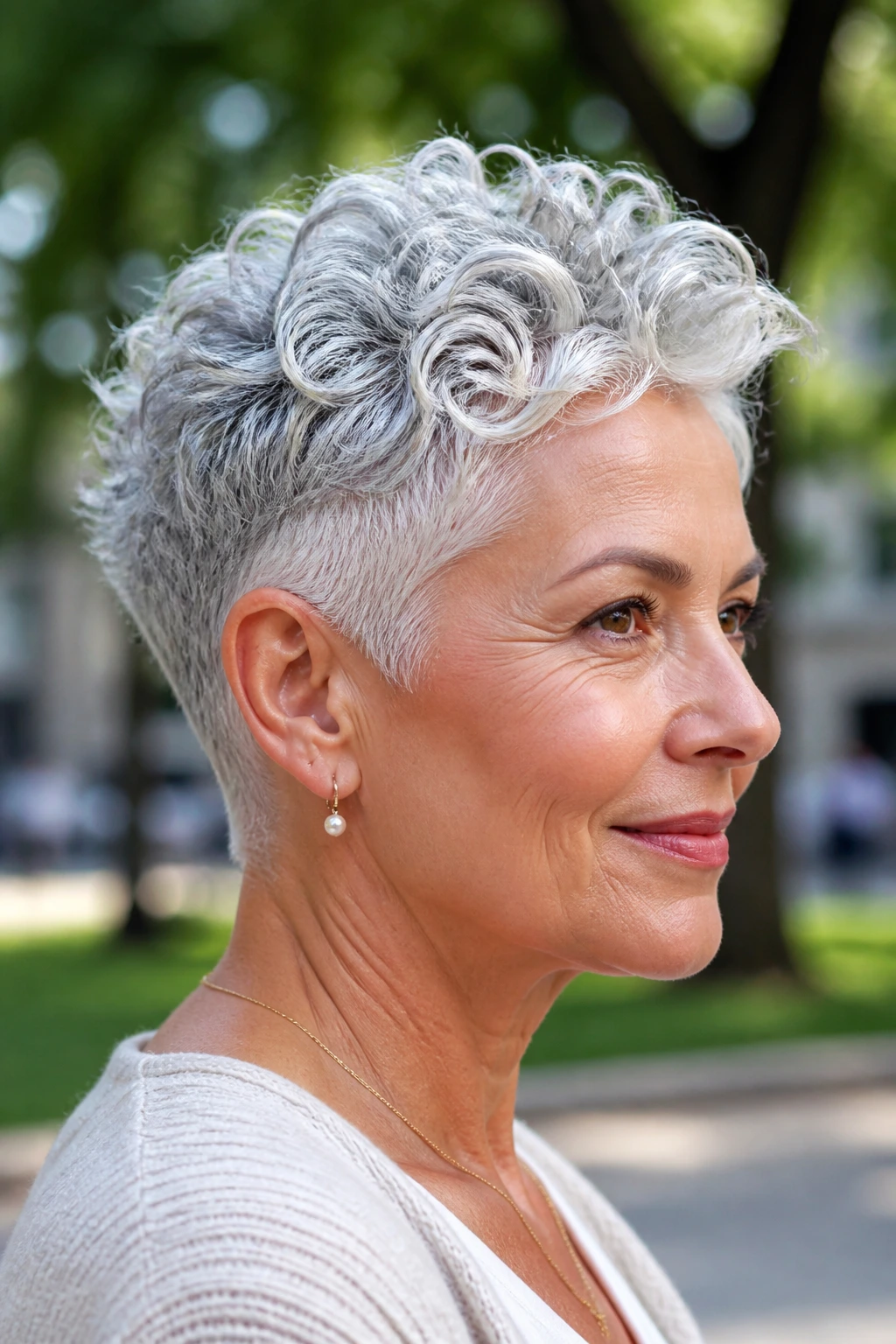
3. Tapered Silver Crop
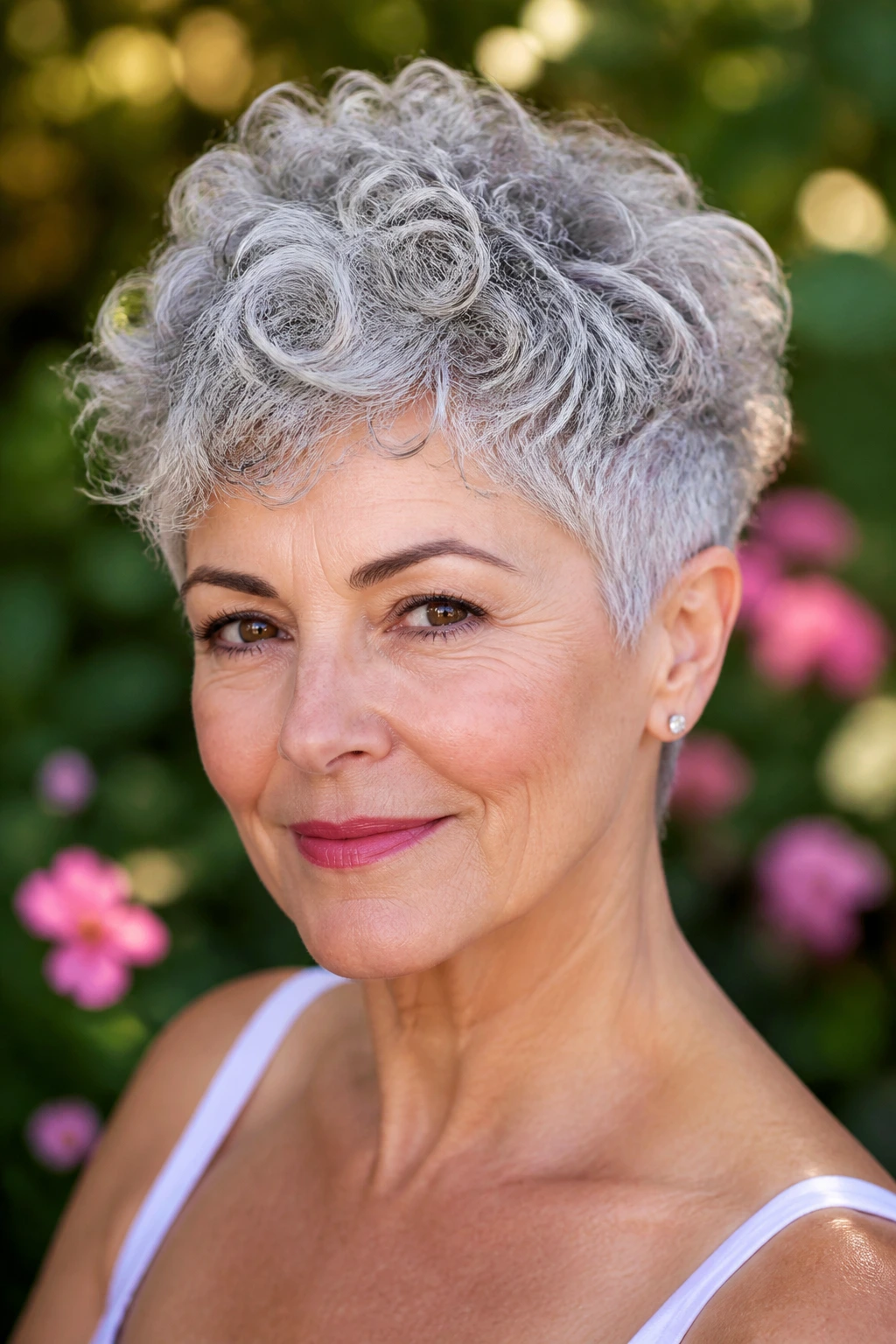
Short gray curls can look expensive in the best sense of the word when the taper is clean. The crop keeps the sides and nape neat while leaving enough length on top for a bend, a wave, or a tight little spiral if that’s your pattern. It’s a sharp, confident shape, and it gets rid of the extra bulk that can make short curls feel bulky instead of chic.
This look is especially useful if your hair feels denser at the crown than at the temples, or if you want less time spent styling. The key is restraint. The top should still have room to curl, and the sides should be tapered enough that the cut follows the head without looking shaved-down to nothing.
Maintenance rhythm: a trim every 4 to 6 weeks keeps the shape from growing out into a fuzzy cap.
Styling trick: use a pea-sized amount of curl cream, then a touch of gel right at the roots for lift. Blow-dry with a diffuser pointed upward to keep the crown from collapsing.
It’s a small cut, but it does a lot of work.
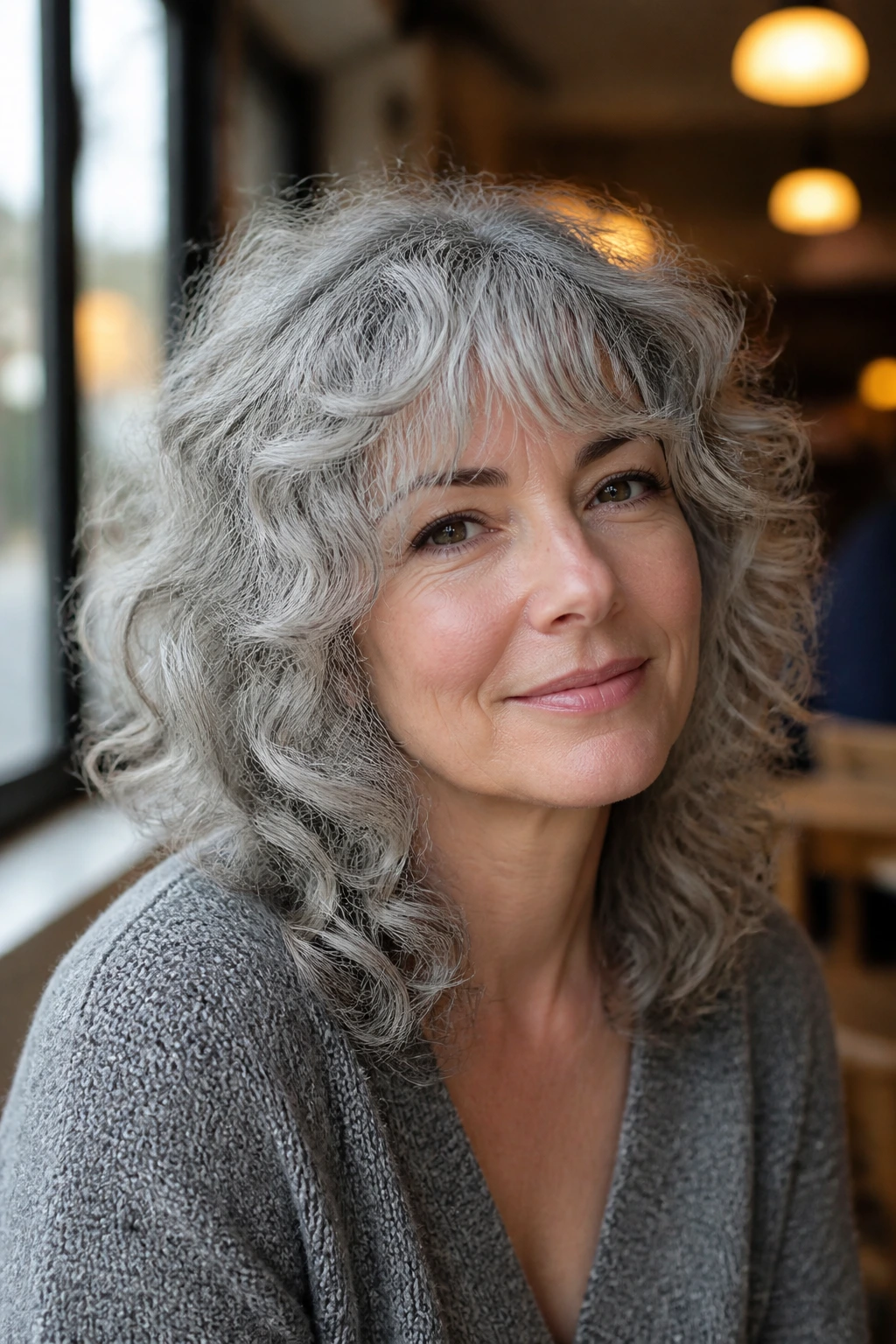
4. Curly Shag with Feathered Bangs
The shag survives because it lets curls do what they already want to do: spring, bend, and land somewhere interesting. On gray hair, the shag can look especially good because the silver streaks catch the broken-up layers and make the whole cut read as textured rather than messy. That’s a useful distinction. A big one, actually.
Feathered bangs are the part that can make or break this look. They should graze the brow or sit just above the eyes when dry, because curly bangs bounce upward more than most people expect. If they’re cut too short, they can end up floating over the forehead in a way that feels accidental. If they’re too long, they lose the point and just become another face-framing piece.
Bangs that stay curly
Keep the bang section a little longer than you think at the salon, then dry them the way you actually wear them. Curly bangs need their own product plan too — a lighter cream or a small bit of mousse is usually enough.
This cut suits women who want motion around the face and don’t mind a little piecey texture. It’s not stiff. Good. It should look a little lived-in.
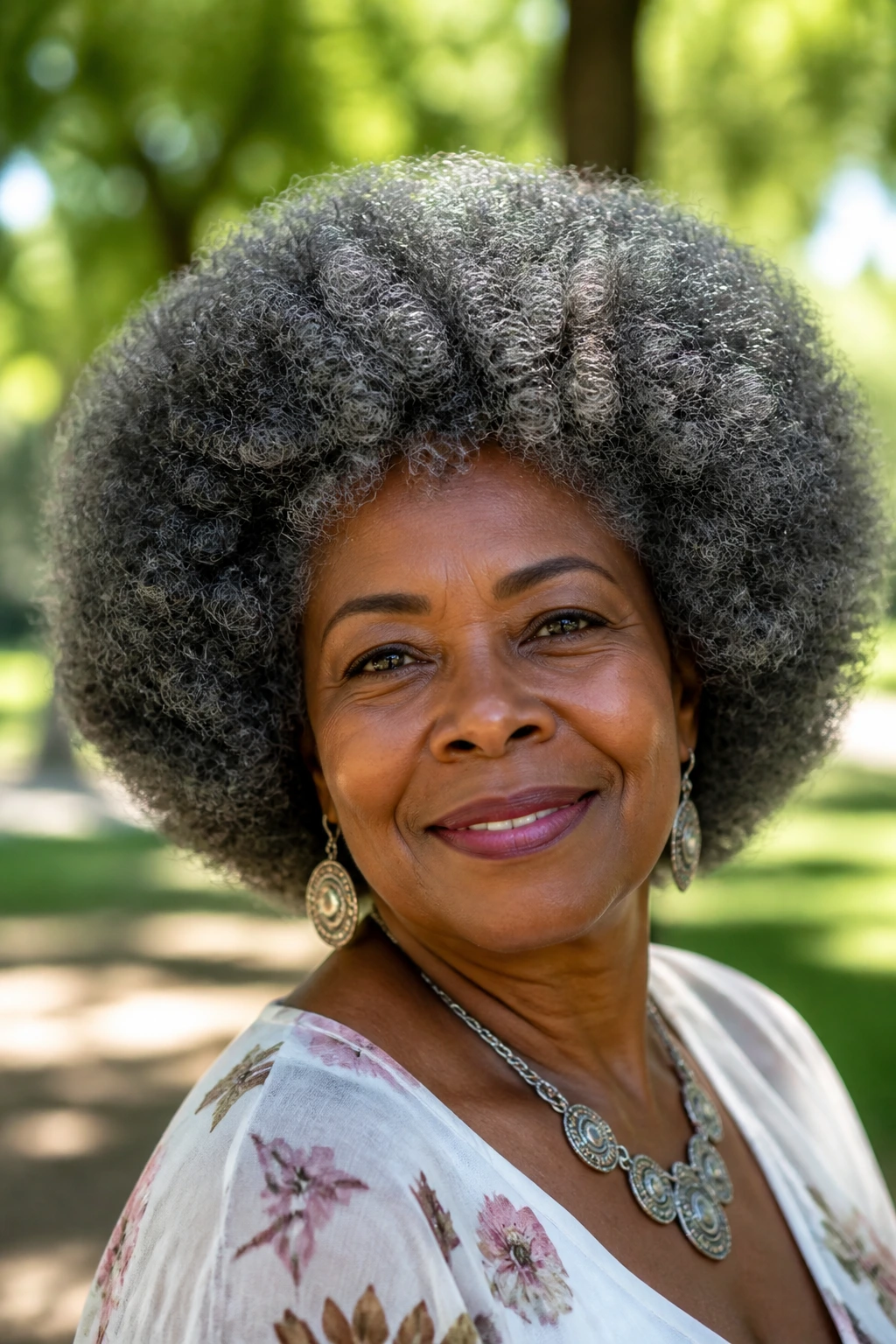
5. Rounded Natural Afro
A rounded afro on gray or white coils is pure shape. No tricks. No fake softness. The silhouette follows the head, lifts away from the cheeks, and gives the hair a sculpted presence that can be quietly stunning when the edge is even and the crown has height.
The big mistake here is trying to tame it into a narrower outline with too much heat or too much combing. The better approach is regular shaping, moisture, and a gentle pick at the roots once the hair is dry. That’s where the volume comes from. Not from fluffing the ends until they fray.
This look is especially strong if your coils have a springy, healthy pattern and you want the silver to show from every angle. White and pewter coils can look almost luminous under daylight because the shape itself becomes the feature. The cut doesn’t need to hide the texture. It needs to honor it.
If your hair dries out fast, keep the ends sealed with a light cream or butter, but don’t load the scalp. That’s how the shape stays round instead of lumpy.
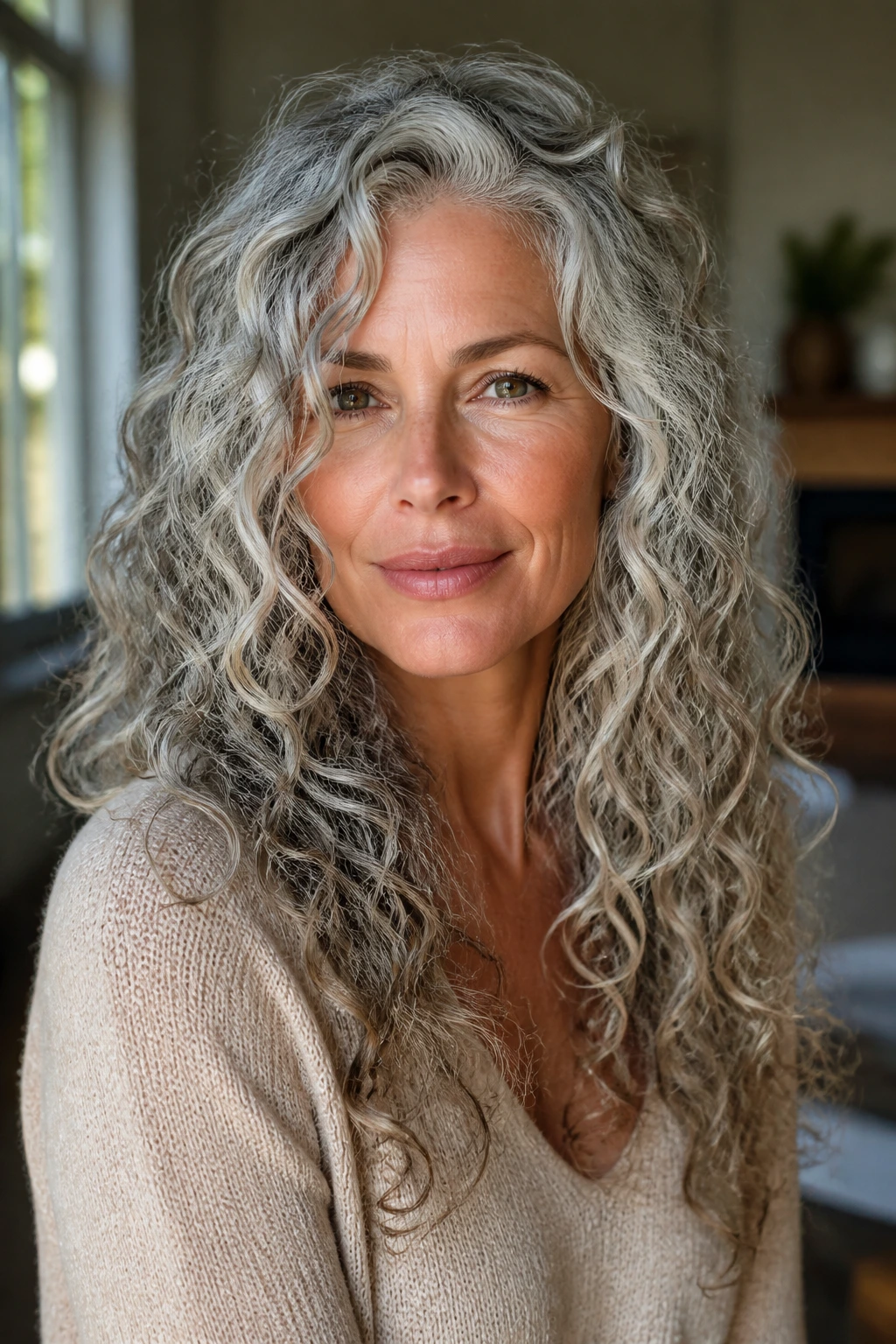
6. Long Silver Ringlets with Internal Layers
Long gray curls are not a lazy option. They ask for more care than people admit. Still, when the ends are healthy and the layers are placed inside the shape rather than hacked into it, long silver ringlets can look elegant in a way shorter cuts cannot.
The secret is weight distribution. If all the length sits on the bottom, the hair can turn into a triangle or drag at the roots. Internal layers remove some of that weight while keeping the outline long and fluid. The visible length stays there. The bulk gets smarter.
A diffuser on low heat helps here, but so does patience. Let the curls set before touching them. Too much fussing ruins ringlets faster than humidity does. And if the ends feel rough, trim them before they start splitting upward. Long gray hair shows damage faster than dark hair does, which is annoying, but also useful. It tells on itself early.
This is the look for someone who wants movement, length, and a little drama without turning to hot tools every morning.
7. Asymmetrical Curly Bob
An asymmetrical bob gives gray curls a little edge without screaming for attention. The difference between sides should stay subtle — maybe an inch, maybe a bit more if the curl pattern allows it. That small shift is enough to wake the cut up. It keeps the eye moving.
This is especially good if one side of your hair naturally drops flatter than the other, or if your face looks better with a side sweep than with perfect symmetry. The longer side can skim the jaw, while the shorter side opens the neck and lifts the cheekbone. Tiny changes. Big payoff.
The shape needs discipline. If the asymmetry gets too dramatic, curly hair can start looking lopsided after a day or two, and that’s not the same thing as stylish. Keep the difference visible enough to notice in profile, but not so sharp that you have to fight it every time you wash.
It’s a good cut for women who want a little personality in the silhouette and do not want to commit to something severe.
8. Pixie with a Curly Crown
A pixie on gray curls is strongest when the top keeps enough length for a real curl bend. The sides and nape stay short, even close, but the crown needs room to rise. Without that, the cut can look flat or too clipped. With it, the whole style looks lively and clean at the same time.
This is a smart choice if you want to show off earrings, a neckline, or a strong pair of glasses. It also gets rid of the weight that can pull fine gray curls down. A little lift at the roots goes a long way here. The top should not sit like a cap. It should move.
Pro move: scrunch in a mousse at the roots, then use a diffuser with the head tipped forward for a minute or two. Finish by lifting the top with your fingers, not a brush.
It does need upkeep. Pixies grow out fast, and the shape gets vague once the nape starts puffing. If you like the look, stay on a 4- to 5-week trim cycle.
9. Shoulder-Length Lob with a Side Sweep
A side part is the easiest way to wake up silver curls that have gone a little sleepy. On a shoulder-length lob, the sweep creates lift at the front and a soft cascade through the rest of the hair. It’s one of those cuts that seems plain until you put it on a real head, then the whole thing changes.
This works well if one side of your curl pattern tends to lie flatter, or if you wear glasses and want the front pieces to sit away from the frames. The shoulder length keeps enough weight for the curls to hang properly, while the side sweep stops the top from looking too centered or too neat.
Try clipping the roots at the part while the hair cools after diffusing. That little bit of root memory helps the lift last longer. And keep the face-framing layers below the cheekbone so the sweep feels soft instead of heavy.
It’s a good answer for anyone who wants movement, softness, and a little easy polish without having to cut hair all the way short.
10. Wolf Cut for Gray Curls

The wolf cut gets a bad reputation when people think only of the version done on straight hair. On curls, the right version is softer and much more controlled. It borrows the airy layers of a shag, keeps some mullet energy in the back, and leaves enough perimeter weight that the ends do not fray into fuzz.
Gray curls take to this shape well because the broken-up layers show off the silver variation. White ends, salt-and-pepper roots, and brighter streaks all get a little more dimension here. But the cut has to be tailored carefully. Too much razoring, and the ends turn wispy in a way that makes mature curls look tired instead of edgy.
Ask for soft, connected layers. Not choppy ones. The back should still hold its shape when dry. If you want drama, you can get it from the crown lift and the face framing, not from shredding the bottom.
This one is for women who like a little movement and do not mind a style that looks a touch undone on purpose.
11. Halo Cut with a Lifted Crown
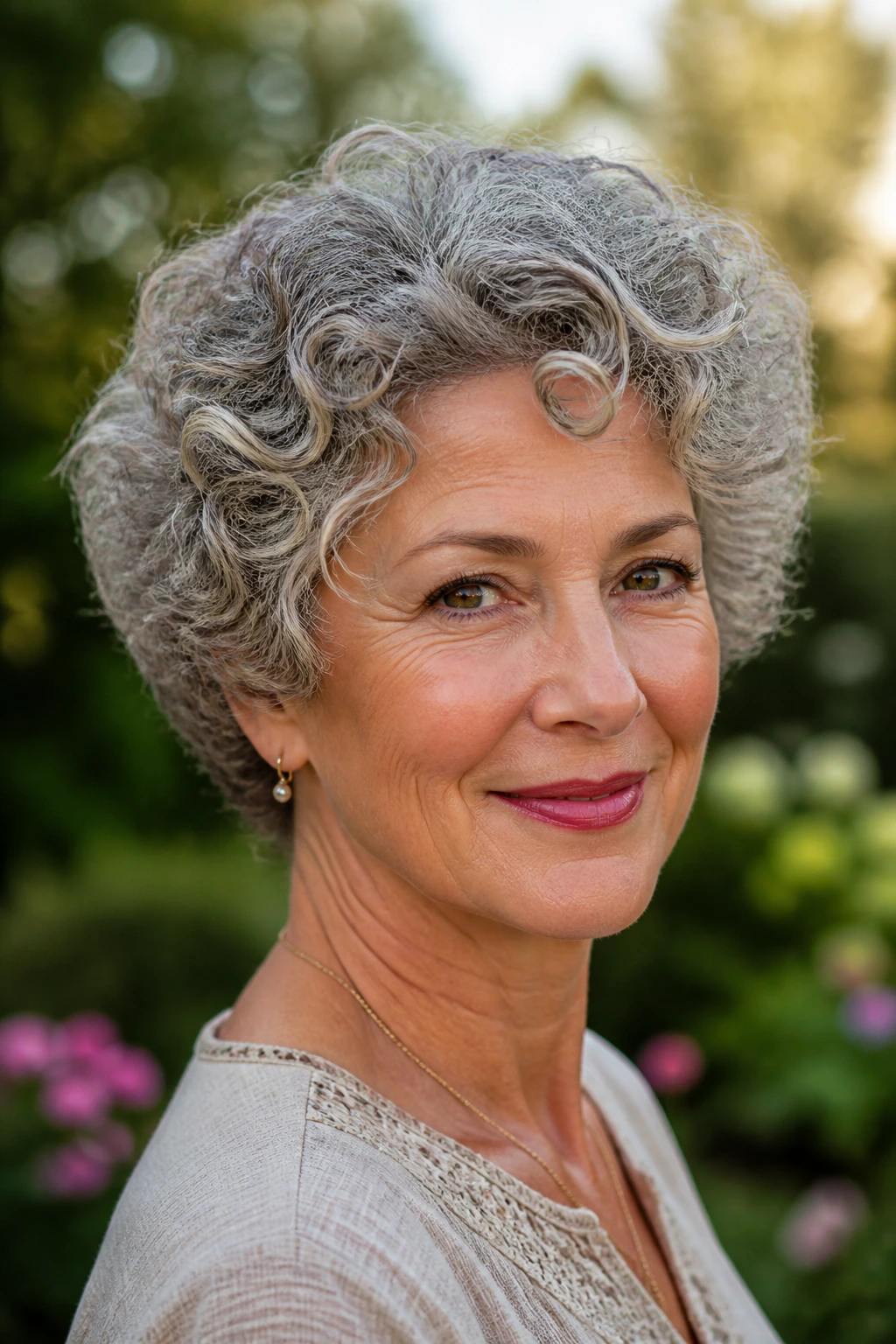
A halo cut wraps the hair around the head in a rounded shape and keeps the volume balanced instead of exploding at the sides. On gray curls, that matters because silver shows silhouette as much as texture. If the outline is clean, the whole style feels intentional even when the curls are loose.
The lifted crown gives the cut a little air. Without it, the style can settle too close to the scalp and lose the shape that makes curly hair interesting in the first place. A good halo cut is especially kind to women with narrower faces or strong cheekbones, because it frames the features without crowding them.
Why it works
The cut follows the head, which means less fight on windy days and less fuss with styling products. You still need moisture and some hold, but not an elaborate routine.
A halo shape also keeps the neckline neat. That sounds small. It isn’t. A clean neckline makes gray curls look polished from behind, and most people forget to check that angle until it’s too late.
12. Jaw-Length French Bob
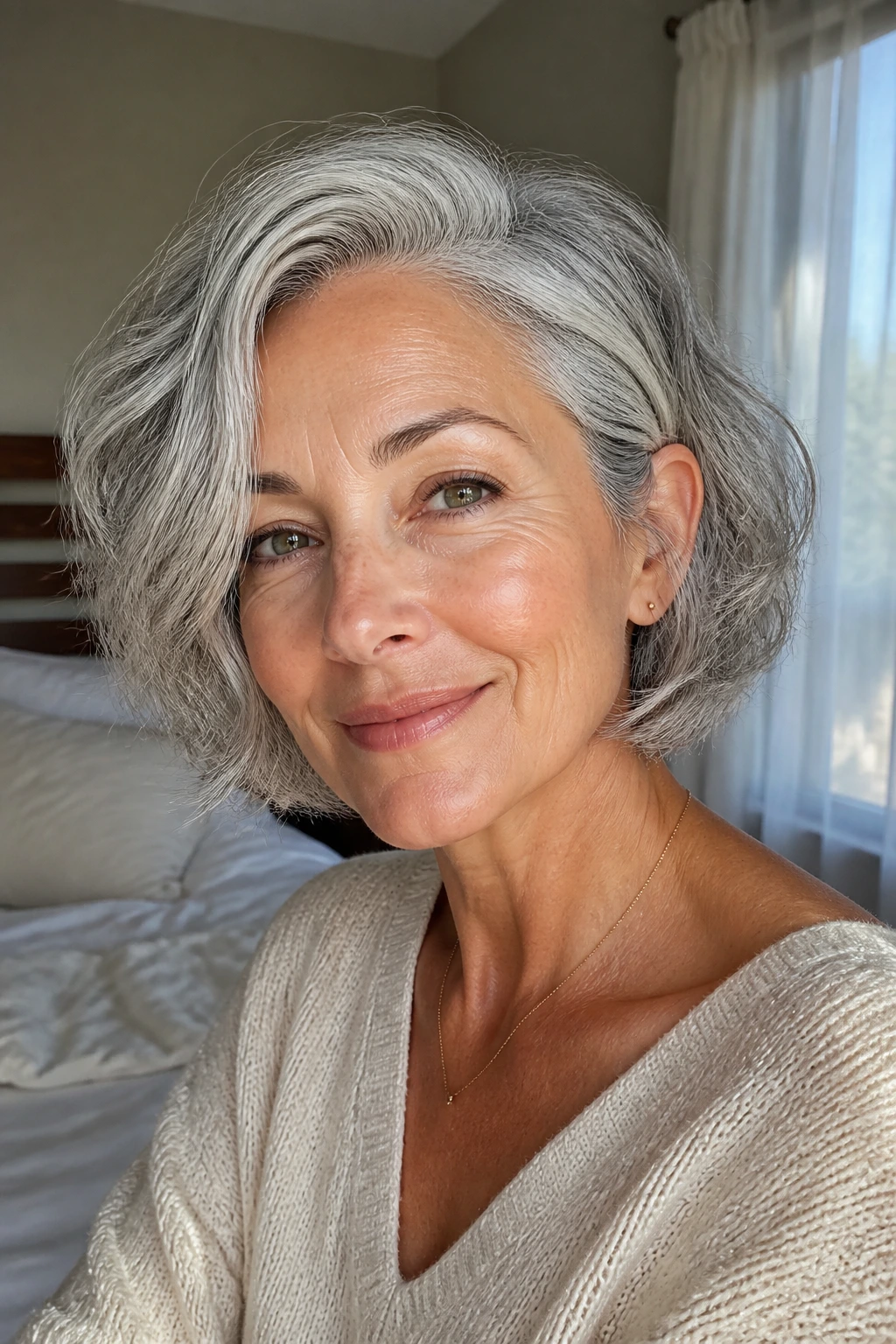
On curly gray hair, a French bob should be read as jaw-length, soft-lined, and a little mischievous. It’s not a hard line. It’s a shape with attitude. The curls sit close enough to the face to feel chic, but not so close that they clamp down on the jaw.
If your curls are loose or your wave pattern is stronger than your curl pattern, this one can be gorgeous. Tight curls can wear it too, but the length needs to be left a little longer at the cutting stage because shrinkage will pull it up fast. I would rather see a French bob land at the jawline than accidentally become a chin puff.
The best version keeps the front pieces just long enough to tuck behind one ear. That little asymmetry keeps the look from going too neat. A deep side part also helps.
It’s one of the sharper, more face-framing looks in this set. Good if you want silver curls that feel crisp, not romantic.
13. Spiral Layers with Curtain Bangs
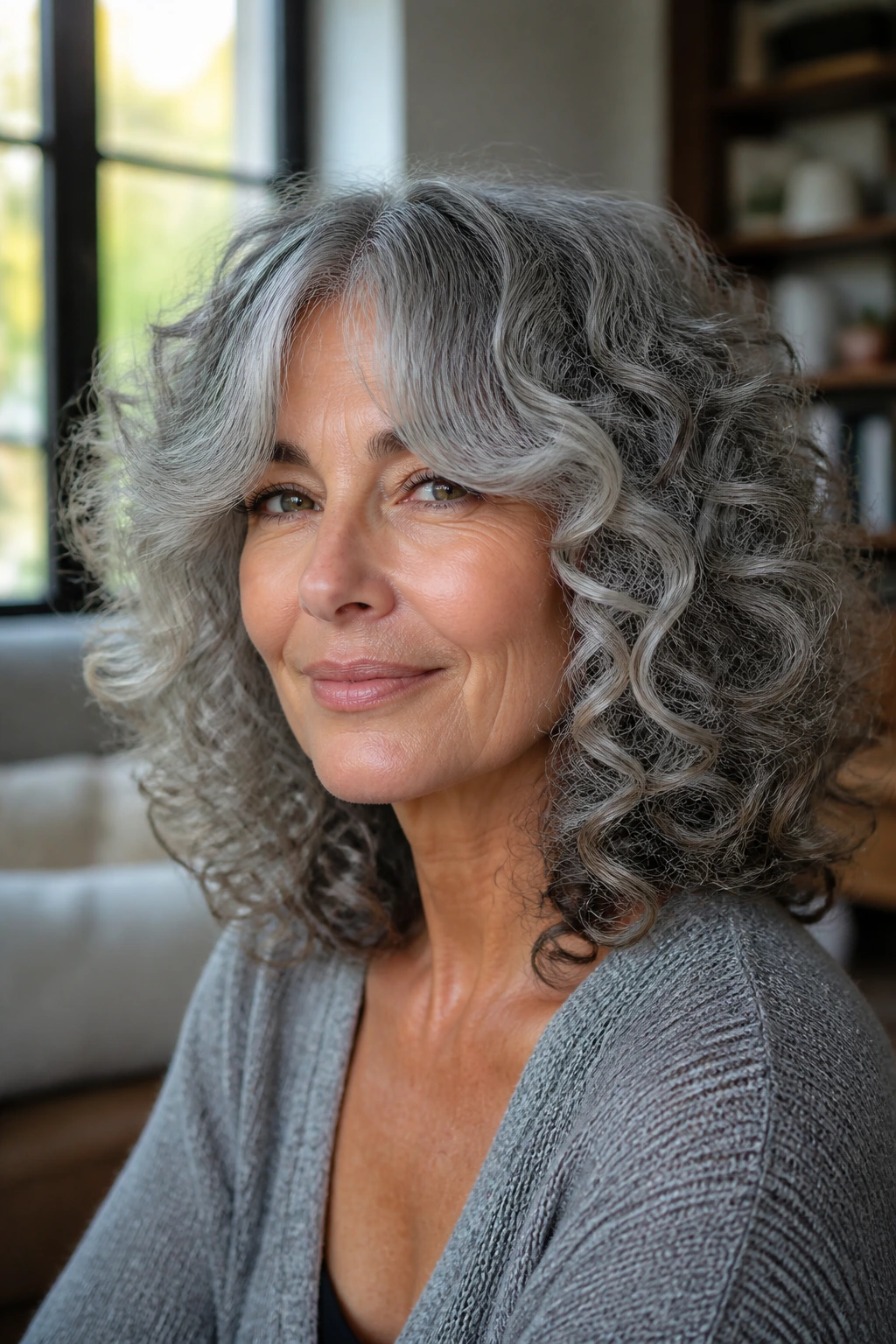
Curtain bangs on gray curls can be a lovely thing when they are cut for the curl, not for the fantasy of straight hair. The bangs split away from the forehead and fall like two soft wings, which gives the face shape and breaks up a long line across the top. It’s flattering without feeling busy.
The layers should start high enough to support the bangs, but not so high that the whole head loses weight. That balance is hard to get right on the first try, which is why I like this best with a stylist who actually cuts curls often. Curtain bangs need their own product plan, too. A light cream or foam works better than a heavy butter, because the fringe can get stringy fast.
This look is especially good if you want to soften forehead lines or bring more attention to the eyes. It’s also one of the easiest ways to make gray curls feel modern without going short.
A small tip: separate the fringe with fingers while it’s still damp, then leave it alone. The more you touch it, the less graceful it gets.
14. Tapered Nape Cut
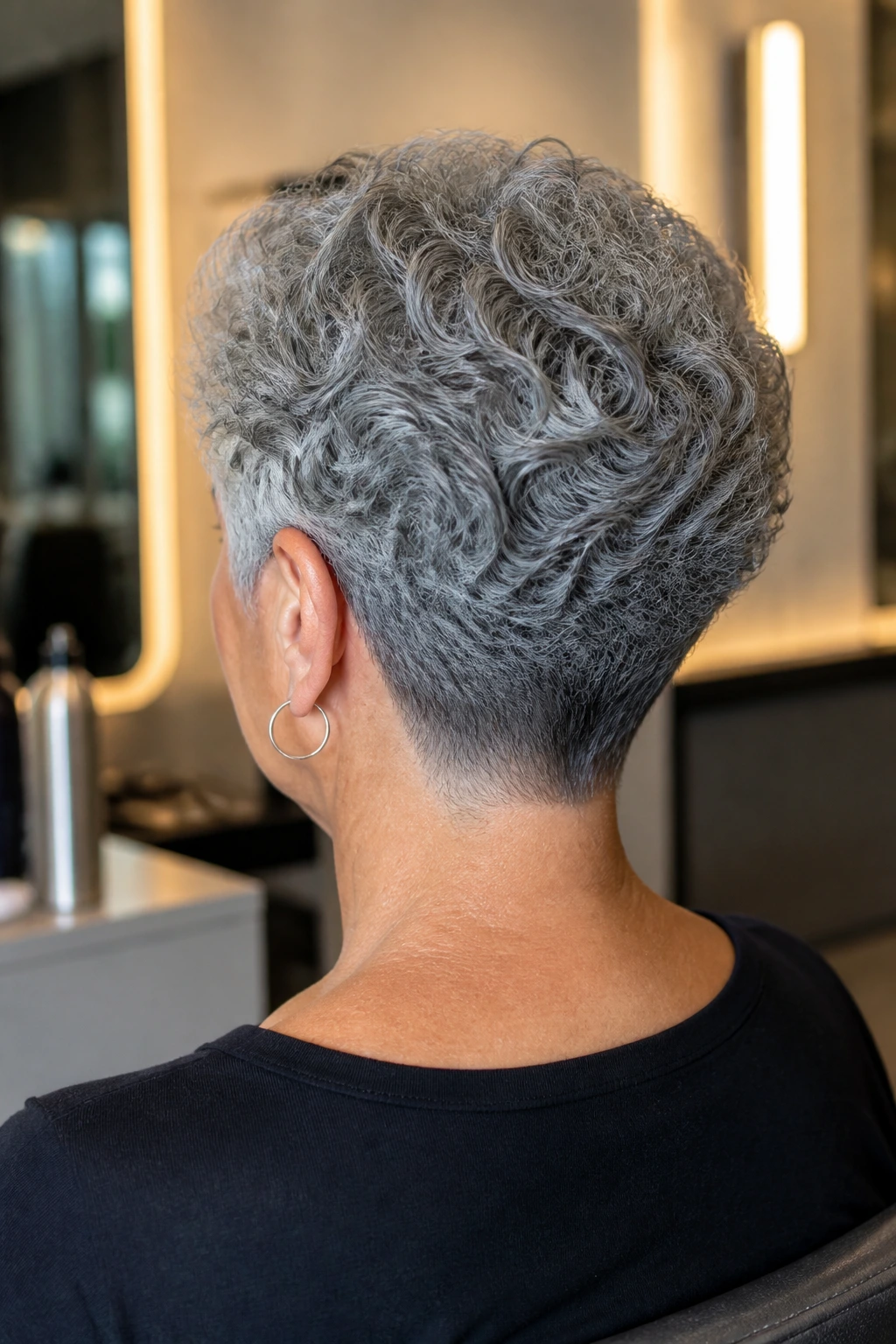
A tapered nape cut solves a problem that a lot of women quietly live with: too much bulk at the collar. Gray curls can swell around the neck and puff under jackets, which makes the whole style feel larger than the face. Tapering the nape pulls that weight down and lets the top stay full.
This shape is neat from the back, which is one reason I like it so much. People spend all their time looking in the mirror head-on. The back is where many cuts fail. Here, the neckline stays clean, and the curls above it still have lift.
It suits active lifestyles, hot weather, and anyone who wants to avoid a fuzzy neck halo at the end of the day. It also looks good with silver because the contrast between the neat nape and the curly crown is easy to see.
If your hair is dense, ask for internal debulking, not aggressive thinning. You want the nape to lie closer to the head without losing the body that makes curls look full.
15. U-Shaped Mid-Length Cut
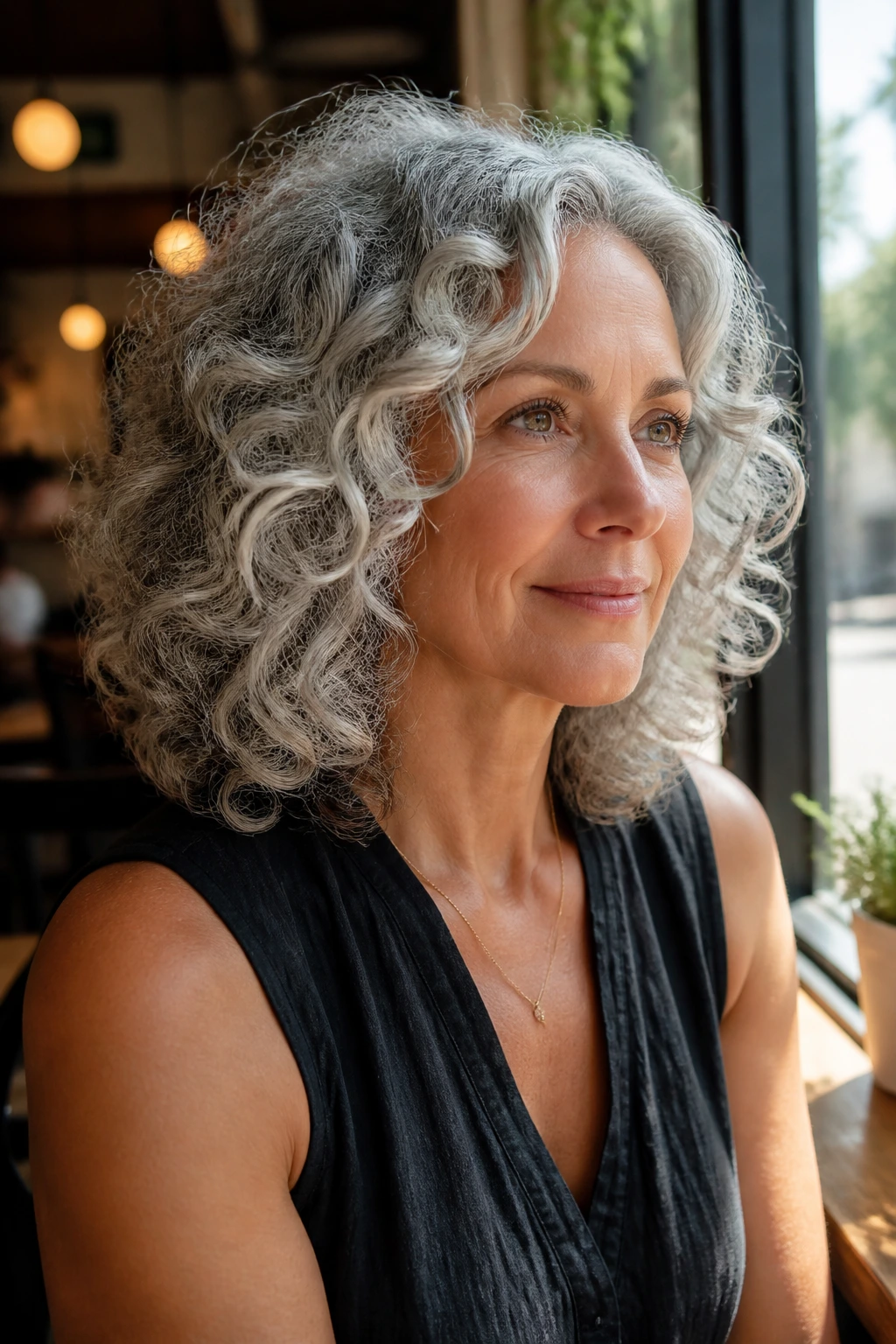
A U-shaped cut keeps the back a little longer than the sides, which stops the profile from looking square. That matters on curly gray hair because the curl pattern already has volume. A straight-across hem can make the silhouette feel stiff. The U shape keeps the movement soft and the length useful.
This is a good compromise if you like tying your hair back sometimes or if you are growing out shorter layers. The front pieces can sit around the cheekbone or jaw, while the back gives you enough length for a low ponytail, a claw clip, or a loose twist. It’s practical without looking plain.
Best of all, the shape tends to grow out gracefully. That matters more than people admit. A cut that looks good on day one and day sixty is a better cut than the dramatic one that only behaves for two weeks.
If your curls are fine, keep the layers minimal. If they’re dense, internal shaping helps the whole thing fall better. Either way, the U outline gives the hair room to move.
16. Soft Undercut with Volume
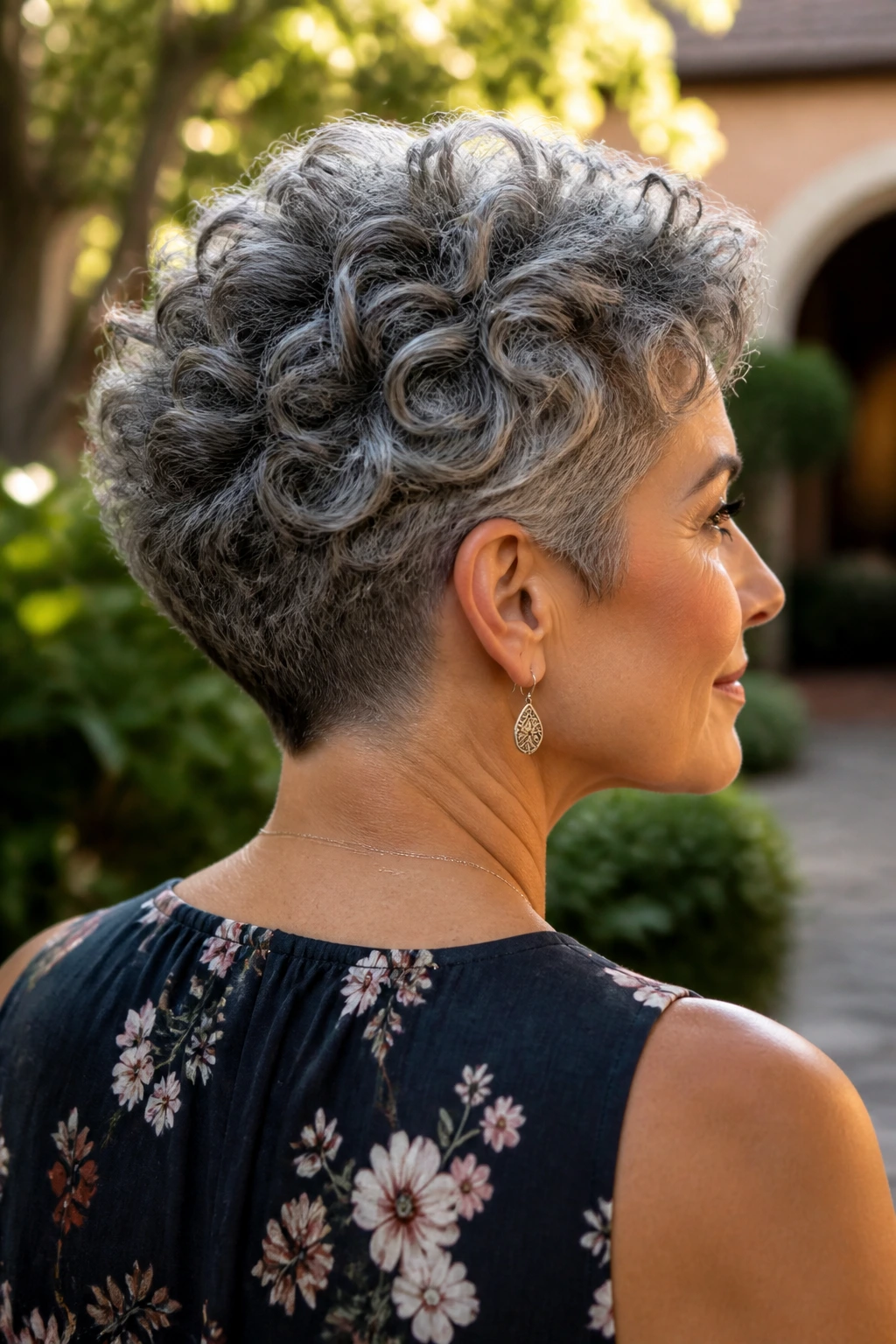
A soft undercut can be a lifesaver for dense gray curls. The hidden layer underneath removes weight where it builds up most — at the nape, behind the ears, and sometimes under the crown — without shaving away the visible top. The result is less bulk, better lift, and a shape that stops feeling hot and heavy.
This is not a dramatic undercut unless you want it to be. In the best version, the top layer still covers the shorter section completely. You just feel the difference when you put the hair up or when the wind catches it. The shape sits closer to the head and moves more easily.
Where the weight comes off
Ask your stylist to remove bulk from the underside only where the hair truly swells. That keeps the surface curls intact and prevents the ends from looking choppy.
It’s a smart option if your hair puffs at the base but you still want visible length or a full crown. A lot of women over 50 need exactly that combination and do not realize it.
17. Deep Side-Part Cascade
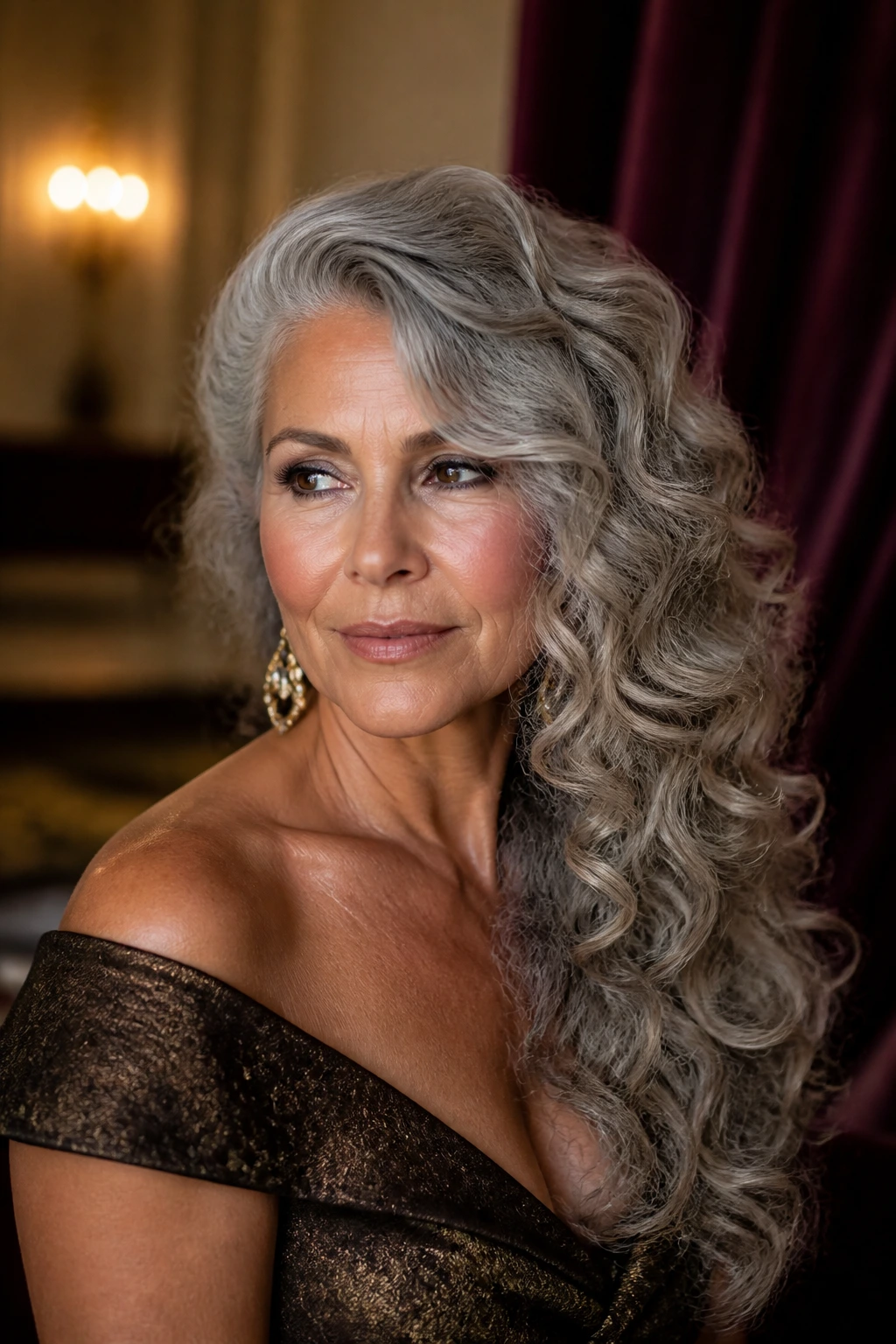
A deep side-part cascade is the most glamorous option in this group, and it earns the name because the curls sweep over one side in a long, soft fall. The part creates lift at the root, which is useful when the crown has lost a little density. The cascade gives the silver strands a stage instead of a wall.
This look can be worn on medium or long hair, but it gets special help from layered front pieces that start below the cheekbone. That keeps the sweep from dropping into your eyes or sticking flat to the face. A root clip or a large Velcro roller at the part can make the crown stay lifted longer after drying.
It’s especially pretty for evening wear, though I’d never save it only for that. A deep side part can make a plain day cut feel deliberate with almost no extra effort. That’s a useful trick when you want polish but not a lot of fuss.
If one side of your hair always behaves better than the other, this is the cut that turns that into a feature.
Why Gray Curls Need a Different Shape Map
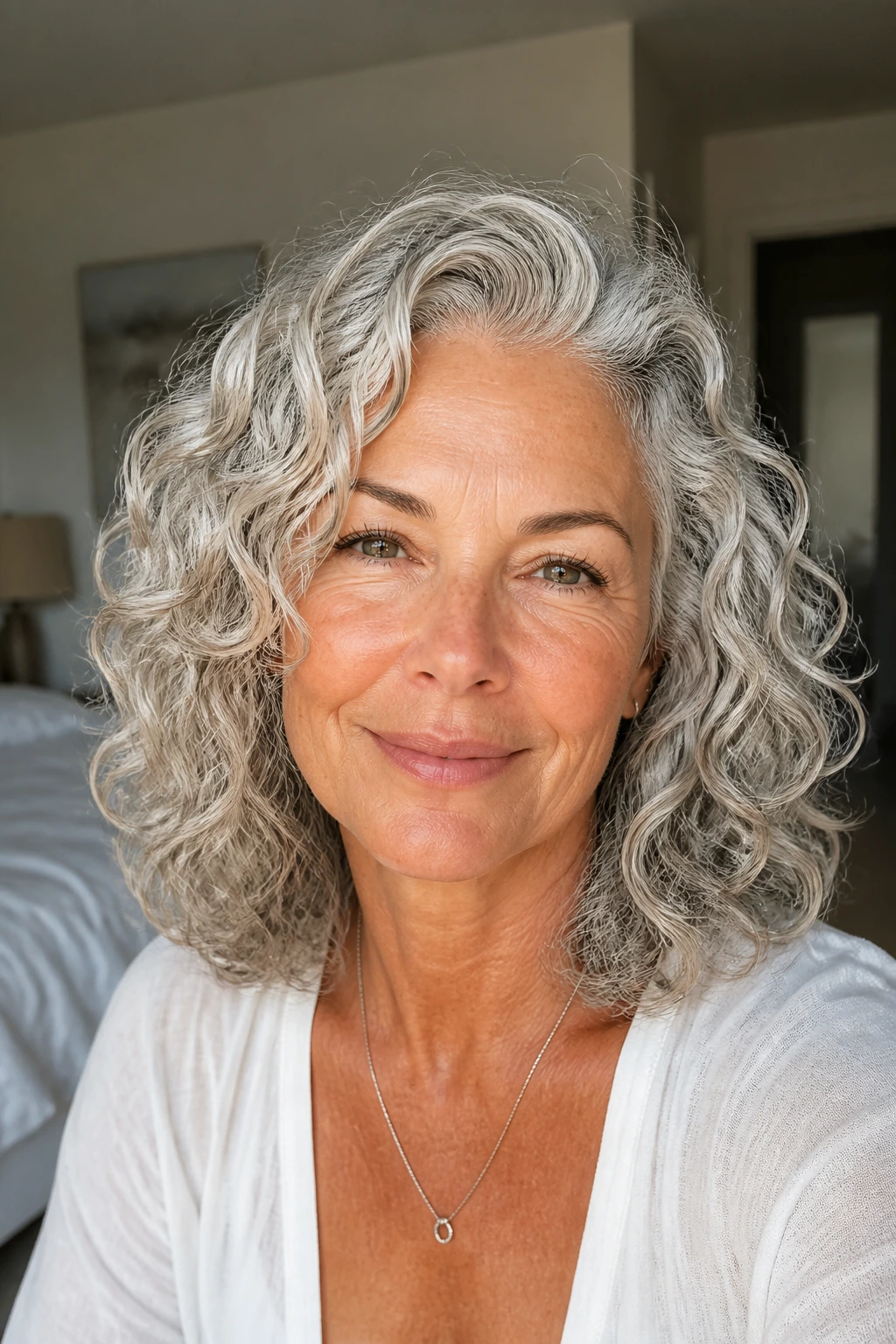
Gray and silver hair are not just darker hair with the pigment removed. The texture often changes too. Many women notice a coarser feel, a little dryness, and curl patterns that seem less predictable than they were before. That combination changes the way a cut behaves.
The other issue is shrinkage. Curly hair can look one length when wet and something very different once it dries. On gray hair, the mismatch shows even more because the lighter strands reflect every edge. A cut that is slightly too blunt or too thin may look crisp for about ten minutes, then it starts broadcasting every mistake.
There is also the density question. Some heads lose fullness at the temples or crown; others keep a lot of width at the sides. The right gray curly haircut doesn’t pretend those changes aren’t there. It uses layers, tapering, and directional shaping to balance them out. That’s why a good cut can make silver curls look fuller without making them fluffy.
Essential Tools for These Looks

-
Curl-friendly shampoo and conditioner: Choose formulas that clean without stripping the hair into a squeak; gray curls need moisture more than they need harsh detergent.
-
Leave-in conditioner: A small amount helps silver curls stay soft, especially if the hair feels wiry or rough at the ends.
-
Light mousse or foam: This gives lift without weighing down fine curls or short crops.
-
Curl cream or gel: Use one or the other, or layer them lightly, depending on how much hold your pattern needs.
-
Microfiber towel or cotton T-shirt: This cuts down friction and helps keep the curl clumps intact while the hair dries.
-
Wide-tooth comb or detangling brush: Best for wet hair and gentle sectioning; do not drag it through dry curls.
-
Diffuser attachment: Essential if you want shape and root lift without blasting the curl pattern apart.
-
Duckbill clips or root clips: Handy for lifting the part or the crown while the hair cools.
-
Tail comb or pick: Useful for clean parts, root lift, and shaping short styles without flattening them.
-
Satin pillowcase or bonnet: Not glamorous, but it keeps curls from turning into a frizz nest overnight.
Smart Product and Salon Choices
Gray curly hair is picky in a way that rewards careful shopping. The salon cut matters first. Look for a stylist who talks about curl pattern, density, and shrinkage without guessing. If they insist on cutting everything wet and even, that’s not a style choice — it’s a warning.
Bring photos of real hair that looks like yours. Not celebrity hair. Real hair. Same curl size, same density, same length. That makes the conversation ten times easier because the shape is visible and the texture is honest. If you wear glasses, say so. If you hate hair brushing your neck, say that too. Silly as it sounds, those details change the cut.
For products, keep the list short. Gray curls usually do better with one cleansing shampoo, one moisturizing conditioner, one leave-in, and one styling product with hold. Fine hair wants lighter formulas. Dense hair can handle a little more cream. If the hair feels coated or dull, cut back on butter-heavy products and use a clarifying shampoo every 2 to 4 weeks, especially in hard-water areas.
Purple shampoo is useful, but not as a daily habit. Use it when the silver looks yellow or dingy, not because someone on the internet told you it was mandatory. Too much can leave gray hair flat or slightly violet at the ends, and nobody needs that surprise.
How to Wear These Styles Without Fighting Your Texture
At the salon: come in wearing the hair the way you actually wear it. If you normally air-dry, do not blow it straight first. The cut needs to meet the real pattern, not a temporary one. If your curls collapse by the end of the day, say that. If the crown goes flat while the sides puff, say that too. The small details matter.
On wash day: apply product to soaking-wet hair, not damp hair that is already starting to frizz. Scrunch upward, then let the curls set before you touch them again. A diffuser on low heat and low airflow keeps the shape intact without roughing up the silver surface.
On refresh days: mist the hair lightly with water or a water-and-leave-in mix, then reshape the front pieces with your fingers. You do not need to soak the whole head every time. Usually the crown, the ends, and the face frame need the most help.
When you want more polish: tuck one side behind the ear, clip the crown for ten minutes, or smooth a tiny bit of serum only on the outer layer. That gives the style a finished look without killing the curl pattern.
Additional Tips and Shape Boosters
Root Lift: If the top goes flat, clip the roots while the hair cools after diffusing. Two or three clips at the crown can change the whole silhouette.
Frizz Control: Use a leave-in and a gel together only if your hair can handle the extra hold. Fine gray curls often look better with one light styler than with a heavy cocktail of products.
Color Brightening: If the silver reads dull, a clarifying wash can bring back shine before you reach for purple shampoo. Hard water and product film make gray hair look tired faster than age ever does.
Face-Framing Trick: Keep the front pieces a little longer than the rest when you want softness around the cheeks or jaw. That small difference keeps the style from looking too severe.
Make-It-Yours: If you wear glasses, lift the front away from the frames. If you like earrings, choose a shorter or more tapered shape. If you want more softness, keep the layers rounded instead of jagged.
Common Mistakes That Make Gray Curls Look Wider or Flatter
The biggest mistake is cutting curly gray hair too wet and trusting the mirror too much. Wet curls lie. They stretch, calm down, and make a cut look more balanced than it will be after drying. The fix is simple: dry-cut, curl-by-curl finishing, or at least a stylist who understands how much the pattern springs.
Another problem is over-thinning. Gray hair can already feel dry at the ends, and when the perimeter gets shredded with a razor or aggressive texturizing shears, the result is frizz and a see-through outline. If you need bulk removed, ask for internal shaping, not fuzzy ends.
Purple shampoo is another trap. Used too often, it can leave silver hair flat, chalky, or slightly tinted. Use it only when the tone needs correction, and follow it with conditioner.
Flat crowns are sneaky too. A lot of women spend time fixing the front and forget the top, which is exactly where age-related thinning shows first. Root clips, the right part, and a little lift at the crown matter more than another ounce of cream.
Finally, do not choose a short style that ignores shrinkage. A jaw-length bob can become a cheek-length puff if the curl pattern is tight. Leave room for the curl to live.
Variations and Adaptations to Try
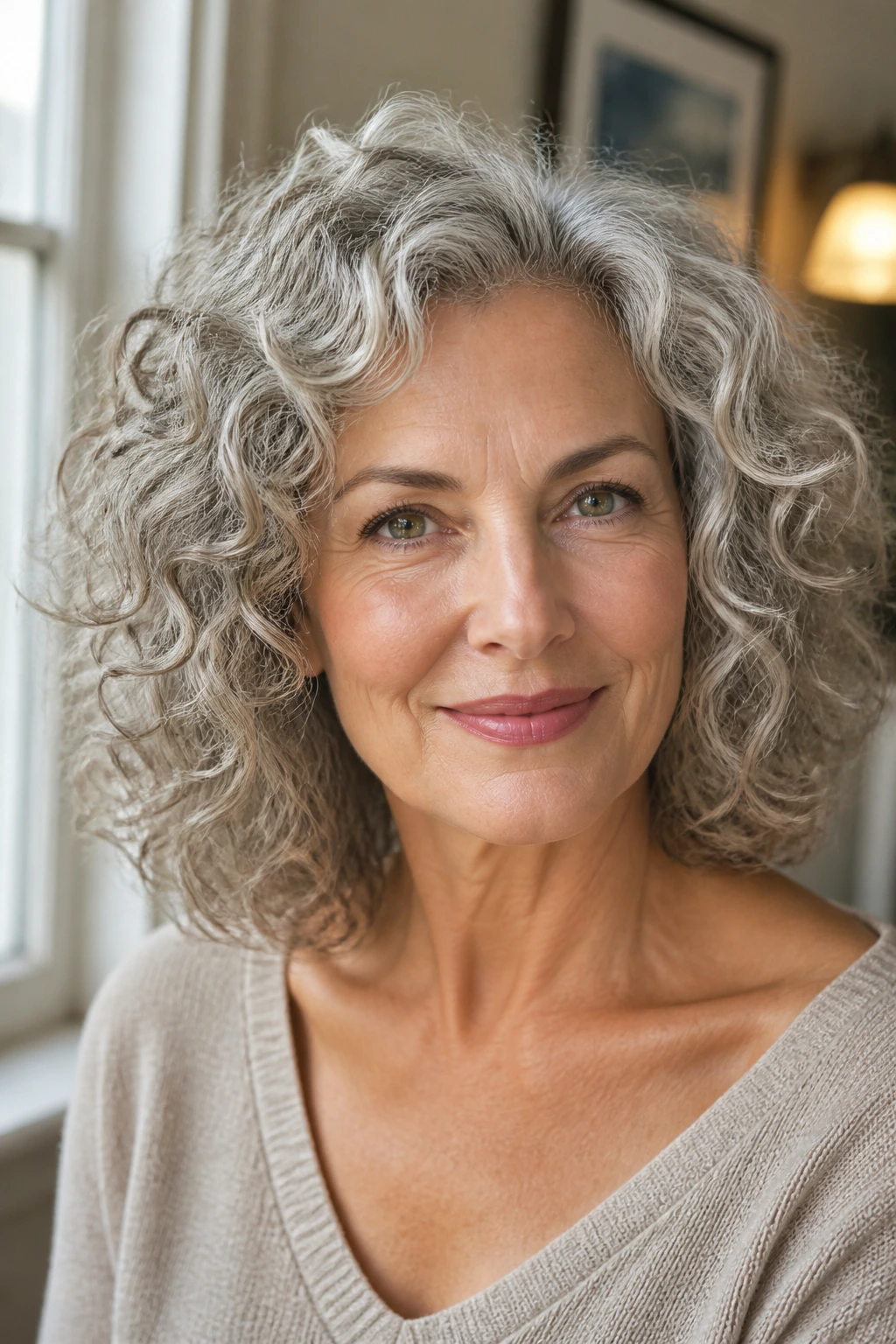
The Fine-Curl Lift: Keep the length around the collarbone or just above it, with minimal layering and a light mousse instead of heavy cream. This version gives the illusion of fullness without dragging the roots down.
The Dense-Coil De-Bulk: Add internal layers or a hidden undercut if the hair feels wide at the sides or heavy at the nape. The goal is to reduce bulk underneath while preserving the visible shape on top.
The Glasses-Friendly Sweep: Choose a side part, longer front pieces, and a cleaner outline around the temples. This keeps the frames visible and stops the hair from sitting on the lenses.
The Grow-Out-Friendly Shag: Ask for soft, connected layers that still look good when they grow an inch or two. This is the smart choice if you do not want to live at the salon.
The Evening Silver Finish: Keep the same cut, then add a little root lift, tuck one side behind the ear, and smooth a small amount of shine serum on the outer layer. It turns a day look into something sharper without changing the haircut.
Keeping the Shape Between Cuts

Short gray curly styles need more frequent trims than most people expect. Pixies and tapered crops usually look best every 4 to 6 weeks. Bobs, lobs, shags, and mid-length layers can often stretch to 8 or 10 weeks if the shape is forgiving and the ends stay healthy.
Wash frequency depends on scalp oil and product load, but many silver curls stay happier when washed every 4 to 7 days instead of daily. If you live in hard-water areas or use heavier creams, clarify every 2 to 4 weeks so the hair does not turn dull and coated. A weekly deep conditioner helps keep the rough gray texture from feeling wiry.
At night, use a satin pillowcase or bonnet. If the curls are long enough, a loose pineapple at the top of the head helps preserve the shape. For shorter cuts, a bonnet or pillowcase is usually enough. In the morning, refresh the crown and the face frame first. Those are the parts people notice fastest.
If the ends start to feel fuzzy or the shape keeps collapsing even with product, book the trim sooner. Gray curls do not need constant fussing, but they do need regular shape maintenance. The cut keeps the style honest.
Questions People Ask Before Cutting Gray Curls Short
Can gray curly hair over 50 go very short without looking harsh?
Yes, if the cut leaves enough softness on top and around the hairline. A tapered crop or curly pixie works well when the crown keeps some length and the sides are not taken too tight.
Should curly gray hair be cut dry or wet?
Dry is usually better because it shows the curl pattern, shrinkage, and density changes. Wet cutting can still work if the stylist knows curly hair, but the final shape should be checked once the hair is dry.
What bang style works best with gray curls?
Curtain bangs and feathered bangs are the safest bets because they can move with the curl. Heavy blunt bangs are harder to manage and can jump upward more than expected.
How often should I trim a curly bob or lob?
Every 8 to 10 weeks is a solid target for most shoulder-length curly styles. If the ends start to fray or the shape loses its outline sooner, go earlier.
Can fine gray curls wear layers?
Yes, but keep them controlled. Too many short layers can make the hair look see-through, while a few longer layers can create lift without stealing density from the ends.
Is purple shampoo worth using on silver curls?
It is, when the silver starts to look yellow or smoky. Use it sparingly, because overuse can make the hair flat or leave a cool cast that looks unnatural in daylight.
How do I stop my curls from flattening at the crown?
Clip the roots while the hair cools, change the part now and then, and avoid applying heavy cream at the scalp. A little mousse at the roots does more for lift than people expect.
What if my curls are thick but the ends are dry?
That usually means you need less stripping shampoo, more moisture on the ends, and a cut that removes bulk from the inside rather than the perimeter. Thick does not always mean healthy all the way through.
A Shape That Lets the Silver Breathe
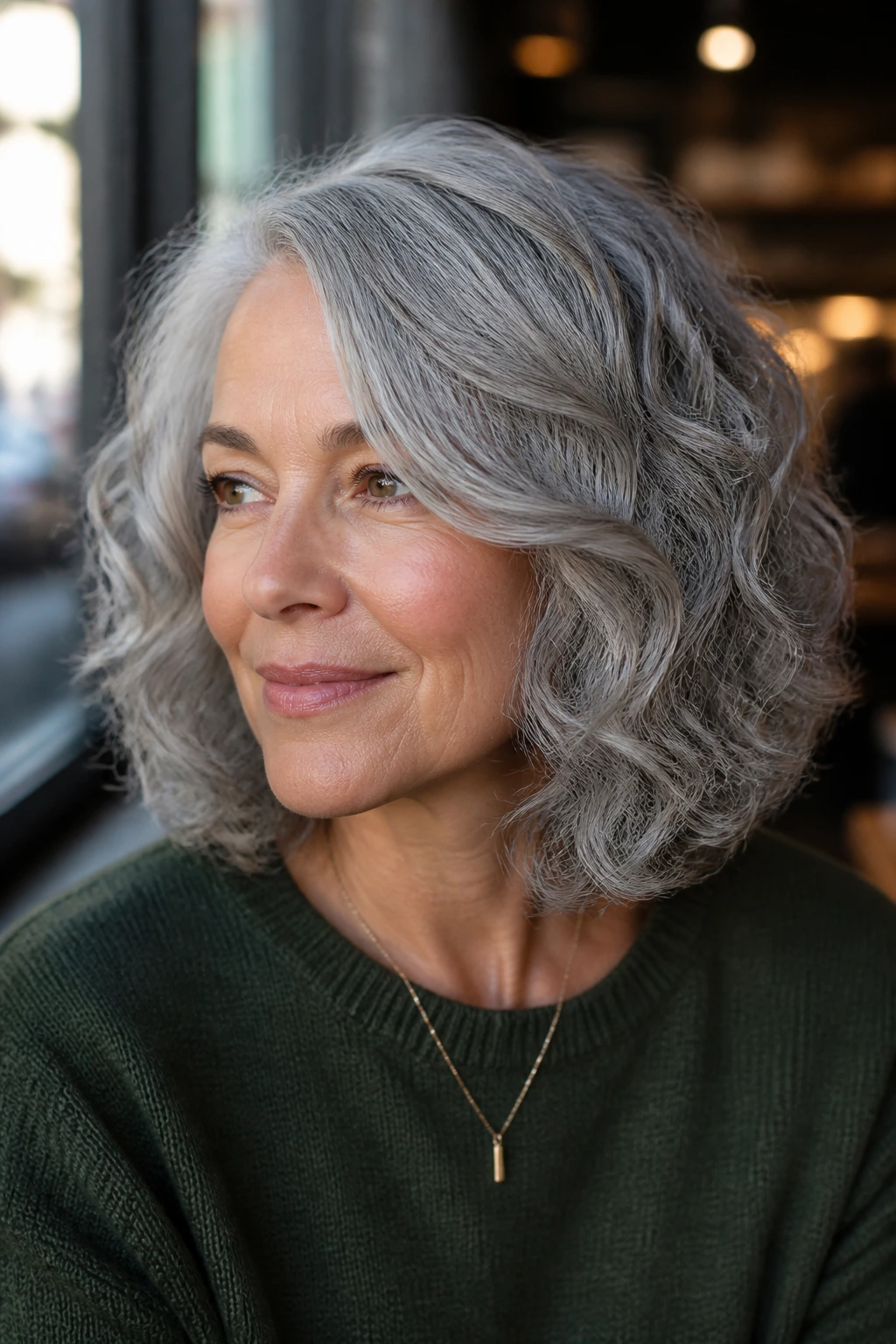
The best gray curly looks after 50 do not hide the hair’s changes. They use them. Shrinkage, shine, density shifts, and silver tone all become part of the style instead of problems to cover up. That’s the real difference between a haircut that feels dated and one that feels lived-in in the best way.
A good cut can make the whole head look lighter, cleaner, and more deliberate in one appointment. Not because it erases age. Because it respects the hair you actually have.
Pick the silhouette that fits your curl pattern, your neck, your glasses, your mornings, and the amount of effort you’re willing to give it. When those pieces line up, gray curls stop feeling like something to manage and start looking like something you meant to wear all along.
