



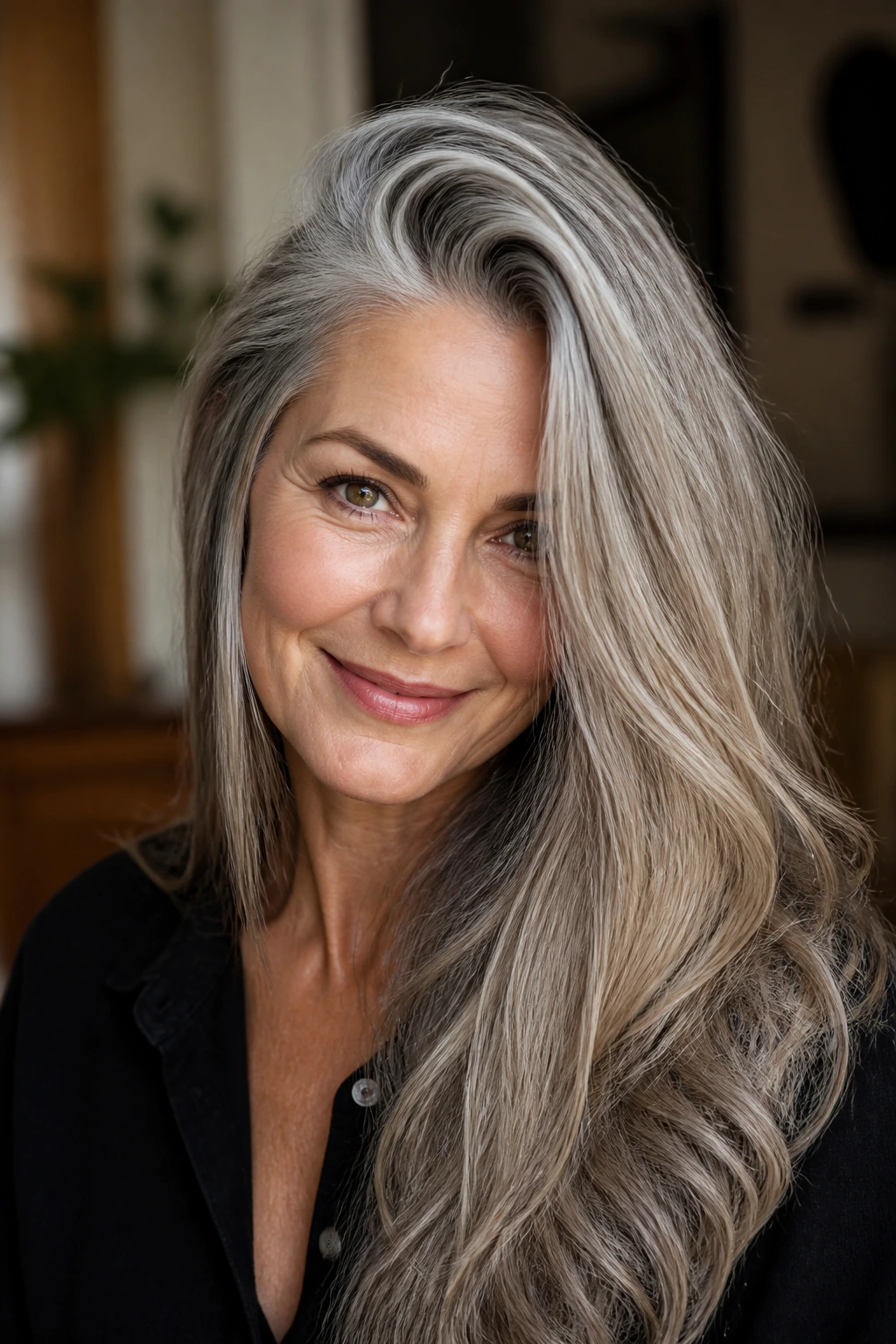
Long gray hair after 50 looks best when it has shape, not apology. Gray hair looks for long hair over 50 can read polished, soft, and expensive-looking when the cut and styling respect the texture silver strands actually have. Ignore that, and the same length can slump at the crown, fray at the ends, or hang so flat it feels like a curtain someone forgot to hem.
That shift matters more than people admit. Gray hair usually loses some pigment and often comes with a drier, coarser feel, which changes how light bounces off it and how the ends behave by the end of the day. A long style that once needed almost no thought may suddenly need a side part, a clean layer, a gloss, or a little root lift to keep it from looking tired.
The good news: long gray hair can wear a lot of different moods without getting chopped off. Sleek. Soft. Braided. Full. Loose enough for a bookstore run, neat enough for dinner, and still unmistakably silver. The trick is choosing the right silhouette for the texture you have, not the texture you wish you had.
Why These Gray Hair Looks Earn Their Keep
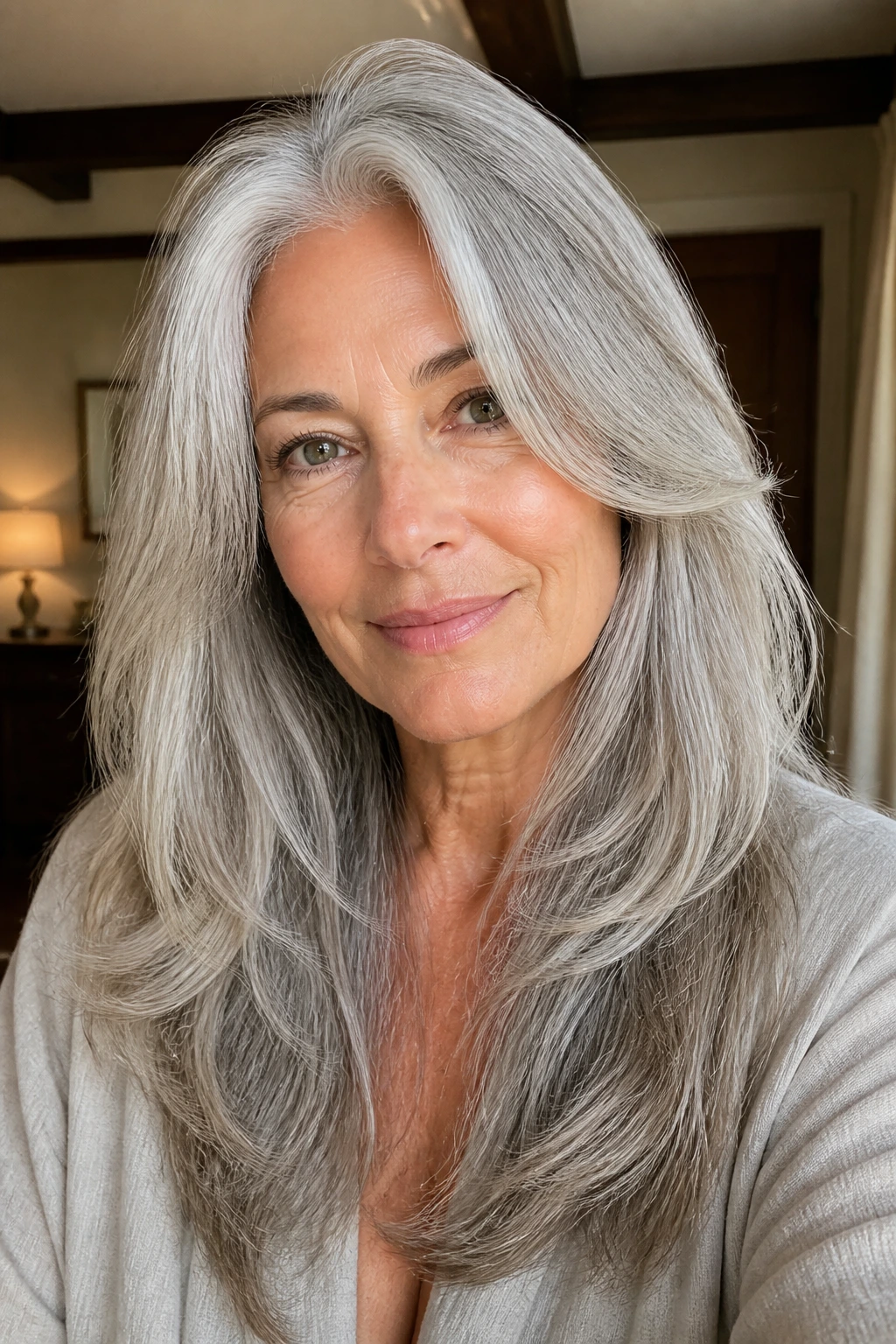
-
Shape Beats Length Alone: Long silver hair needs a line somewhere—layers, bangs, a braid, a side part, or a bun—so it doesn’t read like one heavy sheet.
-
Texture Works With You: Gray strands often feel coarser and drier, so the best looks here use that texture instead of forcing every strand to lie flat.
-
They Don’t Ask for a Salon Blowout Every Morning: These styles can survive second-day hair, a little humidity, and a quick brush-through without falling apart.
-
They Make Transition Hair Look Intentional: If you’re growing out color, these looks keep the line between dyed hair and silver from taking over the whole head.
-
They Play Well With Real Life: Glasses, earrings, office clothes, sweat, and a rushed morning all show up here.
-
They Give the Face a Job: The best gray styles don’t just sit there; they frame the eyes, soften the jaw, or lift the cheek area in a way that flat length never does.
1. Soft Silver Waves with Long Layers
Soft waves are the easiest way to keep long gray hair from looking like it was dropped in one piece. The bend in the hair gives the silver more movement, and the layers stop the bottom from turning into a heavy, triangular hem.
Why the Layers Matter
Long layers should start low—usually somewhere between the chin and collarbone—so the shape stays full, not chopped. That placement keeps the top from going thin and wispy, which is the mistake that makes many long styles look tired by noon.
Quick details that make this work:
- Use a 1.25-inch curling iron or wand and wrap the hair away from the face.
- Leave the last 1 to 2 inches of the ends out for a softer finish.
- Break up the waves with a wide-tooth comb, not a fine brush.
- Finish with a lightweight cream or mist, not a heavy oil.
Gray waves look best when the shine sits on the bend, not on a greasy top layer. That’s the whole game. A little texture gives the silver more dimension, and the layers keep the shape from collapsing into a blanket.
Best for: medium to thick hair, especially if your natural texture is wavy already.
One small tip: curl the pieces around your face away from the cheekbones, then let the rest go a little looser. It keeps the style open instead of overdone.
2. Sleek Center-Parted Gray Length
A clean center part can look stunning on long gray hair when the cut is tidy and the finish is smooth. This is the look that says you know exactly what your hair is doing.
The whole style depends on clean edges. If the ends are transparent or split, a sleek center part will show every weak spot. But if the hair has density and the cut is blunt or only lightly layered, the result is sharp in a good way—like a silk shirt instead of a wrinkled tee.
I like this look most on hair that can hold a little weight without going flat. Blow-dry with a nozzle, direct the air down the shaft, and use a flat iron only where the hair bends or puffs. A pea-sized amount of serum from mid-length to ends is enough. More than that, and the silver starts to look coated.
It’s also one of the best ways to show off a clean gray grow-out line. The part creates structure right away. No fuss.
3. Curtain Bangs That Frame Silver Hair
What keeps long gray hair from swallowing the face? Curtain bangs. They split the difference between “I want my length” and “I still want cheekbones.”
The nice thing about curtain bangs on gray hair is that they soften the transition between forehead, temples, and the rest of the length. They also help if your part line is getting more visible than you want, because the fringe draws the eye back to the center of the face instead of straight up to the scalp.
How to Style the Fringe
Dry the bangs first. Seriously.
Use a round brush or a medium Velcro roller, and push the front pieces away from the face while they’re still warm. If you wait until the rest of the hair is dry, the bangs usually fall in the wrong direction and flatten into those annoying little commas at the temples.
- Keep the shortest point around cheekbone level.
- Let the outer pieces graze the jaw.
- Don’t cut them too dense; gray fringe looks lighter when it moves.
This look is especially good if you wear glasses. The bangs split around the frames instead of competing with them, which is a small thing until you try to live with hair in your eyes all day.
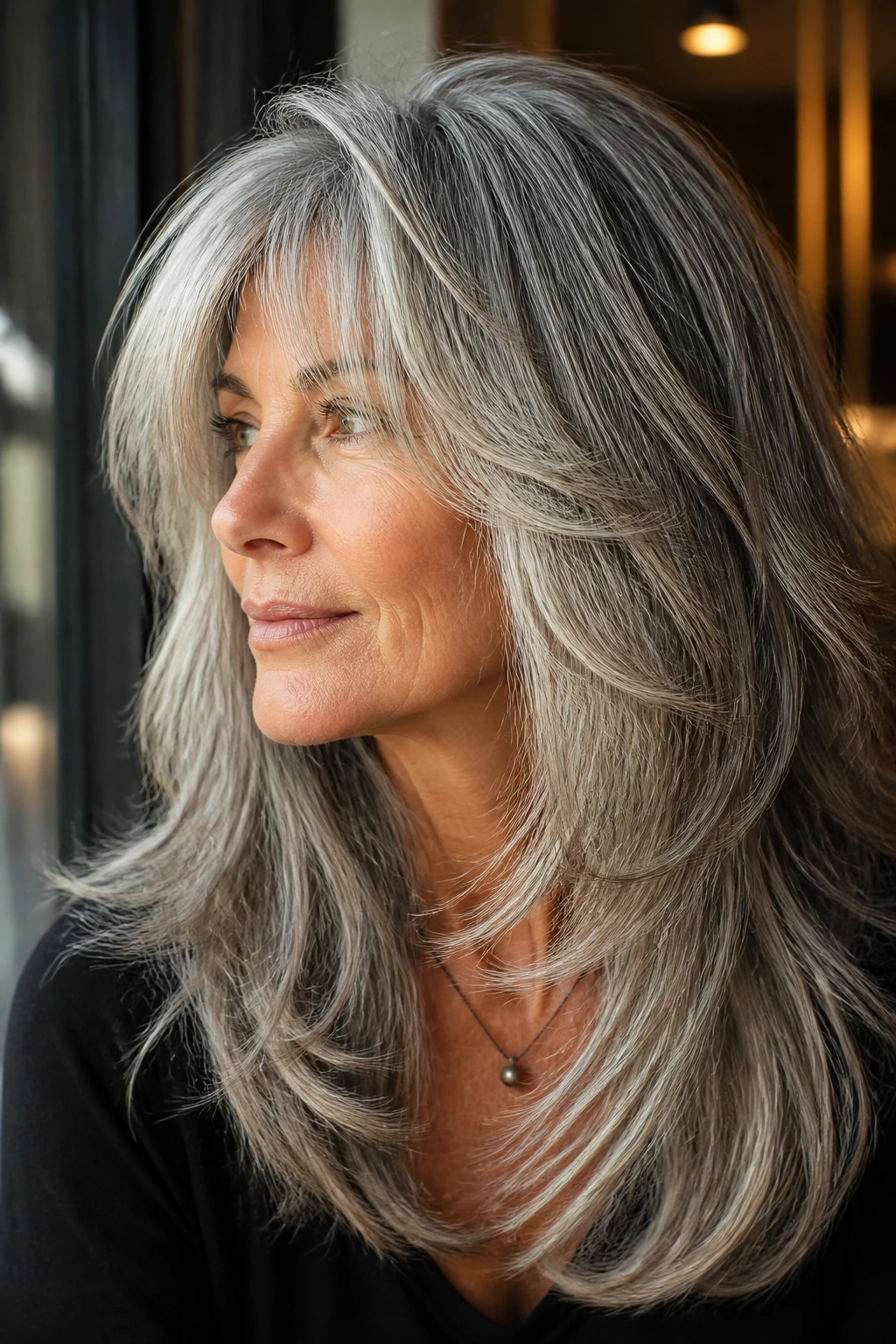
4. Long Gray Shag with Feathered Ends
If your hair naturally flips, bends, or frizzes at the bottom, the shag is the cut that stops the fight. It works with the hair’s own motion and gives long gray lengths a little nerve.
I’ve always thought the shag is the haircut for people who are done pretending hair should behave like printed paper. The crown gets some lift, the mid-lengths get movement, and the ends stay soft enough that the whole thing doesn’t feel severe.
A good gray shag should not be so choppy that it looks chewed up. It needs feathering, not chaos. Ask for layers that are controlled through the crown and more textured through the lower half, especially if the hair is thick or a little coarse. If your hair is fine, keep the internal layers lighter so the bottom doesn’t go see-through.
What Makes It Work
- Best texture: wavy, loose curly, or slightly coarse straight hair.
- Styling helper: mousse at the roots, then a diffuser or a round brush.
- Trim rhythm: every 8 to 10 weeks keeps the feathering from turning shaggy in the wrong way.
- Bad match: very straight, very limp hair with no body at all.
The payoff is a look that feels lived-in, not lazy. That’s a useful difference.
5. Deep Side Part with Crown Lift
A deep side part changes the whole mood of long gray hair in about ten seconds. It gives the crown a little lift, softens the hairline, and makes the silver catch the light on a more interesting angle.
This is a smart move if your hair tends to fall flat near the temples or if the middle part makes the scalp show more than you’d like. Shift the part about an inch off center, then blow-dry the root opposite the way it naturally falls. That little trick gives the hair memory and keeps the top from collapsing after an hour.
Gray hair often has enough natural texture to support this look without much heat. A root-lifting spray or mousse at the crown, plus a round brush at the front, is usually enough. Don’t over-smooth the lengths. The beauty of a side part here is that it lets the rest stay soft.
One more thing: this look changes the face more than people expect. It adds lift without needing layers all over the place.
6. Wrapped Low Ponytail with a Polished Base
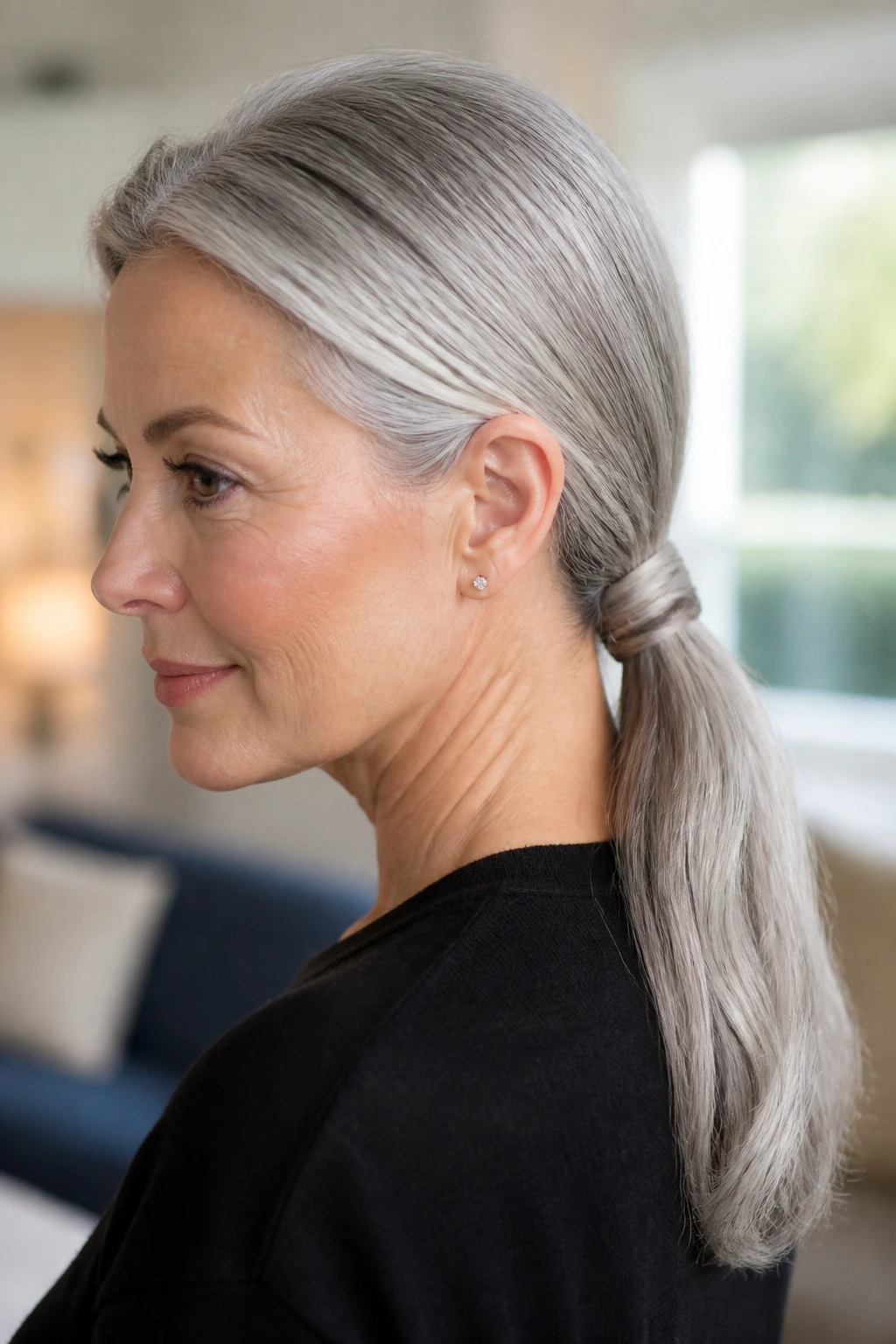
A wrapped low ponytail is what happens when a plain ponytail grows up. Same hair, different attitude.
The wrapping section hides the elastic, which sounds small until you compare it to a bare hair tie. That little detail makes the style look finished, especially with gray hair, where the silver band of wrapped hair shows up like a deliberate line.
It’s best worn low, at the nape or just above it. Gather the hair with a soft brush, leave out a one-inch section from underneath, and wrap it around the elastic before pinning it underneath with a bobby pin. If the hair is slippery, mist the wrap section with dry shampoo first so it grips.
This style is the one I’d pick for errands, dinner, or a day when your hair needs to stay out of your face but you still want the length visible. It is cleaner than a messy ponytail and far less fussy than a full updo.
7. Half-Up Knot for Long Silver Hair
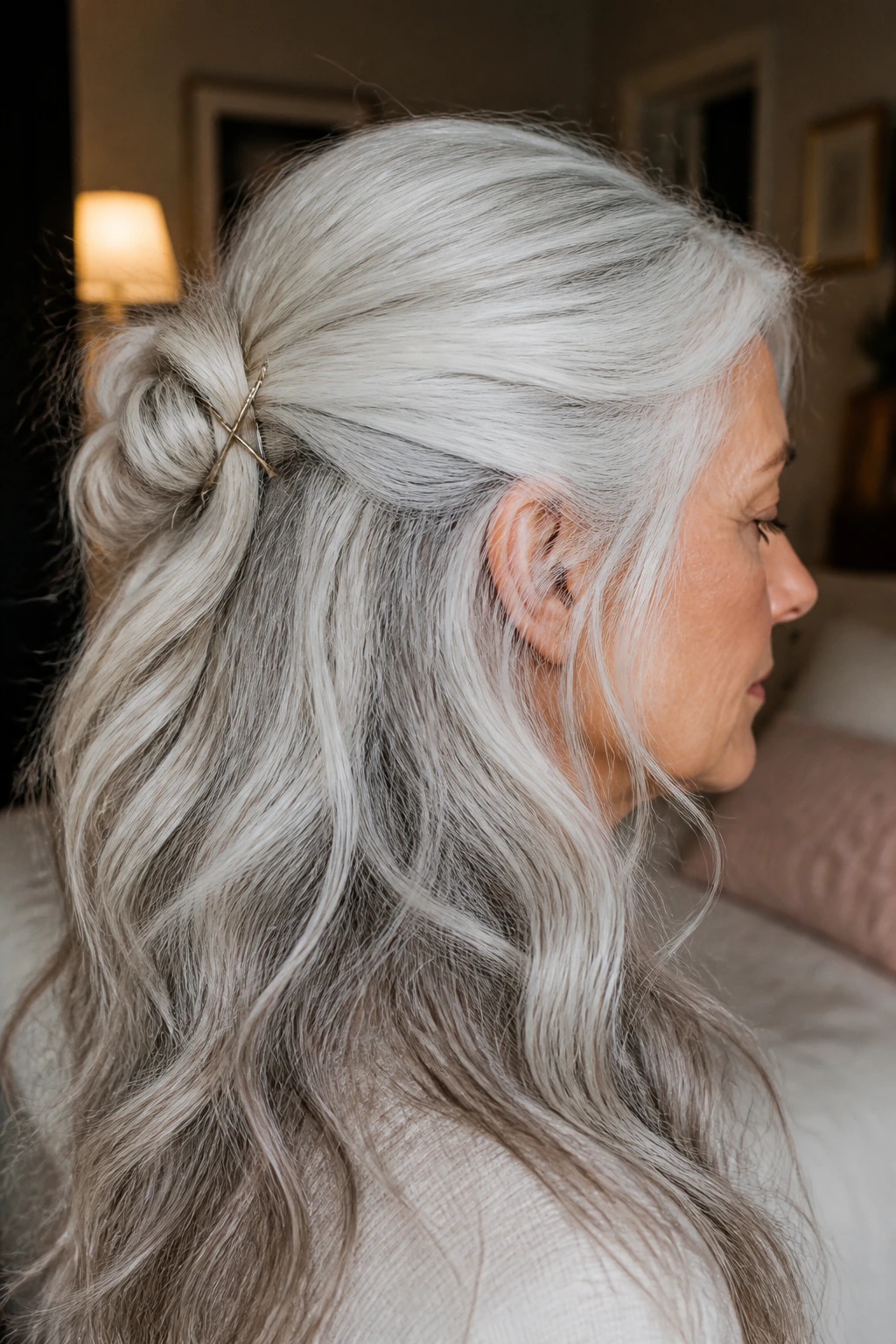
A half-up knot is a good answer when you want the top of the hair out of the way but do not want to hide all that length. It gives the crown some lift, shows off the waves or straight length underneath, and keeps the back from feeling heavy on the shoulders.
Where to Place the Knot
Put the knot just above the occipital bone, not all the way at the crown. Too high, and the style starts to look juvenile. Too low, and it loses the lift that makes it useful.
You can twist the top section once, then loop it into a small knot and pin it with two bobby pins crossed like an X. That small anchor is better than one lone pin that slips out by lunch.
- Leave two slim pieces around the face if you want softness.
- Tease the section at the crown lightly for grip.
- Use a texture spray on very clean hair.
The half-up knot is good on gray hair because it shows the shine on the top while letting the length stay visible underneath. It feels relaxed, but not careless.
8. Braided Crown on Full-Length Gray Hair
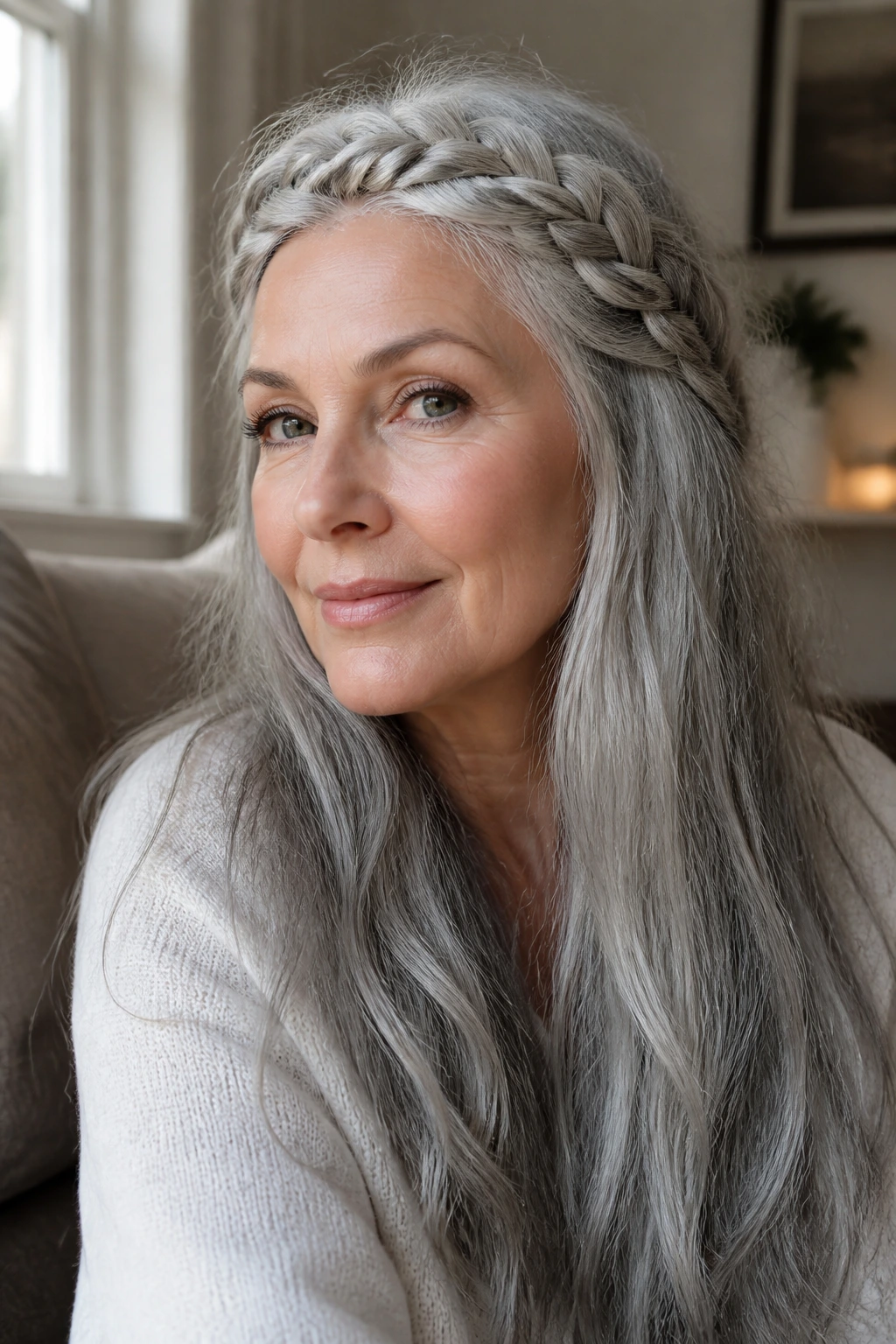
Braided crowns make long gray hair look structured without hiding the texture. The braid becomes the frame. The length becomes the backdrop.
This style works especially well when the hair is slightly off-day and needs a shape that can carry it. Start a braid at one temple, wrap it across the top or around the hairline, and pin it toward the opposite side or into the back. You don’t need a tiny, tight braid. A looser braid with a little width looks richer and is kinder to the scalp.
Dry hair with a bit of texture holds this best. Freshly washed hair can slip unless you rough it up with dry shampoo or a light texturizing spray. I like this style for silver hair that has a mix of white strands and darker lowlights, because the braid shows the color changes instead of hiding them.
It’s not a casual five-second style, though. Give yourself a few minutes and a handful of pins. The payoff is worth the fuss.
9. Loose Low Chignon with Face-Framing Pieces
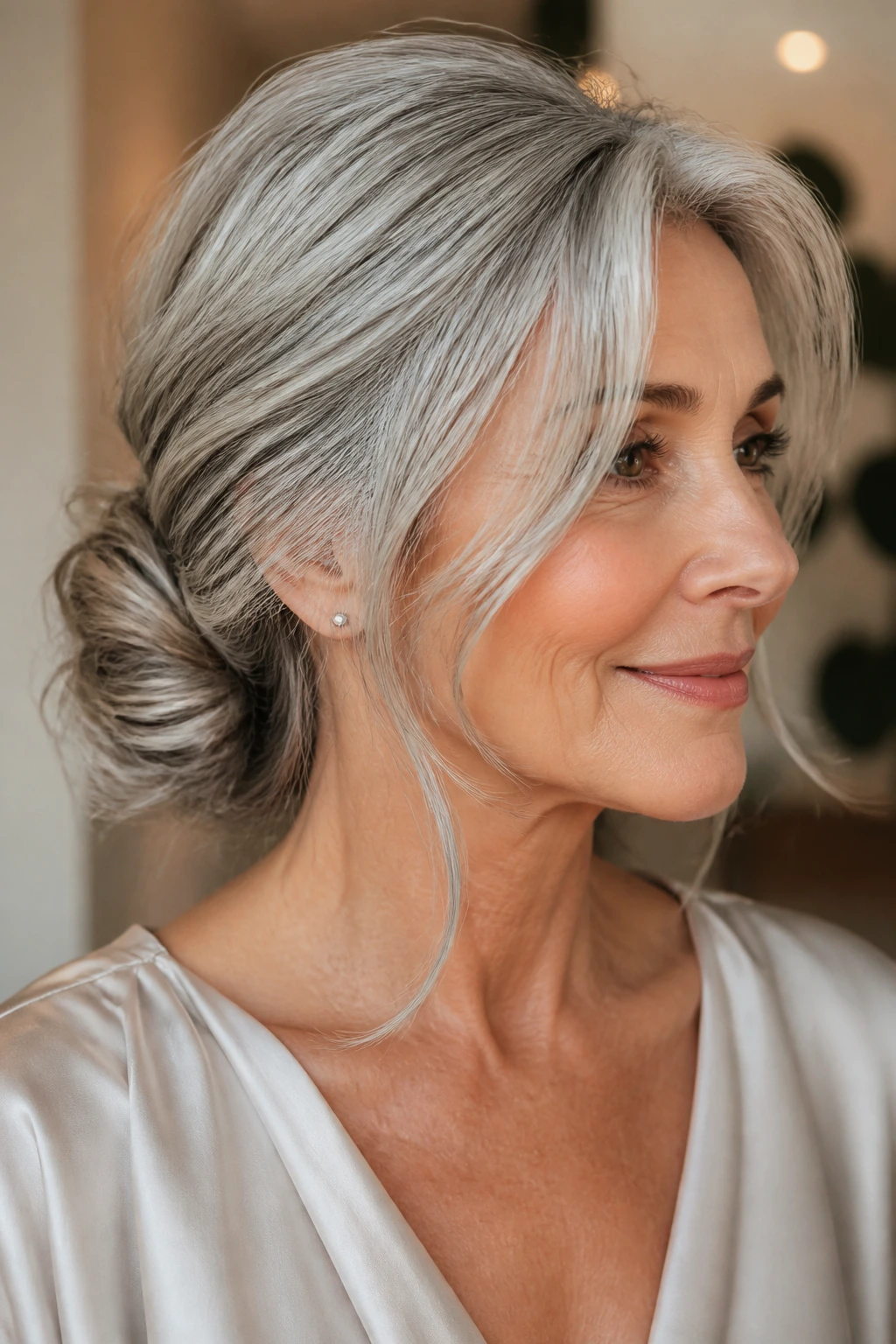
Need long gray hair to look polished without going severe? A loose low chignon is the answer that stays on the right side of formal.
This style keeps the hair gathered at the nape, but it doesn’t snatch every strand back. The little face-framing pieces matter. They break up the outline and keep the hair from looking too tight around the jaw or neck, which can make silver hair feel harder than it is.
Make It Hold Without Looking Tight
Twist the ponytail once or twice, coil it loosely, and pin the bun in place with U-pins or sturdy bobby pins. A small amount of smoothing cream on the top keeps flyaways down, but skip the heavy oil at the roots. That just flattens everything.
A chignon works well for dinner, a ceremony, or any day when you want the length under control but still visible in the sweep of the sides. It also plays nicely with earrings, which is not a small detail if you like a bit of shine near the face.
10. Blunt Gray Length with a Glassy Finish
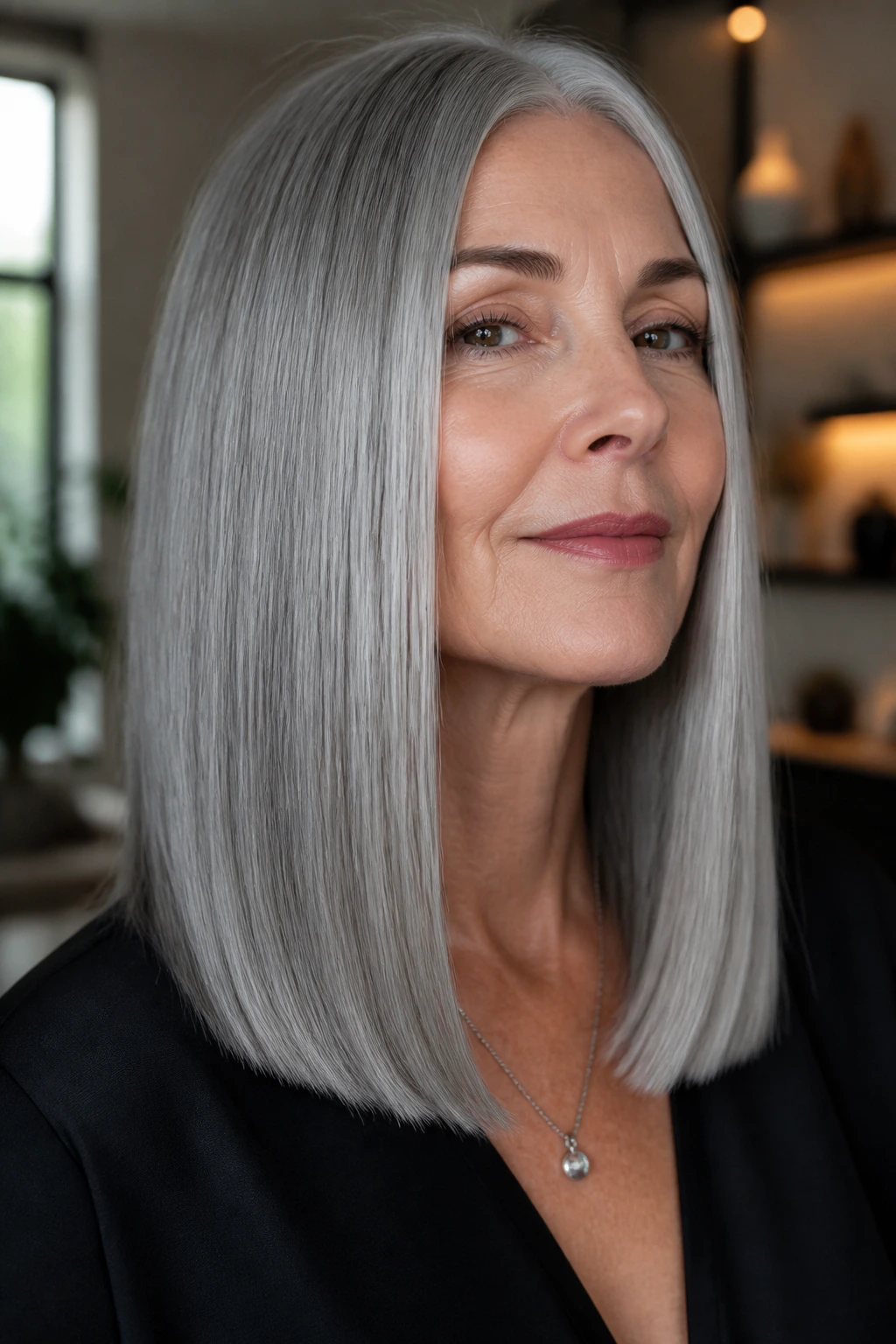
A blunt hemline on long gray hair is a strong look. No softness at the bottom, no wispy tail, no pretending the ends are doing something else. Just a clean line.
This style works best when the hair is dense enough to support that line. Fine hair can wear it, but the cut has to be precise and the ends have to stay healthy. A blunt cut shows damage fast. Split ends, heat stress, and over-lightened pieces all show up at the bottom edge.
That said, when it works, it really works. Gray hair catches light in a blunt line in a way that looks more deliberate than overly layered hair. Use a paddle brush for the blow-dry, follow with a flat iron only if needed, and keep the serum off the roots. If the ends are fraying, get them trimmed before you try to force this shape.
Best On Hair That Has:
- Medium to thick density
- Straight or lightly wavy texture
- Clean ends from a recent trim
- Enough shine to hold a polished finish
This is the look I’d choose when the hair itself is the statement.
11. Big Barrel Blowout for Silver Layers
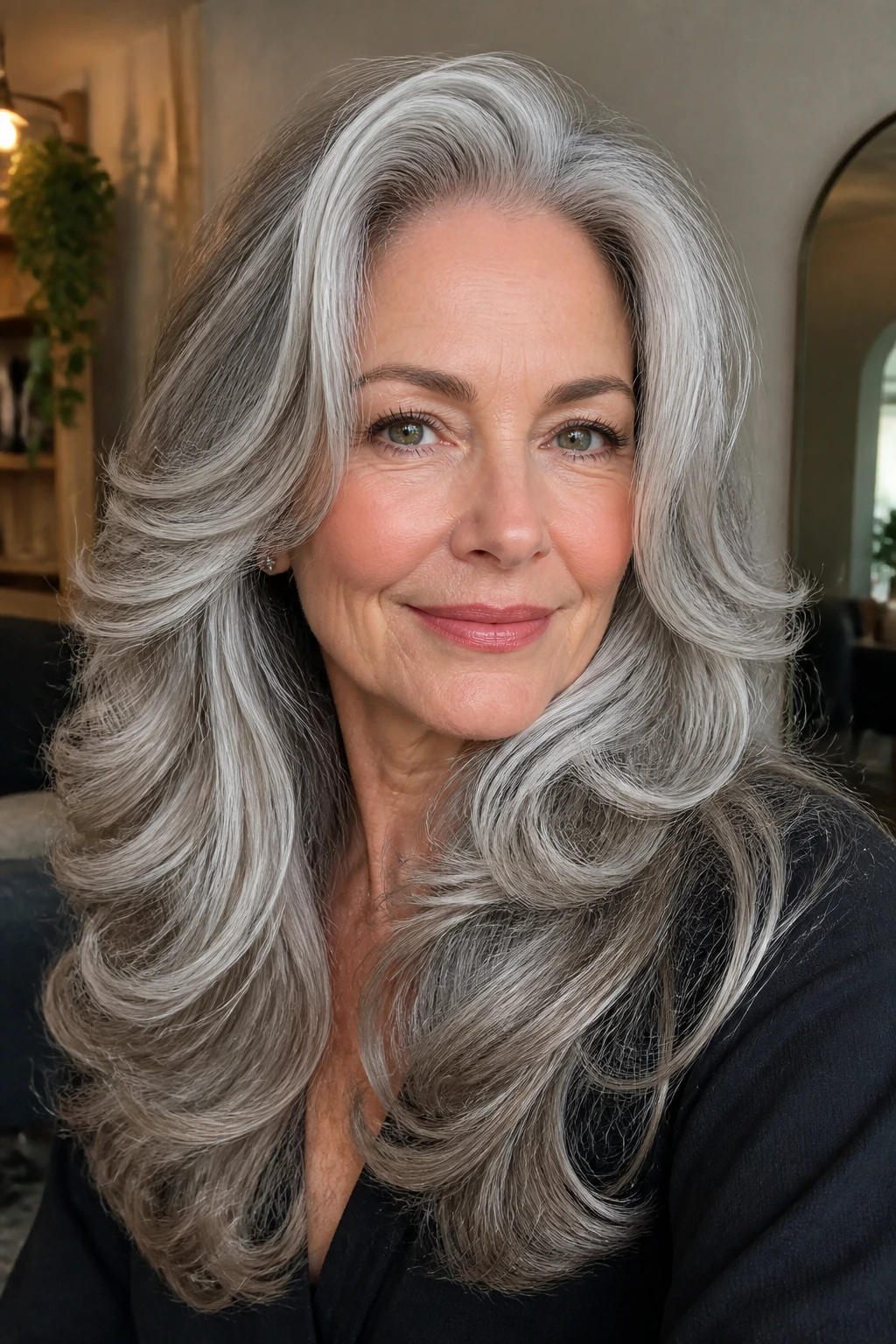
The big barrel blowout gives long gray hair that soft, lifted motion people tend to associate with expensive haircuts, even when the cut itself is very practical. It is less rigid than straightening and more controlled than air-drying.
Use a 2-inch round brush or large hot rollers if your arms get tired halfway through. Work in sections, starting underneath, and direct the brush up at the root before pulling through the mid-lengths and ends. The important part is the root lift. Without that, the style falls flat and the whole look loses its shape.
This is a particularly good choice for layered gray hair because the movement shows off the different lengths instead of hiding them. It also softens coarse silver strands, which can sometimes look a little rough when they are left to dry on their own.
A quick cool shot at the end of each section helps the bend stay in place. Skip that, and the style can collapse faster than you want.
12. Salt-and-Pepper Balayage with Bright Ends
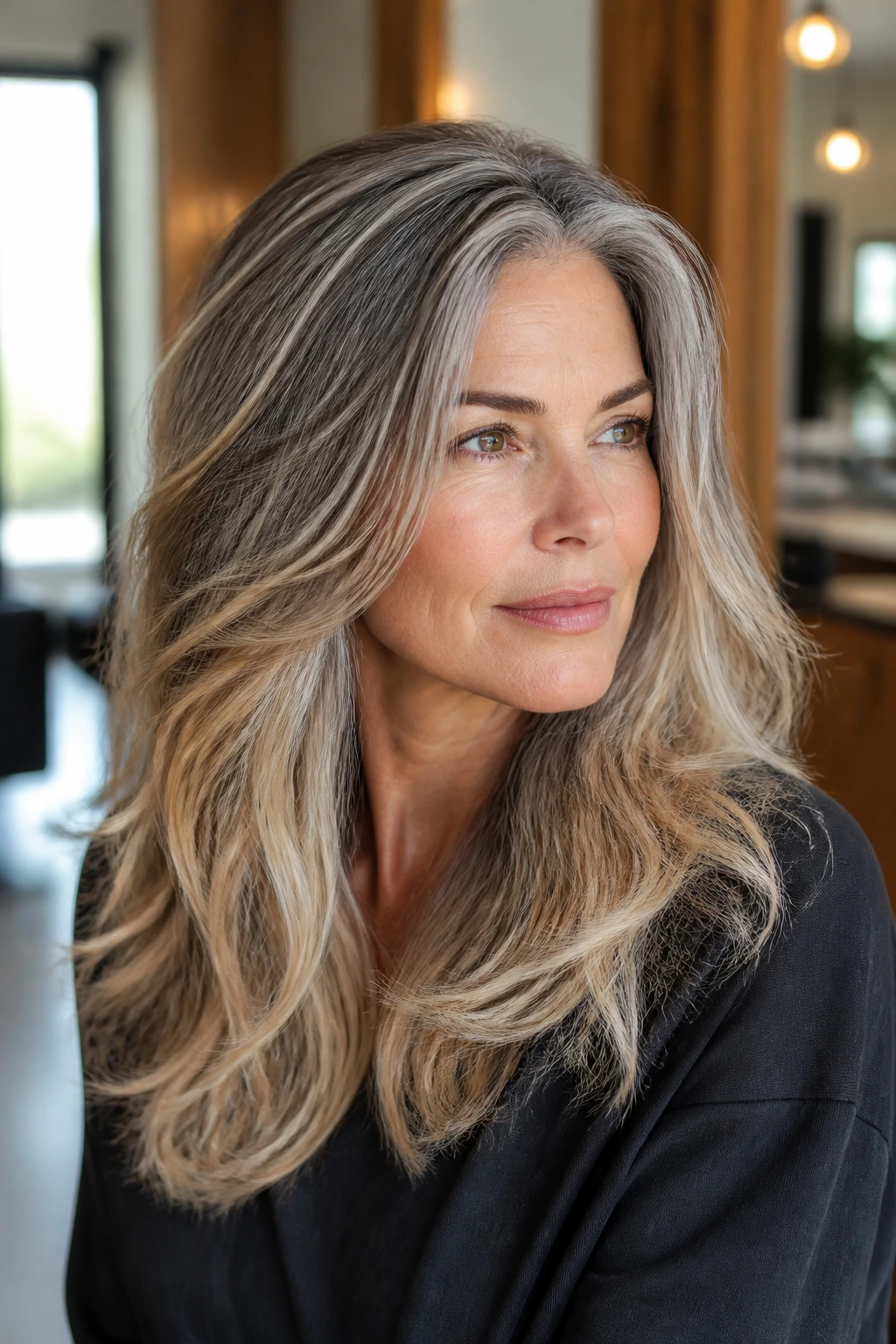
If you are growing out color, a salt-and-pepper blend with bright ends can take the edge off the in-between stage. Instead of fighting the gray line, this look softens it with low-contrast pieces and a deliberate mix of light and dark.
Unlike a one-tone silver finish, a balayage transition gives the hair depth. The face frame can stay lighter, the mids can carry a few darker pieces, and the ends can still read bright enough to look fresh. That balance matters when the roots are coming in and the old dye line is not cooperating.
This is where a good colorist earns the fee. You want placement, not stripes. The goal is to blend the gray with the remaining pigment so it looks expensive and grown-in, not like a rushed fix between salon visits.
It’s a smart option for women who want to keep length while the color transitions are still doing their awkward little dance.
13. Micro-Braids Woven Into Gray Waves
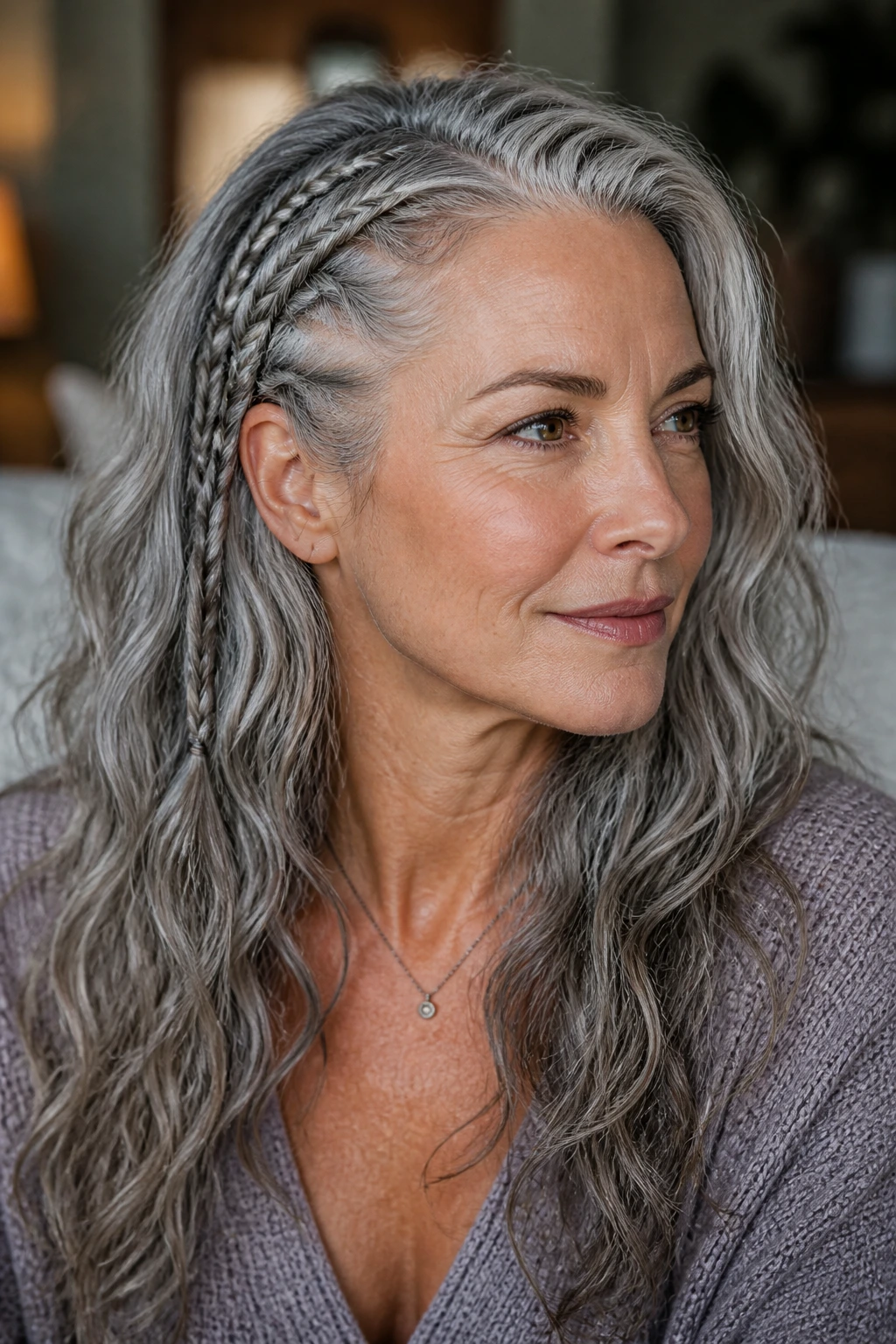
Tiny braids around the temples or threaded through the top layer can wake up long gray waves without stealing the spotlight. They add detail, and detail is often what silver hair needs when the rest of the style is loose and simple.
What Makes It Different
Micro-braids give you texture on top of texture. The waves keep the length soft, while the braids break up the surface so the hair doesn’t look too uniform. That matters more on gray hair than on darker hair, because silver can flatten into one tone if nothing interrupts it.
- Place them near the temples for a casual feel.
- Tuck one or two into the back if you want a more hidden effect.
- Keep the braids loose; tight braids pull at the hairline.
- Add a small elastic at the end if the hair is slippery.
I like this look for days when you want something a little playful without turning the hair into a costume. It’s detail, not drama.
14. French Twist Half-Up on Long Gray Hair
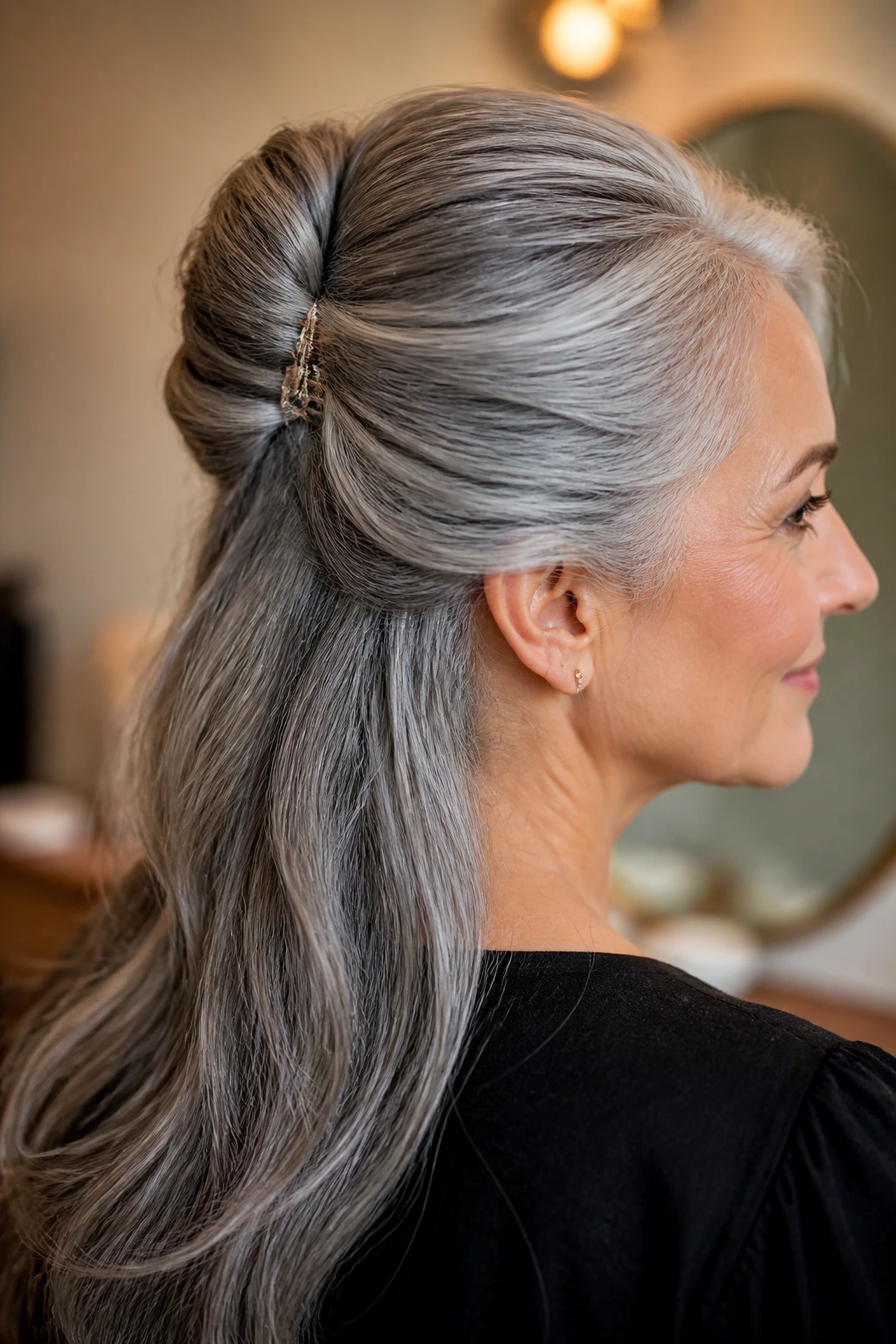
A half-up French twist gives long gray hair a little vertical line, and that line changes everything. It adds lift at the crown and keeps the lower length visible, which is a better compromise than hiding the hair completely in a bun.
This look works because the twist creates height without weight. Pull the top half back, twist it upward along the center or slightly off-center, and pin it so the ends disappear into the fold. The lower half stays loose, and that contrast keeps the style from feeling too formal.
Use texturizing spray before you start if the hair is very smooth. Gray hair can be slippery, and the twist will slide if the pins have nothing to bite into. U-pins tend to work better than tiny decorative clips here because they hold the shape without crowding it.
I’d reach for this on an evening when the hair needs to look done, but not stiff.
15. Sleek Low Bun with a Side Sweep
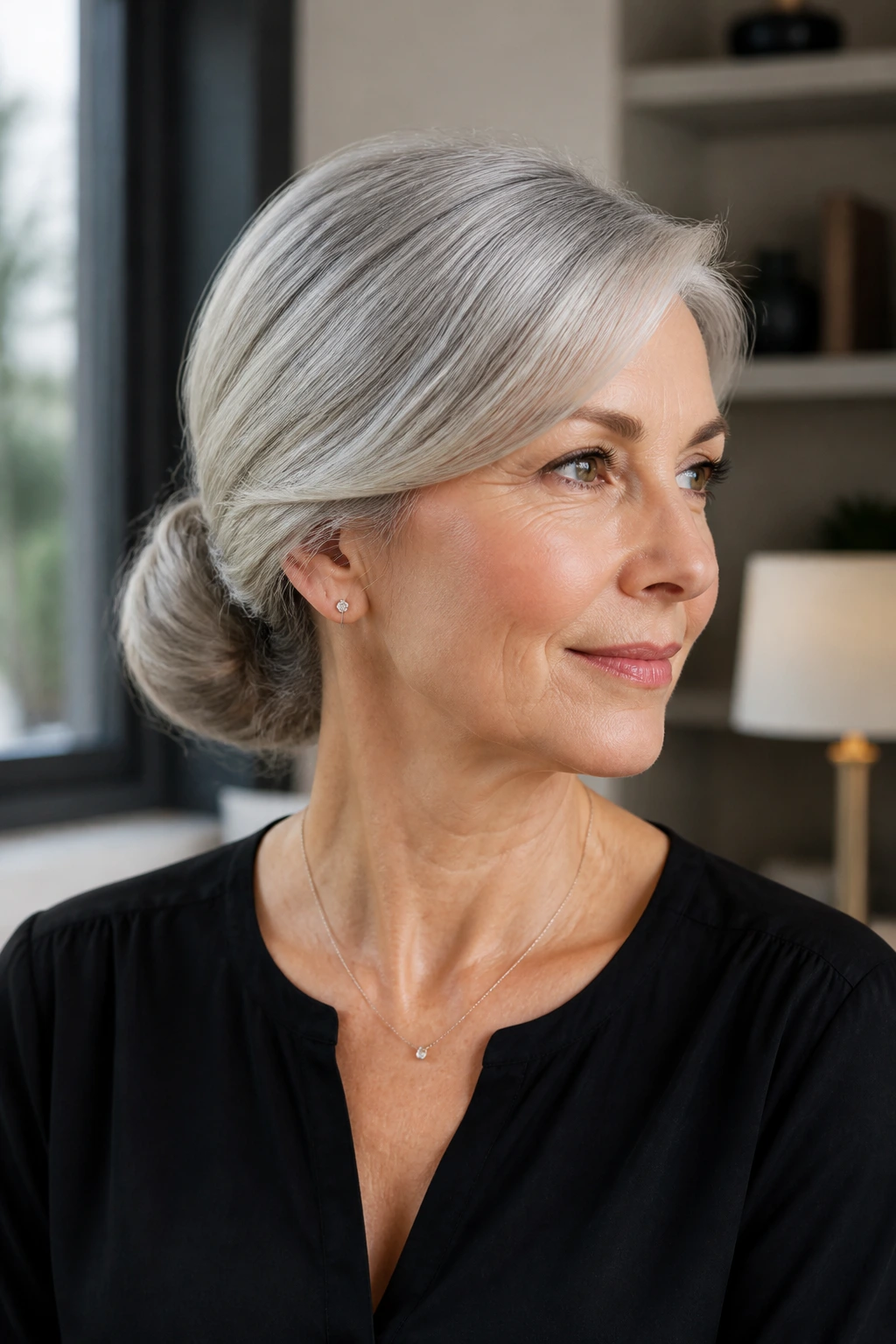
A low bun can look severe on long gray hair. A side sweep fixes that fast.
Shift the front section a little to one side, smooth it back at the temple, and gather the rest into a low bun at the nape. That side sweep softens the face and makes the bun look less strict, which is useful when silver hair already has strong contrast against the skin.
This is one of the best looks for work, formal events, or days when you want the hair off your neck without losing polish. Use a light smoothing cream on the top and a soft brush to pull the surface clean. Do not overload the hair with product. Gray hair will show the buildup, and the bun will start to look dull instead of sleek.
The trick is restraint. A small sweep, a tidy bun, and a little shine. That is enough.
16. Loose Mermaid Braid Down the Back
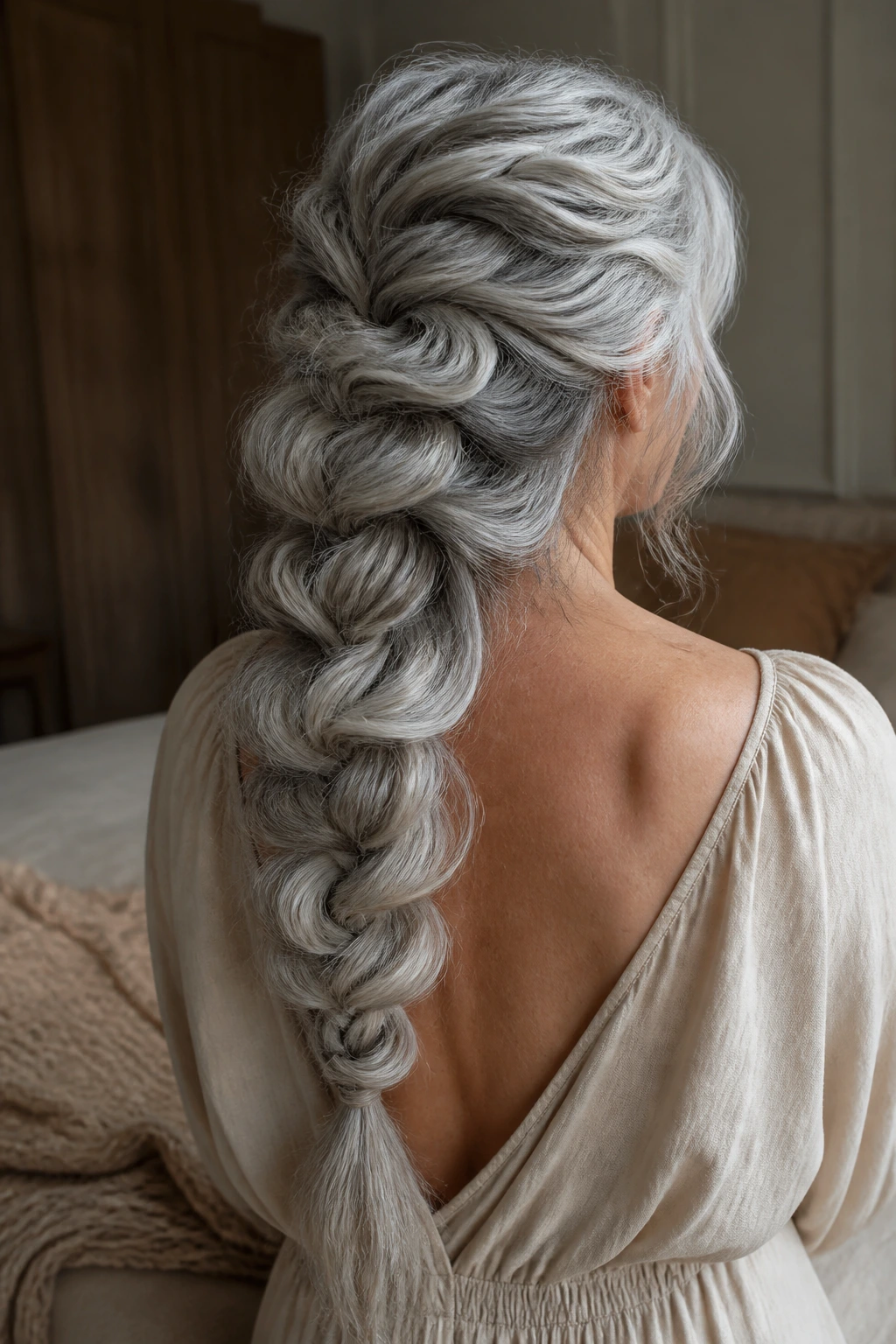
When hair is long enough to reach mid-back or lower, a loose mermaid braid keeps the ends from looking stringy by late afternoon. It also shows off the length in a way that feels deliberate instead of accidental.
Think of this braid as a relaxed three-strand braid that gets gently pulled apart after it’s secured. That loosening, sometimes called pancaking, makes the braid wider and softer. It is much kinder to gray hair than a tight braid that shows every dry bend in the ends.
The Shape You Want
- Start with hair that has a little grip, usually second-day hair.
- Braid loosely from the nape down.
- Secure the end with a clear elastic.
- Pull each outer loop outward a little at a time, not all at once.
I like this style for long silver hair because it keeps the hair visible while making the whole length feel more controlled. It is practical. And it has a little drama.
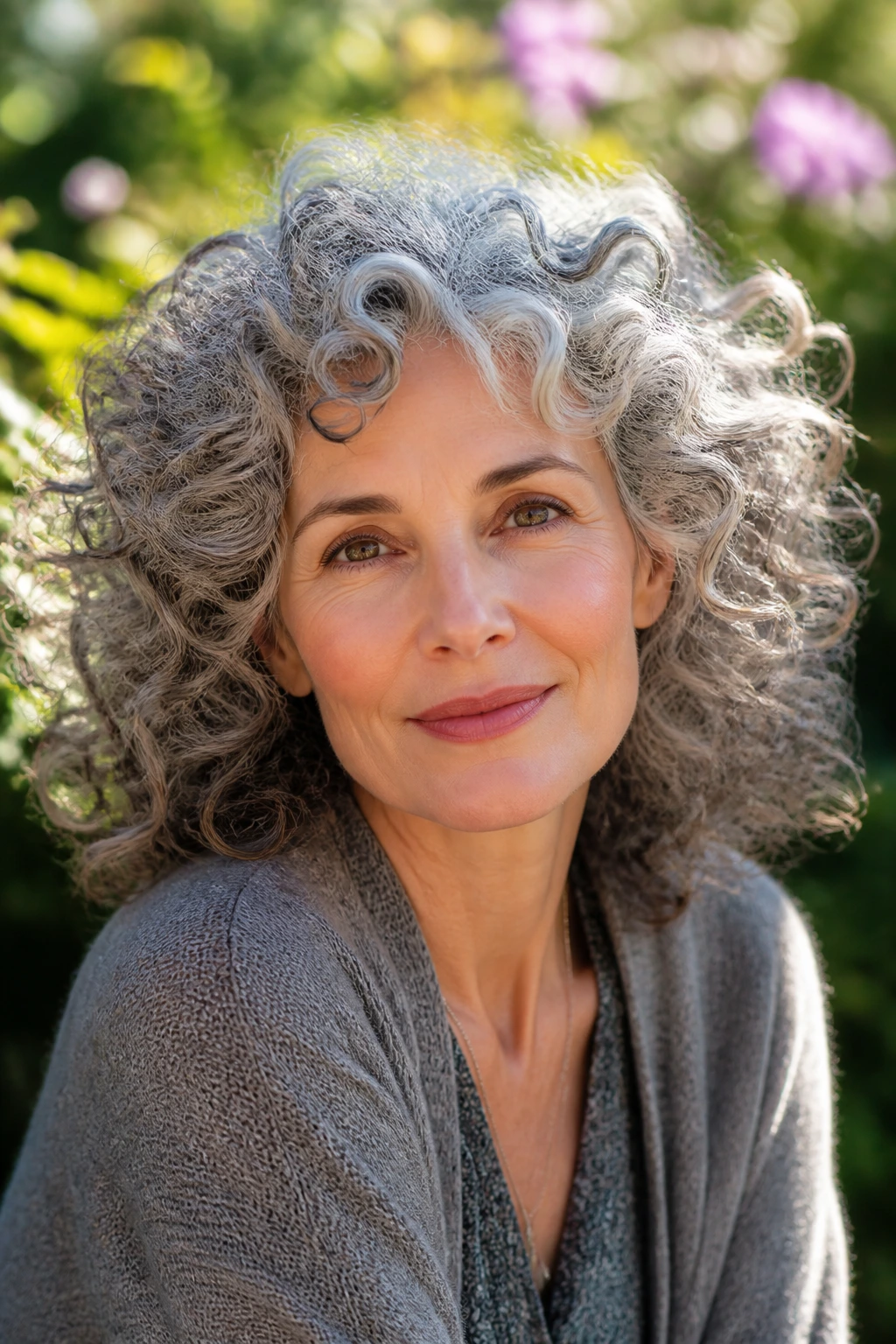
17. Airy Curls With Diffused Volume
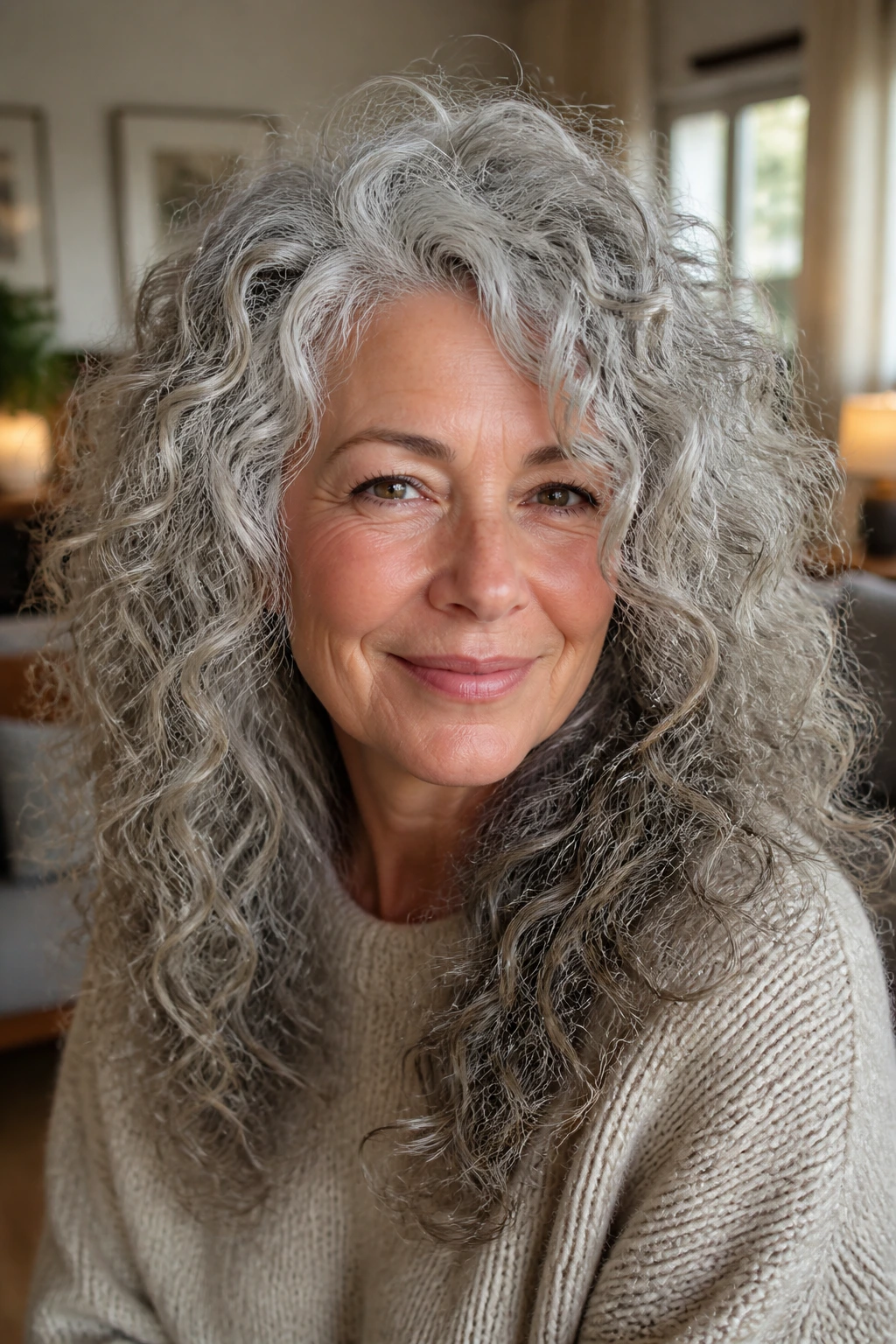
Natural curls, loose spirals, or even strong waves can look excellent on long gray hair when the volume stays airy instead of crunchy. The shape matters more than uniformity here.
Gray curls often need more moisture than darker curls because the strand can feel drier and less forgiving. A leave-in conditioner, then a curl cream or foam, usually gives enough control without weighing the hair down. Diffuse on low heat and low speed, and stop before the curls are bone dry if frizz is your enemy. Let the last bit air-dry.
What I like about this look is that it doesn’t try to tame the gray into obedience. It lets the movement do the work. If your curls are uneven, separate a few pieces with oiled fingers after drying and leave the rest alone. Too much handling makes the whole head puff out.
This is one of the few gray looks that gets better when it looks a little imperfect. That’s the point.
Why Gray Hair Looks for Long Hair Over 50 Need Shape, Not Just Length
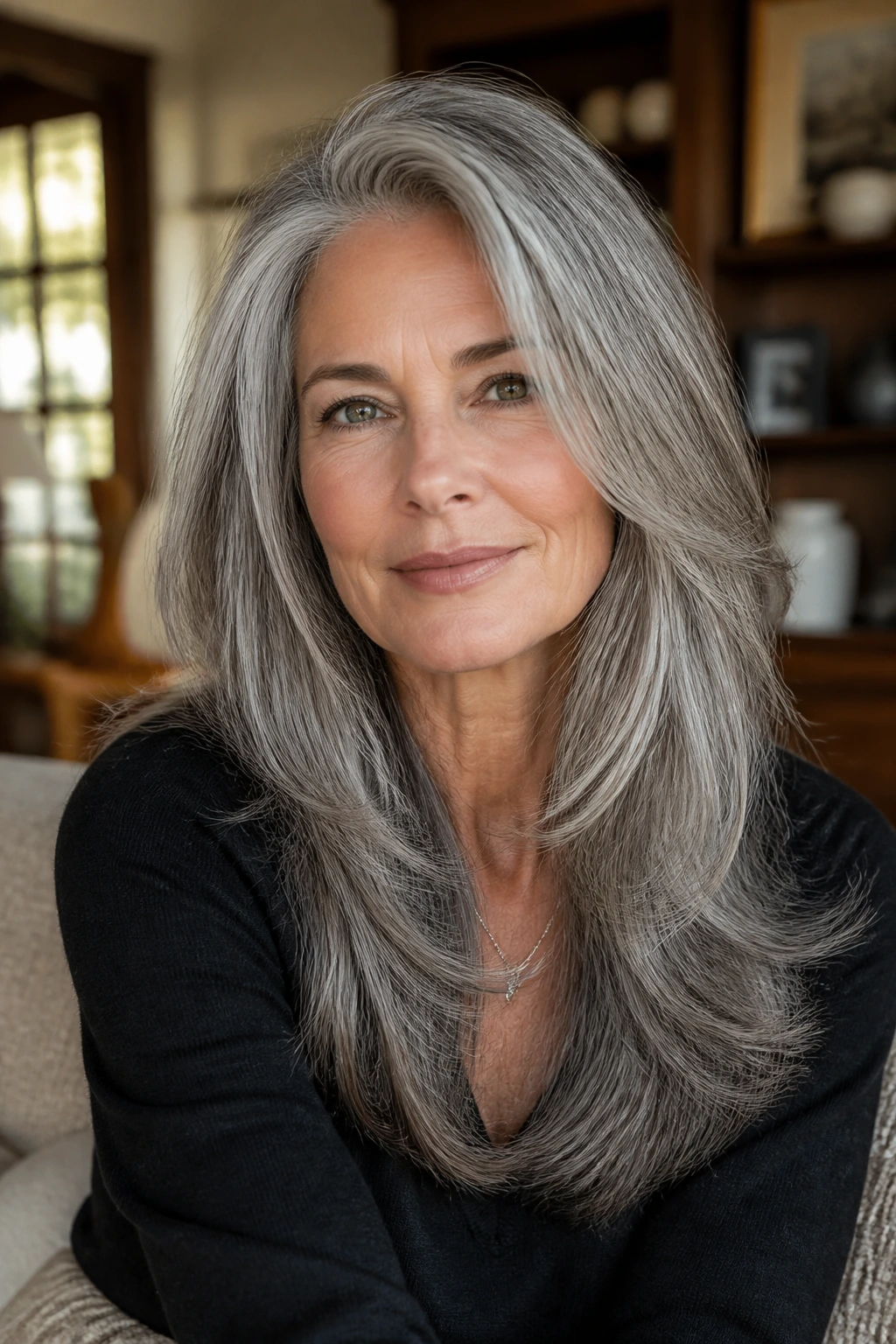
Long gray hair has to earn its outline. That sounds harsh, but it’s true. Pigment loss changes how the eye reads the strand, and texture changes how the ends behave, so the old “just let it grow” approach can leave the hair looking wider, flatter, or more tired than it should.
Shape solves that. Long layers keep the bottom from feeling heavy. A blunt cut gives density if the hair can support it. Bangs or a side part break up a big sheet of silver so the face stays part of the style instead of disappearing behind it. When the cut and styling work together, gray hair stops looking like it is waiting for permission to exist.
There is also the shine issue. Gray hair often reflects light differently because the strand’s surface and pigment have changed, and that can make dryness show up fast. A clean cut, regular trims, and the right finish product do more for this hair than piling on oil ever will. Too much oil tends to sit on top and flatten the silver. A lightweight gloss or leave-in cream usually does the job better.
This is where a lot of people get it wrong. They assume long gray hair needs to be shortened to look tidy. It doesn’t. It needs a plan.
Essential Tools for These Looks
-
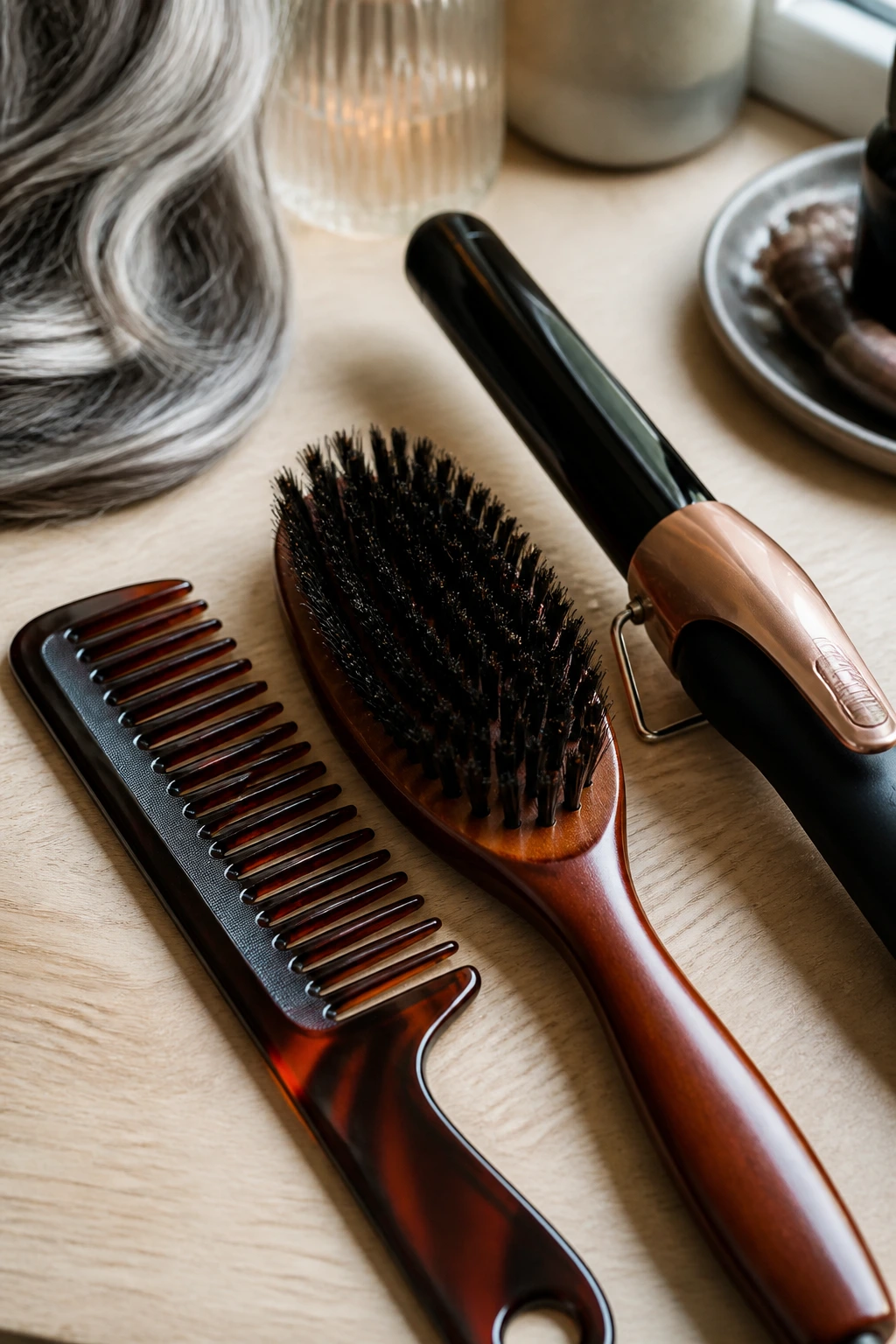
Wide-tooth comb: Best for detangling long gray hair without stretching it out when it’s wet.
-
Boar bristle brush or soft paddle brush: Useful for smoothing the surface on sleek styles and low buns without ripping through the ends.
-
1.25-inch curling iron or wand: The workhorse for loose waves and soft bends that don’t look too tight.
-
2-inch round brush: Gives the big blowout lift at the root and shape through the ends.
-
Blow dryer with nozzle attachment: The nozzle helps direct airflow down the hair shaft, which keeps gray hair smoother.
-
Heat protectant spray or cream: Use it every time you add heat; silver strands can show heat stress fast.
-
Lightweight leave-in conditioner: Good for dryness without the greasy top layer that weighs gray hair down.
-
Root-lifting mousse or spray: Handy for crown lift, side parts, and blowouts that need a little structure.
-
Texturizing spray or dry shampoo: Adds grip for braids, twists, and half-up styles that slip on clean hair.
-
Bobby pins and U-pins: U-pins are especially good for buns and twists because they hold without looking crowded.
-
Silk or satin scrunchie: Better than tight elastics for ponytails and braids, especially if the hair is fragile at the temples.
-
Microfiber towel or old T-shirt: Gentler on gray hair than rough terry cloth, which can rough up the cuticle.
Smart Product Choices for Gray and Silver Strands
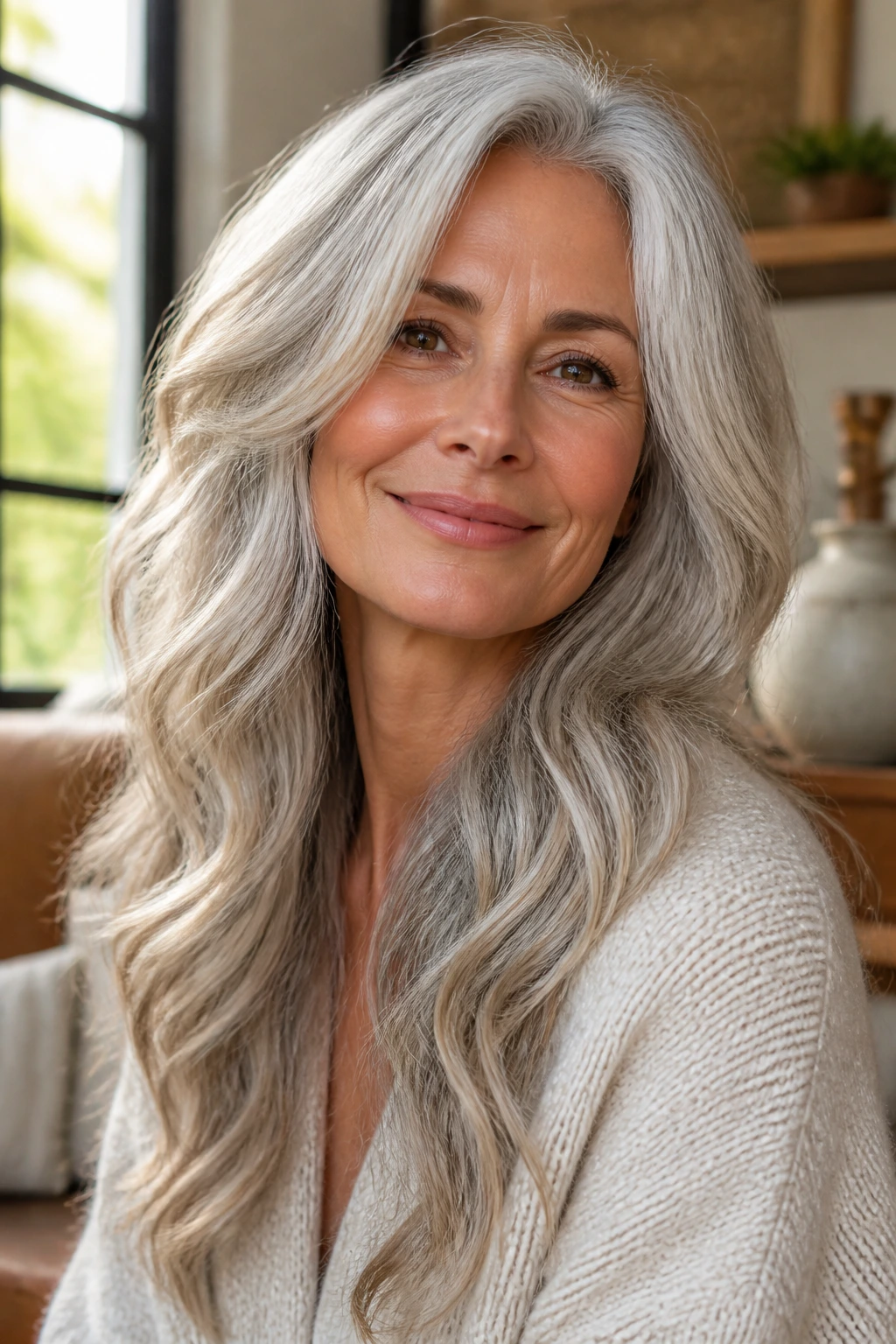
The best products for gray hair usually do one job well instead of three jobs badly. That matters more on long hair, because every bit of buildup shows up halfway down the length.
Shine Without Slipping: Choose a lightweight serum or cream for mid-lengths and ends. If your hands feel coated after using it, you’ve probably used too much. Gray hair likes slip, not grease.
Tone With Restraint: Purple shampoo can keep yellow tones from showing, but it should not become a weekly ritual unless your hair is especially prone to warmth. Use it every 1 to 2 weeks, leave it on for 2 to 4 minutes, and stop if the hair starts to look chalky or tinted.
Lift at the Root: Mousse, foam, or a root spray gives shape without making the lengths sticky. That’s useful on long gray hair because the top often needs help long before the bottom does.
Guard Against Heat: A heat protectant matters more on silver hair than a lot of people think. Gray strands can look crisp and dry after too much iron work, and once that roughness sets in, no serum will fake it.
Don’t Ignore Sun: The American Academy of Dermatology has long warned that UV exposure matters for the scalp and hair. On gray hair, that matters twice. Sun can push silver into a dull yellow cast, so a hat or UV-protective spray is not fussy—it’s just practical.
Smart Styling Moves for Gray Length
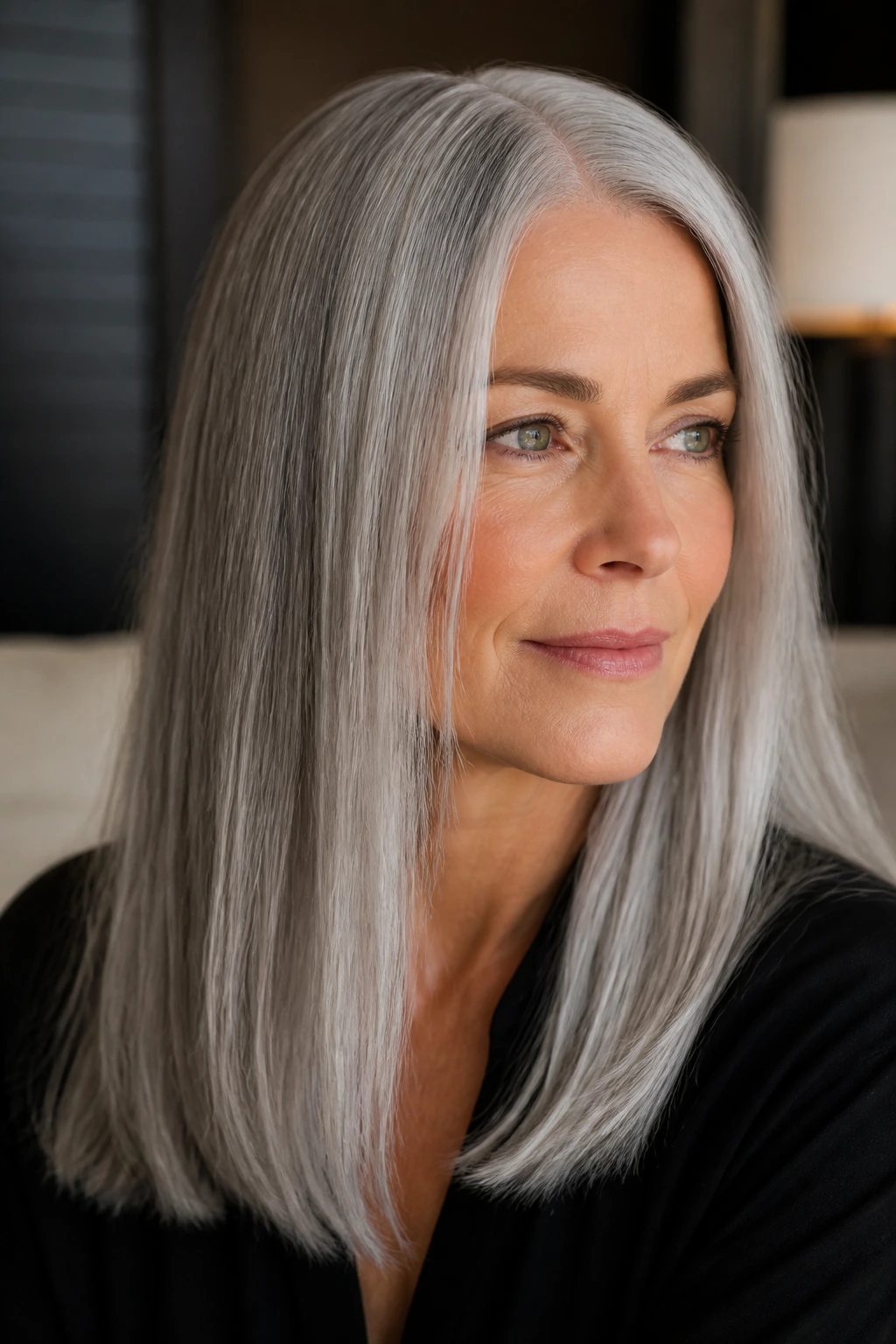
Cut to Match the Texture: If the hair is wavy or has a bend to it, lean into long layers, shags, or soft waves. For straighter hair with real density, a blunt hemline or glassy blowout can look cleaner and more expensive.
Keep the Crown Alive: Gray hair often loses lift at the roots before anything else. A little mousse at the scalp, plus blow-drying the front sections opposite their natural fall, keeps the head shape from going flat.
Use Product Where It Counts: Put smoothing cream on the mids and ends. Put volume spray at the roots. Put serum on the frayed pieces only. That separation matters. Slathering one product everywhere usually makes long gray hair limp.
Choose the Part on Purpose: A center part feels modern and sharp. A side part softens the face and gives height. Switching them occasionally also helps keep the root from training itself into one stubborn line.
Keep Accessories Soft: Silk scrunchies, padded headbands, and smooth pins are gentler on long gray hair than tight elastics or metal clips with sharp edges. Silver strands can be a little less forgiving about breakage around the temples.
Work the Face First: The front of the hair is what people notice first. A curve around the cheekbone, a bang that clears the eyes, or a sweep that opens the face will change the whole look faster than overworking the back.
Common Styling Mistakes With Gray Hair Looks for Long Hair Over 50
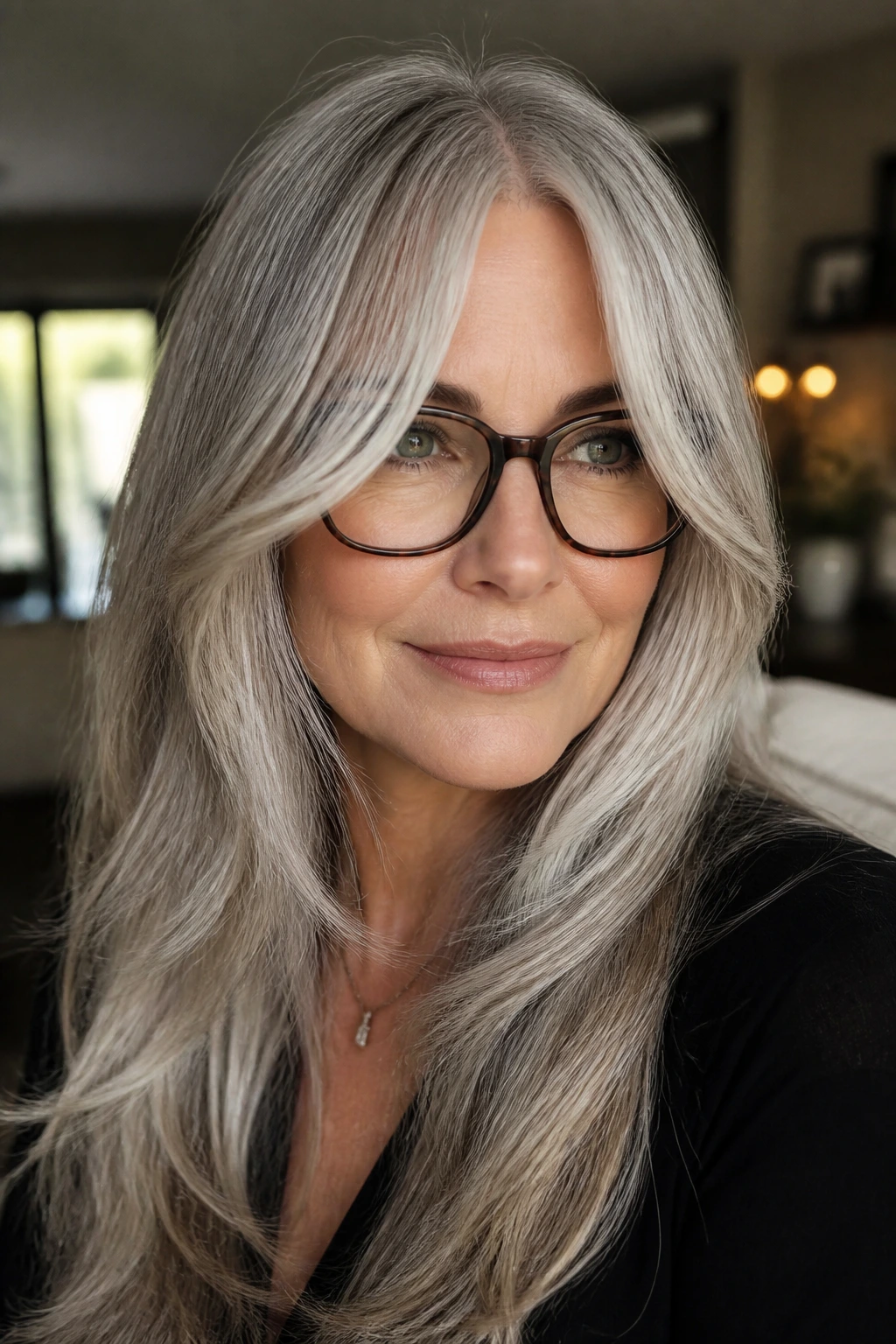
The biggest mistake is keeping the ends too thin. Long gray hair with see-through ends looks frayed, not elegant, and the fix is a trim plus some shape through the lower half. Don’t wait until the whole edge looks like a broom. Dust the ends regularly and keep the outline clean.
Another problem is overusing purple shampoo. A little goes a long way, and too much can make silver hair look flat, chalky, or faintly violet at the ends. Use it sparingly, rinse well, and follow with a moisturizing conditioner so the hair stays soft instead of stripped.
Flat roots are a third trap. If the crown collapses, even beautiful length can look tired. Lift the roots while drying, use a root spray or mousse, and stop pressing the hair down with a heavy brush after styling.
Heavy oils cause trouble too. A few drops on the ends? Fine. A full pump from root to tip? No. Gray hair shows residue fast, and buildup steals the shine you were trying to create.
Tight ponytails and harsh elastics are rough on the hairline. If the temples are fragile, use a silk scrunchie or a soft tie and switch up the style so the same spot is not pulled every day.
Variations and Alternatives to Try
Soft Transition Blend: If you are growing out dyed hair, ask for low-contrast highlights and a subtle blend around the face. That softens the line between the old color and the new silver so the grow-out stage feels more deliberate.
Curly-Silver Halo: For natural curls, keep the layers rounded and the ends hydrated. A diffuser, a curl cream, and a wide-tooth comb can turn gray curls into a halo of shape instead of a puff of dryness.
Heat-Free Weekend Set: Braid-outs, twist-outs, or overnight rollers give you bend and volume without the hot tools. They work especially well if your hair gets dry fast or you want a break from the iron.
Glossy Evening Finish: For a dressier version, smooth the hair into a side part or low twist and add a light gloss spray on the mids. The finish should reflect light, not feel coated.
Long-Front, Lighter-Back Shape: If the hair feels heavy, keep the length but shorten the front layers around the chin and shoulders. That keeps the face open while preserving the dramatic back length.
Keeping Gray Hair Bright Between Washes
Gray hair stays nicer when you do a little maintenance between shampoos instead of waiting for a rescue mission. Wash every 2 to 4 days depending on your scalp, and use conditioner every time unless your hair is very fine and gets weighed down fast.
Between washes, a silk pillowcase helps the cuticle stay smoother overnight. So does a loose braid or low ponytail before bed. If the hair bends sharply while you sleep, the silver often looks frizzier the next morning than it needs to.
A clarifying shampoo every 2 to 4 weeks clears out styling residue, hard-water buildup, and the film that can make gray hair look dull. Follow it with a deep conditioner. Gray hair likes a reset, but it does not like being stripped and abandoned.
If the silver starts to yellow, look at two things first: sun exposure and product buildup. Then adjust the purple shampoo schedule before piling on more toner. If the hair feels rough, add moisture. If it feels limp, pull back on the cream.
Trim the ends every 8 to 12 weeks. Some hair can stretch longer, but the outline starts to lose its shape if you wait too long. Long gray hair stays more impressive when the hemline looks deliberate.
Frequently Asked Questions
Can long gray hair over 50 still look full if it’s fine?
Yes, but the cut has to do more work. Long layers, a side part, or a blunt hemline with a little root lift can make fine gray hair look denser than a heavy, one-length curtain.
Are layers or a blunt cut better for gray hair?
Layers work better if your hair has movement, wave, or a lot of natural texture. A blunt cut is stronger if the hair is dense and you want a clean edge. The wrong answer is the one that fights your actual texture.
How do I stop gray hair from looking yellow?
Start with a gentler wash routine, a clarifying shampoo every few weeks, and a purple shampoo used sparingly. Sun can also yellow gray hair, so a hat or UV-protective spray helps more than people think.
Do curtain bangs work with glasses?
They often work better with glasses than full bangs do. Curtain bangs split around the frames and open the face instead of crowding it, as long as they’re cut long enough to skim the cheekbones.
Can I wear long gray hair straight every day?
You can, but the ends need to be healthy and the root needs some lift. Straight gray hair shows the hemline more than any other style, so regular trims and a light smoothing cream matter.
What if I’m growing out dyed hair?
Low-contrast blending, face-framing layers, and styles with movement—like waves, braids, or half-up looks—make the transition easier to live with. They break up the grow-out line so it doesn’t take over the whole head.
How often should I trim long gray hair?
Most long gray hair benefits from a trim every 8 to 12 weeks. If the ends start to feel stringy, bend oddly, or tangle faster than usual, that’s your cue to go sooner.
What if my gray hair frizzes in humidity?
Use a leave-in conditioner, keep the cuticle smooth with a light serum, and choose styles that work with texture instead of against it. A loose braid, a soft wave, or a low bun usually behaves better than trying to iron every bit flat.
Silver Length, Properly Worn
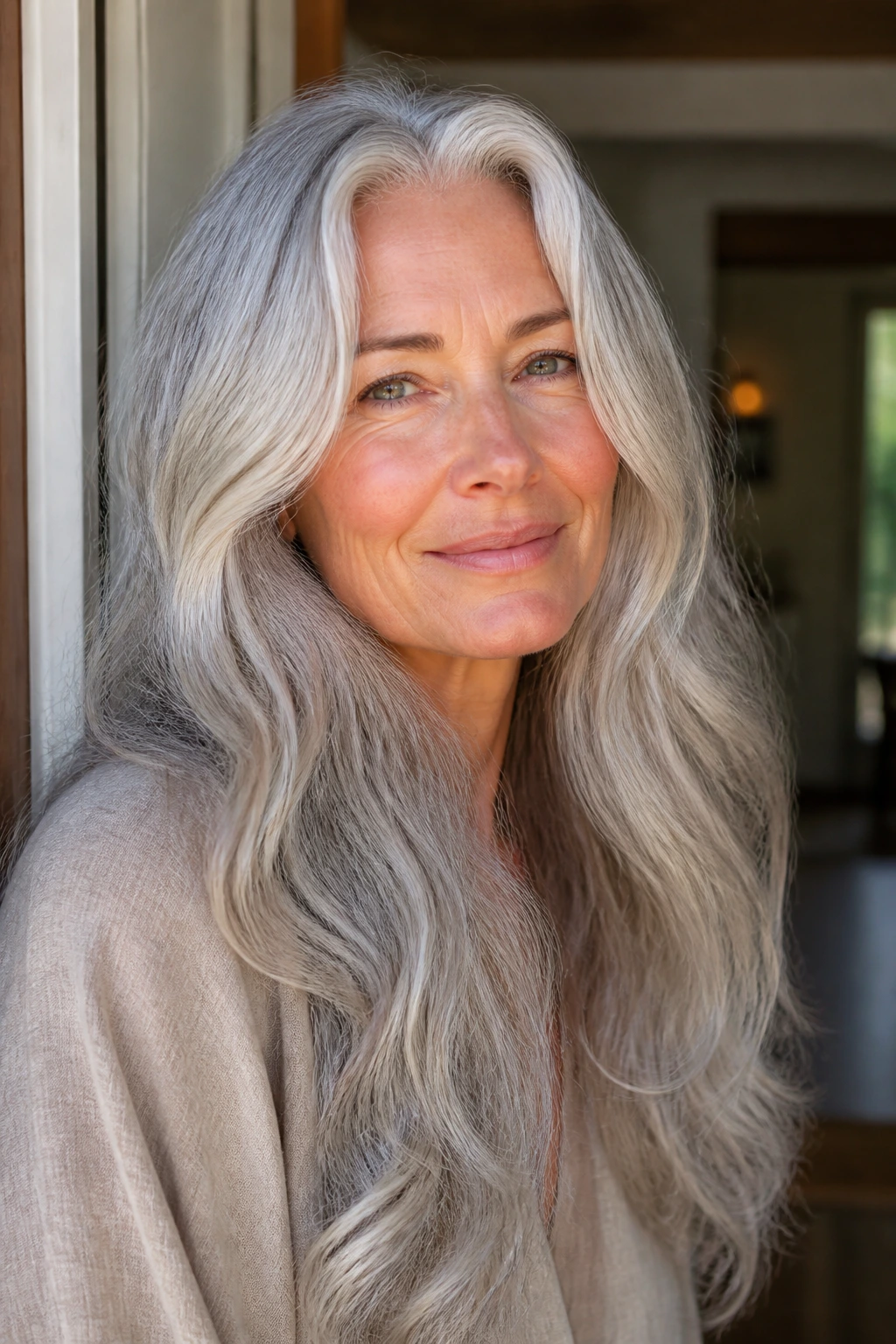
Long gray hair does not need to be short to look intentional. It needs shape, a little discipline, and a finish that respects the strand you actually have in front of you. Once those pieces are in place, silver length stops reading as something you’re managing and starts reading as something you’ve chosen.
That’s the real difference here. A blunt line, a wave, a braid, or a soft fringe can change the whole tone of the hair without touching the length you worked to keep. Pick one look that fits your texture and your routine, and wear it like it belongs to you.
