



Older women hairstyles for gray hair have one job before anything else: make the color look deliberate. A good cut can turn silver strands into structure, and structure does a lot of heavy lifting when the hair has lost some of its old thickness or softness. A blunt line looks sharper in gray. A soft bend looks cleaner. Even a plain bob suddenly has presence when the light hits white and silver instead of dyed brown.
Gray hair changes the rules a little. It often feels drier, can grow wiry around the crown, and tends to show every bad layer, every blunt chunk, every lazy trim. That is not a drawback. It just means the haircut has to be smarter. The best shapes work with the texture you actually have, not the texture you remember from twenty years ago.
There is also a nice freedom to gray and silver hair that people sometimes miss. You do not need to hide it behind heavy styling or force it into one tired “mature” look. Short, long, curly, straight, polished, messy, tucked, braided — all of it can work. The trick is choosing a shape that gives the gray hair a frame instead of letting it hang there and hope for the best.
Why These Styles Work So Well on Gray Hair
Shape beats effort: Gray hair can go flat at the roots and fuzzy at the ends in the same hour, so a cut with a clear outline does more for you than a pile of product ever will.
Texture gets room to breathe: Layers, feathers, and bends keep silver strands from falling into one heavy curtain that makes the face look pulled down.
Fine hair gets help: Several of these styles build lift at the crown and around the cheekbones, which is where thinning often shows first.
Curly and coily hair gets respect: A few of the best options below follow the curl pattern instead of fighting it, and that saves time, moisture, and frustration.
Day-two hair still looks decent: Braids, twists, bobs, and cropped cuts hold their shape better on a satin pillowcase than loose, shoulder-length hair that was overbrushed at 7 a.m.
The color stays the point: Clean lines and soft movement let silver, white, and salt-and-pepper strands do the visual work. That matters more than flashy styling.
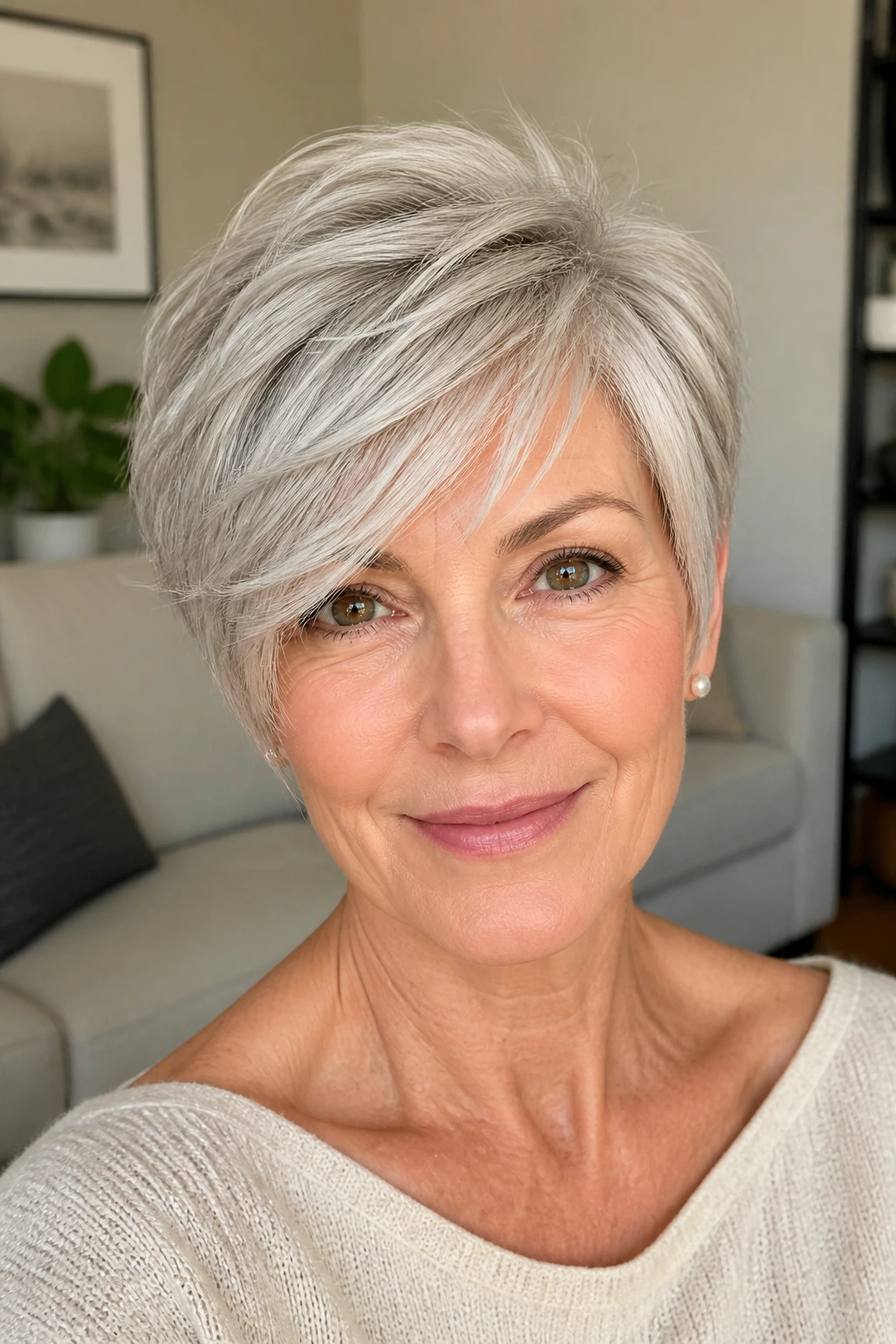
1. Soft Pixie with Crown Lift
A soft pixie is one of the easiest ways to make gray hair look crisp without making it severe. Keep the sides neat and the top a little longer, then add texture through the crown so the cut has a bit of lift instead of sitting flat like a cap. On silver hair, that tiny bit of height makes the whole face look more awake.
Why it flatters gray hair
- The shorter sides show off the face and the neckline, which is useful when the hair around the temples is lighter or finer.
- The longer top catches light and gives gray strands a soft, feathery look instead of a stiff one.
- It needs less heat than a long blowout, and gray hair usually prefers less heat.
A pea-sized dab of matte paste is usually enough. Work it through the crown with your fingertips, not a comb, or you’ll lose the airy shape that makes this cut work.
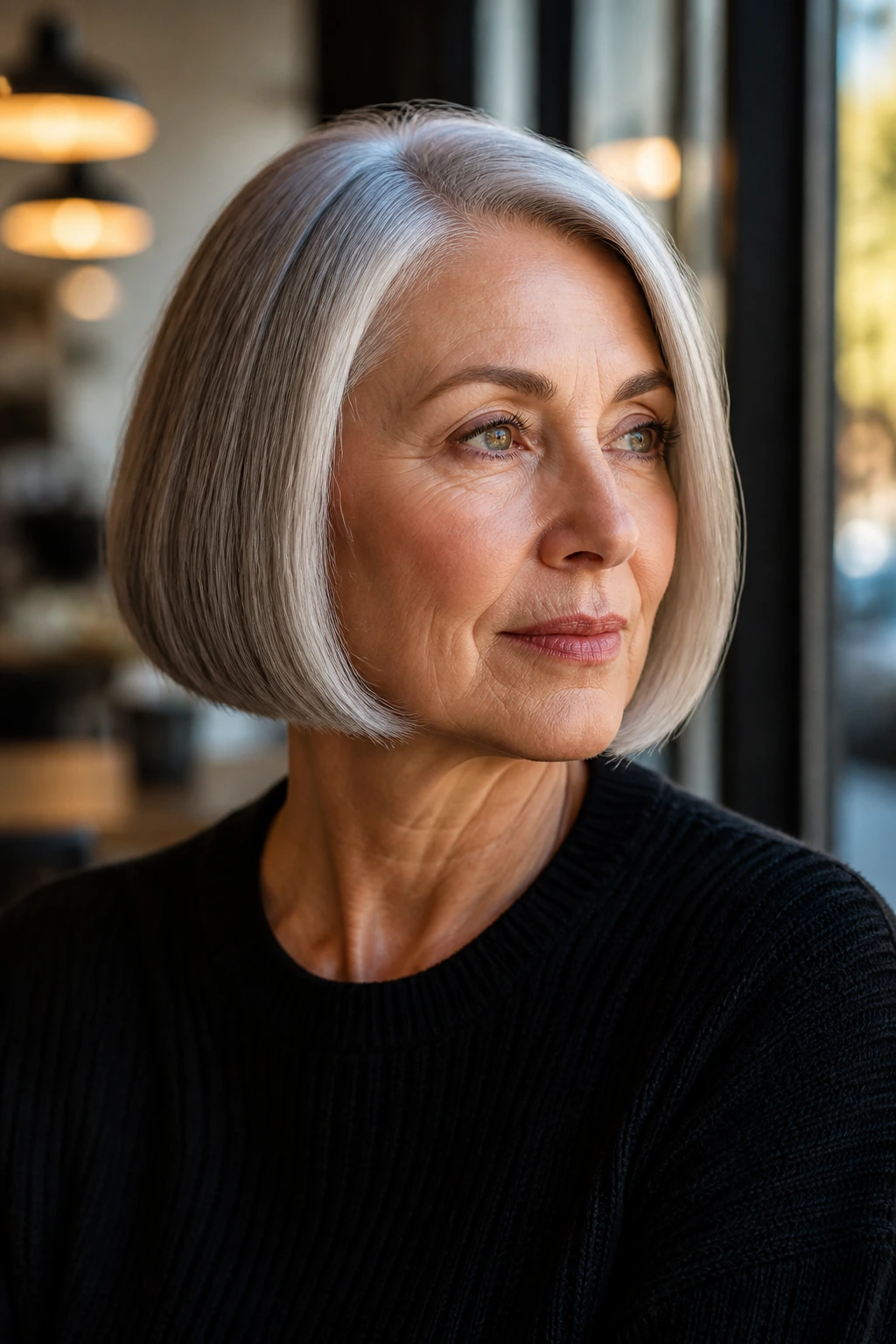
2. Chin-Length Blunt Bob
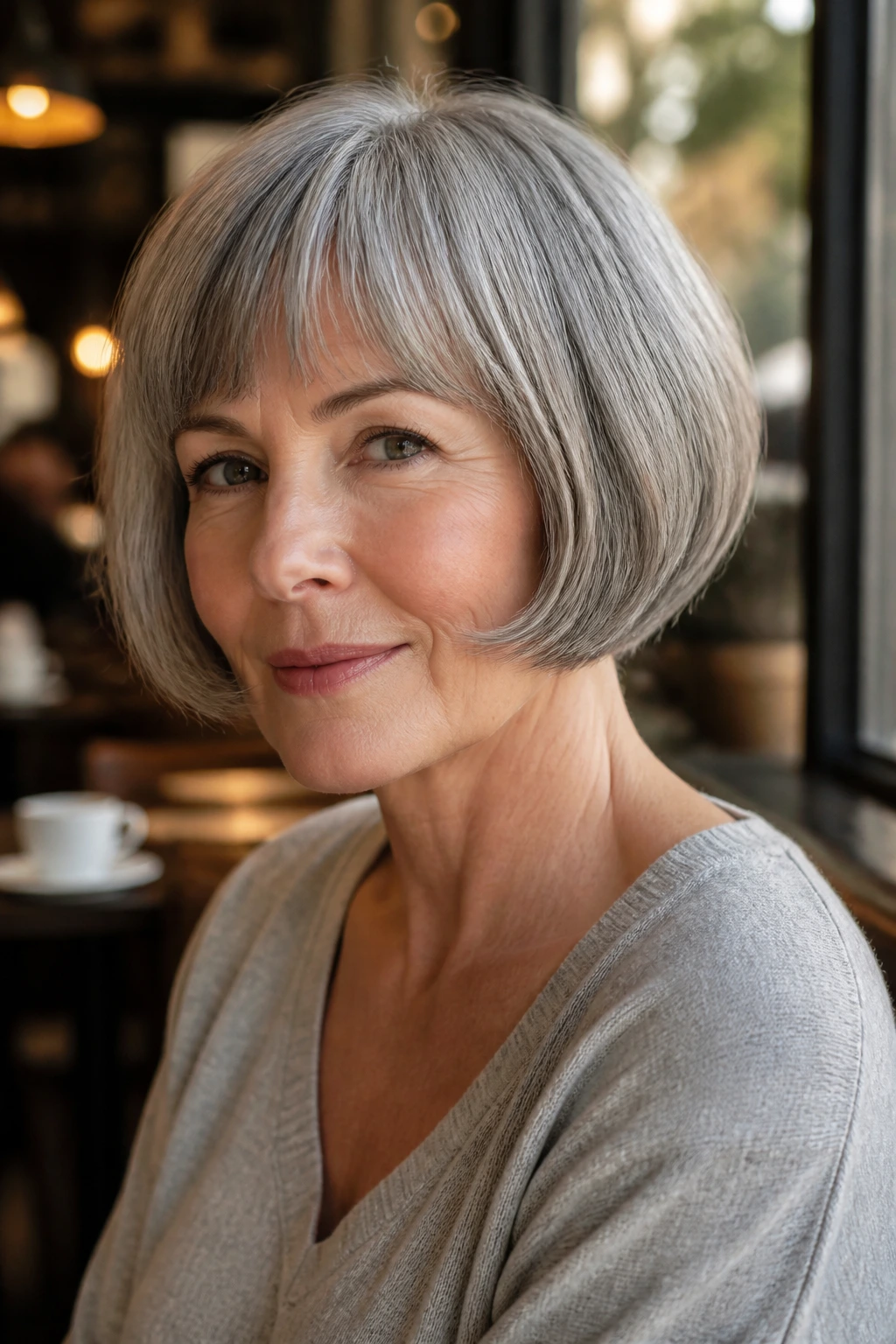
If I had to name one haircut that rarely argues with gray hair, it would be the chin-length blunt bob. The line lands right where the jaw wants structure, and the clean edge makes silver strands look intentional instead of grown-out. It’s one of those cuts that looks more expensive than it is, mostly because the shape stays honest.
This style is especially useful if your hair is fine or medium and you want the ends to look thicker. A blunt perimeter gives the illusion of density. Add a side part if the hair around your hairline has thinned a little — it softens the symmetry and keeps the bob from feeling boxy.
Keep the finish smooth, but not stiff. A round brush and a quick bend under the ends is enough. The point is line, not helmet.
3. Feathered Crop with Side Fringe
Want something softer than a pixie but shorter than a bob? This is the cut to keep in mind. A feathered crop with a side fringe gives gray hair movement around the eyes and temples, which is where many women want a little softness anyway. The fringe also helps if one side of your hair insists on sticking up or if your crown has a cowlick that refuses to cooperate.
What to ask for
- Feathering through the top and sides, not choppy layers that stick out.
- A side fringe that can sweep across the forehead instead of sitting straight down.
- A neck area kept neat, so the shape still looks tidy from behind.
Blow-dry the fringe first, before the rest of the hair dries on its own. That one habit saves a lot of annoying flipping and sticking.
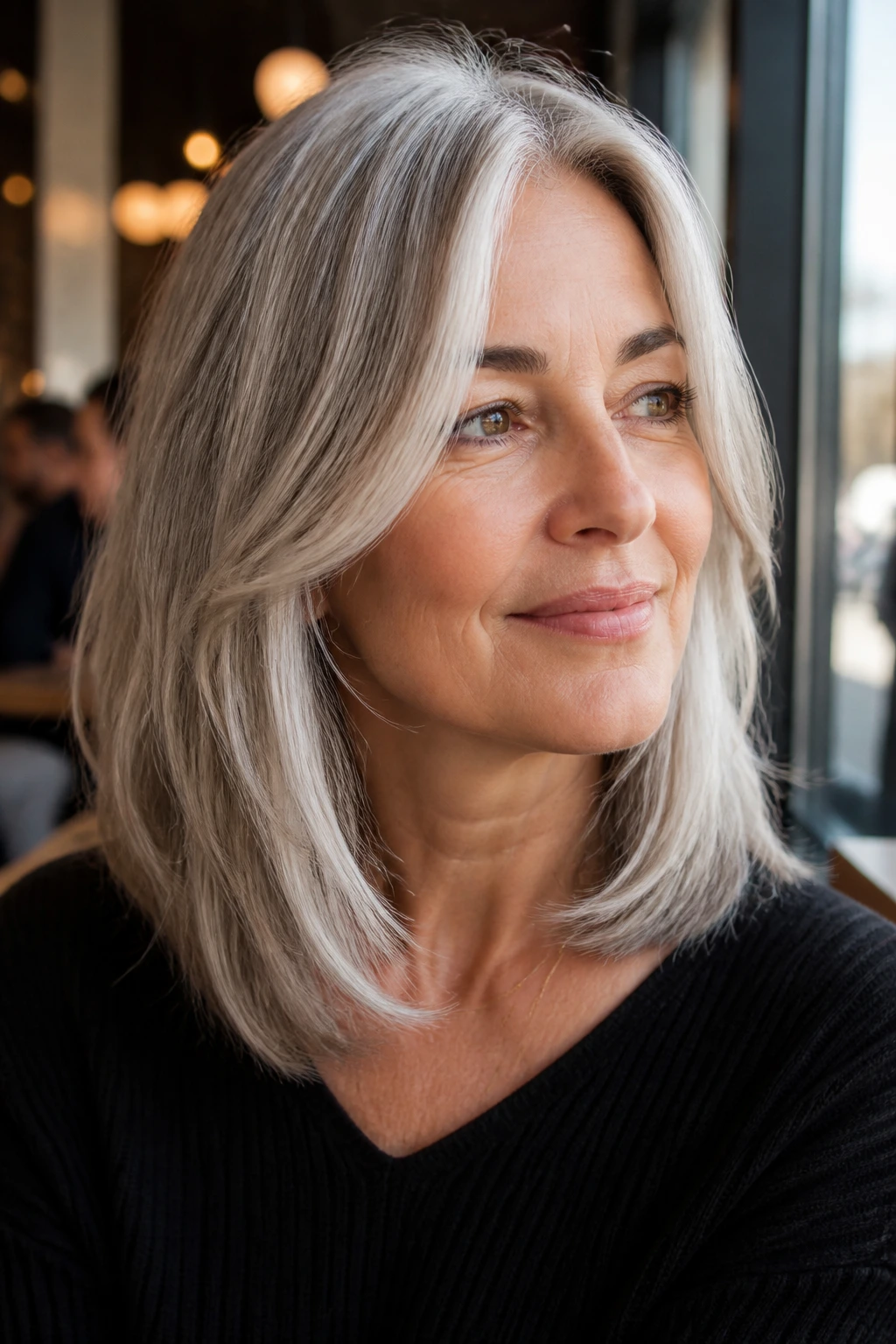
4. Shoulder-Grazing Lob with Face-Framing Layers
I keep seeing this cut on women who want length, but not the kind of length that hangs and drags. A shoulder-grazing lob keeps gray hair looking full because the ends are still thick enough to matter, while face-framing layers stop it from turning into one heavy sheet. It’s a good middle ground when you are not ready to go short.
The face-framing pieces should start around the cheekbone or just below the chin, depending on where you want the eye to land. Too high, and the cut can feel fussy. Too low, and the effect gets lost.
If your hair is straight, a soft bend at the ends is enough. If it waves naturally, let it. The lob looks best when the movement feels relaxed, not curled into submission.
5. Tapered Natural Curls
Gray curls often have a little more personality than their colored versions. They can also dry out faster, puff up at the wrong spots, and lose shape if the cut fights the curl pattern. A tapered natural curl cut fixes that by keeping the silhouette close at the sides and letting the curls stack where they want to.
The best part is how little it asks from you in the morning. A leave-in conditioner, a curl cream, and a diffuser on low heat can be enough. If the curls are springy but loose, ask for a shape that keeps the weight lower around the crown so the style does not mushroom.
This is not a cut for people who want pin-straight polish. It is for people who want their curls to look clean, defined, and fully on purpose.
6. Stacked Bob with Clean Nape
Unlike a one-length bob, a stacked bob builds lift at the back and removes bulk where gray hair often looks heaviest. The nape stays neat, the crown gets more shape, and the whole head looks a little more lifted. That matters if the hair has started to fall flatter in back or if you wear glasses and want the cut to clear the frame.
This shape works well on thick gray hair because the stacking takes away the pyramid effect. On finer hair, the stacking should be subtle — too much and it can look overcut. A good stylist will keep the graduation soft enough that the bob still swings.
It’s a strong choice if you like a haircut that looks polished from the side as well as the front. The back matters here. A lot.
7. Long Silver Layers with Loose Waves
Not everyone wants short hair, and gray hair can look striking at a longer length when the ends are healthy. Long silver layers with loose waves keep the hair moving so it doesn’t hang in one flat sheet, which is what tends to make longer gray hair look tired. The layers should start low enough to preserve weight; otherwise the length starts to fray.
A few practical details matter here:
- Keep the ends trimmed before they start looking wispy or transparent.
- Use a large curling iron, usually 1¼ to 1½ inches, if you want bend instead of tight curls.
- Finish with a light serum only on the ends, never near the roots.
This style works best when the wave is soft and the shine is visible. If the hair is dry, a weekly glossing treatment does more than another pass with the iron.
8. French Bob with Soft Bangs
A French bob can look almost unfairly good on gray hair because the shape is compact, neat, and full of character. The cut sits around the cheekbone or jaw, and the soft bangs keep the forehead from looking too exposed. The result is neat, but not uptight.
The line matters
The outline should feel rounded, not blunt in a heavy, blocky way. Gray hair shows corners fast. A slight bend in the ends and a softer bang make the whole style feel lived-in instead of rigid.
This cut is especially nice if you wear lipstick, earrings, or both. The hair becomes part of the frame instead of the whole story.
9. Asymmetrical Bob with Deep Side Part
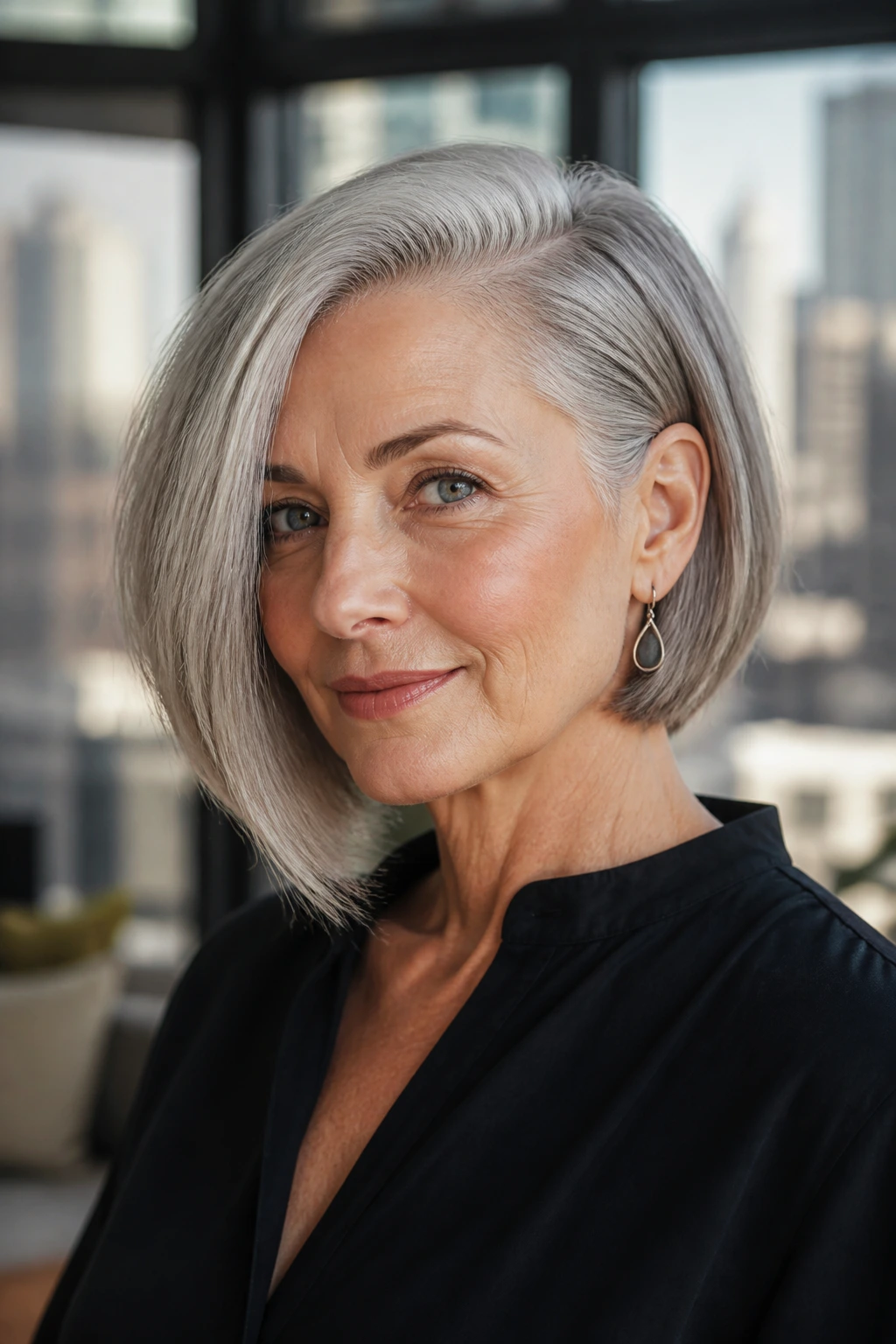
Why does an asymmetrical bob work so well on silver hair? Because it gives the eye a place to move. One side sits a little longer, the deep side part adds lift at the root, and the whole shape feels more modern than a bob that falls the same way on both sides. If one side of your hair always lies flatter than the other, this cut can quietly fix that.
The asymmetry does not need to be dramatic. A difference of half an inch to an inch is enough for most women. Too much and it starts looking like a design choice that needs maintenance every morning.
This is one of the better options for fine hair that needs a bit of attitude. The deep part creates volume without teasing, and gray strands usually respond well to that kind of structural help.
10. Textured Shag with Wispy Bangs
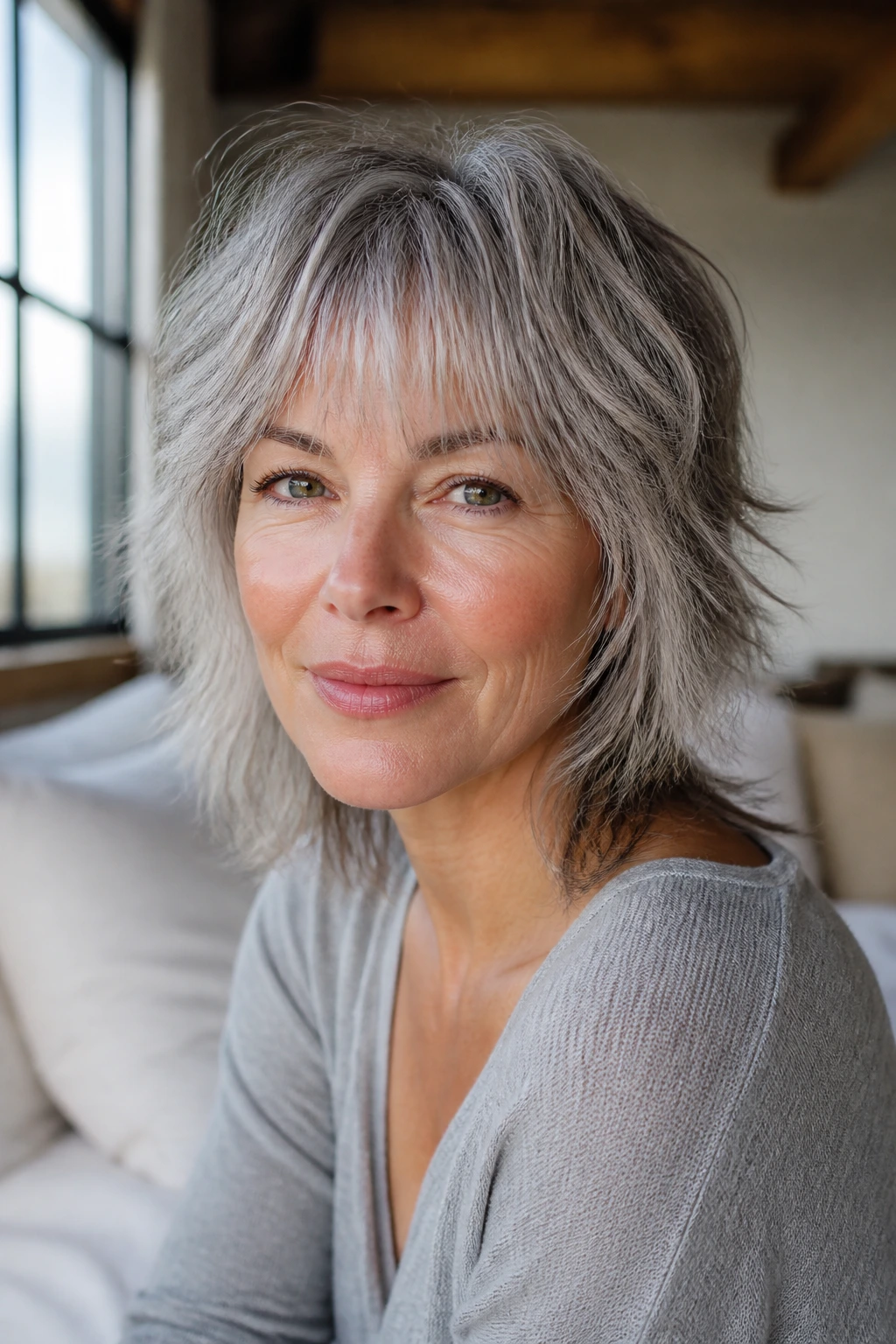
A textured shag sounds edgy, but on gray hair it can read soft and airy if the layers are cut with restraint. The wispy bangs keep the forehead light, and the rest of the layers build movement around the cheeks and shoulders. It’s a good cut for women who want energy without a lot of styling fuss.
The trick is not to overdo the choppiness. Gray hair can already look frayed at the ends if it is over-layered, and a shag that is too aggressive just makes that worse. The best versions keep the perimeter soft and let the layers do the lifting.
Air-drying with a small amount of mousse works nicely here. Scrunch a little, leave a little undone. That lived-in texture is the point.
11. Rounded Sleek Bob
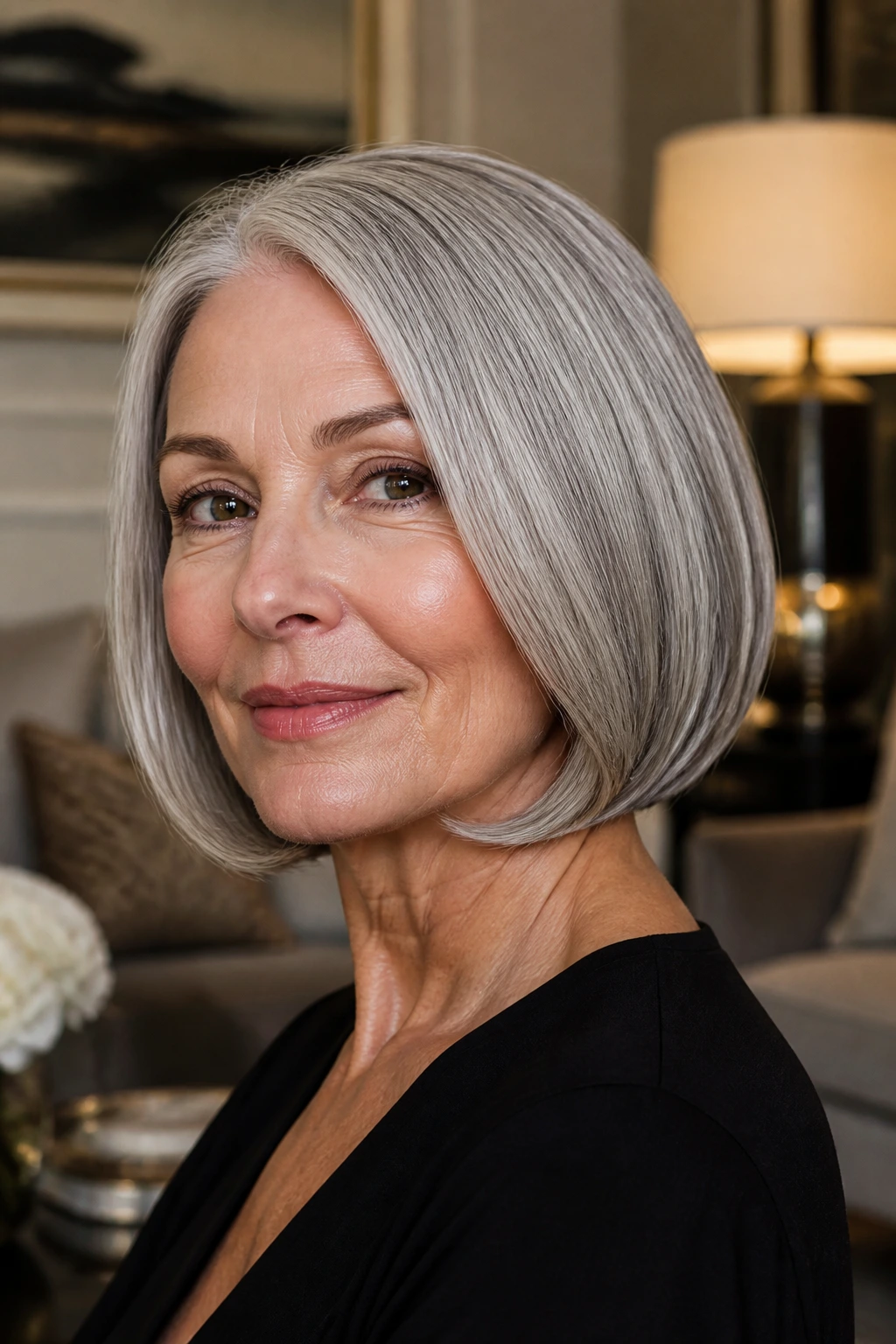
A rounded sleek bob is what you choose when you want gray hair to look polished and controlled without looking severe. The cut curves around the jaw, so the shape feels softer than a dead-straight bob. On silver hair, that curve can be beautiful because the light catches the roundness rather than scattering across frizz.
This style does best with a smooth blow-dry and a brush that can guide the ends inward. A little heat protectant goes a long way. Gray hair is often porous enough that too much heat just roughs up the cuticle and steals shine.
Keep the finish glossy, not greasy. A spray shine product from mid-length to ends is usually enough. The root should stay clean.
12. Curly Taper Cut for Coils
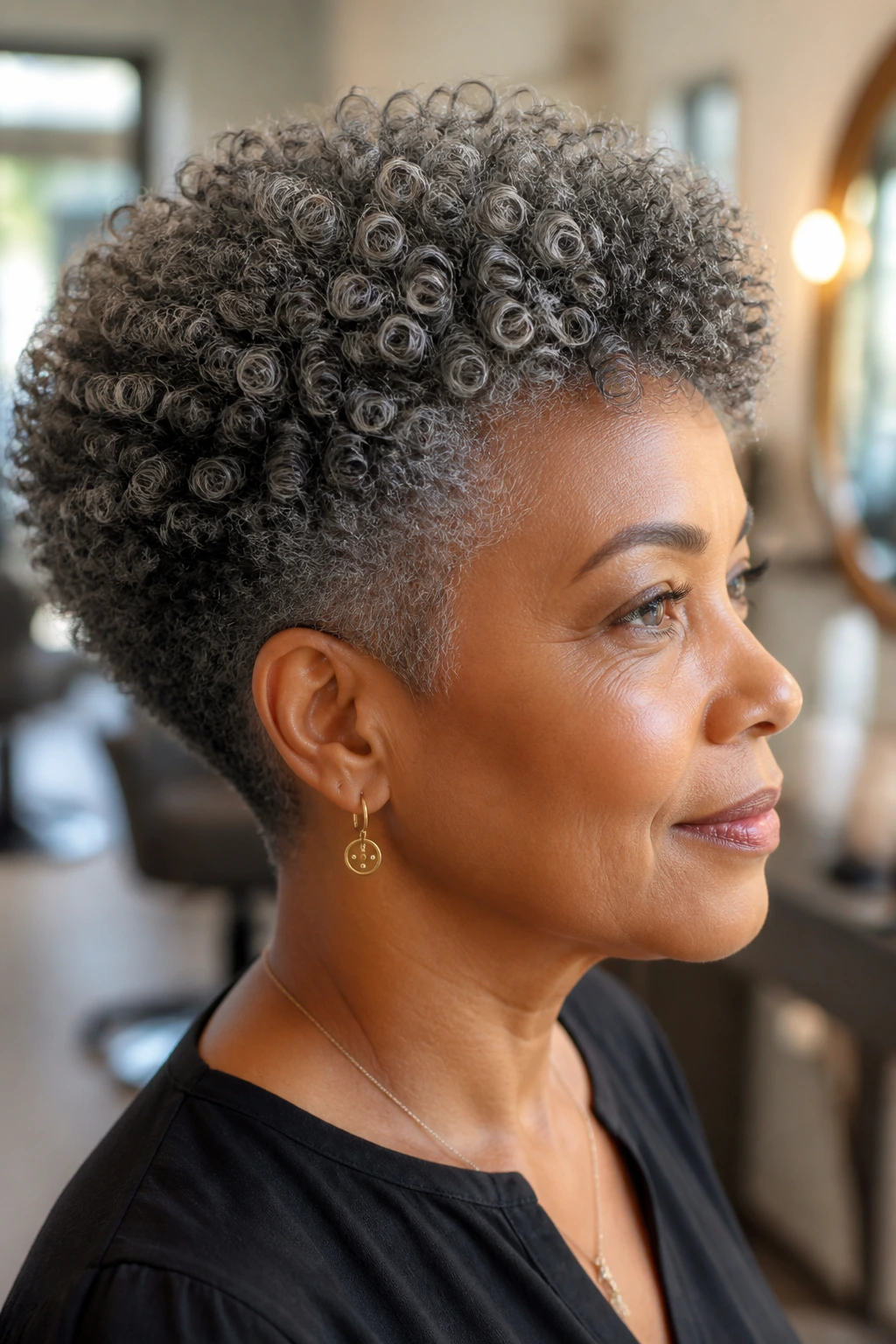
If your curls are tight or coily, a tapered cut can be a better friend than a flat, even shape. It keeps the sides and back tidy while preserving length and fullness where the curl pattern naturally wants to sit. Gray coils often spring differently from dyed curls, and this shape respects that instead of forcing everything into one box.
This is the cut I’d point to for women who want shape, not length for its own sake. It keeps the profile neat. It also keeps the crown from ballooning while the neckline disappears.
Ask for a dry-cut approach if your curls shrink a lot. Wet cutting can be a little deceptive on coily hair, and you want the actual finished shape to be the one your stylist is looking at.
13. Low Chignon with Face-Framing Pieces
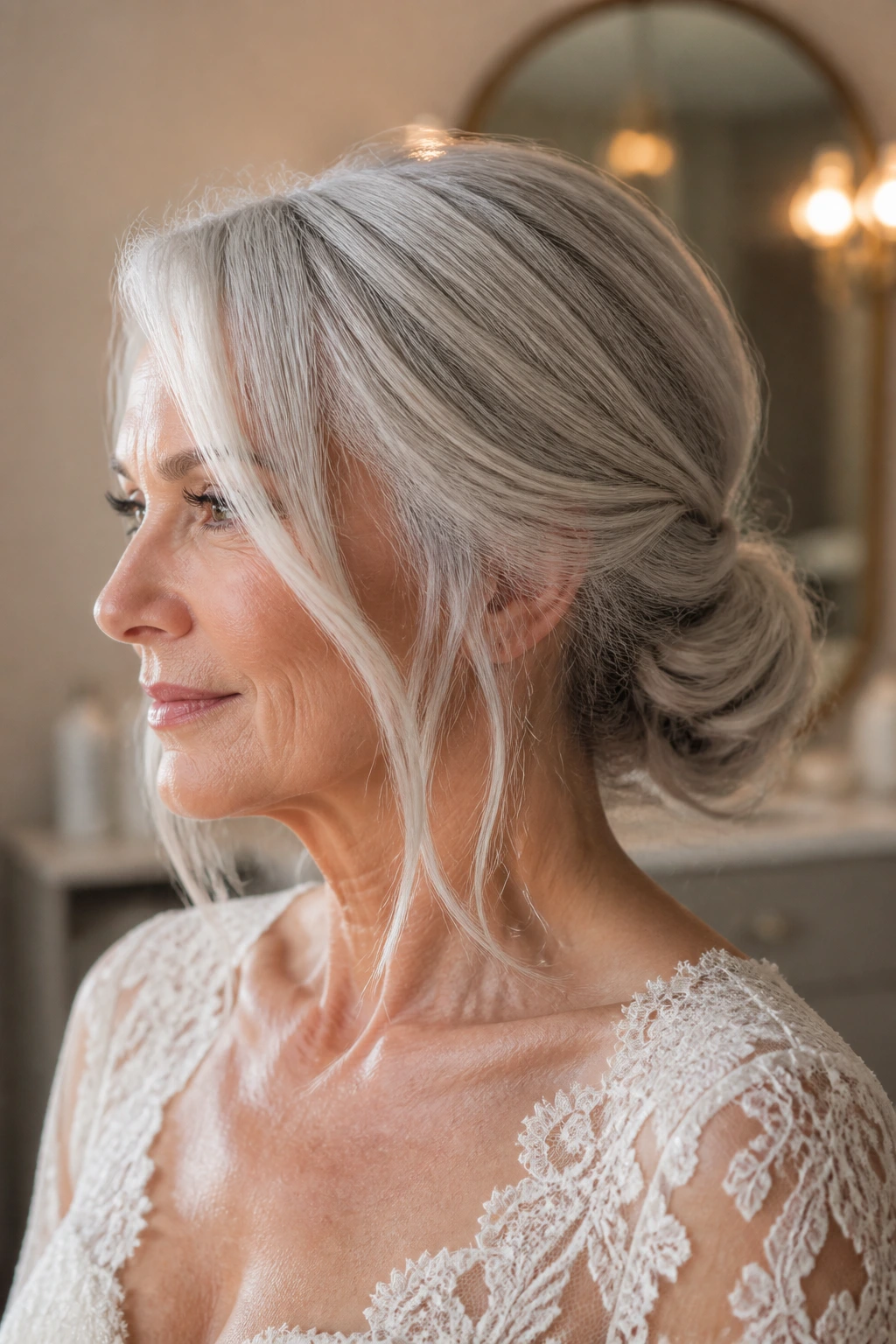
A low chignon is one of those hairstyles that saves a bad hair day and makes it look planned. Pull gray hair into a loose bun at the nape, then leave a few face-framing pieces out around the temples and cheekbones. The silver strands around the face catch the light nicely, which keeps the style from looking too severe.
A few pins tucked under the bun make the difference between “done” and “held together in a hurry.” Use a smoothing cream first if the top layer is frizzy, then secure the bun with U-pins or strong bobby pins.
This works for weddings, dinners, and any day when the neck wants to be free. It also buys you a little extra time between washes.
14. Braided Crown Updo
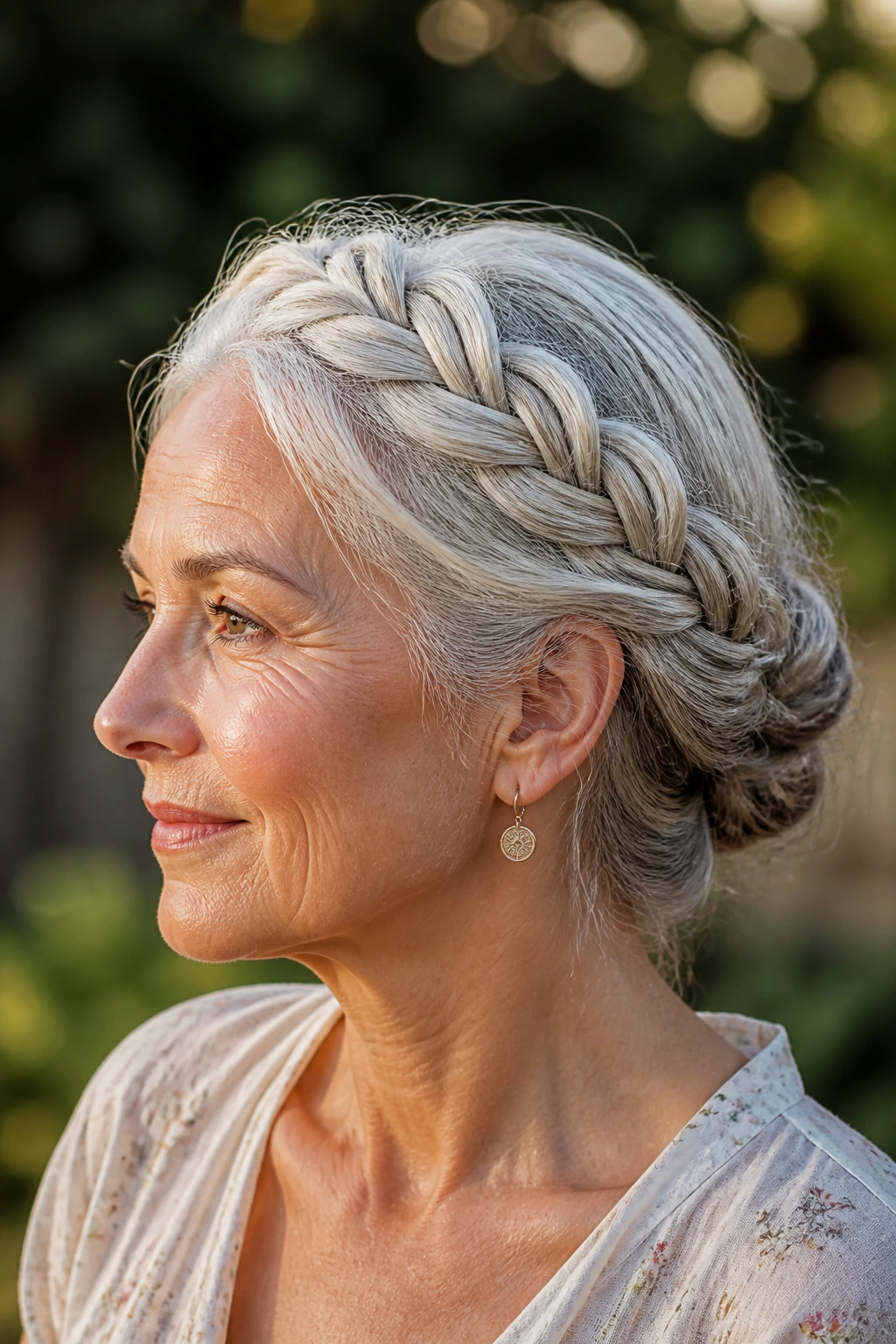
A braided crown is one of the best special-occasion styles for gray hair because the braid itself becomes the feature. Wrap it around the head, pin it close to the hairline, and let the rest of the hair tuck into a low bun or twist at the back. The silver and white strands show the braid pattern beautifully — not in a shiny magazine sense, but in a real, textured way.
This style likes a little grit. Second-day hair, a touch of dry shampoo, or a bit of texturizing spray gives the braid enough hold to stay in place. Too-clean hair slips.
If your hair is fine, braid slightly looser and pancake the braid gently with your fingers. It looks fuller fast. If the hair is thick, keep the braid compact so it does not bulge at the crown.
15. Voluminous Blowout with Side Sweep
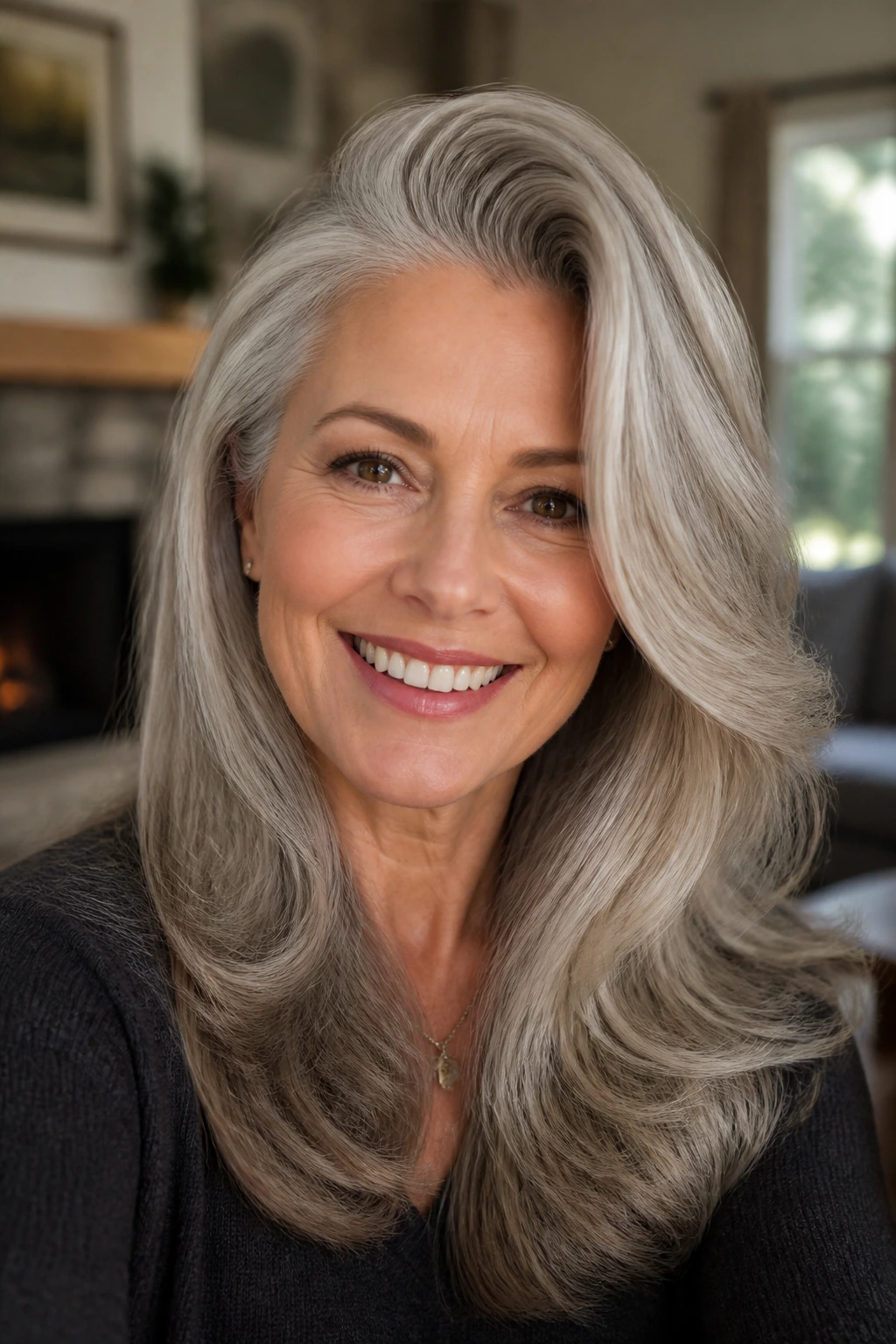
A side-swept blowout is a strong choice when you want gray hair to look full, soft, and a little dramatic without relying on curls. The side part lifts the roots, and the sweep gives the face a shape that feels grown-up in the best sense of the word. It’s flattering on medium to long lengths, especially when the hair has enough body to hold a round-brush finish.
The root is the whole game
If the root stays flat, the blowout falls apart in an hour. Clip the top section up while the rest dries, then direct the root up and away from the scalp with the brush. That small habit makes a bigger difference than another pass with the dryer.
Finish with a light mist of flexible-hold spray. Hard spray kills the movement, and gray hair usually looks better when the brush work still shows.
16. Graduated Wedge Cut
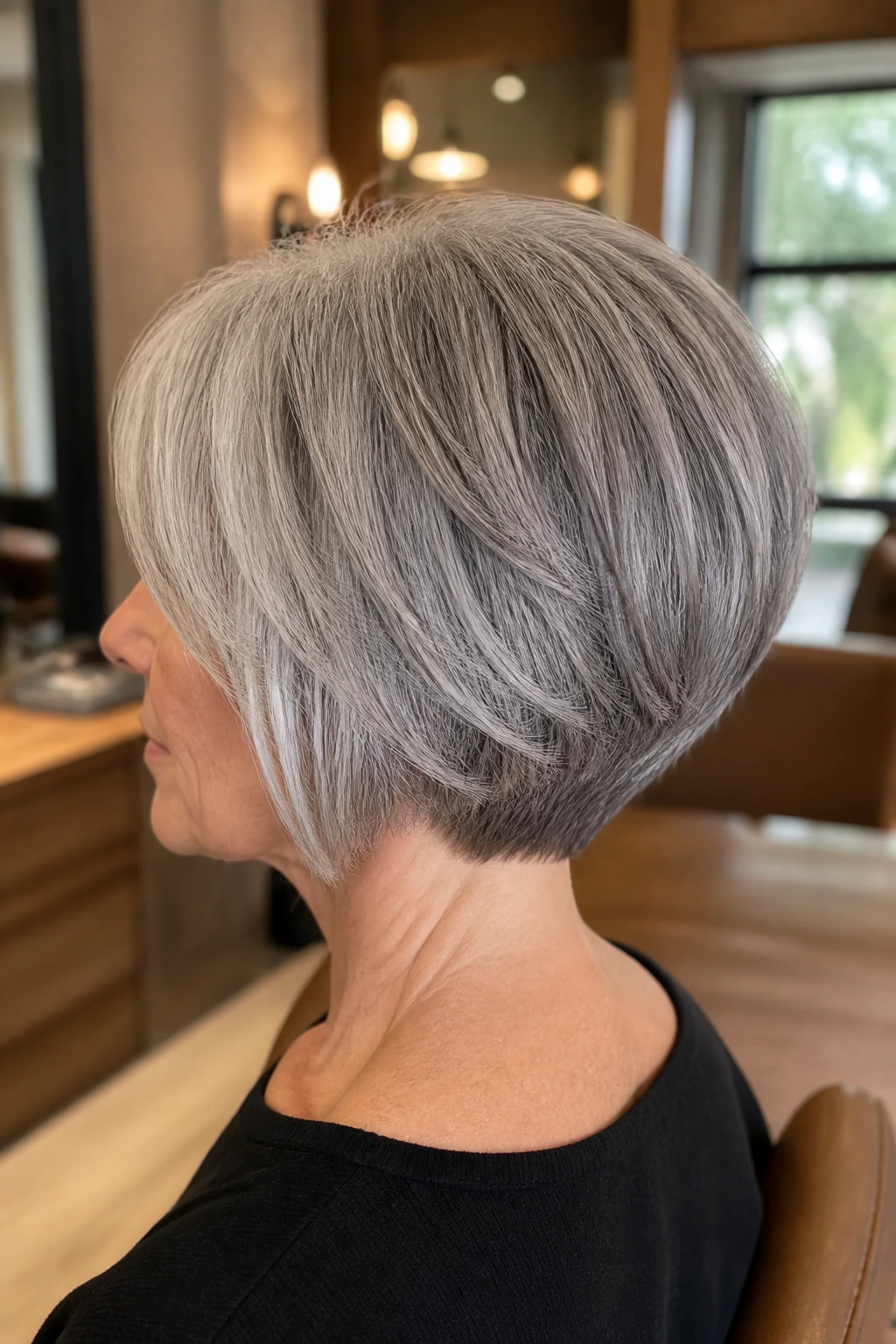
The wedge cut has stayed around for a reason. The back is shorter and stacked, the sides curve forward, and the overall shape gives gray hair a lot of architecture without much daily effort. On older women, that structure can be a gift, especially if the crown has started to flatten or the nape needs a cleaner line.
It’s a cut that suits medium to thick hair especially well. The graduation removes bulk from the right places, and the silhouette stays neat even when the hair grows out a bit. If you like a classic shape but do not want something stiff, this is worth a look.
The modern version should feel softer than the ones you may remember from decades ago. Less helmet. More curve.
17. Curtain Bang Lob
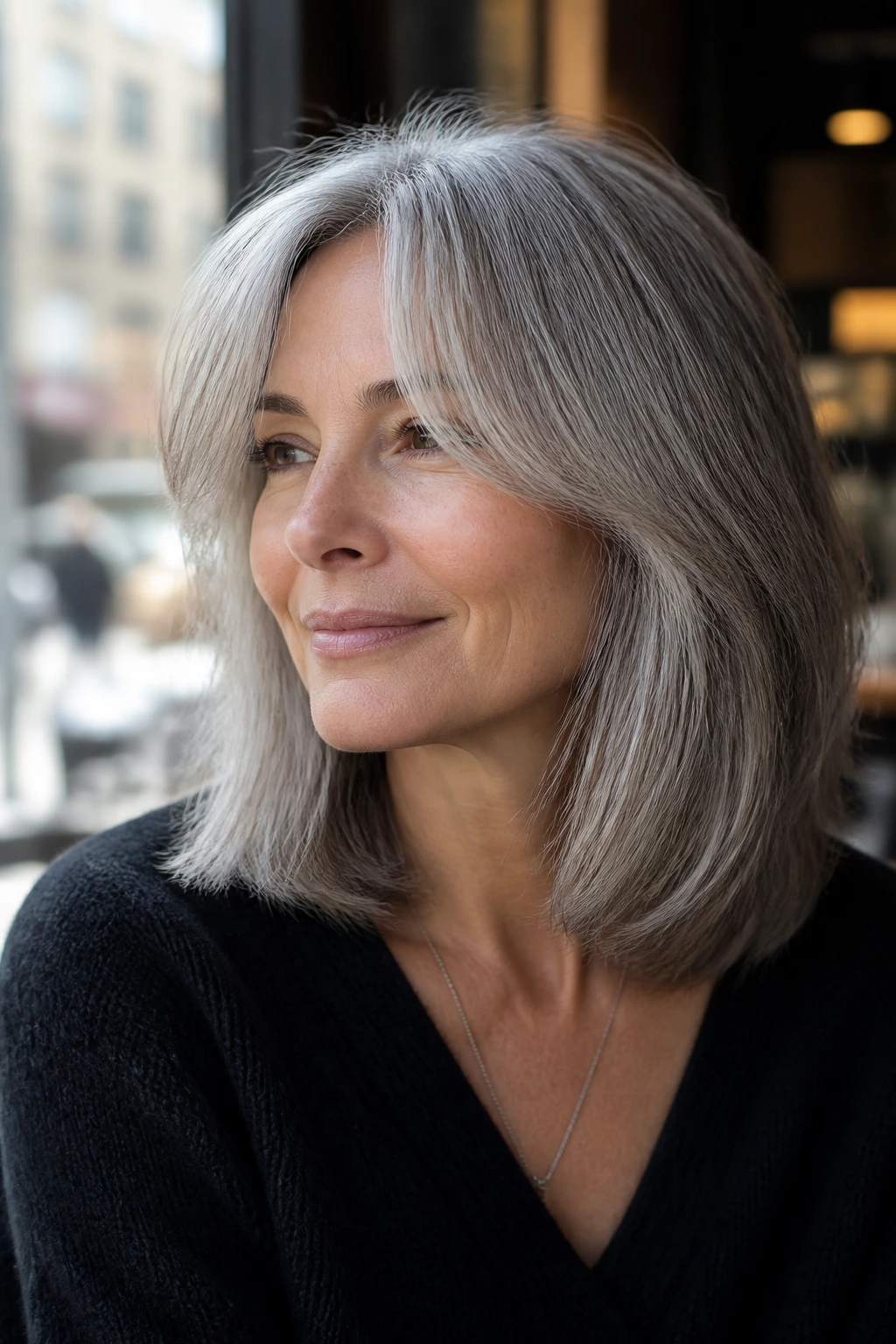
A collarbone-length lob with curtain bangs is one of the most forgiving shapes for gray hair because it gives you movement near the face without committing to full bangs. The curtain fringe opens in the middle or slightly off-center, and that creates a soft frame around the eyes and cheekbones. It also grows out gracefully, which matters when you do not want a cut that demands constant babysitting.
This is a smart choice for hair that has lost a bit of density at the temples. The bangs cover some of that area without feeling heavy. The length below the shoulders keeps the cut from puffing out into a triangle.
If you wear glasses, ask the stylist to keep the fringe long enough that it does not sit on the frames. That tiny detail saves a lot of daily annoyance.
18. Twist-Out Bob
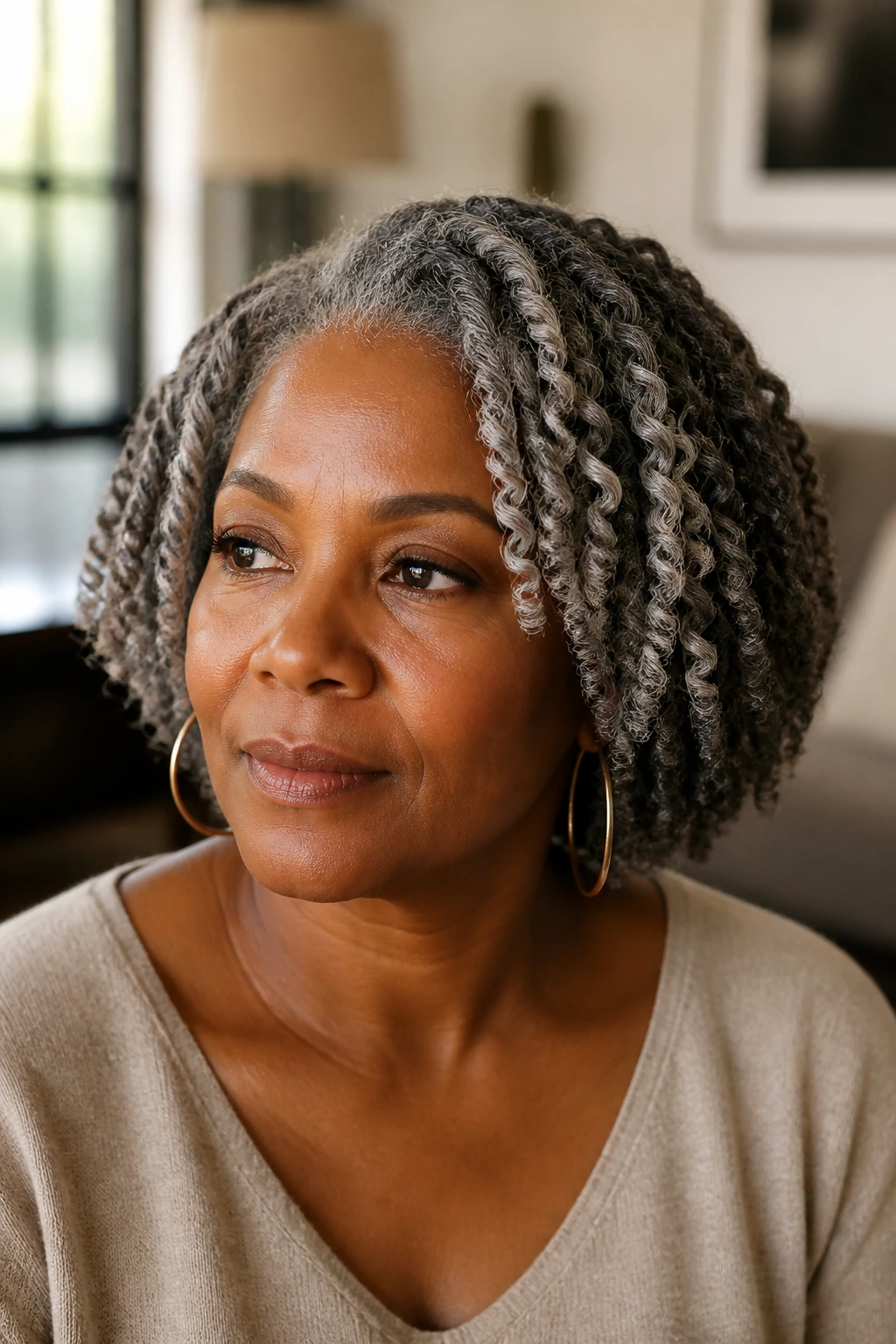
A twist-out bob gives natural gray hair a defined shape without forcing it into a blowout. Set the hair in twists, let them dry fully, then separate them with care so the curls fall into a rounded bob-like silhouette. The texture is soft, fluffy, and personal, not shellacked.
Why it works
- It protects the curl pattern while you style it.
- It gives a bob shape without needing a haircut that is too short.
- It hides uneven curl shrinkage better than straight styles do.
Use a leave-in conditioner and a styling cream with enough slip to keep frizz down during separation. If you rush the unraveling, you lose definition and gain puff.
19. Half-Up Twist for Gray Waves
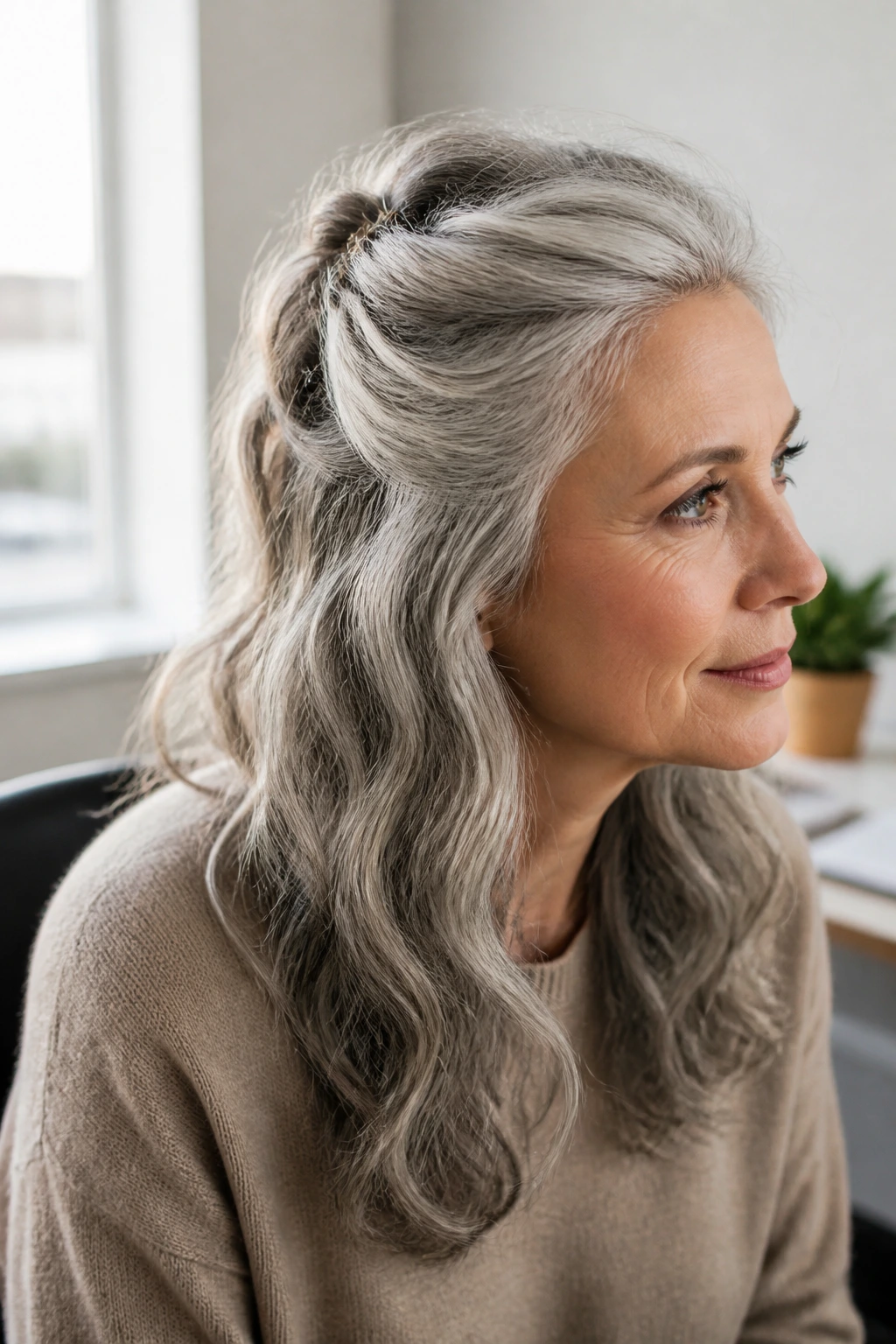
What do you do when the front is flat but the ends still look good? A half-up twist. Take the top section, twist it back softly, and pin it just below the crown. The result is neat enough for an office day, relaxed enough for lunch, and quick enough that you do not need a mirror ritual.
This works beautifully on gray waves because the top gets lift while the lower length stays visible. If the ends are a little dry, that is fine — they stay out of the spotlight.
Use two or three bobby pins crossed in an X pattern to keep the twist in place. One pin alone tends to slip, especially if the hair is fine or silky.
20. Long Pixie with Side-Swept Fringe
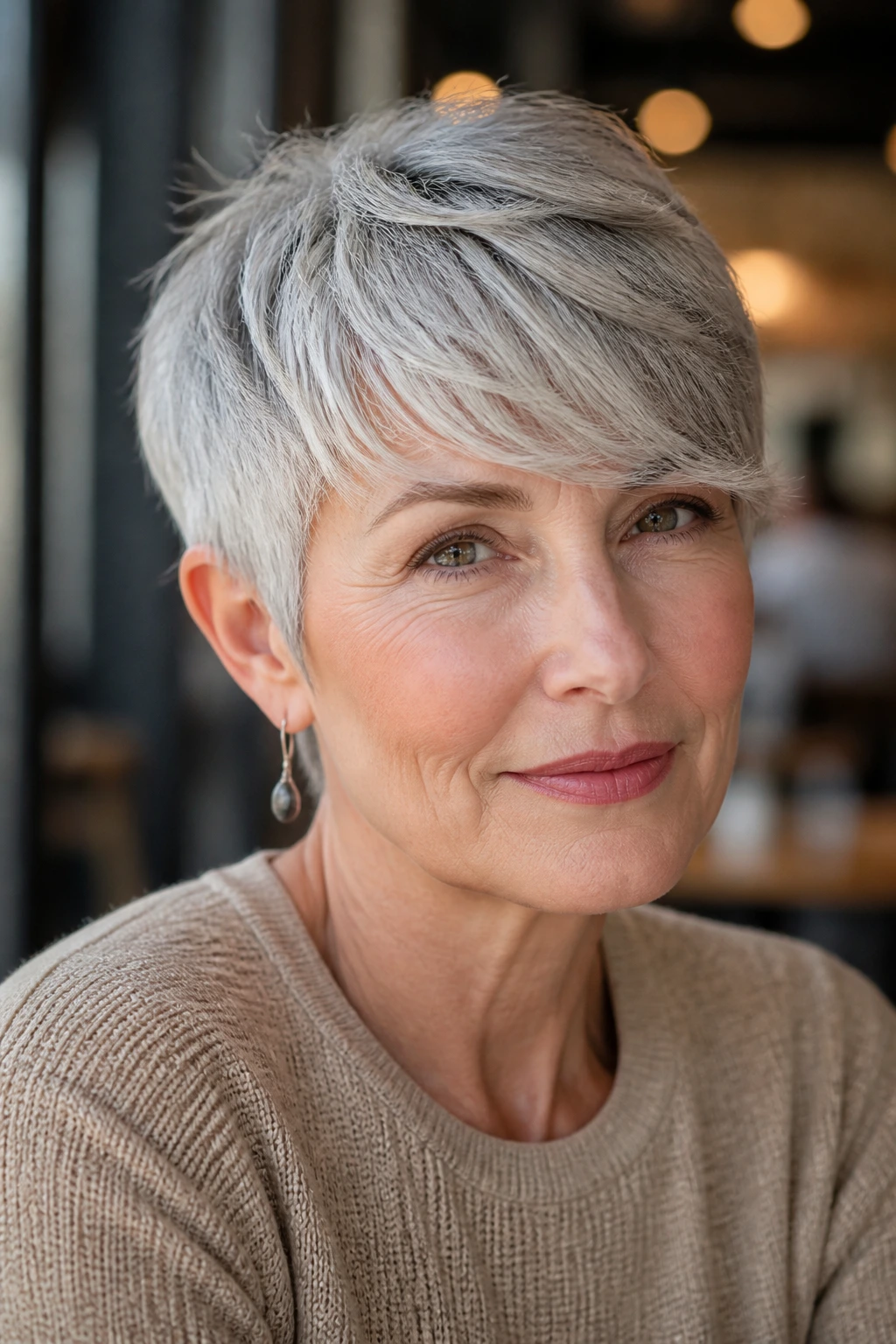
A long pixie gives you the ease of short hair without the sharpness that can sometimes feel too bare. Keep the top long enough to sweep across the forehead, then soften the sides so the cut still hugs the head. Gray hair loves this kind of shape because the fringe brings movement back into the face.
It’s a good match for women who wear earrings, glasses, or both. The cut keeps the neckline open and the fringe keeps the front from feeling too exposed. A matte cream or light paste is enough; heavy gel makes the fringe stiff, which is the last thing you want on silver hair.
This style also grows out cleanly. That matters more than people admit.
21. Soft Perm Set
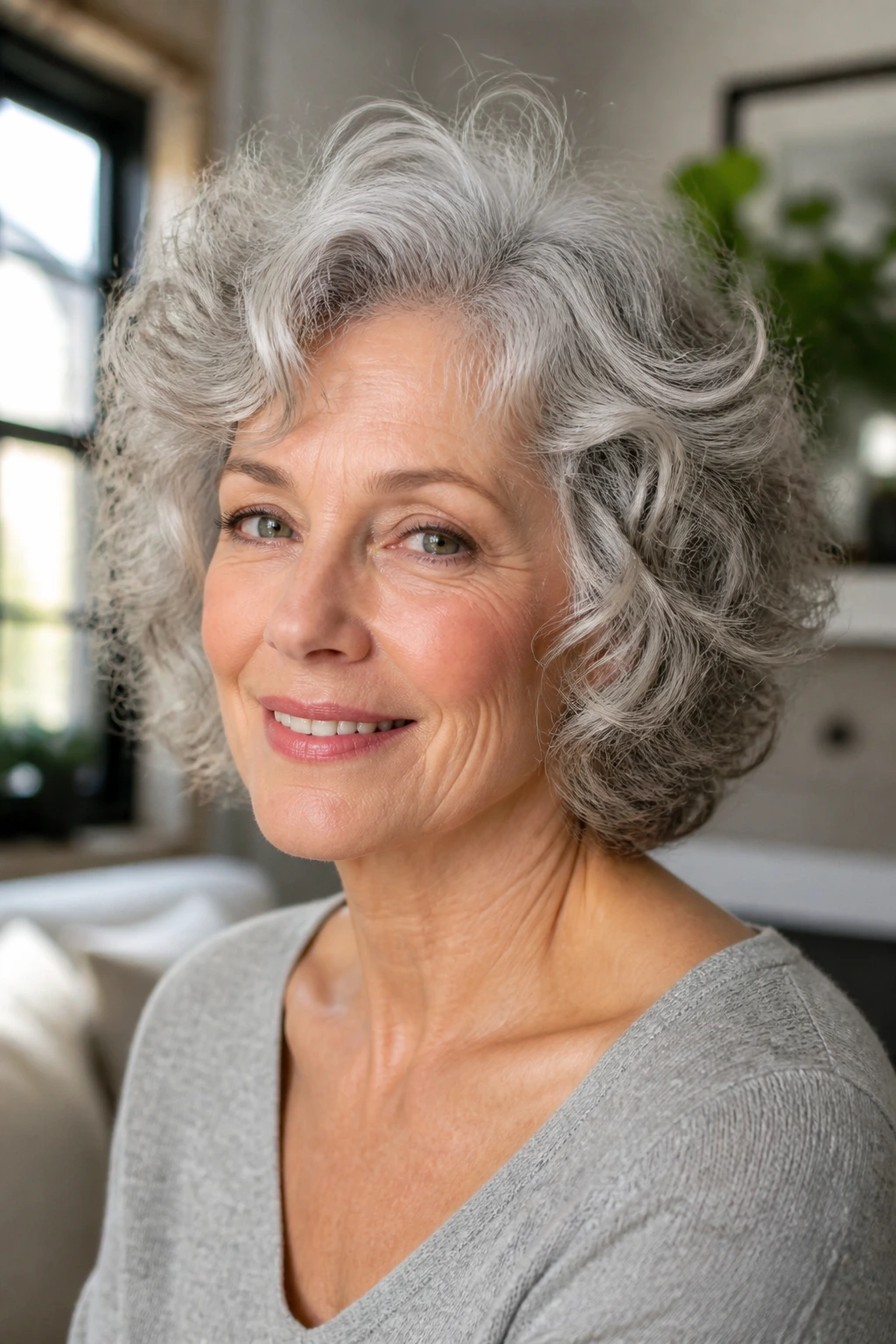
A soft perm is not the tight, crunchy thing people used to fear. Done well, it adds body, bend, and lift to gray hair that has gone limp or too straight to hold a style. The rods should be larger, the curl pattern should be loose, and the finish should feel like movement rather than corkscrews.
Gray hair often benefits from this because the new shape reduces daily heat styling. You wash, scrunch, and go. A little curl cream on damp hair and a diffuser on low heat can keep the shape alive for days.
The maintenance is real, though. Permed hair needs moisture, and gray hair needs moisture anyway. Those two facts happen to fit each other.
22. Wrapped Low Ponytail
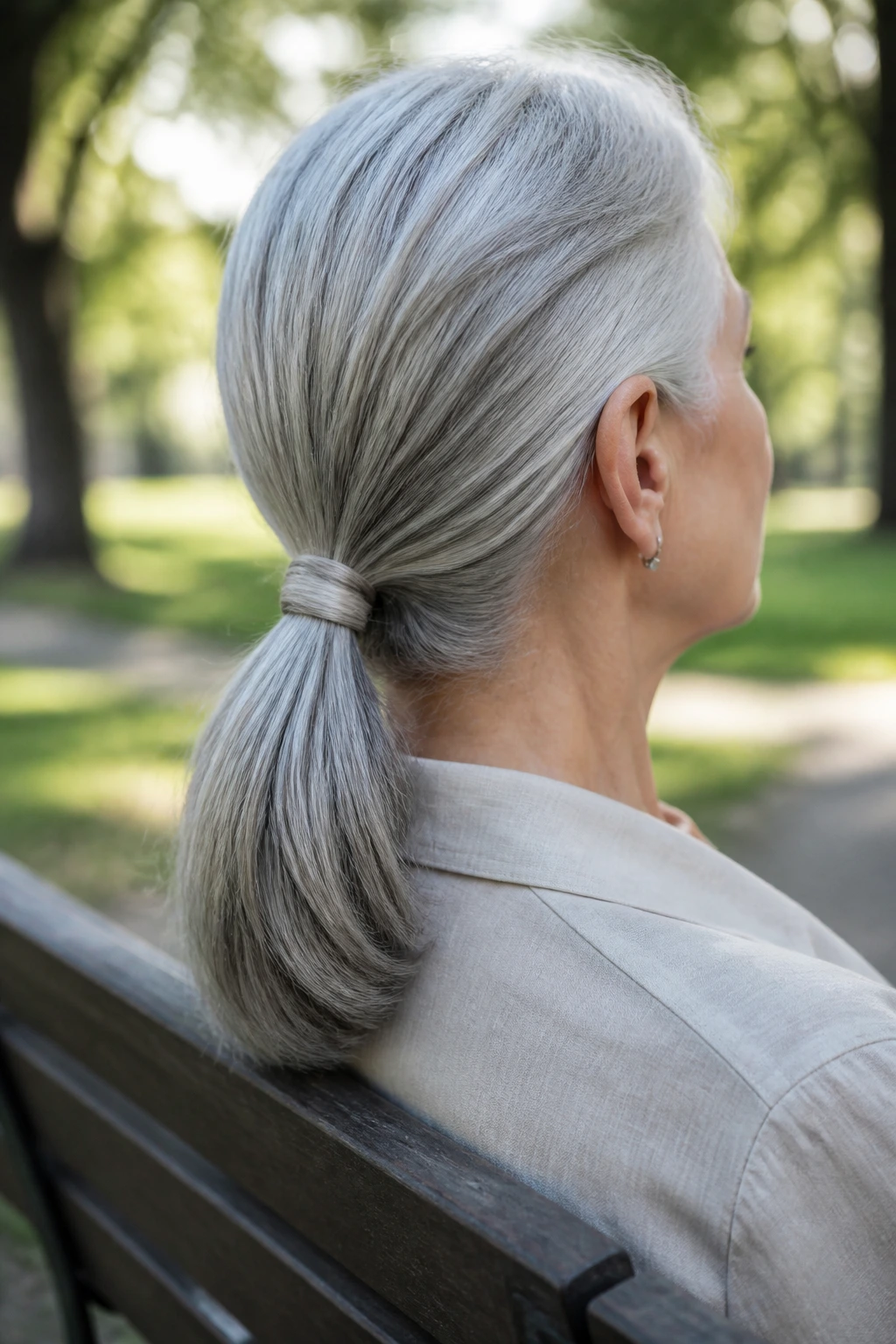
A low ponytail can look plain if it’s tossed together carelessly. Wrapped properly, though, it turns into a polished style that works on gray hair because the clean line at the nape and the wrapped base make the whole thing feel finished. It is one of the easiest ways to look put together fast.
A small section of hair wrapped around the elastic hides the scrunchy look and gives the ponytail a cleaner profile. If the crown is flat, lift it first with a little dry shampoo or root spray before you gather the hair back.
This is a good choice when you want control without stiffness. It also plays well with a blazer, a knit dress, or any outfit where the hair should stay in the background.
23. Invisible-Layer Lob
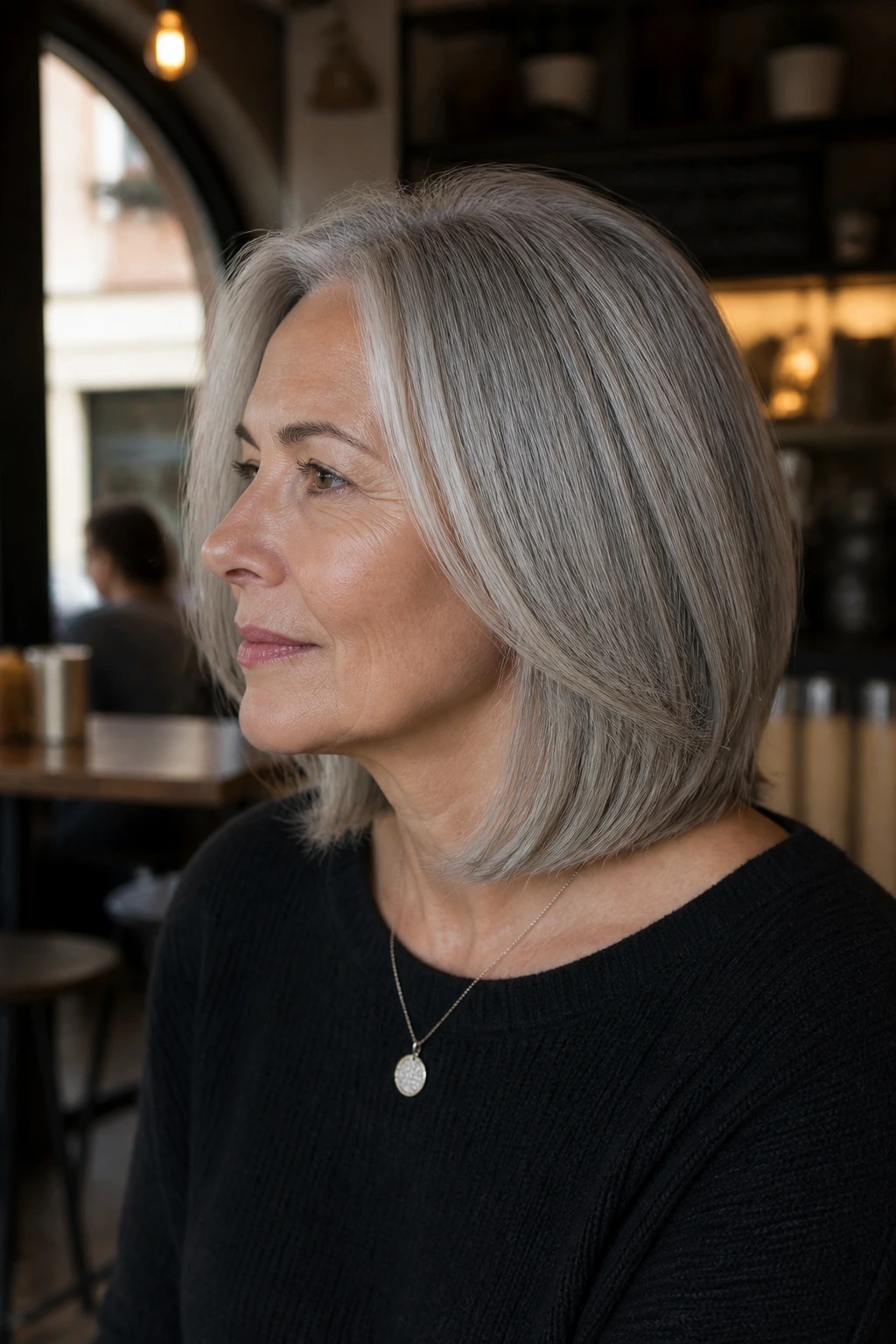
An invisible-layer lob is one of my favorite solutions for thick gray hair that puffs out in the wrong places. The top layer looks smooth, but the internal layers remove bulk underneath, so the shape falls better without showing a lot of obvious chop. That makes the hair feel lighter while keeping the outline clean.
The cut is especially useful if your hair has a wave that only shows up when it dries. It lets the wave move without turning the style into a triangle. A blow-dry with a paddle brush or a loose air-dry both work, which is a nice thing to be able to say.
Ask for layers that you can feel, not layers that shout from across the room. Subtlety matters here.
24. Tucked-Behind-Ear Bob
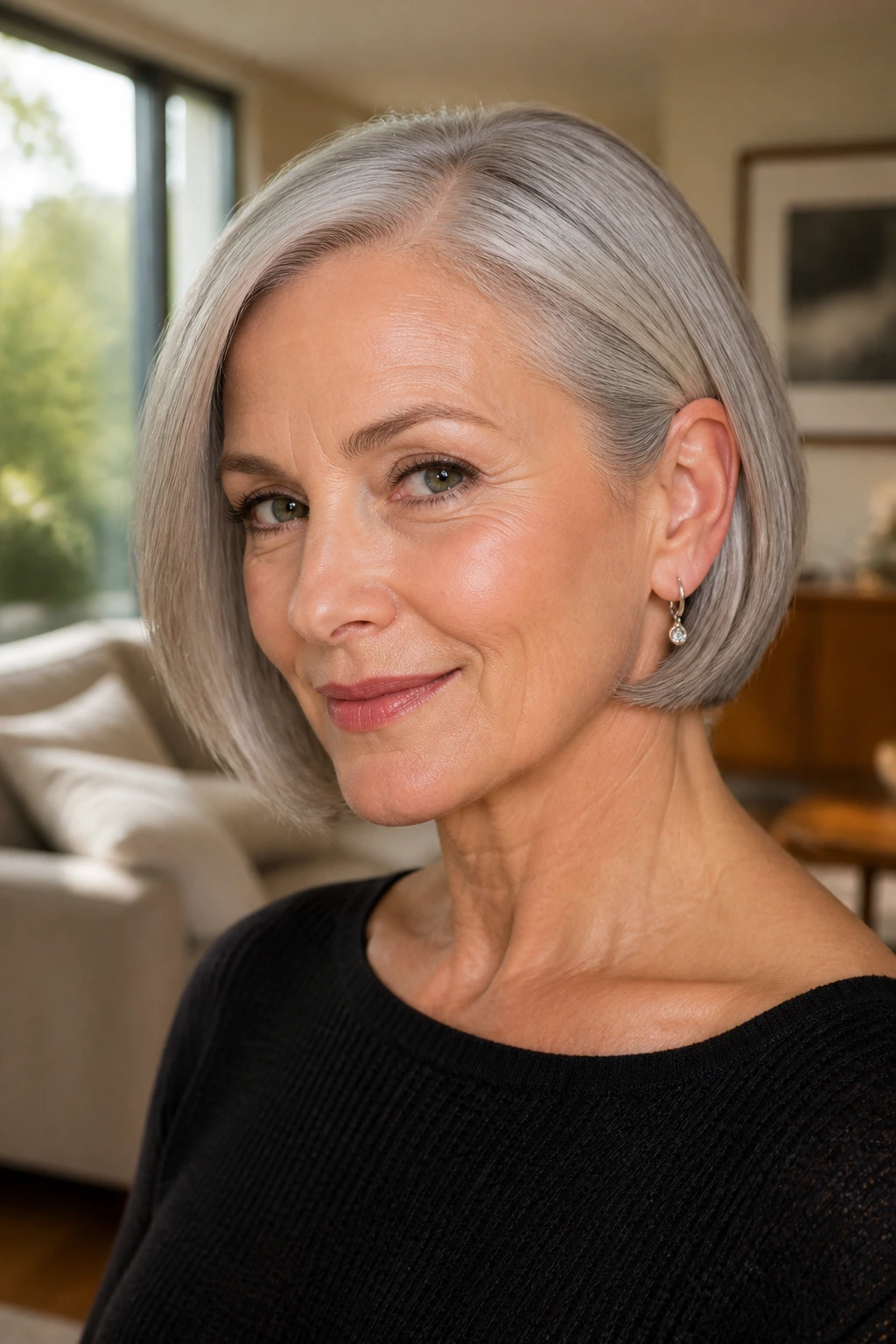
A tucked-behind-ear bob is simple, but simplicity is not the same as boring. When the ends land around the jaw and one or both sides tuck neatly behind the ears, the face gets a clean frame and the earrings get their moment. Gray hair often looks especially nice in this shape because the visible line around the face is so crisp.
This style is useful when you want to show off your jawline or keep the hair away from the cheeks. It also works on second-day hair, which is a practical advantage nobody talks about enough.
If the tuck keeps slipping, the hair may be too clean or too silky. A little dry texture at the roots usually solves the problem.
25. Soft Layered Medium Cut with Ends Flipped Out
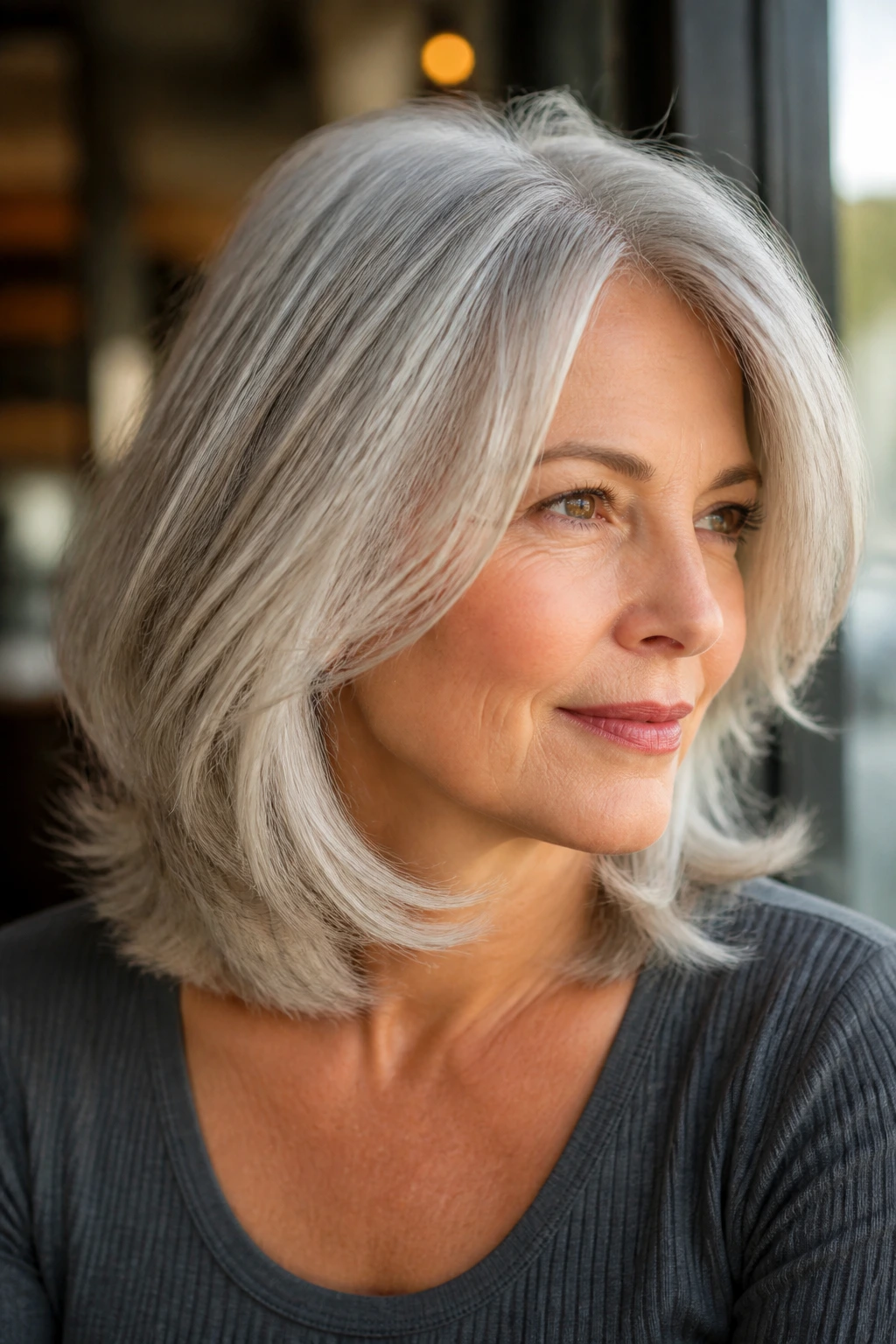
A medium cut with soft layers and flipped-out ends has a bit of lift without the feel of a set-in-stone style. The layers keep the body from collapsing, and the ends flick out just enough to stop the cut from looking heavy. Gray hair likes that airiness, especially if the natural texture leans coarse.
Use a round brush or a flat iron turned slightly outward at the ends. Not much. Just a small bend. The goal is movement, not a retro flip that feels too forced.
This shape is especially kind to women who want a medium length that still feels styled on a normal weekday. It looks intentional with very little drama.
26. Halo Braid Bun
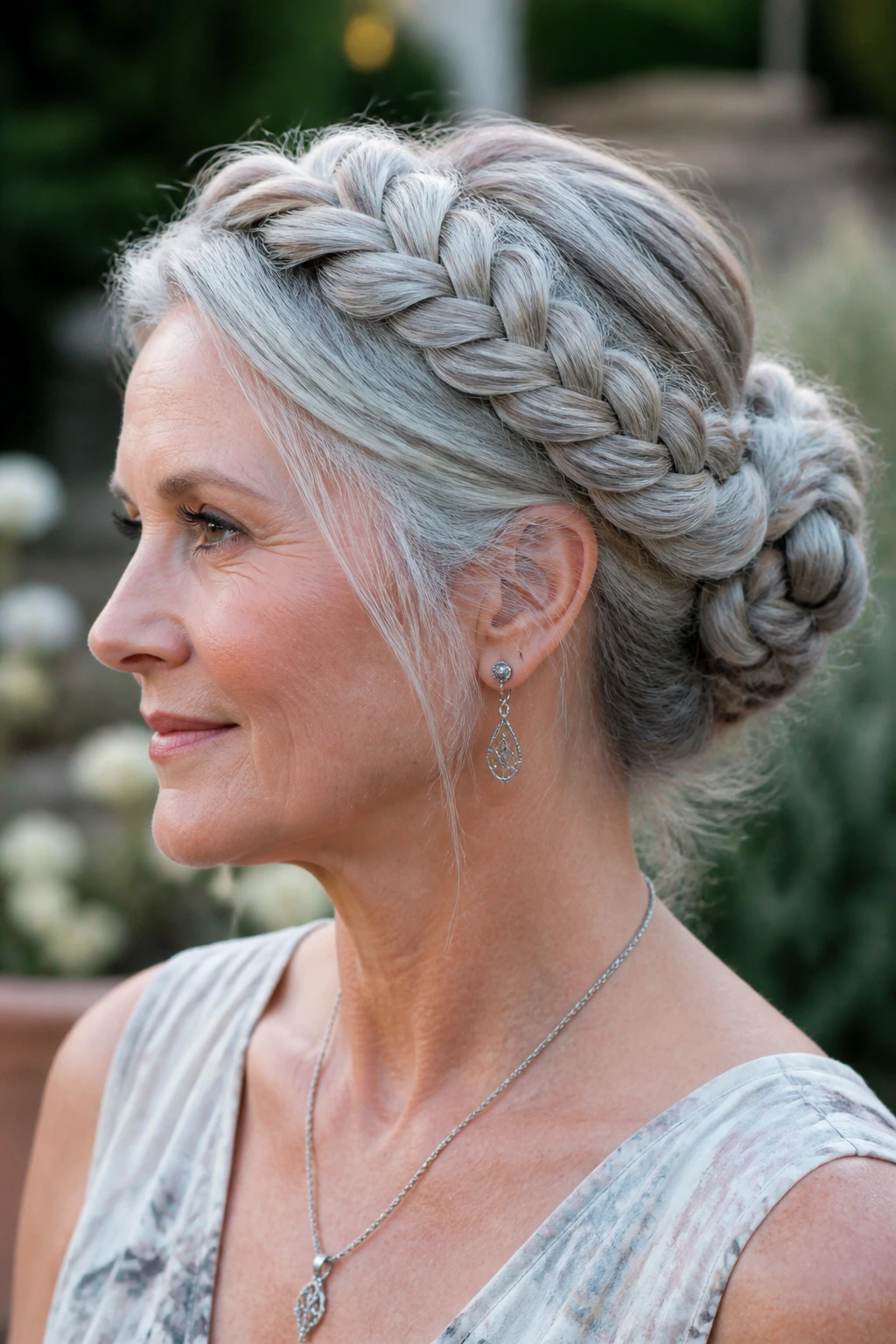
A halo braid bun is one of those hairstyles that looks more complicated than it is, which makes it useful. Braid around the head, either fully or in sections, then gather the ends into a bun at the back or keep them tucked close to the crown. On gray hair, the braid pattern reads clearly, so the style looks detailed even before you add pins.
It’s a strong choice for humid weather, formal events, or any day when you want the hair off the neck. A touch of dry shampoo or texturizing spray at the roots gives the braid better grip.
If the hair is layered, leave the shortest face-framing pieces out on purpose. That softness keeps the style from feeling too severe.
27. Wash-and-Go Coily Crop
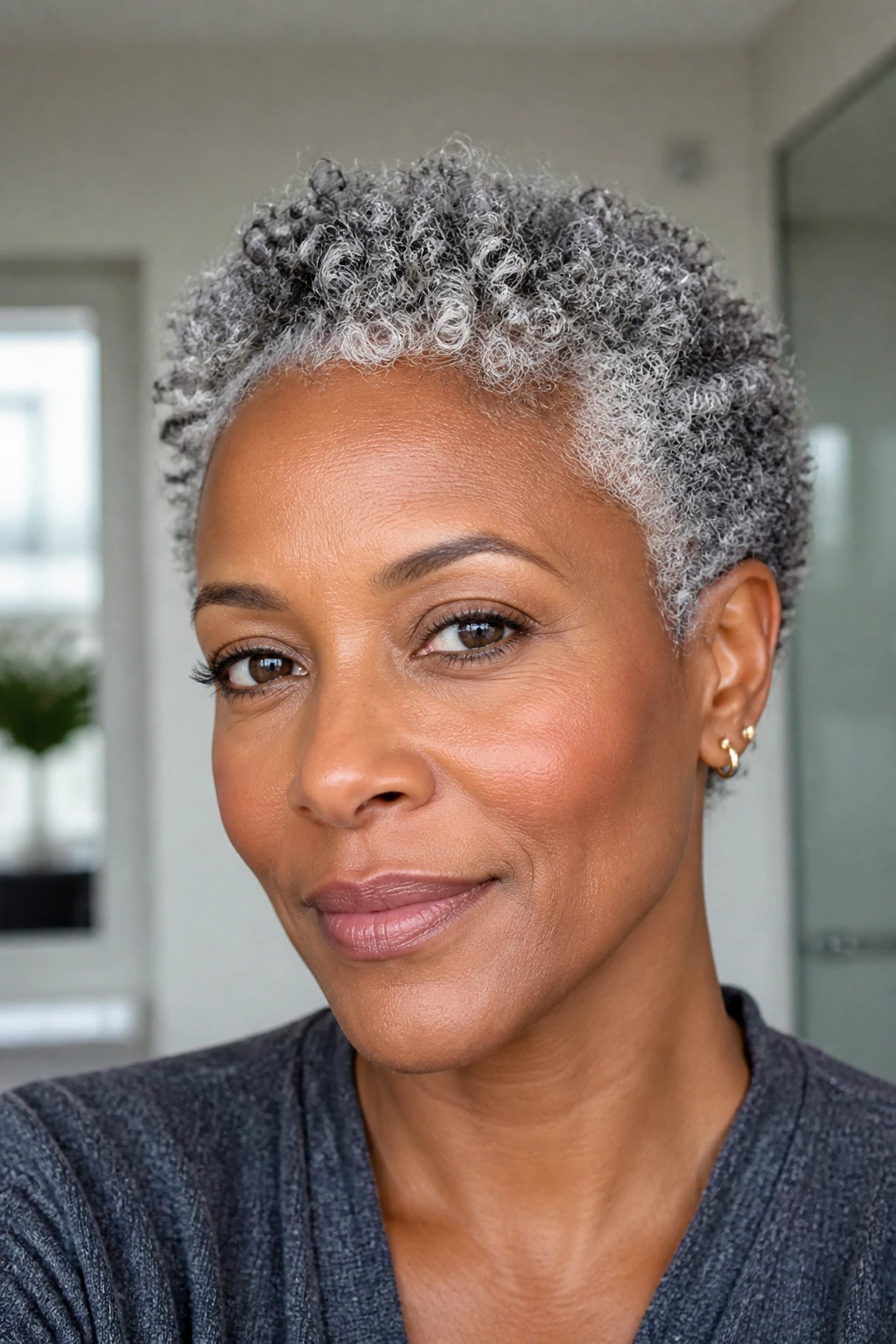
A wash-and-go coily crop is for women who want their cut to do the work. The shape is short, tailored, and built around the coil pattern, so the hair falls into place with moisture and a little scrunching rather than a long styling session. Gray coils can look especially lively here because the cut shows the curl pattern without overcomplication.
This is one of the best options for low-maintenance wearers who still want a style with presence. The shorter shape exposes the neck and jaw, while the curls add the texture. It looks most polished when the edges are clean and the moisture level is right.
Ask for regular shape-ups, because a coily crop loses its line faster than a bob. That is the trade-off. Worth it, if you like your mornings quiet.
How Gray Hair Wants Shape, Not Just Length
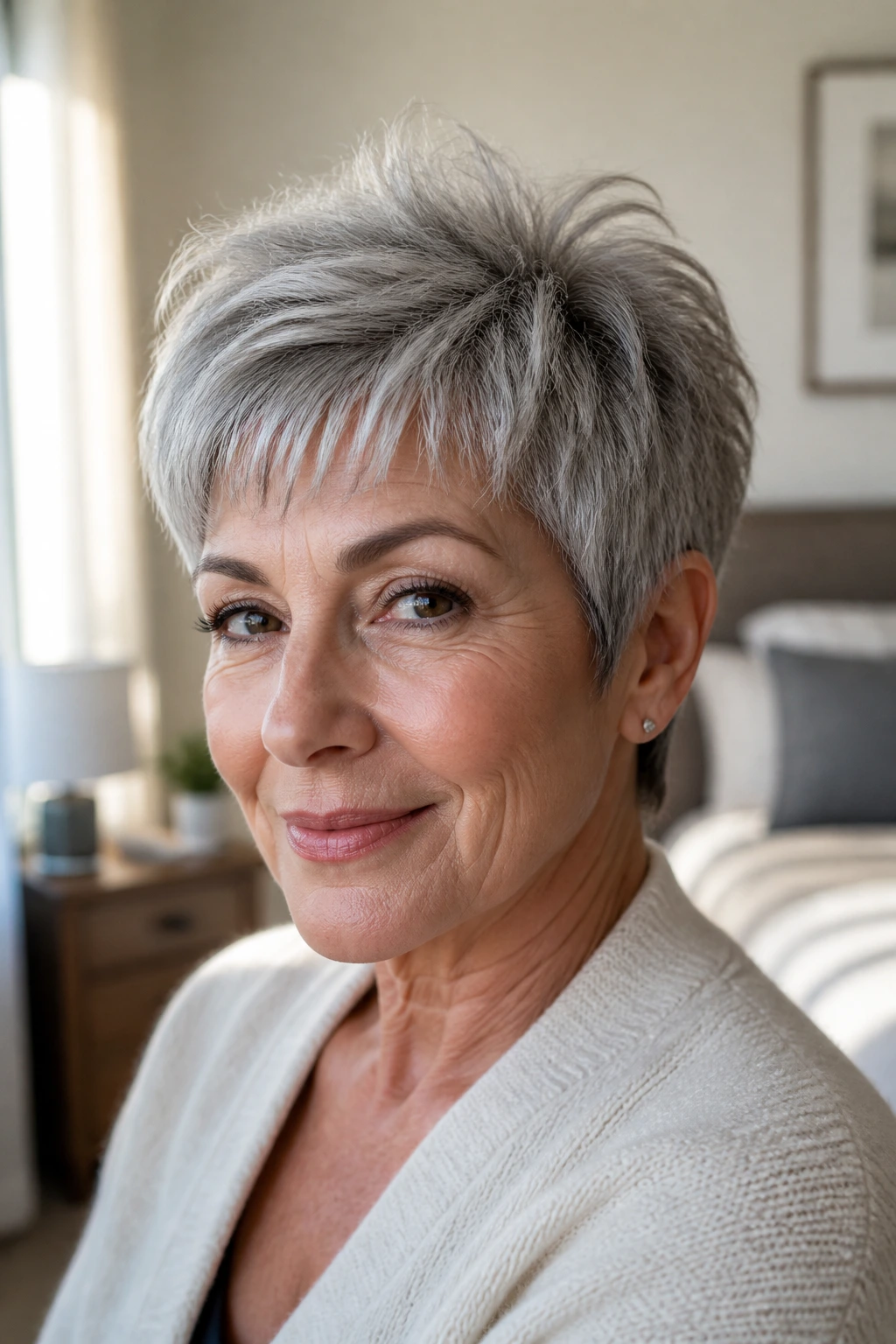
Gray hair usually asks for a different kind of editing. Pigment disappears, but so does some flexibility in the strand, and that means a long cut without structure can look tired faster than the same length in colored hair. A clean bob, a lifted pixie, or a layered lob gives the hair a shape to land in. Without that, the ends do all the talking, and they are rarely saying anything useful.
The other piece people ignore is shine. Silver and white hair reflect light in a way that makes rough ends and overprocessed patches show up fast. A good cut solves half of that problem by removing the damaged-looking parts and keeping the perimeter clean. The style does not need to be fancy. It needs to be deliberate.
If your hair has changed texture over time, that is not a reason to settle. It is a reason to ask for smarter lines, softer edges, and a shape that behaves on day two without a full production at the mirror.
How to Choose Older Women Hairstyles for Gray Hair That Match Your Texture
The best haircut for gray hair is the one that suits the strand diameter you actually have. Fine hair usually does better with blunt edges, crown lift, and shapes that do not eat up density. Thick hair needs internal weight removal so it does not puff out or hang heavy at the nape. Curly and coily hair want cuts that honor shrinkage instead of pretending shrinkage is a problem to be fixed.
Face shape matters, sure, but texture comes first. A woman with a strong jaw and fine hair can wear a chin-length bob beautifully. A woman with thick waves may do better with a collarbone lob or a stacked shape that keeps the bottom from swelling. If the hairline is soft, side parts and curtain fringe are your friends. If the forehead is one of your favorite features, a French bob or a pixie can put it to work.
Bring photos. Always. And bring at least one picture of a side view, because the back and sides are where a lot of flattering cuts either win or fall apart.
The Tools That Make Silver Hair Easier to Style
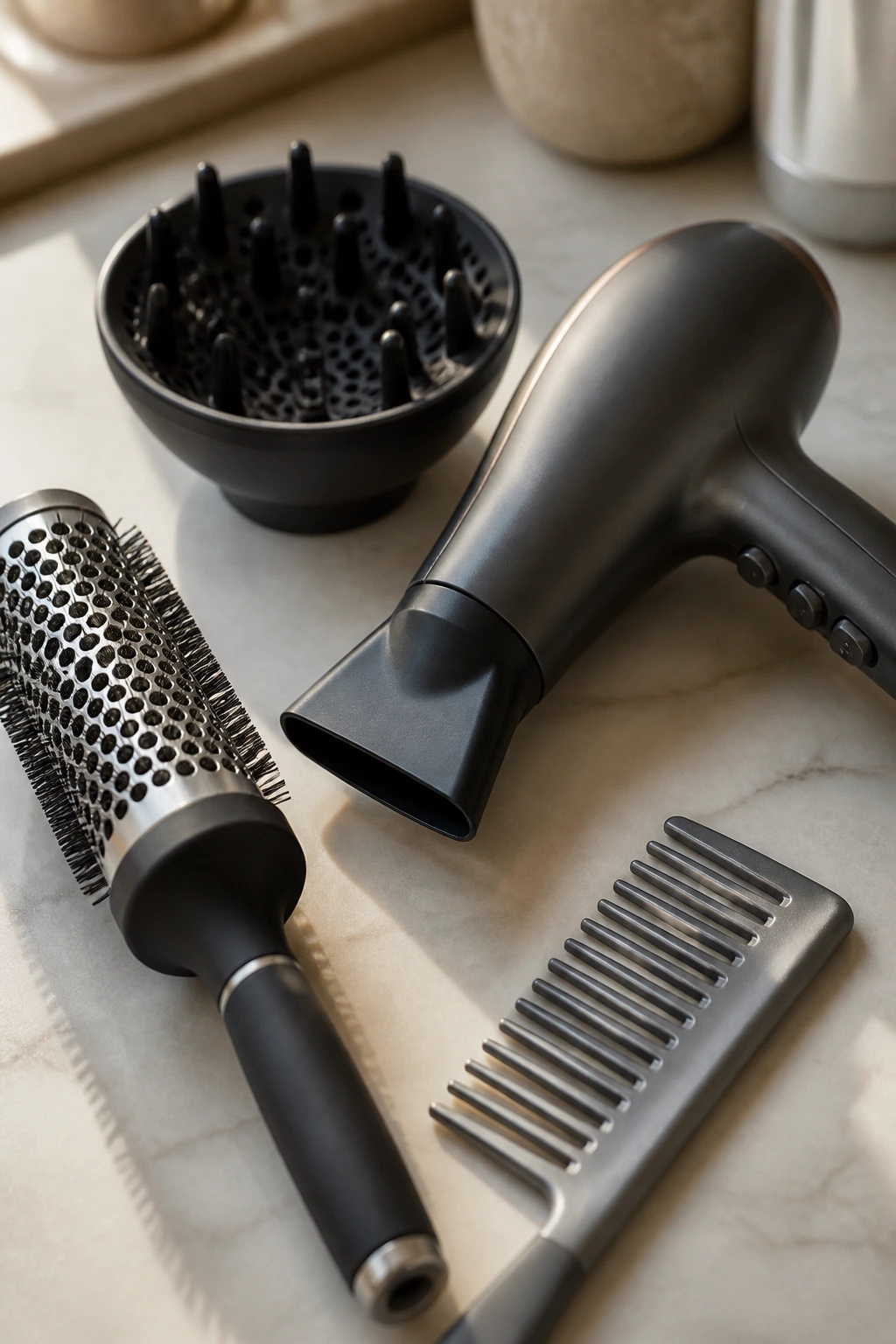
You do not need a drawer full of gadgets. You need the few that actually help gray hair behave.
- Round brush, 1½ to 2 inches: Best for bobs, lobs, and blowouts that need a smooth bend at the ends.
- Blow dryer with a nozzle: The nozzle gives you direction, which matters when you want lift at the root instead of frizz all over.
- Diffuser: A must for curls, coils, and shag cuts that look better when the pattern stays intact.
- Wide-tooth comb: Gentle on dry or damp gray hair and less likely to wreck the curl pattern.
- Tail comb: Useful for clean parts, crown lift, and sectioning before styling.
- Clips and small clamps: Keep the top out of the way while you work on the lower sections.
- Light mousse or root spray: Good for pixies, blowouts, and anything that needs body without stiffness.
- Heat protectant: Non-negotiable if you use a curling iron, flat iron, or blow dryer often.
- Satin pillowcase or bonnet: Helps keep silver hair from frizzing up overnight.
- Dry shampoo or texturizing spray: Useful for second-day bobs, braids, and pinned styles.
- Purple shampoo or silver gloss: Helpful if your gray hair picks up yellowing or dullness, though it should be used carefully so the hair doesn’t go flat or lavender.
What to Ask for at the Salon So the Cut Behaves at Home
The words “I want it to look good when I don’t style it” are a decent start, but they are not enough. Ask where the layers will begin. Ask whether the weight line will sit at the chin, jaw, or collarbone. Ask how often the cut needs a trim to keep its shape. Those details matter more than a vague request for “something flattering.”
If your hair is curly or coily, ask whether the stylist cuts dry or shapes the hair in its natural state. If your hair is straight but fine, ask how much internal layering they plan to remove. Too much thinning can make gray hair look feathery in the wrong way. Too little shaping leaves it heavy and flat.
Say the practical stuff out loud. Mention cowlicks, a flat crown, a stubborn side, or the fact that you wear glasses every day. A good cut should work with those realities, not fight them.
How to Style Gray Hair Without Crushing the Shine
Gray hair often looks best when the styling is light-handed. Heavy creams, thick oils, and too much spray can make silver strands look dull and stringy. Start with less product than you think you need. You can always add a touch more to the ends.
For blowouts, use medium heat and spend the time on the roots. That is where the shape is built. For curls, use enough moisture to control frizz, then stop before the hair gets wet-looking. For sleek styles, smooth the top, leave the ends soft, and keep the scalp clean. A little motion in the hair often looks better than ironed perfection.
And yes, a blunt finish can be good. But gray hair often needs some softness around the face so it does not read harsh under daylight.
Common Mistakes That Make Gray Hair Look Flat or Frizzy
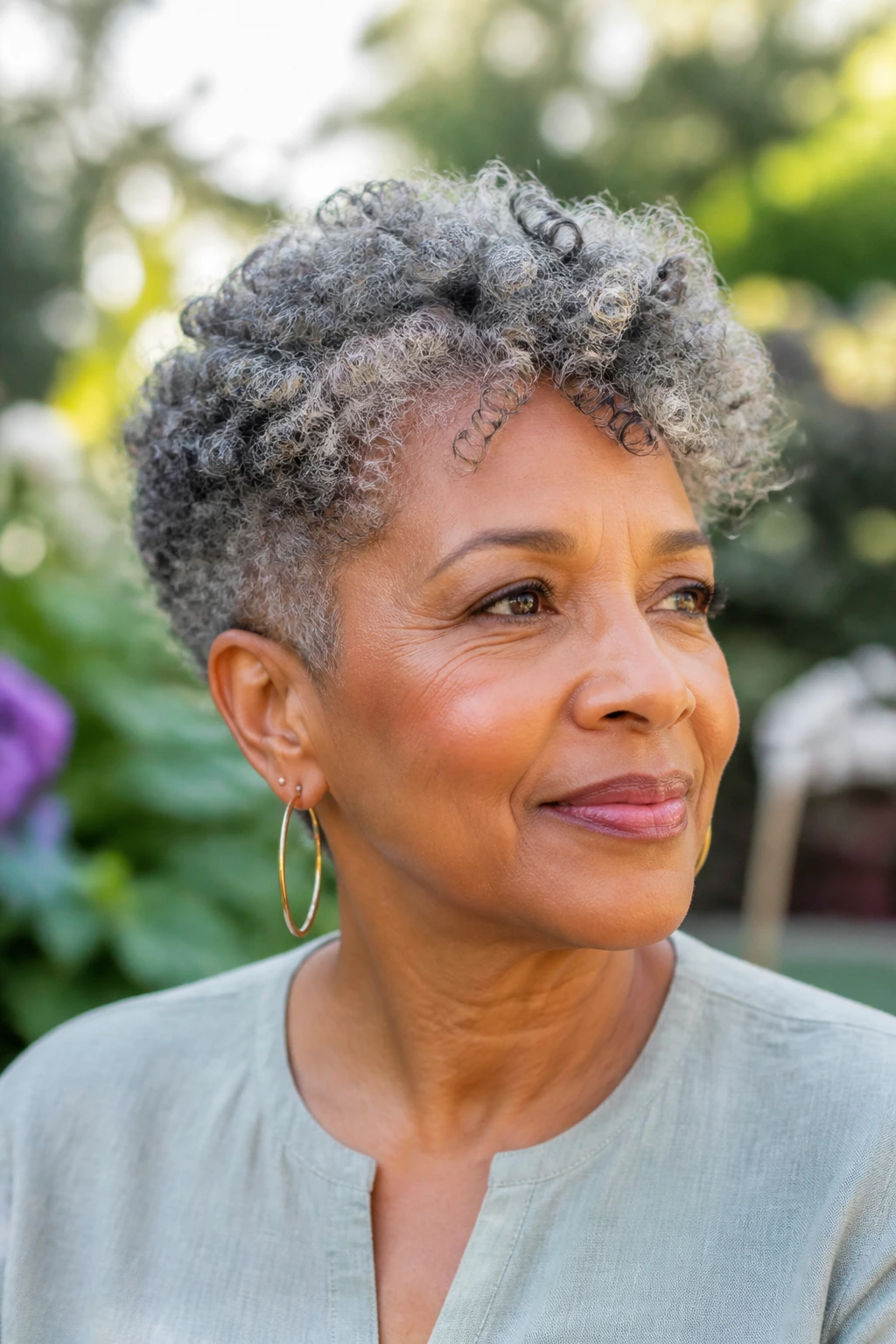
Over-layering fine hair: The ends start to look see-through, and the cut loses body faster than you expect. The fix is a stronger perimeter with fewer short layers.
Skipping moisture and going straight to heat: Gray hair can drink up product and still feel dry. If you hit it with a hot tool before adding a leave-in or heat protectant, the frizz will come back by lunch.
Choosing bangs without checking the cowlick: A fringe that splits at the center or flips sideways is a daily annoyance. Side-swept or curtain bangs are safer if the hairline has opinions.
Using too much oil near the roots: The hair looks greasy while the ends still feel rough. Keep oils and serums on the lower half only.
Ignoring the neckline and back shape: A cute front view hides a messy back view only until you turn around. Ask for the back to be shaped, trimmed, and checked in the mirror before you leave the salon.
Easy Variations for Fine, Curly, Thick, and Long Hair
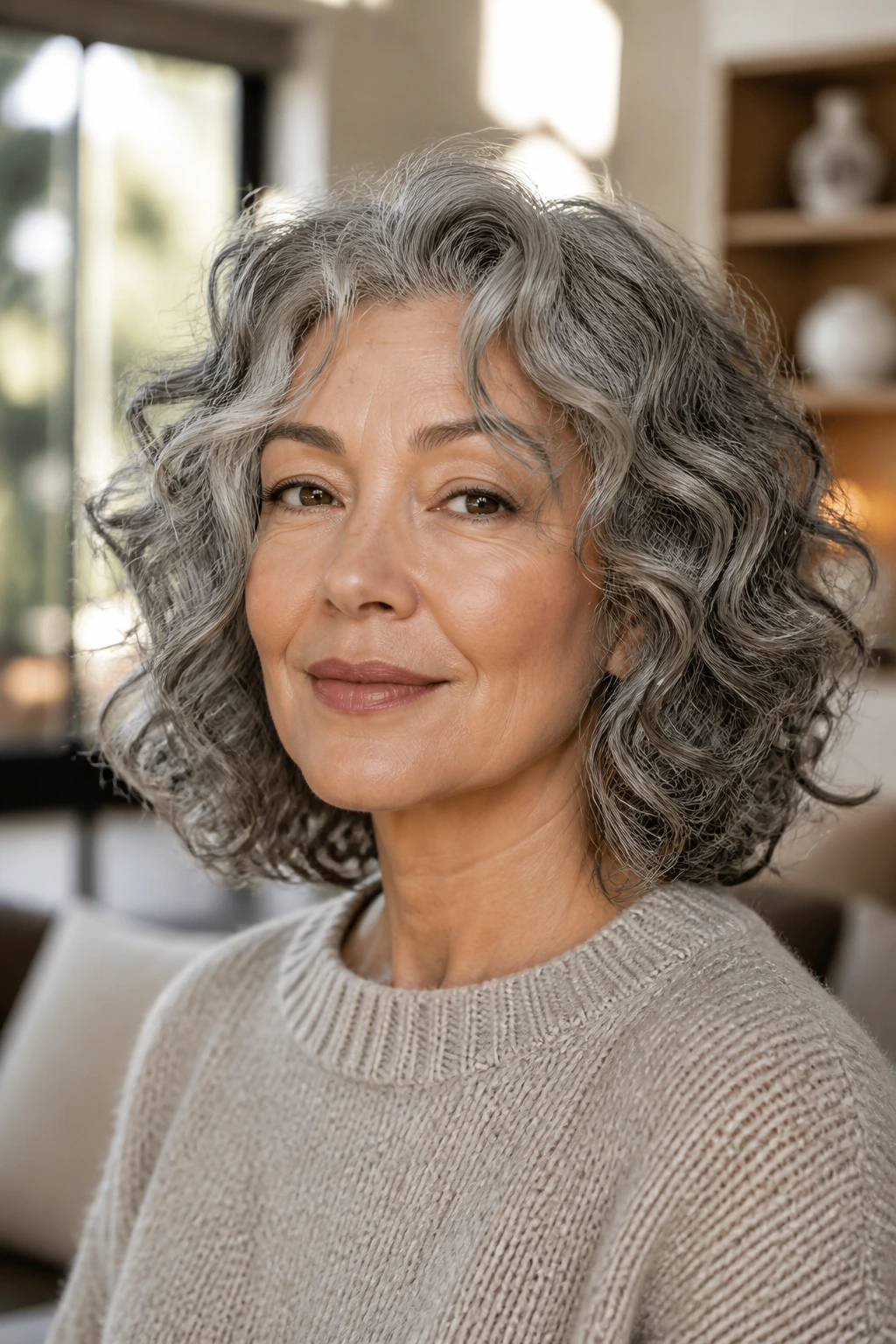
Fine-Hair Boost: Go for a pixie, wedge, or blunt bob with a strong outline and minimal over-layering. These keep the hair looking fuller from root to tip.
Curl-First Shape: Choose a tapered crop, twist-out bob, or curly lob that follows the curl pattern. You’ll spend less time fighting shrinkage and more time keeping moisture in the hair.
Thick-Hair Control: Pick a stacked bob, invisible-layer lob, or graduated wedge so the bulk gets removed from the right places. Thick gray hair can puff up fast if the cut is too blunt everywhere.
Long-Length Softness: Keep the length, but add layers below the chin and a little wave or bend. Long gray hair looks best when the ends still look healthy, not wispy.
Event-Ready Version: Take a bob or medium cut and pin it into a low chignon, braided crown, or wrapped ponytail. The shape changes, but the cut still supports it.
Keeping the Style Fresh Between Washes
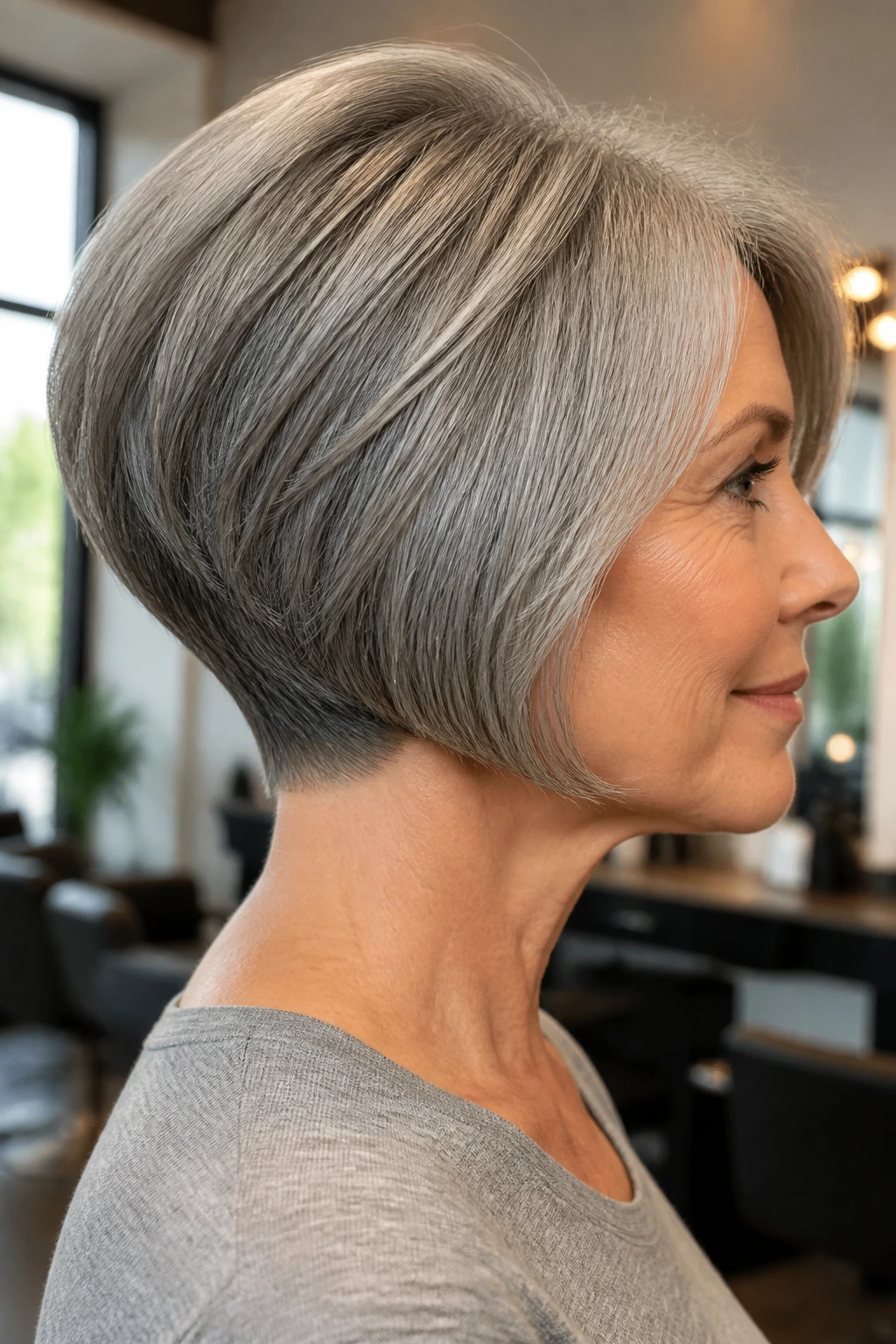
Gray hair often looks better on day two than people expect, as long as you keep the roots clean and the ends from drying out. Sleep on satin if you can. A bonnet works too. Both cut down on friction, which is what turns a nice silver shape into a fuzzy halo by morning.
On the next day, use a mist bottle to wake up the front and crown, then add a touch of mousse or root spray if the shape has gone soft. For bobs and lobs, a small round brush at the front and a quick pass with cool air can reset the outline in under five minutes. For curls and coils, reapply a little leave-in or curl cream to the sections that have gone frizzy, not the whole head.
Trim short styles every 6 to 8 weeks. Bobs and lobs usually hold their shape for 8 to 10 weeks. Longer layered cuts can stretch a bit more, but once the ends start to look hollow or transparent, it is time to sharpen the line again.
Frequently Asked Questions: Older Women Hairstyles for Gray Hair
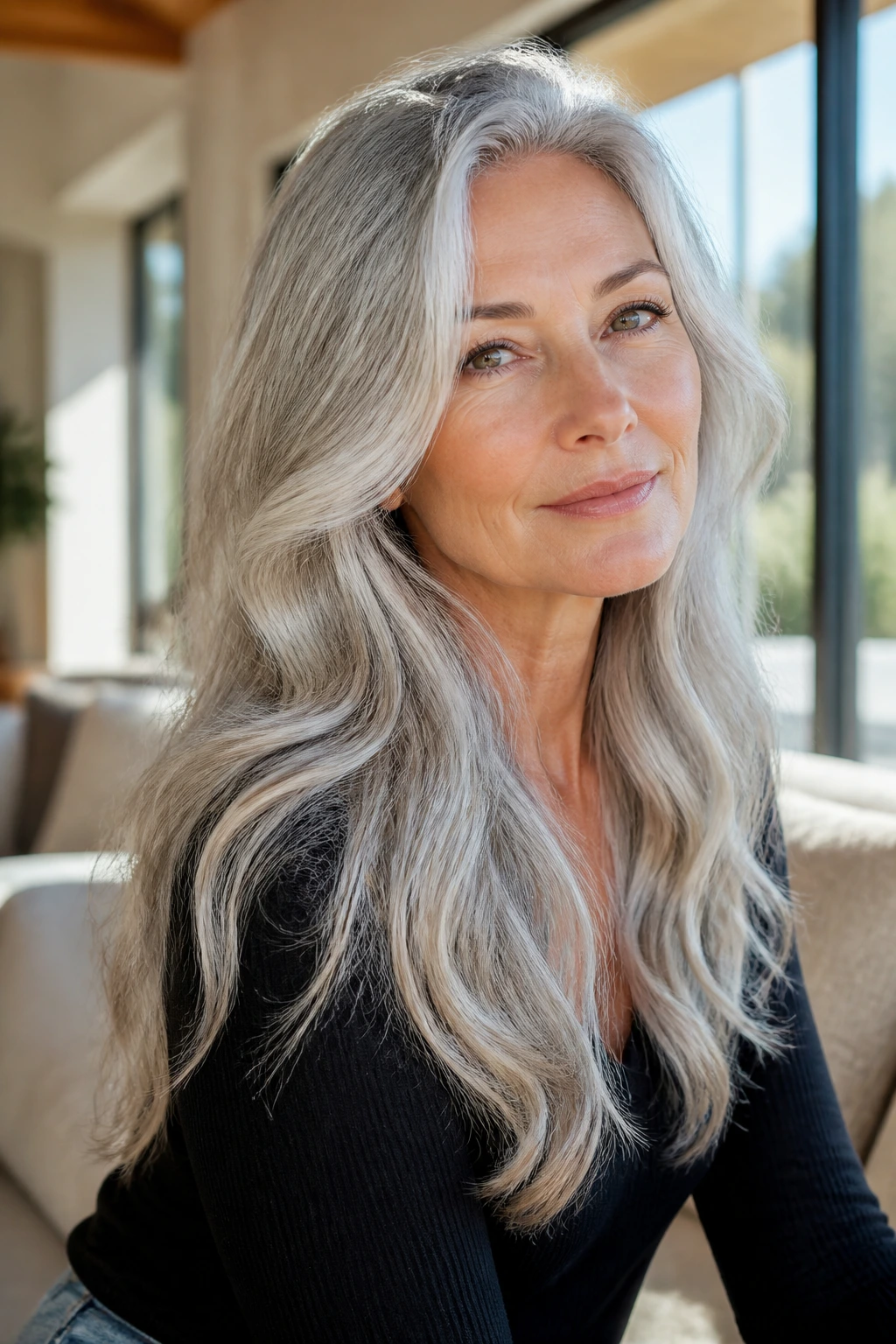
Should older women with gray hair keep it short?
No. Short hair is easier for some people, but not automatically better. Gray hair can look beautiful at chin length, shoulder length, or longer if the cut has shape and the ends stay healthy.
What haircut makes gray hair look thicker?
A blunt bob, stacked bob, or soft pixie usually gives the best illusion of density. The key is a strong perimeter and less thinning at the ends, because wispy edges make gray hair look sparse fast.
Are bangs a good idea with gray hair?
Yes, if the bang shape matches your hairline and texture. Side-swept bangs and curtain bangs are the safest starting point because they grow out more gracefully than a heavy straight fringe.
How often should gray hair be trimmed?
Short styles usually need shape-ups every 6 to 8 weeks. Medium cuts often stay neat for about 8 to 10 weeks. Long hair can go a bit longer, but only if the ends still look full and not see-through.
Can gray hair be styled without heat?
Absolutely. Buns, braids, twist-outs, and wash-and-go curls all work well with the right cut and a bit of product. Air-drying with leave-in conditioner or mousse often gives gray hair a softer finish than hot tools do.
Why does gray hair get frizzy so fast?
It often has a drier cuticle, which means the outer layer lifts more easily and catches humidity. A leave-in conditioner, a light serum on the ends, and less brushing when the hair is dry usually help more than extra hairspray.
What if my hair is thin at the crown?
Choose cuts with lift at the top: pixies, side parts, stacked bobs, and wedges are strong options. Avoid over-layering at the crown, because it can expose the scalp and make the thinning look more obvious.
Is purple shampoo useful on natural gray hair?
Sometimes. If your gray hair picks up yellow tones from hard water, sunscreen, or styling products, a gentle purple shampoo can help. Use it sparingly, though — too much can leave the hair dull or slightly purple in bright light.
A Strong Shape Makes Gray Hair Look Intentional
The nicest thing about gray hair is that it can look clean, bright, and modern without trying to pretend it is something else. A good cut gives the silver room to show up. A good style keeps the texture under control without crushing it.
Pick the shape that matches your hair’s actual behavior, not the one you wish it had. That one choice changes everything else — how often you style, how much product you use, and how confident the whole look feels when you catch yourself in a mirror and don’t immediately want to fix anything.
