



Silver blonde hair color ideas for older women work best when the shade feels like it belongs to the hair you already have, not like a layer of frost dropped on top at the last minute. The prettiest versions usually have a little shadow at the root, a little cream in the mids, and enough shine at the ends to keep the whole thing from going flat. That mix is the sweet spot. Too much ash, and the hair can look chalky. Too much gold, and the silver turns muddy.
There’s also the texture question, which gets ignored far too often. Mature hair is often drier, a touch more porous, and sometimes coarser in random spots — especially around the crown, temples, and nape — so the same toner can look calm in one area and grab like paint in another. That’s why so many silver-blonde attempts go sideways: the color formula is fine, but the hair underneath isn’t being treated like different hair in different places.
The looks below lean into that reality instead of fighting it. Some are soft and low-maintenance, some are bright enough to make a statement, and some are designed for women who want to let natural gray come through without looking like they stopped caring. The first one is the one I’d hand to anyone who wants silver blonde with the least drama and the most payoff.
Why These Silver-Blonde Looks Work
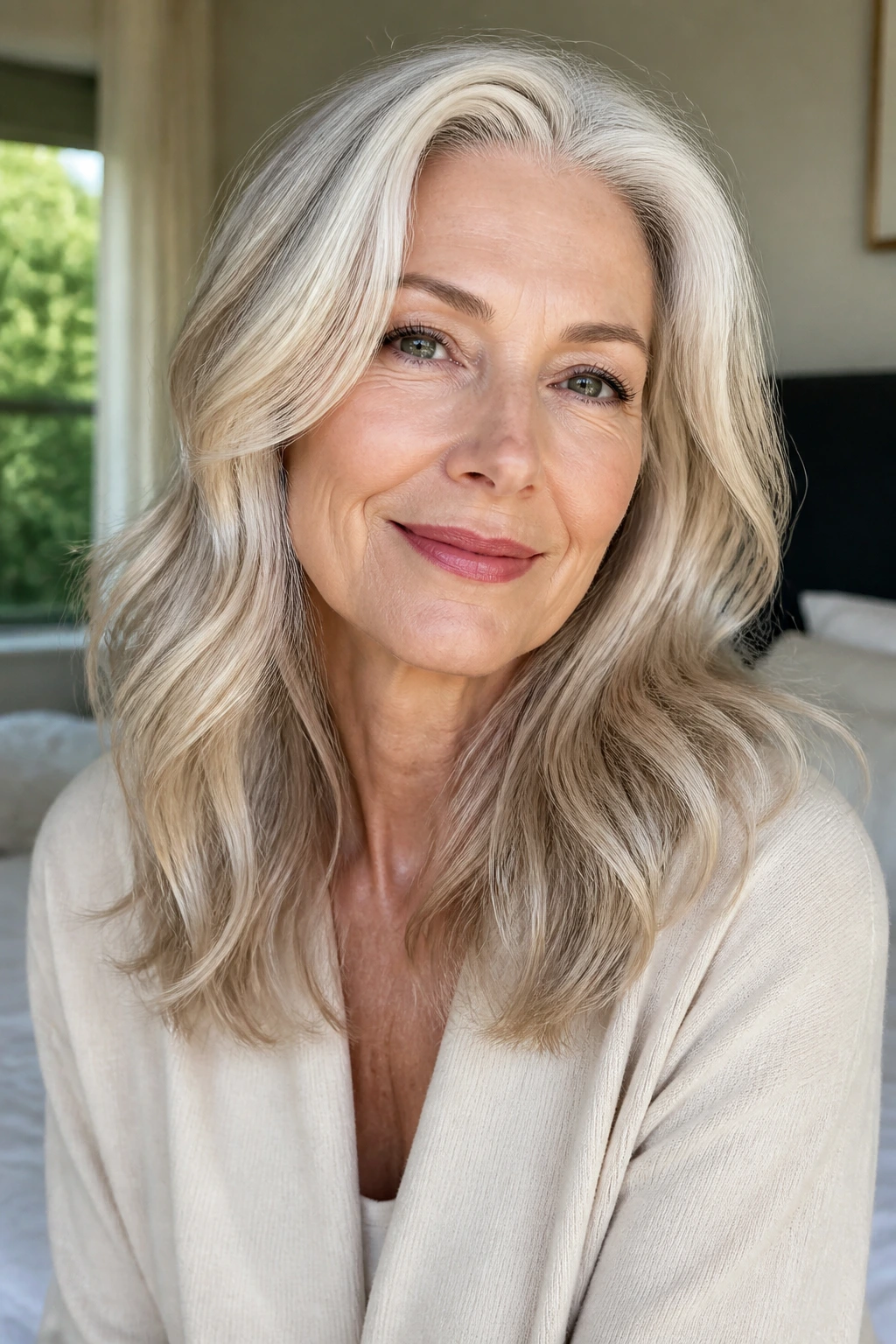
-
They blend with gray instead of hiding it: The best silver-blonde shades borrow from natural white and gray hair, so the grow-out line stays softer and less obvious.
-
They brighten the face without a hard edge: A cool blonde placed near the temples, fringe, or cheekbones can lift the whole face without needing a full head of bleach.
-
They suit different textures: Fine hair, thick hair, curls, and straight cuts all take silver differently, so this collection includes light-handed babylights, bolder platinum, and deeper smoky blends.
-
They’re not all high maintenance: Some of these ideas need toner every few weeks; others work with a root shadow or gloss that keeps salon trips farther apart.
-
They give mature hair some depth: A flat, one-note blonde can make hair look thin. Dimensional silver, pearl, and mushroom tones keep the cut from collapsing visually.
-
They leave room for natural change: If your hair keeps going more gray over time, these shades can move with it instead of turning into a color correction project.
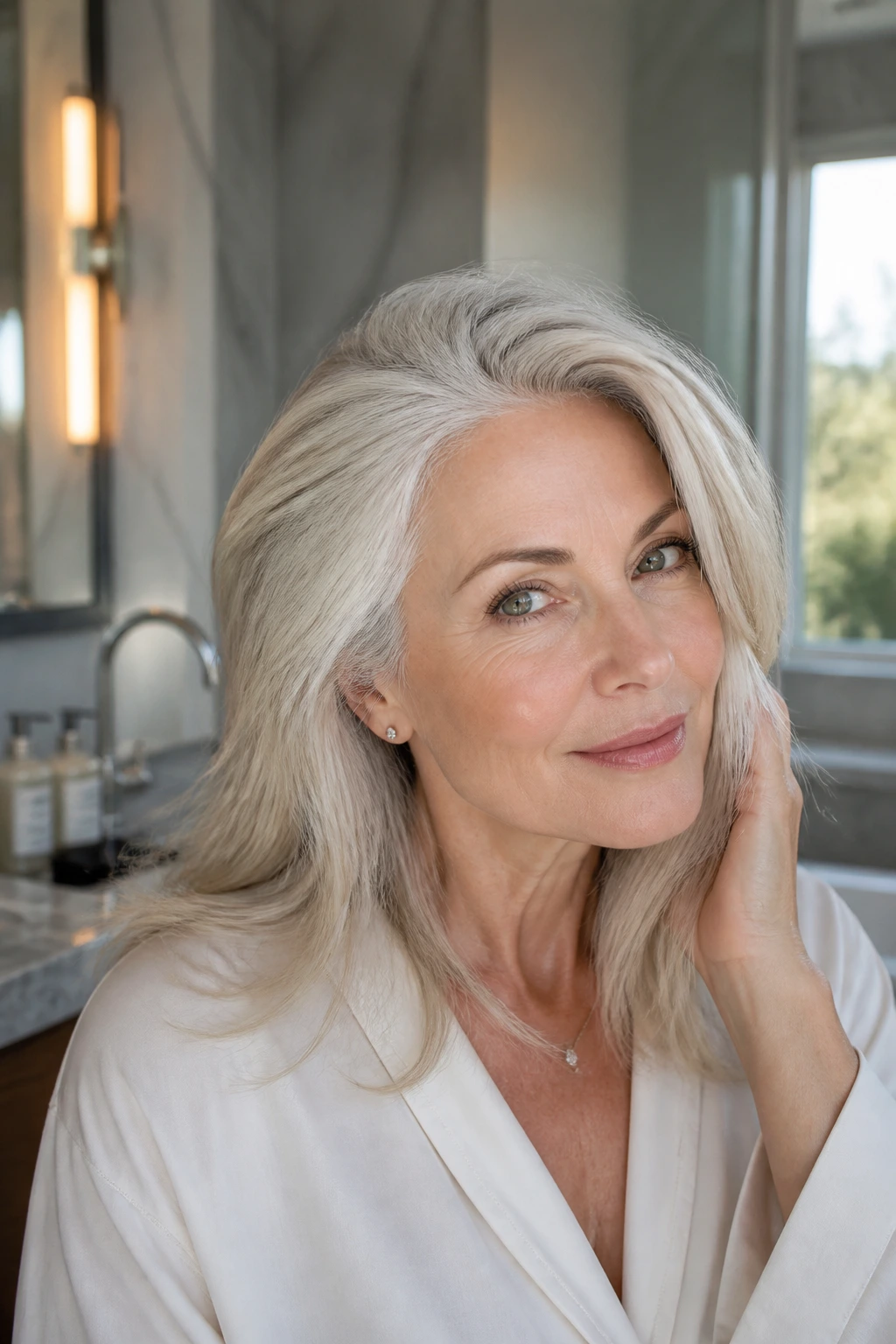
1. Soft Silver Blonde With a Shadow Root
If I had to pick one silver blonde hair color idea for older women that looks calm, polished, and easy to live with, this would be the one. The shadow root takes the edge off the brightness at the scalp, while the mids and ends carry the cool silver tone that makes the whole look feel intentional. It reads expensive without trying too hard, which is the real trick.
The root should sit about one shade deeper than the lightest part of the hair. Not dark. Not obvious. Just enough depth to make the silver lengths look brighter by contrast. That small band of shadow also hides regrowth better, especially if your natural color is darker or you have gray coming in unevenly at the temples.
Why It Feels So Wearable
A root shadow gives the eye somewhere to rest, and that matters more as hair gets finer or the face gets more contrast from makeup and clothing. The cool silver through the ends brightens the face, while the deeper root stops the color from looking like a sheet of white paint.
This is a smart choice if you want to stretch appointments to 8 or 10 weeks. The grow-out is softer, and toner fades in a way that still looks tidy.
The best version keeps the silver a little pearly, not blue. Blue-silver can look sharp on some women, but on drier hair it can turn icy in a way that feels unforgiving.
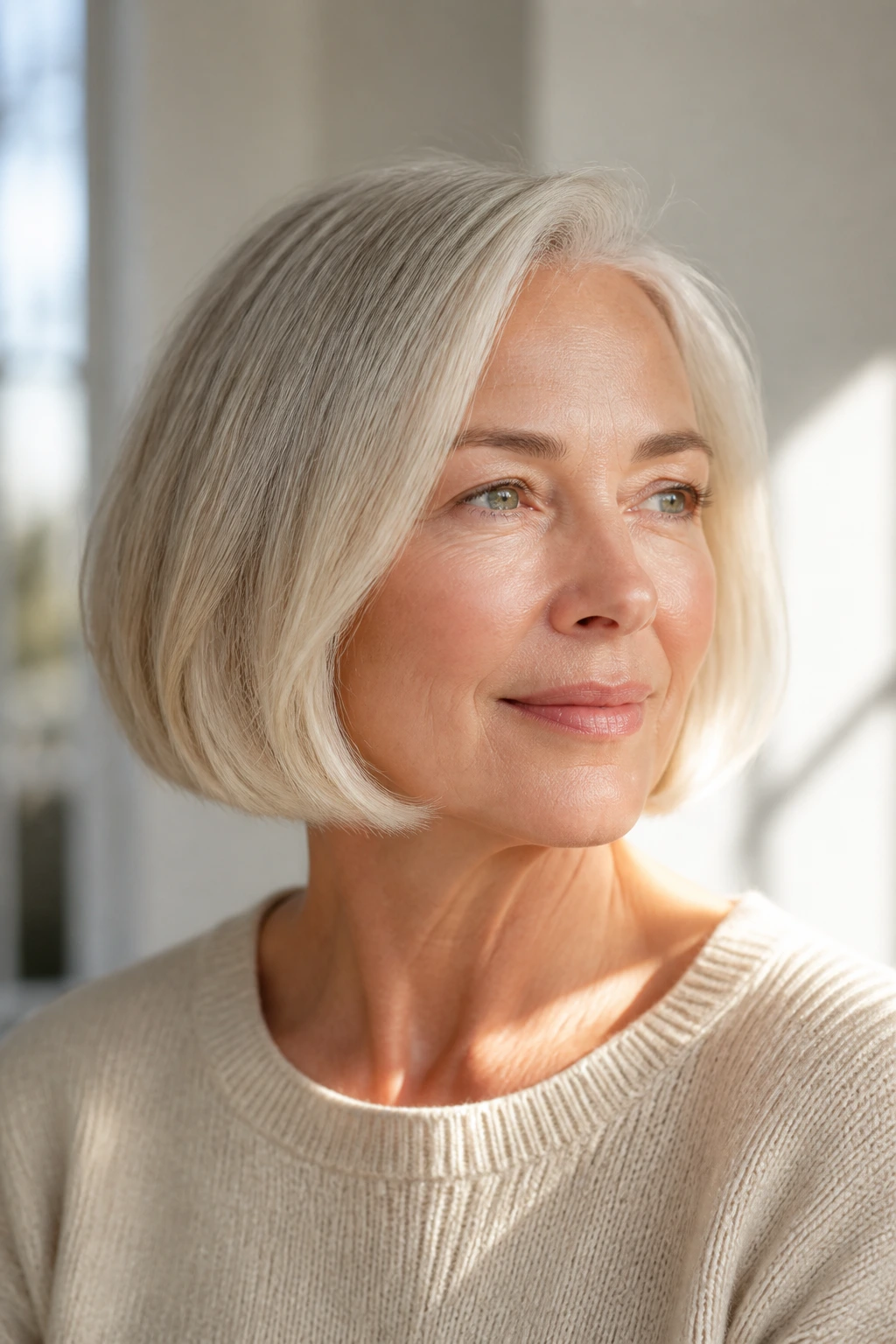
2. Pearl Blonde Bob With Creamy Ends
Want something lighter than beige blonde but softer than white? Pearl blonde lives in that middle space, and a chin-length bob gives it shape. The color has a faint sheen to it, like mother-of-pearl under daylight, which is a nicer effect than the flat, chalky blondes that can make older skin look tired.
Who This Flatters
Pearl tones are kind to hair that already has white or silver strands woven through it. They also work well on fine hair, because a shorter bob keeps the ends from becoming see-through. If the hair is dense, ask for a blunt-ish line with a tiny bit of internal texture so the shape doesn’t look helmet-hard.
The creamy ends matter. They soften the silver and keep the cut from looking severe around the jaw. That’s especially useful if you wear glasses, because a very cool bob can sometimes fight with frames and make the whole face feel crowded.
A pearl blonde bob is at its best with a smooth blowout and a round brush bend at the ends. No need for a stiff, sprayed-to-death finish. A little swing at the bottom is enough.
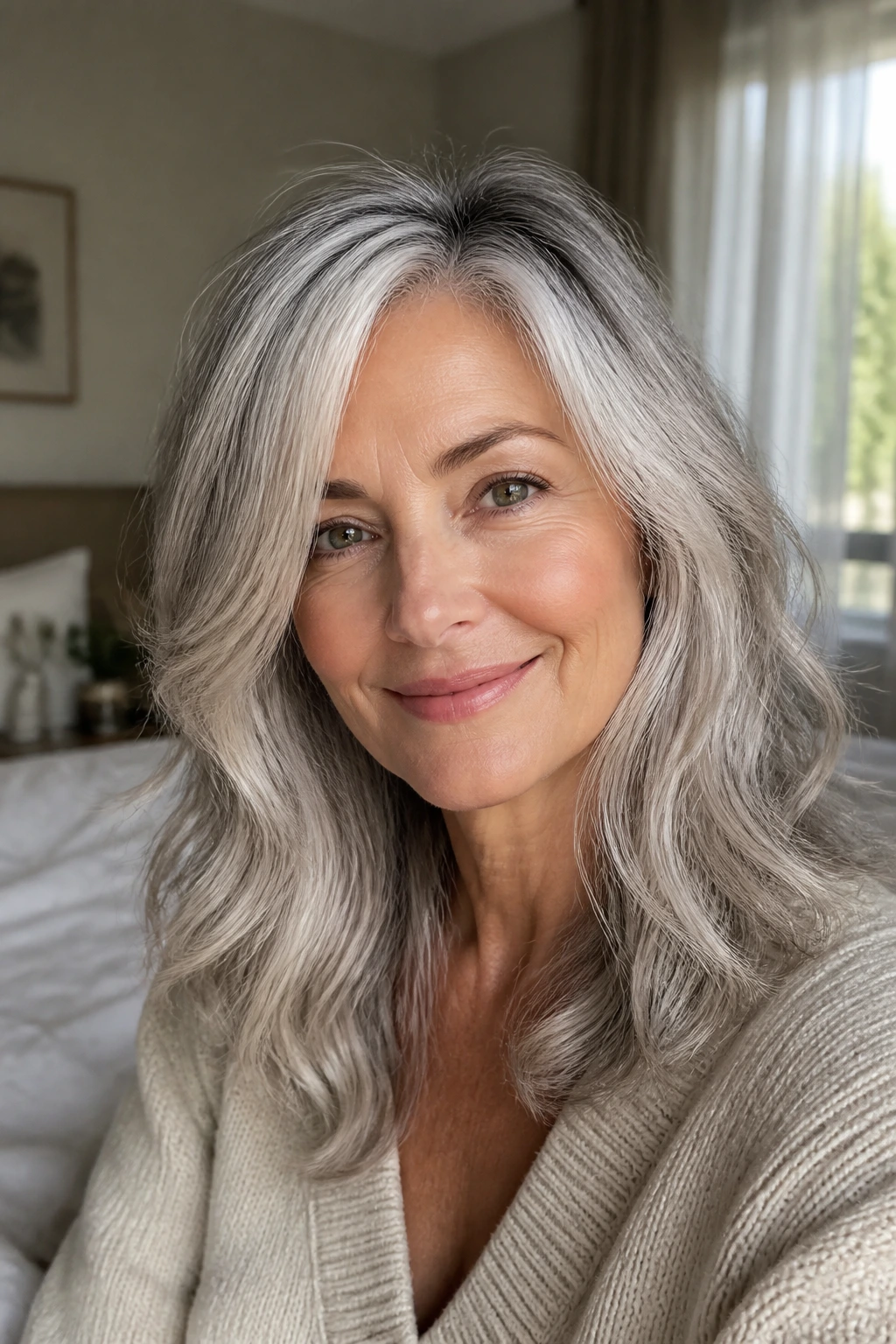
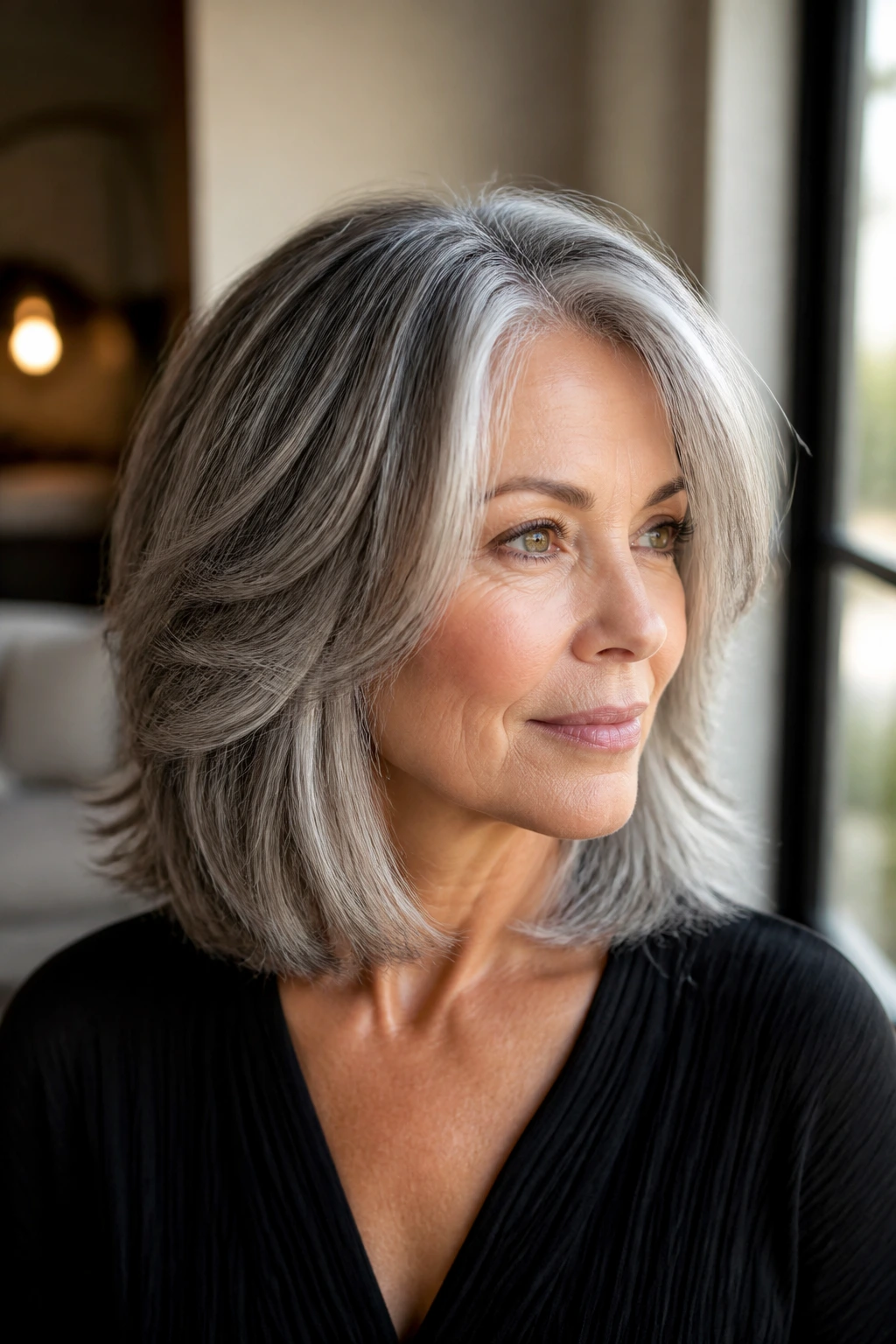
3. Smoky Silver Balayage on Shoulder-Length Layers
Picture a shoulder-length cut where the upper sections stay a touch smoky and the lower layers fade into silver. That’s the charm of smoky silver balayage. It doesn’t look painted on. It looks like the hair has depth, air, and a little movement when you turn your head.
The hand-painted pieces should be irregular, not striped. Balayage works here because it lets the colorist place brightness where the layers actually move — around the face, through the surface, and along the curve of the ends. On mature hair, that keeps the look from turning blocky.
- Best on: Wavy, straight, or softly textured hair that falls between the collarbone and shoulders.
- Ask for: Light ribbons through the surface, plus a cool toner that keeps the silver from going yellow.
- Avoid: Thick foil panels. They can make the hair look like it was highlighted in rows.
- Style with: A medium round brush or loose bend from a 1-inch curling iron.
The thing I like about this one is the fade. The grow-out is forgiving because the root stays close to your natural color, while the silver shows up where the light actually hits. That saves you from the obvious “I need my roots done yesterday” look.
4. Face-Framing Silver Money Piece
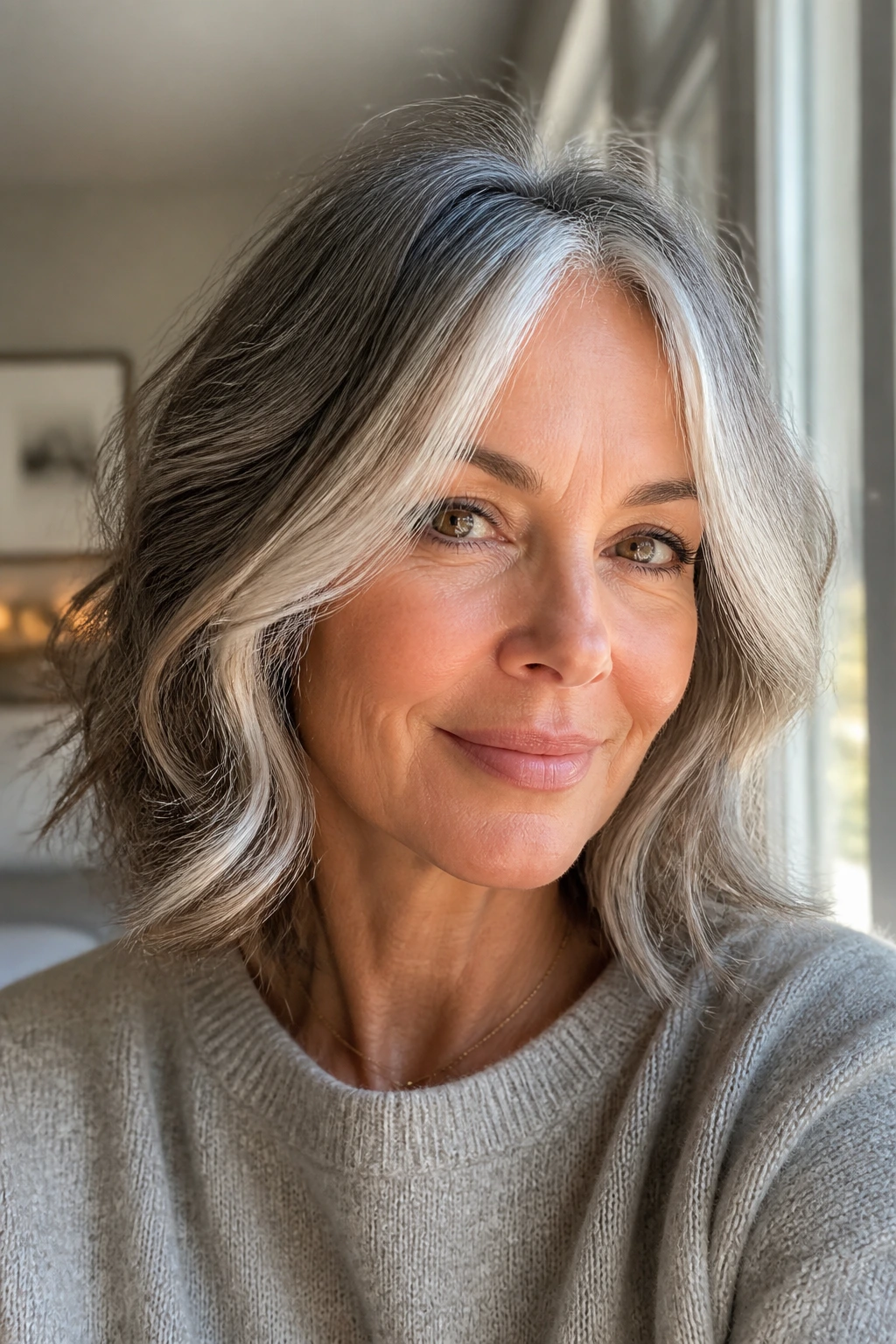
A silver money piece is not a loud streak if it’s done right. It’s a bright border around the face, and on older women it can be one of the fastest ways to wake up the whole haircut without bleaching every last strand. It works especially well if the temples are already gray, because the lighter pieces look connected to what’s happening naturally.
Why the Money Piece Matters
The face-framing section catches light before anything else does. That means a few well-placed foils around the cheekbones, part line, and temples can change the whole read of the cut. The rest of the hair can stay softer and deeper, which helps if you don’t want a full silver overhaul.
Keep the money piece a touch cooler than the rest of the head, but not stark white. If it’s too white, it can pull attention in a weird way and make the hairline look thinner. A cooler beige-silver usually does the job better.
This is also one of the best choices if you wear bangs or a side part. The lighter panel creates lift around the eyes, and that’s usually where people want the color to work hardest.
Pro tip: Ask for the brightest pieces to start about half an inch back from the hairline. That tiny buffer keeps the grow-out from looking harsh after three weeks.
5. Frosted Pixie Cut With Choppy Texture
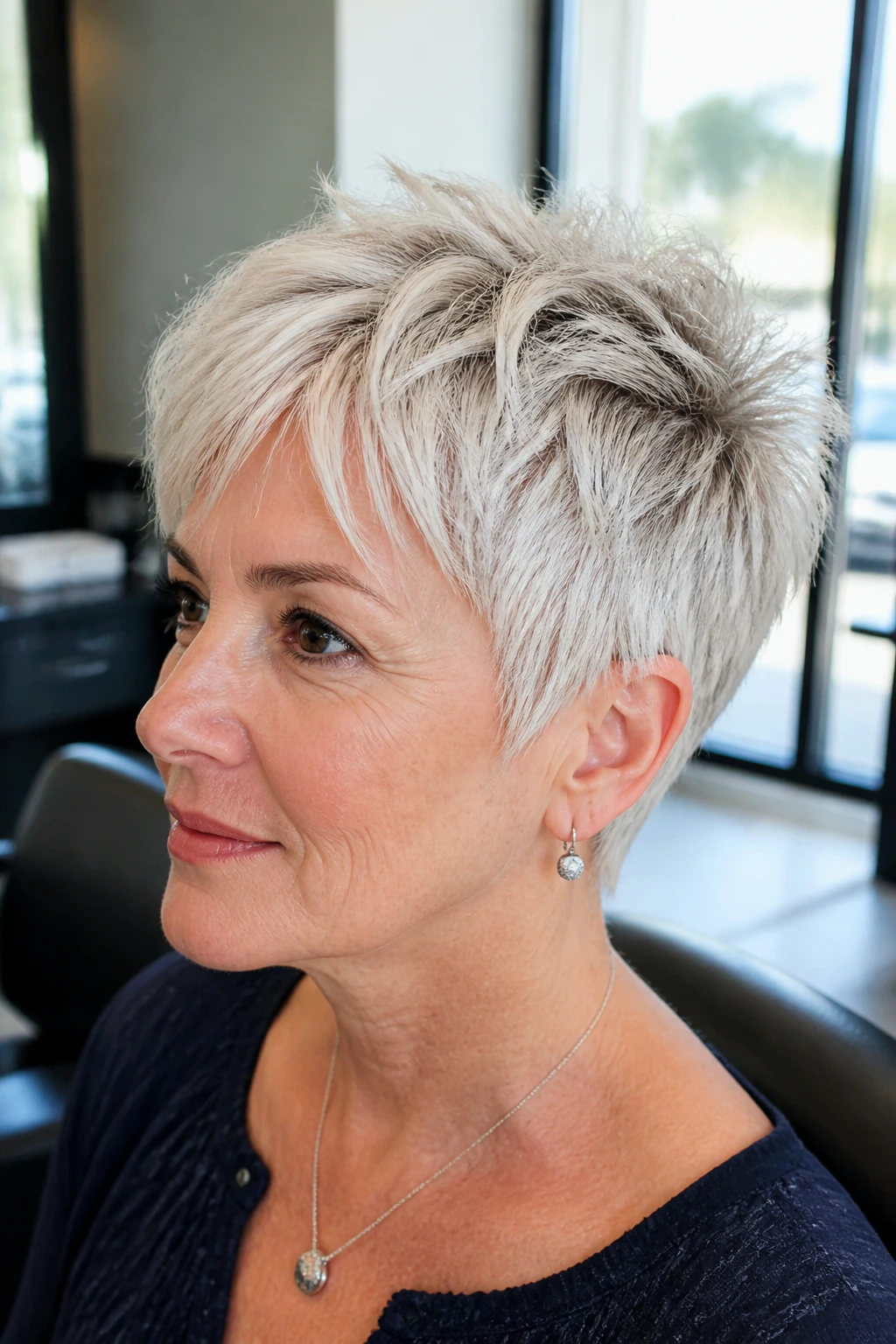
A pixie cut and silver blonde are a good pair when the texture is choppy and the finish is a little piecey, not smooth. The short length makes the color read immediately, which is great if you want the silver to look fresh rather than dusty. It also means less hair to fight with when the tone begins to soften.
The problem with a one-length pixie is that it can look helmet-like once the color gets too pale. The fix is movement. Tiny layers at the crown, a bit of softness around the ears, and a fringe that can be swept to one side all help the silver catch light in different places.
This is one of those cuts where the styling product matters. A matte paste, lightweight cream, or texturizing spray works better than anything shiny. Too much gloss and the color loses its shape. Too much hold and it turns stiff.
If your hair is naturally white or mostly gray, this cut can be especially smart. The shape keeps things modern, and the silver tone keeps the crop from looking overly severe. It’s crisp. It’s clean. And it doesn’t ask for much styling time.
6. Mushroom Blonde With Silver Ribbons
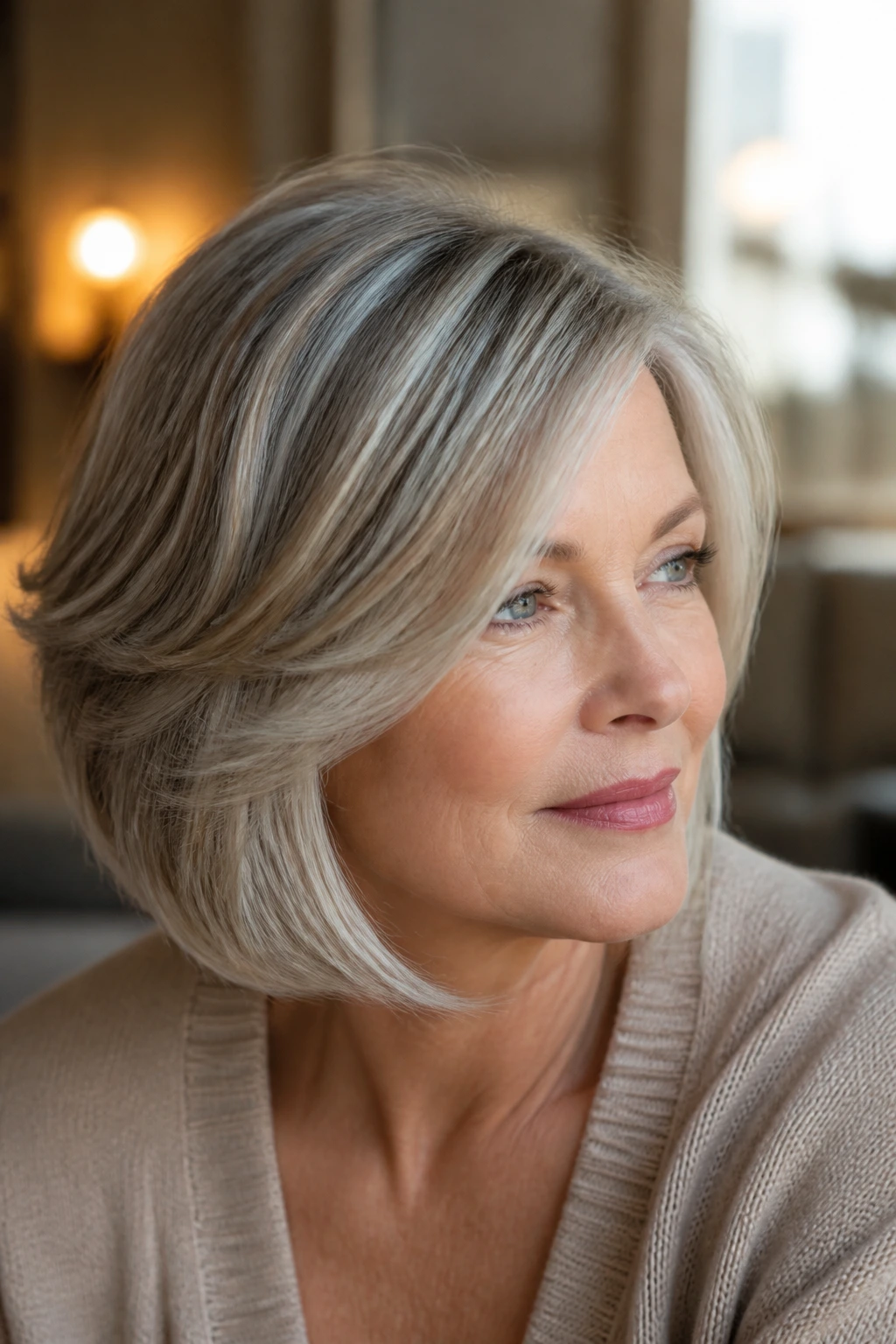
Mushroom blonde is what happens when a cool beige base meets thin silver ribbons, and it’s a lot more wearable than people expect. The darker undertone keeps the color grounded, which matters if you’re growing out dyed hair or if a very pale blonde tends to wash out your skin.
Unlike an all-over platinum look, mushroom blonde doesn’t ask every strand to be light. The silver comes in as a highlight, not a takeover. That gives the hair a soft, lived-in feel that works especially well on layered cuts and shoulder-length bobs.
The best thing about this shade is how it handles transition. If you’re moving away from deep brown dye, this can be a bridge color. The base remains close enough to your natural depth that regrowth is less jarring, while the silver ribbons help gray blend in instead of standing out.
Ask your colorist for a cool beige base with finer silver pieces near the face and crown. Big, chunky highlights will break the spell. Small, woven ribbons keep it calm.
7. Champagne-Silver Lob
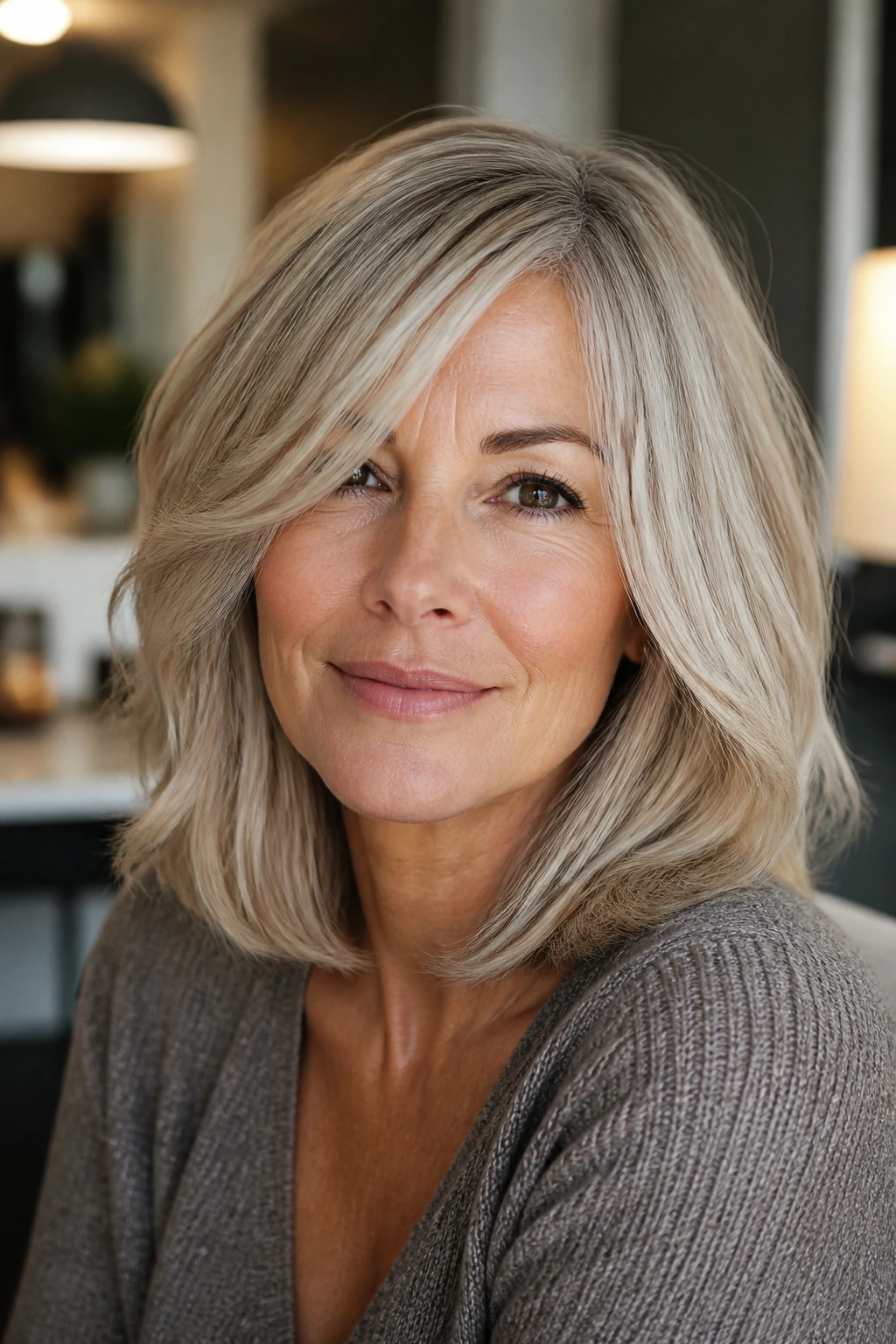
A tiny bit of warmth can make silver blonde look softer, and that’s why champagne-silver is such a smart choice. The champagne note keeps the tone from going icy or flat, while the silver brings enough brightness to keep the color from reading too beige. On a lob, the mix feels polished without becoming fussy.
This is the shade I’d suggest to anyone who has a warm or peachy complexion and feels wiped out by pure ash. Champagne-silver doesn’t fight the skin. It sits beside it more gently. The result is more forgiving around the eyes and mouth, where harsh cool blondes tend to show every line.
The length matters too. A lob usually lands somewhere between the jaw and collarbone, which gives the color enough surface area to show off the tonal blend without needing complicated styling. A soft bend from a curling iron or a round-brush blowout is enough.
If your hair tends to dull at the ends, ask for a clear gloss after the toner. That little extra shine keeps the champagne note from looking flat in indoor light.
8. Feathered Silver Shag With Curtain Bangs
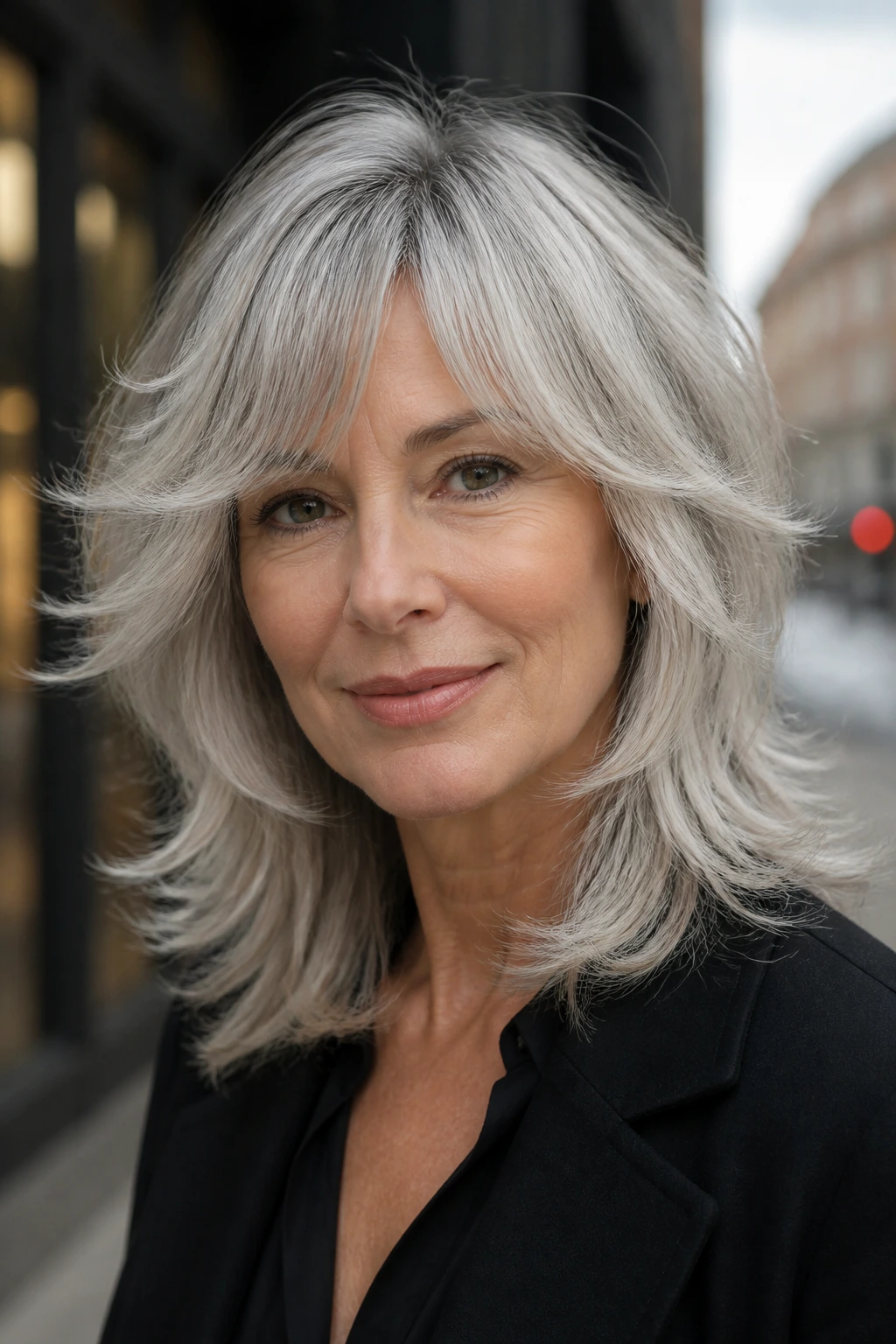
Why do curtain bangs keep showing up in silver-blonde ideas for older women? Because they do a lot of heavy lifting without shouting about it. The feathered shag gives the hair movement, the bangs break up the forehead, and the silver color spreads across all that texture in a way that feels airy instead of heavy.
The shag works best when the layers are soft, not jagged. You want enough shape to make the silver flicker through the cut, but not so much choppiness that the ends look thin. Curtain bangs help because they frame the face and give the hair a soft front edge, which is useful if your hairline is changing or your forehead feels more prominent than it used to.
A little root volume helps here. The shape should lift at the crown and move away from the face, not sit flat against the head. That means a lightweight mousse at the roots and a blow-dry with a round brush or large vent brush.
Silver plus feathering can look extremely flattering when the cut has motion. Without that motion, the same color can look cold. That’s the whole difference.
9. Platinum White Blunt Bob
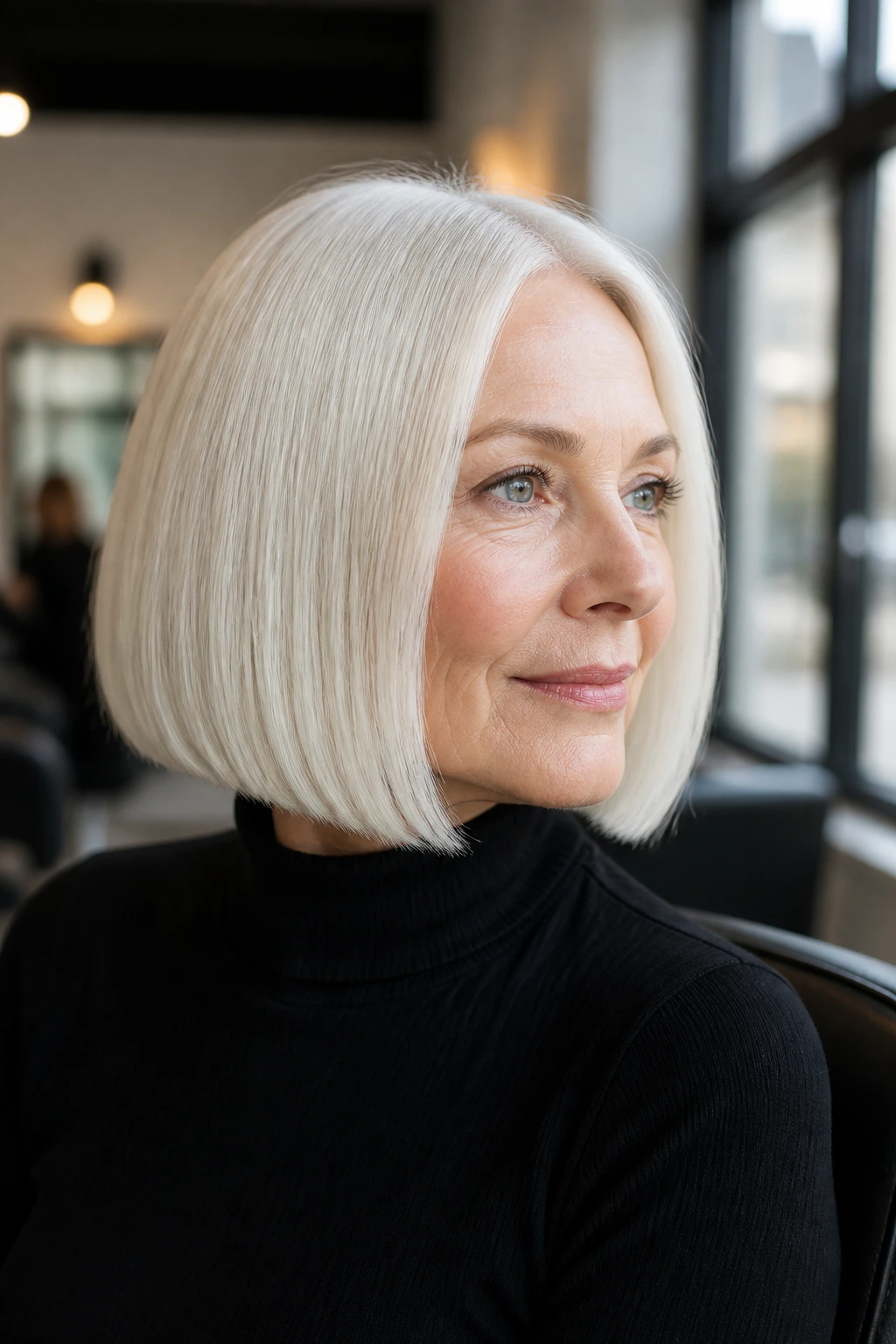
A blunt bob in platinum white is one of the boldest silver-blonde choices, and I won’t pretend it’s low-maintenance. It isn’t. But when the cut is clean and the tone is fresh, it has a kind of graphic clarity that can look very sharp on mature women who want strong lines rather than softness.
The blunt edge is the point. It makes the hair look denser at the ends, which helps if your hair has thinned a bit. The crisp line also gives the platinum something to hold onto, so the color doesn’t drift into “tired blonde” territory. That said, the bob needs regular trims because an uneven hemline makes the white tone look messy fast.
This is not the look for someone who wants to disappear into the background. It’s for women who like contrast, clean shapes, and a color that reads from across the room. Glasses, bold earrings, and a tidy neckline all suit it well.
If your hair is porous, ask for a slightly pearl-toned white rather than pure ice. Pure white can grab too much violet from shampoo and turn bluish. A touch of pearl keeps it cleaner.
10. Dimensional Gray-Blending Highlights
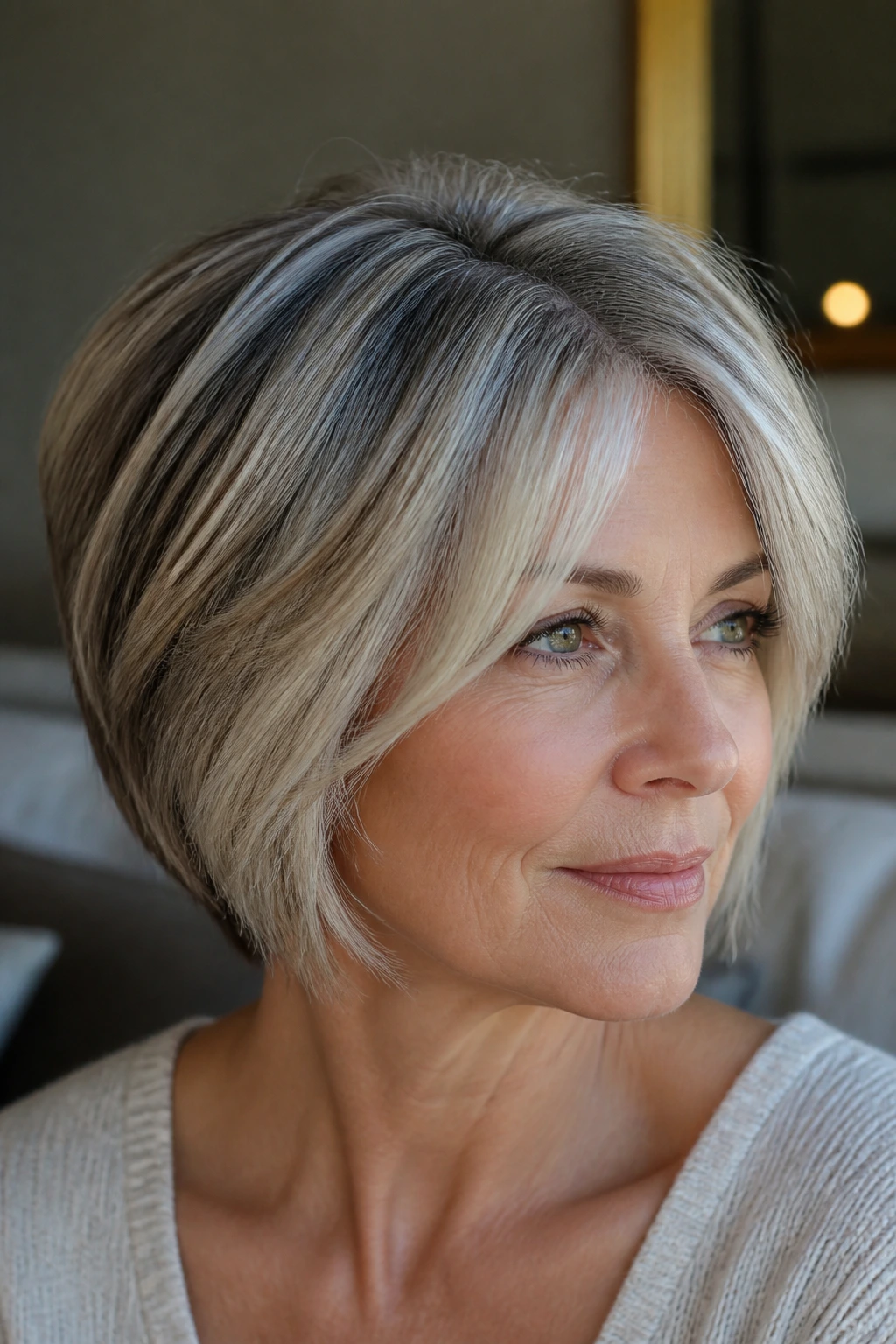
This is the easiest way to stop fighting gray and start making it part of the design. Dimensional gray-blending highlights use a mix of silver, beige, and your own natural gray so the overall effect is softer than a full highlight job. You don’t need every strand to be light. You need enough movement to make the gray look deliberate.
What to Ask For
Tell your colorist you want the gray blended, not buried. That usually means fine foils through the top and face frame, plus a few lowlights so the lighter strands don’t float alone. The goal is to break up hard contrast, especially if your roots are peppery and the rest of your hair still carries old dye.
This approach is one of the least stressful for women who are in the middle of transitioning. It doesn’t force a dramatic change all at once. It gives the gray somewhere to land, and that matters.
The finish should look soft in daylight and tidy indoors. If it starts looking streaky, the foils were too wide or the toner was too cool for the base. Fine placement is what makes this work.
11. Silver Blonde Curls With Lowlights
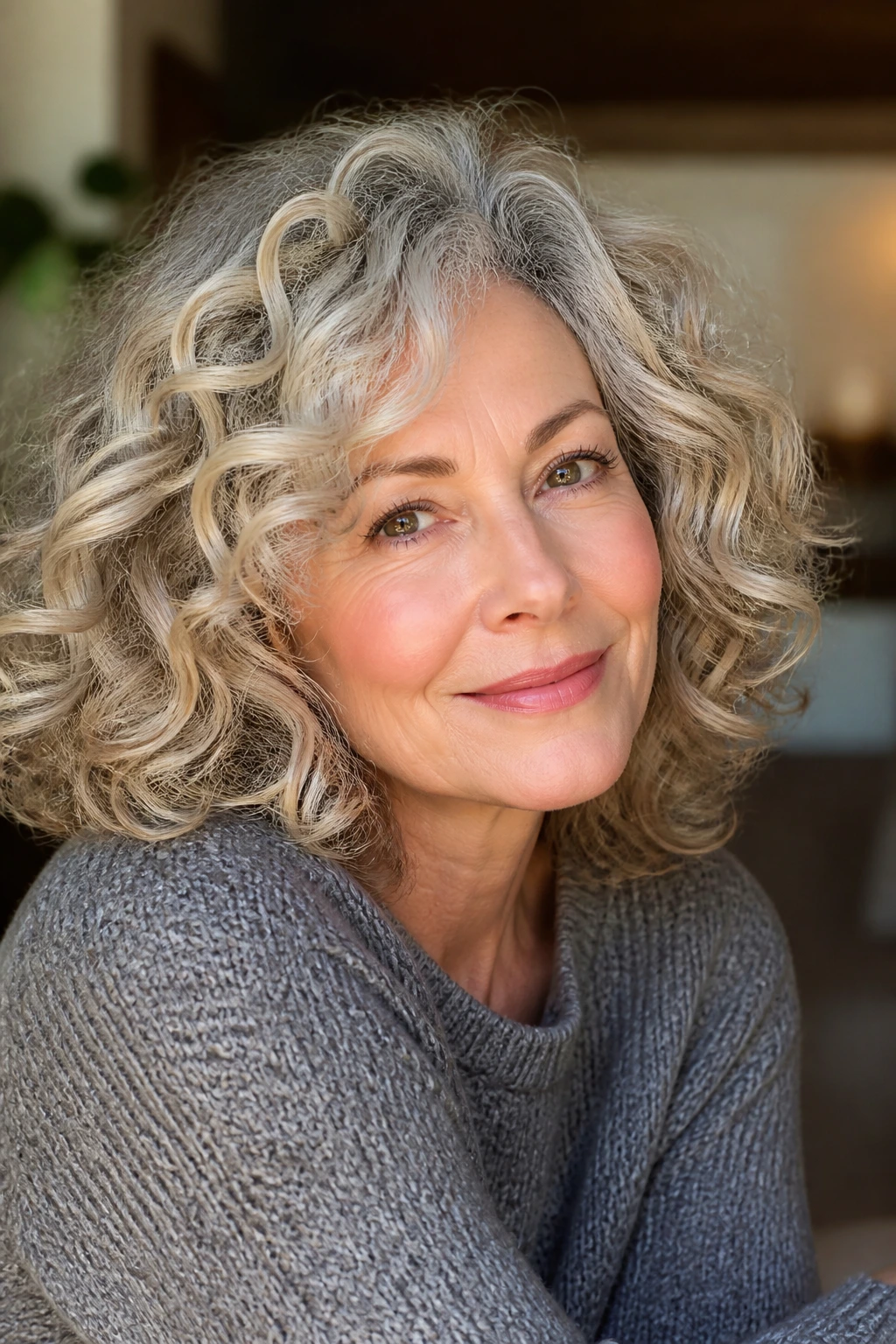
Curly hair needs a different silver-blonde strategy. If every curl is pushed to the same pale level, the pattern can blur and the shape loses definition. That’s why lowlights matter so much here. They keep the curls from turning into one pale cloud.
Silver on curls looks best when it’s placed with restraint. A few brighter ribbons around the face, some cooler silver through the upper surface, and a deeper lowlight under the canopy can make each curl stand out without turning the whole style brittle. The color should move with the curl, not sit on top of it.
Moisture matters twice as much on curly silver-blonde hair. Lightened curls can get frizzy fast, and frizz makes silver look rougher than it really is. A curl cream with enough slip, plus a weekly mask, usually does more for the color than another round of toner.
If you wear your curls natural, ask for the lightest pieces to stay off the ends. Ends are the oldest, driest part of the curl, and they can snap visually if they’re over-lightened.
12. Icy Beige Waves
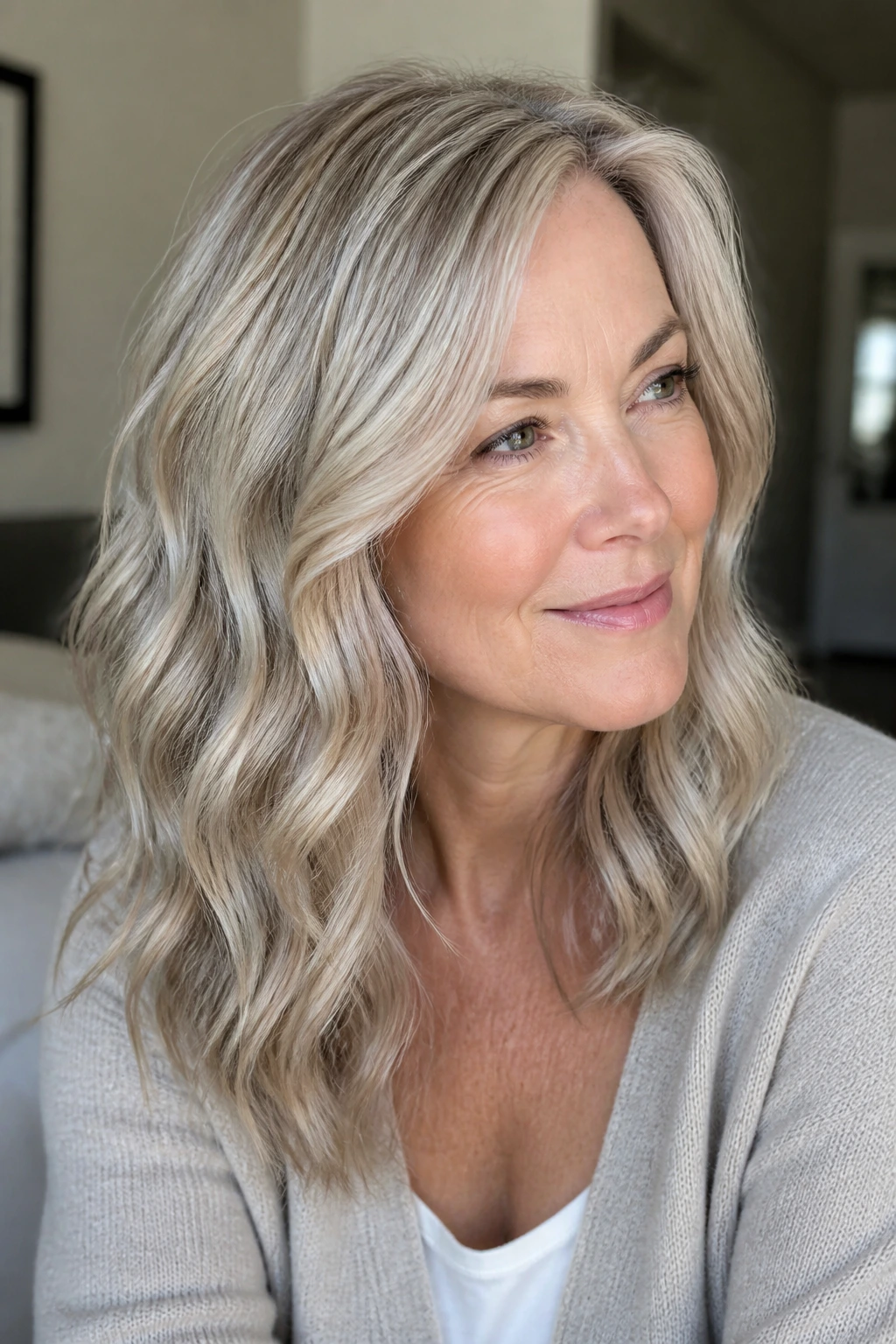
Icy beige sits right between ash and cream, and that middle ground is why it works so well on older women. Pure ash can look dusty. Pure beige can turn brassy. Icy beige keeps the coolness in check while staying soft enough to flatter skin that doesn’t want a harsh contrast.
This shade loves loose waves. Not tight curls. Loose waves. The movement lets the beige and silver shift as you turn your head, which gives the hair depth without needing obvious streaks. On a medium-length cut, the waves help the ends look fuller and stop the color from collapsing into a flat sheet.
Compared with a full platinum look, icy beige is easier to wear day to day. It doesn’t demand perfect makeup or a severe haircut to make sense. You can wear it with a side part, a center part, a soft bend, or even tucked behind the ears.
If your hair is on the finer side, keep the highlights delicate and the root slightly deeper. That preserves the impression of thickness. Too much pale color on fine hair can make it look wispy.
13. Soft Metallic Crop
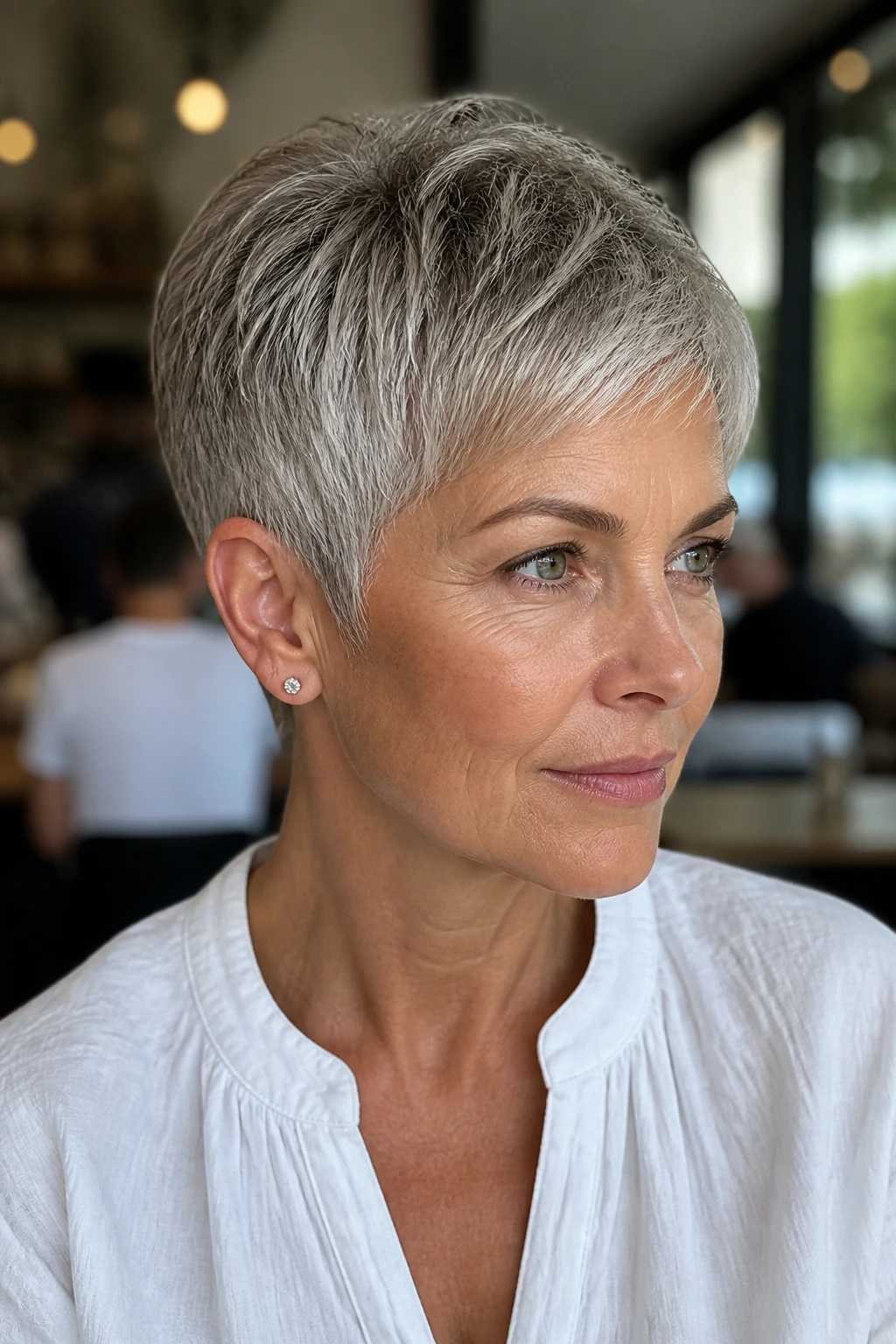
A metallic finish can sound loud on paper, but in real life it’s often just a clean, reflective glaze over a short crop. The color isn’t shiny in a plastic way. It’s more like brushed silver. That subtle shine is what keeps a cropped cut from looking dull or overly matte.
This look suits women with strong bone structure or a haircut that already has good shape around the ears and neckline. The metallic note gives the crop a little edge, while the short length prevents the shade from looking overworked. It’s especially useful if your hair has a mix of silver and darker strands and you want them to sit in the same family.
The cut should stay tidy. A crop with too much bulk on top can make metallic silver look puffy. A little lift at the crown and narrower sides usually reads better.
A lightweight wax or styling cream is enough. You want separation, not helmet gloss. Too much shine spray will make the metallic tone look fake instead of polished.
14. Salt-and-Pepper Blend With a Silver Gloss
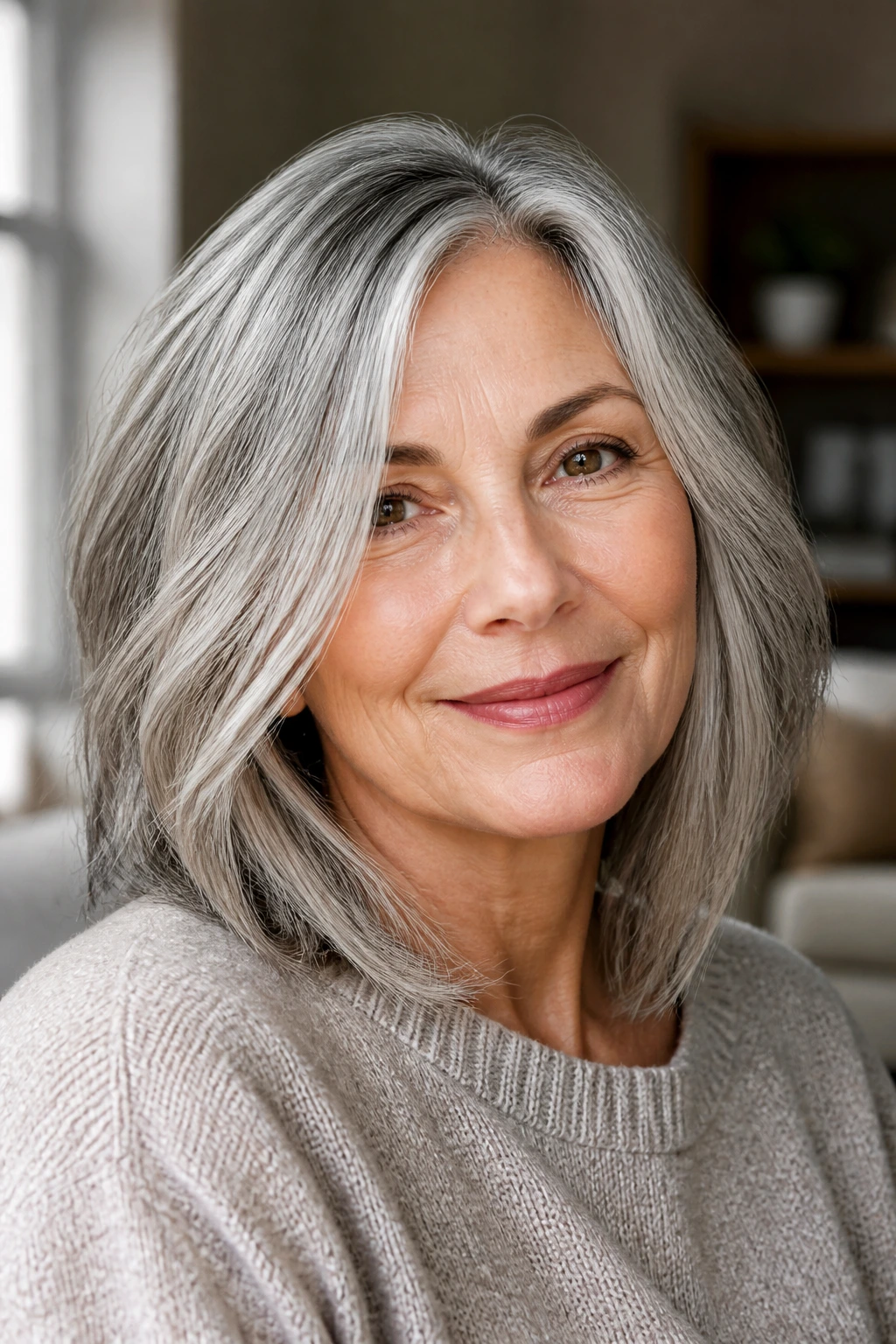
If your hair is already mostly salt-and-pepper, a silver gloss can clean up the whole look without forcing a color rewrite. This is one of the smartest paths for women who want to keep the natural mix but make it look more deliberate. The gloss tones down uneven yellowing, smooths the contrast, and gives the gray a cooler finish.
What Makes It Work
The trick is restraint. A gloss should refine the color, not cover every trace of it. You still want some dark strands and some white strands visible, because that contrast is what gives salt-and-pepper hair its life. Flatten it too much and the result can look muddy.
This works beautifully on short cuts, layered lobs, and hair with a lot of natural texture. The silver glaze also helps tame the little wiry pieces that tend to stick up around the temples and crown. Those bits are often the first place gray starts to look unruly, and a gloss can make them sit down a little better.
If you want to go softer, ask for a few baby lights near the part line. Just enough. Not enough to erase the pattern.
15. Brightened Gray Pixie With Pearl Toner
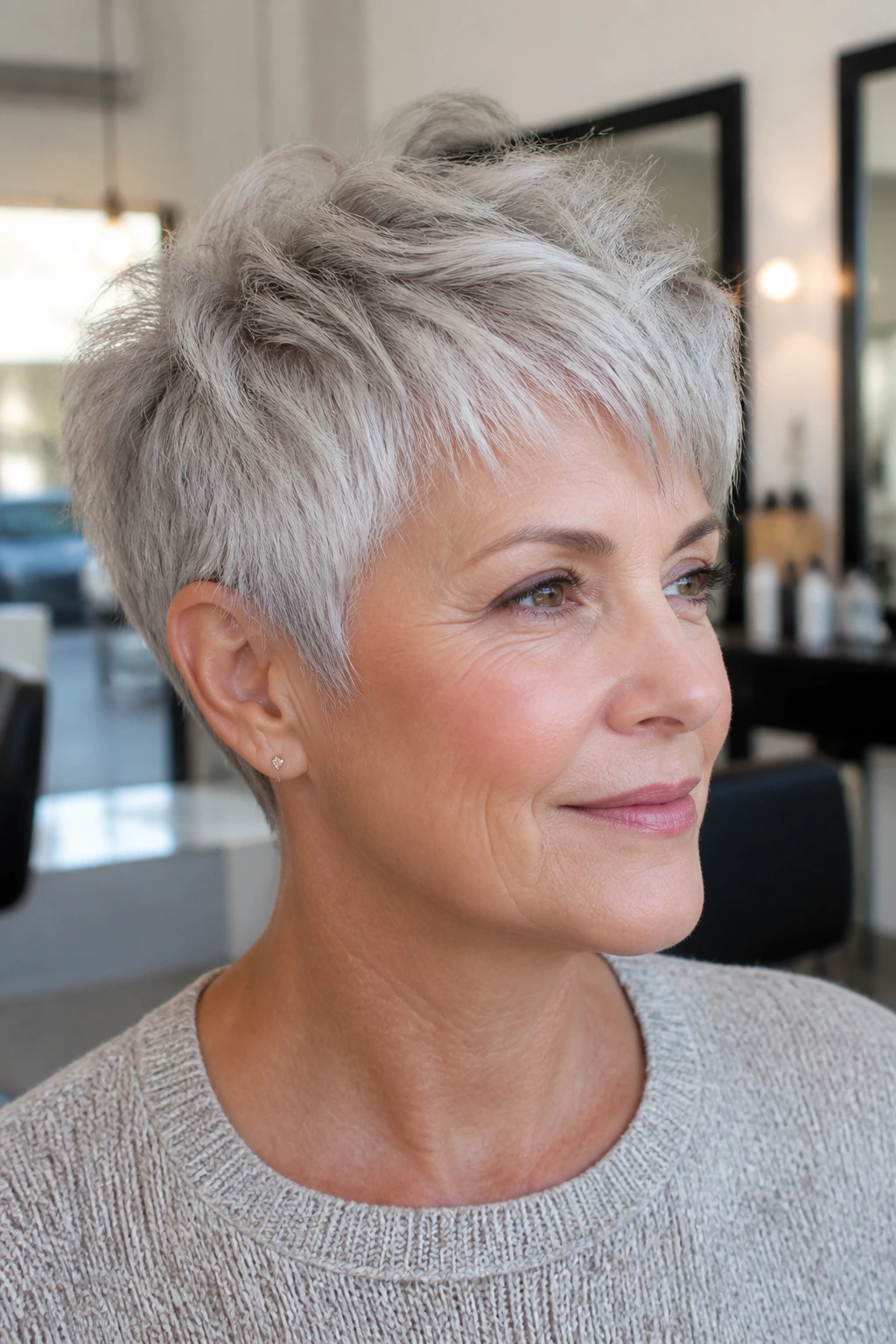
A pixie can look especially good when the gray is the feature, not the problem. Pearl toner softens the white so it doesn’t turn flat or brassy, and the short cut makes the hair look clean and deliberate. If your natural gray is bright and even, this is one of the easiest ways to polish it.
The key is texture. A gray pixie with no movement can look severe. Add a bit of lift on top, keep the fringe soft, and let the sideburn area stay neat but not carved too tightly. That balance keeps the cut from feeling dated.
This is also a good option for women who wear earrings, scarves, or bold lipstick. The face has room to breathe when the hair is short. Pearl toner keeps the hair luminous without pushing it into that very cold, blue-white zone that can look too stark under indoor lights.
A tiny amount of texture cream at the crown is usually enough. You want the strands separated just a little, not frozen in place.
16. Cream-Silver Layers With a Warm Root Melt
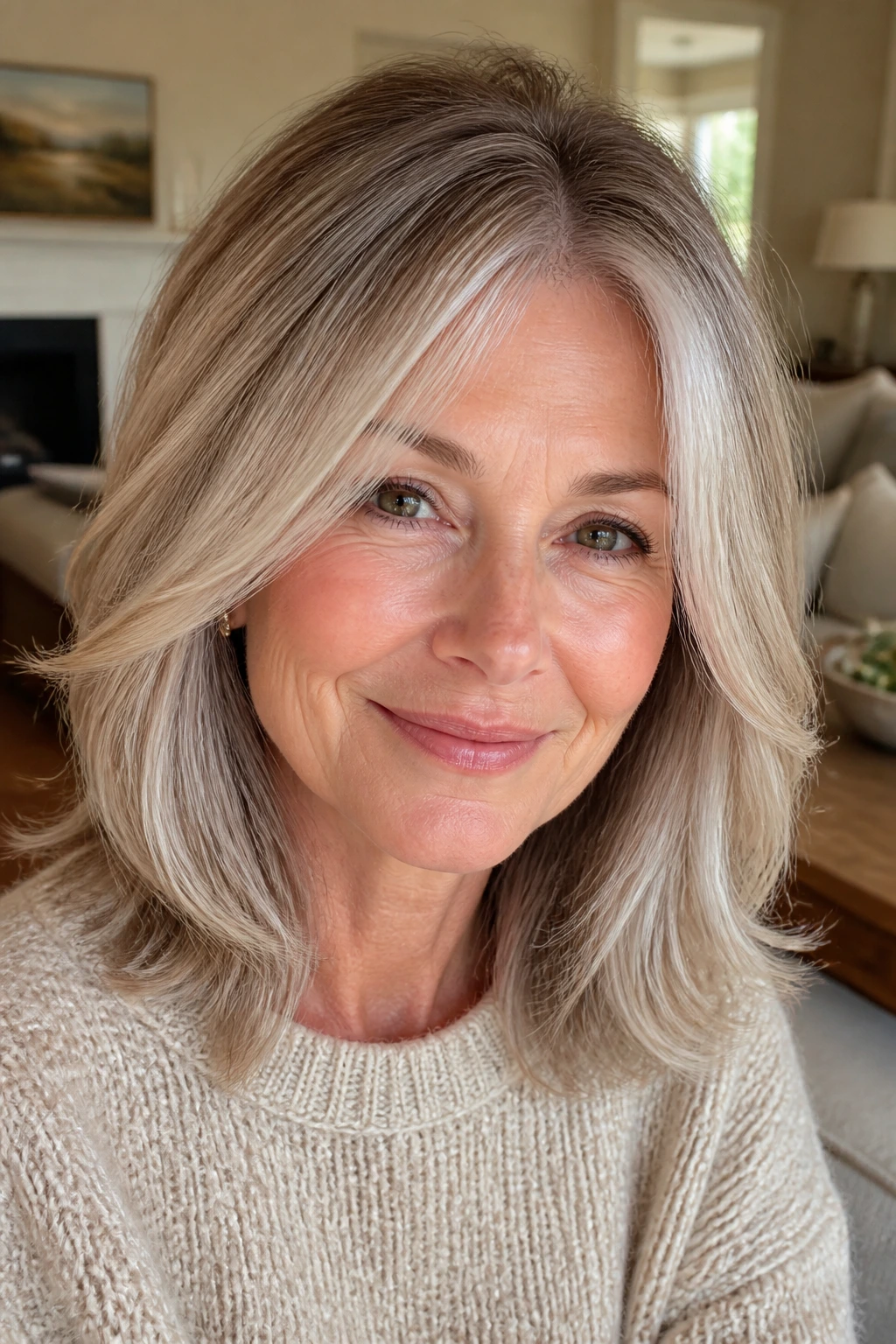
Cream-silver with a warm root melt is one of the easiest silver-blonde ideas to wear if you don’t want your hairline screaming for attention every three weeks. The root melt softens the transition, while the creamier silver through the mids keeps the color from going flat or too icy. It’s a gentle look, which is not the same thing as boring.
The layers matter because the color shows better when the hair has some movement. A one-length cut can make this tone look sleepy. Soft layers around the face and through the ends let the cream and silver overlap, so the color shifts instead of sitting still.
I like this option for women who are growing out natural gray and still have some warm pigment left in the lengths. The melt keeps the lower half from looking disconnected. It also plays nicely with a slightly warmer complexion, which can get washed out by pure ash.
Ask for the root to stay close to your natural depth and the ends to be toned just enough to catch the light. That way the grow-out looks on purpose, not overdue.
17. Scandinavian Blonde With a Frosted Finish
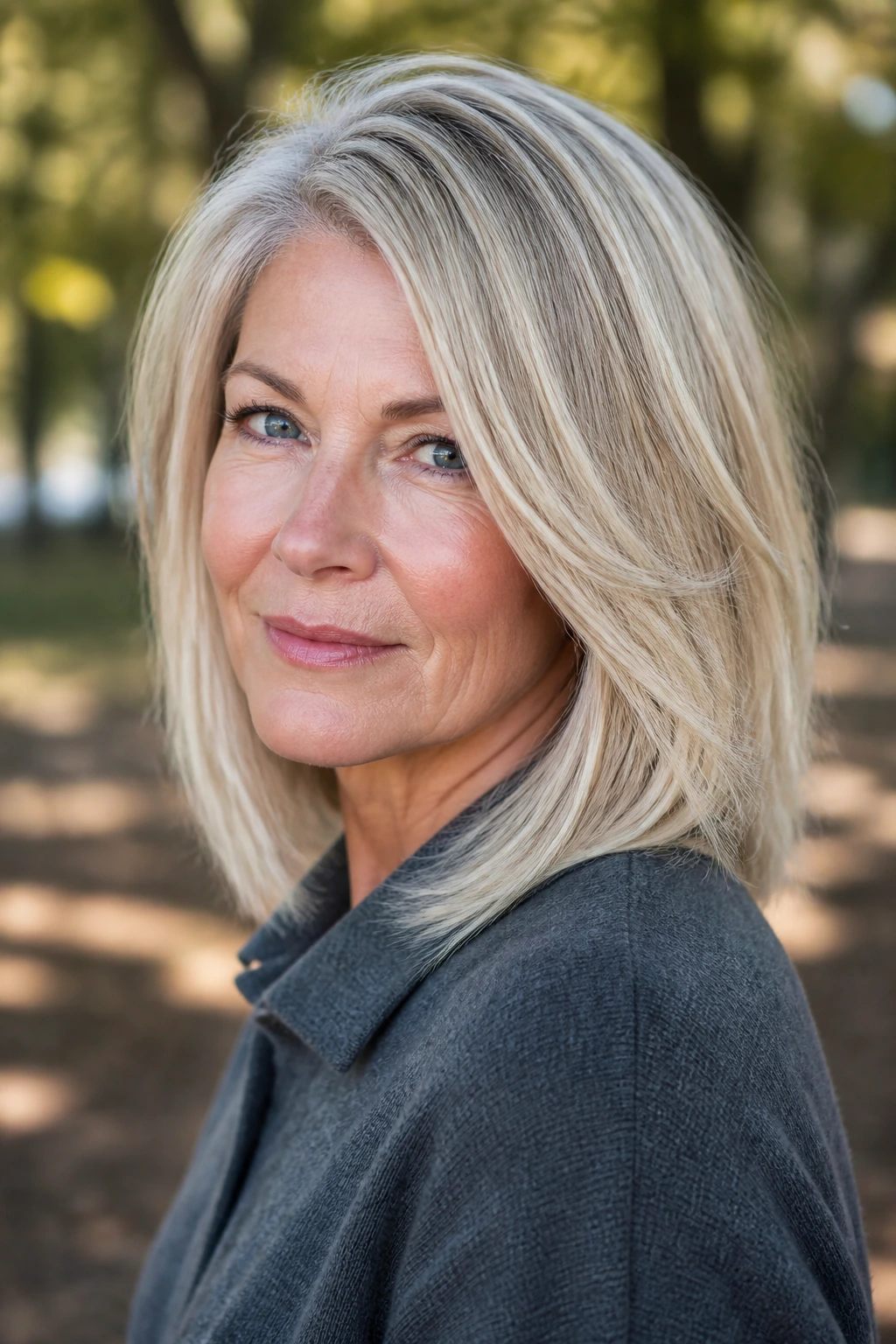
Scandinavian blonde gets used as a label for all kinds of light hair, but the version that works on older women is usually softer than the name sounds. The frosted finish should feel airy, not blindingly white. If the tone goes too pale, the hair can start to look dry and the face loses shape.
This shade likes clean cuts and good density. If the haircut is wispy, the pale blonde can make it seem thinner than it is. A strong bob, a layered shoulder cut, or a pixie with clear edges can keep the overall shape from disappearing into the color.
The frosted finish is best when the roots are softened just a little. A slightly deeper base keeps the blonde from floating away from the face. That small bit of depth is especially helpful if your eyebrows or eyes already have contrast and you don’t want the hair to take all of it away.
This is one of the most high-key options in the collection. It can look beautiful, but it asks for more upkeep, more moisture, and more attention to skin tone than the softer shades do.
18. Silver Rose Gold Blend
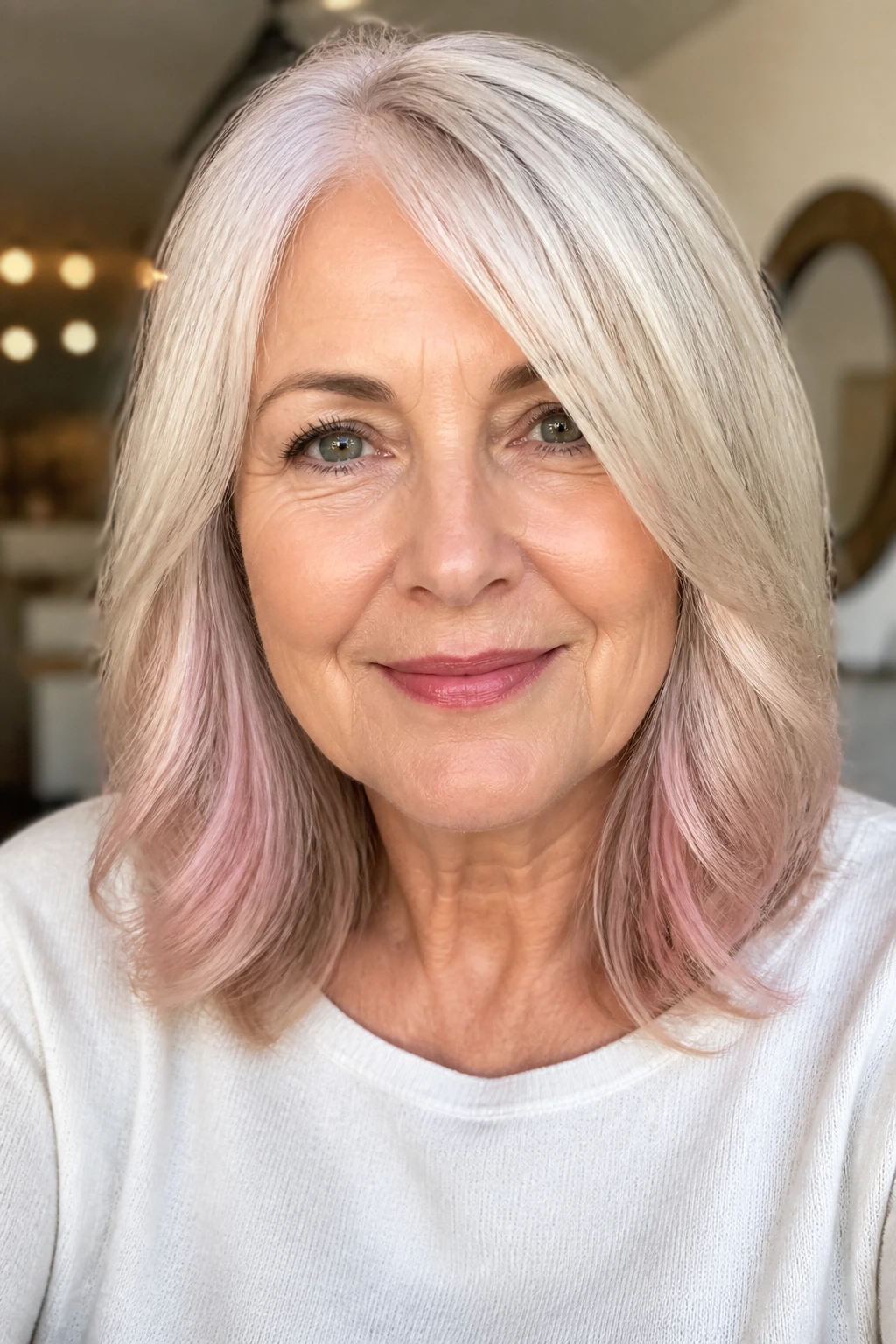
A little pink warmth can save silver blonde from feeling too cold, and that’s the whole point of a silver rose gold blend. The rose tone is subtle — not candy-pink, not pastel cotton-candy nonsense. Just enough warmth to soften the silver and keep the hair from looking flat against the skin.
This shade is a good fit if you like cool colors but don’t want the kind of icy finish that sharpens every line on the face. A pale rose veil near the ends can make the whole haircut look more forgiving, especially around the cheekbones and mouth. It also works well with beige or neutral clothing, which sometimes make pure silver feel a little lifeless.
The blend should be light. If the rose tone takes over, the hair can drift into peach territory and lose its silver edge. A gloss is usually enough; you do not need a full pink dye job.
I’d especially consider this one for women with pale skin and rosy undertones. The hair picks up on what’s already there instead of fighting it.
19. Silver Blonde With Airy Babylights
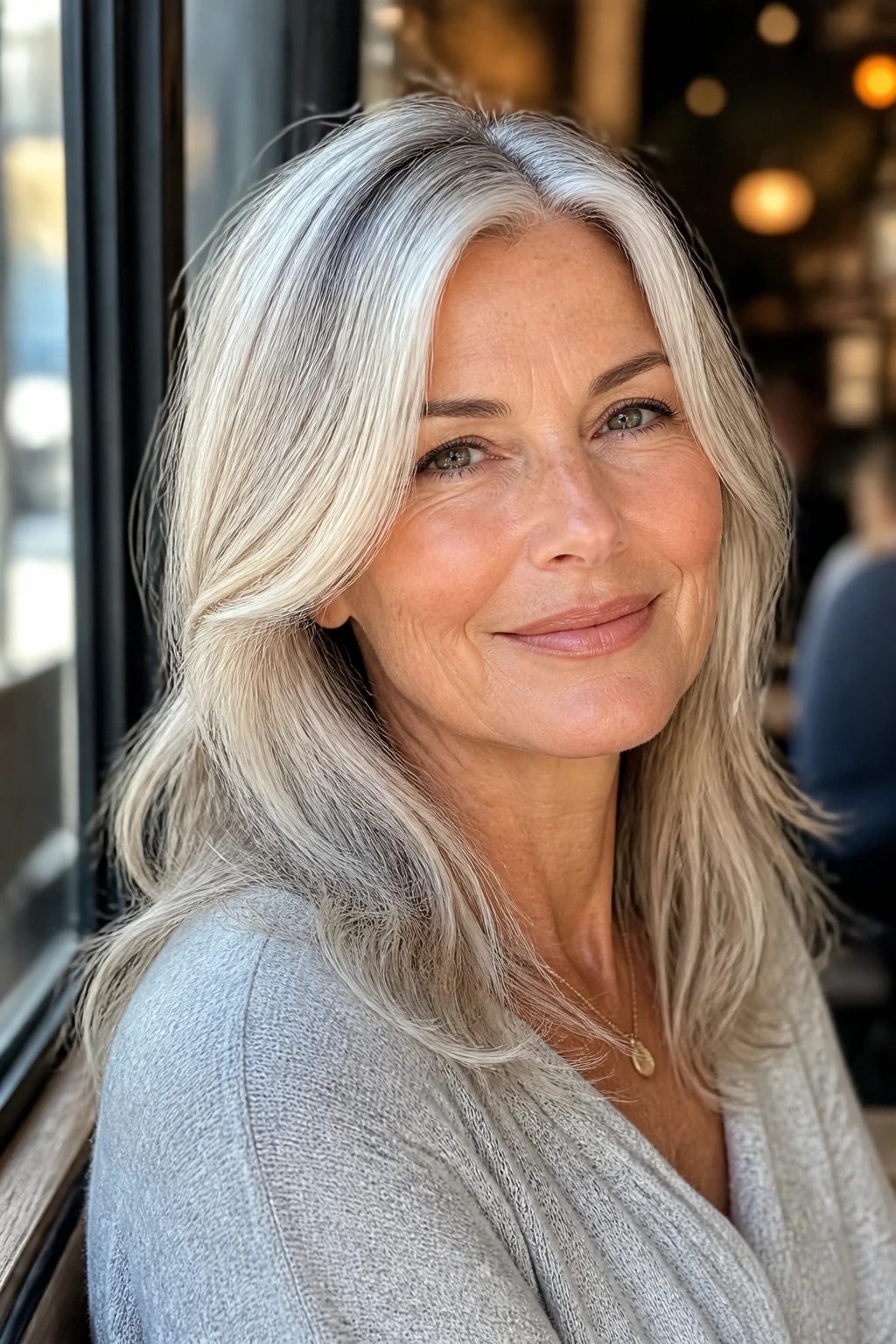
Babylights are the reason some silver blondes look expensive and others look striped. The difference is in the size of the sections. Babylights are tiny. They’re woven so fine that the result looks like the hair has been naturally sun-kissed and then cooled down with toner, not highlighted in obvious rows.
This technique is kind to older women because it keeps the color soft around the regrowth line. A lot of fine foil work near the part and hairline also helps the silver look more blended, especially if your natural gray is coming in unevenly. The shade can be bright, but the placement stays gentle.
- Best for: Fine hair, early gray, or anyone who wants brightness without a dramatic overhaul.
- Ask for: Micro-fine foils and a clean toner, not chunky streaks.
- Style with: A loose blowout or soft bend to keep the dimension visible.
- Avoid: Over-toning the ends into a flat blue-gray.
Babylights do take time in the chair, but the result usually looks calmer for longer. That’s the trade-off. Worth it, in my opinion.
20. Silver Blonde Crop With a Side Sweep
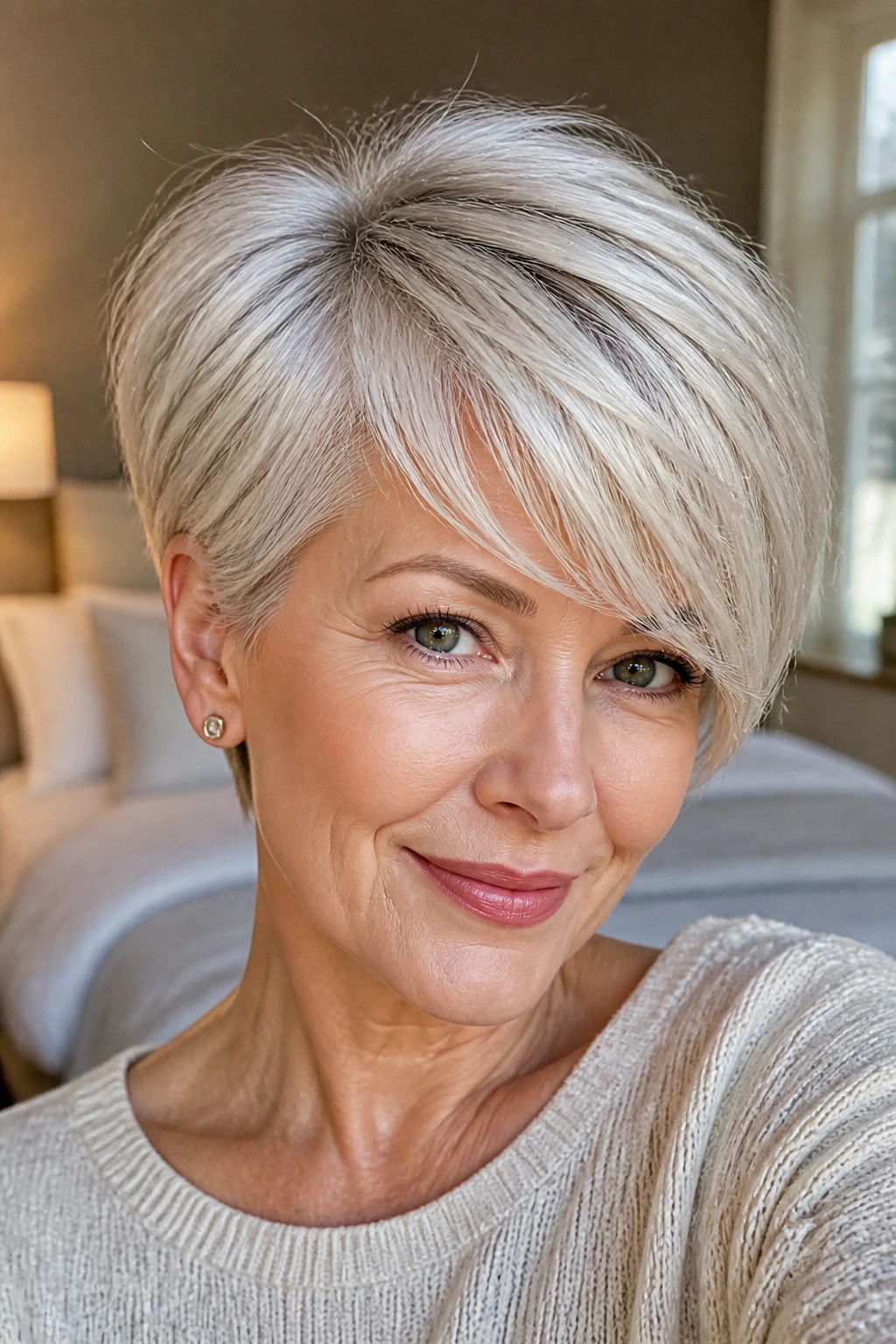
Why does a side sweep matter so much on silver blonde? Because it breaks up the light. A short crop with a side-swept fringe creates movement right where the eye lands first, and that little shift can stop the color from looking too rigid or too youthful in the wrong way.
The side sweep also helps if your hairline has more gray than the rest of your head. Instead of fighting that contrast, the fringe folds it into the shape of the cut. The result is softer and less obvious, especially when the crop is cut close around the ears and fuller on top.
This version works well for women who want an easy morning routine. A little blow-dry at the front, a fingertip of cream or paste, and you’re done. No wrestling with length. No trying to tame limp ends. Just shape and shine.
If your face is round or heart-shaped, the sweep can be especially flattering because it adds diagonal movement. Straight across bangs can be harsher with silver. A sweep gives the color someplace to go.
21. Soft Silver Lob With Invisible Layers
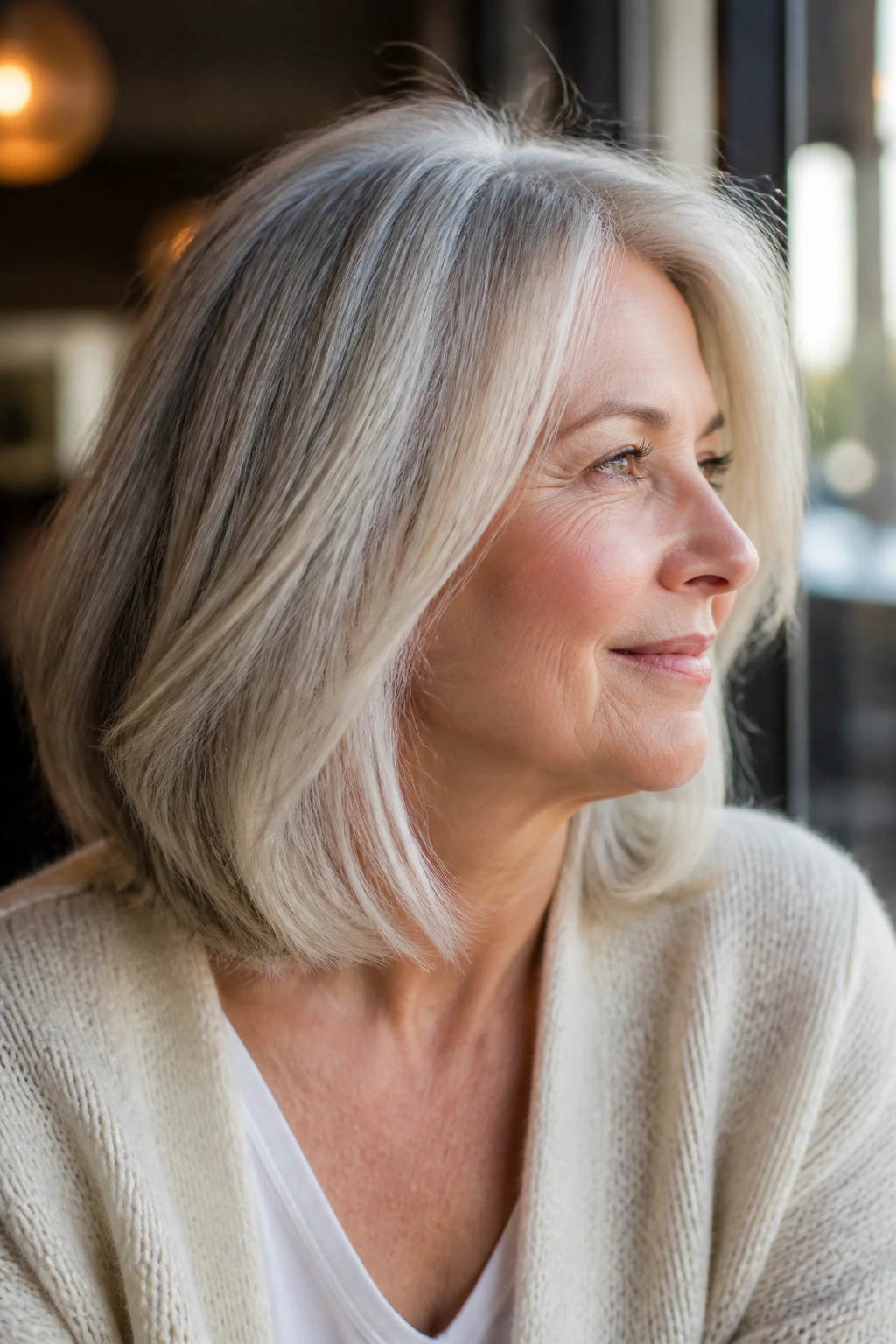
A lob with invisible layers is one of those haircuts that looks simple from across the room and quietly complicated up close. The layers sit inside the shape rather than slicing through the outline, so the hair keeps its weight but still moves. On silver blonde, that movement matters because it lets the tones show up without a lot of obvious cutting.
The softness of the shape is what makes it useful for older women. Hair that has lost a little density often looks better with a polished outline than with too much chop. Invisible layers help the ends turn under or bend lightly without revealing every separate section of the haircut. The silver color looks smoother that way.
This is a good middle-ground option if you want length but don’t want long hair that drags the face down. It can be worn straight, waved, or tucked behind the ears, and each version shows the silver in a slightly different way. That versatility is useful when you’re not in the mood to style your hair like a project.
A gloss every so often keeps the ends from looking faded. That’s the only real nonnegotiable.
Why Silver Blonde Flatters Mature Hair When It’s Tuned Right
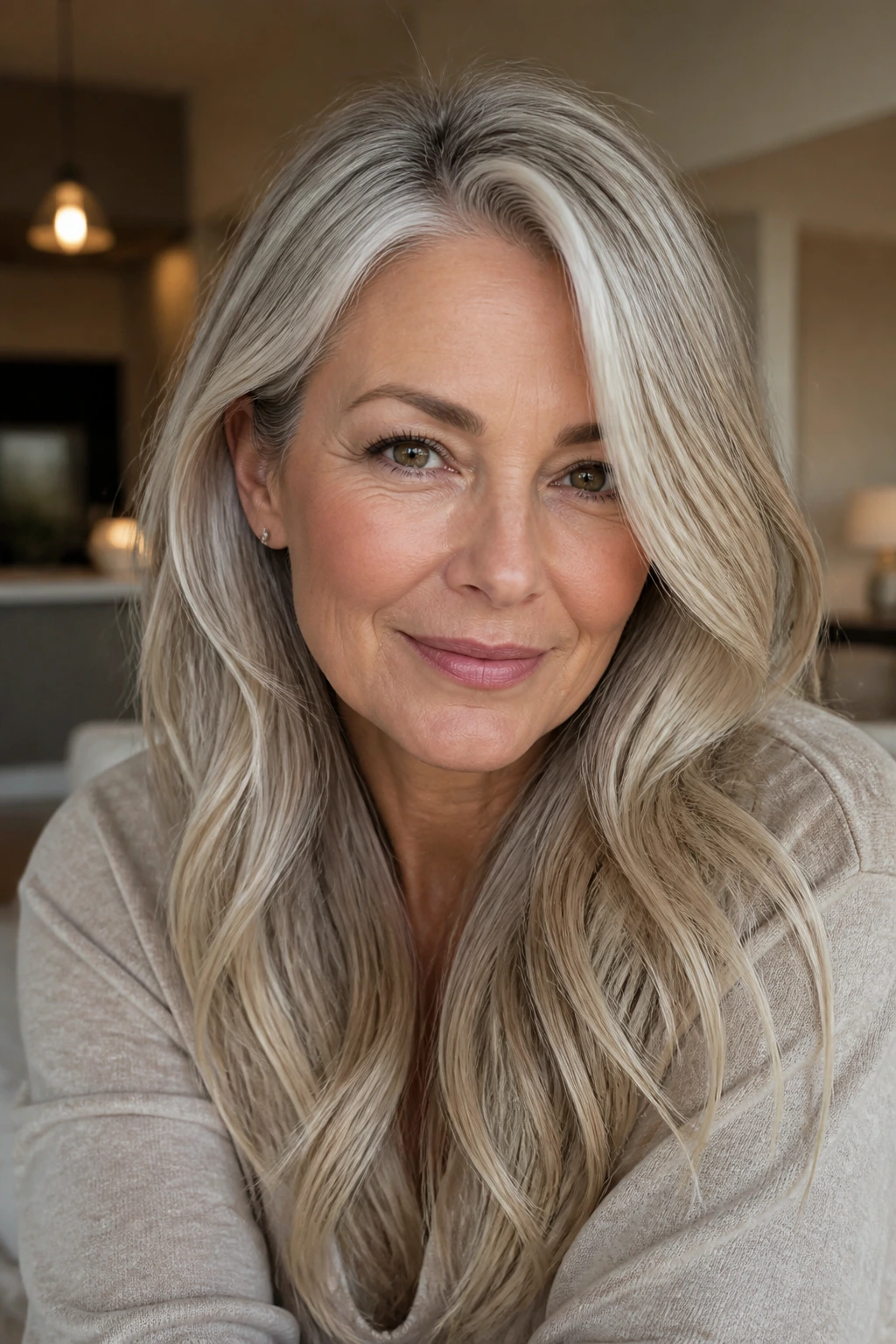
Silver blonde works on mature hair because it doesn’t pretend the hair is starting from scratch. Gray, white, and faded blonde already live in the same cool family, so a good color job is usually about refinement, not reinvention. That’s why the smartest versions use shadow roots, pearl glosses, lowlights, or soft beige-silver blends. They make the existing color look tidier.
Porosity changes the game. Hair that has been colored a few times, or simply gotten drier with age, grabs toner fast at the ends and often resists it near the root. A good colorist reads that difference strand by strand, not just head by head. The better the placement, the less patchy the silver looks when it starts to fade.
There’s also the matter of contrast. Some women look best with a crisp silver-white line near the face. Others need a little beige or champagne in the mix so the skin doesn’t look washed out. That isn’t a flaw in the hair. It’s just the way tone behaves against skin, brows, and lipstick. The trick is to let the hair do its job without stealing all the attention.
What to Ask for at the Salon Chair
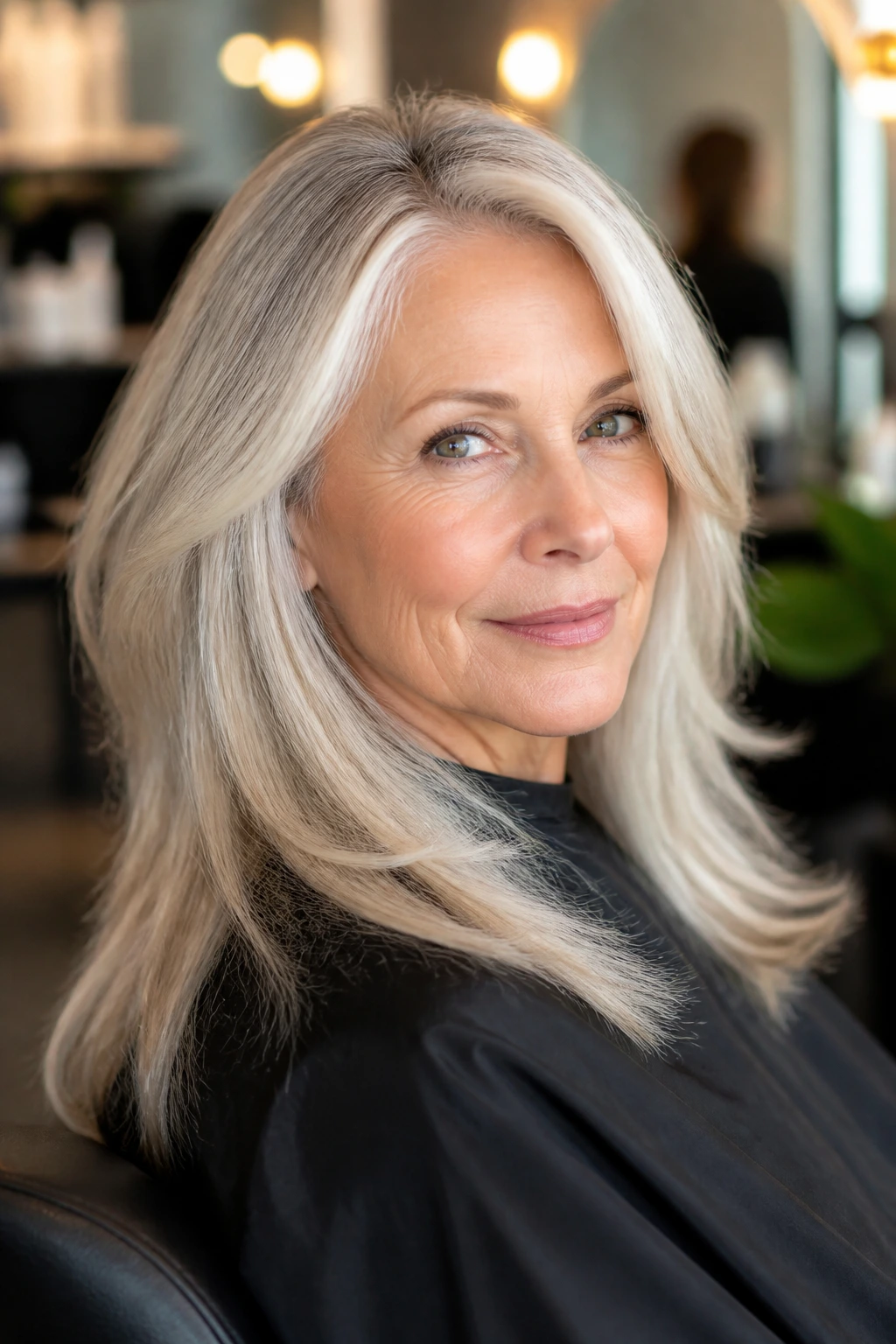
Bring photos, yes, but bring a sentence too. Tell the colorist whether you want soft grow-out, brighter face-framing pieces, or a full cool silver finish. Those three directions lead to very different formulas, and the wording matters more than people think.
If your hair is darker at the root and lighter through the mids, ask whether a root shadow or root melt makes sense. If your hair is already mostly gray, ask about glossing and selective lowlights instead of a full highlight service. That keeps the result from looking overworked. If you’ve got a history of box dye, say so early. No one likes surprises halfway through a foil service.
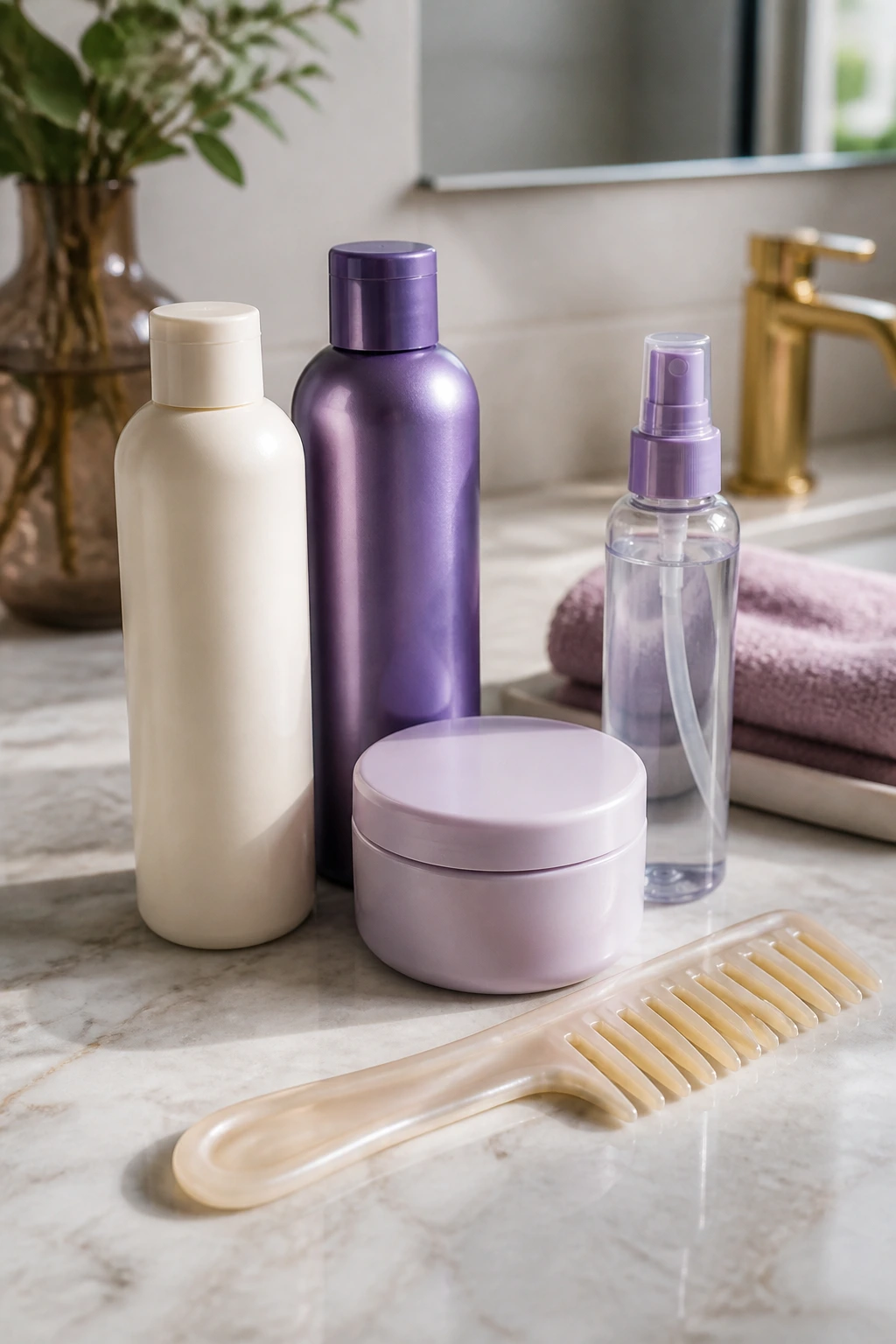
Essential Tools for Silver-Blonde Maintenance
-
Sulfate-free color shampoo: Keeps toner from stripping too fast and helps the silver last longer between washes.
-
Purple shampoo: Use it sparingly, usually once a week or every other week, so porous ends don’t go lilac.
-
Moisturizing hair mask: A weekly mask keeps lightened hair from turning rough and dull, especially on the ends.
-
Heat protectant spray: Silver hair shows heat damage fast, so protect it before blow-drying or using irons.
-
Wide-tooth comb: Useful for detangling wet hair without tearing up fragile, lightened strands.
-
Microfiber towel or soft cotton T-shirt: Cuts down on friction and frizz after washing.
-
Toner or gloss applicator brush: Handy if you refresh color at home or apply a demi-permanent glaze in sections.
-
Sectioning clips: Make it easier to dry, style, or target root areas without missing the back underlayers.
-
Shower filter, if your water is hard: Hard water can leave silver hair looking cloudy or yellow faster than you’d expect.
How to Wear Silver Blonde So It Flatters Your Face
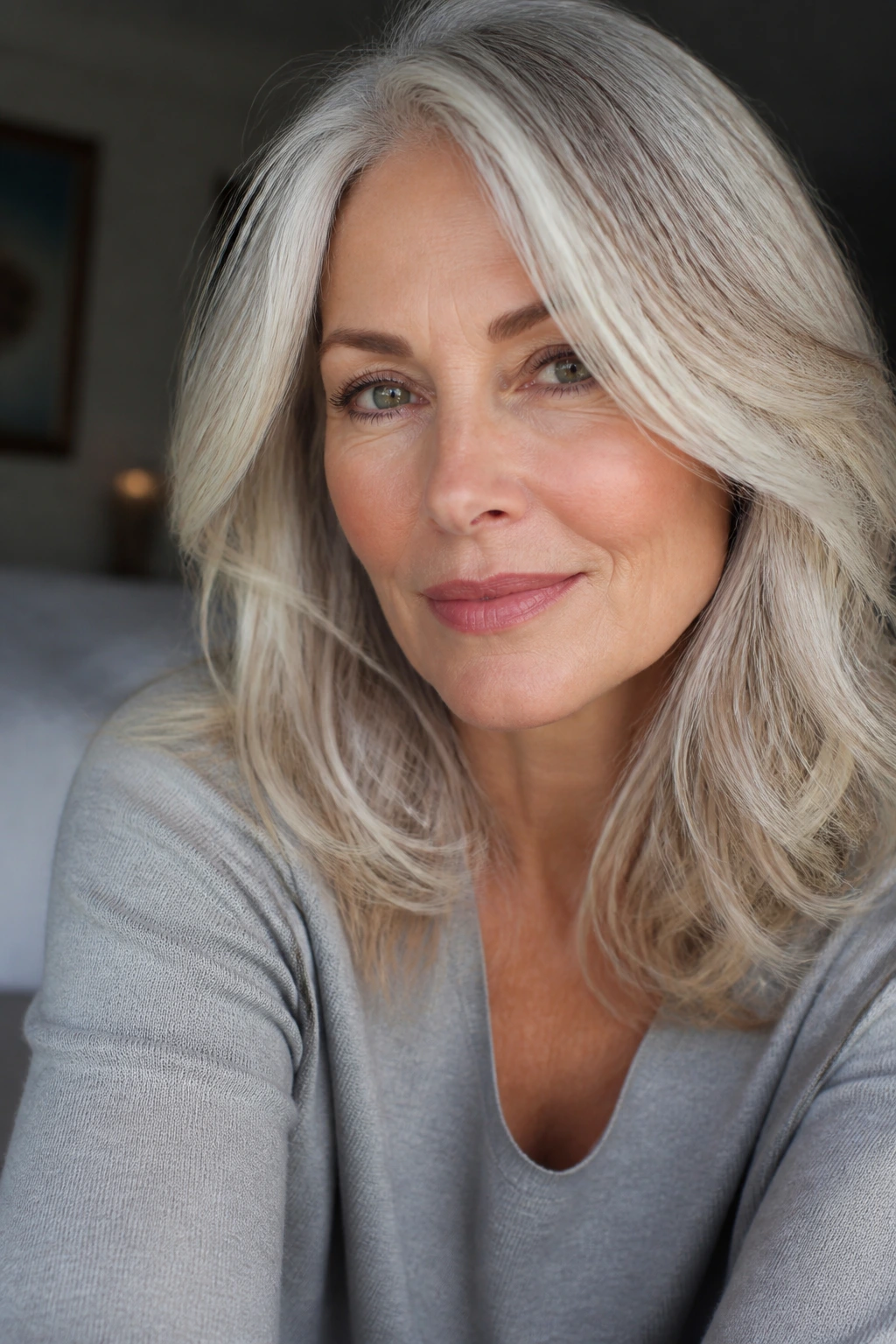
Presentation: Keep the brightest silver or pearl pieces near the cheekbones, temples, or fringe line, not only on the crown. That placement makes the face look lifted without forcing brightness into places that don’t need it.
Outfit Colors: Charcoal, navy, black, soft white, and cool jewel tones tend to make silver blonde look clean. If your wardrobe leans beige or warm tan, choose a slightly warmer pearl-silver so the hair doesn’t get lost against your clothes.
Makeup Pairing: A little brow definition, blush, and lip color usually matters more with silver hair than people expect. The hair removes some warmth from the face, so a dead-flat makeup look can make the whole effect feel unfinished.
Cut Length: Shorter cuts can handle brighter silver and more contrast. Longer cuts usually need more layering or root softness so the hair doesn’t look like one long pale curtain.
Additional Tips and Color Boosters
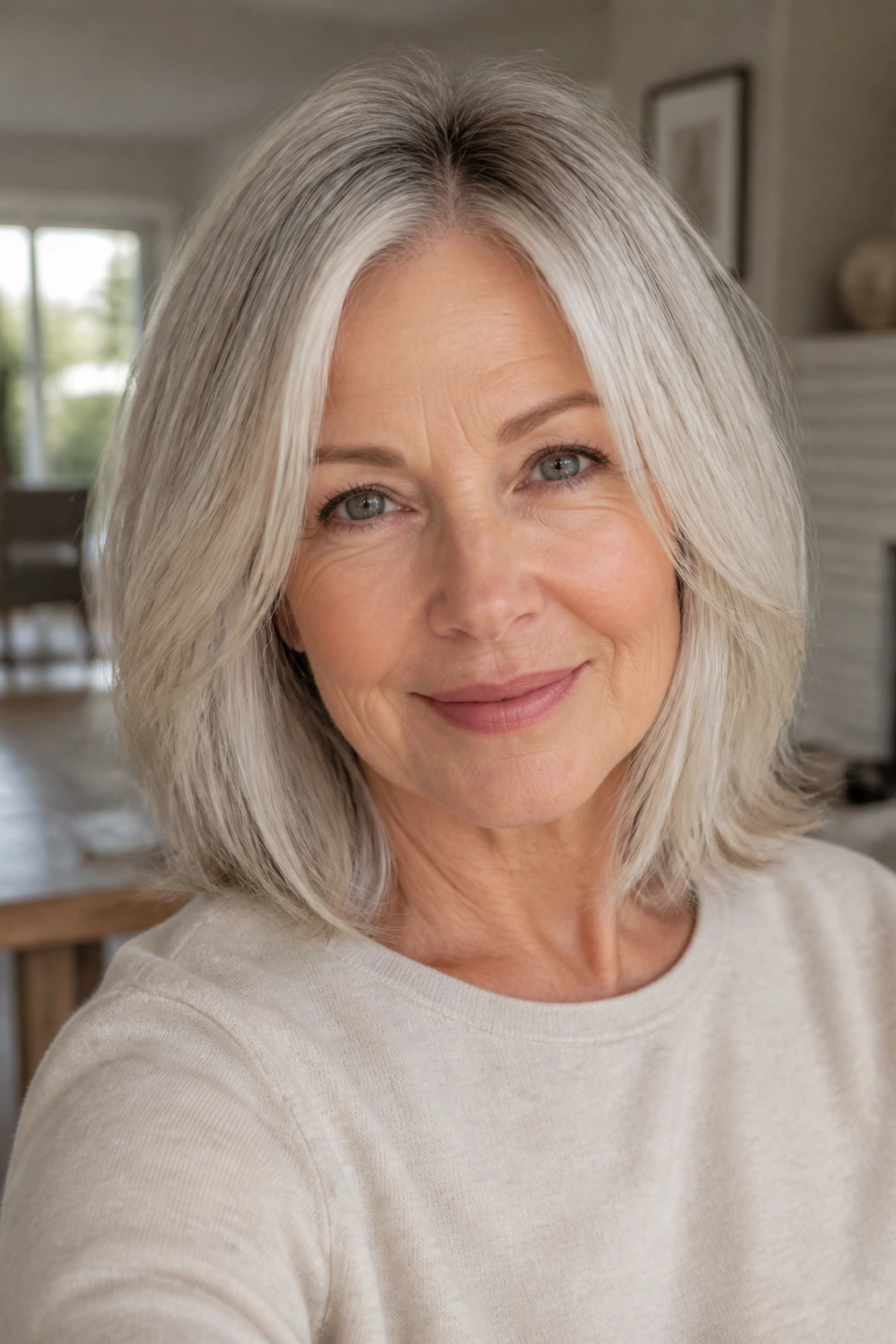
Tone Check: Look at the hair in natural daylight before deciding the silver is too warm or too icy. Bathroom bulbs lie all the time.
Root Strategy: A root shadow one shade deeper than the mids usually grows out better than a flat all-over blonde, especially if your natural color is darker.
Color Saver: If the ends feel dull, use a clear gloss instead of more purple shampoo. Purple shampoo corrects tone; gloss brings back shine.
Texture Boost: A little airy volume at the crown helps silver hair look fuller. Flat silver can show thinning faster than a cut with lift.
Make-It-Yours: If you like a softer finish, ask for pearl and beige notes. If you want sharper contrast, ask for cooler silver and a cleaner white around the face. If your hair is curly, keep more depth underneath so the curl pattern stays visible.
Common Mistakes That Make Silver Blonde Look Harsh
The biggest mistake is pushing the hair too light too fast. Hair that’s already dry or porous can go pale in a hurry, but pale isn’t the same as flattering. When the strands are over-lightened, the cut loses texture and starts looking wiry.
Another common slip is overusing purple shampoo. One heavy-handed routine can leave porous ends with a violet cast, especially on white or silver hair. If the shampoo stains the hair more than it tones it, back off and use a moisturizing wash in between.
Skipping lowlights is another one. Silver only looks dimensional when something darker sits beside it. If everything is the same light level, the result can look like a sheet instead of hair.
The last problem is ignoring the cut. Silver blonde on a shag, bob, or pixie can look chic; silver blonde on a shapeless grow-out often looks like you meant to make an appointment and forgot. The haircut gives the color a frame. Leave the frame sloppy, and the color has to do too much work.
Variations and Adaptations to Try
The Soft-Blend Transition: Use a shadow root, babylights, and a cool gloss to move from darker dye into silver without a hard line. This is the easiest path if you’re growing out color and want the process to feel civilized.
The Bright Face Frame: Keep the inner front pieces lighter and leave the rest of the hair more neutral. It’s a strong choice if you want the eyes to pop but don’t want the whole head to go pale.
The Gray-First Approach: Leave more of your natural gray visible and tone around it instead of covering it. This works well when you already have a lot of white at the temples and crown.
The Warm-Cool Mix: Add a little champagne or beige to the silver so the hair doesn’t look too icy. Good for women with warm skin or anyone who feels drained by blue-toned ash.
The Curl-Friendly Blend: Use wider sections of lowlights and softer silver ribbons so curls keep their shape. This keeps the pattern visible and stops the hair from turning into one bright mass.
Maintenance, Glossing, and Grow-Out Care
Silver blonde is one of those colors that looks best when you don’t manhandle it. Wash it too often and the toner slides out. Slam it with heavy purple shampoo and the ends can look dull, violet, or streaky. The sweet spot is usually a gentle wash routine with a color-safe shampoo, a moisturizing mask once a week, and purple shampoo only when the tone really needs correcting.
Most silver-blonde looks benefit from a gloss or toner refresh every 4 to 8 weeks, depending on how porous the hair is and how cool you want the finish. Root shadows and blended gray looks can stretch farther, sometimes 8 to 12 weeks, because the grow-out is built into the design. A blunt platinum bob usually wants more attention. A balayage lob can go longer.
Heat protection is not optional. Silver hair shows scorching and rough ends faster than deeper brunette shades do, and once the ends start to fray, the color looks older than it is. Keep irons moderate, roughly in the 300°F to 350°F range for most styling, and don’t keep them parked on one section.
Sleeping on a silk or satin pillowcase helps more than people think. It cuts down on friction, which means fewer broken flyaways around the hairline. And if you swim, rinse the hair before you get in the pool and again after. Chlorine can turn silver hair muddy in a hurry.
Questions People Ask About Silver Blonde
Will silver blonde make mature hair look dry?
It can, if the tone is too icy or the hair is over-lightened. The fix is moisture, a softer gloss, and a cut with shape so the color doesn’t hang on rough ends.
Can I go silver blonde if my hair is dark brown?
Yes, but usually not in one tidy appointment unless you’re willing to accept a warmer, darker silver-blonde result. Dark hair often needs lifting in stages, and trying to jump straight to white can wreck the cuticle.
Is silver blonde better than platinum for gray blending?
For many women, yes. Platinum is brighter and more dramatic, while silver blonde blends more easily with natural gray and tends to look softer at the root.
How often should toner be refreshed?
Most people need it every 4 to 8 weeks, depending on porosity, how often they wash, and how cool they want the finish. Highly porous ends may need attention sooner.
What if my hair turns purple after using shampoo?
Stop the purple shampoo for a week or two and wash with a gentle color-safe cleanser. If the cast is stubborn, a stylist can usually knock it back with a quick gloss service.
Can fine hair wear silver blonde without looking thin?
Yes, but the cut matters more. Fine hair usually looks better with babylights, a root shadow, and a bob or layered lob that keeps the ends from going transparent.
What’s the easiest silver-blonde cut to maintain?
A softly layered lob or a textured pixie. Both let you keep movement without needing the daily styling that a longer, brighter blonde often demands.
Do I need to match my brows to silver blonde hair?
No. Brows usually look better with a little depth left in them. If they’re too pale, the face can lose structure, and silver hair already leans cool.
Silver That Stays Soft
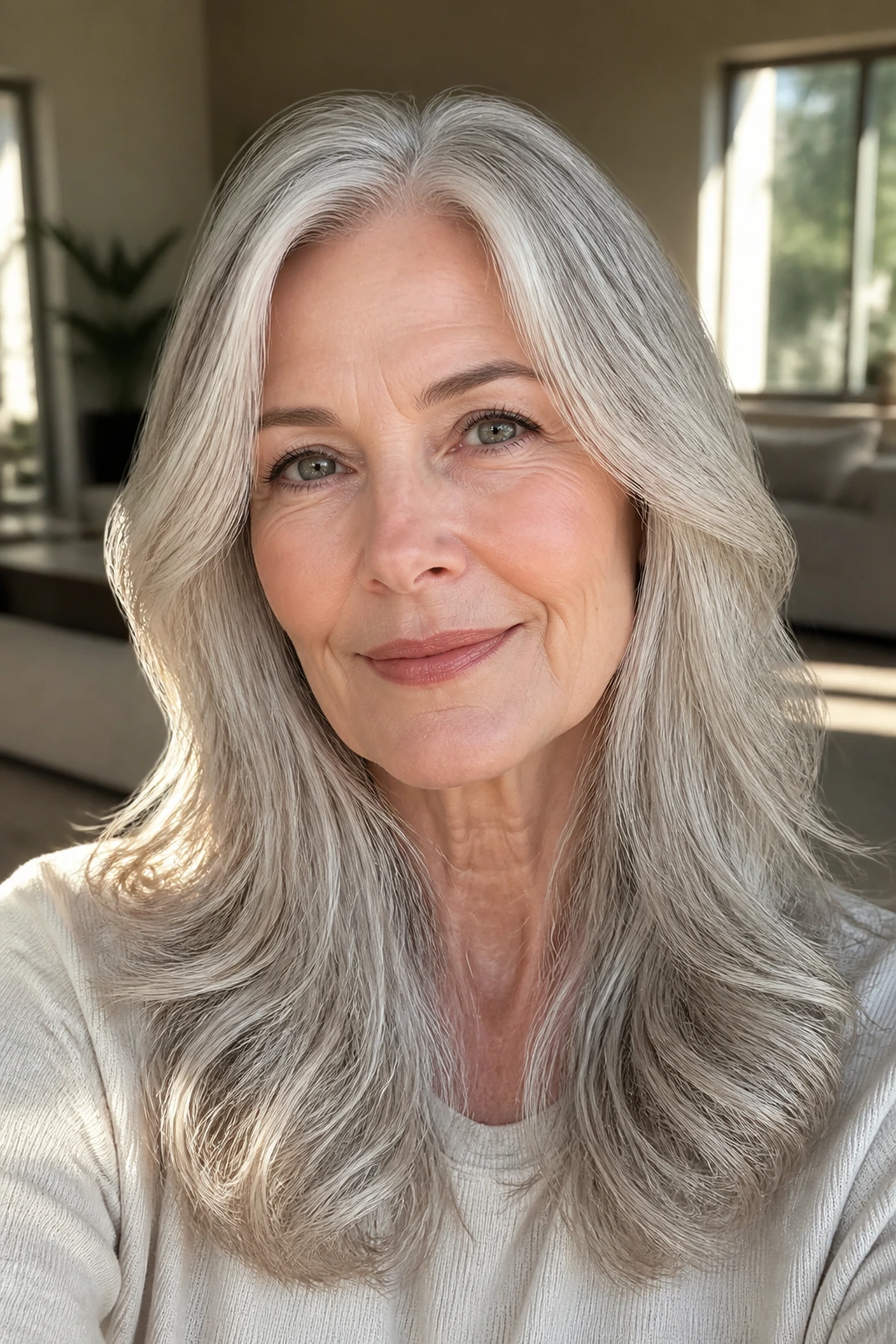
The best silver blonde isn’t the whitest one in the room. It’s the one that makes the hair look cared for, the face look brighter, and the grow-out look calm instead of stubborn. That usually means a little root depth, a little gloss, and a cut that gives the color some shape to live in.
If you’re choosing between a dozen shades, I’d start with the version that feels one step softer than your first instinct. A tiny bit of beige, pearl, or champagne often makes silver blonde easier to wear for years, not just for the first week after the salon chair. Bring photos, ask for a root that isn’t too stark, and let the silver sit where it naturally wants to shine.
