



Round faces do not need to be hidden. They need edges.
That’s the part a lot of haircut advice gets wrong. If the shortest layer lands exactly at the widest part of the cheek, or if the sides puff out at ear level, the whole shape reads wider than it is. The right short haircut for round faces does the opposite: it pulls the eye upward, cuts a cleaner line along the jaw, and gives you a little movement where the face needs it most. Not more volume everywhere. Better-placed volume. Big difference.
I’ve always thought short hair looks best when it has a point of view. A pixie that leans soft and side-swept feels different from a stacked bob with a hard backline, and a curly crop has its own rules entirely. If your face has that soft, full curve from cheek to cheek, the trick is not to fight it. Work with it, then sharpen the outline just enough that the shape feels intentional. That’s where the good cuts live.
Why These Cuts Earn Their Keep
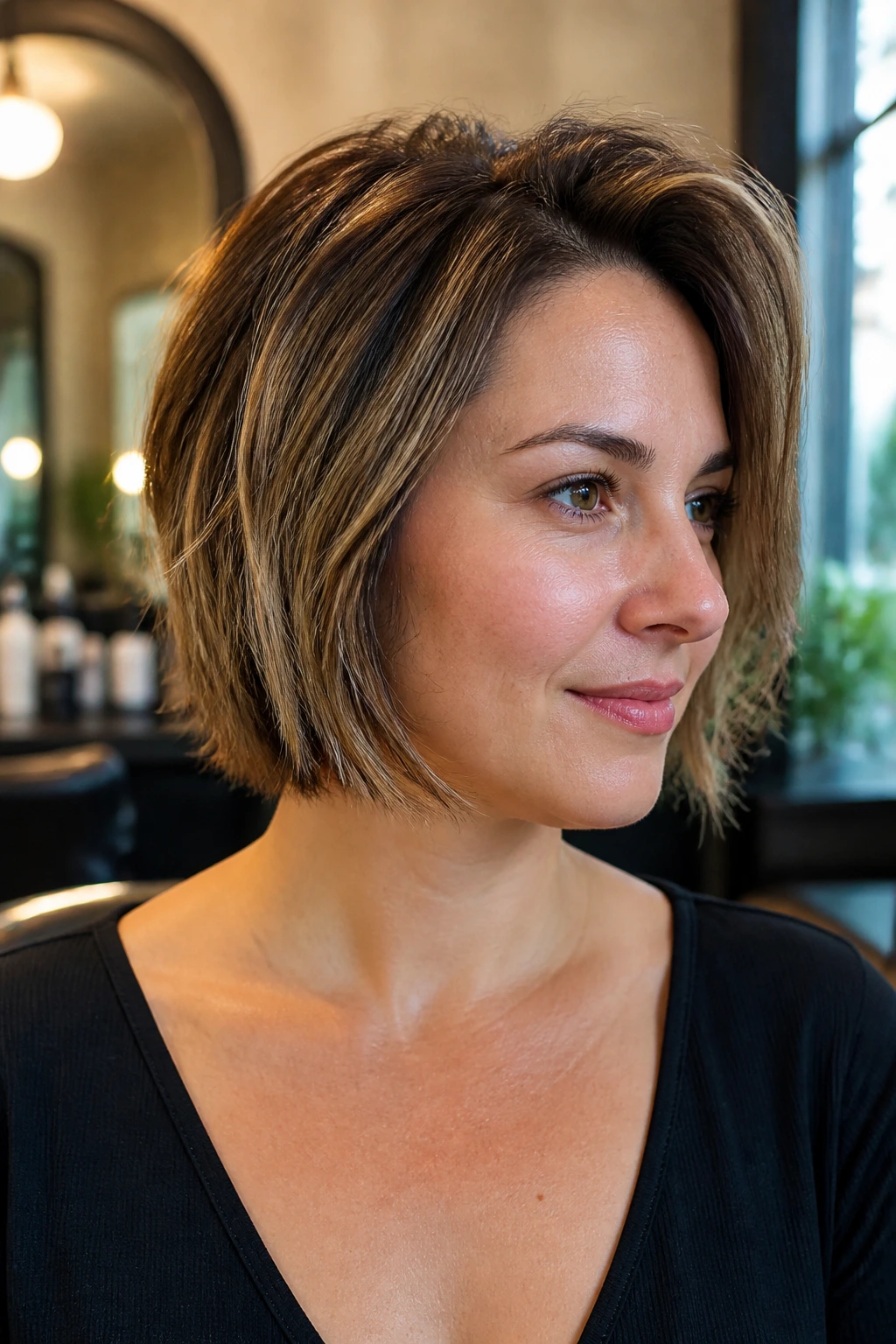
-
Length Past the Cheeks: Cuts that skim below the jaw or fall diagonally across the face keep the eye moving instead of parking it at the widest point.
-
Lift at the Crown: A little height on top adds vertical line, which matters more than people think when the goal is to make a round face look longer.
-
Slimmer Sides, Not Flat Sides: Hair can still have body, but it should not balloon right at the cheekbone. That’s the zone that tends to widen the face in photos.
-
Texture With a Job: Piecey ends, soft bends, and controlled layers help break up the roundness without making the cut look thin or overworked.
-
Grow-Out That Still Looks Deliberate: The best styles in this group hold their shape for weeks, not days. That matters if you do not want to live at the salon.
-
Room for Different Hair Types: Fine hair, thick hair, curls, waves—there’s a version here for each of them, but the placement changes. The cut stays the same only on the mood board.
1. Long Pixie With Side-Swept Fringe
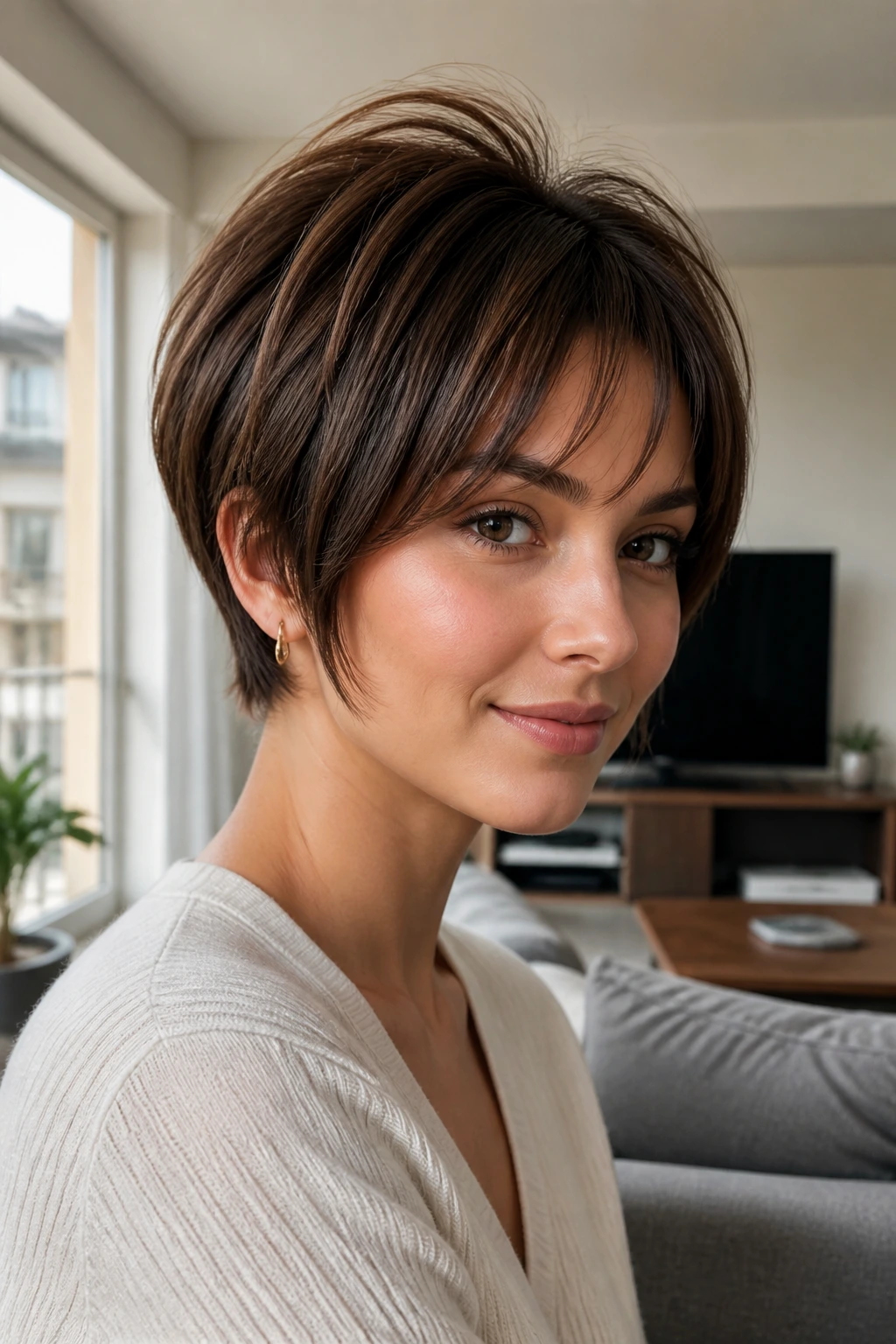
A long pixie is the cut I reach for when someone wants short hair but does not want to feel exposed at the temples. The front stays long enough to sweep across the forehead, the sides taper in close, and the crown keeps a little lift so the whole shape doesn’t collapse into the face. On a round face, that diagonal fringe does a lot of work. It slices the width visually and gives the cheekbones something to lean against.
Why It Flatters Round Faces
The side-swept fringe is the whole trick here. It creates a clean line from brow to cheek instead of a hard horizontal break, which is where a lot of short cuts go sideways on round faces. If the fringe starts near the deep side part and falls across one eye a touch, the face reads longer and narrower.
Keep the top around 2 to 3 inches if you want styling freedom, and ask for the sides to be tapered rather than clipped to the skin. Too much scalp visibility can make the face look broader by contrast. This cut works especially well if you like a bit of movement around the forehead but hate full bangs. It also wears nicely with matte paste or a light pomade; too much shine makes the short layers look sparse.
Quick note: ask for the fringe to land below the brow, not bang right at it. That one inch matters.
2. Asymmetrical Bob With Deep Side Part
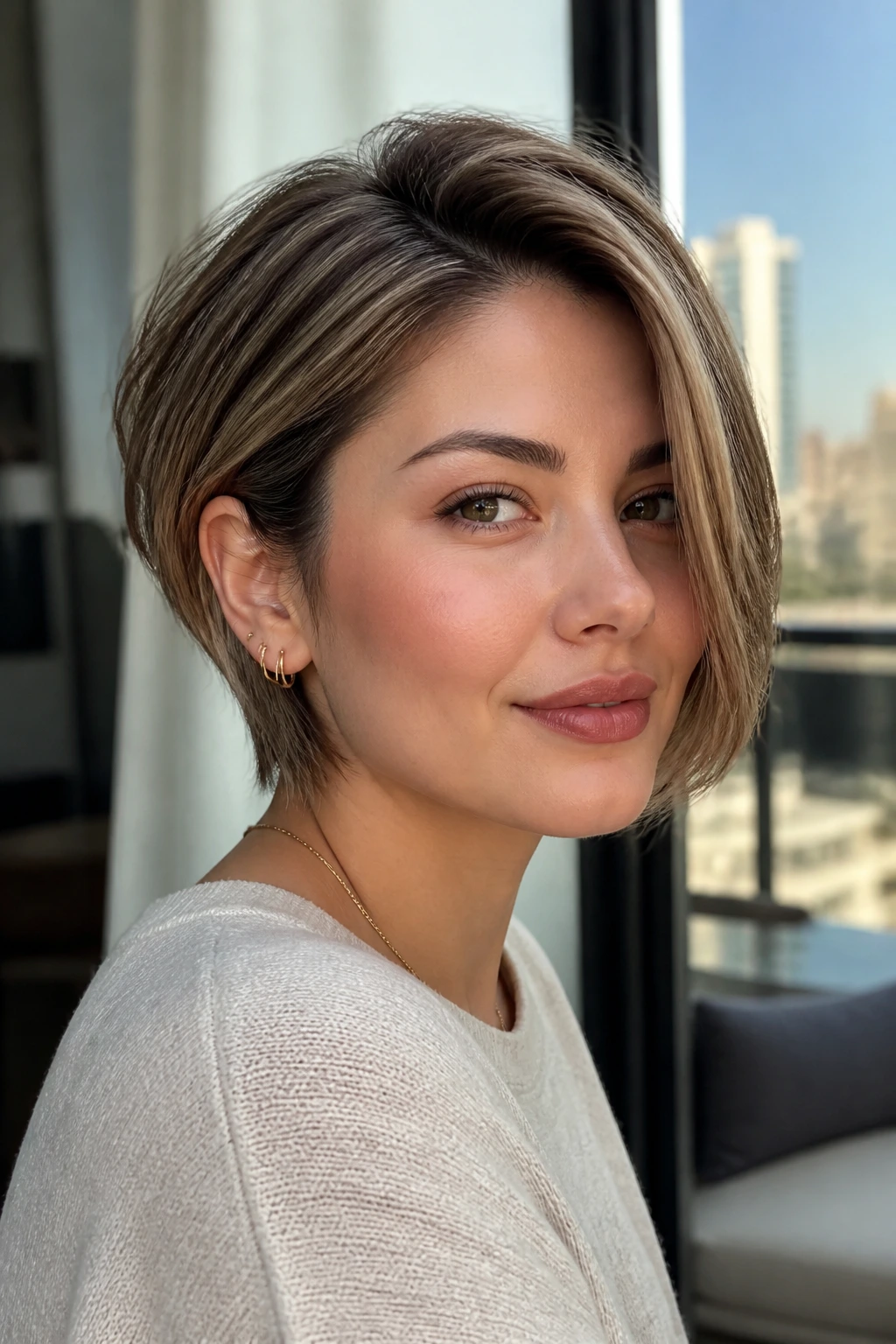
A little imbalance goes a long way. The asymmetrical bob works on round faces because one side drops lower—often just past the jaw—while the other sits a bit shorter and cleaner near the cheekbone. That uneven line makes the face feel longer without turning the haircut into a costume. It’s sharp, but not severe.
The deep side part matters as much as the cut itself. It creates a long vertical sweep across the forehead and gives the roots a natural lift on the heavier side. If your hair is straight, this shape looks crisp with a flat iron bend at the ends. If your hair has a slight wave, even better; the asymmetry looks less stiff and more lived-in.
This cut is a good one if you like structure. It does not need a lot of product, but it does need placement. The longer front should fall below the jawline, not stop at cheek level, or the whole effect gets lost. I’d call this one a strong choice for someone who wants a bob with an edge and doesn’t mind seeing the shape every morning in the mirror.
3. Stacked Bob With Tapered Nape
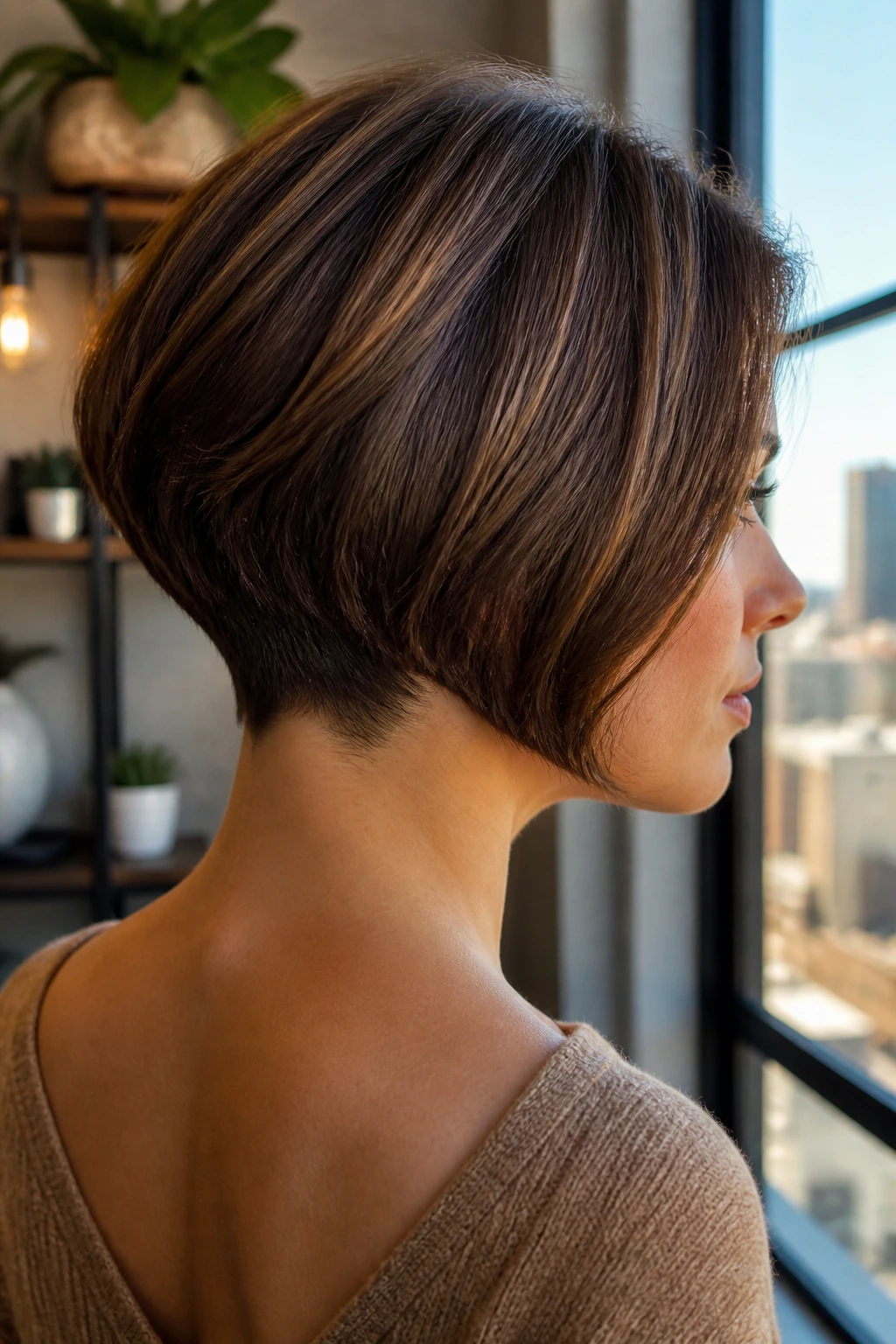
If your hair tends to sit flat in back, the stacked bob solves that in one clean move. The back is cut shorter and layered so it hugs the nape, while the front stays longer and softer. On a round face, that tapering back line creates a lifted silhouette without pushing width into the cheeks. It’s tidy. It has backbone.
Picture the shape from the side: short and neat at the neck, then gradually longer as it comes forward. That slope matters more than a lot of people realize. It gives the eye a diagonal path instead of a circle to follow, which is exactly what you want when working with roundness. The cut also keeps thick hair from puffing into a helmet shape at the bottom.
- Best on straight to slightly wavy hair.
- Fine hair likes the stacked back because it gets instant body.
- Thick hair needs the interior weight removed, not just the surface snipped.
If you like a blowout finish, this is one of the easiest shapes to make look polished. A round brush, a nozzle, and five focused minutes at the crown can make the whole cut fall into place.
4. French Bob With Wispy Bangs
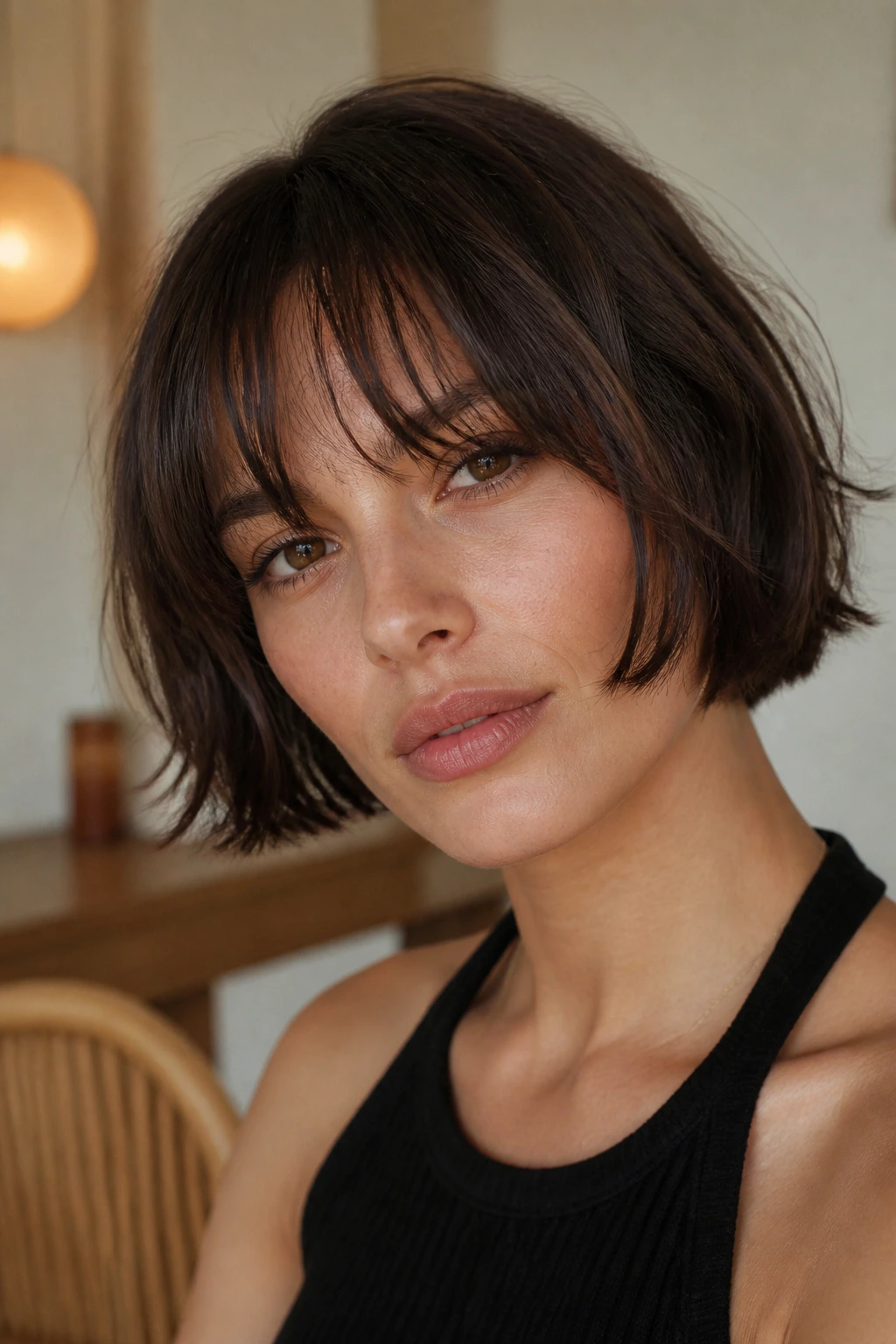
The French bob works because it stops before it turns fussy. It usually lands around the jaw or just below it, and the bangs are soft rather than heavy. On a round face, that softness matters. A blunt fringe across the full forehead can make the face feel boxed in; wispy bangs keep air in the cut.
This is not a tiny, sharp little bob that sits at the cheekbone and panics. That version can be cute on a narrow face, but on a round face it often lands too high. The better French bob gives you a little length through the front, then keeps the bangs sheer enough that the forehead still shows through. The result is less “helmet,” more “intentional.”
It’s especially nice on hair with a small wave or bend. A little texture keeps the line from looking too formal. If your hair is very dense, ask for the perimeter to be softened slightly under the jaw so it doesn’t kick outward. The fringe should be cut longer than you think, then refined dry. Bangs always shrink up more than the photo in your head.
5. Choppy Bixie Cut
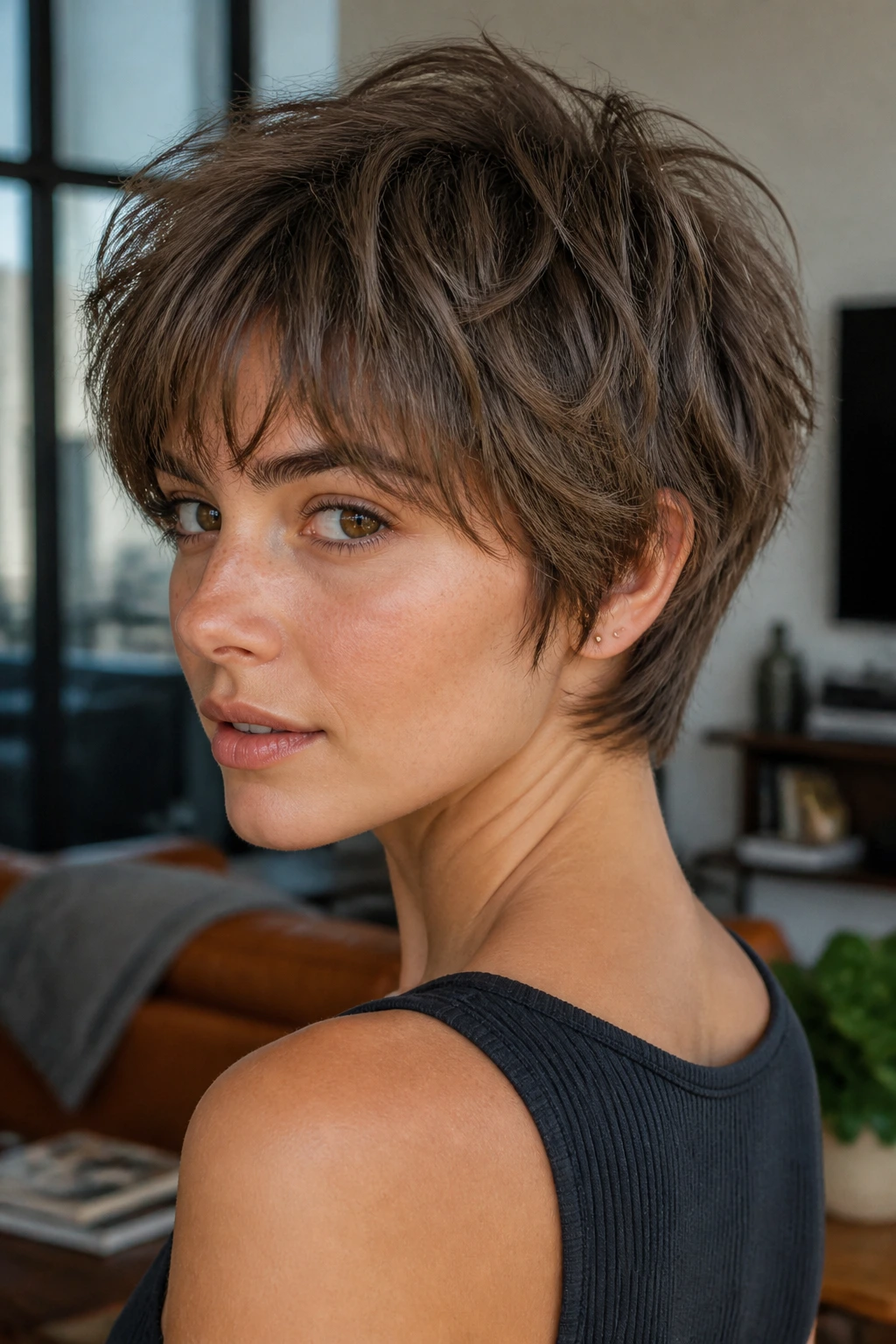
The bixie sits between a bob and a pixie, which makes it a smart move if you want short hair without jumping all the way into cropped territory. It keeps enough length around the crown and front to soften a round face, but the choppy ends stop it from feeling heavy. That in-between space is the whole point.
What makes it work here is the texture. The layers are broken up, not stacked in a way that adds width at the cheeks. You want the top to have movement and the sides to stay controlled. If the cut gets puffy at the ears, it starts fighting the shape of the face. If it stays airy through the front and tapering at the sideburns, it reads clean and modern.
This is a nice choice if you want something that looks a little undone on purpose. Not messy. Just not over-styled. A pea-sized amount of paste or cream pushed through the ends is usually enough. Fine hair gets a touch of mousse at the roots first. Thick hair usually needs a little weight removed underneath so the top doesn’t turn into a mound.
6. Jaw-Grazing A-Line Bob
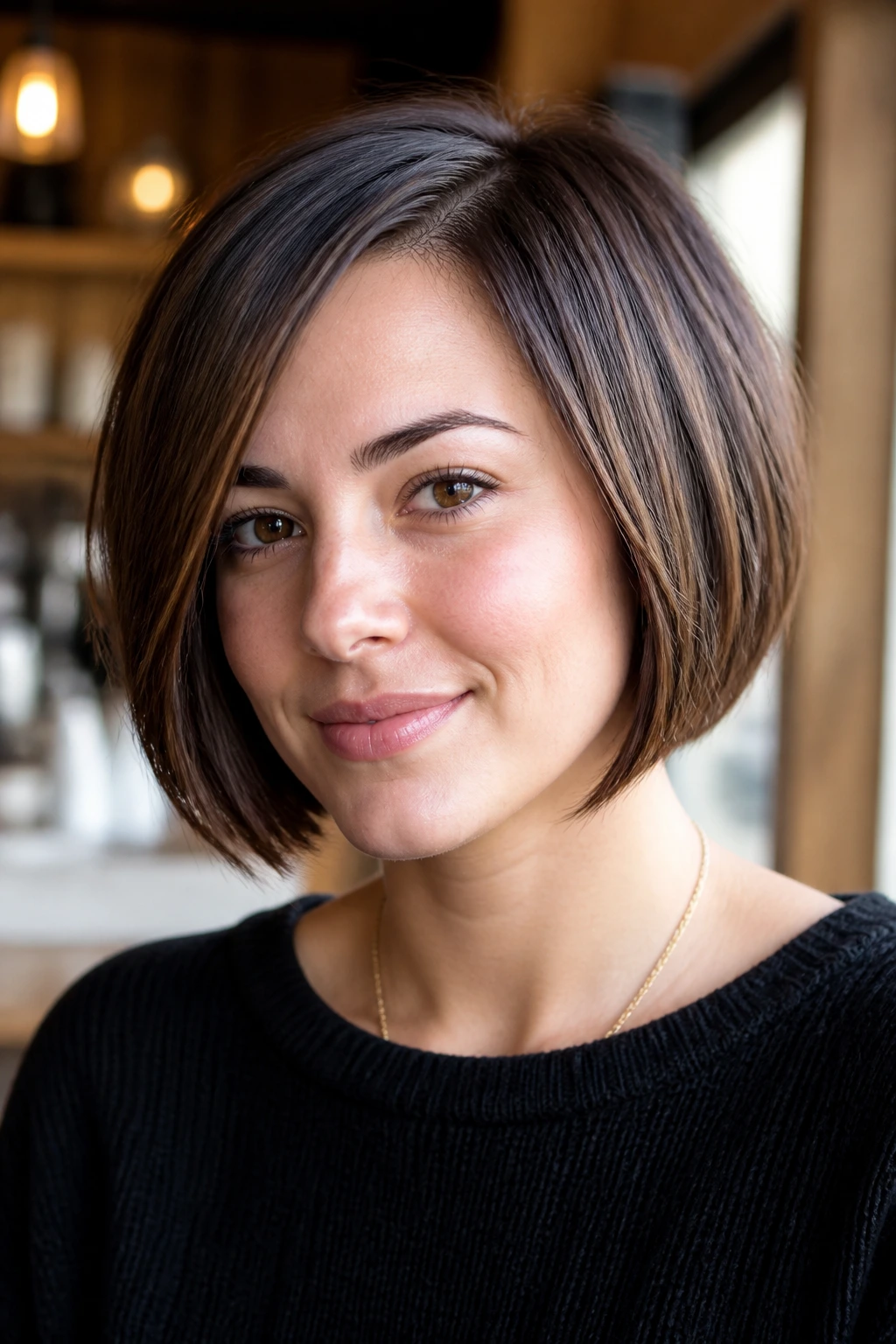
Why does a little front length matter so much? Because a bob that ends right at the jaw can make the face stop there, and that’s the last thing a round face needs. An A-line bob solves that by keeping the back shorter and the front a bit longer, usually grazing just below the jawline. That forward angle makes the face look leaner without making the cut feel long.
What to Ask For
Ask your stylist to keep the front pieces at least an inch or two below the jaw, then angle the back up slightly toward the nape. If you like a clean finish, the line can stay sharp. If you want something softer, the ends can be texturized just enough to stop the perimeter from looking blocky.
The best version of this cut is not too steep. A dramatic A-line can feel dated if the front gets too pointy. I prefer a gentle slope with a side part, especially if your hair is straight. It’s one of those cuts that looks neat even when it’s not freshly styled, which is rare and useful.
7. Textured Shaggy Bob

This is the bob that refuses to sit like a helmet. A shaggy bob uses broken-up layers and piecey ends to create movement, and that movement keeps a round face from reading as one continuous curve. The secret is not “more layers” in the abstract. It’s where those layers land. If they hit the sides too aggressively, you get width. If they start higher and taper down, you get lift.
On wavy hair, this cut can look almost self-styling. On straighter hair, it needs a little help from a curling wand or a rough blow-dry. The goal is not perfect curls. It’s a bend here, a flipped piece there, enough texture that the eye keeps moving. A shaggy bob also suits people who do not want to spend fifteen minutes making their hair behave before they can leave the house.
Texture note: ask for the ends to stay light, not shredded. Over-thinning can make the hair look fuzzy at the sides, and fuzzy sides are not your friend on a round face.
8. Curly Crop With Soft Height
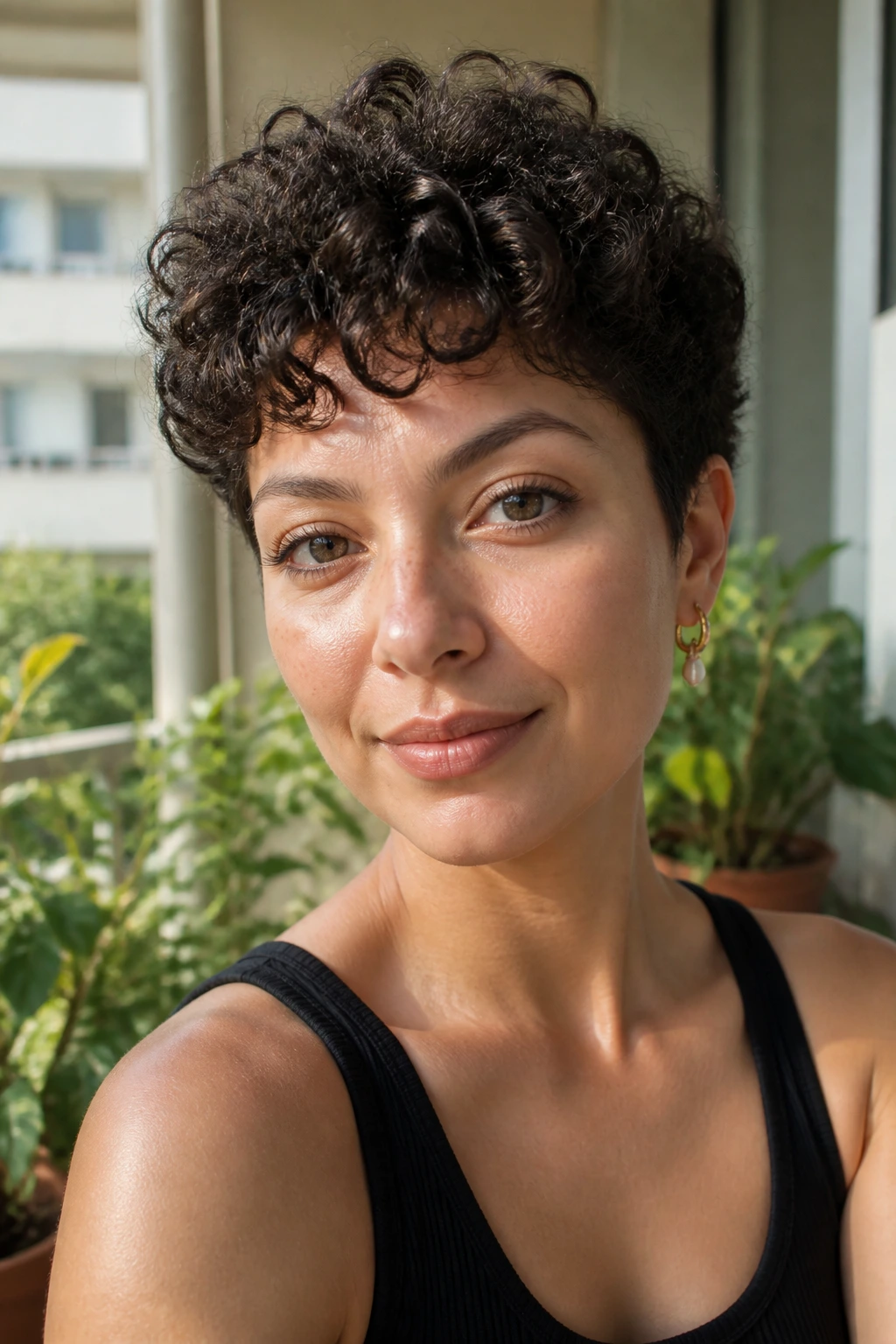
Curly hair on a round face needs room at the top, not a triangle at the cheeks. That is the first thing I’d say to any stylist working on this shape. A curly crop with soft height keeps the sides controlled and lets the curls rise a little at the crown, which stretches the face visually. Done right, it looks lively. Done wrong, it balloons exactly where you don’t want it.
The best version is usually cut with the natural curl pattern in mind, often dry or at least partly dry. Wet curls lie. They shrink in unpredictable ways, and a cut that looks balanced on damp hair can turn lopsided once it dries. The crown should keep enough length that the curls stack upward rather than outward. The front can sit just under the cheekbone, then soften as it moves toward the temples.
A diffuser is the friend here. Low heat, low speed, and hands off once the shape is set. If you keep touching curls while they dry, you break the clumps and create puff. Nobody wants that. A little curl cream, scrunched through wet hair, will usually give more shape than a pile of heavy products.
9. Curtain Bangs on a Cropped Cut

Curtain bangs work because they split the face instead of crossing it. That sounds simple, but it changes everything on a round face. A straight fringe can make the face feel shorter. Curtain bangs move outward from the center and fall toward the cheekbones, which gives the face a longer line and a softer frame.
The length matters. You want the shortest point around the bridge of the nose or just below the brows, then the sides should angle toward the cheekbone or jaw. If they stop too high, the bang opens up the middle of the face and the shape can feel oddly wide. If they’re too heavy, they stop behaving like curtain bangs and start acting like a dense fringe.
This works on pixies, bobs, and shaggy crops alike. It is especially good if you like wearing your hair tucked behind one ear, because the bangs do part of the framing work for you. I’ve always liked curtain bangs on round faces when the rest of the cut stays fairly clean. Too much going on everywhere can feel fuzzy. One strong feature is enough.
10. Undercut Pixie With Longer Top
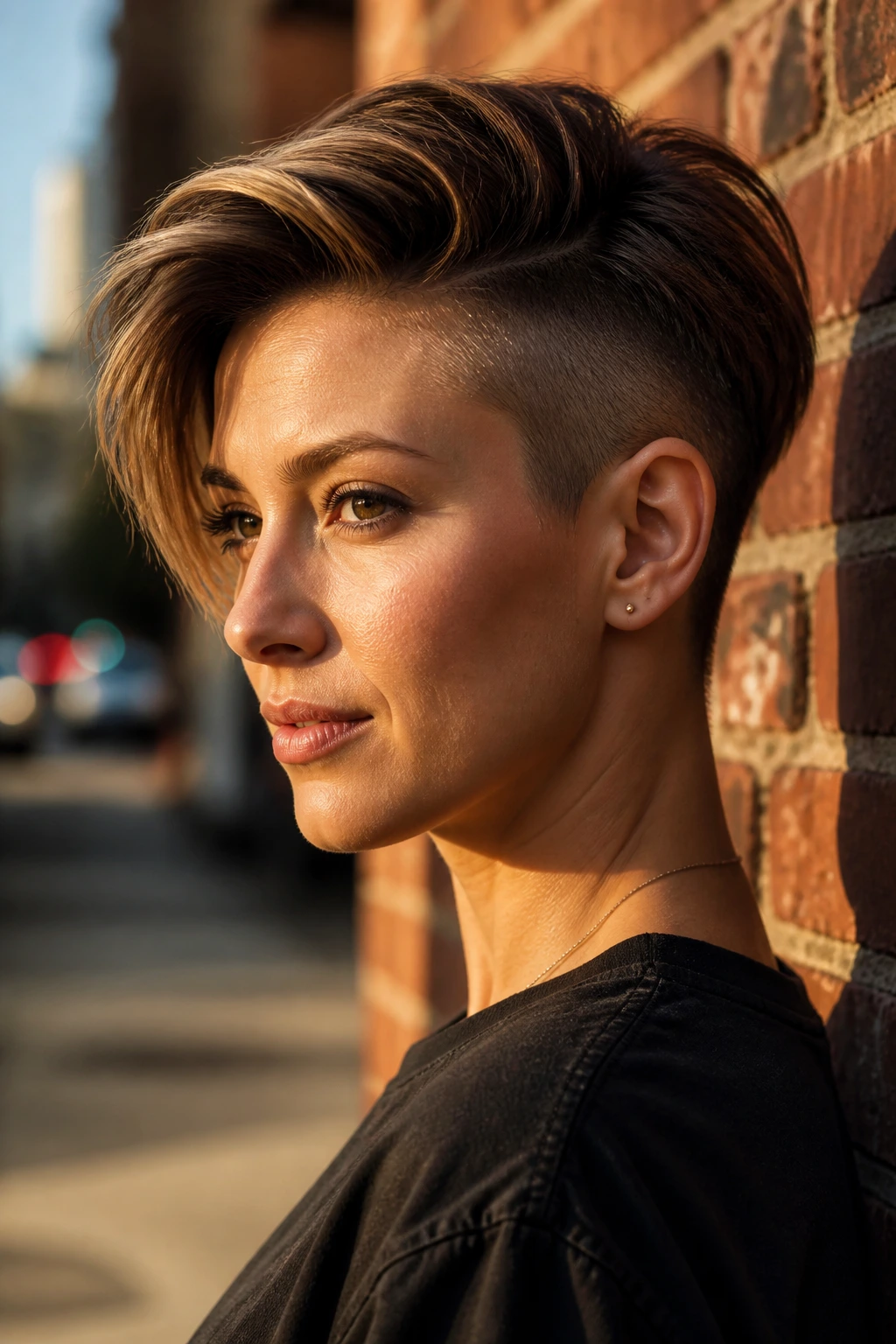
If you have thick hair, the undercut pixie can feel like a secret weapon. The shaved or closely clipped underlayer removes bulk where it tends to puff out, while the longer top gives you the height that flatters a round face. The result is lean around the sides, lifted on top, and a lot easier to dry than a bulky short cut that wants to sit like a mushroom.
This is not a shy haircut. It has a little swagger to it. The longer top can be swept forward, pushed up, or side-parted depending on how dramatic you want to go. The important part is keeping the top long enough that it does not stick straight up in a way that makes the head look wider. Aim for direction, not volume for volume’s sake.
It also grows out with a certain attitude, which I appreciate. The undercut disappears into the rest of the shape for a while, and that gives you a few weeks before the line needs cleaning up. If your hair is coarse or heavy, this cut can feel lighter immediately. If your hair is fine, I’d be cautious. Too much removal underneath can leave the top looking sparse.
11. Sleek Side-Parted Blunt Bob
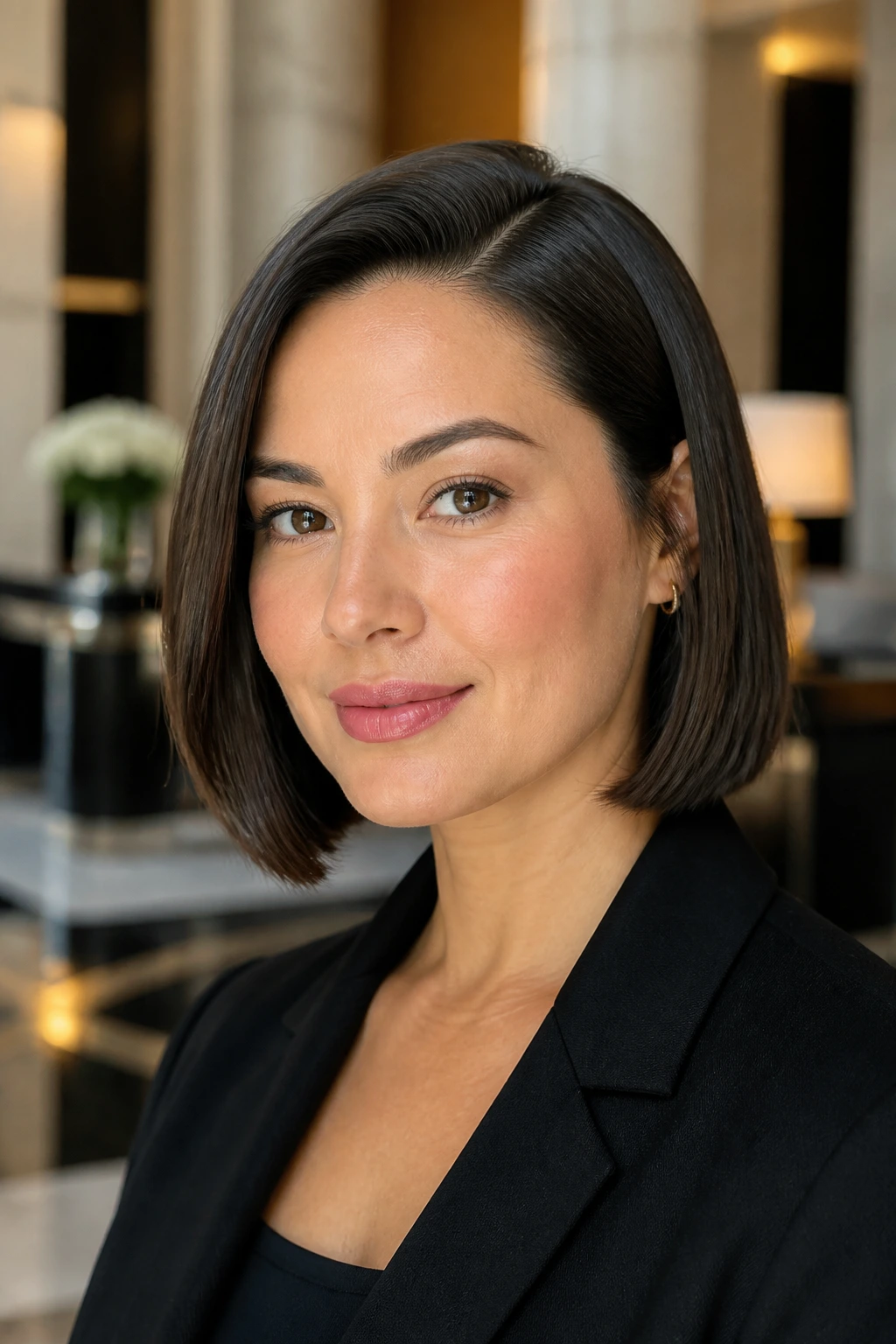
Can a blunt bob work on a round face? Yes—if the line lands in the right place. The trick is to keep it side-parted and to let the blunt edge sit below the jaw, not right at the cheek line. That one detail changes the whole read. The bob still feels crisp, but the face gets a longer frame.
A center part with a blunt bob can look very clean, but on a round face it sometimes makes the width too obvious. A side part softens that. It gives the roots a lift on one side and keeps the front from behaving like a ruler across the cheeks. Sleek is the point here, but sleek should not mean flat to the scalp. A little root volume keeps the head shape from looking compressed.
This cut is a good fit if you like polished hair and do not mind a quick pass with a flat iron. If you want the line to look expensive—there’s no better word for it—the ends need to be even, the part needs to be deliberate, and the shine should come from smoothness, not grease. A drop of serum at the ends is enough. More than that and the bob starts to separate.
12. Wavy Piecey Bob

This is the haircut people think they want to air-dry, and then discover the difference between cool and chaotic is about 8 percent product and 92 percent where you put your hands. A wavy piecey bob looks relaxed, but the shape still needs direction. On a round face, that direction should travel away from the cheeks and down the neck a little.
The best version has ends that separate into pieces rather than one solid wave. That keeps the face from reading as one big circle of motion. A little sea-salt spray can help, but I would not drown the hair in it. Too much rough texture makes the sides puff outward. A light cream on the mid-lengths, then a quick wrap around a 1-inch wand in random sections, usually gives better control.
- Let the front sections bend away from the face.
- Keep the crown lifted, not smoothed flat.
- Pinch the ends after they cool so they separate, not frizz.
If your hair is naturally wavy, this shape can be low effort. If it is straight, you’ll need more help. Either way, it rewards restraint. Touching it too much after styling is what ruins the look.
13. Tapered Crop With Neckline Taper
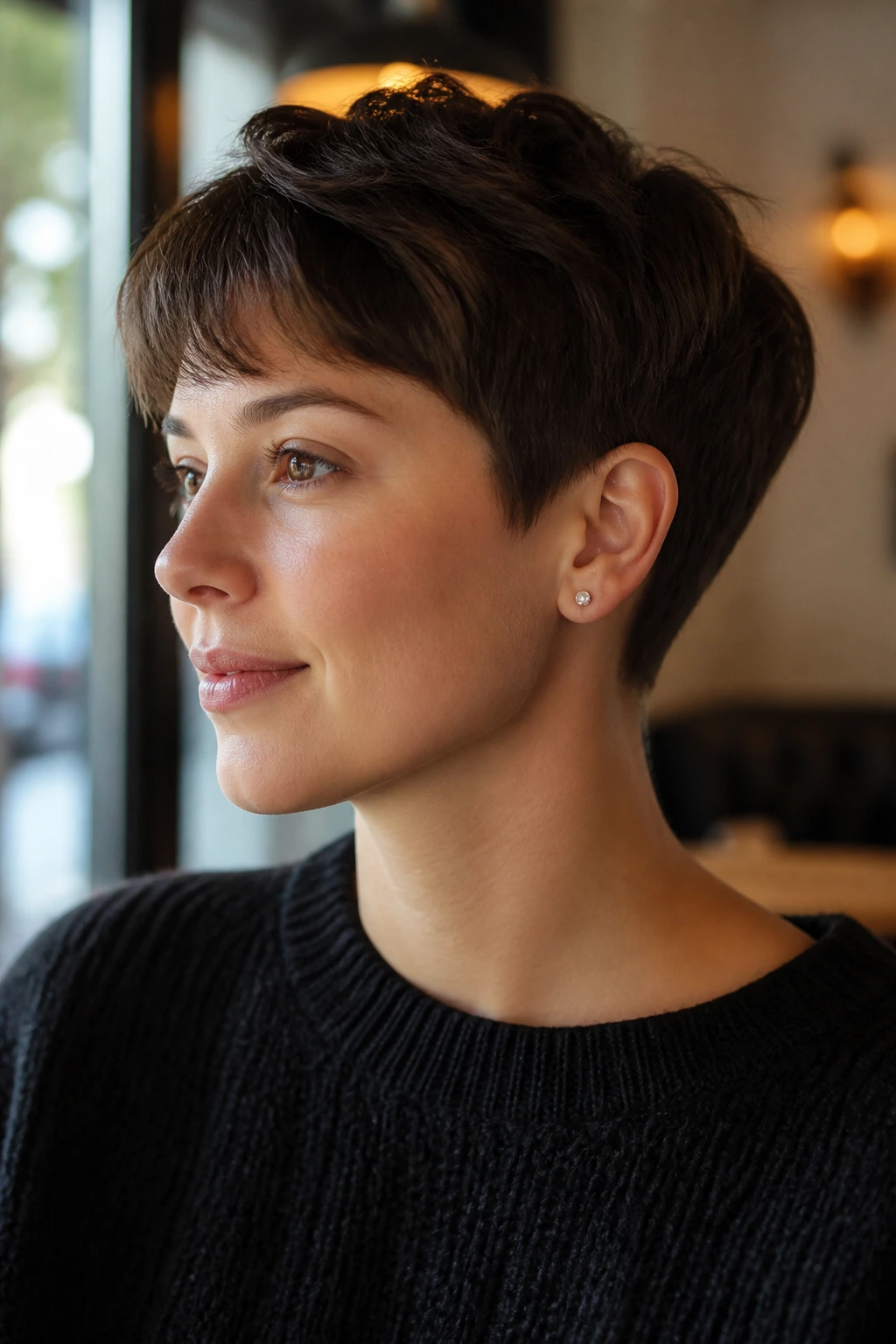
A tapered crop can look very clean on a round face because it keeps the neckline neat and the sides controlled. The taper at the nape removes bulk where short hair often gets puffy, and that keeps the silhouette slim from the back as well as the front. People tend to focus on the fringe or the side part. The nape matters too.
Where the Weight Should Sit
The weight should sit slightly above the ears and through the top, not in the lower half of the head. That placement adds height without making the haircut feel top-heavy. If the sides are cut too full, the roundness comes right back. If they’re tapered properly, the eye moves upward and the whole cut feels sharper.
This style suits someone who likes a neat finish and does not mind regular trims. It can be worn textured or smooth, but the shape is the point either way. A little matte cream on the top keeps the pieces separated; a round brush can smooth it into a polished crop if you want something cleaner. I like this cut with glasses, actually. The clean neckline and face-open front keep the frame from fighting the hair.
14. Wolf Cut Bob

The wolf cut bob takes the shag idea and trims it to a shorter, more controlled length. That matters. On a round face, you want the wildness to stay up top and through the interior, not puff out at the cheeks. The best wolf-bob hybrid keeps the crown lifted, the ends choppy, and the sides lighter than the bottom.
This cut works best when the layers are intentional, not overdone. If the shortest pieces sit exactly at cheek level, the face can look wider. But when the front is left a touch longer and the crown gets more movement, the shape becomes playful without losing line. Think rock and roll, not poodle.
It’s a strong choice for thick hair because the layers remove weight. It also suits wavy hair that wants texture anyway. Straight hair can wear it, too, but it usually needs a bit of bend from a wand or a rough dry with mousse. If you want your short hair to look like it has lived a little, this is the one. Not every cut should be neat. Some should have a scuffed edge.
15. Soft Mullet With Tapered Sides
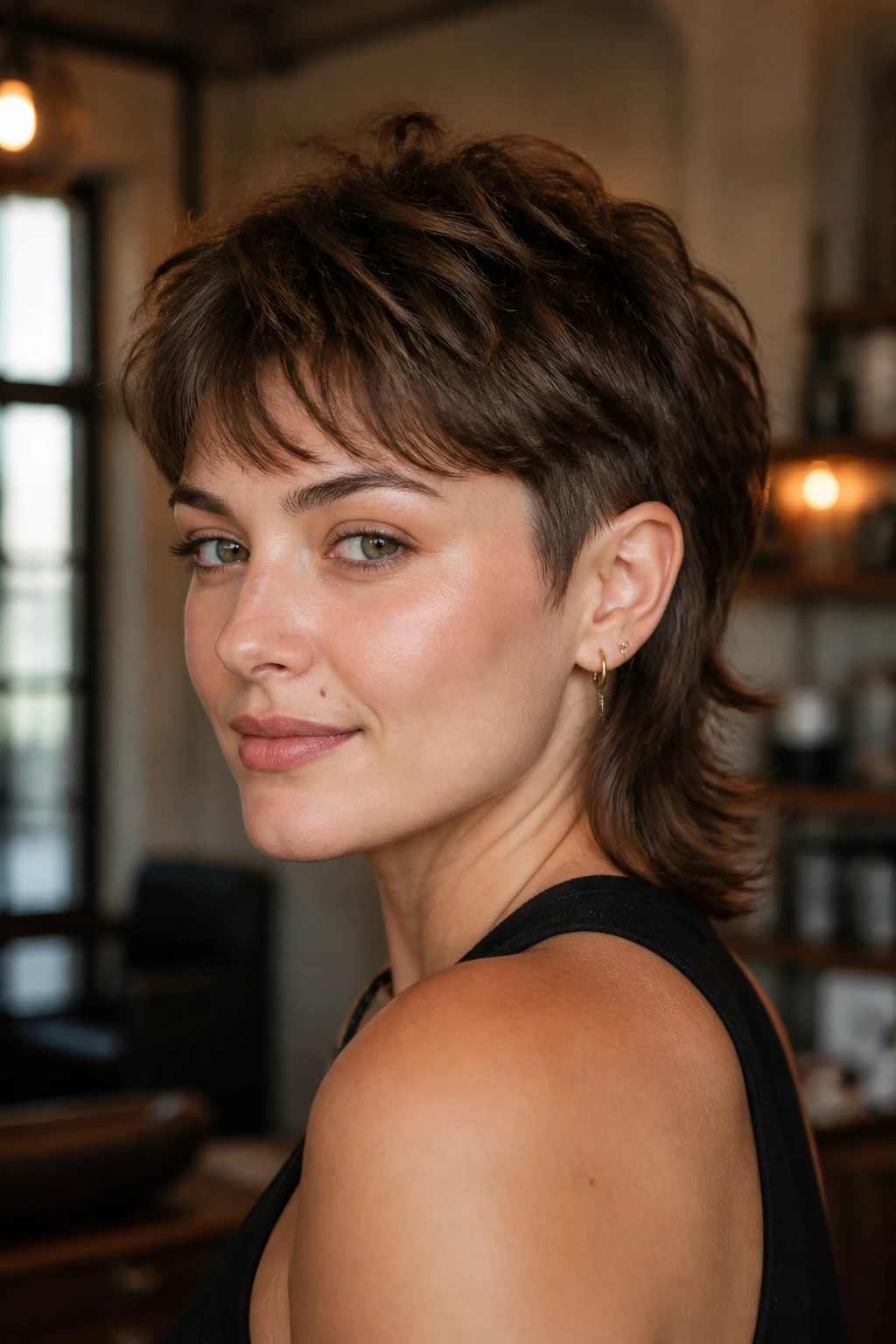
The soft mullet sounds scarier than it looks, and that’s part of its charm. It keeps some length in the back, trims the sides slim, and leaves enough shape on top that the face feels lifted. On a round face, the tapered sides keep the width under control, while the back gives a little visual length. It is a balancing act, but a useful one.
Compared with the wolf cut bob, the soft mullet keeps the back a touch more obvious and the sides a touch leaner. That makes it a good fit for people who like a little attitude without a full shag explosion. The haircut can be subtle if the top layers are soft and the ends are feathered, or more dramatic if the nape stays longer and the fringe is piecey.
This is not the haircut for someone who wants a quiet, invisible shape. It has personality. But on a round face, that personality can be useful because it breaks up symmetry. If your style leans a bit edgy, or you like earrings, strong brows, and a collar that shows off the neck, this cut gives you room to play.
16. Inverted Bob With Feathered Ends
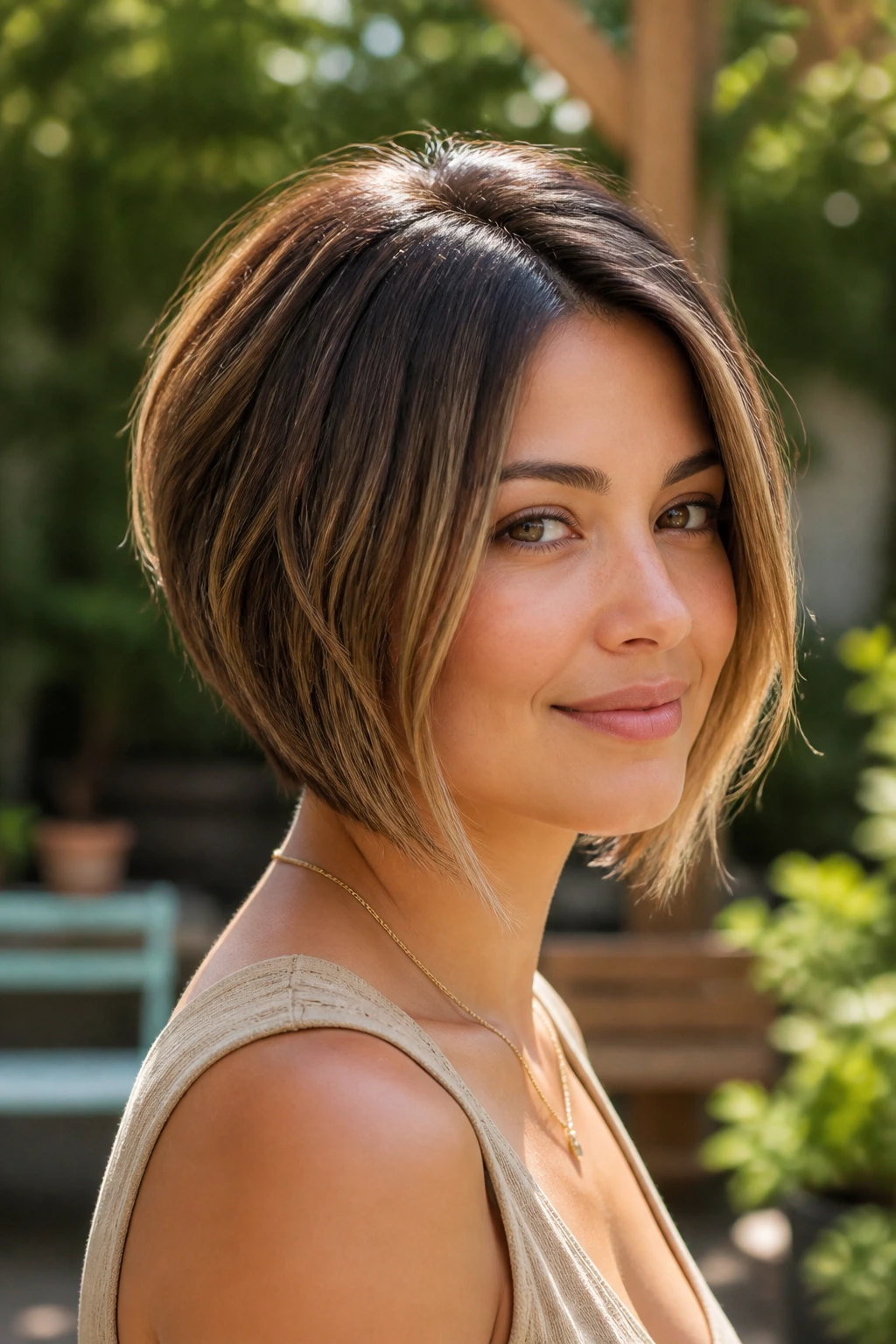
Why does an inverted bob work so well on a round face? Because the front length quietly does the slimming for you. The back is shorter and slightly stacked, while the front drops longer toward the chin or just below it. Then the feathered ends keep the line from looking heavy. You get shape without a blunt wall of hair.
Feathering matters here because a hard, blunt front can feel too solid near the cheeks. The lighter ends let the haircut move. They also make the bob feel less formal, which helps if you don’t want a perfect salon finish every day. This is one of those cuts that can look good with a quick blow-dry and a tuck behind one ear.
Styling Cue
Aim the dryer downward at the front sections and roll the ends under with a round brush, then loosen them slightly once they cool. That keeps the face frame soft. If the hair flips out, the line loses its clean angle and the whole effect gets fussier than it should be.
17. Collarbone-Grazing Lob

This is the compromise cut I recommend when someone says, “I want short hair, but I’m not ready for short hair.” A lob that sits at the collarbone is longer than the other styles here, sure, but on a round face it can be a smart place to land. It keeps the length below the jaw, which gives the face a longer outline, and it’s forgiving when you let it grow.
What makes this version useful is restraint. You do not need a lot of layers; in fact, too many can add width if they start at the cheekbone. A subtle face frame that begins below the chin works better. If the hair is straight, the cut can look clean and easy. If it’s wavy, the length gives the waves room to fall instead of puff.
I like this cut for people who are nervous about maintenance. It grows out gracefully, it can be pinned, tucked, curled, or left to air-dry, and it works with most face-framing strategies. It may not feel as daring as a pixie, but practical hair is underrated. There’s nothing wrong with a cut that makes your morning easier.
18. Ear-Length Crop With Tucked Sides
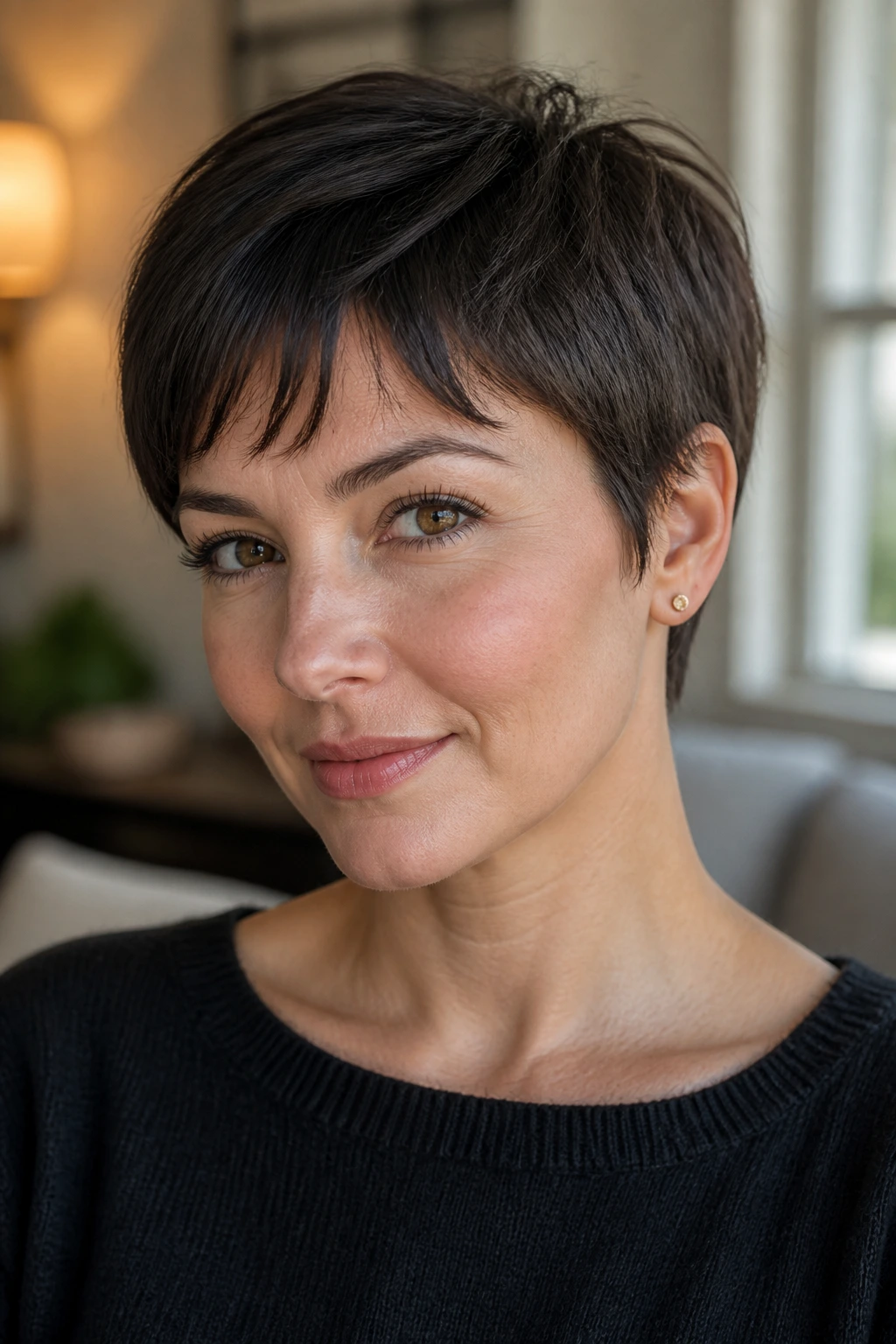
An ear-length crop can be very chic on a round face if the top has enough height and the sides stay tucked rather than flared. The shape shows off the neck, frames the face cleanly, and lets the eyes and brows do more of the visual work. It’s a confident cut. No question about that.
The part people get wrong is width. If the crop balloons at the ears, the face reads wider right where it’s already fullest. The better version keeps the sides neat and lets the top carry the motion. A little piecey fringe or a soft side sweep helps. If you wear glasses, this cut can be fantastic because it gives the frames room instead of fighting them.
This one also pairs nicely with statement earrings. Not because accessories fix a haircut, but because the open sides make the whole look feel balanced. I’d keep the finish a touch matte and avoid too much product at the temples. Clean beats bulky here.
19. Layered Pixie-Bob Hybrid
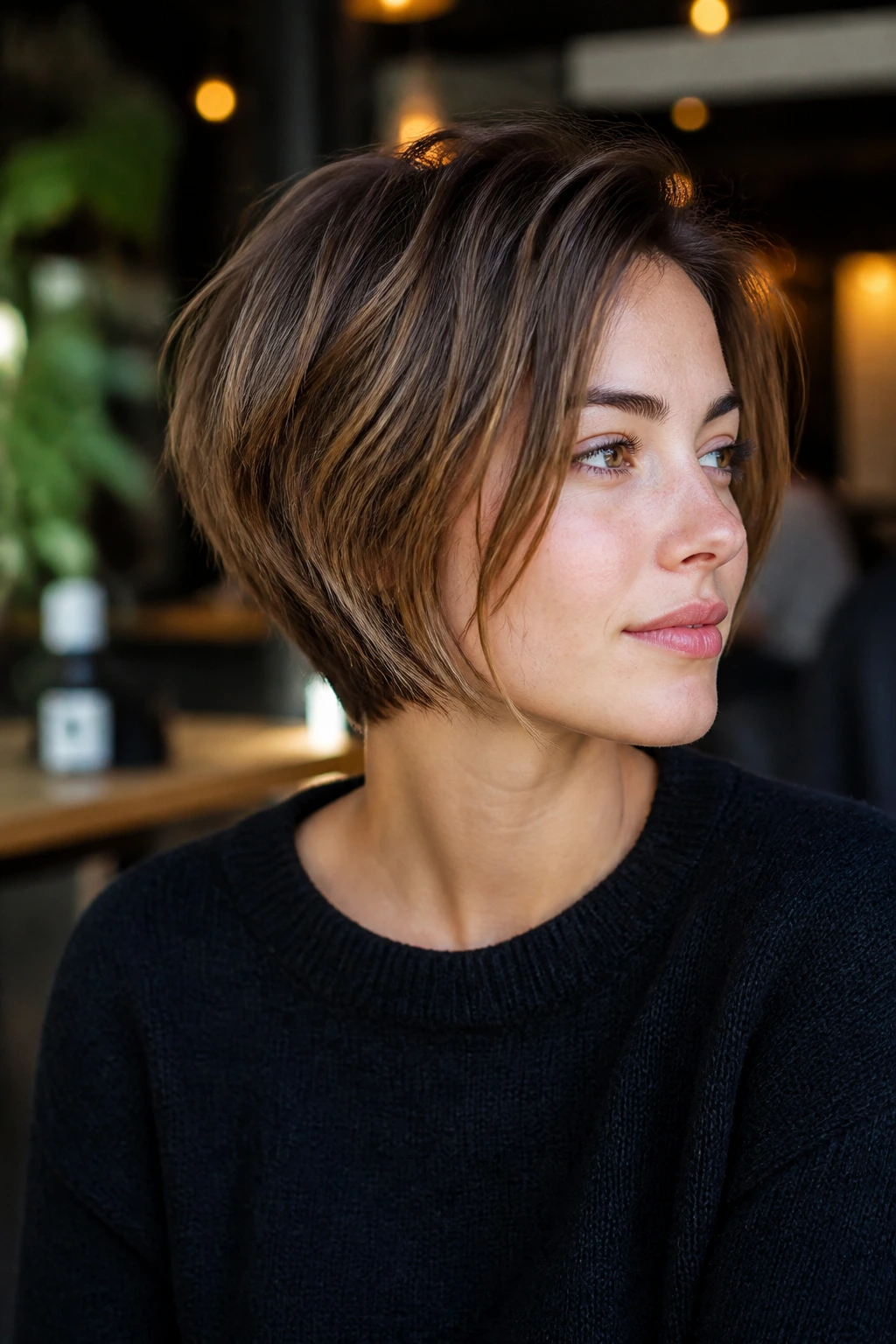
If you can’t decide between a pixie and a bob, this is the cut that steals from both without looking indecisive. The nape stays short, the top carries enough length to move, and the front often lands somewhere between the lip and the chin. On a round face, that mix gives you the best of both shapes: the lift of a pixie, the line of a bob.
The layers matter, but they should be placed with care. Too much layering at the sides makes the cut expand where you need it to stay neat. Better to keep the movement on top and through the front, then taper the lower edge. That way the face gets a frame, not a puff. This cut can be styled sleek on one day and messy the next, which is part of its appeal.
If you want a short haircut that can survive a grow-out period without looking awkward, start here. The hybrid shape holds up well as it gets a little longer, and the transition between pixie and bob looks deliberate rather than accidental. That’s a rare thing in short hair.
How Short Haircuts for Round Faces Get Their Lift
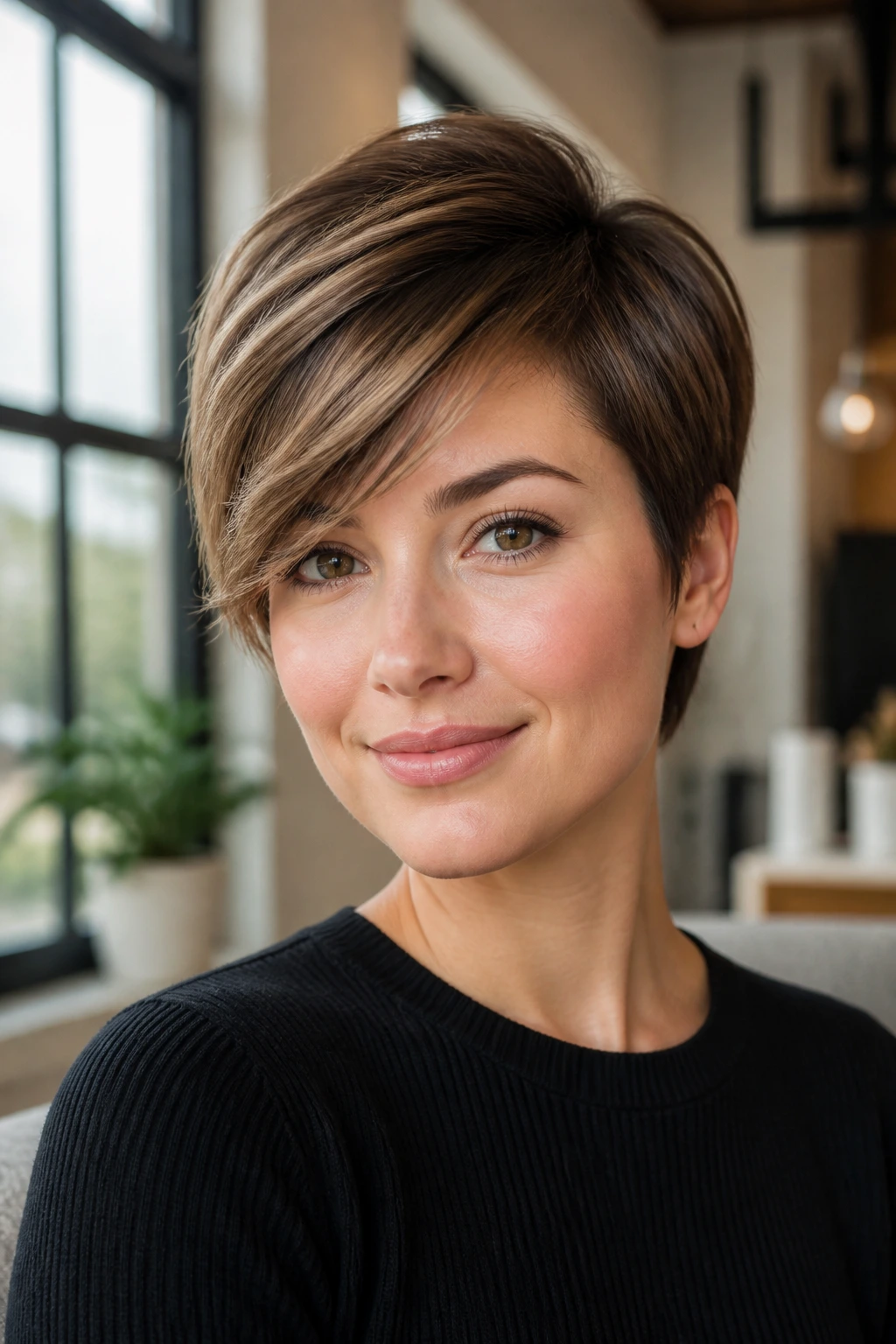
The geometry is simple, but the execution is not. Round faces usually have the same basic width from cheek to cheek and a softer curve from forehead to jaw, so the haircut has to create some line where the face does not naturally supply it. That can mean a side part, a diagonal fringe, a longer front, or crown height. Usually it means more than one of those at once.
Short hair gets tricky because it can cut off the vertical line that longer hair gives you for free. A shoulder-length style can drape past the jaw and quietly lengthen the face. A shorter cut has to build that effect on purpose. That’s why so many flattering short cuts for round faces are a little longer in front, a little tighter at the sides, and lifted at the top. The silhouette matters more than the label.
Texture helps when it has shape behind it. A piecey bob works because the eye keeps moving. A blunt bob works because it lands below the jaw and stays sleek. A pixie works because the fringe sweeps diagonally instead of sitting across the forehead like a shelf. The wrong place for volume is the cheekbone zone. The right place is the crown, the front angle, or the nape, depending on the cut.
There’s a practical side to this too. Round faces can wear short hair beautifully, but the haircut has to respect the width of the face instead of sitting right on top of it. If the cut is too wide, too blunt at the middle, or too short at the jaw, you’ll see it instantly in photos. Good short haircuts don’t hide the face. They edit it.
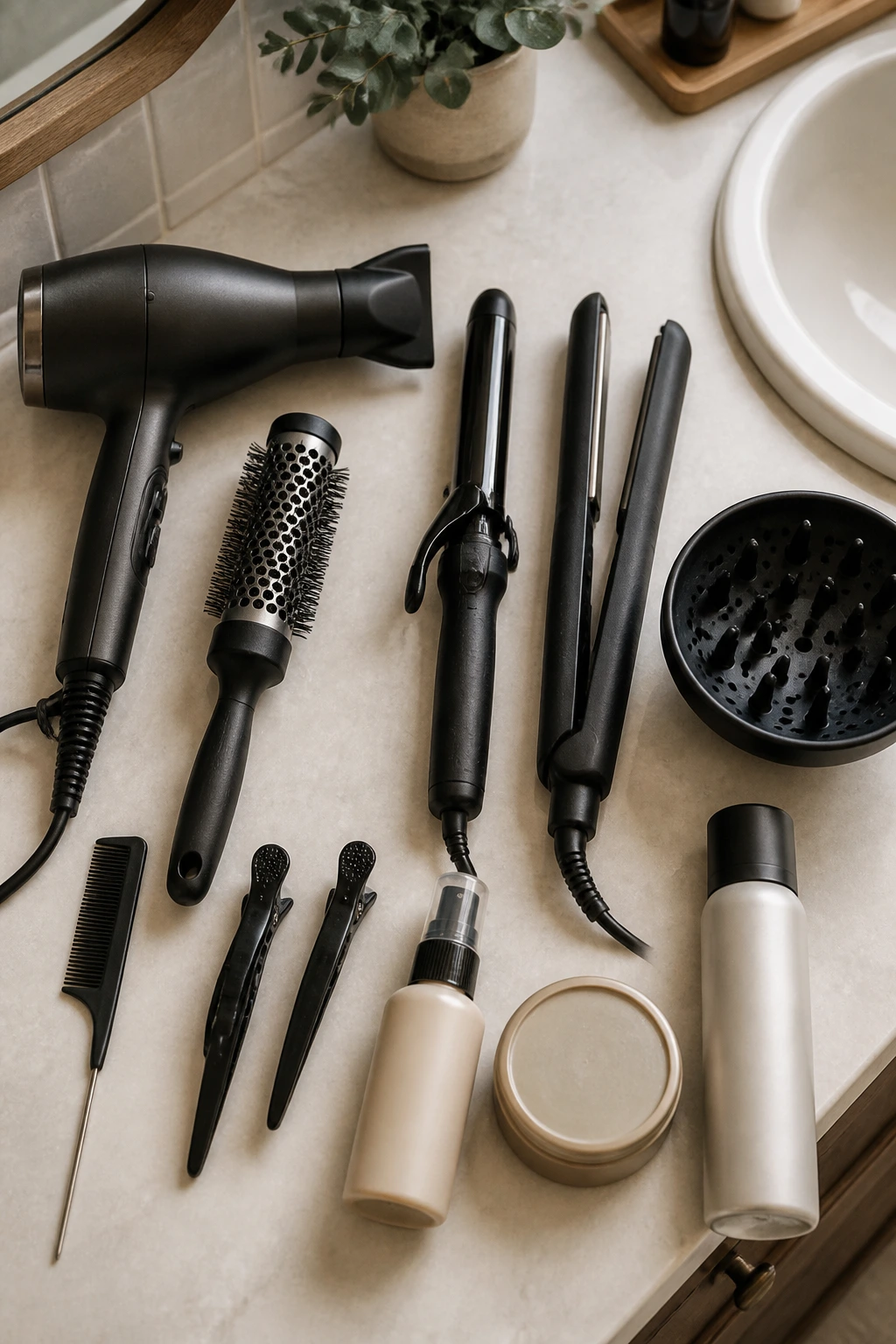
Tools That Make Styling Easier
-
Blow dryer with a nozzle attachment: The nozzle lets you direct airflow downward on sleek bobs and upward at the roots for pixies and crops.
-
Small round brush, about 1 to 1.5 inches: This size gives lift without creating huge ends that widen the sides.
-
1-inch curling wand or iron: Perfect for bending the front pieces away from the face or adding piecey movement to a bob.
-
Flat iron with rounded edges: Useful for smoothing blunt bobs and creating a soft flip at the ends rather than a hard crease.
-
Diffuser attachment: A must if you have curly or wavy hair and want the shape to keep height without frizzing into a triangle.
-
Tail comb: Handy for clean parts, sectioning bangs, and separating the top from the sides without making a mess of the shape.
-
Duckbill or alligator clips: These make crown clipping and sectioning easier, especially on stacked bobs and layered pixies.
-
Root-lift mousse or spray: Use at the roots on damp hair, not all over the lengths, or the cut can feel coated and heavy.
-
Matte paste or light styling cream: Better than heavy wax for most of these cuts because it defines the shape without turning the sides greasy.
-
Dry shampoo: Good for second-day volume, especially if your hair gets limp at the roots or if the fringe clings to the forehead.
What to Tell Your Stylist Before the First Snip
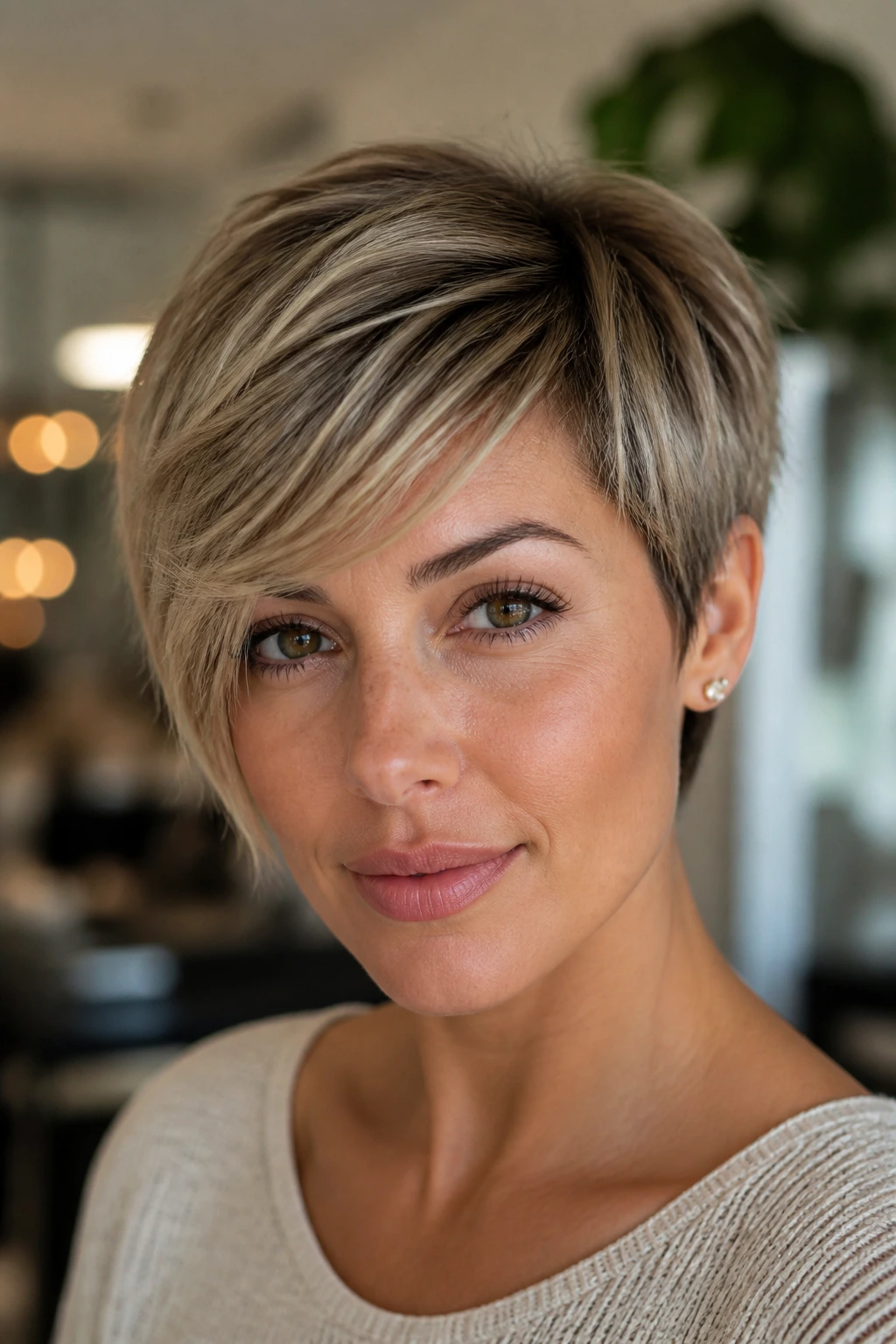
Bringing a photo is useful, but a photo by itself is not enough. Tell your stylist what part of the photo you like: the fringe, the nape, the crown height, the side part, the way the front lands below the jaw. That sentence does more work than waving a celebrity picture around and hoping for the best. A good stylist can translate a shape. They cannot guess which piece of the shape matters to you.
Be specific about your hair density and how much time you want to spend styling it. Fine hair needs different layering than thick hair. Curly hair should be cut in a way that respects shrinkage. Cowlicks at the crown or near the temple can also change the whole plan, especially on short cuts where an extra half inch can swing the shape from neat to stubborn.
Say where you do not want width. That helps more than saying you want your face to look slimmer, which is vague and hard to translate at the chair. “Keep the widest point below the jaw” or “I don’t want volume at cheek level” gives the stylist a clear map. If you wear glasses, mention that too. Frames change how the side pieces sit, and the haircut should work with them instead of crowding them.
Bring one photo of the front and one of the side if you can. The side view is where the truth lives. That’s where you see whether a bob is stacked, whether a pixie has enough crown, and whether the nape is doing something useful or just sitting there.
How to Style These Cuts So They Keep Their Shape
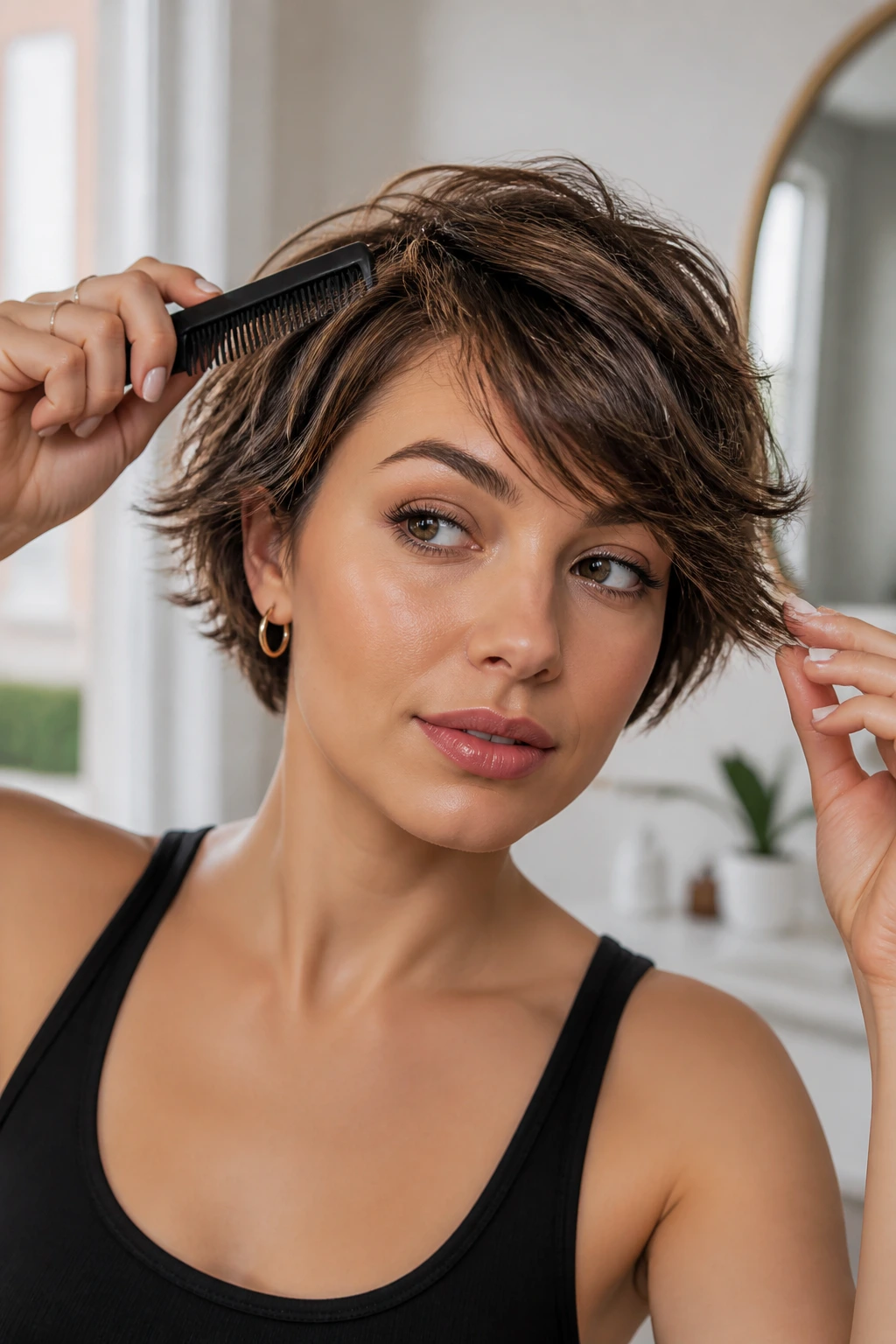
Parting: A side part is the safest place to start on most round faces because it breaks symmetry and gives the top a little lift. A deep side part can be dramatic on an asymmetrical bob or pixie, but it needs root support or it collapses by lunchtime.
Lift: Dry the roots first, not the ends. Focus the nozzle at the crown and direct the hair upward for a few seconds before smoothing the front back down. That keeps the shape from lying flat against the face.
Texture: Pixies and bixies usually want matte paste or a tiny bit of cream worked through the ends with your fingers. Bobs look better with soft bends, either from a brush or a wand, because they need movement that falls away from the cheeks.
Finish: Don’t overdo shine or product near the temples. A little polish at the ends is enough. If the hair starts looking wet at the sides, the cut can read wider and heavier than it is.
For curly cuts, the routine changes. Let the curls form in sections, then diffuse without touching them too much. For straight cuts, one bend around the jawline is often enough. You are not trying to curl everything. You are trying to steer the eye.
Keeping the Shape Sharp Between Salon Visits
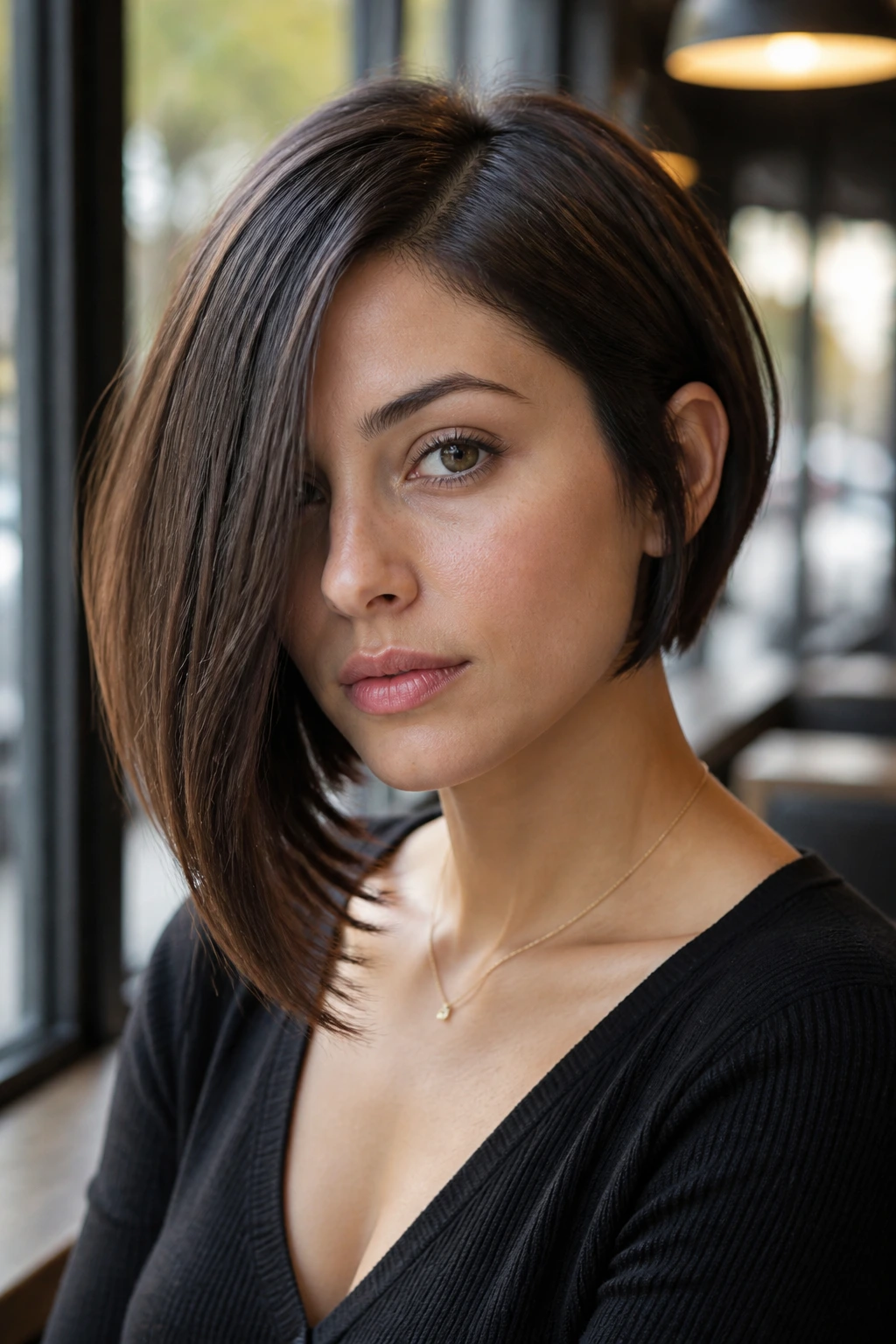
Short hair grows fast enough to change the whole balance in a month or two. Pixies, ear-length crops, and bixies usually need a trim every 4 to 6 weeks if you want the shape to stay crisp. Bobs and inverted bobs can often stretch to 6 to 8 weeks, though bangs usually ask for attention sooner. Fringe trims every 2 to 3 weeks are common if you want the front to keep its line.
The nape is the first place that gives the game away. Once the back starts puffing or flipping out, even a nice front view can look a little sloppy. A quick clean-up at the neckline can buy you time if you are trying to stretch appointments. The same goes for the sideburn area; when those edges grow too full, round faces lose the slimming effect fast.
Day two styling matters more on short hair than people expect. A little dry shampoo at the roots, a quick blast from a blow dryer, or a single pass of a wand on the front pieces can reset the silhouette without a full wash. Satin pillowcases help too. So does not going to bed with wet product plastered at the temples. That is how you wake up with weird bends that fight the cut.
If you are growing a short style out, do it in stages. Keep the nape tidy, let the front lengthen a bit, and ask for soft shaping rather than a full re-cut. That way the haircut keeps its line while it changes. There’s no prize for letting it become shapeless.
Variations and Adaptations to Try
Fine-Hair Lift Version: Keep the perimeter blunt and ask for soft internal layers only at the crown. Fine hair loses body quickly if it gets over-thinned, so the cut should build fullness where it counts instead of shaving it away.
Thick-Hair Taper Version: Use weight removal underneath the surface and keep the sides narrow. Thick hair on a round face can look boxy if the bulk sits at the cheekbone, so the cut needs a clean taper and a controlled front.
Curly-Hair Dry-Cut Version: Have the shape cut in the natural curl pattern so the shrinkage doesn’t surprise you later. This is the safest route for curly bobs, crops, and shaggy shapes because the stylist can see where the curls actually sit.
Low-Maintenance Grow-Out Version: Choose a long pixie, a collarbone lob, or a layered pixie-bob hybrid. These give you shape now and a softer transition later, which is useful if you hate the “awkward stage” between appointments.
Bolder Fringe Version: Swap in curtain bangs, a long side fringe, or a piecey brow-skimming fringe instead of a blunt bang. The face-framing effect stays, but the roundness gets interrupted in a softer, more controlled way.
Common Mistakes That Make a Round Face Cut Feel Wider
Putting the shortest point at cheek level: That’s the cut that makes people glance at the face and stop there. The fix is simple: keep the shortest layer either above the cheek in a lifted shape or below the jaw in a longer one.
Letting the sides puff out: If the hair balloons near the ears, the face gets wider even when the cut looks good from the front. Ask for narrower sides, more control underneath, or a cleaner taper at the nape.
Cutting bangs too straight and too dense: Heavy bangs can chop the face in half. Wispy, curtain, or side-swept bangs usually work better because they leave some space in the middle and guide the eye outward.
Over-thinning fine hair: Thin or fine hair can turn see-through fast if too much weight is removed. The symptom is soft, flimsy ends that stick out in odd places. The fix is a cleaner perimeter with less texturizing.
Ignoring the growth pattern at the crown and nape: Cowlicks, whorls, and neck growth can push short hair in strange directions. If your stylist does not account for them, the cut can flare or split by the end of the first week.
Styling everything flat: A round face usually needs some lift somewhere, even if the rest of the haircut is sleek. A root boost, a side part, or a small bend at the front can change the whole read.
Frequently Asked Questions
What short haircut is most flattering for a round face?
The safest bets are styles that add height or diagonal movement: a long pixie with a side-swept fringe, an asymmetrical bob, or a jaw-skimming A-line bob. The common thread is placement. The cut should move the eye up or down, not park it at cheek level.
Are bangs okay on a round face?
Yes, but the bang shape matters. Wispy bangs, curtain bangs, and long side-swept fringes usually work better than a dense straight fringe because they leave more open space in the middle of the face.
Can I wear a pixie if my face is round?
Absolutely. The version you want is usually longer on top and tapered at the sides, with some sweep in the front. That keeps the cut from looking boxy and gives the face a little vertical line.
Is a center part bad for round faces?
Not always, but it can emphasize symmetry and width if the cut is already full through the sides. A side part is usually easier to wear, especially on shorter styles, because it adds lift and breaks up the roundness.
What if my hair is curly or wavy?
That texture can be a gift, as long as the cut respects shrinkage and shape. Curly crops, shaggy bobs, and soft layered pixies often work well, but they should be cut in the curl pattern rather than guessed from wet hair alone.
How often should short hair be trimmed?
Pixies and crops usually need shaping every 4 to 6 weeks. Bobs can often go 6 to 8 weeks, though bangs and necklines may need a little earlier attention if you want the outline to stay clean.
What if a haircut makes my face look wider than expected?
Check where the width is sitting. If it’s at the cheeks or ears, the fix is usually to narrow the sides, lengthen the front, or shift the part. If the top is flat, a root lift can help more than another cut.
Should I avoid very short cuts if I wear glasses?
No. Glasses can look fantastic with the right short cut because they give you another frame line to work with. The main thing is to keep the sides neat enough that the hair and frames do not fight each other.
The Shape That Stays With You
The best short haircut for a round face is not the one that hides the face. It is the one that gives the face a better outline. A side part, a little height at the crown, a front piece that lands in the right place—those details do more than any vague promise of “slimming” ever will.
If you take one thing from this list, make it this: placement beats length. A well-cut pixie can flatter better than a badly placed bob, and a blunt bob can look sharper than a shag if the line sits below the jaw and the sides stay controlled. Shape first. Drama second. That order saves a lot of bad haircuts.
Bring a clear photo, say where you do not want width, and choose the version that fits how much styling you’ll actually do. That usually leads to the haircut you keep reaching for.
