



Wedding hairstyles for brides with short hair have a funny reputation. People act as if a bob or pixie is a limitation, when it is often the thing that makes the whole look sharper. Less length means more control. More control means cleaner lines, better accessory placement, and fewer of those mid-ceremony moments where a half-fallen curl slides into your lipstick.
The trick is not to force short hair into a long-hair idea. That never looks right. A chin-length bob wants a different kind of polish than a waist-length blowout, and a cropped pixie needs shape, lift, or ornament in the right place — not layers of products piled on like drywall compound.
I’ve always thought the best bridal short-hair styles look deliberate from every angle. The front matters, sure. But the side profile, the nape, and the space where a veil comb sits can make or break the whole thing. Short hair gives you room to be exact. That’s a gift, not a problem.
Why These 19 Styles Work So Well on Short Hair
Cleaner structure: Short hair shows shape fast, so a good side part, wave pattern, or tucked-back detail reads immediately instead of disappearing into length.
Accessory-friendly: Pins, combs, vines, and clips sit closer to the head, which makes them easier to anchor and less likely to slide around.
Less weight, less droop: A bob or pixie does not drag itself flat the way long hair can after a few hours on the dance floor.
More face framing control: You can steer a curl, fringe, or temple piece exactly where you want it, which matters when earrings, neckline, and veil all share the frame.
Trial styling is easier: Short hair usually takes less time to rehearse, and that makes bridal runs less exhausting. You can test one look, adjust the pin placement, and know fast whether it holds.
Extensions are optional, not mandatory: A few hidden pieces can help, but the best short-hair bridal styles stand on their own if the cut is good and the finish is tidy.
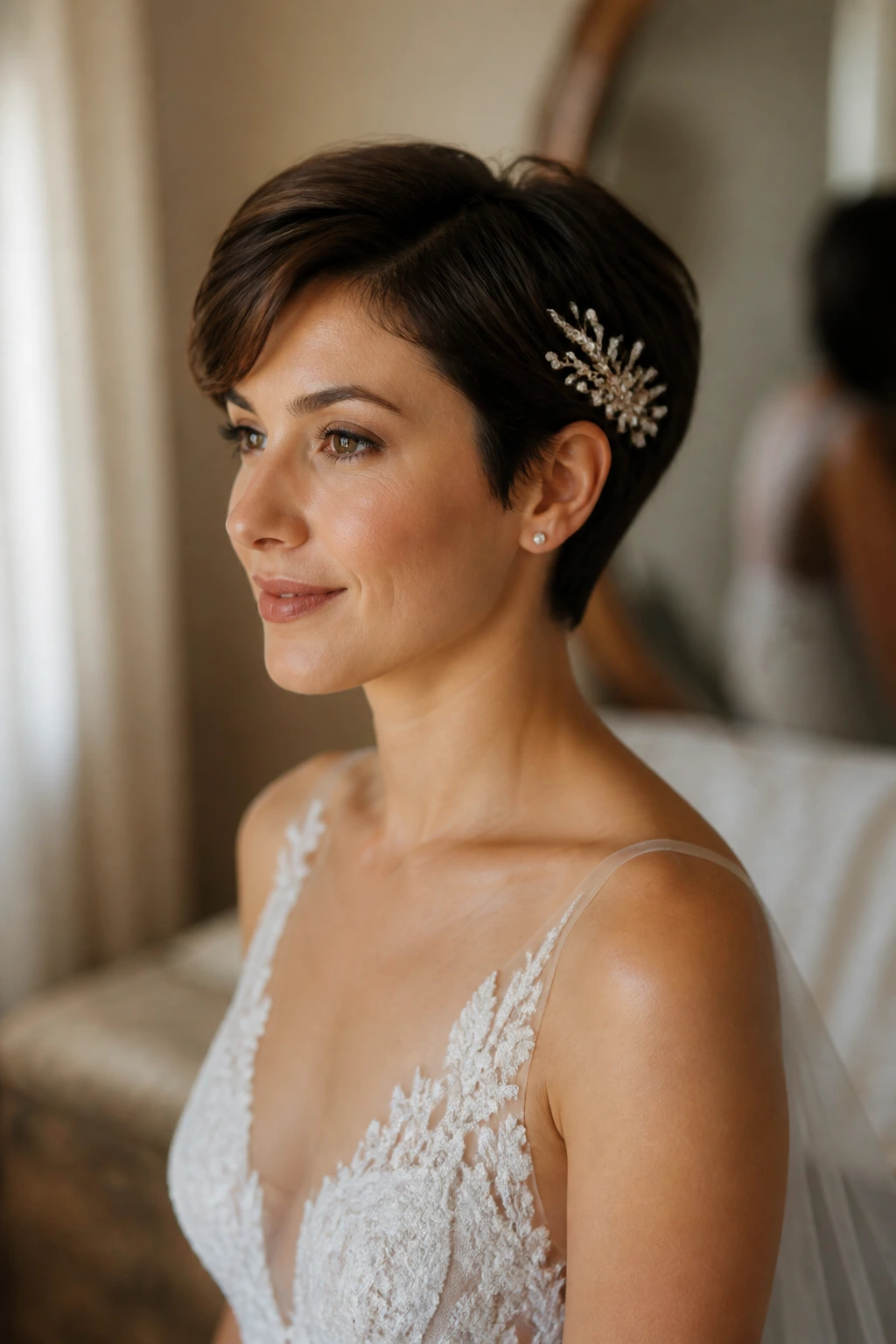
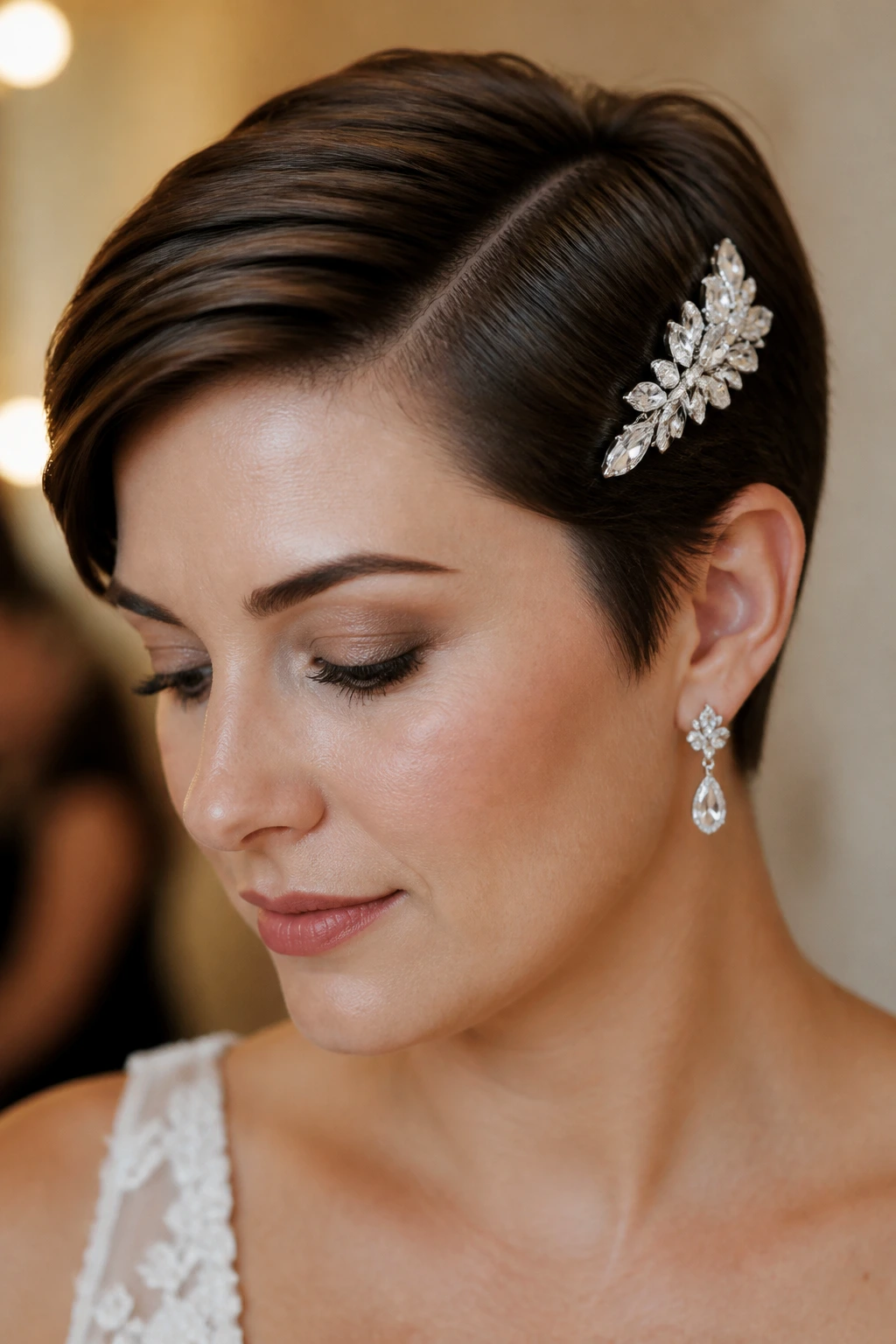
1. Sleek Side-Part Pixie with a Crystal Barrette
A pixie cut does not need extra bulk to look bridal. It needs clean lines, a side part that actually lands where the head wants it, and one well-placed crystal barrette that looks intentional instead of borrowed from a craft drawer. Keep the hair smooth at the temples, then let the top have just enough bend to avoid helmet shine.
Why it works: This style gives you sharpness at the front and a little sparkle right where people look first. It’s especially good if your dress has structure — a bateau neckline, an angular bodice, or a sharp collar. The barrette becomes the focal point, so you do not need much else.
What to ask your stylist for
- A side part set while the hair is still warm from blow-drying
- Light smoothing cream, not a heavy oil
- A barrette anchored into a hidden cross-section of pins
The best part is how little fuss it needs once it’s in place. A fine-tooth comb and a mist of firm-hold spray are usually enough. Keep the front soft if your face shape benefits from a little movement, but do not let the sides puff out. That’s the whole game here.
Best for: Straight or slightly wavy hair, veil-free ceremonies, and brides who want the dress and earrings to do some of the talking.
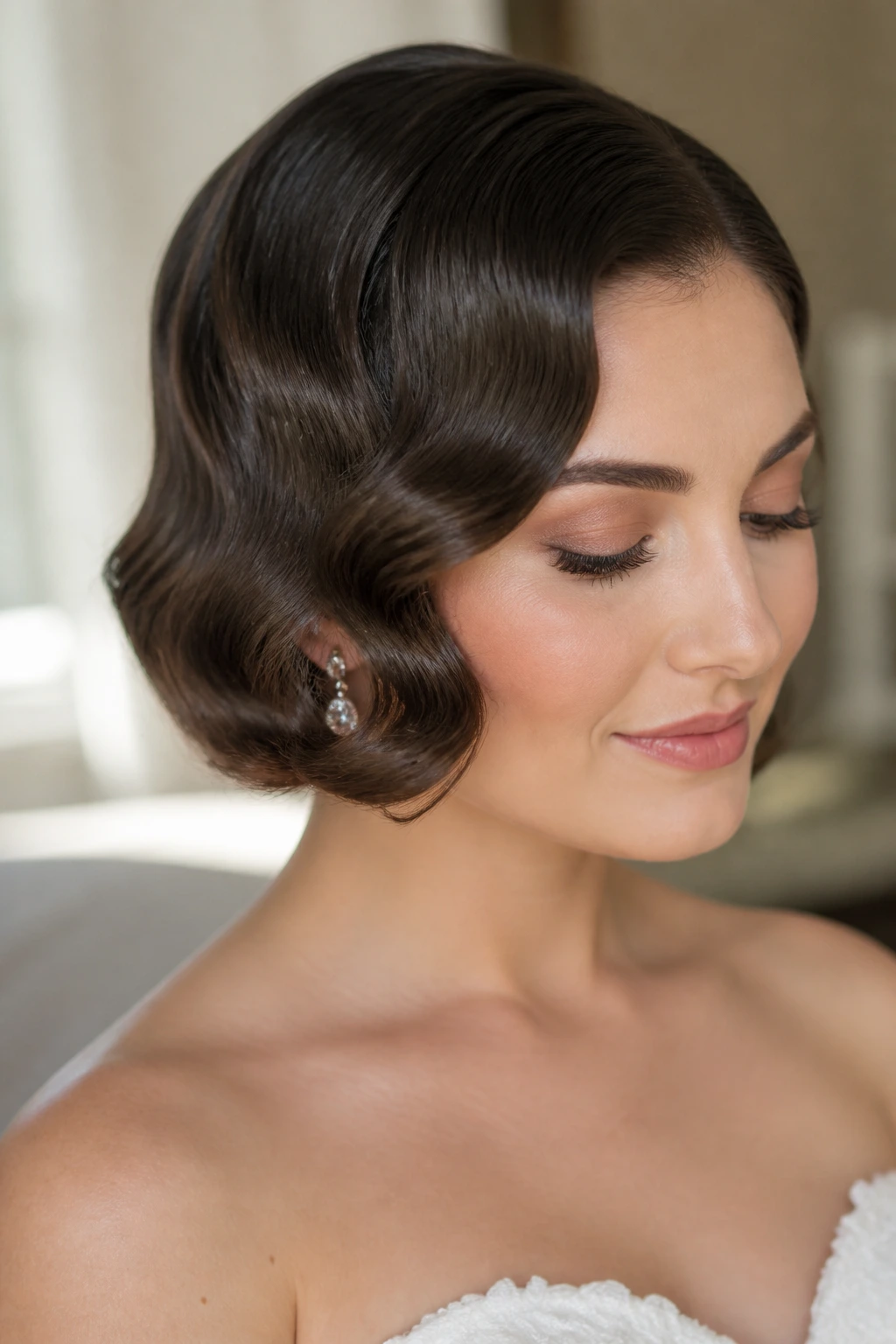
2. Soft Finger Waves on a Chin-Length Bob
Finger waves have a built-in sense of occasion. They press the hair into those glossy S-curves that look like they belong near satin, pearls, and a low-lit dinner room. On a chin-length bob, they read polished and old-world without turning stiff if the set is brushed out lightly.
Why this style holds its own: The wave pattern gives the bob an intentional shape, which matters when the cut sits close to the jaw. A center or deep side part both work, but the wave needs to start near the hairline and stay tidy through the temple so it does not collapse halfway through photos.
What makes it different
- The texture is controlled, not puffy.
- The shine comes from the wave pattern itself, not a glaze of oil.
- It pairs well with a birdcage veil, drop earrings, or a simple comb.
A good finger wave on short hair is a little fussy to make. I’m not going to pretend otherwise. But that fuss pays off because the style stays elegant from front to side profile, and it gives a chin-length cut a finish that feels expensive without trying too hard.
Tip: Ask for the waves to be pinned and cooled completely before the pins come out. Warm hair will loosen fast, and that’s how the pattern gets fuzzy.
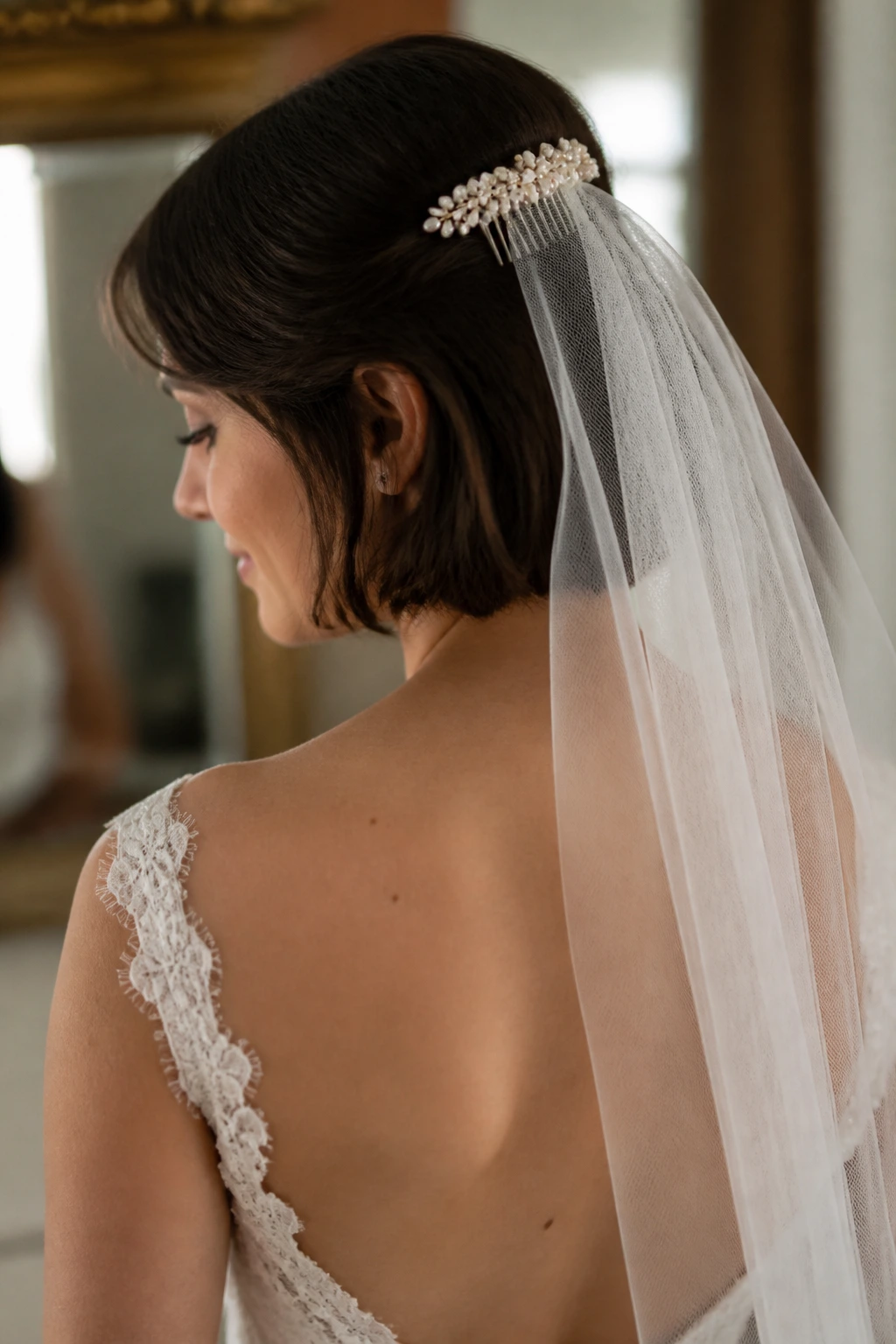
3. Tucked-Under Faux Bob with a Veil Comb
A faux bob is a small trick with a big payoff. You tuck the ends under, pin them at the nape, and suddenly a longer lob or shoulder-skimming cut looks like a sculpted bob with a clean underside. It’s especially useful if you want the front to stay soft but the back to disappear under a veil comb.
Why it works: This shape keeps the neck open and shows off the back of the dress. It also lets a veil sit higher and neater than it would on loose hair. The important part is hiding the end pieces without making the whole style puff at the crown.
How to shape it
- Curl the ends lightly so they bend under instead of sticking straight out
- Pin in small sections, not one giant fold
- Hide the seam under the veil comb or a small cluster of pins
This is one of those looks that needs a trial run. If the fold is too low, you get a droopy shape. Too high, and the head starts to look bulky. The sweet spot is usually just above the nape, where the hair naturally wants to curve anyway.
Best for: Brides who want a classic silhouette with a veil and do not want to fight loose ends all day.
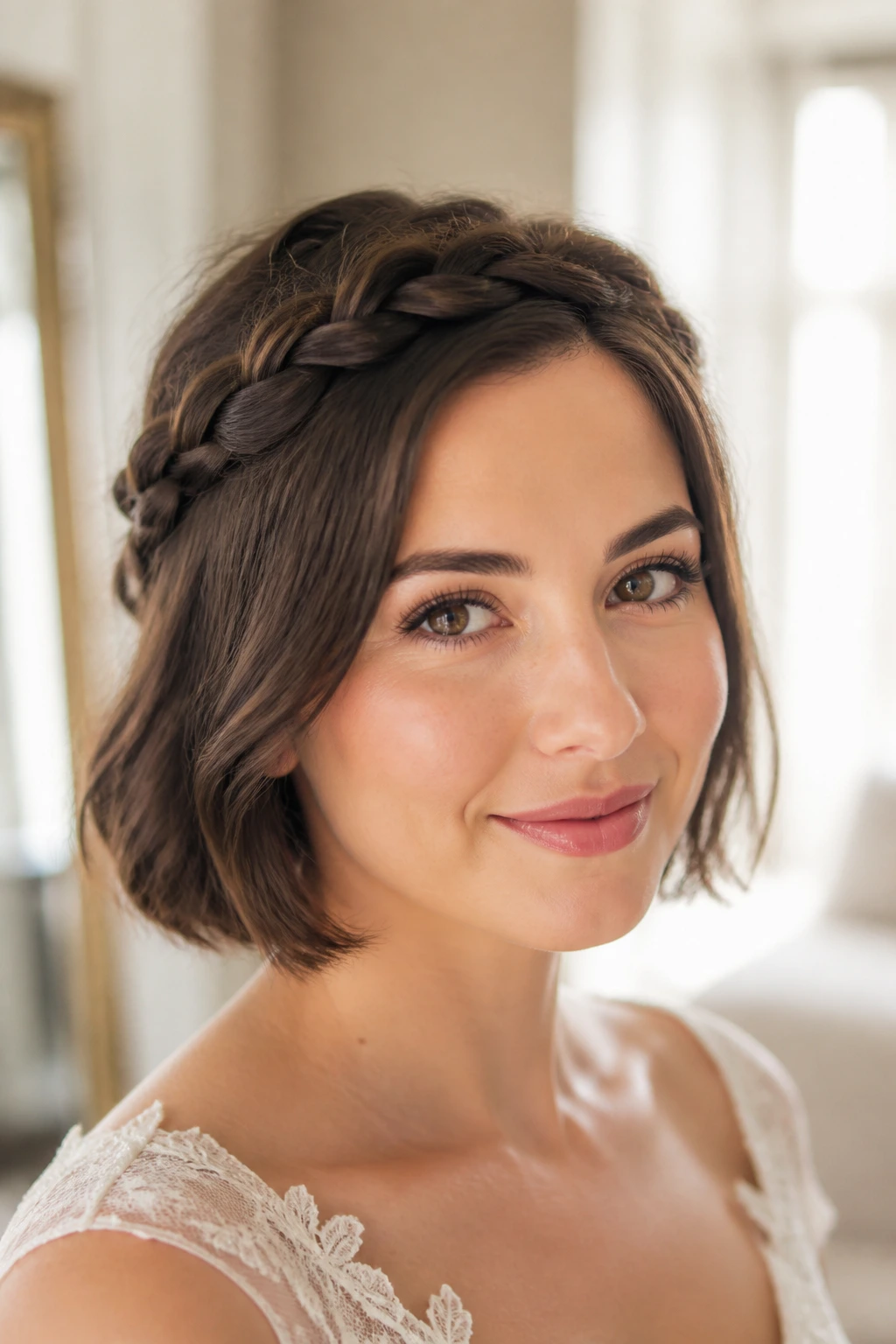
4. Braided Crown on a Chin-Length Bob
A braided crown can make short hair feel ornate fast. On a bob, the braid does not have to circle the entire head. It can sweep from one temple to the other, then tuck into the opposite side with a couple of hidden pins. That partial crown is often prettier than a full wrap because it looks lighter.
Why it works: The braid gives the style texture at the front, where short hair sometimes looks too plain in photos. It also keeps the fringe area controlled, which is useful if your bangs split on their own and never quite behave for a camera.
Good pairings
- Lace sleeves
- Garden ceremonies
- Fresh flowers tucked near the ear
- A short veil with a simple comb
The braid should be soft, not rope-tight. Pull it out a little once it’s set so it looks hand-shaped instead of severe. If your hair is fine, prep the roots with a dry texture spray first. If it’s thick, work with smaller sections so the braid does not turn into a chunky ridge.
Pro move: Keep one face-framing piece loose on the side that opens toward the camera. It keeps the crown from looking too rigid.
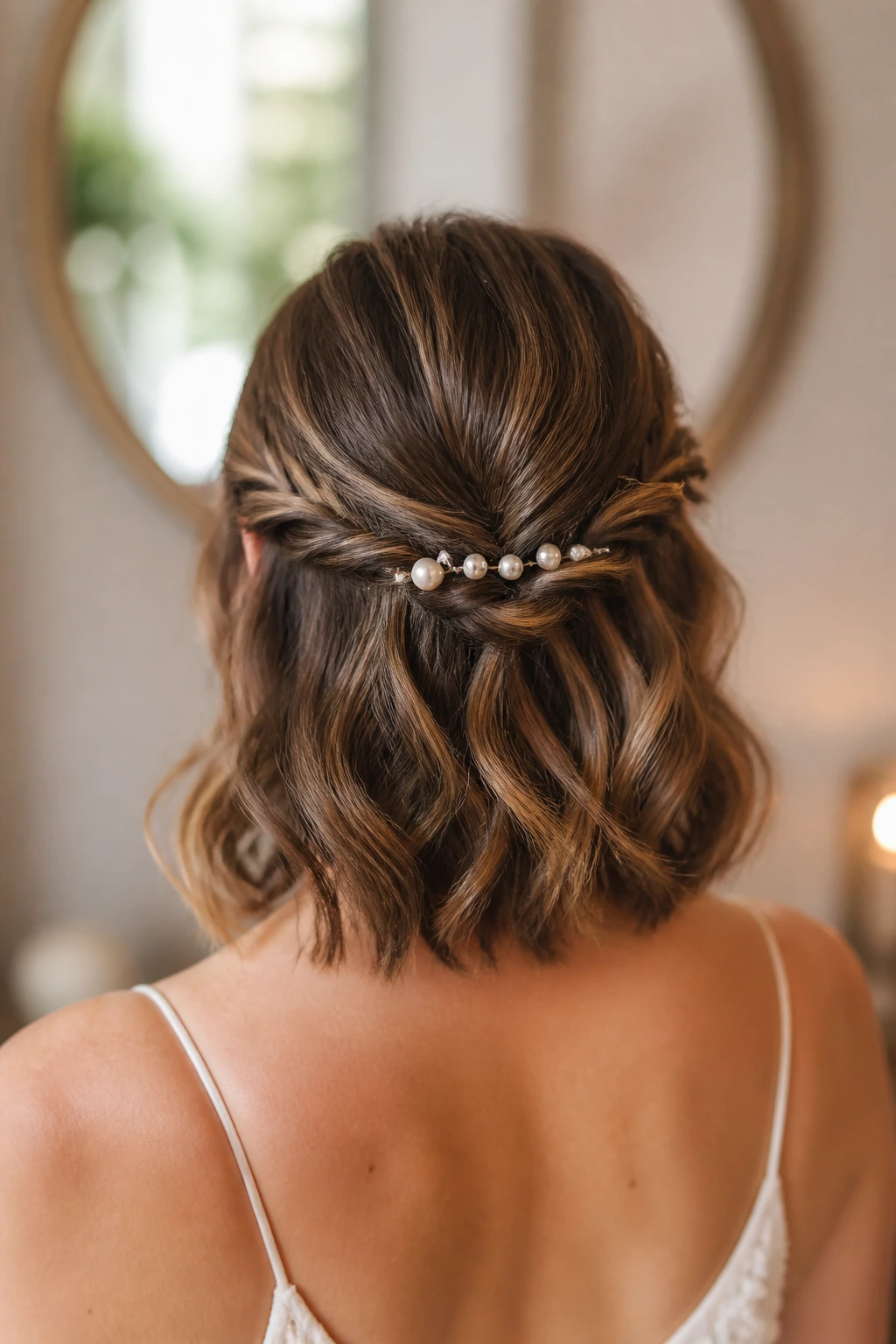
5. Twisted Half-Up Lob with Pearl Pins
This one is all about balance. Take the top sections of a lob, twist them back from the temples, and secure them with pearl pins that sit like a little row of dots across the back of the head. The lower half stays down, so you still get movement, but the crown looks polished.
Why it works: A lob has enough length to twist without fighting the scalp, but it’s short enough that the style stays light. Pearl pins add detail without crowding the cut. They also catch the eye in a softer way than crystal, which helps if your dress already has beading.
You can keep the twists tight for a clean finish or loosen them slightly if you want a more relaxed shape. I prefer the looser version for brides who want the hair to move a little when they turn their head. The pin line becomes the accent, not the whole show.
Tip: Place the pins slightly off-center so the look feels less formal and more natural. Symmetry can get stiff fast on short hair.
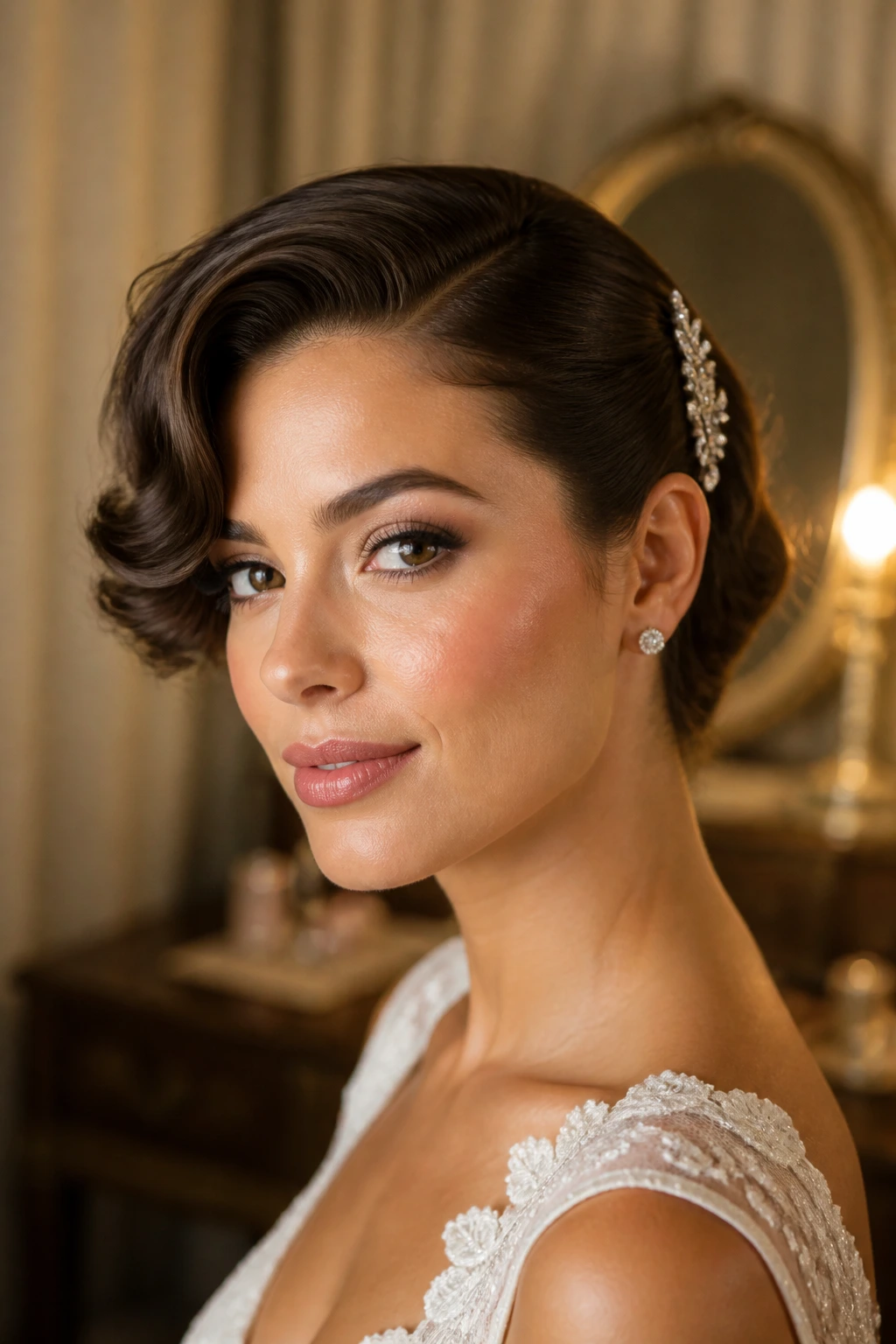
6. Old-Hollywood Side Sweep for Short Hair
If there’s one short-hair bridal look that almost always works, it’s the side sweep. The hair gets set into a soft wave, brushed over one side, and pinned just enough to hold the shape while the front stays glossy and controlled. It has that old-film glamour people think they need long hair to get. They don’t.
Why it works: The shape opens the face and gives the neckline room. That matters more than people admit. A side sweep can make a simple bob feel expensive because the movement is directional — it leads the eye, instead of letting the hair sit flat and indecisive.
How to keep it bridal, not prom
- Use a large barrel or brush-through wave, not tiny curls
- Keep the finish smooth near the root
- Anchor the heavier side behind the ear with hidden pins
This style loves a one-shoulder dress, a draped neckline, or statement earrings on the open side. It also works when you want the veil to sit back rather than right on top of the style.
One sentence, because it matters: If your hairline is frizzy, tame it before you set the wave. Not after.
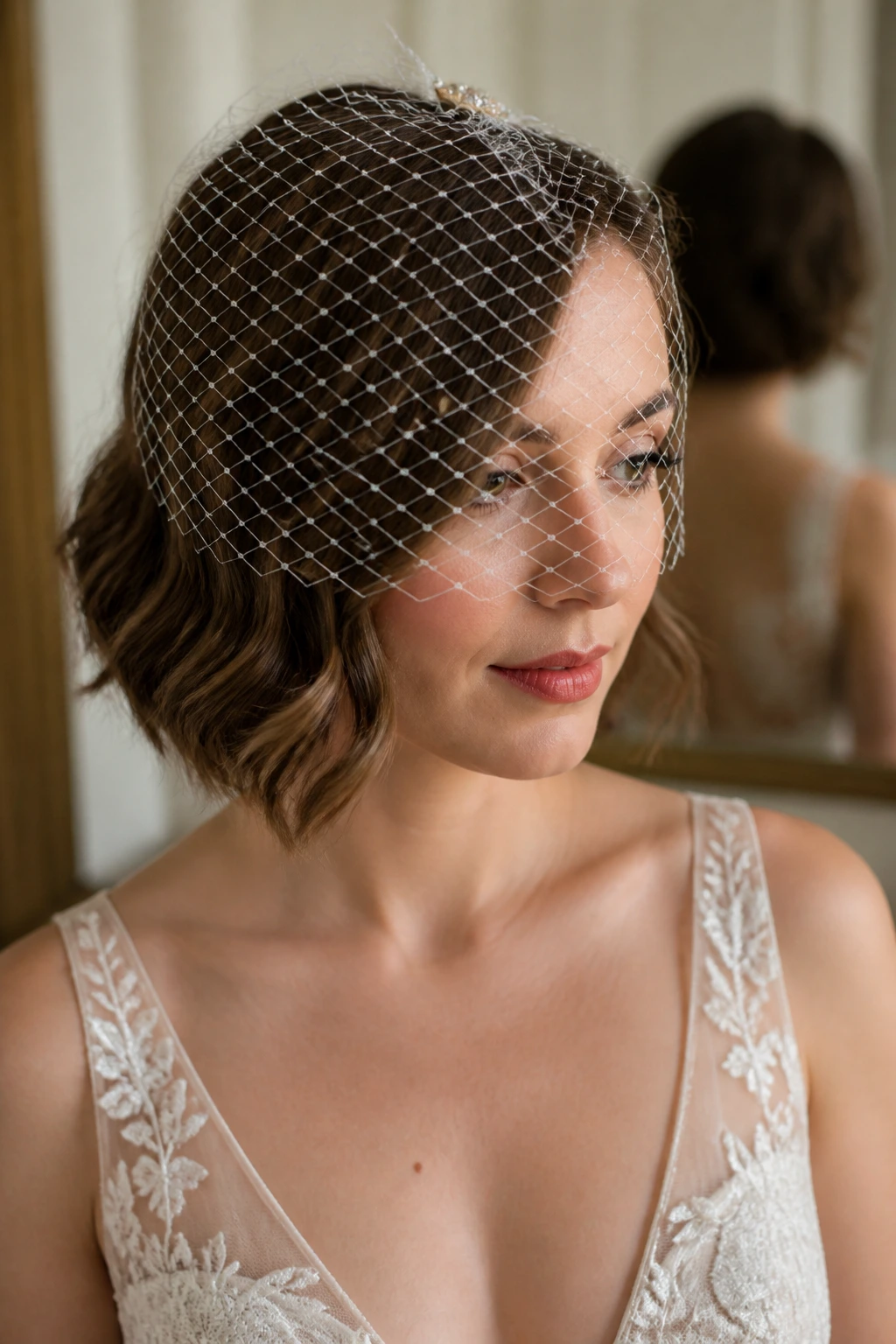
7. Textured Lob with a Birdcage Veil
A textured lob and a birdcage veil are a very good pair. The veil brings the drama; the hair brings the texture. You want enough bend in the lob to keep it from looking too tidy, because the veil itself already has structure and needs something a little softer underneath it.
Why it works: Birdcage veils sit close to the face and have their own shape, so the hair doesn’t need to compete. A tousled lob gives you movement around the jaw and shoulders, and that keeps the whole look from turning severe. It’s one of the best wedding hairstyles for brides with short hair when the bride wants a little vintage edge.
Best details to ask for
- Loose bends from mid-length down
- A side part or softly off-center part
- A veil comb pinned into a teased root base
Do not over-curl this one. The charm is in the slightly undone finish. A few polished bends, then a comb-through with fingers, is enough. If the hair becomes too perfect, the veil can start to look pasted on.
Best for: Cocktail attire, courthouse ceremonies, and brides who want something shorter, sharper, and less traditional.
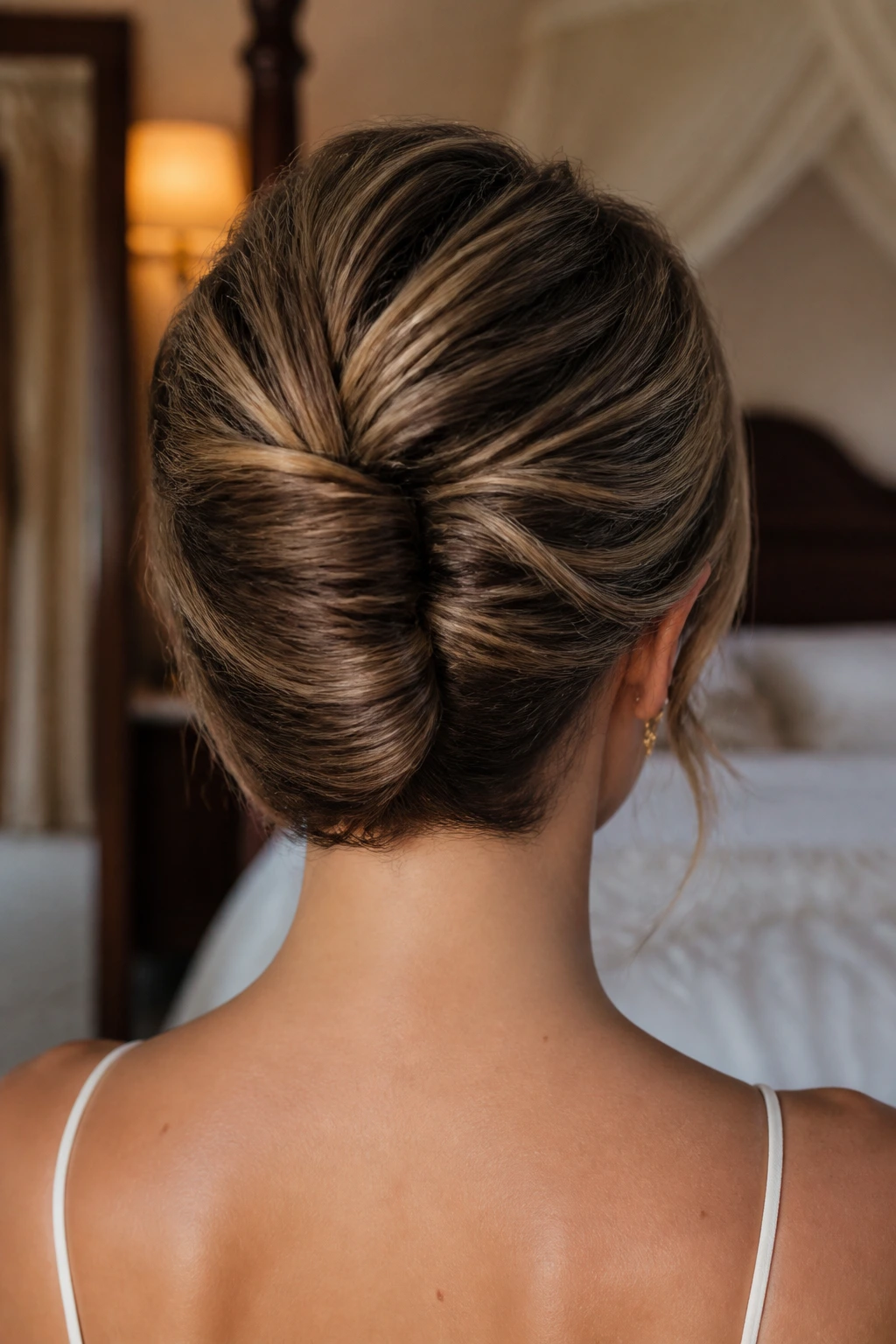
8. Mini French Twist for the Back of a Bob
A full French twist and short hair are not always natural friends. A mini version, though, is different. You gather the bottom section of a bob, roll it upward, and pin it into a compact vertical shape that gives the back of the head a neat little column of hair.
Why it works: It creates lift at the nape without asking the whole cut to behave like long hair. That makes it ideal for brides who want an elegant back view for photos. The front can stay smooth or slightly waved, depending on how formal the dress feels.
The key is not to make the twist too tall. On short hair, a giant twist can look like it’s trying to be something else. A smaller, tighter roll looks cleaner and lasts better.
Tip: Use pins in an X pattern through the base. One pin alone rarely holds the weight if the hair is fine or freshly blown out.
9. Sculpted Pompadour Pixie with a Hair Vine
A pixie with a little height at the front can look fearless in the best way. Push the top upward and back into a sculpted pompadour shape, then lay a hair vine along one side so the height feels intentional instead of dramatic for drama’s sake.
Why it works: The lift balances the face and brings the eye upward, which is useful if your dress is simple and your jewelry is minimal. It also gives the front of a very short cut something to do. Without the lift, a pixie can get swallowed by the rest of the bridal styling.
What to watch for
- The root lift should be soft, not stiff
- The vine should follow the shape of the head, not float above it
- Use matte texture at the crown, shine at the ends
This is a strong look for brides who like a little edge. It does not read delicate. It reads self-assured, which is a different thing entirely.
Best for: Short, straight hair and dresses with a clean neckline or a high-fashion silhouette.
10. Rope-Twist Half-Up on Wavy Short Hair
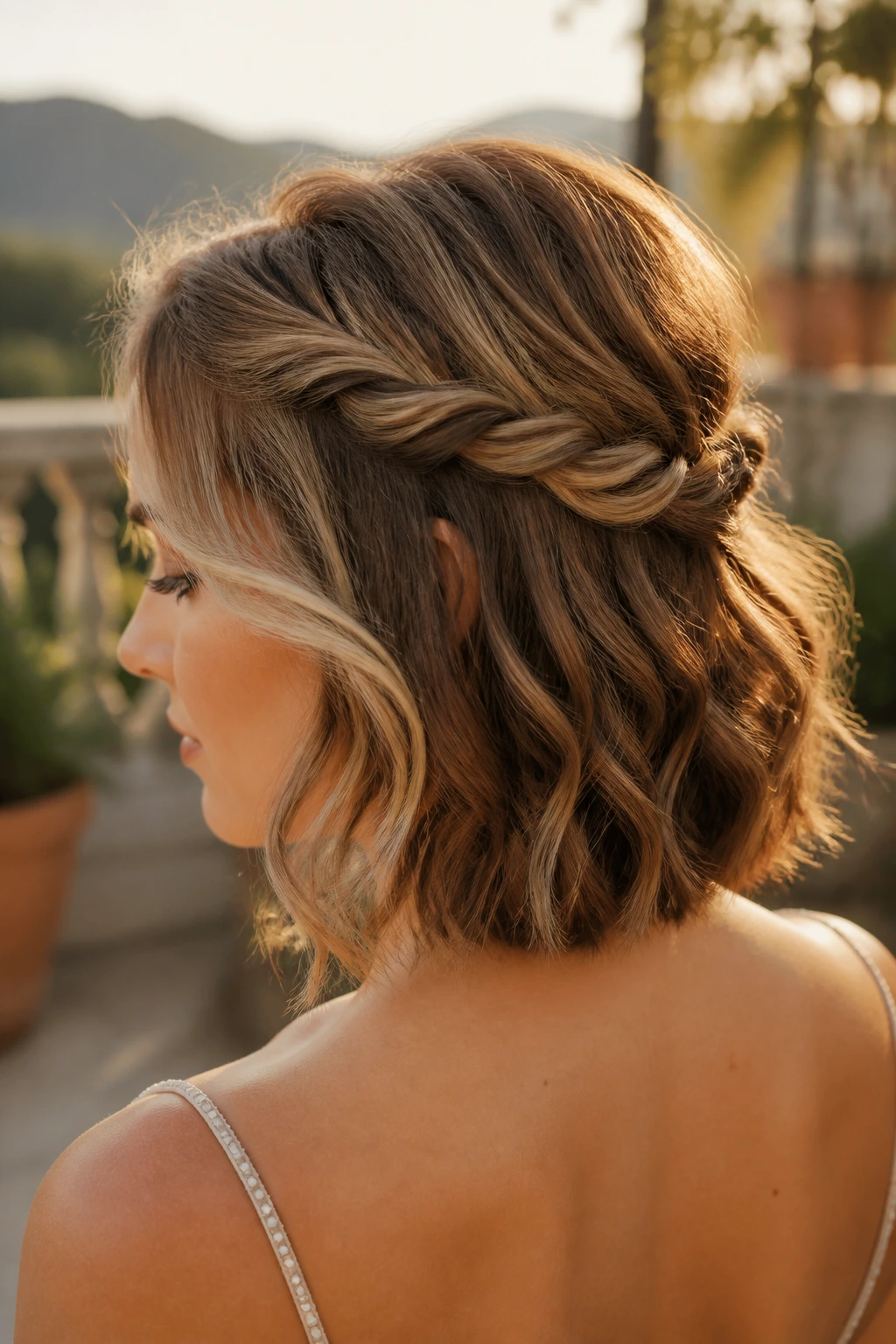
Rope twists work well when the hair is too short for a full braid but long enough to twist back neatly. Take two small sections from each temple, twist them away from the face, and pin them together at the back, letting the rest of the wave pattern fall loose.
Why it works: The rope texture adds detail without consuming length. On wavy short hair, it keeps the front controlled while leaving enough movement underneath to stop the style from looking flat. It’s also one of the easier ways to make a short cut feel finished without bringing in extensions.
This style is better when the waves are soft and not overly defined. You want the twists to be readable, but you do not want the lower half to look like a separate hairstyle. Everything should feel connected.
Best for: Brides who want something light, gentle, and not overly formal.
11. Glossed Wet-Look Pixie with Statement Earrings
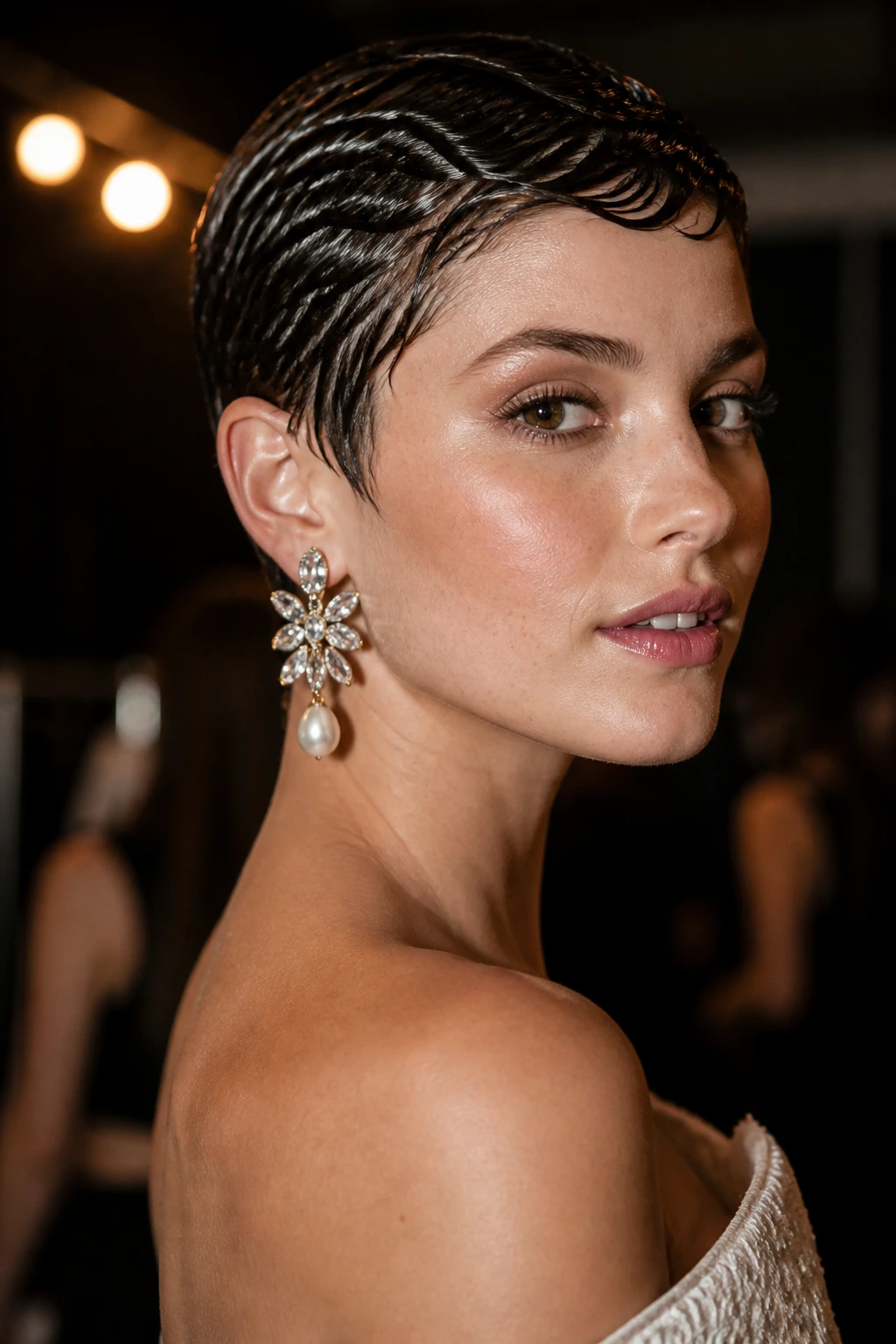
A wet-look pixie is not for everyone. Good. It should be selective. This style leans into a sleek, high-shine finish and uses the cut itself as the main event. Pair it with a strong earring — a drop, a sculptural stud, something with a little shape — and let the hair stay close to the head.
Why it works: The glossy finish makes the short cut look deliberate and clean from every angle. It also keeps the profile uncluttered, which matters if your dress already has drama in the sleeves, neckline, or back. A wet look can be unforgiving if the haircut is uneven, so the shape has to be good.
Good when
- You have naturally smooth hair
- The weather is humid
- You want a modern, less-fussy bridal style
- The jewelry is doing a lot of the work
The trick is restraint. Too much product and it starts looking greasy. Too little and the style loses the effect. Comb the product through with a fine-tooth comb, then stop touching it. That’s the whole point.
12. Curly Bob with Side-Swept Bangs
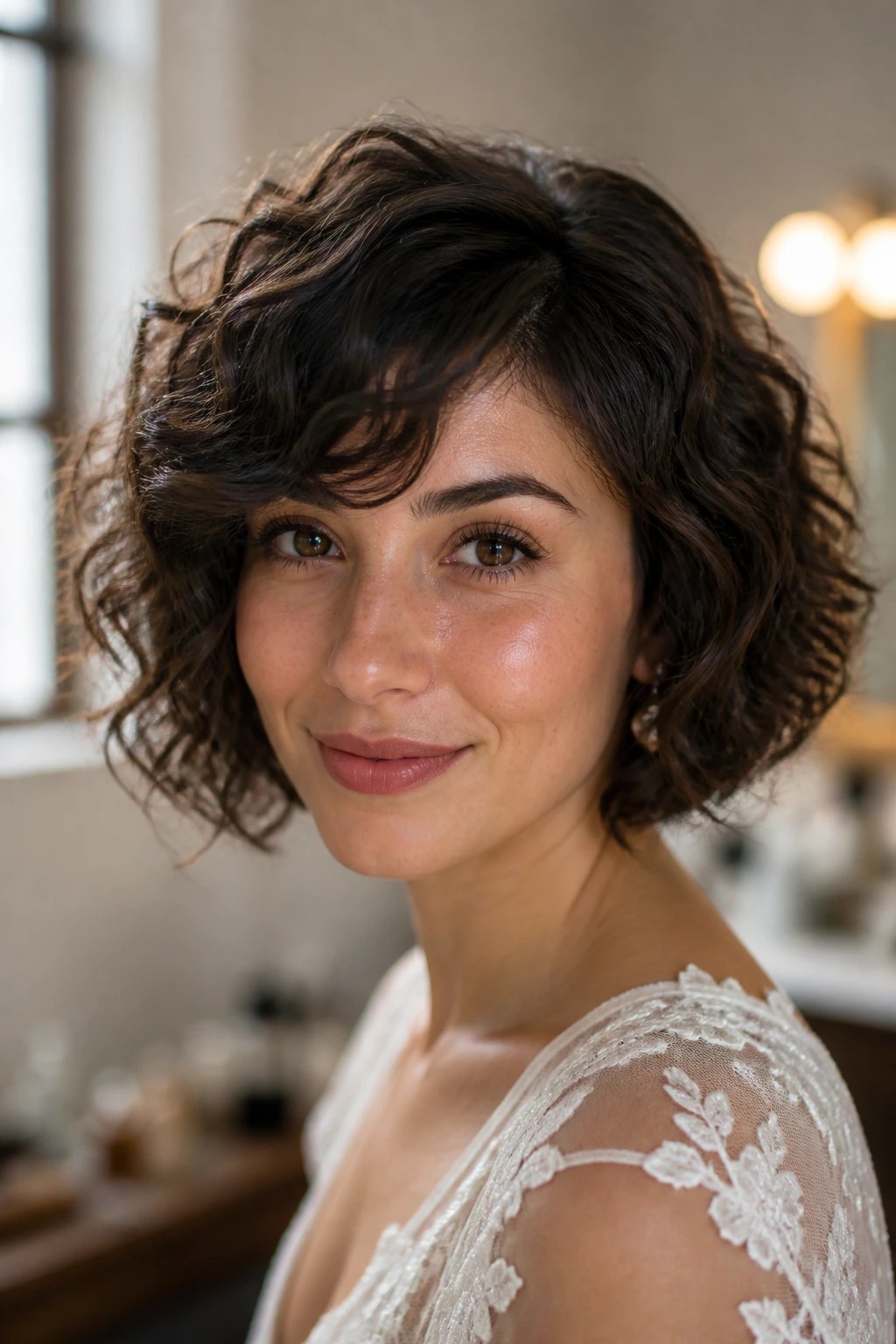
A curly bob has its own kind of wedding energy. It looks soft, full, and alive without needing much persuasion. Side-swept bangs take the edge off the forehead area and create a little diagonal line that feels flattering in photos.
Why it works: Curly hair already gives you shape, so the job is mostly about refining it. A side sweep keeps the curls from landing all at the same place and gives the whole cut a more intentional outline. If you’ve spent years trying to make curls behave, this is the day to let them do their job with a little guidance.
Use this approach if
- Your curls shrink a lot when dry
- Your bob has enough length to sit at the cheek or jaw
- You want a style that doesn’t collapse when people hug you
A curl cream and a diffuse-dry are usually enough. Then go in with a few pins only where the bangs need direction. Do not slick the curl pattern into submission. That never looks like wedding hair; it looks like surrender.
13. Halo of Tiny Braids with Fresh Flowers
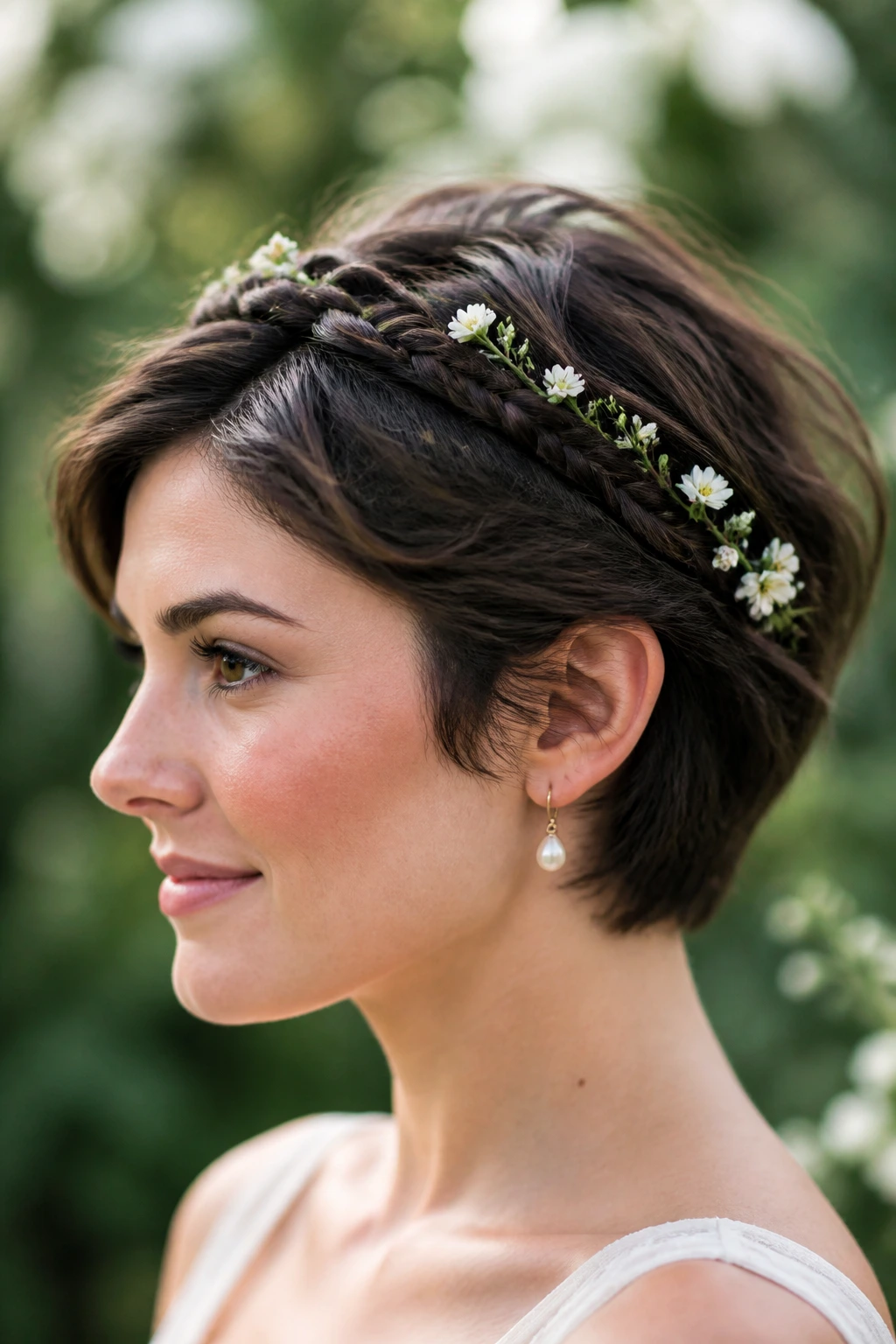
Tiny braids around the crown can make short hair feel layered and romantic without hiding the haircut itself. Add a few fresh flowers — tiny blooms, not giant stems — and the style becomes soft, textured, and a little wild in the best way.
Why it works: The braids create structure near the scalp, which helps short hair look styled instead of simply down. Flowers then break up the line of the braids and add a living, organic note. It’s pretty, yes, but the better word is alive.
Keep it balanced
- Use small flowers that can be pinned securely
- Keep the braids thin so they don’t overpower short hair
- Place blooms near the temple or behind one ear, not everywhere
This style is strongest in outdoor settings or ceremonies with a looser dress code. It can go too sweet if the flowers are oversized or the braids are thick. Small details win here.
Tip: Ask for the flowers to be wired or pinned into a base, not just tucked in. Tucked flowers slide. Wired flowers stay.
14. Low Rolled Chignon with Clip-In Fillers
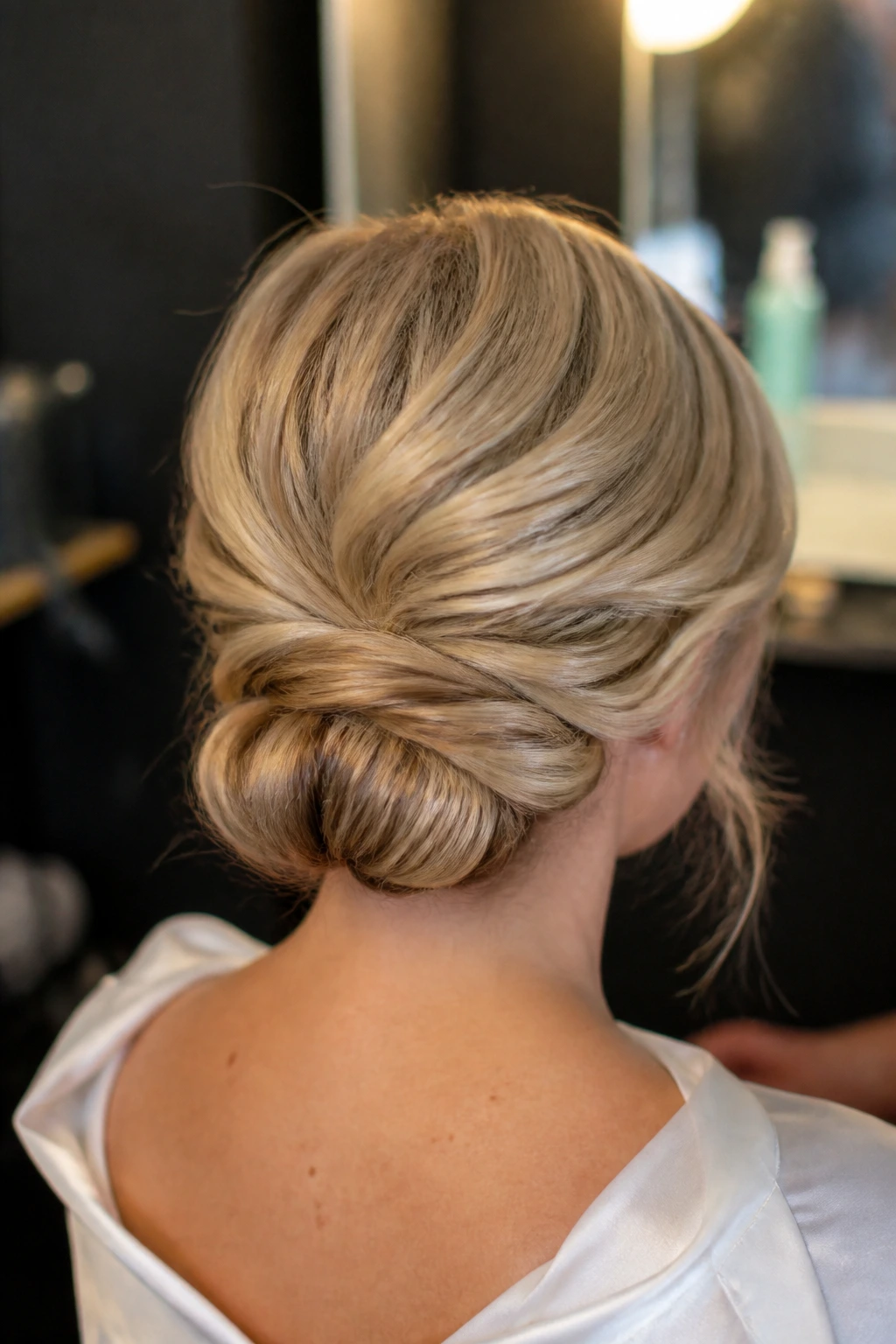
Yes, you can fake a low chignon on short hair if you’re realistic about the shape. The roll is shallow and close to the neck, and a few clip-in fillers or padding pieces can give the bun enough body to look like an intentional knot rather than a pinwheel of loose ends.
Why it works: It creates a classic bridal back view while keeping the front simple. That makes it ideal for dresses with open backs or elaborate bodices. The hair becomes a frame, not the centerpiece.
This style needs a stylist who knows how to hide the seams. If the fillers are visible, the illusion falls apart fast. But when it’s done properly, the result looks neat, compact, and elegant from every angle.
Best for: Brides with bob-length hair or longer, especially if the wedding dress has a strong back detail.
15. Asymmetrical Tuck-and-Pin with a Jeweled Comb
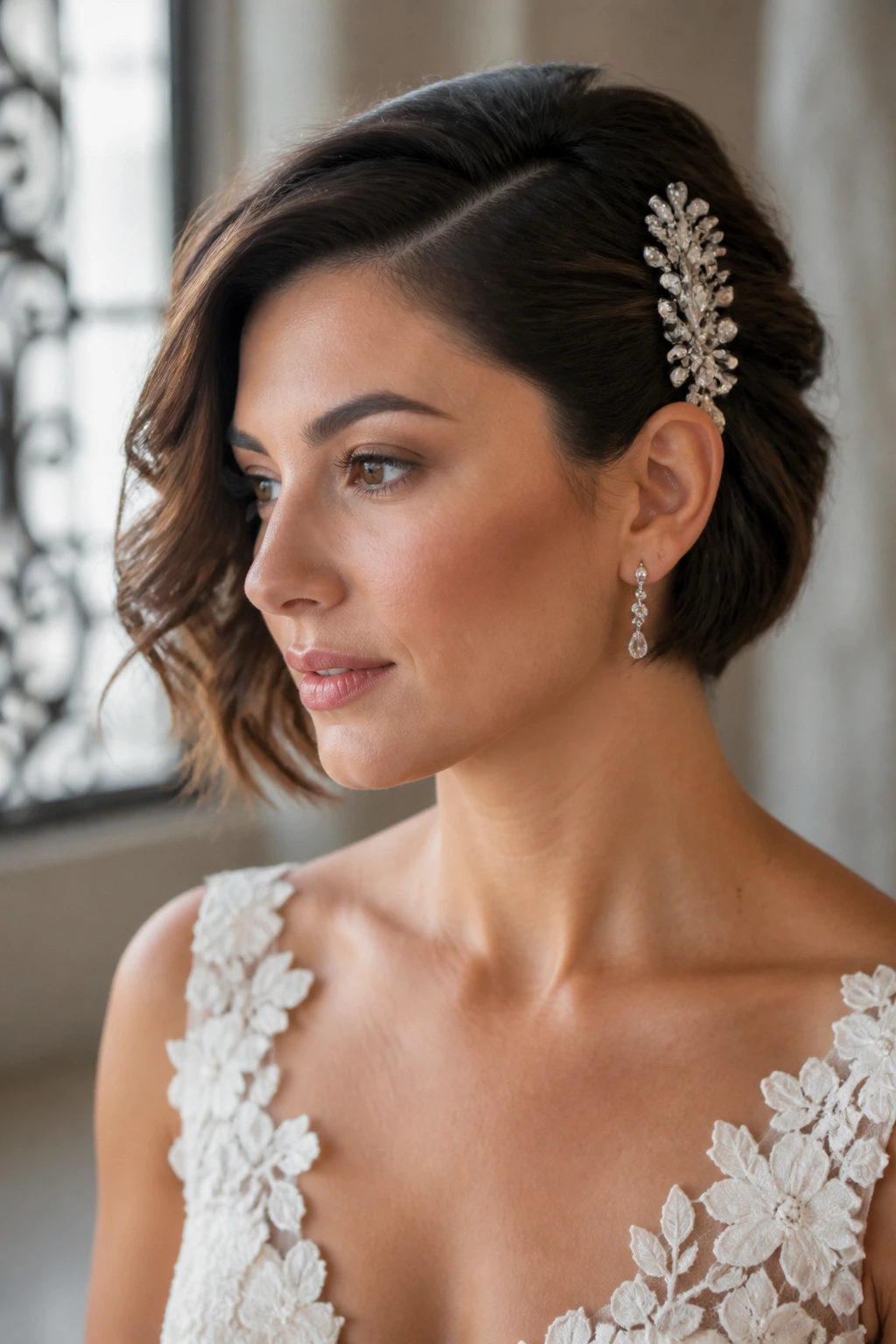
A tucked-and-pinned style is one of those quiet choices that gets better the longer you look at it. One side stays a little fuller; the other is tucked behind the ear and secured with a jeweled comb that becomes the focal point. The asymmetry keeps it from looking formal in a stiff way.
Why it works: Short hair loves direction. Tucking one side gives the style a clear line, and the comb adds just enough ornament to make the shape feel bridal. It’s also a strong choice when you want to show off earrings on one side without competing with a veil.
Best details to ask for
- A soft part that does not sit dead-center
- A comb with prongs that can anchor into a pin base
- A few face-framing strands left free on the fuller side
This is a good option for brides who want something tasteful and controlled but not too polished. It has a little tension in the shape, which I like. Too much symmetry can make short hair feel boxy.
16. Retro Flipped Ends Bob
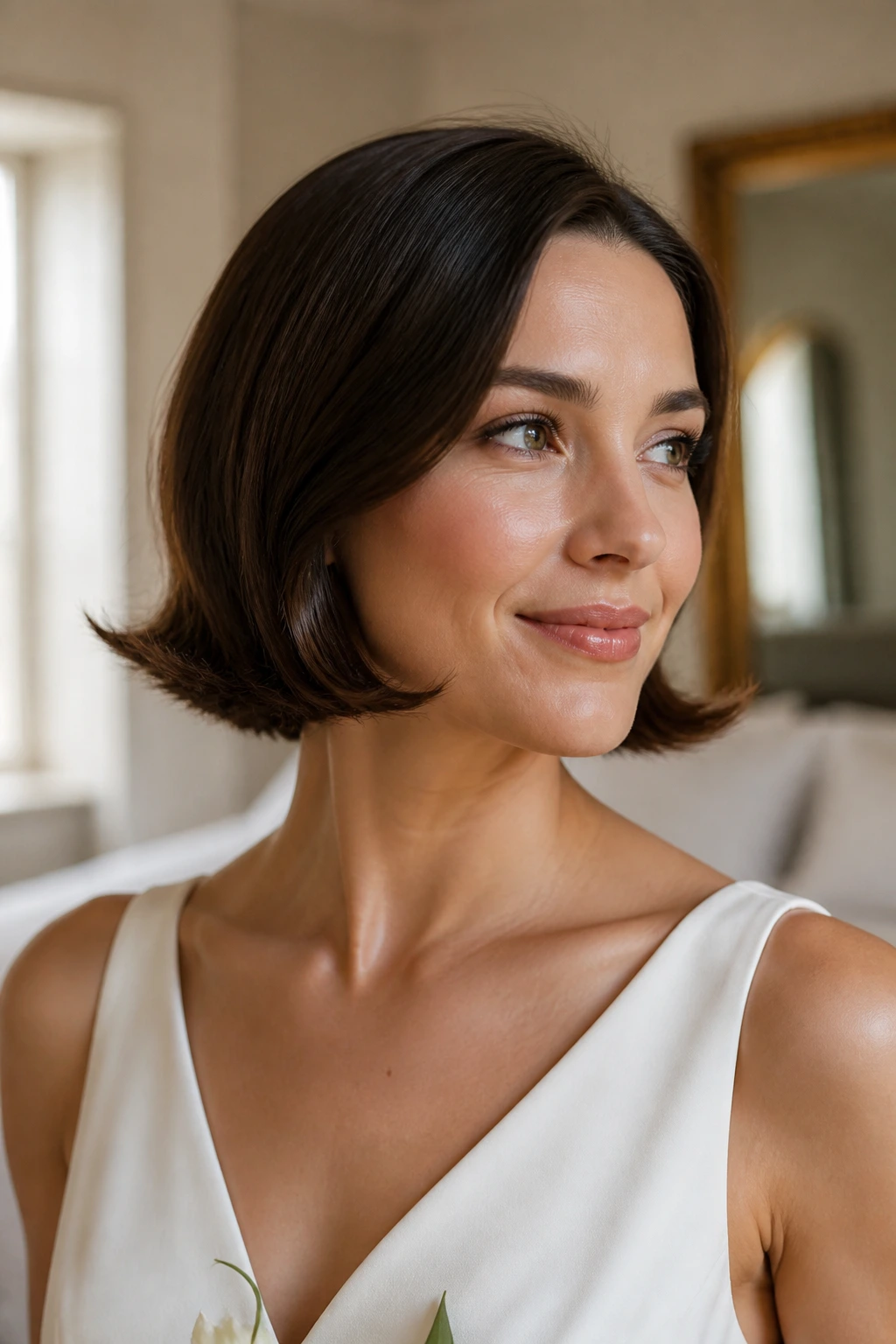
A bob with flipped ends has more personality than people give it credit for. The ends curl outward just a touch, the crown stays smooth, and the whole style gets a nod to mid-century bridal hair without turning costume-y.
Why it works: The flip gives the bob a clear silhouette. On short hair, silhouette matters almost more than volume because the shape is visible immediately. A soft flip at the ends makes the cut read finished and lively.
This one is especially nice with a simple dress and a clean neckline. The hair carries some motion, so you don’t need to overload the rest of the look. Keep the flip even, though. Random bending at the ends looks like the iron slipped, not like a style choice.
Pro tip: Curl the ends under first, then rotate the brush or iron outward at the very tip. That gives the flip a cleaner line.
17. Soft Pinned-Back Waves with a Cathedral Veil
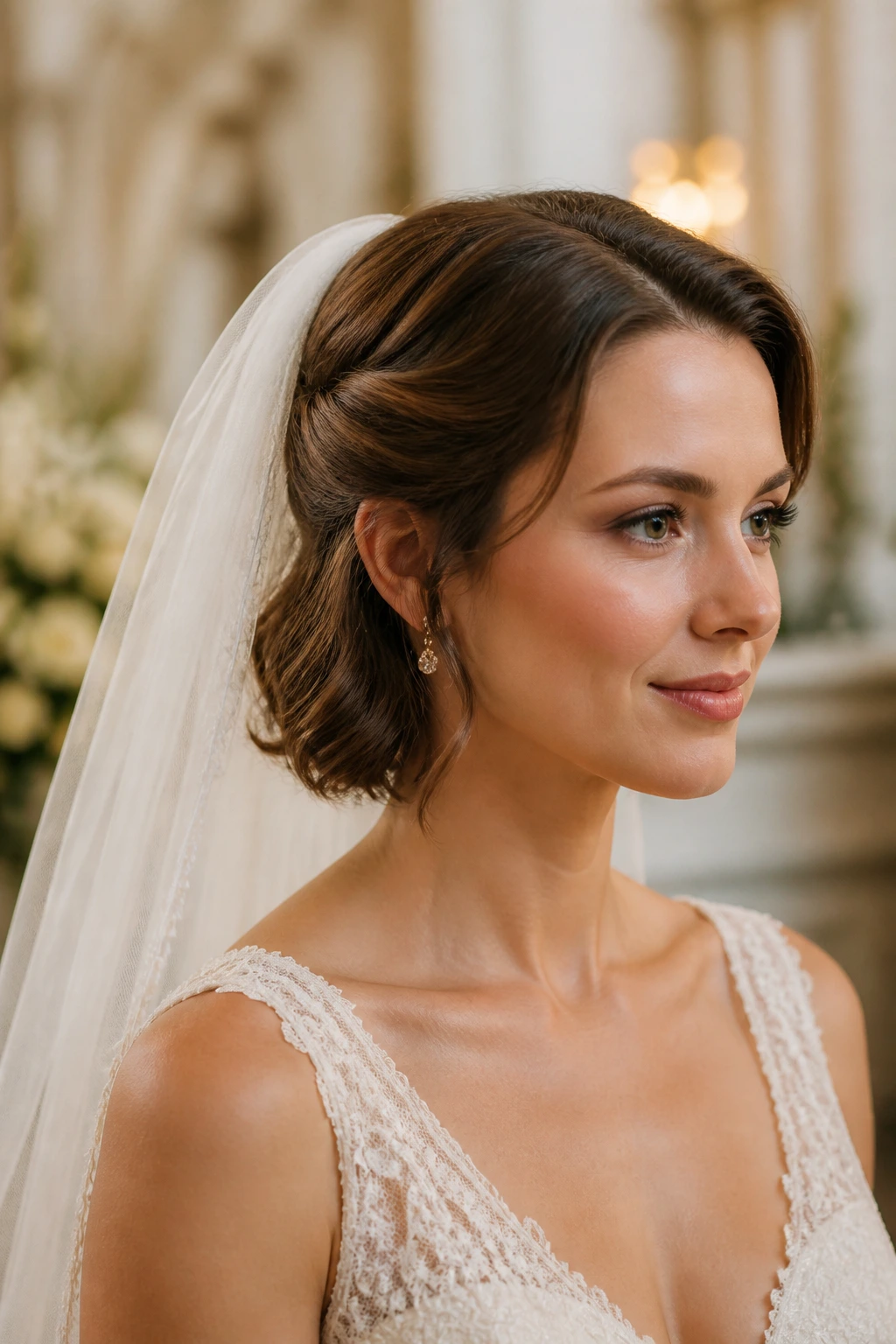
If you want the veil to feel central without hiding the hair, this is the move. The waves stay loose through the bob or lob, the sides are pinned back just enough to clear the face, and the veil comb sits above the pin line so the fabric drops cleanly.
Why it works: The pinned-back sides create a frame, not a cage. The veil gets a stable anchor, and the waves underneath keep the style from looking overbuilt. It’s a strong choice for brides who want the ceremony look to feel traditional and the reception look to feel a little softer once the veil comes off.
A cathedral veil can be heavy, so the base matters. Don’t rely on one comb and hope for the best. Pin into a secure section near the crown and hide the support under the wave pattern.
Best for: Medium-short hair, fuller veils, and gowns with a long train or dramatic back.
18. Braided Mohawk on Short Natural Curls
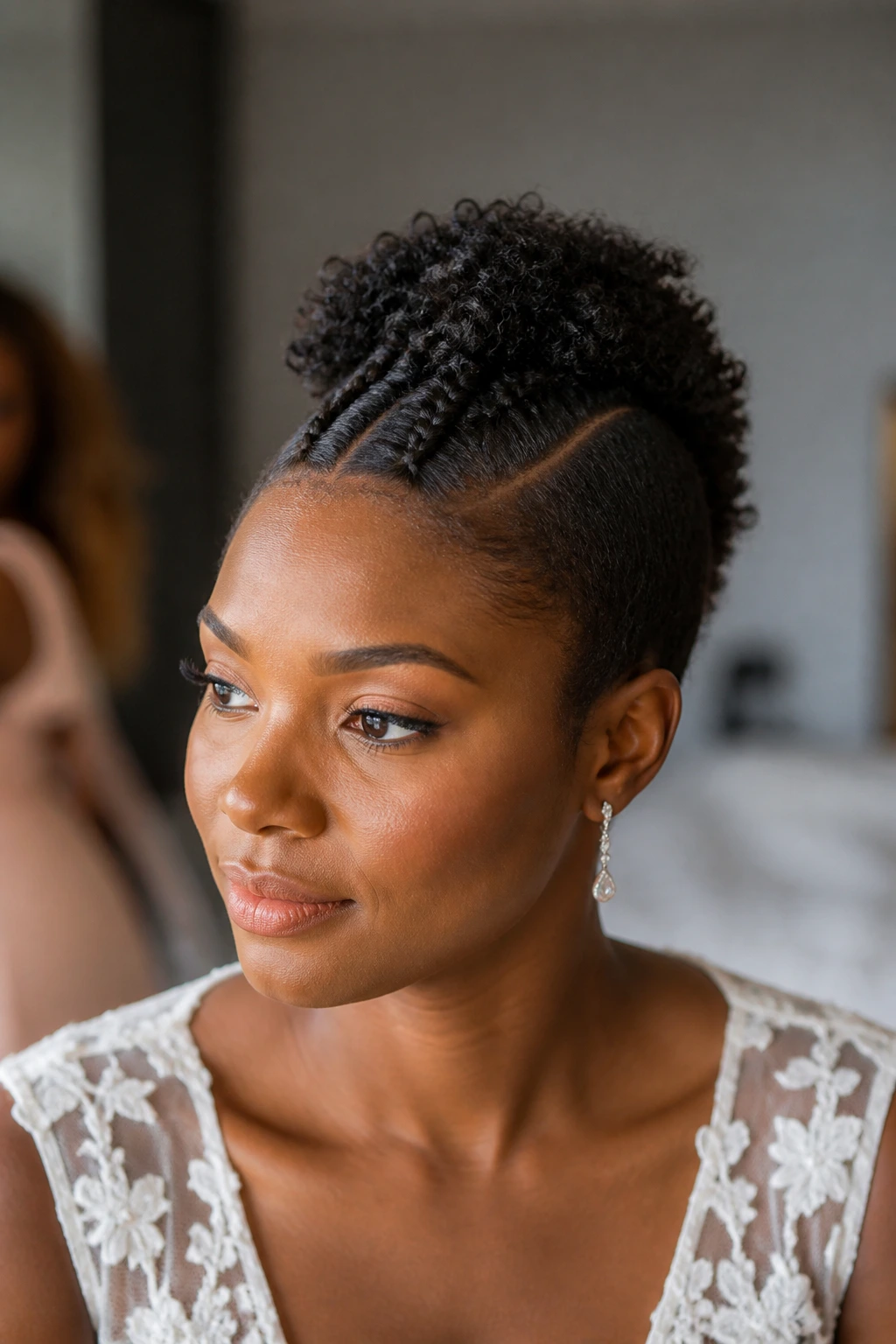
This is the style for brides who want texture to be the point. The sides stay sleek or softly pinned, while the center section rises in a braid or braided ridge that runs from the hairline toward the crown. On natural curls, it turns into a bold, sculpted shape that still feels rooted in the hair’s own texture.
Why it works: It gives short curls height without flattening the sides. That contrast is the reason it looks so striking. You are not forcing the curl pattern into a soft cloud; you’re shaping it into a lane down the center and letting the rest frame it.
Style notes
- Use a curl cream or twisting butter that keeps definition
- Pin the sides low and tight so the mohawk line reads clearly
- Leave some curl texture on top for softness
This is one of my favorite short-hair bridal styles because it knows exactly what it is. No apology. No pretending to be longer or simpler than it is.
19. Minimalist Slicked-Back Short Hair with a Modern Headband
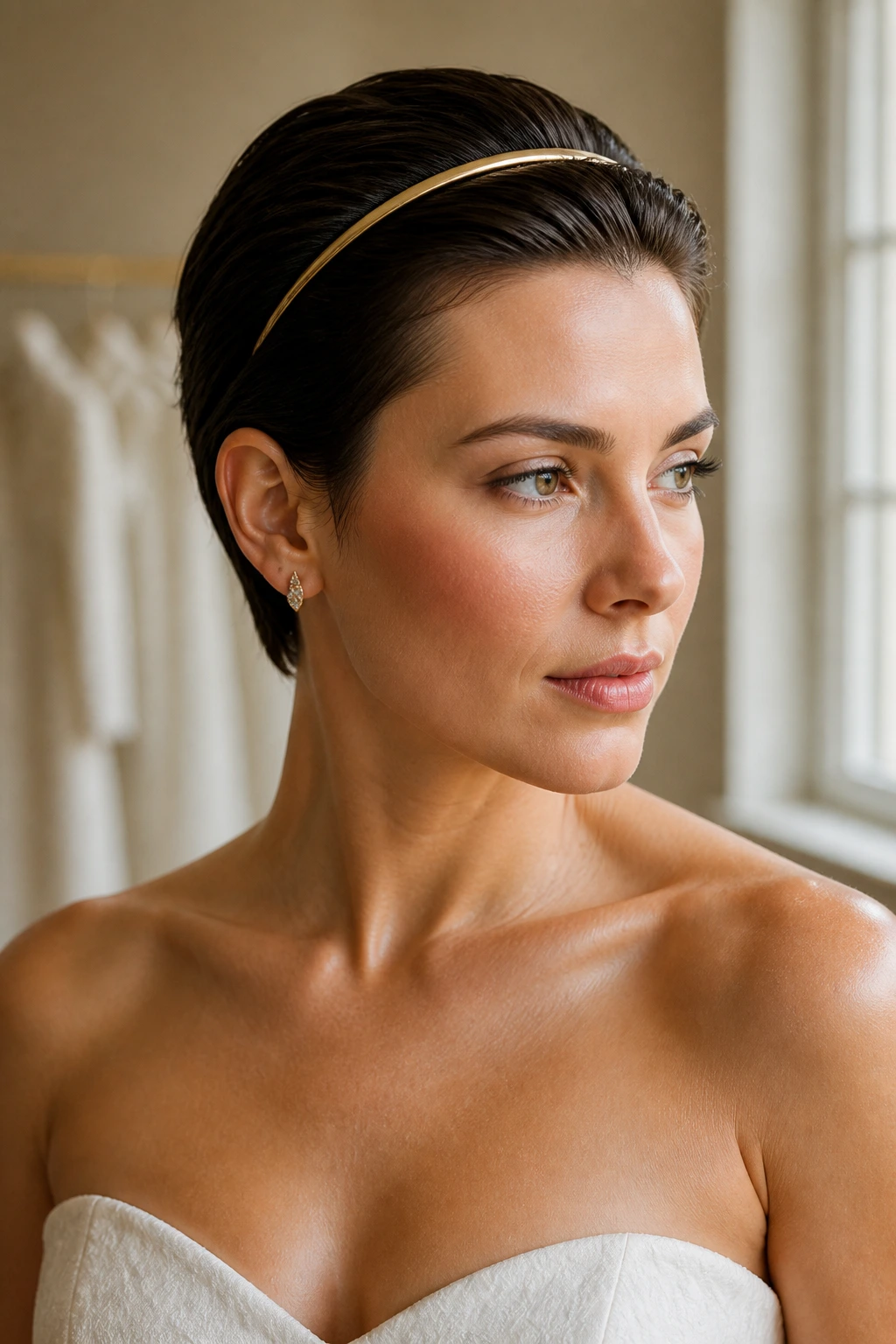
The last look is stripped down on purpose. Slick the hair back, keep the sides smooth, and place a modern headband or slim metallic band where it creates the cleanest line across the head. That’s it. No fuss, no extra twist, no fake fullness hiding underneath.
Why it works: It puts the cut and the accessory in the same conversation. The headband frames the face, the slick finish opens the features, and the overall shape feels contemporary without getting cold. If your dress has strong tailoring or a simple column shape, this look lands beautifully.
This style also holds up well in heat because there is not much to collapse. That matters more than people think. If you’re the kind of bride who hates checking a mirror every twenty minutes, this one is a smart bet.
Best for: Very short hair, minimalist dresses, and brides who want the shortest route to a finished look.
What Makes Short-Hair Bridal Styling Easier Than It Looks
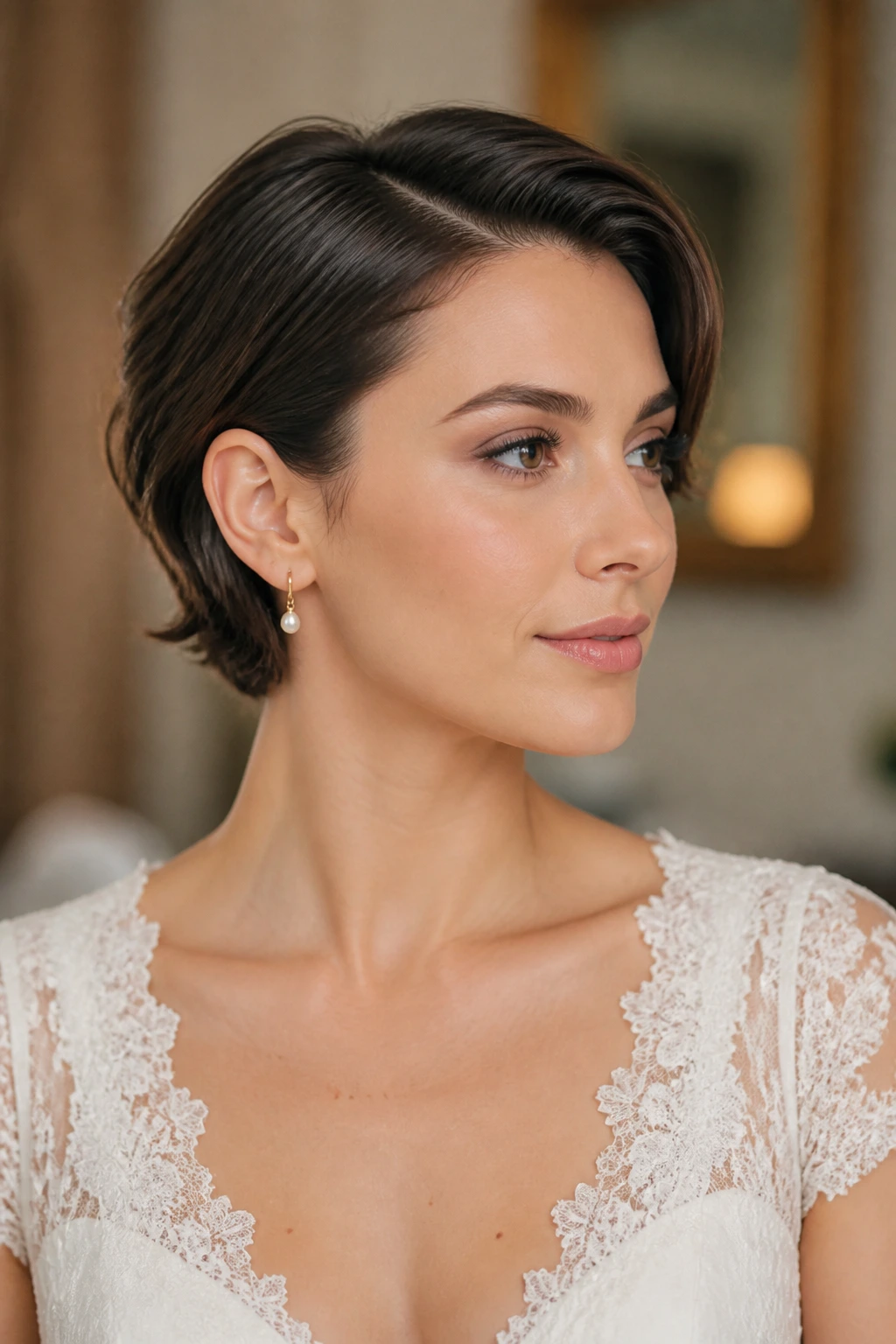
Short hair gives you fewer moving parts. That sounds obvious, but it changes everything. A bob does not swing around a chair back. A pixie does not swallow pins the way long layers can. A lob can be bent, tucked, waved, or clipped with fewer hidden anchors because there simply isn’t as much hair fighting you.
That means the bridal style can be built around the haircut you already have. Good short-hair styling does not pretend the length is longer. It uses the length honestly. A clean side part, a sharp wave, a tuck behind the ear, a barrette in the right spot — these are not consolation prizes. They are the design.
I also like short hair for ceremonies because it keeps the neckline visible. That matters whether the dress is lace, satin, crepe, or something with a clean square neck. Long hair can be gorgeous, sure, but it can also cover the details you paid for. Short hair tends to respect the dress instead of competing with it.
Tools That Make These Looks Hold
- Rat-tail comb: Essential for clean parts, small sectioning, and teasing just the spots that need lift.
- 1-inch curling iron or wand: The workhorse for bobs, lobs, and short waves that need definition without giant curls.
- Flat iron: Best for smoothing pixies, shaping flips, and controlling ends that want to stick out.
- Strong-hold hairspray: Use a brushable formula if possible; you want hold, not a shell.
- Texturizing spray or dry shampoo: Gives short hair grip so pins and clips stay where you put them.
- Bobby pins and U-pins: Stock both. Fine hair usually likes bobby pins; thicker sections may need U-pins for a safer hold.
- Mini clear elastics: Useful for tiny braids, twists, and hidden anchoring.
- Hair oil or shine serum: Use a drop, not a pour. Ends only, unless you want slip.
- Veil comb or clip base: Vital if the veil is part of the plan; don’t assume the veil hardware will magically work with your hair.
- Decorative barrette, comb, headband, or vine: Choose one focal accessory and let the style breathe around it.
Smart Product and Accessory Tips
Short hair does not need a mountain of product. It needs the right kind. If the hair is fine, start with a texturizing spray at the roots and a light mist of hairspray after the shape is set. If the hair is thick or coarse, use a smoothing cream first so the surface lies down before you add pins or clips. The whole style behaves better when the base is doing its job.
Accessory weight matters more than people expect. A heavy crystal comb can pull on fine hair and slide under its own weight, especially if the roots are freshly blown out. A lighter comb with a decent grip often holds better than a giant ornate piece that looks lovely in the box and annoying on the head. I’d rather see one well-anchored accessory than three that keep moving.
Metal finish is worth matching to your jewelry. Cool silver, pearl, and clear crystal feel different from gold, rose gold, or antique brass, and short hair makes that difference obvious because the accessory sits close to the face. If your earrings are bold, keep the hair ornament simpler. If the dress has tiny beadwork, the hair piece can carry a little more shine.
For pinning, use hair-color-matched bobby pins whenever you can. They disappear better, which is the point. And if you’re working with a veil, pre-pin the veil comb to a small test section before the wedding day so you know how much grip it really has. Guessing is a bad plan here.
How to Match the Hair to the Dress, Veil, and Setting
Presentation: Clean necklines love sleek pixies, tucked bobs, and side sweeps. Softer dresses — chiffon, lace, tulle — can handle loose waves, braids, and pinned-back texture because the hair and fabric are speaking the same language. If the dress is dramatic, keep the hair shape clear and skip the extra fluff.
Accessories: Pick one star. A barrette, a comb, a headband, or a veil can all take center stage, but all four together usually look crowded on short hair. If the earrings are large, let the hair accessory stay smaller. If the veil is long, the ornament should support it, not shout over it.
Veil placement: Short hair usually works best when the veil comb lands over a pinned base near the crown or just behind it. Pixies and mini twists often need a little hidden anchoring underneath so the veil does not slide. Birdcage veils are easier because they sit close and light.
Ceremony setting: Outdoor weddings and humid rooms reward styles with stronger texture and more pin support. Indoor, formal spaces can handle sleeker looks with a polished finish. If the event moves from ceremony to reception, choose a style that still looks good when the veil or accessory comes off.
Additional Tips and Finishers
Texture Boost: If the hair is too soft, mist the roots with dry shampoo and rough-dry with your fingers before styling. That one step changes how the pins behave. It gives them something to bite into.
Lift at the Crown: A little root tease at the crown can make a short cut look more dimensional, especially in profile. Keep it small and hidden. You’re building shape, not a nest.
Finishing Shine: Use a pea-sized amount of serum on the ends only. Short hair gets greasy fast if you smear product everywhere. Shine should look like healthy light reflection, not oil spill.
Make-It-Yours: If your style feels too sweet, swap pearls for metal. If it feels too hard, add a soft wave or one loose tendril at the temple. One small change can shift the whole mood.
Common Mistakes to Avoid With Short-Hair Wedding Styles
The biggest mistake is washing the hair until it squeaks and then expecting it to hold. Fresh, very clean hair is slippery. It can work for a sleek pixie or wet-look style, but for pinned shapes and waves, it often needs a little grip from day-old texture or dry shampoo.
Another problem is over-producting the hair in a panic. Too much serum, too much spray, too much smoothing cream — and the style starts sliding around like it’s on ice. The fix is simple: use products in layers, and stop as soon as the hair looks controlled. You can always add a touch more shine later.
Heavy accessories cause trouble too. If the comb is large and the hair is fine, the piece may tilt after an hour of dancing, hugging, or veil removal. Choose a lighter ornament or anchor the base with more pins. A pretty accessory that won’t stay put is just a headache in disguise.
Skipping a trial run is a classic error. Short hair can look completely different once it’s waved, pinned, or tucked, and what feels secure in the bathroom mirror may not survive movement or humidity. Test the look, wear it for a few hours, and shake your head a little. If it moves too much at the trial, it will move more on the day.
Finally, some brides forget the side and back views. Short hair can look wonderful from the front and then go flat at the crown or messy at the nape. Turn around in the mirror. Get a second mirror. Check the profile, because that’s where the little failures hide.
Variations and Adaptations to Try
The Fine-Hair Lift: Add a hidden bump of texture spray at the roots, then choose styles that rely on shape rather than volume, like the side-part pixie or tucked bob. Fine hair looks best when it’s not asked to impersonate thick hair.
The Curly-Texture Edit: Replace smooth pinning with curl-friendly shaping cream and soft anchoring. The curly bob, braided halo, and pinned-back wave styles all get better when the curl pattern is allowed to stay visible.
The Veil-First Version: If the veil matters most, keep the hair shape compact and secure. The faux bob, mini French twist, and soft pinned-back waves are the easiest places to anchor heavier veil hardware without fighting the cut.
The Minimalist Metal Finish: Swap florals and pearls for a single slim barrette, a clean comb, or a narrow headband. This keeps the look sharp and pairs well with modern dresses, square necklines, and simple jewelry.
The Bold Jewelry Option: Let the hair go quieter — slicked back, tucked behind the ears, or lightly waved — and put the visual energy into earrings. Short hair does not need to compete with statement pieces; it can make them look better by giving them room.
The Romantic Garden Twist: Use tiny braids, soft waves, and one or two fresh flowers tucked near the temple. Keep the blooms small and secure. The whole look should feel light enough to move.
Make-Ahead, Prep, and Hold for the Wedding Day
A short-hair bridal style usually behaves best when the haircut has a little memory in it. That means the style trial should happen at least once before the event, and preferably with the same part, products, and accessory you plan to wear on the day. Don’t switch a side part to a center part at the last minute and hope the hair forgives you. It won’t.
If your hair tends to go soft fast, wash it the day before and let it dry with a light texture product. If your style is sleek or wet-look, you may prefer freshly washed hair, but even then the finish product should be applied in layers so the hair does not collapse by lunch. For most pinned, waved, or braided styles, a little natural texture is your friend.
Keep a tiny kit nearby: a few matched bobby pins, one mini hairspray, a small comb, blotting paper for shine around the hairline, and your accessory or veil comb wrapped safely so it doesn’t bend. If you’re changing from ceremony to reception, plan the transition. Some brides remove the veil and leave the hair as is. Others want one quick fluff at the crown or a clip swapped for a smaller one.
As for staying power, a well-set short style should comfortably last through the ceremony, photos, and dinner with only light touch-ups. If you’re dancing hard or the weather is humid, expect to re-pin one side or smooth the hairline once or twice. That’s normal. A bridal style does not need to be frozen in place to work.
Frequently Asked Questions
Can brides with very short hair wear a veil?
Yes, and the hair length matters less than the anchor point. Pixies and short bobs can hold a veil if the comb is pinned into a textured base with a few hidden bobby pins.
Do short hair wedding styles need extensions?
No. Extensions can help with a faux bob or fuller chignon, but most of these looks work without them. Short hair often looks cleaner when you keep the shape honest and let the cut do its job.
What’s the best wedding hairstyle for a pixie cut?
A sleek side part, sculpted pompadour, or glossy wet-look finish usually gives a pixie the most bridal presence. Add one accessory — not three — so the shape stays clear.
How do I keep bobby pins from slipping out of short hair?
Cross two pins in an X shape, insert them against the direction of the hold, and pin into a section with a little texture spray or dry shampoo. Smooth, freshly washed hair is the usual culprit when pins slide.
Should I wear my hair up or down if I have a bob?
A bob usually looks best in a half-up, tucked, waved, or side-swept style rather than a forced updo. If the back is too short to gather cleanly, use the haircut’s shape instead of fighting it.
Can curly short hair hold a formal bridal style?
Absolutely. Curly hair often holds shape better than sleek hair because the texture itself gives grip. The trick is choosing a style that respects the curl pattern instead of flattening it.
What if my hair frizzes in humidity?
Choose a style with texture built in — waves, braids, or a polished pixie with a firm finish — and keep a smoothing cream for the hairline only. Heavy oils often make frizz look worse, not better.
How far in advance should I do a trial run?
Give yourself enough time to change course if the first version is wrong. A trial a few weeks out is usually enough to test hold, accessory placement, and veil weight without rushing the fix.
Can I change the look from ceremony to reception?
Yes. That’s one of the hidden perks of short hair. A veil can come off, a comb can be swapped for a barrette, and a pinned style can be loosened a touch for the dance floor without starting from scratch.
Short Hair, Properly Framed
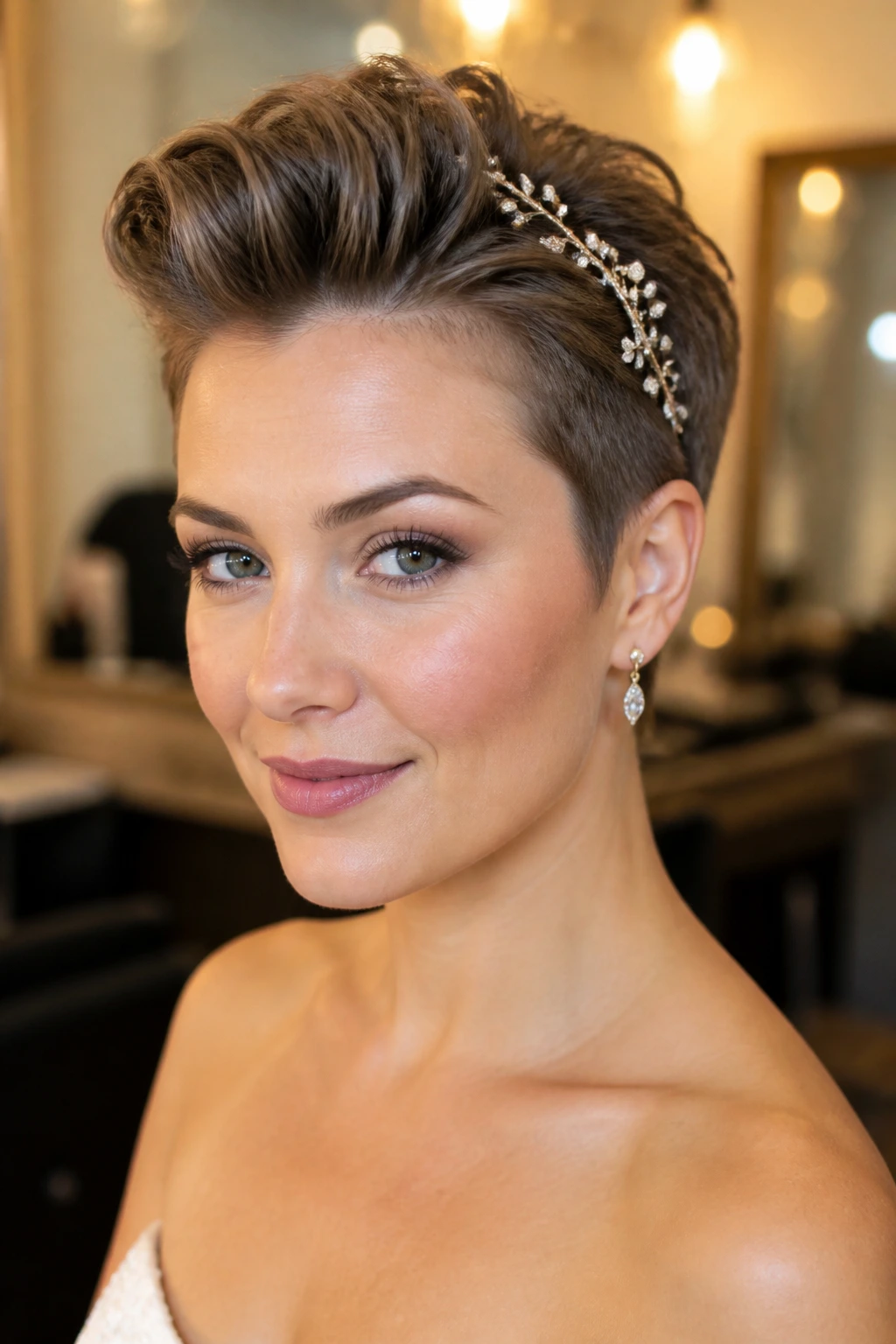
Short hair does not need permission to look bridal. It needs shape, a little planning, and an accessory that sits where it’s supposed to sit. Once those pieces line up, the haircut stops feeling like a compromise and starts acting like the frame for the whole day.
The best part is how honest these styles are. They don’t hide the cut. They use it. That’s why wedding hairstyles for brides with short hair can look so crisp, so modern, and, when done well, so much more memorable than a style that tried too hard to borrow length it didn’t have.
