



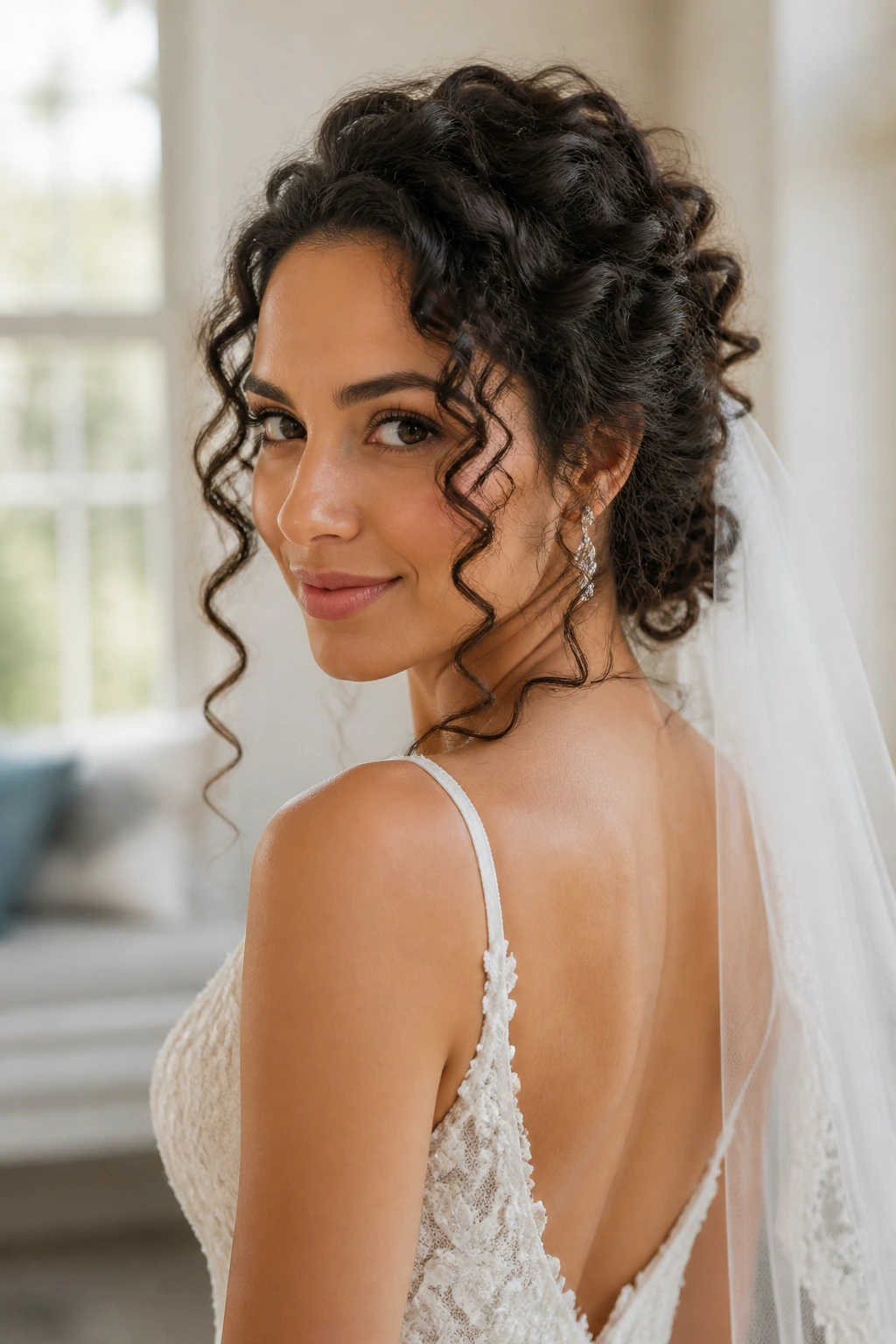
Curly hairstyles for brides with long hair live or die by shape. If the crown collapses, the whole look feels tired; if the curls are pinned so tightly that they stop moving, the hair loses the very thing that makes long length worth showing off.
That balance is the whole game on a wedding day. The hair has to survive hugs, veil changes, a few emotional moments, a camera that never seems to stop, and maybe one stubborn gust of wind right after the ceremony. Long curls can do all of that, but only when the style respects the curl pattern instead of fighting it. A flat iron can smooth the edges, sure, yet the best bridal looks usually keep some bend, some lift, and some real air between the pieces.
I keep coming back to styles that anchor at the back of the head and leave enough curl around the face to soften the bone structure. Those are the looks that still look like hair at midnight, not a shell by the dessert table. The ones below lean into that idea in different ways, from polished and formal to loose and garden-soft.
Why These Curly Bridal Looks Work So Well
-
They use the curl itself as structure: A curl with shape has more grip than freshly blown-out hair, which means braids, twists, and pins actually stay put longer.
-
They give long hair a place to go: Heavy lengths can drag a style down fast; these looks keep the weight distributed so the crown doesn’t sag by the first toast.
-
They leave room for a veil or comb: Most of these styles create a stable anchor point without burying the entire back of the head under pins.
-
They work with natural texture or set curls: Whether your hair starts curly, wavy, or mostly straight, the styles still make sense once the curl pattern is defined.
-
They keep movement around the face: A few tendrils or soft side pieces stop the style from looking too severe, which matters in bright daylight and close-up photos.
-
They scale up or down easily: Add pearls, flowers, or a stronger hold spray and the same base style can feel softer, sharper, or more formal.
1. Soft Half-Up Curl Cascade
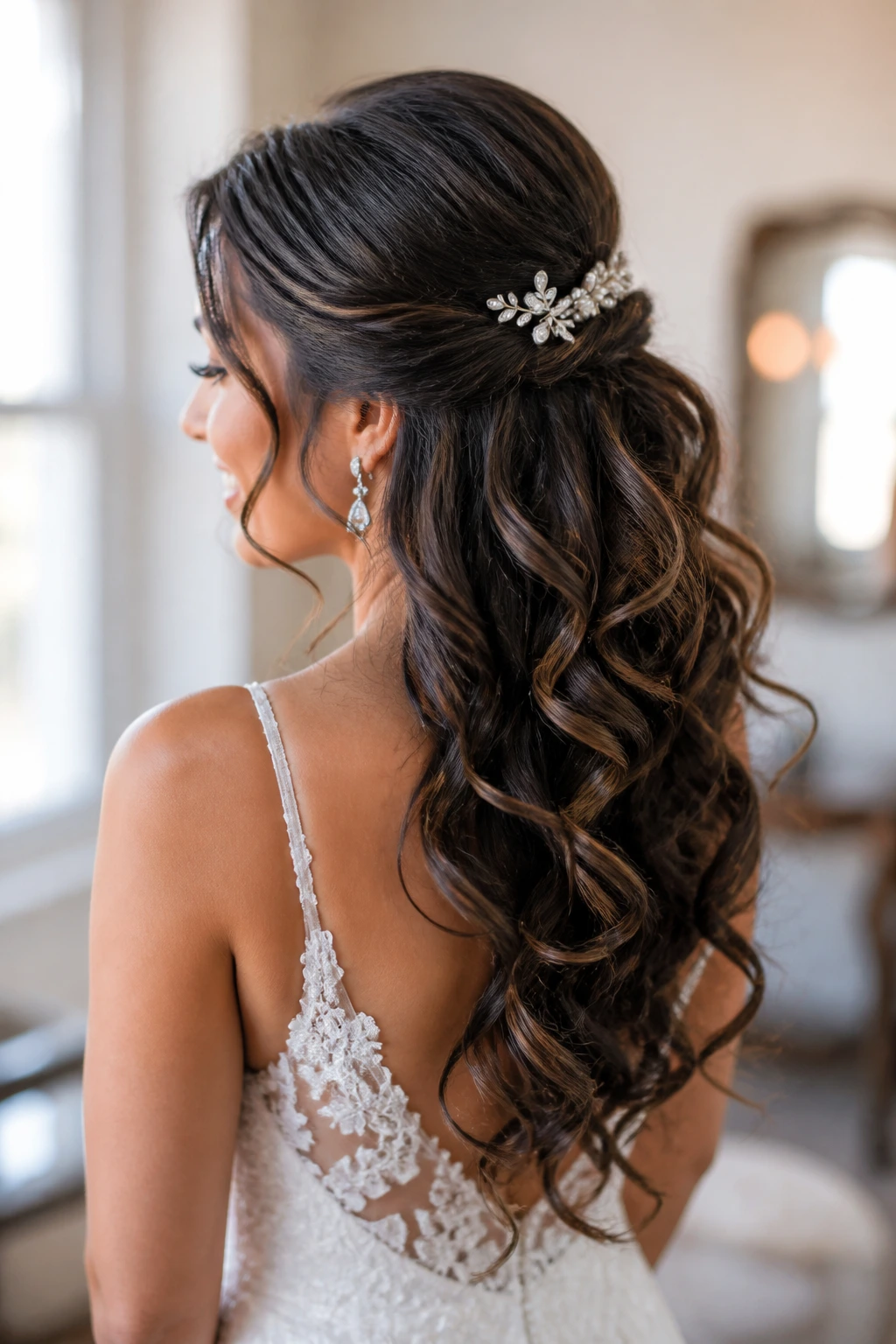
A soft half-up curl cascade is the style I reach for when the bride wants to wear her hair down but still needs the face opened up. The top section is lifted just enough to create shape, then pinned so the long curls can fall freely down the back and over the shoulders.
Why it stays soft
The trick is keeping the crown lifted only 1 to 2 inches, not building a helmet. That small amount of height gives the style room to breathe, and it keeps the top from collapsing into the face as the day goes on.
- Best with: Long layers, medium-to-thick curls, and gowns with open necklines.
- Anchor point: Two crossed bobby pins behind each ear.
- Accessory fit: A small comb, pearl pins, or a short veil.
A style like this is forgiving. If one curl loosens, the whole look still holds because the rest of the hair is doing the visual work.
2. Low Curly Chignon With Face-Framing Pieces
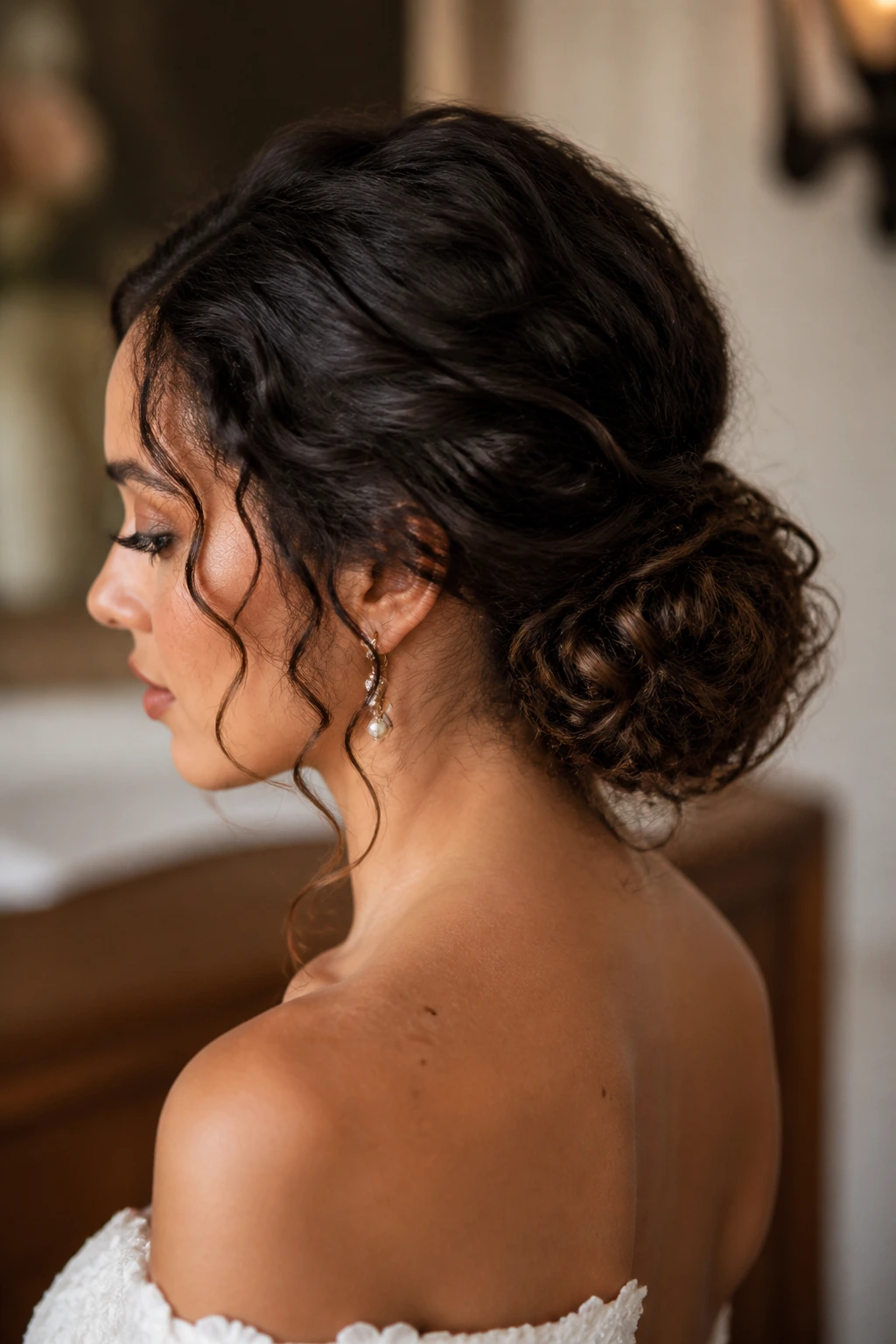
If you want polished without looking stiff, a low curly chignon earns its keep. The curls are gathered at the nape, folded into a soft bun, and left a little imperfect on purpose so the texture still shows from the side.
That low placement matters. It keeps the weight off the crown, which helps long hair stay secure through a full day of moving around. Leave two curled pieces in front of the ears, and the whole style stops feeling too formal the second you turn your head.
This is one of my favorites for heavier earrings and structured dresses. The bun gives the back of the head a clean line, while the loose face pieces keep the style from reading severe.
3. Side-Swept Hollywood Curls
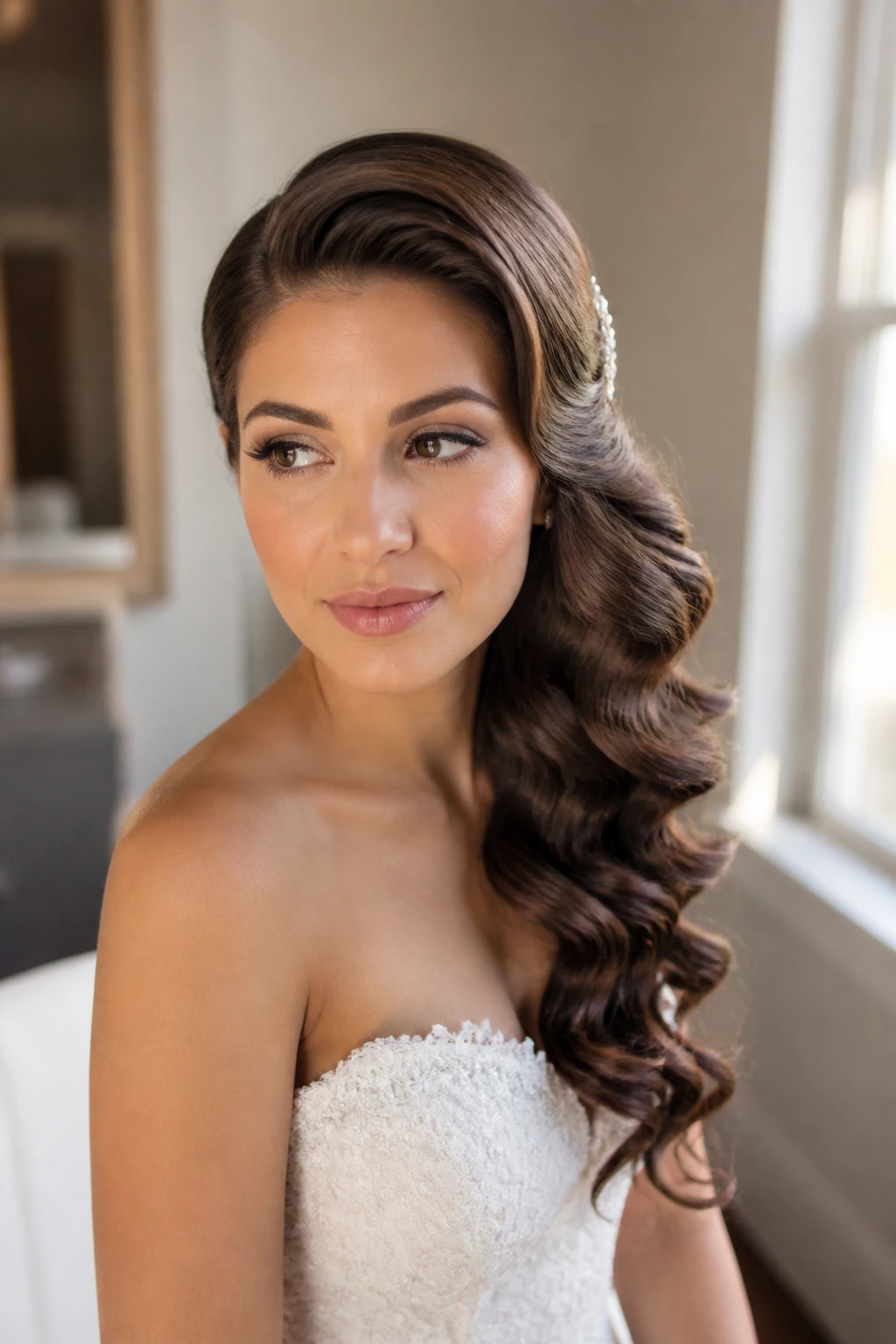
Need glamour without a full updo? Side-swept Hollywood curls do the job with less fuss than people expect. A deep side part, one side pinned flat at the temple, and the length swept over one shoulder create that old-school curve that looks sharp in person and still moves when you walk.
The best version uses medium-to-large curls, not tight ringlets. Big curls make the wave pattern visible from across the room, and the side sweep gives the dress neckline something to frame instead of compete with.
A little root lift at the part helps a lot. Without it, the style can start to fall flat near the face, and then the whole silhouette loses its shape before the reception even begins.
4. Braided Crown With Loose Length
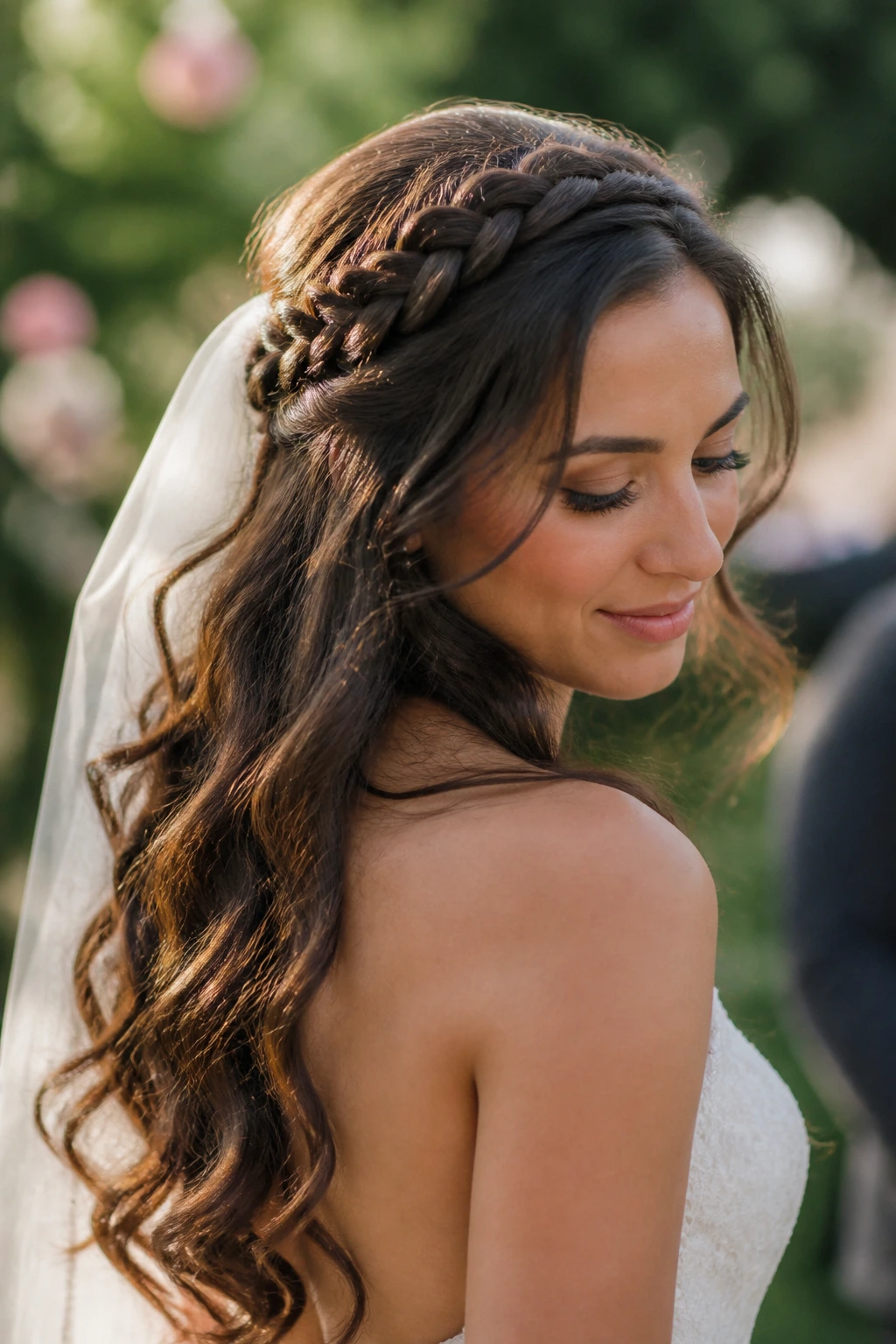
Picture a bride who wants her hair off her face but refuses to give up the length. That is where a braided crown steps in. A thin braid wraps from one side of the head to the other, then disappears into the back while the rest of the curls hang loose.
Small details that matter
The braid should sit just above the ear line, not high on the head. Too high, and it starts to look costume-like; too low, and it loses the crown effect.
- Pin count: Usually 6 to 10 pins, tucked under the braid.
- Best for: Outdoor ceremonies, garden venues, and hair that needs extra control at the front.
- Texture note: Works best when the curls are set first so the braid has grip.
This style has a nice side effect: it hides a little bit of grow-out or uneven curl pattern near the temples, which is handy if the hair was curled a few hours earlier.
5. Curly Ponytail With Wrapped Base
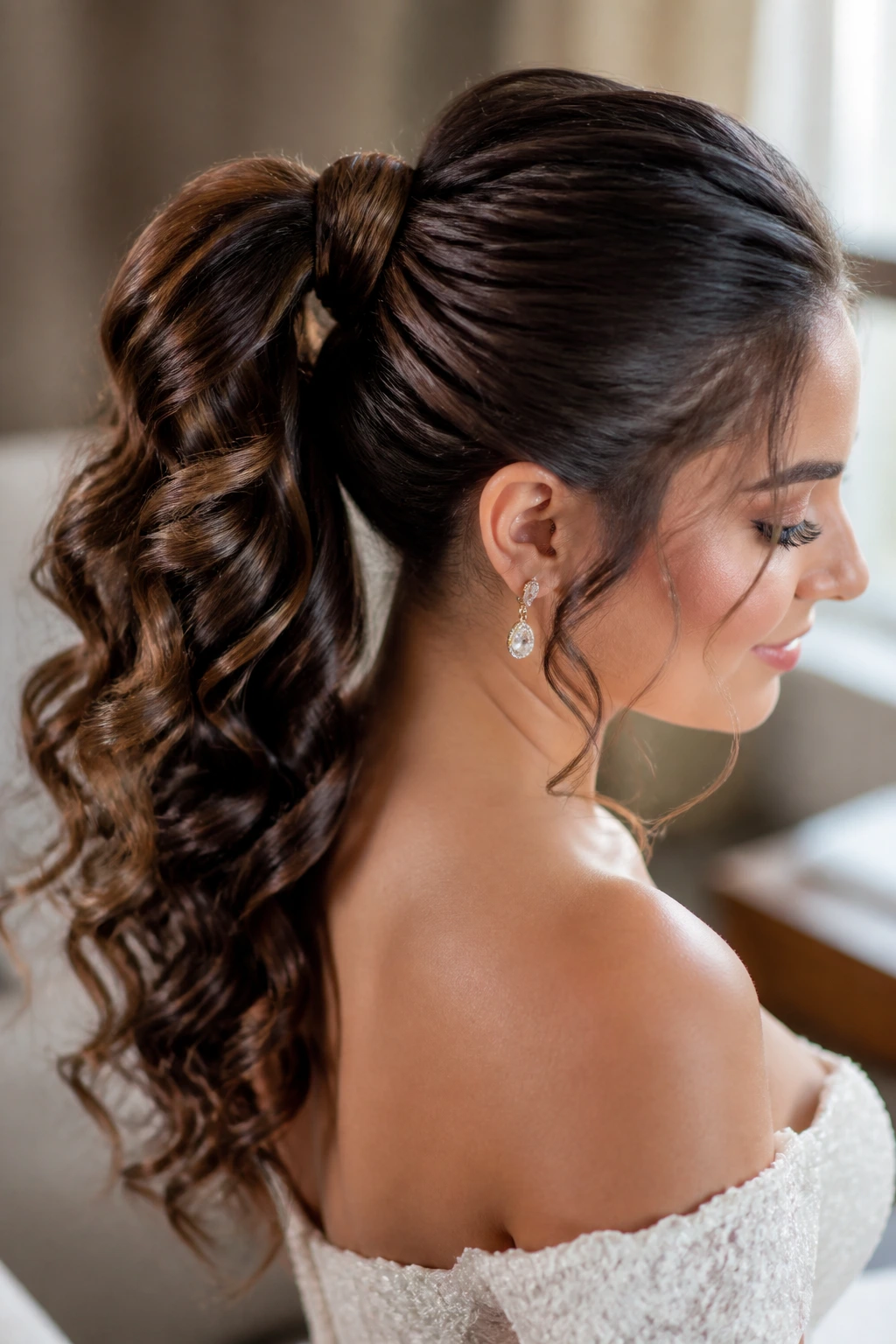
A curly ponytail can look bridal if the base is handled with some care. Gather the hair at the mid-crown or just below it, smooth the top with your hands, and wrap one small curled section around the elastic so the tie disappears.
The length does the rest. Long curls falling from a ponytail have a bit of bounce that an updo can’t fake, and the style keeps the neck open for a gown with a detailed back.
I like this one for brides who move around a lot. It stays out of the way during the ceremony, but it still looks intentional rather than rushed. The wrapped base is the difference between “gym pony” and “wedding pony,” and it’s a bigger difference than people think.
6. Messy Textured Bun With Tendrils
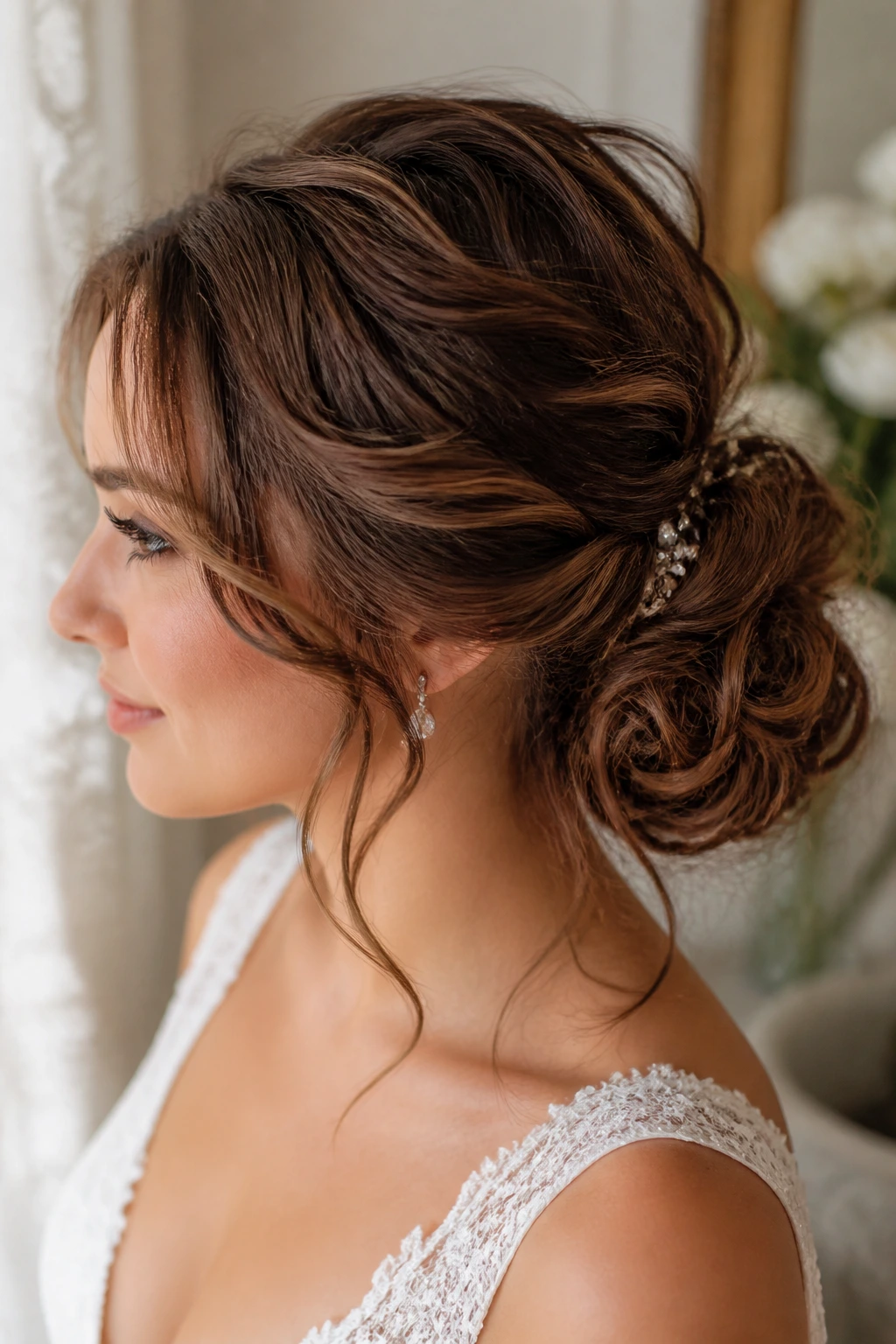
A textured bun is what happens when you stop pretending every bridal style needs to be sleek. The bun sits low or mid-height, the curls are pinned in loops instead of crushed flat, and a few tendrils are left out near the ears and cheekbones.
That looseness is not laziness. It gives the bun a little depth, which is what lets long curly hair look rich instead of compact. If the hair is very thick, this shape is a relief because it removes weight without taking away personality.
I’m partial to this style for brides in lace, tulle, or anything with a softer dress line. The bun gives structure; the tendrils give it motion. Easy balance. No fuss.
7. Waterfall Braid Into Loose Curls
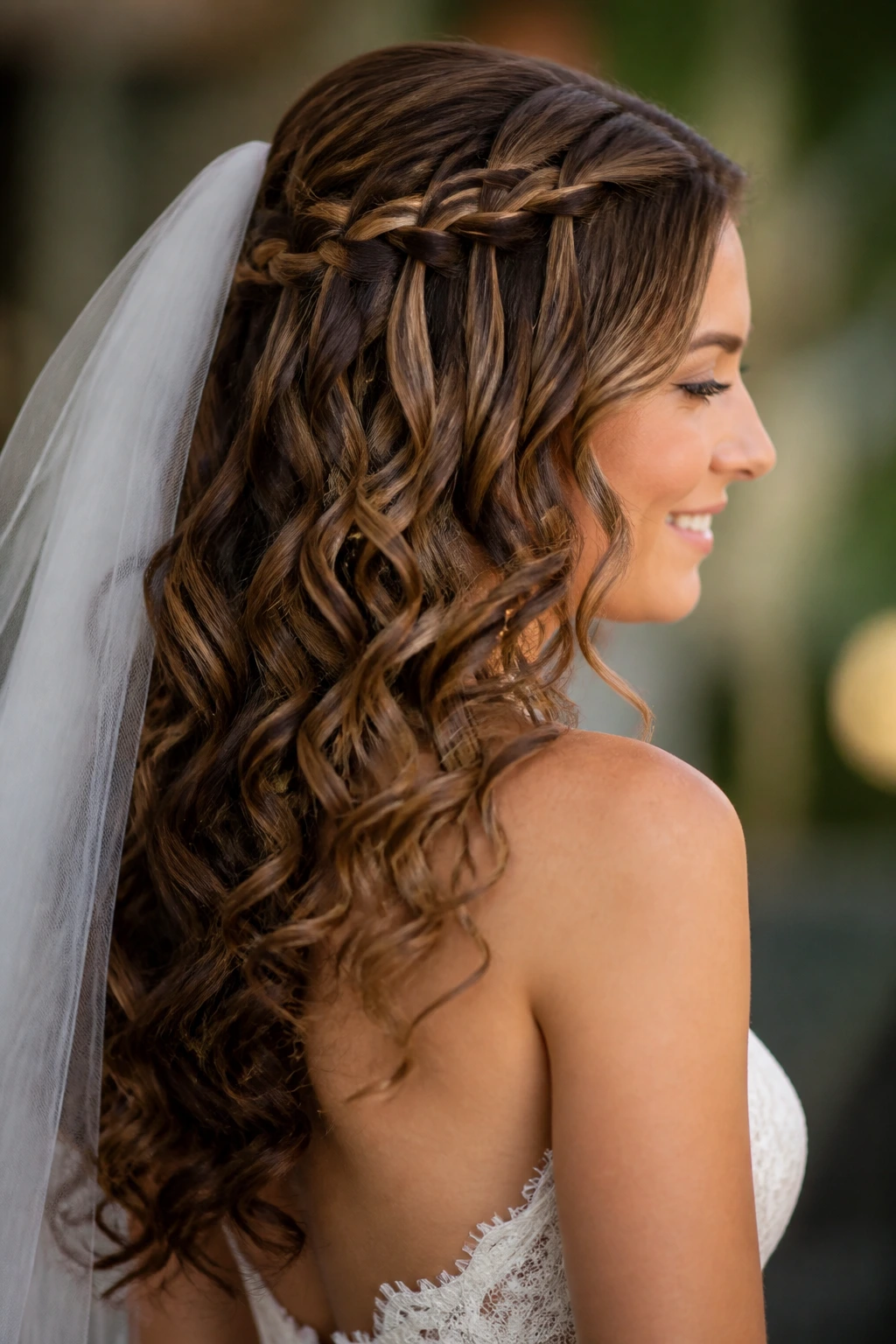
Why does a waterfall braid look so soft on long curly hair? Because it gives the eye something to follow without trapping all the movement. The braid runs across the head like a ribbon, and every dropped section becomes part of the curl curtain underneath.
How to keep the braid from collapsing
Start with day-two hair or lightly set curls so the braid has a bit of texture. Fresh, slippery hair tends to slide out unless you pin more often than you planned.
A small amount of mousse at the roots helps the braid hold. So does crossing the strands snugly, then pinning every few inches where the braid meets the back section.
This style works especially well if the veil will sit low. The braid gives the top a clear visual line, and the curls below keep the length from disappearing into one shape.
8. Romantic Side Braid With Curl Ends
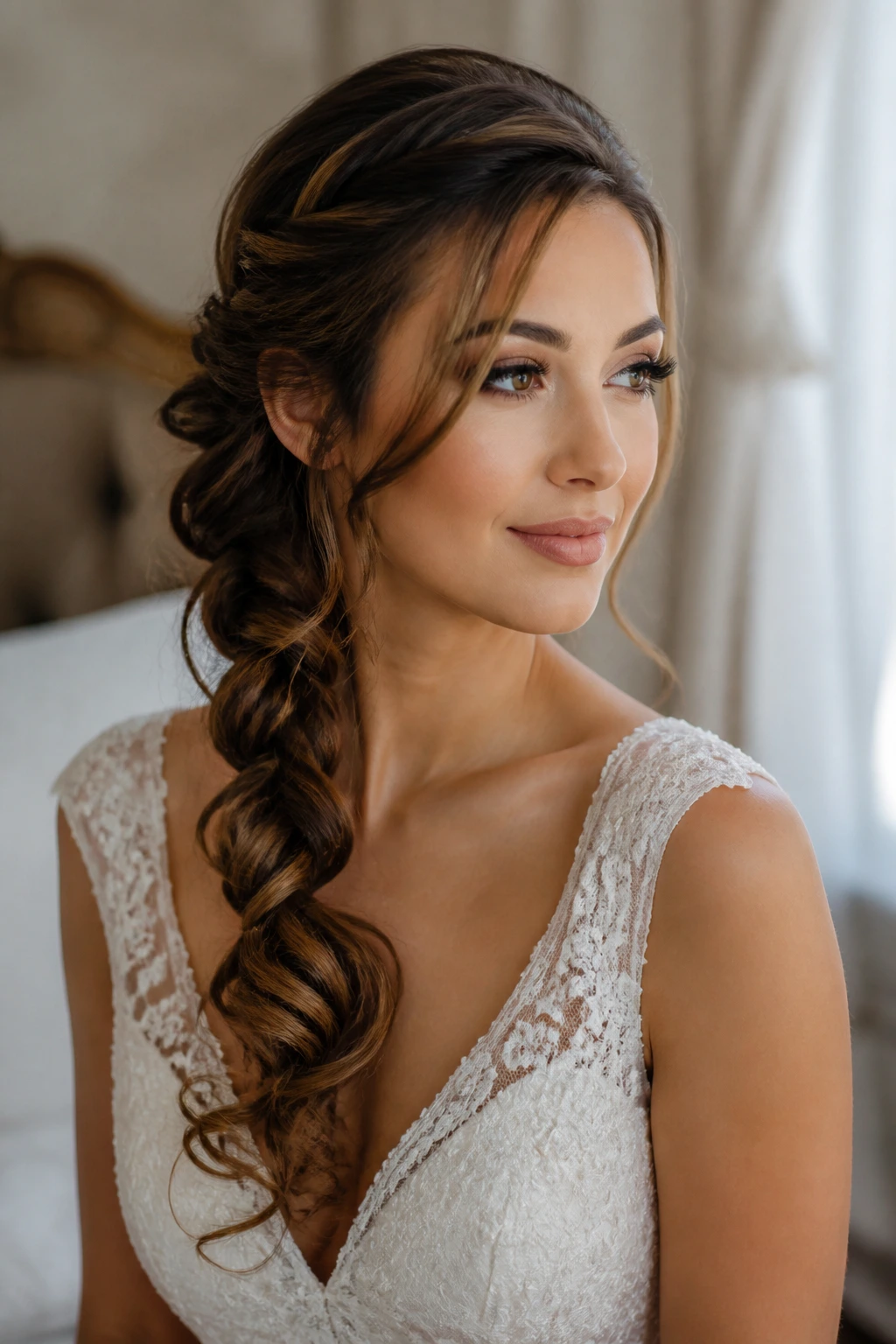
A side braid that finishes in loose spiral ends feels like the opposite of overdone. The braid begins near one temple, sweeps across the back, and settles over one shoulder with the ends still curled so the finish looks soft rather than chopped off.
This is one of those styles that benefits from imperfect pieces around the face. A few curls around the jaw soften the profile, and the braid itself keeps the long length from turning into a single heavy curtain.
- Best paired with: Off-the-shoulder gowns and asymmetrical necklines.
- Works well with: Pearl vines, tiny flowers, or a slim ribbon woven near the end.
- Watch for: Over-braiding. If it’s pulled too tight, the whole look turns rigid.
The best version still has a little looseness at the edges. That tiny slack is what makes it feel bridal instead of athletic.
9. Twisted Half-Up With Pearl Pins
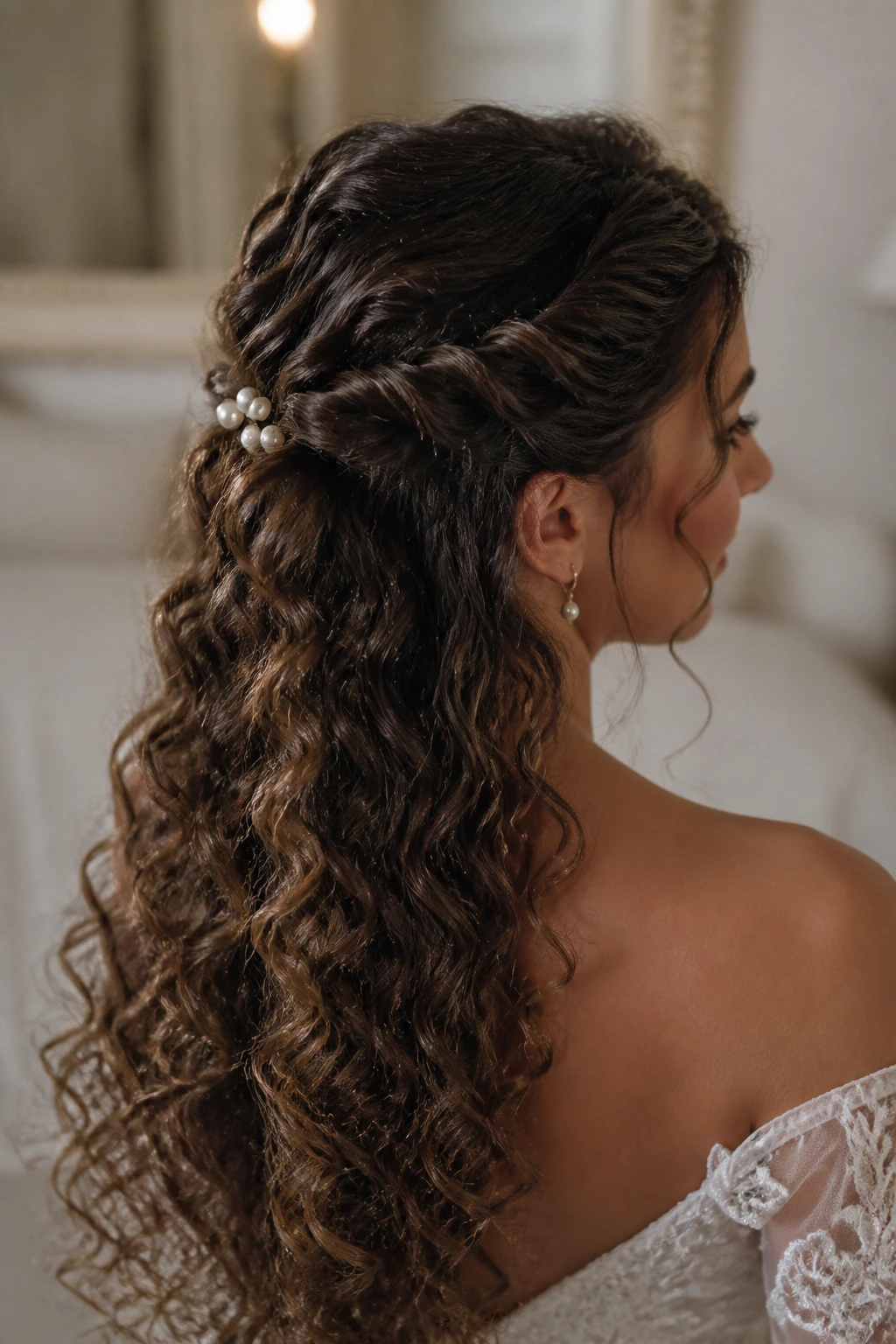
This style has a clean little trick at its center: two sections from the temples are twisted back, crossed, and pinned where they meet. Add pearl pins at the crossing points and the whole thing starts to read more formal without turning into a full updo.
It works because twists show off curl pattern better than a tightly wrapped braid. You can still see the spiral of the hair, which matters when the long lengths are the main event.
I like this for brides who want ornament without weight. The pearl pins can be small and scattered, or they can sit in a neat row if the dress is more minimal. Either way, the style keeps its shape without stealing attention from the rest of the look.
10. Sleek Top Crown And Big Curls
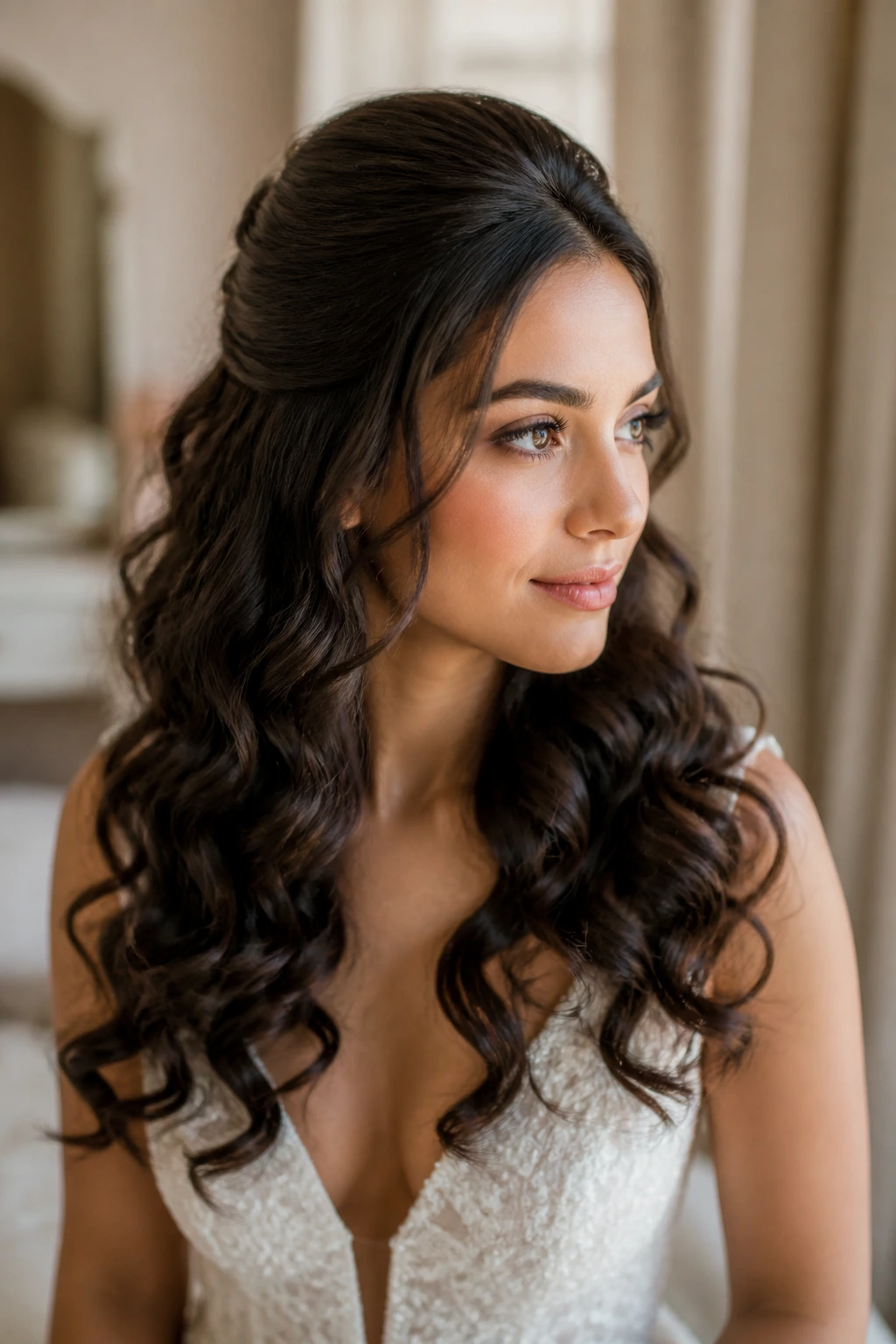
This one has contrast on purpose. The top crown is smoothed and controlled, while the lower lengths stay big and airy. The result feels modern in a way that still lets the curls do their work.
A neat top gives structure to long hair, especially if the roots tend to puff or frizz. Once that upper area is handled, the bigger curls below can stay visible instead of getting lost in the silhouette.
Best when you want the gown to lead
This style suits strapless dresses, square necklines, and anything with a lot of detail at the bodice. The clean top keeps the eye moving downward.
- Top section: Smooth, not slick.
- Lower section: Loose curls with separated ends.
- Finish: Flexible hairspray, not a stiff shell.
That separation is the whole point. One part polished, one part soft. It keeps the hair from feeling too sweet.
11. Curly Gibson Tuck With Volume
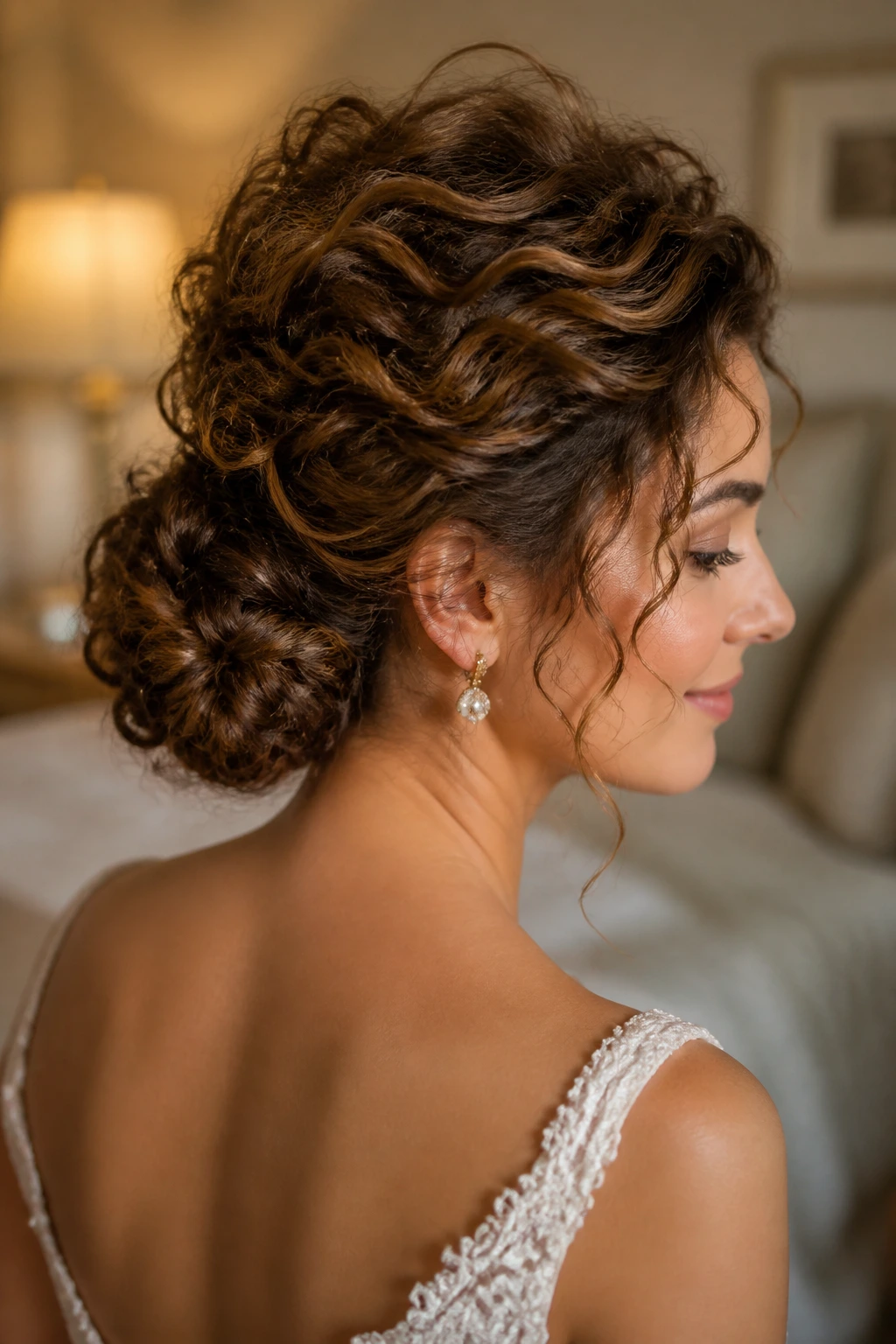
Unlike a tight French twist, the Gibson tuck gives curly long hair somewhere padded to rest. The ends roll inward toward the nape, but the top stays lifted, so the shape keeps its roundness rather than flattening against the head.
The good version is cushioned, not compressed. That means the curls should be pinned in overlapping rolls instead of pushed so flat that they lose texture. If the hair is especially long, the extra length can be tucked in layers, which gives the bun a fuller look from the side.
This works well for brides who like a polished profile and do not want loose pieces around the face. It also plays nicely with long veils, because the nape stays stable and the top does not have to fight the veil comb.
12. Floral Half-Wreath With Loose Curls
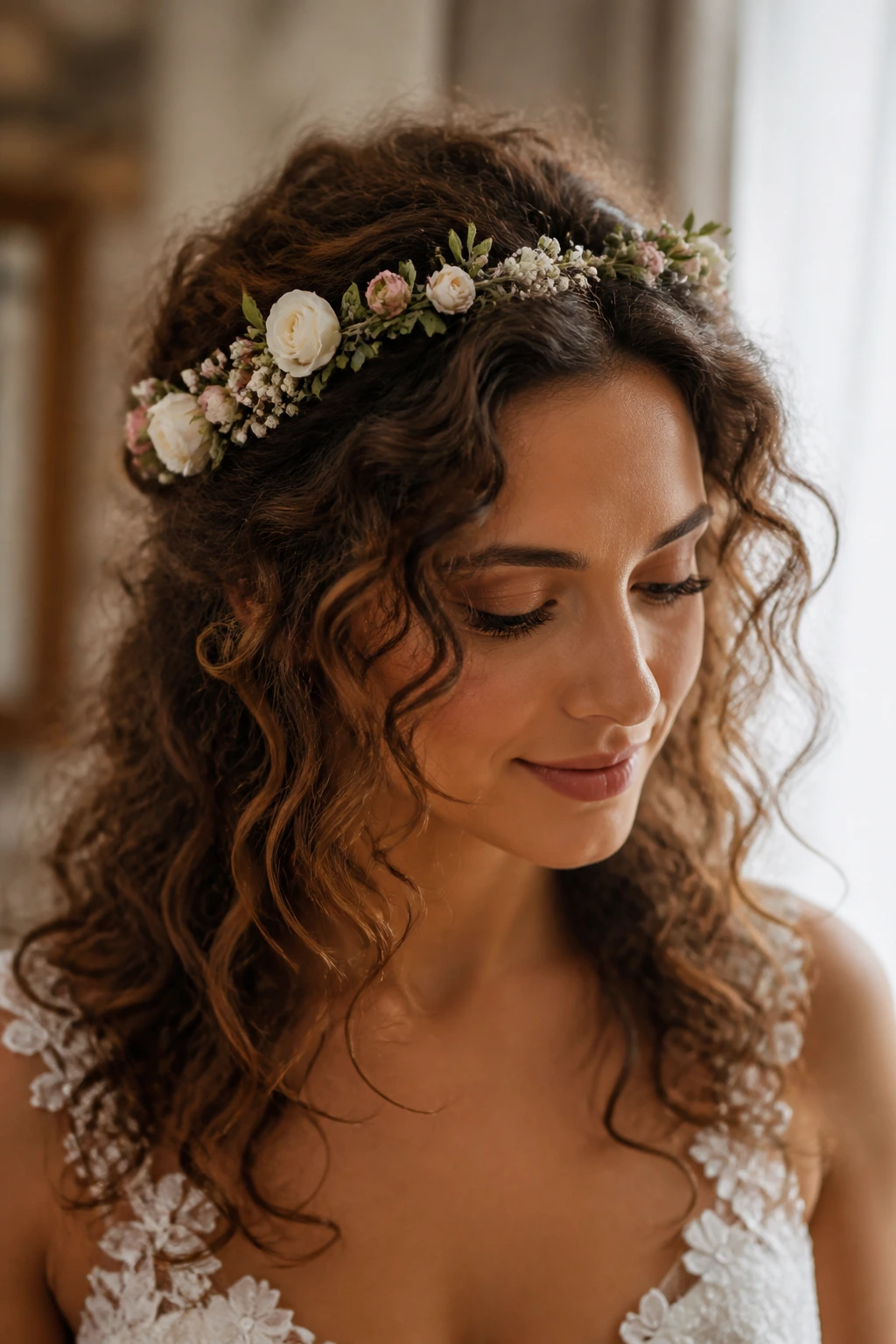
Do flowers belong in the hair or on the bouquet? On a bride with long curls, they often make more sense in the hair than people expect. A half-wreath of tiny blooms or silk petals can sit from temple to temple, with the rest of the curls falling underneath.
The key is restraint. One or two clusters near the side of the head are enough. If the flowers are too heavy, they tug at the curls and start to droop before the vows are over.
Fresh flowers need extra care because stems can bruise and wilt. Silk blooms are easier if the day is long, warm, or full of travel. Either way, the curl pattern underneath should stay visible. That’s what keeps the style from looking like a costume piece.
13. Old Hollywood Deep Side Part Waves
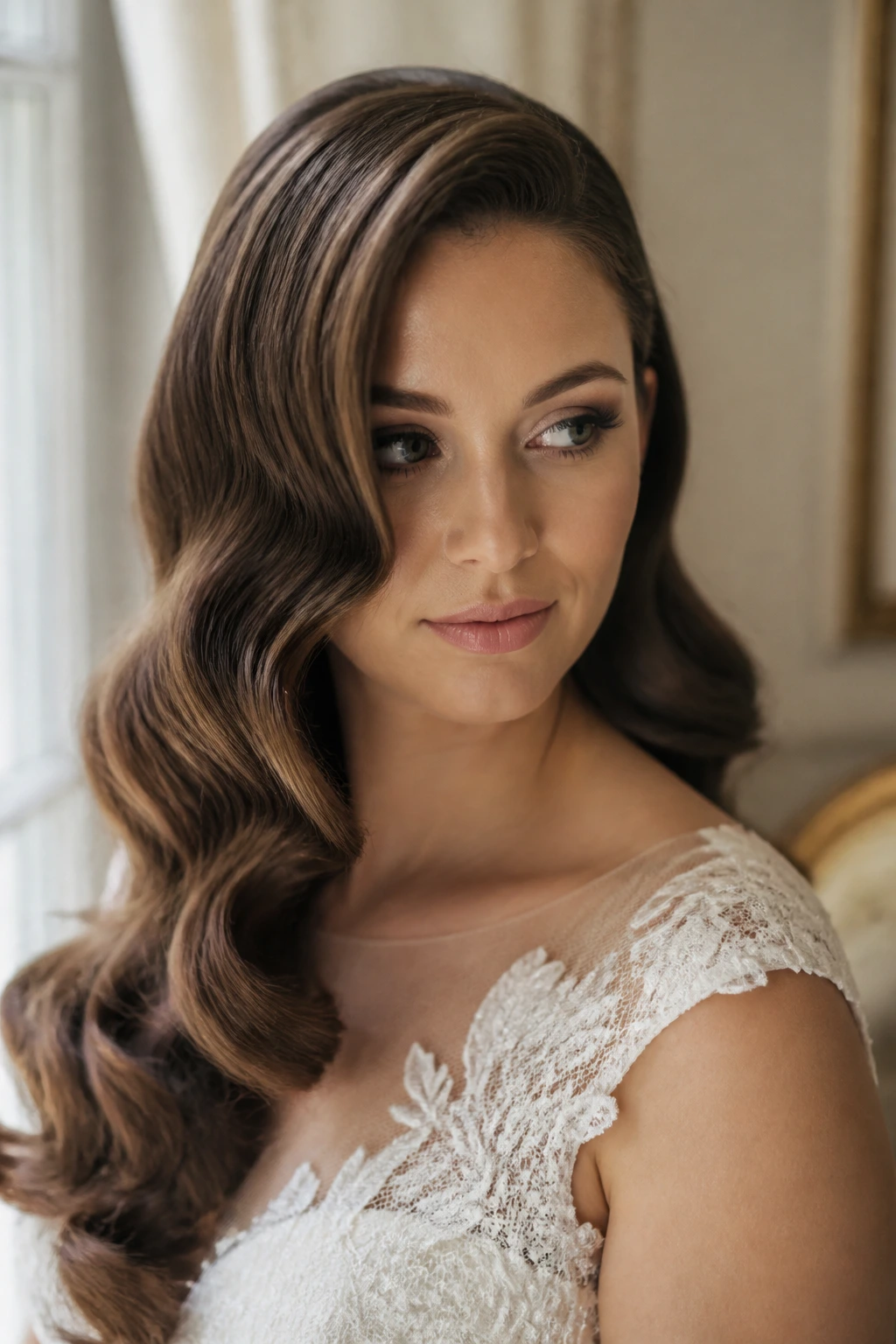
A deep side part changes everything. It gives long curls a direction, and once the waves are set in that direction, the whole style feels more controlled and more glamorous without much extra work.
What to ask for
- A side part that starts slightly above the eyebrow.
- Large waves, not tiny curls.
- A smooth top surface with soft bends through the lengths.
This style loves a gown with clean lines and a neckline that doesn’t need much competition. The hair becomes the statement. It also handles long earrings nicely because one side of the face stays open while the other carries the curve.
The only real caution is over-spraying. Old Hollywood waves need hold, yes, but they still should move a little when the bride turns her head. If they freeze solid, the style loses that expensive-looking sweep.
14. Voluminous High Curly Pony
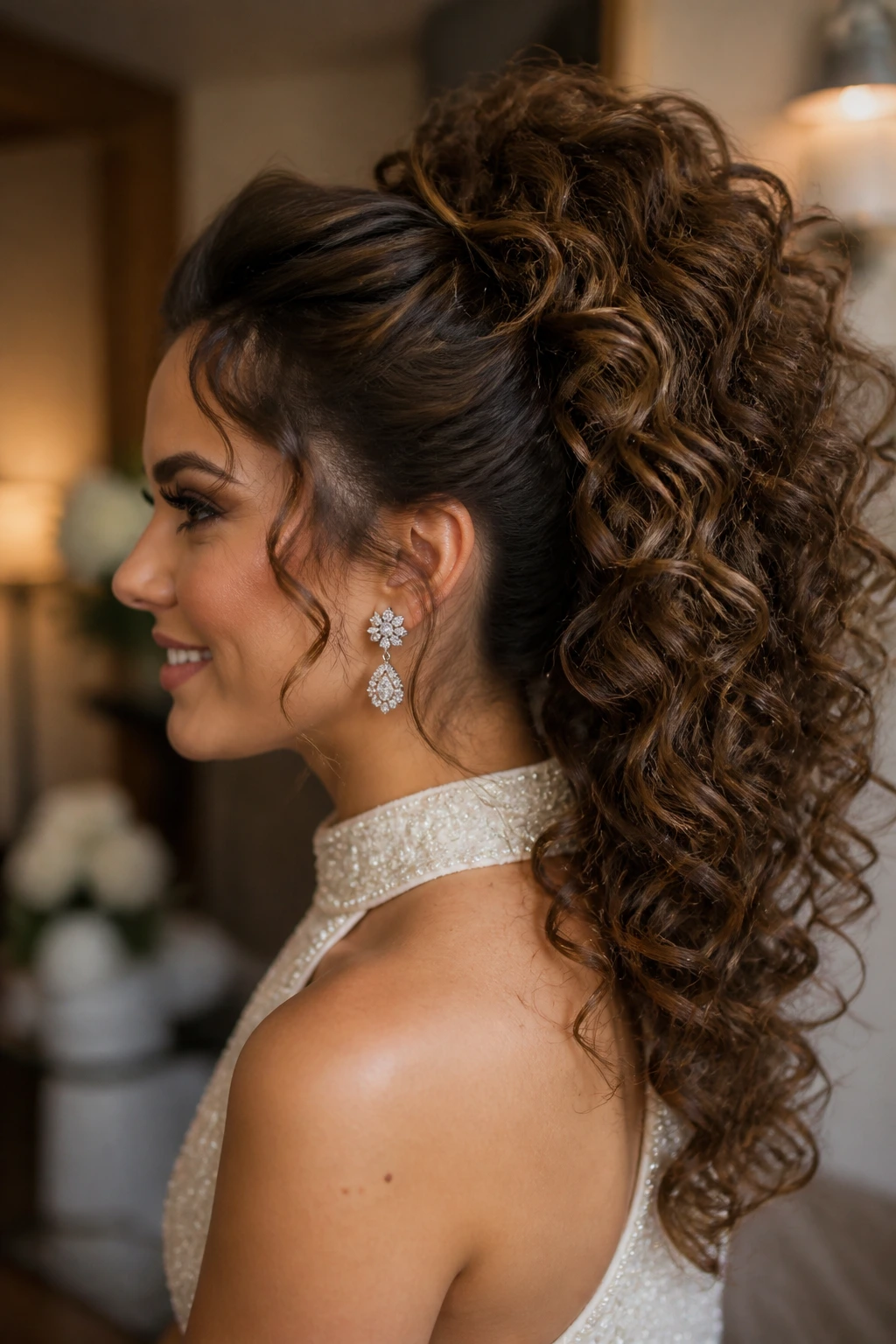
If the bride wants height, this is the blunt answer. A high curly pony sits near the crown, which lifts the face and keeps the long hair from dragging the entire style downward.
The pony itself should be full, not tiny. Tease the underside a little, wrap the base neatly, and let the curls spill out in a thick fall. A few face pieces can stay loose, but the real point is the vertical lift.
This shape is especially handy for brides in high-neck gowns or dramatic earrings. It keeps the back clear, and it gives the profile a strong line from the side. It’s a bold look, not a shy one. Which is part of the fun.
15. Boho Fishtail Braid Into Curls
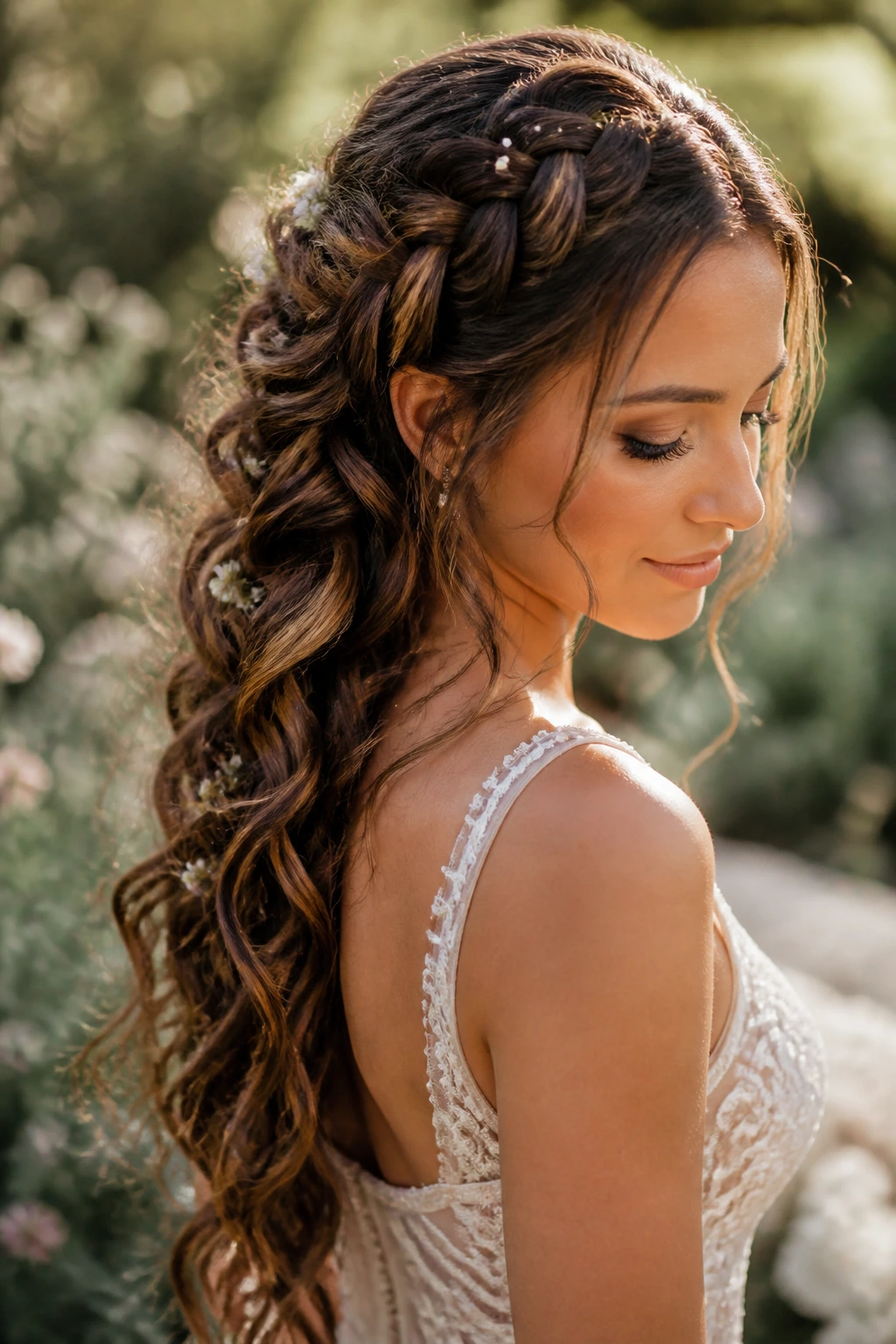
A fishtail braid gives long curly hair a little more visual texture than a standard three-strand braid. It starts higher at the crown or back of the head, then loosens as it moves downward into curled length.
The texture that makes it work
A fishtail looks best when the braid is not pulled too tight. Let the outer edges puff just enough to show the pattern, then stop. That little looseness makes the braid read airy rather than tight and knotted.
The end of the braid can blend into loose curls instead of stopping sharply. That transition keeps the style from feeling too staged.
This one is lovely for brides who like a softer, slightly undone shape. It also gives a good anchor point for tiny flowers or a thin ribbon if the dress needs a more personal touch.
16. Sculpted Low Bun With Center Part
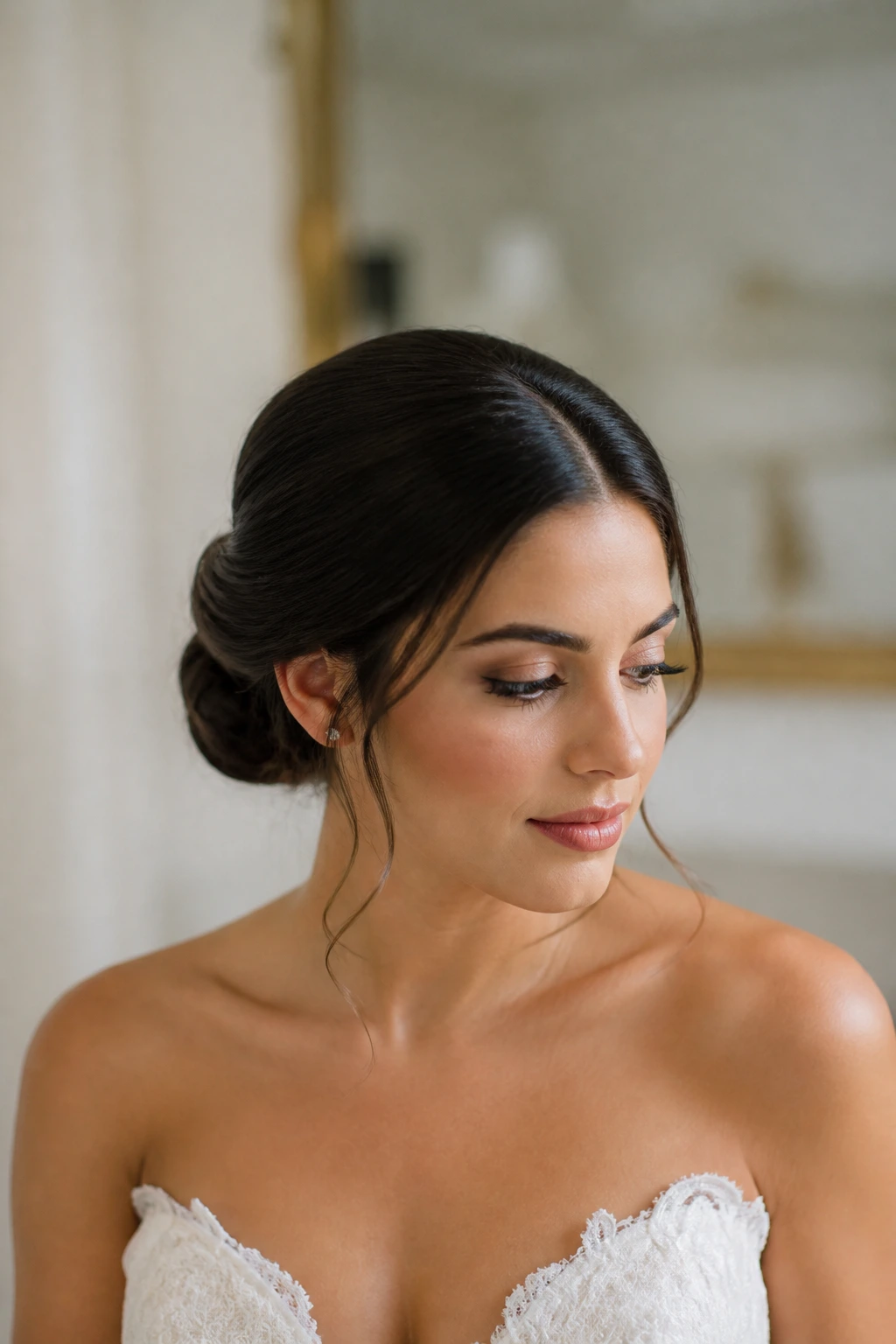
A center part changes the whole mood of a low bun. It adds symmetry, and symmetry does a lot of heavy lifting in bridal hair because it makes the style feel calm even when the curls underneath are doing more work than they seem.
The bun itself should sit low and compact, with the sides smoothed back in a clean line. The best version is not glossy to the point of looking wet. It’s controlled, with enough softness at the edges to keep the hair from feeling severe.
This is the style for a dress with a clean back or strong neckline. It keeps the silhouette crisp. If you like your jewelry to stand out, a center-part bun gives it room.
17. Half-Up Bubble Sections With Curls
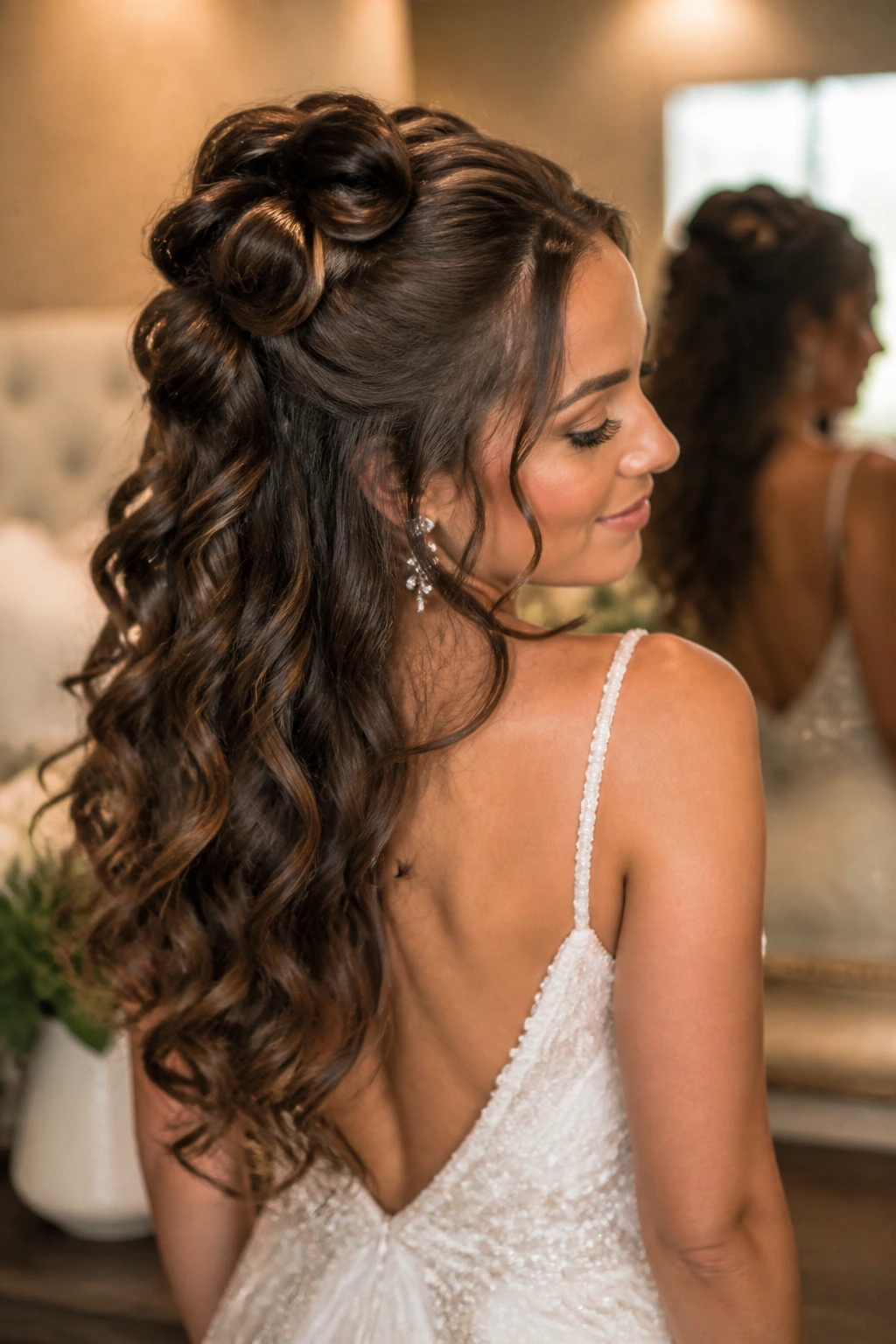
Half-up bubble sections sound playful, but they can look formal fast if the bubbles are spaced correctly. The top layer is divided into small sections with tiny elastics, then each section is gently tugged so it rounds out into a soft bubble before the next tie.
The long curls below keep the style from turning childish. That contrast is what makes it work. The top reads sculpted, the bottom stays romantic, and the whole thing feels deliberate.
It’s a good choice for brides who want something a little different from the usual braid-and-wave formula. The bubbles also create a nice path for pins or pearls if the dress needs a bit of sparkle near the crown.
18. Curly Pony With Veil-Safe Placement
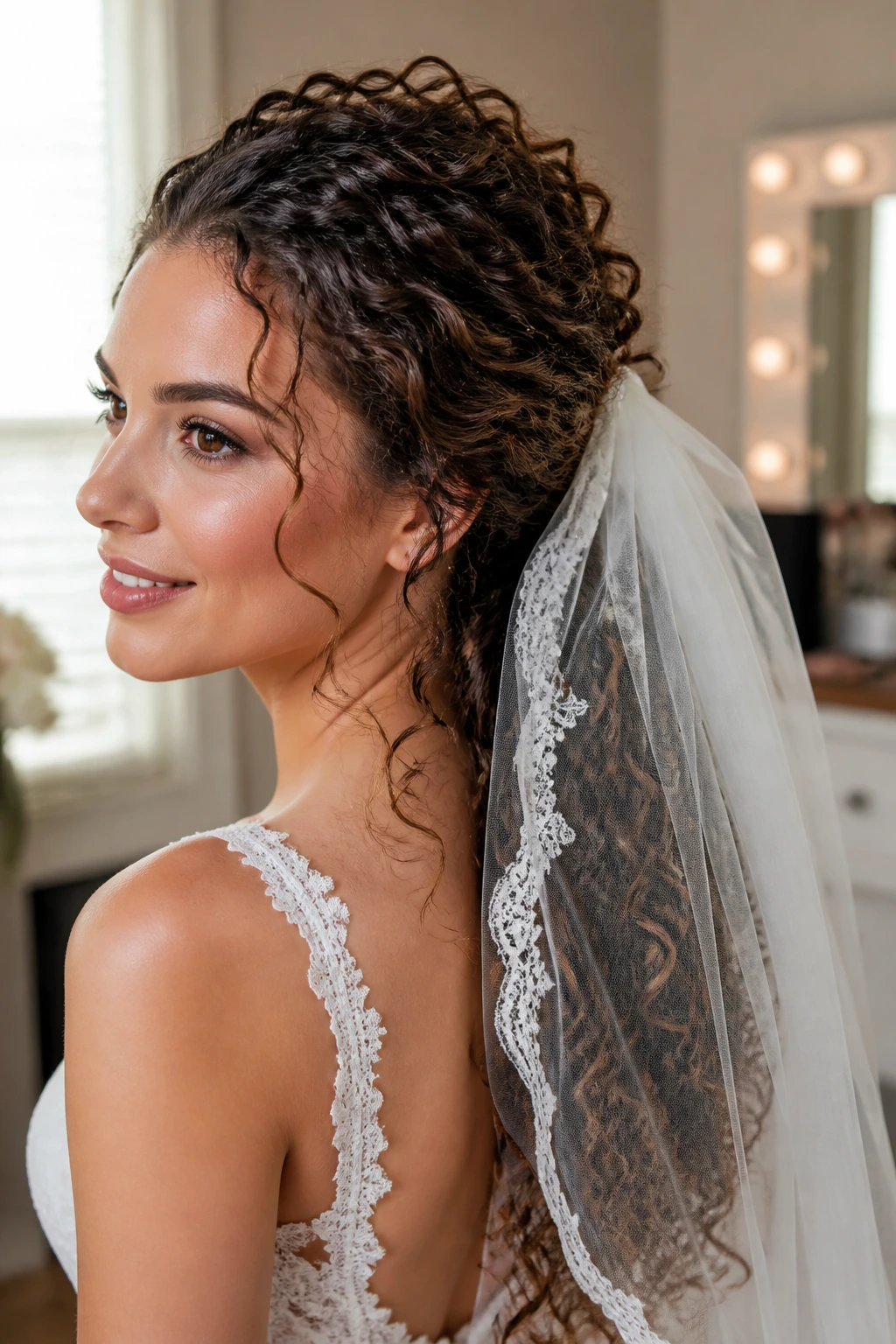
A veil can change a ponytail more than people expect. Put the pony too high and the veil comb starts to fight the curl fall. Place it too low and the shape loses lift. The sweet spot is usually mid-low, just below the point where the veil comb will sit.
That placement lets the veil drape cleanly while the pony still keeps its body. The wrapped base hides the elastic, and the curls can stay separated enough to keep their shape.
This is one of the safest choices for a long wedding day because the veil can come off without disturbing the whole style. A quick fluff at the back, and the pony still looks intentional for the reception.
19. Side Knot With Loose Spiral Ends
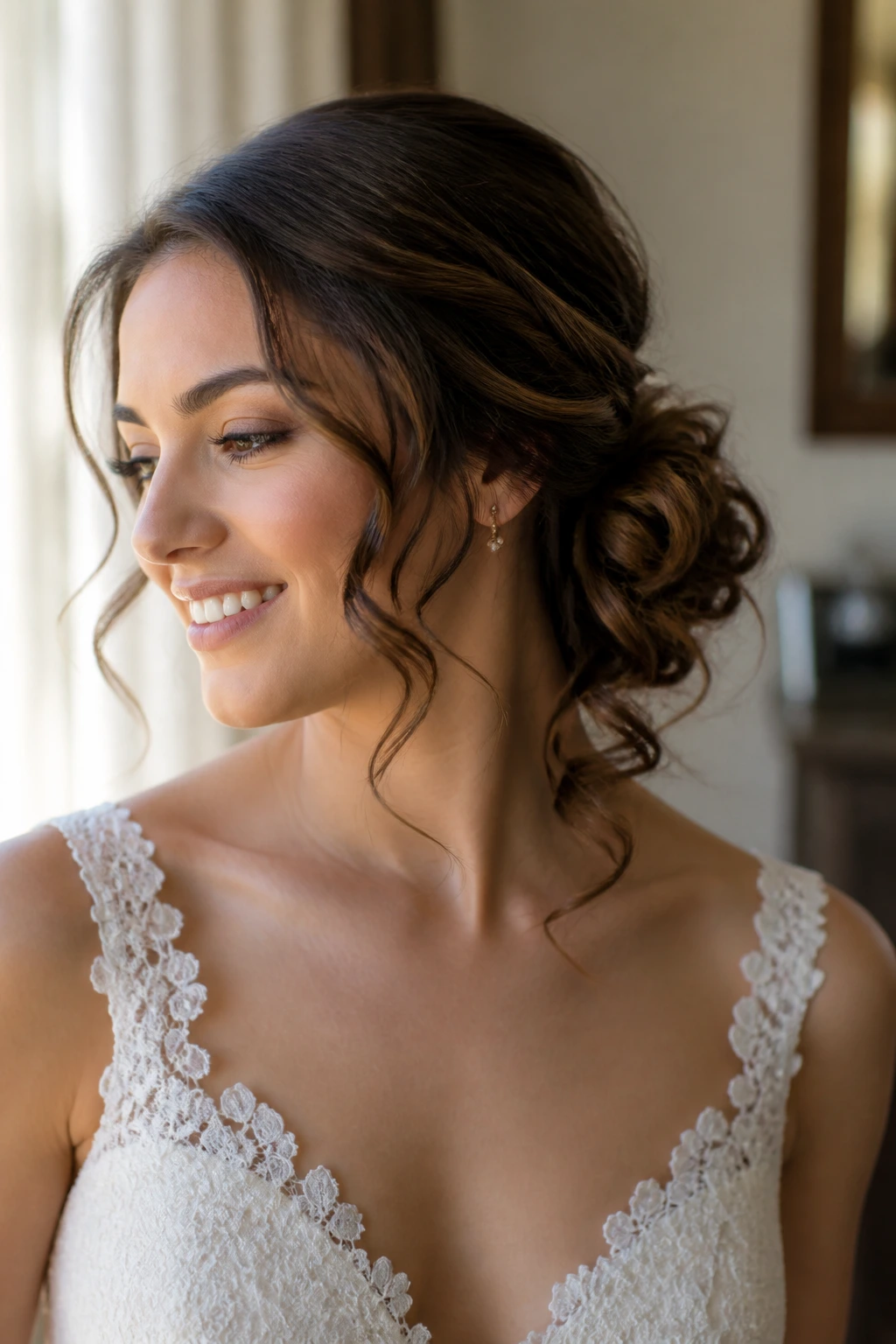
There’s something charming about a side knot that doesn’t try too hard. The hair is gathered slightly off-center, twisted into a knot at the nape or just above it, and left with a few spiral ends visible around the knot itself.
The asymmetry gives it personality. A centered bun can feel formal; a side knot feels like it has a little movement built in.
Good for brides who want shape, not stiffness
- Best with: Curly hair that needs one strong anchor point.
- Pair it with: A single statement earring or a dress with one detailed shoulder.
- Keep it from slipping: Pin the knot in layers, not all at once.
This look works best when the spiral ends are defined, not fuzzy. A small touch of serum on the final curls can help them read clean instead of frayed.
20. Halo Twist With Defined Ringlets
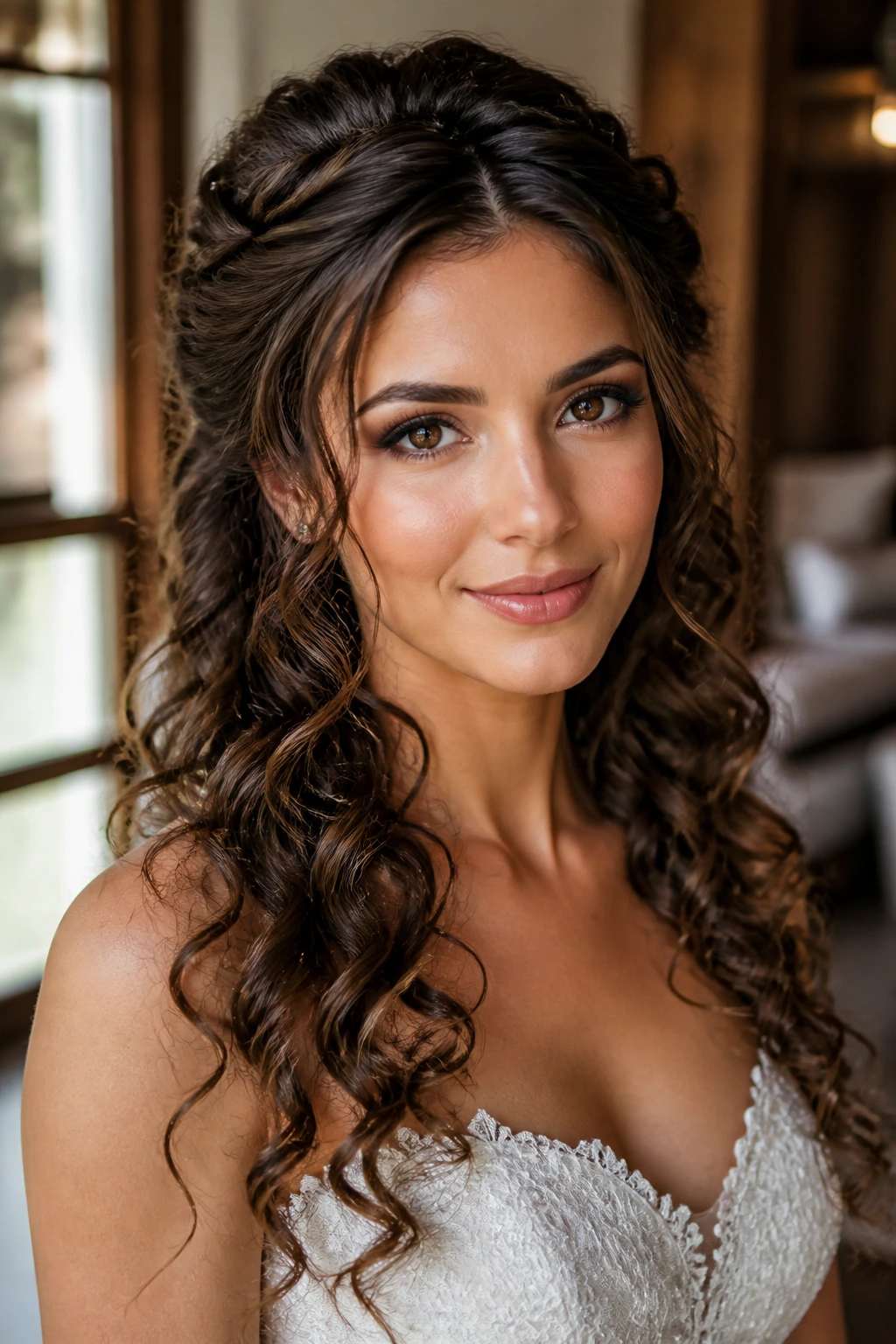
A halo twist wraps the front of the hair around the head like a soft crown, then leaves the ringlets underneath visible. It’s one of the few styles that can feel both ethereal and secure at the same time.
Build it in layers
Start by taking small sections from each side and twisting them back along the hairline. Pin each twist where it starts to tuck behind the ear, then keep working backward until the front is clean.
The ringlets below should stay defined. Don’t brush them out unless the entire look is meant to go softer, because the contrast between the tidy halo and the loose length is what gives the style its shape.
It’s a strong choice for brides who want a little fairytale mood without flowers everywhere.
21. Loose Twist-Back With Cascading Length
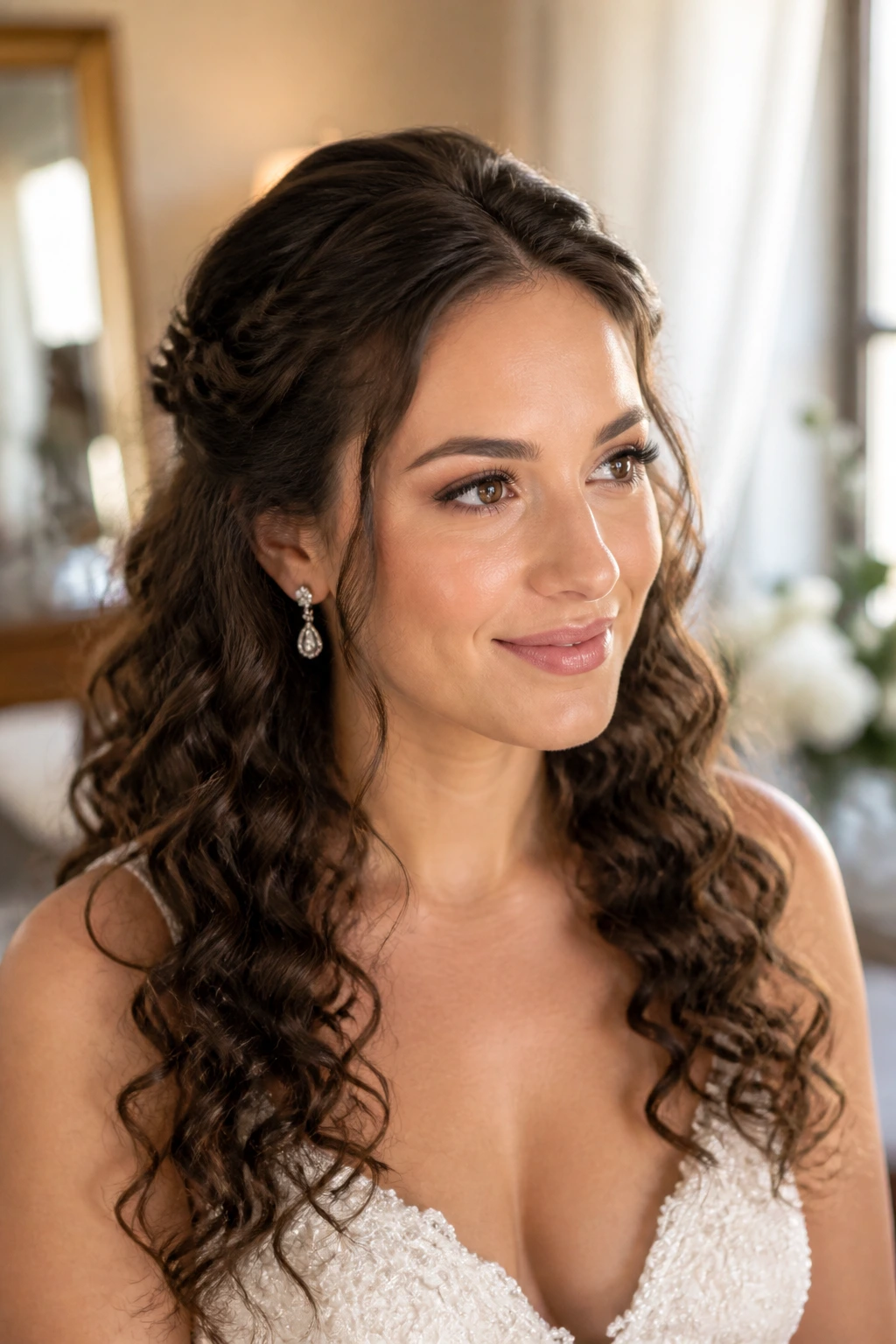
What makes this style useful is how little it asks of the hair. Two sections from the front are twisted back and pinned at the sides, while the rest of the long curls stay down and visible.
The result is relaxed, but not lazy. The twists keep the face open for makeup and earrings, and the loose length gives the style enough body to feel dressed up.
- Best when: You want to keep the neckline visible.
- Works with: Natural curls, heat-set curls, or softened wave patterns.
- Accessory option: A slim barrette or a few pins at the twist points.
It’s also easy to adjust. More twists make it tidier; fewer twists leave it softer. That flexibility is why it shows up so often in real bridal prep.
22. Curly Faux Hawk Updo
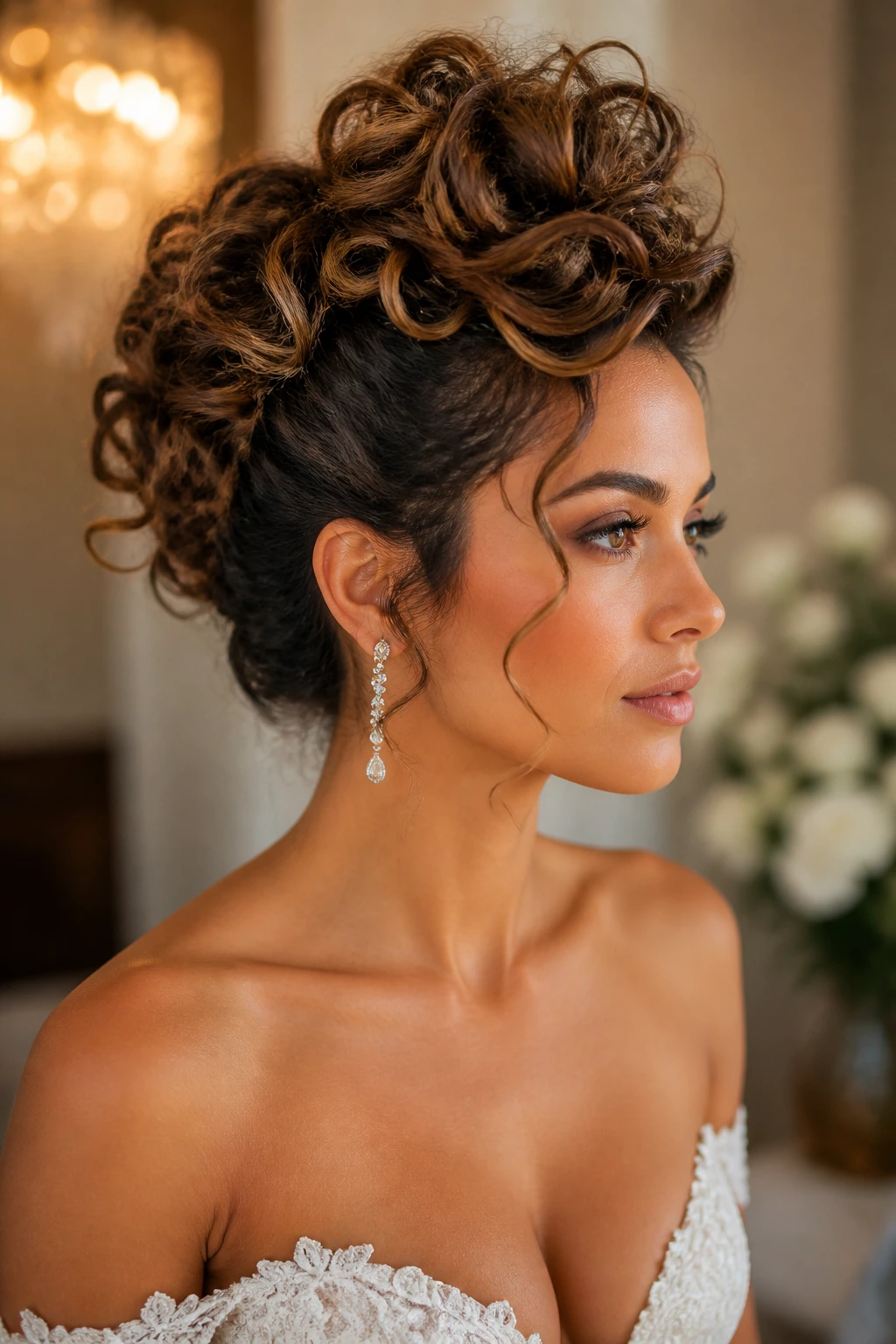
A faux hawk can look bridal. People act surprised every time, and I never know why. When the sides are pinned back softly and the center strip of curls is lifted with enough volume, the shape feels modern, clean, and a little daring.
The center ridge should be plush, not stiff. Think stacked curls rather than sculpted spikes. The side sections can be brushed back and pinned low so they disappear under the profile line.
This is the best choice for a bride who does not want a traditional silhouette. It also photographs well from the side because the shape has a strong profile without needing a lot of extra decoration.
23. Soft French Roll With Curled Ends
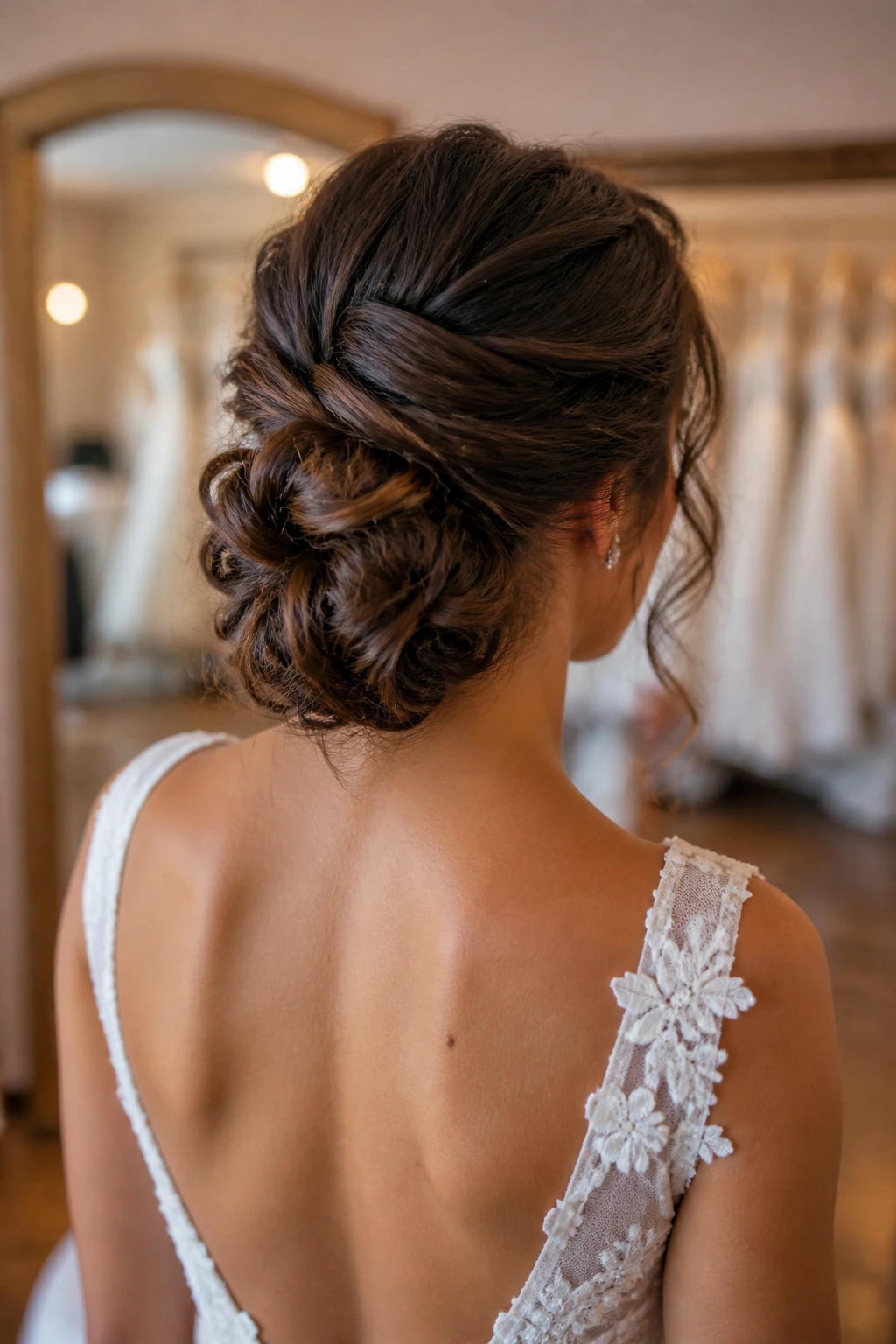
A soft French roll works when the bride wants the back of the dress to stay visible. The hair is rolled upward along the nape, but the ends are left curled and tucked loosely so the final shape doesn’t feel severe.
This is one of those styles that can look older if it’s over-smoothed. Keep a little texture in the roll. Let the curls show at the edge. That tiny bit of looseness makes the whole thing feel more current and less formal in the stiff way.
I like it for gowns with dramatic backs or a row of buttons. The roll gives the dress space to breathe, and the curled ends keep the style from turning into a flat shell.
24. Braided Side Crown With Curtain Pieces
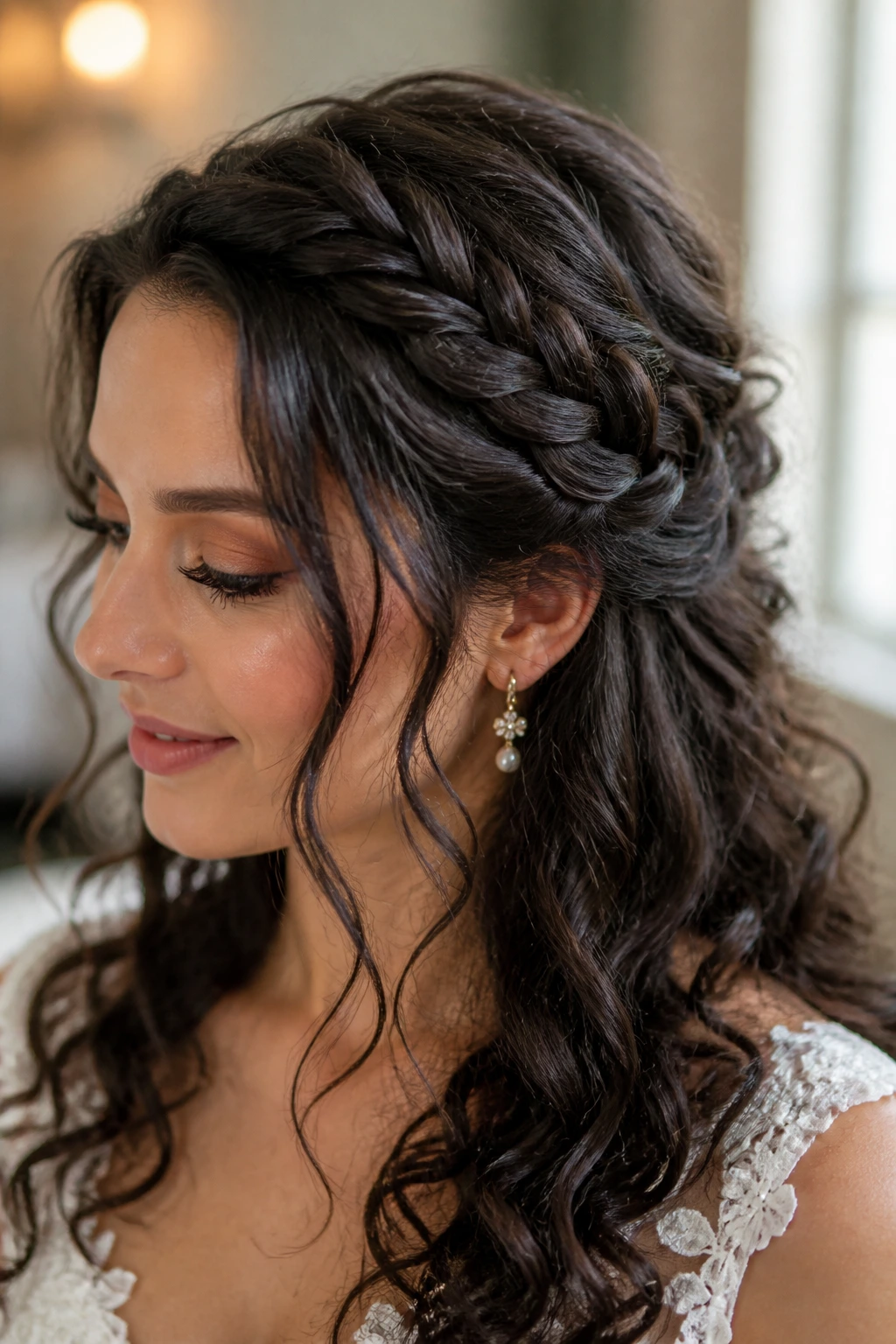
A braided side crown has more softness than a full crown braid, and that makes it a good fit for brides who want the face framed rather than enclosed. The braid starts on one side, follows the hairline, and settles behind the opposite ear.
The curtain pieces matter. A few front curls left loose near the cheekbones keep the style from feeling too closed in. They also make the braid look intentional, not like an afterthought.
Why this one often wins
It gives the scalp area control without taking away all the long length. That means the hair still looks like long hair, which some brides really want.
It’s a good match for boho dresses, beaded sleeves, and anything that needs the hair to feel soft rather than sharp.
25. Pinned Sides With Full Back Curls
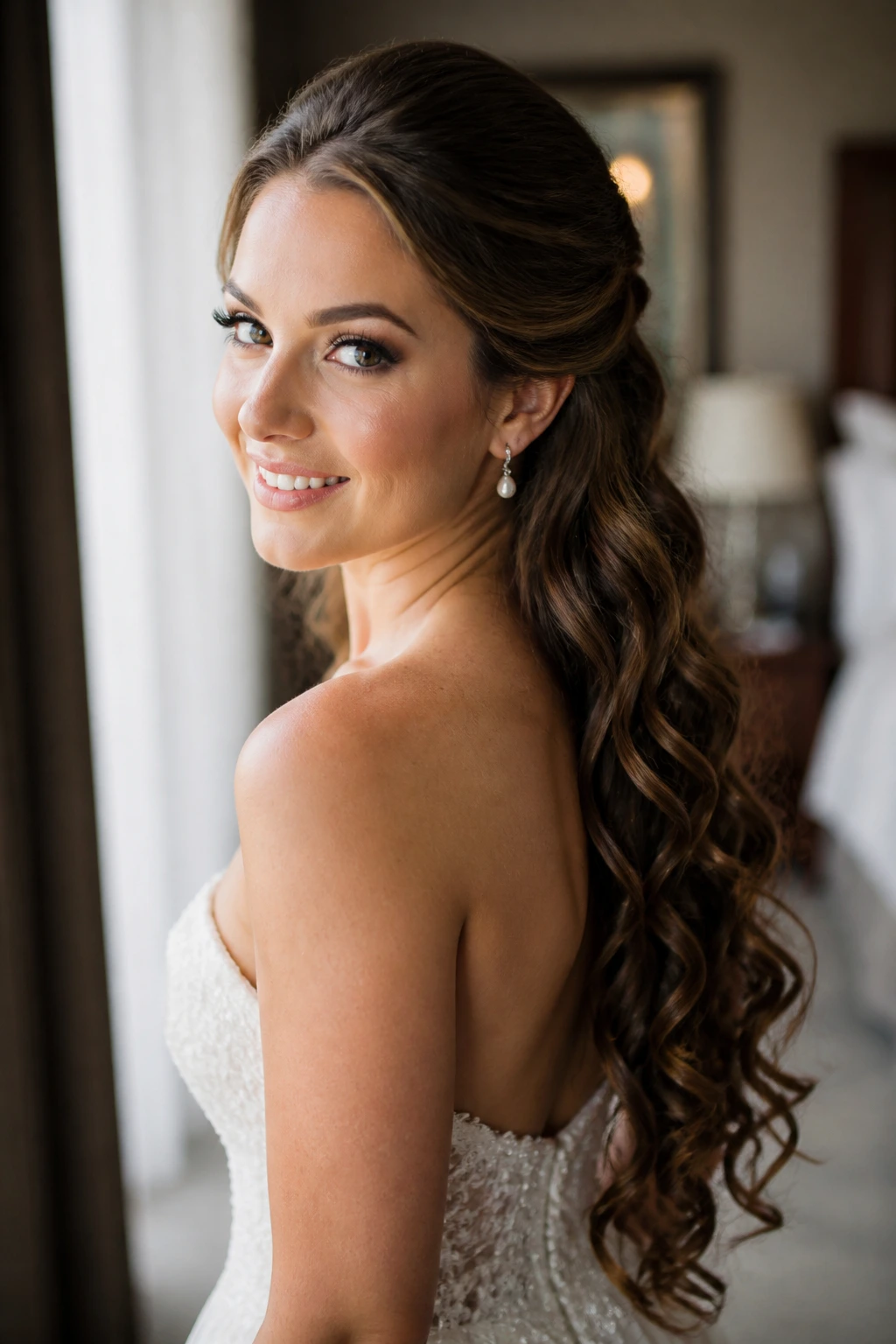
Sometimes the smartest wedding hair is the one that does the least. Pin the sides back behind the ears, leave the top mostly smooth, and let the long curls at the back carry the shape.
The style works because it clears the face without sacrificing length. That makes it a strong option for brides whose hair looks best when it hangs in full curls rather than being tucked away.
- Best for: Thick hair, naturally curly textures, and brides who want a low-stress style.
- Pin placement: Hidden just above the ear and slightly behind the cheekbone.
- Finish: A light spray at the front, a little more hold under the back layers.
The look is easy, but not plain. That little back lift matters. So does the clean side shape.
26. Waterfall Twist Bun
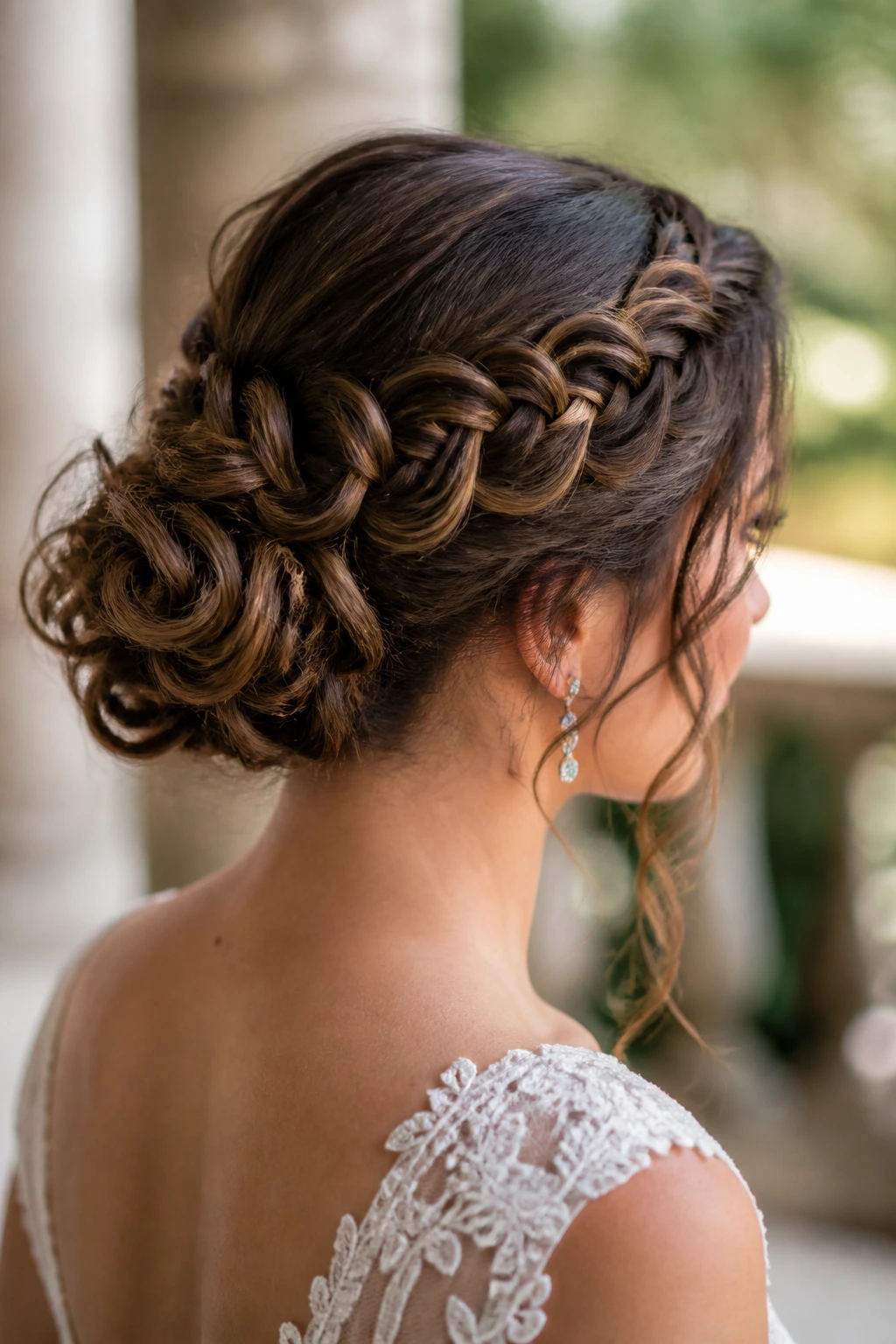
A waterfall twist bun takes the visual trick of a waterfall braid and folds it into a bun at the nape. Sections are twisted back, one after another, then pinned into a rounded knot while the loose lengths feed into the bun like soft layers.
It’s a neat option for long curly hair because it keeps the structure compact while still showing texture. You get the softness of a twist and the control of a bun in one shape.
Small things that help
- Use: bobby pins under the twists and U-pins in the bun itself.
- Keep: a few loops visible so the bun doesn’t look crushed.
- Add: a pearl comb or tiny floral clip if the dress is simple.
It’s elegant without being too polished, which makes it easier to wear through a long day.
27. Ribbon-Woven Curly Ponytail
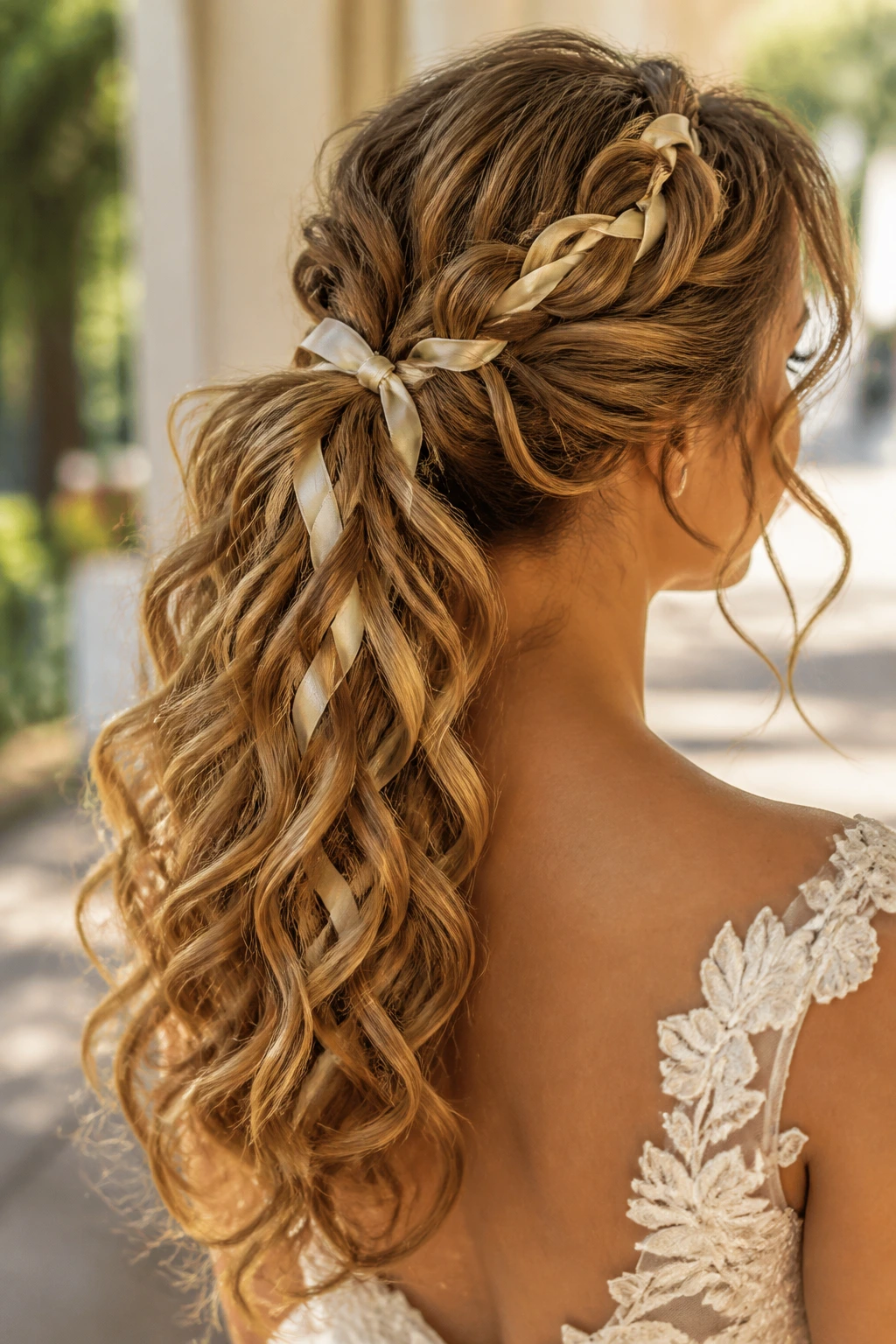
A ribbon-woven curly ponytail can feel surprisingly bridal. Tie the pony, then weave a satin or sheer ribbon through the upper section or wrap it around the base and let the tails hang with the curls.
The ribbon changes the mood fast. Satin feels sleek, velvet reads richer, and a sheer ribbon gives the style a lighter touch. Match the color to the bouquet or shoes if you want the detail to feel connected to the rest of the look.
This is a strong final choice because it is simple to wear and easy to personalize. The long curls do the heavy lifting, and the ribbon gives the style a clear finish. It’s one of the few looks that can feel sweet, modern, and a little romantic all at once.
Why Curly Hairstyles for Brides With Long Hair Hold So Much Presence
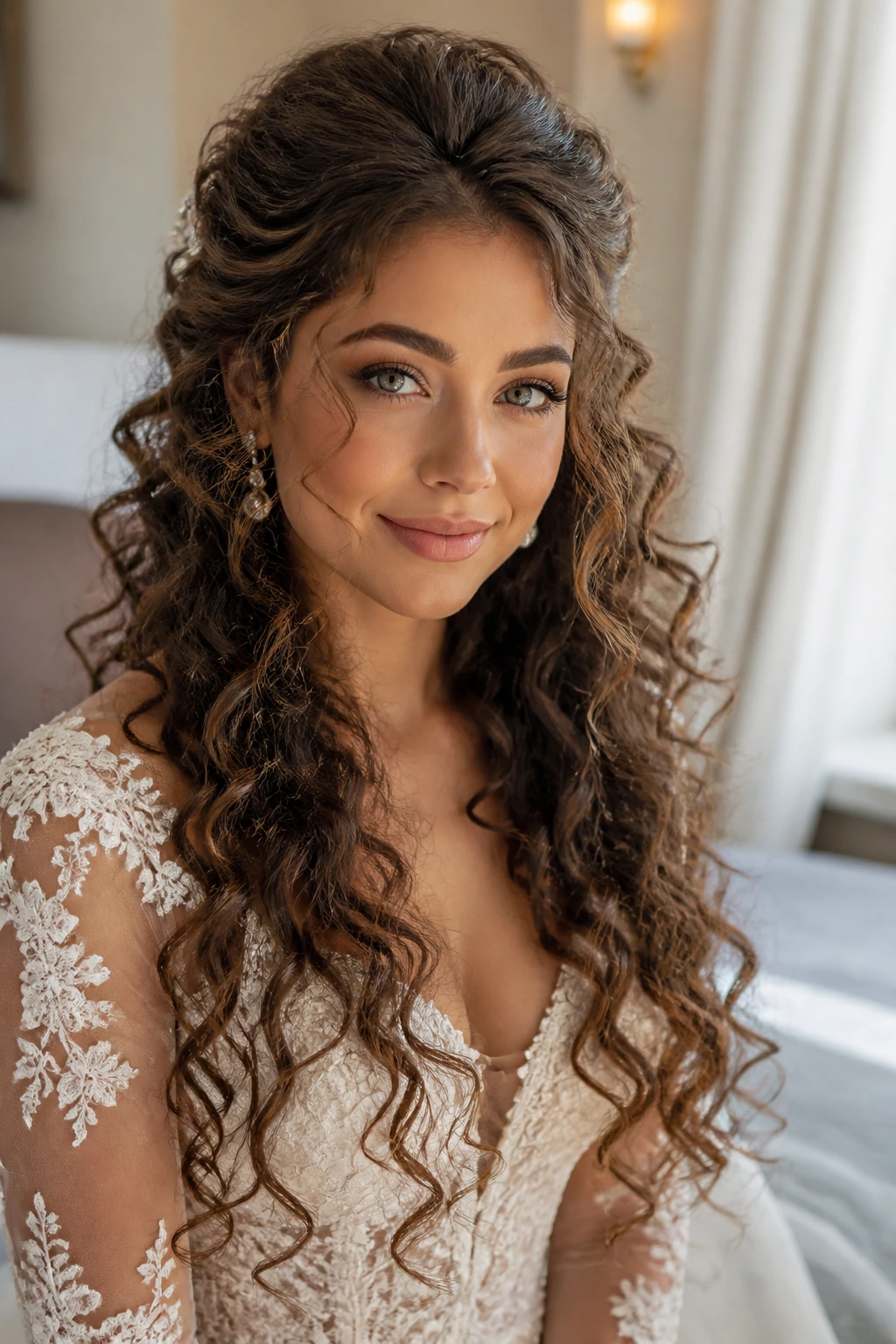
Long curly hair has more visual weight than straight hair, so the shape matters before the shine does. A loose bend near the crown, a twist that sits at the right height, or a braid that stops at the right point can change how the whole face reads. That is why these styles are less about “putting hair up” and more about arranging length so it has somewhere to land.
Curls also catch light in pieces instead of one flat sheet. That means the eye notices the shape of the hairstyle in layers: crown first, face framing second, ends last. If you pin too much away, you lose that layering. If you leave everything down, the weight can swallow the neckline. The styles above keep trying to solve that one problem from different angles.
And yes, the right product helps. So does a clean section line. But the real win is choosing a shape that lets the curls do what they already want to do.
Essential Tools and Products for Curly Bridal Styling
-
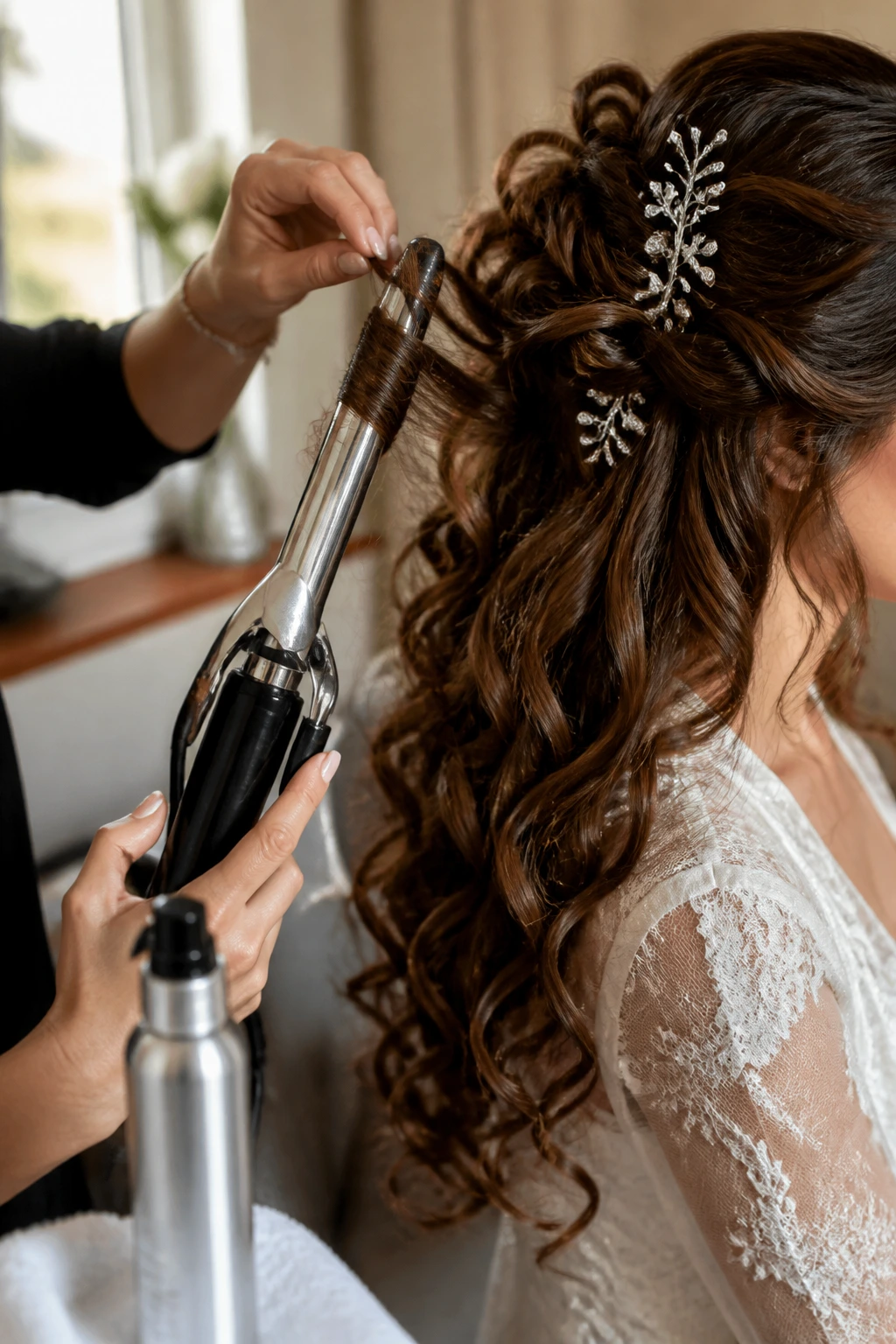
1.25-inch curling iron or wand — Useful if you need to build a uniform curl pattern before pinning long hair into place.
-
Heat protectant spray — Keeps the ends from drying out and turning fuzzy when you use hot tools.
-
Curl cream or lightweight mousse — Gives curls enough grip to hold their shape without turning them sticky.
-
Flexible-hold hairspray — Holds the style without creating a hard helmet around the hairline.
-
Bobby pins in two shades — Match the hair as closely as possible so the pins disappear under twists and curls.
-
U-pins — Handy for buns, rolls, and any style that needs a little extra internal support.
-
Tail comb — Helps make clean parts and smooth the crown without dragging through the curls.
-
Duckbill clips — Useful for sectioning while you test the style or work through a trial run.
-
Veil comb or decorative comb — Gives the veil or accessory a stable anchor point.
-
Silk pillowcase or satin bonnet — Helps preserve test curls and cut down on frizz between prep and event day.
How to Match Curly Styles to Your Dress, Veil, and Jewelry
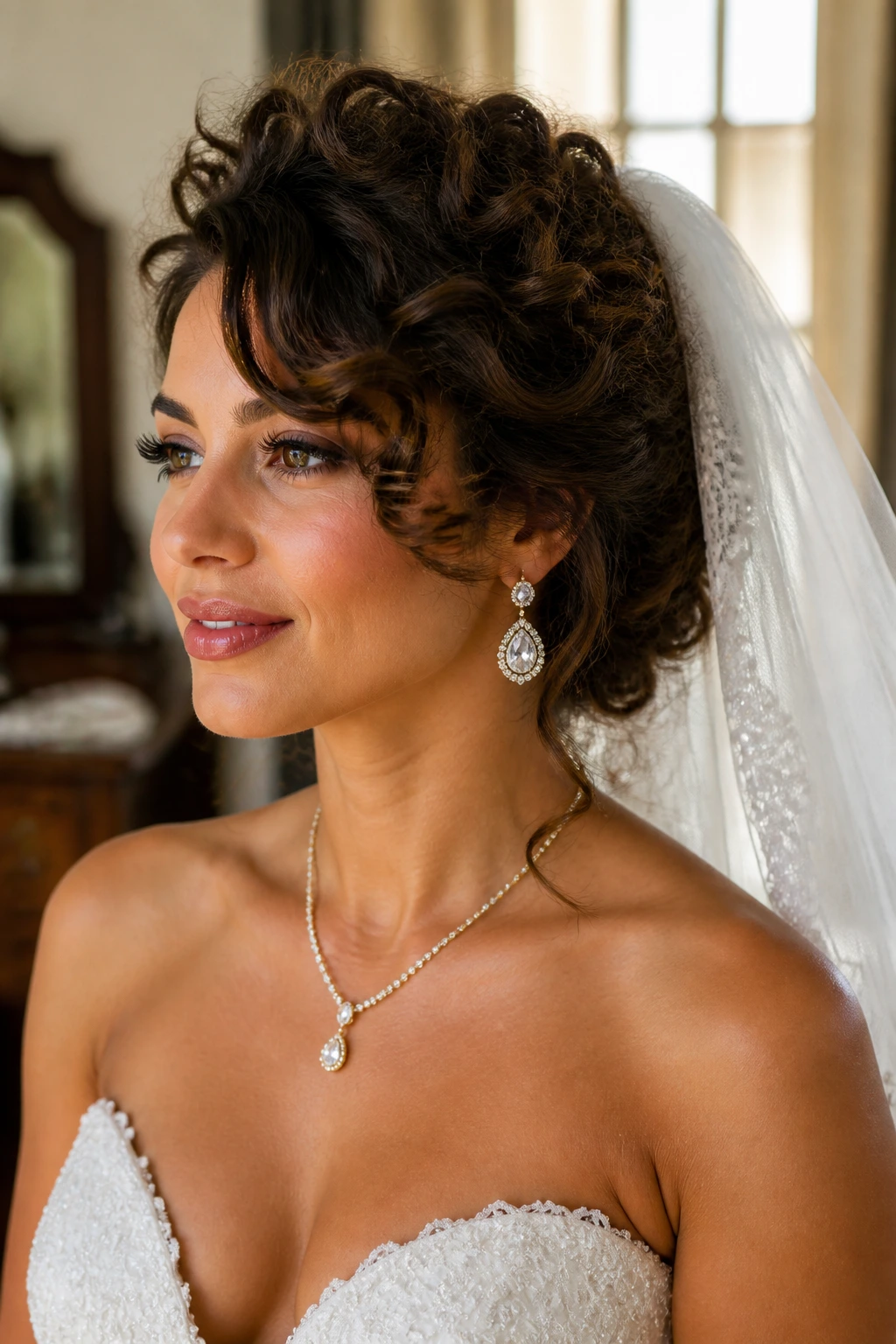
Neckline: Strapless gowns can handle more volume at the crown or back, while high necklines usually look cleaner with a lower bun, side sweep, or pinned-back shape. If the dress already has a lot going on near the collarbone, keep the hairline softer and the top a little quieter.
Veil: A cathedral veil needs a real anchor point, not a couple of hopeful pins. Low buns, tucked twists, and half-up styles with a clear back center tend to work best because the comb can sit where the structure is strongest.
Jewelry: Big earrings need space. If the earrings are long, a side sweep or pinned-back front keeps the face open and lets the jewelry do its job. If the earrings are small, the hair can carry more of the visual weight.
Texture and silhouette: Fine hair usually benefits from styles with more shape at the crown or with a braid for grip. Thick curls can handle bigger buns, higher ponies, or fuller twists without looking crowded. The goal is to make the hairstyle match the dress instead of wrestling it into place.
Trial-Run Tips That Keep the Style Standing
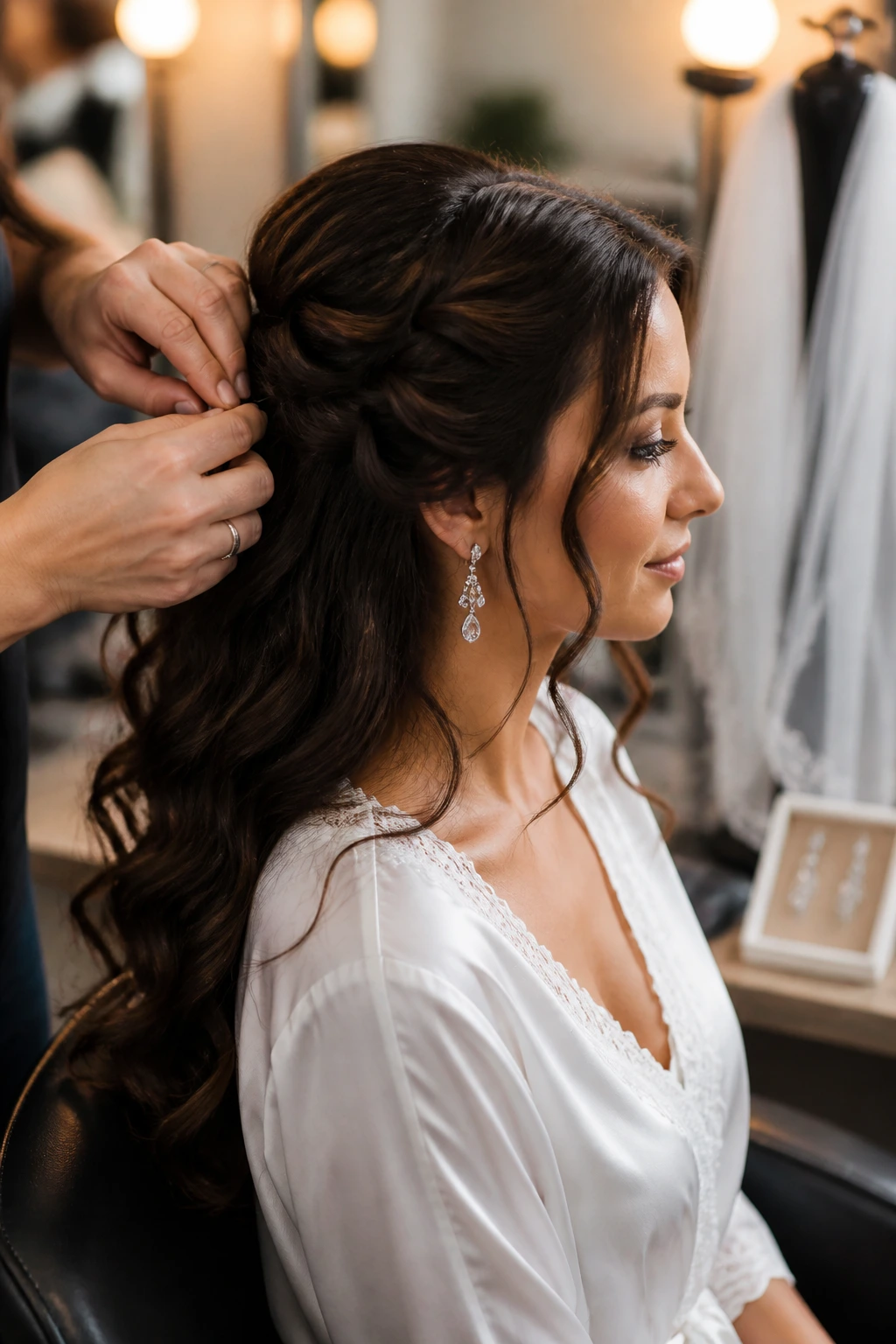
Schedule the trial like a fitting. Do not save it for a random afternoon and hope for the best. A proper trial should happen with the veil, earrings, and any comb or pins you plan to use, because the style changes once those pieces are in the room.
Set the curl before you pin it. Long curly styles last longer when the curl pattern is already defined. Whether you use a wand, rollers, or your natural texture, let the curl cool completely before you start shaping the rest of the hair.
Use product in layers, not in one heavy blast. A little mousse near the roots, flexible spray on the finished shape, and a touch of serum only on the ends will usually hold better than coating the whole head in one go. Heavy product near the scalp can flatten the crown fast.
Pack a tiny rescue kit. A few bobby pins, one U-pin, a travel hairspray, and a small tail comb can save a style that starts to loosen near the temple or the nape. Keep the kit where someone can reach it without hunting through a bag.
Pin where the hair crosses itself. That is where the strength is. If you try to pin a loose, smooth section, it slides. Crossed hair has tension, and tension gives the style something to hold.
Bridal Curl Mistakes That Flatten the Shape
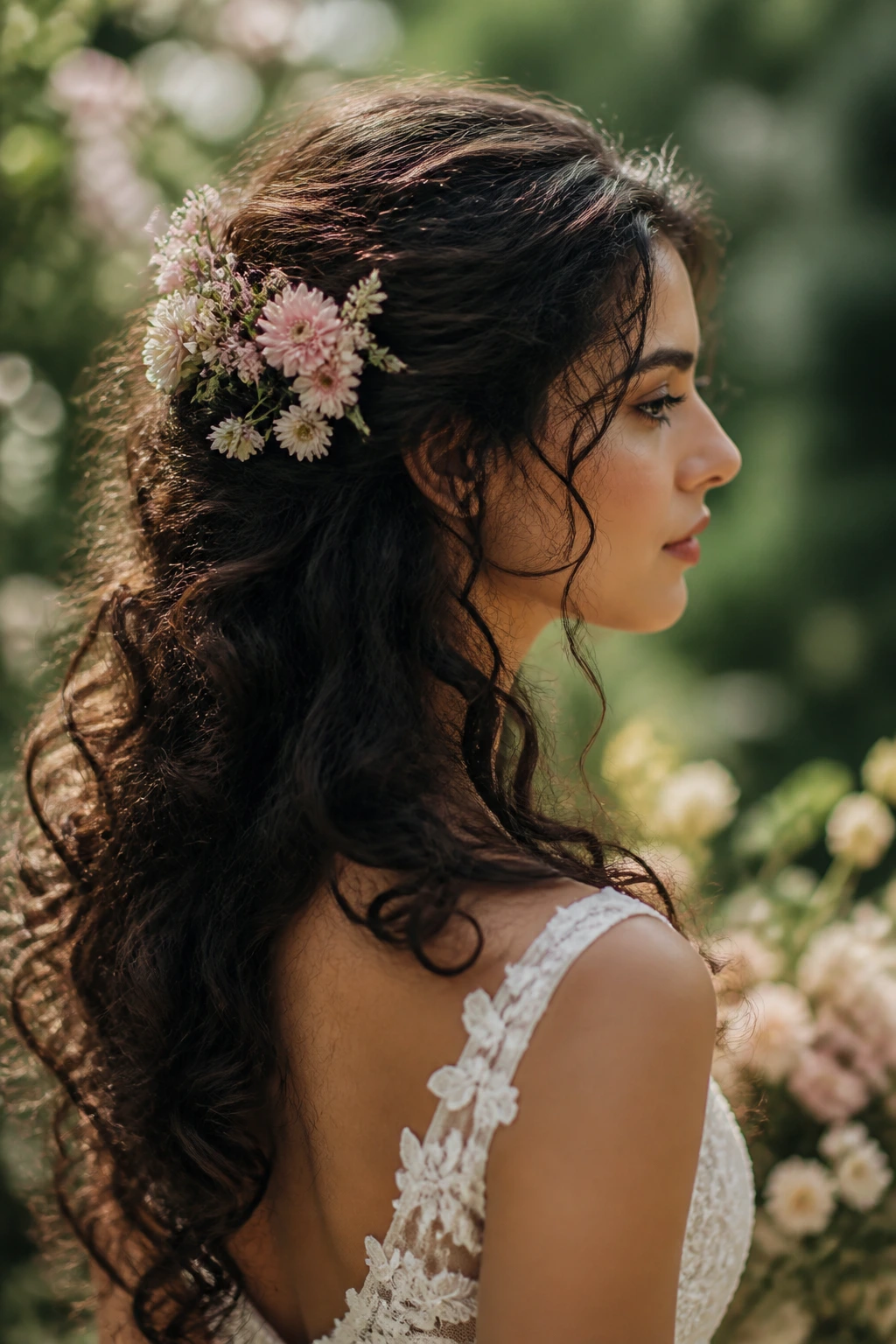
The first mistake is starting with curls that are too soft. If the hair has no memory, the style sinks fast. Set the curls fully, let them cool, and only then build the shape.
The second is over-smoothing the crown. A little polish is good; a slick, flat top usually is not. Once the top is pressed down too far, long hair starts to hang heavy at the sides and the whole style loses height.
Another common problem is forgetting the veil or accessory until the end. That sounds small. It isn’t. A veil comb can change the center of gravity, and a heavy clip can pull one side lower than the other unless the anchor points are planned in advance.
A fourth mistake: using too much hairspray on the surface and not enough support underneath. The top may look neat for an hour, then the base loosens. Pins, sectioning, and curl direction do more work than a crunchy outer layer ever will.
Last one. Trying a style that fights the haircut. Long layers, for instance, need more internal pinning than a blunt cut because the shorter pieces near the face slip out sooner. That does not mean the style won’t work. It just means you need a stronger plan.
Variations and Adaptations to Try
Soft Garden Version: Add tiny fresh flowers or silk buds near one temple and keep the rest of the shape loose. This works best for outdoor ceremonies where the dress already has a romantic feel.
Modern Minimalist Version: Strip out the extra decoration and keep the shape clean: low bun, side part, or polished half-up. It suits satin gowns, sharp tailoring, and brides who want the hair to stay quiet.
Natural-Curl Celebration Version: Use curl cream, diffuse the hair, and work with the curl pattern instead of heat-setting it flat first. This version is strongest when the bride wants the texture to look honest and touchable.
Extra-Secure Wind Version: Add more cross-pinning at the crown and use a stronger setting spray under the outer layer. Best for outdoor venues, open-air photos, and hair that tends to slip in humidity.
Extension-Boosted Version: Clip-ins can fill out the ends or add height at the crown if the natural hair is long but not full enough for the chosen shape. Match the curl pattern closely, or the difference will show once the hair starts moving.
Keeping the Style Fresh From First Look to Last Dance
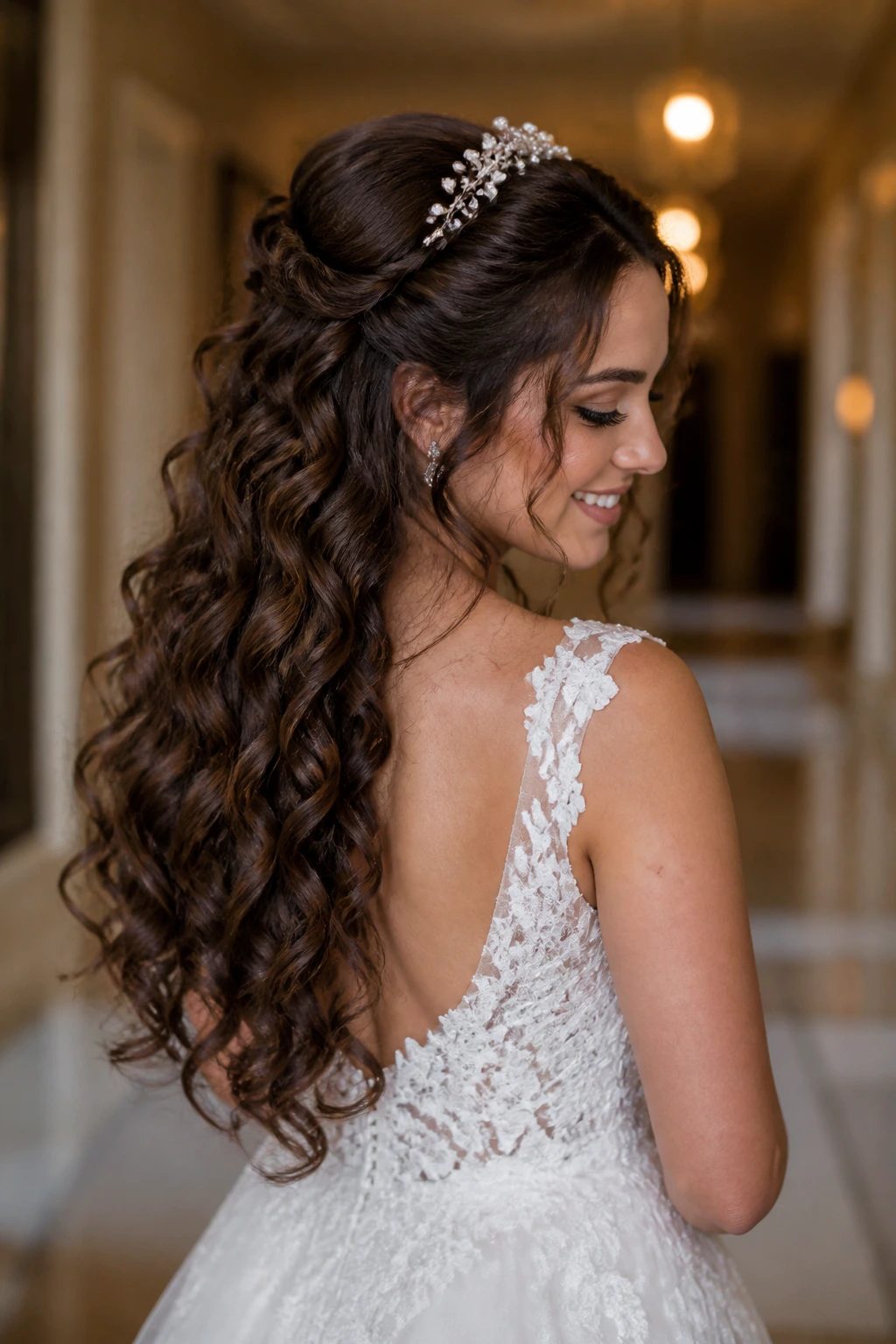
Bridal curls hold better when they are planned like a long event, not a one-time photo. A trial should happen ahead of the wedding day, then the actual style should be built with enough time for the curls to cool fully before they are pinned. That cooling step matters more than people think. Warm curls behave like wet laundry; they collapse when you stop paying attention.
The day before, most long curly styles do better with hair that is clean but not freshly stripped. Slightly lived-in hair usually has more grip. If your hair gets oily fast, wash it the morning of. If it is dry or fine, wash it the night before and keep the roots light with mousse rather than heavy cream.
Once the style is finished, protect the front first. The hairline is where makeup, hand movement, and humidity start to work on it. A small travel hairspray and a few pins can fix a temple piece in under a minute, which is a much better use of time than rebuilding the whole style halfway through dinner.
If you need to preserve the look after the ceremony, ask someone to check the nape and the side pins before the reception starts. Ten seconds is enough. That one glance catches the loosened pin you’d never notice in a mirror.
Removal matters too. Pulling pins out in a rush tugs the curls and can leave the ends looking shredded. Take the style down section by section, then separate the curls with your fingers and a drop of serum if you want to keep them for the next day.
Frequently Asked Questions About Curly Hairstyles for Brides With Long Hair
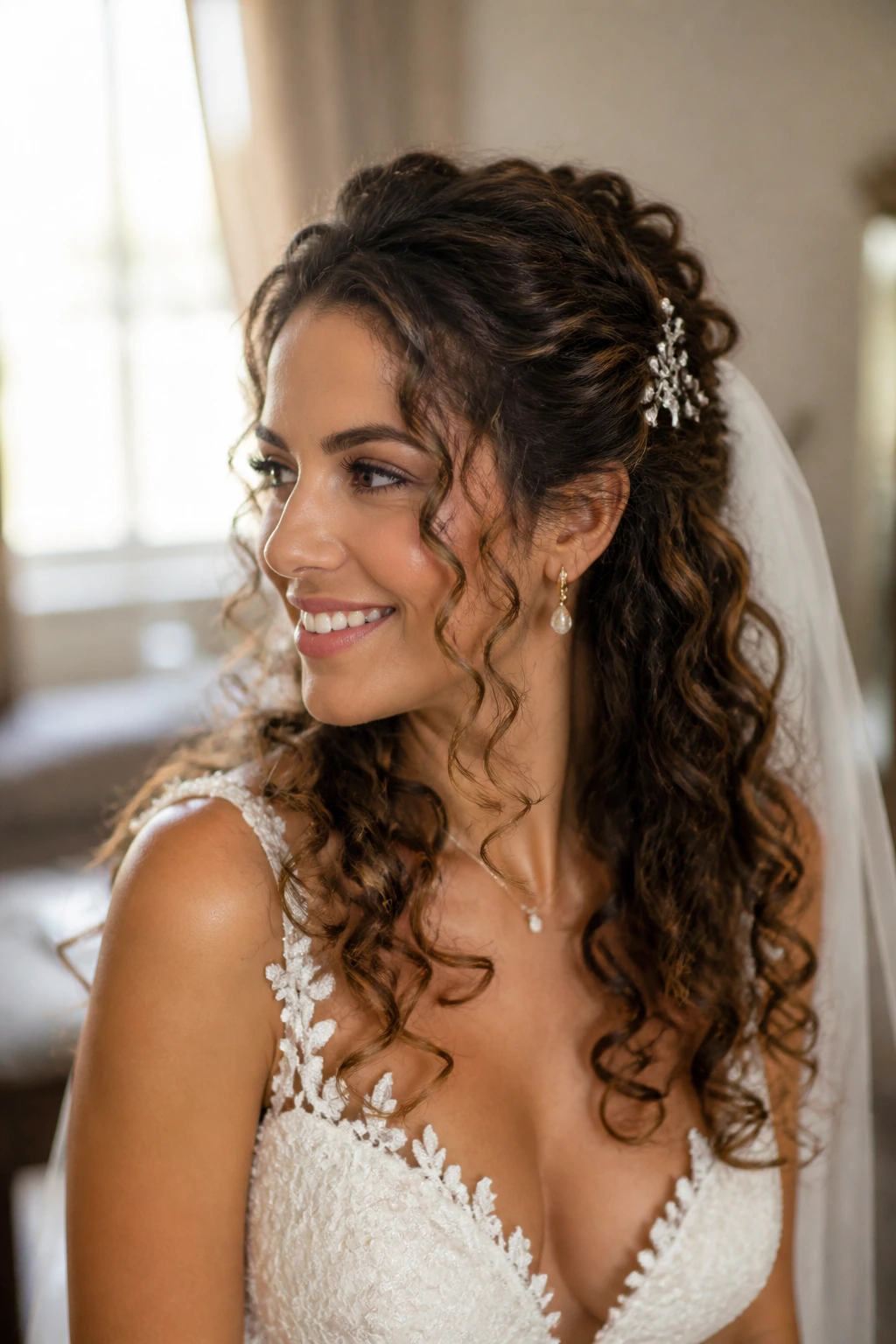
Should bridal hair be clean or a little lived-in?
A little lived-in texture usually gives long curly styles more grip. Freshly washed hair can be too slippery, especially if you’re building twists or a half-up shape. If your hair is very fine, a wash the day before often works better than a same-day shampoo.
Can I wear a veil with a curly half-up style?
Yes, and it’s one of the easier matches. The key is placing the veil comb below the pinned section so it doesn’t fight the half-up anchor. A stylist can hide the comb under the curls or nest it right under the crown lift.
What if my curls start falling before the reception?
Keep a small rescue kit nearby with pins, a comb, and a travel spray. Re-pin the base first, not the surface. If the shape at the crown stays strong, a few softened curls around the face usually do not ruin the whole look.
Do these styles work on naturally curly hair?
Absolutely. In many cases they work better, because natural curls already have grip and body. The main task is shape control: define the curl pattern, smooth only where needed, and avoid over-brushing the lengths into frizz.
How much hairspray is too much?
If the hair starts to feel hard before the style is finished, you’ve gone too far. Long curly bridal hair usually needs flexible hold, not a stiff shell. Spray lightly between sections, let each layer settle, then add a little more only where the shape is loosening.
Are clip-in extensions worth it for bridal curls?
They can be, especially if the natural hair is long but not full enough through the ends. The trick is matching curl pattern and color closely so the extensions blend once the hair starts moving. If they sit too straight or too shiny, the mismatch shows fast.
Which styles are best if my dress has a high neckline?
Low buns, sculpted tucks, pinned-back sides, and side knots usually work best because they keep the neck area clear. A lot of volume near the face can fight a high neckline, while a lower silhouette lets the dress stay in charge.
What should I avoid if my hair frizzes easily?
Do not over-touch the curls once they’re set. Frizz shows up fastest when the hair gets brushed, re-sprayed, and fussed with over and over. Better to define the shape once, seal it lightly, and leave the surface alone except for the pieces that truly need a fix.
The Shape That Still Moves
The best curly wedding hair does not look frozen. It moves a little when the bride turns her head, it keeps its shape when the veil comes off, and it still feels like hair instead of a sculpture by the end of the night.
That is why these styles matter. They give long curls a structure that can handle the day without stripping away the part that makes curly hair so good in the first place. Pick the shape that fits the dress, the neck, and the way you actually wear your hair, then let the curls do what they do best.
