



Glasses change bangs faster than a bad haircut changes your mood.
A fringe that looks airy on bare skin can turn heavy once it meets a thick acetate frame, and a cut that feels flattering in the chair can land right on your lenses by day two if the length is off by half an inch. The best bangs for women who wear glasses don’t fight the frames. They make the frames look like they belong there.
The trick is balance, not perfection. You want enough space between the fringe and the top rim that your face doesn’t feel boxed in, but not so much forehead that the whole look gets disconnected. When the brow line, frame line, and bang line all sit in the same spot, the effect can feel cramped. When they stagger a little, the whole haircut breathes.
That’s why this subject matters more than it gets credit for. A fringe lives right in the most obvious part of your face, and glasses sit there too. You notice the collision immediately. The styles below are the ones that keep that collision under control—some soft, some sharp, some low-maintenance, some a little dramatic, all of them workable if you know where they sit in relation to your frames.
Why These Fringe Styles Make Frames Easier

-
Frame Balance: The best fringe styles don’t end exactly where your lenses start; they either float above the top rim, split around it, or travel diagonally away from it, which keeps the face from looking chopped into equal bands.
-
Brow Visibility: A little brow showing through changes everything. It keeps the eyes readable behind the glasses and stops the fringe from becoming a heavy curtain across the middle of your face.
-
Texture Control: Airier bangs—wispy, feathered, piecey, or layered—usually sit better with frames because they move instead of stacking up against the rim. That movement matters on humid days and on mornings when you’re rushing.
-
Grow-Out Insurance: Styles with softness at the edges, like curtain bangs or Birkin bangs, are kinder if you miss a trim by a couple of weeks. A blunt line gives you less room to drift.
-
Face Shape Flexibility: Glasses already change the geometry of your face. Bangs that can tilt, split, or taper give you room to adjust the balance instead of locking you into one rigid look.
1. Curtain Bangs That Split at the Frames
Curtain bangs are still the easiest answer when someone wants bangs and wears glasses every day. The middle opens up, the sides sweep toward the cheekbones, and the frames get their own space instead of sitting under a slab of hair. That little split does a lot of work.
Why it works with glasses: the center stays light, which keeps the bridge of the glasses visible, and the longer edges soften the frame line instead of competing with it. If your frames are bold or square, curtain bangs make them feel less severe. If your frames are thin, the bang adds shape without crowding the eyes.
A good curtain bang usually starts a bit shorter in the middle and falls longer toward the temples. For glasses, I like the shortest point to sit somewhere between the brow and half an inch below it, then slide into cheekbone length near the sides. That gives you room to wear the fringe with the glasses up or down.
Best for: oval faces, heart shapes, and anyone who wants a cut that can grow out without looking awkward.
Quick tip: ask your stylist to cut them with your everyday frames on. That one detail saves a lot of guesswork.
2. Side-Swept Bangs That Clear the Top Rim
If you want the least drama, start here. Side-swept bangs are the old reliable of bangs for women who wear glasses, and I mean that in the nicest way. They don’t ask for a perfect blowout, and they don’t demand that your frames stay tiny or invisible.
The angle pulls the eye diagonally across the face, which is useful when your glasses already create a strong horizontal line. Instead of stacking hair right on top of the frame, the fringe moves away from it. That keeps the forehead open on one side and gives the look some motion.
This style is especially useful if one temple of your glasses sits a little higher than the other, which happens more often than people admit. A side sweep forgives that. It also works if you habitually push your glasses up during the day, because the fringe can shift with you and still look intentional.
A blunt center bang can feel precise. Side-swept bangs feel forgiving. There’s a reason so many people circle back to them after trying something fancier.
3. Wispy See-Through Bangs

Ever wanted bangs without the heavy forehead commitment? Wispy bangs are the answer. They leave little gaps of skin between the strands, so your brows and frames stay visible and the whole front of the haircut feels lighter.
The biggest mistake with wispy bangs is making them too thin at the ends and too short at the center. That can make them look accidental instead of soft. What you want is a controlled veil—light enough that you can see texture through it, but dense enough that it still reads as a fringe.
With glasses, the see-through quality matters because thick bangs can make the frame line look blunt and crowded. Wispy bangs soften that collision. They’re especially good with round frames, cat-eye frames, and any frame with a slightly chunky top edge, because the fringe adds softness where the frame brings structure.
What to ask for
- A lighter density through the center, not a blunt wall of hair
- Soft, point-cut ends instead of a hard edge
- A length that lands above the top rim or just skims it
How to wear them: let a little brow show through. That gap is the whole point. If you flatten the bangs too much with oil or heavy cream, you lose the airy effect and the glasses start to do all the visual work.
4. Bottleneck Bangs

Bottleneck bangs have that narrow-in-the-middle, wider-at-the-sides shape that sounds fussy until you see it on someone with glasses. Then it makes perfect sense. The center stays slimmer near the bridge, and the sides open up as they travel outward, which gives the eyes room and keeps the frames from feeling boxed in.
They’re a smart choice if you like a fringe that feels a little more styled than curtain bangs but less severe than a blunt cut. The shape also works well when your frames are on the larger side, because the bangs don’t stop dead at the top rim. They curve around it.
I like bottleneck bangs on medium-density hair because they keep enough body to show shape without turning into a heavy sheet. Fine hair can do them too, but the cut needs a little more precision so the center doesn’t disappear by lunchtime.
Best with: oval, square, and heart-shaped faces; soft waves; medium to thick hair.
Best detail to request: a center that sits slightly shorter than the sides, with the side pieces falling toward the cheekbones. That small shift is what makes the style feel balanced with glasses.
5. Brow-Grazing Blunt Bangs
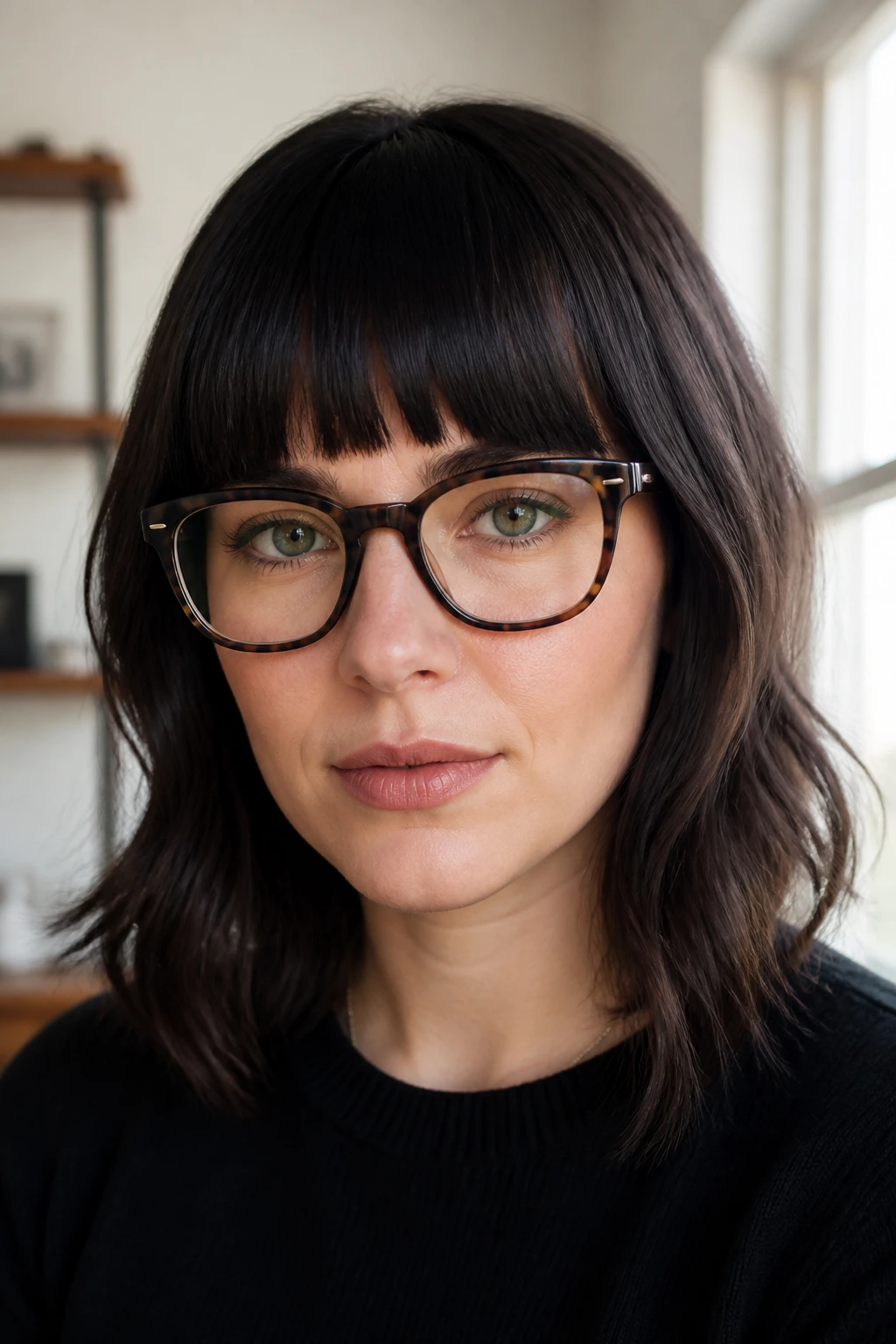
A straight fringe and glasses can look sharp in the best way, but only when the length is right. Brow-grazing blunt bangs should skim the brow line or sit just above it, not disappear under a thick frame. If they drop too low, the whole front of the face starts to feel crowded.
This style is strongest with thin metal frames or narrow rectangular frames, because those frames leave enough visual space for the bang to be the main feature. Thick acetate frames can still work, but the bang has to be clean and full enough to hold its shape without looking like a shelf.
The reason this look still earns a place on the list is simple: it gives drama fast. A blunt fringe has presence. It makes the glasses part of the hairstyle instead of a thing you wear separately.
If you like neat lines, this is your lane. If you prefer softness, keep reading.
6. Arched Bangs That Follow the Brow Line

Arched bangs are a quieter cousin of the blunt fringe. Instead of cutting a dead-straight line, the center sits a touch shorter and the edges extend a little longer, which mirrors the natural curve of the brows. That shape is a gift with glasses because it leaves breathing room above the frame.
Unlike a heavy blunt bang, the arch lets the face keep some lift. The eye can move from brow to lens to cheek without hitting three hard lines in a row. That sounds small, but it changes how the whole haircut reads.
These bangs work especially well if your glasses have a rounded top edge or a subtle cat-eye shape. The bangs echo that curve and make the frame feel like part of the haircut instead of a separate object. The effect is neat, not severe.
Who should try them: people with longer faces, soft features, or frames that sit fairly close to the brow. They’re also a good answer if you want a bang that feels polished without looking stiff.
7. Choppy French-Girl Bangs

Why do some short bangs look cool and others just look blunt? The difference is usually texture. Choppy French-girl bangs keep the ends irregular enough that they never form a hard line across the forehead, which makes them easier to wear with glasses than a stricter crop.
These bangs are best when they’re cut dry or at least checked dry, because the final shape depends on how the hair falls naturally. A little unevenness at the ends is the point. You want pieces that sit around the brow, not a single block of hair pasted onto the face.
They pair well with round glasses, narrow metal frames, and vintage-inspired shapes. The reason is simple: the bangs add a little mess, the frames add structure, and the contrast feels deliberate.
How to wear them
Keep the ends piecey with a small amount of texturizing spray or a touch of styling paste rubbed between your fingertips. Too much product and they turn greasy. Too little and they split into awkward clumps. The sweet spot is that slightly broken-up look that says you didn’t overthink it.
8. Shag Bangs With Built-In Movement

If your hair already wants to bend, flip, or wave on its own, a shag fringe can be your best friend. Shag bangs don’t sit as one fixed curtain across the forehead. They break into layers and blend into the rest of the haircut, which keeps them from piling up against the top of your glasses.
That movement matters more than people realize. Frames can make a static fringe look heavier than it is, especially after a full day of wear. A shag cut keeps the front loose enough that it can settle around the glasses instead of fighting them.
I like this style for women who hate fussy styling. It’s not a precision cut, and that’s part of the charm. If a few pieces lift a little or curve differently from one side to the other, the cut still works.
Best with: wavy hair, textured hair, and frames that already have personality—oversized squares, rounded acetates, or slightly retro shapes.
Watch for: over-thinning. If the stylist removes too much weight, the fringe can go stringy and stop framing the face at all.
9. Long Face-Framing Fringe

Sometimes the smartest bang is the one that doesn’t fully commit to the forehead. Long face-framing fringe gives you the bangs effect without putting hair right across the middle of your glasses. The shortest pieces usually start near the cheekbones or jaw, then fall back into the rest of the cut.
That sounds almost too simple, but it solves a common problem: some women want movement near the face and want to keep their brows visible. This cut does both. It also gives you a softer transition if you’re nervous about going from a center part to a real fringe.
The reason it suits glasses so well is that the frame gets to stay visible. The fringe works around it rather than sitting on top of it. If your glasses are chunky, this can be a relief; if they’re thin, the longer pieces add enough shape that the face doesn’t feel bare.
This is the style I’d suggest to someone who says, “I like the idea of bangs, I just don’t want to babysit them.” Fair enough.
10. Rounded Bangs

Rounded bangs have a softer silhouette than straight-across bangs, and that softness matters when there’s already a frame on your face. The center sits slightly shorter, the corners curve down, and the overall shape keeps the forehead from feeling cut in half.
Compared with blunt bangs, rounded bangs look less rigid. That makes them easier to pair with round glasses, oval frames, and even cat-eye styles if the curve is subtle. The shape helps the bangs and the glasses echo each other instead of competing.
The key is not making the arch too dramatic. If the center is cut too high, you get a helmet effect. If the corners drop too far, the bangs start to behave like face-framing layers instead of a fringe. The cut needs that middle ground.
Best fit
- Soft features and curved frames
- Medium-density hair that can hold a shape
- People who want brow coverage without a hard line
A rounded bang is a nice reminder that softness can be a strategy, not a compromise.
11. Feathered Bangs

Feathered bangs are all about air. The ends are textured so they sit lightly on the forehead instead of forming a solid band, and that makes them far kinder to glasses than a dense, blunt edge. You can still get coverage, but the fringe never feels like it’s sitting in the same visual lane as the frame.
This is a strong choice for fine hair that tends to go flat. Feathering gives the front some lift and stops it from disappearing into your skin by noon. It also works on thicker hair if the stylist removes weight carefully, especially near the sides where the fringe meets the temple.
The look is softer than choppy bangs and less styled than a curtain bang. That middle ground is useful if you like hair that looks done without looking polished to the point of stiffness.
If your glasses sit low on the bridge, feathered bangs help even more. The pieces can hover above the rim and still move, which means you don’t get that hard hair-on-plastic line that can make the face feel boxed in.
12. Curly Bangs

Curly bangs are a different animal, and I mean that in a good way. The shape lives in the curl pattern, not in a straight line, so the fringe can arc around the glasses instead of pressing into them. That makes curly bangs one of the most natural-looking options on this list.
The biggest rule is to cut them dry, or at least cut them with the curl pattern fully visible. Wet curls lie. They stretch, shrink, and change direction in a way that can ruin the length guess. With glasses, that matters even more because a fringe that looks perfect when damp can spring right into the lenses once it dries.
A curly bang that works with glasses usually leaves a little length for shrinkage and relies on shape more than exact precision. You want the curl to rest near the brow line, not fight it. A touch of curl cream is enough; heavy butters and oils can make the fringe collapse onto the top rim.
How to use it
Let the curl fall where it wants, then separate only the pieces that crowd the eyes. Curly bangs rarely need perfect symmetry. They need room.
13. Coily Bangs
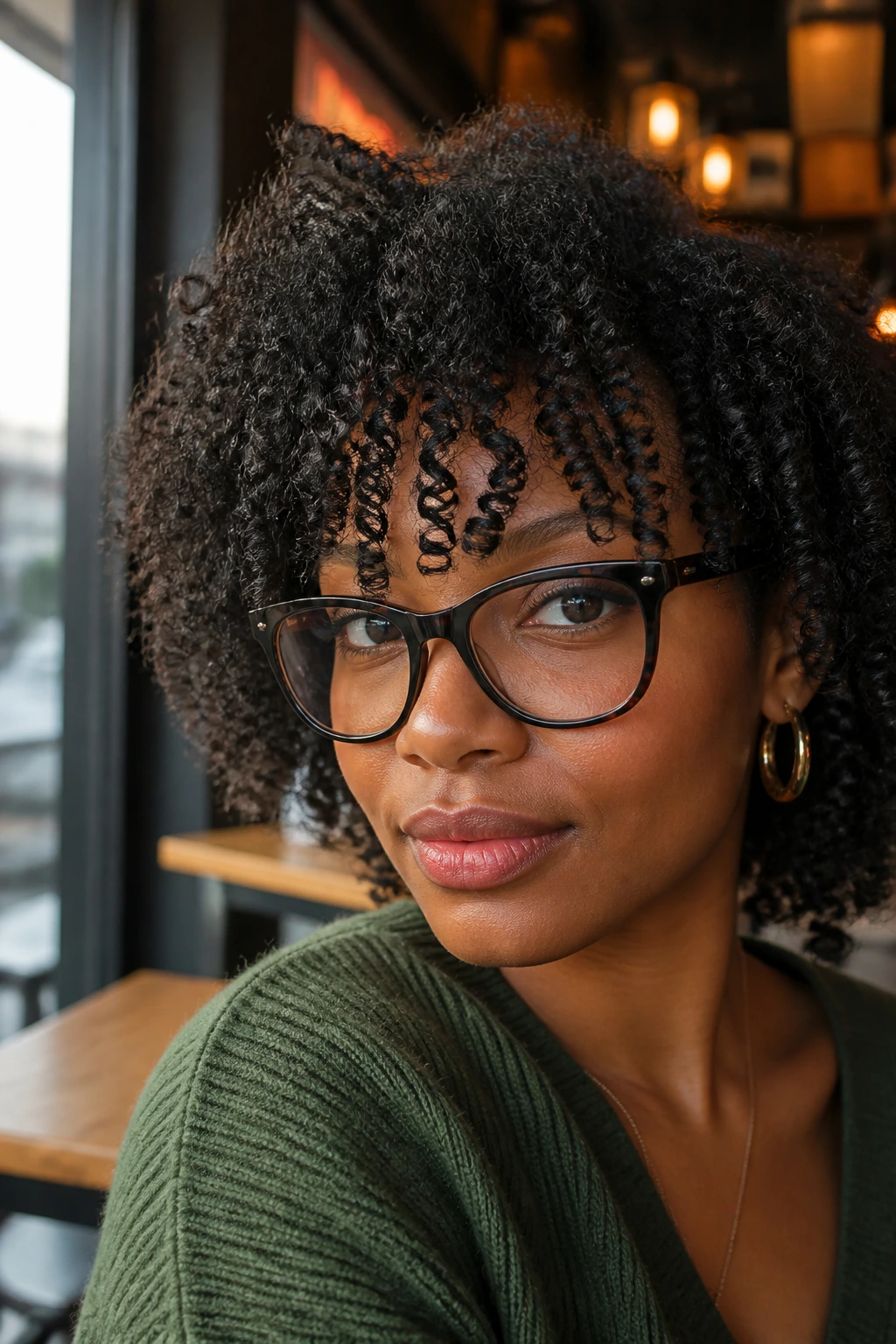
Coily bangs can look incredible with glasses because they add texture where frames often create hard lines. The coils lift the front of the haircut, keep the forehead interesting, and avoid that flat, pasted-down feeling that a lot of straight bangs get after a few hours.
The cut has to respect shrinkage. A coily fringe almost always needs to be shaped longer than it looks in the chair, and the stylist should cut it while the texture is fully defined. If the hair is stretched too much during the cut, the bangs can bounce up into a shape that feels too short and too wide.
Product choice matters here too. Lightweight moisture beats heavy grease. You want enough slip to keep the curls separated, not so much that they clump into little ropes against the frames.
Best for: tighter curl patterns, springy texture, and glasses with some visual weight. Bold frames can handle the energy; thin frames often disappear next to coily fringe unless the cut is very clean.
There’s a lot of personality in this shape. That’s the point.
14. Micro Bangs

Micro bangs are not subtle. They sit high on the forehead, and with glasses that can look striking in a way that either excites you immediately or sends you running to the mirror. There isn’t much middle ground.
The reason they made the list is that, when they’re paired with strong frames, they create a clean separation between brow, lens, and fringe. The face looks open, not crowded. That said, this is the most unforgiving style here if your frames are large, your brow shape changes a lot from day to day, or you’re not into visible contrast.
Micro bangs work best when the haircut around them is sharp too—short cuts, strong cheekbones, deliberate lines. On softer haircuts, they can look a little detached. On the right face and frame pair, they look sharp and modern.
My opinion: if you’re unsure, don’t start here. Micro bangs are brilliant when you want them. They are annoying when you do not.
15. Birkin Bangs

Birkin bangs sit in that sweet space between full fringe and airy softness. They’re longer, a bit separated, and rarely perfectly straight, which is exactly why they behave better with glasses than a dense blunt bang. The brows stay partly visible, and the frames don’t get buried.
This cut is named for a reason: it has a lived-in feel. The fringe often falls just below the brow and can be worn with a slight bend, a little center part, or a tiny sweep to one side. That flexibility makes it easy to wear with different frame shapes.
Compared with curtain bangs, Birkin bangs feel more specific. Compared with blunt bangs, they feel less bossy. They’re a good choice if you want your fringe to look like it belongs to your face rather than announcing itself from across the room.
They also age well through the grow-out stage, which matters more than people think. A bang that still looks good three weeks after the trim is worth keeping.
16. Split Fringe With a Narrow Center Gap

A split fringe is not quite the same thing as a curtain bang, and the difference matters. This version keeps a narrow opening at the center rather than a wide, sweeping part, so the bridge of the glasses stays visible while the rest of the fringe holds more structure.
That makes it a strong option for frames that sit high on the nose or have a pronounced top edge. The narrow gap creates a little negative space right where the glasses need it, which keeps the face from looking crowded.
It’s also a smart fix if you like the idea of fringe but don’t want the full softness of curtain bangs. The split gives shape, but the line stays broken enough that the glasses remain part of the picture.
Best with: medium-to-thick hair, slightly rounded faces, and frames that need a little breathing room through the center. If you wear your glasses constantly, this style tends to settle in well after a quick blow-dry and a light bend away from the face.
17. Deep Side-Part Fringe

A deep side-part fringe changes the whole mood of the haircut. Instead of framing both eyes evenly, it sends most of the fringe to one side, which can be a relief if your glasses already feel visually busy. The asymmetry gives the face motion and keeps one side from getting overloaded.
This is a particularly good match for cat-eye frames and angular glasses because the diagonal line of the bang plays against the frame shape. It also works when one side of your hair naturally wants to fall heavier than the other, which is more common than people like to admit.
The practical advantage is simple: less forehead maintenance. You’re not constantly trying to force both sides into a perfect curtain. One side does the work, the other side blends away.
If you like a haircut that feels a little less precious, this is one to try. It’s polished, but not stiff.
18. Piecey Sliced Bangs

Want texture without a shag? Piecey sliced bangs are the answer. The strands are cut or styled so they separate into visible ribbons, which means they never sit as one solid block against the glasses. That separation gives the face air.
This style is especially useful for thick hair, because thick bangs can feel heavy fast once you add a frame on top of them. The sliced texture breaks that mass up and keeps the front of the haircut from swallowing the eyes.
A pea-sized amount of styling cream or paste usually goes farther than people expect. Rub it between your fingertips, then pinch the bangs into a few separate sections rather than smoothing everything flat. That little bit of separation is the whole look.
Why it stands out
- The fringe moves around frames instead of hitting them head-on
- It gives thick hair a lighter front edge
- It looks casual without looking messy
Some bangs need perfect shape. These need good breakup.
19. Grown-Out Fringe

Not every bang needs to look freshly cut to look good. In fact, grown-out fringe can be one of the best ways to wear bangs with glasses, especially if you hate frequent salon trims or you want a softer outline around your face.
The sweet spot is usually somewhere between brow length and cheekbone length, where the fringe can sweep, split, or tuck without getting trapped under the frames. If the ends are blended into the haircut, the grow-out looks intentional. If they’re left blunt, the style can start to feel limp. That’s the line to watch.
This is a smart choice for anyone who wants flexibility. Wear it down with glasses. Tuck it off the face. Split it in the middle. Let it slide to one side on busy days. The haircut keeps options open, which is not a small thing when you wear frames every day.
How to keep it intentional
Ask for soft interior layers and avoid letting the fringe get too thick at the root. A little lightness keeps the whole thing from collapsing onto the glasses.
20. Tapered Pixie Bangs
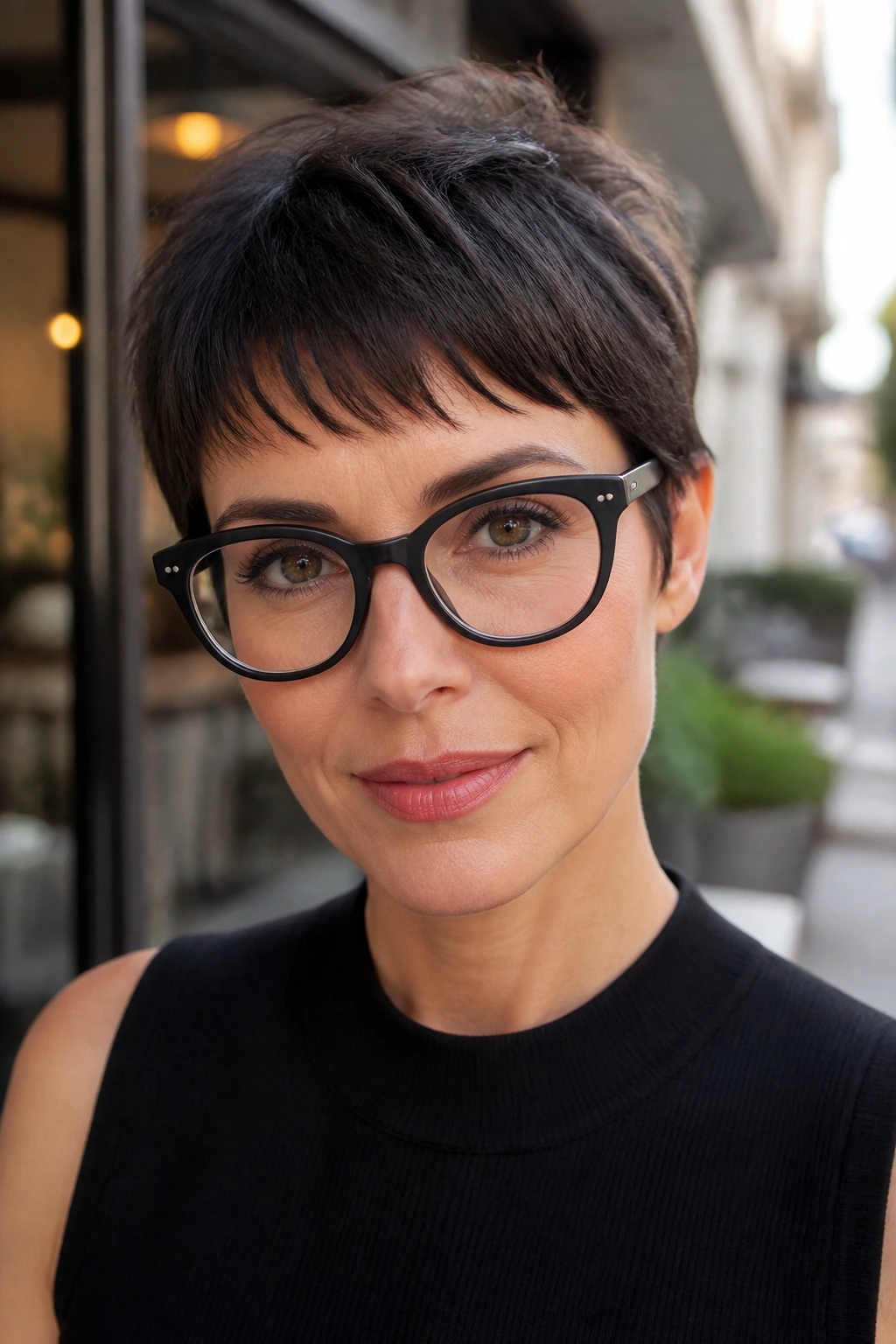
Short hair and glasses can look fantastic together when the fringe is tapered instead of blunt. Tapered pixie bangs keep the front light, open the brow, and let the frames sit as a deliberate part of the look instead of something competing with the haircut.
This style works best if your cut is already short around the sides and neck. The fringe should be the smallest part of the haircut, not the largest. A little longer in the center and softer at the edges keeps the look from going too severe.
I like this cut on people who wear strong frames and want the frames to stay visible. The bangs create a clean point of interest without hiding the glasses or flattening the upper face. It’s sharp, but not harsh when the taper is done well.
If you like your hair neat, short, and easy to reset in the morning, this is the version worth bringing to a stylist.
Why Fringe Placement Matters More Than Most People Think

The top rim is the whole game.
Glasses create a horizontal line across the middle of the face, and bangs create another one. If both lines sit in the same place, the face can feel cut up into stacked bands. That’s why a fringe that looks fine in a salon mirror sometimes feels off when you put your glasses on at home. The cut did not change. The geometry did.
A good bang either leaves room above the frame, opens in the center, or travels away from the lens line. That’s why curtain bangs, bottleneck bangs, side-swept fringe, and airy textures show up so often in the styles people keep returning to. They create movement where glasses create structure.
Frame material matters too. Thick acetate tends to look heavier, so it can handle softer bangs better than a tiny, sparse fringe. Thin metal frames disappear more easily, which means you can get away with stronger bangs, but only if the cut itself has enough shape to carry the front of the face.
A small detail makes a big difference: the bridge position. If your glasses sit low, a bang that lands right at the top rim can feel crowded by midday. If your frames sit higher, a longer fringe can actually help balance the forehead. That’s why a stylist should see the frames, not guess from memory.
What to Tell Your Stylist Before They Pick Up the Scissors
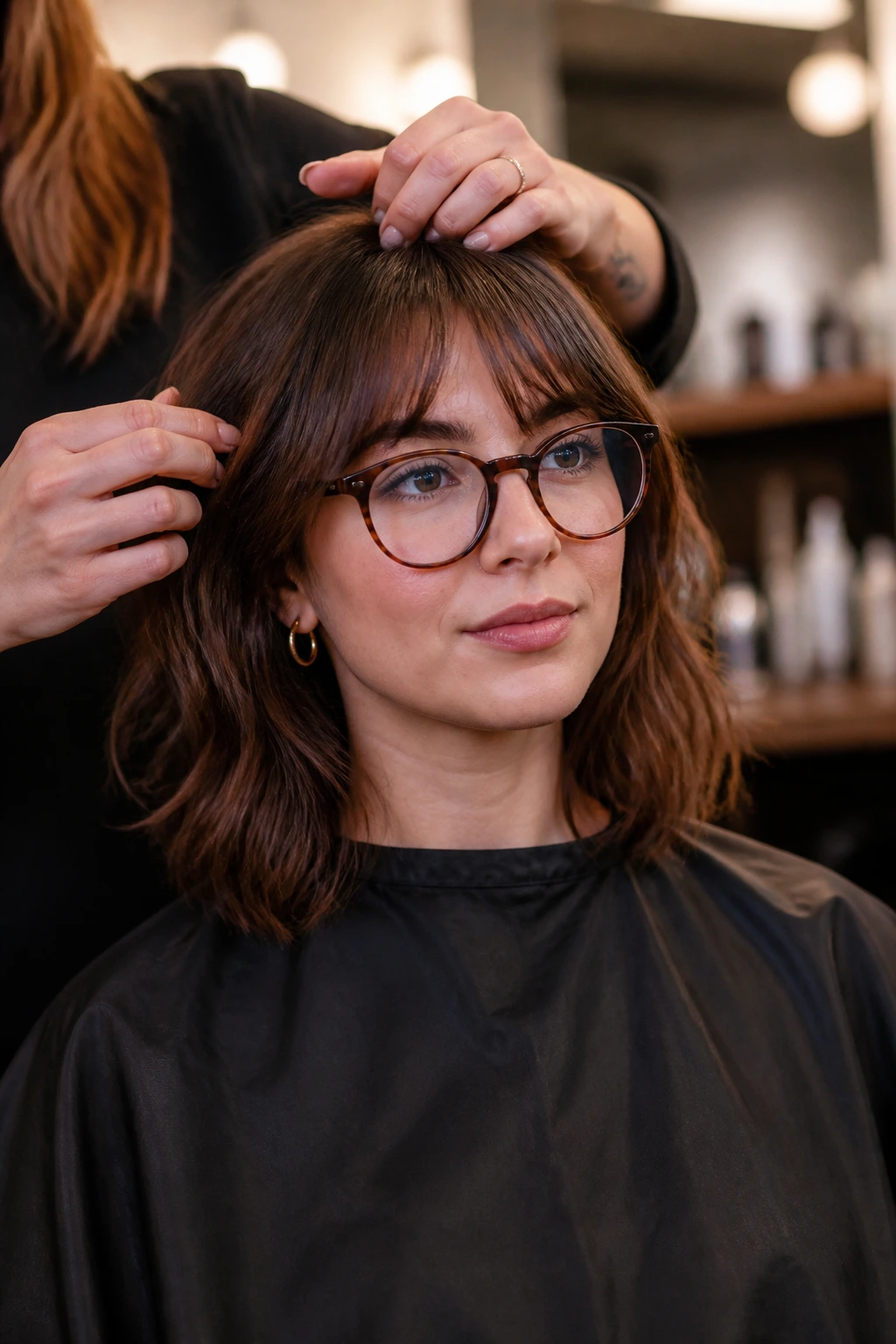
Bring the glasses you wear most, not the pair that lives in your drawer because it looks cute in photos. The height of the bridge, the thickness of the top rim, and the angle of the temples all change how bangs fall once you’re actually wearing them.
Say where the glasses sit on your nose and whether you push them up all day. That one habit matters. A fringe that looks perfect when the frames stay still can get chopped by the movement of your hand if you’re always adjusting them. If you wear progressives or readers, mention that too, because lens height changes how much forehead space feels comfortable.
Ask your stylist to cut the fringe with your natural texture in mind. If your hair is wavy or curly, a wet-cut prediction can be off by a full inch or more. A dry check near the end keeps the bang from shrinking into the glasses or flipping into them on the first humid morning.
Tell them whether you want to see your brows, skim them, or cover them. That sounds basic, but it gives the cut a target. And if you’re torn between two lengths, choose the slightly longer one. Bangs can always be shortened. Growing out a too-short fringe with glasses takes patience.
Tools and Products That Make Styling Easier
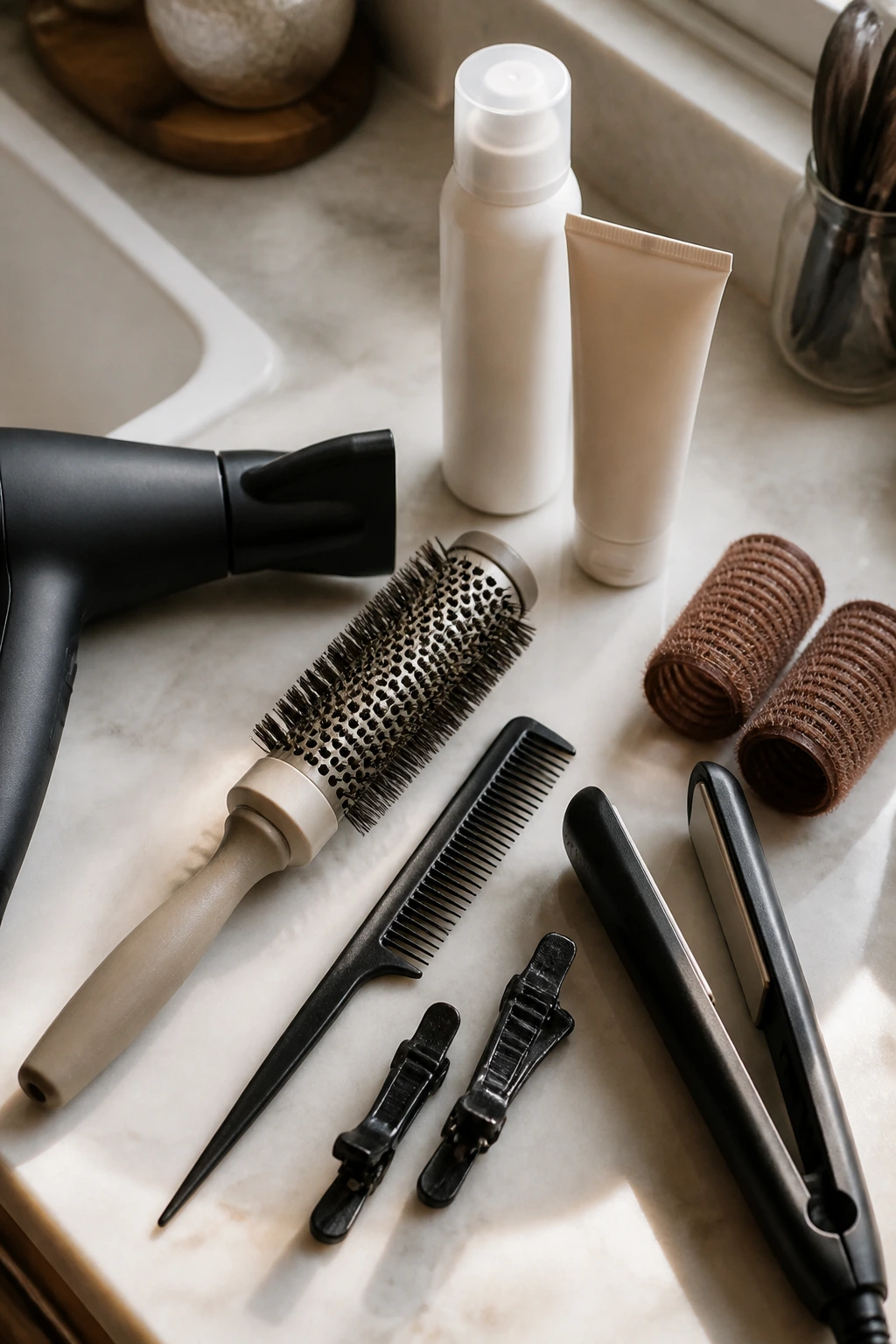
-
Small round brush, 1 to 1½ inches: Best for bending bangs away from the top rim without creating a stiff curl.
-
Blow-dryer with a nozzle attachment: The narrow airflow helps you direct the fringe downward, sideways, or off the brow without blasting it apart.
-
Fine-tooth comb: Useful for separating the front section cleanly before drying, especially if your hair has a cowlick.
-
Duckbill clips or small clips: Great for holding side pieces out of the way while you dry the bang first, which saves time.
-
Dry shampoo: Helps bangs that sit near the glasses stay fresh between washes, especially on fine hair or an oily scalp.
-
Light styling cream or mousse: Better than heavy oils for wispy, layered, curly, or coily fringe because it adds control without flattening the shape.
-
Flat iron with rounded edges: Handy for smoothing a stubborn bend or redirecting a section that wants to hit the frame line.
-
Velcro rollers: A good option if you want root lift without fuss. They’re useful on blunt, curtain, and Birkin bangs.
How to Wear Bangs and Glasses Without Fuss
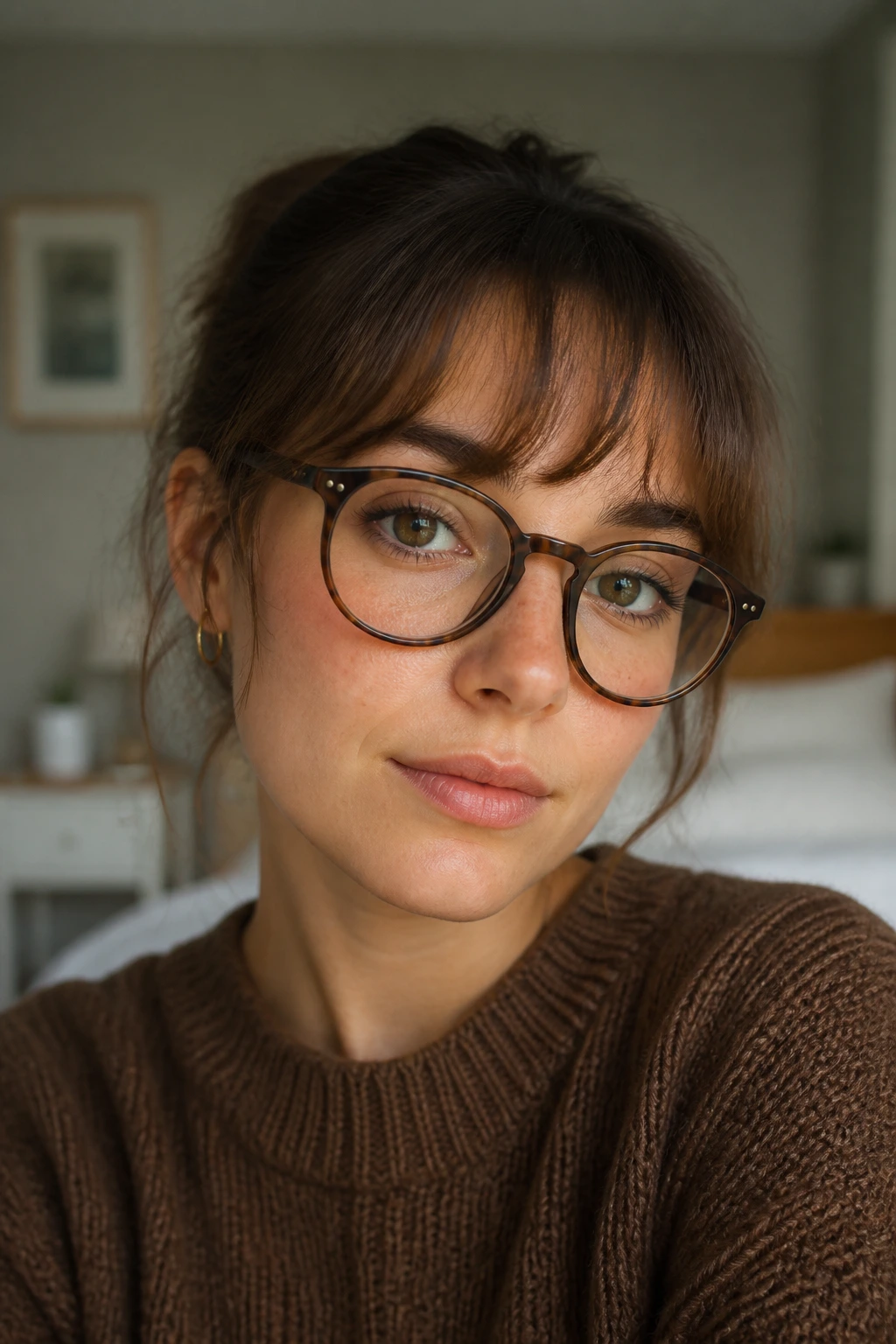
Frame Shape: Curved bangs tend to look best with round or oval frames, while sharper bangs can hold their own next to square or angular frames. If your glasses are already loud, keep the fringe a little softer. If the frames are quiet, the bang can carry more structure.
Brow Balance: Leaving a sliver of brow visible keeps the face from feeling boxed in. You do not need a huge gap. Even a small opening between the fringe and the brow line can make the glasses feel lighter on the face.
Daily Styling: Dry the front first. Always. A quick pass with a small brush and the blow-dryer gives you more control than trying to fix the fringe after the rest of the hair is done. If the bang sits close to the top rim, put the glasses on before the final pass so you can see the actual line you’re creating.
Touch-Ups: Keep a small comb, a travel dry shampoo, or a mini brush near the place where you get dressed. Bangs near glasses show oil and bend faster than the rest of the haircut. A 20-second refresh can save the whole front section.
Additional Tips and Custom Tweaks

Texture Enhancement: If your hair is fine, a light root spray or mousse at the front will keep the fringe from collapsing onto the frame by lunchtime. If your hair is curly or coily, use enough moisture to define the pattern but stop short of anything heavy enough to drag the bangs down.
Customization: Thick acetate frames usually look best with softer fringe—curtain, bottleneck, feathered, or grown-out styles. Thin wire frames can handle sharper cuts, but they also disappear easily, so a bang with more shape can help the face read more clearly.
Serving Suggestions: Pair bangs with a little brow grooming. You do not need carved, overdone brows, but a clean shape makes the fringe and the glasses work together instead of fighting for attention. Earrings matter too; if the frames are bold and the fringe is full, keep jewelry simple enough that the face doesn’t feel crowded.
Make-It-Yours: Want a low-maintenance version? Go longer and softer. Want something with edge? Shorten the center, add texture, or bring in a side part. The same bang family can live in completely different worlds depending on how much forehead it shows.
Common Mistakes to Avoid

-
Cutting the fringe to the frame line exactly: That’s the fastest way to make the face look boxed in. Leave a little space above the rim or build a shape that moves around it.
-
Ignoring how often you wear your glasses: If you wear them all day, a bang that only looks good when the frames are off is not a real solution. Try the cut with your everyday pair on.
-
Going too dense with fine hair: Heavy bangs plus glasses can make the front of the face feel flat and crowded. Keep some air in the cut so the hair doesn’t collapse.
-
Cutting curls or coils too short while wet: Shrinkage is ruthless. What looks like a soft brow-graze in the chair can spring up into a much shorter line once it dries.
-
Using too much product on the fringe: Oily bangs cling to lenses, slide across the frame, and separate in odd places. Use the lightest amount that controls the shape.
-
Forgetting the cowlick: A stubborn front cowlick can kick one side of the fringe up and shove it into your glasses. If you have one, cut around it instead of pretending it isn’t there.
Variations and Alternatives to Try

The Soft Frame Buffer: Keep the bang longer at the sides and lighter through the center if your glasses are thick or oversized. This version gives the frame room without losing the bang effect.
The Wire-Frame Clean Line: If your glasses are thin metal frames, try a more defined bang like rounded, blunt, or arched fringe. The stronger line of the cut helps the glasses show up instead of disappearing.
The Texture-First Cut: For curly, coily, or wavy hair, build the fringe around the natural pattern first and the glasses second. The cut will feel more personal and usually sit better through the day.
The Grow-Out Friendly Version: Choose curtain, Birkin, or long face-framing fringe if you want bangs without a strict trim schedule. These styles stay readable even when they slide a little longer.
The Statement Brow Reveal: If you like your glasses and brows to be visible, go for a shorter, lighter front—micro bangs, wispy bangs, or a narrow split fringe. The face opens up, and the glasses become part of the design.
Maintenance, Trims, and Day-Two Fixes

Bangs near glasses get greasy faster than the rest of your hair. That’s not your imagination. Skin oils, forehead contact, and frame movement all work together, so a fringe that looks fresh in the morning can start to separate by late afternoon. Dry shampoo at the roots helps, but use it sparingly; too much can make the front look dusty.
Trim timing depends on the style. Blunt bangs, micro bangs, and precise Birkin bangs usually need attention every 3 to 5 weeks if you want the shape to stay crisp. Curtain bangs, bottleneck bangs, shag bangs, and grown-out fringe can often go 6 to 8 weeks before they start to annoy you. Curly and coily bangs should be checked when they lose shape, not when a calendar says so.
For day-two or day-three resets, mist the fringe lightly with water, brush it forward, then dry the roots first and the ends second. If the bangs kick into your frames, direct the front with the blow-dryer while wearing the glasses so you can see where the hair actually lands. A cold shot at the end helps keep the line in place.
Night care matters too. If your fringe bends weirdly while you sleep, clip it very loosely to one side or roll it on a soft Velcro roller before bed. The goal is not perfection. It’s just keeping the front from waking up like it spent the night under a hat.
Frequently Asked Questions

Which bangs are easiest if I wear glasses every day?
Curtain bangs, side-swept bangs, and long face-framing fringe are the easiest to live with because they move around the frames instead of landing directly on them. They also forgive a grow-out phase, which is useful if you don’t want to visit the salon every few weeks.
Should bangs touch the top of my glasses?
They can, but only in a controlled way. A fringe that barely skims the top rim can look intentional; one that sits heavy on the frame usually feels crowded and gets oily faster. The safest bet is to leave a little breathing room or build an opening in the center.
Are blunt bangs bad with glasses?
No, but they’re less forgiving than softer styles. Blunt bangs work best with thin or narrow frames and with hair that holds a clean line. If your frames are thick, blunt bangs can still work, but the balance has to be very deliberate.
Can I wear bangs with curly or coily hair and glasses?
Yes, and the result can be gorgeous when the cut respects shrinkage and shape. Curly and coily bangs should be cut dry or checked dry, left a bit longer than straight bangs, and styled with light moisture rather than heavy oils.
How do I keep bangs from sticking to my lenses?
Keep the fringe off heavy product, dry the roots before the ends, and use a small brush or comb to redirect any pieces that fall forward. If the front gets sweaty or oily, a quick blot with tissue and a small mist of dry shampoo can keep it from sliding onto the frames.
What if my frames are oversized?
Go softer, longer, or more layered. Curtain bangs, bottleneck bangs, shag bangs, and long face-framing fringe usually handle oversized frames better than a hard blunt line because they keep the face from feeling overbuilt at the top.
How often should I trim my bangs?
Precise bangs need trims more often than people expect—usually every 3 to 5 weeks. Softer styles can last longer, but if the fringe starts hitting the middle of your lenses or covering your brows in a way you dislike, it’s time to shorten it.
Can I grow out bangs without looking messy?
Yes. Keep the center a little longer, add soft layers around the temples, and let the fringe split or sweep instead of forcing it straight down. Grown-out curtain, Birkin, and side-swept styles are the least annoying transition shapes.
A Fringe That Lets Your Frames Breathe

The best bangs with glasses don’t hide the frames, and they don’t surrender to them either. They leave enough room for your brows, enough shape for your hair, and enough contrast that the face still feels open when you put the glasses on and step back from the mirror.
That’s the part a lot of people miss. You’re not trying to erase the glasses or make the bang invisible. You’re trying to get the two to talk to each other without shouting. When that happens, the whole haircut feels calmer, sharper, and much easier to live with.
Pick the fringe that matches your frame shape, your texture, and your tolerance for upkeep. The right one won’t make you think about it every morning. It’ll just sit there, doing its job, which is exactly what good bangs should do.
