



Short hair with bangs for thick hair works only when the cut understands weight. Thick strands do not sit on the head like a polite guest; they push outward, hold shape, and make a fringe either sit beautifully flat or stick up like it has something to prove. The right cut uses that density instead of fighting it.
That is why the best short styles for thick hair are never just “short.” They’re built. A blunt edge gives the outline something solid to do. Internal layering keeps the bulk from turning boxy. Bangs, when they’re cut with enough thought, can settle across the forehead in a way that looks deliberate instead of dense. And if you’ve ever watched a too-thick fringe separate into three stubborn strips by lunchtime, you know why this matters.
The sweet spot is usually somewhere between structure and movement. Too much thinning, and thick hair can frizz at the ends and lose its clean line. Too little, and the whole shape balloons. The styles below lean into different versions of that balance — some sharp, some soft, some easy to air-dry, some built for a round brush and a little patience.
Why This Collection Works on Thick Hair
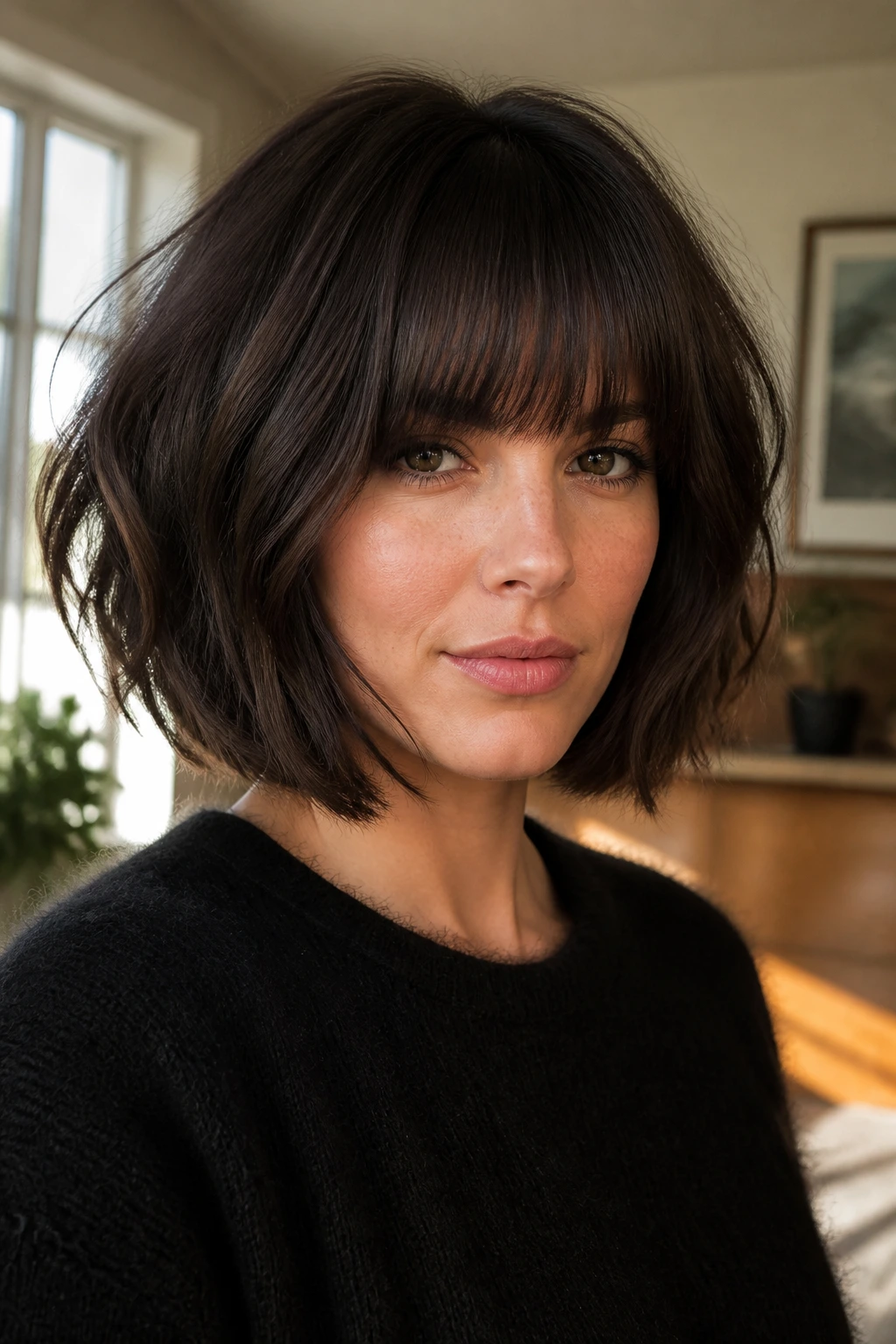
-
The shape has somewhere to go: Thick hair holds a line well, so a blunt bob, stacked back, or cropped fringe can stay visible instead of collapsing halfway through the day.
-
Bangs get enough weight to behave: Thin bangs often split or float on dense hair, but thicker fringe sections can sit properly and cover the forehead without looking see-through.
-
You can control the bulk instead of chasing it: Short lengths make it easier to remove weight exactly where it causes trouble — usually around the crown, behind the ears, and at the nape.
-
The grow-out is kinder: A strong short cut with bangs usually grows into another shape, not a shaggy accident. That matters when you don’t want a trim every three weeks.
-
The styling choices are wider than people think: Thick hair can handle blunt lines, airy texture, curls, waves, and polished finishes. You just need the right silhouette for the strand pattern you already have.
1. Blunt Chin-Length Bob With Full Bangs
This is the cut that makes thick hair look expensive without trying too hard. The blunt edge sits right at the chin, and the full bangs drop straight across the forehead with enough density to look intentional, not sparse. It has that clean, graphic feel that works especially well if your hair grows wide when it’s cut too softly.
Why it works on dense hair
A chin-length bob gives thick hair a clear stopping point. Instead of letting the shape puff out around the shoulders, it keeps the outline tight and controlled. The full fringe borrows some of that weight and moves it forward, which can calm a heavy crown.
What to ask for
- A blunt perimeter at the chin
- Bangs cut slightly longer first, then refined dry
- Minimal thinning at the ends
- A little internal removal near the nape if your hair swells there
If you like a crisp finish, this is the one. It looks especially sharp on straight or slightly wavy hair, and it plays well with a center part or a straight-across fringe that barely grazes the brows.
2. Textured French Bob With Brow-Grazing Fringe
A French bob with thick hair has a kind of easy arrogance to it. The cut sits a little shorter, usually around the cheekbone or jaw, and the fringe skims the brows with soft edges that bend instead of sitting like a ruler. It’s less polished than the blunt chin bob above, and that’s the point.
The texture keeps thick hair from looking heavy. A little point cutting through the ends lets the shape move when you turn your head, which matters because dense hair can go stiff fast if every line is too neat. This is the version I’d pick for anyone who wants bangs but does not want to spend 20 minutes persuading them into place every morning.
It looks best when the ends are slightly broken up with a matte cream or a small amount of texturizing spray. Too much shine and it starts to feel helmet-like. Keep it soft. Keep it touchable.
3. Layered Pixie With Side-Swept Bangs
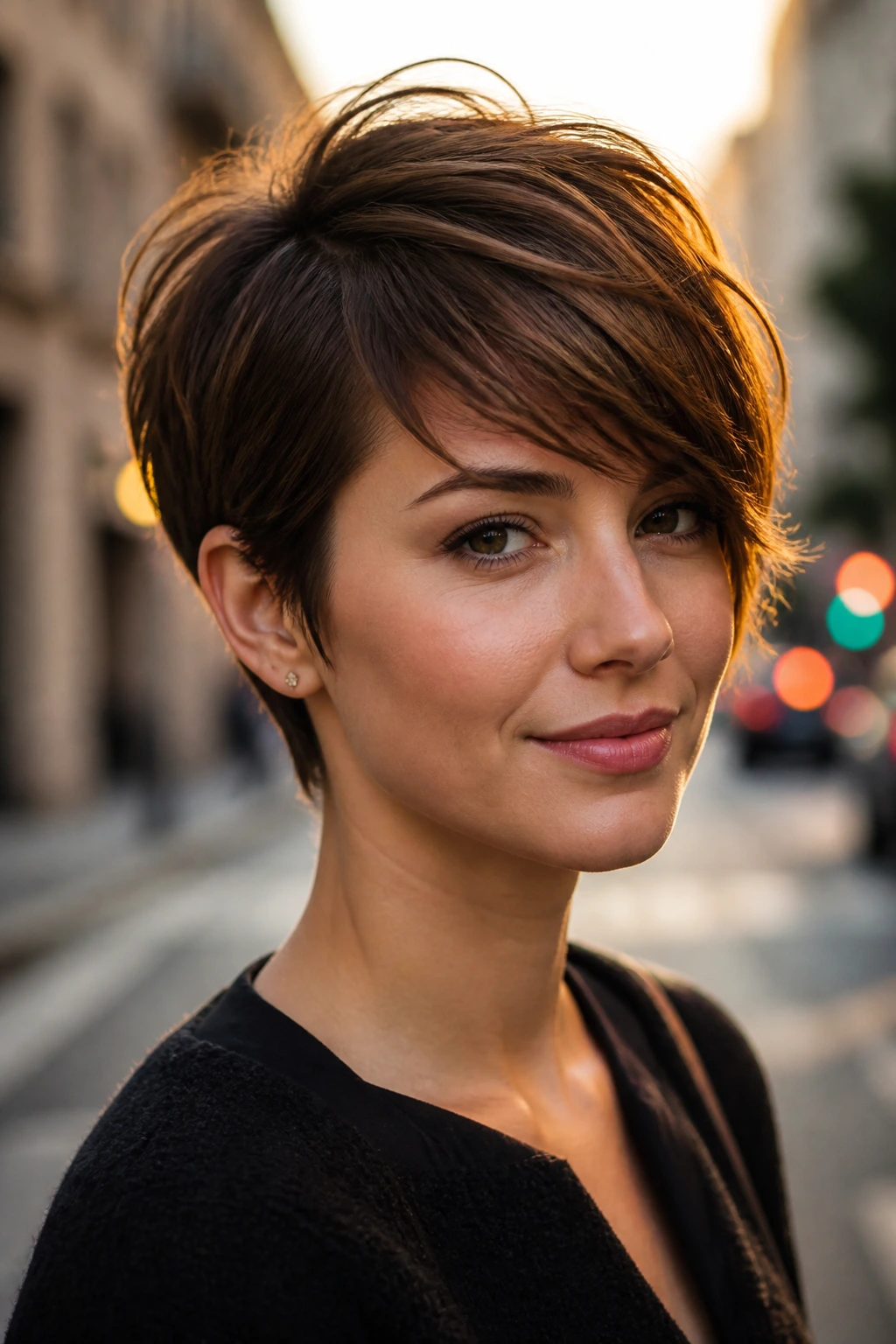
If your thick hair has a stubborn crown or a wide forehead line, a layered pixie with side-swept bangs can be a lifesaver. The side fringe pulls weight off the front without making the face look fenced in, and the short layers let the top collapse in a good way instead of standing up like a brush.
The detail that matters
Ask for the top to be cut with movement, not chopped flat. Thick hair can take a lot of layering, but the layers need to be placed with intention. If the crown is too short and the sides are too heavy, you get a puffy helmet. If the front is left long enough to sweep across the brow, the whole cut looks softer.
Best for: strong cheekbones, busy mornings, and people who don’t mind a quick finger-style after blow-drying.
Skip if: you want one haircut to behave for six weeks without touchups. Pixies tend to ask for more attention.
4. Bixie With Curtain Bangs
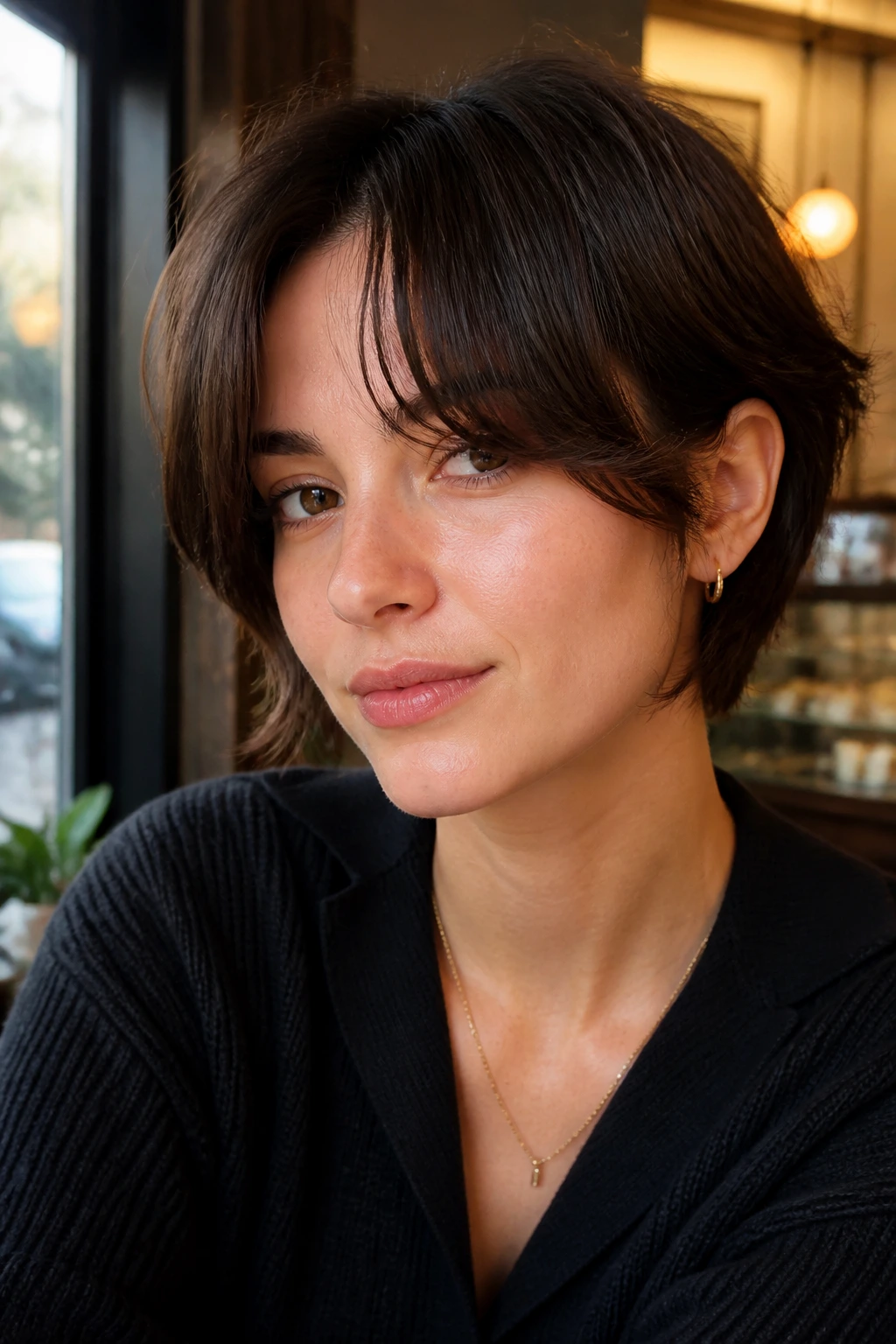
The bixie sits in that sweet spot between a bob and a pixie, which is exactly why thick hair likes it. There’s enough length to tuck behind the ear, enough texture to keep the shape loose, and enough fringe to soften the forehead without locking you into a heavy straight bang. Curtain bangs open the face and let the density fall to each side instead of piling up in one block.
What I like about this cut is the lack of drama in the grow-out. It doesn’t suddenly lose its shape. The front softens first, the sides stay useful, and the whole thing becomes a little messier in a way that still reads on purpose. Thick hair carries that transition better than fine hair does.
Use a round brush or hot air brush if you want the fringe to flip away from the face. Or leave it rough and let the natural bend show. Both work.
5. Stacked Bob With Micro Bangs
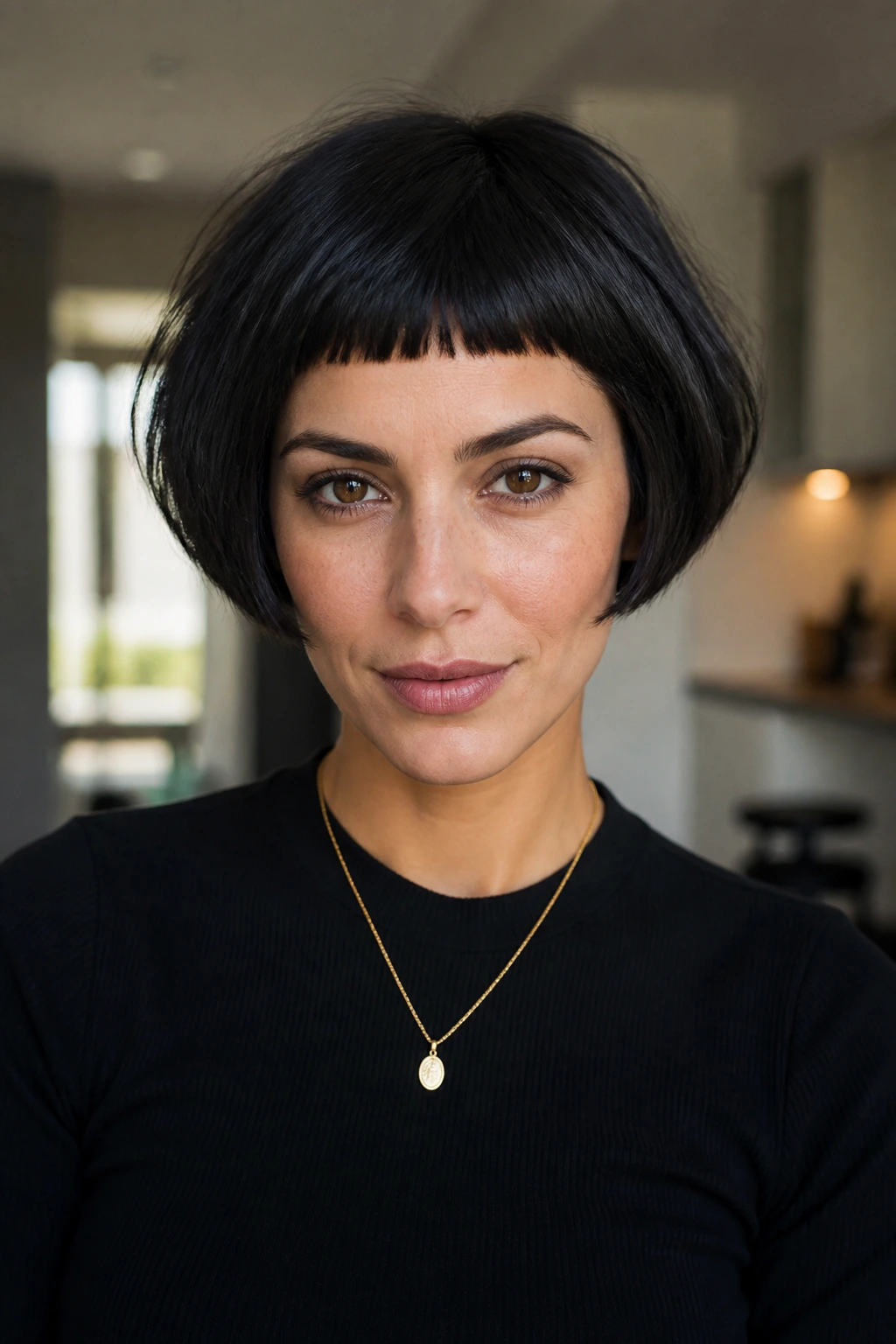
This is the bold one. A stacked bob builds weight through the back and removes it as the shape moves toward the neck, so thick hair can keep that lifted curve without turning bulky. Micro bangs make the front feel sharp and modern, almost architectural, which is a nice trick when the hair itself is dense and heavy.
The cut only works when the stacking is clean. If the back is too blunt and the top is too long, the head can look rounder than intended. Done well, though, it gives you a neat nape, a little lift at the crown, and a fringe that draws the eye upward.
It’s not the easiest cut to maintain. That’s the tradeoff. But on thick hair, it can look stunning in a very matter-of-fact way — no fluff, no extra movement, just shape.
6. Shaggy Crop With Choppy Bangs
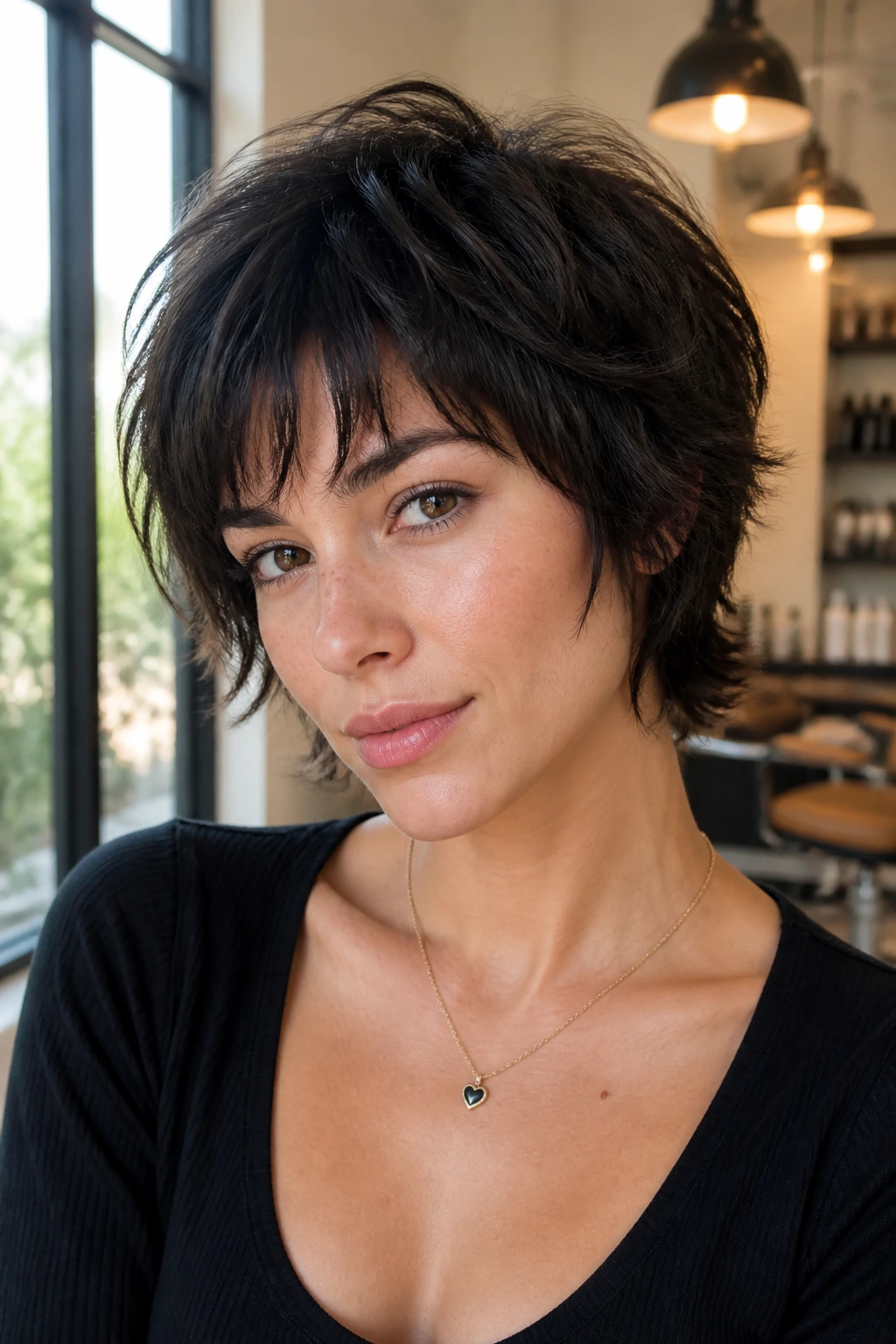
A shaggy crop is where thick hair gets to misbehave in an organized way. The choppy bangs and broken-up layers give the density somewhere to spread out, which keeps the cut from sitting like one solid mass. It works because it doesn’t pretend to be sleek.
Why this cut feels lighter
Thick hair often looks best when the ends are intentionally irregular. Not ragged. Just broken up enough that the perimeter doesn’t form a hard wall. Choppy bangs do the same job at the front: they release weight without leaving the fringe too thin to matter.
You want this cut to look better at 80 percent dry than at 100 percent blown out. A little bend, a little separation, and a small amount of paste rubbed between the fingers are usually enough.
If your hair has natural wave, this is one of the easiest ways to use it instead of ironing it flat every day.
7. Inverted Bob With Rounded Fringe
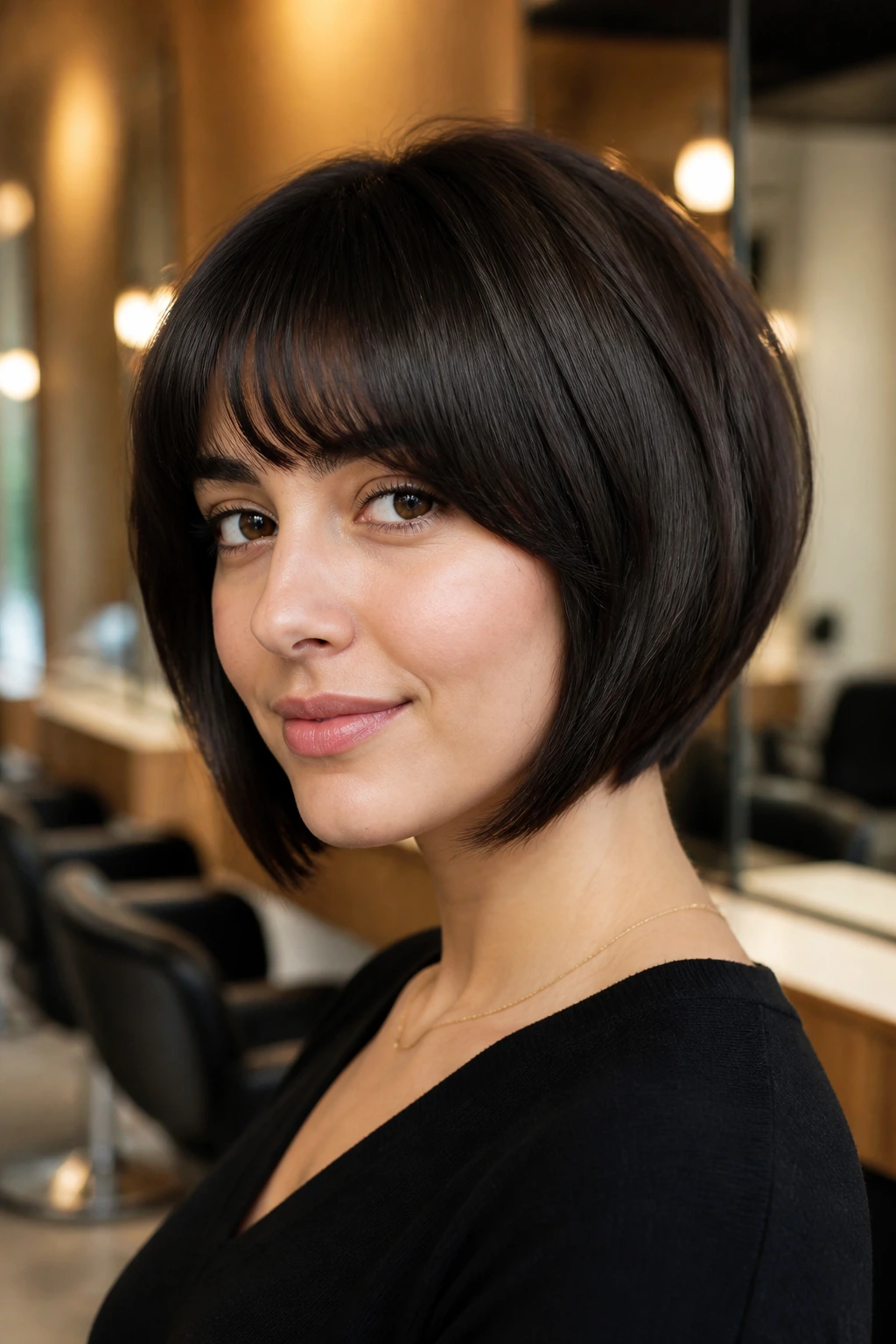
The inverted bob gives thick hair a strong forward shape, with the back sitting shorter and the front dropping longer toward the jaw. That angle helps a lot when the hair wants to fan out at the bottom. The rounded fringe softens the front line so the whole cut doesn’t feel severe.
This is one of those cuts that quietly fixes a lot of problems. Heavy hair around the nape gets lifted. The front has movement. The fringe doesn’t slice straight across the forehead, so it works nicely if your face is longer or your brow line needs a little balance.
A few salon notes
- Keep the front angle gradual, not extreme
- Ask for the fringe to curve slightly at the temples
- Avoid over-thinning the ends; the shape depends on solid structure
It’s a smart choice if you want a bob that feels tailored but not stiff.
8. Jaw-Length Box Bob With Heavy Blunt Bangs
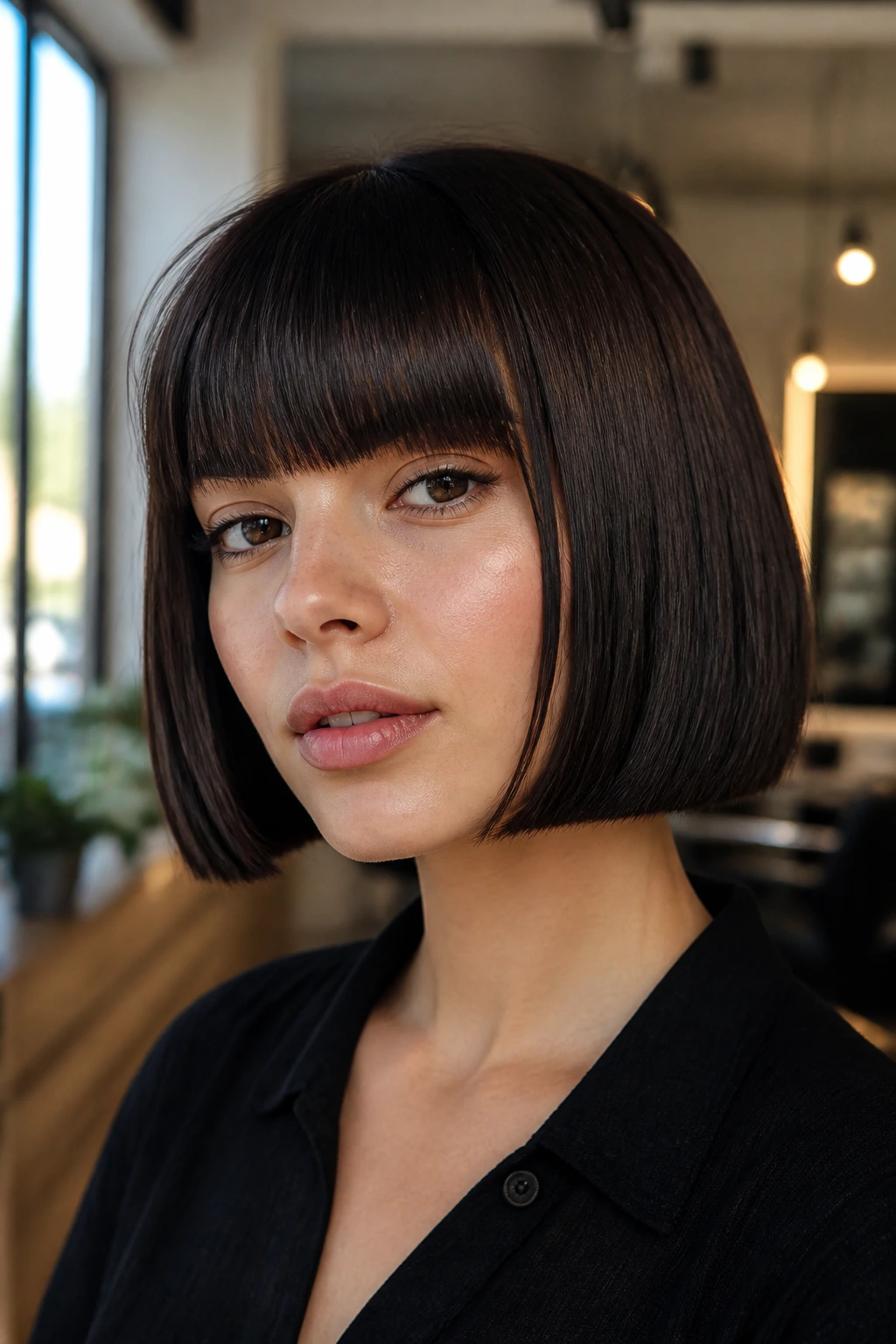
This is the strong, clean version of short hair with bangs for thick hair. The box bob lands at the jaw, and the bangs come down heavy enough to read as a real fringe rather than a decorative whisper. On dense hair, that kind of bluntness is a gift. The cut uses the fullness as the point.
The danger is extra bulk at the corners of the jaw. If the sides are left too thick, the shape can widen fast. The fix is a small amount of internal debulking, usually hidden beneath the top layer, so the perimeter stays crisp while the inside has room to move.
This cut looks especially good with straight hair or a smoothing blow-dry. It’s one of the few short styles that can feel almost severe in the best way.
9. Ear-Grazing Crop With Piecey Fringe
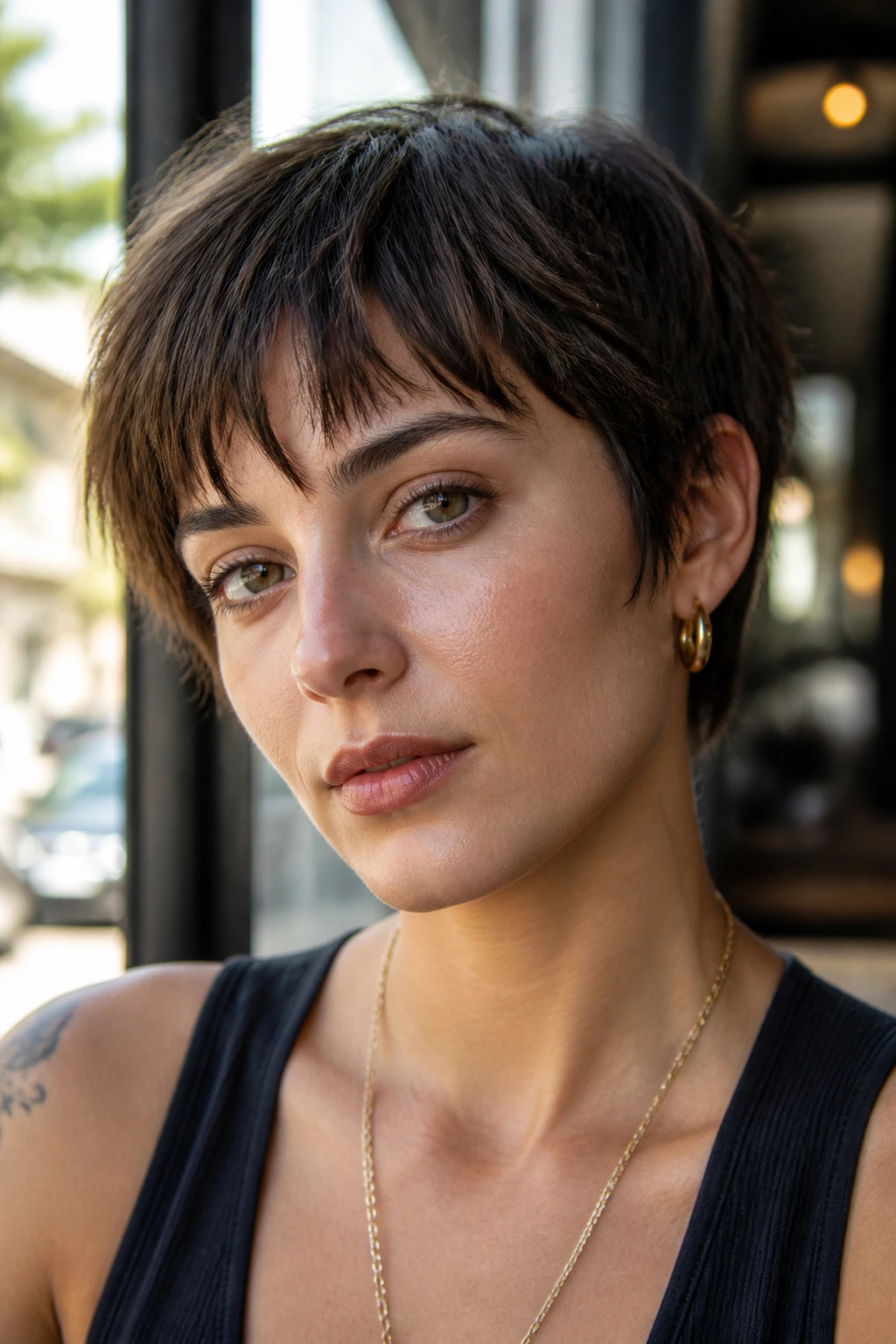
If you like short hair that feels a little undone, this one has teeth. The crop sits around the ears, the fringe breaks into separated pieces, and thick hair turns from heavy to textured the second a stylist removes the excess bulk in the right spots. It’s the sort of cut that never looks overly precious.
A piecey fringe works because it stops the forehead from being buried under one thick curtain. You still get bang coverage, but the gaps between the pieces let skin show through, which keeps the whole style from feeling dense. That’s a useful trick if your hairline is low or your forehead runs short.
A pea-size amount of styling cream is enough. More than that and the separation gets sticky.
10. Soft Pageboy With Arched Bangs

Why does a pageboy still work? Because thick hair gives that rounded shape the body it needs. The cut curves under at the ends, and the arched bangs follow the brow line with a slight lift in the middle, which softens the face without making the front too blunt.
Best when you want order
This is the cut for someone who likes polish but doesn’t want hard edges everywhere. The curve around the jaw can make a square face feel less boxy, and the bangs keep the attention near the eyes. Thick hair helps the shape hold its roundness, which is a blessing if your strands usually refuse to bend.
Styling note: Blow-dry the bangs first with a small round brush, then finish the rest of the bob. If you wait until the whole head is dry, the fringe will usually set in the wrong direction.
11. A-Line Bob With Long Side Bangs
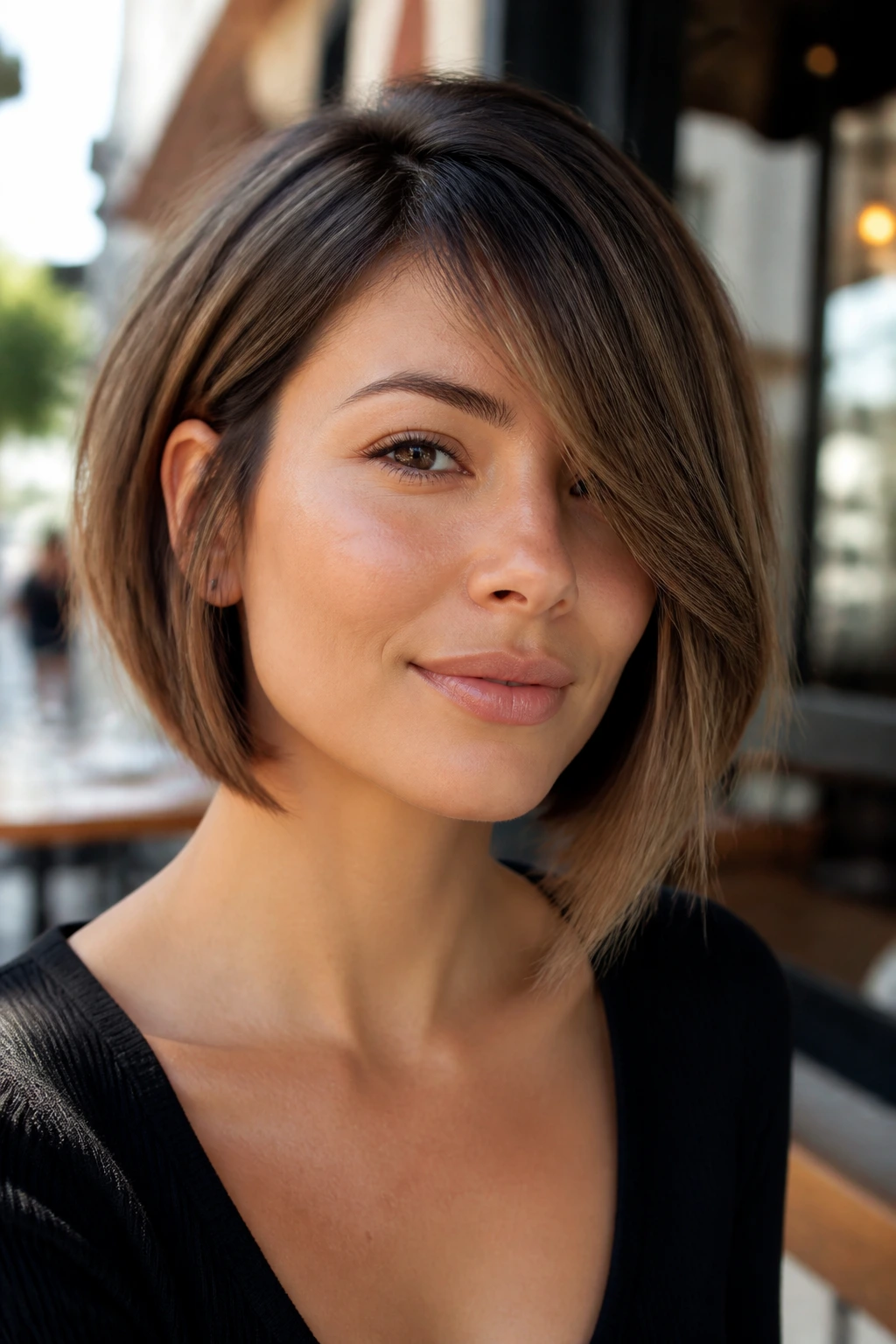
The A-line bob is one of the easiest ways to keep thick hair short without feeling boxed in. The front is slightly longer than the back, which gives the cut motion and keeps the jawline open. Long side bangs stretch that shape forward and make the whole style feel a little more elegant than a strict blunt bob.
This is a good choice if you wear glasses or if your forehead feels better partially covered rather than fully framed. The long fringe can be tucked, pinched behind the ear, or pushed across the brow with a flat brush and a quick blast from the dryer.
Thick hair loves the built-in geometry here. There’s room for body, but the line still says something.
12. Curly Bob With Curly Bangs
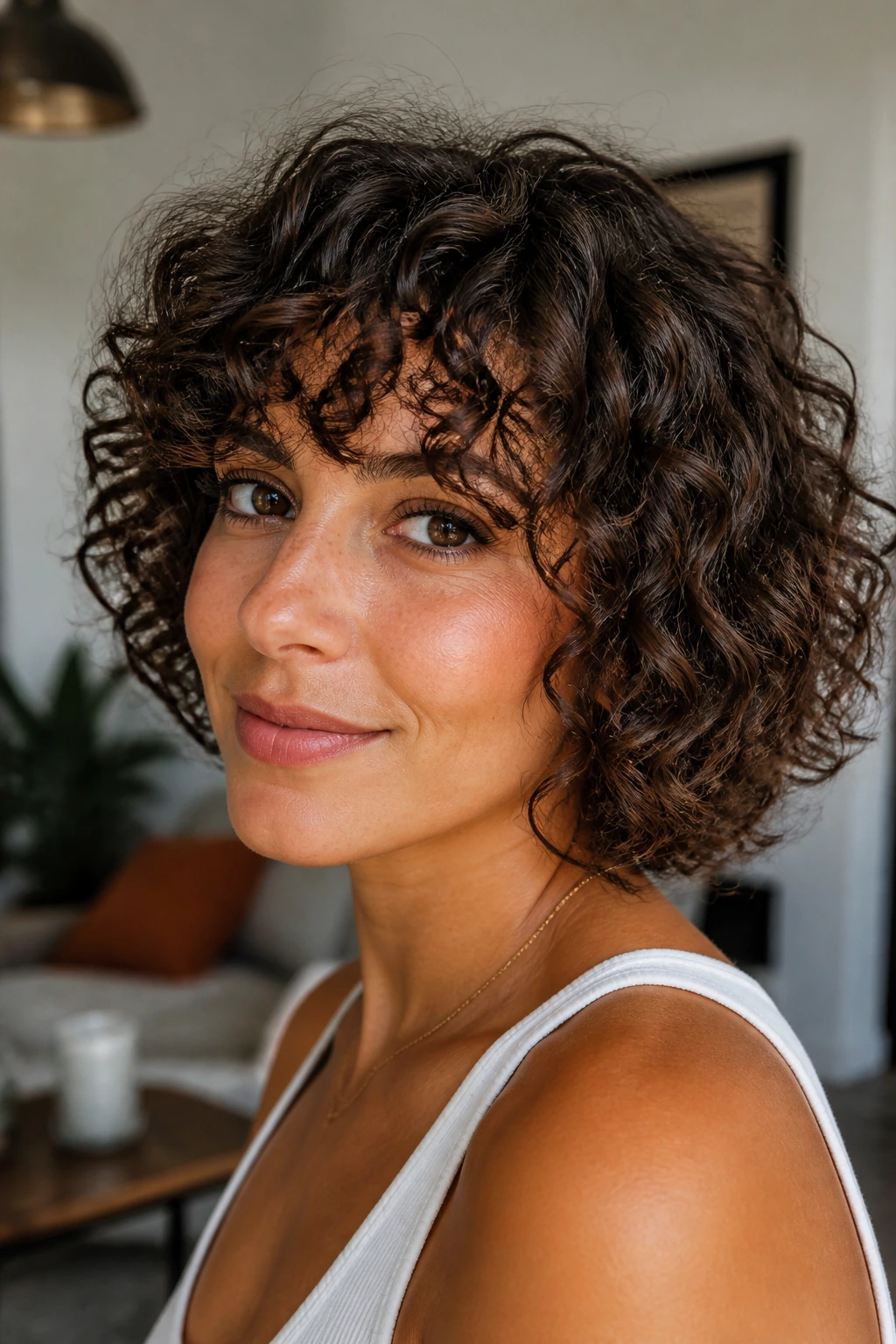
Curly thick hair and bangs are not a bad match. They just need honesty. A curly bob with curly bangs works when the fringe is cut to live in the same texture as the rest of the head, not forced into a straight shape that won’t hold after one humidity shift.
The best version usually sits around the chin or slightly above it, with enough length for the curls to spring without shrinking into the forehead. The bangs should be cut dry, curl by curl, so the stylist can see where each coil wants to sit. That part matters a lot.
Unlike straight fringe on curly hair, curly bangs should look a little softer at the edges. That softness is not a flaw. It is the point.
13. Feathered Crop With Bottleneck Bangs
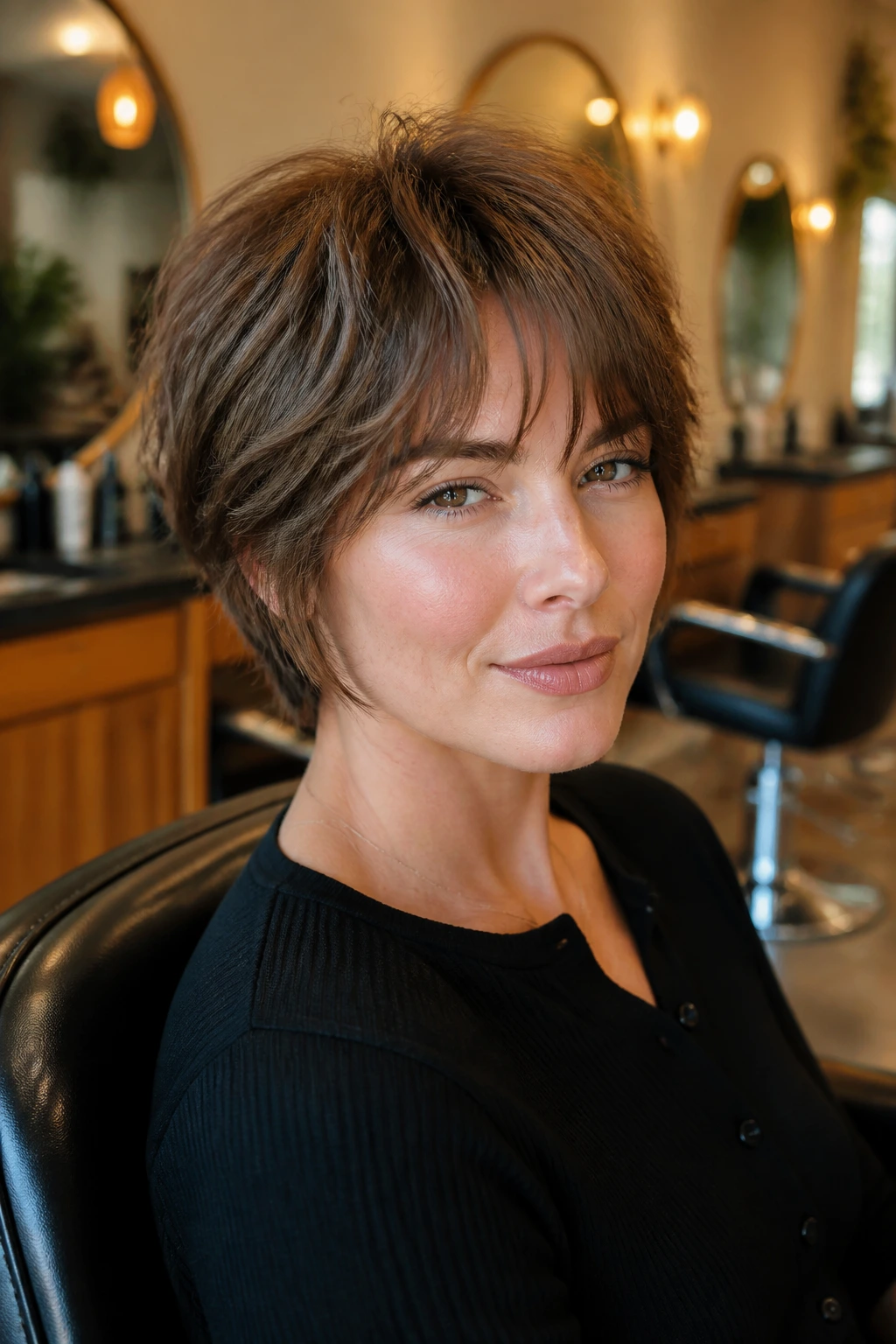
A feathered crop gives thick hair some breathing room. The layers are lightened through the top and crown, while bottleneck bangs — fuller in the center, softer at the sides — keep the front from looking too severe. It’s a good match if you want movement without the shag haircut becoming too messy.
What makes it different
Bottleneck bangs are sneaky. They offer coverage where you want it, but they don’t sit across the whole forehead like a blunt block. On dense hair, that matters because too much width at the front can make the face look narrower than it is.
This cut plays well with a little bend from a dryer or a velcro roller at the fringe. It also grows out in a nice, relaxed way, which is one reason stylists keep reaching for it with thicker textures.
14. Undercut Pixie With Sweeping Fringe
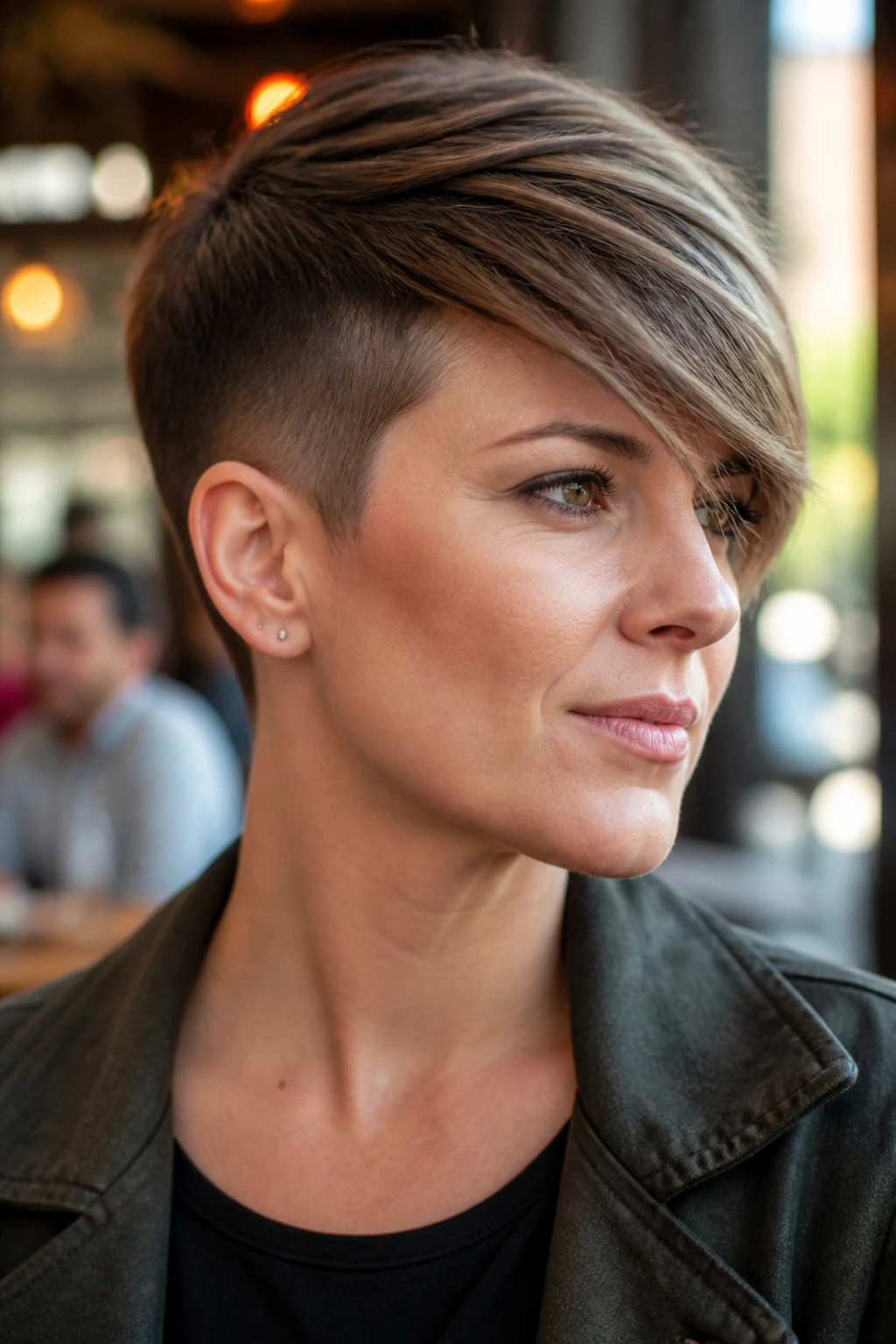
This is the pressure-release valve cut. An undercut removes hidden bulk from the sides or nape, while the sweeping fringe keeps the top soft and wearable. Thick hair can feel almost weightless in this shape, which is a strange and lovely thing if you’ve spent years fighting a helmet effect.
The fringe should be long enough to move across the forehead without splitting into a short, stiff strip. If it’s too short, the drama disappears. If it’s too heavy, the undercut is doing all the work and the top looks disconnected.
I like this cut on people who want a little edge but don’t want to style every strand into submission. It has enough attitude already.
15. Wedge Cut With Short Bangs
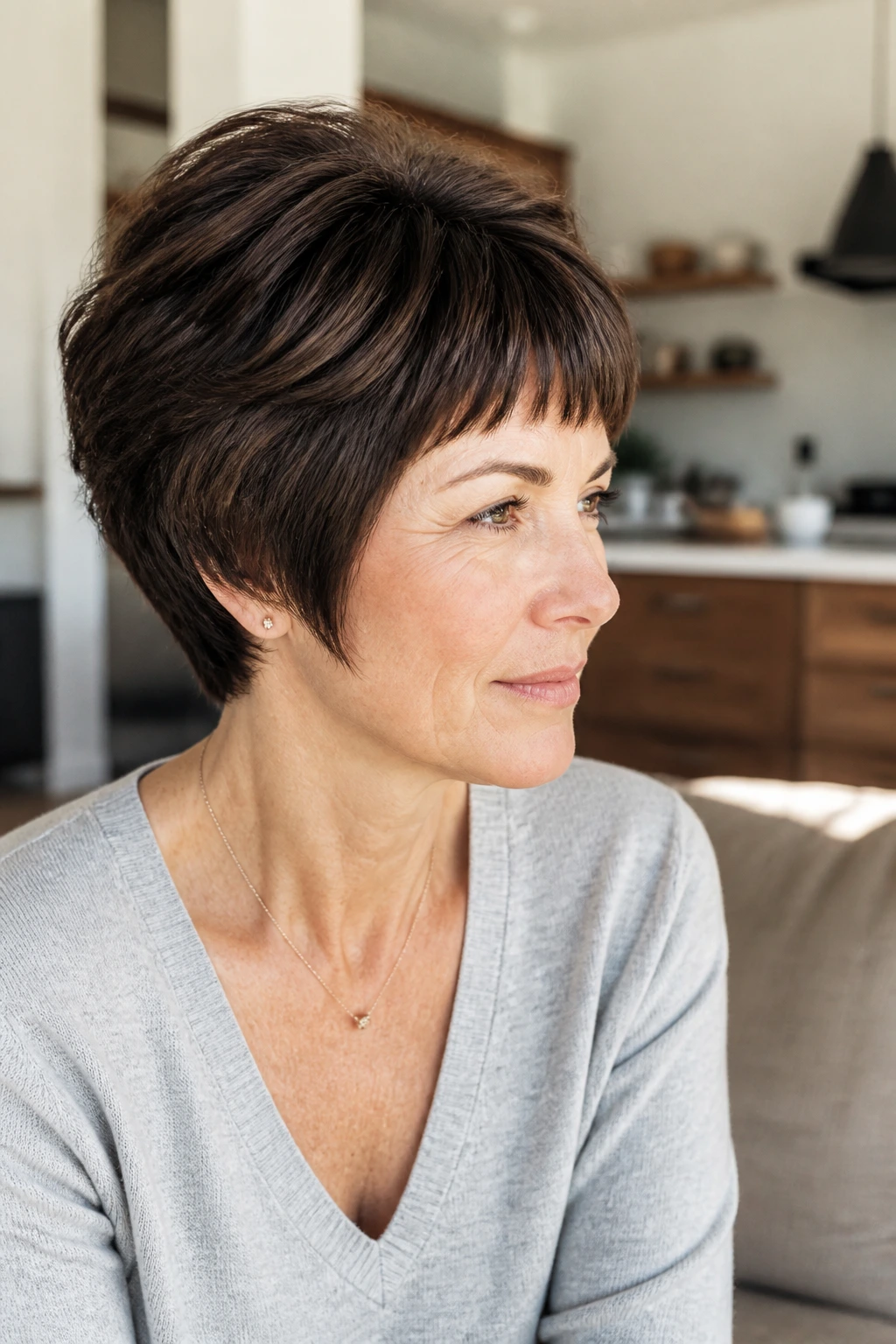
The wedge cut has a retro spine, but thick hair gives it a cleaner, sharper feel than people expect. The back stacks up gently, the sides taper inward, and the short bangs sit high on the forehead. When the cut is done right, it looks tidy from every angle.
Best for a strong profile
This shape works especially well if you like a lot of structure around the head. Thick hair provides the body the wedge needs, so the back doesn’t collapse, and the short fringe keeps the front from feeling too heavy. The face opens fast with this style, which can be useful if your hair tends to hide your features.
It is not a lazy haircut. You’ll need regular shaping to keep the wedge clear. But if you enjoy the clean geometry, it pays you back every morning.
16. Asymmetrical Bob With Long Fringe
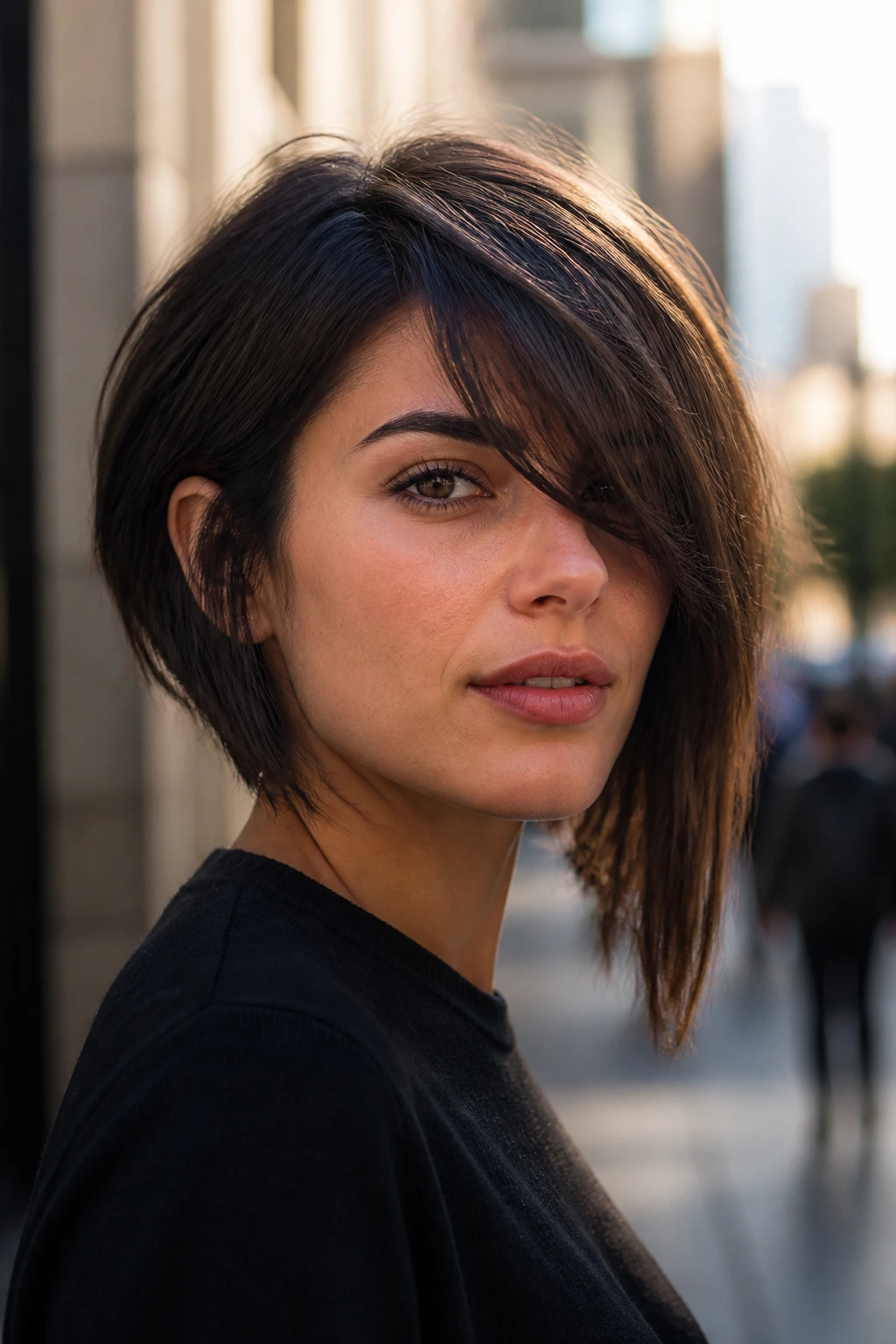
One side longer, one side shorter, and a long fringe that drifts over the brow. That’s the basic structure, but on thick hair the asymmetry becomes much more visible because the density gives the line real weight. The result feels modern without needing any extra fuss.
What I like here is the way the long fringe can correct balance. If one side of your hair grows flatter, or if your face has a natural asymmetry that bugs you, this cut can soften it without shouting about it. The longer side also gives you a place to tuck behind the ear when you want the face more open.
This is a good choice if you want short hair that looks a little unexpected. Not wild. Just not boring.
17. Rounded Mushroom Cut With Soft Bangs
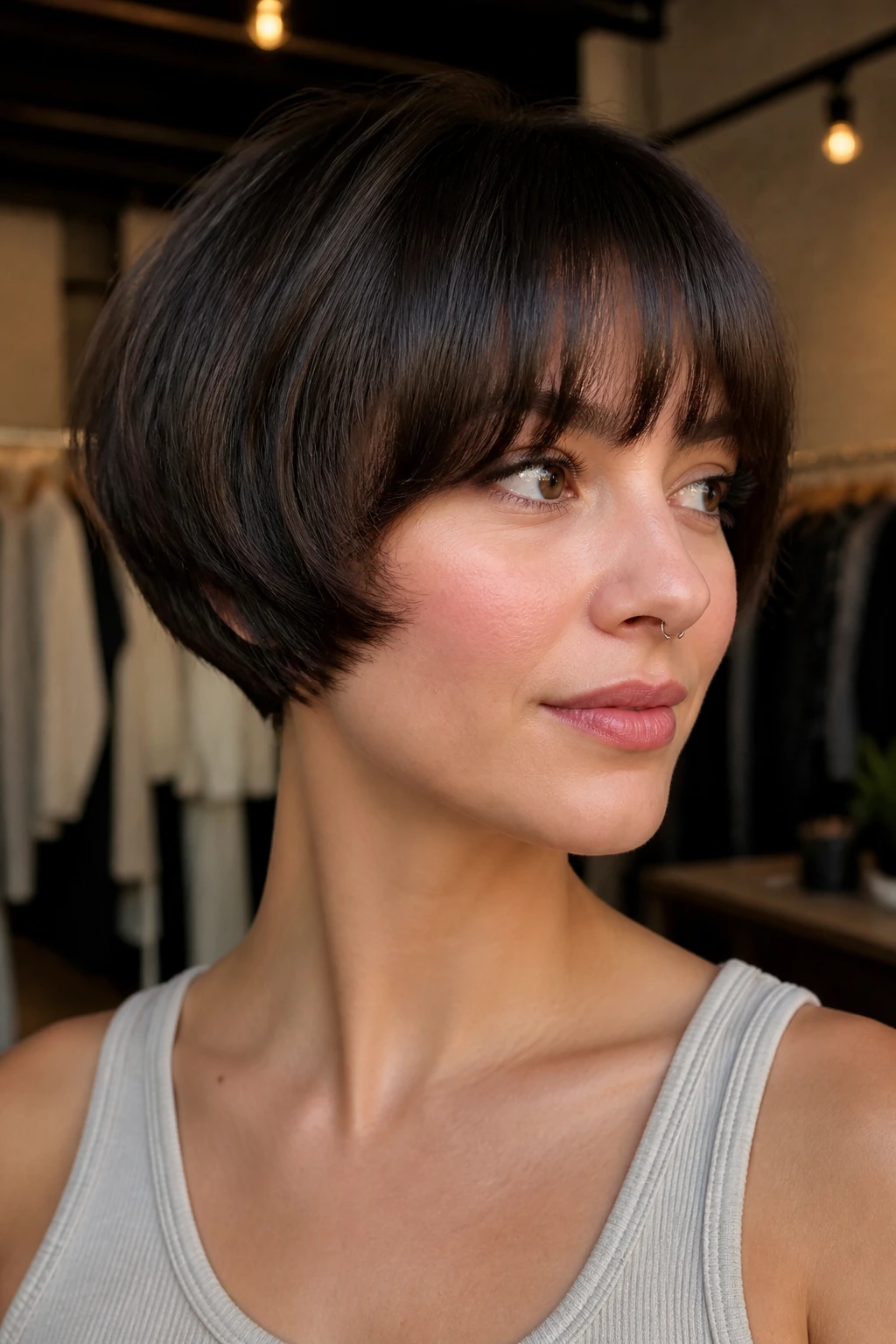
The mushroom cut can go wrong fast on thick hair if the sides are left too bulky. But when it’s shaped with restraint, it becomes a rounded little cap of softness that sits close to the head and shows off the density instead of fighting it. Soft bangs keep the front from feeling cartoonish.
This cut is all about balance. The top must be light enough to move, the sides trimmed enough to avoid puff, and the bangs tapered so they don’t form a hard line. On the right hair texture, it looks almost sculptural.
If you like a fashion-forward shape and don’t mind a stylist who understands proportion, this one has real personality.
18. Tousled Mini Lob With Curtain Bangs

The mini lob is a little longer than the others here, but it still counts as short enough to stay in this family. Curtain bangs are what make it useful for thick hair. They break the front into two soft panels, which keeps the forehead visible and the overall shape from feeling too blocky.
The nice part
This cut gives you room. Room to tuck, room to wave, room to grow it out without panic. Thick hair can handle that length without losing form, and the curtain fringe helps the front stay light.
A sea-salt spray or light mousse works well if you want the ends to bend instead of lie flat. It’s the least fussy option for someone who wants bangs but doesn’t want to commit to a sharply defined fringe every day.
19. Sliced Bob With Cheekbone Bangs
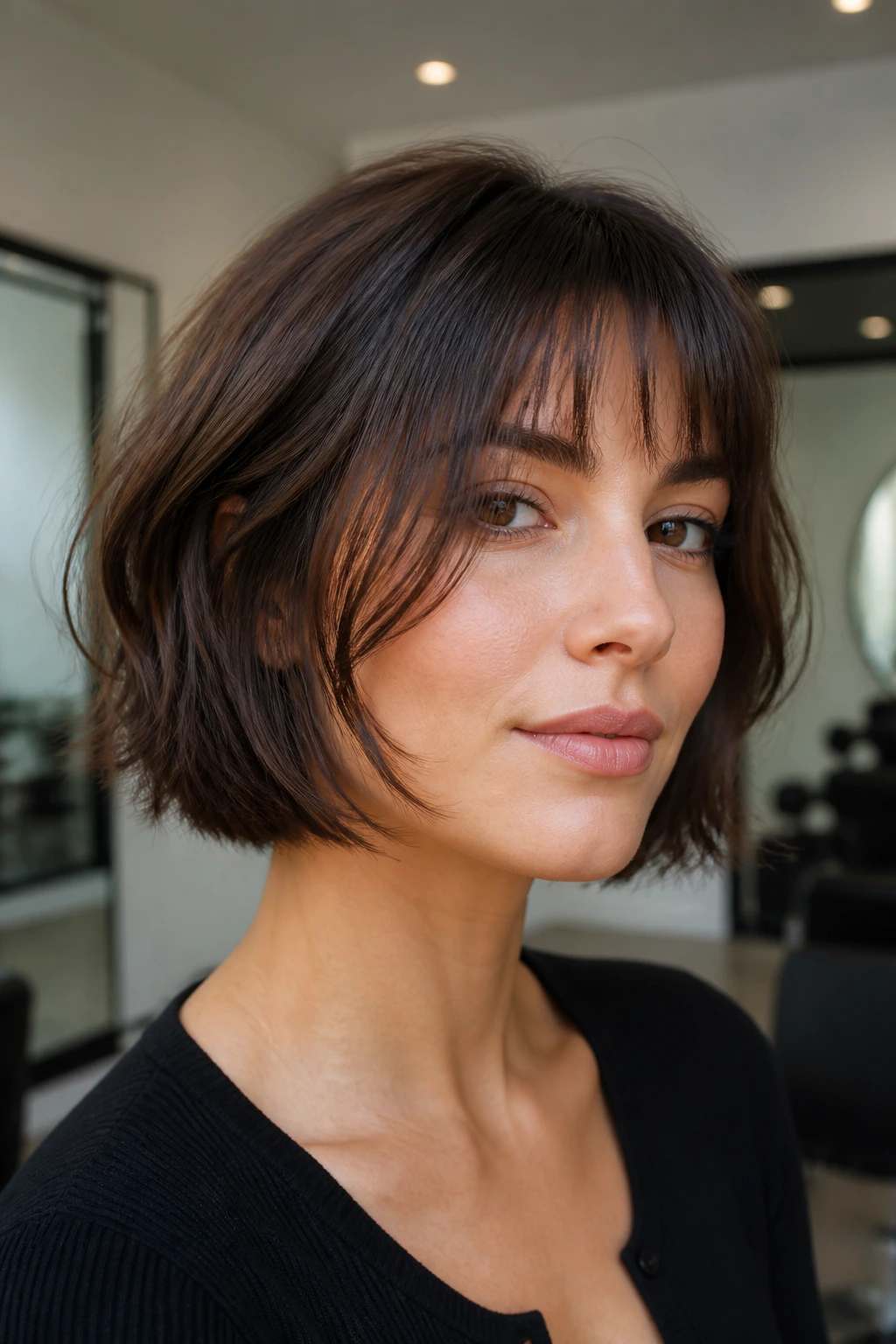
A sliced bob uses sharper internal cutting to remove some of the density while keeping the outer line clean. Cheekbone bangs do what the name says: they aim right at the bone structure, which is useful if you want the cut to frame the face instead of sitting across it.
Why it’s a smart shape for thick hair
The slicing gives the inside of the cut more movement than a blunt bob does. That matters because thick hair can look too solid if every section is left the same length. The cheekbone fringe then directs attention upward and outward, which keeps the face open.
It’s one of those cuts that looks best when you don’t overwork it. Brush it, bend it, and let a little unevenness stay in place.
20. Textured Boyish Crop With Eyebrow Bangs
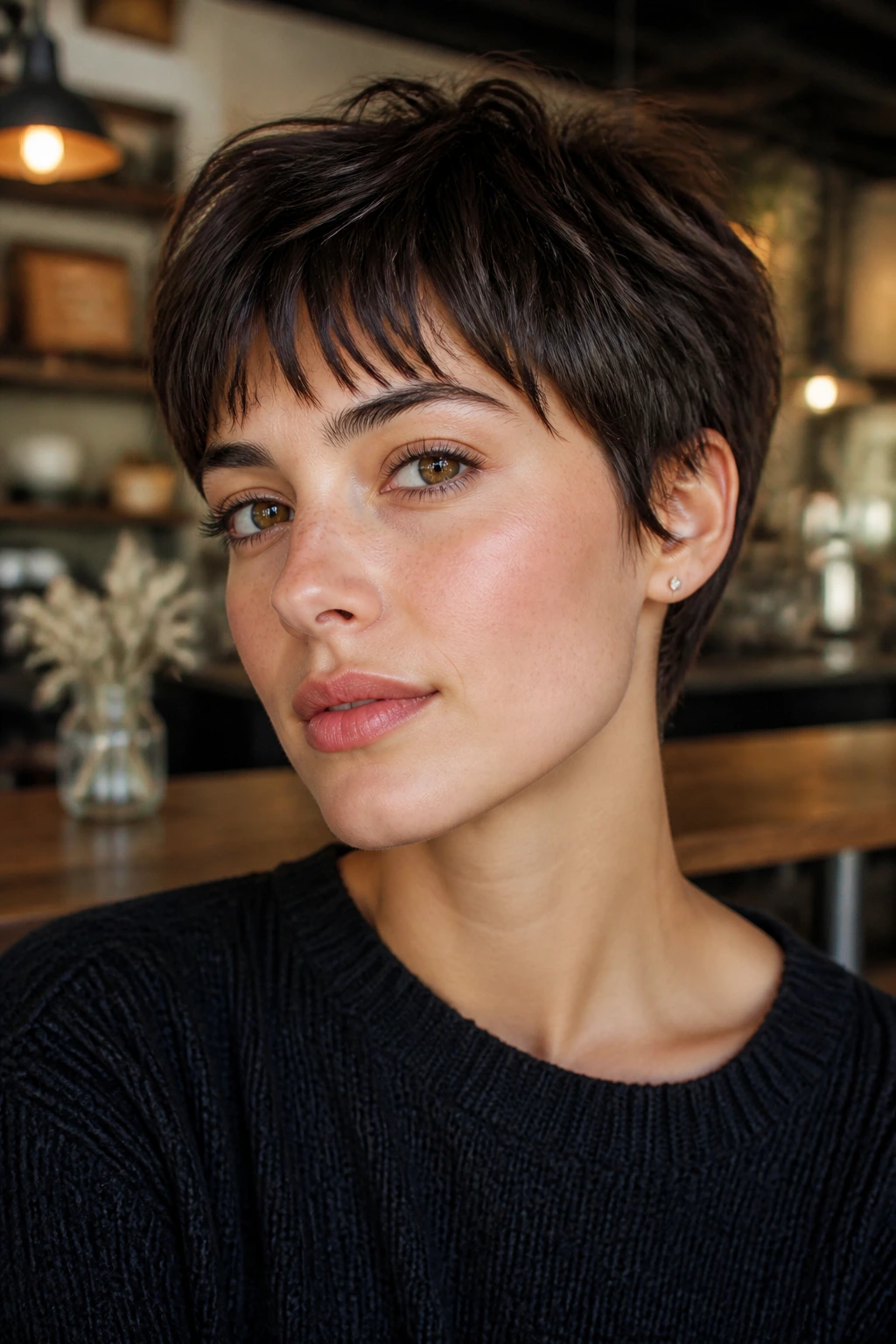
This is a clean, cropped shape with just enough fringe to soften the front. Eyebrow bangs are shorter than curtain bangs but longer than micro fringe, which makes them a useful middle ground for thick hair that needs direction without full coverage.
The boyish crop works because the top is usually broken up with texture, not left in one dense block. That helps the cut dry faster and keeps the silhouette from ballooning. If your hair has a lot of body at the crown, this is a very good place to put it to work.
It has a slightly undone feeling, but not in a careless way. More like you woke up with the right haircut.
21. Modern Shag Pixie With Airy Fringe
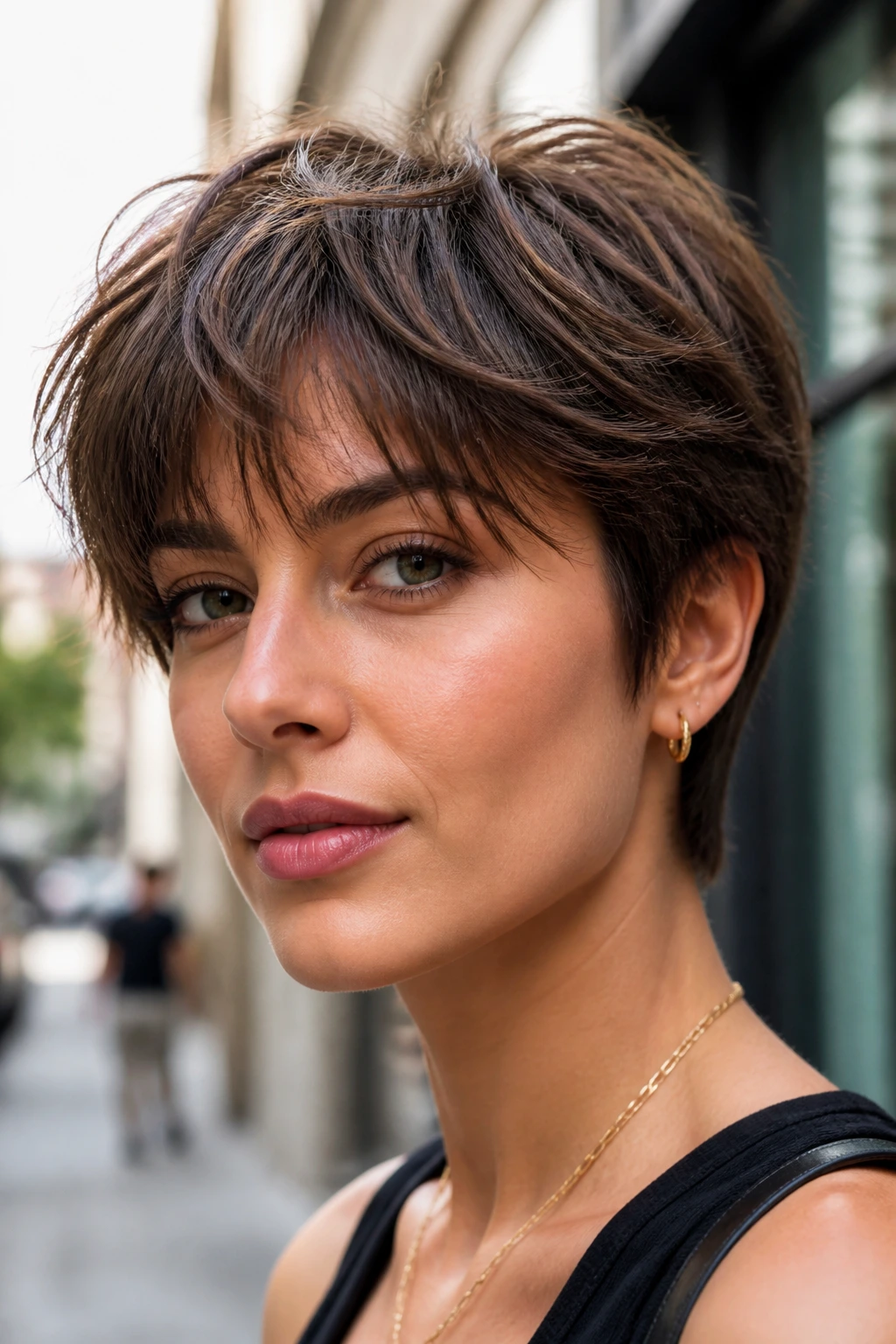
Can thick hair wear a shaggy pixie without becoming too big? Yes, if the layers are carved with restraint. The modern shag pixie uses airy fringe and short, uneven sections to keep the crown from looking overbuilt. It’s light, but not flimsy.
How it behaves
The airy fringe is thinner than a blunt bang, so it lets the forehead breathe. That can be a relief on thick hair, which sometimes needs front softness more than front coverage. The rest of the cut gets movement from layered ends and a little piece-y styling paste.
This is a strong option if you like texture and don’t mind a little mess. It’s also one of the easiest shapes to push in a more polished or more casual direction, depending on the product you choose.
22. Tapered Crop With Baby Bangs
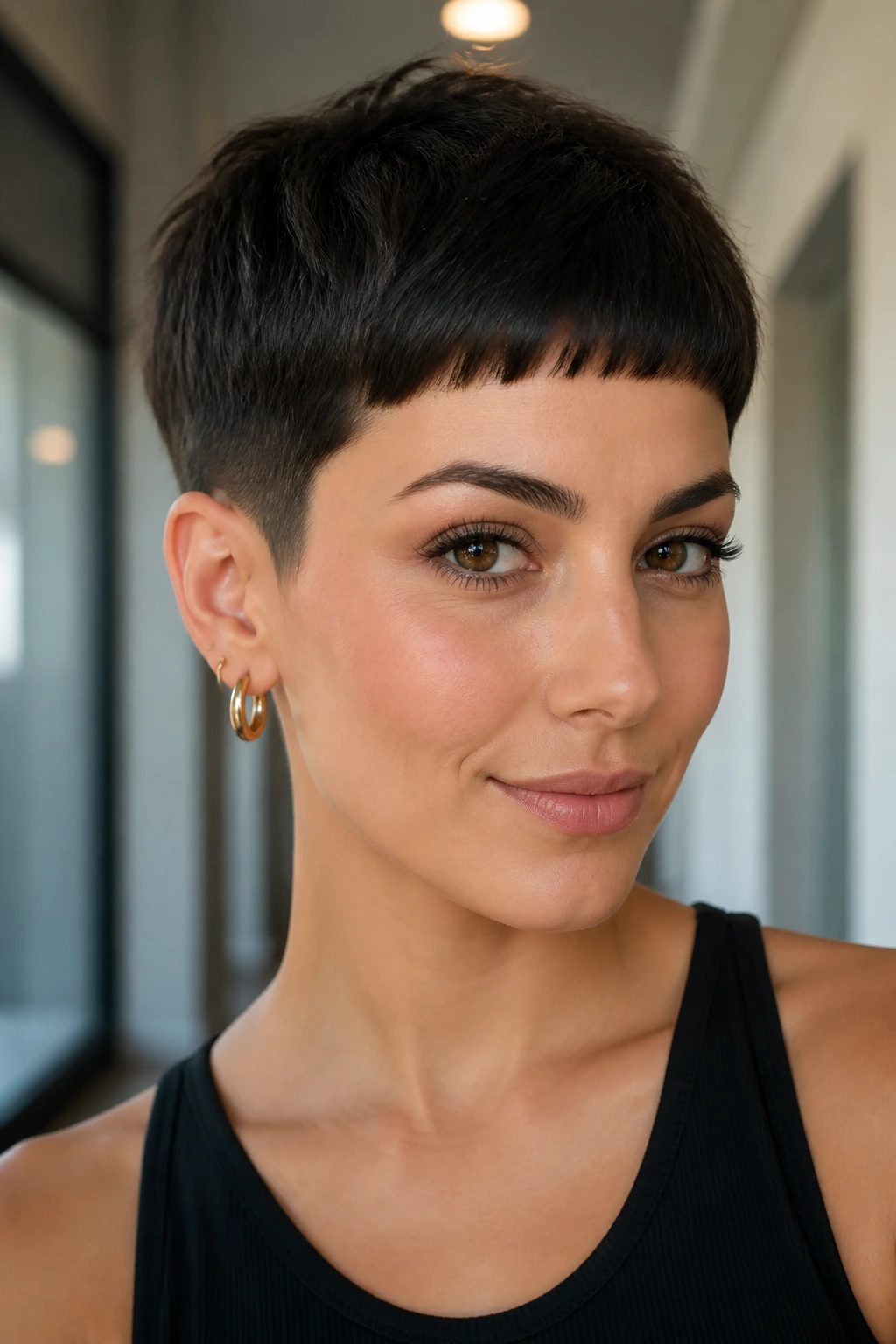
Baby bangs on thick hair are a statement, but they work better than people think when the rest of the crop is tapered close to the head. The taper removes the extra bulk at the sides and nape, while the short fringe puts all the attention up front. It feels sharp. A little daring, too.
The important part is restraint everywhere else. If the sides stay too wide, baby bangs can start to look like an afterthought. But if the overall shape is trimmed tight, the fringe has a reason to exist.
This is the cut for someone who likes a clean neckline, bold brows, and a style that says what it means without much apology.
Why Short Hair and Bangs Behave Better on Thick Hair
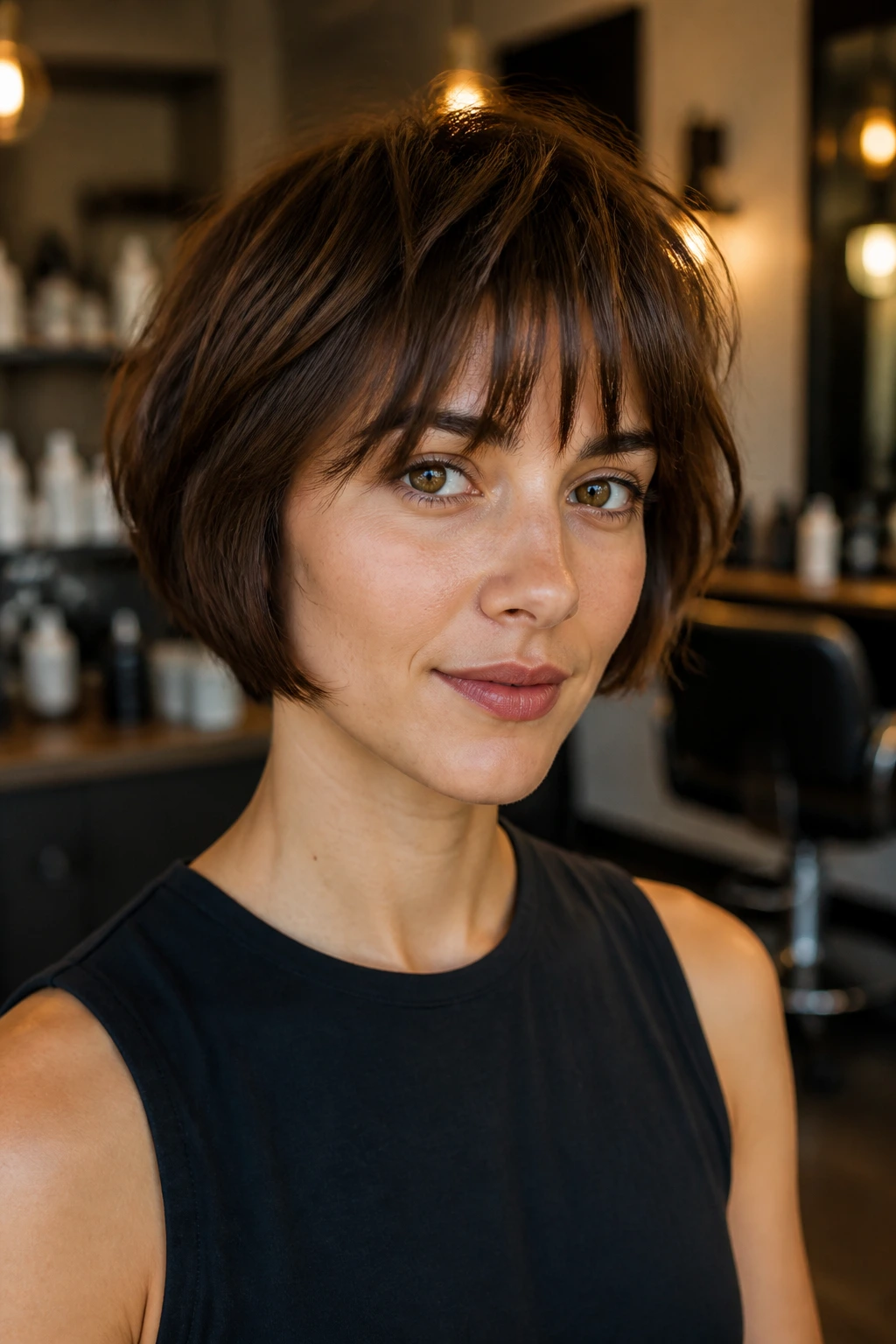
Thick hair needs a job. Short hair gives it one.
When the hair is long, density can turn into weight without much shape. The ends drag, the front splits, and the whole thing starts living on its own terms. Shorter lengths change that. The line becomes visible. The fringe gets enough support to stay in place. Even the little things — a tucked ear, a lifted crown, a heavier nape — become part of the design instead of a battle.
There’s another reason this pairing works: bangs help distribute visual weight. A short cut with no front detail can sometimes look top-heavy on dense hair, especially if the crown is broad or the head shape is round. A fringe pulls the eye downward and inward. It gives the haircut a focal point. That’s one of the reasons a blunt bob with bangs can feel more balanced than a bob without them, even when the total length is the same.
The catch is that thick hair asks for honest cutting. If the perimeter is too blunt and the inside is too heavy, the cut swells. If the fringe is too thin, it disappears under the rest of the hair. The best versions respect both facts at once.
Essential Tools for Styling Dense Hair
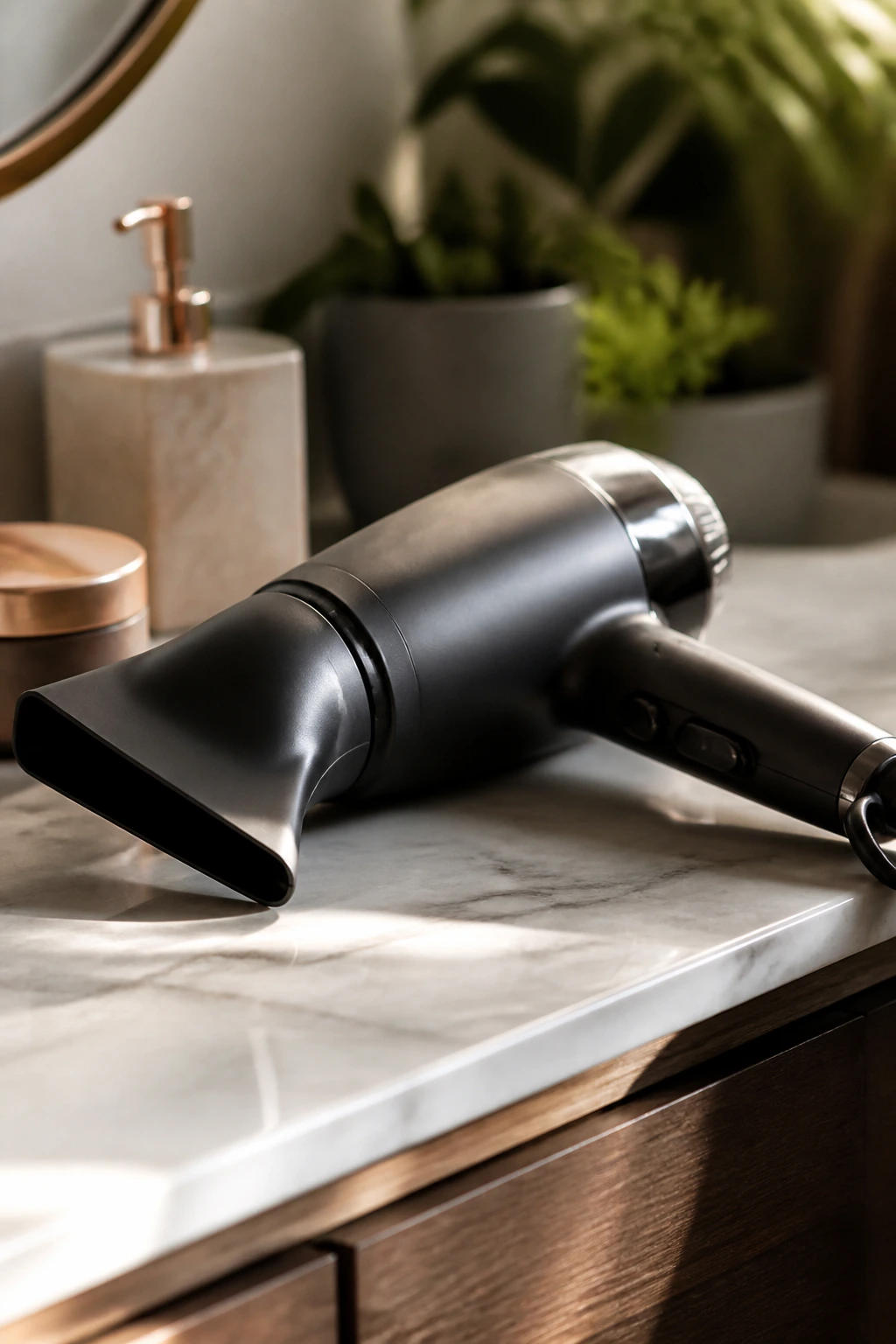
-
Hair dryer with nozzle attachment — A nozzle keeps the airflow directional, which helps bangs sit flat instead of blowing apart.
-
Round brush, 1 to 1.5 inches — Best for shaping fringe and adding a bend to bob lengths without over-puffing the ends.
-
Paddle brush — Useful for smooth blowouts on blunt bobs and box cuts, especially when the hair wants to frizz.
-
Sectioning clips — Thick hair takes longer to dry and style, and clips keep the fringe separated from the rest of the head.
-
Wide-tooth comb — Good for detangling wet thick hair without tearing up the curl pattern or creating frizz.
-
Light mousse or root lift spray — Gives shape at the roots without turning the bangs sticky.
-
Texturizing spray — Helps shaggy crops, bixies, and piecey bangs keep separation.
-
Heat protectant — Non-negotiable if you use a brush dryer, flat iron, or curling iron on the fringe.
-
Finishing cream or matte paste — A small amount goes a long way on thick hair; too much makes short cuts collapse.
-
Diffuser — Worth having if your thick hair is wavy or curly and you want the bangs to keep their pattern.
What to Ask for at the Salon When Your Hair Is Dense
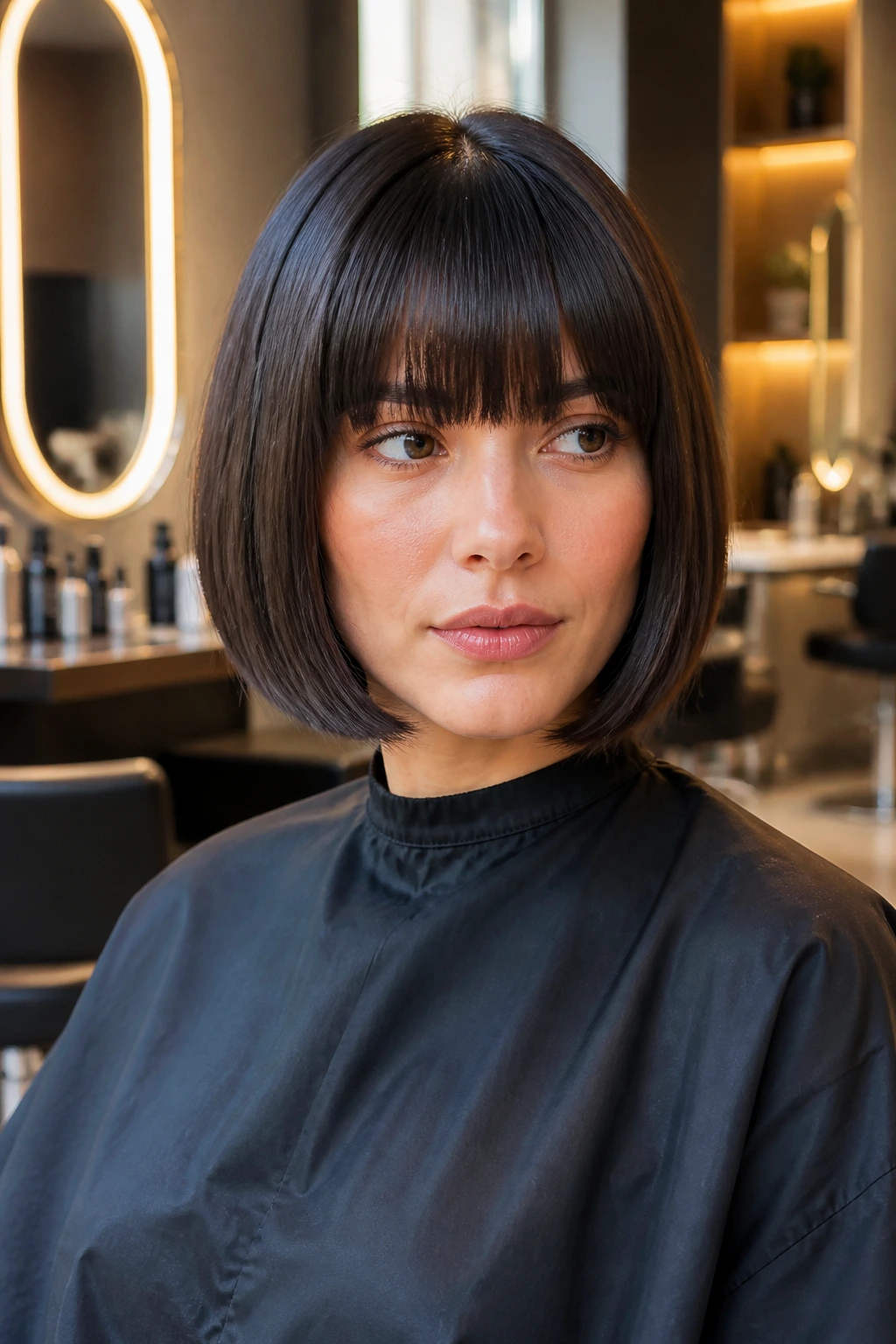
Thick hair has a way of making vague haircut requests go sideways. “A bob with bangs” is not enough. “Short and layered” is worse. The better move is to talk in shape terms: where the perimeter should sit, how much weight you want left in the fringe, and whether the inside should be softened or kept solid.
Start with the outline
Ask where the cut should land on your face — chin, jaw, cheekbone, or ear. Thick hair changes shape as it dries, so the outline matters more than a vague length description. If you want a blunt bob, say blunt. If you want movement, say you want texture through the ends, not loose, wispy layers everywhere.
Talk about the fringe separately
Bangs on thick hair need their own conversation. A stylist should know whether you want full coverage, a split curtain fringe, side-swept movement, or something cropped. Mention your cowlicks if you have them. Mention whether your bangs usually split, twist, or sit heavy. That one detail saves a lot of frustration.
Ask where weight should come out
This is the part people skip. Thick hair often needs weight removed at the crown, behind the ears, or in the nape — but not in the perimeter that gives the cut its shape. If a stylist reaches for thinning shears by reflex, speak up. You want controlled removal, not frayed ends.
How to Wear and Style These Cuts Day to Day
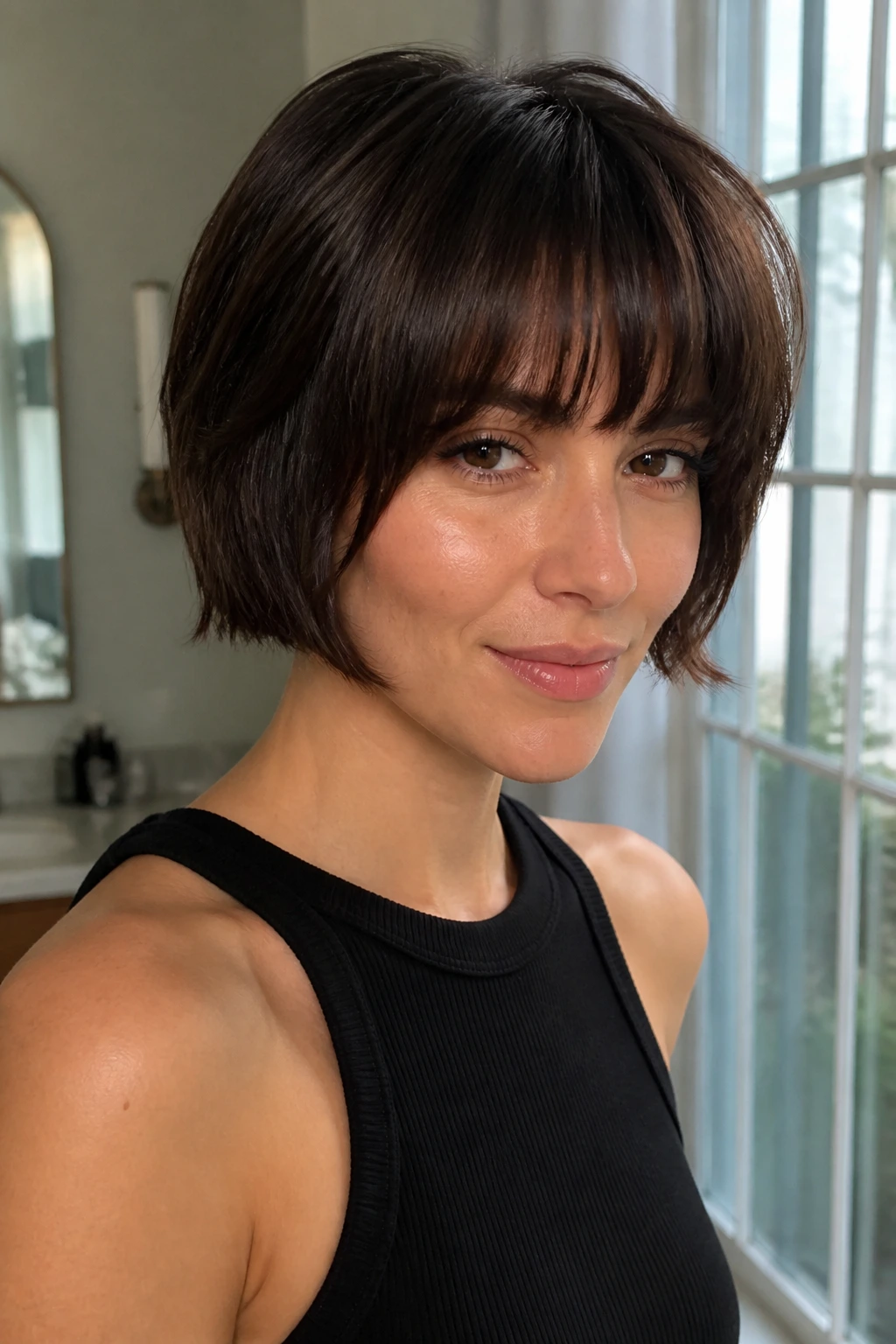
Short cuts with bangs can look polished, messy, or somewhere in between. The trick is choosing which one you want before you start drying your hair.
Sleek finish: Use a round brush or paddle brush to dry the bangs first, then work through the rest of the head in sections. A pea-size amount of smoothing cream on the lengths is usually enough. Thick hair often needs that front section dried from side to side so the fringe doesn’t set in a split.
Air-dried finish: Best for shags, bixies, curly bobs, and piecey crops. Scrunch in mousse on damp hair, let the roots dry with a little lift, and touch the bangs only if they’re clearly sitting wrong. Overtouching thick hair makes it puff. Every time.
Pinned-back finish: A slim clip, a side pin, or even a tucked-ear look changes the mood fast. This matters if you wear glasses or bold earrings, because the front of the haircut stops competing with your accessories.
Day-two refresh: Mist the fringe with water, reshape with fingers or a brush, and hit only the root area with a dryer. Don’t rewet the whole head unless the style truly needs it.
Extra Styling Moves That Keep the Fringe in Place
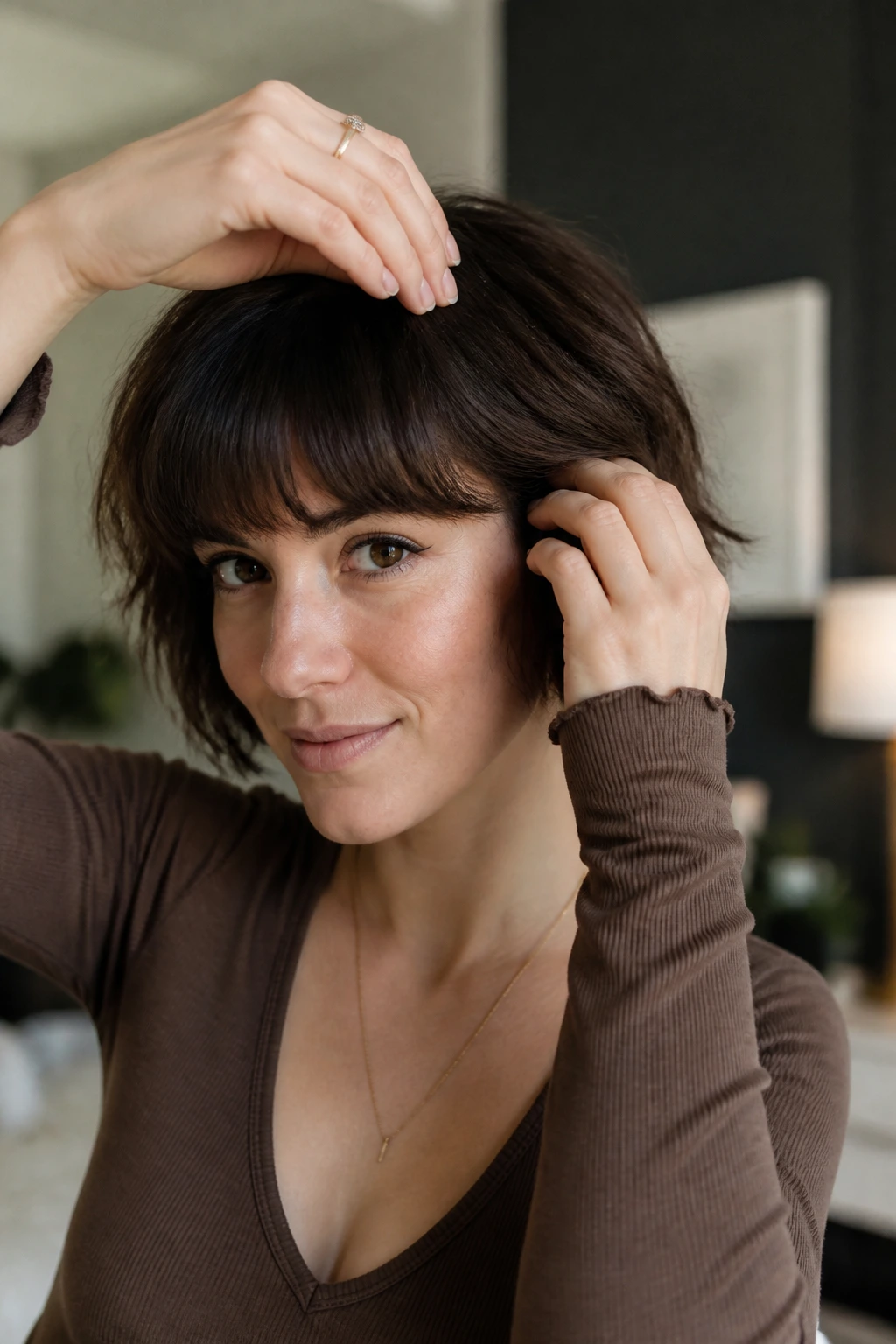
Texture Boost: A tiny amount of dry shampoo at the roots of the bangs can keep thick fringe from separating too fast. Use it before the hair gets greasy, not after it has already collapsed.
Humidity Control: If your hair puffs in damp air, smooth a light anti-frizz cream over the ends, not the roots. Thick hair usually needs control at the perimeter more than it needs more product near the scalp.
Bang Rescue: When bangs go flat or twist, roll them around a round brush for 20 to 30 seconds with warm air, then let them cool in place. The cooling part is what holds the bend.
Make-It-Yours: If you wear your hair up part of the time, choose a fringe long enough to sweep aside. If you rarely style in the morning, choose a cut with built-in texture rather than one that depends on a perfect blowout.
Common Mistakes That Make Thick Hair Look Bigger, Not Better
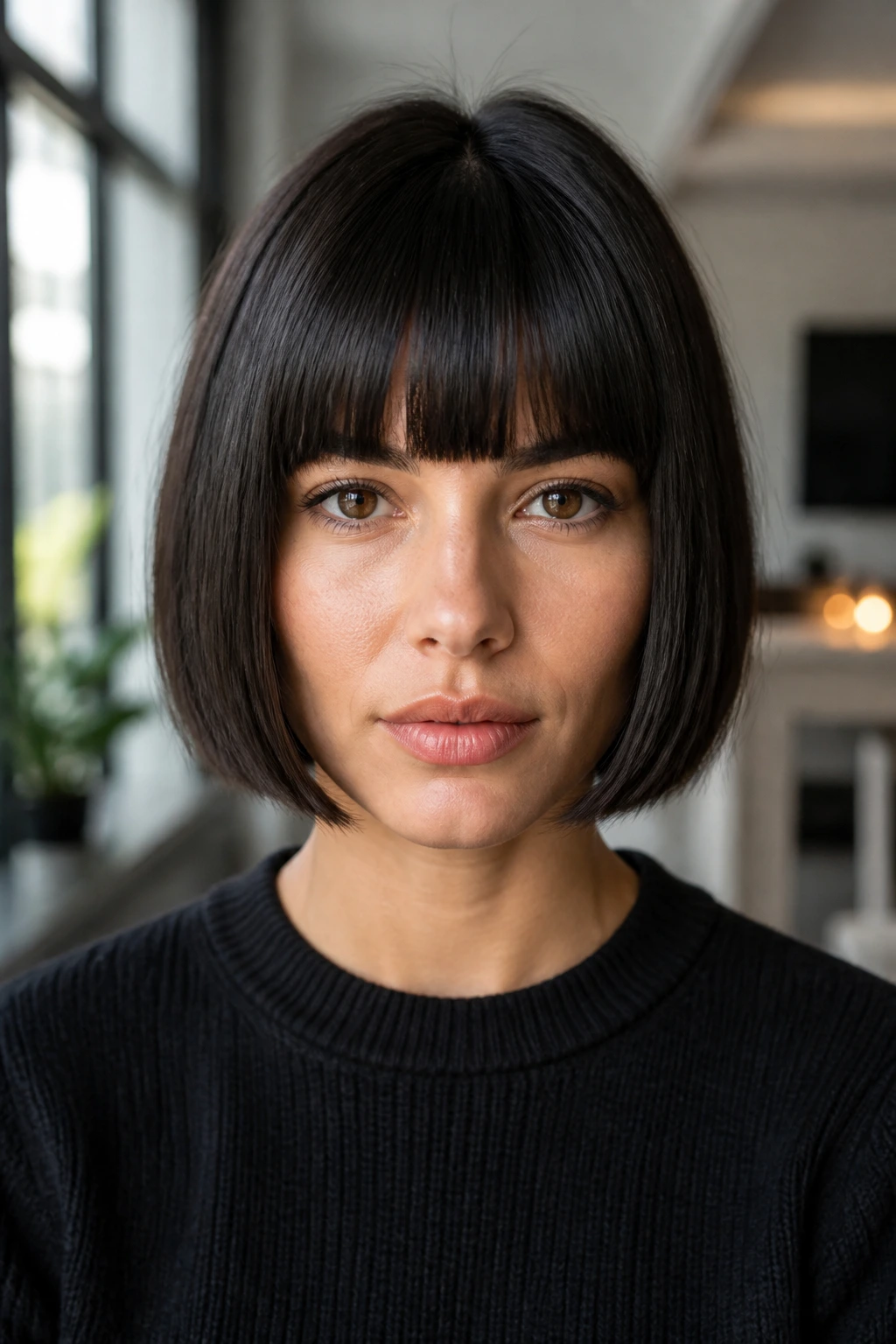
The biggest mistake is too much thinning in the wrong place. Thick hair does not need to be shredded from root to end. When that happens, the top looks fuzzy and the ends stick out like little brushes. Ask for weight removal only where the shape needs it.
Another problem is bangs that are cut too thin for the density of the hair. They look fine in the chair, then split apart once the hair dries. If your fringe keeps separating, the section is probably too small or too long for the haircut around it.
Ignoring the cowlick is another classic. Thick hair with a strong growth pattern will not politely obey a straight-across bang unless the cut accounts for the direction it wants to move. A longer fringe, a side sweep, or a curtain shape often behaves better than trying to force a blunt line.
And then there’s skipping the trim schedule. Short hair shows its shape fast. Once the back starts to bulk up or the bangs hit your lashes at the wrong angle, the whole cut changes. Catch it early and it stays sharp.
Keeping the Shape Between Salon Visits
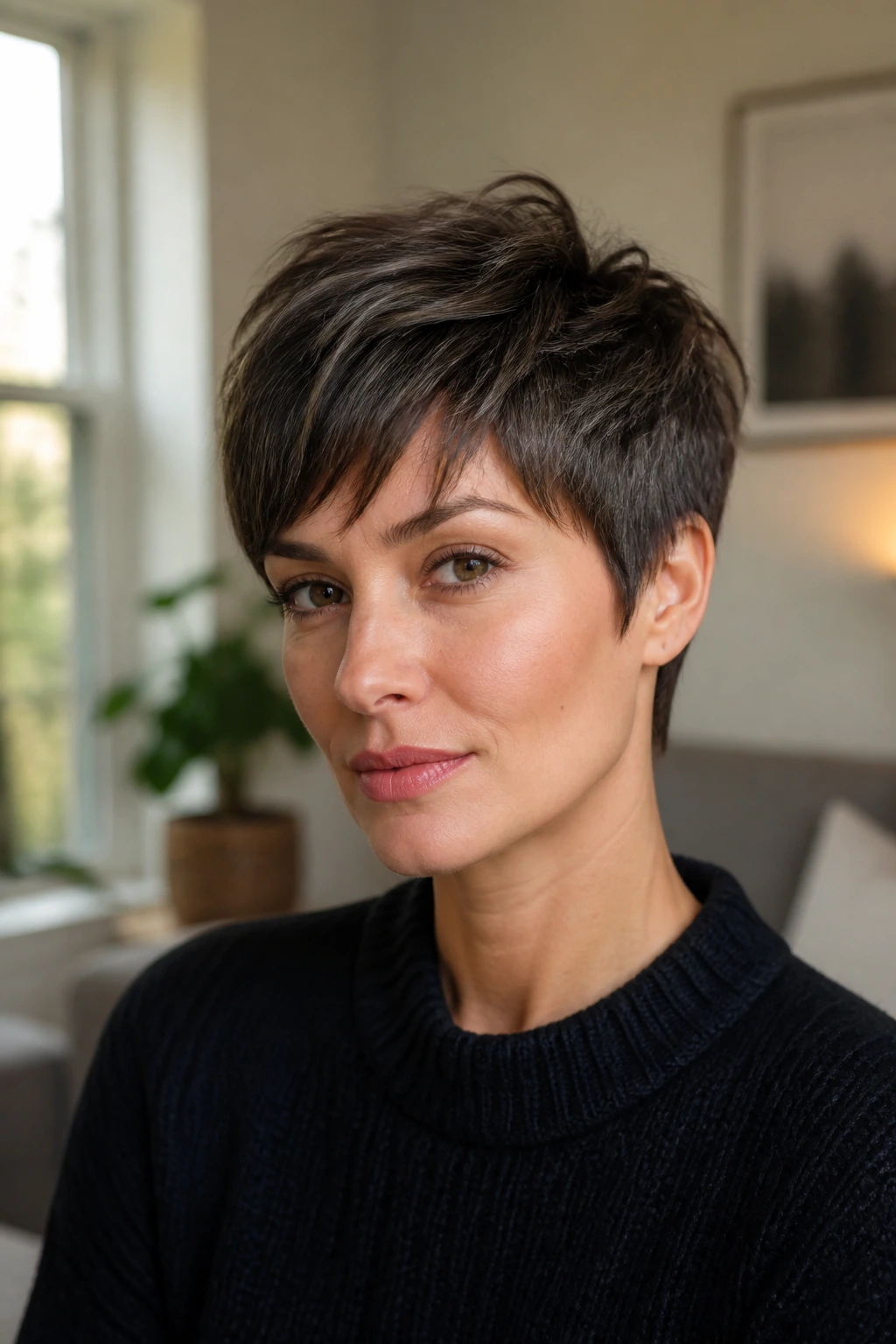
Short thick hair does not need constant fuss, but it does need a rhythm. Pixies and crops usually want a trim every 4 to 6 weeks if you want the outline to stay crisp. Bobs can often stretch to 6 to 8 weeks, sometimes a bit longer if the shape is soft and the fringe is grown slightly wider. Bangs are the first thing to drift, so many people book a fringe trim every 2 to 3 weeks for blunt bangs and a little longer for curtain or side-swept versions.
Wash frequency depends on scalp oil and texture, not fashion rules. Thick hair can usually go 2 to 4 days between washes if the cut is short enough and the roots are not overloaded with cream or oil. Dry shampoo is useful, but only if it goes at the roots. Spraying it everywhere on thick hair makes the ends feel dusty and dull.
At night, sleep with the fringe either clipped loose from the face or parted the way you plan to wear it. That tiny habit saves you ten minutes in the morning. For bobs and crops, a quick blow-dry of the front section is usually enough to reset the whole style. The rest often falls back into place with a comb and a little air.
Variations and Adaptations to Try

The Soft Grow-Out Version: Keep the same short shape, but ask for longer fringe and slightly less structure at the temples. This is the best version if you want the cut to last longer between salon visits and still look deliberate while it grows.
The Curly-First Version: For curly thick hair, cut the bangs dry and leave more length than you think you need. Shrinkage changes everything. A curl-friendly bob with a soft fringe usually works better than a rigid blunt line.
The Glasses-Friendly Version: Keep bangs just above the frame line or part them into a curtain shape. This keeps the hair from stacking awkwardly on top of the glasses and stops the fringe from needing constant pushing aside.
The Low-Fuss Texture Version: Ask for more internal movement, a slightly broken-up perimeter, and a fringe that can be air-dried. This suits people who would rather scrunch and go than round-brush every morning.
The Bold Graphic Version: Choose a blunt bob, stacked bob, or tapered crop with a strong fringe line. This is the version for people who want the haircut to read from across the room and don’t mind trimming it often.
Frequently Asked Questions
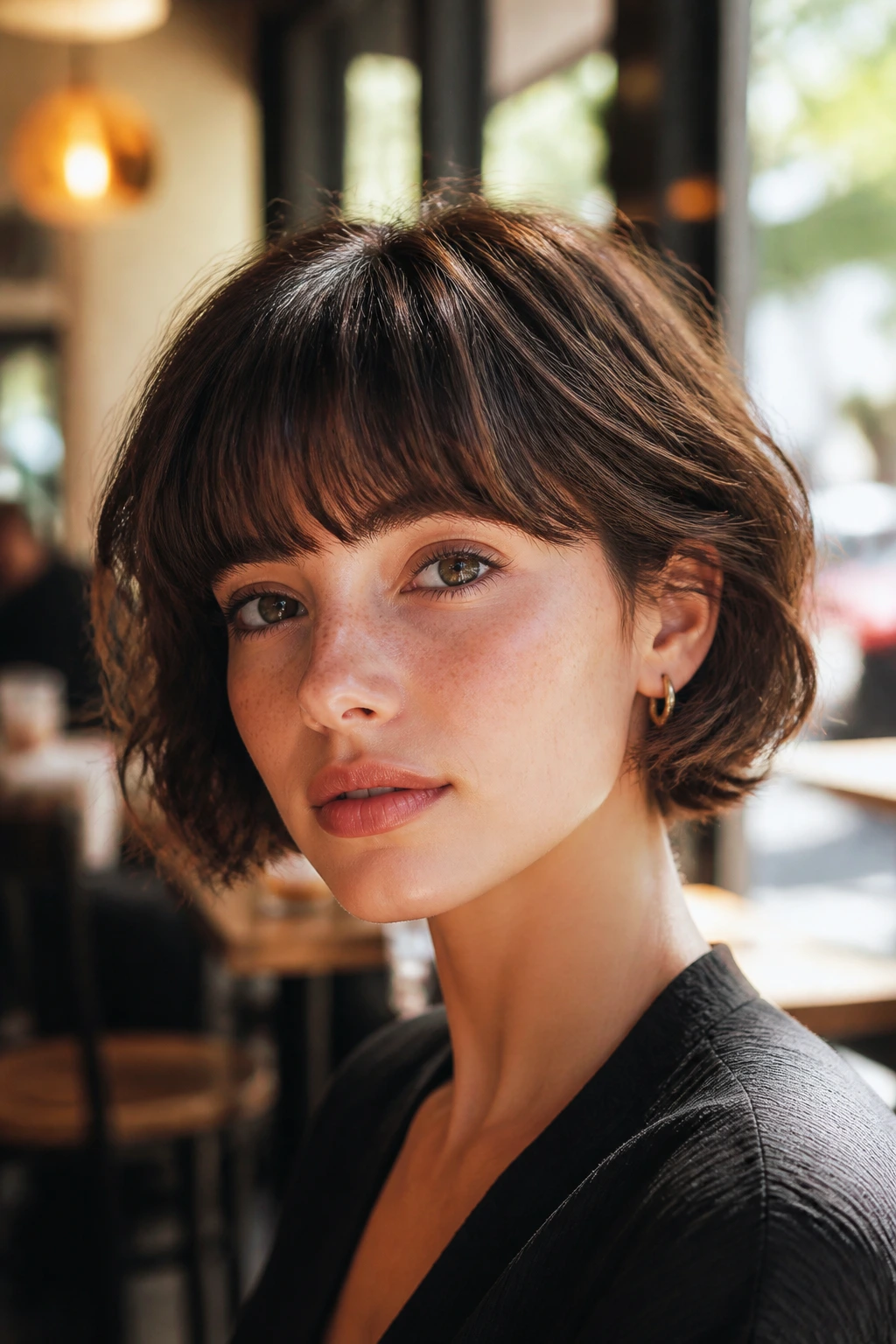
What short haircut is best for very thick hair?
A blunt bob, bixie, or tapered crop usually gives thick hair the most control without making it feel bulky. If you want a softer look, curtain bangs or side-swept fringe can break up the front line without adding more width.
Are bangs a bad idea if my hair has a strong cowlick?
No, but the bang shape matters. A blunt fringe can fight a strong cowlick all day, while a curtain bang, side bang, or longer brow-grazing fringe tends to cooperate better.
How often should I trim short bangs on thick hair?
Blunt bangs usually need attention every 2 to 3 weeks if you want them to sit cleanly. Softer fringe styles can go longer, but short hair itself still needs regular shaping to keep the balance right.
Can I air-dry thick hair with bangs?
Yes, if the cut is built for it. Shags, bixies, textured crops, and curly bobs tend to air-dry better than polished box bobs. Bangs usually need a quick touch with a dryer or brush, even if the rest of the hair dries on its own.
Why does my thick bob puff out at the bottom?
The perimeter is probably too blunt, or the internal weight hasn’t been removed where the hair expands. A slight undercut, internal debulking, or a more tapered shape can stop that square, wide look.
Do curtain bangs work on thick hair?
They work very well, especially if you want some forehead coverage without a heavy wall of hair. On thick hair, curtain bangs usually need a slightly longer starting length so they can split and fall into place.
What should I avoid if I want short hair with bangs to look neat?
Avoid overloading the fringe with cream or oil, and avoid letting the ends get over-thinned. Both mistakes make thick hair lose shape fast and can turn a clean cut into a frizzy one.
Which of these styles is easiest to grow out?
The bixie, French bob, curtain-bang bob, and shaggy crop usually grow out more gracefully than a micro-bang crop or a very blunt box bob. Softer fringe hides the transition better than a hard line.
The Shapes That Work Hard for Thick Hair

Thick hair should not have to fight its own haircut every morning. The right short shape gives that density a job, puts the fringe in the right place, and keeps the whole thing from ballooning when the weather changes or the blow-dry goes a little sideways.
That’s why the best short hair with bangs for thick hair always looks deliberate. Not forced. Not overstyled. Just clear. When the outline is right, thick strands stop feeling difficult and start doing the thing they’re best at: holding shape with a bit of attitude.
If your current cut feels heavy, wide, or oddly puffed at the edges, one of these shapes is probably a better fit than the version you’ve been wrestling with. Bring photos, talk honestly about your growth pattern, and ask for the line you actually want. The rest is mostly good cutting — and a bang trim before the fringe starts getting ideas of its own.
