



Thick hair looks glamorous in a mirror and then eats half your morning if the cut is wrong. That’s the part people gloss over. Dense strands can swing from full and expensive-looking to boxy, puffy, or weirdly heavy at the bottom in one bad trim, and the difference usually comes down to shape, not sheer length.
The best thick hair hairstyles do one thing well: they give the hair somewhere to go. A blunt line can be useful. So can a soft layer, a braid, a bun, or a bob that sits exactly at the collarbone instead of wandering off into triangle territory. Thick hair needs decisions, not guesses.
There’s a sweet spot with this kind of hair. Cut too much weight out, and you get frizz and flyaways. Leave too much bulk in one place, and the whole style starts to feel like a helmet. The styles below are the ones I keep coming back to because they respect density instead of fighting it.
Why These Thick Hair Looks Earn Their Keep
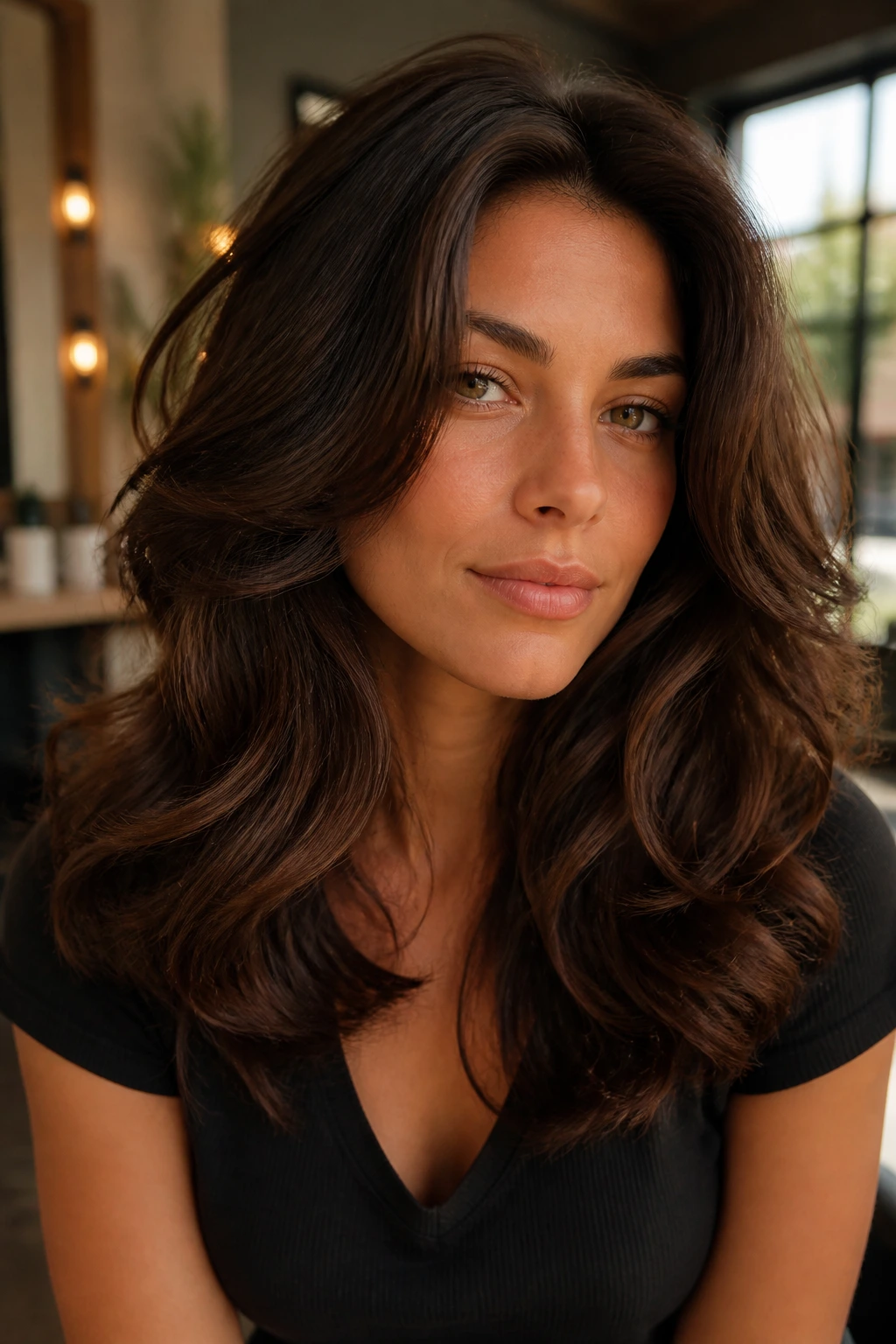
- Shape First: Every style here controls bulk at the ends, crown, or sides so the outline looks deliberate instead of mushroom-shaped.
- Day-Two Friendly: A few of these hold their line after sleep, a loose clip, or a quick refresh with dry shampoo.
- Texture-Aware: Straight, wavy, curly, and coily hair each get styles that suit how the strands actually fall.
- Salon-Realistic: These are the kinds of cuts and styles you can ask for without decoding hairdresser jargon.
- Accessory-Ready: Thick hair gives clips, pins, ribbons, and braids something solid to grip, which makes the style stay put.
- Work-to-Weekend Range: Several of these can look neat at the office and softer or messier later without starting over.
1. Long Invisible Layers
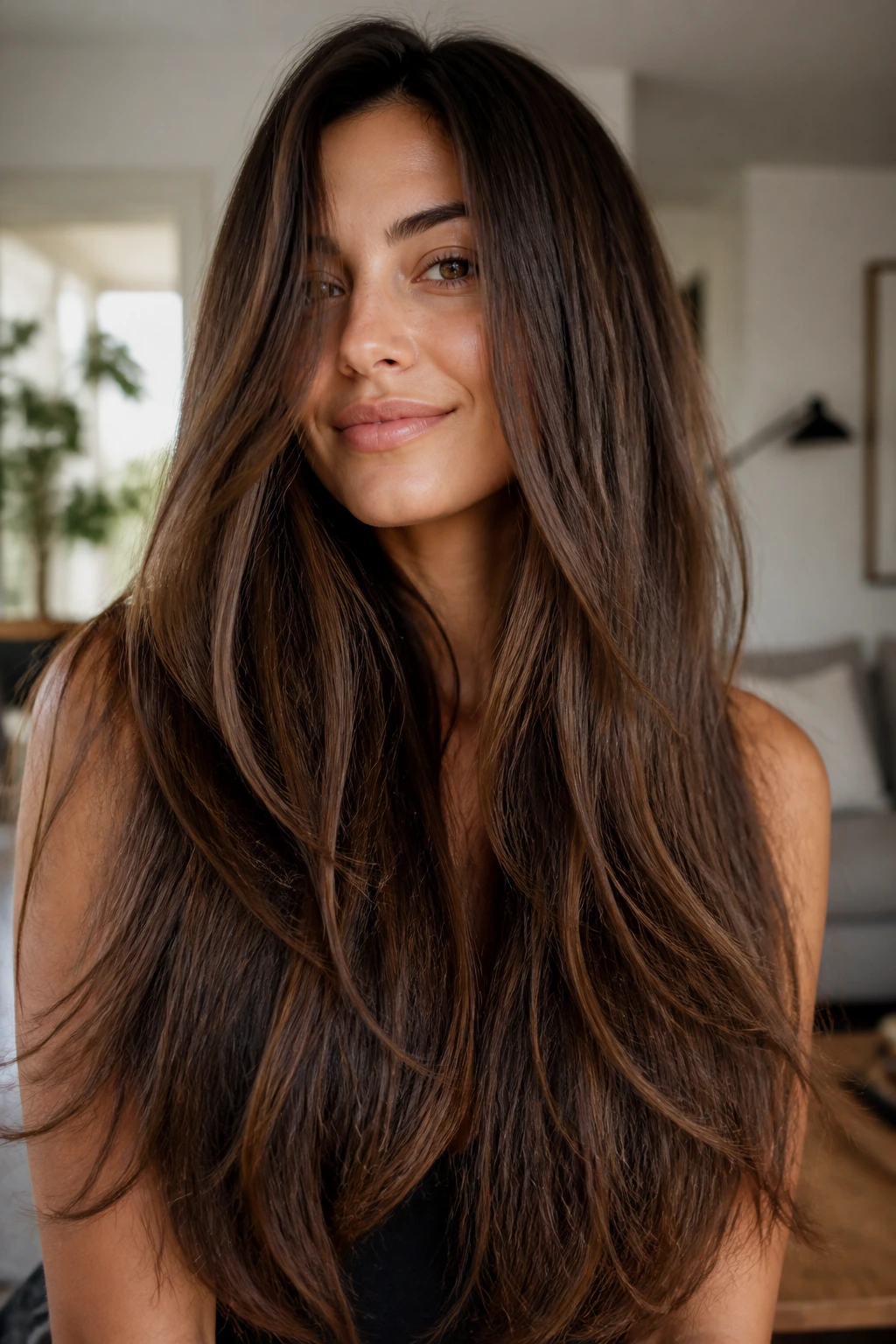
Long hair with a lot of density can look gorgeous until the weight starts pulling the shape flat at the crown and bulky at the ends. Invisible layers fix that by removing mass from the inside of the cut instead of carving obvious steps into the outside. The perimeter still looks full. It just moves better.
What makes it work
The first layer usually starts lower than people expect, often around the collarbone or just below. That keeps the ends from looking wispy while still giving the hair room to swing instead of sitting in one heavy sheet.
Ask for point-cutting or slide-cutting through the interior, not a big chop through the whole head. That gives thick hair motion without making the surface look chopped up.
- Best for long straight, wavy, or loose-curly hair
- Keeps ponytails and braids looking thick
- Needs only a trim every 8 to 12 weeks if the shape is holding
Pro tip: If your hair puffs at the ends, keep the layers lower and let the stylist debulk the interior near the mid-lengths instead.
2. Butterfly Cut with Soft Face Framing
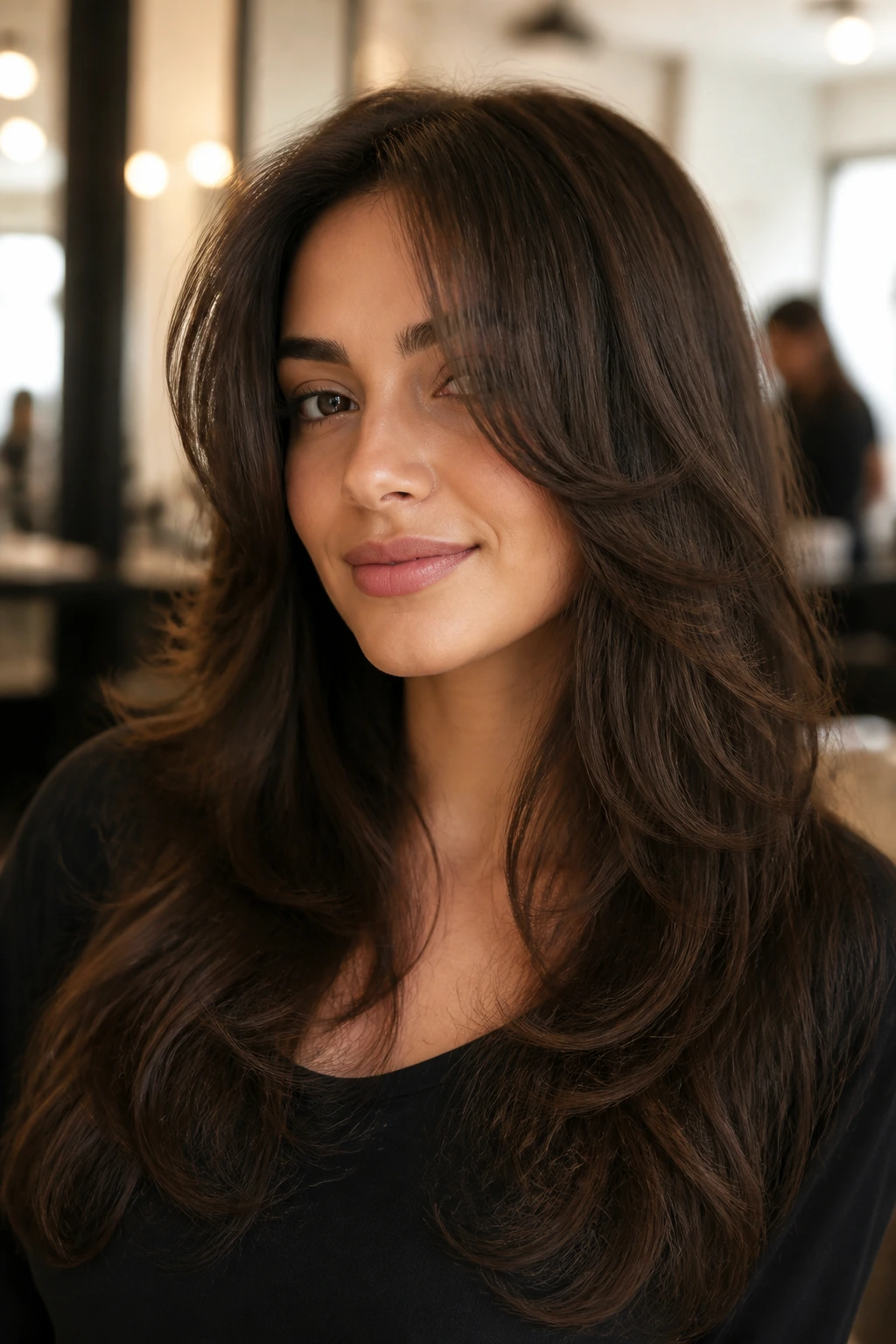
Want length and lift without giving up the ponytail? The butterfly cut is one of the few styles that can pull that off. It stacks shorter face-framing pieces over longer layers, so the top half gets bounce while the bottom half still feels long and substantial. Thick hair loves the contrast.
The key is placement. The shortest pieces usually graze the cheekbones or jaw, then melt into longer layers that keep the rest of the hair from turning into a wall. On dense hair, that shape can take a decent amount of air out of the silhouette without making the ends look thin.
This one looks especially good when it’s blown out with a round brush, because the lifted front pieces frame the face and the ends flip away from the neck. If you air-dry, ask for the shortest layer to stay long enough to tuck behind the ear. Tiny face-framing pieces can disappear into heavy hair.
3. Collarbone-Length Blunt Lob
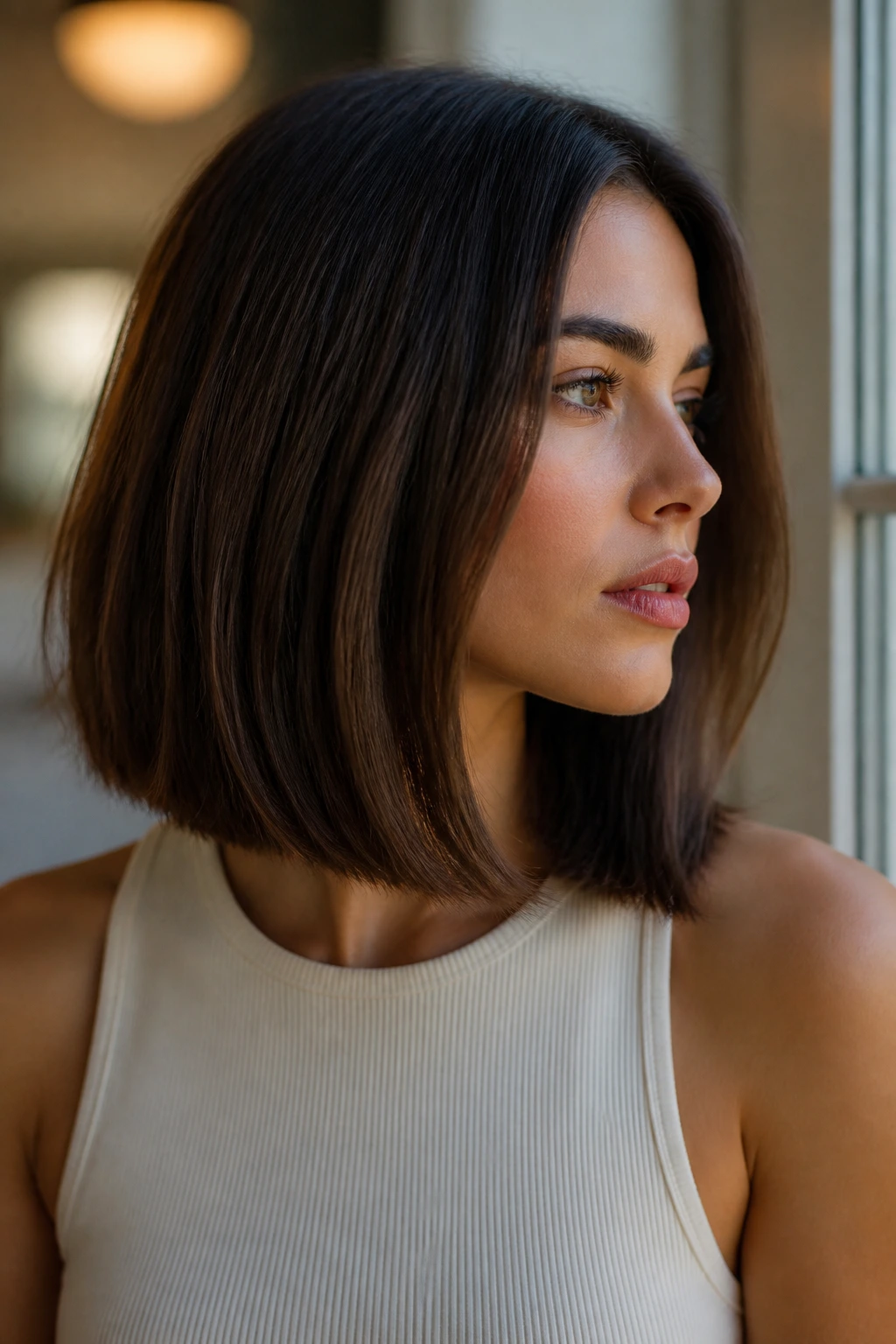
A blunt lob at the collarbone can calm thick hair faster than a pile of layers. That sounds counterintuitive until you see it in motion. The clean edge keeps the bulk in one line, so the hair looks expensive and solid instead of fuzzy at the ends. It’s the haircut version of giving a crowded room one strong boundary.
The magic is in the length. If it lands right at the collarbone, the hair sits with enough weight to stay sleek but not so much that it drags down the face. A little bend at the ends helps, but the cut should do most of the work.
This is the style I’d pick for thick hair that gets frizzy when over-layered. It also plays well with deep side parts, soft waves, and straight styling. If your ends tend to flare outward, ask for a barely softened edge rather than heavy texturizing. Too much thinning ruins the whole point.
4. French Bob with Tucked Ends
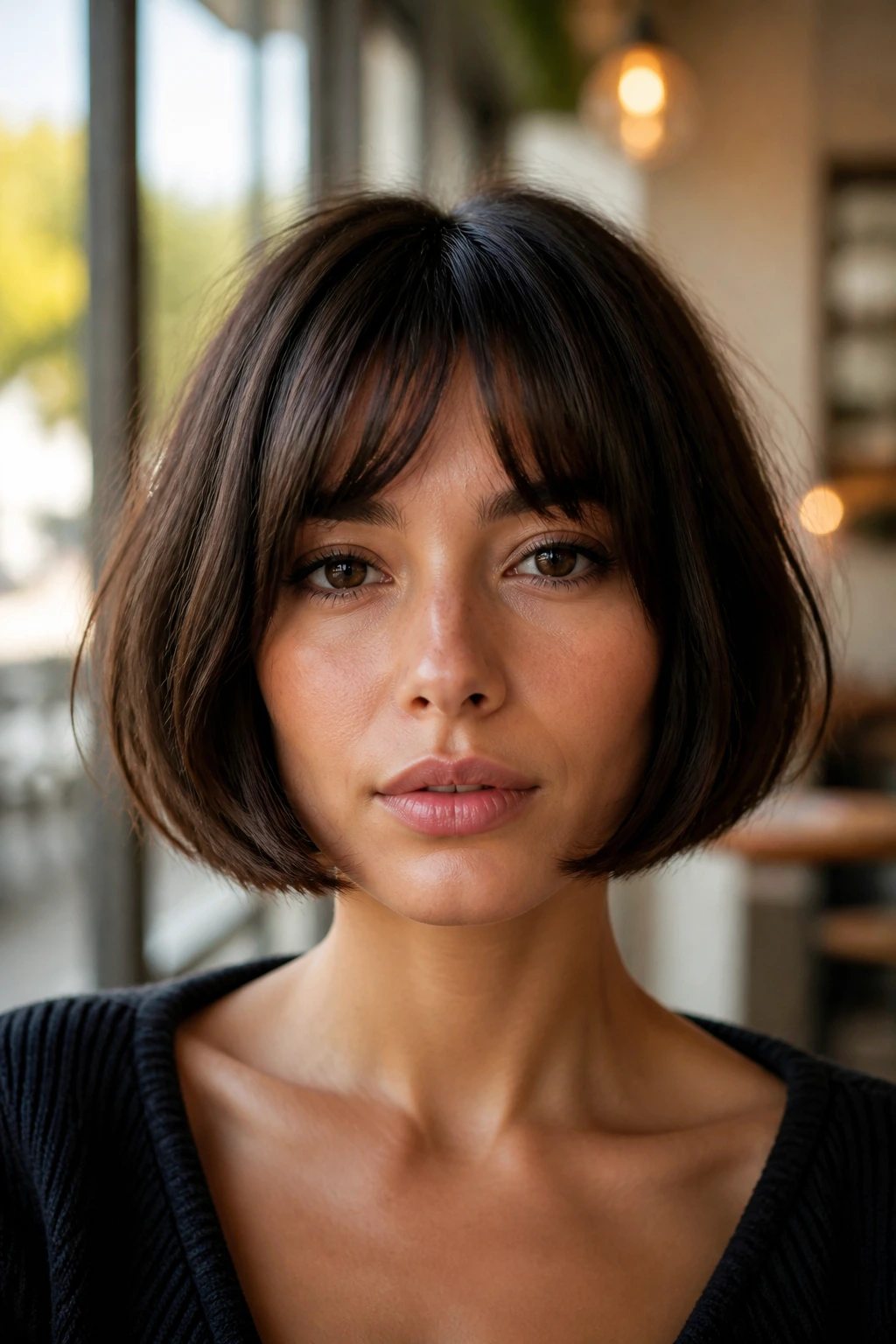
If your hair springs outward the minute it reaches jaw length, a French bob can be a sharp fix. The line sits around the chin or just below it, and the ends are usually tucked under a touch so the shape reads neat rather than boxy. Thick hair gives this cut body. The cut gives it discipline.
This works best when the hair has some natural bend or can hold a round-brush finish. A little lift at the roots and a curved-under edge are enough. You do not need a blown-out pageant bob. That would feel fussy and dated. A softer bend at the jaw looks better and grows out more gracefully.
Ask for this if:
- You want a shorter style that still has density
- Your hair is straight, wavy, or only slightly curly
- You don’t mind trims to keep the line clean
It’s not the right choice if you hate regular maintenance. A bob this short shows every inch of growth.
5. Curly Shag with Rounded Volume
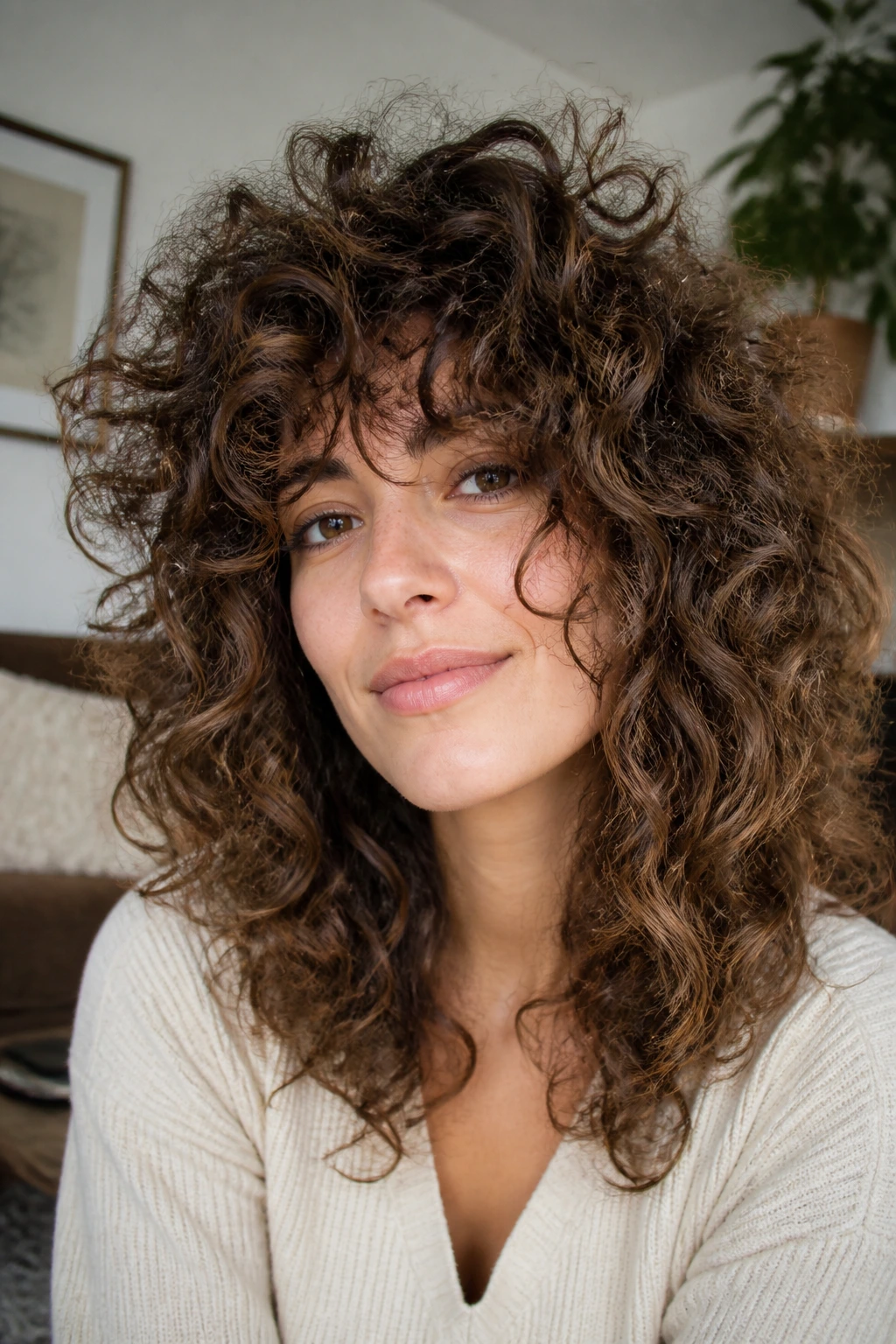
Curly thick hair and a blunt, one-length cut often argue with each other. The curly shag settles the dispute by building the shape around the curl pattern instead of against it. Shorter layers lift the crown, longer ones keep the bottom from ballooning, and the whole thing ends up looking fuller in the right places.
The rounded silhouette matters. You want the hair to arc outward and then back in, not fan out like a pyramid. A good curly shag usually has enough length around the face to soften the jaw, plus layers that let the curls stack without fighting for the same space.
Use a diffuser on low heat, and stop touching the curls once they start drying. Thick curls can take a while to dry, and every extra poke opens the cuticle and adds frizz. If your hair is coarse, ask for the layers to be cut dry or with the curl pattern visible. Wet cutting alone can mislead the eye on dense curls.
6. Wolf Cut with Choppy Crown Texture
Not every thick head of hair needs to be tamed. Sometimes it needs a shape that looks a little unruly on purpose. The wolf cut leans into that energy with a shorter, choppier crown and longer, shaggy length underneath. On thick hair, the result can feel cool instead of chaotic, which is a much better deal.
This style works because the crown gets built up while the sides and ends stay broken up enough to move. Thick wavy hair takes to it fast. Straight hair usually needs a bit more styling—texturizing spray, a rough-dry, maybe a few bends with a flat iron.
Keep the texture piecey, not crunchy. If the product clumps the hair too hard, the layers stop reading as airy and start looking stiff. A light paste at the ends or a dry texture spray at the roots is enough. Anything heavier turns the shape muddy.
7. Curtain Bangs and Long Layers
Curtain bangs can be a lifeline for thick hair that feels too heavy around the face. The split fringe opens in the center and blends into longer layers, so you get softness without carrying a full blunt bang around all day. That matters. Thick bangs can get sweaty, fluffy, and irritating fast.
The best curtain bangs on dense hair are longer than people expect. They usually hit around the cheekbones or even the lip line so they can be pushed to either side and still sit cleanly. Pair them with long layers that start low enough to keep the bottom from turning into a dense curtain.
A round brush or a large Velcro roller gives the front pieces a clean sweep. If your hairline has a stubborn cowlick, ask the stylist to leave the very center a touch longer. Shortening it too much tends to make the fringe split in odd places instead of falling in that easy, face-framing arc.
8. U-Shaped Long Cut
A U-shaped cut sounds subtle, and that’s the point. The hair is longer in the center back and slightly shorter toward the sides, which creates a soft curve instead of a straight block. Thick hair benefits from that because the perimeter feels lighter without losing the weight that makes long hair hang nicely.
Compared with a blunt hemline, the U-shape moves more cleanly when you wear it down. Compared with a V-shape, it feels softer and less pointed. It’s the middle path. Good for people who like long hair but don’t want the bottom to look heavy enough to need a forklift.
This shape also behaves well in braids and ponytails. The ends can still look full, and the curve gives long hair a little motion even when it’s tied back. If your hair is coarse, ask for the outer line to stay fairly solid. Too much layering around the curve makes the cut lose its calm, flowing shape.
9. V-Cut Length with Feathered Ends
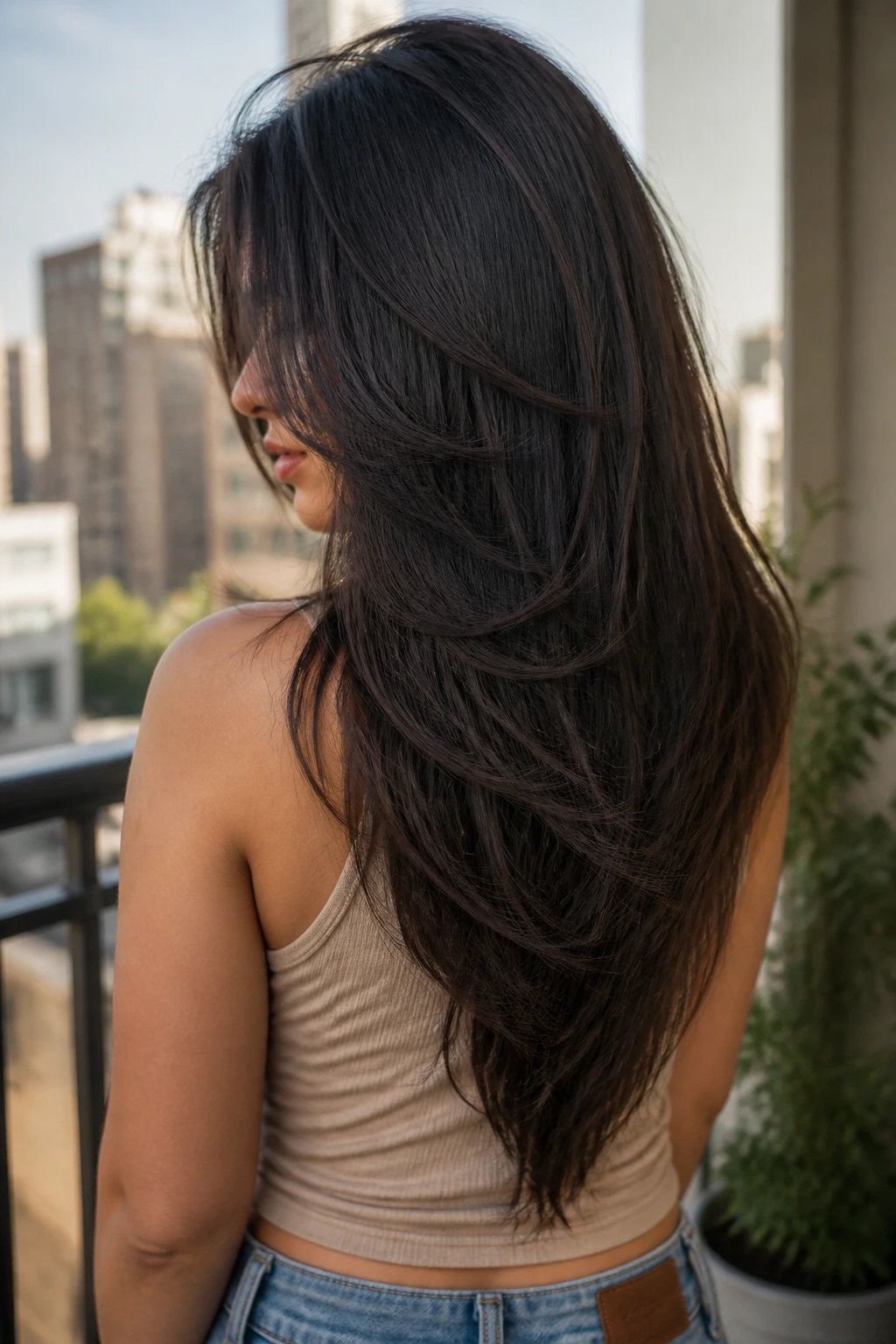
A V-cut gives thick hair a sharper finish at the back, which helps a lot when the ends feel like one solid slab. The center back stays longest, and the sides angle inward to form a point. That point pulls the eye down and breaks up the width that thick hair can create when it hangs straight.
This cut is best on hair with real length. On shoulder-length hair, the V can look abrupt. Past the shoulder blades, though, it becomes a neat way to keep fullness while making the silhouette feel lighter. Feathered ends keep the point from reading harsh.
If your hair is straight, the V-cut shows up clearly. If it’s wavy, the shape is softer but still visible. Ask your stylist to avoid over-texturizing the point itself. The goal is a clean taper, not shredded ends that go frizzy the minute humidity shows up.
10. Side-Part Blowout Layers
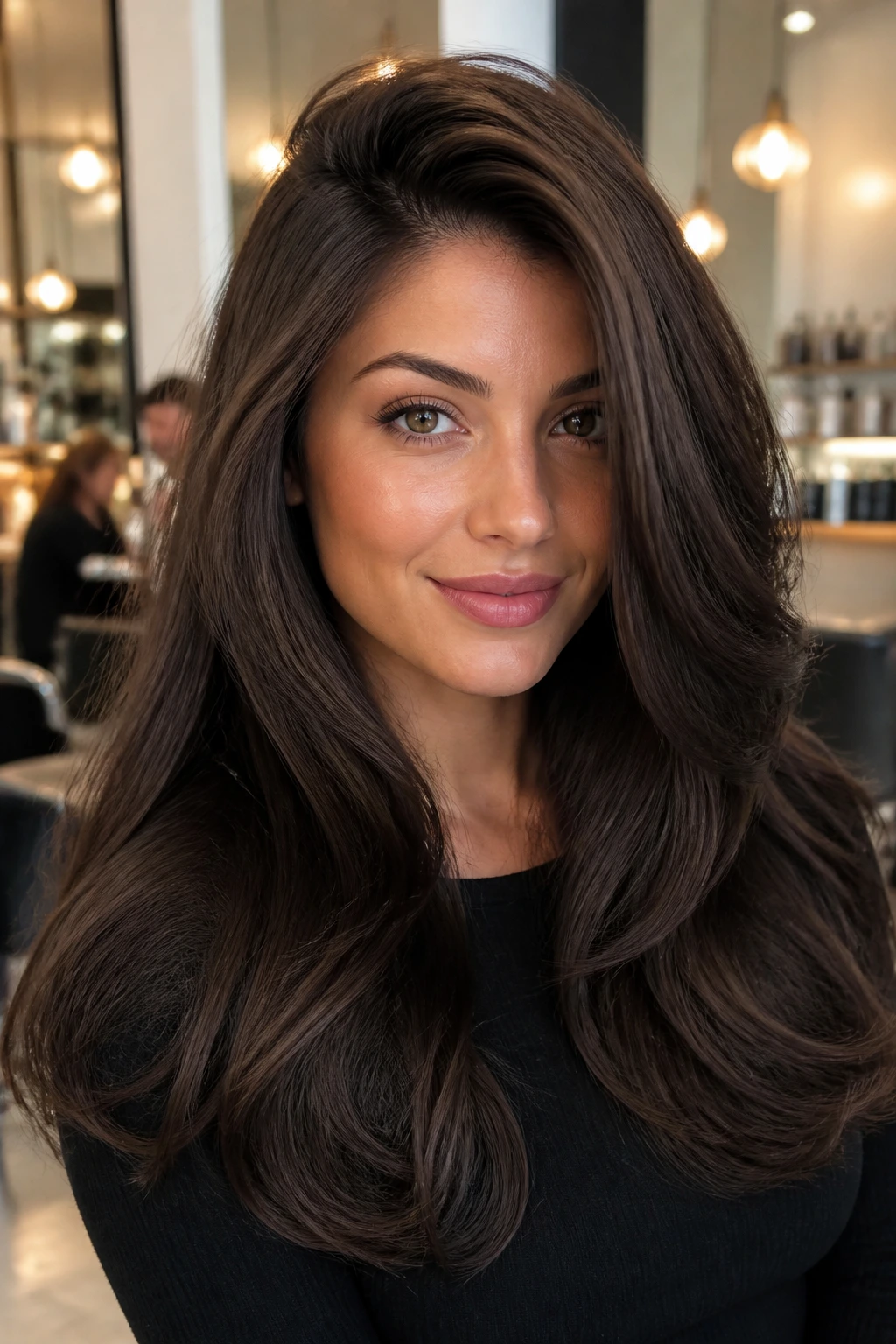
A deep side part does more for thick hair than people give it credit for. It shifts the weight, lifts one side at the root, and keeps the style from sitting flat across the crown. Add long blowout layers, and the whole thing gets that swishy, polished look that thick hair can hold better than fine hair ever could.
This style shines when you use a big round brush and direct the front away from the face. The layers should curve softly, not flip into hard curls. Thick hair has enough density to keep that smooth bend in place for hours, especially if you let the hair cool around the brush before you move on.
Good signs you picked the right version
- The crown has lift without teasing
- The front pieces sweep back instead of clinging to the cheeks
- The ends feel soft, not thin
A quick mist of flexible hairspray at the roots keeps the part from collapsing. That’s the whole trick.
11. Textured Pixie with a Longer Top
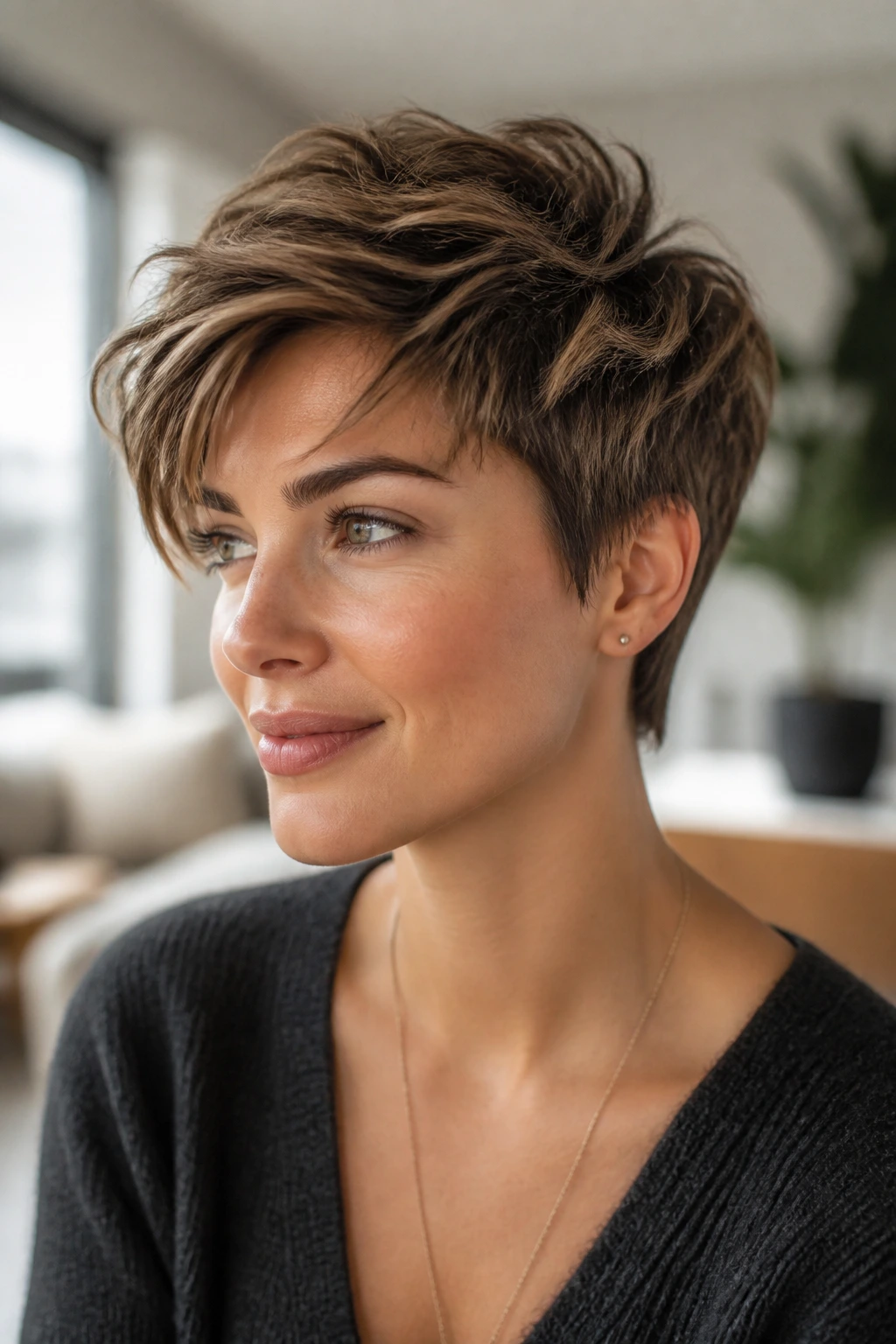
A pixie on thick hair can be fantastic, but only if it keeps some length on top. Dense hair gives the cut structure, which means the top can be swept, spiked, or softened depending on the day. The sides and nape stay close so the head doesn’t look oversized.
The mistake people make here is asking for too much thinning. That leaves the top wispy while the back still feels heavy. Better to keep the top long enough to move—often 2 to 4 inches depending on your texture—and let the stylist shape the bulk through careful point-cutting.
This cut works best if you don’t mind styling product. A pea-sized dab of matte paste or cream can define the top without making it greasy. The payoff is huge: less drying time, less weight around the neck, and a shape that can look sharp or soft with almost no effort.
12. Chin-Length Graduated Bob
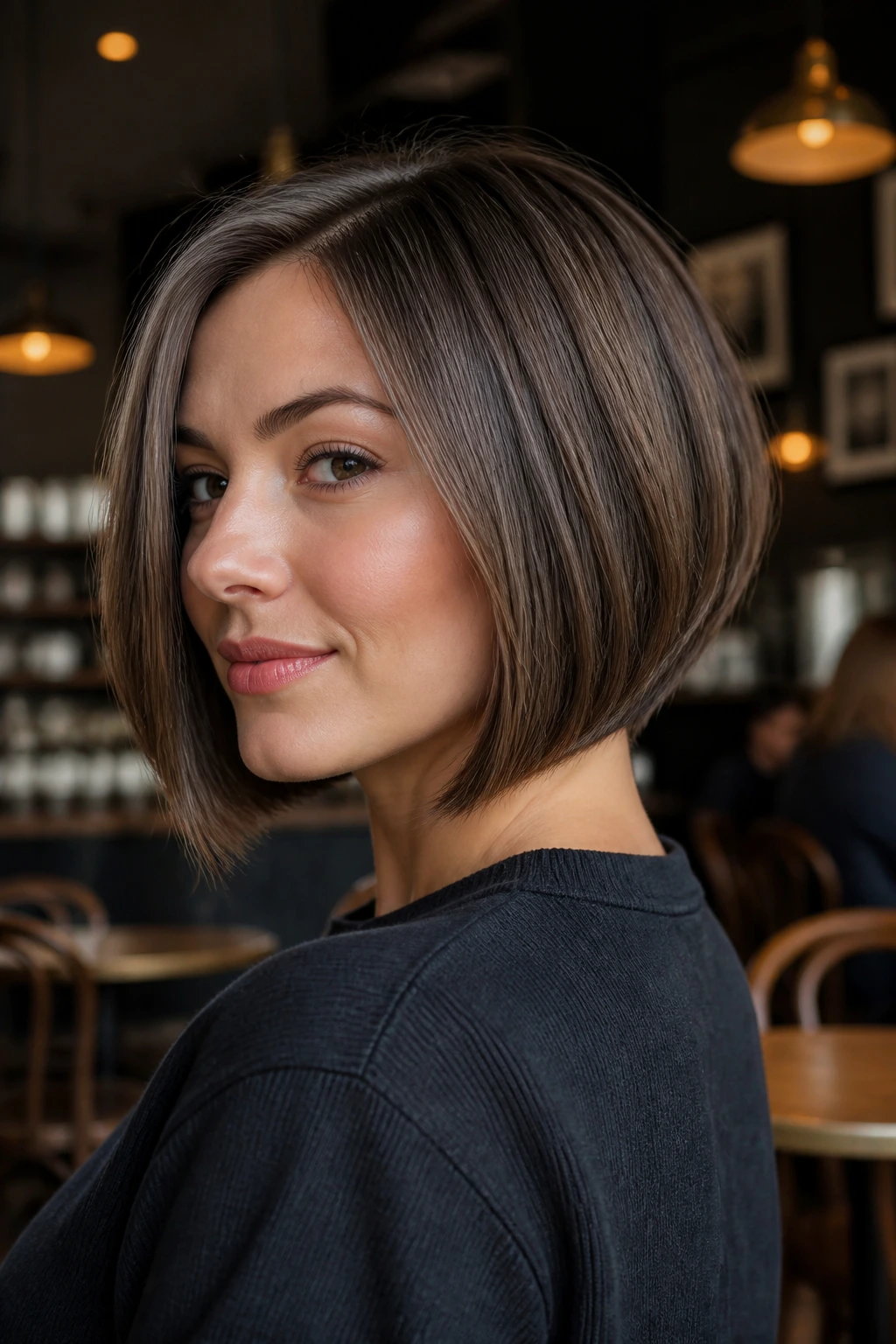
A graduated bob gives thick hair a built-in angle at the back, which helps remove bulk where it tends to pile up. The nape sits a bit shorter, the front stays longer, and the whole cut leans forward in a clean line. On the right hair, it looks crisp. On the wrong hair, it can puff.
That’s why the balance matters. The stack at the back should be subtle, not stacked so high that the crown turns round and helmet-like. A little graduation is enough to lift the neck line and keep the shape from collapsing into a block.
This is one of the better options if your thick hair tends to sit heavy around the ears and jaw. A side part can make it feel softer; a center part keeps it graphic. Either way, it wants regular trims. Let it grow too long and the graduation loses the angle that makes the cut work.
13. Sleek Low Ponytail with a Wrapped Base
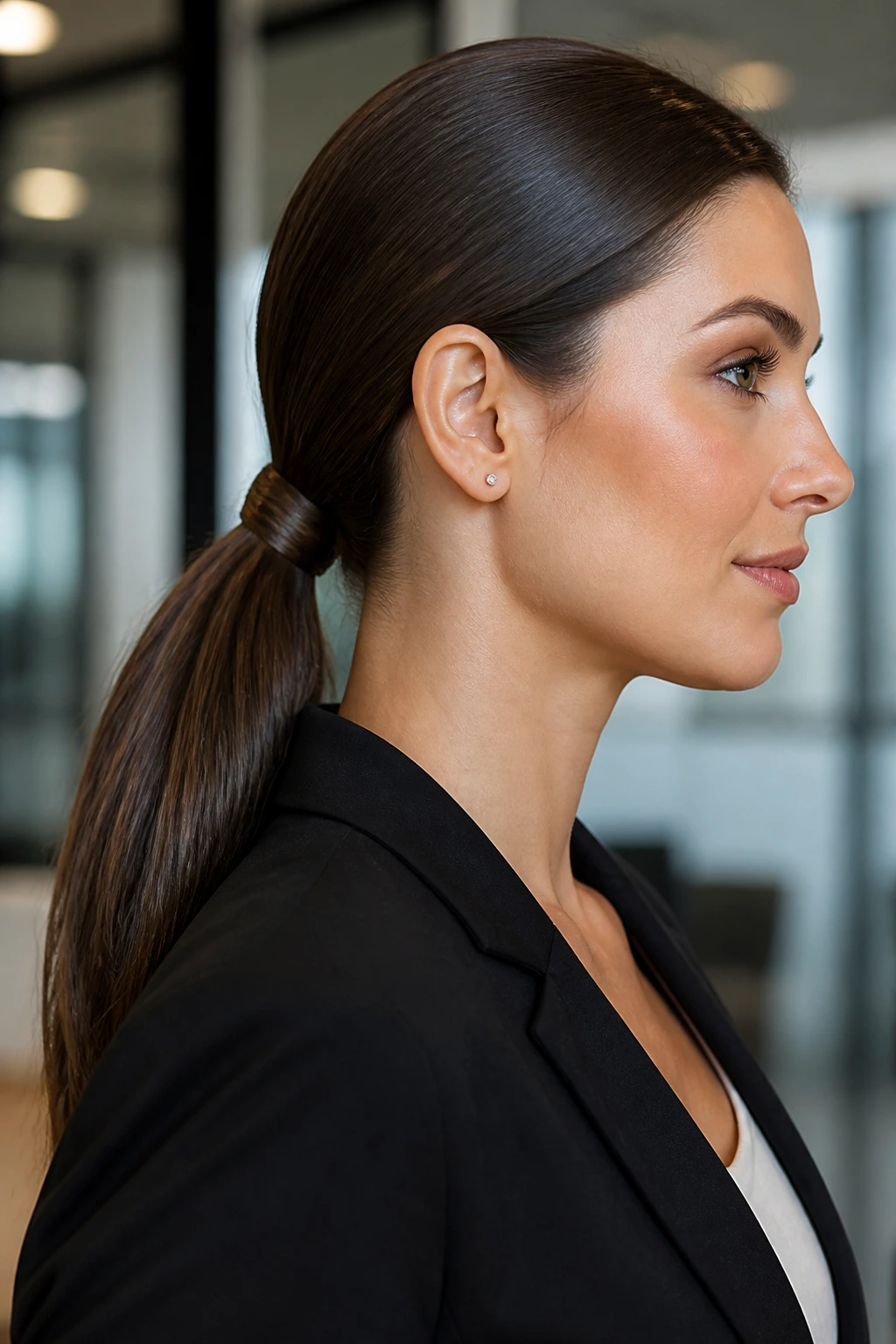
Thick hair can make a low ponytail look elegant instead of plain, and the density is part of the appeal. The trick is control. Smooth the surface with a boar bristle brush or a dense paddle brush, gather the hair at the nape, and wrap a small section around the elastic so the base looks finished rather than slapped together.
If your hair is extremely thick, split the ponytail into two stacked ponies before joining them. That sounds fussy, but it takes strain off the scalp and keeps the tail from sagging by mid-afternoon. Heavy hair can pull hard enough to make a tight ponytail uncomfortable fast.
A little serum on the mids and ends adds shine without flattening the crown. Keep the roots clean. That contrast makes thick hair look deliberate.
14. High Wrapped Bun
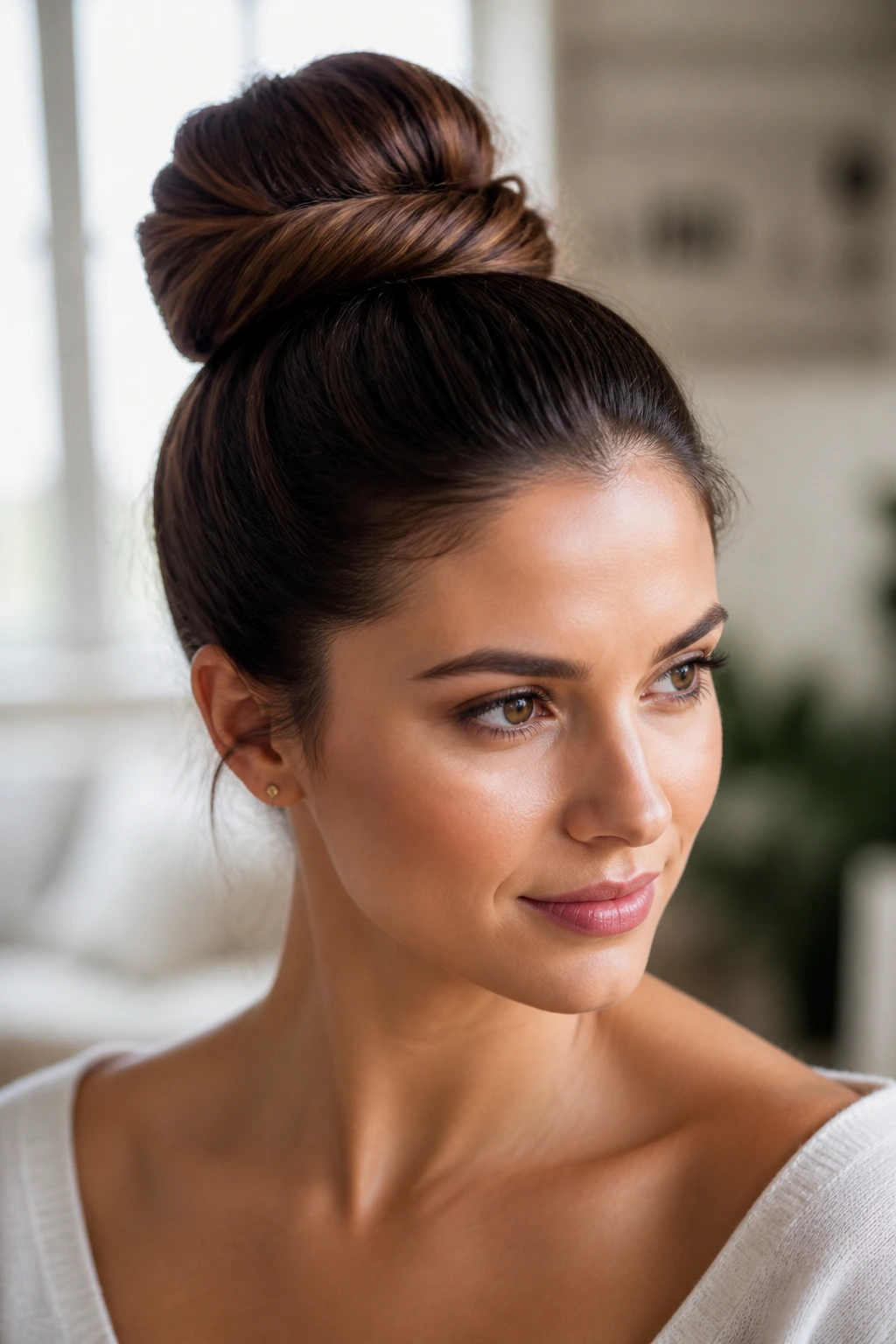
Thick hair makes a bun feel substantial, which is half the charm. A high wrapped bun sits at the crown or just behind it, where the density can spread out without dragging the whole style down. The goal is a smooth base and a rounded shape with enough fullness to look intentional.
The easiest way to build it is to anchor the hair in a high ponytail first, then twist the tail and wrap it around the base. Use two elastics if the hair is heavy. One often gives up. A handful of U-pins or strong bobby pins helps the bun stay tight without turning the scalp tender.
This style is a good answer for humid weather, workouts, or days when you want the neck clear. Leave a tiny bit of softness near the temples if you don’t want the bun to look severe. Thick hair can take a sleek finish, but it usually looks friendlier with one or two loose pieces near the face.
15. Half-Up Claw Clip Twist
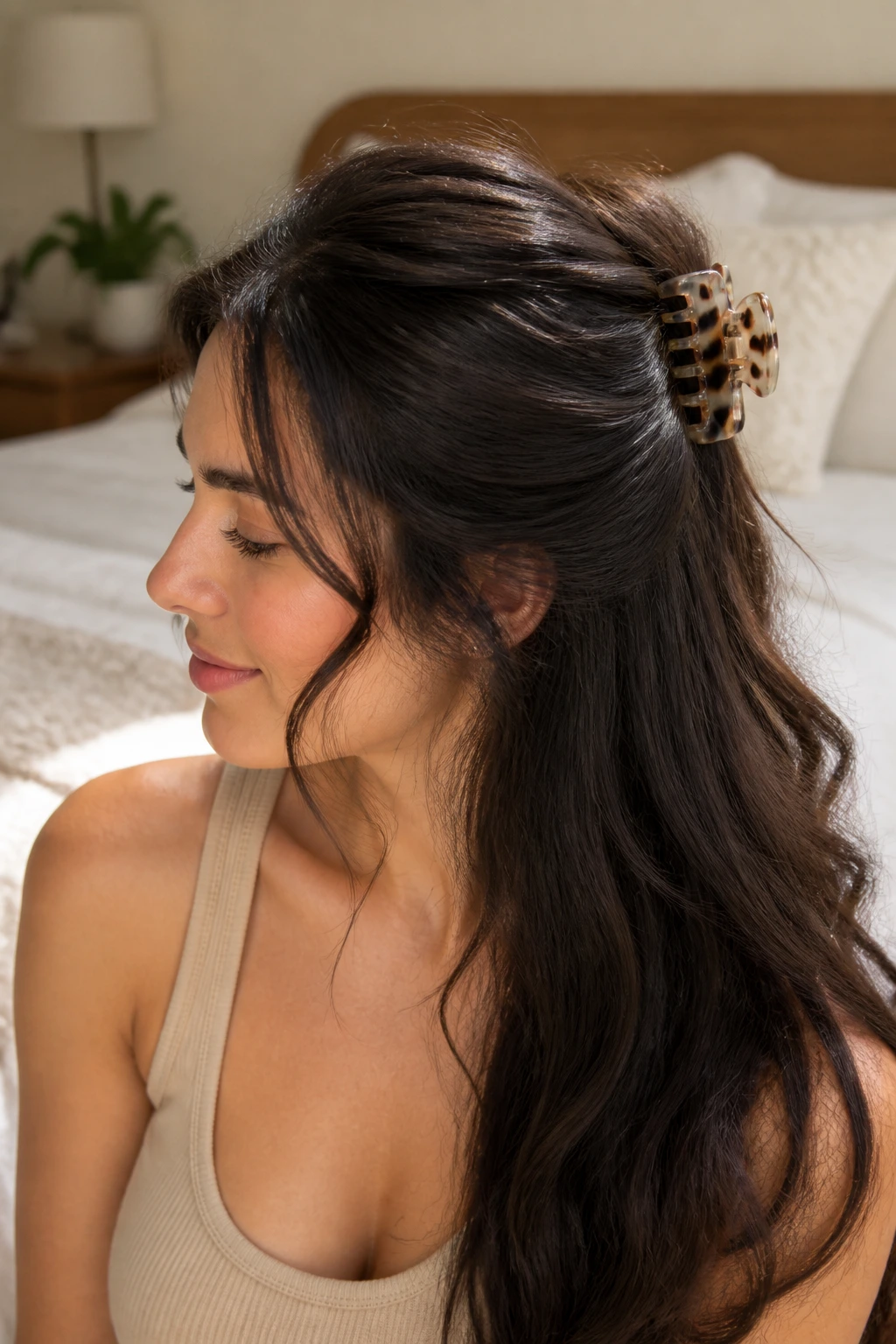
The half-up claw clip twist is the style people reach for when they want the hair out of the face without committing to a full updo. Thick hair gives the twist enough body to stay visible, and the lower half left down keeps the style from looking overworked. It’s quick. That matters.
The clip needs to be large and sturdy, not a tiny decorative one that slides out after lunch. Twist the top section once or twice, fold it upward, and catch the base with the clip. If your crown is especially dense, a small elastic underneath can give the clip something more reliable to bite onto.
This style is more forgiving on day-two hair than clean, freshly washed hair because there’s a little grip. Dry shampoo at the roots helps the twist stay put. A few face-framing pieces soften the front and keep the clip from looking too stiff.
16. Crown Braid
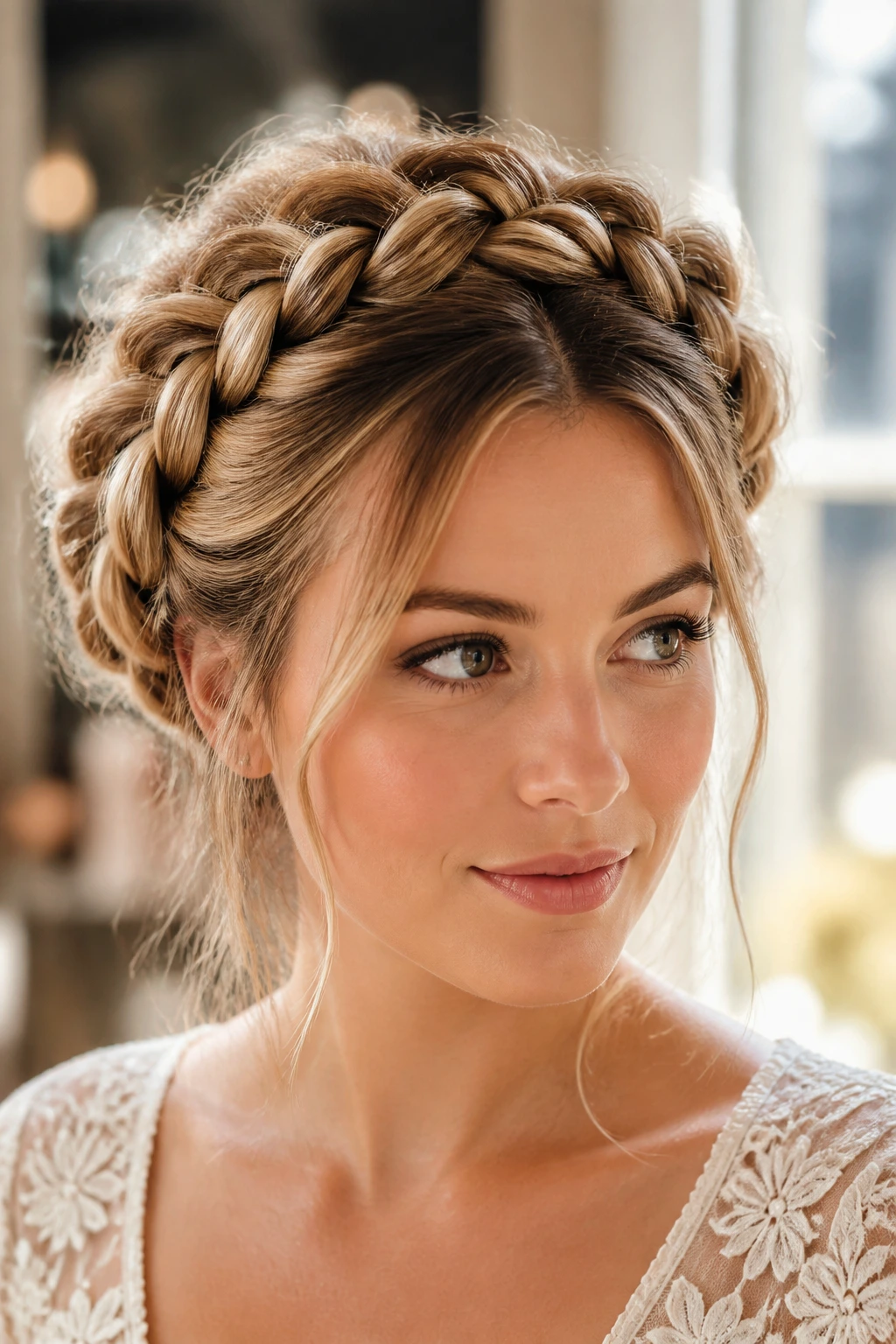
A crown braid can make thick hair look almost architectural. The braid wraps around the head and uses all that density to create a strong halo effect. On fine hair, this style can look sparse. On thick hair, it gets full fast, which is exactly why it works so well.
It helps to start with second-day hair or a light mist of texturizing spray. Freshly washed thick hair can be too slippery, and the braid will loosen before you’re done pinning it. Once the braid is in place, gently pull on the edges—pancaking the braid—so the loops open a little and the braid looks broader.
This style holds especially well for events because the weight is spread around the head instead of hanging from one point. It also keeps the neck clear, which is a small mercy when the weather is sticky or when you’ll be on your feet for hours.
17. Bubble Ponytail
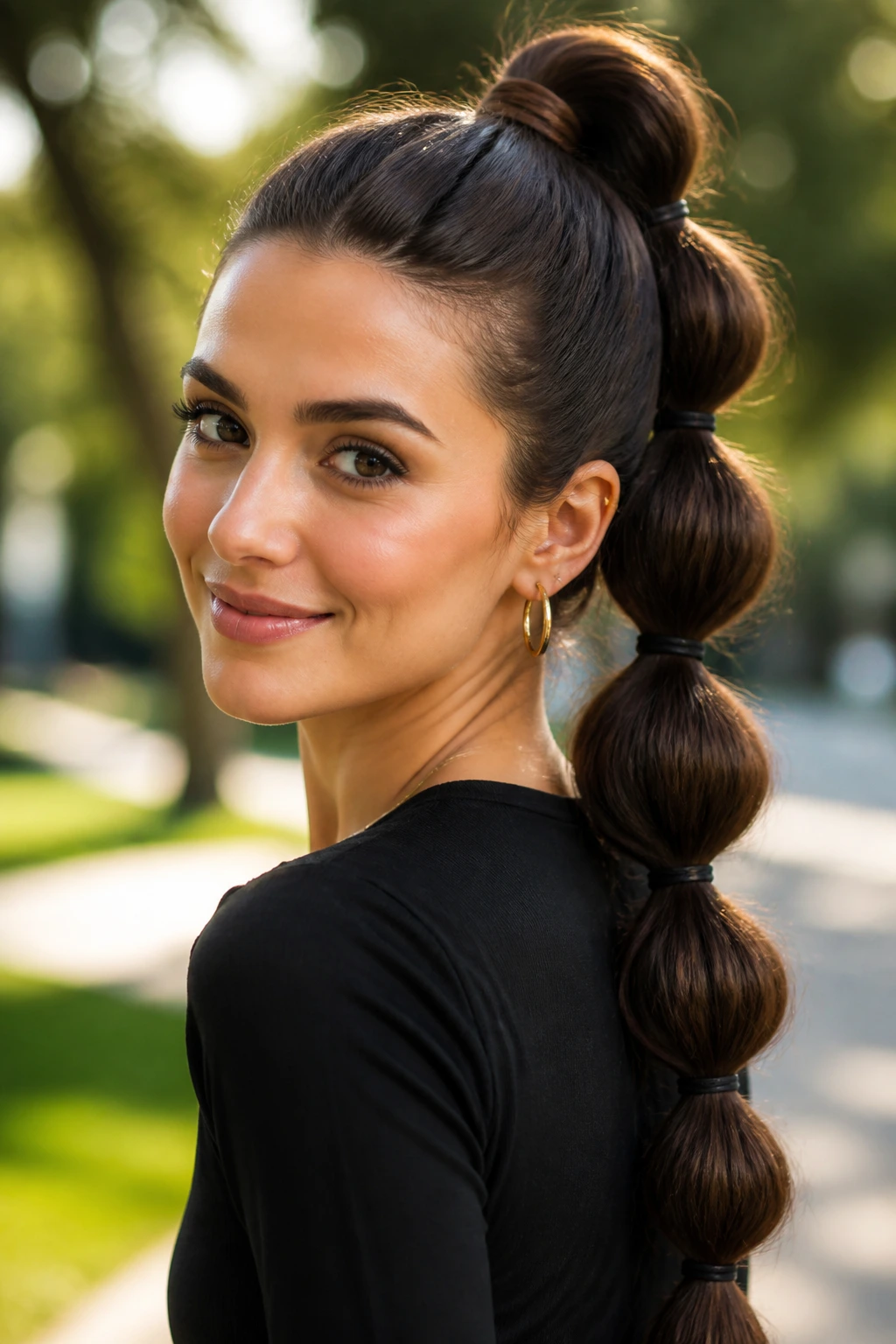
The bubble ponytail works because thick hair gives each section enough volume to read as a shape, not just a tied-off lump. Start with a high or mid ponytail, then add clear elastics every 2 to 3 inches down the length. Gently tug each segment outward until the “bubble” forms.
This style is one of the few playful looks that thick hair can do without disappearing. Thin hair can struggle to make the bubbles look full. Dense hair fills them out naturally, which gives the style a clean graphic line.
How to keep it neat
- Use elastics that match your hair color if you want the bubbles to stand out, or clear bands if you don’t
- Smooth the crown first so the ponytail base looks polished
- Leave the ends a little tousled rather than pinning every strand flat
It’s fun, but it’s not sloppy. That’s the difference.
18. Braided Space Buns
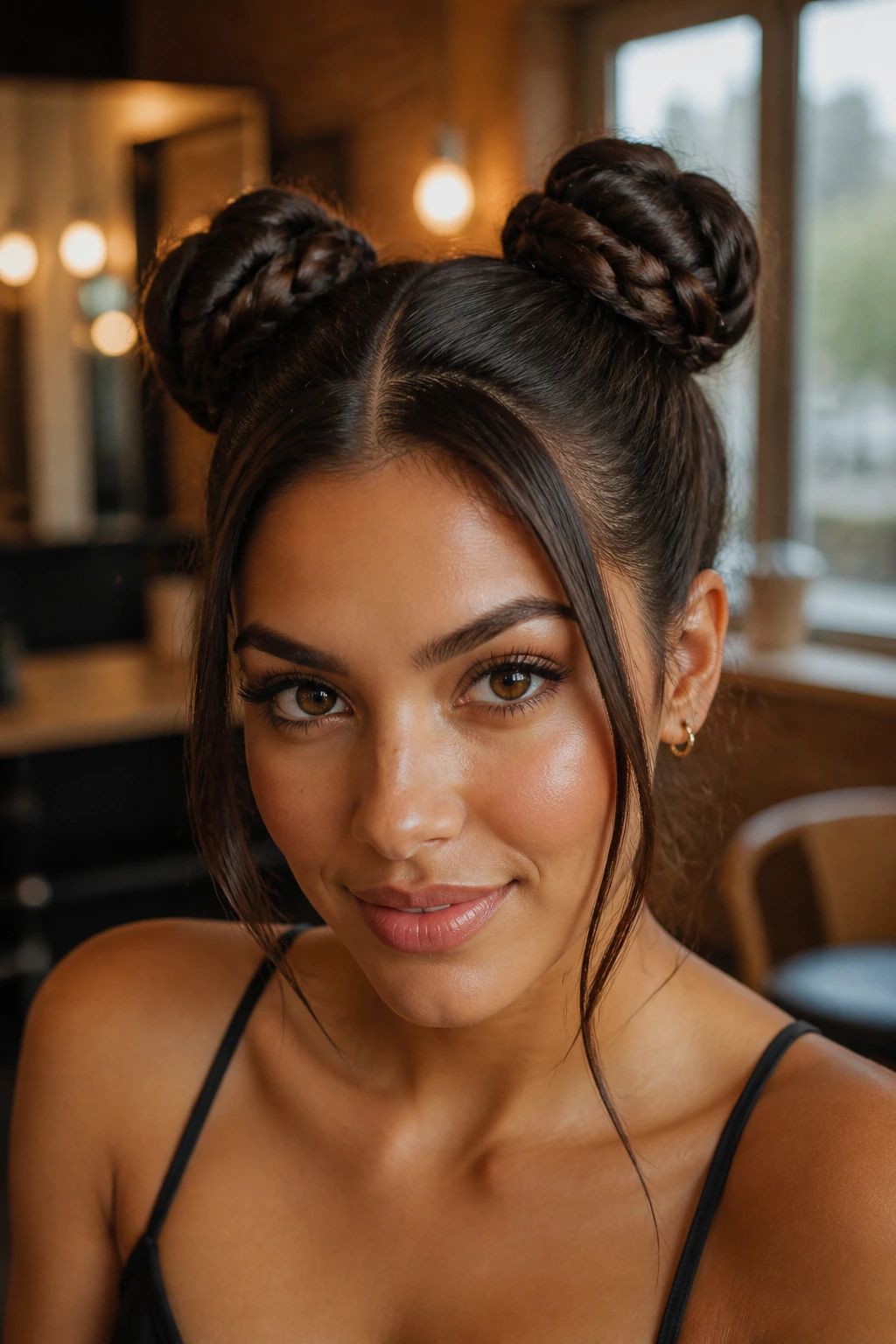
Braided space buns split thick hair into two manageable sections, which is half the battle. Each side gets braided first, then coiled into a bun. The braid gives the bun grip and stops the style from slipping under its own weight. That matters when the hair is long or heavy.
This look has a little attitude to it, but it can still feel neat if the parts are clean and the buns sit evenly. A center part makes the whole style balanced. A zigzag part makes it feel more playful. Thick hair supports either version well.
If the buns feel too bulky, braid the tails tighter before wrapping them. If they feel too small, loosen the braid edges a touch. The style is forgiving, which is why people keep coming back to it for festivals, travel days, and casual weekends when the hair needs to stay off the neck.
19. Messy Top Knot with Face-Framing Pieces
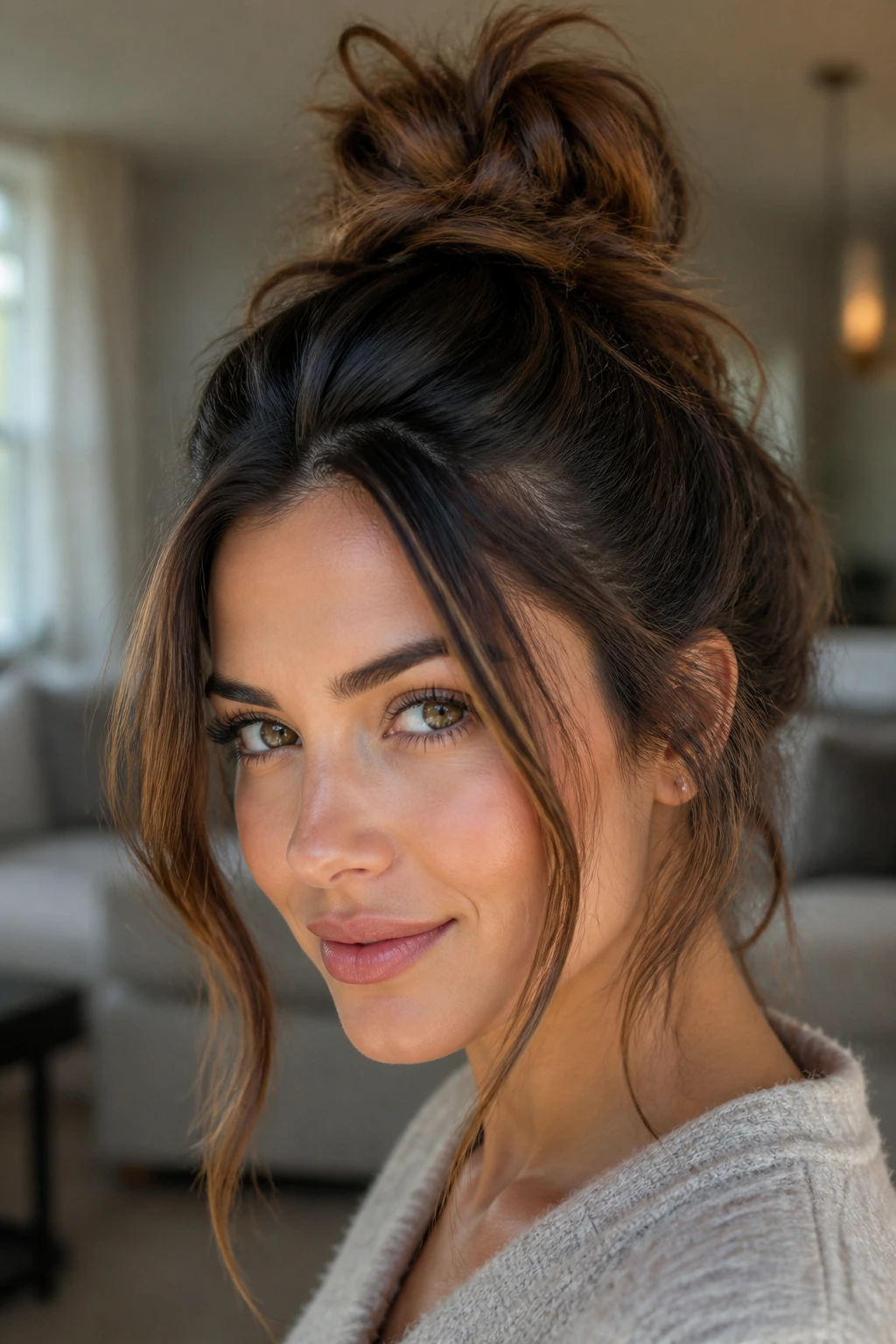
A messy top knot on thick hair works because the hair supplies its own volume. You don’t have to fake a full bun. The challenge is control, not fullness. Gather the hair high, twist it loosely, and pin the knot so it feels secure but not stiff.
Leave out a few face-framing pieces around the cheekbones and jaw. Those small soft bits matter more than people think. Without them, a thick top knot can look severe and a little too tight around the face. With them, the style feels easier and less boxed in.
Use two crossed bobby pins under the knot instead of one. Thick hair likes to slip free from a single pin, especially if the bun sits high. If the knot sags, you pulled too much hair into it. A lighter twist usually holds better.
20. Halo Braid
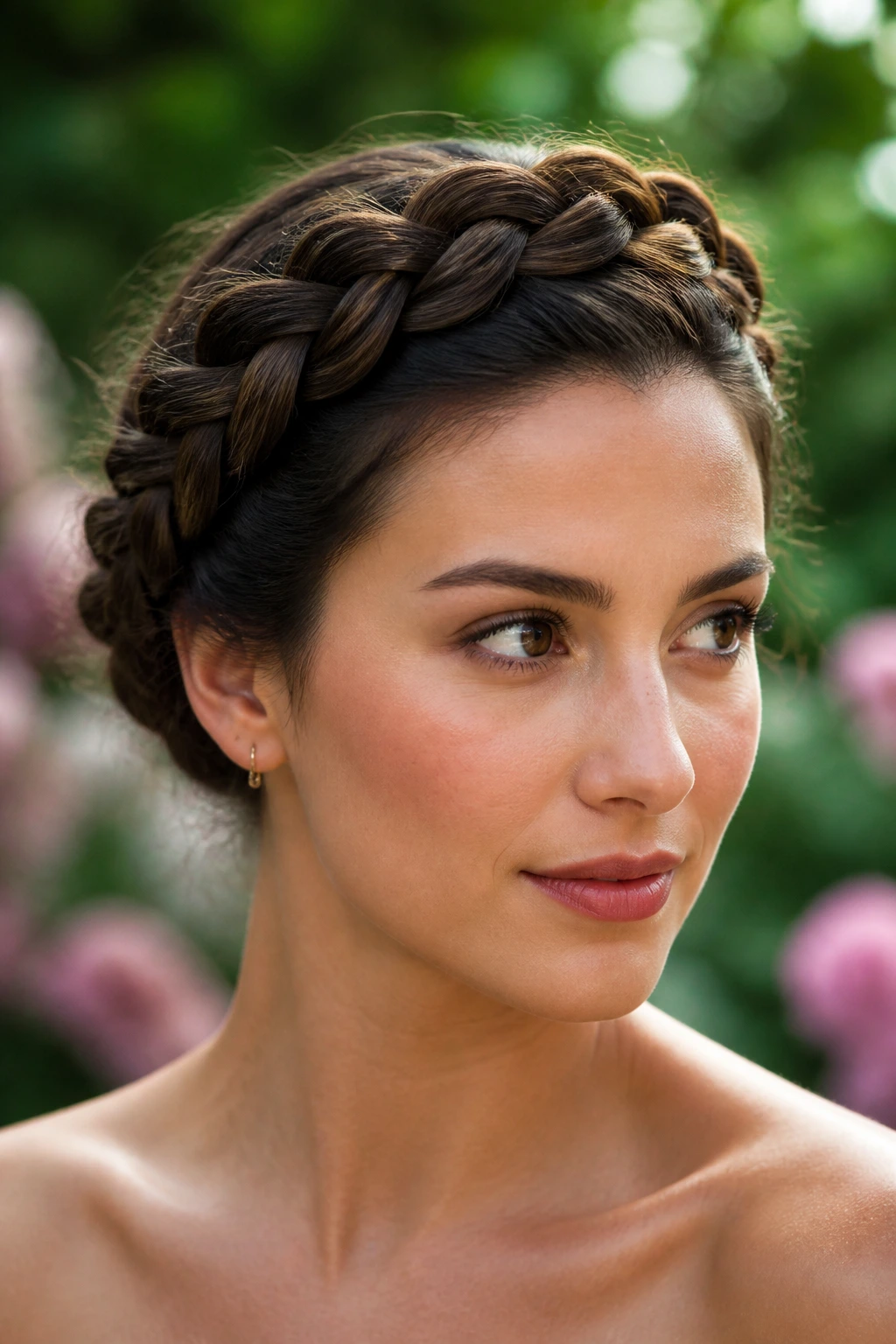
The halo braid wraps around the head and turns thick hair into its own crown. That sounds dramatic because it is. The braid can be loose and soft or tight and clean, but either way the density gives the style weight and fullness all the way around the head.
This works especially well for second-day hair, when the strands have a little grip. A fresh wash can make the braid too silky, which means more flyaways and less hold. Pin the braid at the nape or behind the ears, where the hidden anchors keep the shape stable.
A halo braid also solves a practical problem: it keeps thick hair off the face and neck without relying on heat. That makes it a strong choice for long events, warm rooms, or any day when you want the hair to look styled while doing almost nothing once it’s in place.
21. Waterfall Braid Half-Up
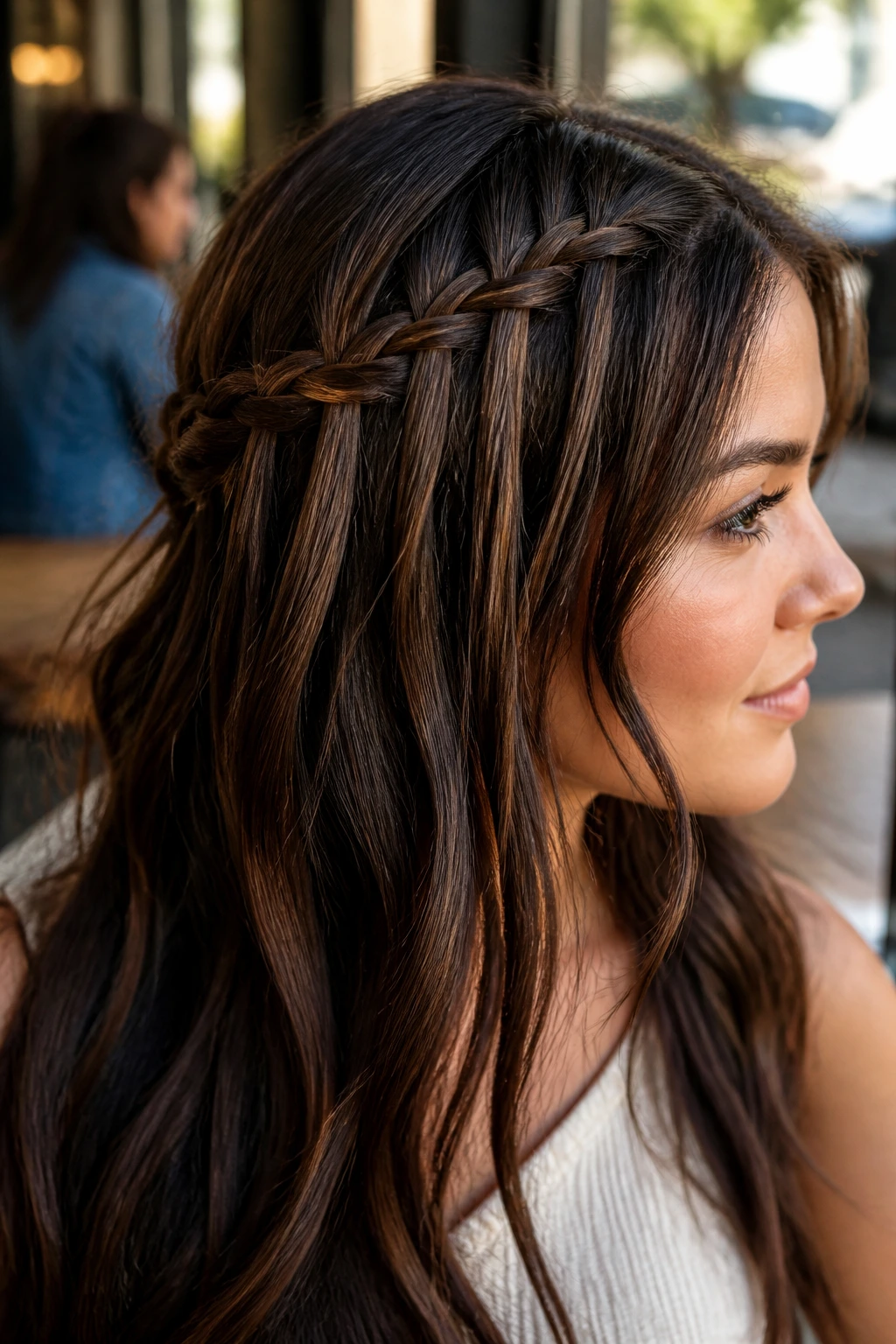
A waterfall braid lets thick hair show off its length without losing all the control at the front. The braid runs across the crown, and pieces drop through the pattern like a soft cascade. On thick hair, the dropped strands stay visible instead of getting lost, which is half the appeal.
This style works best when the hair has some bend or texture. Perfectly silky hair tends to slip out of the braid. A light spritz of texturizing spray or a touch of mousse at the front gives the strands a little grip. You want enough hold to build the pattern, not enough to stiffen it.
The braid can end in a clip, a small twist, or a hidden pin under the loose lengths. Keep the sectioned hair small and even. Uneven pieces make the braid sag on one side, and thick hair exaggerates every asymmetry.
22. Twisted Low Chignon
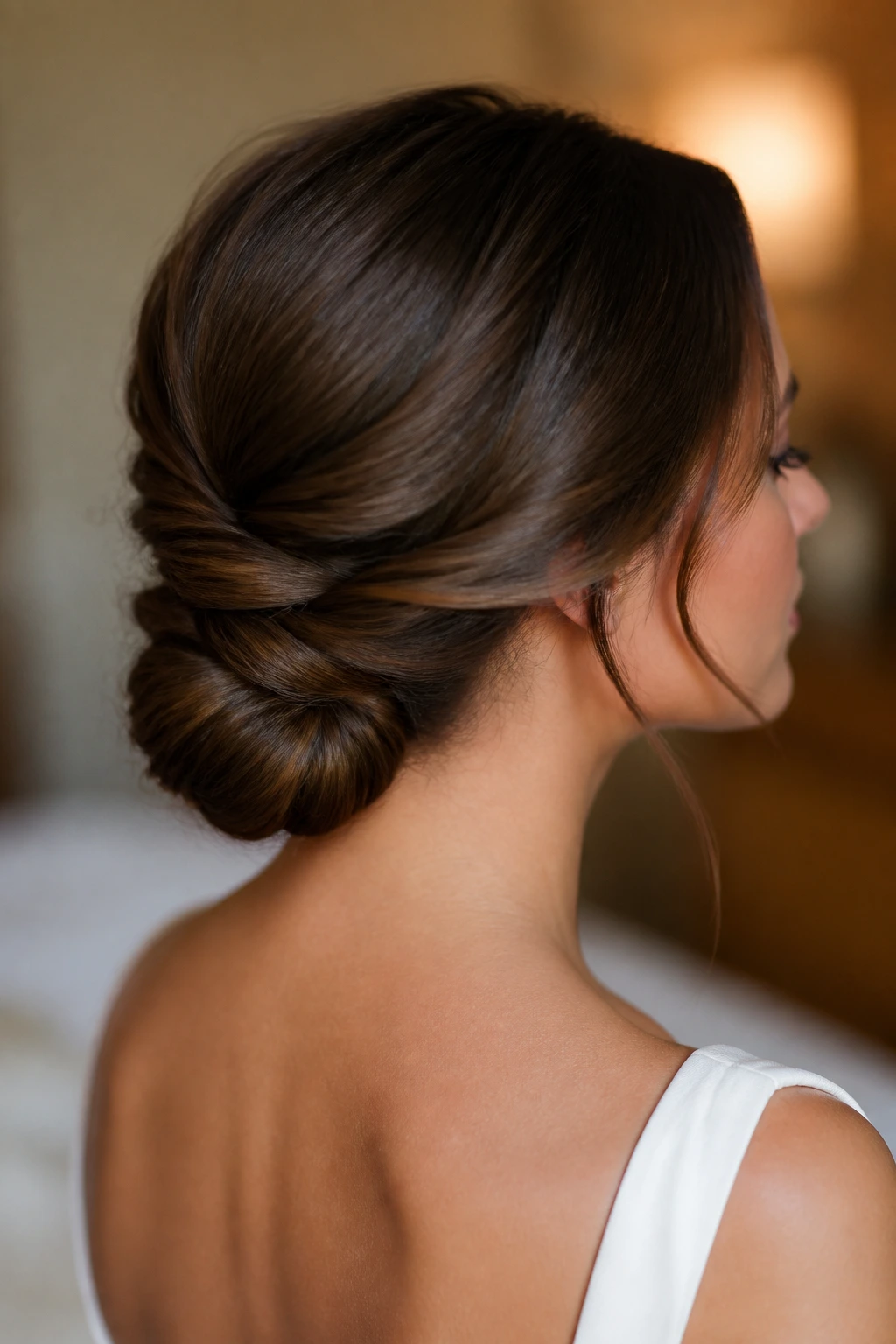
The twisted low chignon is the quietest style on this list, and that’s why it earns its place. Thick hair gathered at the nape can look elegant instead of bulky when the twist is tight at the base and folded neatly into a low knot. Nothing about it needs to shout.
A little backcombing at the crown helps the top sit softly before the hair is pinned into place. Smooth the surface with a brush, but do not press every strand flat. The chignon looks better with a bit of shape around the head and a polished knot below.
This style is useful for weddings, dinners, interviews, or any moment where you want the hair to disappear into the outfit without losing character. A few U-pins and a firm hair tie are enough if the hair is clean and detangled. If it’s extra dense, make the twist in two sections and fold them together. That keeps the knot tight and stops the style from bulging at the back.
Why Thick Hair Hairstyles Need Shape, Not Just Length
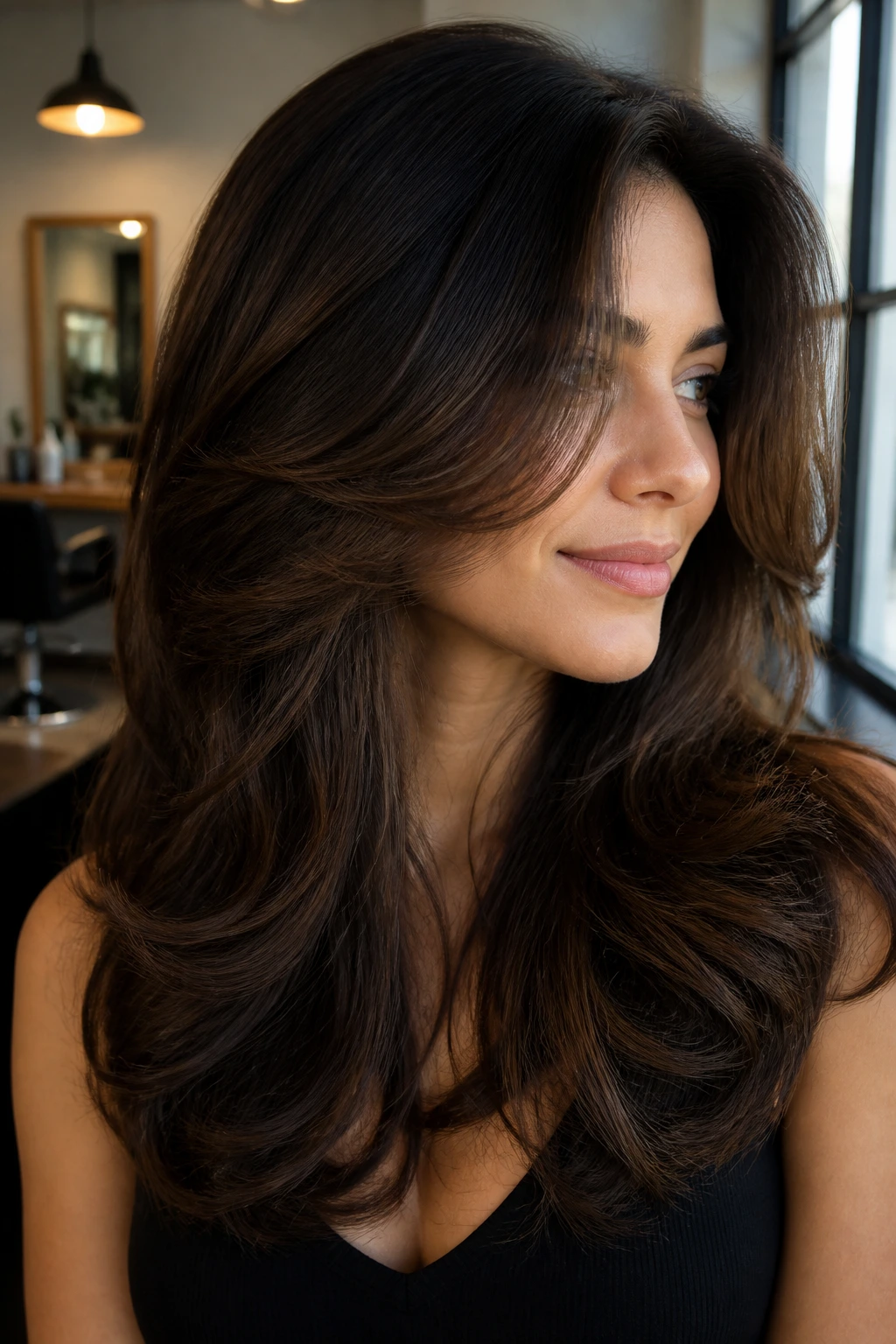
Dense hair can carry a lot of visual weight, which sounds lovely until the ends start to look like one heavy curtain. The shape of the cut decides whether that weight feels controlled or bulky. A good style uses the hair’s thickness as structure. A bad one lets the hair pile up wherever gravity happens to land.
That’s why stylists talk about perimeter, interior layers, and balance. The perimeter is the outline. The interior is where the bulk lives. If those two pieces don’t work together, the style either looks flat on top and puffy at the ends or too shattered and wispy through the middle. Thick hair needs a middle path.
Humidity, curl pattern, and cowlicks also matter more here than people expect. Dense hair can hide a lot of mistakes on day one and show them the second the air turns damp or the blowout loses steam. Shape buys you time. It also makes the style easier to refresh the next day without starting from scratch.
The Tools That Make Thick Hair Easier to Control
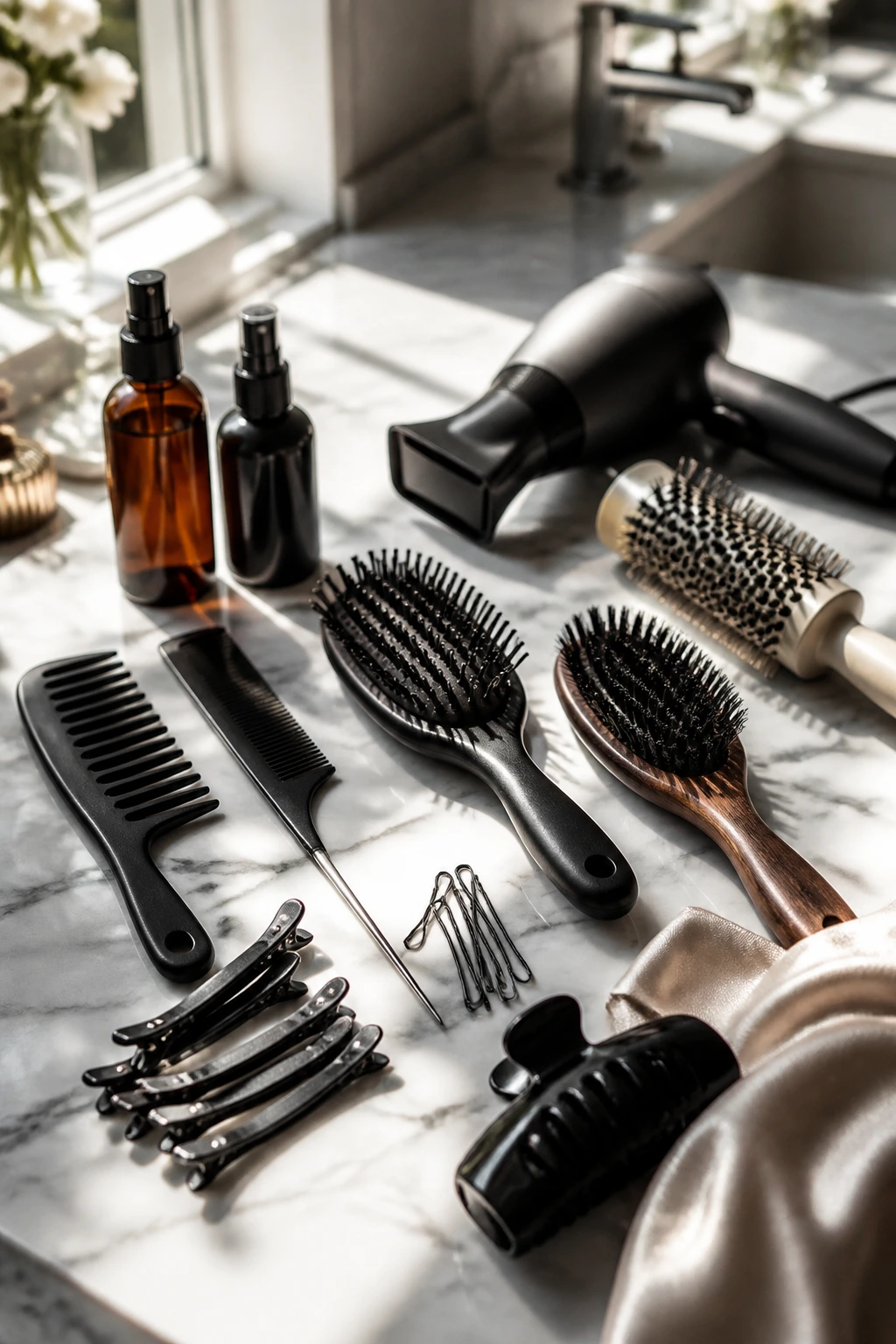
- Wide-tooth comb: Best for detangling thick wet hair without yanking the whole head.
- Tail comb: Clean parts and precise sectioning matter more on dense hair because sloppy sections show fast.
- Sectioning clips: Thick hair falls out of bad clips. Use strong clips that actually hold.
- Boar bristle or dense paddle brush: Helps smooth the surface for ponytails, buns, and blowouts.
- Round brush, 1.5 to 2 inches: Useful for shaping layers, curtain bangs, and side-part blowouts.
- Blow dryer with nozzle attachment: Directs airflow where you want it and cuts down on frizz.
- U-pins and strong bobby pins: Thick hair can swallow weak pins. Stronger ones stay put.
- Large claw clip: Small clips snap shut on a fantasy version of thick hair. Buy the big one.
- Heat protectant: Any hot-tool style needs it, especially on dense hair that takes longer to dry.
- Texturizing spray or dry shampoo: Gives grip for braids, buns, and day-two styling.
- Silk or satin pillowcase: Helps braids, blowouts, and loose waves last longer overnight.
How to Choose Thick Hair Hairstyles for Your Texture and Face
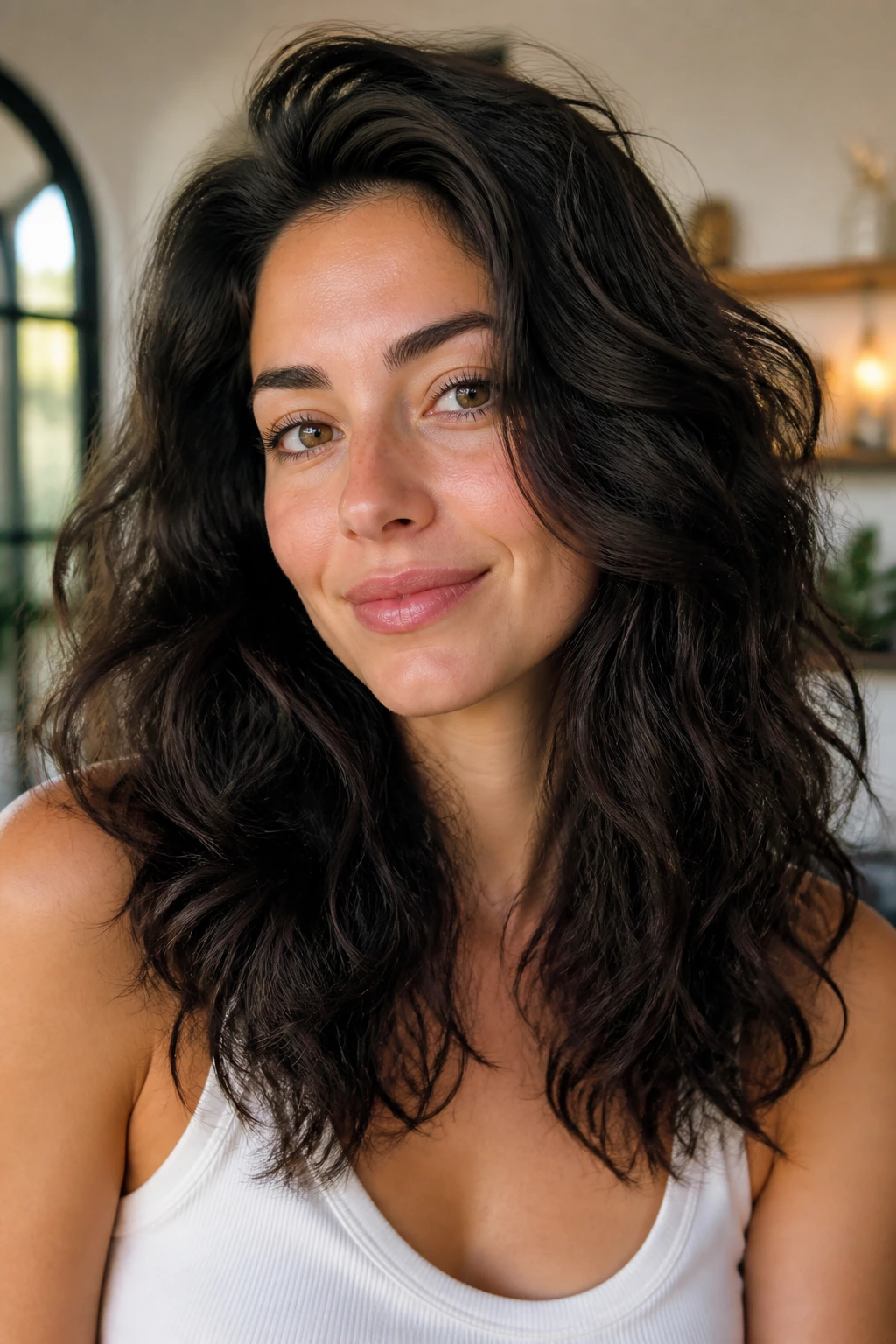
Thick hair is not one thing. Straight, wavy, curly, and coarse hair all behave differently, and the best style for one can fight another. A blunt lob on straight dense hair can look clean and expensive; on very curly dense hair, that same cut may puff at the edges unless it’s shaped carefully. The texture sets the rules.
Face shape matters less than people think, but it still changes the feel of the cut. Curtain bangs soften a longer face. A chin-length bob can sharpen soft features. Long layers help if the face needs a bit of width near the jaw. There isn’t one magic answer. There are useful shapes, and then there are bad ones for your specific density and growth pattern.
Before you sit in the chair, tell the stylist three things:
- How long you want styling to take on a normal morning
- Whether you air-dry, blow-dry, or use hot tools
- Which part of your hair gives you trouble: crown, sides, ends, or fringe
That conversation matters more than bringing a photo alone. A photo shows the result. Your hair shows the physics.
How to Wear These Styles With the Clothes You Own
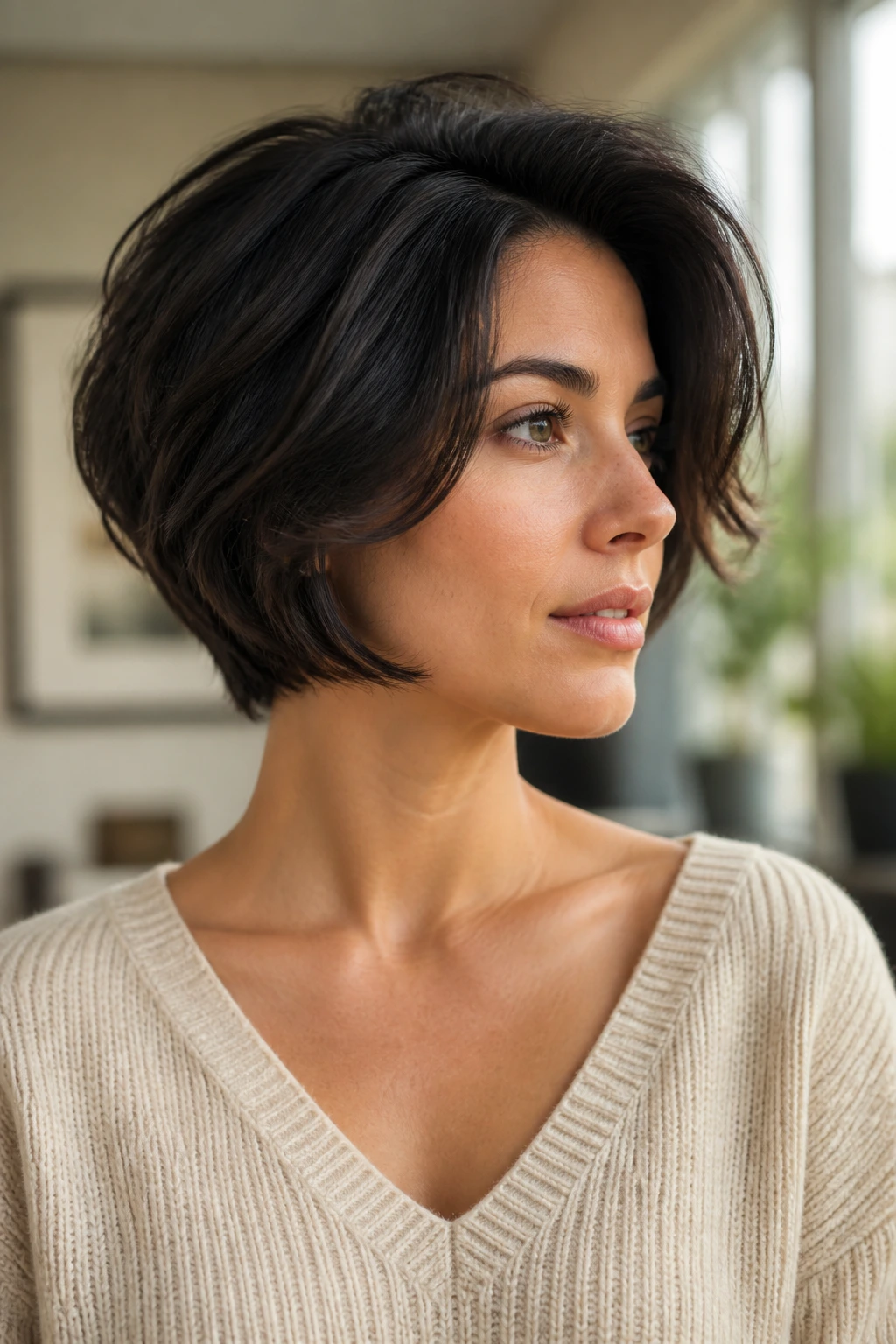
Presentation: Sleek cuts like the blunt lob, French bob, and low chignon look sharper with clean necklines, hoop earrings, or a strong collar. Softer styles like butterfly layers, curtain bangs, and loose braids fit better with knits, linen, and open necklines because the movement around the face stays visible.
Accompaniments: Thick hair can carry heavier accessories without disappearing under them. Big clips, barrettes, scarf ties, and statement earrings often look more balanced on dense hair than tiny pieces that get swallowed. If the hairstyle is bulky already, keep the earrings lighter. If the style is sleek, the accessories can do more work.
Portions: If your hair sits below the collarbone, styles with layered movement tend to hold best because the weight can fall without collapsing. Shorter thick hair often needs more structural cuts—bobs, pixies, and graduated shapes—so it doesn’t inflate at the sides. Mid-length hair is the sweet spot for claw clips, half-up twists, and bubble ponytails.
Beverage Pairing: Not literal, thankfully. But a salon day goes smoother with a water bottle and a coffee that isn’t balanced on the vanity beside hot tools. That’s the kind of practical pairing thick hair appreciates.
Extra Polish and Simple Style Tweaks

Shape Booster: A small amount of mousse at the roots before blow-drying gives thick hair better lift than piling on oil later. The base needs support first.
Time-Saver: Keep a “thick hair drawer” with elastic ties, strong pins, a tail comb, and one large claw clip. Searching for tools steals more time than styling does.
Polish Move: A pea-sized drop of hair oil on the mid-lengths and ends calms roughness after heat styling. Use less than you think. Thick hair can take more product, but it does not need a flood.
Make-It-Yours: Add curtain bangs, a side part, ribbon, or a single braid wrapped into a bun to change the mood without changing the whole cut. That’s the easiest way to keep a style from feeling stale.
Common Mistakes That Make Thick Hair Expand Instead of Flow
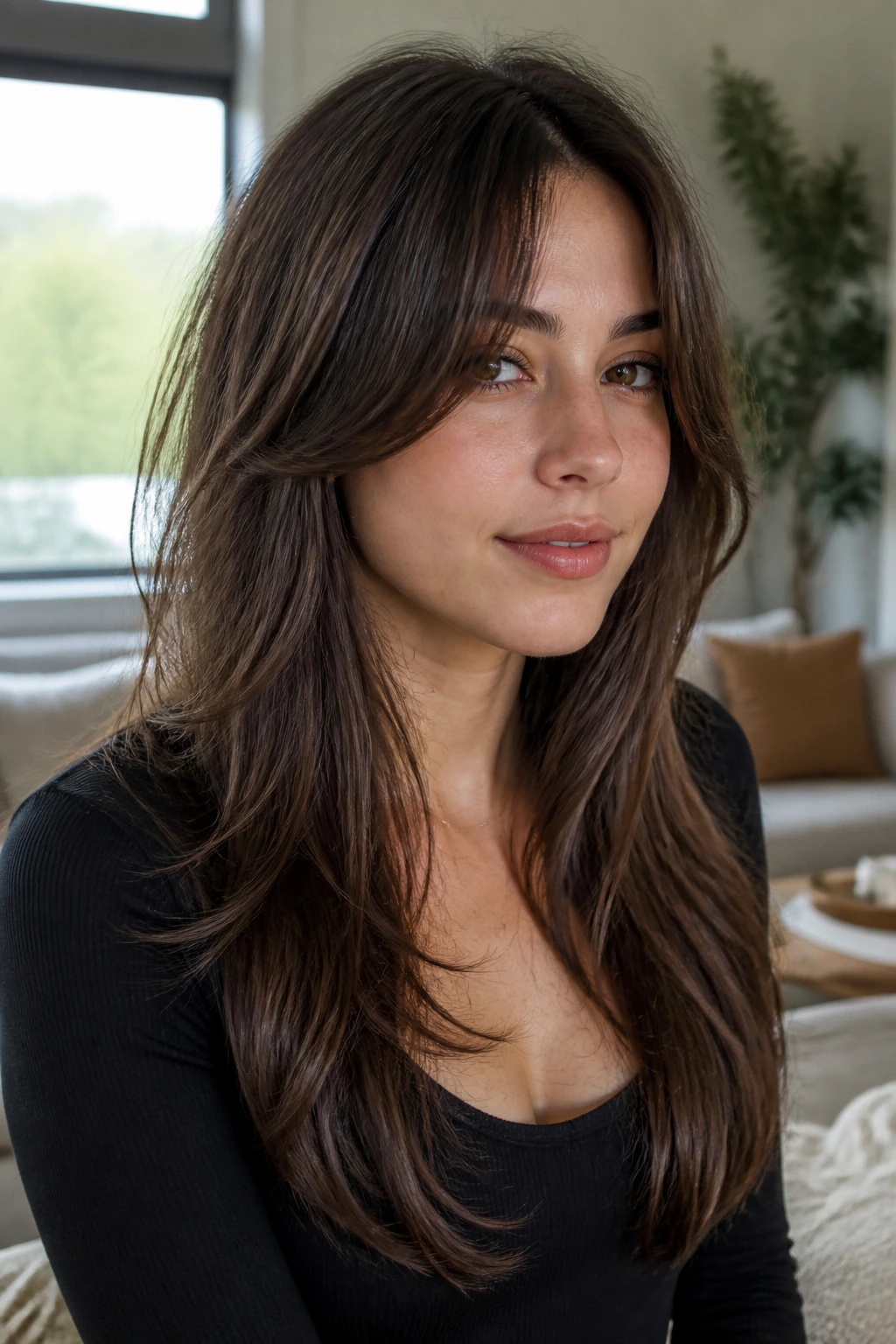
- Over-thinning the ends: The hair looks airy for one day and frayed the next. Ask for internal shaping instead of aggressive thinning shears through the whole perimeter.
- Cutting bangs too short: Thick fringe springs up, swells, and sits higher than expected. Leave extra length, then trim again once you see how it dries.
- Pulling every style too tight: Scalp tension, flyaways, and a hard-looking hairline are the usual clues. Leave a small amount of softness around the temples and nape.
- Skipping directional drying: Thick hair dries in the shape it’s pushed into. If you blow-dry every direction at once, the surface puffs.
- Using too much cream or oil: Roots go limp while the ends still look dry. Start with a tiny amount and add only if the hair asks for it.
- Ignoring the crown swirl or cowlick: The front splits and refuses to lie flat. Work with the growth pattern instead of trying to force it under a pin.
Variations and Alternatives for Different Hair Textures
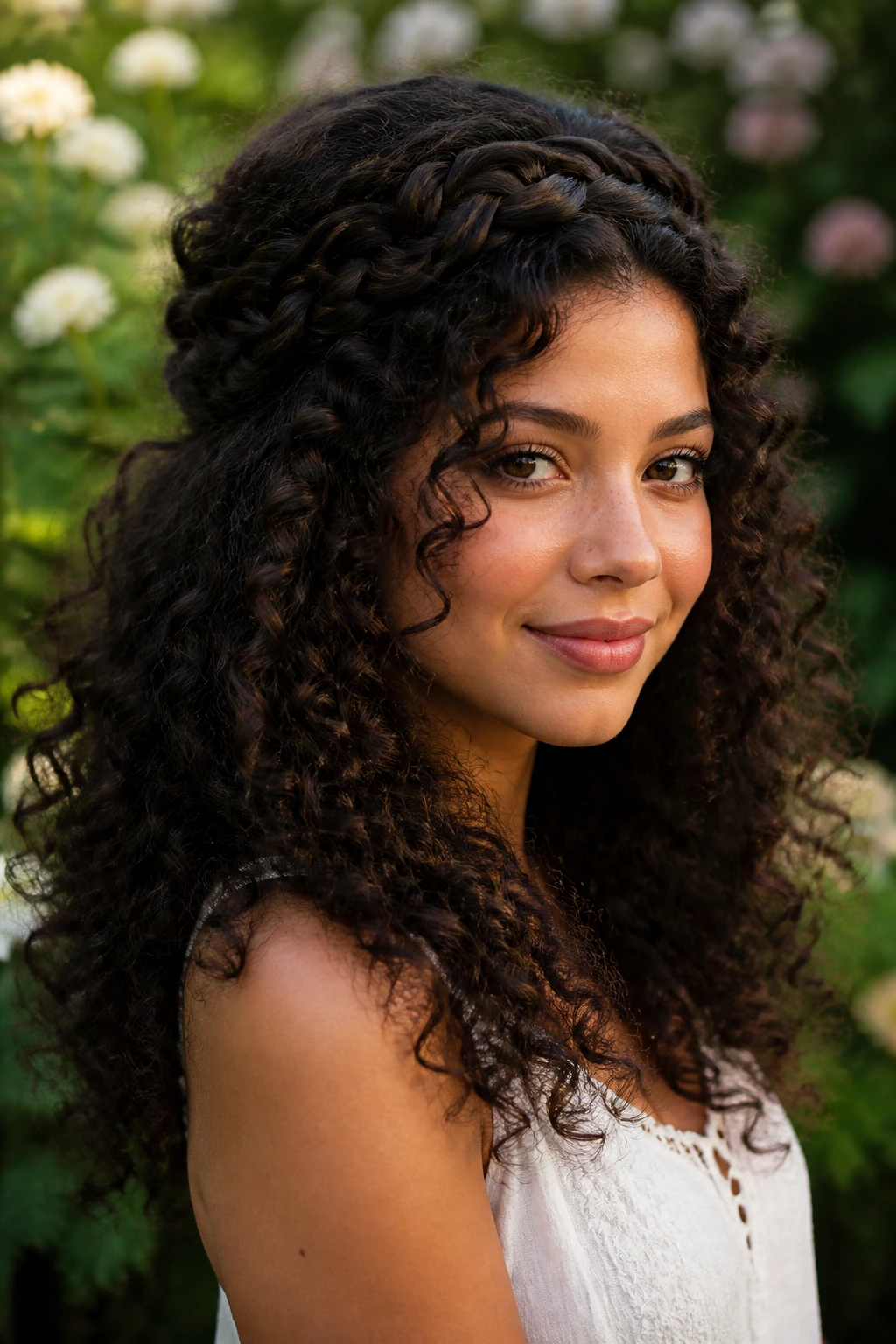
Curl-First Version: On curly or coily thick hair, keep the layers long enough to respect the curl pattern and use styles that can be diffused or air-dried. A crown braid, halo braid, or curly shag tends to behave better than a super blunt cut unless the perimeter is shaped carefully while dry.
Humidity Shield: If the air makes your hair swell, choose styles with structure at the base—low buns, wrapped ponytails, graduated bobs, or a blunt lob. Smooth the top with a light cream, then stop touching it. More product usually doesn’t solve humidity. Better shaping does.
Five-Minute Reset: For mornings that move fast, the half-up claw clip twist, low ponytail, and messy top knot are the most reliable. They work because thick hair supplies its own body. You’re not building volume from scratch. You’re just guiding it.
Office Clean-Up: Sleek low ponytails, twisted chignons, and French bobs keep thick hair tidy around collars and headphones. These styles also read polished on camera, which matters if your day involves a screen and not a mirror.
Low-Heat Routine: If you want to keep the hair healthy and skip the hot tools, aim for styles that rely on texture rather than heat: braids, buns, space buns, waterfall braids, and air-dried shags. The trick is to set the shape while the hair is still damp, then leave it alone long enough to dry in place.
Keeping Thick Hair Styles Going Between Washes
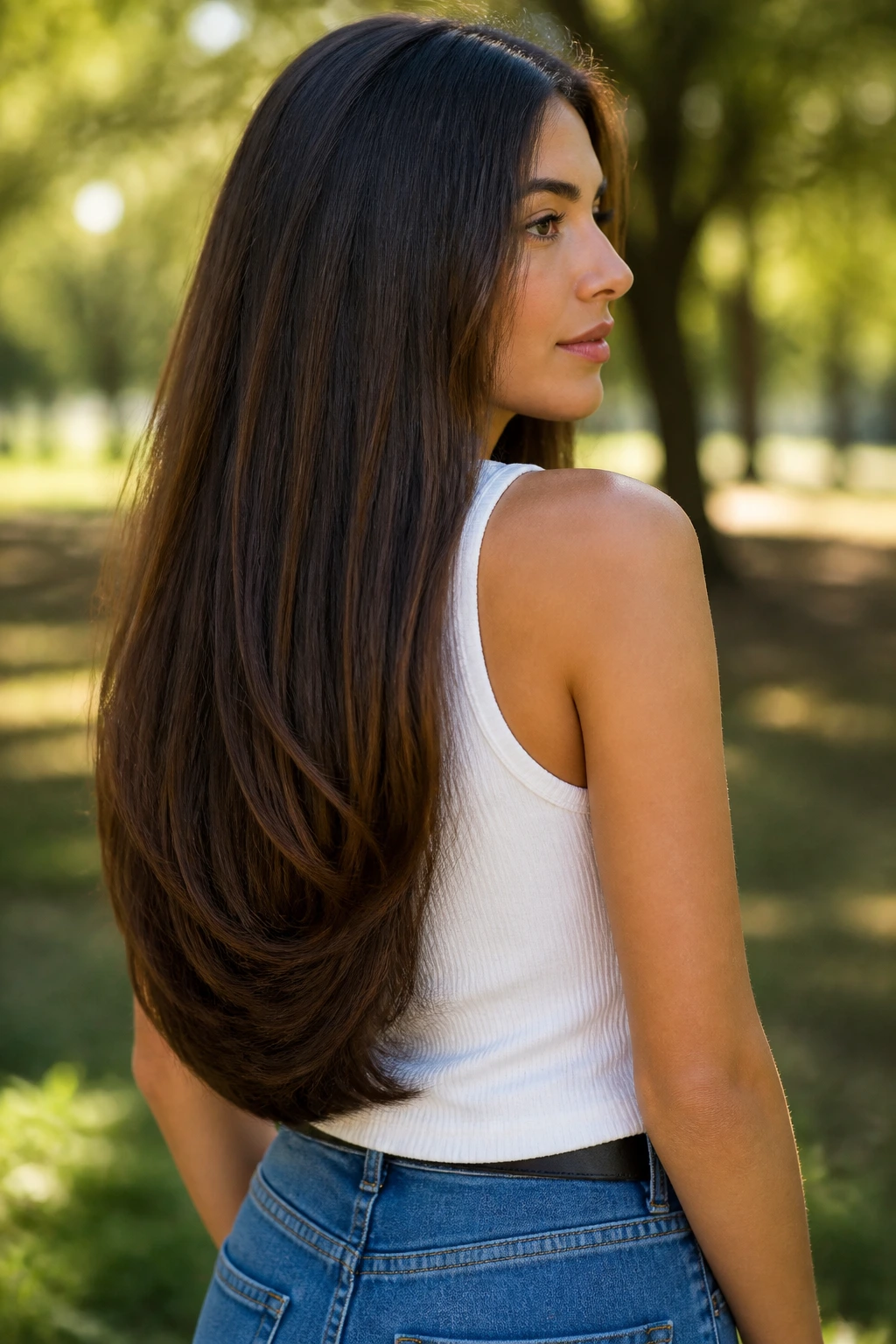
Thick hair usually holds a style longer than fine hair, but it still needs a plan after day one. For blowouts and sleek styles, let the hair cool completely before you touch it. That cooling time matters more than people think. Warm hair forgets shape fast.
Braids, buns, and twists often do well for 1 to 3 days if you sleep on a silk or satin pillowcase and secure loose ends with a soft tie. If the roots start to separate, dry shampoo at the part line can buy you another day without making the hair chalky. Use it in small passes, then massage it in with your fingertips.
For heat styles, a quick re-bend at the front pieces or ends is usually enough. You do not need a full restyle. Rewarming the whole head tends to build frizz faster than it fixes anything. If the style is up, refresh the crown with a little dry texture spray and a couple of pins. The shape usually comes back with less effort than you’d expect.
Wash-day timing matters too. Thick hair that gets oily quickly may need washing every 2 to 4 days. Hair that stays dry can stretch longer, especially if the ends are sealed with a light cream. The point is to protect the shape, not chase a perfect schedule that ignores your scalp.
Questions People Ask Before They Sit in the Chair
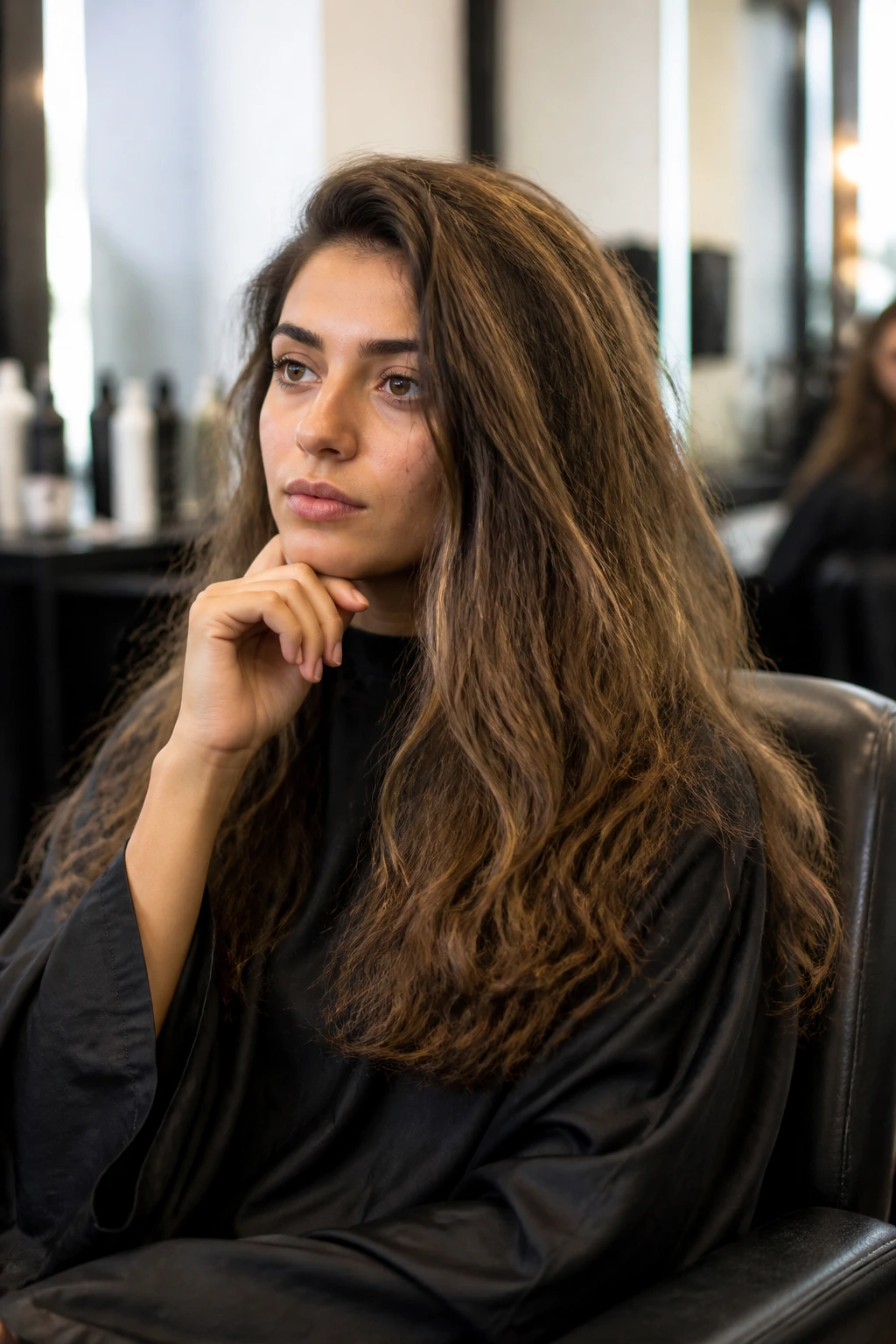
Are layers good for thick hair, or do they make it frizzy?
Layers help thick hair when they’re placed with intention. Short, scattered layers can make the hair puff, but long internal layers or a well-shaped shag can remove bulk and keep the outline calmer. The cut matters more than the word “layers” on its own.
What haircut makes thick hair look lighter without going flat?
A collarbone lob, butterfly cut, U-shape, or long invisible layers tends to do that well. Those shapes keep some weight at the bottom so the hair still swings instead of turning stringy.
Can thick hair wear blunt cuts?
Absolutely. A blunt bob or blunt lob can look crisp on thick hair because the density supports the line. The trick is to keep the perimeter clean and not over-thin the ends.
What bangs work best with thick hair?
Curtain bangs are the safest starting point. They’re easier to grow out, easier to part, and less likely to feel like a heavy curtain over the forehead than a dense straight fringe.
How often should thick hair be trimmed?
Many thick styles stay in shape best with trims every 8 to 12 weeks. Short bobs and pixies need closer attention than long layers or braids, which can stretch a little longer.
Is razor cutting a good idea for thick hair?
Sometimes, but not always. On some textures it creates soft movement; on others it can leave the ends fuzzy. Point-cutting or slide-cutting often gives thicker hair a cleaner result.
What if my thick hair gets triangle-shaped?
That usually means the bulk sits too low and the top is too flat. Ask for more lift at the crown, more internal shaping through the mid-lengths, and a less blunt lower edge.
Can I air-dry thick hair and still get a good shape?
Yes, but you need to set the pattern while the hair is damp. A braid, twist, scrunch, or curl-friendly layer cut will hold better than leaving the hair loose and hoping it behaves.
A Shape That Lets Thick Hair Breathe
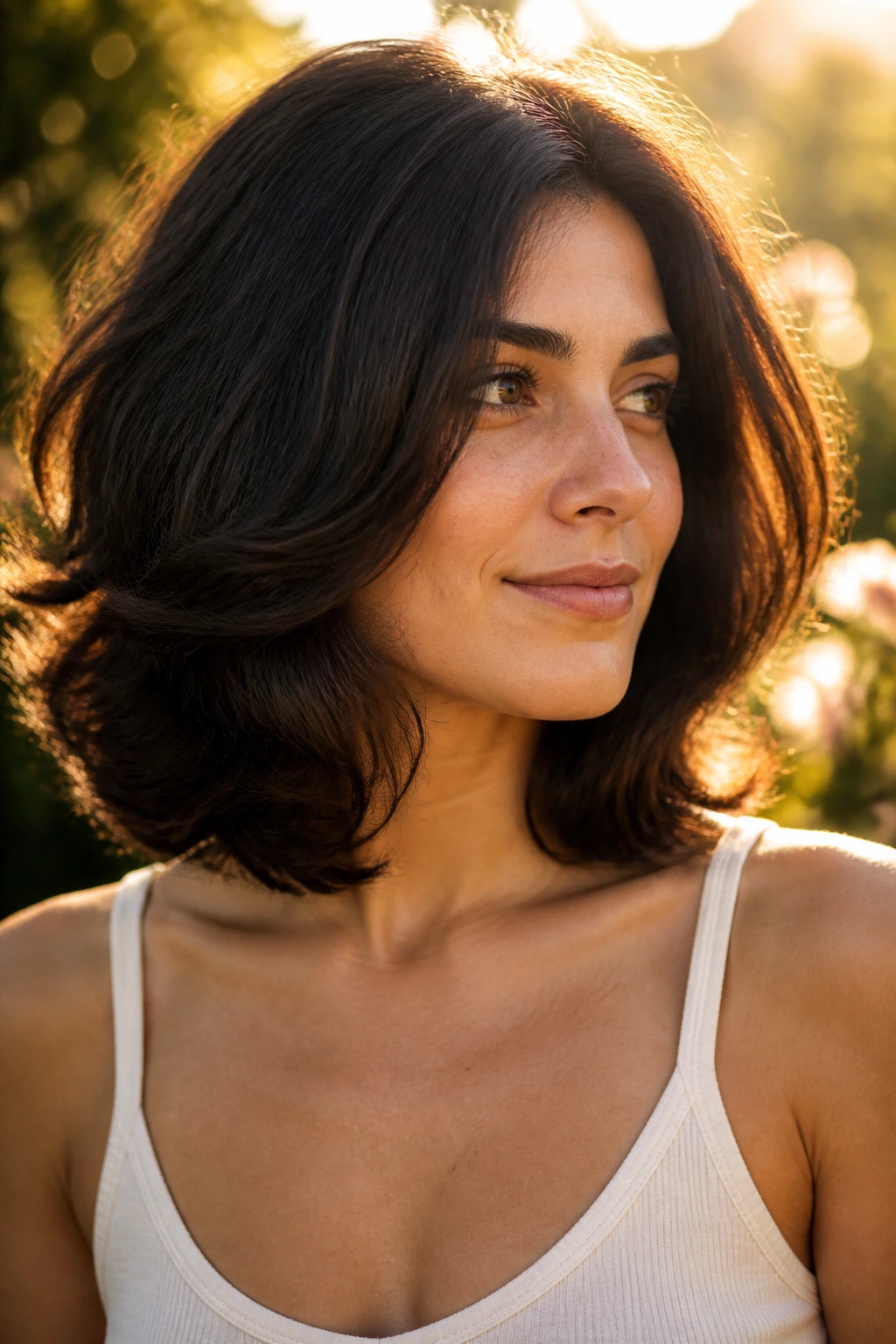
Thick hair does not need to be tamed into something smaller. It needs a cut or style that knows where to put the weight. That’s the difference between a look that sits there and one that actually moves when you do.
The strongest styles here work because they respect density. Some lean sleek. Some lean soft. Some live entirely in braids, buns, or clipped-up shapes. None of them ask your hair to pretend it’s thinner than it is. That’s the whole point.
If you’ve spent years fighting puff, bulk, or a blunt outline that never seems to settle, pick the style that matches your real texture and real morning habits. Thick hair looks best when the shape does the work for you.
