



Medium-length bridal hair is a sneaky sweet spot. It sits in that in-between zone where the ends are long enough to twist, braid, pin, and tuck, but short enough that every move has to be deliberate. That’s why these hairstyle ideas for brides with medium length hair can look so polished when they’re built around the hair’s real length instead of pretending it’s waist-long.
The biggest mistake I see is brides trying to force medium hair into a shape that belongs on a much longer head of hair. It usually ends the same way: pins showing, pieces slipping, or a style that feels overworked by the time the veil goes on. The better approach is smarter, not bigger. Medium-length hair loves low knots, half-up twists, side sweeps, clean ponies, soft braids, and those glossy wave patterns that show movement without needing extra inches.
And there’s another advantage people miss. Shoulder-skimming and collarbone-length hair keeps the styling visible. You see the shape. You see the texture. You see the earrings, the neckline, the veil comb, all of it. A good bridal style on this length doesn’t need to be elaborate to feel special. It just needs to sit in the right place and hold there through hugs, photos, and the part of the reception where everybody starts leaning in close.
Why These Medium-Length Bridal Looks Earn Their Spot
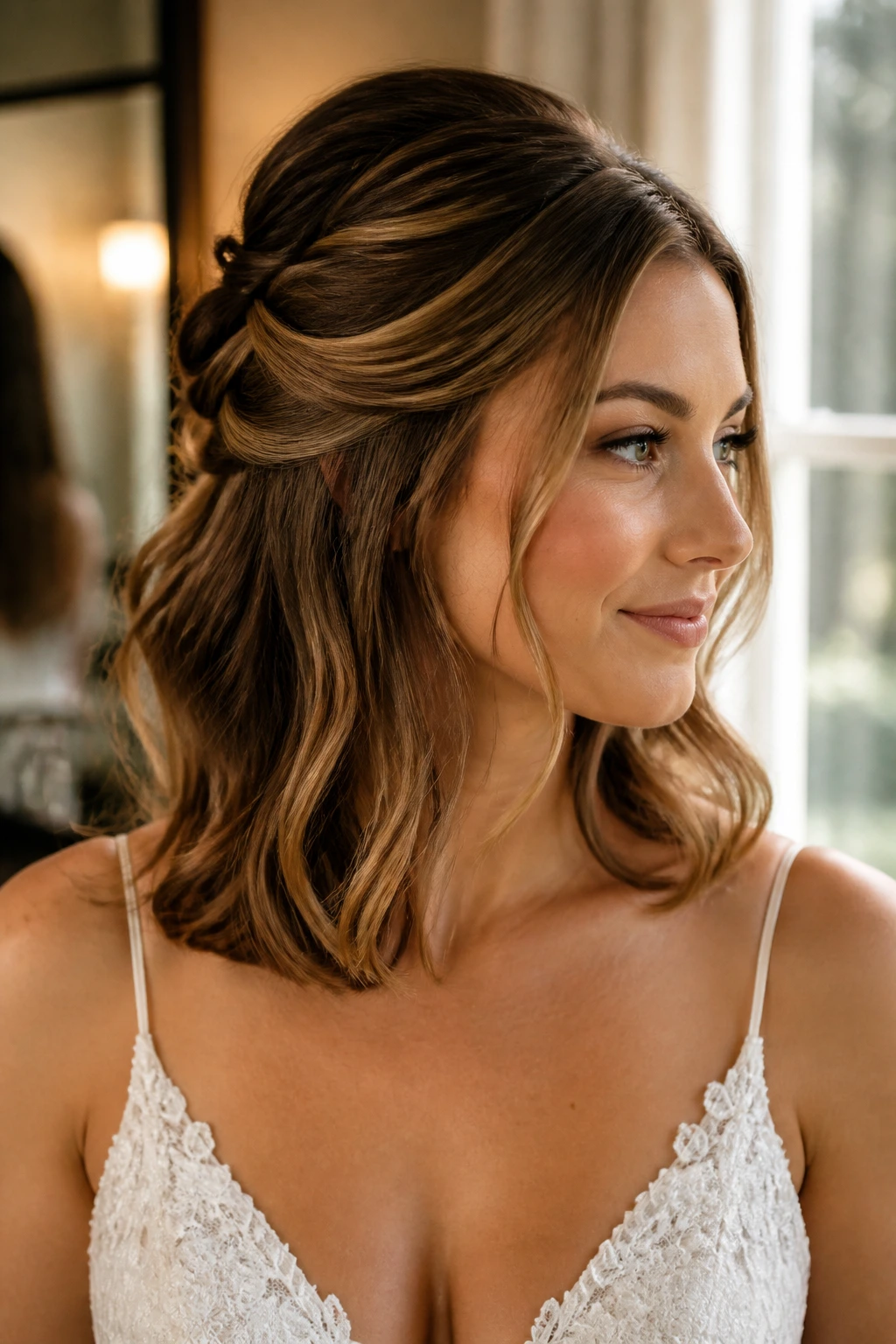
-
They don’t fight the cut: Medium hair already has enough length to bend into form, so these looks use that movement instead of loading it down with padding and fake fullness.
-
They keep the neck and shoulders in play: A low bun or half-up twist shows off a gown’s neckline, which matters more in photos than most people expect.
-
They hold better than you’d think: When the hair sits at collarbone length, bobby pins have more grip than they do in super-slippery long hair, especially if you prep it with a little texture.
-
They work with veils and accessories: Medium hair gives you enough anchor points for combs, pins, ribbons, and fresh flowers without swallowing the detail.
-
They can look soft or structured: The same length can become a clean knot, brushed-out wave, or loose braid depending on how much polish you want.
-
They’re easier to refresh after the ceremony: A bride with medium-length hair can usually bring a style back to life with four pins, a little spray, and a quick shake at the roots.
1. Soft Low Chignon With Face-Framing Pieces
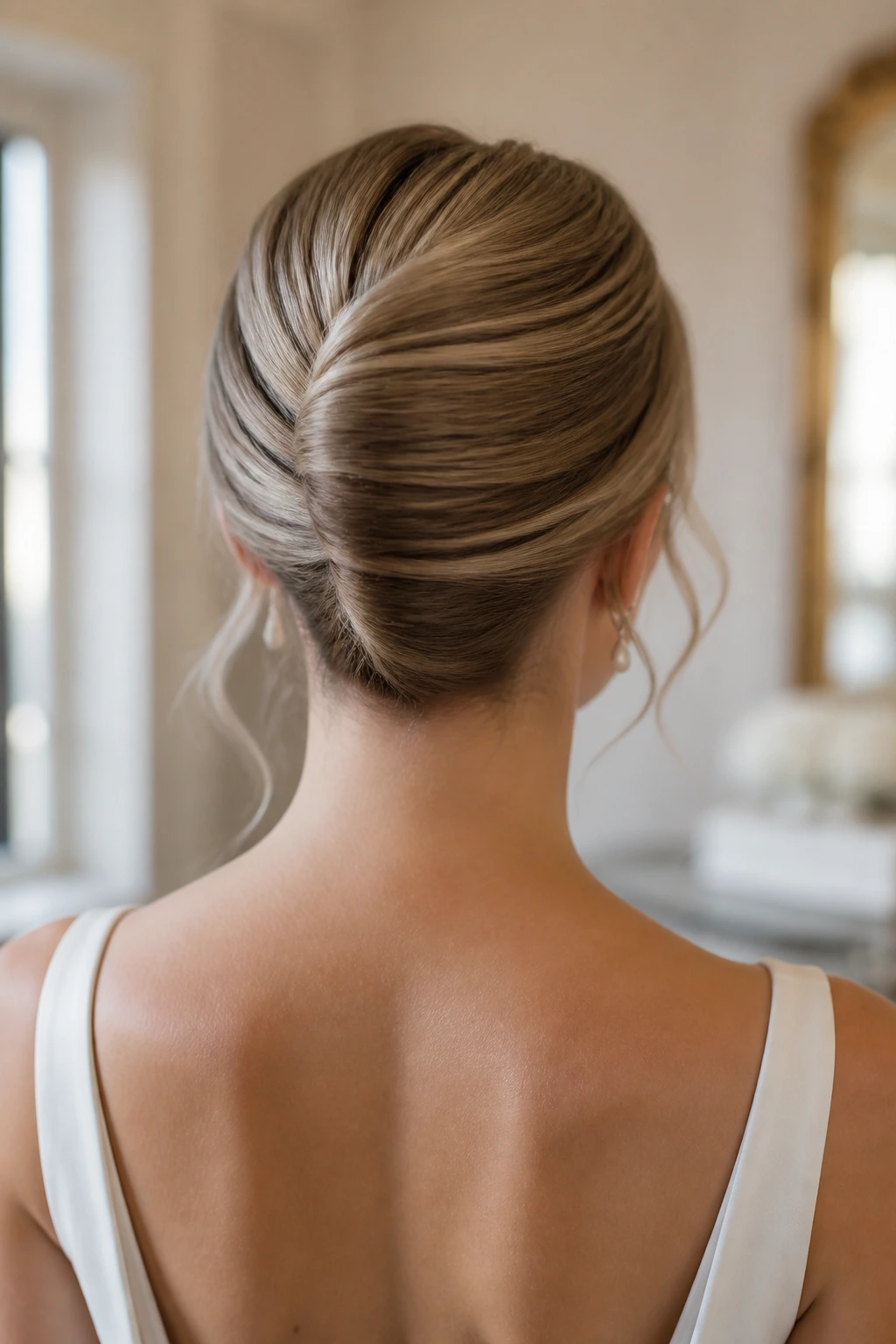
A soft low chignon is one of those bridal styles that looks calm from every angle. The bun sits at the nape, usually just below the curve of the head, and the front pieces fall in a way that keeps the face from looking boxed in. On medium-length hair, that matters. You want the ends tucked cleanly, not stuffed into a shape that’s too large for the hair you actually have.
This style works because it gives structure without stiffness. A stylist can curl the mid-lengths first, twist the hair into a low coil, and pin the bun flat against the head so it feels secure rather than puffy. The face-framing pieces should be left a little softer than the rest — not curled into tight ringlets, just bent away from the cheekbones so they move when you turn your head.
It’s especially good if your dress has a clean neckline, because the bun keeps the back open and the front pieces add a little softness near the collarbone. If you’re wearing a veil, ask for the comb to sit just above the chignon so it doesn’t squash the shape. Tiny detail, big difference.
2. Old-Hollywood Side Sweep
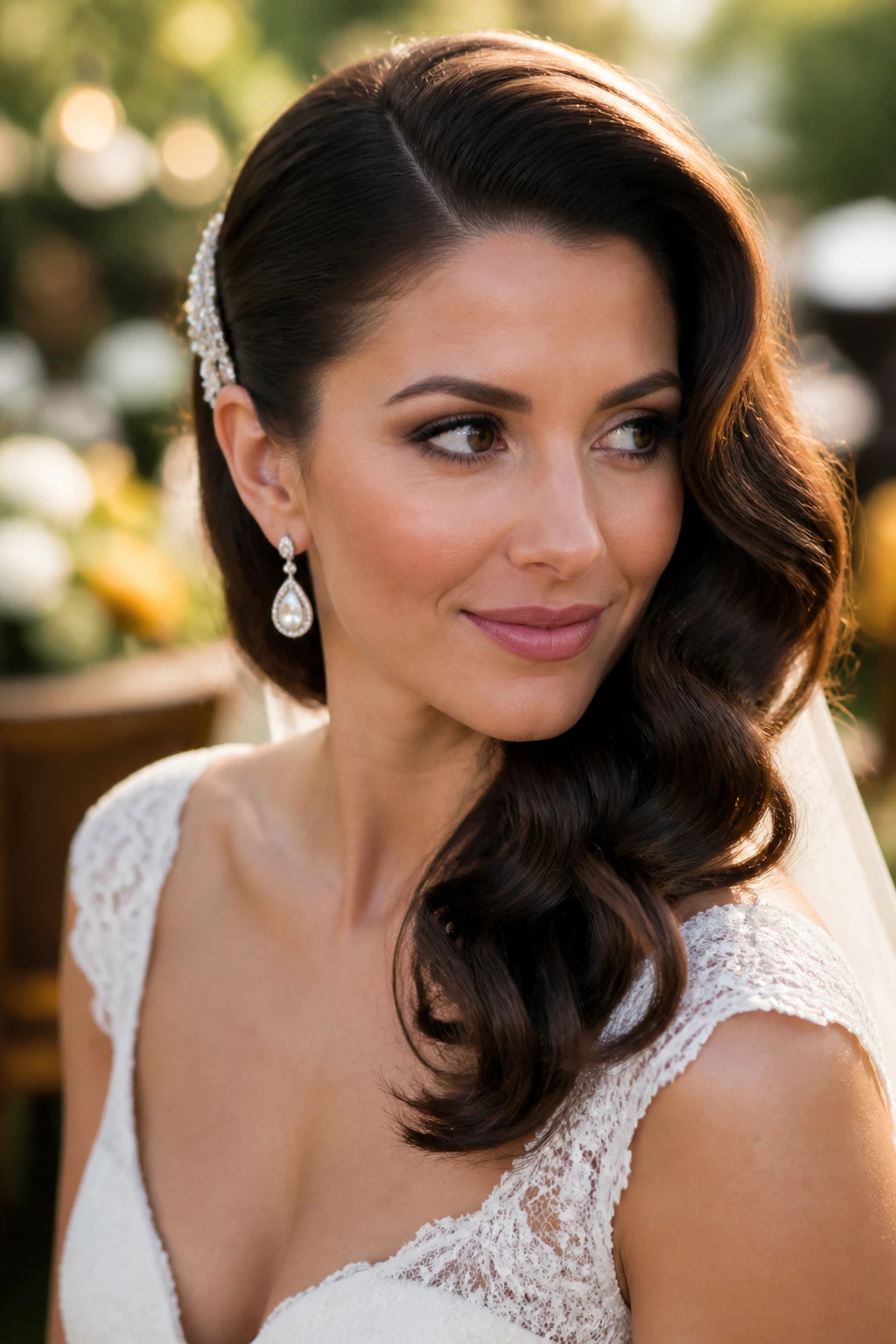
A deep side part with brushed waves has a different mood from the usual bridal updo. It feels a little more dramatic, a little less fussy, and medium-length hair is the right length for it because the ends can curve without dragging the whole look down. The wave pattern should start near the cheekbone and roll toward one shoulder, with one side pinned back just enough to show the earrings.
The best version of this style is set with a 1.25-inch iron or hot rollers, then brushed out until the waves look smooth but not flat. You want the bend, not spiral curls. A light mist of shine spray on the top layer gives the hair that soft reflective finish brides usually want in portraits, but too much product turns the wave heavy. That’s the line to watch.
This is one of my favorite choices for satin, crepe, or one-shoulder dresses. The asymmetry of the hair keeps the whole look from feeling too predictable. If the ceremony is outdoors, pin the heavier side with two hidden bobby pins crossed under the wave so the front doesn’t drift into your eye every time the breeze picks up.
3. Braided Half-Up Crown
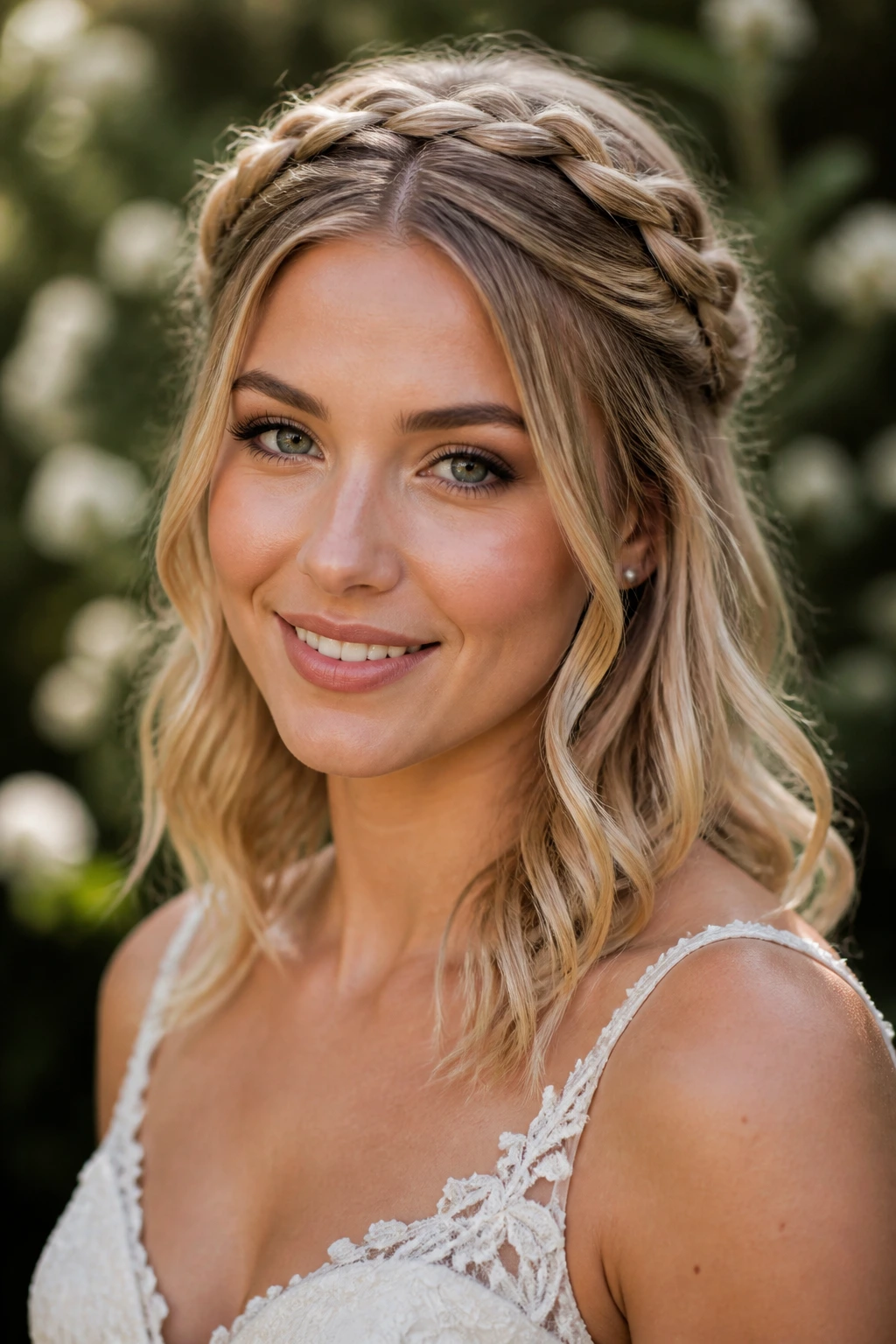
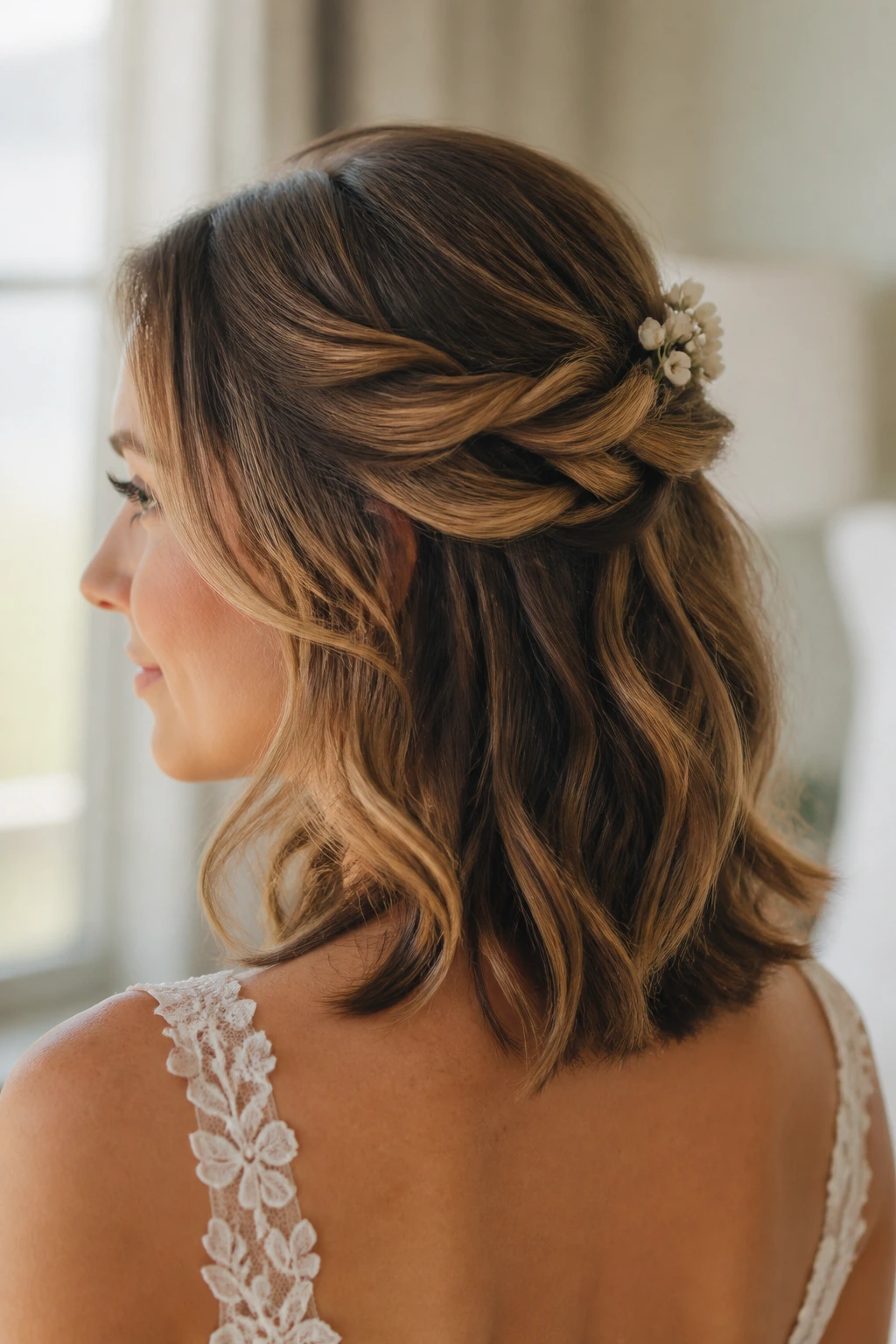
A braided half-up crown gives medium-length hair more presence without hiding the length altogether. Two sections from the temples are braided back and joined at the center, or one braid is wrapped across the crown like a narrow band. The rest of the hair stays down in soft bends, which keeps the style from feeling too formal or too juvenile.
What makes this work so well is the balance. The braid gives you a solid top line, so the crown looks intentional, while the loose lengths keep the style bridal instead of severe. For hair that falls at or just below the shoulders, the braid also adds the impression of width, which helps when the hair itself is fine or straight. You can tuck a few pearl pins into the braid if the dress needs a little sparkle, but don’t overfill it. The braid should still read as braid.
This look sits nicely with garden ceremonies, lace sleeves, and dresses that need a softer frame around the neckline. If you want a veil, place the comb under the braid rather than over it. That keeps the braid visible after the veil comes off.
4. Sleek Tucked-Under French Twist
A French twist on medium-length hair sounds more ambitious than it is. The trick is not making it tall. It’s making it narrow and clean, with the ends folded in tight enough that the twist reads as a column instead of a bulky roll. On shoulder-length hair, the shape often lands somewhere between a classic twist and a tucked shell, which can be a good thing. It looks tailored.
This style needs smooth prep. A small amount of styling cream through the mid-lengths and a fine-tooth comb at the top help keep flyaways down before you start twisting. Then the hair gets rolled upward and pinned along the seam. If the hair is a little too short to form a full twist, the ends can be tucked inward at the bottom and hidden under the fold. Nobody needs to see the engineering.
It works best with sharper dress lines, structured straps, or a gown with a clean back. The hair gives the outfit a crisp edge. If you want softness, leave two thin front pieces out and curl them away from the face; otherwise, keep the whole shape sleek and let the twist do the talking.
5. Twisted Half-Up Knot
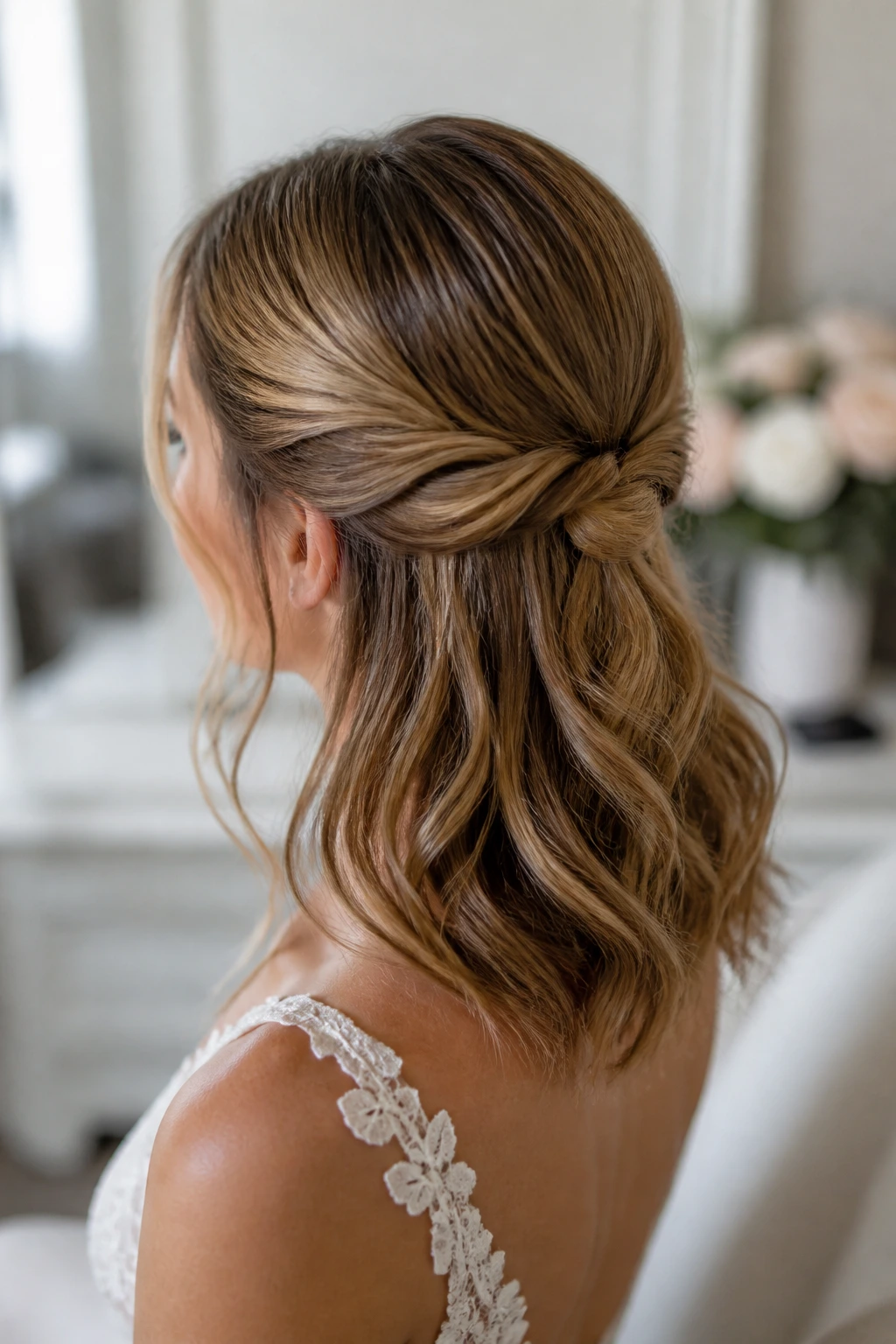
There’s a nice in-between energy to a twisted half-up knot. It keeps the hair away from the face, but it doesn’t close off the length the way a full updo does. On medium hair, the knot usually sits where the head starts to round toward the crown, which is a good place for it because the style gets a little lift without looking perched.
The best versions use two side twists that meet at the back and fold into a small knot or loop. The lower half stays loose, usually with a wave pattern that starts below the ear. That wave matters. If the bottom section is too straight, the top and bottom don’t talk to each other, and the style looks unfinished. A little bend at the ends fixes that right away.
This one is good for brides who want something pretty without a hard line. It also behaves nicely with small floral pins, because there’s enough open space in the knot to tuck in a single accent without making the whole thing crowded. If your veil is light, this style holds up well underneath it.
6. Textured Low Bun With Crown Volume
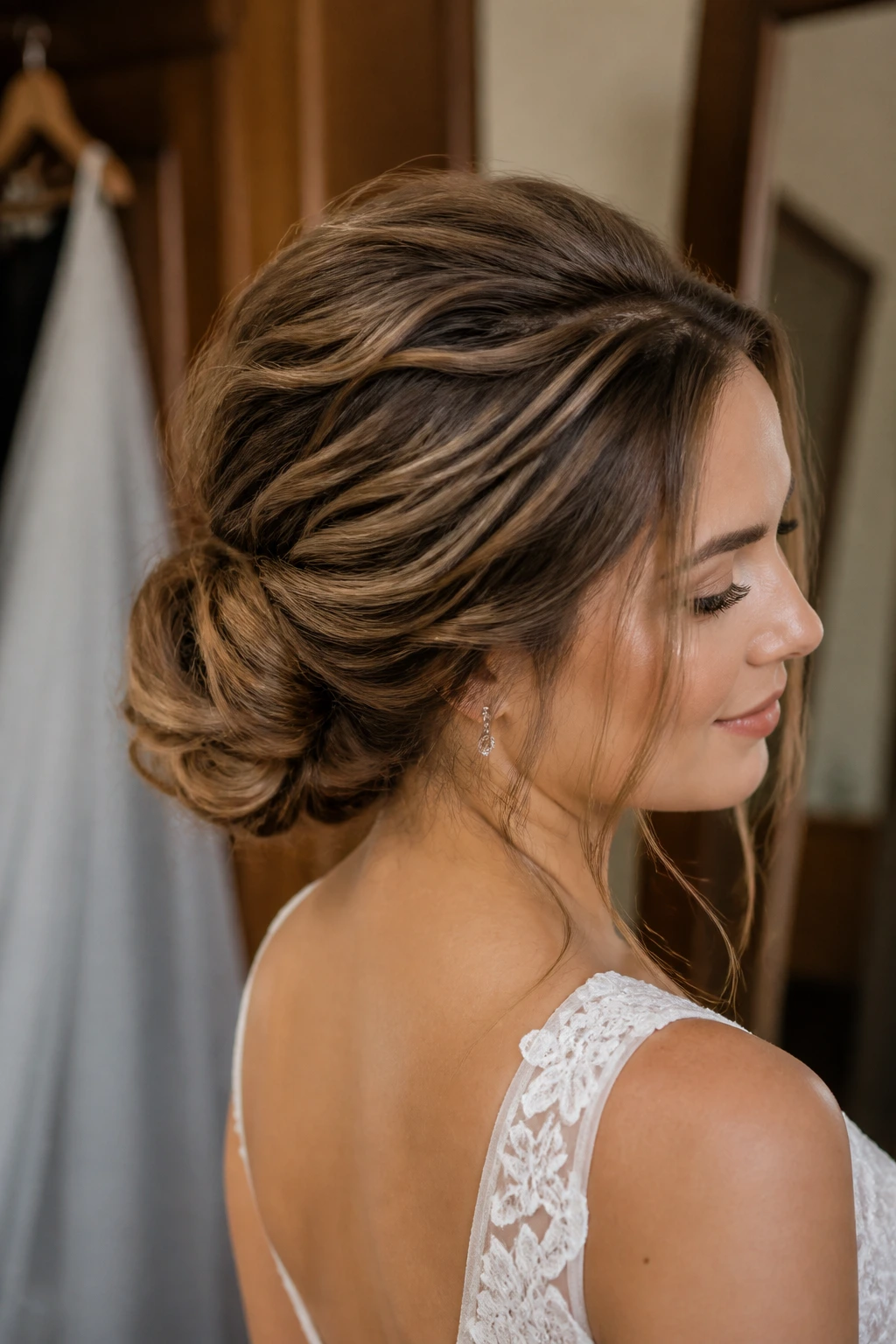
A textured low bun is a friend to medium-length hair, especially if the hair is fine or tends to go flat by noon. The crown gets a little lift first — not a giant pouf, just enough tease or padding to keep the top from sitting too close to the skull — and then the rest is gathered low and pinned into a bun with some texture left visible. You should still see the bends in the hair. That’s the point.
This style works because the texture hides the seams. Medium hair often doesn’t have enough length for a giant wrapped bun, so a deliberately piecey finish makes the bun look fuller than it really is. A matte texturizing spray at the roots helps the pins bite. If the hair is very silky, a touch of dry shampoo can give it the grip it’s missing.
I like this look for brides who want volume without the weight of a big curled style. It photographs well from the back, especially if the dress has buttons or a low back. The bun should sit low enough to avoid fighting the veil comb, but not so low that it drops below the neckline.
7. Waterfall Braid Over Soft Waves
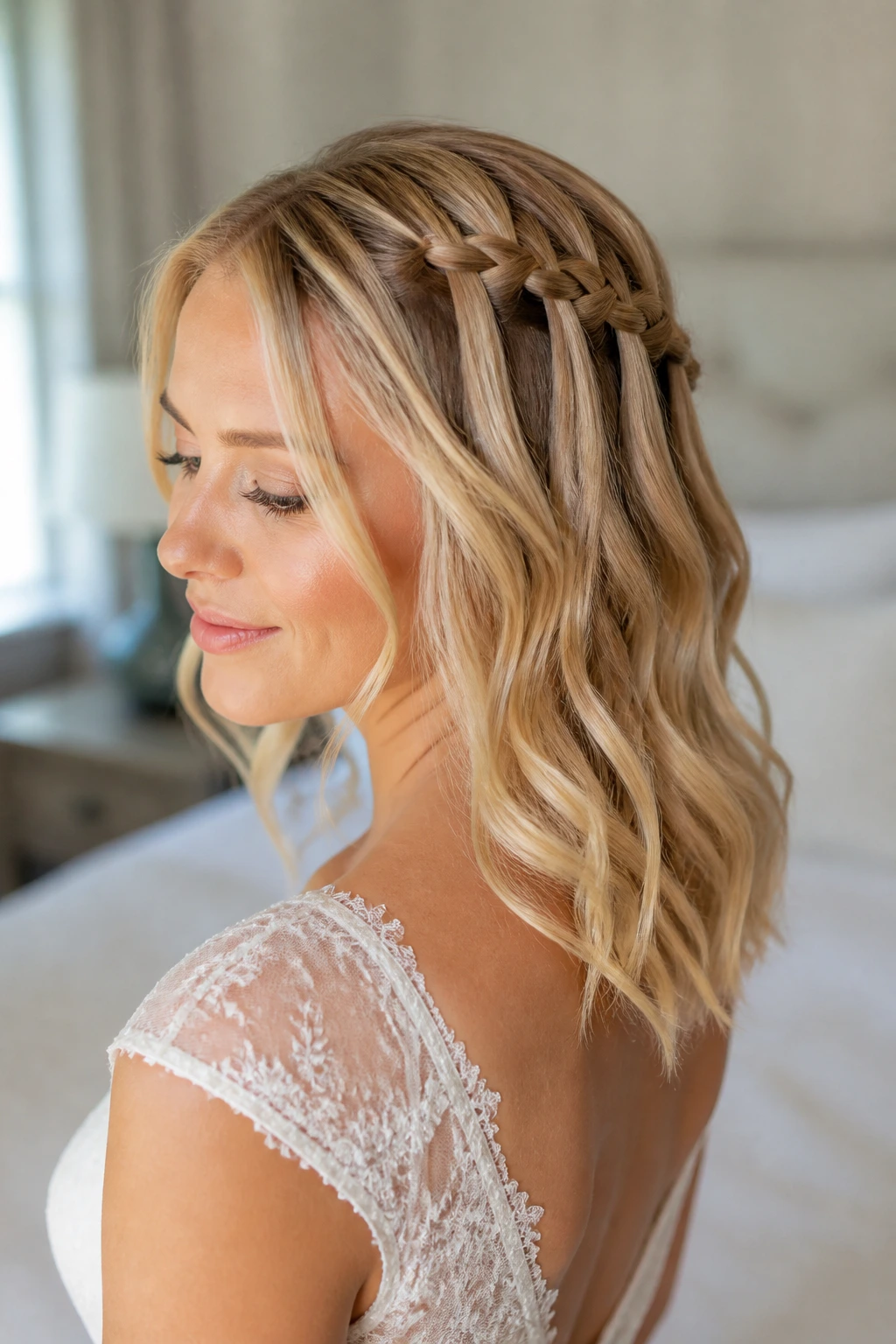
A waterfall braid has a lighter feel than a full crown braid, and that’s one reason it works on medium-length hair. The braid moves across the head in a narrow band, releasing pieces as it goes so the loose lengths can keep flowing. On shoulder-length hair, the braid doesn’t need to stretch far to look complete. That’s a gift, not a limitation.
This style is all about contrast. The braid gives you a pattern, the waves give you movement, and the two together make the hair look more layered than it is. Because the braid uses only part of the hair, it can stay crisp while the rest stays soft. A stylist should braid a little tighter than usual at the start, since the released pieces can loosen the whole shape fast if they’re too slack.
It’s a strong option for brides who want something feminine without a heavy updo. Add tiny crystal pins where the braid meets the loose section, or leave it plain and let the braid do the work. A waterfall braid also sits nicely under a short veil because the shape stays visible once the veil is removed.
8. Ribbon-Tied Half-Up Bow
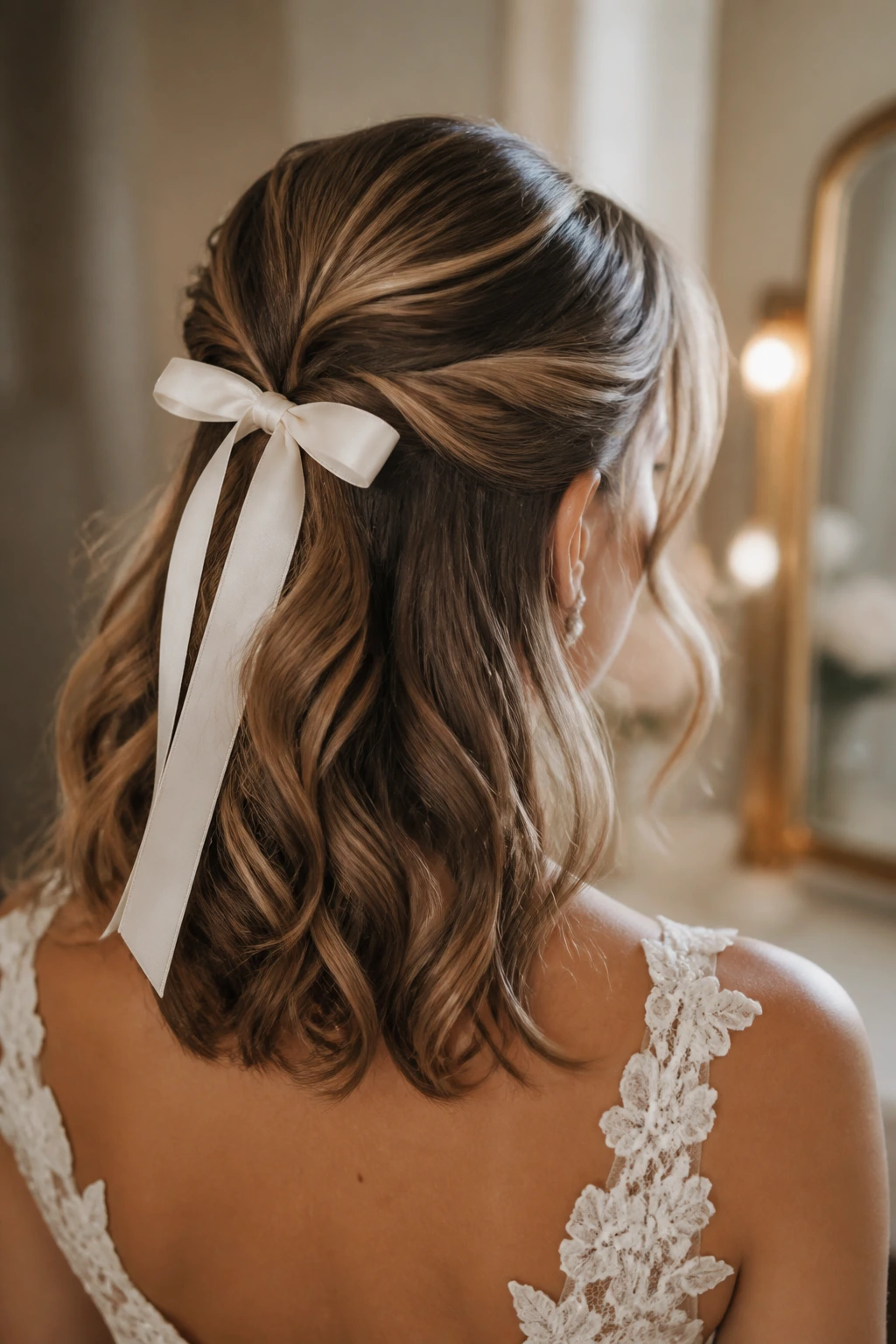
A satin ribbon can change the whole mood of medium-length bridal hair. Tie it around a half-up section, knot it into a bow, or use it as a wrap around a small twist at the back. The result feels softer and more personal than a standard pin, and because the hair length isn’t overwhelming, the ribbon stays visible instead of getting lost in the volume.
The best ribbon styles use a fabric with some body — silk or satin, not something limp that droops by the first toast. Ivory, champagne, or soft blush usually reads as bridal without looking costume-like. If your hair is textured or waved, leave the ends loose so the ribbon sits against movement rather than trying to pin everything into perfect symmetry.
This is one of those styles that looks better when it’s slightly undone. Not messy. Just human. A ribbon-tied half-up shape works especially well for outdoor ceremonies, daytime events, and brides who don’t want a lot of metal or sparkle in the hair. The bow becomes the accessory, which keeps the whole look quiet and memorable.
9. Polished Blowout With Oversized Bends
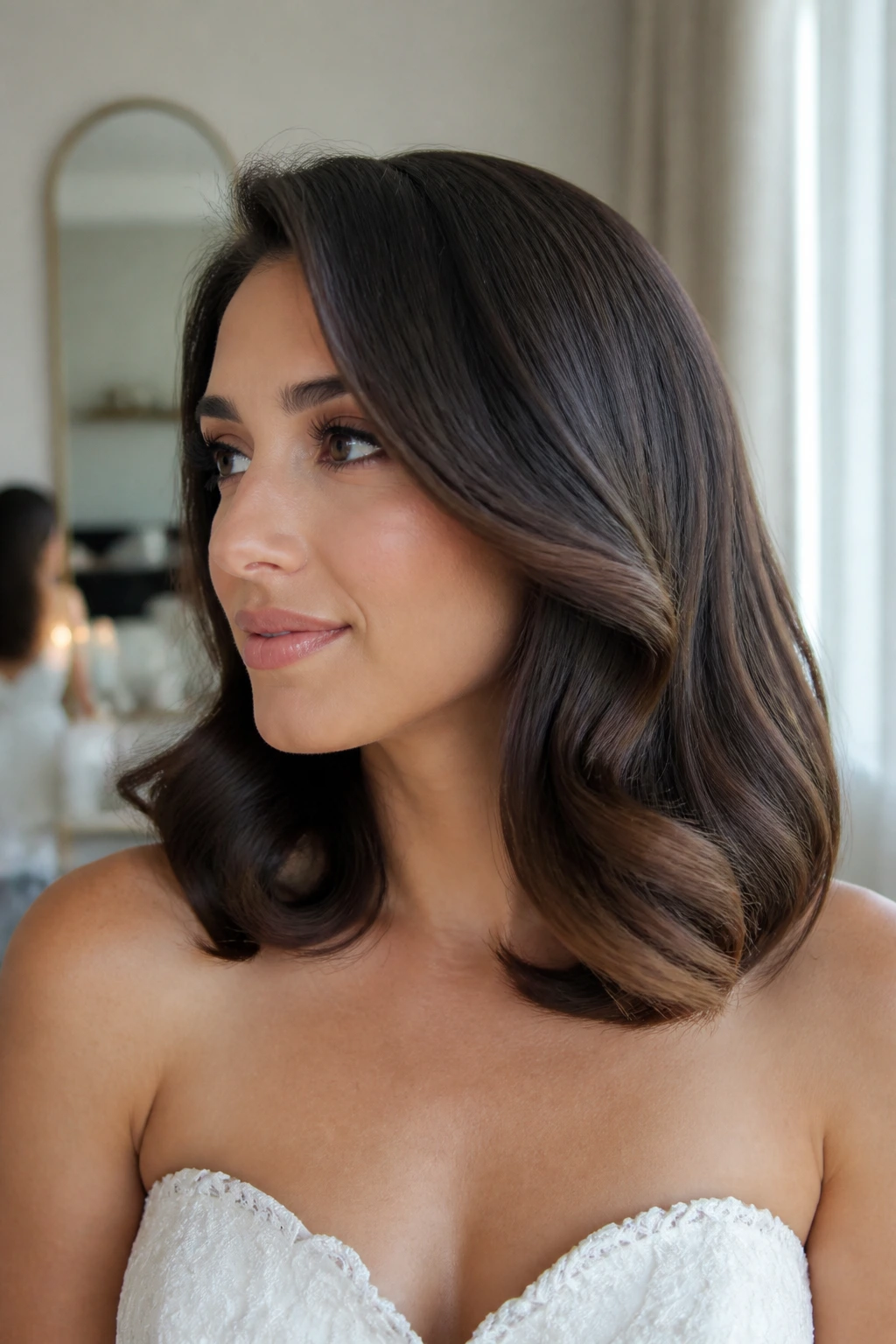
Sometimes the smartest bridal choice is to let medium-length hair stay down. A polished blowout with oversized bends gives movement without turning the whole head into a cloud of curls. The sections should be wrapped around a large barrel iron or a round brush, then brushed lightly so the bend stays broad and smooth rather than tight and springy.
This style reads clean and expensive in the plainest sense of the word: not flashy, just finished. It’s a good match for dresses with strong shoulders, dramatic sleeves, or a back detail you don’t want to cover. The hair should skim the collarbone and turn softly at the ends; if it flips too sharply, it can look dated. The bend should feel deliberate.
A center part makes the shape more modern. A side part softens it. Either way, the hair needs a little root lift so it doesn’t sit flat against the head after the first few hours. A lightweight mist of anti-humidity spray near the ends keeps the bend from collapsing, which matters more than people think once the dance floor warms up.
10. Fishtail Braid Into a Low Ponytail
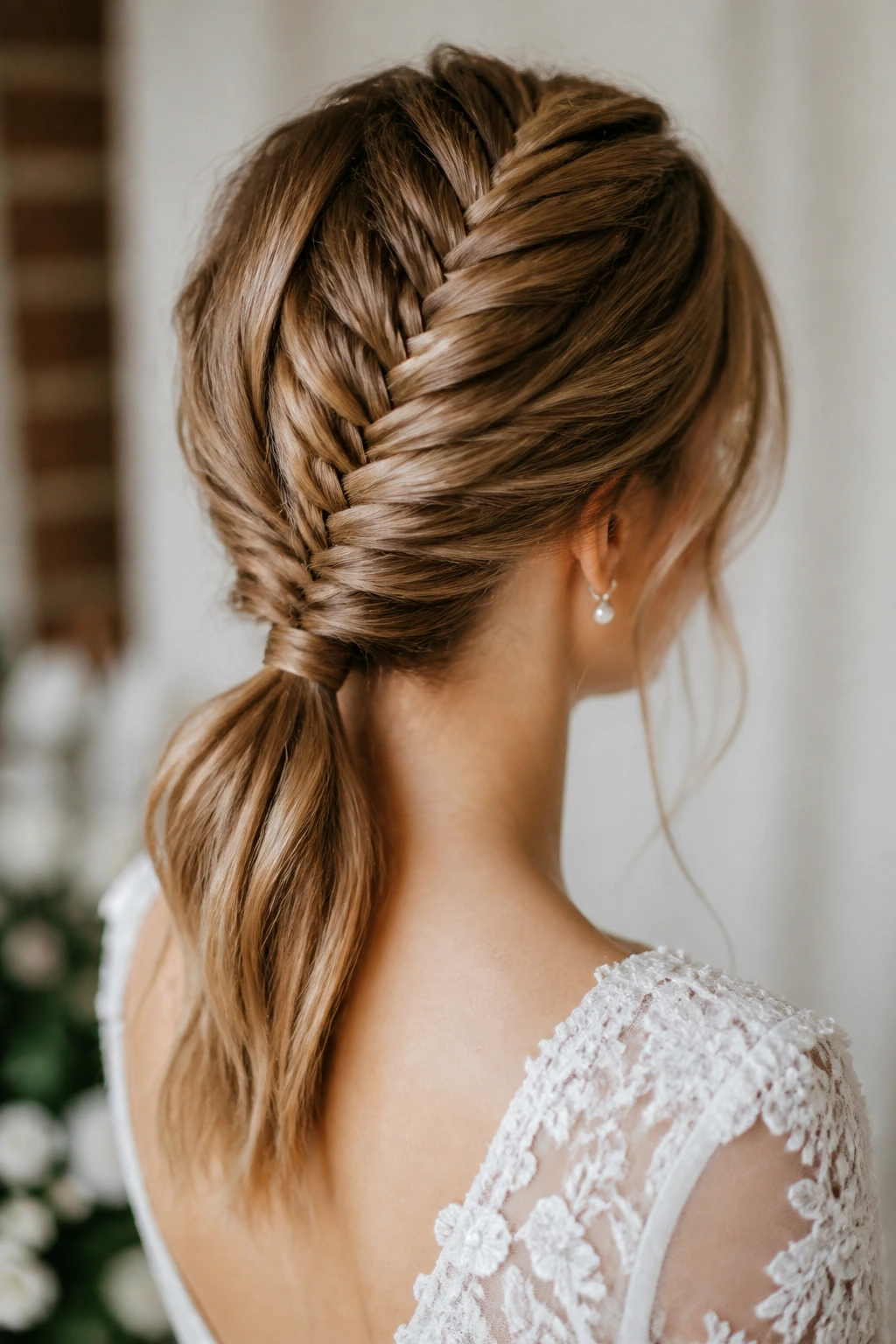
A fishtail braid going into a low ponytail gives medium-length hair a bit of edge without turning it into a severe sport look. The braid usually starts at the crown or just behind the part, then tightens into a low ponytail at the nape where the length can swing freely. Because the braid itself is narrow, it doesn’t need endless inches to look neat.
What makes this one appealing is the texture. A fishtail braid has a more intricate surface than a regular three-strand braid, so it looks detailed from a distance and even better up close. On medium hair, the trick is to keep the braid snug enough that it doesn’t puff out halfway down the head. Once the ponytail is secured, wrap a small section of hair around the elastic and pin it underneath.
This style fits brides who want something secure, a little architectural, and not overly soft. It also works if you plan to change outfits later, because the ponytail portion is easy to loosen into waves. I’d use it with a structured dress or a gown that has a lot happening at the top, since the hair won’t compete with the fabric.
11. Soft Gibson Tuck
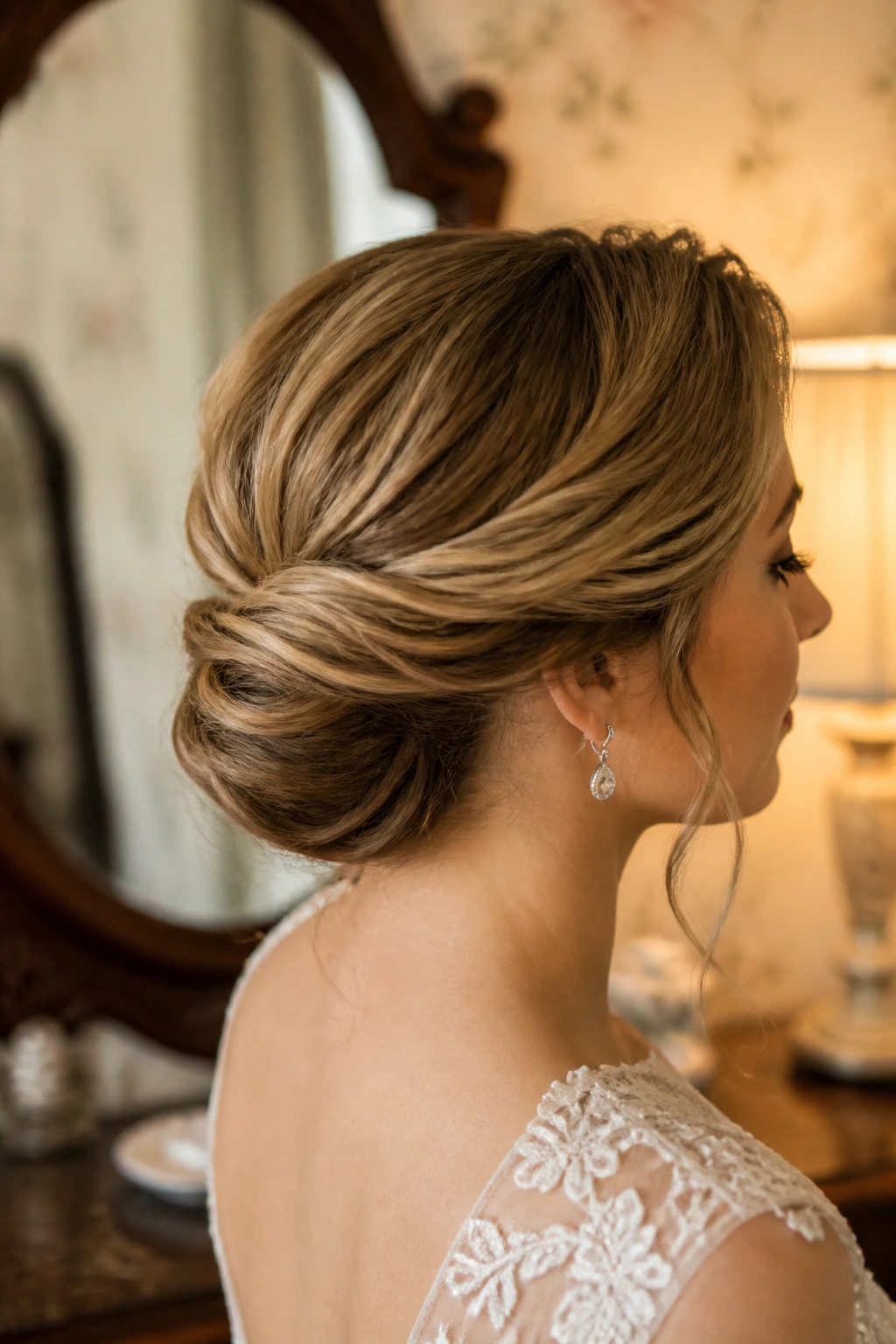
The Gibson tuck has a vintage shape that suits medium hair better than most people expect. The length doesn’t need to be long; it just needs enough bend to roll under itself and stay there. A soft version leaves the front pieces loose or swept back gently, then folds the back hair into a low tucked roll with a few pins holding the seam.
It has a tidy profile, but it doesn’t feel severe when you keep the finish a little loose. That’s the important part. If the roll is too tight, the style can look stiff, especially on hair that hits the shoulders. If it’s too loose, the tucked section starts to sag. You want that narrow middle ground where the roll looks smooth and intentional.
This is a strong pick for brides who like vintage details, pearl earrings, or a dress with lace at the collar. It also behaves well with birdcage veils, since the tucked shape gives the comb a firm place to sit. A soft Gibson tuck is one of those styles that looks more complicated than it is, which is often the sweet spot on a wedding day.
12. Braided Halo With Loose Ends
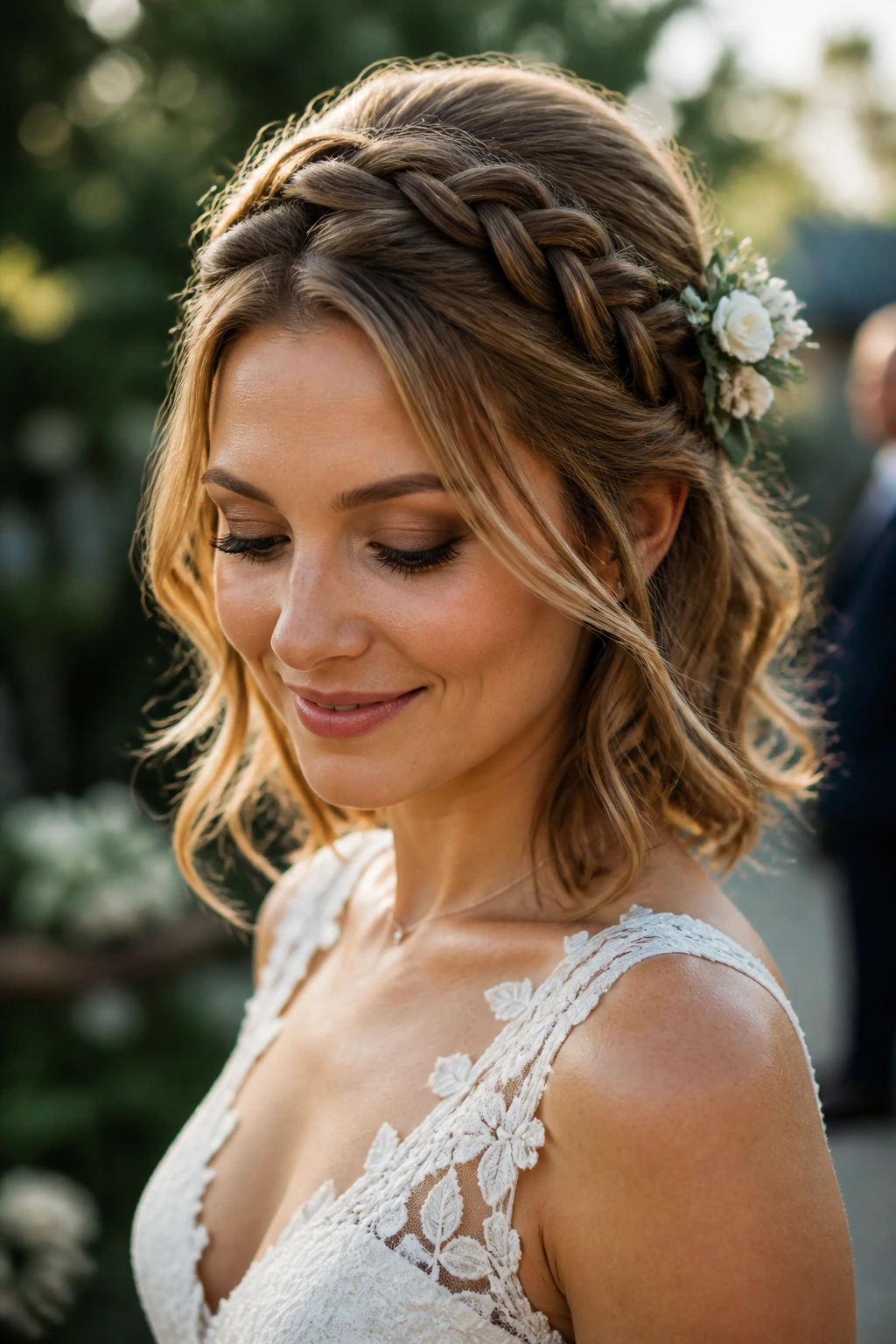
A braided halo looks ornate, but on medium-length hair it can stay surprisingly grounded if you keep the braid close to the head and let the ends soften rather than fighting for a full crown wrap. You don’t need the braid to make a complete ring. A partial halo that stops just past the ears and feeds into loose, waved ends often looks better because it leaves the haircut visible.
The crown area gets a little lift, then the braid is pinned flat enough to feel secure. From there, the rest of the hair can hang in soft texture or be curled into broad S-shapes. If you want a small floral comb, this is a good place for it. It nests into the braid instead of floating awkwardly above it.
This style has a softer shape than a full updo and a more finished edge than simply wearing the hair down. It works well with outdoor settings, but it also survives indoor ceremonies because the braid gives the style some architecture. On medium hair, that structure matters. It keeps the look from turning wispy by hour two.
13. Glam Ponytail With Wrapped Base
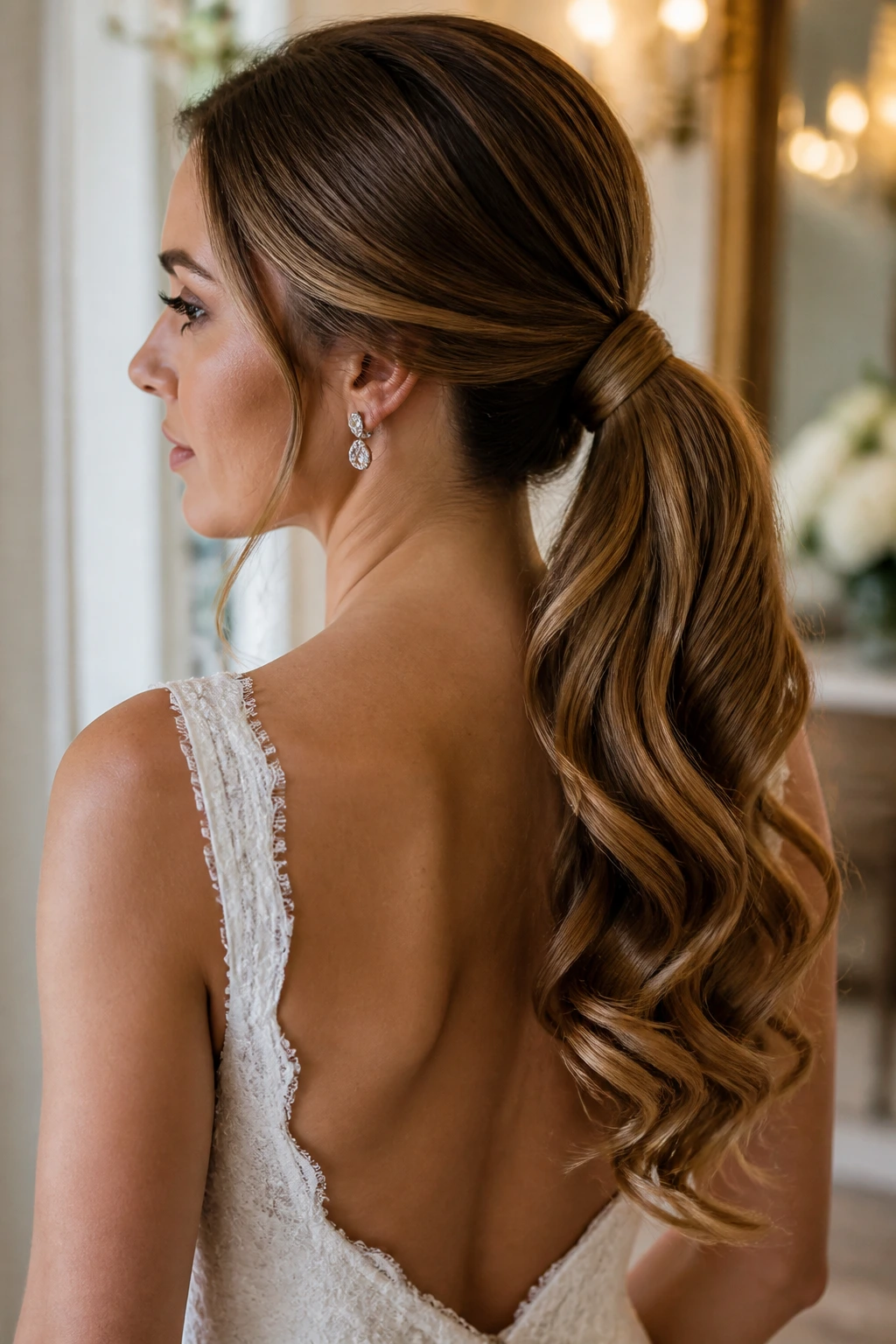
A bridal ponytail doesn’t have to feel casual. On medium-length hair, a glam ponytail can look sharp and polished, especially if the crown is smooth and the base is wrapped with a section of hair so the elastic disappears. The ponytail itself can be curled in large sections or left in soft bends that skim the shoulders.
This works when you want movement. A ponytail swings when you walk, which gives photos a little life. It also keeps the face open for veil removal, speeches, and the part of the night where you don’t want hair falling into lip gloss. For medium hair, the ponytail usually lands mid-back or just below the shoulder blades, which is enough length to feel styled without needing extensions.
I like this with a sharp neckline or a dress that already has a lot of detail. The hair stays out of the way and still looks deliberate. If the hair is fine, a small clip-in piece can add a little tail length, but keep the blend smooth. A ponytail should read as one shape, not a jumble of sections.
14. Curly Updo With Hidden Pins
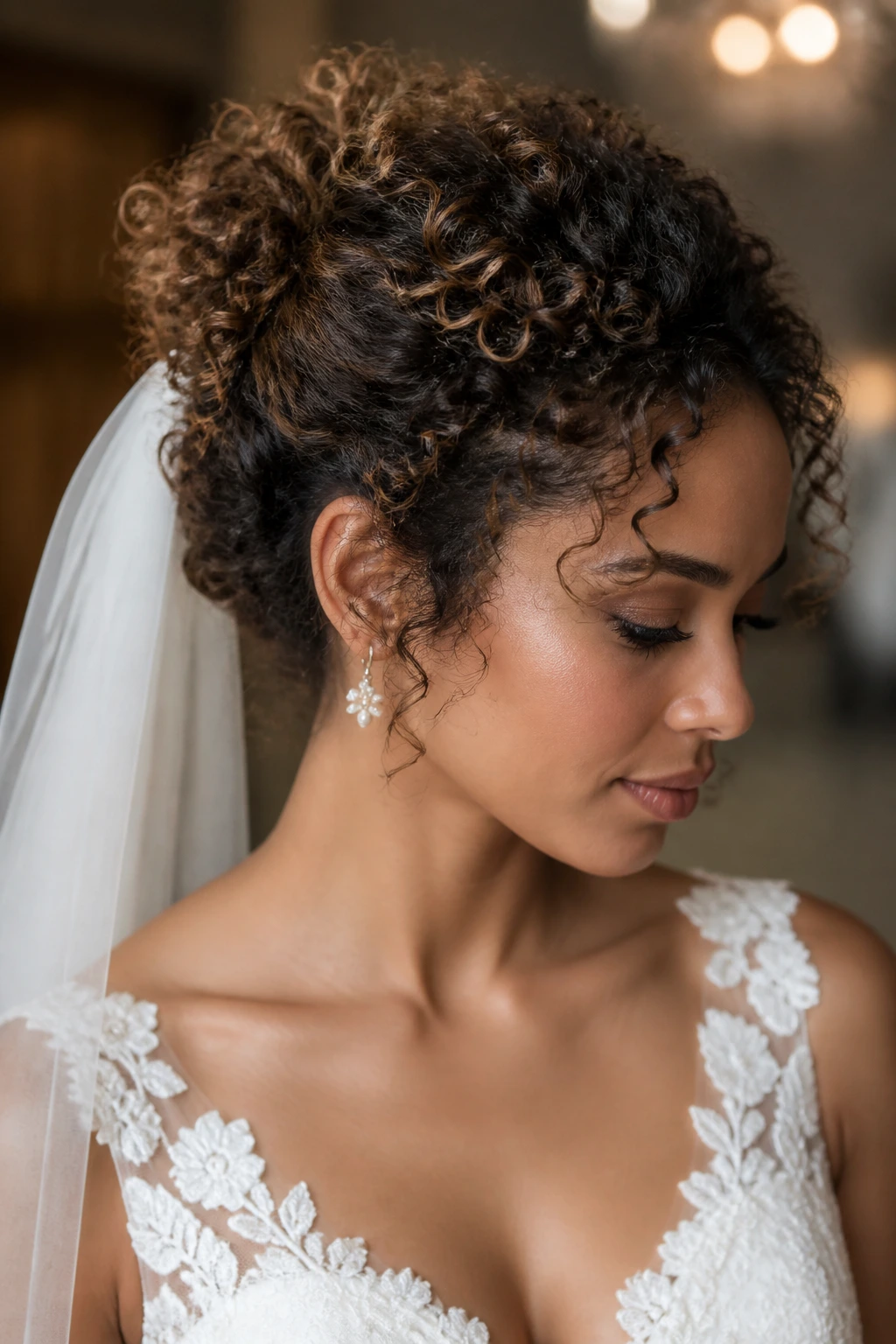
Natural curls make a beautiful bridal updo on medium-length hair, especially when the stylist lets the curl pattern stay visible instead of brushing it into submission. The hair gets shaped into a low or mid-height updo, but the curls are pinned where they naturally want to fall. Hidden pins do the heavy lifting. The visible part should look like a cluster of curls gathered into a soft cloud.
This style is best when the curl cream and setting product are already doing part of the job before the hair is pinned. You don’t want crunchy edges. You want curls that hold their shape and still move a little when you touch them. A medium-length curl has enough spring to build texture without the weight of a long length dragging it down, which makes this length especially useful.
A curly updo pairs well with gowns that need warmth and softness near the shoulders. It also makes a veil placement easy if the comb sits slightly above the gathered section. The hair should feel like itself. That’s the whole trick.
15. Side-Swept Curled Lob
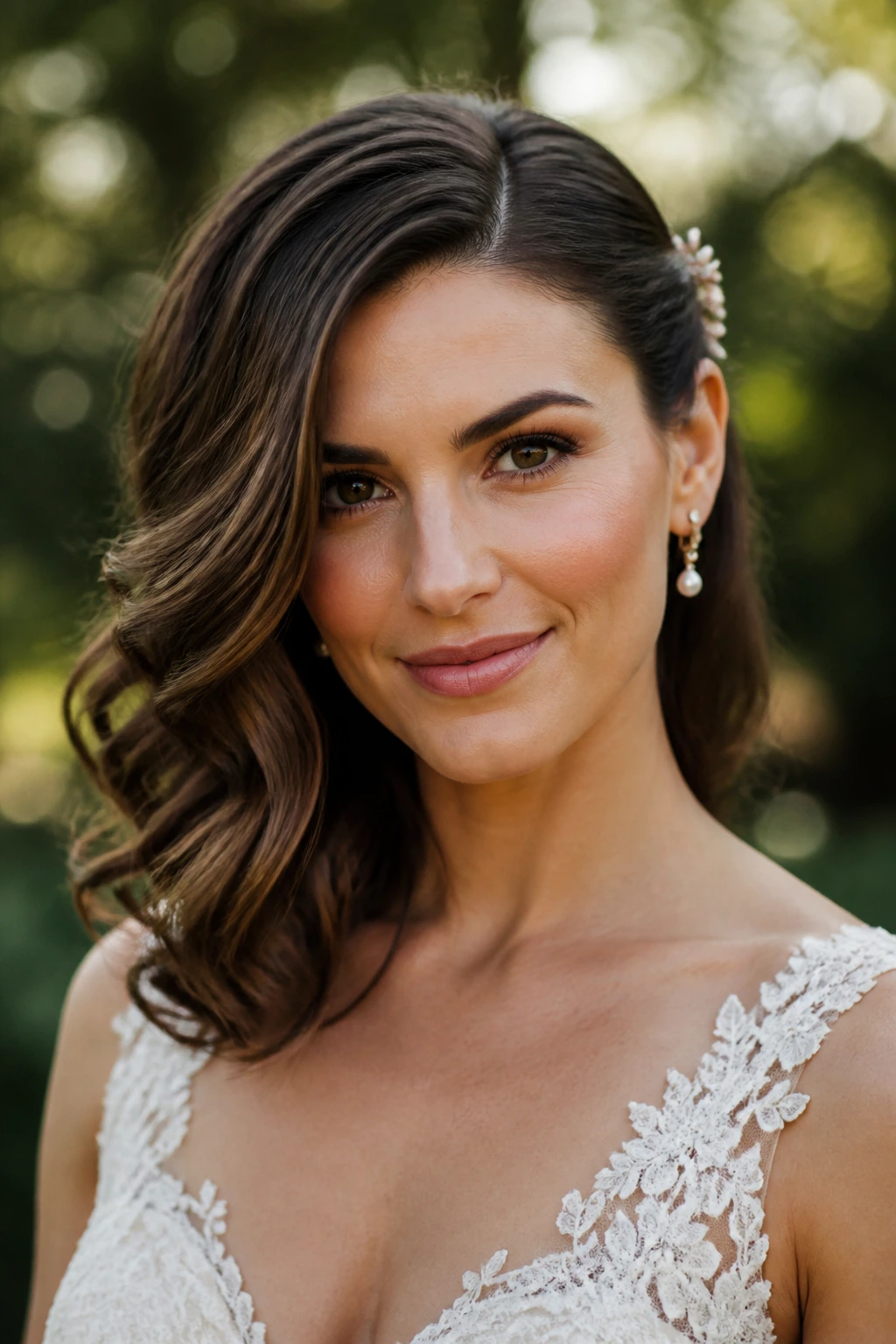
If the hair hits around the collarbone or just above it, a side-swept curled lob can be one of the smartest wedding styles on the list. One side gets tucked behind the ear and pinned low, while the rest falls in glossy curls that turn over the shoulder. The shape is simple, but the effect is strong because the asymmetry keeps the eye moving.
This style is good for brides who want to wear the hair down but still make it look arranged. The curls should be large and directional, not tight. A deep side part gives the face a little lift and helps the front curve away from the eyes. If the hair is naturally thick, use fewer sections so the shape doesn’t become heavy. If it’s fine, add a root spray first and set the curls in pin curls until they cool.
Here’s the useful part: this is one of the easiest styles to revive later. A quick finger-comb, one extra pin at the ear, and a mist of spray can put it back together fast. That matters more than most brides realize.
16. Crown Twist With Pearl Pins
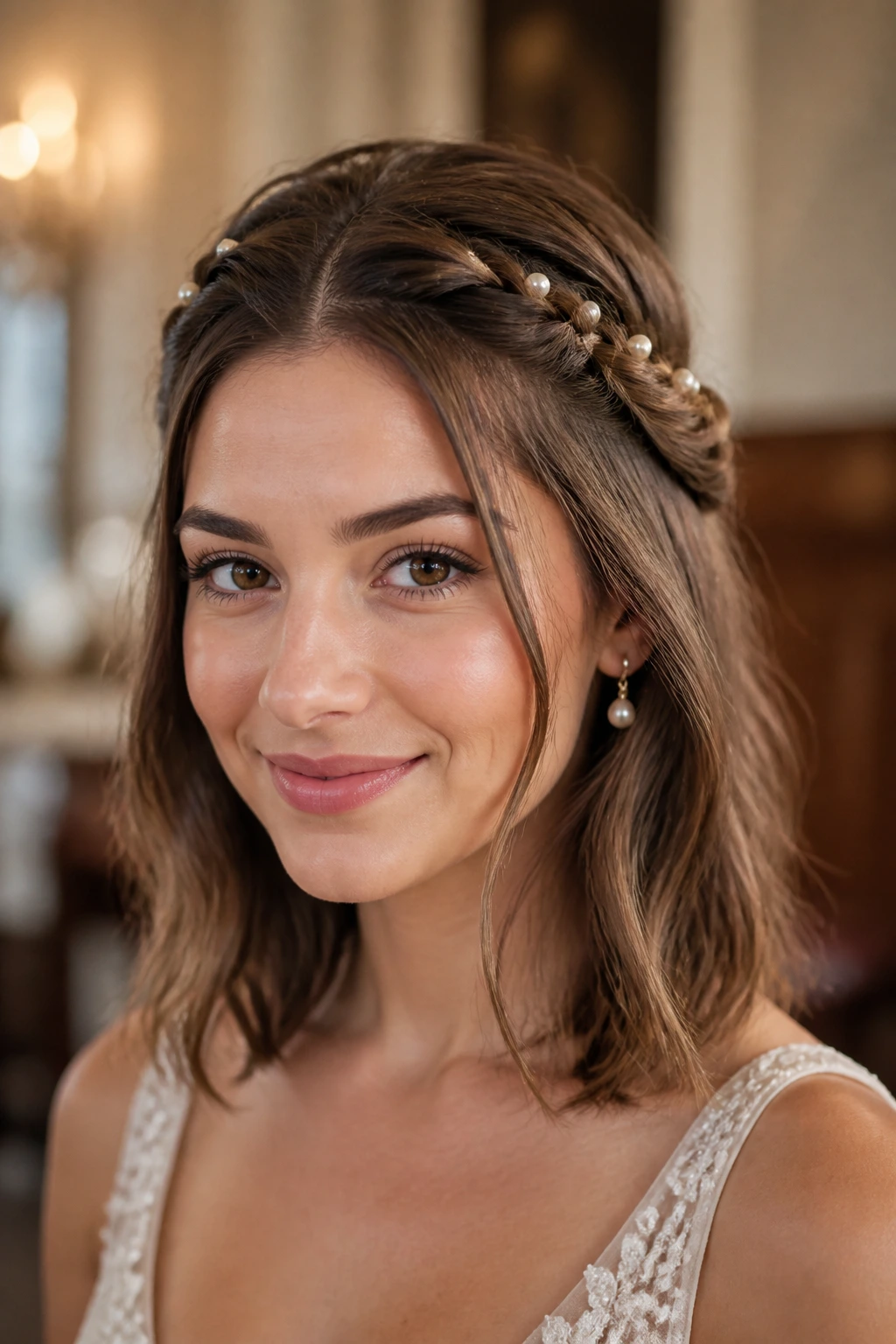
A crown twist gives medium-length hair a clean line across the top without needing the full braid treatment. The sections are twisted from each side toward the back, then pinned where they meet, leaving the lower length loose or loosely tucked. Pearl pins dropped along the twist make the style feel bridal without turning it into a bead-heavy look.
This style holds well because the twists create their own anchors. They’re easier to keep neat on medium hair than a braid that has to be woven and stretched across a long distance. The face stays open, the crown gets shape, and the rest of the hair can stay soft. That combination is hard to beat.
It’s a good choice if your dress has a lot of texture and you want the hair to echo that rather than compete. Keep the pearl pins sparse. Three or four is enough. Once you pack the twist with too much decoration, the whole thing starts to look pinned up for the sake of it.
17. Undone Bun With Clean Edges
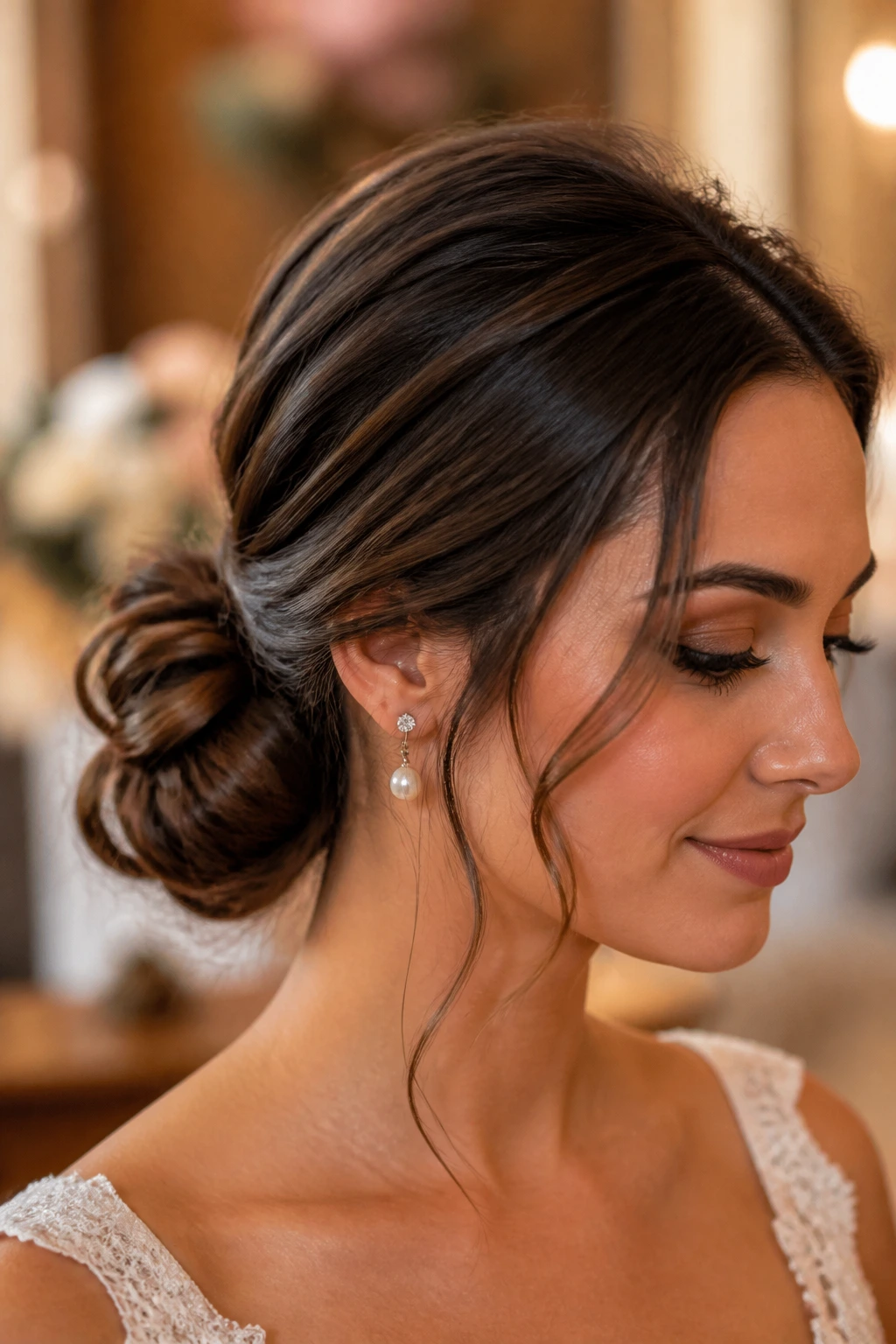
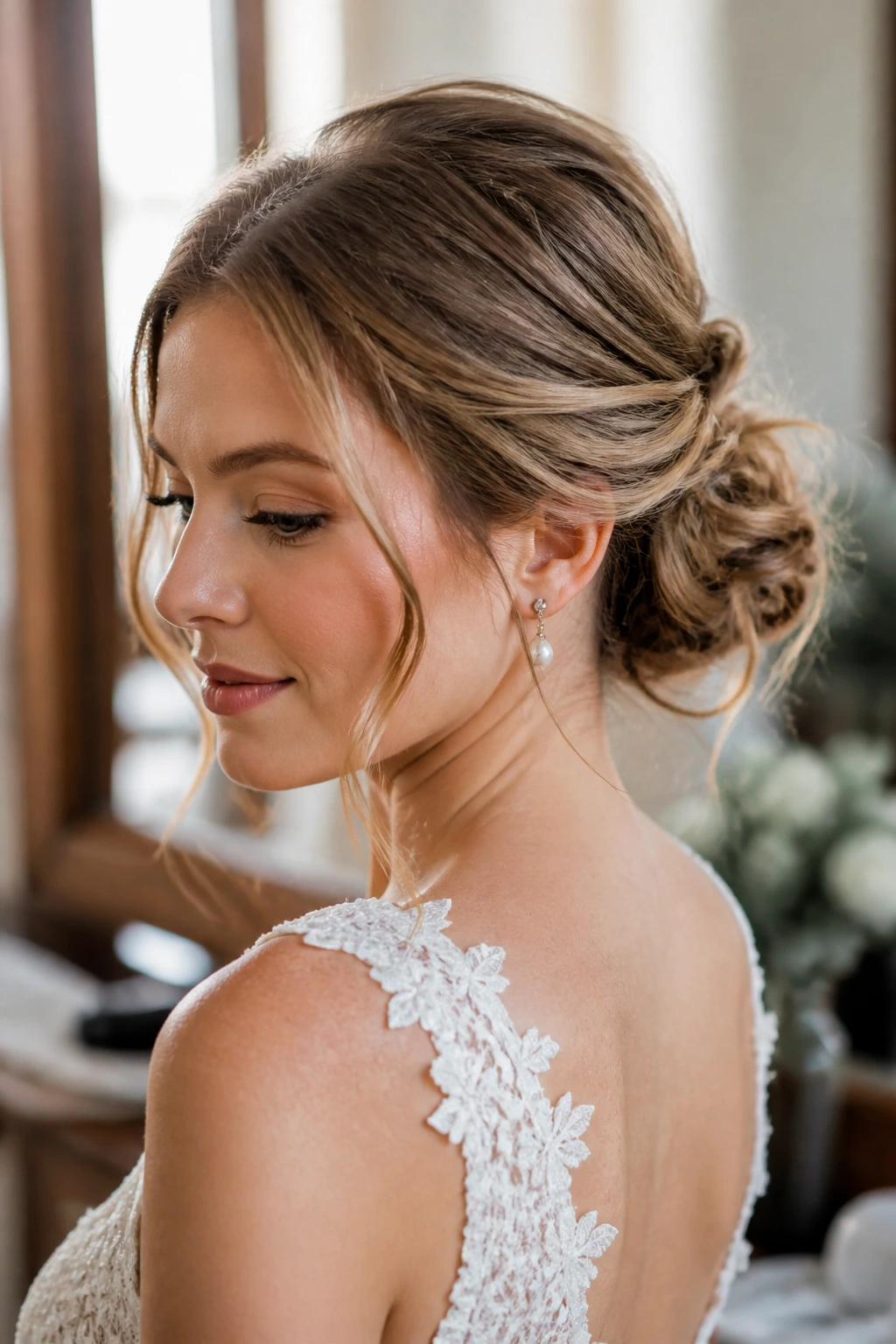
A bun does not have to look perfect to look elegant. On medium-length hair, an undone bun with clean edges gives you a little softness in the looped sections and a crisp outline where it matters: around the face, the nape, and the part. The bun sits low or slightly off-center, with the ends tucked in but not hidden so aggressively that the shape loses interest.
This style works because it walks the line between relaxed and polished. The front can be smoothed back, the bun itself can have visible turns and loops, and a few shorter pieces can stay loose at the temples. That’s enough movement to keep the style from feeling hard. But the edges stay controlled, which keeps it bridal.
I like this for dresses that have clean tailoring or a little structure in the bodice. The hair shouldn’t be louder than the dress. If you want the bun to hold all evening, use cross-pinned bobby pins through the center and not just a few around the rim. The inside needs support, not just the outside shell.
18. Loose Braid Into a Chignon
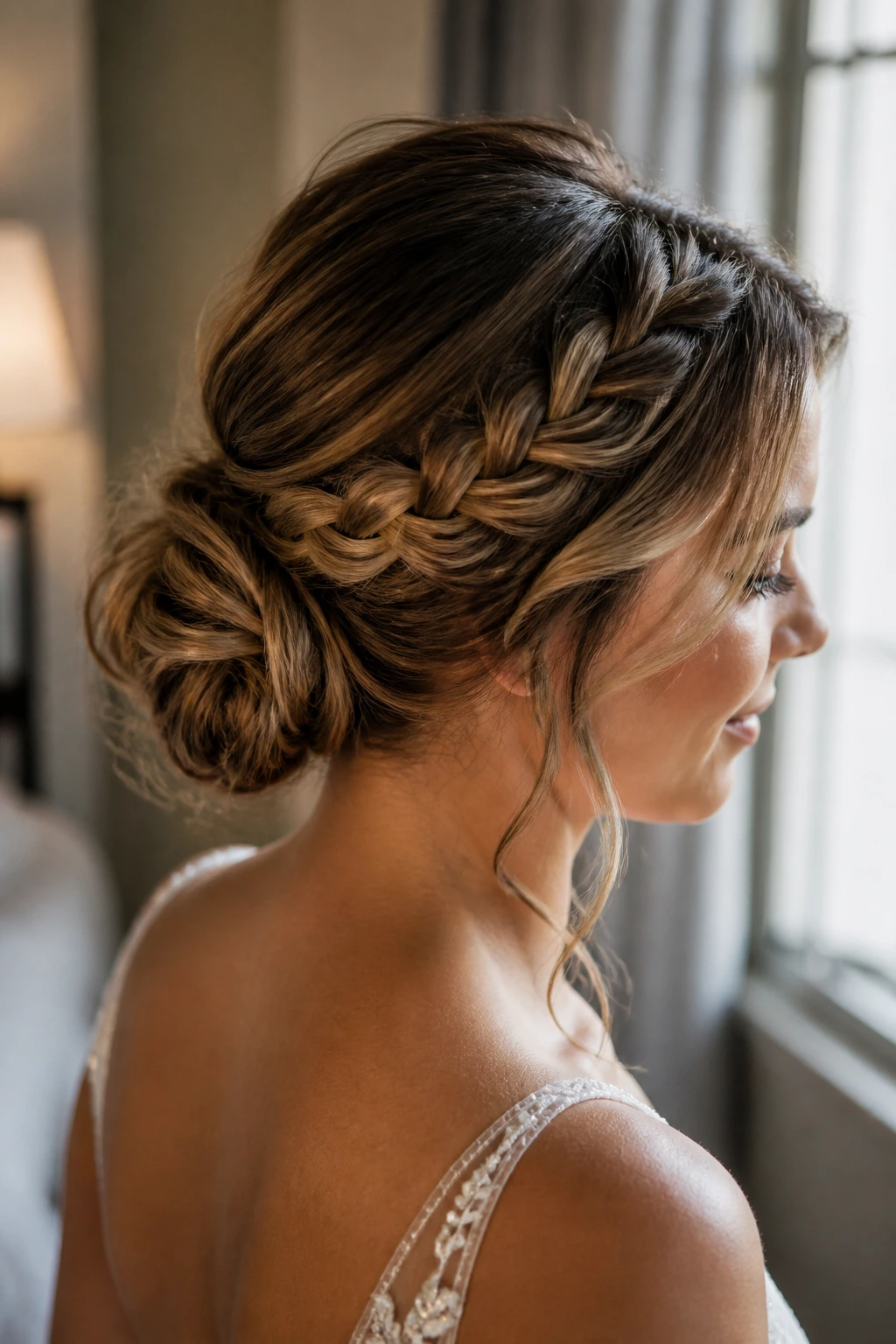
A loose braid feeding into a low chignon gives medium hair a nice mix of pattern and softness. The braid usually starts at the upper back of the head or just below the crown, then transitions into a tucked bun at the nape. That shift from woven texture to smooth coil keeps the look from feeling flat.
What’s useful here is the way the braid fills space. Medium-length hair sometimes needs help looking substantial from the side, and the braid does that without needing padding. The loose braid also breaks up the visual weight of the bun, which matters if your hair is thick. If it’s fine, the braid can be gently pulled apart to widen it before the chignon is pinned.
This style sits well with veils, flowers, and dresses that need a bit of softness in the back. It’s also one of the more forgiving options if your hair varies in length underneath. The braid hides that. Clever little trick.
19. Minimalist Slick-Back Knot
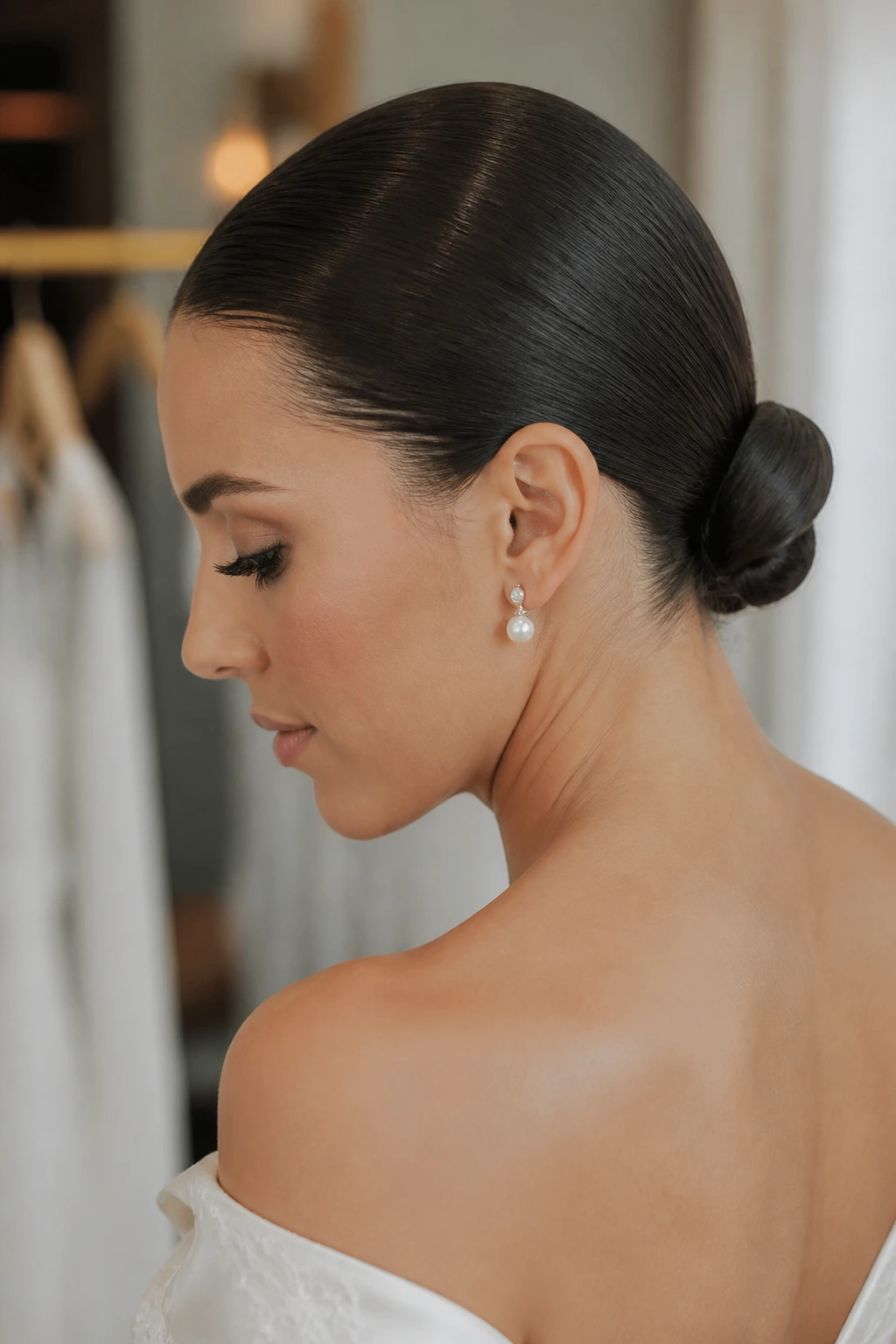
A slick-back knot is not for brides who want softness everywhere, and that’s exactly why it works. The hair is brushed back tightly from the forehead and temples, then gathered into a small, low knot or coil at the nape. On medium-length hair, the shape can be compact and clean, which makes the face and dress do more of the work.
This style depends on control. A styling gel or strong smoothing cream keeps the surface sleek, and a fine comb lines everything up before the knot gets pinned. You want the finish to feel deliberate, not wet for the sake of being wet. A glossy finish works. A greasy one does not. There’s a difference, and it shows in photos.
It’s a sharp choice for modern gowns, square necks, and brides who want the hair out of the way without looking plain. I’d avoid this if the dress is already heavily embellished near the neckline, because the slicked shape can make the whole outfit feel a little too hard. But with the right dress, it looks calm and strong.
20. Veil-Ready Twisted Bun
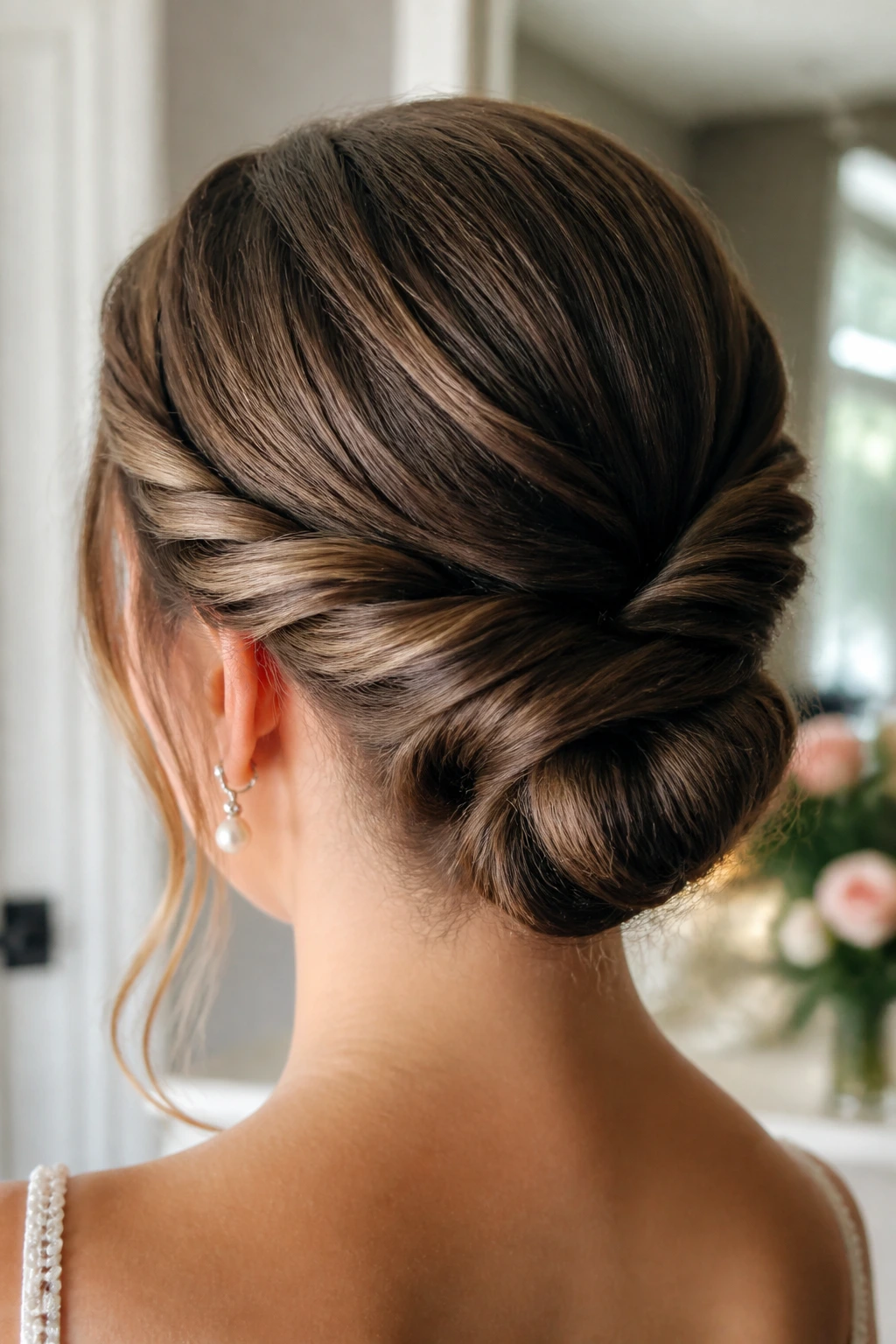
A veil-ready twisted bun is built around one practical detail: the comb has to sit without collapsing the style. That’s why this low bun is usually shaped with a small open center or a defined base where the veil can anchor. The twists travel into the bun from both sides, giving the hair enough body to support the extra weight of tulle or lace.
Medium-length hair is especially useful here because the bun does not need to be oversized to hold the comb. The twists create a compact shape, and the ends can be tucked deep inside. If the veil is heavy, the comb should go into the bun itself, not just the top layer. Otherwise it drags the structure down by the end of the aisle.
This style is less about decoration and more about dependable shape. You can still add a few pearls or a narrow vine comb, but the key move is underneath the surface. If the bun is balanced, the veil reads as part of the style, not an afterthought.
21. Half-Up Knot With Cascading Curls
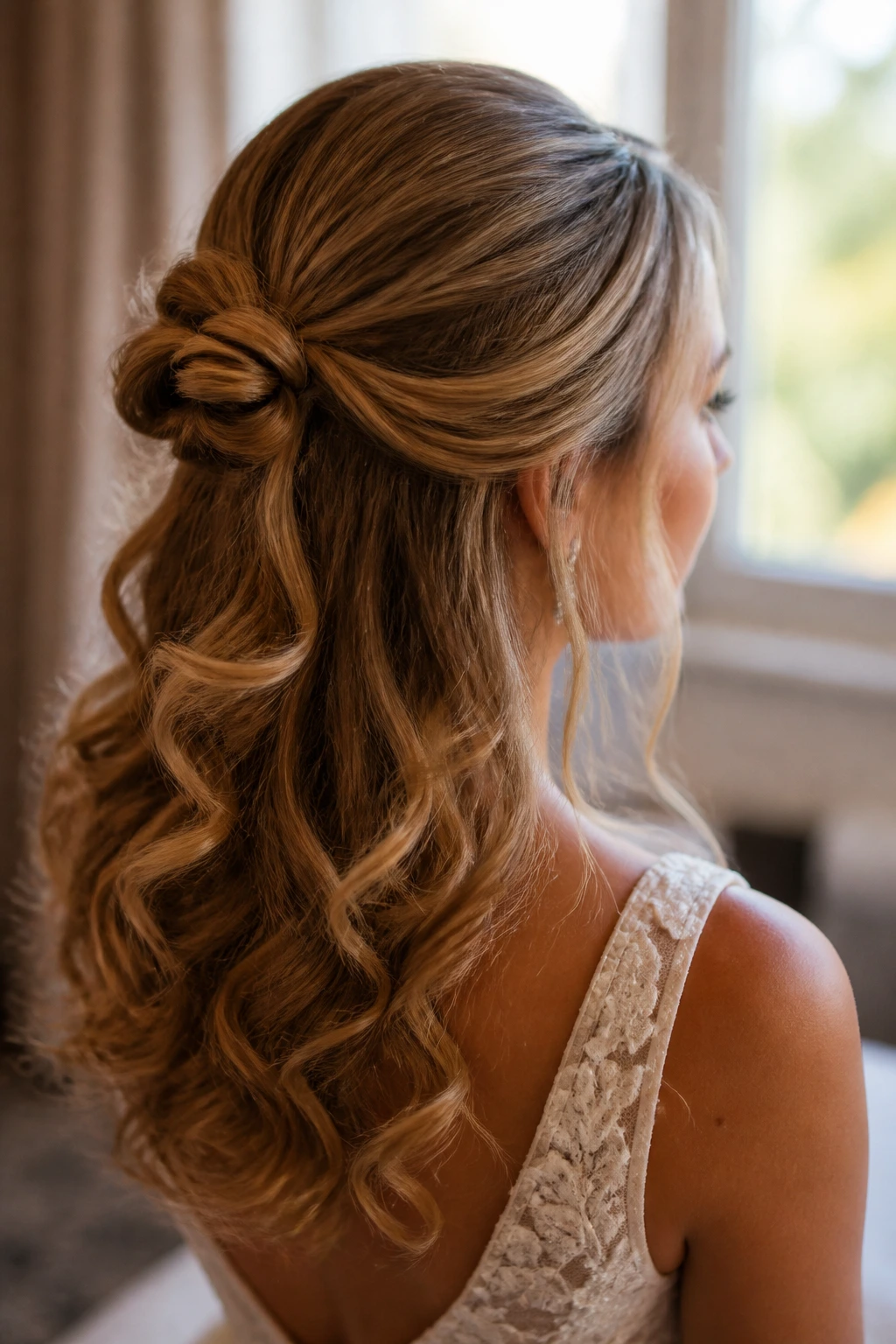
A half-up knot gives medium-length hair a little lift while keeping the lower length in play. The top section is pulled into a small knot, loop, or knot-like twist at the back of the crown, and the rest falls in curls that start about halfway down the head. That keeps the style from feeling too heavy at the top.
This is one of the easiest ways to get the “bridal” effect without committing to a full updo. The knot gives a focal point, and the curls create movement down the back. If the hair is layered, the loose ends will naturally break into soft pieces, which looks good here. If the hair is blunt, the ends may need a little extra bend so the line doesn’t feel too straight.
A half-up knot is a strong choice when you want hair off the face during the ceremony but still want the softness of down hair for portraits. It also leaves room for earrings, which is useful if the dress calls for them. Small detail. Big payoff.
22. Bubble Ponytail With Satin Wraps
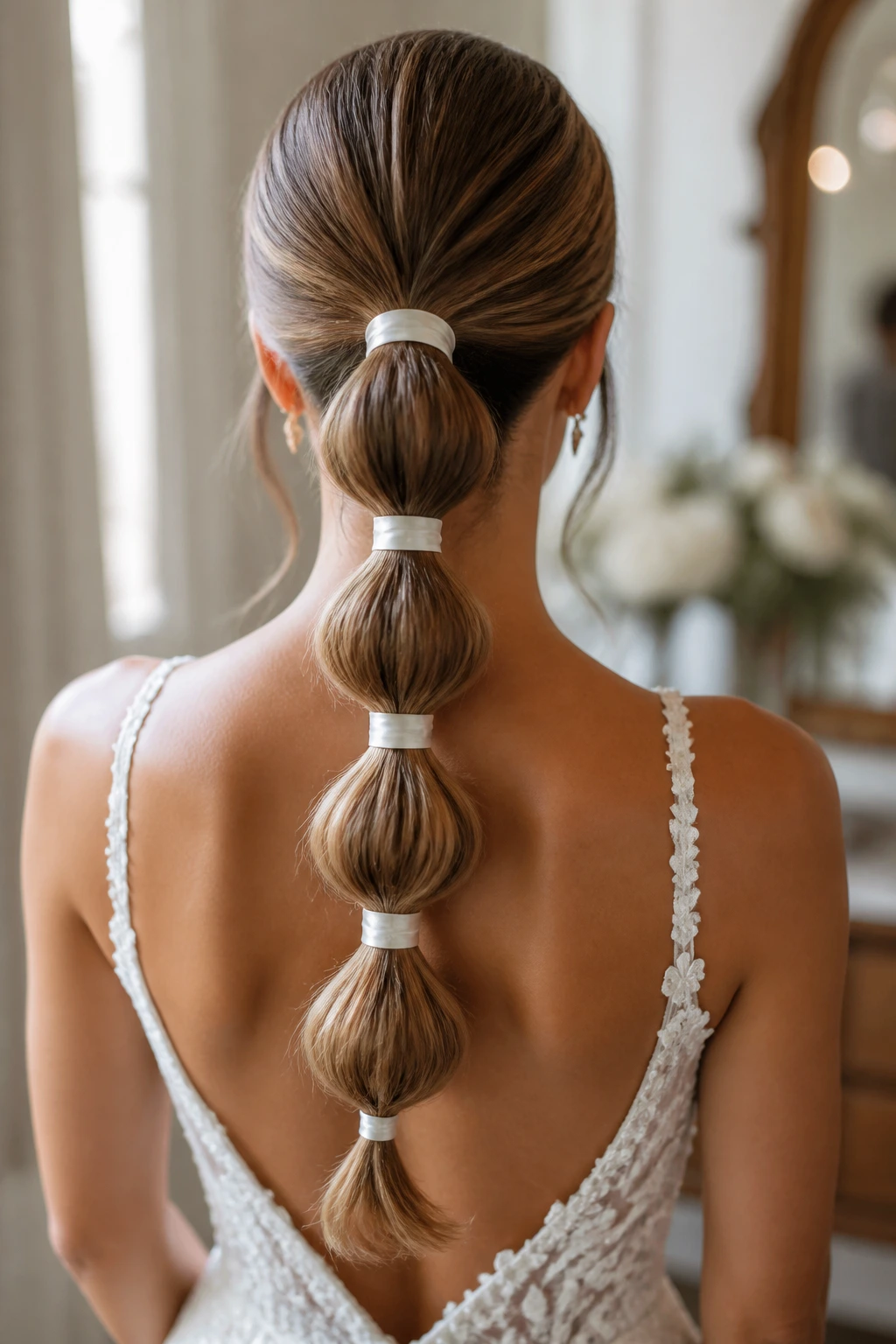
A bubble ponytail sounds playful, but on medium-length bridal hair it can be polished fast if you keep the sections clean and the wraps neat. The ponytail is secured first, then divided with small elastics at intervals, puffing each section slightly before wrapping one or two sections with satin ribbon or hair around each elastic. The result has shape without looking fussy.
This style works because medium-length hair creates bubbles that are visible without becoming huge. The sections sit in proportion to the head, which helps a lot. If the hair is layered, the bubbles should be tightened a little more so the shorter pieces don’t stick out. The wrap around the elastics hides the practical parts, which keeps the whole style looking finished.
I’d use this for a bride who wants something modern, a little unexpected, and easy to keep in place. It also works well with shorter veils or no veil at all. The ponytail has enough personality on its own.
23. Floral-Accented Soft Updo
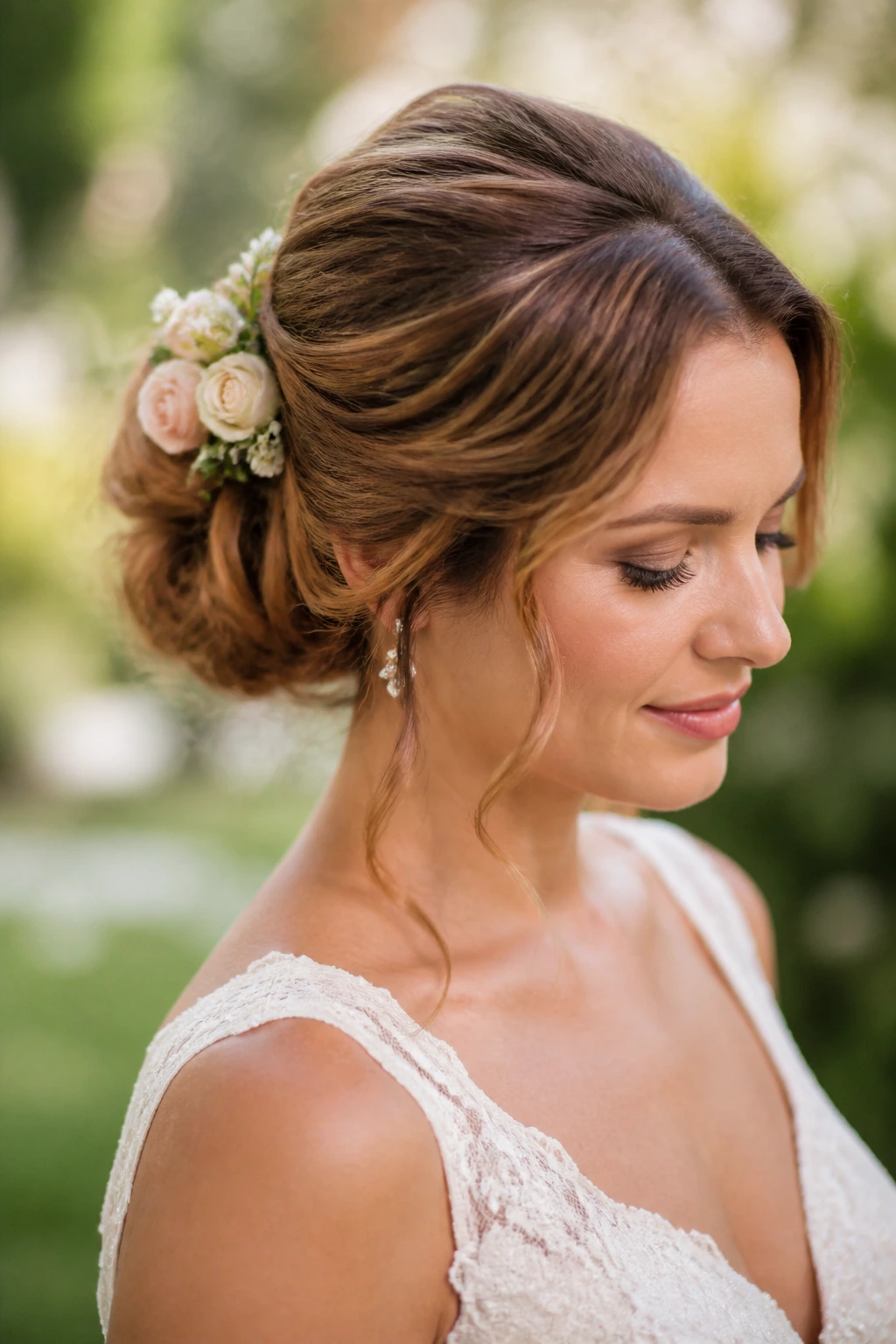
A soft updo with flowers can feel ornate or very plain depending on how it’s done, and medium-length hair gives you a sweet middle ground. The hair is pinned into a low or mid-height shape with a few twists visible at the sides, then the flowers are tucked near the bun or along one edge of the style. A few blooms is enough. More than that, and the hair disappears under the arrangement.
Fresh flowers need support, so they should be wired or placed into small floral pins, not shoved into the bun and hoped for the best. That’s one of those details that separates a tidy style from one that droops halfway through photos. If you’re using silk flowers, keep the stems short and the colors tight to the bouquet palette so the look feels connected.
This style works especially well when the dress and bouquet already lean soft or garden-like. It can also be made more modern with a cleaner bun and only one or two blooms. The flowers should frame the hair, not fight it.
Why Medium-Length Bridal Hair Gives You More Room to Play
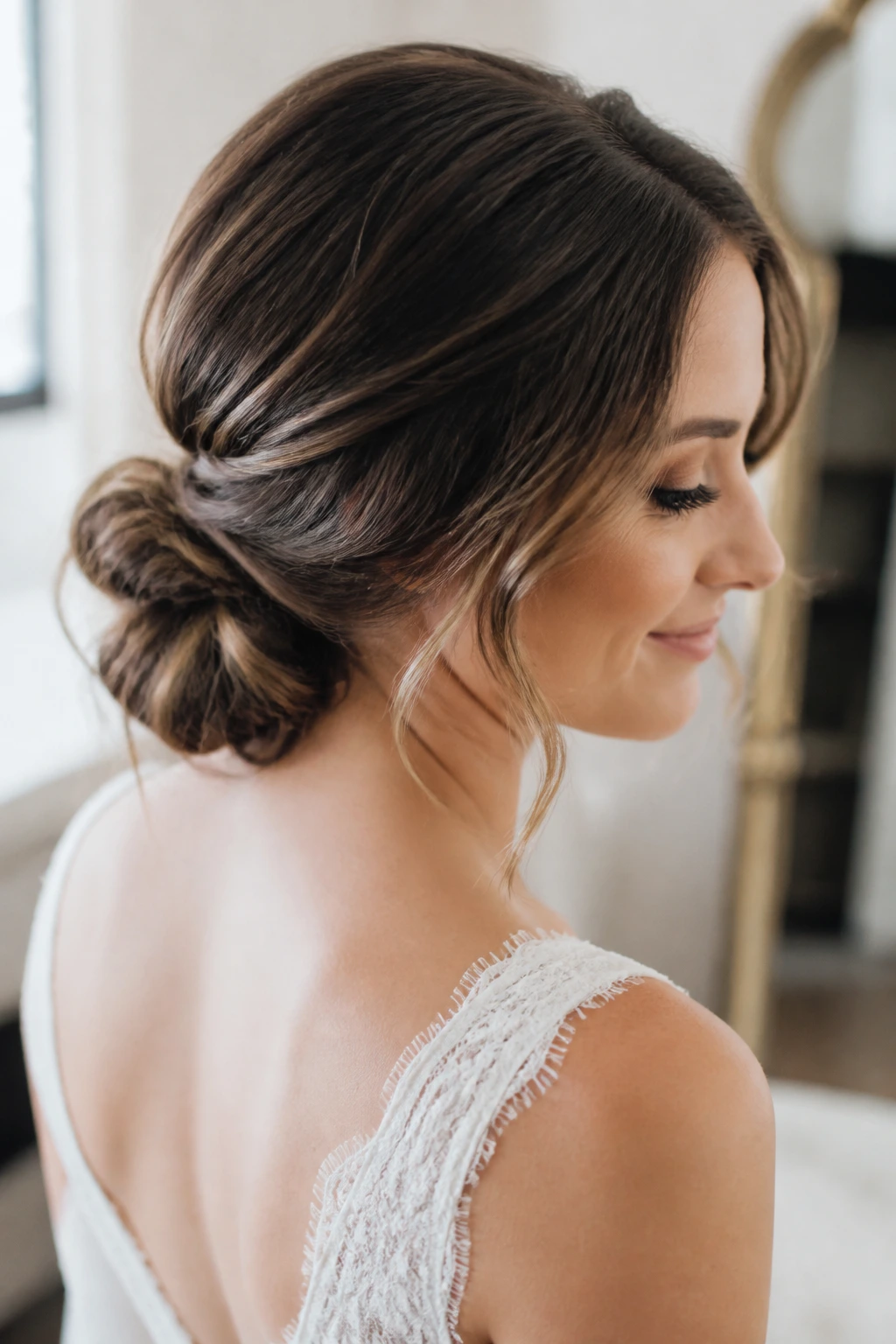
Medium-length hair sits in a useful middle zone. It has enough weight to stay in place once it’s pinned or curled, but not so much that every section pulls on the rest of the style. That’s why low knots and half-up shapes often behave better here than they do on very long hair. The structure stays visible, and the style does not need a ton of reinforcement to hold.
There’s also a practical side that people overlook. With hair that lands around the shoulders or collarbone, your stylist can shape the hair close to the head without dealing with a lot of extra bulk at the ends. That means fewer hidden knots, fewer awkward lumps, and fewer sections that fall out when you turn your head. Good bridal hair is as much about control as it is about prettiness.
The length also plays well with accessories. A comb can grip. A pin can tuck in. A ribbon can sit where it’s meant to sit instead of sliding off a heavy mass of hair. If you’ve ever watched a veil comb fight long, silky hair, you know why this matters. Medium hair gives the accessory somewhere to land.
And there’s a styling bonus that gets missed all the time: medium-length hair shows shape. A low bun looks like a bun, not a hidden knot inside a curtain of hair. A wave pattern reads from across the room. That visibility makes the whole look easier to control in photos, which is half the battle.
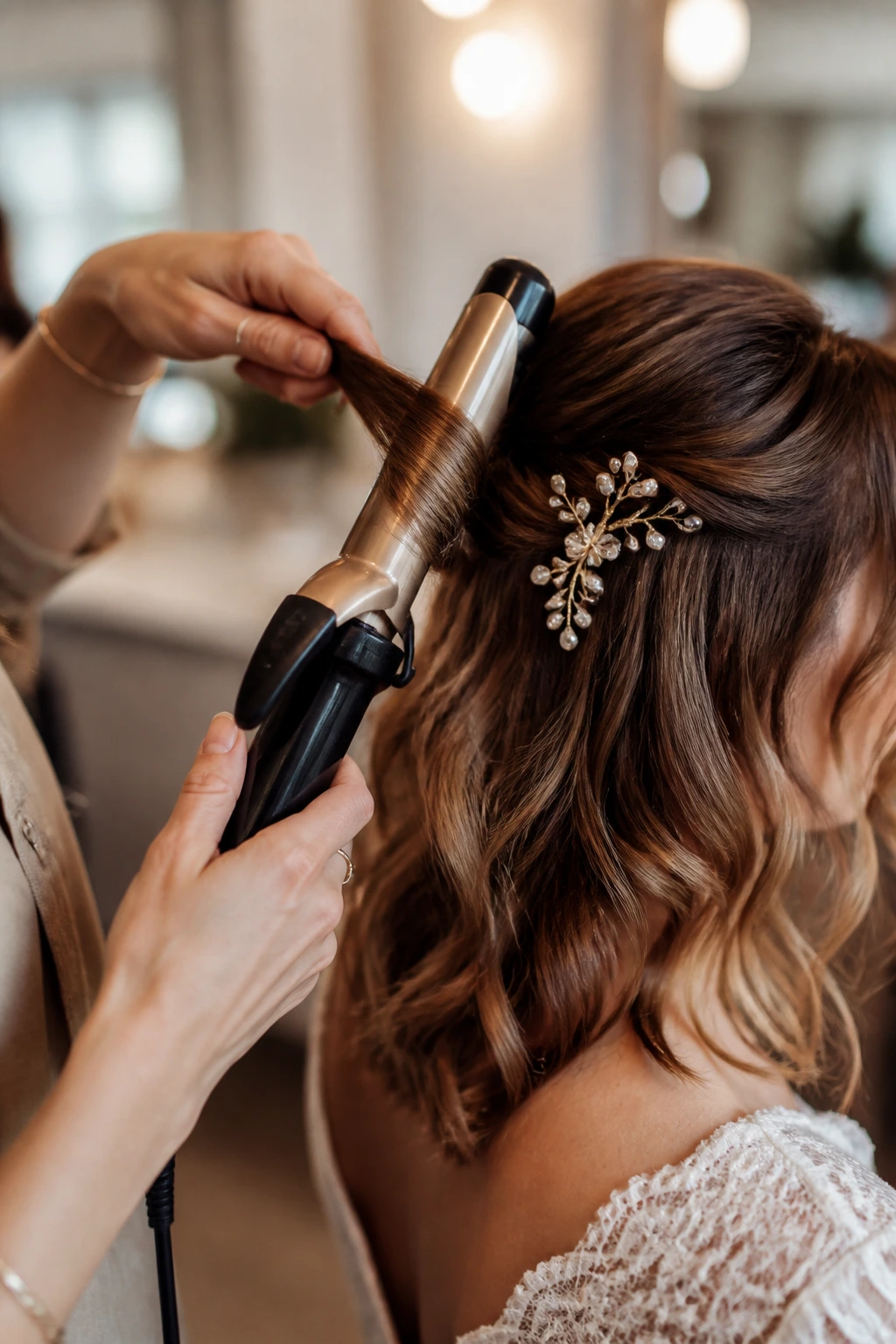
Essential Tools for These Looks
-
1-inch curling iron: Best for tighter waves, face-framing pieces, and the soft bends that need a little definition.
-
1.25-inch curling iron or wand: Useful for broader bridal waves that brush out without turning frizzy.
-
Tail comb: Helps with clean parts, sectioning, and teasing at the crown without ripping through the hair.
-
Texturizing spray: Gives pins something to hold onto, especially if your hair is silky or freshly washed.
-
Strong-hold hairspray: Keeps flyaways down and helps the finished shape stay in place through photos and dancing.
-
Bobby pins and U-pins: You’ll need both. Bobby pins grip; U-pins help support buns and twists without making the style look crowded.
-
Mini elastics: These disappear better than regular hair ties when you’re building half-up knots, ponytails, or braids.
-
Shine spray or light finishing mist: Adds polish to the top layer without coating the hair in heavy product.
-
Round brush: Useful for smoothing the crown or shaping the ends of a blowout.
-
Veil comb or hair accessory pins: If you’re wearing a veil, floral piece, or pearl clip, test the attachment before the wedding day.
Smart Prep and Product Choices
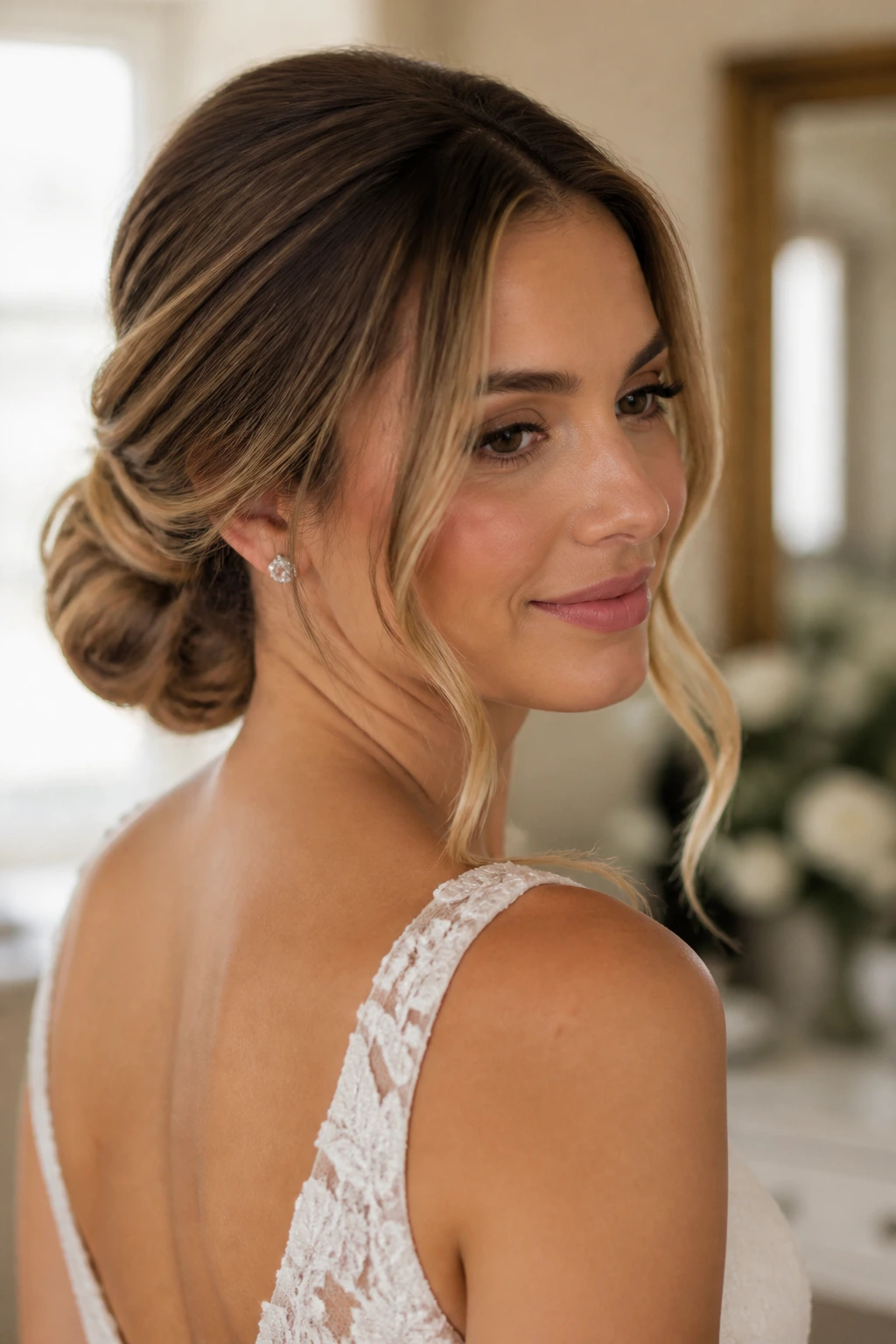
Most medium-length bridal styles hold better on hair that isn’t freshly washed that same morning. A little natural grip helps pins stay put, and clean, silky hair has a habit of slipping right out of careful work. If your hair is the kind that goes glassy after conditioner, wash it the day before or use a light dry shampoo at the roots before styling.
Product choice matters more than volume of product. You do not need a helmet. You need grip, bend, and a finish that won’t collapse. A mousse at the roots can help with lift. A texturizing spray through the mid-lengths gives waves something to cling to. A tiny amount of smoothing cream on the surface keeps the top layer neat, but keep it away from the roots unless you want the style to go flat.
The shape of the hair should also match the style. If you’re planning a low bun, the ends need enough softness to tuck cleanly. If you want a ponytail or a loose wave style, the ends can stay a little more piecey. For coarse or curly hair, resist the urge to flatten everything out. A good bridal style usually looks better when it keeps some of the hair’s own texture instead of sanding it away.
And yes, there’s a practical note nobody likes but everyone should hear: test your accessory with your prep products. Some sprays make metal combs slide. Some oils make pearl pins drift. You want to know that before the wedding, not when someone is trying to hold your veil in place with one hand and whisper calm things with the other.
How to Match the Style to Your Dress, Veil, and Jewelry
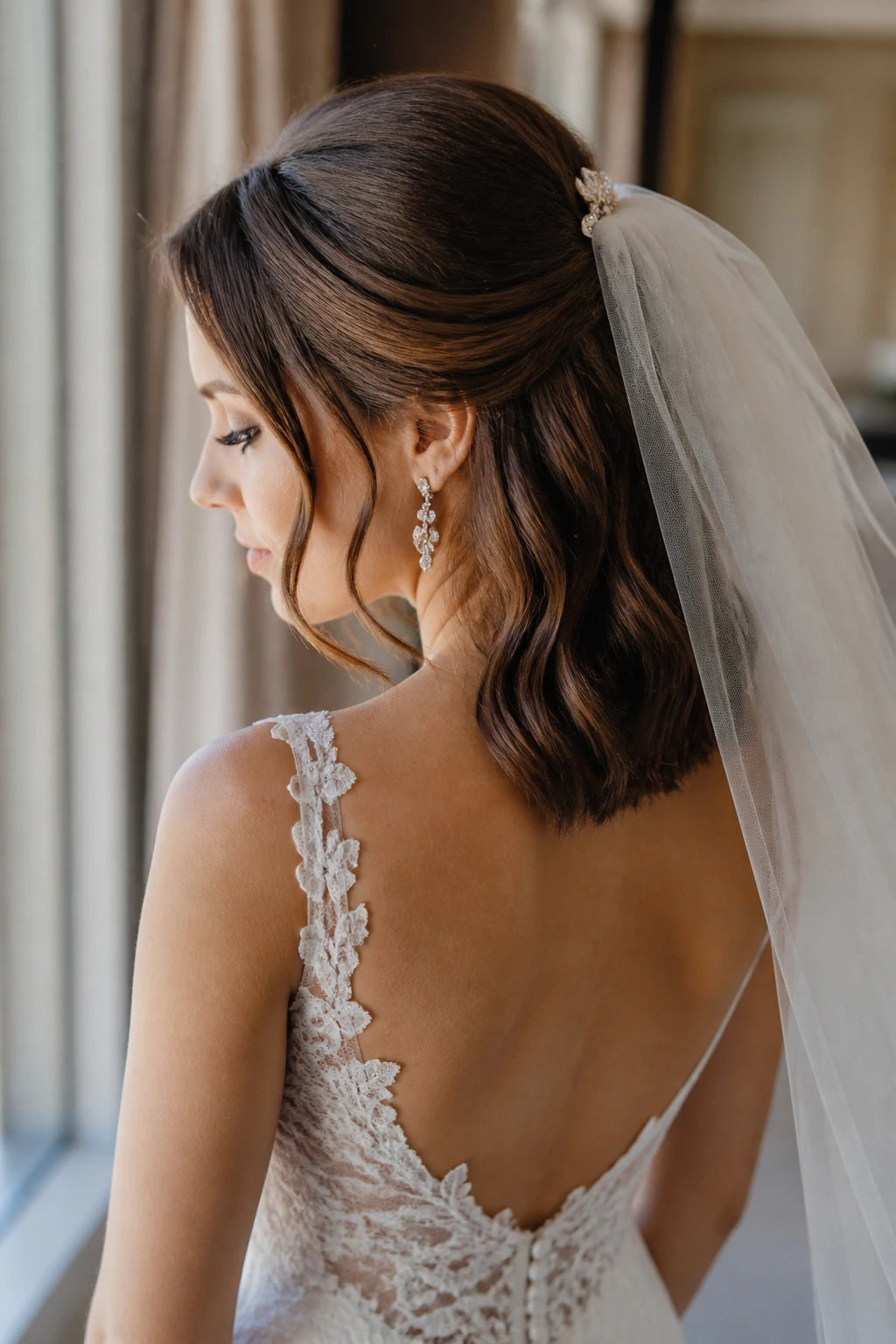
Neckline: Low buns, French twists, and tucked styles give square necks, halters, and open backs more space to breathe. If the dress already has a lot happening around the collarbone, keep the hair quieter and lower so the outfit doesn’t feel crowded.
Veil Placement: For comb veils, ask your stylist to build the style around the comb’s exact position. A veil placed too high can crush the crown; one set too low can pull the bun loose. Trial runs are where that gets solved, not on the aisle.
Jewelry: Big earrings can carry a simpler hairstyle, while delicate studs often look best with a little more detail in the hair. Side sweeps and half-up styles are especially useful if you want your earrings visible from the front and side.
Dress Fabric: Satin and crepe pair nicely with polished shapes like the slick-back knot or Old-Hollywood waves. Lace, tulle, and chiffon can handle softer textures like braids, loose buns, and ribbons.
Photos: Think about the back of the dress. If the bodice has buttons or a low scoop, a style that clears the back will save you from hiding the part of the gown that deserves attention. Hair should frame the dress, not cover the work.
Extra Tricks for Hold, Shine, and Softness
Texture Prep: Mist a little texturizing spray at the roots and mid-lengths before you start pinning. Hair that’s too smooth doesn’t stay where you place it, and medium-length hair can slip faster than you’d expect if it’s freshly blow-dried to a shine.
Shine Control: Put shine spray on the top layer only. Keep it off the roots and away from the pins. Too much gloss near the base makes the style look oily in flash photos, which is a brutal little surprise nobody needs.
Shape Check: Step back from the mirror and look at the outline, not the details. Medium-length bridal hair should have a clear silhouette. If every section is soft but the whole thing looks shapeless, it probably needs a cleaner pin or a tighter twist somewhere.
Personal Touch: A narrow ribbon, a pearl pin, or one well-placed flower often does more than a cluster of accessories. Brides sometimes pile on details because the hair feels “small” compared with long styles. That urge is understandable. It’s also how you end up with a busy head.
Common Mistakes Brides Make With Medium-Length Hair
The first mistake is starting with hair that’s too slippery. Freshly washed hair may feel clean and shiny, but it often fights against pins and sectioning. The fix is simple: give the hair some grip with dry shampoo, mousse, or second-day texture before shaping it.
The second mistake is asking for too much bulk at the wrong spot. A giant crown can make medium-length hair look top-heavy, and a low bun that’s packed too wide can flatten the neck line. Keep the volume where the style needs it — at the crown for lift, at the bun for width, or in the waves for movement — but not all three at once.
The third mistake is ignoring the back of the style. Brides often check the front, tuck in the veil, and call it done. Then they see a pin cluster or an uneven part in the photos from behind. Turn around in the trial. Take pictures. Fix the back before the wedding day.
Another common issue is accessories that don’t match the scale of the hair. A huge comb can overpower a medium-length updo, while a tiny pin can vanish inside a textured bun. The accessory should fit the size of the shape, not fight it.
Finally, don’t choose a style that only works when the hair behaves a certain way it never actually has. If your hair refuses to stay poker-straight, don’t ask for a sleek look that depends on it. Build around the texture you actually have. It’s calmer that way, and the result usually lasts longer.
Variations and Adaptations to Try
Fine-Hair Lift: Add a little padding at the crown and choose styles with visible texture, like a low bun, twisted half-up knot, or crown braid. Fine hair usually needs more structural support than it looks like it does from the mirror.
Curly-Texture Version: Keep the curl pattern intact and let the pins disappear inside the shape. Curly medium-length hair is strong enough to build a gorgeous updo, but it does not need to be brushed into surrender.
Short Lob Adaptation: If your hair sits closer to the shoulders than the collarbone, lean into side sweeps, half-up knots, and polished waves instead of full buns. The shorter length still works; it just wants less wrapping and more sculpting.
Humidity-Safe Finish: Choose cleaner lines, stronger pins, and less loose surface hair. A slick-back knot, tucked twist, or low ponytail usually behaves better when the air is heavy and the day is warm enough to make fine hair frizz at the edges.
Minimalist Ribbon Version: Replace sparkling clips with a narrow ribbon in silk or satin. It keeps the look soft and intentional, and it’s an easy way to make a simple half-up style feel dressed for the occasion.
Garden-Flower Version: Swap metal pins for tiny floral accents wired into a bun or braid. Keep the blooms small and clustered, because medium-length hair can carry flowers, but it does not need to wear a bouquet.
Make-Ahead, Trial Run, and Touch-Ups
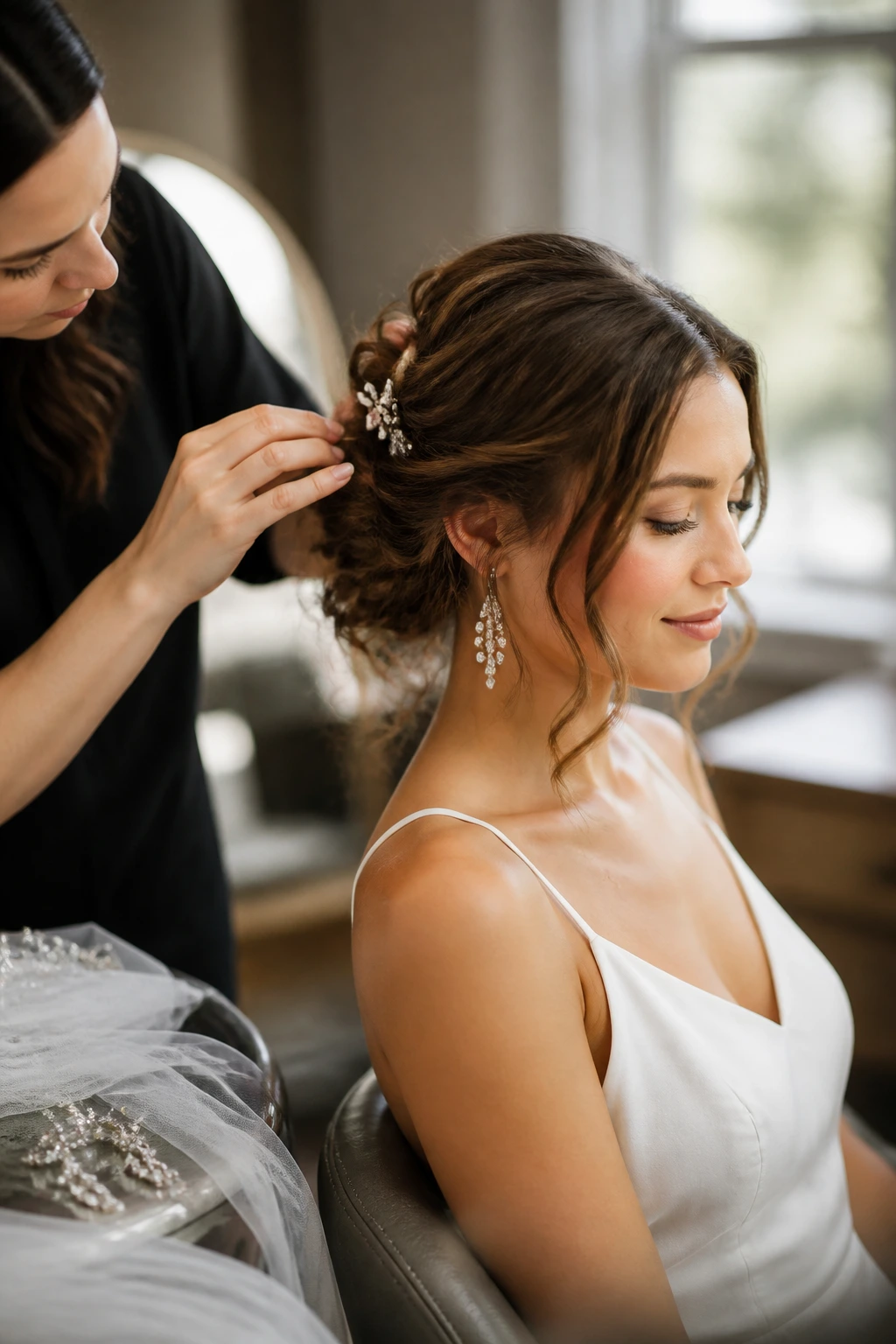
A bridal hair trial is not a luxury. It’s where the style learns how your hair behaves when it’s curled, pinned, sprayed, and asked to stay nice for more than an hour. Bring your veil, earrings, and any hair accessories to the trial. If the veil comb doesn’t sit right then, it won’t magically fix itself on the wedding day.
If you’re doing your hair yourself or having a friend help, plan a dry run with the same tools and product you’ll use later. Medium-length hair can look perfect at first and then slip after thirty minutes if the sections aren’t pinned in the right direction. A trial shows whether the bun is too loose, whether the front pieces need to be shorter, or whether the crown needs a little more lift.
The prep usually starts the day before. Hair that is freshly washed and blown out into silk can be harder to pin than hair with a little texture. If your style depends on curls, set them, let them cool completely, and avoid brushing them out too early. That cooling time matters. Warm curls fall faster.
For touch-ups, keep a small kit nearby: a handful of bobby pins, two U-pins, a travel-size hairspray, a tiny comb, blotting papers, and one mini elastic. If your hair is down, a quick finger twist at the front and a little spray at the roots may be enough. If it’s up, pinch the bun gently from the sides before adding a fresh pin through the center. Don’t just spray and hope. Hair needs support, not wishes.
Frequently Asked Questions About Bridal Hair for Medium Length Hair
Can medium-length hair really hold an updo all day?
Yes, if the shape is built for the length instead of fighting it. Low buns, twisted knots, braided crowns, and tucked styles usually hold better than oversized chignons because the hair has less weight pulling it down.
Should I wash my hair the morning of the wedding?
Usually no, unless your hair is very coarse or your stylist asks for it. Hair that has a little natural oil or product from the day before tends to grip pins and curls better.
What if my hair is too short for a full bun?
That’s normal. Ask for a tucked twist, soft chignon, or half-up style that uses the full length without forcing it into a bigger shape than it can hold. A good stylist will work with the ends instead of hiding them badly.
Do I need extensions for these styles?
Not always. Medium-length hair can hold a lot on its own. Extensions help if you want extra fullness in waves or a larger ponytail, but they are not required for a polished bridal finish.
Which styles work best with a veil?
Low buns, twisted knots, French twists, and structured half-up styles usually give the veil comb a secure place to sit. Bring the actual veil to the trial so the stylist can place it where it won’t flatten the hair.
How do I keep curls from falling flat before the reception ends?
Start with product that gives grip, set the curls fully, and don’t brush them too early. Once the style is finished, let it cool again before moving around too much, and keep a small touch-up spray for the ends.
Can I wear my hair down and still look bridal?
Absolutely. A polished blowout, side-swept lob, or brushed-out wave style can look every bit as formal as an updo if the finish is deliberate and the accessory choice is tight.
What should I bring to my hair trial?
Bring your veil, earrings, neckline photo, and any clips, combs, ribbons, or flowers you plan to use. Also bring pictures of the front, side, and back of the dress, because the hairstyle has to work from every angle, not just the one in the mirror.
A Bridal Style That Fits the Length
Medium-length hair gives you more room than it first appears. That’s the part people often miss. It can be soft and down, tucked and clean, braided and lifted, or pinned into a shape that looks far more intricate than the length would suggest. The trick is choosing a style that uses the hair’s own weight and movement instead of fighting it.
The best bridal looks for this length usually share one trait: they know where to stop. They stop before the bun gets bulky. They stop before the wave turns stiff. They stop before the accessories crowd the head. That restraint is what makes the style look expensive, calm, and wearable all day.
Pick the shape that matches your dress, your texture, and the way you actually like to see yourself in photos. Then test it, pin it, and let it move a little. Medium-length bridal hair has enough personality on its own. The right style just gives it a sharper outline.
