



Straight hair on a bride can look startlingly refined when it’s handled well. Not loud. Not fussy. Just clean lines, good shine, and a shape that still looks intentional when the veil comes off and the dancing starts. The trick is that straight hair shows everything — the part, the pins, the bend at the ends, even the places where the style starts to sag — so the styling has to be smarter, not heavier.
Brides with straight hair get handed a lot of lazy advice. “Add texture.” “Curl it all.” “Tease it bigger.” Sometimes that works, and sometimes it turns sleek hair into a straw-like cloud that doesn’t match the dress, the makeup, or the person wearing it. The better route is usually cleaner: build structure where the hair needs grip, keep the silhouette crisp, and choose accessories that do some real work instead of sitting there like decoration.
I’ve always had a soft spot for bridal styles on straight hair because they can look expensive without trying to shout about it. A polished bun with a center part. A low ponytail tied in satin. A tucked French twist that leaves the neckline clear. Those looks have a kind of quiet confidence that survives camera flashes, humidity, and an aunt who keeps patting your hair as if it’s a blessing. The styles below lean into that.
Why Straight Hair Makes Bridal Styling Look So Sharp
-
The lines stay visible: Straight hair shows the exact parting, curve, and finish of a style, which makes a good shape look crisp instead of mushy.
-
Accessories sit cleanly: Combs, pins, ribbons, and headbands lie flatter against straight strands, so they look placed on purpose instead of fighting the hair.
-
The finish reads elegant fast: A low bun or ponytail on straight hair can look deliberate with less bulk than the same style on textured hair.
-
It works with simple makeup: Clean hair pairs well with a strong lip, a sculpted cheek, or a dress that already has detail at the neckline.
-
The veil gets a better anchor point: Straight hair lets you map out where the comb or pin should sit without a lot of puff or twist in the way.
-
You can go sleek or soft: Straight strands give you a clean base for a glossy, minimalist look or a style with a few bent ends and face-framing pieces.
1. Glassy Center-Part Low Chignon
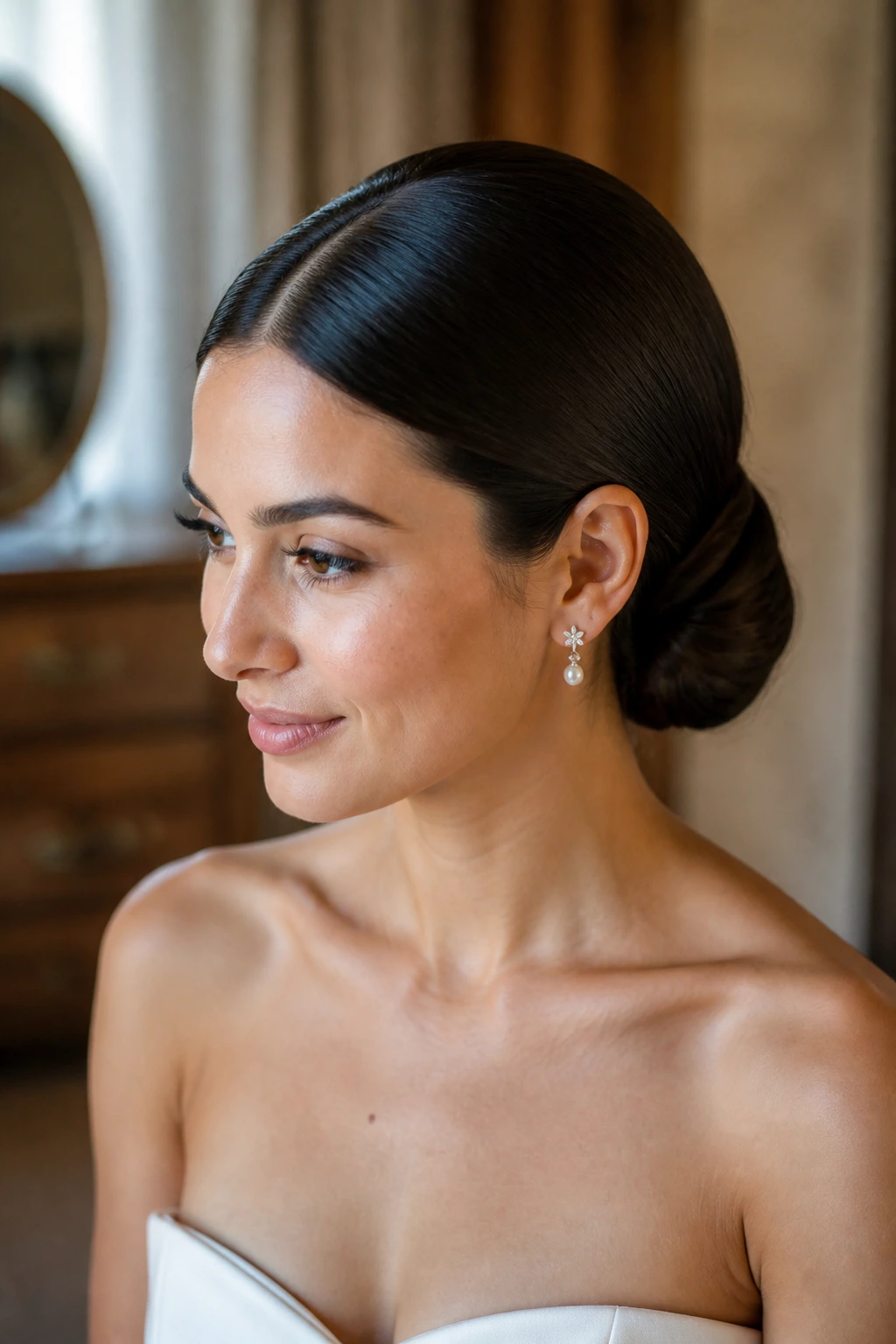
A center-part low chignon is one of those styles that looks calm from every angle. The hair is brushed flat at the crown, drawn low at the nape, and tucked into a knot that sits neatly under the occipital bone. On straight hair, that shape lands with real precision. No fluff. No wobble. Just a smooth line from forehead to bun.
What makes it work is the contrast between the sharp part and the soft knot. The top stays polished, almost mirror-like, while the bun itself can be a little looser so it doesn’t feel helmet-stiff. If your dress has a high neck, lace back, or a dramatic pair of earrings, this style gives the clothes room to breathe.
Best for: brides with medium to long straight hair who want a veil-friendly style that doesn’t compete with the dress.
A few face-framing pieces can soften it if your features feel sharp in photos. Keep them slim. One or two strands is enough; a whole curtain of tendrils can make the clean line lose its power.
2. Sleek Low Bun with a Hidden Twist
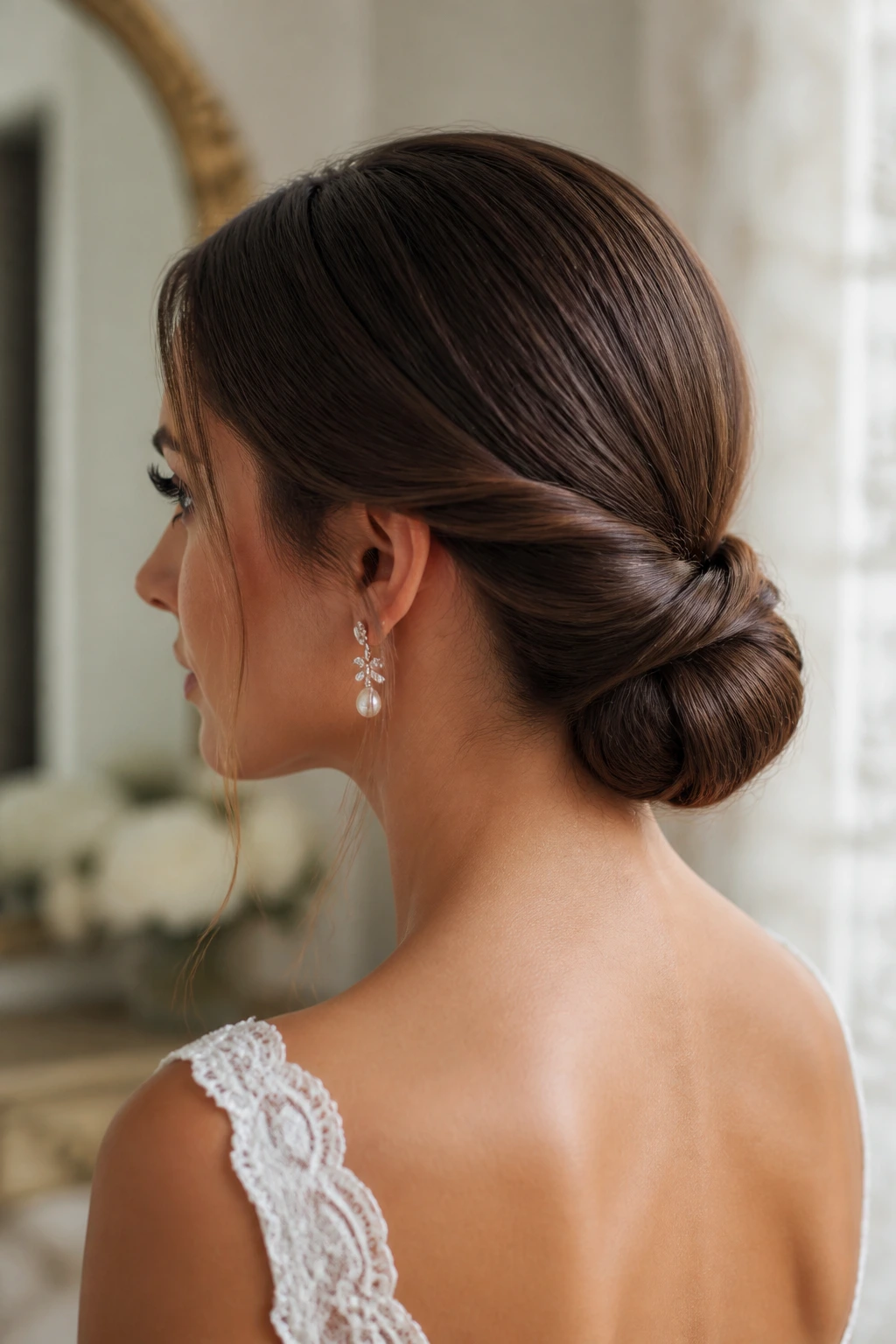
This one is the workhorse of bridal hair, and I mean that as a compliment. A sleek low bun with a hidden twist starts with a smooth crown and ends in a compact knot or coil at the nape, but the middle section is folded or twisted before it’s pinned down. Straight hair is good at this because the twist stays visible instead of collapsing into frizz.
The style is especially smart if you want your neckline and shoulder line to stay open. It also photographs well from the back, which matters more than people admit. The back of the head is where a lot of wedding photos live. A tidy twist gives the stylist something to sculpt, so the bun doesn’t just look like a rolled-up elastic.
Use this when the dress has embellishment on the shoulders or back. The hair won’t steal attention from beading or buttons, but it still looks finished. That balance is the whole point.
3. Satin Ribbon Low Ponytail
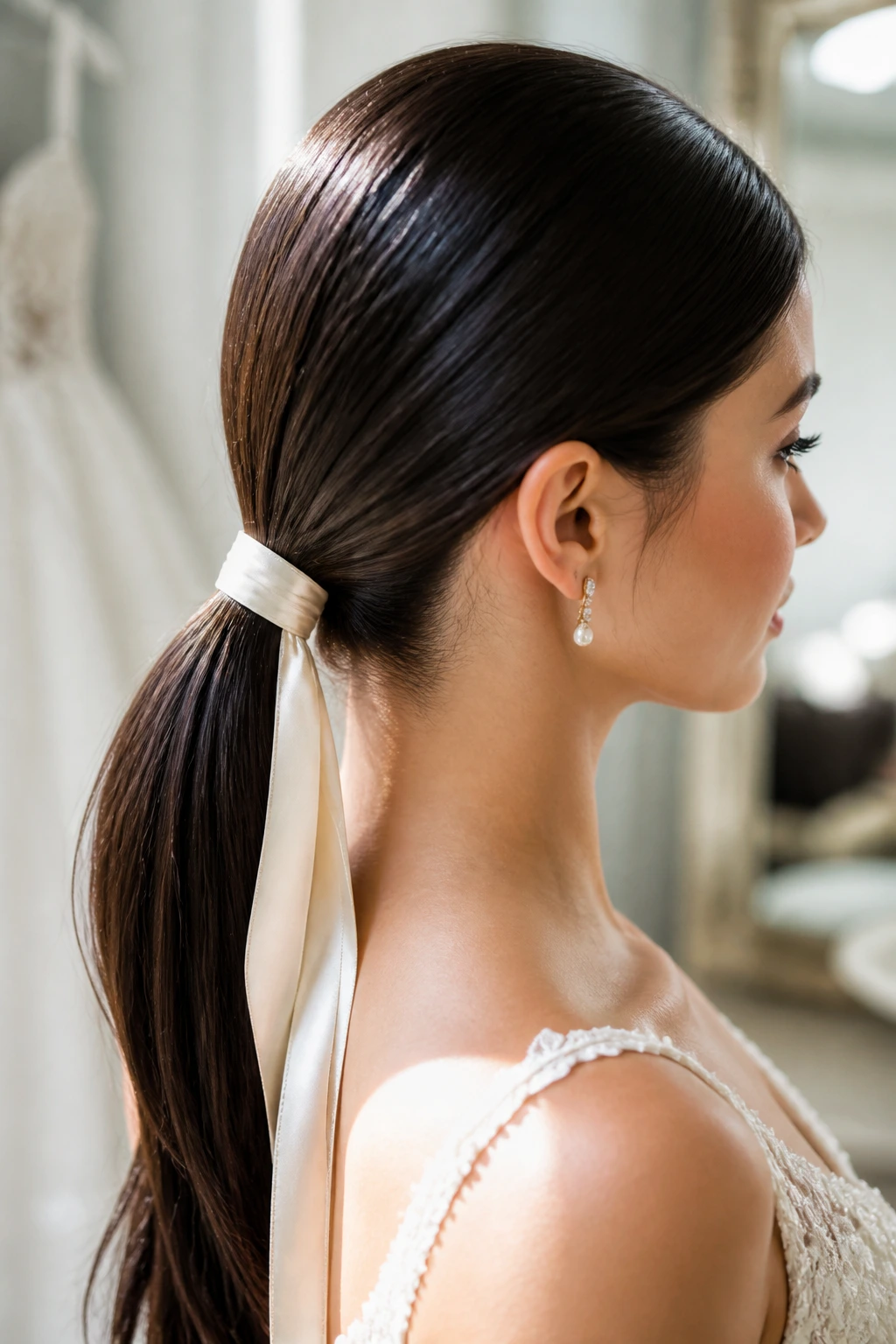
A satin ribbon changes a ponytail from practical to bridal in about two seconds. On straight hair, the ponytail sits smooth and dense, and the ribbon hides the elastic while adding a soft, slightly old-fashioned note that works with slip dresses, minimalist gowns, and even more romantic tulle skirts.
The trick is placement. Keep the ponytail low and secure it right where the head starts to curve into the neck. If it sits too high, the ribbon can look like an afterthought. If it sits too low, the whole style can disappear. A 1- to 2-inch ribbon width is usually enough; anything wider starts to dominate the look.
This style is especially nice for brides who hate anything tight around the scalp. It moves. It sways. It still feels dressed up, and you won’t spend the evening worrying that ten bobby pins are giving up on life.
4. Modern French Twist with Clean Ends
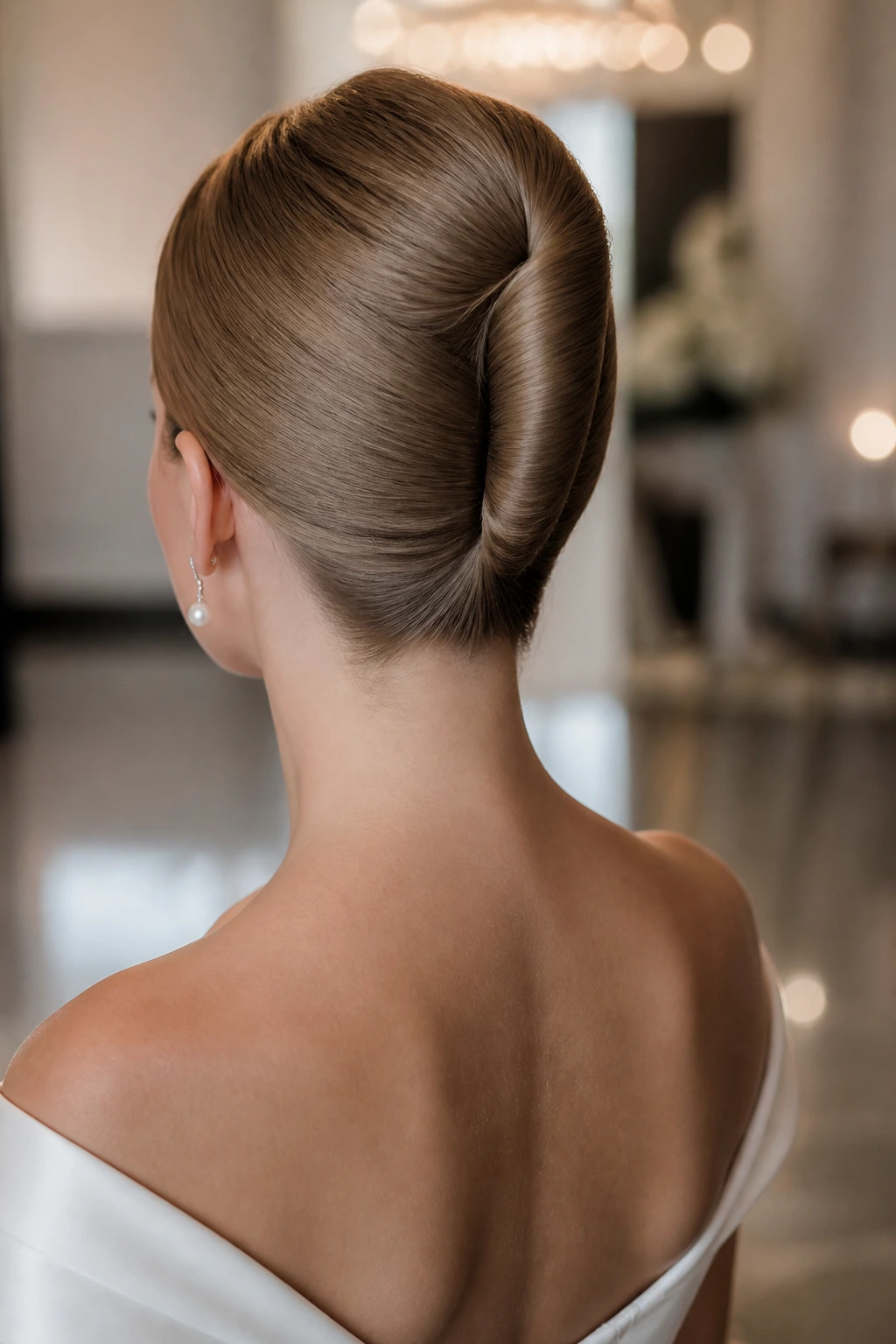
French twists don’t have to feel dated. On straight hair, they can look almost architectural when the seam is clean and the roll is tucked tight enough to hold its shape. The better versions leave a slight sheen at the surface and a sharp vertical line down the back, which looks gorgeous with square necklines and tailored gowns.
Why it earns its place
The straight texture gives the twist a sleeker profile than wavy hair often does. That means fewer stray ends and a cleaner tuck. If you want a style that says “I knew exactly what I was doing,” this is it.
Keep the volume controlled. A little lift at the crown is fine, but the old-school tall twist can fight modern wedding dresses unless the gown has serious drama. The version I like most sits low and narrow, with the ends hidden so the whole shape looks like one continuous fold.
5. Half-Up with a Crystal Barrette
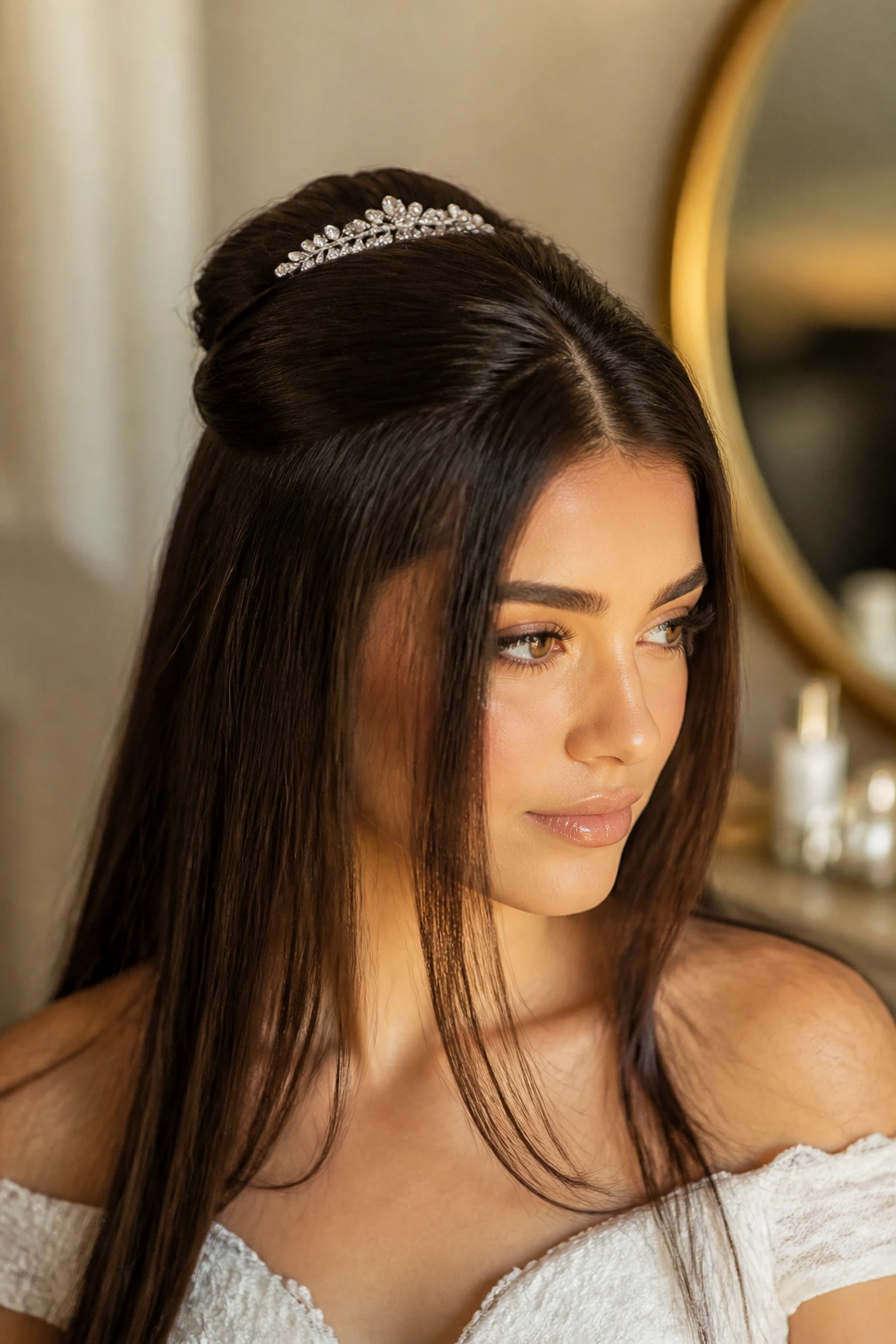
If you want hair down but not loose in the “my curls fell by accident” sense, a half-up with a crystal barrette is a smart move. Straight hair stays glossy in the back while the top section gets lifted just enough to keep the front tidy. One well-placed barrette can do more than a whole nest of pins.
This style works because it gives the hair a job. The top section pulls back the front and crown, while the rest hangs straight and polished. The barrette becomes the focal point, especially if it catches the light near one temple or just above the back of the head.
A lot of brides overdo this look. They add too many curls beneath the half-up section, which makes straight hair look like it’s pretending to be something else. I’d keep the lower lengths smooth, maybe with a slight bend at the ends if the cut needs it. Clean is better here.
6. Bubble Ponytail with Bridal Pins
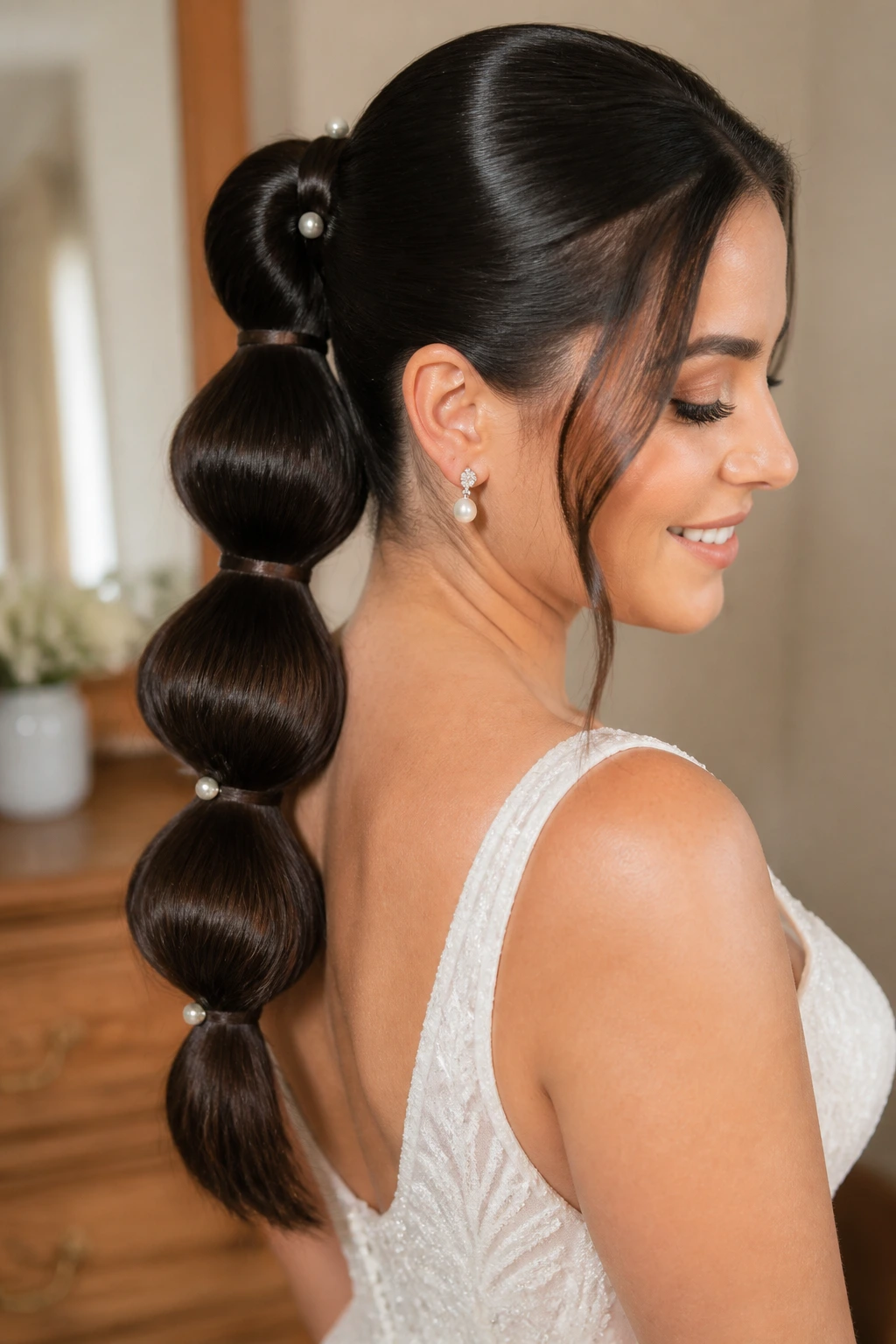
A bubble ponytail gives straight lengths some architecture, which is useful if your hair tends to lie flat and slide around. You section the ponytail with small elastics every few inches, then gently puff each segment so the shape reads round and deliberate. On straight hair, those clean divisions look sharp instead of fuzzy.
The style has a little bit of fashion energy without becoming hard to wear. It’s especially good for brides in modern dresses, jumpsuits, or minimal gowns with strong lines. Add pearl pins at one or two section breaks if you want it to feel more bridal and less runway.
It’s also forgiving. If your ponytail isn’t wildly thick, the bubbles create the illusion of more body. If it is thick, they control it. Either way, the style holds up better than a loose ponytail, which can go limp halfway through family photos.
7. Side-Part Polished Waves at the Ends
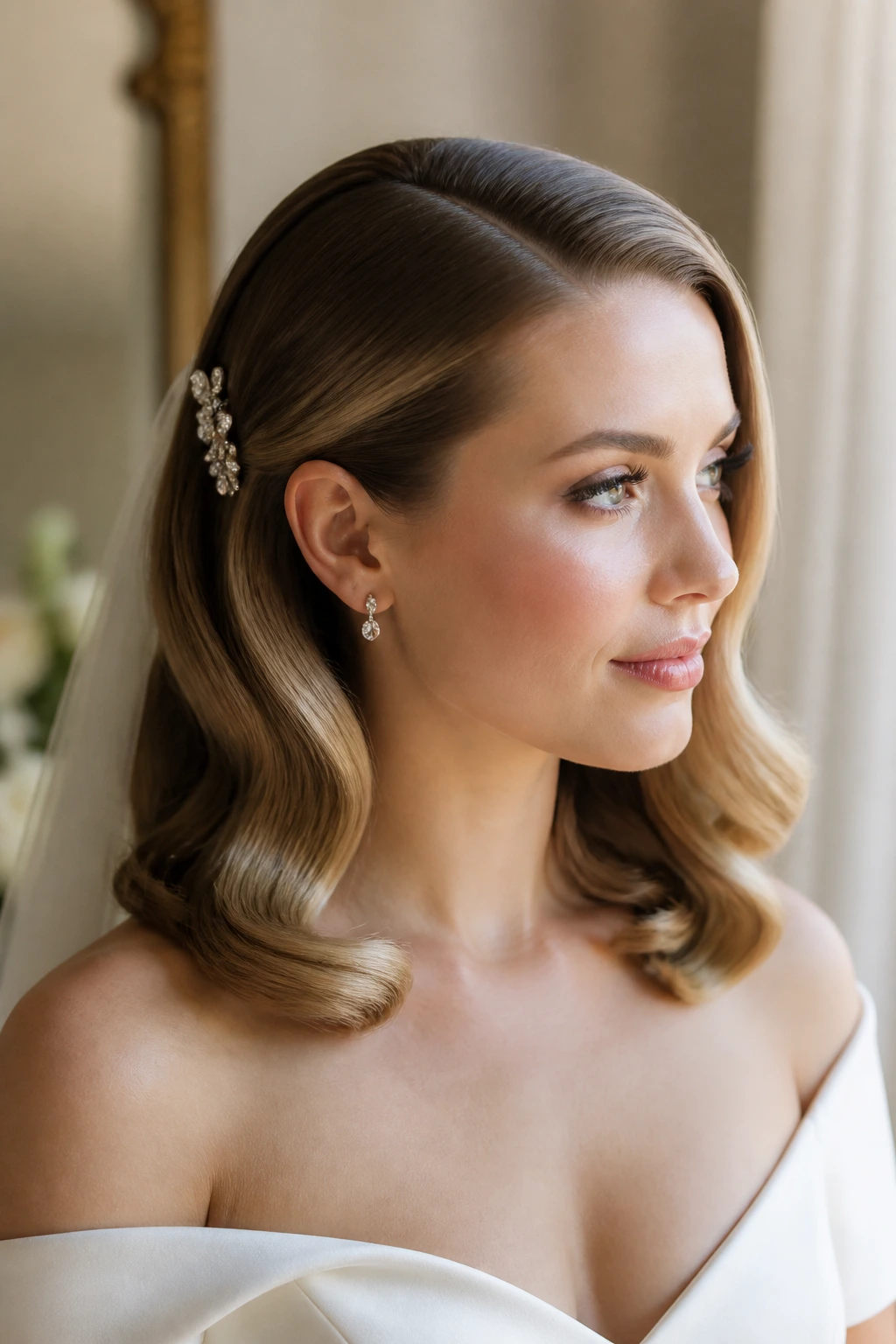
A side part can soften straight hair in a way a center part sometimes doesn’t. This version keeps the roots smooth and straight but gives the ends a gentle bend or wide wave, enough to frame the jaw and collarbone without turning into a full curl set. It’s a good answer for brides who want movement but dislike heavy styling.
The part matters. A deep side part shifts the weight of the hair and gives the face a little asymmetry, which looks lovely with one-shoulder gowns, asymmetric necklines, or dresses with a dramatic sleeve. Don’t curl the whole head. Bend the bottom third only. That keeps the finish crisp and modern.
This is one of the few down styles that works well for brides who still want to tuck one side behind the ear and show off earrings. It’s simple, but simple isn’t the same thing as plain.
8. Braided Crown on Straight Hair
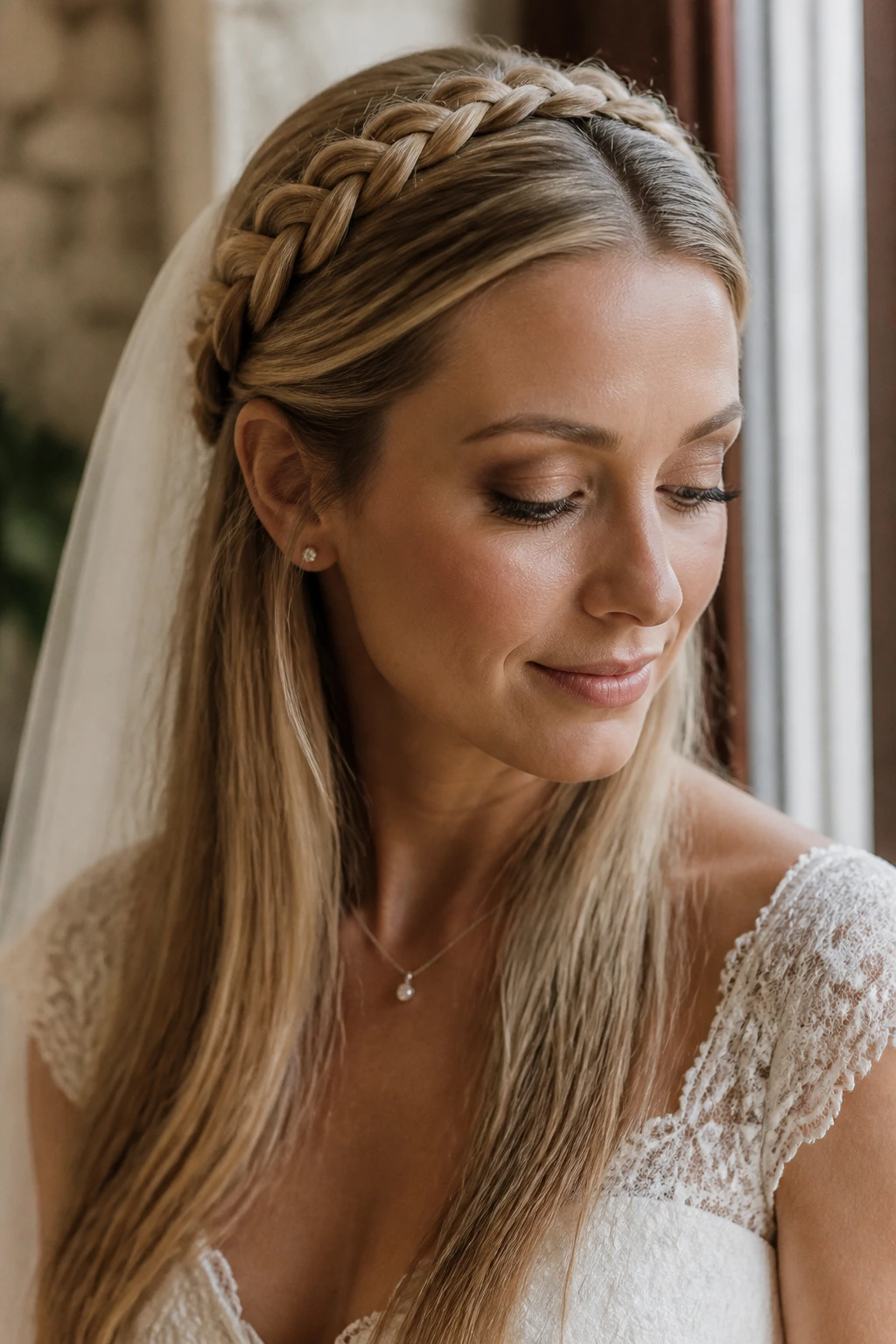
Braids can be a trap on straight hair if they’re too loose or too fluffy. Then they slide out of shape and look thin. A braided crown fixes that by keeping the braid close to the head and letting it act as a frame rather than a centerpiece. It gives the style shape without asking the hair to become a giant texture event.
This look is strongest on medium to long hair with a little built-in grit from mousse or dry shampoo. The braid wraps from one side of the head to the other, leaving the rest of the hair tucked or hanging depending on how formal you want it. I like it best when it stays neat, with the braid lying clean against the head.
It also plays nicely with veils and floral combs. Place the accessory just under the braid line, not on top of it, so the whole thing doesn’t get crowded. On straight hair, restraint is the charm.
9. Wrapped Knot at the Nape
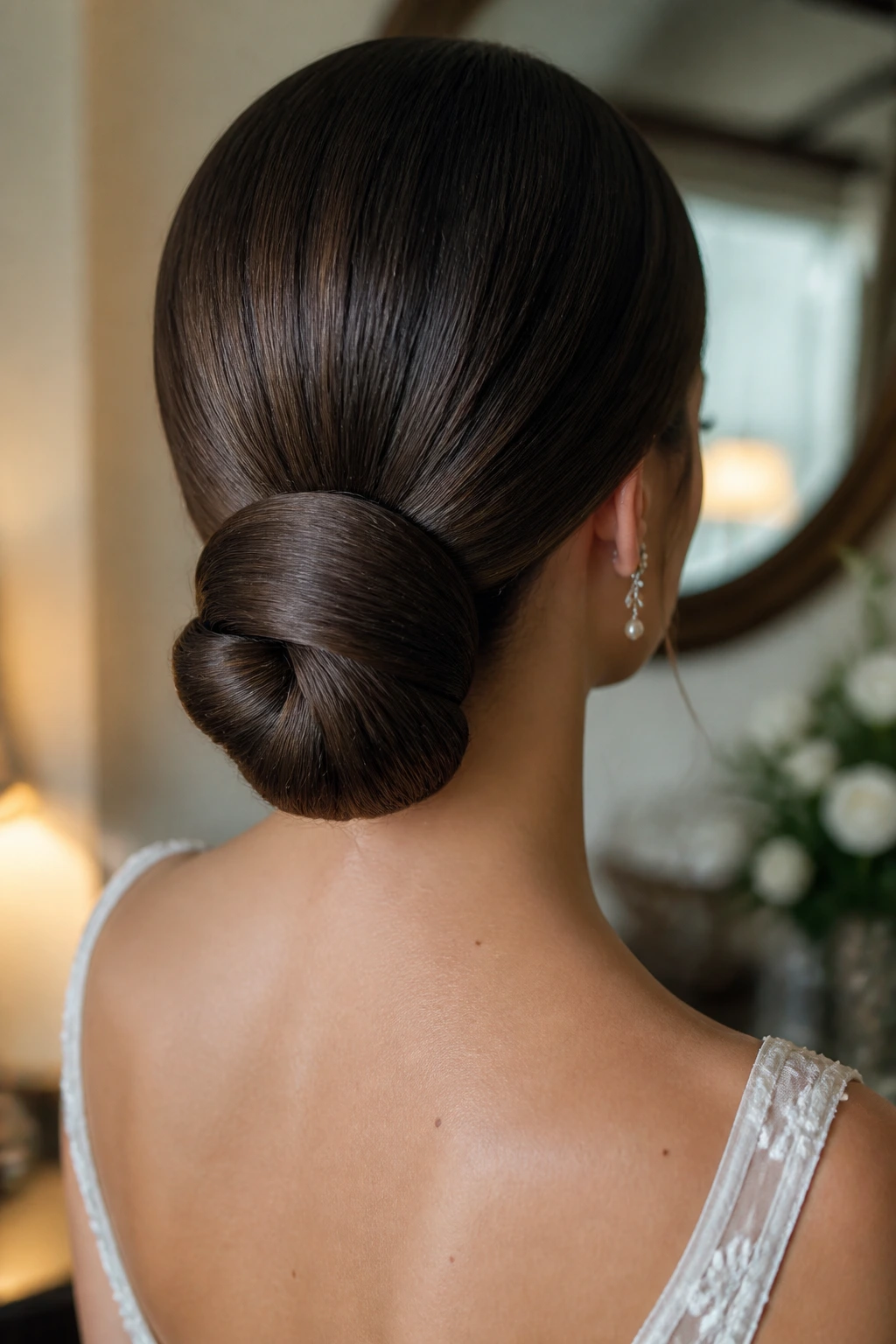
A wrapped knot at the nape is one of the easiest ways to make straight hair look deliberate and polished. The hair is gathered low, folded around itself, and pinned so the seam disappears into the knot. No giant bun, no loose fluff, no extra volume just for the sake of it.
The appeal is the back view. That little wrapped center gives the style depth, and straight hair keeps the lines visible. If your dress has a low back or a clean column shape, this is one of the nicest pairings. The neck stays open, the shoulders look longer, and the whole silhouette feels tidy.
I’d recommend this for brides who dislike touching their hair once it’s done. It holds its shape, and if the stylist places the pins well, it behaves for hours. Not forever. No style is magic. But long enough to matter.
10. Low Ponytail with Face-Framing Pieces
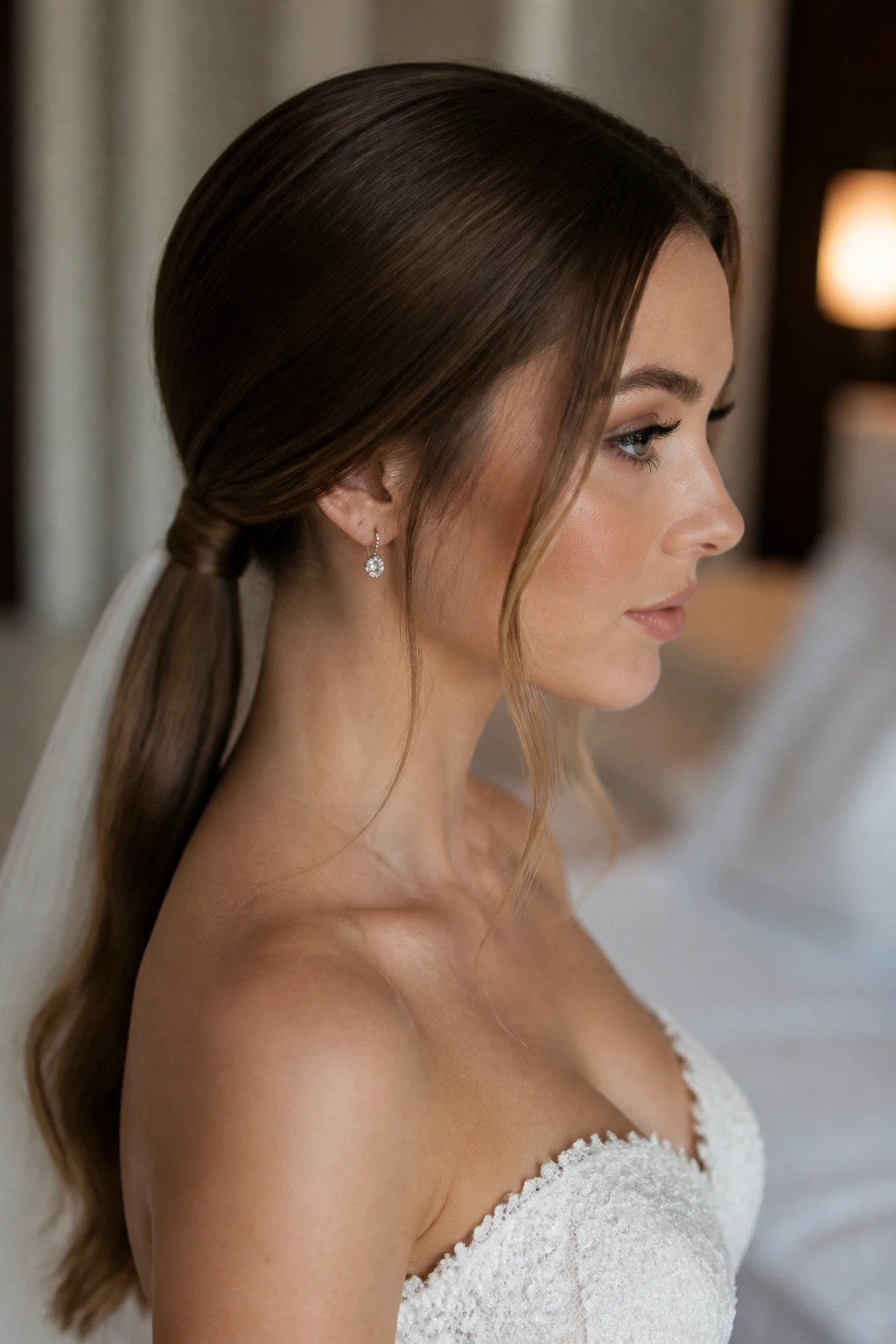
A low ponytail can look almost too plain until you break the front line a little. Face-framing pieces soften the severity and help straight hair feel intentional instead of slicked back into a school-photo version of itself. The ponytail itself can stay smooth, which keeps the style bridal rather than casual.
The pieces should be controlled, not wispy. Think slim strands that curve around the cheekbones and stop near the jaw or collarbone. If they’re too long, they can drag the style down. If they’re too thick, they look like an afterthought pulled out at the last minute.
This is one of my favorite styles for brides who want a clean profile but don’t love the feeling of every strand pulled tight. It also works well with square necklines and spaghetti straps, because the ponytail keeps the back open while the front pieces soften the face.
11. Veil-Ready Top Knot with a Hidden Comb
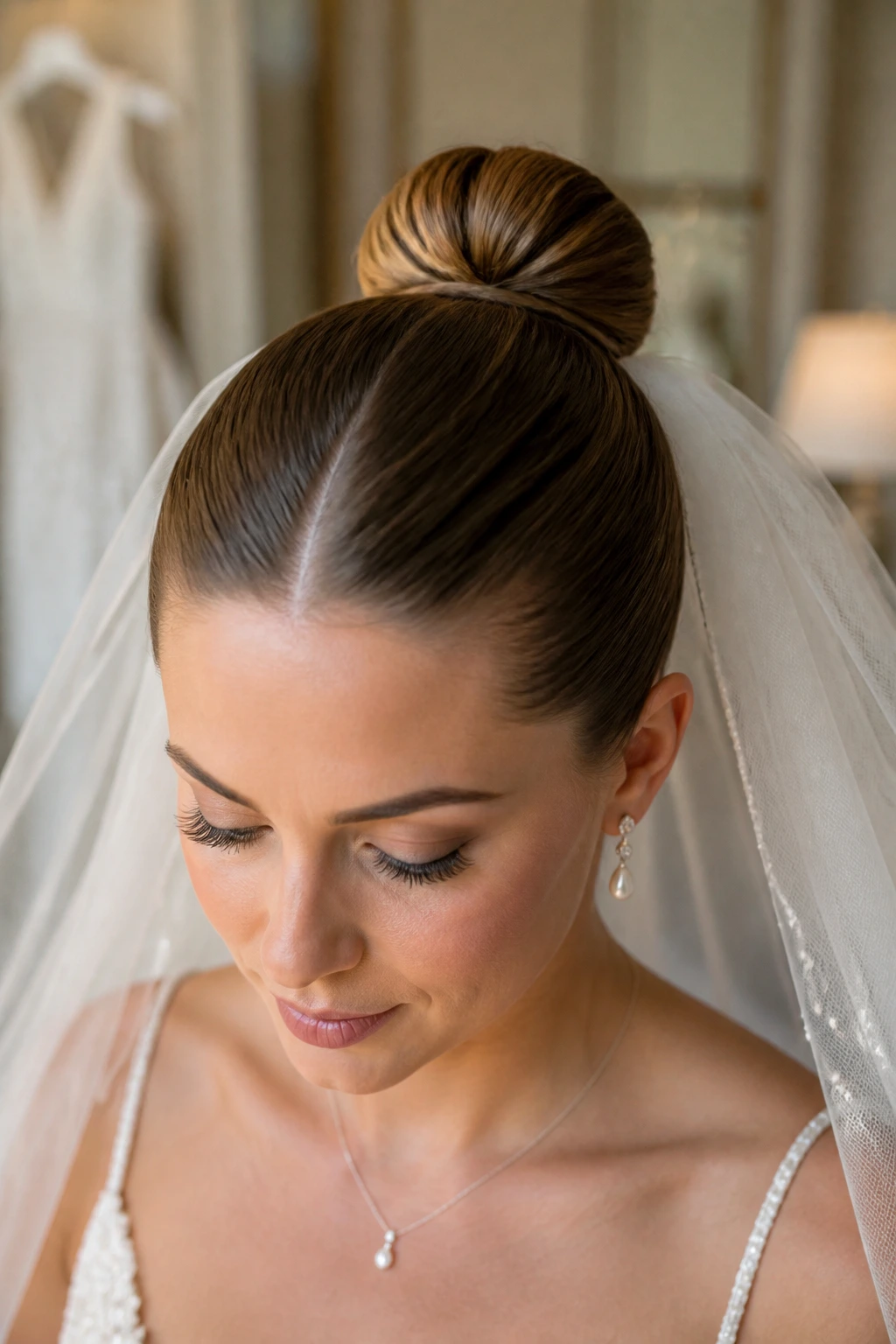
A top knot is not only for ballet buns and quick fixes. When it’s done cleanly and placed a little lower than the crown, it can look smart and modern on straight hair. The trick is to keep the bun compact and smooth, then hide the veil comb just under the knot so the veil drops without pulling at the shape.
This style is especially good for dresses with detail at the waist or shoulders. The hair stays off the fabric, which saves you from wrestling with tulle and appliqué. Straight hair helps because the bun can be wrapped neatly instead of turning fuzzy at the edges.
I wouldn’t use this on every bride. If your face is very long, a high knot can make it feel longer. But on the right person, it’s clean, efficient, and strangely glamorous in a very non-fussy way.
12. Minimalist Bob Tuck Behind One Ear
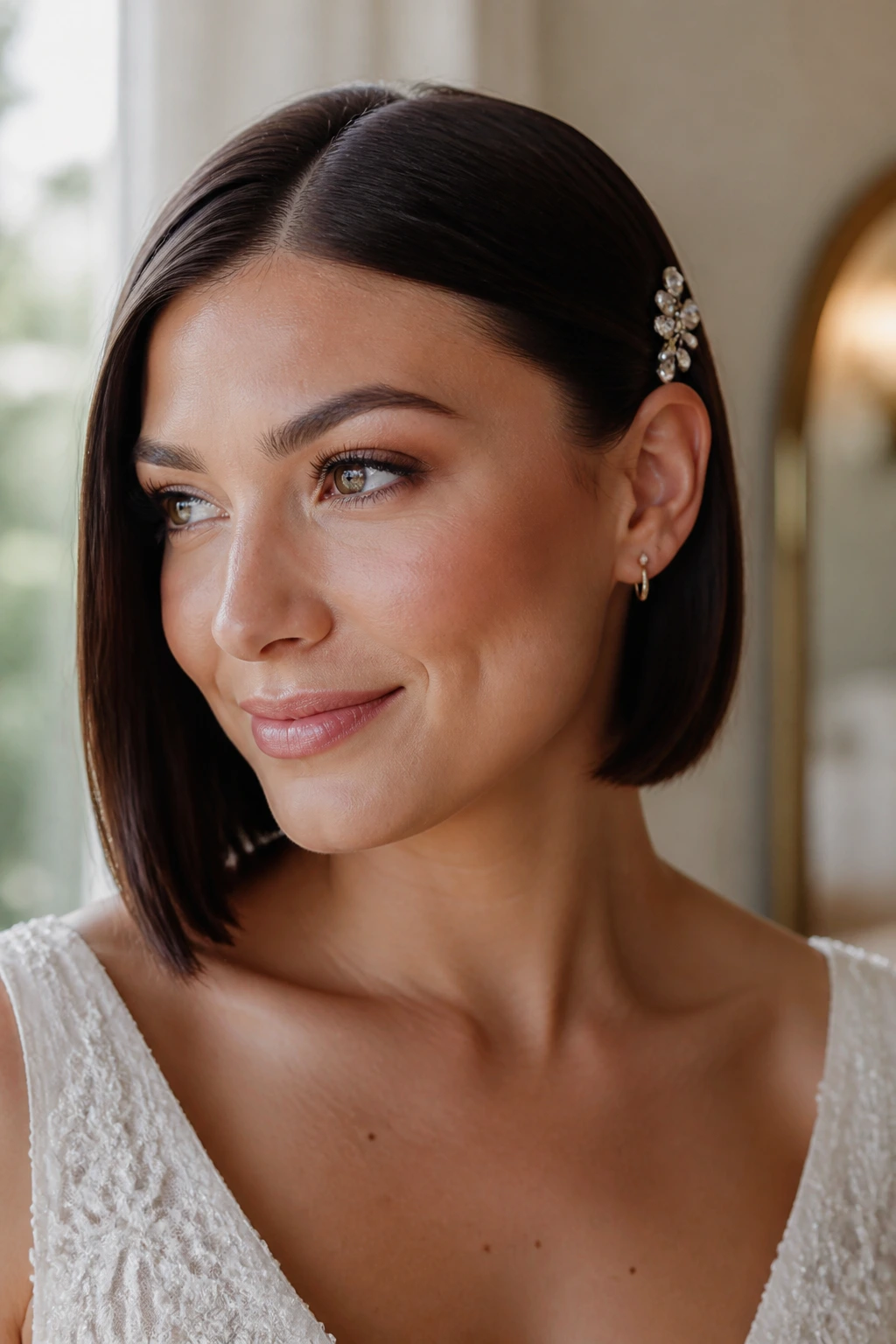
Short straight hair needs a different plan, not a smaller version of the same plan. A minimalist bob tuck behind one ear is one of the strongest choices because it respects the haircut instead of trying to turn it into an updo. The clean side tuck creates shape, and a crystal clip, pearl comb, or sculptural pin keeps the style bridal.
The beauty of this look is the negative space. One side stays open and sleek; the other side holds the accessory and maybe a soft bend at the ends. It feels polished without being overworked. If the bob sits right at the jaw or collarbone, the tuck gives the neckline room and makes earrings matter more.
This is the style I’d pick for brides who wear sharp tailoring, satin, or clean modern dresses. It looks thoughtful. That’s the whole win.
13. Twisted Half-Up with Pearl Pins
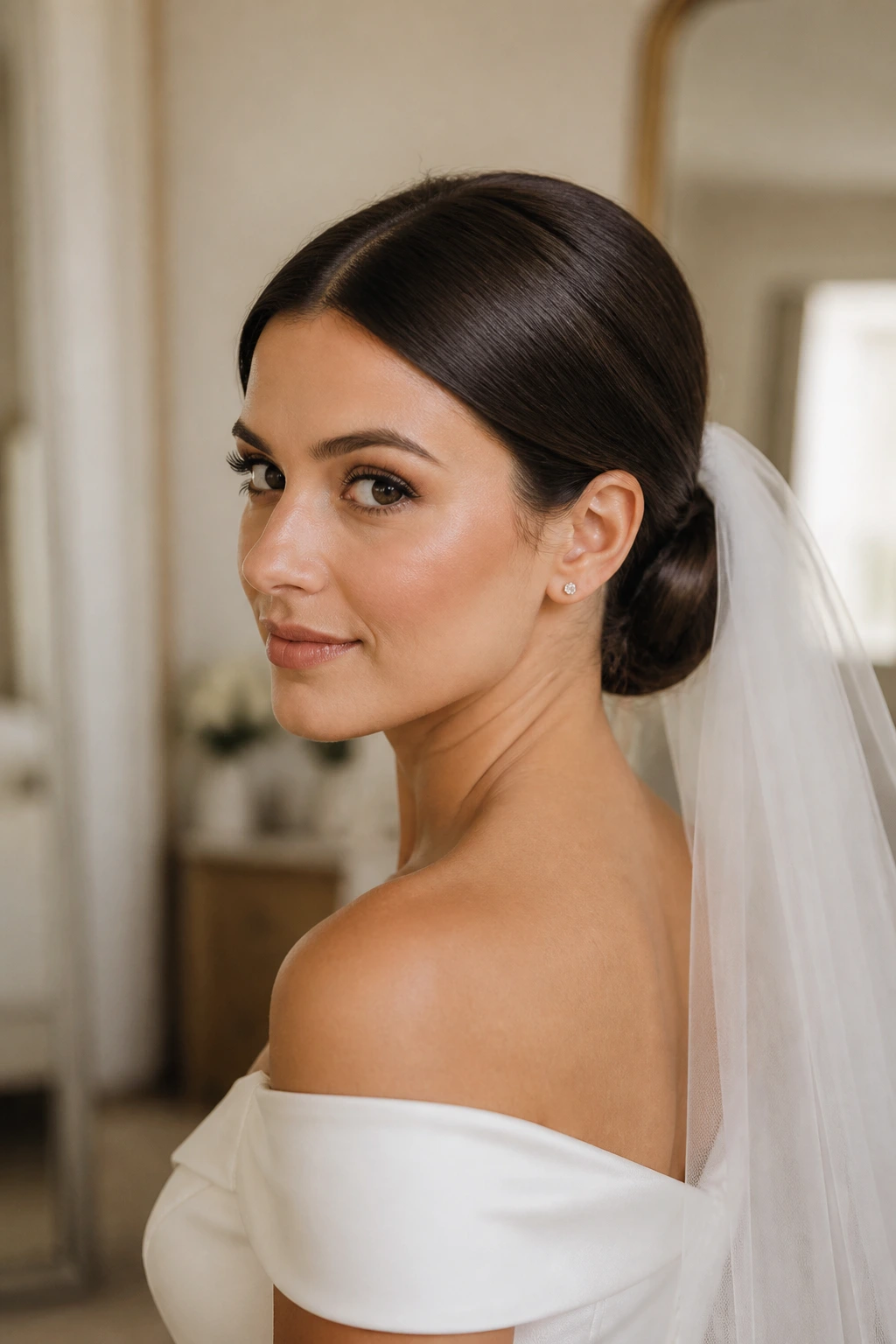
Twists are the unsung hero of bridal half-up styles. On straight hair, they create grip where braids might slide apart, and they hold a more graceful line than a basic clipped-back section. Pearl pins finish the look without making it stiff.
The style starts by taking small sections from each temple, twisting them back, and pinning them together or into a small knot at the back of the head. The lower lengths stay straight and glossy, which gives you that nice contrast between control and flow. It’s a good compromise if you want to keep the front open but still feel secure.
Pearl pins work here because they echo the shape of the twists. If you use a comb or barrette, keep it small. Too much hardware and the half-up section starts competing with the hair instead of sitting inside it.
14. Deep Side-Part Low Bun
A deep side-part low bun gives straight hair a bit of old-Hollywood weight. The part shifts the whole mood of the style. It makes the face feel softer, and the bun itself looks more elegant because the sweep of hair across the front has a bit of drama built in.
This style is a good match for off-the-shoulder dresses, one-shoulder gowns, and gowns with a substantial earring moment. The bun sits low and usually slightly to one side of the nape rather than dead center. That tiny move changes everything. The asymmetry gives the style shape from across the room.
If your hairline tends to look flat in photos, this is a better choice than a center-part bun. A deep side part naturally adds interest without asking for teasing or extra bulk.
15. Waterfall Accent Braid on Straight Hair
Accent braids do more work on straight hair than full braids sometimes do. A waterfall braid, or a braid that runs along one side and releases sections into the rest of the hair, creates detail without stealing the whole hairstyle. That matters if you want straight lengths to stay the main story.
The style looks best when the braid is clean and narrow. Too chunky, and it starts to look heavy against the smooth hair. Too tiny, and it disappears. Somewhere in the middle is right. The rest of the hair can stay pin-straight or have a slight bend through the ends so the braid has a softer landing.
This is a nice option for garden venues, softer dresses, and brides who want one interesting detail rather than a full set-piece. It’s a small move with a decent payoff.
16. Wrapped Ponytail with Satin Finish
A wrapped ponytail looks much more expensive than a bare elastic ever will. You take a section of hair from the ponytail, wrap it around the base, and pin it underneath so the closure disappears. On straight hair, that clean wrap creates a smooth, intentional base with very little visual clutter.
The satin finish matters. You want gloss, not grease. A little smoothing cream through the mid-lengths and ends can help, but the roots should stay controlled rather than slicked flat. That balance keeps the ponytail from looking like it belongs in a gym.
This style works well with longer veils that can be pinned above or below the wrap point. It also survives movement better than a loose ponytail, which is why it’s one of my favorite ceremony-to-reception looks. It moves without unraveling into chaos.
17. Soft Blowout with a Statement Clip
A soft blowout counts as a bridal style when the accessory does the heavy lifting. Straight hair doesn’t need to be curled into submission if the cut is nice and the finish is smooth. A statement clip — sculptural, pearled, jeweled, or even matte metal — can pin one side back and turn simple lengths into something ceremonial.
The blowout should have body, not bounce for the sake of bounce. Think brushed volume at the crown, soft movement through the lengths, and ends that flip just enough to avoid stiffness. If the hair is too flat, the clip looks like it’s rescuing the style. If there’s a little shape, it looks like it belongs there.
This is a great choice for brides who wear minimal dresses or for ceremonies where hair down feels more like them than any updo ever could.
18. Gibson Tuck for Long Straight Hair
The Gibson tuck has a lovely way of making straight hair look tucked-in, not stiff. Hair is rolled upward and inward at the nape, usually into a soft pocket, which keeps the finish low and elegant. On long straight hair, the tuck shows off length without leaving it loose.
The reason it works so well on bridal hair is the shape. The rolled fold creates a clean back view, and the style stays secure under a veil or floral comb. It’s less formal than a French twist and less casual than a low ponytail. That middle ground is useful.
If your dress has buttons, a keyhole back, or a lot of detail at the neck, the Gibson tuck gives you room to show it off. It also handles straight hair better than many people expect because the smooth texture helps the roll lie flat.
19. Double Knot Low Bun
Two knots can read cleaner than one bun if the hair is long and fine. The double knot low bun uses two folded sections or two twisted loops to create a shape that feels sculptural, not bulky. On straight hair, that means you get dimension without needing padding.
I like this style for brides who want something a little less expected than the standard chignon. It still sits low and secure, but the overlap of the knots creates interest in the back view. If you’re wearing a veil, the anchor point can sit just above the knot line so the comb doesn’t fight the shape.
The style is especially good when you don’t want the bun to look too round. It keeps the silhouette narrow, which can be flattering with sleek dresses and sharper jewelry.
20. Straight and Glossy with a Headband
A headband can rescue straight hair without burying the style. A padded satin band, a pearl-edged band, or a slim embellished piece frames the face and gives the hair a finished edge. The rest of the hair can stay down, straight, and glossy, which is exactly the point.
This look works because the accessory becomes the architecture. You’re not trying to force the hair into a shape it doesn’t naturally want. You’re giving it a frame and letting the texture do what it already does well. If the ends need a slight bend, fine. But keep the top clean.
It’s a strong option for brides with bangs, shorter layers, or a face shape that benefits from a little framing above the brows. Also, it’s comfortable. That matters more than people admit.
21. Center-Part Sleek Plait
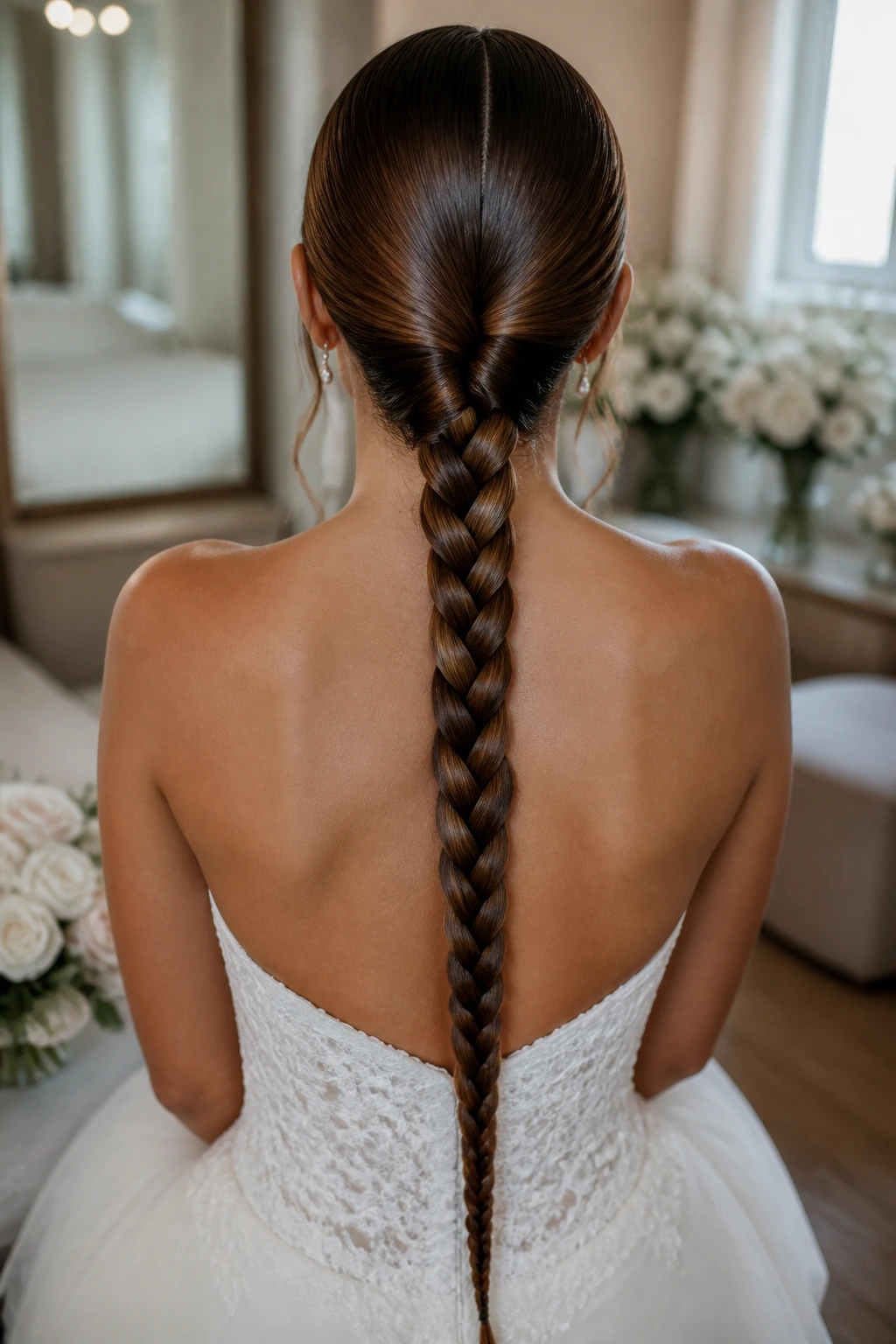
A center-part plait keeps everything tidy, and that’s the point. The hair is brushed smooth, split cleanly, and braided down the back in one neat line. Straight hair makes the braid look precise rather than fluffy, which gives the style a surprisingly refined feel.
The plait can be tight and narrow for a modern finish or a little looser near the ends for softness. Either way, it stays controlled. I’d choose this for brides who want the back of the dress to remain visible but still want more structure than a ponytail gives.
You can dress it up with ribbon, tiny pins, or a wrapped base if you need more bridal presence. Without those extras, it still works. Sometimes that’s the better choice.
22. Face-Framing Low Knot with Loose Tendrils
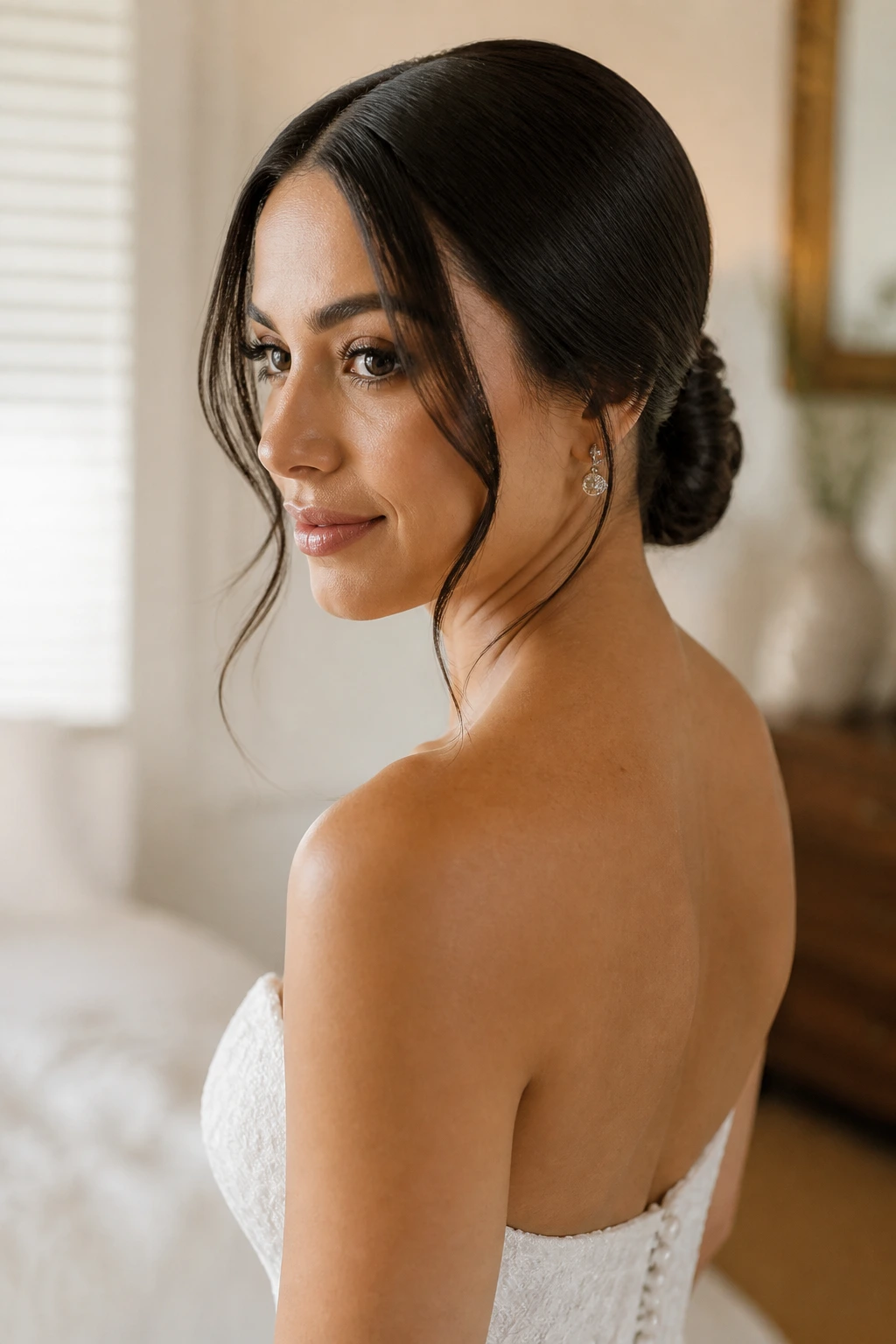
Loose tendrils are tricky on straight hair, but they can work if they’re controlled. A face-framing low knot with a few deliberate pieces around the cheekbones feels softer than a fully slicked bun, yet it doesn’t drift into mess. The knot stays low and neat while the front gets a little movement.
The key is restraint. Pick the pieces that matter — usually one near each temple — and leave them with a gentle bend or a soft curve from a flat iron or large iron barrel. If you pull out too much, the style starts to look unfinished. A little is elegant. A lot is sloppy.
This is a nice choice for brides who like the shape of an updo but want to keep the face from looking too bare in photos. The tendrils soften the profile without stealing the show.
23. Veil-Anchor Pinback for Short Straight Hair
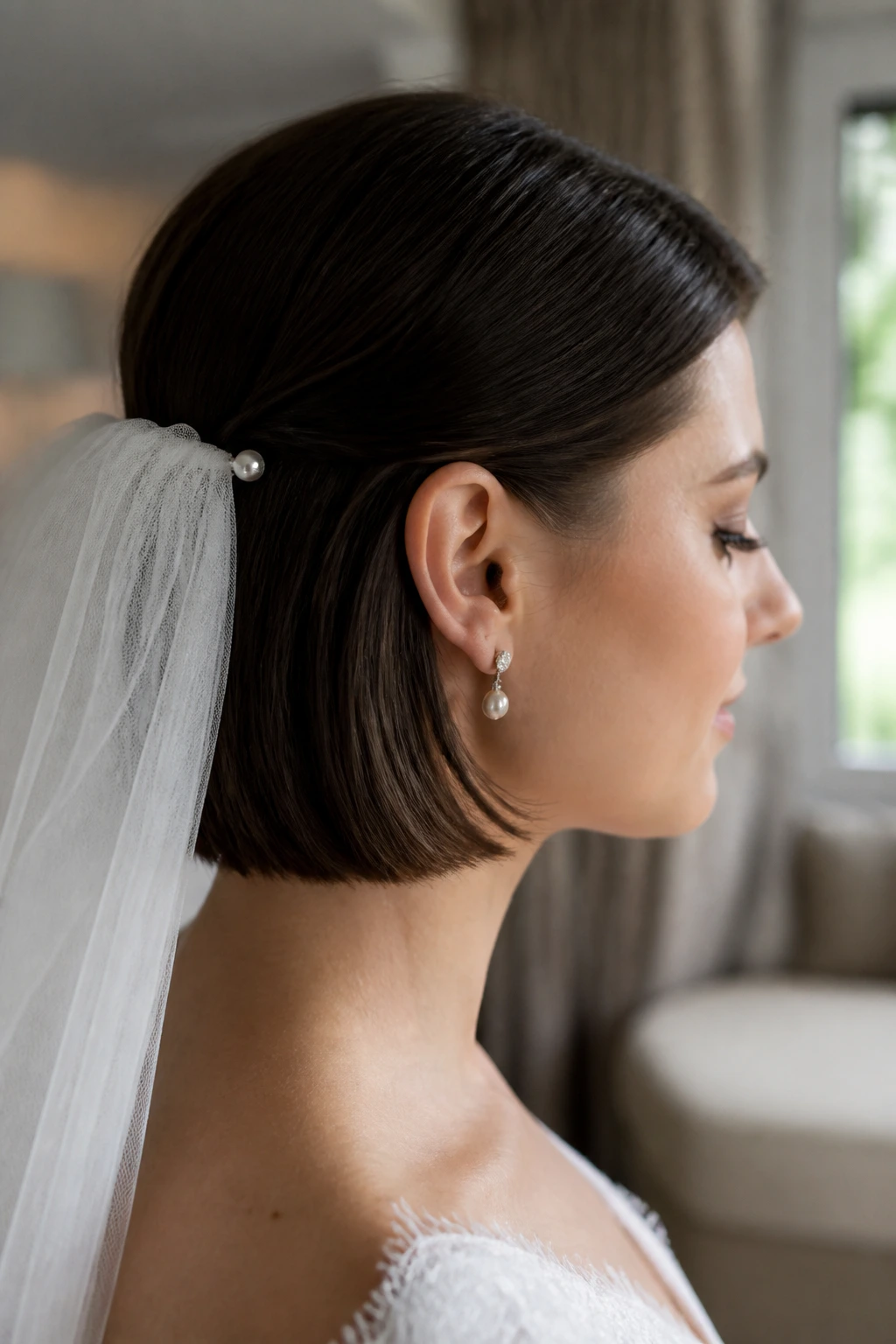
Short straight hair looks best when the pinning feels intentional, not borrowed from long-hair ideas. A veil-anchor pinback does exactly that. One side, or both sides, get pinned neatly back with a comb, a crystal bar, or a cluster of small pins, and the veil attaches to that anchor without trying to overwhelm the cut.
This style is especially good for pixies, bobs, and shoulder-length cuts that don’t want to be forced into fake volume. The hair keeps its own shape. That’s the win. You can add a soft bend to the ends, tuck one side behind the ear, or leave the front smooth and let the accessory carry the ceremony.
Short straight hair at a wedding can look incredibly chic when it’s treated like a real style rather than an inconvenience.
How to Choose the Right Straight-Hair Bridal Style for Your Dress and Veil
A bridal hairstyle doesn’t live by itself. It has to sit next to the dress, the veil, the earrings, and the way you actually move your head. Straight hair makes that coordination easier in some ways because the finish is clean, but it also means every line matters. If the dress has a high neck, a low bun or French twist usually keeps the whole look from feeling crowded. If the gown has an open back, a wrapped ponytail or low knot leaves the fabric visible and lets the back of the dress do its job.
Veils need their own logic. A comb veil usually likes a style with some structure at the crown or nape, because that gives the comb something stable to grip. A mantilla or soft drape can sit beautifully over a center part or half-up style. And if you’re planning to remove the veil for the reception, don’t build a hairstyle that only works while the veil is attached. That’s a rookie move. The hair should stand on its own.
Length and density matter too. Fine straight hair often looks best in narrower, more controlled shapes: tucked buns, sleek ponytails, half-up sections that don’t demand too much bulk. Thicker straight hair can handle bigger twists, bubble sections, and fuller knots without collapsing.
The Prep Work That Keeps Straight Hair From Slipping
Straight hair has one annoying habit on a wedding day: it behaves like it’s trying to escape its own pins. That doesn’t mean you need gallons of hairspray. It means you need grip in the right places. Start with a blow-dry that smooths the cuticle, then add a lightweight mousse or setting lotion at the roots if the hair is very fine. Roots need hold. Ends need polish. Those are not the same thing.
A flat iron can help, but don’t iron every strand into submission if the style needs a little bend. Clean straight hair is easier to section, easier to pin, and easier to shape. If you’re doing an updo, a small amount of dry shampoo or texture spray at the crown and nape gives bobby pins something to bite into. Use it sparingly. Too much and the hair feels dusty before noon.
Hair that was washed the same morning can be slippery. Hair that’s a day old often grips better. That single day makes a difference, especially for low buns, twists, and tucked styles. If your scalp tends to get oily fast, plan the wash so the roots are clean but not freshly stripped.
Tools and Products That Earn Their Place in the Kit
-
Rat-tail comb: For crisp parts, clean sections, and those little adjustments that separate polished from sloppy.
-
Boar-bristle or paddle brush: Helps smooth the crown and gather straight hair without leaving it puffy.
-
Sectioning clips: Keep the hair out of the way while you build twists, braids, or a low bun.
-
Fine bobby pins and U-pins: Straight hair needs more than one size; U-pins help support buns, while bobby pins lock down seams and flyaways.
-
Strong-hold hairspray: Use a flexible but reliable spray so the style sets without turning brittle.
-
Texturizing spray or dry shampoo: A small amount at the roots or pin points gives smooth hair some bite.
-
Flat iron or blow-dryer with nozzle: Useful for getting the base clean before styling and for refining face-framing pieces.
-
Veil comb and decorative pins: If the style includes a veil or accessory, test the placement before the wedding day. Guessing is how combs slip.
-
Small elastic bands: Better for ponytails, braids, and hidden anchors than oversized school-day elastics.
-
Shine spray or light smoothing serum: Finish the lengths with a whisper of gloss, not a greasy coat.
How to Keep the Style Fresh Through Photos, Dinner, and Dancing
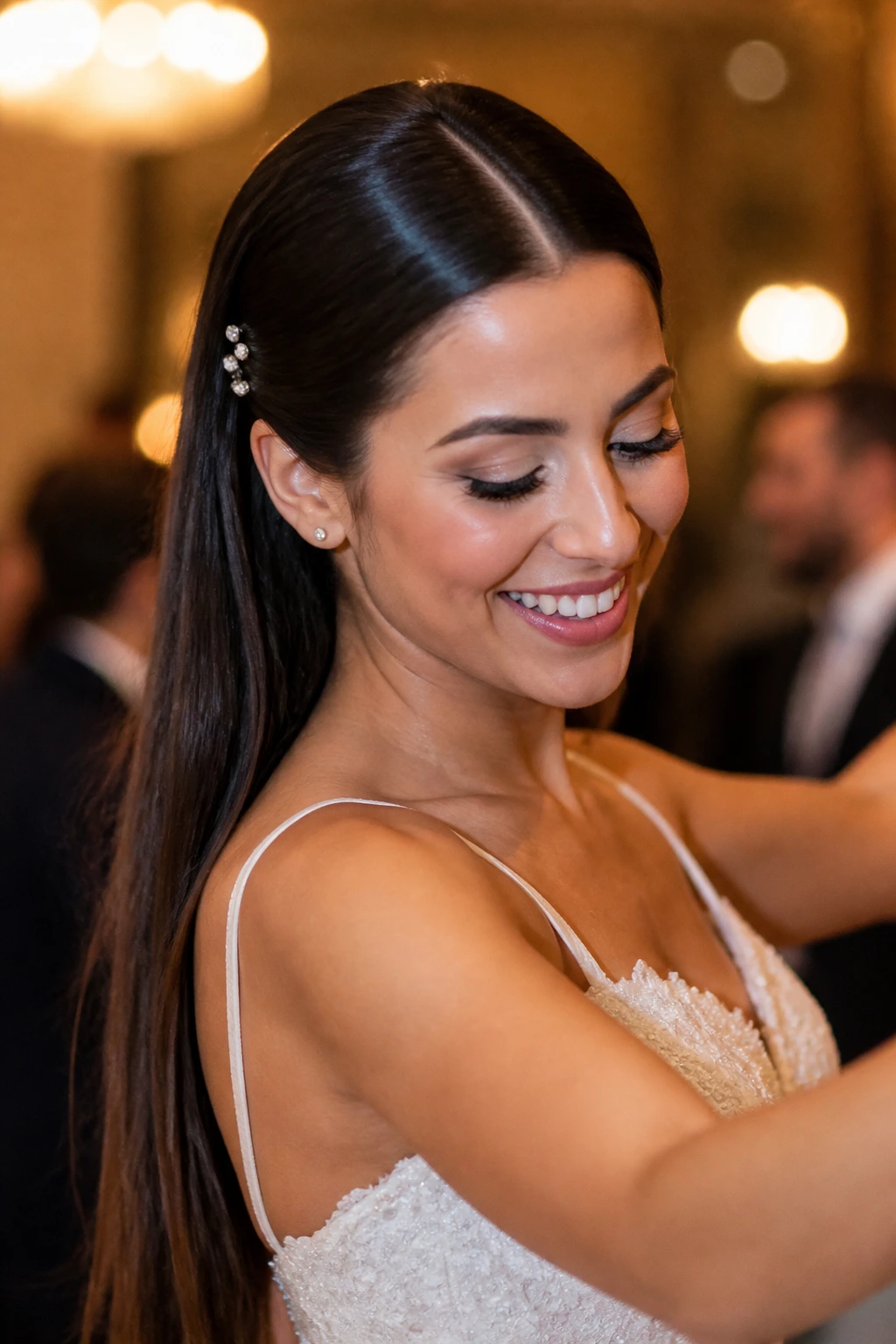
The first hour is not the only hour. A bridal hairstyle has to survive portraits, hugs, eating, and movement, which is where straight hair either shines or starts to slip. The best defense is placement. Pins should go where the style naturally wants to collapse — usually the nape, the seam of a twist, the base of a ponytail, or the fold of a bun. If the pins are hidden in the middle of nowhere, they won’t help when the style loosens.
Pack a tiny touch-up kit. A few bobby pins, a travel hairspray, a small comb, and a sachet of anti-frizz serum are enough. Keep it light. You’re not rebuilding the hairstyle at the reception, just smoothing the crown, pinning a loose seam, or re-seating a clip that shifted after the first round of dancing.
If the style is down or half-up, the biggest issue is usually flattening at the crown. A quick lift at the roots with your fingertips can restore shape. If the style is up, check the nape after photos and after the veil comes off. That area always works the hardest.
Common Mistakes Brides Make with Straight Hair
The biggest mistake is overloading straight hair with texture products before you know where the style needs grip. Hair that’s crunchy at the roots and soft at the ends behaves badly in pins. The fix is simple: apply texture only where the updo or half-up section will actually sit, then leave the lengths smooth.
Another common problem is choosing a style that depends on volume the hair doesn’t naturally have. A tall bun or overstuffed braid can look sparse on fine straight hair unless you add padding or extensions. If the style wants body, give it a helper. If not, don’t force it.
Veil placement causes trouble more often than people think. A comb set too high can slide, and one placed too low can drag the hairstyle down. Test the veil with the actual hairstyle shape, not a guess. And if you plan to remove the veil after the ceremony, make sure the hair still looks complete without it.
Finally, too many loose pieces can make straight hair look unfinished fast. One or two tendrils can be lovely. Six can look like you ran out of time.
Variations and Alternatives for Different Lengths and Hair Densities
For a bob or lob: Choose a side tuck, a sleek headband, or a miniature French twist pinned low at the back. Those styles respect the cut and keep the ends looking intentional.
For fine straight hair: Lean into narrow buns, wrapped ponytails, and half-up styles with a single barrette or comb. Fine hair usually looks best when the silhouette stays clean and the accessory adds the detail.
For thick straight hair: Try bubble ponytails, low knots, Gibson tucks, or a full braided crown. Thick hair can hold more shape, so the style can take up a little more space.
For a more romantic finish: Soften the front with a gentle bend through the ends or a pair of slim face-framing pieces. That tiny move changes the whole mood without turning the style into curls-for-the-sake-of-curls.
For a minimalist dress: Keep the hair sleek and choose one clean accessory — a barrette, a pearl pin cluster, or a satin ribbon. The simpler the gown, the more the hair can carry a subtle, tailored line.
Frequently Asked Questions
Should brides with straight hair wash it the day of the wedding?
Usually, no. Straight hair often holds up better when it’s washed the day before or even two days before, depending on scalp oil and hair type. A little natural oil gives pins something to hold onto, which is helpful for buns, twists, and half-up styles.
What hairstyle works best for fine straight hair?
Low buns, wrapped ponytails, side tucks, and half-up styles with a single accessory tend to work best. They don’t ask fine hair to be bigger than it is, which keeps the style looking clean instead of hollow.
Can straight hair hold a veil securely?
Yes, if the veil is anchored into a pinned section or a style with enough structure at the crown or nape. A few crossed bobby pins under the comb usually help. The veil should sit into the hairstyle, not balance on top of it.
Do I need extensions for a bridal hairstyle on straight hair?
Not always. If you want a fuller braid, a bigger bun, or extra length for a dramatic ponytail, extensions can help. But many sleek styles look better without them because the clean line is part of the appeal.
How do I keep straight hair from looking greasy in a sleek style?
Use smoothing serum only from mid-lengths to ends, and keep product off the roots unless the style calls for it. A glossy finish is the goal, not a shiny scalp. That line matters.
What if my hair slips out of pins?
Add texture spray at the exact spot where the pins go, then cross the pins in an X or slide them into a tiny woven pattern. Straight hair needs a little friction. Give it that, and the pins stop fighting you.
Can I wear a headband with a veil?
Yes, but the veil and headband need to live in separate parts of the hairstyle. Usually the veil comb sits lower or farther back, while the headband frames the front. Test both together before the wedding day so they don’t crowd each other.
Which styles suit a high-neck dress best?
Low buns, chignons, French twists, and tucked knots are the cleanest match. They keep the neckline visible and stop the top of the dress from getting buried under hair.
A Polished Finish That Feels Like You
Straight hair doesn’t need to be rescued on a wedding day. It needs shape, grip, and a little discipline. Once you stop trying to make it into something it isn’t, the options open up fast: sleek buns, ribbon-tied ponytails, soft half-up styles, sharp side parts, and veil-ready pinbacks that feel clean from the ceremony to the last dance.
The nicest thing about these styles is that they don’t fight the hair’s nature. They use it. That’s why they stay elegant in photos and still look like hair, not a construction project. Pick the silhouette that fits the dress, the veil, and your own face, then build the style around that line. The result tends to look calmer — and much more expensive — than the fussier route.
