



A chin-length curly haircut can do two opposite things on a round face. If the shape is right, it pulls the eye down, shows off the cheekbones, and gives the curl pattern room to move. If the cut is wrong, the whole head turns into one soft circle, which is exactly the look most people are trying to avoid.
Curly hair makes this more interesting, because curls do not sit where you leave them. They shrink, puff, stack, and spring back with their own opinion. A bob that brushes the chin in the salon chair may bounce up two inches after a diffuser, and the same shape can look sleek on one curl pattern and bulky on another. That is why chin-length curly haircuts for round faces need more thought than a straight-across trim and a prayer.
The good versions do not fight the curl. They use it. A side part can break up width at the cheeks, a tapered nape can clean up the back, and a few internal layers can keep the ends from turning into a mushroom. The right cut feels deliberate, not puffy. The next sections get into the shapes that actually do the work, and the ones I’d hand to a stylist without blinking.
Why This Collection Is Different
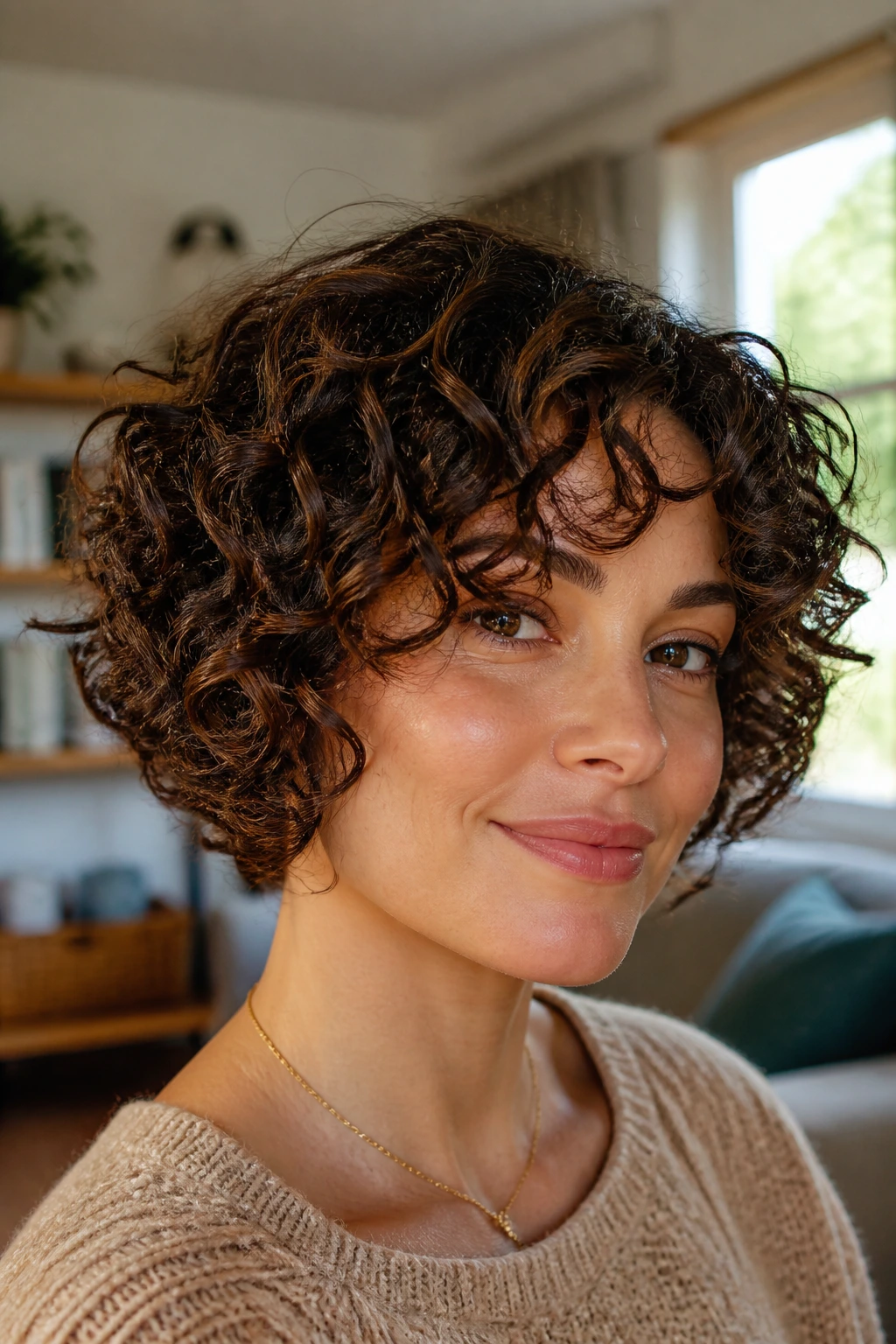
-
Shrinkage is built in: Every cut here assumes your curls will rise after they dry, so the shape is described by how it looks dry, not just what the comb said in the chair.
-
Round faces need interruption, not more roundness: The cuts lean on side parts, asymmetry, crown lift, and cheekbone-skimming pieces so the silhouette stops at more than one point.
-
There’s room for different curl densities: Fine curls need a different perimeter than dense coils, and these styles call that out instead of pretending one bob works for every head of hair.
-
Short hair does not mean flat hair: Several of these cuts keep volume at the crown and temples, which is the part most people undercut too much by accident.
-
A chin-length shape can still feel soft: Not every option here is sharp or architectural. Some are built to move, which matters if you air-dry and do not want to fight your texture every morning.
-
You can choose low-maintenance or sculpted: I’ve included cuts that grow out quietly and cuts that need a cleaner outline, so you can pick the one that matches your patience level.
1. Soft Side-Part Curly Bob
A soft side-part curly bob is the easiest place to start if you want shape without drama. The side part shifts the visual weight away from the widest part of a round face, and the curl clumps fall in a way that feels relaxed rather than stacked up against the cheeks.
Why the side part does the heavy lifting
The part line matters more than most people think. On a round face, a center part can work, but a side part usually gives you a cleaner diagonal line, and diagonals are your friend when you want a face to read a little longer. I like this cut best when the front pieces sit just below the chin once dry, because curls tend to spring up and the extra half-inch buys you room.
Ask for soft layers around the lower cheek and jaw, not a bunch of short pieces at the widest part of the face. That’s the whole trick. You want movement, not side fluff.
- Best placement: Front pieces that land 0.5 to 1 inch below the chin when dry.
- Best curl range: Loose waves through springy ringlets, especially if the curls clump well.
- Styling note: Tuck the smaller side behind one ear after diffusing; it opens the face fast.
- What to avoid: A part that sits exactly over the cheekbone if your hair puffs outward there.
One detail that saves this cut: ask for the layers to be point-cut, not hacked blunt, so the ends move instead of forming a shelf.
2. Tucked-Nape Curly Bob
This is the cut that makes the back of the head behave. The nape is lightly tapered or cleaned up so the curls don’t balloon at the collar, while the front still hits the chin and frames the face with enough length to keep the shape grounded.
The appeal is simple. Round faces often need a little vertical lift, and a tucked nape does that without turning the whole style into a stacked bob. It gives you neck, a cleaner profile, and less of that puffy “all one width” look. On dense hair, this shape can be a lifesaver.
The catch is balance. If the nape is cut too high, the bob starts to look clipped rather than shaped. I prefer a soft taper under the occipital bone, with the top layer left long enough to curl over it. That way the haircut reads as intentional from the side, not shaved off in back and generous in front.
If you wear jackets with high collars or scarves, this cut is worth a look. It stays neat where hair usually fights fabric, and that matters on curly hair because friction can wreck the back of a style by lunch.
3. Curly Shag with Face-Framing Pieces
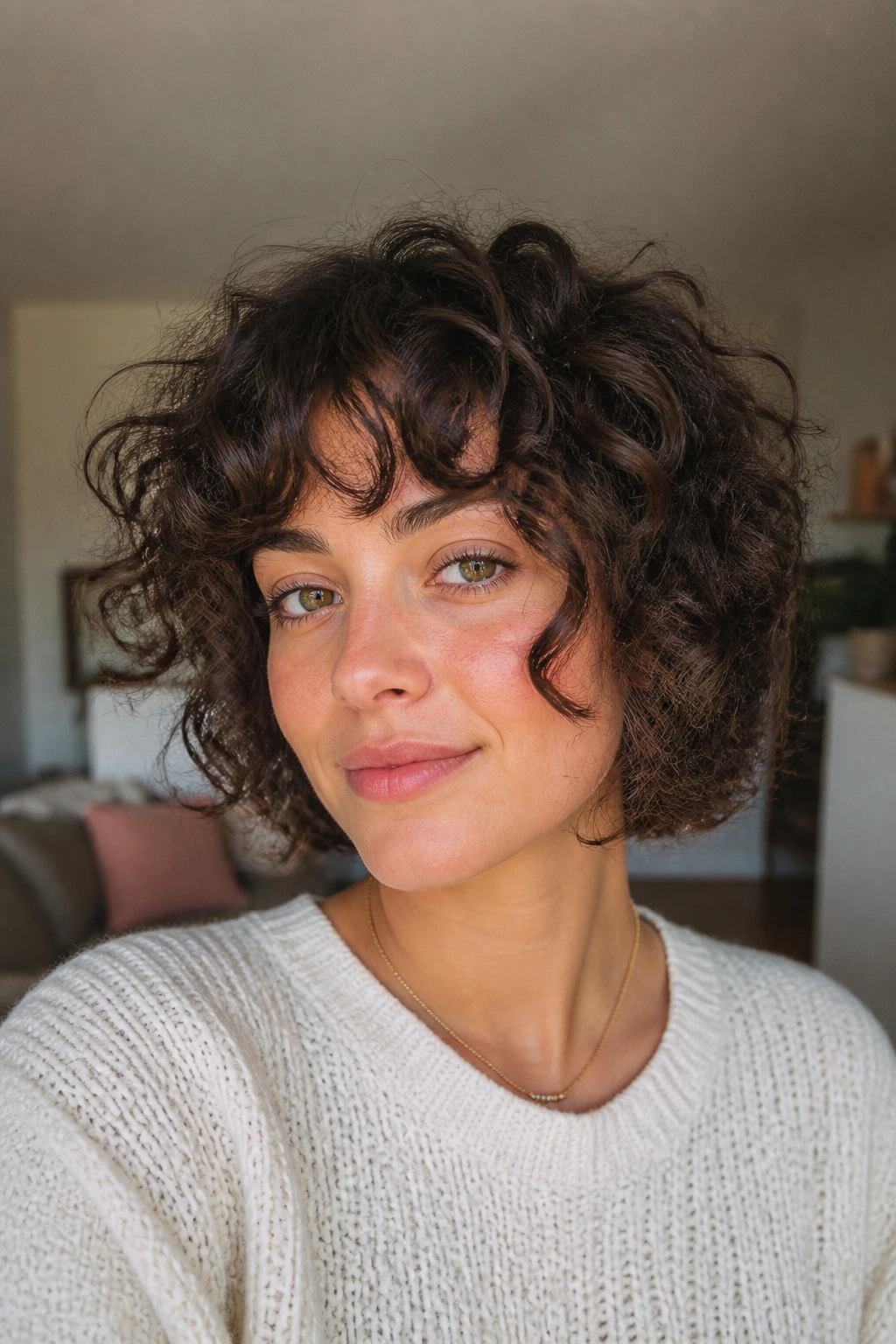
Why does a shag flatter a round face so fast? Because it breaks the silhouette into pieces. A classic bob gives you one main shape; a curly shag gives you layers, edges, and a little air between sections, which keeps the face from looking boxed in.
Where the shortest pieces should land
The shortest face-framing layers should start around the cheekbone or just below it, not right across the fullest part of the cheek. That small difference changes the whole haircut. If the shortest curl lands too high, you get width where you do not want it. If it starts lower, the eye gets pulled down and the face feels longer.
This cut also handles curl shrinkage better than people expect. The top can sit a bit shorter because the shag wants movement, but the bottom perimeter should still be chin-length when dry. I like this most on 2C to 3B hair with enough natural spring to separate into pieces.
- Good for: People who like a messy, lived-in shape.
- Not ideal for: Very fine curls that collapse when overloaded with layers.
- Styling note: Scrunch mousse into the crown first, then gel through the ends.
- Ask for: Internal layers, not thinned-out ends that frizz up by day two.
The shag wins when your curls already have attitude. It gives them a better stage.
4. French Bob with a Soft Micro Fringe

If you like the idea of a sharp little bob but do not want the face to read square, the French bob is the neat answer. On curly hair, it works best when the fringe stays soft and short enough to graze the forehead without turning into one heavy block.
The micro fringe is the part people get nervous about, and fair enough. A blunt curly fringe can be unforgiving. Keep it airy, a little irregular, and longer at the temples if you want the round face to look less wide. The bob itself should stay close to the chin with a slightly curved line so the curls don’t spread outward at one level.
This cut has attitude, but it needs a stylist who understands shrinkage. I’d want to see the fringe cut dry or at least checked dry, because a curl that looks eyebrow-length wet can spring up and sit halfway to the hairline once it settles. Not a disaster if you planned for it. A mess if you did not.
The best version feels a little Parisian, a little vintage, and not remotely fussy. That is the point.
5. Rounded Curly Bob with Internal Layers
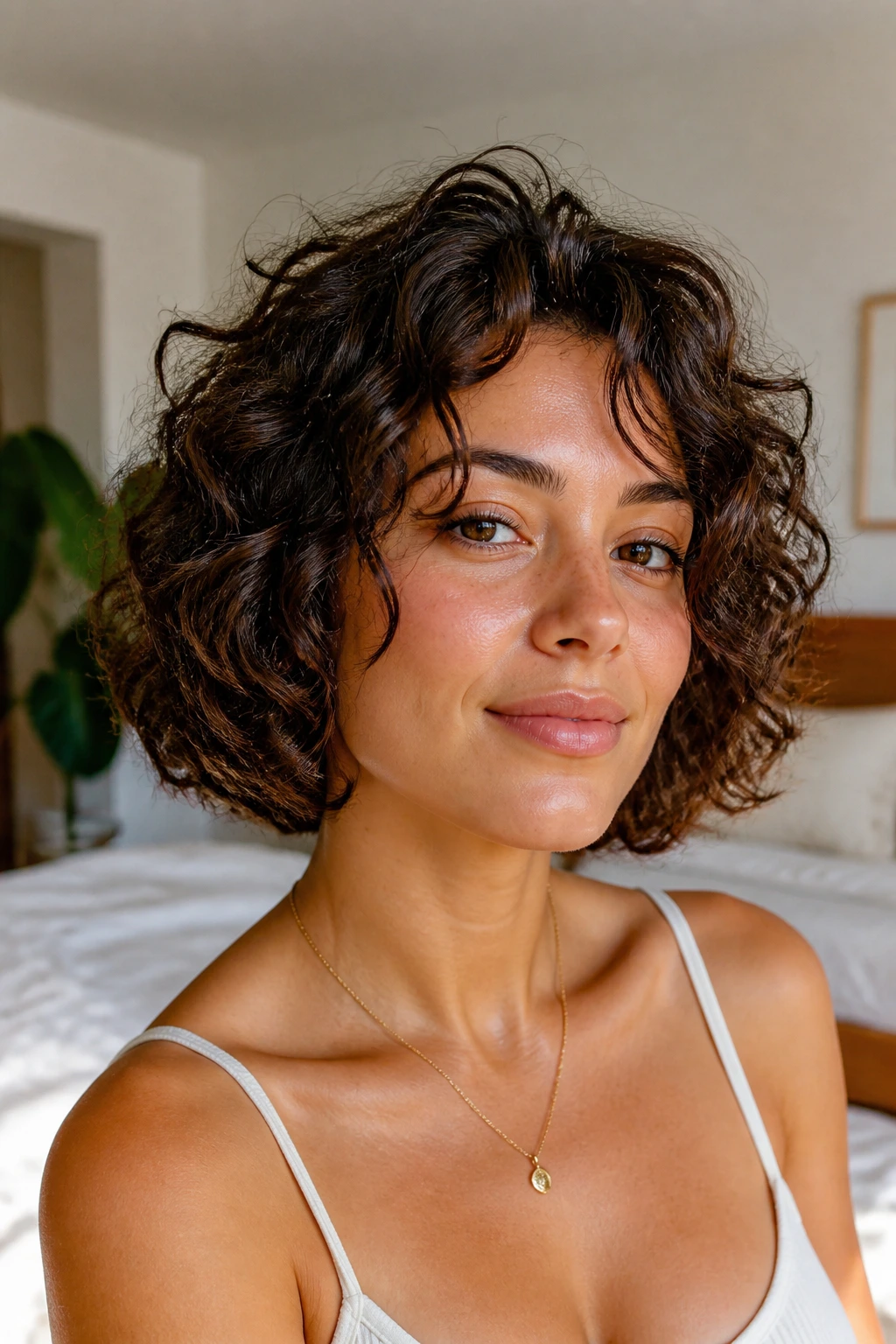
A rounded curly bob sounds like it would add width, and if the shaping is wrong, it absolutely will. Done well, though, it can be one of the softest ways to wear chin-length curls on a round face because the outer shape is controlled while the inside is de-bulked.
This is the cut for curls that want to sit in a halo but need structure underneath. Internal layers remove weight from the middle without collapsing the outline. The eye sees a clean curve at the chin, then the curls move around it instead of exploding past it. It’s a controlled roundness, which sounds ironic and is exactly why it works.
I would not use this on hair that already expands a lot at the cheeks unless the crown gets some lift too. That lift can come from the cut or from how you diffuse, but it has to be there. Otherwise the bob turns too full at the sides and starts reading as a sphere.
The nicest thing about this shape is how quietly it grows out. A few extra weeks do not ruin it. The outline just gets a little softer, which is often better than a sharp line anyway.
6. Angled Curly Bob with Longer Fronts
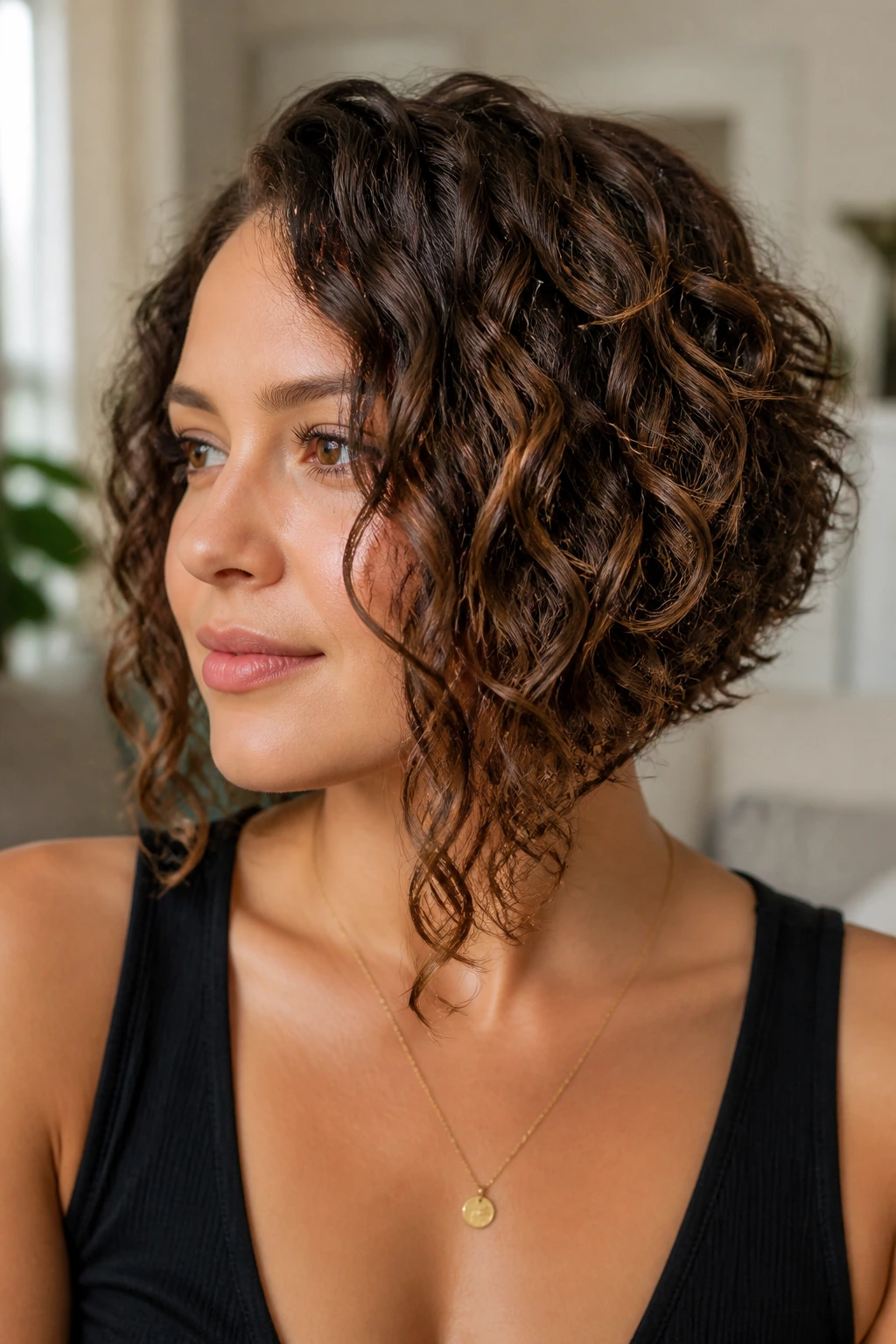
An angled curly bob does one thing extremely well: it drags the eye forward and down. The back sits slightly shorter, the front hangs a bit longer, and that subtle slope gives a round face more length without making the haircut look severe.
I prefer this when the curl pattern clumps well and the front pieces can show the angle. If the curls are too fuzzy or too small, the shape can disappear. But when it works, it works fast. The front can sit 1 to 2 inches longer than the nape and still read as chin-length from the side, which is enough to sharpen the profile.
Who gets the most out of this shape
If your face feels widest right at the cheeks, this is one of the better bets. The longer front curls act like a frame that does not stop at the same point all the way around your head.
Keep the angle subtle. A dramatic A-line on curly hair can turn into an awkward wedge if the curl pattern has a mind of its own. Ask for soft graduation, not a ruler-straight slope. That difference matters more than the salon mirror makes it seem.
It’s a cleaner look than a shag, less retro than a French bob, and a little more polished than the messy shapes. Good middle ground. Sometimes that is exactly what you want.
7. Curly Bob with Curtain Bangs

Curtain bangs are the easiest way to bring the focus up toward the eyes without cutting a hard fringe across the forehead. On a round face, that matters. The split center and longer sides create a vertical break, and the curls fall away from the cheeks instead of sitting on them.
The bangs should start around cheekbone length, not chin length, and they should open softly at the center. If they are too short, they spring up and widen the face. If they are too heavy, they turn into a shelf. The sweet spot is a fringe that can be tucked behind the ears, pushed to the side, or left loose when the mood is there.
How the fringe should fall
The shortest bits should skim the upper cheek and blend into the front layers. You want the eye to travel through the face, not stop at one dense block of curls. This is especially good for loose ringlets and wavy curls that separate cleanly when styled with a diffuser.
A curtain fringe also buys you flexibility. Day one can look soft and airy. Day two can look a little more dramatic after a mist of water and a squeeze of gel on the front pieces. That’s a nice bonus because fringe maintenance can be annoying if the cut has no range.
I’d call this one of the most forgiving chin-length curly haircuts for round faces, mostly because it makes the front of the style do real work.
8. Tapered Curly Cut with a Clean Nape
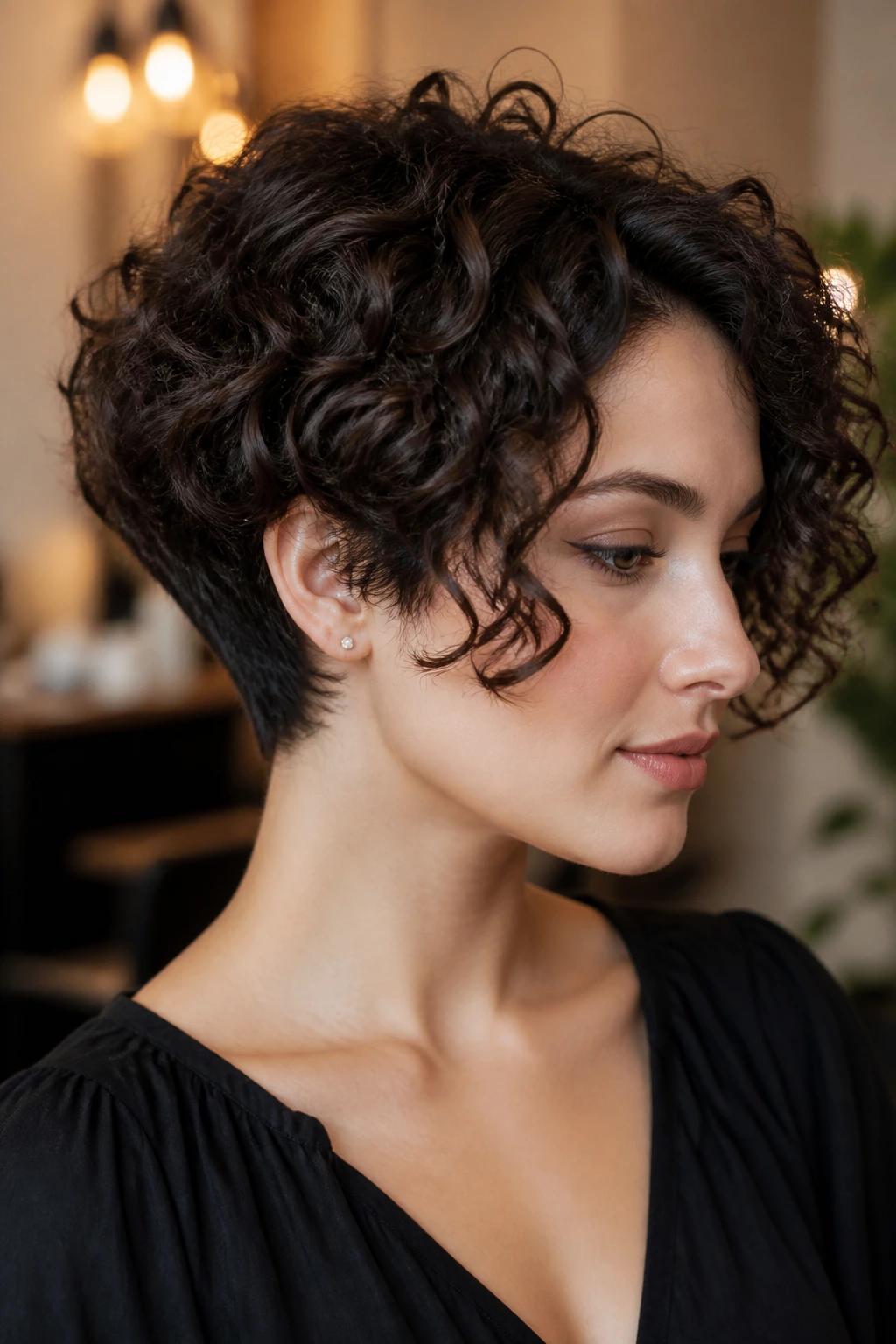
The back gets clipped a little tighter. The sides stay plush. That simple split is why a tapered curly cut can clean up a round face so well without sacrificing curl texture.
The taper at the nape removes the visual bulk that often makes short curly cuts feel boxy from behind. The front remains long enough to sit at the chin, so the face still gets framing and movement. It’s a good choice if you hate hair brushing your collar all day or if your curls swell at the back faster than they do in front.
A low taper is enough. Go too high and the haircut can look disconnected, especially when the top layers shrink up. I like a clean line that is hidden when you’re standing straight but shows a small, tidy curve when you turn your head. That small detail makes the cut feel finished.
This one is practical first, stylish second. That is not a knock. Some of the best curls are the ones that stop fighting your clothes, your neck, and your morning mirror.
9. Blunt Perimeter Curly Bob
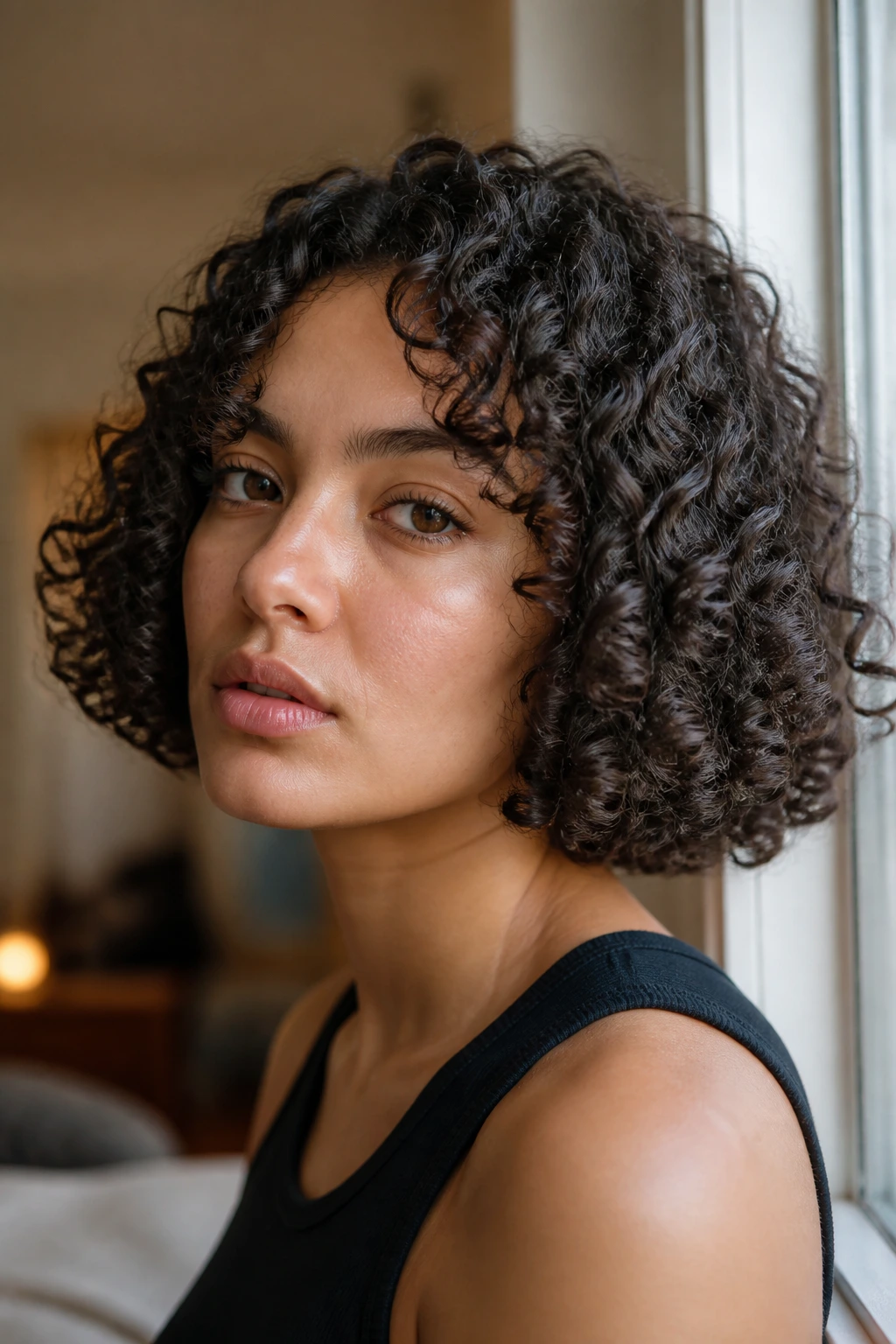
A blunt perimeter on curly hair can look stunning on a round face, but it needs the right curl shape to pull it off. The reason is simple: a clean edge gives definition, and definition is useful when curls tend to blur the outline of the face.
The trick is not to go too blunt everywhere. The line around the bottom should be strong, but the crown still needs lift and the interior may need a touch of soft layering so the cut doesn’t balloon. On tighter curl clumps, that blunt edge can look full in a good way. On looser, fluffier curls, it needs more control or it risks becoming wide.
I would use this cut if you like structure and you don’t mind putting in a little styling effort on wash day. A mousse-plus-gel combo often keeps the perimeter crisp enough to show. Without that, the line can fuzz out and lose the whole point.
This is the one I reach for when someone wants the bob to read as a shape, not a cloud. Strong choice. Not the softest one in the bunch, but one of the clearest.
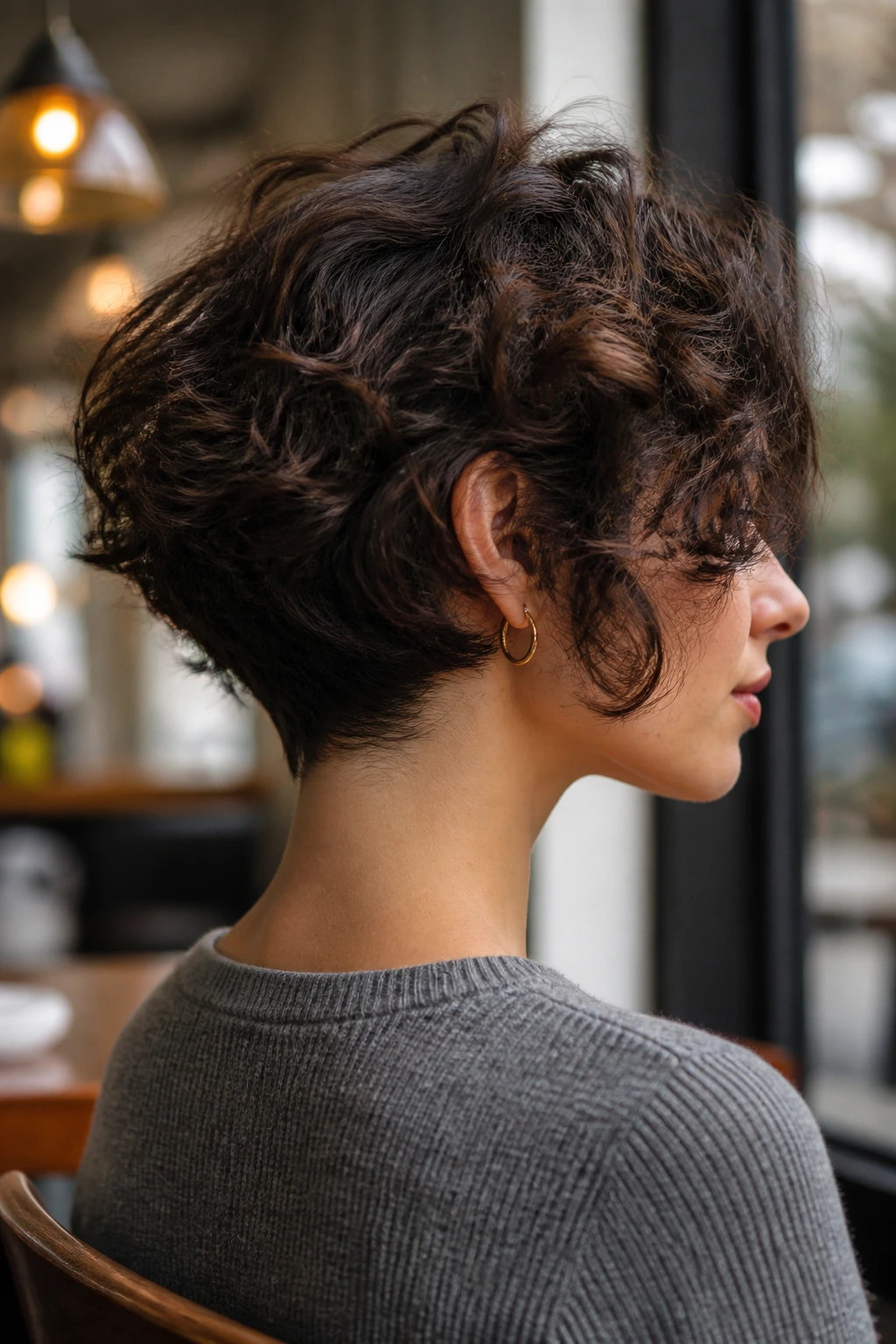
10. Chin-Grazing Pixie-Bob Hybrid
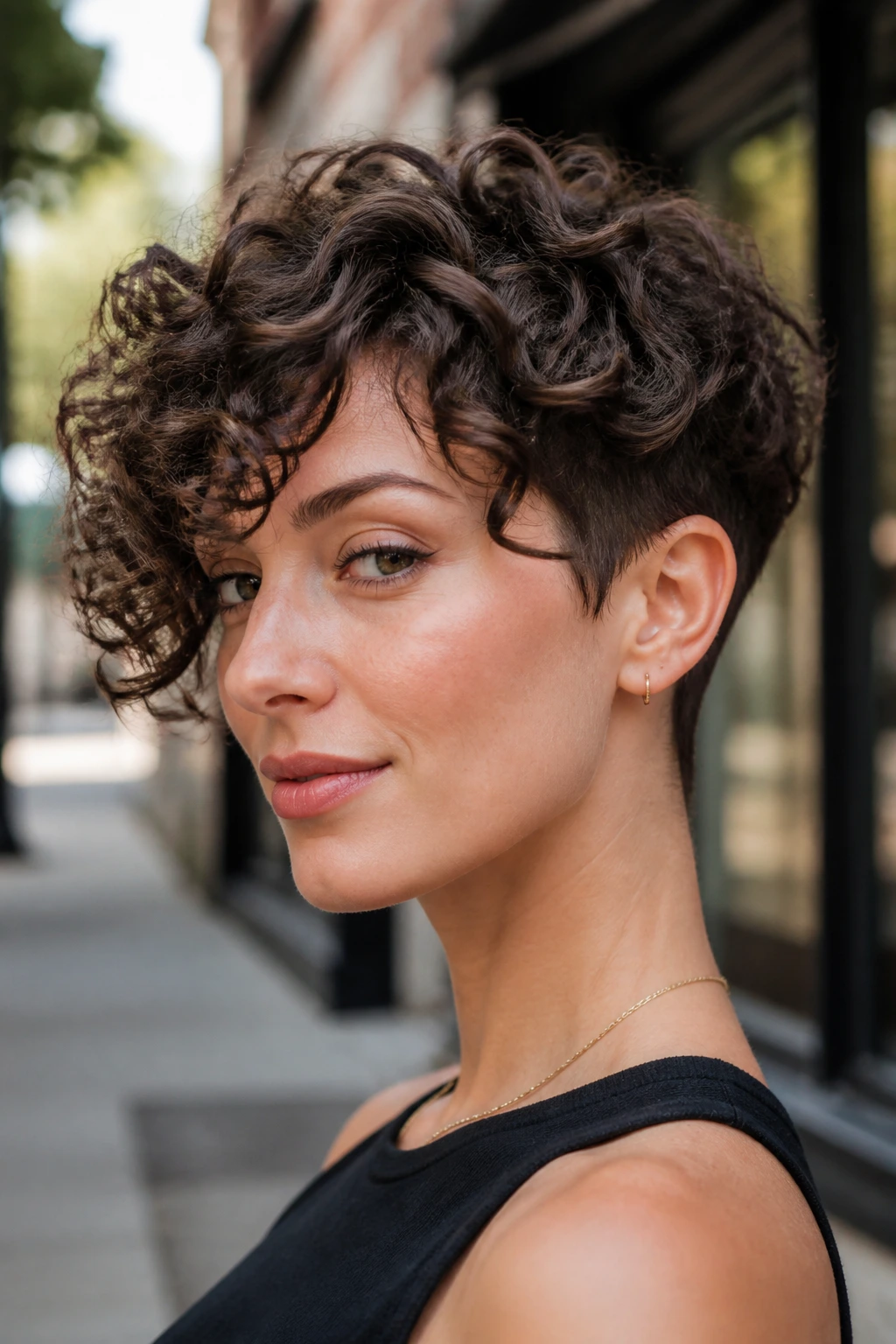
Short doesn’t have to mean severe. A chin-grazing pixie-bob hybrid keeps the nape and sides compact while letting the top and front hold enough length to touch the chin once the curls settle.
This cut is a good fit for people who want less hair around the face without going full pixie. The shorter back removes bulk and shows the neck, while the longer top gives the cut a little swing. On a round face, that vertical line can be more flattering than a wide bob that sits evenly all the way around.
The main rule here is proportion. If the top gets too short, the head starts to look top-heavy. If the front gets too long, the hybrid loses its charm and becomes an awkward in-between length. Ask for the front to be left long enough to curve under the jaw while the crown is gently layered for lift.
I like this on dense curls that need shape removal and on finer curls that need a bit more structure around the face. It’s a neat little cut when it’s done well. A mess when it’s not. There isn’t much middle ground.
11. Inverted Curly Bob with Crown Lift
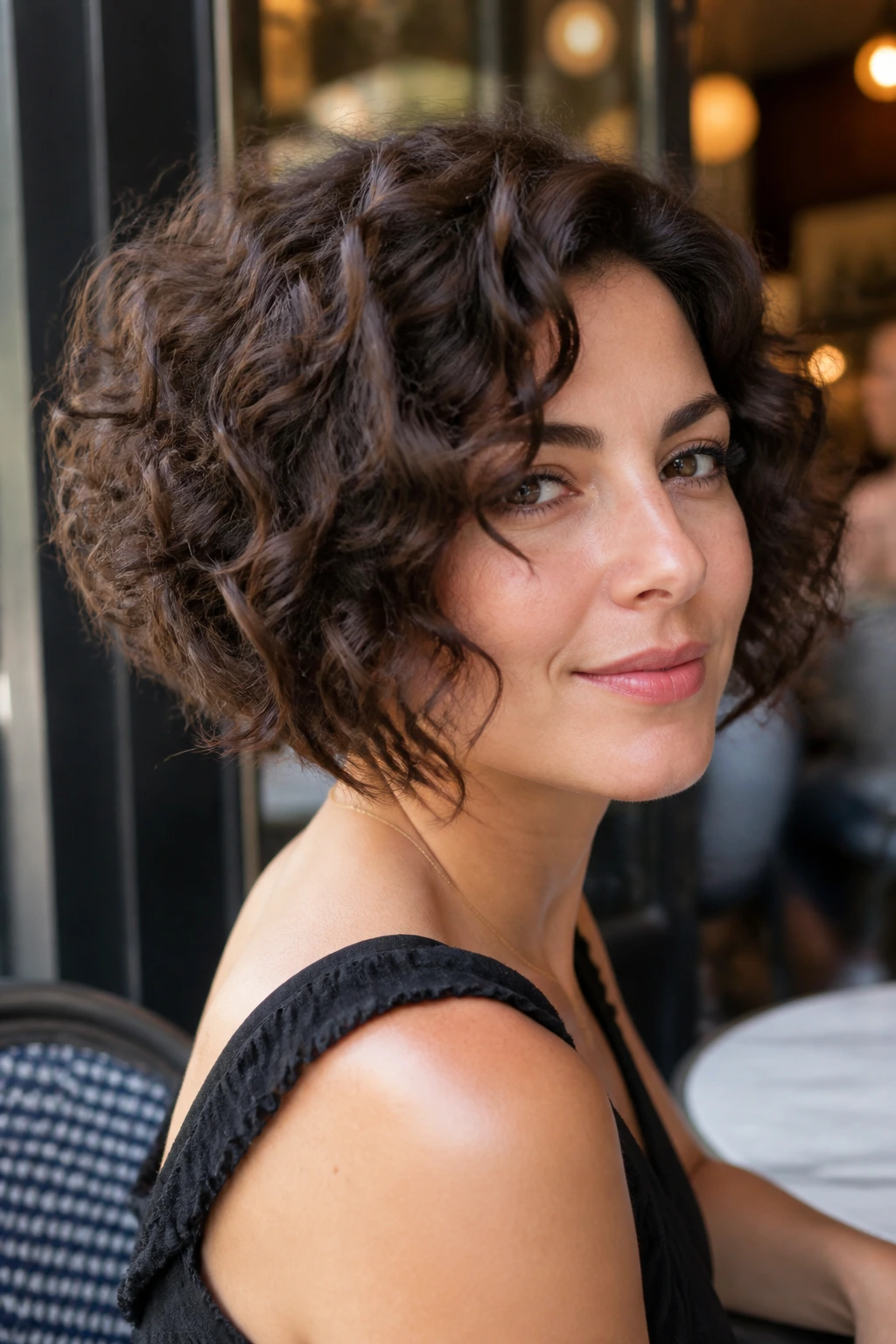
An inverted bob gives you one of the cleanest visual tricks in curly hair: more height at the back, more length in the front, and a clear upward line through the crown. On a round face, that line helps stretch the shape instead of echoing it.
The back should be stacked lightly, not piled. Too much stacking and the haircut becomes a triangle or a mushroom, neither of which does a round face many favors. The front can sit at the chin or just below it, depending on shrinkage. I always think it’s smarter to err on the side of a little extra length when curls are springy.
The part that makes it work
Crown lift. Without it, the front-heavy shape can drag the face downward and make the jaw look wider. With it, the angle reads clean and the profile gets a little more lift.
This is a strong choice if you like a haircut that looks deliberate from every angle. Side view? Clean. Back view? Shaped. Front view? Long enough to frame the face without hiding it. That’s a nice set of problems to have.
12. Center-Part Curly Bob with Cheekbone Layers

A center part is not banned on round faces. It just needs help. When the bob hits chin length and the front layers start at the cheekbone, the center part creates balance instead of more width.
This works best when the curls are defined and the roots can hold a little lift. If your hair lies flat on top and puffs at the sides, a center part can feel too honest. But if the crown has some height and the front pieces fall in soft arcs, it can be one of the cleanest looks in the entire set.
The face-framing pieces matter here. They should not stop right at the cheek’s fullest point. I would rather see them start a touch higher and then drape past the jaw, because that gives the eye a down path. The middle part then acts like a divider, which is exactly what a round face needs.
This is a good cut for people who like symmetry but do not want a strict shape. It’s calmer than a deep side part and less styled than a shag. Quietly effective.
13. Deep Side-Part Curly Bob
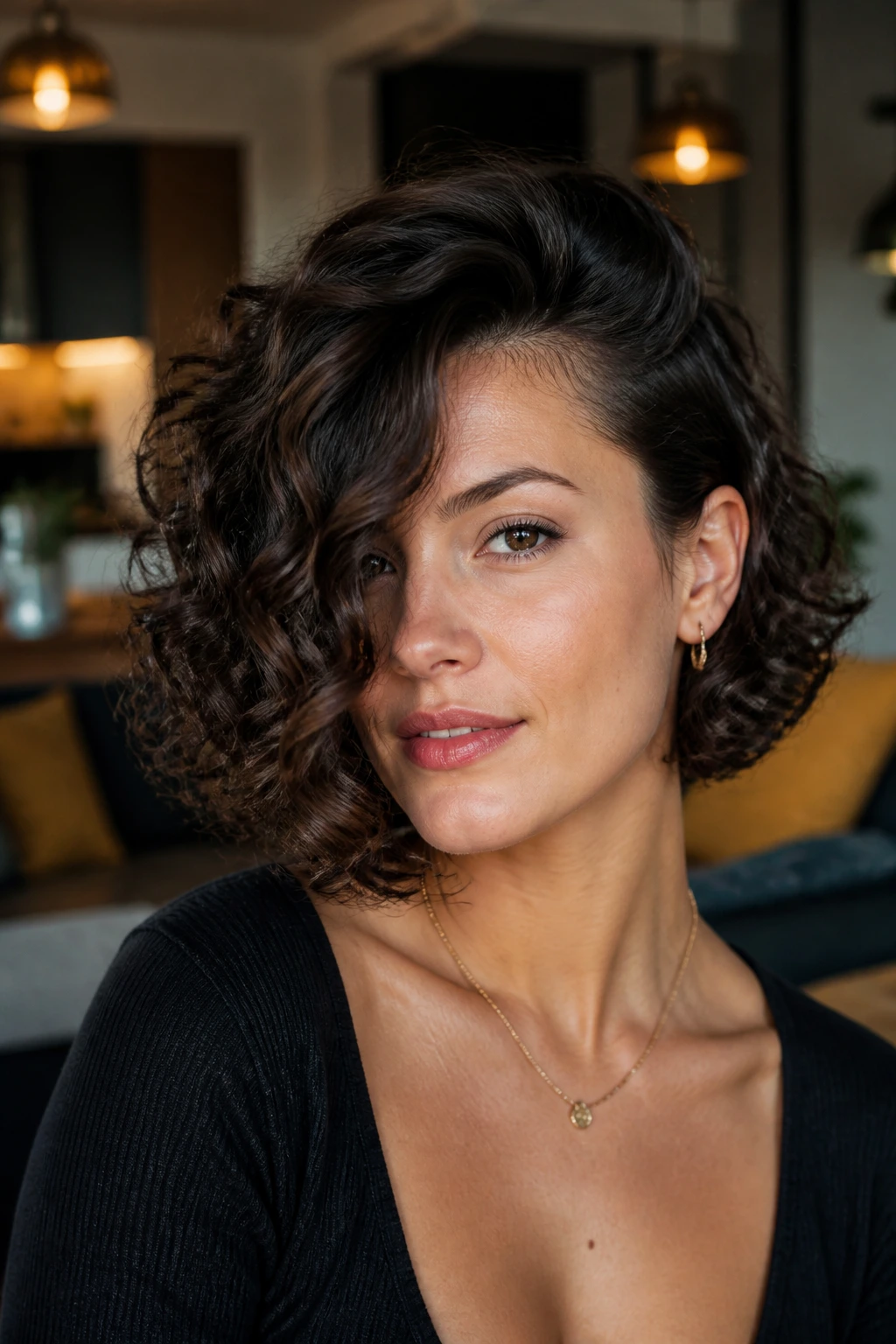
The deep side part is the louder cousin of the soft side part, and it has a more obvious slimming effect because it throws a larger curtain of curls across one side of the face. That asymmetry is useful on round faces, which often benefit from broken lines and uneven visual weight.
The difference between this and the earlier side-part bob is the amount of contrast. One side can sit close to the cheek while the other opens up the forehead and temple area. That creates a longer diagonal than a mild part ever could. It feels more fashion-forward, too, which is nice if you like a haircut that looks like it has a point of view.
I’d pair this with chin-length layers that stay a little longer on the heavy side. You do not want the shorter side to pop out at the cheek and widen the face again. The shape should fall, not flare.
If your curls naturally separate on one side anyway, stop fighting that habit. Some cuts are better when they follow what your hair already wants to do.
14. Modern Curly Pageboy

A pageboy on curly hair sounds retro because it is retro, but the modern version is softer around the edges and much kinder to a round face. The hemline curves under a little, the sides stay smooth, and the top holds enough volume to keep the shape from feeling flat.
This style works because it creates a clear outline without adding extra width at the cheeks. The curve near the chin acts like a frame, and the curl texture keeps it from looking severe. I especially like it on curls that form clean clumps rather than frizzing apart, because the curve reads better when the strands cooperate.
The fringe, if you use one, should be feathered rather than heavy. A hard fringe on this cut can box in the face fast. A soft one lets the pageboy keep its structure without losing air.
It’s a neat choice for someone who likes polish but does not want the haircut to feel precious. There’s a little old-school energy here, and I mean that in the best way.
15. Chin-Length Cut with Sliced Ends
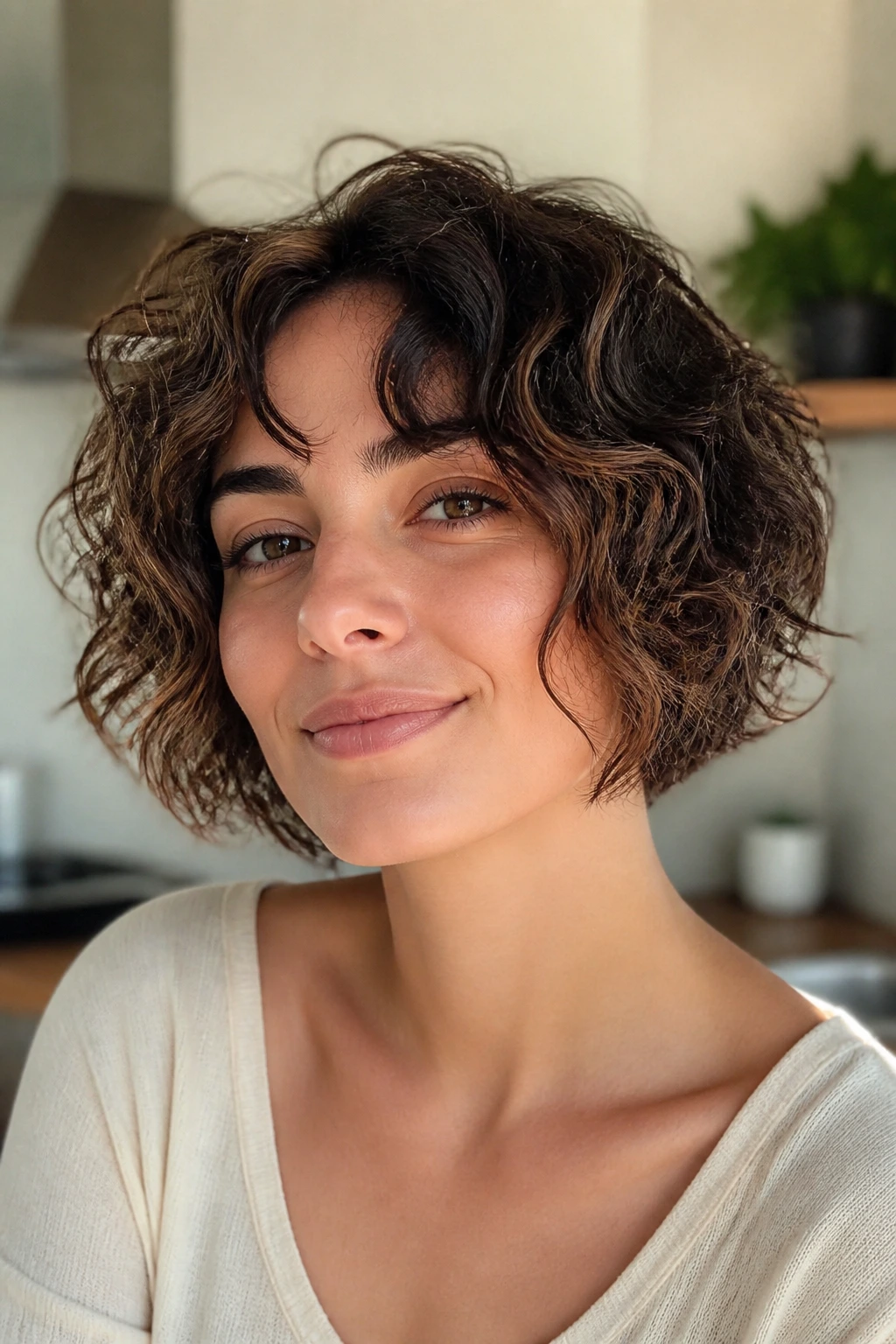
Sliced ends make sense on curly hair when the goal is movement, not blunt heaviness. Instead of cutting the ends straight across, the stylist slices into the edge so the perimeter breaks up and the curls fall with a little more air between them.
That matters on round faces because a blunt, wide hemline can sit right on the cheek and make the face feel broader. Sliced ends soften that line without erasing the shape. The result is still chin-length, but it doesn’t read like a helmet.
I like this cut on medium-density curls and on hair that tends to swell when the weather turns humid. The softened edge stays less boxy as the day goes on. Do not overdo the slicing, though. Too much removal and the shape gets wispy fast, which is a problem if your curls are already fine.
This is one of those cuts that looks casual but is actually doing a lot of work in the background. That’s usually a sign the stylist did their job well.
16. Dense-Hair Curly Bob with Hidden Weight Removal
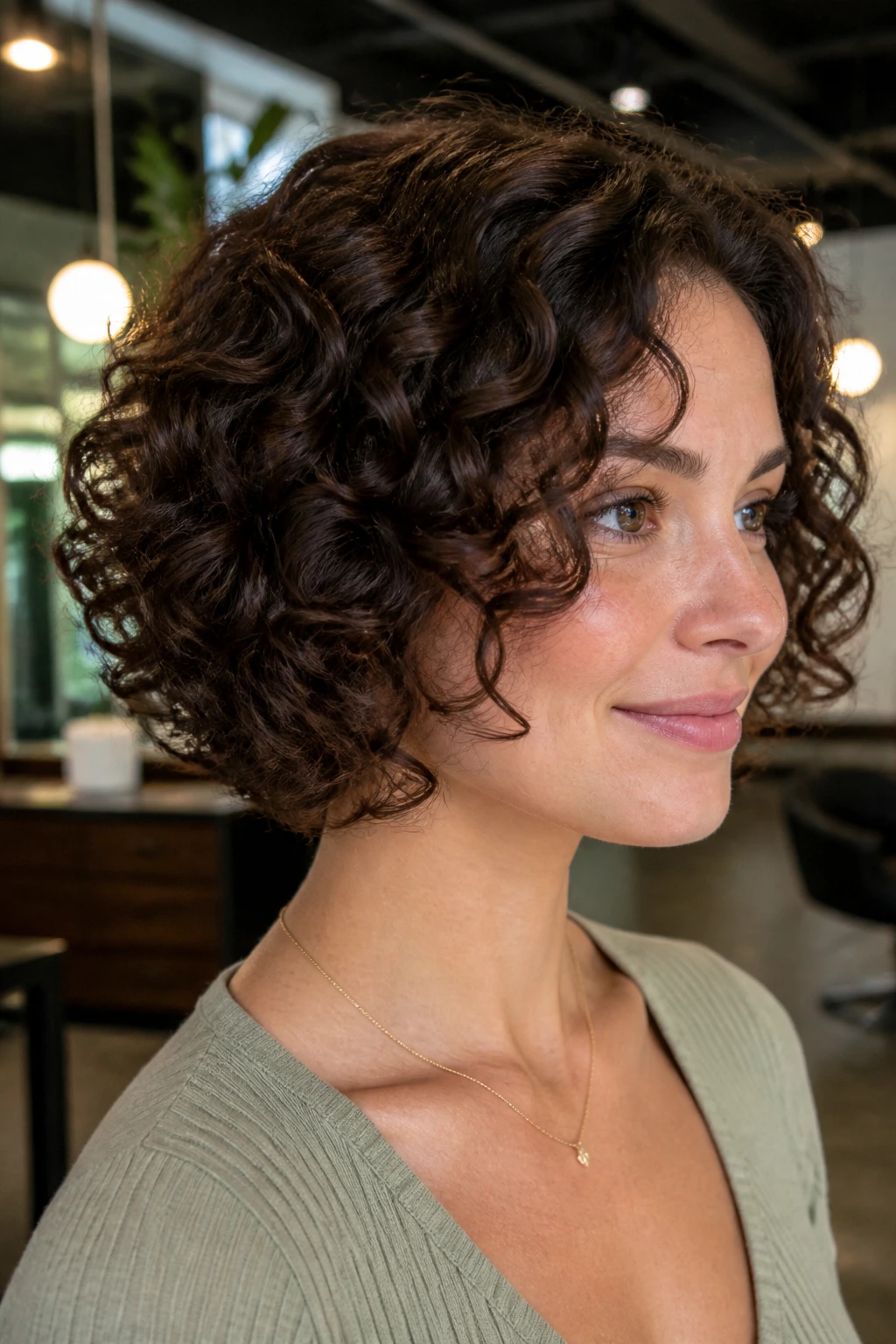
Dense curls need a different kind of haircut. If the weight stays trapped underneath, the bob swells at the bottom and sides, and a round face gets buried in all that width. Hidden weight removal solves that without shredding the outline.
The idea is simple: take bulk out from the inside and leave the surface shape intact. That means the top layers keep their presence, the perimeter stays readable, and the underside stops pushing everything outward. A good stylist knows how to do this with a careful hand. A bad one reaches for the thinning shears and makes a frizzy mess.
What to ask for
Ask for debulking inside the shape, not across the outer line. That distinction matters.
This cut is especially good if your curls are thick enough to feel hot around the ears and neck. The haircut should release some of that weight so the chin-length silhouette can actually sit where it’s supposed to. Dense hair can handle more structure than fine hair, so do not be afraid of shape. Just keep it controlled.
The best dense-hair bob feels lighter than it looks. That’s the win.
17. Fine-Curl Chin-Length Cut with Soft Graduation
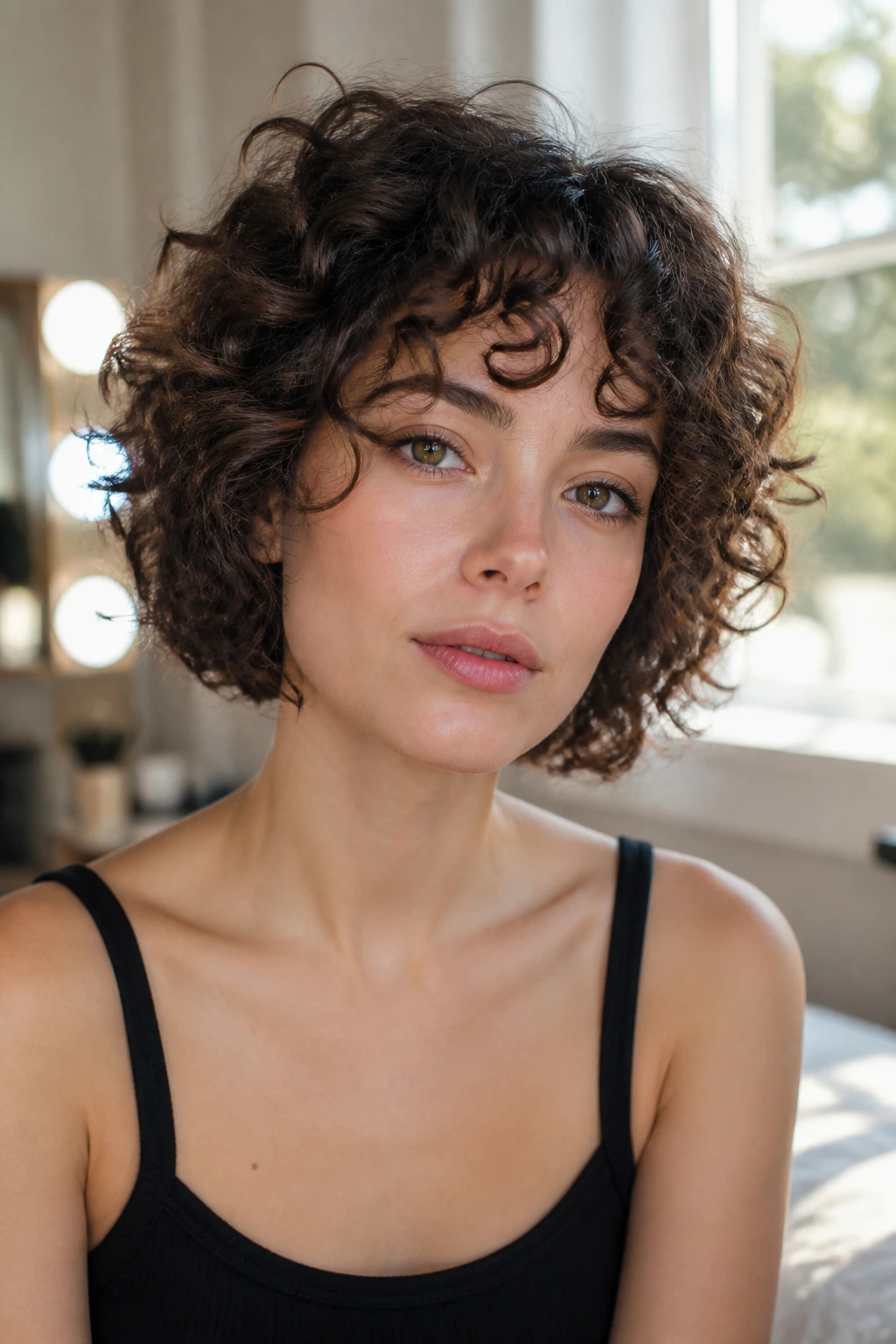
Fine curls need volume, but they do not need to be chopped into a hundred pieces. With this cut, the perimeter stays fairly full while the layers are graduated softly enough to keep the top from collapsing.
I like this shape when the goal is a chin-length bob that still feels airy. Too many short layers on fine curls can expose the scalp and leave the ends looking thin. A soft graduation gives the illusion of density without turning the cut heavy. The line around the chin should remain readable, because that’s what gives a round face the length it needs.
Product choice matters here, too. A lightweight mousse or foam at the roots can help the curls hold a little lift, while a strong cream can drag them down. Fine curls hate being overfed. They go limp fast.
This cut is the opposite of the dense-hair bob above, and that contrast is the whole point. The haircut should respond to the texture, not the other way around.
18. Spiral-Friendly Bob with Micro Layers
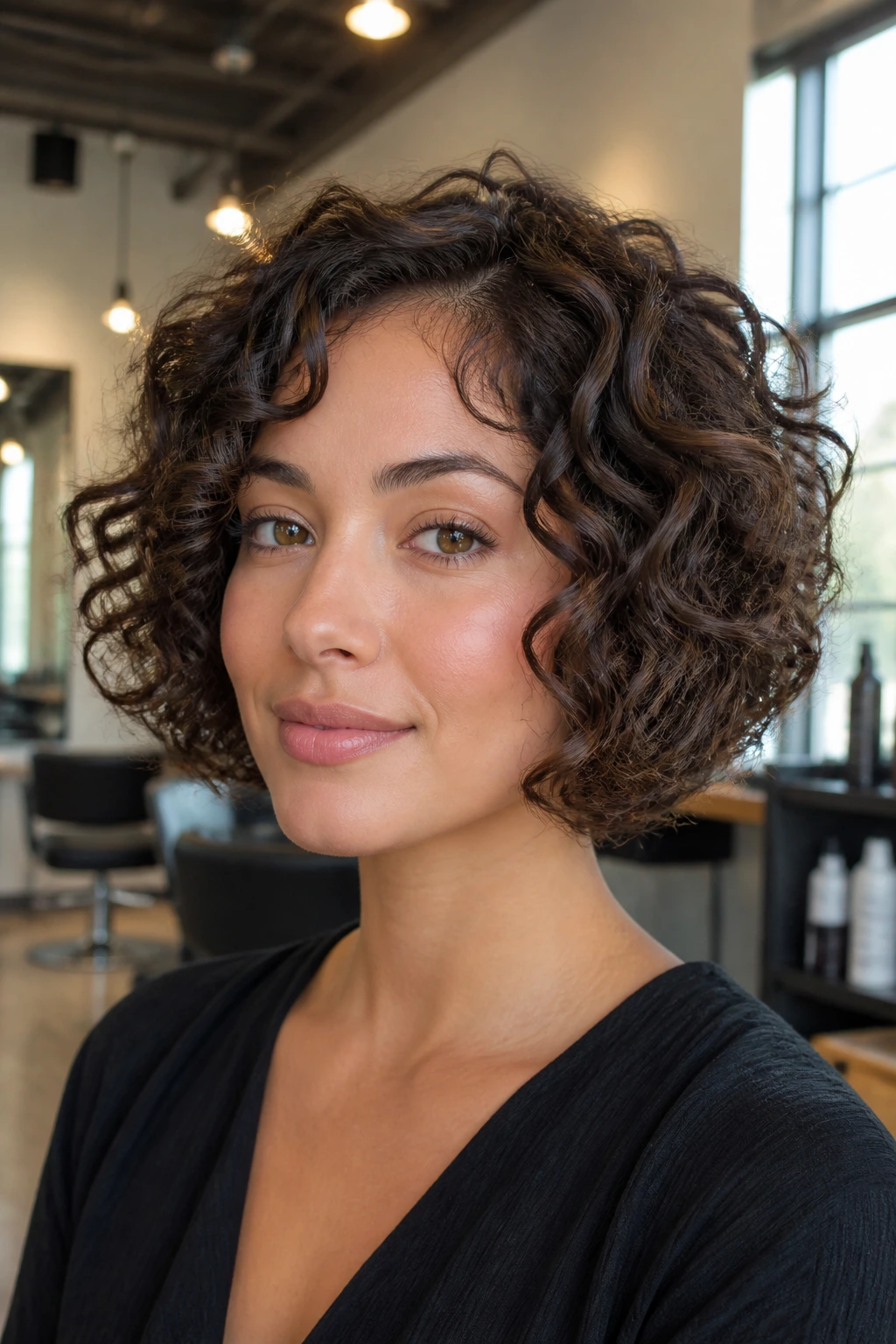
Tighter spirals often need small, precise layers instead of big dramatic ones. Micro layers give the curls room to spring without stacking up into one heavy shape, and that helps a round face keep a little vertical movement.
The perimeter still sits around the chin, but the inside is lightly stepped so the curls do not bunch together in one thick ring. That shape is especially useful if your hair shrinks a lot after washing. Ask for the dry result to be checked before the final line is set, because spiral curls can move more than people expect.
This is a good cut if you like definition. The curls show their own structure, and the haircut simply supports it. I would avoid excessive face-framing pieces here unless you want them. Too many can crowd the cheeks, and this style works better when the outline stays clean.
It’s a tidy, modern shape for spirals that want enough structure to look intentional without feeling sculpted to death.
19. Long Side-Bang Curly Bob

A long side bang does a different job than curtain bangs. Instead of splitting down the middle, it sweeps across the forehead and skims one side of the face, which creates a longer, angled line through the front.
That can be very useful on a round face. The bang pulls the eye diagonally, and the rest of the bob gets to stay chin-length without crowding the cheeks. I like this better than a full fringe for people who want some forehead coverage but not a heavy block of curls sitting across the brow.
The side bang should blend into the front layers, not hang like a separate piece. If it looks detachable, it’s too heavy. It should feel like a curve that happens to start at the part and drift across the face.
This is also a nice option if you like to change your part from time to time. You can sweep the bangs across, tuck them, or let them split a little on wash day. Flexibility counts. Hair that gives you options is easier to live with.
20. Retro Rounded Bob with Temple Volume

Temple volume sounds small, but it changes the whole haircut. A little lift at the temples and upper sides creates shape around the top half of the face instead of leaving everything concentrated at cheek level, which is a smart move on round features.
This bob takes a nod from retro silhouettes without turning into costume hair. The outline stays rounded, but the crown and temples get enough height to make the face look longer. The important part is keeping the volume higher up, not wider out. That distinction is the difference between flattering and puffy.
I like this one when the curls are medium to dense and can hold a curve. If the texture is too soft, the volume can drift downward and lose the effect. A root-lifting mousse or a lightweight foam helps keep the crown awake, and a diffuser with the head tipped to the side can add the lift without disturbing the front too much.
This is a polished choice for someone who likes a rounded bob but wants a little more architecture in it.
21. Wash-and-Go Curly Cut with Minimal Framing
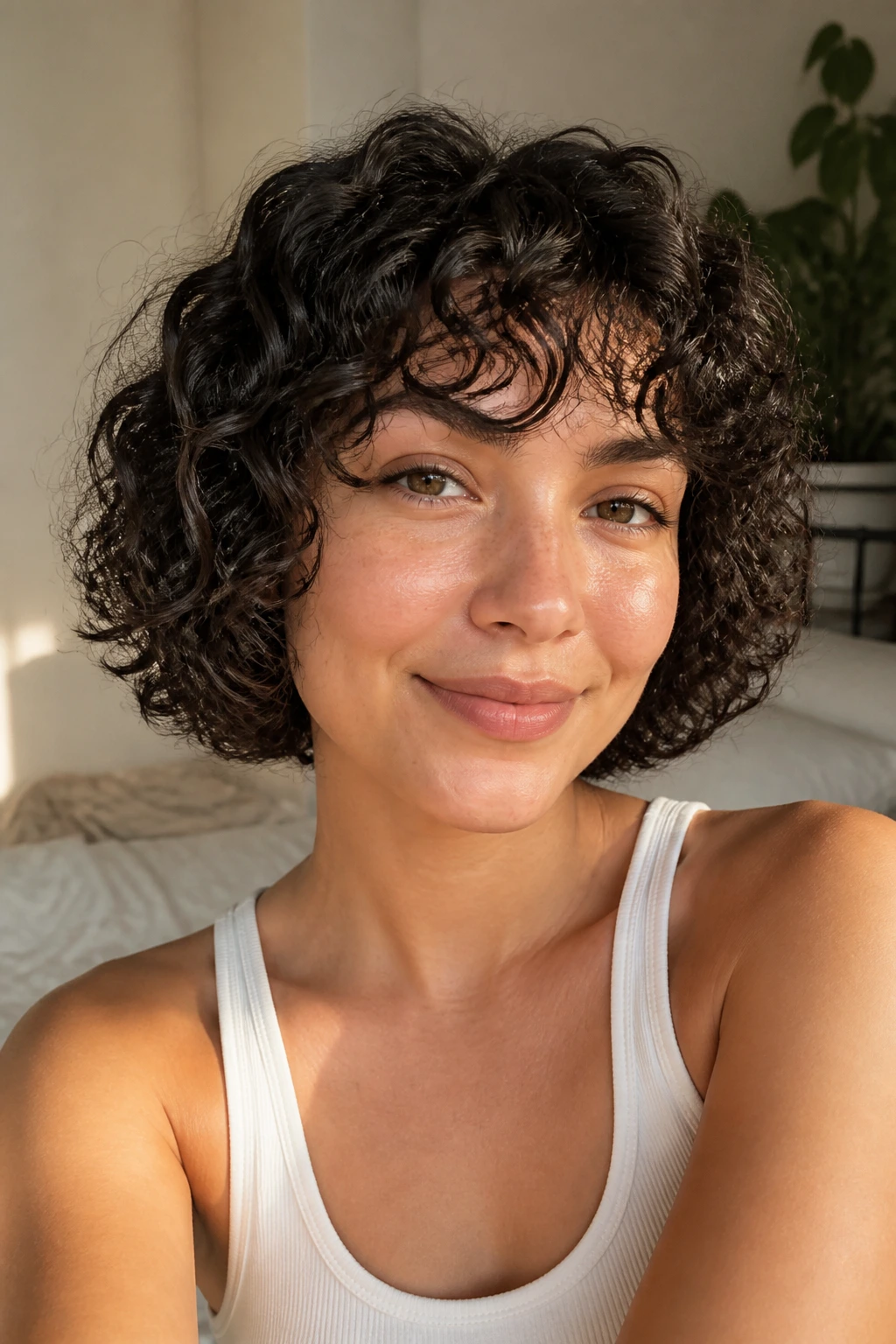
Not everyone wants a haircut that needs a map, a timer, and a lot of arm work. A wash-and-go chin-length cut keeps the layers minimal, the framing simple, and the outline easy to live with.
The trick is restraint. You still need enough shape to keep the curls from forming one wide mass, but you do not want so much layering that the style turns frizzy after one rough night on the pillow. A subtle face frame, one or two longer front pieces, and a chin-level perimeter can be enough if the curl pattern is friendly.
This is a nice fit for people who air-dry often or do not like to restyle on day two. It grows out quietly, and the maintenance schedule is usually less annoying than more sculpted shapes. That said, it does ask for good product control on wash day. If the definition is sloppy, the whole cut looks less intentional.
Sometimes the smartest haircut is the one that asks the least from you on a Tuesday morning.
22. Hidden Undercut Curly Bob
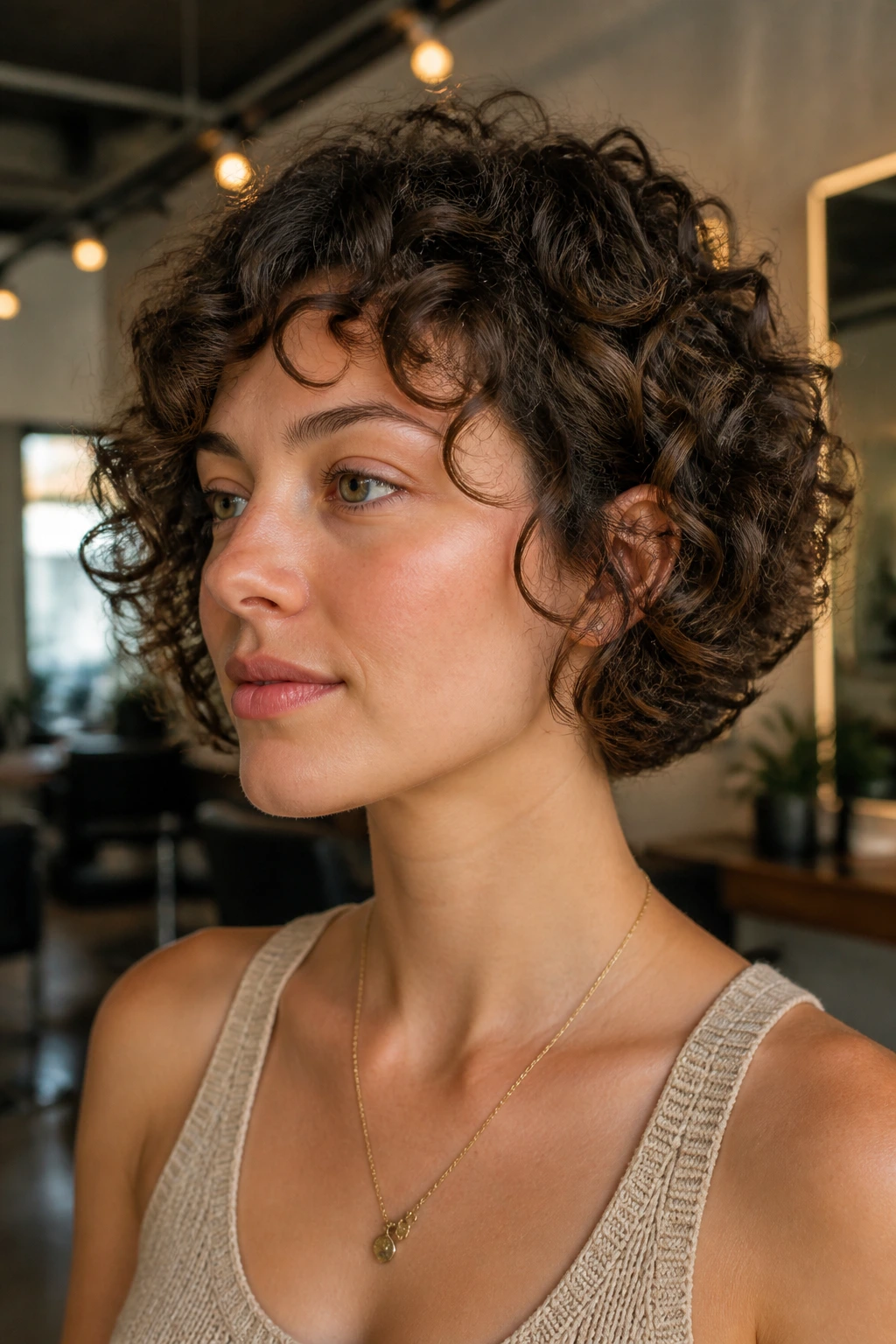
A hidden undercut is the rescue option for heavy curls that refuse to sit compactly. The undercut removes bulk underneath the top layer, usually at the lower nape and behind the ears, while the visible shape stays chin-length and full.
This is not a dramatic undercut unless you want it to be. In the best version, nobody sees it when the hair is worn down. You just feel the difference: less bulk, less heat at the neck, and less of that triangle effect that dense curls can create on a round face.
I’d be careful with the placement. Too high and the top layer can collapse over it in a weird way. Too low and you do not get enough relief. A small hidden section is usually enough. The haircut should stay balanced from the front, where the eye reads the whole shape.
If you have thick hair and you keep wishing your bob would lie flatter, this is a smart move. It can make the same chin-length style behave like a calmer version of itself.
23. Drop-Curve Curly Bob

A drop-curve bob is a softer cousin to the angled cut. Instead of a sharp slope, the front length drops just a little lower than the back, giving the silhouette a curved line rather than a straight diagonal.
That curve is useful because it lengthens the face without looking severe. The hair moves around the jaw instead of stopping right at it, and round faces usually benefit from that extra bit of visual descent. I especially like this on curls that separate into medium-size clumps, because the curve shows up more clearly when the pieces are defined.
This shape can be subtle enough that people do not notice the haircut first. They notice the face. That’s a good sign. It means the line is doing its job quietly.
Keep the drop modest. A huge front-heavy difference can start to feel dated or awkward with curly texture. A small one reads modern and easy to wear.
24. Soft Asymmetrical Curly Bob
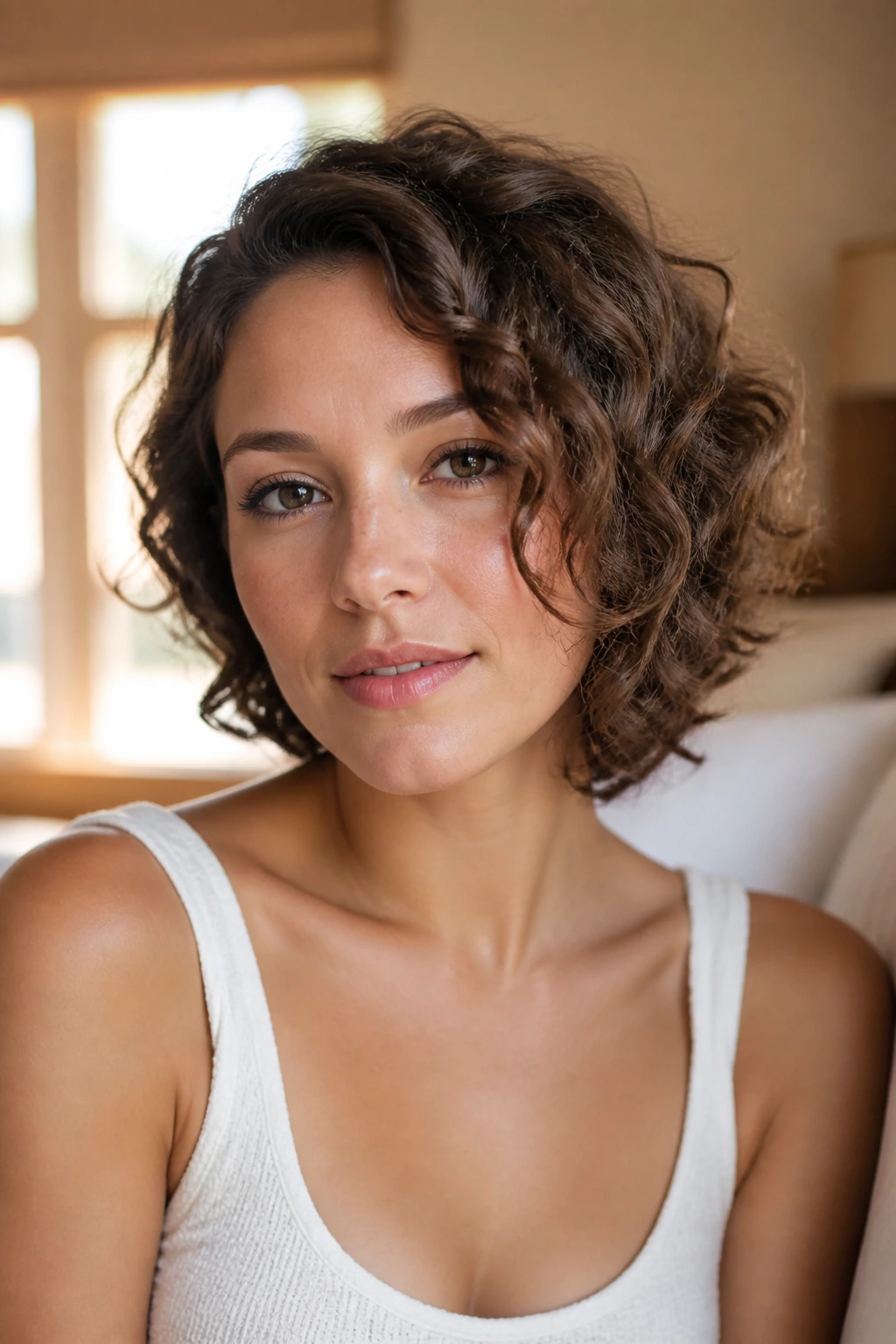
A soft asymmetrical bob gives you almost the same length on both sides, but one side drops a little lower, usually by half an inch to an inch. That tiny difference is enough to break up the circle effect on a round face without making the haircut shout.
I like this when someone wants shape but not drama. The asymmetry gives the front a little motion, especially if the part is off-center and the curls on the longer side are allowed to sweep across the jawline. The shorter side can stay tucked closer to the ear or cheek, which opens the face nicely.
The danger here is making the difference too big. If one side is much longer, the cut starts to feel costume-like, and the curly texture can make that even more obvious. Keep it soft. The eye should sense the imbalance without staring at it.
This is a good middle path between the strict bob and the highly layered shag. A little off-kilter can be a very good thing.
25. Sculpted Curly Bob with Face-Skimming Ridges
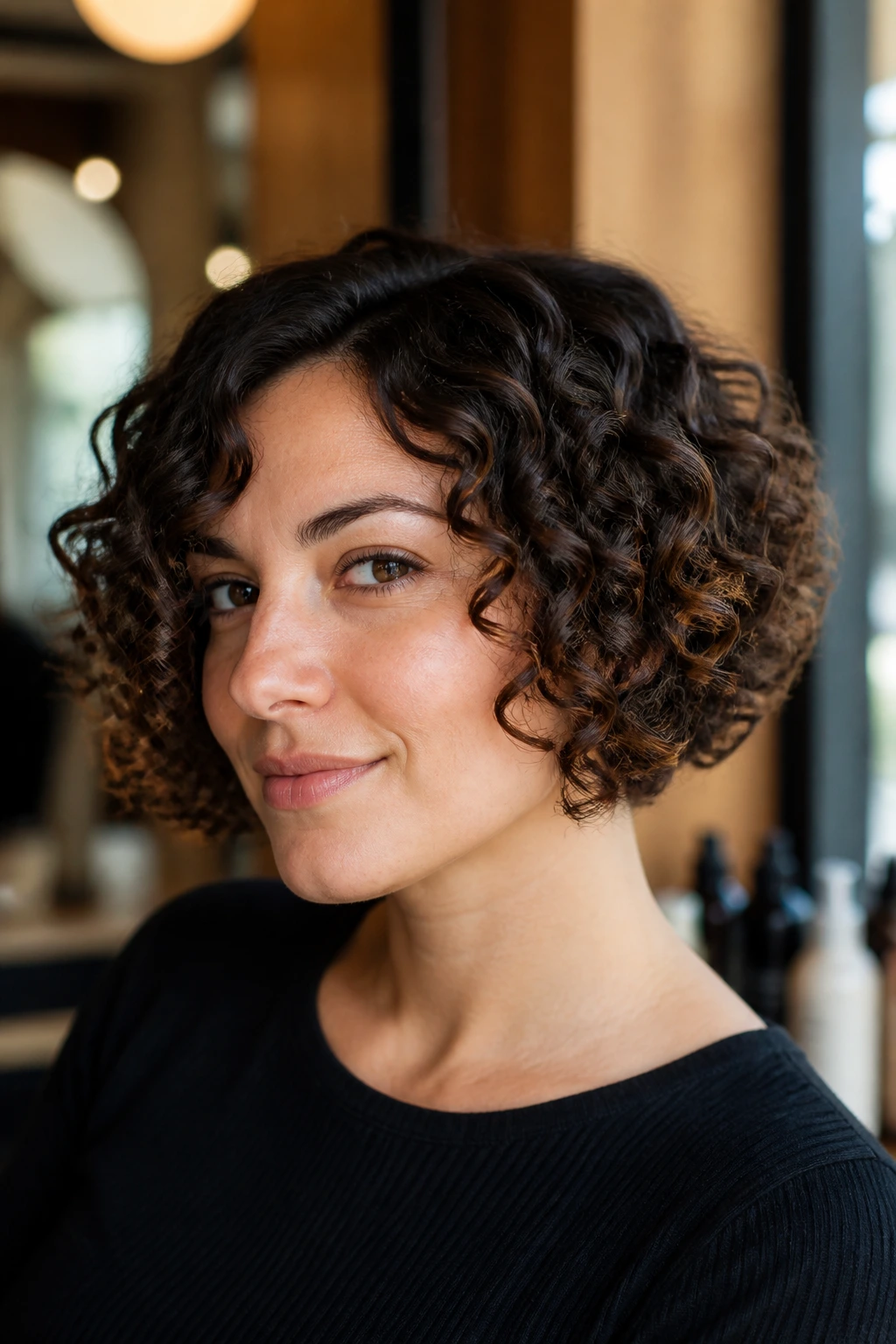
This is the most deliberate cut in the bunch. A sculpted curly bob uses carefully placed ridges of layers around the temple and cheek area to guide the curl pattern, not just shorten it. The result can look sharp, but not harsh, if the layers are placed with a light hand.
The ridges create tiny shifts in length that let the curls fall around the face in sections rather than one continuous arc. That matters on a round face because the eye gets more places to stop and start. The silhouette feels shaped, not inflated.
This is not a beginner cut. It needs a stylist who understands dry cutting, point cutting, and how curl groups behave when they dry together. If those skills are missing, the cut can lose its structure fast. But in the right hands, it gives you a chin-length style that looks almost tailored to the bone structure.
It’s the most editorial option here, and the one I’d pick when someone wants their curls to look precise without looking stiff.
Why Chin-Length Curls Work on Round Faces

A round face usually has soft width through the cheeks and a shorter-looking vertical line from forehead to chin. That does not mean short curly hair is off limits. It means the haircut has to create shape in the right places.
The line matters more than the length
A chin-length cut works because it gives the eye a place to land below the widest part of the cheeks. Once curls move past that point — even by an inch — the face can look longer. That small extra bit of length is often more useful than a dramatic style change. A haircut does not need to be severe to be effective.
Crown height keeps the shape alive
If the top lies flat, the sides take over. That is where the puffed-out, circular look starts. A little lift at the crown changes the whole silhouette, especially on curls that shrink upward as they dry. You do not need a giant pouf. You need enough root support that the haircut has some vertical energy.
Shrinkage is part of the design
Dry curls can sit 1 to 3 inches shorter than they looked when wet. Some patterns bounce less, some bounce a lot more. A good chin-length curly cut is planned with that in mind, which is why asking for a dry check or a length buffer is not fussy — it’s practical.
How to Brief a Stylist Without Guesswork
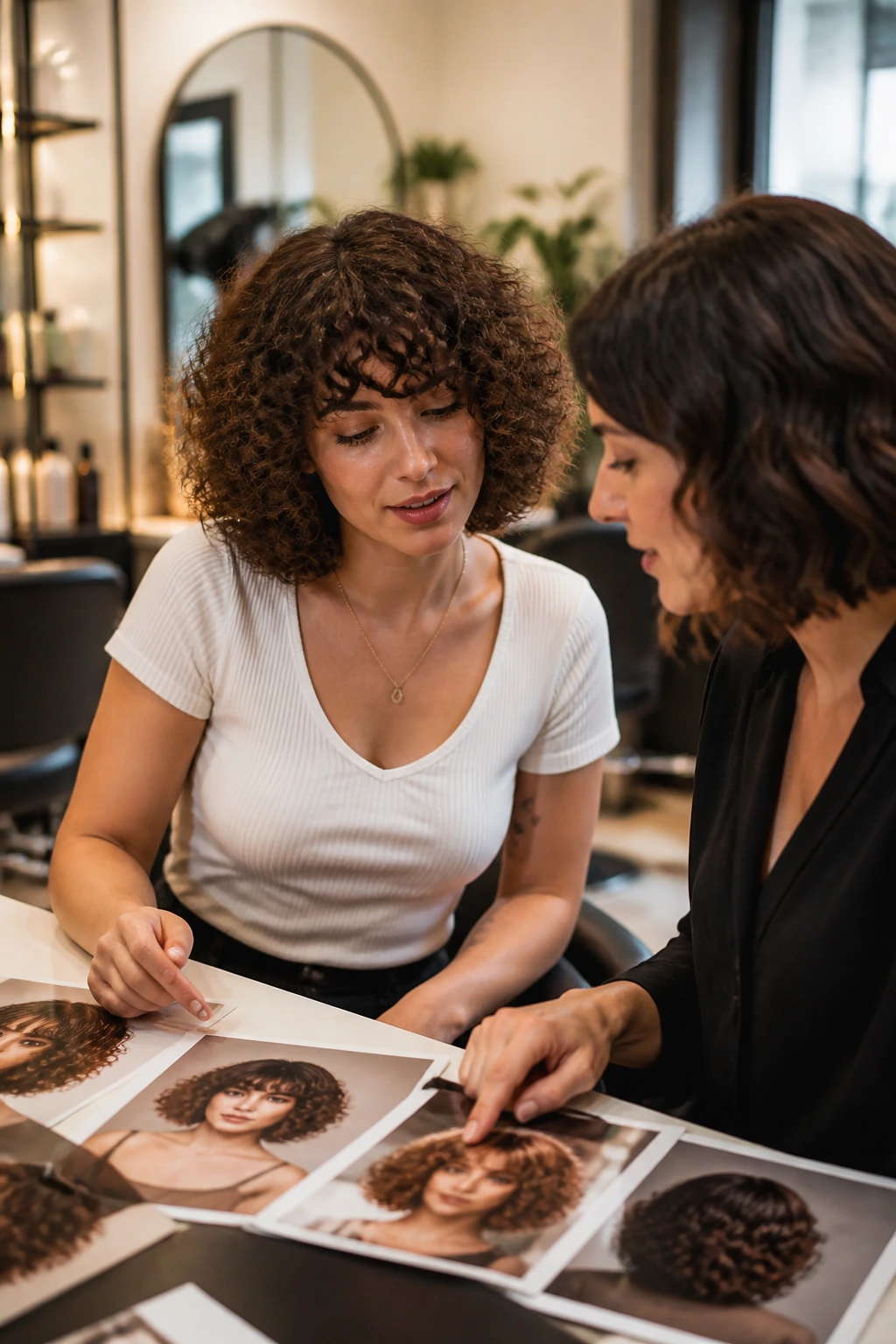
Bring photos. Not one. Three or four. Front, side, back, and one that shows the shape with the same curl pattern you have, or close to it. That gives the stylist something concrete instead of a vague request for “something cute but not too short,” which is how people end up with hair they regret for six weeks.
Say how your curls behave when they dry. If they spring up a lot, say it. If they flatten at the crown but swell at the cheeks, say that too. Those details matter more than your hair type label. A 3A bob and a 3C bob do not need the same perimeter.
Ask where the haircut should land when dry. That question alone saves a lot of trouble. If you usually air-dry, say so. If you diffuse upside down, mention that. If you never use a side part unless you’re late, the stylist should know. Haircuts live in real life, not on salon day.
And yes, mention your maintenance tolerance. A sculpted bob and a wash-and-go bob are not the same promise.
Tools and Products That Keep the Shape Honest
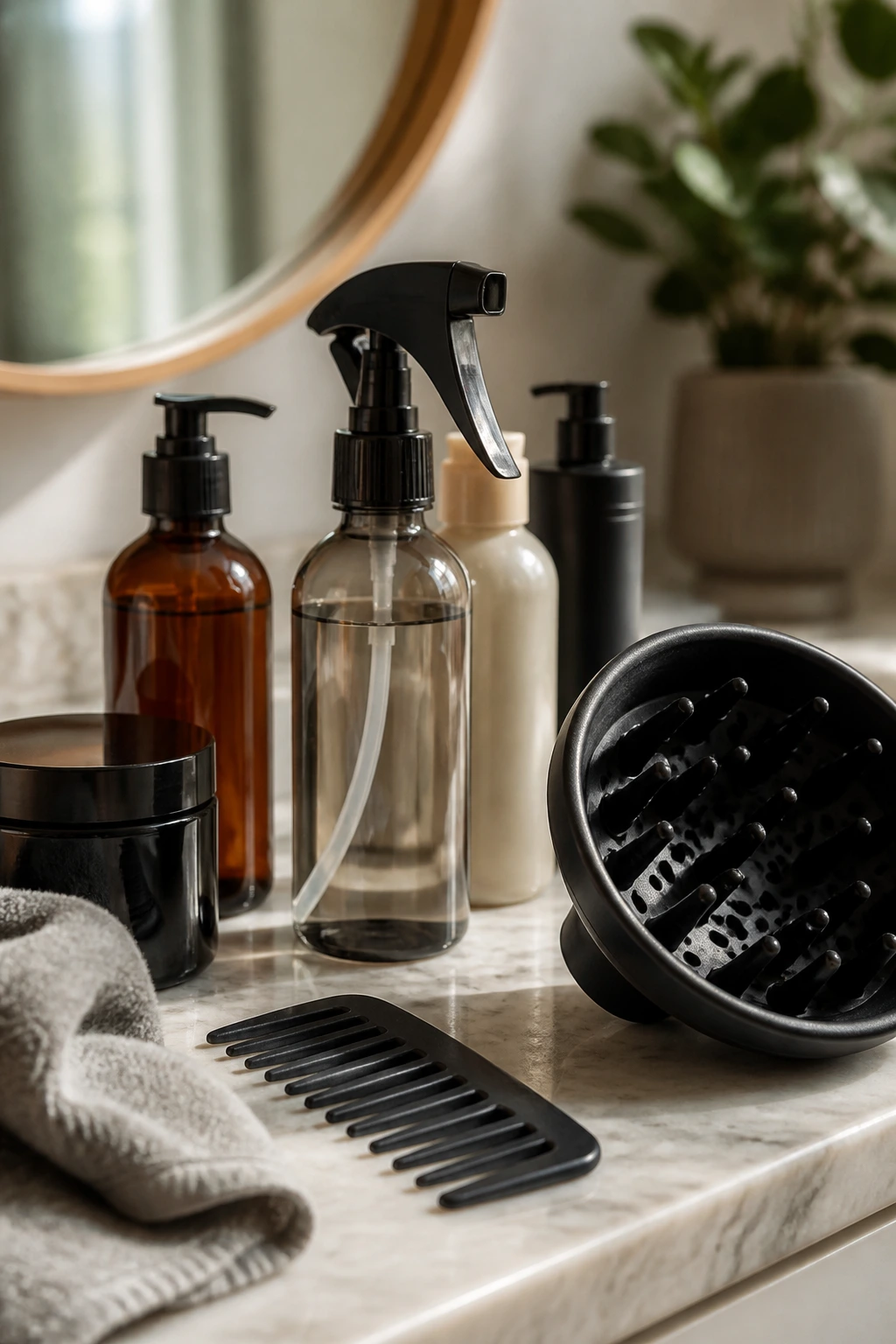
- Spray bottle: Useful for re-wetting front pieces and resetting the part without starting over.
- Wide-tooth comb: Better than a brush for separating curls before product goes on.
- Microfiber towel or cotton T-shirt: Cuts down on rough frizz when you scrunch out water.
- Duckbill or sectioning clips: Handy for lifting the crown while the roots set.
- Diffuser attachment: The fastest way to keep a chin-length curly cut from drying into one wide shape.
- Lightweight mousse: Good for lift at the root, especially on fine curls.
- Medium-hold gel: Helps the perimeter hold its outline instead of fuzzing out.
- Curl cream: Useful on drier textures, but use a small amount so the bob does not go limp.
- Hand mirror: The back of a short curly cut can surprise you. Check it dry, not only wet.
- Silk or satin pillowcase: Helps preserve the front shape and reduces the morning halo.
How to Style, Refresh, and Wear These Cuts
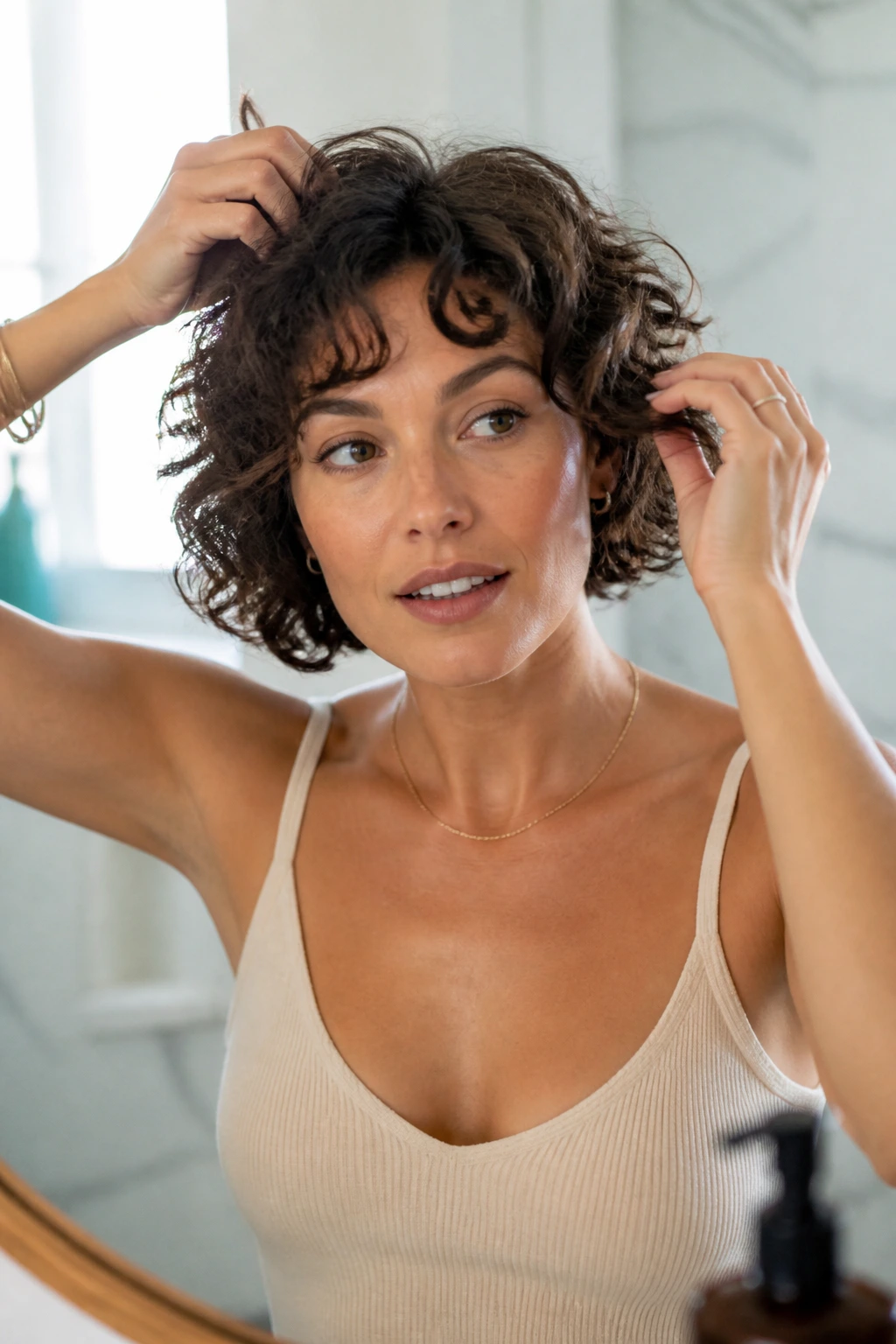
Wash day is where the shape starts. Work styling product through soaking-wet hair, not damp hair that is already half-dried and frizzing at the edges. A light cream or leave-in can go first, then mousse or gel where you need hold. Scrunch gently, then diffuse on low or medium heat until the roots are mostly dry and the curls have set their pattern.
Do not over-handle the crown. That’s where round faces get the most help from the haircut, and it’s also where people accidentally flatten everything with their hands. Clip the roots if you need extra lift while drying. Two or three small clips at the top can change the whole outline.
Day two is simpler. Mist the front and the crown, smooth a pea-sized amount of gel over any frizzy sections, and let it dry before fluffing. If one side starts to collapse, tuck it behind the ear or pin it for an hour. Small interventions beat a full restyle.
And here’s a useful habit: check the haircut from the side in daylight once a week. Short curls can drift into a shape you stop noticing. A quick look tells you whether the front still frames the face or whether it has started to spread wider than you want.
How to Choose the Right Version for Your Curl Pattern and Density
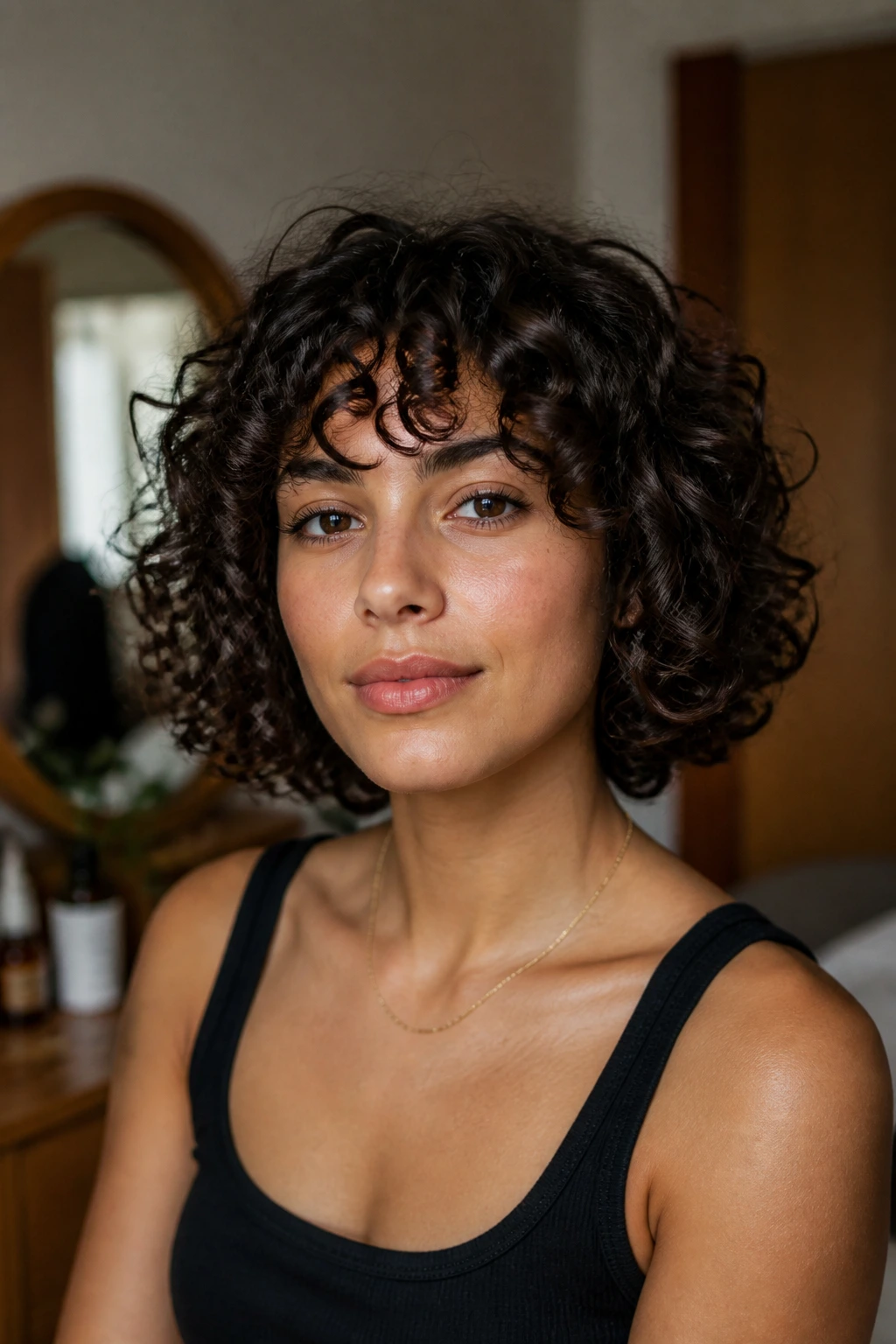
Fine curls need a cleaner outline and fewer short layers. Too much layering strips away the look of fullness, and a round face can end up with a cut that sits close to the head at the crown and fluffy at the cheeks. A blunt-ish perimeter, a soft side part, and a little root lift usually go farther than complicated layering.
Medium-density curls can handle more movement. That is where shags, curtain bangs, angled bobs, and soft asymmetry start to make sense. The hair has enough body to show the shape and enough flexibility to move away from the face instead of clinging to it.
Dense or coarse curls need bulk management first. Hidden weight removal, a clean nape, or a tapered back may matter more than fringe choice. If the haircut feels too round, the problem is usually weight distribution, not the lack of bangs.
Tighter curls and spirals often shrink upward more than loose curls, so length buffers matter. If the dry shape needs to land at the chin, the wet cut may need to sit a little lower. That is not overthinking. That is how curly hair works.
Additional Tips and Shape Boosters
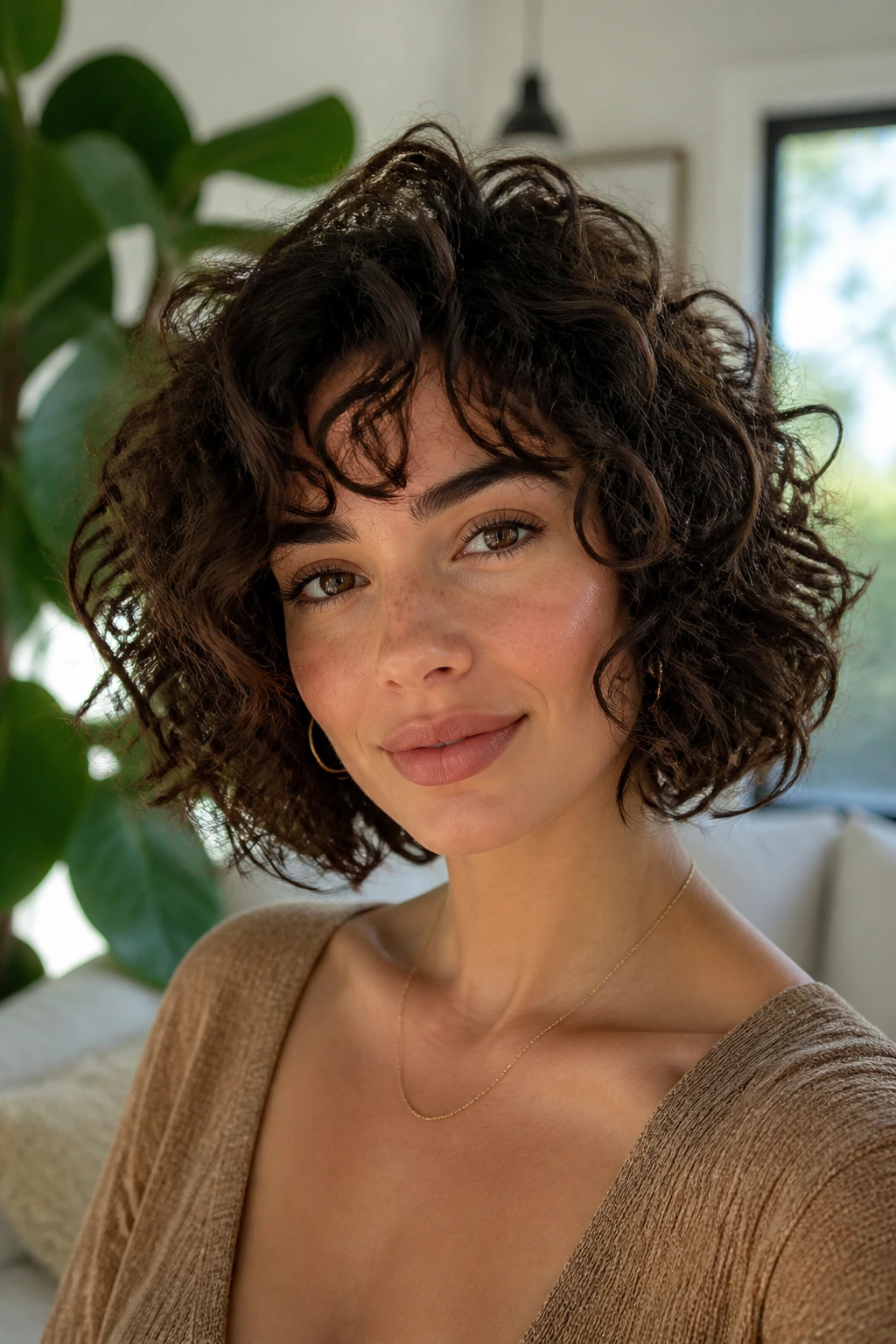
Lift at the crown: If you want the face to look longer, build some height up top before you worry about the sides. A little root clipping while the hair dries can do more than another inch of length ever could.
Break the cheek line: When the face is the widest at the cheeks, avoid letting every front curl stop there. Ask for pieces that either sit above it or fall below it. The eye needs a path, not a wall.
Keep one side freer: Even a tiny asymmetry can help. Tuck one side behind the ear, shift the part, or leave one front piece longer. Round faces respond well to that broken line.
Use product by density, not habit: Fine curls usually need mousse first and cream second, if at all. Dense curls may want more slip and more hold. Put the product where the hair actually asks for it.
Make the neckline clean: A tidy nape matters more on short curly cuts than people expect. Even when the front is soft, a messy back can make the whole style feel unfinished.
Maintenance, Trim Timing, and Grow-Out Care

Most chin-length curly cuts need a tidy-up every 8 to 12 weeks if you want the shape to stay readable. If you wear a shag or a more relaxed version, you can usually stretch that a little farther. The sharper the line, the sooner it wants a trim.
Between cuts, protect the shape at night. A loose pineapple, a satin pillowcase, or a satin bonnet keeps the front from getting smashed flat and the back from frizzing into a fuzzy wedge. If the haircut leans on a side part, re-establish that part while the hair is still damp in the morning.
For refreshes, a light mist of water plus a small amount of gel or foam is usually enough. You do not need to soak the whole head again unless the curls have gone completely off the rails. Target the parts that matter most: crown, front pieces, and any side that collapsed overnight.
Grow-out can be helpful if it’s planned. A chin-length bob often softens into a bob-lob hybrid after a few months, and that can be a nice place to land if you like less maintenance. If you want to keep the shape sharp, book the next trim before the last one starts to lose its outline. That tiny bit of planning saves a lot of awkward mirror moments.
Common Mistakes That Add Width Instead of Shape
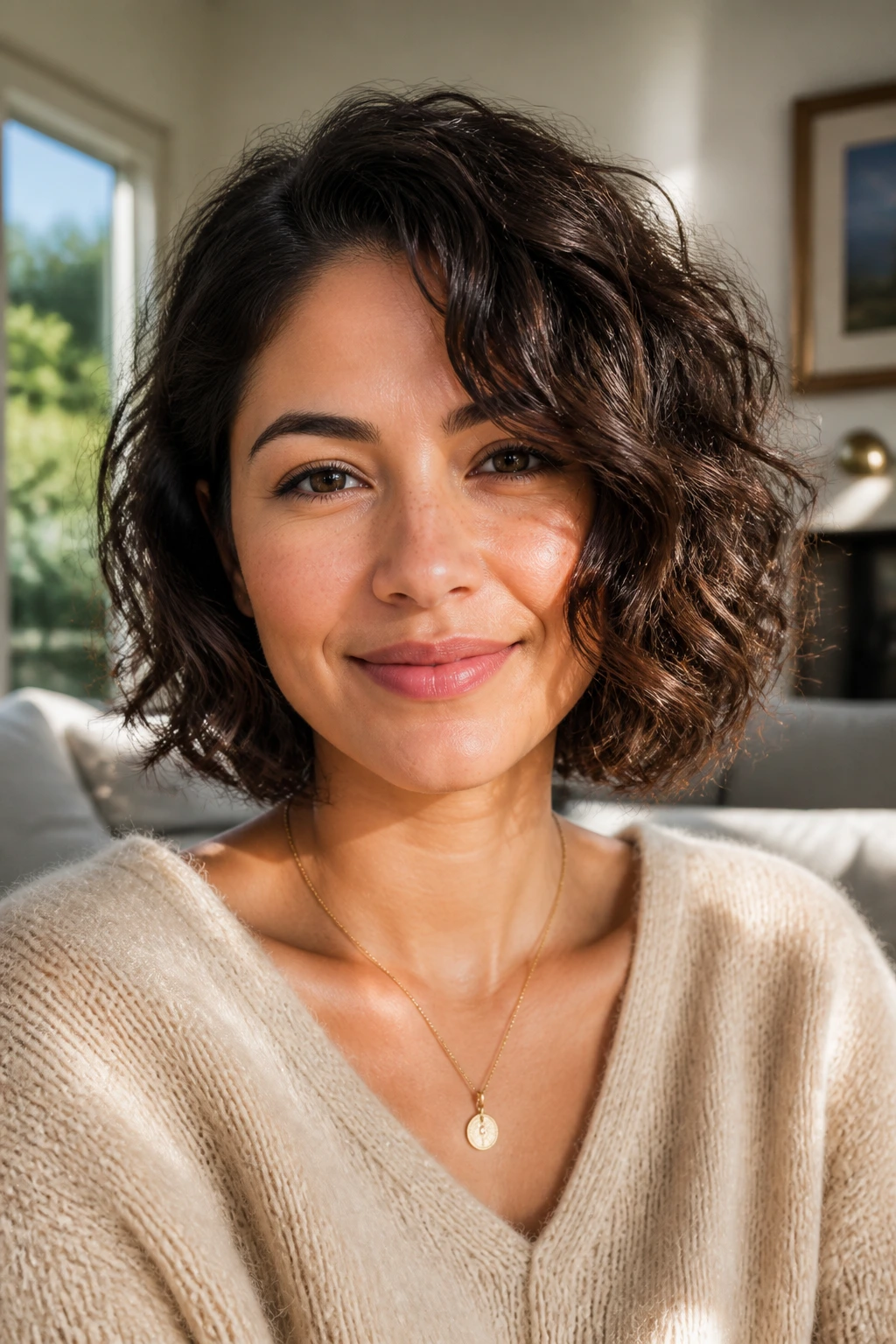
The biggest mistake is cutting the perimeter too short at the exact widest part of the cheek. The curls spring outward, and the face looks broader before the cut has even settled. Keep the line either a touch above or a touch below that point, depending on the shape you want.
Another common problem is over-layering fine curls. The haircut may look airy in the chair, then go thin and fuzzy once it dries. Fine texture needs restraint. Dense texture can take more removal, but fine hair usually wants fewer short pieces and more careful shaping.
People also forget about the crown. Flat roots make the sides look larger by comparison. If the top has no lift, even a smart haircut can read as rounder than it should.
And then there’s the fringe issue. Bangs can help, but heavy blunt bangs on a short curly cut can box in the face fast. If you want fringe, keep it soft, lighter at the edges, and long enough to blend.
Variations and Adaptations to Try
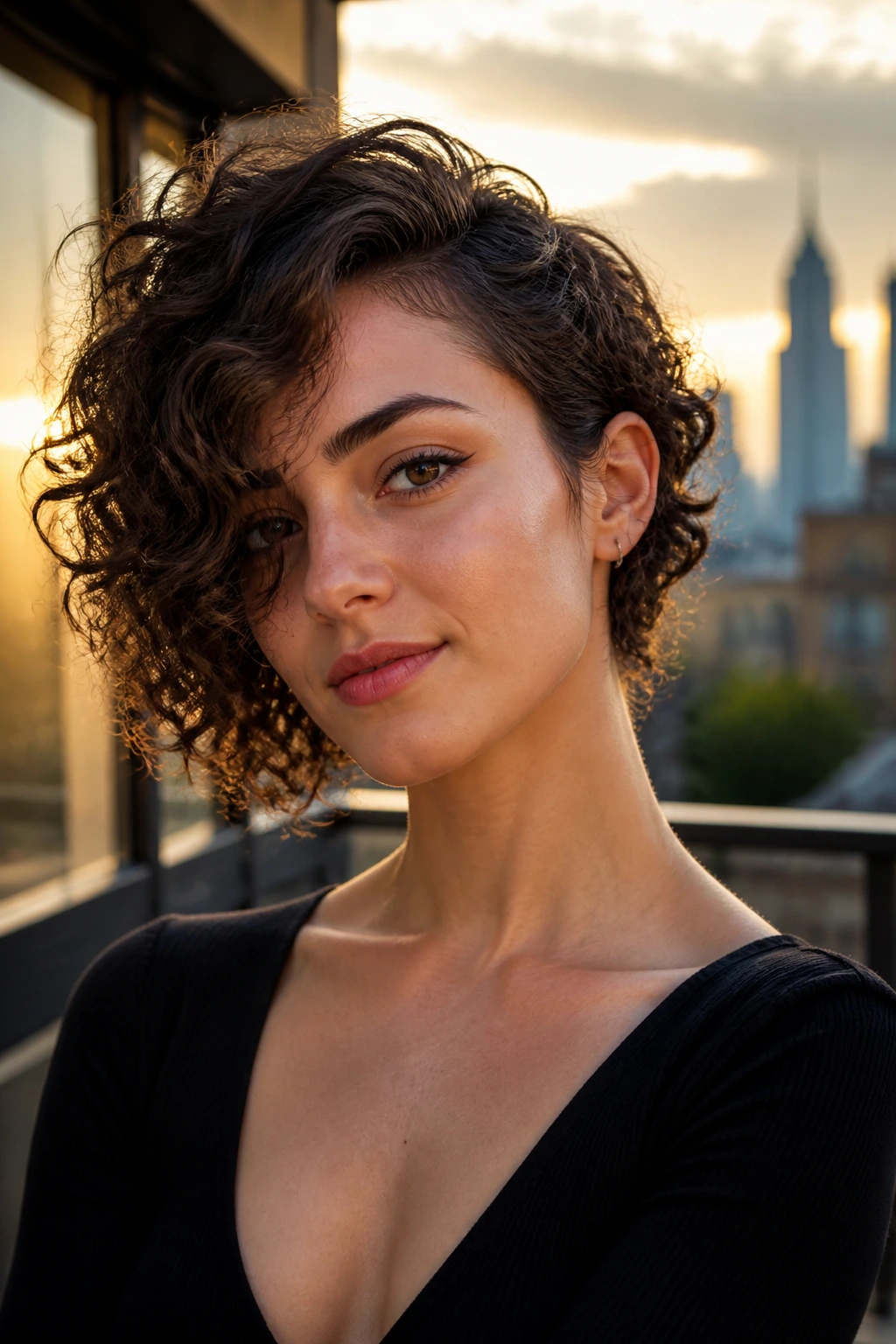
The Low-Maintenance Air-Dry Version: Ask for fewer layers, a soft perimeter, and just enough face framing to break up the cheeks. This version is good when you do not want to diffuse every time you wash.
The Dense-Curl Control Version: Build in hidden weight removal and a clean nape. This keeps thick curls from ballooning at the sides and gives the chin-length shape a cleaner outline.
The Fine-Curl Lift Version: Keep the perimeter a bit stronger and the layers softer. Add root clips and lightweight mousse so the hair holds its height without going flat by noon.
The Fringe-Free Version: Skip bangs entirely and rely on a side part, angled front pieces, or a subtle drop curve. This is the easiest option if your forehead already gets the amount of attention you want.
The More Dramatic Asymmetry Version: Let one side fall a little longer and shift the part deeper. It adds movement without needing a huge cut change, which is handy if you want something modern but not loud.
The Softer Grow-Out Version: Ask for rounded layers that blend easily as the hair grows. This is smart if you know you will miss trims for a stretch and do not want the shape to fall apart in the meantime.
Frequently Asked Questions
Can chin-length curly haircuts really flatter a round face?
Yes, if the cut creates vertical movement and keeps bulk away from the widest part of the cheeks. The length itself is not the trick; the placement of layers, parting, and crown lift does the work.
Should I cut curly hair wet or dry?
Dry cutting usually gives a better read on shrinkage, especially if your curls bounce a lot. Some stylists use a dry check after an initial wet shape, which is a smart middle ground.
What if my curls shrink a lot after washing?
Ask for the visible shape to land lower than chin level when wet, then be specific about how many inches your hair springs up. A strong shrinkage curl may need a length buffer of 1 to 3 inches depending on pattern.
Are bangs a bad idea for round faces with curly hair?
Not at all. Heavy blunt bangs can crowd the face, but curtain bangs, soft side bangs, and airy fringes can work very well because they break the face shape instead of boxing it in.
What if my hair is fine and curly?
Keep the layering gentle and the perimeter cleaner. Fine curls usually do better with less aggressive texturizing, more root lift, and styling products that do not sink the hair down.
What if my hair is thick and puffs out at the sides?
Look for internal weight removal, a tapered nape, or a hidden undercut. Those details reduce bulk without making the haircut look thin on top.
How often should I trim a chin-length curly cut?
About every 8 to 12 weeks is a solid range if you want the shape to stay crisp. If the cut is softer and more layered, you can usually stretch that a bit longer.
Can I wear a center part with a round face?
Yes, if the crown has some lift and the front pieces start around the cheekbone or lower. A flat center part with no structure is the problem, not the part itself.
The Shape That Holds Its Own
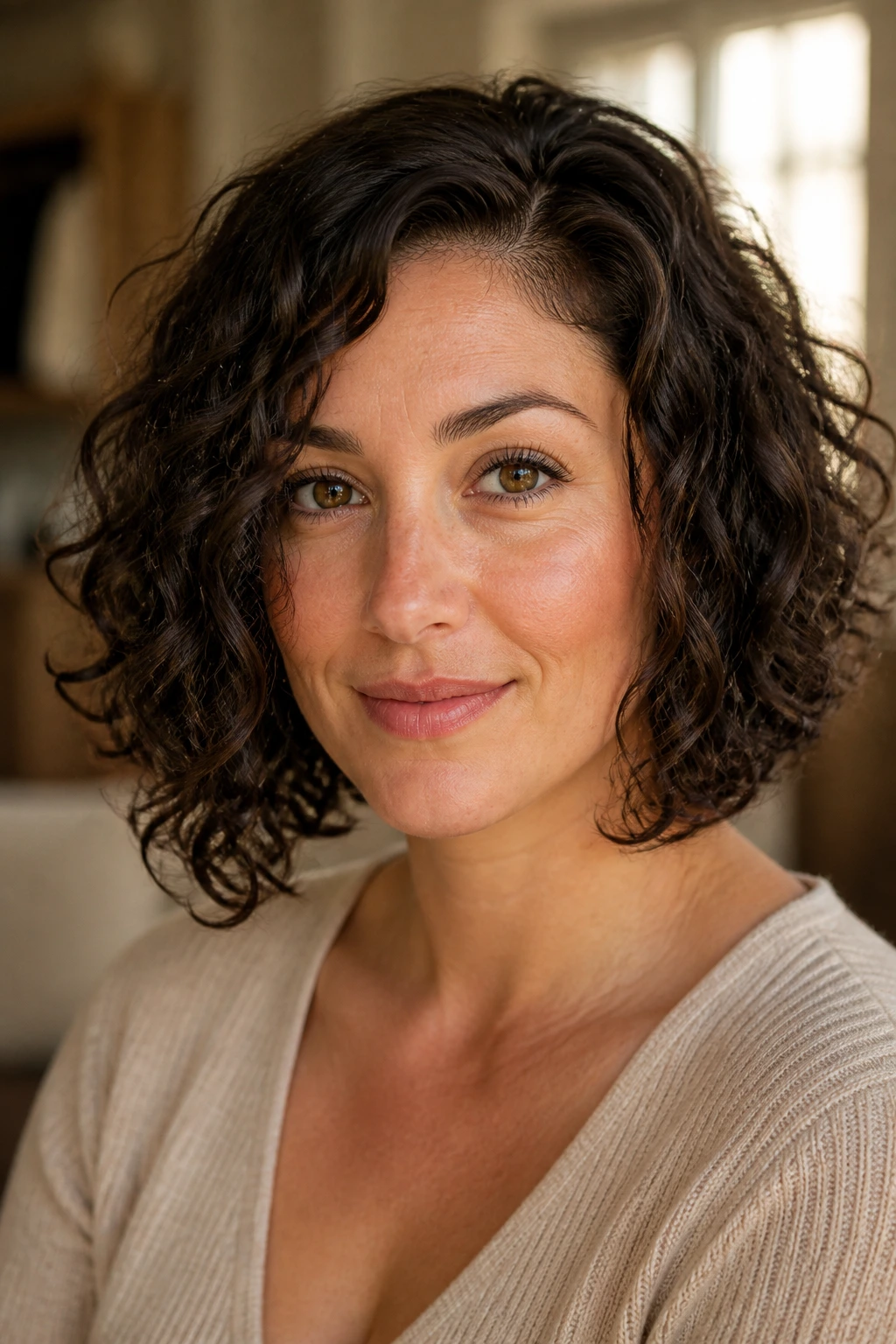
The best chin-length curly cuts for round faces do one thing well: they give the curls a shape that has direction. Not more fluff. Not more width. Direction. That can mean a side part, a taper, a little angle, or a fringe that opens instead of blocks, but the goal stays the same.
If your curls shrink, swell, or spring in their own direction, that is not a reason to avoid short hair. It is the reason to choose the right short hair. A smart bob, shag, or hybrid cut can make the face look longer, the neck look cleaner, and the curl pattern look more deliberate than it did at longer lengths.
Bring a few reference photos, talk honestly about shrinkage, and ask for the dry shape, not the wet illusion. That one habit separates the cuts that sit well from the ones that spend all day widening at the cheeks.
