



Gray bob haircuts can look sharp in a way long hair sometimes can’t. Once silver strands meet a clean line at the chin, jaw, or collarbone, the whole style stops feeling like a compromise and starts feeling like a choice.
That matters because gray hair does not behave like dyed, uniformly pigmented hair. It can come in coarse at the root, soft at the ends, wiry in the crown, or a little dry through the mids. A bob only looks modern on silver hair when the cut works with that texture instead of trying to flatten it into something it isn’t. The right shape gives the hair direction. The wrong one gives you a puffball with good intentions.
The nice part is that gray bob haircuts have range. Some are blunt and crisp, some are soft and layered, some lean airy and face-framing, and some use bangs or asymmetry to keep the cut from feeling too tidy. If your silver hair has been asking for a reset, the answer is probably not more length. It’s better edges, smarter texture, and a shape that makes the gray look intentional from across the room.
Why Gray Bob Haircuts Work So Well on Silver Hair
-
The clean edge does the heavy lifting: A blunt or beveled line makes silver hair look polished fast, because the eye reads the shape before it notices small frizz or uneven texture.
-
Gray hair usually needs structure, not bulk: Many silver strands are coarser than they used to be, and a bob can remove the extra weight that makes the shape puff out at the sides.
-
Shorter lengths make shine look sharper: Silver and gray reflect light differently than darker hair, so a tidy bob catches that contrast in a way loose, long layers often miss.
-
The grow-out is easier to live with: Natural regrowth blends into gray hair more gracefully when the cut already has a deliberate shape. A blunt bob with a soft root line can look intentional for weeks.
-
You can tune the mood fast: Same color, different result. Sleek styling gives silver hair a clean, modern finish; a bit of bend or texture turns the same cut softer and more relaxed.
-
The style works with glasses, earrings, and strong necklines: That sounds minor, but it matters. A bob frames the face instead of disappearing behind it, which makes silver hair feel present, not shy.
1. Blunt Chin-Length Gray Bob
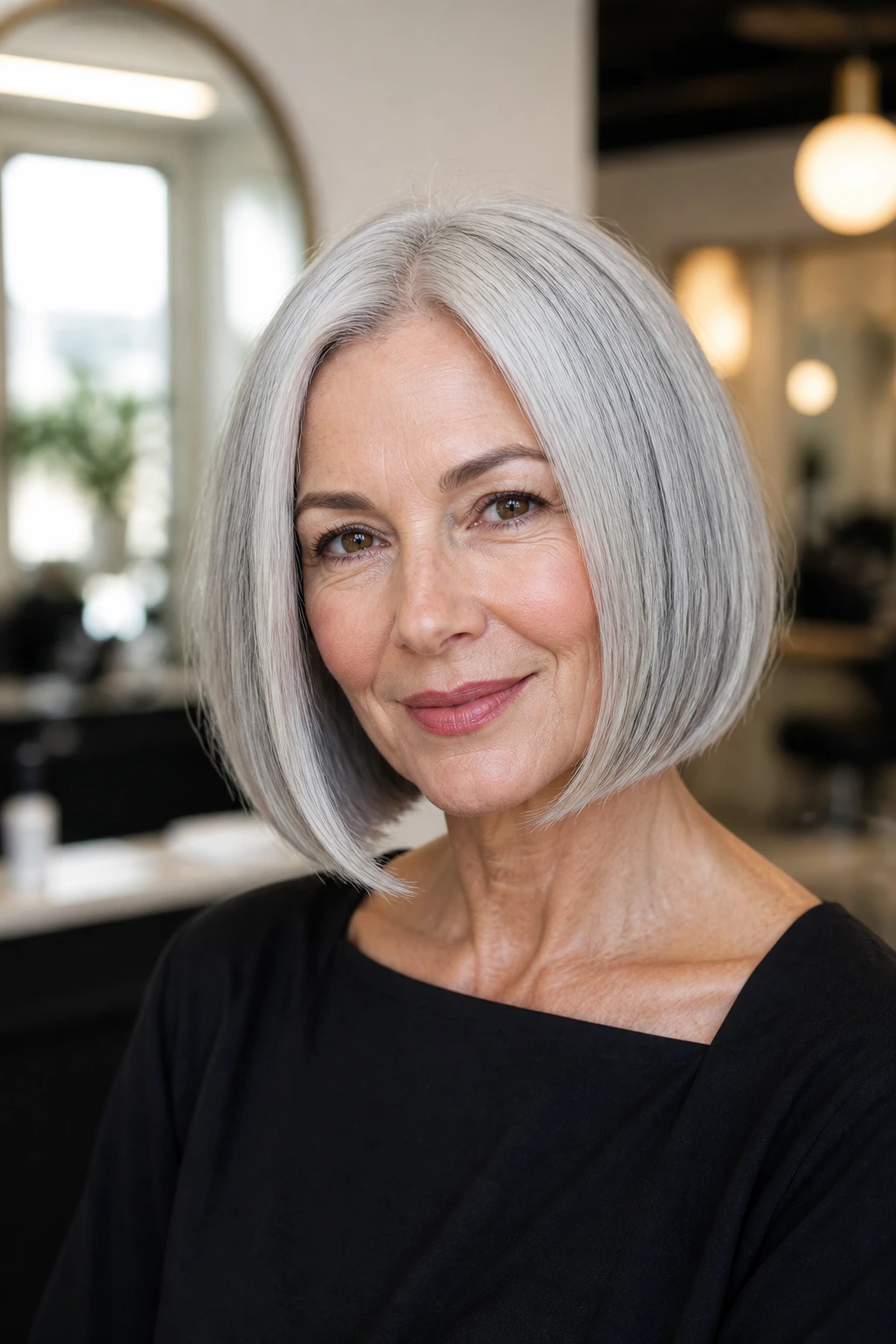
A blunt chin-length gray bob is the haircut I reach for when someone wants silver hair to look crisp without fuss. The line sits right around the jaw, which gives the face shape and keeps the cut from drifting into “growing out” territory. On gray hair, that straight edge reads almost luminous.
Why It Works
The blunt perimeter makes fine or medium-density gray hair look fuller at the ends. That’s the part that matters most, because silver hair can thin out visually if the layers are too aggressive. Keep the cut slightly beveled at the bottom so it moves when you turn your head, rather than sitting like a hard shelf.
If your hair bends at the nape, ask for a dry finish or a quick refinement after blow-drying. Wet hair lies. Dry hair tells the truth.
Best detail to ask for: a chin-grazing line with a tiny bit of inward bevel
Styling note: a paddle brush and a flat wrap blow-dry keep this neat
Who it flatters: round, oval, and heart-shaped faces
My take: this is the bob that makes gray hair look expensive without trying too hard.
2. Soft Layered Silver Bob
Too many silver cuts get overloaded with layers. This one avoids that trap. A soft layered bob keeps movement at the ends, but it leaves enough weight in the body so the hair doesn’t go fuzzy by noon.
The trick is restraint. You want the layers to whisper, not shout. On gray hair, choppy layering can create a halo of flyaways that looks bigger in daylight than it did in the salon mirror. Soft, long layers around the perimeter are much kinder, especially if your hair has a bit of natural wave.
I like this shape for people who want their hair to move when they walk, not just hang there. It’s one of the best gray bob haircuts if you want a silver look that feels relaxed but still finished.
What to Ask Your Stylist
Ask for long internal layers and a soft, rounded outline, not heavy slicing through the top.
Ask for a little extra length below the jaw if your hair tends to shrink when it dries.
If your silver strands are coarse, this is the version that keeps them from looking boxy.
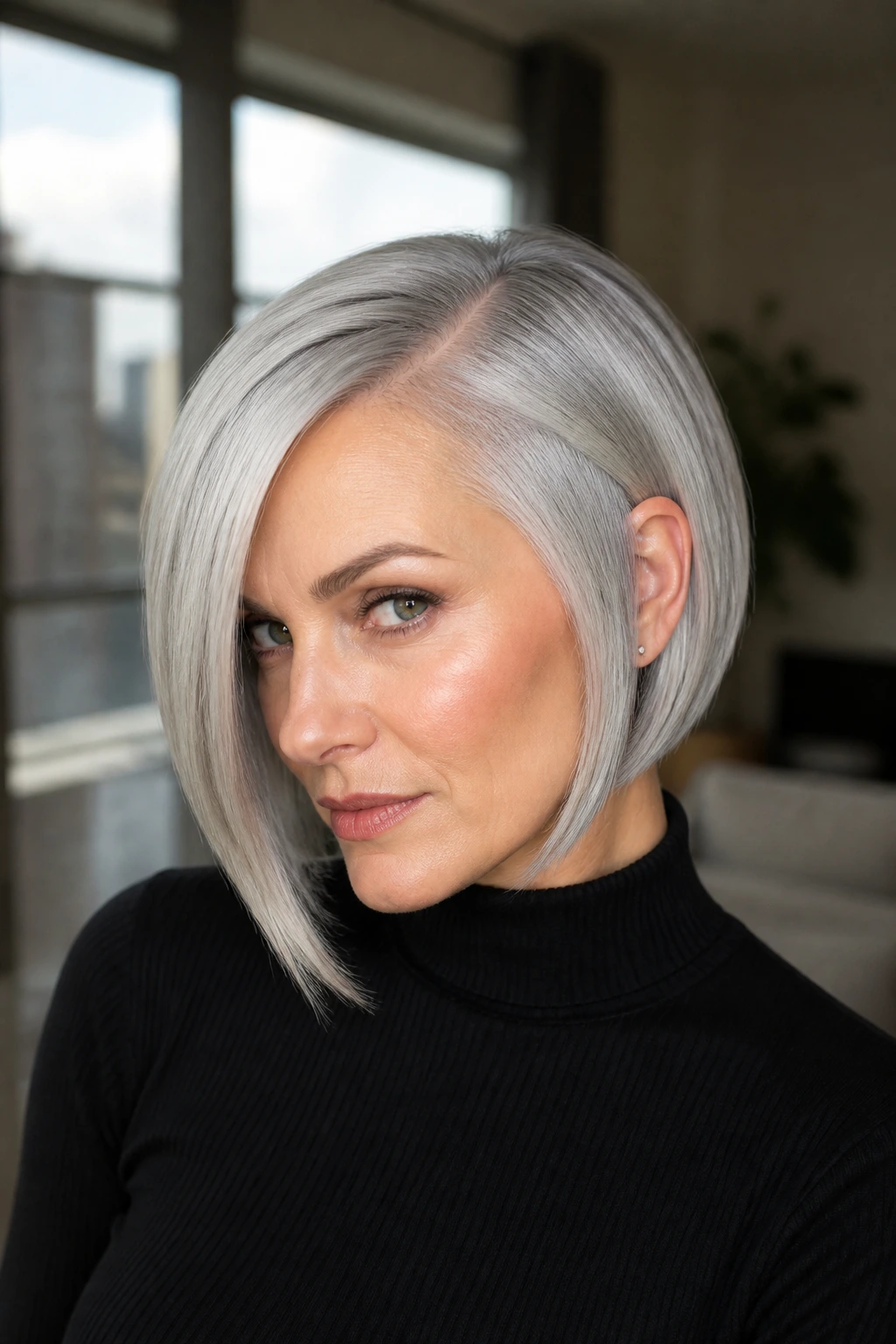
3. Angled Bob With a Sleek Side Part
Why does an angled bob look so clean on gray hair? Because the cut line does something the color can’t do alone: it creates motion. Shorter in the back, longer toward the front, the angle gives the silver a forward sweep that feels sharp rather than static.
This is the bob for someone who likes a polished finish and doesn’t mind a little styling. A sleek side part can make the cut look almost architectural. The longer front pieces narrow a wide jaw, and the shorter back keeps the whole shape lifted. On straight silver hair, the result can look almost glassy.
How to Style It
Blow-dry the front forward first, then sweep it over while it is still warm. A small flat iron bend at the ends keeps the line from getting too severe.
If your hair flips out at the collar, this shape needs a smooth neck finish.
A pea-sized amount of cream on the ends is enough. Too much and the angle goes limp.
This cut is a good answer for gray hair that feels a little flat in the crown but still has density through the sides.
4. French Bob With Micro Fringe
A French bob with micro fringe is a bold little cut. It sits short, usually around cheekbone to lip length, with a fringe that falls well above the brows. On gray hair, that shorter shape looks confident fast. There’s no hiding behind it.
The reason it works is proportion. Short fringe plus short body equals a cut that feels deliberate. If the gray is bright and the edges are clean, the whole thing has that neat, slightly cool look that older haircuts often miss. The danger is going too soft with the finish. A French bob needs some edge.
Best for: straight to slightly wavy hair
Ask for: a fringe that’s wispy, not heavy and helmet-like
Watch out for: very thick or very curly hair, unless your stylist is comfortable shaping both the fringe and the body while dry
A little matte texture at the ends keeps this from looking costume-y. That’s the difference between a chic crop and a haircut pretending to be chic.
5. Collarbone Gray Bob
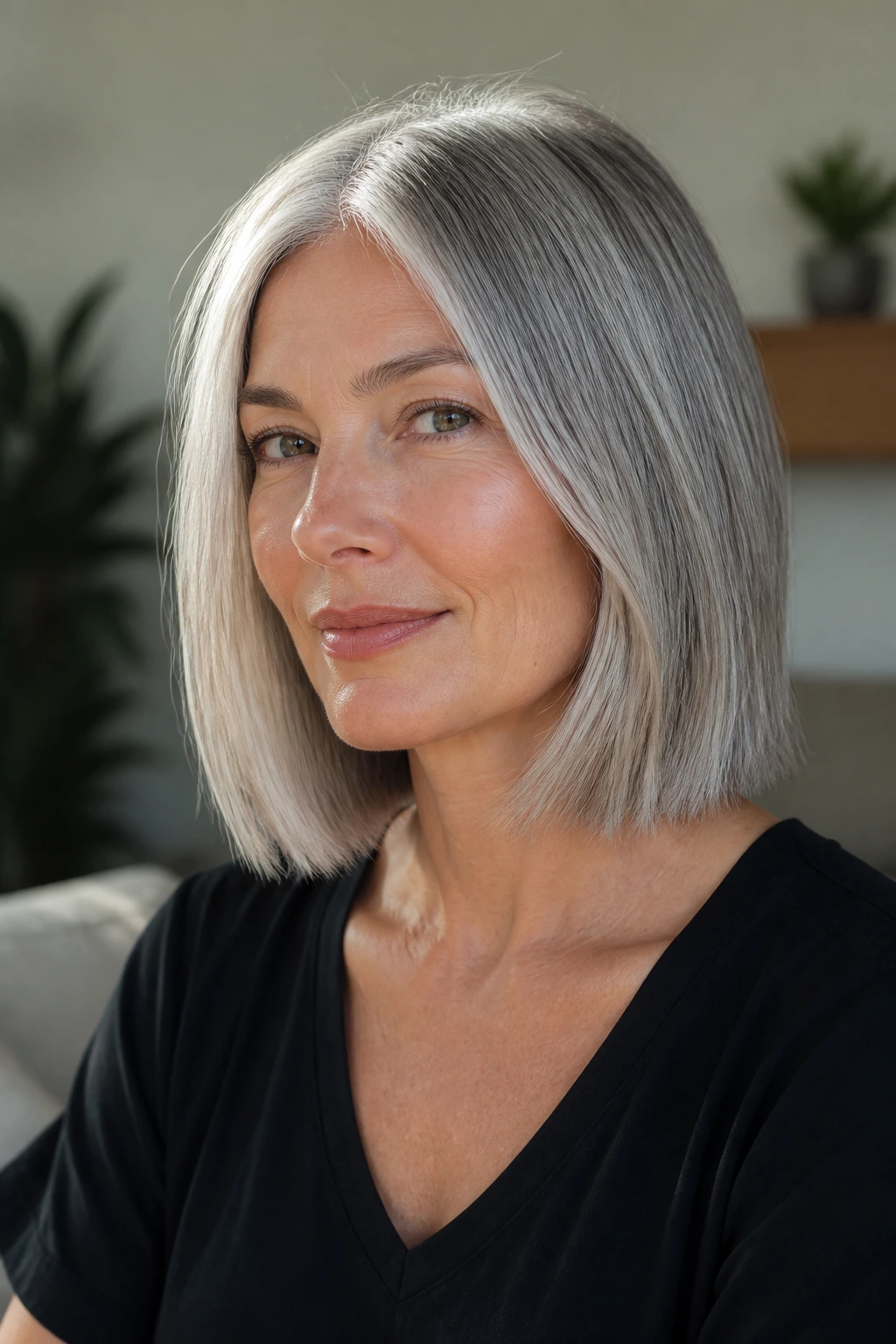
Can a bob be longer and still feel sharp? Absolutely. The collarbone bob is proof. It gives you the bob shape without losing the swing and softness that some people want when they’re not ready for a chin-length cut.
This is one of the easiest gray bob haircuts to wear if your hair is thick, wavy, or growing out from a shorter style. The length lets the silver move, and the ends sit near the collarbone where the hair catches a little bend naturally. That means less daily wrestling with the blow dryer.
The collarbone length also makes grow-out less dramatic. If you like to stretch salon visits a bit, this is the version that forgives a few extra weeks. Keep the ends blunt enough that the shape still reads as a bob, not a vague medium cut.
Quick notes
- Works well with center or off-center parts
- Good choice if you wear sweaters, collared shirts, or high necklines
- Looks especially nice with soft bends rather than tight curls
6. Feathered Bob for Fine Hair
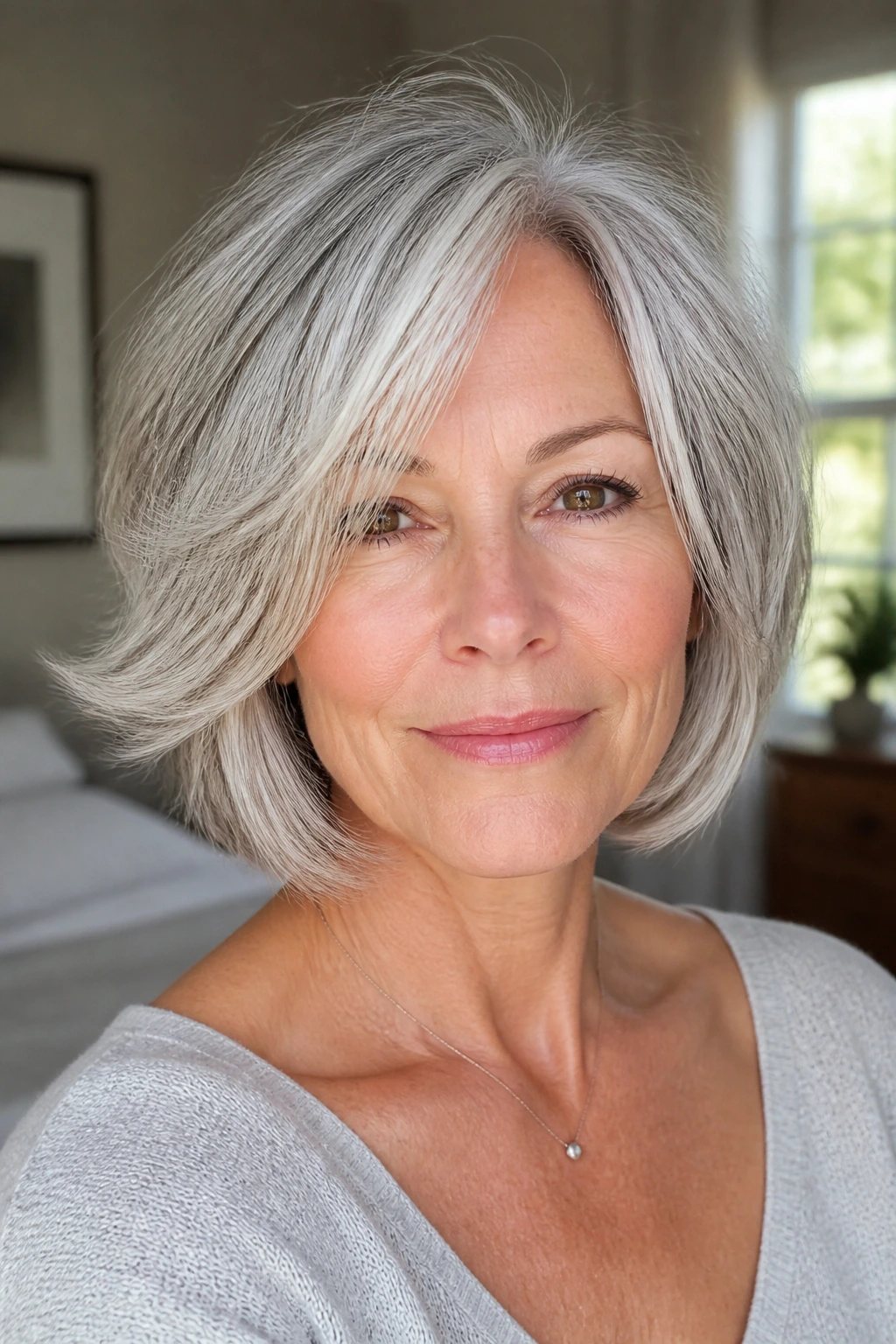
Fine gray hair can go flat in a hurry. A feathered bob fixes that by building movement near the ends without stripping away all the weight. The result is airy, not wispy.
This cut depends on touch, not drama. The feathering should be subtle enough that the hair still looks like it has a perimeter. If the layers get too short, fine silver hair starts to look see-through at the tips. That’s not the goal. You want lift, not holes.
A feathered bob shines when you blow-dry it with a round brush and keep the root lift soft. A little mousse at the crown helps, but don’t load the mids with heavy product. Fine gray hair can collapse under it.
Best for: flat crowns, fine strands, and hair that needs movement without a shaggy finish
Tip: ask for feathering mostly around the cheekbones and outer ends
7. Wavy Silver Bob With Loose Texture
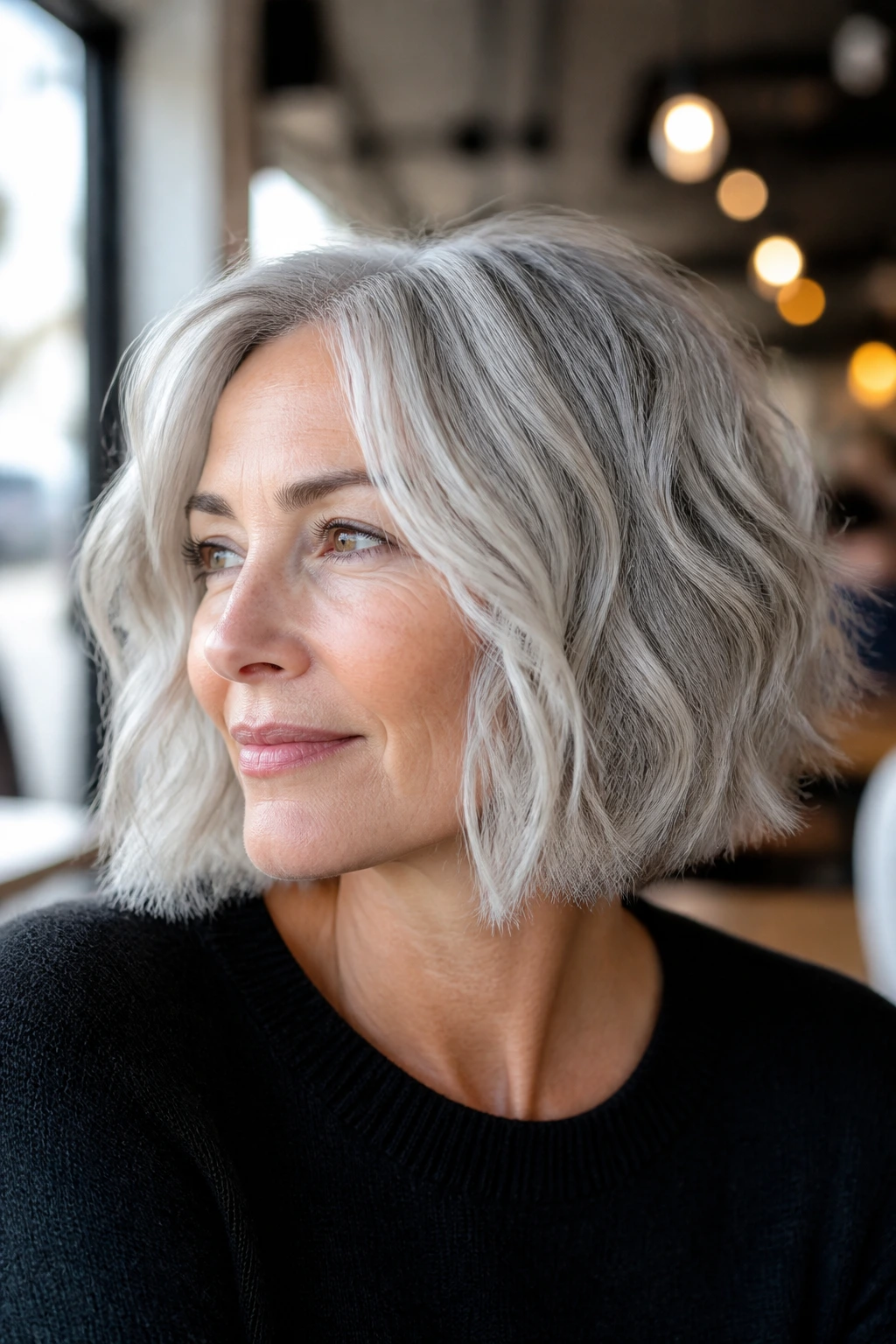
A wavy silver bob is the haircut that makes gray hair look like it was meant to live in soft air. Not curled. Not stiff. Just bent enough to keep the shape moving. If your hair has any natural wave, this is worth a serious look.
The thing I like most here is the contrast between the silver and the texture. Straight gray hair can read severe. Add loose bends, and the same color turns softer, almost luminous. It’s a simple shift, but it changes the whole mood of the cut.
How to get the shape
Use a 1-inch curling iron or wand and wrap random sections away from the face, leaving the ends out for a lived-in finish. Then finger-comb, not brush. If you brush this style hard, the wave disappears and you’re back to square one.
This version works especially well when the gray has multiple tones. Those small shifts in silver, charcoal, and white show up better once the hair has movement.
8. Stacked Bob With Lift at the Crown
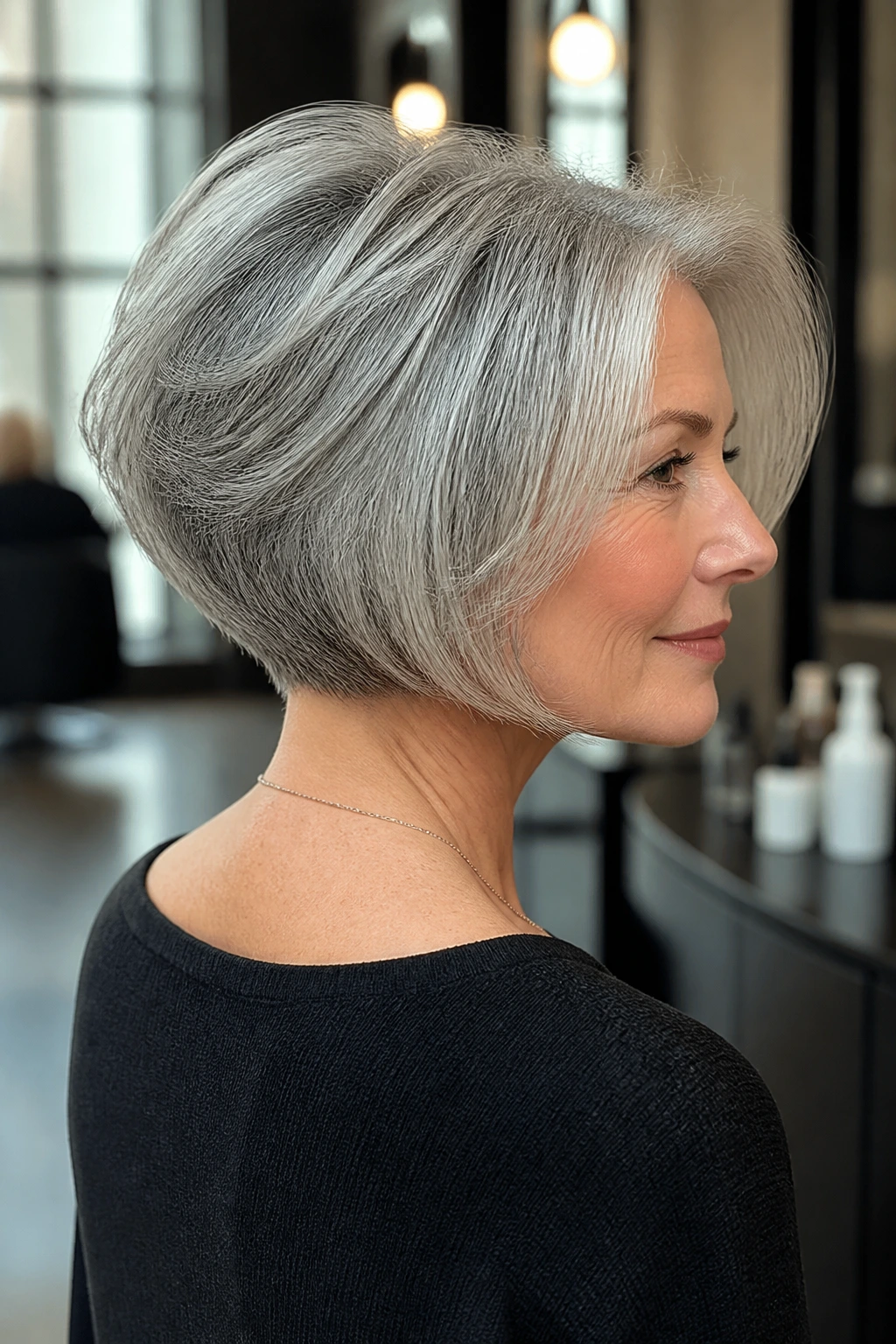
A stacked bob is for someone who wants a clear shape from every angle. The back is shorter and rounded, with weight building through the crown so the cut sits up instead of collapsing. On gray hair, that lift can be a lifesaver.
The crown volume gives the silver a bit of posture. That sounds silly, maybe, but it’s true. When the back is stacked neatly, the whole style feels lifted and tidy, especially if your hair sits flat near the nape. The cut does a lot of the work, so you don’t need to tease or spray it into submission.
The one thing to watch is roundness. Too much stacking can look dated fast. Ask for a modern finish with a clean neckline and less puff at the back than the old-school versions people remember from salon posters.
This is a strong pick for dense hair that keeps hitting your shoulders and flipping out at the ends.
9. Asymmetrical Gray Bob
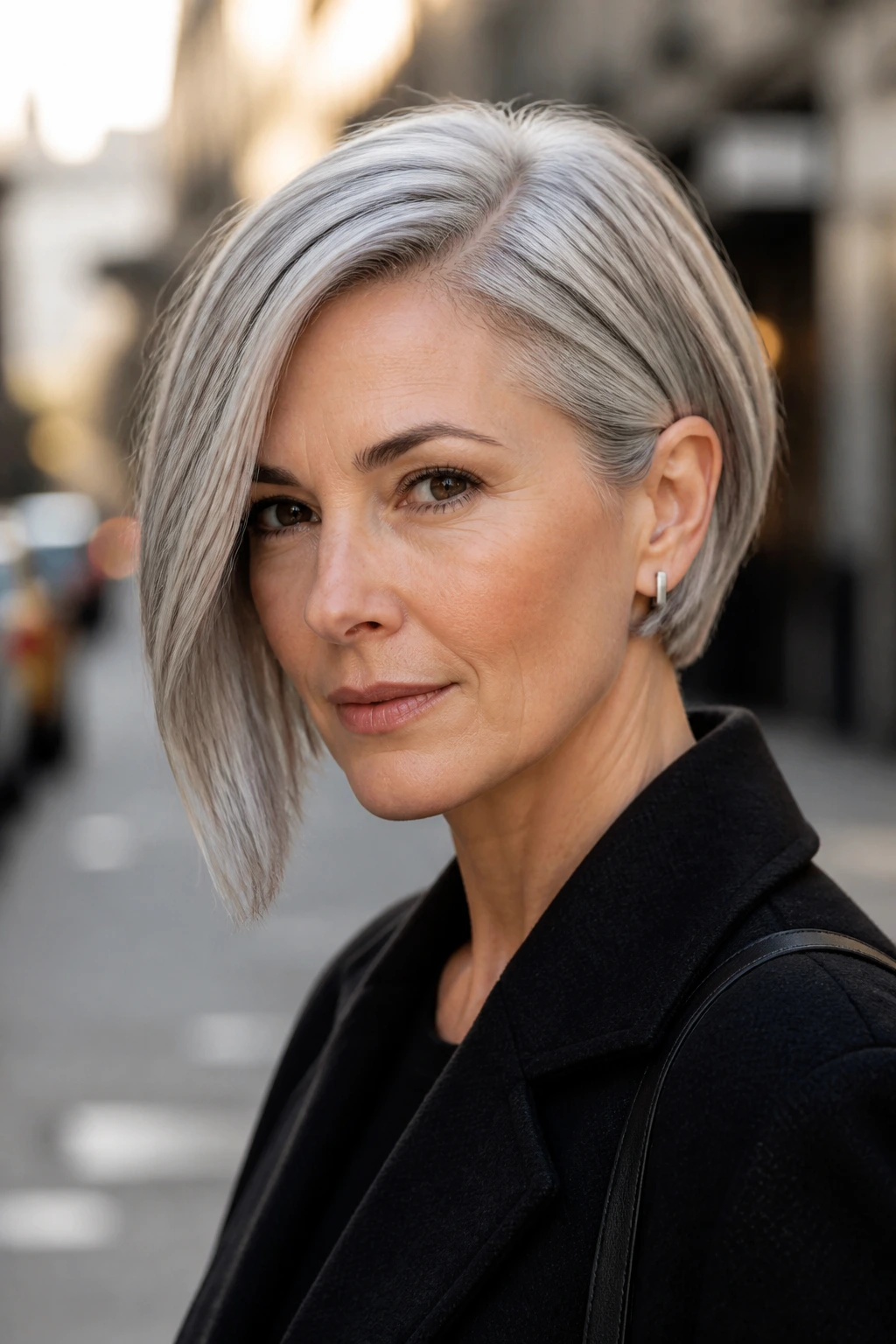
Looking for something that breaks the symmetry a little? The asymmetrical bob gives you that. One side is left longer than the other, and the imbalance makes gray hair look sharper, not messier.
I like this cut because it creates a point of view. It doesn’t rely on the color alone. The line itself has personality. That matters on silver hair, where the wrong bob can drift into safe territory fast. An asymmetrical shape keeps the eye moving and works especially well with a side part.
How to wear it
Keep the shorter side tucked behind the ear and let the longer side brush the jaw or upper neck. That contrast is the whole point.
If your hair is fine, keep the length difference modest.
If it’s thick, the asymmetry can be more obvious without looking extreme.
This is one of the best gray bob haircuts if you want a little attitude without going short-short.
10. Curly Silver Bob

Curly gray hair in a bob can be gorgeous when the shape is cut with restraint. The cut should support the curl pattern, not bulldoze it. A good curly bob keeps the silhouette rounded and the ends soft enough that each curl can sit where it wants.
The mistake people make here is cutting curly silver hair too blunt while it’s wet, then wondering why it springs up unevenly. Curly hair has opinions. Gray curly hair even more so. A dry cut or a curl-by-curl shaping session usually gives the best result, especially if the curl pattern changes from the front to the back.
What I love is the halo effect. Silver curls catch light in small flashes, and a bob lets that happen around the face instead of halfway down the back. It can look lively, not frizzy, when the layering is light and the hydration is handled well.
Use a cream that gives slip, not crunch. The shape should feel soft in motion, not shellacked.
11. Inverted Bob With a Clean Nape
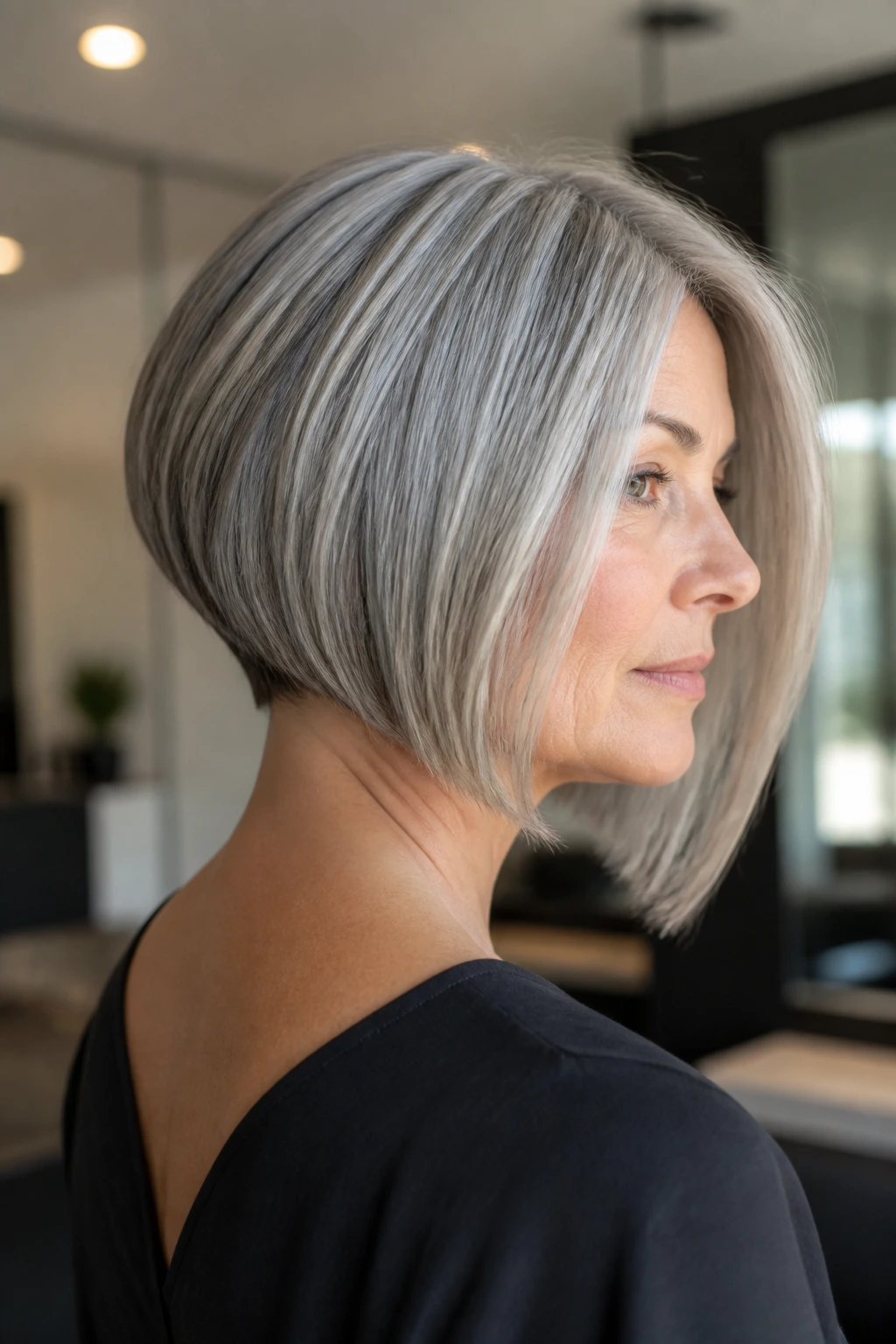
The inverted bob is the sharper cousin of the stacked cut. It keeps the nape neat and close while the front drops longer toward the collarbone or jaw. On gray hair, that clean back line makes the whole cut feel tailored.
This style works because the difference between the back and front creates movement without needing a lot of visible layering. The back looks tidy under jackets and scarves, which is nice if you hate collar friction. The front gives you enough length to tuck, curl, or flatten with a brush.
I’d choose this for someone whose hair is thick enough to hold a shape but not so thick that it explodes at the bottom. The inverted line needs a crisp finish. If the nape gets bulky, the whole thing loses the point.
A little smoothing serum through the front only. Not the crown. Keep the lift up top, or you’ll flatten the shape.
12. Choppy Textured Bob

A choppy textured bob is for silver hair with personality. The ends are broken up just enough to keep the cut from feeling strict, and the shape sits in that nice middle ground between neat and undone.
This is one of the gray bob haircuts that benefits from texture spray more than heavy styling cream. The point is separation. You want to see the movement in the layers, especially if your hair has natural wave or a bit of bend from sleeping on it. Done right, the cut looks casual in a way that still feels intentional.
What makes it different
Unlike a blunt bob, this one doesn’t rely on a hard edge.
Unlike a shag, it doesn’t lose the bob silhouette.
That makes it useful for people who want softness but not too much fluff.
If your gray hair tends to poof in humidity, keep the choppiness around the ends only. Too much texture near the crown gets noisy fast.
13. Side-Swept Bang Bob
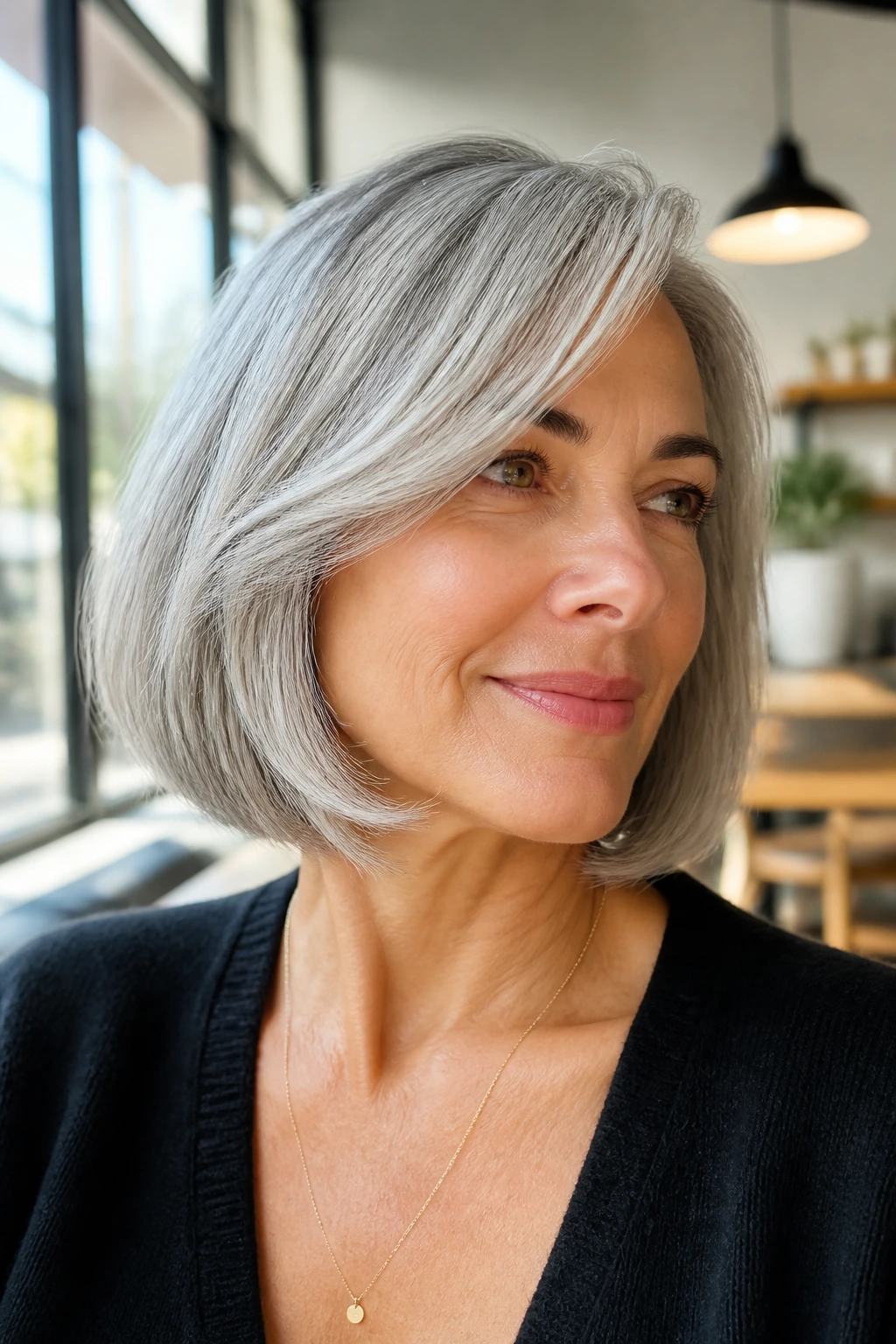
A side-swept bang changes everything. It softens the forehead, gives the bob a little sweep, and keeps silver hair from feeling too severe around the face. If straight-across bangs feel like too much maintenance, this is the safer move.
The nice thing about side-swept bangs is that they grow out gracefully. They can blend into the rest of the bob instead of needing a hard trim every few weeks. On gray hair, that matters because the fringe area often shows regrowth first.
The best versions are light enough that they move when you turn your head. Heavy side bangs can hide the eyes and drag the style down. A softer angle keeps the cut open, which is usually what silver hair needs.
I like this with chin-length or collarbone-length bobs most. The bang creates a diagonal line that helps the whole style feel less square.
14. Rounded Bob With Soft Volume
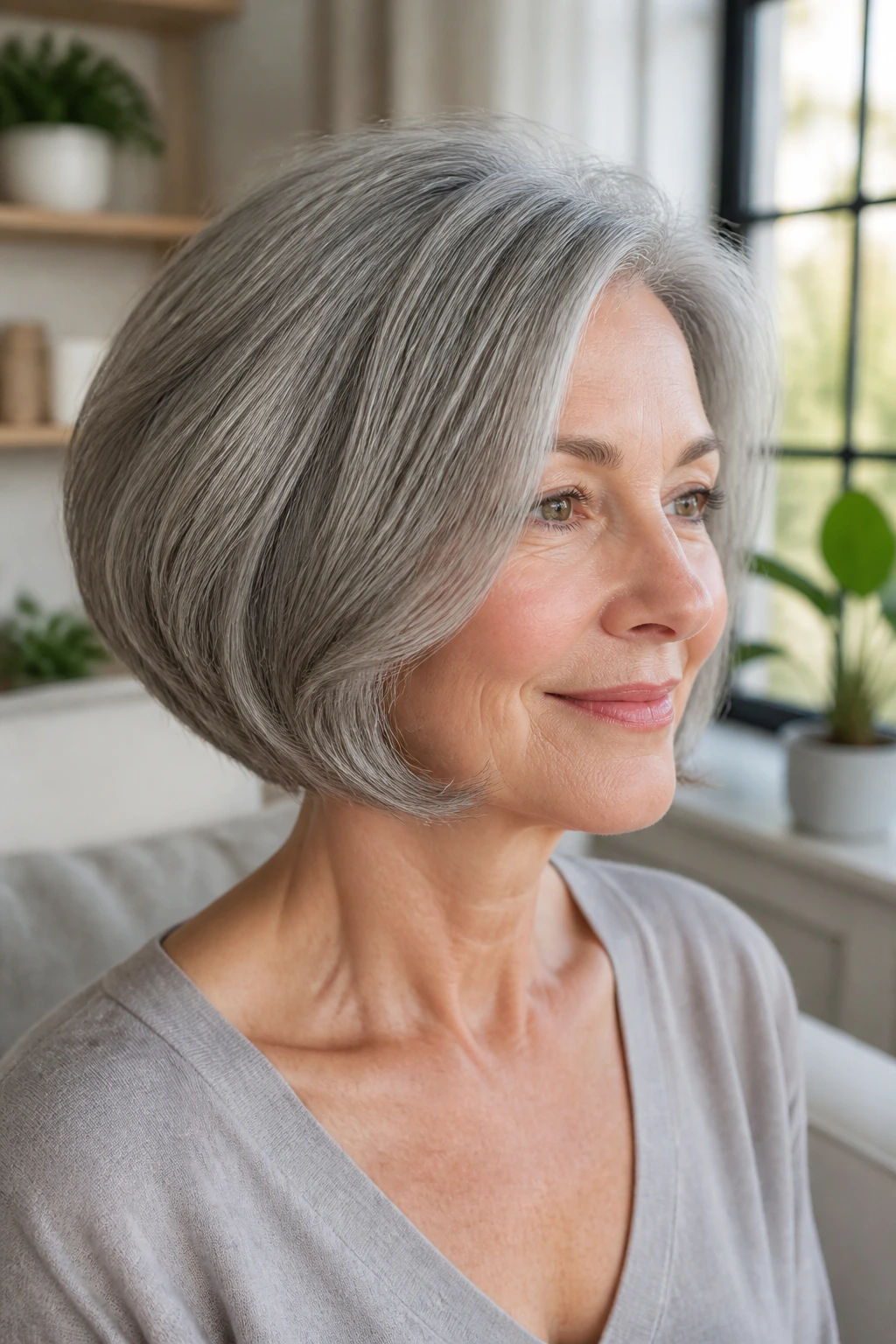
A rounded bob sounds old-fashioned until you see one cut well. The modern version keeps the curve gentle, with fullness through the middle and softened ends. On gray hair, that roundness can give the style a controlled, almost sculpted shape.
This works especially well if your hair naturally wants to puff at the sides. Instead of fighting that, the cut turns it into part of the silhouette. The result is polished, but not stiff. You get body without the blocky outline that can age a haircut fast.
The key is keeping the curve subtle. If the roundness gets too dramatic, the bob starts to feel helmet-like. A light bend under the ends and a little lift at the crown are enough.
Best for: medium to thick hair
Styling note: a round brush and a cool-shot finish keep the curve in place
Avoid: too much hairspray, which can make the finish look dry and chalky
15. Glassy Sleek Silver Bob
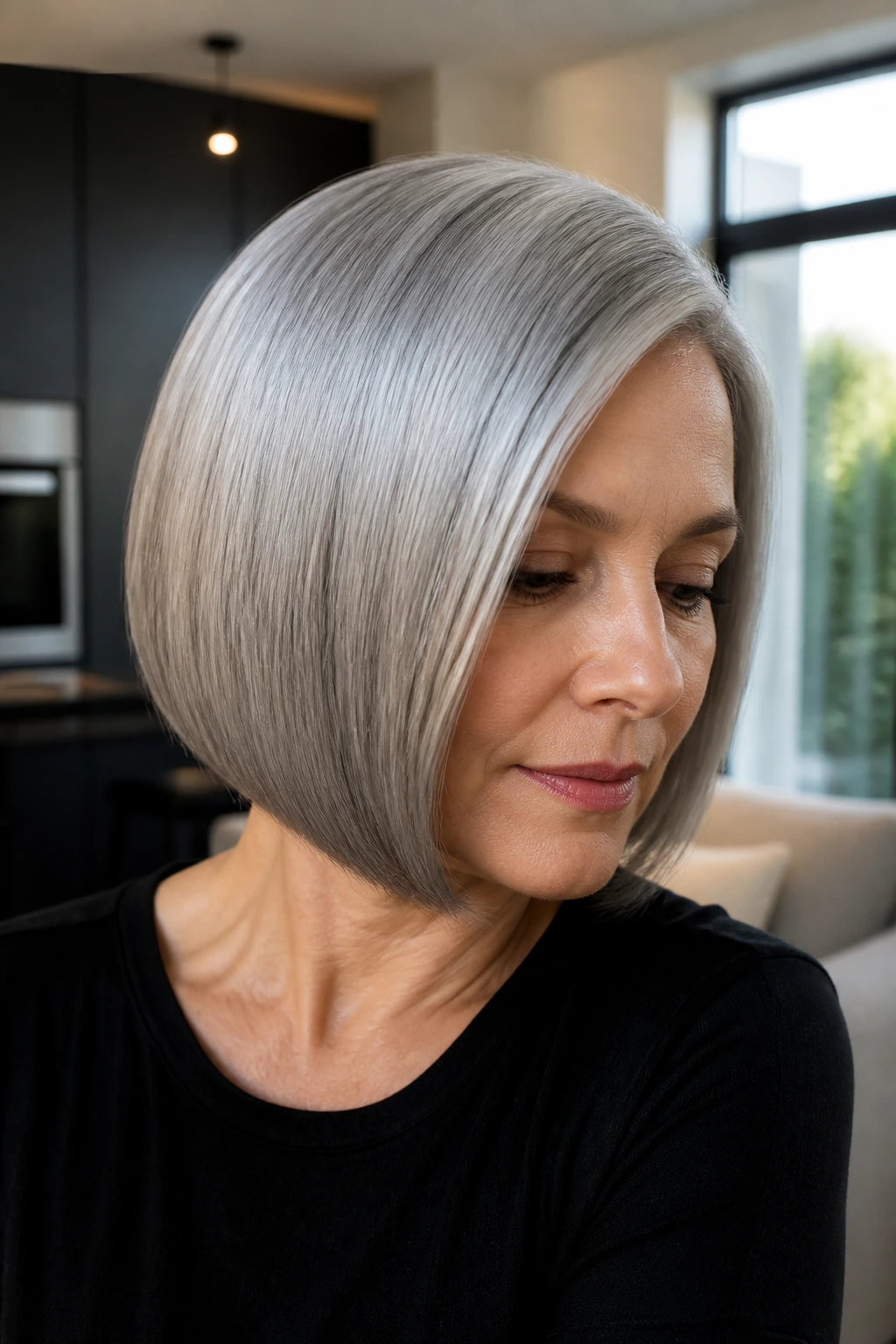
A glassy bob is one of the most striking ways to wear gray hair. Everything is smooth, reflective, and precise. The finish matters as much as the cut. Without shine, the style can look flat. With it, the silver turns almost metallic.
This is not the bob for people who want to air-dry and go. It likes a flat iron pass, a good heat protectant, and a careful part. But the payoff is strong: every line looks intentional, and the gray reads as luminous rather than dull. That’s the magic of a sleek silver bob done right.
How to keep it from falling flat
Use a lightweight smoothing cream before drying.
Pass the flat iron in small sections, and stop short of curling the ends under too much.
Finish with a drop of serum on the last inch only.
If your hair is coarse, this cut can feel like a relief. There’s something nice about a style that tells the truth about the hair’s shape instead of fighting it all day.
16. Razored Bob With Piecey Ends
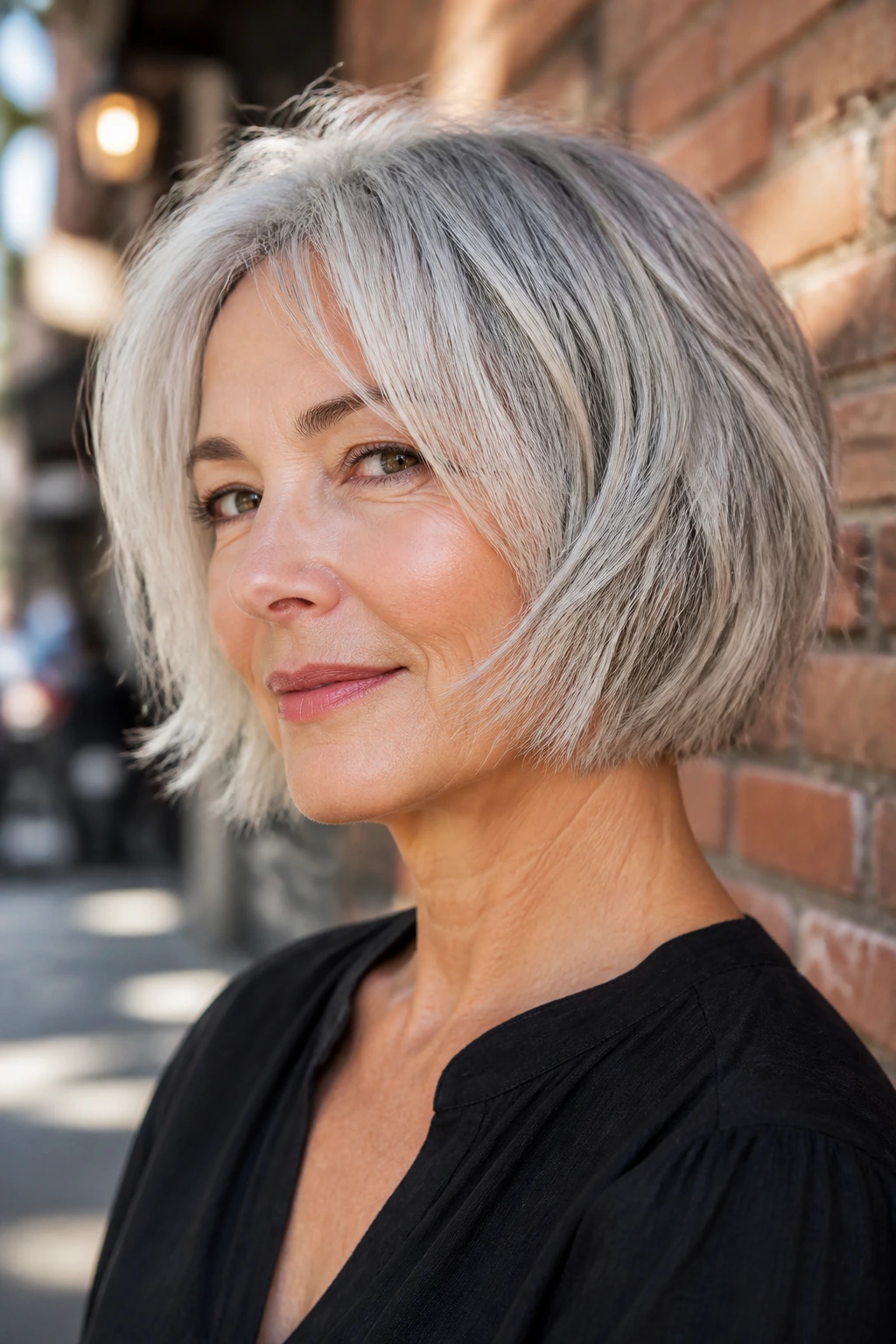
A razored bob brings edge to silver hair, but it needs a careful hand. The blade creates airy ends and a bit of separation, which can be great on thick or straight hair that wants to sit too solid. The wrong razor work, though, leaves gray hair frayed.
That’s why I like this cut most on dense hair with some natural movement. The piecey ends keep the bob from looking blocky, and the texture makes the silver catch light in little flashes. It’s a good choice if you want something less polished than a glass bob but sharper than a soft layered one.
The best version still has shape. The ends should look light, not shredded. If you can see through the hair too much, the cut has gone too far.
This is the bob I’d pair with a matte paste or a dry texture spray, especially if you like a finger-styled finish.
17. Salt-and-Pepper Bob

There’s something honest about a salt-and-pepper bob. The mix of dark strands, silver strands, and white streaks gives the cut built-in dimension, so it doesn’t need complicated layering to look interesting.
What works here is contrast. A clean bob line keeps the mixed color pattern from looking messy. At the same time, a little texture through the ends lets the darker and lighter pieces show up in movement. If you have more pepper than salt, a slightly softer cut can keep the overall look from feeling too severe.
This style is great when you’re growing into gray rather than dyeing it to one shade. It lets the hair keep some of its original depth, which can make the transition feel less abrupt.
A gloss can help here, especially if the darker strands look dull. You don’t need a dramatic tone change. You just want the mix to look rich.
18. Curtain Bang Bob
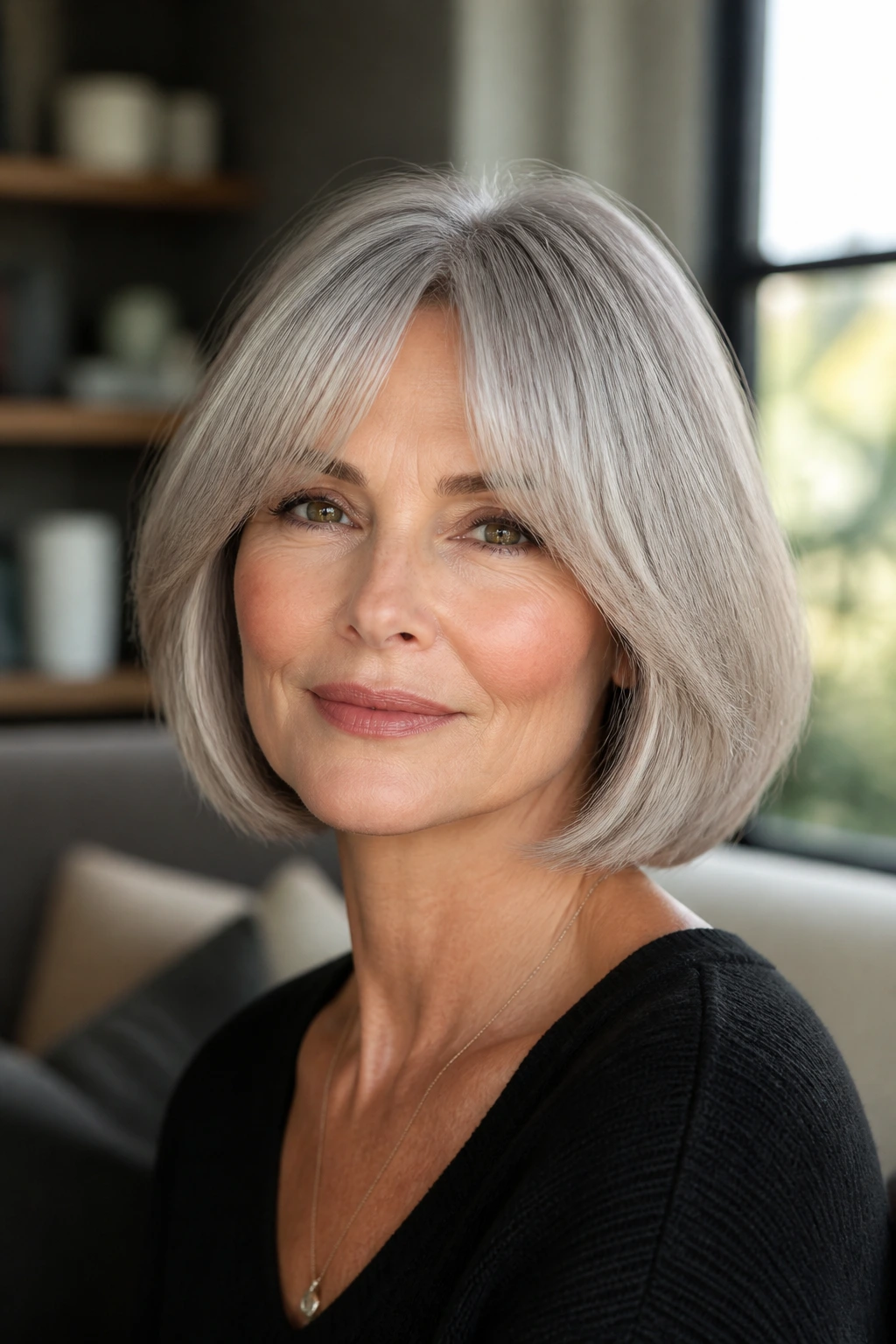
Curtain bangs do a lot of quiet work. They open at the center, skim the cheekbones, and soften the front of a bob without making the whole cut feel heavy. On silver hair, they’re one of the easiest ways to add shape near the face.
This cut is especially useful if your forehead feels broad or if a full fringe feels like too much maintenance. Curtain bangs can slide into the rest of the bob and grow out in a way that’s much less annoying than blunt bangs. That alone earns them points.
The best curtain-bang bobs have enough length in the front that the fringe can bend away from the eyes. If the bangs are too short, they stick up. If they’re too long, they lose the shape and just become face layers.
This is a good softener for straight, wavy, or slightly coarse gray hair.
19. Tucked-Behind-the-Ear Bob
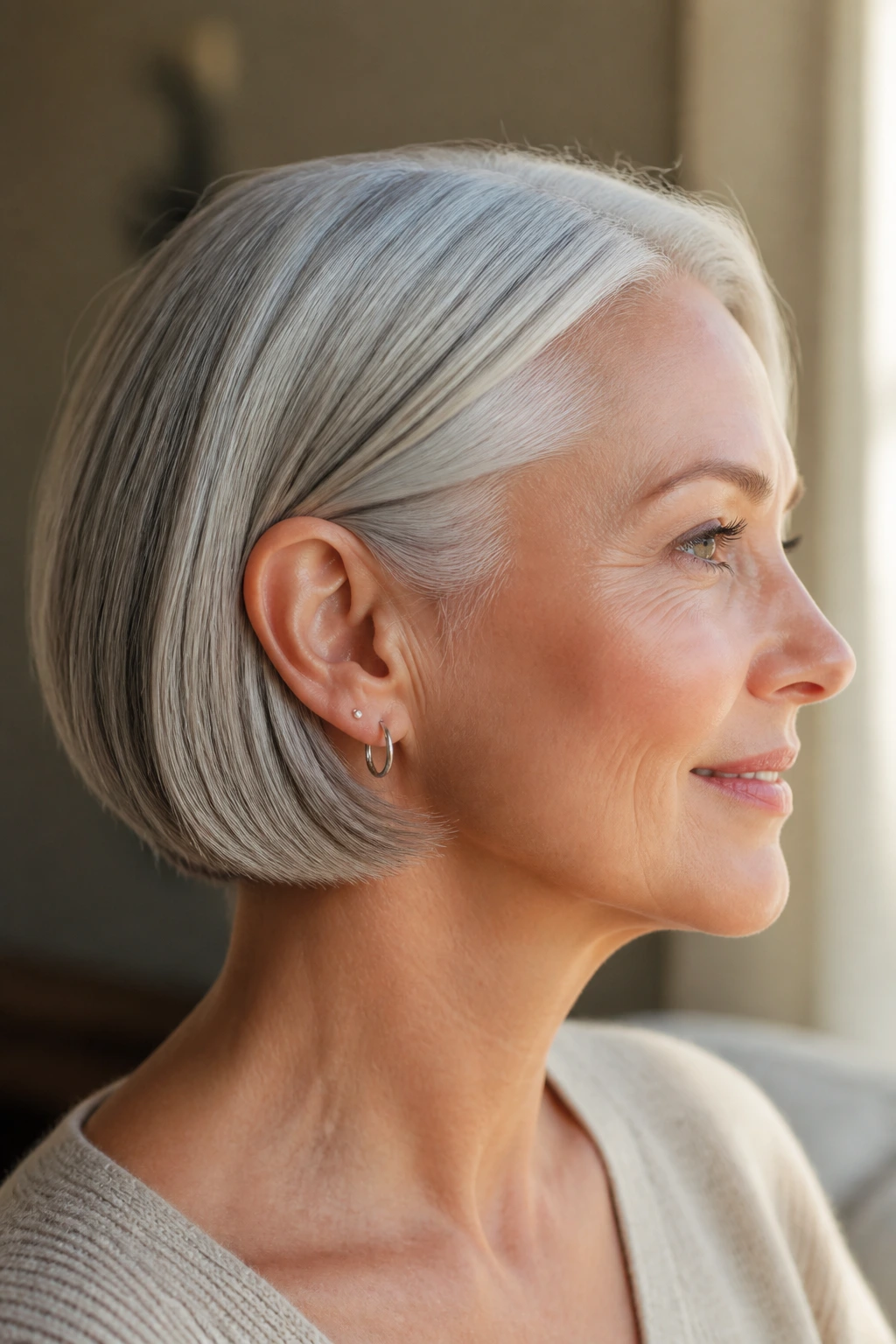
Sometimes the simplest move is the smartest one. A tuck-behind-the-ear bob depends on a clean shape at the jaw and enough length at the front to tuck one side without destroying the line. On gray hair, that tucked side can make the whole style look neat in seconds.
I like this because it uses everyday behavior as part of the cut. You don’t need a dramatic styling trick. You just need a bob that behaves when one side is tucked and the other side falls loose. The asymmetry feels natural, not forced.
When it works best
- Chin to jaw length
- Straight to lightly wavy hair
- Side parts or soft off-center parts
If your ears stick out or you wear glasses, this style can still work. Just leave enough fullness at the cheek so the tuck looks deliberate rather than like you’re hiding the hair.
20. Deep Side-Part Bob
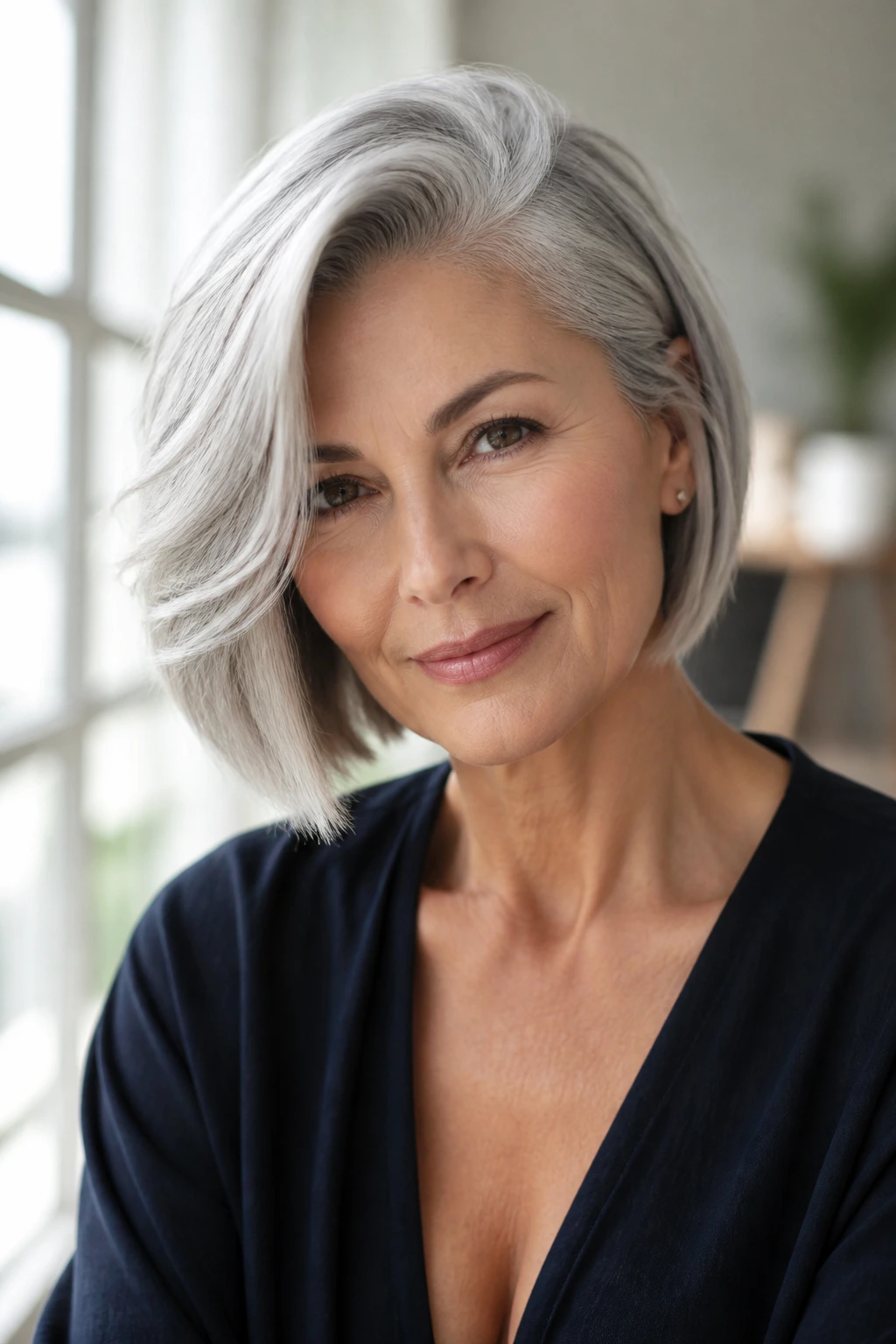
A deep side part gives gray hair immediate shape. It creates volume at the crown, softens a square face, and makes even a simple bob feel more styled. You can do it on blunt, layered, or rounded cuts, which is part of why it’s so useful.
The part itself matters more than people think. When silver hair is all parted the same way every day, it can go flat at the root and stubborn at the bend. A deep side part resets the visual weight. The hair suddenly has lift on one side and a smooth fall on the other.
This is also a nice fix for grow-out phases. If one side feels heavy or the line is getting a little tired between trims, the deep part can freshen everything without scissors. Small shift. Big difference.
Use a root-lifting spray near the part and blow-dry the crown in the opposite direction first. That gives the lift staying power.
21. Graduated Bob for Thick Hair
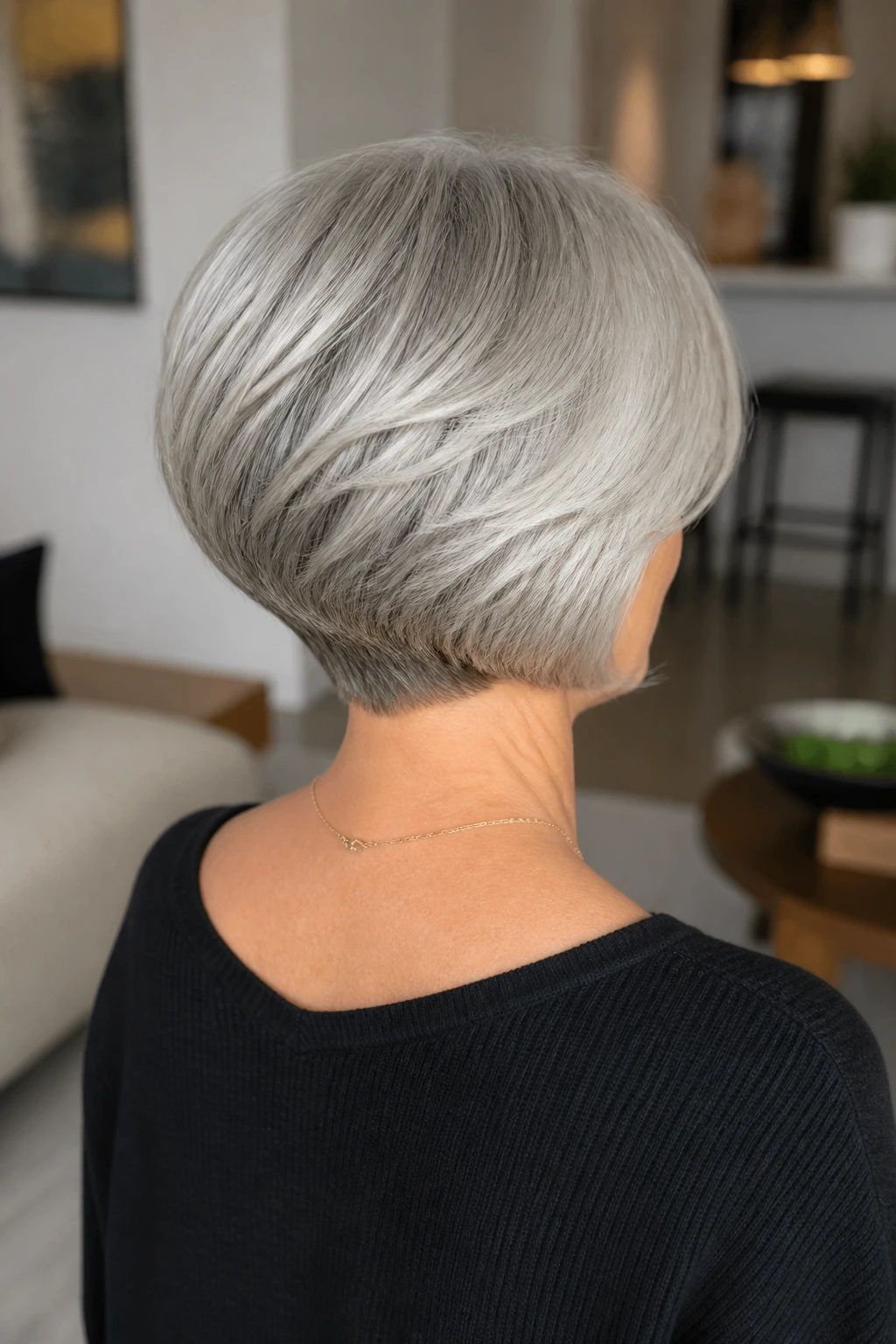
Thick gray hair needs somewhere to go. A graduated bob creates that room. The back is shorter and stacked just enough to remove bulk, while the sides hold enough length to keep the silhouette balanced. That makes the cut feel controlled, not puffy.
The main thing here is weight removal in the right places. If you thin thick silver hair in the wrong spots, the ends fray and the shape turns fuzzy. A graduated bob should feel lighter at the nape and cleaner through the sides, not hacked up. It’s a precision cut.
This style is especially useful if your hair expands when it dries. The graduation lets the hair sit closer to the head at the back, which helps jackets and collars too. You’ll notice the difference the first time you put on a coat and the bob doesn’t balloon.
A smoothing blow-dry gives this cut its best line. Air-drying can work, but it needs more product discipline than most people want.
22. Mini Bob at the Jawline
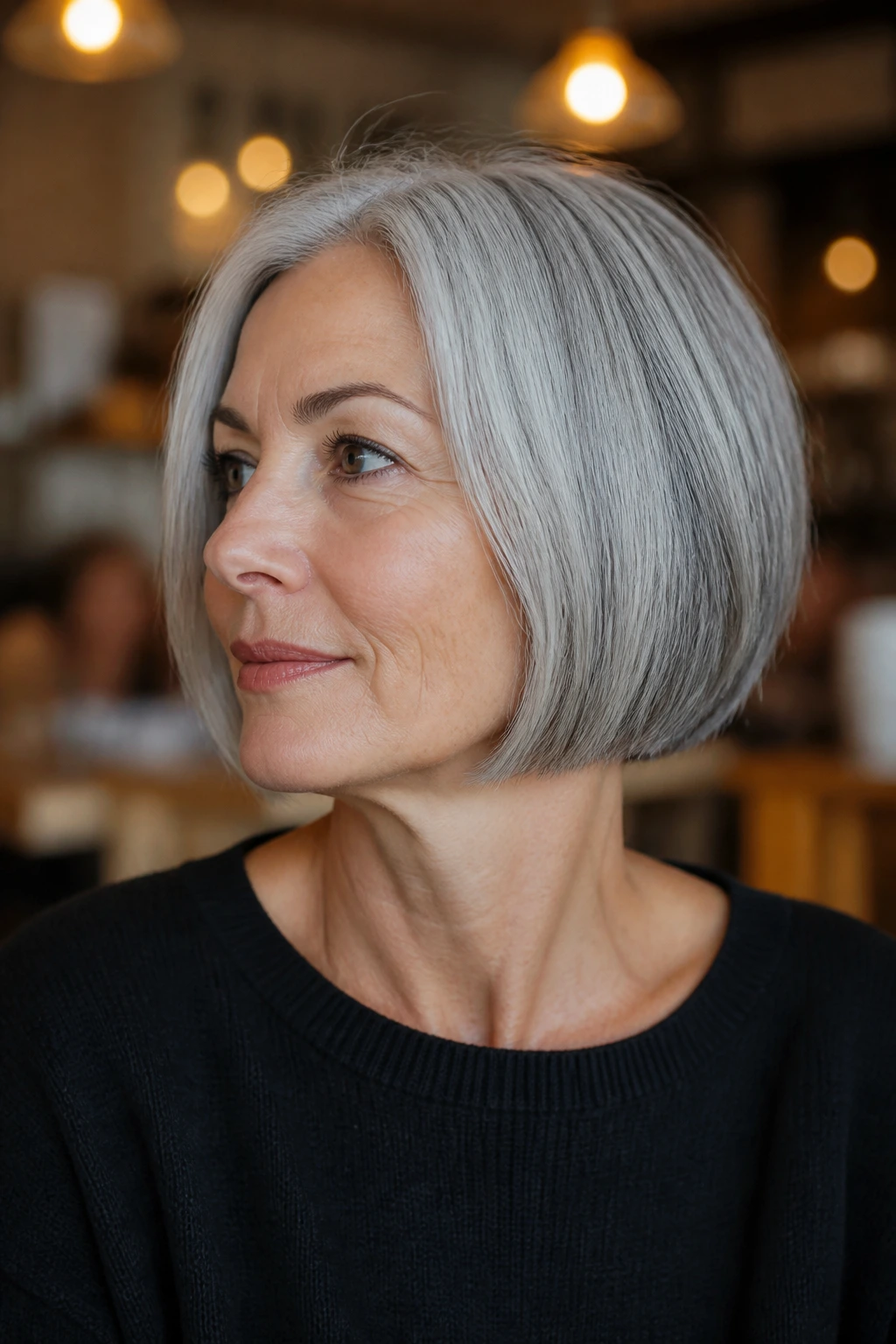
The mini bob is short, neat, and a little cheeky. It stops at or just below the jaw, which makes the face the star. On gray hair, that short length creates a clean frame that looks modern fast.
This cut is especially nice if you like your hair off the neck. It keeps the silhouette tidy and works well with bold earrings or strong glasses frames. Because it sits shorter, the shape needs regular trims to stay sharp. Let it grow too long and it loses the point.
The mini bob can look harsh if the ends are too blunt and the density is too low. A soft bevel at the bottom helps, and a bit of bend through the front keeps it from feeling severe. Think crisp, not stern.
I’d recommend this for people who want low hair bulk and don’t mind keeping up with shape maintenance.
23. Layered Lob for Wavy Gray Hair

A layered lob gives you bob energy with a little more movement through the shoulders. It’s a smart option if your gray hair is wavy and you don’t want the cut to spring up above the jaw. The extra length keeps the wave from bouncing too high.
This is one of those cuts that looks casual on good days and still presentable on less cooperative ones. The layers help the wave pattern fall in soft bends, and the longer length means the gray tones have more room to shift as the hair moves. If you’ve got white streaks around the front, they show up nicely here.
Why I like it
It’s easier to tie back than a shorter bob.
It grows out with less drama.
It gives wavy gray hair a softer landing than a strict chin-length shape.
If you use a curling wand on this one, keep the bends loose and leave the ends out. That keeps the style from turning into ringlets unless you want that.
24. Face-Framing Bob With Cheekbone Layers
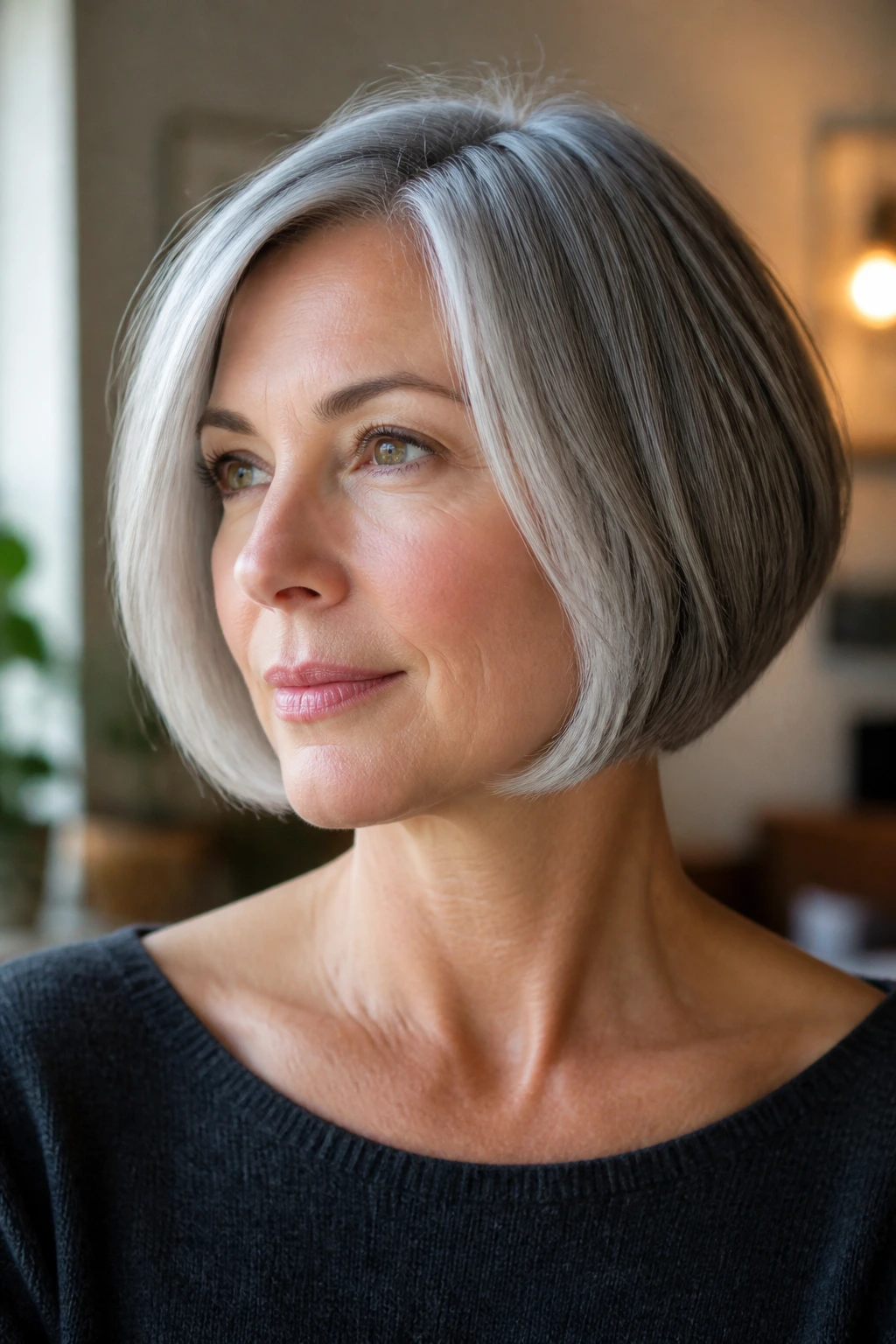
A face-framing bob is one of the most flattering gray bob haircuts when you want the cut to lighten the face without losing the bob shape. The front pieces are trimmed to hit around the cheekbones or just below them, and that softens the whole line.
What makes this version work is the contrast between the front and the back. The back can stay tidy and compact, while the front opens up the face. On silver hair, those face-framing pieces catch the light quickly. It’s a small thing, but it changes how the whole cut reads.
This is a strong move if your jawline feels strong and you want a little softness around it. It also helps if you wear makeup sparingly and want the hair itself to do more framing work. Less contour. More shape from the cut.
Keep the layers around the face long enough to tuck or curl. If they’re too short, they can puff outward in a way that feels dated.
25. Shadow-Root Silver Bob
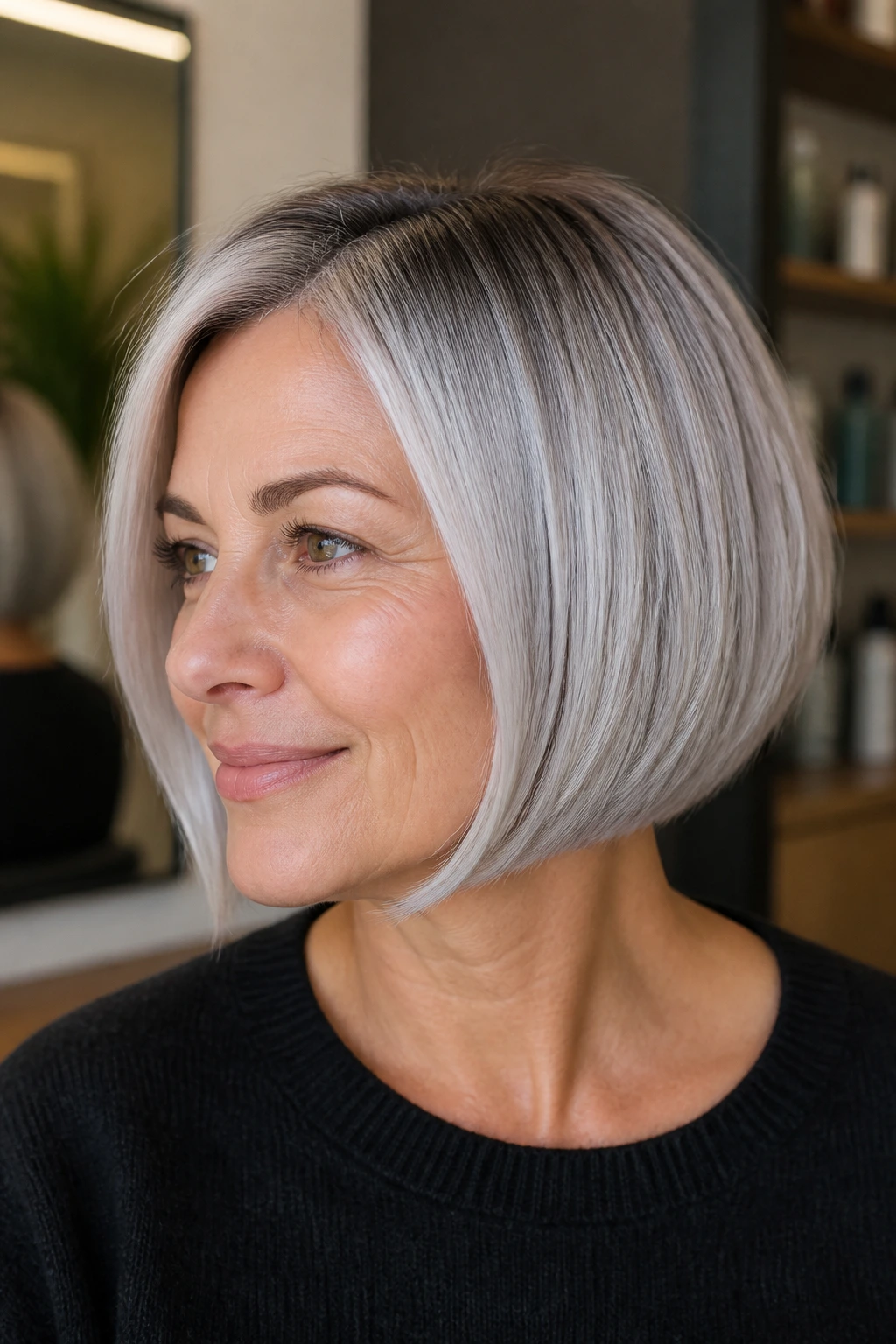
A shadow-root silver bob is for people who want brightness without the maintenance spiral. The darker root, whether natural or color-blended, grounds the silver and gives the cut dimension right away. It’s one of the smartest ways to wear a modern silver look because the grow-out looks built in.
The shadow root also makes the bob look thicker near the scalp. That matters on gray hair, which can sometimes look flat at the top even when the rest of the strand has plenty of body. The deeper root adds visual depth, and the lighter ends keep the brightness.
This version can be sleek, wavy, or piecey. That’s the nice part. The root shading works with almost any bob shape, but I like it most on blunt, angled, and collarbone-length cuts. The contrast keeps the style from reading too one-note.
If you color your hair, ask for a root that is only one or two levels deeper than the mids. Too dark, and the effect turns harsh. Too light, and you lose the point.
Choosing the Right Gray Bob for Your Texture and Face Shape
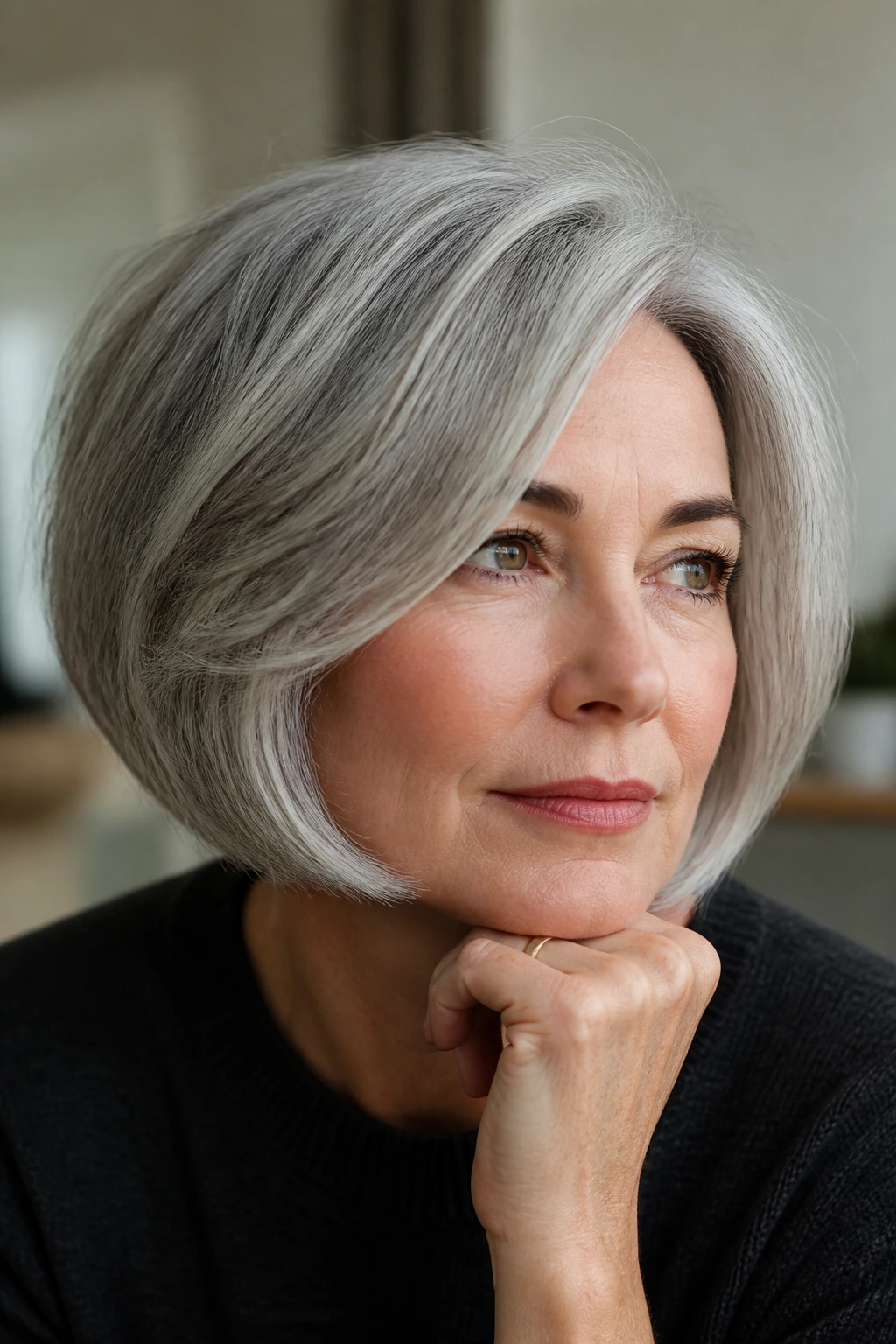
A bob is never just a bob. The same cut can look elegant on one head and bulky on another, and texture is usually the reason. Fine gray hair wants perimeter and a little internal lift. Thick gray hair wants weight removed in the right places. Wavy gray hair needs enough length to show the wave without ballooning out.
Face shape matters too, but not in the rigid way salon charts sometimes make it sound. If your jaw is soft, a chin-length blunt bob can sharpen it in a good way. If your jaw is wide or strong, a collarbone bob or face-framing cut can soften the edges. A deep side part can shift balance fast. Curtain bangs do their own kind of quiet work.
One thing I’d push back on: don’t pick a bob based only on the photo. Pick it based on how your hair behaves on a humid day, on a rushed morning, and after the third day without a wash. That’s the version you actually live with. The best gray bob haircuts are the ones that still look like themselves when the styling is imperfect.
If your hair is coarse, ask for softness in the perimeter rather than more layers. If it’s fine, ask for density at the bottom and lift at the crown. Those two sentences solve a lot of bad haircuts before they happen.
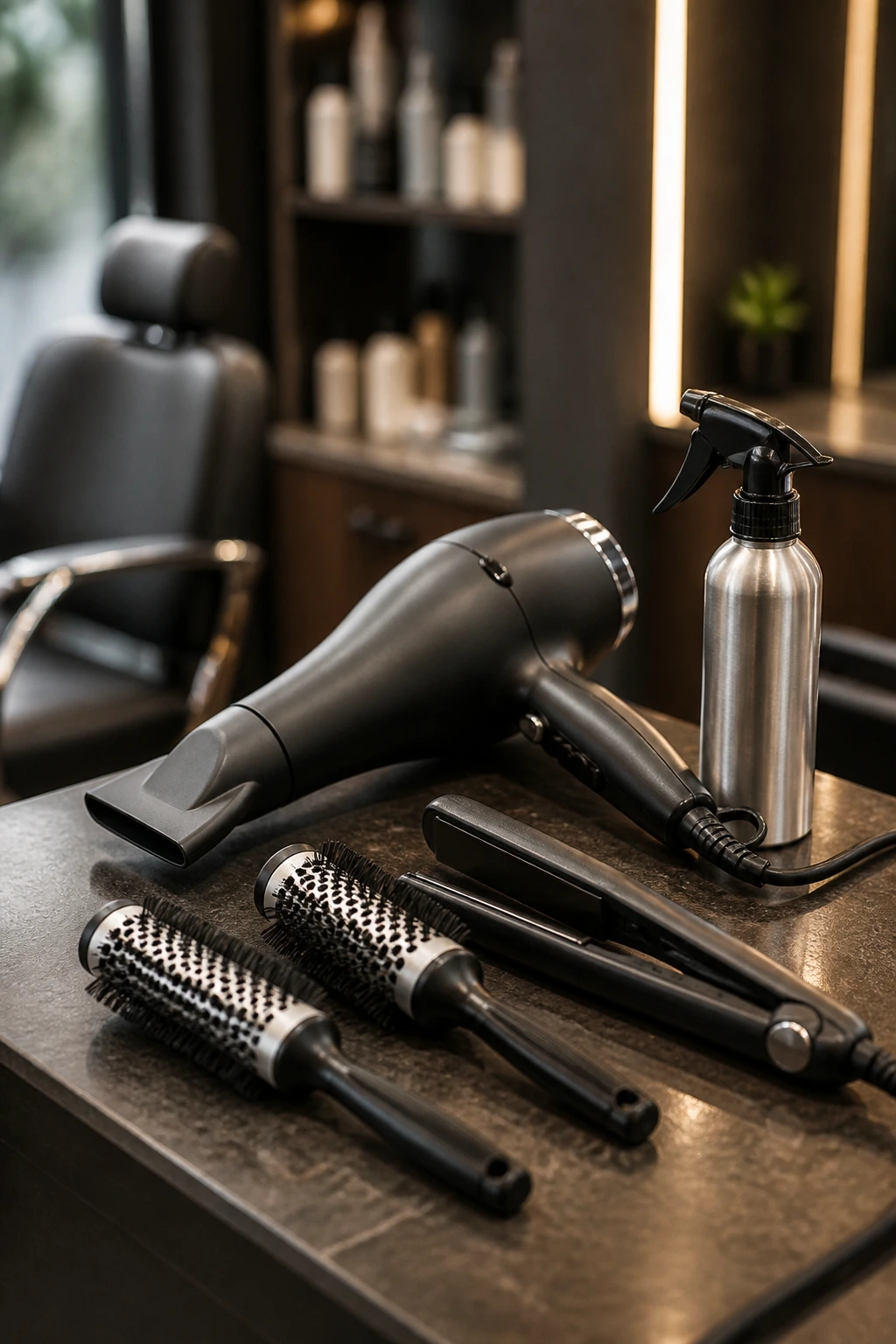
Essential Tools for Styling a Silver Bob
-
A good blow dryer with a nozzle: The nozzle matters because it directs airflow and helps keep the cut smooth along the bob’s edge.
-
A round brush in two sizes: A medium brush handles most bob lengths; a smaller brush is useful for fringe, underturn, and crown lift.
-
A flat iron with adjustable heat: Gray hair can be drier, so lower settings matter. Thin sections and one pass usually beat repeated hot passes.
-
Heat protectant spray: Use it every time you heat-style. Silver hair shows dryness fast, especially at the ends.
-
Light mousse or root lift spray: This helps shorter gray cuts keep shape at the crown without turning sticky.
-
Texture spray or dry finishing spray: Good for wavy, choppy, or razored bobs when you want separation instead of polish.
-
Purple shampoo or silver shampoo: Useful for cooling brassiness, especially on white or very light gray hair, but it should not be used so often that the hair turns dull or violet.
-
A wide-tooth comb and a vent brush: The comb is kinder on curly or fragile gray strands; the vent brush speeds drying on fine to medium hair.
-
Sectioning clips: Not fancy, just useful. Bob styling gets easier when the hair is divided into manageable slices.
How to Wear These Gray Bob Haircuts
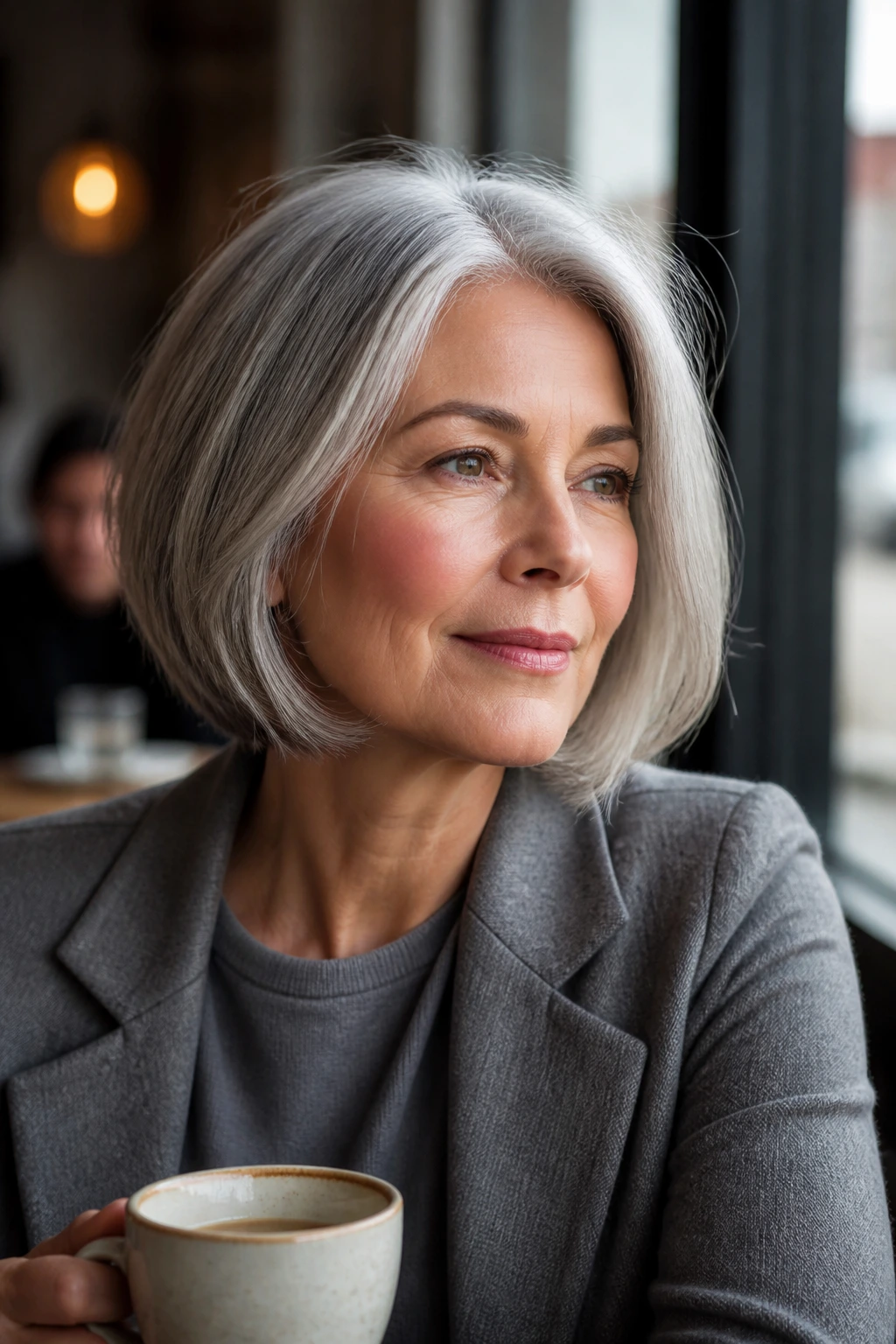
Presentation: A sleek silver bob looks strongest with a clean part and a smooth finish near the face, while a textured gray bob wants a bit of movement and separation at the ends. If your cut is blunt, keep the outline neat. If it is layered, let the texture show instead of brushing it into one flat sheet.
Wardrobe Pairings: Gray bob haircuts look especially good with strong necklines, open collars, small hoops, and glasses that have a defined frame. A bob exposes the neck and jaw more than long hair does, so the shirt collar and earrings become part of the look whether you planned that or not.
Proportions: Shorter bobs usually flatter when the volume sits either at the crown or just under the cheekbones. Longer bobs balance better with soft bends around the collarbone. If your face feels shorter, skip heavy volume at the sides. If your face feels long, add width around the jaw or cheek area.
Finish: A glossy finish suits cleaner cuts like the blunt bob, glass bob, and angled bob. A matte, piecey finish works better on choppy or razored shapes. Don’t force one finish onto every cut. That’s how a good haircut starts acting wrong.
Small Styling Tweaks That Make the Cut Look Fresh
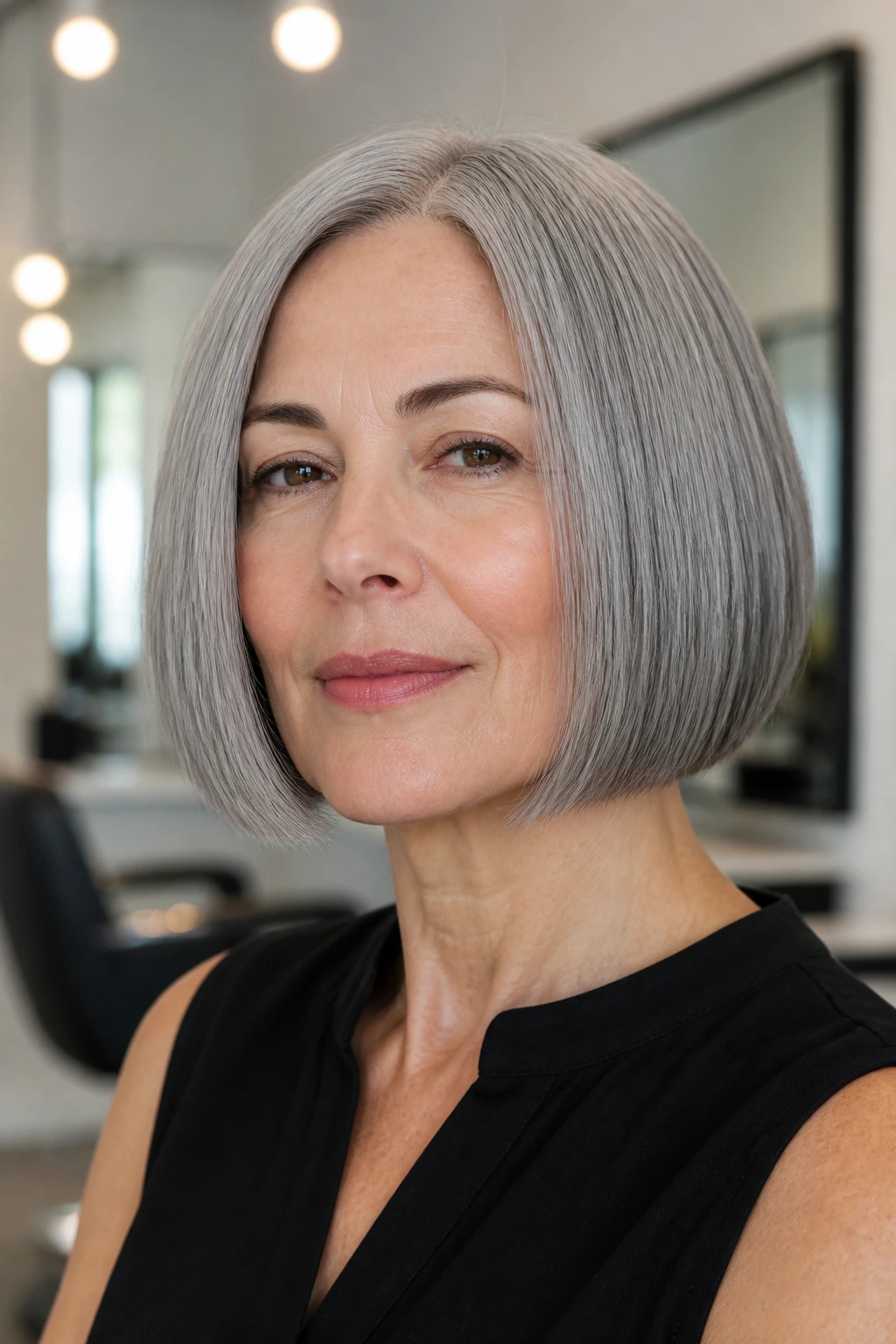
Part Change: Move the part an inch or two off its usual spot. That one shift adds lift at the root and stops a gray bob from settling into the same fold every day.
Root Lift: Use a small amount of mousse or root spray only at the crown. Gray hair can collapse fast if the mids get overloaded, so keep the product close to the scalp.
Face Softening: If the bob feels too hard, bend the front pieces away from the face with a flat iron or curling iron for five seconds per side. That tiny curve changes the mood more than a full curl does.
Shine Control: A drop of serum on the ends can tame dryness, but a glossy spray over the whole head can make fine gray hair look limp. Light hand. Every time.
Shape Refresh: Use a steam pass or a light mist of water and a brush on day two or three, then re-bend only the top layer. You do not need to restyle the whole head from scratch every time.
What to Avoid With a Gray Bob
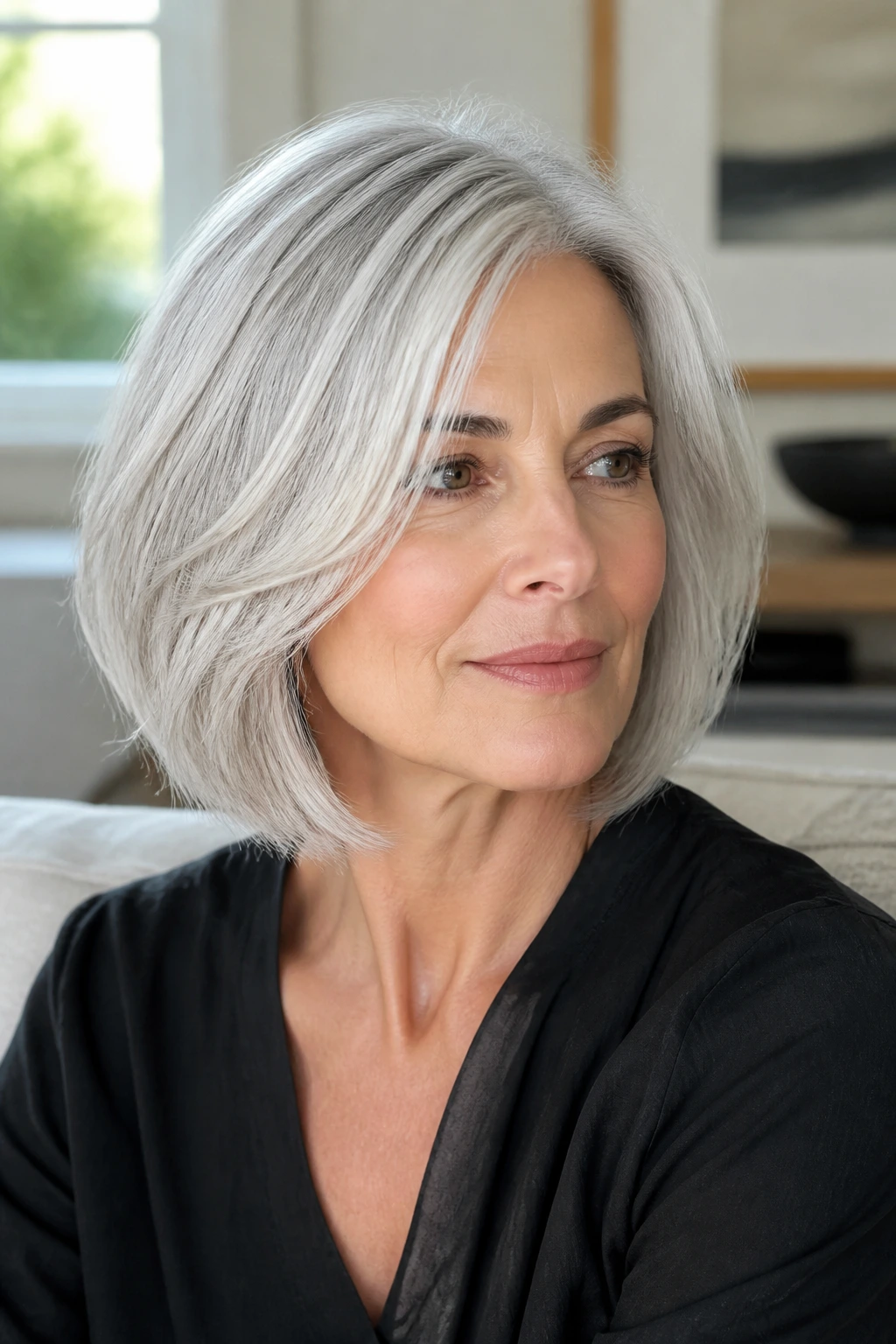
The biggest mistake is cutting too many short layers into coarse gray hair. The hair puffs, the outline frays, and the bob starts to look larger instead of sharper. If your strands already have some grit, leave more weight in the perimeter and let the shape do the work.
Another common problem is overusing purple shampoo. One wash can brighten yellow tones; five washes in a row can leave gray hair dry, flat, and slightly muddy. Use it when brassiness shows up, not on autopilot.
A third issue is ignoring the neckline. A bob can look freshly cut in the front and tired in the back if the nape grows out too much. Clean nape lines matter. They sound fussy until you see how much they change the whole haircut.
And then there’s the flat-iron trap. Straight does not always mean sleek. If you press the hair too hard, you erase the body that makes gray hair look full. A soft bend at the ends often looks better than a dead-straight edge.
Variations and Adaptations to Try

The Airy Gray Lob: Keep the length grazing the collarbone and add a little bend through the mids. This works well if you want movement without losing enough hair to feel startled every morning.
The Sleek Silver Office Bob: Pair a blunt line with a deep side part and a polished finish. It reads neat, controlled, and a touch formal, which is handy if you like hair that behaves under structured clothes.
The Soft Fringe Bob: Add curtain bangs or a light side fringe to any of the fuller bob shapes. It makes the cut feel friendlier around the face and can take the edge off a stronger jawline.
The Curly Silver Halo: Shape the bob around the curl pattern and keep the perimeter soft. This version works best when the goal is bounce and shape, not a perfectly smooth outline.
The Low-Maintenance Grow-Out Bob: Leave the front a little longer and introduce a shadow root or soft root blend. The cut stays looking intentional even when the trim gets pushed back a bit.
The Tucked and Tapered Bob: Keep one side long enough to tuck behind the ear while tapering the nape for clean lines. It’s a small tweak, but it changes the whole attitude of the style.
Keeping the Cut Sharp Between Salon Visits
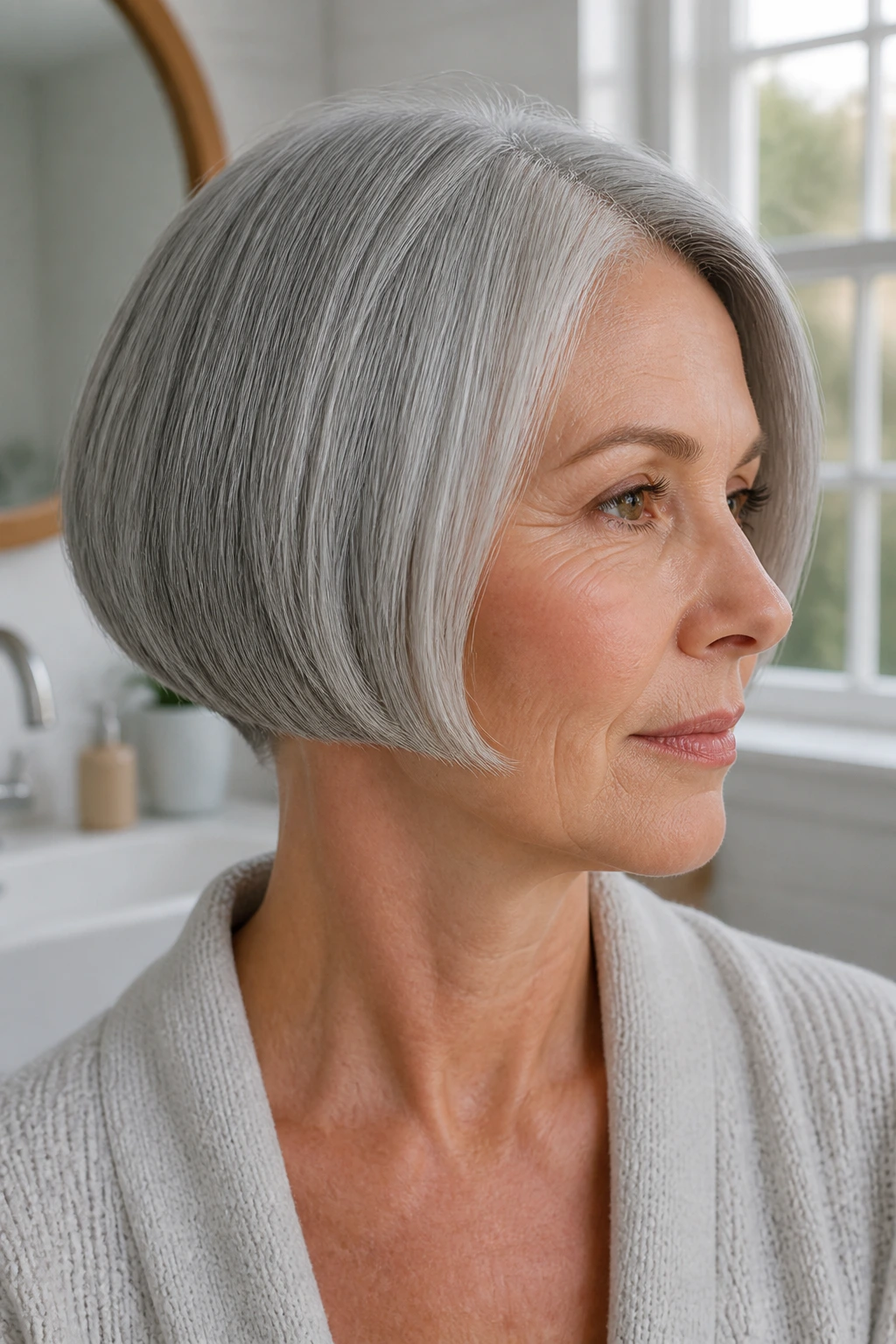
Gray bob haircuts hold their shape best when you treat the trim like part of the style, not an emergency fix. Short bobs with blunt lines usually need shape cleanup every 5 to 7 weeks if you want the outline to stay crisp. Longer bobs can stretch a little farther, but once the front starts losing its line, the whole cut gets vague fast.
Washing habits matter more on silver hair than people expect. A very heavy conditioner can weigh the bob down, especially at the crown and around the ends. Use conditioner from mid-length to ends only, and rinse well. Gray strands tend to show residue more quickly than darker hair, which is one reason a fresh bob sometimes looks flatter a week later.
If your hair goes yellow or dull, use a purple shampoo sparingly and always follow it with moisture. If your hair feels rough, a gloss or toner is often better than another round of violet pigment. I prefer a clear or slightly cool gloss when the hair is already bright but looks thirsty. That keeps the silver shiny without turning it chalky.
At night, a loose silk scarf or a satin pillowcase helps preserve the bob’s shape. It’s not glamorous. It works. And if you’re heat styling often, that one small habit can save the ends from fraying before the next trim.
Frequently Asked Questions
Which gray bob haircut is best for fine hair?
A blunt chin-length bob or a feathered bob usually works best. Fine gray hair needs either a strong perimeter or a bit of light movement, not heavy layers that make the ends look thin.
Will a bob make thick gray hair puff out?
It can, if the shape is too round or overly layered. Ask for controlled weight removal, a clean nape, and a perimeter that keeps the silhouette in check.
Can I wear bangs with a gray bob?
Yes, and they can make the whole cut feel younger in the good sense of the word. Curtain bangs are the easiest place to start because they grow out more gracefully than blunt fringe.
How do I keep silver hair from looking yellow?
Use purple shampoo only when you need it, not every wash. If the yellow tone keeps coming back, a salon gloss or toner often gives a cleaner result than piling on more violet products.
Is a short gray bob hard to maintain?
The shorter it is, the more often it needs trimming. A chin-length or mini bob can look fantastic, but it will show outgrowth faster than a collarbone-length version.
What if my gray hair is curly and frizzy?
Choose a curl-friendly bob with soft shaping and keep the layers light. Hydration matters more than ever here, and dry cutting or curl-by-curl shaping usually gives the best outline.
Can I grow out my current cut into one of these styles?
Usually, yes. A collarbone bob or layered lob is a good landing spot if you’re moving away from a shorter cut. The transition looks more intentional if the ends are cleaned up along the way.
Should I ask for a dry cut on gray hair?
If your hair has wave, bend, or a lot of texture, a dry cut can be useful because it shows how the hair actually sits. Straight hair can be cut wet, but the final line still needs a careful dry check.
A Silver Shape That Stays Current

The best gray bob haircuts don’t fight silver hair’s texture. They use it. A clean line, the right amount of movement, and a little attention to shine can turn gray from something people try to manage into the thing they actually notice first.
What I keep coming back to with silver hair is this: the cut matters more than the apology. A bob with a clear shape says the gray is part of the design, not an accident you’re working around. That shift changes everything, and it takes very little extra effort to get there.
