



The best gray hair ideas for women who wear glasses do one thing well: they make the frame line look intentional instead of crowded. Hair, temples, cheekbones, brow line — all of that sits in the same little zone on your face, and if the cut ignores that fact, the whole look feels slightly off. Too much width at the sides. Bangs that land right on the top rim. Layers that puff out where the frame arms need space. You can feel the problem before you can name it.
Gray hair changes the game in a nice way. Silver strands catch light, soften sharp edges, and make even a simple cut look crisp when the shape is right. But they also show every blunt line and every bad grow-out faster than darker hair does. That is why the smartest gray hair styles for glasses are not just “short” or “age-appropriate” or whatever lazy word people like to use. They’re shaped. They leave room where the glasses sit, and they put interest somewhere else — at the jaw, at the crown, at the ends, or just below the lenses.
The 25 looks below do not all behave the same way. Some are clean and polished. Some have movement and air. A few are sharp enough to make chunky frames look deliberate. A few lean soft and loose so the glasses can do the harder work. The point is balance, not perfection, and the best place to start is right here.
Why These Gray Hair Ideas Work So Well With Glasses

- Temple space matters: Hair that tapers near the ears keeps the frame arms from fighting with bulk, which is where a lot of cuts go wrong.
- Frame shape changes the haircut: Strong square frames usually need softer hair around them, while thin wire frames can hold up to more texture and volume.
- Gray hair shows shape fast: Silver and salt-and-pepper strands reflect light, so a clean outline reads clearly even from across the room.
- Bangs need a landing zone: Curtain bangs, side-swept fringe, and wispy pieces work because they move around the glasses instead of landing straight on top of them.
- The crown can carry the style: If the sides need to stay light for the frames, a little lift at the top keeps the whole look from going flat.
- Less bulk, better glasses: The cleanest gray hair ideas are the ones that make the frames feel chosen, not squeezed in as an afterthought.
1. Soft Layered Lob
A soft layered lob is one of those cuts that quietly solves a lot of problems. It hits around the collarbone, which gives your glasses room to breathe, and the longer layers keep the shape from turning boxy near the cheeks. I like this one for women who want gray hair to look sleek without feeling stiff.
Why it works: The lob keeps enough weight to lie smooth, but not so much that it crowds the temples. Ask for layers that start below the cheekbone so the front pieces don’t puff right into the frame arms. It’s especially good with rectangular, cat-eye, or slim acetate frames.
A quick bend at the ends is all it needs. Straighten it too much and it can look severe; add too much curl and it starts to compete with the glasses.
2. Feathered Pixie
A feathered pixie gives gray hair a little lift without turning the whole head into a helmet. The sides stay light, the top has movement, and the frame arms don’t get buried in bulk. That matters more than people think.
If your glasses are bold — thick black, tortoiseshell, or a strong geometric shape — this cut keeps the face from feeling overloaded. The trick is in the texture. You want piecey, airy layers, not a hard, spiky finish. A pea-sized bit of styling cream worked through the crown is usually enough.
It’s a good cut if you hate fussing with hair in the morning. Dry it with your fingers, push the front slightly up and back, and let the silver show its own shine.
3. Curtain Bangs and Shoulder-Length Layers

Curtain bangs are a gift for glasses wearers when they’re cut with some restraint. Not too short. Not too dense. They part in the middle and fall away from the frames instead of crashing into them, which is the whole point.
The part is doing real work here
Shoulder-length layers keep the rest of the style soft, so the bangs can be the focus without taking over the face. I’d ask for the shortest point to sit somewhere between the brow and the top rim of the glasses, then let the sides drift down into cheekbone length. That keeps the fringe useful instead of fussy.
This look is especially nice if your frames are round or oval. The bangs give structure; the hair underneath keeps it relaxed.
4. Chin-Length French Bob

A chin-length French bob is blunt in a way that looks deliberate, not harsh, when the cut is clean. The length lands near the jaw, which works beautifully with glasses because it leaves the temple area open and creates a crisp line below the face.
It’s a good choice if you wear smaller frames or a neat cat-eye. The bob gives you a little architecture; the glasses add a second line without making the whole look busy. Keep the ends tidy and slightly curved under if you want a polished finish, or let them air-dry with a little bend for a more casual feel.
Short, yes. Severe, no. The difference is in the edge and the way it sits against the frame line.
5. Silver Shag

A silver shag is for women who want movement and do not want to spend half the morning coaxing hair into place. The layers are choppy enough to stop the style from sitting flat, but the shape stays soft around the temples, which matters when you’re wearing glasses all day.
The best version keeps the crown a little fuller and the ends a little broken up. That prevents the hair from gathering at the frame arms or looking too neat. A shag is especially good with round frames, because the extra texture keeps the face from becoming too circular.
Air-dry it if your wave is already there. If not, a diffuser and a tiny bit of mousse will give the gray strands some grit.
6. Sleek Blunt Bob

A sleek blunt bob is the haircut equivalent of a clean white shirt. The line is the point. Gray hair makes it even better because silver reflects light and sharpens the outline.
This style looks strongest with thin wire frames or narrow rectangular glasses. The blunt edge at the jaw or just below it keeps the face tidy, and the straight finish makes the frames feel purposeful instead of busy. I would not over-layer this one. The whole charm is in the solid shape.
A flat iron and a light serum are enough. If the hair starts to flip out at the ends, round brush it under just a touch. That tiny curve changes everything.
7. Long Silver Waves

Long silver waves work when you want to keep length but still give your glasses some space. The hair should move around the face, not hang like a curtain. That distinction matters. A good wave pattern opens up the cheeks and lets the frames stay visible.
This style is strongest with lighter frames — thin metal, softened rectangles, or a cat-eye that sits neatly on the brow. The hair itself carries most of the visual weight, so you do not need the glasses to do the heavy lifting too. Keep the layers long enough that the front pieces sweep past the temples instead of stopping right on them.
A center part makes it feel calm and modern. A soft side part adds lift if your hair tends to lie flat.
8. Tapered Crop
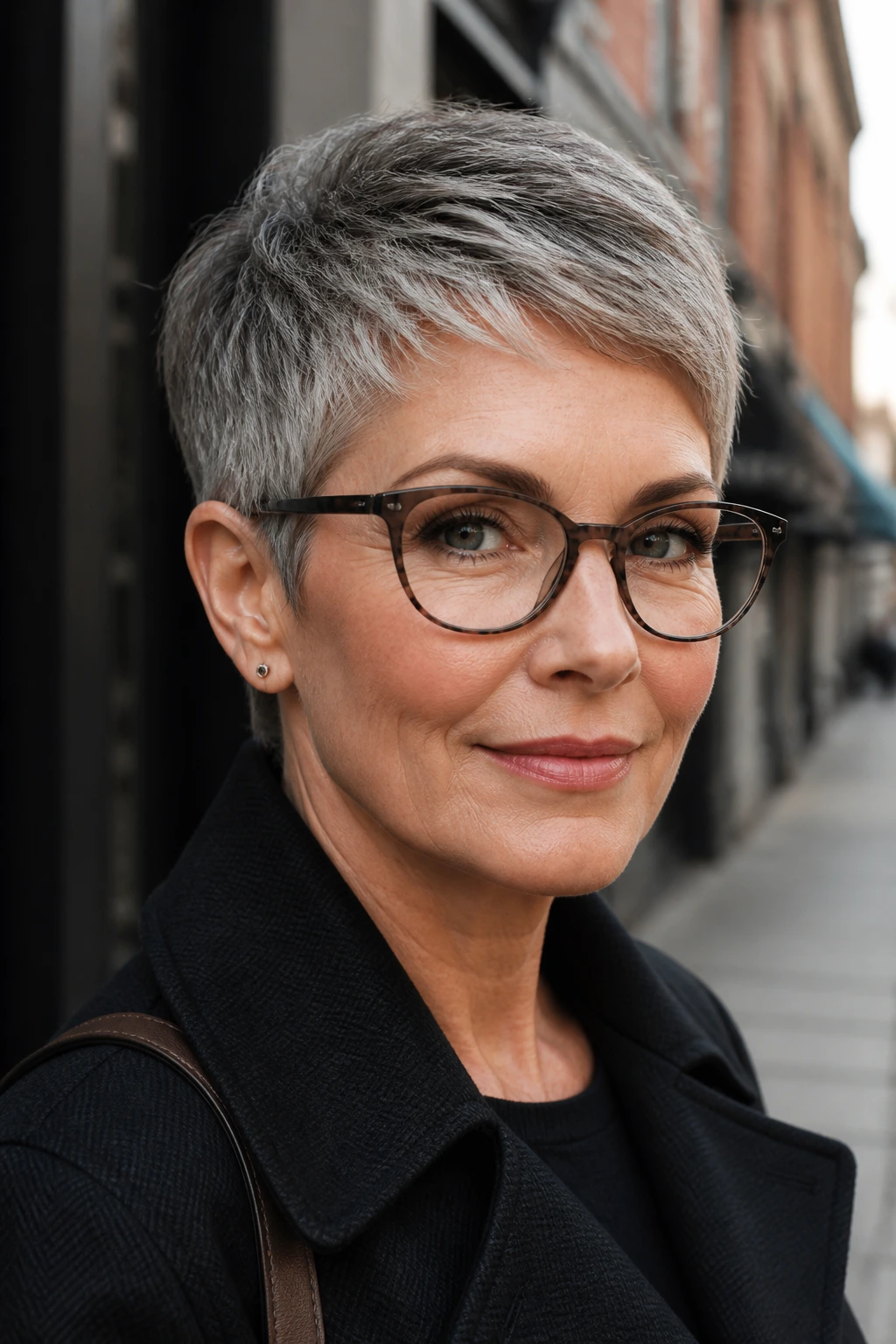
A tapered crop takes the bulk out of the sides and leaves the top with enough length to style. That is a smart move for glasses wearers, because the frame arms need a little breathing room. Hair that sits too full at the ears gets uncomfortable fast.
Ask for a taper around the nape and sideburns, with the top left long enough to push forward, up, or slightly to the side. It pairs well with bold frames because the haircut itself is clean and the glasses get to carry some of the visual weight. The result is neat without looking severe.
If your hair is thick, this cut can feel like a relief. Less puff, less friction, less afternoon frizz where the arms hit.
9. Side-Swept Fringe Cut

A side-swept fringe is one of the easiest ways to soften a strong frame line. Instead of landing straight across the forehead, the hair slips diagonally, which breaks up the space above the glasses and makes the whole face look less boxy.
What to ask for
Keep the fringe long enough to tuck behind the frames without poking into the lenses. The shortest pieces should graze the brow area, not fall straight onto it. This works especially well with high-set frames or glasses that have a stronger top rim.
The rest of the cut can be simple — shoulder length, bob length, even a pixie — because the fringe does the face-shaping work. It is a small detail, but it changes the whole attitude of the haircut.
10. Curly Gray Bob

A curly gray bob can look sculpted rather than fluffy when the shape is cut with the curl pattern in mind. The trick is to keep the length long enough that the curls spring below the frame arms, not right into them. Jaw length or just under usually behaves best.
This is where glasses can actually help the look. The frames act like a little anchor at the center of the face, while the curls build around them. The result feels lively, not messy, as long as the sides are trimmed so they do not balloon out at the temples.
Moisture matters here. Use a cream that defines the curl without making it greasy, and dry with a diffuser if you want more lift at the crown.
11. Salt-and-Pepper Midlength Layers

Salt-and-pepper hair is gorgeous when the layers are cut to show the contrast instead of hiding it. Midlength layers give the strands room to move, which is handy if your glasses already bring a lot of structure to the face.
This look is especially good for women in the middle of a grow-out. The darker bits and the gray bits blend into a kind of soft stripe effect, and the layers keep that pattern from looking heavy. It works with rounded frames, square frames, and pretty much any shape that doesn’t sit too high on the bridge.
The danger is over-thinning the ends. Leave enough weight so the hair still falls in a clean line when you tuck one side behind your ear.
12. Asymmetrical Bob

An asymmetrical bob gives the face a little tension in a good way. One side stays slightly longer than the other, which creates movement around the glasses and keeps the haircut from feeling too symmetrical and static.
It’s a smart choice if you wear a strong frame shape — thick acetate, geometric lines, or a wide cat-eye. The uneven hemline helps the look feel edited, not fussy. The longer side can skim the jaw while the shorter side opens up the face, which is a nice balance when the glasses already draw attention upward.
I’d keep the difference subtle. Half an inch to an inch is enough. More than that and the haircut starts to feel like a statement first and a style second.
13. Tousled Shoulder Cut

A tousled shoulder cut has enough length to stay feminine and enough roughness to avoid looking overdone. Gray hair loves this kind of texture, especially when the strands have a little natural bend.
The benefit for glasses is simple: the movement sits below the frame line, so the hair does not crowd the temples. You can wear it tucked back on one side, let it fall loose on the other, or rough it up with a little spray if you want it to look less polished. That casual imbalance is part of the charm.
If your hair is fine, don’t chase volume everywhere. A little lift at the roots and soft bends from the cheek down are enough.
14. Glossy Straight Lob

A glossy straight lob makes gray hair look intentional in the cleanest possible way. The shine matters here. Silver hair can look flat if it is dry, but when it is smoothed out properly, it reflects light in a way that makes even simple glasses look sharper.
This style suits women who wear thin frames or minimalist rectangles. The straight line of the lob echoes the clean frame shape, and the whole face feels tidy without being severe. Keep the ends blunt or only slightly textured so the silhouette stays calm.
Heat protectant is not optional with this one. One pass with a flat iron and a light finishing cream is enough. Too much product will make the hair look greasy instead of glossy.
15. Long-Top Pixie

A long-top pixie gives you the freedom of short hair without losing the ability to shape it. The sides stay close to the head, which is great for glasses because the frame arms don’t have to compete with bulk. The top stays long enough to sweep, lift, or separate into soft pieces.
This cut looks especially sharp with bold frames. You get contrast: clean sides, strong glasses, and a crown with enough movement to keep the face from feeling flat. It’s one of my favorite gray hair ideas for women who like a little edge but do not want a high-maintenance style.
Use a dab of mousse at the roots and dry the top upward with your fingers. That small lift stops the haircut from collapsing around the frames.
16. Collarbone Waves
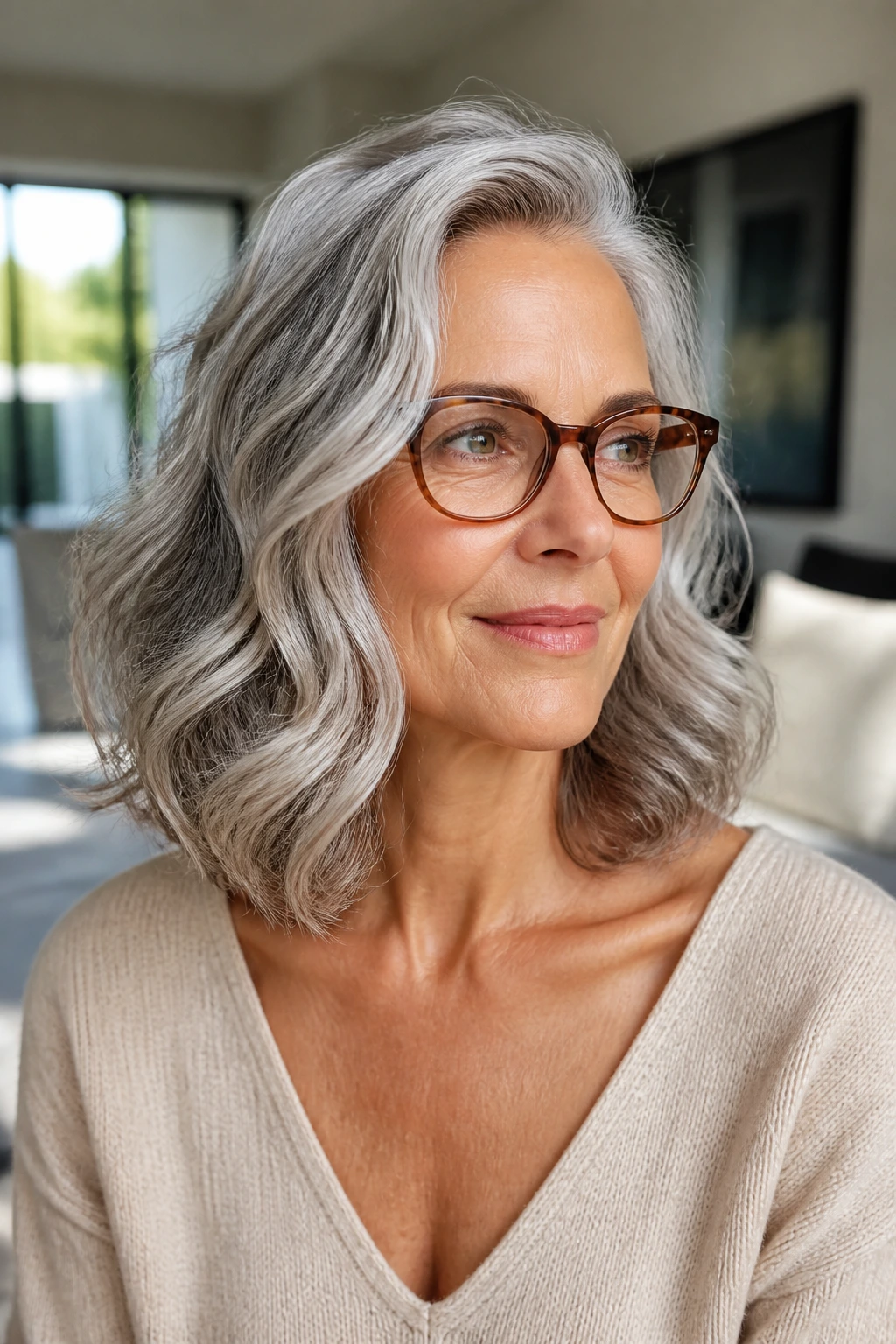
Collarbone waves land in that pleasant middle ground where the hair is long enough to feel soft but short enough to stay away from the jawline. For glasses wearers, that matters. The length keeps the sides from crowding the temples, while the waves keep the style from going dull.
This cut likes a side part or an off-center part. A dead-center part can make the face feel a little too symmetrical, especially with square or oversized glasses. The waves themselves should be loose enough to move, not so tight that they start bouncing against the frame arms.
If your silver hair has a lot of texture already, you may only need a cream and a quick scrunch. If it is straighter, a few bends from mid-length down will do the job.
17. Rounded Bob with Tucked Ends

A rounded bob with tucked ends is tidy in the best way. The shape curves gently toward the chin, which softens the face and gives glasses a neat backdrop instead of a competing shape. It is a very good choice when you want the hair to look finished even on a lazy day.
The rounded edge keeps the ends from flaring out near the frame arms, which is a small detail but a useful one. I like this style with medium-sized frames because the curves play off each other without looking too matched. The hair can be smooth or lightly brushed through with a round brush, depending on how much polish you want.
If your hair swings out at the bottom, a quick blow-dry under makes the whole thing behave.
18. Choppy Crop

A choppy crop is all about piecey texture. The ends are broken up, the layers are light, and the style never sits too perfectly. That looseness is exactly why it works with glasses. The frames provide the structure; the hair keeps things from feeling stiff.
It’s a nice option for women with straight or slightly wavy gray hair who want movement without length. The shape sits close to the head and stays away from the temples, so it doesn’t get stuck under the frame arms every time you move. A matte paste or texturizing cream gives it a little grip.
Do not load this up with heavy shine products. It needs texture, not slickness.
19. Face-Framing Layers

Face-framing layers are the safe, smart answer if you like long hair but need it to play nicely with glasses. The layers start near the cheekbone and flow down toward the collarbone or below, which opens the sides of the face and keeps the frame area visible.
The shape matters more than the length
You can keep the rest of the hair long, even very long, and still make the face feel lighter. The trick is to keep the shortest pieces away from the exact spot where the frame arms sit. That leaves the glasses visible and stops the hair from bunching around the ears.
This is a good one for women with round or oversized frames. The layers trim down the visual weight without making the hair feel thin.
20. Modern Soft Mullet

A modern soft mullet is not the wild, punk version people picture from old photos. This one is gentler. Shorter through the crown and sides, longer through the back, with soft blending instead of a harsh disconnect. Gray hair makes that shape look cleaner than you’d expect.
It works well with glasses because the sides stay light, which gives the frames room, while the back carries enough length to keep the style from feeling too short. If you like a bit of edge and do not want your hair to sit politely all day, this is a strong choice.
Keep the transition soft. The whole point is movement, not shock value.
21. Side-Parted Soft Waves

A side part changes the whole mood of gray hair with glasses. It gives one side a little more lift, opens up the face, and shifts the line of the hair away from the center of the frames. That tiny movement can make a big difference.
Soft waves keep the style from looking too formal. They fall around the cheeks and jaw instead of pressing straight against the glasses, which is what you want if your frames are a little larger. The part also helps if one side of your hair tends to lie flatter than the other — the asymmetry looks deliberate rather than accidental.
This is one of those styles that works on almost no effort. A blow-dry with a round brush or a few bends with a curling iron, and you’re done.
22. Defined Voluminous Curls

Defined curls can look especially striking with gray hair because the texture and the silver tones both show up clearly. For glasses wearers, the key is shape. The curls need to be cut so they sit around the frames, not over them.
That usually means keeping enough length to let the curls drop below the frame arms, while removing weight where the hair wants to balloon at the sides. The best version has lift at the crown and shape around the jaw. Smaller or medium frames usually work better than oversized ones here, because the curl pattern already brings a lot of presence.
Moisture is the difference between sculpted and fuzzy. A curl cream, a diffuser, and a wide-tooth comb are enough to keep the shape honest.
23. Undercut Pixie
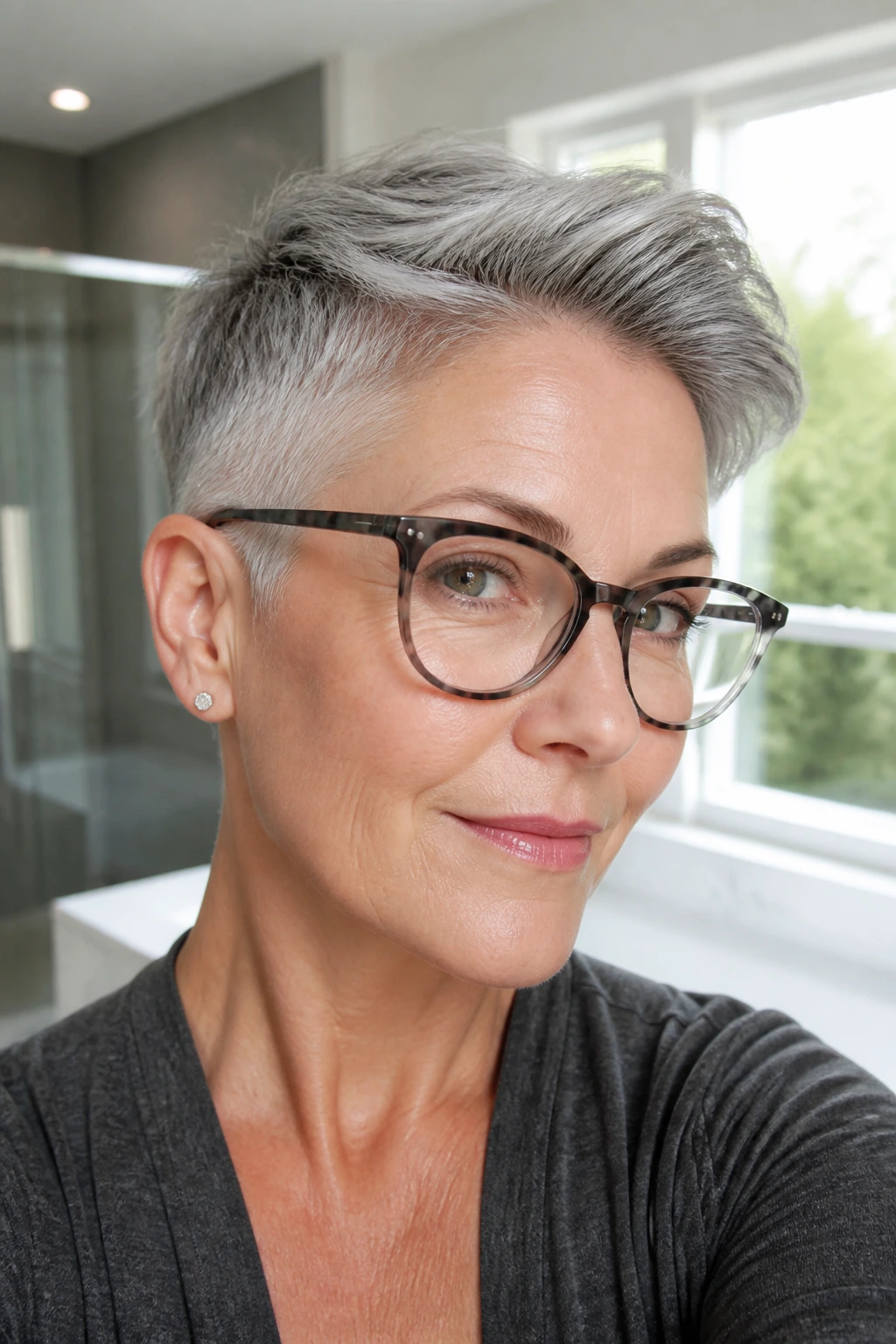
An undercut pixie is for the woman who wants her glasses to feel bold, not apologetic. By removing bulk underneath, especially around the sides and nape, the haircut clears space for the frame arms and keeps the silhouette sharp.
It’s a good answer if your hair is thick or coarse and tends to puff out where the glasses sit. The top can stay longer and more playful, which stops the whole cut from looking too severe. The contrast between the close sides and the lifted top is what gives it its shape.
You do have to maintain it. The undercut grows out fast, and once the sides lose their clean line, the whole style can start to feel muddy.
24. Half-Up Twist With Loose Sides
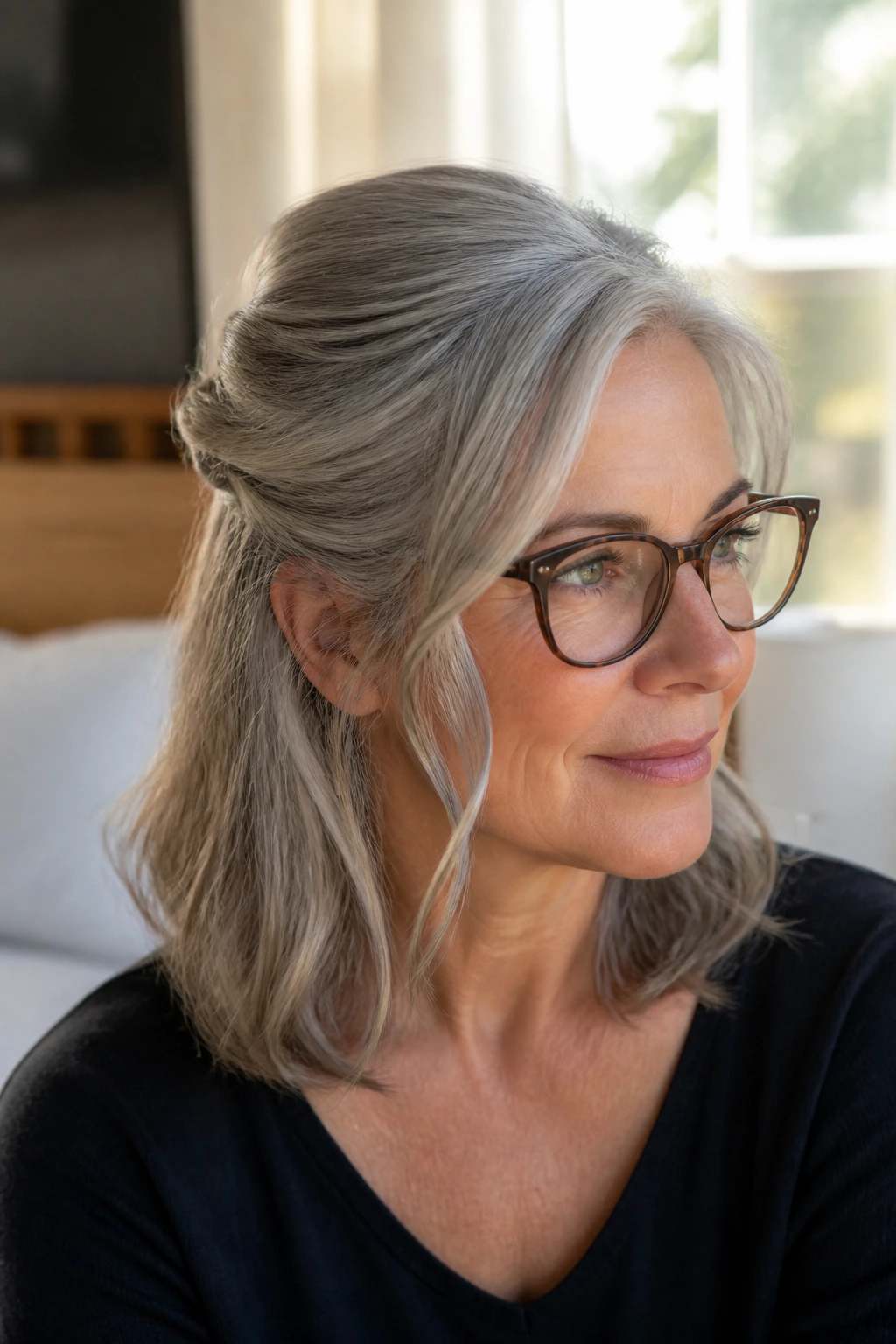
A half-up twist with loose sides is a nice styling trick when you want the feel of an updo without pulling everything back. The twist clears the top of the head, the loose pieces soften the temples, and the glasses stay visible instead of getting swallowed.
This works especially well with medium to long gray hair. Keep the twist low enough that it doesn’t fight the frame arms, and leave a few face-framing pieces out if your glasses have strong lines. That little softness keeps the look from turning severe.
It is also useful for days when your hair has gone a little flat. A twist adds shape fast, and silver hair tends to look clean when it’s gathered with intention.
25. Polished Natural Gray Grow-Out
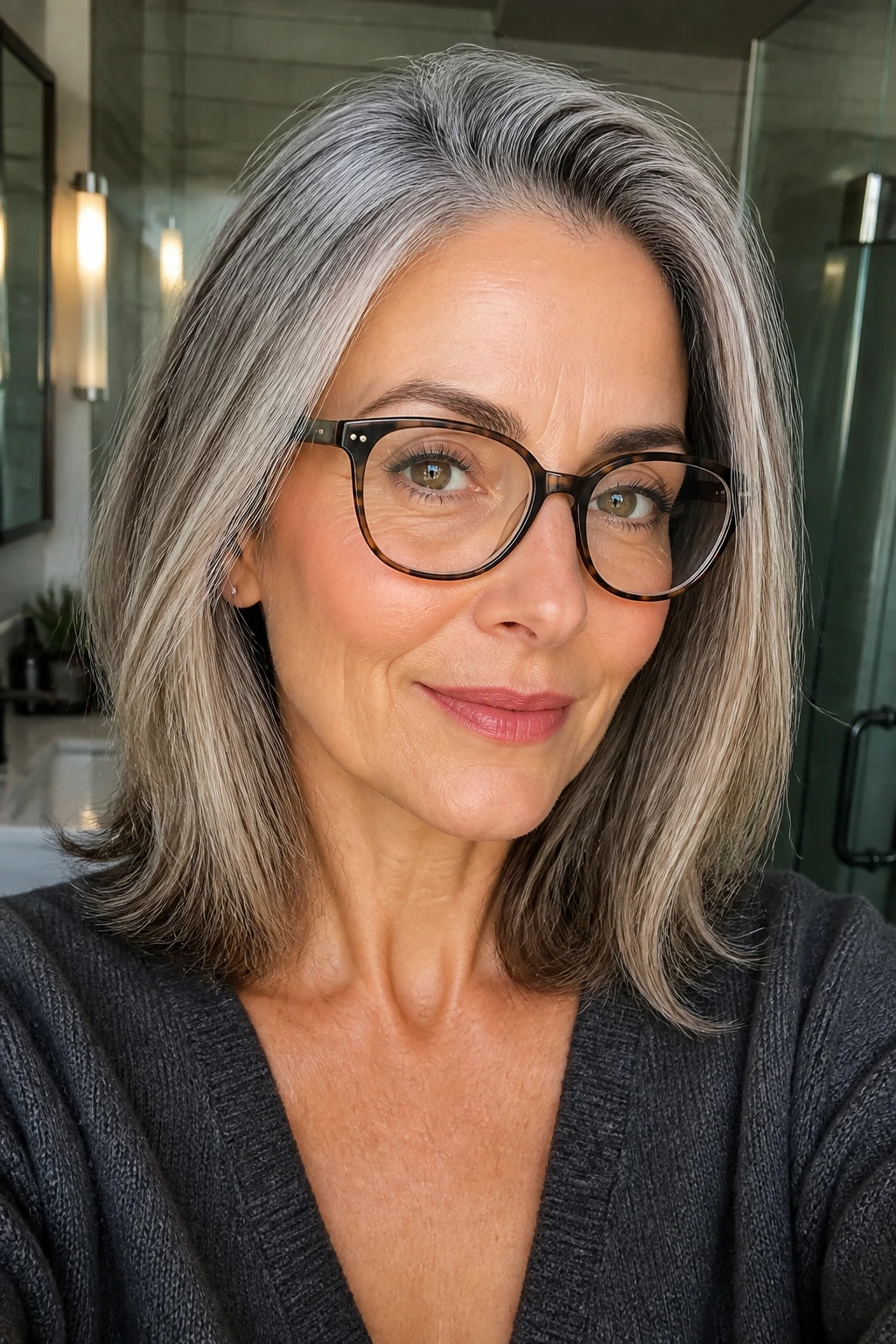
A polished natural gray grow-out is not a compromise. It’s a style decision. When the cut is neat and the shape is clean, the grow-out looks deliberate, and glasses actually help finish the look by giving the face a defined frame.
The best version keeps the ends healthy and the layers light enough that the demarcation between old color and new gray doesn’t look harsh. A gloss, a trim, and a clean part can make a grow-out look much more considered than a rushed dye job ever did. This is especially good if you are letting silver take over at its own pace and want the transition to look calm.
The haircut does the heavy lifting here. The gray does not need to be hidden. It needs a shape.
How to Choose a Cut That Cooperates With Your Frames

The easiest way to pick from these gray hair ideas is to stop thinking about your hair by itself. Look at your glasses first. Thick acetate frames need more space at the temples and usually do better with cuts that taper or move away from the sides of the face. Thin wire frames can carry more hair, more texture, even a little extra volume, because they do not already take up much visual space.
Ask yourself where the frame sits. High on the bridge? Then fringe becomes a real decision, not an afterthought. Wide across the temples? Then a bob that stops right at that width may feel too boxed in, while a cut that falls above or below it will feel cleaner. I always think people should bring their actual glasses to the appointment. Not a photo. The real pair. Temple length, arm thickness, and bridge shape all change how a haircut lands.
Hair texture matters too. Fine gray hair often looks best with a blunt edge, a soft lob, or a cropped cut that keeps the shape tight. Coarse or very thick gray hair usually needs weight removed at the sides so the glasses do not get buried. Curly hair wants room to spring, and straight hair usually benefits from a little bend or internal layering so the style does not feel too flat next to the frames.
Small Styling Moves That Make the Shape Look Intentional

Temple lift: If the hair starts to puff where the frame arms sit, dry that area with a nozzle attachment aimed downward and keep the brush moving away from the face. It saves you from that puffy triangle that sneaks in after lunch.
Fringe placement: Curtain bangs and side-swept pieces should either clear the frames cleanly or land well above them. Hair that stops right on the top rim tends to split and misbehave all day.
Texture control: Gray hair can get coarse at the ends and soft at the roots, which is a strange combination. A light cream on the mid-lengths and a dry texture spray at the crown usually works better than loading everything with oil.
Parting: A slightly off-center part often flatters glasses more than a dead center one. It gives one side a little lift and stops the face from looking too divided into equal halves.
Salon note: Ask your stylist to cut the shape with your glasses on at least once during the appointment. That tiny test shows whether the layers sit where they should or if they’re landing too close to the frame line.
Tools That Make Gray Hair Easier to Style
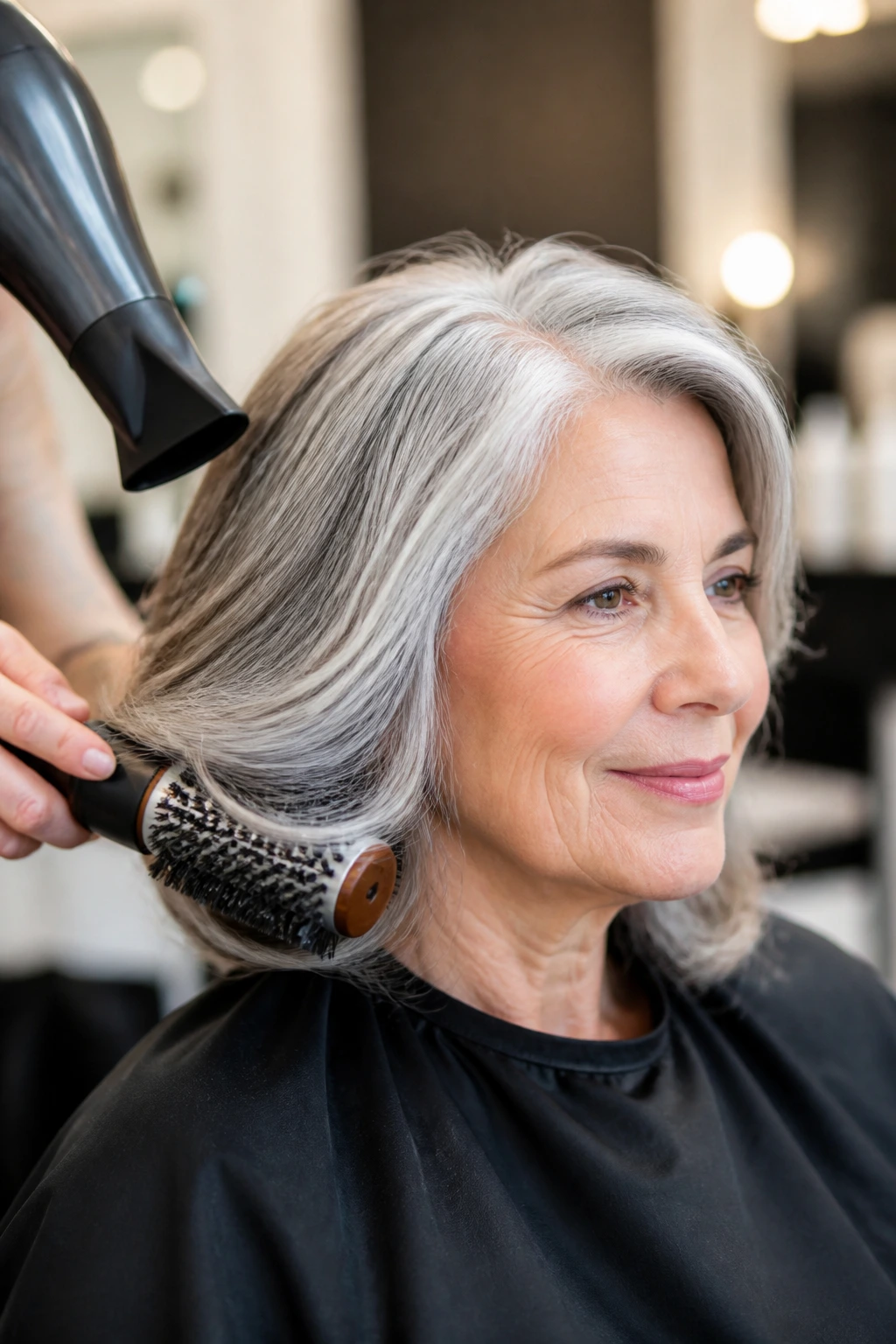
- Blow dryer with a nozzle attachment: Helps direct hair away from the frame arms and keeps the temple area smoother.
- Round brush, medium size: Useful for bob lengths, curtain bangs, and tucked-under ends that need a little curve.
- 1-inch curling iron or wand: Good for adding soft bends to lob lengths, waves, and face-framing pieces.
- Lightweight styling cream: Keeps gray hair soft without making it limp or greasy.
- Texturizing spray or dry texture spray: Best for pixies, shags, and choppy crops that need movement.
- Heat protectant spray: Non-negotiable if you use hot tools on silver hair, which can turn dry faster than darker hair.
- Purple shampoo: Helpful when gray or silver hair starts to yellow near the face.
- Wide-tooth comb: Better than a fine comb for curls, waves, and grow-out days.
- Salon clips: Handy for sectioning bangs, crown lift, or half-up styles.
- Microfiber towel: Cuts down on frizz, especially around the temple zone where glasses already create friction.
Keeping Gray Hair Bright, Soft, and Close to the Face

Gray hair around glasses needs a little more attention than the rest of the head because the temple area gets pressed, rubbed, and touched all day. That means oil builds up faster there, and the cut can start to lose shape sooner than the back. A quick dry-shampoo touch at the roots near the temples keeps the style from collapsing. Don’t pile it on. A light mist, worked in with fingertips, is enough.
If your silver hair is starting to yellow, use purple shampoo sparingly — once every few washes, not every time you wash. Overusing it can leave gray hair looking dull or faintly violet, and that flat tone shows up more clearly next to glasses. A clear gloss or a salon toner can help if you want more shine without changing the tone too much.
Trims matter too. Bangs and face-framing layers usually need a touch-up every 4 to 6 weeks if they sit near the frame line. A bob or lob can stretch longer, but the ends should still be checked before they start flipping in odd directions. Gray hair tells on a bad cut faster than dyed hair does, which is annoying, but it also means a good shape stays readable longer.
Common Mistakes That Make Hair and Glasses Compete

- Letting the bangs hit the frames: When fringe ends right on the top rim, it tends to split, stick, or poke into the lenses. The fix is either shorter fringe that clears the glasses or longer curtain pieces that move away from them.
- Keeping too much bulk at the sides: Puffy hair at the temples presses into the frame arms and makes the face look wider. Ask for tapering, internal weight removal, or a cleaner side shape.
- Choosing a cut that ends exactly at the widest part of the frames: That can box in the face fast. Move the length either a little above or a little below that point so the silhouette has some breathing room.
- Over-toning gray hair: Purple shampoo and strong toners can flatten shine or make silver strands look dull. Use them only when the hair starts to yellow, not as a daily habit.
- Ignoring frame weight: Heavy glasses plus heavy hair can drag the whole look down. If your frames are bold, a lighter cut usually works better. If the hair is full, slimmer frames often read cleaner.
- Forgetting about the ears and sideburns: Hair that sits awkwardly around the ears is what makes glasses feel itchy. A tiny trim there can change the whole experience.
Variations and Alternatives Worth Trying

The Featherweight Fix: If your hair is fine, keep the layers long and soft, not shredded. A clean lob, a polished pixie, or a shoulder-length cut with light face-framing pieces will keep the hair from looking sparse next to strong frames.
The Bold-Frame Balance: Thick acetate glasses usually look best with a haircut that clears the temples: a pixie, tapered crop, blunt bob, or controlled lob. The point is contrast. Let the glasses be the statement and keep the hair shape clean.
The Curl-Friendly Shape: Curly gray hair needs room to spring, so ask for dry-cut shaping or longer layers that respect the curl pattern. Framed faces usually look best when the curls sit below the glasses instead of pressing into them.
The Grow-Out Gloss: If you’re letting gray come in naturally, keep the ends tidy and the tone bright. A trim, a shine treatment, and a simple part turn the grow-out into a style instead of a waiting period.
The Soft-Edge Contrast: Sharp frames with rounded hair, or rounded frames with a slightly sharper bob, can create a nice balance. Too much matching gets boring fast. A little contrast gives the face more shape.
Frequently Asked Questions
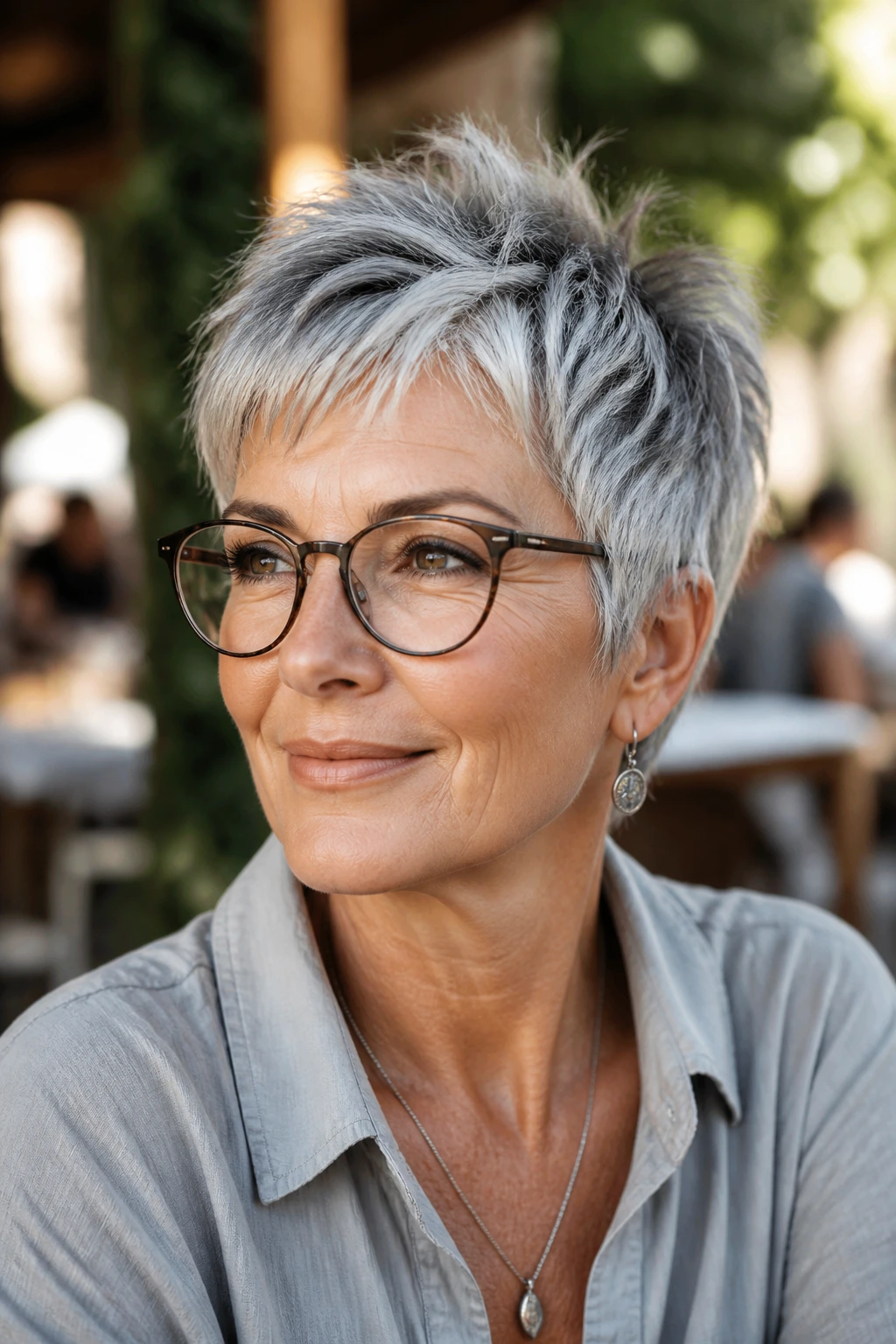
What gray hair style looks best with glasses?
The safest picks are a layered lob, a soft pixie, or a bob that stays away from the temples. Those shapes leave room for the frame arms and keep the face from feeling crowded. If your frames are bold, a cleaner haircut usually works better than a heavy, fluffy one.
Do bangs work with glasses on gray hair?
They do, but the length matters more than people expect. Curtain bangs and side-swept fringe usually behave better than blunt bangs that land right on the frame line. If you want a fuller fringe, ask your stylist to cut it with your glasses on.
Is short gray hair easier to wear with glasses than long hair?
Short hair is often easier around the temples, but not always easier overall. A well-cut long lob or shoulder length style can actually feel simpler than a short cut that needs daily shaping. The real question is whether the hair leaves space where the glasses sit.
How do I keep hair from puffing out under my glasses?
Ask for tapering at the sides and keep styling products light near the ears. Drying the temple area with a nozzle and brushing the hair away from the face while it cools helps a lot. If the puffing is severe, the cut may need less bulk, not more product.
Can I wear bold frames with silver hair?
Yes, and the combination can look very sharp. The trick is keeping the haircut clean enough that the hair and frames do not fight for attention. A pixie, blunt bob, or polished lob usually pairs well with thick frames.
How often should gray hair be trimmed if I wear glasses?
Bangs and short layers often need attention every 4 to 6 weeks. Bobs and lobs can usually go longer, but the shape should be checked before the ends start flipping into the frame line. Around glasses, a tiny trim can make a bigger difference than you’d think.
What if my gray hair feels coarse or dry near the temples?
That’s common, especially if the frame arms rub that spot all day. Use a lightweight cream on the mid-lengths and ends, not the roots, and avoid heavy oils that can make the hair slip around the frames. A satin pillowcase also helps more than most people expect.
Should my haircut match the shape of my glasses?
Not exactly. Matching too closely can make the face feel boxed in. A better move is contrast: round frames with a slightly sharper bob, square frames with softer waves, or bold frames with a clean pixie.
A Cut That Lets the Frames Breathe

Gray hair and glasses work best when neither one has to shout. That’s the part people miss. A good haircut leaves room at the temples, gives the frames a clear outline, and lets the silver do what silver does best — catch the light and sharpen the face without trying too hard.
The sweetest spot is usually somewhere between structure and softness. Not fussy. Not flat. Just clean enough to sit well beside the frames and alive enough to keep the face from looking boxed in. Once you find that balance, the glasses stop feeling like a separate accessory and start looking like they belong there.
