



Gray hair has a funny way of exposing bad haircutting habits. A blunt line that used to disappear in dark brown hair can suddenly look choppy. Dry ends show faster. A fringe that was once soft can sit on the forehead like a strip of felt if the texture underneath isn’t right. And when the shape is right, silver hair does the opposite: it looks crisp, luminous, and fully on purpose.
Gray hair looks for women work best when the cut, the finish, and the color story all pull in the same direction. A strong bob can stop white strands from puffing at the sides. A pixie can turn coarse texture into something sharp and expensive-looking. Long gray waves need shine and movement, not just length. That’s the part many people miss. Gray hair is not one texture, and it doesn’t reward one-size-fits-all styling.
What I like about the styles below is that they don’t all chase the same effect. Some are polished enough for a blazer and lipstick. Some lean airy and lived-in. A few are bold in the way only short silver hair can be bold. If you’ve been growing out dye, living with natural grays, or trying to stop your silver strands from reading flat and fuzzy, you’ll probably find at least one look here that feels like a proper answer.
Why These Silver Styles Earn Their Keep
- Texture-aware cuts: Gray hair often feels coarser or more wiry than it did before, so the best styles work with that change instead of fighting it.
- Shine without fuss: These looks lean on shape, parting, and movement, which matters when silver strands need a smooth surface to reflect light.
- Grow-out friendly options: Several of the styles handle root regrowth, skipped color appointments, and awkward transition lines without looking messy.
- Short, medium, and long choices: Not everyone wants a pixie, and not everyone should wear one. This mix gives you real room to choose.
- Salon and at-home friendly: Some looks need a great cut and a round brush. Others need only a blow-dry cream, a comb, and five calm minutes.
- Built for real women: These aren’t costume-y “going gray” ideas. They’re normal, wearable gray hair looks that hold up at work, at dinner, and on a rainy Tuesday.
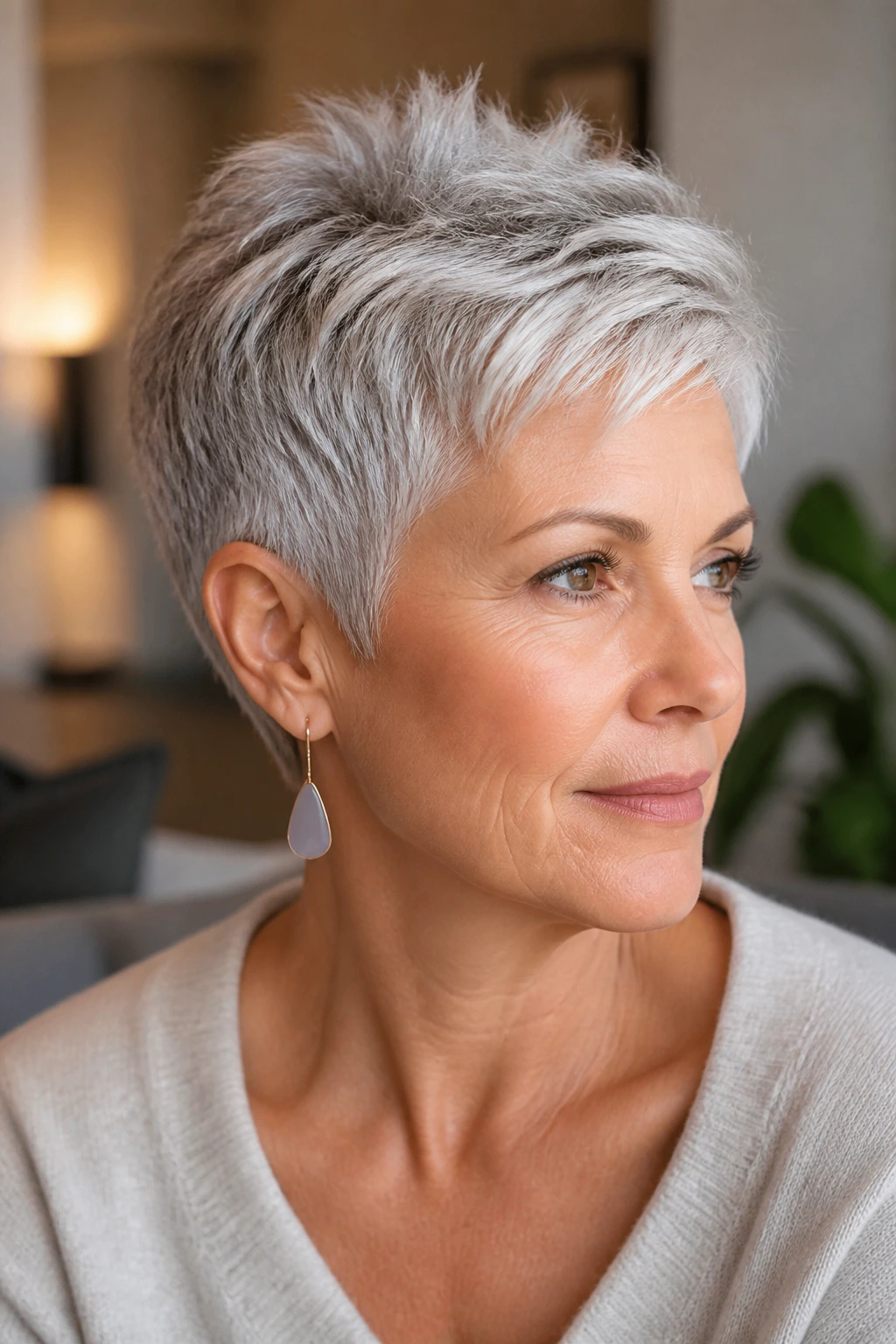
1. Soft Silver Pixie With Tapered Sides
The soft silver pixie is one of those cuts that looks crisp the second it’s dry. The tapered sides keep the outline clean, while the longer top gives you enough length to push forward, sweep back, or mess up with your fingers when you’re running late. On gray hair, that little bit of movement matters. It keeps the cut from looking severe.
Why it works:
Gray hair often grows in with a little extra texture, and a pixie uses that to its advantage. The shorter sides reduce bulk at the temples and behind the ears, which is where a lot of silver hair starts to puff. Leave the top around 2 to 3 inches if you want styling room. Any shorter and you lose shape fast.
How to style it:
A pea-sized amount of lightweight paste or styling cream is usually enough. Work it through damp hair, then finger-dry or use a blow dryer with the nozzle aimed downward. If your hair is fine, a small root-lift spray at the crown keeps the cut from lying flat against the scalp.
A sharp pixie like this needs regular cleanups. Every 4 to 6 weeks is the sweet spot, because gray hair shows uneven growth sooner than dark hair does. Skip the heavy waxes; they can make silver strands look greasy instead of glossy.
2. Chin-Length French Bob
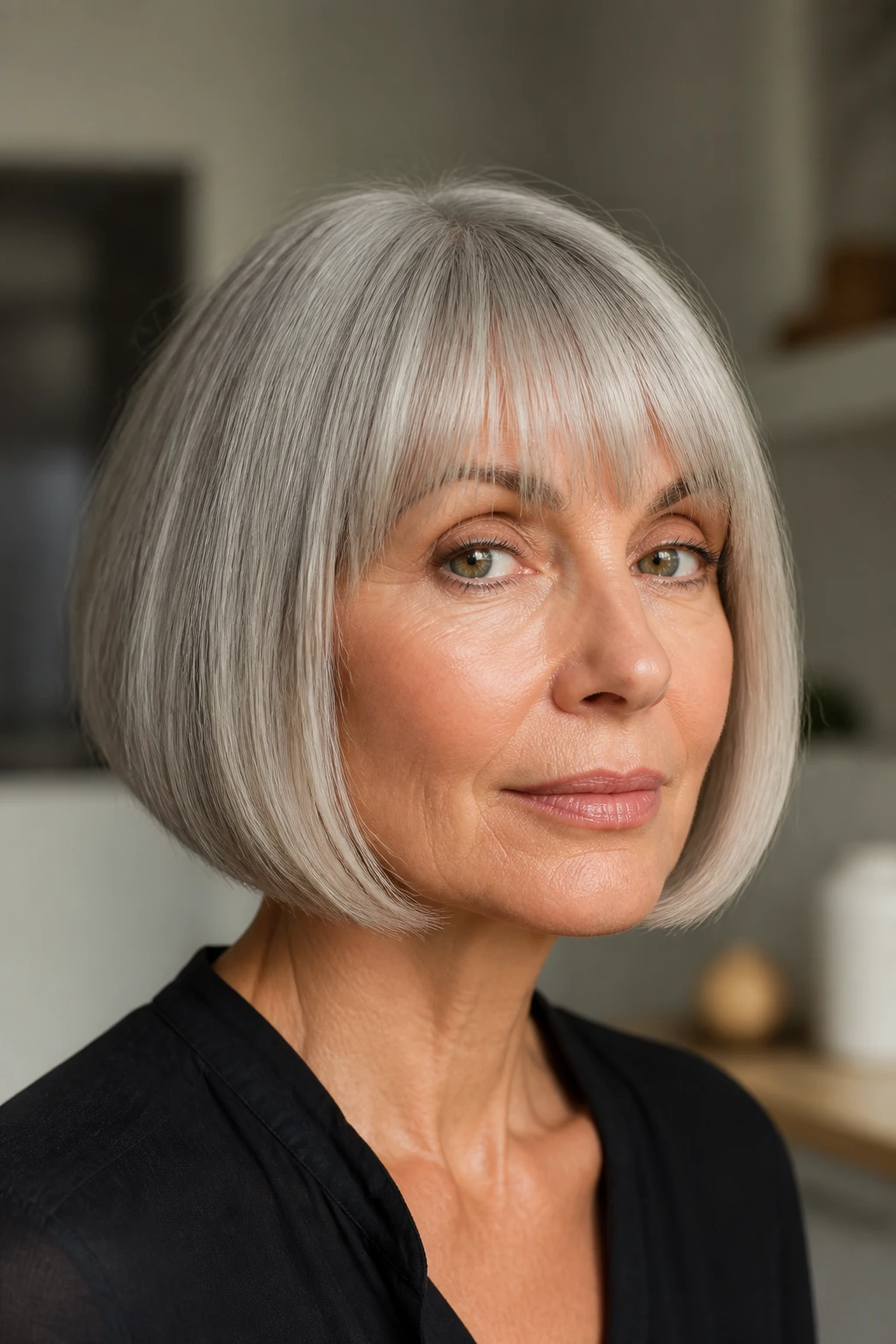
A chin-length French bob has a certain bite to it. It sits close to the jaw, usually with a soft bend rather than a hard curl, and that line looks especially good in silver. Gray hair has enough natural brightness to make the cut read expensive even when the styling is simple.
Why it works:
This shape gives you structure without feeling stiff. The length brushes the cheekbones or the jawline, which helps if your hair is fine and tends to go wispy at the ends. If you want a little softness, add a tiny amount of internal layering near the back of the head. Not too much. Too many layers and the bob starts to collapse.
The detail that makes it sing
Ask for the perimeter to stay blunt, then let the interior do the work. That gives you the swing of a bob without turning the ends into a feathered cloud. On gray hair, bluntness is your friend because it makes the color look denser.
For styling, a 1-inch round brush and a quick bend under the ends are enough. You do not need a shellacked finish. In fact, the slight looseness around the face is part of the charm.
3. Collarbone Shag With Airy Layers
The collarbone shag is for women who want gray hair to move. Not sit there. Move. The layers fall around the shoulders and collarbone, with enough internal texture to keep the style from looking bulky, especially if your gray comes in thick or puffy after washing.
Why it works:
Shags and gray hair get along for a simple reason: both are happiest with a bit of imperfection. The layers break up density, while the longer length keeps it from feeling too chopped. If your hair has a wiry bend to it, this cut makes that bend look like part of the design instead of a problem.
You can air-dry this one with leave-in conditioner and a touch of curl cream, or rough-dry it with a diffuser if your waves need help. The trick is not to over-brush it once it’s dry. That’s how shags turn into fluff.
A collarbone shag also handles grow-out well. If you’re not sure where you want your gray journey to land, this cut gives you a little room to change your mind.
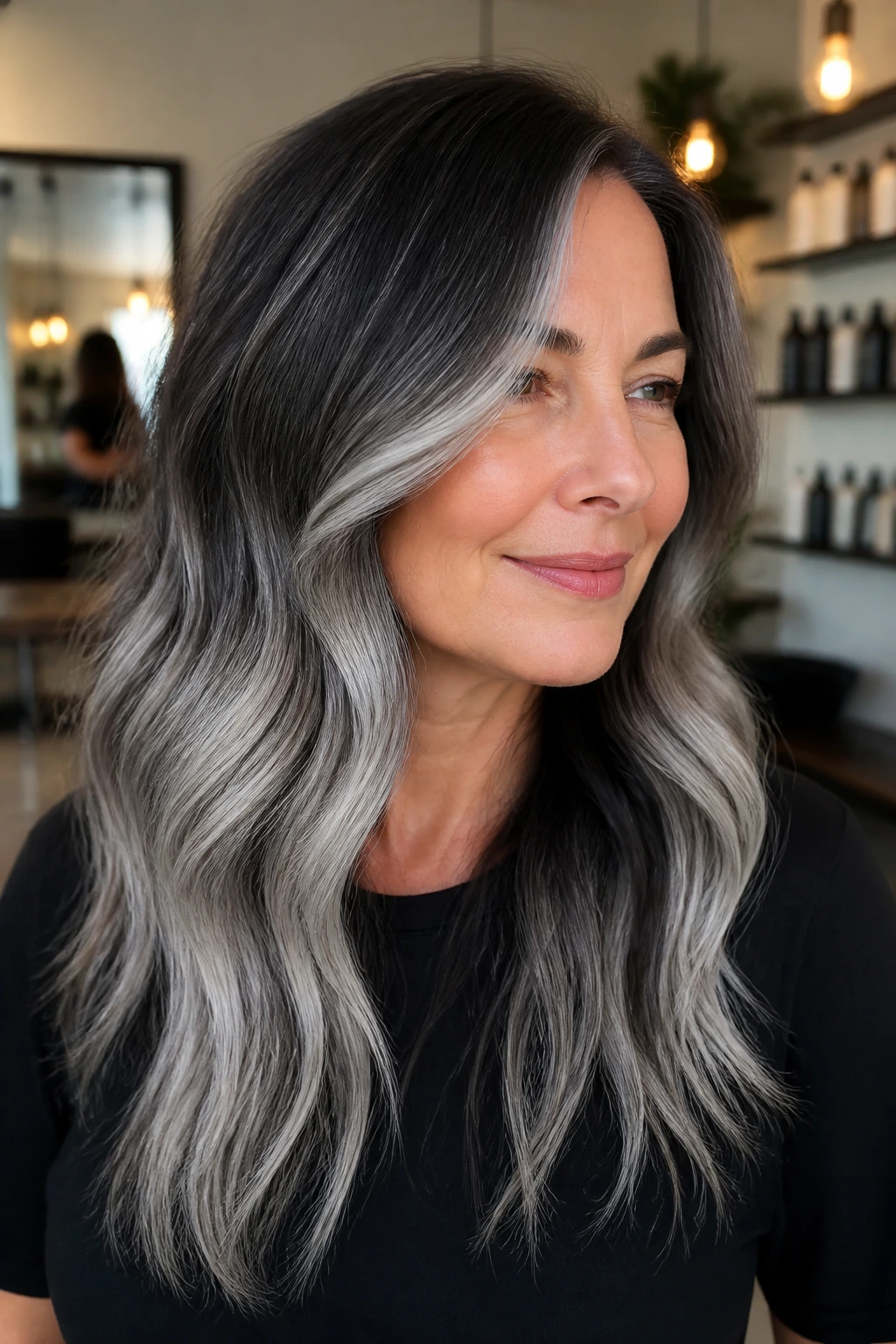
4. Long Gray Waves With Face-Framing Pieces
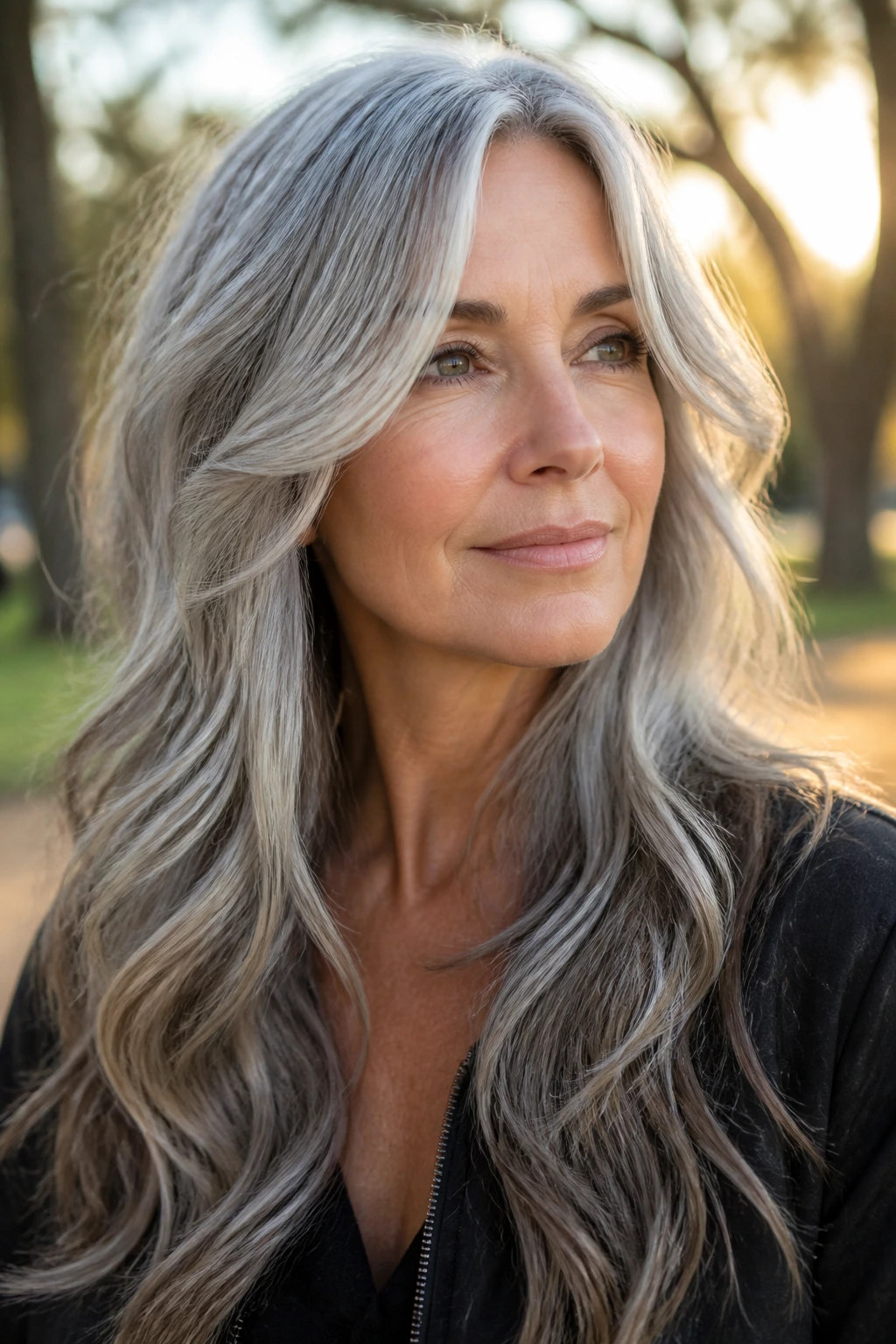
Long gray hair can look gorgeous. It can also look stringy if the ends are too thin or the top has no lift. The fix is usually not to chop it all off. It’s to give the hair a face frame and enough wave so the length feels deliberate.
Why it works:
Face-framing pieces soften the line around the cheekbones and jaw, which is useful if you wear your hair long and straight. Gray hair can sometimes feel static-looking at a single length, especially when it’s very bright silver. A few layers starting around the chin or mouth add movement without removing length.
If your hair is naturally wavy, use a medium barrel iron or sleep in braids to encourage shape. If it’s straight, bend just the mid-lengths and leave the ends a little straighter. That contrast keeps the style from becoming too “done.”
A small but useful warning
Long gray hair needs regular dusting at the ends. Every 8 to 12 weeks is better than waiting half a year and hoping for the best. Split ends show up fast on silver hair, and they make the whole length look tired.
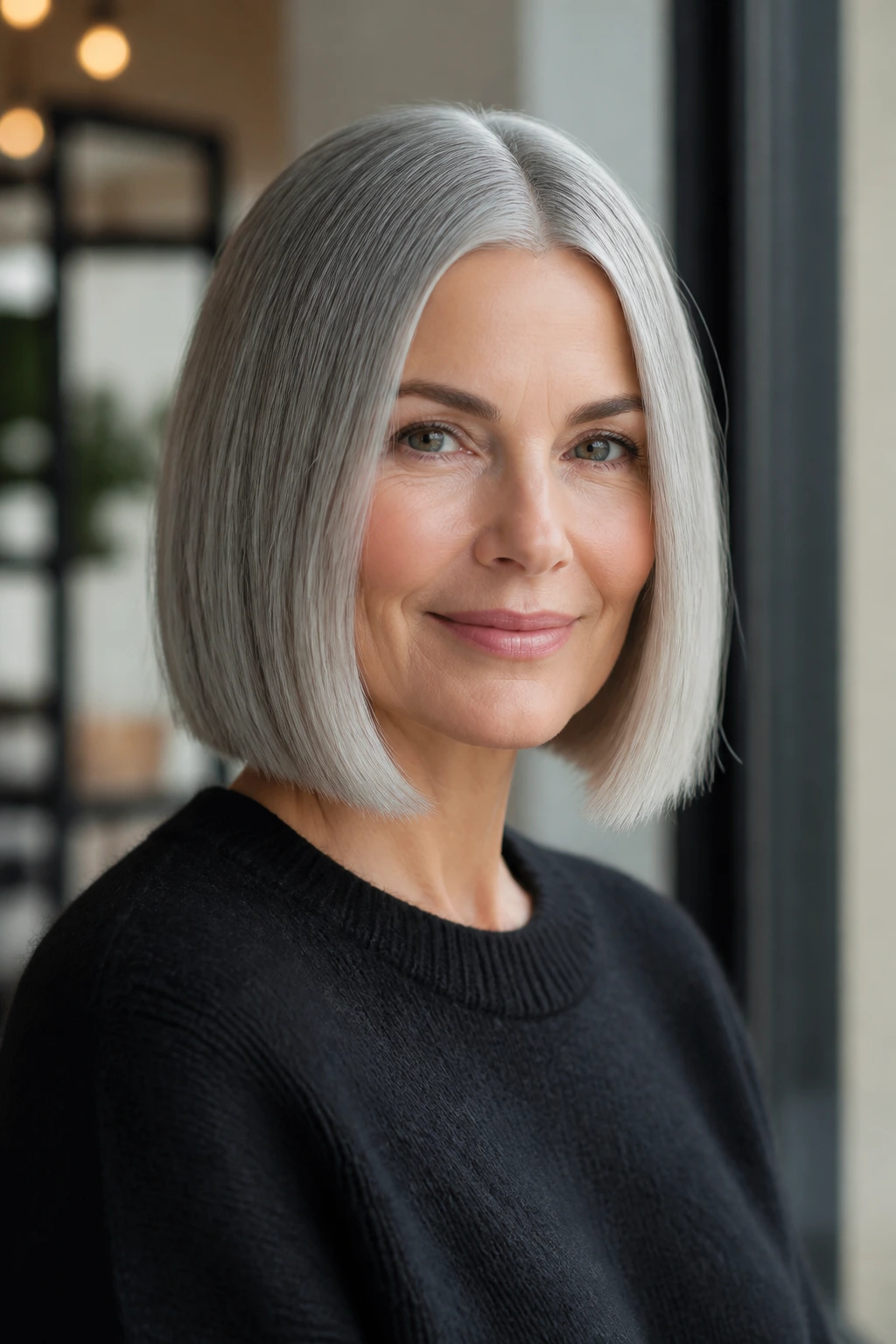
5. Sleek Blunt Lob With a Center Part
A sleek blunt lob is one of the cleanest gray hair looks for women who want order, not softness. The line ends somewhere between the chin and shoulders, and the center part gives the style a calm, modern feel. If your hair is naturally straight, this one can look almost architectural.
Why it works:
The blunt edge makes silver hair look denser than it really is. That matters if your strands are fine or if you’ve lost some bulk at the crown. A center part also keeps the shape balanced, which helps the cut read intentional instead of accidental.
This is one of those styles that looks better when the ends are polished. A flat iron pass, a blowout with a paddle brush, or even a smoothing cream can make a huge difference. But don’t flatten the root too much. You want a little lift at the crown, not a helmet.
If your hair tends to flip out at the bottom, ask your stylist to keep the perimeter slightly beveled. That tiny adjustment saves a lot of morning fighting.
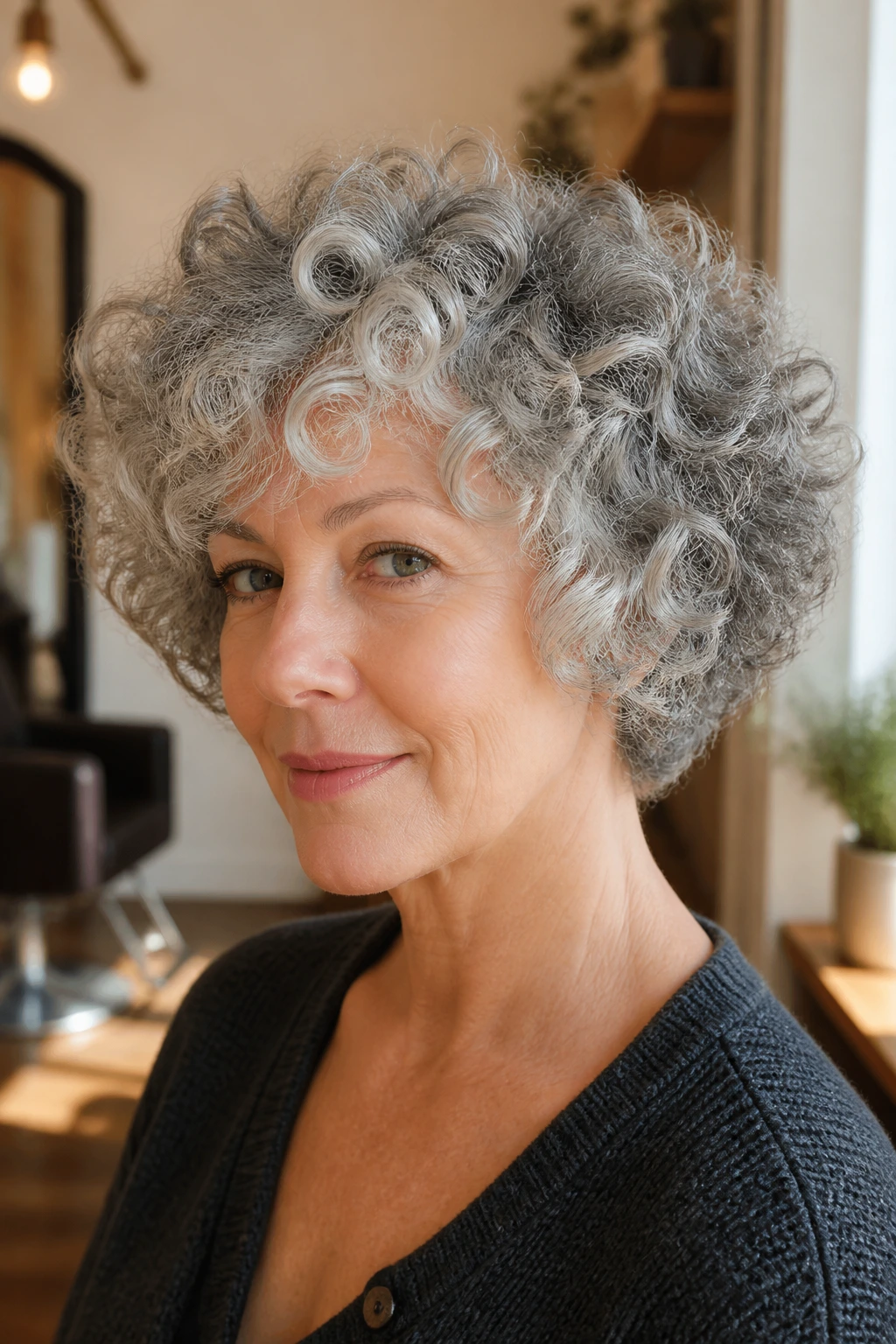
6. Curly Gray Halo Cut
Curly gray hair can be a knockout when it’s shaped properly. The halo cut gives the curls room to stand out around the head without building a triangle at the bottom. It’s especially good if your gray hair has a springy, spring-water texture that wants to move on its own.
Why it works:
Curly gray hair often needs more shape at the crown and less weight at the bottom. A halo cut removes the bulk where curls stack up and keeps the silhouette rounded. If the curls are tight, the cut should follow the natural spring pattern rather than forcing a uniform line. That’s where too many styles go wrong.
Use a leave-in conditioner and a light gel or mousse while the hair is still damp. Then scrunch and let it dry without touching it much. If you diffuse, use low heat and stop when the curls are about 90 percent dry. Over-drying gray curls can make them rough and frizzy in a hurry.
A good halo cut has presence. It does not whisper. It sits there with confidence and enough air between the curls to make the silver pieces catch the eye.
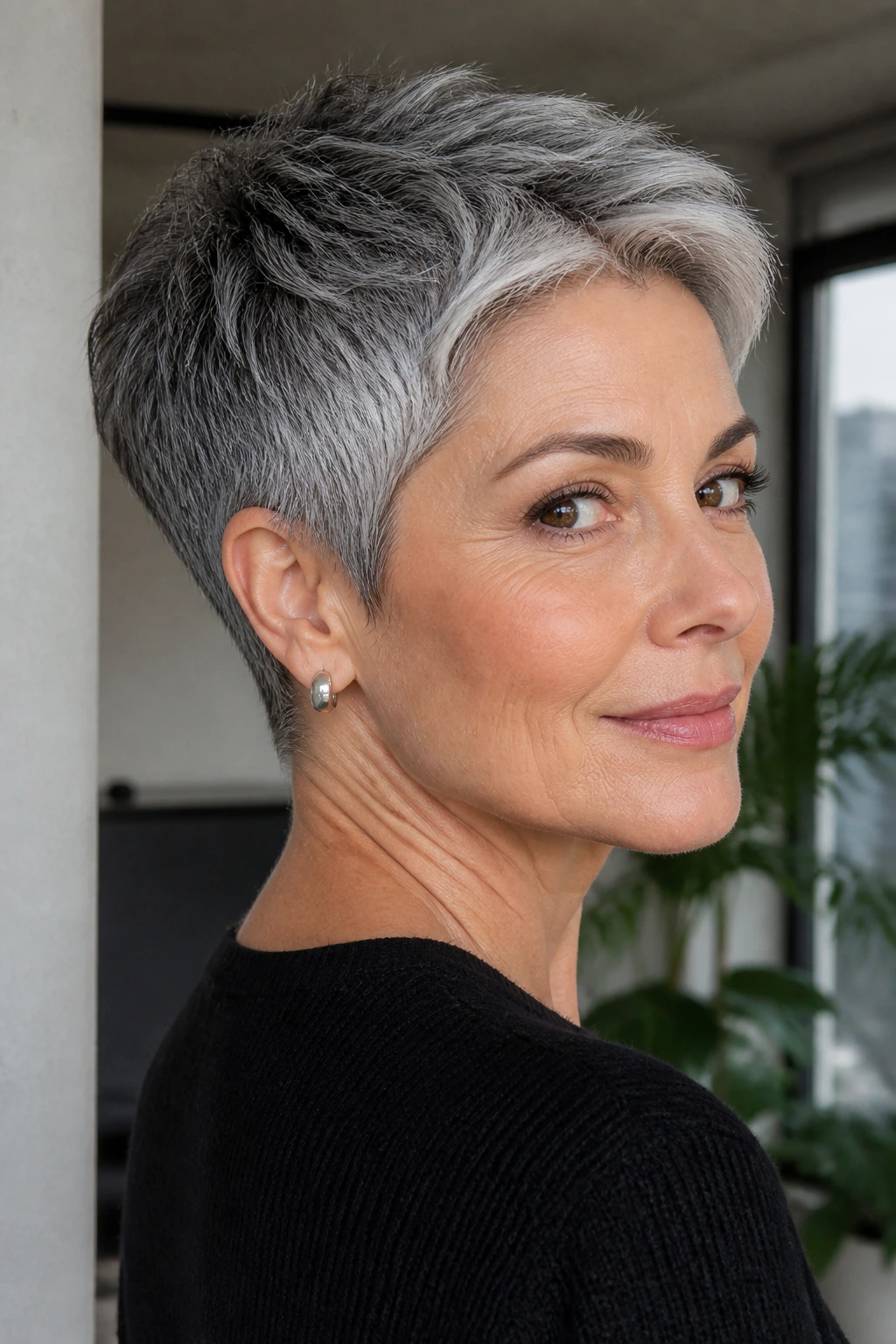
7. Salt-and-Pepper Pixie With Tapered Nape
Short hair can be a relief, but it has to be cut with intention or it turns into a fuzzy afterthought. The salt-and-pepper pixie with a tapered nape keeps the neckline clean and lets the crown stay a touch longer for shape. The contrast between dark strands and silver ones is the point here.
Why it works:
This style is good for women who still have mixed color and don’t want to color every few weeks to hide the transition. The short length makes the salt-and-pepper pattern look graphic instead of patchy. A tapered nape also keeps the back from puffing out, which is a common problem on coarse gray hair.
You can style it with a bit of matte cream for texture or a light pomade for shine. I prefer the latter if the silver pieces are bright. A touch of sheen keeps the cut from looking dry.
Nope, this is not a timid haircut. It looks best when the edges are tidy and the top has a little lift. If you want gray hair to feel sharp, this is one of the cleanest routes.
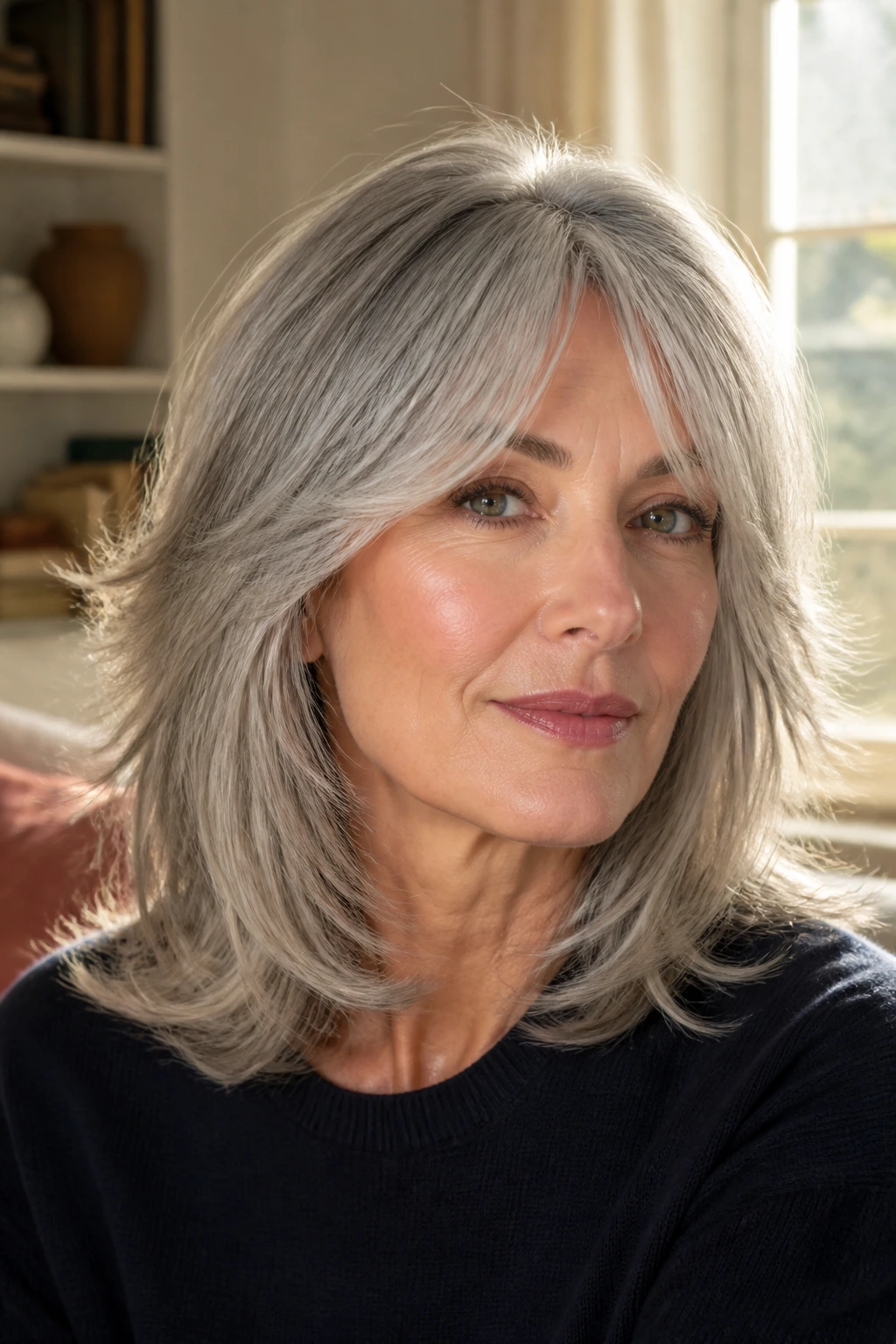
8. Feathered Shoulder Cut With Curtain Fringe
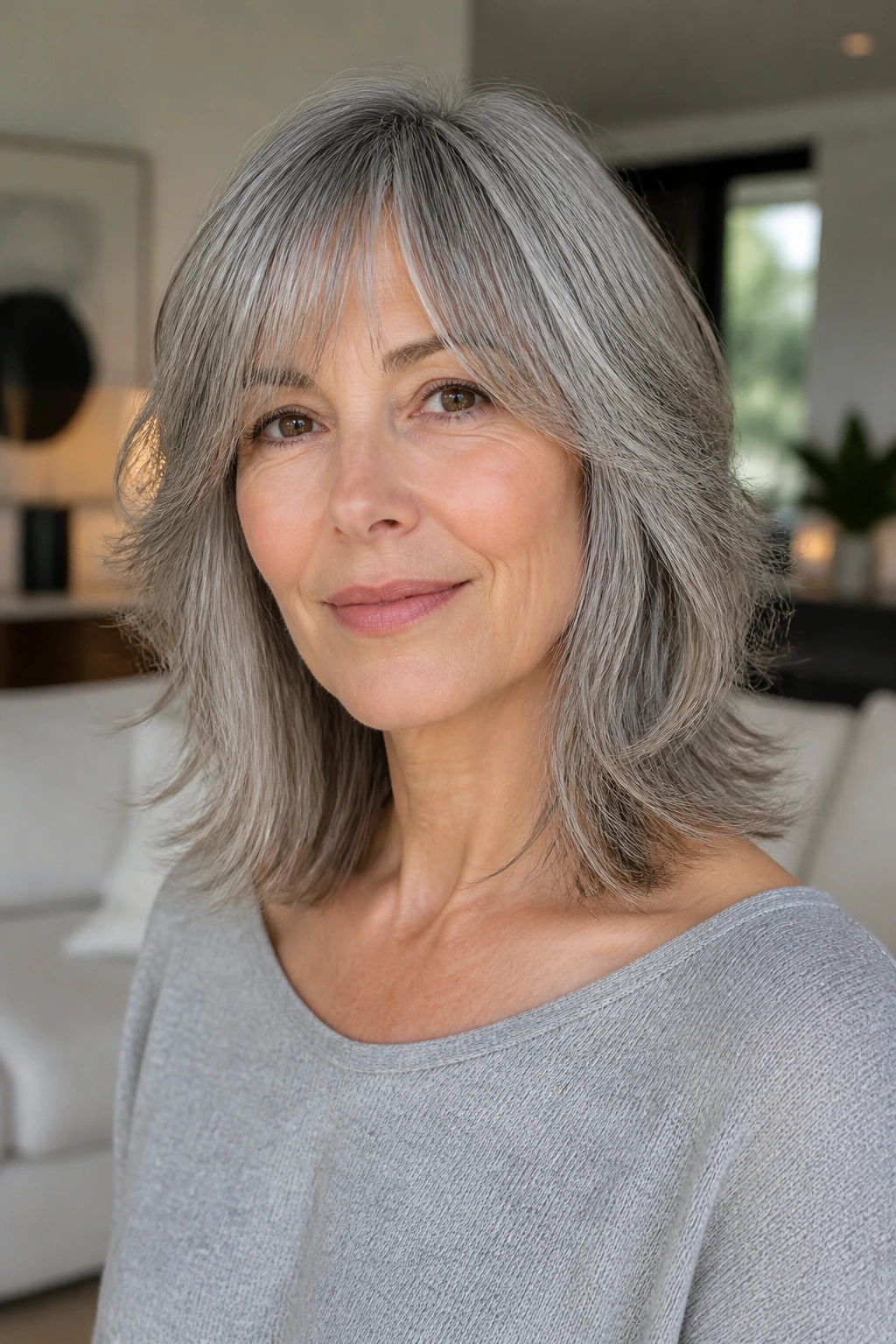
The feathered shoulder cut is a nice middle ground for women who want movement without going full shag. The layers are soft, the ends are feathered out rather than choppy, and the curtain fringe opens the face in a way that feels easy.
Why it works:
Feathering takes weight off gray hair that tends to grow in thick at the ends. The curtain fringe also helps disguise the awkward stage when a dye line is growing out and the roots are showing a different shade. If your hair hits the shoulders and starts flipping in odd directions, this cut can tame that fast.
The styling trick is simple: blow-dry the fringe away from the face with a round brush, then let the ends of the cut swing naturally. A little volumizing mousse at the roots helps if your hair is fine. If your hair is coarse, use a smoothing cream on the mid-lengths before drying.
This is a polished everyday style. It works with sweaters, blazers, and big earrings. It does not need to look perfect to look good.
9. Silver Balayage on a Dark Base
Not every woman is fully gray, and not every grow-out needs to be hidden. Silver balayage on a dark base gives you a controlled transition, with lighter silver pieces painted through the mid-lengths and ends while the roots stay deeper and richer.
Why it works:
Balayage softens the line between old color and new gray. Instead of a hard stripe of regrowth, you get a blended shift that looks more natural as it grows. This is especially useful if your natural gray is still mixed with brown or black and you want the whole head to feel connected.
The maintenance is lighter than full color, but it still needs tone control. Silver pieces can go yellow under heat and hard water, so a violet conditioner every few washes helps. Leave it on only a few minutes. More is not better here. Too much toning can make the silver look dull.
If you like the idea of gray but aren’t ready to go all in, balayage is one of the smartest transitional looks. It buys time without making the hair look neglected.
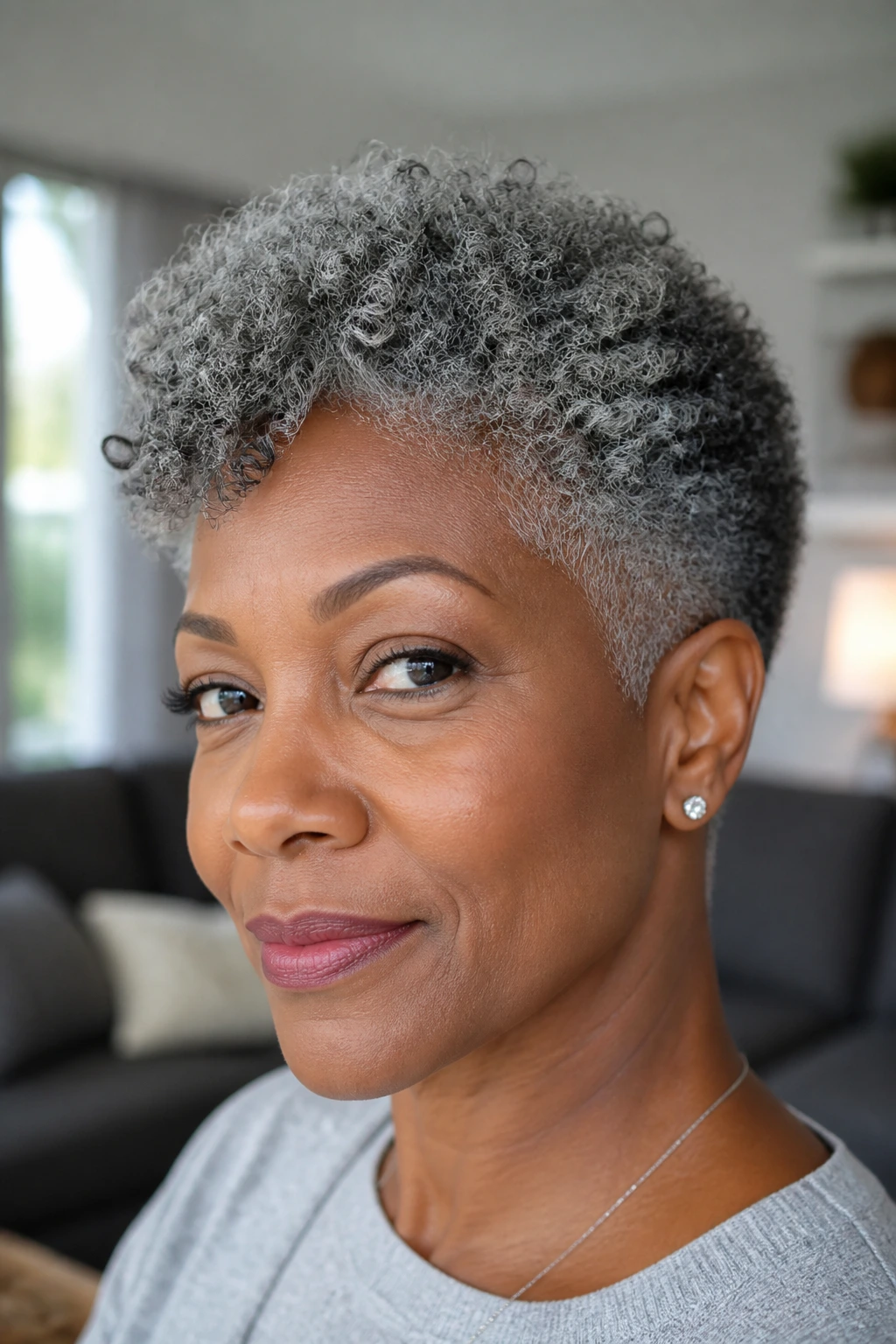
10. Tapered Natural Coil Cut
Natural coils and gray hair can be a beautiful pair, provided the shape respects the curl pattern. A tapered cut keeps the sides and back close while leaving the top fuller, which lets the coils rise instead of spreading outward in a triangle.
Why it works:
Coily gray hair often needs moisture, shape, and a clean edge. The tapered cut gives all three. It also shows off the silvery strands at different levels, which makes the color look dimensional instead of flat. If your coils shrink a lot, ask for the top to stay a bit longer than you think you need. Shrinkage is a sneaky thing.
I’d use a rich leave-in, then define the coils with cream or gel while the hair is damp. Once it dries, don’t rake your hands through it repeatedly. That breaks the curl clumps and creates frizz.
This style has edge, but it’s also practical. It grows out gracefully and usually needs only a regular shape-up around the ears and nape. Clean lines matter.
11. Asymmetrical Silver Bob
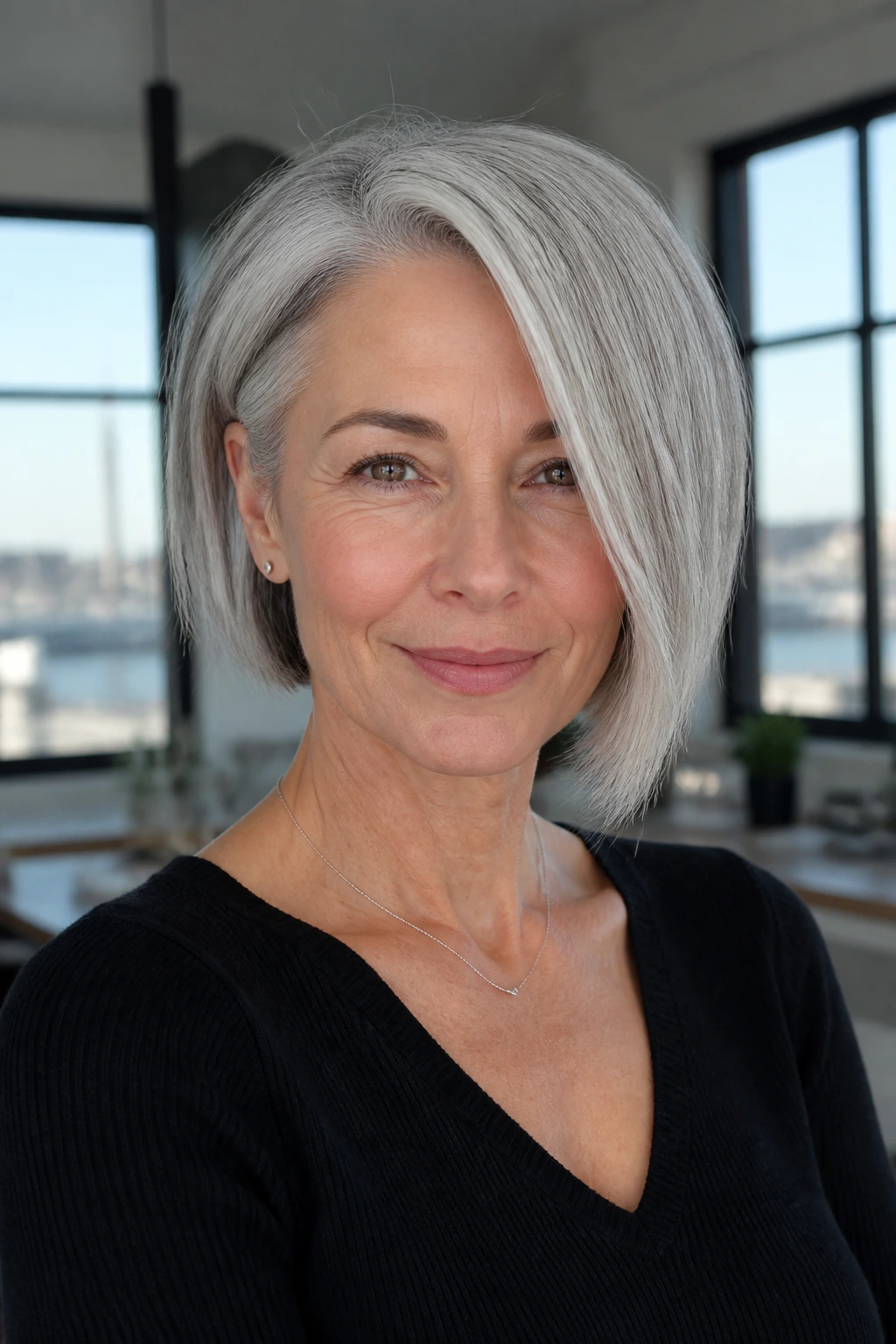
An asymmetrical bob has one side slightly longer than the other, and that small imbalance gives silver hair a lot of attitude. It’s the kind of look that turns a simple bob into something sharper without making the cut difficult to wear.
Why it works:
Gray hair can sometimes read flat in a perfectly even bob. The asymmetry gives the eye something to follow, which makes the style feel more dynamic. It also helps if one side of your hair grows thicker or flips more stubbornly than the other. Instead of fighting that difference, the cut uses it.
The best version usually has a deeper side part and a clean neck line. If you want extra polish, blow-dry the longer side with a round brush so it curves in slightly at the ends. A smoothing serum on the surface helps the silver reflect light without getting stringy.
This is a good cut for women who like structure but do not want a severe line. It has enough personality to keep silver hair interesting.
12. Braided Crown on Long Gray Lengths
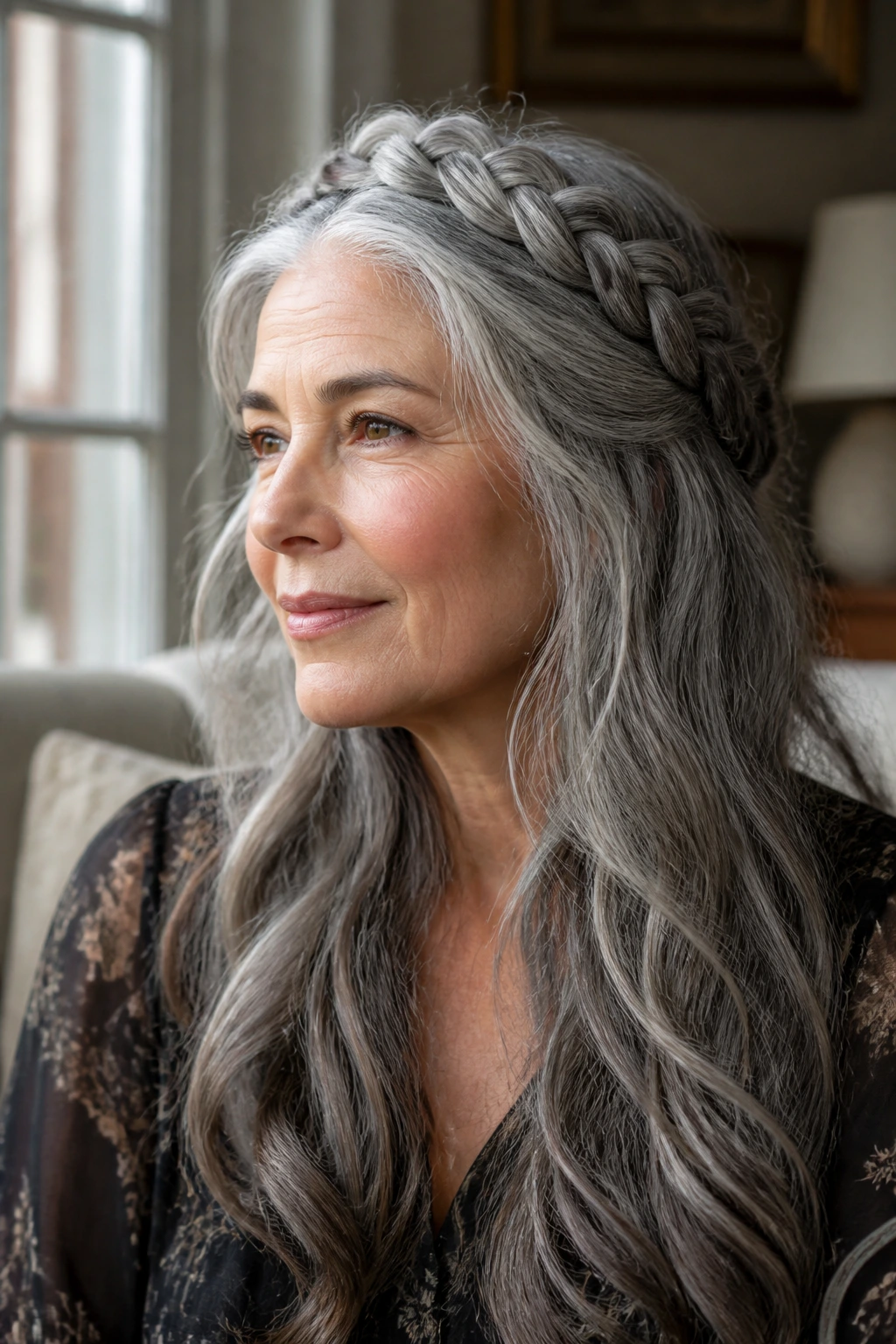
A braided crown on long gray hair has a calm, almost old-world feel that works because silver strands show braid texture so well. The plaits catch the light differently from the loose lengths, and that contrast makes the whole style feel richer.
Why it works:
Gray hair can be slippery or dry depending on the strand, and braiding gives it shape when you want to keep it out of the face. It’s also a useful style when the roots are growing in unevenly. A crown braid distracts from the transition and looks deliberate even if you haven’t washed your hair that morning.
For the best result, use a bit of texture spray or dry shampoo before braiding. Clean, too-slick hair can make the braid unravel. Once the braid is pinned, tug the outer edges slightly to widen it. That fuller finish suits silver hair better than a tight, tiny braid.
This is the kind of style that looks much harder than it is. Which is nice. We all need a few of those.
13. Glossy Blowout on Mid-Length Layers
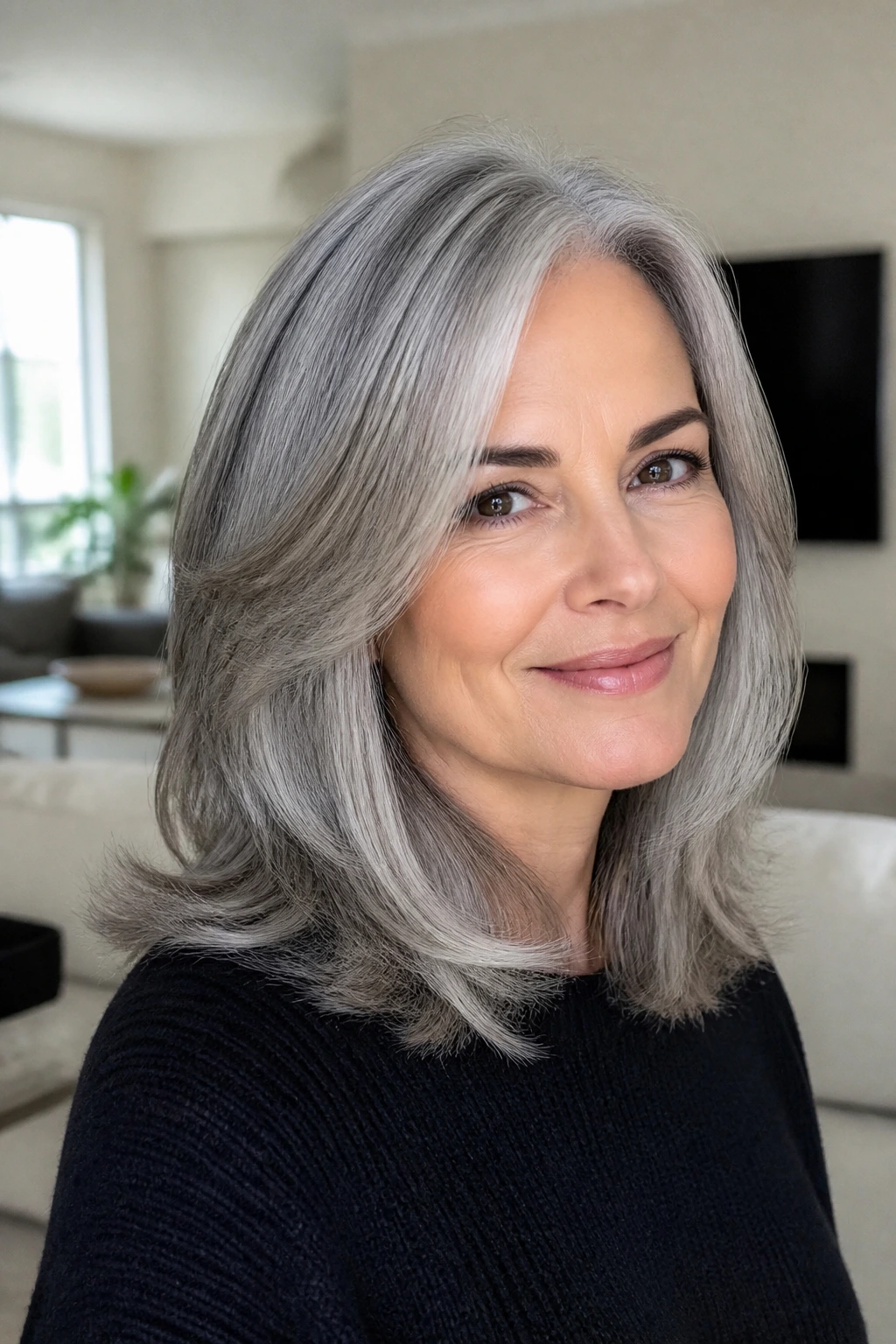
A glossy blowout gives gray hair a soft, plush surface that photographs well in real life, not just in salon lighting. Mid-length layers help the blowout move, while the finish keeps the silver from looking coarse or dry.
Why it works:
Gray hair often lacks the same natural smoothness it once had, so a blowout can make a noticeable difference. A round brush, a heat protectant, and a small amount of smoothing cream are enough. Focus on the top and front first, then turn the ends under slightly or curve them away from the face, depending on the look you want.
The point is not to make hair pin-straight. The point is to make it touchable and shaped. If the strands are fine, use a volumizing spray at the roots. If they’re thick, keep the product light so the style doesn’t collapse under its own weight.
A good blowout is one of the simplest ways to make gray hair look expensive without changing the cut. It’s the surface that does the work.
14. Textured Crop With Micro Bangs
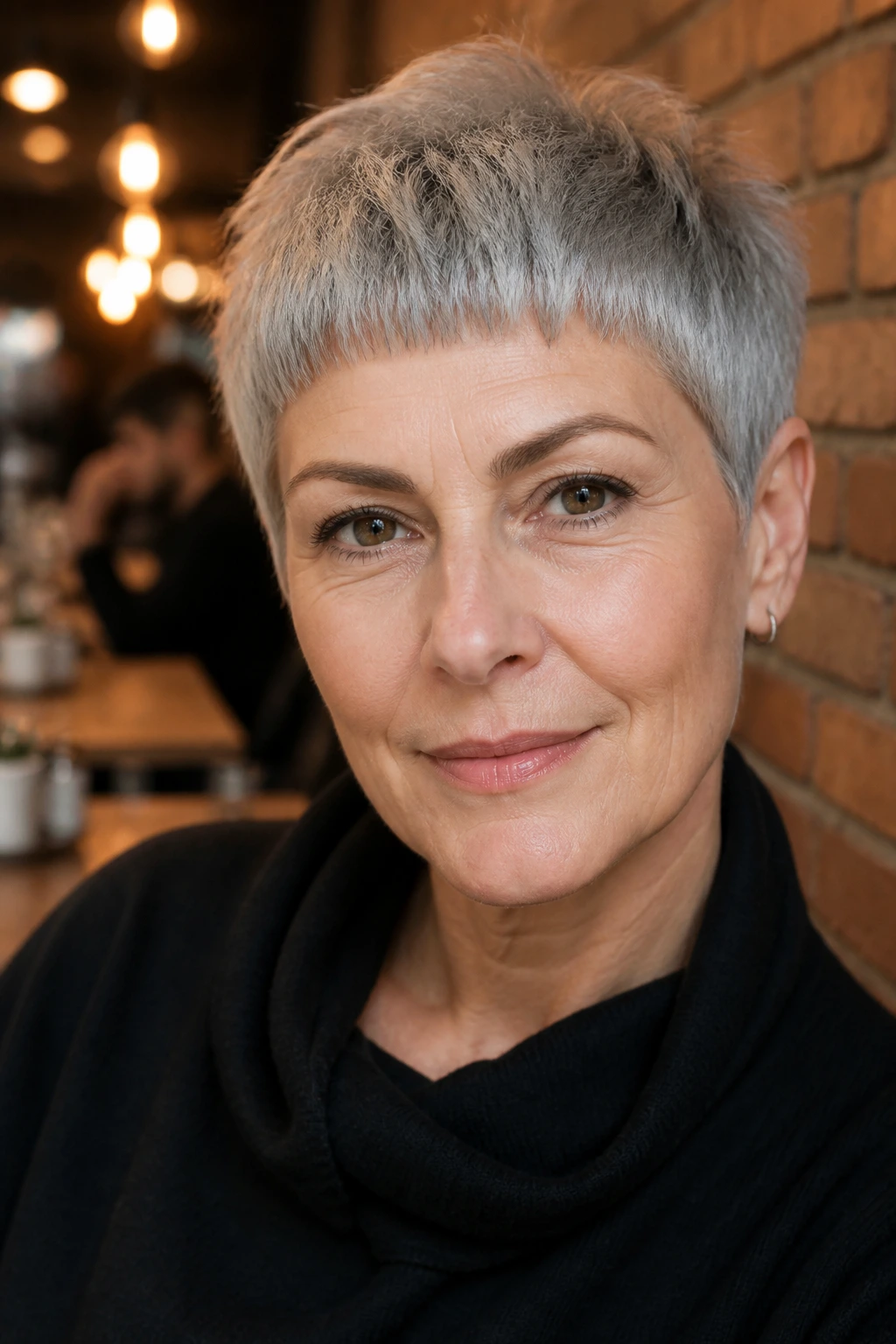
Micro bangs are not for everyone. Let’s be honest about that. But on the right woman, with the right gray crop, they can look sharp in a way that feels almost graphic. The cut is short, choppy, and a little stubborn on purpose.
Why it works:
The short fringe pulls attention upward and can make the eyes stand out, especially if the rest of the cut is kept close to the head. Gray hair with texture benefits from this kind of controlled messiness. Instead of trying to smooth every strand, the style lets the hair show off its grain.
Keep the sides tight and the top textured. If the bangs are too thick, they can close in on the face. Too thin, and they just look accidental. The balance matters more than people think.
I’d pair this with a matte paste or dry wax, not a glossy cream. The finish should read piecey, not shiny. If you’re wearing strong earrings or glasses, micro bangs can frame the face in a very clean way.
15. Silvery Ombré on Straight Lengths
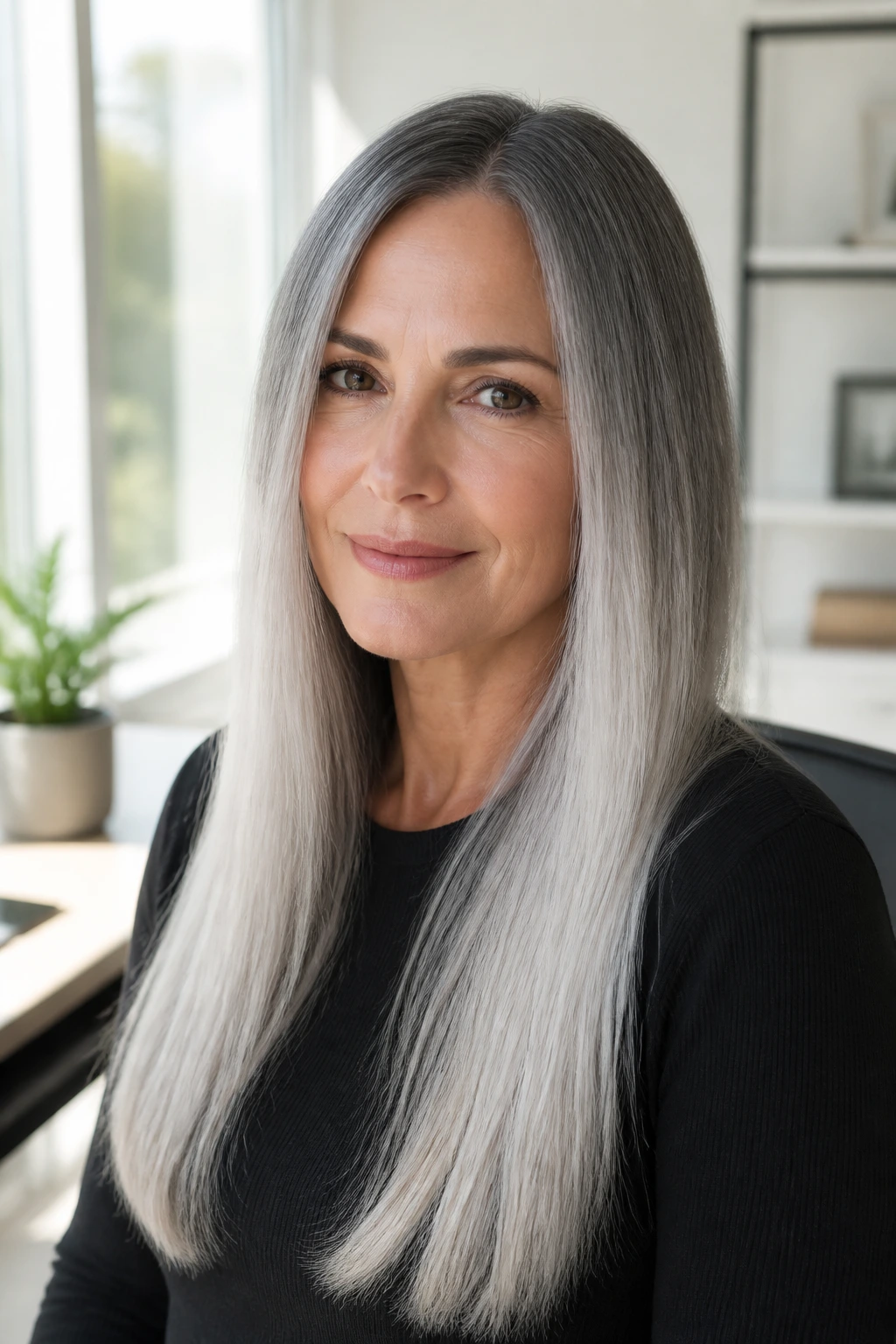
Silvery ombré is a color look, not a cut, and it works especially well on straight hair because the gradient shows clearly. The darker roots melt into pale silver ends, which makes the grow-out easier and the whole head feel softer.
Why it works:
This is a smart option for women who want a gray-inspired look before they’ve reached full silver. It keeps dimension through the length and avoids that flat, monochrome feeling some all-over light tones can create. Straight hair shows the transition beautifully, especially when the ends are kept blunt enough to hold weight.
A toner or gloss every few weeks helps keep the silver ends cool instead of yellow. Don’t over-wash. The more often you shampoo, the faster the tone slips. A sulfate-free cleanser and a heat protectant are both worth it here.
The ombré effect also buys you flexibility. If you decide to grow out more gray later, the transition is already built in.
16. Half-Up Knot for Mixed Gray Regrowth
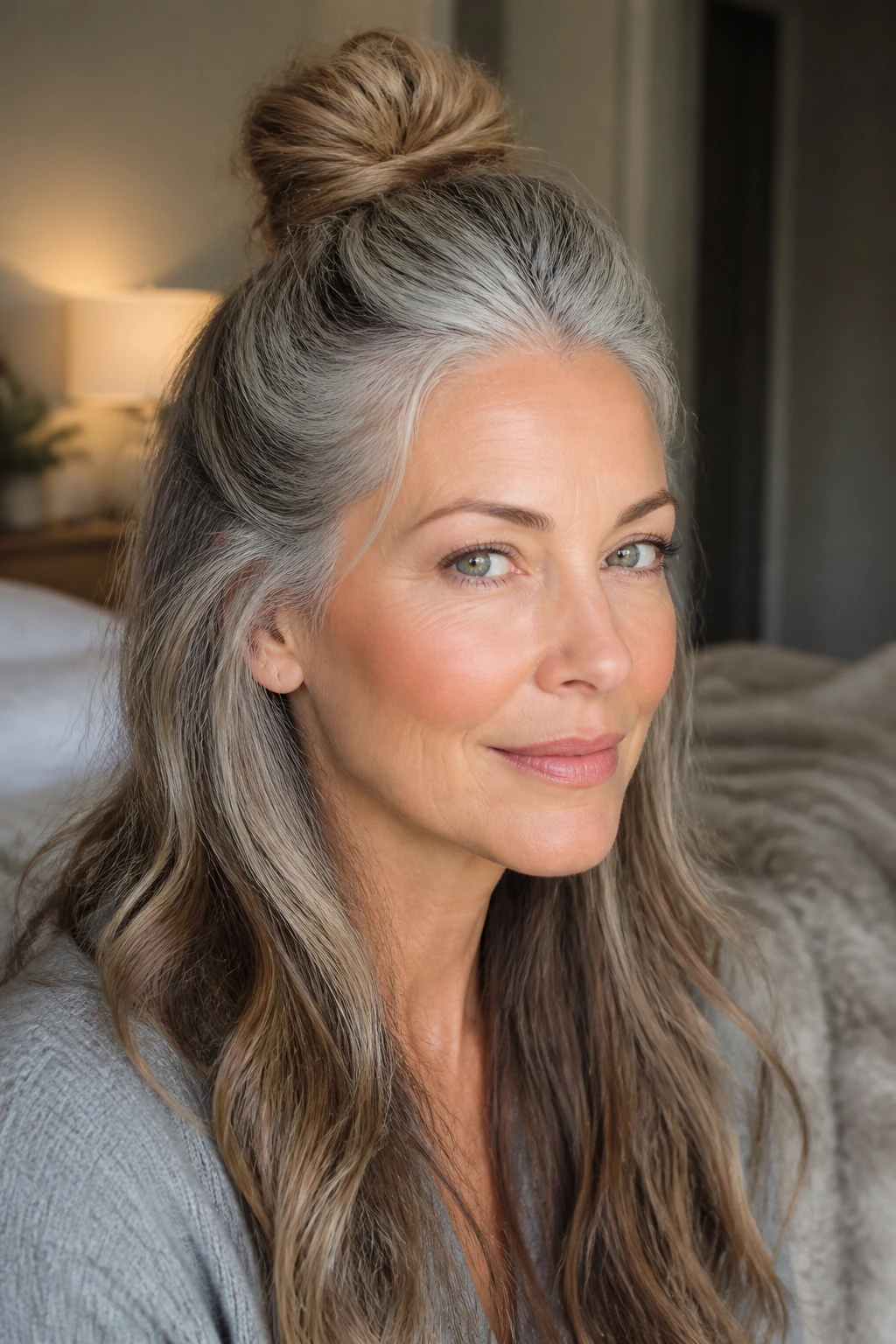
The half-up knot is one of those deceptively useful styles that saves a bad hair day without looking lazy. Pull the top section back, twist it into a small knot, pin it loosely, and let the rest fall around the shoulders. Mixed gray regrowth looks especially good here because the top is lifted away from the face.
Why it works:
When gray roots are coming in against colored lengths, the half-up knot breaks up the color line. It also gives you root lift at the crown, which is a nice bonus if your hair has started to thin there. The style works on straight, wavy, and slightly curly hair, which is not true of every look on this list.
A little dry texture spray at the roots helps the top section hold. If your hair is very smooth, a tiny backcomb at the crown can give the knot something to anchor to. Keep the knot slightly loose. A tight little bun on top can look fussy fast.
This is an everyday style with a low tolerance for perfection. Good. Most of us need more of those.
17. Romantic Chignon for Formal Days
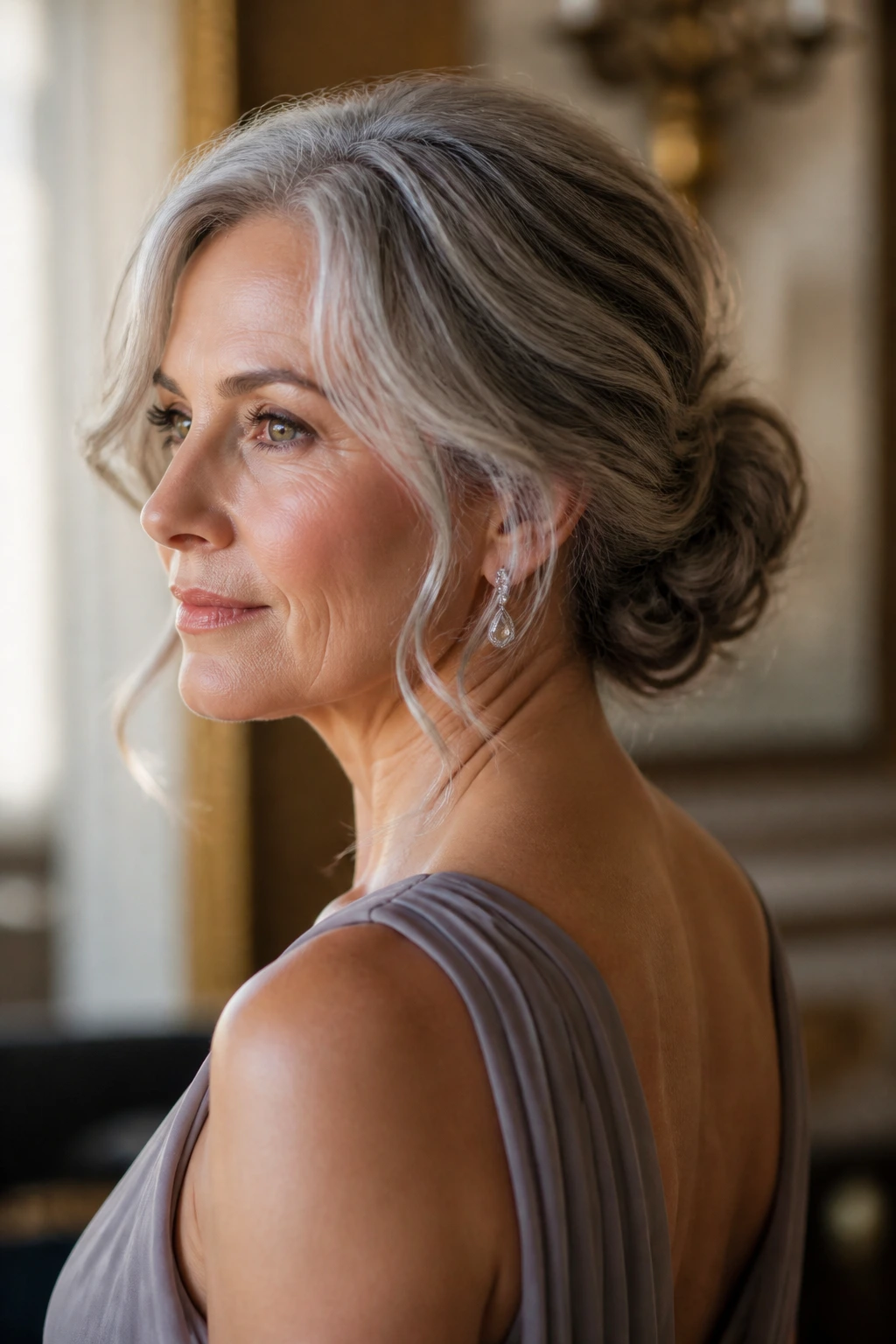
A low chignon gives gray hair a soft, polished shape that works beautifully for weddings, dinners, or any moment when you want the silver to look intentional rather than casual. The trick is to keep the bun low and a little relaxed so the texture still shows.
Why it works:
Gray strands reflect light well when the surface is smooth, and a chignon creates a neat surface without demanding a stiff finish. If your hair is layered, leave a few face-framing pieces out. That keeps the style from looking severe and gives the silver around the temples a chance to shine.
Use a light hold spray and a bobby pin or two, then tuck the ends into the knot rather than wrapping them neatly. The less tidy edges make the style feel softer. If your hair slips, a bit of styling cream on the palms before gathering it helps.
This is one of the best styles for showing off earrings and necklines. Quiet, but not plain.
18. Wavy Shag With Choppy Fringe

If your gray hair has wave and a little attitude, the wavy shag with a choppy fringe makes that texture the star. The layers are uneven enough to keep the shape loose, while the fringe brings the focus toward the eyes.
Why it works:
The shag removes weight where gray hair can turn bulky, especially near the mid-lengths. The choppy fringe also helps balance a wider forehead or soften a strong brow line. On hair that wants to frizz, the cut gives the frizz a frame instead of trying to erase it.
Air-drying works well here if you scrunch in a light curl cream. If you blow-dry, use your fingers or a diffuser and stop before the hair gets too puffy. This style looks best with texture, not stiffness.
It’s also forgiving. If the layers grow a little unevenly, the cut still looks lived-in. That’s one reason people keep returning to shags. They have a decent memory for chaos.
19. Sleek Ponytail With Polished Roots
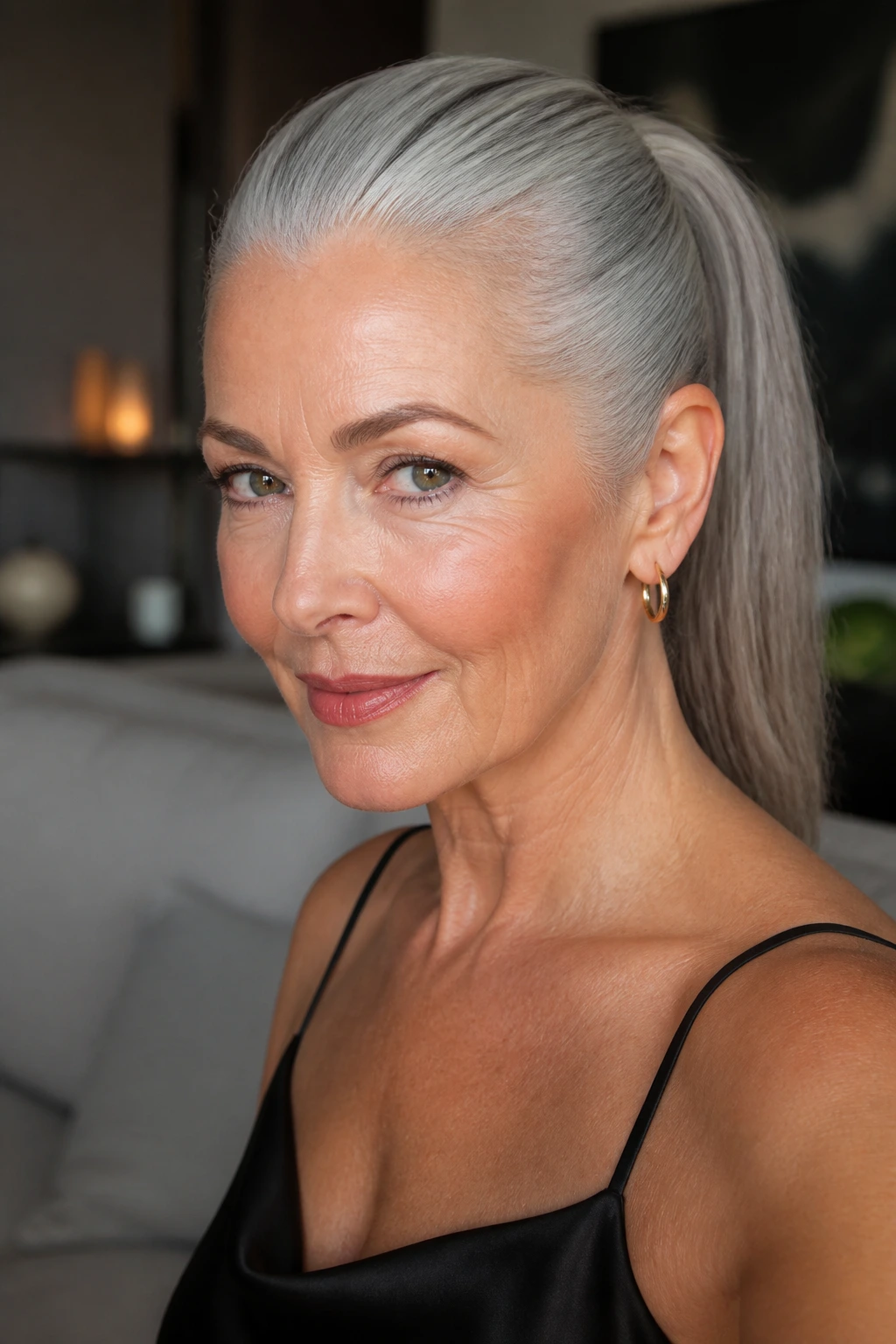
A sleek ponytail is one of the most underused gray hair looks for women who want something simple but sharp. With the right polish at the roots, silver hair in a ponytail can look clean and strong instead of thrown back on a hurry.
Why it works:
The ponytail shows the sheen in gray strands, especially if the hair is brushed smooth from the hairline to the nape. A low ponytail feels more elegant, while a mid-height ponytail gives a little lift. If your hair is mixed gray and dark, the gathered length turns the color pattern into a feature instead of a problem.
Apply a smoothing cream or a touch of serum to the top section before brushing it back. Use a boar-bristle brush if you want a tighter finish, or a paddle brush if you need less tension. A small wrapped section of hair around the elastic makes the style look finished.
This is a good choice on humid days, on workout days, or on any day when your hair refuses to cooperate. Which is most days, if we’re being honest.
20. Dimension-Building Charcoal Lowlights
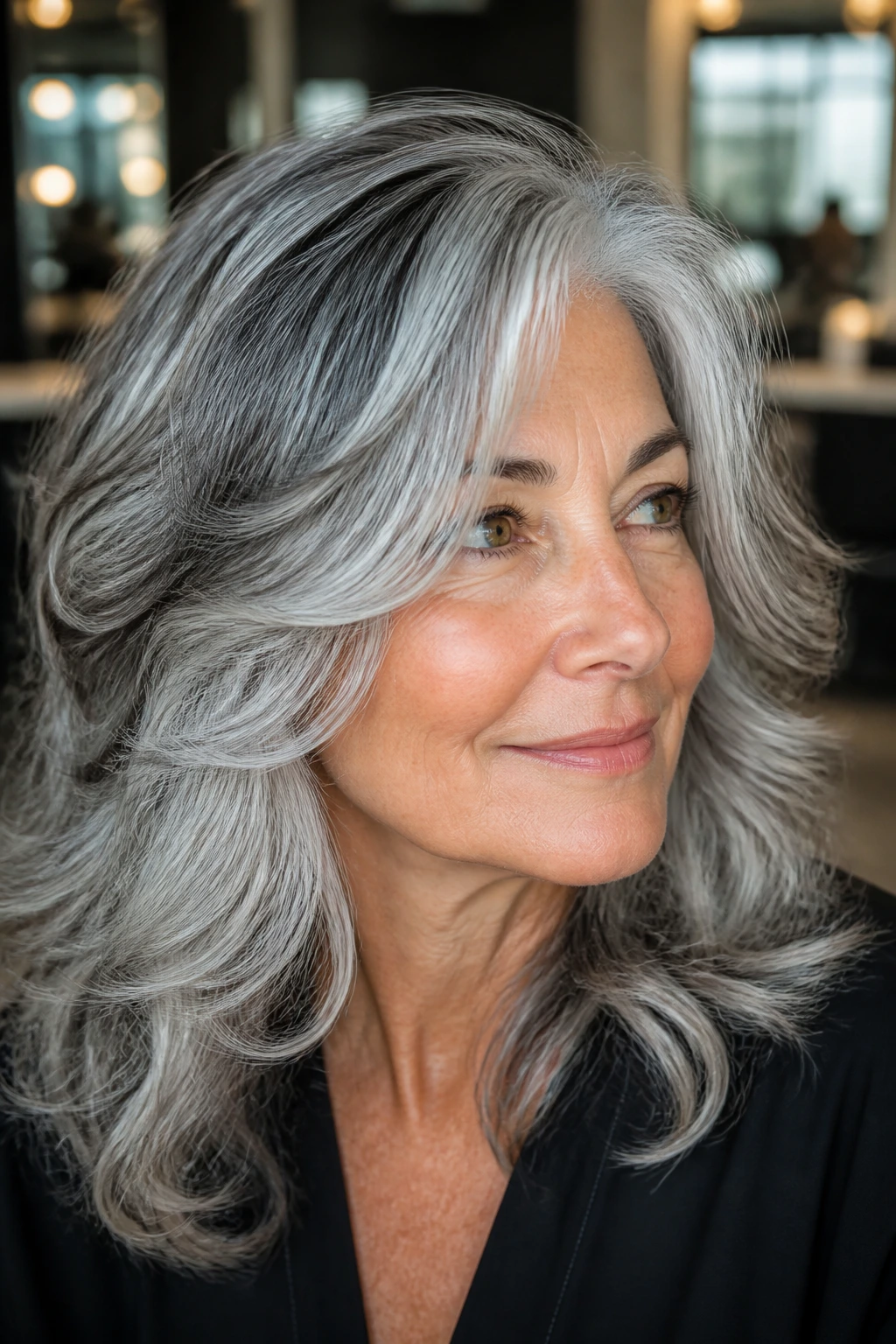
Charcoal lowlights are for women who want their gray hair to have depth instead of a single silver note. Thin ribbons of darker color are woven through the lighter base, and the contrast gives the whole head more body.
Why it works:
All-over gray can sometimes look flat in certain light, especially if it’s very white or very pale. Lowlights solve that by creating visual depth without pushing the hair back toward dark brown. They’re a good option if you want to keep the silver look but need a little shadow near the roots or underlayers.
The key is restraint. Too many dark pieces and the hair loses its airy feeling. Too few and the effect disappears. A colorist with a light hand is worth finding here, because the difference between rich dimension and stripy confusion is smaller than people think.
I like this look on shoulder-length cuts and bobs best, where the color movement has enough length to show. On very short hair, the lowlights can read too compressed.
21. Layered Flip-Out Midi Cut
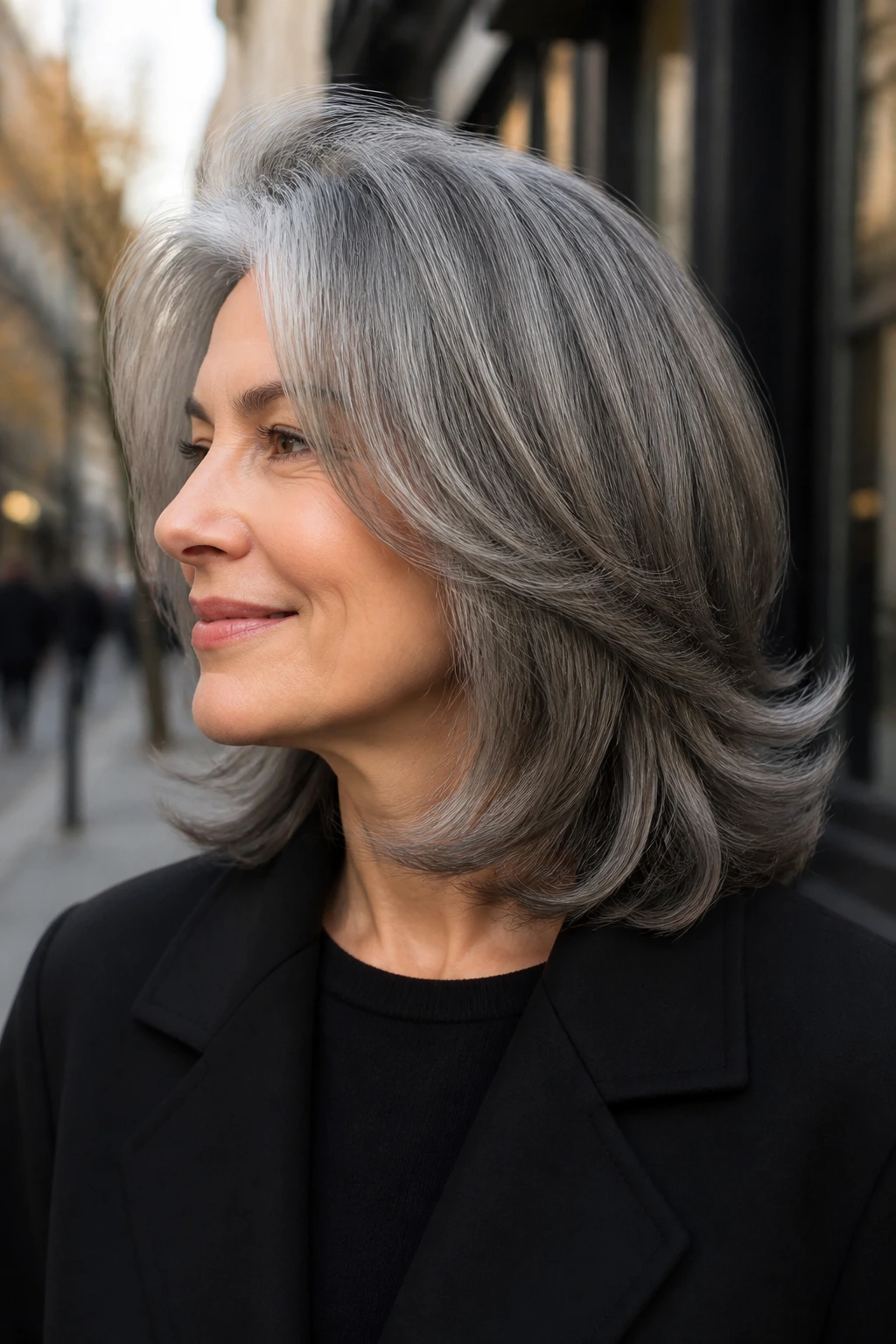
The flip-out midi cut has a little retro energy, but it can look fresh on gray hair because the layers keep it from feeling heavy. The ends bend outward just enough to create movement around the shoulders and jaw.
Why it works:
Gray hair often needs a visible shape at the ends, especially when it’s mid-length and prone to hanging straight. The flip-out effect gives the cut personality without requiring tight curls or aggressive styling. It’s a solid choice if your hair is fine and needs the illusion of fullness.
A medium round brush or a quick pass with a flat iron can create that outward bend. If you want a softer finish, let only the top layer flip while the underneath stays straighter. That contrast feels modern, not retro-costume.
This is one of those cuts that looks especially good with a side part. The asymmetry at the roots helps the ends feel lighter. Small detail, big payoff.
22. Voluminous Side-Swept Bob
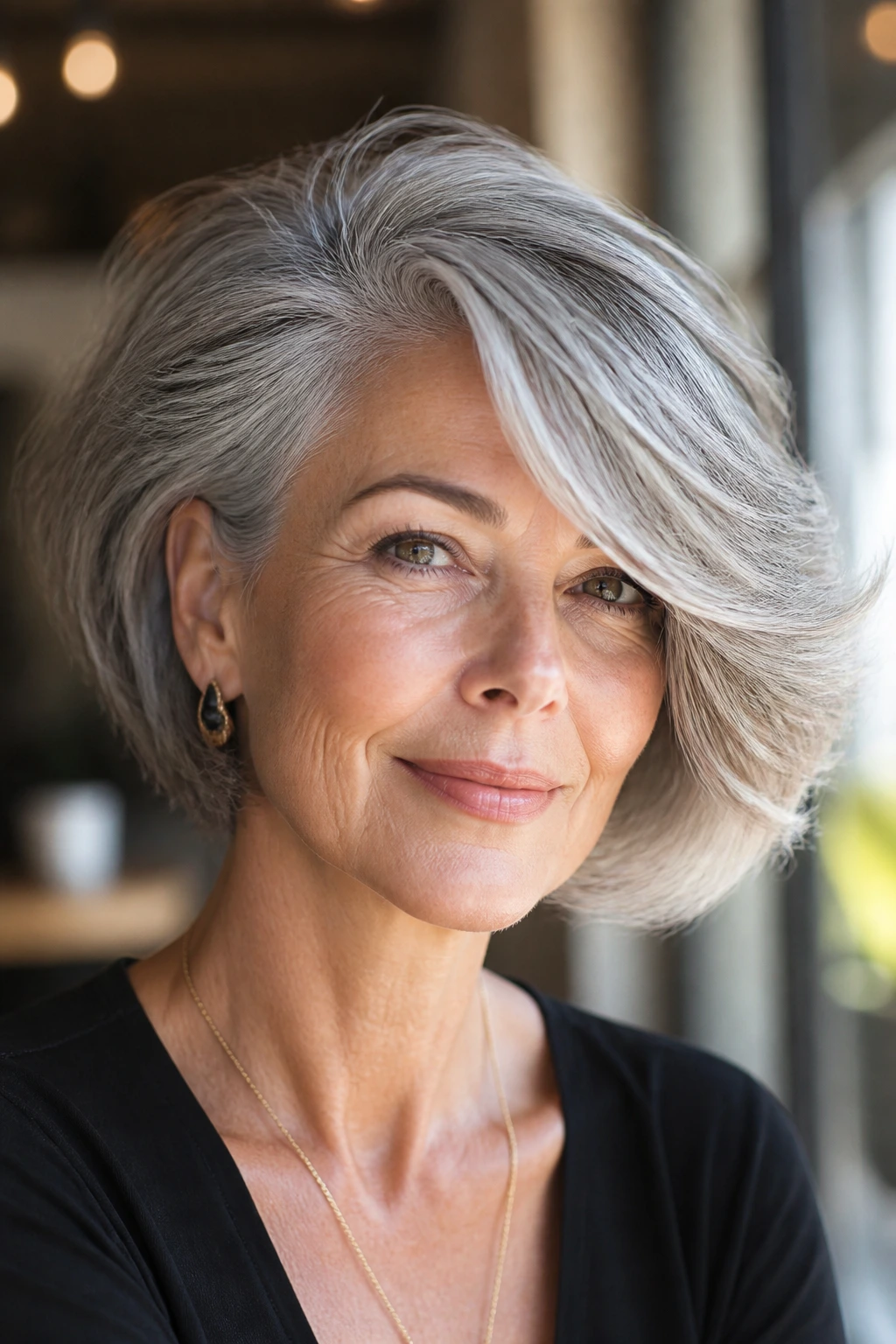
A side-swept bob brings life to gray hair that lies flat at the crown. The side part gives height, while the bob itself stays compact enough to hold shape. On women with finer strands, this can be the difference between “haircut” and “just hair.”
Why it works:
The side part lifts the root line and creates a diagonal across the face, which usually softens the look of a strong jaw or a rounder face. If the bob is cut to skim the chin or just below it, the volume lands in a flattering place. Gray hair also tends to show shine better on a side-swept curve than in a dead-straight line.
A root-lift mousse or spray helps the style stay off the scalp. Blow-dry the hair in the direction opposite the part first, then switch back once it’s mostly dry. That extra step gives the crown a little hidden lift.
If your hair falls flat by noon, this is one of the better fixes. It’s practical. And it doesn’t look like you tried too hard, which is often the real goal.
23. Air-Dried Silver Waves With Shine Cream
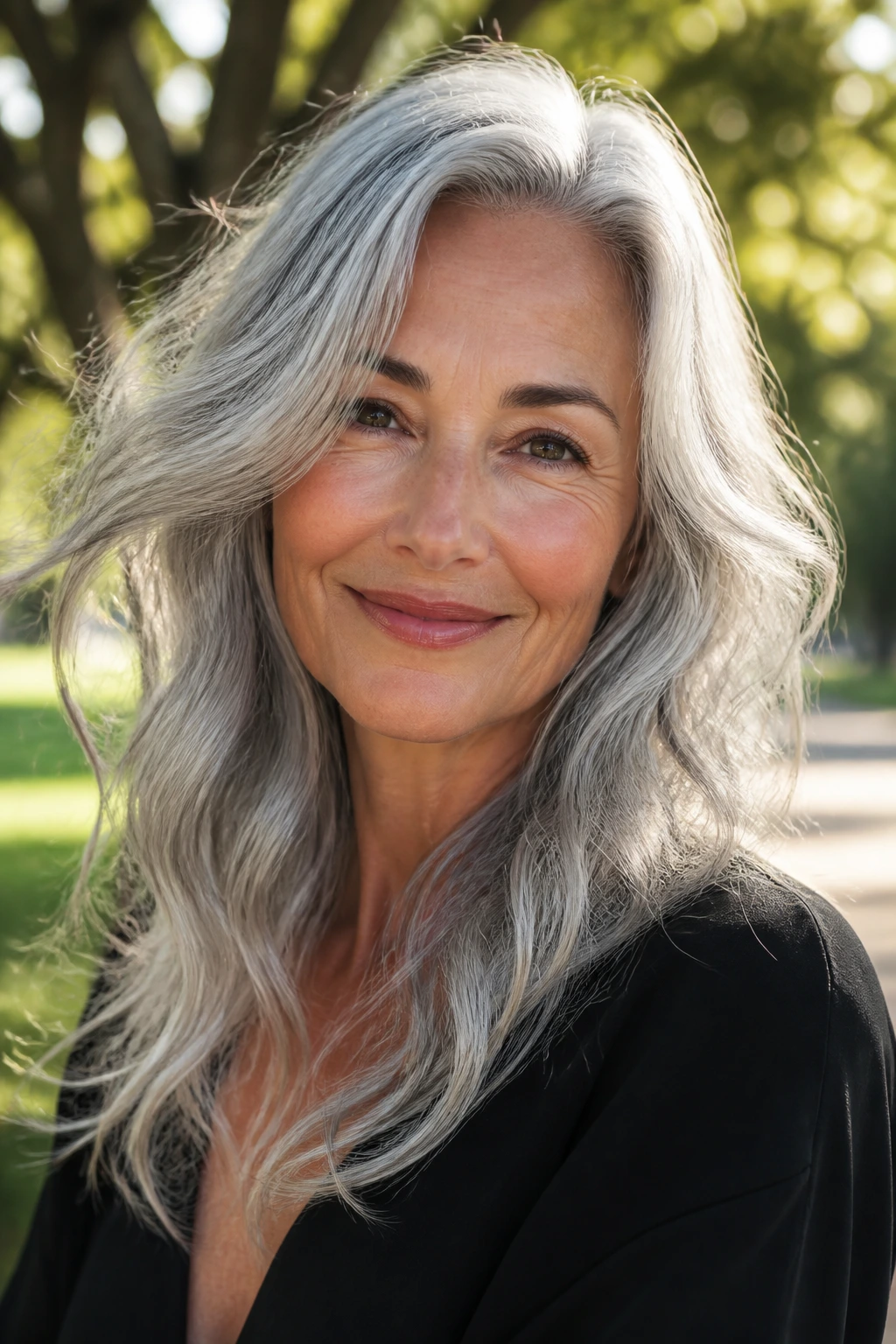
Air-dried silver waves are probably the least fussy look in the whole bunch, and that’s exactly why they deserve a spot here. You wash, add a little product, twist or scrunch the hair into shape, and let it dry with as little interference as possible.
Why it works:
Gray hair can turn frizzy when it’s handled too much, and air-drying keeps the surface a little softer. A small amount of shine cream or lightweight leave-in helps the silver reflect light instead of looking dusty. If your waves naturally fall in loose bends, this style can look effortlessly put together with almost no heat.
The important part is product control. Too much cream and the waves fall limp. Too little and the hair gets puffy. Start with a dime-sized amount, emulsify it in your hands, and focus it on the mid-lengths and ends.
I like this look for travel, weekends, and days when the weather is fighting everyone. It’s honest hair. No drama. Just shape, movement, and a silver tone that doesn’t need a lot of explanation.
Why Gray Hair Needs Shape, Shine, and a Little Planning
Gray hair changes the game because the strand itself often changes. It can feel drier, sometimes rougher, and a bit less cooperative about lying flat. That means the best gray hair looks are rarely about copying a younger version of your old hairstyle. They’re about giving the new texture a smarter frame.
Shape matters more than people want to admit. A blunt bob can make gray hair look denser. A taper can keep a pixie from puffing out. Layers can stop curls from becoming a triangle. If a style feels a little too easy on the eyes, it’s usually because the cut did some of that work for you.
Shine matters too. Gray hair can be bright, but bright is not the same as glossy. Surface smoothness, clean trims, and the right kind of product finish make silver strands look polished instead of dull. That’s why a good blowout or a soft cream finish can change the whole mood of a cut.
Essential Tools for Styling Gray Hair
- Wide-tooth comb: Good for damp gray hair because it detangles without roughing up the cuticle.
- Paddle brush: Best for sleek bobs, ponytails, and blowouts when you want a smooth finish.
- Round brush, 1 to 2 inches: Useful for bending ends under, lifting roots, and giving mid-length cuts more body.
- Blow dryer with nozzle attachment: The nozzle helps aim airflow downward, which keeps silver hair smoother.
- Diffuser: A must for curls and waves if you want definition without frizz.
- Heat protectant spray or cream: Gray strands can look fried fast, so this is not optional when you use hot tools.
- Lightweight serum or shine cream: A little goes a long way; use it on the surface, not the roots.
- Volumizing mousse or root-lift spray: Helpful for fine hair, especially in bobs, pixies, and side-swept styles.
- Purple shampoo or violet conditioner: Useful for silver hair that picks up yellow tones; use sparingly so the color doesn’t go flat.
- Bobby pins and small elastics: Handy for braids, chignons, and half-up styles.
- Tail comb: Great for clean parts and sectioning when you want a sharp finish.
- Clips for sectioning: They save time during blow-drying and keep product placement cleaner.
Smart Product Choices for Silver Strands
Gray hair is unforgiving about heavy products. Slather on a thick oil and you’ll get limp roots and dull ends. Use too much wax and the hair turns piecey in the wrong way. The sweet spot is light, controlled, and a little more careful than you might expect.
For shampoo, I lean toward sulfate-free cleansers if the hair is dry or color-treated. They’re gentler and less likely to strip the silver shine you’re trying to keep. If your hair turns yellow under hard water, a violet shampoo once every 1 to 2 weeks is enough for many people. Using it every wash can leave gray hair flat or lilac-tinted, which is not the same thing as bright.
Heat styling needs restraint. A heat protectant with smoothing slip helps protect the cuticle and cuts down on frizz. If you want a polished bob or blowout, a light styling cream is usually better than a dense oil. For curls, a mousse or gel with flexible hold gives shape without crunching the hair into a helmet.
If you color your gray hair, ask for a gloss, toner, or demi-permanent formula rather than a hard, opaque dye when you want shine and softness. Those gentler finishes tend to grow out more gracefully and leave the silver looking more like part of the design.
Picking a Gray Hair Look That Fits Your Texture and Face Shape
Not every gray style belongs on every head. That’s not a criticism. It’s just hair.
Fine hair and straight strands
Fine gray hair usually benefits from blunt lines, shorter lengths, and root lift. Think sleek bobs, pixies, and side-swept cuts. Too many long layers can make the ends disappear, which leaves the hair looking thin even when there’s plenty of it.
Thick, coarse, or wiry hair
If your gray hair has body, you can afford more movement. Shags, feathered layers, tapered crops, and curly shapes keep the bulk from taking over. The goal is to let the hair breathe a little. Heavy one-length cuts often look boxy on thicker silver strands.
Curls and coils
Curly gray hair wants a cut that follows the pattern, not one that flattens it. Shape at the crown, less weight at the bottom, and enough length to let the curls stack naturally. If you wear glasses, a shorter fringe or a rounded shape around the temples can make the whole look cleaner.
Face shape and neckline
A chin-length bob tends to sharpen soft features. Long waves soften strong angles. Side parts add lift for rounder faces. A short neckline looks especially neat with tapered cuts and pixies, while fuller necklines often pair better with lobs and layered shags. You do not need to match everything perfectly, but the lines should make sense together.
Keeping Gray Hair Bright, Soft, and Not Yellow
Gray hair turns yellow for boring reasons: product buildup, heat, pollution, hard water, too much sun, or a toner that has simply worn off. The fix is not to panic and drown the hair in purple shampoo. Use enough, not too much.
A clarifying shampoo once every couple of weeks can help if your hair is coated with styling residue. Follow it with a conditioner that actually softens the hair, because gray strands can dry out fast after a deep cleanse. If you use hot tools often, a heat protectant matters more than any fancy finishing spray.
Sun exposure is another quiet culprit. A hat helps, and so does UV-protective hair product if you spend long stretches outdoors. White and silver hair can pick up a warm cast faster than many people expect. If your hair is very bright, a cool gloss every few weeks can keep it crisp without making it icy.
The real trick is consistency. A little maintenance beats a big rescue job.
Common Mistakes That Make Gray Hair Look Dull
- Skipping the shape work: Gray hair without a clear cut line often looks wider, flatter, or fuzzier than it is. A trim can fix more than another product ever will.
- Using too much purple shampoo: Over-toning can leave silver hair flat, chalky, or slightly violet. Use it sparingly and alternate with a gentle cleanser.
- Loading on heavy oils: Thick oils and dense creams can weigh gray strands down fast. Start with half the amount you think you need.
- Letting ends go too long between trims: Split ends show plainly on silver hair. If the ends look ragged, the whole style reads tired.
- Blowing hair straight up from the root: That can create a puffy halo in coarse gray hair. Aim the dryer downward and control the root with a brush.
- Ignoring root contrast during grow-out: If you’re transitioning from dye, some strategy helps. A center part, lowlights, a shag, or a braid can make the line look intentional while the color changes.
Gray hair does not need more fuss. It needs better decisions. That’s the part that saves time.
Ways to Adapt These Looks
- Soft Office Version: Choose a bob, lob, or low chignon and keep the finish smooth. This is the easiest way to wear gray hair without calling too much attention to the styling process.
- Low-Maintenance Wash-and-Wear Version: Pick a shag, halo cut, or airy crop that still looks good when air-dried. Use a leave-in and let texture do the work.
- High-Contrast Silver Version: Keep the cut blunt and the finish glossy. Add a cool gloss or silvery toner if your hair leans warm.
- Warm and Dimensional Version: Ask for charcoal lowlights, beige gloss, or a softer transition between dark roots and silver lengths. This keeps the look gentler on the face.
- Bold Short-Hair Version: Go for a pixie, micro bangs, or a tapered coil cut. Short silver hair looks especially strong when the edges are neat.
- Grow-Out Friendly Version: Use braids, half-up knots, curtain fringe, or layered shags to break up the line between old color and new gray.
Frequently Asked Questions
What haircut makes gray hair look thicker?
A blunt bob, a side-swept bob, or a short pixie usually makes gray hair look fuller because the ends hold a clean line. Thin, wispy layers at the bottom can make the hair look sparse, so ask for shape, not thinning.
Should I use purple shampoo on gray hair every wash?
No. That’s usually too much. Once every 1 to 2 weeks is enough for many people, though bright white hair may need it a little more or less often depending on water, sun, and styling products.
Can I wear my gray hair long without it looking old-fashioned?
Yes, but the ends need to stay healthy and the shape needs some movement. Long gray hair looks best with face-framing layers, soft waves, or a polished blowout rather than one flat curtain of length.
What’s the best style for growing out dyed hair into gray?
A shag, a lob, a braid-friendly length, or a cut with curtain fringe usually helps the grow-out stage look more deliberate. Lowlights or balayage can also soften the line if you want a slower transition.
Why does my gray hair feel wiry?
The texture often changes as pigment drops away, and the hair can feel drier or coarser. A lightweight leave-in conditioner, regular trims, and less heat usually make the biggest difference.
How often should I trim gray hair?
Short cuts usually need a trim every 4 to 6 weeks. Bobs and lobs can stretch to 8 to 10 weeks, but if the ends start to fray, don’t wait for a calendar to save you.
What if my silver hair looks yellow or dull?
Start with a clarifying wash, then use a violet shampoo or conditioner sparingly. If the tone still feels flat, a salon gloss can reset the shine without making the hair feel overprocessed.
Can I make gray hair look more modern without cutting it short?
Absolutely. A center part, a clean wave pattern, glossy finish, or deep side part can change the whole mood of long gray hair. The cut helps, but the styling does a lot of heavy lifting too.
Silver That Feels Like Yours
Gray hair doesn’t ask for permission, and that’s part of its charm. Once the cut works with the texture instead of against it, silver strands can look sharper, softer, or more polished than a lot of dyed hair ever does. The trick is choosing the shape that gives your hair a job to do.
Some women need clean lines. Some need movement. Some need a little color help while they grow out old dye. The right answer is usually less about age and more about proportion, shine, and how much time you want to spend in front of the mirror.
Pick the look that fits your hair on a normal Tuesday, not the one that only behaves in good lighting. That’s where the best gray styles earn their keep.
