



Curly bridal hairstyles have a stubborn habit of looking more expensive than they are. A soft bend around the cheekbone, a few ringlets pinned low at the nape, a clean crown with texture left intact — the whole thing reads polished because the hair still looks like hair, not a helmet.
That matters on a wedding day. You need movement for photos, grip for pins, and enough shape to survive hugs, dancing, and a humid patch of air that would flatten a straight blowout in ten minutes. Curly texture gives you built-in architecture. It does some of the heavy lifting before the stylist even picks up a curling iron.
The tricky part is choosing the right finish. Too soft, and the style collapses by dinner. Too tight, and it can look formal in a stiff, dated way. The best curly wedding hair walks a fine line: secure at the base, loose at the edges, and intentional everywhere your eyes land first. That balance is where the good stuff lives.
Why Curly Bridal Hair Keeps Showing Up on Mood Boards
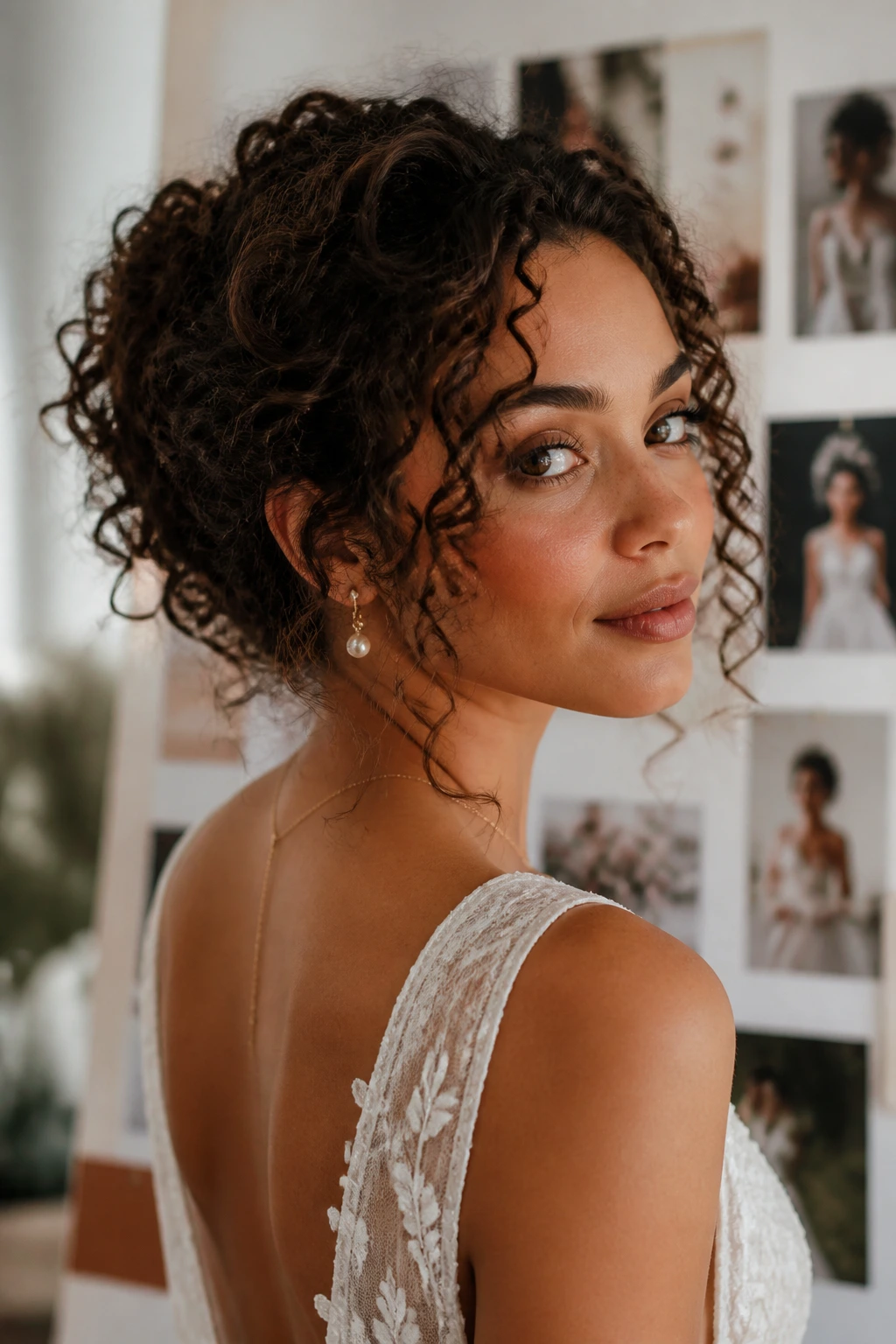
Built-in movement: Curls shift as you walk, turn, and dance, which keeps the style from looking frozen in photos.
Better pin grip: Texture gives bobby pins something to hold onto, so updos and half-up shapes usually stay put longer.
Less visible grow-out: A little frizz or a few escaped strands can look romantic on curly hair instead of unfinished.
Works with accessories: Combs, pins, vines, and veils settle into curls without fighting a flat, slippery base.
Flexible finish: The same curl pattern can look airy and soft or sleek and sculpted depending on parting, product, and placement.
Good for long events: A style with texture usually survives the reception better than one that depends on pin-straight shine alone.
1. Soft Half-Up Curls with Face-Framing Pieces
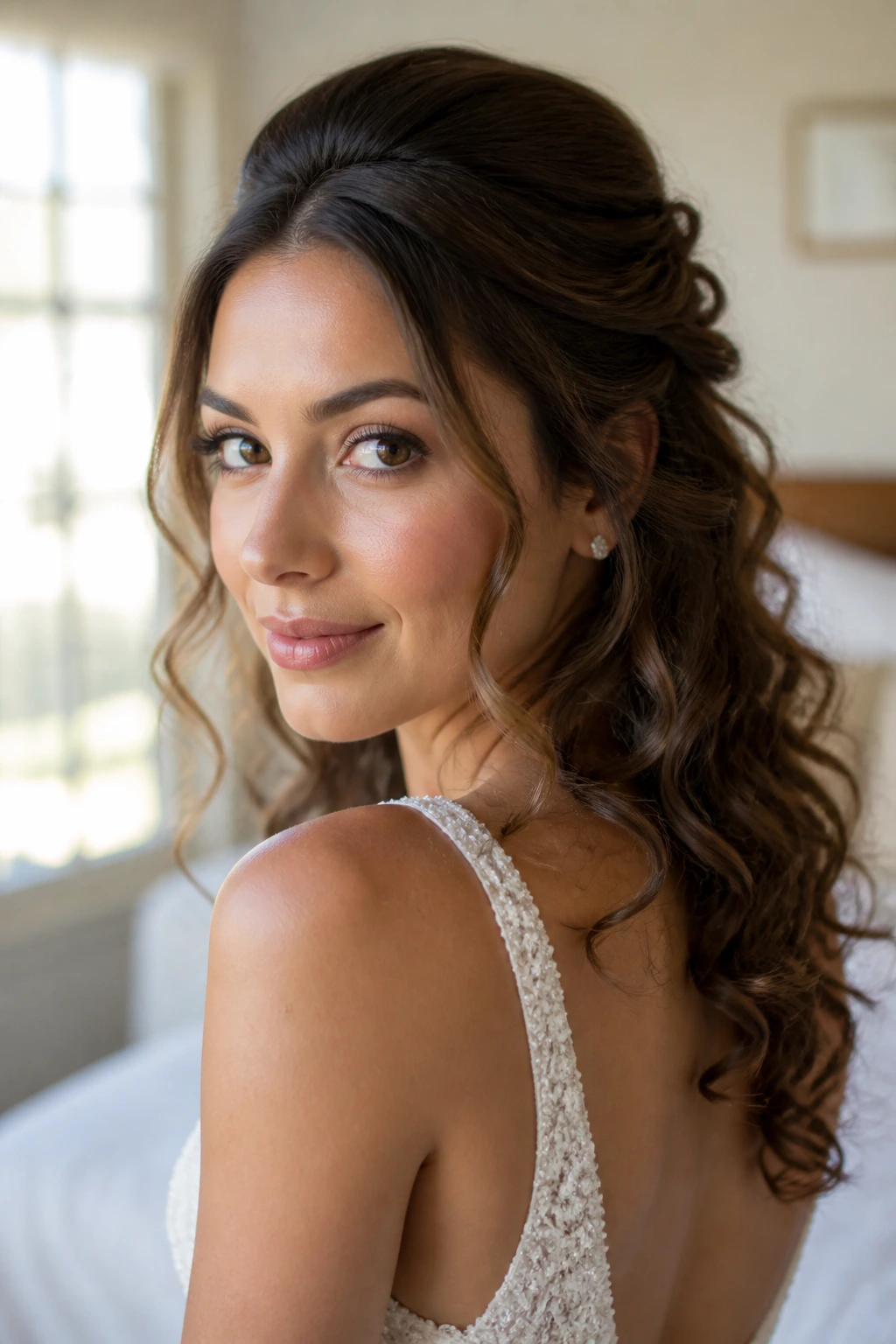
This is the bridal style I’d recommend to the bride who wants to look like herself, just edited. The crown is pulled back with a small twist or hidden pin set, while the rest of the length falls in loose curls that move when you move. The face-framing pieces matter more than people think; they soften a strong jaw, tuck around earrings, and keep the style from feeling too stiff.
If your dress has lace, beading, or a little detail at the neckline, this shape lets the gown stay visible. It also plays nicely with a fingertip veil, since the anchor point sits high enough to hold it without crushing the curl pattern below.
Best for
- Medium to long hair with natural wave or curl.
- Brides who want a veil and still want hair down.
- Dresses with open backs or detailed necklines.
A good stylist will leave enough curl around the temples so the front doesn’t feel over-pulled. That’s the whole trick. A half-inch too much tension at the crown changes the mood fast.
2. Low Textured Chignon with Loose Ringlets
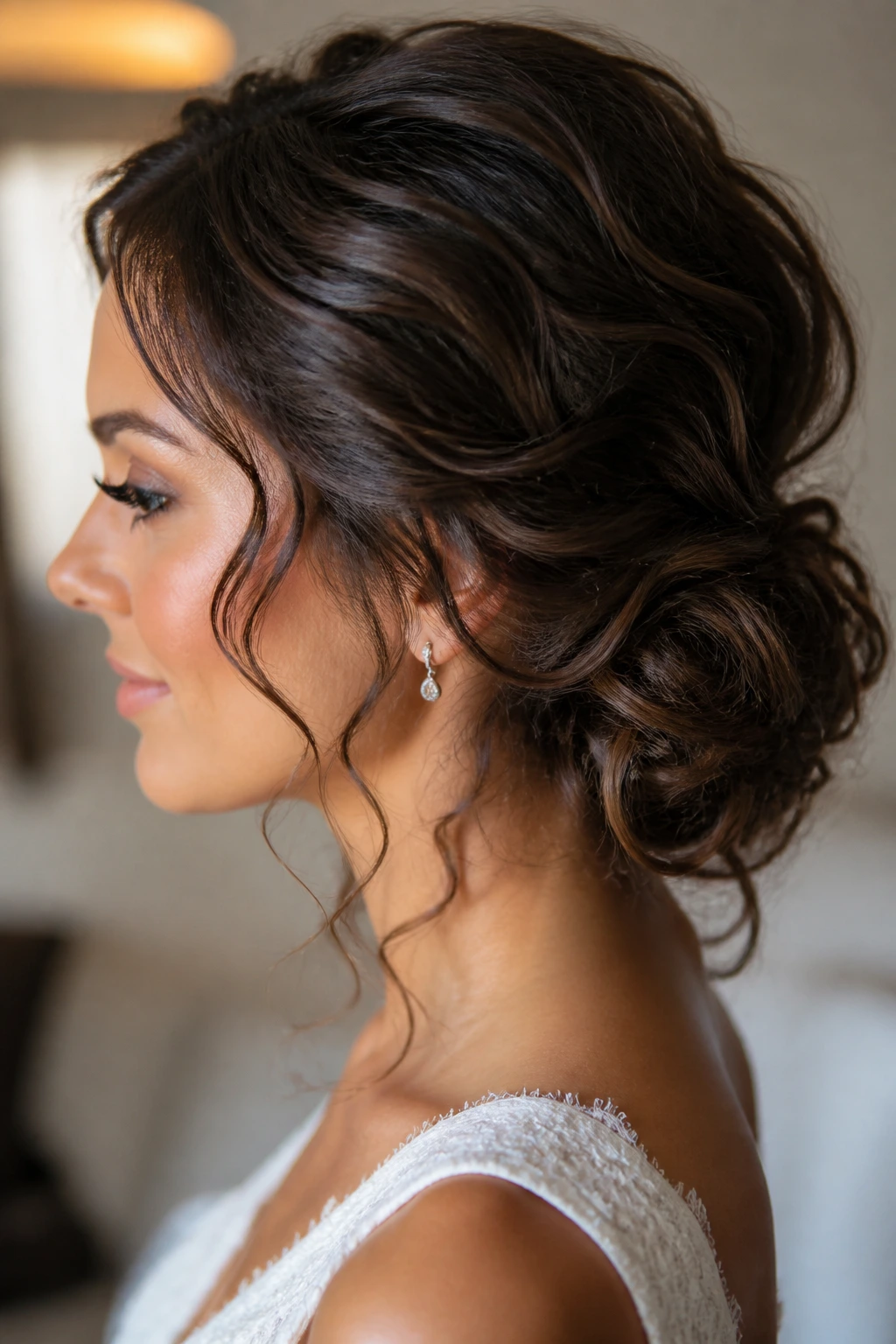
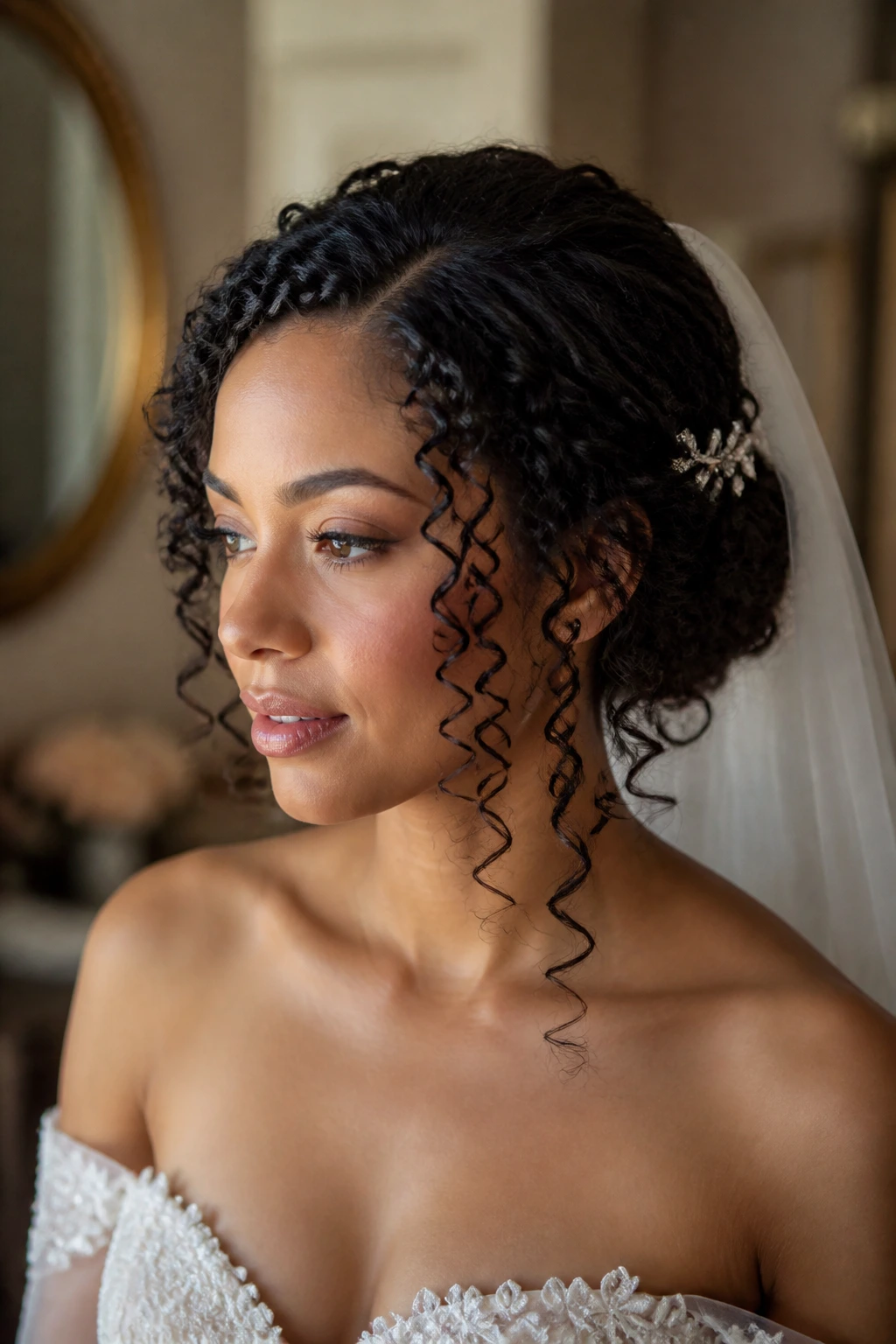
A low chignon with curls tucked and pinned at the nape has real staying power. It looks neat from the front, but the back still has life — little ringlets can spill out around the bun, which keeps the style from reading severe. I like this one for brides who want a clean silhouette without losing the softness that curly hair naturally brings.
The best version is not slick. It has some lift at the crown, a soft side part, and a bun that looks hand-shaped rather than rolled into place. If your dress is high at the neckline, this shape leaves space for the fabric to do its work.
Ask for a few deliberate tendrils around the ears or jawline if you want less structure. Those small pieces matter. They stop the chignon from feeling too formal.
3. Side-Swept Old Hollywood Waves
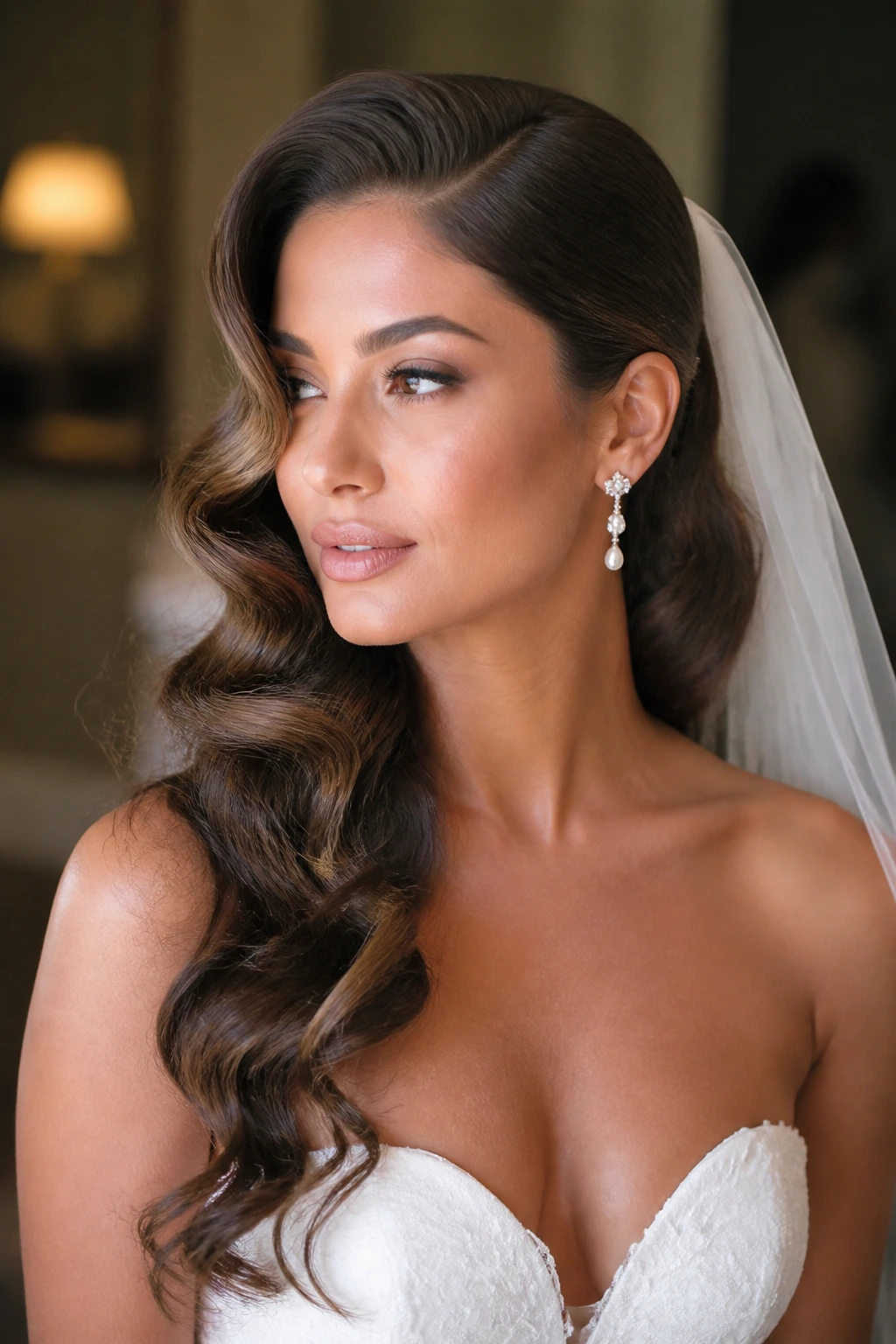
Side-swept curls give you glamour with a little bite. The hair is parted deeply to one side, then waved or brushed into a smooth, sculpted cascade that falls over one shoulder. The finished look has that clean, movie-star curve, but it still works better when the hair keeps a bit of texture instead of being polished flat.
This style loves long earrings and strapless gowns. It also photographs well from the front because the asymmetry opens the face and gives the photographer something to work with. If your curl pattern is tighter, your stylist may set it in larger sections and then brush it into a softer wave so it doesn’t turn into a ringlet pile.
It’s not the lowest-maintenance option. It asks for careful prep. But when it’s done right, it looks expensive in the old-fashioned way — not flashy, just deliberate.
4. Curly Crown Braid with a Hidden Bun
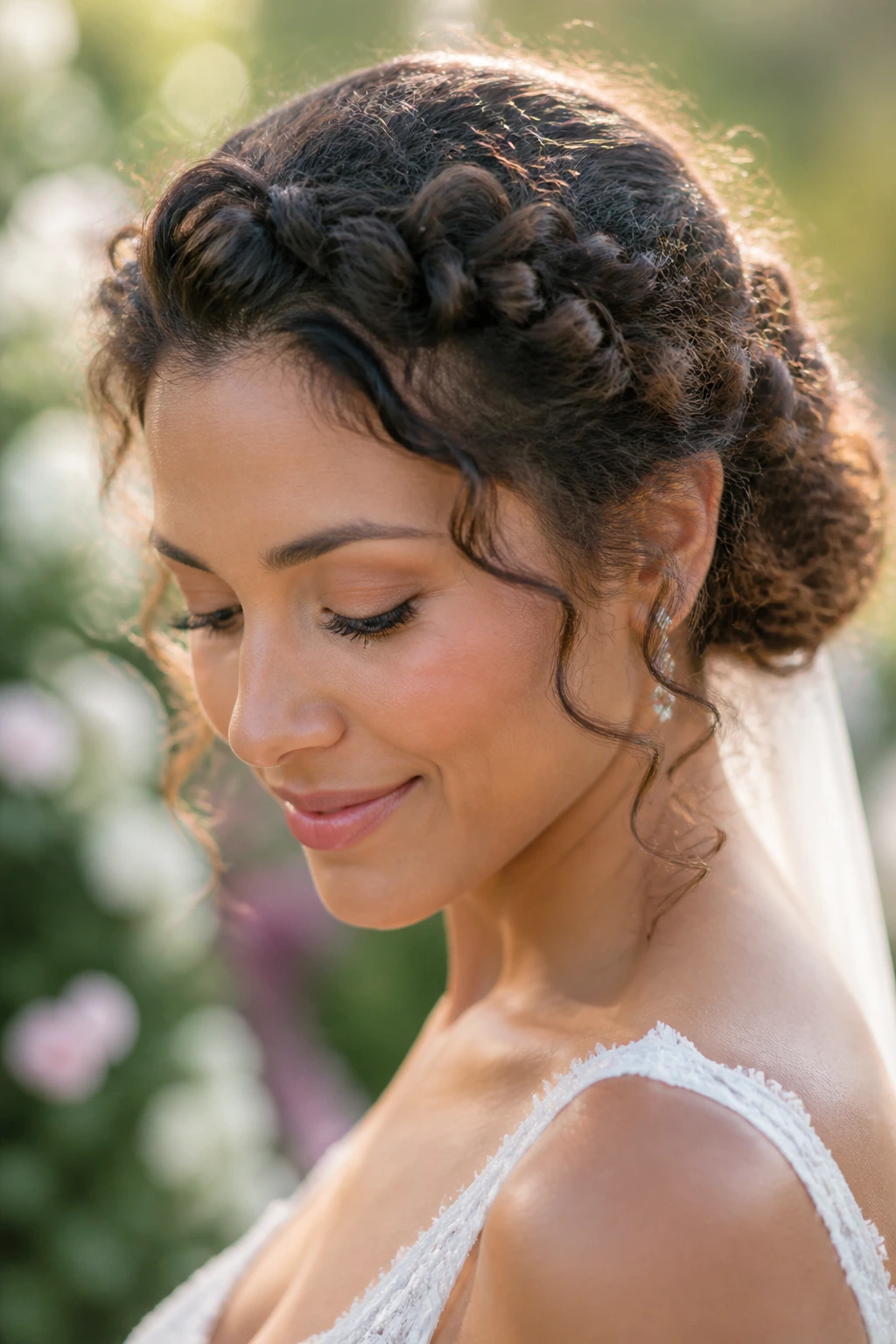
A crown braid wrapped through curly hair gives you structure without hiding texture. The braid sits along the hairline or slightly behind it, and the ends disappear into a low bun or tucked knot. From the front, you get that framed, secure feeling brides love. From the back, the curls still have room to show off.
This is a smart choice for outdoor ceremonies or summer weddings because the braid acts like a built-in brace. It keeps hair from sliding backward while still allowing a few curls to escape near the temples and nape. That little looseness keeps the style from turning into a hard shell.
If you want flowers or tiny pearl pins, this is one of the easiest styles to decorate. The braid gives you clean anchor points, which means the accessories actually stay where they’re placed.
5. High Curly Ponytail with Polished Roots
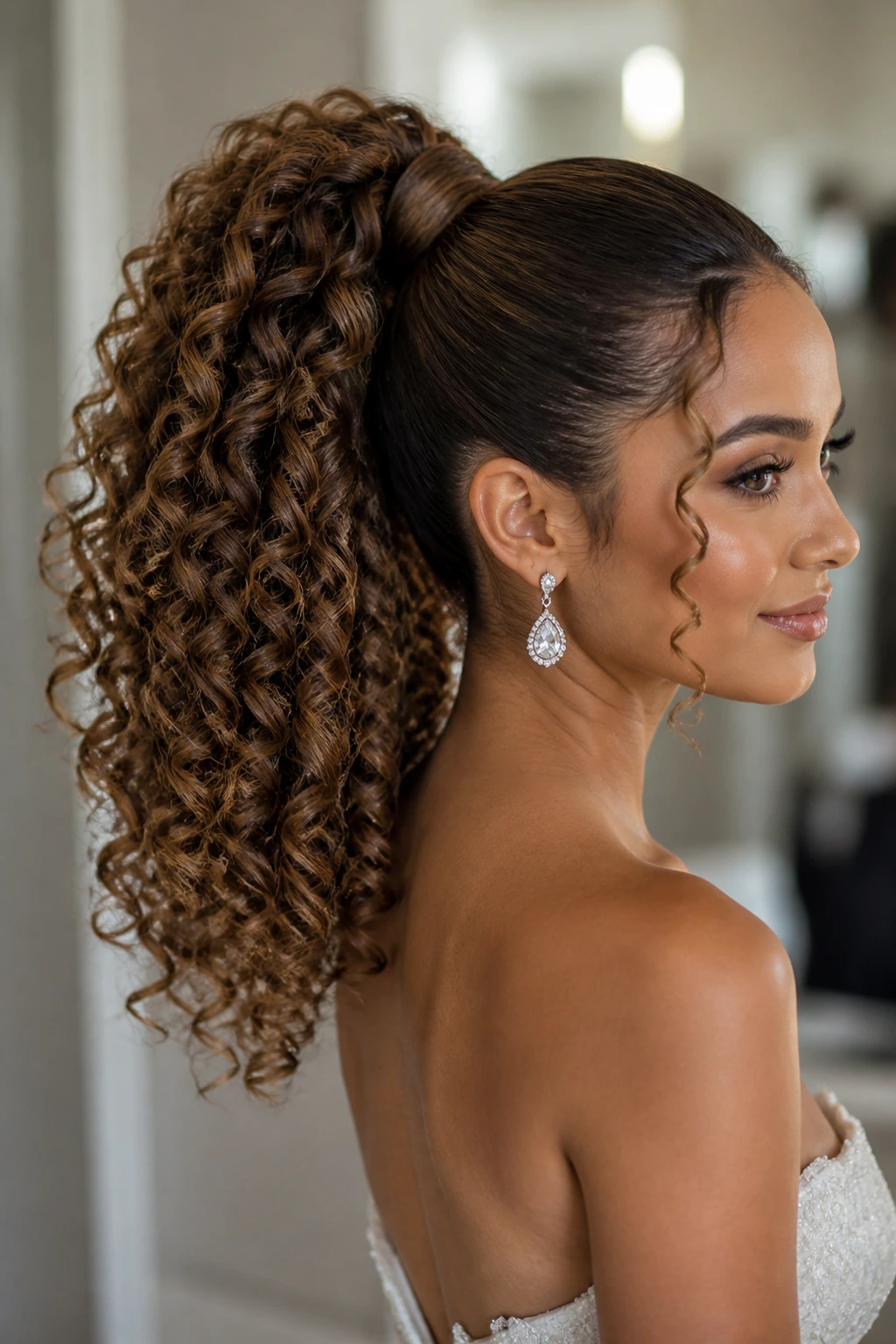
A high curly ponytail can look bridal when the base is neat and the length is full. The roots are smoothed up and back, often with a clean wrap or a hidden piece of hair around the elastic, while the curls fall in a high, dramatic tail. It has a little edge, which is exactly why some brides love it.
The key is tension at the crown and softness through the ends. You want lift, not tightness. If the hair is pulled too hard, the style starts to look like a gym ponytail wearing lipstick. Keep the top controlled and let the lengths do the talking.
I like this one with modern gowns, square necklines, or anything with strong lines. It also works if you want a statement earring to stay visible in profile. The shape opens the neck, which gives the whole look a cleaner finish.
6. Romantic Cascading Curls with a Crystal Comb
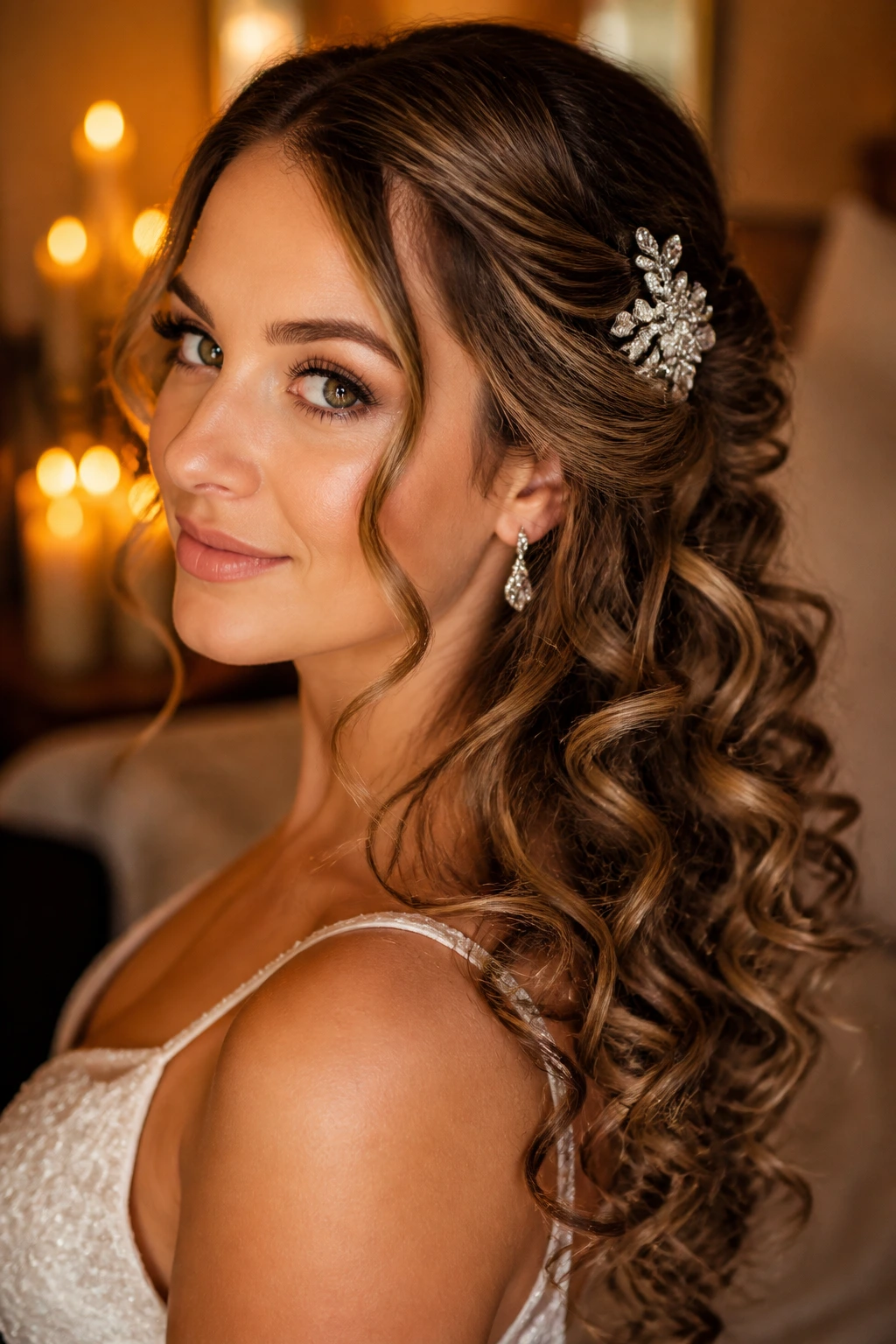
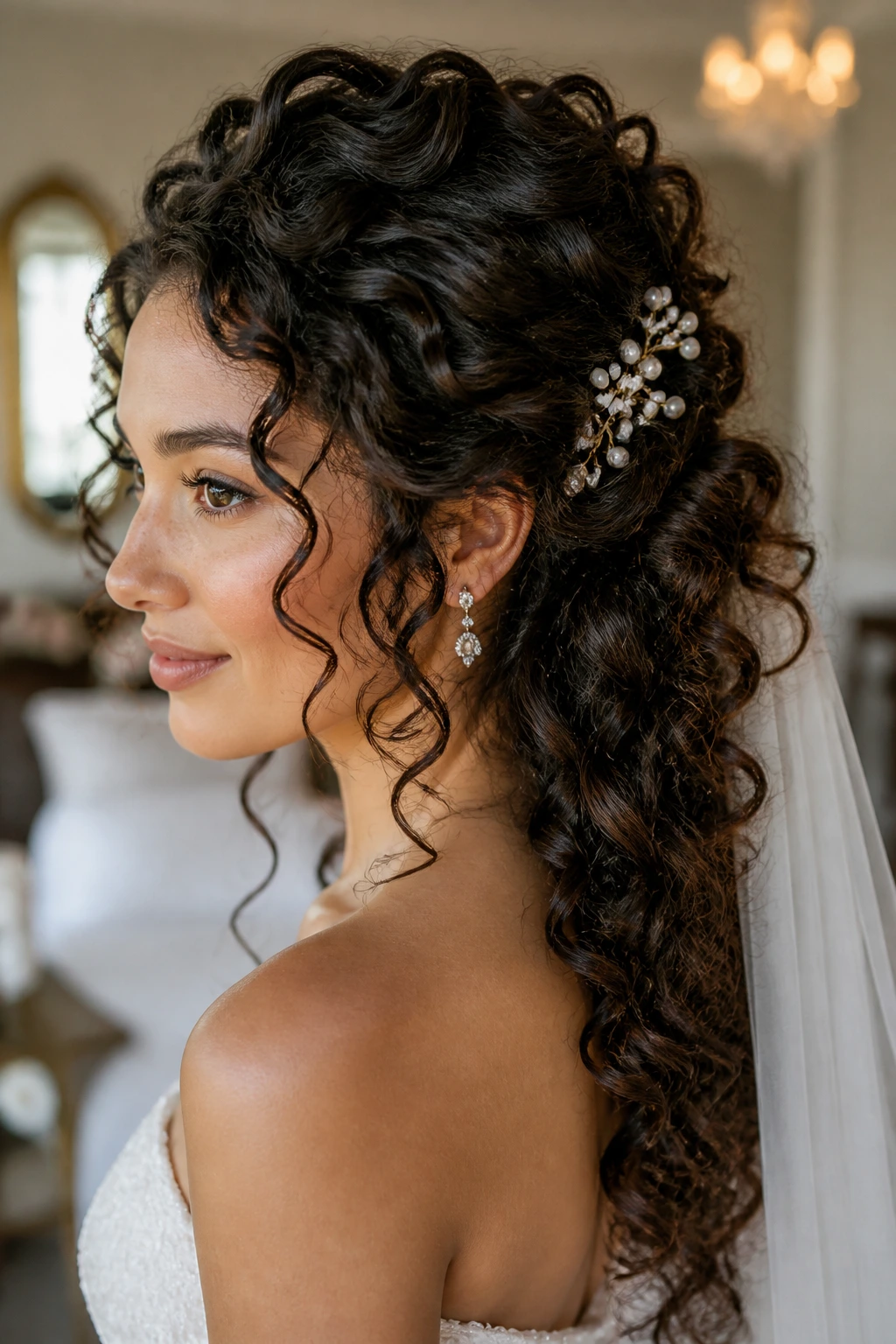
Sometimes the right answer is the simplest one: keep the curls down and give them a focal point. A crystal comb tucked near one side of the part or just above the ear makes loose cascades feel intentional instead of casual. The accessory catches light, but the curls do the real work.
This style suits brides with dense curls or long blowout-set waves. It has a lot of motion, so it looks good in candlelight, outdoors, and in those candid shots where the dress is moving and the hair needs to follow. The trick is definition. If the curls are too brushed out, the ends go fuzzy and the whole style loses shape.
Use this when the dress is dramatic enough to carry a lot of hair. A simple satin gown can handle it. A heavily embellished neckline usually cannot.
7. Braided Half-Up Halo for Long Curls
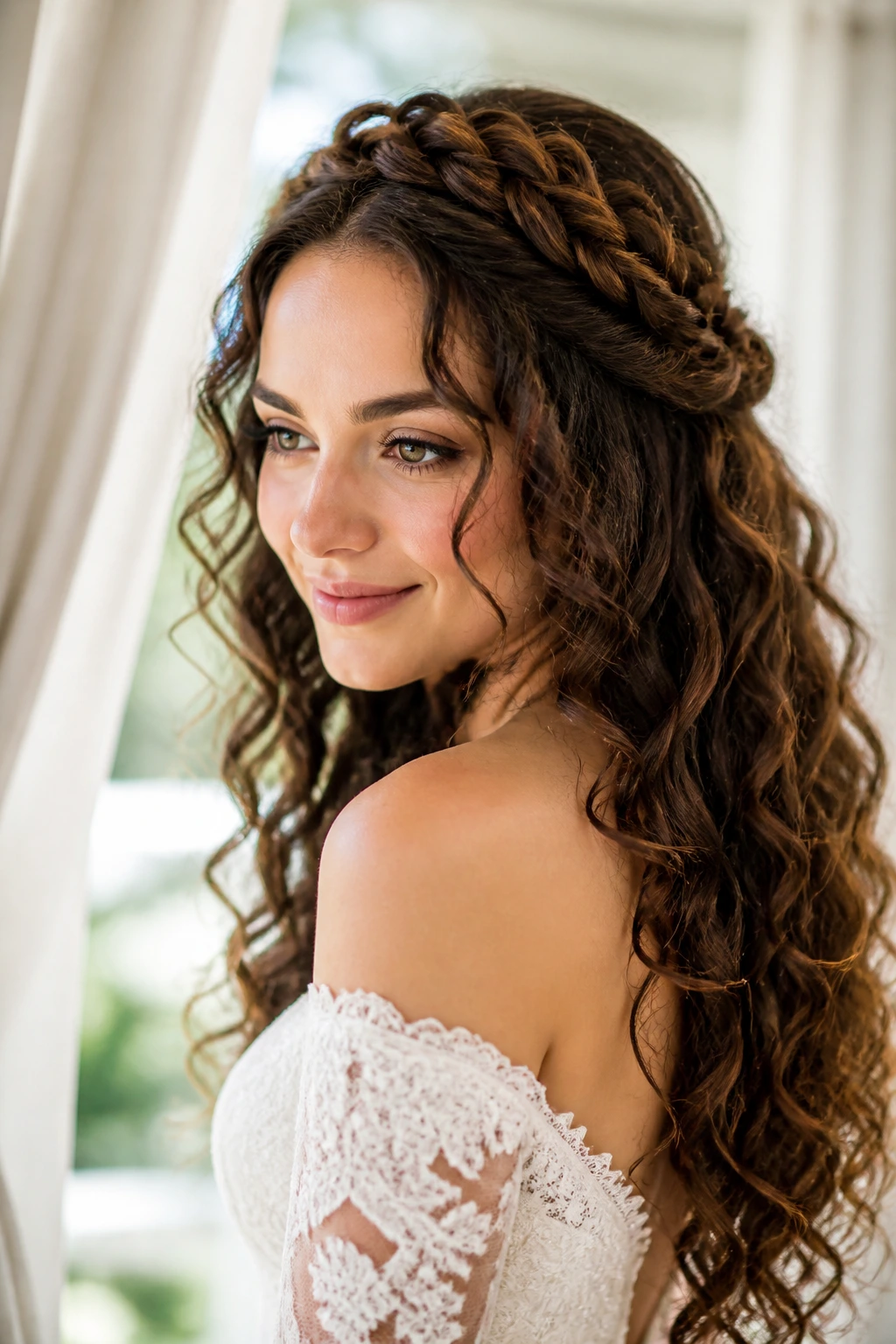
A braided halo half-up style sits somewhere between boho and formal. The braid wraps around the head like a soft frame, while the rest of the curls fall free underneath it. The effect is secure but airy, and it’s one of the better choices for brides who want their hair off the face without giving up length.
The reason it works is simple. The braid creates a clear line, which reads well in photos, while the loose lengths below keep the style from feeling pinned down. If your hair has mixed textures — some curl, some wave, a bit of bend from the last blowout — this style forgives that mix better than a fully structured updo.
It’s especially nice with hair vines or tiny flowers tucked into the braid. Keep the accessories small. The braid already carries enough visual weight.
8. Sleek Middle Part with Defined Spiral Ends
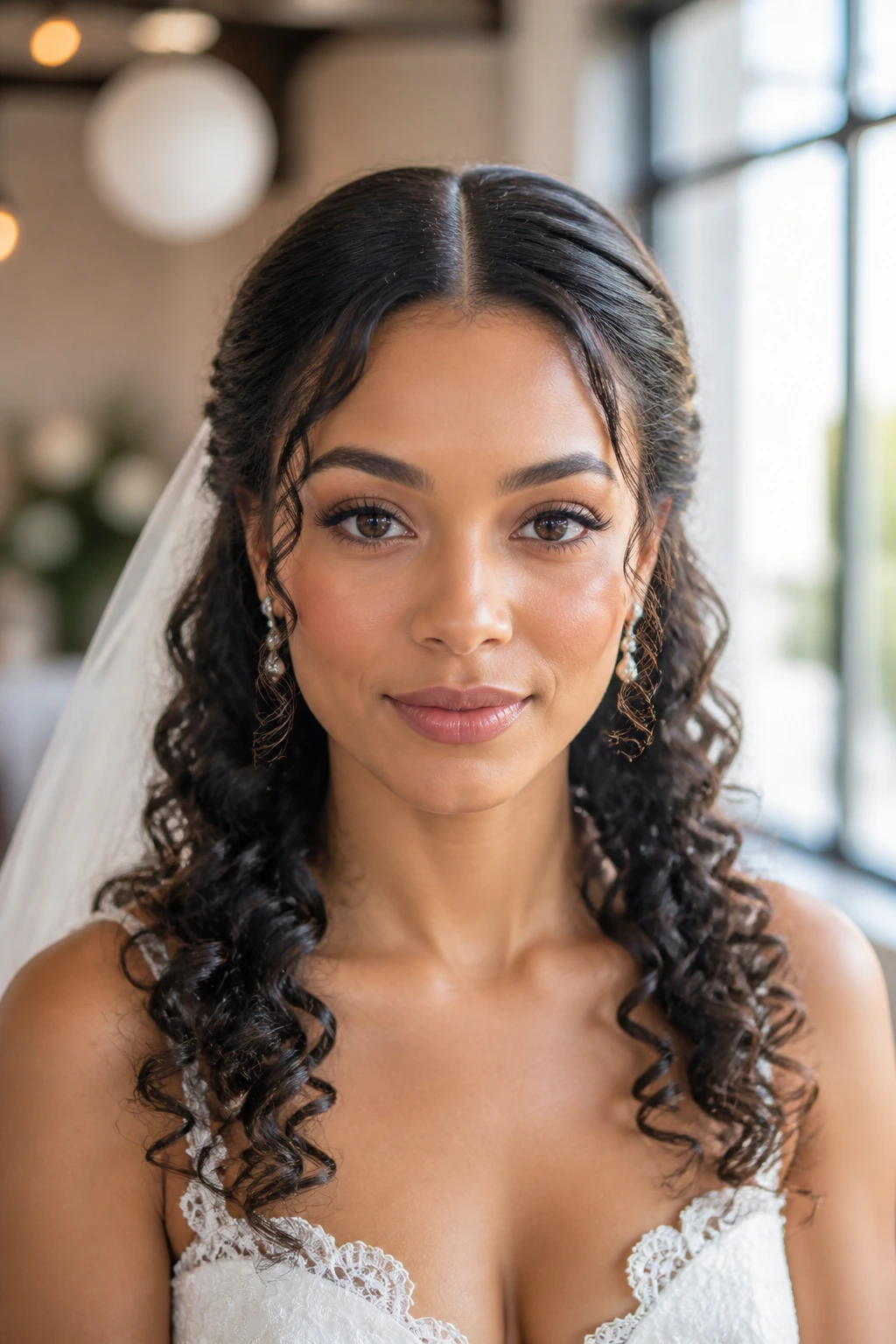
A middle part with sleek roots and defined curls at the ends has a cleaner, more modern mood. The top section is smoothed close to the scalp, then the lengths are left in polished spiral curls or brushed-out ringlets. It feels deliberate, not fussy. That’s the appeal.
This shape flatters strong cheekbones and longer faces because the symmetry draws the eye straight down the center. It also pairs well with minimalist gowns, satin slip dresses, or sharply cut necklines. If the hair is very dense, the stylist may use a light smoothing cream at the roots and keep the volume lower around the temples so the part stays crisp.
I’d choose this for a bride who wants structure without a full updo. It gives you clean lines at the top and movement below. That combination photographs sharply.
9. Low Bun with Curly Tendrils
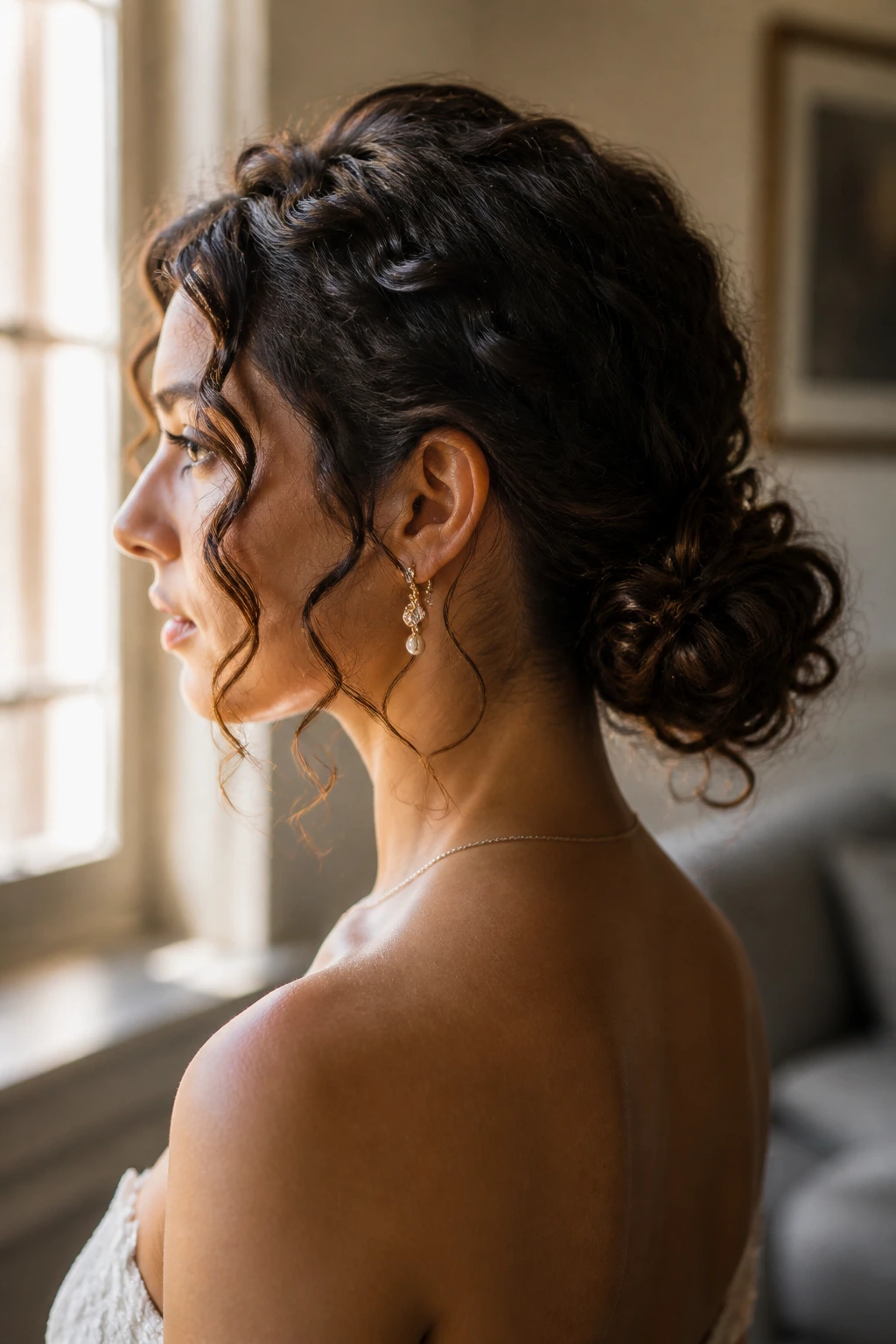
The low bun with tendrils is a classic for a reason. The bun sits close to the nape, and a few curls are left out around the ears, neck, or temples so the look doesn’t feel locked down. It’s formal, but not severe.
What makes this version better than a standard bun is the texture. Curly hair softens the outline, so even a compact bun looks richer and less flat. The tendrils also give the stylist room to soften the face shape without building an entire side fringe.
If you’re wearing a veil, this is one of the easiest placements. The comb can sit just above the bun, and the rest of the hair stays protected underneath. The only thing I’d watch is weight: if you plan to pile on pins or a heavy comb, make sure the bun is anchored at more than one point.
10. Natural Texture Puff with Pearl Pins
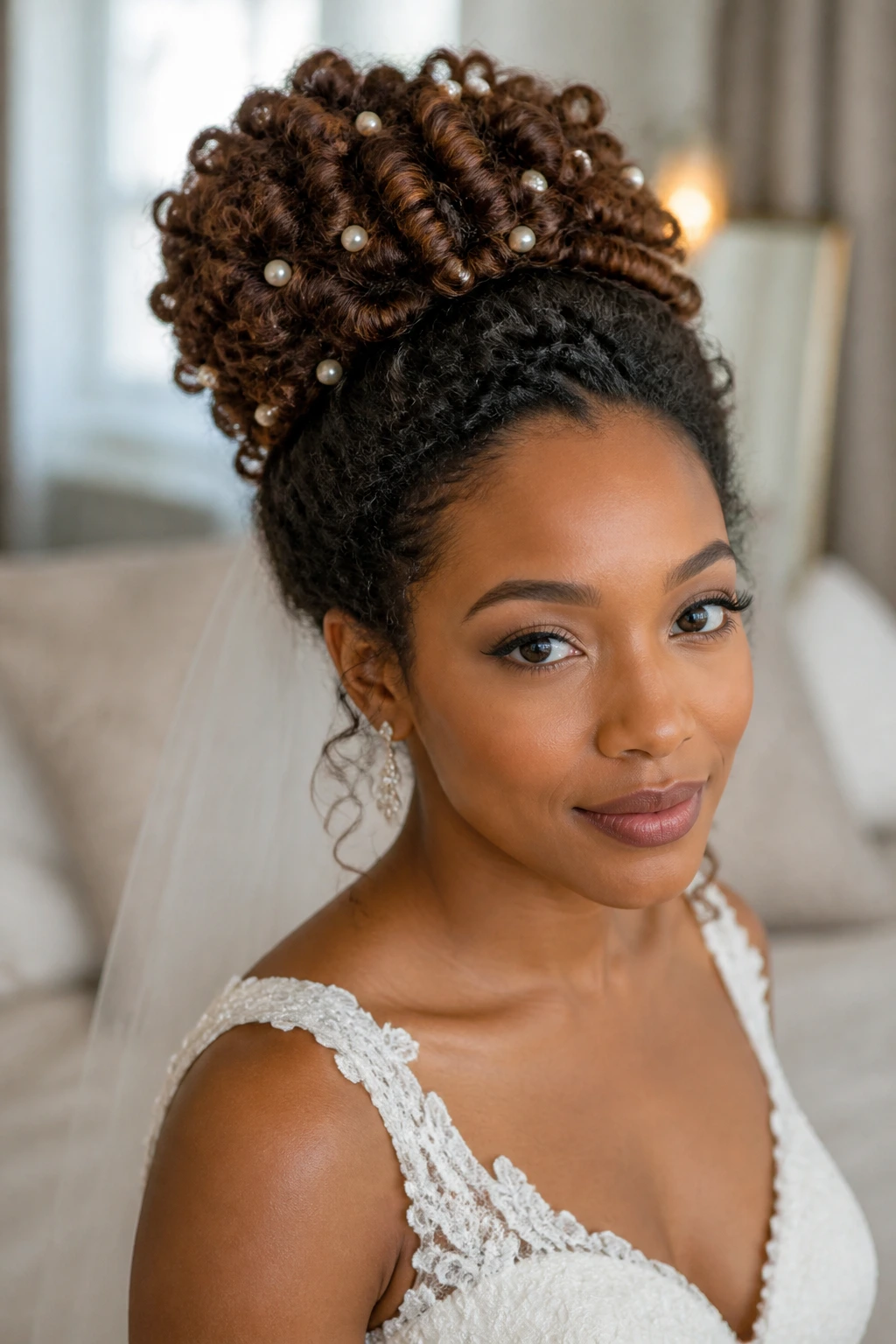
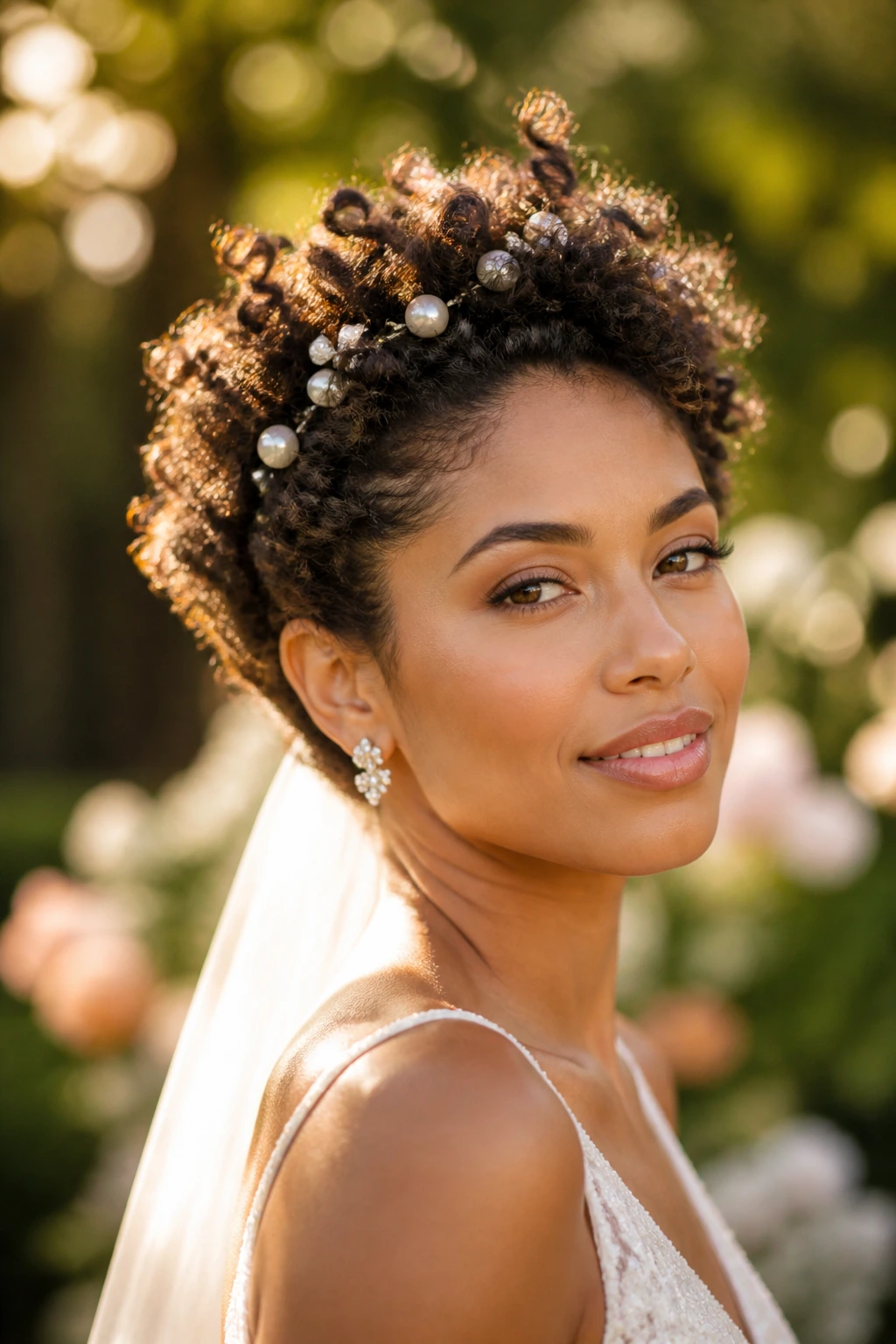
A natural texture puff is one of the most striking bridal looks when it’s shaped cleanly. The hair is lifted upward or outward from the crown, with the natural curl or coil pattern left intact, then pinned with pearls or small jeweled clips. It has presence. No apologizing, no flattening, no pretending the texture isn’t the point.
This style is a strong choice for brides with coily or tightly curled hair who want volume to be part of the design. The puff creates a clean silhouette around the face, and the accessories give the style ceremony without drowning it in decoration. A good shape here depends on moisture and definition, not stiffness.
If you wear this, keep the edges tidy and the crown balanced. Too much product at the front can make the hair look rigid. The goal is sculpted softness, not plaster.
11. Voluminous Side Bun with Deep Side Part
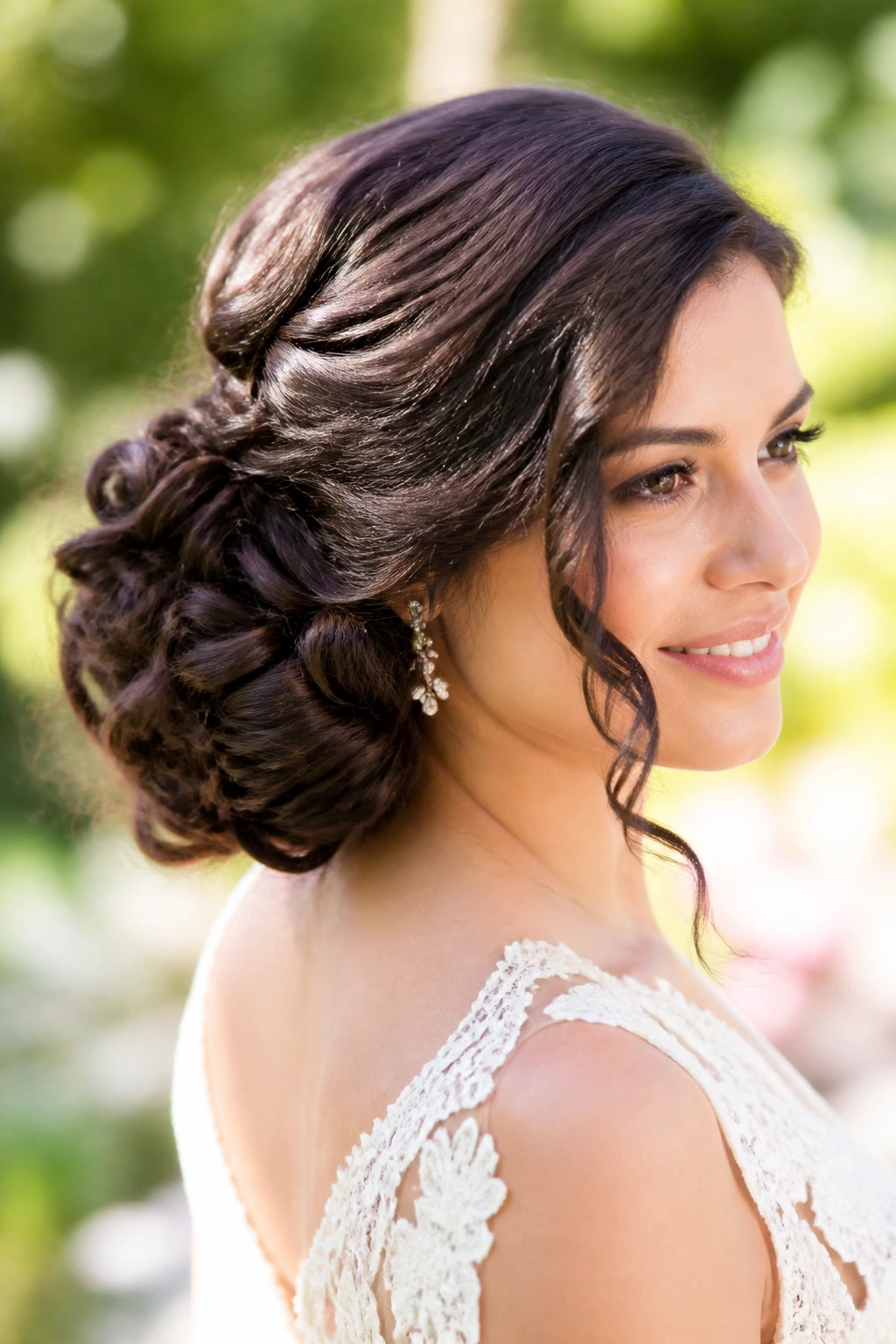
A deep side part changes everything. It gives a side bun more sweep, more drama, and a little old-world polish that straight center parts rarely deliver. The bun itself sits low and full, often with curled pieces folded into it so the shape feels layered rather than tight.
This style is at its best with asymmetric gowns or jewelry you want to show off on one side. The part opens the face, and the volume helps the profile look composed from the aisle all the way through the last dance. If your curls are thick, your stylist may pin them in sections instead of forcing them into one hard twist. That usually looks better anyway.
I like this option for brides who want a side view that holds its shape. It’s one of those styles that looks expensive from every angle.
12. Boho Fishtail Half-Up on Long Curls
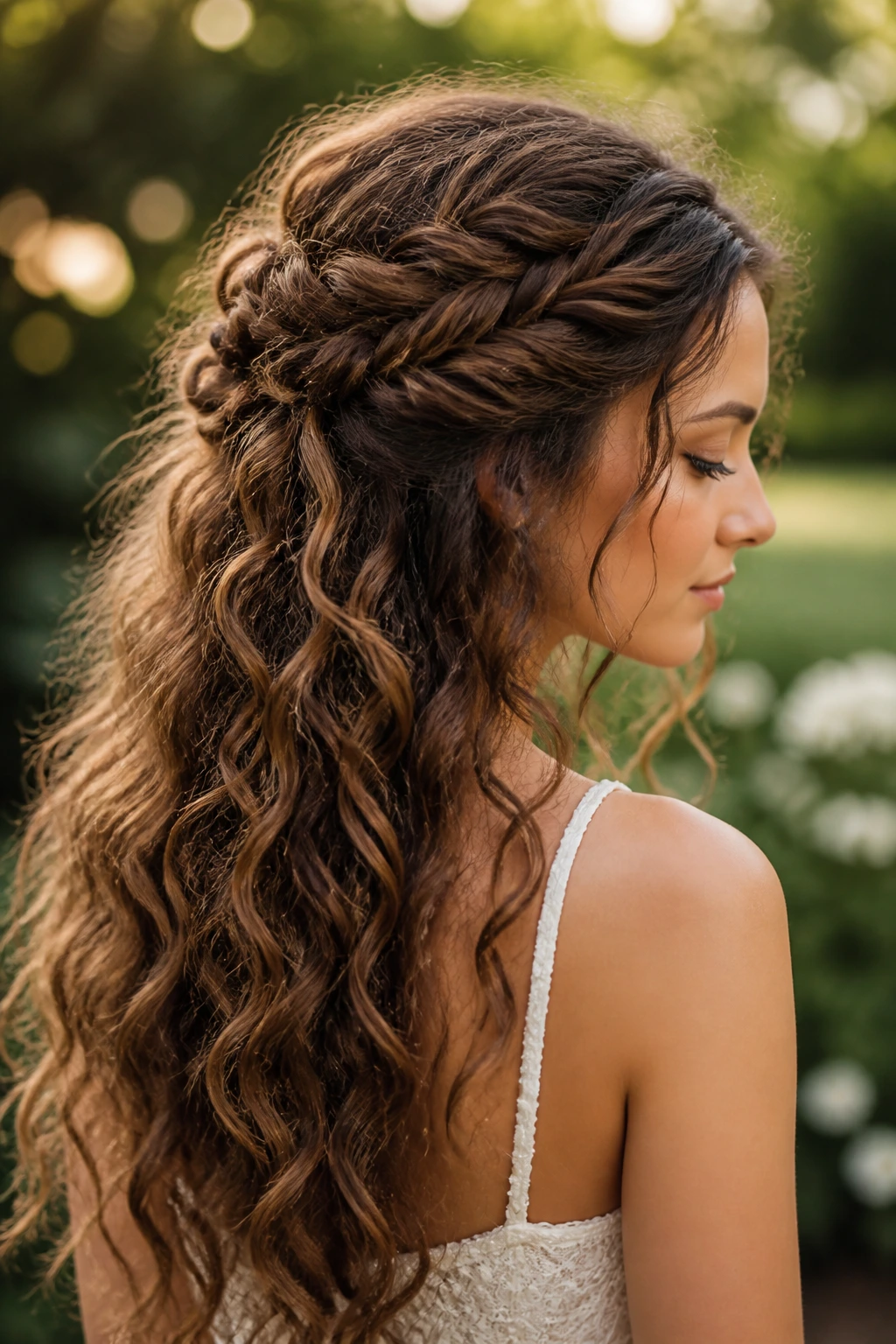
A fishtail half-up style has a softer, more handwoven look than a standard twist. The braid or fishtail portion sits across the back of the crown, and the rest of the hair falls loose in curls. It’s the bridal version of structure with a little dust on it — polished enough for the day, relaxed enough to breathe.
The braid gives the style visual texture before the curls even begin. That matters in photos, because the eye has something to follow at the crown instead of dropping straight into a curtain of length. Long hair does especially well here, since the braid needs enough material to stay visible without getting swallowed up.
A small vine or some dainty pins can tuck into the braid, but don’t cover it. The braid is the point.
13. Curly Lob with Tucked-Behind-One-Ear Styling
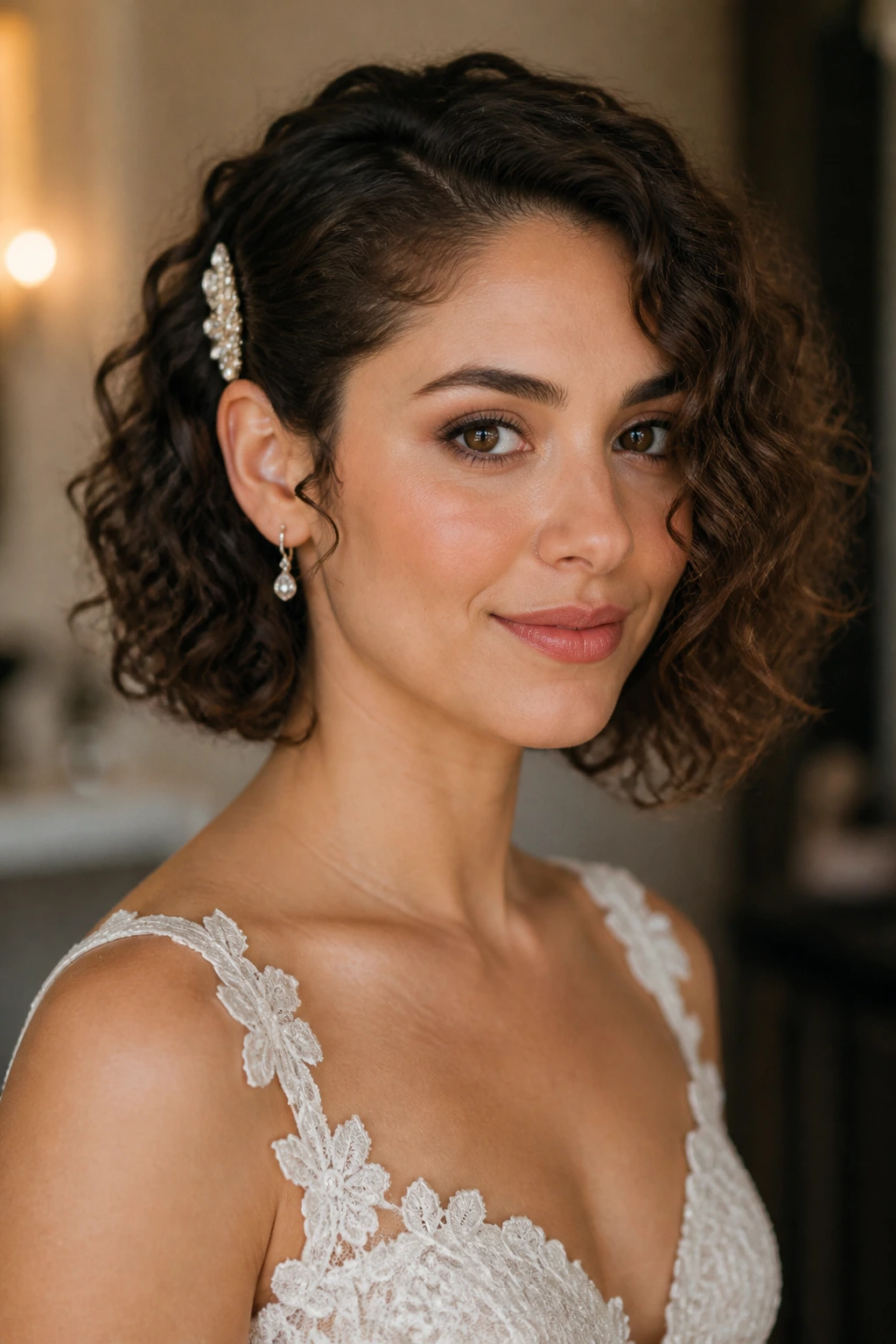
A curly lob can look bridal when the parting and tuck are done right. One side is tucked behind the ear, often with a jewel pin or comb, while the rest of the curls fall in a controlled shape around the jaw and collarbone. It’s crisp without looking overdone.
This works beautifully for brides who don’t want long hair on the neck or shoulders. The length skims the top of the dress and gives you enough movement to feel finished, but not so much hair that it competes with the gown. Keep the curl pattern defined near the ends and slightly smoother near the top for a cleaner outline.
The real advantage? It doesn’t fight the cut. Too many brides try to force a lob into an updo when the haircut already wants to sit near the face. This style listens to the haircut.
14. Twisted Updo with Soft Spiral Fringes
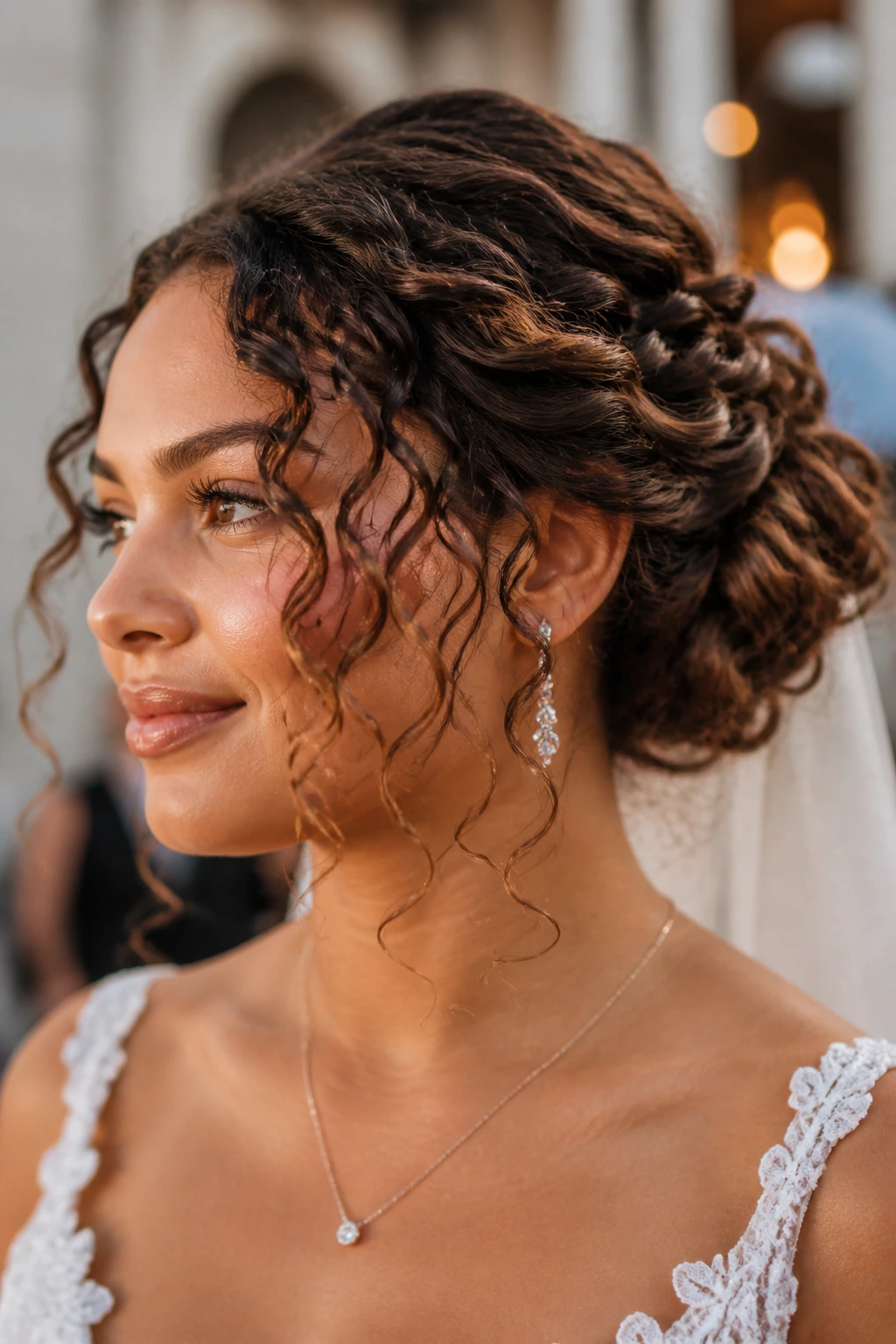
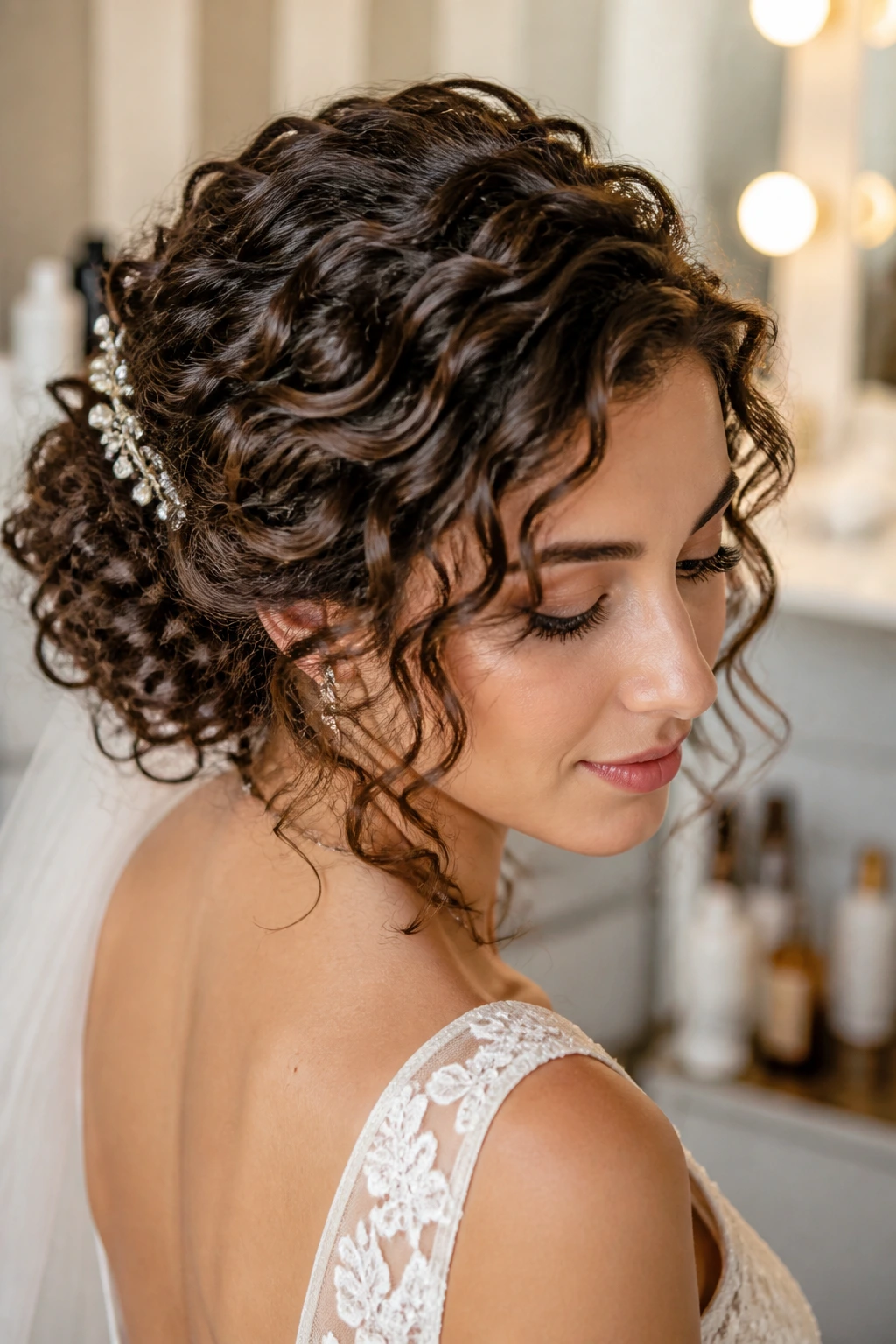
A twisted updo is one of those styles that looks more complex than it is, which I count as a win. Sections of curly hair are twisted back and pinned into a low or mid-height shape, while soft spiral pieces stay loose at the front. The result feels airy and a little undone, but still deliberate.
This is a good answer for brides who want the neck clear and the face softened. The spiral fringe matters because it keeps the updo from feeling too formal. When the stylist leaves the front sections just long enough to curl and shape, the whole look gains movement.
You’ll want enough product to hold the twists, but not so much that the curls at the front stiffen. That balance is the game here. Too hard, and the shape turns sharp. Too loose, and the updo falls apart by the end of the vows.
15. Waterfall Braid over Loose Curls
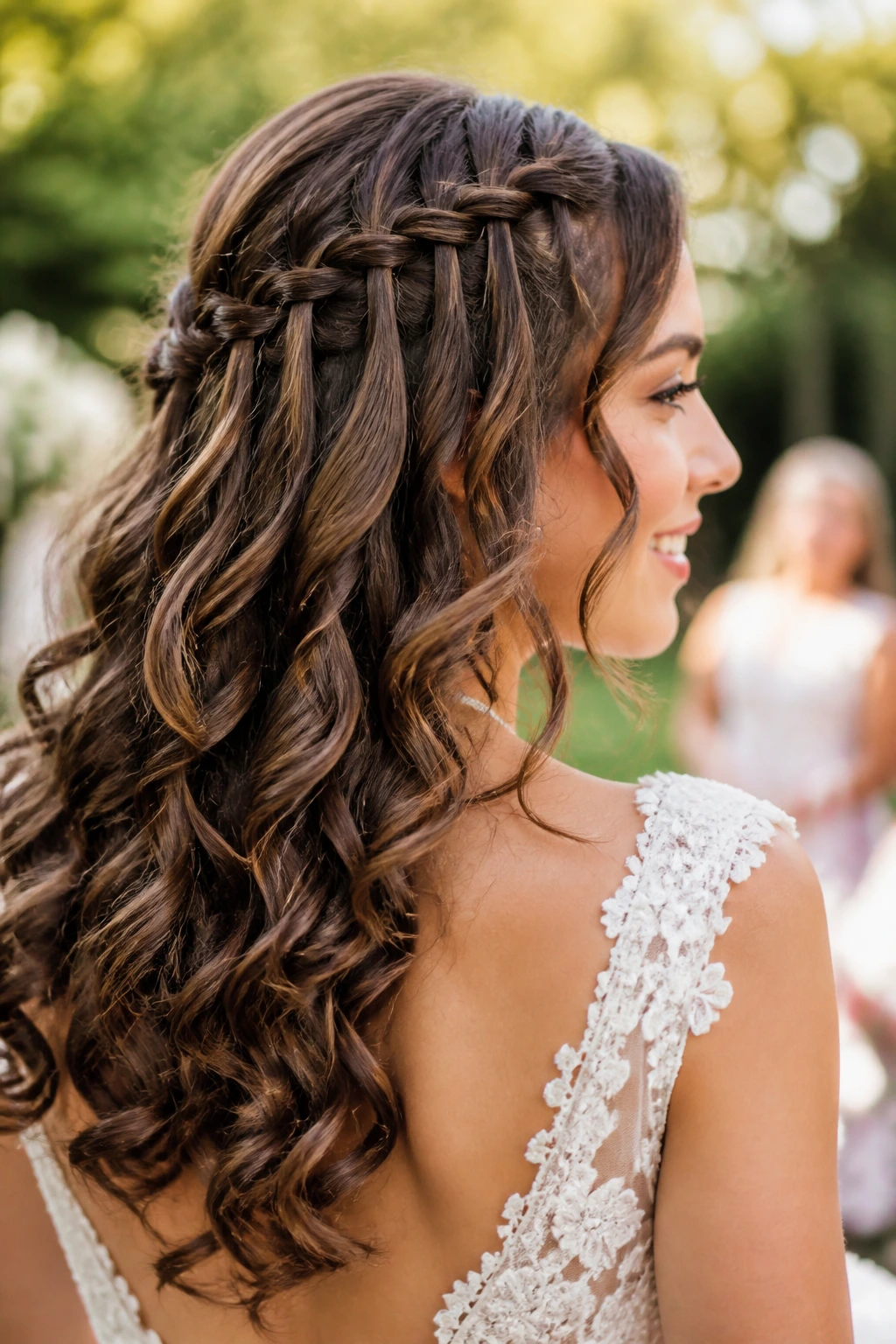
A waterfall braid is one of the prettiest ways to keep curly hair half-down without letting it feel heavy. The braid runs across the head and drops strands through it, creating that layered, flowing look, while the loose curls underneath still have room to move. It’s romantic in a way that doesn’t feel sugary.
This style works well when you want the top half controlled and the bottom half soft. It’s especially useful for brides with long hair that tends to spread wide once it’s curled, because the braid gathers some of that width and gives the style direction. Add tiny pins along the braid if the rest of the dress is minimal and needs a little extra detail.
If your curl pattern is tight, ask for the braid to sit a bit higher. Low waterfall braids can disappear under the length.
16. Hollywood Bob with Vintage Finger Waves
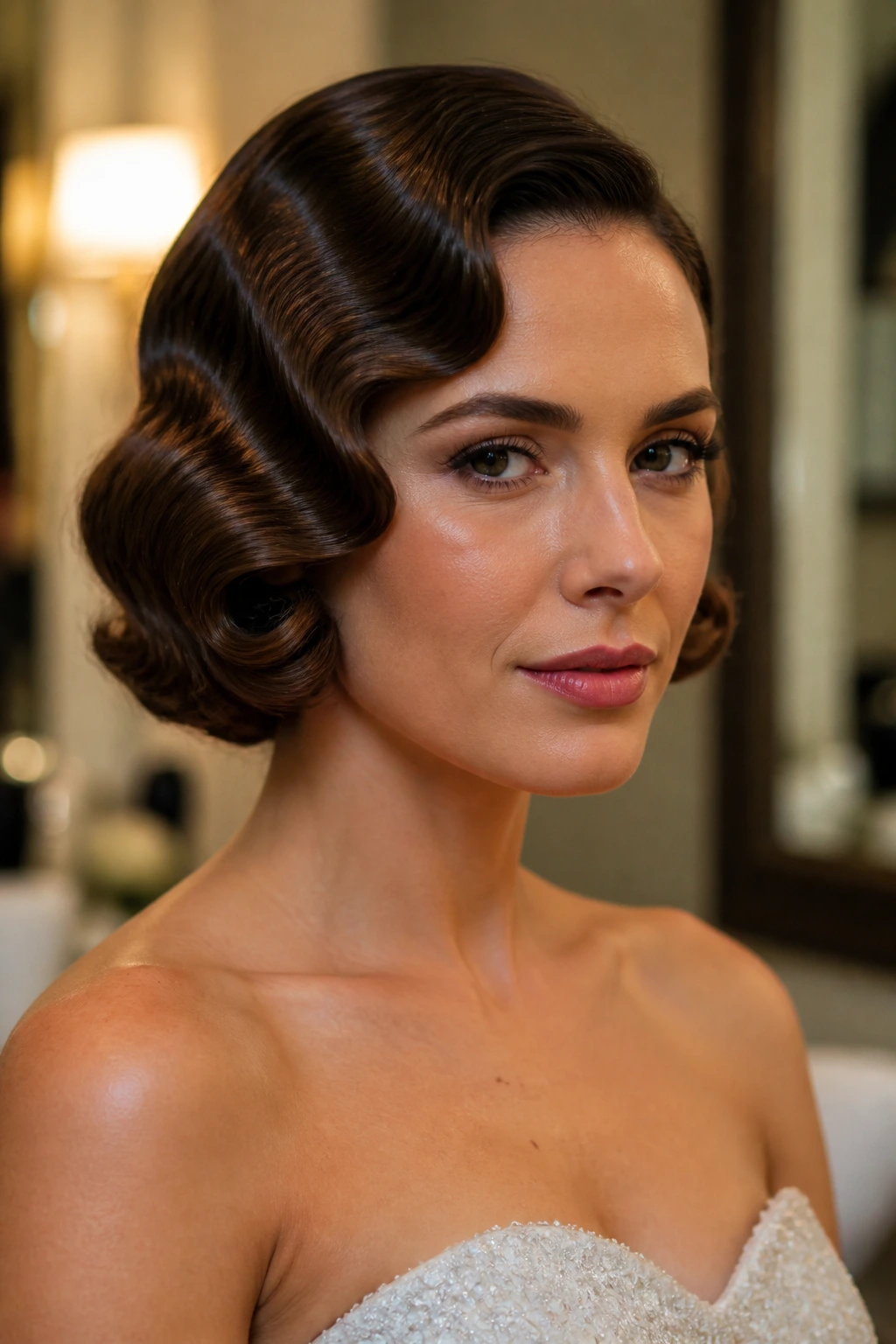
A bridal bob with finger-wave influence has a sharp, retro mood that I always think deserves more attention. The top or front is sculpted into a smooth wave pattern, and the ends are curled under or set into soft bends that frame the jaw. It’s clean. It’s dramatic. It doesn’t need much else.
This is a strong choice for short-haired brides who are tired of hearing that wedding hair has to be long to be formal. Nonsense. A short cut can look more striking because every line is visible. The trick is to make the shape intentional from the hairline to the ends.
A birdcage veil, a narrow comb, or a single side pin works better here than a heavy accessory. The style already has a lot of shape; it does not need clutter.
17. Floral Crown with Loose Defined Curls
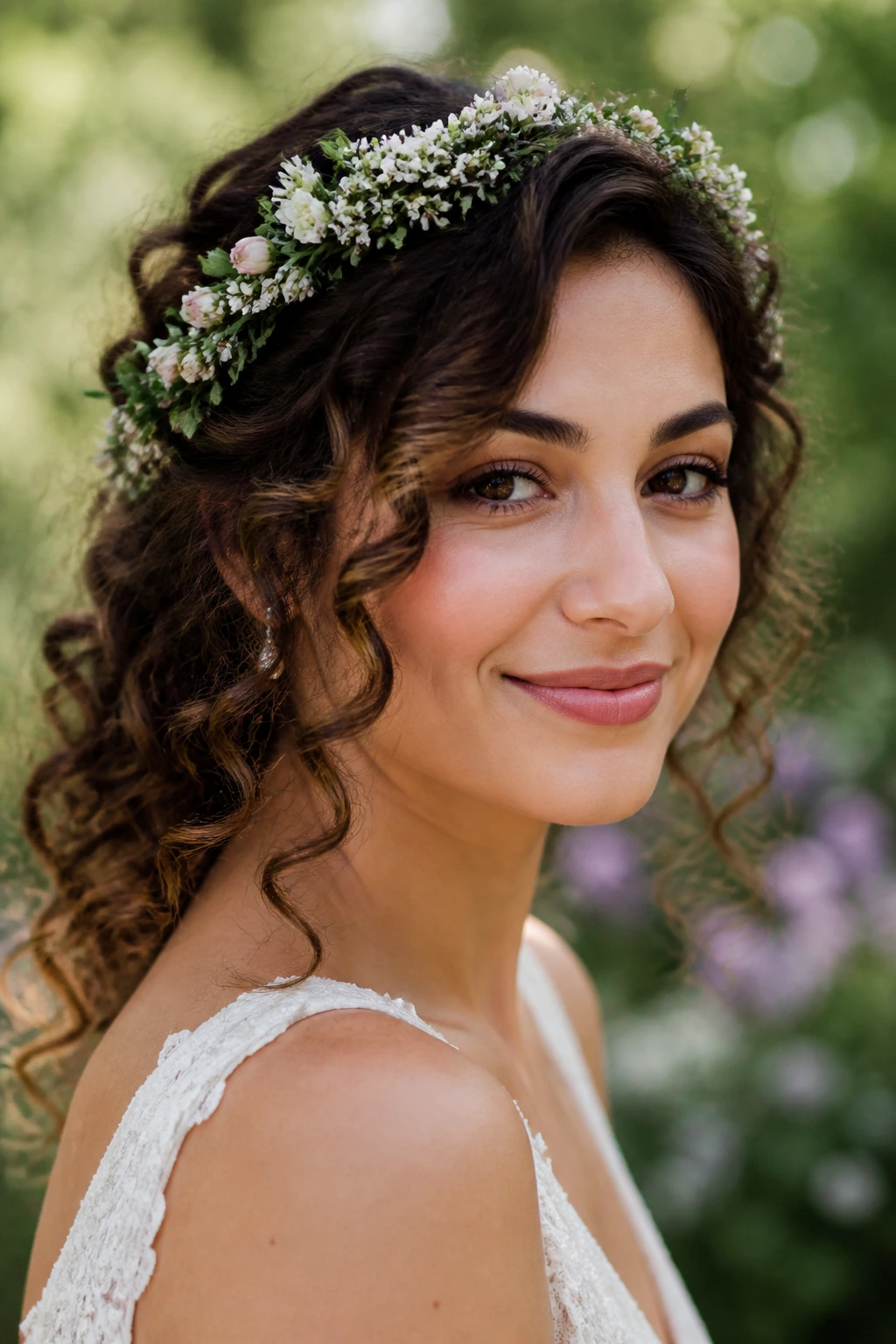
A floral crown on curly hair can look sweet or flat-out messy, depending on the rest of the styling. The version I like keeps the curls defined, the crown slightly lifted, and the flowers chosen with restraint. Small blooms, soft greenery, or dried pieces work better than a giant ring of decoration.
The curls give the flowers a base with texture, which stops the crown from sliding around. If the hair is very smooth, the crown will shift. If the curls are too crushed, the flowers disappear into the shape. So the balance matters.
This is best for outdoor ceremonies, garden settings, or brides who want the hair to feel tied to the atmosphere without turning costume-like. Keep the flowers tight to the head and let the curls handle the rest.
18. Curly Faux Hawk with Pinned Sides
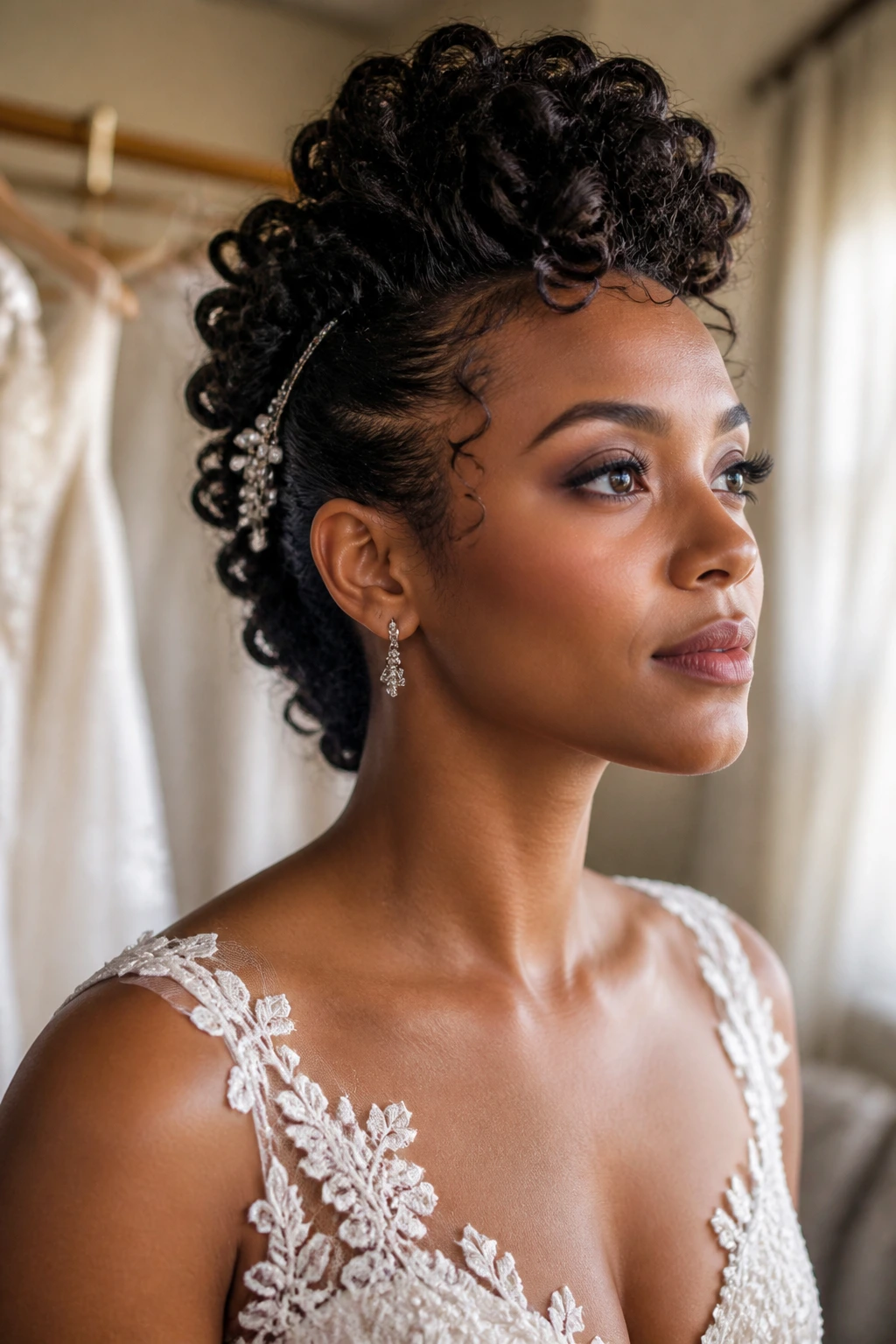
A curly faux hawk is for the bride who wants the aisle to have a little attitude. The sides are pinned back or smoothed in, while the center section rises in a column of curls from crown to nape. It’s bold, but not chaotic.
The shape works because it keeps the height in the middle, which elongates the silhouette and gives the face an obvious frame. If you have tighter curls, the center can be shaped into a fuller ridge. If your hair is looser, the stylist may set the top with pins and curls for more structure.
I’d pair this with a clean neckline or a dress that has sharp lines. The hair already has personality; the gown should not compete with it.
19. Halo of Mini Twists and Open Ends
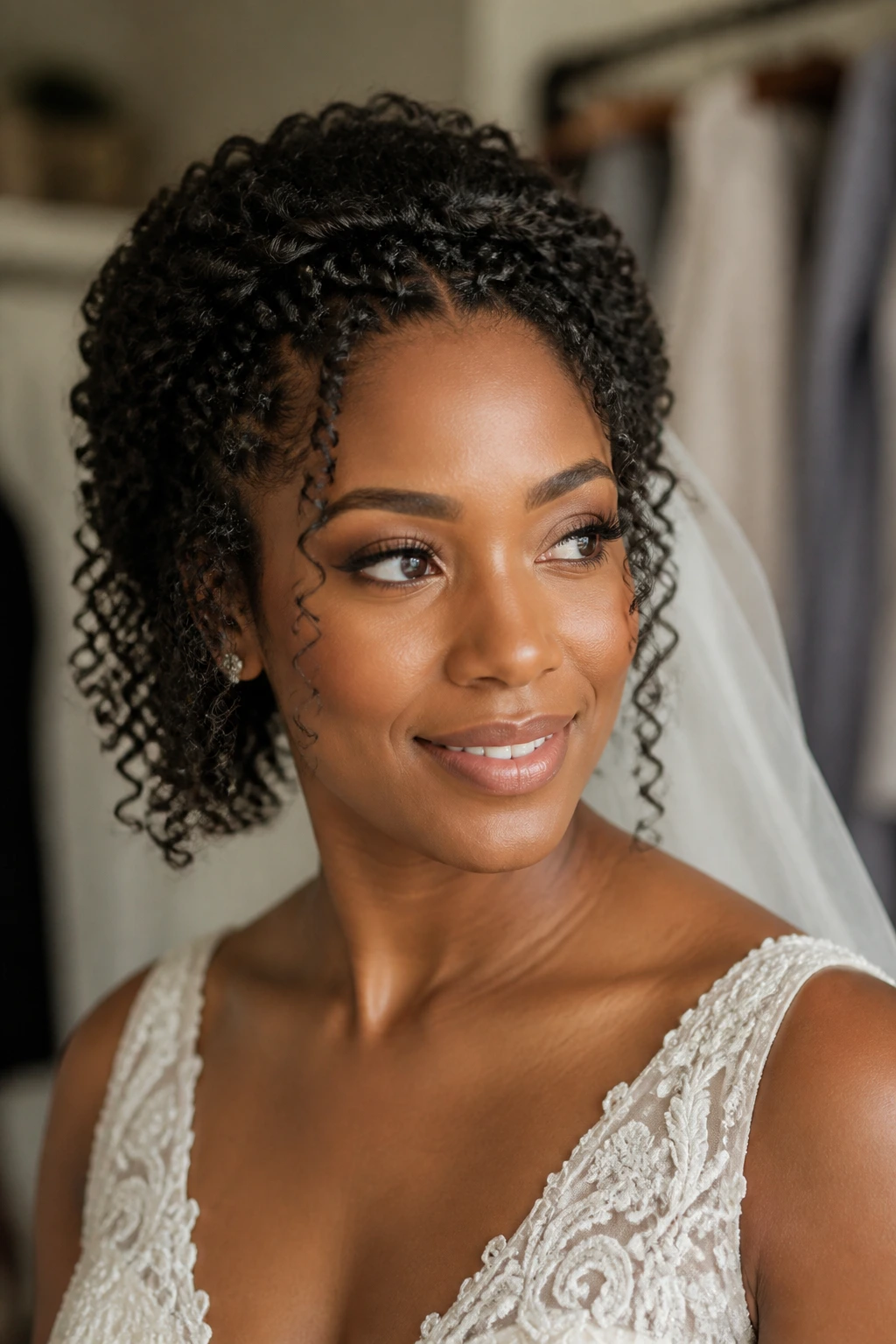
A halo of mini twists gives textured hair a graceful frame without burying the curl pattern. Small twists are pinned around the crown like a soft border, and the remaining lengths stay free. It creates a halo effect that reads romantic from the front and surprisingly sturdy from the back.
This is especially good for brides with dense natural curls or coils who want a style that holds shape without a lot of heat. The twists help guide the hair away from the face, and the open ends keep the texture visible. That combination looks richer than a fully smoothed style on this hair type.
If you wear this, make the twists small and consistent. Big, uneven sections can turn the shape lumpy fast. And yes, that’s the sort of thing that shows up in photos.
20. Low Bubble Ponytail on Curly Lengths
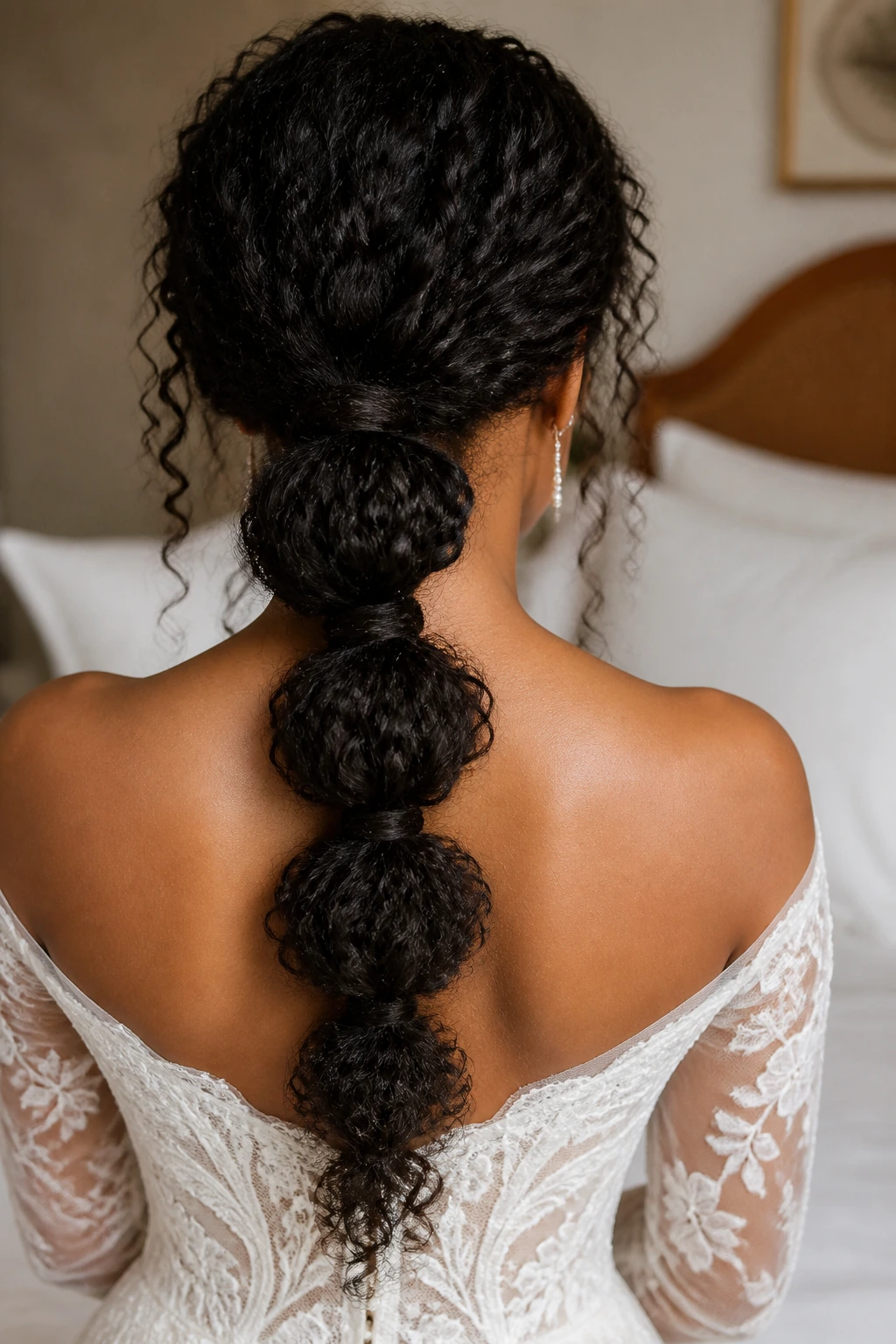
The low bubble ponytail has a playful side, but on curly hair it can still feel formal if the base is neat. The ponytail sits low at the nape and is divided into soft rounded sections with discreet elastics or pinned breaks. Curly texture makes each bubble look fuller, which is half the appeal.
This style gives you shape without the heaviness of a bun. It’s a smart choice if your hair is long, dense, or prone to tangling when fully worn down. The low placement keeps it grounded, and the bubbles create clean rhythm through the length.
If you want this to read bridal instead of casual, hide the elastics, polish the crown, and add one elegant accessory near the base or the first section. Keep the shine controlled. Too glossy and it starts to feel corporate; too matte and it loses definition.
21. Elegant Side Chignon with Jeweled Pins
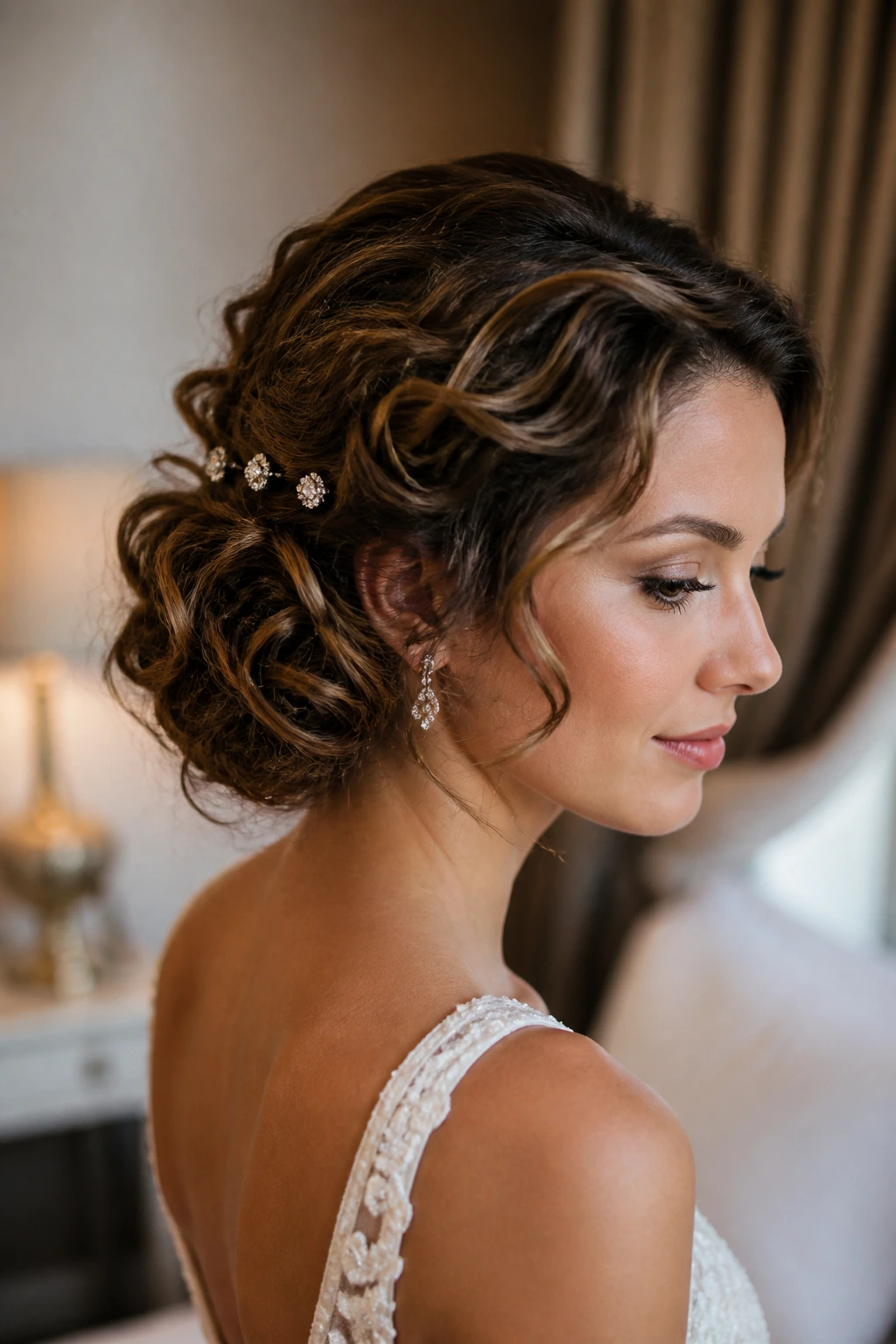
A side chignon feels a little more sculptural than the standard centered low bun. It sits just behind one ear or slightly lower, with the curls folded into a compact shape that can take a row of jeweled pins. The asymmetry gives it motion.
This is one of my favorites for brides who want formal hair without pulling everything straight back. The side placement gives you a profile line, which matters in photos. It also leaves room on the opposite side for earrings, a long drop pendant, or a shoulder detail on the dress.
The best version has a soft sweep over one temple. Without that, the style can look too set. With it, the chignon feels intentional and a little richer.
22. Shoulder-Grazing Curl Set with Veil Comb
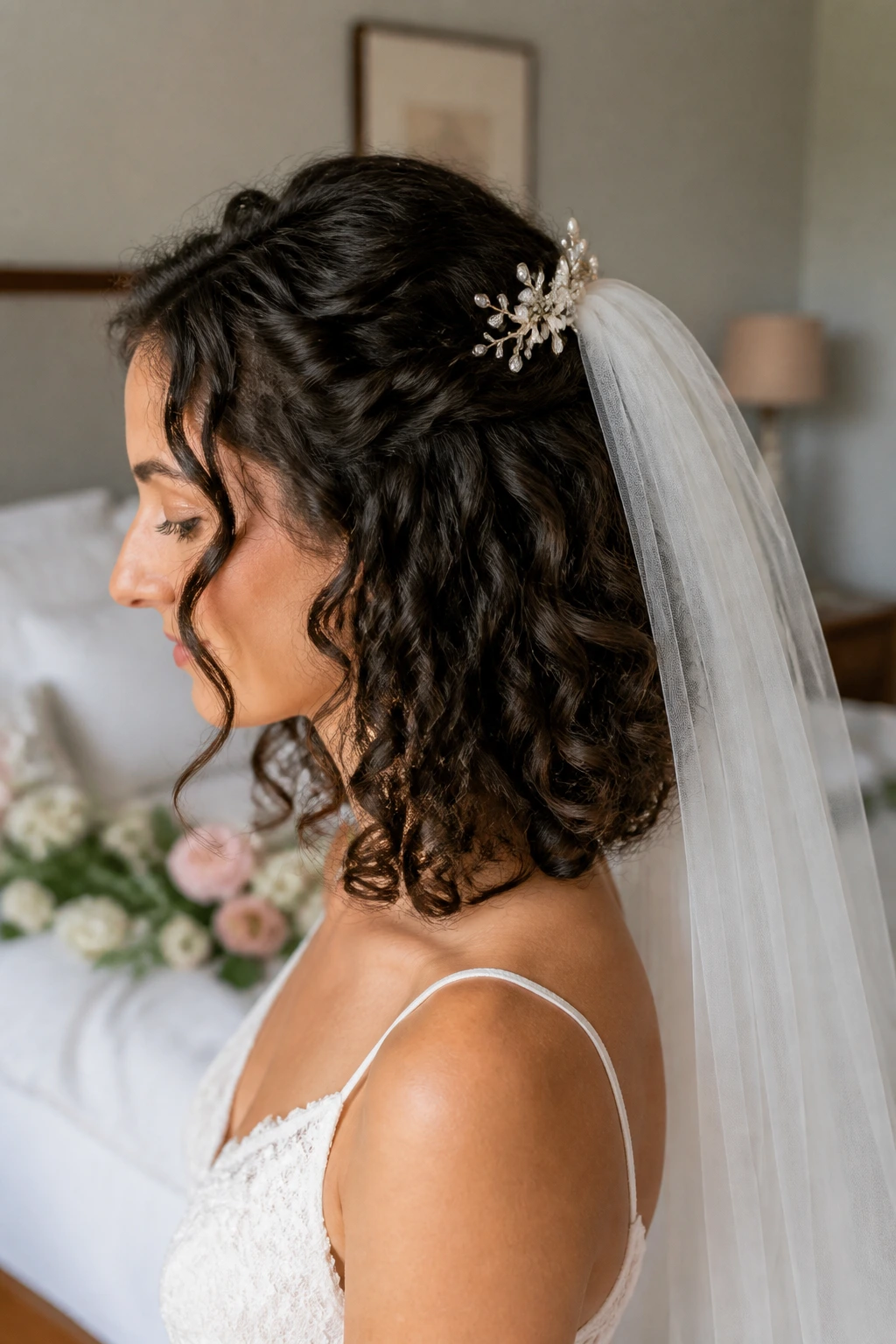
Shoulder-length curls can absolutely hold a bridal look. The key is not to fight the cut. A neat set, a clean part, and a veil comb placed where the hair has enough density to support it can turn a shoulder-grazing style into something polished instead of underdone.
I like this one for brides who want movement near the collarbone and less hair on the back of the dress. The veil comb becomes the anchor point, and the curls around it provide balance. If the cut has layers, keep the front pieces shaped on purpose so they don’t flick out in random directions.
A soft side sweep or a tiny twist near the temple can make this feel more finished. It doesn’t need much. The length already does the visual work.
23. Braided Bun for Thick Natural Curls
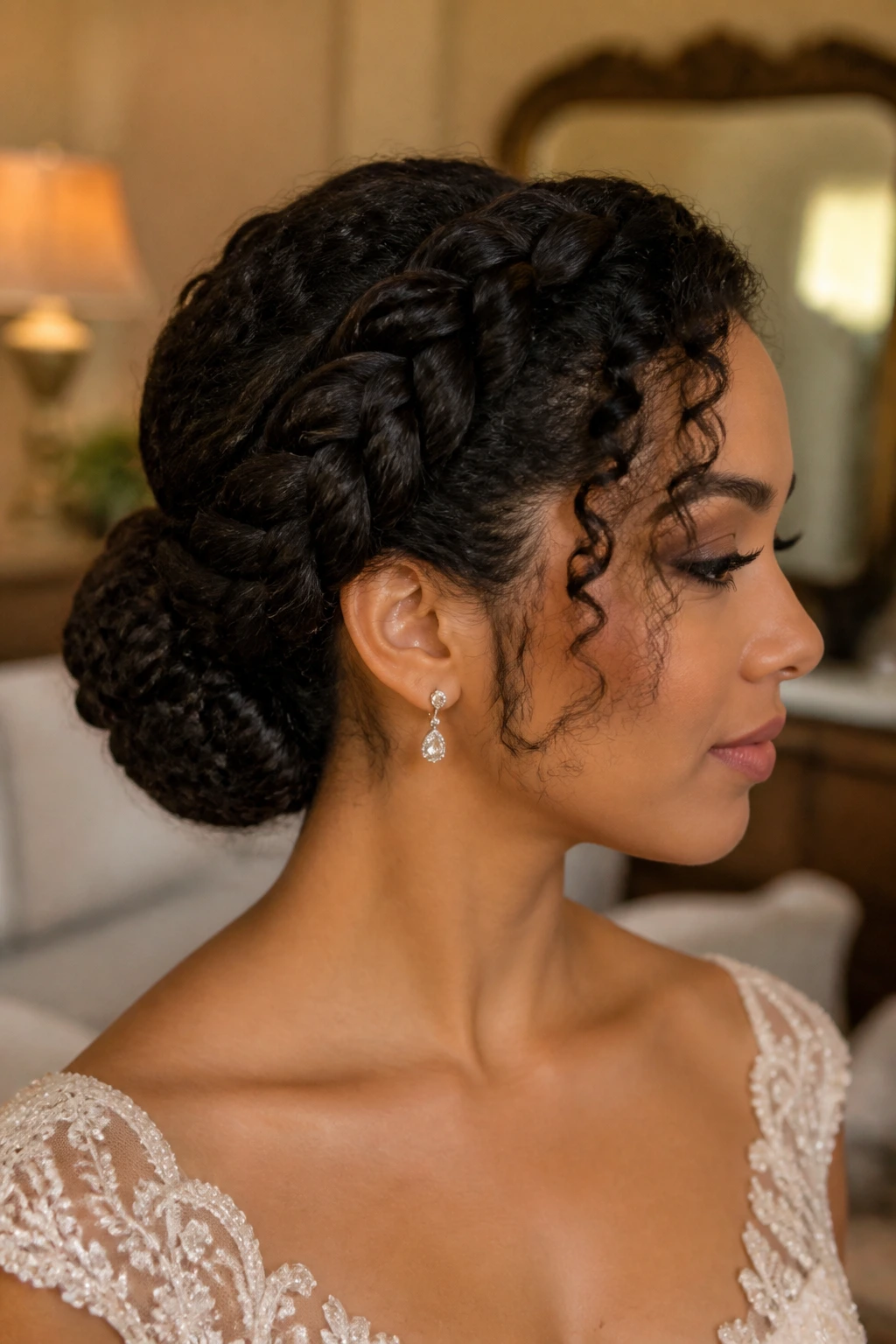
Thick curls need a plan, not a fight. A braided bun uses sections that are braided or twisted first, then coiled into a bun with plenty of pin support. The braid helps control bulk while preserving the texture that makes the style interesting.
This is a strong pick for brides with dense hair who need a style that can take weight. A plain bun on very thick curls can end up too wide or too loose; the braid gives the shape a backbone. It also keeps the look neat from the front while giving the back some depth.
Ask your stylist to keep the bun low and the braid visible in spots. Total concealment often looks flat. A little texture peeking through is what keeps the style alive.
24. Soft Pompadour with Curly Length Left Down
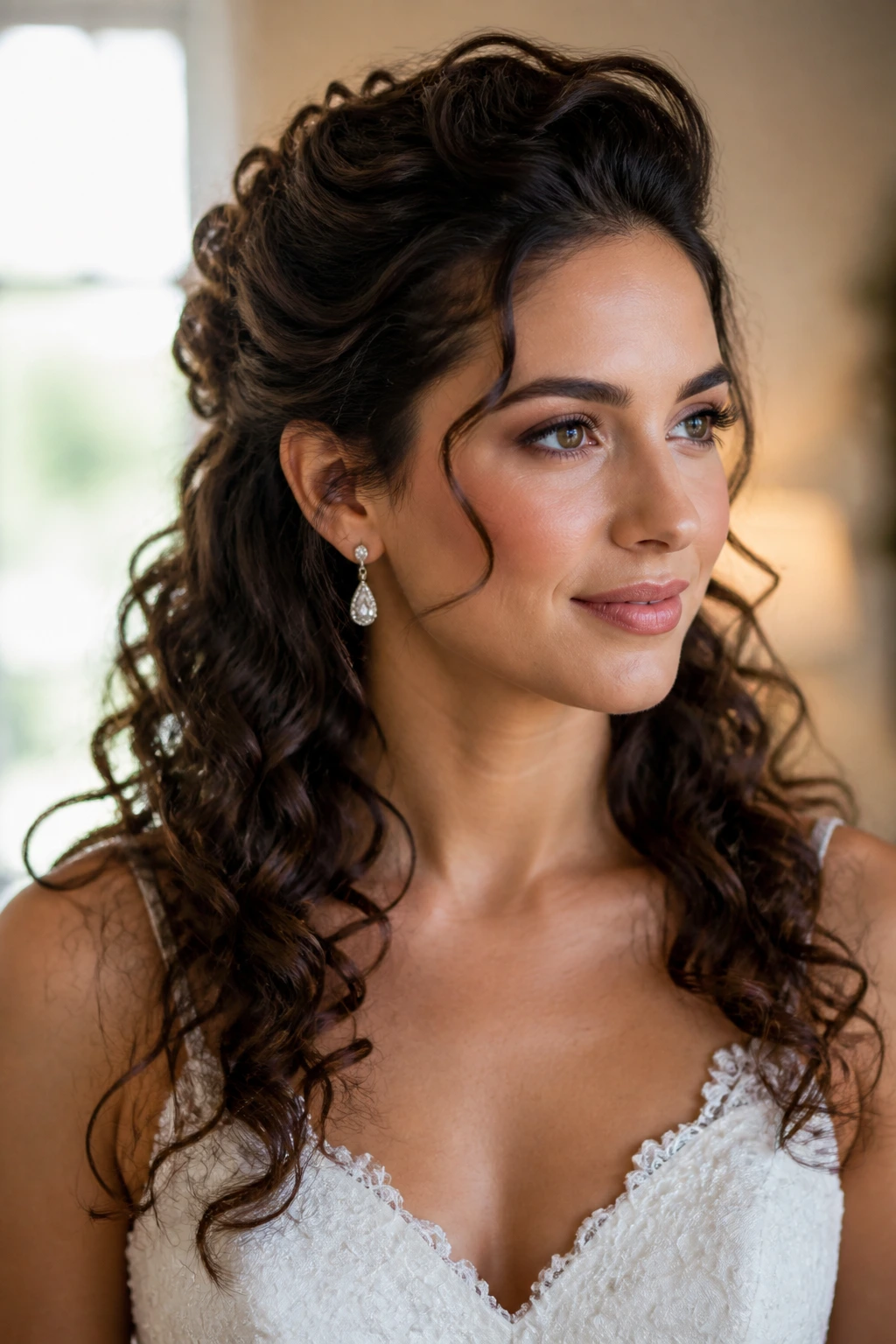
A soft pompadour adds height at the front without making the whole style heavy. The crown is lifted, smoothed, and pinned back, while the rest of the curls fall freely. It has a touch of vintage polish and a little red-carpet energy.
This shape is useful when you want to open the face and lengthen the silhouette. It also helps balance very full dresses because the added height at the top keeps the head from disappearing into the gown. The curls below keep it from feeling stiff.
You’ll want the volume to sit just above the forehead, not in a giant puff. Too much lift and it becomes costume territory. Too little and it’s just a brushed-back front.
25. Short Curly Crop with Side Sweep and Barrettes
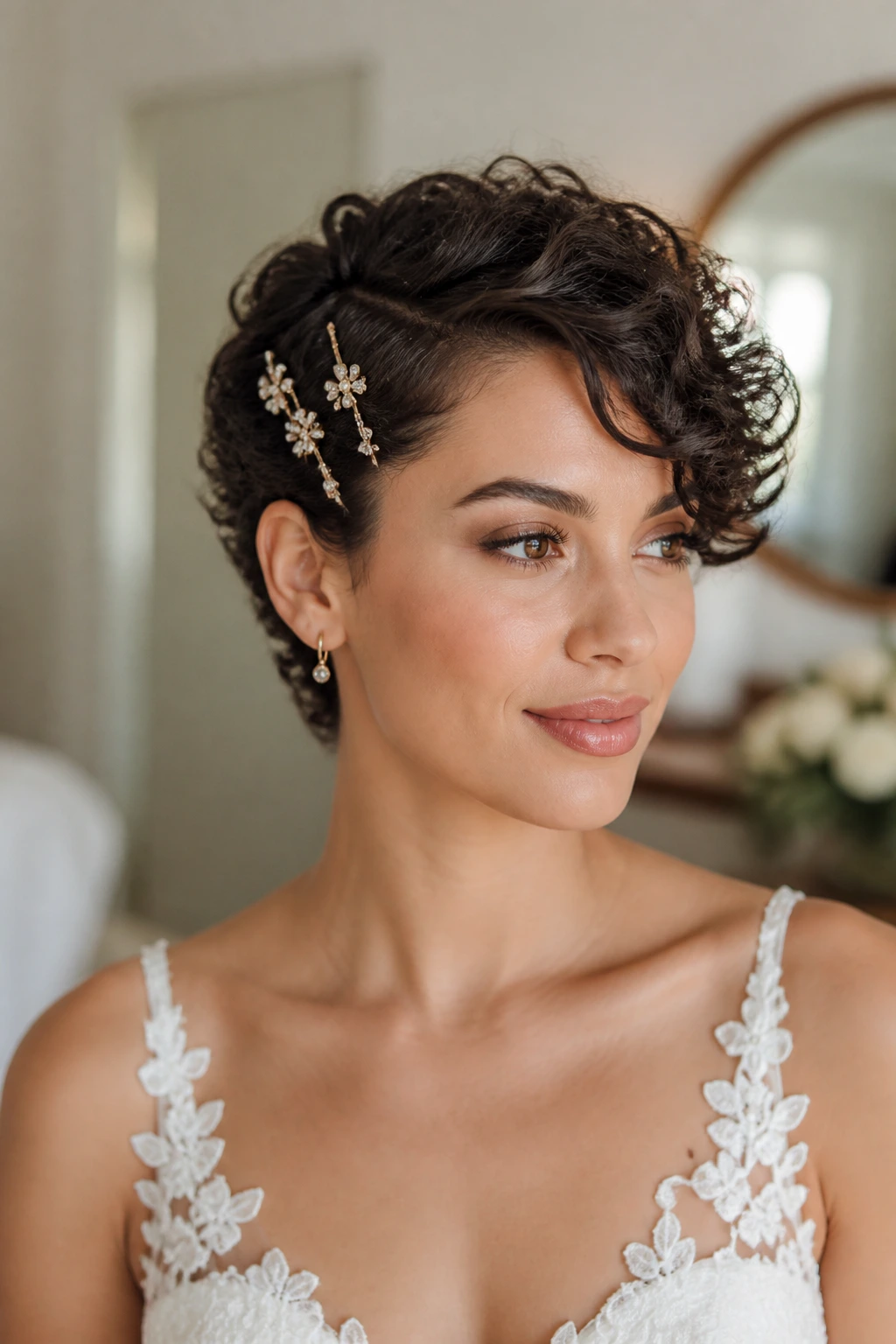
Short curly hair can feel deeply bridal when the shape is clean and the accessory choice is deliberate. A side sweep tames the front, and a few barrettes or pins add sparkle without burying the cut. The crop stays visible, which is the point.
This is one of the better options for brides who love their short haircut and do not want to pretend otherwise. The side sweep gives the style a line, and the accessory gives it ceremony. You do not need more than that.
If the crop has layers, ask for them to be shaped into the face rather than flipped randomly at the ends. That tiny difference is what separates a polished wedding look from a salon-finished everyday cut.
26. Half-Up Top Knot on Loose Spiral Curls
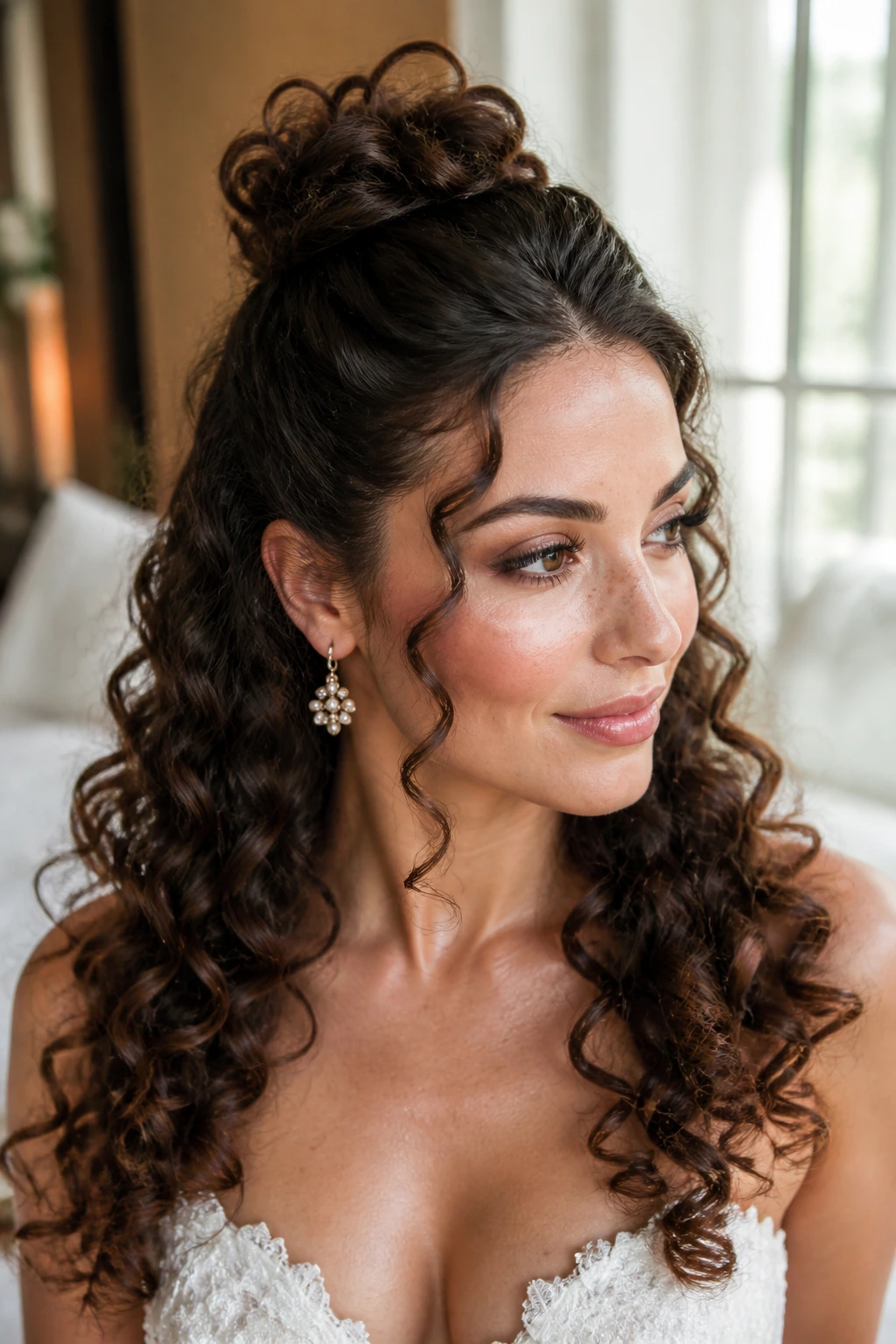
A half-up top knot is playful, but on a bride it works when the knot stays compact and the curls below stay defined. The top section pulls the hair away from the face and gives you height, while the loose lengths keep the style soft.
This is a good answer for brides who want a little lift without committing to a full updo. It also suits younger, lighter gowns or ceremonies where the vibe is less formal and more crisp. The top knot should feel like a punctuation mark, not a giant lump sitting on the crown.
If your curls are long enough, leave the knot small and let the spiral ends underneath do the heavy lifting. That contrast is what makes the style look modern.
27. Tucked Curl Roll with Birdcage Veil
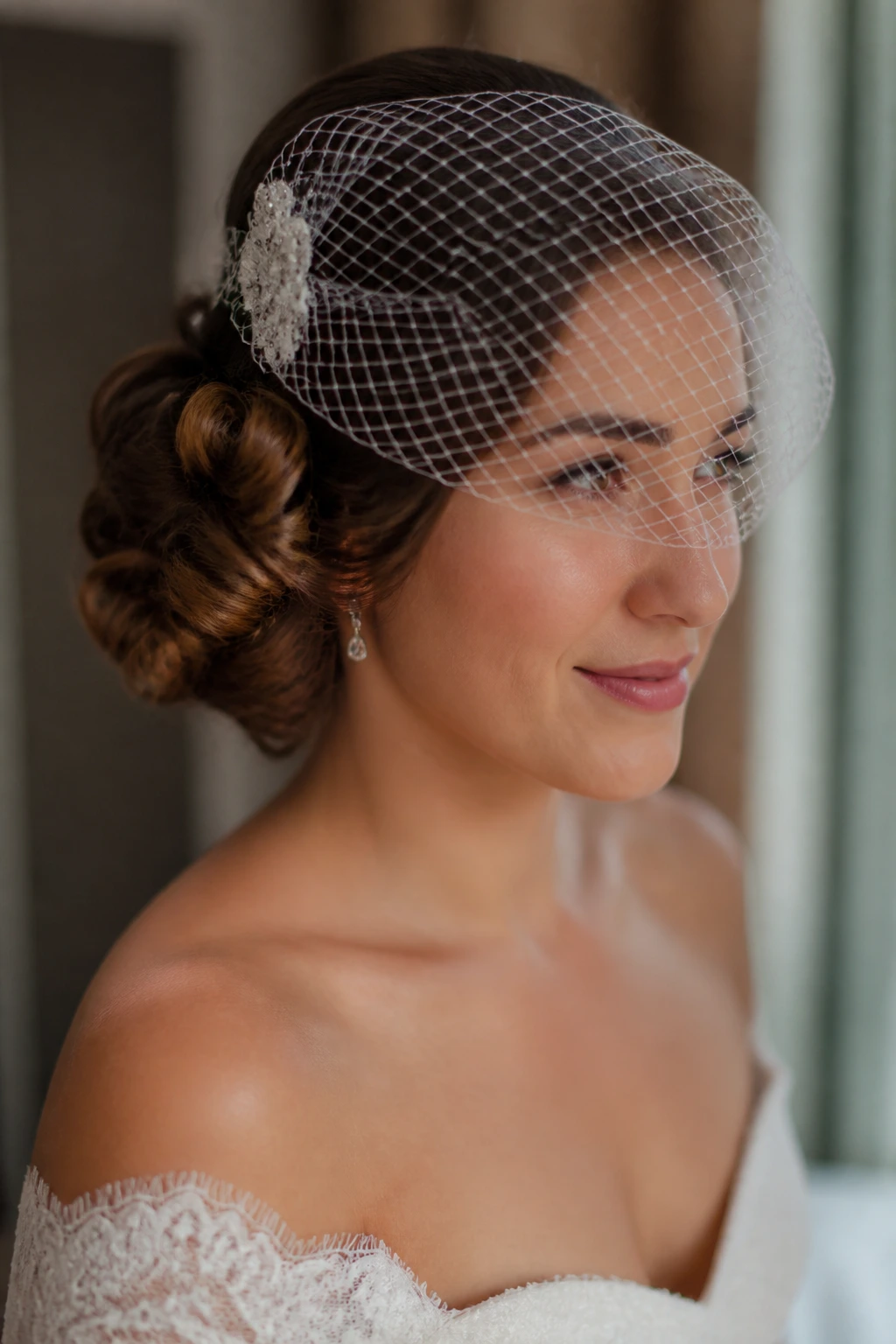
A tucked curl roll has a vintage feeling that pairs naturally with a birdcage veil. The hair is rolled or folded back along one side or across the nape, and the veil sits close to the face. It’s clean, deliberate, and a little theatrical in the best way.
This style suits brides who want a nod to old-fashioned glamour without a full retro costume. The curl roll creates a smooth path for the veil, and the birdcage adds shape at the eyes and cheekbones. The rest of the hair can stay softly curled or pinned low.
Keep the roll neat. Loose pinning turns the whole thing fuzzy, and a birdcage veil needs crisp support to look right. That’s the deal.
28. Gilded Afro with Statement Earrings
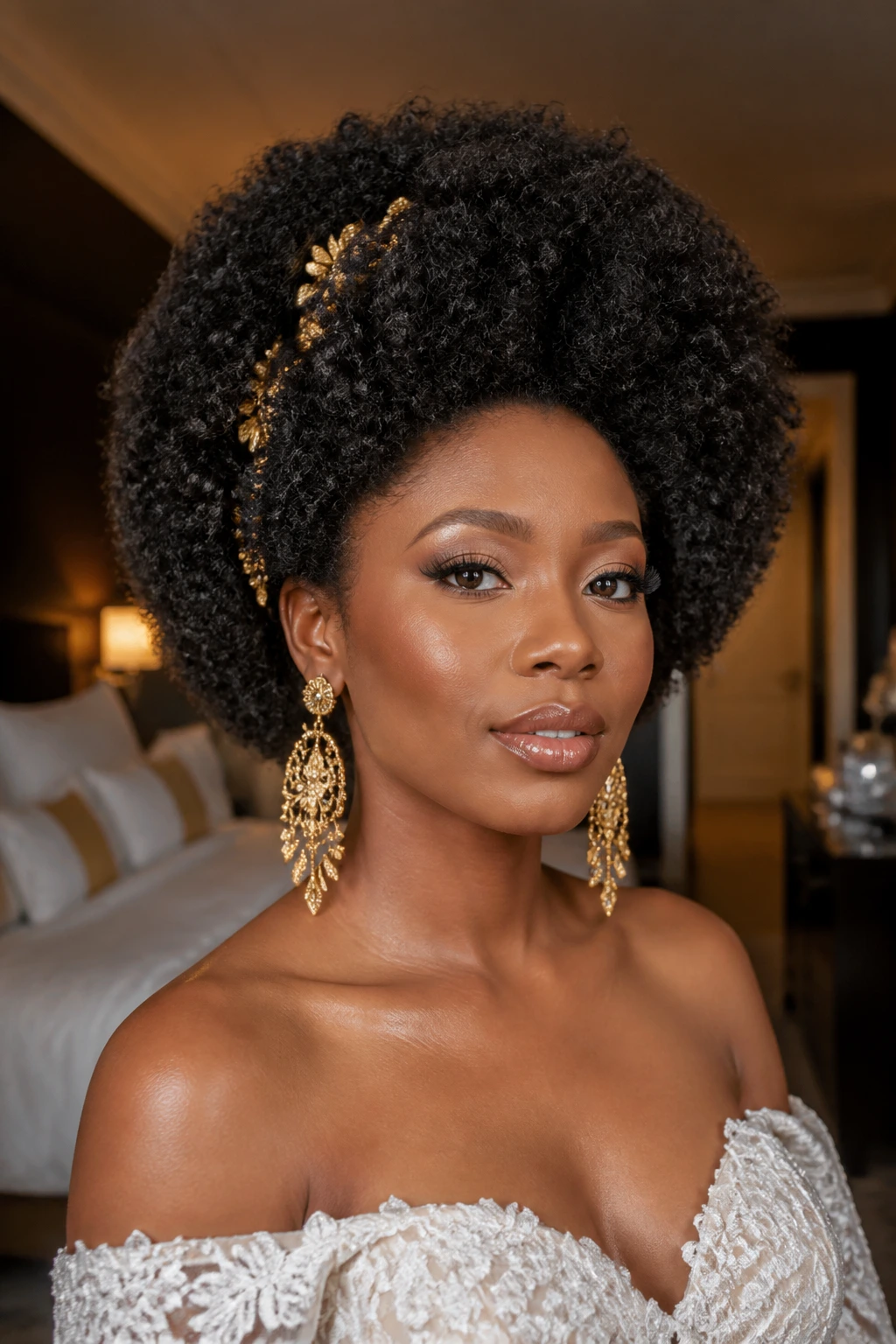
A sculpted afro with gold or pearl accents can be one of the strongest bridal looks in the room. The shape is rounded and full, with the texture picked and shaped into a clean silhouette. Then the jewelry does what jewelry should do: it finishes the story instead of competing with it.
This style works beautifully when the bride wants the hair to feel unapologetically natural and formal at the same time. The volume brings presence, and the accessory choice gives focus. I’d keep the earrings bold and the rest of the adornment restrained.
The key here is shape control, not flattening. A little moisture, a good pick, and careful edge work go a long way. The style should look intentional from every angle, not just the front.
29. Messy Curly Updo with Wispy Fringe
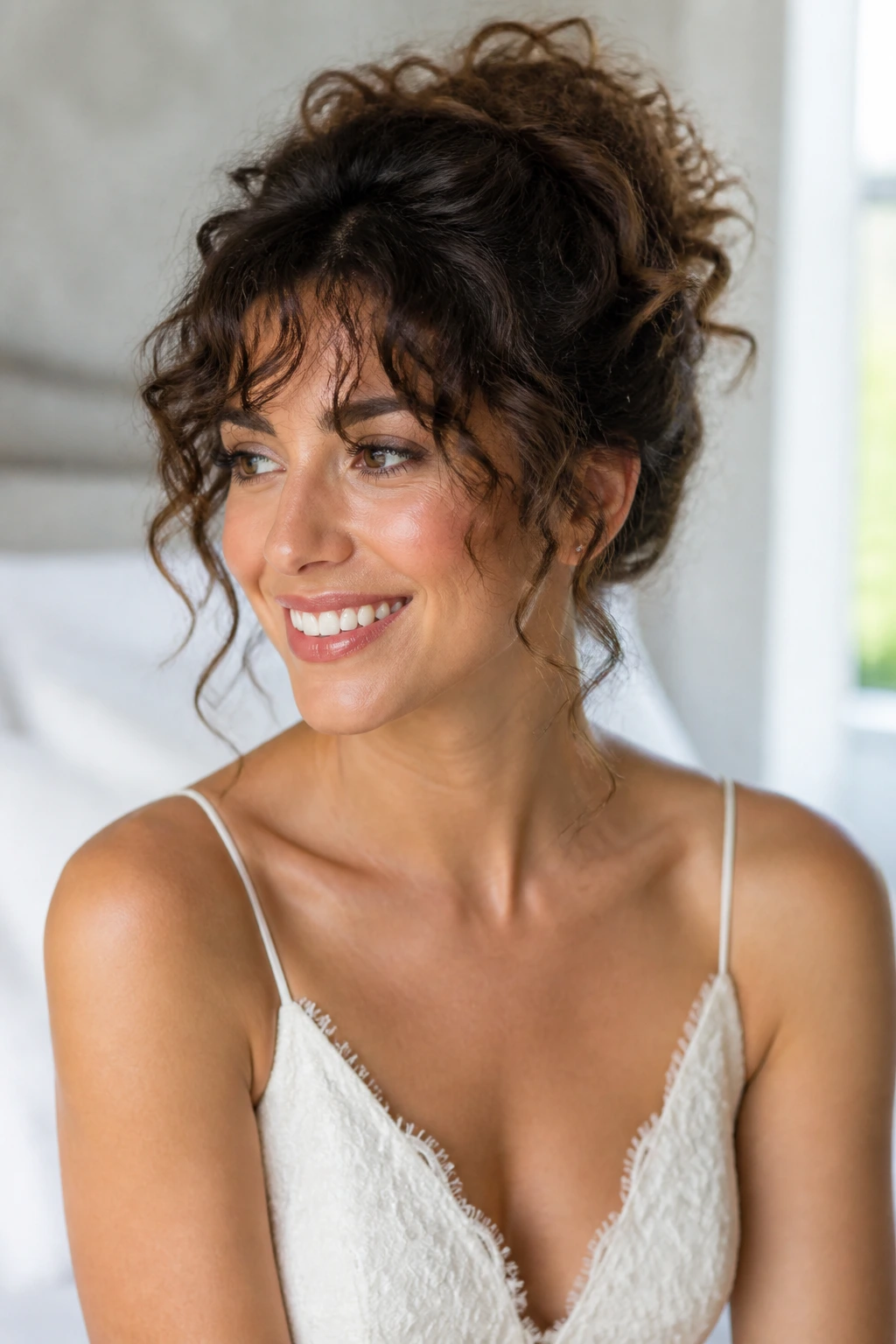
A messy curly updo is not an excuse to skip planning. The best version still has shape at the crown, a clear base at the nape, and wispy fringe pieces placed on purpose. The looseness gives it life, but the structure keeps it from falling apart.
This works for brides who want a relaxed finish and hair that can survive a long day without feeling overworked. It’s especially forgiving if your curls vary in size or your layers are doing their own thing. The style can absorb that variation instead of fighting it.
Let a few curls stay unpinned around the ears and temples. Those pieces soften the outline and make the updo feel less rigid. Too many loose strands, though, and the whole thing starts to look unfinished.
30. Polished Center-Part Cascade with a Long Veil
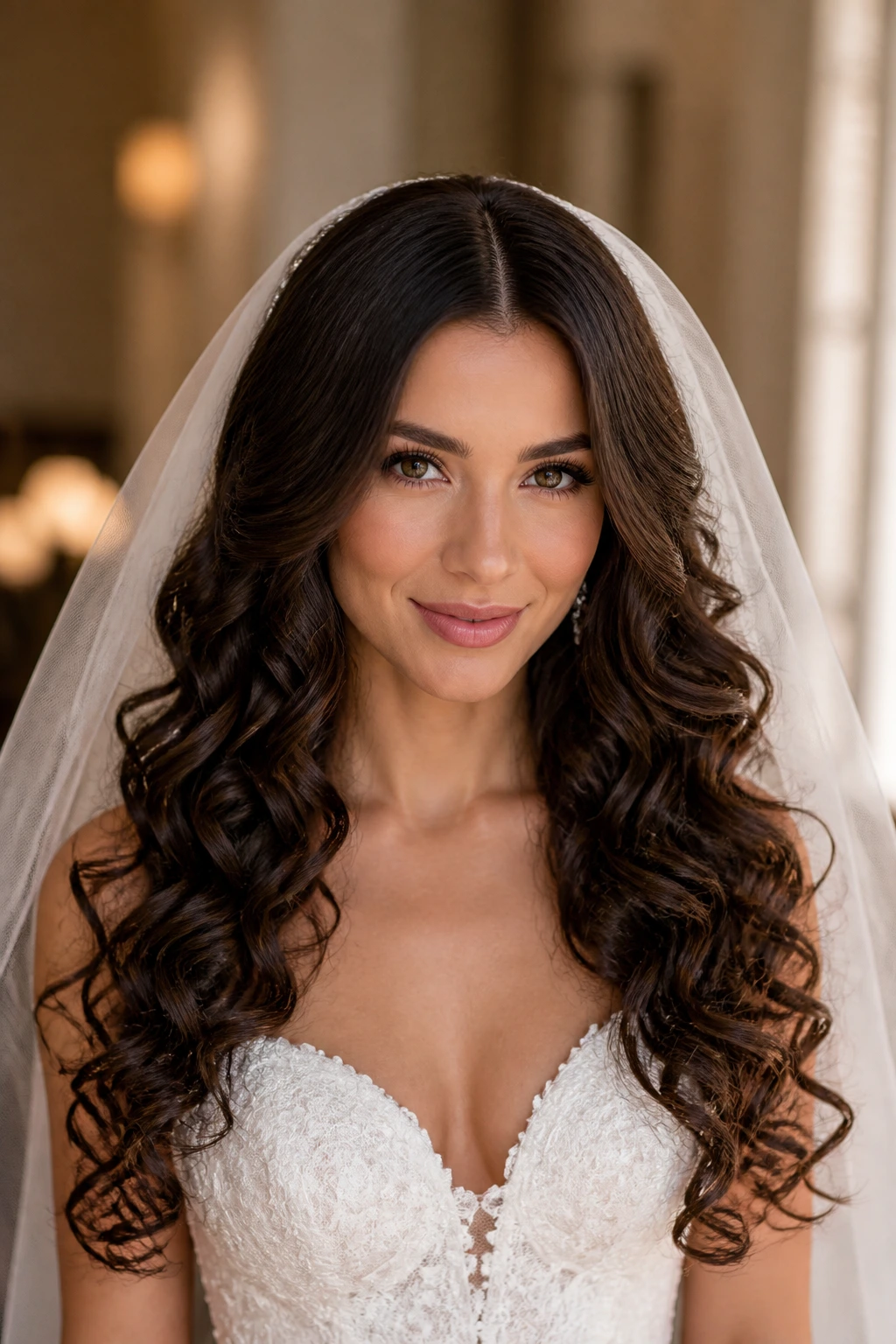
A center-part cascade with a long veil has a clean, straight-down-the-middle confidence that never looks accidental. The curls fall evenly on both sides, the part stays crisp, and the veil drops from the crown or just behind the top section so the length remains visible. It’s the kind of style that lets the dress and veil make a statement without crowding the face.
This is a smart choice for brides who want symmetry and length at the same time. The center part opens the features, and the waterfall of curls softens the edges. If the veil is cathedral-length, this shape keeps the hair from competing with it.
Make sure the top is smooth enough to hold the part. If the roots are too puffy, the style loses the clean line that gives it its power.
Why Curly Bridal Styles Hold Up Better Than They Get Credit For
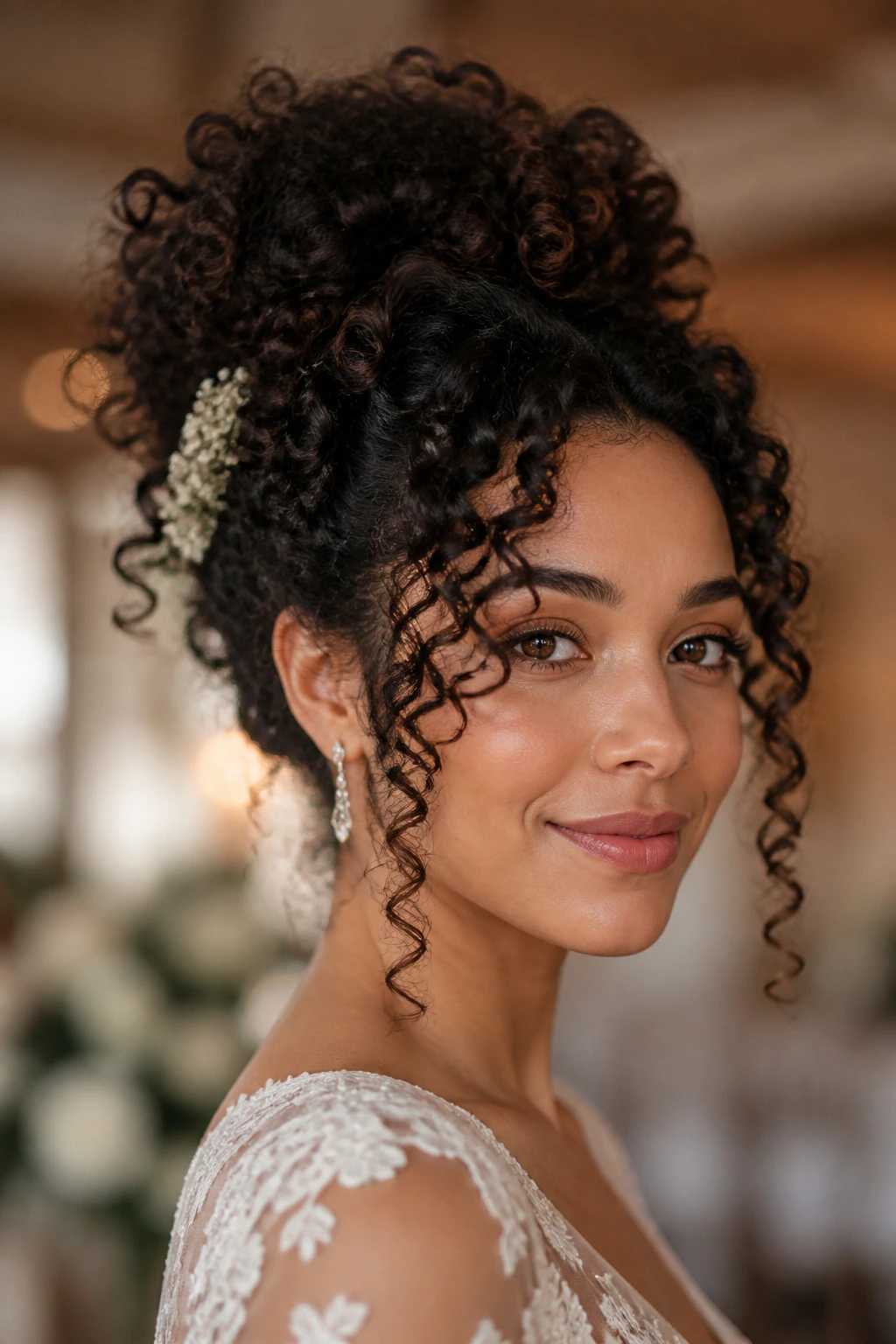
Curly hair has a structural advantage that people underestimate. The bends and bends inside bends give pins something to bite into, and that means a well-placed bobby pin often lasts longer here than it does in straight hair. The style does not need to work as hard to create volume, which is why a low bun or half-up shape can look full without a mountain of teasing.
There’s another quiet benefit: texture hides small changes. If a curl loosens a little during the reception, the whole style still looks deliberate. A pin slips? Fine. The overall silhouette often stays intact because curly shapes are forgiving in a way that smooth styles are not.
The real enemy is overmanipulation. Brush too much, heat too high, product too heavy, and you squeeze the life out of the curl pattern. Keep the curl where it belongs, and the style will usually take care of the rest.
Essential Styling Tools for Curly Bridal Hair
- Tail comb: Good for clean parts, controlled sectioning, and lifting the crown without roughing up the curl pattern.
- Sectioning clips: Keep curls separated while you curl, pin, or prep the top half.
- 1-inch curling wand or iron: Useful for refreshing pieces and creating uniform definition on looser curls.
- Diffuser attachment: Helps dry curls without blasting the shape apart.
- Bobby pins in a hair-matched shade: The pins disappear faster when the color is close to the hair.
- U-pins: Better than standard pins for thick buns and textured rolls; they hold bulk without crushing it.
- Strong-hold hairspray: Use it where you need grip, not everywhere.
- Flexible-hold spray: Better for preserving movement in down styles.
- Heat protectant: Non-negotiable if any hot tool is involved.
- Teasing brush or fine comb: Useful for crown lift, but keep it gentle.
- Mini flat iron: Handy for smoothing the hairline or taming one stubborn bend.
- Veil comb and accessory pins: Bring these to the trial so placement can be tested, not guessed.
Smart Product Picks for Bridal Curls
Start with the curl pattern you already have. Fine curls need lighter products — think mousse, soft cream, and flexible spray — because heavy butters and oils can collapse the root before the day even starts. Thick curls usually need more grip, so a setting lotion or stronger curl cream may make the style hold its shape without puffing out.
The shine product matters, too. A glossy serum looks lovely on mids and ends, but too much at the roots makes hair slide. That’s annoying on a wedding day. Keep anything slick away from the anchor points where pins, combs, or a veil need to stay put.
Accessories deserve the same attention. A comb that’s too short will wobble in thick curls. A floral pin with a flimsy stem will twist around and sit crooked by the ceremony end. Bring the dress fabric, veil, and jewelry to the trial if you can. The weight and tone of each piece change how the hairstyle should sit.
How to Match These Styles to Veils, Necklines, and Jewelry
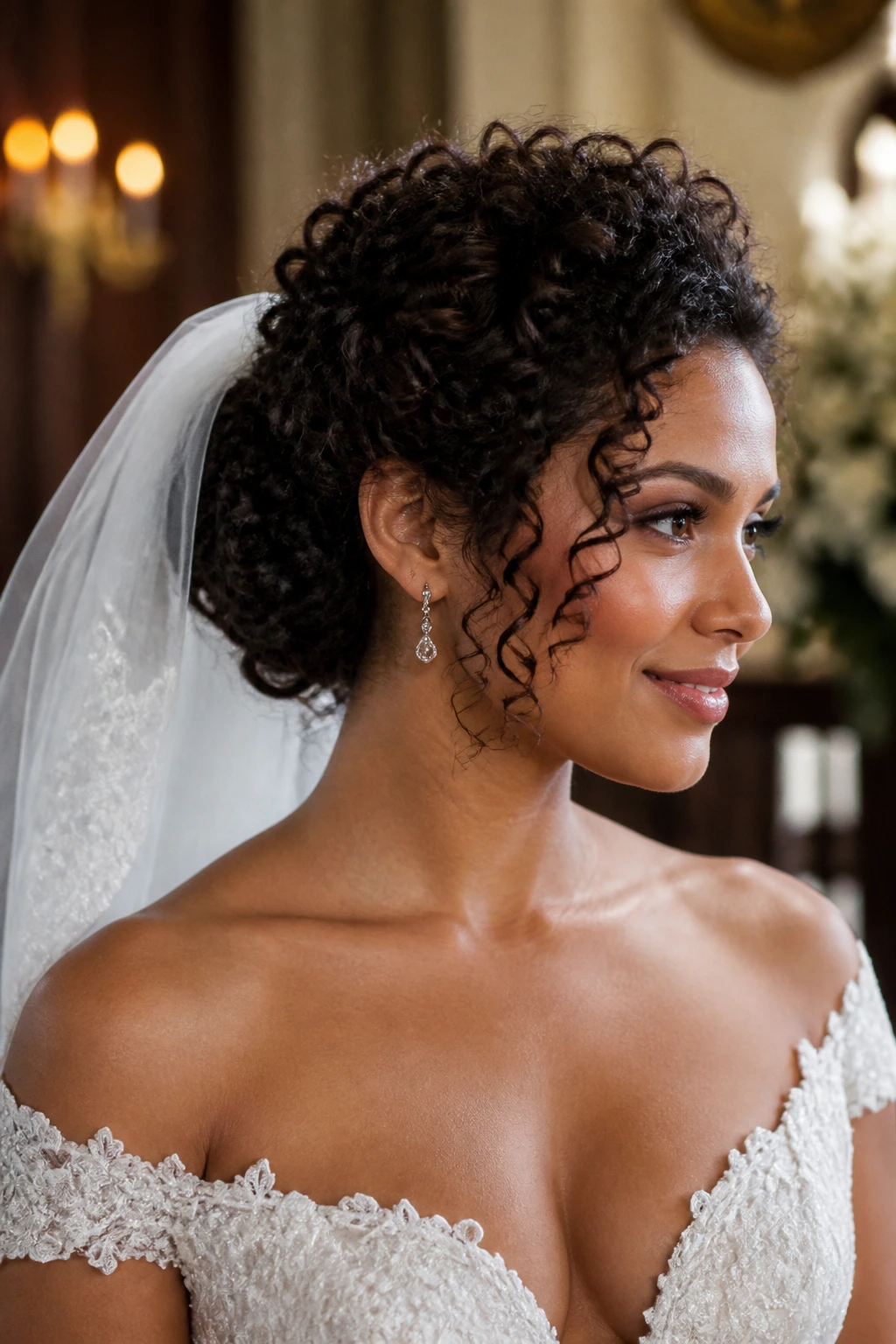
Veils: The veil should attach where the hairstyle has real structure. Half-up styles usually take a comb above the twist or braid; low buns and chignons like the veil just above or just below the base, depending on height. Avoid placing a heavy veil where the hair is loose and slippery.
Necklines: Strapless and sweetheart necklines can handle bigger curls and more volume. High necks and halters usually look cleaner with a low bun, side chignon, or tucked style, because too much hair near the collar can crowd the line. Open backs are where cascading curls or half-up shapes earn their keep.
Jewelry: If the earrings are large, keep the hair away from the jaw so they can show. If the necklace is the star, consider a sleeker crown and less hair around the chest. One focal point is enough. Three is where the whole thing starts arguing with itself.
Photography: Ask for a little extra separation in the front pieces and a clear shape at the back. Wedding photos punish muddy hair. Sharp sections, defined curls, and a visible anchor point make the style read cleaner on camera.
Extra Styling Tricks That Change the Finish
Humidity Shield: A light anti-humidity spray over the finished style helps curly bridal hair keep its line without turning it crunchy. Focus it on the outer layer and the frizz-prone perimeter, not the roots.
Root Lift: Pin the crown while it cools if you want height that lasts. Even ten minutes of cooling in clips can change the shape more than another full can of hairspray.
Shine Without Slip: Use a tiny amount of gloss serum only on the mids and ends. The roots should stay grippy, especially near veils, combs, and pins.
Emergency Fixes: Pack a travel kit with a few matched pins, a tiny comb, blotting papers, a travel hairspray, and a mini anti-frizz stick. The kit usually spends the day untouched. When you need it, you need it fast.
Make It Yours: A bridal hairstyle does not have to look identical to the trial photo. If your curls are naturally tighter, keep them tighter. If your hair wants more lift or more softness, work with that bend instead of forcing a shape it doesn’t want.
How to Prep, Preserve, and Refresh Bridal Curls
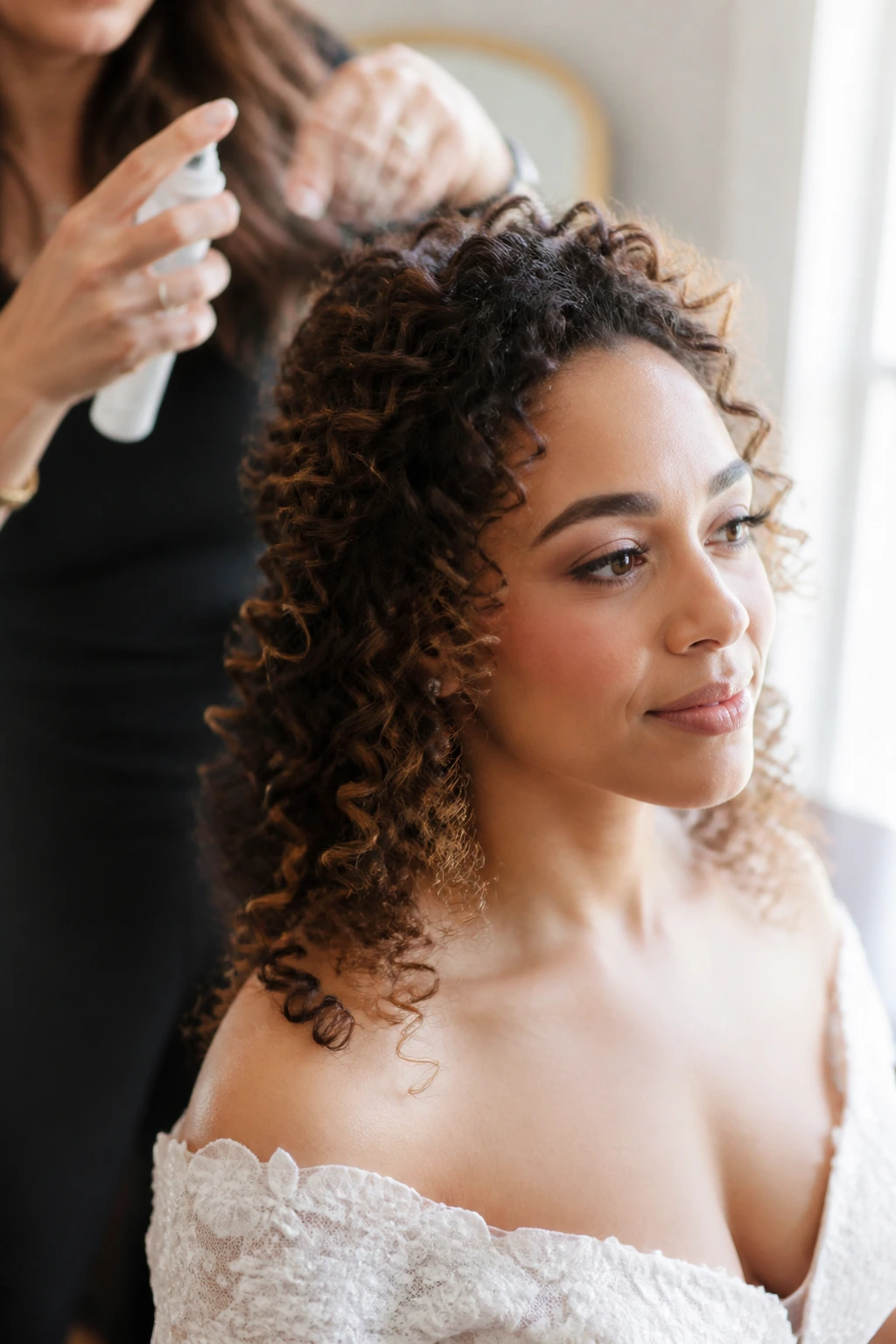
A bridal trial should happen early enough to leave room for adjustments, not panic. I like seeing the final candidate at least a few weeks before the wedding, because the first idea is rarely the one that survives real-life movement, veil weight, or a change in neckline.
Wash timing depends on the texture. Many curly styles behave best on hair that’s been washed the day before or two days before, not squeaky clean. Freshly washed hair can be too slippery, which makes pins slide and roots lose lift. If your hair is very dry, though, the stylist may want cleaner hair for the definition to show.
Overnight preservation is about friction control. A silk scarf, satin bonnet, or pineapple wrap helps keep curls from turning into fuzz if the style is being set ahead of time. If you’re wearing a down style, sleep on a silk pillowcase and keep the hair loosely gathered, not smashed flat.
Touch-ups should be small. Refresh one or two curls around the face with a wand if needed, then stop. The more you poke at the whole head, the more likely you are to wreck the shape you already paid for.
Variations and Adaptations to Try
Rain-Ready Romance: Tighten the curl pattern a little and use a stronger hold on the outer layer. This version is better for outdoor ceremonies or humid venues where softer waves can droop by the reception.
Short-Hair Sparkle: If your hair sits at the chin or above, lean into side sweeps, jeweled pins, and vintage shaping instead of pretending you have length you don’t. Short curly wedding hair looks strongest when the cut is visible.
Coily Crown Statement: On tightly coiled hair, shape the crown first and let accessories sit inside the structure rather than on top of it. Pearls, combs, and pins tend to look best when they nest into the texture.
Minimalist Veil Version: Keep the styling clean, reduce the accessory count, and let the veil do the heavy lifting. This is the route for brides who like crisp lines and don’t want competing details.
Soft Boho Version: Loosen the front pieces, add a braid or twist, and keep the curls more separated instead of brushed into one curtain. It suits gardens, barns, rooftops, and any setting where the hair should feel a little less formal.
Black-Tie Version: Smooth the root, sharpen the part, and choose one strong accessory rather than several tiny ones. When the gown is formal and structured, the hair should look equally resolved.
Common Mistakes to Avoid with Curly Wedding Hair
-
Brushing curls after they’re set: The result is usually fluff, not softness. Finger-shape or gently separate the curls instead, and stop before the hair loses its outline.
-
Using too much product at the roots: Heavy cream or oil near the scalp makes pins slip and kills lift. Keep rich products on mids and ends where they can do their job without flattening the base.
-
Choosing a style that fights the hair’s density: Very thick curls can swallow tiny accessories and loose pins; very fine curls can collapse under a heavy bun. Match the structure to the amount of hair on your head.
-
Ignoring the dress from the back: A style that looks fine from the mirror can cover a key detail in the gown or look too plain against a dramatic open back. The back view matters. A lot.
-
Testing the veil too late: A veil placed after the style is locked can sit awkwardly or pull the hair in the wrong spot. Bring it to the trial and place it with the hairstyle, not after.
-
Over-smoothing the front: Flat roots with stiff ends can look disconnected. The best version keeps the top controlled but still allows a little texture near the temples and hairline.
Frequently Asked Questions About Curly Bridal Hair
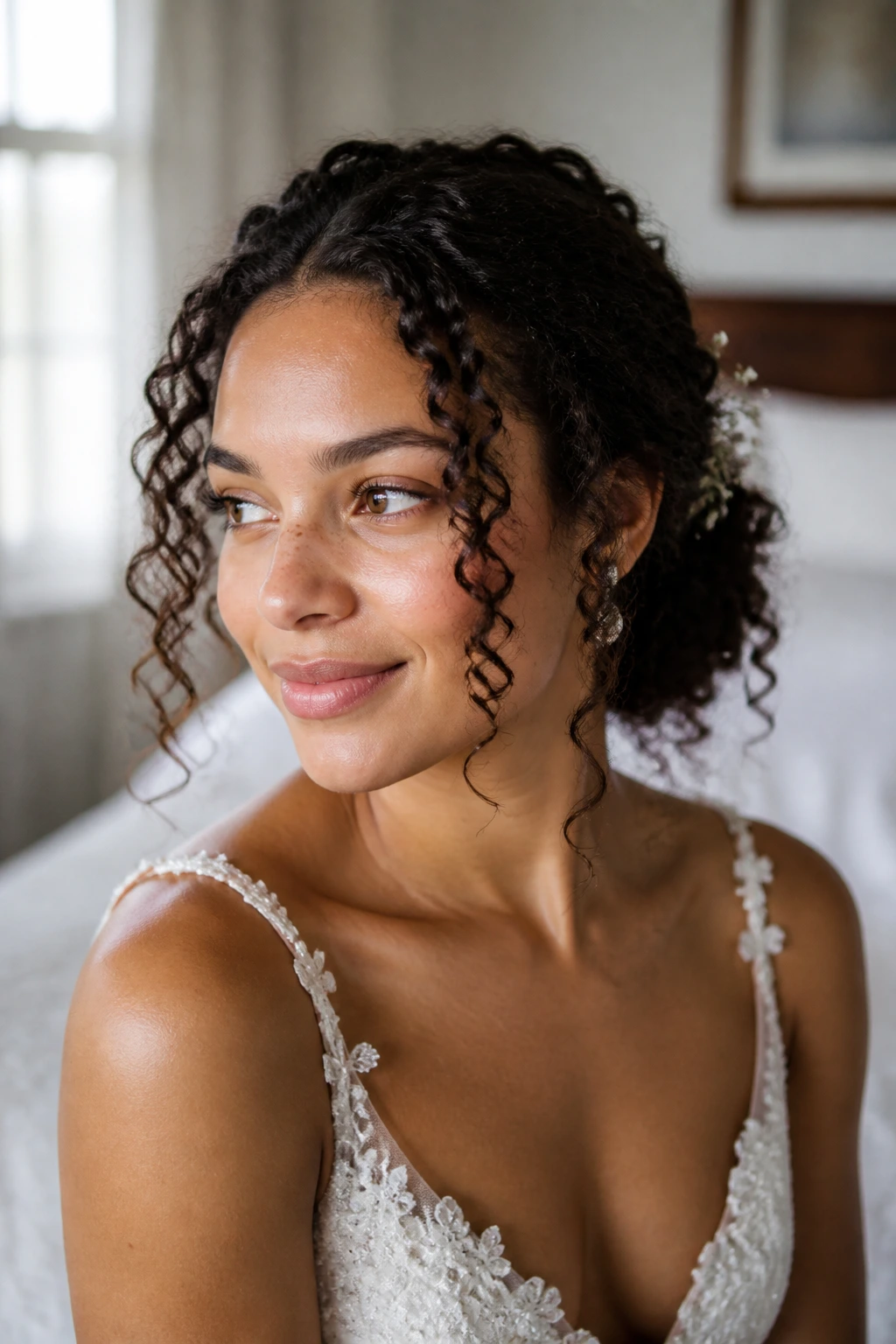
How far ahead should I choose my bridal hairstyle?
Pick the style early enough for at least one trial, and ideally a second if your dress, veil, or color changes. Curly hair often behaves differently with humidity, product, and accessory weight, so leaving room for a revision saves a lot of stress.
Should curly hair be washed on the wedding day?
Usually no, unless your stylist specifically prefers fresh hair for the style you’ve chosen. Day-old or two-day-old hair often has better grip, less slip, and fewer problems with pins moving around.
Can I wear a veil with curls down?
Yes, but the placement has to be deliberate. A half-up section, crown braid, or small anchored twist gives the veil a secure point so it doesn’t slide through loose curls.
What if my curls fall flat by the reception?
That usually means the styling products were too light, the roots were too soft, or the curl pattern was brushed too much. A small travel kit, a little lift at the crown, and a careful refresh of the face-framing pieces can rescue the look fast.
Do I need extensions for these styles?
Not always. Extensions help when you want extra fullness for a braid, bun, or long cascade, but they’re not required for every bride. If your natural curls already have enough volume, adding hair can make the style heavier than it needs to be.
What style works best for humid weather?
Half-up styles, low buns, and braided crowns usually handle humidity better because they keep the hair anchored. Loose down styles can still work, but they need firmer product and more defined sectioning.
Can short curly hair look formal enough for a wedding?
Absolutely. A short curl set with a side sweep, a vintage wave, or a jeweled pin often looks sharper than a forced updo. The shape just needs to look intentional and clean.
How do I show my stylist the style I want without getting a generic version of it?
Bring two or three photos with the same silhouette, then point out what you like in each one: crown height, parting, accessory placement, or the amount of curl left loose. Photos alone are vague; talking through the parts keeps the style from turning into a copycat mash-up.
The Style That Still Looks Like You
The best curly bridal hairstyles do one smart thing: they keep the hair’s personality intact while sharpening the outline enough for a ceremony. That’s a better goal than trying to erase texture or chase some fixed idea of “perfect” wedding hair. Perfect is usually stiff. Curly hair is better when it moves.
If you’re choosing between half-up softness, a low chignon, a braided crown, or a full natural texture statement, trust the version that lets your face, dress, and curls share the frame without fighting. That balance tends to age well in photos, which is more valuable than a style that only works for one hour under one kind of light.
Pick the shape that can survive the day and still look like it belongs to you. That’s the real finish line.
