



The best bridal hair extensions do not shout. They change the whole geometry of the hair: where the curl sits on the shoulder, how the bun fills the nape, whether the veil comb stays anchored or starts to drift after the second hug. That’s the part people miss when they think about wedding hair as just “longer” or “fuller.” It’s really about balance. A thin ponytail can make a gown look heavier than it should. A few well-placed wefts can make the same style sit cleanly and feel deliberate.
Bridal hair extensions also solve a problem that shows up in real life, not just in salon photos. Fine hair collapses under pins. Straight hair slides out of curls. Short layers pop loose around the ears the minute humidity gets involved, or the minute you start moving around in it. The right extension style gives the stylist something solid to work with, which is why the hair looks calm instead of fragile.
And there’s a nice bonus: extensions let the style match the dress instead of fighting it. A high-neck gown asks for a different shape than a bare back. A cathedral veil wants a different base than a petal clip. Once you start thinking in those terms, the options open up fast.
Why These Bridal Extension Styles Earn Their Keep
-
They add structure at the roots: Bridal hair needs more than length; it needs enough body at the crown and nape so pins, combs, and loops stay where they’re placed.
-
They make curls hold their shape longer: A little added hair gives waves more weight, which helps them fall in clean ribbons instead of turning wispy and uneven.
-
They work with accessories instead of against them: Veils, pearl combs, and floral pins need a stable base, and extensions make that base less slippery.
-
They help shorter hair borrow a different silhouette: A bob can become a soft faux-updo, and shoulder-length hair can stretch into a full braid without looking stuffed.
-
They keep the style readable in motion: Walking, hugging, dancing, and turning your head all change the shape of bridal hair; extensions keep the outline intact.
-
They let the bride choose the mood, not the limitation: Sleek, romantic, polished, undone, old-Hollywood, boho—those choices get easier once the hair has enough substance to hold the line.
1. Hollywood Waves With Clip-Ins
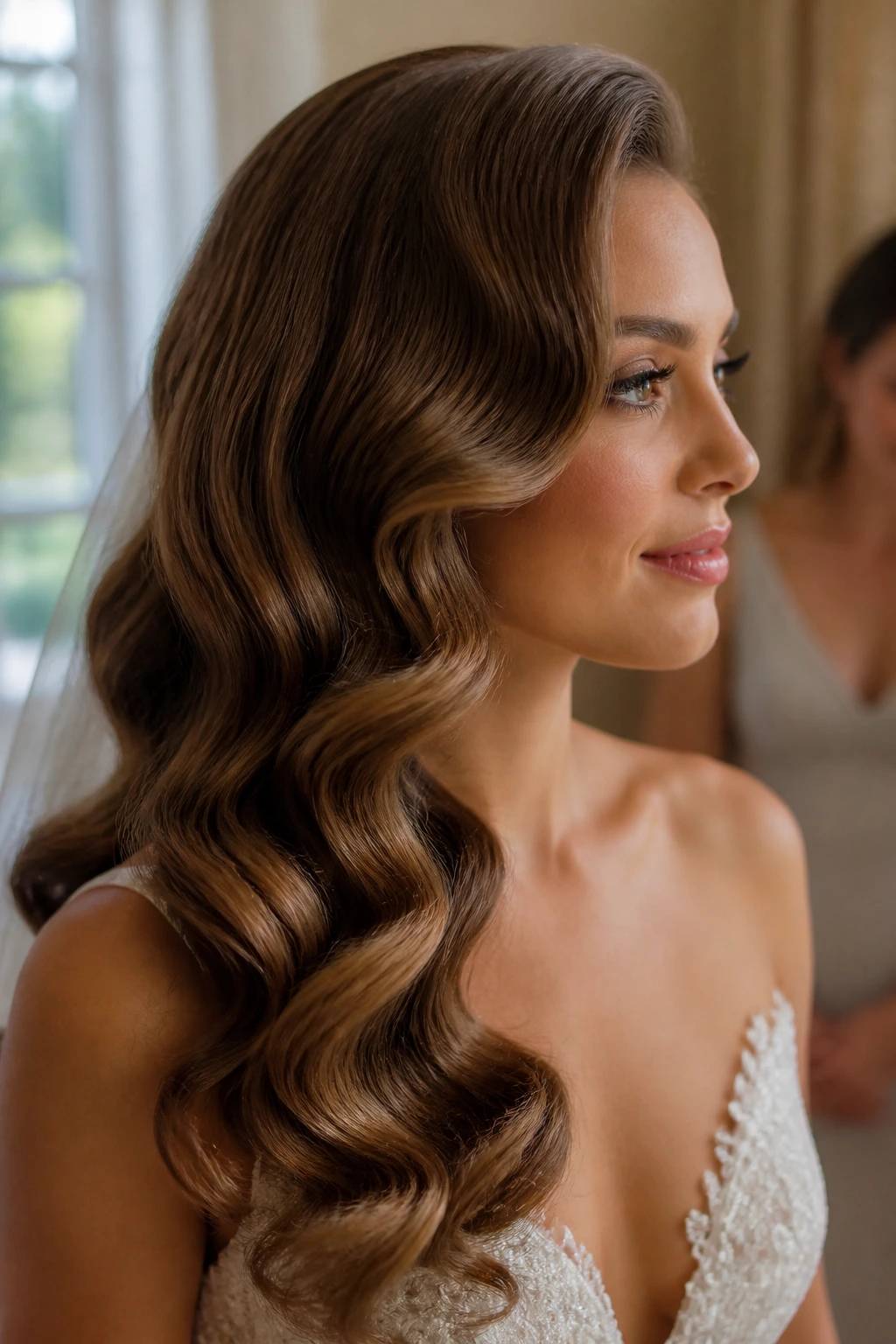
Hollywood waves are the first style I’d hand to a bride who wants movement without chaos. The wave pattern sits in those deep, S-shaped bends that look luxe in person and stay tidy when the camera flash hits. Clip-ins give the mid-lengths and ends enough weight to keep the curve from fraying into fluff.
What makes this style work is the contrast: a smooth side part, polished roots, and all the softness living from the cheekbone down. Clip-ins should be placed low and wide so the wave can drape instead of puffing out at the sides. If the bride’s own hair is fine, I like to leave the top section untouched and use the added length only where the wave needs it most.
The trick is to curl, pin, and cool. Don’t rush that part. Tight setting clips for 10 to 15 minutes make the wave behave much better than simply wrapping hair around a barrel and hoping for the best.
2. Low Chignon With Hidden Wefts
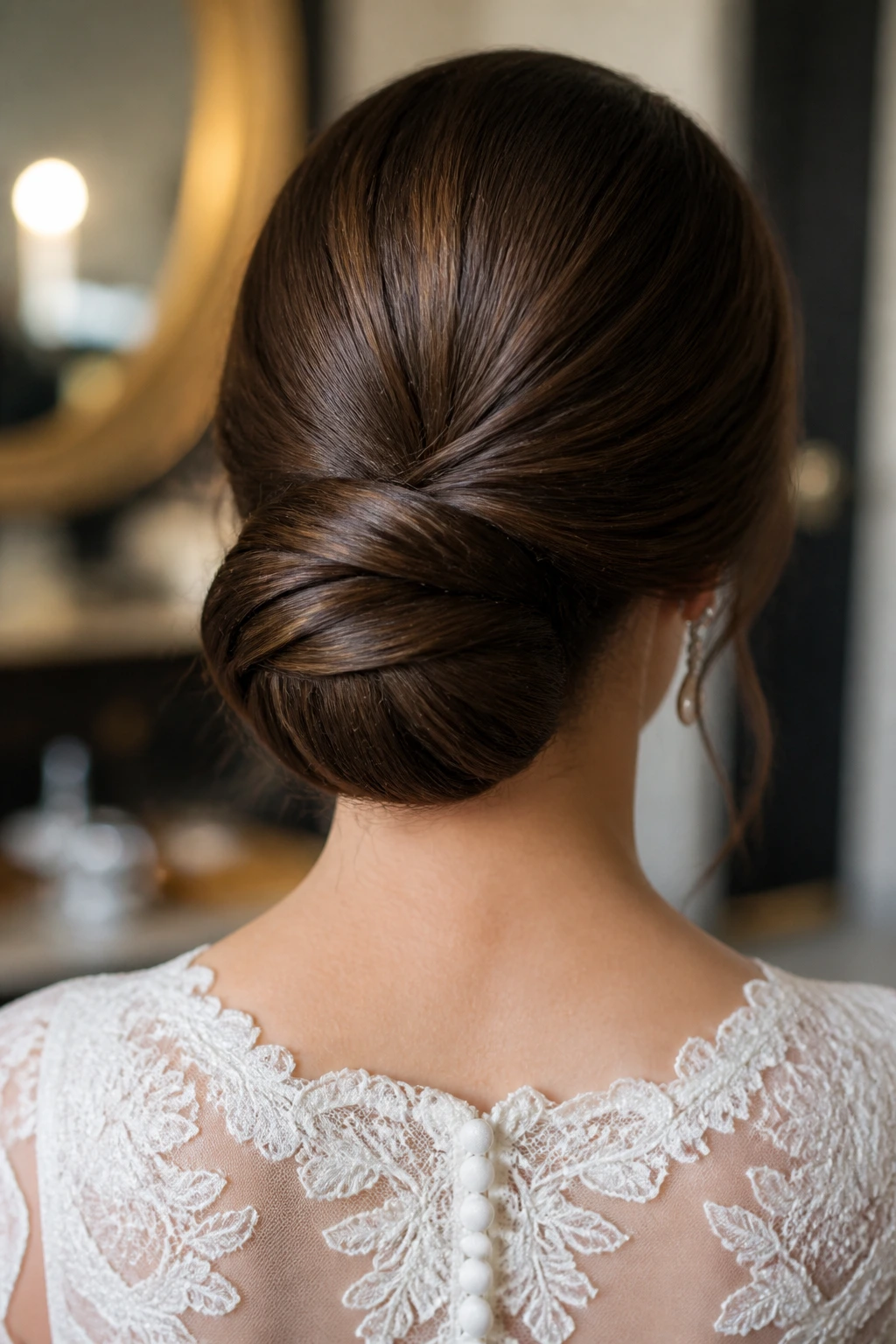
A low chignon looks elegant when it has enough density to read as intentional from the back. Hidden wefts give the knot a little more thickness at the nape, which matters more than people think. Without that foundation, the bun can sit flat and feel more like a pin cushion than a finished bridal style.
This version is especially good under a sheer veil because the shape stays compact. The hair folds over itself instead of stretching out into a long, loose twist. A stylist can tuck the extension hair into the same direction as the natural hair, which keeps the seam from showing when the bride turns her head.
If the dress has a dramatic back or lace detail, this is one of the cleanest choices. The bun frames the neckline without stealing attention from the gown, and that restraint is the whole point.
3. Half-Up Crown Twist With Tape-Ins
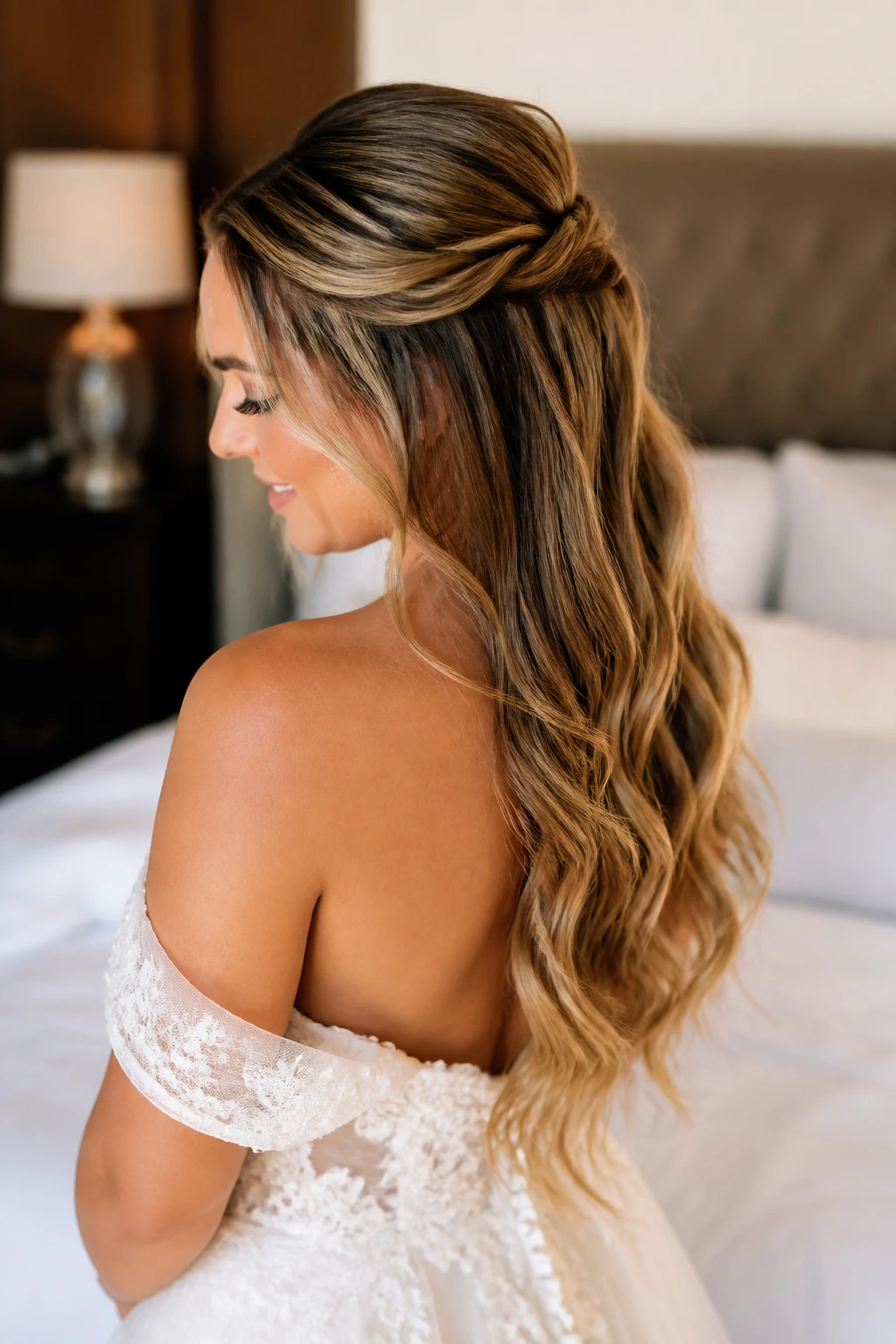
Tape-ins are underrated for half-up styles because they lie flatter than most people expect. That makes them useful when the top section needs lift but the rest of the hair should still move. The crown twist itself gives a soft, lifted shape that opens the face and keeps the ends free for curls or polished bends.
This style works best when the twist starts high enough to show the braid or twist detail, then relaxes into a low fall. The tape-ins help the lower section carry a little more weight, so the length doesn’t look stringy by hour three. That matters if the bride wants the hair to still feel airy after the ceremony and a few rounds of photos.
The cleanest versions use a middle part or a subtle off-center part. Too much volume at the crown can make the whole thing read as bridal hair from another decade. Keep the crown soft. Keep the ends smooth.
4. Sleek Center-Part Low Bun With Invisible Fillers
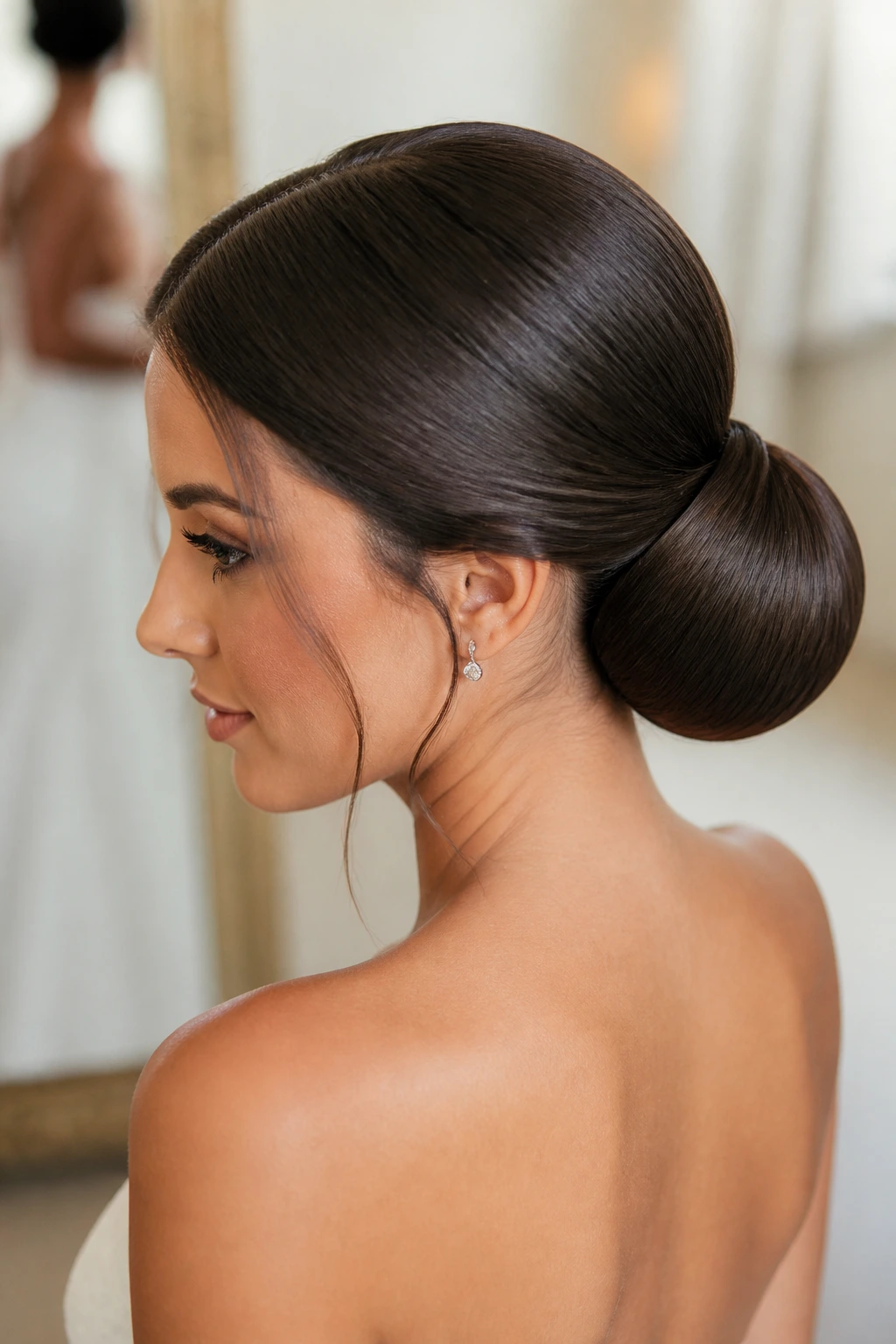
A sleek center-part bun can look spare in a good way, but only if the bun itself has enough size to hold the balance of the face. Invisible fillers—small concealed pieces or discreet extension panels—give the knot more body without turning it into a donut. That extra thickness helps the bun sit neatly at the base of the neck instead of shrinking into the head.
The sharp part is what makes this style modern. Everything else should be clean: brushed-down sides, a polished surface, and a bun that is smooth at the edges but not lacquered to death. A little shine is good. Grease is not.
This is one of the best choices for brides wearing statement earrings or a sculptural neckline. The hair steps back and lets those details do the talking. And yes, it still needs enough hidden fullness to look finished from the side.
5. Waterfall Braid With Extra Length
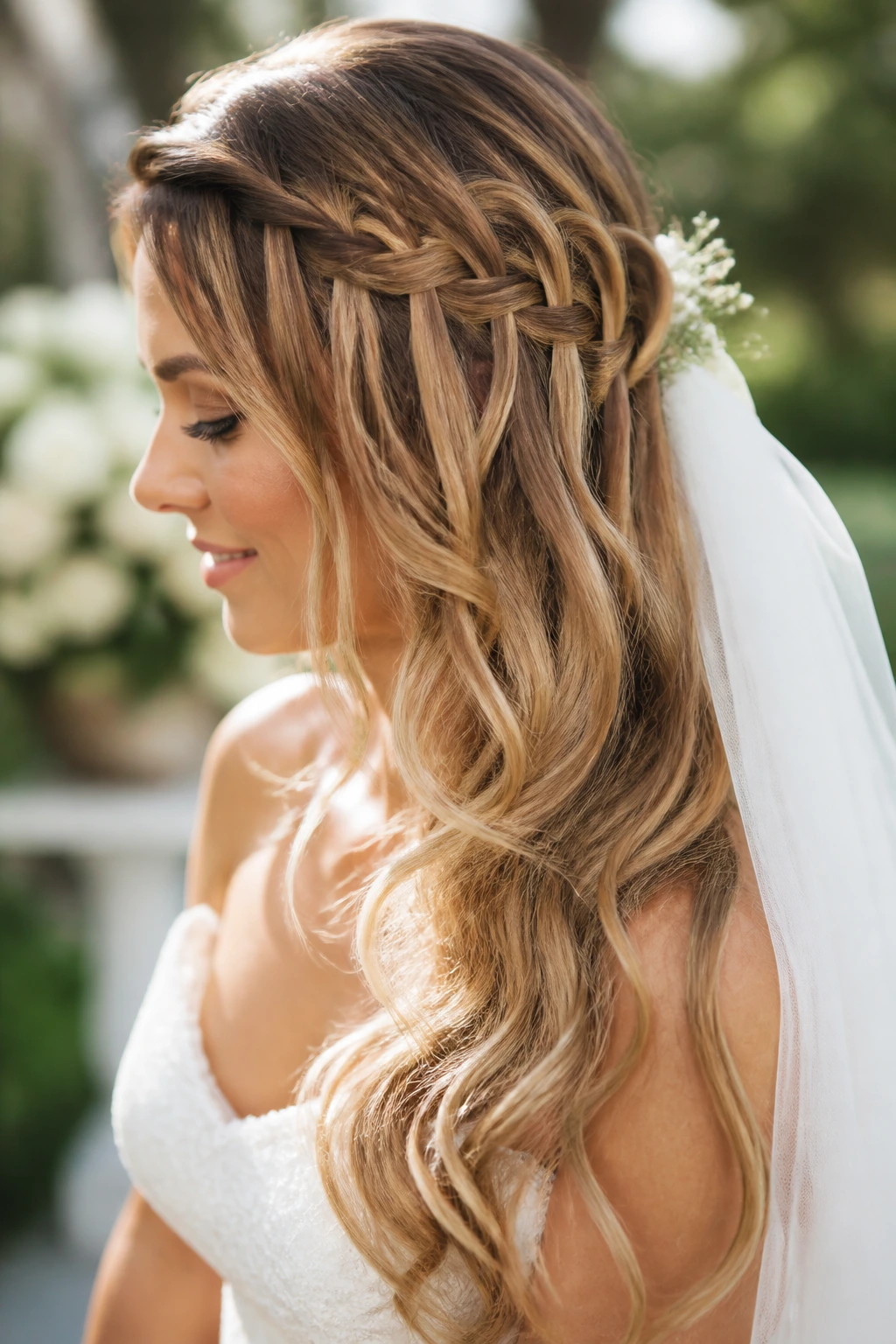
A waterfall braid depends on movement, so it falls apart fast if the hair is too short or too thin. Extra length solves both problems at once. The braid can travel from temple to ear without losing the shape of the dropped strands, and the loosened pieces have enough length to curl into soft ribbons rather than hanging awkwardly.
This style has a gentler feel than a full braid crown. It leaves a lot of hair free, which makes it useful for brides who want romance without a heavy updo. The braid also plays nicely with veil placement, as long as the comb sits below the woven section and not through it.
The best versions use a texture spray before braiding. Not too much. Just enough grit for the fingers to grip the sections cleanly. Straight, slippery hair needs that bit of tooth, or the whole braid starts loosening in the chair.
6. High Ponytail With a Wrap-Around Piece
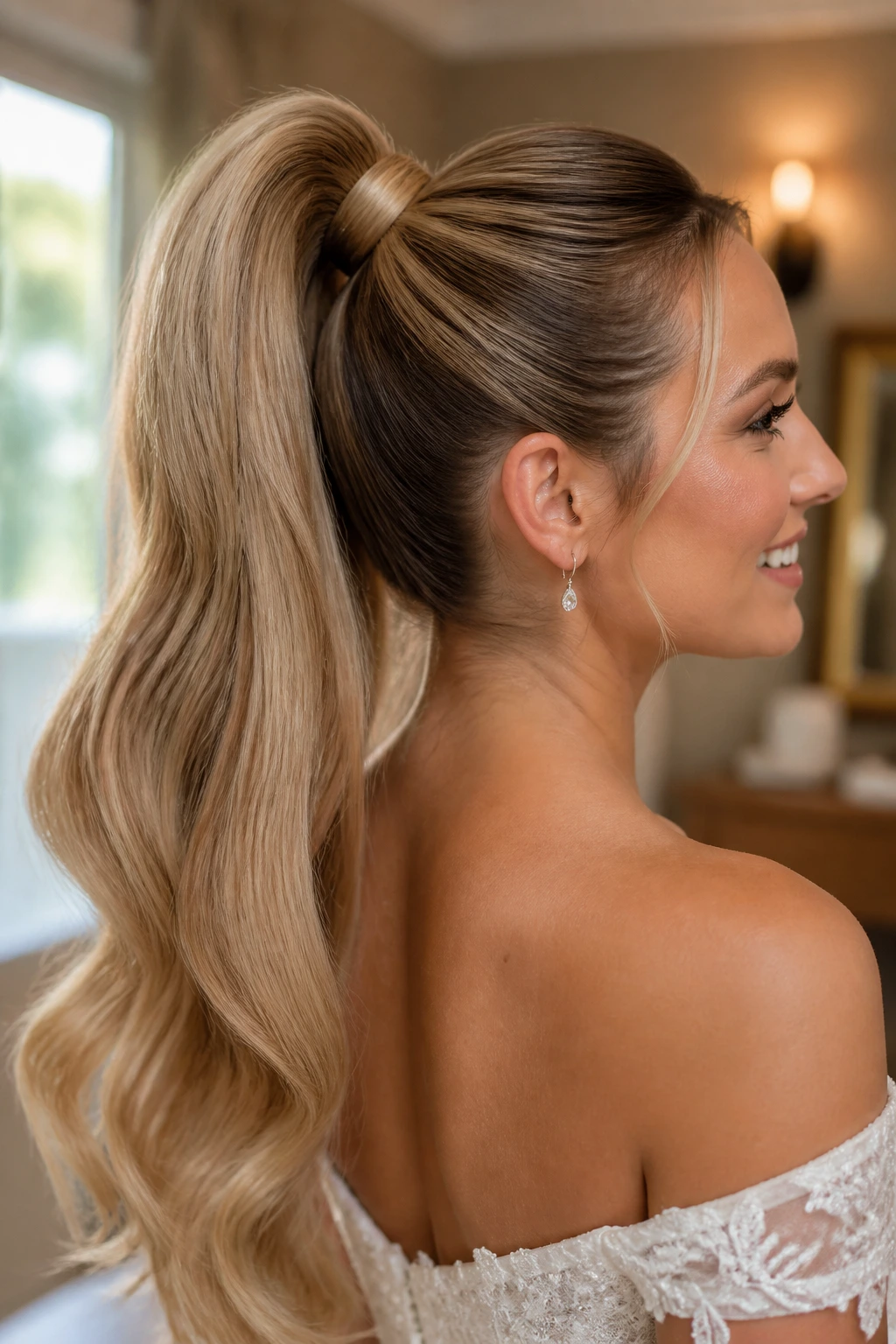
A bridal high ponytail can look sharp, expensive, and slightly dangerous in the best way. The wrap-around extension piece is what gives it that sleek, substantial tail instead of a thin rope. This style is all about height, polish, and a clean swing through the ends.
It works best when the base is tight and the pony is secured with more than one anchor point. A hidden elastic, a few strong pins, and a wrapped section over the band keep the look from sagging halfway through the reception. If the bride wants a glossy finish, the roots should be smoothed before the pony is secured, not after.
I like this style for modern dresses and brides who want their hair off the shoulders but still visible from every angle. It moves well on the dance floor. It also holds up to movement better than a low knot when the air is warm and the night gets busy.
7. Boho Mermaid Waves With Seamless Clip-Ins
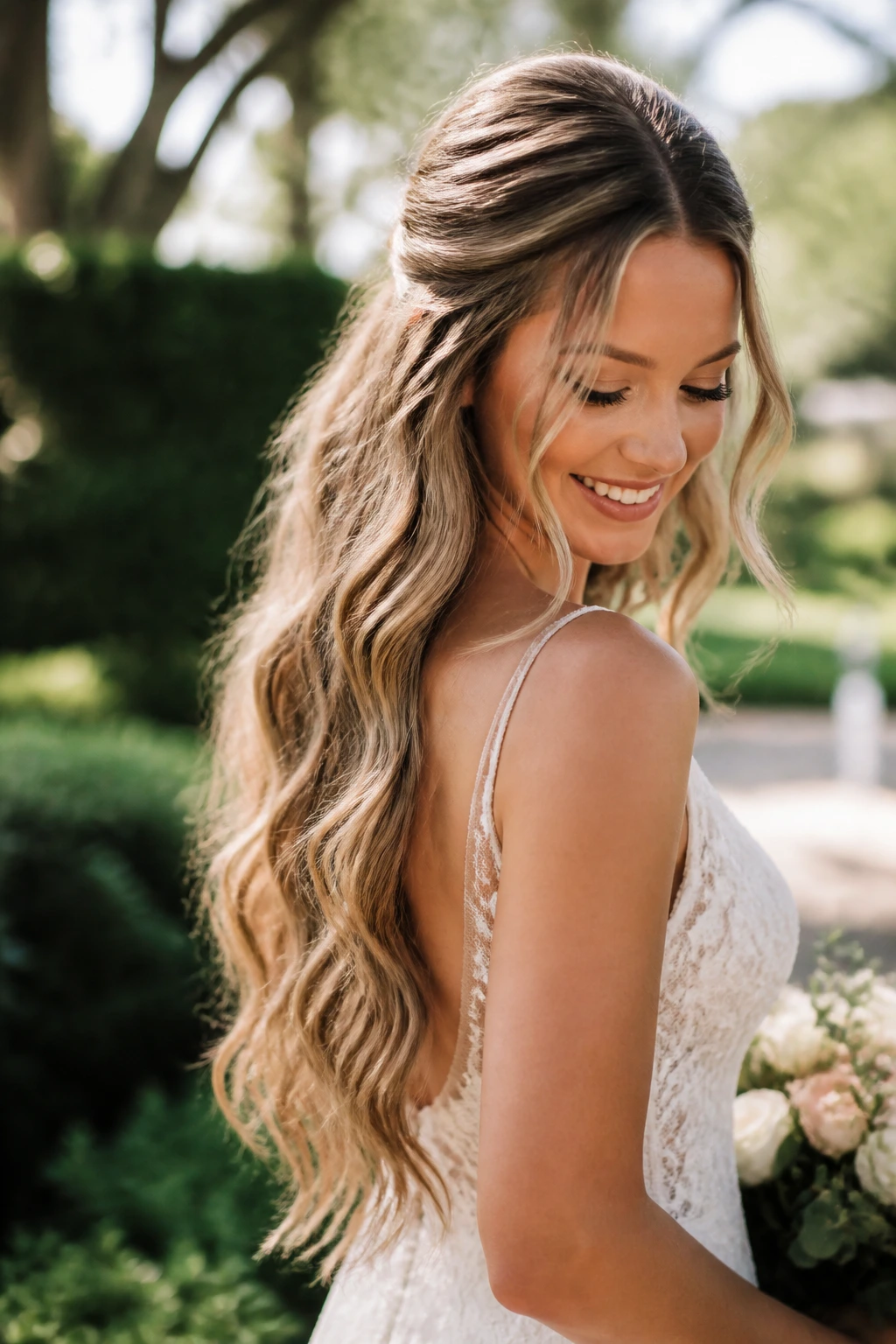
Boho mermaid waves only work if the hair has enough length to drape, not just puff. Seamless clip-ins are useful here because they disappear into the wave pattern and keep the ends from looking chopped. The shape should feel soft and flowing, with a little bend at the ends rather than a tight curl.
This style asks for a careful color match. Any mismatch shows more in loose waves than in an updo, because there’s nowhere to hide the contrast. The finish should lean matte-soft rather than stiff and shiny; too much gloss makes the waves look shellacked, which is a bad look with boho styling.
A few face-framing pieces help, but keep them long enough to blend into the rest of the shape. Short front pieces can break the illusion. That’s one of those annoying little details that matters a lot more than people expect.
8. Braided Halo With Volume Wefts
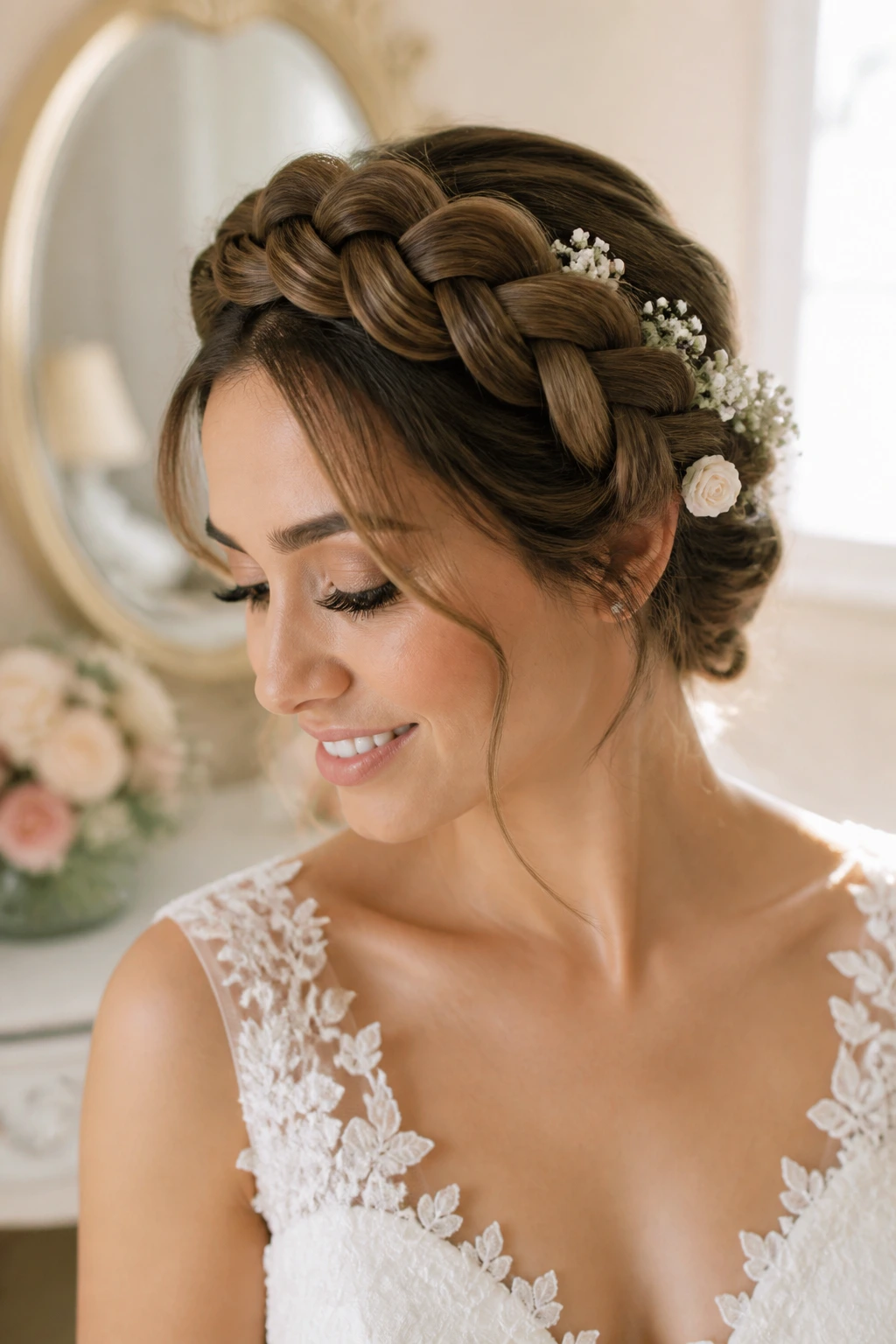
The braided halo is one of those styles that looks intricate but relies on very simple mechanics: fullness at the sides and enough length to wrap around the head once without pulling thin. Volume wefts give the braid more bulk, which keeps the halo from shrinking and exposing the scalp in the spaces between loops.
This is a strong choice for brides who want a crown effect without a literal crown. It also works well with floral pins tucked into the braid, because the braid itself creates small pockets that hold accessories in place. If the braid is too tight, the whole thing can look hard. If it’s too loose, it loses the shape of the halo.
The sweet spot sits in the middle. Rounded, not bulky. Soft, not fuzzy. That balance is what makes it feel bridal instead of just “braided hair.”
9. Side-Swept Curls With a Deep Part
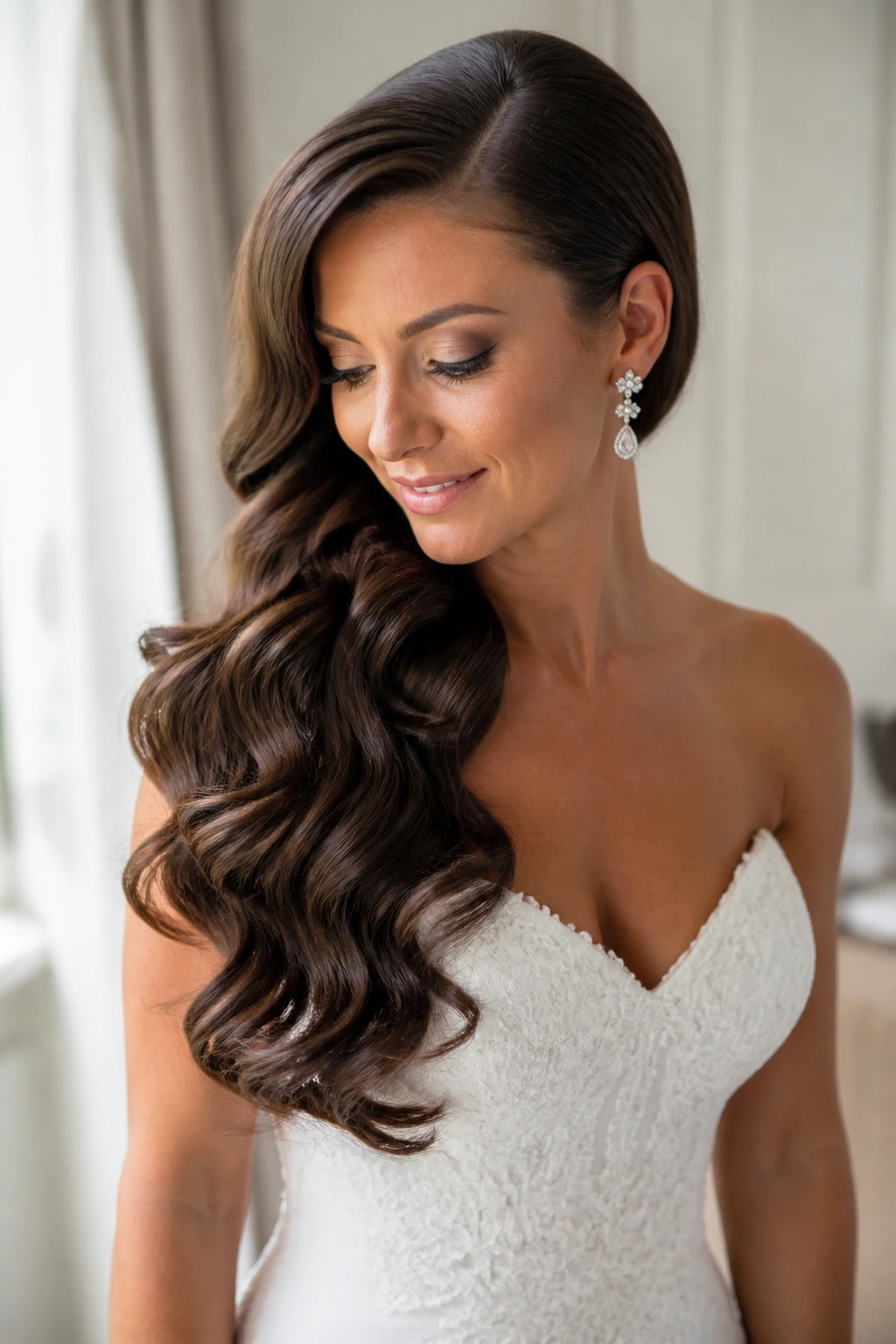
A deep side part can rescue a simple curl set and make it look like styling instead of default hair. When extensions are added beneath the top layer, the curls have enough length to sweep over one shoulder without breaking apart. It’s especially useful for brides who want a little glamour without committing to a full updo.
This style depends on direction. Everything should flow to the same side, from the part to the curl pattern to the placement of the pins. If one section flips away from the rest, the whole look starts to feel accidental. Side-swept hair is unforgiving that way.
The upside is that it works beautifully with strapless or one-shoulder gowns. The hair frames the neckline instead of covering it, and the bridal extensions give the curl enough body to stay visible past the first round of photos.
10. Glossy Blowout With Invisible Layers
Not every bride wants curls. Some want that smooth, expensive-looking blowout with a bend at the ends and movement through the mid-lengths. Invisible layers from extensions help the hair feel fuller without making it look staged. The result is sleek but not flat, which is harder to pull off than it sounds.
A blowout like this needs a good round-brush finish and a careful sectioning plan. If the extensions are too long or too blunt, the style can drag the face down. Layers soften the line and keep the hair from turning into one heavy curtain.
This is one of my favorite choices for brides who want restraint. It feels polished in a way that doesn’t depend on big curls or heavy teasing. And it survives veil removal better than most styles because the shape is built into the cut and the finish, not just the surface.
11. Fishtail Braid With Thickness Added
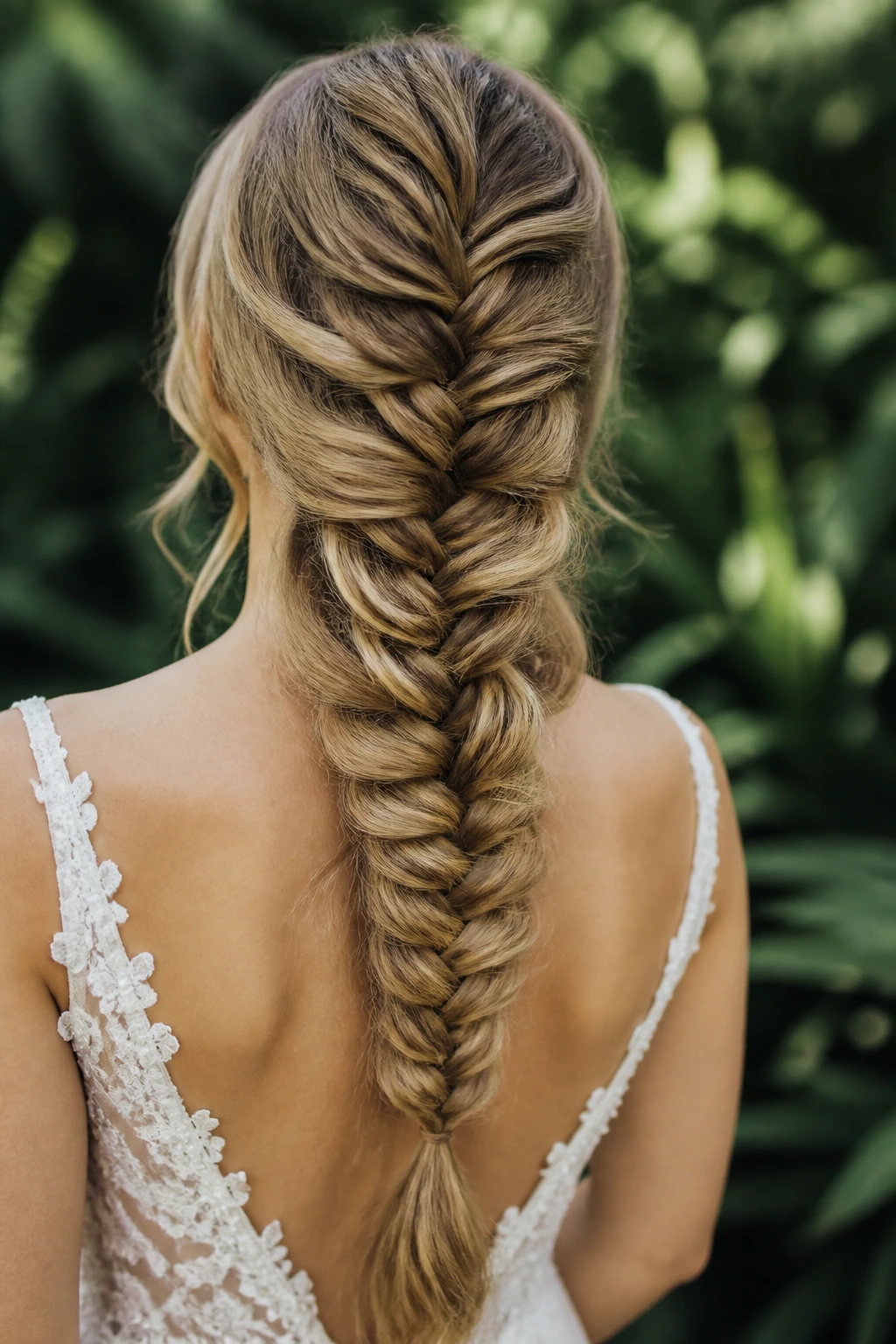
A fishtail braid is gorgeous when it has enough mass to show the woven pattern. Without added thickness, the braid can look narrow and fussy. Extensions fix that by widening the sections so the braid reads clearly from the back, which is where most people will see it.
This style is less about softness and more about texture. The braid should have a slight pull-apart effect once it’s secured, which makes the plaits look fuller and keeps the tail from tapering too hard. A few loose front pieces can soften the face, but I would not overdo them.
Fishtails are good for brides who want something a little less expected than curls. They hold up well if the braid is pinned under the ends, and they make a veil look a touch more modern when the veil is removed for the reception.
12. Twisted Low Knot With a Halo Extension
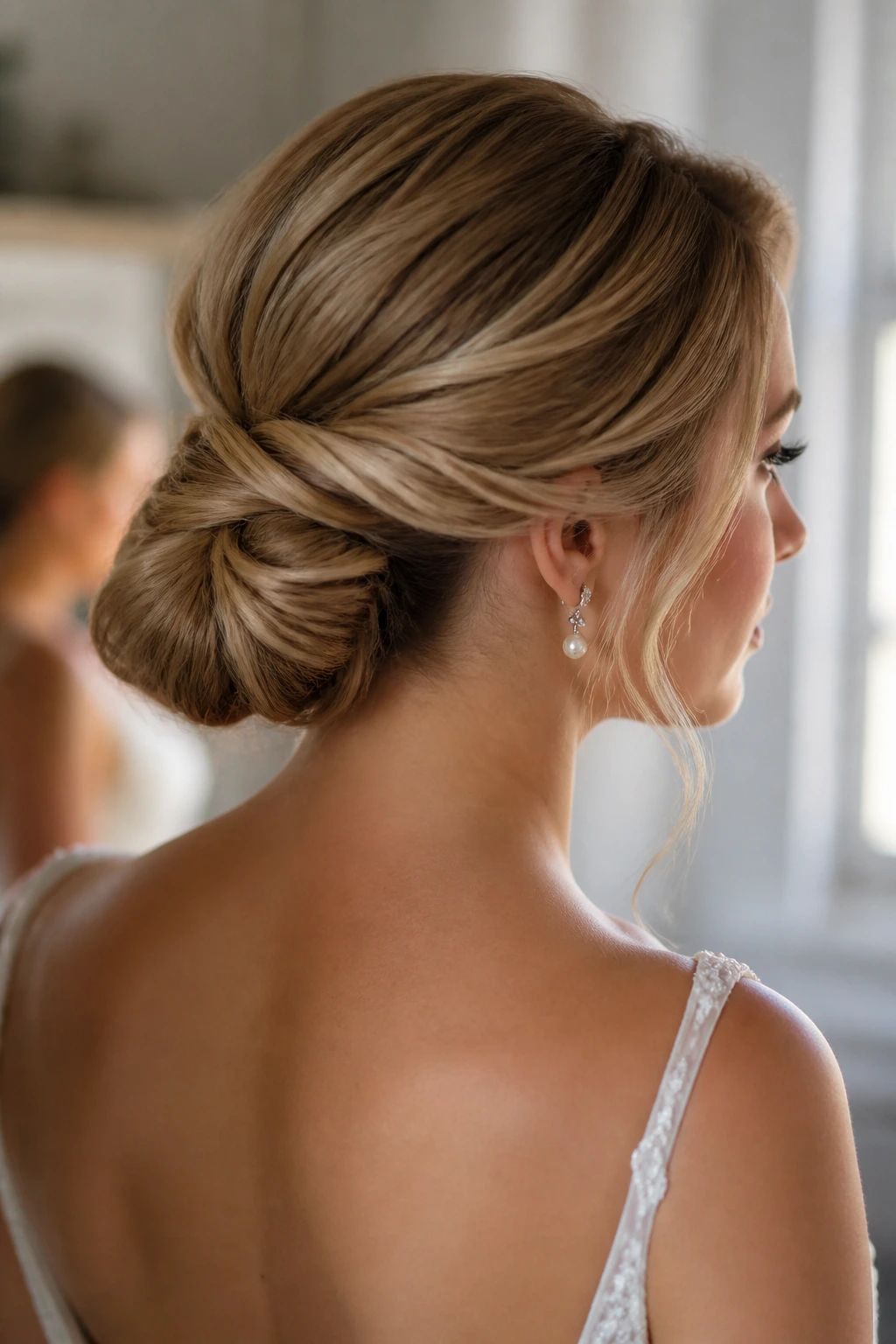
A halo extension is one of the easiest ways to add body for a twisted low knot. It gives the stylist more hair to fold, twist, and tuck without making the head look overloaded. That matters with low knots because too much bulk at the base can feel clumsy.
The halo itself should stay hidden inside the shape, not peek out at the sides. The hair then gets wrapped into a knot that feels soft but controlled, with a little bit of width through the center. Brides with thin ends usually get the best payoff from this style, because the knot looks full even if the natural tail is short.
I like this one for dresses with clean lines. There’s no drama for the sake of drama. Just a knot with enough volume to hold its own.
13. Bubble Ponytail With Full-Length Extensions
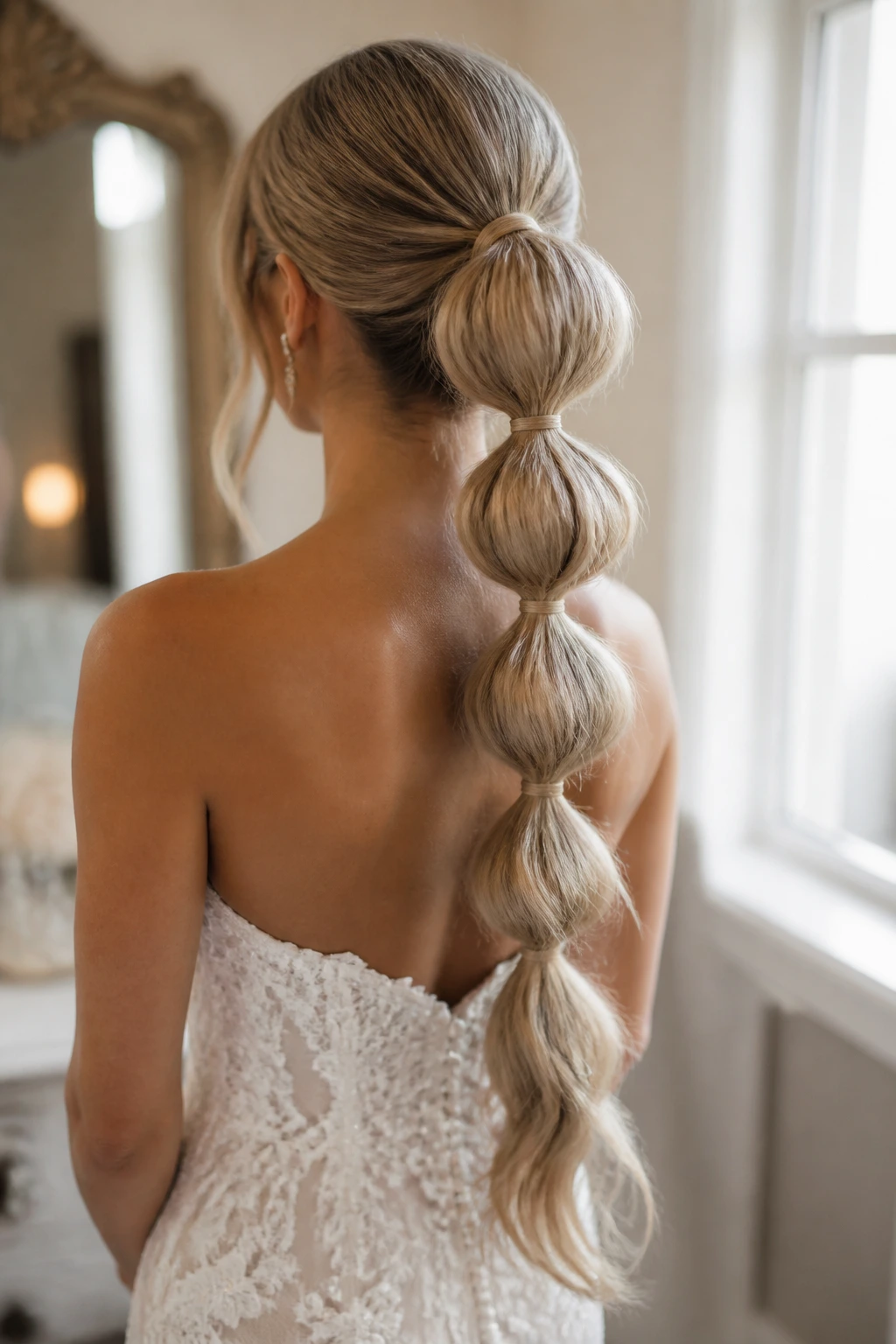
Bubble ponytails have a playful edge, but on a bride they work best when the proportions are neat and the bubbles are evenly spaced. Full-length extensions give each section enough length to puff out without collapsing. Without them, the style can look a little sad halfway down the back.
The key detail is the elastic spacing. Each bubble should have enough room to round out, usually a few inches apart depending on the length of the hair. Then the sections can be gently tugged to build width. Not too much. If the bubbles are over-expanded, the style starts looking messy instead of sculpted.
This is a good pick for brides who want something fashion-forward and a little less soft than waves. It looks strongest with sleek roots and a crisp outfit line.
14. Old-Hollywood Side Bun With Hidden Padding
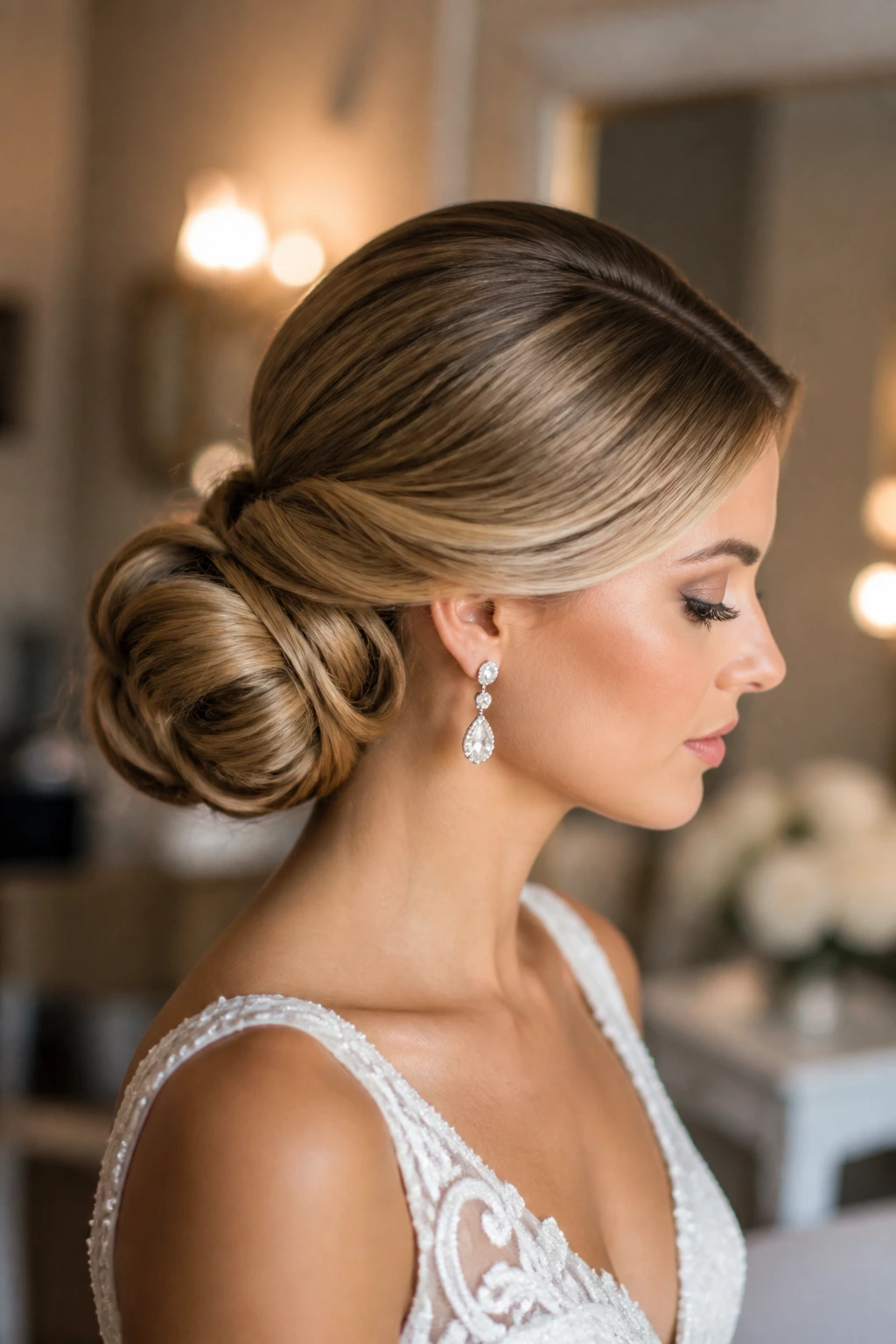
Old-Hollywood side buns have that rich, classic shape that sits low and slightly to one side, close to the jawline. Hidden padding gives the bun the fullness it needs to look elegant rather than pinned-down. The padding also helps keep the curve smooth, which is half the appeal.
This style works best when the front is glossy and controlled, then the bun opens into a rounded shape behind the ear. The side placement creates a strong profile, so the bride should be comfortable with the hair being a major visual element. It does not whisper. It arrives.
Pearl pins or a single comb usually suit this style better than scattered flowers. The bun already has enough presence. Extra clutter can muddy the line.
15. Curly Updo With Ringlet Extensions
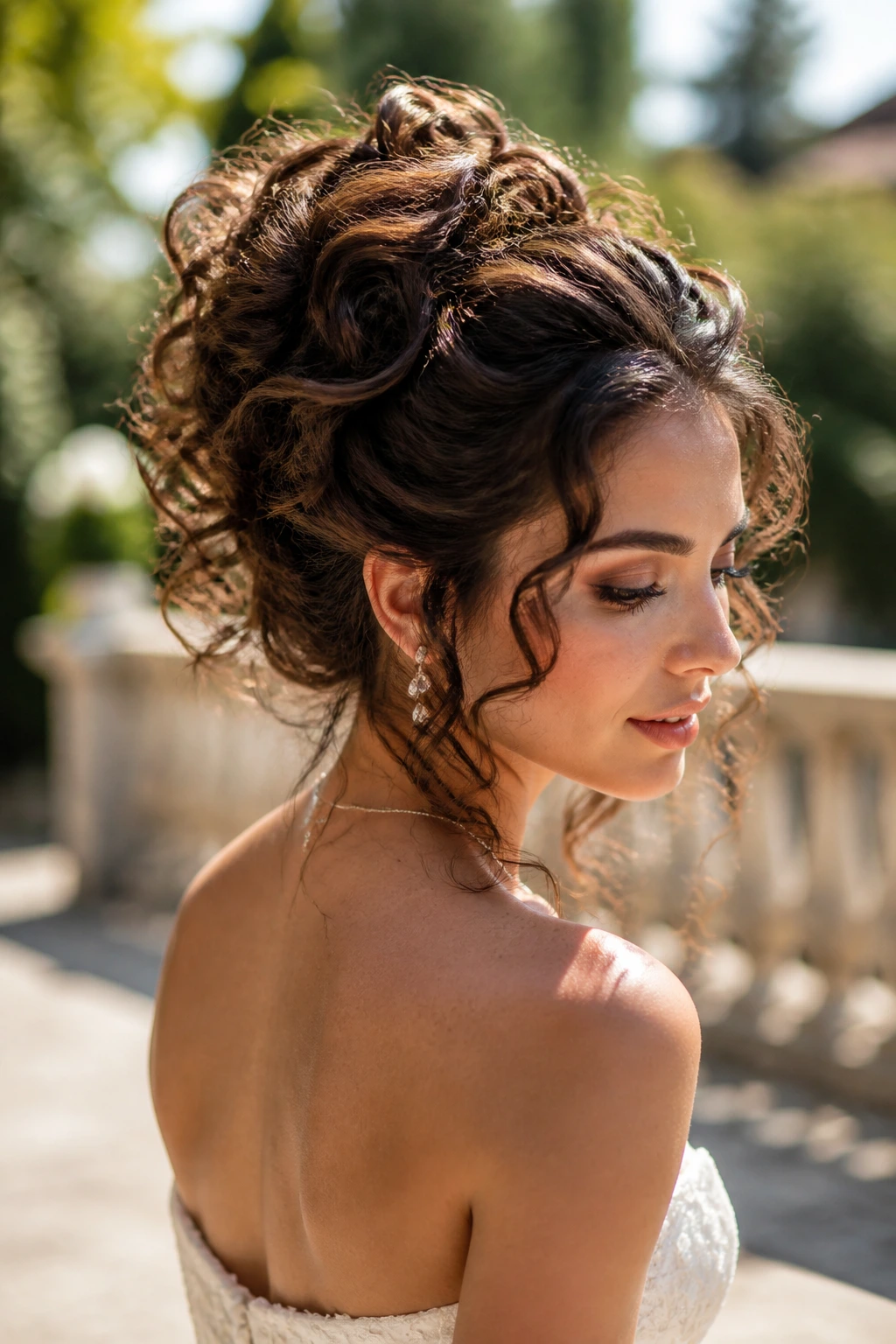
Curly updos need a different kind of extension support because the goal is not smooth length but ringlet density. Curly extensions let the stylist build a soft updo with defined pieces that coil and stack instead of slipping flat. That keeps the shape lively, not stiff.
This is one of the best choices for brides with naturally curly hair who want the updo to stay true to their texture. Matching curl pattern matters more than matching exact length. If the curl is off by too much, the blend becomes obvious fast, especially around the temple and nape.
The finished shape should leave a few tendrils loose near the face and around the ears. Too much control makes curly bridal hair look boxed in. A little movement keeps it human.
16. Modern Bridal Bob With Hidden Fillers
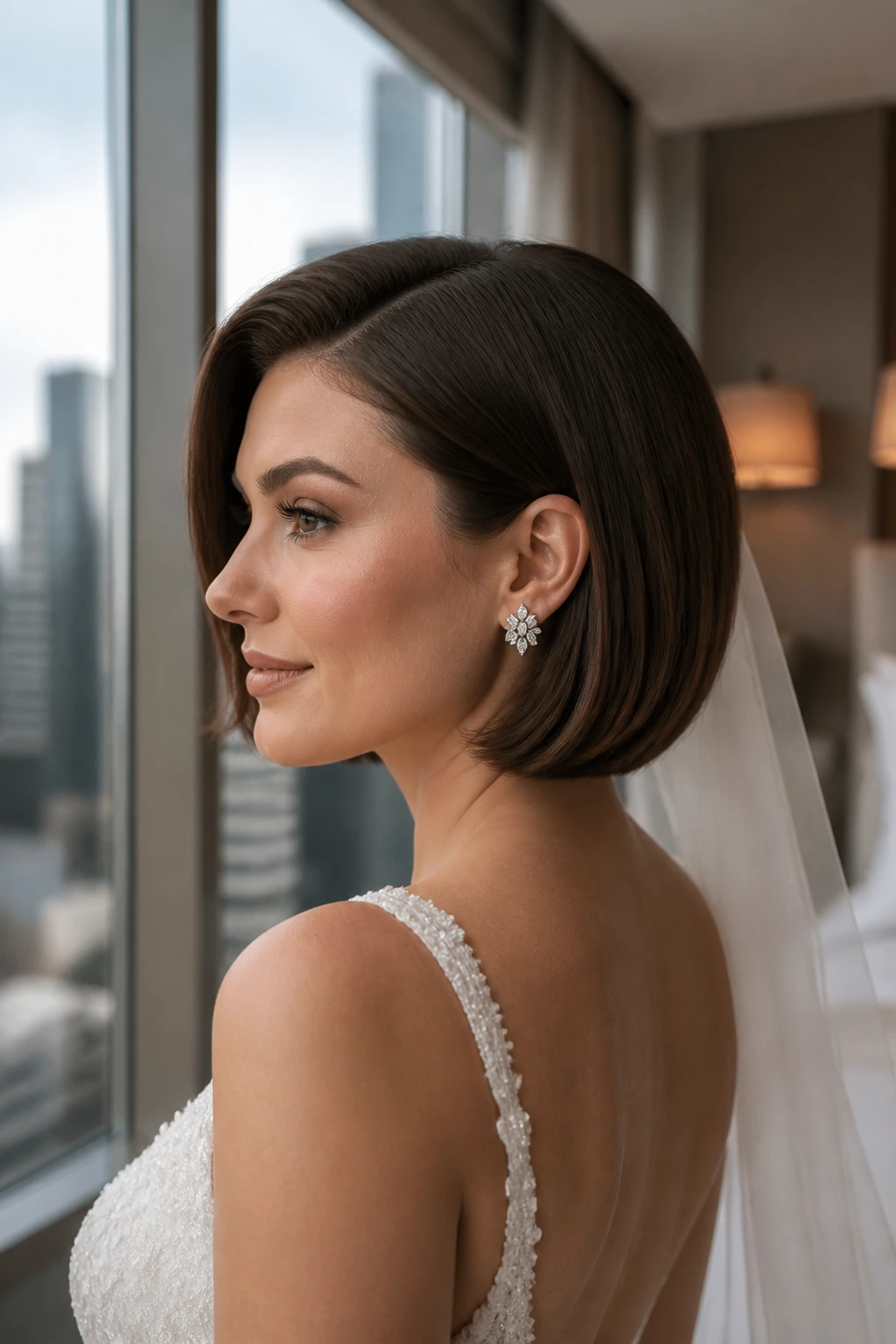
A bob doesn’t need to stay small. Hidden fillers can add enough internal volume to turn a short cut into a polished bridal shape without pretending it’s long hair. That can mean a rounded tuck, a sculpted wave, or a brushed-under finish with a clean side part.
This style is useful for brides who do not want to spend the day wrestling with borrowed length. It keeps the hair close to the head while giving the silhouette more weight. The best part is how fresh it looks. Short bridal hair can feel sharp and elegant in a way that long waves sometimes don’t.
The main challenge is balance. The filler pieces should support the shape, not become the shape. If the bob starts to look stuffed, the whole thing loses credibility. Keep it neat. Let the cut do some of the work.
17. Half-Up Bow Braid With Clip-Ins
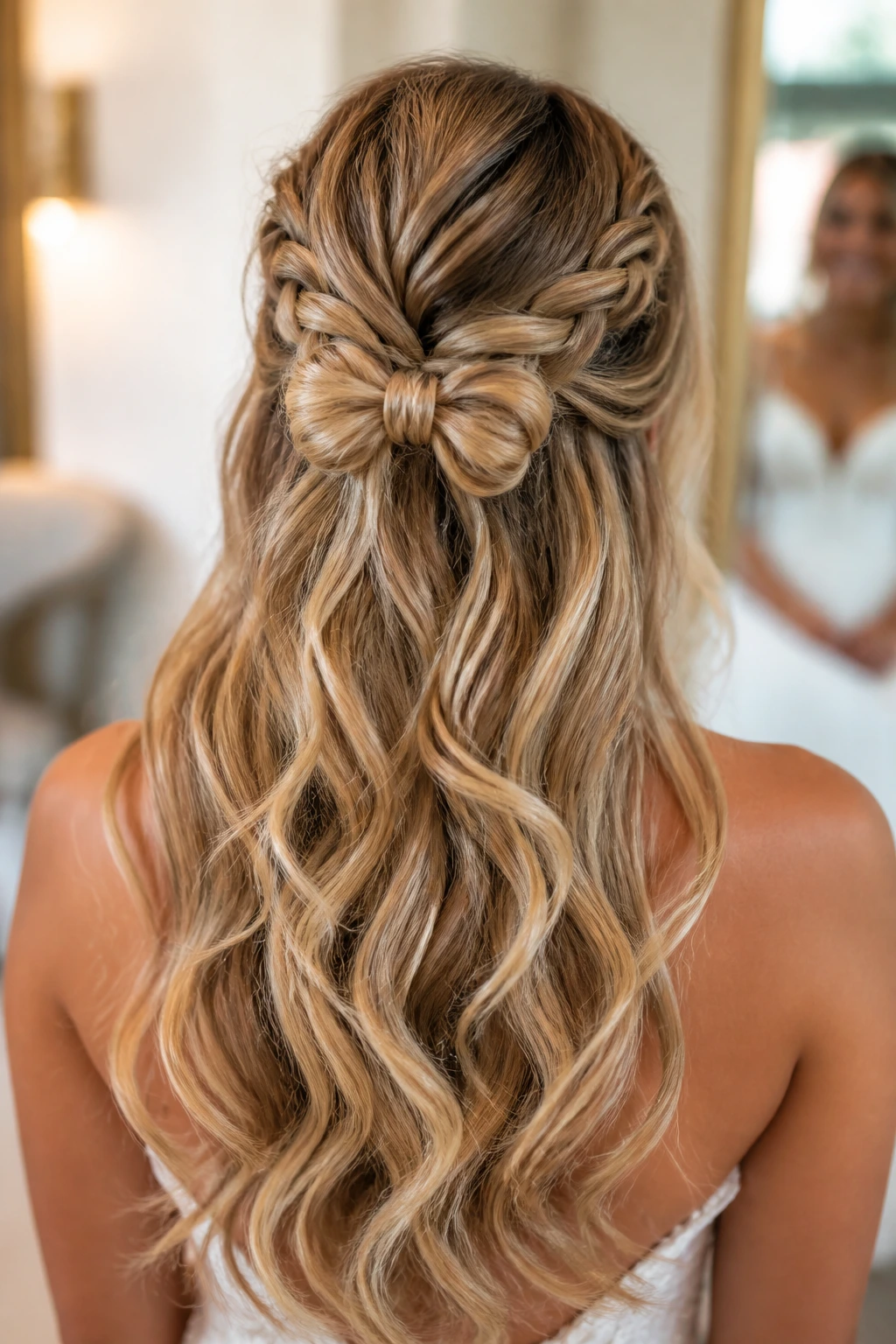
The bow braid looks whimsical, but it needs enough hair to hold its loops cleanly. Clip-ins provide the length and thickness that make the bow shape read from the back instead of collapsing into a twist. The top half stays controlled, while the lower half can drop in soft waves or a straight tail.
This style suits brides who want something a little sweet without drifting into costume territory. The key is proportion. The loops should be rounded but not oversized, and the strands should be smooth enough that the braid looks intentional, not accidental.
A bow braid also gives you a nice spot for a small accessory, though I’d keep it restrained. The braid itself is already doing a lot of visual work.
18. Gilded Braid Crown With Micro Wefts
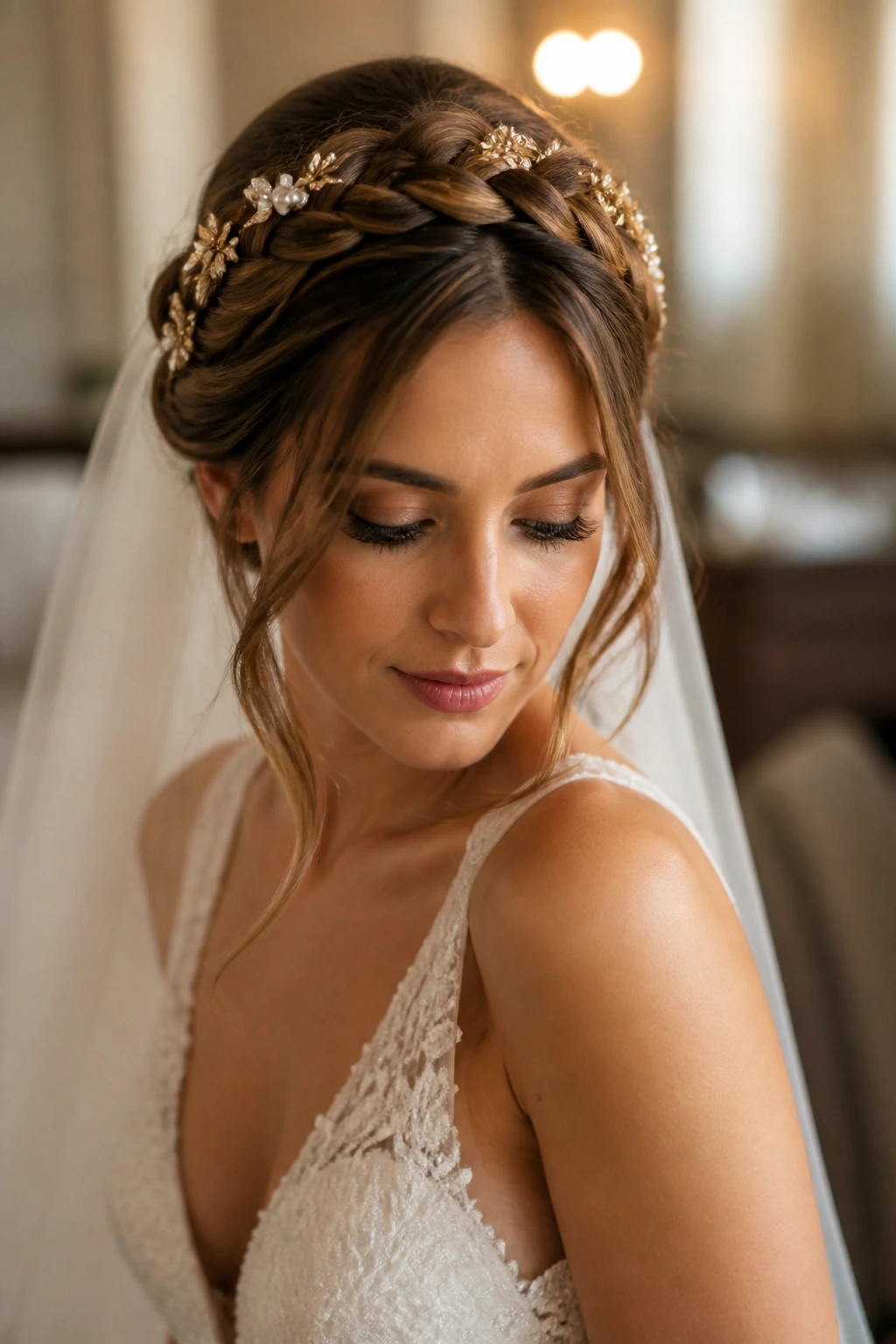
A braid crown with micro wefts has a lovely, controlled thickness that makes the braid look architectural. The micro wefts sit low enough to stay hidden, but they give the braid enough meat to wrap around the head without gaps. That is the whole battle with crown styles: too thin and the braid reads weak, too thick and it feels heavy.
This version works well with metallic hairpins, tiny pearls, or a narrow headband woven into the braid. The braid creates a frame around the face, which is useful if the bride wants to show off makeup or earrings. It also keeps the neck open, so the gown remains visible.
There’s something very tidy about this one. It feels composed from every angle, which matters when guests circle around for photos.
19. Soft S-Wave With a Sew-In Foundation
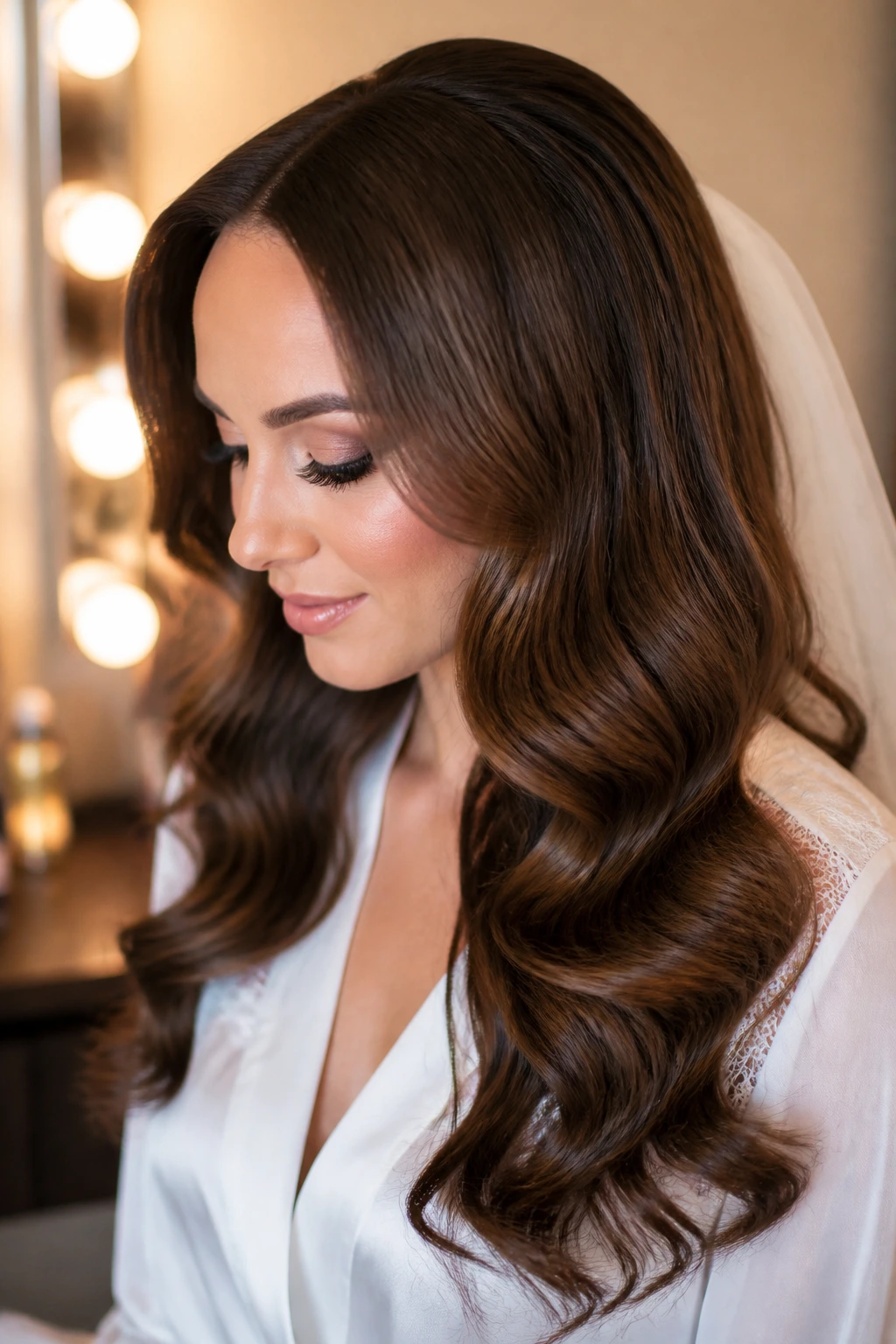
A sew-in foundation gives S-waves a steadier base than clip-ins sometimes can. The hair lies flatter at the roots, then bends into soft, repeating curves that hold their line through the day. Brides with thick or coarse natural hair often get a particularly clean result because the sew-in anchors the style from underneath.
This is not a style you choose for speed. It takes planning and a careful braid pattern or base track, but the payoff is stability. The waves keep their shape better when the hair is already supported at the scalp, and that matters if the ceremony runs long or the weather turns damp.
I like this option for brides who want quiet glamour. It has a smoothness to it that feels expensive without trying too hard.
20. Low French Twist With Extra Density
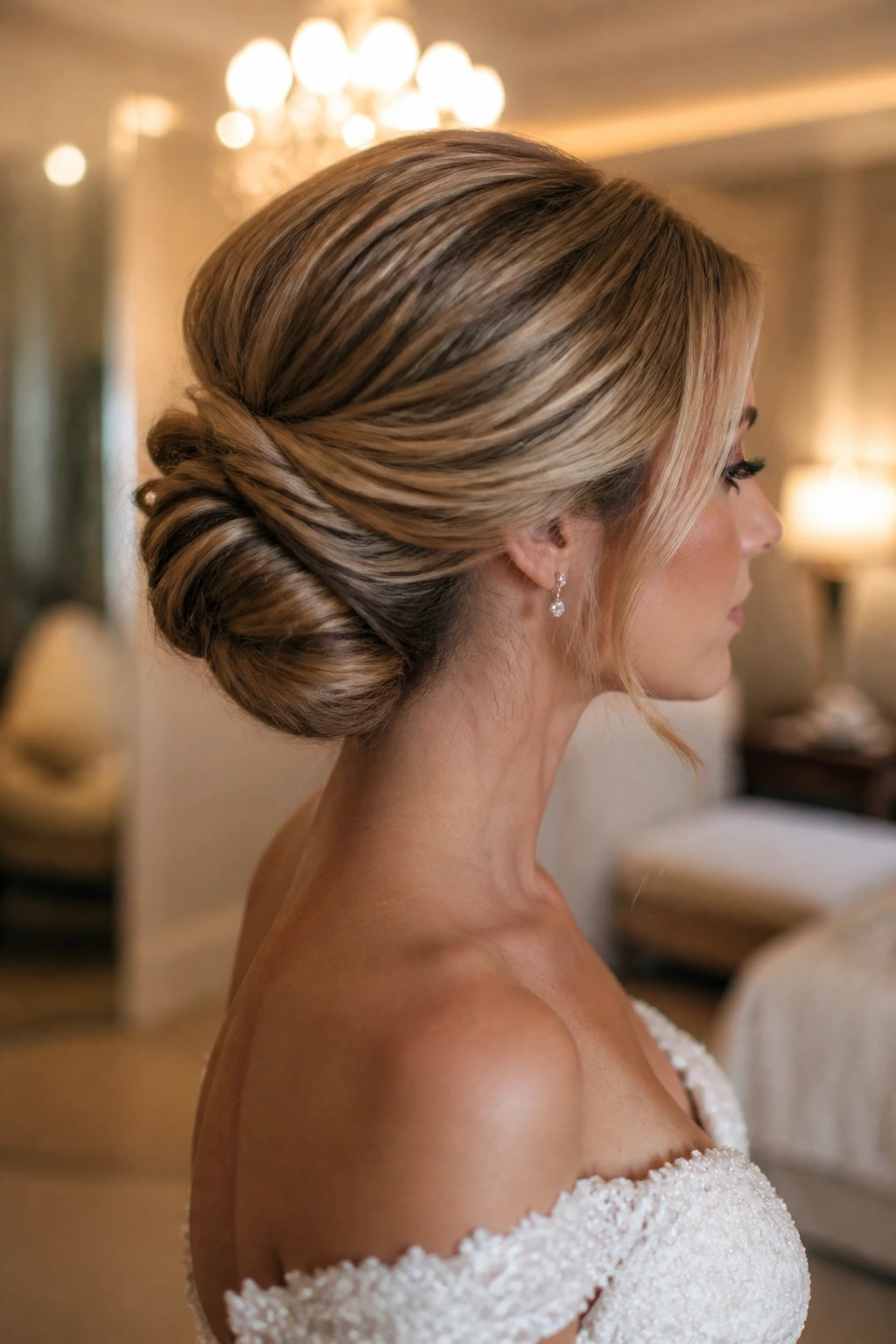
A French twist becomes bridal when it has enough density to fill out the vertical line. Extra hair gives the twist body through the center, which keeps it from turning into a narrow roll. The shape should be smooth on the outside and solid in the middle, almost like a folded ribbon.
This is one of those styles that looks simple until you try to do it on thin hair. Then the gaps show up fast. Extensions solve that by giving the twist enough volume to pin securely and enough mass to keep the silhouette clean from the side.
The best versions leave the ends hidden, tucked neatly into the fold. That creates a very tidy finish, which is exactly what the style needs. No frizz. No soft drift. Just a controlled line.
21. Braided Ponytail Cascade
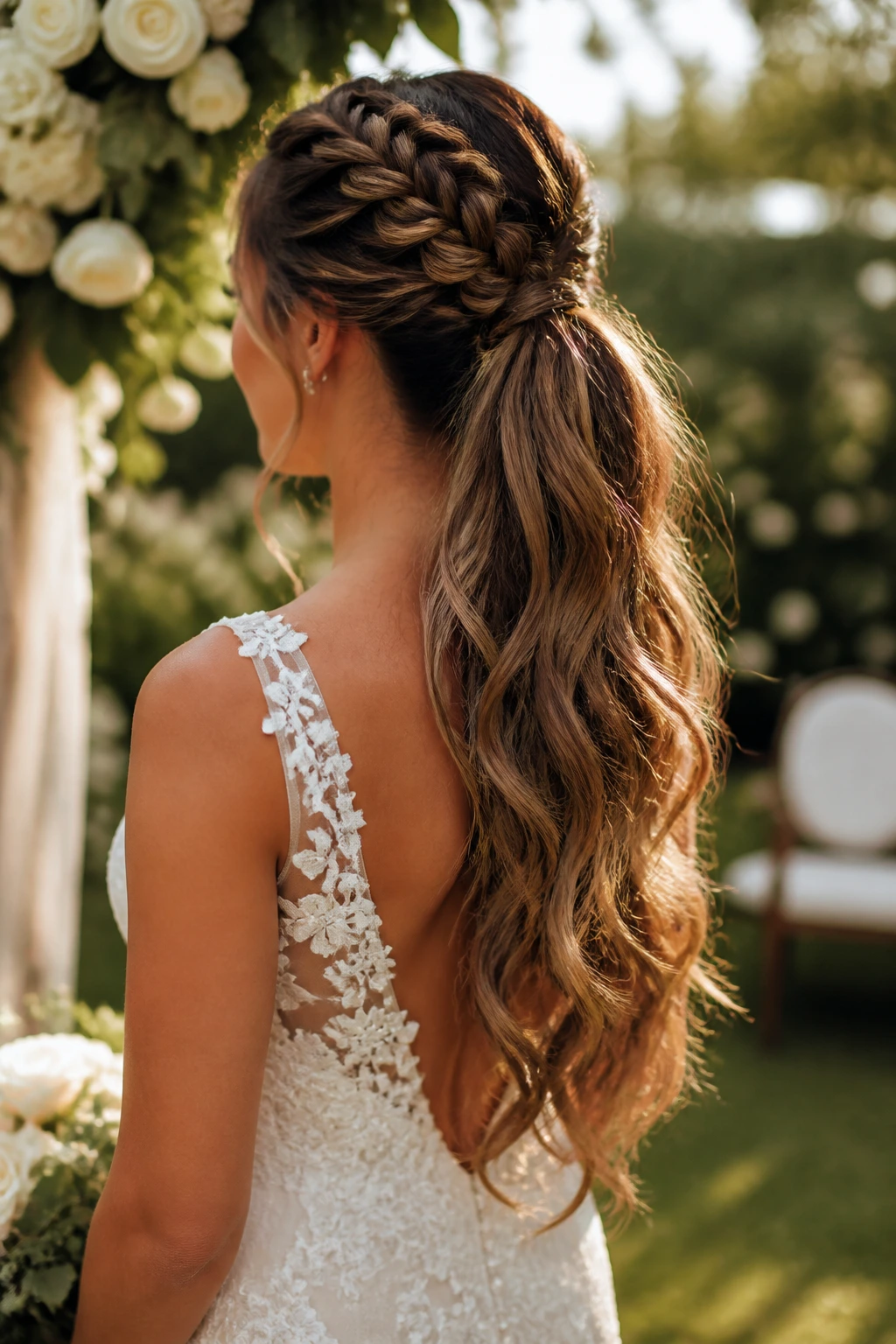
A braided ponytail cascade has a lot going on, and that’s the appeal. The braid adds structure at the top, then the ponytail drops into a longer, thicker fall. Extensions give the tail enough length to keep the braid from swallowing the rest of the style.
This is a strong choice for brides who want something that feels active and alive. It has movement in the tail, grip at the braid, and a clear profile from behind. That makes it work for both indoor and outdoor ceremonies, especially when the hair needs to survive wind or a long day of dancing.
A small bit of texture at the base helps the braid hold. Too smooth and the style slips. Too rough and it starts to look overworked. The sweet spot is controlled but not stiff.
22. Textured Top Knot With Invisible Volume
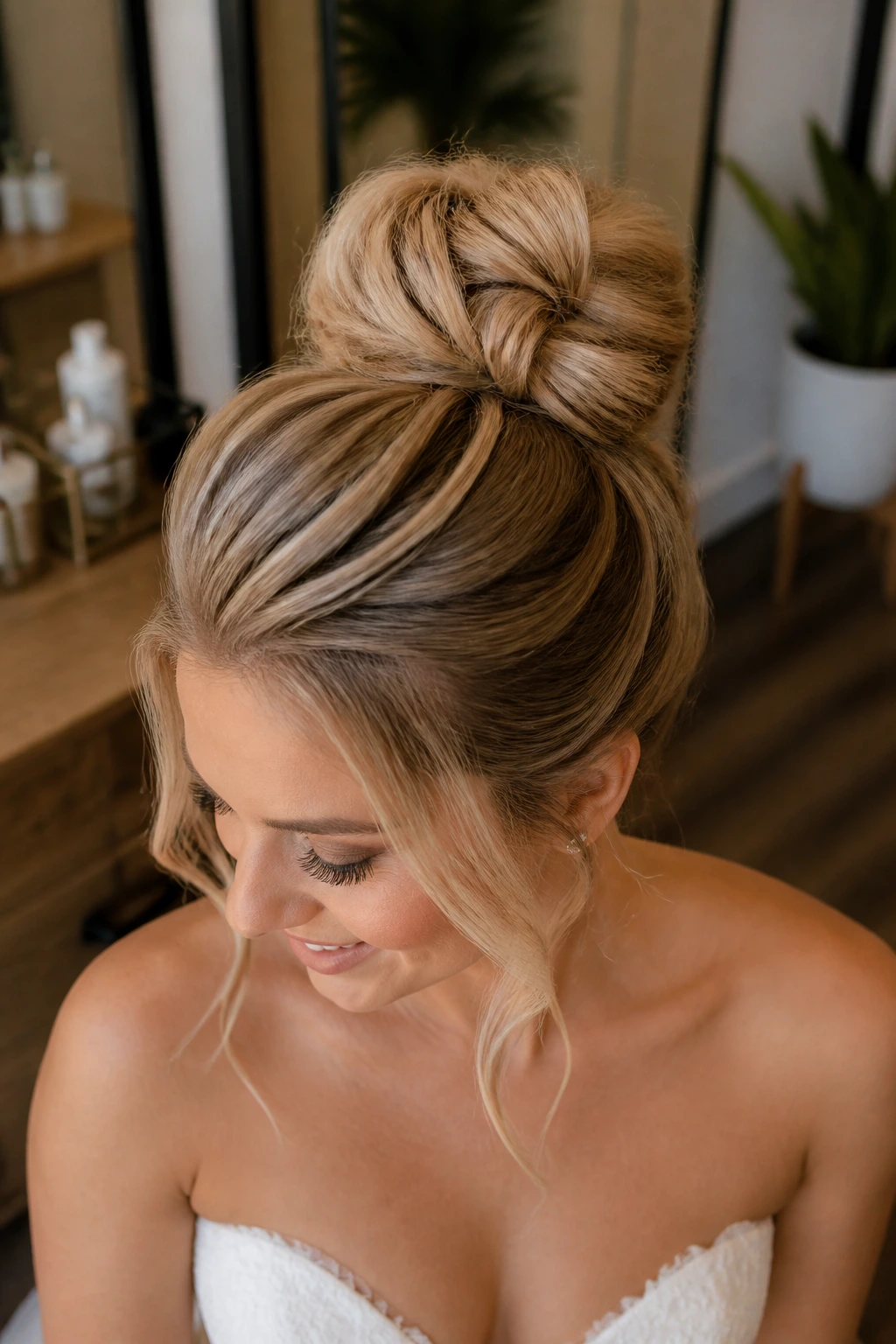
A textured top knot can look effortless, but it’s really a shape problem. Invisible volume pieces help the knot sit high enough and full enough without turning the head into a giant ball. The goal is soft height, not a bulky lump.
This style is useful for brides who want the neck and shoulders open. It also works with dresses that have detail up top, since the knot stays out of the way. The best top knots have a few loose ends and a little lift at the crown, which keeps them from looking too severe.
The trick is to build the knot in layers. First the base. Then the volume. Then the soft tugging at the edges. Skip the last part and the style reads stiff.
23. Romantic Lob With Face-Framing Pieces
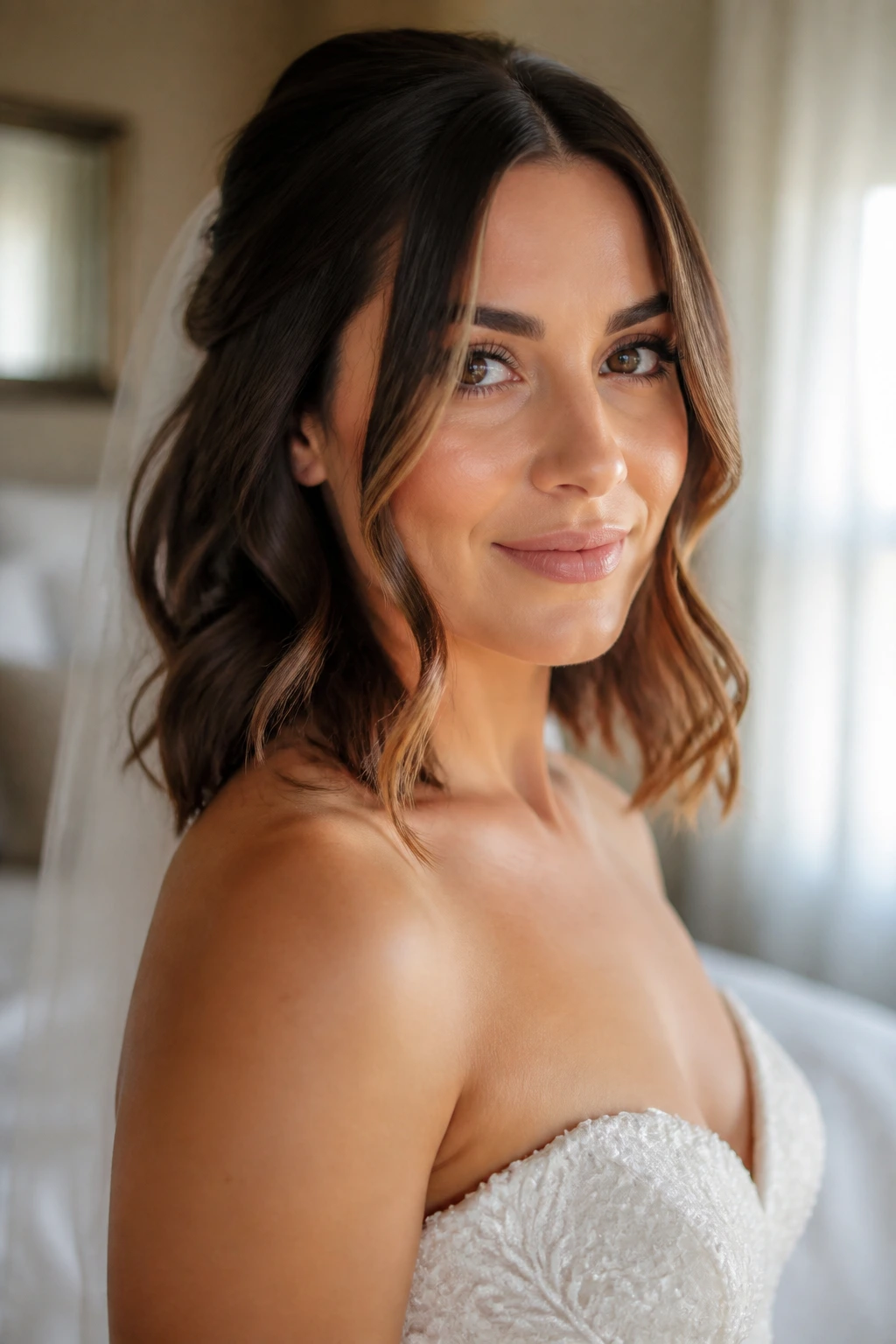
A lob can be one of the prettiest bridal lengths because it sits right in that middle ground between short and long. Face-framing extension pieces help elongate the front so the style feels deliberate, not chopped. Soft bends through the ends keep the line airy.
This is a smart option for brides who want movement without committing to dramatic length. It works especially well with delicate earrings or a neckline that benefits from some framing around the collarbone. The hair should hover, not hang.
A good lob style also ages well through the day. It does not depend on one giant curl pattern that falls apart by dinner. The shape is simpler than that, which is part of why it works.
24. Mermaid Braid With Long Extensions
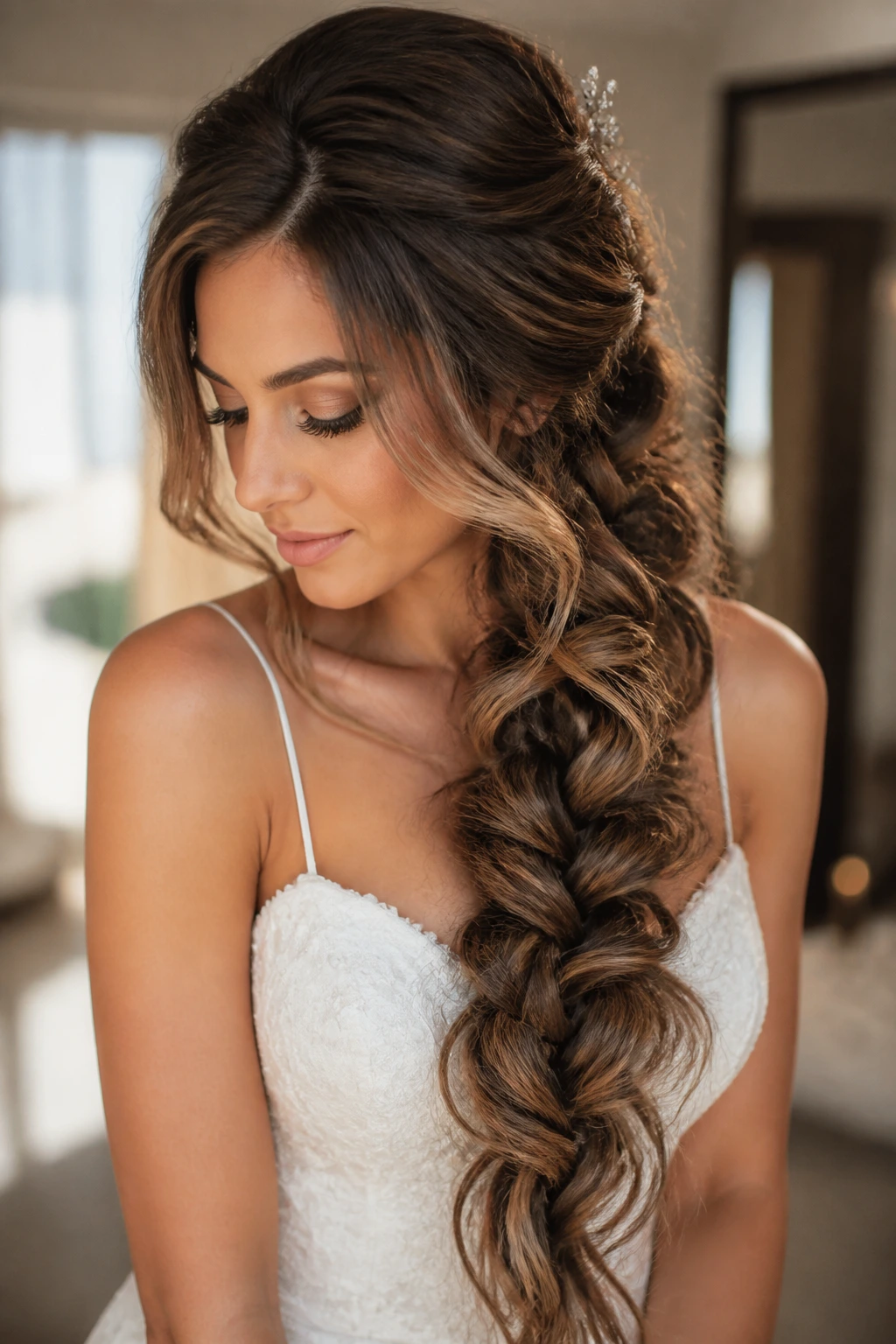
A mermaid braid needs serious length to show off its scale. Long extensions make the braid wider and longer, so the sections stay visible all the way down. The braid should look substantial from the start, then loosen slightly as it drops.
This style has a dreamy quality, but it is not fragile if it’s pinned well at the base. The real trick is keeping the braid from flattening. Long extensions fix that by building enough mass for the braid to hold its own. A few face pieces can soften the front, though I’d keep them long and curved rather than short and chopped.
If the bride wants a braid that reads from the back of the aisle, this one does it. The shape has presence.
25. Minimalist Sleek Bun With Hidden Extensions
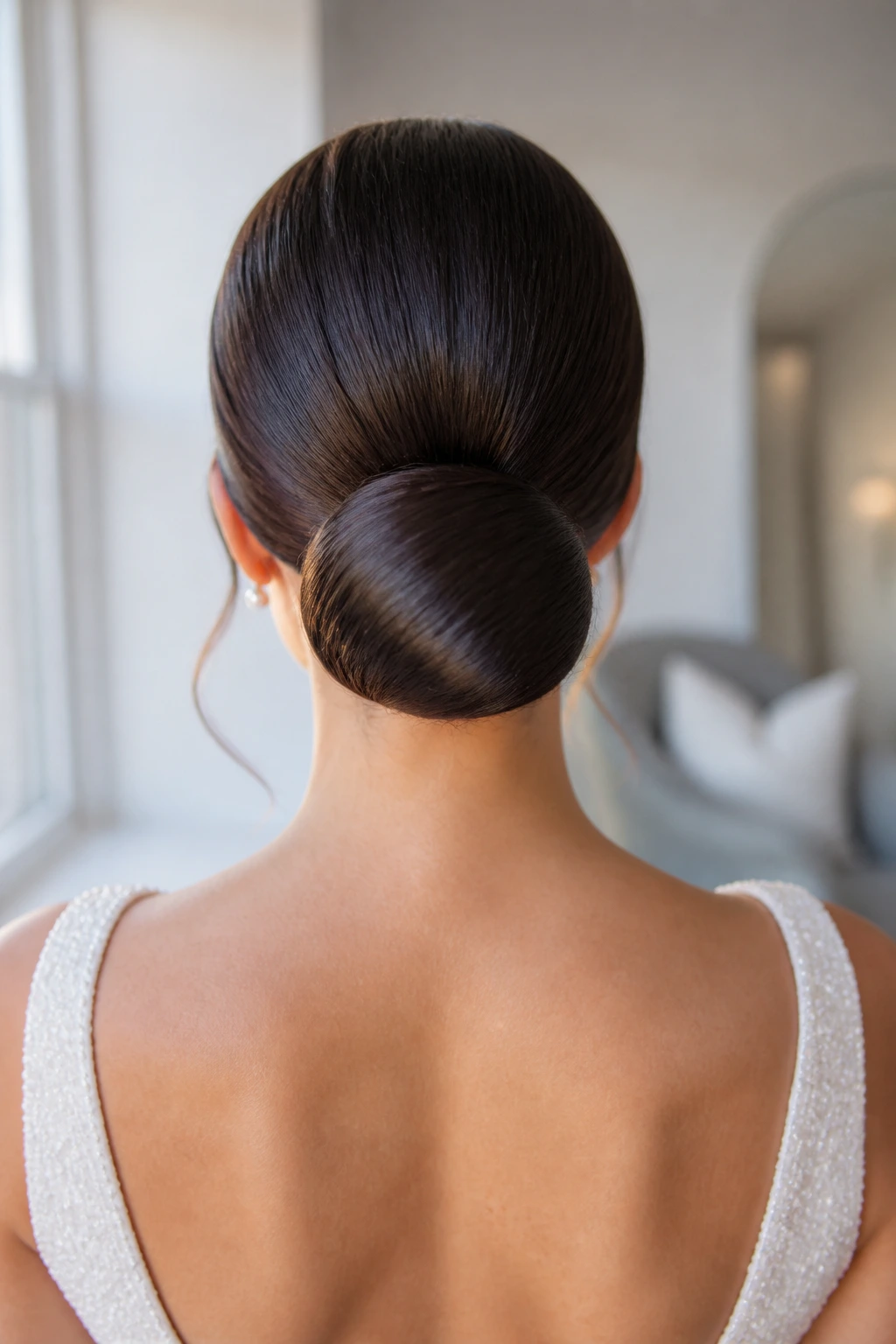
A minimalist bun sounds easy until the hair is too thin for the silhouette to hold. Hidden extensions solve the problem quietly. They let the bun stay compact while still having enough size to look finished against a gown or veil.
This style is all about restraint. No loose curls. No visible teasing. Just a smooth surface, a centered or slightly off-center placement, and a rounded bun that sits cleanly at the back of the head. The finish should feel deliberate and calm.
It’s a strong choice for brides who want the dress and face to take priority. The bun supports the look instead of competing with it. That’s not boring. That’s good editing.
26. Floral Half-Up With Extension Padding
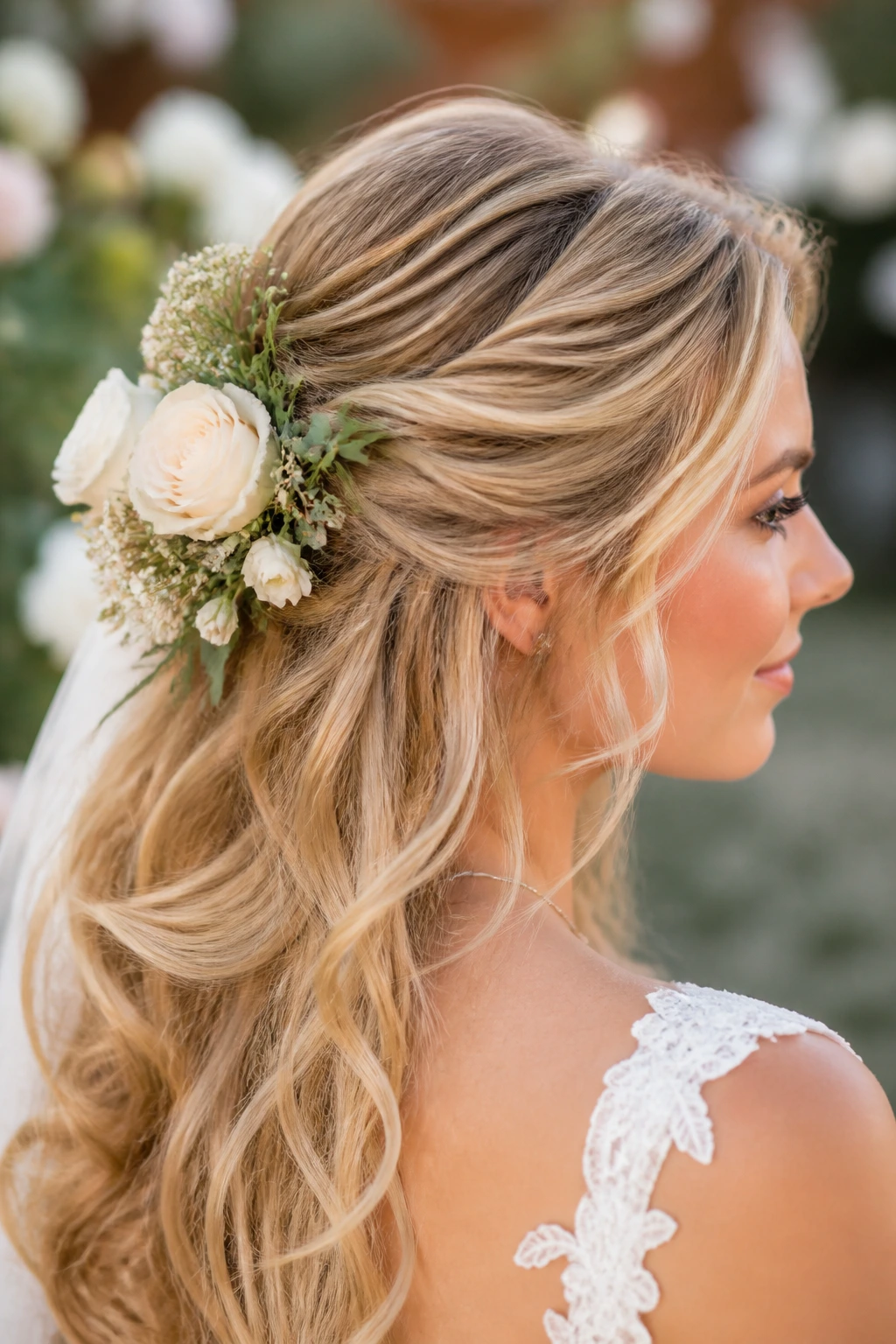
A floral half-up style needs padding more than people expect. Flowers look best when they have a solid base to sit on, and extension padding gives the top section enough width for pins and blooms to hold. Without that support, florals can look crowded or droop after a couple of hours.
This style is especially useful for outdoor ceremonies or softer dresses. The half-up structure leaves the length free, while the top section creates a platform for one larger bloom or a cluster of tiny ones. The extensions also help the lower curls keep their shape once the flowers are added, which is often where the style falls apart.
Keep the floral placement controlled. Too many blooms and the hair starts looking like the bouquet wandered onto the head.
27. Tousled Side Braid With Layered Wefts
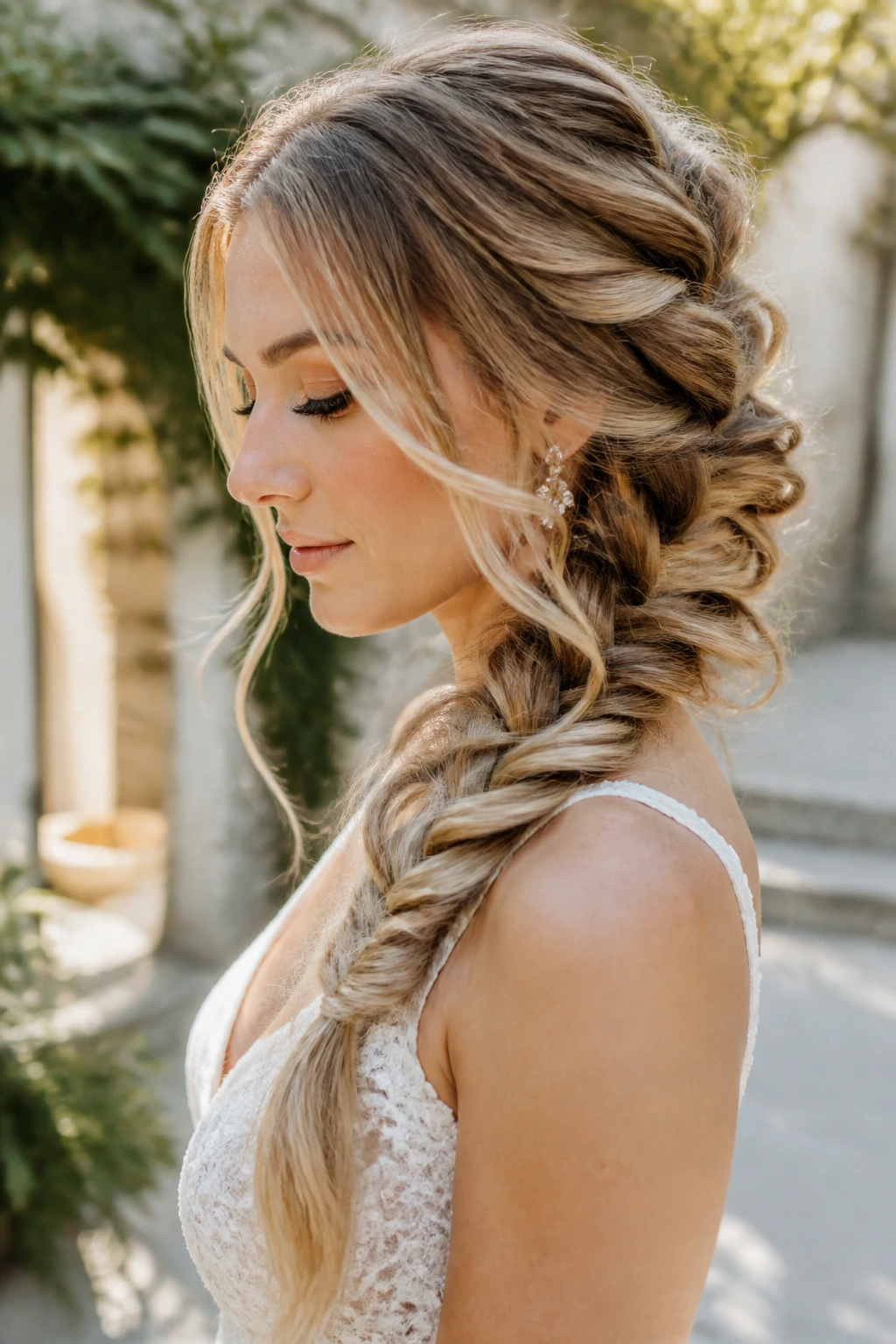
A tousled side braid works best when the braid has layered fullness, not one blunt mass. Layered wefts help the braid taper naturally while still looking thick through the center. That gives the whole style a softer, more lived-in shape.
This one sits somewhere between romantic and practical. It keeps hair mostly gathered to one side, which is nice for movement and for showing off earrings or a neckline. The loose texture should be deliberate, though. Tugging pieces out at random makes the braid lose its line.
I’d reach for this when the bride wants a relaxed finish that still reads polished in photos. It’s less formal than a crown braid and less rigid than a sleek plait.
28. Veil-Ready Polished Curls With Extension Support
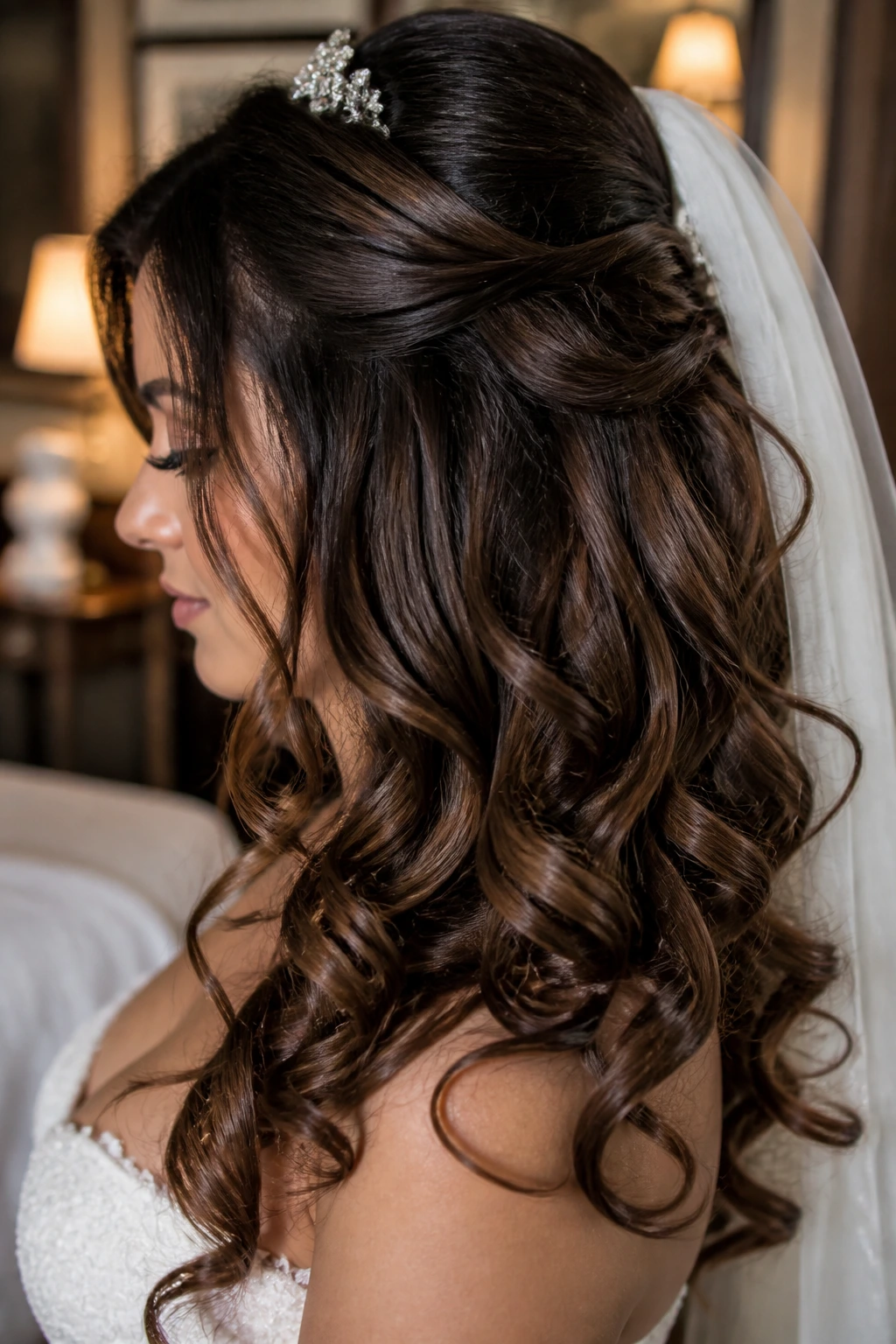
Some styles are built around the veil itself. Polished curls with extension support create a soft base that can carry a comb, a clip, and the weight of the veil without collapsing at the crown. The curls should be smooth and shaped, not wild, so the veil can sit cleanly above them.
This is the style I’d choose for a bride who wants classic romance and easy removal later. The curls frame the face and shoulders, while the extensions add the missing density that keeps the style from going flat in the back. Once the veil comes off, the hair still looks finished. That’s the real test.
The key is placement. The veil comb should anchor into a stable section, not into the softest top layer. Miss that, and the whole style starts sliding around.
What Bridal Extensions Really Change Under the Veil
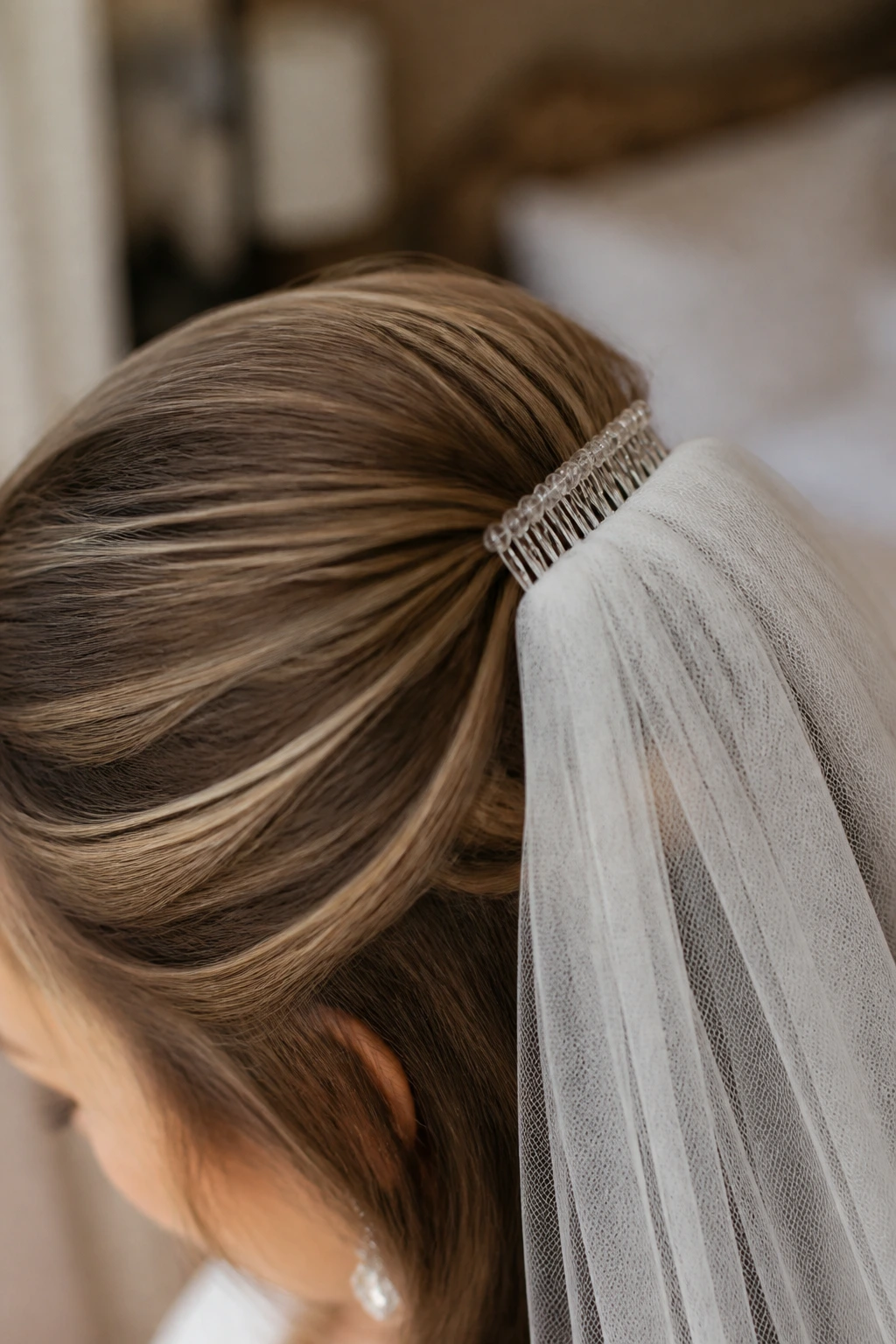
The biggest mistake people make with bridal extensions is thinking they only matter when the hair is down. They matter even more when the hair is pinned up. A veil comb needs a stable pocket to grip, and a twist or bun needs enough internal hair to support its own shape. Thin hair can do the job, but it usually needs help.
Extensions also change the way the style behaves after the ceremony. A style that looks tidy at noon can go limp by late afternoon if the hair underneath is too sparse. That’s why good bridal styling starts with the base, not the curl pattern. If the base is right, the style can survive hugs, humidity, and the little bit of chaos that wedding days always bring.
There’s a practical side too. A fuller shape gives the stylist room to hide pins, tuck ends, and build symmetry from left to right. That sounds small. It is not small. Symmetry is what keeps a bridal style from looking unfinished when the room starts filling up with people and cameras.
The Tools That Make These Styles Hold Their Shape
-
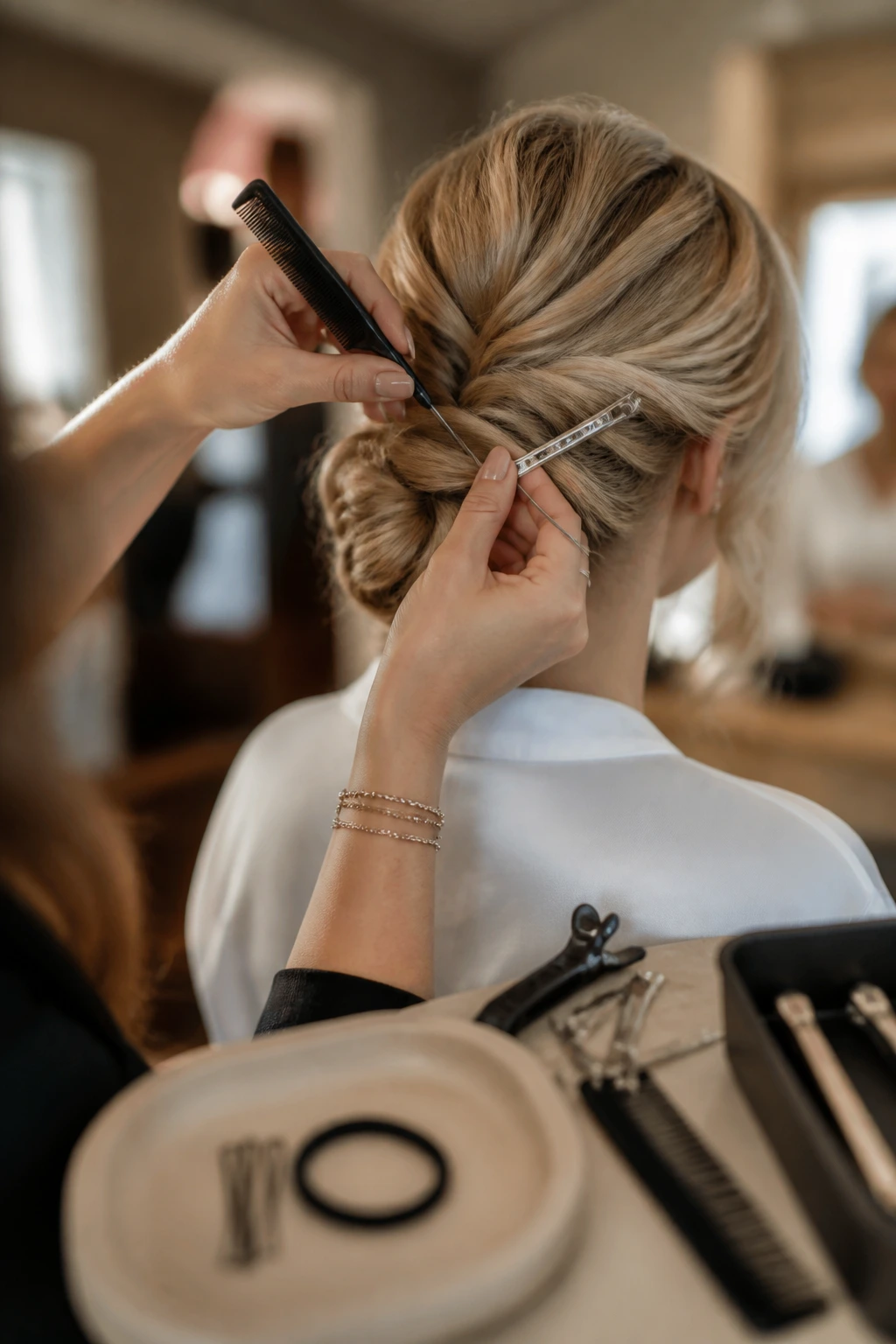
Tail comb: Parting and sectioning are cleaner with a fine tip, especially for center parts and braid lines.
-
Sectioning clips: These keep the top layers out of the way while you place clip-ins, wefts, or padding.
-
Bobby pins in two shades: One shade for blondes and brunettes, one for darker hair; the right color disappears faster.
-
Strong elastics: Ponytails, bubble styles, and braid bases need elastic that grips without snapping.
-
1-inch curling iron or wand: This size gives most bridal waves and curls a shape that lasts without looking overly tight.
-
Flat iron: Handy for polishing roots, smoothing ends, and refining a sleek bun or French twist.
-
Teasing brush: A little root lift at the crown keeps updos from sinking by mid-day.
-
Flexible-hold hairspray: You want control, not a shell. The style should move a little when touched.
-
Heat protectant: Especially important if the final style uses repeated curl resets and touch-ups.
-
Handheld mirror: Necessary for checking the back of the style, the veil placement, and any visible extension edges.
-
Extension hanger or satin storage bag: Keeps clip-ins and removable pieces smooth, untangled, and safe from dust.
Choosing the Right Length, Texture, and Density
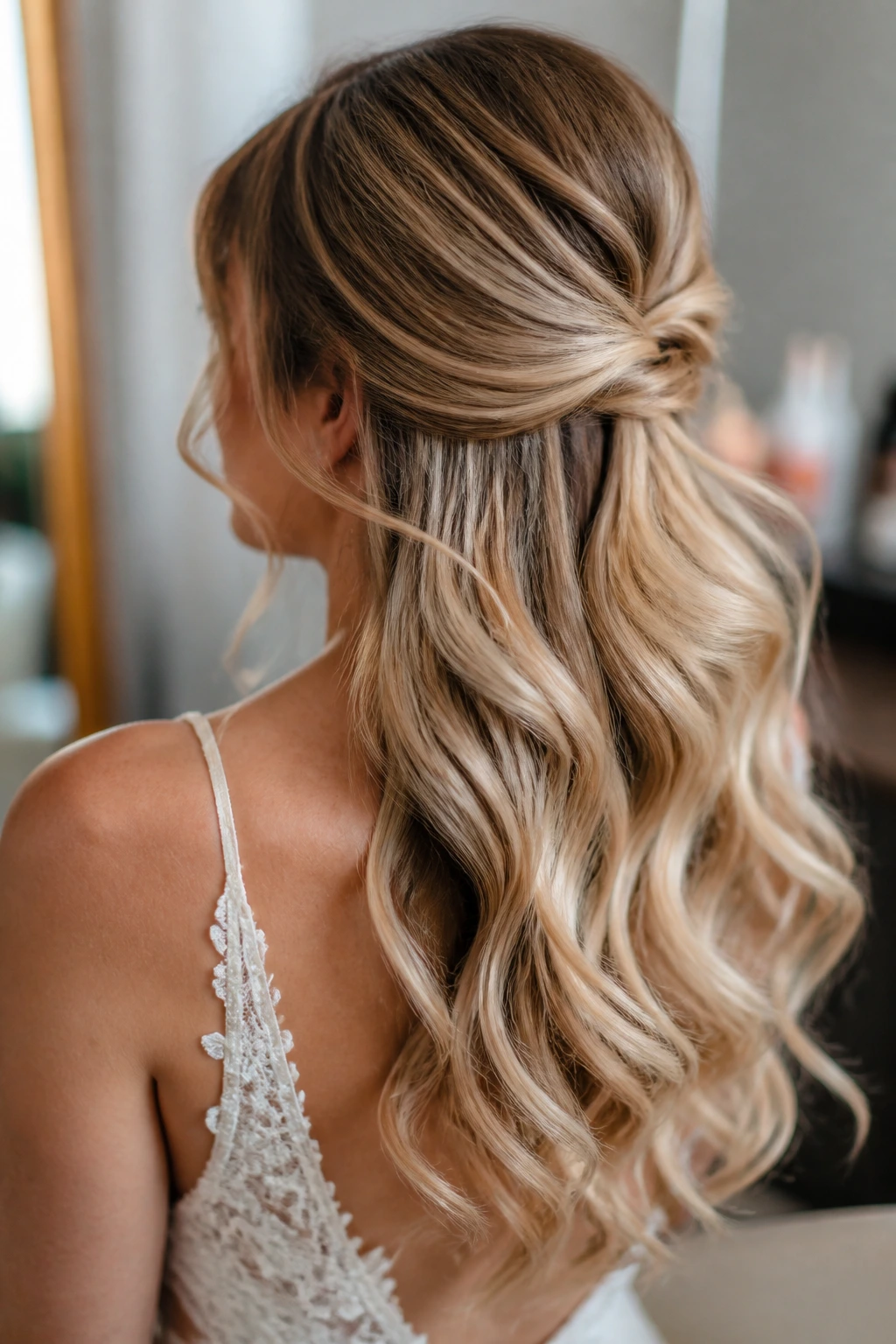
The prettiest bridal extension style is the one that matches the hair you already have, only slightly better. That sounds obvious, but people still get fooled by length. They ask for “long” when what they really need is the right density at the right points. A shoulder-length bride with thin hair usually needs more help at the mid-lengths and crown than at the ends. A bride with thick hair may need only a few pieces for balance.
Texture matters just as much as color. Straight clip-ins in wavy hair will stand out the minute the curls loosen. Curly extensions with a looser pattern can look off around the face. If you’re choosing installed extensions, have them matched after the hair has been washed and dried the way it will be styled. Dirty hair, product-heavy hair, and second-day hair all read differently under salon light.
Length is the easiest thing to overdo. Extra inches can look glamorous in a mirror, but they can also drag the proportions down, especially with short veils or high necklines. For bridal hair, I’d rather see a slightly shorter extension set that blends cleanly than a dramatic set that keeps reminding you it’s there.
How to Wear the Style With a Veil, Comb, or Headpiece
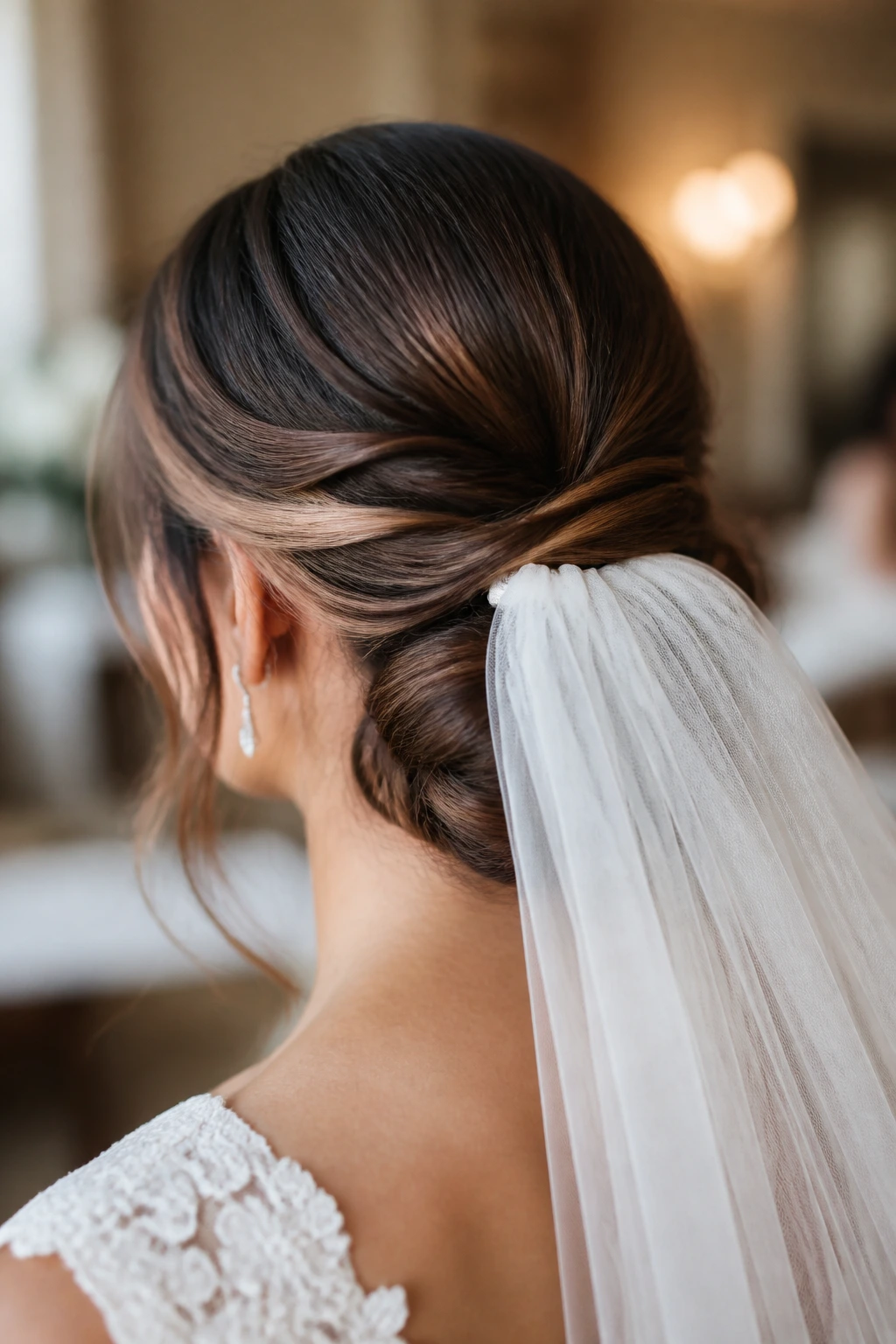
Veil Placement: Put the veil where the hair is strongest, not where it looks prettiest in the mirror. On low buns and twists, that usually means just above the base of the knot; on half-up styles, it often works best below the twist so the veil comb has something solid to bite into.
Headpiece Balance: A pearl comb, floral vine, or crystal pin should echo the shape of the style instead of fighting it. Sleek buns take narrow pieces. Braids can handle more texture. If the accessory sits too high or too heavy, it steals the shape of the hair.
Dress Neckline: Off-the-shoulder gowns usually welcome soft waves or side-swept styles. High necks and illusion backs often look sharper with compact buns, low knots, or polished twists. The hair should frame the dress, not cover the best part of it.
Ceremony-to-Reception Switch: If the veil comes off later, think about what the hair needs to look like on its own. A style that depends on the veil to feel complete may look thin once the comb is removed. A strong bridal extension base keeps the shape standing even after the accessories leave.
Small Upgrades That Make the Style Feel Like Yours
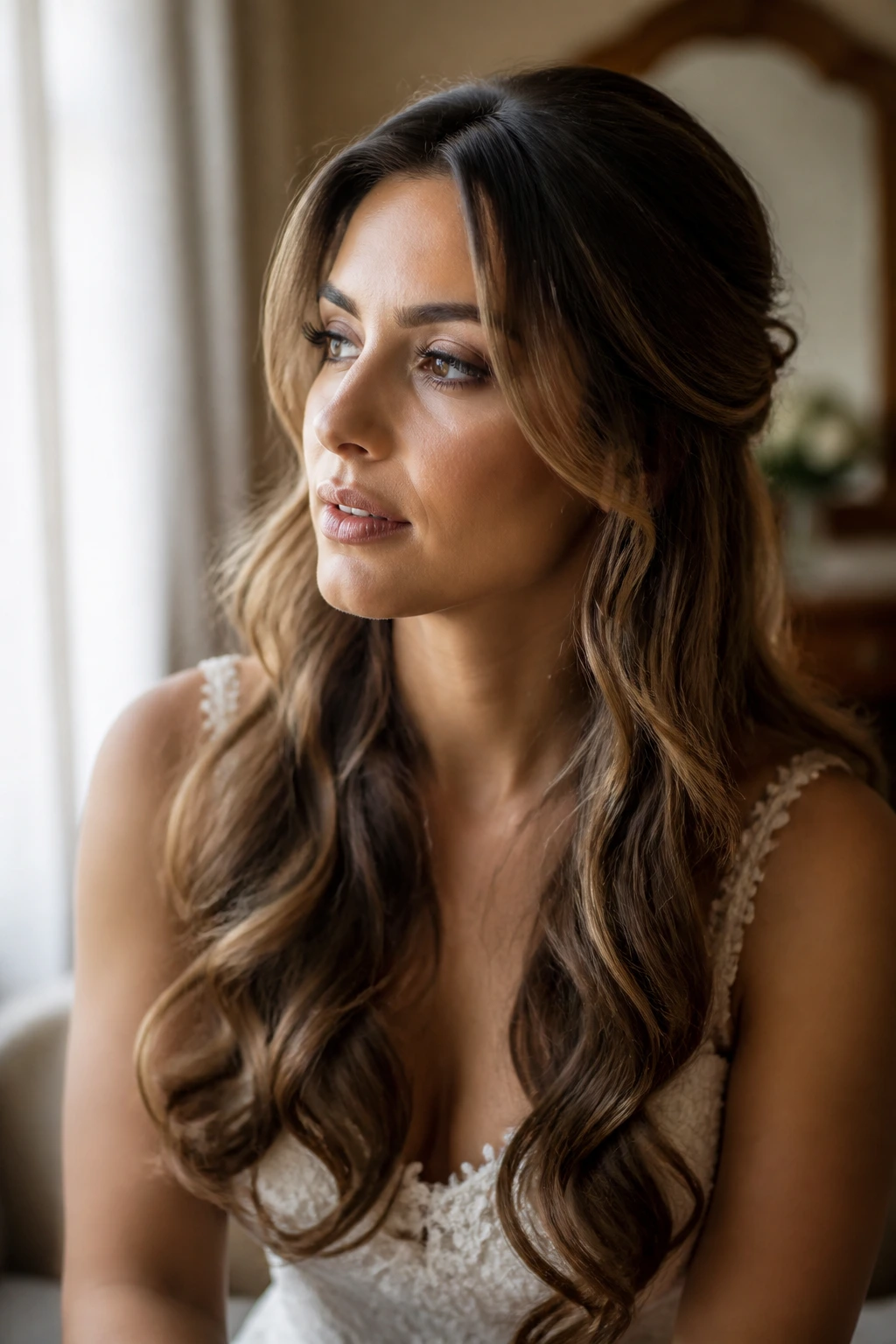
Texture Boost: A single product can change the whole read of a style. Salt spray gives braid styles a drier, more touchable feel; shine spray smooths a bun or blowout; mousse at the roots helps curls lift instead of collapse. Pick one lane and stay in it.
Color Blend: A tiny shift in tone can make extensions disappear faster than another inch of length ever will. If the ends are lighter than the crown, place the lightest pieces lower. If the hair has dimension, mimic that with a few mixed shades instead of one flat match.
Longevity Fix: A thin veil of flexible hairspray over the finished shape can keep flyaways from moving too much without freezing everything in place. Use it after the curls cool, not before. Wetting fresh curls is a quick way to ruin the bend.
Make-It-Yours: Brides who want a less formal feel can leave out a few soft face pieces or trade a neat twist for a looser braid. Brides who want sharper lines can smooth the roots and pin the ends tighter. The style should still look like it belongs to the person wearing it.
Prep, Storage, and Freshening Up the Hair Pieces
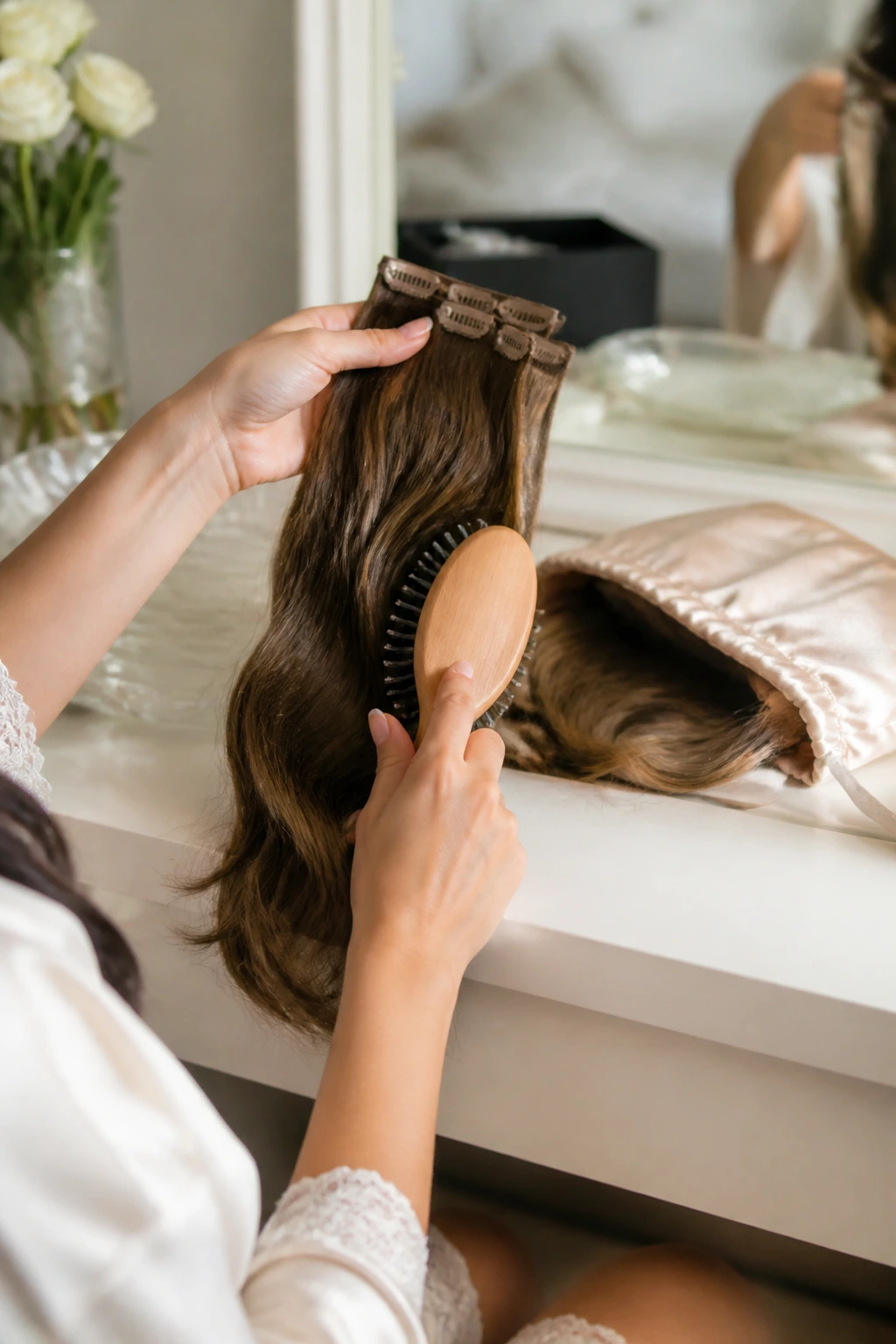
Clip-in extensions should be brushed before and after use, then stored flat or hung on a dedicated hanger so the wefts do not crease. If they’ve been curled for the wedding trial, let them cool fully before packing them away. Warm hair pinned into a bag is a recipe for dents and odd bends.
Human-hair pieces usually need washing after 6 to 10 wears, or sooner if you’ve used a lot of spray and smoothing cream. Use a gentle shampoo, keep the water lukewarm, and let them air-dry completely before storage. Do not twist them into a tight knot while they’re damp. That’s how you get tangles that look like a bird nest in the back of a closet.
For installed extensions, the maintenance schedule matters before the wedding, not just after. Tape-ins and sew-ins should be checked early enough that any repositioning or trimming is done before the final styling day. On the wedding morning, the goal is not to invent a new plan. It’s to work with hair that already behaves.
Variations and Adaptations to Try
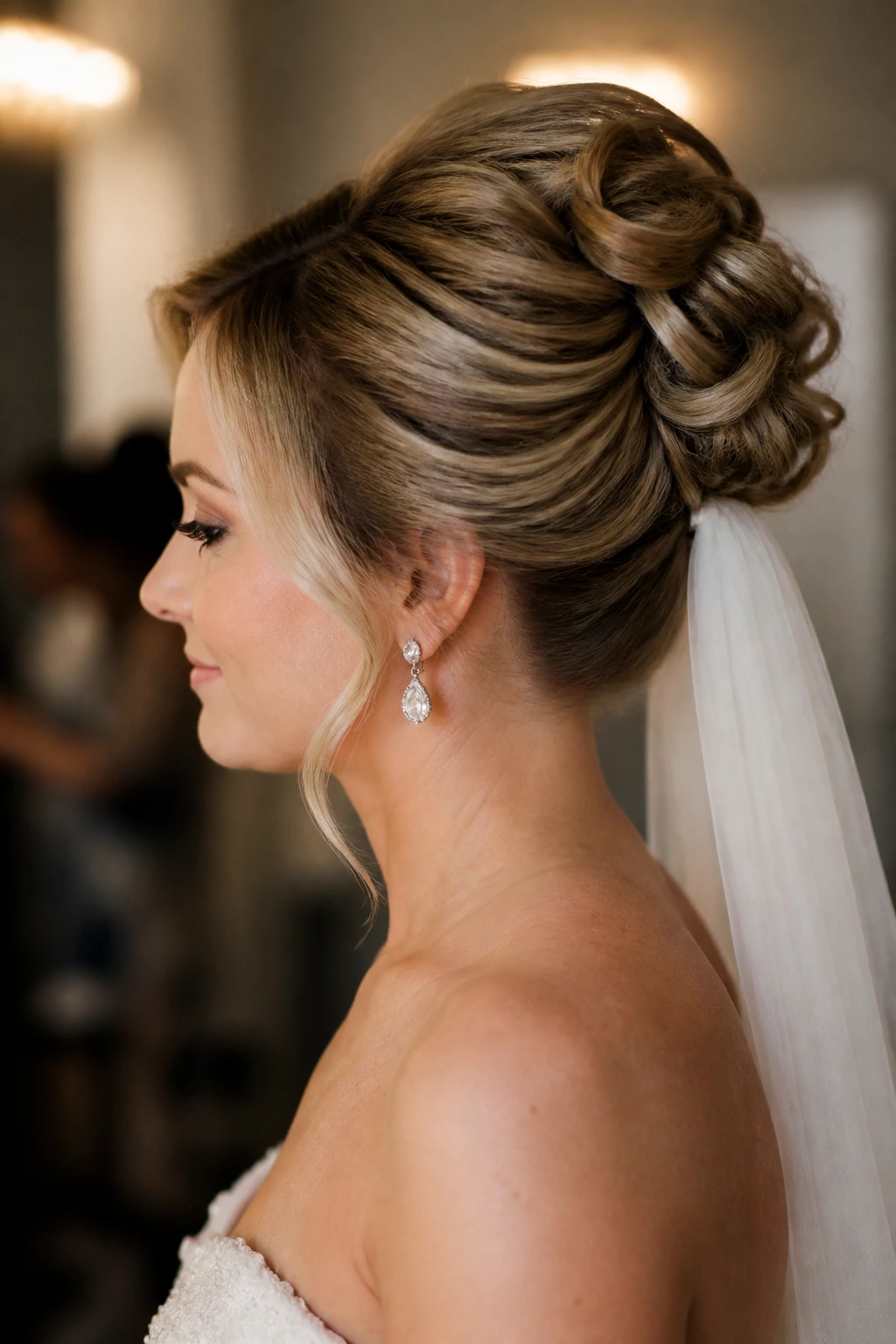
Fine-Hair Rescue Set: Use lighter-weight clip-ins or a narrow halo piece focused at the crown and sides. Fine hair usually needs lift more than length, so keep the ends believable and let the root support do the heavy lifting.
Curly-Pattern Match: Choose extensions that match your own curl type as closely as possible, then shape the style around that texture instead of forcing it straight. A curly bride looks most like herself when the extension pattern follows the natural bend of the hair.
Humidity-Proof Finish: Lean into smooth updos, braided bases, or polished waves with a strong pin structure. Loose curls and full blowouts can work, but only if the base has enough support to survive warm air and movement.
Short-Hair Bridge: If the hair is bobbed or just above the shoulders, use hidden fillers, small wefts, or a half-up structure that lets the shorter layers disappear inside the style. Trying to fake a full-length cascade often backfires.
Veil-First Bridal Set: Pick a style that gives the veil comb a solid anchor and still looks complete after the veil comes off. Low buns, French twists, and polished curls with a firm crown base are usually safer than airy, loose styles.
Reception-Ready Switch: Build the hair so it can be repinned or loosened later without starting from scratch. A half-up twist can become a full down style, and a low bun can be softened for dancing. That flexibility matters more than it gets credit for.
Common Mistakes That Make Bridal Extensions Look Off
-
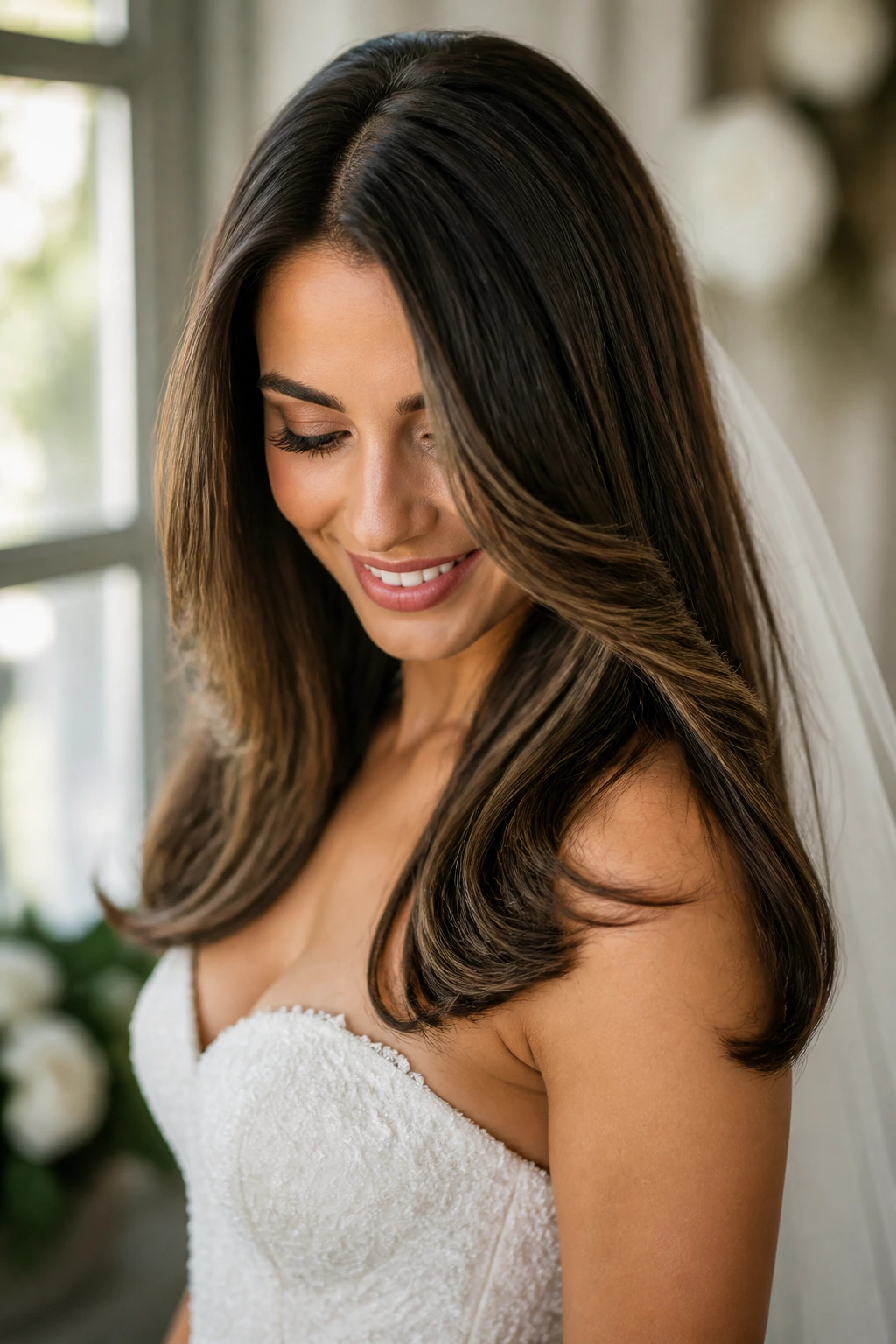
Matching only the color, not the texture: Straight extensions in wavy hair, or glossy pieces in dry, matte hair, can stand out even when the shade is right. Match the finish first, then the color.
-
Putting too much hair in the wrong place: Heavy length at the ends can make a style drag downward while the crown still looks flat. Brides usually need more support where the hair is pinned than where it hangs.
-
Forgetting the accessory plan: A veil or comb can shift the parting, hide a braid detail, or crush the crown if it’s added at the last minute. Test the full look before the wedding day.
-
Overloading the front with face-framing pieces: Short front pieces can split apart or curl in odd directions, especially when the bride moves. Keep them long enough to blend into the rest of the style.
-
Using too much product on extension bonds or clip seams: Oils and heavy creams near tape-ins or clips can weaken hold and make the hair slip. Put smoothing products lower on the shaft and away from the attachment point.
-
Skipping a real trial: A trial should show how the style behaves when the hair cools, when pins settle, and when the veil is removed. If you only check it in the salon chair, you’re guessing.
Questions Brides Ask Before Choosing Extensions
What type of extension is best for wedding hair?
The best type depends on how much change you need and how long the style needs to last. Clip-ins are ideal for one-day flexibility, tape-ins lie flat for half-up or down styles, and sewn or installed methods give the most stable base for detailed updos.
Can I wear clip-ins with an updo?
Yes, if they’re placed low and hidden well. The key is to use the added hair for thickness and anchor points, not to leave the seams where they’ll show at the part or around the ears.
How far in advance should I match the hair?
Long enough to test it in natural light, with the hair washed and styled the way it will be worn. A salon mirror can forgive a lot that daylight won’t.
Will extensions make a veil sit awkwardly?
Not if the base is built for it. In fact, extensions often help a veil comb stay in place because the extra hair gives the comb more to grip.
What if my hair is very fine and slippery?
Start with texture at the roots and choose styles that create structure: low buns, braids, twists, and controlled waves. Fine hair usually needs a better base, not just more length.
Can curly brides use extensions without losing their texture?
Absolutely, but the curl pattern has to be close. The closer the bend, the less you need to disguise, and the better the final shape holds when humidity shows up.
Do I need to cut the extensions to fit my haircut?
Often, yes. A blunt extension line can show through layers, especially around the face. A small trim or point-cut blend usually helps the style sit naturally.
What happens if the hair starts falling by the reception?
That usually means the base was too smooth, too heavy, or not pinned securely enough. A stylist can often rescue the look with a few hidden pins and a light re-spray, which is why a strong foundation matters more than a stiff finish.
The Shape That Stays Put
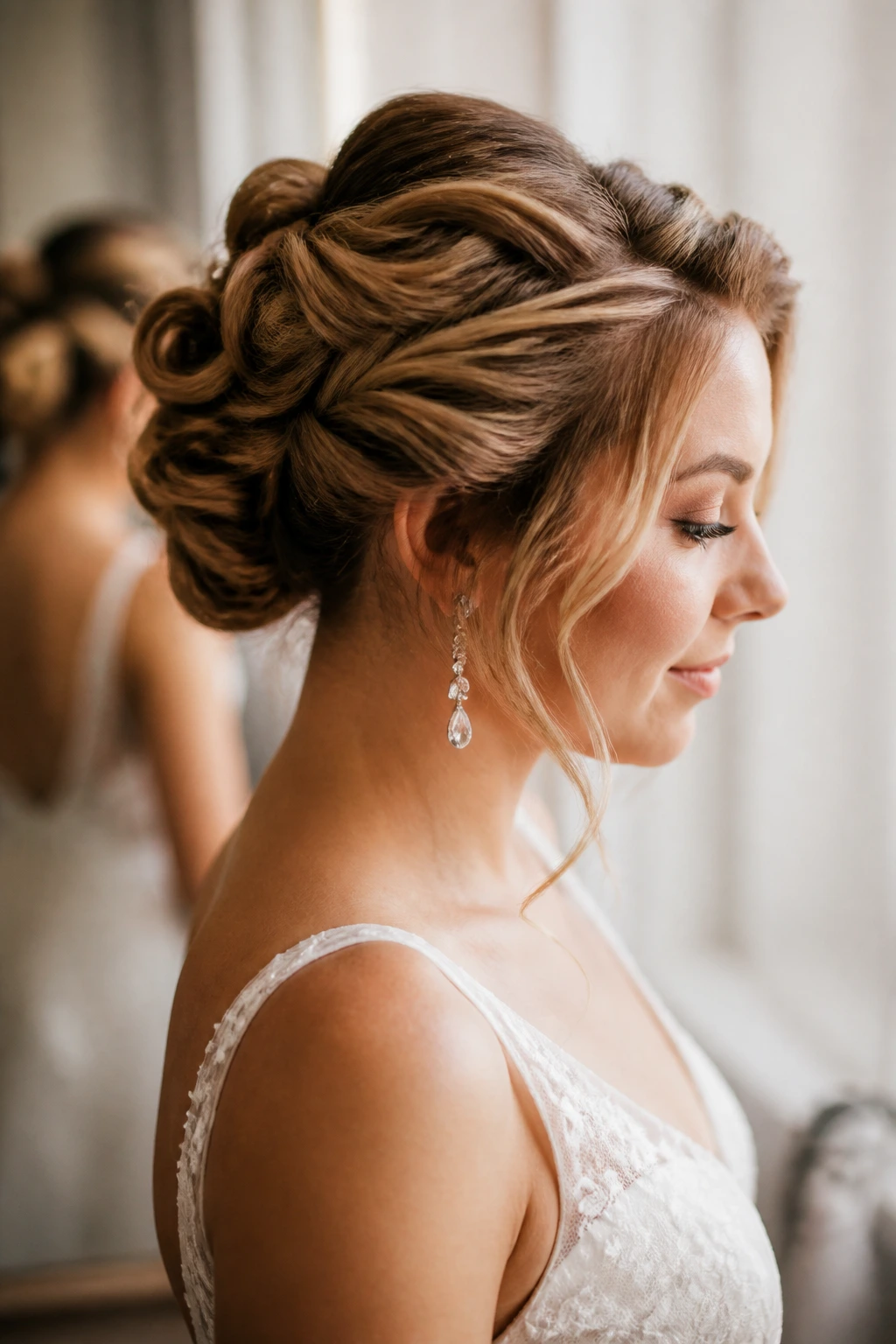
Bridal hair extensions are worth the trouble when they solve real shape problems. They keep buns from collapsing, braids from shrinking, and curls from turning thin by the second hour. That is the part that matters when the dress is on, the veil is pinned, and the day starts moving faster than the mirror ever could.
The styles above all do the same quiet job in different ways: they give the hair enough structure to hold its line. Some do it with hidden wefts. Some do it with clip-ins. Some rely on a ponytail piece, a filler section, or a carefully matched curl pattern. The method changes, but the goal stays the same.
Choose the version that fits your hair, your dress, and the way you actually move through a room. That’s the style that will still look like itself when the lights go down.
