



Prom night is unforgiving in a way flat-iron tutorials never are. The lights are bright, the photos are close, and curly hair has a habit of telling the truth: if the roots are over-smoothed, if the crown is pinned too tight, if the curls were brushed before they cooled, the whole style starts looking tired by the time the first group picture is done.
The best curly hairstyles for prom night do not fight texture. They work with the bend already in your hair, then add shape where it counts — at the part, at the hairline, at the crown, or with one accessory that looks deliberate instead of glued on as an afterthought. That’s the whole game. A style can be soft and romantic and still hold up through dinner, corsage hugs, slow songs, and the dance floor if the structure underneath is smart.
And curly hair is not one thing. Loose waves, springy ringlets, dense coils, shoulder-length cuts, long layers that insist on escaping every pin — they all ask for different handling. Some need height. Some need control. Some look best when they’re left almost entirely alone except for a few pins and a barrette that doesn’t snag. The styles that follow lean into that reality, because prom hair should look expensive in the human sense of the word: balanced, touchable, and secure enough that you’re not checking the mirror every twelve minutes.
Why These Curly Prom Styles Hold Their Shape When the Night Runs Long
-
Built for real curl patterns: These looks keep the curl groupings intact instead of brushing everything into a puff that collapses after the first warm room.
-
Photo-friendly from every angle: A good prom style has a clean front, a readable side, and enough back detail that the hair still looks intentional when someone takes a picture from behind.
-
Accessory-ready without the clutter: One crystal clip, one ribbon, or one comb can do more than six random pins shoved in at the last minute.
-
Better for movement: The styles here leave room for dancing, hugging, and turning your head without the whole shape going flat or poking into your cheeks.
-
Works with different lengths and densities: Short curls, long curls, thick curls, fine curls — there’s a lane for each of them, which matters more than the dress color or the makeup trend.
-
Less heat, more payoff: Several of these styles look polished because of placement and sectioning, not because you spent an hour frying the front pieces into obedience.
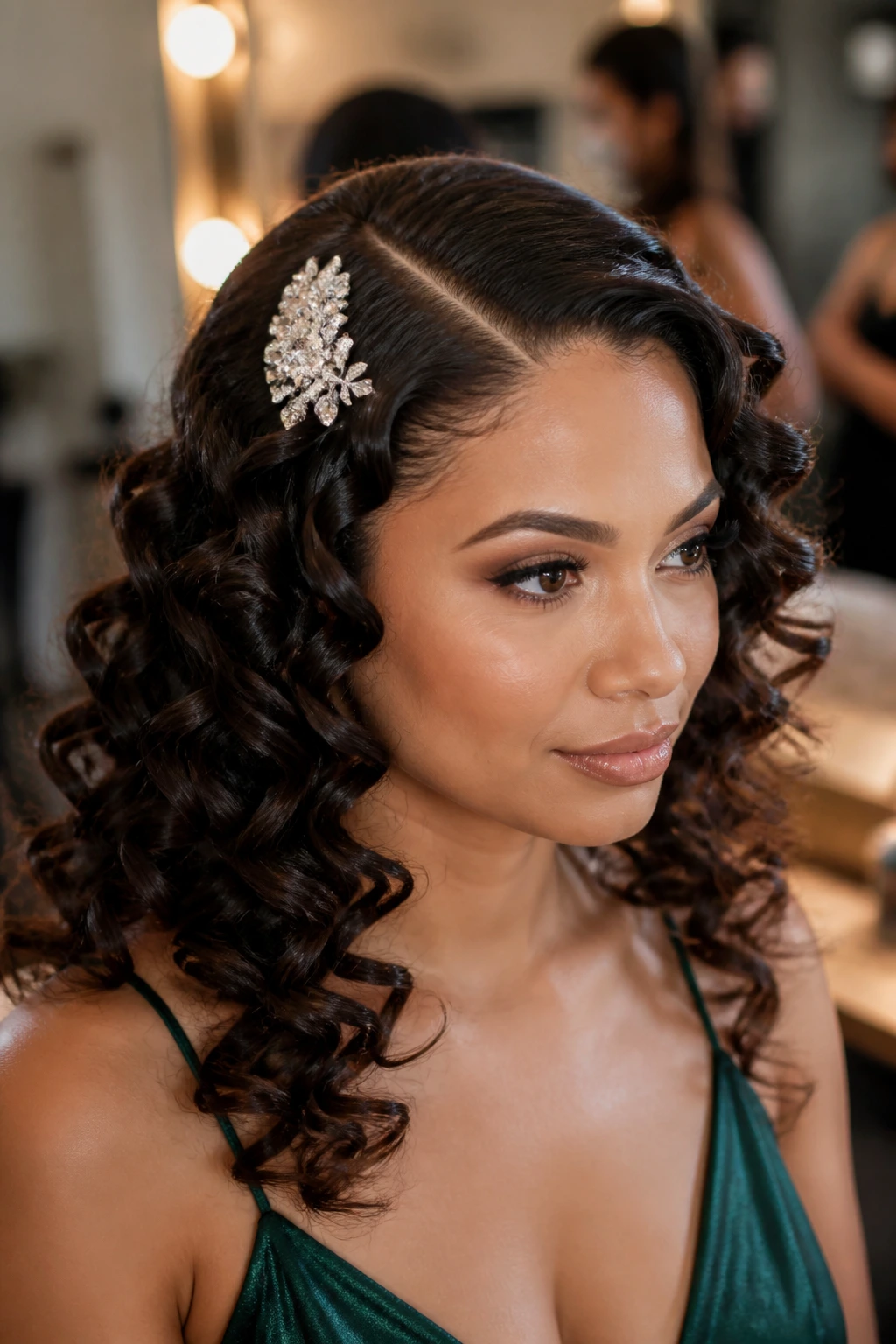
1. Deep Side-Part Ringlets with a Crystal Clip
A deep side part changes the whole mood before you even touch the ends. It gives the curls a clear direction, which makes the style feel richer and more formal than a flat middle part with no plan. The crystal clip sits right where the part begins to open up, so the eye gets one clean spark instead of a handful of random shiny things fighting for attention.
Why it photographs so well
The ringlets stay grouped in visible ribbons, not brushed into one big cloud. That matters under flash, because flash loves separation and hates fuzz. A light mist of flexible-hold spray at the crown, plus a dab of shine serum on the ends, is enough; if you pile on heavy cream, the front can collapse before dessert.
- Best for: medium to long hair with loose curls or defined ringlets.
- Works especially well with: one-shoulder or sweetheart necklines, because the side part balances the open neckline.
- Watch this: the clip should grab a flat section near the temple, not just sit on top of flyaways.
Pro tip: curl the front pieces away from the face and let them cool completely before you touch them. That one small pause keeps the part from puffing up.
2. Half-Up Twists with Loose Face-Framing Curls
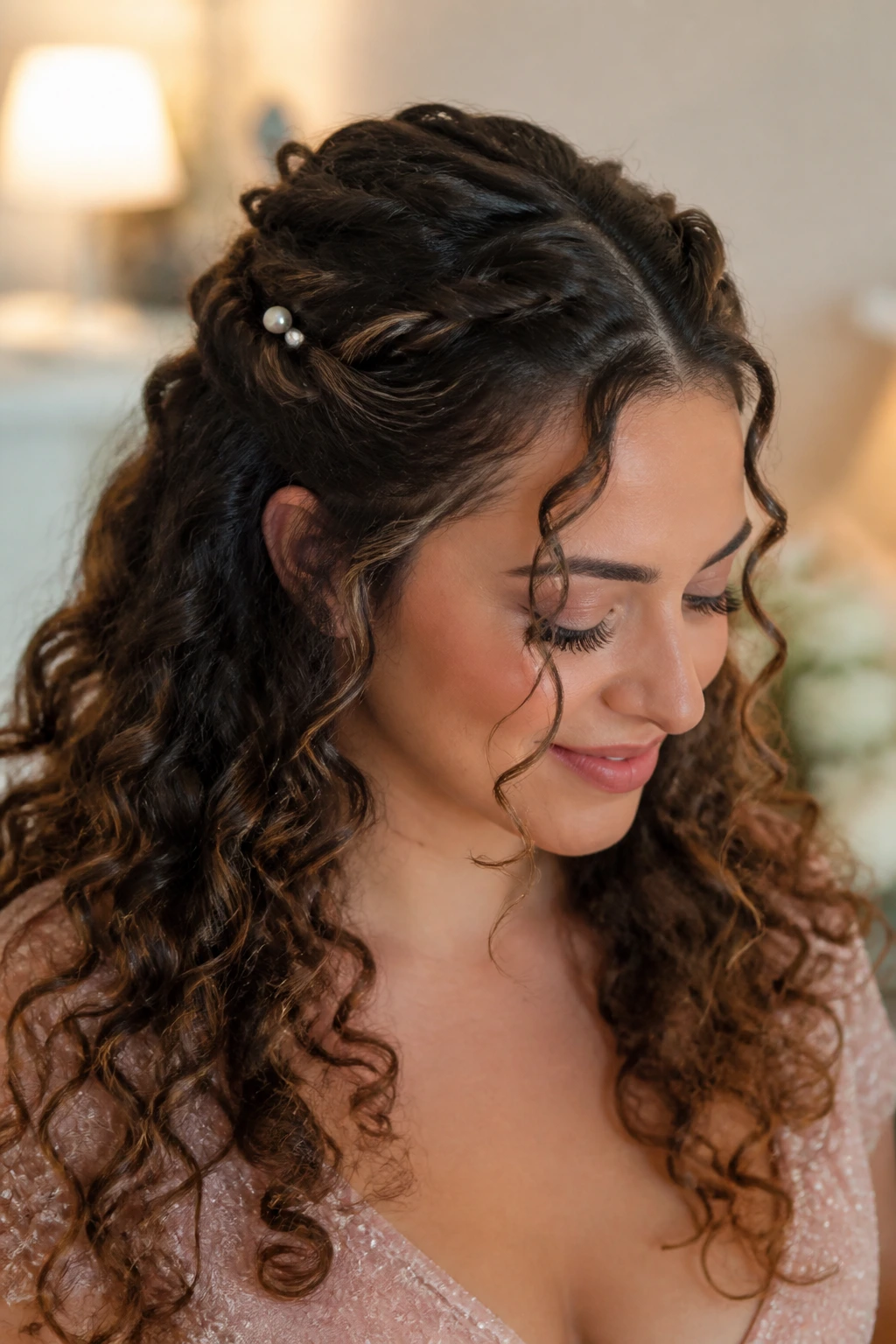
Twists are the low-drama answer when you want hair off your shoulders but refuse to flatten the curl pattern. Two slim sections from the temple to the crown pull the style back just enough to keep the face open, while the rest of the curls spill down with their shape intact. It feels soft, not fussy.
The nice thing here is the balance. You get a little lift at the top, but you still keep the movement that makes curls look alive. If your hair gets heavy by the end of the evening, this style keeps the pressure off the neck and the top layer from hanging in your eyes.
Best with: layered hair, curtain bangs, or medium density curls that need a little control.
Avoid if: the hairline is so short that the twists keep slipping — in that case, use smaller sections and crisscross pins underneath.
A tiny pearl pin or two near the twist anchor is enough. More than that starts to look crowded, and prom hair should never look like it lost a fight with the accessory drawer.
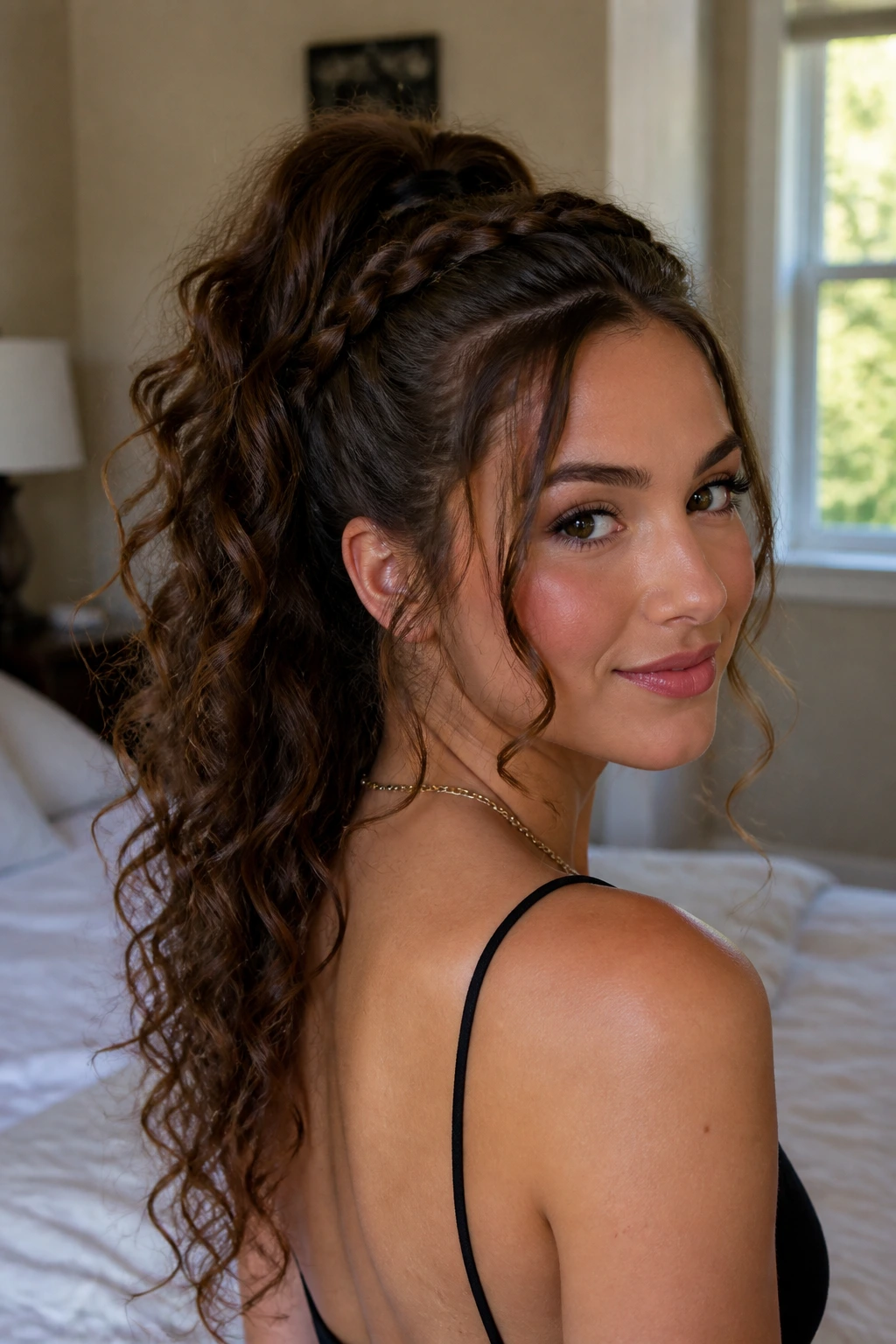
3. High Curly Ponytail Wrapped with a Strand of Hair
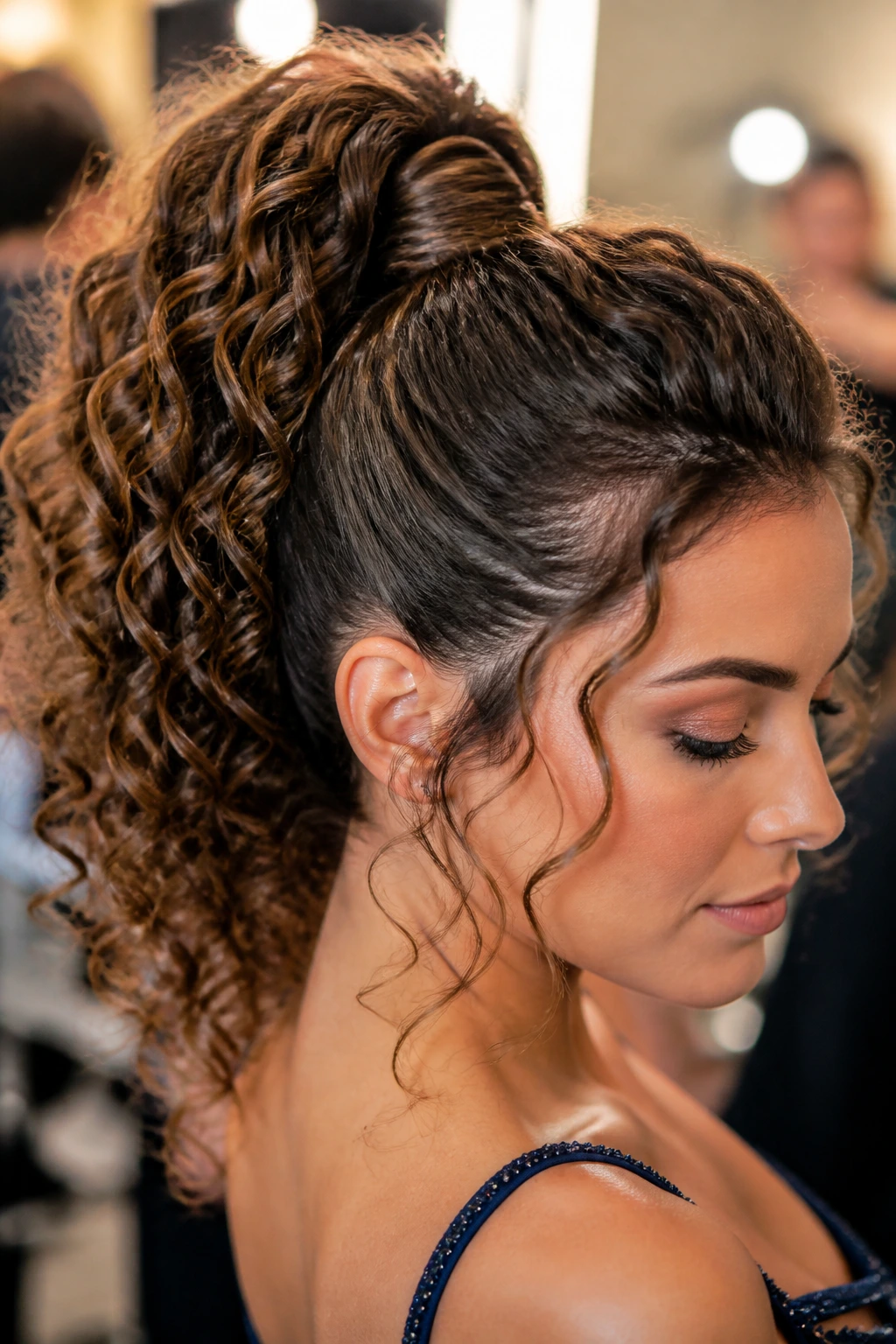
A high ponytail makes a strong case for itself when you want lift without giving up length. The wrap-around strand hides the elastic, which is a small detail that changes the whole look. Without that wrap, the style can read as gym hair with expensive earrings. With it, the ponytail looks like a deliberate choice.
The curls sit higher, which means the face gets more open and the jawline shows up better in photos. That’s useful with heavier dresses or higher necklines, where loose hair can feel crowded. Keep the crown smooth but not flat — a little root volume is what stops this from looking severe.
What makes it hold
The pony needs a secure base. Tie it once with a strong elastic, then lock the wrapped piece with a bobby pin tucked under the pony, not across the outside where it can slip free. A light touch of gel or edge control around the hairline helps, but don’t go glossy everywhere unless you want the whole top to look slick.
4. Braided Crown Over a Soft Curl Cascade
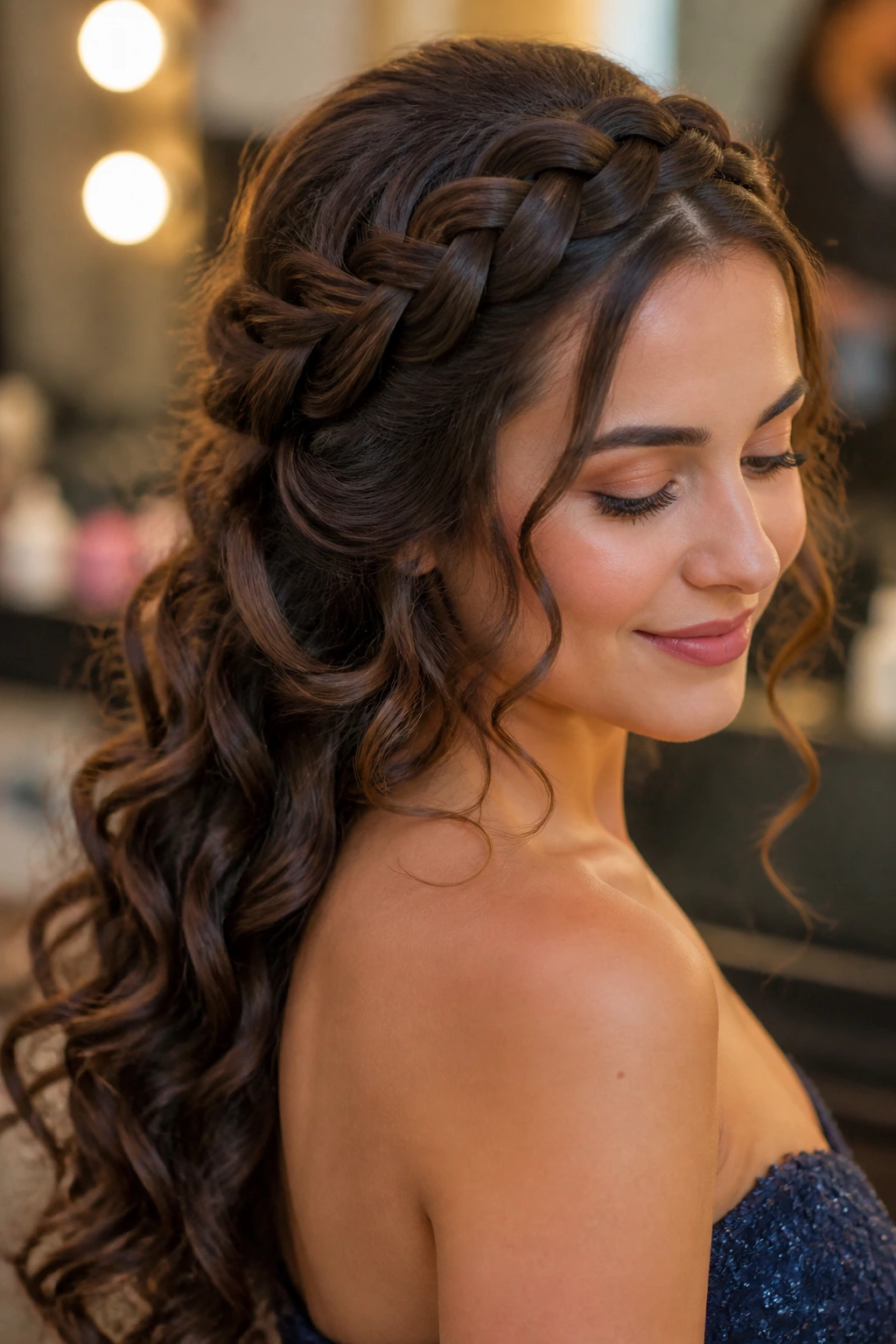
This one is basically a built-in headband, and I love that about it. The braid keeps the front controlled, so the curls behind it can stay loose and full without falling into the face every time you turn your head. It also gives the style some structure, which matters when the dress itself is soft or drapey.
The trick is not braiding too tightly. A flat braid can look rigid, and prom hair should have some air in it. Gently pancake the braid after it’s pinned so it looks wider and softer, then leave the rest of the curls alone except for a quick finger-shape through the ends.
Best for: long hair, side-swept bangs, and anyone who wants a romantic look that still keeps the front clean.
A small detail that helps: slide one decorative pin into the braid near the ear, not at the back, so it’s visible in photos.
5. Sleek Center Part with Glossy Loose Spirals
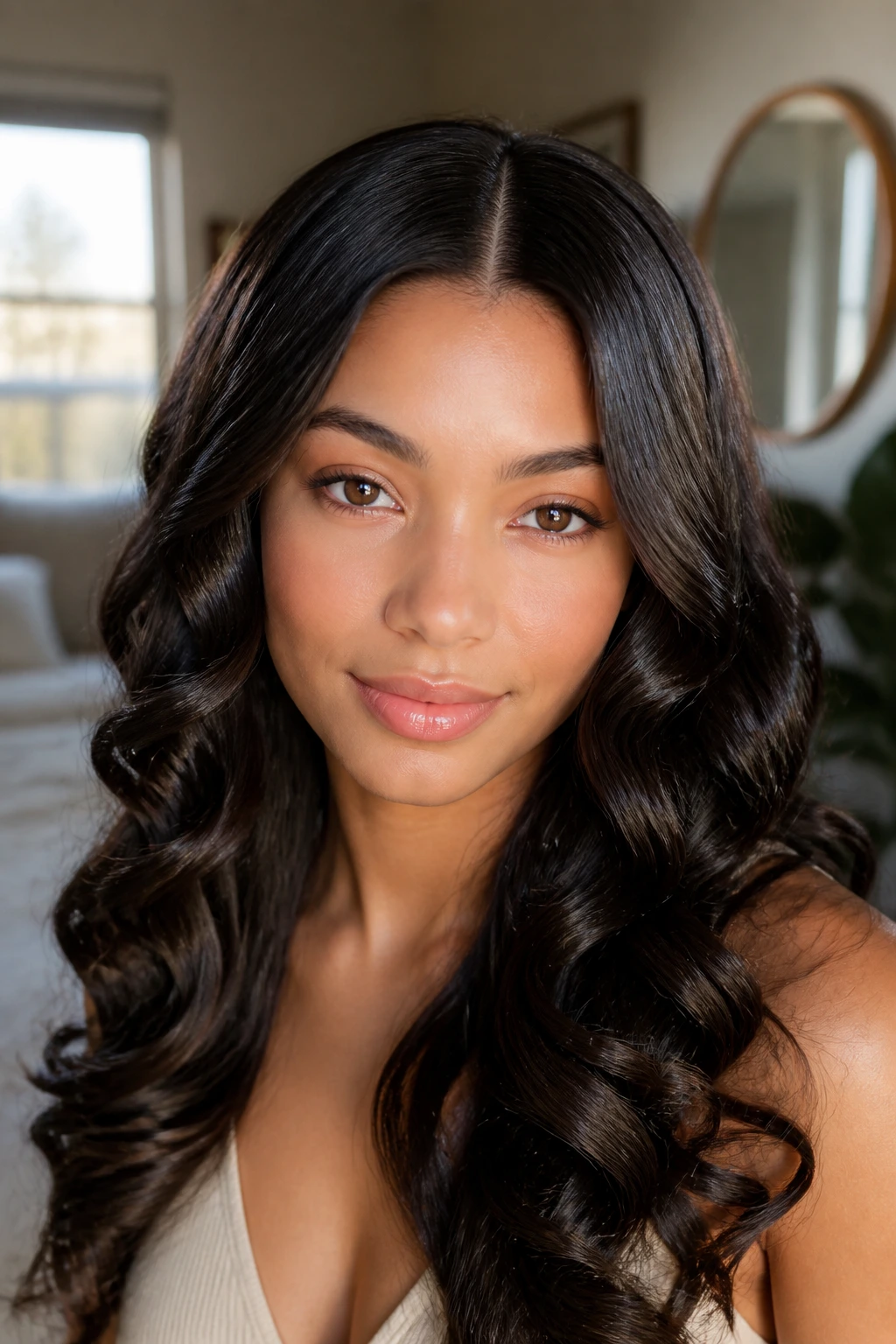
A center part can look severe if the hair is too flat. Here, though, the whole point is contrast: smooth roots, glossy spirals, and enough volume from the mid-lengths down to keep the style from looking stiff. It’s cleaner than a side part, sharper in the face, and especially good if your dress has symmetry in the bodice or straps.
The part needs to be precise. Use the tail of a comb, not your fingers, and check that both sides are even before the curls fall over them. Then keep the front pieces polished with a little serum — not oil slick, just enough to make the light bounce off the hair instead of catching on frizz.
A center part is also a quiet fix for thick curls that want to fan out too much. It pulls the eye down the middle and makes the overall shape feel deliberate. No drama. Just control.
6. Low Curly Chignon with Pinned Tendrils
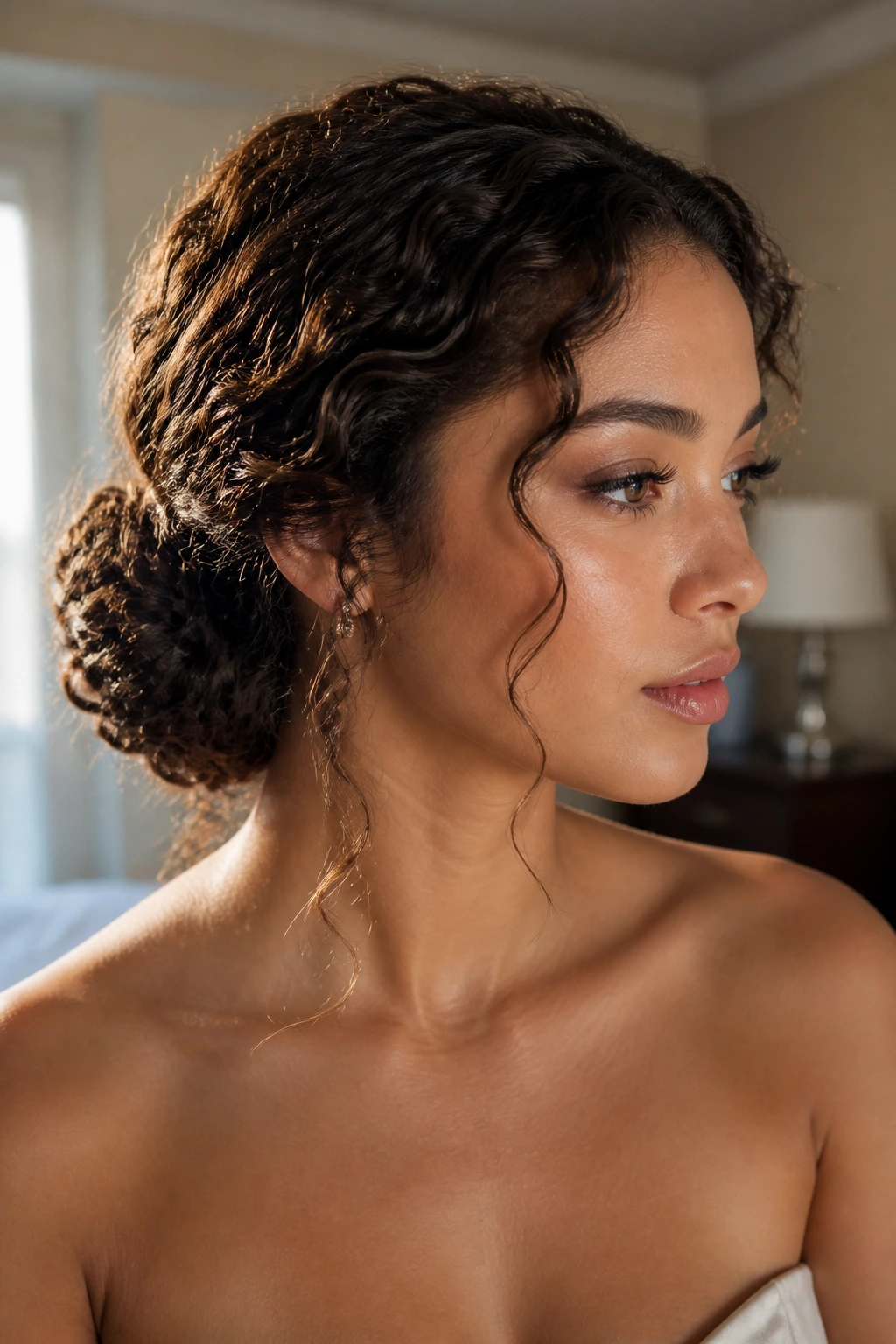
A low chignon is the style you choose when the dress already has enough personality. Maybe the neckline is busy. Maybe the earrings are big. Maybe you want your shoulders to do the talking and the hair to behave in the background. This bun stays low and soft, with a few tendrils pinned loose at the temples so it doesn’t feel severe.
The curl texture keeps it from looking too formal in a stiff way. A perfectly smooth bun can look like a job interview. This one has bends and pieces and a little lift at the crown, which makes it feel more like prom and less like a red carpet copy.
Why it works on curly hair
Curly hair gives the bun body without needing padding. That’s the gift. Twist the curls gently, pin the loops as they land, and leave a few ends out if the style needs softness around the face. The best version has enough slack to look relaxed but not so much that pieces poke out in every direction.
7. Bubble Ponytail for Long, Bouncy Curls
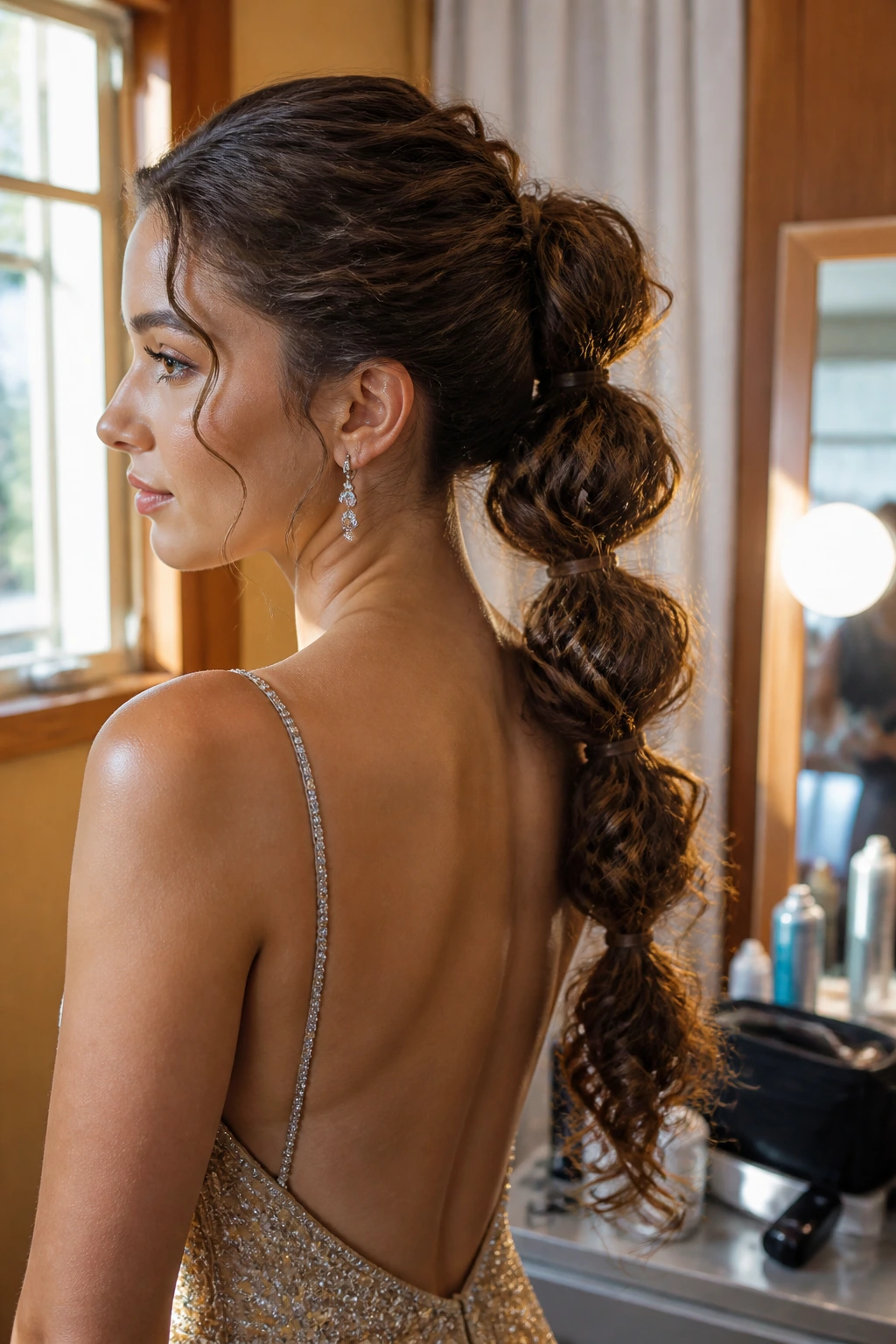
The bubble ponytail is a smart move when you want something playful and secure. It keeps the length visible, but each section is cinched, so the style doesn’t depend on one elastic holding everything together. If one section loosens a little, the entire pony doesn’t fall apart. That’s a nice thing to know around dessert.
This works especially well on long curls because the bubbles show off density. The look is built from shape rather than perfect polish, which means it tolerates texture beautifully. Clear elastics keep the structure light, and a tiny stretch of hair wrapped around each bubble makes the style look more finished.
Best with: long layers, thick curls, or gowns with simpler silhouettes.
Pro move: gently pull each bubble wider after tying it so the sections look round, not skinny.
It’s not the most formal look on this list, but it’s one of the most secure. And there’s something refreshing about that.
8. Curly Faux Hawk with Tucked Sides
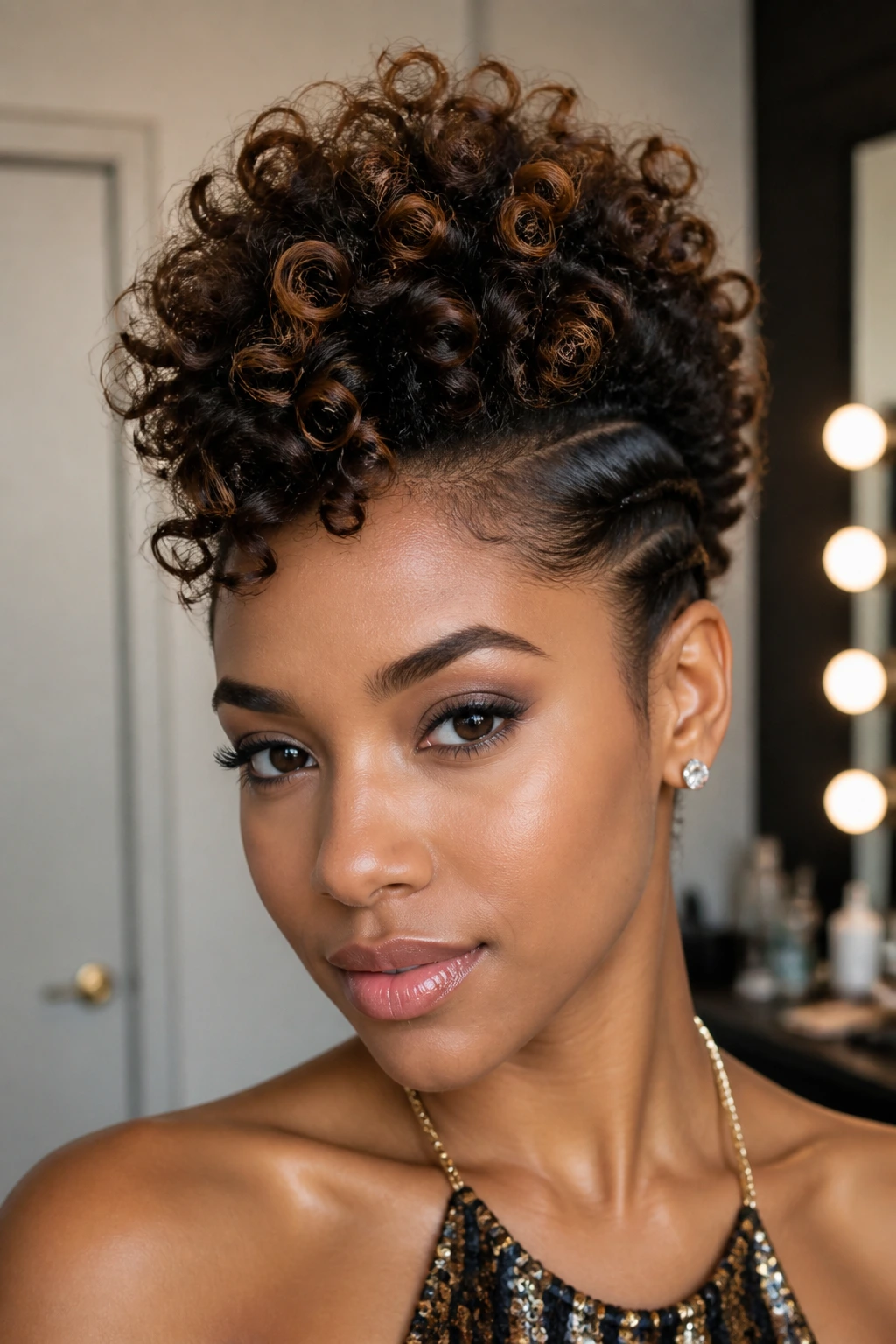
If you want a little edge without making the style feel costume-y, this is the one. The sides are tucked back tightly, while the curls run up the center in a soft ridge that gives the whole head more height. It’s dramatic from the front and even better in profile.
The faux hawk works because the curl texture softens what could otherwise feel harsh. Instead of a sharp punk shape, you get a sculpted column of curls that still moves. If your dress has strong shoulders, metallic fabric, or a high slit, this style adds the right amount of energy without asking the rest of the outfit to compete.
A fine mist of strong-hold spray near the tucked sides keeps the shape clean. Just don’t spray the center to death. You want the curl pattern to stay touchable, not crunchy enough to crack when you turn your head.
9. Waterfall Braid into Open Curls
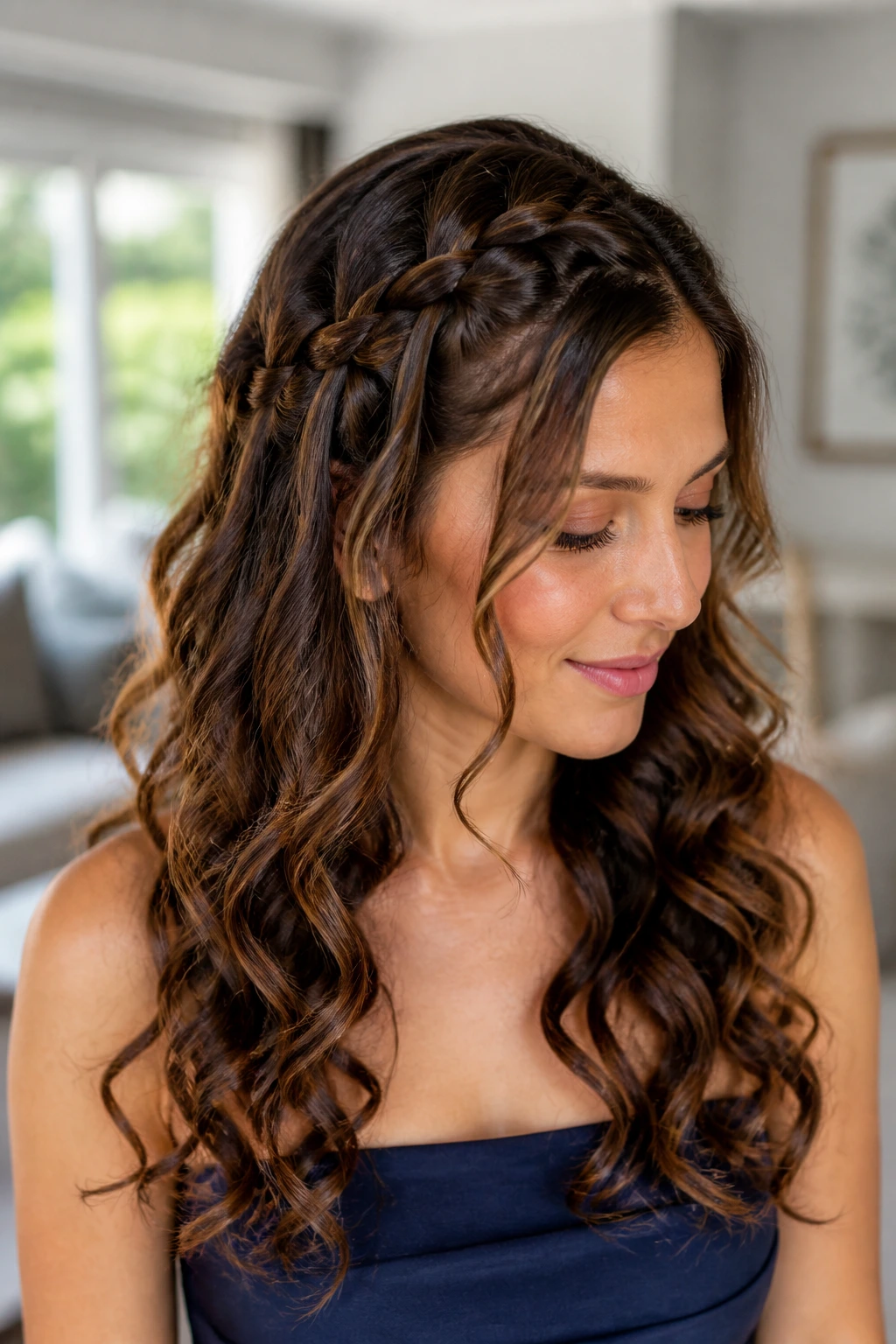
A waterfall braid has one job: keep the front interesting while leaving the rest of the curls loose. The braid drops strands as it moves, which creates that soft cascade effect without swallowing the whole head in braids. It’s one of the best options if you want detail that shows up in photos but doesn’t take over the style.
The open curls underneath should stay defined. That means the braid is doing the framing while the curls provide the volume. Don’t over-fluff the lengths after styling. Let the ringlets fall where they want, then separate only the biggest clumps with your fingers so the texture still reads clean.
Best case for this style
Long hair with layered ends handles this beautifully. The braid gives enough structure to anchor the top, and the loose lengths keep it from feeling too done. If you’re wearing drop earrings, this is a nice choice because the hair stays back just enough for the jewelry to show.
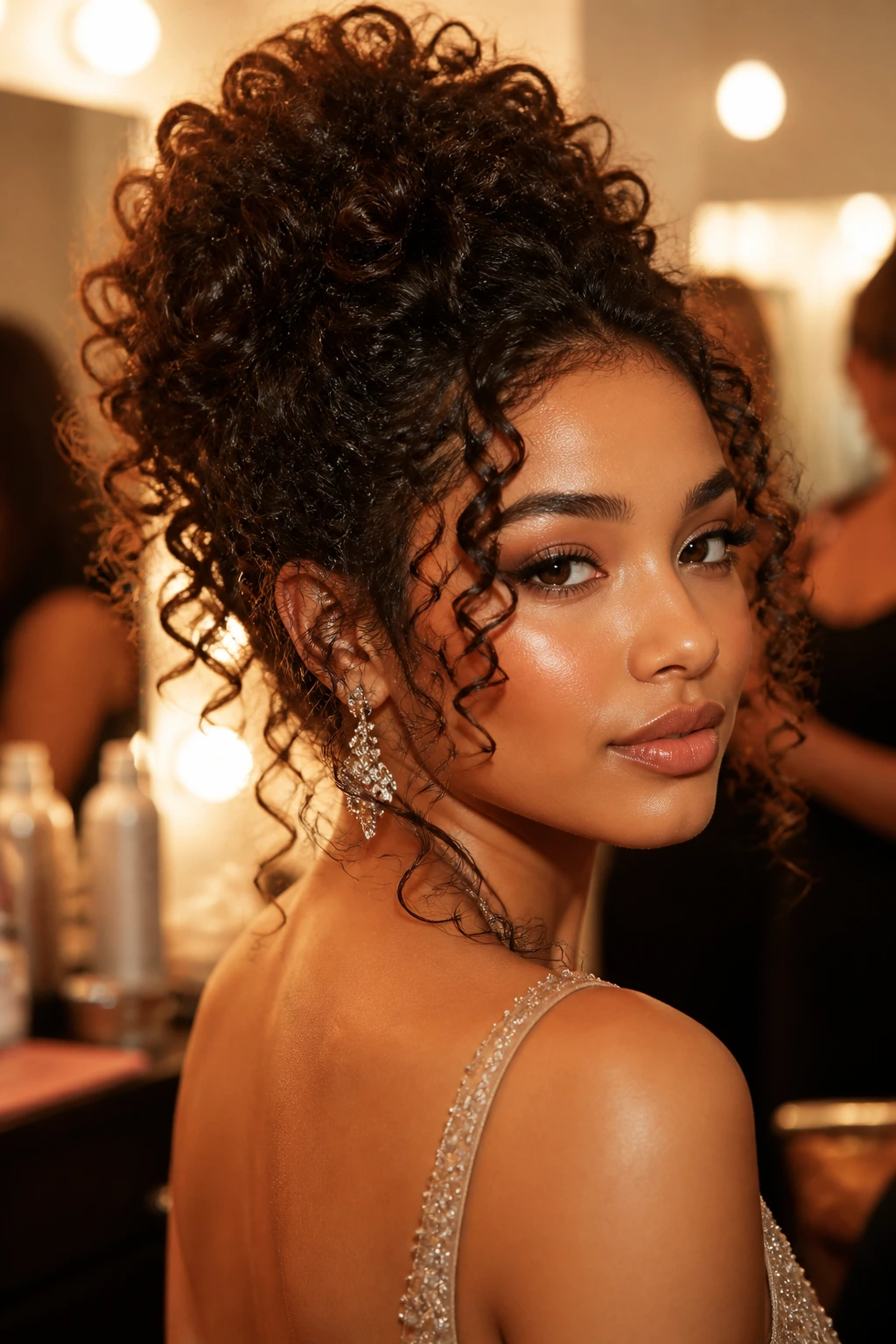
10. Messy Textured Bun with Spiral Pieces Left Out
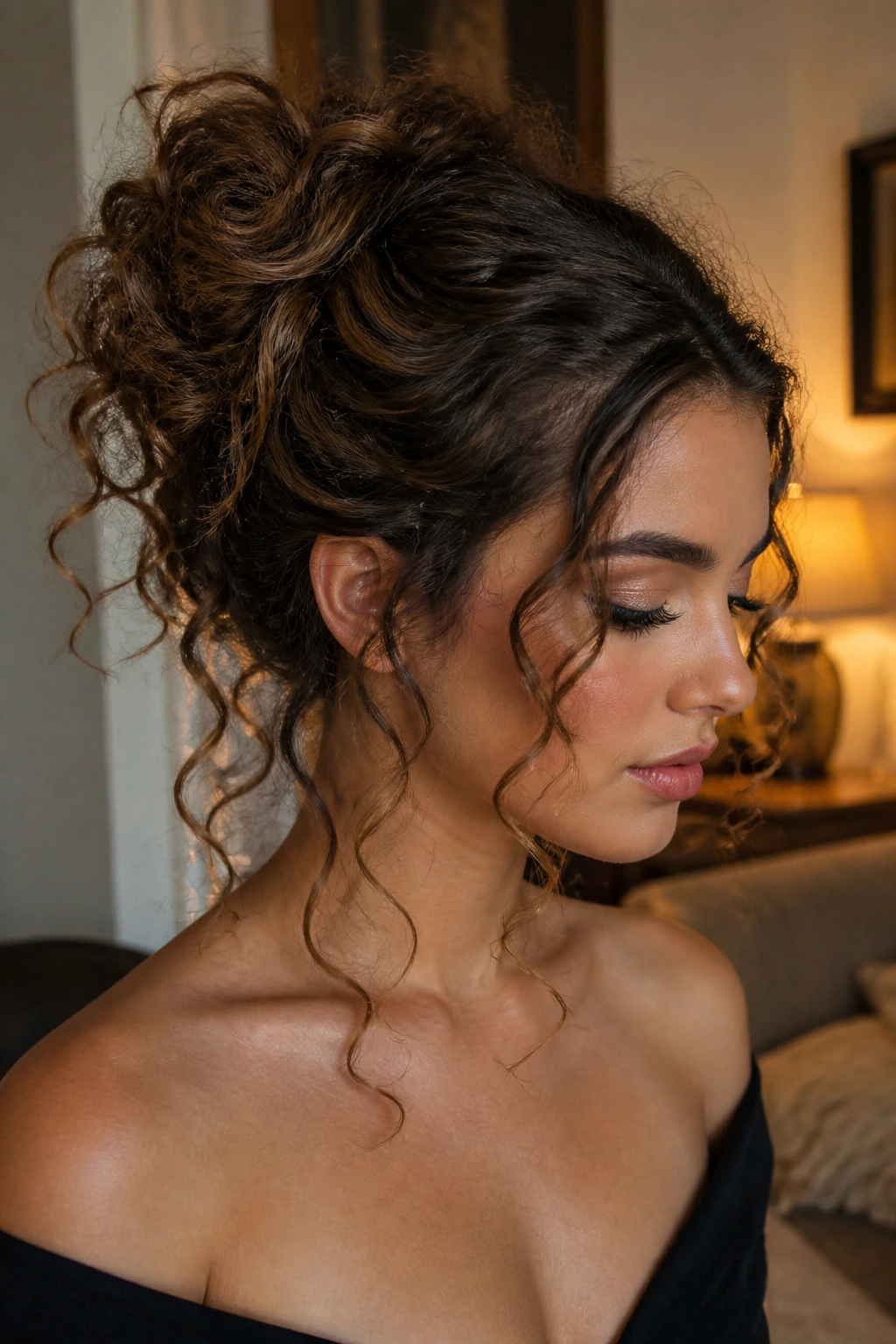
Messy sounds lazy until you do it wrong. The good version of a textured bun is controlled chaos: the curls are pinned into a soft knot, the crown has a little air, and a few spiral pieces fall out around the temples and neck. It looks like someone knew exactly where to stop.
This is the style for warm rooms and long nights. It keeps the neck free, it stays away from the lipstick, and it still reads as romantic because the loose pieces keep moving. If your curls are naturally springy, the bun almost builds itself. Just be selective with the pins and don’t crush the shape down trying to make it symmetrical.
Keep in mind: the bun should sit at the point where the head starts to curve down, not jammed high on the crown unless you want more lift.
That little adjustment matters. It changes the whole silhouette.
11. High Puff with Laid Edges and Gold Pins
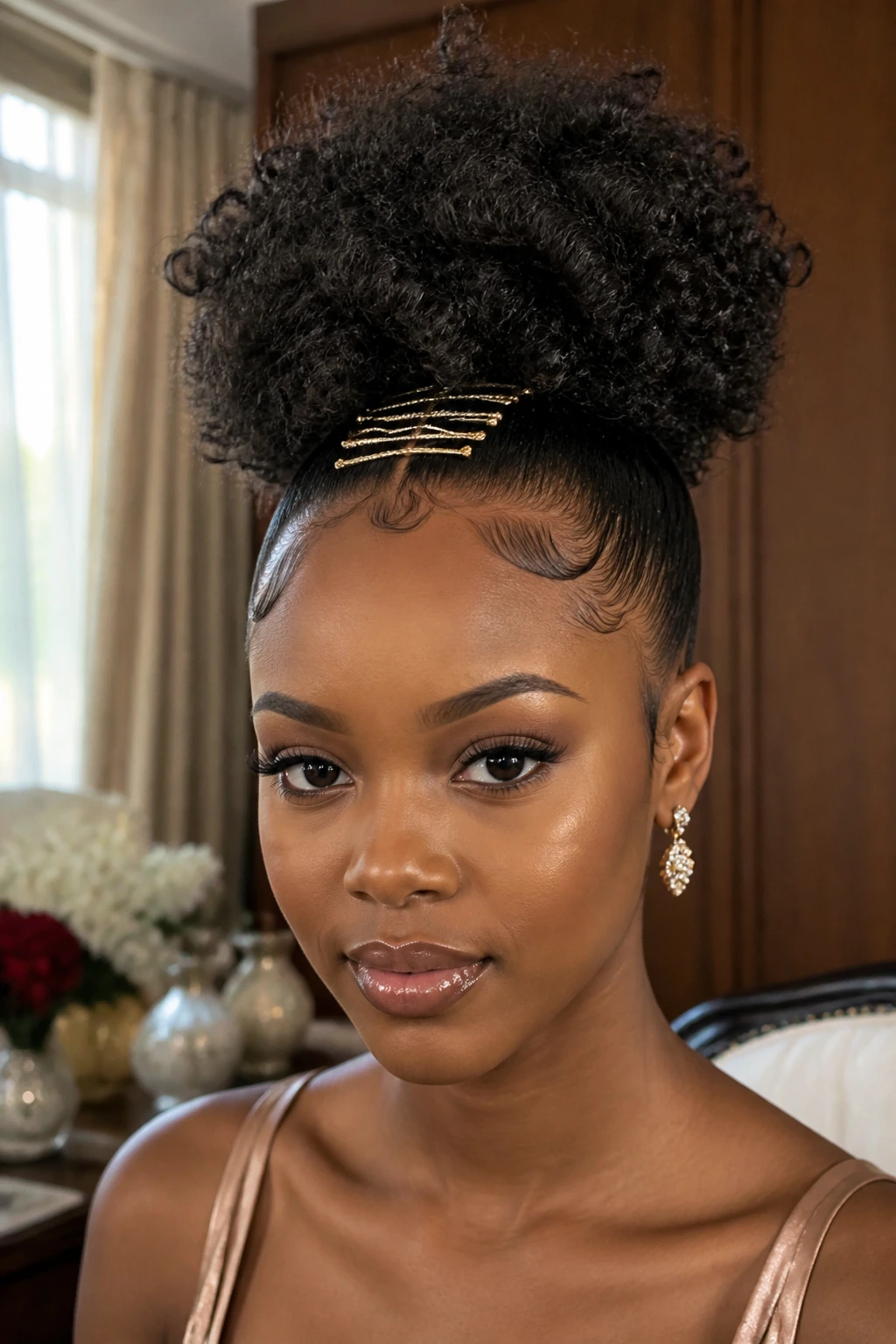
A high puff makes no apology, and that’s the fun of it. It centers the natural texture instead of using it as a base for something else. The hair at the sides stays smooth, the puff builds up on top, and a few gold pins near the front or temple add polish without stealing the shape.
This look is strongest when the hairline is clean and the puff has real fullness. It works beautifully with strapless dresses, simple earrings, and anything that benefits from a strong neckline. The height gives the face a little lift, which can be more flattering than a low style if the dress already carries a lot of weight in the bodice.
A soft edge brush and a tiny bit of gel are enough for the hairline. Don’t plaster it down. The clean front is the frame; the puff is the picture.
12. Ribbon-Tied Half-Up Curls
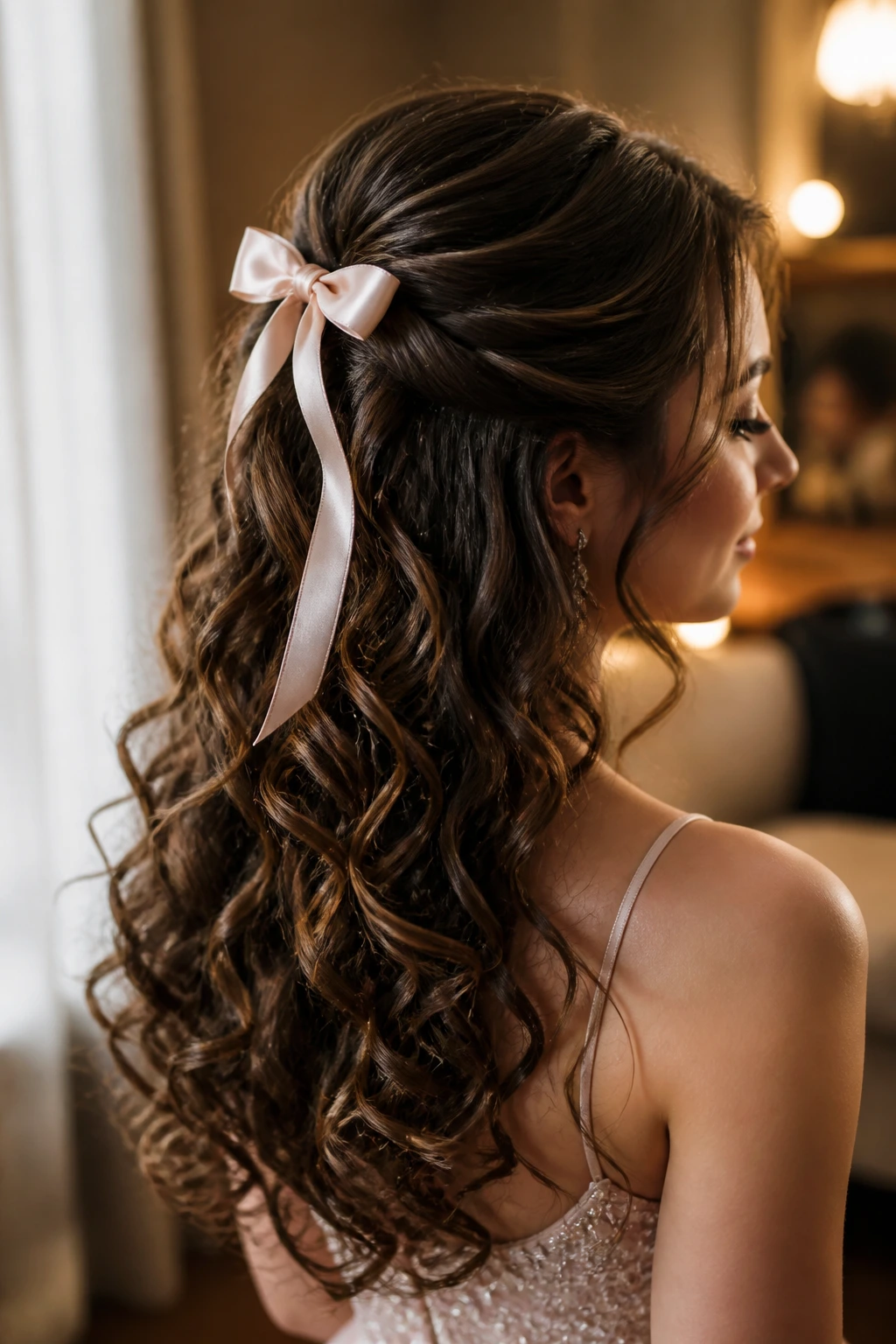
A ribbon changes the entire mood of half-up hair. Without it, the style can look like a standard school dance look. With a satin ribbon tied at the back of the lifted section, the curls suddenly feel more deliberate, more dressed up, and a little more charming in the best way.
This works best when the ribbon matches the texture of the dress rather than the exact color. A matte dress with a soft satin ribbon feels balanced. A shiny dress usually does better with a ribbon that’s slimmer and less glossy, so the two fabrics don’t fight for attention. The curls underneath should stay loose and touchable, not brushed into a puff.
Best for: medium to long hair, especially when you want a softer front than a full updo can give.
Tiny detail: tie the ribbon slightly off-center if you want the style to look less rigid.
13. One-Sided Volume with a Statement Barrette
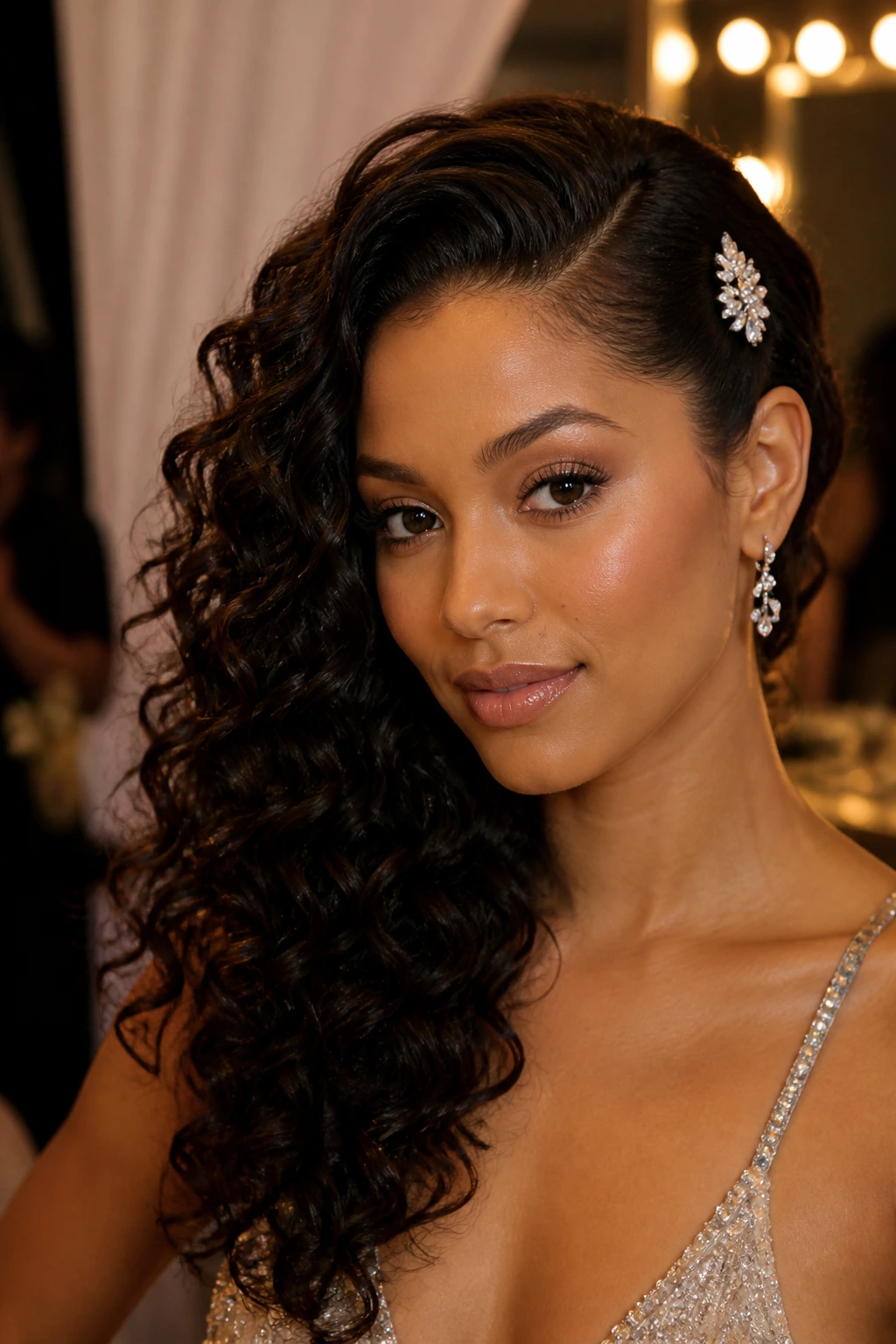
One-sided volume is a simple idea with a big payoff. Sweep the curls to one shoulder, pin the opposite side close to the head, and let the length create a strong diagonal line across the body. The statement barrette does not need to be huge. It just needs to be placed where the eye will land first.
This is one of my favorite options for dresses with one strap or dramatic earrings because the hair and the outfit are actually talking to each other. The style can be sleek at the roots and full through the lengths, which gives it that polished-but-not-picky finish people keep trying to describe and never quite get right.
Best part
It photographs with shape from the front and side.
That sounds small. It isn’t.
14. Twisted Halo Braid Around Loose Curls
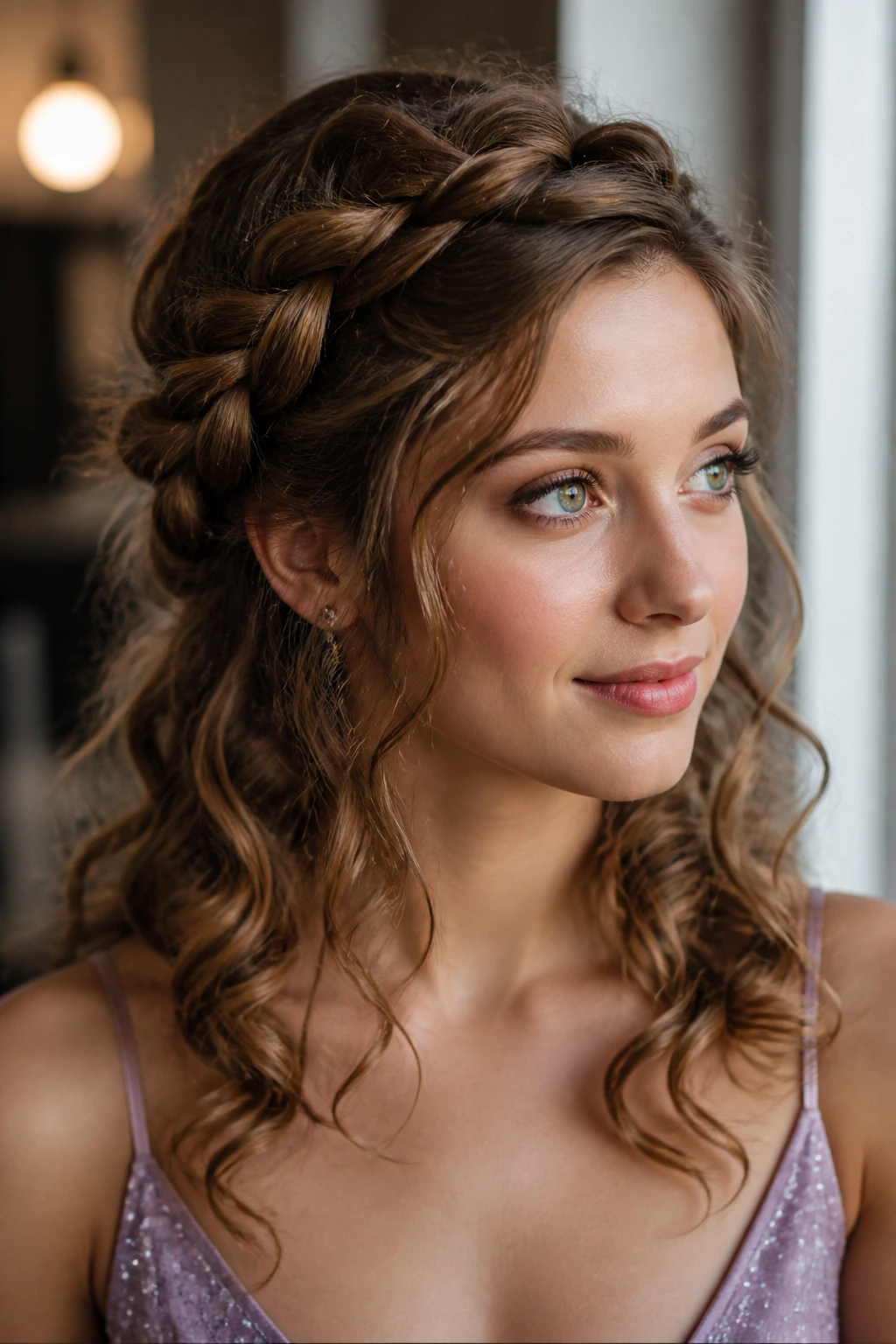
A halo braid gives you a built-in frame around the face, which means the loose curls underneath can stay softer and freer. The braid circles the head like a crown, but if it’s pancaked gently and not pulled flat, it stays romantic instead of rigid. That balance is what keeps it from looking like a costume piece.
The style is especially kind to layered hair that tends to fall across the cheeks. The braid keeps the top controlled, and the curls below provide the movement. If you like a softer face shape in photos, leave two small pieces near the temples and curl them away from the face. It makes the braid feel less severe.
A halo braid also survives the dance floor well. The structure is around the head, not hanging off it. That matters more than people think.
15. Curly Lob with Clipped-Back Front Pieces
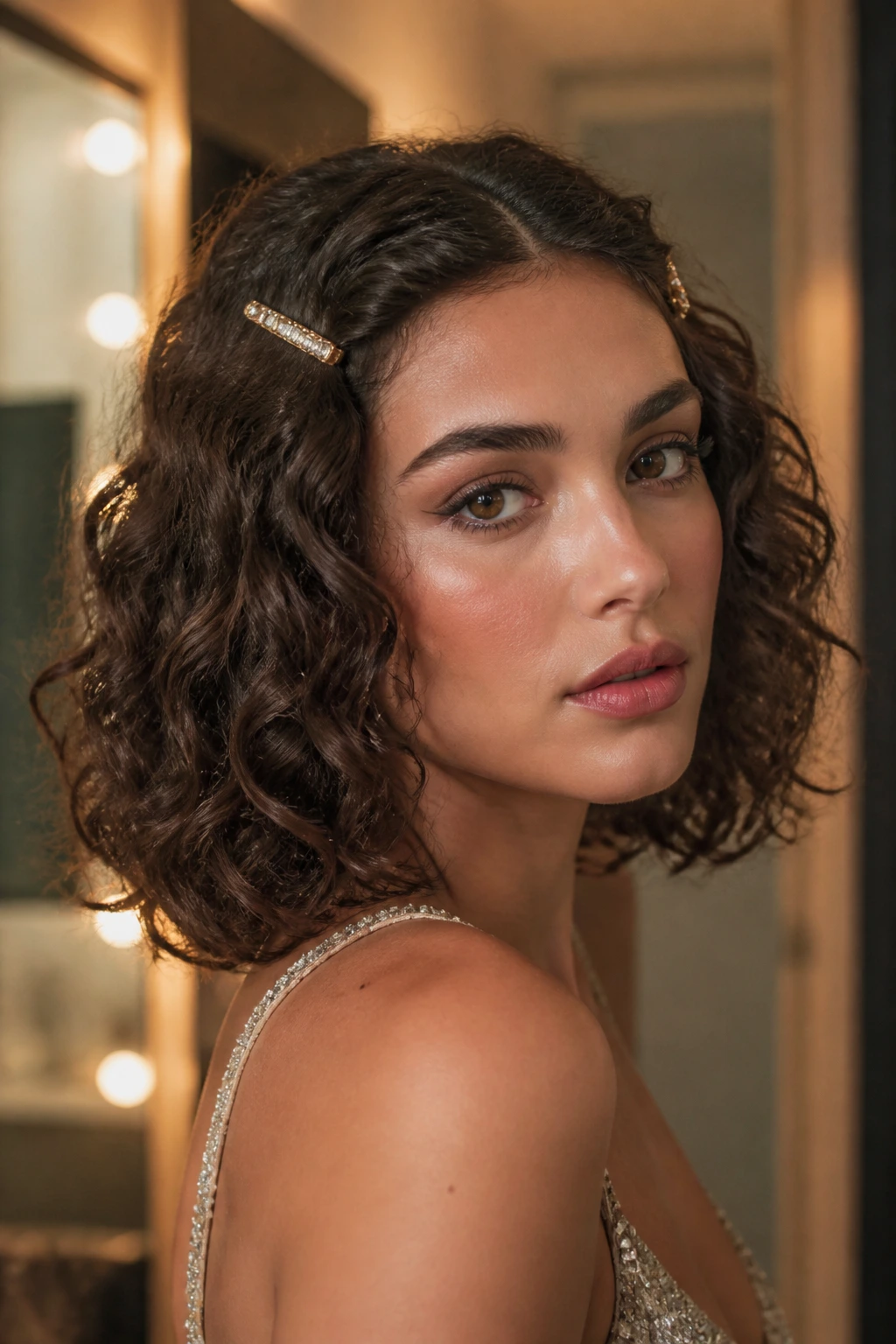
A lob can feel tricky for prom because there’s not enough length for a classic updo, but also too much hair to leave totally unstyled. The answer is to make the cut itself the star. Keep the curls defined, clip back the front pieces with two clean barrettes, and let the shape of the haircut do the work.
This is a good one for anyone with a shoulder-length cut who doesn’t want extensions or a ton of pinning. The clipped-back front opens the face, but the rest of the curls stay loose enough to move. It looks modern, not borrowed from somebody else’s idea of formal hair.
Best with: blunt ends, soft layers, or a bob that already has a strong silhouette.
Avoid: oversized clips that swallow the haircut. You want the clip to support the style, not become the style.
16. High Half-Ponytail with Curled Ends
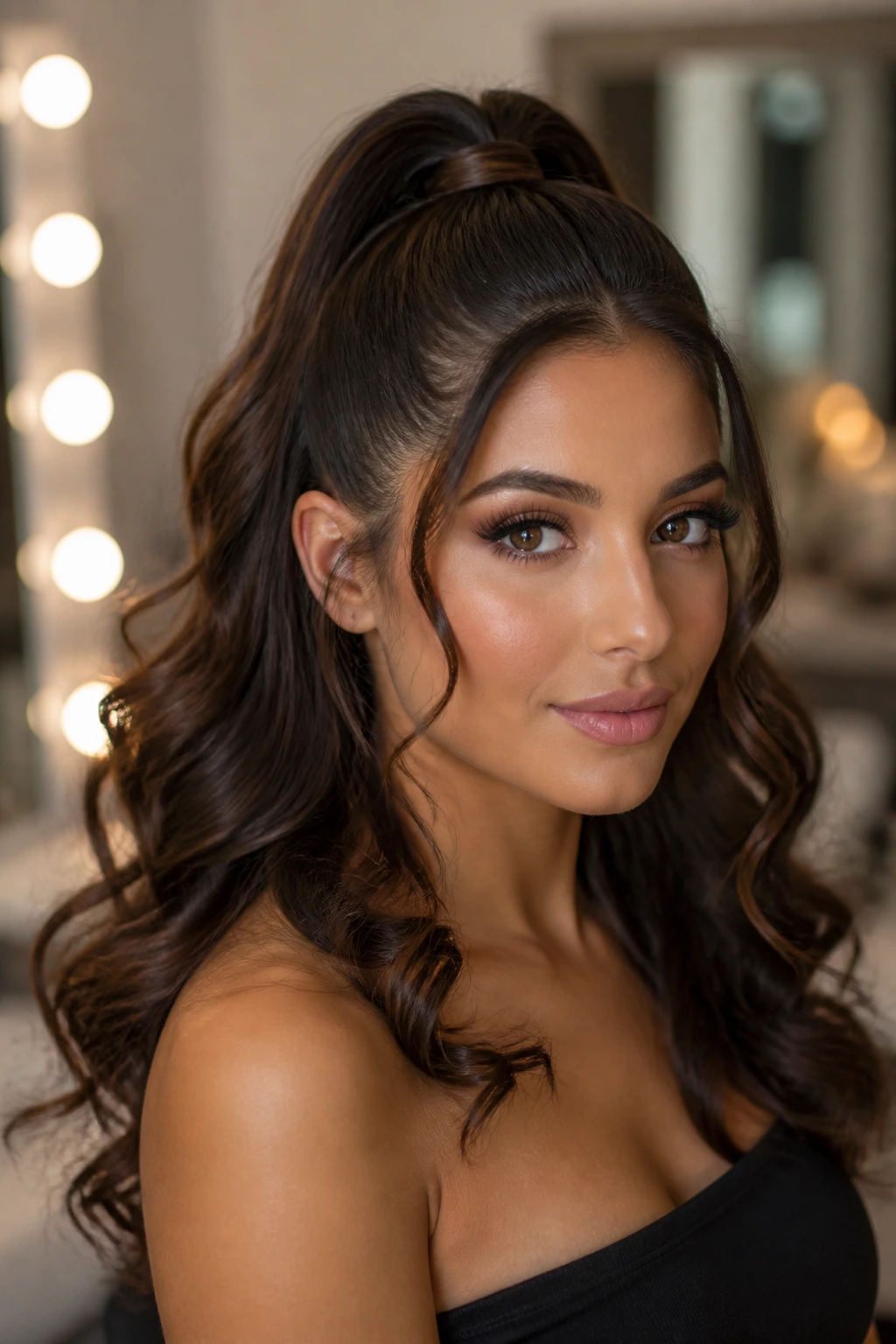
This style is one of those quietly clever choices. The top section pulls the hair up and away from the face, while the bottom half keeps the curls flowing. It gives you lift without a full updo, and it keeps the outfit visible across the shoulders and neckline.
The key is the height. Too low and it looks like an afterthought. Too high and it starts to feel juvenile. Put the pony at the upper third of the head, secure it well, and let the ends bounce. A little backcombing at the crown helps if your hair is fine, but don’t overdo it or the shape will go soft before you leave the house.
This is a smart middle ground. Not fussy. Not plain. Just enough structure to read well from across the room.
17. Low Bubble Braid Ponytail
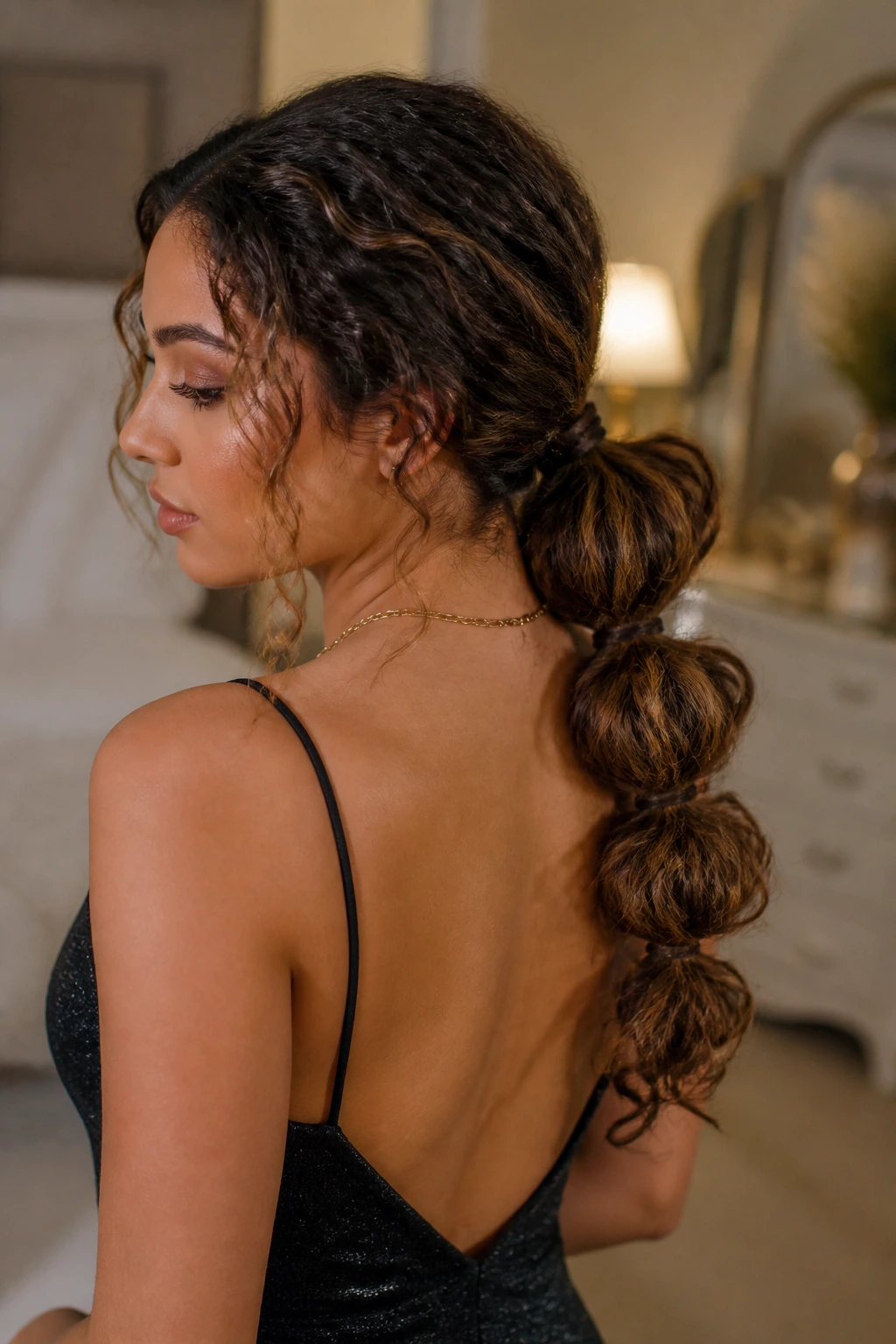
The low bubble braid ponytail is neater than it sounds. Start with a smooth pony at the nape, then section the tail into rounded bubbles with clear elastics. Gently tug each section wider so the ponytail looks full, not tight. The result is tidy, but not severe, and the curls still get to keep some movement.
This style is excellent if your dress has a detailed back or if you want the hair down your back without the constant sweep of loose curls. It holds well because every section has its own anchor. That means less slipping, less drooping, and fewer emergency mirror checks.
A satin scrunchie at the base can soften the look if the dress is romantic. If the dress is sleeker, go with hidden elastics and a wrapped base instead. Small changes. Big difference.
18. Scattered Gem Pins on Open Natural Curls
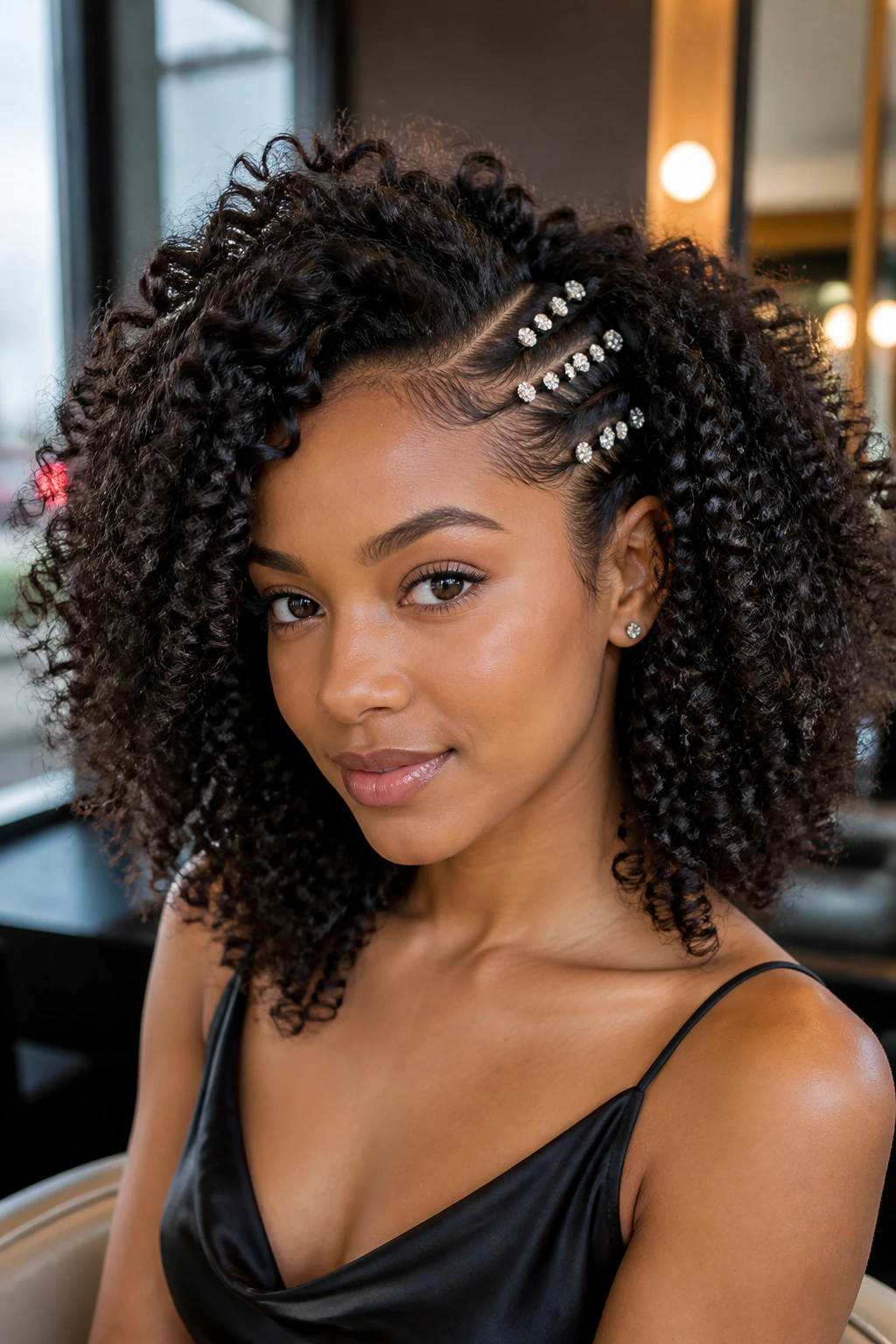
Sometimes the smartest move is to leave the curls alone and place the decoration carefully. A few gem pins scattered through the crown or one side can turn open natural curls into a prom style without flattening anything. The curls keep their spring, the shape stays full, and the sparkle reads like punctuation instead of a paragraph.
This is especially good if your hair already has a strong pattern and you don’t want to spend an hour forcing it into a shape it doesn’t want. Pin placement matters here. Think in lines or clusters, not random dots. Three pins near the part, or two near one temple, usually looks more intentional than a spray of glittery clutter across the whole head.
Best for: natural curls that hold their own and need only a little polish.
Best with: dresses that already have texture, beading, or shine.
19. Voluminous Top Knot with Curly Ends Loosely Shaped
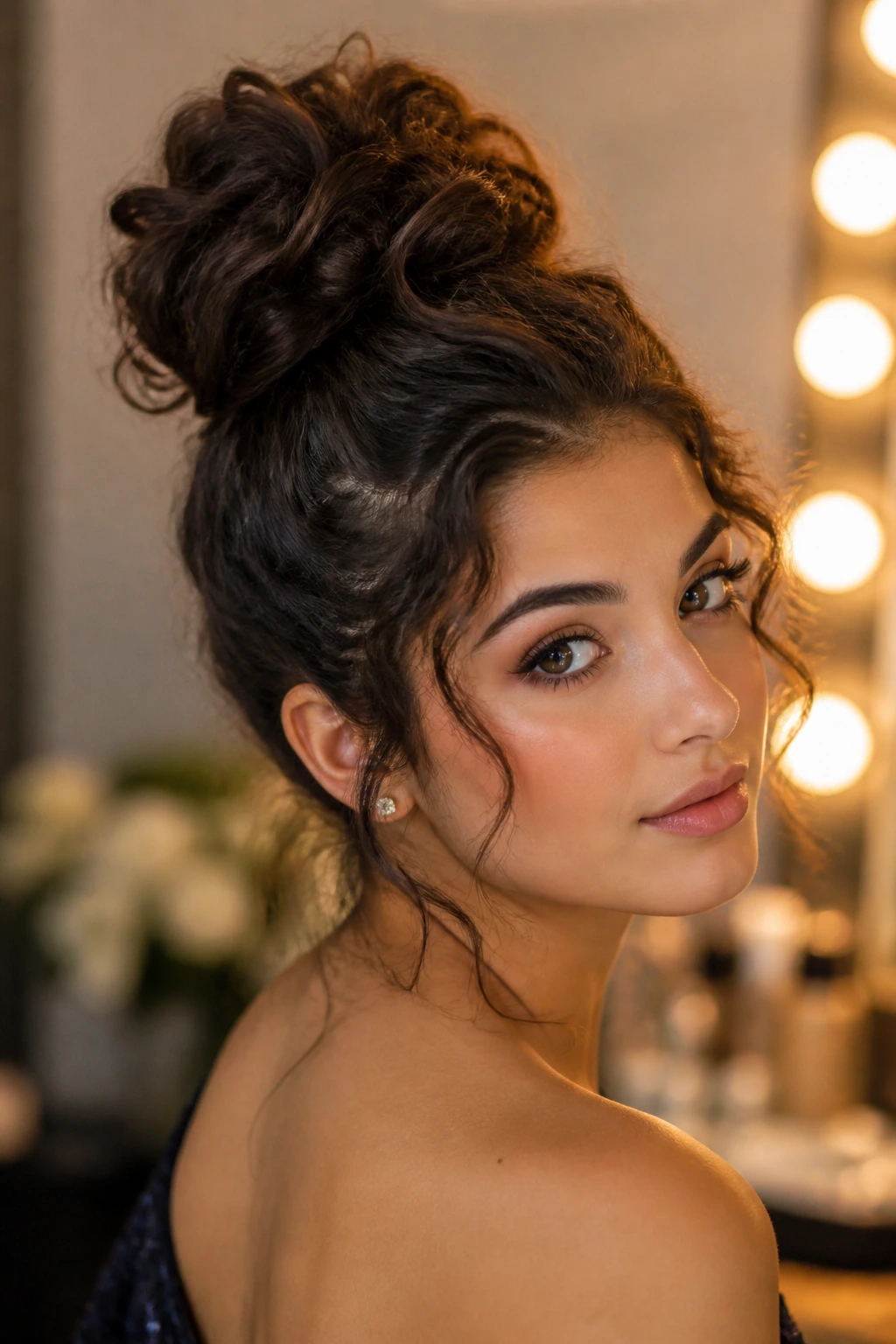
A top knot can look severe if it’s wound too tight. The version that works for prom keeps some softness around the bun and a few shaped curls at the ends so it doesn’t turn into a gym bun with earrings. Lift the knot high enough to open the face, then leave the texture a little imperfect on purpose.
The advantage is practical. The neck stays clear, the shoulders show, and the style stays out of the way while you’re moving around. But there’s still personality in the shape. A tiny bit of volume at the crown and a few curved pieces around the hairline keep it from feeling too plain.
If your dress is dramatic, this is a nice counterweight. The hair steps back. The outfit steps forward. Clean. Easy. Smart.
20. Romantic Side Bun with Spiral Face Pieces
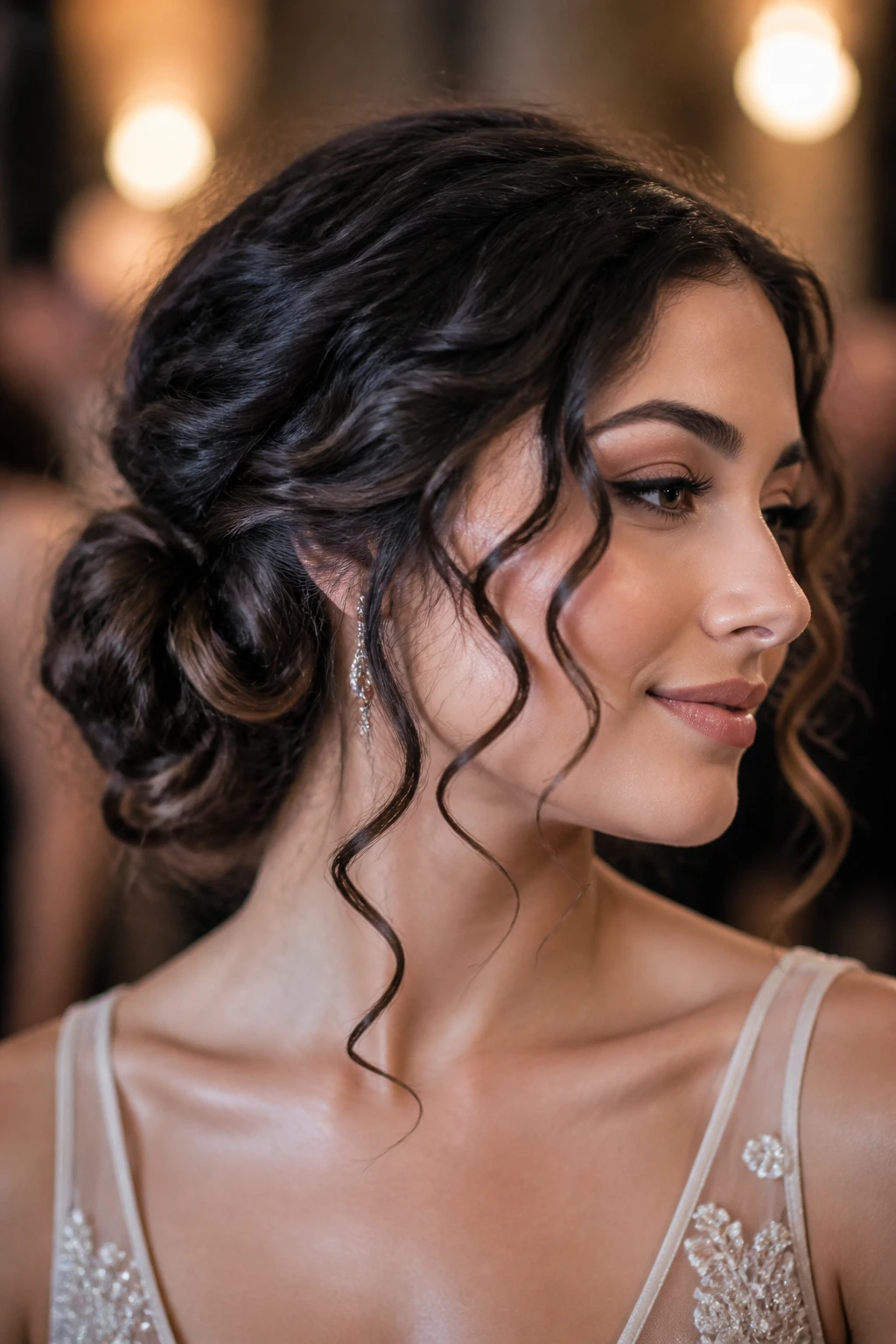
The side bun is the one I reach for when someone wants formal without stiffness. Set the bun low and off to one side, then leave two or three spiral pieces around the face and neckline. Those pieces soften the whole look, especially if the dress has a lot of structure.
This style works because it creates a shape across the jawline and shoulder, which can be flattering in a way that’s hard to explain until you see it in photos. The bun gives weight to one side, while the loose curls keep the style from feeling overly designed. A little texture at the crown helps the bun look full instead of pinned flat.
A side bun also gives room for a larger earring on the opposite side. That asymmetry can be gorgeous. And yes, it photographs better than a bun hidden dead center at the back.
21. Curly Shag with Flipped, Feathered Layers
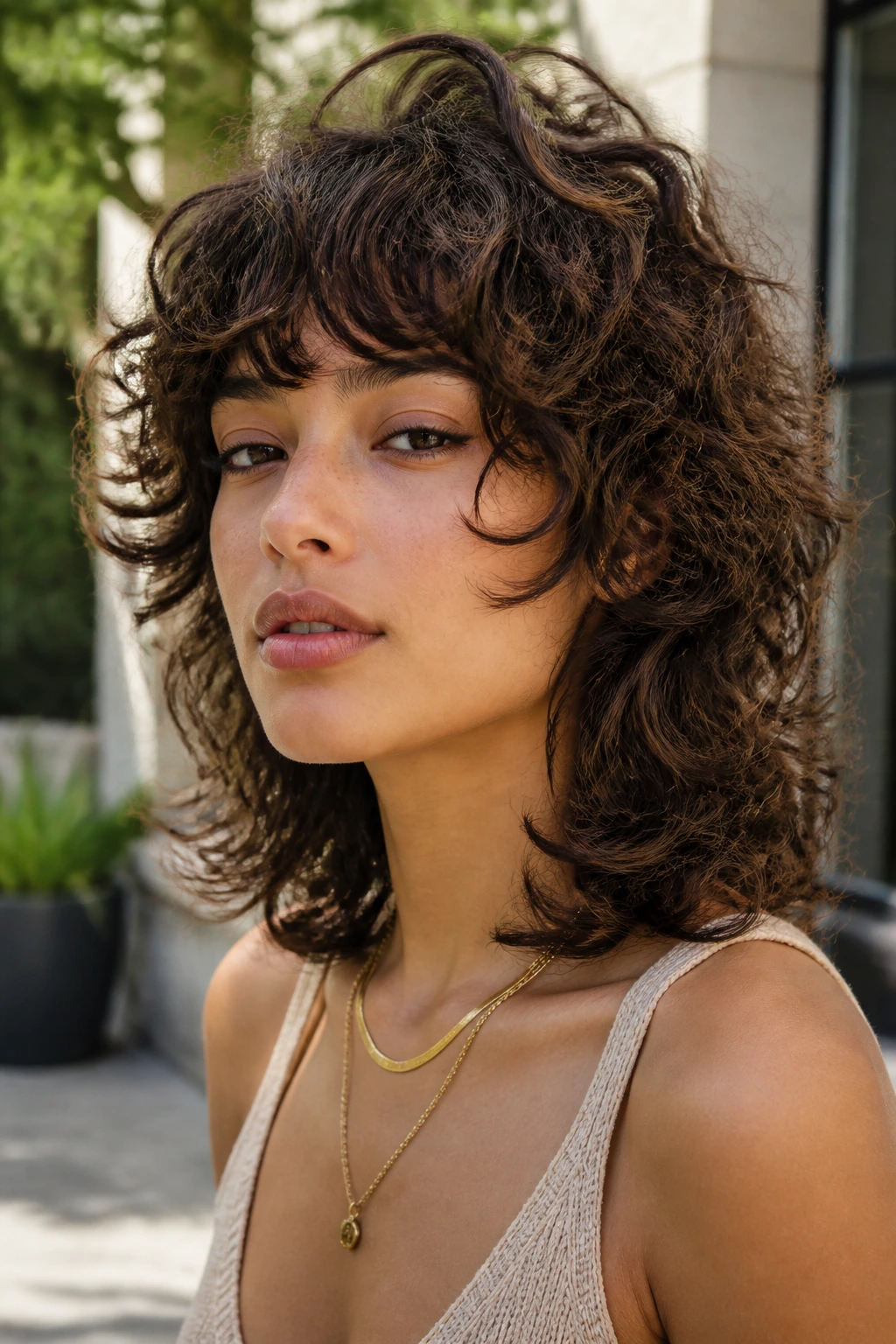
Not every prom hairstyle needs to be pinned up. If you have a curly shag, the cut itself already has attitude and shape, so the goal is to show off the layers instead of covering them. A little root lift, some separated curls around the cheekbones, and slightly flipped ends can make the haircut feel intentional and fresh.
This is the style for someone who does not want to lose the haircut under formal styling. Keep the crown soft, define the top pieces, and let the layers fall where they naturally want to land. A light diffuser helps, but so does restraint. The shag is already doing the work.
Why I like this one
It looks modern without trying too hard.
That’s harder to pull off than people think.
22. Milkmaid Braid with Soft Puff at the Crown
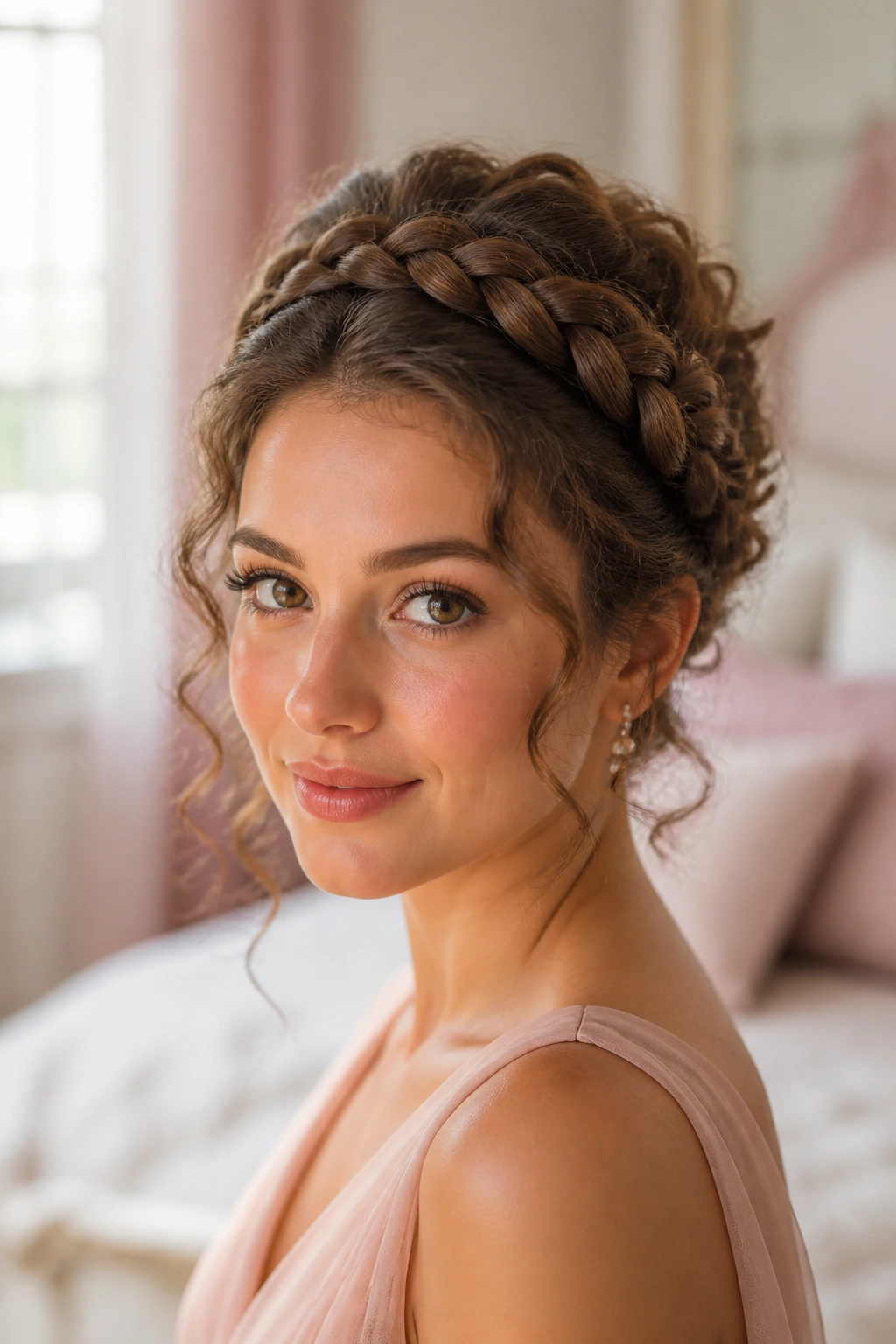
The milkmaid braid can veer very sweet, very quickly, so the trick is keeping it a little loose. Leave a soft puff at the crown, braid around the head, and let a few curls or coils escape near the temples. The shape is charming, but the softness keeps it from looking stiff or childish.
This is a strong choice if you want the hair off your neck and still want a braided look that feels special. The crown puff matters because it gives the head shape from the side; without it, the braid can sit too flat and read a little severe. A little teasing at the roots under the braid is enough.
Good with floral dresses. Good with vintage-inspired gowns. Good when you want the hair to feel like part of the outfit rather than a separate project.
23. Satin-Bow Low Ponytail
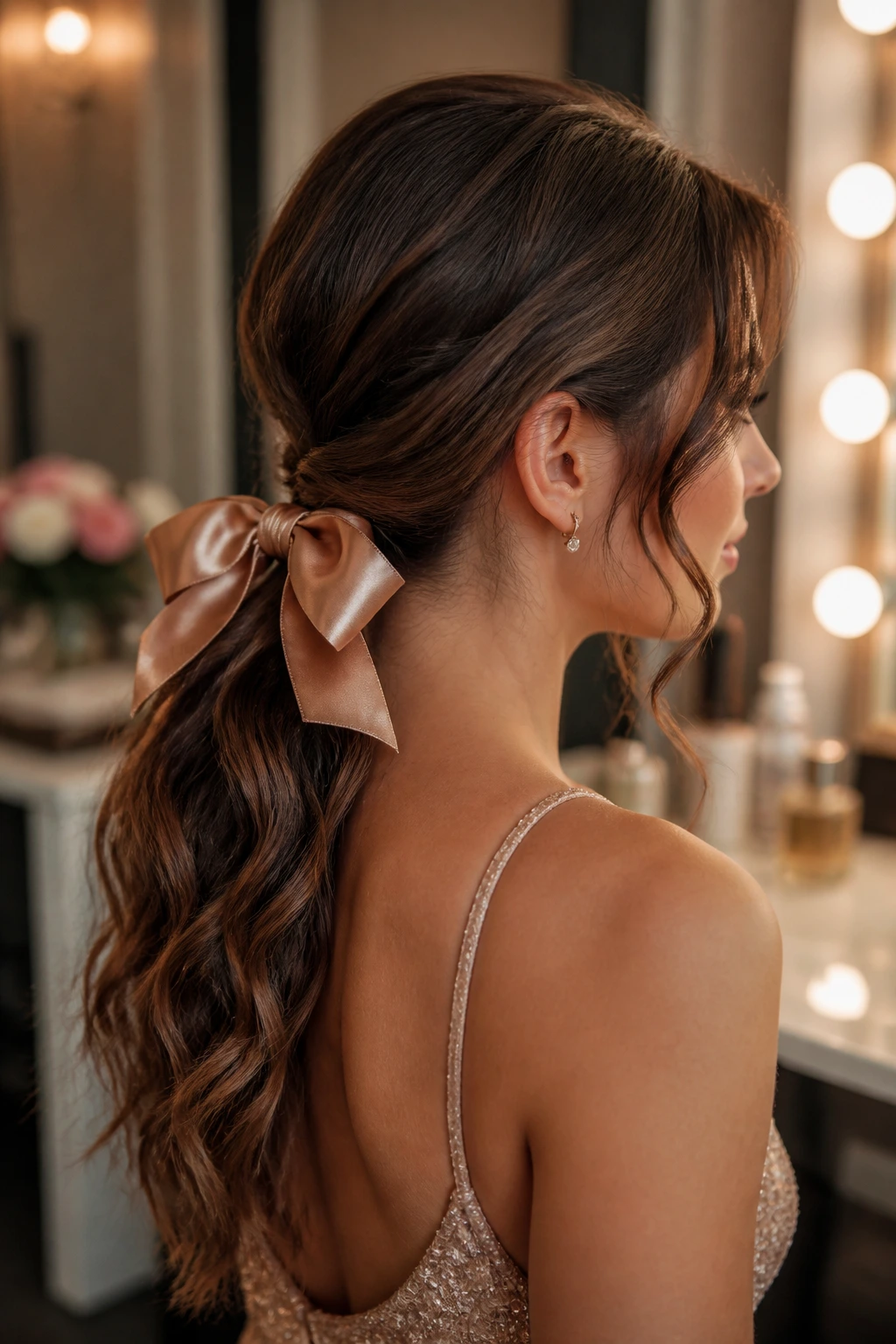
A satin bow can save a low ponytail from looking too plain. The pony itself should sit at the nape, smooth at the root and full through the curls or waves. Then the bow finishes the base with a soft flourish that reads formal without being heavy.
The bow should feel like an accent, not a centerpiece. If it’s oversized, the hair disappears. If it’s tiny, it looks accidental. The middle ground is a ribbon that sits broad enough to be seen in photos but slim enough that it doesn’t pull the eye away from the curls. Keep the ponytail itself defined, because the bow needs a good shape underneath it.
This is one of the easiest styles to customize with dress color. Ivory, black, blush, deep green — the ribbon can echo the outfit without matching it too literally. That little bit of restraint keeps it chic.
24. Defined Natural Coils with a Crystal Headband
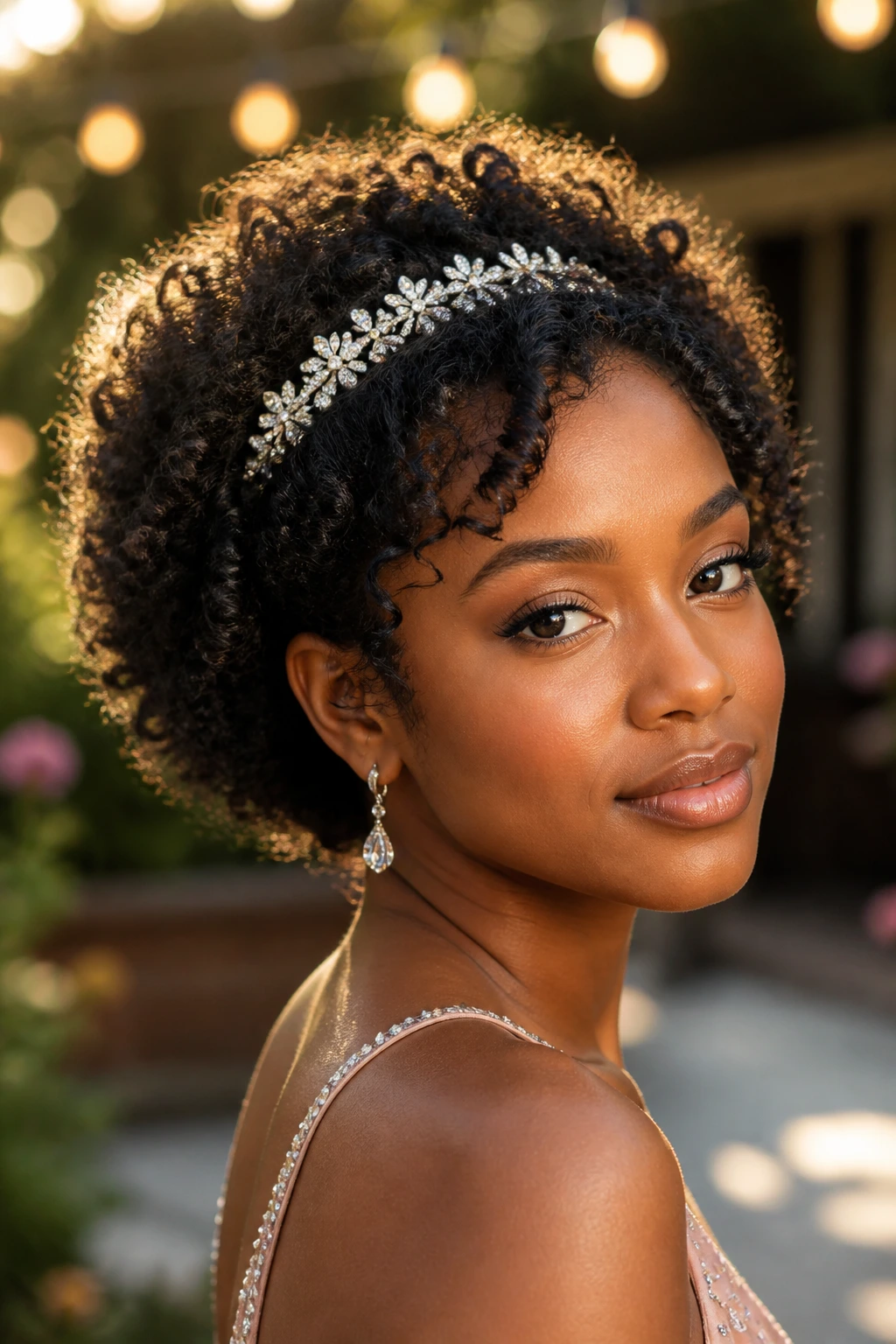
If your coils are healthy and defined, the most striking move is often to let them be the main event. A crystal headband gives you a prom signal right away, but the coils still own the silhouette. The headband should sit just behind the hairline, not crushed into the roots, so the front stays comfortable and the texture stays visible.
The appeal here is shape. Coils have a rhythm that looks gorgeous when the hair is moisturized and separated correctly. A little edge control at the front keeps the line clean, and a sheen spray on the surface can make the coils catch light in a way that looks rich rather than greasy.
A headband is also forgiving. If the curls shrink a little or the style shifts through the evening, the accessory stays in place. That reliability is worth more than people admit.
25. Faux Half-Up Knot at the Crown
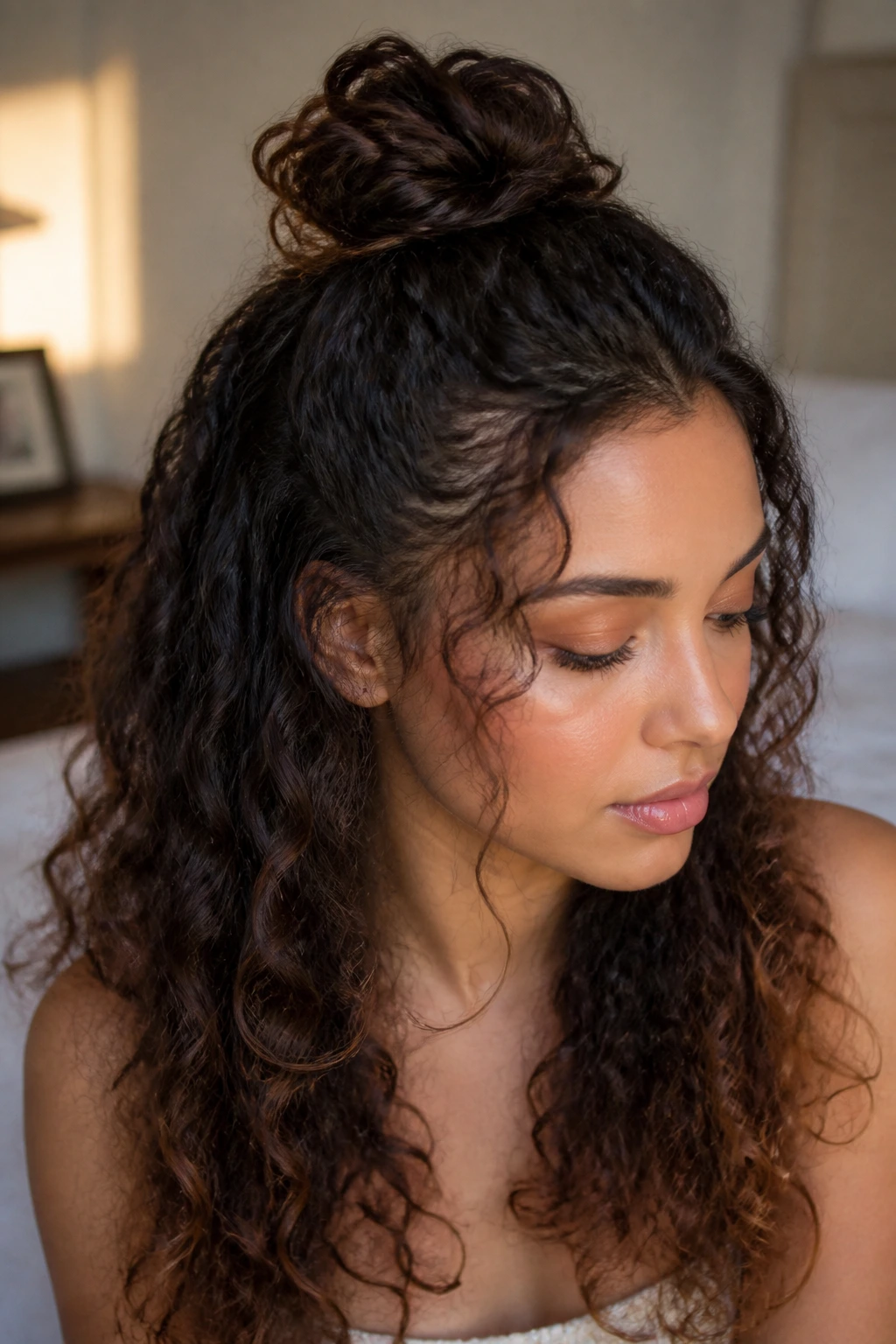
A faux half-up knot gives the illusion of a more elaborate style without locking you into a full updo. Pull the top section to the crown, twist it into a soft knot, and let the rest of the curls fall below. The effect is lifted and airy, but still relaxed enough to keep movement.
This is a good choice for medium-length hair because it creates the feeling of more height. It also works well if the top layer of your curls tends to fall into your eyes. The knot lifts the line of sight, while the lengths stay soft around the shoulders. A couple of hidden pins under the knot will hold better than a single big pin shoved through the middle.
If your dress has detail across the bodice, this style keeps the hair from competing with it. Clean top, full bottom. That’s the formula.
26. Side-Swept Old-Hollywood Waves on Curly Hair
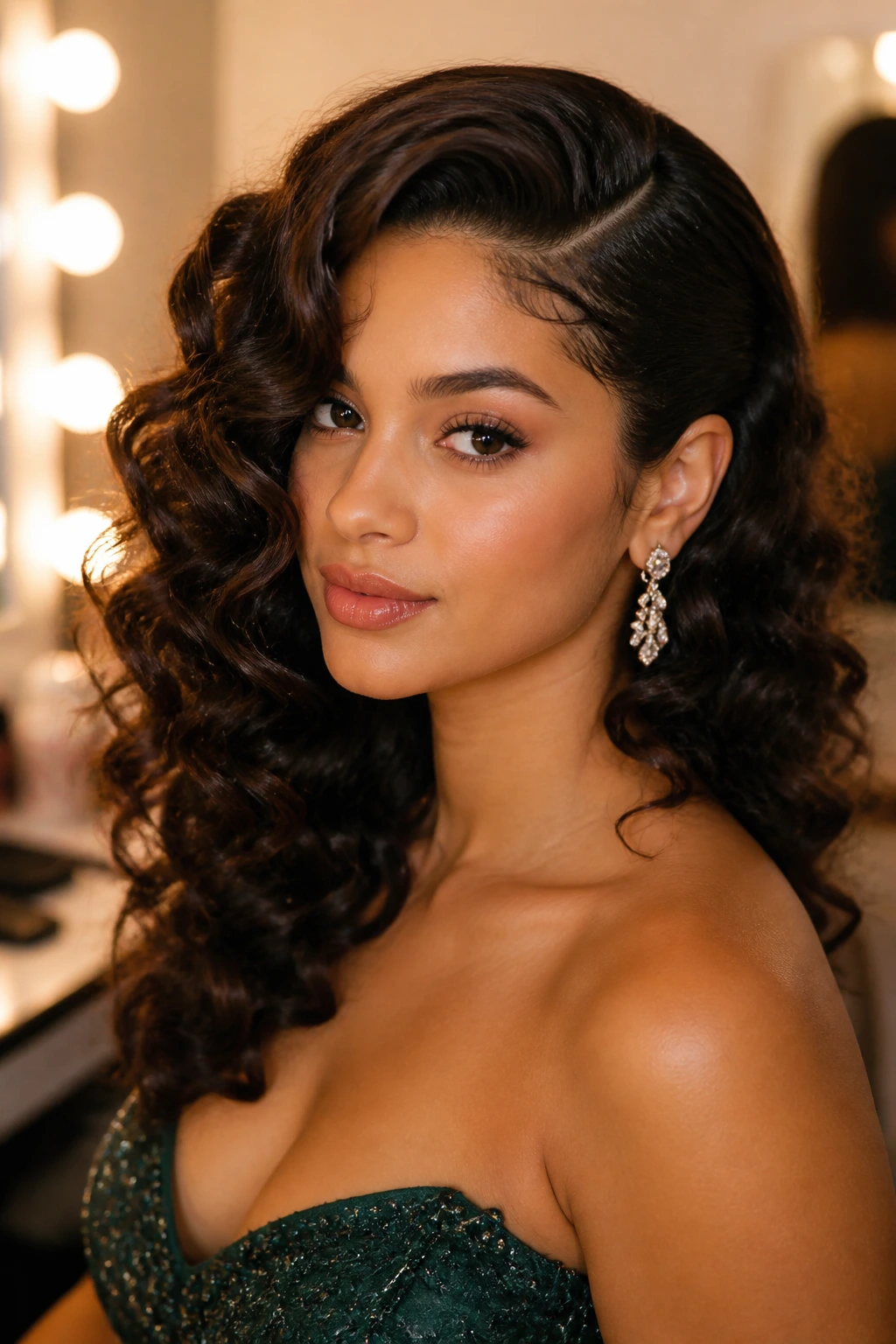
Side-swept waves are not the same as brushing curls into oblivion. The best version on curly hair keeps the base pattern alive, then shapes the front into a sweeping curve with a deep side part and carefully set sections. The result has that old-Hollywood feel, but without turning the hair into a helmet.
This style asks for patience. Let the curls cool, shape them in sections, and pin the front while it sets if needed. The side sweep should have weight and direction, not just a loose pile of hair that’s been muscled over one shoulder. If you do it right, the front has a sculpted line and the ends still move.
Best for: glamorous dresses, heavier fabrics, or anyone who wants the hair to feel dramatic without a lot of accessories.
Best detail: tuck one side behind the ear and leave the other fuller. The contrast is part of the appeal.
27. Tucked-Behind-One-Ear Bob with Sparkly Clips
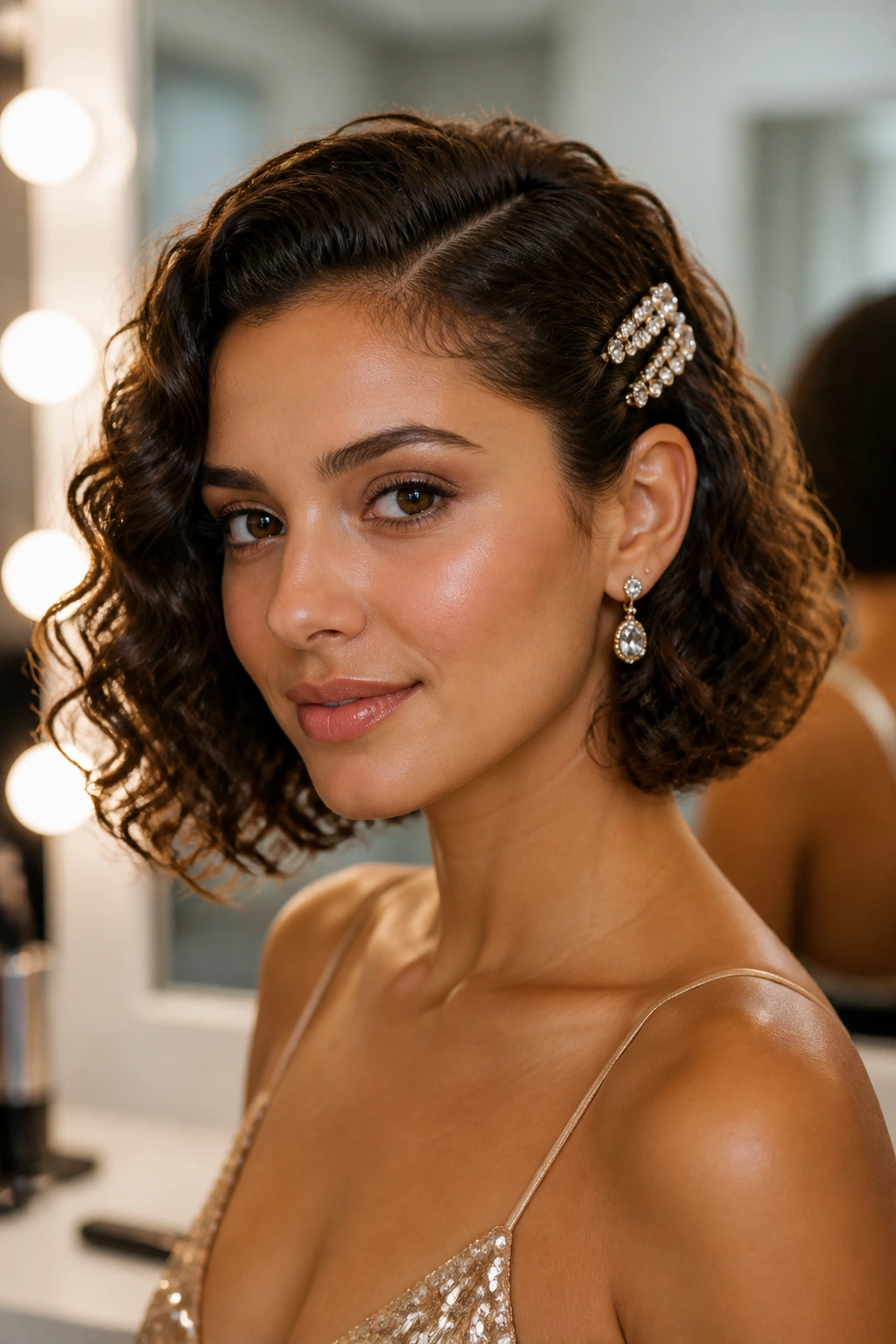
Short hair deserves a seat at the prom table. A curly bob with one side tucked behind the ear feels clean and modern, and the sparkly clips make sure it reads as intentional, not as if the curls simply ran out of length and gave up. The silhouette stays compact, which is useful if you want the dress and makeup to take a little more space.
The clip placement is everything. Put the sparkly piece where the hair naturally wants to fall forward, not at the very end of the section. That way it controls the shape instead of fighting it. A touch of curl cream on the ends keeps the bob defined, and a little root lift keeps the top from sitting too close to the scalp.
This is one of those styles that looks far more polished in person than people expect. Short curls have a crispness that long hair sometimes loses.
28. Textured French Twist with Curled Fringe
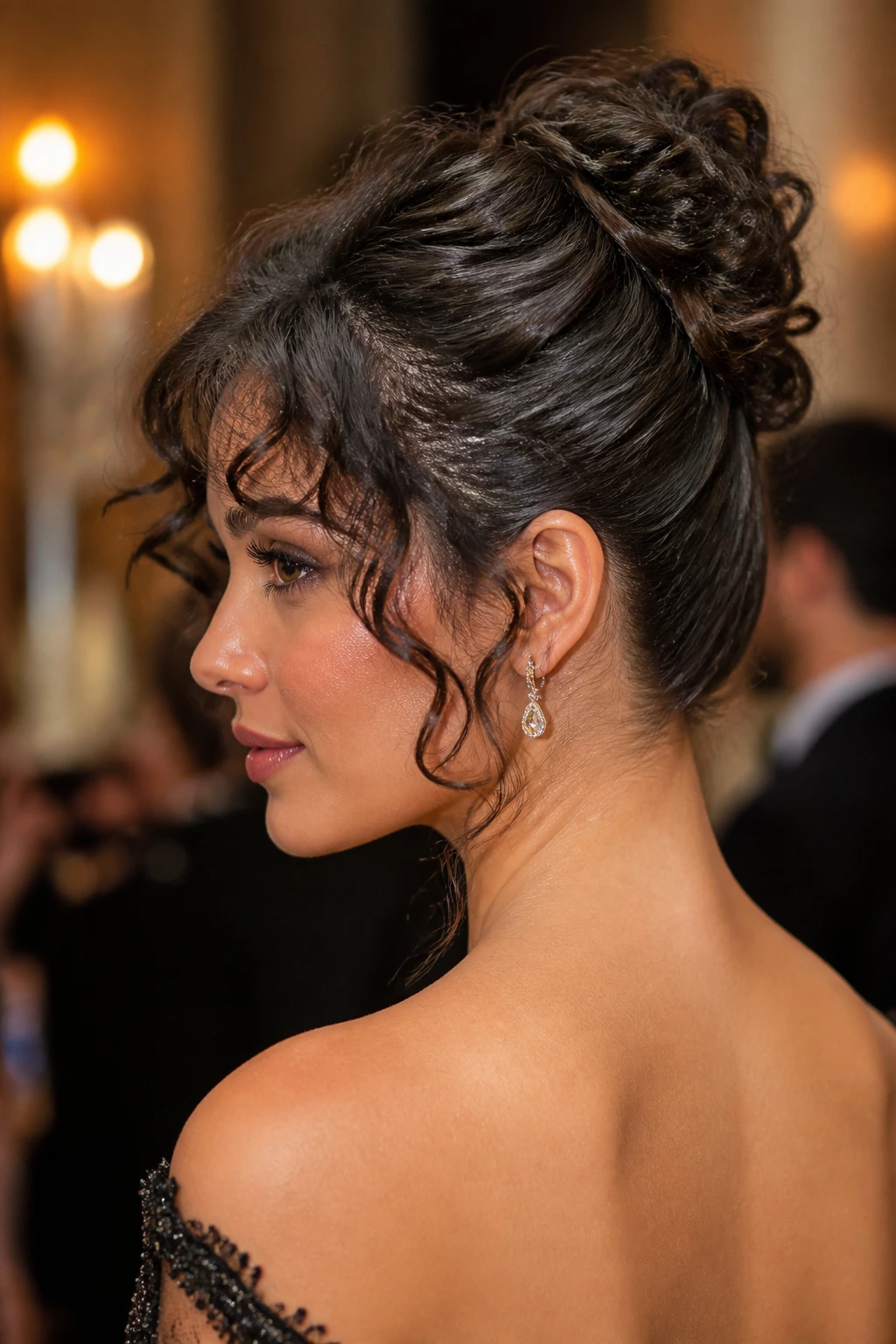
A French twist can go from elegant to stiff in a hurry, which is why texture matters so much here. Leave the surface a little lived-in, twist the body of the hair upward, and let the fringe or front curls stay soft around the face. The shape stays formal, but the texture keeps it from feeling too strict.
This is a strong option if you want the back of the dress visible. It opens the neck, frames the shoulders, and gives the profile a clean line. The curled fringe is the part that keeps it from looking severe. A French twist with no softness at the front can age a face. A little movement fixes that fast.
If you’re wearing a high neckline, this can be one of the most balanced looks on the list. The hair gets out of the way, but it still looks styled with intent.
29. Soft Afro with a Jeweled Comb
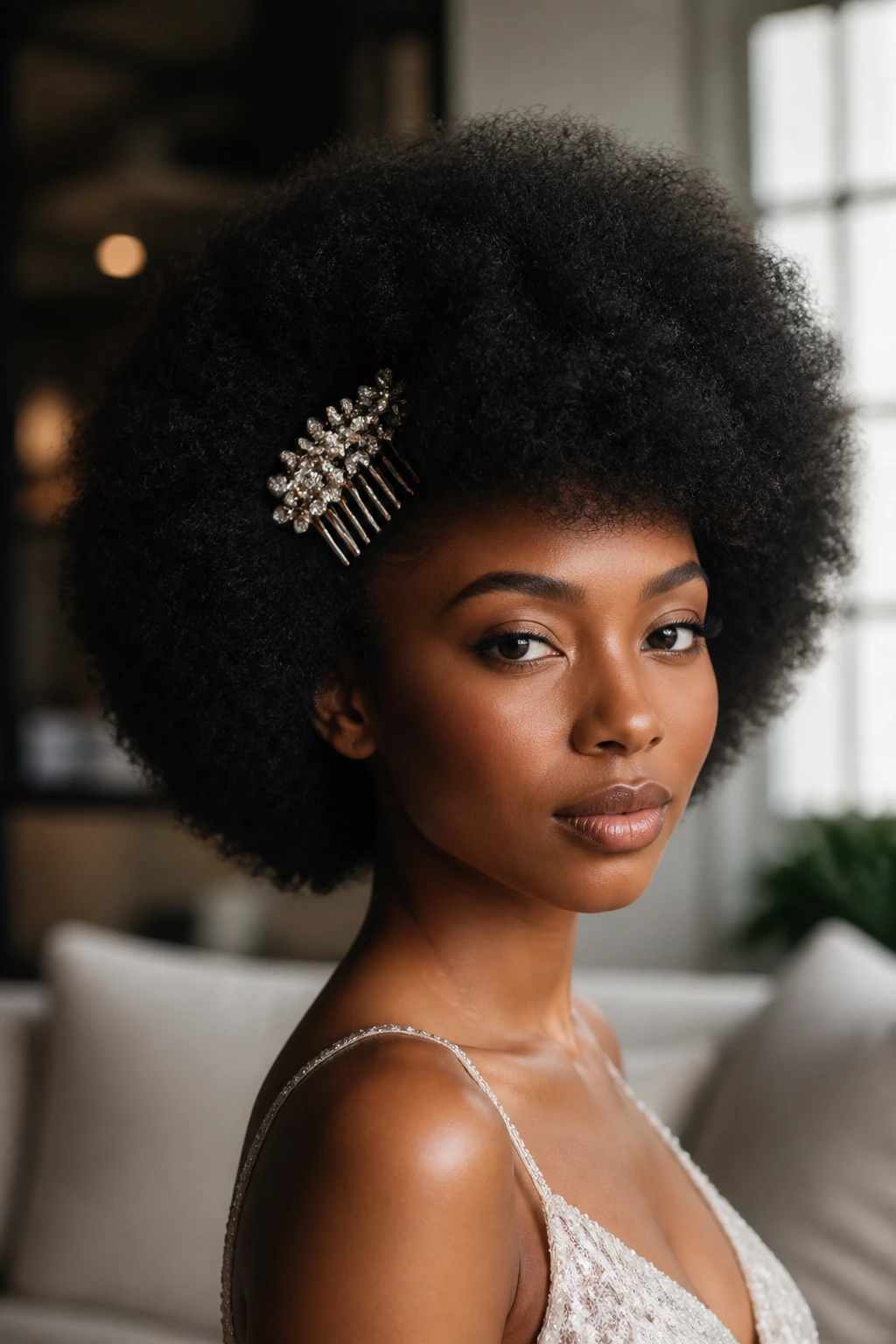
A soft afro is one of the most beautiful prom choices because it celebrates shape instead of trying to shrink it. The goal is a rounded silhouette with definition, not a blown-out cloud and not a crunchy shell. A jeweled comb placed to one side adds just enough sparkle to mark the occasion without flattening the volume.
The shape should be even from front to side. Pick the curls gently, separate where needed, and keep the outline clean. A little gloss on the surface can make the texture look rich in photos. The comb works best when it’s placed slightly above the ear or near the temple, where it can catch light without crowding the face.
This is a style that doesn’t need a lot of help. That’s part of its appeal. The haircut and texture do the heavy lifting; the accessory just steps in at the right point.
30. Braided Ponytail with Curled Lengths
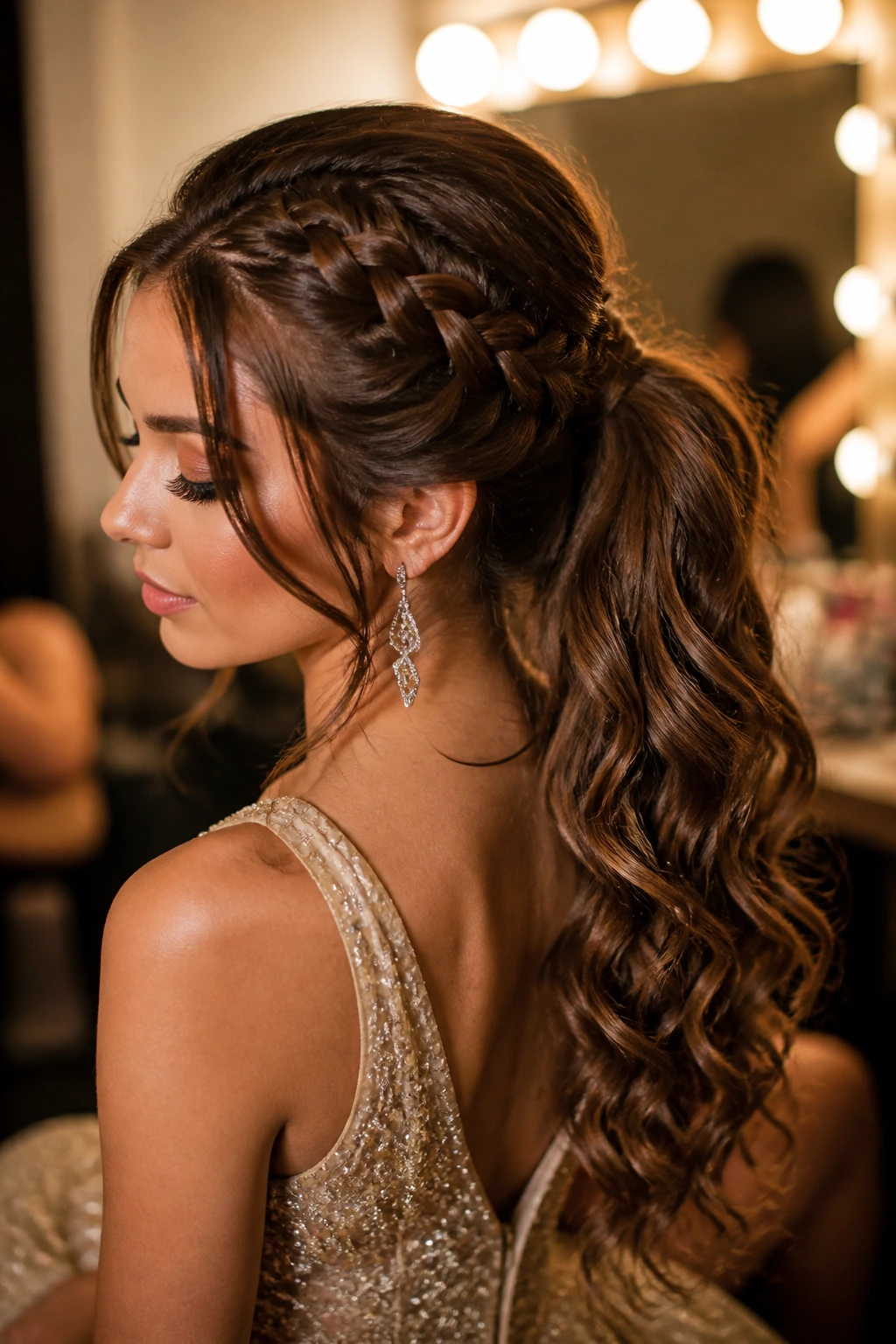
A braided ponytail gives you two textures in one look. The braid secures the top and the curls finish the tail, which makes the style feel fuller and more detailed than a plain ponytail. It also solves the problem of hair falling in the face while still keeping visible length.
The braid can start at the hairline, run along one side, or sit as a small accent across the crown before joining the pony. Pick the version that suits the dress. A cleaner braid works with structured fabric. A looser, slightly pancaked braid works with softer dresses and more romantic makeup.
If your hair is thick, this is a good way to keep weight under control. If your hair is fine, the braid gives the illusion of more body. Small effect. Big reward.
31. Clip-Back Cascade with Flowing Volume
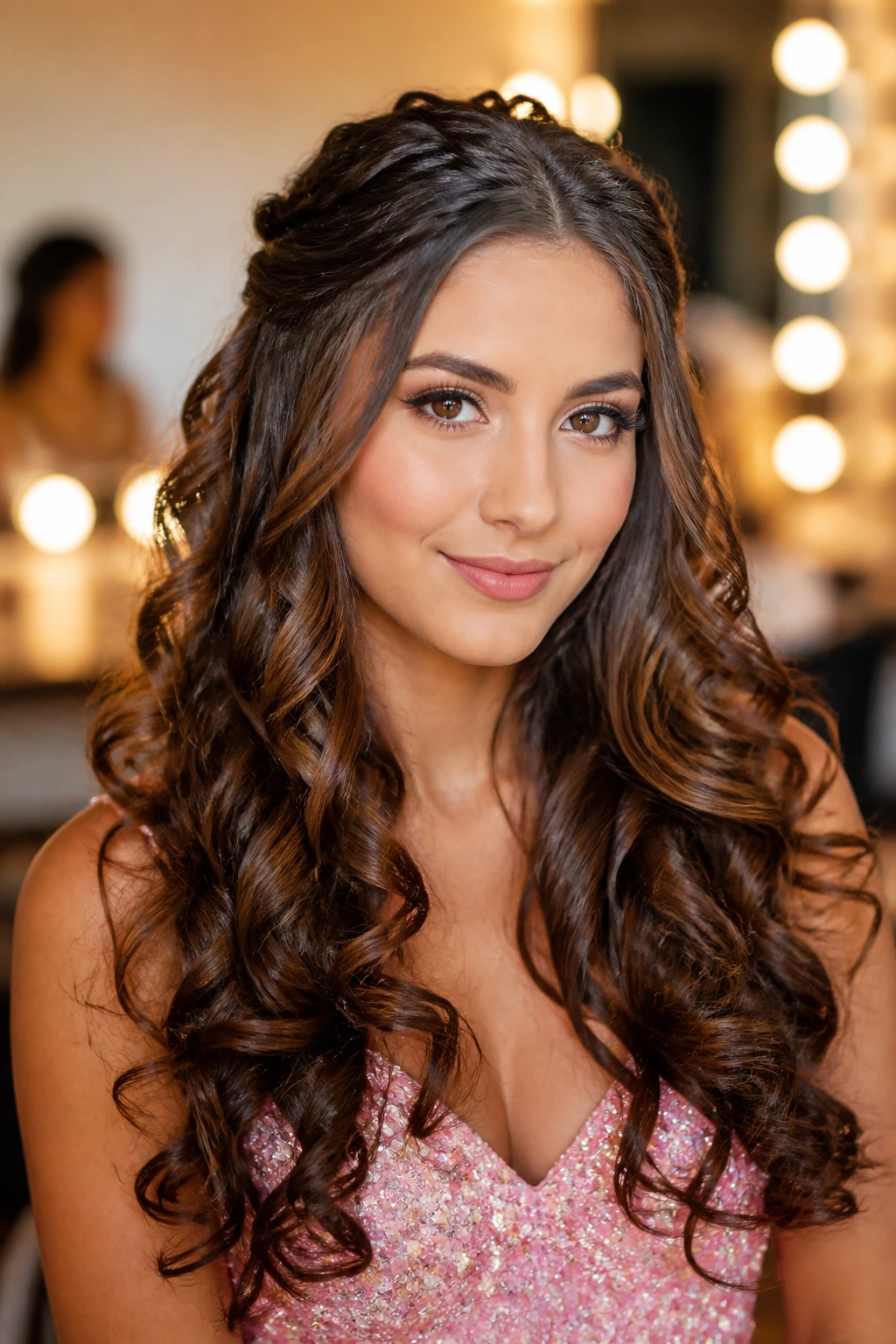
This one is easy to underestimate. A few well-placed clips at the front can turn loose curls into something polished almost instantly, especially when the rest of the hair is left in a long cascade over the shoulders and back. The clips create structure where the eye lands first, and the length below keeps the look glamorous.
The front pieces should be directed back rather than pinned flat to the scalp. That preserves volume at the root and avoids the flattened strip that can happen when clips are pushed in too tight. Mix two smaller clips instead of one oversized one if the hair is thick — it holds better and looks lighter.
This is the style for someone who wants to wear her hair down but still needs a formal detail. It’s simple. Not plain. There’s a difference.
32. Wrapped-Base Statement Ponytail with Spiral Tail
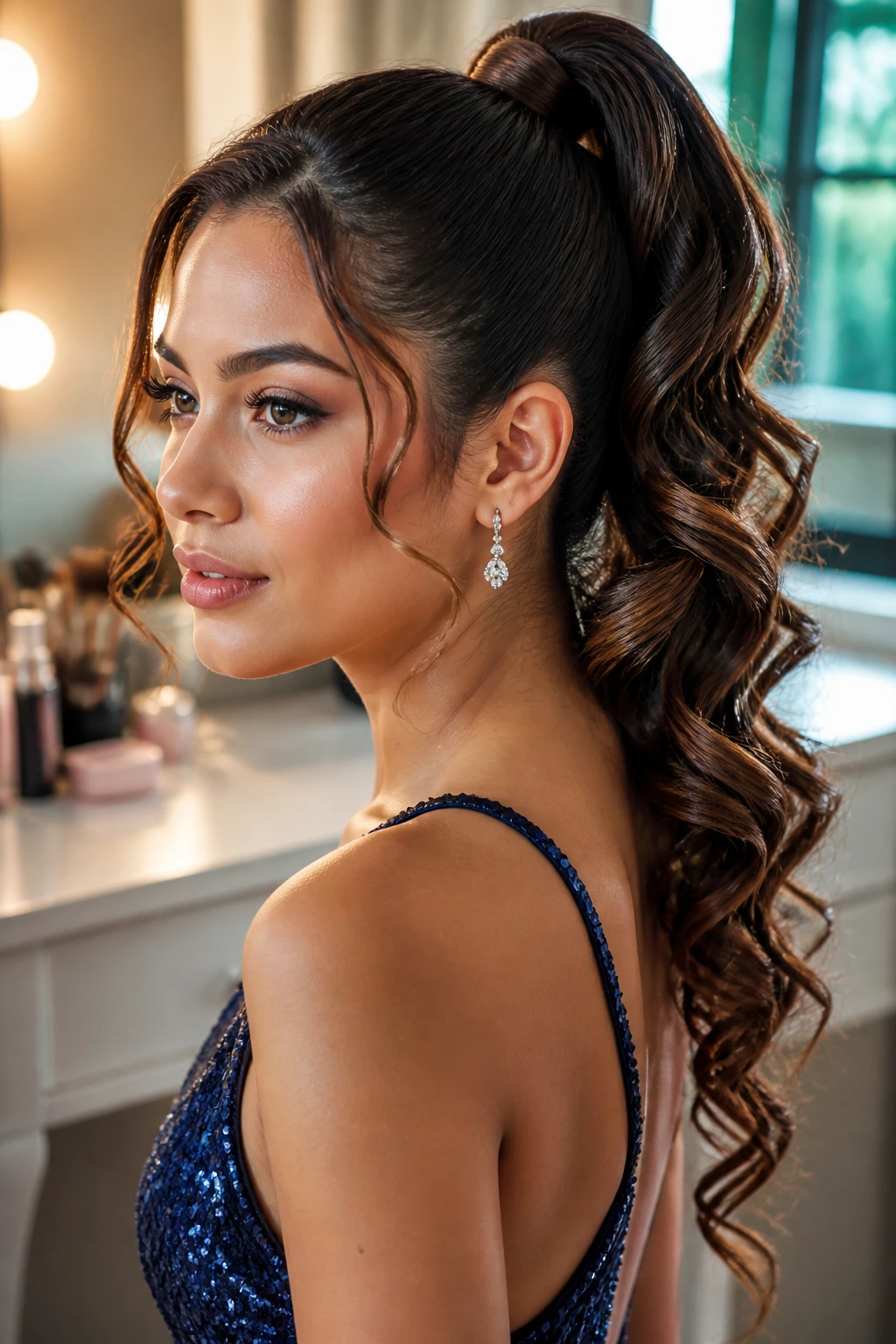
A wrapped-base ponytail is one of the cleanest finishes you can give curly hair. The wrap hides the elastic, the crown stays smooth, and the spiral tail drops below with enough shape to feel dressed up. It’s a strong ending choice for the collection because it sits right between polished and fun.
The ponytail needs a firm anchor. Build it high or mid-high, wrap the base neatly, and then define the tail with a little serum or curl cream so the spirals don’t separate into frizz. If your hair is long, this is where the length becomes part of the design. If it’s medium, the bounce still reads well because the base is so clean.
This style is also one of the easiest to adjust if the evening gets warm. The base stays put. The tail keeps moving. And the whole thing looks better than a ponytail has any right to.
Why Curly Hair Needs a Different Prom Plan
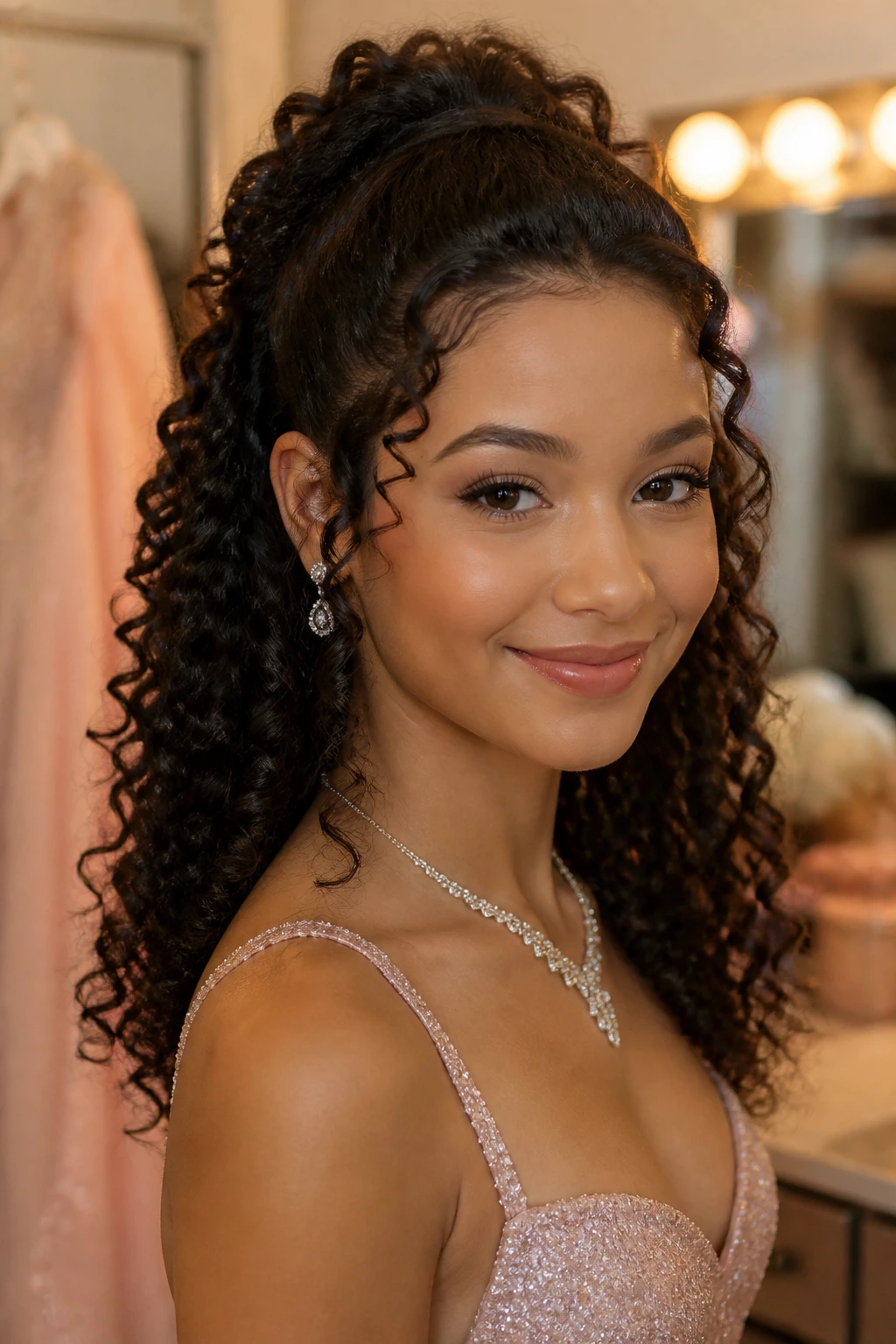
Curly hair does not fail at prom because it is curly. It fails when it’s handled like straight hair with extra steps. That’s the real issue. The curl pattern wants support at the roots, moisture through the mid-lengths, and enough restraint at the front that it doesn’t expand into frizz the second the room gets warm.
The smartest prom prep starts with shape, not with heat. If you smooth the cuticle too hard, the curls lose their grip. If you pile product onto the roots, the style goes soft and heavy. If you skip the cooling stage after curling or setting, the curls collapse while they’re still warm and you spend the rest of the night trying to revive them with tiny, futile sprays.
There’s also the simple matter of movement. Prom hair has to survive hugging, dancing, flashes, and long stretches between bathroom mirrors. That means you want a style that keeps the front controlled, the crown anchored, and the ends free enough to move. Clean structure. Soft finish. That combination is doing almost all the work.
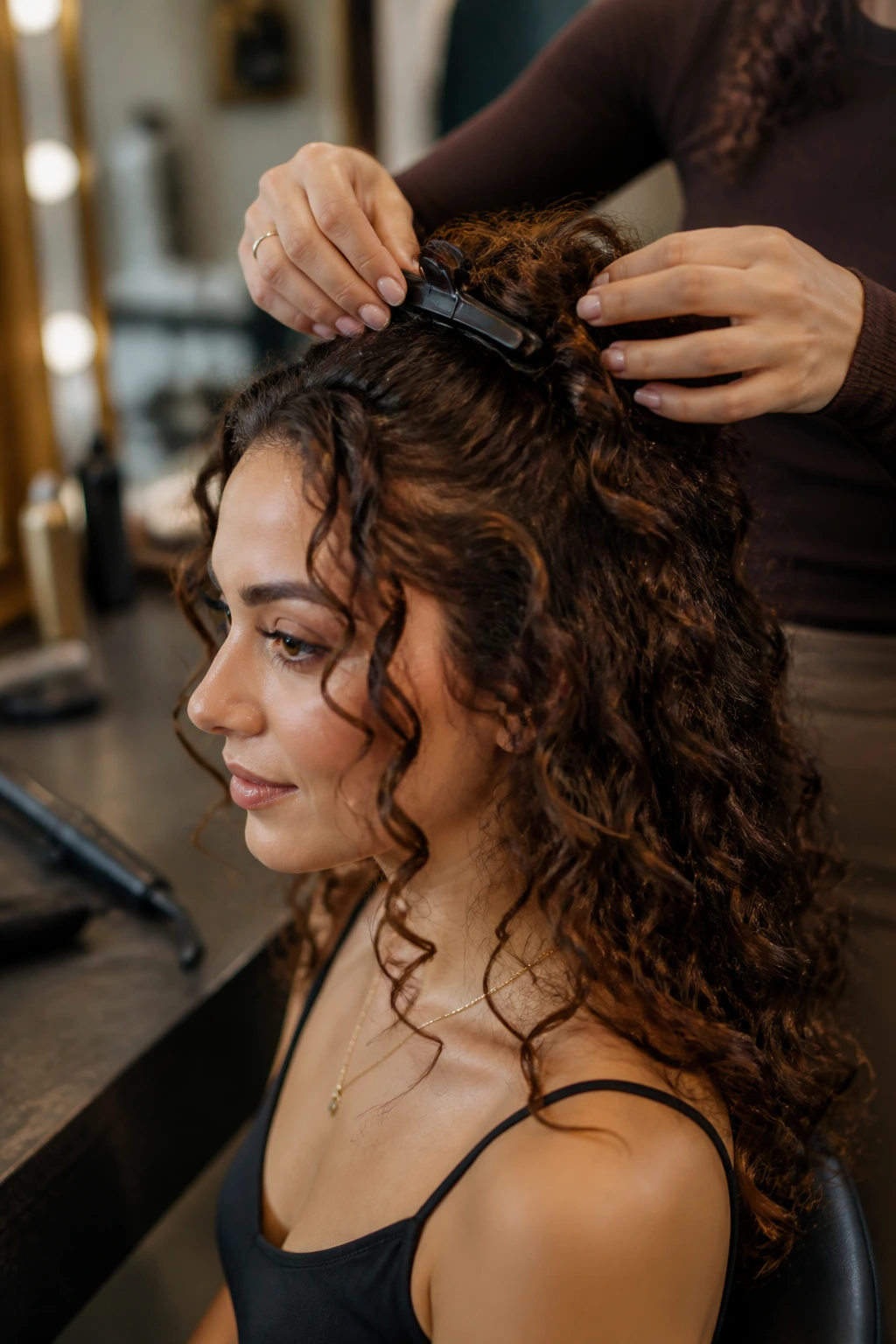
Essential Tools for Curly Prom Styles
-
Tail comb: Clean parts and sharp sectioning matter more than people think, especially for side parts, half-up sections, and tidy ponytails.
-
Duckbill clips: These hold sections while you set curls or pin the front back without leaving a giant dent.
-
Bobby pins in two sizes: Small ones disappear into twists and braids; larger ones help with buns and crown sections.
-
Flexible-hold hairspray: You want control, not shellacked hair that snaps when you turn your head.
-
Mousse or curl foam: Great for keeping curl shape intact before diffusing or air-drying.
-
Curl cream or serum: Use a small amount on the lengths and ends for shine and slip.
-
Satin scrunchies and clear elastics: These protect the hair better than rough ties and look cleaner in photos.
-
1-inch curling wand or iron: Useful for refreshing a few face-framing pieces or redefining ends that need polish.
-
Diffuser attachment: If you’re drying curls from damp to finished, this is what keeps the pattern from blasting apart.
-
Hand mirror: Essential for checking the back, because no prom style should rely on hope alone.
Smart Product and Accessory Picks
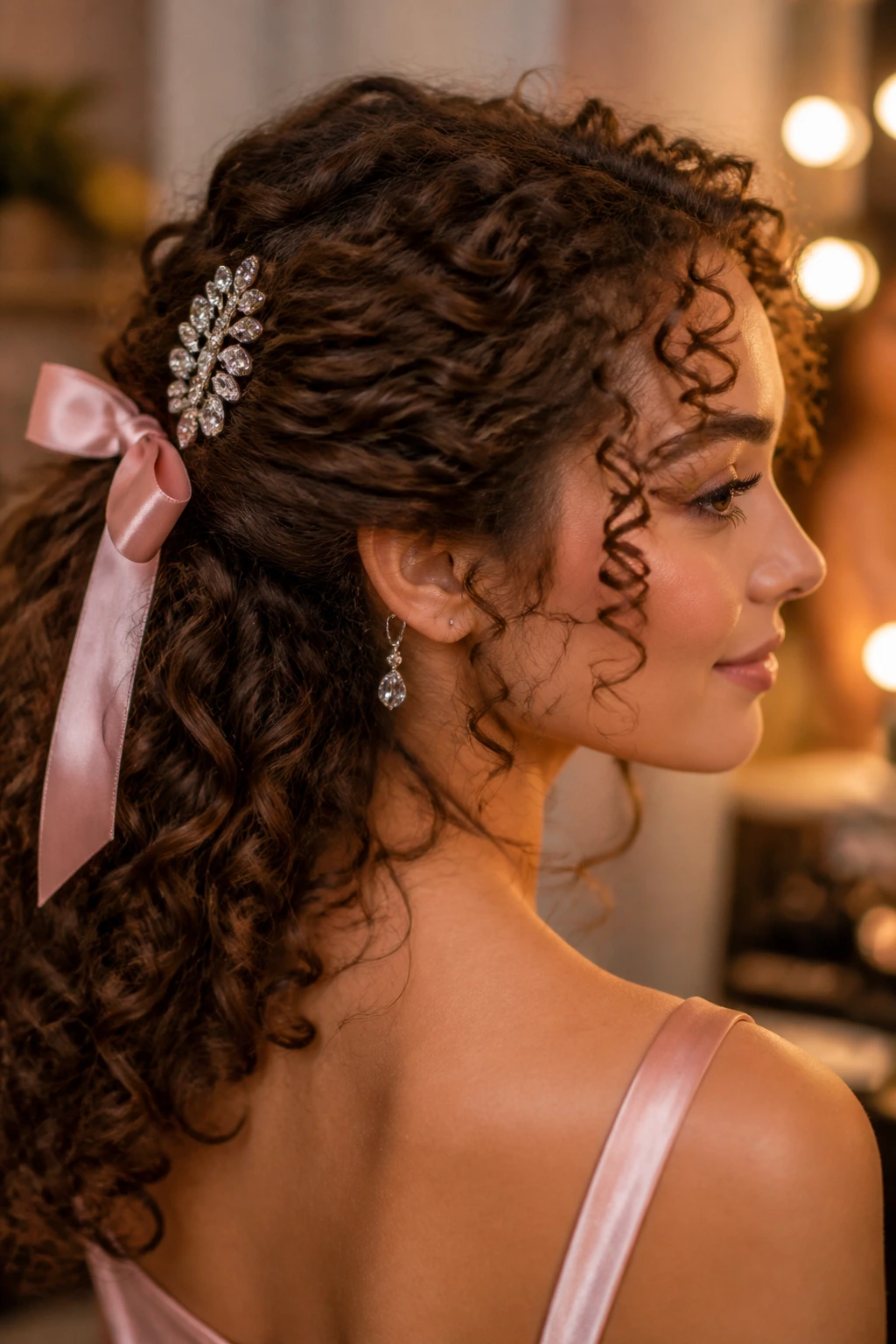
Product choice matters more than most people admit. A heavy cream on fine curls can flatten the crown before you even get dressed. On thick or coarse curls, though, that same cream may be the thing that keeps the ends from looking dry by dessert. The right pick depends on weight, not on the label’s promises.
For hold, I like a mousse at the roots and a flexible spray at the end. That combo keeps the shape alive without turning the hair stiff. If the style is a ponytail or bun, use a little gel or edge control at the hairline, but keep it close to the roots. Dragging product through the lengths is how curls lose bounce.
Accessories need to be sturdy enough to stay put and light enough not to snag. A decorative barrette with a weak clasp will pop open halfway through the evening. A ribbon with a slippery knot will slide. Check the backs. Always. If the clasp or pin feels cheap in your hand, it will be worse once it’s inside the hair.
One more thing: choose accessories that look good when the curls move. That tiny crystal clip may be beautiful in a still photo, but if it disappears under volume, it isn’t doing much for you.
How to Match the Style to the Dress, Jewelry, and Photos
Dress Neckline:
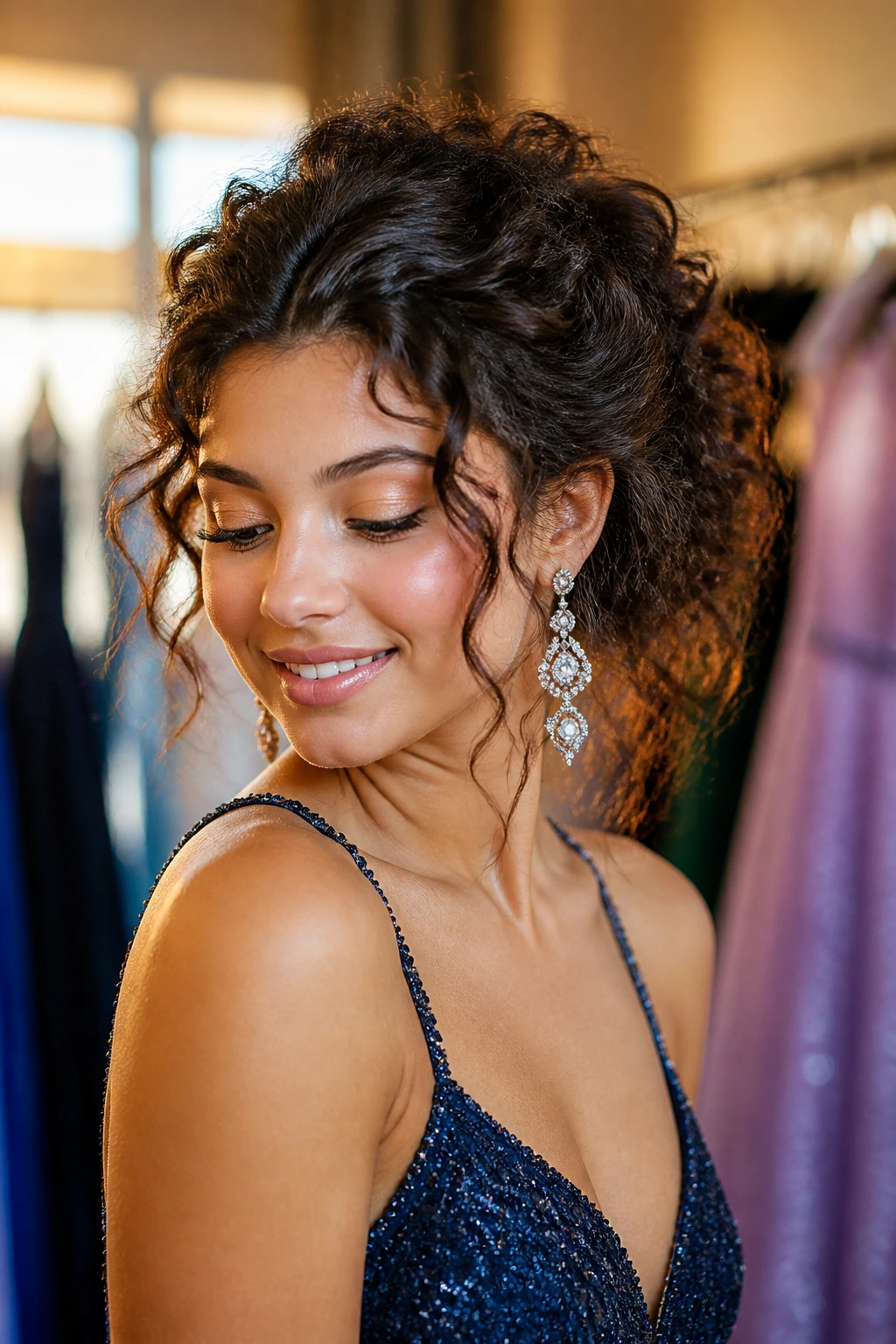
High necks usually work best with lifted styles — buns, ponies, faux hawks, or clipped-back looks that keep the fabric visible. Strapless and sweetheart necklines can handle more hair down, especially if the curls are side-swept or arranged with a braid at the crown.
Jewelry:
If the earrings are the star, keep the hair back enough to show them. That can mean one side tucked behind the ear, a low bun, or a half-up style that opens the jawline. Big necklace? Choose a style that doesn’t crowd the chest, because the hair and jewelry should not fight for the same space.
Accessories:
Pick one lane. Crystal clips, pearl pins, ribbons, jeweled combs — any one of them can carry a style. Two can work if they’re related. Five starts to look like the accessory drawer spilled into the bathroom sink.
Photo Angle:
Think about the front, side, and back. A style that looks good only from the mirror is not enough. If your dress has an open back, make sure the back of the hair has something worth looking at: a wrap, a braid, a bubble pony, or a bun with good shape.
Extra Styling Moves and Finishers
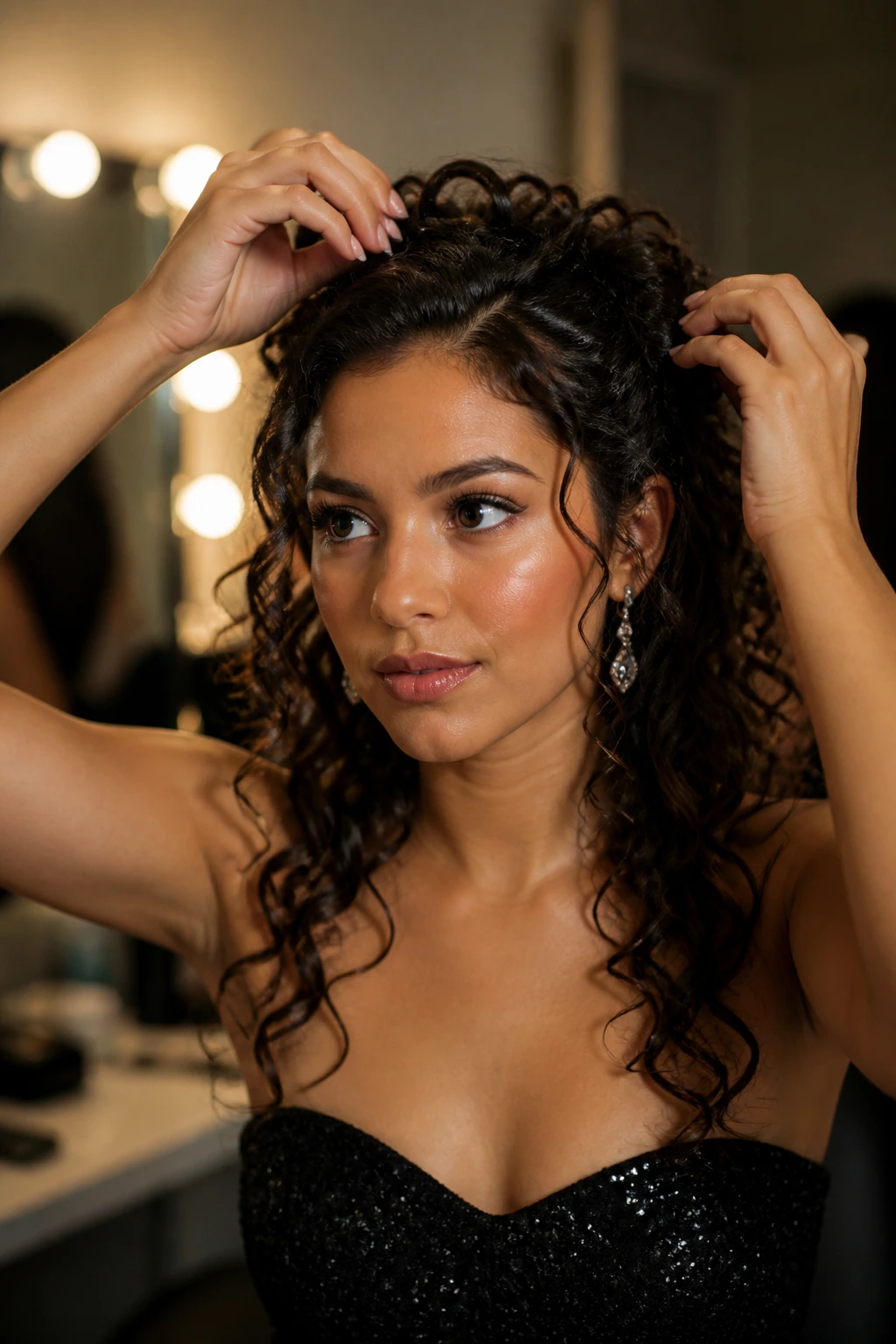
Texture Booster:
If the curls start to feel soft after setting, diffuse for another 3 to 5 minutes with cool air. It can bring back the outline without making the hair frizzy.
Accessory Placement:
Set the accessory slightly off-center when you want the style to feel more natural. Dead-center placement can work, but it often looks a little formal in a stiff way.
Humidity Fix:
Carry a travel-size flexible spray and a few spare pins. If the air is heavy, the front pieces will loosen first. A quick pin under the surface saves you from over-spraying the visible layer.
Make-It-Yours:
Fine hair usually needs more root lift and fewer heavy creams. Thick hair needs stronger pins and cleaner sectioning. Coily hair often looks best with less manipulation and more shape support at the crown. Short hair does better with accessory details than with overbuilt structure.
Make-Ahead, Touch-Up, and Overnight Care
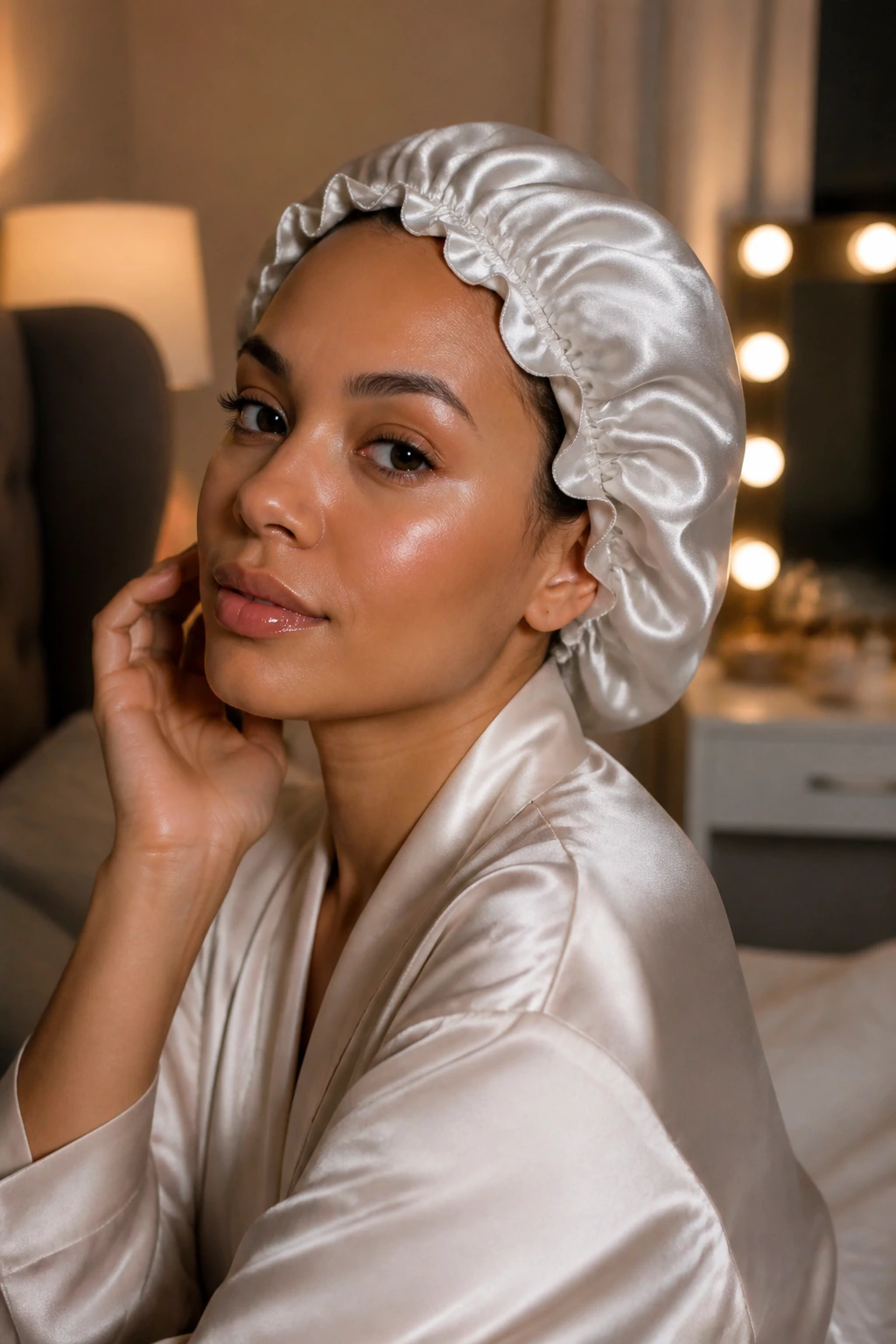
Prom hair usually looks best the same day it’s styled, but the prep can happen in stages. You can wash and condition the day before, then let the hair dry fully overnight so the curls are not starting from dampness. Damp hair under pins is a mess waiting to happen. It shifts, it swells, and it steals the shape you worked for.
If you’re using a curl set or a braid-out, let the style cool or dry completely before you separate anything. That cooling window is the difference between defined shape and softness that vanishes under your fingers. For styles with pins, do a test wear for at least 10 minutes before you leave. If something bites the scalp or slips, fix it before the car ride, not in the bathroom at the venue.
For overnight care before a big event, sleep with a satin bonnet or a loose satin scarf if the style is being set the night before. Use a silk or satin pillowcase if you’re leaving curls loose and just refreshing them in the morning. And if the hair is already fully styled, don’t stack it under a normal cotton pillow without some protection — friction will rough up the curl surface fast.
After prom, the rules change a little. Strong updos can often be taken down and turned into soft day-two curls with a light mist of water and a touch of serum on the ends. Ponies and buns can usually be left in for a few hours if you need to keep the style going for photos or dinner. If you plan to wear the same curls the next day, clip the front away from your face before sleep and refresh only the visible sections in the morning.
Variations and Adaptations to Try
Fine-Hair Lift Kit:
Choose styles that create crown height — high half-ponies, side parts, clipped-back cascades, or a wrapped ponytail. Fine hair can disappear in a low bun if the structure is too soft, so focus on root lift and clean placement.
Thick-Hair Control Plan:
Go for braided crowns, low buns, bubble ponytails, or French twists. Thick curls need anchor points, not a dozen weak pins spread across the head. A style with one strong base usually lasts longer than a style that’s trying to control everything at once.
Humidity-Proof Prom Hair:
Pick updos or half-up styles with more structure at the crown and less loose surface area. A little anti-frizz serum on the ends helps, but the real fix is shape. Hair pinned close to the head resists humidity better than hair that’s hanging fully open.
Short-Cut Sparkle:
If your hair is chin-length or a bob, lean on clips, headbands, and side placement. The haircut itself should stay visible. Trying to force short curls into a big formal bun usually ends badly, and there’s no reason to do that to yourself.
Coily Crown Moment:
Let the texture be the finish. High puffs, defined coils with a headband, or a soft afro with one jewel accent often look more striking than anything that tries to hide the curl pattern. The shape is the statement.
Low-Heat, Low-Stress Styling:
Choose braid-outs, twist-outs, or styles that depend more on pinning and accessory work than hot tools. If your hair gets dry from heat fast, there’s no prize for forcing extra curling iron time into prom week.
Common Curl-Killing Mistakes to Avoid
The first mistake is brushing curls before they’re set. The symptom is easy to spot: the top layer turns fuzzy, the ends go limp, and the shape loses definition within an hour. Fix it by letting the hair cool completely, then separating only where you need volume.
Another one is overloading the roots with cream or oil. The hair may look shiny for a minute, but the crown goes soft and the style starts sliding. Put richer products on the mid-lengths and ends, then use mousse or a light spray near the scalp.
Tight pinning causes a different problem. It can create headaches, visible dents, or little gaps where the style pulls apart as you move. Use more hidden pins and less force. Pins should support the hair, not squeeze it into submission.
Skipping the test run is a bigger deal than it sounds. A clip may look gorgeous but pinch the ear. A braid might sit too high with the neckline. Try the style at least once beforehand and take photos from the front and side. Those pictures tell the truth faster than a mirror.
One more: too much spray. If the hair sounds crunchy when you touch it, the curls will not move naturally in photos. A prom style should hold its shape, yes, but it should still look like hair.
Questions People Ask Before Prom
Should I wear my natural curls or smooth them out first?
If your natural curl pattern is healthy and defined, work with it. Smoothing everything first often removes the shape that makes these styles look rich. A little refinement at the crown or front is enough for most prom looks.
What if my curls fall by dinner?
Choose a style with a secure base: a braided crown, low bun, high ponytail, or half-up twist. Loose open curls can be refreshed, but pinned styles usually hold better when the evening gets long and warm.
Is day-two hair better for prom styling?
Often, yes. Hair with a little natural texture or light buildup can hold pins and shape better than squeaky-clean strands. If your scalp gets oily fast, just refresh the roots with a small amount of dry shampoo and keep it off the lengths.
Can short curly hair still look formal?
Absolutely. A bob with clips, a tucked side, a jeweled headband, or a clean center part can look polished without pretending the hair is longer than it is. Short hair usually looks best when it’s styled with intention, not hidden.
How much product is too much?
Enough to weigh the hair down or make it feel sticky. If the curls clump into heavy sections, or if the roots start looking wet, back off. A light layer of the right product beats a heavy layer of the wrong one.
Should I do a trial run?
Yes. Prom hair is too expensive in time and stress to guess at on the day itself. A trial tells you where the pins slip, which side part flatters your face, and whether the accessory looks elegant or oversized.
What if I want to dance a lot?
Pick a style with a secure center: ponytails, buns, bubble styles, or a half-up look with strong anchors. Loose hair can still work, but the more you move, the more you’ll appreciate structure at the crown and nape.
The Styles That Last Past the Last Dance
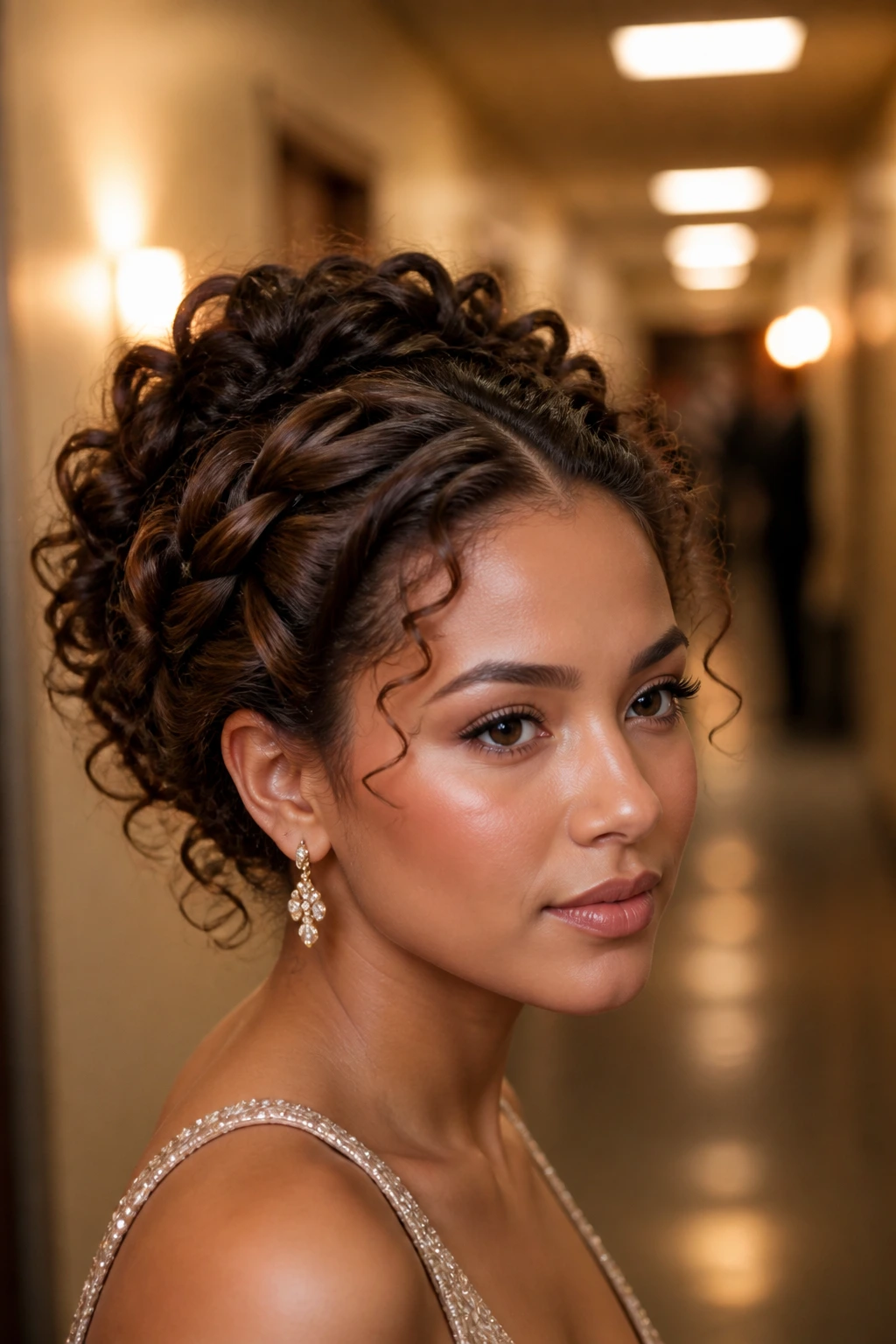
The best prom hair does not try to erase curls. It gives them a frame, a little polish, and enough security to survive the parts of the night nobody sees in staged photos — the warm hallway, the packed dance floor, the ride home with your pins still in place.
Pick the style that matches your hair length, your dress, and how much movement you want to keep. Then test it once, fix what slips, and trust the shape you’ve built. Curly hair has more personality than straight hair ever will. Prom night is a good place to let it show.
