



A communion hairstyle has a tricky job. It needs to look gentle under church light, stay neat through photos and handshakes, and still feel comfortable enough that a child forgets about it after the first few minutes. The best communion hairstyles for girls do not shout for attention. They sit quietly beside the dress, the veil, the ribbon, the little polished shoes, and let the whole look feel finished.
I’ve always thought the sweet spot is somewhere between “too plain” and “too grown-up.” Tight curls sprayed into a helmet are a mistake. So is a style that looks lovely at 8 a.m. and starts shedding pins by the time the family sits down for lunch. The styles that work best have a bit of softness near the face, a secure base at the back, and one small detail — a ribbon, pearl pin, braid, or flower — that gives the style a reason to be remembered.
That’s the balance this collection leans into. Some of these looks are built for fine hair that slips apart if you look at it wrong. Others are better for thick, wavy, or curly hair that needs control without losing its shape. A few are ideal if there’s a veil comb to anchor, while others are beautiful on their own and only need a tiny accessory to feel complete.
Why These Communion Styles Work So Well
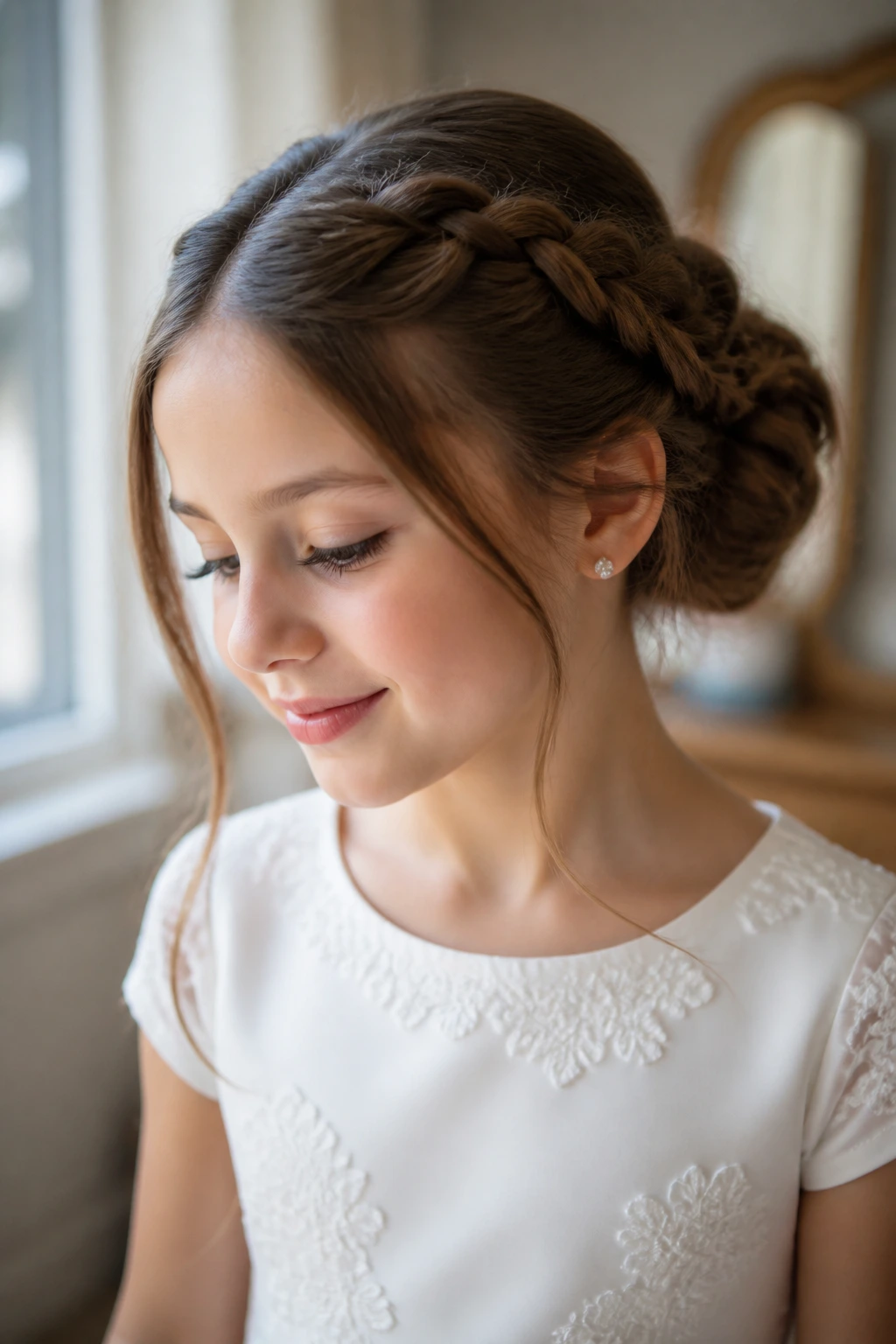
- They hold without looking stiff: Each style uses braids, twists, or low buns to keep the shape secure while leaving the hair soft around the edges.
- They suit the occasion without feeling overdone: Communion hair should feel polished, not theatrical, and these looks stay on the right side of that line.
- They work with dresses, veils, and headbands: The styles leave room for lace, satin, pearls, or a small floral piece without crowding the outfit.
- They can be adjusted for hair type: Fine hair, thick hair, curls, and straight hair all need different handling, and the collection includes options for each.
- They are comfortable for a long day: No style here should pinch at the scalp or tug at the temples for hours. That matters more than people think.
- They photograph cleanly: A braid line, a low bun, or a centered part gives shape in pictures, even when the overall look stays soft.
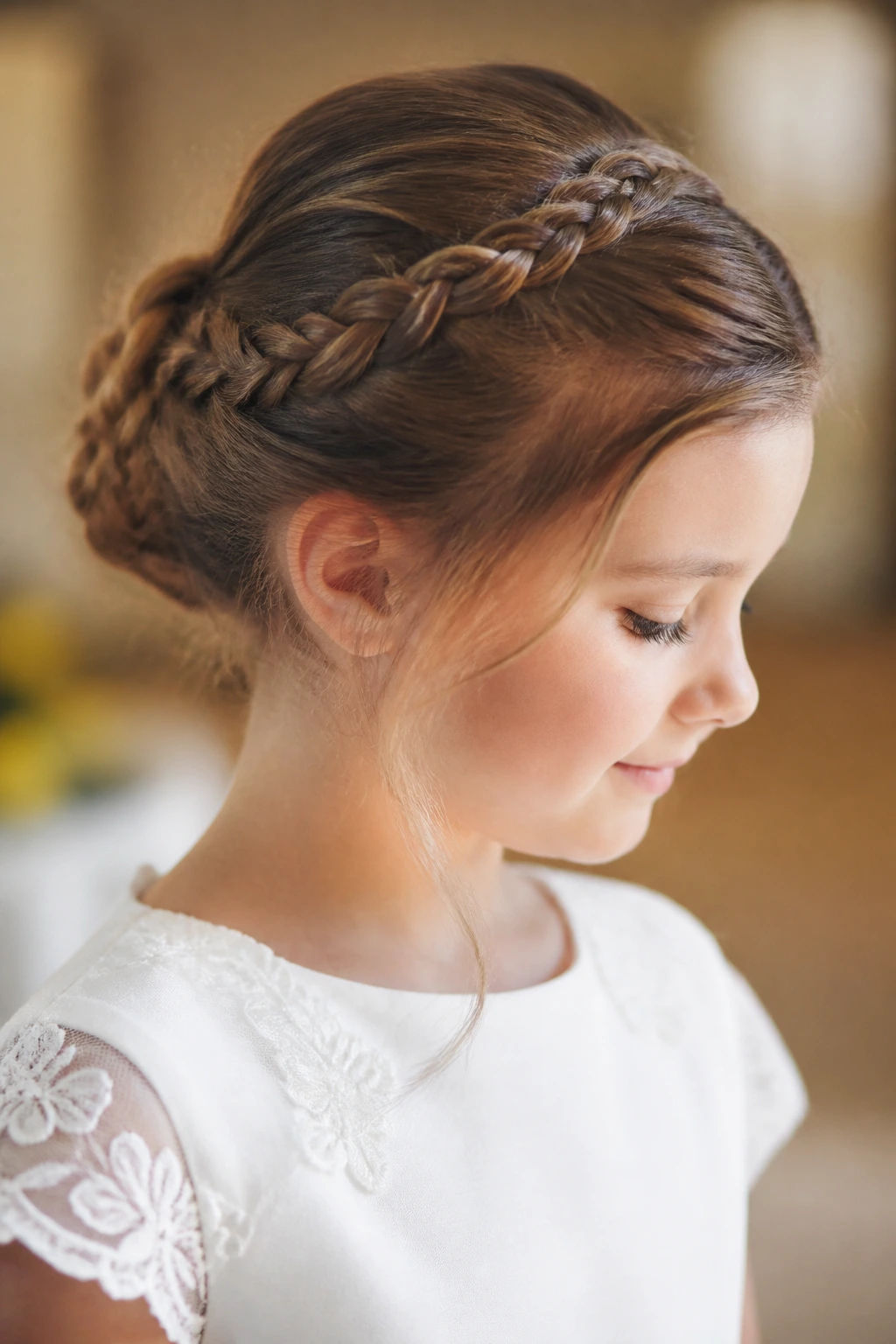
1. Soft Crown Braid with Ribbon Tie
A soft crown braid is one of those styles that looks more complicated than it really is, which is always a nice trick on a busy morning. The braid curves around the head like a headband, then meets at the back where a narrow satin ribbon can be tied in a small bow. It feels sweet, tidy, and age-appropriate without looking fussy.
Why It Works
The crown shape keeps hair away from the face, which is useful during a long ceremony and even more useful when there are photos being taken from every angle. It also suits medium to long hair because the braid has enough length to lie flat and stay put. A little texture spray before braiding helps the strands grip, especially if the hair is silky.
What to Watch For
The braid should sit snugly against the head, not pulled tight enough to leave a line at the hairline. If the hair is very layered, pin the loose ends under the braid with two crossed bobby pins. That tiny bit of hidden structure is what stops the style from collapsing halfway through the day.
2. Low Chignon with a Side Part
A low chignon is the quiet little workhorse of communion styling. It sits at the nape, gathers the hair into one smooth knot or roll, and keeps everything looking neat from the front. Add a deep side part, and the whole thing softens enough to feel child-friendly rather than formal in a stiff way.
Best For
This is a strong choice for thick hair, because the shape gives weight somewhere to go instead of letting the hair puff outward. It also works beautifully with a veil comb, since the bun gives the comb something solid to grip. If you want a pearl pin or small satin bow, place it just above the chignon, not dead center on top of it.
A chignon can look severe if the surface is too slick. Leave the front section brushed smooth, but don’t shellac the whole thing. A little movement near the temples keeps it from looking like a recital bun that wandered into church by mistake.
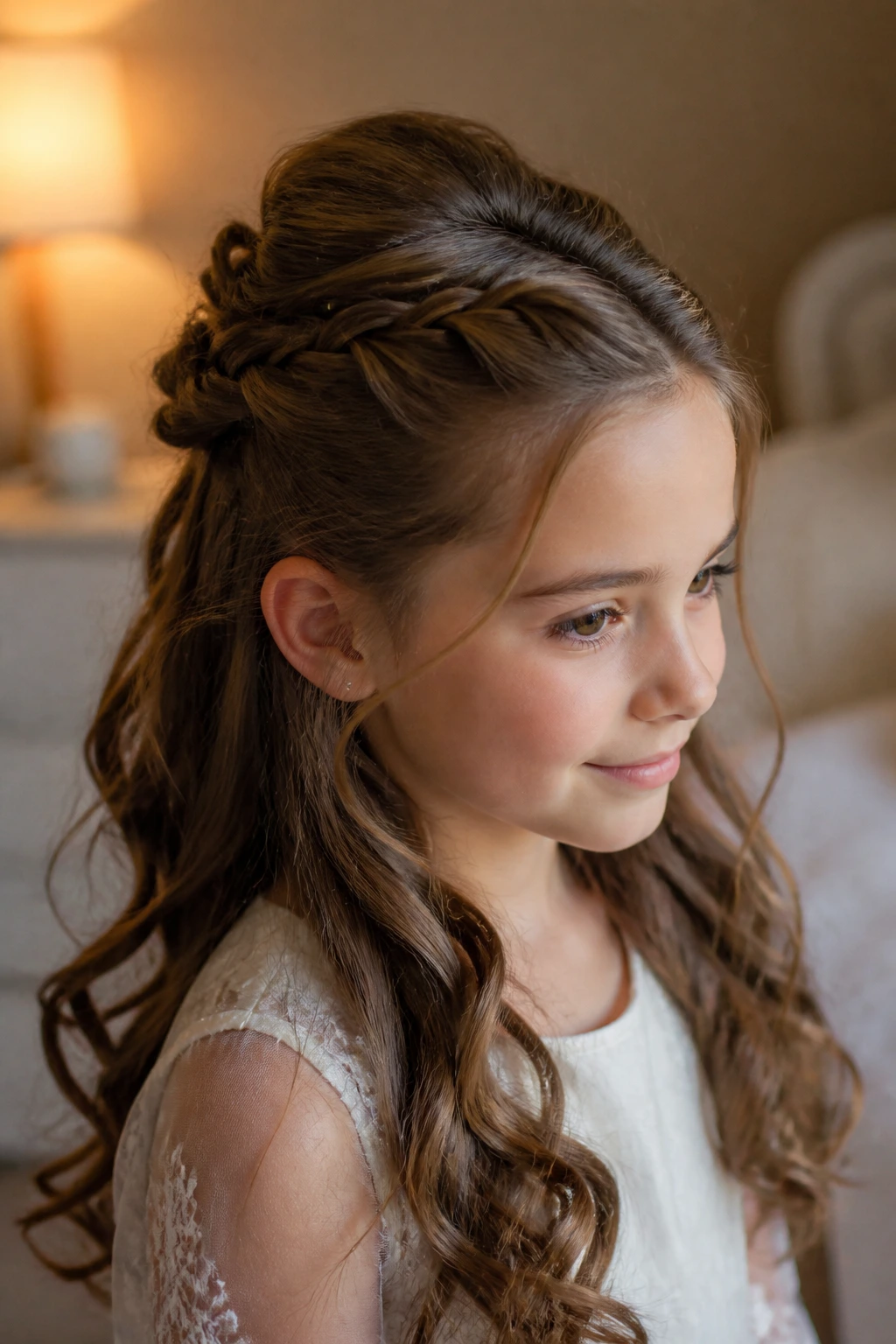
3. Half-Up Curls with a Pearl Clip
This is the style I reach for when a girl wants to keep her hair down but still look dressed for the day. The top section is pinned back, usually with a pearl barrette or a small comb, while the rest falls in soft curls down the shoulders. It has a calm, pretty shape and doesn’t fight the natural look of long hair.
Why It’s a Safe Choice
It works on straight, wavy, or lightly curled hair, and it doesn’t require the entire head to be set with heat. Curl the ends with a 1-inch wand if needed, or leave the natural texture in place if the hair already has enough bend. A small amount of mousse at the roots before blow-drying keeps the top section from slipping open.
The clip matters here. Choose one with smooth backing, because rough metal can snag delicate strands when the child turns her head. I prefer pearl or satin-covered clips over anything glitter-heavy; the softer finish reads better in daylight and doesn’t tug attention away from the dress.
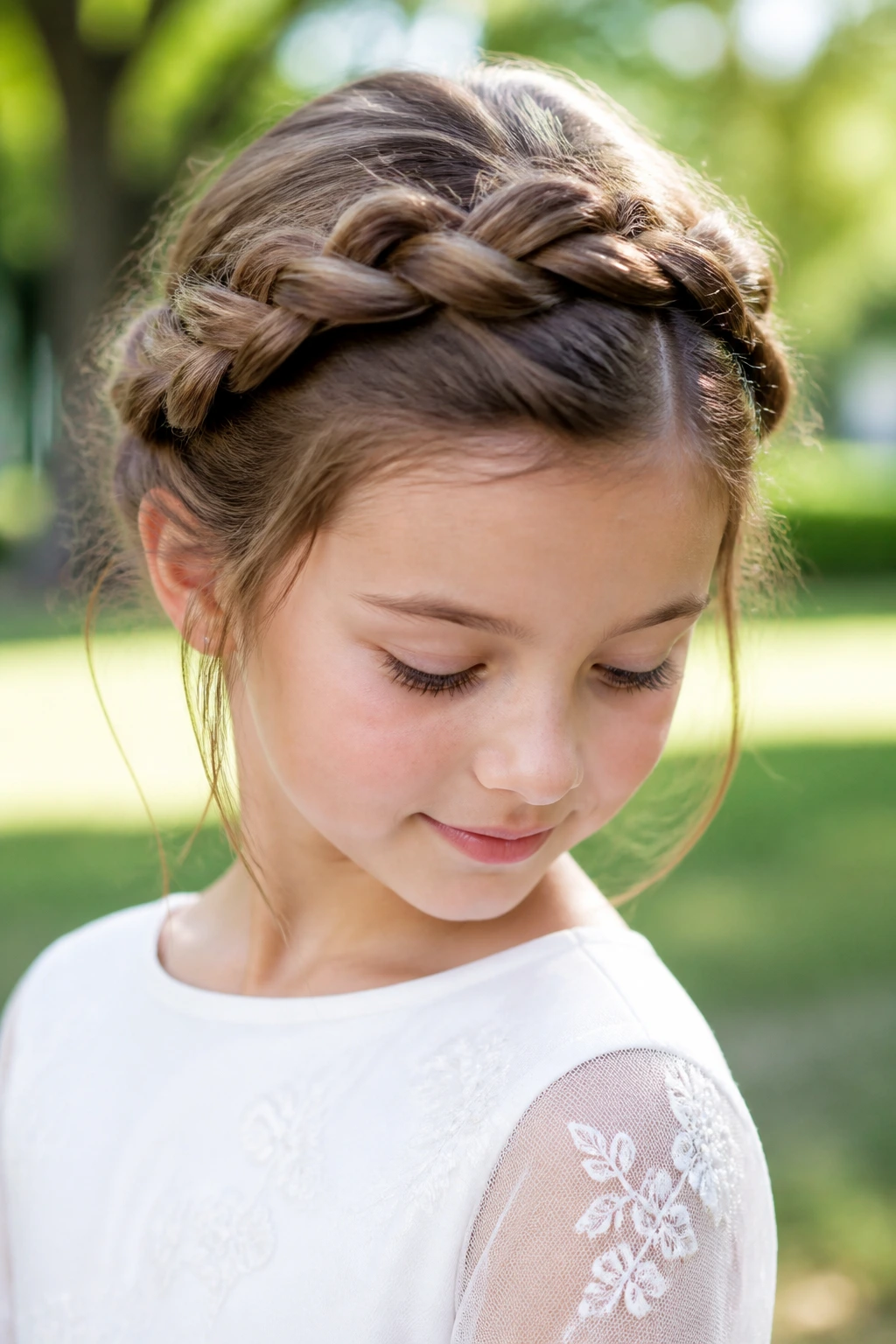
4. Twisted Halo Braid
A halo braid wraps around the head in a gentle circle, and there’s something especially sweet about that shape for a communion day. Unlike a tight braided crown, a halo braid can be made from two soft twists that meet at the back and tuck under, which makes it easier for younger children to wear comfortably.
What Makes It Stand Out
The braid line frames the face in a very tidy way, but it still looks airy if you pull the outer edges of the braid slightly after securing it. That little “pancake” effect makes the braid fuller and less severe. It also helps if the hair is medium length and slightly textured rather than pin-straight.
If the hair is layered, the front sections can be misted lightly with water and smoothed with a dab of leave-in conditioner before twisting. Too much product makes the style slippery. Too little, and the shorter pieces stick out like little flags. Neither is the goal.
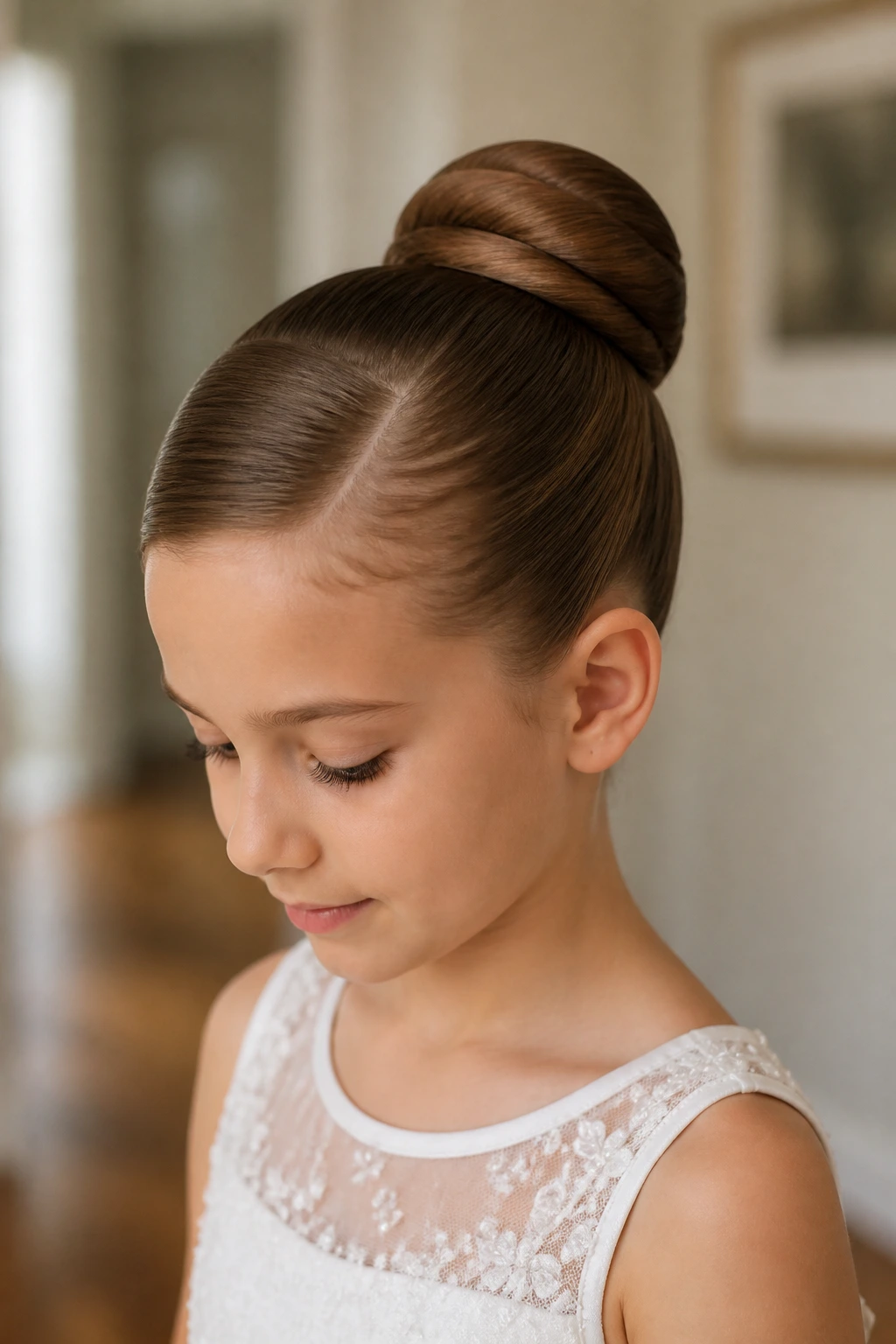
5. Sleek Ballet Bun
A ballet bun has a clean, centered feel that works especially well when the dress itself has lace, embroidery, or a dramatic collar. The hair is brushed smooth, gathered high or mid-height, then wrapped into a neat bun that sits close to the head. It is plain in the best sense of the word.
Where It Shines
This style is excellent for active children because it stays anchored and keeps hair off the neck. It also gives a nice frame for a veil or a small headband, provided you keep the accessory slim. If the hair is very fine, tease the ponytail base a little before wrapping the bun so the pins have something to bite into.
A ballet bun looks sweetest when the finish is clean but not frozen. A soft side part, or one little face-framing section tucked behind the ear, keeps it from feeling too strict. That small looseness matters more than people think.
6. Side-Swept Loose Waves with a Floral Pin
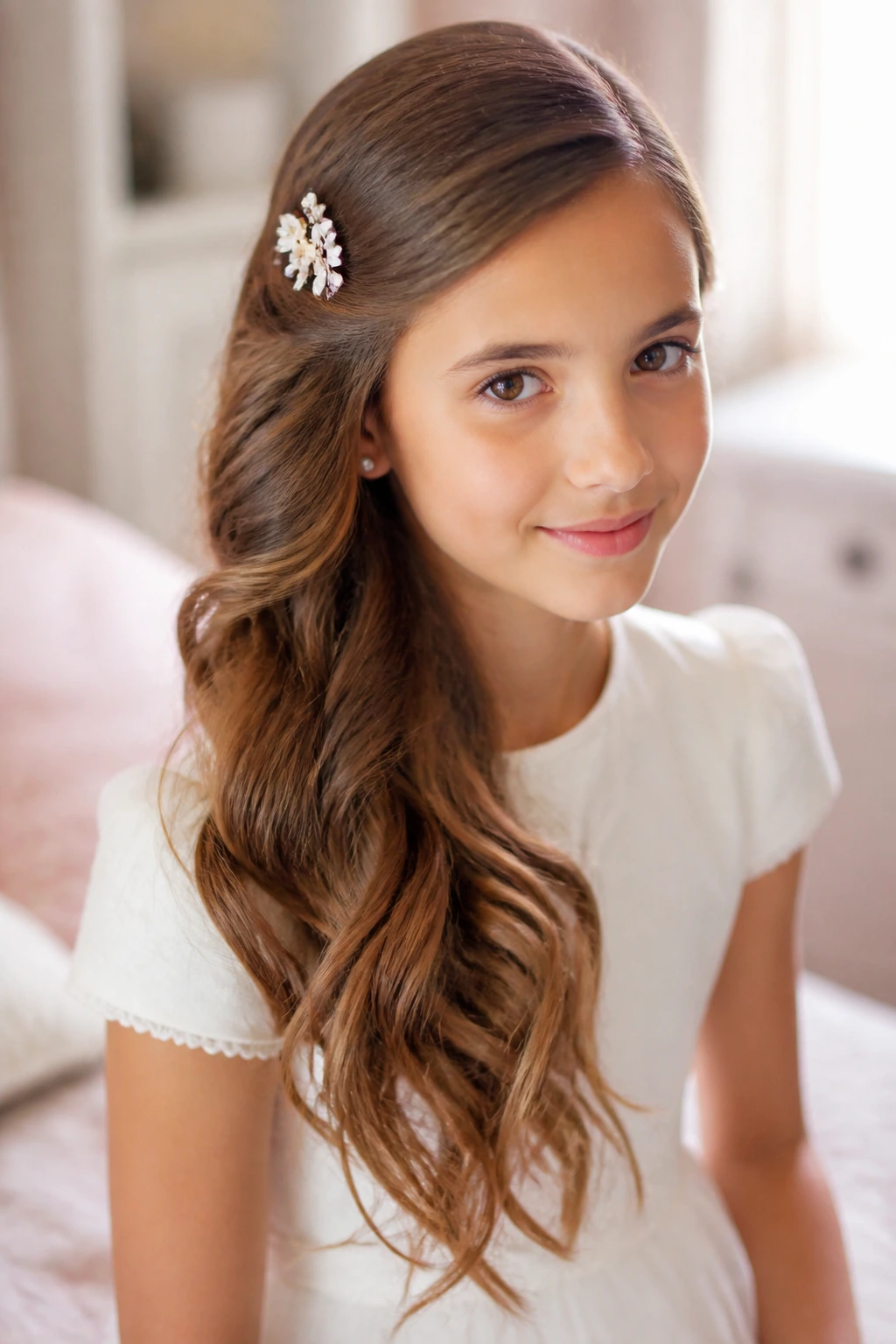
Side-swept waves are for the child who looks best with movement in her hair. Sweep the hair over one shoulder, shape it into soft waves, and pin one side back with a small floral accessory or a single cluster of pearls. The result is romantic without trying too hard.
A Good Fit for Longer Hair
This style gives length a chance to show, which is useful if the hair has been growing all year and the family wants to see it look special. It works best when the wave pattern is soft, not crunchy. A curling iron with a large barrel — around 1 to 1¼ inches — makes a loose bend instead of a tight curl.
The accessory should sit near the temple or just above the ear. Too low, and it gets lost in the hair; too high, and it starts to look like a costume piece. Keep the flower or pin small enough that the wave remains the star.
7. Bubble Ponytail with Satin Ties
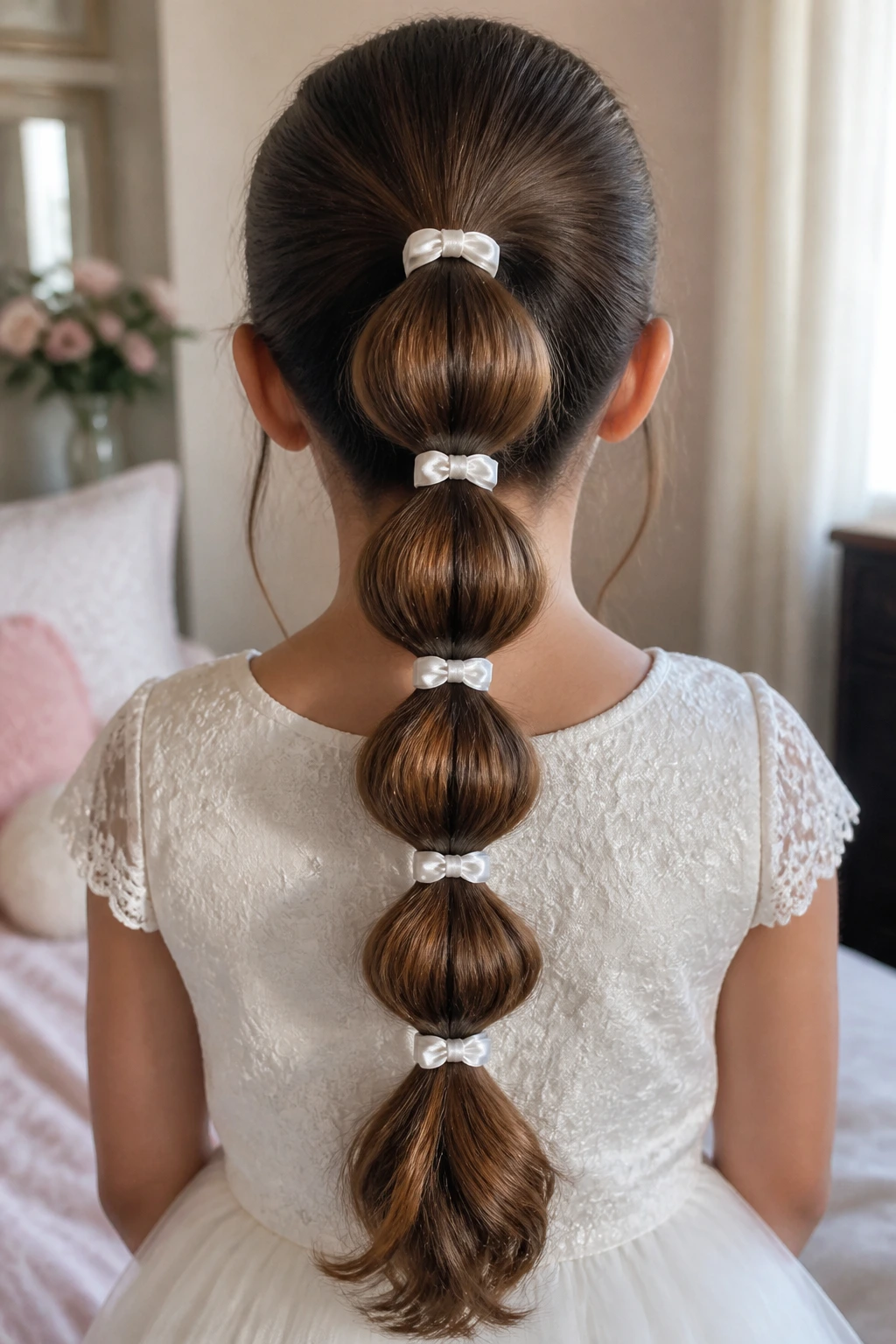
A bubble ponytail is playful, clean, and surprisingly practical for communion hair. The ponytail is divided with several small elastics, then each section is gently puffed into a round “bubble.” Narrow satin ties or ribbon wraps can be added between the sections for a softer finish.
Why It Works for Busy Hands
This is a smart choice if a child hates having lots of pins near her scalp. Once the ponytail base is secure, the rest is mostly elastic work, which means fewer sharp points and less fuss. It also stays neat on thick hair that tends to fall out of softer styles.
The trick is spacing. Keep each elastic about 1½ to 2 inches apart, then tug the sides of each section evenly so the bubbles look rounded rather than squeezed. If the hair is fine, mist each section with texturizing spray before shaping; otherwise the bubbles can fall flat before the family has reached the church steps.
8. Dutch Braid Pigtail Crown
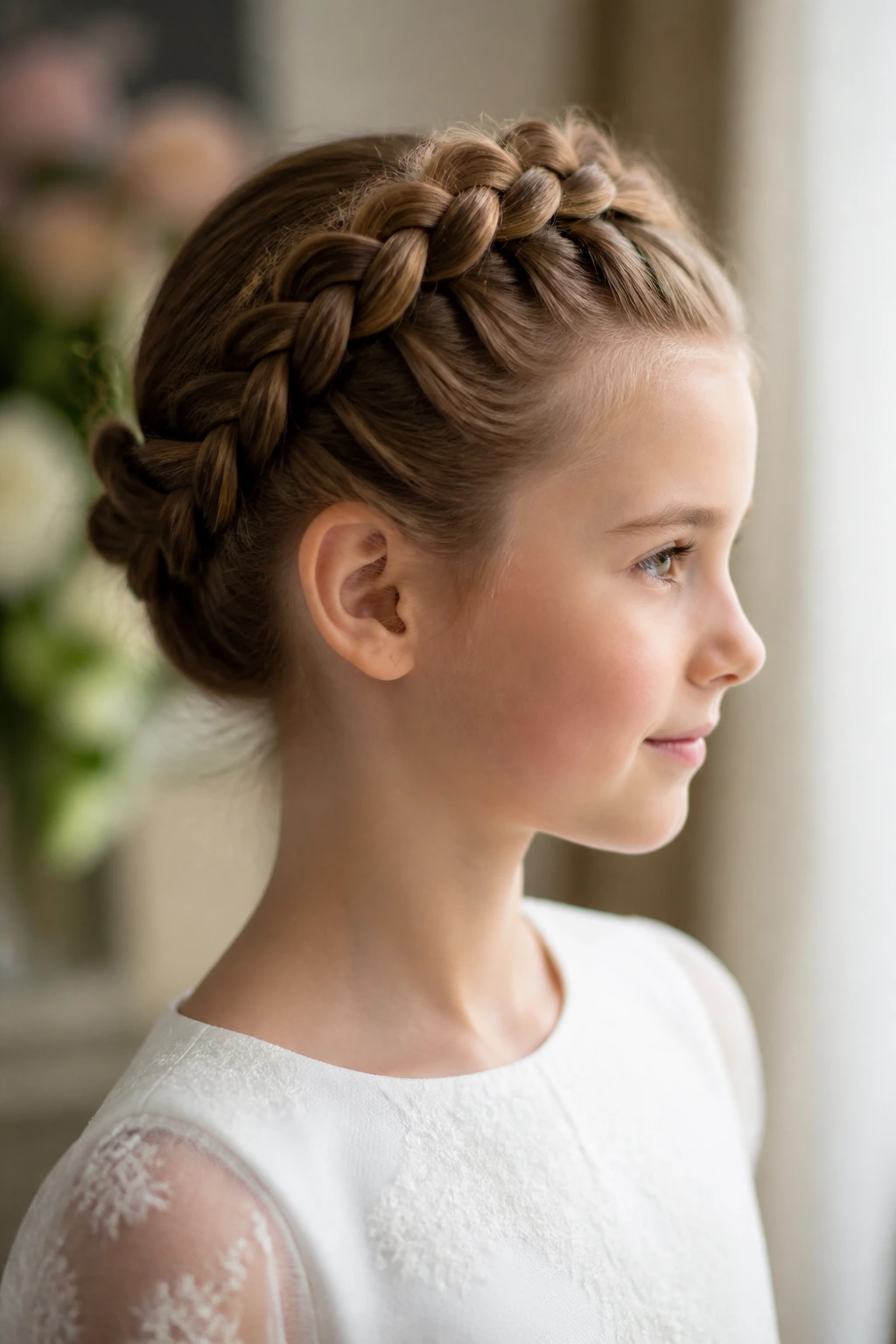
Two Dutch braids coming from each side of the head and meeting toward the back make a lovely crown effect without needing a formal bun. It has a sweet, youthful feel, and the raised braid texture gives the style enough visual shape that it looks special even from across the room.
What to Know Before You Start
Dutch braids sit on top of the hair rather than sinking into it, so they show up well in photos. That raised line is useful if the dress is simple or plain white and needs just a little texture nearby. A narrow ribbon can be woven into the last few inches of each braid if you want a softer ending.
This style works best on hair that is at least shoulder length. If the ends are a bit uneven, tuck them together under a small bow at the back and pin them in place. Nobody will notice, and that kind of hidden fix saves the whole look.
9. Tucked-In French Twist for Kids
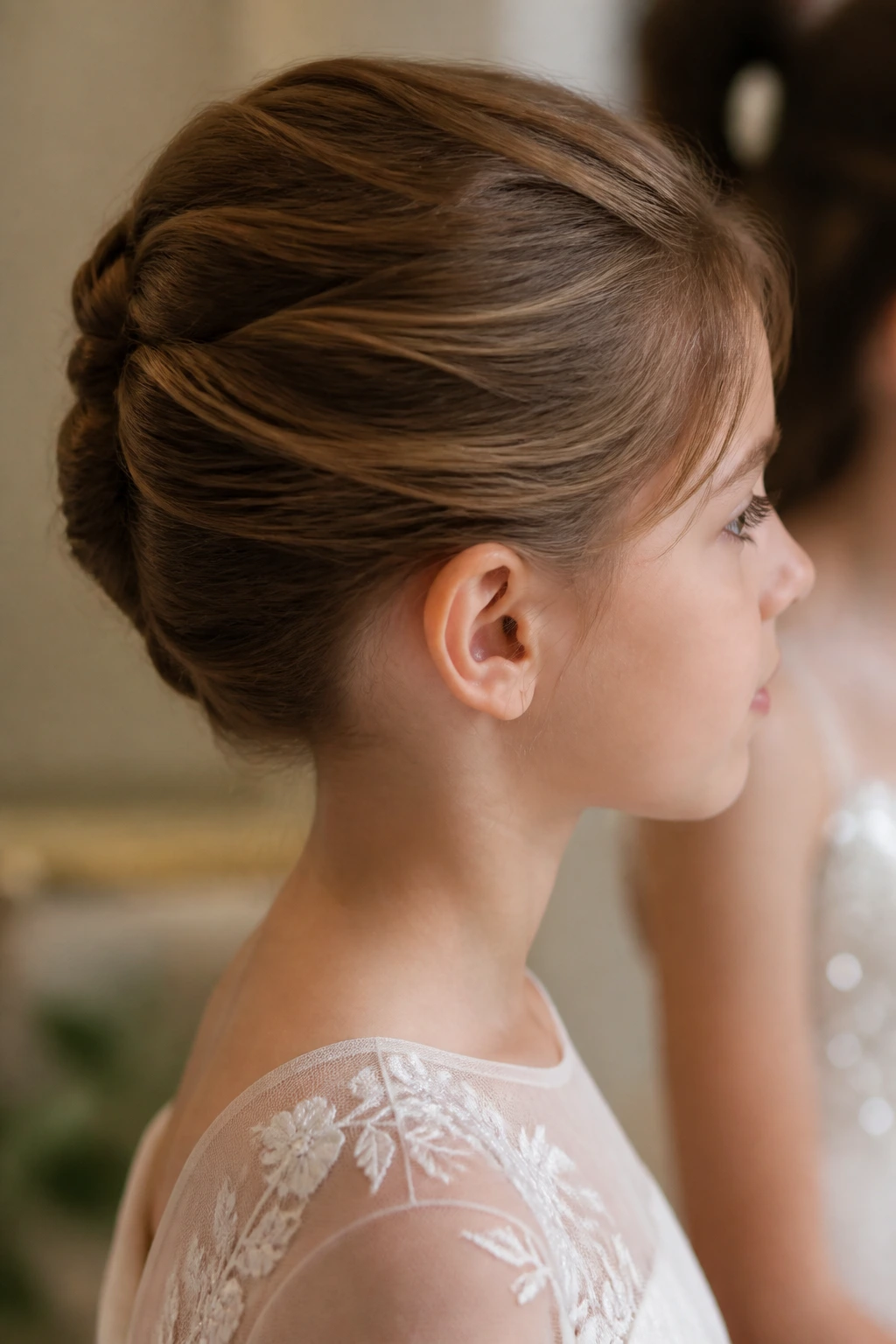
A French twist can sound too grown-up, but a softened version works beautifully for communion. Instead of building it tall and dramatic, keep it low, smooth, and tucked into itself at the nape. It gives a polished outline that stays graceful under a veil or small comb.
Why It Feels Right for the Day
The style keeps hair off the neck, which is helpful if the child gets warm in a crowded church or during a long family lunch. It also reads clean in photos, especially from the side. A little bit of texture at the front — not a helmet, please — makes the style gentler and less formal.
Use a few flat bobby pins in the same color as the hair. Cross them in an X shape where the twist folds under. That tiny detail matters because French twists can loosen if the hair is silky, and the crossed pins give the shape something to hold on to.
10. Double Braids into a Low Bun
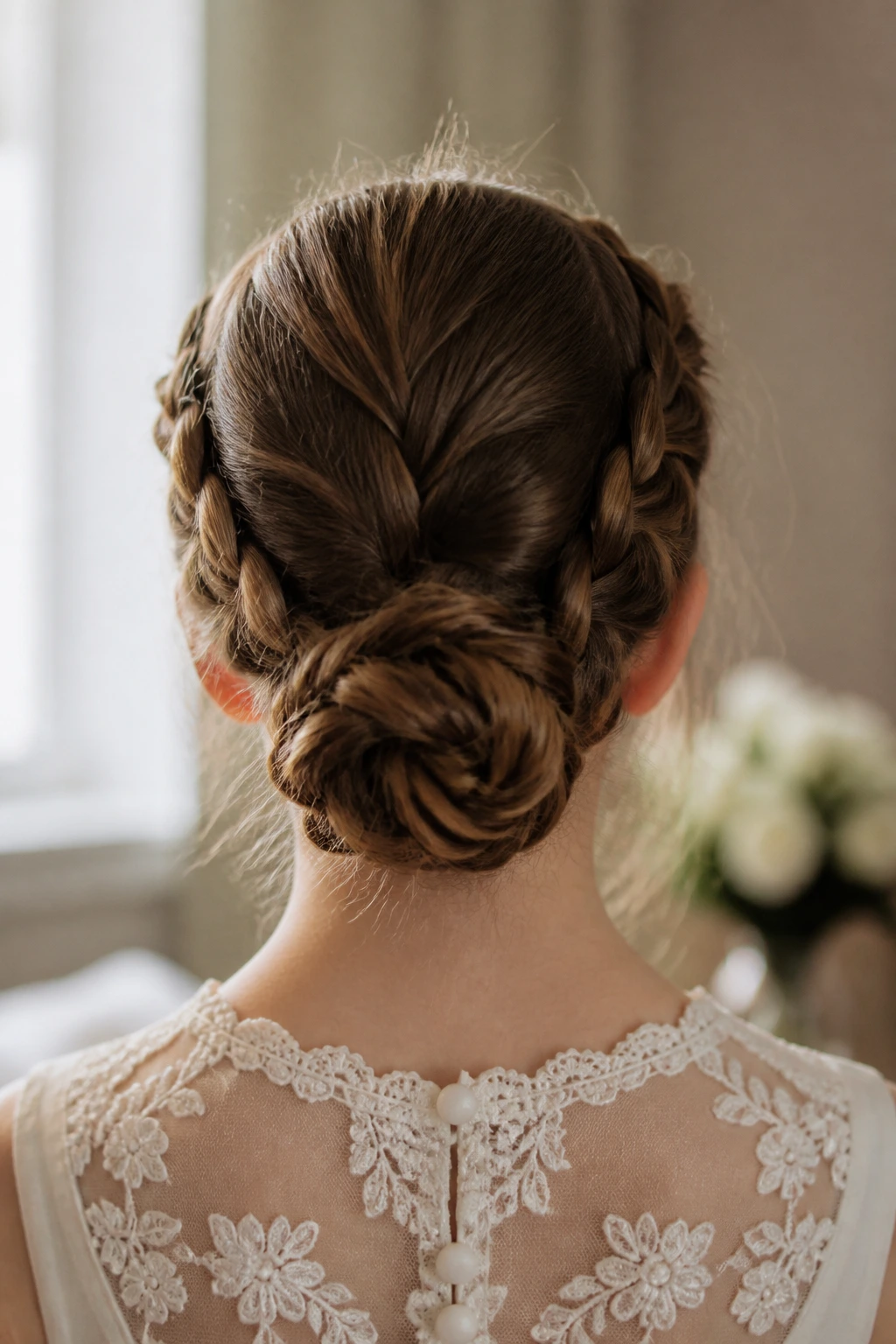
Double braids folded into a low bun make a style that feels anchored and sweet at the same time. The hair is split into two sections, braided, then wrapped together at the nape into a compact bun. It gives a nice braided texture without leaving the whole look busy.
A Nice Middle Ground
This works well for girls who want something a little more structured than loose curls but less severe than a sleek bun. It also handles thickness well; in fact, thick hair often looks better in this style because the bun has enough volume to sit naturally. If the hair is fine, loosen the braids a touch before wrapping so the bun does not look too tiny.
A few delicate pins or a small bow at the bun base is enough. Don’t stack on too many accessories here. The braids already do the talking.
11. Waterfall Braid with Soft Ends
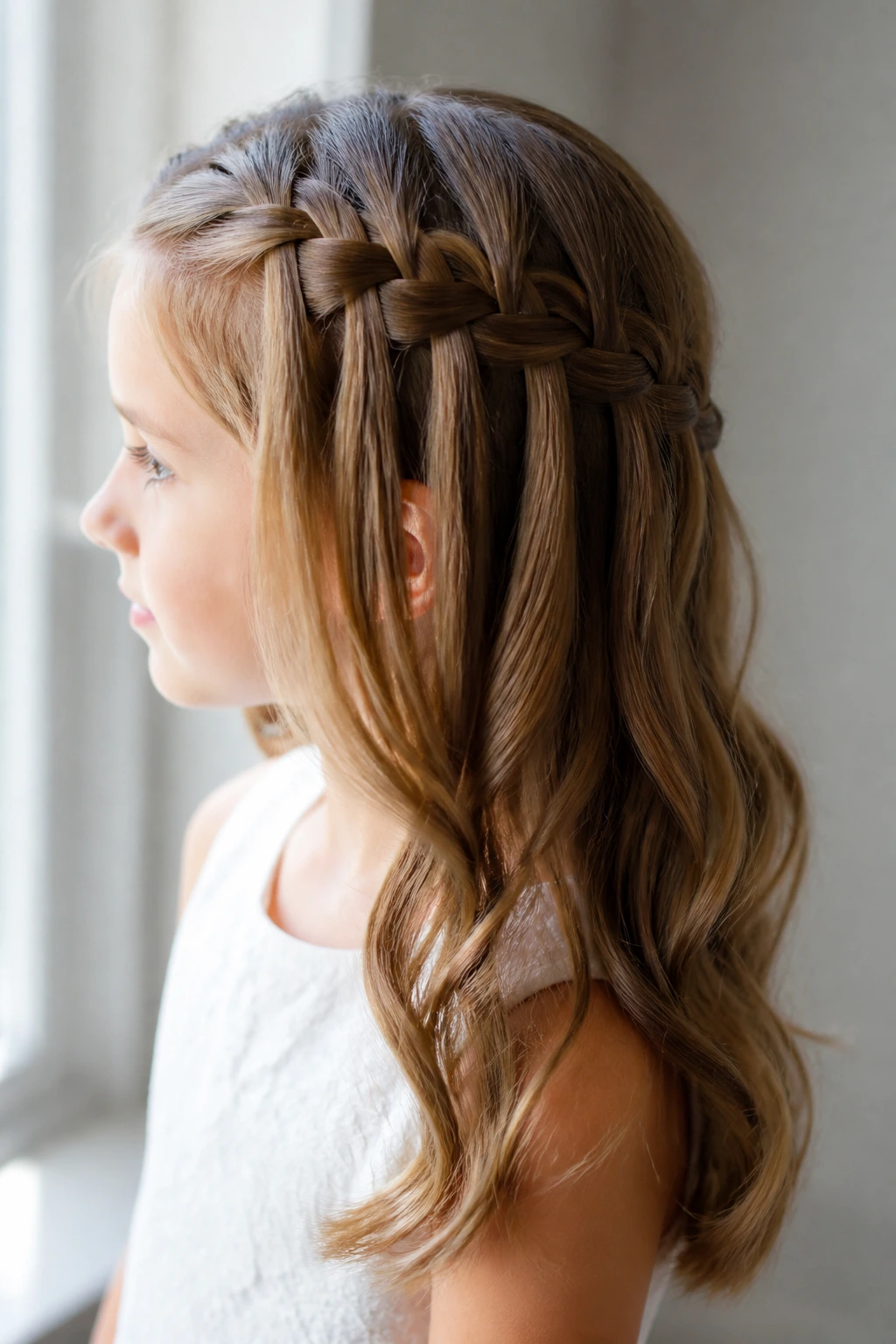
A waterfall braid gives that lovely “hair down, but dressed up” effect. The braid runs across the back or side of the head, letting pieces drop through like little ribbons of hair, while the remaining lengths fall softly below. It has a pretty, airy look that works well when the rest of the outfit is simple.
When It’s the Right Pick
Choose this if the hair is long enough to show the braid clearly and the child likes movement near her shoulders. The braid line itself should be neat and narrow, while the loose ends can be curled lightly at the bottom. That contrast — structured top, soft bottom — is the whole appeal.
A waterfall braid can unravel if the hair is freshly washed and too slick. Day-old hair usually behaves better. If you must work with clean hair, add a little dry texture spray before braiding and secure the ends with two hidden pins near the back of the ear.
12. Loose Side Bun with Face-Framing Pieces
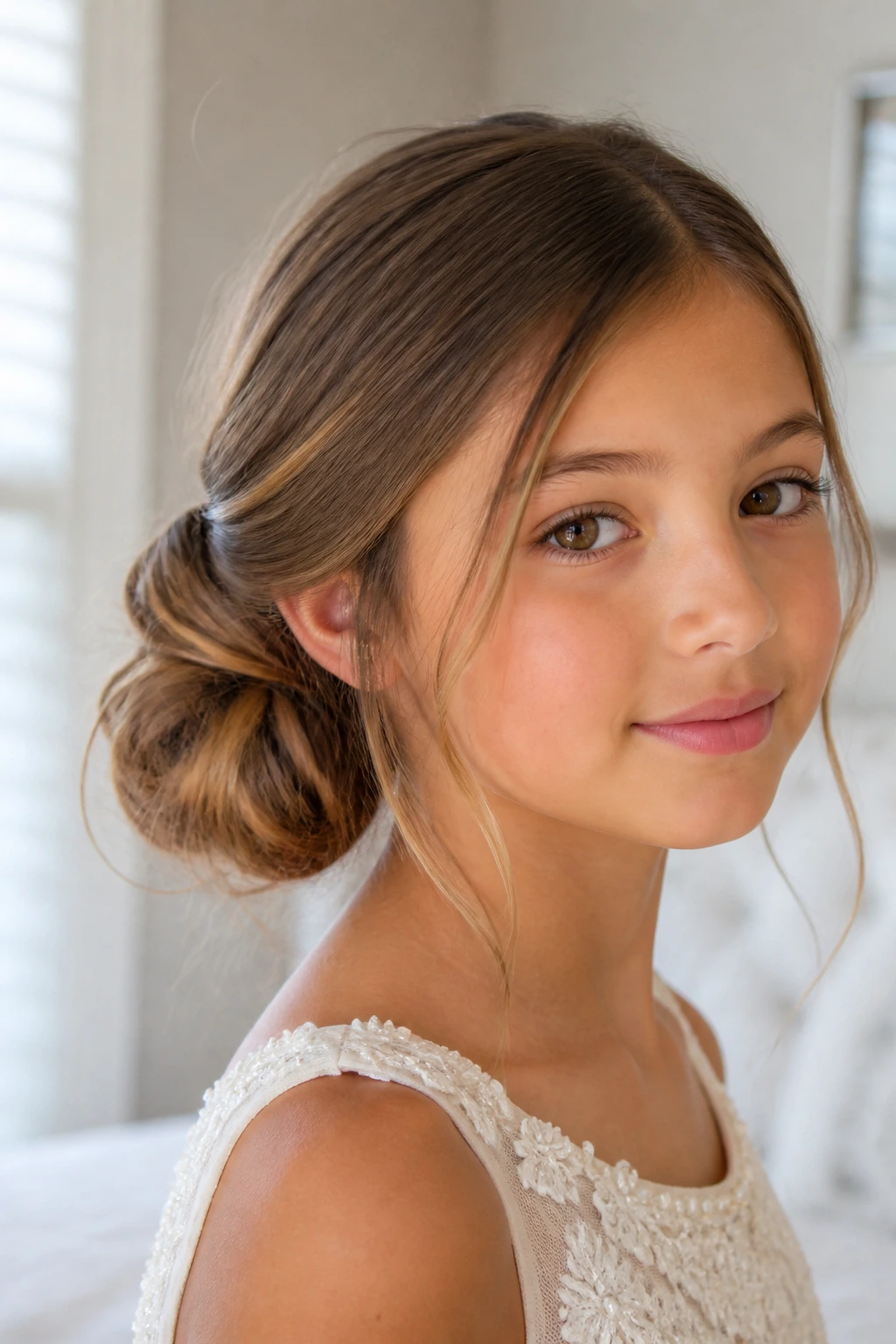
A loose side bun feels graceful without becoming stiff. The hair gathers low and slightly off-center, then twists into a bun that sits behind one ear or just below it. A couple of soft tendrils around the face keep it from looking too tight.
Why It’s So Pretty
The off-center shape is flattering in photos because it creates a gentle line across the neck and shoulder. It also works well with dresses that have one special detail — a lace collar, a sash, or a veil that falls more to one side. The style gives those details room to breathe.
I like this one best when the bun is secured first, then the front pieces are shaped second. If you try to pull the front pieces out before the bun is stable, the whole style can loosen too much. Small order-of-operations detail, big difference in the mirror.
13. Rope-Braid Half-Up Style
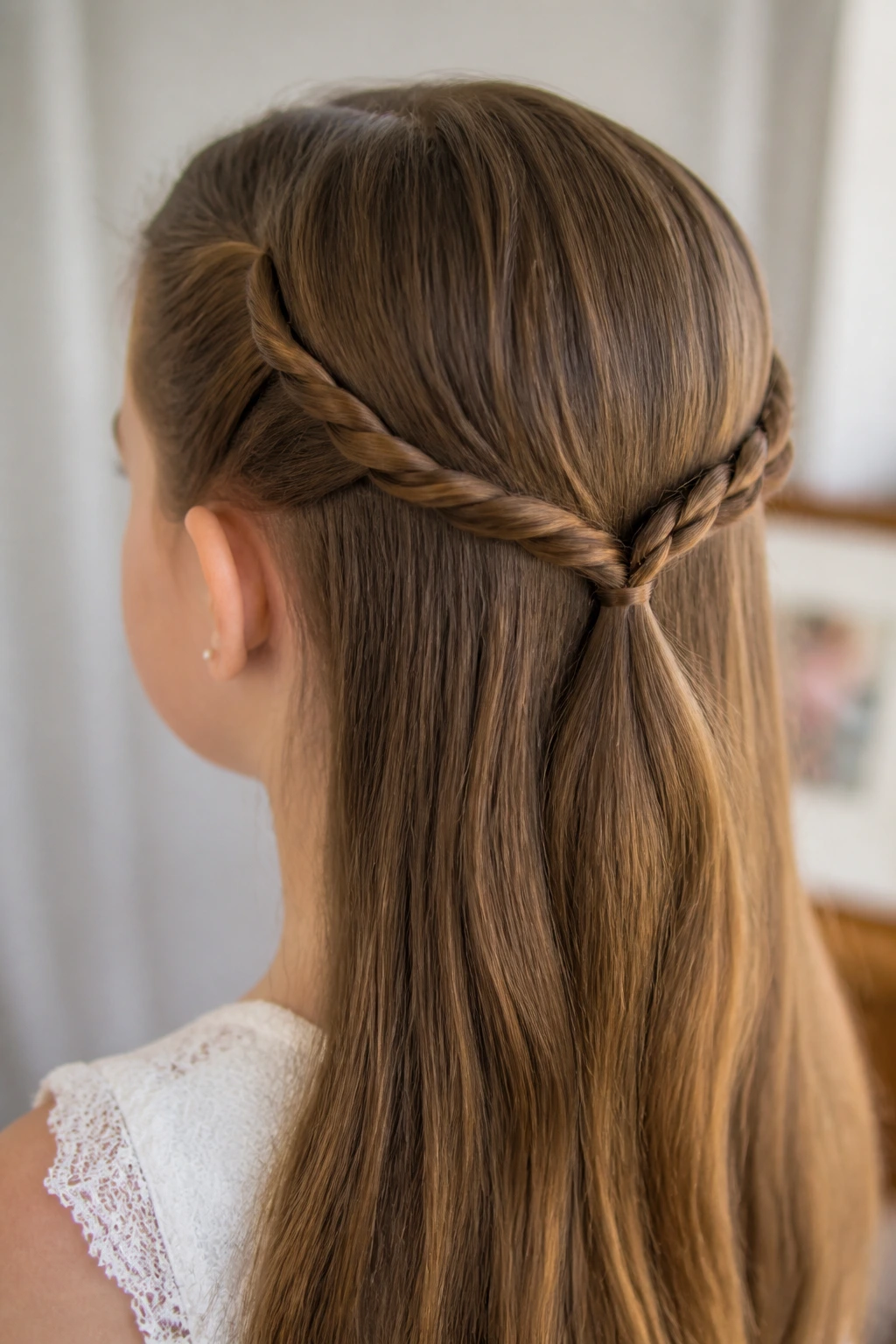
Rope braids look polished without requiring the precision of a full braid. Two sections are twisted over each other on each side, then joined at the back into a small half-up shape. The result is tidy, shiny, and easy to keep neat on fine or medium hair.
Why It’s Handy
This style is one of the quickest ways to make straight hair look intentional without adding heat all over the head. It also gives a nice surface for a small bow or pearl clip. If the hair is layered, the twist lines help keep shorter sections tucked in rather than floating free.
A little smoothing cream on the fingertips is enough to tame the top section. Don’t use so much that the hair goes greasy at the crown. Rope braids need grip, not slickness.
14. Braided Headband with Straight Hair
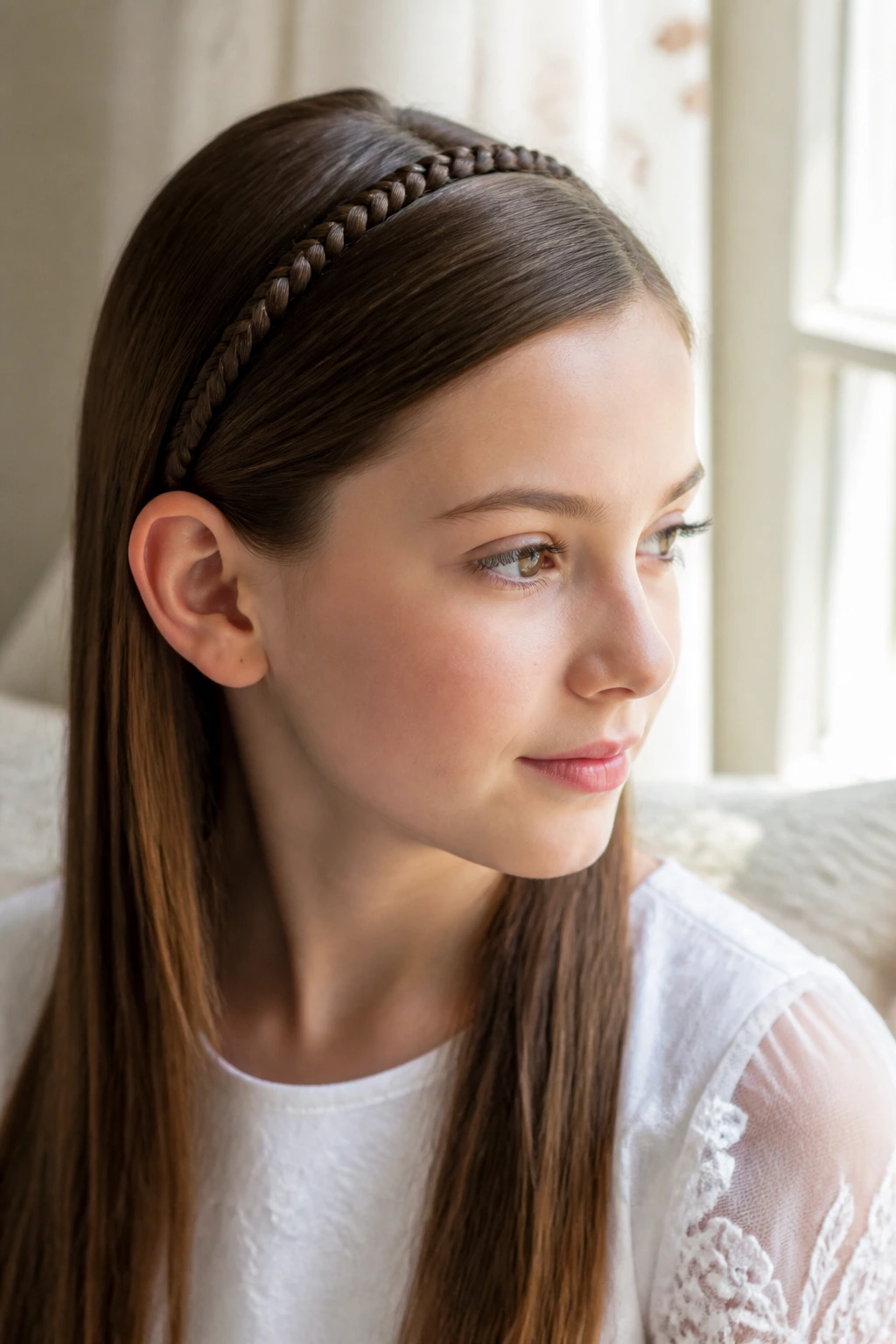
A braided headband is one of the simplest communion styles, and I mean that as a compliment. The braid is taken from one side, crossed across the front like a band, and pinned behind the opposite ear. The rest of the hair can stay straight, softly curved at the ends, or tucked into a low ponytail.
Best For
This suits girls who do not like lots of curls or fancy sections around the face. It gives just enough detail to feel special, while letting the hair stay mostly natural. If the hair is long and straight, the contrast between the sleek lengths and the braid is especially neat.
Keep the braid narrow. A thick braided band can overwhelm a small face. A slim braid, tucked flat and finished with one hidden pin behind the ear, looks far more graceful in daylight.
15. Curly Ponytail with a Bow
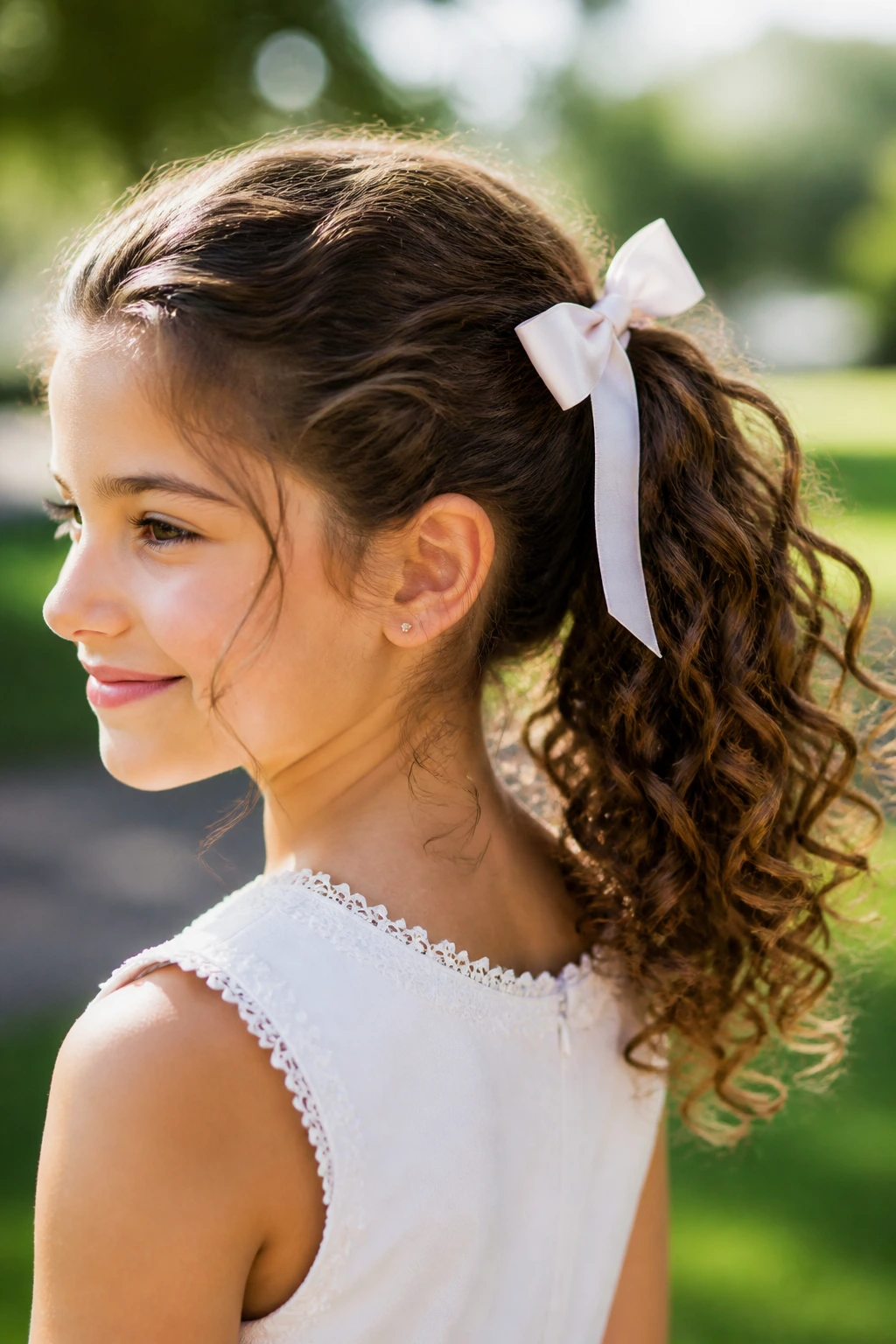
A curly ponytail can be charming if the curls are shaped, not left in a frizzy cloud. Gather the hair into a mid or low ponytail, curl the ends or define the natural curls, then finish with a ribbon bow around the elastic. The bow is what turns it into communion hair instead of a school-day ponytail.
Why It Works
The style keeps the hair out of the face while still showing length and texture. It’s especially good for girls whose curls are already springy and full; there’s no reason to fight them into something else. A little curl cream on damp hair, scrunched through and air-dried or diffused, can make the ponytail look tidy without flattening it.
The bow should match the dress in tone, not exactly in color. A cream bow with an ivory dress looks softer than an identical white-white match, which can sometimes look harsh in photos. Tiny detail. Big payoff.
16. Minimalist Top Knot with a Veil
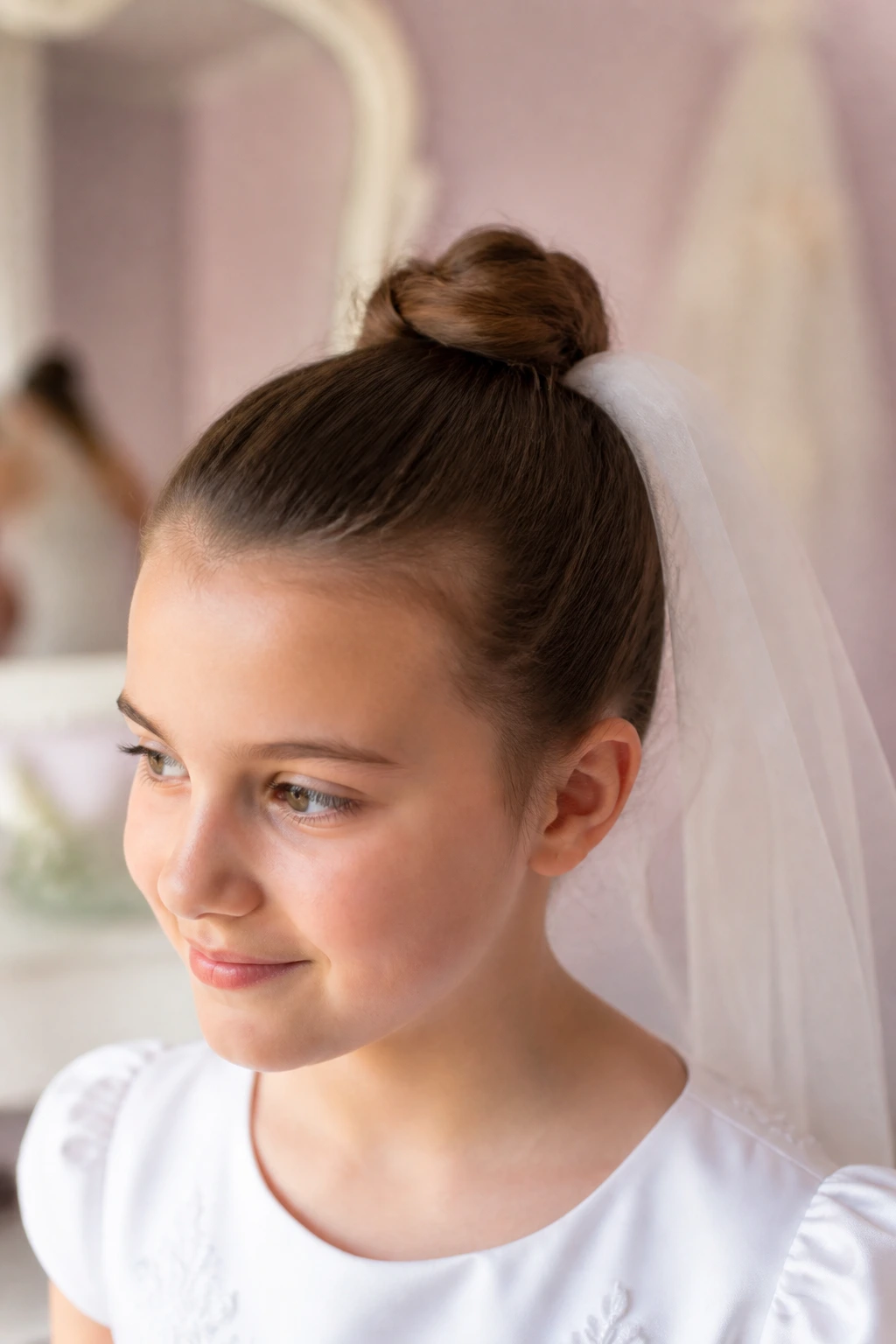
A minimalist top knot is for the child who needs a veil in place and doesn’t want a lot of hair at the nape. The knot sits high and compact, giving the veil comb or clip a firm anchor. It can look very sweet when the front is smoothed back and the knot itself is neat, round, and small.
A Style That Likes Structure
This one behaves best when the hair is slightly textured or prepped with a light mousse. Too much slip and the knot starts to sag. Too much volume and the whole thing gets lumpy, which is not what you want when the veil is the visual focus.
Keep the knot small enough that the veil can sit above or just beneath it without pulling. A test run is worth doing here, because veil placement changes the balance of the whole look. Once it’s right, though, it’s one of the most secure styles in the bunch.
17. Lace Braid into a Ponytail
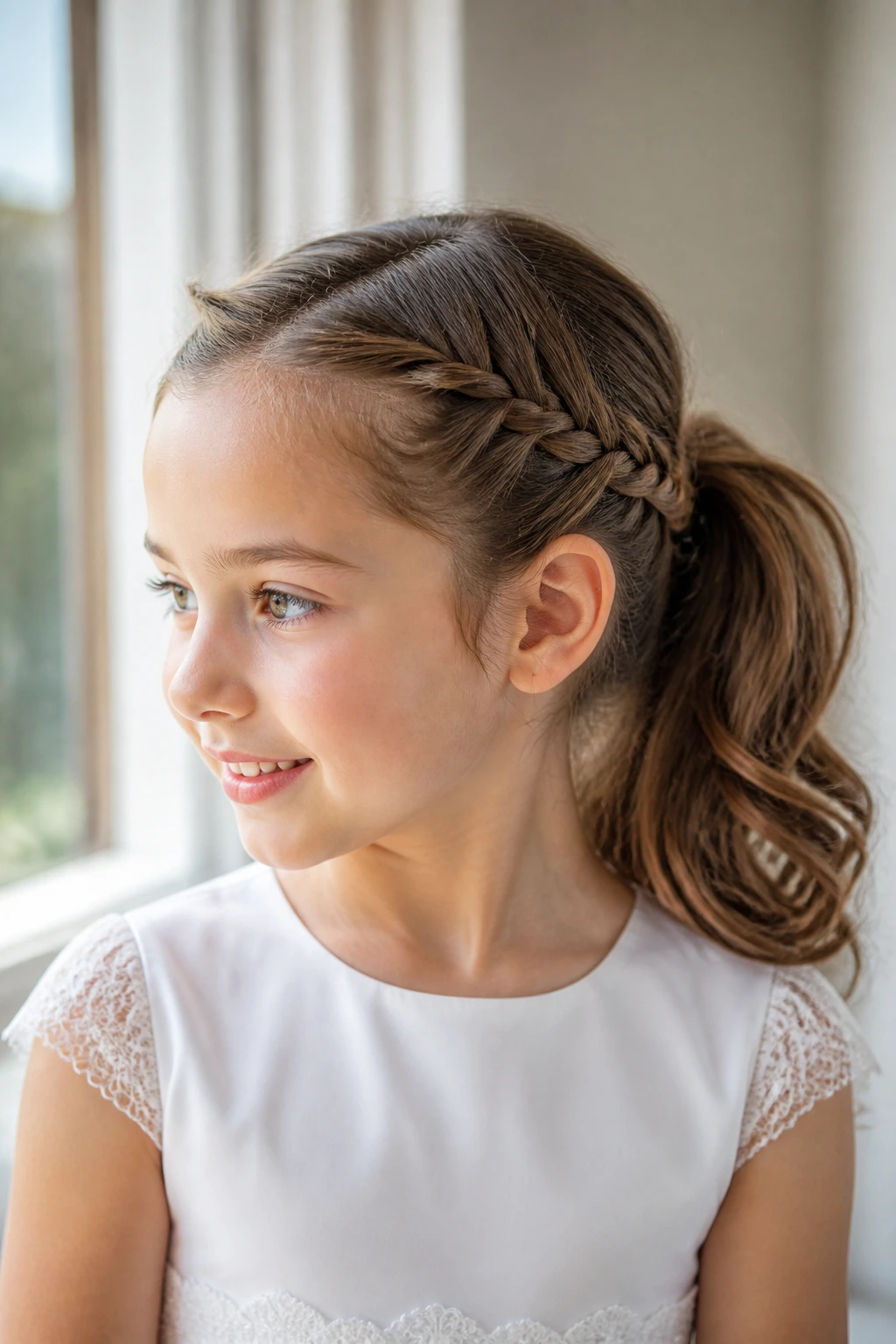
A lace braid has a pretty, woven look along one side of the head and then falls into a ponytail at the back. It’s a lovely compromise for girls who want hair back off the face but still want some length showing. The braid line gives the style its charm.
What Makes It Different
Unlike a full French or Dutch braid, a lace braid only adds hair on one side as it moves, which gives it a softer, more one-sided look. That makes it useful when the front section needs a bit of detail, but you still want the ponytail to feel free. Curl the ponytail ends slightly if the hair is straight; it keeps the finish from looking too plain.
This style is especially helpful on layered hair because the braid can hide some of the shorter pieces at the front. A small clear elastic at the ponytail base and a ribbon wrap over it are enough. Nothing bulky.
18. Classic Long Curls with a Center Part and Clip
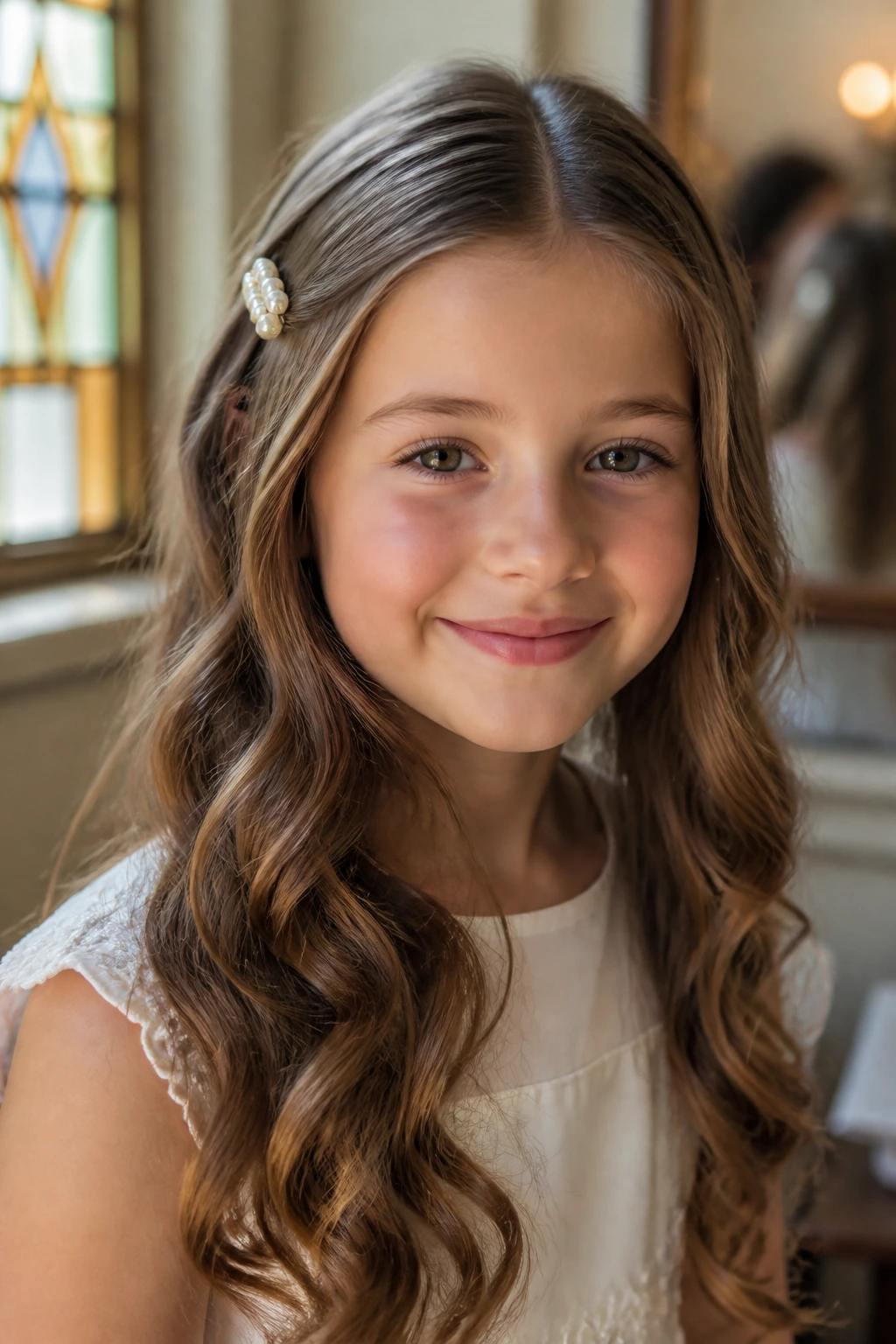
Sometimes the simplest answer is the right one. A clean center part, soft curls through the lengths, and one small clip or comb at the temple can look just right for communion. It feels gentle, unfussy, and elegant in a childlike way.
Why It’s Still a Favorite
Long curls are a good choice when the dress already has plenty of detail and the hair needs to stay visually calm. The center part keeps the style balanced, while the curls add movement around the shoulders. If the hair is naturally wavy, you may only need to touch the ends with a wand rather than curl the whole head.
The clip should not compete with the curls. I would choose a simple pearl barrette, a satin bow, or a tiny floral pin and stop there. If the accessory is too large, the curls end up feeling like background scenery, and that’s backwards.
19. Milkmaid Braids
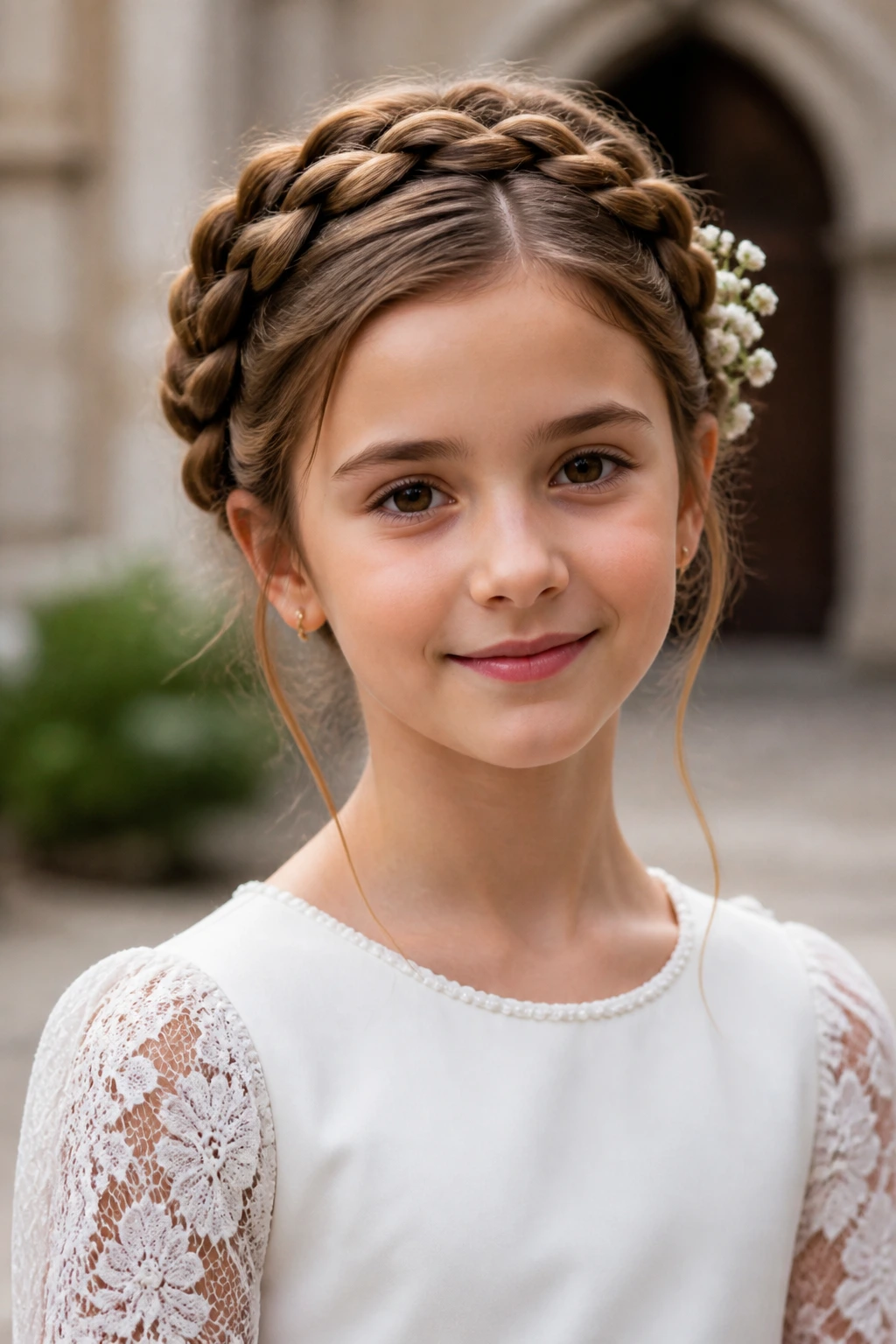
Milkmaid braids are braided sections wrapped across the crown, and they have a quaint, timeless feel that suits a communion day well. They frame the face softly and keep hair secure without requiring a polished bun. There’s a reason this style keeps showing up in family photos — it sits well on a child’s face.
How to Keep It Soft
The braids should be gently loosened after pinning so they look full rather than tight. That fuller texture helps them stay visible from the front and side. If the hair is very smooth, prep with a little dry shampoo or texturizing spray before braiding; otherwise the sections can slide apart while you’re pinning.
A milkmaid braid also pairs nicely with small flowers tucked near one ear. Don’t scatter accessories everywhere. One or two tiny pieces is enough, especially if the braid line itself is neat.
20. Low Bubble Bun
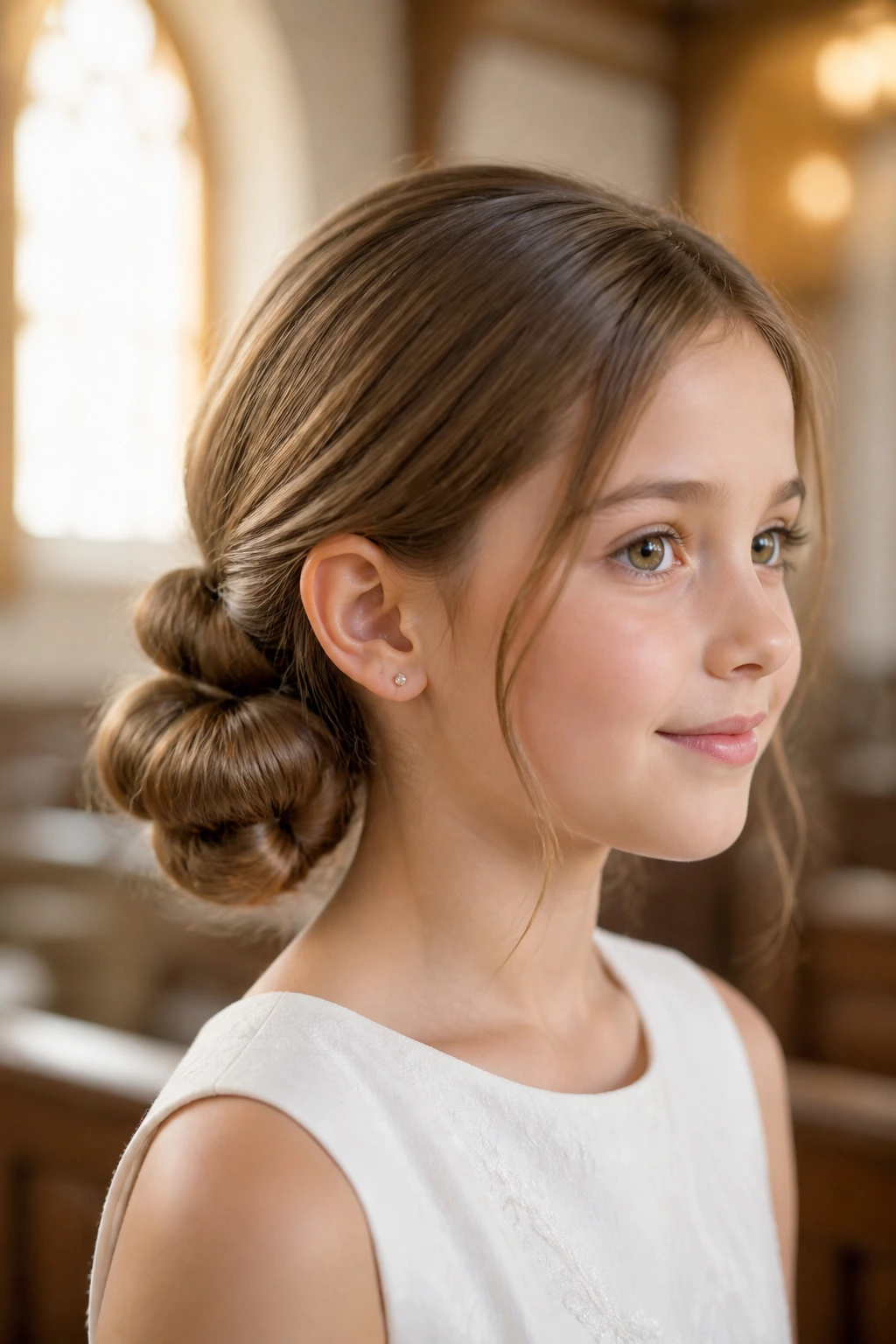
A low bubble bun takes the playful segmented look of a bubble ponytail and turns it into something a little more dressed up. The hair is sectioned into puffy rounds, then wrapped low into a bun at the nape. It’s a clever style for thick hair that needs structure but not a tight braid.
What to Expect
This style has more shape than a plain bun, which makes it useful when the dress is simple and needs a bit of hair texture near the back. It also works well for children who don’t want their hair pulled up high. Because the bun sits low, it tends to stay comfortable through a long morning.
Use small elastics that match the hair color as closely as possible. If you can see the elastic from five feet away, it’s too loud. The point is to build shape, not to turn the hair into a craft project.
21. Twisted Half-Up Knot
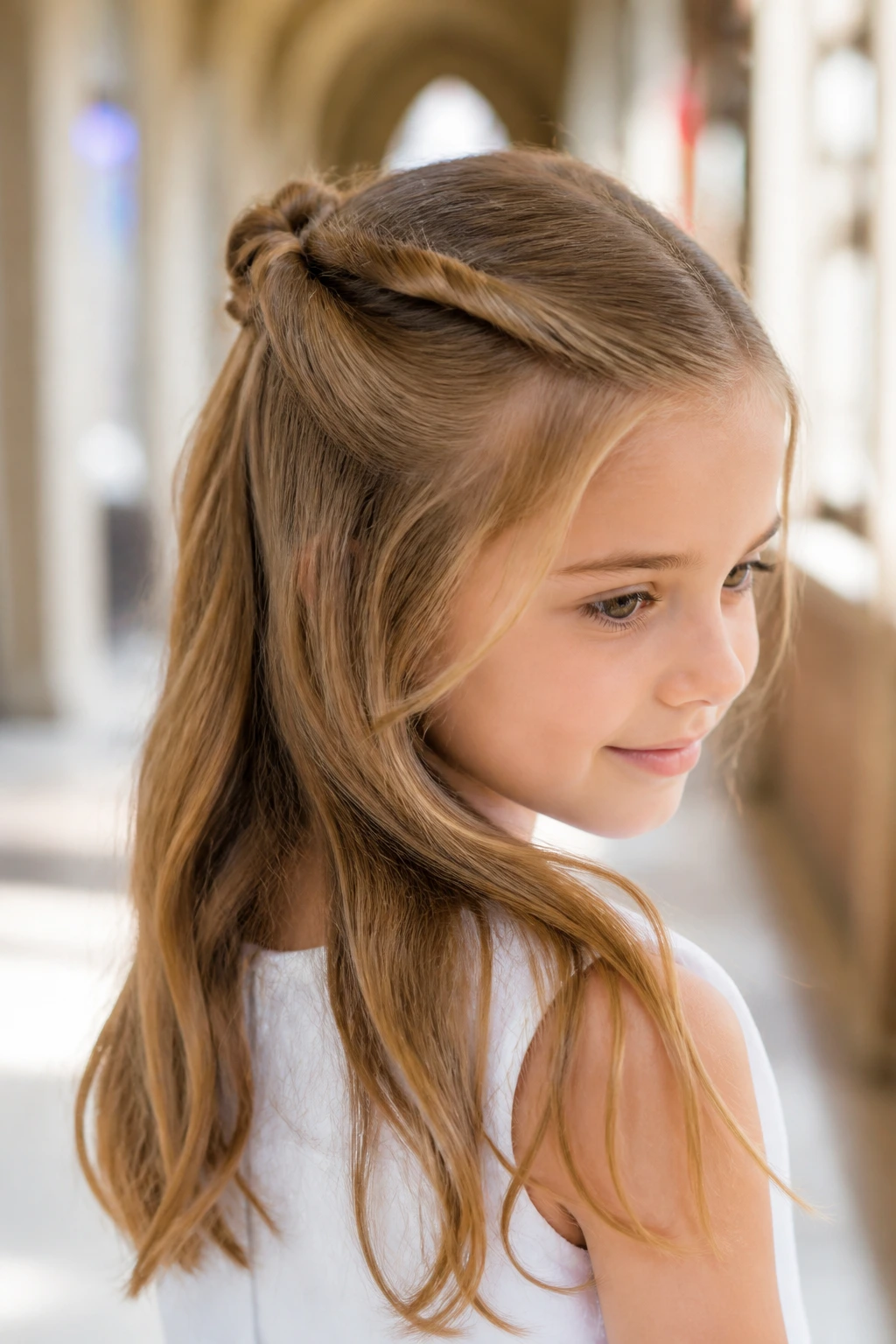
A twisted half-up knot is one of the sweetest styles in the whole collection because it looks calm from the front and slightly detailed from the back. Two side sections are twisted toward each other, tied into a knot or mini loop, and pinned just below the crown. The rest of the hair falls loose.
A Good Choice for Fine Hair
This style gives fine hair some structure without needing heavy backcombing. The knot can be tiny and still look intentional. If the hair has a little natural wave, leave it alone below the knot; if not, bend the ends with a soft iron so the lower section does not hang flat.
A small ribbon or pearl pin can sit right over the knot. Keep the detail centered and modest. The style should whisper, not announce itself.
22. Side Braid into a Loose Bun
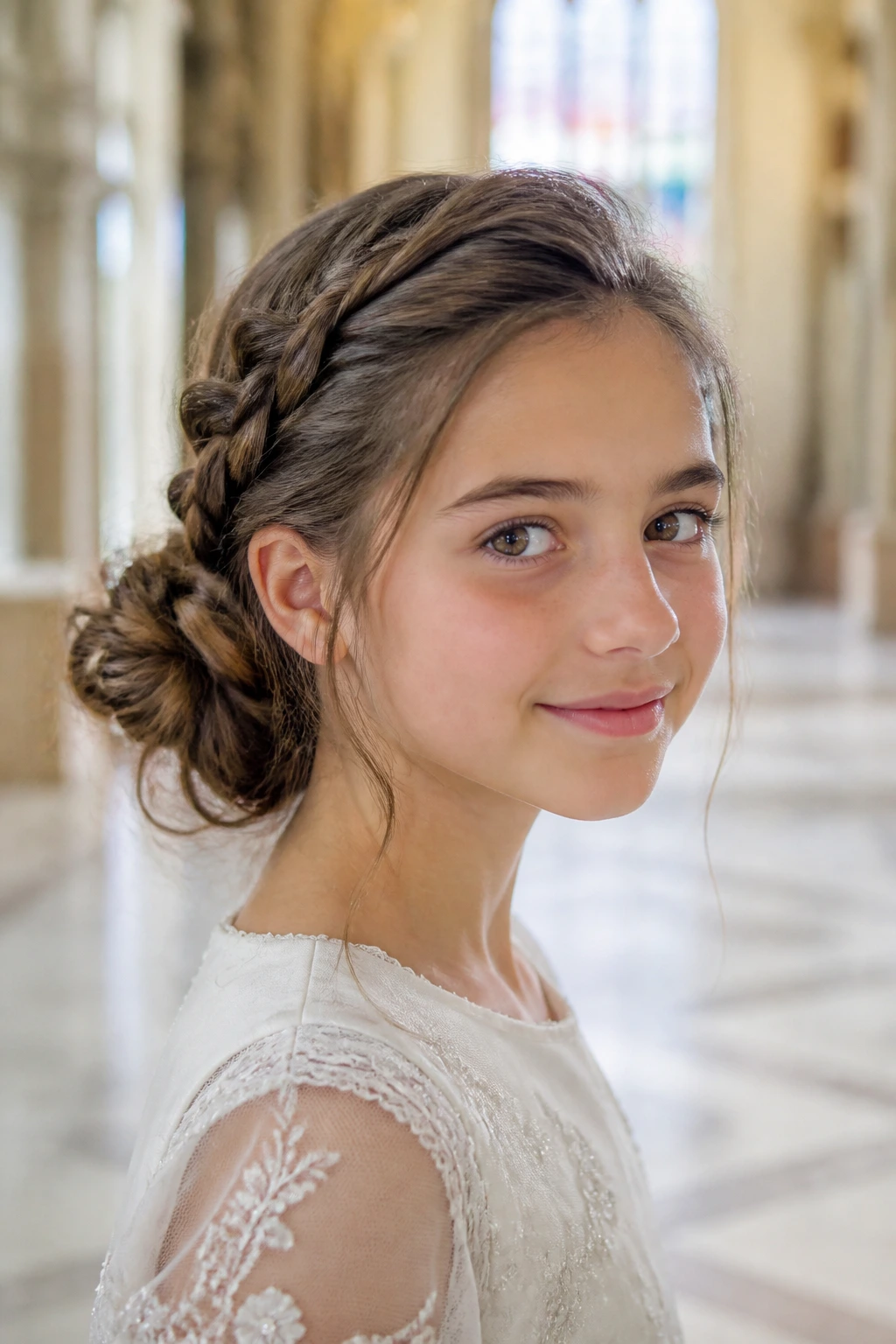
A side braid that feeds into a loose bun has a nice, handmade feel that fits a communion morning well. The braid starts near one temple, travels toward the nape, and disappears into a soft bun sitting slightly off-center. It has just enough structure to look polished and just enough looseness to stay childlike.
Why It’s Useful
This is one of the better styles for hair that tends to fall forward around the face. The braid acts like a frame and the bun keeps the ends under control. If you need to add a veil or clip, place it where the braid meets the bun; that junction is naturally stable.
Pull a few tiny strands free near the hairline if the style starts to feel too severe. Not many. Two or three wisps are enough to break up the shape and keep it soft.
23. Soft Fishtail Braid Over One Shoulder
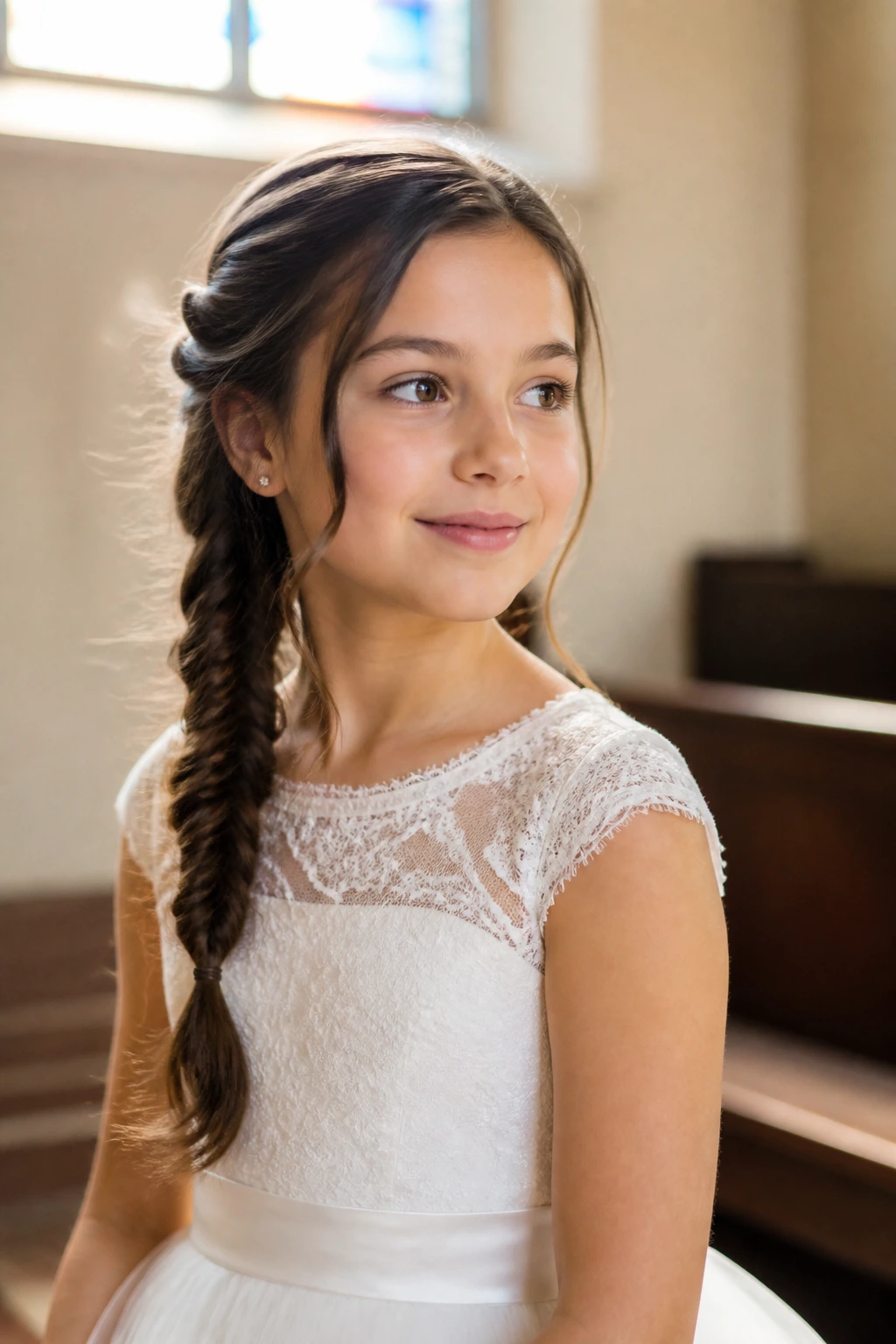
A fishtail braid has a fine, woven look that feels a little more special than a plain three-strand braid. Worn over one shoulder, it gives the hair a clean line while leaving the face open. It’s lovely for long hair that can handle a braid with some weight.
The Thing About Fishtails
They look intricate, but they’re mostly about patience and tension. Keep the sections small and even, then gently pull the outer edges once the braid is secured to give it a fuller shape. If the hair is slippery, a touch of powder spray at the roots before braiding helps more than people expect.
This braid works especially well if the dress has a simple neckline. The braid itself becomes the detail. Add a ribbon at the end or leave the tail plain if you want the style to stay quiet and clean.
24. Pinned Back Natural Curls
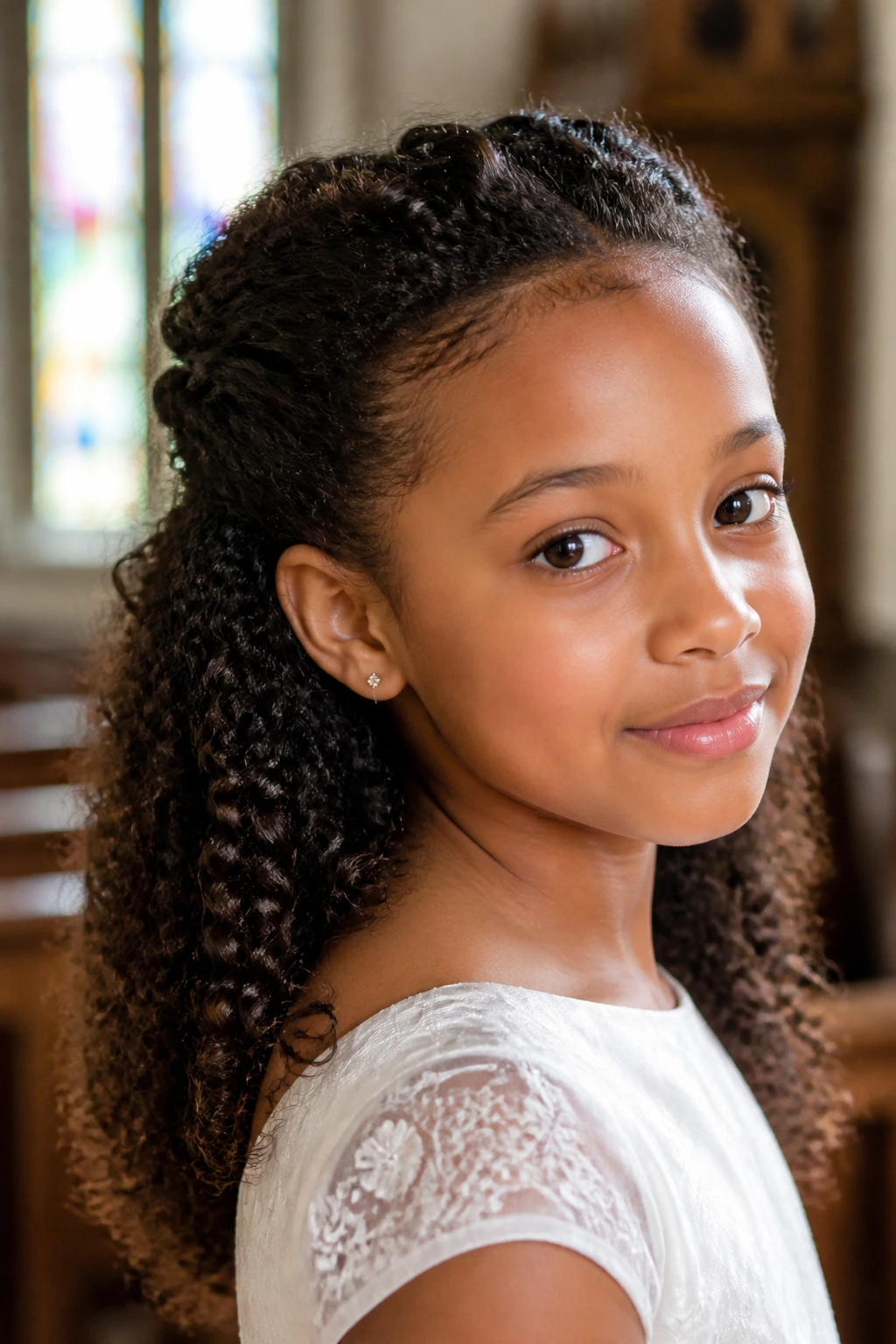
Natural curls pinned back at the sides can be one of the prettiest communion looks because it keeps the child’s texture intact. The front is gently clipped or pinned away from the face, while the rest of the curls stay free. It’s honest, soft, and far better than trying to force curls into a straight-hair style.
Why It Matters
When curls are treated as the main feature instead of a problem to be fixed, the result looks far more relaxed. A smooth part and a few pearl pins at the temples are enough. If the curls need a little more shape, define them with leave-in conditioner or curl cream the night before, then separate them gently in the morning.
The pins should hold the sides, not squeeze them flat. That balance is the whole point. You want lifted curls, not a head that looks clipped open.
25. Braided Bun with Rosette Clip
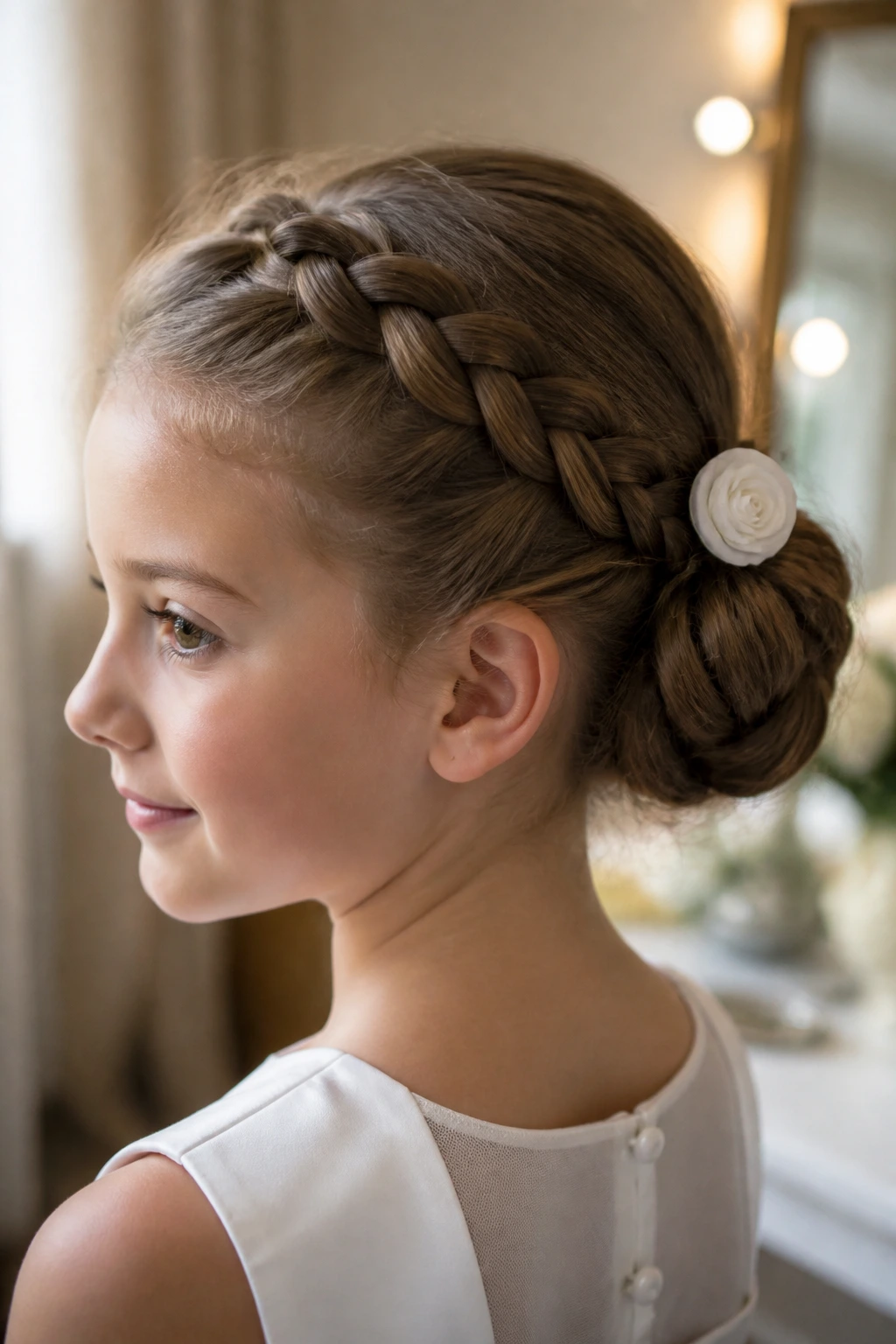
A braided bun with a rosette clip feels a little dressier, but still sweet enough for a communion setting. The hair is braided first, then wrapped into a bun, and a small fabric rosette or bow is placed at one edge. The braid gives texture; the bun keeps the shape neat.
Best Use
Choose this if you want the back of the hairstyle to look finished from every angle. That matters in family photos, especially when the child is turning slightly toward the camera. The braid also helps disguise a few uneven layers if the hair is cut in a way that makes buns hard to smooth out.
The rosette should be small and soft. If it looks like it belongs on a gift box, it’s too much. A single fabric flower or satin knot works better than anything stiff or oversized.
26. Mini Crown of Twists
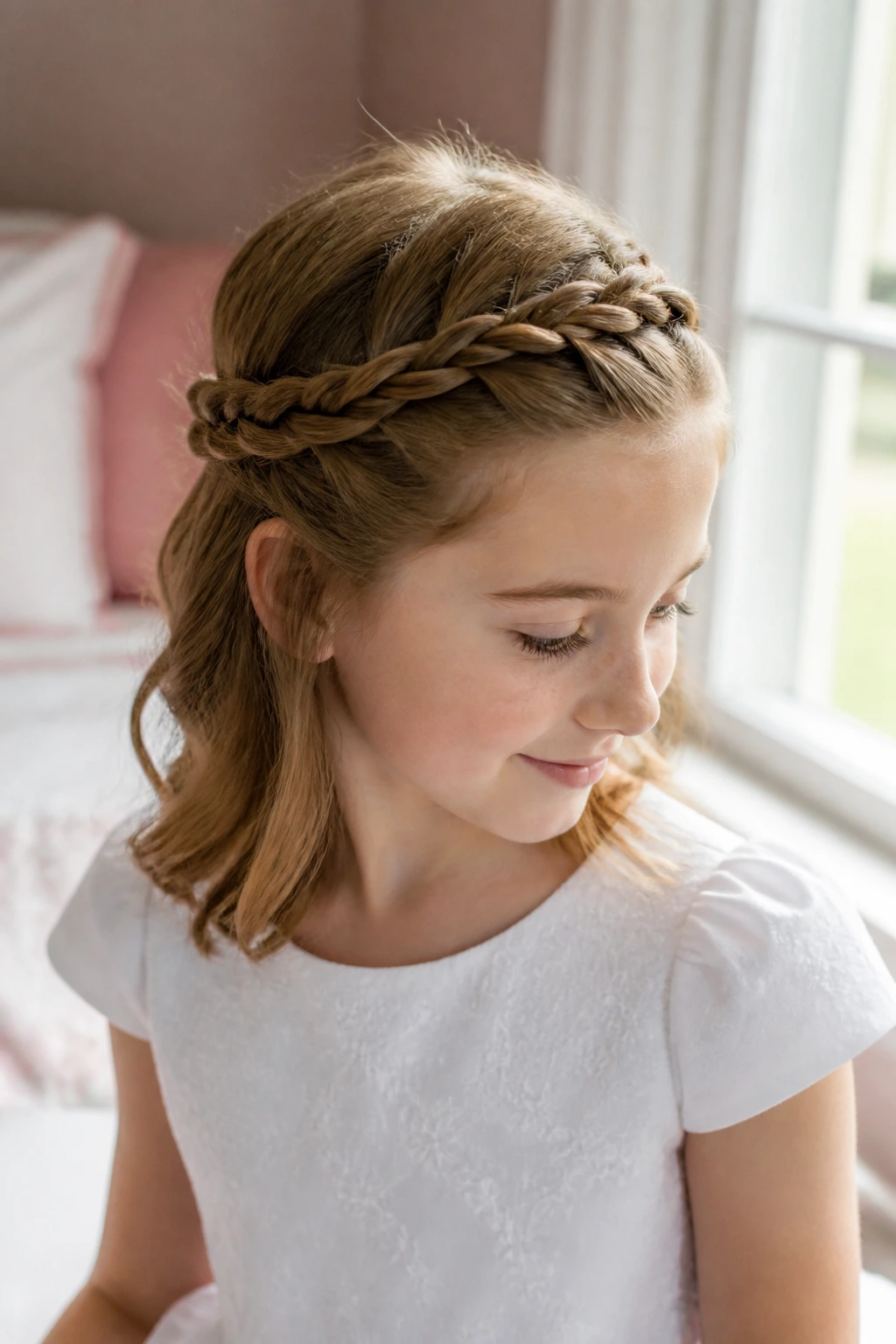
A mini crown of twists is a gentler cousin of the full halo braid. Small sections from each side are twisted back and pinned along the head, creating a crown shape that is lighter and faster to build than a full braided crown. It has a dainty feel that suits younger girls very well.
Where It Wins
This style is kind to shorter lengths and layered hair because twists are easier to manage than long braids. It’s also a good option if the child gets impatient during styling; twists move fast, and the overall shape comes together with fewer steps. A dab of styling cream on the fingertips helps the twists lie flat.
If you want a tiny accessory, place it where the final twist tucks in at the back. That gives you one focal point instead of a scattering of little extras. Less clutter, better line.
27. Sleek Half-Up with a Satin Bow
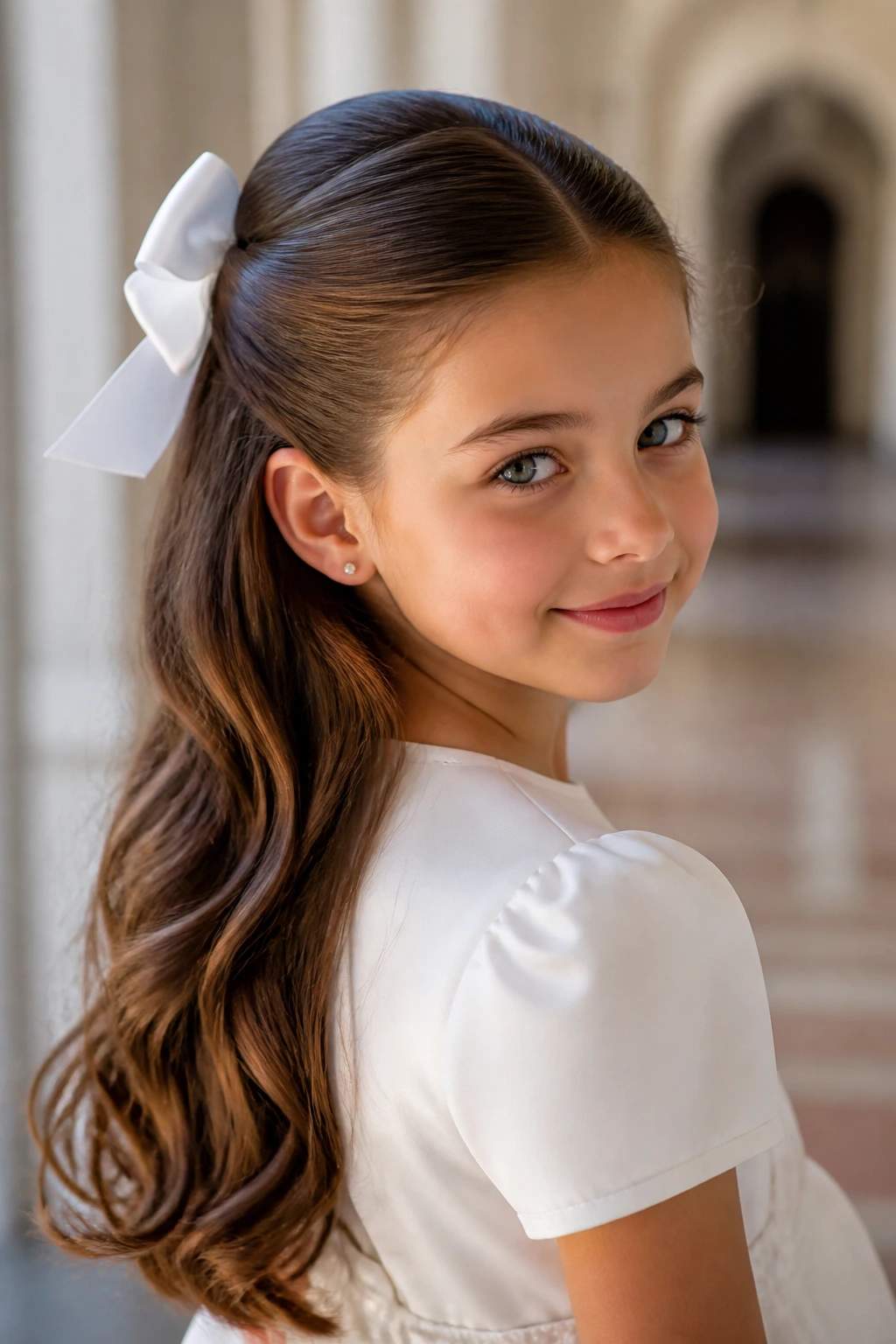
A sleek half-up style can look surprisingly polished when it’s done with care. Smooth the top half back, secure it at the back of the crown, and finish with a satin bow that drapes over the elastic. The rest of the hair can stay straight or be given a soft bend at the ends.
A Clean, Calm Option
This is a good answer for girls with very straight hair that resists curl or braid. The smooth top keeps the style tidy, and the bow softens it enough to feel special. If the hair has a side part, keep it; if not, a centered part makes the whole shape look balanced.
Use a lightweight serum only on the outer lengths, not the roots. Too much shine product near the crown makes the top section slide, and the bow starts to twist. Small details. Annoying result if ignored.
28. Low Ponytail with a Braided Base
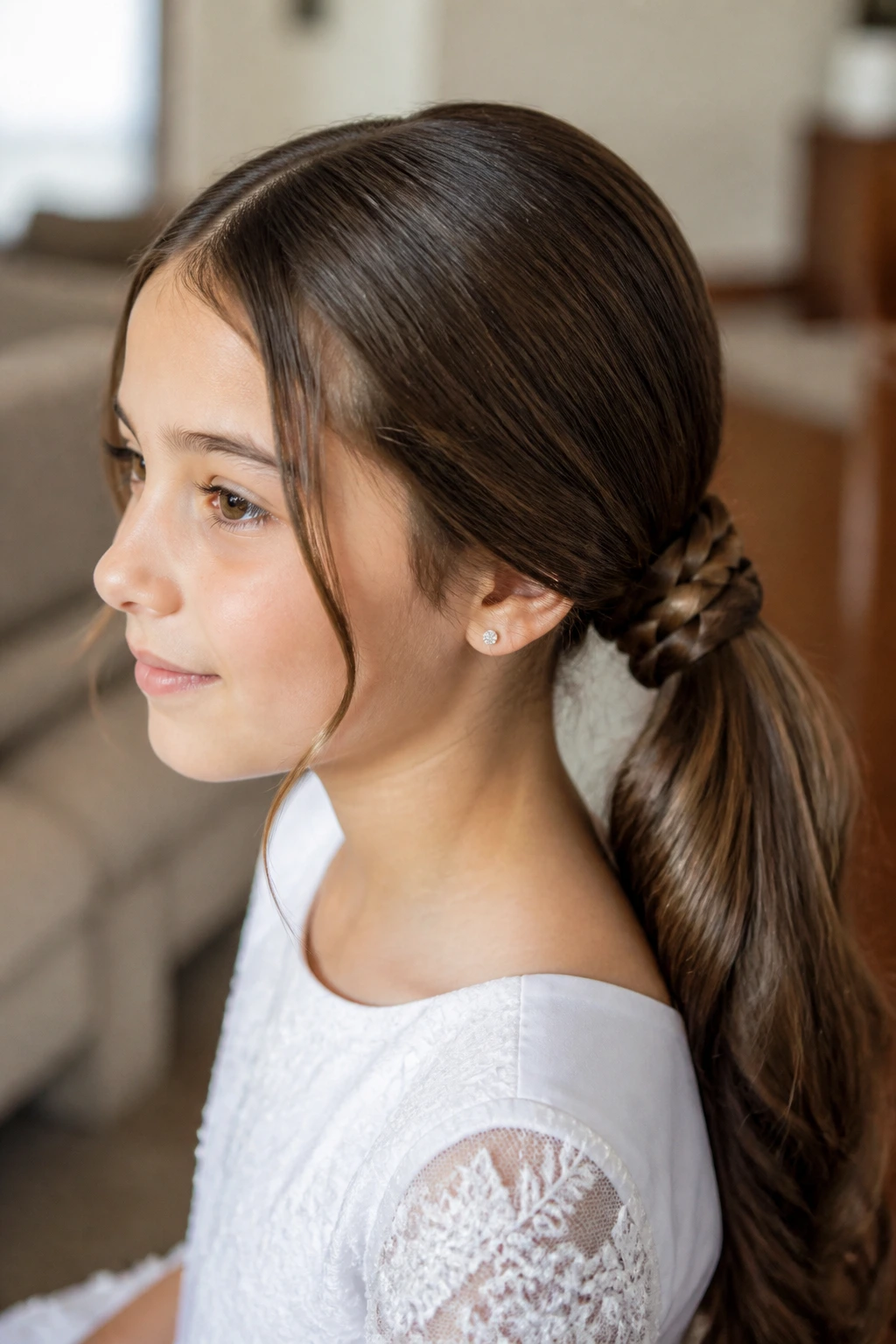
A low ponytail gets a much more dressed-up feel when the base is wrapped in a braid. The braid can be a tiny section from the front, wrapped around the elastic, or a fuller braid that anchors the ponytail before the rest falls down. It is simple, neat, and easy to wear.
Why It Works
The low position keeps the look calm and practical, which matters if the child will be wearing a veil or moving from church to family photos. The braided base gives the ponytail enough detail that it doesn’t look like a school day style. Add a ribbon wrapped over the elastic if the dress needs a touch of softness.
I like this for hair that is long, thick, and easy to manage. It also survives motion better than most loose styles. If the ponytail starts to swing too much, a second hidden elastic lower down can keep the shape centered.
29. Dutch Braid into a Ribboned Plait
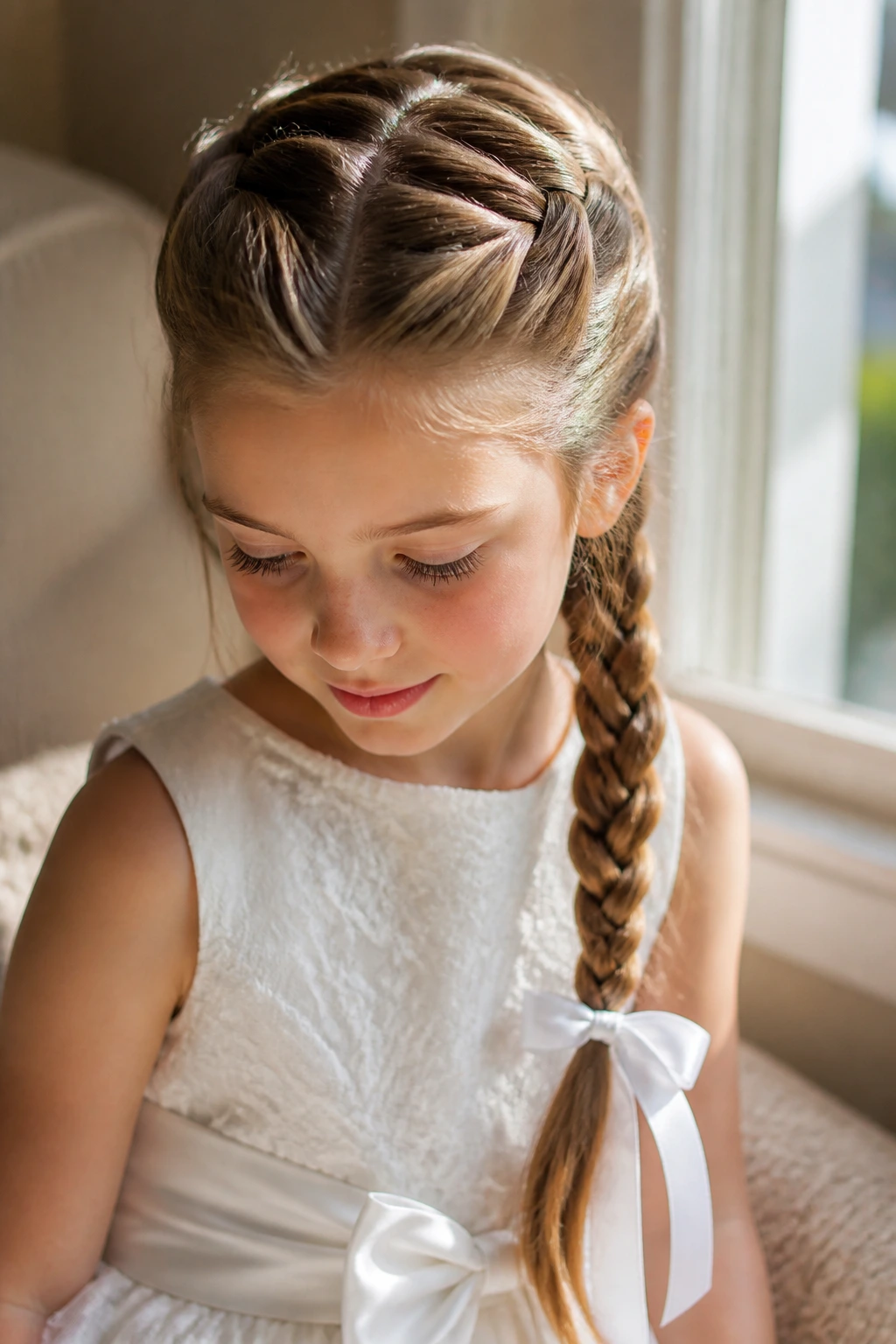
A Dutch braid followed by a ribbon through the end gives you texture at the top and sweetness at the bottom. The braid stands proud against the head, then transitions into a simpler plait or loose tail threaded with ribbon. It has a gentle, almost old-fashioned charm that feels right for communion.
What to Know
This style shows up beautifully in photos because the braid line is raised and clear. It also works for thick hair that needs a firmer hold than a regular braid can give. If the hair is fine, the ribbon can help the tail look fuller and more intentional.
Pick a ribbon that’s narrow enough to weave cleanly through the braid. Wide ribbon can bunch up and make the end heavy. Satin or grosgrain both work; the real choice is whether you want a softer sheen or a slightly matte finish.
30. Loose Romantic Waves with a Veil Comb
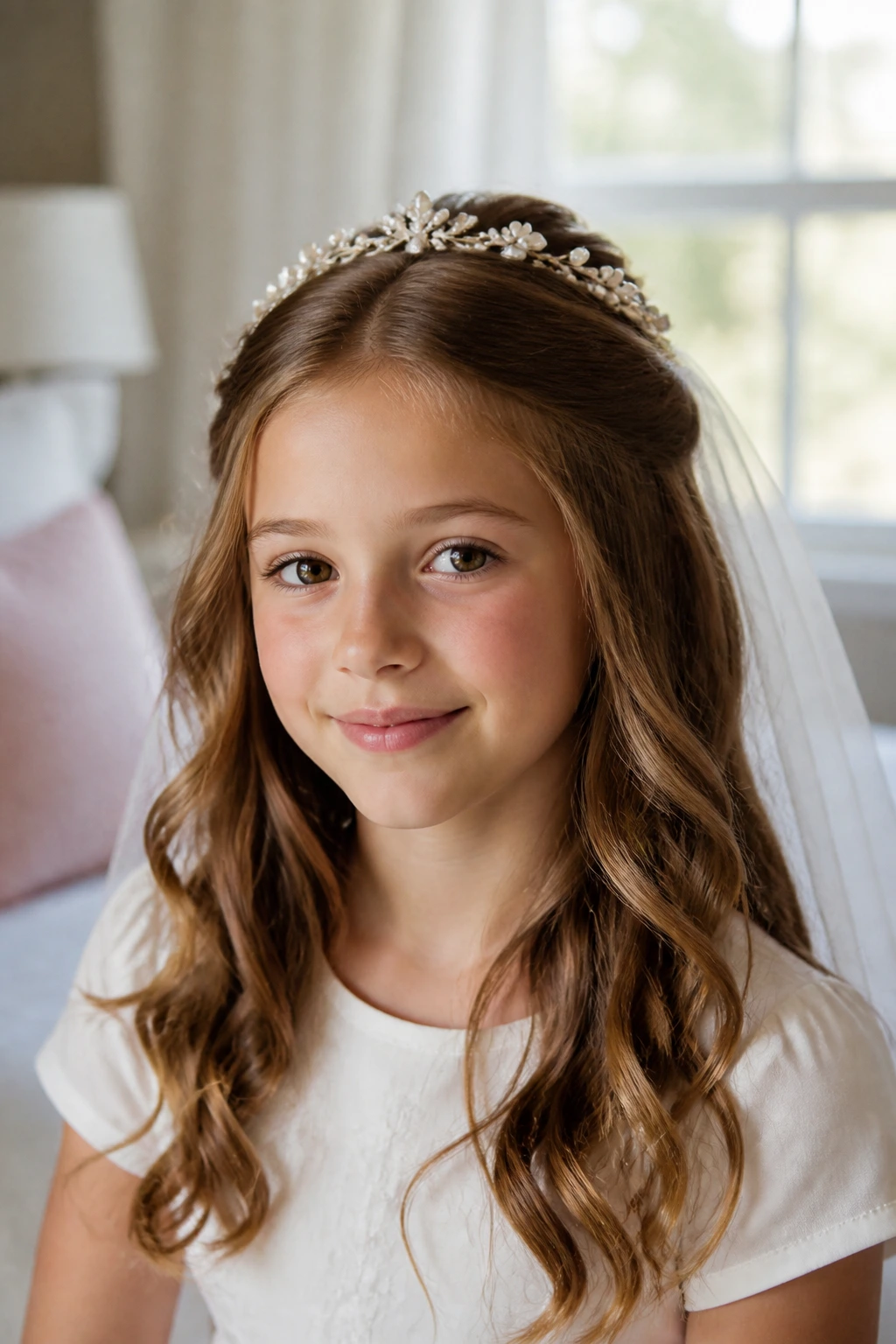
Loose waves with a veil comb are a classic for a reason. The hair stays down, softly parted, and shaped into smooth bends that hold a veil or small comb near the crown. The style feels gentle and elegant without pretending to be anything else.
The Final Thought on This Look
This is one of the easiest styles to pair with a communion veil because the comb has enough hair to anchor into, but the waves still fall around the shoulders in a soft frame. If the hair is naturally wavy, work with that pattern instead of trying to flatten it first. If it’s straight, one-inch sections curled away from the face give a better result than tight spirals.
The key is restraint. A little polish at the top, soft movement through the ends, and one secure comb — that’s enough. Anything more starts to crowd the face, and communion hair should leave space around a child’s features.
Why the Style Has to Hold Up in Real Life
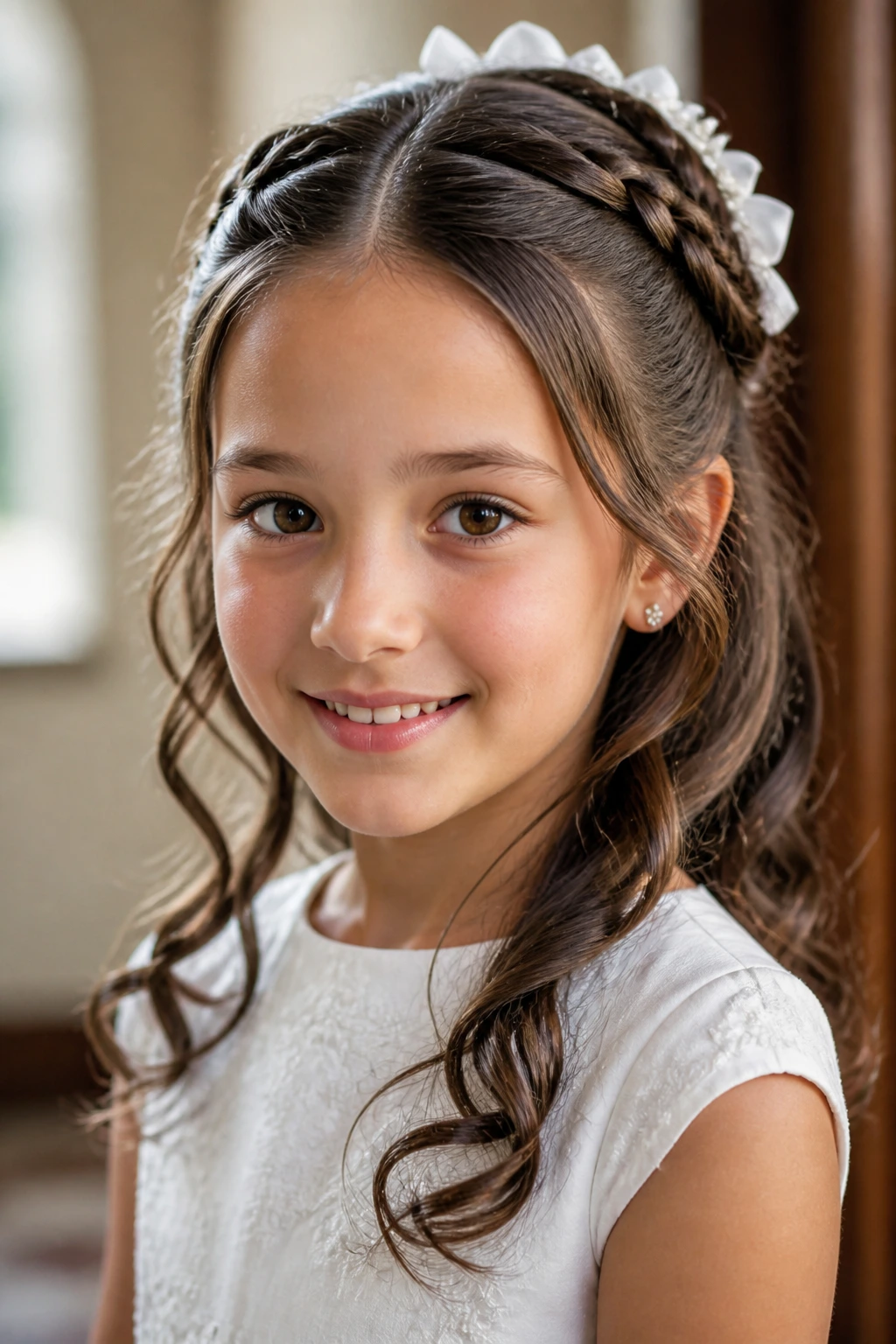
A communion hairstyle does its real work long before the photos. It has to survive the walk into church, the seating shuffle, the candle or program in hand, the family hug, and the hour or two after that when the child is still wearing the dress but no longer standing perfectly still. Styles that only look good in the first mirror check are a waste of pins.
The fix is usually a matter of structure. Braids help because they anchor layers together. Twists help because they gather the hair without making it feel pulled. Low buns and half-up shapes help because they split the weight of the hair across more than one point, which makes the style less likely to drop or separate. A touch of texture at the roots, especially on clean hair, gives pins something to grip.
I also think people underestimate how much the front of the hairstyle matters. You can hide a lot at the back. The front is what everyone sees when the child turns her head, smiles, or leans forward for a picture. A smooth part, soft temple sections, and one tidy finish at the back are usually enough.
Essential Tools and Accessories
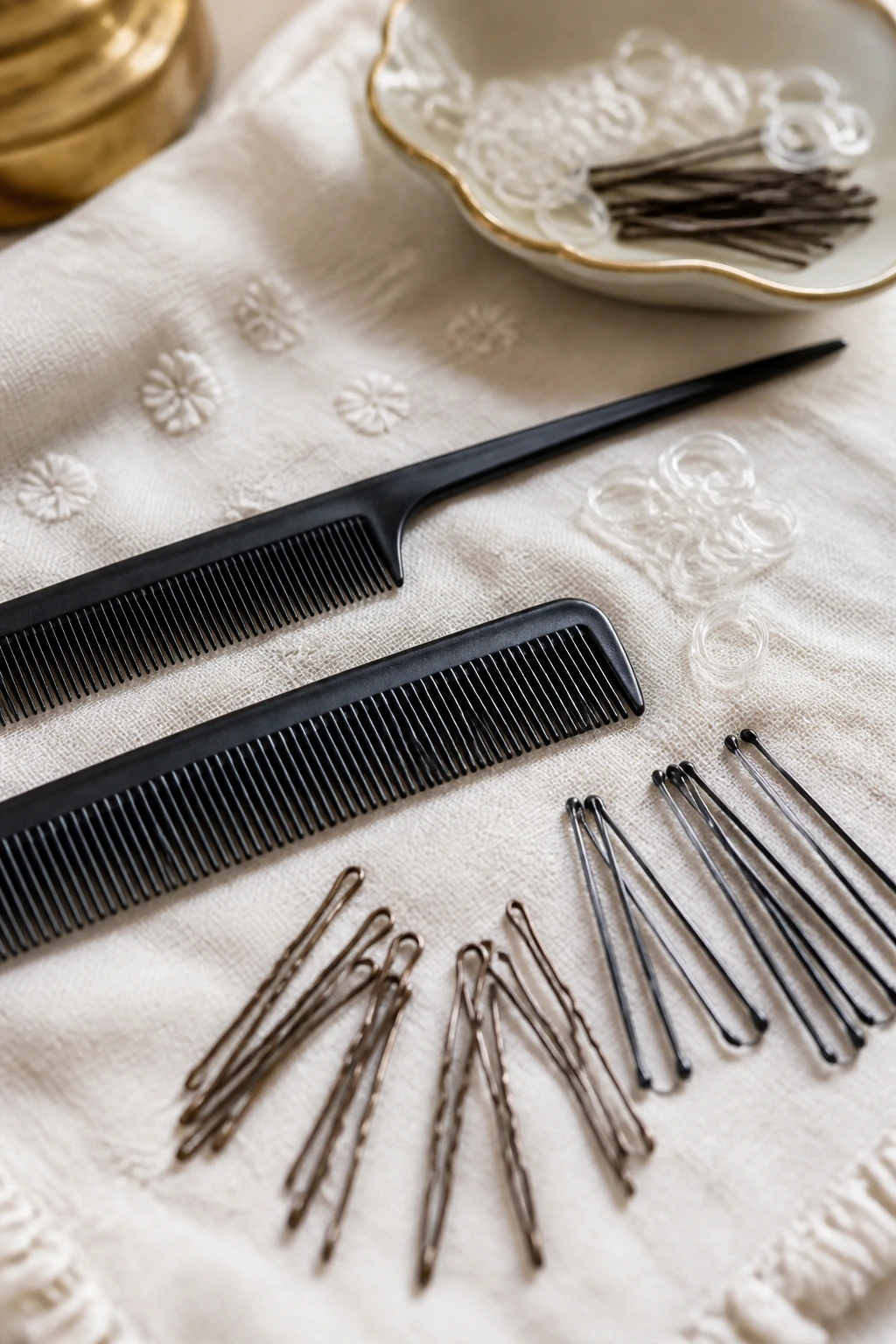
- Fine-tooth comb: Useful for parts, smoothing the crown, and keeping braid sections clean.
- Soft bristle brush: Helps flatten flyaways without making the hair feel scraped back.
- Tail comb: Handy for sectioning half-up styles and neat braid lines.
- Clear elastics: Best for ponytails, bubble sections, and braid ends you want to hide.
- Small bobby pins: Choose pins that match the hair color and hold twists or buns without sliding.
- U-pins or spin pins: Good for buns and chignons, especially on thicker hair.
- Light-hold hairspray: Keeps wisps under control without locking the style into a stiff shell.
- Texturizing spray or dry shampoo: Gives fine or slippery hair some grip before braiding.
- Satin ribbon, bow, or narrow headband: Works as a finishing piece without overpowering the hairstyle.
- Pearl or floral clips: A few small accessories usually look better than one oversized one.
- Curling wand or flat iron: Optional, but useful for shaping soft waves or bending the ends.
- Hand mirror: Worth having nearby so you can check the back before leaving the house.
Smart Prep and Product Choices for Communion Hairstyles for Girls
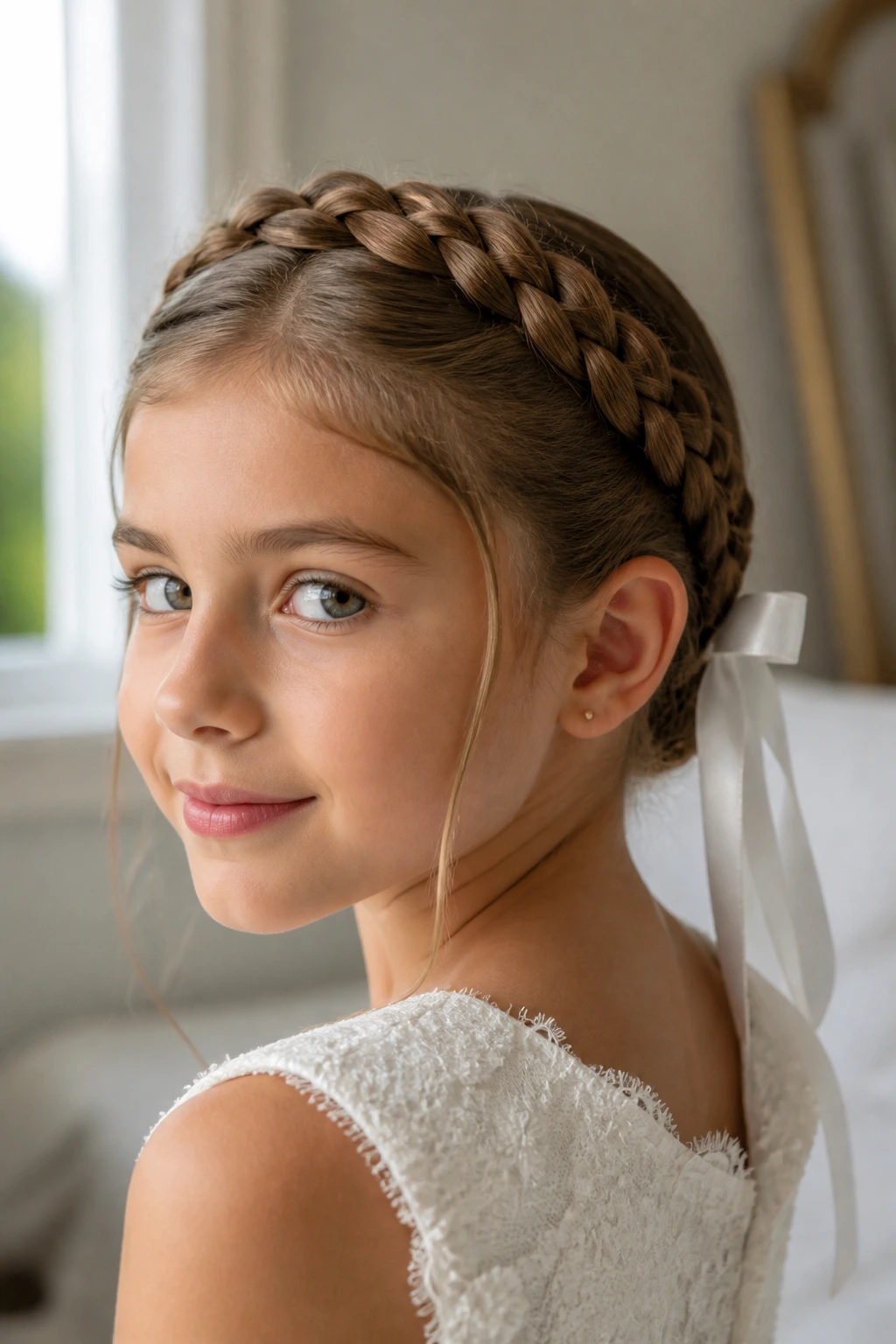
The best prep usually starts the day before, not the morning of. Hair that’s been freshly washed and blown dry can be too slippery for braids and pins, especially if it’s fine. Slightly lived-in hair — clean enough to feel fresh, but not squeaky and slippery — tends to behave better for communion styles.
Product choice matters more than people admit. For fine hair, a little mousse at the roots and a mist of texturizing spray before braiding can be the difference between a braid that stays neat and one that slowly slides apart. For thick hair, a smoothing cream through the mids and ends helps the braid or bun lie flatter without adding grease near the scalp.
Accessories should match the weight of the hairstyle. A large bow can swallow a delicate braid, and a tiny clip can disappear in a big mass of curls. I usually lean toward pearls, satin, matte ribbon, and soft fabric flowers because they sit well beside lace and white dresses. Glitter can work, but only in a very small dose. Too much and the hair starts looking like party hair instead of communion hair.
How to Finish the Look Without Overdoing It
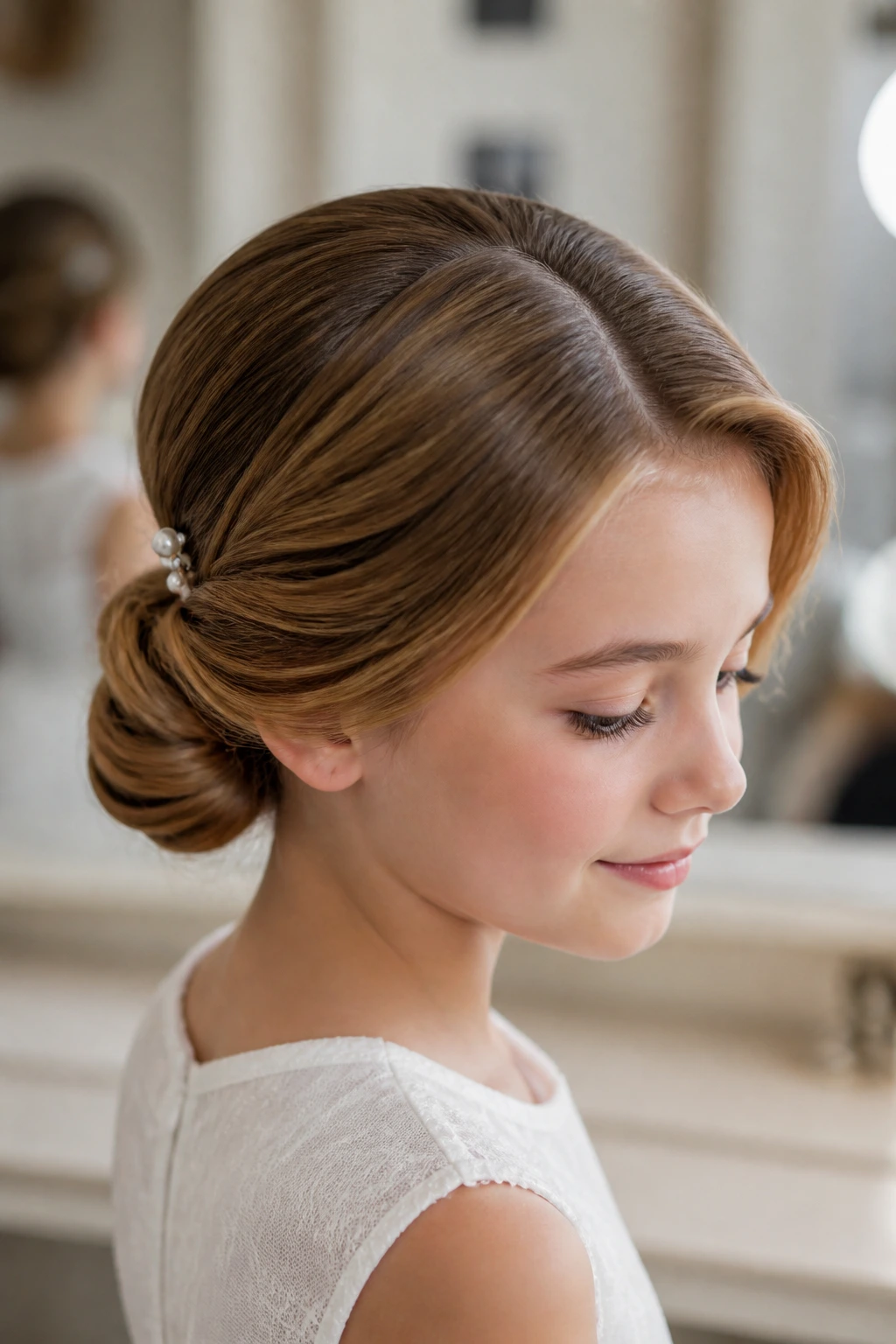
Presentation: Keep the silhouette clean. If the dress already has lace, tulle, or a veil, let the hairstyle be softer and smaller; if the dress is plain, the hair can carry a little more detail, like a braid or ribbon. The goal is balance, not competition.
Comfort: Check the hairline before leaving the house. Pins at the temples or behind the ears should not stab, scratch, or pull when the child turns her head. If she says something feels tight, fix it then. That discomfort rarely goes away on its own.
Pairing with the Dress: A high neckline usually likes a low bun, chignon, or side braid. A simple neckline can handle loose curls, half-up styles, or a centered part with a clip. If there’s a veil, place the comb where the crown has enough density to support it.
Photos: Before the family heads out, take one quick picture from the front and one from the side. The camera shows gaps and lumps that a bathroom mirror sometimes hides. A tiny fix — a braid tugged looser, a bow centered more carefully, a pin hidden under the twist — can change the whole effect.
Additional Tips and Personal Touches
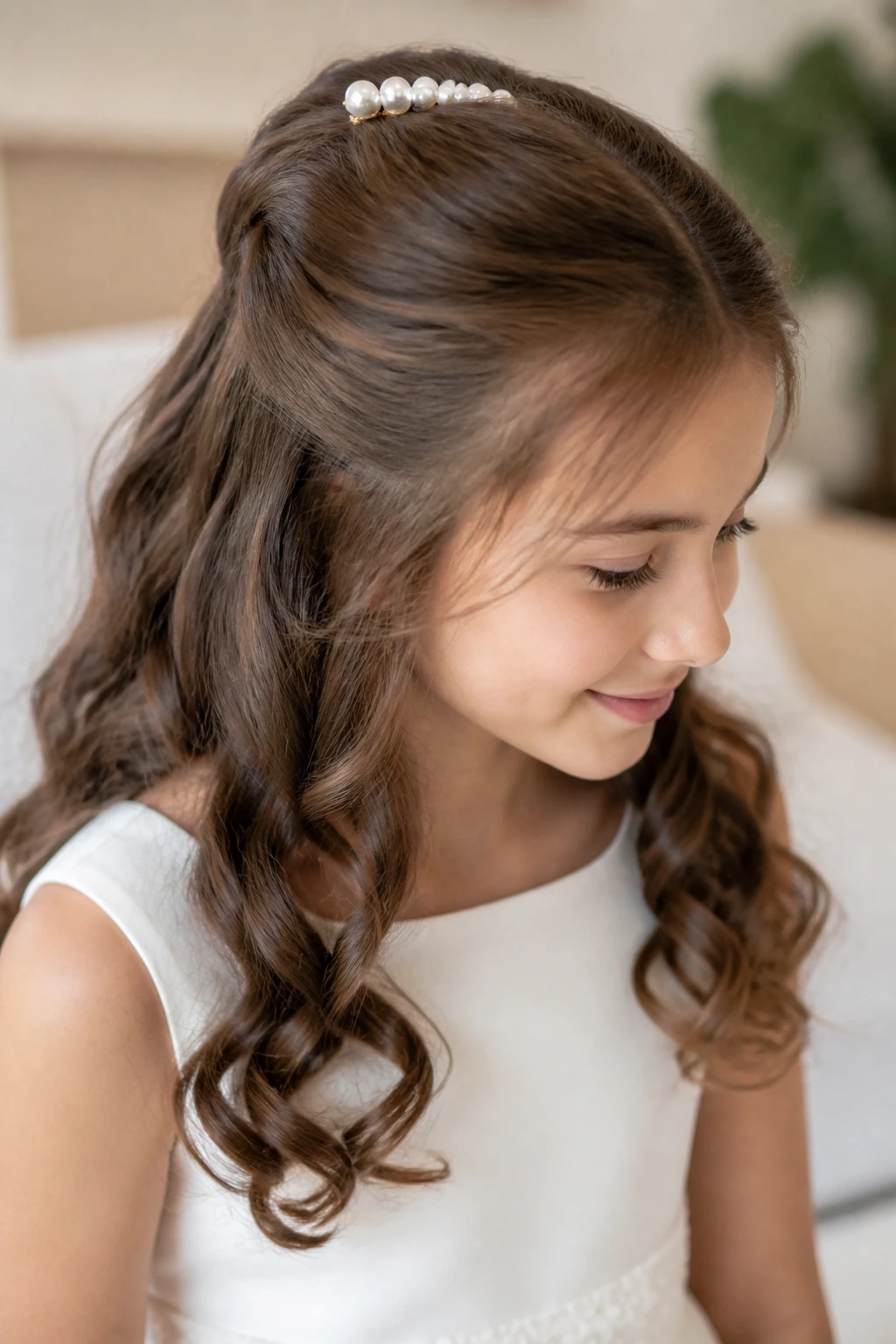
Texture: If the hair is very smooth, prep it with texture spray before you begin. Braids and twists need a little tooth, and the style usually lasts longer when the hair is not freshly polished to the point of slickness.
Customization: Match the hairstyle to the child’s personality, not just the dress. A girl who hates hair on her neck will be happier in a half-up style or braided crown. One who loves wearing her hair down may feel more comfortable in loose waves with a small clip.
Finishing Touches: A ribbon tied into a tiny bow at the nape, a pearl comb tucked above one ear, or a single flower near a braid can be enough. One good accessory beats three competing ones every time.
Comfort Check: After pinning, ask the child to shake her head gently and look down. If pieces slide or the style shifts, it needs more support. Better to fix it on the bathroom tile than during the walk into church.
Night-Before Prep and Next-Day Care
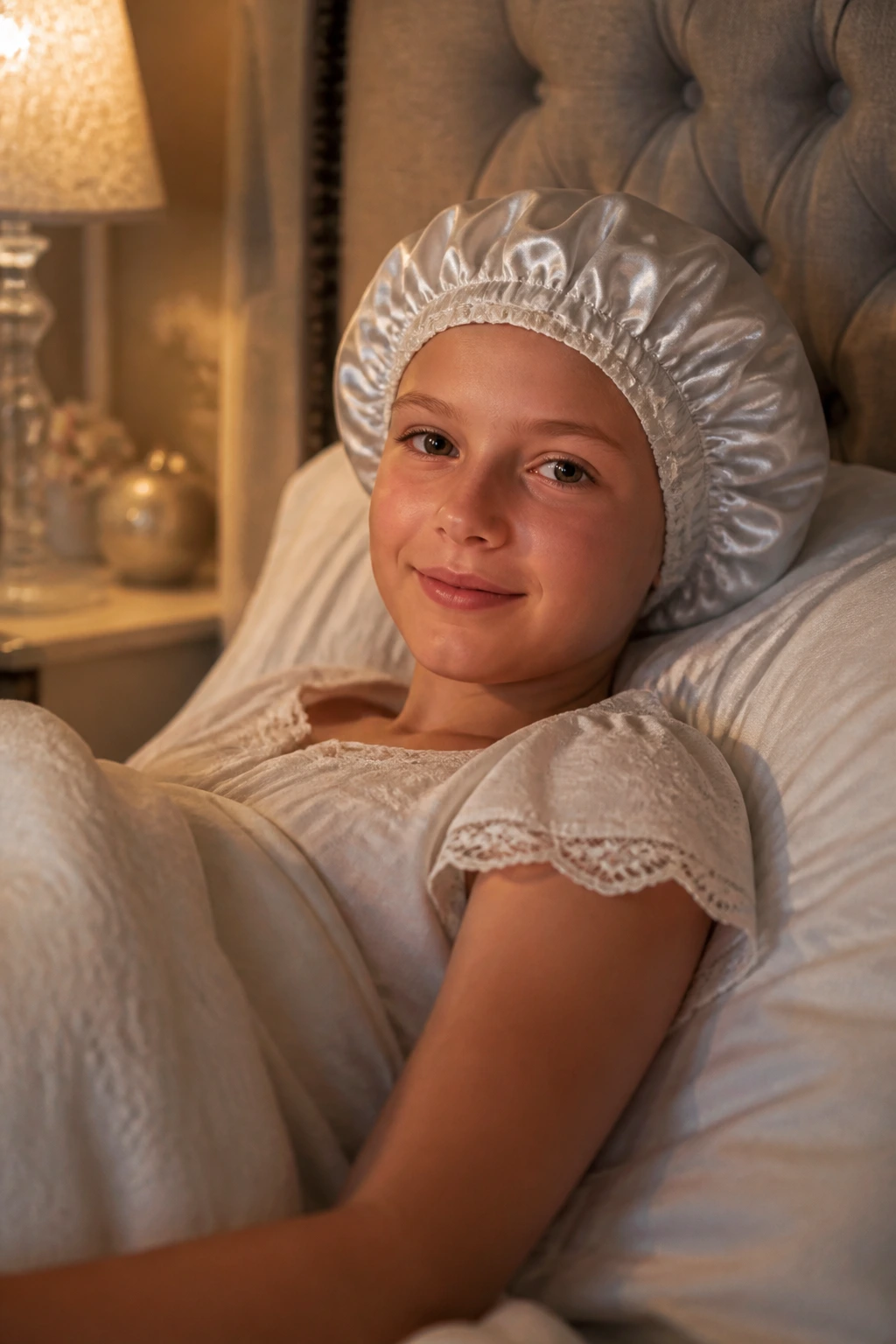
Most communion hairstyles are easier if the hair is prepped the night before. That can mean washing and drying the hair the evening before, then setting it in loose twists, braids, or a satin bonnet so it has a little texture without getting frizzy. If you plan to curl the hair, doing it the night before can save time in the morning — just let the curls cool completely and wrap them loosely before bed.
Braided styles and buns tend to hold the longest. A crown braid, chignon, milkmaid braid, or low bun can usually survive most of the day with only a tiny midday touch-up, especially if the hair was pinned well at the start. Loose curls need more attention. A quick mist of water and a touch of leave-in conditioner can bring them back if the ends start to frizz.
If the hairstyle must last into family dinner or a longer gathering, bring a few spare bobby pins, one small comb, and a travel-sized hairspray in a pocket or handbag. A satin ribbon can be retied if it loosens. And if the child ends up with a style that’s meant to stay for the evening, a satin pillowcase or bonnet helps the hair look better the next morning.
Variations and Adaptations to Try
Fine-Hair Soft Grip: Use mousse at the roots, texturizing spray through the mid-lengths, and styles that rely on twisting or half-up structure rather than heavy volume. Fine hair usually looks fuller when the braid is gently pulled apart after it’s secured.
Thick-Hair Control Plan: Choose low buns, double braids, Dutch braids, or chignons that give the weight somewhere to go. Thick hair can be beautiful in a loose style, but it usually needs a stronger base so the shape doesn’t puff out by noon.
Curly and Coily Celebration: Work with the natural pattern instead of flattening it. Pinned-back curls, a curly ponytail with a bow, or a soft half-up crown can look gorgeous when the curls are defined with leave-in conditioner and allowed to keep their shape.
Short-Hair Fix: Use small twists, side clips, pearl barrettes, or a slim headband rather than trying to force a braid that the length cannot support. Short hair often looks sweetest with a clean part and one well-chosen accessory.
Veil-Friendly Setups: If a veil is part of the outfit, build the hairstyle around the comb or clip. Low buns, compact chignons, and smooth half-up styles usually support veil hardware better than loose styles with soft, slippery roots.
Minimalist Sunday Look: Skip the large accessories and keep the hair neat, calm, and softly polished. A simple part, one braid, or a ribbon tied low can be enough when the dress already carries the weight of the outfit.
Common Mistakes to Avoid
One of the biggest mistakes is choosing a style that’s too tight. Tight braids can leave a line at the hairline, and slick buns can start to hurt after an hour or two. If the child is fidgeting with the style before you’ve left the house, it is too tight.
Another common problem is using too much product. A cloud of hairspray can make the hair stiff and shiny in a way that reads harsh under indoor lighting. Start light, then add a little more only where needed. You can always add product, but you cannot easily remove it once the style is done.
Skipping a trial run is a classic headache. Some styles look easy on a mannequin head or in a photo, then fail on the actual hair because of length, layers, or texture. If you have time, test the style once before the day itself. That ten-minute rehearsal saves a lot of morning panic.
A fourth mistake is picking accessories that are too big or too heavy. Huge bows slump. Heavy clips slide. Glittery pieces can snag little hairs near the temples. The accessory should support the hairstyle, not sit there like a separate event.
Finally, people forget about comfort after the style is finished. Communion hair should not need constant fixing. If the child has to keep touching it, the style was built poorly or pinned in the wrong places. The hair should let her enjoy the day, not make her feel like a display stand.
Frequently Asked Questions
How far ahead should I style communion hair on the morning of the ceremony?
Give yourself at least 45 minutes if the look involves braids, curls, or a veil. Simple half-up styles can take less, but the extra time keeps you from rushing the pinning and missing small fixes at the back.
Can short hair still work for communion?
Yes. Short hair often looks lovely with a side clip, slim headband, small twists, or a soft half-up section if the length allows it. The trick is to choose one detail and let the cut stay the focus.
What if my daughter’s hair is very fine and slippery?
Use a little texturizing spray or dry shampoo before styling, and choose shapes that create grip, like braids, twists, or low buns. Fine hair usually needs less shine product and more structure.
Do I need heat tools for these styles?
Not always. Braids, buns, and pinned-back looks can be done on natural texture, which is often kinder to children’s hair. If you do curl the hair, keep the heat soft and controlled rather than chasing tight ringlets.
How do I keep a veil comb from slipping?
Anchor it into a denser section of the crown or the base of a bun, and cross a few bobby pins over the comb teeth. If the hair is very smooth, add a bit of texture first so the comb has something to grip.
What if the style starts coming apart before church is over?
Carry two or three spare bobby pins and a travel-size spray. Usually the fix is one hidden pin at the braid base, the bun fold, or the temple section — not a full redo.
Can I use a bow and a veil at the same time?
Yes, but keep one of them subtle. A veil with a compact bun or chignon usually looks best if the bow is tiny or placed lower, so the top of the head doesn’t feel crowded.
Is it better to wash the hair the same day or the day before?
For most braid-heavy or pinned styles, the day before is better. Slightly settled hair has more grip, and it usually takes shape more easily. Very fresh hair can be too soft and slippery.
A Quiet Finish That Holds Up
The nicest communion hairstyles are the ones that look calm when the child first gets dressed and still look calm after the candles, the photos, the hugs, and the long family lunch. That usually means choosing a shape with good bones — braid, twist, bun, half-up — and finishing it with one small detail instead of five.
I keep coming back to the same idea because it matters: soft does not mean flimsy, and polished does not need to mean stiff. A good communion style sits right in that middle space. It lets the child look like herself, only a little more finished, which is exactly the point.
If you want the safest path, start with the hair type, then the dress, then the accessory. The style usually reveals itself after that.
