



A good bob haircut with bangs can do a strange little bit of magic. It can make fine hair look denser, make thick hair feel lighter, and make a plain front view suddenly look like someone thought about the whole shape, not just the ends. The cut has teeth. It frames the face, hides a high forehead if you want that, and gives straight hair a cleaner outline than layers ever will.
The catch is that bangs change everything. A chin-length bob with a heavy fringe reads sharp and polished; the same bob with a wispy curtain fringe feels softer and more forgiving. If you’ve ever walked out of a salon with a bob that looked fine from the side but wrong from the front, you already know the problem: the fringe and the line of the bob were not talking to each other.
That’s why bob haircuts with bangs are worth paying attention to as a group, not as a single trend. The small differences matter. A micro fringe on a French bob, a side-swept bang on an angled cut, or a bottleneck fringe on a collarbone-length bob can completely change how the haircut behaves on wash day, on a windy street, or when you’ve only got six minutes and a blow-dryer that’s been making a weird noise for months.
Why This Collection Feels More Useful Than a Random Bob Board
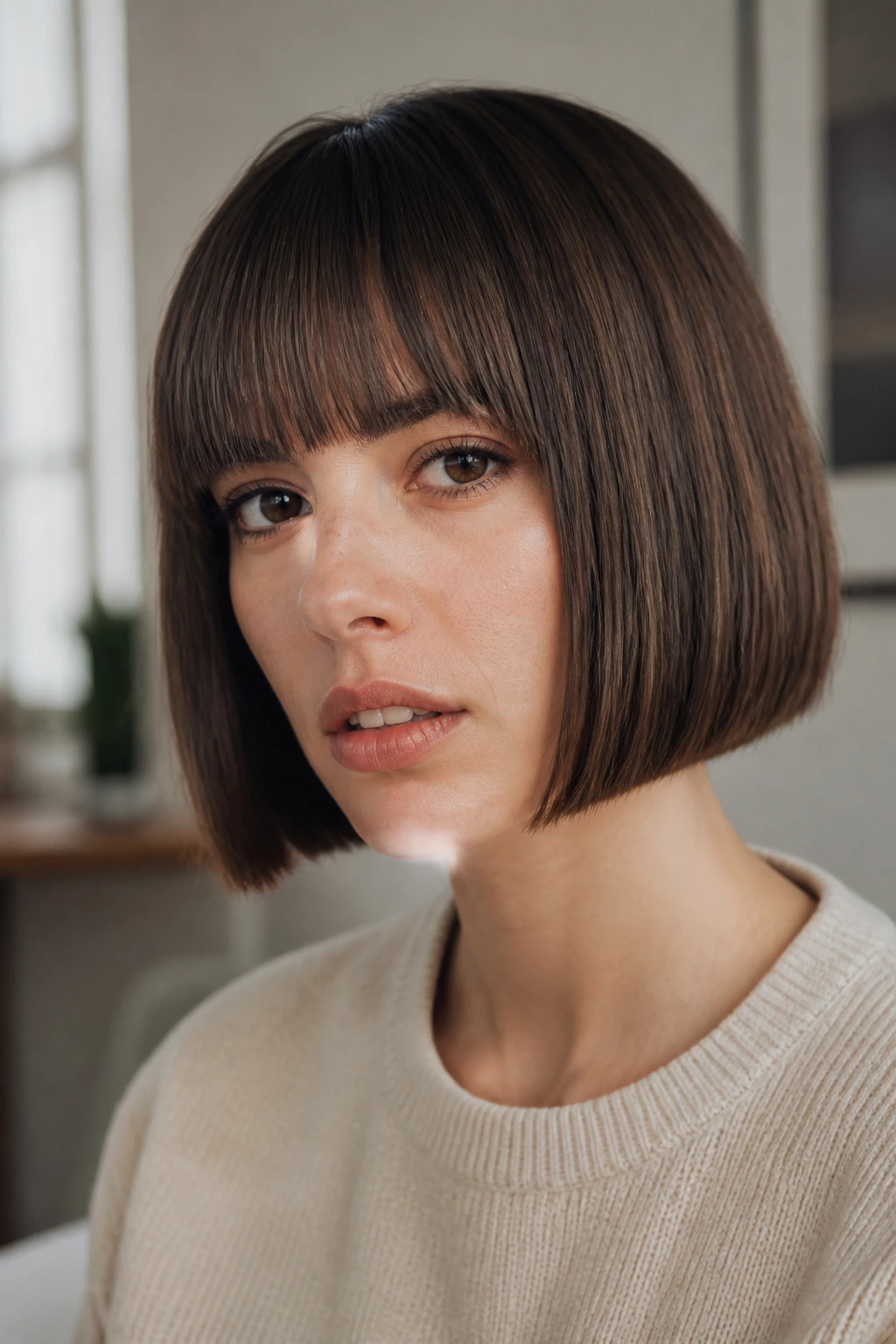
- The bangs change the face frame fast: A fringe can shorten a long forehead, soften a strong jaw, or pull attention to the eyes without taking the length shorter.
- The bob length changes the mood: A jaw-length bob feels neat and crisp; a collarbone bob feels looser and easier to grow out; a stacked bob pushes volume up at the crown.
- Texture decides whether the cut feels easy or high-maintenance: Straight hair shows every line, wavy hair gives movement, and curly hair needs room for shrinkage or the shape will jump up more than you expect.
- The fringe can save or sink the whole cut: Too-short bangs on the wrong hairline are annoying for weeks. The right fringe, even a small one, makes the haircut look deliberate.
- These styles cover real-life needs: Some of these bobs are built for air-drying, some for a round brush, and some for the kind of blunt finish that looks best when the ends are kept tidy every few weeks.
- There’s a version here for almost every density and face shape: The trick is matching the line, the weight, and the fringe—not forcing one trendy photo onto every head.
How to Choose the Right Bob and Fringe Before the First Snip
The best bob with bangs usually starts with three things: where your hair breaks, how much density you actually have, and how much time you’ll spend styling the front of your face every morning. That last one matters more than people admit. Bangs are not passive. They ask for a brush, a quick dry, or at least a little finger work if you want them to sit where you asked them to sit.
A stylist who knows what they’re doing will look at your cowlicks before they talk about fringe length. Good. That’s the right order. If your hair pushes hard at the crown or splits at the front hairline, the most flattering bang in the world can still misbehave if it’s cut too short or too blunt for the growth pattern. A photo helps, but your hairline tells the truth.
Bring the right reference, not just a pretty one
Photos are useful when they show the front, the side, and the way the cut sits after movement. One still shot of a model with perfect lighting tells you almost nothing about how the bangs will behave on your face. Bring a few references with similar texture to yours, and say the part out loud: whether you tuck hair behind one ear, whether you wear glasses, whether you want your fringe to hit the brows or clear them by half an inch.
Think about the shape you want in the mirror
A bob with bangs can lean strong and geometric, or soft and cheek-skimming. If you want structure, the line needs weight: a blunt edge, a denser fringe, and fewer internal layers. If you want movement, ask for a little softness through the ends or a piecey finish in the fringe. That is the difference between a haircut that looks crisp and one that looks airy.
Know when to cut shorter and when to leave room
Short bangs grow out faster than anyone wants. Very short bobs, especially jaw-length cuts, also show every millimeter of regrowth at the neck. If you’re not ready for regular trims, keep the fringe a touch longer than your first instinct says. A little extra length can be tucked, parted, or pushed aside. Too short is just too short.
1. Blunt Chin-Length Bob with Full Browsing Bangs
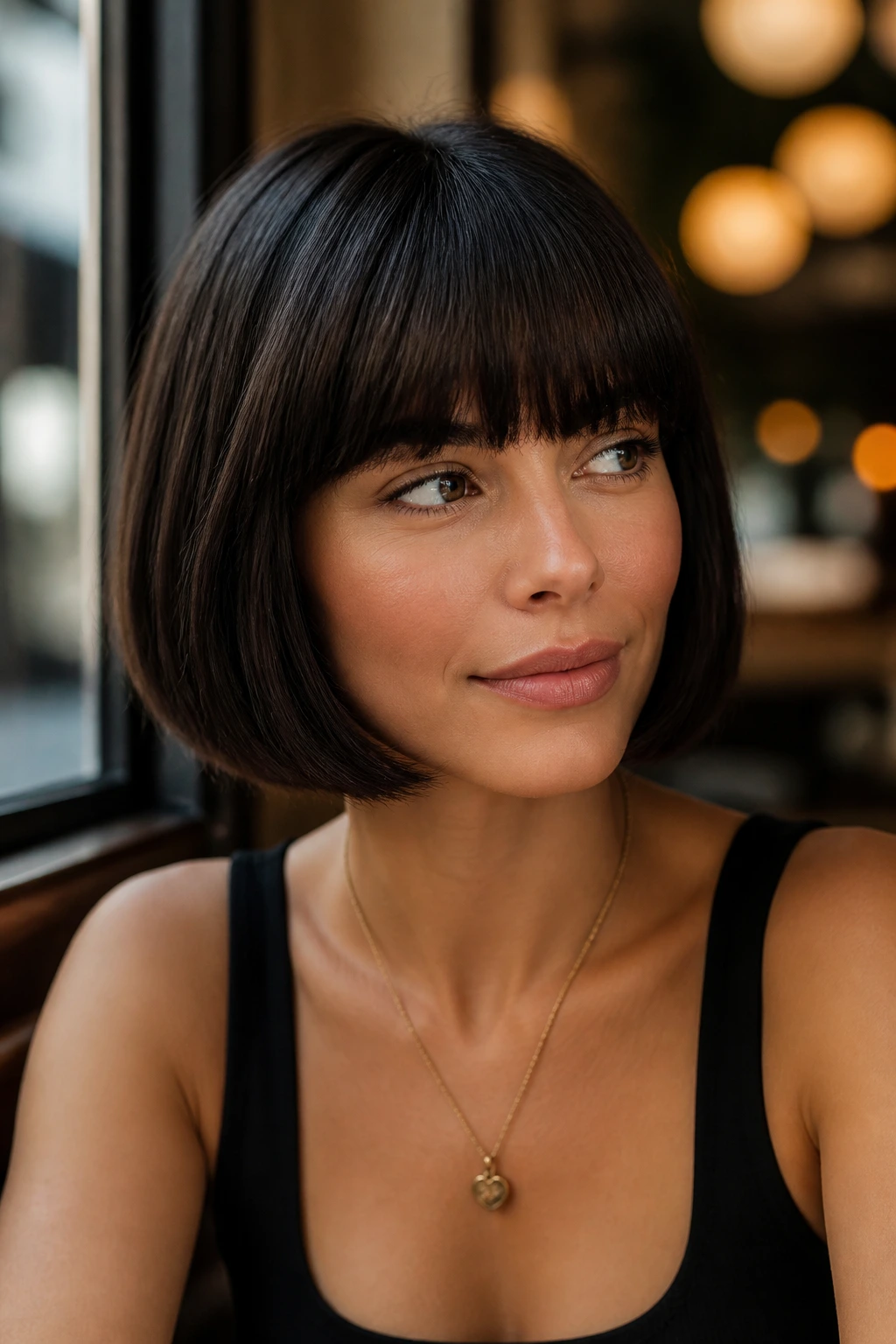
This is the cut that makes a hairline look intentional. The blunt edge sits right around the chin, and the bangs skim the brows with enough weight to look strong without swallowing the face. On straight or lightly waved hair, the result is clean in a way that almost feels architectural.
What I like most here is the contrast. The bob is heavy and exact; the fringe softens the forehead just enough to keep the cut from looking severe. If your hair tends to puff at the ends, this shape behaves better than a shorter pixie-bob because the weight at the line keeps the silhouette grounded.
Why It Feels So Crisp
The line matters more than layers here. A blunt chin-length bob creates a straight visual edge that looks dense even when the hair itself is not very thick, and the full bangs echo that shape across the front of the face. The haircut works especially well when the ends are beveled just a hair under, not curled into a big round flip.
If you have strong features—a defined jaw, prominent cheekbones, or a long neck—this cut gives you a frame that doesn’t apologize. It is not a shy haircut. It says what it means.
Best for: straight to slightly wavy hair, medium to thick density, and anyone who likes a polished finish.
Watch for: very fine hair that splits at the ends. A blunt line can still work, but it usually needs a little more density at the perimeter.
2. French Bob with Soft Micro Fringe
A French bob with a micro fringe has a sharper personality than the soft photos suggest. The bob usually sits around lip to jaw length, and the short fringe opens up the face in a way that feels a little cheeky, a little vintage, and not at all boring. It’s the kind of cut that looks even better when it is not overstyled.
The mistake people make with this look is trying to make it neat in a formal way. It should move. The fringe should be short enough to show the brow line, but not so blunt that it looks pasted on. A little separation in the bangs keeps the whole cut from looking costume-y.
If your hair has natural bend, this one is a gift. The ends can kick under or out just enough to make the bob feel alive, and the micro fringe keeps attention high on the face. Straight hair can wear it too, but it needs a tiny bit of texture spray so the finish doesn’t look flat and severe.
One-sentence truth: this cut lives or dies on texture.
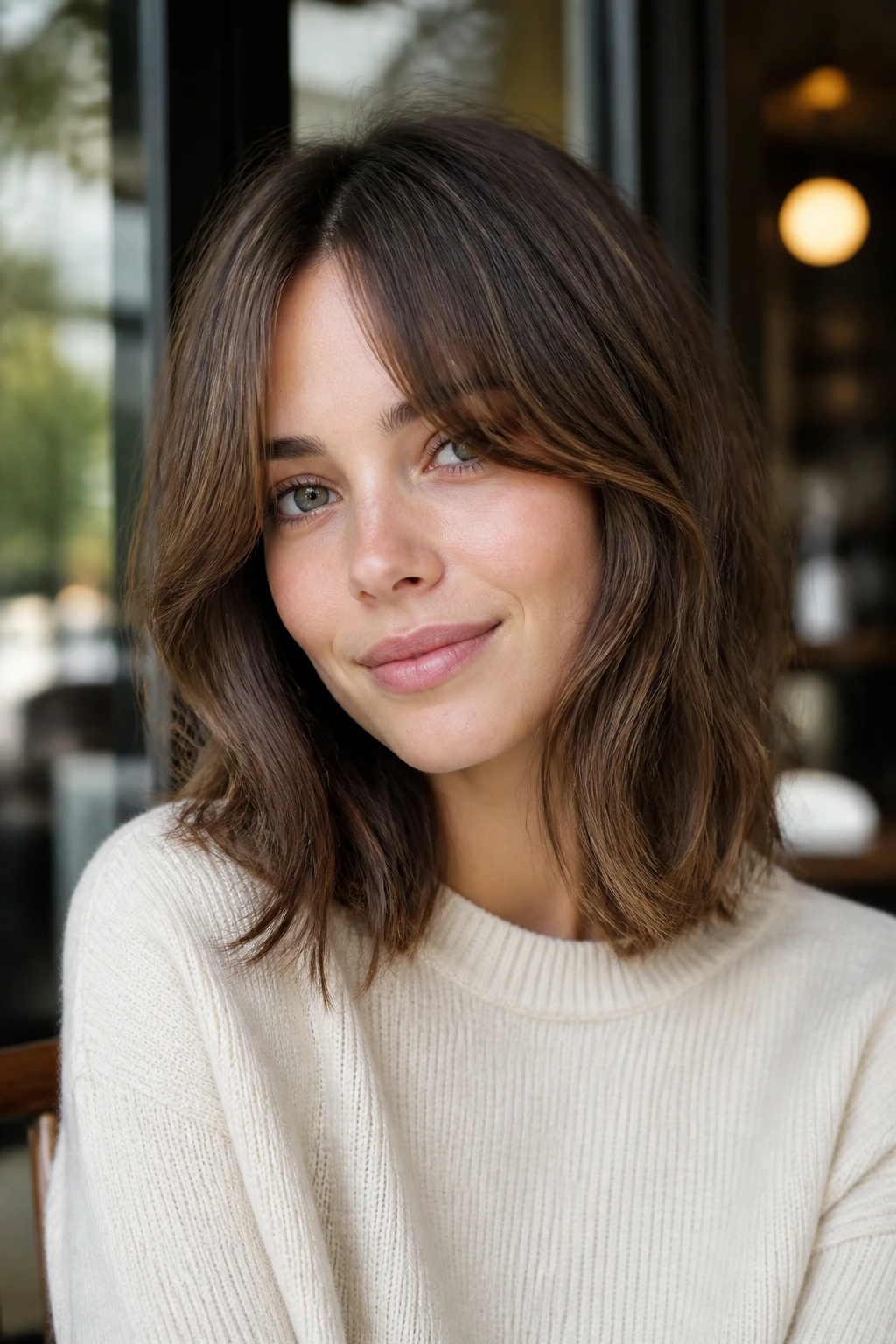
3. Long Bob with Curtain Bangs
Why does this combination work so often? Because a long bob already gives you breathing room, and curtain bangs keep the front from feeling boxy. The length usually sits somewhere between the collarbone and the top of the shoulders, which means you can wear it down, clip it back, or tuck the front pieces behind your ears without wrecking the shape.
Curtain bangs also behave better than full blunt bangs on people who hate daily maintenance. They grow out in a more forgiving way, and they can be blended into face-framing layers when you want to change the look without cutting off much length. That’s a real advantage, not a marketing line.
How to Wear It Off-Center
A slight off-center part makes this cut look lived-in instead of too arranged. If you blow-dry the bangs away from the face first and then split them down the middle with your fingers, the shape gets that soft swoop people keep saving to their camera roll. The key is not volume everywhere. It’s controlled lift at the roots and a quieter fall through the lengths.
Best on medium density hair. If your hair is very fine, keep the layers gentle or the ends can start to look wispy in a bad way.
4. Curly Bob with Curly Bangs
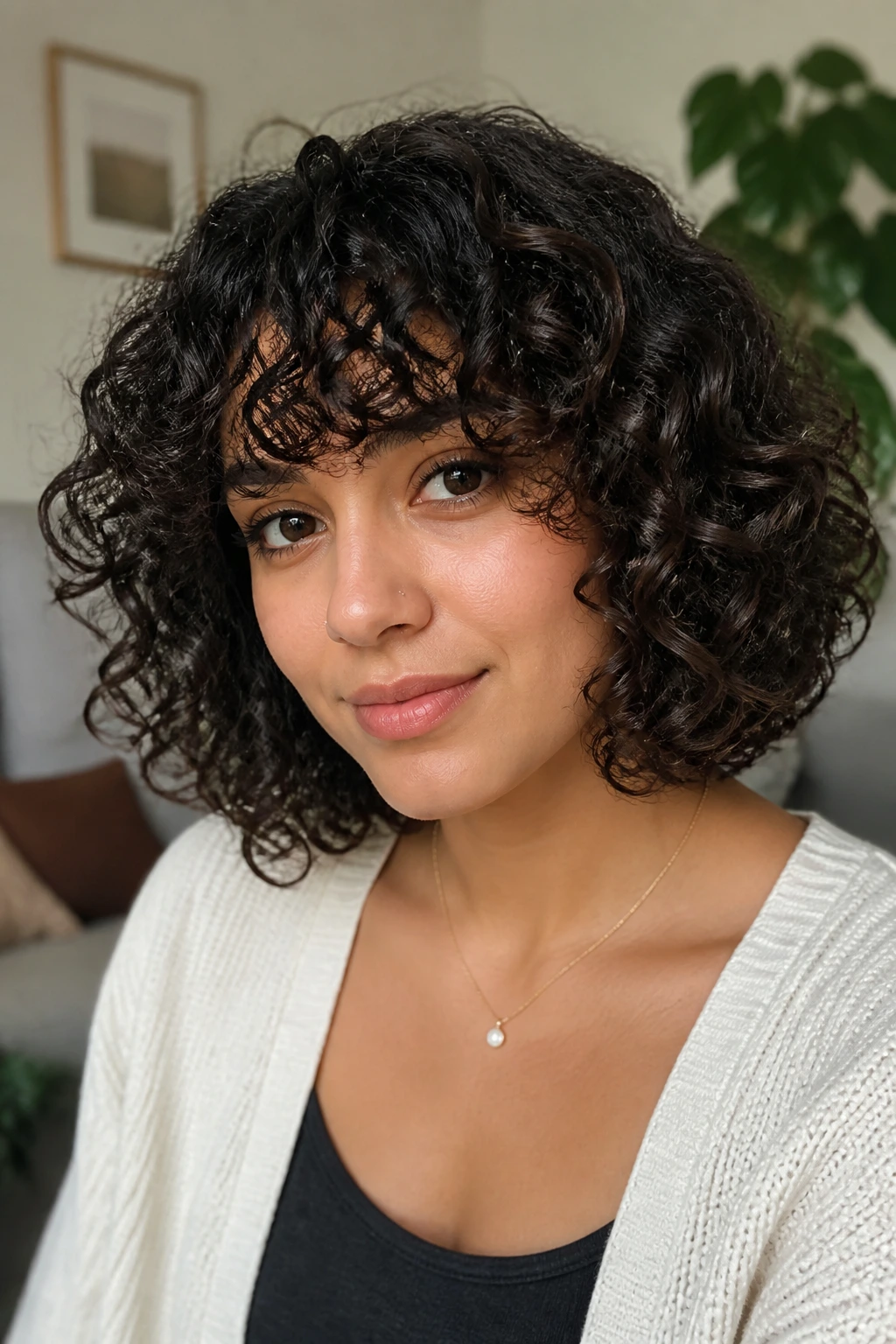
Curly bangs are not a compromise. They’re a decision. If your hair already bends, coils, or springs at the root, cutting the fringe to work with that pattern can look far better than forcing it flat and straight every morning. The cut usually lands around the jaw or a little below, with the bangs cut longer when wet so they can shrink to the right place.
This version needs a stylist who understands curl shrinkage. That phrase gets thrown around a lot, but the real issue is simple: curls do not stay where you left them when they’re damp. The fringe may curl higher, twist sideways, or separate into a few curly ribbons. That’s fine. That’s the point.
What Makes It Work
- The bob should leave enough length for the curl to spring up without turning into a triangle.
- The bangs should be cut curl by curl, not as one blunt sheet.
- Layering needs to be gentle or the shape can balloon out at the sides.
- Styling cream and a diffuser help, but the cut does half the job.
If you like a wash-and-go routine, this is one of the smartest bob haircuts with bangs. Not the easiest to cut. Very often the easiest to live with.
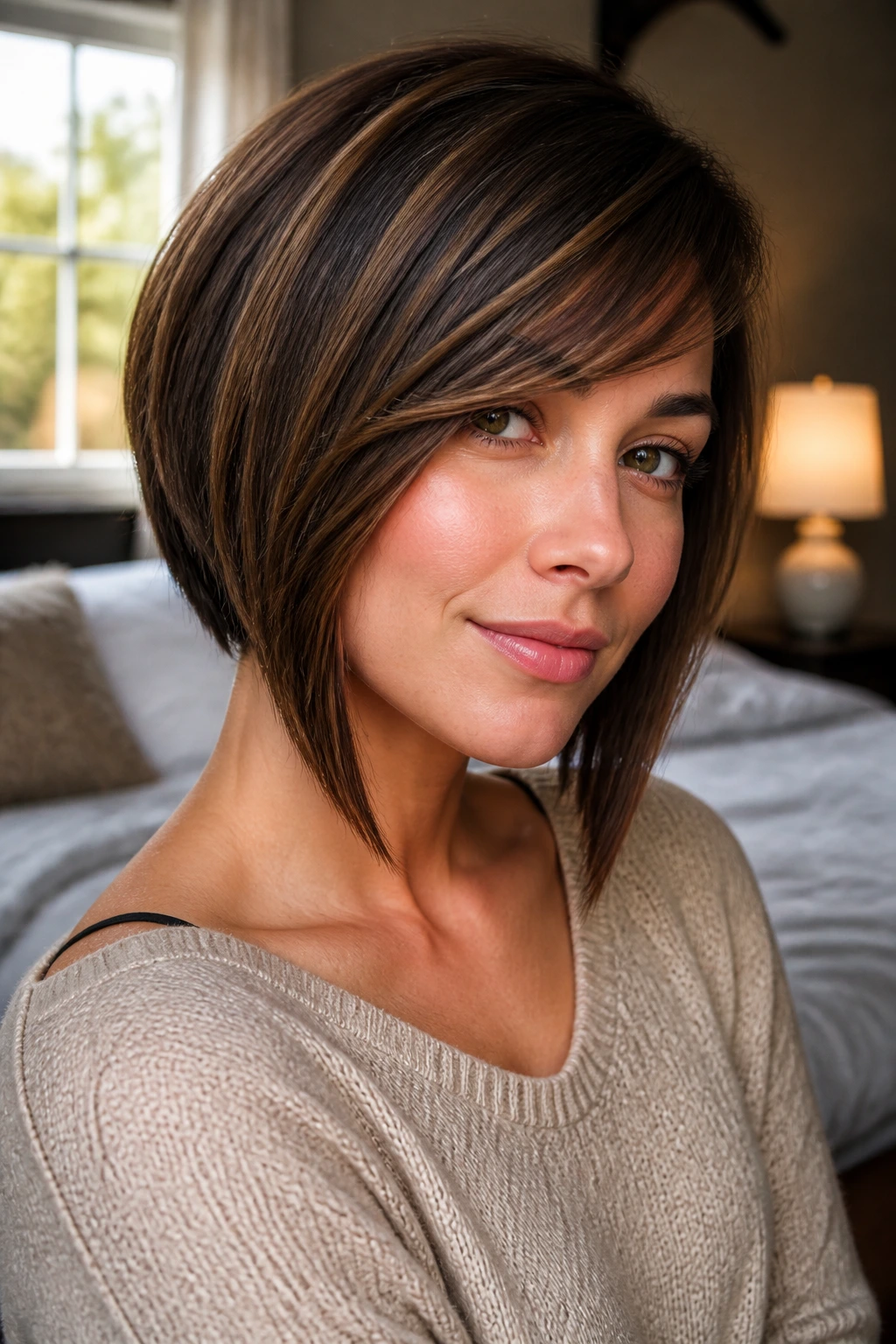
5. Angled Bob with Side-Swept Bangs
An angled bob is one of those cuts that does quiet work from every angle. The front stays a little longer, the back sits shorter, and the side-swept bangs bridge the transition without drawing a hard line across the forehead. The shape feels sleek, but not stiff.
This is the bob I’d point to when someone wants a little drama without committing to full blunt bangs. The side fringe softens the front, and the angle in the cut keeps the neck area open, which is useful if you like the feeling of hair off your collar. It also makes fine hair look like it has more movement than it actually does.
The angle matters most when you’re turning your head. Straight on, the cut looks neat. In profile, you get that little slide from shorter to longer, which is what gives the haircut its lift. If the cut is too extreme, it starts to look like it’s trying too hard. Keep the difference subtle and the line stays elegant.
This is a strong pick if your face is round or square and you want a front shape that gently cuts the width.
6. Shaggy Bob with Wispy Bangs
A shaggy bob with wispy bangs is the cut for people who hate the feeling of their hair being too “done.” It has movement built in. The ends are broken up, the fringe is light, and the overall effect is piecey rather than precise. On the right head of hair, it looks relaxed in a way that takes some skill to create.
The bangs are the delicate part. They should look like they were lifted from the front of the cut, not pasted on as an afterthought. That means light texturizing, but not so much that the fringe becomes see-through and weak. There’s a fine line there. Too much thinning and the bangs go stringy.
If your hair gets flat by midday, this cut still has a chance because the messy finish is part of the point. A little dry shampoo at the roots and a twist with your fingers can bring it back fast. It is less fussy than a blunt bob, though the silhouette does need occasional reshaping so the shag doesn’t just turn into random unevenness.
Who it suits: wavy hair, slightly finer hair, and anyone who prefers motion over hard edges.
7. Italian Bob with Brow-Grazing Bangs
The Italian bob has weight. That’s the whole charm. It usually hits around the jaw or just below, with enough fullness at the ends to make the shape look plush and expensive without needing a lot of styling tricks. Pair it with brow-grazing bangs and the whole cut gets that glossy, old-school finish.
I prefer this version on dense hair because dense hair can hold the heft without feeling bulky. Fine hair can wear it too, but then the bangs and the perimeter have to be cut with more restraint. The fringe should skim the brows, not sit in them like a curtain that forgot to open. Too much hair in the bang area and the face disappears.
Best on Dense Hair
When hair is thick, this cut gives you a place to keep the weight instead of shredding it into too many layers. That means the bob can swing while still looking full. The bangs become part of the line, not a separate event. If you want a haircut that looks great with a bend at the ends and a touch of shine serum, this is a very strong choice.
It is not a wash-and-leave-it cut. But it’s also not a needy one. A round brush, a nozzle attachment, and four to six minutes can get you most of the way there.
8. Inverted Bob with Textured Fringe
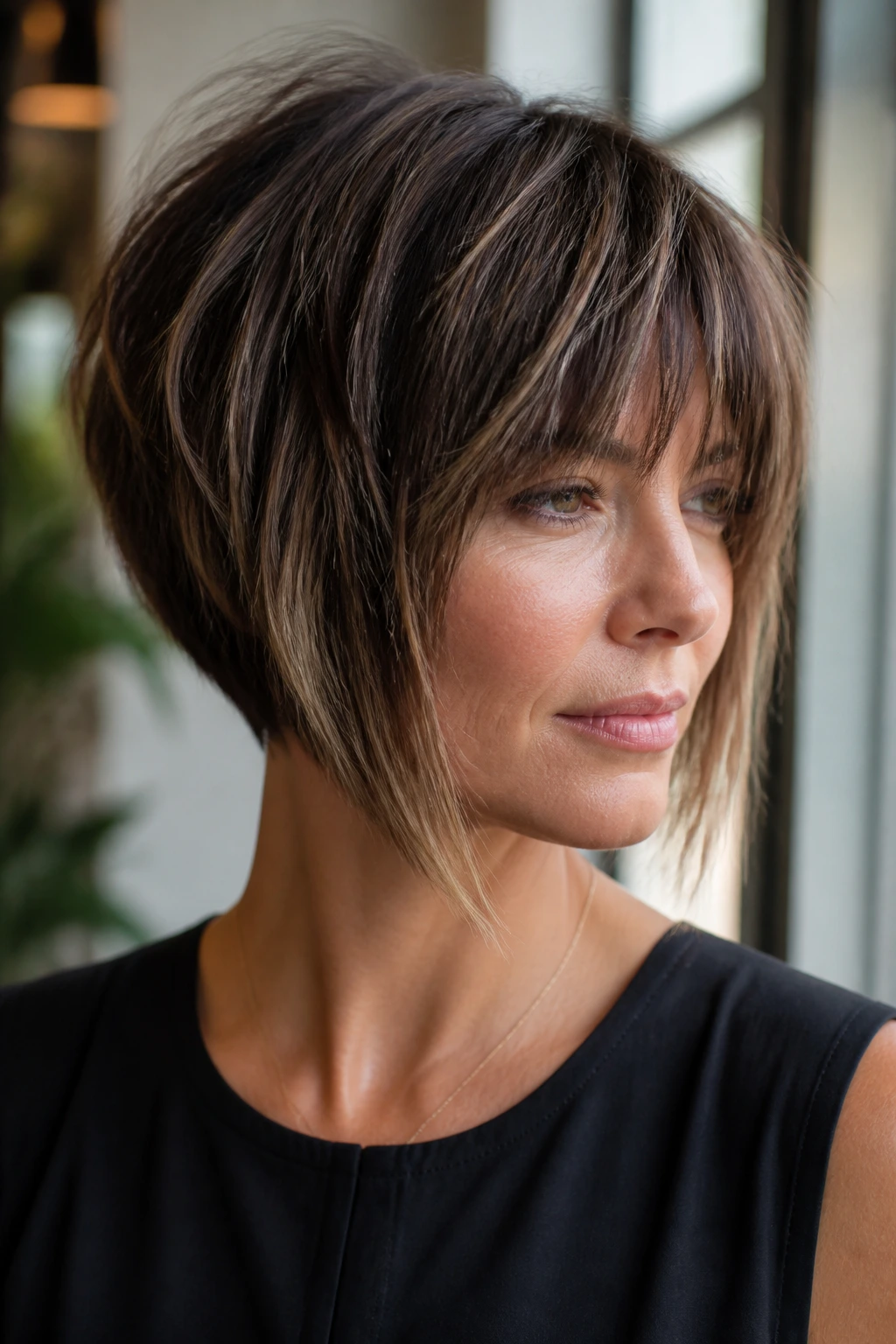
An inverted bob stacks shorter in the back and leaves the front longer, which means the shape already has a built-in angle. Add a textured fringe and you get a haircut with clear direction: lift at the crown, movement around the face, and a front edge that doesn’t feel too blunt.
This cut can save hair that lies too flat at the back of the head. The shorter nape creates lift, while the longer front pieces drag the eye forward and down. That’s a nice trick if you want some height without teasing the roots into a crunchy mess.
The fringe should be cut in broken pieces, not as a solid shelf. That texture keeps the front from competing with the stacked shape in back. If both parts are too heavy, the whole haircut starts to feel boxy. A textured fringe gives the inverted bob a little air, which is exactly what it needs.
One practical note: this shape grows out fast at the back, so the silhouette can lose its crispness if you wait too long between trims.
9. Box Bob with Baby Bangs
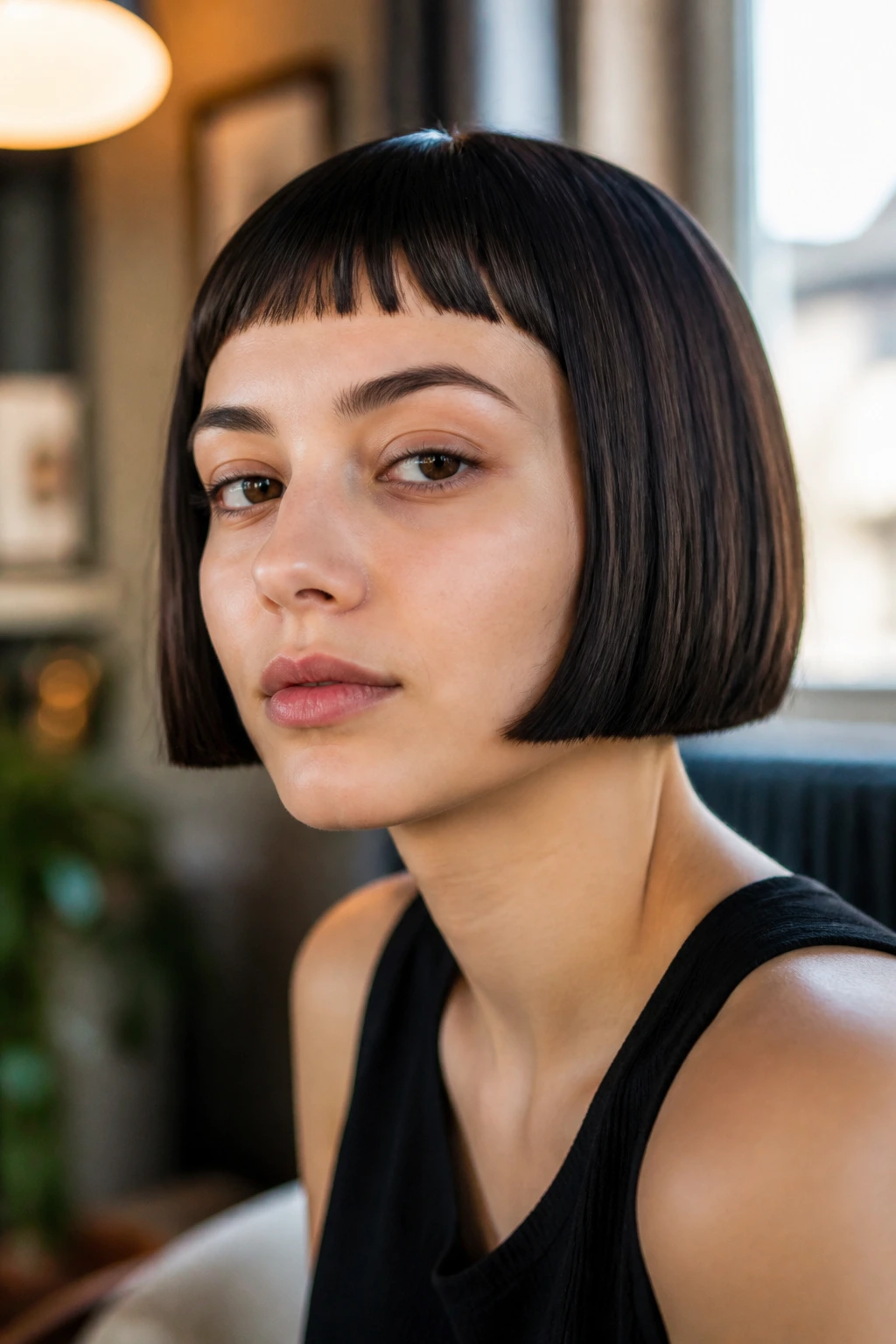
This one is sharp. Almost severe. And if you like structure, that’s the appeal. A box bob keeps the sides more straight than rounded, and baby bangs—short, blunt, and sitting well above the brows—add a graphic line across the forehead. The whole look can feel very modern, but it has roots in vintage cuts too.
Baby bangs are not for hiding anything. They expose the forehead and make the upper half of the face the center of the cut. That makes the bob itself matter even more, because the fringe will not do any softening for you. If the perimeter is uneven, you’ll notice. If the ends are fuzzy, you’ll notice that too.
This is best when the haircut is maintained carefully. The bang length has to stay deliberate, and the bob edge has to stay clean. If you like a little edge and don’t mind regular trims, it’s one of the most memorable bob haircuts with bangs. If you want low maintenance, skip it. No shame in that.
10. Feathered Bob with Arched Bangs
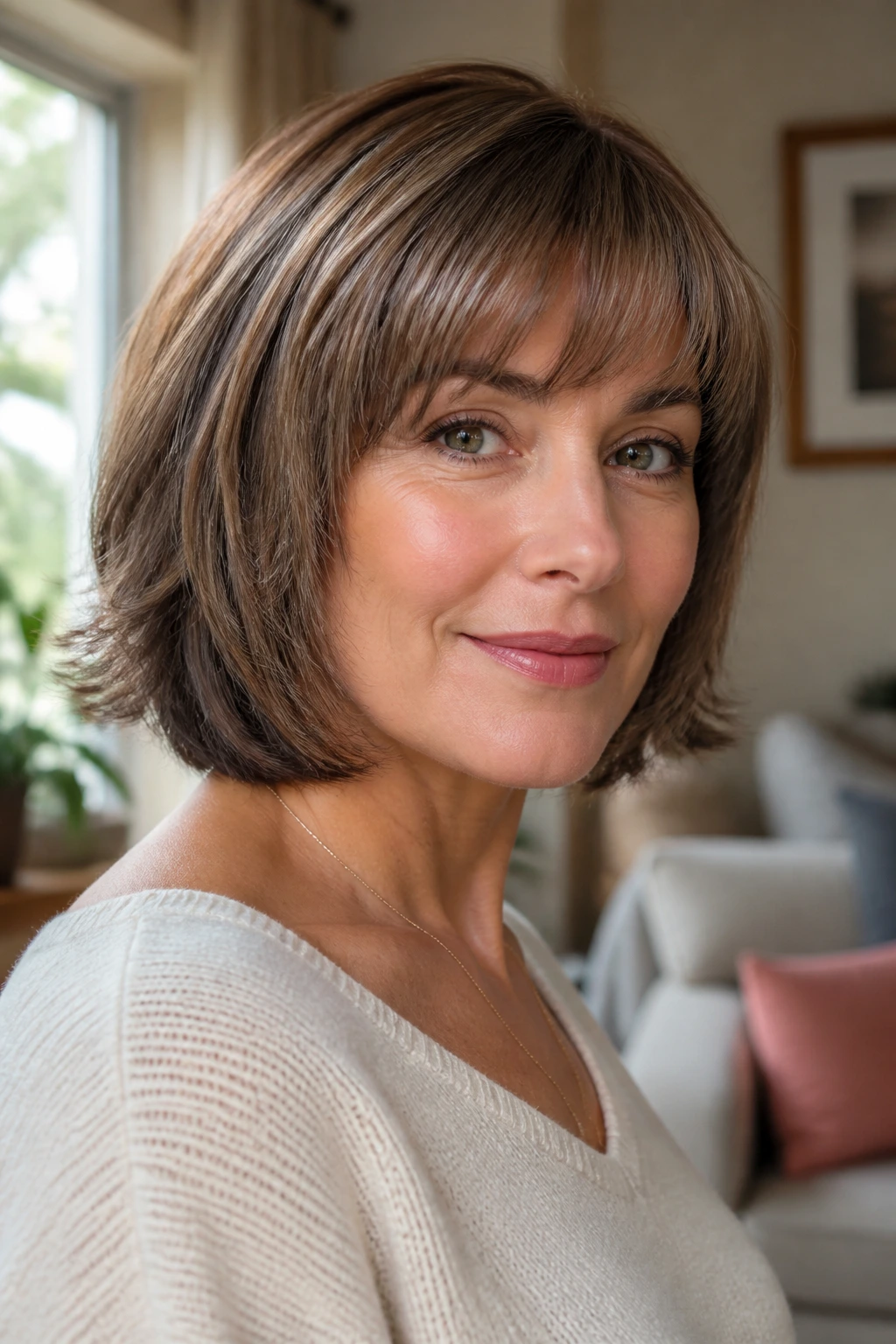
A feathered bob with arched bangs feels softer than the boxy shapes, but it still has enough structure to look finished. The ends are lightly feathered so they don’t sit as one hard line, and the bangs curve gently over the forehead instead of cutting straight across it. That curve matters. It takes the bluntness out of the front.
I like this on people who want a flattering shape without a heavy fringe. The arch in the bangs opens the eyes a bit and follows the natural shape of the brow line, which can be kinder than a flat horizontal fringe. It also makes the haircut easier to grow out because the bangs don’t have one exact obvious edge.
Why the Curve Helps
A curved fringe keeps the eye moving. Straight bangs stop it. That’s the difference. When the front is softly arched, the face reads more open, and the feathered ends keep the bob from feeling too formal. It’s a good middle ground for someone who wants softness but not fluff.
If your hair is medium density, this cut can be a sweet spot. Thick hair may need some internal removal of bulk, and fine hair should avoid over-feathering or the ends can fray faster than you’d like.
11. Asymmetrical Bob with Deep Side Fringe
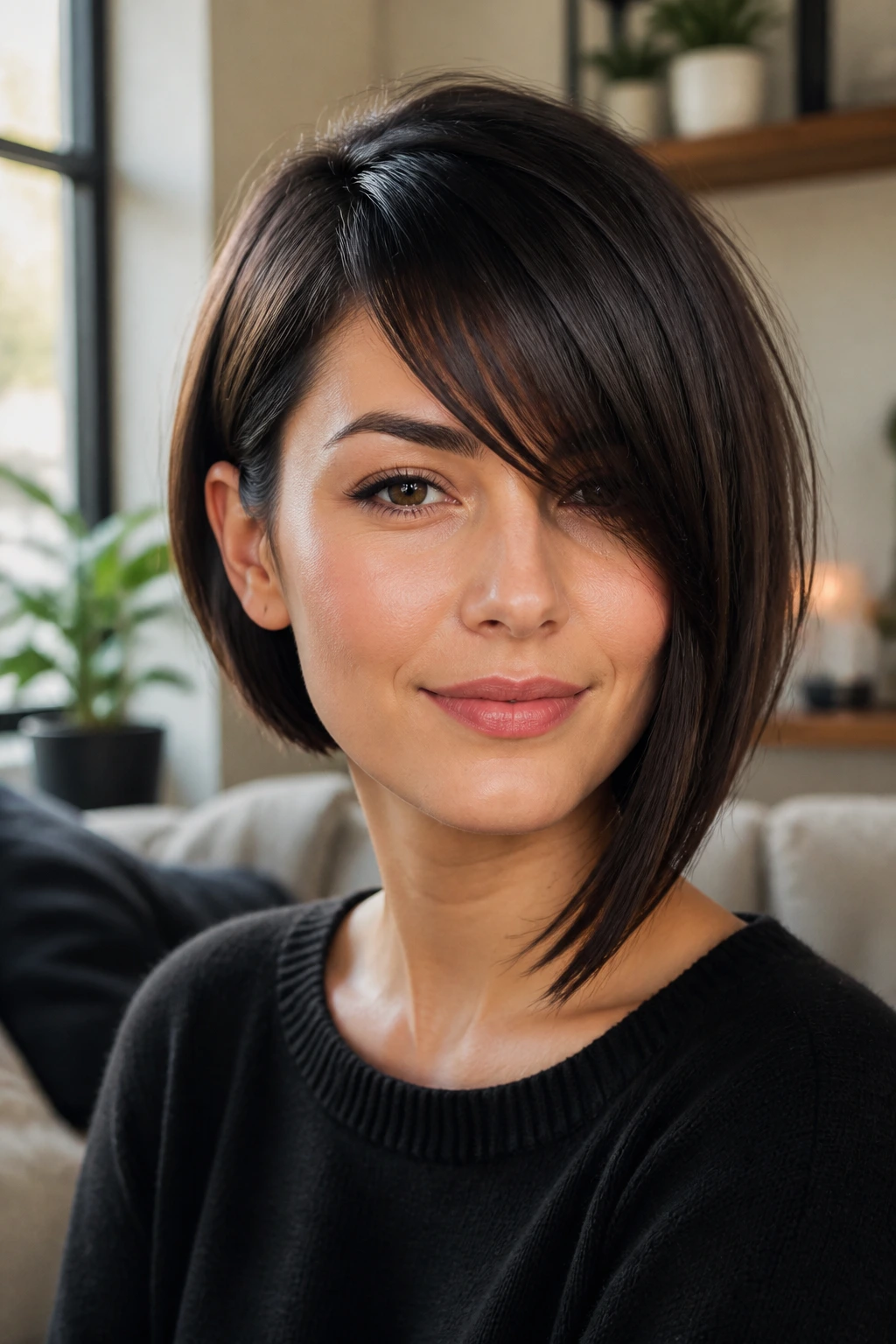
Asymmetry gives the eye somewhere to go. One side sits a touch longer, the other a bit shorter, and the deep side fringe reinforces that slant across the face. It’s a haircut with movement built into the shape, even when the hair is straight.
This is a smart choice if you want a bob that feels less expected than a classic blunt cut. The side fringe can soften one cheek or balance a strong part line, while the length difference keeps the silhouette from looking stiff. The cut also works well on people who tuck one side behind the ear and leave the other loose. That habit suddenly looks intentional.
The danger here is overdoing the angle. Too much difference between the sides and the cut starts to look like a correction rather than a style. Keep the asymmetry noticeable but not theatrical unless you want the haircut to become the whole outfit.
Nope, it does not have to be loud to be interesting.
12. Jaw-Length Bob with Straight-Across Bangs
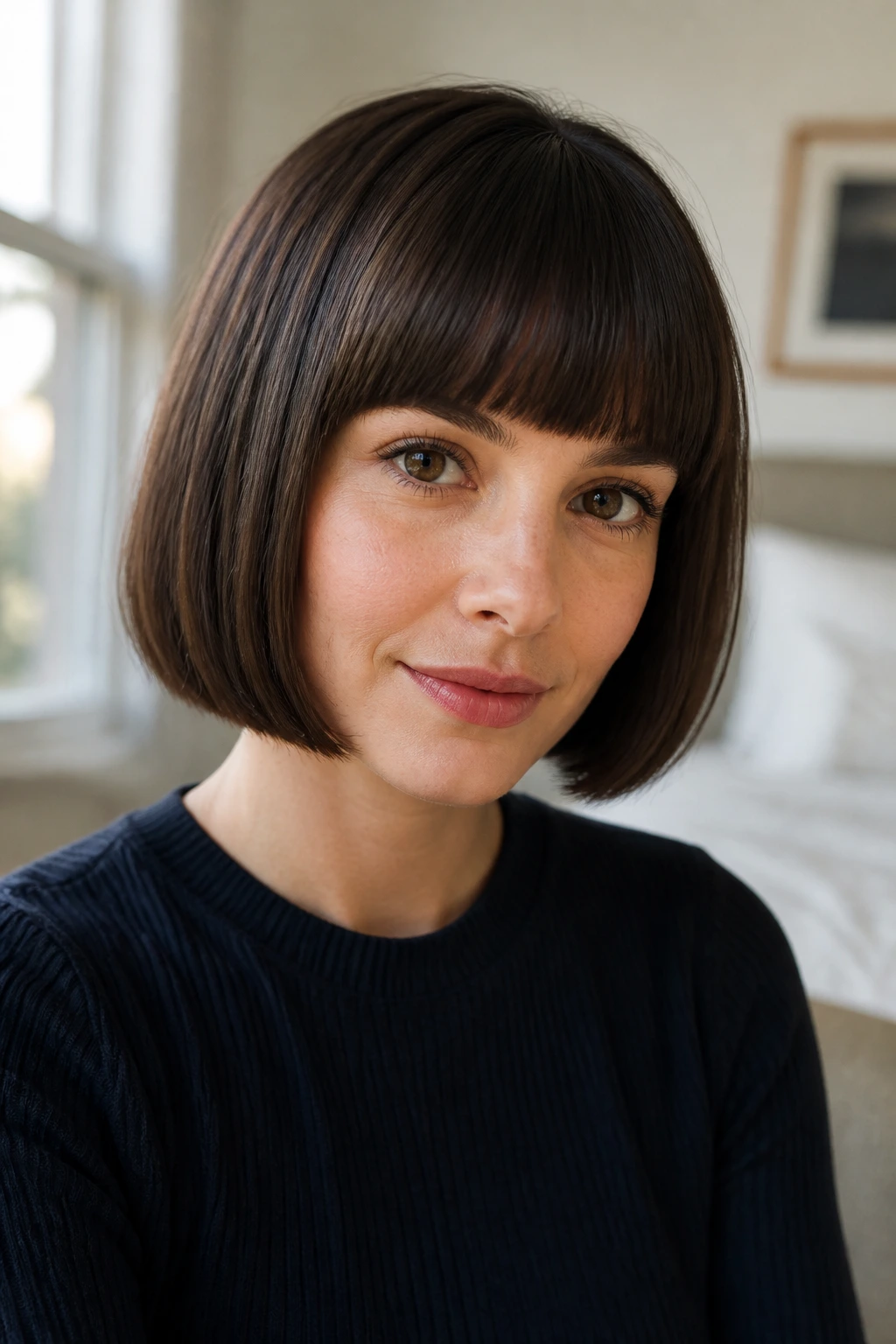
This is the classic geometry version of the bob-and-bang formula. The length sits right around the jaw, and the bangs go straight across the forehead with a clean edge that makes the face look framed, not hidden. It’s a blunt cut, but not a boring one.
If you have straight hair and want a haircut that looks tidy even when you haven’t done much to it, this is a very strong candidate. The line is simple enough to air-dry into something recognizable, which is more than I can say for many trendy cuts that fall apart if you sleep wrong. A jaw-length bob also gives the neck a nice open line.
The Tradeoff
Straight-across bangs need upkeep. They grow into the eyes fast, and any cowlick at the front will announce itself. That is the tradeoff for getting such a clear shape. If you can live with regular fringe trims, the haircut pays you back with a very clean silhouette.
It suits strong bone structure well, but it can also work on softer faces if the bangs are cut a touch longer or less dense. There’s no single way to wear it. The line is the feature, not the prison.
13. Tousled Wavy Bob with See-Through Bangs

This is the easygoing cousin in the family. The bob sits somewhere between chin and shoulder length, the waves are left loose, and the bangs are kept light enough that they break apart a little on their own. See-through bangs should show the forehead in places; if they don’t, they’re not see-through anymore.
What makes this cut practical is that it forgives a little mess. A wave that bends unevenly, a fringe that separates at the middle, or ends that flip out slightly can all look on purpose here. That doesn’t mean you can ignore the shape. It means the shape is allowed to breathe.
If your hair is naturally wavy, this can be one of the best bob haircuts with bangs for everyday life. The fringe should be left long enough to settle after drying, and the bob should have enough length to avoid the pyramid look some waves create when cut too short. A touch of cream, a rough dry, done.
No hard line. No fuss. Just enough structure to count as a haircut.
14. Rounded Bob with Oval Bangs
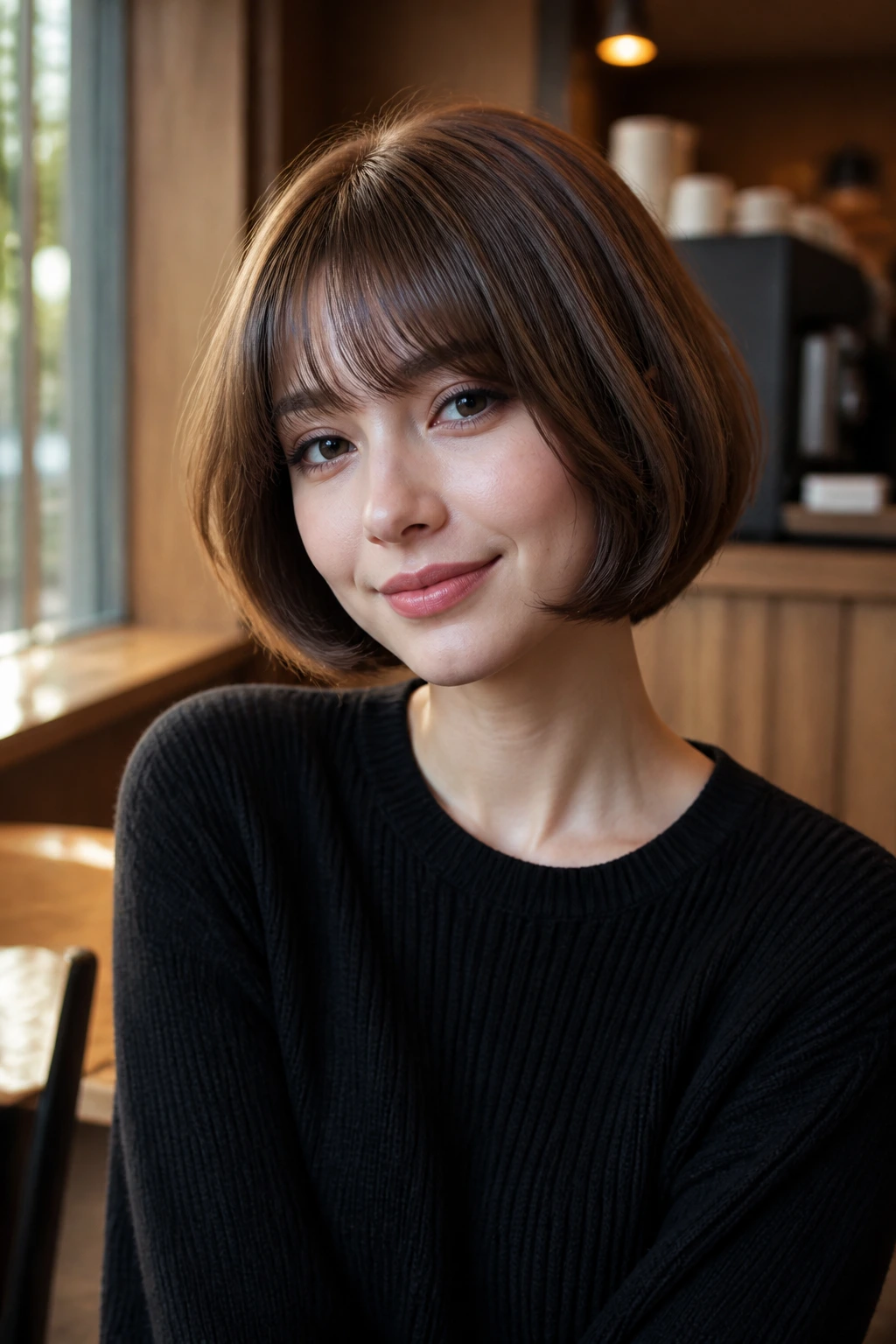
A rounded bob curves softly under at the ends, which gives the cut a cushioned, polished feel. Pair that with oval bangs—longer at the sides, shorter in the middle—and you get a front shape that follows the face instead of chopping it in half. It’s one of the more flattering options when you want softness without losing definition.
The rounded silhouette is especially kind to people with narrow faces or sharper cheekbones. It adds a little fullness at the perimeter, which can balance angular features beautifully. The bangs matter because they keep the roundness from becoming too wide. The oval shape opens the center and narrows the sides just enough.
This is also a sensible choice for medium-density hair that needs help looking balanced. The curve can be styled with a round brush or left with a natural bend, and the fringe stays softer than a full blunt line. If you want a cut that reads refined but not severe, this one deserves a serious look.
15. Stacked Bob with Choppy Bangs
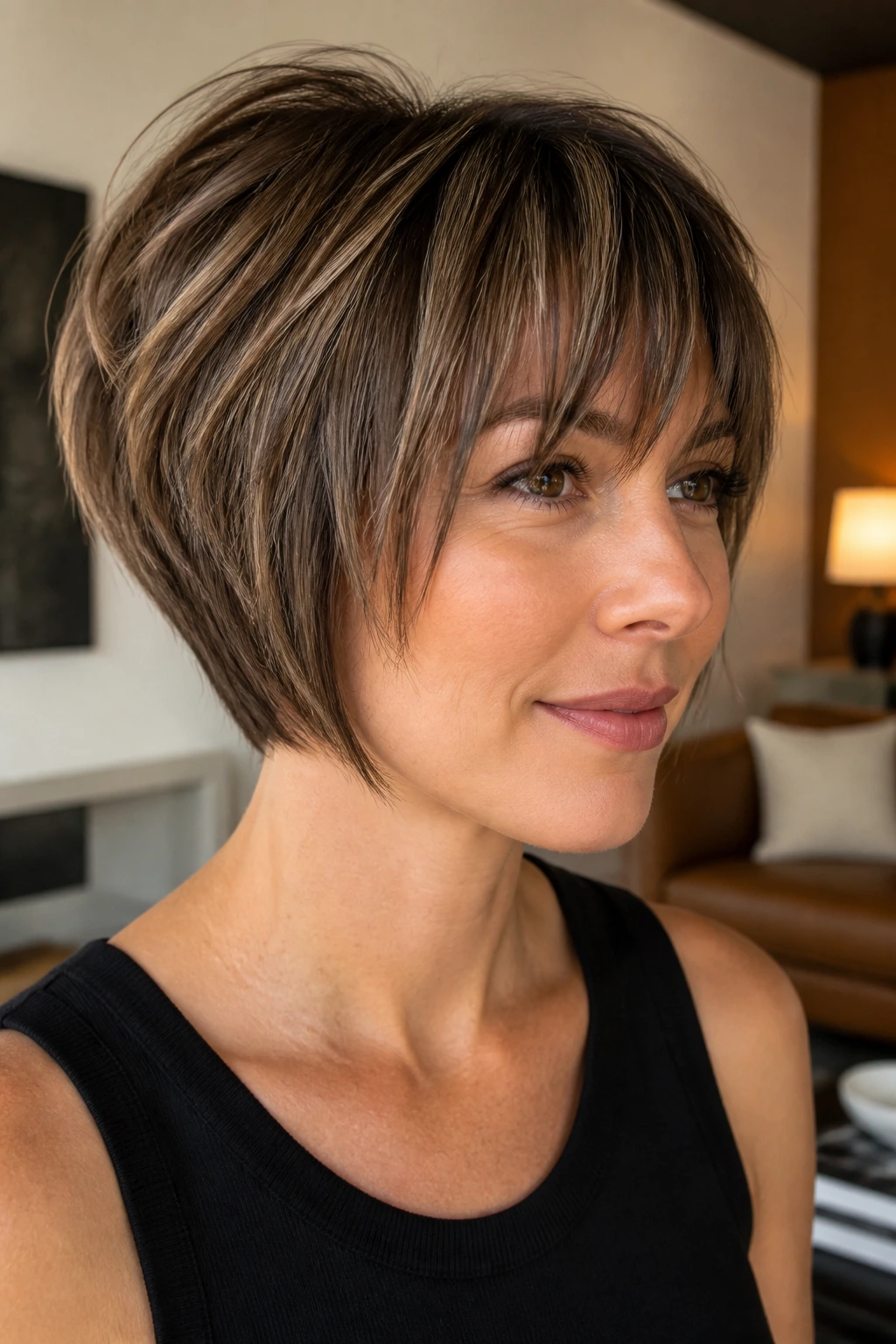
The stacked bob builds volume at the back of the head, and choppy bangs keep the front from feeling too perfect. That combination gives you a haircut with personality from both angles. The crown lifts, the nape hugs close, and the bangs break into pieces instead of one heavy bar across the forehead.
This is the cut I’d choose for someone whose hair collapses at the back. The stacking creates internal support, so the shape holds better than a one-length bob when the hair is fine or straight. Choppy bangs also lighten the mood at the front, which matters because stacked bobs can get a little rigid if every line is too exact.
The best version still needs discipline. Choppy does not mean random. The pieces should look deliberately separated, not hacked apart. A little styling paste or light wax can help the fringe stay visible without turning crunchy. That’s the sweet spot.
16. Collarbone Bob with Bottleneck Bangs
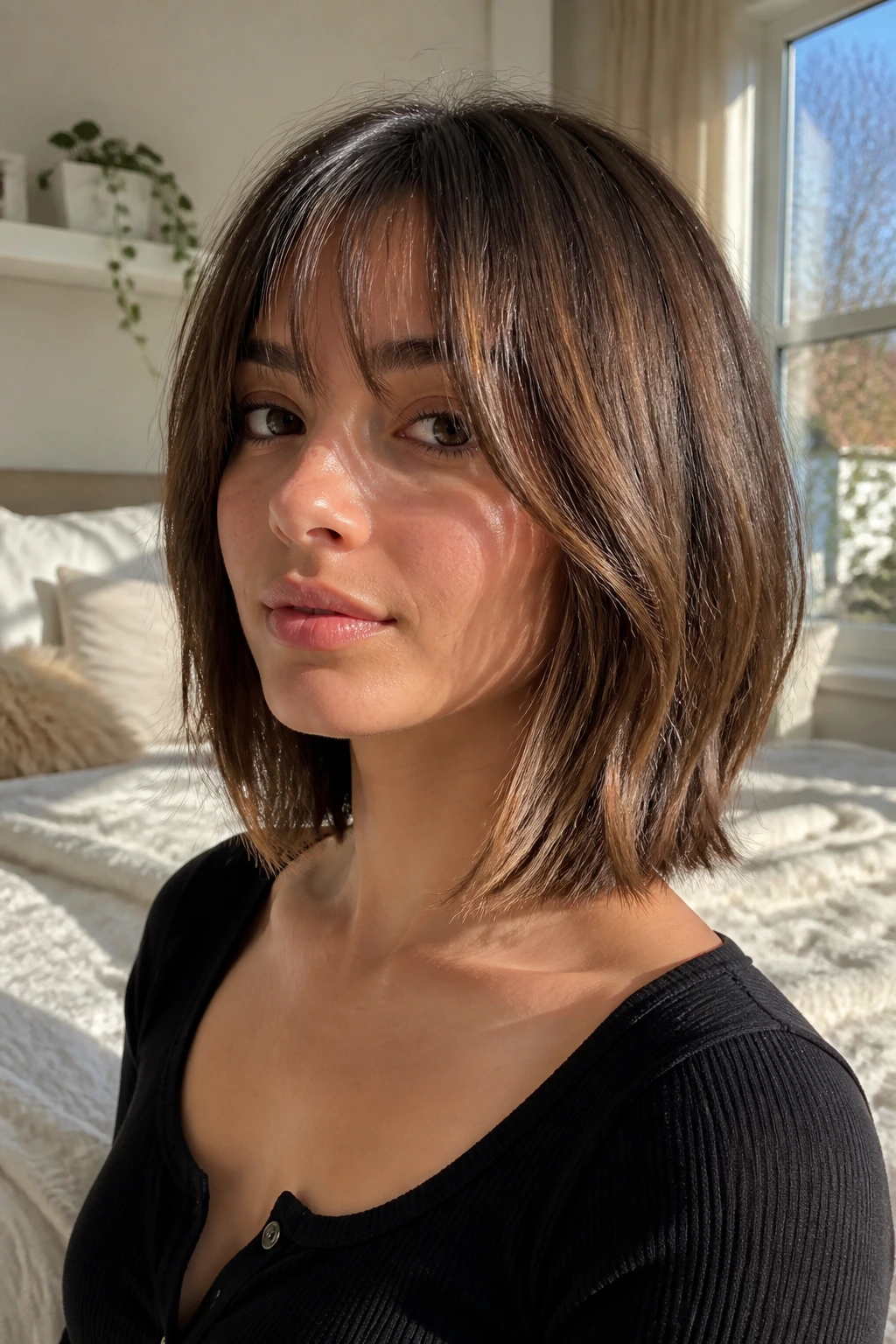
A collarbone bob is the most forgiving length in the group. It brushes the shoulders, can be pinned back, and grows out without looking as abrupt as a shorter bob. Add bottleneck bangs—narrower in the center, softer at the sides—and the cut gets a face-framing shape that feels modern without trying too hard.
This is the version I’d hand to someone who wants bangs but fears regret. Bottleneck bangs are easier to live with than blunt fringe because they can be parted, tucked, or grown into curtain bangs later. The collarbone length gives you room to change your mind without needing a full restart.
The cut works especially well with a little bend in the hair. It doesn’t need a perfect blowout. In fact, a bit of movement through the ends keeps it from looking flat and over-controlled. If you want a bob that lets you move between polished and casual without changing the cut, this is the one.
What Makes Bob Haircuts With Bangs Work in Real Life
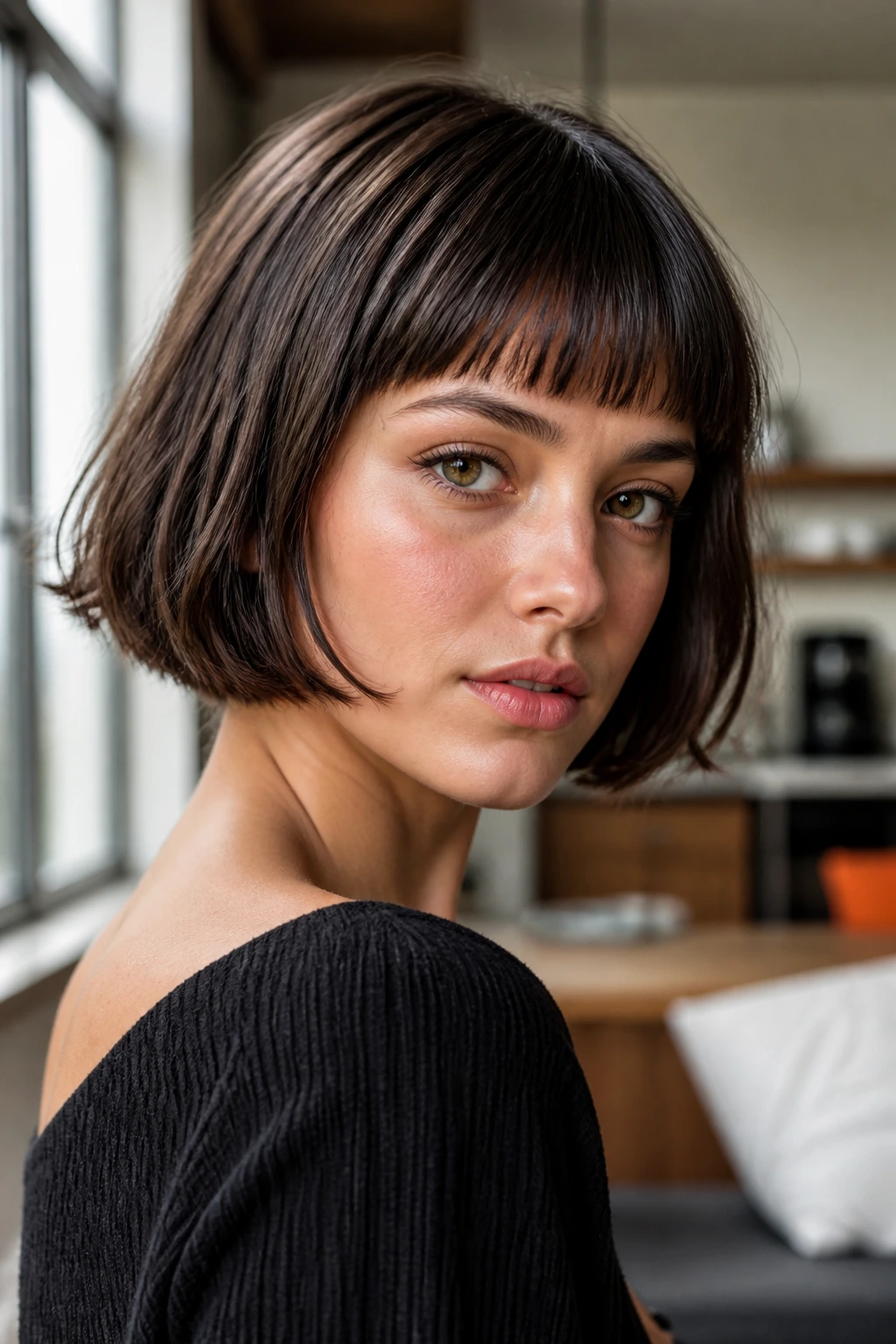
The best bob-and-bang combinations do one thing well before they do anything else: they respect the hair that is actually on your head. That sounds obvious, but it’s the part people ignore when they’re staring at a photo of a model with perfect density and a fringe that behaves like obedient ribbon. Real hair has cowlicks, bent ends, flat spots, and growth patterns that don’t care about your inspiration folder.
A bob with bangs works when the perimeter, the fringe, and the crown all agree on the same direction. If the bangs are heavy but the bob is wispy, the haircut can feel split in half. If the bangs are airy and the bob is dense, the front disappears and the back takes over. Balance is the whole game.
There’s also the matter of styling time. A blunt fringe and a polished bob can look stunning, but they usually ask for a dryer, a brush, and a few extra minutes. A curtain fringe or a see-through bang gives you more slack. Neither choice is better in the abstract. One is more disciplined, the other more forgiving.
And honestly, that is the real decision. Not “what’s trendy,” but “what do you want to do every morning when you haven’t had coffee yet?”
Essential Tools for Styling a Bob With Bangs
- Blow-dryer with a narrow nozzle: The nozzle helps direct the air at the roots so bangs don’t splinter in five directions.
- Small round brush, 1 to 1.5 inches: Best for bending fringe under, smoothing a bob line, and adding a little lift at the crown.
- Vent brush or paddle brush: Useful on faster mornings when you want movement without a full blowout.
- Fine-tooth tail comb: Handy for clean parts, sectioning bangs, and checking whether the fringe is sitting evenly.
- Sectioning clips: Keep the rest of the hair out of the way while you dry the front first, which is usually the smart move.
- Light heat protectant spray: A small mist before styling keeps the fringe from getting brittle at the ends.
- Dry shampoo: A must if your bangs separate or get oily faster than the rest of your hair.
- Texturizing spray or light styling cream: Pick one, not ten. The goal is separation or hold, not helmet hair.
- 1-inch flat iron, optional: Best for smoothing a stubborn fringe or bending the ends of a blunt bob inward by a half turn.
- Velcro rollers, optional: Great for lift at the crown when you want the bob to look fuller without much heat.
How to Choose the Right Bob Length for Your Hair and Face
The right bob length has less to do with rules and more to do with where your hair wants to sit. Jaw-length bobs show off the face line fast. Chin-length bobs sharpen the silhouette. Collarbone bobs buy you room to move, especially if you’re still deciding whether bangs are a forever thing or a phase you’re testing.
Face shape matters, but not in the rigid way some salon advice makes it sound. A round face can wear a blunt bob if the fringe isn’t too heavy. A long face can wear a collarbone bob with curtain bangs and look balanced instead of covered. The real question is where the eye lands. Do you want the focus high on the face, around the cheekbones, or lower near the jaw?
Hair texture changes the choice too. Fine straight hair usually looks fuller with a blunt edge and a denser bang. Thick hair often benefits from internal shaping so the bob doesn’t balloon outward. Wavy hair needs enough length to account for movement. Curly hair needs the most respect for shrinkage, because the cut you see wet is not the cut you’ll see dry.
If you wear glasses, don’t ignore the frame line. Bangs that end exactly where your glasses sit can get crowded fast. A longer fringe or a softer side sweep can solve that without changing the whole haircut.
Daily Styling Tricks That Keep the Fringe in Place
The front of the haircut is the part that gives you away. If the bangs sit nicely, the whole bob looks finished. If they split, puff, or flip at strange angles, the cut can look undone even when the rest of the hair is behaving. That’s why the first few minutes after washing matter so much.
Start the bangs first. Always. They dry faster than the rest of the hair, and once they set in the wrong direction, you end up fighting them. Use a round brush or your fingers plus a nozzle, depending on how neat you want the finish. Direct the roots side to side, then down, then give them a cool shot so they hold the shape instead of drifting apart the minute you stop touching them.
Root Lift: If the bob looks flat at the crown, lift the roots with the brush and aim the dryer at the base, not the ends. That creates shape without puffing the whole head.
Bang Control: Dry the fringe from right to left, then left to right, then center it. That little back-and-forth motion helps fight a stubborn cowlick.
Finishing Touch: A pea-sized amount of styling cream on the ends is enough for shine. More than that, and the fringe starts clumping.
Time-Saver: On rushed mornings, a dry shampoo puff at the roots of the bangs can buy you another day. Not glamorous. Very useful.
The Mistakes That Make a Bob and Bangs Go Off

The first mistake is cutting the bangs too short on day one. Hair shrinks a little once it dries, and some textures shrink a lot. If the fringe sits exactly where you want it when wet, there’s a good chance it will sit too high when dry. Leave room, especially if your hair is wavy or curly.
The second mistake is ignoring the hairline. Cowlicks at the front can split blunt bangs down the middle, and strong growth patterns can make one side behave differently from the other. A stylist can work with that, but only if you mention it before the cut starts. Silence is how people end up pinning one side of their bangs every morning.
Another common problem: over-layering the bob while keeping the fringe too thin. That combo can make the whole cut look stringy, especially on fine hair. The fix is simple. Either keep more weight in the perimeter or keep the fringe fuller so the cut has a clear line.
And then there’s the opposite issue. Thick, heavy bangs with a heavily stacked bob can turn boxy fast. The shape needs room to breathe. If the haircut starts feeling helmet-like, the solution is usually less bulk in one area, not more product.
Variations and Adaptations to Try
The Air-Dry Bob: Best for wavy or slightly curly hair that wants motion without heat styling. Ask for a softer edge and a fringe that can separate naturally instead of sitting as one solid curtain.
The Sleek Flat-Iron Bob: Ideal when you want a polished finish and the ends to sit in a tight line. Works especially well on straight hair with full bangs, but the fringe should still be left a touch longer so it doesn’t look chopped off.
The Grow-Out Bob: A collarbone-length version with bottleneck or curtain bangs that can shift as the hair grows. This is the practical choice if you want the option to stretch salon visits a little farther.
The Glasses-Friendly Fringe: Slightly longer bangs that sit above or between the frames instead of crashing into them. Soft arcs and side pieces keep the front from feeling crowded.
The Curly-First Version: A bob cut dry or mostly dry, with bangs shaped around natural curl pattern and shrinkage. This is the one to choose when flat ironing every day would make you quit the haircut in a week.
Keeping the Shape Between Salon Visits

Bangs ask for maintenance more often than the bob itself. That’s the deal. Most fringes need a trim every 2 to 4 weeks if you want them to stay where they’re supposed to sit, while the bob can usually go 6 to 10 weeks before it starts losing its clean line. Shorter, blunter cuts show regrowth faster. Longer bobs forgive a little more.
At home, dry shampoo is your friend if the fringe starts looking oily before the rest of the hair does. Use it at the roots, wait a minute, then brush it through so you don’t get that chalky patch right in the center of your forehead. If your hair gets bent while sleeping, a quick morning mist at the bangs and a round-brush dry can reset the front faster than washing the whole head.
Night care helps too. A loose clip or soft bend at the crown can keep the bangs from folding into weird angles while you sleep. If you have a blunt fringe, don’t sleep with it pinned too tightly or you’ll wake up with a dent that takes longer to fix than the original problem.
Heat styling every day is not mandatory, but some shape does help. Even five minutes with a dryer can keep a bob looking like a haircut instead of a grown-out event.
Questions People Actually Ask About Bob Haircuts With Bangs

Will bangs make my bob look thicker?
Usually, yes, if the fringe has enough density and the bob edge is kept blunt or softly rounded. A thin, see-through bang on very fine hair can have the opposite effect, so the trick is matching fringe weight to the rest of the cut.
What bob length is easiest to live with?
Collarbone-length bobs are the most forgiving because they can be tied back, tucked, or left down without looking unfinished. If you want a shorter bob, chin length is still workable, but it shows every trim cycle faster.
Can I wear a bob with bangs if my hair is curly?
Absolutely, but the cut has to respect shrinkage and curl pattern. Ask for the bangs to be shaped dry or nearly dry, and don’t expect them to lie flat like straight hair.
Do bangs work with glasses?
Yes, though the fringe length matters. A brow-grazing bang or a side-fringe usually sits more comfortably around frames than a very short blunt fringe that ends right at the top rim.
How often do I need a bang trim?
Most fringes need a touch-up every 2 to 4 weeks, depending on growth rate and how short they are. Micro bangs need more upkeep than curtain bangs, which is one reason people love curtain bangs after trying something sharper.
What if I have a cowlick at the front?
Tell the stylist before the cut starts. A cowlick can be worked with, but it changes the way the fringe should be sectioned and how short it can safely go.
Can I grow out a bob with bangs without looking awkward?
Yes, if the fringe is blended early into curtain or bottleneck shapes and the bob is allowed to lengthen toward the shoulders. The awkward stage is shorter when the cut already has some softness built in.
Is a blunt bob better than a layered bob for bangs?
A blunt bob pairs better with blunt or dense bangs, while layered bobs work well with curtain, wispy, or textured fringe. The line of the bob should match the weight of the bangs, or the style starts to feel disconnected.
When a Bob With Bangs Is at Its Best

The nicest thing about bob haircuts with bangs is that they can be tailored without losing their identity. Short or long, blunt or airy, sleek or shaggy—the shape still reads as a bob, but the fringe changes the tone. That’s a rare kind of flexibility.
If you’re considering one, don’t get distracted by the prettiest photo in the pile. Match the fringe to your hairline, the length to your daily routine, and the texture to the kind of styling you’ll actually do. A cut that looks good only on wash day is a bad bargain. A cut that looks decent with a quick brush and a little dry shampoo is the one you’ll keep reaching for.
Save a few versions that fit your texture, not just your mood. Then take them to a stylist who’ll talk honestly about growth patterns, density, and upkeep. That conversation matters more than any trend label ever will.
