



Long hair on men looks easiest when it has a job. A shoulder-length cut that falls on purpose, parts on purpose, or ties back on purpose reads as deliberate; the same hair after a few months of neglect reads like you lost a fight with a pillow. That difference is shape, weight, and a little discipline.
The best long hairstyles for men do not try to hide the length. They use it. A clean middle part can sharpen a face that feels too round. Soft layers can keep thick hair from puffing out at the sides. A low bun can pull the whole look together in five seconds flat, while curls or waves can do most of the visual work without much product at all.
Hair texture changes everything. Fine straight hair needs lift and a light hand. Thick wavy hair needs weight removed in the right places. Tight curls and coils need moisture first, shape second. If you’ve ever grown your hair out and thought, “Why does this look better in the mirror than it does in real life?”, the answer is usually the cut, not the length.
Why These Long Hairstyles for Men Need Shape, Not Just Length
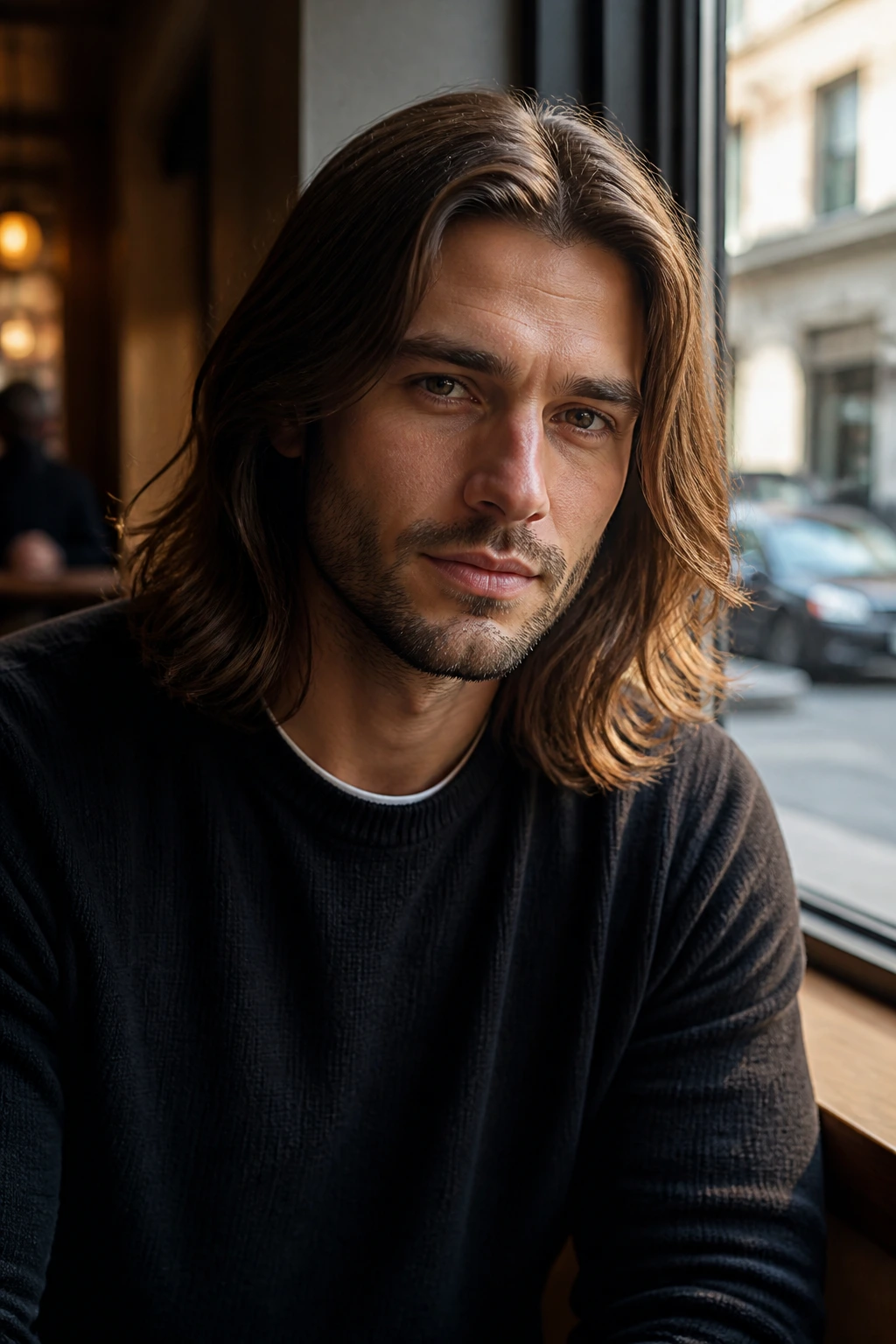
- Shape beats sheer length: Hair that hits the collarbone can look sharp if the ends are controlled and the sides are balanced; hair that just hangs can look tired fast.
- Texture is the deciding factor: A long cut that works on straight hair will collapse on curls, and a braid that looks crisp on coarse hair may sit flat on fine strands.
- Movement matters more than perfection: The best long hair styles keep some swing in the ends, so they move when you walk instead of sitting like a sheet.
- Most of these styles grow out well: That’s the real test. A good long style should still look decent three weeks after a trim, not only on day one.
- They play well with beards: Long hair and facial hair can look balanced when one side is cleaner than the other, which is a useful trick if your jawline needs a little help.
- They give you options: Tie it back, part it, braid it, bun it, leave it loose. That flexibility is the whole point.
1. Bro Flow
The bro flow is the style that makes long hair look like it belongs on your head, not in a catalog. It falls back from the face, brushes the ears, and lands somewhere around the collar or upper shoulders with just enough lift to avoid that dead, heavy curtain effect. I like it because it looks better when it is not trying too hard.
Why It Works
The bro flow lives on movement. A few soft layers around the crown and cheekbones keep the hair from dropping straight down, which is what makes the style feel relaxed instead of flat. It’s a smart choice if your hair has a medium wave or a little bend to it, because the shape gets stronger the second the hair dries with some texture in it.
It suits guys who want length without a tied-back look. Think skate hair, surfer hair, a bit of grown-out rock band energy, but cleaner at the edges. If your hairline is strong and your temples are decent, this style gives you a lot of room to work with.
Quick facts:
- Best on medium to thick hair
- Works well at collarbone length
- Looks best with soft internal layers
- Needs only light cream or sea salt spray
- Gets better with a little air-drying
Bold tip: Ask your barber to remove bulk, not length. That one request changes everything.
2. Curtain Length with a Middle Part
A middle part is unforgiving when the cut is wrong. It looks clean when the front pieces hit around the cheekbones or just below the eyes, and it looks awkward when the hair is too short to fall with any grace. That’s why curtain-style long hair works best once the front has enough weight to open naturally around the face.
The part does more than split hair down the middle. It frames the forehead, softens a strong jaw, and can make straight hair look fuller without adding product. If you have a higher forehead, the front fringe buys you visual balance. If your hair is thick, the middle part keeps the bulk from gathering all in one place.
This is a style that benefits from a blow dryer more than people expect. A quick pass on low heat, brushing the front away from the center, gives the curtain shape its bend. Let it cool before you touch it again. That little pause locks in the movement.
3. The Shoulder-Length Shag
Want long hair that looks like it has some attitude? The shoulder-length shag does that better than almost anything else on this list.
The cut uses choppy layers, broken-up ends, and a fringe that doesn’t behave too neatly. It’s the style for a guy who wants length, but not polish. On wavy hair, it has that lived-in, slightly wild look that still reads as intentional because the layers are doing real work. On straighter hair, it gives you movement you would not get from one blunt length.
How to Ask for It
Ask for layers that start around the cheekbones or just below them, with the ends point-cut so they don’t sit in a heavy block. If your barber tries to make it too uniform, stop them. The shag dies when it gets too even.
A little mousse or cream scrunched into damp hair is enough for most days. If your hair is fine, keep the product light and let the ends stay soft. If it is thick, the layers will take care of the bulk and you won’t need to fight it much.
This one is good when you want a style that looks decent on a bad hair day. Because honestly, half the charm is the mess.
4. Slicked-Back Length
There’s a certain point in the grow-out process when hair gets in your eyes all day and starts to feel like a problem. Slicking it back is the cleanest answer if you still want the length visible.
The trick is not to drown it in gel. That’s where the look goes from sharp to wet cardboard. Use damp hair, a light mousse or medium-hold cream, and a comb only if the hair is long enough to hold direction without splitting into little weird ridges. The style should move back from the forehead and keep some softness at the sides, not glue itself to the scalp.
- Best for: straight or slightly wavy hair
- Length needed: at least to the nose, better at the chin
- Product: lightweight cream, mousse, or a soft gel
- Finish: low shine, not glossy
- Pairing: works well with a short beard or clean cheeks
This style makes a long cut look polished without giving up the shape entirely. It’s one of the few long men’s hairstyles that can move from casual to formal without a full restyle.
5. The Half-Up Knot
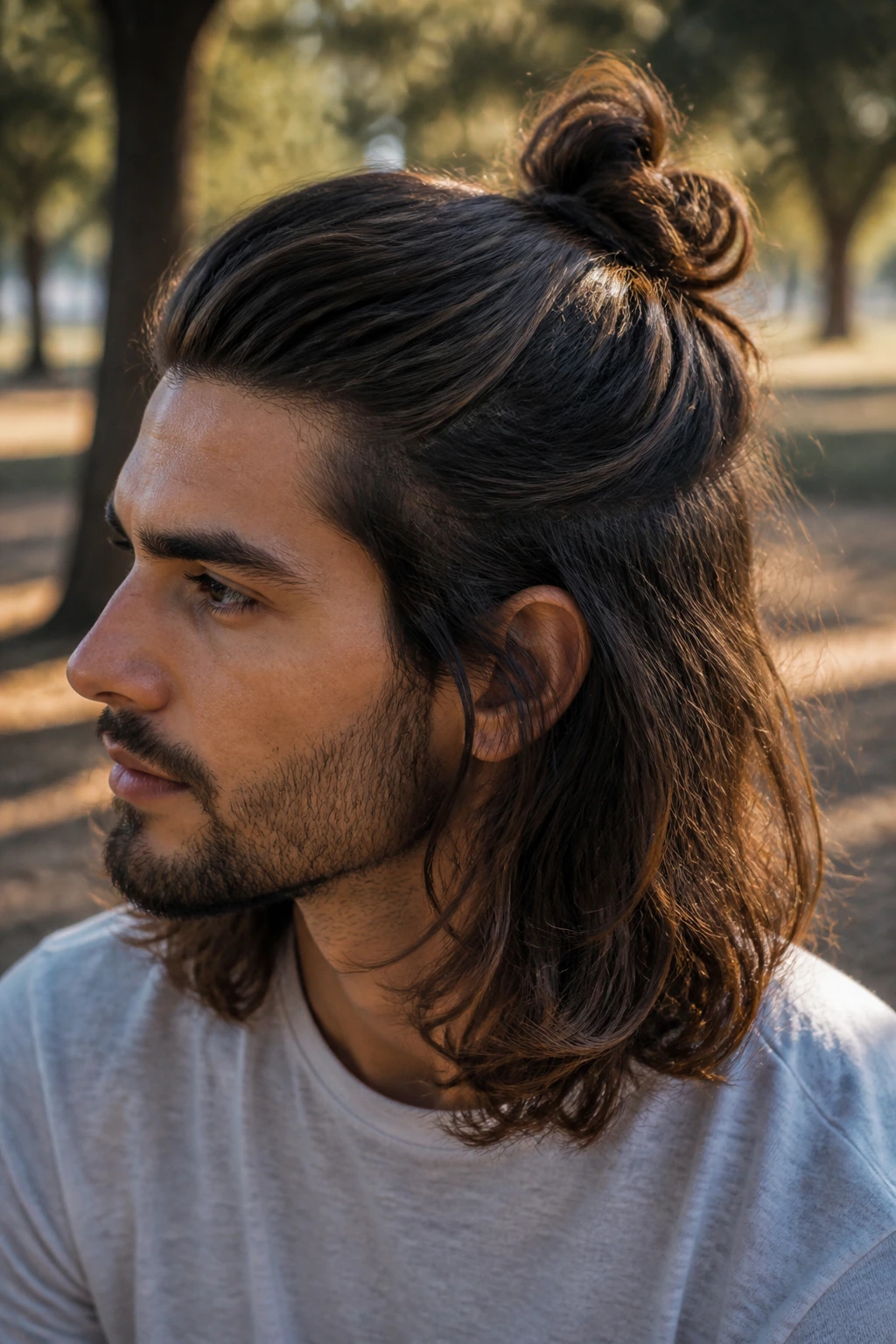
The half-up knot is what I suggest to guys who like the feel of loose hair but hate how it falls across their face every ten minutes. You pull the top section back, leave the rest down, and instantly get a little control without turning the whole thing into a bun.
It works best when the top layer has enough length to gather cleanly, usually somewhere past the nose and into the chin range, while the lower layers can stay loose and show off texture. That contrast is the whole point. The tied section clears your forehead; the loose section keeps the style from looking severe.
The best version of this style is never tight. If you yank the knot hard, you lose the relaxed shape and you may end up with a flat dent at the crown. Leave a little lift above the tie. It makes the hair look fuller and keeps the style from shouting “I gave up halfway.”
This is one of the easiest long hairstyles for men to live with on workdays, gym days, and days when your hair is doing something stupid. Which is most days.
6. The Low Man Bun
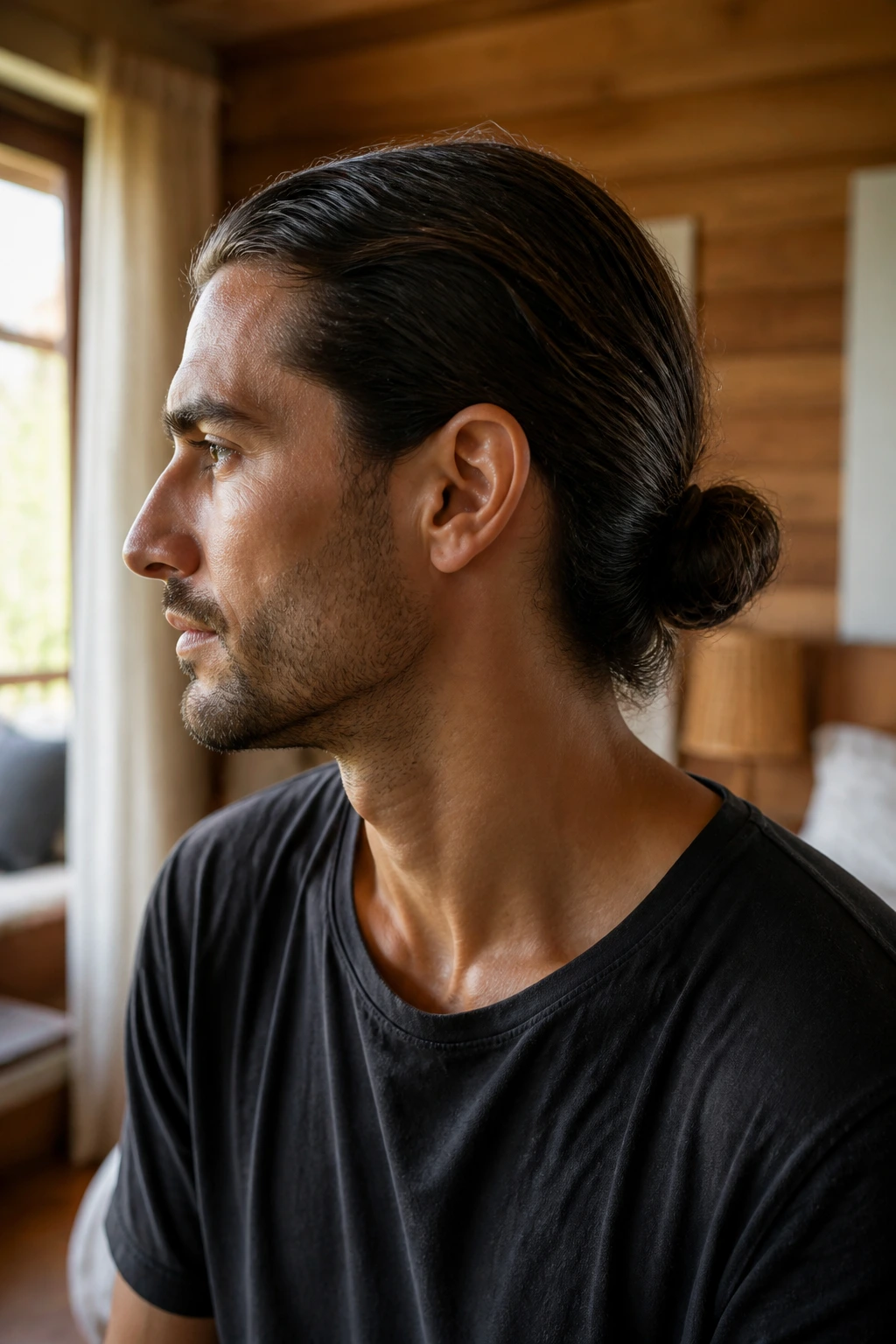
I’ll say it plainly: the low man bun looks better than the high one on more faces than people admit. The low placement uses the weight of the hair instead of fighting it, and it keeps the top of the head from looking overly tight or scrubbed back.
A good low bun sits near the nape, not halfway up the back of the skull. That placement matters because it keeps the look grounded. You still see the length around the sides and back, but the shape feels cleaner and less aggressive than a top knot.
It’s best if your hair is long enough to wrap once and tuck the tail under. If you need four loops around the elastic, the bun is too small and you’ll spend all day tightening it. Leave a little slack so the bun has volume. Tight buns flatten fast and pull too much at the temples.
This is the style for men who want a reliable default. It is neat without being severe. Practical without being boring. And yes, it looks better when the ends aren’t chopped bluntly.
7. The Classic Ponytail
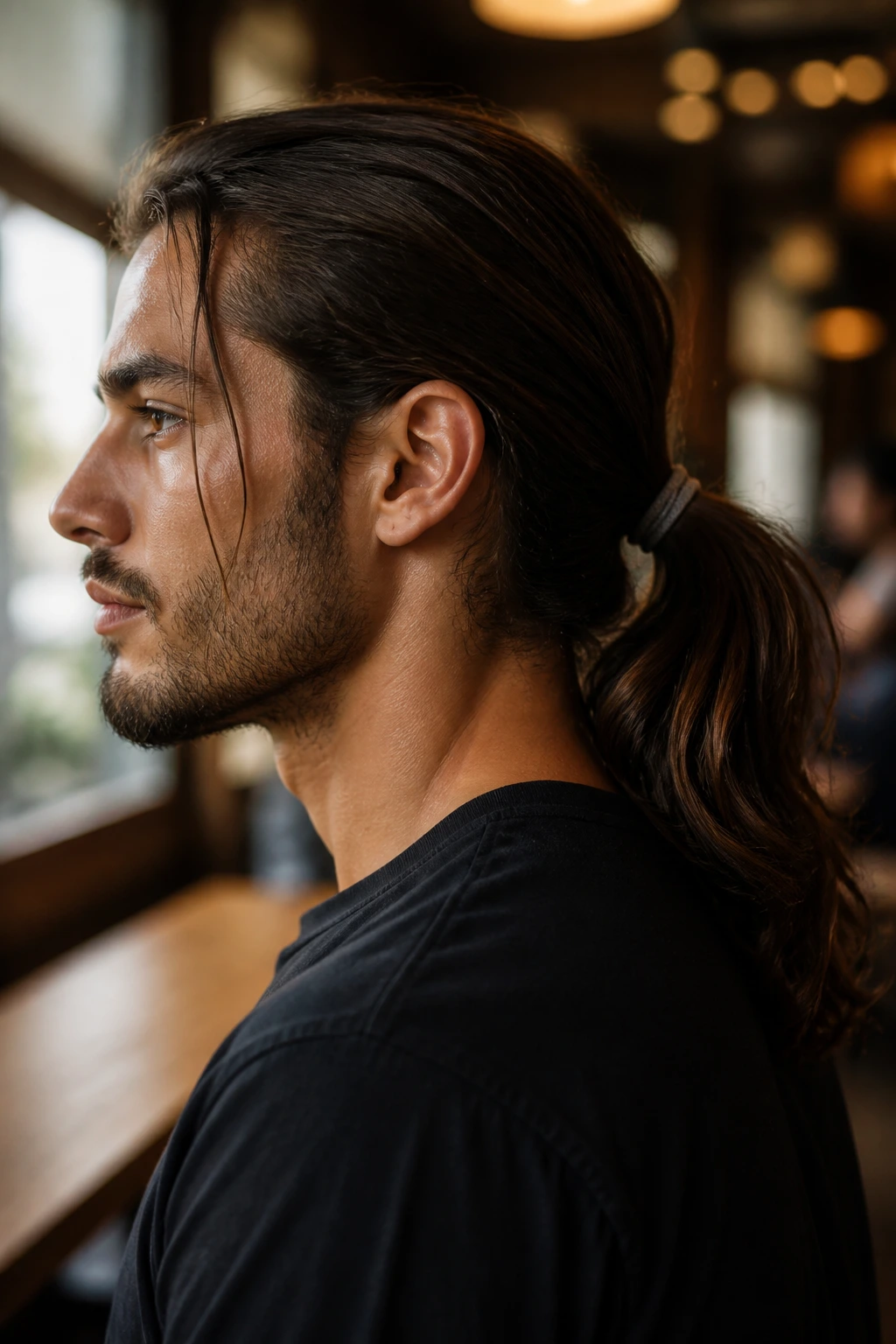
The ponytail is the oldest long-hair move in the book, and it still earns its place because it works. A low or mid-level ponytail keeps the hair out of the face, shows off the length down the back, and takes thirty seconds once you know where to place the tie.
The part people miss is the crown. If you pull too much hair straight back from the forehead, the style gets flat and the front loses all shape. Leave a little lift at the roots, then gather the hair at the back of the head where it feels balanced. A small amount of texture spray or cream on the surface keeps flyaways from turning into static.
- Cleanest look: low ponytail at the nape
- Looser look: mid ponytail with a few face-framing pieces out
- Best hair types: straight, wavy, or coarse hair
- Useful detail: use a fabric tie, not a sharp rubber band
- Works with: a beard, denim, and a jacket collar that doesn’t fight the hair
If your hair is long enough to swing when you walk, the ponytail starts to make sense in a way it doesn’t at shorter lengths. It becomes a shape, not just a fix.
8. The Modern Mullet
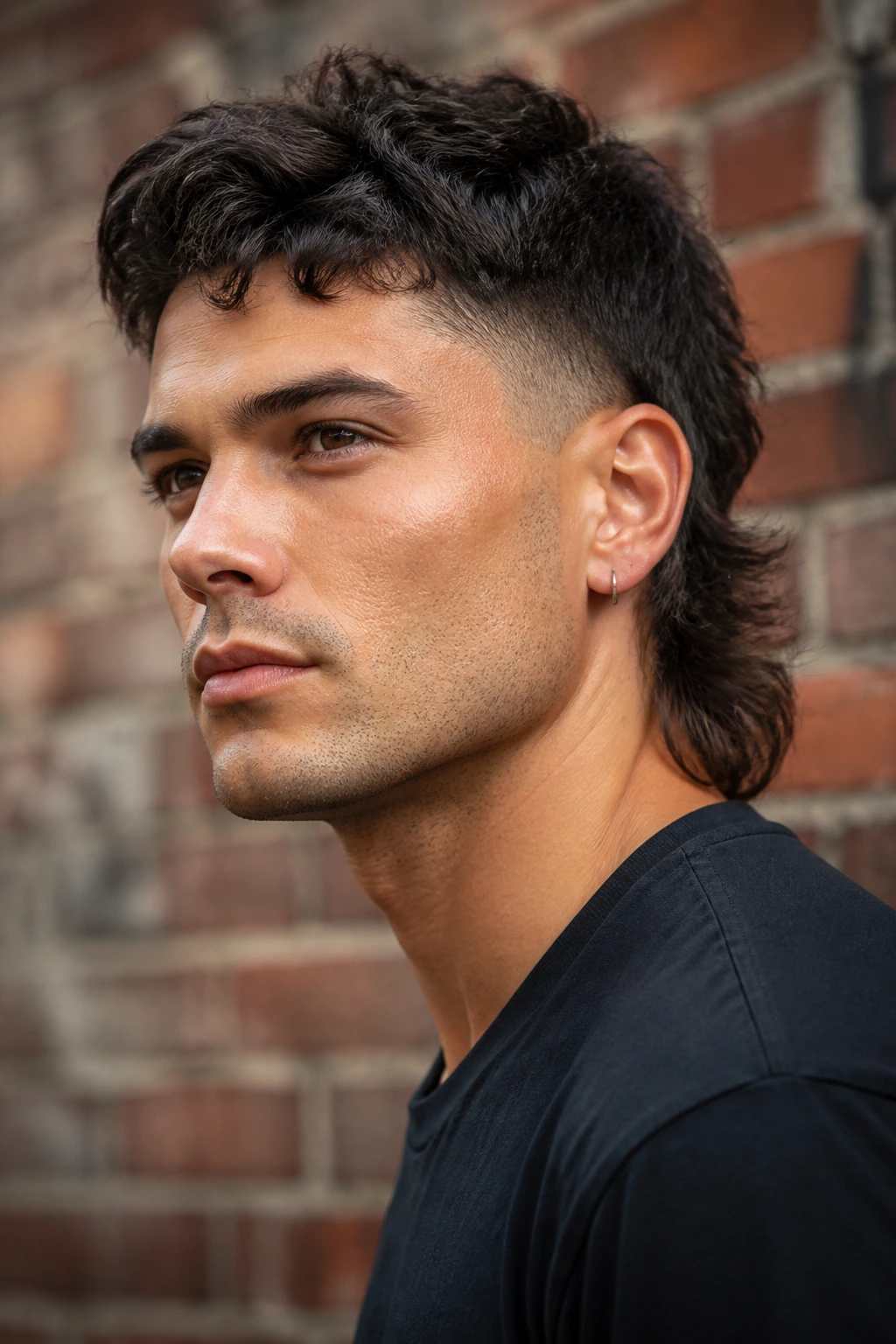
The modern mullet is not the joke version people still picture from old photos. Done right, it has a shorter front and sides, a textured top, and a back that keeps the length alive without looking shaggy in the wrong places. It can be rough-edged or surprisingly neat, depending on how hard you want to push the contrast.
This cut works because it creates a clear front-to-back story. The face gets lift and shape near the temples, while the back stays long enough to keep the style from feeling cropped. That balance is what makes the modern version so much better than the old one. It feels directional.
The key is the transition area around the ears. If that zone is too heavy, the style turns bulky fast. If it is too short, the mullet loses its point. The best version keeps the sides tidy and the back soft. A little matte paste through the top gives the front enough grit to match the rest of the cut.
This one is for a guy who does not mind being noticed. It has personality baked into it.
9. Layered Waves
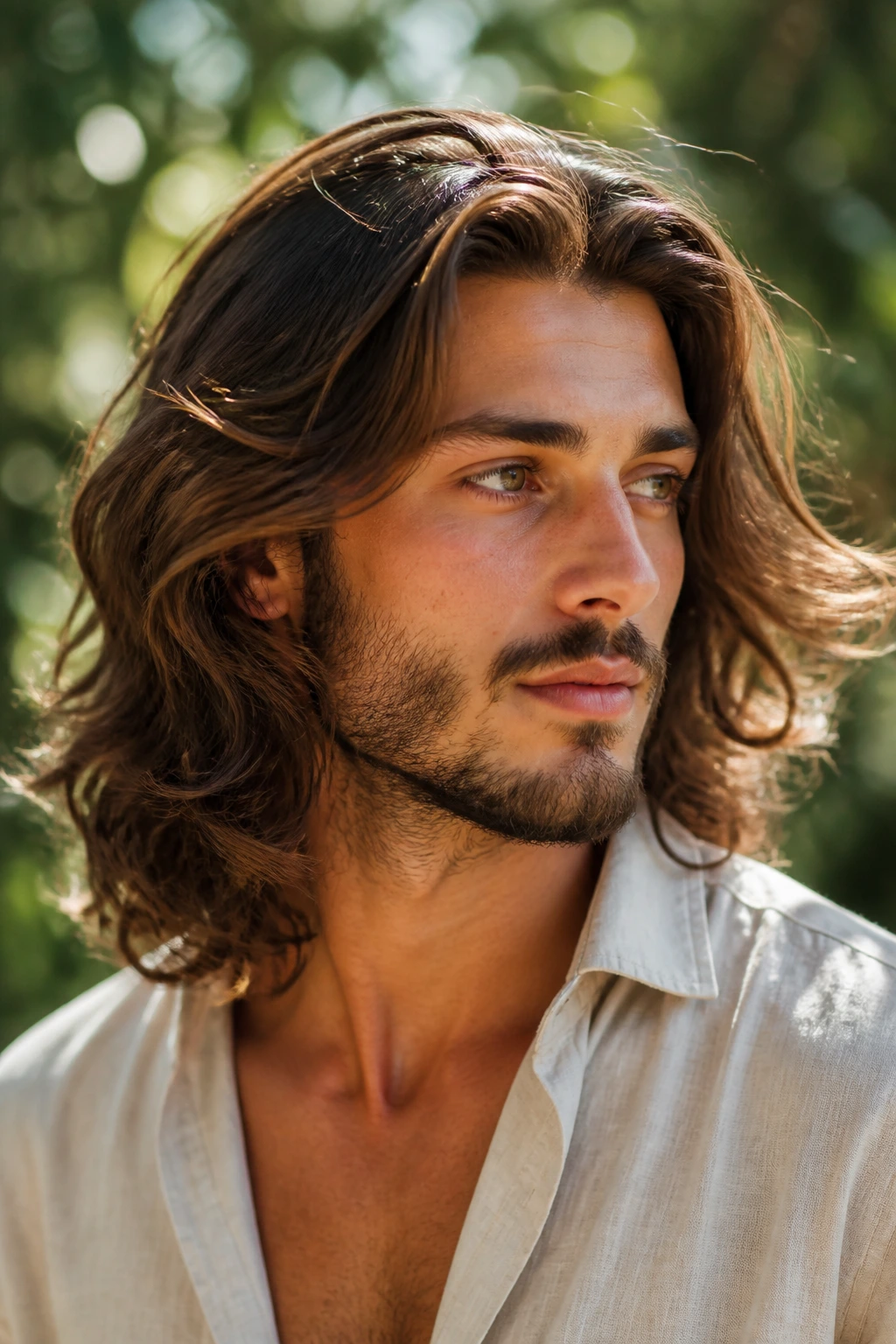
What if the wave pattern is the star instead of the thing you keep trying to tame? That’s the whole idea behind layered waves.
A long wavy cut without layers can swell at the sides and collapse in the middle. Layers break that up. They let the wave pattern stack in a way that looks richer and less bulky, especially around the cheekbones and the back of the head. The cut does some of the styling for you, which is why this style has such a strong following among men with natural bend in the hair.
What Makes It Work
You do not need a heavy product routine here. A leave-in conditioner or light curl cream on damp hair is enough if the layers are right. Letting the hair air-dry halfway, then lifting the roots with your fingers, gives it shape without crunch.
This style is at its best when the ends are not all one length. Ask for internal layers that remove weight but keep the perimeter soft. That phrase sounds a little barbershop-y, but it matters. The result is a wave pattern that lands in loose, clean sections instead of a single puffy shape.
The style looks relaxed, but the cut has to be precise. That’s the part people underestimate.
10. The Long Undercut
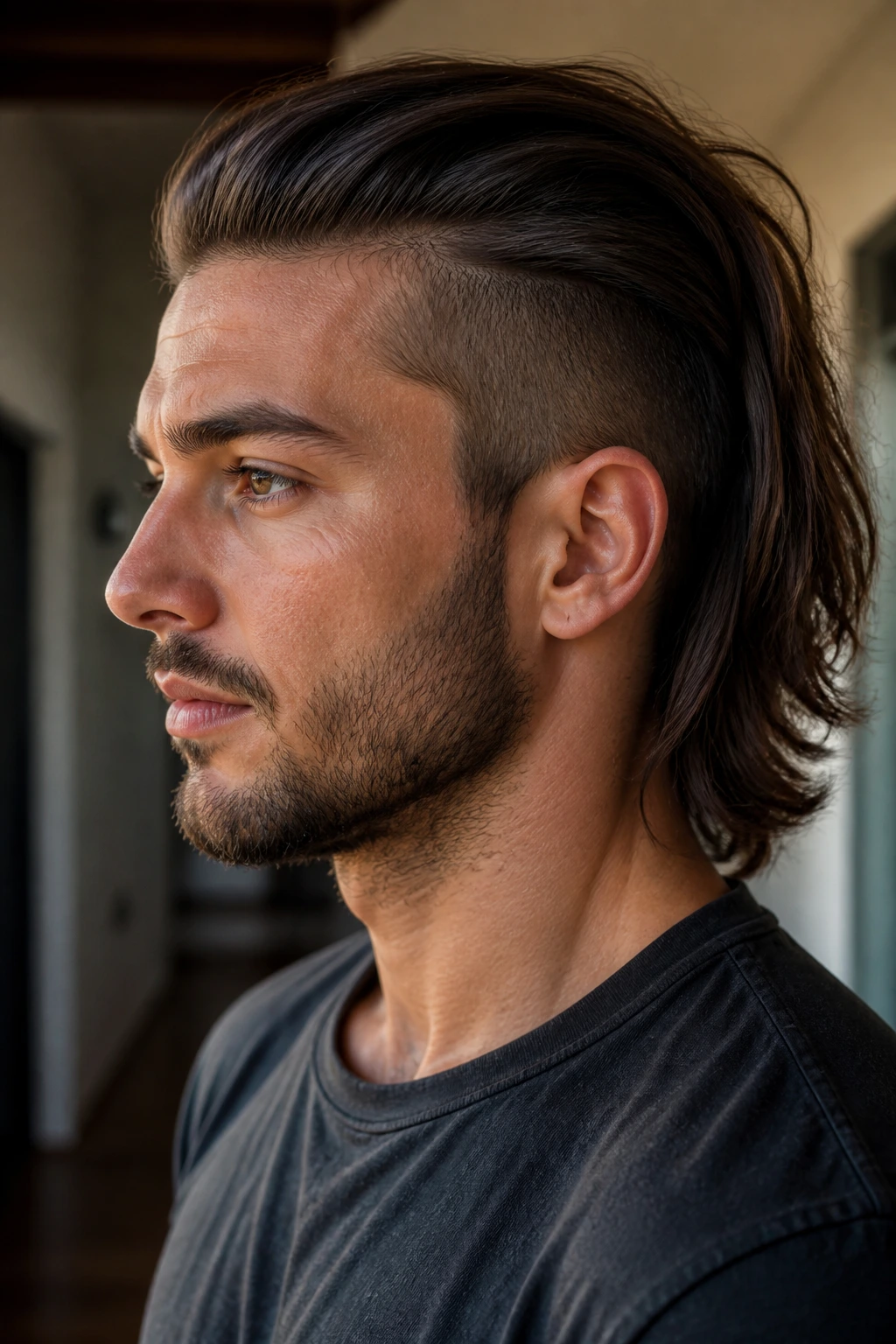
The long undercut has a built-in contrast that makes it one of the easiest styles to read from across a room. Shorter sides, longer top, and enough length on top to push back, part, or tie up. It’s simple on paper. In practice, it can look sharp or awkward depending on how much the disconnect is controlled.
The appeal is the clean line around the sides and back. That lets the top stay long without adding too much bulk around the ears and neck. If your hair is thick, the undercut can be a relief. If it is fine, the shorter sides can make the top look fuller by comparison.
- Best if you like structure: this cut gives you a clear silhouette
- Needs maintenance: the side growth shows faster than people expect
- Styling options: sweep back, part it, bun it, or let it fall forward
- Works well with: strong jawlines and dense hair
- Watch out for: too much contrast if your face is already narrow
I like this style on men who want long hair but still want a clean outline around the head. It keeps the edges under control, which is half the battle.
11. The Side-Part Sweep
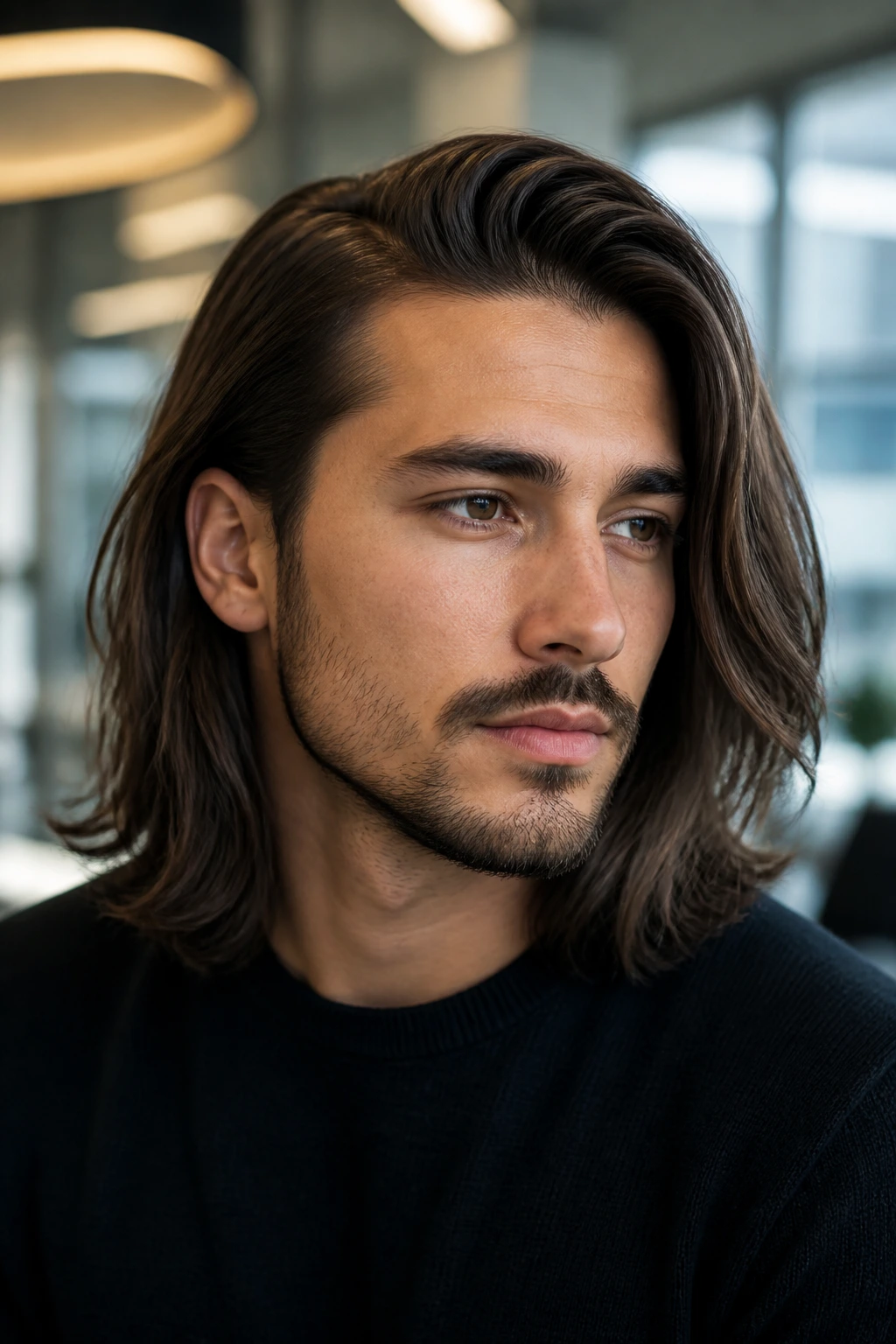
The side-part sweep is one of those styles that looks calm in a way straight hair often doesn’t. Instead of forcing the hair straight back or down the middle, you move it across the head with a defined side and let the length fall with a little direction.
The style benefits from a subtle bend in the hair, but it can be adapted to straighter textures with a bit of blow-drying and a light styling cream. The trick is to keep the part soft enough that it doesn’t look drawn on. If the line is too hard, the style starts to feel dated. If it is too vague, it just turns into hair that happened to fall sideways.
This is a good long style for professional settings because it looks intentional from the front and controlled from the side. A tucked-behind-the-ear version works nicely if you want a cleaner edge. A looser sweep reads more casual and works better with a bit of beard texture below it.
There’s not much drama here. That’s why it works.
12. The Samurai Bun
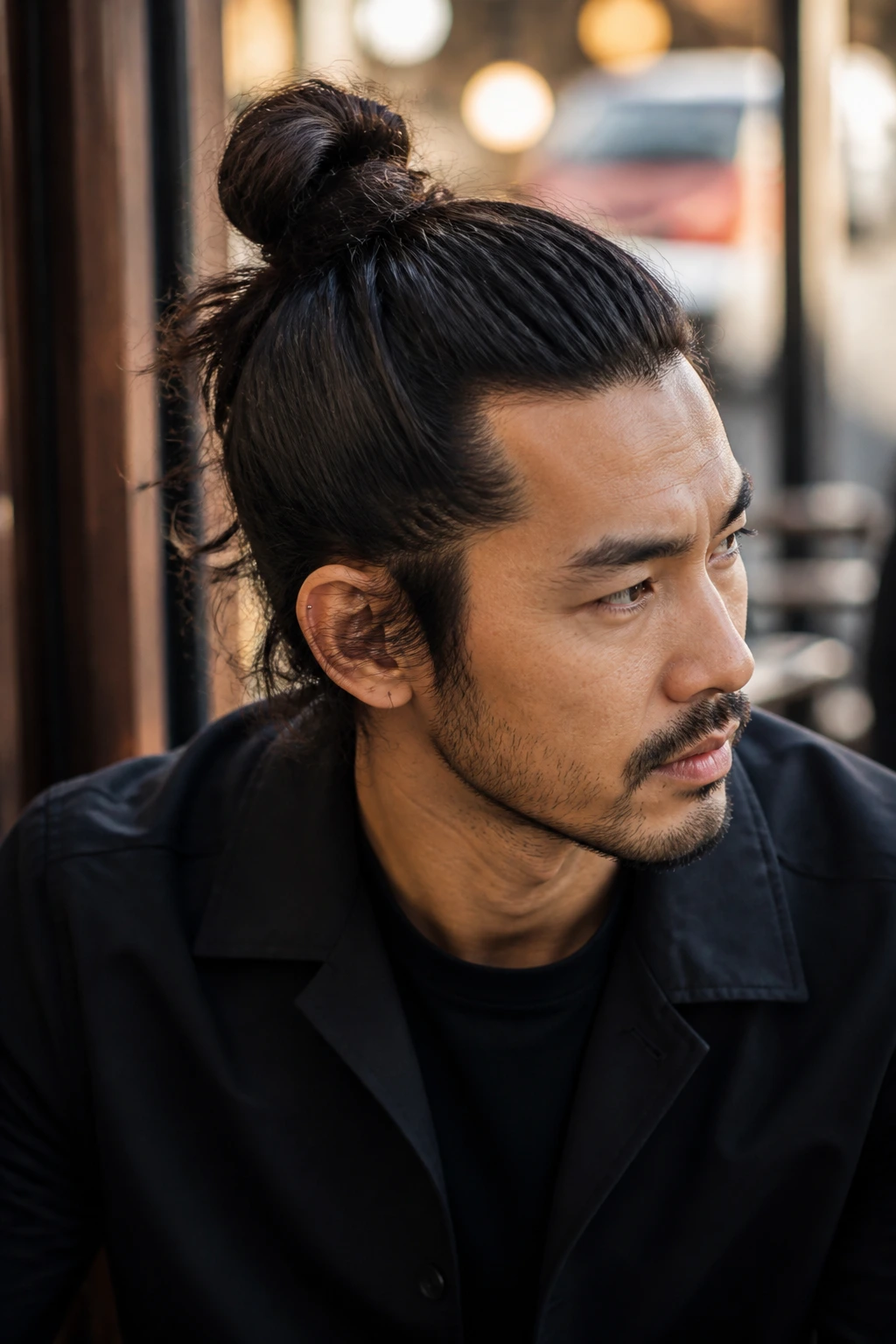
The samurai bun sits high, usually near the crown, and it changes the profile of long hair in a way the low bun never will. It opens the face, exposes the neck, and gives the style a little more edge. I prefer it when the hair is long enough to support a tight but not tiny knot; otherwise it can look like a compromise.
Compared with the low man bun, this one feels more assertive. The hair is pulled up and back, which makes the jaw and cheekbones stand out more. That can be a great move if you have a strong bone structure or if you want to show off a beard line without hiding it behind loose hair.
The catch is tension. A samurai bun should not feel like your scalp is being tugged all afternoon. If the tie has to work too hard, the style is too small or the hair is not long enough. Use a soft elastic, and don’t worry if a few ends spill out. A little imperfection keeps it from looking like a costume.
This is a style with presence. Wear it like one.
13. Box Braids
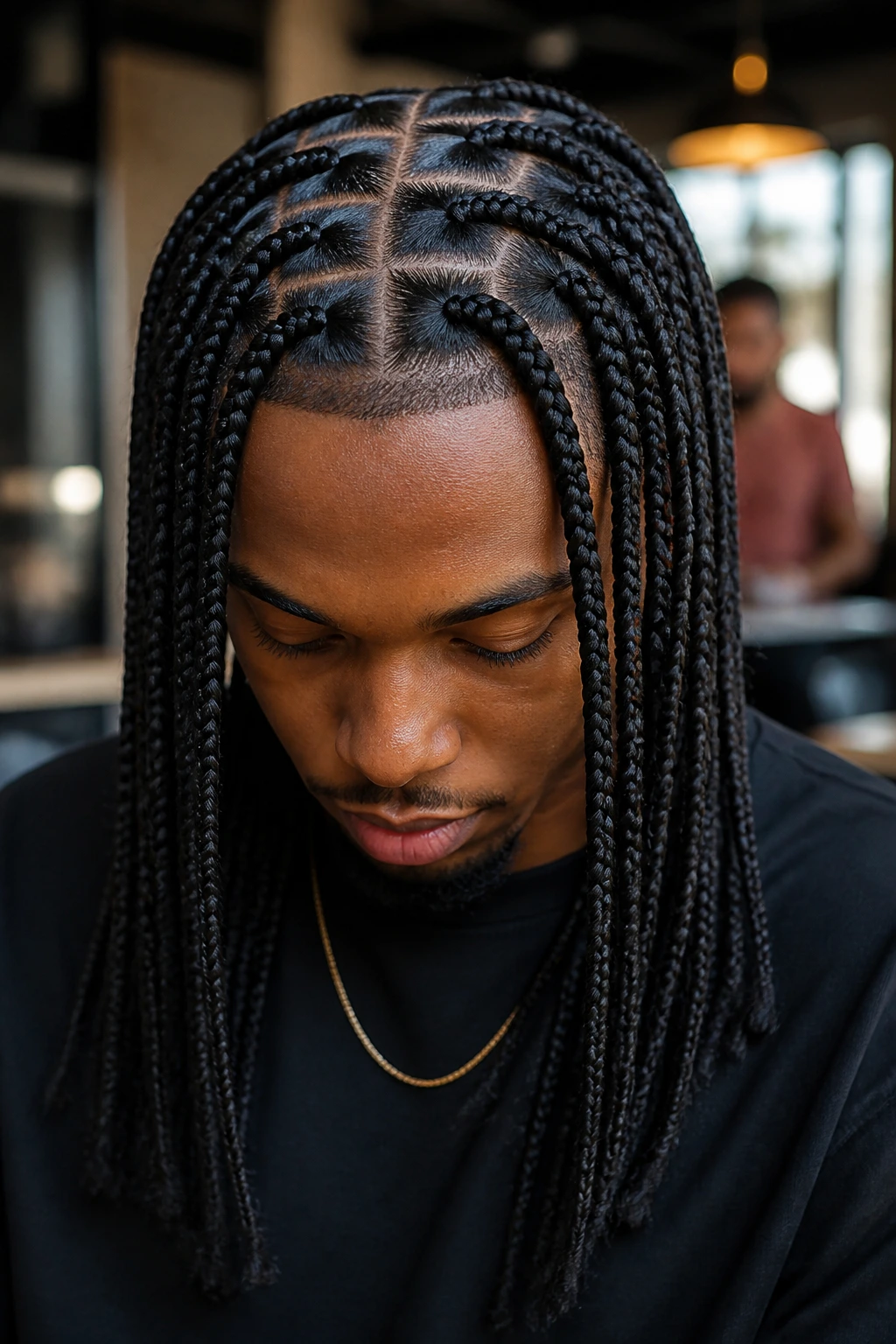
Box braids are one of the cleanest ways to control long hair while keeping the length visible. The style divides the hair into neat square or rectangular sections, then braids each section down so the hair stays organized for weeks instead of hours. That makes it one of the most practical long styles if your daily routine is too busy for constant combing and rewetting.
Why They Earn Their Keep
The braid pattern reduces tangling and protects the strands from constant handling. That matters more than people think. Hair that is touched less often usually stays smoother at the ends, and the scalp can breathe better when the sections are not being reworked every morning.
The style also gives you options on thickness and length. Smaller braids look more detailed and take longer to install. Larger braids are faster and feel bolder. If you have enough length to grip the braid securely, the style sits neatly and lasts longer.
A clean scalp matters here. You want the parts neat, the roots cared for, and the braids not pulled so tight that they hurt around the hairline. Tension is the enemy. Comfort is not optional.
This is a style that rewards patience and a good first installation.
14. Cornrows
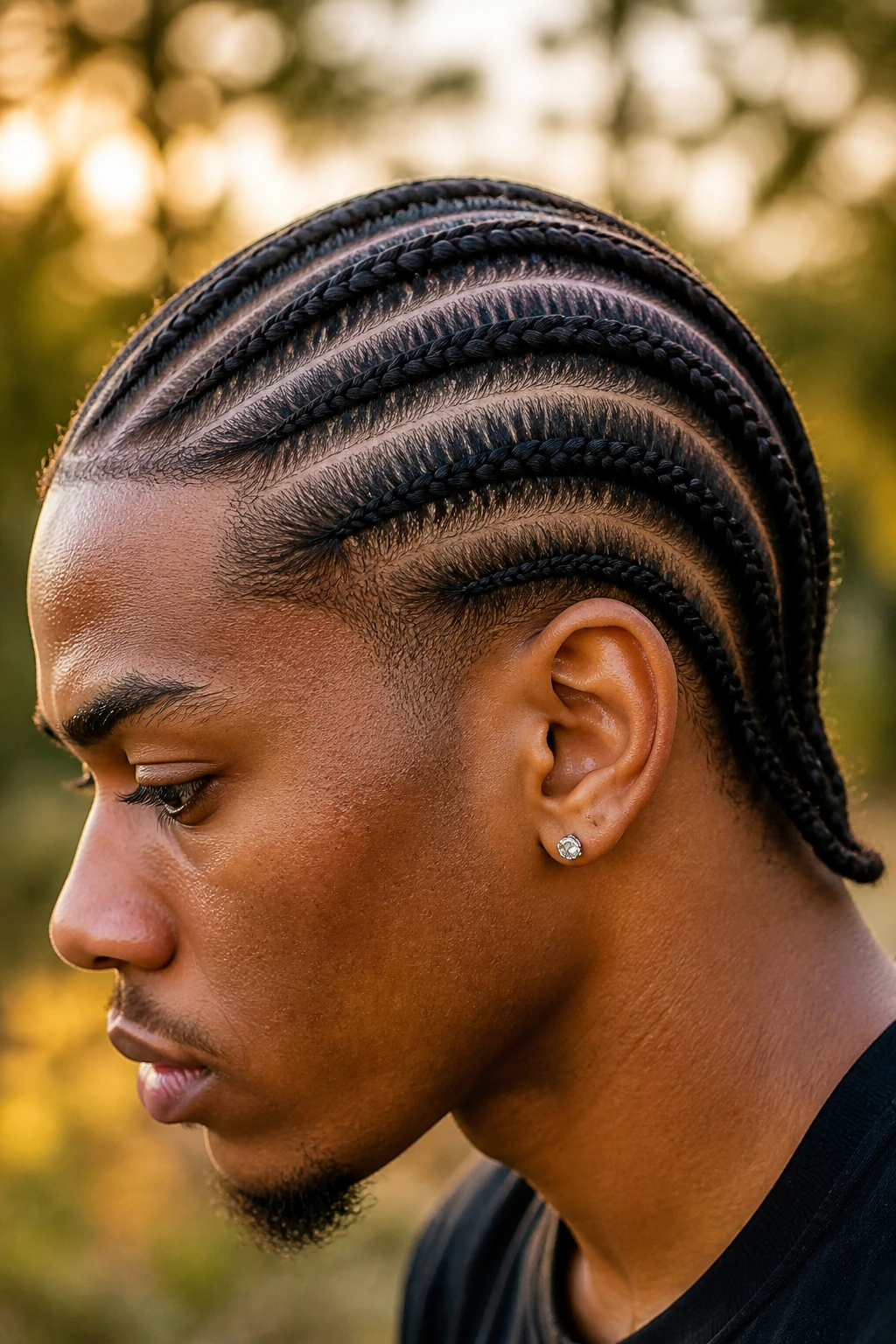
Cornrows look sharp because the shape is built into the scalp. The rows sit flat, the direction is obvious, and the whole style has a clean geometry that reads instantly. It is one of the few long hairstyles for men that can look both athletic and polished at the same time.
The best cornrows follow the natural head shape instead of fighting it. Straight-back rows are classic, but curved parts or alternating directions can make the style feel more modern. The sections need to be even enough to hold, but not so tiny that the scalp feels stressed. That balance matters because tight braiding at the hairline can irritate fast.
A light scalp oil or leave-in spray helps the base stay comfortable. Not much. The style should be neat, not greasy. If the rows start to fuzz up at the edges, a quick touch-up is better than piling on product. Cornrows usually look strongest when the hairline is clean, the rows are consistent, and the ends are secured with enough tension to hold without yanking.
This is a style with a strong outline. If you like order, it delivers.
15. Locs
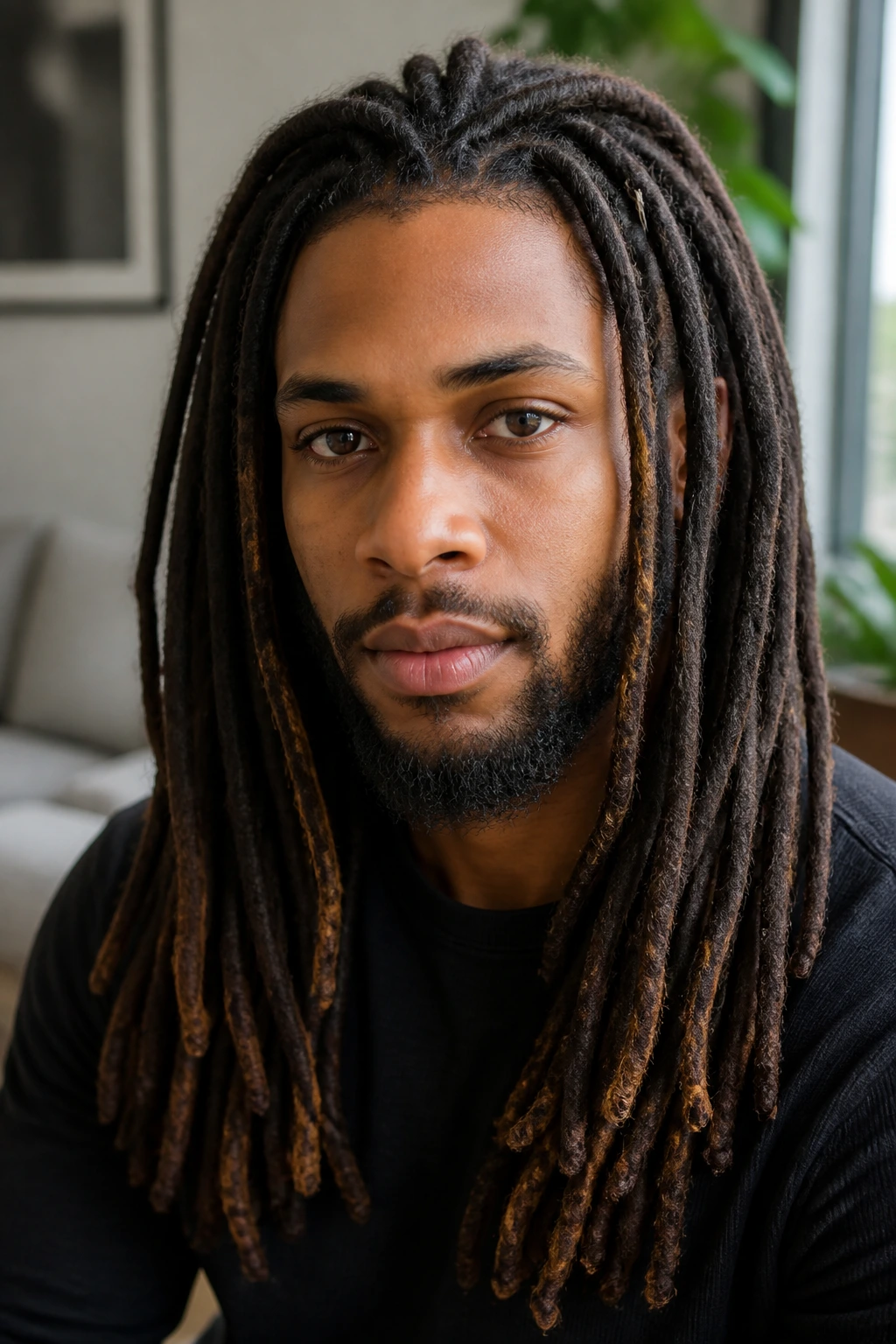
Can long hair look both relaxed and disciplined at the same time? Locs are the answer that proves it can.
Whether they are starter locs or mature locs, the style is built on sections that lock over time into rope-like strands. The visual effect is different from braids. Braids are woven; locs are formed. That difference gives locs a denser, more organic look, and the longer they get, the more personality they pick up from the shape of the head and the way they fall.
What to Expect
The first stage is the messiest. Starter locs can puff a little, loosen at the roots, and look less tidy than the finished style. That is normal. The early months are about consistency: regular palm rolling or retwisting if that is part of your maintenance method, clean scalp care, and enough moisture to keep the hair from drying out.
Once the locs mature, the style becomes easier to live with. You spend less time shaping and more time maintaining the base. A satin bonnet or pillowcase helps the hair stay together at night, and a residue-free cleanser keeps buildup from sitting at the roots.
Locs are not low effort. They are different effort. If you respect that, they reward you.
16. The Long Curly Halo
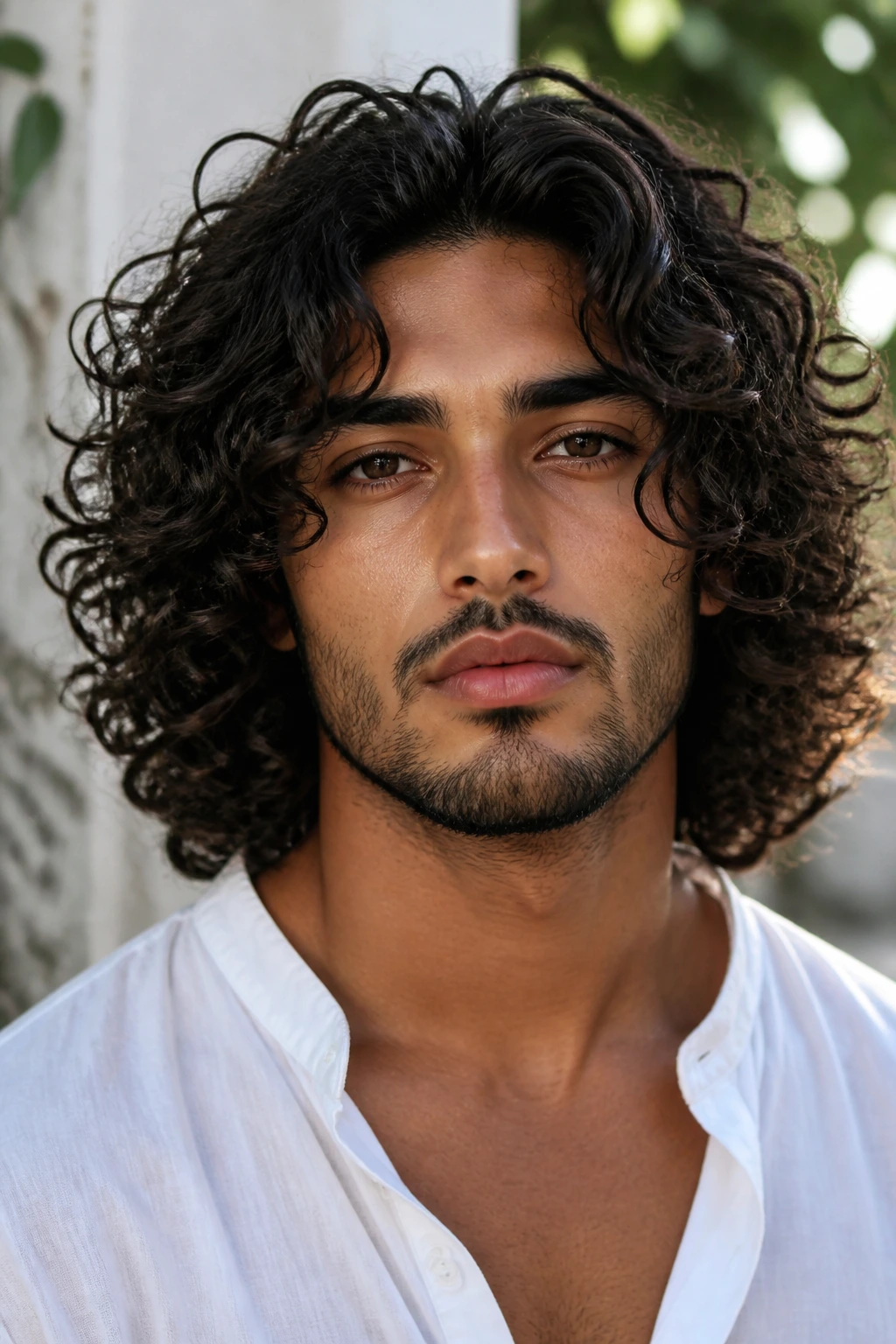
Curly hair wears length differently. Instead of lying down the back, it lifts, spreads, and builds a rounded shape that can look fantastic when the cut respects the curl pattern. A long curly halo leans into that fullness and keeps the silhouette even, which is where a lot of long curly cuts go wrong.
The crown should not be too heavy, or the style gets bulky in one spot and flat in another. A curl-friendly cut with layers that follow the curl’s natural spring keeps the shape balanced. The sides can be slightly shorter than the top, but not so much that the whole look turns into a triangle.
- Best products: leave-in conditioner, curl cream, and a light gel if you need hold
- Best drying method: air-dry or diffuse on low heat
- Best shape cue: rounded, not boxy
- Best length range: chin to shoulder and beyond
- Good habit: separate curls with fingers, not a brush, once dry
This is one of the most expressive long styles on the list. When the curl pattern is healthy, it does the heavy lifting for you.
What Makes Long Hair Look Intentional Instead of Just Grown Out
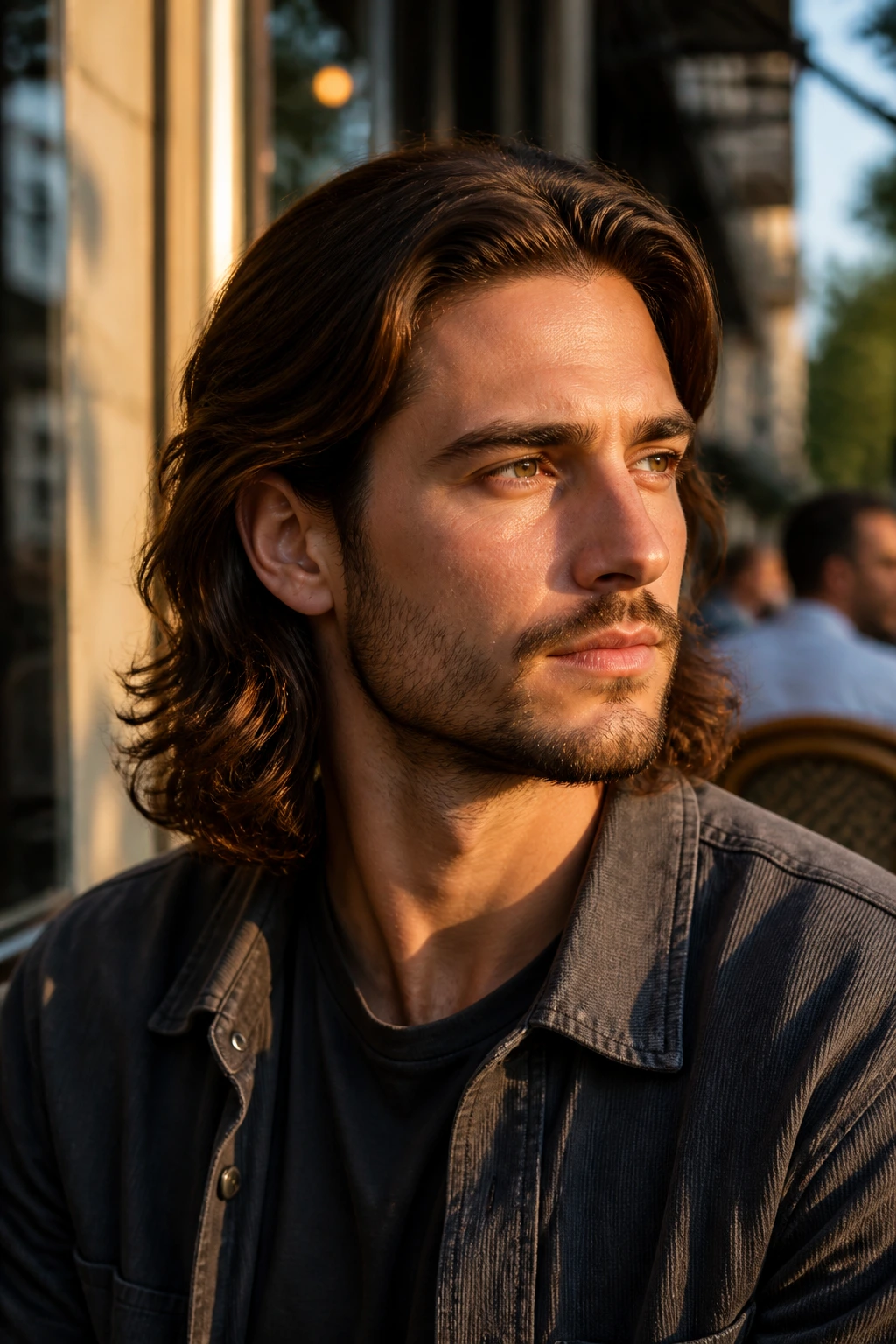
A long cut needs a silhouette. That’s the part people miss when they say they “just let it grow.” Hair grows whether you do anything or not. Style happens when the ends are shaped, the bulk is controlled, and the front has a reason to fall the way it does.
The cleanest long looks usually do one of three things: they frame the face, they keep the length back, or they break the weight into layers and sections. If a style does none of those, it tends to collapse into the same flat shape by mid-afternoon. That is especially true when the hair is thick or slightly wavy. Gravity is not subtle.
A barber can help, but so can a few honest questions before the cut. Do you want hair that stays off the neck? Do you want it to fall around the cheeks? Do you need enough length to tie it up? Those questions sound basic, but they change the cut in real ways. The difference between a blunt grow-out and a proper long style is usually a couple of internal layers and a better perimeter.
Also, hair around the ears matters more than most men think. If the sides puff out, the whole style reads wider. If they are too tight, the top can look disconnected. The sweet spot is somewhere in the middle, where the hair follows the head instead of fighting it.
Essential Tools for Long Men’s Hairstyles
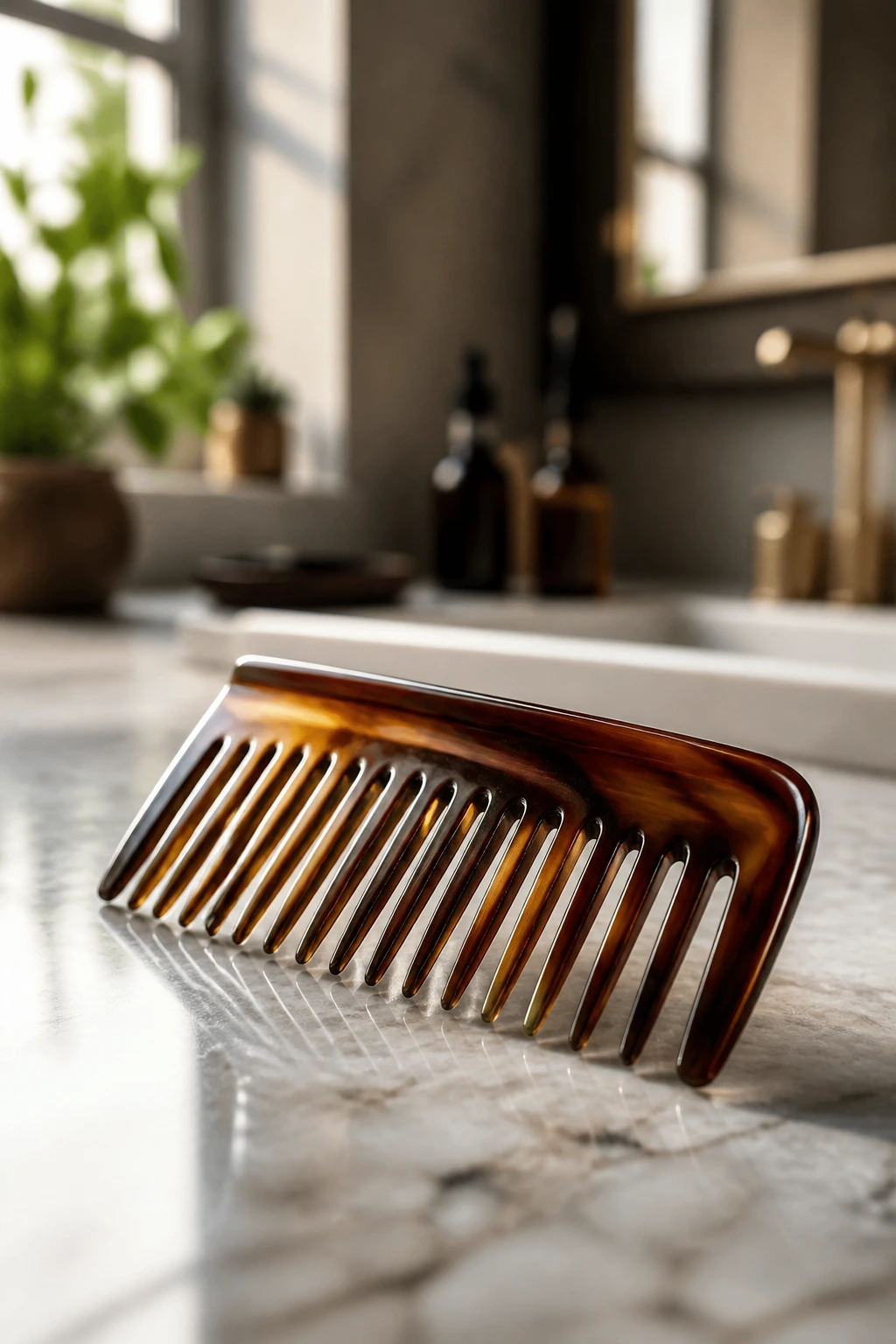
- Wide-tooth comb: Best for detangling wet hair without ripping through knots or breaking the ends.
- Vent brush: Helps with blow-drying straight or wavy hair when you want lift at the roots.
- Boar-bristle brush: Useful for smoothing slick-back styles and distributing oil on straighter textures.
- Leave-in conditioner: Keeps longer hair from feeling dry and rough, especially at the ends.
- Curl cream or mousse: Handy for waves, curls, and shaggy cuts that need shape without stiffness.
- Matte paste or light cream: Gives control without the crunchy finish that ruins long hair.
- Soft hair ties: Go for fabric ties or coiled elastics; hard rubber bands snap strands and leave dents.
- Hair clips: Good for half-up styles, sectioning, and keeping the top out of the way while drying.
- Blow dryer with a nozzle: The nozzle matters. It gives direction, which long hair often needs more than heat.
- Satin pillowcase or bonnet: Cuts down on friction at night, which helps the hair stay smoother and less tangled.
Picking Long Hairstyles for Men by Hair Texture
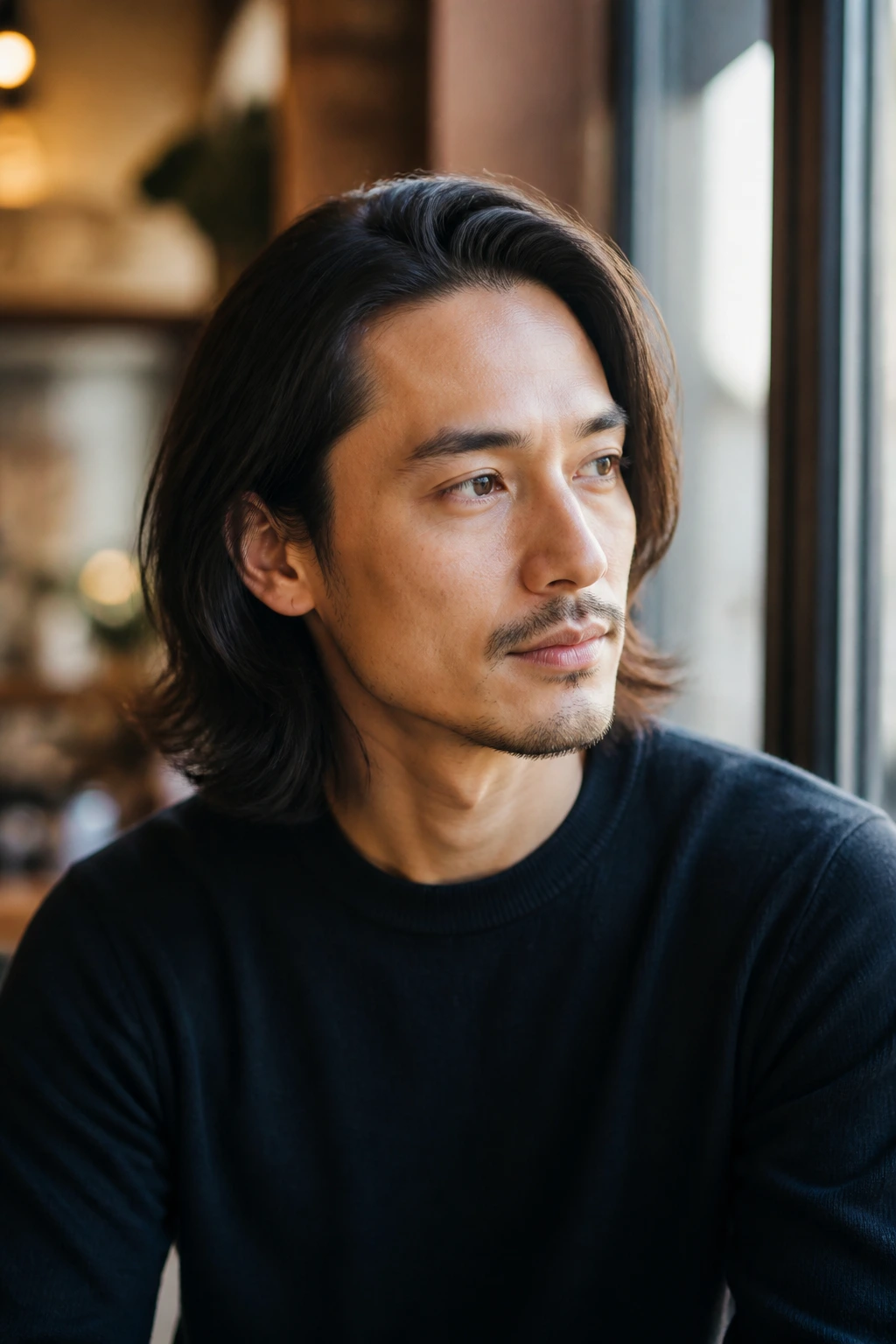
Straight hair, wavy hair, curls, and coils do not want the same cut. That sounds obvious until you watch someone with fine straight hair copy a thick-wave shag from a photo and wonder why it collapsed in six minutes. The shape has to match the fiber.
Fine straight hair usually does best with styles that create movement without asking the hair to hold too much weight. Curtain length, a soft side-part sweep, and a low ponytail all work if the cut has enough internal layering to prevent that limp, stuck-to-the-head look. Too much product makes it worse. A little goes a long way.
Thick wavy hair can carry more shape. Bro flow, shags, and modern mullets look good here because the texture gives the style some lift on its own. The challenge is bulk. If the barber leaves too much weight at the bottom, the whole thing balloons out. Remove some of that weight and the style starts behaving.
Curly and coily hair do best when the cut respects the curl pattern instead of flattening it. The long curly halo, locs, and braids are obvious fits, but half-up styles and low buns can work too if the hair is moisturized and sectioned well. Dry curls frizz faster than straight hair, so hydration is not a luxury here. It is the baseline.
How to Wear Long Hair Without Looking Unfinished
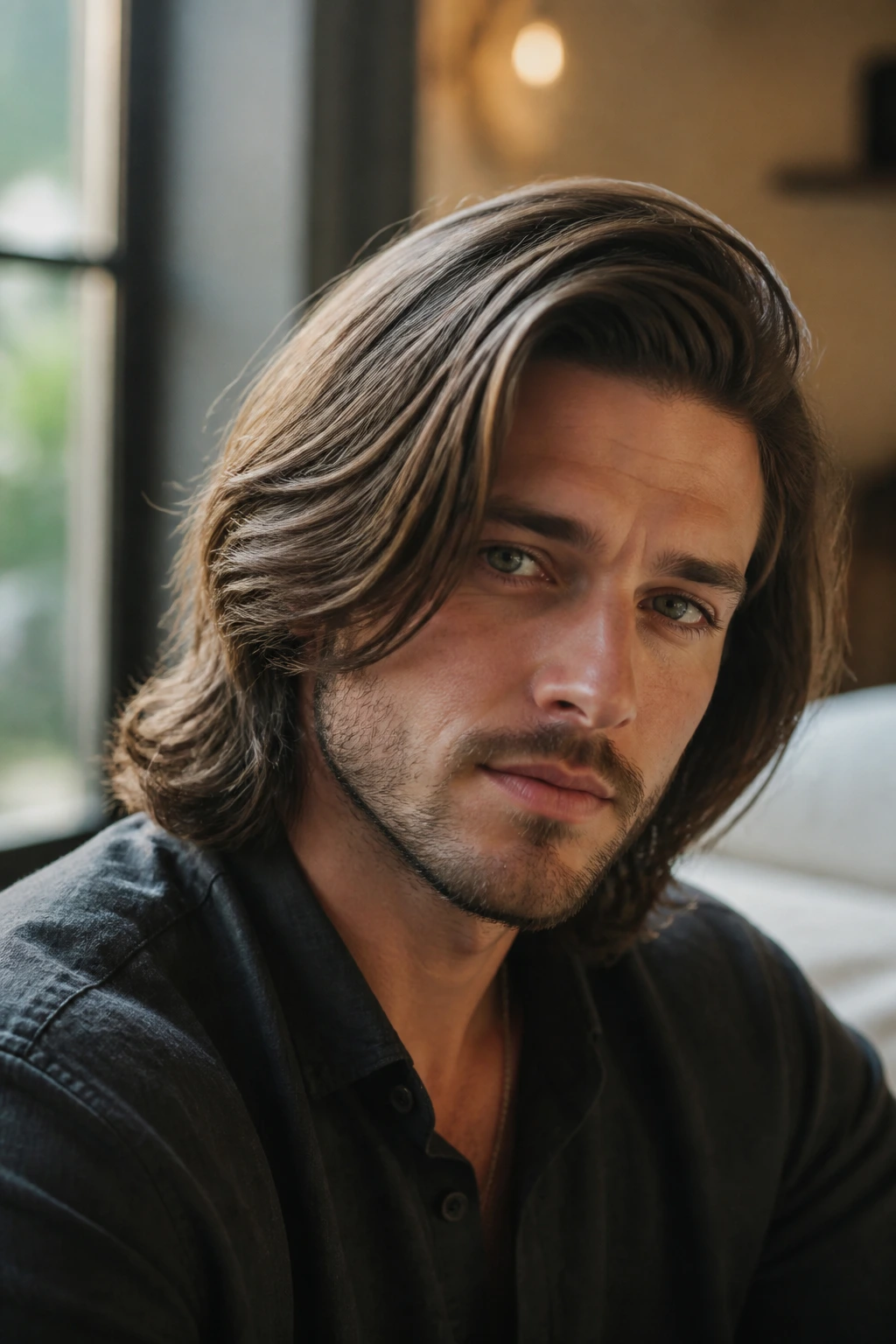
Presentation: The front of the style should answer the question, “What is this hair doing?” If it’s loose, let it frame the face with intention. If it’s tied back, keep the top smooth enough that the tie looks like a choice, not a rescue.
Accompaniments: Beard shape matters more with long hair than most guys expect. A long cut with a blunt, overgrown beard can turn heavy fast. A shorter cheek line, clean neckline, or even a stubble fade can keep the whole thing readable. Glasses and collars matter too; thick frames and high collars both compete with loose hair if the cut already has too much width.
Length: Shoulder length is the spot where many men start to lose shape if they never trim the ends. A clean trim every 8 to 12 weeks keeps the perimeter from looking ragged. If the hair is much longer than that, the ends need even more care or they start to fray visually.
Style Pairing: Heavy creams pair better with curls and thick waves. Sea salt spray works on looser textures that need grit. A matte paste suits a side-part or swept-back style. Heavy pomade can look slick in photos and greasy in real life, so I tend to skip it unless the haircut is short enough to handle it.
Practical Styling Tips That Save Time
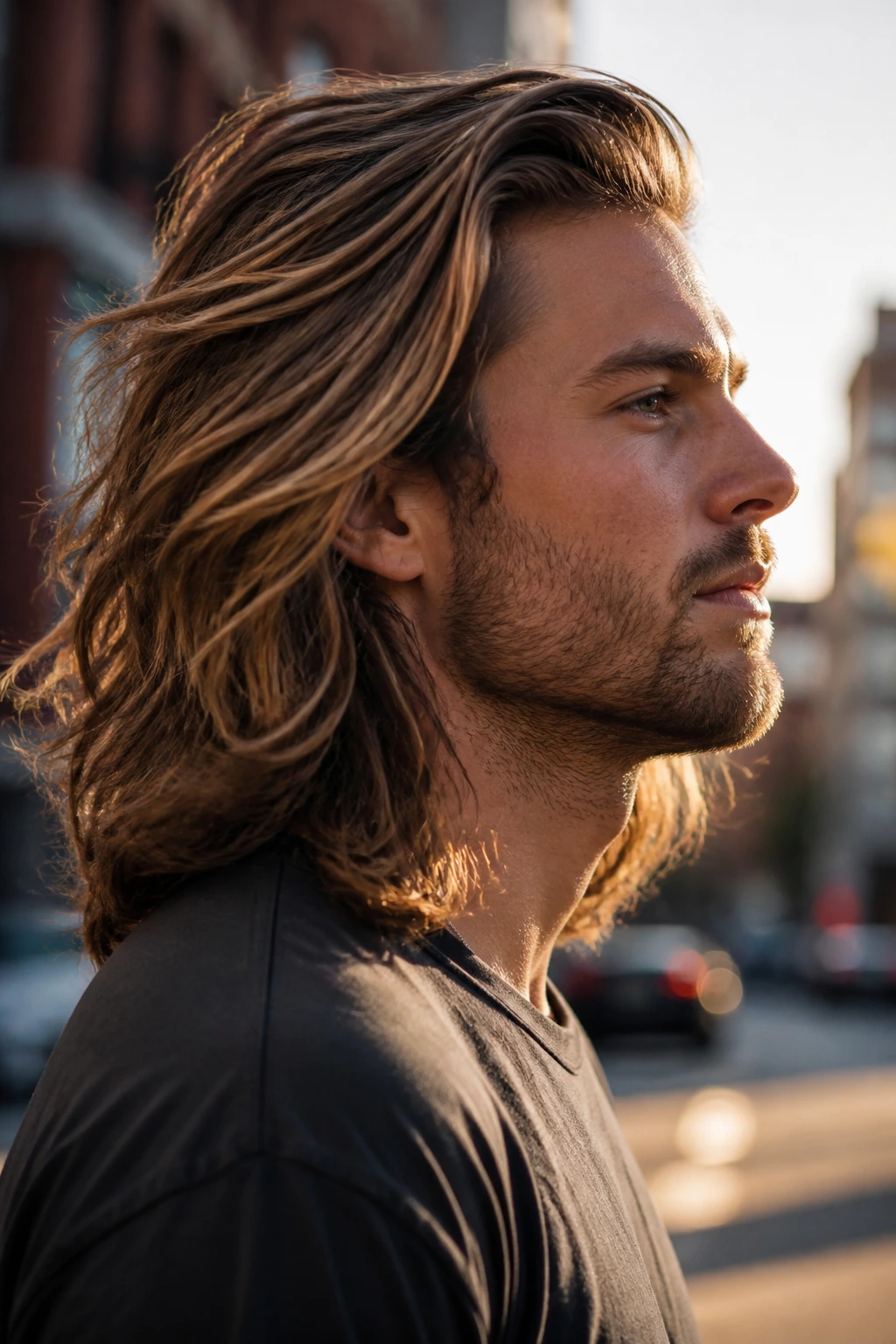
Texture Boost: Put product in damp hair, not soaking wet hair. Water dilutes hold, and long hair tends to clump when it’s too wet. A towel-blot and a rough finger-comb do more than a lot of people realize.
Time-Saver: If you wear a ponytail, half-up knot, or low bun often, keep one small tie on your wrist or in a drawer where you actually get dressed. The style gets worn more when it is easy to do without hunting for gear.
Pro Move: Ask for a trim that removes shape-killing bulk, not a dramatic cut. Most men with long hair do not need more length taken off; they need the bottom edge cleaned up and the heavy areas thinned where they puff out.
Cost-Saver: Buy one good leave-in conditioner and one styling product that fits your texture, then stop collecting bottles. Half the product aisle is a waste if you already know your hair wants cream and not paste, or vice versa.
Finish Line: If the ends feel dry, add a pea-sized amount of hair oil or cream only to the bottom third. That keeps the roots from going limp and makes the whole style look better by morning.
Common Mistakes That Make Long Hair Look Sloppy
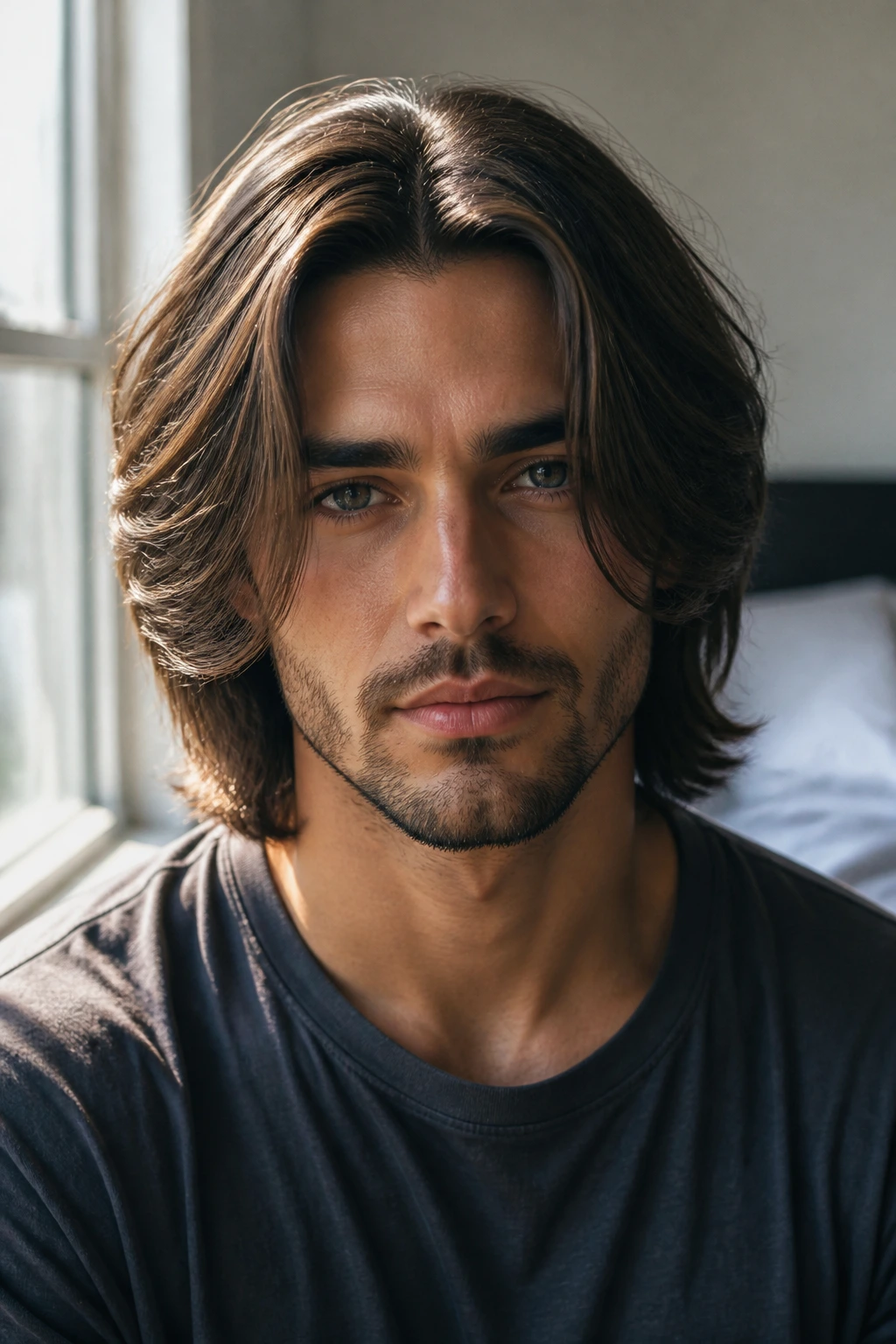
Growing it out with no trims is the classic mistake. The hair gains length, sure, but the ends turn ragged and the silhouette widens at the wrong spots. A trim every couple of months keeps the style from drifting into shapeless territory.
Using too much heavy product is another one. The hair looks sleek for ten minutes, then starts to hang in greasy clumps. Fine hair suffers the most here. Start with less product than you think you need, then add a touch only where the hair actually needs control.
Skipping conditioner is a quiet disaster. Long hair is older hair by the time it reaches the shoulders, and the ends dry out first. If they feel rough when you run your fingers through them, the cut starts looking dull no matter how good the shape is.
Tight ties can also ruin the line. If the elastic leaves a deep bend or gives you a headache, it is too tight. That damage shows up fastest around the temples and crown, where repeated pulling can create breakage and a thin-looking patch.
The last mistake is pretending one long style works on every texture. It doesn’t. A loose flow on straight hair is not the same thing as a curly halo, and a man bun on heavy waves is not the same as a braid on coarse strands. Match the style to the hair you actually have.
Variations and Adaptations to Try
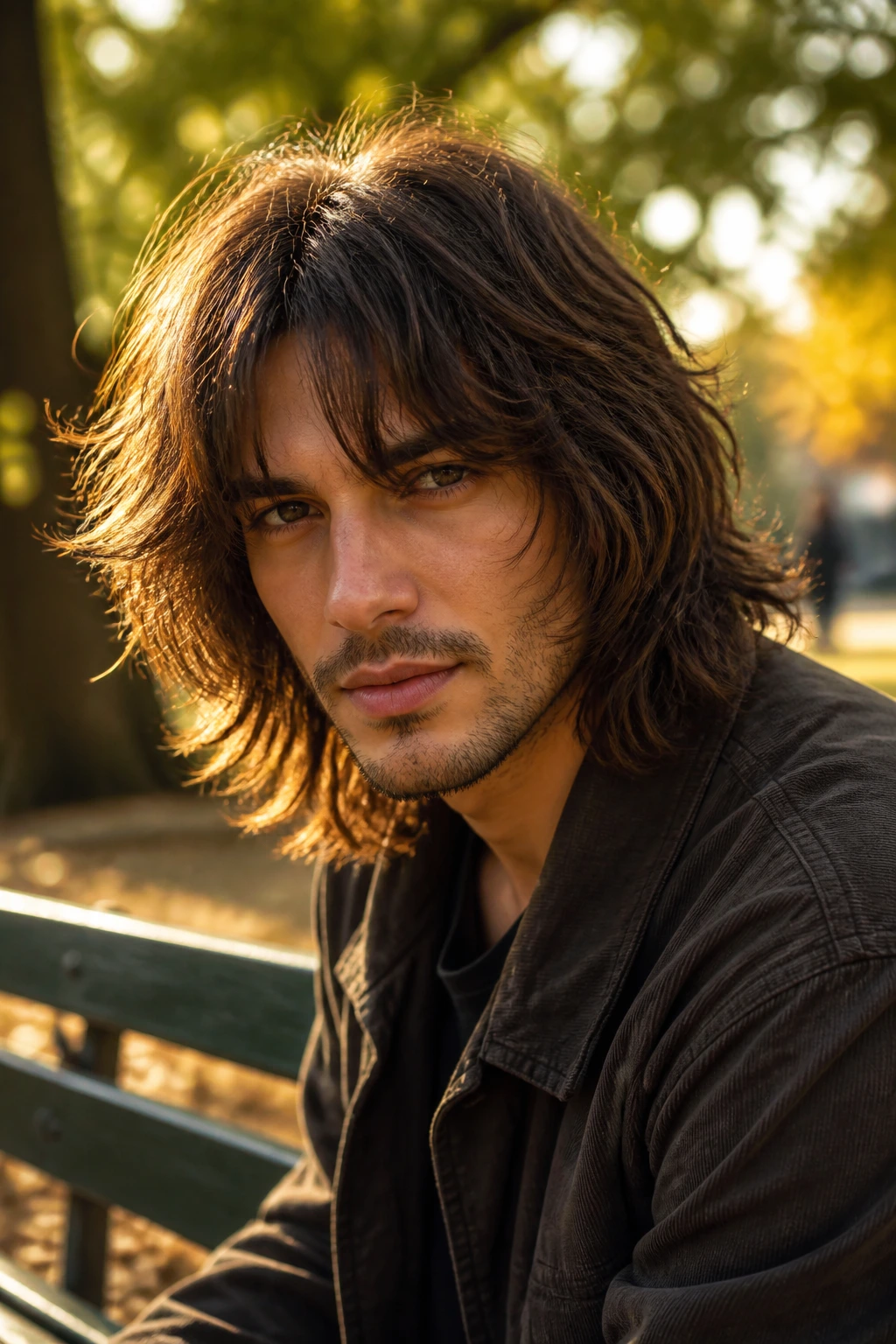
The Clean-Barber Version: Keep the length, but ask for softer edges around the ears, neck, and fringe. This version works if you want long hair that still looks tidy in a jacket and button-down shirt.
The Windblown Weekend Version: Use a salt spray on damp hair, rough it dry with your hands, and let the natural texture do the talking. It fits bro flow, shag, and layered wave cuts especially well. The trick is not over-brushing it into submission.
The Office-Ready Version: Pull the hair into a low ponytail or low bun, keep the sides smooth, and tuck any loose front pieces behind the ears. This is the version I’d trust if you need the style to behave around clients or under bright lights.
The Curly-First Version: Let curls keep their round shape and use a cream or gel that fights frizz without crushing volume. This works best when the cut follows the curl pattern instead of flattening it. The style should look alive, not pasted down.
The Protective-Length Version: Braids or locs make sense when you want the length to stay visible but do not want daily combing, tying, or heat. The style lasts longer between resets, though the scalp still needs regular washing and moisture.
Washing, Drying, and Night Care

Long hair changes how you wash. A short crop can survive almost anything. Long hair cannot. The ends are older, drier, and more exposed to friction, so the routine needs a little more patience.
Shampoo the scalp, not the entire length every time. Let the suds run down as you rinse. That keeps the roots clean without stripping the ends. Conditioner belongs from mid-length to ends, with a little extra on the driest sections if your hair feels rough. If you use a lot of styling cream or paste, a clarifying wash every couple of weeks keeps buildup from making the hair feel dull and heavy.
Drying matters too. Rubbing long hair hard with a towel creates frizz and breakage. Squeeze the water out, press it in a microfiber towel or T-shirt, then shape it with your hands. If you blow-dry, use low to medium heat and keep the nozzle moving. High heat on the same spot turns the outer layer rough fast.
At night, a satin pillowcase or bonnet cuts friction, which helps the style last longer and keeps tangles down near the ends. If your hair is tied back for sleep, use a loose tie. Tight sleep buns look tidy until they start pulling at the scalp. Then they stop being tidy and start being annoying.
Frequently Asked Questions
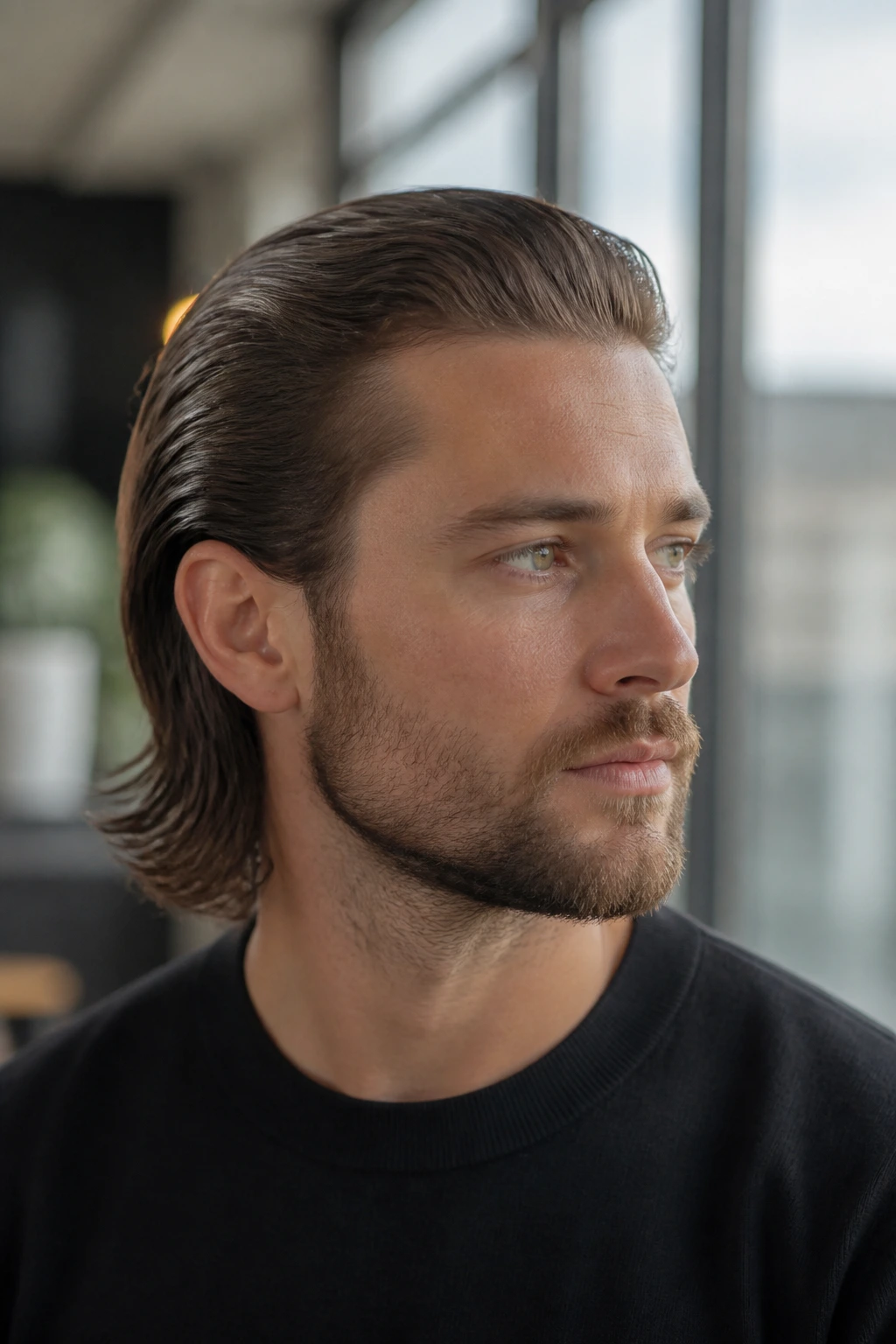
How long does a man’s hair need to be for a bun?
You usually need enough length to wrap the hair around once and secure it without the tie fighting the strands. For many men, that means at least chin-to-neck length, though thicker hair can sometimes bun up sooner because it has more bulk.
What long hairstyle works best for straight fine hair?
A curtain cut, a side-part sweep, or a low ponytail tends to work best because these styles create shape without demanding too much hold. Keep the layers soft and avoid heavy wax, which can drag fine hair down and make it look thinner.
Can long hair on men look professional?
Yes, but it needs clean edges and a deliberate shape. A low bun, slicked-back length, or tucked side-part usually reads more polished than loose hair that falls into the face all day.
How often should long hair be trimmed?
Every 8 to 12 weeks is a good range for most men, even if you’re trying to grow it out. The goal is not to lose length; it’s to keep the ends neat so the whole style still looks controlled.
What if my long hair gets frizzy fast?
Use a leave-in conditioner on damp hair, then seal the ends with a small amount of cream or oil. Frizz usually gets worse when the hair is dry, rough, or over-brushed, so the fix is often gentler handling rather than more product.
Should I grow out layers or keep the cut blunt?
If your hair is thick or wavy, some layering usually helps because it removes bulk and gives the style movement. Very blunt ends can look sharp for a while, then heavy and boxy once the hair gets past the shoulders.
What works if my hair is thinning on top but still long in back?
Styles that direct hair backward or slightly to the side usually work better than a hard middle part. A low bun, sweep-back, or layered shape can keep the long length while making the top look less sparse.
How do I stop long hair from looking greasy?
Wash the scalp enough to keep the roots clean, then use only a small amount of styling product. If the ends need moisture, put conditioner or cream just on the bottom half, not the roots, or the style can collapse by lunch.
The Shape Is the Point
Long hair gets better when it stops pretending length is the whole story. The men’s styles that hold up are the ones that solve a real problem: face framing, bulk control, texture, or the simple need to keep hair out of the way without sacrificing character.
Pick the style that matches your texture, not the one that looked best in a photo taken under perfect light. Then keep the ends trimmed, the product light enough to move, and the shape honest. That’s where long hair starts looking like a style instead of a grow-out.
