



A haircut for work has one job: look deliberate before coffee, survive a commute, and still make sense after the third meeting in a room with bad lighting. That sounds simple. It isn’t. The best men’s work hairstyles have to behave under pressure, and most hair, given the chance, would rather do something annoying by lunch.
The styles that work best in an office usually share the same bones: clean sides, a top that stays put without looking frozen, and a finish that doesn’t catch the light like a greasy spoon counter. A classic side part can look sharp. A textured crop can look modern without getting loud. A buzz cut can read crisp and expensive if the outline is tidy. The trick is matching the cut to the way your hair actually moves, not to the most dramatic photo on a barber’s wall.
My bias is plain: a good work haircut should save you time, not give you another morning chore. If you need a mirror, a brush, a blow-dryer, and a pep talk to leave the house, the cut is doing too much. The better options are the ones that still look intentional when you touch them once, maybe twice, and head out the door.
Why These Workday Cuts Earn Their Place
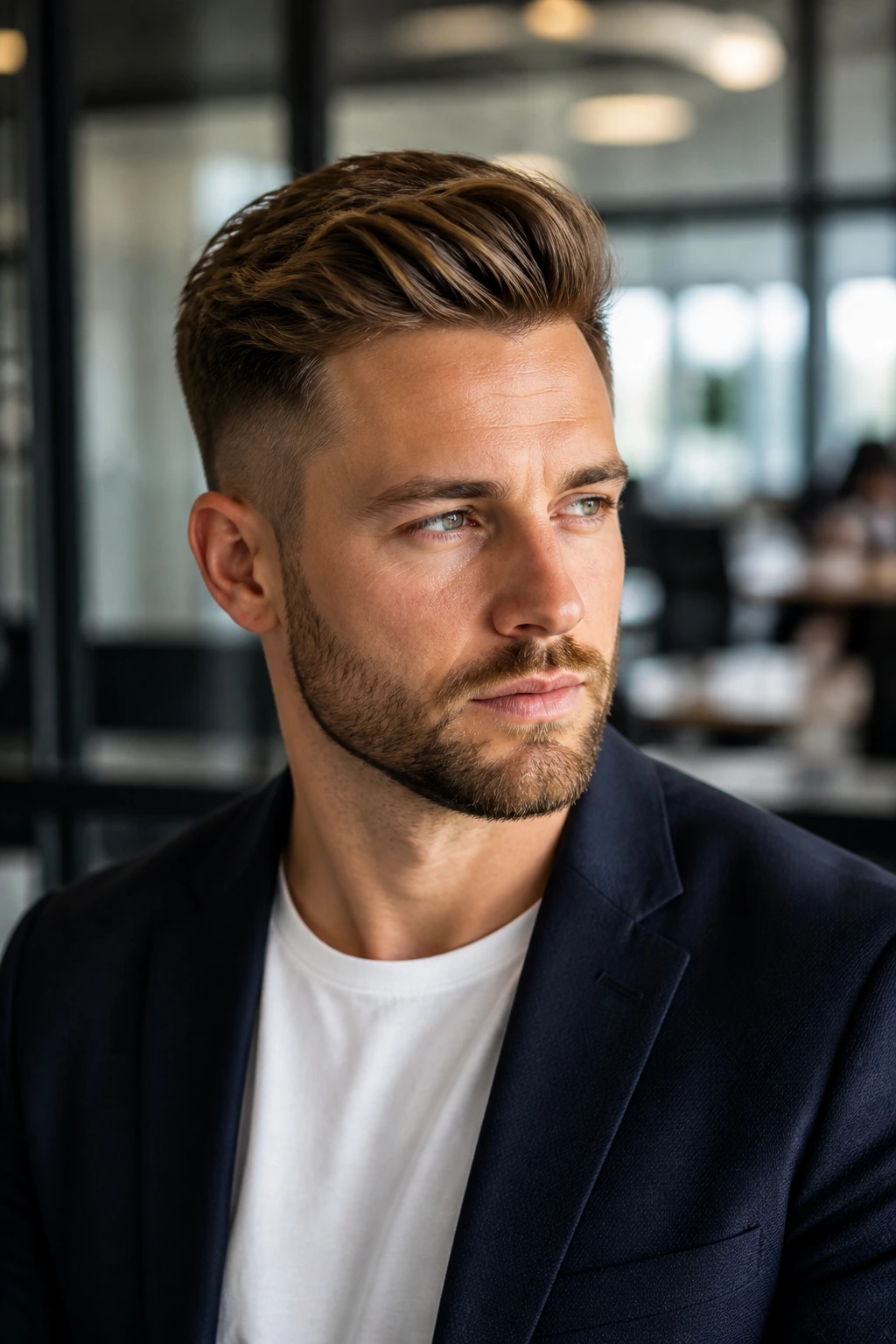
-
Short on time: Most of these styles can be brought back to life with a damp comb, a small dab of product, and 30 seconds in front of the mirror.
-
Dress-code friendly: The list leans toward shapes that read clean under a blazer, a button-down, or a polo that has seen a few wash cycles.
-
Hair-type range: Straight, wavy, curly, thick, and thinning hair all get a place here, because office hair should not be a one-hair-type club.
-
Grow-out friendly: Several of these cuts keep their shape for 4 to 6 weeks, which matters if your schedule is full and your barber isn’t around the corner.
-
Low-shine by design: Matte creams, pastes, and light clays do most of the work here, so your hair looks styled, not shellacked.
-
Easy to describe: You can ask for these by length, taper, and shape. That matters more than saying, “Make it professional,” which is one of the least useful haircut requests on earth.
What Makes a Men’s Work Hairstyle Hold Up Past Lunch

The cleanest office haircut usually has the least drama at the crown. That’s not a glamorous answer, but it’s the right one. If the hair at the back splits open, if the front flops after the first humid walk, or if the sides puff out like a triangle, the whole look starts working against you.
Tapered sides do the heavy lifting
A taper takes bulk out of the ears and neckline, which is where most haircuts start looking messy first. A low taper is the safest move for conservative offices because it keeps the outline neat without shouting for attention. Skin fades can work too, but they shift the cut into sharper territory fast.
Top length decides the tone
Two inches on top reads differently from four. Shorter tops lean tidy and controlled. Longer tops bring in movement, height, or a little softness, which can be useful if your hair is wavy or curly. The key is matching that length to how much time you want to spend styling before you leave the house.
Finish matters more than shine
A lot of work hair goes wrong because of product. Heavy gel and glossy pomade can look fine in a bathroom mirror, then turn greasy under office lights. Matte paste, clay, cream, and light fiber usually read better in real life. They show shape without making the hair look wet all day.
Cowlicks are not small details
They’re the reason some haircuts look perfect in the chair and rude at home. If your hair kicks up at the front or splits at the crown, tell your barber before the scissors come out. A half inch more length in the right spot can save you from fighting your own head every morning.
1. Classic Side Part
A good side part has a quiet kind of confidence. The line is clear, the top sits neatly, and the whole cut looks like it knows where it’s going. It’s one of those men’s work hairstyles that can look formal with a suit and still fine with a sweater or an open collar, which is probably why it never really leaves office rotation.
Why it works at work
The side part is useful because it controls the hair without flattening it into boredom. Keep about 2 to 3 inches on top, taper the sides low or mid, and let the part fall where your hair already wants to split. If the barber forces the part against your grain, you’ll spend every morning repairing the damage.
- Best for: Straight or slightly wavy hair that parts naturally.
- Ask for: 2 to 3 inches on top, a low taper on the sides, and a clean neckline.
- Style with: A light matte cream or soft paste, worked through damp hair.
- Watch for: A hard line that sits too close to the center; that can make the cut feel stiff.
- Trim schedule: Every 3 to 4 weeks if you want the shape to stay sharp.
Pro tip: Comb the front in the direction of the part first, then push the rest back and slightly over. That order matters. It keeps the front from puffing up like a little helmet.
2. Ivy League
The Ivy League is what happens when a crew cut gets a little more polish. It’s short enough to stay civilized, long enough to show some shape, and tidy enough that nobody in the office is wondering whether you forgot to finish your haircut. I like it for men who want low maintenance but still want hair on top that looks intentionally styled.
Unlike a blunt buzz, the Ivy League gives you room to move the front slightly to one side or brush it up with a bit of lift. Keep the sides tapered and the top around 1.5 to 2.5 inches, depending on how thick your hair is. Thicker hair can take a little more length. Fine hair usually looks better shorter, because too much length makes it lie flat and thin.
It’s also one of the easiest styles to grow out. That matters more than people admit. A cut that stays acceptable at week five is worth more than a cut that looks perfect for four days and weird for the rest of the month.
3. Low Taper Fade with a Short Top
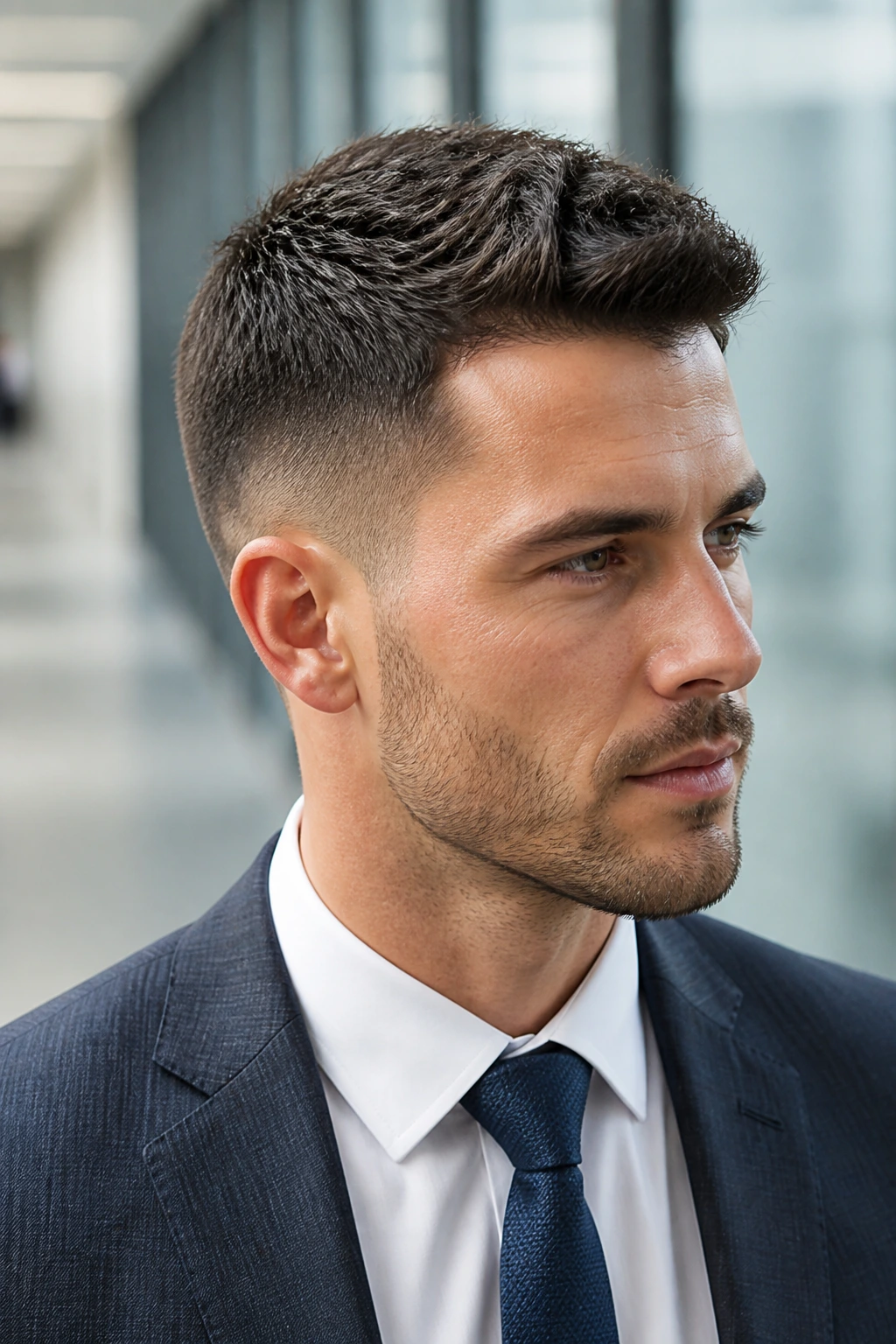
Can a fade look office-appropriate? Absolutely, if you keep your top short and the fade low enough that the haircut doesn’t start screaming from across the room. The low taper fade is the safer version of the fade family. It cleans up the sides and neckline without making the cut feel too aggressive for a conservative workplace.
How to ask for it
Tell your barber you want a low taper, not a high skin fade, unless your office is very relaxed. Keep the top around 1 to 2 inches if you want the style to stay understated. A little texture on top helps the haircut look modern, but the shape should stay close to the head.
- Best for: Straight, thick, or slightly wavy hair.
- Top length: 1 to 2 inches.
- Side length: Low taper around the temples and neckline.
- Product: Matte clay or paste, used sparingly.
- Good in: Jobs where clean edges matter more than formal polish.
A low taper fade shines when you don’t overstyle it. Push the top forward a little, separate it with your fingers, and leave the shine alone. The shape does the work.
4. Textured Crop
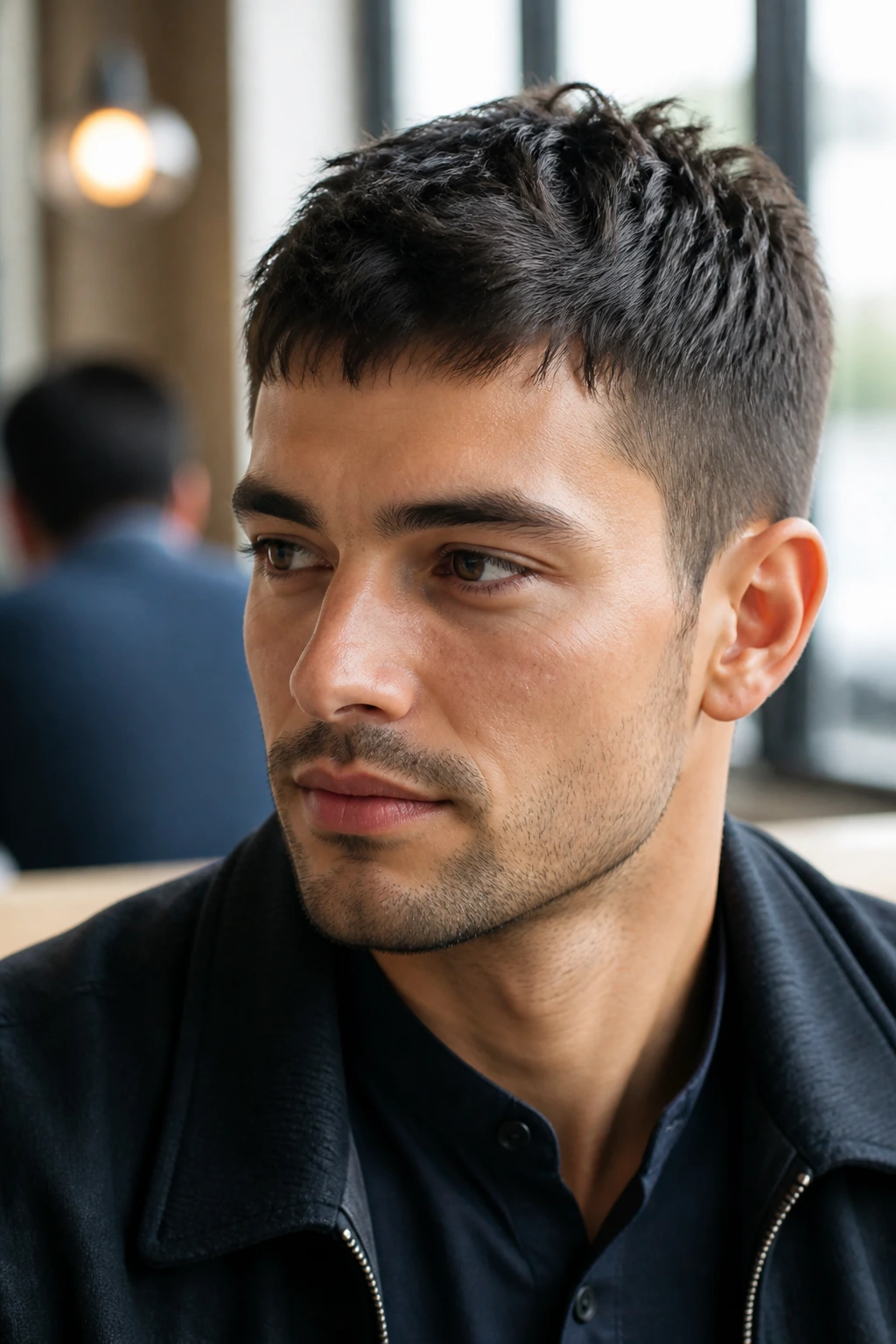
If your hair puffs up on the commute or rebels the moment humidity shows up, the textured crop is the haircut that stops arguing with you. The top is short, choppy, and deliberately uneven in a good way. The fringe can sit forward or slightly broken up, which makes the cut feel modern without asking for a lot of product.
This style works because it doesn’t depend on perfect smoothness. That’s the whole point. A textured crop looks better with a little grit, especially if your hair is thick and tends to stand up on its own. Keep the sides tight enough to frame the top, then ask for texture on the crown so the hair doesn’t stack into a block.
A lot of barbers will use scissors over the top instead of clippers, which helps break up bulk. That matters if you have heavy hair. Heavy hair can look blunt fast. Softening the top makes the cut easier to style and easier to grow out.
5. Low Quiff

A low quiff gives you lift without turning your head into a billboard. That’s the version I prefer for work. It keeps a little height at the front, brushes back just enough to look intentional, and doesn’t need the large, glossy shape that makes a full pompadour feel too dressed up for most offices.
The trick is restraint. Keep the front long enough to stand up with a blow-dryer, usually around 2.5 to 3.5 inches, but not so long that it collapses under its own weight. The sides should stay tapered and neat so the volume at the front has room to breathe. If the sides are too bulky, the quiff starts looking top-heavy.
Use a round brush or your fingers to direct the front up and back while the hair is still damp. A pea-sized amount of matte paste is usually enough. Too much product will pull the hair down and make the lift disappear by lunch.
6. Crew Cut

The crew cut is the haircut equivalent of a pressed shirt. It’s clean, easy to live with, and hard to mess up. Compared with a buzz cut, it leaves a little more length on top, which gives the cut shape instead of just length-as-a-number. That small difference matters more than people think.
This is a good option if your mornings are already full. If you work out early, wear headphones, or spend half the day moving between rooms, the crew cut stays out of the way. Keep the top around half an inch to 1 inch, with the sides tapered shorter so the head keeps a natural shape. Too much bulk at the sides makes it look square.
The crew cut also behaves well on hair that wants to stand up. It won’t erase a cowlick, but it softens the fight. A little cream or no product at all can be enough, which is why it’s such a useful cut for busy weeks.
7. Buzz Cut with a Skin Taper
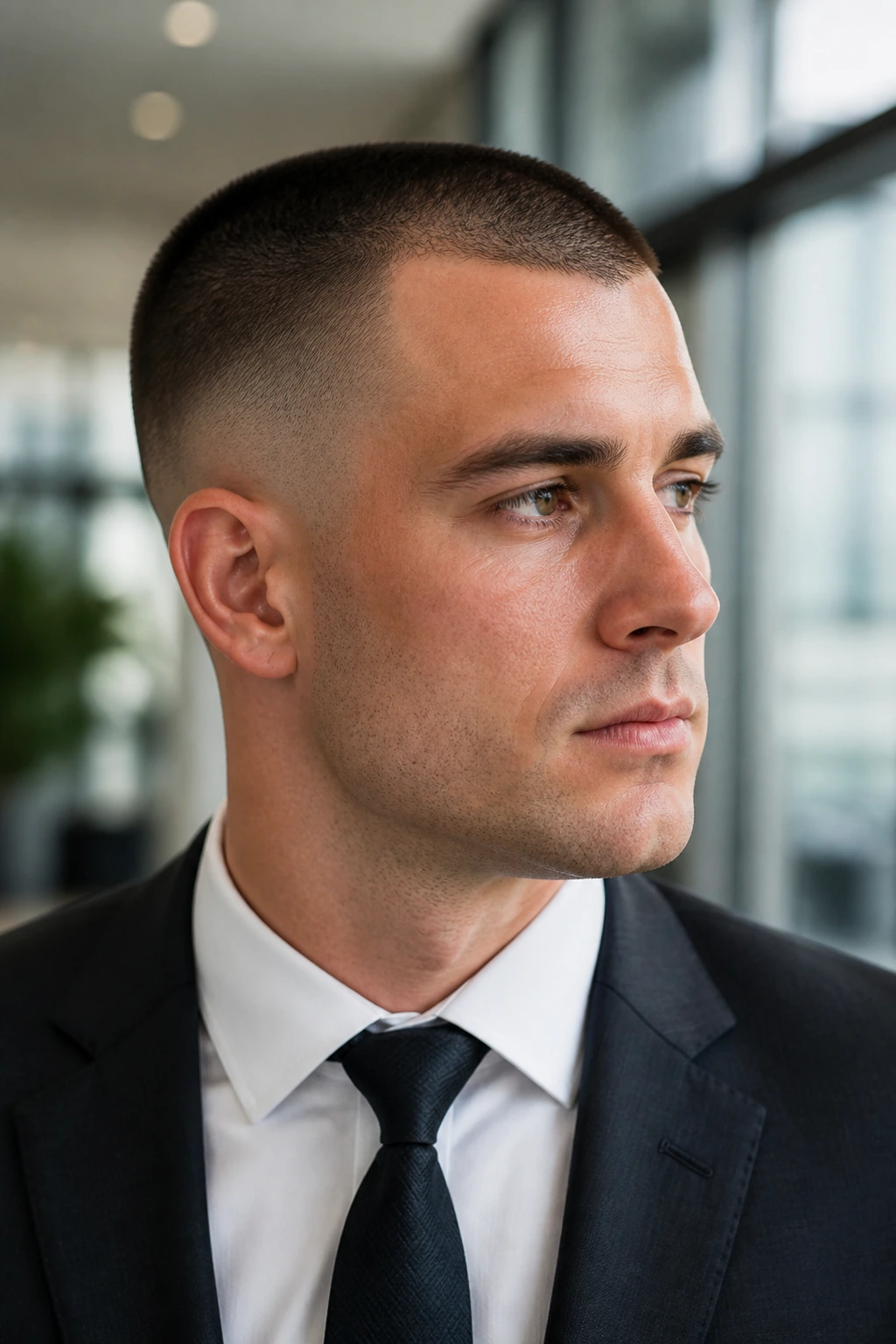
There are mornings when a comb feels like extra baggage. The buzz cut exists for those mornings. Add a skin taper around the ears and neckline, and the cut stops looking bare and starts looking deliberate. That crisp edge is the difference between “I gave up” and “I know exactly what I’m doing.”
What to keep in mind
A buzz cut is not one single length. You can run a #2 or #3 guard on top for a softer look, or go shorter if your hair is dense and you want less bulk. The skin taper should stay clean and even, especially around the temples. If the line is sloppy, the whole cut loses its shape fast.
- Best for: Strong hairlines, dense hair, or anyone who wants zero styling time.
- Top length: Usually #1 to #3 guard.
- Side detail: Skin taper or low fade for a sharper outline.
- Maintenance: Every 2 to 3 weeks if you want the edges to stay crisp.
- Product: Usually none.
This one is blunt, but useful. It works especially well if you sweat a lot or wear helmets, headphones, or hats during the day. There’s no product buildup, no fringe to battle, no surprise collapse when the weather shifts.
8. Slick Back Taper
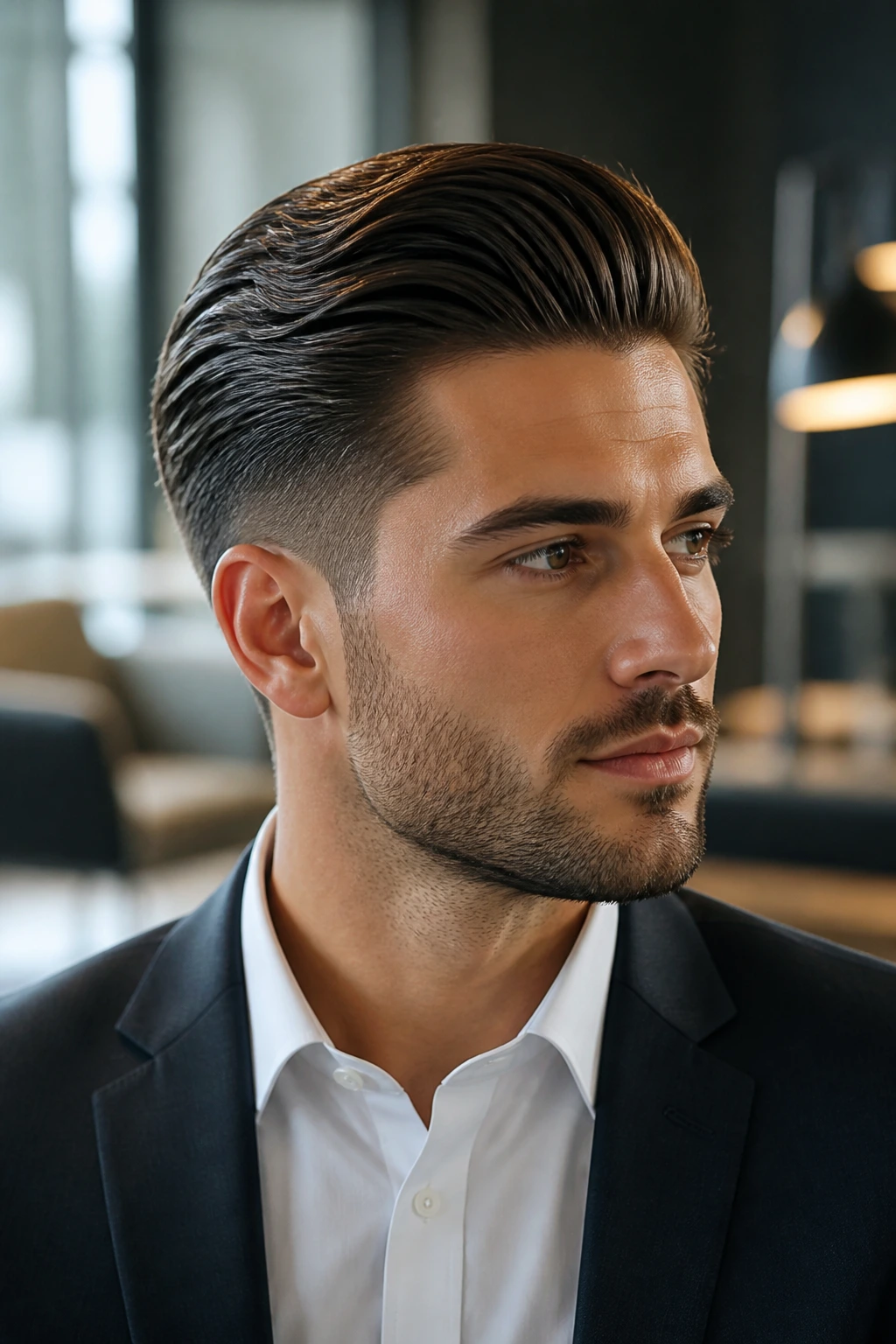
Why does the slick back still work in an office? Because when it’s cut well, it looks controlled rather than flashy. The modern version is softer than the old, shiny, wall-of-hair look. You want enough length on top to brush straight back, but not so much that the style starts sliding into nightlife territory.
Best for hair that lies flat
Straight or slightly wavy hair handles this cut best. Keep the top around 3 to 4 inches, with the sides tapered and the weight removed around the temples. A light pomade or cream gives shape without turning the hair into a slick, hard shell. If your hair is fine, skip the heavy stuff. It will collapse.
What matters most is direction. Blow-dry the hair back while it’s damp, then use your fingers or a comb to set the top. If you skip the drying step and slap product on wet hair, you usually end up with a flatter, greasier version of the same idea. Not good.
A slick back taper is especially good if you have a longer face shape or a strong jaw. The volume goes backward, not upward, so the shape stays sleek and controlled.
9. Modern Comb Over

A modern comb over is not the desperate version people joke about. Done well, it’s one of the cleanest office styles around. The difference is in the intention. You’re not trying to hide hair loss with a blanket. You’re moving the hair into a controlled shape with a clear part and a little lift at the front.
The best version keeps the top long enough to move, usually 2 to 3 inches, and the sides tight enough that the part stands out. A mid taper works nicely because it keeps the haircut from feeling too severe. If your hair is thinning, the modern comb over can still work, but the hair should be moved, not dragged. Dragging hair across a wide area is where the old, awkward version starts.
Use a light matte product and a fine comb. Comb the top in sections so you don’t flatten all the texture out at once. That bit of separation helps the style read fuller and more natural under office lighting.
10. Caesar Cut
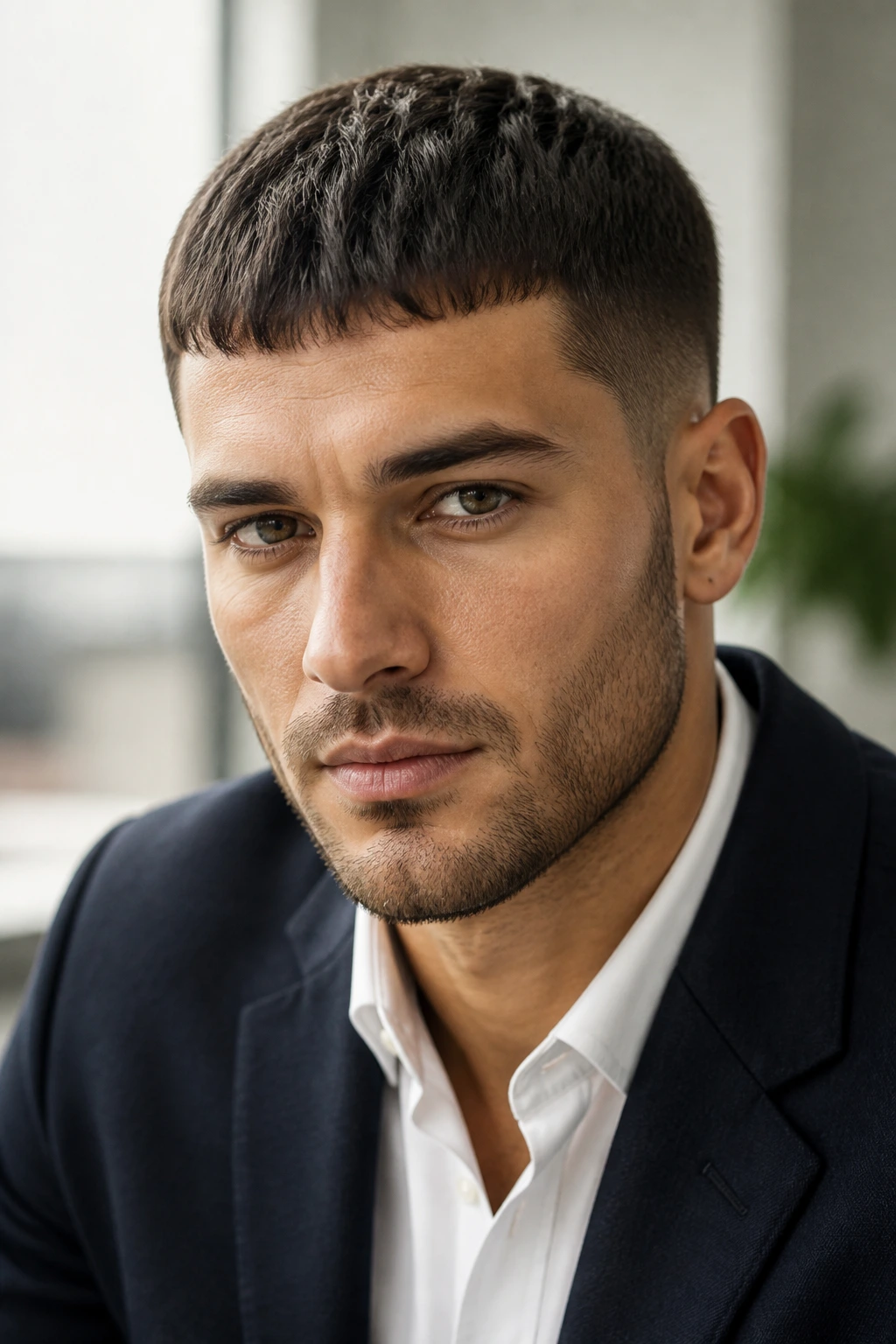
The Caesar cut is short, direct, and strangely underrated for work. The fringe sits forward in a straight or slightly textured line, which keeps the style low-maintenance and tidy. It works especially well if you want something that doesn’t depend on a strong side part or a lot of height.
The cut suits thicker hair and can also help make a receding hairline look more intentional because the front stays short and controlled. Keep the length around 1 to 1.5 inches on top, with the fringe cut blunt enough to show a shape but textured enough not to feel heavy. If the top gets too long, the whole thing starts to look like a tired bowl cut. Nobody needs that.
Quick fit check
- Use it if: You want a short style that still has personality.
- Avoid it if: You need a lot of height at the front.
- Style with: A tiny amount of matte paste, applied mostly to the fringe.
- Best for: Thick, straight, or slightly wavy hair.
- Trim cadence: Every 3 to 4 weeks keeps the front neat.
The Caesar is one of those cuts that looks cleaner the less you fuss with it. That’s a nice trait when you’re getting ready before sunrise.
11. French Crop
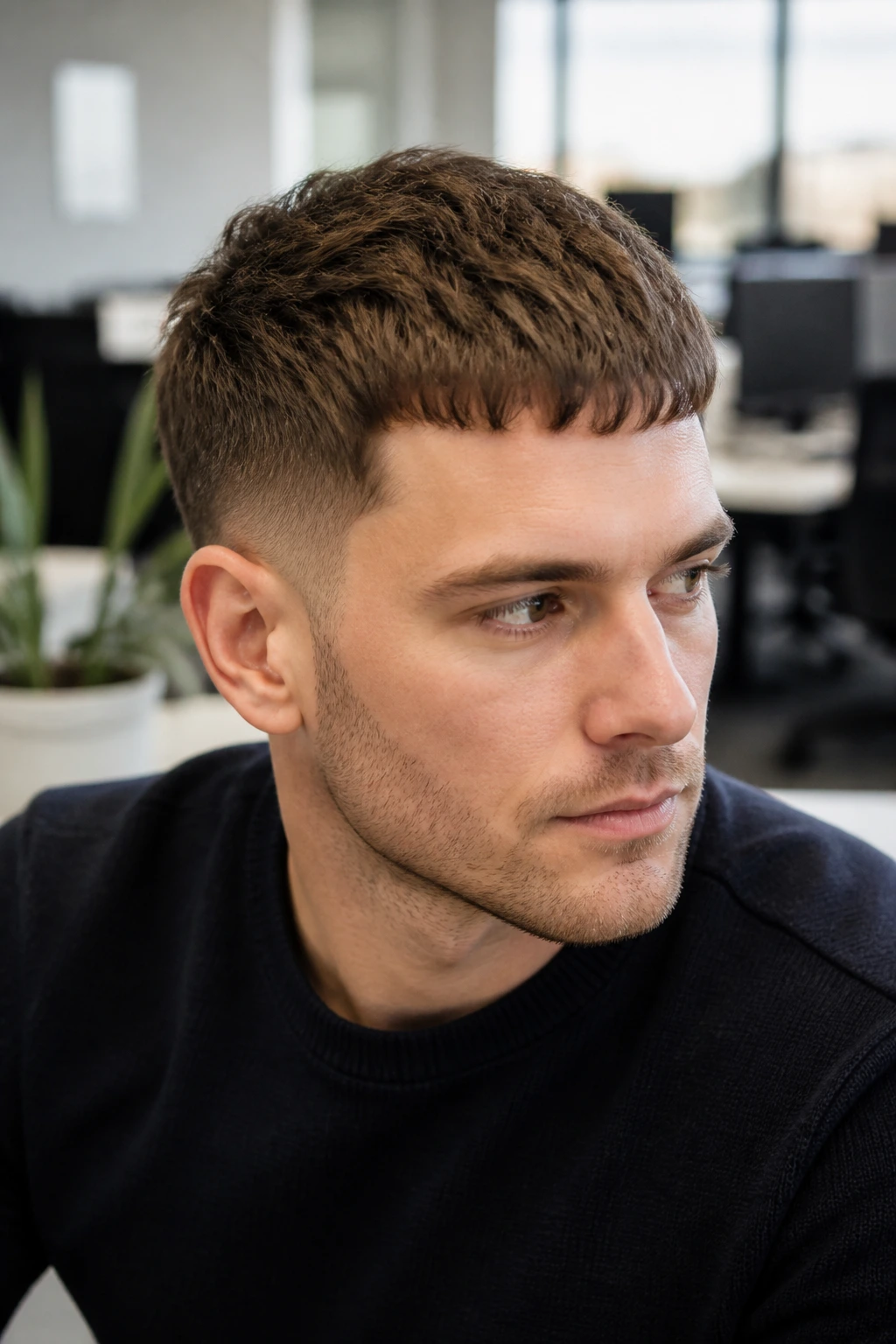
The French crop is the Caesar’s more textured cousin. It keeps the fringe forward, but the edges are softer and the top often carries a little more movement. The result is still office-safe, just less rigid. If the Caesar is a crisp white shirt, the French crop is a washed Oxford that doesn’t need ironing every time you wear it.
It tends to work well on thick hair because the crop takes bulk off the top and keeps the shape compact. Ask for a faded or tapered side and a textured top with a short fringe. If your barber cuts the fringe too heavy, the style can look dense fast. That’s the one thing to watch.
I like this cut for men who want a short haircut that doesn’t feel too formal. It pairs well with casual offices, dark-framed glasses, and clean stubble. If your job runs a little relaxed but you still want sharp edges, this one lands in the right middle.
12. Short Pompadour
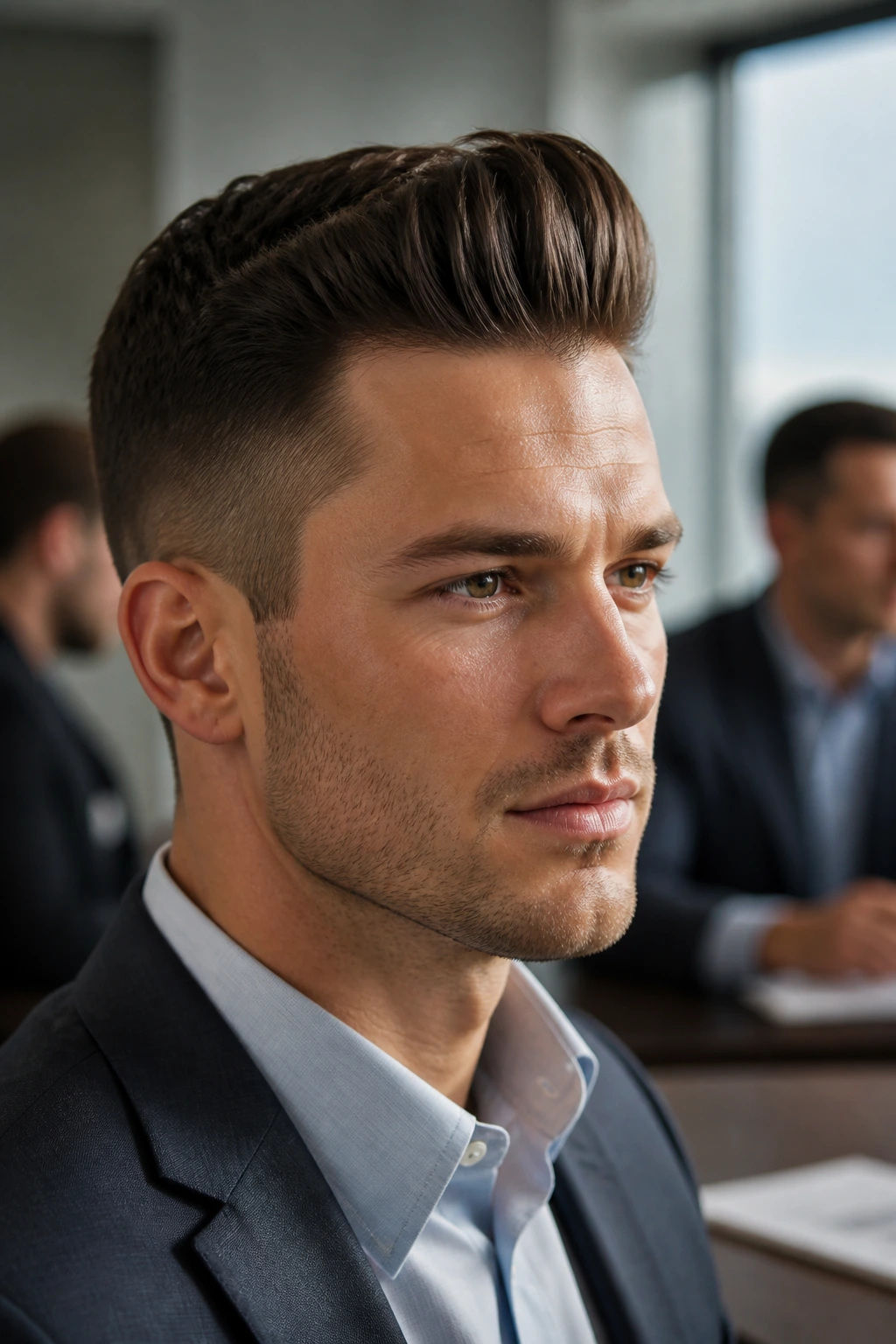
Need height without turning your forehead into the main event? Keep the pompadour short. A compact pompadour gives you lift at the front, a little shape through the crown, and enough structure to read polished in a meeting. Leave the dramatic volume for people who are in a different line of work.
The sides should stay tight, usually with a low or mid taper, so the front can rise without the haircut swelling on the sides. The top usually needs around 3 inches at the front, maybe a little more if your hair is thick and holds shape well. Blow-drying matters here. A lot. If you skip it, the hair tends to fold back on itself instead of building that rounded front.
What keeps it looking right
A short pompadour should look controlled, not stiff. Use a medium-hold matte product or a light pomade with low shine. Brush the front up and back, but keep the curve soft. Sharp corners make the style feel old-fashioned in a bad way. Soft height is the goal.
This cut works best when you’re willing to spend a minute on it. Not ten. One minute. Maybe two on a rough morning.
13. Regulation Cut
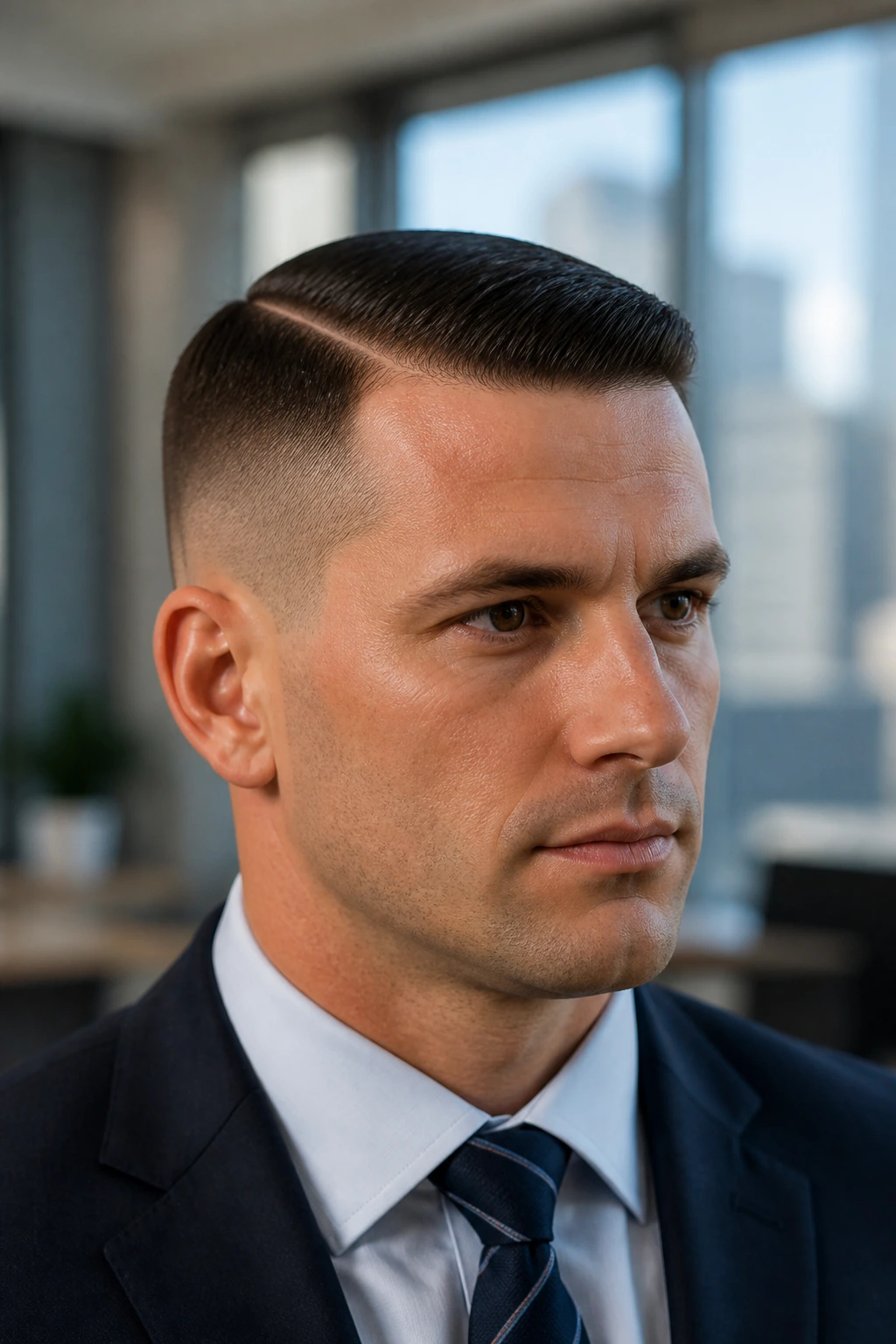
The regulation cut has military roots, and you can feel that in the shape. It’s crisp, close, and clean without being flashy. There’s usually a clear part, short sides, and a top that stays practical rather than decorative. That makes it one of the easiest styles to wear in a formal workplace.
It’s the haircut version of a pressed oxford shirt and polished shoes. Straight lines. No nonsense. If you like your hair to disappear into the overall look instead of becoming the point of the look, this is a solid choice. It also grows out in a controlled way, which is helpful if you don’t want to chase the barber every two weeks.
Use a comb and a touch of light cream or paste. The product should help the hair sit where it belongs, not add shine or bulk. If your hair is thick, your barber can remove weight through the top so the cut sits flatter. If your hair is fine, keep the top shorter so it doesn’t collapse.
14. Curly Top with Tapered Sides
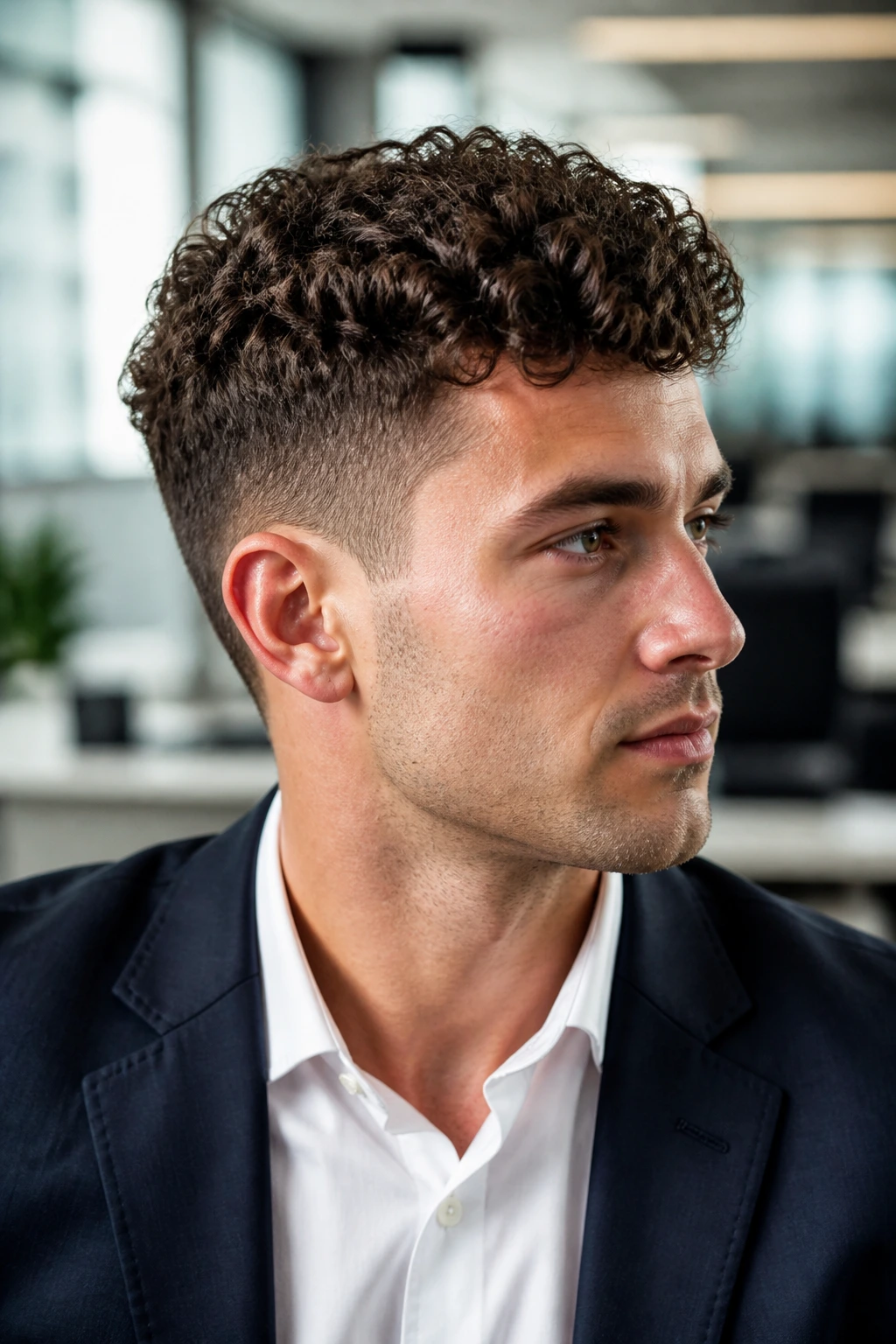
Curly hair does not need to be flattened to look work-ready. That mistake gets made all the time, and it usually makes the hair look puffier, not tidier. A curly top with tapered sides keeps the texture where it belongs and gives the whole cut a clean frame.
The sides should stay tight, but not shaved down to nothing unless your curls are extremely dense and you want a sharper outline. On top, keep enough length for the curls to form naturally. That might mean 2 to 4 inches depending on curl pattern. Shorter than that, and you risk losing the shape of the curl. Longer than that, and the top can start to spread.
Use leave-in conditioner or a light curl cream while the hair is damp, then let it dry with some air movement or a diffuser on low heat. Do not rough it up with a towel. That creates frizz, and frizz is what makes curly office hair look tired before lunch. Clean sides, controlled curls on top, done.
15. Brushed-Back Medium Length

Medium-length hair can still look disciplined if the cut underneath is doing its job. Brushed-back styles are a good fit when you want hair that moves, but not hair that falls over your eyes every time you lean forward. The shape is relaxed, but it’s not sloppy.
When this style makes sense
- Hair length: Usually 3 to 5 inches on top.
- Hair type: Wavy hair often takes to it fast; straight hair needs more blow-drying.
- Product: A light cream or soft paste, not a heavy wax.
- Best setting: Offices that allow a little personality in the haircut.
- Watch for: Ends that puff out if the layers are too blunt.
The brushed-back look works because it follows the natural direction of the hair. That makes the style easier to live with than trying to force a side part that your hair doesn’t want. If you wear glasses, this cut can also keep the hair off the frames without looking too polished.
A quick finger-comb after the blow-dry is usually enough. If you need a stronger hold, use a little more product at the front and crown, not all over. That keeps the sides from getting heavy.
16. Low Knot or Man Bun
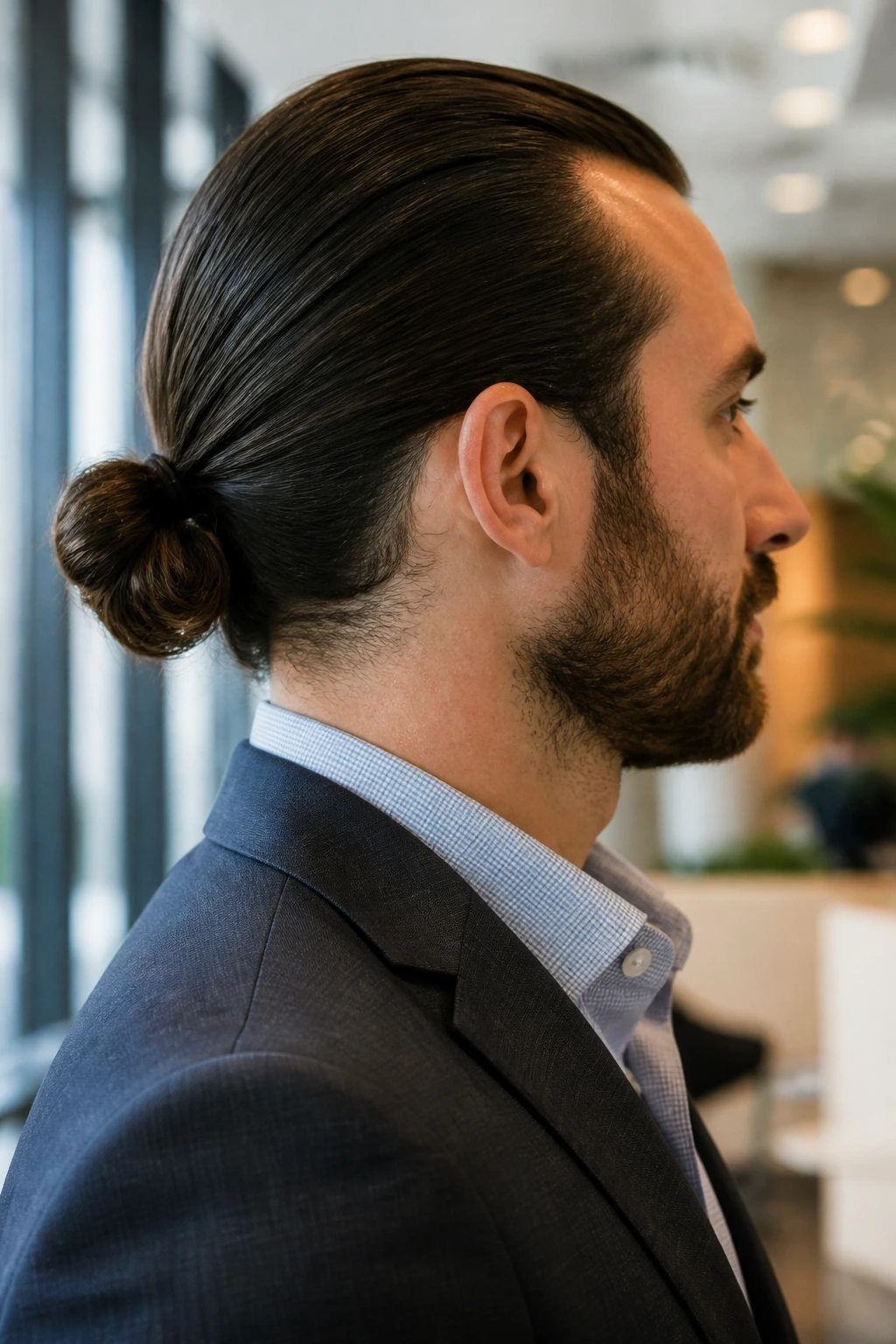
If your hair reaches the collar, a low knot can look tidy when the rest of the cut is clean. The main rule is simple: the bun should sit low, compact, and smooth. A high, loose knot with flyaways everywhere tends to look like a gym decision, not a work decision.
This style is best when the hair is healthy and the line around the ears and neckline has been cleaned up. The contrast matters. A neat perimeter makes the longer hair feel intentional. Without it, the style can look unfinished even if the bun itself is tied well.
Keep the tie at the nape, not halfway up the back of the head. Use a thin elastic, gather the hair without yanking it tight, and smooth the surface with a small amount of cream if needed. If your office is conservative, this style needs an especially tidy finish. If your office is relaxed, you’ve got more room.
17. Hard Part with Mid Fade
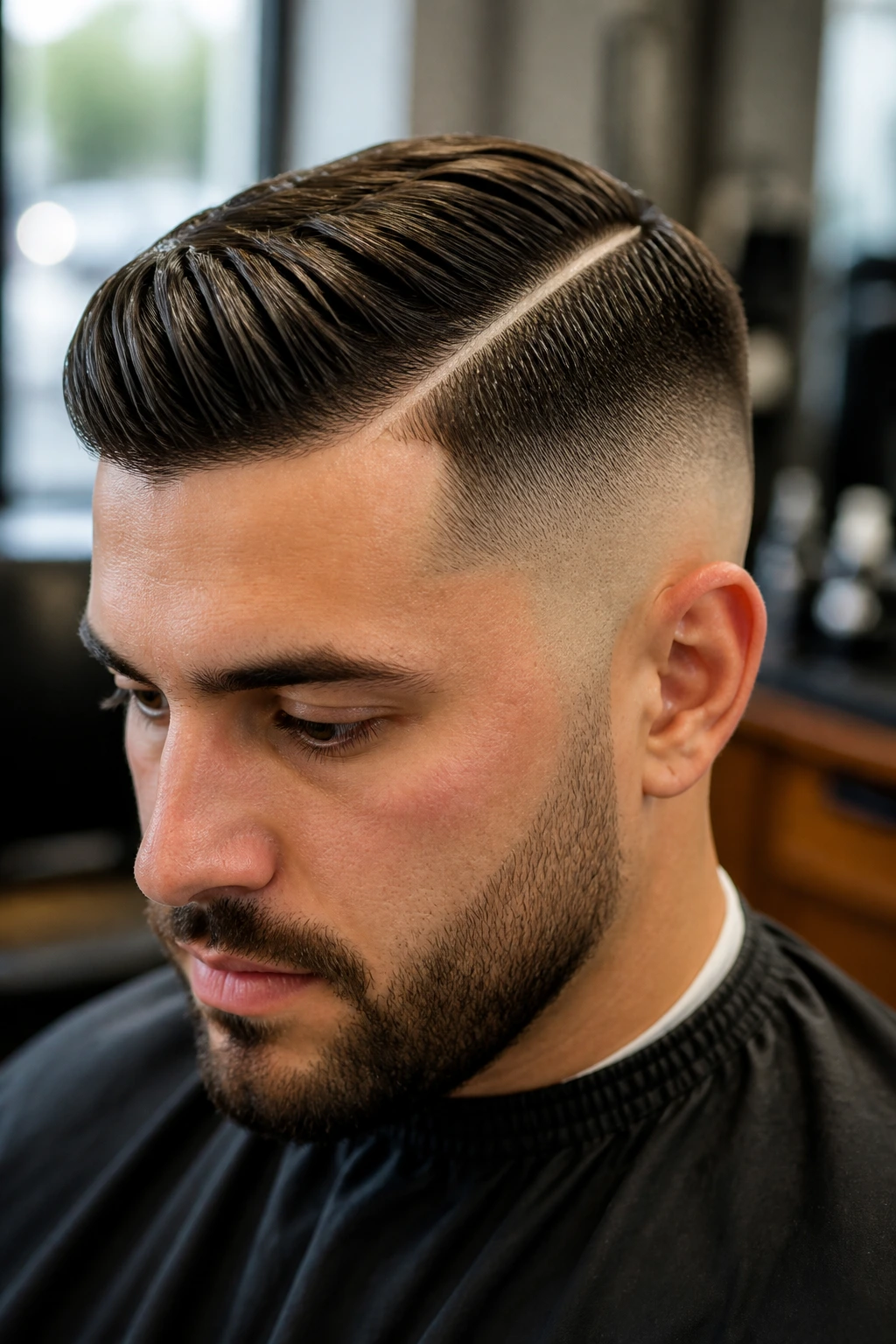
Compared with a classic side part, a hard part gives the shape a clearer edge. That line can be useful if your hair is thick, straight, or naturally resistant to lying where you want it. The mid fade helps keep the sides clean while the hard part makes the structure obvious.
The catch is maintenance. A hard part looks sharp when it’s fresh and less sharp once it starts growing out. If you like a haircut that stays neat for five weeks with almost no thought, this may not be your first pick. If you want a crisp, defined shape and you don’t mind barber visits every 2 to 3 weeks, it earns its place.
Ask for a mid fade that doesn’t rise too high on the head, a top around 2 inches, and the part cut in clearly but not carved so deep that it looks harsh. Use a comb and a touch of matte product. The part should guide the hair, not trap it.
The Tools That Keep These Styles Looking Intentional
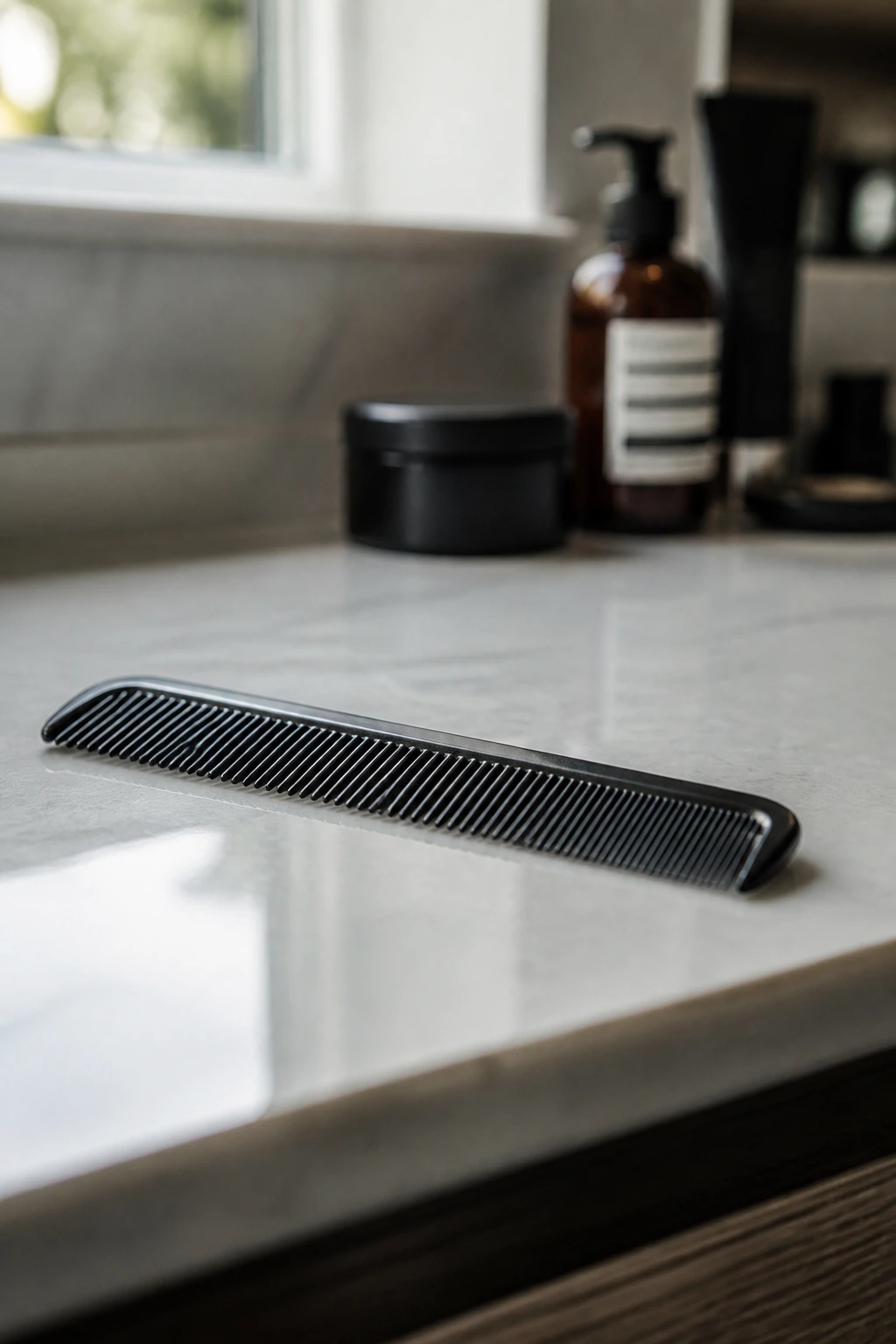
A work haircut is only half the story. The other half lives in the bathroom drawer, and that drawer does not need to be full.
- Fine-tooth comb: Best for side parts, comb overs, and regulation cuts when you want clean direction.
- Wide-tooth comb: Easier on curly or medium-length hair; helps separate without ripping through knots.
- Vent brush: Good for blow-drying lift into quiffs, pompadours, and brushed-back styles.
- Blow dryer with concentrator nozzle: Directs air where you want it and keeps frizz down.
- Matte clay or paste: Adds hold with less shine, which is usually the safer office look.
- Light styling cream: Useful for longer hair, curls, and anyone who hates stiff product.
- Hair powder or fiber: Handy for thinning hair when you want texture and a bit of lift at the roots.
- Microfiber towel: Dries hair without roughing up the cuticle as much as a bath towel.
- Small trimmer: Great for cleaning sideburns and the neckline between barber visits.
- Hand mirror: Saves you from guessing what the back of your head looks like. Never guess.
How to Tell Your Barber What You Actually Want
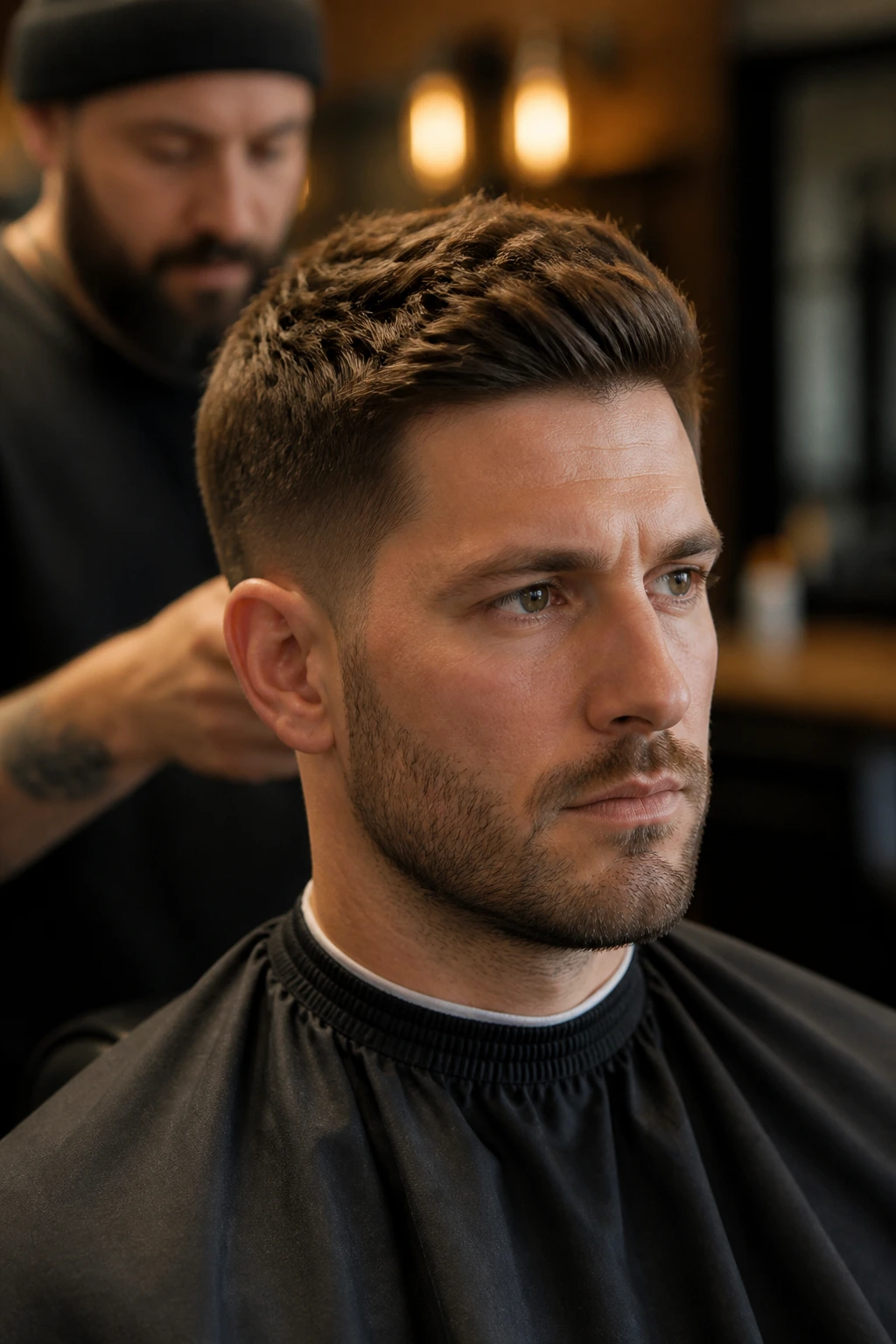
“Make it professional” is not a haircut instruction. It’s a shrug. Barbers can work with that if they know your hair well, but most of the time you’ll get a generic short cut that may or may not suit your face or your daily routine.
Say the numbers first
Bring a photo if you want, but also say the length. “Two inches on top, low taper on the sides, keep the part natural,” is useful. “Short on the sides, longer on top” is a little too vague. If you already know your guard numbers, say them. If not, describe the result you want in plain words: cleaner neckline, less bulk at the temples, a little more length in the front.
Point out the annoying parts
Cowlick at the front? Say it. Double crown? Say it. Receding corners? Mention it before the barber starts cutting. A good barber can build around those things, but only if they know they’re there. The same goes for curly hair, dense hair, or a hairline that sits lower or higher than average.
Talk about your maintenance level
If you only want to visit every 6 weeks, ask for a cut that grows out softly. If you don’t mind seeing the barber more often, you can go sharper with a hard part, a tighter fade, or a shorter crop. Haircuts are easier when they match your calendar. That part gets skipped too often.
How These Cuts Fit With Shirts, Jackets, and Beards
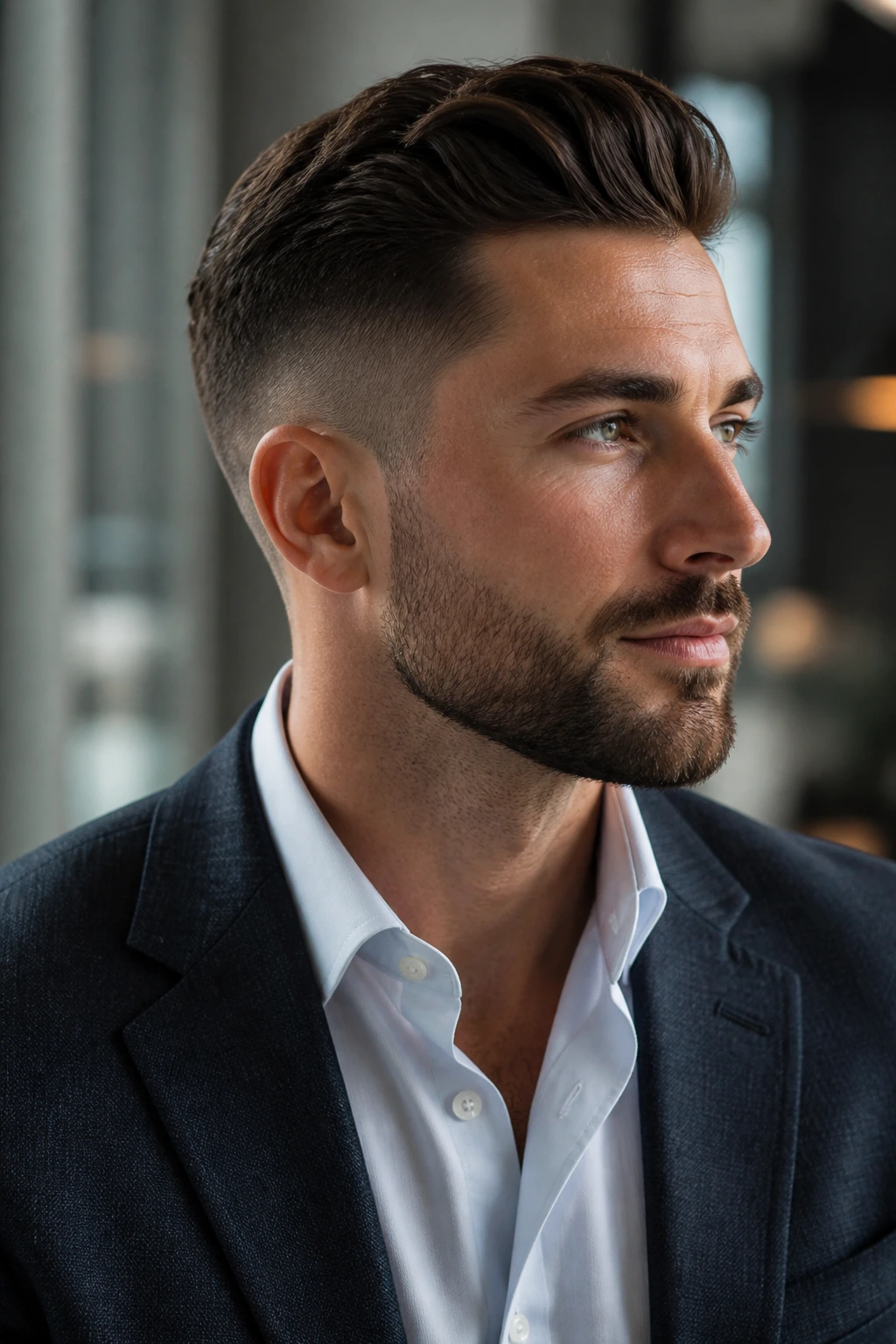
A work hairstyle doesn’t live alone. It sits next to your collar, your beard, your glasses, and the shape of the rest of your face. Get those combinations right, and the haircut looks sharper. Get them wrong, and even a good cut can feel off.
Presentation: A side part, regulation cut, or Ivy League looks cleanest when the neckline is neat and the temples are tidy. Textured crops and curly tops can handle a little more looseness, but the outline still needs to be crisp enough that the cut reads deliberate from a few feet away.
Accompaniments: Short beards usually pair well with low tapers, slick backs, and comb overs because the jawline has enough structure to hold the balance. If you wear glasses, consider cuts with a little less bulk at the temples so the frames don’t fight the hair. Open-collar shirts and knit polos can handle a softer, more textured cut; a suit jacket usually looks best with cleaner sides and less height.
Portions: In haircut terms, “portions” means how much length and height you let each area keep. If your office is strict, keep the top shorter and the side taper tighter. If your office leans relaxed, you can leave more movement on top or wear a medium-length brushed-back style without it feeling out of place.
Finish: Matte finish is the safest bet for day-to-day work. A little sheen can help a slick back or hard part look refined, but glossy product on a side part or crop tends to read greasy under bright office light.
Small Styling Moves That Make a Big Difference
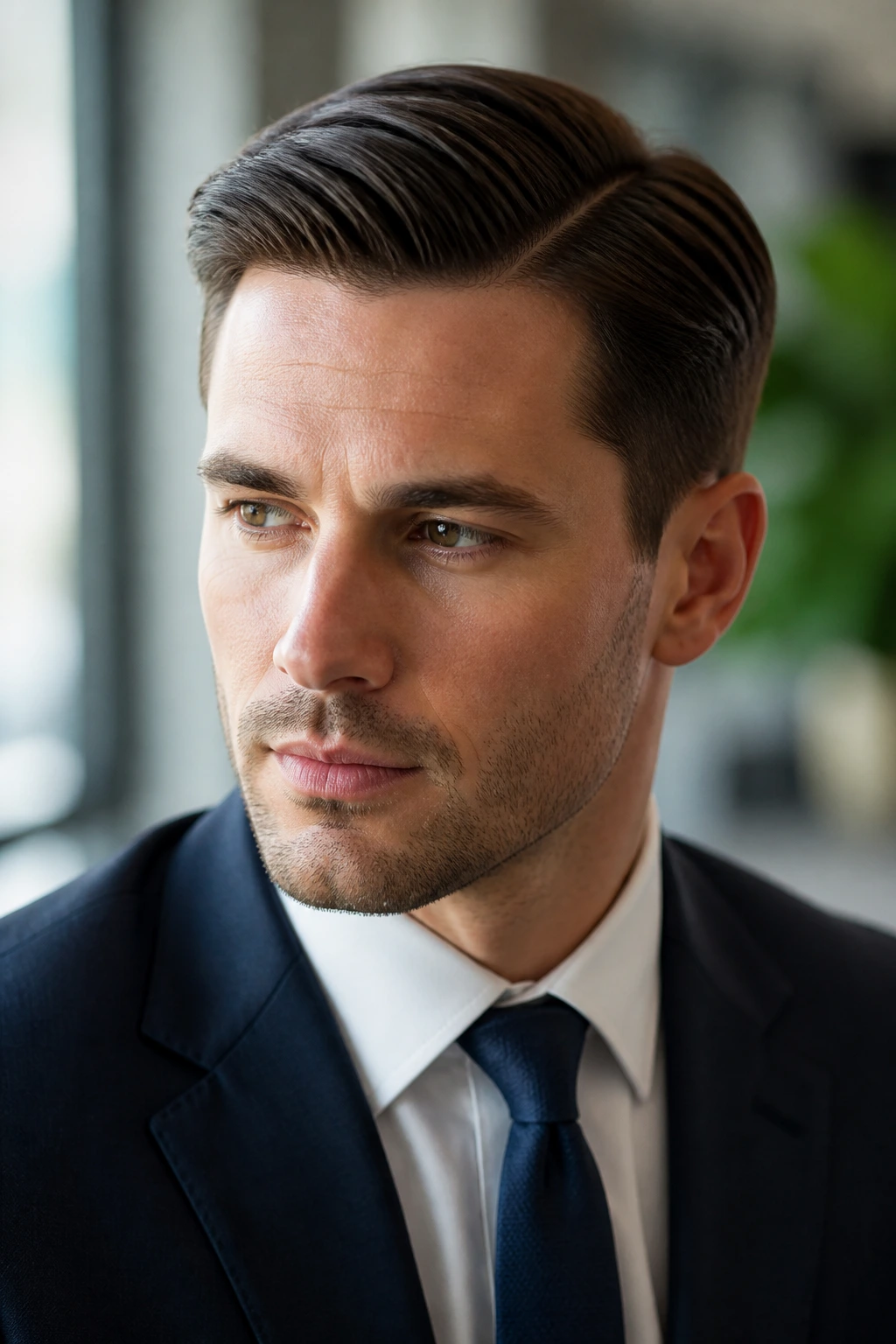
Most office hair improvements are boring in the best possible way. They’re the little moves nobody posts about, because they don’t look dramatic in a photo. They just make the cut behave.
Texture Enhancement: Blow-dry the front in the direction you want it to sit, then hit it with the cool shot for 5 to 10 seconds. That sets the shape better than letting it air-dry in whatever direction it feels like taking.
Time-Saver: Keep a spray bottle with water near the sink. A few spritzes are often enough to reset a flat side part, a stubborn cowlick, or a brushed-back style that went sideways overnight.
Pro Move: Start with less product than you think you need. A pea-sized amount of paste or cream usually covers more ground than people expect. If you add product in stages, you avoid the heavy, sticky finish that makes hair look overworked.
Make-It-Yours: Straight hair usually handles clay, paste, and fiber well. Wavy hair likes a light cream or paste with some grip. Curly hair usually looks better with curl cream or leave-in conditioner than with a stiff hold product that crunches the curl pattern.
The Mistakes That Make a Good Work Cut Look Off

The haircut itself is rarely the whole problem. Usually it’s one small choice that throws the rest off, and then the style starts looking harder than it should.
Asking for “professional” without details: This is the fastest route to a bland haircut. You’ll usually get something short, safe, and not especially flattering. Fix it by giving lengths, taper type, and the amount of daily styling you’re willing to do.
Using too much shiny product: A slick, wet finish can read greasy in office lighting. It also tends to collapse finer hair. Switch to matte paste, clay, cream, or fiber, and use less than your first instinct tells you.
Cutting the sides too high too fast: High fades and aggressive disconnects can look sharp in the right setting, but they’re not the safest office choice for every job. If you want a cut that reads cleaner for more people, go low or mid on the taper.
Ignoring the crown: A bad crown will fight every style you own. If your hair splits there, leave more length and use a blow-dryer to direct it before you add product.
Waiting too long between trims: Even good cuts start looking fuzzy when the neckline and sideburns grow out. Short styles usually need a trim every 2 to 4 weeks. Medium-length styles can stretch farther, but only if the shape is still holding.
Variations and Adaptations to Try
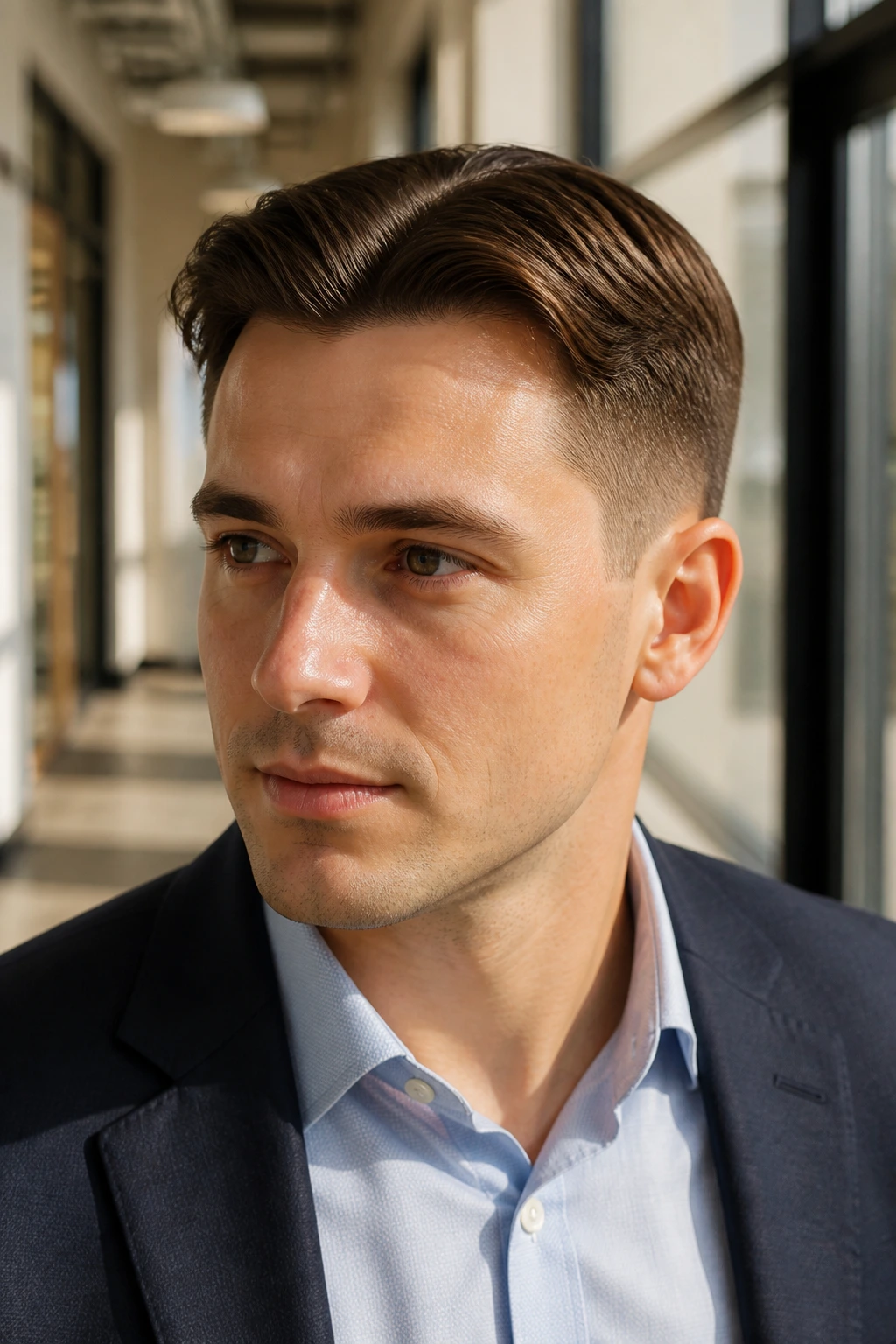
The Five-Minute Office Cut: Ask for a low taper, short top, and enough length to part naturally. This version works well if you want almost no morning effort and don’t care about having much lift or texture.
The Thinning-Hair Rescue Cut: Keep the sides tight, leave a little more length on top, and use matte powder or fiber instead of heavy cream. That combination makes the top look fuller without turning it stiff.
The Curly-Hair Control Version: Leave more length where the curls live and taper the sides cleanly. Use leave-in conditioner and a curl cream, then keep your hands out of it once it dries. Curly hair looks better when it’s allowed to form.
The Conservative Boardroom Edit: Shorter top, lower taper, minimal shine, and no hard line at the part. This is the safe choice for client-facing roles or offices that prefer a more traditional look.
The Relaxed Creative Office Version: Add a little more texture, a touch more length at the front, and a looser finish. Textured crops, brushed-back medium cuts, and low quiffs all fit here without looking careless.
The Receding-Hairline Smart Cut: Caesar, French crop, or a short comb over with a natural part. These cuts work with the hairline instead of pretending it isn’t there, which usually looks better than trying to stretch hair over thin areas.
Keeping the Shape Between Cuts

A work haircut only looks good if it keeps its outline long enough to matter. That means the upkeep matters almost as much as the initial cut.
Short styles like the crew cut, buzz cut, and textured crop usually need a trim every 2 to 4 weeks if you want the edges to stay crisp. Side parts, Ivy League cuts, and regulation cuts can often go 3 to 5 weeks before they start looking soft. Medium-length styles, like brushed-back hair or a low quiff, may stretch to 6 or 8 weeks if the layers are still behaving.
Washing plays a bigger role than people think. If your scalp gets oily fast or you use a lot of product, shampooing 3 to 4 times a week can keep the shape from going limp. If your hair is dry, curly, or color-treated, fewer washes and more conditioner usually work better. A dry shampoo can help in a pinch, but it’s a patch, not a cure.
For overnight care, a silk or satin pillowcase can cut down on frizz and flattened sides. If you wear a longer style, loosely tying it before bed can keep the ends from knotting up. In the morning, mist the hair with water, hit the problem spot with a comb or brush, and use the smallest amount of product needed to restore the shape.
Questions Men Ask Before They Sit in the Chair
What is the most professional haircut for men at work?
A classic side part, Ivy League, regulation cut, or low taper fade usually lands best in formal settings. They keep the shape neat without leaning too trendy, and they grow out in a controlled way.
Can I wear a fade in a conservative office?
Yes, if the fade stays low or mid and the top isn’t styled into something loud. A skin fade with a tall quiff is a different message. A low taper with a short top is much easier to wear in strict workplaces.
Which work hairstyle is best for thinning hair?
Short, controlled styles usually help most: a Caesar cut, a modern comb over, or a short textured crop. They reduce the contrast between thicker and thinner areas and look better when you use matte products instead of heavy shine.
What if my hair is curly?
Keep the curls on top and taper the sides cleanly. Curly hair looks more polished when it’s shaped, hydrated, and left alone after styling. Fighting the curl pattern with too much gel usually makes things worse.
How short should the sides be?
For most offices, a low or mid taper is the safest starting point. If your workplace is relaxed, you can go shorter. If it’s formal, keep the taper softer and avoid a harsh disconnect unless your barber knows your hair well.
How often should I get a trim?
Short cuts usually need attention every 2 to 4 weeks. Medium-length cuts can often wait 4 to 6 weeks. If the neckline starts fuzzing out before that, book sooner; the back of the cut is usually the first thing to look tired.
Can longer hair still look professional?
Yes, if the hair is clean, controlled, and pulled into a neat low knot or brushed back without flyaways. The real issue is not the length. It’s whether the shape looks intentional.
What if my hair sticks up in the morning?
Dampen the trouble area with water, then apply a tiny amount of product and direct it with a comb or brush before it dries. If the same spot keeps sticking up, mention the cowlick to your barber next time and leave a touch more length there.
The Haircut That Makes Mornings Easier

The best work hairstyle is the one that stops demanding your attention. That’s the real test. If the cut stays neat through a commute, a long desk day, and one unfortunate run of your hand through it, you picked well.
Some men need a side part that never surprises them. Some need a textured crop that forgives humidity. Some need a buzz cut because life is already full. Good office hair is not about looking like everyone else. It’s about looking put together without turning the bathroom into a daily project.
Pick the style that matches your hairline, your schedule, and how much effort you’re willing to spend before coffee, and the mirror gets a lot less annoying.
