



Round faces get blamed for bob haircuts all the time, and that’s mostly bad haircut folklore. The right bob haircuts for round faces do the opposite of what people fear: they sharpen the jaw, stretch the eye line, and make the whole shape look cleaner without turning the haircut stiff or severe.
The problem usually isn’t the bob. It’s where the bob ends. A cut that hits right at the widest part of the cheek can puff outward like a bell, while a better-placed line — half an inch lower, or angled forward, or broken up with movement — changes the whole read of the face. That tiny shift matters more than most salon chatter admits.
And yes, texture changes everything. A blunt bob on straight hair, a curly bob, and a wavy bob all behave differently on a round face, even if they’re cut from the same general idea. The good ones below aren’t generic “short hair” inspiration. They’re specific shapes that do a job.
Why These Cuts Work So Well
- Angle beats width: a forward-sloping line pulls the eye down and stops the haircut from sitting flat across the cheeks.
- Crown lift changes the whole profile: even an extra half-inch of height at the roots keeps the head shape from looking boxy.
- Length placement matters more than inches: the best versions land at the chin, just below it, or at the collarbone — not squarely at the widest point of the face.
- Texture is part of the design: soft bends, broken ends, and piecey layers keep the style from looking like a helmet.
- A side part can do real work: it breaks the circle of a round face in a way a center part sometimes can’t, especially on fuller cheeks.
- You have options: sleek, curly, choppy, stacked, or long enough to tuck behind the ear — the right bob is about shape, not just length.
1. Chin-Grazing Angled Bob
A chin-grazing angled bob is the cleanest place to start if you want structure without drama. The back sits a touch shorter, the front falls right at or just below the chin, and that slight slope does a lot of visual heavy lifting. It gives the face a sharper outline without making the haircut look overworked.
What makes it flattering
The diagonal line is the whole trick. On a round face, you want movement that goes forward and down, not straight out to the sides. This cut does that with almost no fuss, which is why it looks expensive even when the styling is simple.
Ask for the front to skim the chin and the back to stay compact at the nape. Too much stacking in the back can turn it into a wedge, and a round face does not need extra bulk around the crown and cheeks. Keep the ends soft, not blunt as a ruler.
Best for: straight to wavy hair, fine to medium density, anyone who wants a crisp shape that still air-dries decently.
Style note: a 1-inch round brush or a flat iron bend at the ends is enough. Keep the bend outward at the front if your cheeks are full; an inward curl can close the face in.
2. Collarbone Lob with Long Face-Framing Pieces
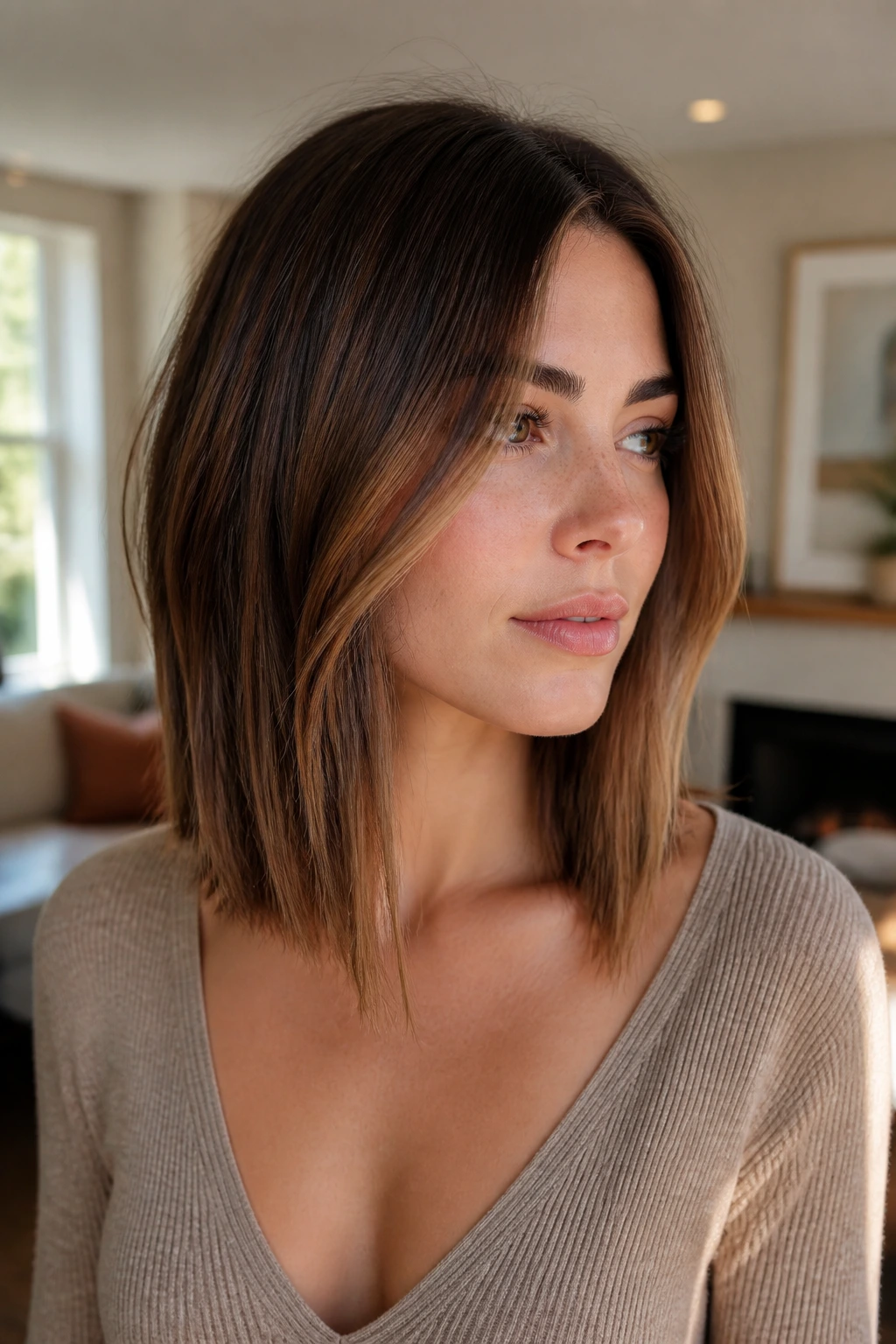
If you like your hair a little longer, the collarbone lob is the safest flattering bet in the whole bunch. It gives you room to move, room to tuck, and room to soften the cheeks without losing the clean line that makes a bob feel intentional. The front pieces should begin around the cheekbone or lower and slide into the collarbone.
This is the cut I recommend to people who are nervous about going short. It has enough length to avoid the “my head suddenly got wider” problem, but it still gives the face definition. The long front pieces pull the eye down, which is exactly what a round face usually wants.
A center part can work here if the front layers are long enough and the texture has some bend. A side part makes it easier. Either way, avoid heavy layers around the cheeks; they can fill the face in a way that looks busy.
Works especially well on: medium-thick hair, naturally wavy hair, and people who want to wear clips, half-up styles, or a low bend at the ends.
My take: this is one of the least risky choices if you want a bob but you’re attached to length. It’s polite. It’s easy to live with. And it still looks like you meant to cut your hair.
3. French Bob with Wispy Fringe

Can a French bob work on a round face? Absolutely — if you don’t copy the textbook version too literally. The classic chin-skimming cut with a blunt fringe can be too boxy, but a slightly longer French bob with a broken, airy fringe is a different animal. It feels lighter, less circular, and much friendlier to fuller cheeks.
The fringe matters here. Keep it wispy, uneven, or softly separated, not thick and straight across the forehead. A heavy bang can shorten the face and make the roundness feel more obvious. A broken fringe opens the center of the face and gives you a little vertical lift.
What to ask for
- Keep the bob just below the chin if your face is very full through the cheeks.
- Ask for texture at the ends, not a hard blunt edge.
- Make the fringe piecey, with a little separation through the center.
This cut looks best when it has a bit of lived-in motion. It doesn’t need to be sleek to work. In fact, too much polish can make it look severe. A small amount of dry texture spray at the roots and a loose bend through the mids keeps it from sitting like a helmet.
4. Stacked Bob with Crown Lift
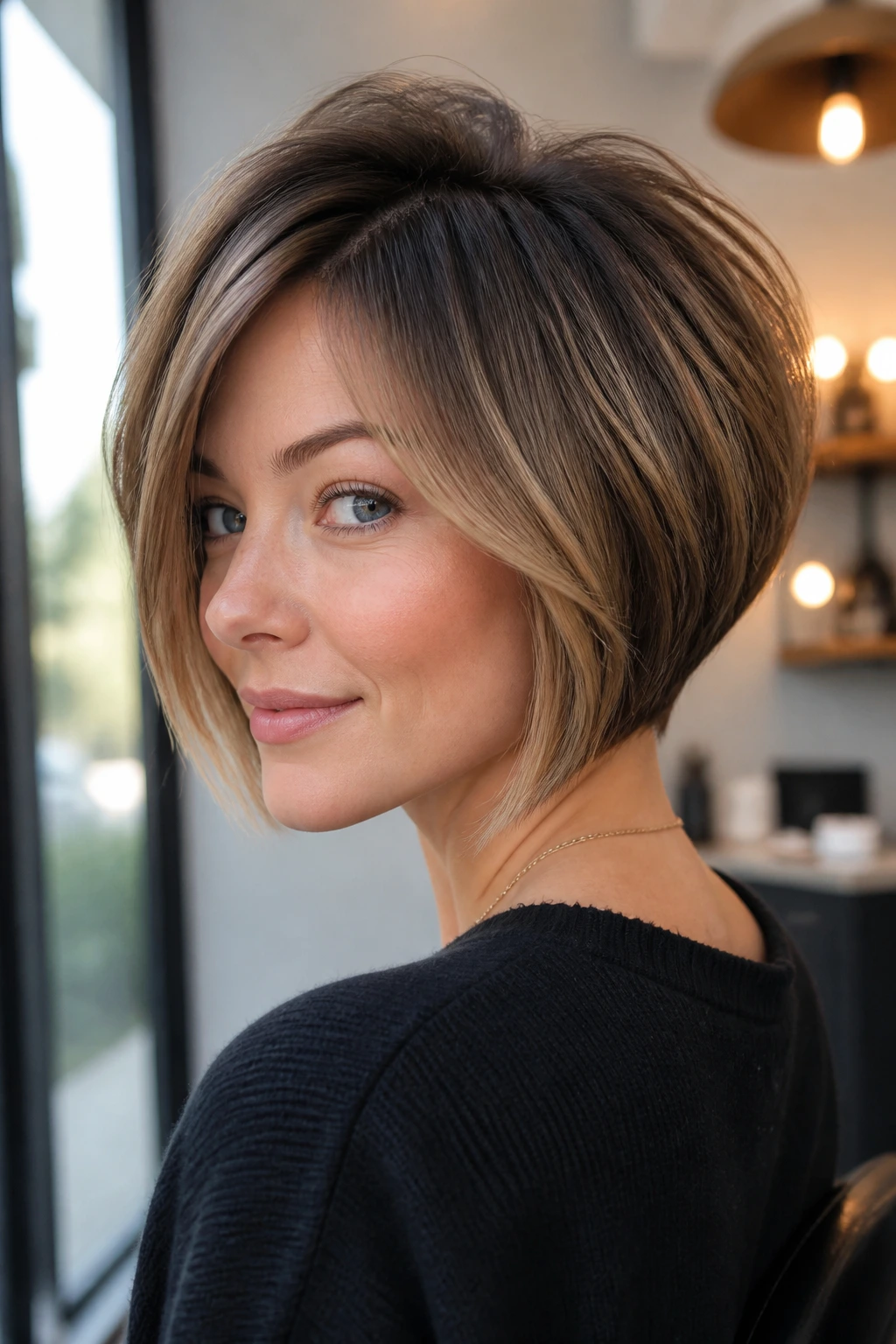
A stacked bob is one of those cuts that can either flatter a round face or fight it, and the difference comes down to restraint. Done well, the stacking stays tucked at the back of the head, creating lift where you want it and avoiding extra width at the cheeks. Done badly, it balloons. Fast.
The good version gives you a lifted crown and a neat nape, which adds vertical shape from the side. That matters because round faces usually look best when the hair sends the eye upward before it moves down again. You want the haircut to feel sculpted, not puffy.
If your hair is fine and collapses by noon, this is a smart option. The stacked structure gives the illusion of density. If your hair is thick, ask for internal debulking so the back doesn’t turn into a shelf.
Styling reality: you’ll probably need a round brush and a quick blow-dry at the crown. Not a full salon blowout. Just enough lift to keep the back from hugging the head too tightly.
One warning. Keep the stacking controlled. Too much height plus too much width is a bad bargain on a round face.
5. Asymmetrical Bob
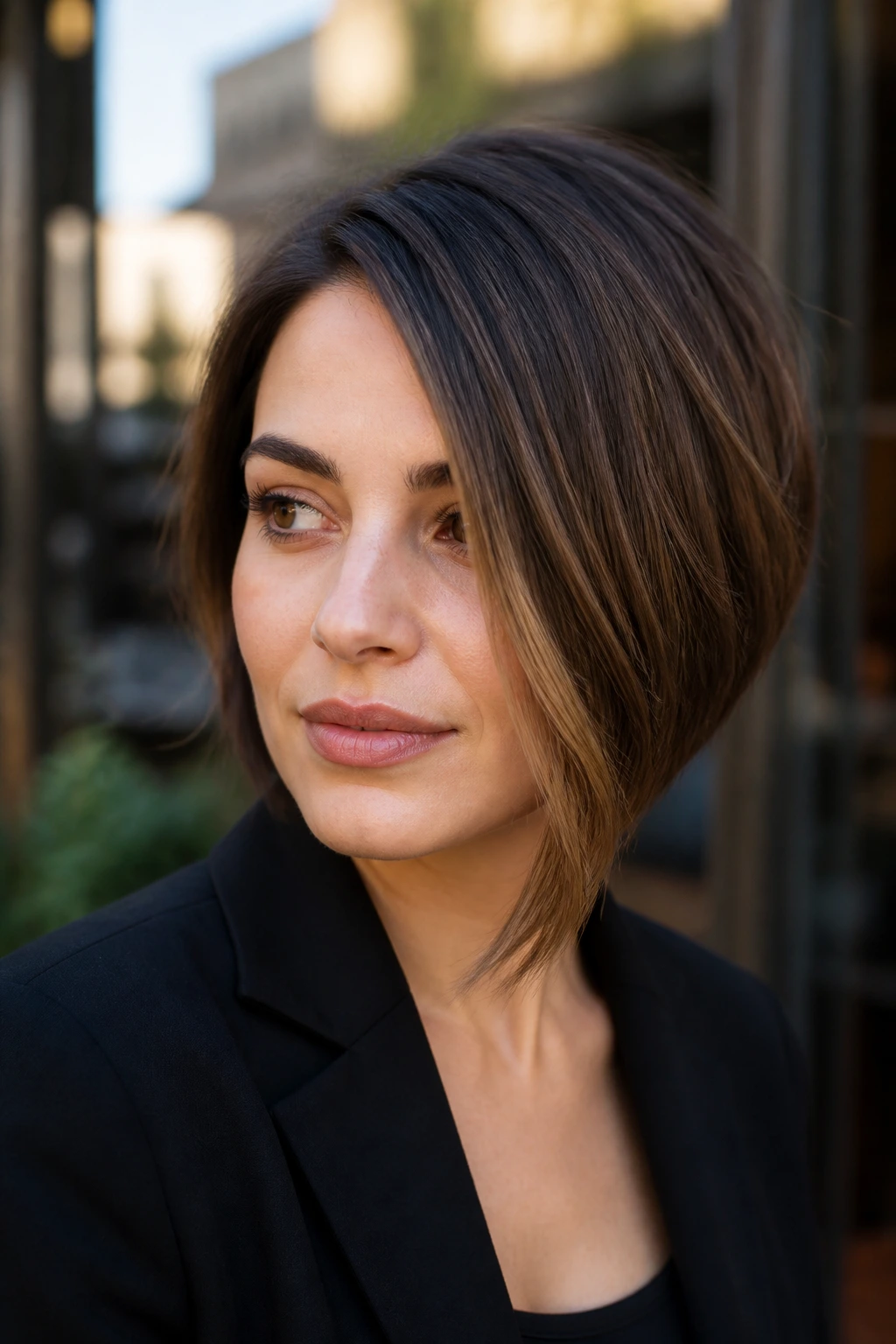
An asymmetrical bob works because the eye doesn’t settle in one place. One side is slightly longer — often by one to two inches — and that tiny imbalance breaks up the roundness in a very satisfying way. The haircut feels modern without screaming for attention.
This is a good choice if you like a sharper look but don’t want something as severe as a fully blunt cut. The longer side creates a diagonal line across the face, and diagonal lines are your friend here. They pull attention down and away from the cheeks, which gives the face a longer read.
It also has a bit of personality. That matters. Some round faces look best when the haircut adds angularity, and a symmetrical cut can sometimes leave the face feeling too neat, almost coin-shaped. The asymmetry gives the whole thing some edge.
Best if you want: a bob that looks intentional even when it’s not perfectly styled, a side part, or a cut that grows out without losing its shape too fast.
Pro move: keep the longer side soft at the ends, not heavy. If it gets too blunt, the asymmetry can start looking gimmicky instead of sleek.
6. Textured Wavy Bob

If your hair already bends on its own, a textured wavy bob may be the one that gives you the least resistance. The movement keeps the hair from sitting in one flat line across the face, which is exactly what a round face usually doesn’t need. Pieces fall at different spots, and that broken outline creates shape.
The best version isn’t beachy in a sloppy way. It’s controlled enough that the ends still have direction. You want a bob that looks like it has air in it, not one that looks frizzy or over-diffused. A little texture at the ends helps the cheek area feel lighter.
This cut also plays nicely with a side part or a slight off-center part. If the hair has a soft wave, the part line can be enough to make the whole style feel less circular. On straighter hair, a 1-inch curling iron or flat iron bend through just the mid-lengths can create that same effect.
A lot of people overdo the wave and end up with too much side width. Don’t. Keep the body below the cheeks if you can. That’s where the flattering part happens.
7. Blunt Bob with a Deep Side Part
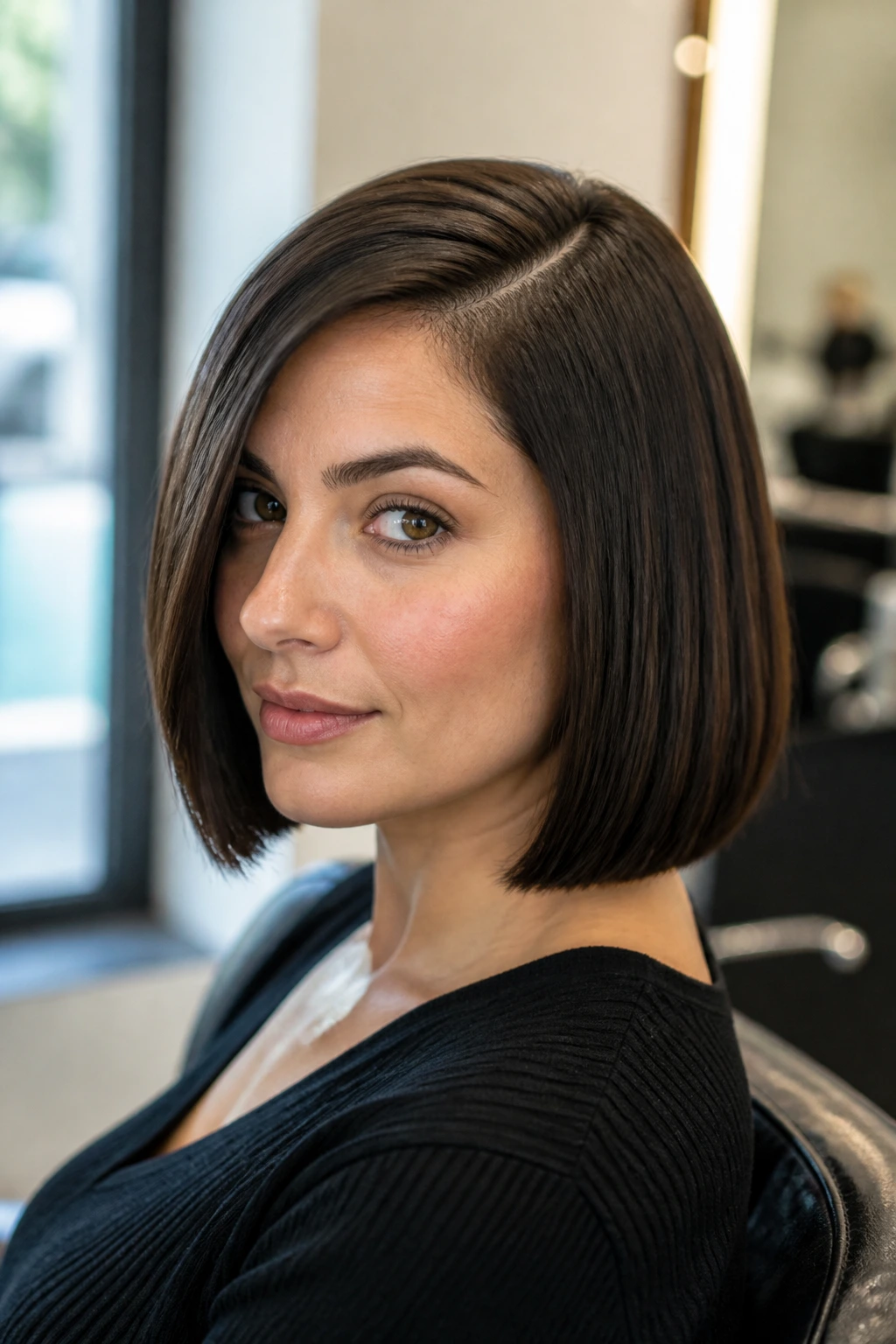
A blunt bob can work on a round face, but I’d never send someone off with a blunt, center-parted bob and no thought behind it. That’s lazy. A deep side part changes the geometry completely, giving the haircut a stronger diagonal and adding height where the face needs it most.
The cut itself should sit a little below the chin or at the collarbone rather than right at cheek level. That keeps the line from punching outward at the widest part of the face. Then the side part creates a sweep across the forehead, which lengthens the face visually.
This style looks especially good if you like a cleaner finish. Straight hair, polished ends, a bit of shine. It has a crispness that feels deliberate, not fussy. And when the part is deep enough, it makes even a simple bob feel styled.
The catch
If your hair is very thick and blunt-cut to the exact same length on both sides, the ends can form a shelf. That shelf is not your friend. Ask for subtle internal removal of bulk, especially near the mids.
8. Graduated Inverted Bob
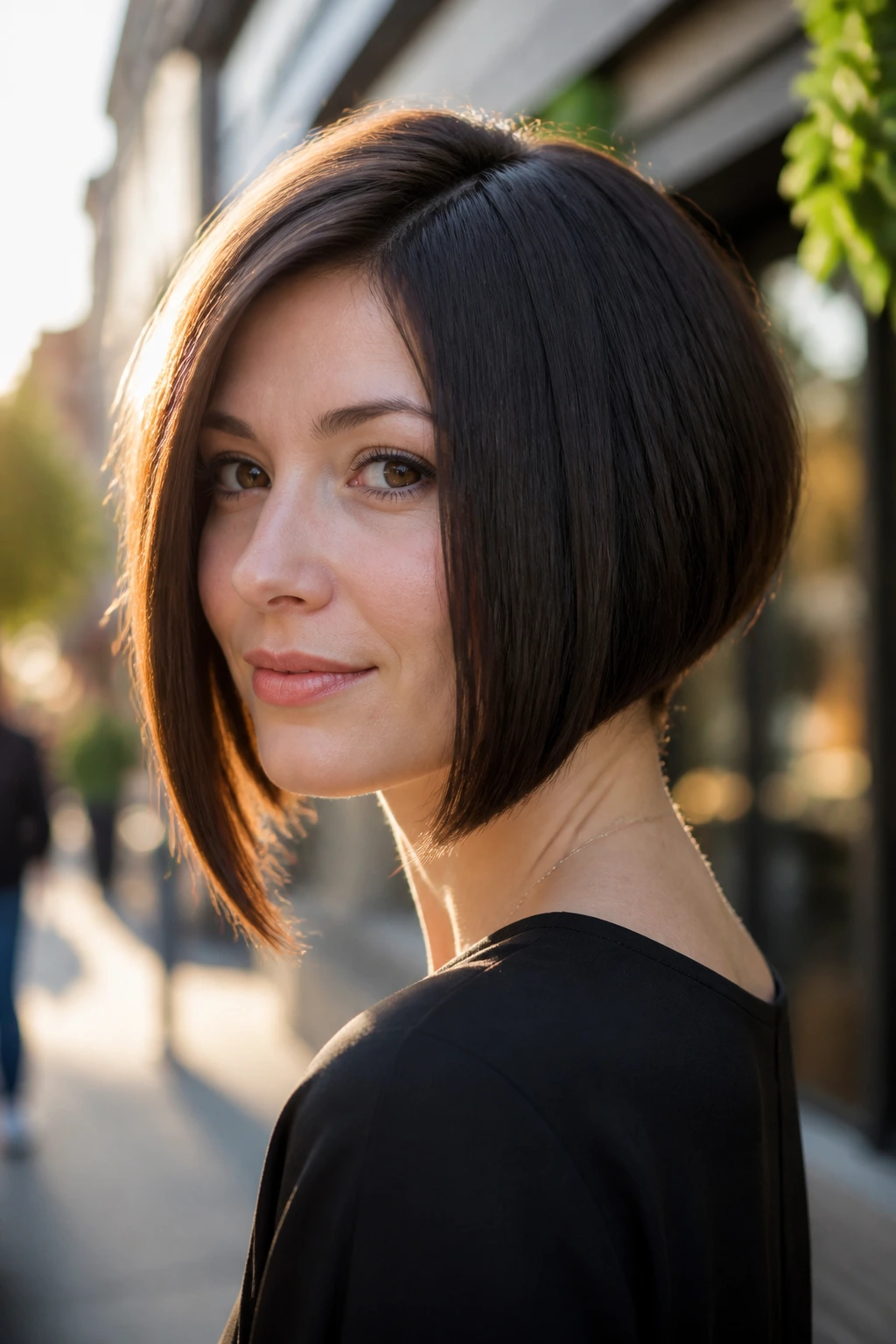
The graduated inverted bob is the polished older cousin of the stacked bob. Shorter in the back, longer in the front, with the weight line moving forward in a clean slope. On a round face, that forward line does a lot of good. It draws the eye past the cheeks and gives the haircut a sharp, tidy outline.
What I like about this shape is how much it can do without needing obvious layers. The structure is baked into the cut itself. If the front pieces touch just below the chin and the back sits close to the nape, the result is a strong silhouette that reads as sleek even when you barely style it.
It’s a smart choice for fine hair because it creates the illusion of fullness where the cut needs it. It’s also useful for straight hair that tends to lie limp. The graduation gives the back a little lift.
You do want a precise cut here. A sloppy inverted bob can look dated fast. Ask for soft graduation, not a hard stacked shelf. Those are not the same thing, and your mirror will know the difference.
9. Curly Bob with a Rounded Shape

A curly bob on a round face needs a different brain than a straight bob. You are not trying to add width. You’re trying to place the curl pattern so it frames the face, not crowds it. The best version is usually a little longer than people think, often sitting between the chin and collarbone, with curls shaped to fall forward and down.
The shape should follow the curls, not fight them. If the haircut gets too short and too even, the curls can puff outward around the cheeks and make the face look wider. Keeping the top slightly longer and the sides controlled helps the shape stay soft.
What matters most
- Cut it dry if possible, or at least with the curl pattern in mind.
- Let the front pieces land below the cheekbones.
- Keep layers light near the cheeks and denser lower down.
Curly bob haircuts for round faces can look fantastic when the curl pattern is respected. The trick is restraint. Too much trimming for “bounce” can eat up the vertical length you need. A diffuse dry, a bit of curl cream, and finger shaping are usually enough.
10. Soft Shag Bob

The soft shag bob is the move when you want movement and don’t want the haircut to look too clean. It’s shorter than a lob, longer than a pixie, and layered enough that the face doesn’t sit inside one hard shape. On a round face, that softness is useful because it keeps the style from looking like a circle with bangs.
The layers should start low enough to avoid puffing out at the sides. That’s the mistake. A shag cut can help narrow a round face if the layers create vertical movement, but if the layers begin too high, the cut widens the cheeks. That’s a bad trade.
This one loves a little rough drying. A mousse at the roots, a handful of scrunching, and some quick finger separation are usually enough. You do not need to make it perfect. In fact, the less exact it looks, the better it tends to read.
Best on wavy hair, but straight hair can fake the movement with a curling iron and a loose finish. It’s a bit more effort than a blunt bob. Worth it if you like hair that has some life.
11. Box Bob with Hidden Layers
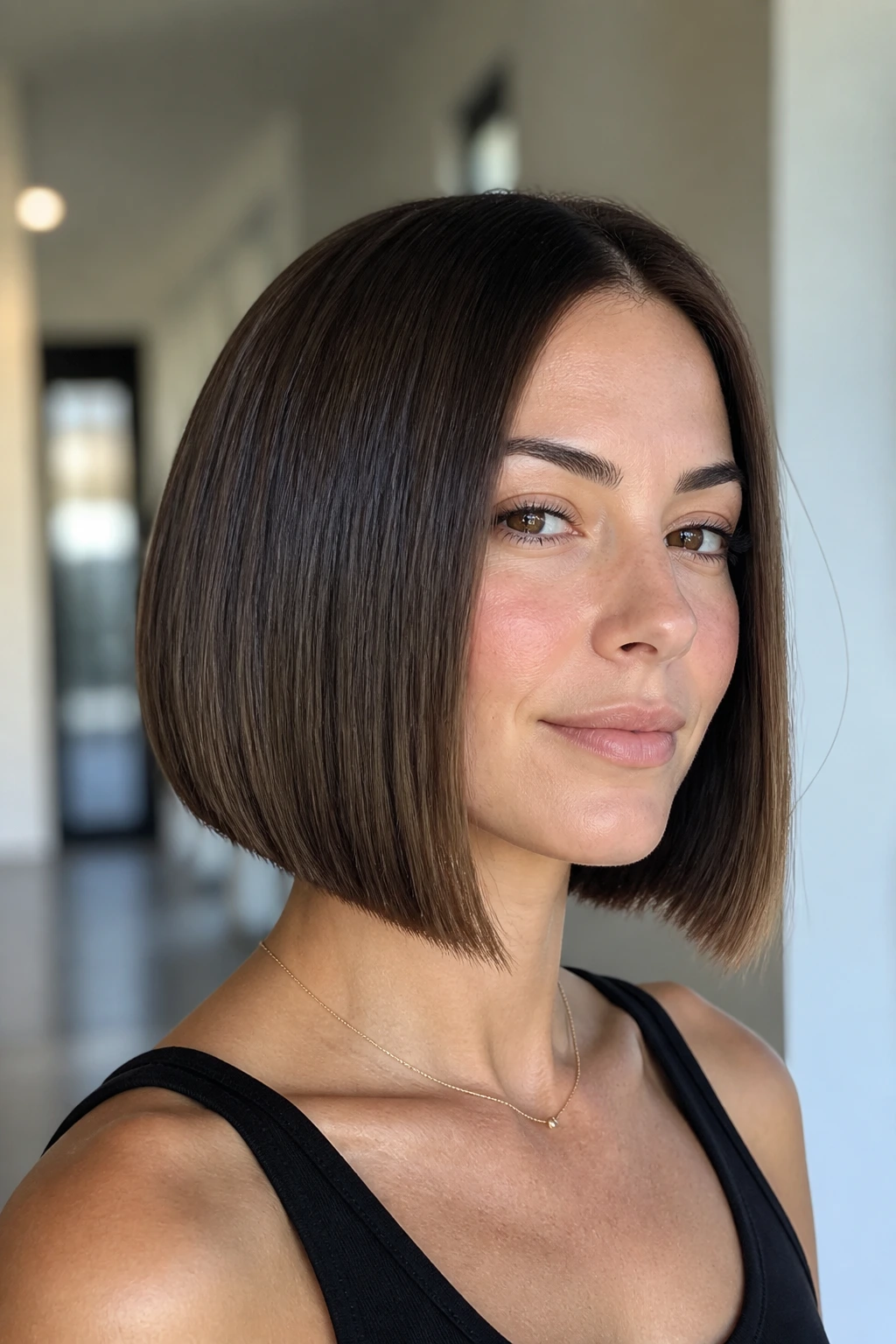
A box bob sounds severe, and in the wrong hands it can be. But on a round face, a slightly softened box bob can be a smart choice if your hair is thick and tends to spread out around the sides. The perimeter stays clean, almost geometric, while hidden layers inside remove bulk so the outline doesn’t balloon.
That hidden structure is the whole point. You keep the visual crispness of a full bob without the helmet effect that thick hair can create. If the ends are cut blunt but the interior is lightened, the haircut falls more neatly against the jaw and collarbone.
It’s best for people who like controlled shapes. If you prefer a scruffy, airy look, this is probably too precise. But if you want a haircut that reads as polished with minimal daily fuss, it’s a strong option.
A middle part can work if the cut sits below the chin. A side part makes it even easier. And if your hair has natural wave, ask the stylist to keep the weight line slightly forward so the cheeks don’t get boxed in.
12. Tapered Nape Bob
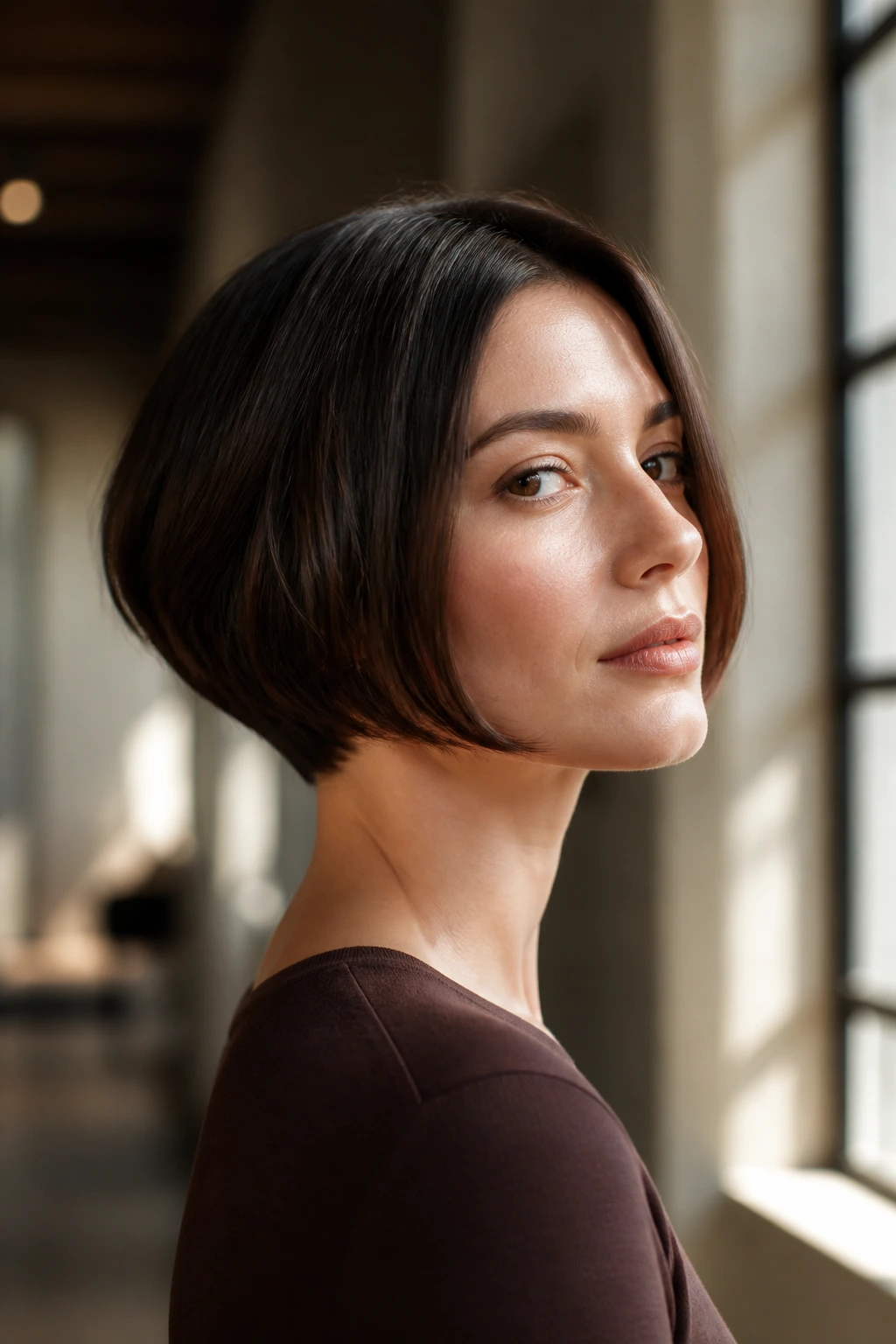
The tapered nape bob is one of my favorites for round faces because it quietly makes the neck look longer. The back is tapered in close, the sides stay soft, and the front pieces usually skim the jaw or slip a little below it. That contrast creates shape without extra width.
This cut is especially nice if you like to wear your hair tucked behind one ear. The taper in the back keeps the silhouette neat, while the forward pieces still frame the face. It has a practical, tidy quality that can look sharp with very little styling.
Think of this as a bob with discipline. It doesn’t have to be severe, but it does need a clean line at the neckline. If the nape gets too heavy, the whole effect disappears. If it’s tapered well, the haircut looks lighter than it actually is.
It’s a smart option for straight or slightly wavy hair, and it does wonders for anyone who wants a more lifted profile from the side. A round face often benefits from that extra neck exposure more than people realize.
13. Bob with Curtain Bangs

Curtain bangs can be a cheat code for round faces when they’re cut with the right softness. Split in the center and swept away from the face, they create a vertical opening through the forehead and draw the eye downward along the sides. That break in the front is useful. Very useful.
The bob itself can be chin-length or a little longer, but the bangs need room to move. Heavy curtain bangs that sit flat across the forehead won’t help much. You want them blended enough that they frame the cheekbones without hiding them.
This style works because it gives the face an elongated center line. It also softens the transition from forehead to cheek, which can make the whole face read less circular. If the bangs are too short, they fight the effect. If they’re too thick, they take over.
Best for: medium-density hair, slightly wavy textures, and anyone who wants the front of the haircut to feel a little romantic instead of sharp.
A small round brush and a fast blow-dry at the fringe are usually enough. Don’t over-direct them. Curtain bangs look best when they fall with a little bend, not when they’re glued into place.
14. Glass Bob
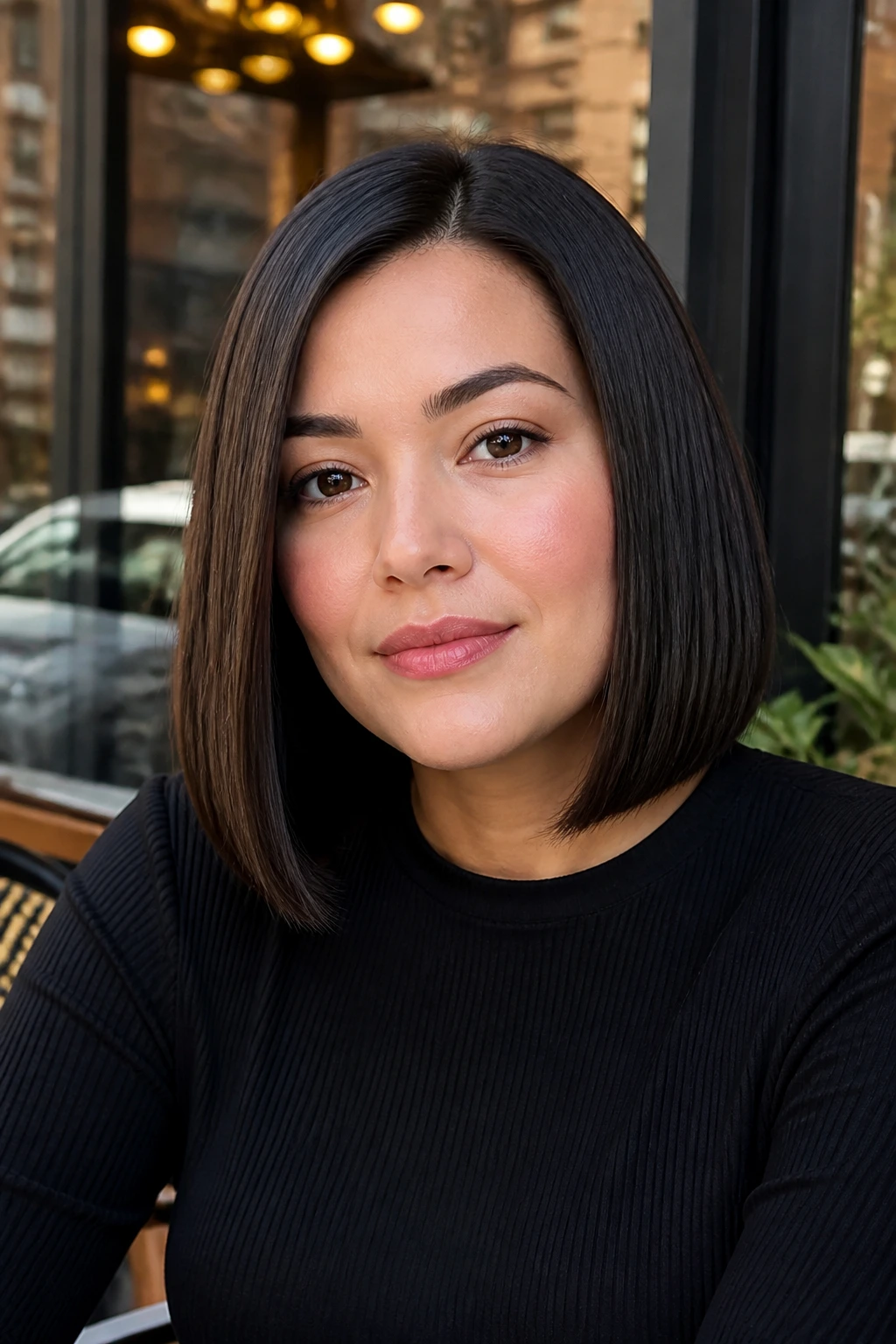
A glass bob is sleek, straight, and glossy enough to catch every line in the cut. On a round face, it works best when the bob sits just below the jaw or at the collarbone, because the smooth surface creates a long, continuous shape. If the line is too short, the look can turn blunt in the wrong way.
This is one of those cuts that relies on precision. The ends should be tidy, the part clean, and the finish nearly reflective. It’s especially good if you have straight hair already, because you’re not fighting the texture. You’re just polishing it.
The reason it flatters a round face is simple: no puff, no excess width, no busy layers around the cheeks. The haircut stays contained. It gives the face room to be the focus, which is what makes it feel so sharp.
A flat iron pass plus heat protectant is usually enough. If your hair tends to frizz, a pea-sized amount of serum on the mids and ends can keep the look from turning fuzzy at the edges. Keep the roots light. Too much product near the scalp kills the shape.
15. Feathered Bob with Face-Framing Pieces

Feathering gets a bad reputation because people remember the overdone versions. Fair enough. But a feathered bob with face-framing pieces can be one of the easiest ways to soften a round face without losing structure. The texture is light, the ends are broken, and the face is framed in a way that doesn’t add extra bulk.
The key is where the feathering starts. It should not begin right at the cheeks. That just makes the sides poof out. Start the movement lower, then let the front pieces fall away from the face with a little bend. The result is airy instead of fluffed up.
This is a good choice if you want something approachable, not too trendy, and not too severe. It plays nicely with medium-density hair and can make thick hair feel less heavy. A blow-dry brush or a round brush and a few flips at the ends are usually enough.
One honest note
If your hair is very fine, too much feathering can leave the ends wispy in a sad way. Keep the perimeter clean. Save the softness for the internal movement.
16. Side-Swept Bob
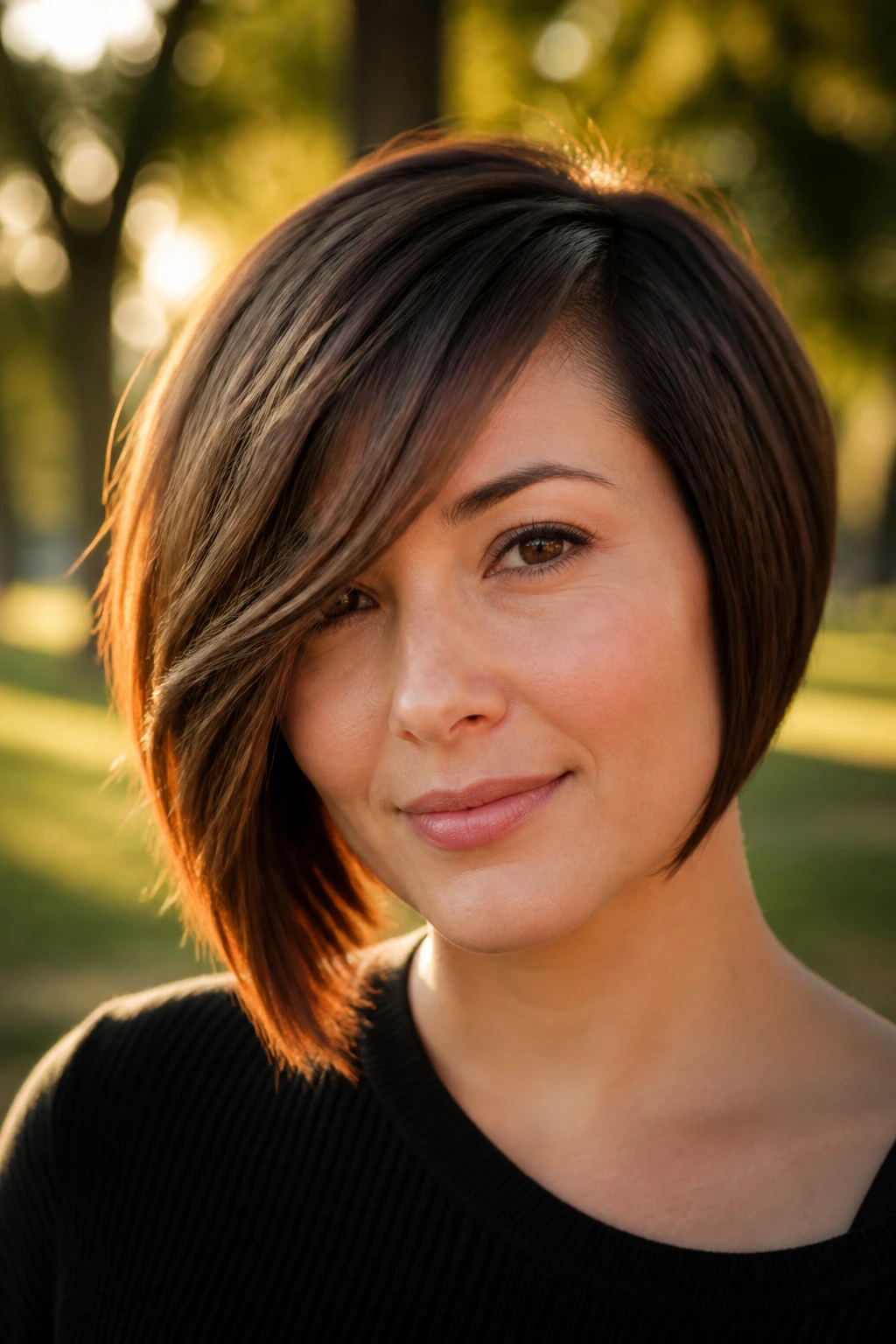
A side-swept bob is one of the easiest ways to change the whole mood of a round face without changing the length much at all. The side sweep adds a diagonal line across the forehead, and that line does a lot of work: it lengthens the face, breaks up symmetry, and gives the cut a more sculpted feel.
The style can be chin-length, lob-length, or somewhere in between. What matters is the direction. Hair swept to one side pulls the visual focus away from the center of the cheeks. It’s a small move, but it changes the read of the face faster than most people expect.
This is a particularly useful look if your face has fuller cheeks and a soft jaw. The side sweep gives the haircut some movement without relying on heavy layers. It also hides the hard line of a center part if you feel that a center split makes your face look too open.
A little root lift on the heavier side helps keep it from collapsing. Don’t flatten it with too much product. You want sweep, not helmet hair.
17. Layered Lob with Flipped Ends
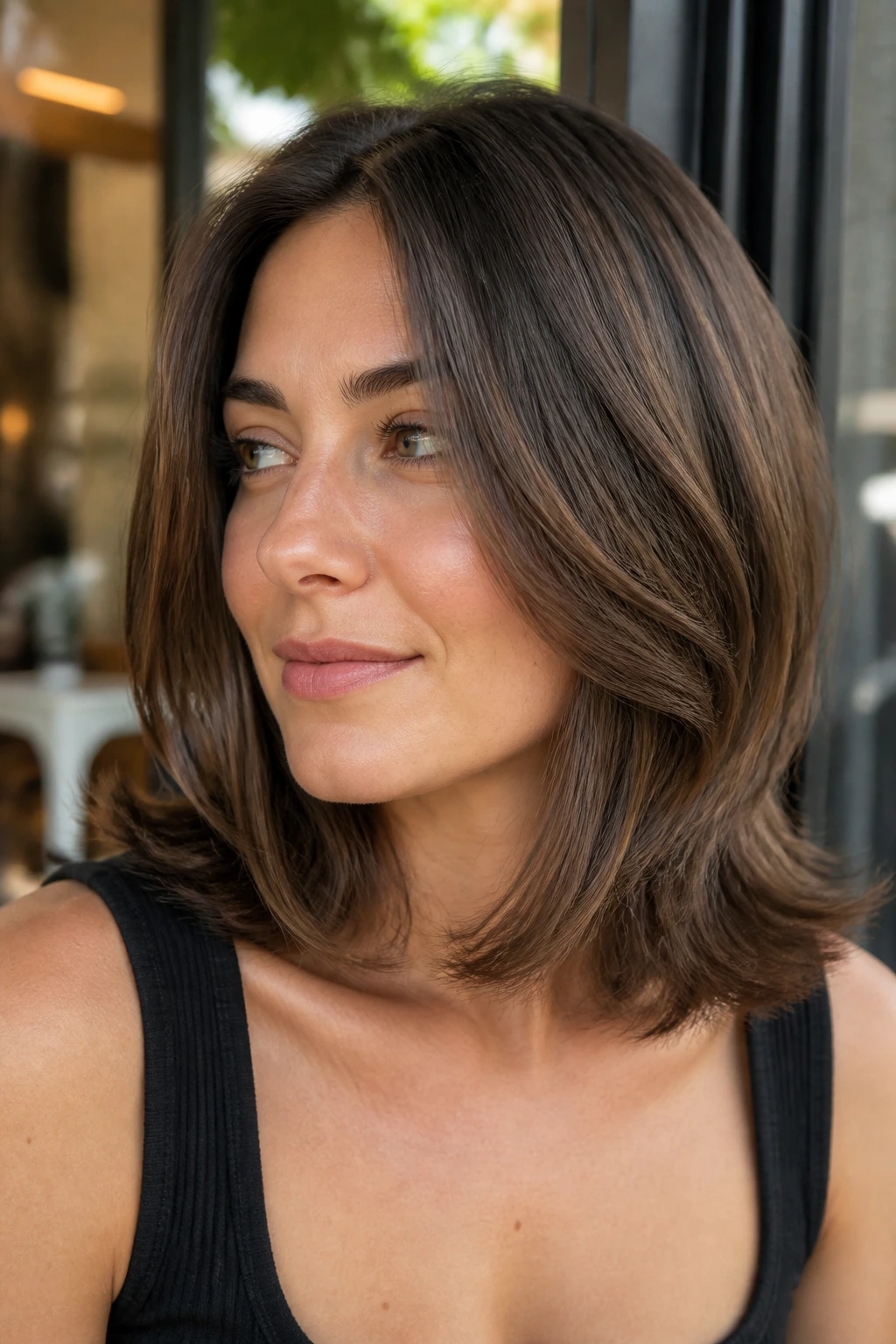
A layered lob with flipped ends has a little vintage energy, but it can look fresh when the layers are kept long and the flip is subtle. On a round face, the best version creates movement below the cheek line, which keeps the sides from widening too much.
The flip at the ends matters because it redirects attention outward at the bottom instead of across the middle of the face. That gives the haircut a sense of shape without making it look stiff. If the layers start too high, though, the whole cut can puff up around the cheeks. So ask for restraint.
This is a nice choice if you like volume but don’t want the haircut to feel short. It also grows out well, which is a gift if you’re not in the mood for constant trims. The extra length gives you room to tie it back, clip it, or tuck it behind the ear without losing the shape entirely.
Best for: medium to thick hair, shoulder-length fans, and people who want movement with a little polish.
18. Razored Bob with Airy Ends

A razored bob can be a little tricky on a round face, but when it’s done with control, it gives you a lighter outline than a blunt cut ever will. The ends feel softer, the edges look less rigid, and the whole haircut has a bit of swing. That makes it useful if your hair tends to lie heavy around the cheeks.
The trick is to keep the razor work at the ends, not carve the whole head into thin wisps. You want airy movement, not frayed ends. The length should sit somewhere below the chin or near the collarbone so the cut doesn’t widen the face at its broadest point.
This style is best on hair that has some texture already. Straight hair can wear it, but it may need a quick bend or a light wave to keep the shape from looking too flat. On wavy hair, it can look easy in the best possible way.
If you’ve got dense hair that swells at the sides, this cut can feel like a relief. It removes heaviness without taking away the bob shape. That balance is hard to get. When it’s right, it looks loose, clean, and a little cool.
What Makes a Round-Face Bob Work in Real Life

A flattering bob on a round face is not magic. It’s geometry with a personality problem. The haircut needs a line that moves, some lift where the crown would otherwise collapse, and enough softness around the cheeks that the face doesn’t get boxed in. That’s it. No secret ritual.
The biggest mistake people make is treating every bob like a small version of the same haircut. A chin-length blunt cut, a collarbone lob, a stacked bob, and a curly bob all sit differently on a round face. The cheek area is the danger zone. If the cut ends there and spreads out, the face looks wider. If the cut slips below it, or angles away from it, the face usually looks longer and neater.
Part placement matters more than people want to admit. A center part can work, but a side part or slightly off-center part often gives a round face more shape. And then there’s crown height. Not a skyscraper. Just enough lift that the silhouette doesn’t flatten from temple to temple.
Texture is the final piece. Soft bends, broken ends, and piecey movement make the haircut feel less circular. That’s the whole game.
The Tools That Make These Cuts Behave
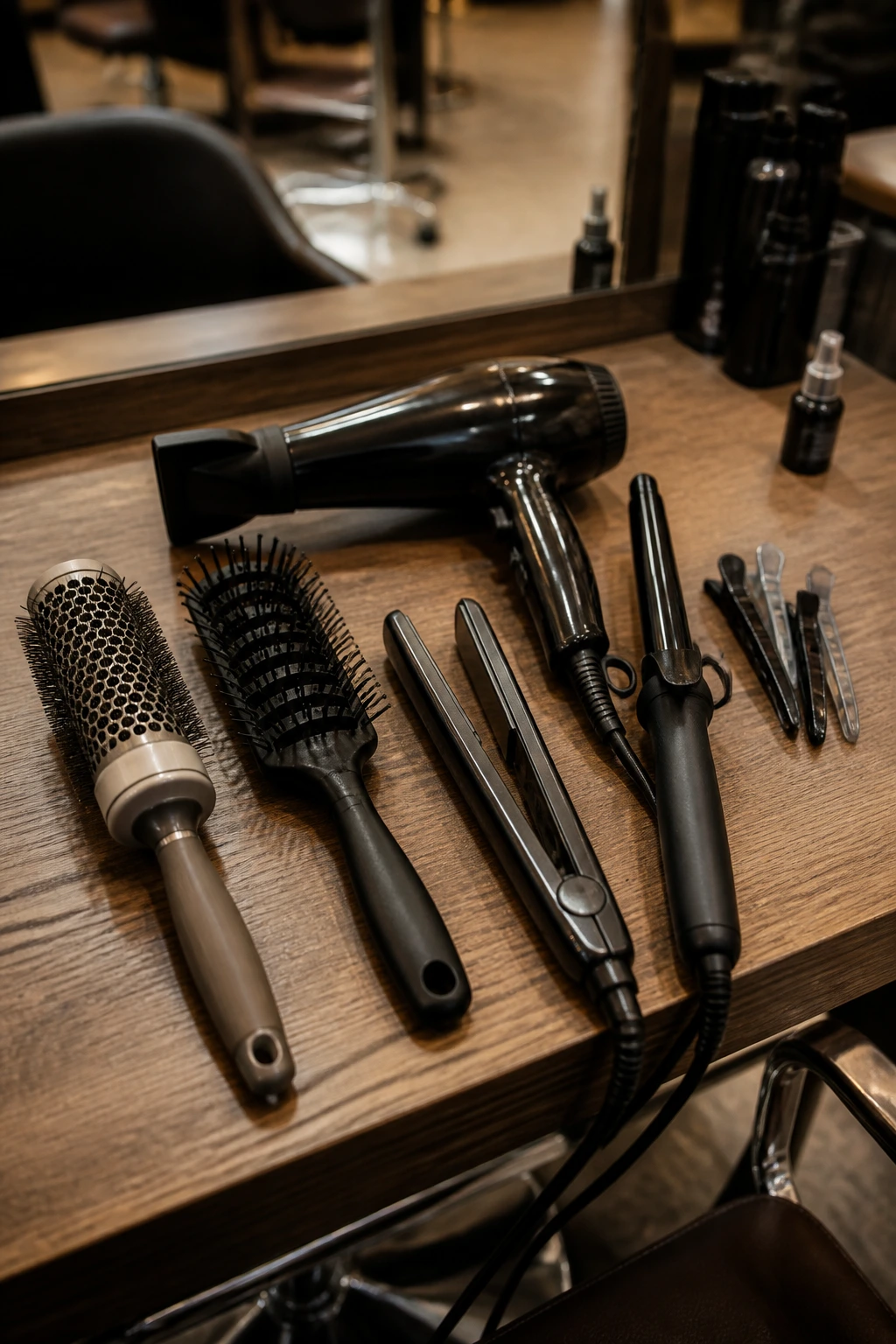
- 1-inch round brush: useful for bending the ends under or away from the face without creating huge curl.
- Vent brush: a fast way to dry the roots and push lift into the crown.
- Blow dryer with a nozzle attachment: keeps the air focused and helps smooth the cut line.
- Flat iron with rounded edges: good for subtle bends, especially on blunt or glassy bobs.
- 1-inch curling iron or wand: handy for adding loose movement without turning the bob into a curl cloud.
- Sectioning clips: make crown lift and clean styling much easier.
- Heat protectant spray: non-negotiable if you use any hot tool.
- Lightweight mousse or root spray: adds body without turning the hair stiff.
- Texturizing spray: useful for piecey ends and lived-in movement.
- Shine serum or light oil: a small amount smooths the ends, especially on sleek cuts.
- Wide-tooth comb: gentler than a brush when you’re working through curls or waves.
- Hand mirror: useful for checking the back so the nape doesn’t puff out.
How to Ask for the Right Cut at the Salon

Don’t walk in and say “I want a bob for a round face” and leave it there. That’s too vague. A good stylist needs to know where your hair sits, how much time you’ll spend styling it, and whether your face is round because of fullness at the cheeks, width at the jaw, or both. Those are different problems.
Bring at least two reference photos: one from the front and one from the side. If you can, bring a third that shows the back. A lot of bob photos are flattering from one angle and odd from another. I’d rather see the truth. So would your stylist.
Be specific about the parts that matter. Say things like: “I don’t want extra width at the cheek,” “I need the length to hit below the jaw,” or “I want crown lift but not a stacked wedge.” Those notes help more than saying “face-framing layers,” which can mean almost anything.
And tell the truth about styling. If you’re not going to round-brush your hair, say that. If you air-dry most days, say that too. A bob that looks brilliant with a hot brush and five clips may be a poor fit for a wash-and-go life. Better to say it out loud before the scissors come out.
How to Wear These Bobs Without Fiddling All Morning

Sleek finish: The glass bob, blunt bob, and deep-side-part styles look best when the surface is smooth and the ends are clean. A blow-dryer nozzle and a quick pass with a flat iron are enough. Keep the volume controlled near the temples.
Soft movement: The wavy bob, shag bob, and feathered bob want a looser hand. Scrunch in mousse, dry with a diffuser or rough-dry at low heat, and stop before the hair gets too big at the sides. Leave a little mess in the finish. That’s the point.
Lift where it counts: For stacked, inverted, and angled bobs, focus on the crown and nape first. If the back is too flat, the whole shape drops. A small round brush at the roots can save the cut.
Face framing: Curtain bangs, side sweeps, and longer front pieces should fall away from the cheeks, not curl inward into them. If you’re using a curling iron, bend the front pieces out and away from the face for a longer, sharper line.
Small Styling Moves That Change the Whole Look
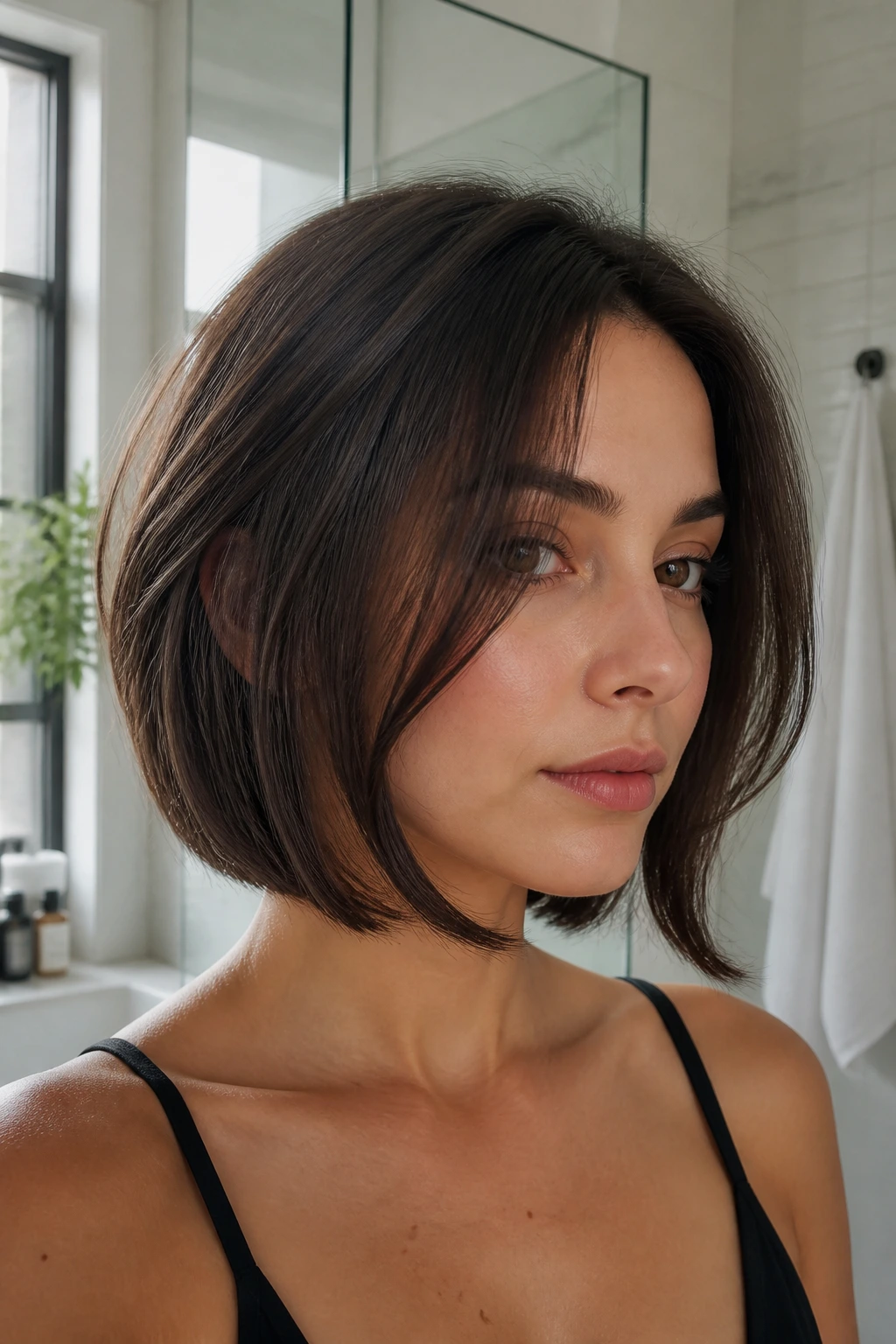
A bob lives or dies by tiny choices. Seriously. A one-inch change in where the front pieces land can make a round face look softer, narrower, or oddly compressed. That’s why the best styling advice is rarely dramatic.
Root lift: Blow-dry the crown first. Even 20 seconds of lift at the roots keeps the shape from collapsing into a circle.
End direction: Flip the ends slightly forward for angled bobs, or bend them away from the face for blunt cuts. The direction matters more than the curl itself.
Part placement: Shift the part a half-inch if the haircut feels too symmetrical. That tiny move can change the whole outline.
Make-it-yours: If your hair is fine, use a mousse at the roots and skip heavy creams. If your hair is thick, a light smoothing cream on the mids keeps the sides from puffing out. If your hair is curly, cut it dry or semi-dry so the shape lands where the curl actually lives, not where it looks like it lives when wet.
Keeping the Shape Between Salon Visits
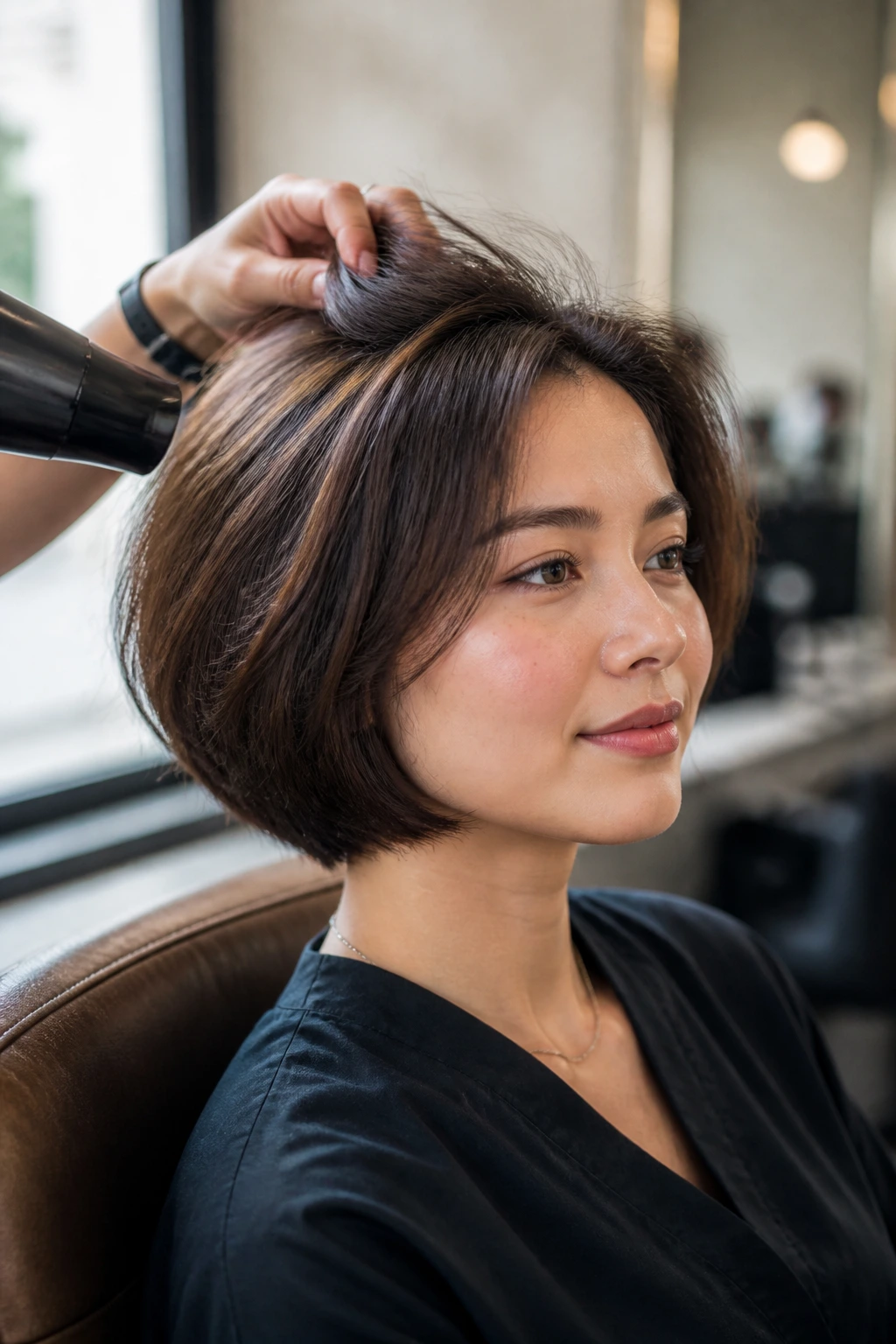
Bobs are tidy only if you stay on top of them. Most of these cuts need a trim every 6 to 8 weeks to keep the perimeter from slipping past the point where the shape starts to change. The longer lob versions can sometimes stretch to 10 weeks, but once the line drops too low, the whole point of the cut starts to blur.
At home, the biggest maintenance task is the part and the crown. If the roots collapse, the haircut looks heavier around the cheeks. A quick blow-dry on the top section — even two minutes — can keep the silhouette lifted. Dry shampoo helps on day two or three, but don’t pile it on until the hair looks dusty.
If you wear sleek styles, wrap the hair loosely at night or use a silk pillowcase to reduce the bend marks that can kink the ends. If you wear waves, refresh only the front and the top. The back usually needs less correction than the pieces everyone sees first.
Grow-out is manageable if the front stays a little longer than the back. That forward line gives you room as the cut lengthens. If the bob is straight across and very short, the grow-out stage gets awkward faster.
Variations and Adaptations to Try

The Curly-Control Version: Keep the length below the chin and ask for layers that follow the curl pattern instead of fighting it. This keeps the sides from ballooning and lets the face stay open.
The Fine-Hair Lift Version: Choose an angled or stacked shape with light graduation at the back. Fine hair needs support at the crown, but not so much layering that the ends turn thin.
The Thick-Hair Debulked Version: Keep the perimeter clean and ask for internal weight removal. Thick hair on a round face needs shape reduction, not more surface layering.
The Air-Dry Version: Go for a lob or shag bob with softer ends and low-maintenance parting. This version looks best with texture cream and a few finger-twisted pieces, not a lot of heat.
The Fringe Version: Add curtain bangs or a broken fringe if you want forehead coverage without closing the face in. Keep the bangs airy and longer at the sides so they blend into the cheek area.
The Grow-Out Version: Let the front sit at the collarbone while keeping the back slightly shorter. That way, the bob can lengthen without losing its forward motion.
Common Mistakes That Make a Bob Work Against a Round Face
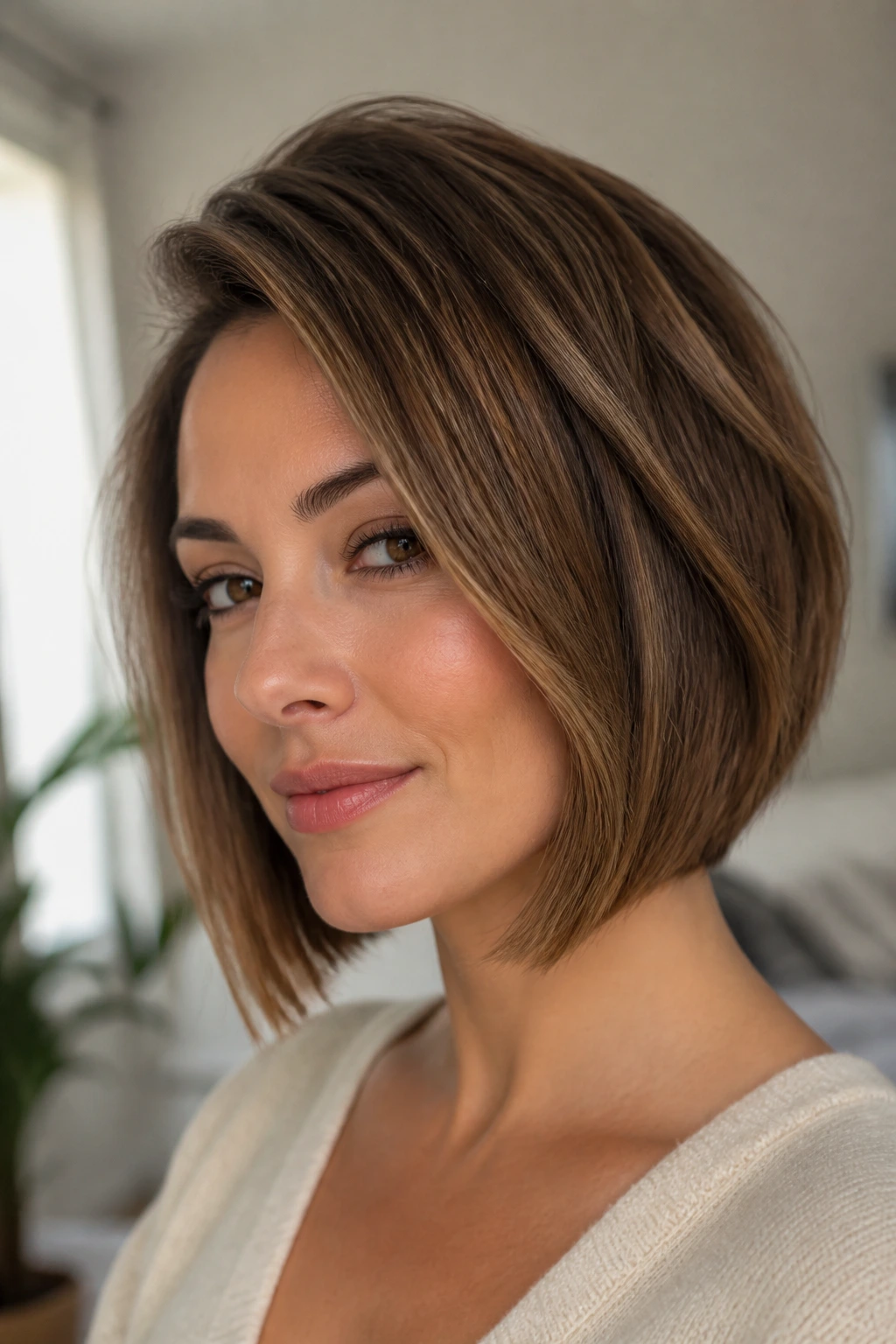
The first mistake is cutting the bob too close to the widest part of the cheeks. That’s the classic trap. The haircut ends where the face is already broad, and the result is more width, not less. Move the line slightly below the jaw or angle it forward, and the shape usually improves fast.
The second mistake is building too much volume at the sides. Big side fullness is nice on some face shapes. On a round face, it can be a disaster. Keep the lift at the crown and the movement in the front, not at cheek level.
Heavy bangs are another problem. Straight-across fringe can shorten the face and make the roundness feel stronger. If you want fringe, go wispy, split, or side-swept so the forehead still breathes.
Over-layering is sneaky. A stylist may think layers equal softness, but if they start too high, the hair can puff around the temples and cheeks. You want movement, not a triangle of fluff.
Finally, too much product can crush the shape. Creams, oils, and pomades are useful, but a heavy hand turns a bob into a flat, sticky shape that hugs the face in all the wrong places.
Questions People Ask Before Cutting the Hair
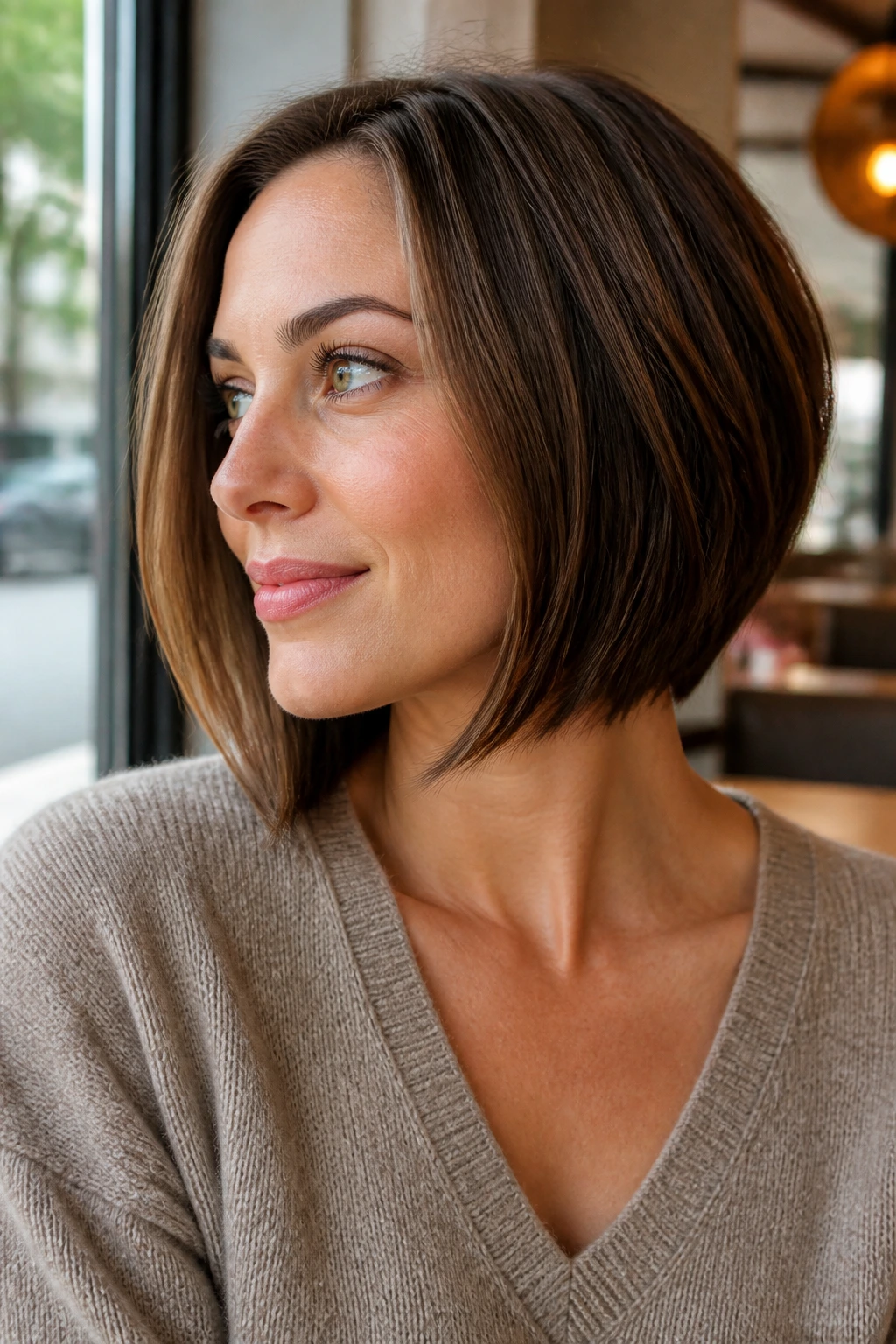
What bob length is most flattering for a round face?
Usually the sweet spot is just below the chin or at the collarbone. That gives the face room to look a little longer, and it keeps the haircut from ending exactly where the cheeks are widest.
Can a blunt bob work on a round face?
Yes, if the length is chosen carefully and the part creates some diagonal movement. A blunt bob that ends at the jaw with a center part can be too boxy, but a longer blunt cut with side-part styling can look sharp.
Are bangs a bad idea for round faces?
Not at all. The wrong bangs are a bad idea. Heavy, straight fringe can close the face in, while curtain bangs, side-swept bangs, or broken fringe can actually help stretch the face visually.
What if my hair is very thick?
Ask for internal debulking and a perimeter that stays clean. Thick hair needs the bulk removed from the right places, or the bob can spread out at the sides and lose its shape.
What if my hair is fine and flat?
Go for stacked, angled, or inverted shapes that create lift at the back. A root spray or mousse at the crown helps, but the haircut itself should already be doing some of the work.
Can curly hair pull off a bob on a round face?
Yes, and it can look excellent when the length is kept below the cheek line and the curl pattern is respected. The trick is keeping the curls from expanding too wide at the face.
Is a center part bad here?
No, but it isn’t the easiest default. A slight side shift often gives a round face more vertical line and a bit more shape around the forehead.
How often should I trim a bob?
Every 6 to 8 weeks is the safe range if you want to keep the line sharp. Longer lob styles can stretch a bit farther, but once the front and back lose their relationship, the cut starts to feel ordinary.
The Shape That Keeps Doing the Work

A good bob on a round face doesn’t just sit there looking neat. It changes the way the whole face reads. That’s why a thoughtful cut — angled, lifted, broken up, or lengthened in the right places — matters more than chasing some mythical “perfect” bob.
If you remember one thing, make it this: the best bob haircuts for round faces move the eye instead of trapping it. Forward, down, diagonal, lifted at the crown. Those are the moves that keep the haircut from turning circular.
The nice part is that there isn’t only one correct answer. There are short ones, long ones, sleek ones, curly ones, and messy ones that all do the job if they’re cut with the face in mind. Pick the shape that fits your texture and your daily routine, and the haircut will keep paying rent every morning.
