



A thick fringe changes long hair fast. The minute it lands at the brow, the whole cut stops reading as one long sheet and starts reading as a shape with a front edge, a backbone, and a little attitude. Long hairstyles with thick bangs do that better than almost anything else in the haircut playbook.
The catch is that they ask for honesty. A thin, wispy fringe can disappear into waist-length hair and look like an afterthought. A dense bang has to earn its place. It needs the right width, the right weight, and the right finish so it doesn’t collapse into a greasy split by lunch or stick out like a shelf after a bad blow-dry. If your hair has a cowlick, if your forehead is on the shorter side, if your texture shifts from smooth to puffy the second humidity shows up — yes, all of that matters here.
That’s exactly why this cut is worth looking at from more than one angle. Some versions are crisp and polished, some are shaggy and easy, some work with curls instead of fighting them, and some are built for people who want to spend four minutes on the front and let the rest air-dry. The 18 looks below cover the full range, from blunt and glossy to soft and undone.
Why This Collection Earns a Spot in Your Queue
- The front of the haircut finally has weight: Thick bangs give long hair a clear focal point, so the length doesn’t swallow your face.
- There’s room to change the mood: The same dense fringe can look sharp with a flat iron, soft with a round brush, or piecey with a bit of texture spray.
- It plays well with long hair that’s already there: You do not need to lose length to make the style feel intentional.
- It works across a few different textures: Straight, wavy, curly, and coily hair can all wear a heavy fringe, but the cutting method changes.
- The grow-out stage can be useful: A thick bang can slide into curtain bangs, side-swept fringe, or face-framing pieces instead of looking awkward.
- The style does real visual work: It shortens a long forehead, adds width where the eye needs it, and keeps long hair from feeling flat around the crown.
1. Sleek Waist-Length Hair with a Blunt Brow-Grazing Fringe
A blunt fringe across long, glossy lengths has a strong graphic quality. The line at the brow is the point; the waist-length hair is the backdrop. When the finish is smooth, this style looks polished in a way that a soft, feathered bang never quite can.
Why the blunt line works
The hard edge gives long hair a front anchor. Without it, very long hair can start to feel like a curtain. With it, the cut reads as deliberate.
A good version of this style needs enough density in the bang section to stay closed when you part it with your fingers. Ask for the fringe to land right at the brow or a hair below if you plan to round-brush it under. Too short, and it springs up. Too thin, and the line breaks apart.
Styling notes
- Blow-dry the fringe first with a nozzle pointed downward.
- Use a small round brush if you want a slight bend under.
- Finish the mids and ends with a 1-inch flat iron for that glassy, straight finish.
Best for: straight to slightly wavy hair, strong hair density, and anyone who likes a clean outline around the face.
2. Soft U-Layers with a Rounded Full Bang
This is the version I reach for when someone wants the drama of thick bangs without the sharpness of a straight-across edge. The long layers curve into a soft U shape, and the fringe follows that curve instead of fighting it.
The result is gentler around the cheekbones. It still has presence. It just doesn’t shout.
The rounded bang needs a little more air at the center and softer corners at the temples. That means your stylist should not chop it into a stiff rectangle. A slight bevel on the sides keeps the fringe from sitting like a slab. When it’s dried with a round brush, the shape opens the face instead of boxing it in.
This is one of those haircuts that looks expensive in a quiet way when it’s cut well. Not because it is fussy. Because the balance is doing the work.
3. Long Shag Layers with Piecey Dense Bangs
Can thick bangs still look relaxed? Absolutely — if the bangs are cut with movement instead of one blunt edge. A long shag with dense bangs gives you weight at the front and lift through the crown, which keeps the length from dragging everything down.
The texture sweet spot
The bang section stays full, but the ends are point-cut so the fringe breaks into small pieces when you style it. That makes the shape easier to wear if your hair doesn’t sit perfectly smooth on its own.
This cut likes a little mousse at the roots and a quick scrunch with your fingers. If you air-dry it flat, the whole look can lose its shape. If you over-blow it, the shag line gets too neat and starts to feel wrong. Messy, but controlled. That’s the point.
Who it suits: people with medium-to-thick hair who want body without a full salon blowout every morning.
4. Airy Waves with Heavy Curtain Bangs
If you’ve ever wanted curtain bangs but hated how skinny they can look, this is the version to ask about. The center is thicker, the sides sweep back in a wide arc, and the whole bang holds enough density to stand on its own.
A thick curtain fringe is useful because it can open and close. Wear it centered and blended into the waves, or push it apart and let the face-framing pieces do their thing. Either way, it still looks like part of the haircut, not a borrowed accessory.
The easiest way to style this one is with a medium round brush or a 1.25-inch iron, curling each side away from the face. Let the bend cool before touching it. That cooling time matters more than people think. If you mess with it too soon, the shape falls flat and the fringe loses its swing.
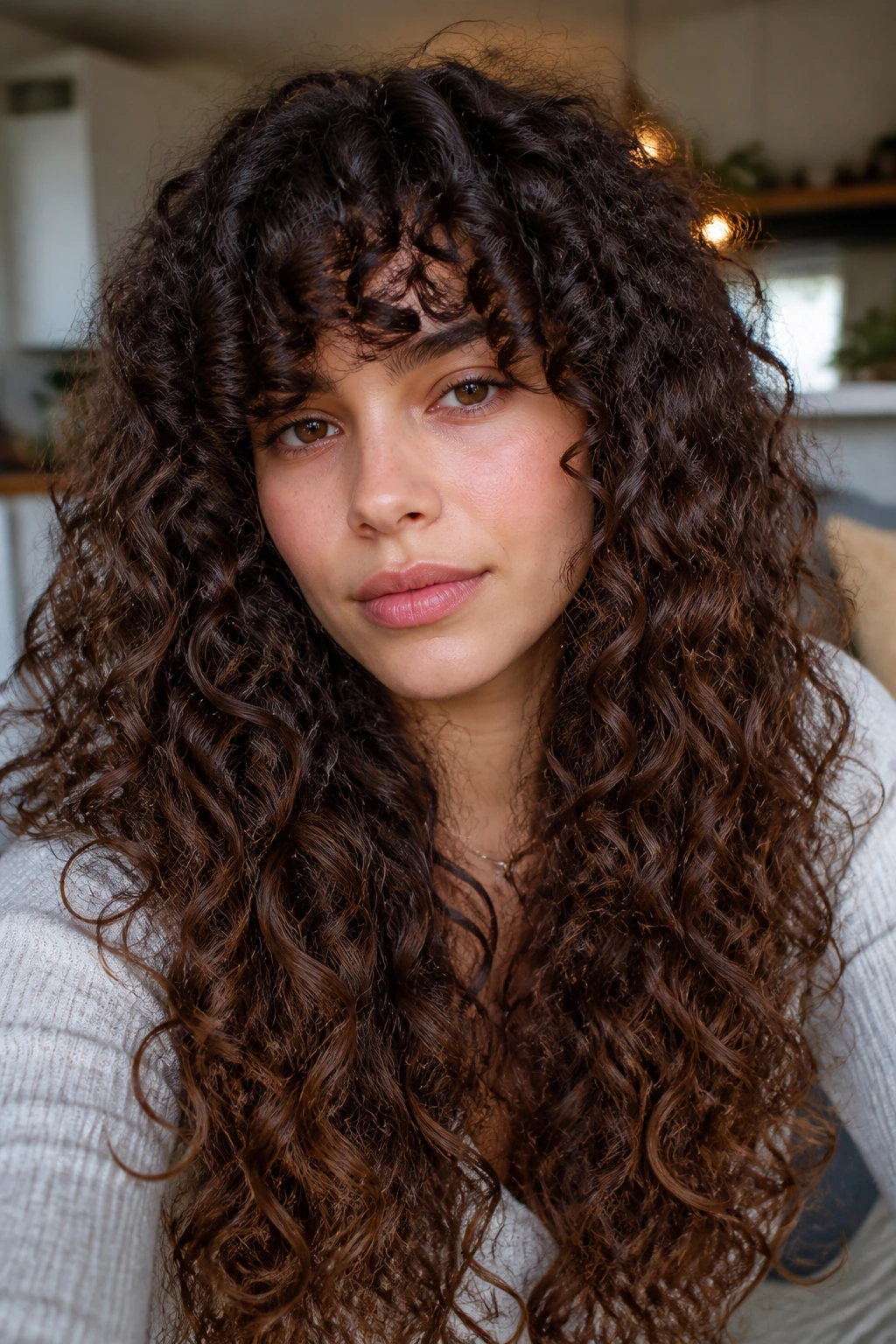
5. Curly Length with a Full Curved Fringe
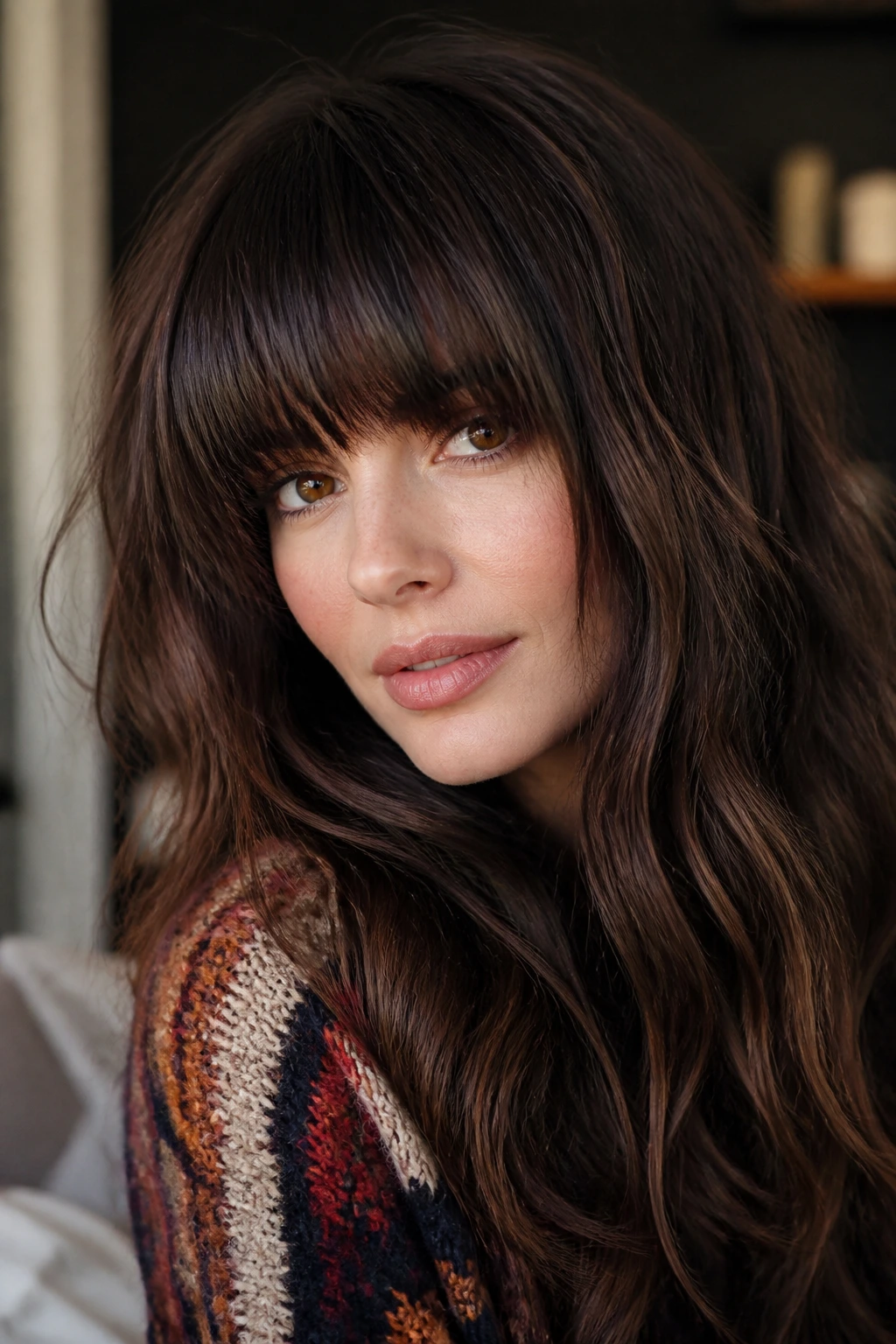
Curly hair changes the whole conversation. Thick bangs on curls should not be cut like straight bangs and then hoped into shape. They need to be cut with the curl pattern in mind, because shrinkage is not a small detail here. It is the detail.
When this is done well, the fringe arcs softly across the forehead and meets the rest of the curls without a hard break. It has density, but it still moves. The front keeps the same lively texture as the length, which is why the style feels cohesive instead of pasted on.
Dry cutting helps here. So does patience. A stylist who understands curl pattern will leave more length than you think you need, then refine it after the hair springs up. That is the part a lot of people get wrong. They ask for the final length they see in the mirror, not the length the curl will become once it dries.
6. Big Blowout Layers with a Thick Brushed-Through Fringe
Some bangs want to be perfect. These want to be brushed out.
The whole style depends on movement at the roots and a soft bend through the fringe, the kind you get from a round brush and a dryer that’s aimed with a little discipline. Once the fringe is dry, brush it back and forth across the forehead so it gets that loose, salon-blowout swing instead of a rigid curl.
This cut works because the long layers support the bangs instead of competing with them. You get lift at the crown, fullness around the cheekbones, and ends that kick out just enough to keep the shape alive. If your hair is dense, this is a smart way to use all that body without letting it turn into a triangle.
Pro move: set the fringe on velcro rollers for five to ten minutes while you do the rest of your makeup. It sounds old-school. It works.
7. Long Wolf Cut with a Heavy Textured Fringe
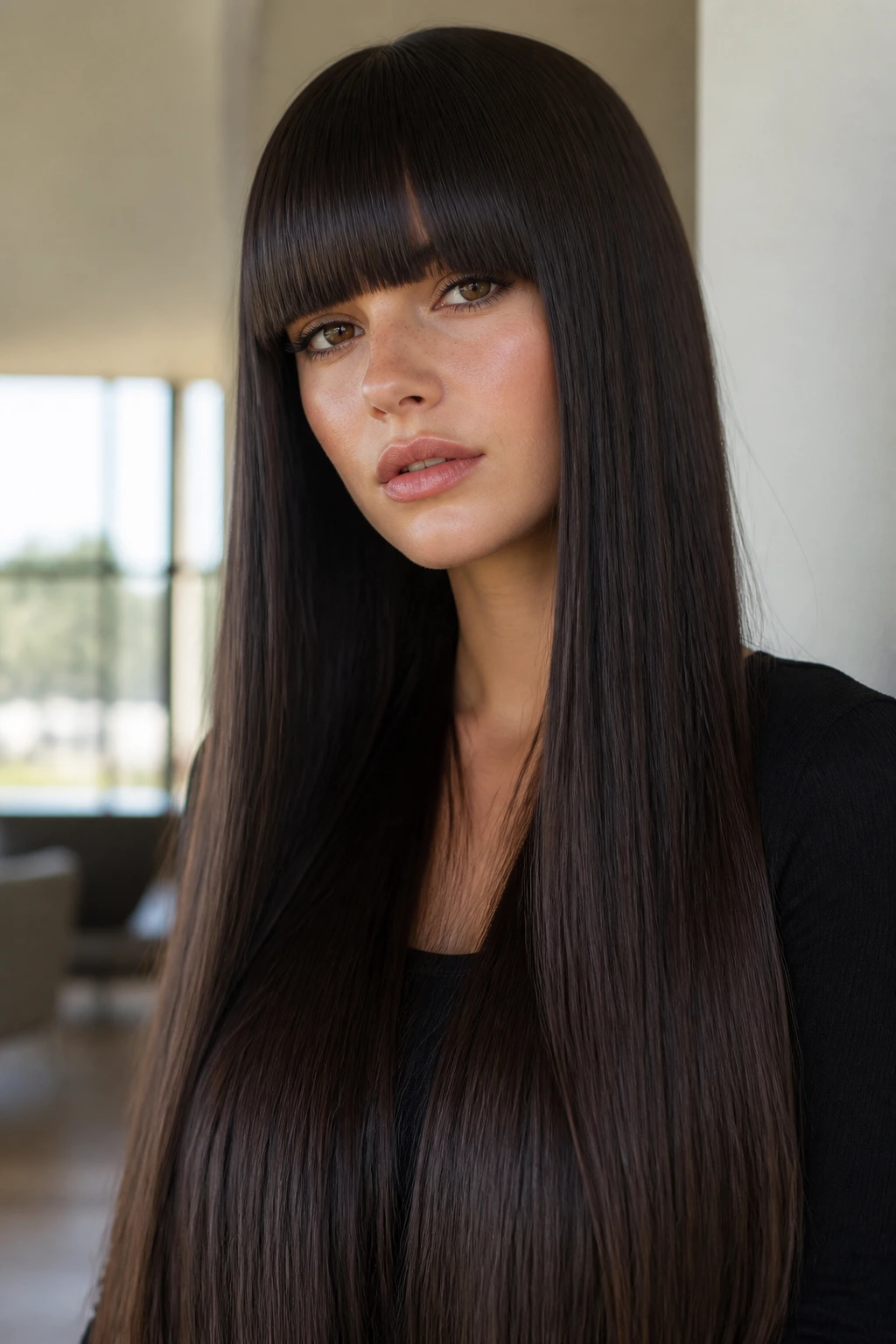
A wolf cut can look like a mess if the fringe is too thin. With thick bangs, though, the whole thing clicks. The heavy front section gives the cut a clear starting point, and the broken layers through the lengths keep it from feeling weighed down.
The fringe here should have texture, not neatness. Point-cut the ends. Leave some separation. Let the bangs sit a little wild. That roughness is what matches the rest of the cut, which usually has a looser crown, cheeky face-framing layers, and ends that are not meant to be tucked into place.
This is one of the better options if you like a style that looks better on day two than day one. A dry texture spray at the roots, a tiny bit of paste at the bang ends, and you’re done. No perfect finish needed. In fact, perfect is the wrong target.
8. Straight Mid-Back Hair with a Straight-Across Bang
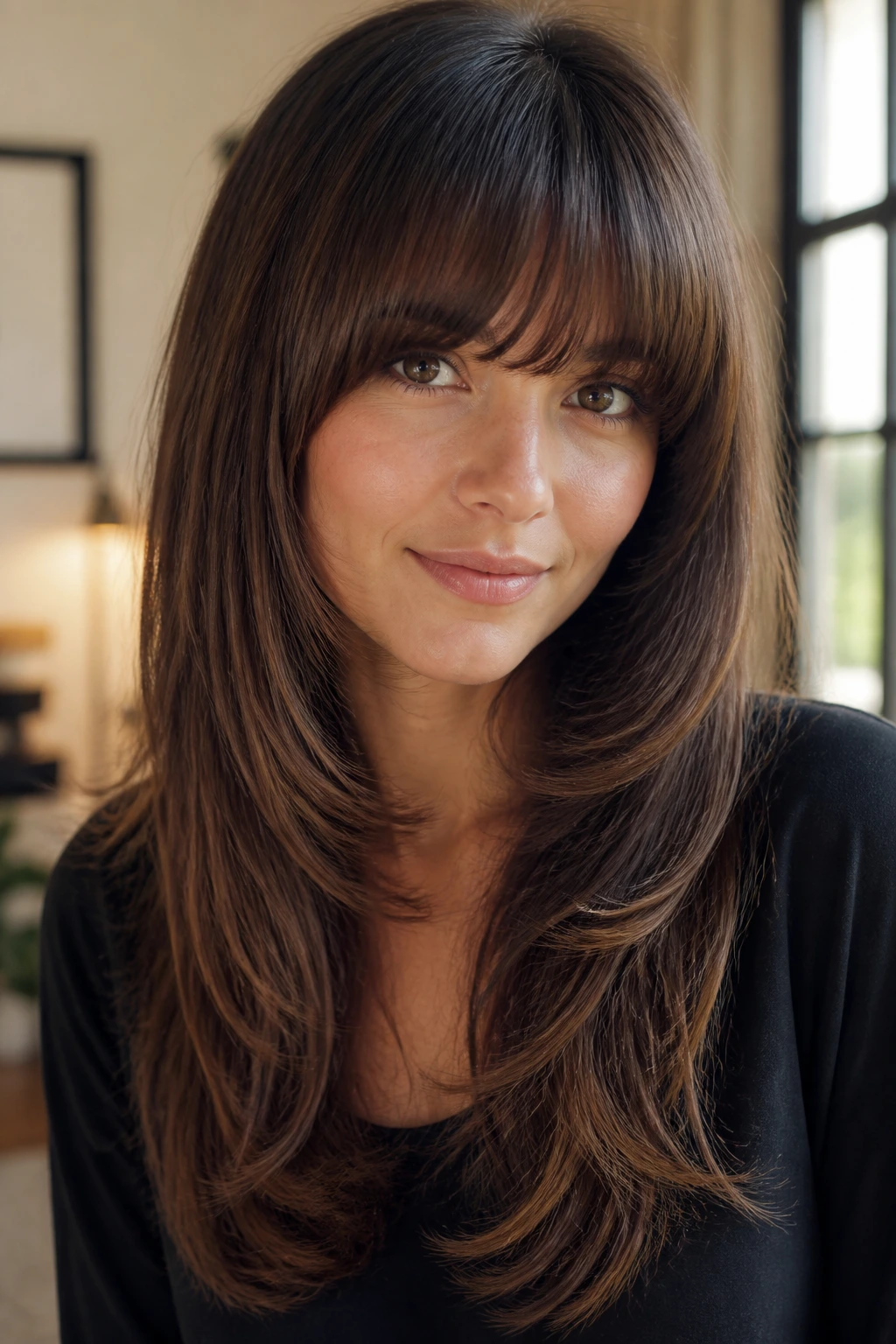
Here’s the version for people who want the cleanest possible line. Long, straight hair with a dense blunt fringe has almost no visual noise. The bang creates the shape. The length supports it. Nothing is hiding.
That simplicity is the reason it works. A straight-across bang on long hair feels confident because it doesn’t ask for extra layers or a lot of texture to make sense. It just needs a good cut and enough density at the front so the fringe doesn’t split apart the second the wind moves.
Use a flat brush or paddle brush to dry the bangs flat, then bend the very ends under if you want a softer finish. If your hairline grows forward at the temples, ask for the bang to angle out slightly there. That tiny detail keeps the fringe from looking boxed in.
9. Mermaid Waves with a Soft-Edged Thick Fringe
Mermaid waves can start to feel all length and no structure. Thick bangs fix that by bringing the eye back to the face before the rest of the hair spills downward again.
This version is best when the fringe has a soft edge. Not wispy. Soft. There’s a difference. The bang stays full in the center, but the perimeter is blurred enough that it slips into the waves instead of sitting on top of them like a helmet. A lot of people ask for “soft bangs” and end up with thin bangs. That’s not the same thing at all.
A wide-barrel iron gives this shape its swoop, but don’t curl the bang too far under. The finish should feel like part of the wave pattern, not a separate event. If you want the look to last, pin the fringe in the direction you want it to dry for a few minutes after blow-drying. Annoying? A little. Worth it? Yes.
10. V-Cut Layers with Side-Swept Thick Bangs
A V-cut makes long hair look pointed and a little athletic. Add a dense side-swept fringe and the whole shape gets more movement through the front. It’s a smart pick if you want the bang to feel substantial without sitting squarely across the forehead.
The side-swept angle is what changes the mood. Instead of a straight line, you get a diagonal that pulls the eye across the face. That can soften stronger jawlines and give rounder faces a longer read, but the real win is simpler: it keeps the fringe from feeling heavy in a bad way.
This style needs a clean side part and a proper blow-dry. Push the fringe in the direction you want it to live, then let it cool before flipping it. If you skip the cool-down, it tends to split in the middle and lose that sweeping shape.
11. Braidable Length with a Wide Bardot Fringe
If you wear braids, low ponytails, or half-up styles a lot, a wide Bardot fringe earns its keep. The front section is dense enough to matter, but it parts open in the middle and blends into the rest of the hair when you need it to.
That makes it a very practical version of thick bangs. The fringe gives your face a frame on days when the rest of your hair is tucked away. On days when you wear it down, it falls into a soft curtain that still feels full.
A broad Bardot bang works especially well when the side pieces are left a little longer. Those temple pieces keep the look from becoming too center-heavy. And if you like a little polish, wrap the fringe around a large brush for one turn on each side. Not more. Too much curl and it starts to look dated fast.
12. Spiral Curls with a Dense Curly Fringe
Dense curly bangs are a whole different animal. They need moisture, shape, and a stylist who respects the curl pattern enough not to slice them too short. A curly fringe cut thick can be one of the best features in a long curly style because it keeps the front from going sparse while the rest of the hair has volume.
The trick is to cut the fringe in its natural state and leave enough length for spring. A curl that seems long while wet can bounce right up above the brow once it dries. That’s not a defect. It’s physics.
Use a leave-in cream or light gel on the fringe, then diffuse on low heat or let it air-dry untouched. Finger-combing too much while it dries can separate the curl clumps and make the bangs look thinner than they are. If you want control, clip the fringe in place while it sets. Old trick. Still works.
13. Blunt Ends with a Clean, Compressed Fringe
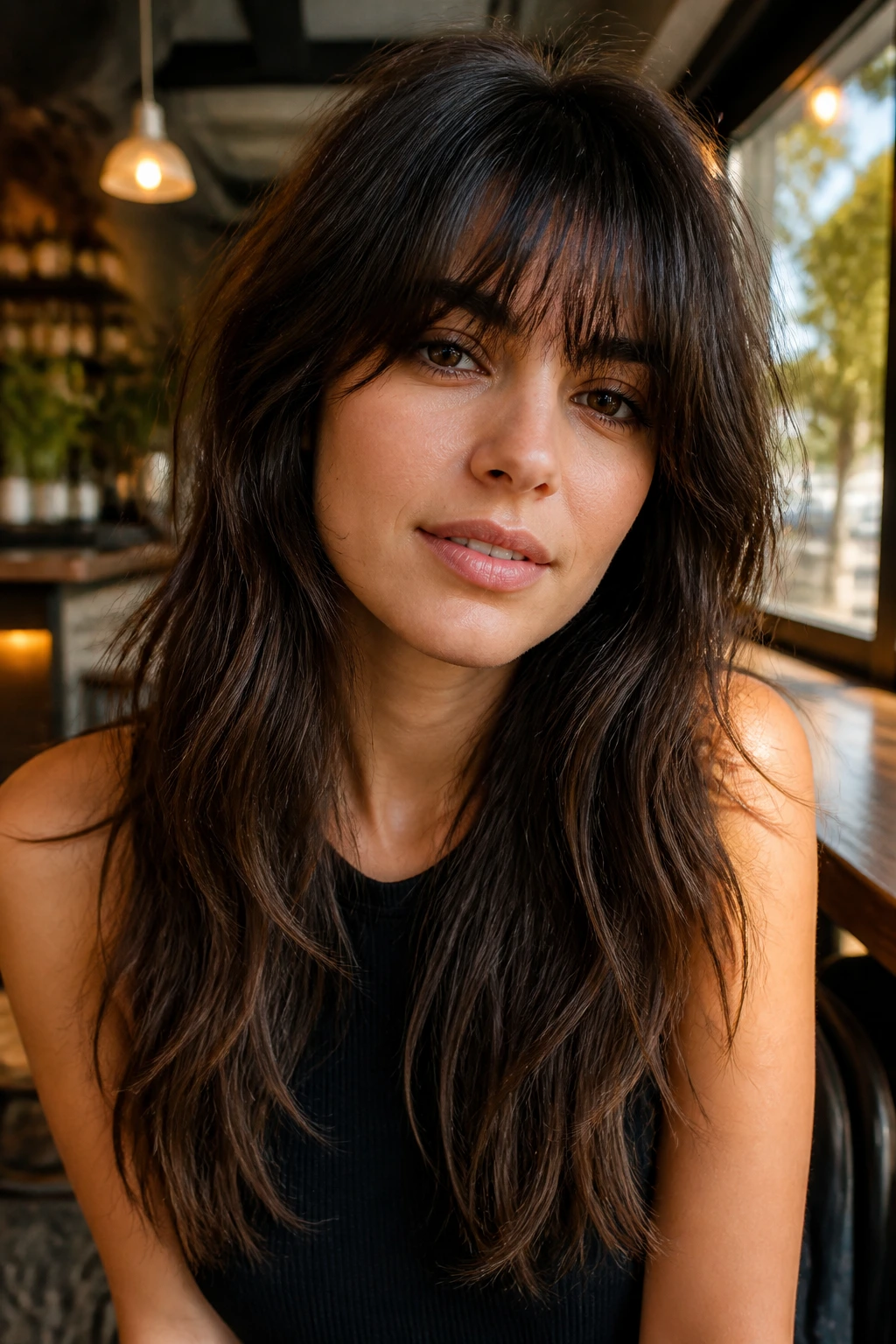
This is the sharpest version in the group. Long hair with blunt ends and a compressed thick fringe looks deliberate from every angle. There’s no soft blur to hide behind. The edge does all the talking.
What makes it work is the proportion. Because the ends are blunt, the bangs need enough weight to hold their own. A sparse fringe would look like a mismatch. A dense one gives the haircut a clear top line and makes the overall silhouette feel editorial without becoming precious about it.
Keep the finish smooth. A little smoothing cream through the fringe, then a low-heat blow-dry with tension at the roots. That’s enough. If you over-style it, the cut starts to lose the crispness that makes it interesting.
14. Long Layers with Bottleneck Bangs
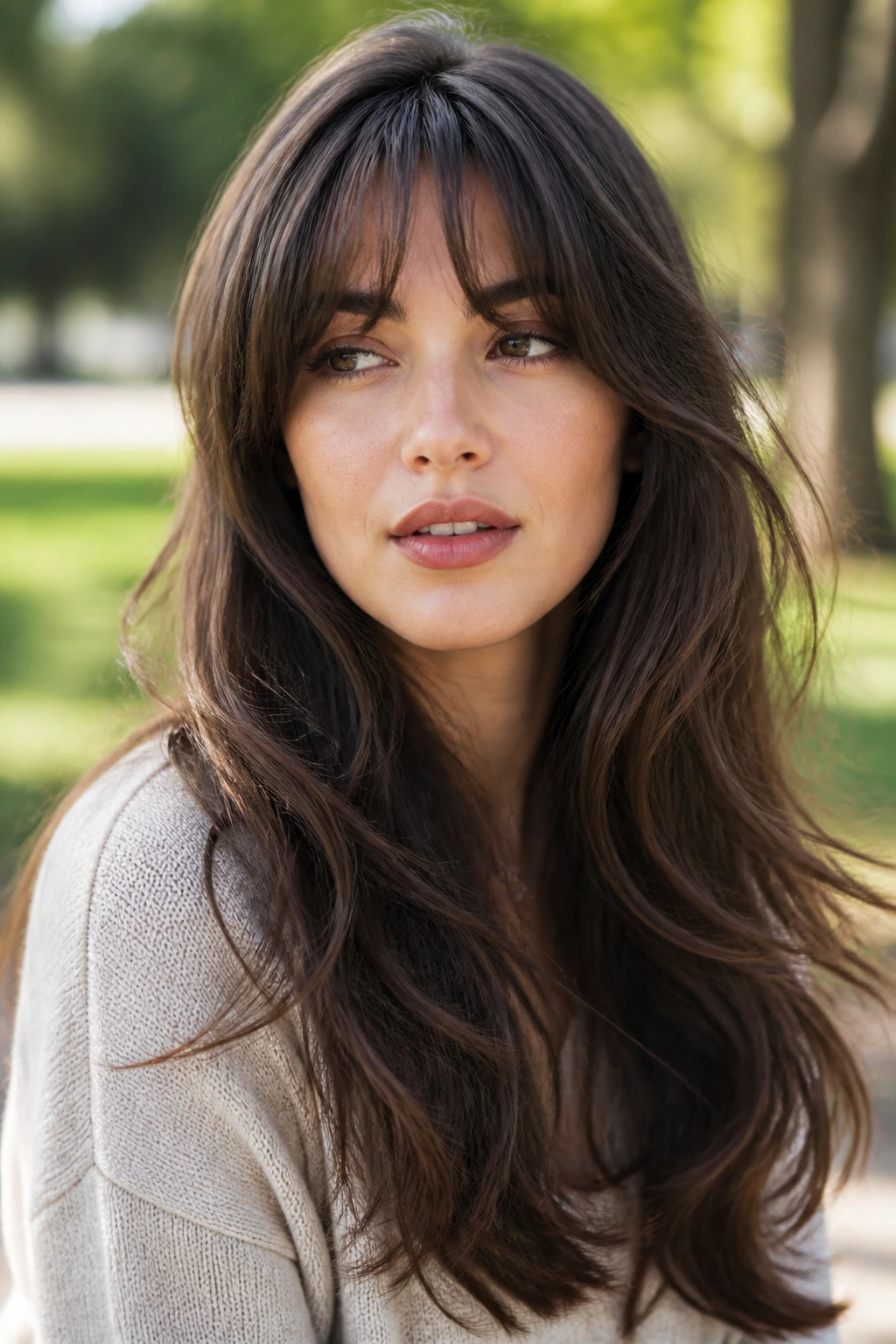
Bottleneck bangs are a good middle ground when you want thickness without a blocky edge. The center comes down fuller, then the sides taper softly around the temples, like the neck of a bottle widening out. It sounds technical because it is, but the effect is simple: the fringe feels dense and wearable at the same time.
On long hair, that shape is useful because it keeps the front from feeling heavy across the whole forehead. You get coverage where you want it and softness where you need it. That balance is why so many people grow into this style from straight-across bangs. It’s a gentler shape to live with.
A bottleneck fringe wants a bit of movement at the roots and a clean split in the center. Use your fingers to direct the bangs first, then finish with a round brush only where the bend needs help. Don’t over-direct the temple pieces. The softness is the point.
15. Deep Side Part with a Sweeping Dense Fringe
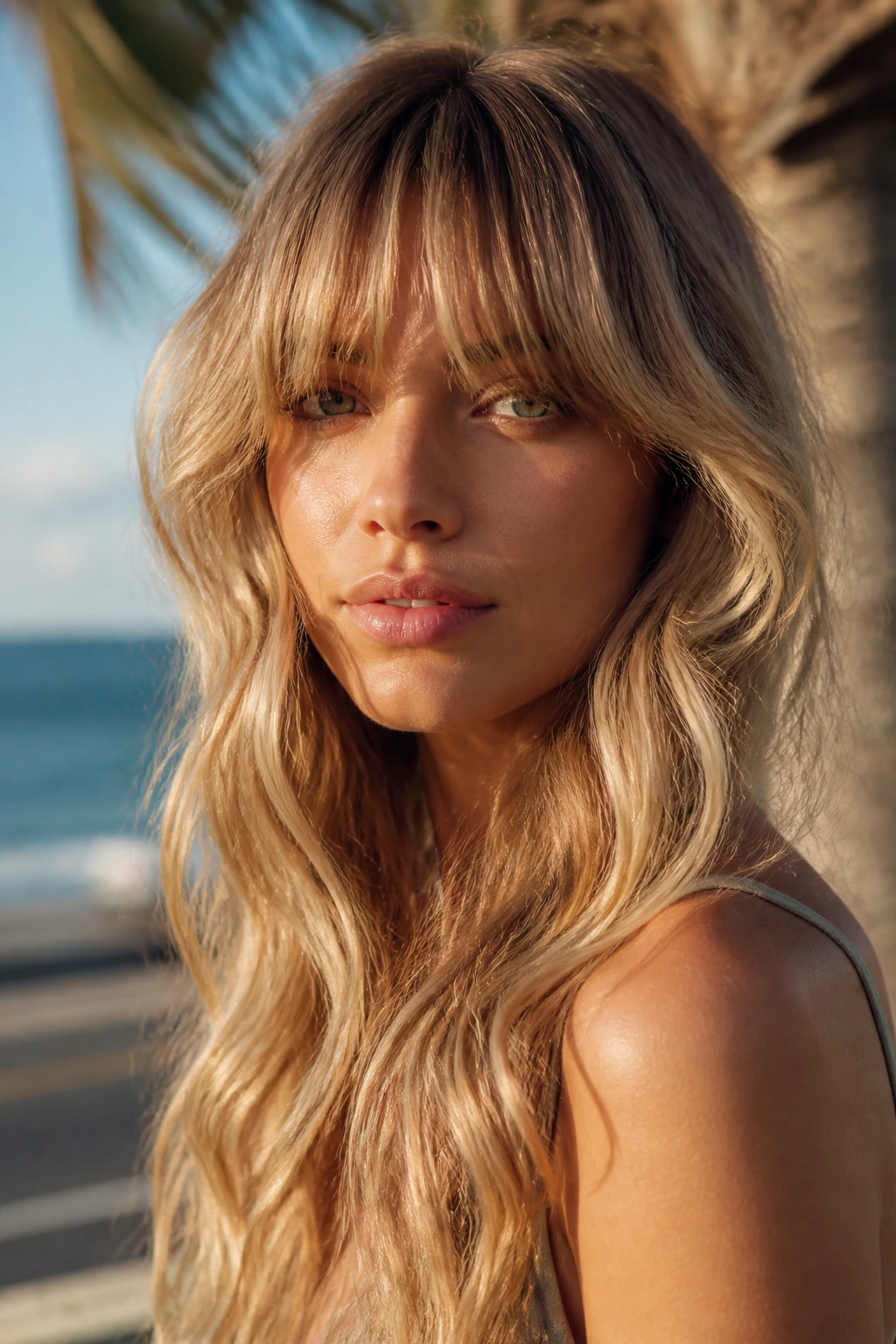
A deep side part changes the whole conversation before the scissors even come out. With thick bangs swept across one side, the style feels asymmetrical and a little more dramatic than a center-parted fringe. It can be a smart pick if you like the weight of bangs but don’t want them sitting squarely in the middle of your face.
The strength of this version is the movement. The bang section is dense enough to stay visible, but the diagonal sweep keeps the forehead from being boxed in. That makes it a useful shape for people with strong features who want a little softness without losing structure.
To style it, dry the fringe in the direction of the part first, then brush it across and set it with a cool blast. A tiny bit of flexible hairspray helps, but don’t bury it in product or the sweep falls stiff. The best version moves when you move.
16. Tousled Length with an Internal Layered Fringe
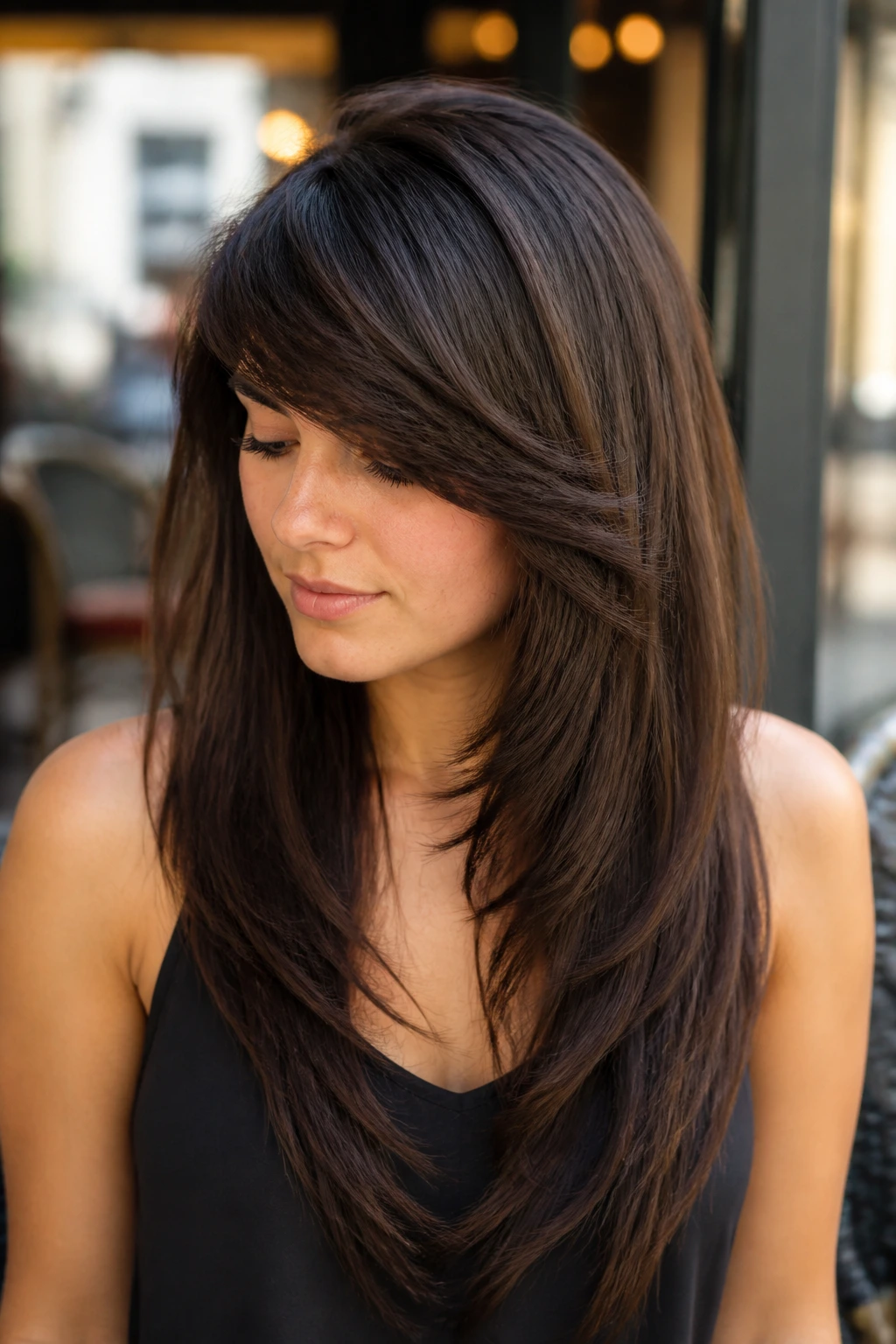
This one is quieter than the others, and that’s why it works. Instead of a heavy straight fringe, the bang zone is built from internal layers that create the feeling of thickness without a hard cut line. On long, tousled hair, that can be a relief.
The style is especially good if you want bangs but not the constant visual dominance of a full blunt fringe. The front still frames the face, but it does it in a softer, more blended way. You can wear it blown out, scrunched, or tucked behind one ear, and it never looks like it belongs to a different haircut.
It’s also a smart bridge style for people growing out bangs. The layered front keeps the shape alive while you decide whether to move toward curtain bangs, a side sweep, or no fringe at all. Not every bang has to be a permanent declaration.
17. Satin-Straight Hair with Heavy Angled Bangs
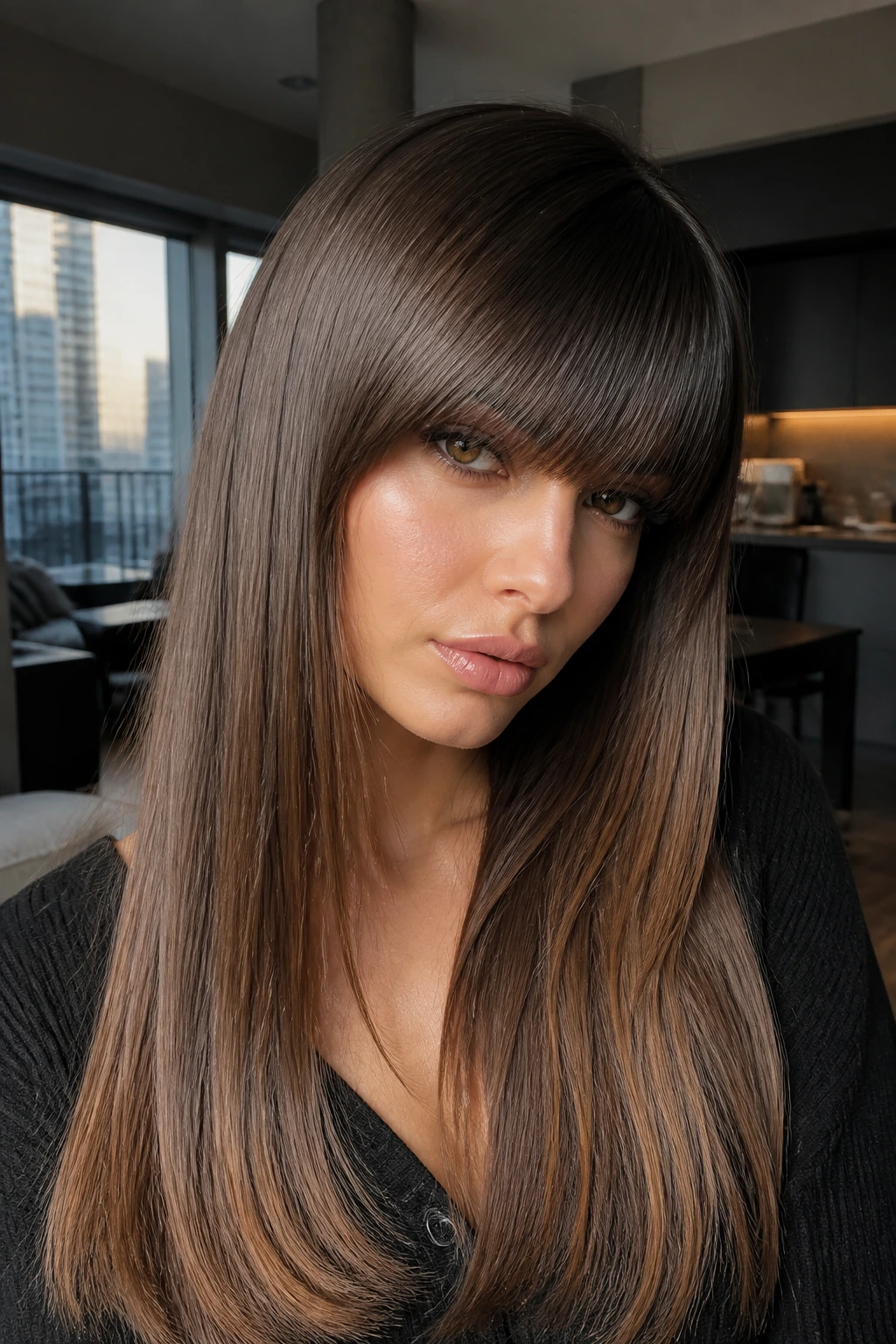
A heavy angled bang gives long straight hair a little motion without breaking the polished finish. One side drops slightly lower than the other, which lets the fringe sit diagonally across the forehead instead of as one flat line.
That diagonal is useful because it sharpens the face in a different way than straight bangs do. It also gives the haircut more flexibility when you wear glasses, tuck one side behind your ear, or pin the hair back. The fringe still reads as full, but it doesn’t lock you into one look.
This cut shines when the hair is ironed smooth and the edges of the bang are beveled rather than harshly chopped. Ask for the longest pieces to skim just below the brow on the heavier side. If the angle is too steep, the fringe loses density. If it’s too mild, the shape disappears.
18. Face-Framing Length with a Thick Grown-Out Fringe
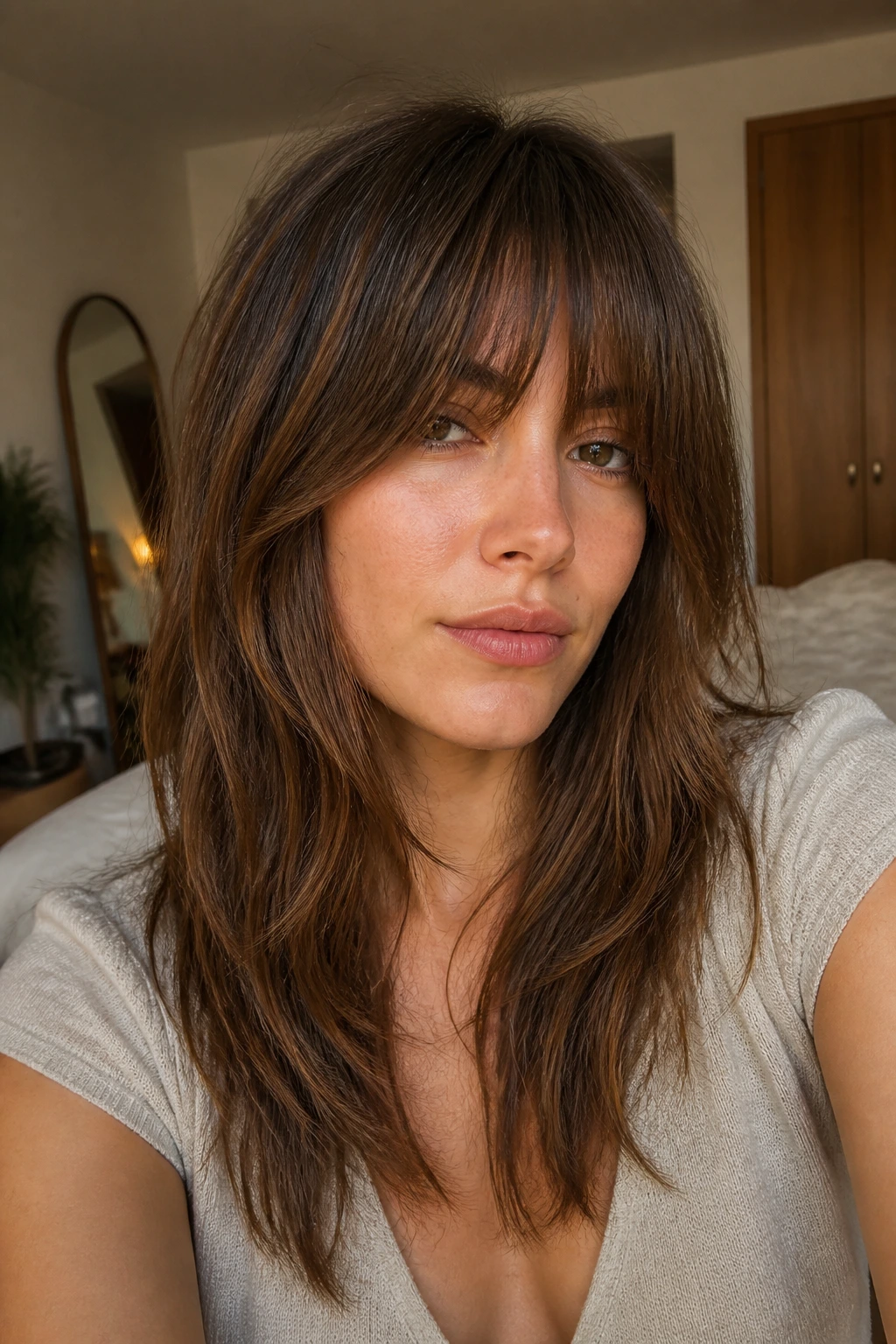
A grown-out fringe can be its own look, not just a waiting period. When the bangs stay dense but sit a little lower and wider, they soften the forehead without demanding a hard styling routine every single day.
This is one of the easiest styles to live with if you like long hair and you’re not in the mood for a strict bang line. The front still has substance, but the edges blend into face-framing layers, which means you can wear it pushed apart, tucked, or brushed straight down depending on the day.
It’s a useful option for people who want to grow out blunt bangs without jumping straight into a middle part. The thickness keeps the fringe from disappearing while it lengthens. If you’ve ever reached the awkward stage where bangs look too short to commit to and too long to ignore, this is the bridge that makes the stretch less annoying.
Why Thick Bangs Change the Whole Long-Hair Equation
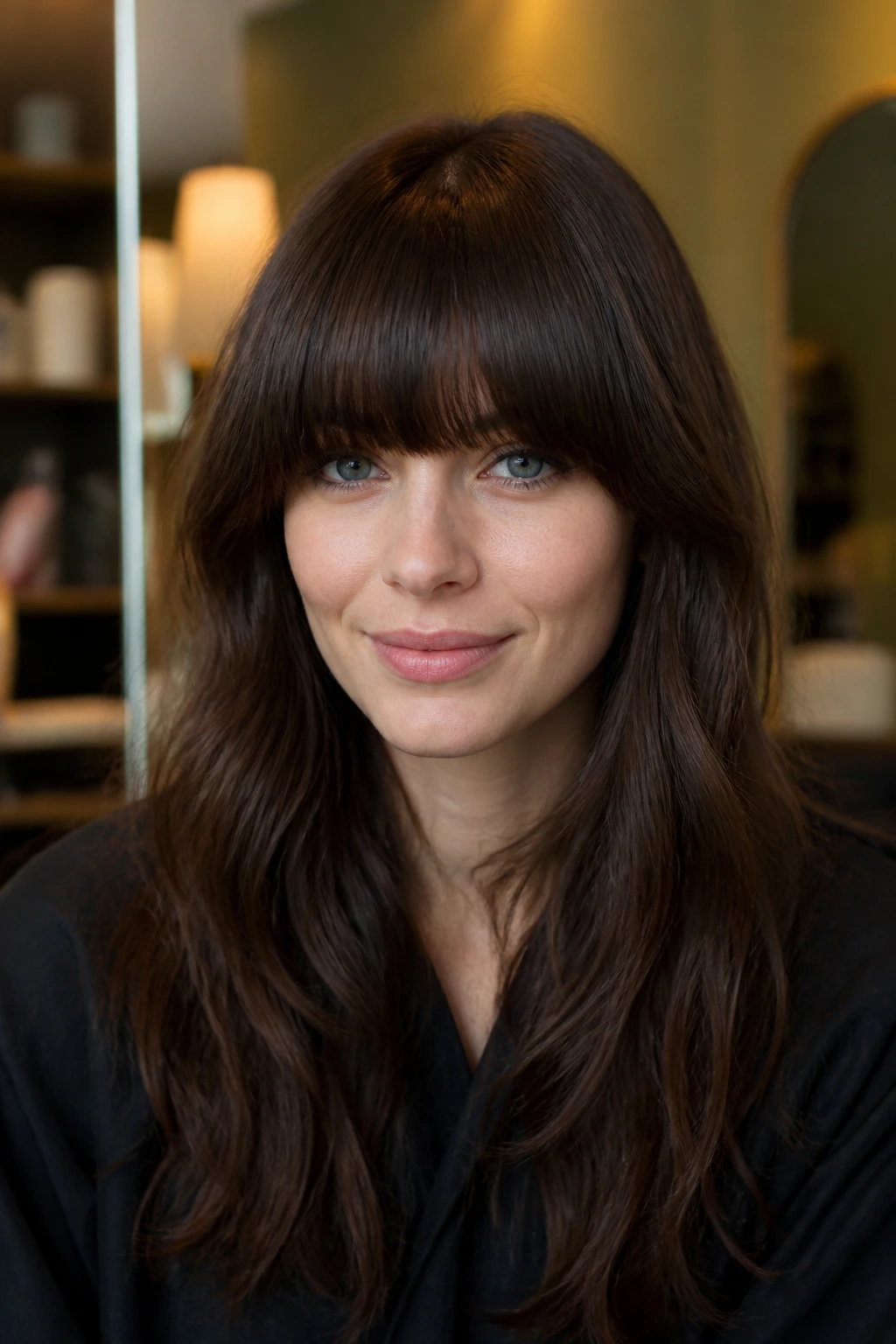
A full fringe changes the math of long hair. Instead of one vertical line from crown to ends, you get a strong horizontal shape across the face, and that little interruption matters more than people expect. It gives the eye a place to land before it drops into the length.
That is why thick bangs can make even simple long hair feel finished. A straight cut with no front structure can look flat if the hair is very long. Add density at the brow, and suddenly the silhouette has a top line, a frame, and a point of focus. The cut stops being only about length.
There’s also a practical side. Thick bangs can hide forehead oil on day two, make the top of a ponytail look more intentional, and give you a way to change the mood of the haircut without sacrificing inches. The tradeoff is upkeep. A dense fringe does not forgive neglect as easily as long lengths do. It wants trims, a little styling discipline, and a plan for cowlicks.
How to Ask for the Right Bang Density at the Salon
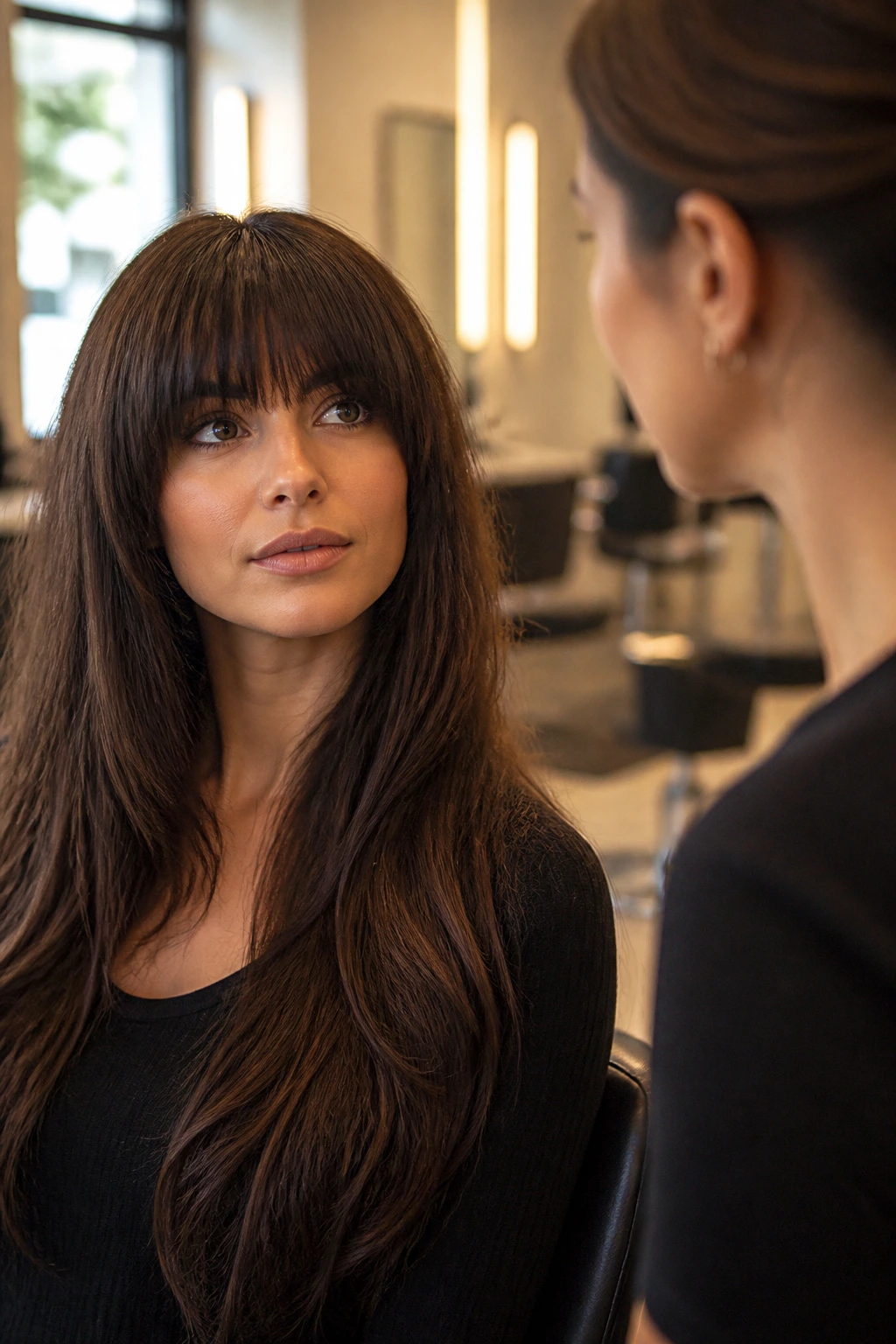
The phrase “thick bangs” can mean three different things to three different people. To a stylist, it should mean density in the fringe section, enough width to cover the forehead without gaps, and a shape that makes sense for your hairline. Say all three out loud. Don’t assume they’ll read your mind.
Bring photos, but bring the right photos. One should show the shape you want. Another should show the amount of fringe you want. Those are not always the same image. A lot of people save a picture of soft curtain bangs and ask for blunt density. That’s how you end up disappointed before the blow-dryer starts.
Mention your cowlicks, your part, and whether you air-dry or heat-style. If you wear glasses, say so. If you sweat at the forehead, say that too. A good fringe has to live in the real world, not just in a salon chair.
What to say in plain language
- “I want the bangs dense, not see-through.”
- “I’d like the sides to blend softly.”
- “Please cut them with my hairline in mind.”
- “I need enough length for shrinkage when it dries.”
- “I’m willing to style them, but not fight them.”
Those little sentences save a lot of regret.
Essential Tools for Styling Thick Bangs
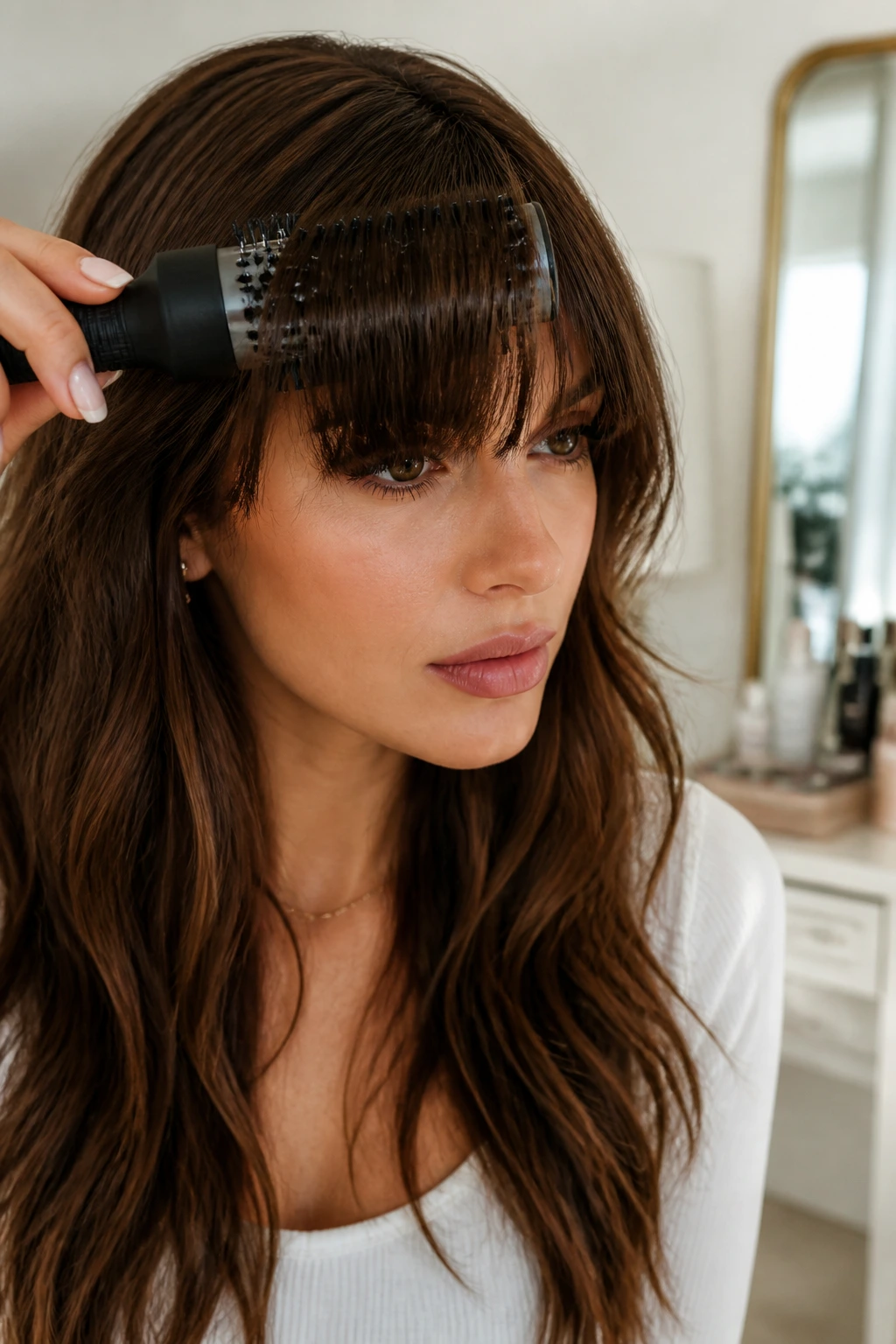
You do not need a drawer full of gadgets. You do need the right few things.
- A small round brush: Best for shaping the fringe under or away from the face without making it curl too hard.
- A blow dryer with a nozzle: The nozzle matters more than people think; it helps direct airflow so the bangs don’t frizz outward.
- Sectioning clips: Keep the rest of the hair out of the way while you work only on the fringe.
- A flat iron, 1/2-inch to 1-inch: Useful for sleek bangs and for nudging a stubborn bend into place.
- Heat protectant spray: Non-negotiable if you use hot tools on the fringe more than once a week.
- Dry shampoo: Helpful for bang roots, which get oily faster than the rest of the head.
- A fine-tooth comb: Good for clean parting and for distributing product without overloading the fringe.
- Velcro rollers or a root clip: Optional, but useful when you want lift without heavy heat.
- Lightweight hairspray: The flexible kind, not the crunchy shell kind.
- Leave-in conditioner or curl cream: Only if your texture needs moisture in the fringe.
Smart Product and Cut Choices
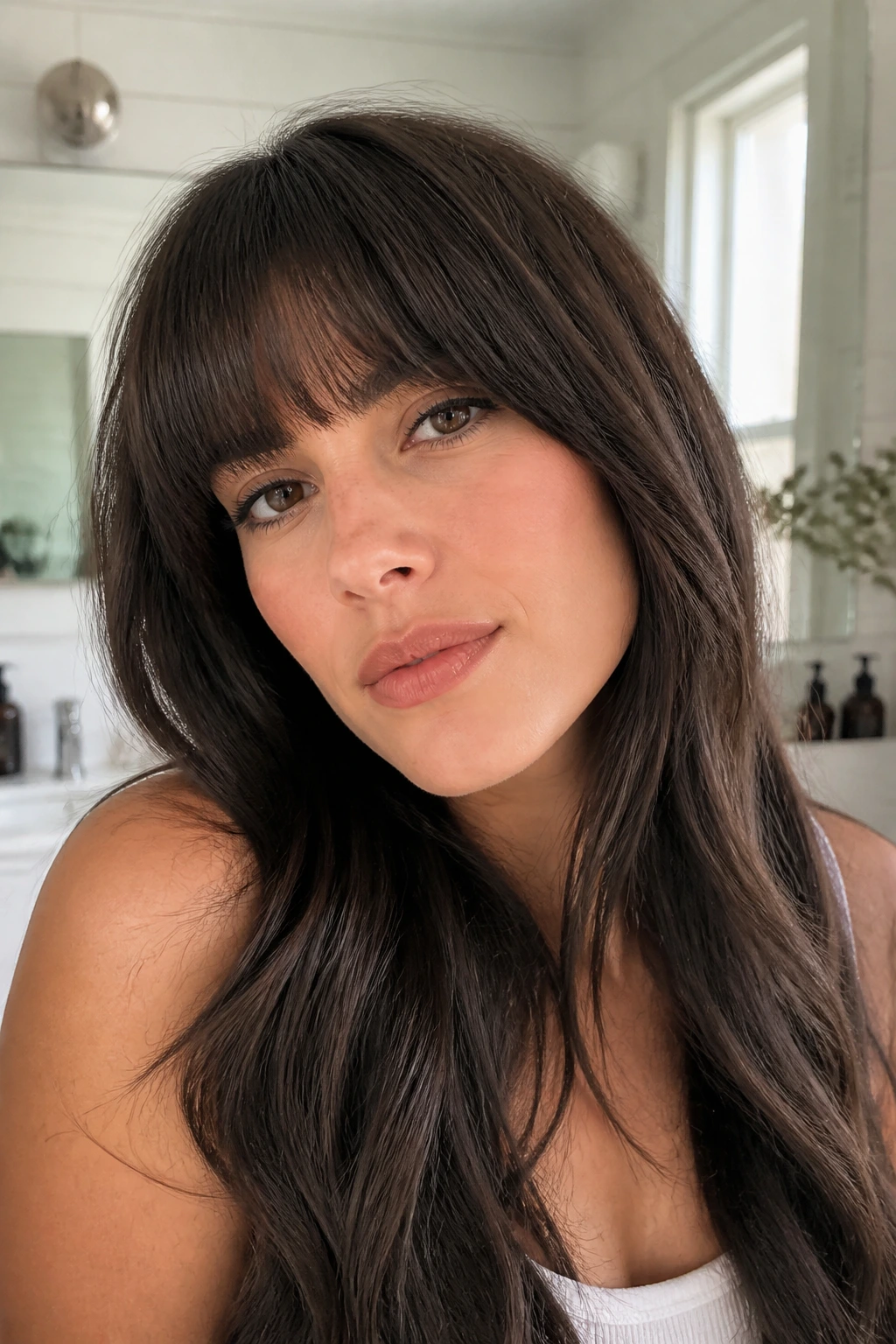
A thick fringe is cut first and styled second. If the cut is wrong, no product will save it. That means the real shopping starts with the haircut plan, not the shampoo aisle.
Ask for a fringe shape that matches your texture instead of pretending every bang should behave like straight hair. For dense straight hair, blunt or lightly beveled edges hold cleanly. For wavy hair, a slightly longer fringe often wears better because the wave steals a bit of length as it dries. For curls, leave room for shrinkage and don’t let anyone cut the bangs as short as they look in the moment.
Product choice matters in a small, annoying way. Thick bangs pick up oil faster than the rest of your hair because they sit against the skin. A lightweight dry shampoo near the roots can buy you a full extra day before the fringe looks limp. On the flip side, a heavy oil or a silicone serum near the roots can flatten the shape by noon. Keep the richer product on the mids and ends, not the bang line.
If you use heat, a fine mist heat protectant is worth it. So is a mousse or root-lift spray for bang volume, especially if your fringe falls flat the second it dries. The goal is not more product. It’s the right product in the right spot. That’s the part people skip and then blame the cut for.
How to Wear These Styles in Real Life

A thick fringe changes the outfit around it. That’s the honest version. Some days the bangs are the whole story, and the clothes can stay simple. Other days the hair needs a little breathing room so the front shape doesn’t fight with a high collar or a giant necklace.
Presentation: Keep the fringe either polished or deliberately loose. Half-styled bangs look accidental. If you want sleek, finish the roots smooth and the ends clean. If you want soft, let a few pieces bend naturally and avoid combing the life out of them.
Accessories: Hair clips, slim headbands, and low-profile barrettes work better than bulky pieces right at the forehead. Big earrings can also help balance a thick fringe because they draw the eye downward without crowding the face.
Outfits: Open necklines and soft collars tend to work well with blunt or heavy bangs because they give the haircut space. A turtleneck plus a dense fringe can look sharp, but it can also start to feel crowded fast if the hair is very full. Keep that in mind before you build the whole look around volume.
When to choose it: Thick bangs are useful on days when you want the face framed without doing much else. They also work nicely when the rest of your hair is in a ponytail or braid and you still want the front to look finished.
Additional Tips and Style Boosters
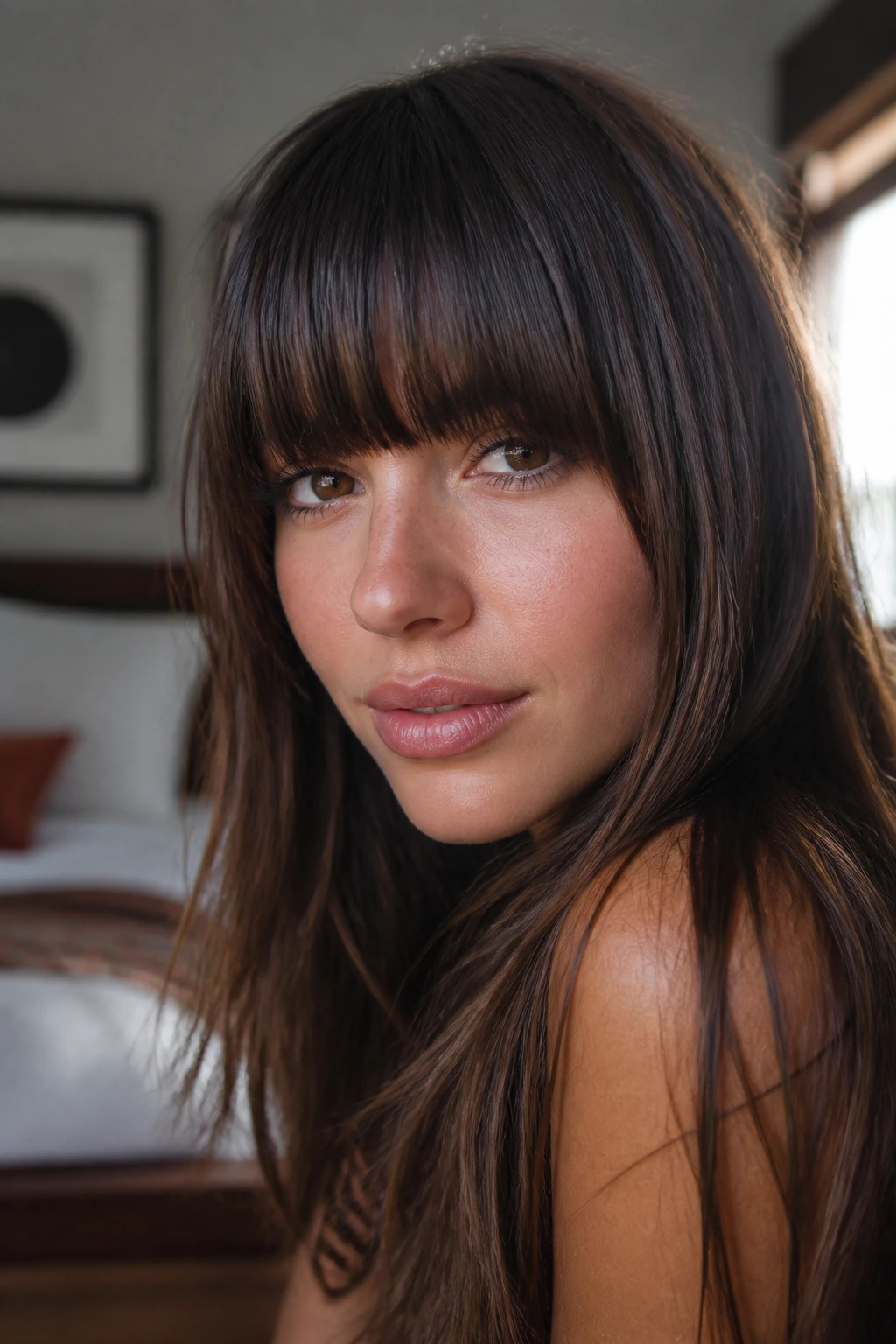
Shape Boost: Dry the bang section first, before the rest of the hair. That small habit matters because bangs set quickly, and if they dry in the wrong bend, you spend twice as long fixing them later.
Texture Boost: If the fringe looks too heavy, use a touch of dry shampoo at the roots and a tiny bit of texture spray at the ends. The root lift stops the bang from lying flat; the texture keeps the edge from looking too stiff.
Customization: Ask for softer temple pieces if your face needs length, or keep the bang line fuller if you want more coverage. That tiny shift changes the whole balance. It’s not a small detail.
Serving Suggestions: Pin one side back with a small clip, or tuck the fringe behind the ears for a few minutes to reset the shape between meetings or errands. The rest of the hair can stay long and loose while the front gets a quick reset.
Make-It-Yours: If you wear glasses, keep the center slightly longer so the frame doesn’t compete with your brows. If you like hats, ask for a fringe that can split cleanly. If your hair is fine, keep the ends blunt enough to hold the illusion of density.
Maintenance, Trims, and Daily Refresh
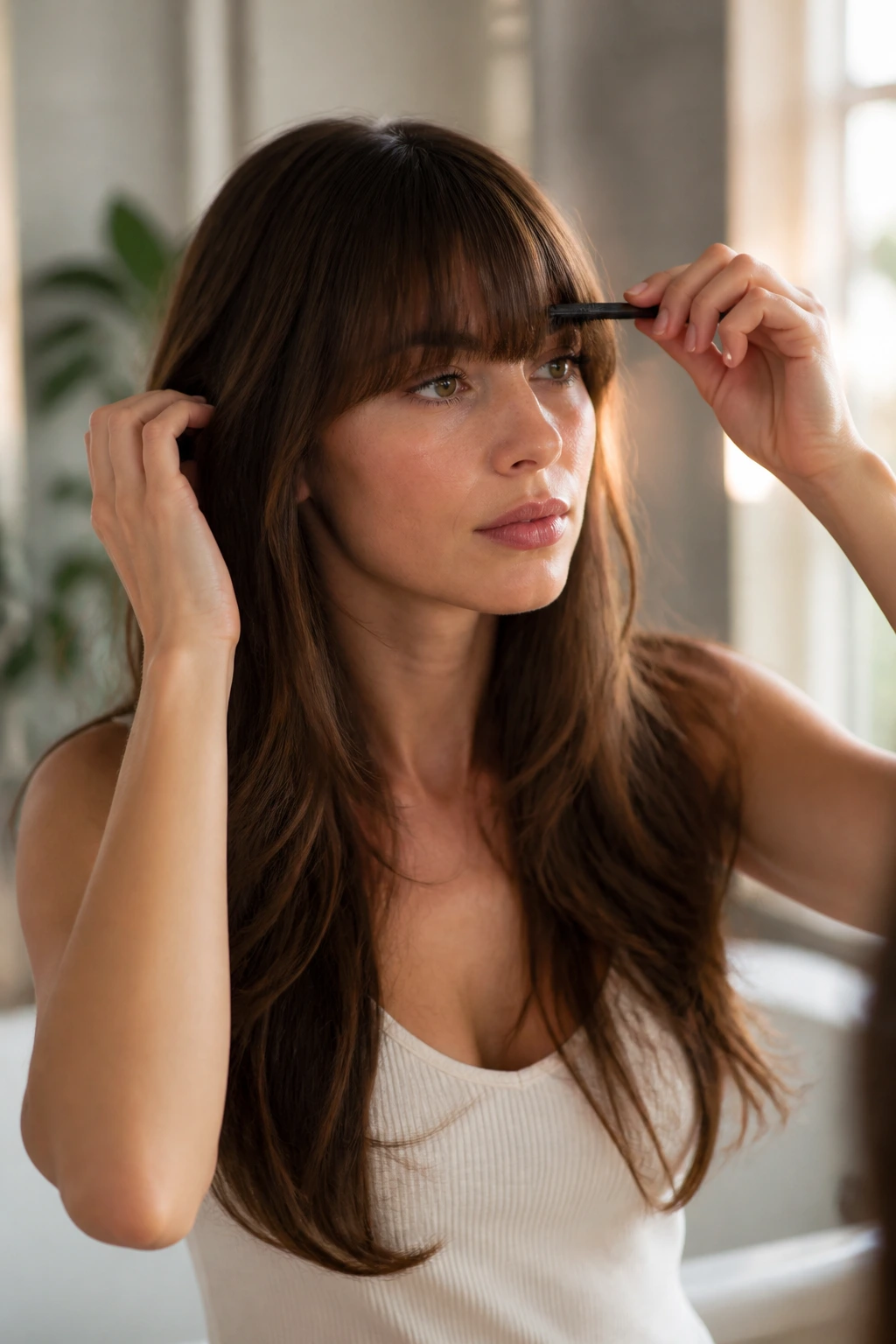
Thick bangs need a schedule. Not a strict one, but a real one. If the fringe is blunt, plan on a bang trim every 3 to 5 weeks. If the shape is softer — curtain, bottleneck, side-swept — you can usually stretch that to 5 to 7 weeks before the line starts drifting.
The long lengths themselves can usually wait longer. A shape tidy-up every 8 to 12 weeks keeps the layers from collapsing into the wrong place, especially around the face. If your hair grows fast or you wear a very precise outline, shorten that gap a little. If you like a messier finish, you can stretch it.
At home, the bang area may need a quick refresh even when the rest of your hair looks fine. A dry shampoo puff at the roots, a quick round-brush pass, or a blast of cool air can bring the fringe back to life in under two minutes. If the bangs bend weird overnight, mist them lightly with water, brush them in the direction you want, and dry them again. Don’t soak them. That just resets the problem and adds frizz.
For overnight care, a silk or satin pillowcase helps, but the real trick is keeping the fringe from being crushed. If you can, clip it loosely to the side or separate it from the rest of the hair before sleep. It sounds fussy. It saves time in the morning.
Variations and Adaptations to Try
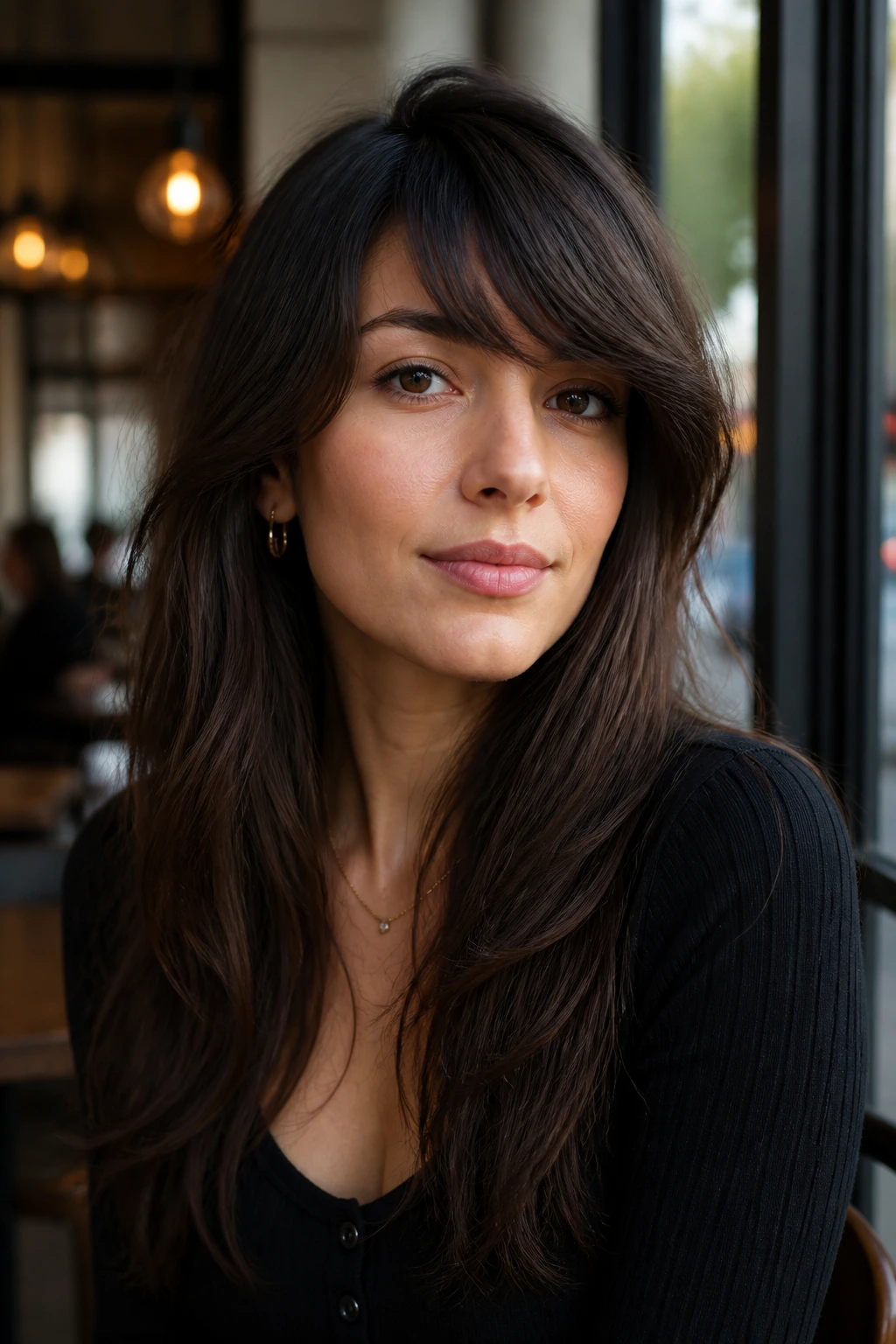
The Low-Heat Version: Keep the bang a touch longer and let it air-dry with a light mousse. This works well if you hate daily hot-tool work and don’t mind a softer edge.
The Curly-First Version: Cut the fringe to follow the curl pattern and stop trying to force it flat. The shape will read denser and more natural when the curl clumps stay intact.
The Fine-Hair Fix: Ask for blunt ends in the fringe and reduce excessive layering near the temples. That keeps the front from looking wispy even if the rest of the hair is fine.
The Grown-Out Bridge: Let the bangs sit at lash level and widen them slightly into the sides. This is the easiest version for anyone between fringe stages.
The Side-Part Swap: Move a dense fringe off-center and let it sweep across the forehead. It keeps the bang weight but changes the mood in one move.
The Half-Up Friendly Cut: Leave the temple pieces a bit longer so you can pull the lengths back without making the fringe look chopped off. Handy, plain and simple.
Common Mistakes That Flatten the Fringe

The most common mistake is cutting the fringe too thin because the word “thick” sounds scary in the chair. Thin bangs on long hair tend to separate, especially once oil, wind, or a humid room gets involved. The fix is density at the front, not just width across the forehead.
Another one: ignoring the way your hair falls when it dries. A bang that looks perfect wet can split, spring up, or drift sideways once it’s dry. If your hair has a strong cowlick or a wave pattern, cut and style with that in mind. Otherwise the fringe will fight back every morning.
People also overload the bang area with product. A heavy cream or too much oil near the roots makes the fringe collapse and cling to the skin. Use your richer products on the lengths and keep the bang line lighter. That’s where dry shampoo earns its keep.
The last mistake I see a lot is over-layering around the face until the fringe stops being thick at all. Softness is good. Thinning the whole front section into wisps is not the same thing. If you want a dense bang, keep the weight in the middle and let the edges soften later.
Frequently Asked Questions
Are thick bangs hard to maintain with long hair?
They ask for more attention than no fringe at all, but not by much once you get the routine down. The main work is keeping the front dry, shaped, and trimmed before it starts hanging in your eyes.
Will thick bangs work on fine hair?
Yes, if the front section is cut with enough density and the ends stay blunt enough to hold together. Fine hair can wear a full fringe well; it just needs a little less thinning and a little more structure.
Can I wear thick bangs with curly hair?
Absolutely, and curls can make the style look richer than straight hair ever will. The key is to cut for shrinkage and dry the fringe in its natural pattern, not straight out of the shower.
How often should I trim them?
Most blunt fringes need a trim every 3 to 5 weeks. Softer shapes can go a little longer, but once the line starts blocking your vision or splitting badly, it’s time.
What if my bangs separate in the middle?
That usually means the fringe is either too sparse or your hairline is pushing it apart. Dry the roots in the direction you want, use a light dry shampoo, and ask your stylist for a denser interior next time.
Do thick bangs make a long face look shorter?
They can, because the horizontal line across the forehead breaks up vertical length. A rounded or curtain-style fringe usually softens the effect more than a severe blunt line.
Can I grow out thick bangs without the awkward stage?
Yes, if you shape them into bottleneck, side-swept, or wide curtain fringe as they lengthen. The trick is not letting them drift into a random in-between shape with no plan.
Do I need heat tools every day?
No. Some versions need a round brush or flat iron to set the front line, but textured or curly versions can work with air-drying, a little product, and a few clips. The cut should support the routine you actually live.
Why the Fringe Carries the Look

A thick fringe does more than cover the forehead. It gives long hair a front edge, which is the piece a lot of very long cuts quietly lack. Once that edge is in place, the rest of the hair has something to orbit around.
That’s why these styles can feel polished, edgy, soft, or lived-in without changing the length much at all. The front does the heavy lifting. Pick the shape that matches your texture and your patience level, and the rest of the cut starts making sense on its own.
