



Long box braids change the whole mood of a hairstyle. The length gives you movement, yes, but it also changes the line of the braid, the way the parts read from across the room, and how much weight sits on the scalp by the end of the day. That’s why box braid styles for long hair need a little more thought than a simple “wear it down and go” approach. The shape matters. The parting matters. Even the hardware — beads, cuffs, scarves, pins — matters more when the braids fall past the collarbone.
I’ve always thought long braids look best when the style respects the length instead of fighting it. If the install is too bulky at the roots, the style starts looking tired before it’s old. If the ends are too heavy, the whole head slumps. But when the balance is right, long braids have this clean, swinging, almost architectural feel that shorter braids can’t quite duplicate.
That’s the fun part here. Long hair gives you room to change the silhouette without redoing the whole head. One day the braids can hang straight and neat. The next day they can live in a ponytail, a wrapped bun, a crown, or a scarf knot that makes the entire style feel new again. And yes, some looks are easier on the scalp than others — that matters a lot once the braids get past shoulder length.
Why Long Length Gives These Braids More Room to Work
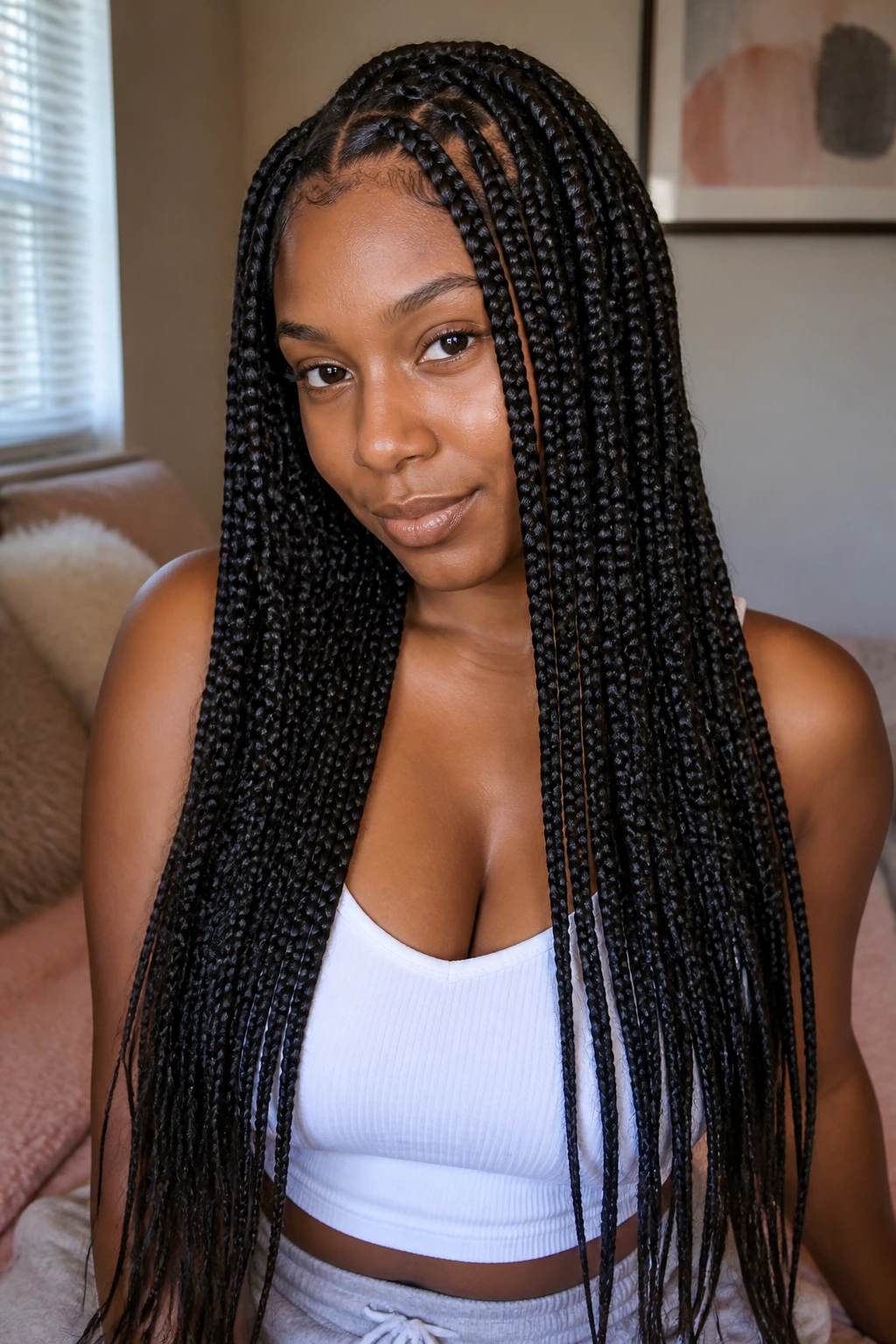
Length is the styling tool here, not just the finish. With short braids, the braid itself is often the whole story. With long braids, the story starts at the part line and keeps going all the way to the ends, which is why you can change the look so much with one pin or one ponytail holder.
Weight changes everything. A braid that lands at the chin behaves differently from one that brushes the mid-back. Long braids swing more, pull more, and show frizz more clearly, so the styles that win are the ones that either distribute the weight well or gather it in a way that feels intentional.
Accessories finally have room to breathe. Beads, cuffs, thread wraps, and scarves often look crowded on shorter braids. On longer lengths, they have space to sit, and that makes the styling read cleaner. One cuff near the end of a waist-length braid can say more than six cuffs scattered up top.
You get more ways to hide a bad hair day. Not glamorous, but true. A low bun, a side sweep, or a half-up knot can rescue roots that need a wash day or an install that’s started to loosen at the edges. Long braids are generous like that.
The parting becomes part of the design. Square parts are classic. Triangle parts add movement before you even touch the hair. Curved parts and off-center sections show up more clearly once the braids fall long, which is why the base of the style deserves more attention than people give it.
1. Classic Waist-Length Box Braids
Classic waist-length braids are the version most people picture first, and for good reason. They’re clean, straight, and honest about the length. There’s no trick here — just neat parts, even tension, and braids that fall in a smooth curtain past the waist or lower back.
Why it still works
The appeal is in the line. Waist-length braids create one continuous vertical shape, which makes the whole head look long and polished even when the outfit is casual. If your parts are crisp and the ends are sealed evenly, the style holds its shape for weeks without asking for a lot of fuss.
Keep the roots tidy. That’s the whole game.
A classic install looks best when the front rows are a touch smaller than the back rows, because the hairline gets more visual attention and less bulk there prevents that boxed-in look around the face. I also like a slight taper at the ends. Sharp, blunt braid ends can look stiff; a little taper gives the movement a softer finish.
If you want one style that can go straight from errands to dinner without a restart, this is it. Nothing flashy. Nothing forced. Just long braids doing what long braids do best.
2. Jumbo Box Braids with Clean Parts
Want the fastest way to make long hair look dramatic? Go jumbo. Big, chunky box braids with sharp parts have a confidence to them that tiny braids can’t imitate, and on long hair the effect is even stronger because the extra length keeps the bulk from looking top-heavy.
The reason jumbo braids make sense on long hair
Jumbo braids reduce the number of individual plaits on the head, which can make the install feel lighter than it looks. That’s the trick people miss. The braids are thick, yes, but there are fewer of them, so the scalp doesn’t have to carry as many sections. If your hair is dense or your mornings are busy, that matters.
The parts need to be clean. Sloppy sections make jumbo braids look unfinished fast, because there’s nowhere for the eye to hide. A rat-tail comb, a firm clip, and a steady hand are worth their weight here.
Best for: bold earrings, simple outfits, and anyone who likes a braid style that reads from across the room.
Skip it if: you want a lot of tiny styling options. Jumbo braids are not shy, and they don’t pretend to be.
3. Knotless Box Braids That Sit Lighter at the Roots
Knotless braids are the version I reach for when I want long braids to look smoother at the scalp and feel kinder by day three. The feed-in method shifts the bulk away from the root, so the braid grows out of the head more softly instead of starting with that obvious knot.
What makes them feel different
The first few inches are the key. Instead of locking a big knot at the base, the braider adds hair gradually, which spreads the tension out. That doesn’t make the style weightless — long braids are still long braids — but it does change the way the roots feel, especially if your edges are delicate.
This style is smart for people who know they’ll wear the braids for several weeks. The cleaner root transition grows out better, and when the new growth shows, it doesn’t shout as loudly. It also plays nicely with long hair because the weight of the extension hair doesn’t all sit in one lump at the scalp.
A lot of people assume knotless means “less maintenance.” Not quite. It means less pulling, not less care. You still need a satin wrap at night and a gentle wash routine. The difference is that your scalp usually thanks you for the choice.
4. Triangle-Part Box Braids
Triangle parts are what happen when you want the braid itself and the part pattern to matter equally. Instead of the usual square grid, the sections come out in triangles, and long braids make that geometry easy to see. The pattern peeks through when the braids move, which is half the fun.
The shape feels fresh without being loud. That’s a rare thing.
On long hair, triangle parts look especially good when the braids are worn down or in a high ponytail, because the parting stays visible near the scalp while the length does the rest of the work. The style gives you a little bit of visual surprise every time the hair shifts.
If you’re choosing between square and triangle parts, think about what you want people to notice first. Square parts give neatness. Triangle parts give motion. I prefer triangle parts when the braids are medium to long, because the extra length keeps the parting from looking overly busy.
The real benefit is simple: triangle parts make the head look styled even when the braids are hanging loose. You don’t need cuffs or beads to make it interesting. The parts already did that.
5. Boho Box Braids with Curly Ends
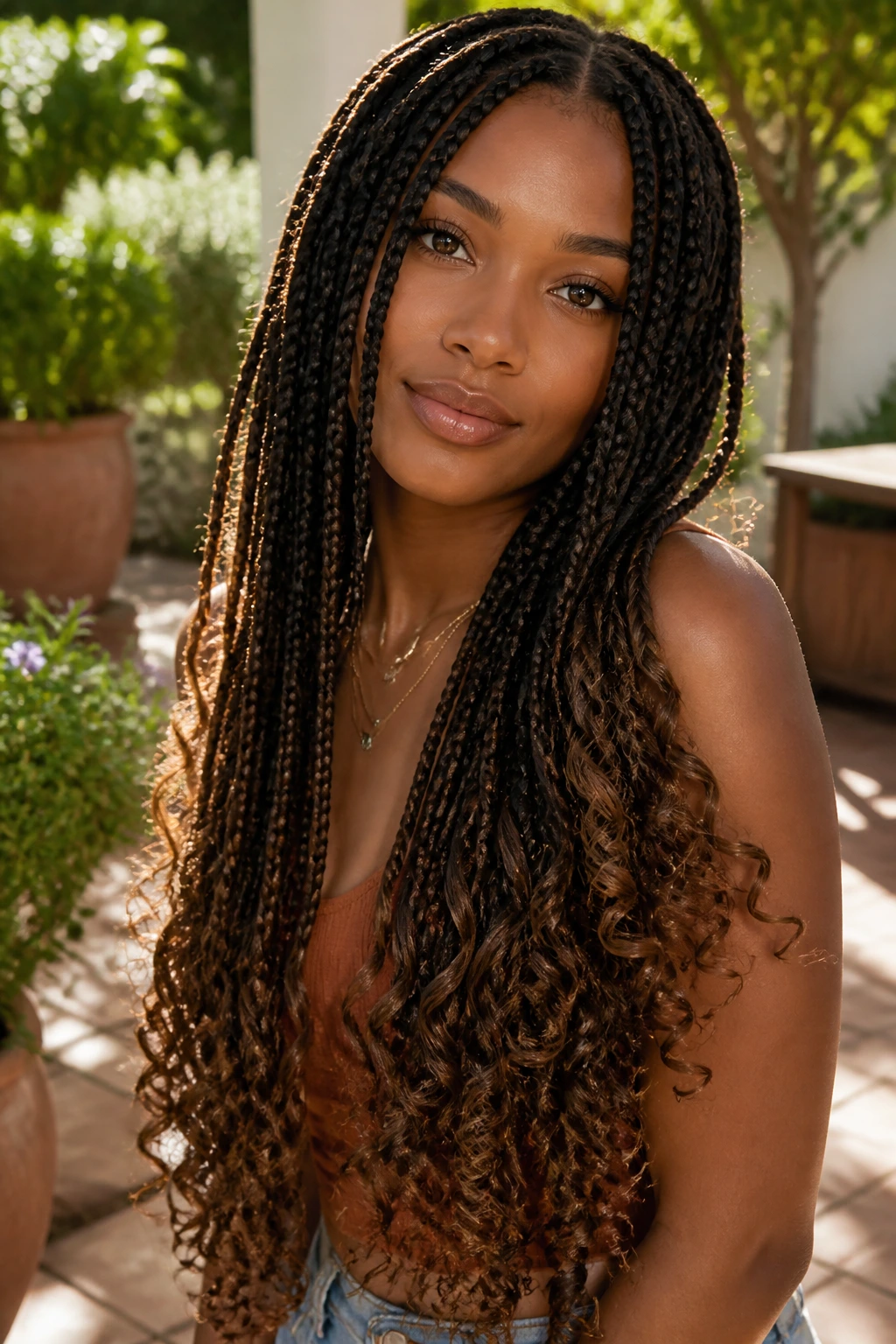
Boho box braids are for people who like their long braids to feel a little softer and a little less strict. The base still reads as box braids, but curly strands or loose textured pieces are threaded in, and the ends often finish with a bend or a curl instead of a hard blunt line.
Where the curl belongs
Start the loose texture lower down, not right at the root. If the curls are packed in too close to the scalp, the style can look fuzzy before you’ve even left the house. The pretty part is the movement at the mid-length and the ends — that’s where the contrast lives.
This style wears especially well on long hair because the extra length gives the curls room to fall without puffing the whole head outward. A few defined curls near the lower half of the braid look deliberate. A frizzy halo from root to tip does not.
Use a light mist of water or a braid-safe curl refresher, then finger-coil the loose pieces if they start to spread. Heavy creams are a mistake here. They drag the curls down and make the braids feel dusty by the end of the week.
I think boho braids are best when you want the style to read romantic instead of severe. They’re not neat in the same way classic braids are. That’s the point.
6. Side-Swept Long Box Braids
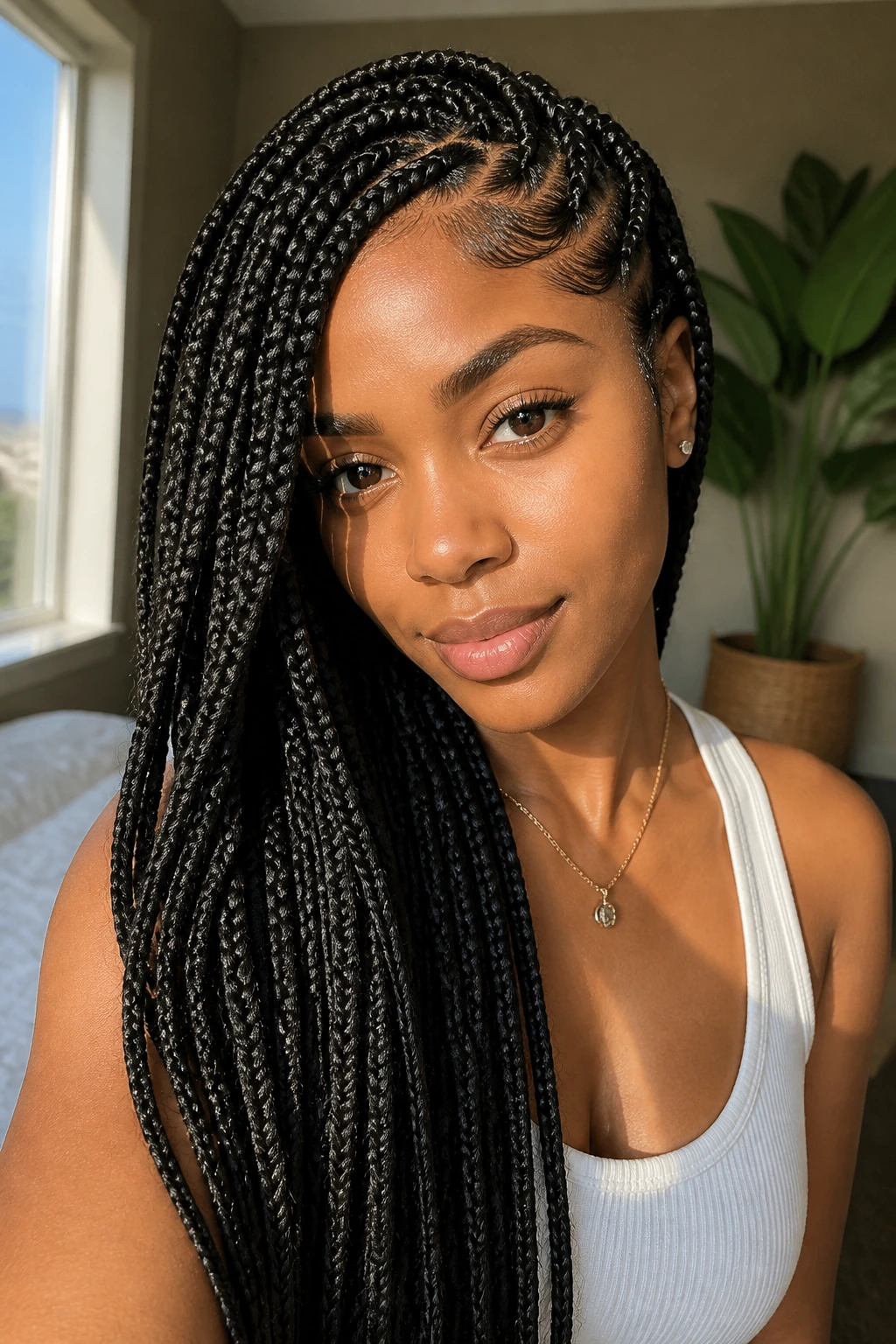
A side sweep is the easiest way to make long braids look intentional without adding extra hardware. You move all that length over one shoulder, let the parts stay visible on the other side, and suddenly the style feels shaped instead of just worn down.
It’s a simple change. It changes everything.
Side-swept braids work especially well with long hair because the weight sits across the front and collarbone area, which makes the ends visible instead of lost behind your back. I like this look when the outfit has an open neckline or one strong shoulder line. The braids can frame the clothes instead of hiding them.
It also helps on days when you’re sick of braids rubbing the back of your neck. Pulling them to one side gives the head a break, and the style still looks polished. If your ends are especially long, tuck the bottom section slightly under itself so the whole pile doesn’t slide forward too far.
A single braid cuff near the front strand can finish the look. One. Not six.
7. Half-Up, Half-Down Box Braids
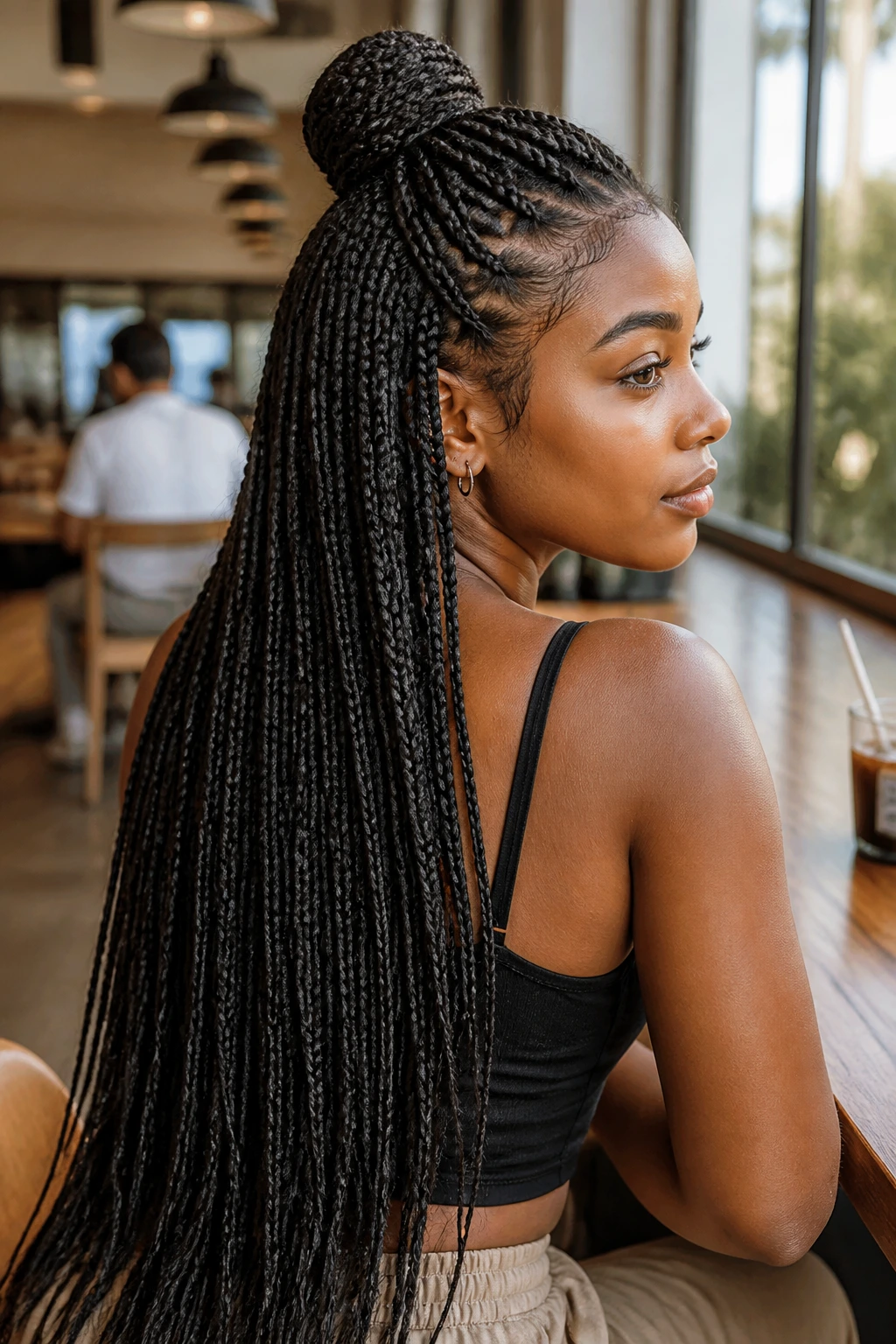
Half-up, half-down is the workhorse style in this whole collection. You keep the lower length free, which shows off the long silhouette, and gather the top section into a ponytail, knot, puffed bun, or clipped roll. It’s the easiest way to take the weight off your face without giving up the length.
Why it stays popular
Long braids can get heavy. That’s not a flaw; it’s physics. A half-up style redistributes some of that weight, especially around the temples and behind the ears, which makes it easier to wear the braids for a long day.
The top section does not need to be huge. In fact, if you pull too much hair up, the style can start feeling strained and the braid line around the crown gets too tight. I prefer a smaller, cleaner top section with the lower half left full and free. It gives the whole style a better balance.
This is also one of the easiest ways to make braids look different without redoing the whole head. Add a ribbon one day. Use a claw clip the next. Twist the top into a small bun when you want the braids off your forehead. The base install stays the same, but the silhouette keeps shifting.
8. High Ponytail Box Braids
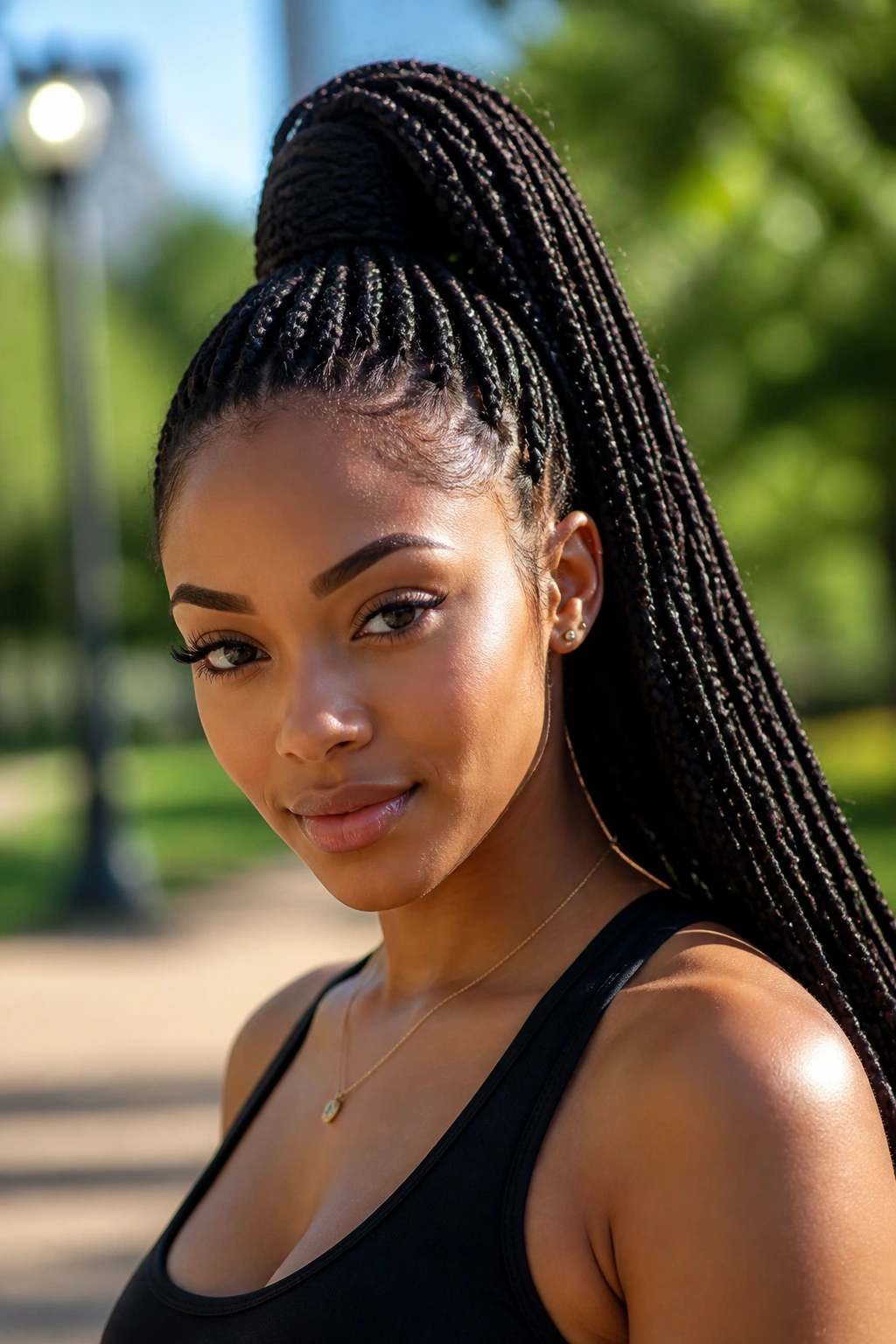
A high ponytail changes the whole attitude of long braids. Suddenly the length isn’t just hanging there; it’s lifted, swinging, and drawn into one strong point at the crown. It reads energetic, clean, and slightly dramatic, which is why so many people reach for it when they want the braids off the neck.
The one rule: don’t force it too high if the roots are tender. A ponytail should feel secure, not like a tug-of-war.
Long braids are beautiful in a ponytail because the tail itself becomes the visual focus. The longer the braids, the more satisfying the swing. A wrapped base — one braid looped around the elastic — gives the style a finished look and hides the hair tie, which matters more than people think.
If your hairline is freshly braided, give it a day before hauling everything straight up. That little pause can save you a headache. And if the ponytail looks a touch too stiff, loosen the crown by a few millimeters with the tip of your comb. Not enough to ruin the part. Just enough to stop the style from looking welded on.
9. Low Braided Ponytail
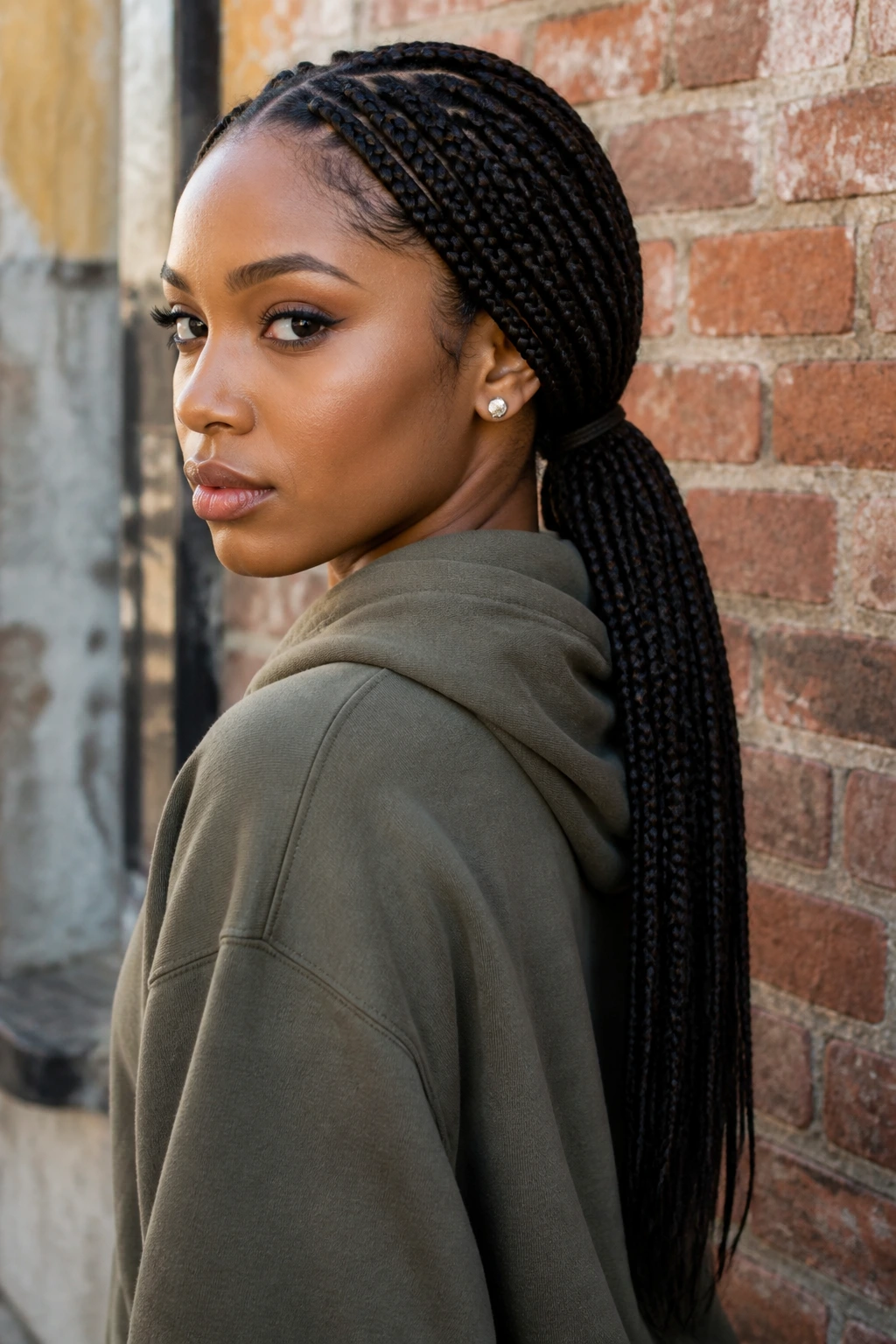
A low ponytail is the quiet, polished cousin of the high version. It sits at the nape, keeps the length controlled, and lets the braids fall in a neat line down the back or over one shoulder. There’s less strain on the roots, which makes this one easier to wear on long days.
Sometimes the simplest style is the smartest one.
This look is good when you want the braids to stay put under a coat, a scarf, or a collared shirt. The lower placement stops the ends from bunching at the neck, and the style still gives you that long, visible braid shape people love. If you have long earrings, this is one of the best pairings.
I like a low ponytail with a small braid wrapped around the elastic. It gives the base a little polish and keeps the style from looking like an afterthought. You can also braid the tail itself into one thicker rope if you want more control and fewer tangles at the ends.
The mood here is practical, but not plain. That’s the sweet spot.
10. Low Wrapped Bun
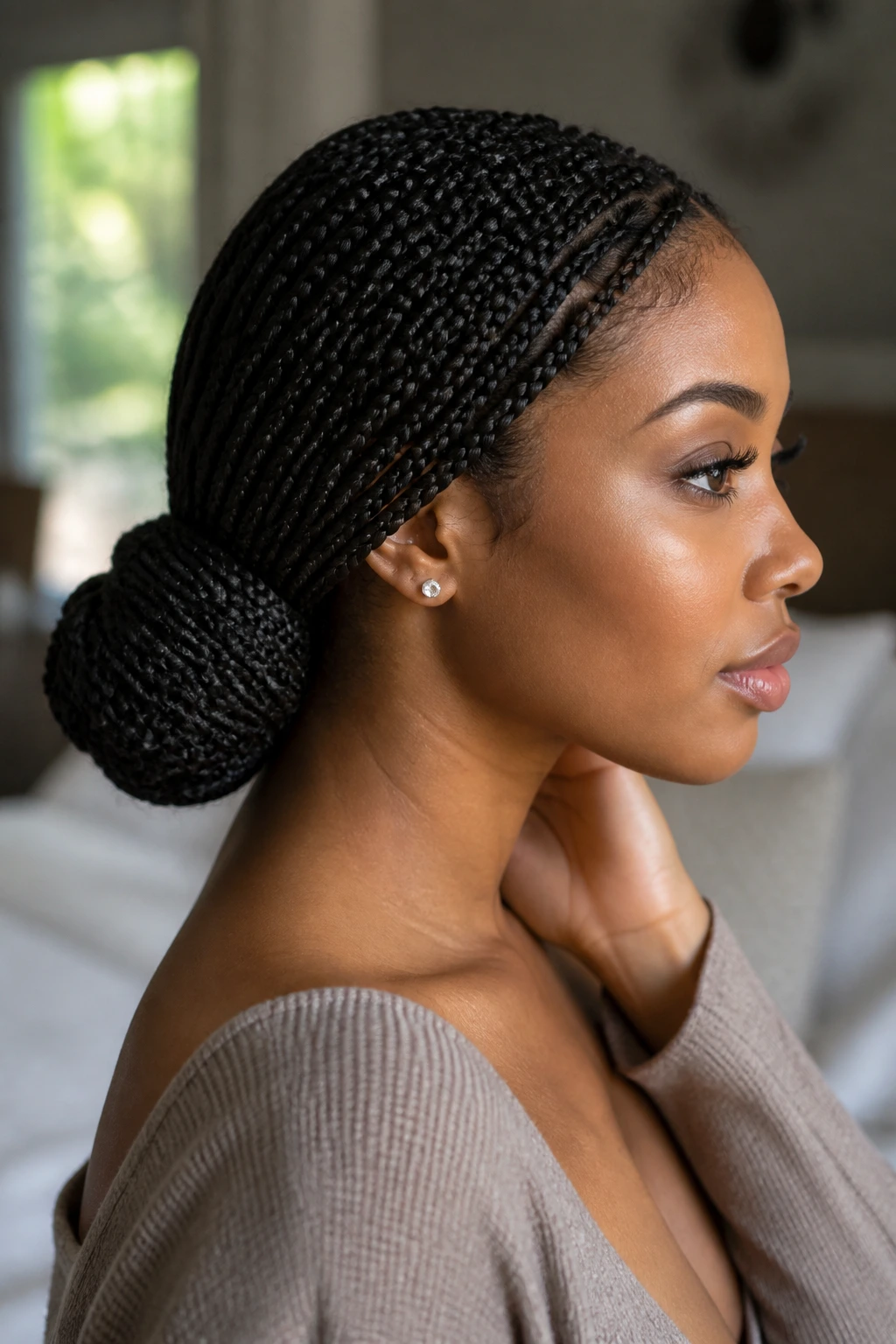
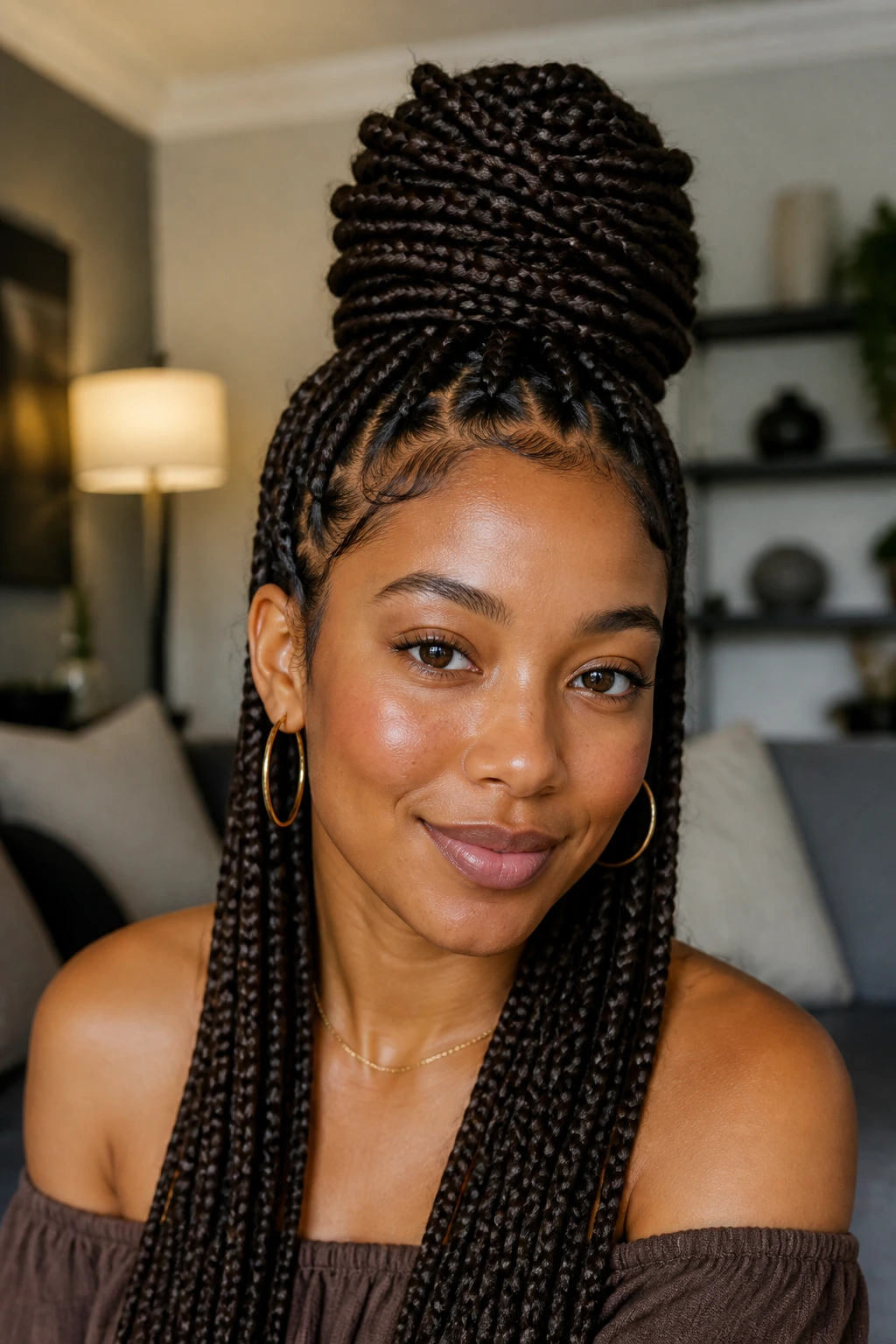
Long box braids tucked into a low bun feel cooler, cleaner, and more dressed up all at once. The bun sits at the nape, where the head naturally balances the weight, and the ends disappear instead of swinging against your shoulders. On humid days, this is the style that gets quietly saved.
The bun should sit low and slightly loose. If you try to force every braid into a tiny knot, the result looks lumpy and the scalp gets unhappy fast. A broader wrap gives the style its shape and keeps the tension spread out.
This is one of the best options for long braids when you need them out of the way for a while. Working, traveling, cooking, sitting at a desk all day — the low bun handles all of it. It also looks good with large earrings because the neck stays open.
If the ends are long enough to poke out, pin them down under the base with a few U-pins rather than stabbing them flat into the scalp. That keeps the bun secure without turning the whole thing into a headache.
11. Space Buns for Long Braids
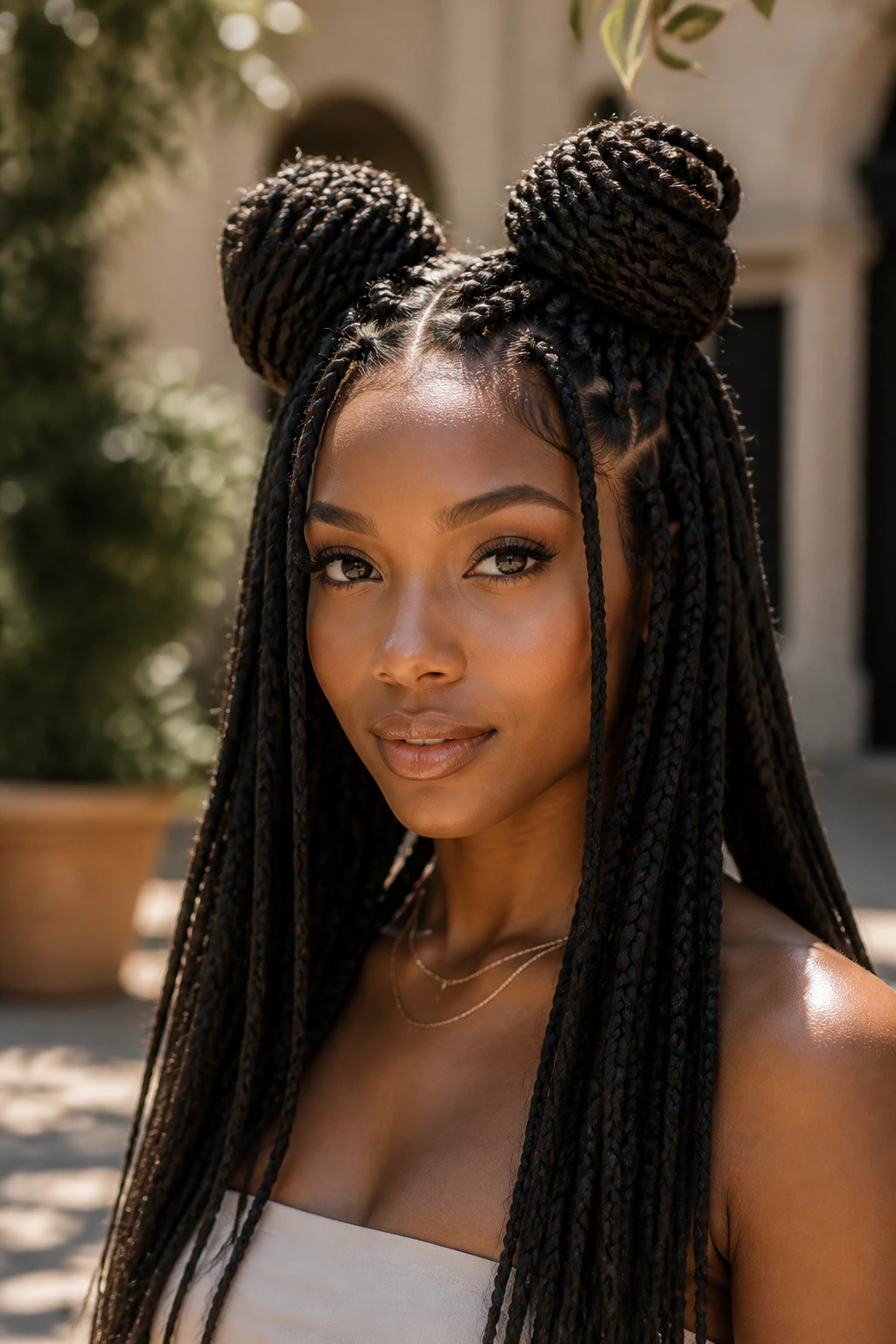
Space buns turn long braids into something playful fast. Split the head into two sections, twist or coil each side into a bun, and let the remaining length drop where it can. On long hair, the buns get enough volume to look full instead of sad and flat.
The middle part matters here. If it’s crooked, the whole style looks off in a way that’s hard to ignore. Keep the part clean, then decide whether you want the buns high and cheeky or lower and more relaxed.
This style is more than cute. It’s also practical. Space buns lift the length off the neck and keep the front rows from falling into the face, which is useful on warmer days or when you want the braids to feel lighter for a few hours.
I think this look works best when the buns are slightly loose rather than sculpted into perfect little domes. Box braids have texture. Let them keep it. Too much smoothing can make the style feel staged.
12. Braided Crown with Loose Length
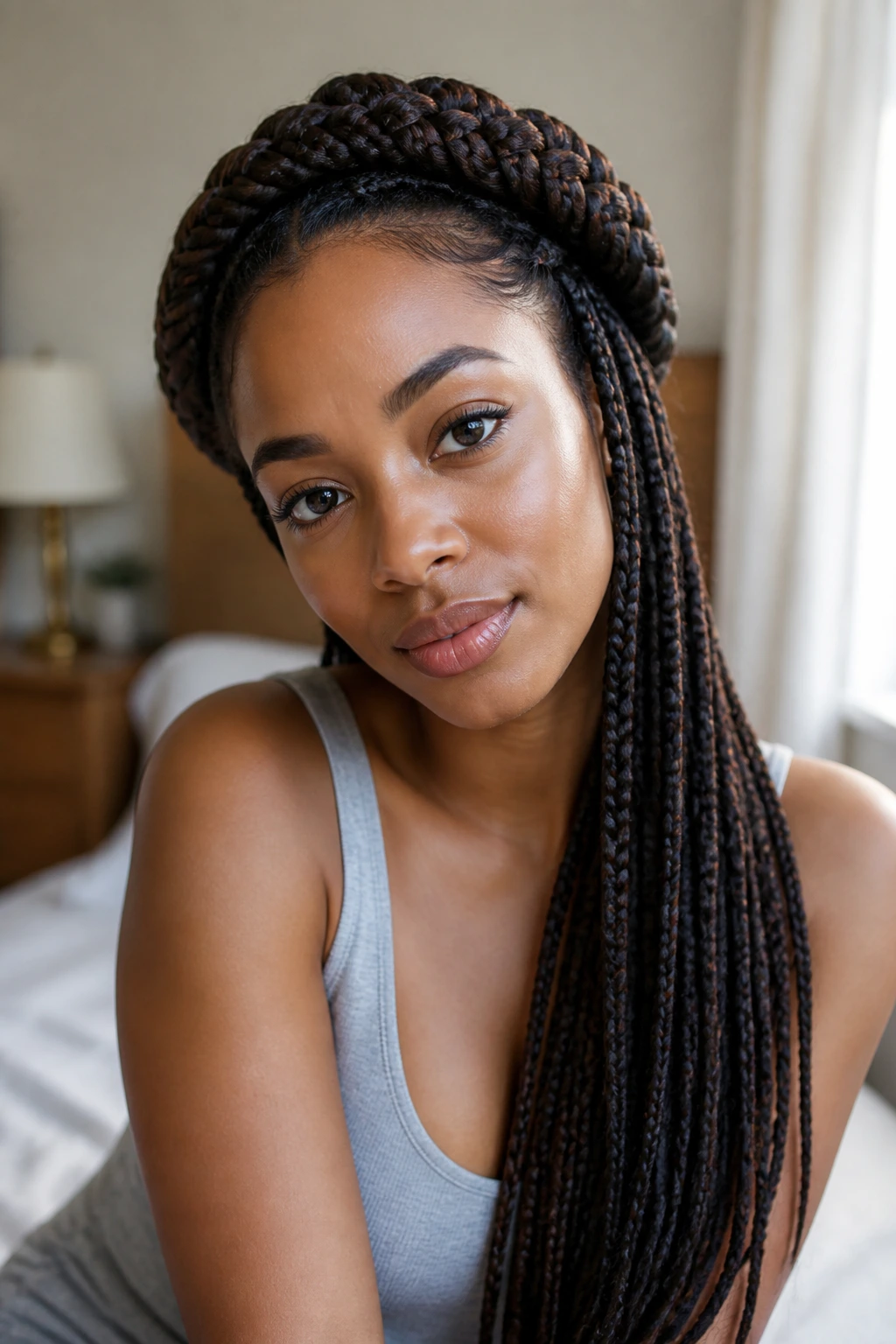
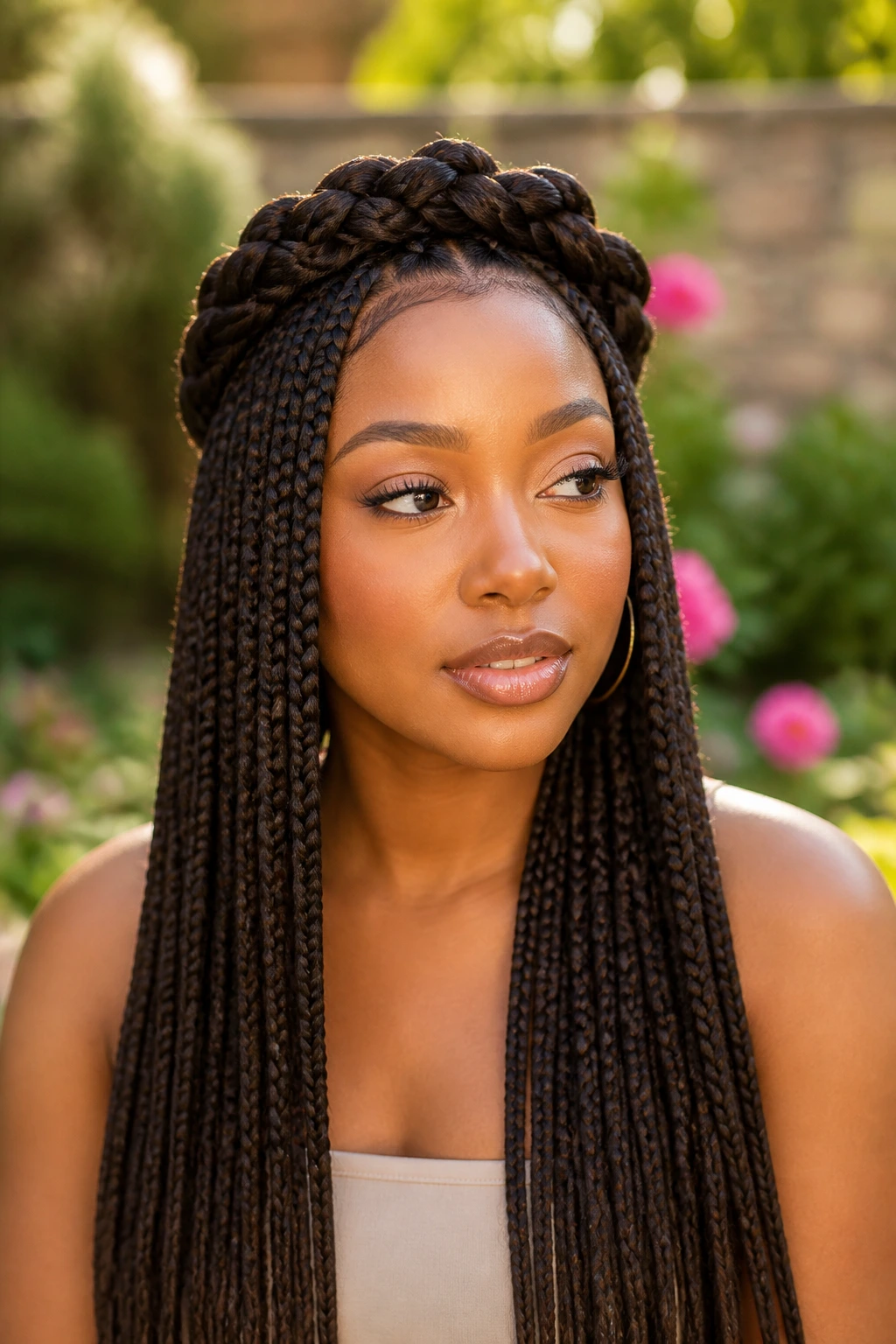
A braided crown gives long box braids a dressier shape without hiding the length completely. You sweep a section around the perimeter of the head, pin it into a crown or halo shape, and leave the rest to fall down the back or over the shoulder. The effect is tidy at the front and generous everywhere else.
Why it reads more formal
The crown shape opens up the face and makes the cheekbones and earrings do more work. That’s one reason I reach for it on days when the outfit needs a little structure. Long braids wrapped into a crown look considered, not fussy.
The style also keeps the braids away from the face while still showing off the install length. That’s a better trade than a full bun if you still want the length visible. Use pins that match the hair color if you can. Dark pins disappear better than silver ones on most braid colors.
One practical note: don’t make the crown too tight just because the style looks neat in your head. If the braids are being hauled from temple to temple with no slack, the style will feel it by lunch. Keep a little room under the wrap.
13. Beaded Ends
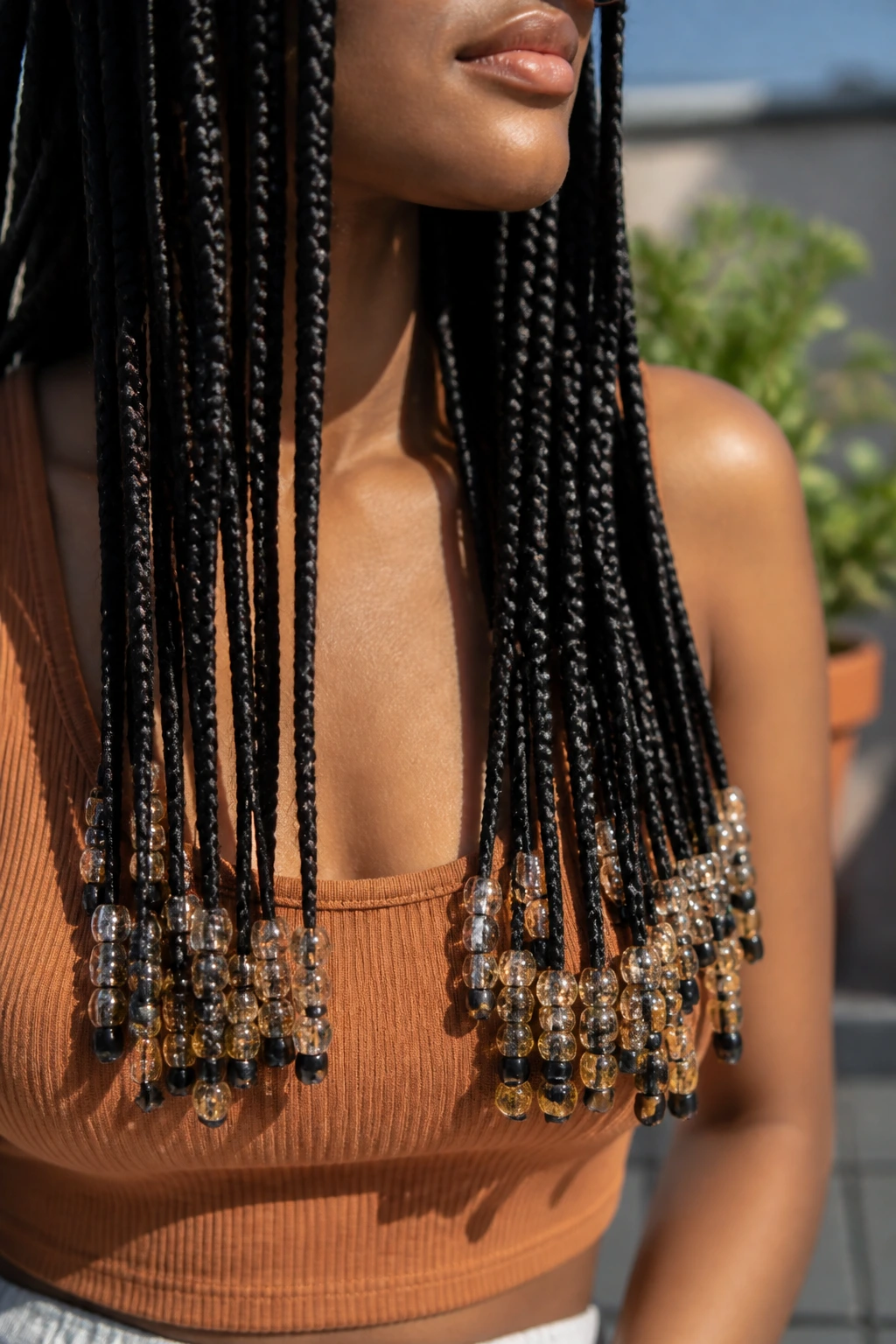
Beads do more than decorate braids. They change the sound, the swing, and the way the ends sit against the clothes. On long braids, beaded ends can be gorgeous because the length gives the beads a place to land without crowding the scalp.
Use lightweight beads if the braids are very long. Heavy wooden or metal pieces can drag the ends downward and make the style feel clunky. A few clear acrylic beads or matte wooden beads can look better than a whole pile of shiny ones. Less noise on the head. Cleaner silhouette.
This style works best when the beads are placed low, near the end of the braid or in one or two clusters. Beads shoved high up the shaft tend to slide, tug, and fight with the braid. That’s not a styling choice. That’s a nuisance.
I like beaded ends with simple clothing and a single strong accessory, like hoops or a scarf, because the braids already carry a lot of the visual weight. If you add too much more, the whole look gets busy fast.
14. Cuffed and Wrapped Accent Braids
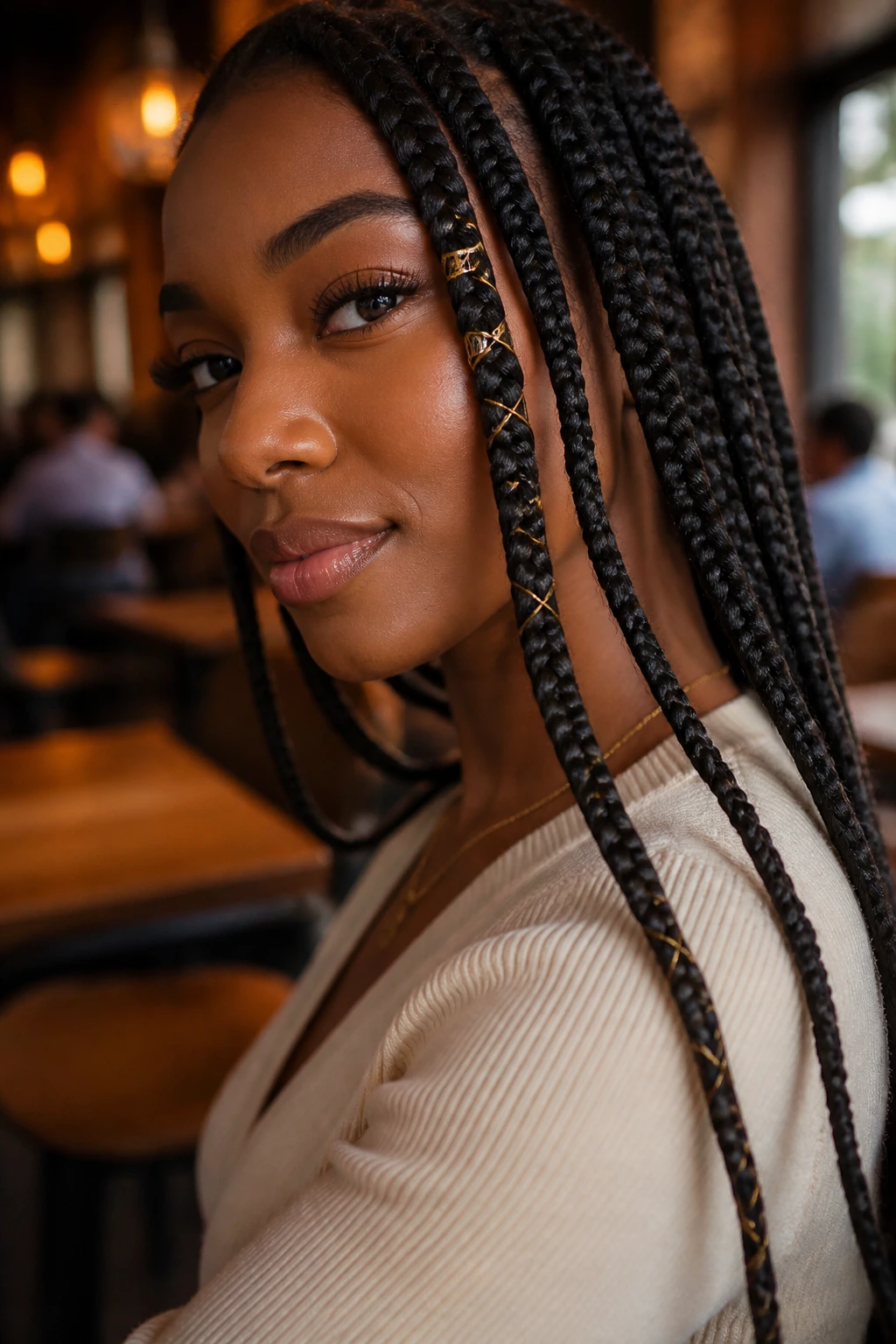
Cuffs and thread wraps are the quiet detail work of long box braids. They don’t change the shape the way a ponytail or bun does, but they do give the style a finished, deliberate feel. A few cuffs near the ends, a narrow thread wrap on one braid, and the whole head suddenly looks styled instead of simply installed.
The trick is restraint. Three to five cuffs can read clean. Fifteen can look like the accessories spilled.
Long braids give cuffs more room to sit, which is why this style works better on long hair than on shorter installs. The metal or thread has space to show, and the lower length keeps it from crowding the scalp. I especially like this approach when the braids themselves are a solid color and need a tiny bit of contrast.
A wrapped accent braid also gives you a nice way to echo your clothes. If there’s a color in the outfit you want to repeat, a thread wrap near the end of one braid is enough. You do not need to turn the whole head into a craft project.
15. Ombré Color Melt Box Braids
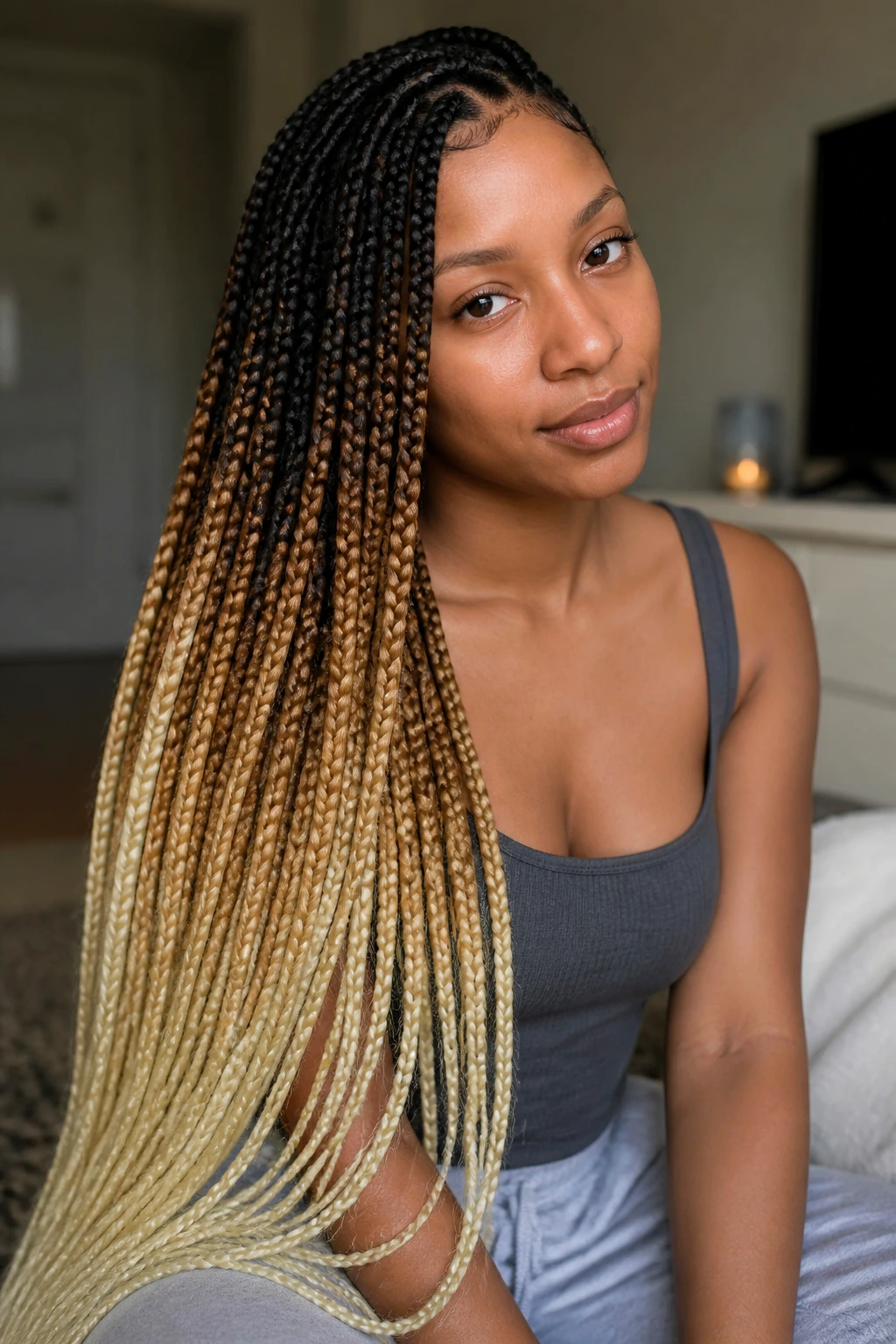
Ombré braids are made for long hair. The length gives the color room to fade instead of hitting in a blunt block, which is exactly why this style works so well on waist-length installs. Dark at the roots, lighter through the middle, brighter at the ends — that fade has time to show itself.
Where the lighter shade should land
The safest place for the color shift is below the ear or around the collarbone. If the lighter tone starts too high, the scalp can look disconnected from the rest of the style. Keep the root color close to your natural shade or a close match, then let the lighter tone take over lower down.
This is a good style for people who want color without committing to bright roots. The grow-out is kinder, the part line still looks clean, and the long lengths make the fade more visible than it would be on short braids. I think this works especially well in two-tone blends that don’t jump too sharply between shades.
Long braids can carry color in a way loose hair sometimes can’t. The color sits inside the braid, not just on top of it, so the change looks richer and more woven in.
16. Face-Framing Layered Braids
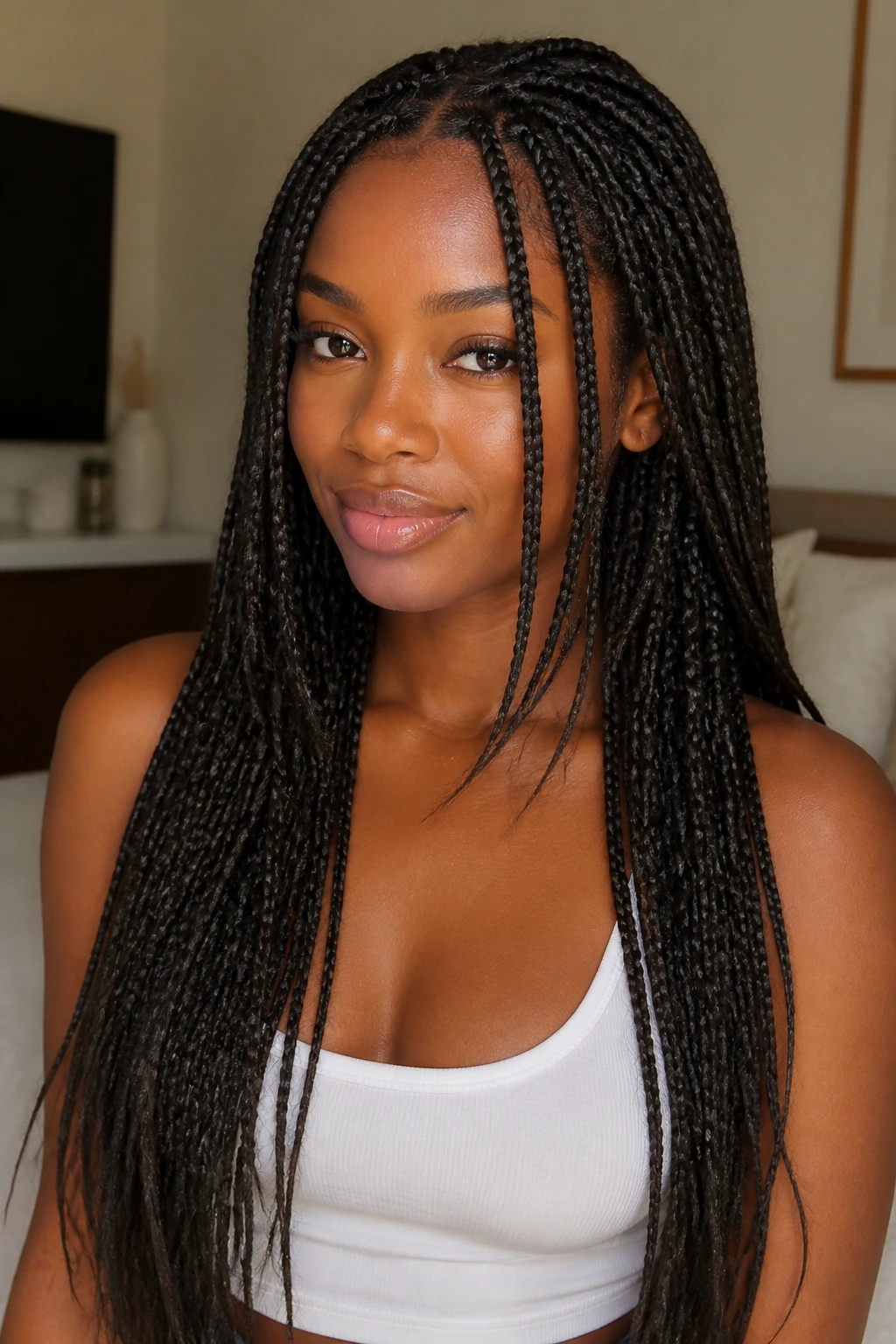
Long braids can look heavy when every strand lands at exactly the same length. Face-framing layers break that up. A few braids cut or installed slightly shorter around the front soften the line near the face and stop the style from feeling like one solid curtain.
That small shift changes the whole head shape.
This is one of the best options if your long braids tend to overwhelm your features. The shorter front pieces open the face, show the cheekbones, and make it easier to tuck a braid behind the ear without losing the style. It also gives you a little more movement when the braids are worn down.
I like this style most when the overall length stays long in the back but the front drops at different levels. It feels more expensive, if I can use that word carefully, because the eye sees planned shape rather than one blunt cut. If your hair is very dense, the layers also take some of the visual weight off.
The downside is obvious: uneven ends need a tidy install. If the lengths are accidental instead of planned, the look goes messy fast. This one needs a steady braid pattern.
17. Twin Pigtail Box Braids
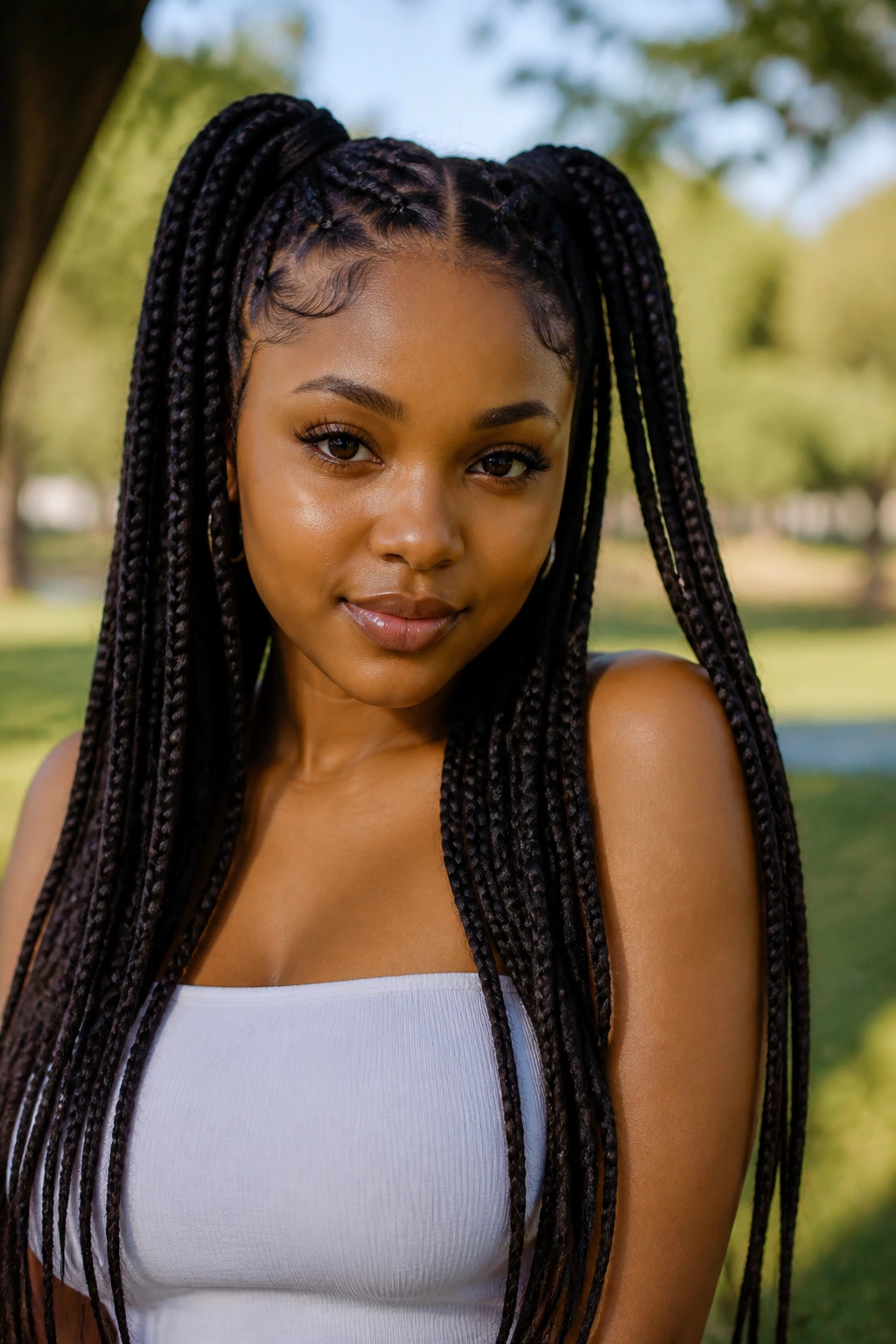
Pigtails are underrated. Split the braids into two tails, high or low, and the whole head suddenly feels balanced. Long braids work especially well here because each side gets enough length to drape, swing, and still look full.
The style is practical, too. It spreads the weight across both sides instead of stacking everything in one place, which can feel easier on the neck. If you’re active, traveling, or just tired of hair hanging down your back, twin pigtails make a lot of sense.
They can be playful or polished depending on where you place them. High pigtails read younger and more energetic. Low pigtails feel more relaxed and put together. Add one wrap around each elastic if you want the base to look neat.
A small warning: if one side has more hair than the other, the asymmetry shows fast. This style needs a clean center part and even sections. No hiding.
18. Scarf-Wrapped Long Braids
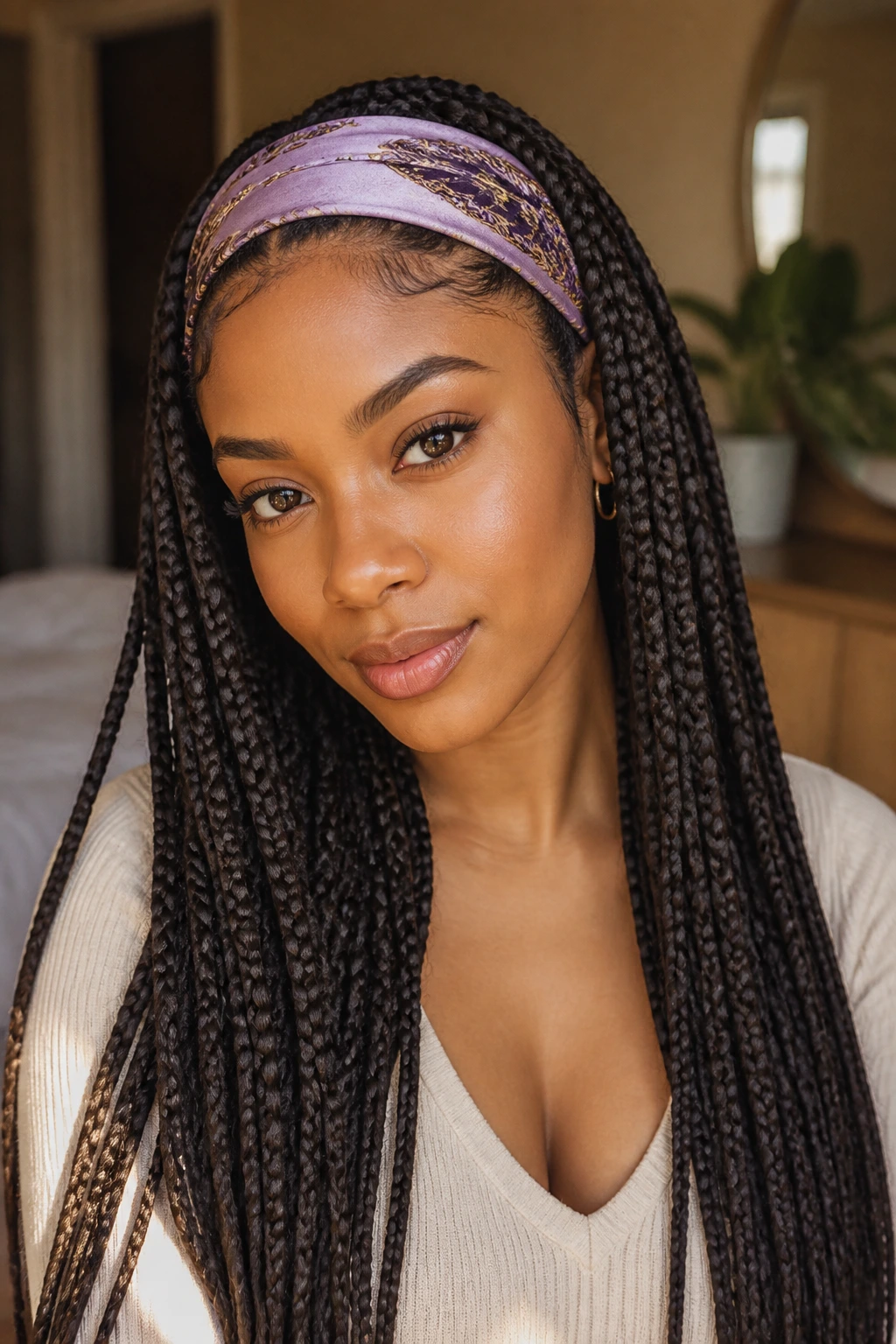
A scarf can do a surprising amount of work on long braids. Wrap one around the hairline, tie it at the nape, or fold it into a headband shape and let the length fall freely. The scarf adds color, protects the front rows, and makes the style look planned even on the laziest day.
I especially like silk or satin scarves here because they glide instead of grabbing the hair. Cotton can snag and flatten the front in a weird way. If the braids are long and heavy, a scarf also gives the roots a little pause by holding the front section in place.
This is a nice move on day-old braids, when the roots are still neat but you want a different read. A patterned scarf can pull the whole look into a more finished place without adding weight. That matters when the braids are already long enough to feel like a workout.
Keep the scarf narrow if you want the braids to stay the main event. Wide wraps can eat the hairline and make the style feel swallowed up.
19. Faux Bob Tuck
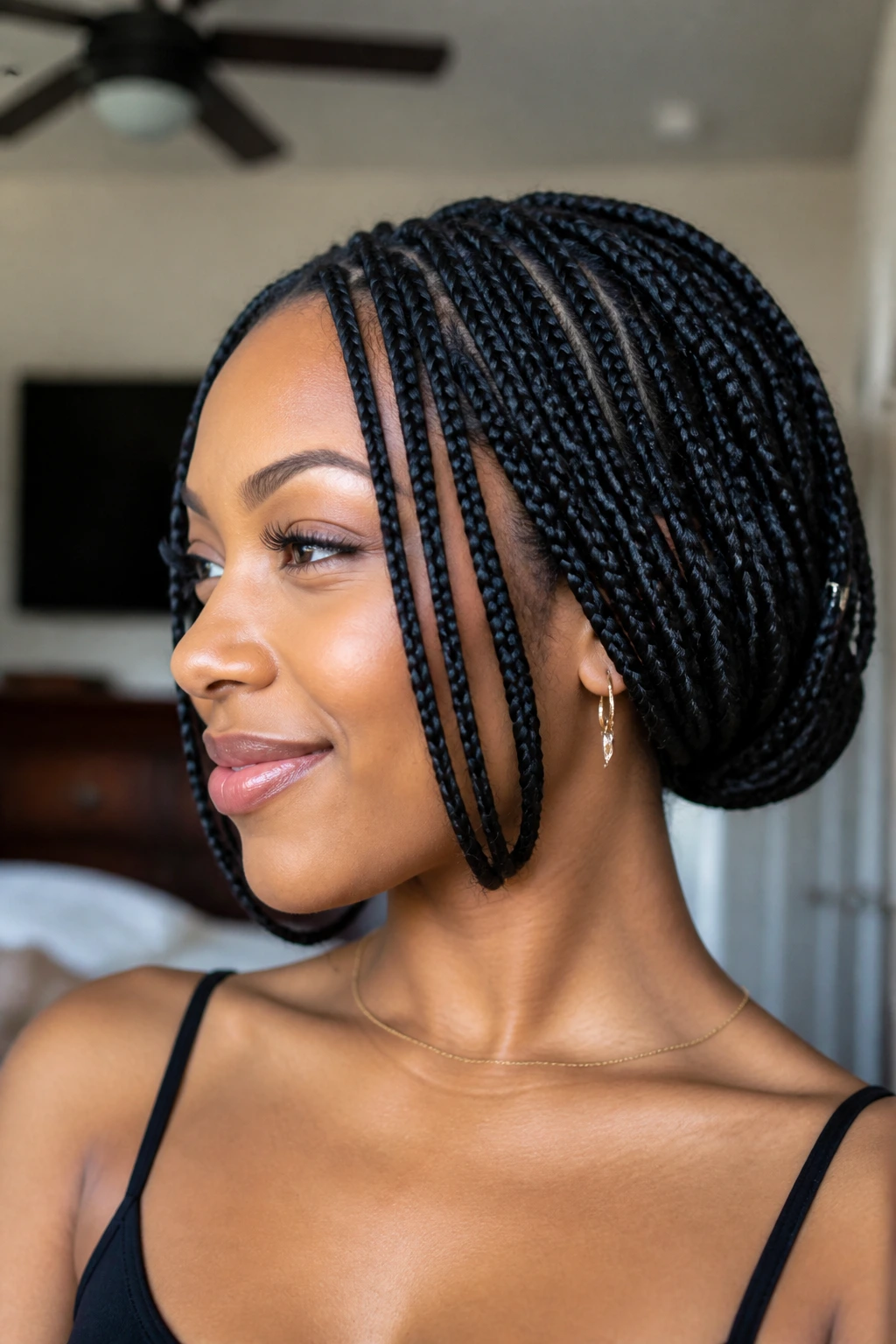
A faux bob is the most surprising trick in the whole set, and it’s one of my favorites. You tuck the long braids under themselves, pin them low, and shape the length into a rounded bob silhouette. The long braids stay installed, but the visual weight shifts up and in.
How to fake the shape
The key is not to cram everything under at once. Fold the length in sections, pin as you go, and keep the profile soft rather than too flat. A couple of U-pins do more work than a dozen tiny clips because they anchor the mass without making a little metal forest at the nape.
This style is brilliant when you want the neck free, the ends hidden, and the install still intact. It also works well for formal dressing, since the short silhouette feels clean against structured clothes. The whole point is to trick the eye. Let it.
I think faux bobs are best when the braids are long enough to tuck without fighting back. If the install is too bulky or the ends are thick with beads, the shape gets awkward fast. Use this one on braids that are already past the shoulders and flexible enough to fold.
Why Long Box Braids Need a Different Styling Eye
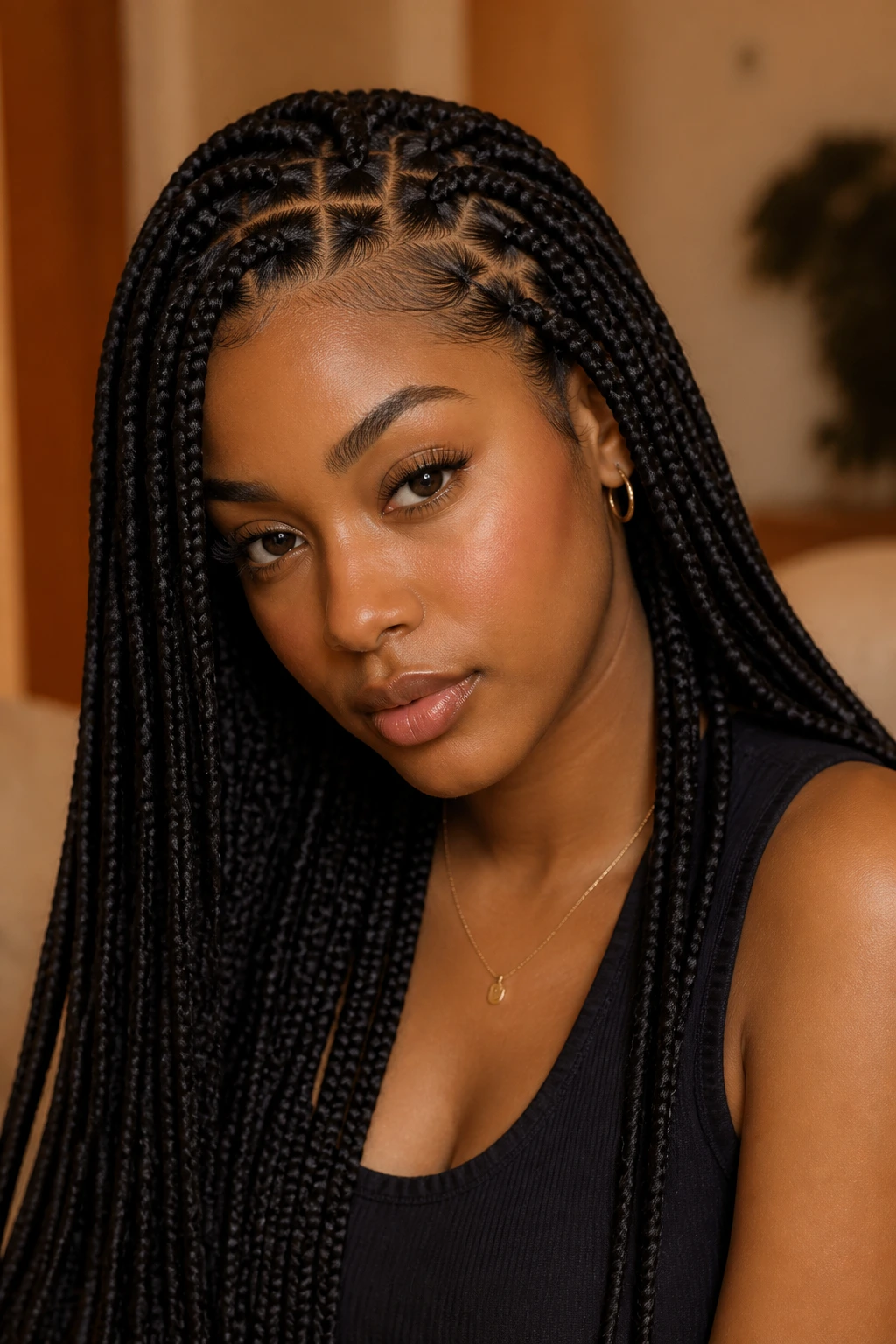
Long braids are not just “more hair.” They’re more motion, more surface area, more weight, and more ways for the style to go sideways if the base work is sloppy. That’s why a long install needs a different eye than a short one. You’re not only choosing a look; you’re choosing how that look behaves when it hits a coat collar, a chair back, a car seat, or the side of your face.
The biggest issue is tension. Heavy styles pull at the roots, and that pull adds up if the braids are packed too tightly at the hairline or loaded with too much extra weight near the ends. Dermatologists and stylists have warned for years that repeated tension can lead to breakage around the edges, and that’s not something you want to gamble with just to make the part lines look razor clean.
Long braids also show mistakes more clearly. A crooked part near the front gets magnified as the braid drops. Uneven length feels more obvious because the ends swing at different points. Even the frizz behaves differently; the longer the braid, the more the old fuzzy section and the new neat section sit side by side.
There’s a sweet spot here. If the install is balanced, long box braids can do almost anything — down, up, half-up, wrapped, tucked, decorated, or stripped back to plain and still look good. If the install is too tight or too heavy, the styling options start shrinking fast. You feel it before you see it.
Essential Equipment for These Styles
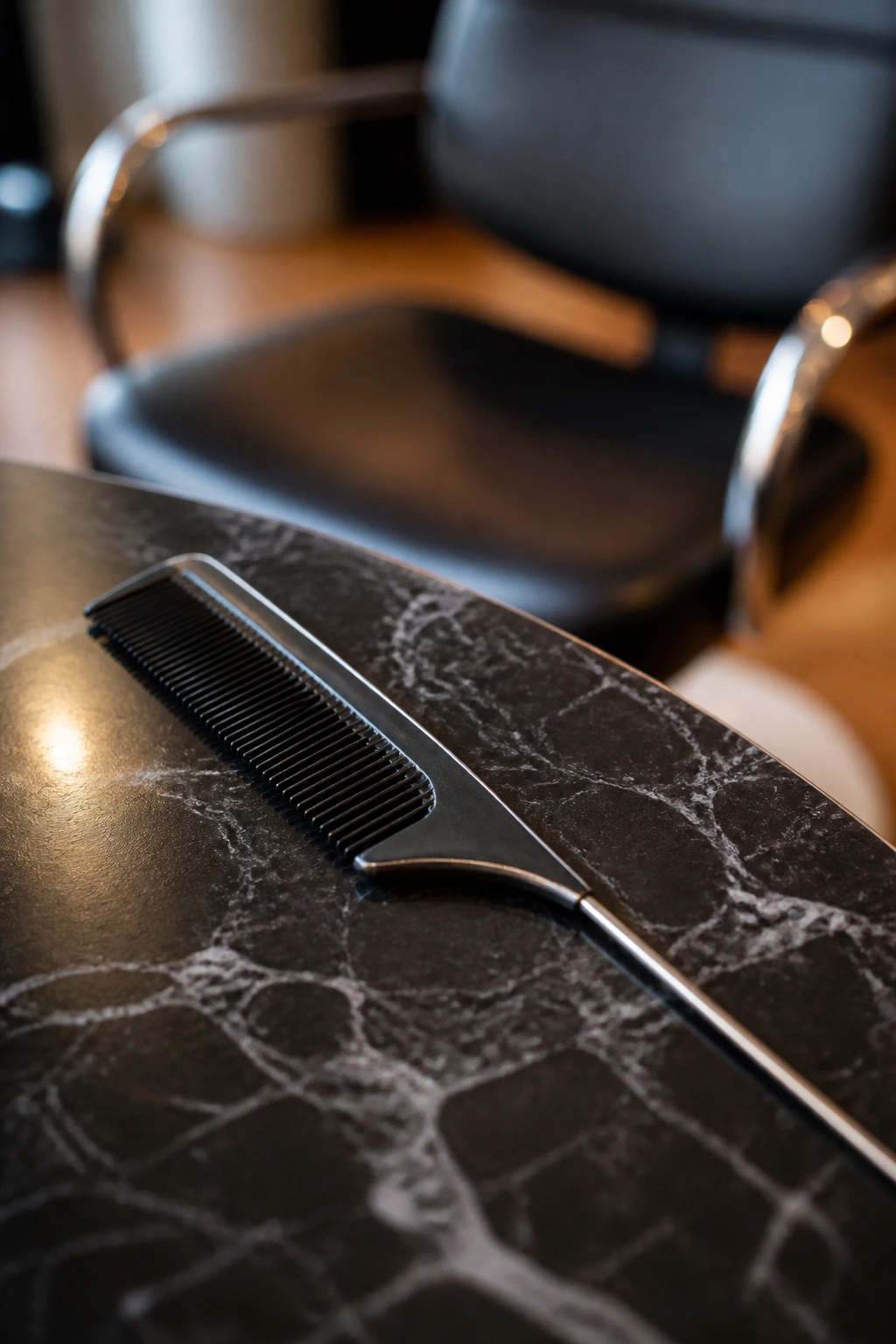
- Rat-tail comb: The long metal or plastic tail helps create clean square, triangle, or curved parts without shredding the section line.
- Sectioning clips: Use these to keep unbraided hair out of the way while you’re parting or styling; they save time and reduce tangles.
- Snag-free hair ties: Clear elastics or coated ties hold ponytails and half-up styles without catching the braid fiber.
- Satin scarf or bonnet: Night protection matters more when braids are long, because the ends rub everything they touch.
- Edge brush: A small brush helps smooth the hairline before a style change, but use it lightly so you don’t scrape the edges.
- Foaming mousse: A water-light mousse settles flyaways and helps braids lay down after a fresh install or a restyle.
- Spritz bottle: Fill it with water or a braid-safe leave-in mix for tiny refreshes, especially around the scalp and loose curls.
- Hair pins and U-pins: These are essential for buns, crowns, and faux-bob tucks; regular bobby pins can bend out fast on thick braids.
- Lightweight cuffs, rings, or beads: Use these for styling detail, but choose pieces that won’t drag the ends down.
- Wide-tooth comb: Keep one around for detangling your natural hair before install or for separating extension hair gently.
Smart Shopping and Hair Selection Tips
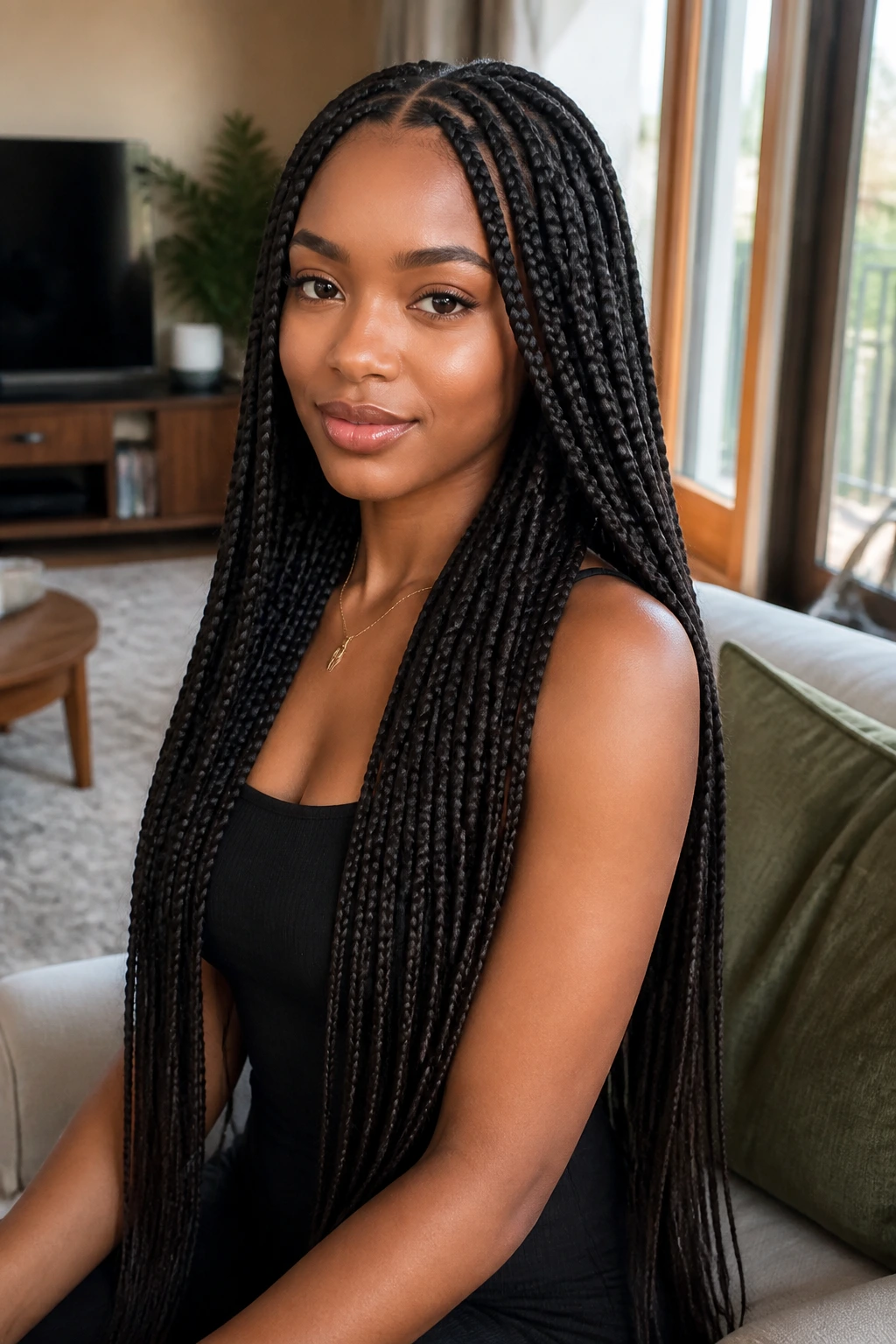
Start with the hair itself, because the style starts there whether people want to admit it or not. For most long box braid looks, pre-stretched synthetic braiding hair gives you the cleanest braid line and the neatest tapered end. It’s easier to feed in, it blends well with long installs, and it keeps the finish from looking blunt at the bottom.
If you want boho curls, soft ends, or a more textured finish, look for human-hair curl pieces or curly braiding additions rather than forcing synthetic straight hair to do a job it hates. Straight synthetic hair and loose curls are not the same animal. One lays flat. The other wants movement.
Length matters, but so does density. Waist-length braids need enough hair to keep the braid full from top to bottom, but buying too much extra bulk only makes the roots harder to manage. For many long styles, having one extra pack on hand is smart. Better to have a spare than run short halfway through and end up with an awkward color mismatch.
Color choice is where a lot of people overthink and then overdo. If you want a soft grow-out, stay close to your natural root color at the scalp and push any lighter tones lower into the length. If you want a louder look, keep the root color solid so the pattern at the scalp stays visible. A harsh color change right at the hairline tends to read louder than people expect.
And one more thing: if your own hair is fine or sensitive at the edges, don’t let a long style bully you into extra bulk. Choose a lighter install, a knotless method, or a slightly shorter length. Pretty braids that hurt are not a bargain.
How to Wear Long Box Braids Without Fighting the Length
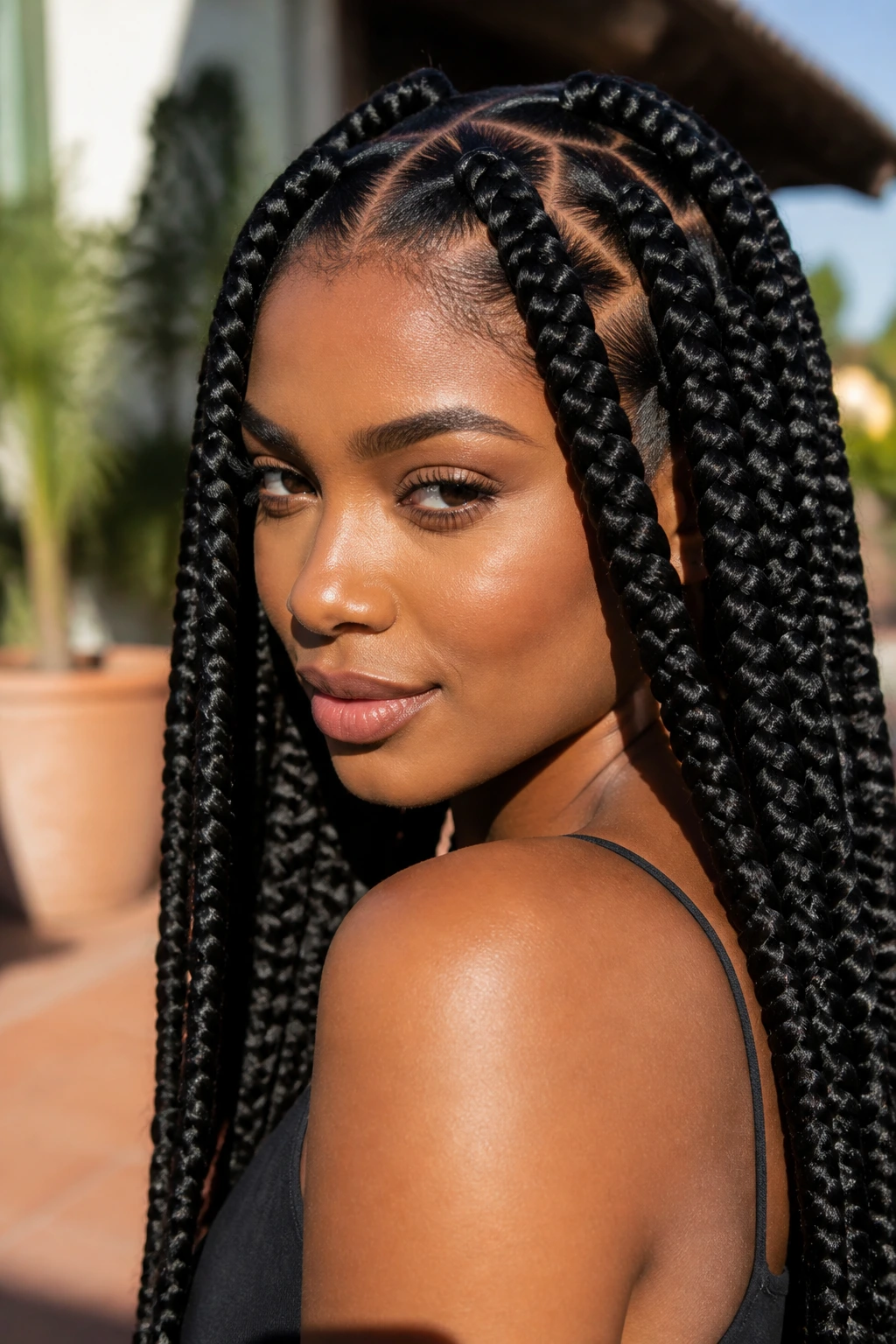
Presentation: Let the silhouette do some work before you reach for accessories. Long braids look sharp when the front rows are neat and the rest falls in one clear direction — down the back, over one shoulder, or gathered into a clean bun. If the style looks intentional from the hairline, the length will handle the rest.
Accessories: Choose one main accent and let it lead. A few cuffs near the ends, a satin scarf at the crown, or a pair of bold hoops usually reads cleaner than piling on every option at once. Heavy beads belong lower on the braid; they sit better and pull less there.
Outfits: Open necklines, crewnecks with room, and jackets that don’t snag at the collar usually pair well with long braids. High collars can still work, but they’re friendlier to buns, ponytails, or side-swept styles. If the outfit already has a lot going on up top, keep the braids simpler.
Best Uses: Straight-down styles are nice when you want the length visible and the effort low. Half-up looks and ponytails make more sense on busy days or in heat. Buns, crowns, and faux bobs are the move when you need the braids off your neck for a few hours without touching the install itself.
Additional Tips and Style Boosters
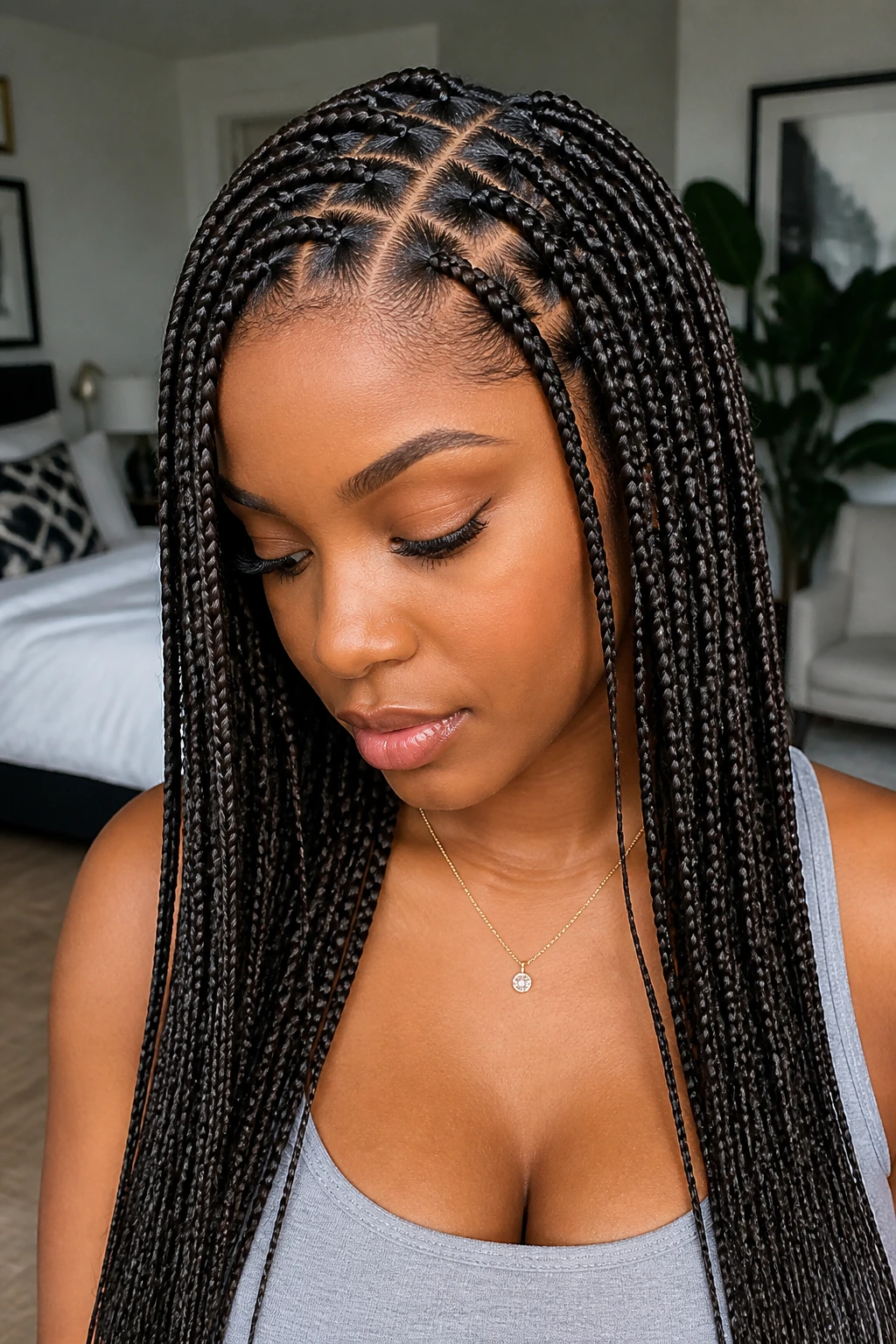
Parting Polish: Clean parts make long braids look expensive, even if the rest of the look is plain. A rat-tail comb, a steady hand, and a little patience at the front rows go a long way. If the parts around the face are crisp, people forgive a lot more in the back.
Weight Control: If the braids start to feel heavy halfway through the wear, change the shape instead of just enduring it. A low bun or side sweep redistributes the load faster than another round of edge control ever will. That’s not a styling trick. That’s a survival trick.
Accessory Lift: One well-placed detail can do enough. A single scarf knot at the crown, three cuffs near the ends, or one bead cluster on each side can sharpen a look without making it busy. I’d rather see one obvious choice than ten weak ones.
Night Reset: Wrap the roots with a satin scarf and tuck the length into a bonnet or loose wrap so the ends don’t dry out on rough pillowcases. If you wear curly boho pieces, refresh those with a little water and finger-coiling the next morning instead of layering on more cream.
Make-It-Yours: If you like minimal looks, keep the braids plain and let the parts be the detail. If you like color, build it into the length, not the root line. And if you like movement, use layers or side-swept styling before you reach for more hardware.
Mistakes That Make Long Braids Harder to Wear
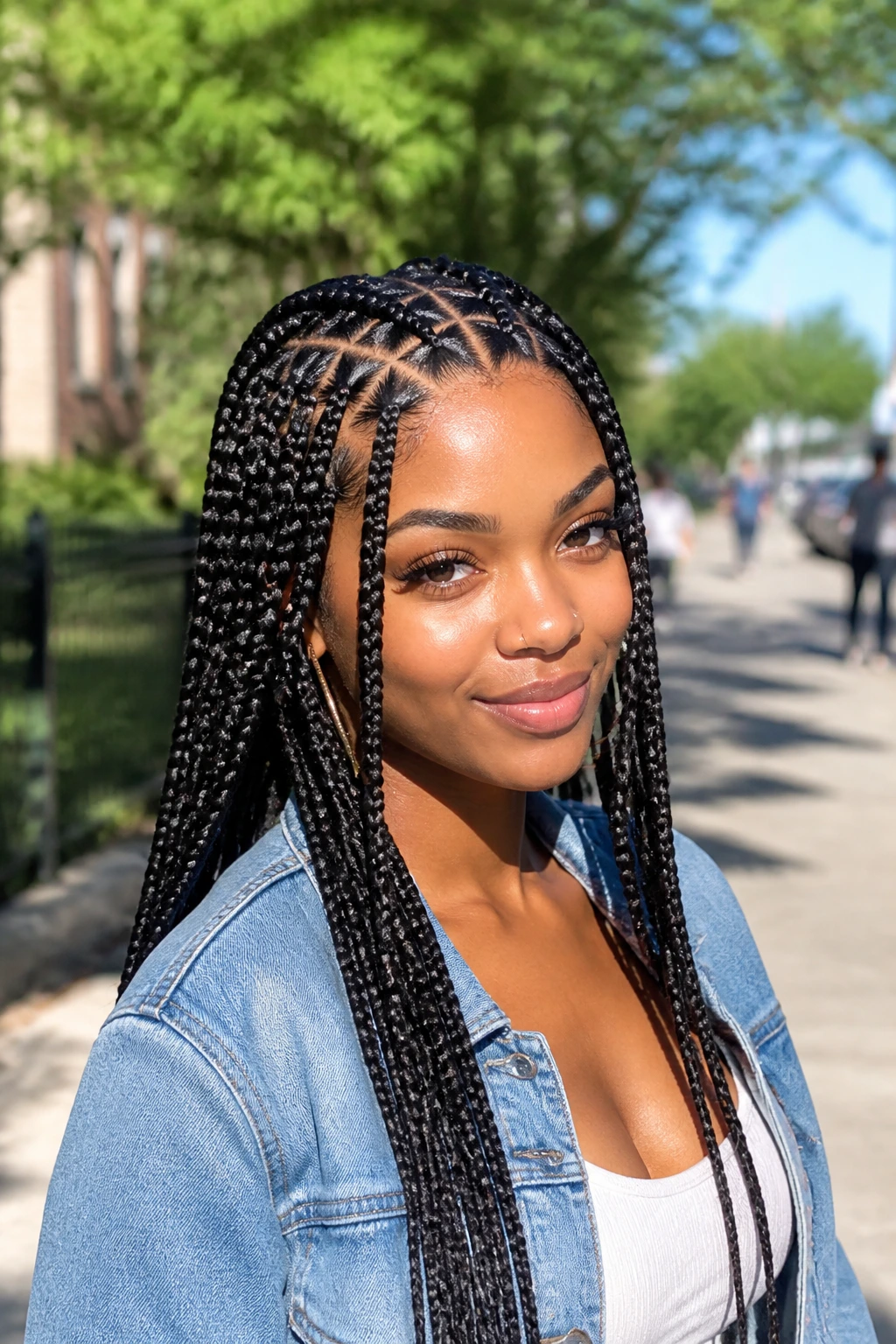
The first mistake is starting too tight at the hairline. If the front rows sting, lift the scalp, or leave bumps around the temples, the style is too tight. Fix it by asking for a little slack at the root next time and never assuming pain is part of the deal.
Another common one is loading heavy beads or cuffs too high up the braid. That’s where the pull gets annoying fast, and the braids start to tilt forward or sag. Keep the heavier accessories lower down where the braid can carry them without dragging the scalp.
Skipping nighttime protection causes more damage than people expect. Long braids rub against cotton sheets, catch on zippers, and flatten into odd bends overnight. A satin scarf or bonnet keeps the surface smoother and cuts down on morning frizz.
Using too much product at the roots is a sneaky problem. The scalp gets coated, the part lines look greasy, and build-up starts itching before the style is even halfway through its wear. Use light spray, not a heavy hand. If your scalp needs washing, wash it.
And then there’s keeping the braids in long past the point where the roots are talking back. Once the new growth gets fuzzy, the ends tangle more, and the weight starts to sit in all the wrong places. If the install has lost its shape and the scalp feels tired, it’s time to remove it.
Variations and Adaptations to Try
The Soft Knotless Swap: Keep the same long silhouette but ask for knotless feeding at the roots. It gives you a lighter feel and a cleaner grow-out, especially if you wear the style for weeks at a time. This is the one I’d choose for anyone who knows their scalp gets cranky.
The Dress-Up Crown: Take a standard long braid install and turn the front sections into a halo or crown while leaving the rest loose. It changes the whole mood without demanding a new install. Good for events, photos, or days when straight-down braids feel too plain.
The Color Melt Blend: Choose one darker root tone and one or two lighter shades for the lower length. Long braids give ombré room to breathe, so the fade looks smoother and less abrupt. This is a cleaner move than a hard color block if you want the style to age well.
The Minimal Hardware Version: Skip beads and go with one or two cuffs, maybe a ribbon or a scarf at the base. The long length already brings drama; this keeps the styling calm and controlled. It’s my pick when the outfit has its own strong voice.
The Playful Twin-Tail Remix: Split the braids into two ponytails, high or low, and leave the ends loose. The style feels younger and more active, and it spreads the weight around instead of stacking it all at the center of the head. Handy for gym days, errands, and travel.
Make-Ahead, Sleep Care, and Refresh Schedule
The best make-ahead move happens before the braids are even installed. Cleanse the hair, deep condition if that’s part of your routine, and make sure the roots are fully dry. Damp hair under long braids is a bad idea. It extends the install time and can trap moisture where you cannot see it.
Once the braids are in, set a night routine from day one. Satin bonnet or scarf. Loose wrap for the length. No cotton pillowcase if you can help it. Long braids rub against fabric more than short ones do, and that friction is what makes the ends fray faster.
For freshness, use a light scalp spray or a diluted braid cleanser every 1 to 2 weeks, depending on how much product you use and how active you are. Focus on the scalp and the part lines. Wipe gently with a clean cloth or cotton pad rather than soaking the whole head.
If the style includes boho curls, refresh those pieces separately. A little water, a tiny bit of curl foam, and finger-coiling usually work better than heavy creams. Heavy product makes the curls droop and invites buildup near the braid shaft.
Most long braid installs wear best for 6 to 8 weeks if the scalp stays comfortable and the parts are still behaving. If the roots feel tight, the edges look stressed, or the braids start to mat near the base, take them out sooner. The style should move with your life, not bully it.
Questions People Ask Before Choosing Long Box Braids
How many packs of hair do I need for long box braids?
For waist-length braids, many people end up needing 5 to 8 packs of braiding hair depending on braid size, hair density, and whether the style is knotless or classic. Jumbo styles use fewer packs, while smaller, longer installs usually need more. Buying one extra pack is smart.
Are knotless braids better for long hair?
They’re often better if you care about root comfort and a smoother grow-out. The feed-in method spreads the tension out, which can feel easier on the scalp during long wear. If you want a firmer, more defined root, classic braids still have a place.
Which long braid styles are lightest on the scalp?
Loose side-swept styles, knotless installs, and low ponytails usually feel lighter because they spread the weight or keep it off the hairline. High buns and heavy bead styles can feel stronger on the scalp, especially if the braids are very long.
Can I wash long box braids without making them frizzy?
Yes, if you keep the water focused at the scalp and use a diluted cleanser instead of rough scrubbing. Pat the braids dry with a microfiber towel or T-shirt, then let them air dry fully. Rubbing them dry is what causes extra fuzz.
Do beaded ends make braids last longer?
Not really. They change the look, not the lifespan. In fact, heavy beads can add pull if they’re placed too high or used in excess, so the safest versions keep the beads lower and lighter.
What if my braids puff up at the roots too fast?
That usually means the parting, tension, or product balance wasn’t right, or the scalp is producing more oil than the style can handle. A little mousse and a clean scarf can tame mild puffing, but if the roots are matted or sore, the install may need to come down sooner.
Can long box braids work on fine hair?
Yes, but the install should be lighter and more thoughtful. Knotless braids, medium parts, and a slightly shorter long length are usually kinder than very heavy waist-length jumbo braids. Fine hair can wear long braids well when the tension stays low.
What’s the easiest style to start with if I’m new to long braids?
A classic straight-down install or a half-up, half-down version is the easiest place to begin. Both show off the length without demanding a lot of advanced shaping, and both can be restyled quickly if you want to change the mood halfway through the week.
Braids That Earn Their Keep
Long box braids work best when the style suits the weight, the length, and the way you actually live. That’s the part too many braid roundups skip. A good look isn’t only about the first day in the mirror. It’s about whether the parting stays neat, whether the scalp stays calm, and whether you can still tie your hair up without wrestling with it for ten minutes.
The nicest thing about long braids is how much they can change without asking for a new install. One day they’re down the back. The next, they’re in a bun, a side sweep, or a faux bob that feels a little clever and a little unexpected. That flexibility is the real luxury here.
Pick the shape that fits your shoulders, your schedule, and your patience level. Then wear it hard.
