



Curly hairstyles for little boys look their best when the cut works with the curl instead of flattening it into something that only behaves for an hour. That sounds obvious until you’ve watched a fresh haircut dry into a fuzzball, or seen a too-short fringe spring right back up and disappear from the forehead. Curls do that. They shrink, bend, puff, and change their mind every time the air gets damp.
The good ones are the styles that keep a bit of swing on top, clean up the sides, and still leave room for a child to run, nap, sweat, climb, and shake his head like nothing happened. That’s the real test. Not the photo right after the barber cape comes off. The next day. And the day after that.
A lot of the best little-boy curly haircuts aren’t fussy at all once you understand the shape they need. Leave enough length for the curl pattern to show. Trim the bulk where it mushrooms. Keep the edges neat without shaving away all the personality. That balance is where these styles live, and it’s why they work in real life instead of just on a chair-side mirror.
Why These Curly Looks Work So Well on Little Boys
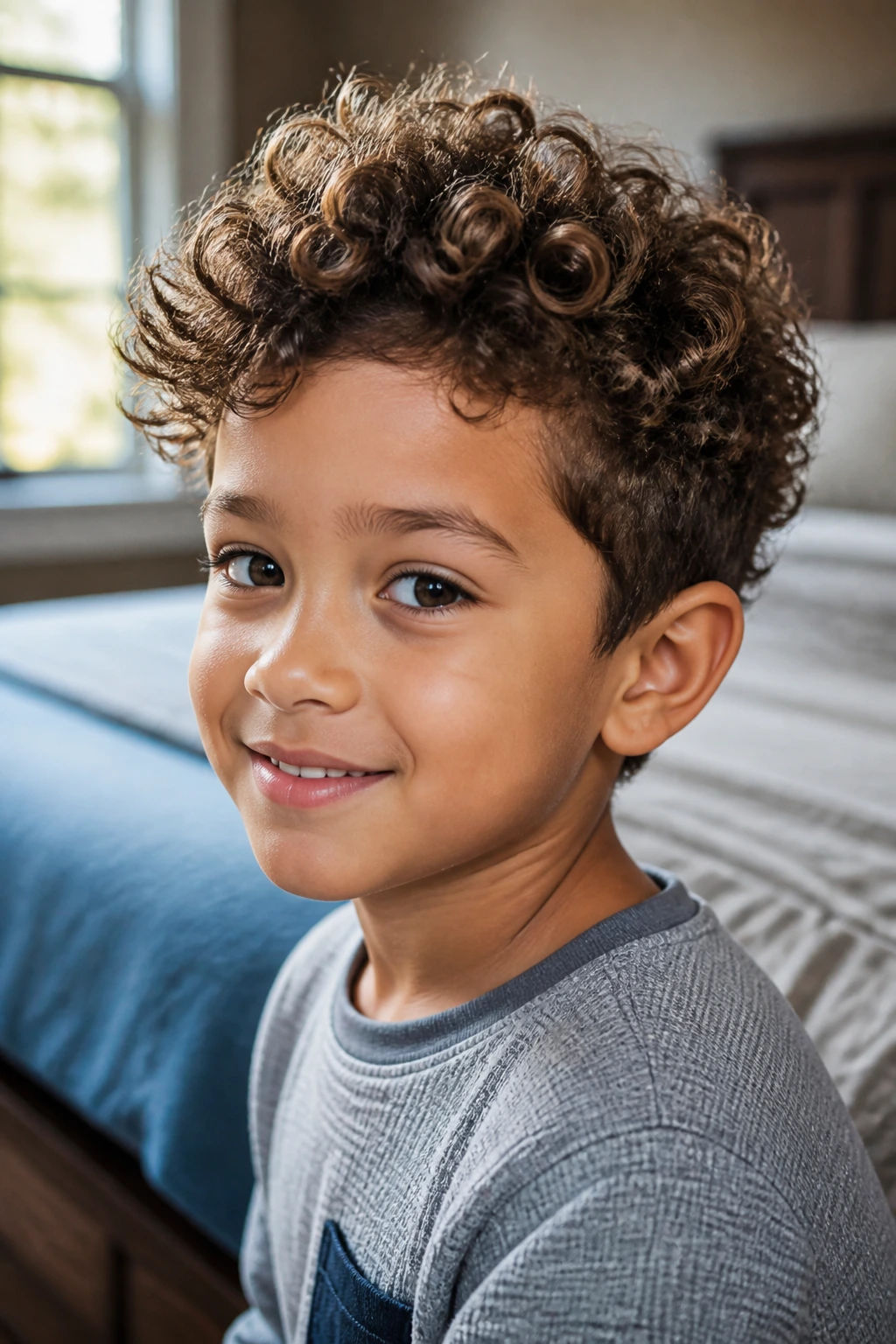
- They respect shrinkage: Curly hair bounces shorter as it dries, so these styles leave enough length on top to avoid the “did we cut it too much?” moment.
- They grow out with less drama: A tapered side and a rounded top can go an extra week looking intentional, not overdue.
- They fit busy mornings: Most of these styles need water, a little leave-in, and a quick finger-shape rather than a 10-minute styling battle.
- They work with more than one curl type: Loose ringlets, springy curls, and tighter coils all have a place in this lineup.
- They handle kid life: Playground sweat, hat hair, and a nap in the car are less of a problem when the haircut has movement and shape.
- They still look neat in school photos: You can keep the curls soft without letting the whole head turn into a halo of static.
Why Curly Hairstyles for Little Boys Need a Different Cut at the Chair
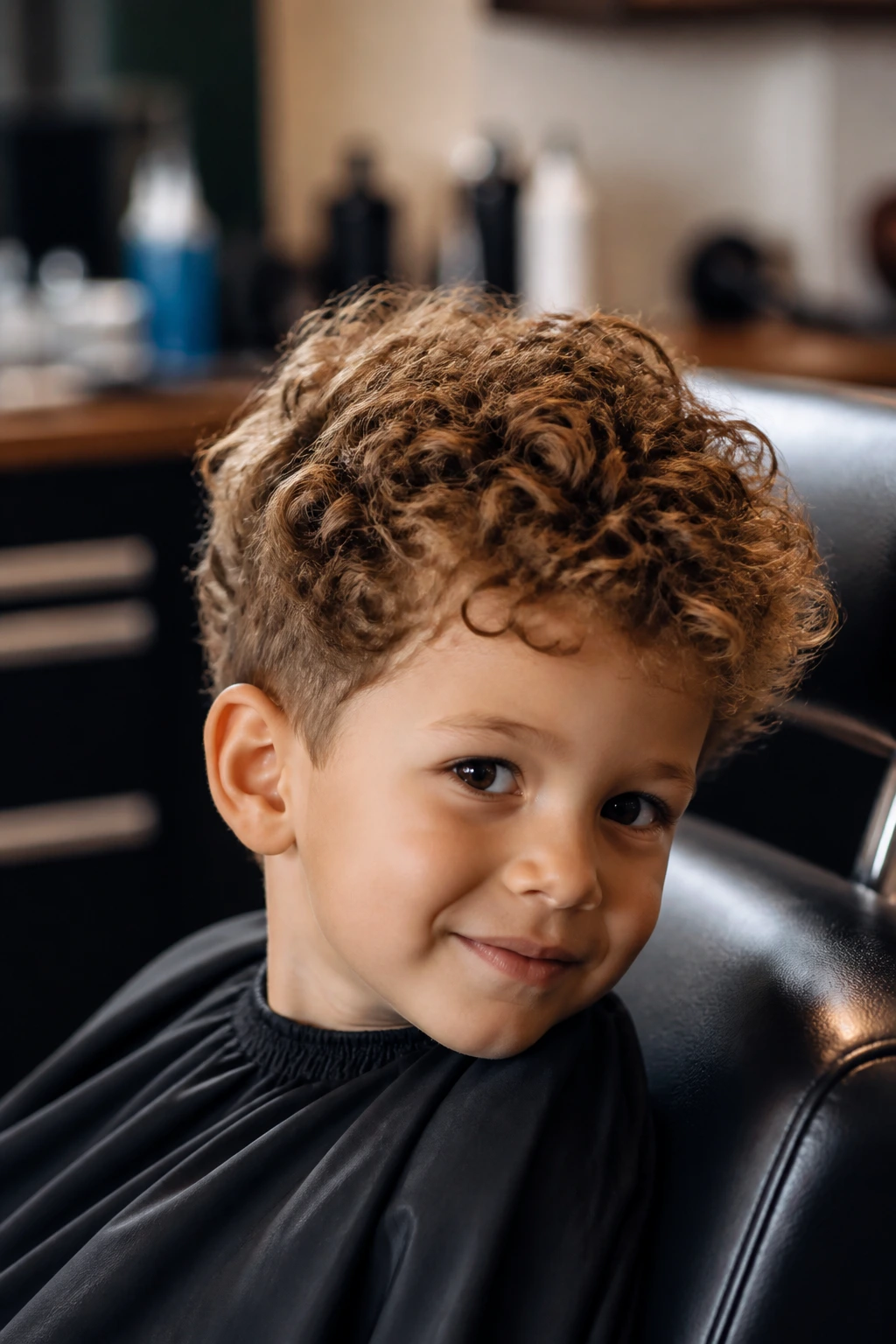
Curls are not straight hair with attitude. They’re a different shape from the root, and that changes everything once the scissors come out. A boy with curls usually needs more room on top than a barber would leave for a straight-haired child, because the strand doesn’t lie flat the same way. Cut it wet and short, and it can pop up half an inch higher once it dries. Sometimes more.
Shrinkage Changes the Final Shape
A curl that looks long in the sink can look much shorter by the time the haircut is done. That’s why a good curly cut often leaves an extra half inch to an inch more length than you’d expect on top. It isn’t sloppiness. It’s accounting.
The Sides Carry More Weight Than People Think
Most curly styles for little boys improve fast when the sides get cleaned up. Not shaved bald, unless that’s the look you want. Just tidied. A low taper, temple fade, or scissor trim on the sides lets the top breathe so the curls read as a shape, not a puff.
Dry Shape Tells the Truth
If a child has a very tight curl pattern, a dry or mostly dry cut can be worth asking about. You can see where the curls sit, where the crown sticks up, and where one side bends differently from the other. That matters more than people think. The crown swirl alone can change how a fringe falls, and if you ignore it, the haircut fights back every morning.
1. Soft Curly Fringe with Tapered Sides
A soft curly fringe is one of those styles that looks calm even when the child wearing it is not. The curls sit forward across the forehead, but the fringe isn’t chopped blunt and boxy. It falls in small pieces, which keeps the shape light instead of helmet-like. The tapered sides do the quiet work here, cleaning up the bulk around the ears and neckline so the front can stay soft.
I like this cut for boys who hate hair in their eyes but still need a little movement up front. Ask for 2 to 4 inches on top after drying, with the fringe left long enough to bend, not sit stiff. At home, a mist of water and a pea-sized amount of leave-in cream usually does the trick. Skip heavy gel. It makes the fringe clump in a way that turns odd fast.
2. Curly Taper Fade with Clean Edges
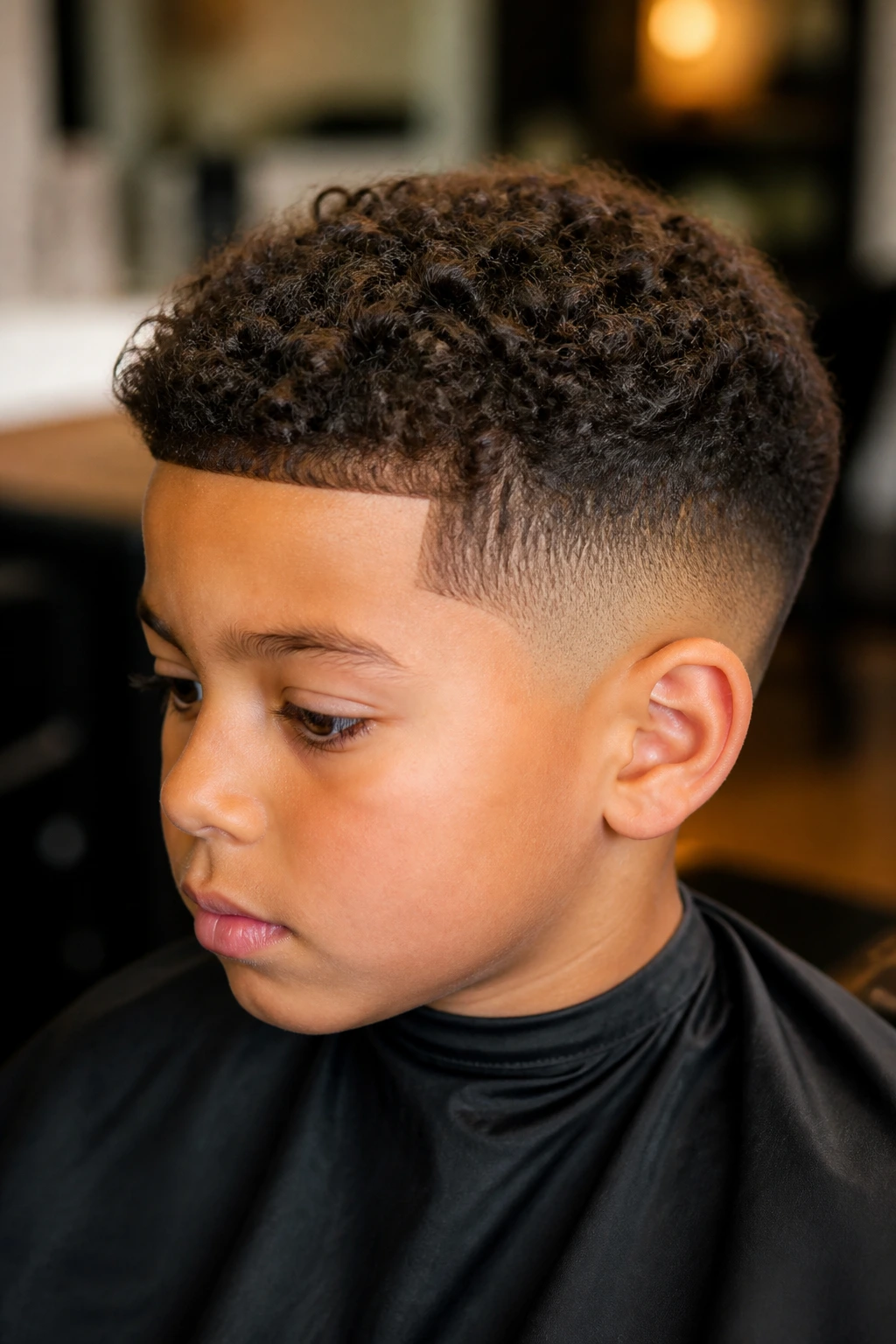
This one is sharp without looking severe. The taper fade starts low around the ears and neckline, then blends into a fuller top where the curls get to keep their bounce. It’s especially good for boys whose hair gets big on the sides before it gets long on top. Clean edges help the whole thing look deliberate.
What to ask the barber
Say this in plain English: keep the top curly and leave enough length for the pattern to show; taper the sides low and keep the fade soft, not high and tight. That’s the whole conversation, more or less. If the barber knows curls, they’ll understand what to do with the crown and how much to leave near the front.
This style is one of the better choices for active kids because it stays neat after a rough day. The fade keeps the outline crisp, and the curls on top can be refreshed with water in under a minute. No drama. No special tricks.
3. Mini Curly Afro
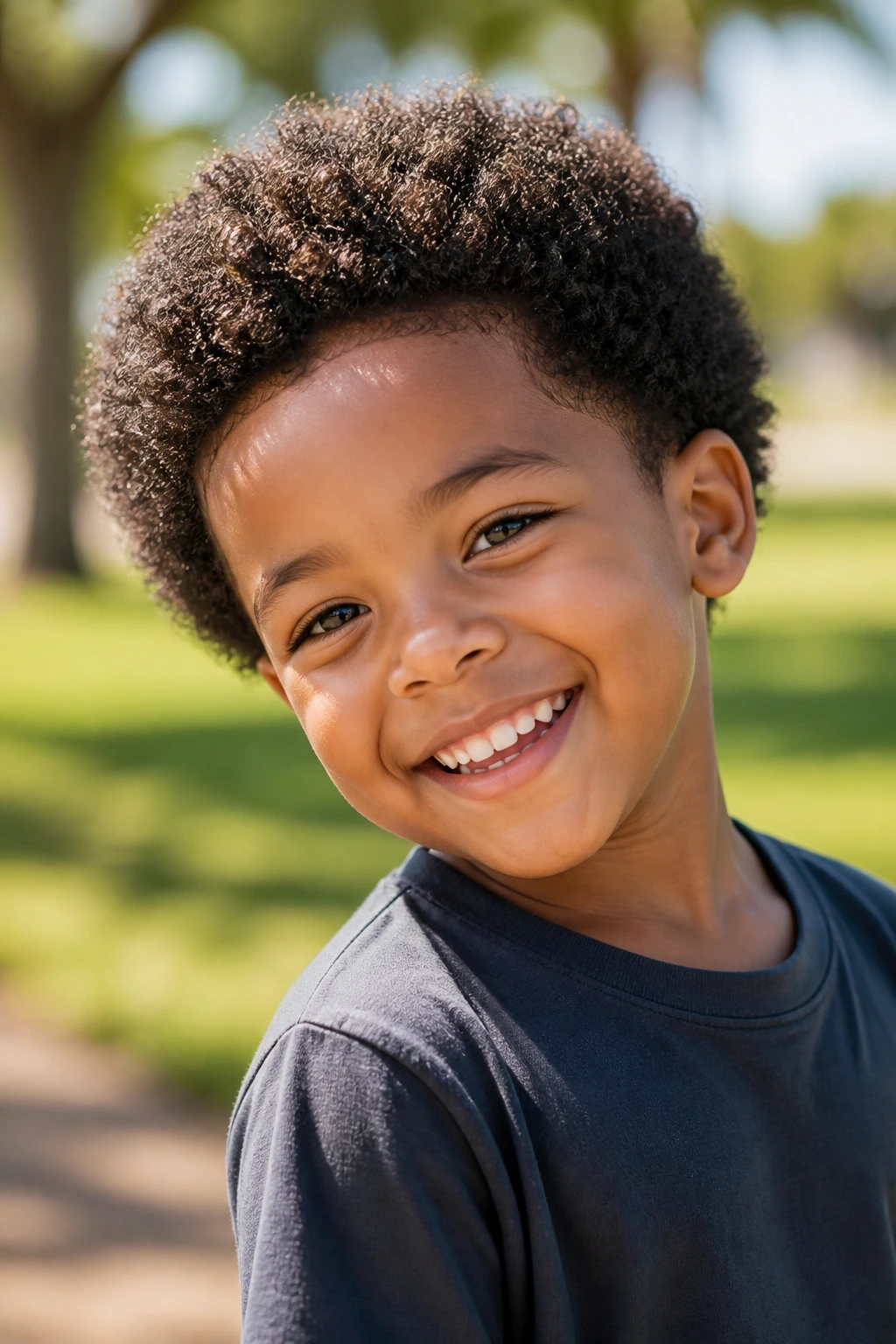
The mini curly afro is the style I suggest when you want the child’s texture to stay front and center. No pretending, no flattening, no pretending the hair should lie down like straight hair. Just a rounded, controlled shape that lets the curls build outward in a clean circle.
The trick is shape, not size. A good mini afro is balanced around the head, with the edges shaped but not carved into a hard block. That means it can be soft at the top and still neat around the sides. It works beautifully on tighter coils and denser hair that likes to puff if it’s cut too short in the wrong places.
If you want it to stay tidy, ask for a rounded shape-up and light trimming at the perimeter instead of a close crop all over. That keeps the curl pattern visible. A little moisturizing cream goes a long way here. Too much product will make it look greasy before lunch.
4. Side Part with Defined Curls
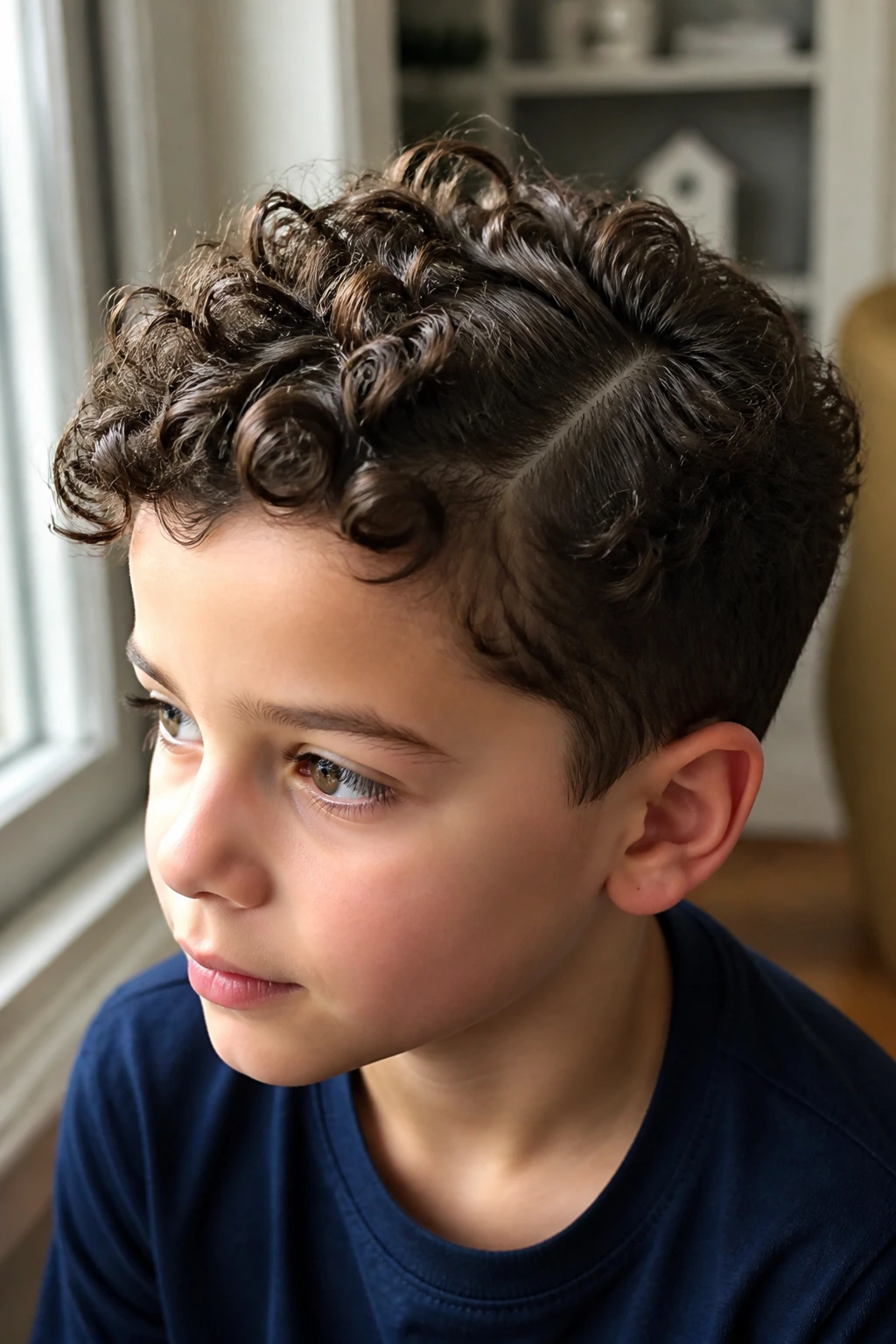
A side part on curly hair is a little sneaky. It sounds formal, but on a little boy it can look relaxed and polished at the same time. The part doesn’t need to be razor-sharp. It just needs to guide the curls into one direction, which helps when the front likes to fall everywhere at once.
This style works best when the curls are medium length and the top has enough weight to move. If the hair is too short, the part disappears. If it’s too long, the side can start to flop. The sweet spot is usually about 3 to 5 inches on top, with the part placed where the hair already wants to split. Fighting the natural part is a waste of time.
A dab of light curl cream and a finger-comb is usually enough. I’d avoid a hard gel finish here. The point is definition, not a lacquered shell.
5. Curly Mohawk with Low Taper
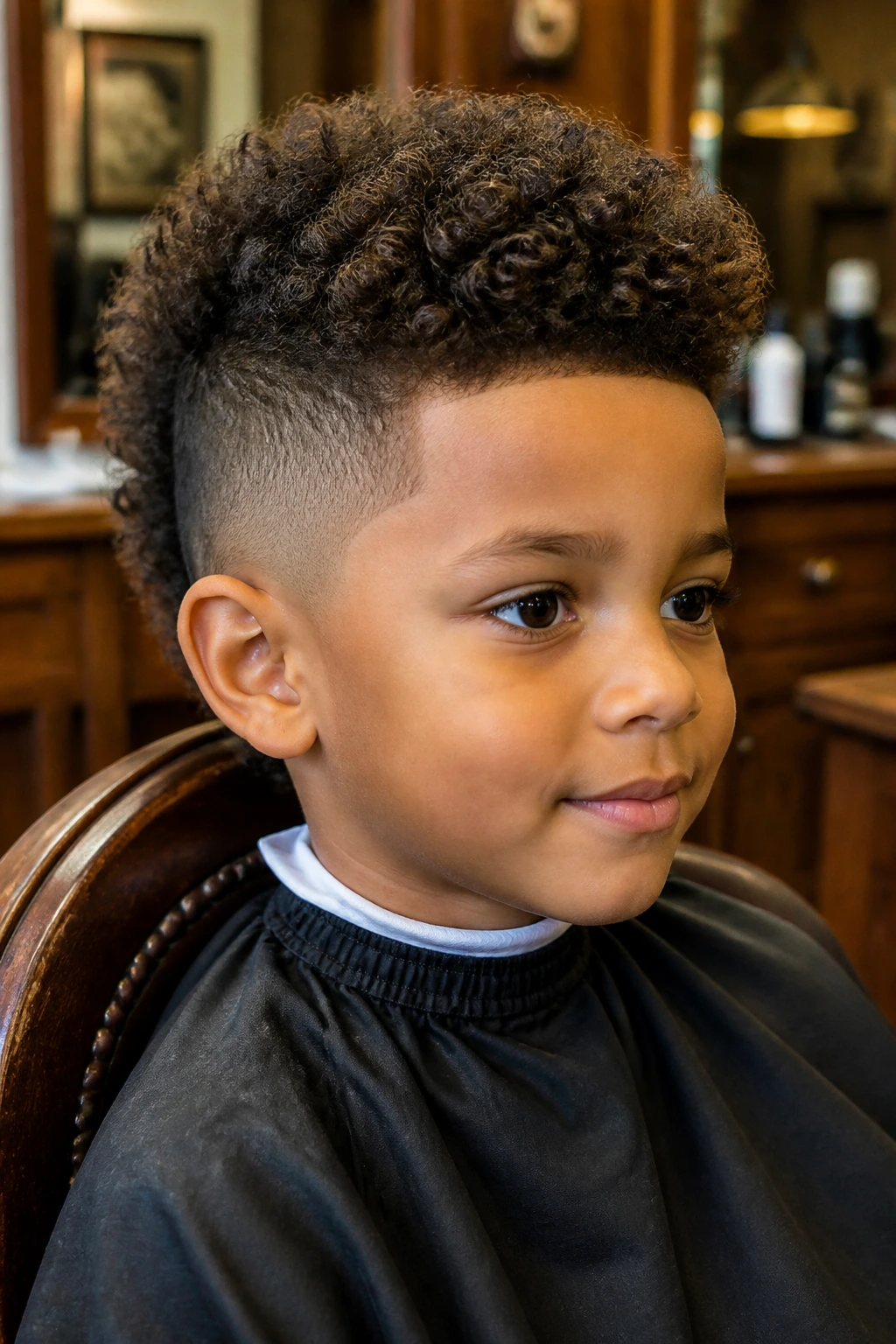
The curly mohawk gives you attitude without going all the way into costume territory. The center strip stays longer and fuller, while the sides are tapered down low so the curl line looks intentional. On little boys, that middle ridge of curls often looks playful rather than edgy, which is part of why parents keep coming back to it.
This cut is a good fit for kids with medium to tight curls who don’t mind a style that has a little shape to it. It can be worn tidy for school or messier on the weekend, and the same haircut handles both. The key is not taking the side taper too high. Once the sides are stripped too far up, the mohawk starts looking narrow and gets harder to grow out cleanly.
A light curl foam or leave-in keeps the center curls from frizzing up. Let the top dry naturally if you can. Blow-drying curls hard usually makes them spring off in every direction.
6. Longer Crown Crop with Low Fade
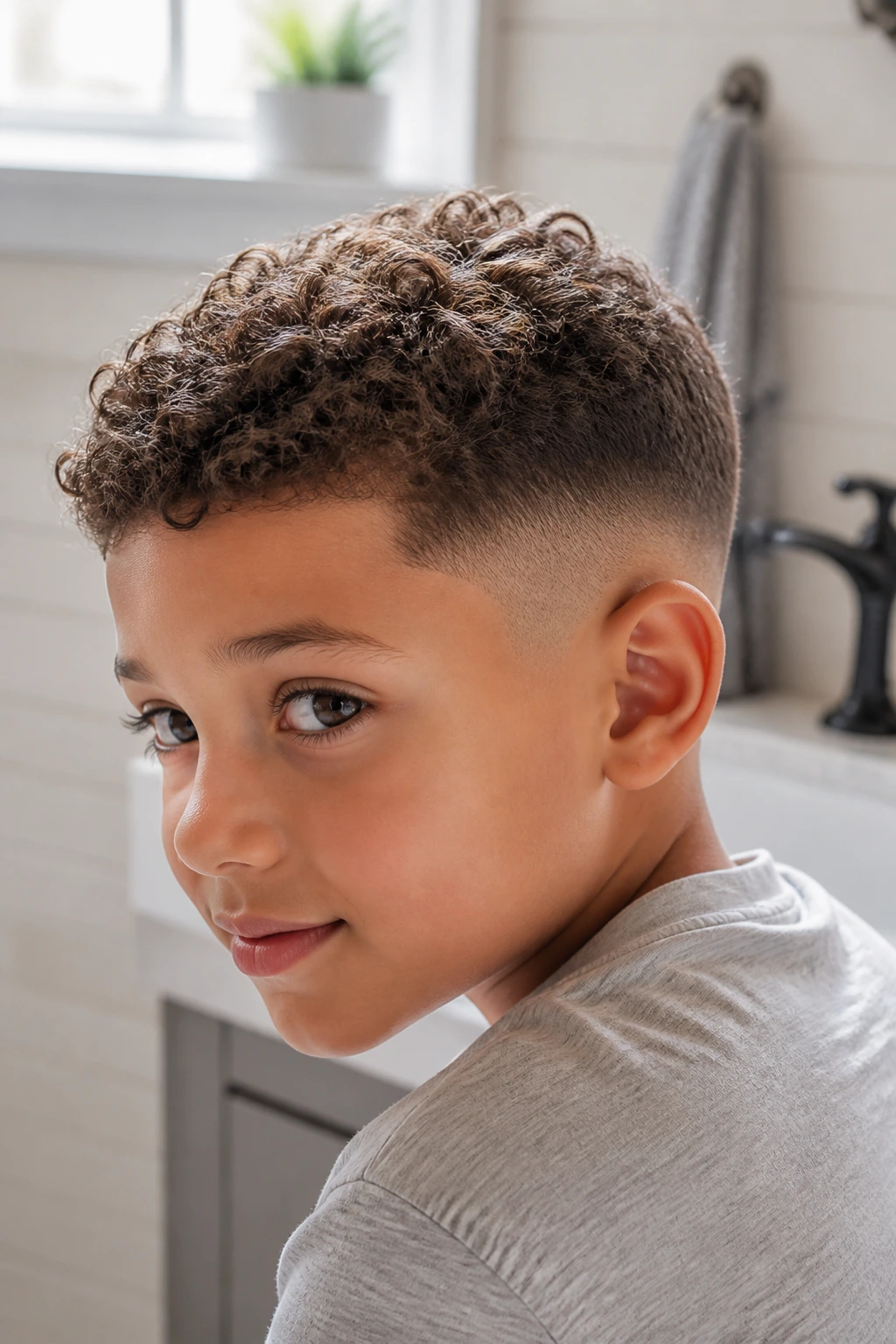
This is a smart cut for a child whose curls get interesting at the crown. Some boys have a swirl there that sticks up no matter what, and this style works with that instead of pretending it doesn’t exist. The crown stays a touch longer so the natural bend can settle, while the low fade keeps the sides crisp and compact.
It’s a tidy look, but not a stiff one. That’s the point. The curls have enough length to show texture, yet the overall head shape stays clean. If the hair at the back tends to puff more than the front, this cut helps pull the eye upward and keeps the shape balanced.
Barber note
Ask the barber to check the crown dry if possible, or at least to leave enough length there that the swirl doesn’t poke through. That one detail changes the whole haircut. It saves you from the awkward spot where the top looks fine and the back looks like it was cut by a different person.
7. Temple Fade with Loose Ringlets
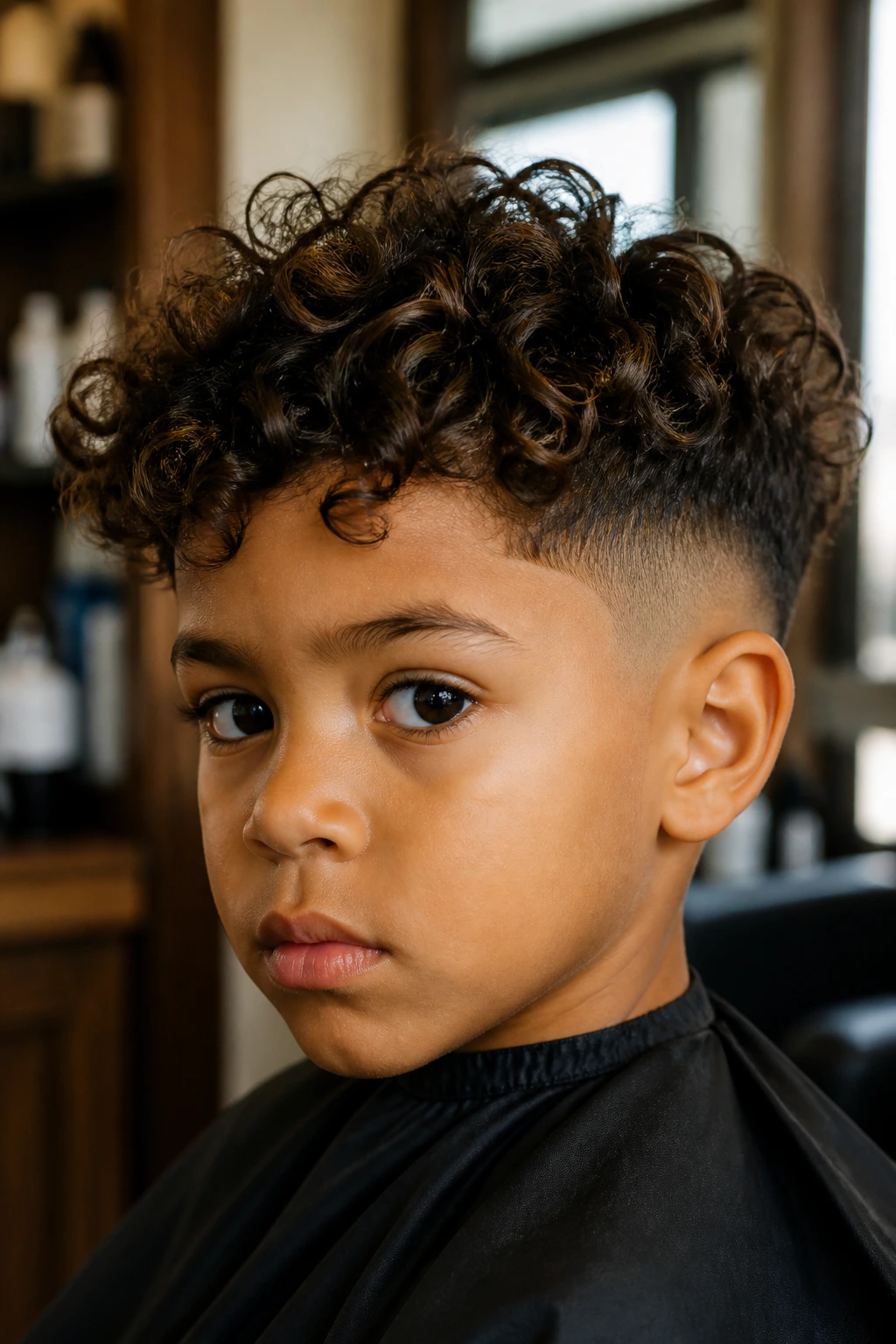
Loose ringlets can look messy in the best way, or messy in the “we forgot to comb this” way. The temple fade helps control that. By fading only around the temples and keeping the top and crown fuller, the curls stay soft and springy where people actually notice them.
This style is a nice fit for boys with looser curl patterns who still need structure around the face. The fade frames the eyes and cheeks, which can make even a simple haircut look finished. It also grows out well, because the transition is gradual rather than severe.
A small amount of curl cream is enough. Ringlets can get weighed down quickly, and once they collapse, the whole style loses its shape. Keep the product light, scrunch with damp hands, and stop before it starts looking coated.
8. Curly Top with Line-Up
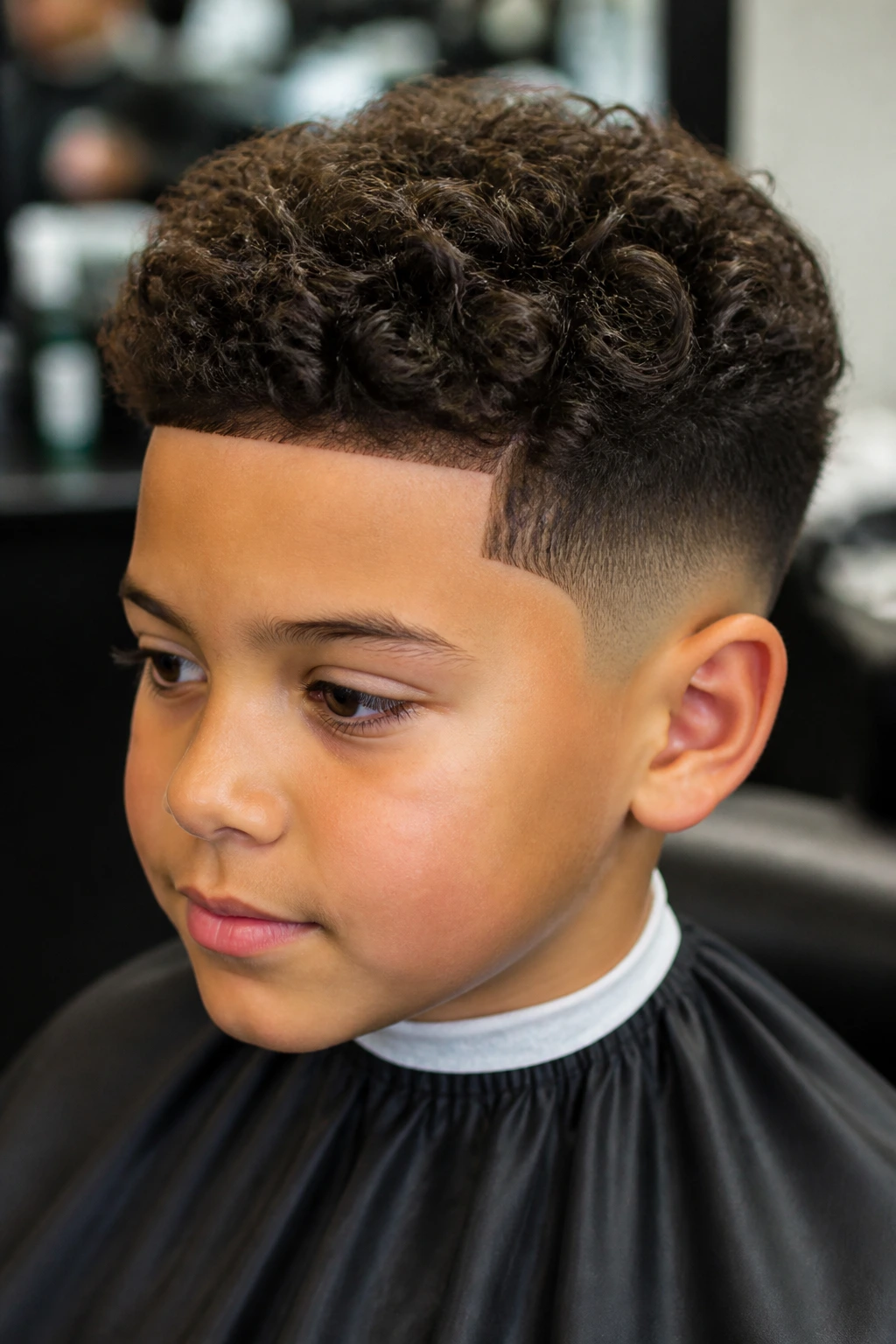
A curly top with a line-up is one of the cleaner-looking styles in the whole group. The top stays textured and natural, while the hairline gets carefully edged so the shape reads crisp from a distance. It’s a good choice for boys who like a tidy finish and don’t mind a little maintenance every couple of weeks.
The line-up shouldn’t overpower the curl. That’s where people go wrong. If the front is carved too hard and the top is left too dense, the haircut can start to feel split into two different styles. A softer edge around the forehead and temples usually looks better on young kids than a razor-straight front.
This style wears well with a low fade or a close taper, depending on how much contrast you want. The higher the contrast, the more often it needs touch-ups. Clean. But not fussy.
9. Tousled Curly Bowl Cut
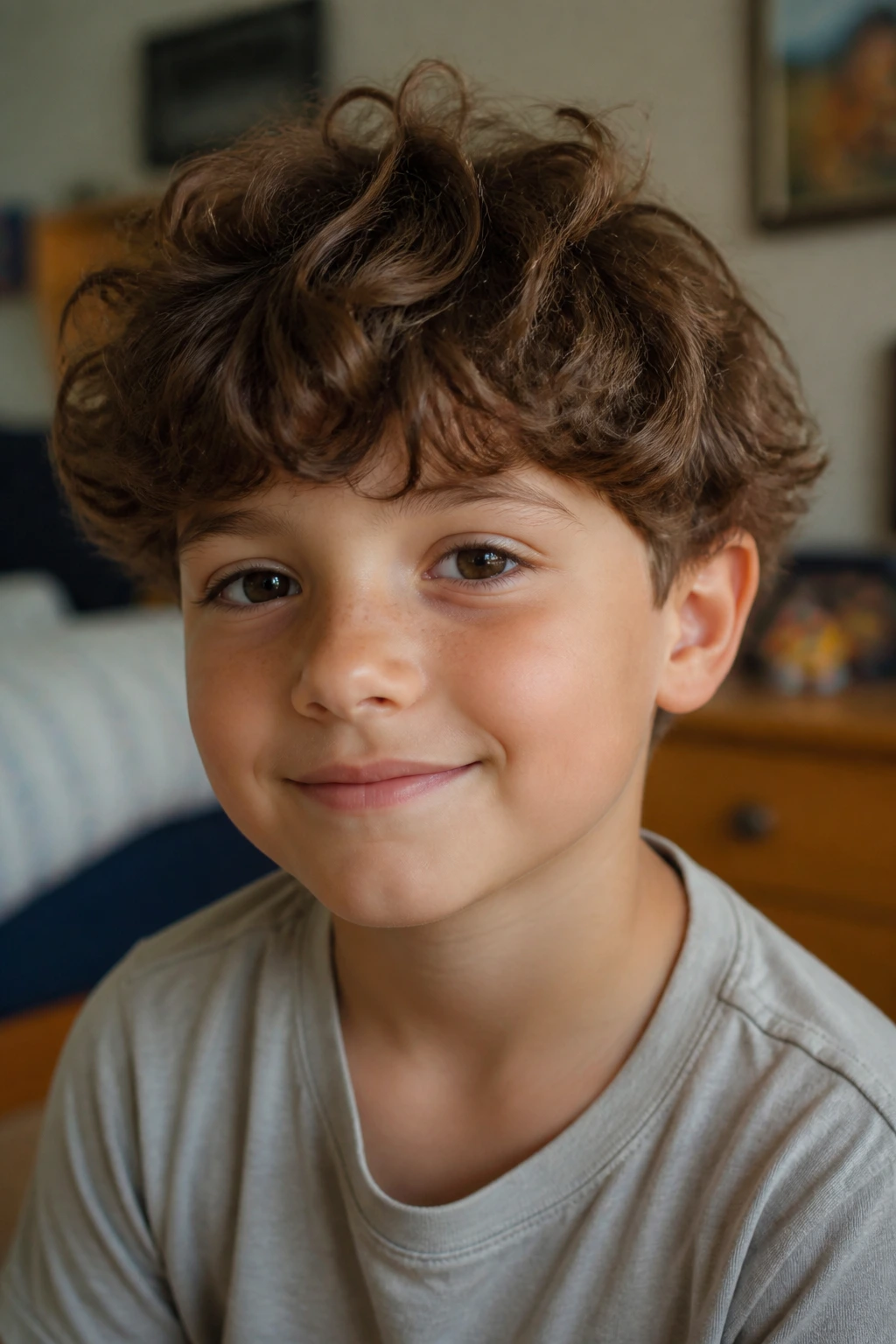
The words “bowl cut” still make some people flinch, which is fair. A curly bowl cut, though, is a different animal. When it’s done with texture and softness, it gives a rounded shape that follows the head without sitting like a cap. The curls break up the line in a way that makes the cut look intentional instead of old-school in the wrong way.
This works best with medium curls and enough length for the ends to move. Ask for soft layering around the perimeter so the bottom edge doesn’t go blunt. The whole thing should feel airy, not dense. If the barber thins it too much, you’ll lose the shape. If they leave it one length all the way around, it can mushroom.
A little water and finger-shaping are enough most mornings. That’s the beauty of it. The texture does the styling for you.
10. High-Top Curly Shape-Up
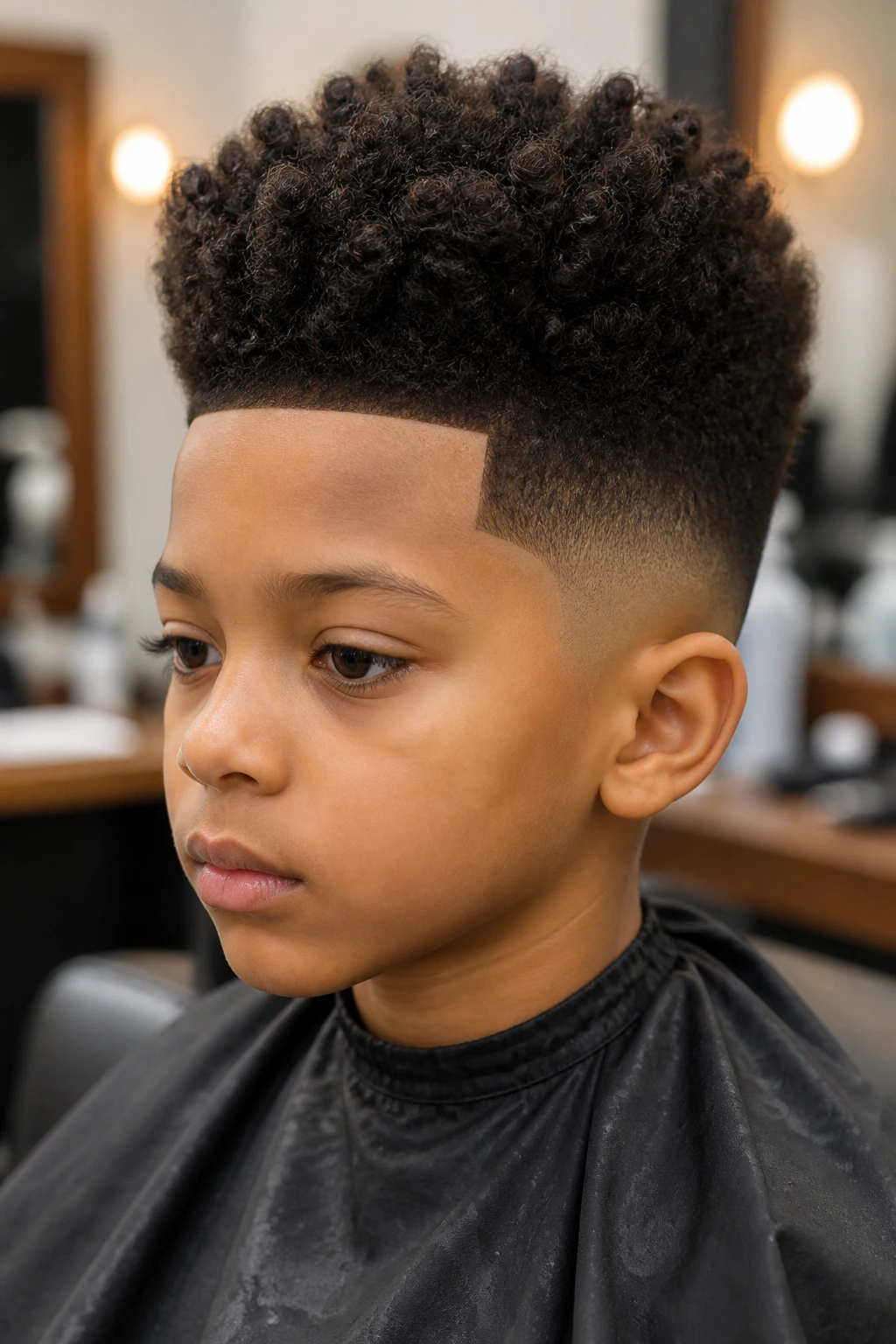
The high-top curly shape-up has presence. It’s taller, more vertical, and it keeps the curls stacked in a controlled way instead of spreading outward. This is the one I’d point to when a child has tighter curls and a lot of density on top. The height becomes the style.
The sides and back need to stay neat so the top can do the talking. A close taper or fade below the temple line gives the haircut that clean geometry people expect from a high-top. Then the top is shaped into a rounded rectangle or soft square, depending on the child’s hairline and preference.
This is not the haircut for a boy who hates maintenance. It looks best when the top is kept moist enough to hold its shape and the edges get touched up often. But when it’s done right, it has a strong silhouette and still keeps the curl texture visible. That’s a good trade.
11. Short Scissor Crop for Tight Curls
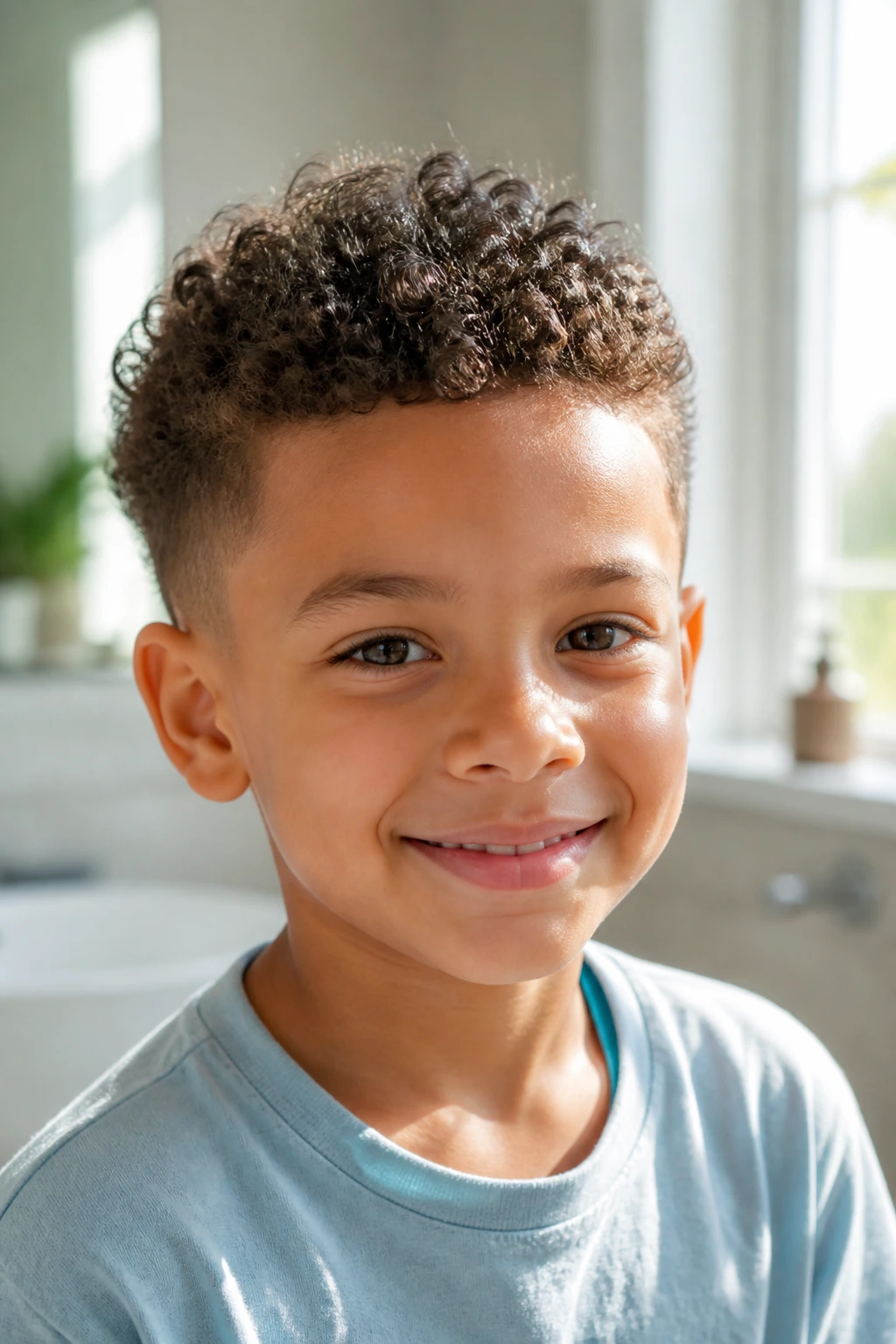
A short scissor crop is the practical answer when curls are tight, the child is young, and nobody wants to spend five minutes wrestling with hair before breakfast. The top is kept short enough to stay neat, but not so short that the curls disappear into fuzz. The sides get cut with scissors or lightly tapered, which keeps the style soft around the ears.
I like this one because it does not pretend every little boy needs a fade. Sometimes the best haircut is the one that lets him sleep on it, wake up, and still look fine after one splash of water. Tight curls can handle a shorter crop better than looser waves, because the texture still shows even at a low length.
Ask for enough length to see the curl bend, not just the outline of the head. That sentence saves a lot of disappointment.
12. Curly Shag with Soft Layers
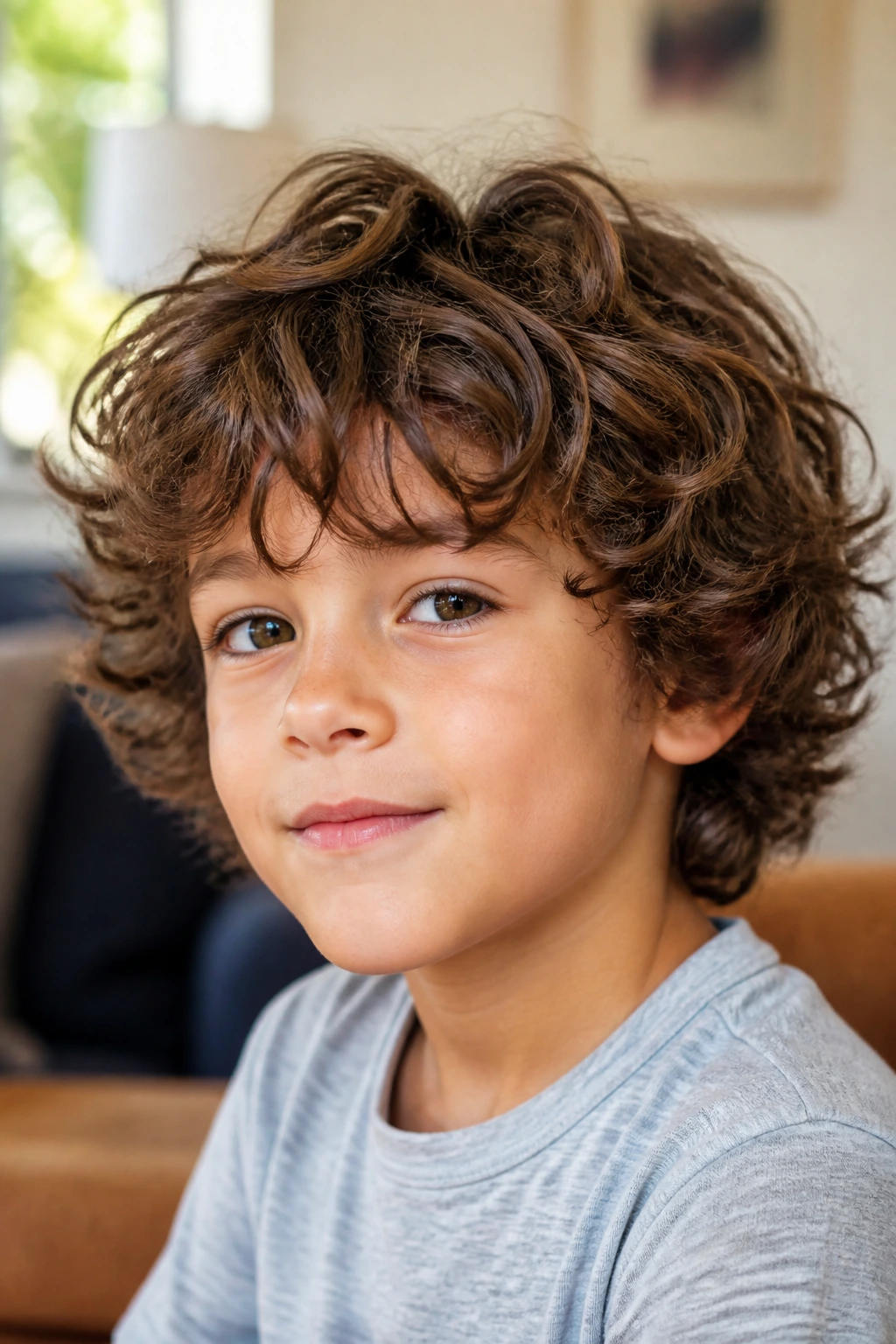
The curly shag has movement in every direction, and that’s what makes it fun. Instead of one even shape, the layers let the curls fall in pieces around the forehead, crown, and sides. It looks a little relaxed, a little artsy, and a lot better than a triangle shape that’s been left alone too long.
This style loves medium-length curls. The layers stop the hair from sitting as one heavy block, which is a common problem when little boys’ curls start getting longer. It works especially well for kids with looser ringlets or mixed texture, because the uneven pattern gives the cut character.
The catch is that it needs a barber who knows how to remove bulk without making holes. That’s not the same thing. The shag should feel soft and lived-in, not chopped up. If the layers are done well, the hair falls in a way that looks easy, even though the cut itself takes some skill.
13. Half-Up Curly Top Knot
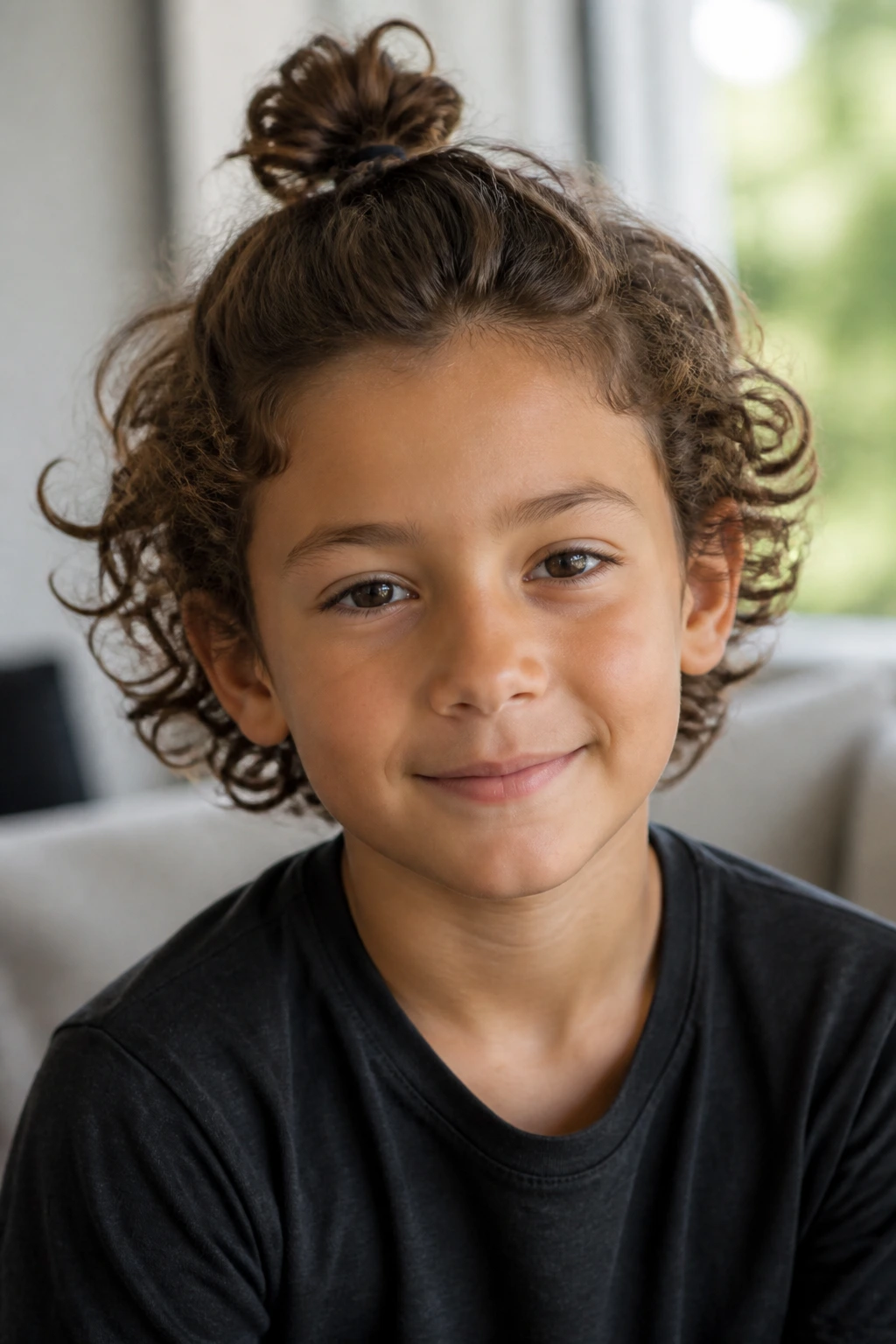
This one is for the kid with enough length to play with. The half-up curly top knot keeps the front and crown pulled back while leaving the rest of the curls free. It’s practical when hair is in the eyes, but you still want to keep the length on top instead of cutting it all off.
It works best on medium to long curls, and it’s especially nice for warmer days when a child keeps pushing hair off his face. The knot itself should stay small and loose. You’re aiming for control, not a tight pull that leaves the scalp sore by lunchtime.
A soft elastic and a little leave-in conditioner are enough. If the ends are dry, the knot can look frayed fast, so keep a spray bottle nearby. I’d avoid this style for very young kids who won’t sit still. On older little boys, though, it has a clean, easygoing look.
14. Curly Undercut with Full Top Length
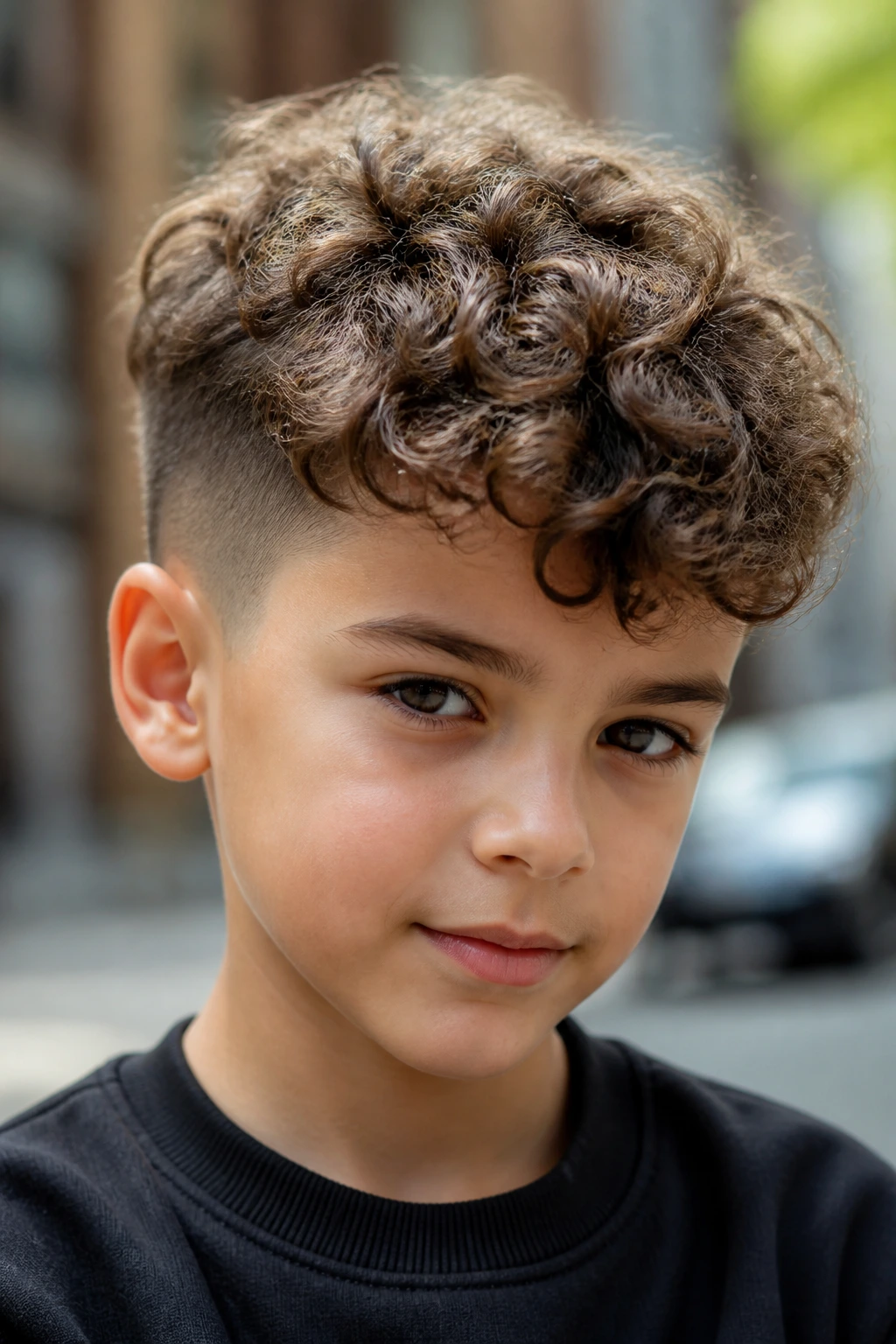
The curly undercut is a bold contrast style. The sides are cut much shorter, sometimes very short, while the top keeps its full curl length. That difference gives the curls up top room to spread and makes the whole head look taller and more defined.
This haircut suits boys who want the top to stay the main event. It can look sharp with loose curls, and even tighter curls get a nice frame from the clipped sides. The undercut does ask for some regular maintenance, because once the sides grow out, the contrast softens fast and the look changes.
If you like the top to keep moving and don’t mind a more noticeable haircut, this one is a strong choice. If you prefer a softer transition, a low taper is easier to live with. The undercut is cleaner. The taper is kinder. Both have their place.
15. Side-Swept Curly Quiff
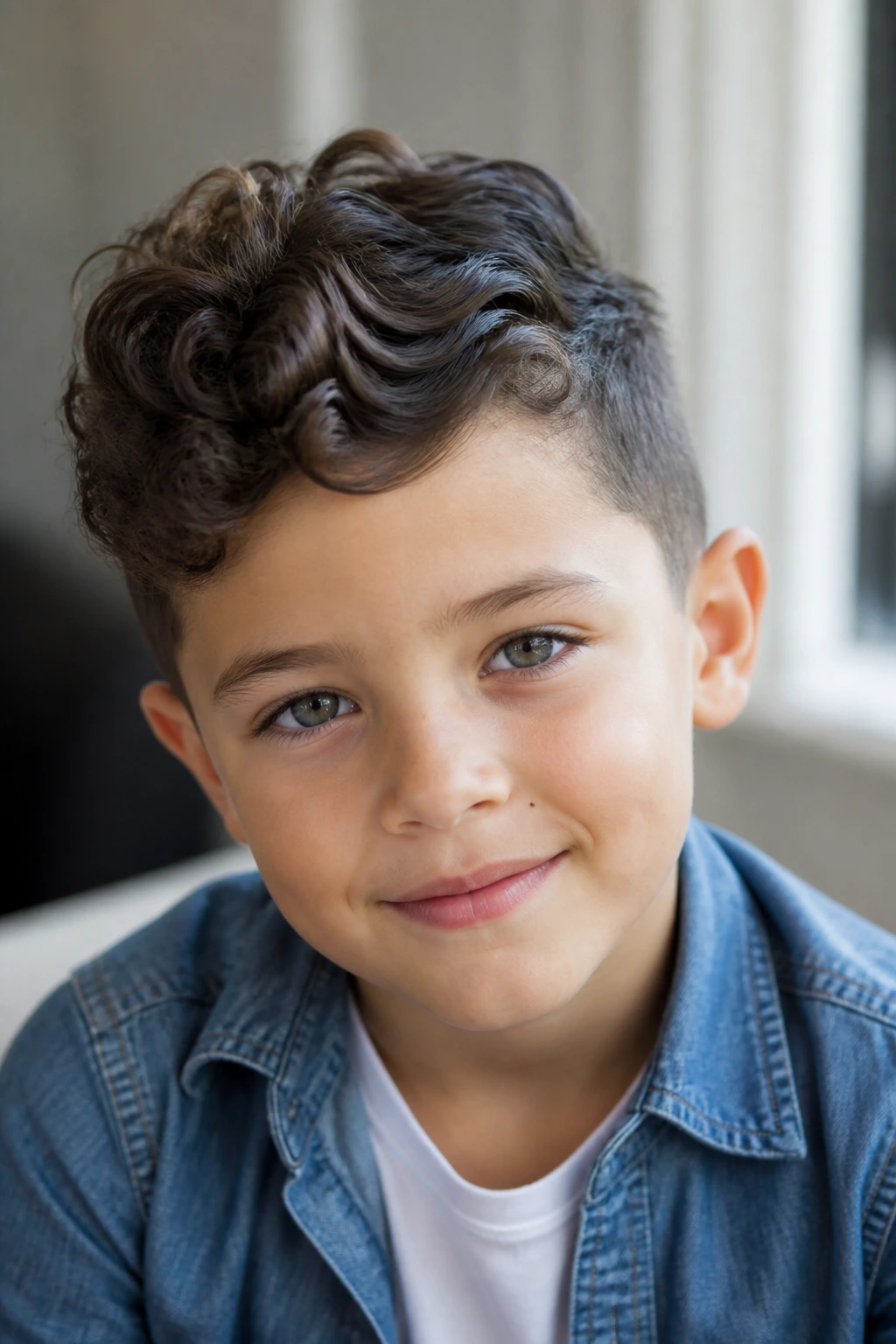
A side-swept curly quiff sounds more polished than it is. The front section gets lifted a bit and pushed to one side, so the curls sit in a soft wave over the forehead instead of hanging straight down. It works when the top has enough length to lift but not so much that the shape collapses.
This is a nice middle ground for boys who want a style that feels a little dressed up without turning into a formal haircut. It looks best when the sides are shorter and the front has a touch more length than the rest. That lift at the front helps the face look open, which can be useful if the hairline grows low or the forehead is smaller.
A very light cream or mousse can help the quiff hold its direction. But keep the product airy. If it dries hard, the whole thing loses the soft sweep that makes it work.
16. Drop Fade with Curl Puffs
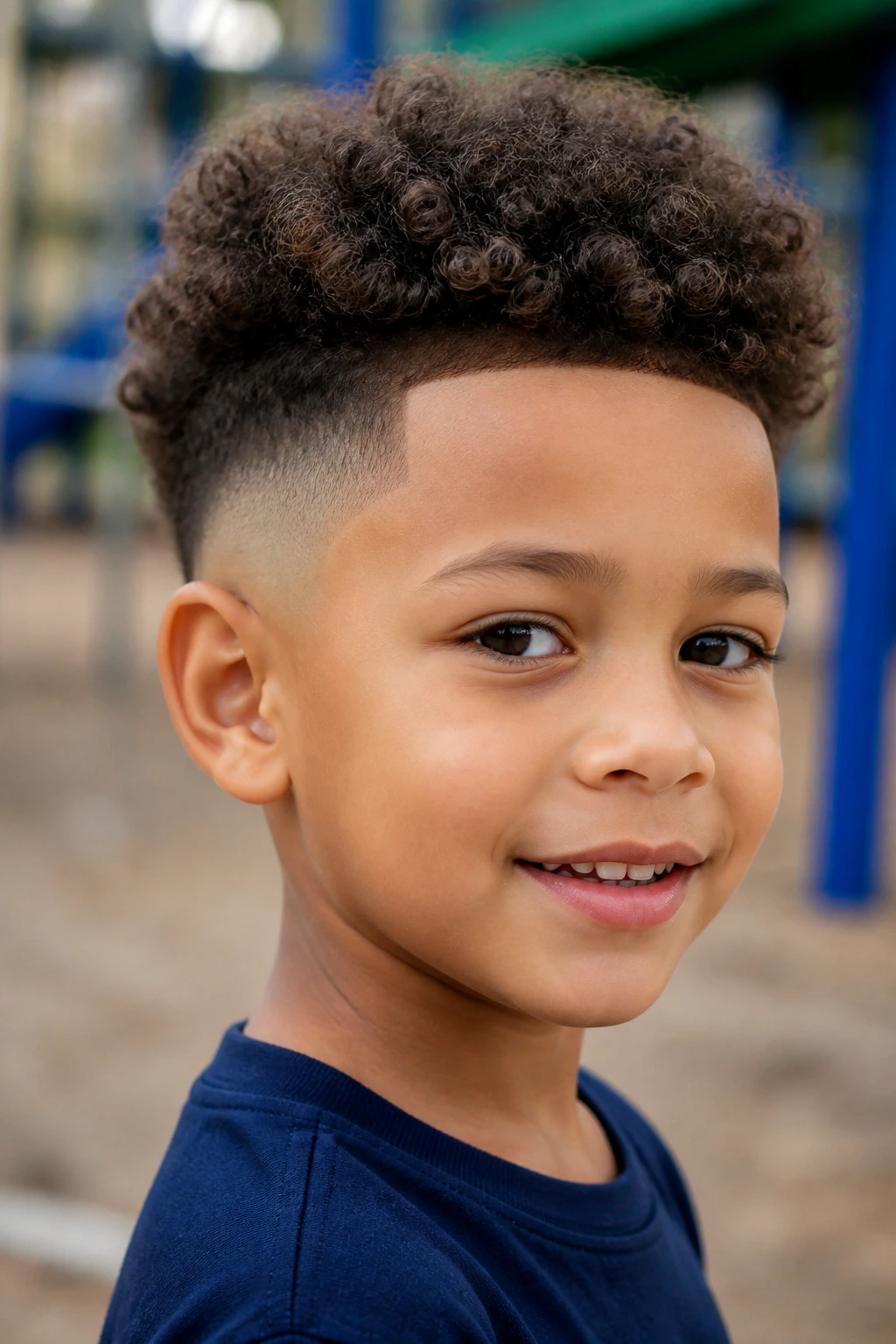
The drop fade curves lower around the back of the head, which gives the curls on top and in the crown a fuller frame. I like this one for boys whose hair gets thick at the back of the head or around the ears. The fade dips, the top stays rounded, and the shape ends up looking balanced from every angle.
You’ll sometimes hear parents describe this look as “the curls puff up just enough.” That’s exactly right. The top keeps volume, but the drop fade keeps the bulk from spreading outward like a mushroom. It’s a smart cut for active kids because the silhouette stays tidy even when the hair gets a little mussed.
Ask the barber to keep the transition soft. A drop fade that’s too sharp can make the crown look disconnected. The best version has a smooth curve and a top that still feels playful.
17. Long Curly Layers
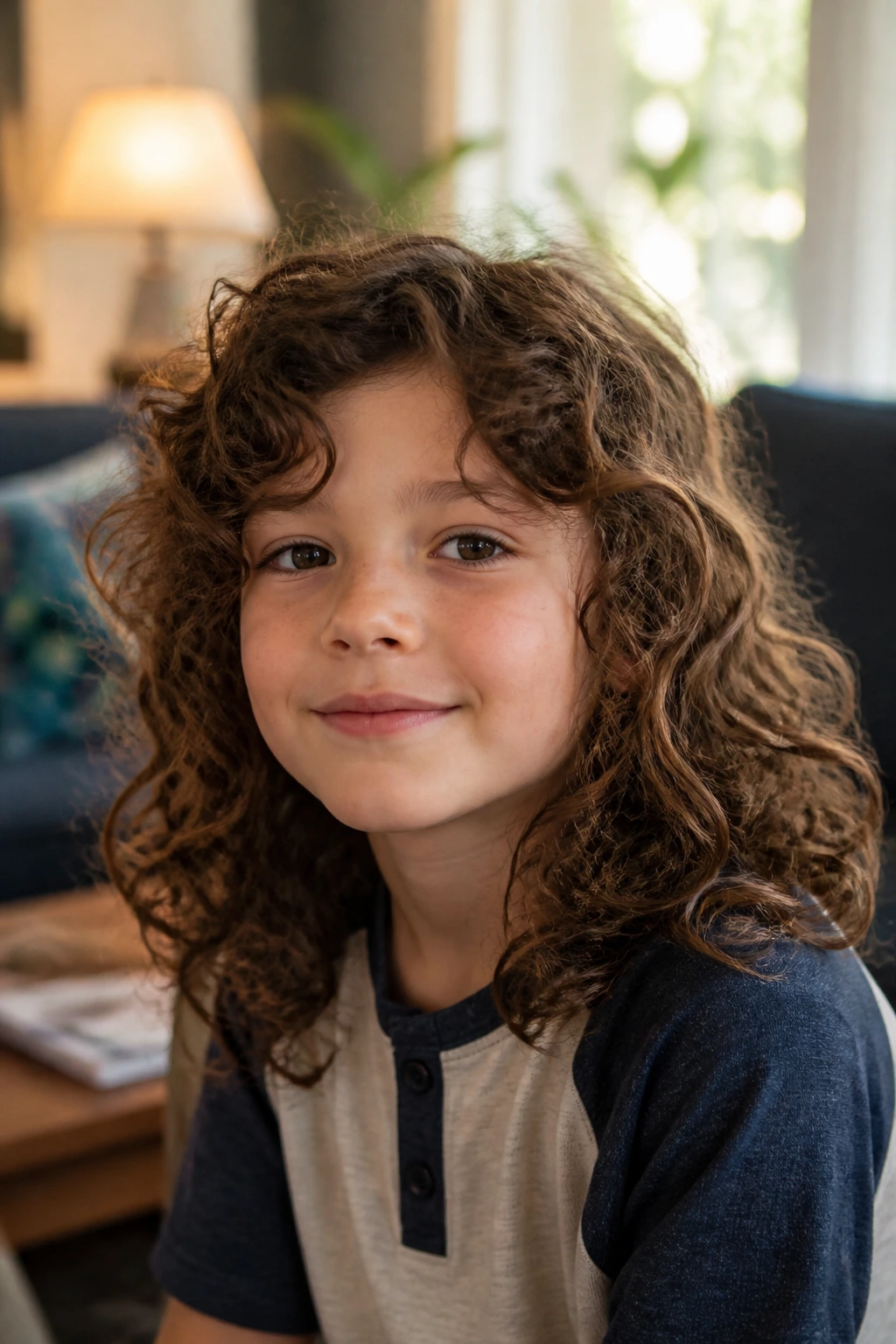
Long curly layers are for the kid who wants the curls to hang and bounce instead of sitting clipped short. The layers stop the hair from turning into one heavy sheet, and they help the curls separate a little so you can see the texture. Without layers, long curly hair on a child can get bulky fast.
This style does ask for patience. It’s not the cleanest choice for every school rule, and it can take a few extra seconds to refresh after sleep. But it’s one of the nicest options when the child has soft ringlets or a thicker curl pattern that looks best with movement.
The best part is the grow-out. Long curly layers keep working even when they’ve been in place for a while, which is handy if you are trying to stretch the time between barber visits. The haircut ages better than a hard, short crop.
18. Little Gentleman Curls
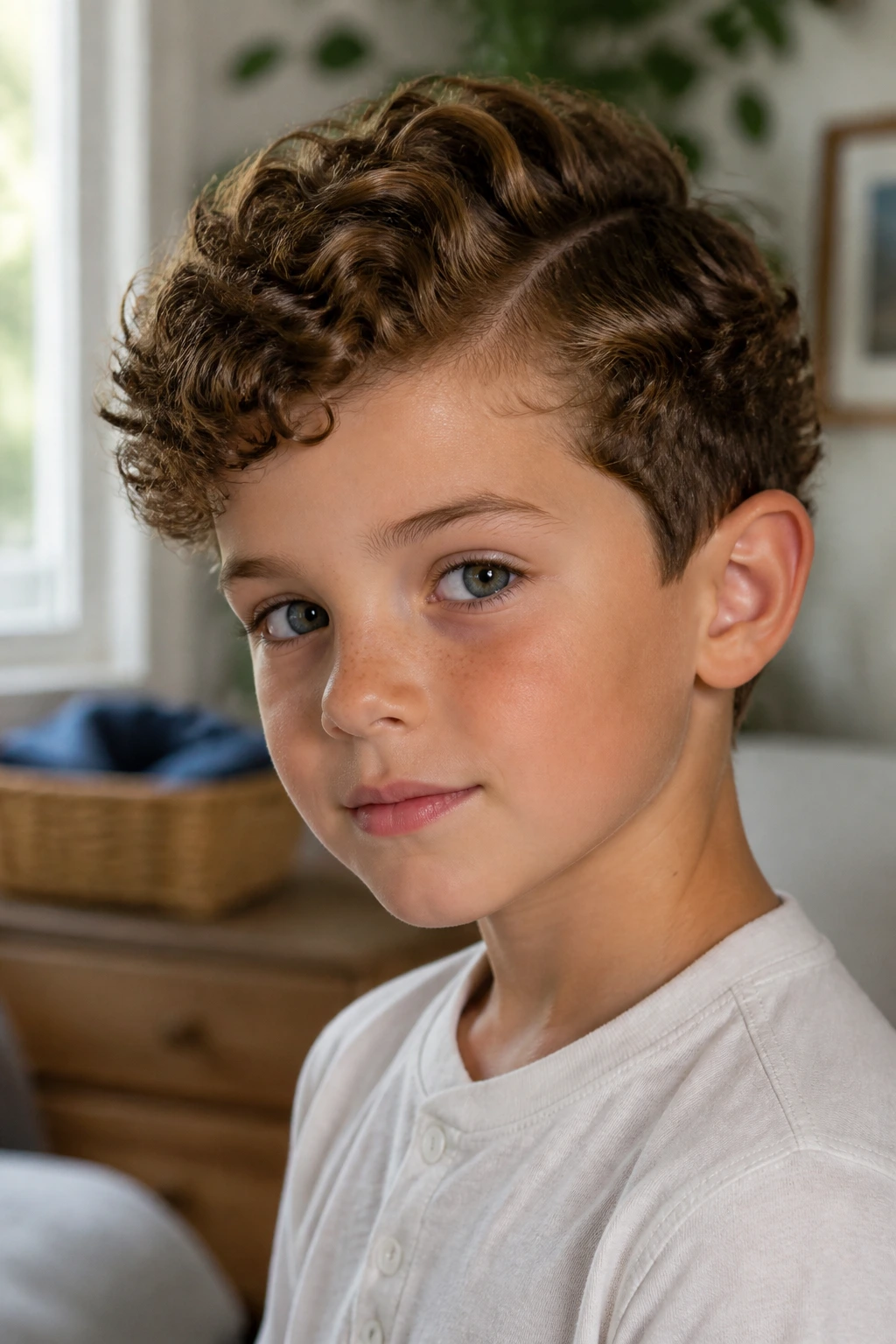
This is the tidy, polished version of curly hair. The curls stay natural, but the outline is neat, the sides are controlled, and the overall effect reads calm rather than wild. Think soft side part, clean neckline, and curls left with enough length to bend instead of sticking up.
It’s a good choice for family events, school pictures, or any day when you want the haircut to look finished without losing texture. I prefer it on boys whose curls are soft enough to shape with a light comb-through. If the hair is very tight, a more rounded cut usually works better.
A tiny amount of cream, a neat part, and a quick finger sweep is usually all it needs. No hard shell. No crunchy gel. Just tidy curls with manners.
19. Wash-and-Go Frohawk
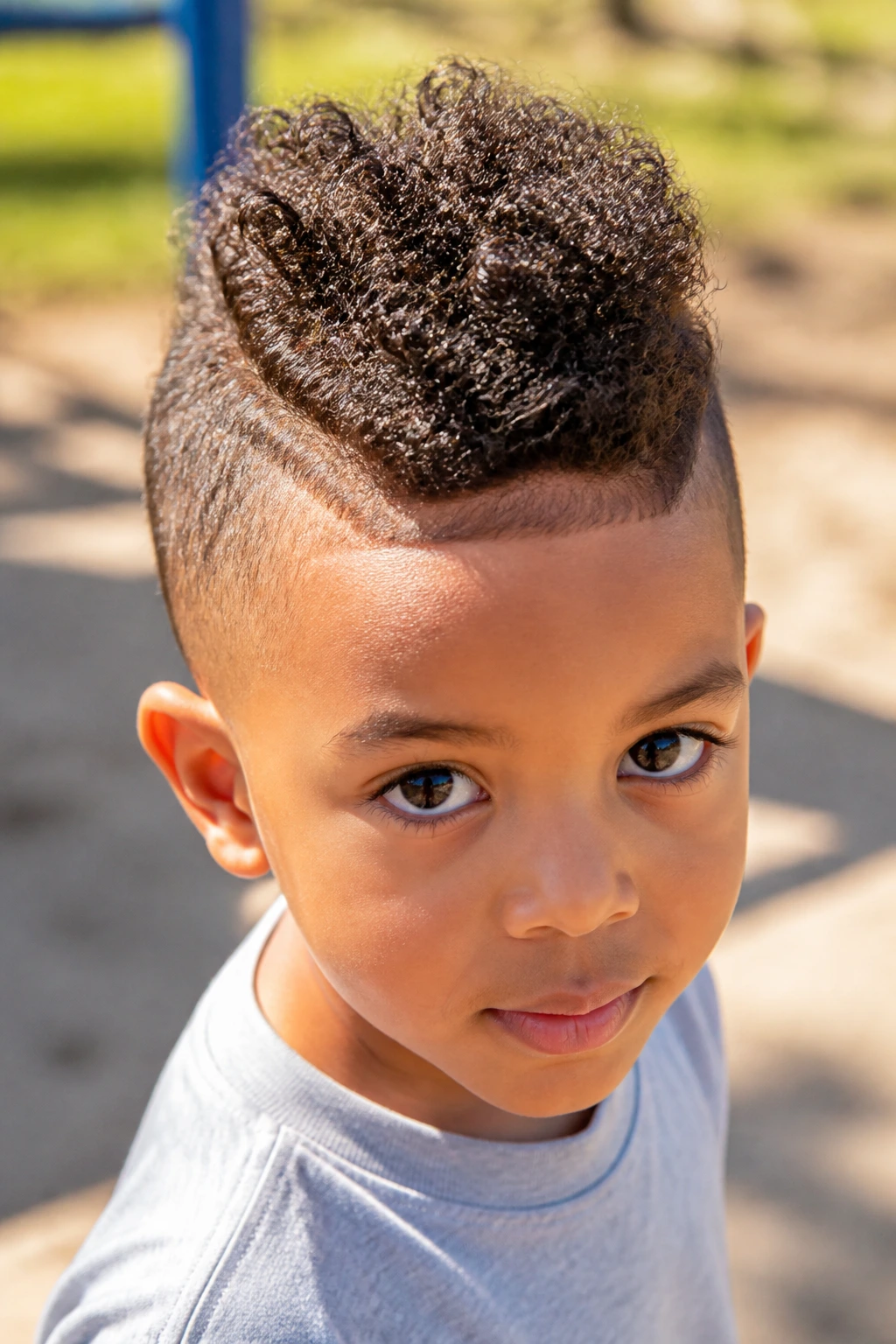
The wash-and-go frohawk is the easiest one to live with if you want shape but not a lot of styling. The sides stay shorter, the center remains fuller, and the curls stand up on their own with very little help. It’s the kind of haircut that still looks decent after a nap, which is saying something.
The whole point is low fuss. Water, a little leave-in, and a quick scrunch are enough. You don’t need to force the center ridge into some perfect line. In fact, it looks better when it stays a little loose and playful. That looseness is what keeps it from feeling too grown-up or too stiff.
For boys with tighter curls, this can be a strong option because the curl pattern naturally supports the shape. For looser curls, a touch more product may help the middle stay upright. Either way, it’s one of the most forgiving curly haircuts in the lineup.
How to Ask for These Looks Without Guessing
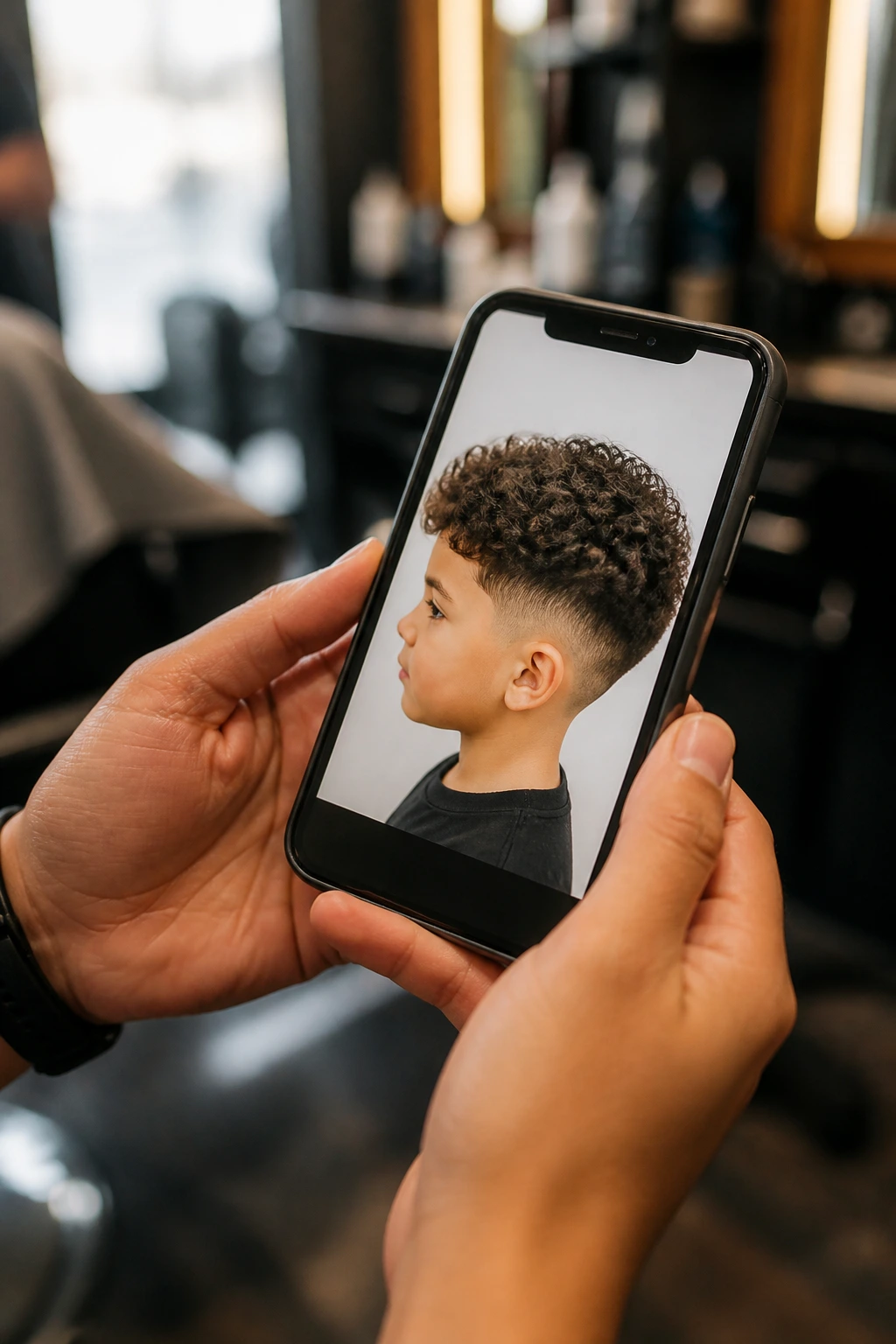
The fastest way to get a good result is to speak in pieces, not in one vague sentence. Barbers can work with “make it curly” the way a cook can work with “make it tasty,” but neither one is ideal. Bring the shape, the length, and the cleanup details with you.
A simple script helps: “Leave more length on top so the curls keep their shape, taper the sides low, and keep the neckline neat but not too sharp.” If you want a fringe, say how far it should sit on the forehead. If you want a fade, say whether you want it low, mid, or high. If you want the hairline natural, say that too. People skip that part and then wonder why the edges look carved when they didn’t want them carved.
A photo still helps. Two photos are better than one, especially when the curls in the picture are closer to your child’s texture. Same style name. Different curl pattern. Different result.
Tools That Make Curly Hair Easier to Style
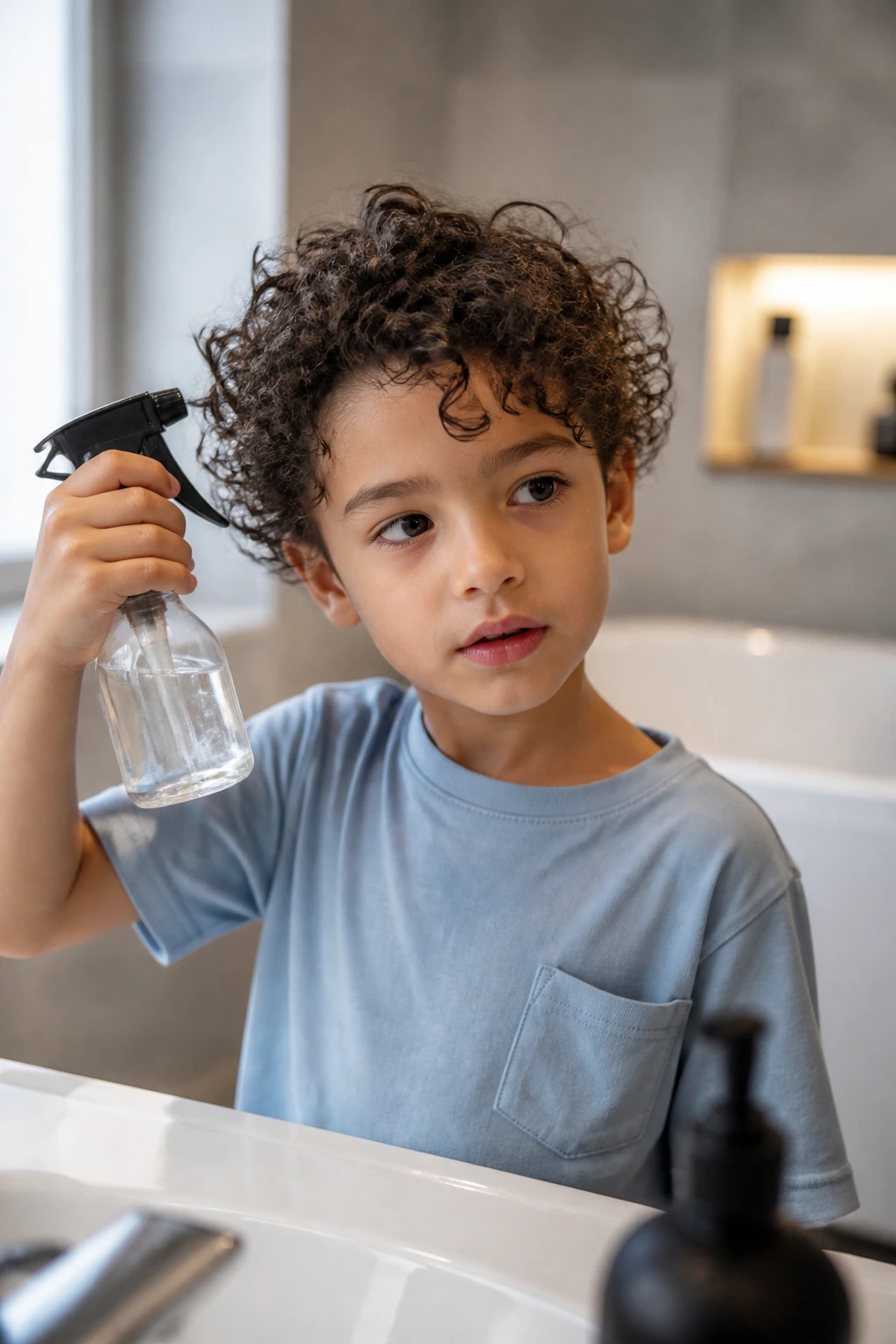
- Spray bottle: A few spritzes wake up curls fast without soaking the whole head.
- Leave-in conditioner: Use a small amount on damp hair to keep curls soft and easier to separate.
- Curl cream or light mousse: Helps shape the curl without turning it stiff or sticky.
- Wide-tooth comb: Best for detangling when the hair is damp; it pulls less than a fine comb.
- Microfiber towel or soft T-shirt: Dries hair without roughing up the curl pattern the way a bath towel can.
- Soft-bristle brush: Useful for smoothing the outer shape on looser curls, but don’t overwork it.
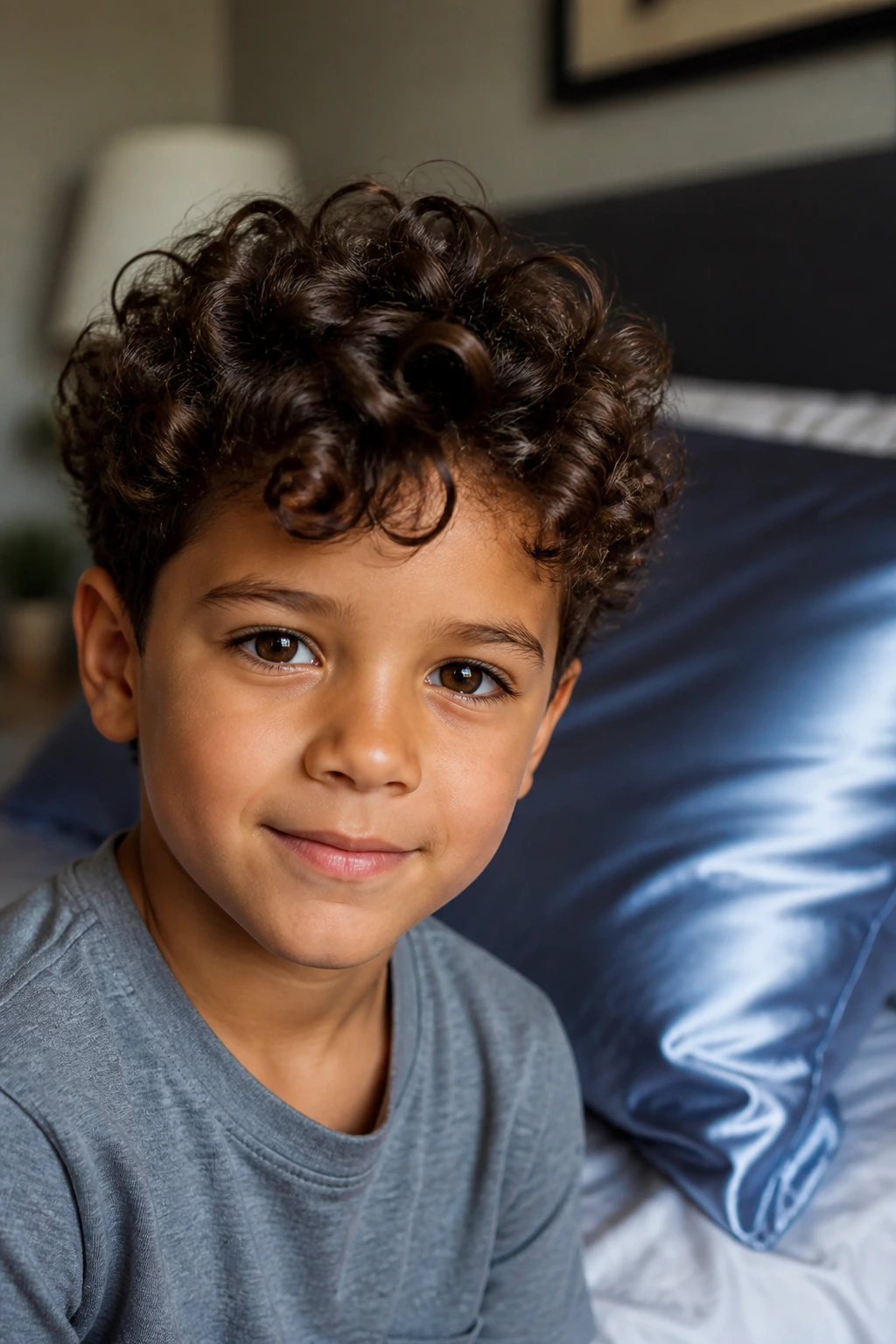
- Satin pillowcase or bonnet: Reduces the frizzy, crushed look after sleep and makes morning refresh faster.
How to Keep Curly Hairstyles for Little Boys Looking Neat Between Trims
Curly hair can still look sharp three weeks after a haircut if you treat it with a little respect. That doesn’t mean fancy routines. It means a sane wash schedule, a damp refresh, and a trim before the sides turn into a cloud.
Morning Refresh
Start with water. Always. A spray bottle is enough for most styles. Mist the top, scrunch it with your hands, and smooth the sides if they’ve gone fuzzy. A pea-sized amount of leave-in or curl cream can help, but only on the parts that look dry. Slathering the whole head usually makes the curls droop.
Bedtime Protection
If a child sleeps on cotton every night, the curls will show it. A satin pillowcase makes a bigger difference than people expect. A bonnet helps too, especially for tighter curls or longer shapes. Neither one needs to be perfect. Even partial protection cuts down on the frizz crown in the morning.
Trim Timing
Short fades and line-ups usually need a clean-up every 3 to 5 weeks. Longer curly layers can stretch closer to 6 to 8 weeks if the shape still sits well. If the sides start puffing out before the top loses length, that’s your cue. Don’t wait until the haircut has turned into a different haircut.
Small Tweaks That Change the Whole Look
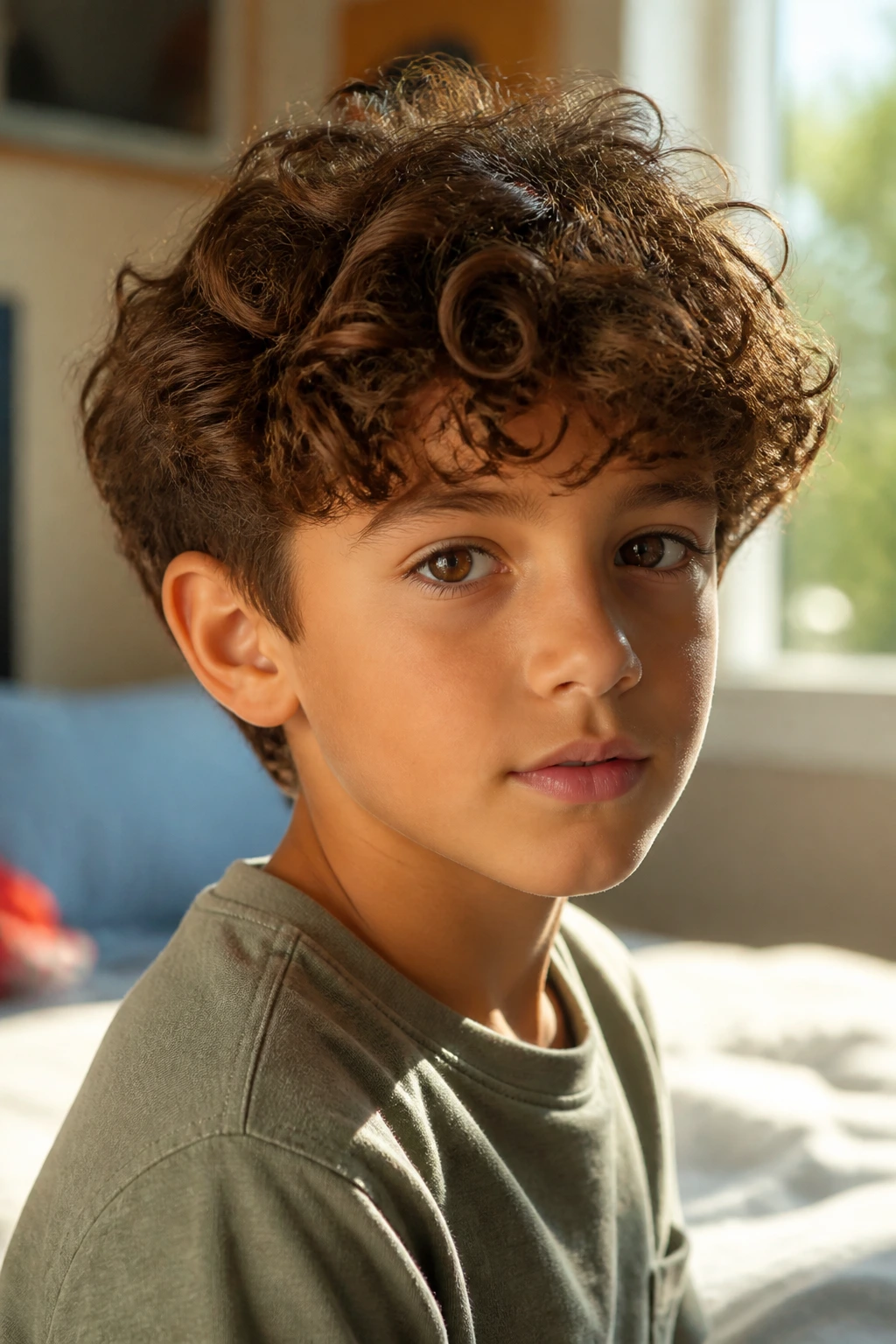
- The Short-and-Tidy Version: Keep the top around 1.5 to 2.5 inches and choose a low taper. This is the cleanest route for school, sports, and kids who dislike hair on their face.
- The Longer-Fall Version: Leave 3 to 5 inches on top and ask for softer sides. The curls hang more, the fringe moves more, and the haircut feels a little less boxed in.
- The Tight-Curl Version: Preserve extra length on top and keep the sides controlled, not shaved. Tight curls shrink harder than loose ones, so cutting them too short turns the style into a patchy fuzz fast.
- The Fine-Hair Version: Go lighter on layers and avoid aggressive thinning. Fine curls need shape more than they need removal; too much thinning can leave holes.
- The Grow-Out Version: If you’re planning to let the hair get longer, keep the neckline and ears tidy while the top grows. That keeps the in-between stage from looking rough.
Common Mistakes That Make Curly Styles Frizzy or Flat
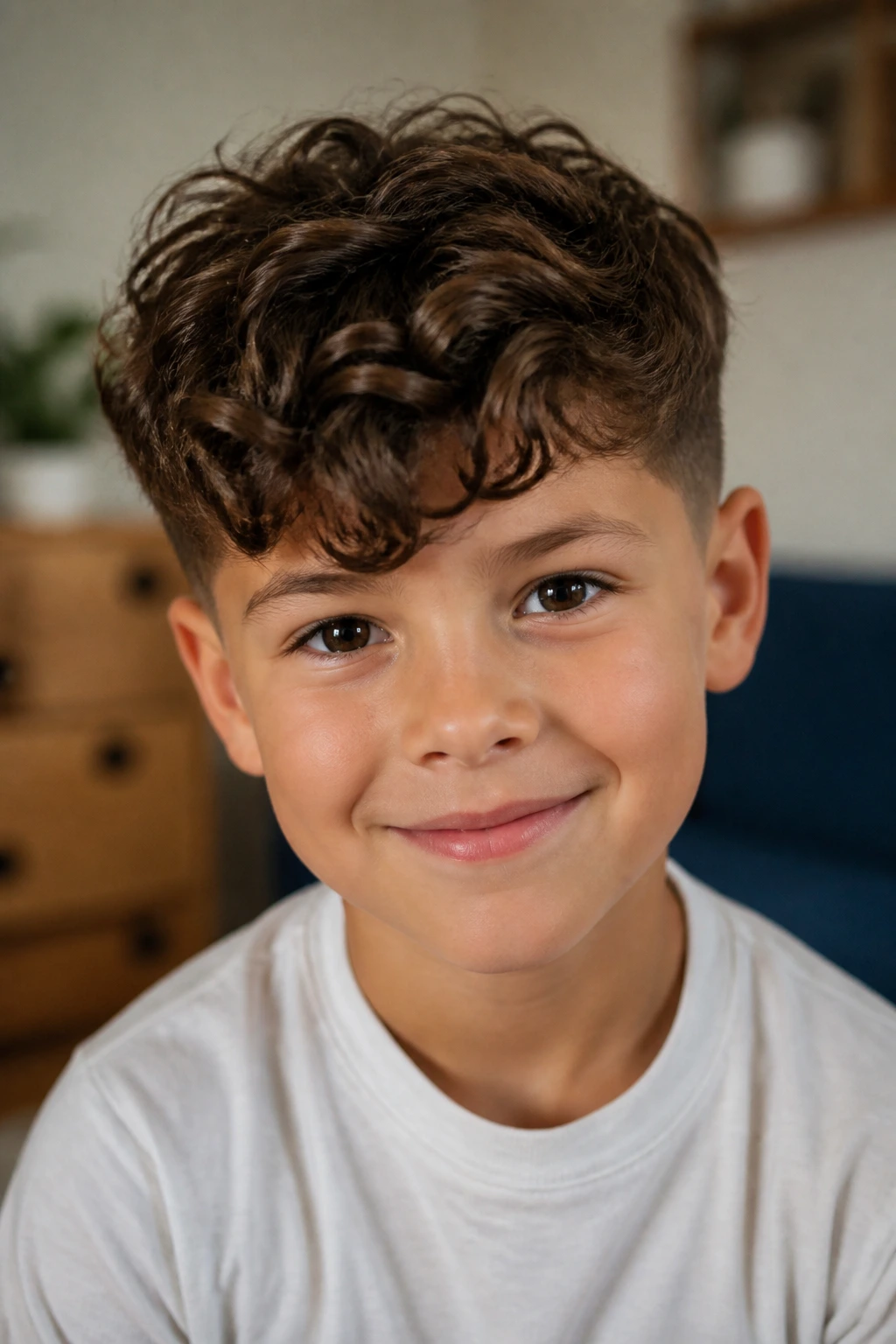
Cutting curls too wet is the classic mistake. The hair looks longer in the chair, then springs up after it dries and the fringe disappears. The fix is simple: leave more length than you would for straight hair, and ask whether the barber can check the shape once the curls are dry enough to show their real size.
Taking the sides too high makes the top look like it’s sitting on a shelf. The shape can go from playful to awkward in one bad fade. A lower taper or temple cleanup usually keeps the balance better, especially on younger boys.
Using too much product turns soft curls into crunchy clumps. You see this most often with gels that promise hold and deliver stiffness. Start with a dime-size amount, not a palmful, and add only if the curl actually needs it.
Brushing dry curls makes them puff and split. If the style needs detangling, do it when the hair is damp with conditioner in it. Dry brushing is how you get the giant triangle nobody asked for.
Ignoring the crown swirl causes one side or one patch to stand up forever. That’s not bad hair; that’s a haircut that didn’t account for the head shape. The fix is to leave enough length at the crown and cut that area with the swirl in mind.
Waiting too long between trims lets the sides grow wider and the neckline blur. Curly hair can hide a lot, but not forever. If the shape has lost its edges, it’s time.
Frequently Asked Questions
What haircut is easiest to maintain for a little boy with curly hair?
A short curly taper or a soft scissor crop is usually the easiest. Both keep enough texture on top to look intentional while cutting down the bulk that causes daily fuss.
Should curly hair be cut wet or dry?
Dry or mostly dry is often better for very curly hair because you can see the true length and shape. Wet cutting can work too, but the barber needs to leave extra room for shrinkage.
How often should curly boys get trims?
Short styles usually need a clean-up every 3 to 5 weeks. Longer styles can last 6 to 8 weeks if the shape still sits well and the ends aren’t knotting up.
What product keeps curls soft without making them crunchy?
A light leave-in conditioner or curl cream is the safest starting point. If more hold is needed, add a small amount of mousse rather than a heavy gel.
Can these styles work on toddlers?
Yes, but softer, shorter versions tend to work best. Toddlers usually do better with styles that need little styling and don’t put hair in the eyes all day.
What if my child’s curls are uneven from side to side?
That’s normal. A good barber can balance the overall silhouette without forcing both sides to behave exactly the same. Sometimes one side needs slightly more length to match the other once it dries.
Do I need a fade for curly hair to look neat?
No. A fade is one option, not a requirement. Soft tapers, scissor cuts, and rounded natural shapes can look just as clean, and sometimes cleaner on younger kids.
How do I grow out a curly cut without it looking messy?
Keep the neckline and around the ears trimmed while the top grows. That keeps the grow-out stage from turning into a mop and helps the curls keep a visible shape.
A Clean Finish
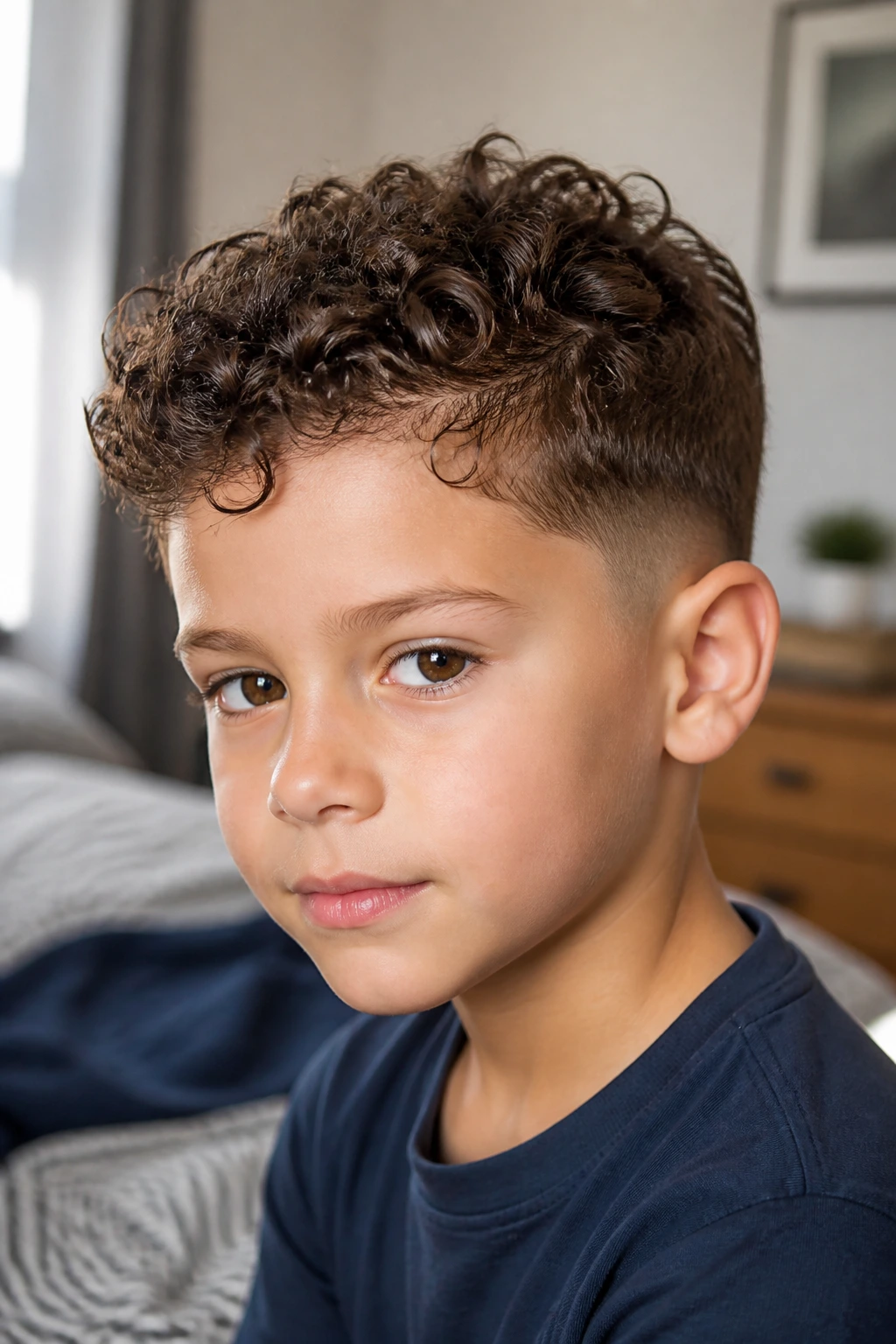
The best curly haircut for a little boy is usually the one that leaves enough room for the curl to do its own work. Clean sides help. A sensible top length helps more. And a barber who knows that curls shrink, swell, and change shape after they dry is worth keeping.
If you start with one style that fits your child’s curl pattern instead of trying to force the hair into something straighter, mornings get a lot calmer. The haircut lasts longer. The curls look like curls. That’s the whole point, really, and it’s a good place to start the next time the chair cape goes on.
