



Long hair gives curtain bangs room to breathe, and that changes everything. A short fringe can feel like a hard line; a longer drape can soften the forehead, move with the rest of the cut, and still look like you meant it. The trick is getting the split, the length, and the density right so the front pieces don’t collapse into your eyes by lunchtime.
I like curtain bangs on long hair because they can be subtle or dramatic without changing the whole haircut. A few cheekbone-skimming pieces can make a ponytail look finished. A fuller, brushed-out version can turn a plain blow-dry into something with shape. The cut is small. The effect is not.
The part people miss is that curtain bangs are not one thing. Hairline height, cowlicks, density, texture, and the way you dry your hair all change the result. Cut them too short and you spend weeks pinning them back. Cut them too heavy and they stop reading as a curtain at all. Get the shape right, though, and they behave like a built-in frame that keeps working even when the rest of your hair is down to your ribs.
Why These Curtain Bang Styles Earn Their Keep on Long Hair
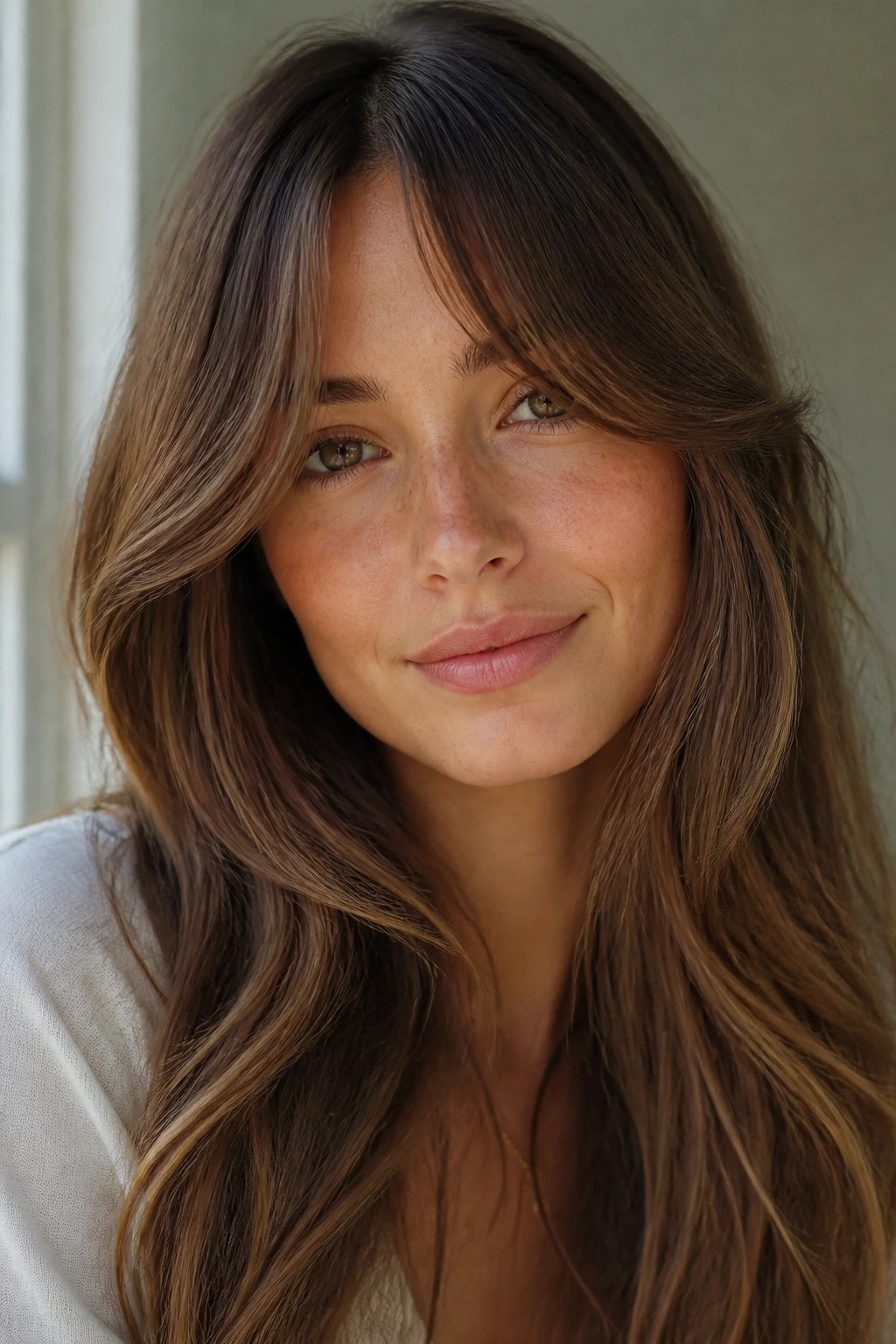
- They change the face without stealing length: Long hair stays long, but the front gains movement, which is the whole point when you do not want a blunt chop.
- They soften a center part fast: A middle split can look severe on its own; a curved fringe breaks that line and makes the part feel deliberate.
- They work with lazy styling: A round brush, a quick bend, or even a little air-drying can make the front pieces look finished.
- They grow out with less drama: When curtain bangs start slipping past the eyes, they can slide into long face-framing layers instead of turning into a shelf of awkward short pieces.
- They let texture do the talking: Straight hair can look polished, waves can look soft, curls can look sculpted, and none of that needs a separate haircut.
- They give you options on day two: Tuck them behind one ear, sweep them off-center, clip them back, or leave them split. The cut still behaves.
1. Soft Center-Part Sweep
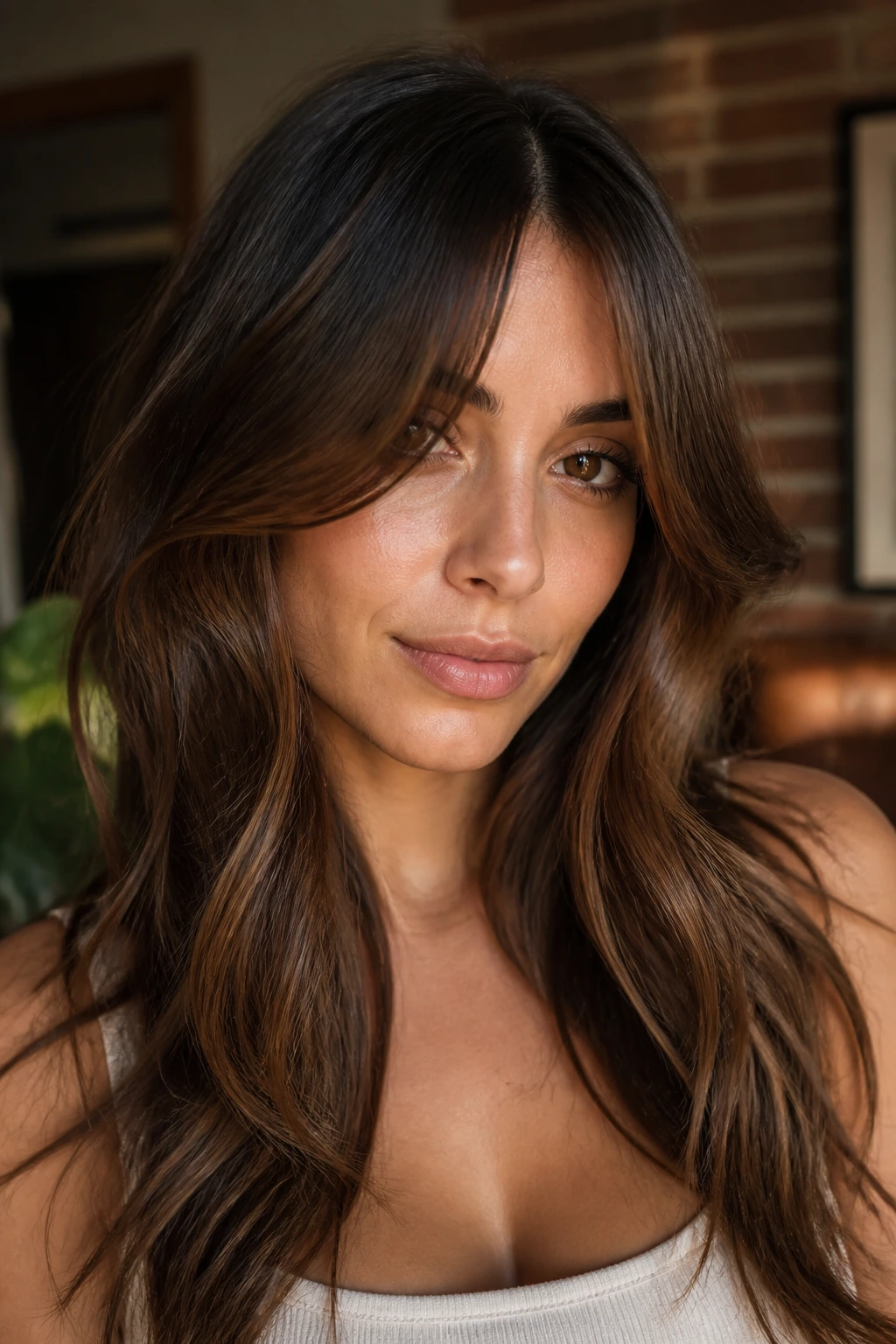
Soft center-part curtain bangs are the quiet ones that do more than they look like they should. The shortest point usually sits near the bridge of the nose or just below it, and the longer corners drift toward the cheekbones, so the shape melts into long layers instead of sitting on top of them. On straight or lightly wavy hair, that gives you a front frame that reads polished even when the rest of the hair is loose and unstyled.
How to ask for it
- Keep the center long enough to touch the bridge of the nose when dry.
- Ask for point-cut ends so the edge blurs instead of forming a block.
- Style them forward with a round brush, then sweep each side away from the face while it cools.
- If your cowlick splits hard, keep the center slightly longer than you think you need.
One-line tip: If you can see a hard line in the mirror, the cut is too blunt.
2. Bottleneck Curtain Bangs
The bottleneck version is the one I reach for when someone wants shape without a heavy forehead line. The center starts narrower, then the pieces open wider around the cheekbones, almost like the neck of a bottle flaring into the body. That gives the face room in the middle and keeps the movement where the eye naturally follows the jaw and cheek line.
What makes this style useful on long hair is balance. The front gets structure, but not so much that it steals the show from the length. I like it on denser hair because the shape can take a little weight without turning boxy. It also makes a center part look less stark, which matters if your hairline is strong and a dead-straight split feels too harsh.
Best for: thick straight hair, oval or square faces, and anyone who wants more fullness at the sides than at the center.
3. Feathered ’70s Blowout
Why does a feathered ’70s blowout look so put together on long hair? Because the fringe is doing two jobs at once: lifting off the forehead and bending away from the face in a soft, airy curve. The pieces are long enough to move, but short enough at the front to create that old-school sweep that lands somewhere between polished and flirtatious.
The styling matters as much as the cut. I would use a medium round brush, a nozzle on the dryer, and a little tension at the roots so the hair lifts before it bends. Set the front in velcro rollers for a few minutes if you want that rounded finish without overcooking the ends. The shape should look brushed out, not ironed into place.
How to get the most from it
- Blow-dry the roots first, aiming the dryer up and away from the face.
- Wrap only the front half of the strand around the brush.
- Let the hair cool before touching it.
- Finish with a mist of flexible hairspray, not a crunchy helmet.
4. Long Shag Curtain Fringe
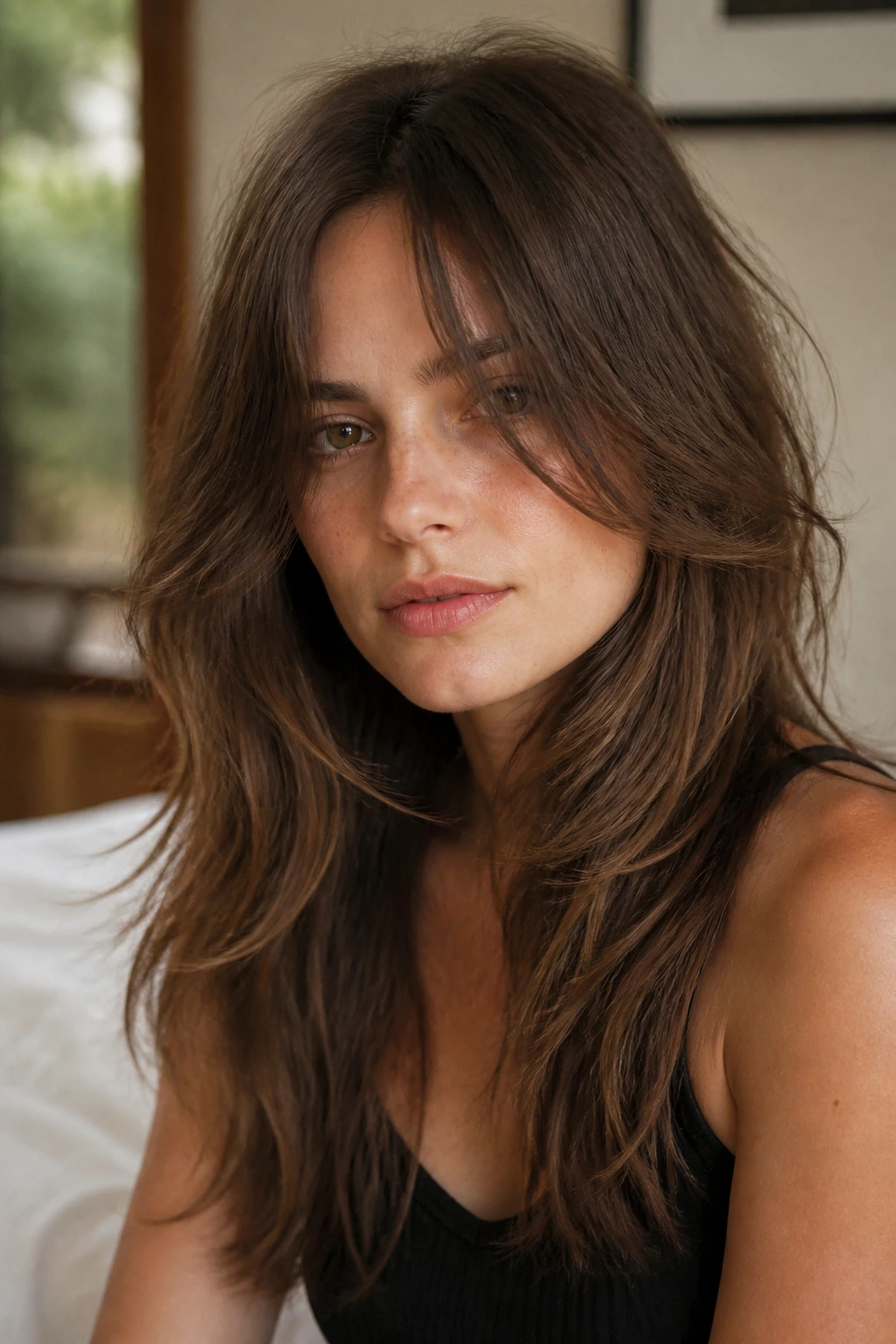
A long shag curtain fringe is the one that looks like it belongs to someone who never wants a stiff hair day. The front pieces are part of a bigger haircut, so the fringe doesn’t sit as a separate event. It blends into layers that are cut to move, which means the whole shape feels loose, lived-in, and a little messy in the best way.
This cut loves wavy and thick hair because the natural texture keeps the fringe from lying flat. If your hair gets puffy at the wrong times, though, you need the layering handled with care. Too much internal thinning and the front pieces start fluttering around like they’ve been cut from a different head of hair. I’d ask for shape around the eyes and cheekbones, not shredded ends all over the front.
- Shortest pieces should sit around the upper cheek.
- The front should connect to long layers, not stop abruptly.
- Texture spray belongs on the mids and ends, not the roots.
- If you wear your hair up a lot, this version still leaves enough softness to frame the face.
5. Wispy Face-Framing Veil

On fine hair, a wispy curtain bang can save the whole front of the haircut. Heavy fringe on delicate hair looks like too much cloth on a small window. Wispy pieces do the opposite: they leave air between strands, so the forehead can still peek through and the fringe reads as movement, not a block.
The key is restraint. Keep the density low, cut with a light hand, and avoid over-thinning the ends until they disappear. I’d rather see a few purposeful strands that land at the cheekbone than a weak, see-through fringe that floats apart in humidity. If your hair tends to lie flat, a tiny amount of root lift spray at the front can keep the veil from sticking to the forehead.
Best on: fine straight hair, softer jawlines, and anyone who wants a barely-there front frame that still changes the haircut.
6. Chin-Grazing Curtain Ends
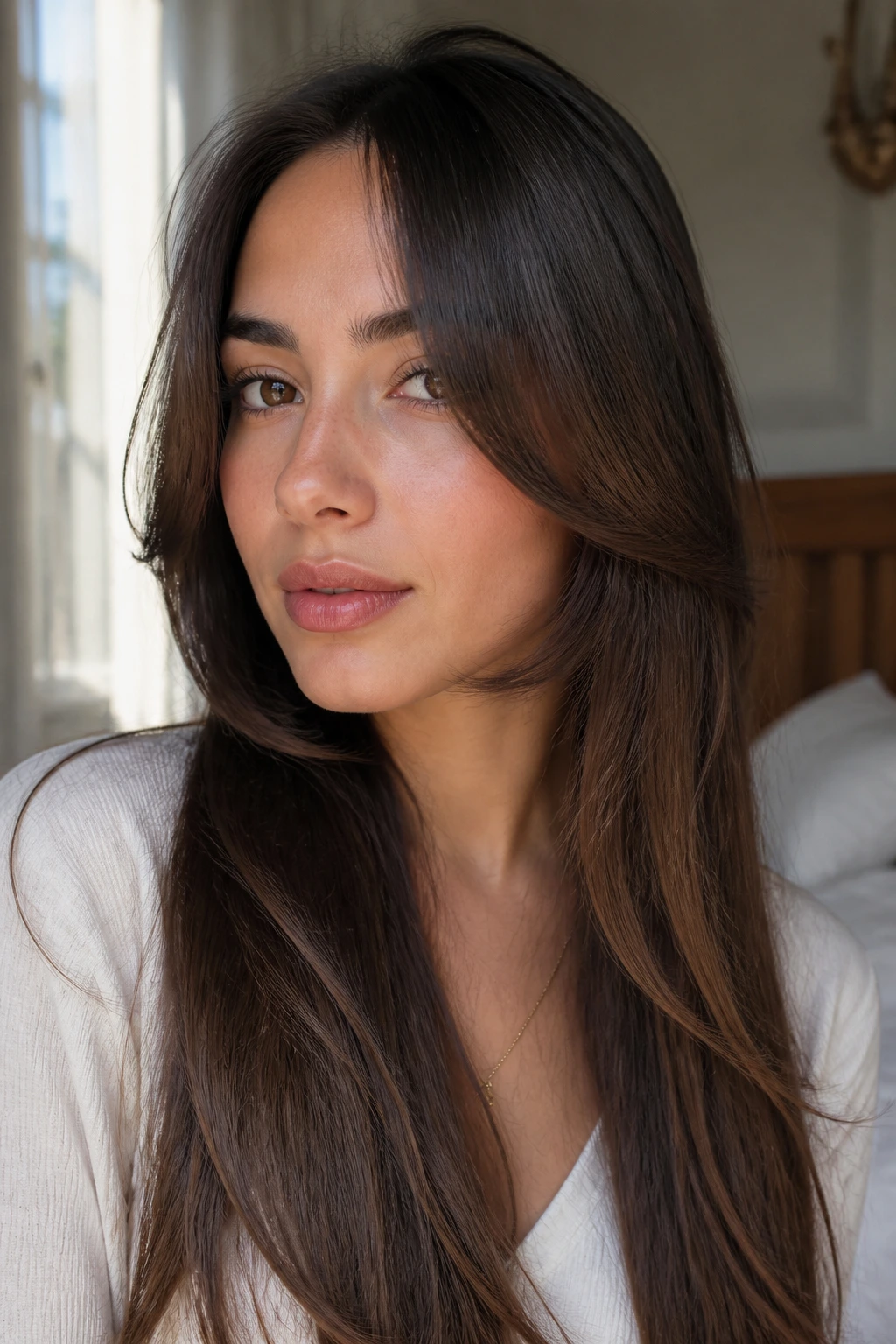
If you want the front pieces to read as intentional rather than shy, chin-grazing curtain bangs are the bluntest tool in the box. The shortest point still starts high enough to open the face, but the sides stretch down to the jawline or just below it, which gives the haircut a clear outline. On long hair, that extra length makes the fringe feel like part of the entire shape, not a separate layer tacked on at the end.
Compared with cheekbone-length curtains, this version creates more visible contour. It gives long faces a little interruption, and it gives rounder faces a vertical line to follow. I like it when someone wants the front to hold its own against very long lengths. The shape is less shy. It has a little backbone.
The trick is keeping the corners soft. If the ends get chopped blunt at the jaw, the whole thing can look boxy fast.
7. Sleek Glass-Hair Curtains
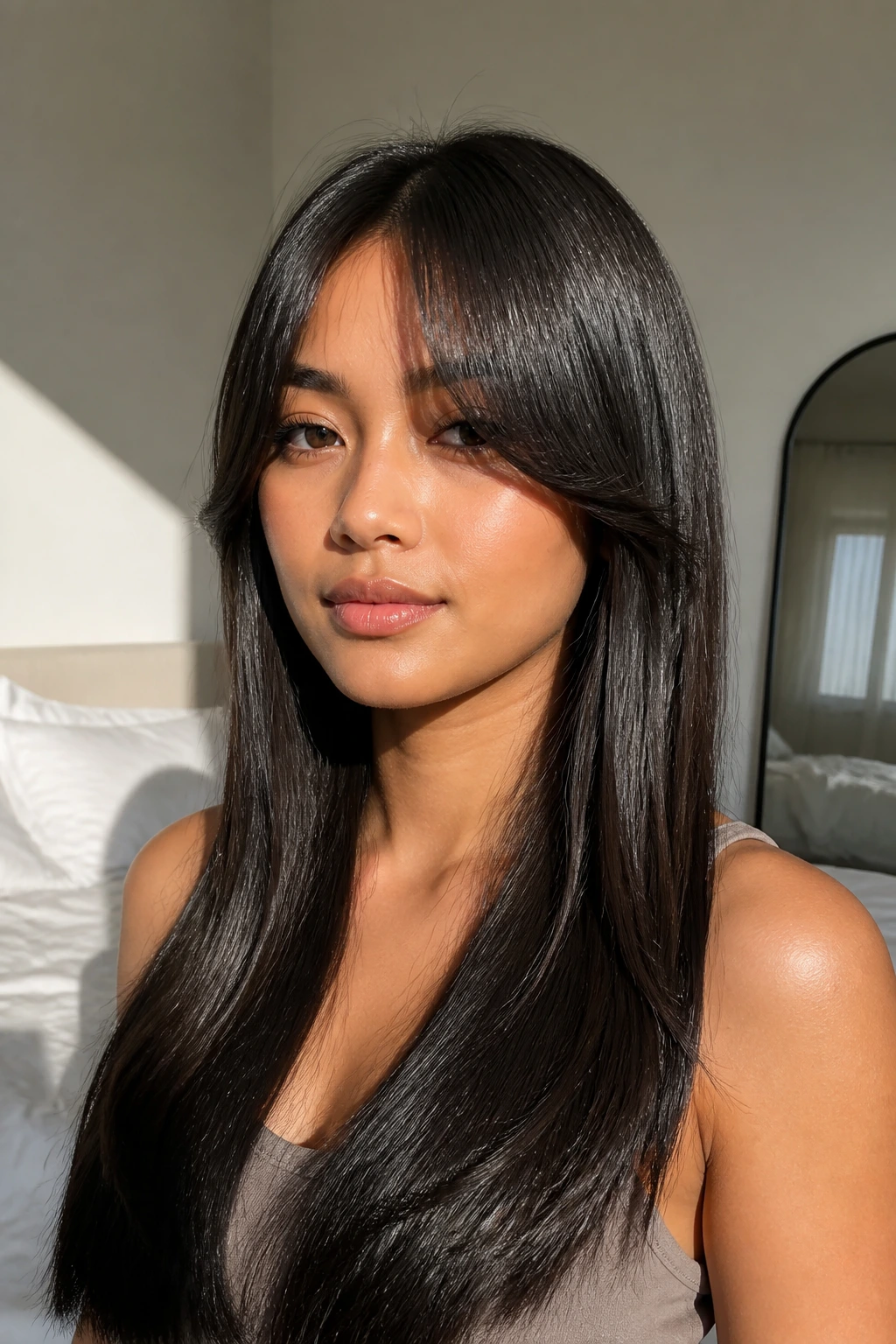
Glass-hair curtain bangs are the opposite of airy. They are smooth, reflective, and clean at the edges, which sounds fussy until you see how well that finish works against long lengths. Straight hair loves this version because the split stays neat, the sides fall with intention, and the front does not puff out in odd places.
How to style it
Use a smoothing cream before blow-drying, then direct the front pieces with a round brush or a paddle brush if your hair is already straight. The goal is not volume here. It’s polish. I’d flat iron only the outer two inches of the fringe if the ends kick out, and I would keep the heat low enough that the hair still looks like hair, not a piece of plastic.
This style is especially useful if you wear your long hair glossy and simple. The fringe doesn’t need to scream. It just needs to sit cleanly and leave the rest of the length uninterrupted.
8. Air-Dried Wave Curtain Bangs
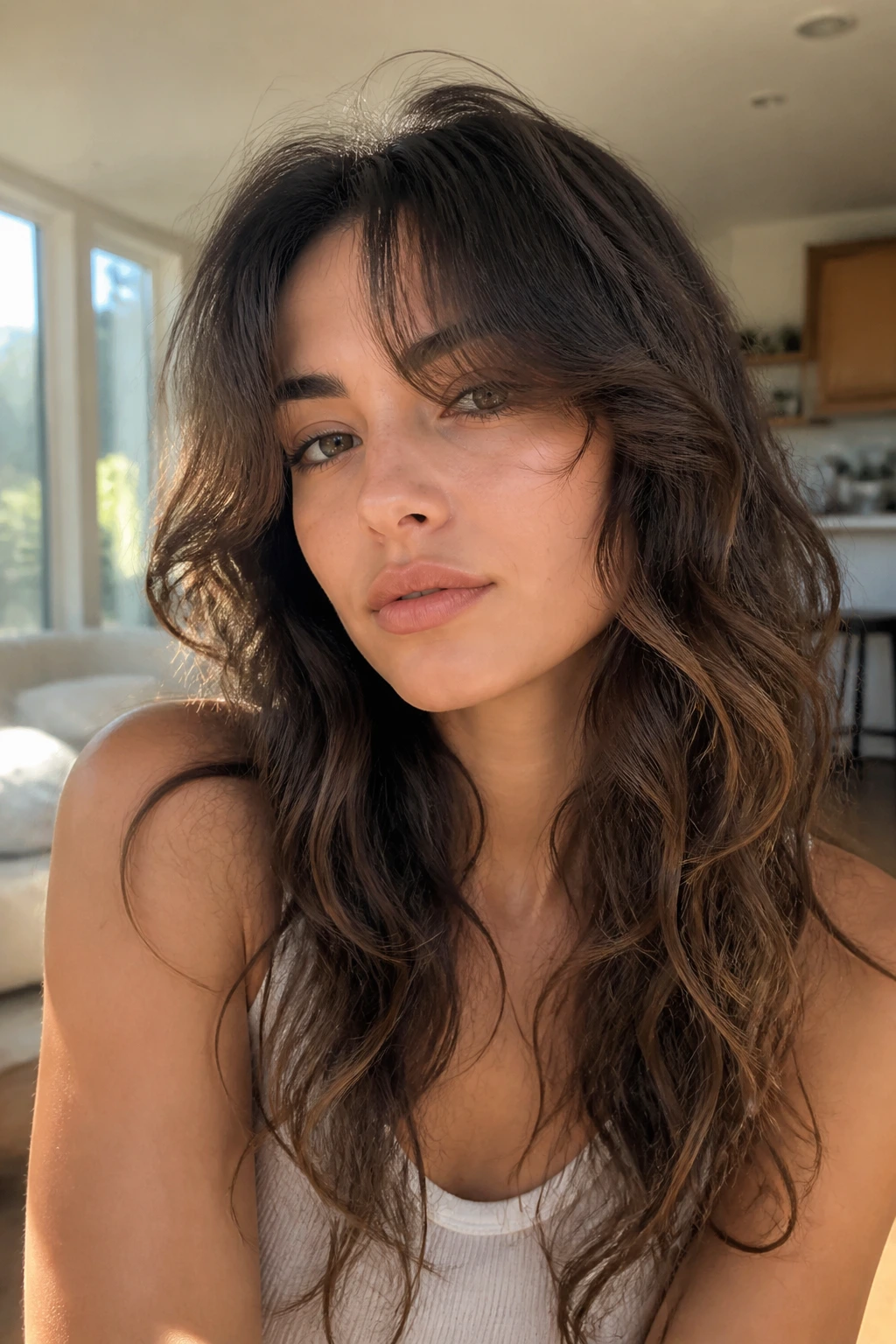
Air-dried curtain bangs work best when you stop trying to make them match. Wavy hair has its own rhythm, and the front pieces usually behave better when you guide them, not force them. A little mousse, a quick clip to keep the split in place, and a hands-off drying period can give you a loose curve that looks softer than a hot-tool finish.
I like this version for people who want movement without a whole morning spent at the mirror. Scrunch the fringe lightly after washing, clip each side forward while it’s damp, then leave it alone until it’s dry. If one side bends faster than the other, that’s normal. I usually take a finger and nudge the shorter side away from the face once it starts to set. That tiny move is often enough.
The result should look relaxed, not unfinished. The bend lands somewhere between cheekbone and jaw, and the center split stays open instead of collapsing into one clump.
9. Piecey Razor-Cut Fringe
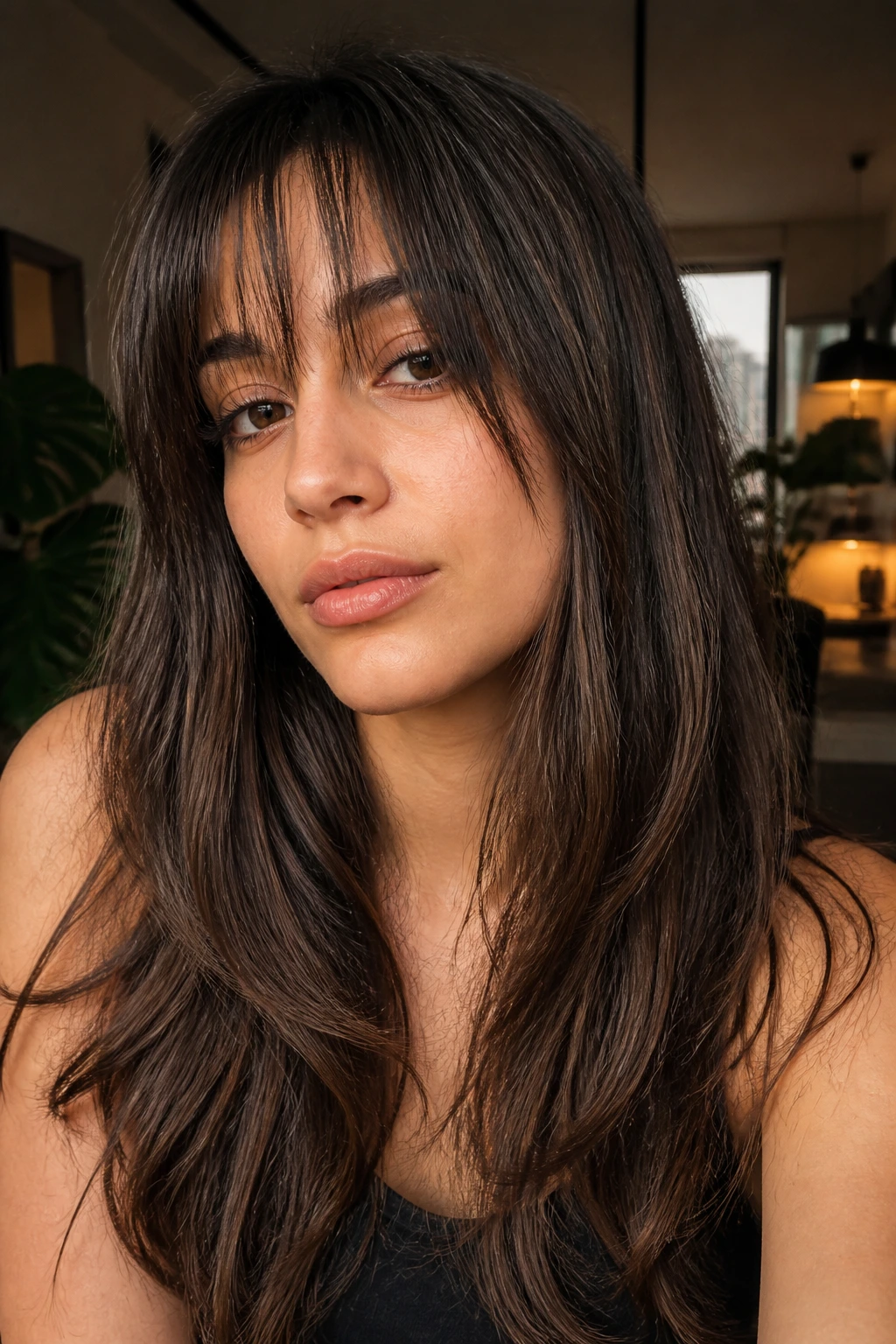
Can curtain bangs look sharper without turning into blunt bangs? Absolutely, and a razor-cut fringe is the answer when you want the front to feel a little torn-up in a controlled way. The razor removes weight in soft slices, so the ends separate instead of falling as one solid sheet. On long hair, that detail matters because it keeps the front light while the length stays full.
This version works best on medium to thick hair that can handle texturizing without looking thin. A good razor cut should create separation, not frizz. That means the stylist needs a steady hand and a clear guide length. If the razor goes too far, the edges can get wispy in a bad, airy-as-a-mop way. Too little, and the shape loses its edge.
Use it when: you want a little grit in the front, your hair naturally holds a bend, and you don’t mind re-shaping the pieces with your fingers during the day.
10. Thick Corner Sweep
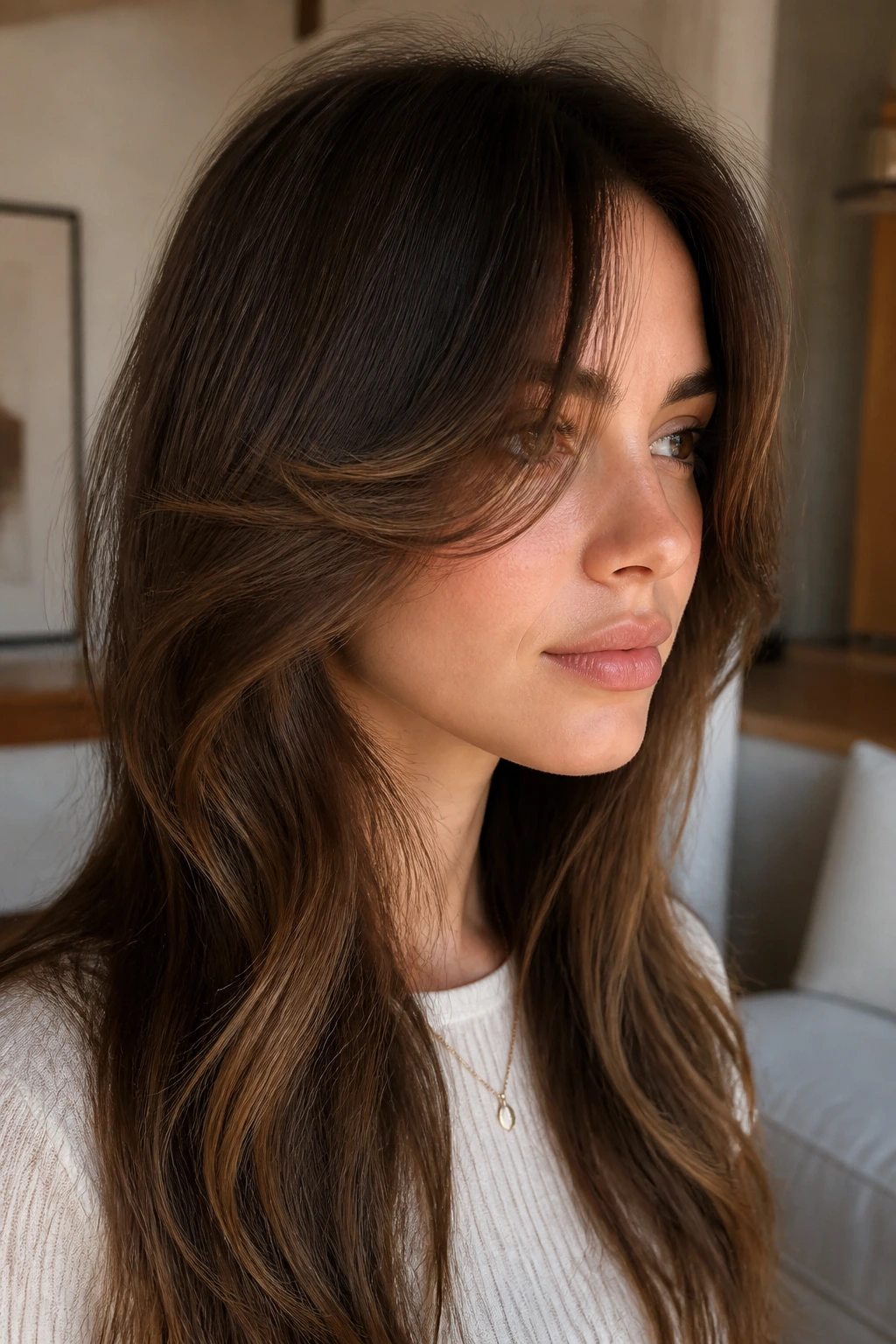
When the front of the haircut gets too dense, the corners start doing all the talking. A thick corner sweep keeps more weight at the outer edges, so the curtain opens wide and frames the face instead of sitting like a heavy strip across the forehead. It’s a smart move for dense hair because it gives the fringe enough substance to stay put, but not enough bulk to swallow your features.
The cut should still be soft in the middle. That part of the fringe needs a little lightness so the split can happen cleanly. What I like here is the way the ends skim outward and land near the cheekbones, especially when the rest of the hair is long and layered. It gives the front a clear shape from the front and from the side.
- Keep the corners longer than the center.
- Ask for point cutting, not aggressive thinning shears.
- Blow-dry with side-to-side tension so the fringe doesn’t puff up.
- A small round brush helps the corners bend, not flip.
11. Brushed-Out Retro Bounce
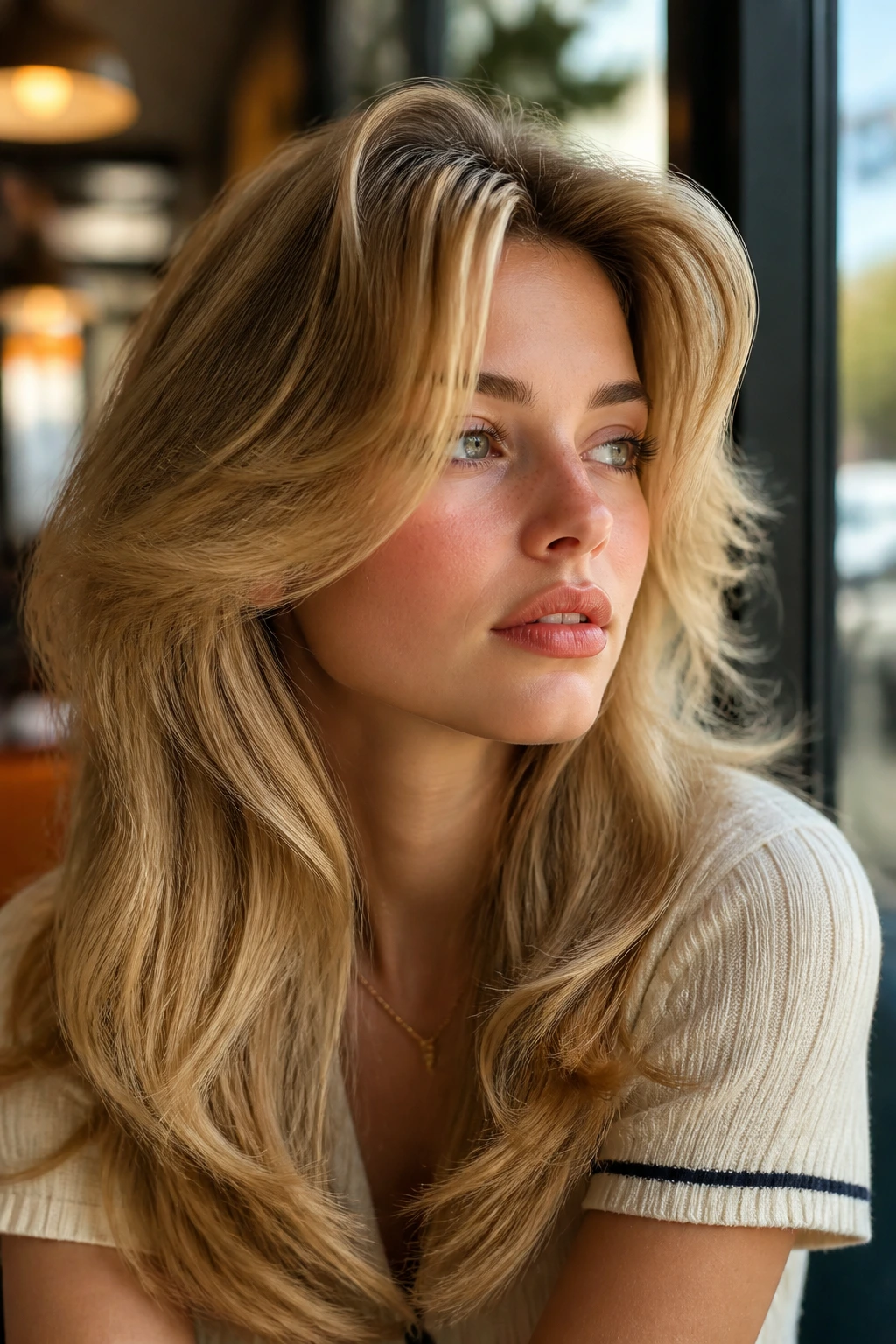
The brushed-out retro version wants height at the roots and a bit of confidence. It’s the curtain bang style that looks best when the front pieces lift off the forehead and then drop into a soft bend, almost like they were set and then gently undone. Long hair gives it room to feel glamorous instead of costume-y, which is why this one works so well on fuller lengths.
I’d build it with a round brush, then wait until the hair cools before brushing it open. That cooling step matters. Skip it and the bend falls flat in ten minutes. If you want a little extra memory, set the front with rollers while you do your makeup. Not a long set. Ten minutes is enough if the hair is dry.
The result should feel big without looking stiff. The front pieces should catch air when you move, and the split should remain visible even after the brush-out.
12. Curly Curtain Bangs
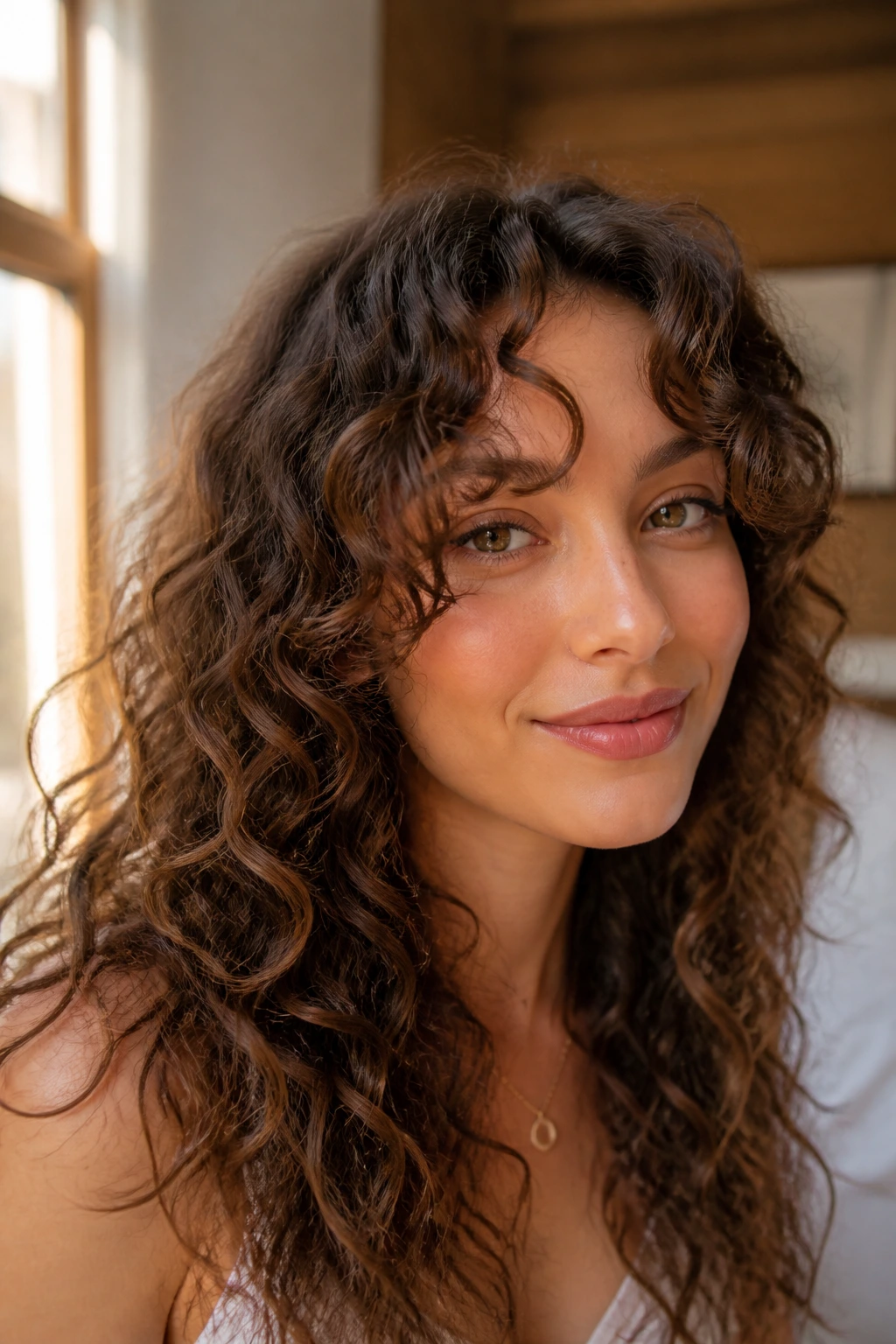
Curly curtain bangs need a different contract with gravity. You cannot cut them like straight fringe and hope the shape will behave after drying. Curly hair springs, shrinks, and changes direction, so the front pieces need to be cut dry or nearly dry, following the curl pattern instead of fighting it. That usually means leaving them longer than a straight-hair version, sometimes by more than you expect.
The best curly curtain bangs frame the face rather than cover it. They should open at the center, then land where the curls naturally want to rest, often around the cheekbone or lower. I like this version because it turns shrinkage into shape. The curls create the drape for you. You just need a clean enough cut that the curtain reads as a curtain and not a random front cluster.
If your curls are tighter, ask the stylist to trim in small sections and check the fall in stages. The haircut should look good dry first. That is the rule.
13. Balayage-Blended Curtains
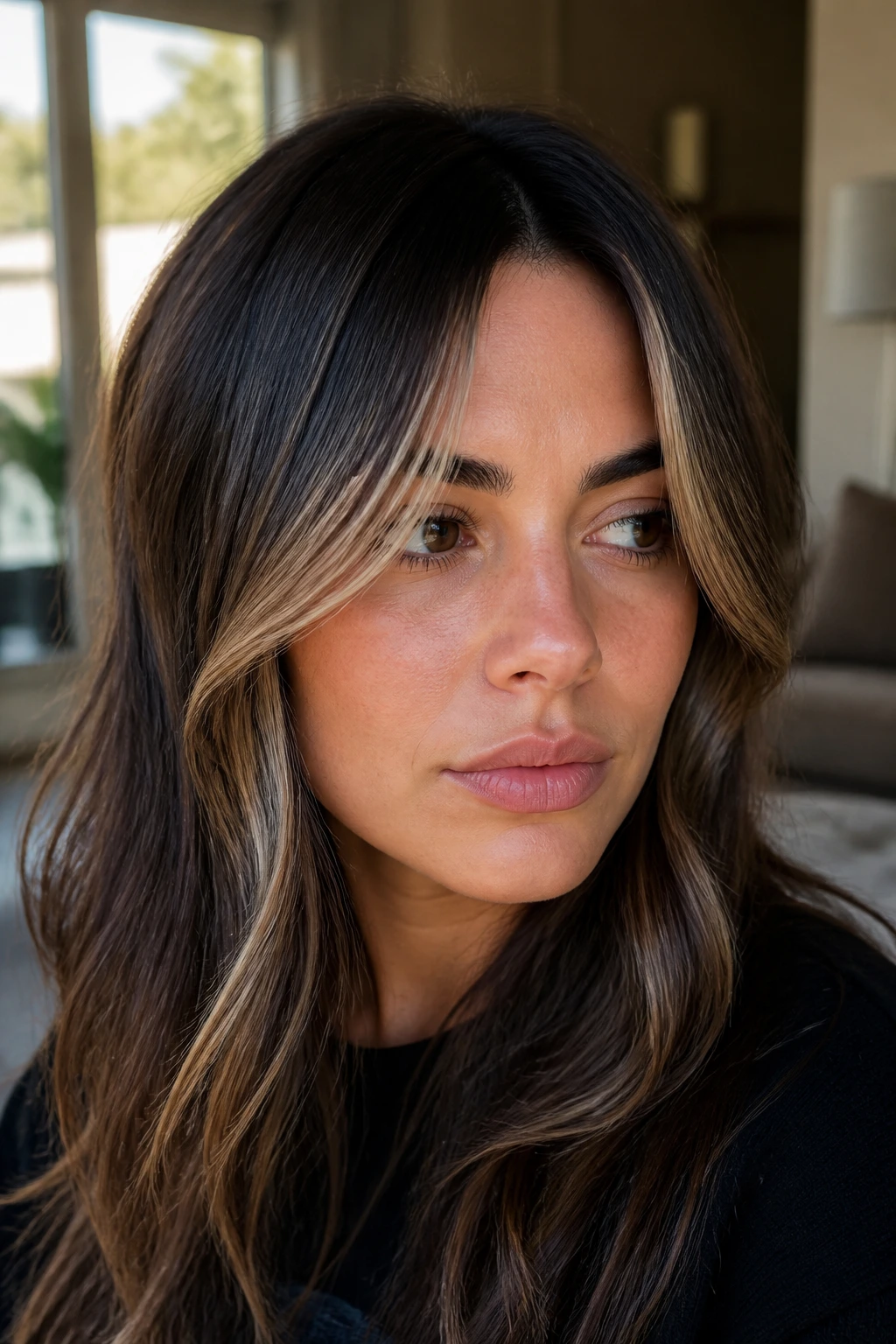
Balayage and curtain bangs work because color can make the split look deeper and the face frame look lighter without changing the structure of the cut. If you place face-framing highlights along the front pieces, the bangs separate from the rest of the hair in a way that feels softer than a hard outline. The eye sees movement first, then shape.
Why the color placement matters
Start the lightest pieces around eyebrow or cheekbone height if you want the fringe to show without frying the roots with bleach. Keep the brightest strands on the outer corners and let them fade as they move into the length. That keeps the face frame from looking stripey when the bangs grow.
I like this version on long brown hair, but the idea works across shades. The point is not contrast for its own sake. It is clarity. A little brightness near the face makes the curtain shape easier to read, especially in soft light or on days when the hair is worn straight.
14. U-Shape Front Layers
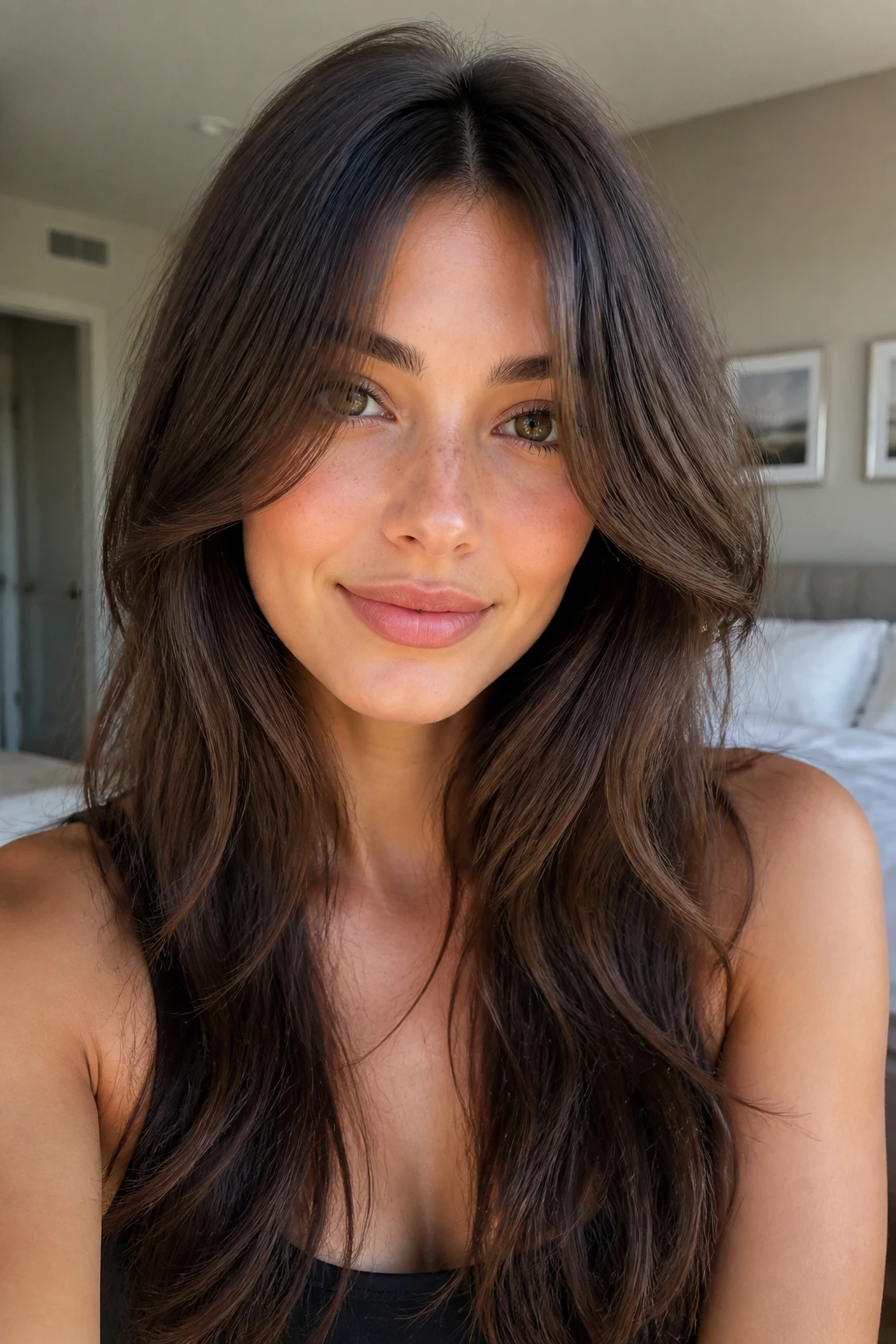
A U-shape front layer can behave like a curtain bang without announcing itself too loudly. The shortest piece may not sit in classic bang territory at all. Instead, the front layers curve down in a U around the face, which means the haircut still opens at the center while blending into the long length almost immediately.
This is the version I point people to when they want the effect of curtain bangs but not the maintenance of a traditional fringe. It’s useful if you tuck your hair behind your ears a lot, wear it in waves, or want the front to look soft even when it’s just air-dried. The cut is subtle, but it changes the silhouette of long hair in a way you notice when you turn your head.
If your stylist asks how short to go, think about the lowest point you want to hit on your face. Lip, chin, collarbone. That answer matters more here than a generic bang photo.
15. Side-Shifted Curtain Bangs
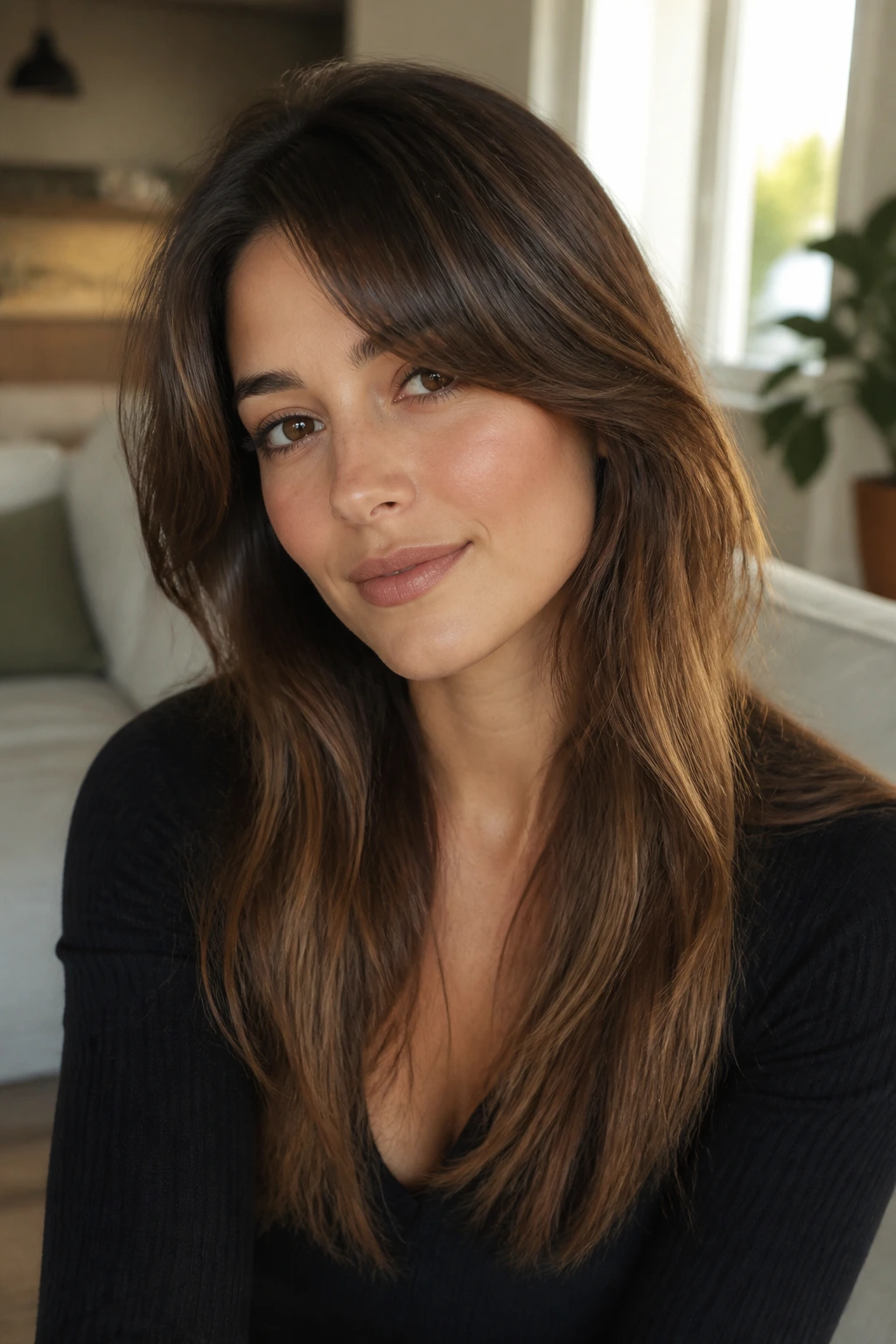
What if a dead-center part feels too rigid? A side-shifted curtain bang is the answer. The front still opens in a curtain shape, but the split leans a little off center, so one side drops lower and the other side sits slightly higher. That tiny asymmetry softens the whole front without turning it into full side-swept bangs.
I like this when someone has a stubborn cowlick or just wants a less symmetrical look. The hair still frames both sides of the face, but the eye gets a diagonal line to follow, which can be easier to wear on busy mornings. It also gives long hair a little motion at the top without changing the rest of the cut.
The danger is making the shift too dramatic. A slight lean is enough. If it turns into a deep side part, you lose the curtain effect and the front starts reading like a different haircut.
16. Oval-Face Soft Halo
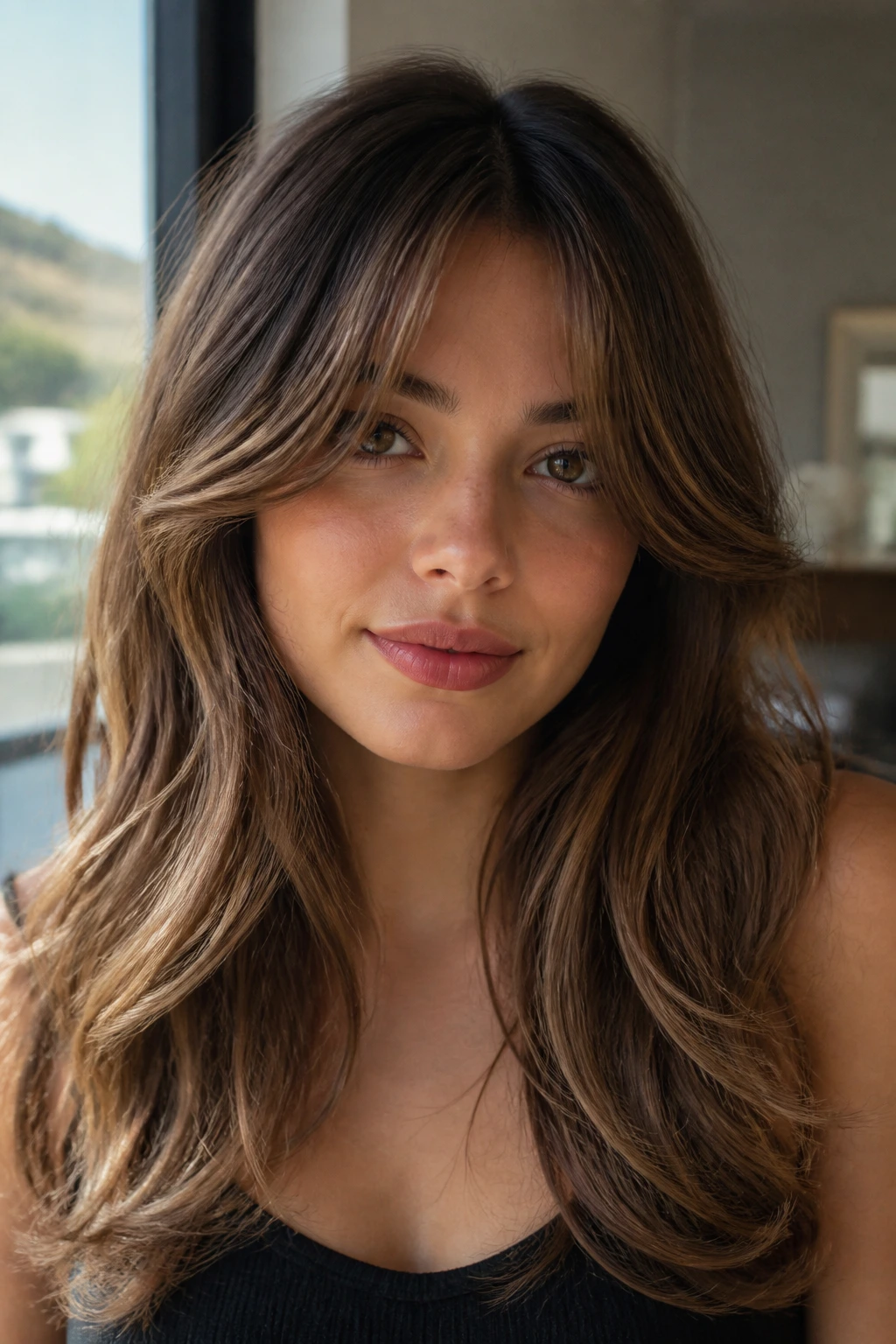
Oval faces can wear almost anything, which is useful and a little boring to hear. The better question is what kind of shape gives the front pieces some personality without flattening the rest of the cut. A soft halo fringe does that by draping around the face in a gentle arc, with the shortest point sitting high enough to open the eyes and the corners sliding outward toward the cheeks.
The halo version looks best when the bend is smooth, not pinched. I’d keep the outer pieces light and the center slightly longer so the front doesn’t resemble a sharp V. On long hair, the goal is to create a soft frame that moves with the length, not against it.
Ask for this if: you want a balanced front that can be brushed out, tucked back, or worn with a little wave. It’s one of the easier shapes to live with because it doesn’t demand a single styling trick to make sense.
17. Round-Face Lengthening Drapes
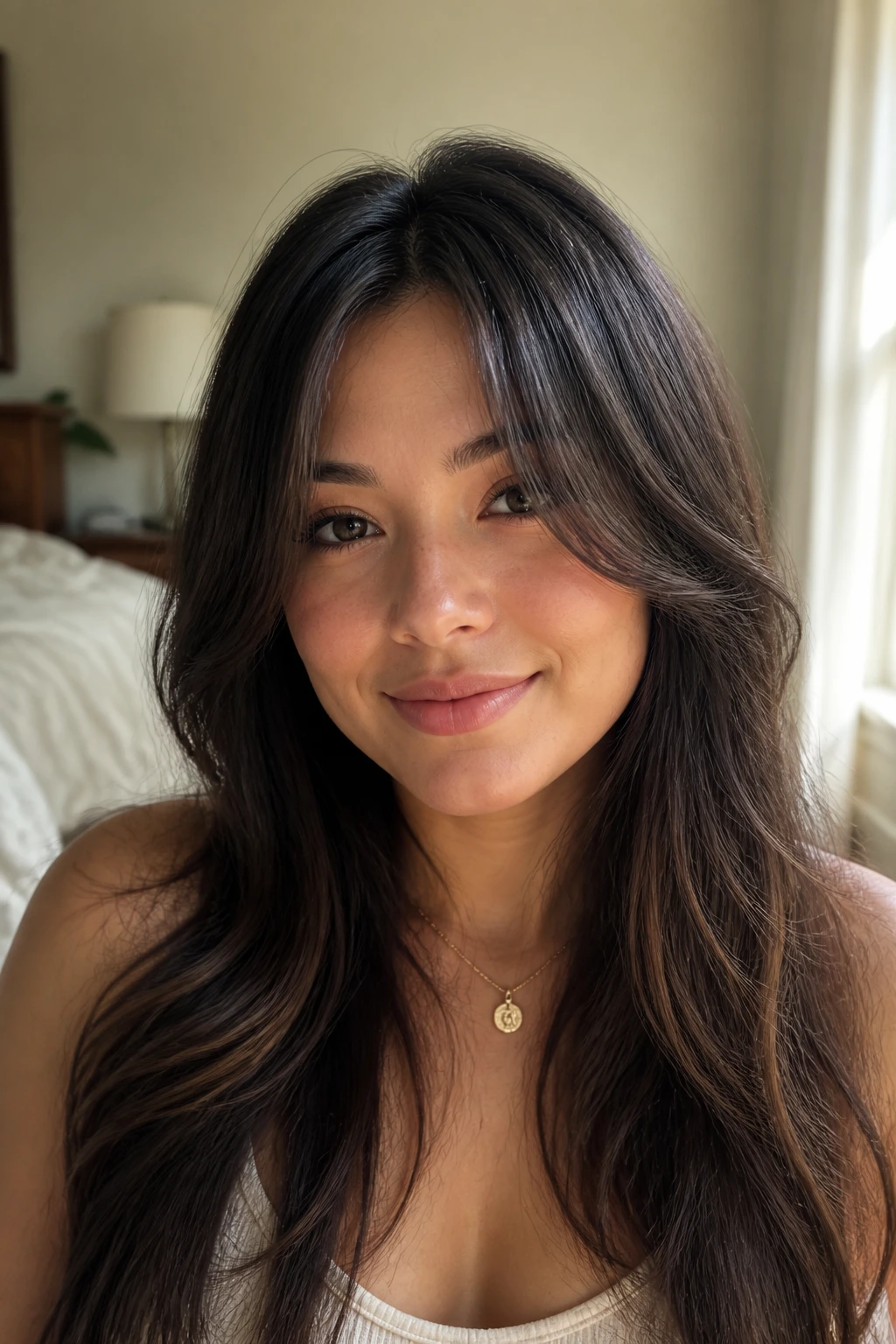
Round faces need a little length and a little air. Curtain bangs can do both if the shortest point stays above the widest part of the cheeks and the corners drop down past that line. That creates a vertical path for the eye, which helps the front read longer instead of wider.
The mistake here is cutting the fringe to sit exactly at cheek width and then curling it inward. That puts all the visual weight in the same place. I’d rather see longer sides with a soft bend away from the face. It keeps the frame open and avoids the little helmet effect that can happen when the corners are too short.
Long hair helps because the front pieces can travel farther than the rest of the cut. That extra length makes the face frame feel like part of the entire shape rather than a stop sign near the brow.
18. Heart-Face Balance Fringe
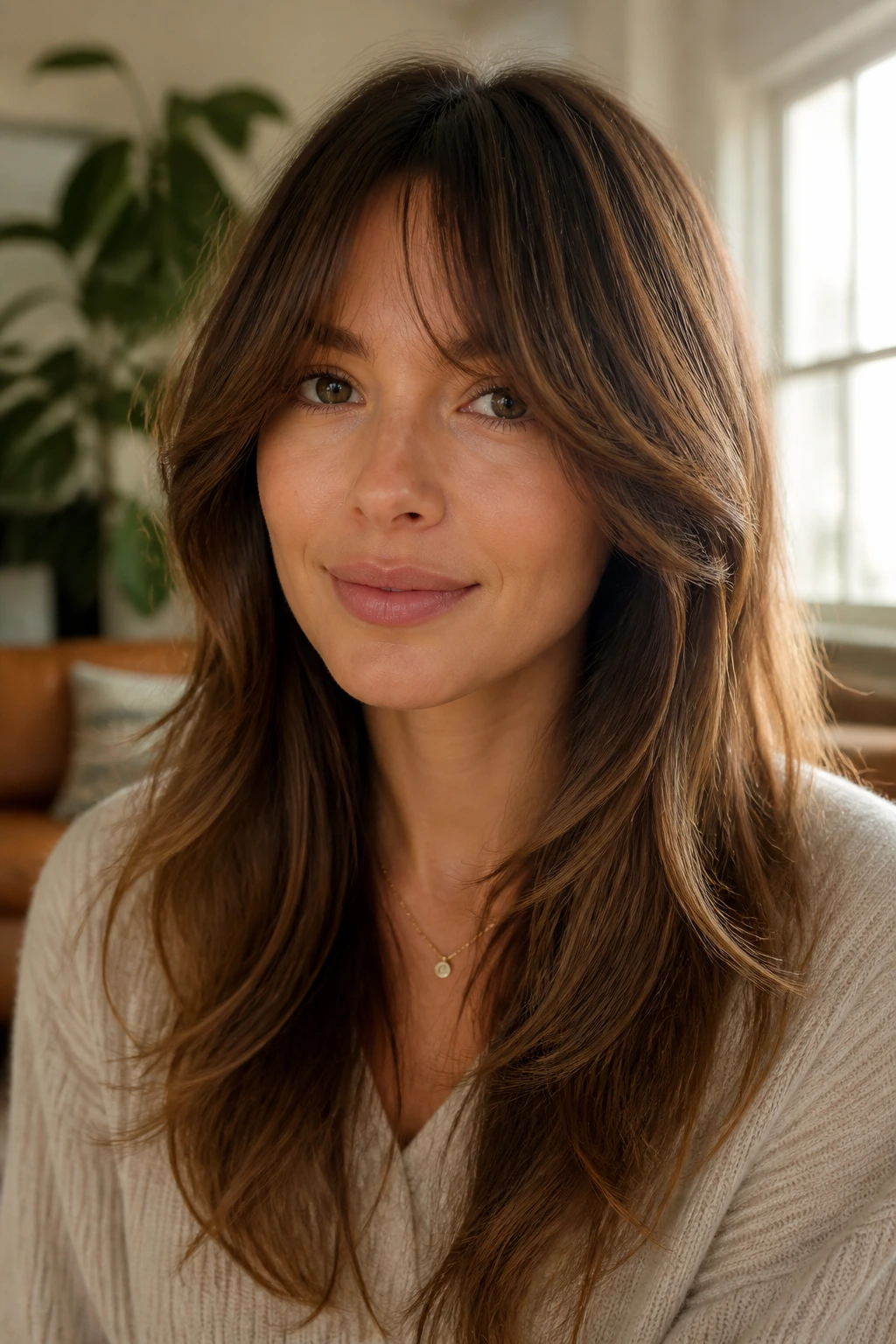
Heart-shaped faces often carry more width at the forehead and less at the chin, so curtain bangs need to bring the emphasis down a little. The best version starts softly at the center and opens into longer side pieces that land around the jawline. That takes some of the attention off the top of the face and gives the lower half more visual weight.
I prefer this shape when the fringe is not too short in the middle. If the center sits too high, it can exaggerate the width up top, which is the opposite of what you want. The corners should be the quiet heroes here. They carry the shape downward and soften the transition into long hair.
This is also a good place for a little bend, not a tight curl. A smooth outward sweep keeps the frame light and stops the bangs from bunching near the temples.
19. Square-Face Softening Curtains

Square faces do well with curtain bangs that bend, split, and soften at the edges. Hard corners near the jaw and forehead can make a blunt fringe feel even stiffer, so the front pieces need to take the edge off. I’d ask for a rounded center and longer corners that graze the cheekbones, with enough softness in the ends that the shape doesn’t look carved.
What to soften
- Keep the center split open instead of packed together.
- Avoid blunt lines at the corners of the fringe.
- Use a round brush or a large iron bend to create curve.
- Leave enough length that the bangs can move away from the face.
The nice part is that long hair gives this style room to work. The front pieces can drape, move, and settle without fighting the rest of the cut. It’s one of the more forgiving shapes if you want the face frame to feel gentle rather than graphic.
20. Fine-Hair Floaty Fringe
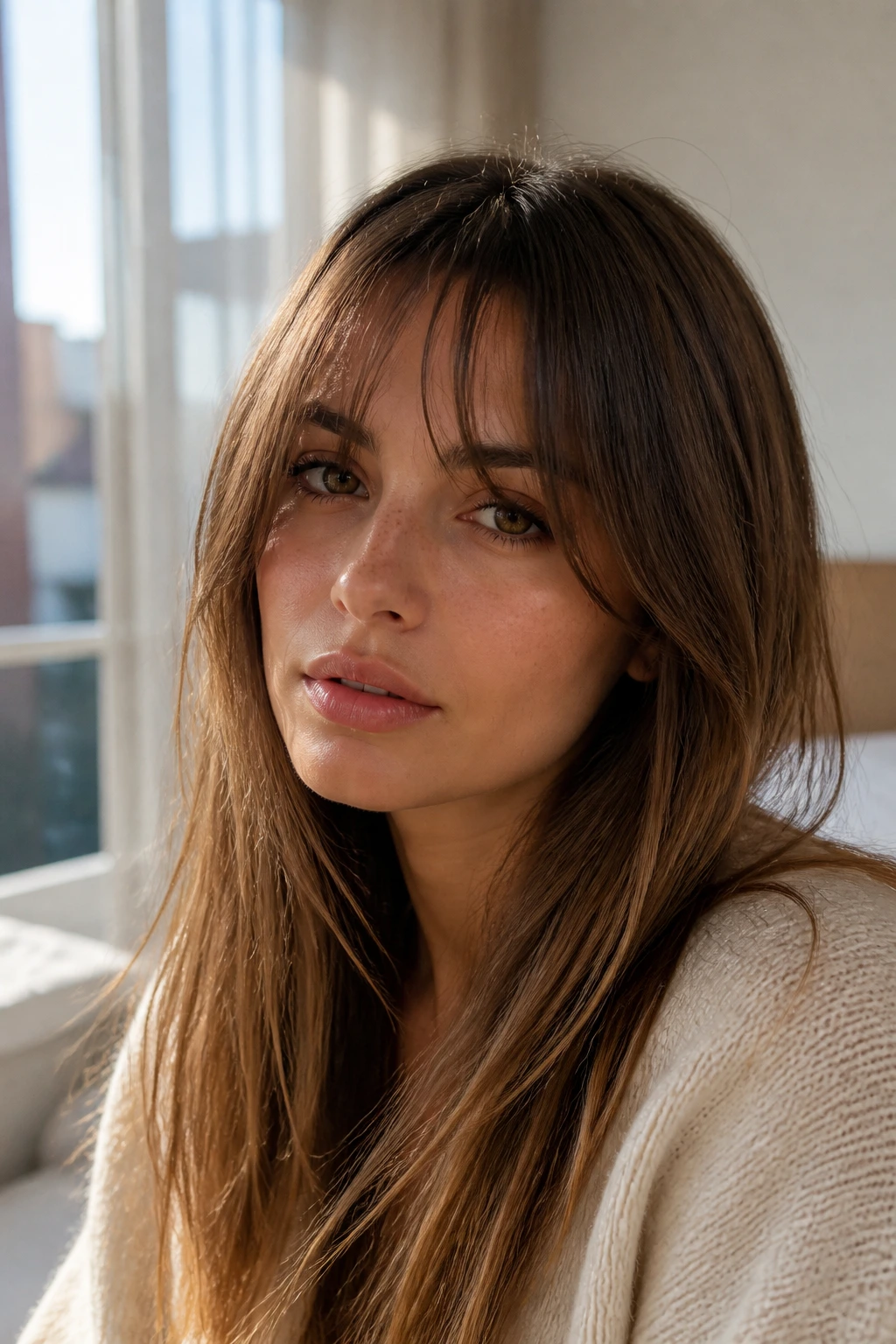
Fine hair can’t carry a heavy curtain bang without complaining. It falls flat, separates too much, and starts to look like it forgot its own plan. A floaty fringe fixes that by keeping the density light and the ends soft, so the front pieces can move without collapsing into stringy little sections.
The trick is to leave enough length that the hair has a chance to bend, not just hang. I’d also avoid heavy oils or thick creams at the roots, because fine hair shows every bit of product. A touch of volumizing spray at the base and a quick round-brush bend at the front usually does more than a pile of styling cream ever will.
If your hair is fine but plentiful, ask the stylist not to thin it to death. Fine density and fine texture are not the same thing. That distinction saves a lot of bad fringe cuts.
21. Thick-Hair Carved Curtains
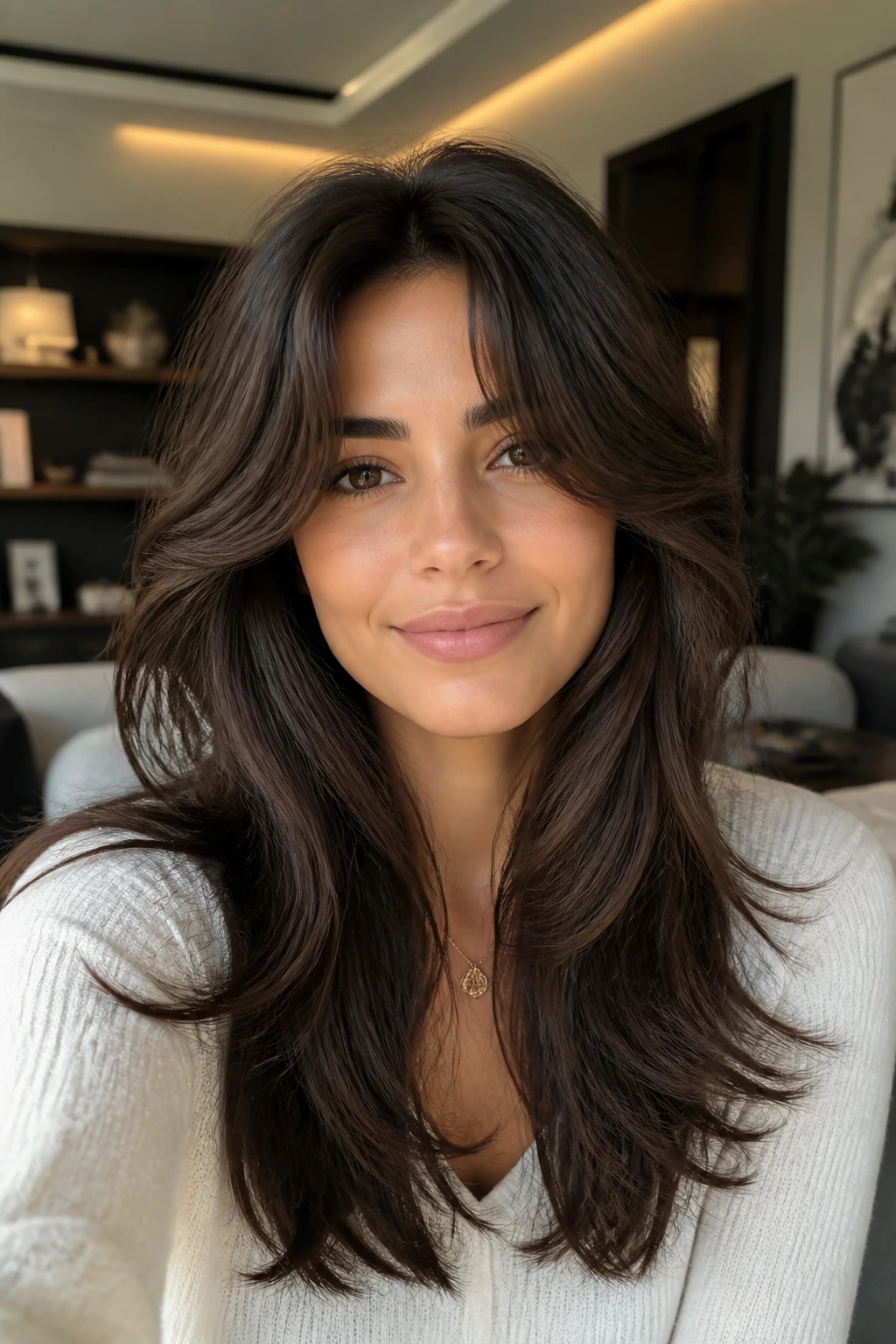
Thick hair needs carving, not just trimming. If the front section is left too solid, curtain bangs can puff, flip, or sit like a wall. A carved curtain shape removes weight where it doesn’t help and leaves enough substance at the corners for the fringe to hold its drape.
What to ask for
- Internal point cutting instead of blunt cutting through the whole front.
- A slightly longer center so the bangs can split cleanly.
- Corners that keep enough weight to bend outward, not explode upward.
- Styling with tension, because thick hair usually needs direction, not persuasion.
This version is best when you want the fringe to feel polished but not sparse. Thick hair can take structure. It just needs the structure placed in the right spots. I’m never eager to thin thick front pieces with aggressive shears; that usually creates frizz near the face and more work later.
22. Grown-Out Fringe
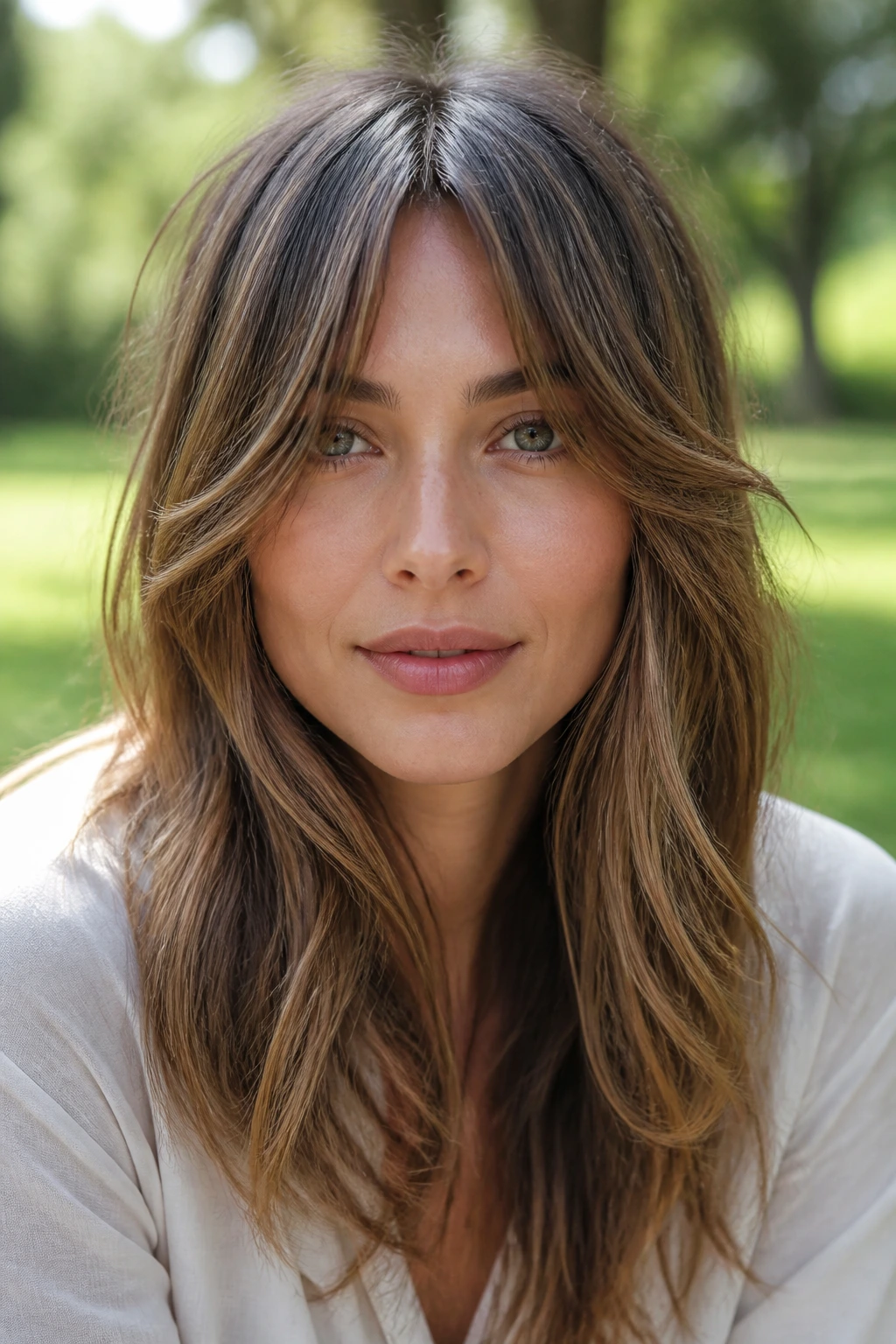
The grown-out version is for people who want the look to survive a lazy week. Maybe you started with straight bangs, maybe you’re in the awkward middle of a grow-out, maybe you just like the front pieces to sit in that relaxed in-between place. Curtain bangs are good at this. They can be coached into shape instead of chopped into shape.
The move is simple. Keep the center long enough to split, let the corners blend into the face-framing layers, and use a little heat or a couple of clips to teach the hair where to fall. On long hair, this stage often looks intentional faster than people expect. The fringe is no longer a fringe in the classic sense. It becomes a soft opening around the face.
That’s one reason I like curtain bangs more than blunt bangs on long lengths. The grow-out phase is built into the haircut. You are not fighting it. You are just editing it.
23. High-Volume Statement Curtains
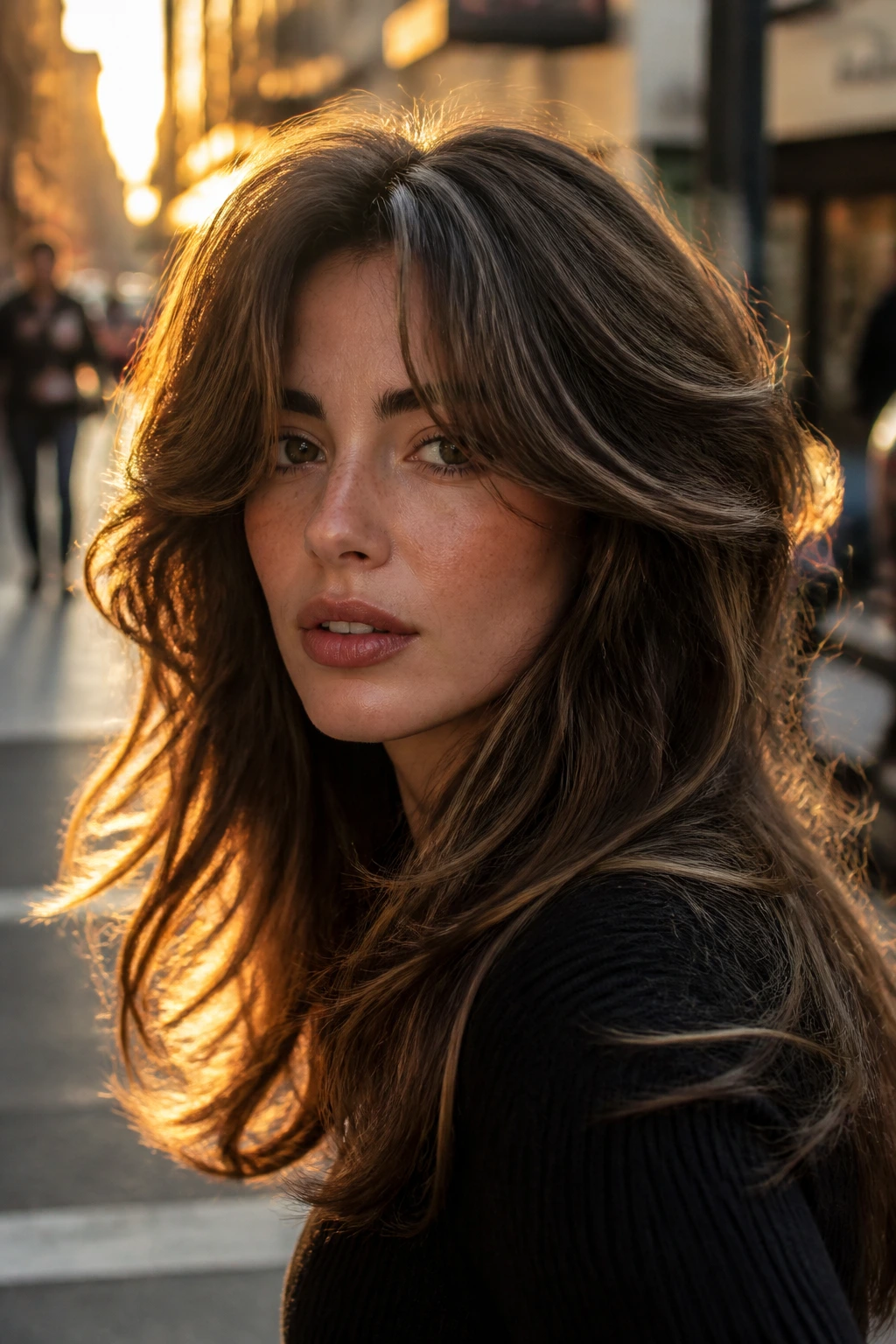
High-volume curtain bangs are not subtle, and that is the point. The front lifts high at the roots, the bend is more dramatic, and the sides carry a little more body through the cheek area. On long hair, that volume has somewhere to go, which keeps the look from turning too puffy or too short.
This style likes mousse at the roots, a round brush with some grip, and a bit of patience while the hair cools. I’d set the front pieces forward first, then sweep them out and up as they dry. If the bangs fall flat the second you stop styling, the cut may be too long at the center or too soft at the root.
This is a strong choice when you want the fringe to be the first thing people notice. It can carry a dramatic eye, a clean center part, and a long length all at the same time. Not every bang style can do that.
24. Beachy Curtain Bangs
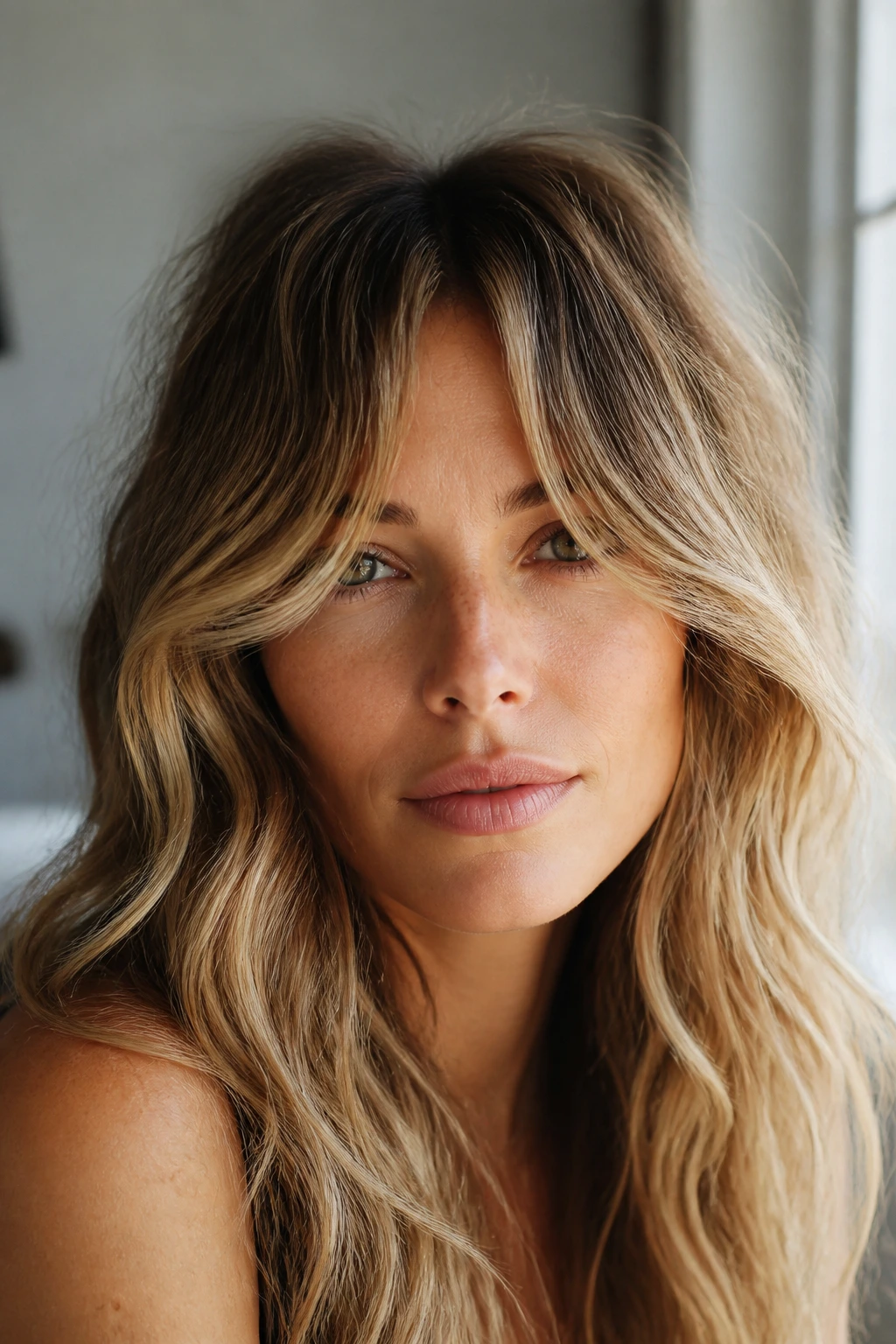
Beachy curtain bangs look best when the bend starts somewhere in the middle, not right at the root. That keeps the front from turning into a stiff curl and gives the whole shape a relaxed, slightly undone finish. Long hair already carries softness, so the fringe only needs a gentle bend to match it.
I’d reach for this style with wavy or lightly textured hair, especially if you like a piecey finish. Use a light salt spray or texture mist only through the mids and ends. Too much at the root and the fringe gets rough, which is never the point. A soft S-shaped bend away from the face is enough.
This is one of my favorite versions for warm-weather dressing, not because it is seasonal, but because it sits well with loose shirts, bare shoulders, and hair that is meant to move. It’s not polished in the glass-hair sense. It’s easier than that.
25. Sleek Middle-Part with Long Layers
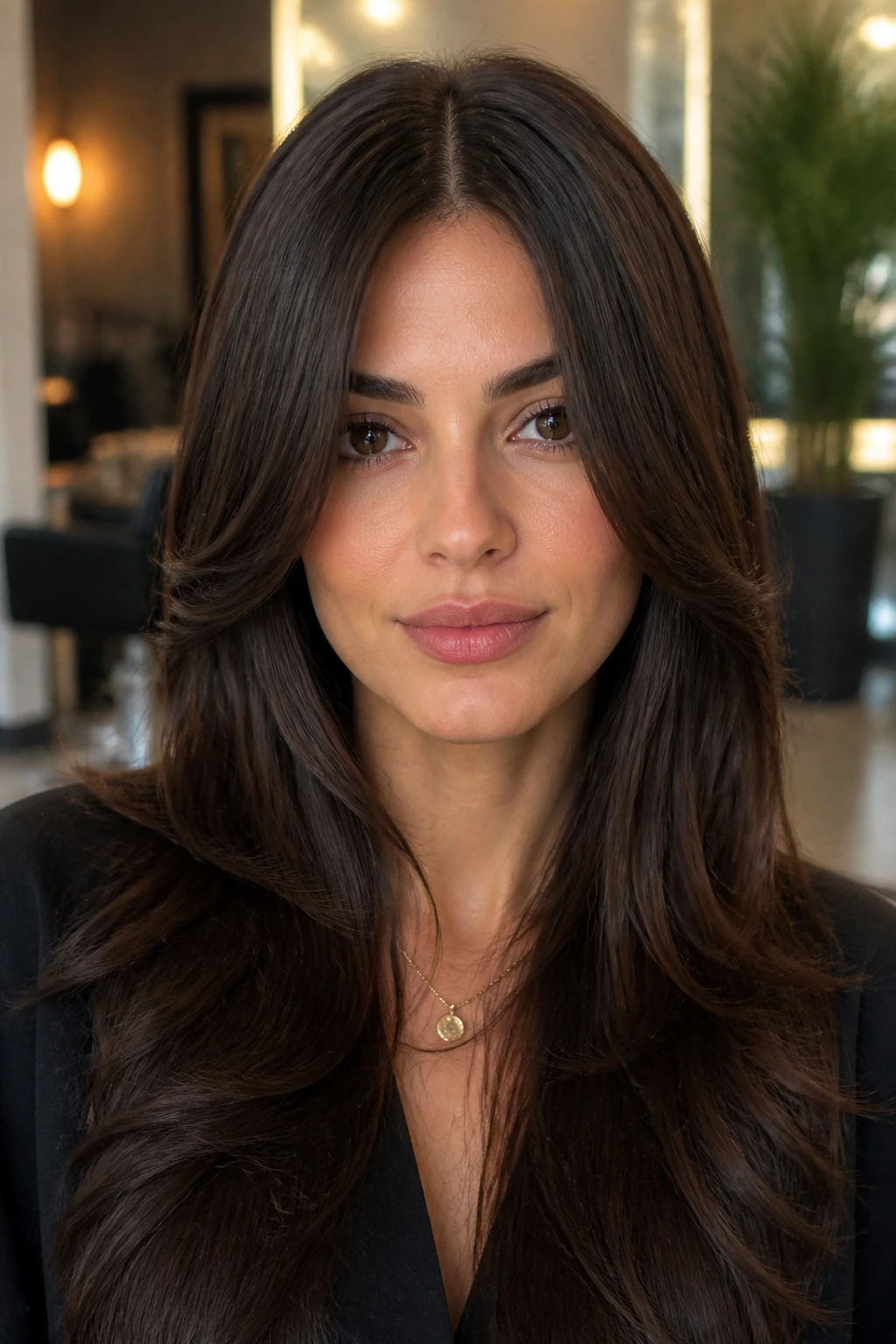
A sleek middle part with long layers keeps the front clean and the rest of the length in control. The curtain bang is there, but it behaves almost like a long face frame rather than a separate fringe. That makes it a strong choice if you want the shape without the daily styling theatrics.
Why it works
- The center stays long enough to lie flat when needed.
- The outer pieces blend into the long layers instead of sitting on top of them.
- The finish looks tidy with a quick blow-dry and even tidier when the hair is straightened.
- It is easy to tuck behind the ears without losing the shape completely.
I like this version on long, straight hair that feels heavy around the face. The front pieces break up the length but do not steal attention from it. That balance is useful when you want the haircut to feel modern without looking heavily styled.
26. Color-Boost Fringe
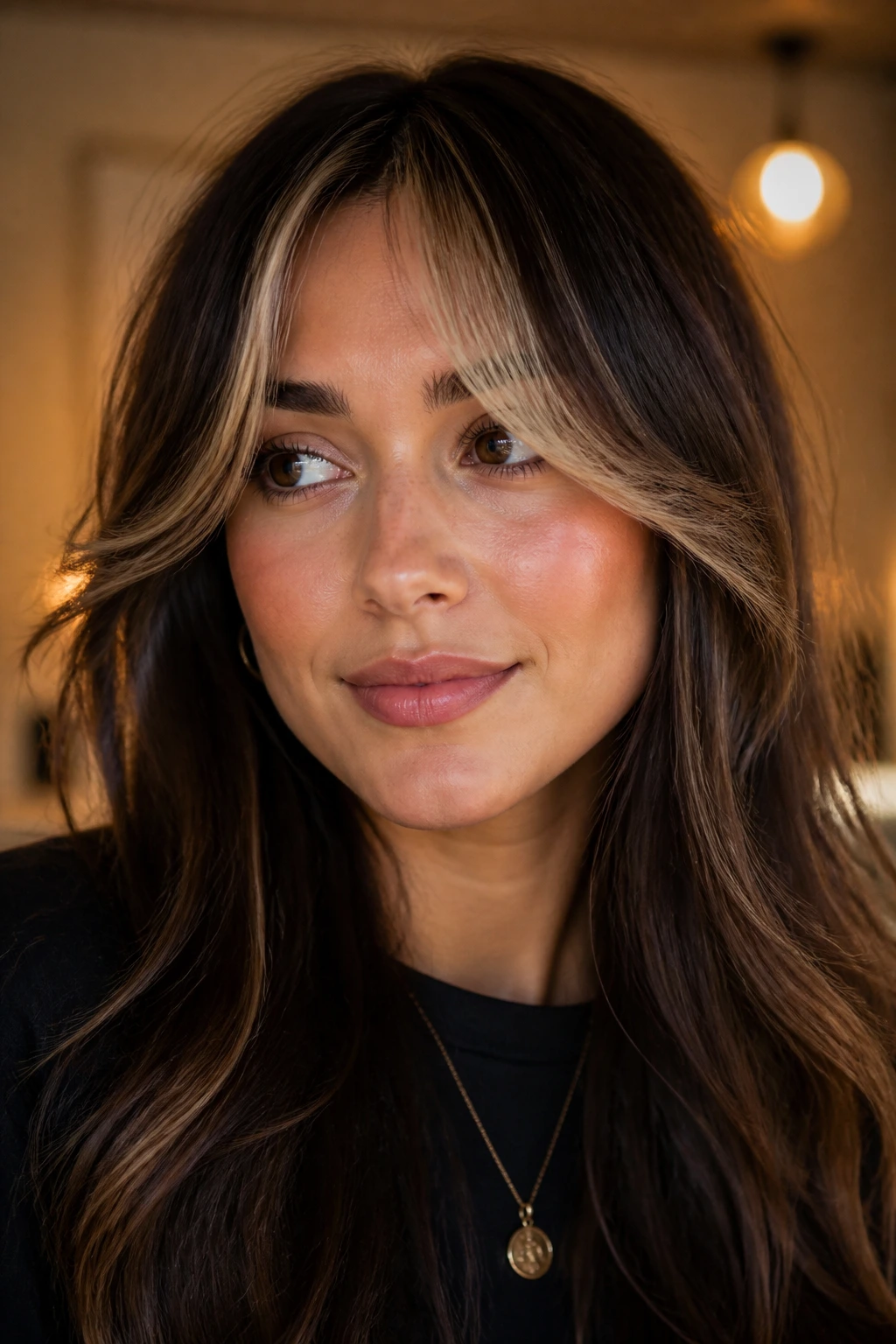
Color placement can do half the work of the cut. A color-boost fringe uses face-framing highlights or a lighter money piece to make the curtain split and the front drape read more clearly. The eye sees the brighter front pieces first, which gives the haircut depth even when the shape itself is quiet.
The smartest version keeps the lightest color away from the roots. Start the brightness around the brow or cheekbone area, then let it fade toward the ends. That gives the fringe dimension without turning the top into a high-contrast stripe. On long hair, the lighter front pieces can make the face frame look cleaner and the overall length look richer.
I especially like this on darker brunettes and deep blondes, where a little brightness near the face changes the whole cut with surprisingly little effort. It’s a color trick, yes, but it’s also a shape trick.
27. Editorial Curtain Bangs
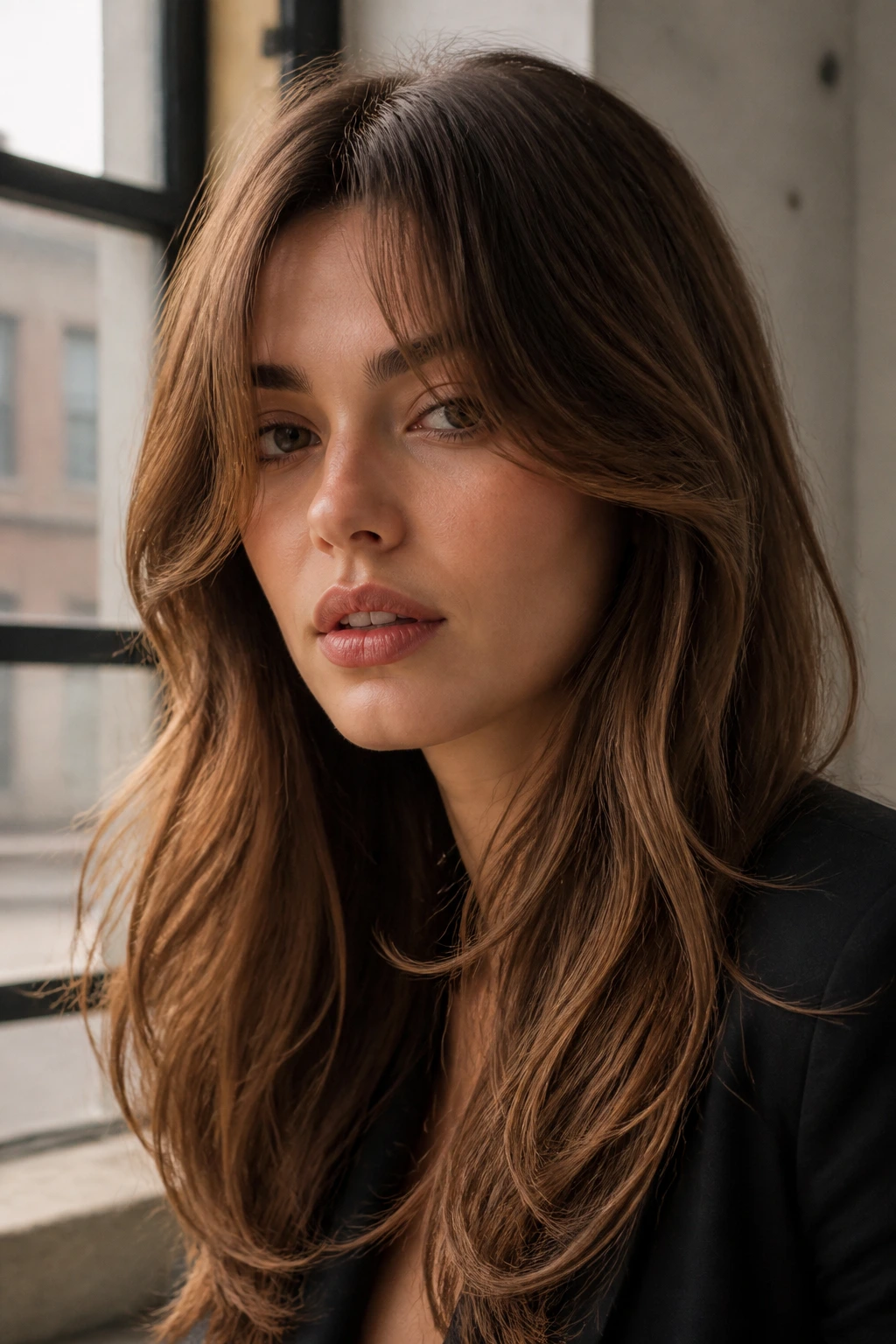
Editorial curtain bangs are the sharpest version in the bunch. The outline is deliberate, the center drop is long enough to move, and the corners are shaped so the whole front reads clean from every angle. They sit somewhere between fashion-forward and wearable, which is a useful place to live if you like your hair to look like it has intent.
What gives this version its edge is the precision. The split is clean, the corners are well judged, and the fringe doesn’t rely on a lot of product to make sense. I would cut this on hair that already takes direction well, because the style needs a bit of discipline to stay crisp. Long hair helps, since the fringe can feel bold without making the whole haircut heavy.
This is the one I’d pick if you like a stronger front shape, a clean center part, and long layers that frame the rest of the hair without competing with it.
How to Choose a Curtain Bang Shape That Fits Your Hairline
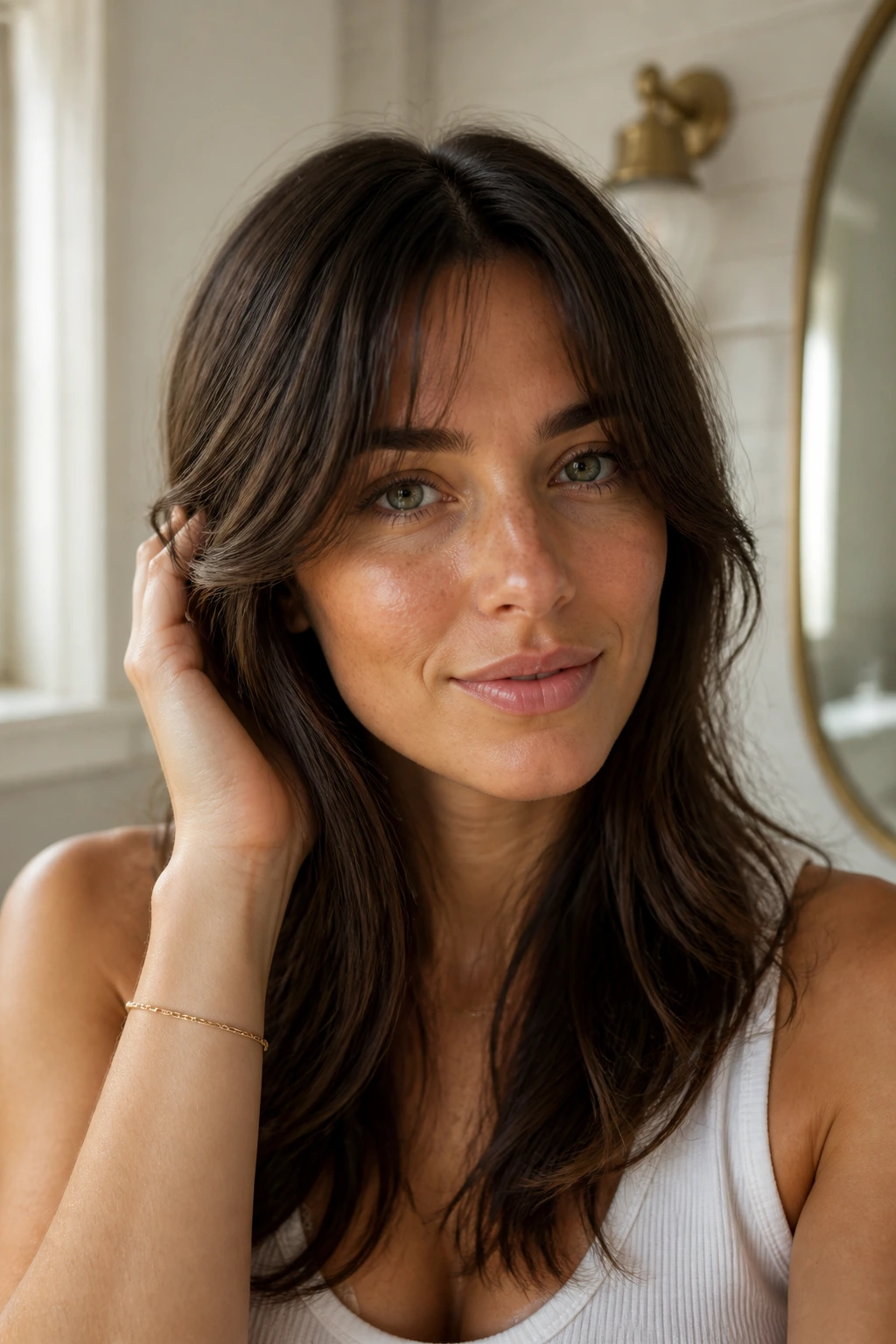
The smartest curtain bang choice starts with the hair you actually have, not the photo you saved on your phone. Hairline height, density, and how your part naturally falls will change the shape more than people think. If your hairline is high, a longer center can keep the front from looking too exposed. If your hairline is low or your forehead is short, a shorter center with softer corners can open the face without crowding it.
Density matters too. Fine hair usually looks better with wispy, bottleneck, or sleek shapes that don’t ask for much bulk. Thick hair needs carving, weight control, and a shape that can hold its outline after the first brush. Wavy and curly hair almost always need to be cut a bit longer and in a dry state, because shrinkage is real and it is not shy.
Cowlicks are not a small detail. If the front wants to split a little off center, fight that only if you enjoy wrestling with your mirror. A slightly shifted part can look better than a perfect middle part that caves in by noon. I’d rather work with a natural split and make the curtain shape fit the hairline than force symmetry and spend the next month hating the result.
Length should be decided in life, not just in the salon chair. If you wear glasses, tuck one side back, or pin your hair up often, you may want the corners to sit lower so they don’t keep falling into your frames. If you blow-dry every time and love a big front sweep, you can go a bit shorter at the center. The cut should match the way you live with it.
Essential Tools for Styling Curtain Bangs at Home
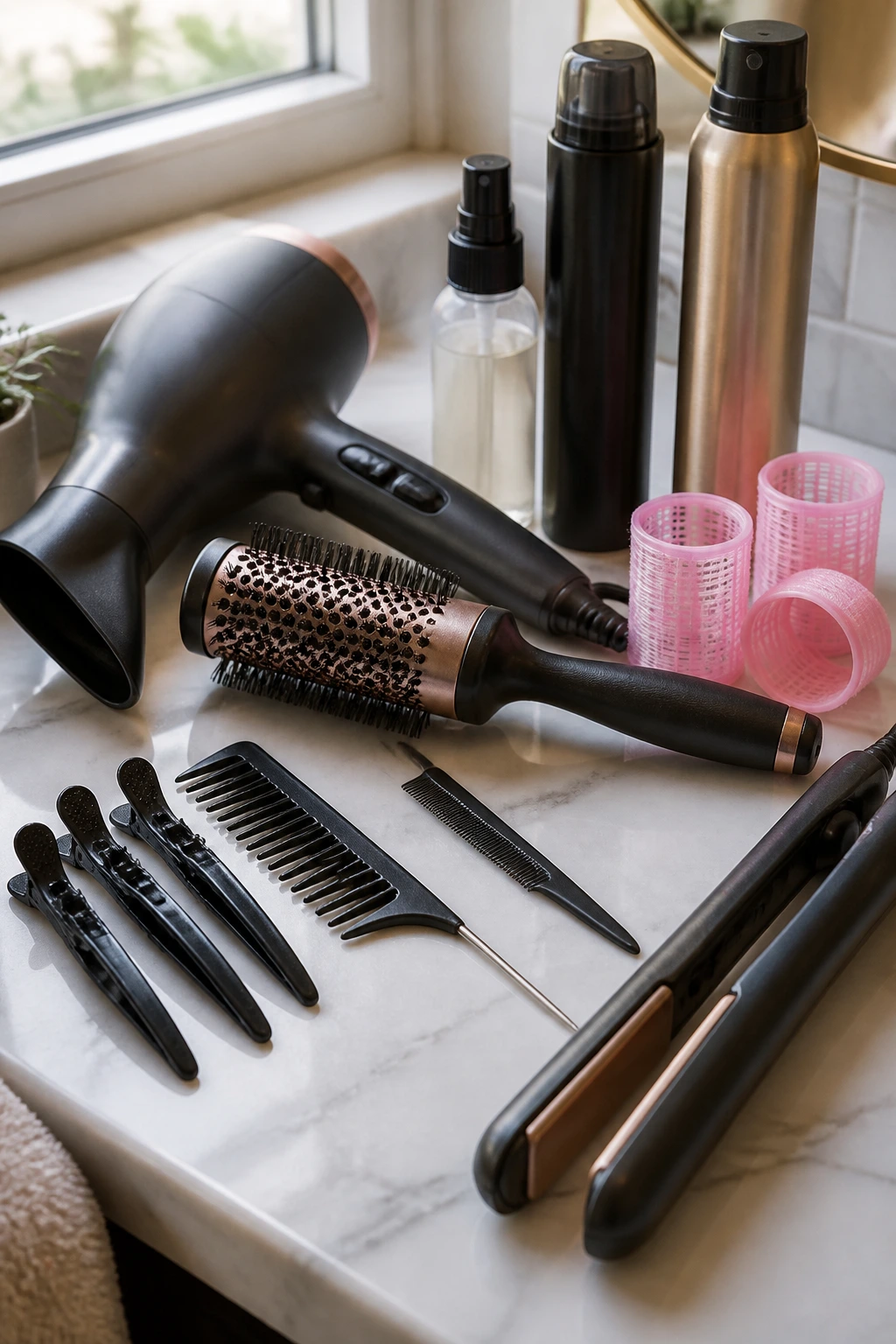
- Blow dryer with a concentrator nozzle: Directs airflow where you want it and keeps the front from frizzing out.
- 1 to 1.25-inch round brush: Small enough to bend the fringe, large enough to keep the curve soft.
- Heat protectant spray: Bangs sit near the hottest part of the dryer, so this is not optional if you style them often.
- Lightweight mousse or volumizing foam: Gives the roots a little lift without making the front sticky.
- Flexible-hold hairspray: Useful for setting the shape without turning the fringe stiff.
- Velcro rollers or small clip rollers: Handy when you want the front to cool in a curved position.
- Wide-tooth comb and tail comb: The wide-tooth comb detangles without pulling; the tail comb helps section the front cleanly.
- Alligator clips: Keep the rest of the hair out of the way while you focus on the fringe.
- Flat iron with rounded edges, optional: Good for smoothing the last inch or two if your hair kicks out at the ends.
- Reference photos on your phone: The best tool in the chair, honestly. Photos of your own texture help more than a celebrity shot with a different hairline.
Small Styling Tweaks That Change the Finish
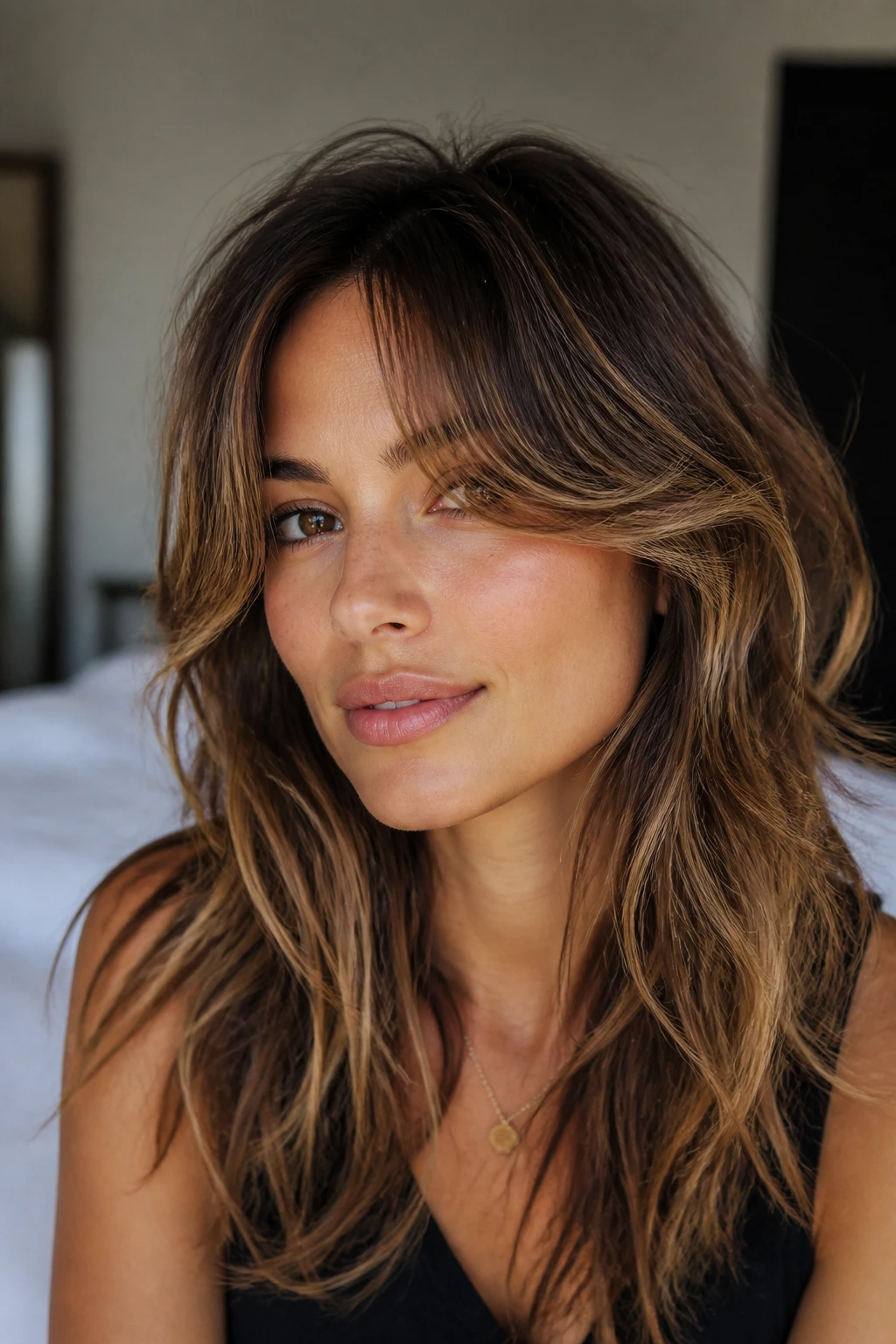
Root Lift: Clip the front pieces up for a few minutes while they cool if you want the bangs to sit away from the forehead. That tiny pause often does more than another pass with the dryer.
Texture: Use a pea-sized amount of light cream or paste only on the ends if the fringe feels too clean. The goal is separation, not grease. I’d keep product off the center root unless your hair is extremely flat.
Finish: A toothbrush-sized burst of flexible hairspray can tame flyaways near the split without freezing the whole front. It sounds fussy. It works.
Resetting the Split: If the curtain starts collapsing to one side during the day, dampen your fingers, sweep the front into place, and twist each side away from the face for a minute. That usually trains the bend back into position faster than a full wash.
My bias: start lighter with product than you think you need. Bangs punish overdoing it first.
Keeping Curtain Bangs in Shape Between Trims
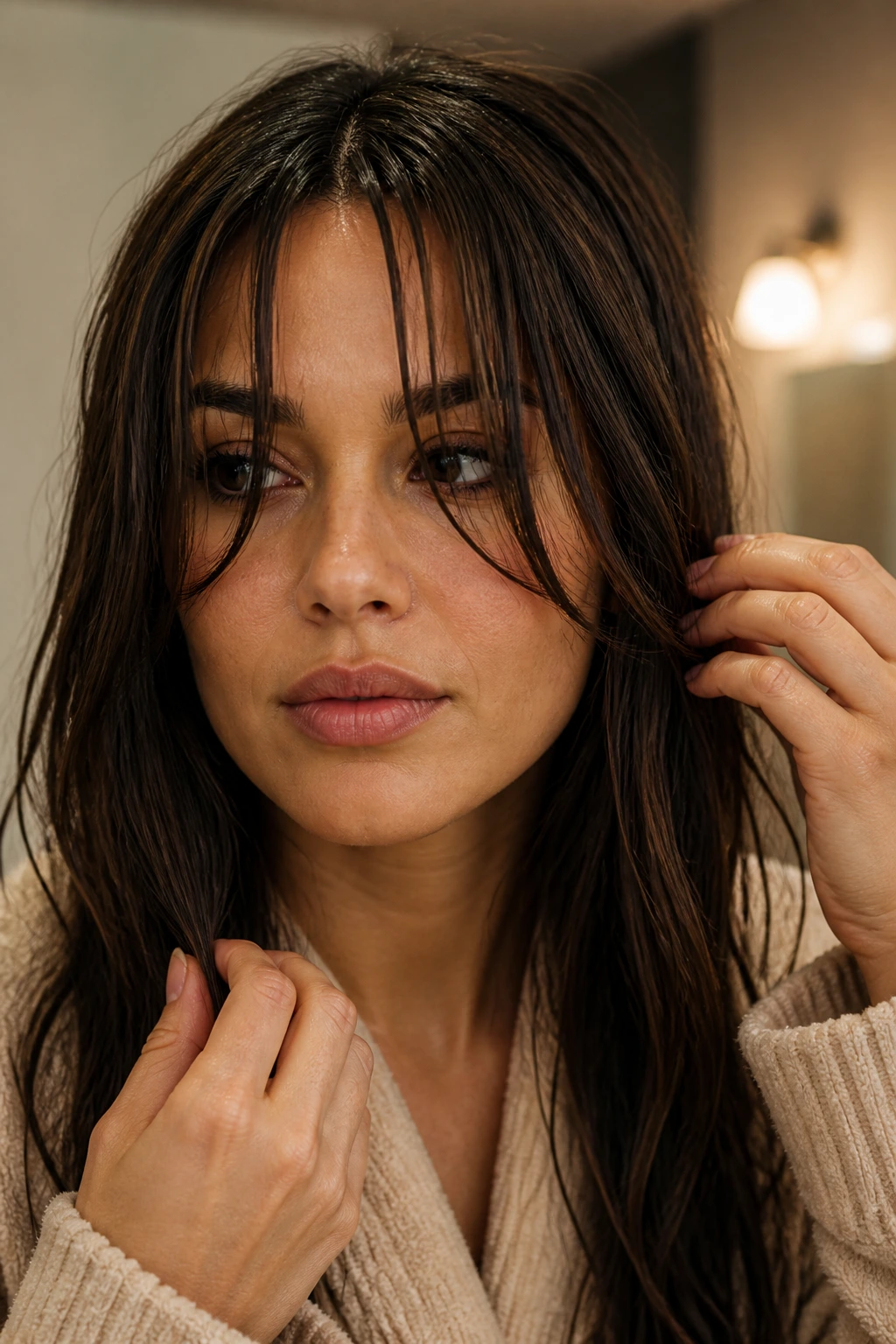
Curtain bangs are forgiving, but they are not self-maintaining. The front pieces grow fast enough that a shape can go from cheekbone-skimming to eye-sweeping in a few weeks. For shorter, fuller versions, I’d plan a trim every 4 to 6 weeks. For longer, blended versions, 6 to 8 weeks is usually enough. If you wait much longer, the center starts disappearing into the rest of the length and the curtain effect gets muddy.
Wash day matters too. Bangs get oily faster than the rest of the hair because they sit against skin, makeup, and forehead heat. Some people wash the whole head. Some people just rinse the front sink-side and save themselves a full shampoo. Either way, dry the fringe first so it does not settle into the wrong shape while the rest of the hair is still damp.
Between washes, a quick refresh is often enough. Mist the front lightly with water, brush it forward, then re-dry with a small brush or even your fingers if the style is supposed to stay loose. Dry shampoo at the roots can buy you another day, but use it sparingly or the front turns chalky. If you are growing the bangs out, ask for a trim that keeps the corners but softens the center. That approach preserves the curtain shape while letting the front lengthen into face-framing layers.
Sleeping is the annoying part. If your fringe bends wrong overnight, clip it loosely while it is dry or slightly damp before bed. A tiny bend now saves a lot of weird kinks in the morning.
Common Mistakes That Make the Front Pieces Misbehave
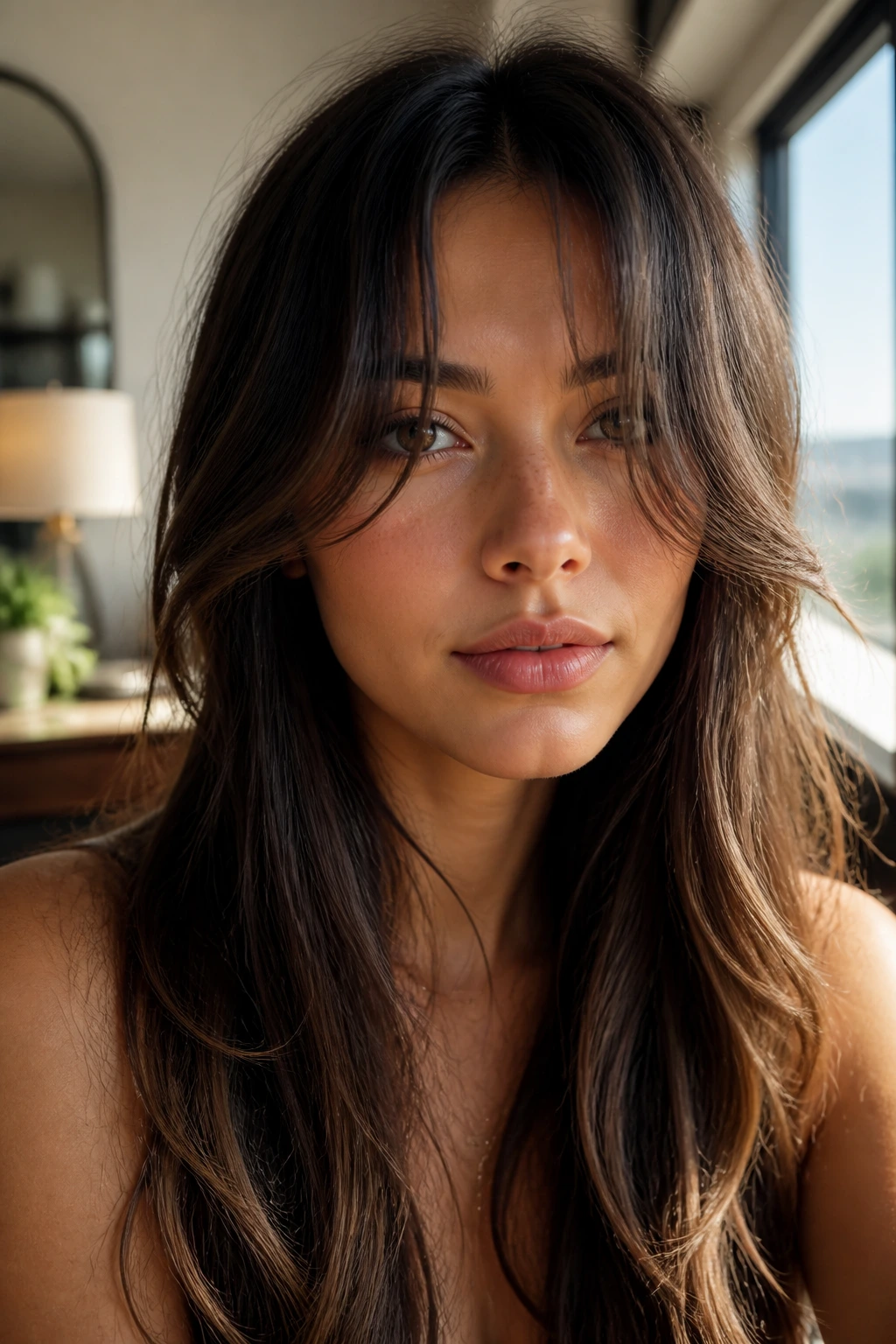
- Cutting the center too short: The symptom is eyes-in-your-face bangs that need constant pushing back. The fix is simple: keep the shortest point longer than your first instinct, because hair shrinks as it dries and bends.
- Thinning the whole front with shears: The symptom is fluffy, weak ends that split apart in humidity. The fix is point cutting and selective weight removal, not aggressive thinning from root to tip.
- Ignoring the hairline and cowlicks: The symptom is a bang that splits where it wants, not where you asked. The fix is to work with the natural fall and dry the fringe in the direction you want while it’s still warm.
- Styling the pieces straight down the middle: The symptom is a flat, helmet-like strip that sits on the forehead. The fix is to direct each side away from the face and let the center stay a little open.
- Cutting the corners too blunt: The symptom is a blocky front that looks heavy instead of soft. The fix is longer corners and soft blending into the layers.
- Waiting too long between trims: The symptom is a fringe that has already joined the rest of the haircut and lost its frame. The fix is to book a dusting before the shape disappears.
Variations and Alternatives to Try

The First-Timer Soft Set: Start with longer, cheekbone-grazing pieces and keep the center modest rather than dramatic. This is the safest entry point if you want the look without a big commitment.
The Blowout-Only Version: Ask for a shape that really comes alive with a round brush and hot air. The cut may look plain when air-dried, but the finished blowout has a lot of lift.
The Air-Dry Bend: Keep the fringe longer and lighter so waves can form naturally. This works well if you hate hot tools and do not need the front to look identical every day.
The Curly Crown Frame: Leave the center and corners longer, then trim dry curl by curl. The shape should follow the curl pattern, not fight it.
The Grow-Out Bridge: Let the curtain pieces blend into long face-framing layers so the cut can move from fringe to no-fringe without a hard line. Great for people who change their mind often. I respect that.
The High-Drama Split: Keep the center clean and the corners long, then style with stronger root lift and a pronounced bend. This is the version that reads bold in photos and still belongs on long hair.
Questions People Ask Before They Cut Curtain Bangs
How short should curtain bangs be on long hair?
Short enough to open the face, long enough to move. For most textures, that means the center should start around the bridge of the nose or slightly below, then the corners can drop toward the cheekbones or jawline. If your hair shrinks a lot when dry, ask to keep it longer than the mirror suggests.
Do curtain bangs work with curly or coily hair?
Yes, but they need to be cut with the curl pattern in mind, usually dry or nearly dry. The style should follow where the curls want to fall, not where they look on the cutting cape. Longer lengths are usually safer because curl shrinkage can be dramatic.
Can I style them without a blow dryer?
You can, but the finish will be softer and less controlled. Clip the front while it’s damp, let it set in the direction you want, and then finger-style it once dry. That gives you a looser version that still reads as a curtain instead of a random front section.
What if my cowlick pushes the bangs apart too hard?
Go longer at the center and use the cowlick as part of the design, not a flaw. Dry the hair side-to-side with a brush or clip the front in place while it cools. Sometimes a slightly off-center split behaves better than a perfect middle part.
Can I trim curtain bangs myself?
You can clean up tiny bits if you’re careful, but this is one of the easiest haircuts to overdo at home. Dry hair first, cut less than you think, and work vertically rather than hacking straight across. If the shape matters to you, let a stylist handle the real trim.
Will curtain bangs make my face look wider?
Only if they end at the widest part of the face and sit flat. Longer corners, a little bend away from the cheeks, and a soft center opening keep the line moving vertically instead of sideways. The shape matters more than the label.
How often do curtain bangs need trims?
Usually every 4 to 8 weeks, depending on texture and how sharp you want the shape to stay. The fuller and shorter the fringe, the faster it needs a cleanup. The longer and more blended the shape, the more room it has to grow.
What should I bring to the salon?
Photos help, but only if they show a similar texture and hairline. Add notes about how you wear your part, how often you blow-dry, and whether you want the front to stay obvious or blend into long layers. That extra context saves a lot of guessing.
The Shape That Grows With You
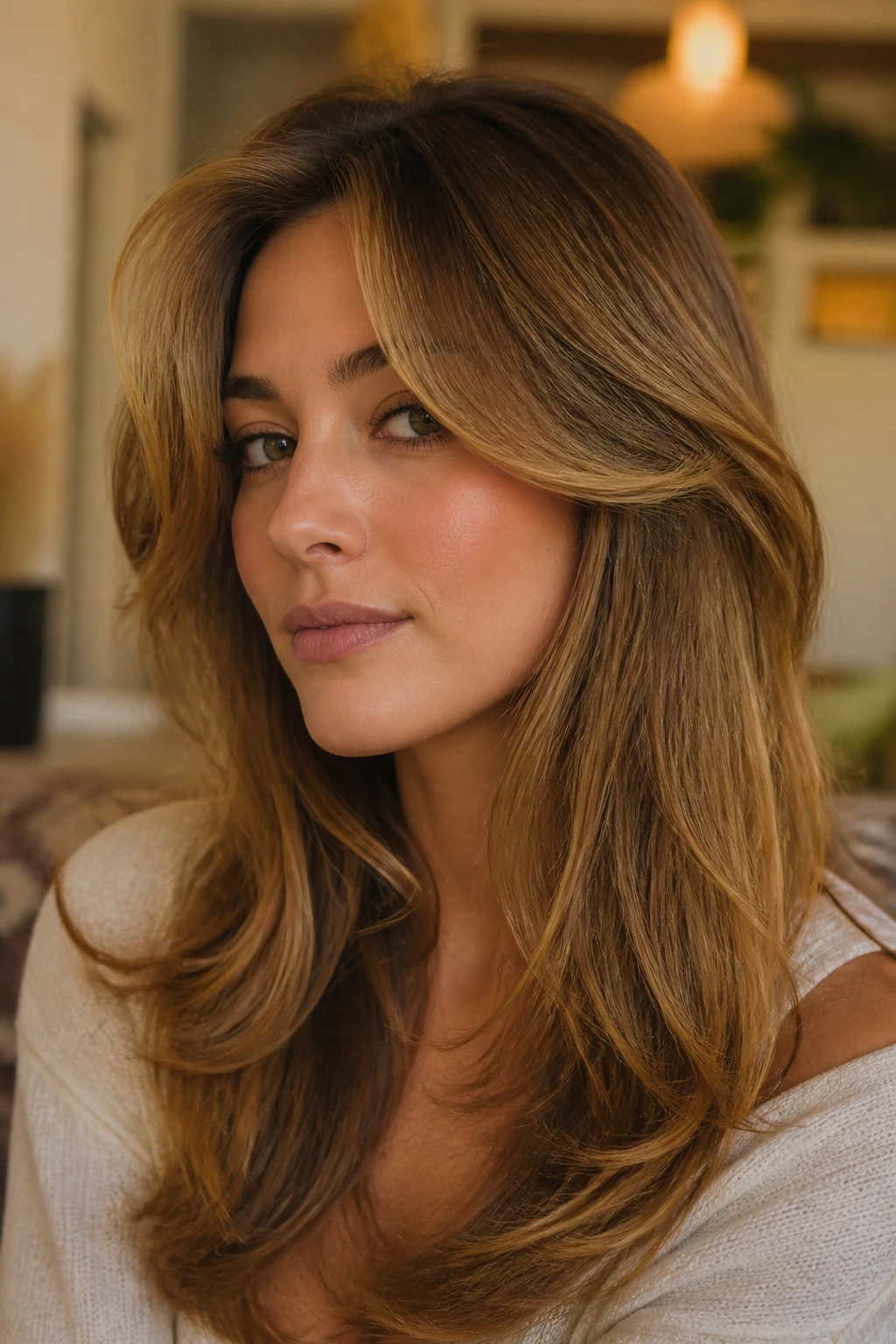
The best curtain bangs on long hair are the ones that still make sense after a week of real life. They can be brushed out, air-dried, tucked back, or worn a little messy, and they still look like part of the haircut rather than a separate project. That is why I keep coming back to them. They give you change without taking away the thing you already like: the length.
If you want the front pieces to earn their place, start with texture, face shape, and how much effort you will actually give them on a Tuesday morning. That matters more than chasing the shortest version in the room. Long hair has room for softness, drama, and a little forgiveness. A good curtain bang uses all three.
