



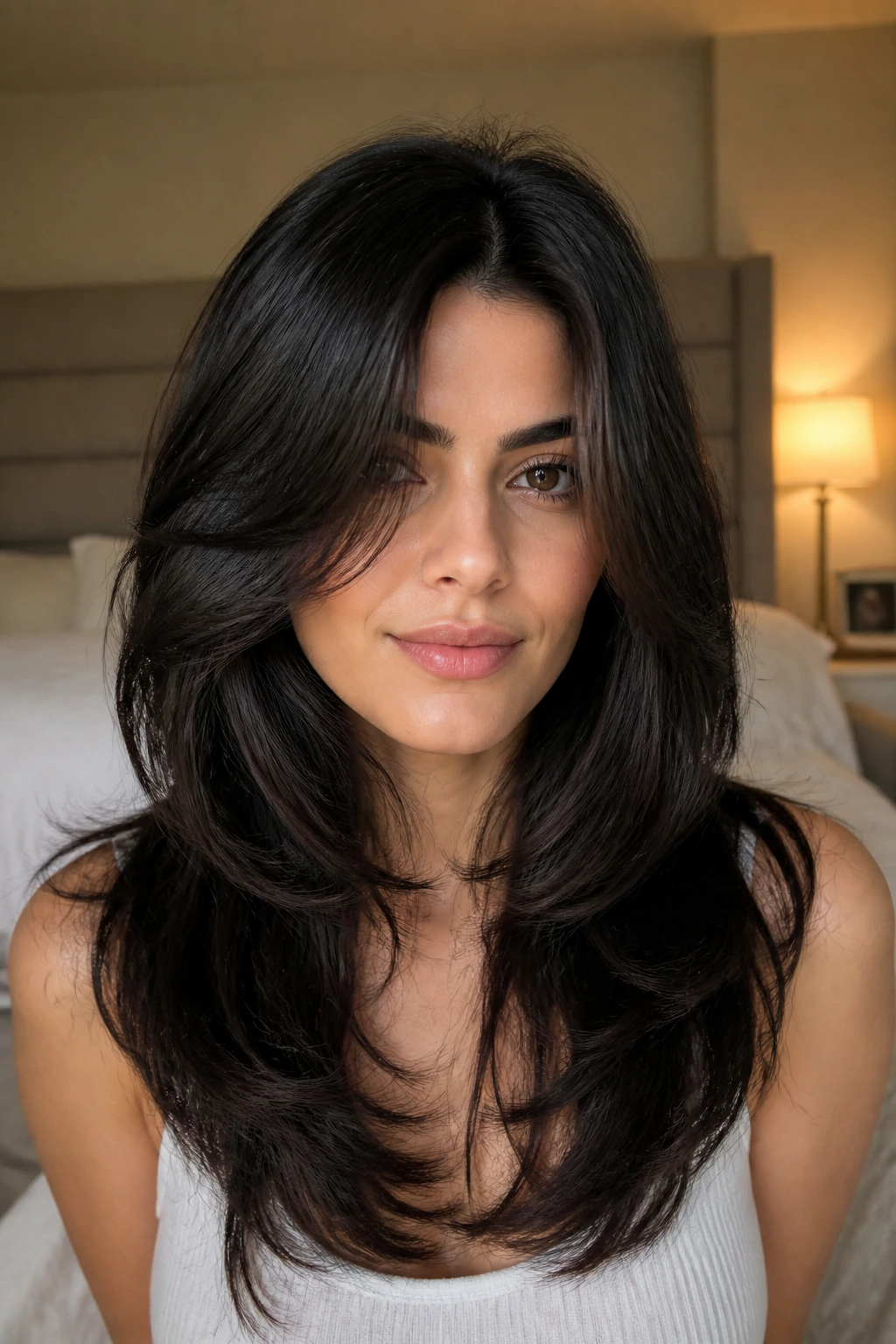
Dark layered haircuts for thick hair work best when they treat weight like a design problem, not an afterthought. Thick, dark strands can look glossy and expensive when the shape is right, but they also pile up fast. Cut them blunt in the wrong place and the whole head turns into a heavy sheet. Over-thin them and you get soft-looking ends that frizz at the first hint of humidity. Neither look is flattering.
The trick is getting movement without losing the dense, rich feeling that makes dark hair so good in the first place. Black, espresso, and deep brown shades don’t always show shape the way lighter hair does, so the silhouette matters more than people expect. A smart layer map gives you lift around the face, air through the crown, and a bottom line that doesn’t drag like a wet towel.
These nineteen cuts cover the full range: long and glossy, shaggy and lived-in, shoulder-length and easy, sharp and polished, soft enough for daily wear. Some keep nearly all the length. Some remove weight where thick hair tends to balloon. A few are for people who want a little edge without committing to a full chop. Start with the shape that sounds closest to how you actually wear your hair, not the one that looks coolest in a screenshot.
Why This Collection Works for Thick Dark Hair
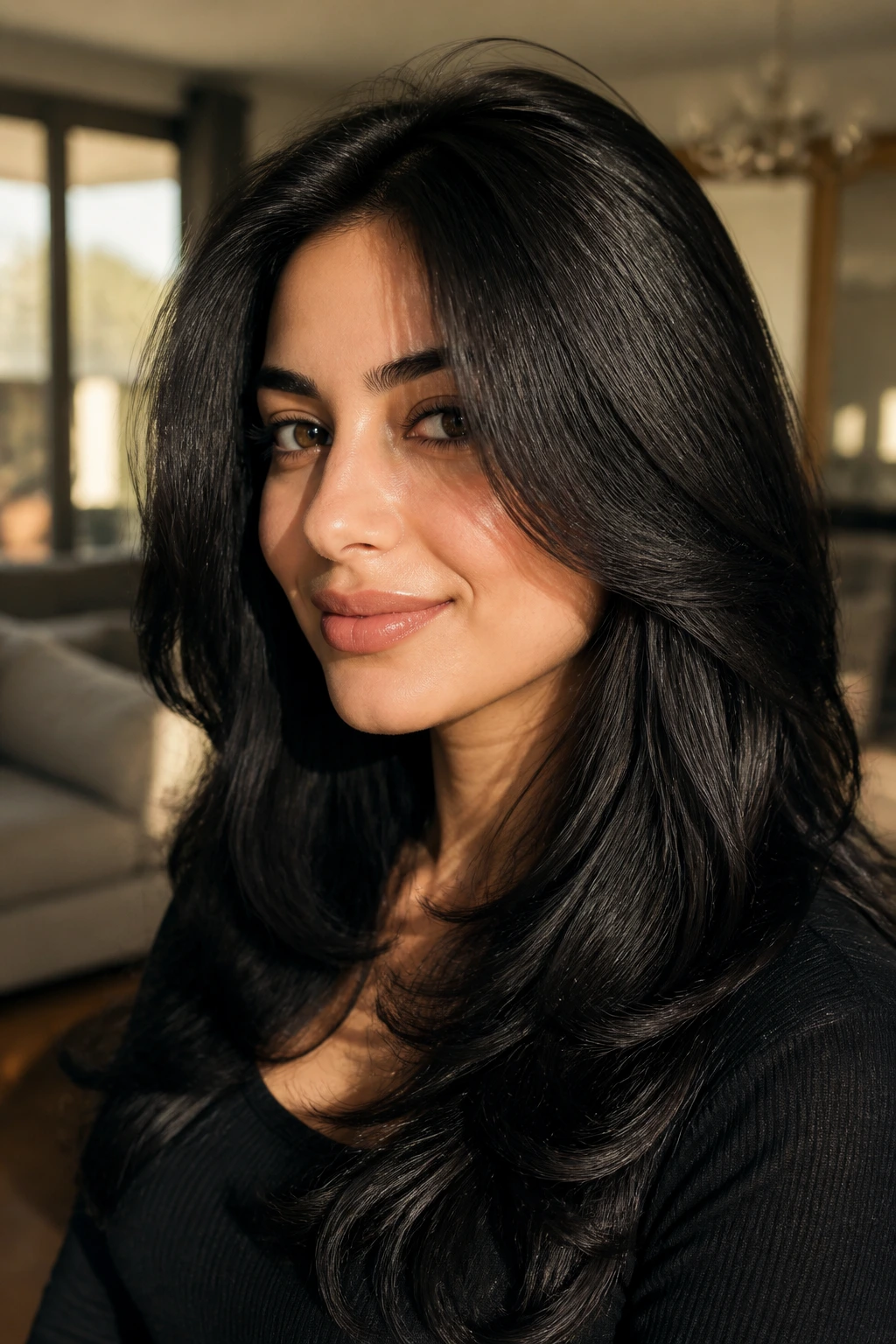
-
Weight Is Handled, Not Hidden: Every cut here takes bulk out of the places thick hair stacks up most, which keeps the silhouette from turning boxy by day two.
-
Dark Color Gets Real Shape: Deep brown and black hair can read flat in the wrong cut, so these styles build visible movement through the crown, sides, and ends.
-
Length Stays in the Conversation: You do not have to sacrifice long hair to get airiness; several of these cuts keep the perimeter full while sneaking in movement above it.
-
Styling Time Stays Practical: Some of these need a round brush. Some only need a diffuser or a quick bend with a flat iron. That matters when you have dense hair and a life.
-
The Grow-Out Is Not Brutal: The better layer patterns soften as they grow, which means you are not stuck with a weird shelf line three weeks after the salon chair.
-
There’s Room for Personality: From polished and sleek to shaggy and cheeky, thick hair can carry more shape than people give it credit for. These cuts prove it.
1. Soft Long Layers That Keep the Ends Full
This is the haircut I reach for when someone wants movement but refuses to give up the weight at the bottom. The length stays intact, the ends still feel substantial, and the layers are gentle enough that dark hair keeps its rich, dense look instead of going wispy. On thick hair, that matters. A lot.
Why It Works
The layers start low, usually around the collarbone or just below it, so the haircut never loses its anchor. Around the face, the shortest pieces can hit the cheekbone or jawline, which gives you motion without turning the front into a curtain. Dark hair shows shine best when the perimeter is clean, and this shape keeps that line readable.
Best For
- Long, straight thick hair that needs air
- Wavy hair that gets heavy at the bottom
- Anyone who wants to keep the length but lose the “helmet” effect
Tip: Ask for the ends to be point-cut instead of chopped blunt. It softens the line without making the hair look thin, and that small change is doing more work than most people realize.
2. The Butterfly Cut with a Lifted Crown
If your thick hair feels flat at the roots and huge at the ends, the butterfly cut is the move that changes the whole balance. It gives you those short, face-framing top layers that sit around the cheekbone, then keeps longer lengths underneath so the haircut still falls with some drama. It’s a split personality in the best way.
The crown gets lift fast with this shape, especially on dark hair where flat roots can make everything look heavier than it is. I like this cut on thick hair that wants movement around the face but still needs enough length to pull back, braid, or tuck behind the shoulders. It does ask for styling. Not a lot, but enough to matter.
A round brush and a little root lift spray will make the layers actually show. If you air-dry it with no product, the shape can blur. That’s not a failure. It’s just the haircut telling you it likes a bit of direction.
3. U-Shape Layers That Preserve the Length
A U-shape is one of the safest bets for thick dark hair because it keeps the bottom line curved and soft instead of cutting it straight across like a shelf. That curved hemline makes long hair move better, especially when the ends are dense enough to look like a single block. You still get thickness, but the shape breathes.
This is a good middle ground for anyone who has been burned by too many aggressive layers. The longest pieces stay strong in the back, while the layers around the sides quietly lighten the outline. You can wear it sleek, bend it with a blowout, or let natural waves do most of the work.
What To Ask For
- A rounded perimeter instead of a blunt one
- Layers that begin below the chin
- Soft face-framing pieces that blend into the rest of the cut
Note: The U-shape is especially kind to dark hair because it keeps the silhouette obvious from the back. That’s where a lot of cuts get muddy. Not this one.
4. The Modern Shag with Piecey Texture
Can thick dark hair look airy without looking messy? Yes. A modern shag does that job better than most cuts people call “low maintenance” but secretly require endless styling. The shag breaks up bulk with choppy layers, adds movement around the crown, and gives the ends a little separation so the whole head doesn’t fall into one heavy sheet.
Curtain bangs help here, but they’re not mandatory. What matters more is that the layers are placed with enough intention to keep the shape from puffing out at the sides. On wavy hair, this cut can air-dry into something that already looks styled. On straight hair, it usually needs mousse, a rough blow-dry, or a flat iron bend to show the texture.
I like this cut most when the person wants attitude. It has edge. Not punk edge, not costume edge. Just enough grit to keep thick dark hair from looking too polished and too heavy at the same time.
5. Curtain Bang Layers That Open the Face
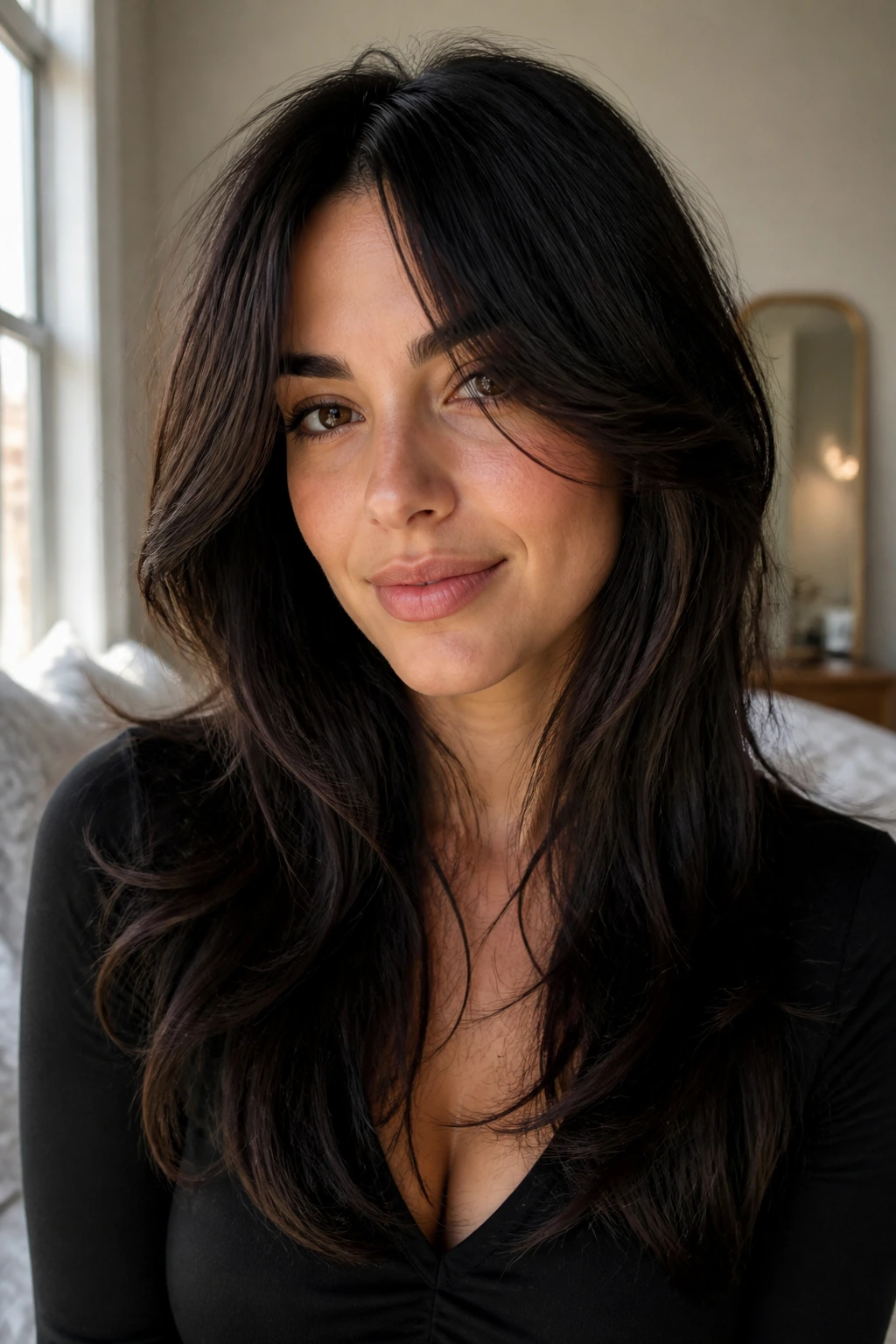
Curtain bangs are one of the smartest ways to break up dense dark hair, because they pull attention upward and away from the bulk at the sides. The fringe opens from the center and sweeps into longer face-framing layers, so the haircut feels softer without losing structure. On thick hair, that fringe has enough body to sit properly; it doesn’t collapse into stringy little pieces.
The trick is not making the bangs too short. If they start too high on the forehead, thick dark hair can make them sit heavy and blunt. A better version lands around the cheekbone or just above it, where the part can split naturally and the edges can blend into the rest of the cut.
This shape works especially well when you wear hair down a lot and want the face to show through the curtain of dark strands. It’s also a nice match for people who keep saying they want layers but are nervous about losing length. Fair. Curtain bangs give you a taste of change without the full commitment.
6. Collarbone Layers With Hidden Interior Cutting
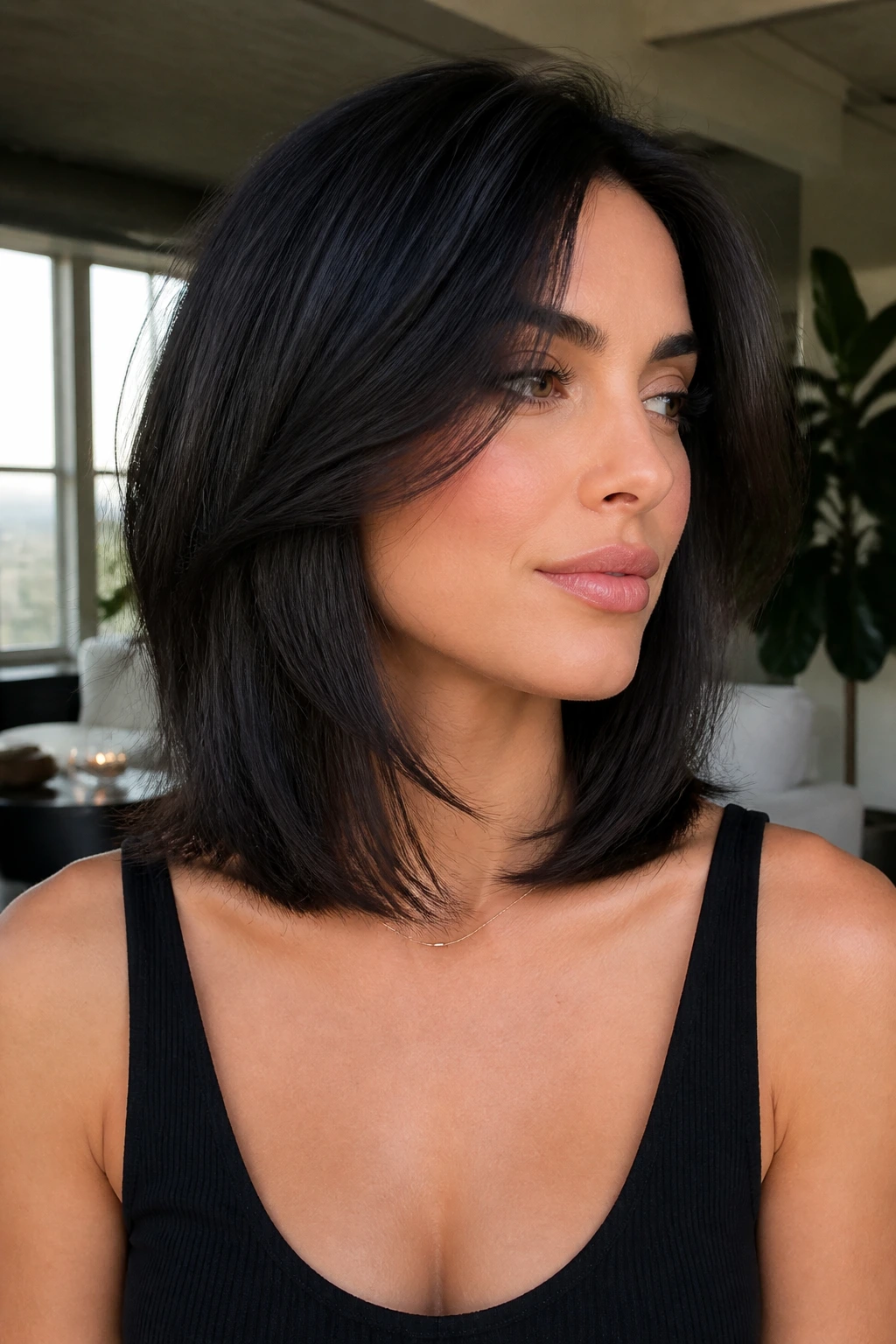
This is the grown-up answer to thick hair that keeps acting bigger than you want it to. The outside looks polished and clean, but the real work happens inside the haircut, where the stylist removes bulk with internal layers you barely see. The result is a collarbone-length shape that still feels full, not flimsy.
It’s one of my favorite choices for dark hair in professional settings because it doesn’t scream “layered haircut” from across the room. It just sits better. The shoulders stop catching on the ends, the sides don’t puff up as much, and the overall outline looks easier to wear. That hidden structure also helps if your hair gets triangle-shaped when it dries.
This cut is not flashy. That’s the point. It’s the haircut you notice when you move your head and the hair swings instead of sticking.
7. V-Cut Layers for Heavy Length
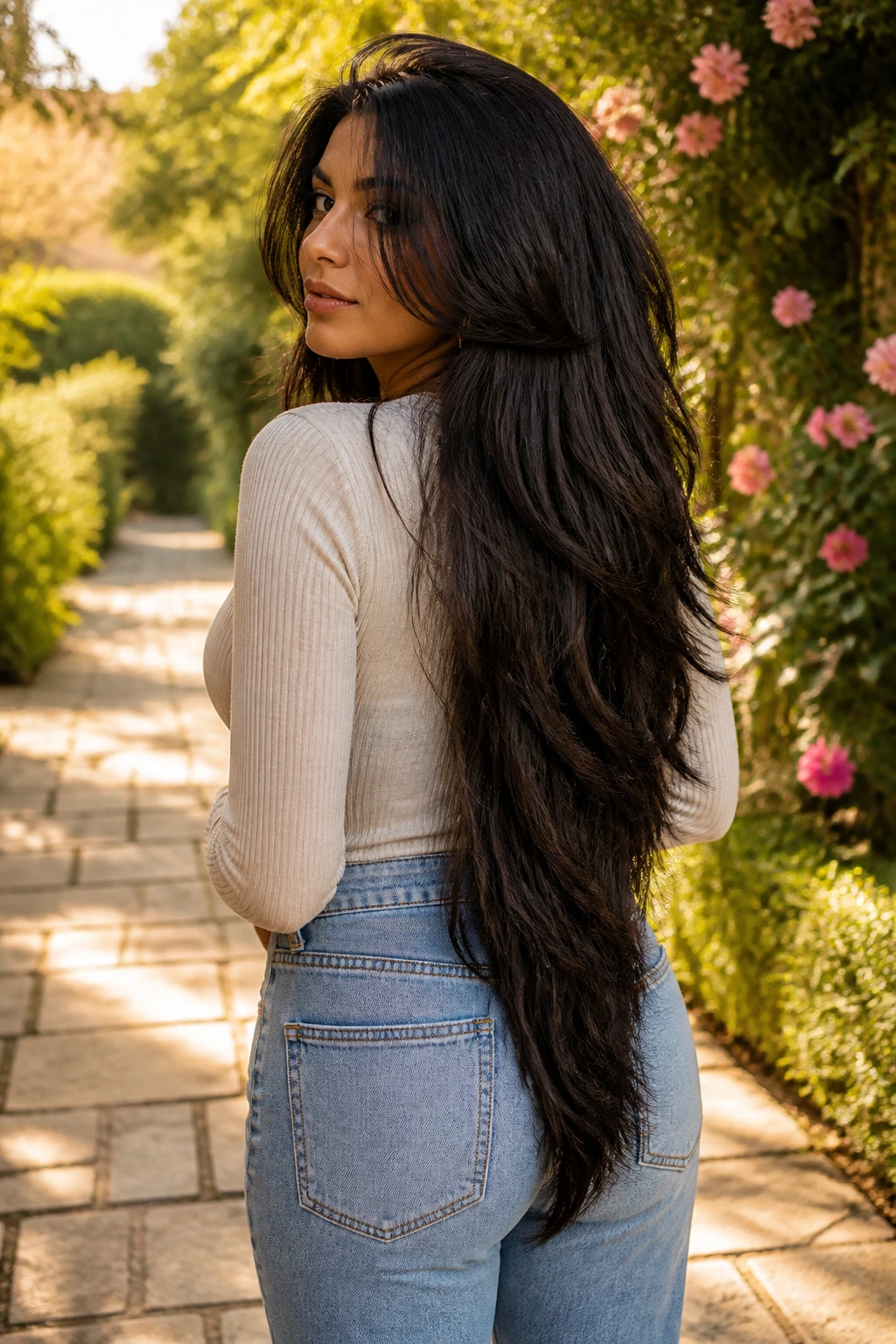
When thick hair gets very long, the bottom can start to feel like a weight vest. A V-cut changes that by tapering the back into a pointed shape, with the longest pieces centered and the sides falling a little shorter. It creates movement without removing so much that the hair loses its dramatic length.
Dark hair tends to show this shape beautifully because the pointed back line reads clearly in motion. If you wear your hair straight, the V gives the ends more action. If you wear waves, it keeps the bulk from spreading out too wide at the bottom. Either way, the shape looks intentional.
Good For
- Waist-length or mid-back hair
- Thick straight strands that feel heavy at the nape
- Anyone who wants long hair that still swings
Watch Out: If your hair is very fine at the ends, a harsh V can make them look sparse. For thick hair, though, it’s one of the few dramatic cuts that usually earns its keep.
8. Rounded Layers for Soft Movement
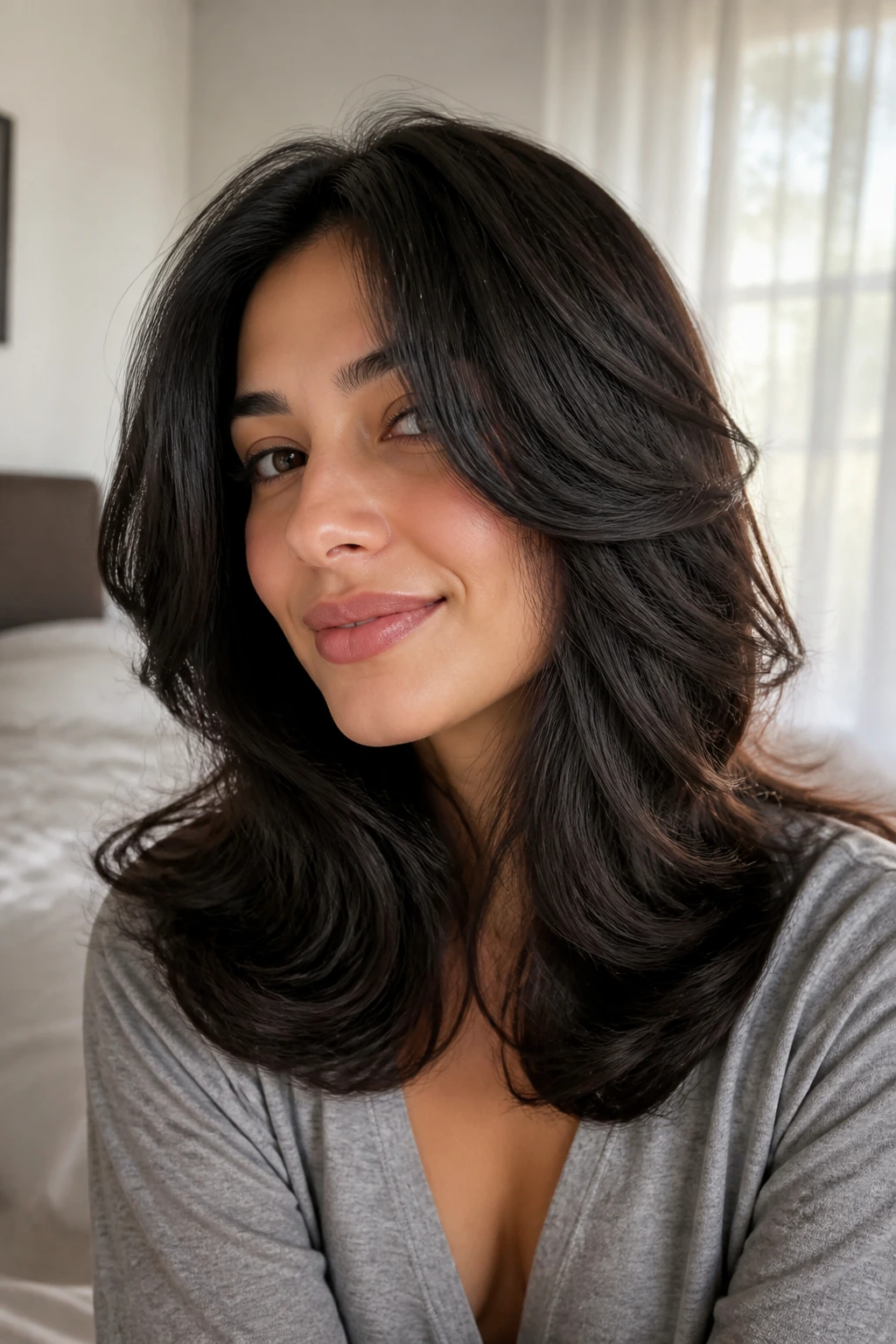
A rounded layer pattern follows the curve of the head instead of forcing the hair into a square or triangular outline. That sounds technical, but the payoff is simple: thick hair falls better. The sides don’t stick out as much, the ends don’t hang like a block, and the overall shape feels softer around the jaw and shoulders.
This is a strong choice for wavy or curly dark hair because the curve of the cut works with the natural volume instead of fighting it. A lot of people with thick hair ask for layers, then end up with a puffed-out triangle because the weight was removed in the wrong places. Rounded layers avoid that. They let the cut sit close where it should and open where it needs to.
It’s also one of the more forgiving styles as it grows. The shape blurs a little, but it doesn’t fall apart.
9. The Razor Shag with Edge and Air
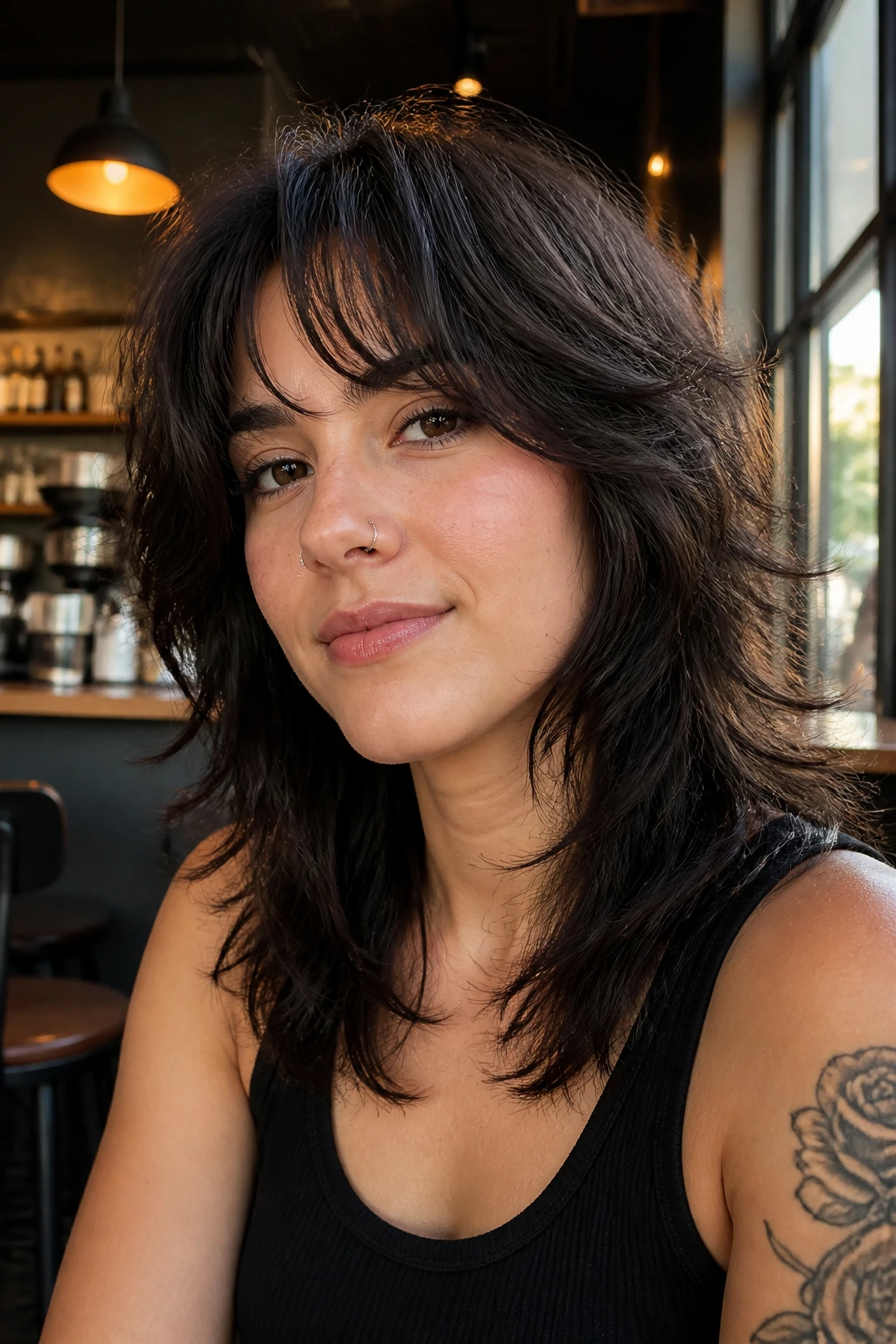
A razor shag can be gorgeous on dense dark hair, but I’m selective about it. If the hair is healthy, strong, and naturally bulky, a razor can carve out feathered ends that move better than scissors alone. The whole cut feels lighter through the mid-lengths, and the texture shows up fast on dark strands because the layers catch light in motion.
If the hair is already dry, porous, or frizzy, I would skip the razor and ask for careful point cutting instead. That’s the catch. A razor can make dark hair look beautifully piecey, or it can make the ends go fuzzy if the texture isn’t right for it. There’s no mystery there.
Used well, though, this is one of the coolest-looking layered haircuts for thick hair. It has swing. It has edge. It looks a little undone in a way that feels deliberate, not lazy.
10. Money-Piece Layers for Dimensional Dark Hair
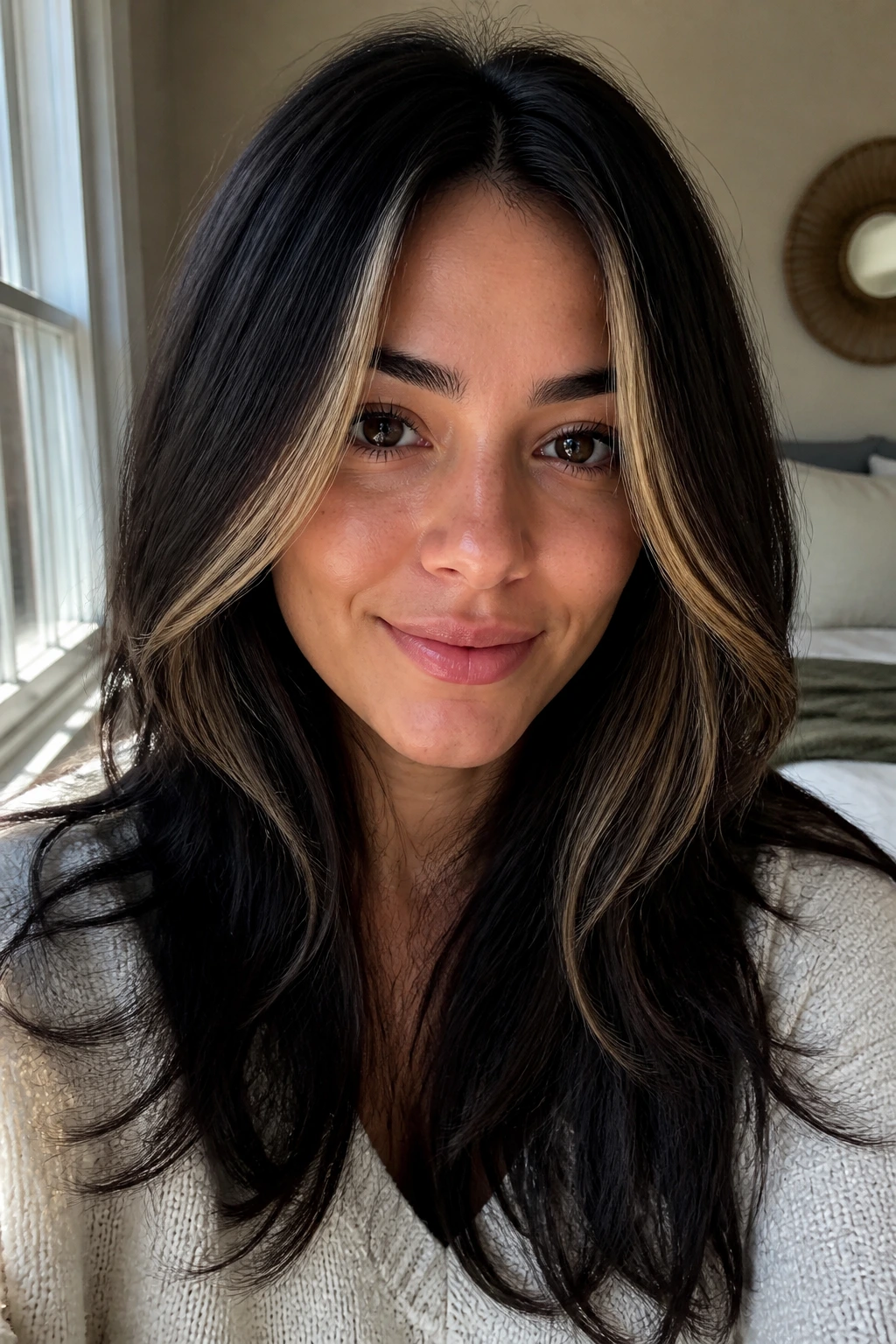
Dark hair can go flat fast around the face, especially when the length is heavy and one-color. Money-piece layers fix that by creating brighter, more noticeable front sections that frame the face and make the layer pattern visible right away. Even if you keep your color deep and rich, the front shape reads with more contrast.
This is a good move if you want the haircut to do some of the visual work that lighter hair gets for free. Thick dark hair can sometimes swallow detail, and the front pieces are where the eye lands first. Add a soft bend there, and the whole cut suddenly feels more alive. If you wear glasses, these pieces can be tailored so they don’t crowd your frames. Small thing. Big difference.
What Makes It Different
- The front looks lighter and more open
- The rest of the hair keeps its fullness
- Styling the face frame becomes the easiest way to show the cut
Opinion: I like this on hair that sits between polished and playful. Too sleek, and it can feel stiff. Too shaggy, and the contrast gets muddy.
11. Bottleneck Bangs with Long Cascading Layers
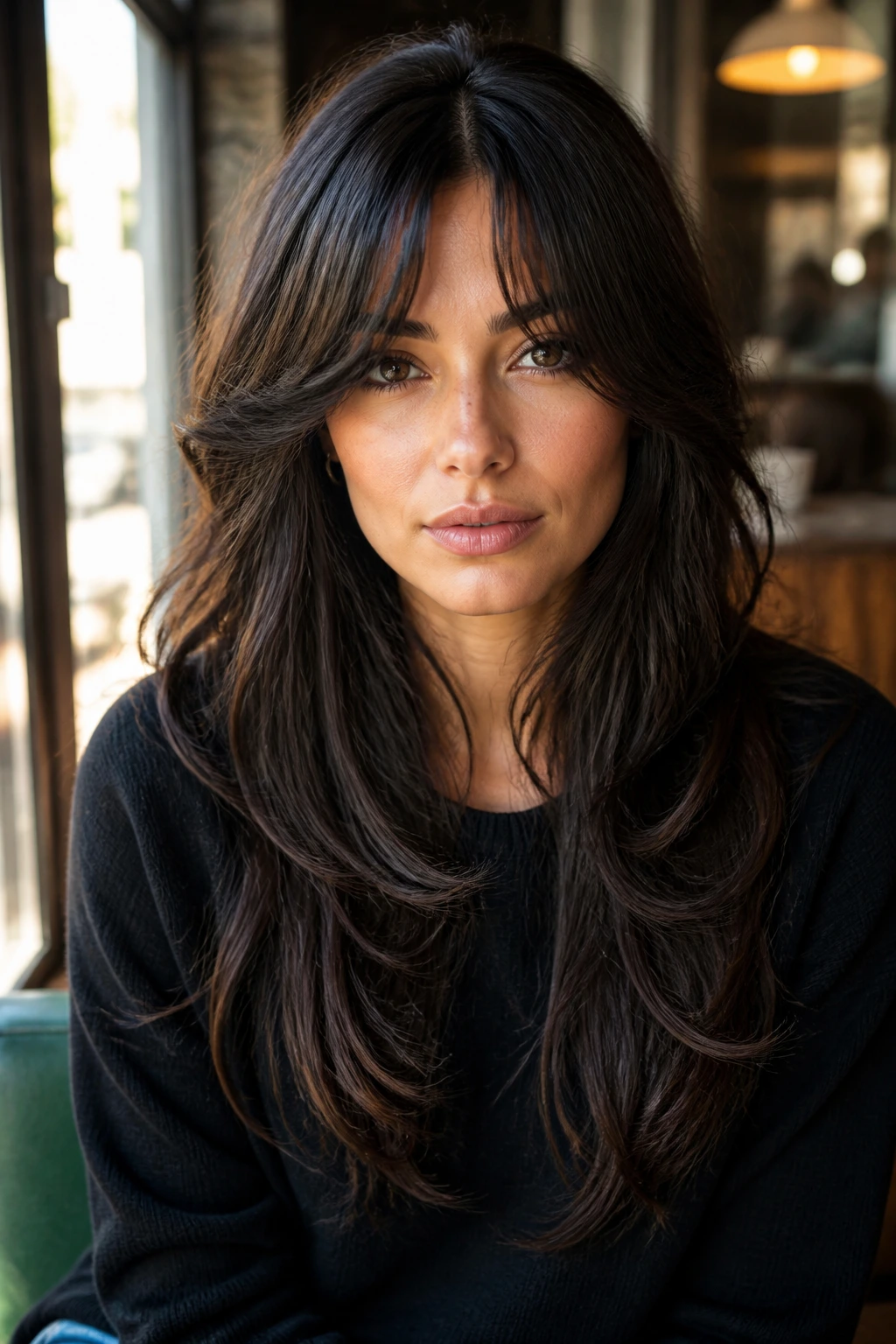
Bottleneck bangs are like curtain bangs’ quieter cousin. They’re narrower in the center, then open up as they move toward the temples, which makes them softer around thick dark hair than a heavy straight fringe. The rest of the hair can fall in long layers, so the bangs become the focal point without taking over the whole haircut.
This shape is especially useful if your forehead feels too exposed with a full curtain bang but you still want something around the face. On dense hair, the fringe has enough body to look deliberate, not wispy. And because it blends into long layers, you won’t get that awkward line where bangs end and the haircut begins.
It’s a nice compromise. Clean at the top, loose at the sides, and still full through the bottom.
12. Shoulder-Length Flip Layers
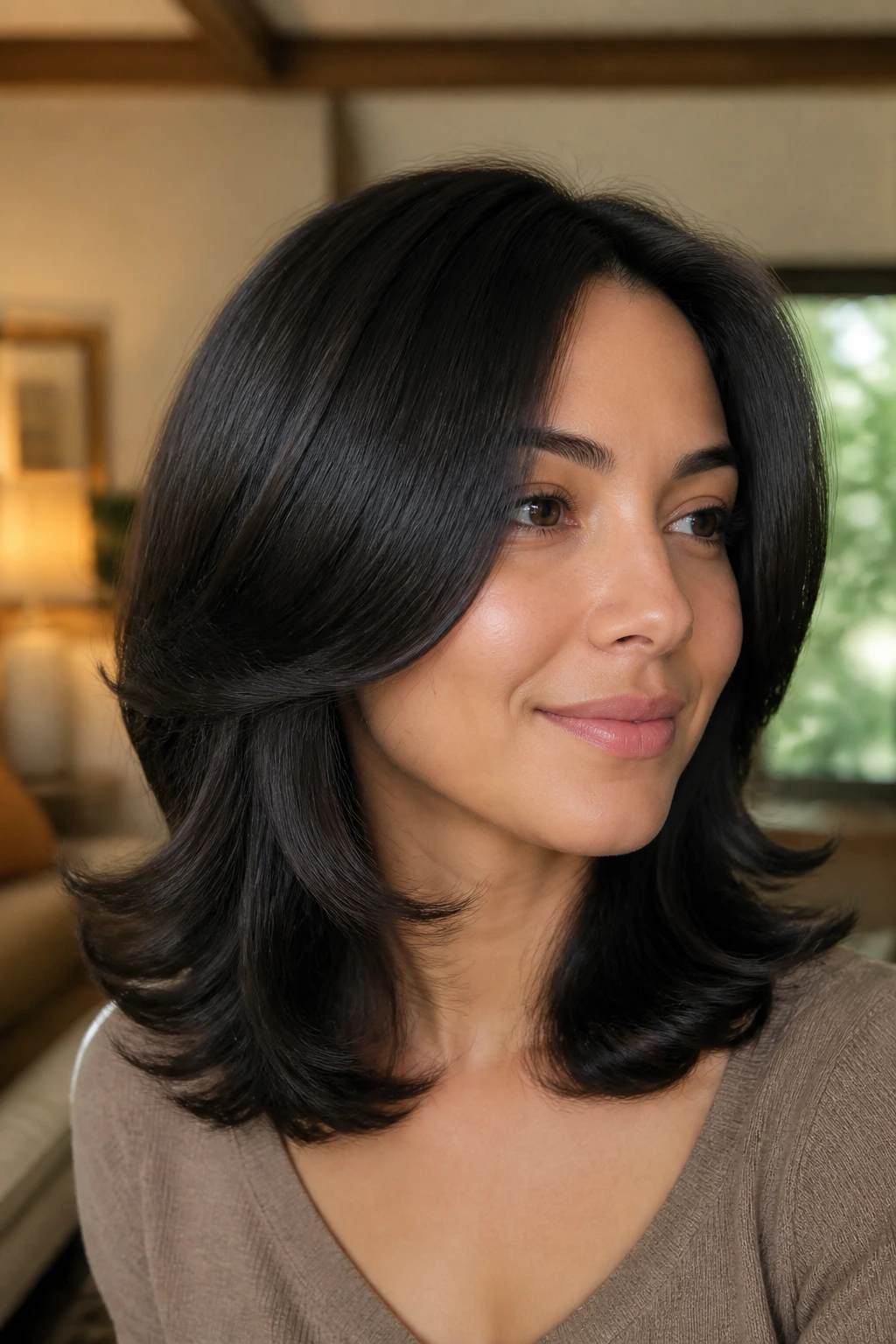
Shoulder-length thick hair has a habit of turning boxy right at the point where it hits the shoulders. Flip layers fix that. The cut puts movement through the ends so they bend outward or tuck inward instead of sitting like a solid shelf. On dark hair, that little bit of swing makes the shape much easier to read.
This haircut works well if you like the structure of a lob but want more life than a blunt line gives you. It’s also a smart choice for anyone who wears sweaters, collars, or jackets that tend to snag at the shoulder. The layers help the hair move away from the body instead of catching and puffing out.
I’d call this one polished with a little bit of motion. Nothing fussy. Just enough shape to keep thick hair from feeling stuck.
13. Deep Side-Part Layers That Build Volume
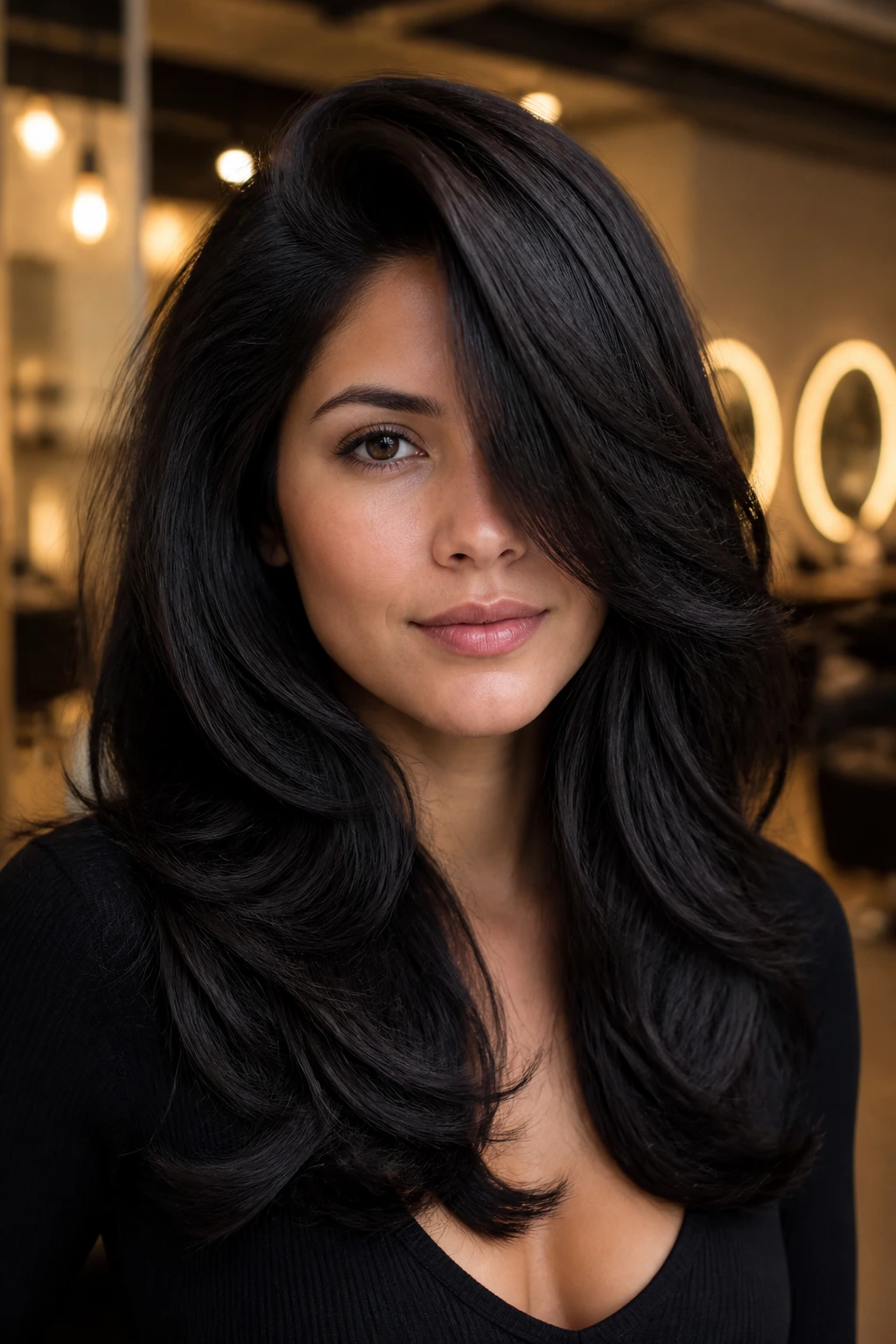
A deep side part can change a haircut without changing the cut itself, which is handy when your hair is thick but your crown stays flat. Shift the part over, and the heavier side gets a little lift while the opposite side drapes with more drama. That imbalance looks intentional when the layers are placed correctly.
This works especially well on dark hair because the deep side part creates a clear line through the top, and the layers around the face follow that line instead of fighting it. The haircut feels a bit glam, a bit old-school, a bit sharp. I like it on people who want volume without teasing the roots into oblivion.
If you have a stubborn cowlick, the side part can help or annoy you. Sometimes both. But when it lands right, it’s one of the simplest ways to make thick hair feel more styled.
14. Invisible Layers for Sleek Dark Hair
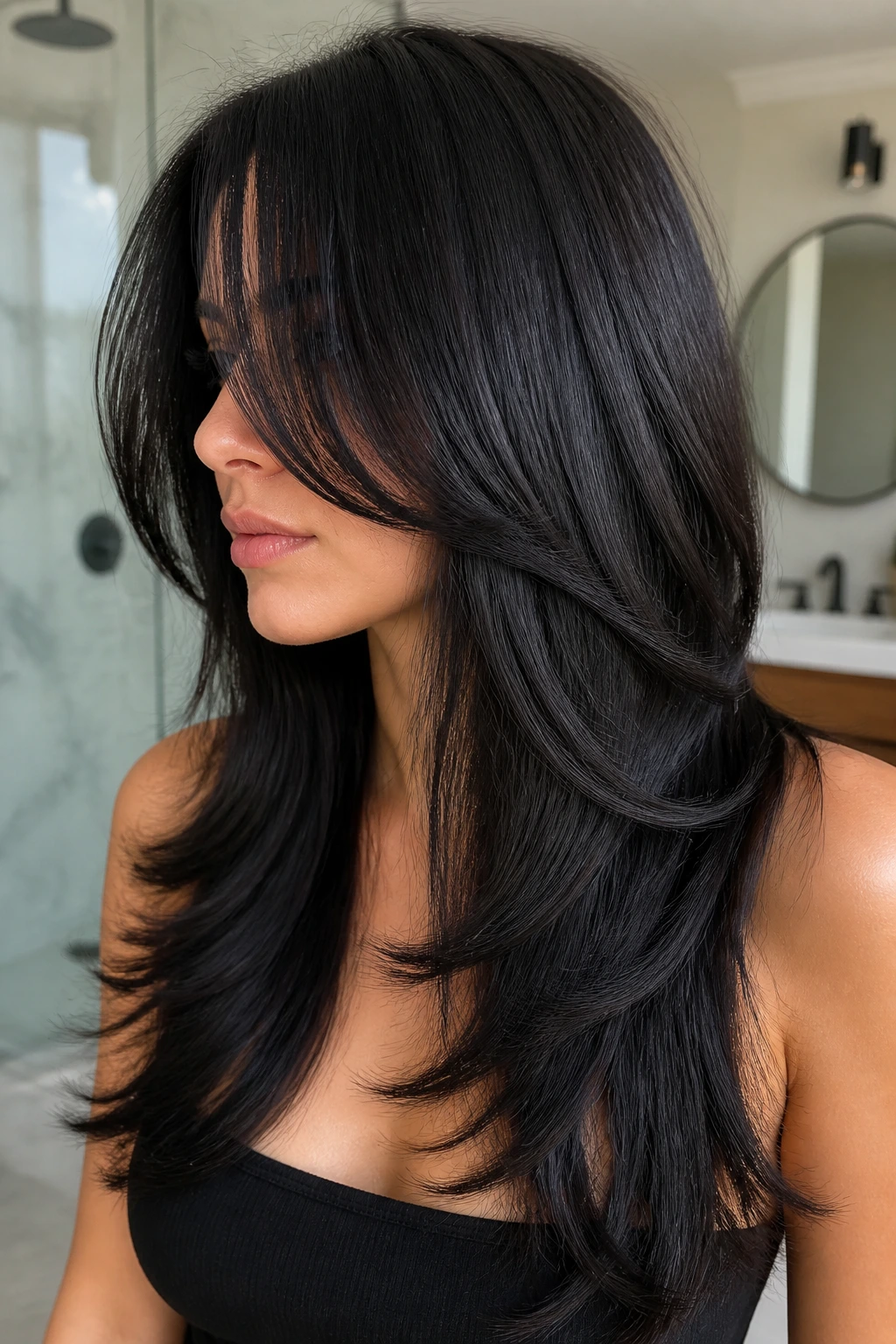
Invisible layers are for people who want thick hair to move better without looking layered at all. The exterior keeps a strong, smooth outline, while the interior is cut to remove bulk and stop the shape from ballooning out. On dark hair, this is especially useful because the glossy surface stays intact. You get shine and motion together.
I think this is one of the most underrated options for thick hair that lives in sleek blowouts or straight styles. The cut does not announce itself. It just makes the hair behave. The ends sit more evenly, the sides stop swinging out at odd angles, and the whole head looks cleaner from the back.
Why It’s Smart
- Keeps a blunt-looking surface
- Removes hidden bulk
- Makes straight styling much easier
Worth saying: If you hate obvious steps but still need movement, this is the one to ask about first.
15. Blunt Ends With Internal Layering
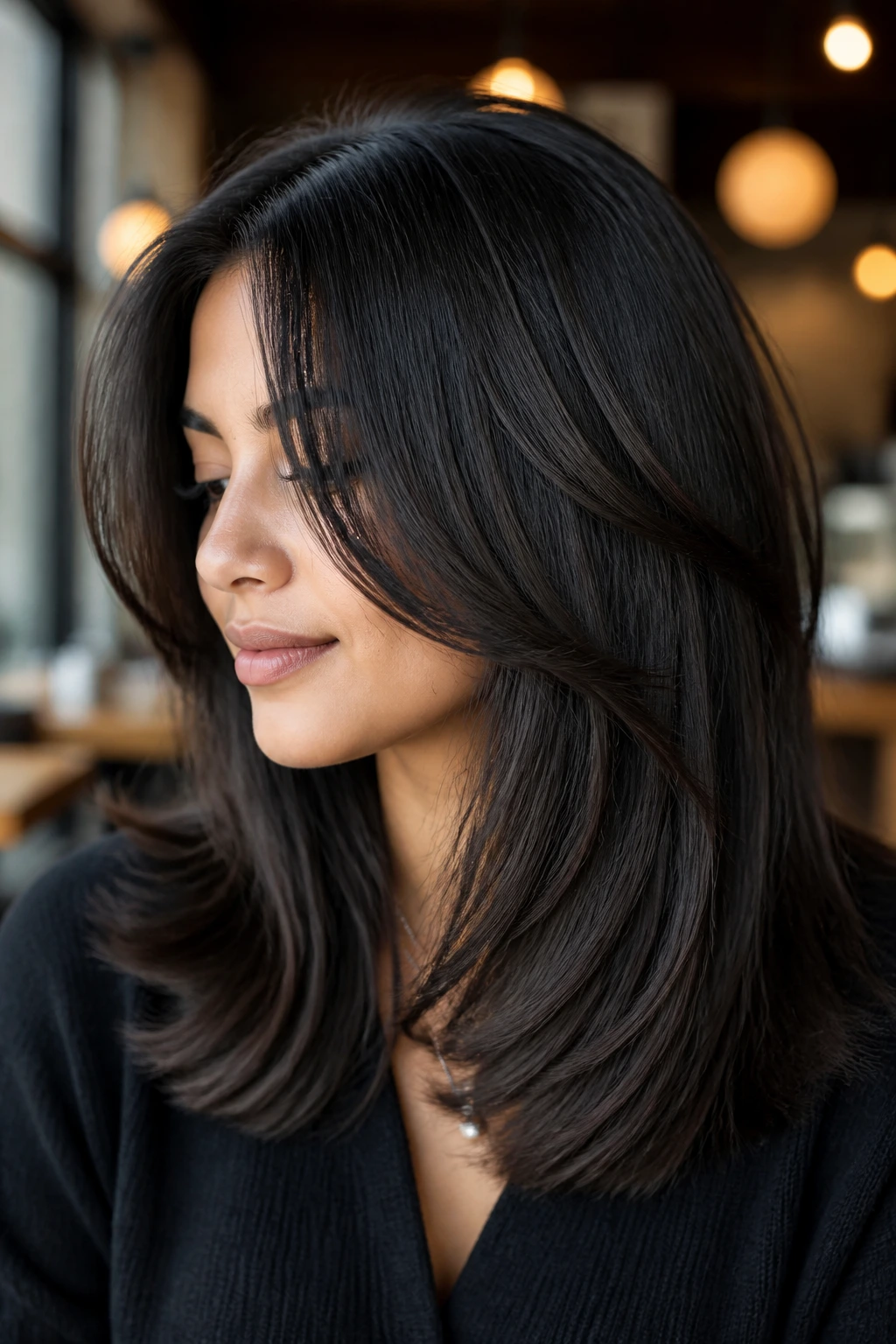
This is the cut for anyone who loves the feeling of thick hair but hates the way it can spread out wide at the sides. The ends stay blunt and heavy, which keeps the perimeter strong, while the interior layers take out some of the bulk that makes dense hair feel helmet-like. It’s a little bit of discipline, a little bit of softness.
The contrast is what makes it good. From a distance, it looks full and clean. Up close, it moves better than a totally blunt cut ever could. That matters on dark hair, where the outline often carries more weight than the texture does. A blunt edge with hidden layers keeps the silhouette sharp.
If you wear your hair straight, this cut is especially satisfying. The line at the bottom stays solid, but the mid-lengths stop acting like a wall.
16. Extra-Long Cascade Layers
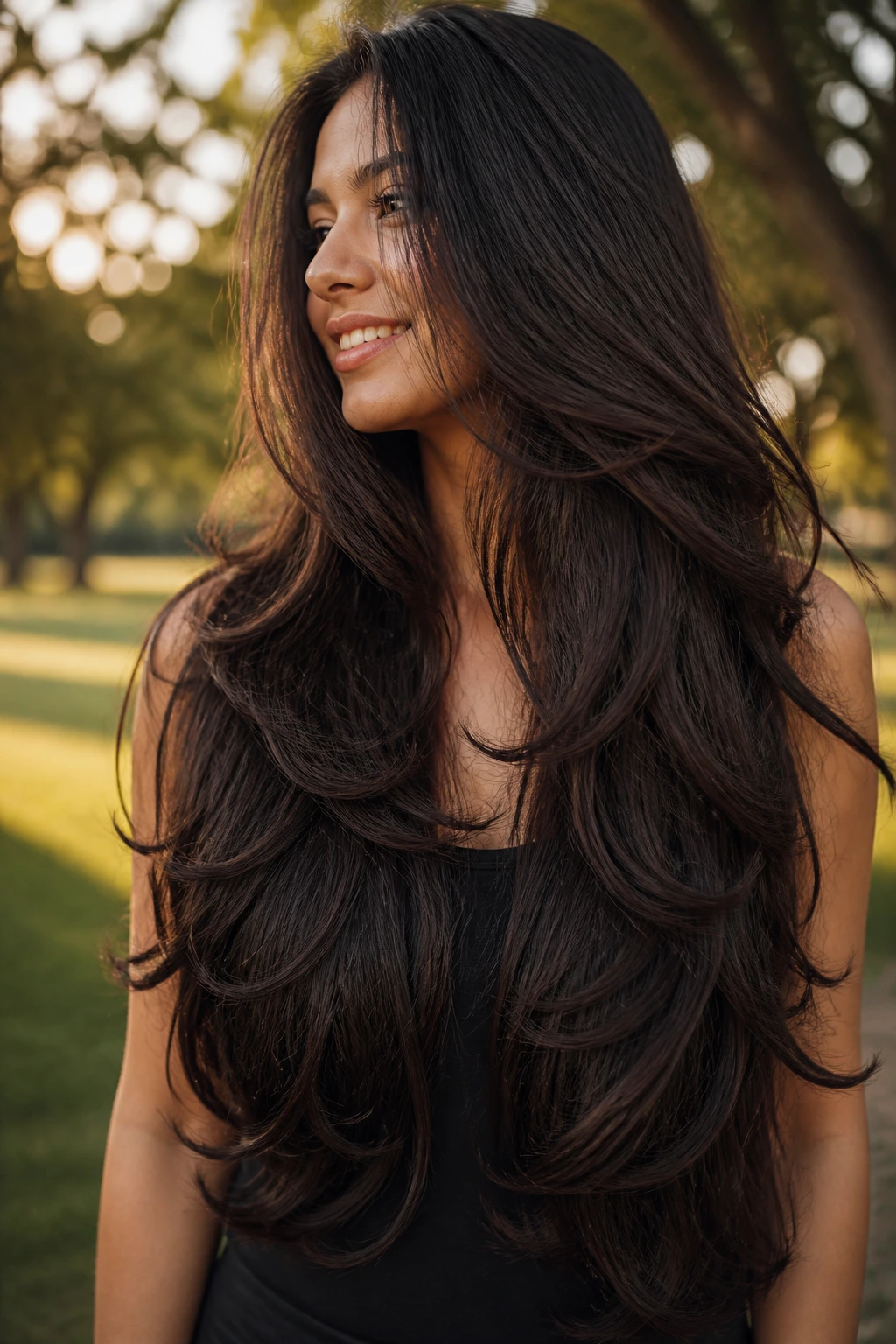
Very long thick hair can lose shape in a hurry if all the weight sits at the bottom. Extra-long cascade layers keep the top and mid-lengths moving while preserving enough length for braids, buns, and all the usual heavy-hair survival tactics. The layers start low, then step down gradually so the whole thing falls like fabric instead of rope.
This style is useful if you want long hair to look intentional from every angle. Dark shades show the cascade well, especially when the ends catch light after a blowout or soft wave. It’s a shape that rewards movement. The more the hair swings, the better it looks.
Good Clues for This Cut
- Layers begin below the chin or bust line
- The longest lengths stay thick at the ends
- The back gets motion without losing the dramatic length
Pro tip: Ask your stylist to check the cut while your hair is dry if it tends to spring up. Thick hair can lie to you when it’s wet.
17. Chin-Grazing Midi Layers

A chin-length midi cut can be a sweet spot for thick dark hair because it gives you enough length to tuck, clip, and wave, but not so much that the weight drags everything down. The layers around the chin and neck stop the shape from feeling boxy, and the result is lighter without looking chopped up.
This is a good option if your hair always looks heavier than the length suggests. A lot of thick hair loses personality once it gets past the shoulders. This cut changes that. It builds movement where people can actually see it, especially around the face and collarbone.
I like it for people who want a real haircut, not just a trim that removes a quarter inch and calls it a day.
18. Crown Layers for Straight Thick Hair
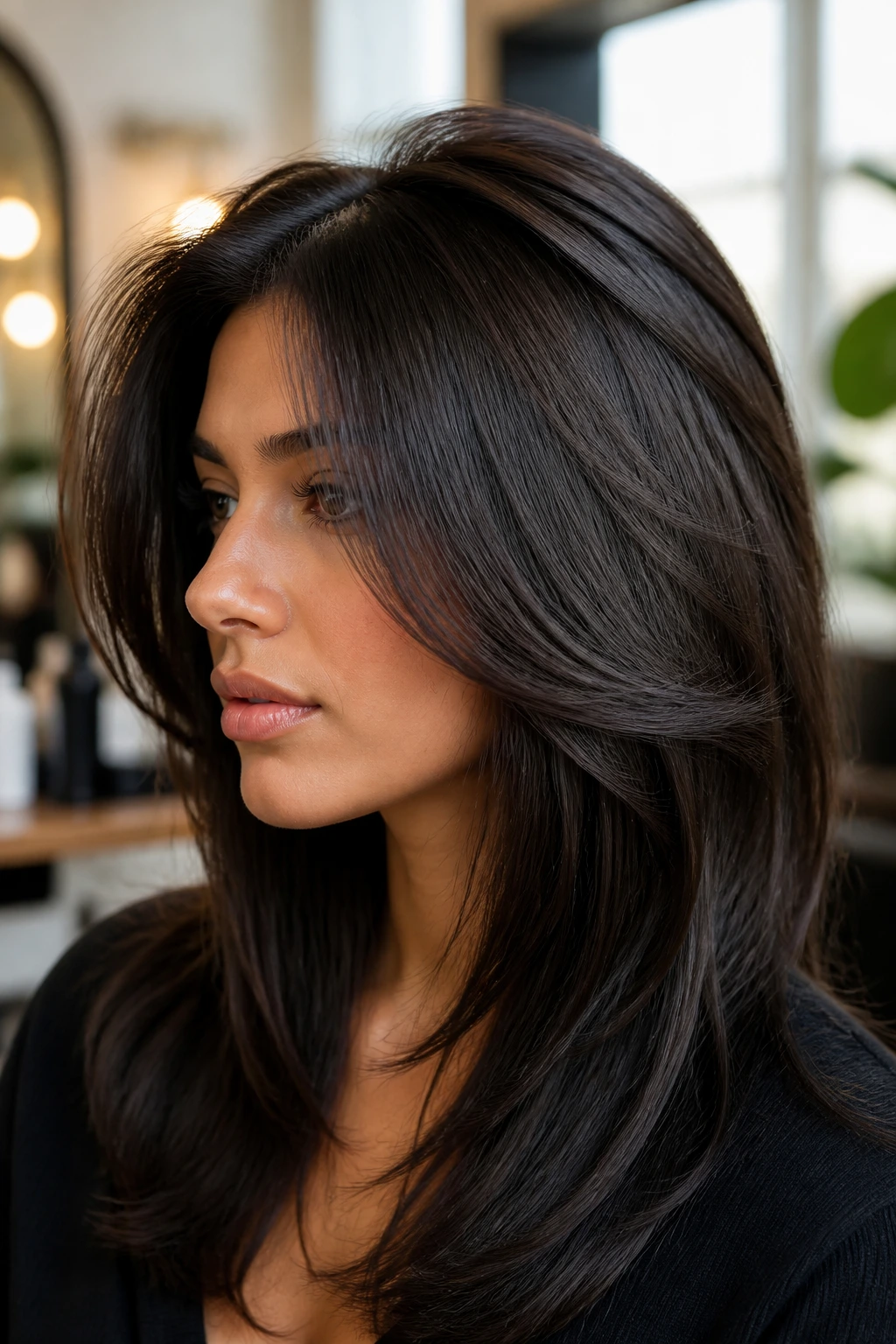
Straight thick hair can look deceptively simple until you cut it wrong. Then it turns into a flat top and a too-heavy bottom, which is a bad deal. Crown layers solve that by removing some weight at the top and upper mid-lengths so the hair lifts instead of sitting like a cap.
This cut is great if your roots go flat fast but the rest of the hair has a lot of body. The shorter crown layers create a little height, while the lower lengths stay long enough to keep the density. On dark hair, the change in shape shows clearly once you add a bend or a blowout.
A root clip or a quick round-brush lift at the crown makes the difference between “nice haircut” and “oh, that has shape.”
19. Tapered Soft Layers With a Polished Finish
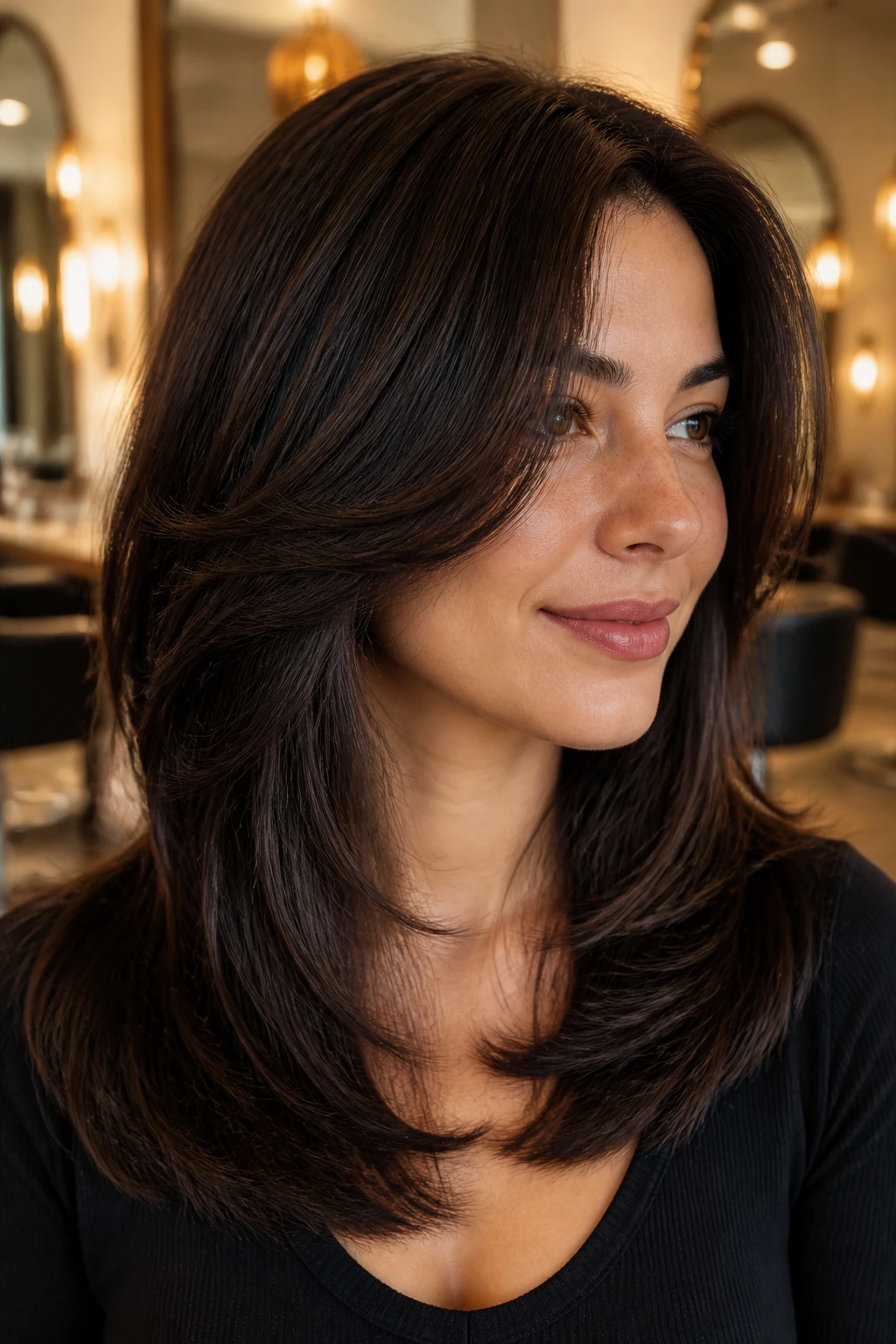
If you want one layered haircut that can go soft, sleek, or a little undone without looking like it’s trying too hard, this is the one I’d put in the front of the stack. The taper starts gently around the face and becomes more noticeable through the lengths, which keeps thick dark hair from feeling blunt and rigid. It’s controlled. Not stiff.
The polish comes from the way the layers blend. There are no harsh shelves, no obvious holes, no over-texturized ends. Just a smooth drop from the top into the mids and then a soft finish at the bottom. That makes the cut easy to wear with straightening, a loose wave, or a rounded blowout.
It’s the most flexible of the bunch. The kind of cut that can dress up for dinner and still survive an ordinary Tuesday without looking embarrassed.
Why Thick Dark Hair Needs Layers That Respect Weight
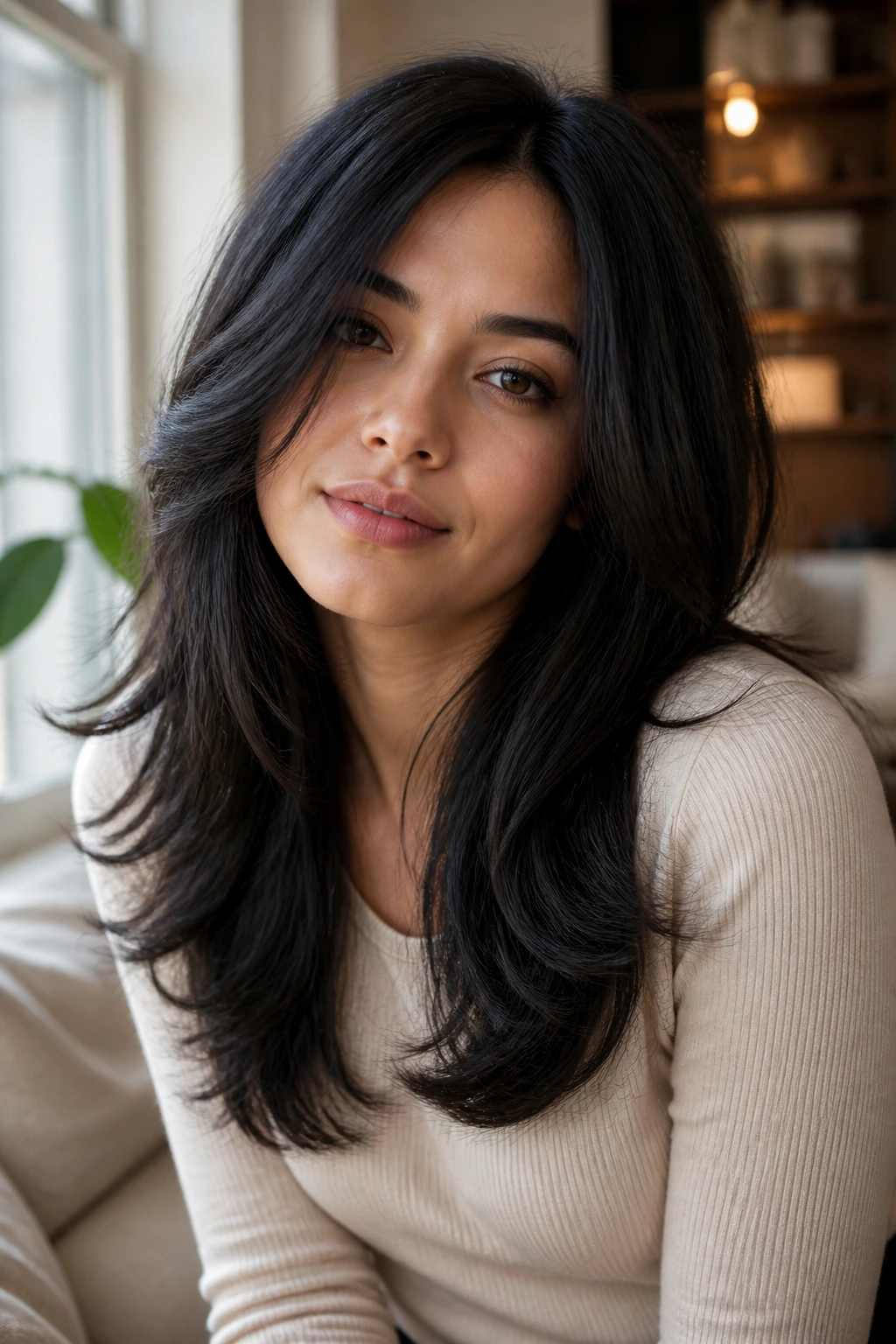
Thick hair is not one thing. Density, strand width, and texture all behave differently, and dark hair tends to exaggerate the shape problem because the color hides detail. A blunt cut on dense black hair can look lush for about five minutes. Then the ends gather, the sides widen, and the whole shape starts reading heavy. That’s not a styling failure. It’s a structure issue.
The best layered cuts for dark hair work in sections. They lighten the crown if it sits flat. They break up the middle so the sides don’t flare out. They keep enough perimeter weight that the ends still look full, because thin ends on dark hair can look scraggly faster than people expect. The goal is controlled movement, not a shredded finish.
There’s also the matter of shine. Dark hair reflects light beautifully when the surface is smooth and the outline is tidy. If the haircut is over-thinned, all that shine gets interrupted by fuzzy ends. If it’s too blunt, the shine sits there without motion. The sweet spot is a cut that lets the hair move but still keeps the line solid. That’s what makes these shapes work in real life, not just in photos.
How to Choose the Right Layer Pattern for Your Length and Texture
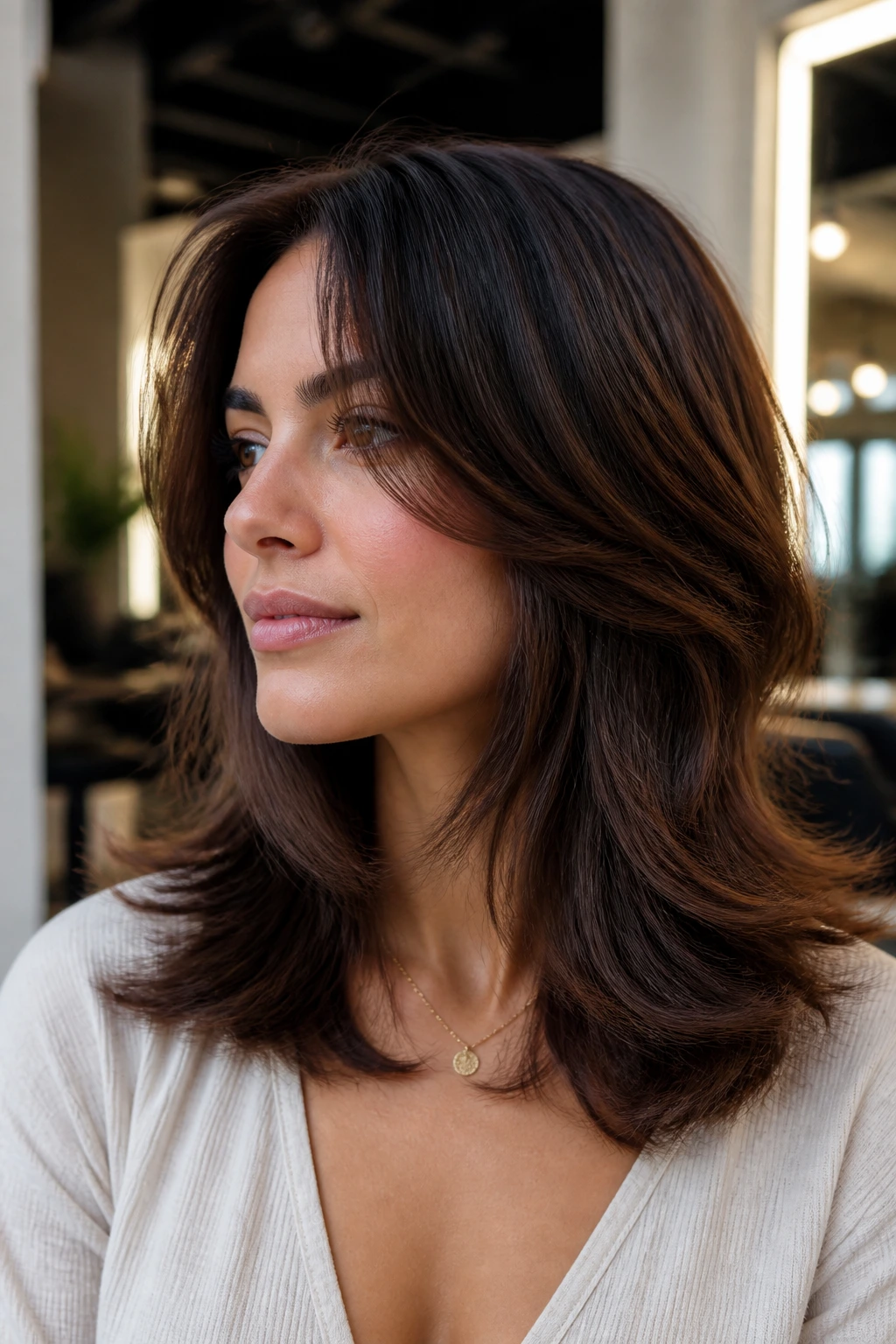
Start with length, because thick hair behaves very differently at the collarbone than it does halfway down the back. Long hair can handle lower, softer layers without losing its identity. Shoulder-length hair usually needs internal weight removal or a stronger front frame so it doesn’t puff out. Shorter thick hair often needs crown work to stop the top from sitting flat and the bottom from ballooning.
Texture matters just as much. Straight thick hair usually needs more structural shaping to keep it from hanging like a curtain. Wavy hair can take a more visible layer pattern because the natural bend helps the cut. Curly hair usually wants rounded layering, not choppy slicing, or the volume spreads sideways in a hurry. That’s the part people miss when they copy a screenshot and call it a plan.
A Simple Way to Decide
- If you hate losing length: start with invisible layers, a U-shape, or long cascades.
- If your roots are flat: butterfly, crown layers, or a deep side part will help.
- If your ends feel like a block: shag, tapered soft layers, or a V-cut can loosen them up.
- If you want low-styling effort: rounded layers or internal layering usually grow out better.
And please, bring a photo that shows the hair from the front, side, and back if you can find it. One picture of a glossy front view is not enough. Never has been.
The Salon Kit: What to Bring and Ask For
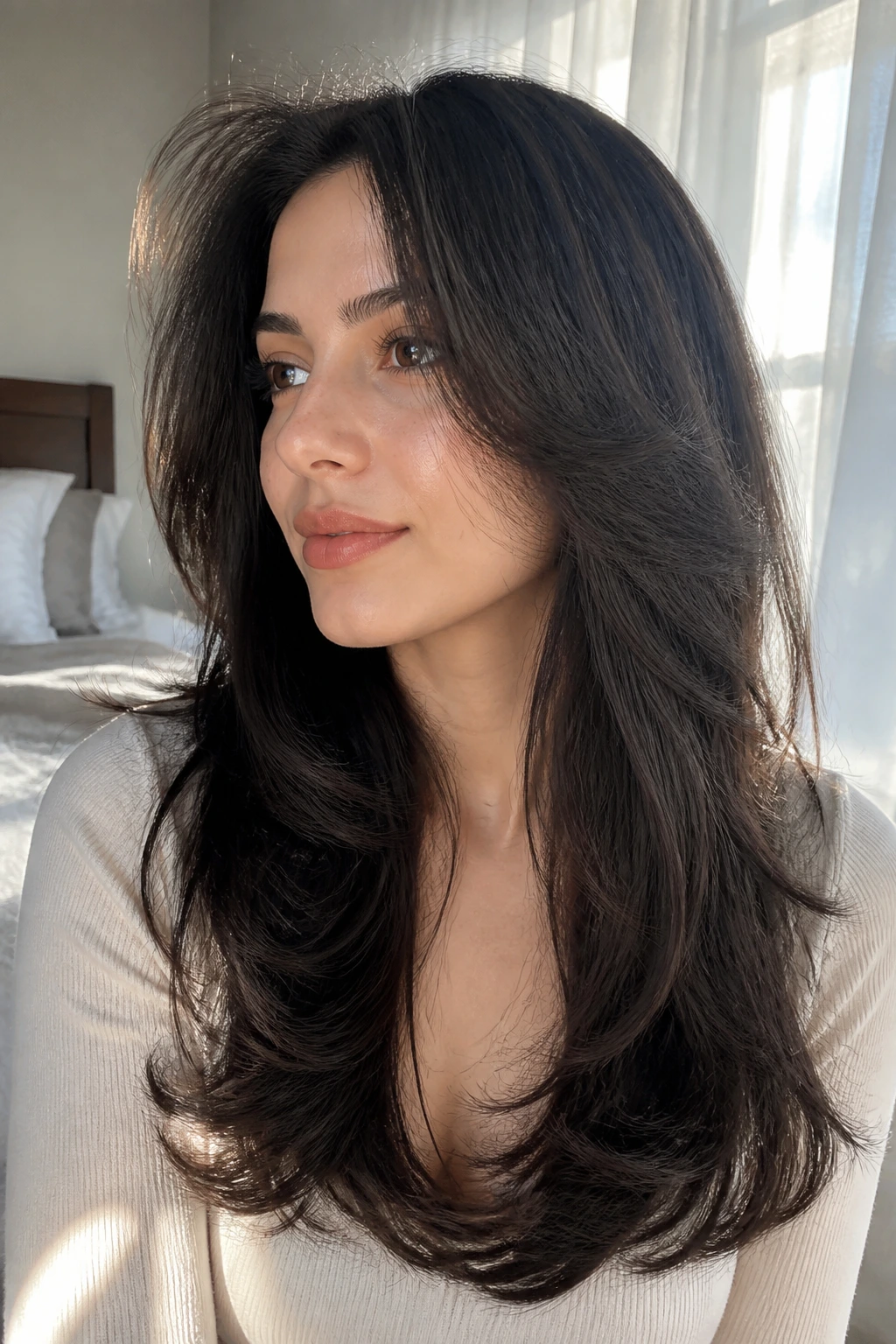
A good haircut starts before the stylist touches the scissors. Bring 2 to 3 reference photos, not 12. One should show the front, one the back, and one the texture you actually want. If your hair is thick and dark, the wrong photo can be misleading because lighting hides bulk. Pick images where you can see the perimeter, not just the color.
Tell your stylist how you wear your hair most days. Center part, side part, blowout, air-dry, bun, clip, flat iron — all of it matters. Thick hair cut for a smooth blowout can look very different from thick hair cut for a wash-and-go wave. If your crown goes flat or your ends puff up, say that out loud. Those details are the map.
Useful Tools and Resources
- Reference photos: Bring clear front and side shots so the layer length is obvious.
- Wide-tooth comb: Good for checking how hair falls naturally after a wash.
- Sectioning clips: Helpful if you want your stylist to show you how the layers are placed.
- Round brush: Necessary for styles like butterfly cuts, flip layers, and crown-lift cuts.
- Blow dryer with a concentrator nozzle: Helps smooth thick hair and direct the shape instead of blasting it wide open.
- Heat protectant: Worth using every time you style with heat, especially on dark hair that shows frizz quickly.
- Texturizing spray or mousse: Useful for shaggy, piecey finishes and root lift.
- Light serum: A tiny amount on the ends keeps the surface smooth without flattening the cut.
Styling Dark Layered Haircuts So the Shape Actually Shows
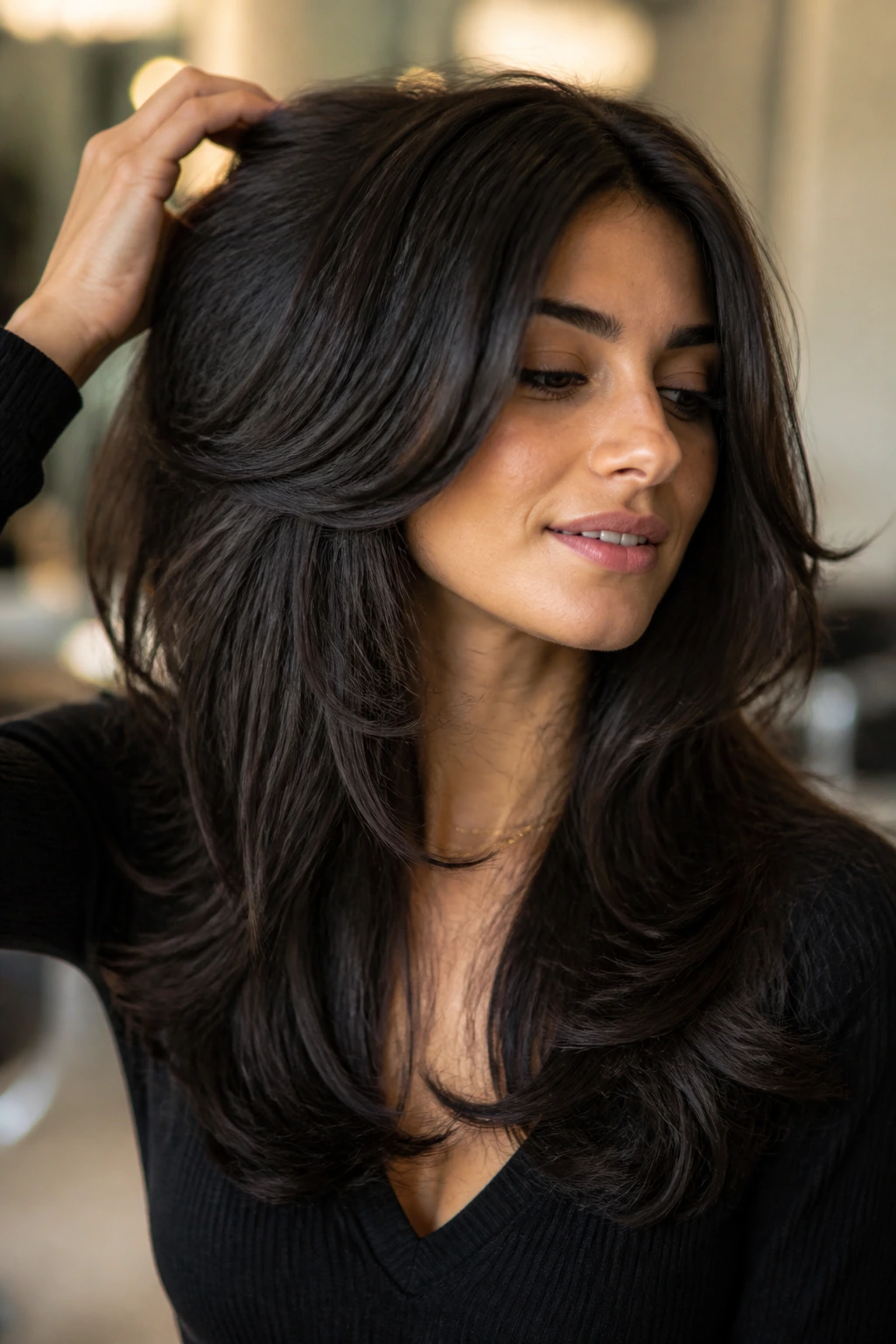
A layered haircut on thick dark hair can disappear if you let it dry with no direction. That’s the truth. The layers are there, but the weight of the hair pulls the shape back into one mass unless you give it some help. You do not need a salon routine every morning, but you do need to aim the hair a little.
For blowouts, start by drying the roots in the opposite direction of your part. It gives the crown lift without teasing. Then move to a medium round brush and bend the mid-lengths just enough to show the layers, not enough to curl them into a pageant wave. That gentle bend is what lets dark hair read as layered instead of one dark block.
Air-drying works better on some cuts than others. Shags, rounded layers, and curtain-bang styles often like a little mousse and a scrunch. Sleeker cuts usually need a serum at the ends and maybe a quick touch with a large-barrel iron on the face frame. The point is not perfection. The point is keeping the outline alive.
Practical Tips for More Movement Without Losing Density
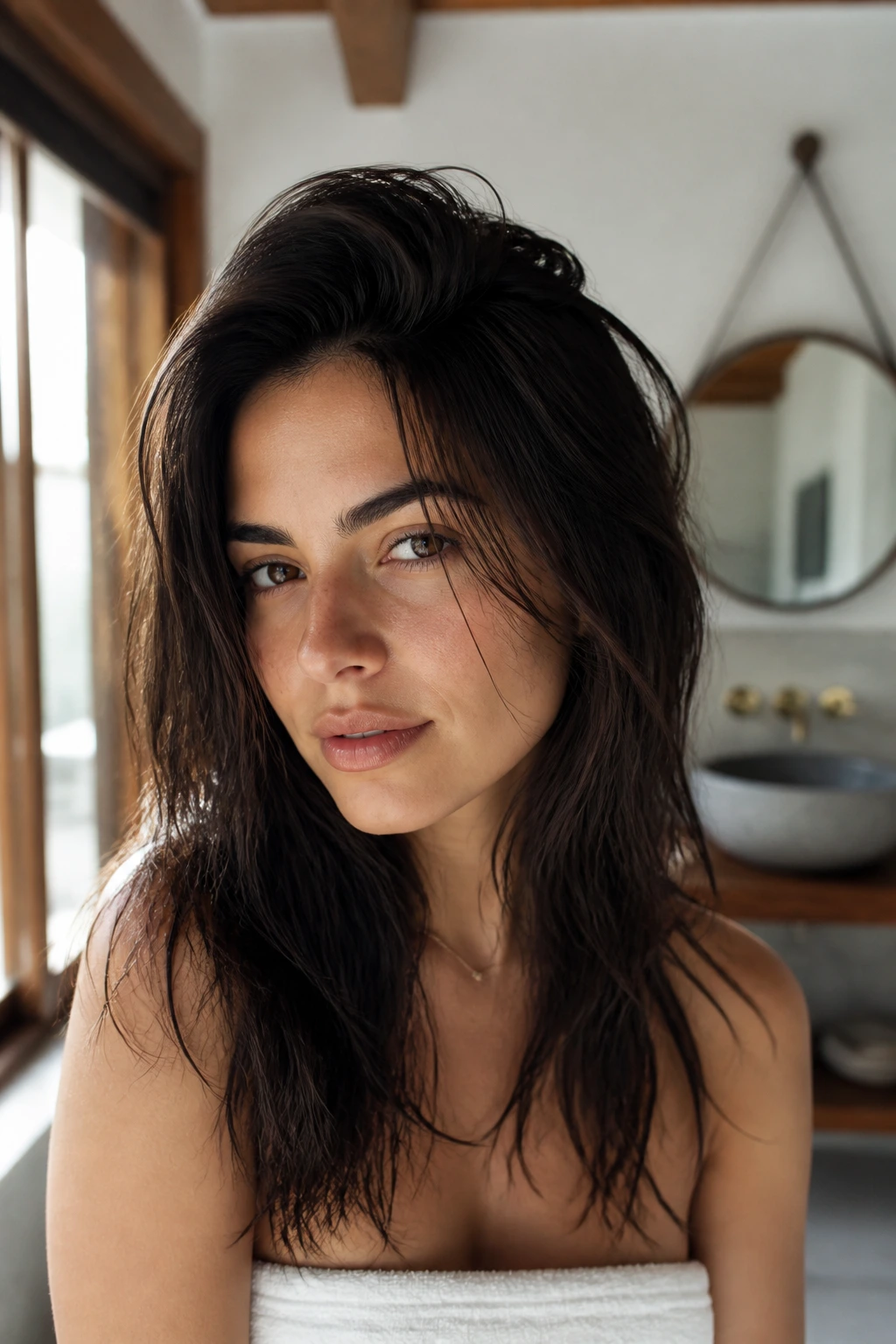
Root Lift: A small amount of volumizing mousse at the roots does more than people think, especially on thick dark hair that settles flat at the top. Work it in while the hair is damp, not after it’s already half-dried and stubborn.
End Control: Keep lightweight serum or cream only on the last few inches. Thick hair can handle a little moisture, but if you coat the mids and roots, the layers collapse and the whole haircut feels sleepy.
Brush Direction: Blow-dry the front pieces away from the face for a few seconds at the end. That tiny move makes face-framing layers show up instead of tucking under and disappearing.
Night Routine: Sleep on a loose silk scrunchie or a satin pillowcase if your hair tangles easily. Thick hair loses shape through friction, and once the layers knot up, the cut looks heavier the next morning.
Gloss Matters: Dark hair shows dullness faster than people expect. A clear gloss or shine spray can make the layers look sharper because the light moves across the surface more cleanly. That’s not vanity. It’s part of the haircut reading well.
Mistakes That Make Thick Hair Look Bulky or Stringy
-
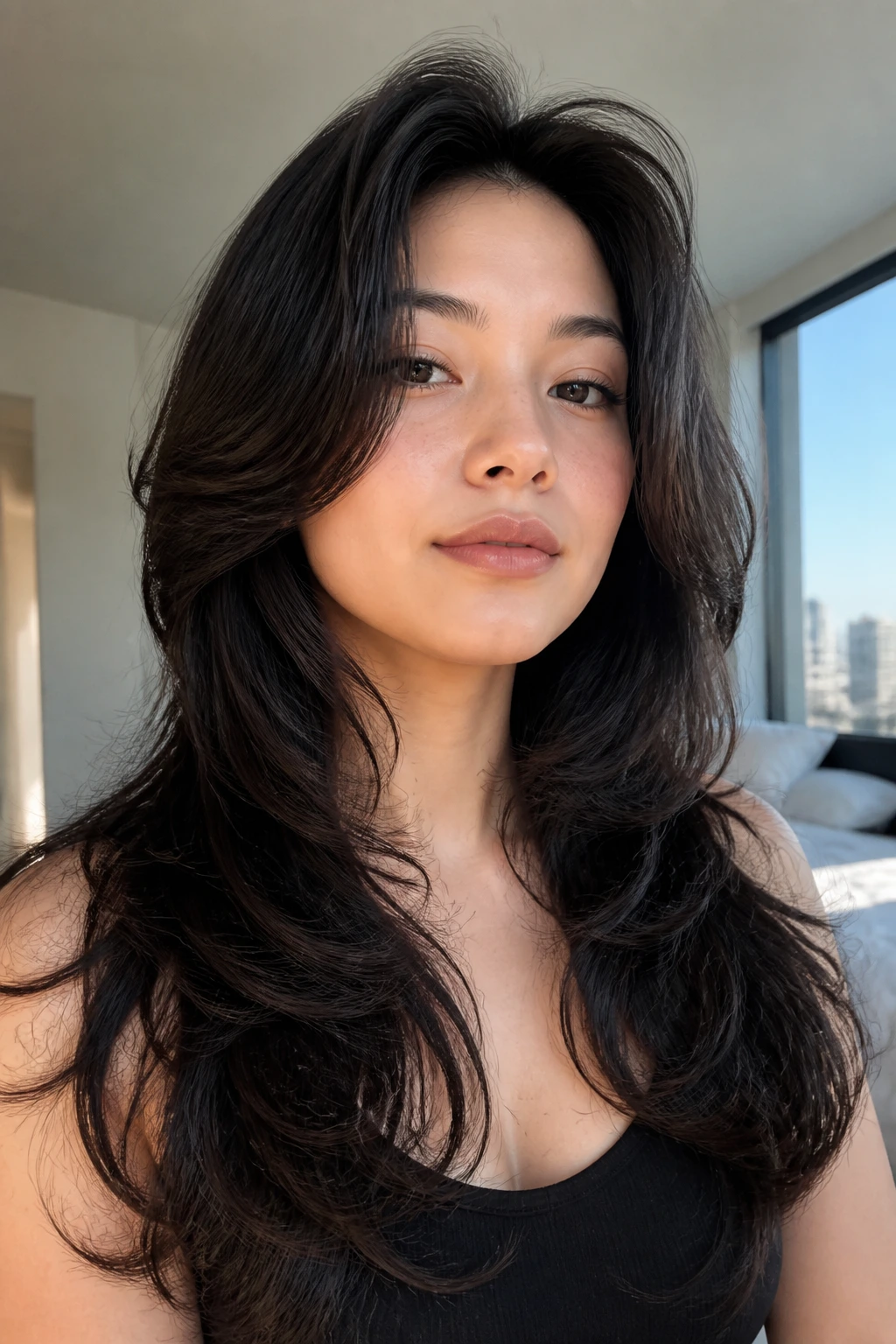
Removing weight in the wrong place: If the bulk is at the ends and the stylist thins the crown, you’ll still get that wide bottom line. The fix is to place the layers where the hair actually sits heavy.
-
Over-texturizing the ends: Thick hair can take some shaping, but too much texturizing leaves the ends frayed. On dark hair, frayed ends stand out because the surface loses its clean edge. Ask for controlled point cutting instead of aggressive thinning if your hair is already dry.
-
Starting layers too high: When short layers begin too close to the scalp, thick hair can puff out like a mushroom. That shape might look cute for five minutes in a mirror, then weird in real weather. Keep the shortest pieces deliberate, not random.
-
Ignoring your part: A cut that looks balanced on a center part may fall apart on a deep side part, and vice versa. Wear your hair the way you actually wear it before the appointment, not the way the photo model does.
-
Skipping the trim schedule: Thick hair forgives a lot, but not forever. Once the layers grow past their sweet spot, the shape gets thick in all the wrong places. The fix is a trim before the outline turns dull.
Variations and Alternative Approaches for Different Moods
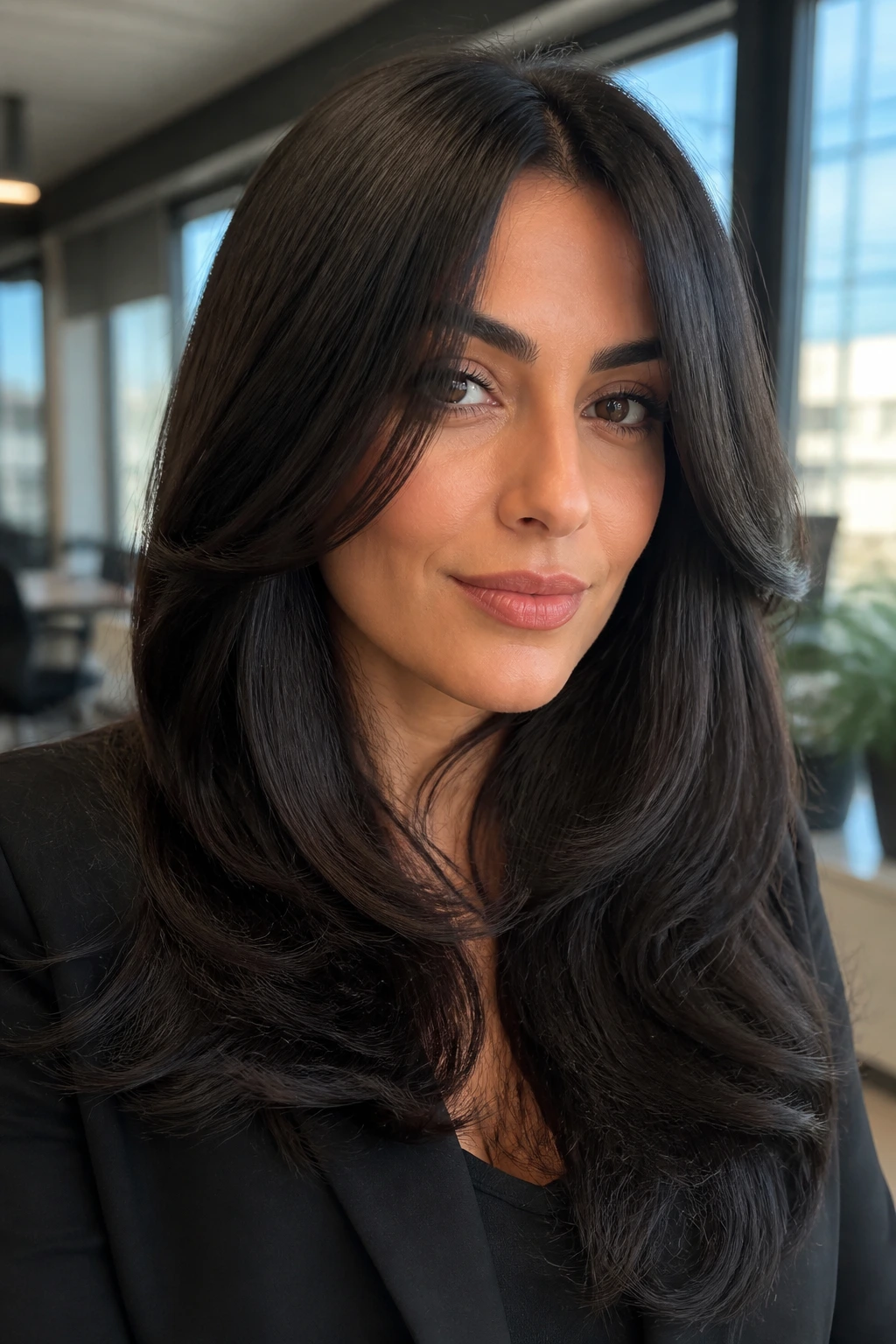
The Sleek Office Cut: Choose invisible layers or blunt ends with internal cutting if you want a polished look that stays serious in meetings and still moves when you turn your head. It’s a strong choice for dark hair because the gloss stays front and center.
The Air-Dry Cut: Go with a modern shag, rounded layers, or curtain-bang layering if you want your natural texture to do most of the work. These cuts let thick hair dry into shape instead of fighting it.
The Soft Romantic Version: Ask for long face-framing layers, bottleneck bangs, and a rounded perimeter if you want the hair to feel gentle around the face. This is the one that pairs well with loose waves and a little bend at the ends.
The Edgier Version: A razor shag or a more obvious butterfly cut gives thick hair sharper movement and a little attitude. It’s cleaner when styled, messier when it grows out, and that’s part of the charm.
The Low-Maintenance Long Hair Version: Extra-long cascades and a U-shape work if you want to keep the length and avoid constant salon upkeep. They grow out gracefully and still keep enough structure that the ends don’t feel like dead weight.
Keeping the Cut in Shape Between Appointments
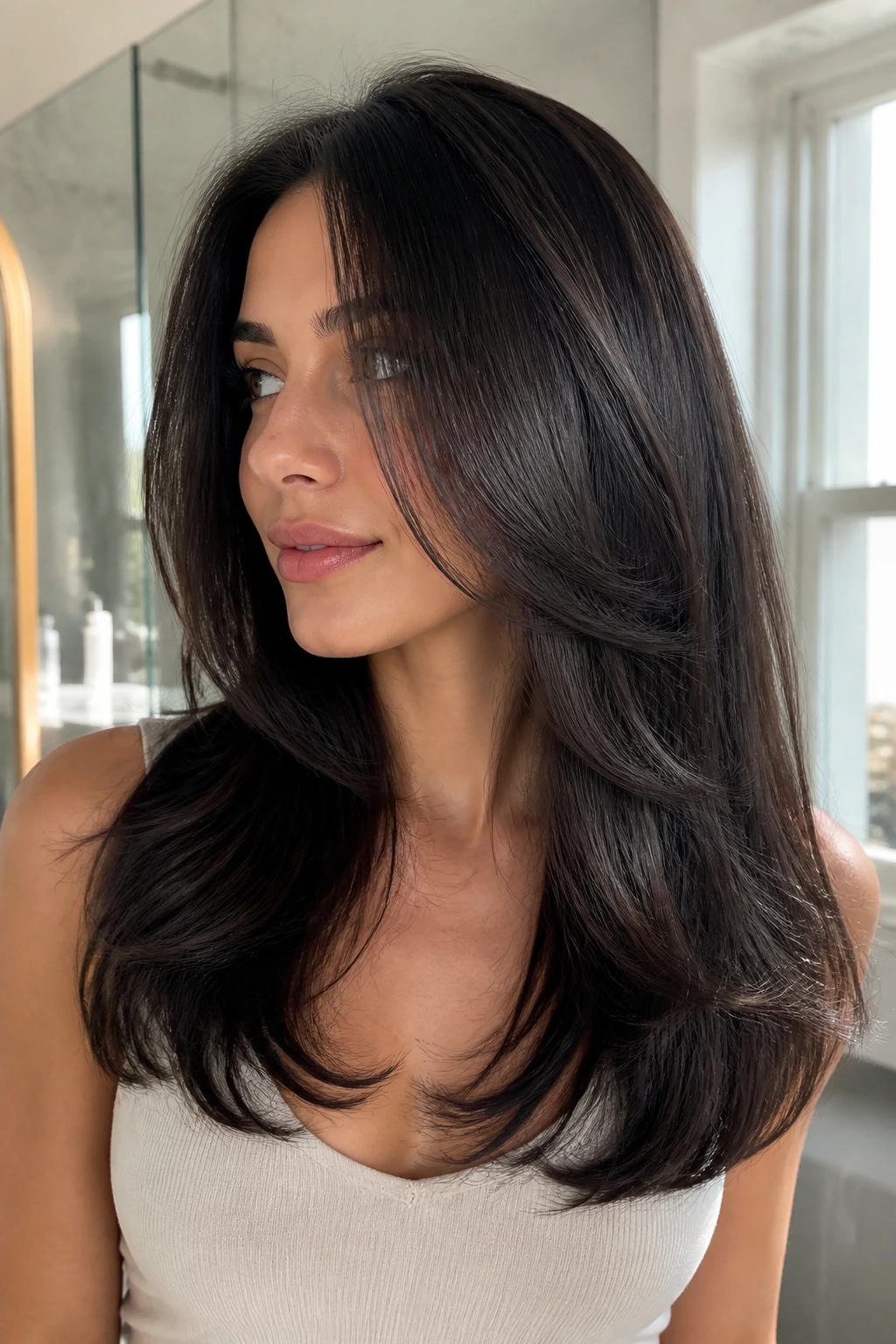
Thick dark hair usually needs regular shape maintenance, not because it falls apart fast, but because it grows into its old bulk before you notice. A trim every 8 to 12 weeks keeps the layer pattern readable. If you wear bangs, expect those to need attention every 3 to 5 weeks or they’ll drift into your eyes and stop doing their job.
If your hair is color-treated dark, a gloss treatment or shine-focused conditioner can help the layers keep their crisp look. Dark hair shows buildup faster than people expect, especially around the roots and behind the ears. A clarifying wash once every 1 to 2 weeks can help if the hair starts feeling coated or heavy. Don’t overdo it. Thick hair needs moisture too, especially at the ends.
At night, a loose braid, a satin pillowcase, or a low pony keeps the layers from tangling into a puffball. In the morning, a quick refresh with water mist at the face frame and a bit of mousse at the roots can bring the shape back without starting over. If the cut is a good one, the grow-out should soften, not collapse. That’s the real test.
Questions People Ask Before They Sit in the Chair

Will layers make thick hair look thinner?
Not if they’re cut well. The right layers remove bulk and add movement while keeping enough perimeter weight that the hair still looks full.
What’s better for thick dark hair: scissors or a razor?
Scissors are safer for most people. A razor can create lovely texture, but it can also rough up the ends if the hair is dry or porous.
How short should the first layer be?
That depends on the shape you want, but cheekbone to collarbone is a common range for face-framing layers on thick hair. Shorter than that can get dramatic fast.
Can thick hair do a shag without looking puffy?
Yes, if the layers are placed with control and the ends aren’t over-thinned. A shag should remove bulk, not explode the shape sideways.
What if my hair is straight and heavy?
Look at crown layers, invisible layers, or a butterfly cut. Straight thick hair usually needs shaping near the top so it doesn’t fall flat.
How do I ask for layers without losing length?
Tell the stylist you want to keep the perimeter and remove weight internally or below the shoulders. Those phrases are clear and hard to misunderstand.
Do dark haircuts need more styling than light haircuts?
Not more because of color, but dark hair does show flatness and frizz more clearly in the shape. A little smoothing or lift at the roots goes a long way.
A Shape That Keeps Up With Thick Hair
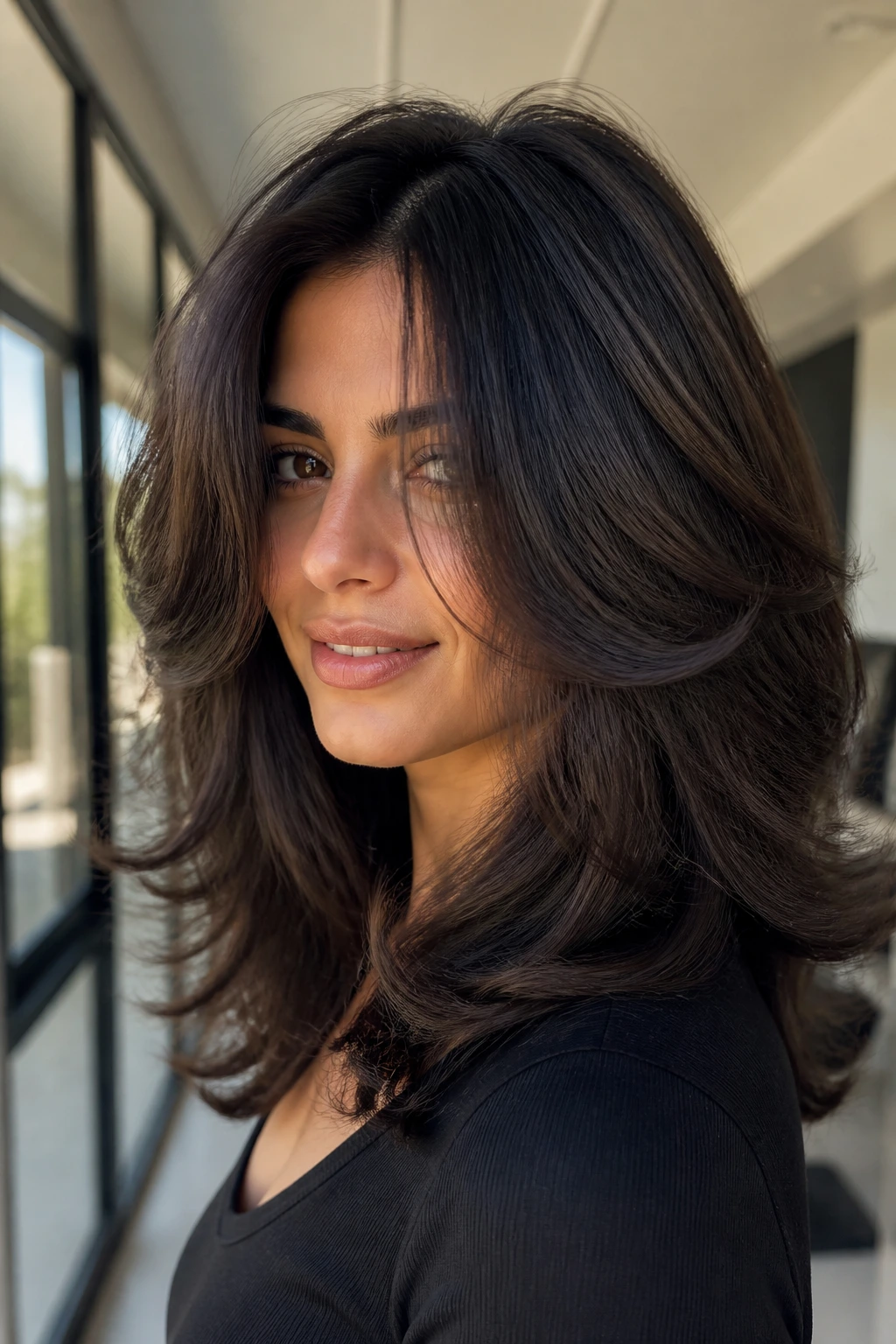
Thick hair is generous, but it can be stubborn. Dark hair makes that stubbornness more visible, which is exactly why the cut matters so much. When the layers are placed with care, the hair stops fighting the silhouette and starts showing it off. The result is movement, shine, and a line that still looks good on the third day, not just when you leave the salon.
The best layered haircut is the one that respects the weight you already have. Keep that in mind, and the rest gets easier. The right shape is out there, and thick dark hair can carry it better than almost any other texture.
19 Dark Layered Haircuts for Thick Hair — Recipe Card
Recipe Name: 19 Dark Layered Haircuts for Thick Hair
Description: A curated collection of layered haircut ideas designed to control bulk, add movement, and show off the depth and shine of dark, thick hair. Includes long, medium, shaggy, polished, and low-maintenance options.
Prep Time: 0 minutes
Cook Time: 0 minutes
Total Time: 0 minutes
Course: Hairstyle Inspiration
Cuisine: Beauty / Hair
Servings: 19 haircut ideas
Calories: N/A
Ingredients
- 1 reference photo that shows the front
- 1 reference photo that shows the side
- 1 reference photo that shows the back
- 1 clear note about your current part
- 1 clear note about how you style your hair most days
- 1 plan for how much length you want to keep
- 1 stylist who is comfortable with thick hair shaping
Instructions
-
Choose the layer pattern that matches your length, density, and styling habits.
-
Bring reference photos that show the silhouette, not just the color.
-
Tell the stylist where your hair feels heaviest, especially at the crown, sides, and ends.
-
Ask for the specific shape you want: long layers, butterfly cut, shag, U-shape, V-cut, or internal layering.
-
Style the haircut with the right amount of root lift, smoothing, or texture so the layers show.
Notes: Thick dark hair usually looks best when the ends stay full and the bulk is removed in the right places. If you want the shape to stay crisp, plan on regular trims and a small amount of styling direction.
