



Hair changes after 60. So does patience.
A cut that looked polished with a quick blow-dry in the past can start acting like a small rebellion at the temples, around the crown, or right at the fringe. That’s why short hairstyles for women over 60 with bangs earn their keep so well: they give shape back without asking you to fight your hair every morning. A good fringe can soften the forehead, pull attention toward the eyes, and make a short cut feel finished even when you’ve done almost nothing to it. Almost nothing. That part matters.
The sweet spot is usually not a heavy wall of hair across the brow. It’s a fringe with some give — side-swept, wispy, feathered, piecey, or softly rounded — paired with a cut that respects your texture instead of bullying it into submission. I like styles that leave room for a cowlick to behave, a pair of glasses to sit cleanly, and a normal day to happen without a two-hour styling ritual.
Why These Short Banged Cuts Feel So Right
-
They remove weight where hair starts to drag: Short layers stop thick hair from puffing at the sides and keep fine hair from collapsing at the roots.
-
They put the focus where you want it: Bangs draw the eye toward the eyes and cheekbones, which is often where the face still carries the most expression.
-
They play well with glasses: A fringe that stops a little higher, longer, or softer can keep frames from fighting the haircut.
-
They make grow-out less dramatic: A short cut with bangs can look intentional even four or five weeks after the salon, when a one-length bob starts looking boxy.
-
They give you styling options without extra length: You can tuck, sweep, tousle, or smooth a fringe in minutes instead of wrestling with long sections of hair.
-
They’re not all high maintenance: The right short shape can air-dry well, especially if your stylist works with your natural bend instead of cutting every strand to the same rule.
1. Soft Pixie With Side-Swept Bangs
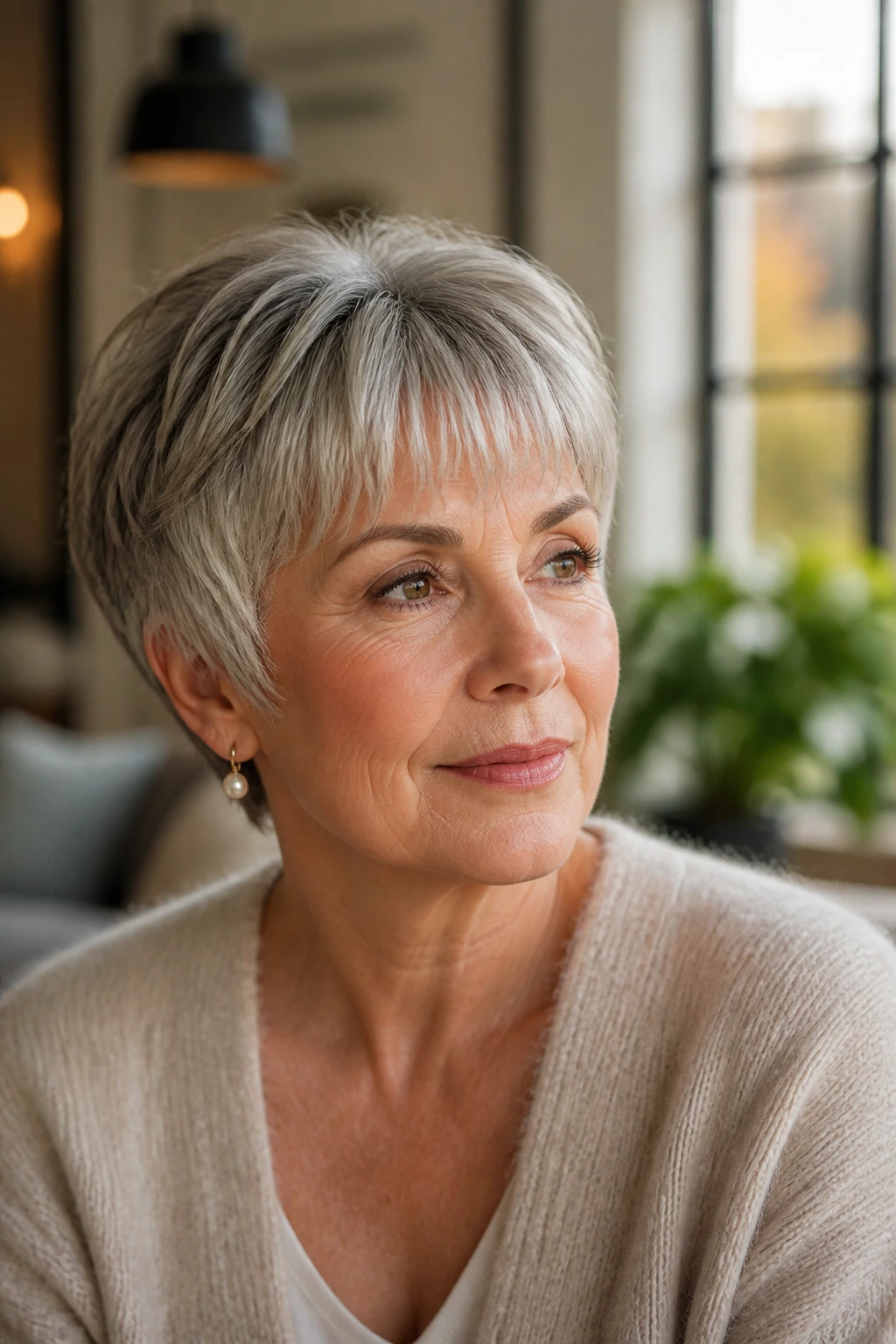
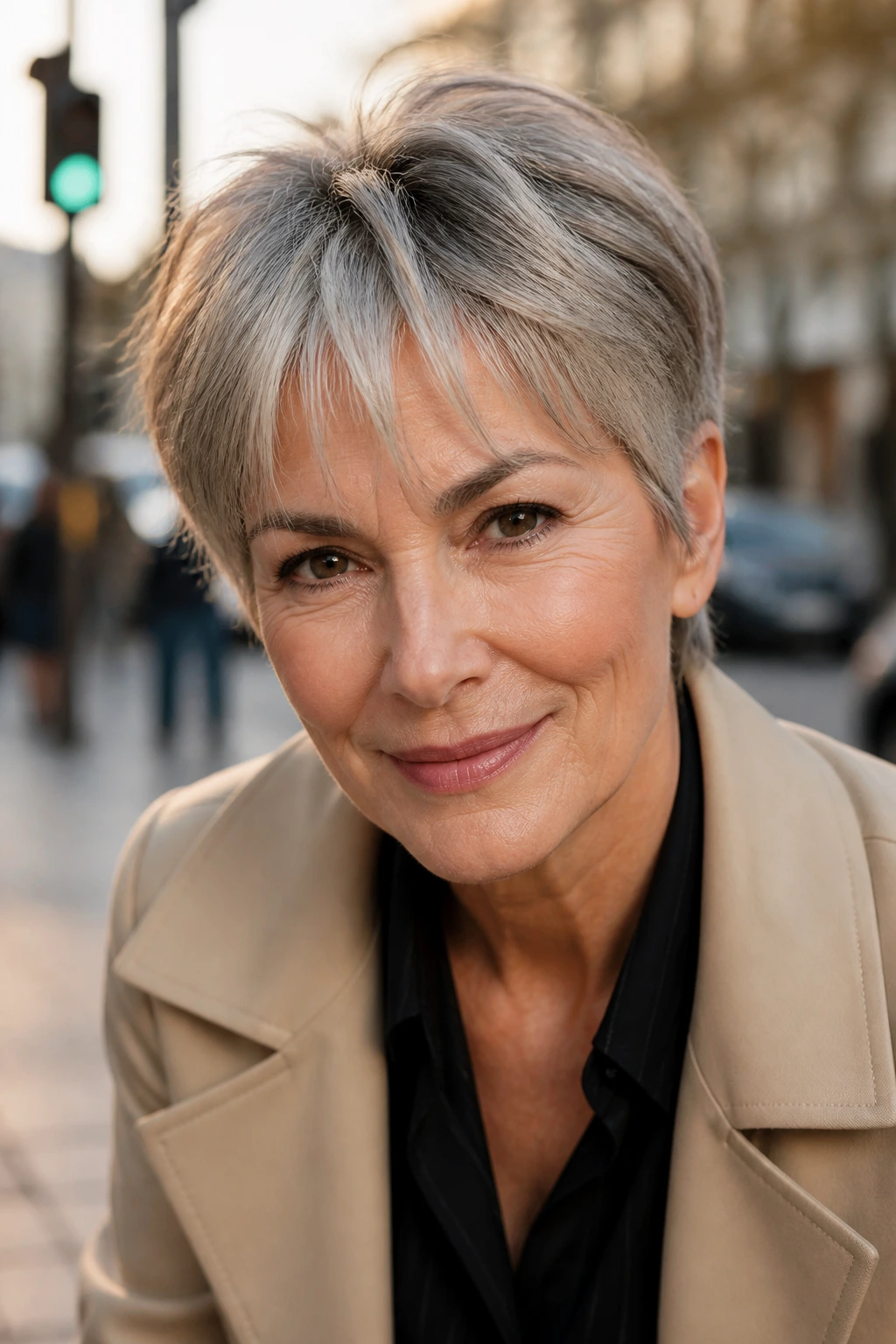
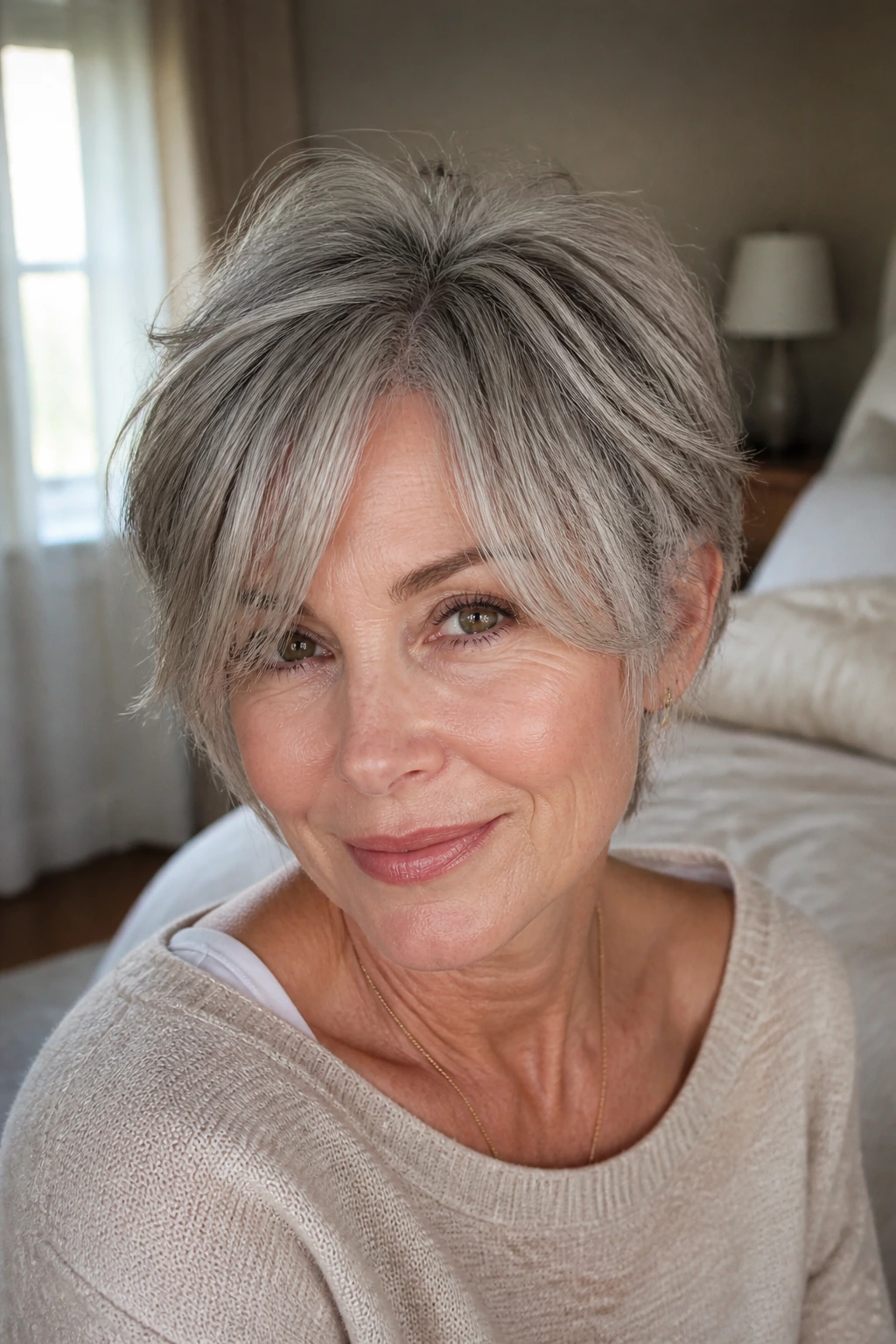
A soft pixie with side-swept bangs is the one I reach for when someone wants short hair that still feels gentle around the face. The sides stay close enough to look neat, but the top keeps enough length to brush forward and over, which gives the fringe a little movement instead of a hard edge.
This cut works because it leaves the crown with a touch of lift and keeps the bang line longer at the outer corner. That extra length matters more than people think. It makes the style easier to grow out, easier to tuck behind a brow line, and easier to wear when your hair has a stubborn cowlick that likes to split bangs right down the middle.
If your hair is fine, ask for soft texturizing rather than aggressive thinning. If it’s thick, ask the stylist to remove bulk inside the shape, not on the ends where it will fray. The difference shows the first time you try to comb it forward in the morning.
2. Layered Bob With Wispy Fringe
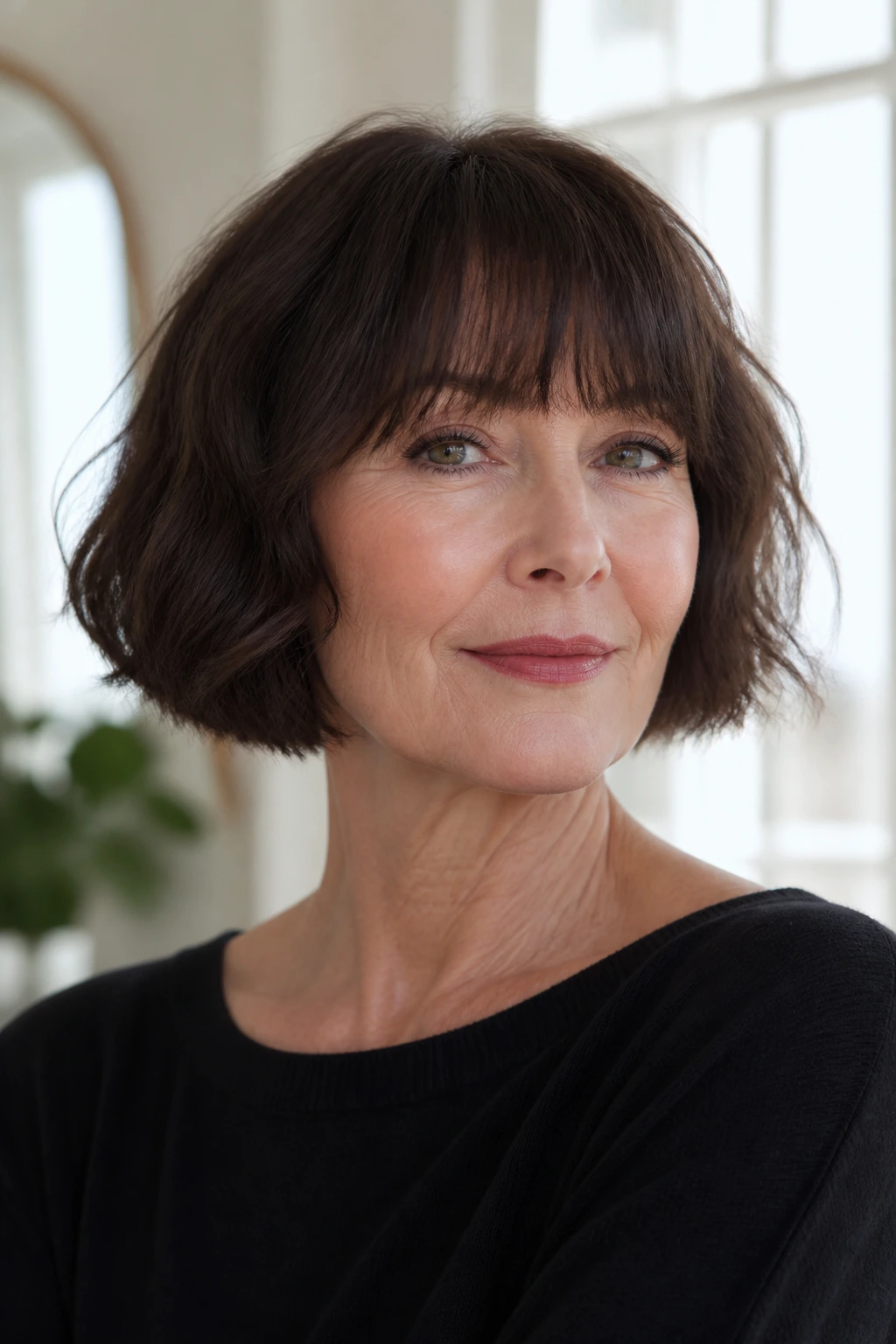
This is the cut for someone who wants the neat outline of a bob without the bluntness that can sometimes sharpen the face too much. The layers are light and mobile, and the fringe sits wispy enough to blur the forehead instead of covering it like a curtain.
Why it works
The layers stop the bob from hanging in one heavy block, which is especially useful if your hair has gotten a little finer or flatter at the ends. The fringe should be cut with a soft point or feathered edge, not a razor-thin strip that disappears by noon.
A layered bob with wispy bangs also takes well to a round brush or a quick bend with a medium curling iron. You do not need a perfect blowout here. In fact, a little irregularity makes the cut look better.
If you wear glasses, ask for the bang length to stop just above the frames or slide gently into them instead of sitting exactly on top. That small adjustment keeps the whole face from feeling crowded.
3. Tapered Crop With Feathered Bangs
Need a cut that stays tidy through wind, humidity, and a rushed morning? A tapered crop does that work quietly.
The nape is cut close and clean, the sides taper in, and the top carries just enough length for feathered bangs to lift away from the forehead. It’s a sharp little shape, but not a severe one. The feathering keeps it from turning helmet-like, which is the problem with too much bluntness on a short crop.
This style suits thick or medium hair that tends to expand outward when it’s cut too uniformly. The taper removes that bulk. The fringe should be kept soft and slightly longer in the center if your forehead is broad or if you like a little bend at the front rather than a straight line.
It’s also a very good choice if you’re tired of hair sitting on your neck. No drama. No neck fluff. Just a clean shape that behaves.
4. French Bob With Eyebrow-Grazing Bangs
The French bob has a little attitude, but not the kind that looks forced. It usually hits somewhere around the jaw or just above it, and the fringe lands right at the eyebrows or a hair above them. That eyebrow-grazing line is what gives the cut its character.
I like this shape on straight or slightly wavy hair, especially if the cheekbones are worth showing off. The length is short enough to feel crisp, but not so short that you lose softness around the jaw. If the bangs are cut with a subtle arc, the face looks lifted rather than boxed in.
Watch for this
A French bob can go too heavy if the fringe is cut too dense. You want movement at the ends, not a thick slab across the forehead.
If your hair is coarse, ask for the interior weight to be reduced a bit so the shape doesn’t puff under the ears. And if your hairline has a cowlick, the bang length should probably start a touch longer than you think you need. Short bangs sound bold in theory. In practice, they can be fussy.
5. Shaggy Pixie Bob With Curtain Bangs
This is the cut for people who don’t want to look “done” in the obvious sense. A shaggy pixie bob sits between a pixie and a bob, with messy little layers around the crown and curtain bangs that part softly in the center or just off-center.
The curtain fringe is the key. It opens the face instead of closing it off, and it’s forgiving if one side dries a little faster or falls a little flatter than the other. That’s real life. Real hair does not march in step.
I especially like this shape for wavy hair and for anyone who wants to keep some length around the ears. The layers can be air-dried with a dab of mousse, then scrunched or finger-combed into place. If you’re someone who hates rigid styling, this one gives you room to be a little lazy without looking careless.
6. Rounded Bob With Full Fringe
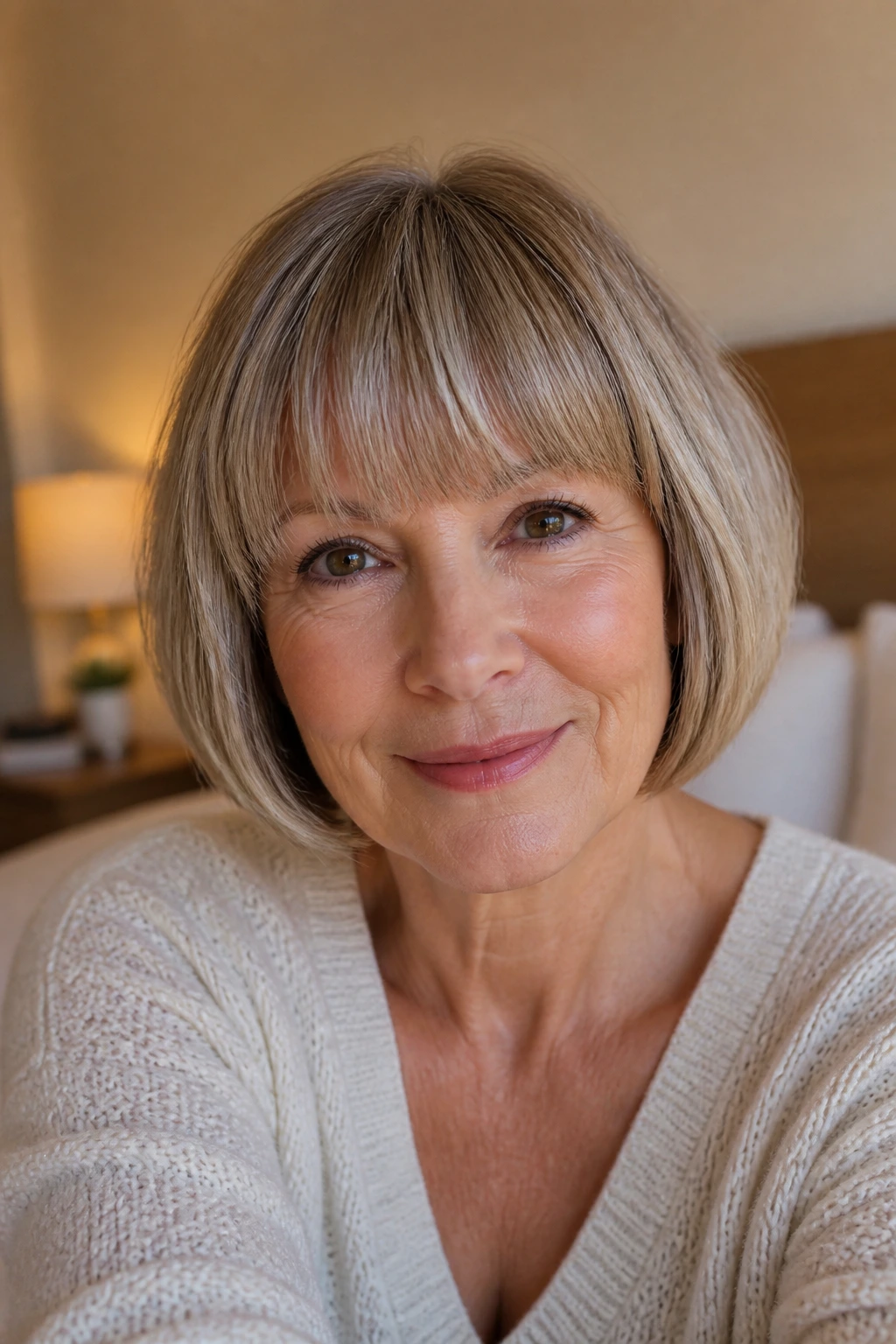
A rounded bob with full bangs is a classic for a reason: it brings structure back to hair that has gone soft at the ends. The bob keeps a curved outline around the head, and the full fringe makes the style feel deliberate.
The trick is not to cut the fringe so heavy that it shuts down the face. A good full fringe should still have some bend and some separation at the brow line, especially if your hair is fine. If it’s thick, ask for interior texturizing so the bangs don’t stand up like a shelf.
This cut looks especially nice with straight hair or hair that can be smoothed quickly with a paddle brush. It gives a neat frame to the eyes and works well if you like a tidy shape that doesn’t change much from day to day. Some people want edge. Others want order. This is the second one.
7. Textured Crop With Piecey Bangs
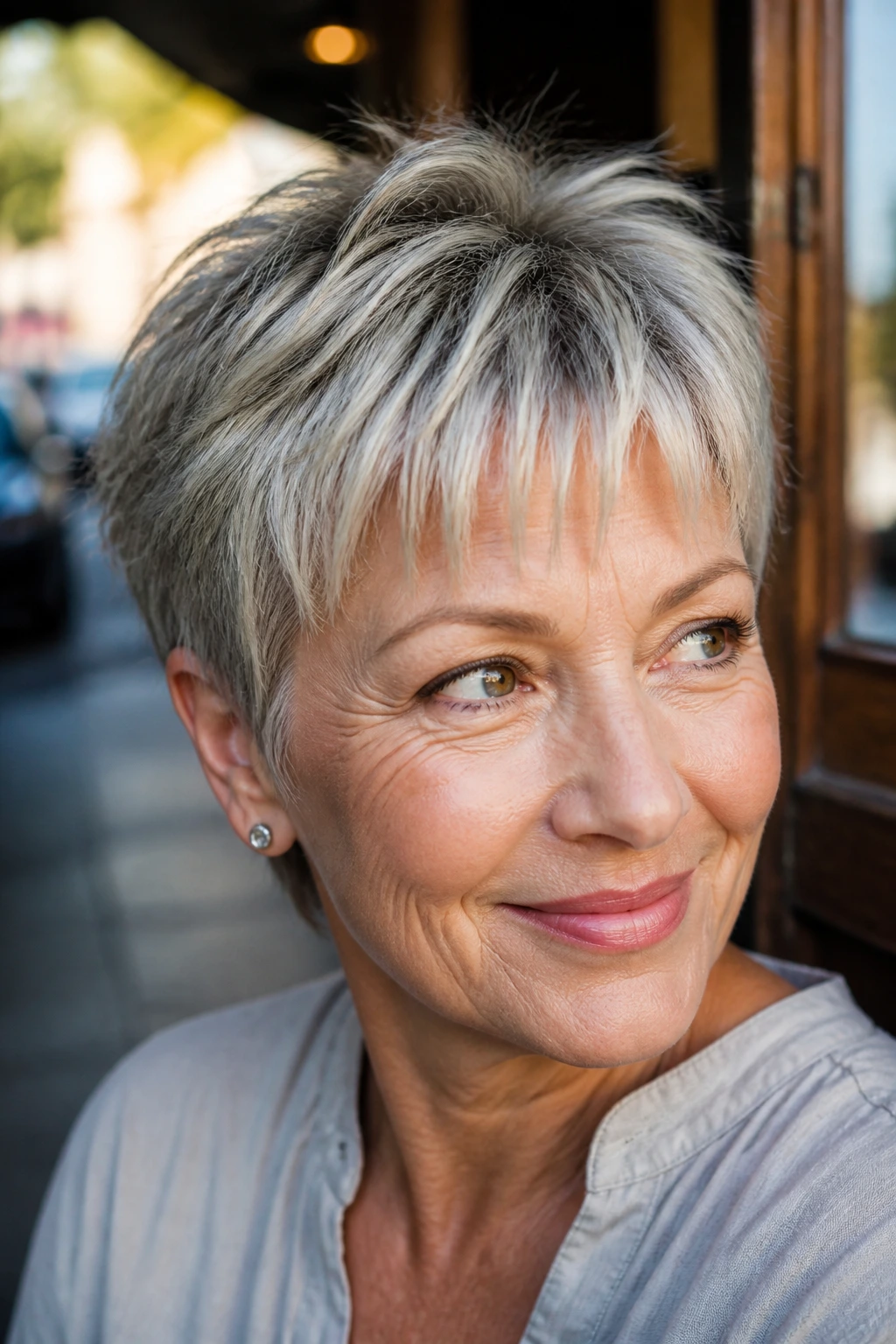
A textured crop with piecey bangs is all about movement. The ends are broken up enough to keep the silhouette airy, and the bangs are cut into little separated sections instead of one solid line.
That piecey fringe is useful because it hides small changes in growth better than a blunt bang does. It also gives you more flexibility if your forehead has texture, lines, or a hairline that isn’t perfectly straight. Most hairlines aren’t. No need to pretend otherwise.
This style works well on short, dense hair that needs some release at the top. Use a small amount of styling paste or a light wax, and pinch the bangs into place rather than brushing them flat. Brushed too hard, they lose the whole point of the cut.
If you want a short style that feels modern without trying too hard, this is one of the easiest paths.
8. Long-Fringe Pixie With Tapered Nape
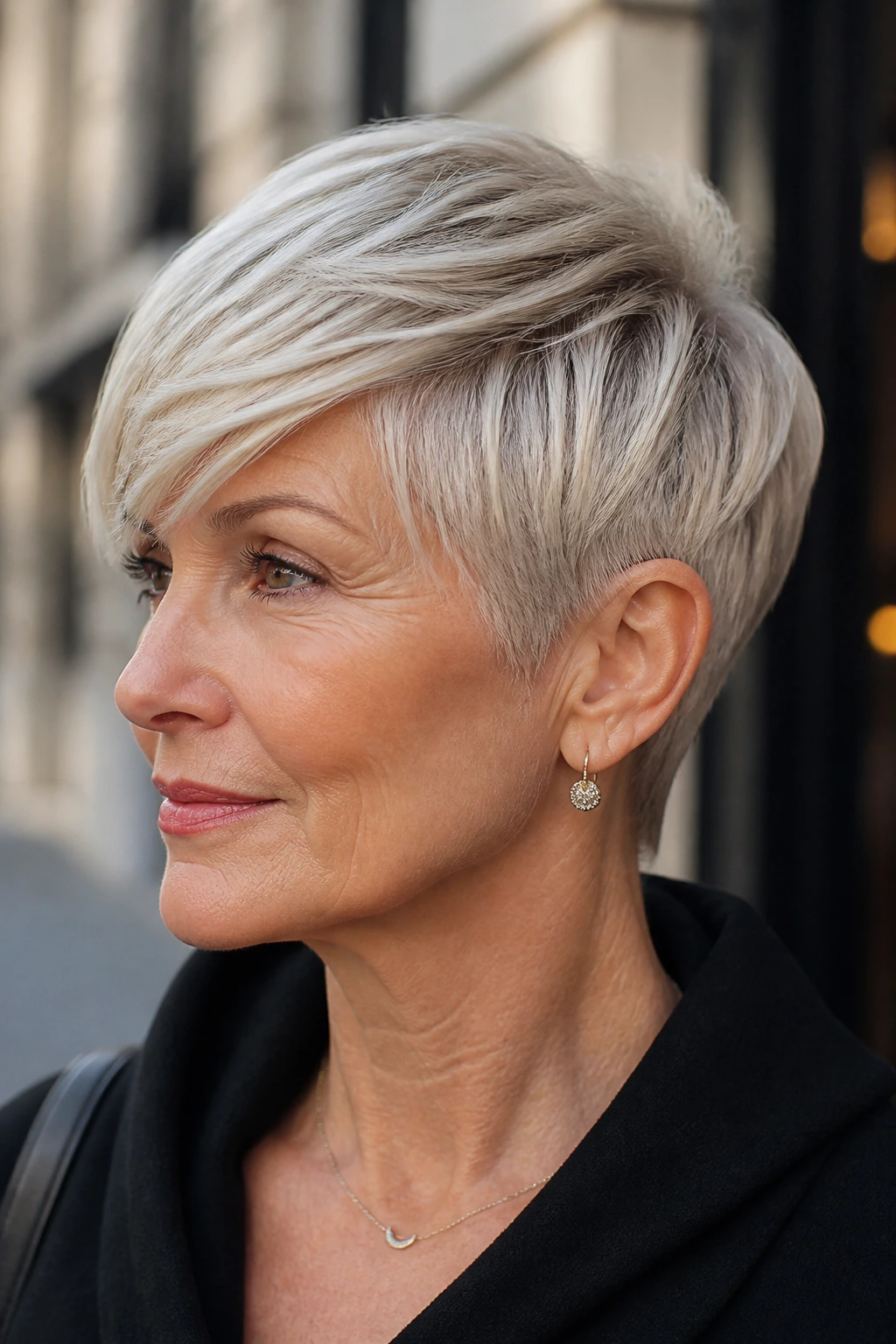
A long-fringe pixie gives you the ease of a very short cut with the comfort of a little face-framing length. The nape stays tapered and clean, while the front is left long enough to sweep to the side or tuck forward in a soft arc.
That longer front piece does a lot of work. It makes the cut less stark, and it gives you wiggle room on days when your hair is doing its own thing. You can push it open, close it down, or let it fall a little messily across the brow.
This is a smart choice for women who like short hair but don’t want the front to feel exposed. It also plays well with earrings, because the sides stay trimmed and the ear area stays visible. I’ve always thought this kind of cut is underused. It looks polished with almost no effort and grows out in a friendly way.
9. Stacked Bob With Side Bangs
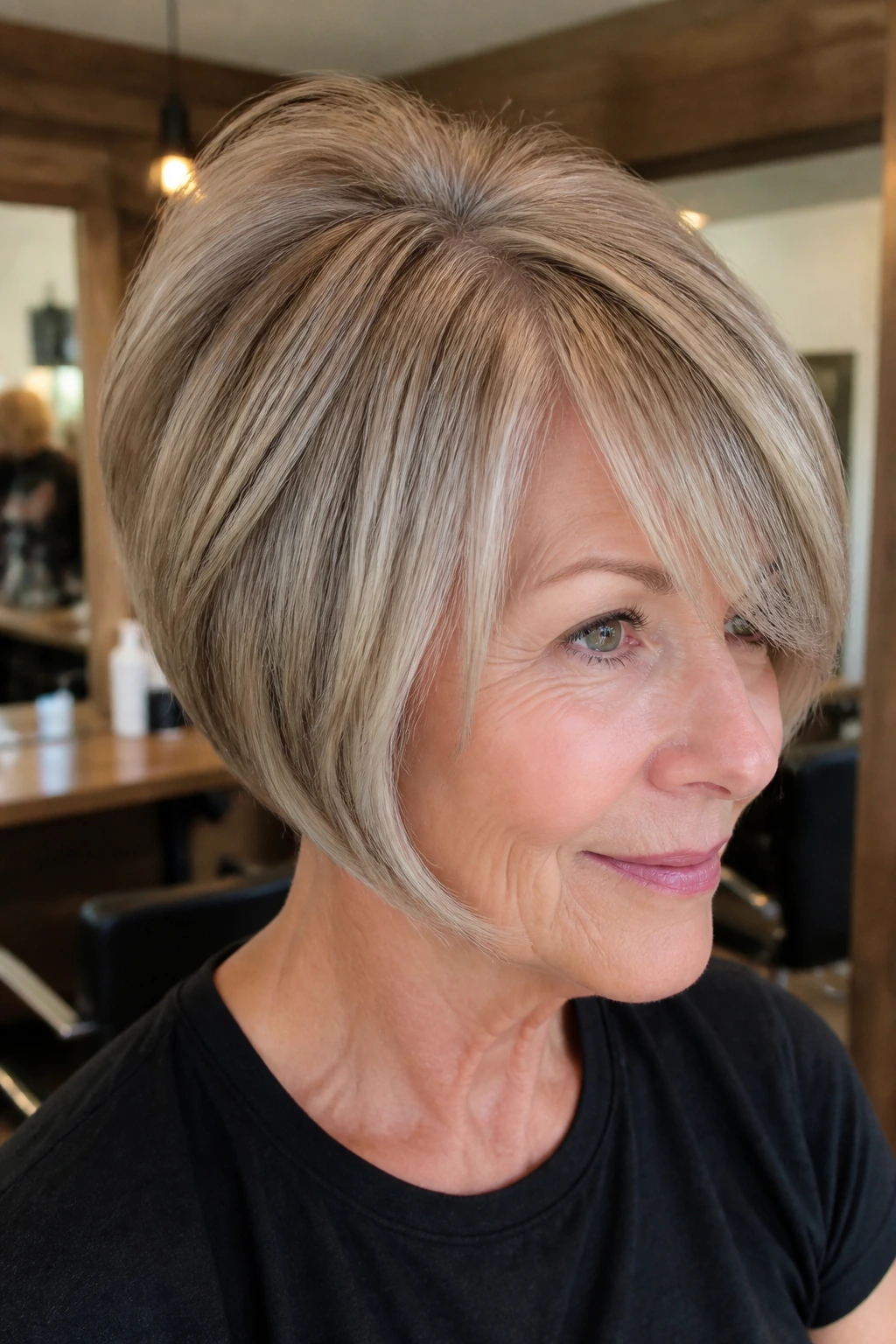
The stacked bob earns its reputation by building shape at the back. The hair is cut shorter and fuller through the nape, then gradually left longer toward the front. Add side bangs, and the whole thing becomes more wearable around the face.
What makes this cut appealing is the lift in the back. If your hair tends to lie flat or you feel like your profile disappears a little in photos, stacked graduation helps. The side bangs keep the front soft and give the style a diagonal line, which is kinder to many face shapes than a straight-across edge.
Ask your stylist to keep the stacking moderate if your hair is thick. Too much graduation can turn into a triangle if the ends are cut too blunt. A subtle stack is more useful than a dramatic one. You want shape, not a helmet with ambition.
10. Short Curly Shag With Curly Bangs
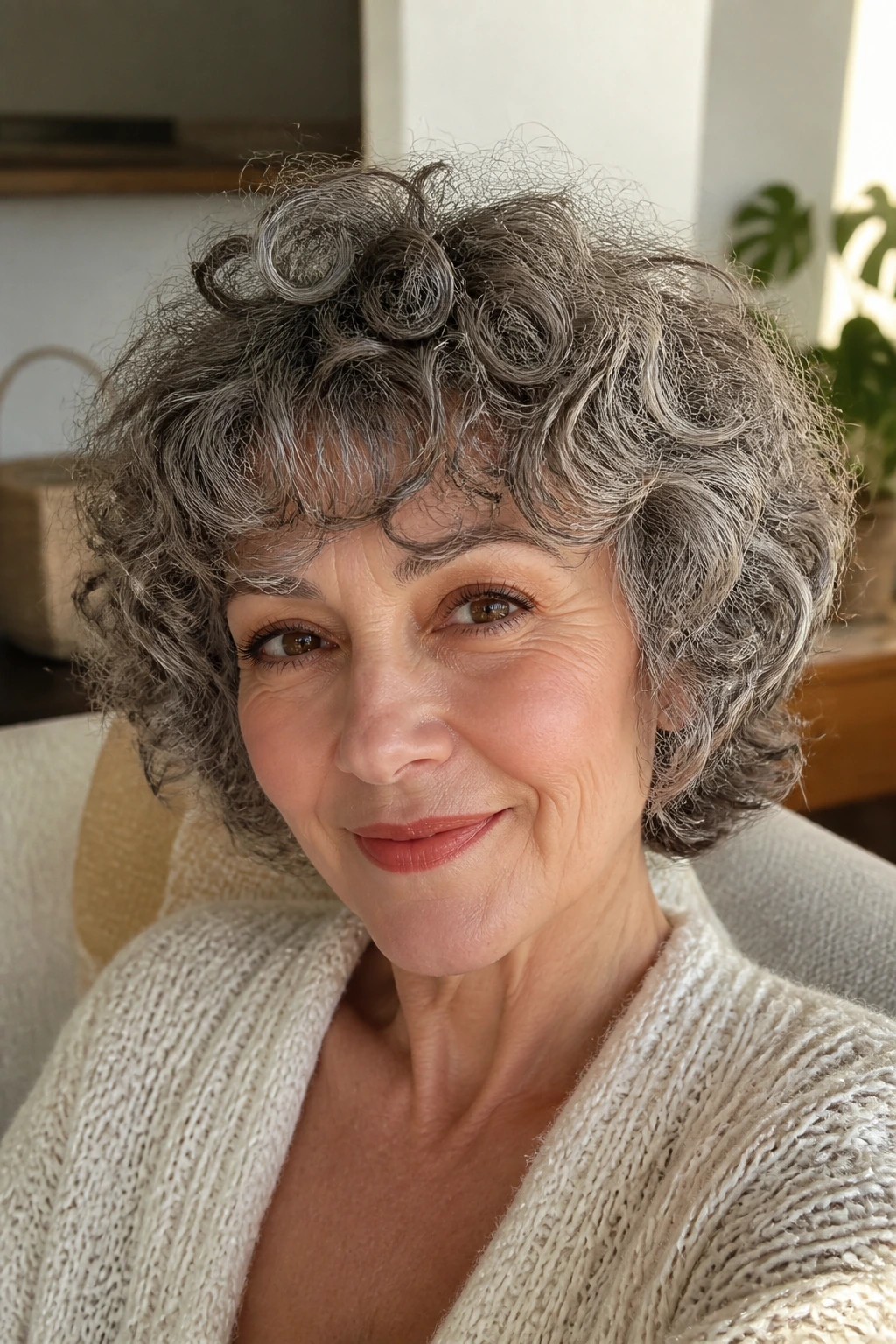
Curly hair and bangs can absolutely live together. They just need room.
A short curly shag keeps the layers soft and rounded so the curls can spring without fighting the shape. The bangs are cut to live as curls, not as straight strands that later become something else. That means dry cutting is often the safer call, because curl length changes once it dries.
This style is wonderful if your hair already has texture and you want the front to look intentional rather than random. The fringe should sit a little longer than you think, because curls bounce up. That one detail saves a lot of regret.
Use a light leave-in conditioner and a gel or cream that holds the curl without making it crunchy. If the bangs need reshaping on day two, mist them lightly and scrunch. Don’t drown them. Curly bangs hate that.
11. Sleek Silver Bob With Blunt Bangs
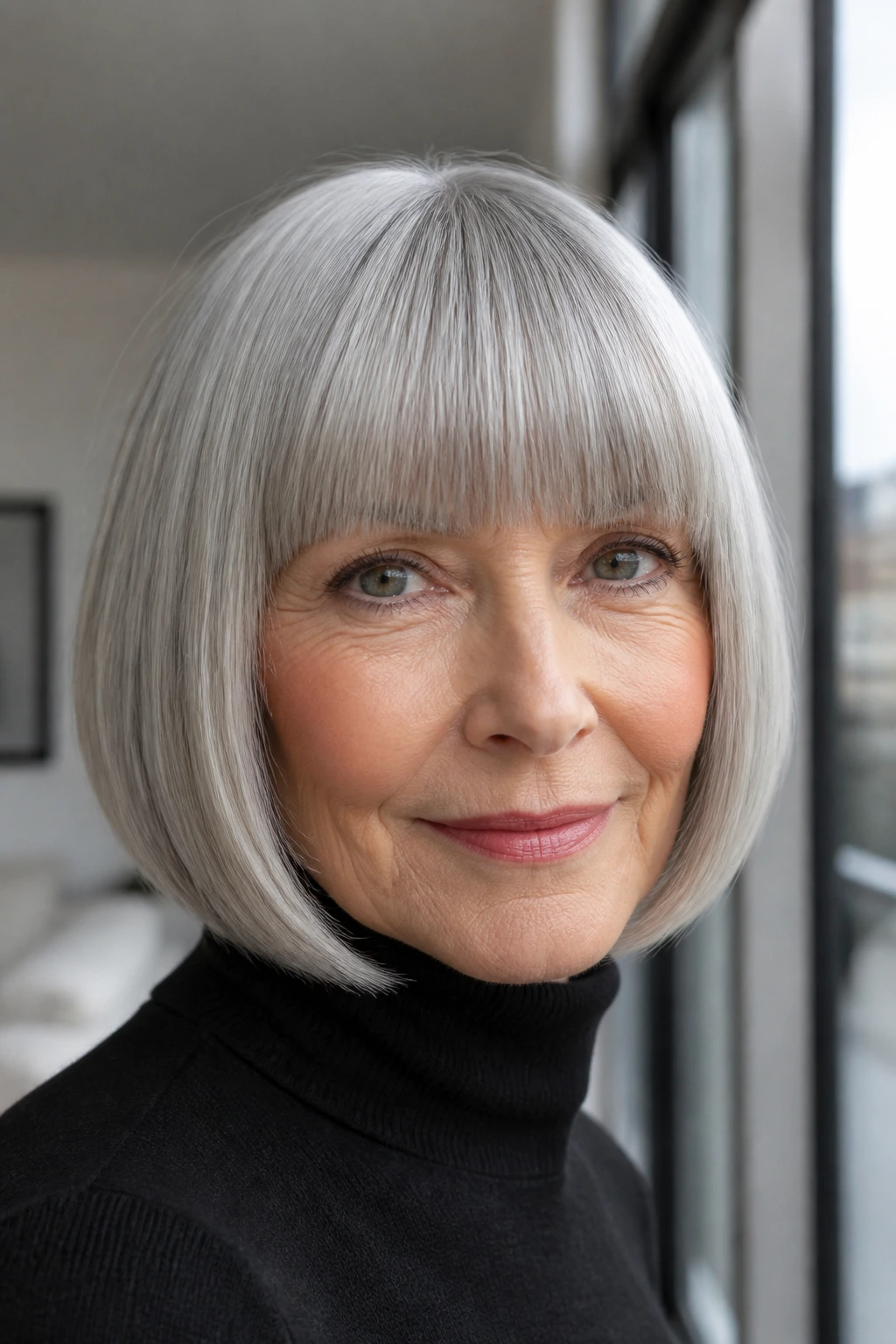
A sleek silver bob with blunt bangs has a clean, graphic feel that can look very striking on strong hair with enough density. The silver or white tones make the shape look crisp, and the blunt fringe brings the eyes straight to the face.
This is not the cut I’d suggest if your hair is very fine or if you hate blow-drying. Blunt bangs need weight to sit well, and the bob beneath them needs enough body to keep the line from looking limp. When it works, though, it really works.
The neat thing about this style is how little decoration it needs. A smooth finish, a centered part in the body of the bob, and a fringe that lands right above the lashes can do all the talking. Keep the ends sharp and the shine healthy. That’s the whole message.
12. Angled Bob With Curtain Bangs
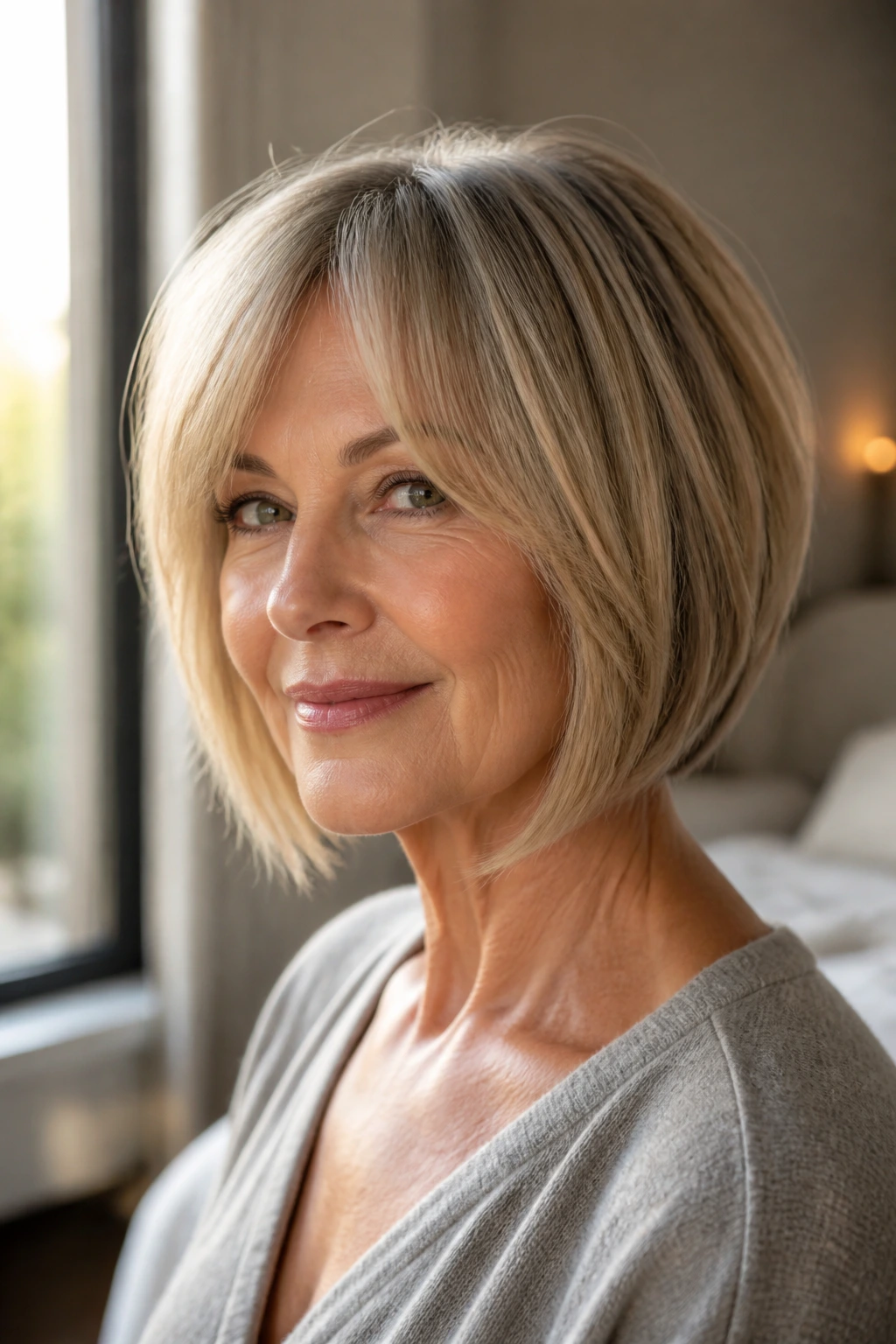
An angled bob gives you length in the front and lift in the back, which is a very useful trick when you want the neck to look a little longer and the jawline a little softer. Pair it with curtain bangs, and the front of the cut opens cleanly instead of landing in one solid block.
This shape is especially good if your hair is straight or only lightly wavy. The diagonal line from the back to the front gives movement, and the fringe can split or sweep depending on the day. It’s one of those cuts that looks more expensive than it is, mostly because the angle does the hard work for you.
Keep the front pieces long enough to tuck behind the ear on one side. That tiny detail makes the whole thing easier to live with and gives you a quick fix on days when the fringe feels too full.
13. Ear-Tucked Crop With Split Fringe
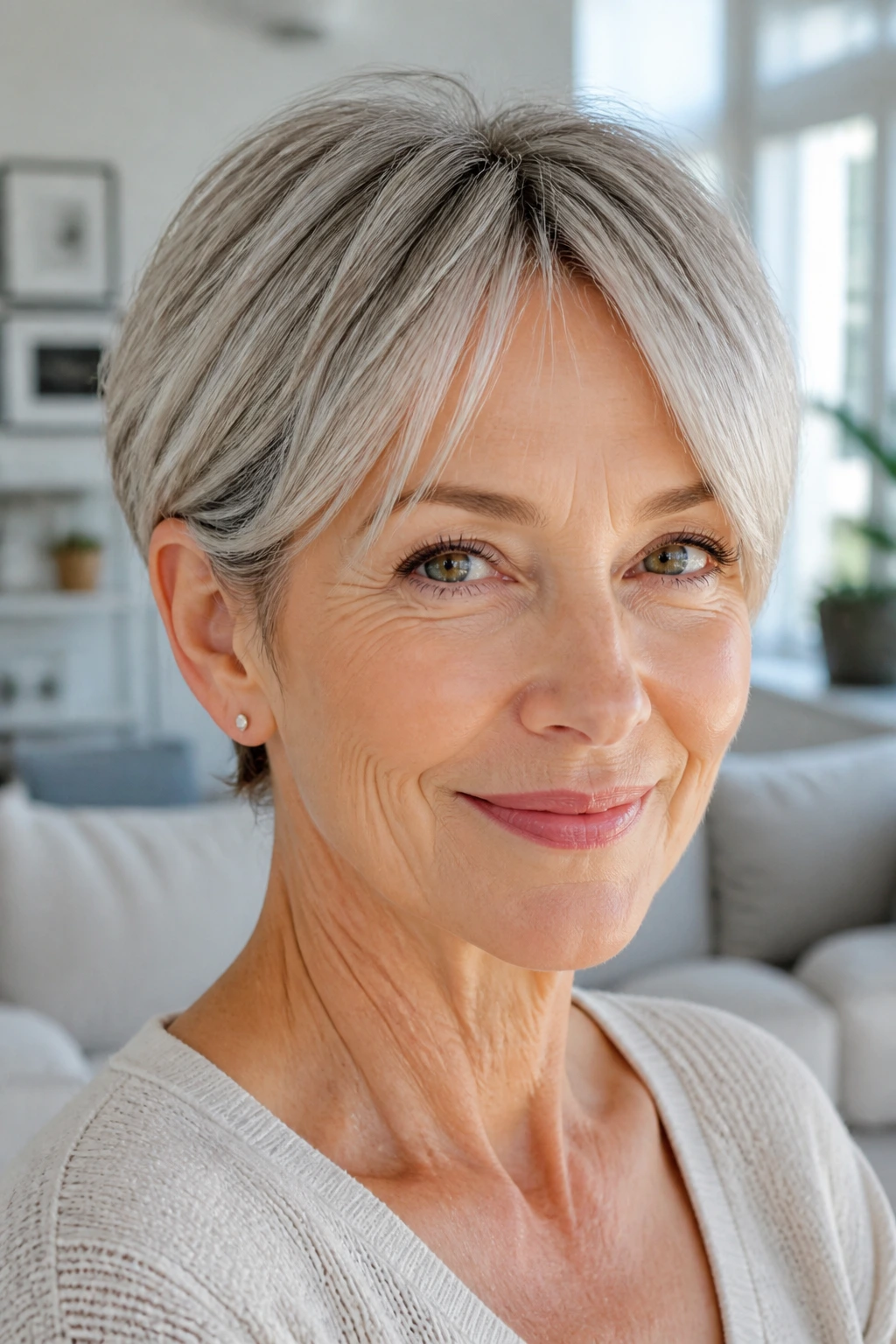
There’s something relaxed about a crop that sits close enough to tuck behind the ears without fighting you. Add a split fringe — a fringe that opens in the middle or just off center — and the result feels neat but not severe.
This is a good haircut for women who wear glasses, because the fringe can move around the frames instead of landing exactly where the arm of the glasses wants to sit. It also gives you a bit of forehead coverage without hiding the whole face. That balance is tricky. This cut handles it well.
The split fringe should be soft, not symmetrical to the millimeter. If you part it too perfectly, it can look staged. A little irregularity gives it life. I’d ask for a bit of texture at the ends and a soft taper near the temples so the hair doesn’t puff out near the frame.
14. Choppy Boyish Crop With Soft Bangs
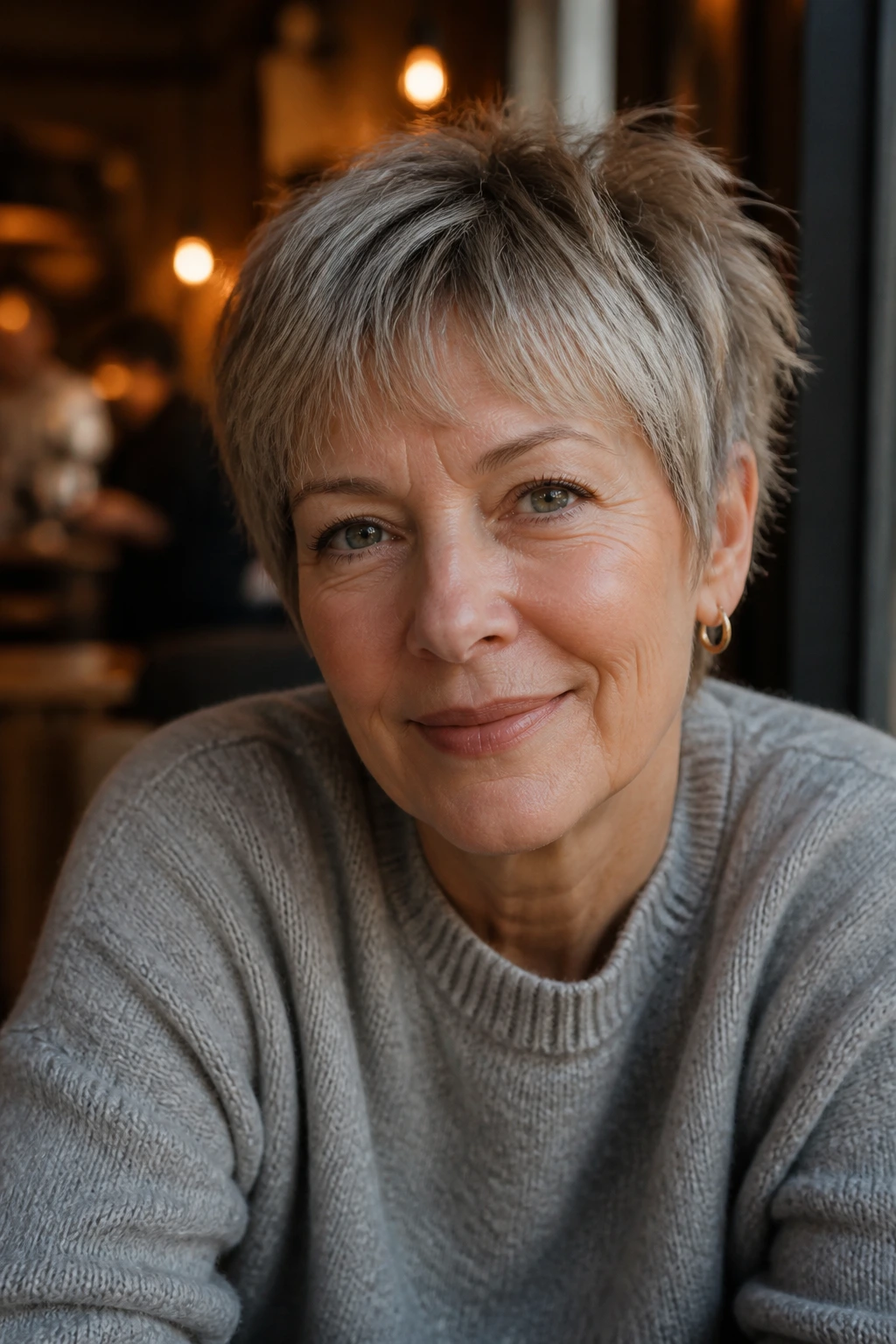
This one has edge, but in a friendly way. The choppy boyish crop keeps the length short and playful, while the soft bangs stop it from looking too hard around the hairline.
The choppiness keeps the cut from turning flat. Each little piece should sit with some separation, especially at the top and around the fringe. If your hair is naturally straight and you like a cut that can be roughed up with your fingers, this is a strong pick.
It works best when the bangs are soft enough to move. A full, rigid fringe would make the whole thing feel too heavy. Instead, the bang line should break a little at the ends so the eyes stay open. This is a cut with a little attitude, yes, but it still needs softness or it starts looking stern.
15. Wedge Bob With Feathered Bangs
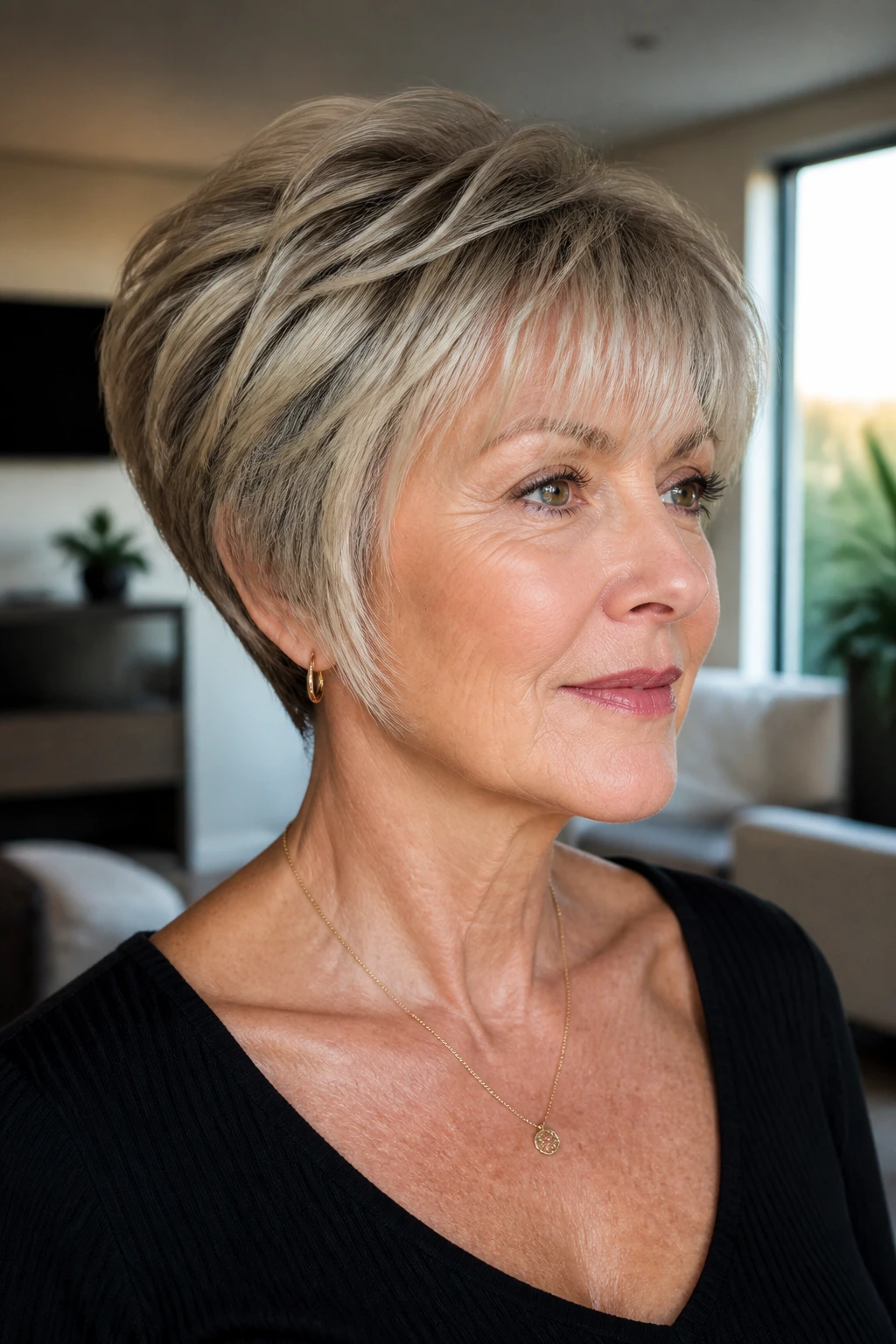
The wedge bob is a shape cut to build volume at the back while keeping the front controlled. It was never a boring haircut, and it still isn’t. With feathered bangs, the style gets a lighter top line and a more modern feel.
What makes this cut useful is the internal structure. The back stacks up, the crown gets lift, and the bangs feather forward without turning into one heavy sheet. If your hair wants to lie flat behind the ears, the wedge gives it a better job.
This is a strong choice for straight to slightly wavy hair that benefits from some architecture. Ask for softness around the temple area so the shape doesn’t sit too square. A wedge can be a little stubborn if it’s cut too rigidly, and nobody needs that on a Tuesday morning.
16. Wavy Crop With Brow-Skimming Fringe
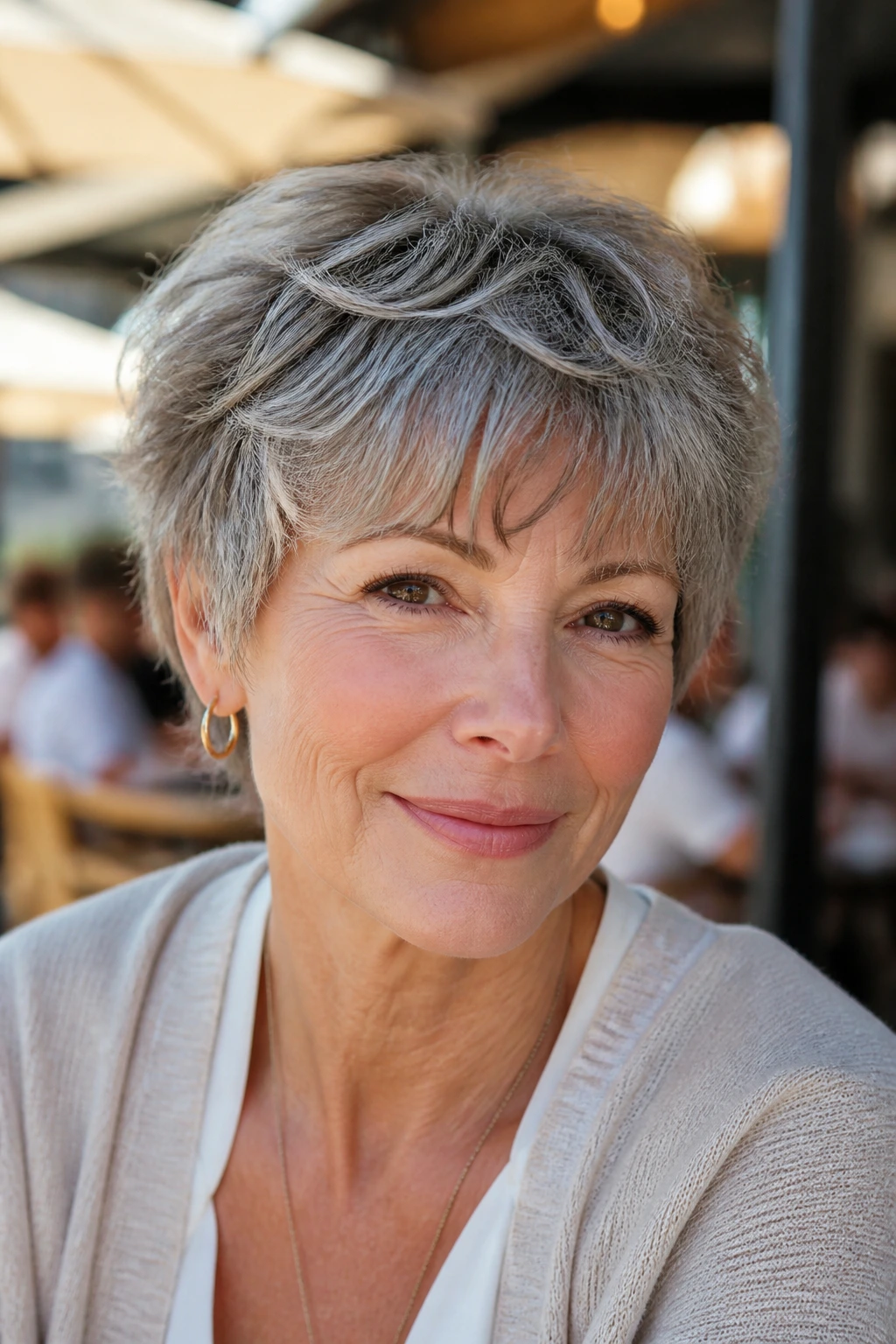
Wavy hair behaves best when it’s given a cut that respects the wave instead of sanding it down. A wavy crop does that neatly, and a brow-skimming fringe keeps the front part of the style connected to the rest of the cut.
The fringe should hit at or just above the brows, not so short that it shrinks into the forehead once the hair dries. That’s the common trap with waves. They pull up. They always pull up.
I like this style when someone wants short hair that still looks soft and touchable. A little sea-salt spray, a diffuser, or even air-drying with a twist at the fringe can be enough. The result should look casual in the good sense, not unfinished. There’s a difference.
17. Asymmetrical Bob With Deep Side Bangs
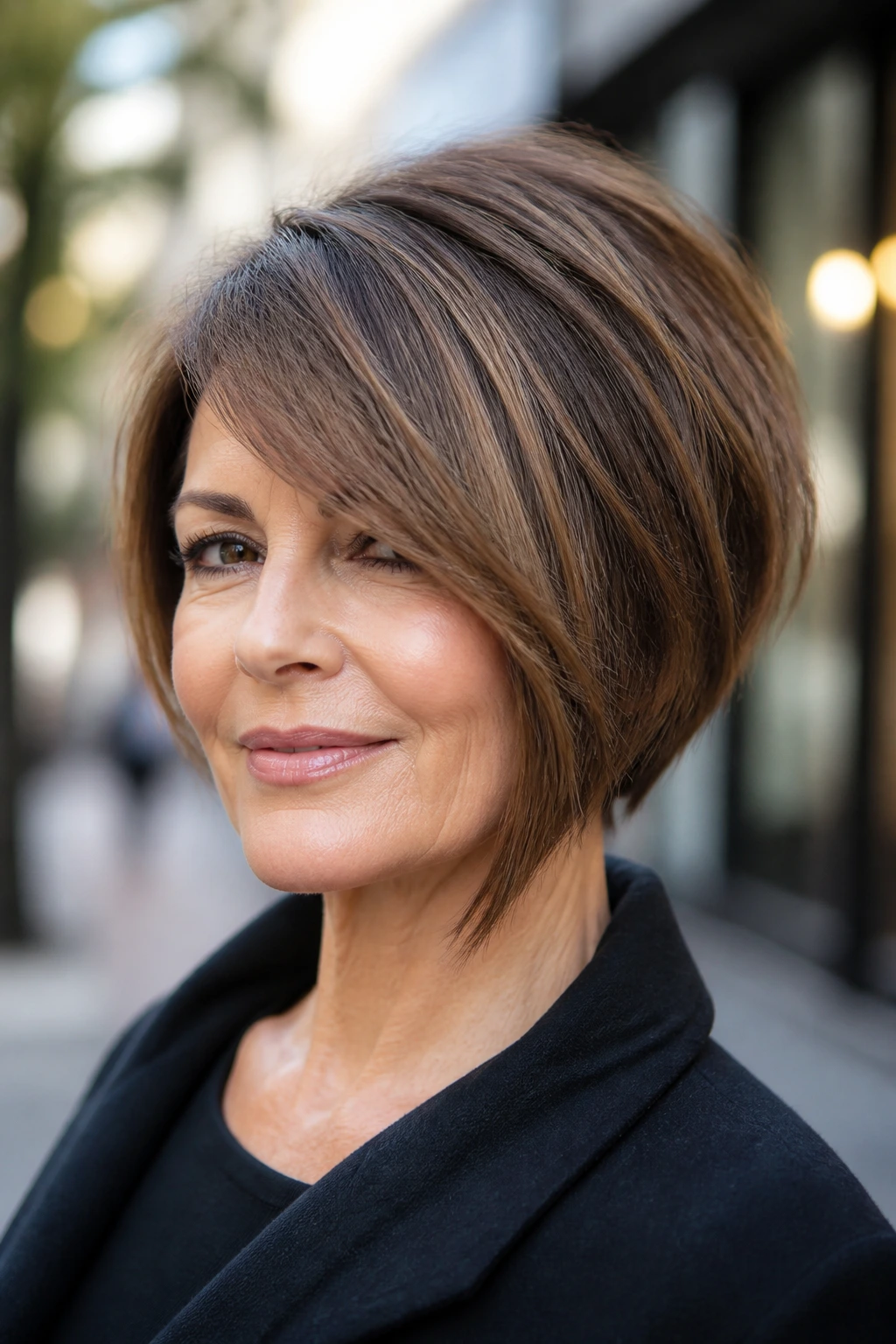
An asymmetrical bob gives you one side slightly longer than the other, and that diagonal line can be very flattering around the jaw and neck. Deep side bangs reinforce that slant and make the whole cut feel intentional.
This style is especially handy if one side of your face is more open than the other, or if you simply like a haircut with a bit more motion. The longer front section gives you the option to tuck it back or let it fall forward. More options, fewer regrets.
The bang should be substantial enough to anchor the shape, but not so dense that it erases the asymmetry. A deep side sweep works best when it follows the shape of the brow and cheek instead of fighting them. If you wear statement earrings, this cut gives them room to show up.
18. Undercut Pixie With Long Top and Fringe
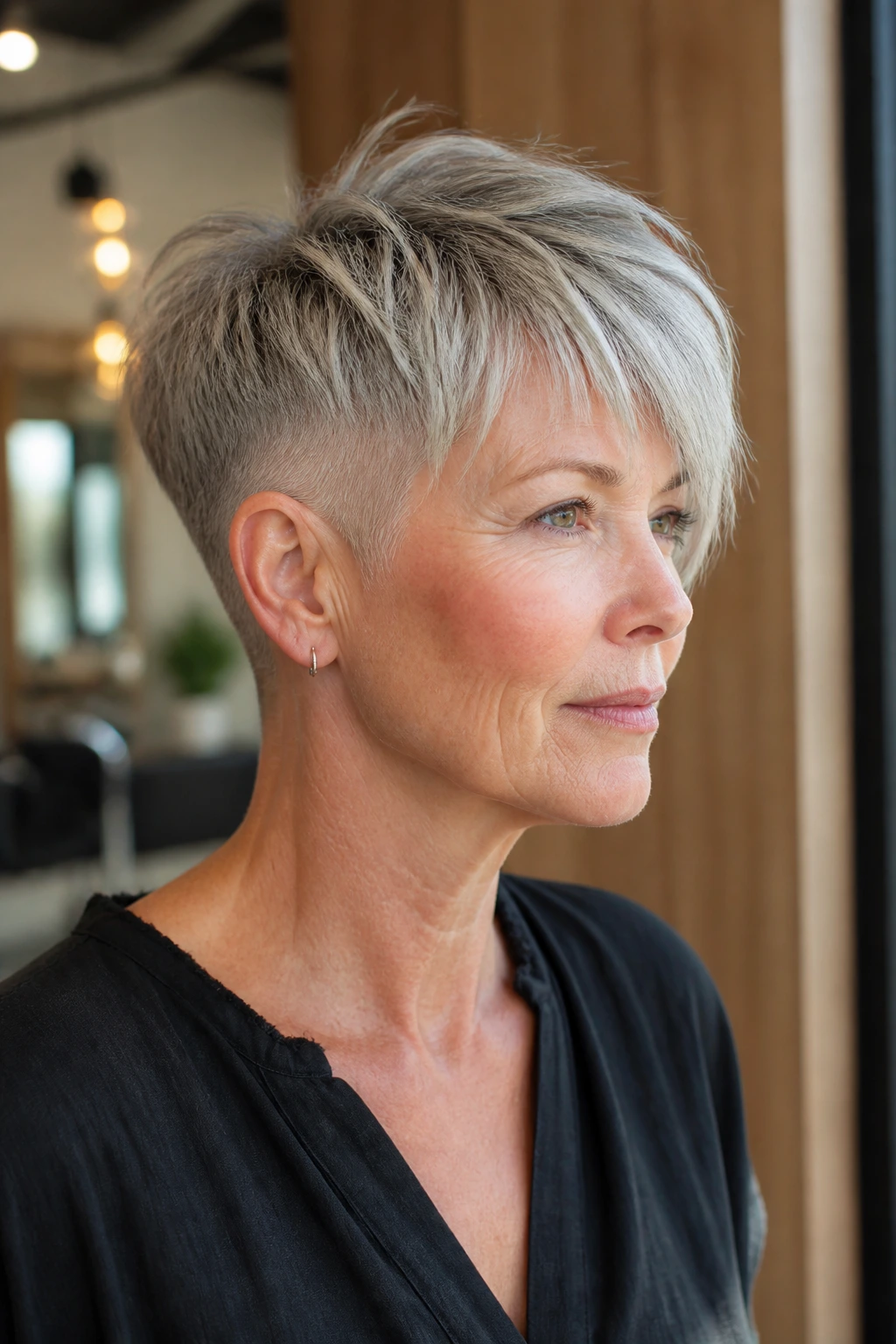
An undercut pixie is not for everyone, and that’s fine. It does one thing extremely well: it removes bulk underneath so the top and fringe can sit with more shape and less puff.
This is the cut I’d recommend for thick, coarse, or very dense hair that expands at the nape and around the ears. The undercut quietly solves that problem. Then the long top and fringe can be styled forward, swept back, or pushed to the side depending on the day.
The look can be edgy or soft, depending on how the top is handled. If you want it gentler, keep the fringe long and feathered. If you want something sharper, let the top stay piecey and a little separated. Either way, the structure underneath gives the haircut room to breathe.
19. Neck-Grazing Bixie With Bangs
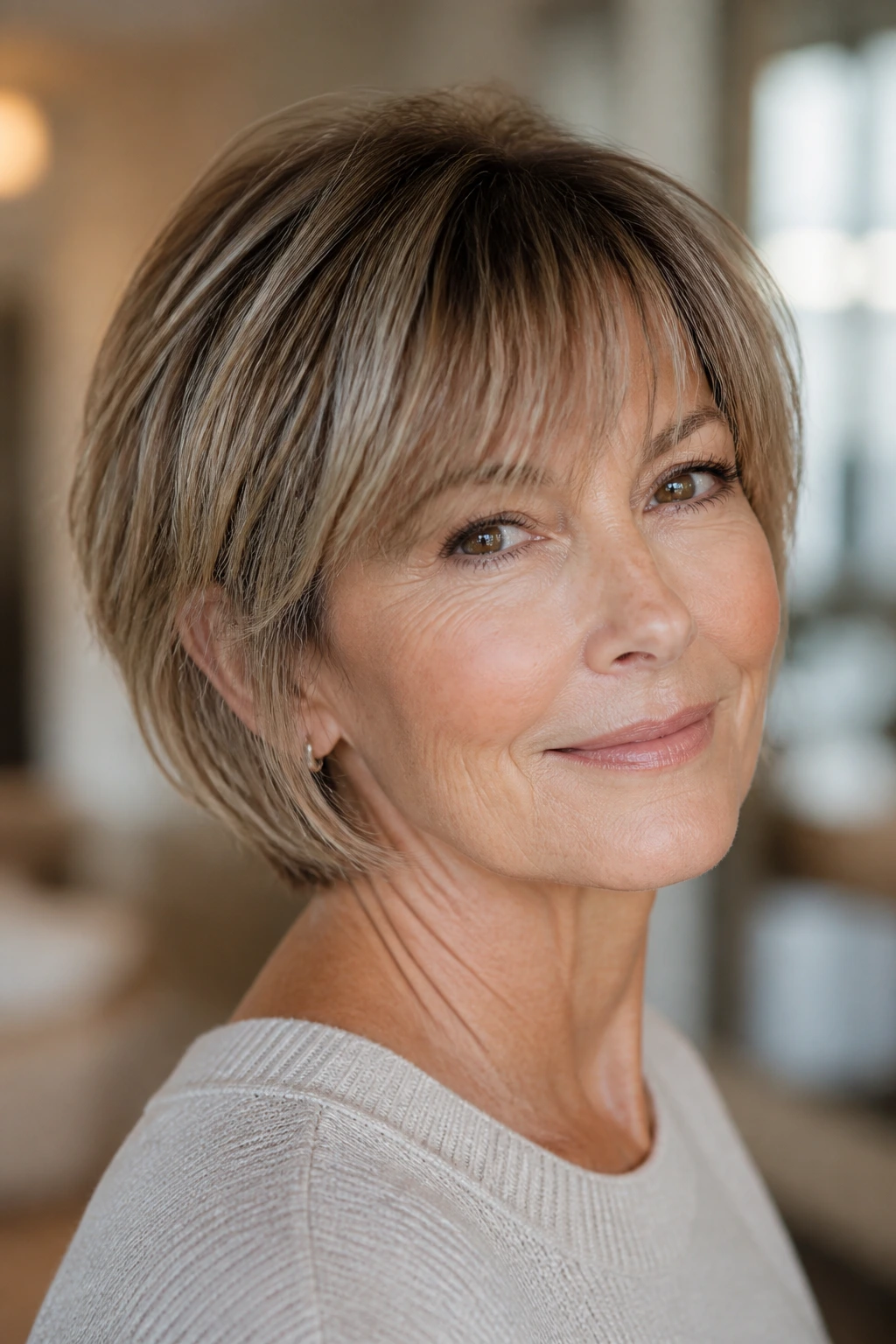
The bixie sits between a bob and a pixie, and that middle ground is part of why people keep coming back to it. It has enough length to feel feminine and versatile, but it still dries faster than a bob and holds a compact shape.
With bangs, the bixie becomes even easier to wear. The fringe can be side-swept, soft, or lightly layered, while the sides and nape stay trimmed close enough to keep the silhouette neat. It’s a friendly cut for grow-out, too. It doesn’t turn into a weird shape the way some short cuts do after six weeks.
If you’re uncertain about going very short, the bixie is the compromise that doesn’t feel like one. It gives you the clean neckline of a crop with a little more movement around the face. That matters more than people admit.
20. Tousled Classic Crop With Airy Fringe
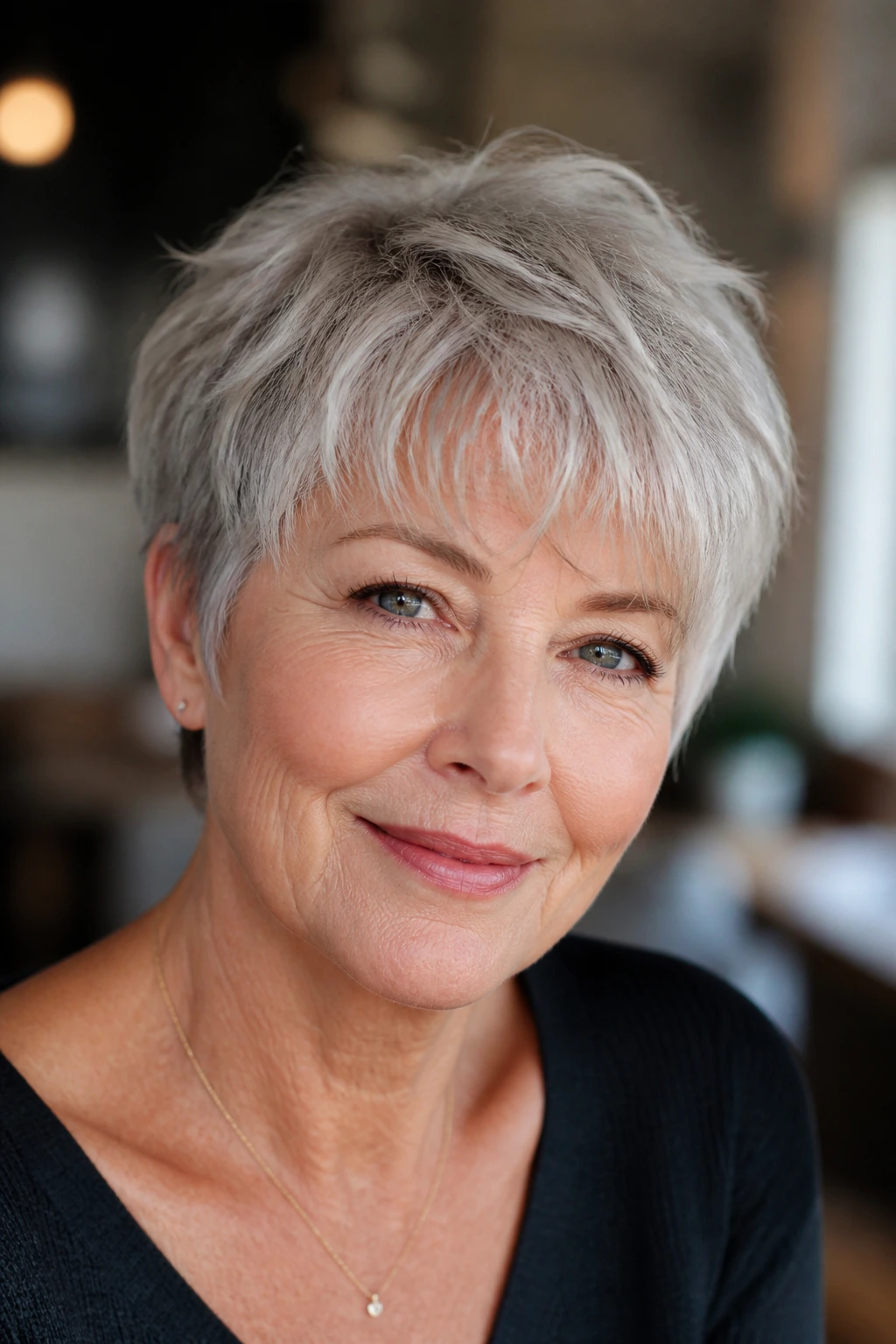
A tousled crop with airy bangs is the easygoing cousin in this group. It’s short, yes, but it doesn’t read as severe. The fringe is light enough to flutter a little, and the top has just enough texture to be pushed around with your fingers.
This cut is one of the most forgiving for daily life. It doesn’t need every piece in place. A little lift at the crown, a little separation through the bangs, and you’re done. If the hair falls a bit differently on a humid day, the style still looks intentional.
I like this one for women who want short hair without the commitment of something crisp or geometric. The airiness keeps it from feeling heavy at the forehead, and the tousled finish helps it work on straight, wavy, or slightly coarse textures. It’s the sort of cut that gets better when you stop overworking it.
Why Short Hair and Bangs Work So Well After 60
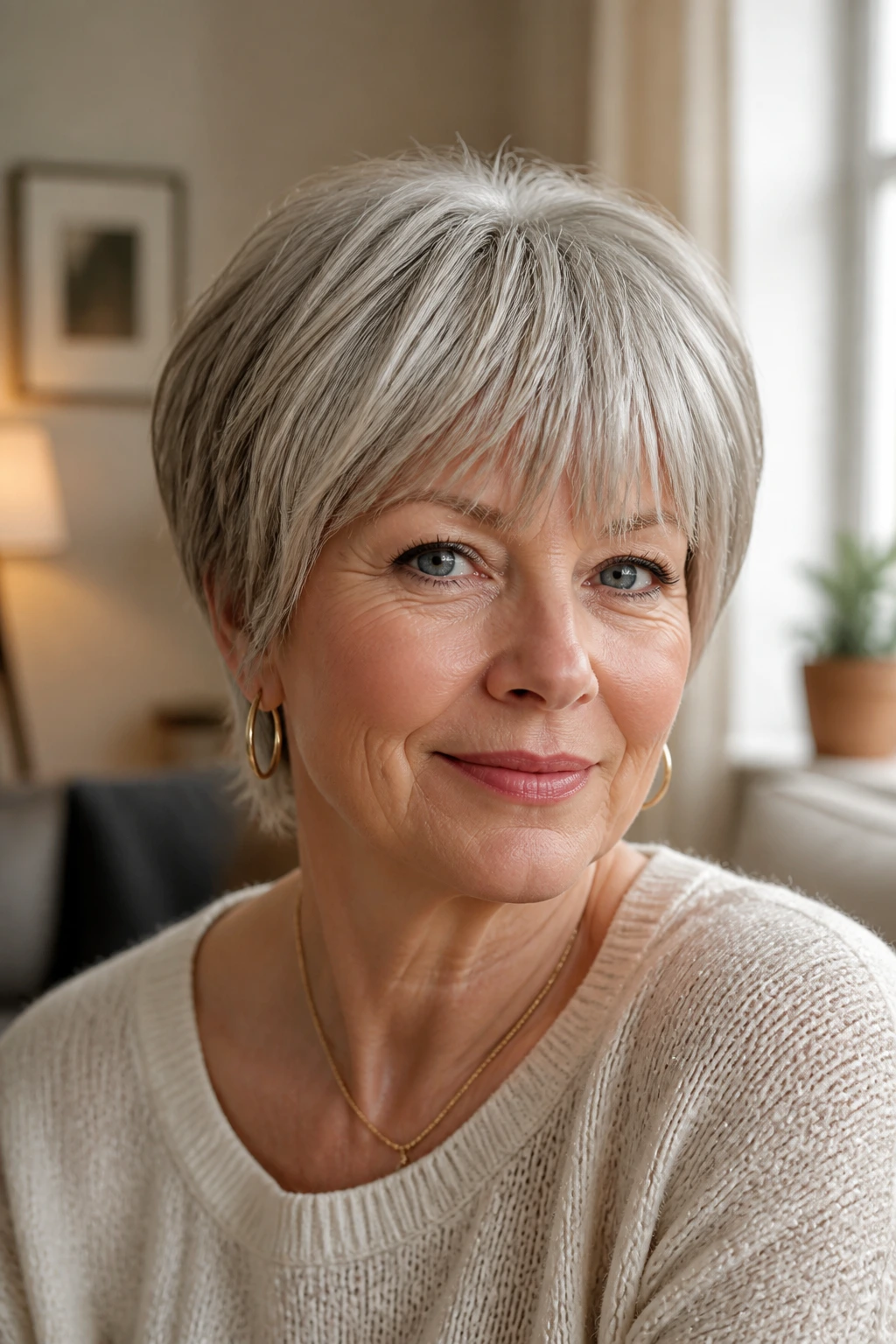
A short cut with bangs does a few jobs at once, and that’s why it keeps showing up in good salons. It trims away dead weight at the ends, which helps hair that’s gotten finer or more fragile. It also lets the fringe do some face-framing work without forcing the rest of the haircut to stay long for the sake of “coverage.”
There’s another reason I like this combination: it gives the front of the face a soft landing. Foreheads, brows, and the top of the cheekbones carry a lot of expression. A fringe can blur one area and sharpen another, which is why a good bang line can make a face look calmer, fresher, or more awake without looking overly styled.
And yes, glasses matter. So do cowlicks. So does the way your hair bends at the temples or flares at the ears. A strong short cut respects those details instead of pretending they do not exist.
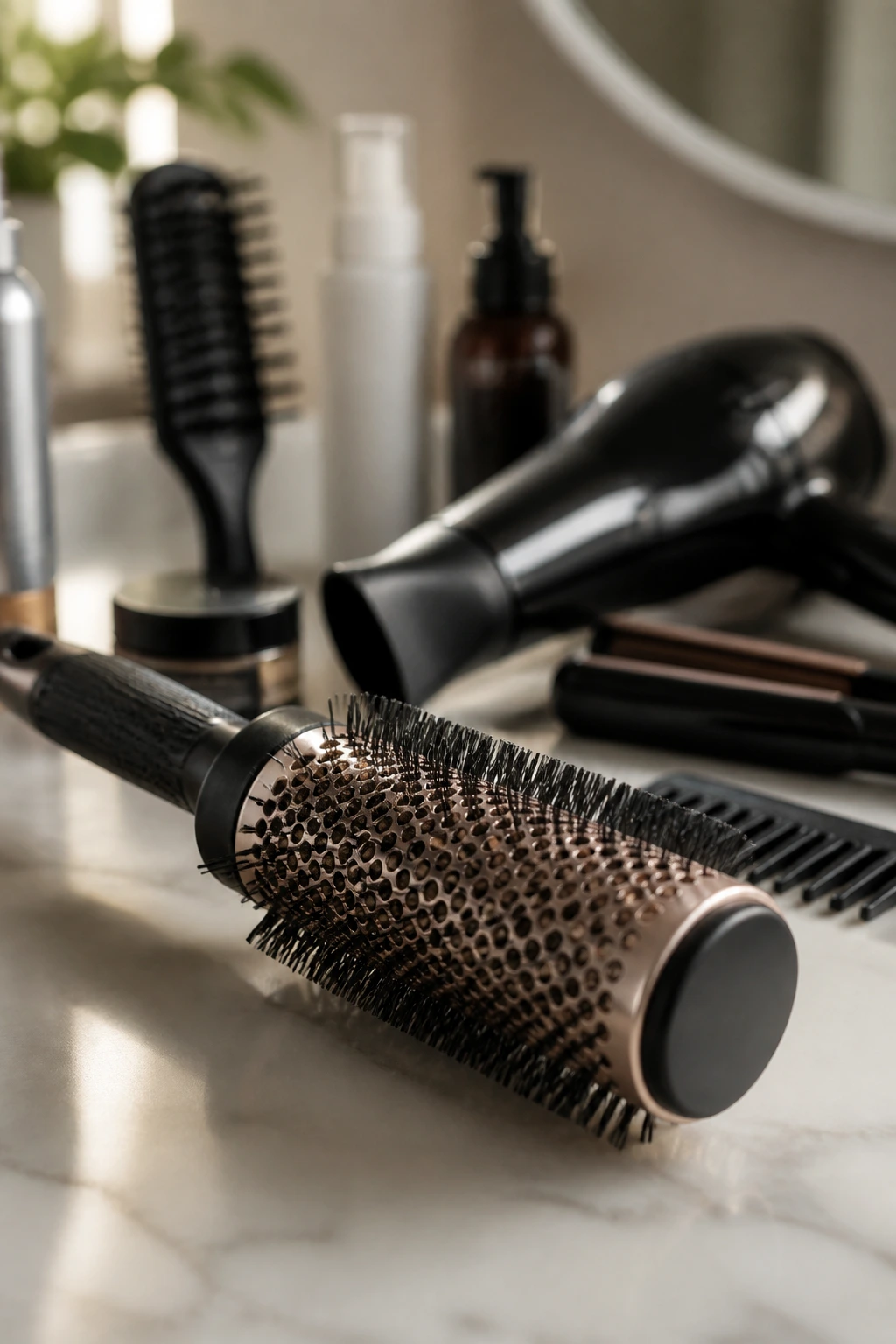
Essential Tools That Make These Cuts Easier to Live With
-
A small round brush, 1 to 1.5 inches: Best for lifting the fringe at the roots without flipping the ends too hard.
-
A vent brush: Good for quick drying when you want movement instead of a polished blowout.
-
A blow dryer with a narrow nozzle: Helps aim the air at the roots and keeps bangs from separating in weird places.
-
A light styling mousse or root-lift spray: Useful on fine hair that needs a little support at the crown.
-
A pea-sized wax or styling paste: Gives piecey bangs and textured crops some separation without making them greasy.
-
A lightweight smoothing cream or serum: Helpful for blunt bobs and sleek fringes that need shine without puff.
-
A small flat iron or mini styler: Handy for touching the front pieces only, not flattening the whole head.
-
A wide-tooth comb: Better than a rough brush for curly or wavy bangs when you’re resetting the shape.
What to Ask for at the Salon Before the First Snip
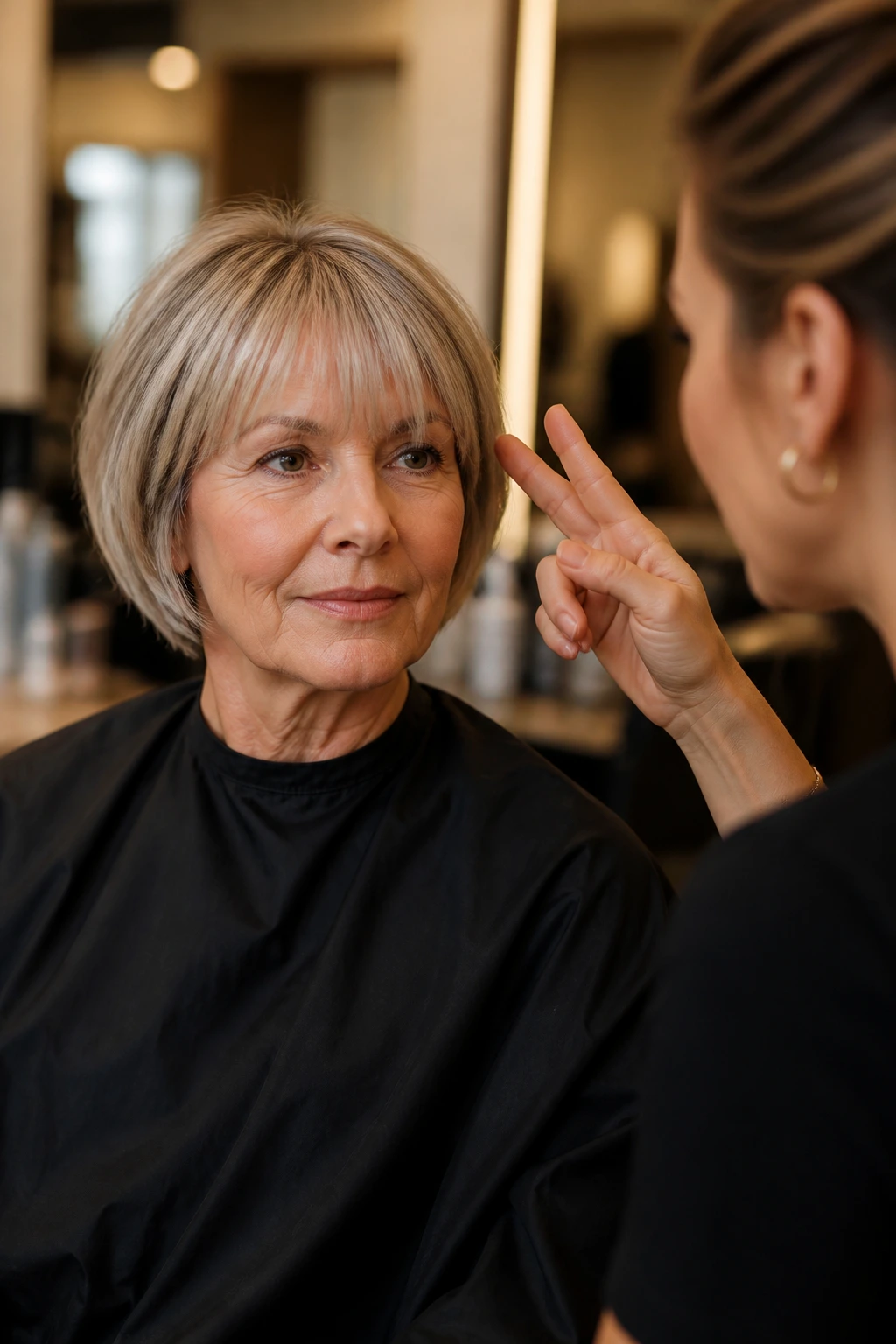
Bring photos, yes, but bring the right kind. You want pictures of hair that looks like yours in density and texture, not a cut sitting on someone with completely different hair. That is where bad decisions start. A fine-haired pixie on thick, coarse hair will not behave the same way, and a curly fringe cut from a straight-haired reference photo can go sideways fast.
Ask how the bangs will sit when dry. Ask whether the stylist is cutting them blunt, point-cutting them, or feathering them. Those words matter because each one changes how much weight stays in the fringe. If your hair shrinks, bend, or lifts at the front, say so before the scissors move.
A good stylist should talk about your cowlicks, your glasses, your growth pattern at the temples, and how often you’re willing to come back for maintenance. If they don’t ask, volunteer the information. A fringe that needs trimming every three weeks is fine if you know that going in. It is less fine when you discover it by accident.
How to Wear and Style These Cuts Day to Day
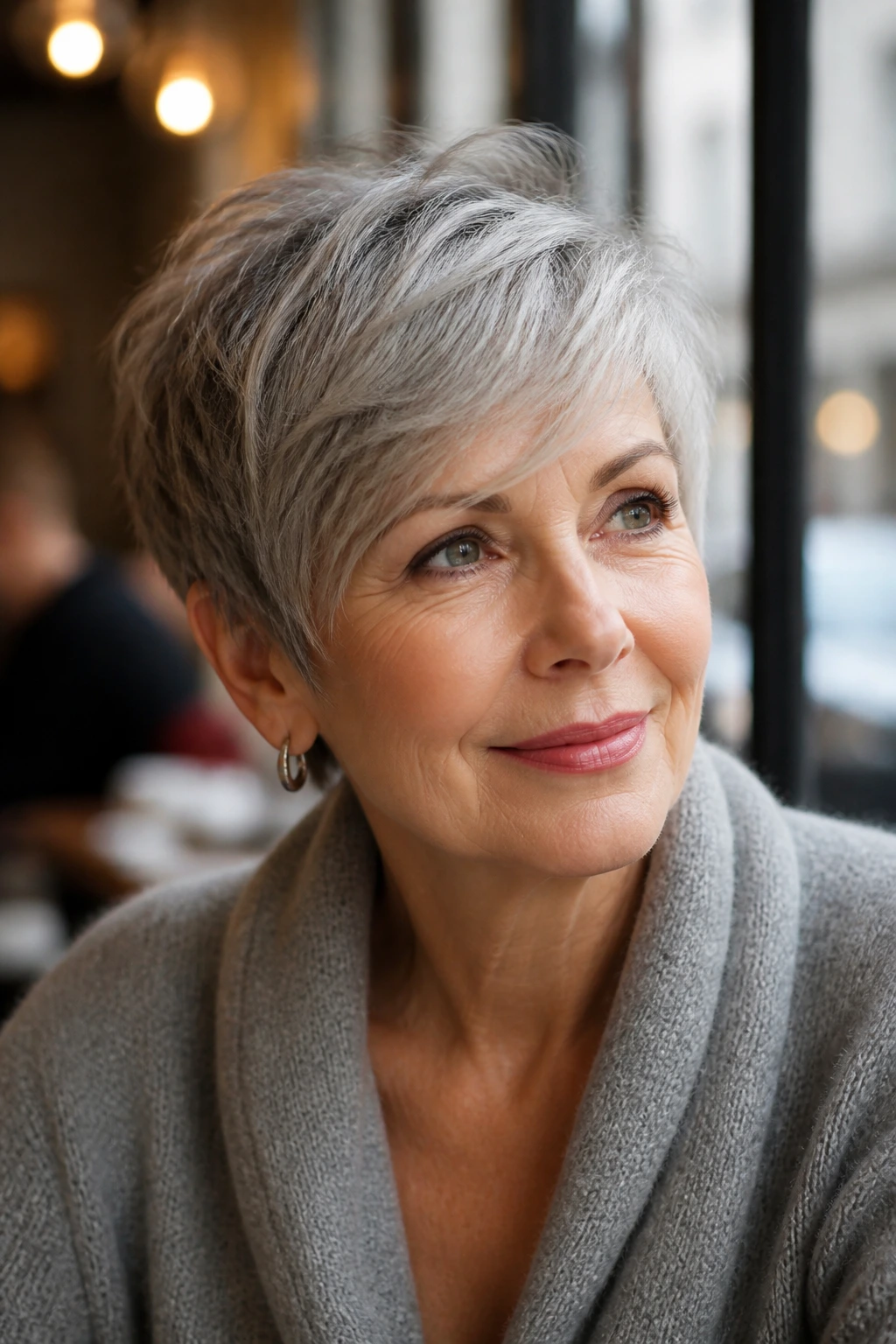
Presentation: Start by deciding whether you want the haircut to read soft, neat, or piecey. A quick round-brush lift at the front gives a pixie or bob a cleaner line, while finger-dried texture makes a crop feel looser and younger in the best sense of that word. The finish changes the whole mood.
Accompaniments: Glasses, earrings, scarves, and collars matter more with short hair than most people expect. A blunt fringe plus a chunky frame can look crowded, so a softer side-swept bang often breathes better. Necklines with a little open space — a V-neck, a scoop, a simple collar — tend to show off these cuts nicely.
Portions: Think in terms of balance. If the fringe is heavy, keep the sides lighter. If the crown has volume, the nape can stay tighter. If the cut is very short at the ears, leave enough length in the front to avoid that pinched look around the temples.
Beverage Pairing: If the label feels silly, treat it like the styling mood beside the haircut. A sleek bob with blunt bangs likes a crisp, controlled finish; a shaggy pixie wants a relaxed one; a curly crop looks best when you stop over-smoothing it and let the texture do the talking.
Small Styling Tweaks That Change the Whole Cut
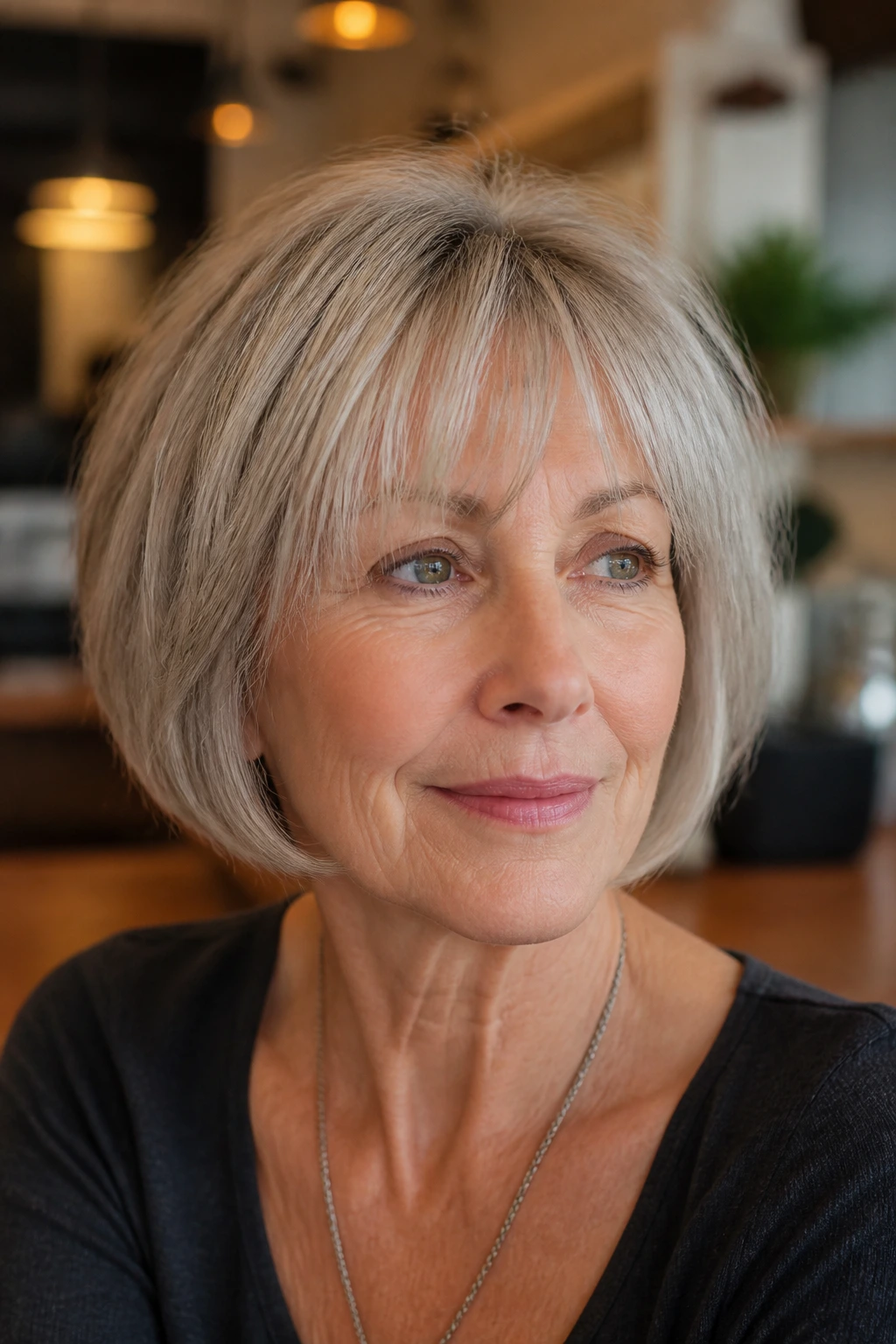
Shape Boost: A mist of root-lift spray at the crown before drying can make a short cut stand up instead of lying flat against the scalp. Use your fingers first, brush second.
Texture Control: If your bangs separate too much, rub the tiniest amount of paste between your fingertips and press it into the ends only. Not the roots. The roots need air, not glue.
Customization: Move the part a half-inch to one side and the face changes almost immediately. A center split softens a French bob; a deeper side part gives a pixie more lift on one side.
Finishing Touch: On blunt bobs and sleeker fringes, a drop of serum on the very ends can tame frizz without killing movement. On piecey cuts, skip the serum and use a dry paste instead.
Make-It-Yours: If you wear glasses, leave the outer corners of the fringe a touch longer. If your hair is fine, keep the fringe a little wispy. If it’s thick, ask for interior debulking so the shape doesn’t balloon outward by lunch.
Common Cutting and Styling Mistakes to Avoid
One common mistake is cutting the bangs too short on the first pass. The hairline almost always surprises people once it dries, especially if the hair bends, waves, or springs up at the front. The fix is simple: start longer and trim in stages. Shorter is easy. Growing out a bang you hate is the boring part nobody wants to do.
Another problem is asking for too much thinning near the fringe. On thick hair, aggressive texturizing can leave the front wispy in a bad way, like the bangs lost their nerve halfway through the week. Better to remove bulk inside the shape and leave enough weight at the perimeter to hold the line.
Then there’s the cowlick issue. If the front grows in a swirl, a straight-across fringe can split and stick out. You can fight it with a longer bang, a side sweep, or a dry-cut approach that follows the growth pattern instead of ignoring it.
Finally, some people choose a cut that needs more daily styling than they actually want to do. A sleek bob with blunt bangs looks lovely if you’ll smooth it each morning. If you won’t, don’t pretend you will. That’s how good haircuts become resentment.
Variations on the Same Idea That Still Feel Different
The Glasses-Friendly Sweep: Keep the fringe long enough to brush to one side and leave a little space above the frames. This works when you want softness without hair landing directly on your lenses.
The Low-Heat Crop: Ask for texture through the top and a fringe that can air-dry into place with minimal help. A little mousse and finger-drying are enough; no flat iron required.
The Silver-First Shape: If your gray or white hair has strong shine, let the cut stay cleaner and more graphic. Silver hair can carry a sharper line beautifully when the shape underneath is tidy.
The Thick-Hair Release Valve: Use a short style with interior layering and a slightly longer fringe so the hair can move instead of spreading out. This is the version that keeps dense hair from turning into a triangle.
The Curly-Top Version: Keep the bangs longer, cut them dry, and shape them around the curl pattern instead of straightening them into submission. The front should belong to the curl, not the other way around.
Keeping the Cut Sharp Between Salon Visits
Short cuts with bangs need touch-ups more often than long hair, but the maintenance is manageable if you stay ahead of it. Bangs usually need a trim every 3 to 4 weeks, while the full shape can often go 6 to 8 weeks before it starts to lose its line. If your hair grows fast at the temples or the nape, that clock can feel shorter.
Wash day matters too. A short fringe can look limp if it’s overloaded with product, so use shampoo where you need it and don’t pile on conditioner at the front. Keep conditioner off the roots and fringe unless your hair is very dry, because softened bangs tend to split and fall into the eyes faster.
At night, a silk pillowcase or a soft wrap can help the fringe stay smoother. In the morning, a quick mist of water, a thumb-sized bend from a dryer, and a tiny bit of product usually do more than a full restyle. If your cut is cropped close, that routine should take minutes, not half the morning.
Frequently Asked Questions
Will bangs make my face look smaller?
They can, but that isn’t always the goal. A better fringe frames the face and shifts attention upward, especially around the eyes and cheekbones, without making the forehead disappear completely.
Are bangs a bad idea if I wear glasses?
No, but the shape matters. Side-swept, airy, or slightly longer bangs usually sit more comfortably with frames than blunt fringe that lands directly on the glasses line.
What if my hair is thinning on top?
Short styles can actually help, because they remove long lengths that drag the roots down. Ask for soft layering and avoid over-texturizing the crown, which can expose too much scalp.
Can curly hair really pull off bangs?
Yes, if they’re cut for curl, not against it. The bangs should usually be left longer and cut dry so they shrink into the right shape after washing.
How often do I need to trim bangs?
Most fringes need a touch-up every 3 to 4 weeks. If the cut is very short or the hair grows quickly at the front, you may want a trim sooner.
What if my bangs split in the middle every time?
That usually means a cowlick or strong growth pattern. A longer side sweep, a curtain fringe, or a dry cut that follows the natural direction will usually behave better than forcing a straight line.
Is a pixie too severe for a softer face shape?
Not if the fringe and top have enough movement. A soft pixie with side-swept bangs can be far gentler than a longer cut with blunt edges.
Can I grow out a short bang without a weird stage?
You can, but the transition is easier if the front pieces were left a little longer to begin with. Push them to the side, pin them back, or blend them into a curtain shape while they lengthen.
A Cut That Still Feels Like You
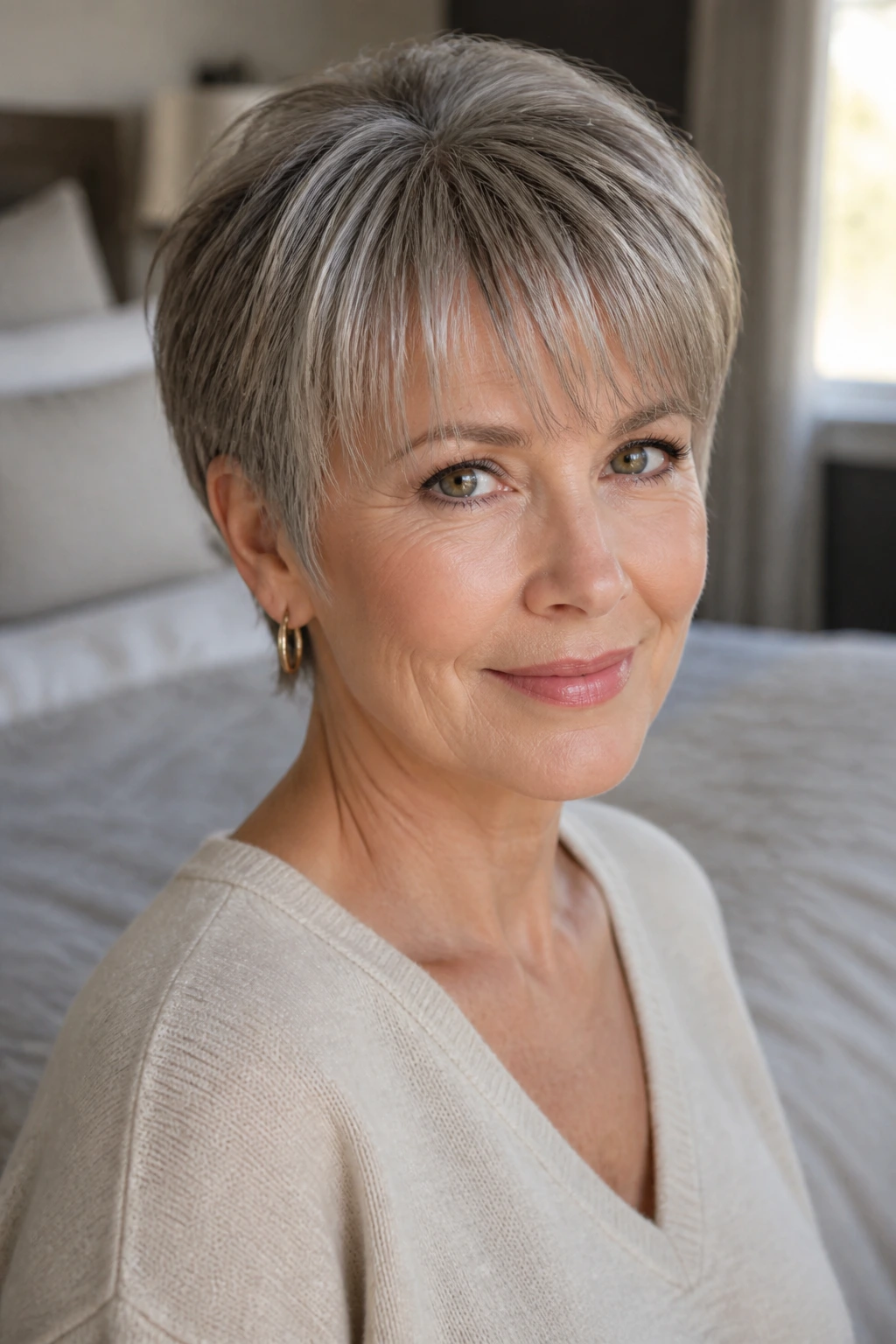
The best short haircut with bangs doesn’t fight your face or your mornings. It gives the hair a job, keeps the neckline clean, and lets the fringe do a little quiet work around the eyes instead of stealing the whole show.
That’s the part I keep coming back to: a good short shape should make the mirror easier, not harsher. If the cut respects your texture, your glasses, your cowlicks, and your willingness to style it, it’ll keep paying you back long after the salon cape comes off.
