



Black hair color ideas for straight hair live or die on precision. Straight strands do not hide much. A tiny shift in undertone, a blunt edge that’s a little uneven, a patch that grabbed too much pigment at the ends — all of it shows up faster than it does on curls or waves.
That’s not a drawback. It’s the whole point.
When the canvas is smooth, black hair can look razor-sharp, glossy, smoky, inky, blue-toned, plum-toned, or softly dimensional without needing dramatic contrast. The trick is knowing which version of black you want, because “black” is not one shade. It can lean cool, warm, metallic, cherry, violet, graphite, or espresso, and straight hair makes each one read in a different way under indoor lights, daylight, and the flash on a phone camera.
I’ve always thought straight hair is the toughest place to fake a lazy color job. You can get away with sloppy placement on textured hair more easily. Straight hair is unforgiving. It rewards clean lines, smart undertones, and finishes that look intentional instead of heavy. If you’ve ever looked at a black dye job and felt like something was off, odds are the undertone was wrong or the length had no movement. That’s where the interesting choices start.
Why These Black Shades Work So Well on Straight Hair
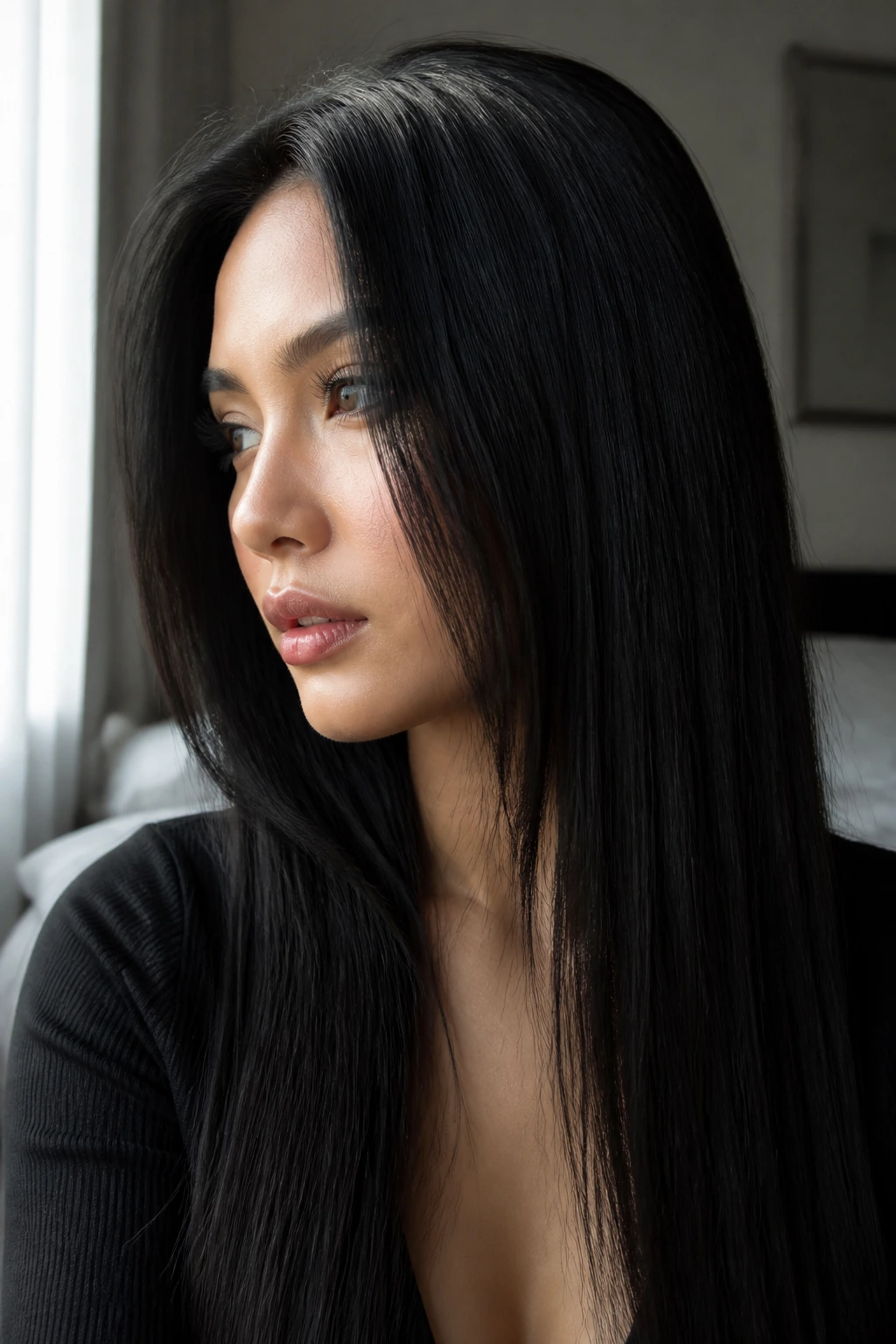
-
Shine carries the look: Straight hair reflects light in a clean sheet, so a blue-black, jet black, or glossed brunette reads much more clearly than it would on a waved texture.
-
Undertone does the heavy lifting: A cool black can look crisp and modern, while a burgundy or plum black softens the edge without turning the hair brown.
-
Placement matters more than drama: Thin ribbons, hidden panels, and soft melts show up better on straight hair than chunky highlight blocks that can look striped.
-
Blunt cuts make dark color look richer: A clean hemline gives black hair a sharper finish, especially on bobs, lobs, and long one-length styles.
-
Low-maintenance depth is possible: Shadow roots, glosses, and demi-permanent black tones can deepen the hair without forcing you into a hard grow-out line.
-
Fine hair gets a lift from contrast: Not brightness, necessarily. Just a little movement near the face or through the mids keeps dark hair from collapsing into one flat sheet.
1. Jet-Black Glass Hair
Jet-black glass hair is the version that looks almost lacquered when it catches the light. On straight hair, that effect gets amplified, because the surface stays smooth and the color reads as one continuous sheet from root to tip. It’s a clean look, but not a lazy one. If the ends are dusty, if the cut is uneven, or if the dye has gone even slightly warm, the whole thing loses that sharp edge.
Why It Works on Straight Hair
The smooth cuticle of straight hair makes a glossy black finish look almost reflective, especially after a clear gloss or a shine serum. A blunt bob, long one-length cut, or softly beveled ends all help the color look denser than it is. If you want this look to land, ask for a true black level with a cool-neutral base, not a soft brown that only looks black in dim light.
- Best on level 1 to level 3 bases
- Looks strongest with blunt ends, not choppy layers
- Needs regular gloss refreshes every 4 to 6 weeks
- Works best when heat styling stays low and controlled
Tip: if the ends are see-through, the whole look starts to wobble. Trim first, color second.
2. Blue-Black on a Sleek Lob
Blue-black is the fastest way to make black hair color feel colder and more deliberate. Indoors, it can look nearly jet black. In daylight, though, there’s a navy flash that straight hair reveals beautifully because the light travels across the surface instead of breaking up in texture. A sleek lob is the best cut for this because the edge is long enough to show movement, but short enough that the undertone doesn’t disappear into a heavy curtain.
This shade is the one I’d pick for someone who likes black but finds pure black a little severe. It softens the face in a good way. There’s still depth, still drama, but with a faint cool shimmer that keeps the look from feeling one-note.
How to Ask for It
Tell your colorist you want a black base with a blue-violet reflect, not a brown-black finish. If your hair is naturally dark, a demi-permanent gloss may be enough. If your starting point is medium brown, you may need a more saturated deposit to get the blue tone to show clearly instead of fading into dark brown.
3. Espresso-Black Balayage
Can black hair still move? Absolutely. The trick is breaking up the mids and ends with espresso balayage instead of leaving one solid block from scalp to hem. On straight hair, those soft ribbons show up much more clearly than they do on curls, because the lines stay visible as the hair falls.
This is one of my favorite black hair color ideas for anyone who wants depth without the helmet effect. The base stays black, but the hand-painted espresso pieces keep the hair from reading flat. They’re usually only one or two levels lighter than the base, which is enough to make the ends look softer and less heavy.
What Makes It Different
Unlike classic caramel balayage, espresso balayage stays deep and moody. It gives you movement without obvious contrast, which matters on straight hair where chunky foil lines can look harsh fast. Ask for diagonal painting through the mids and a soft root melt so the transition doesn’t look stamped on.
4. Black Cherry Peekaboo Panels
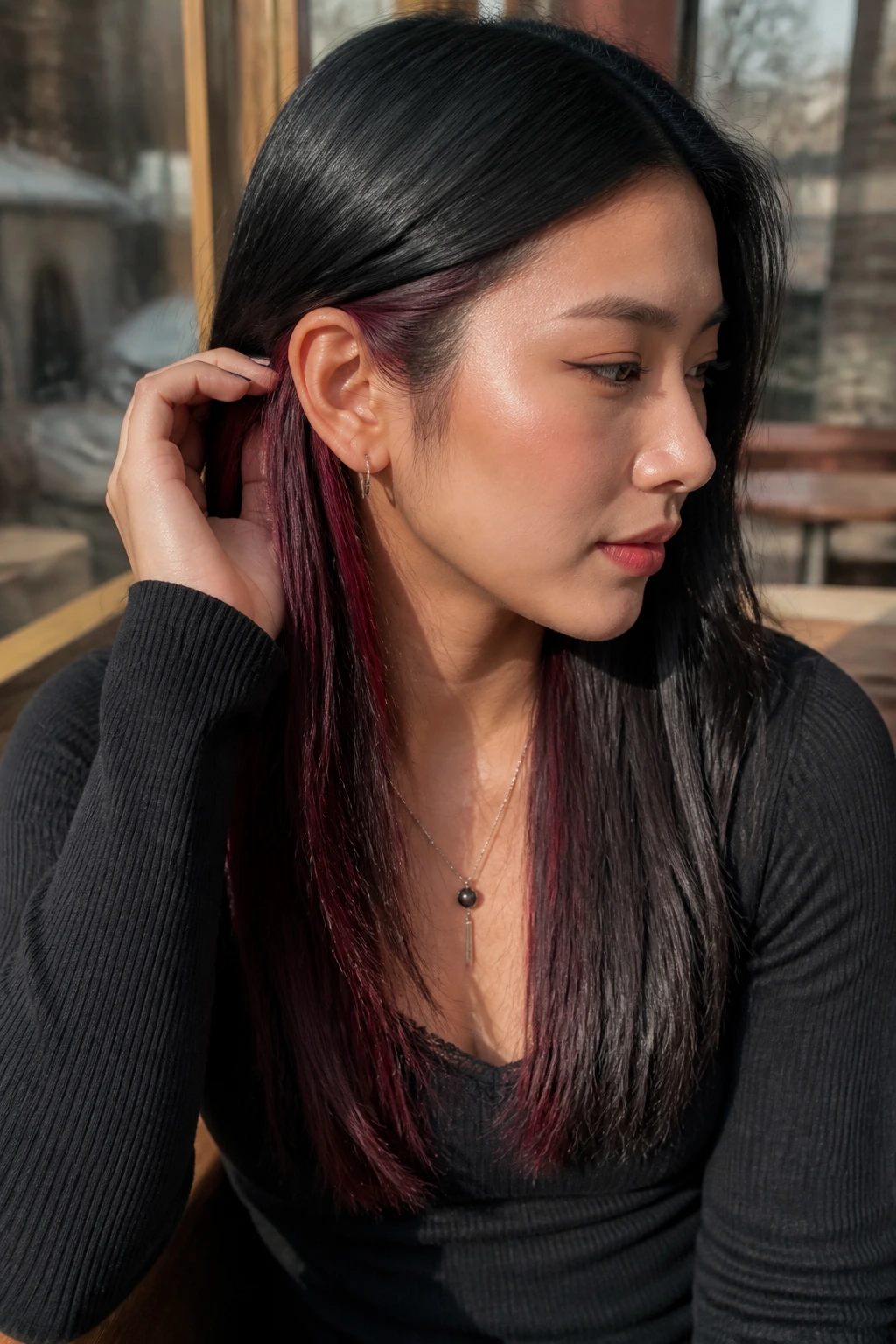
The first time you tuck straight hair behind your ear and catch a flash of black cherry underneath, it feels like a little secret. That’s the whole charm of peekaboo panels. The top layer stays black, while the hidden sections underneath carry a cherry, wine, or deep merlot tone that only shows when the hair moves.
This look works especially well on straight hair because the panels do not disappear into texture. They stay clean and graphic. Wear the hair down for a dark, polished finish. Sweep it into a half-up style or a low ponytail, and suddenly the burgundy undertone becomes part of the shape.
Best Way to Wear It
Keep the hidden color close to the nape and the lower sides, not broad chunky stripes. Too much cherry can turn the style costume-like. A few carefully placed panels under the top veil are enough. If you want the effect to stay rich, ask for a wine-toned deposit rather than a bright red fantasy shade.
5. Smoky Graphite Black
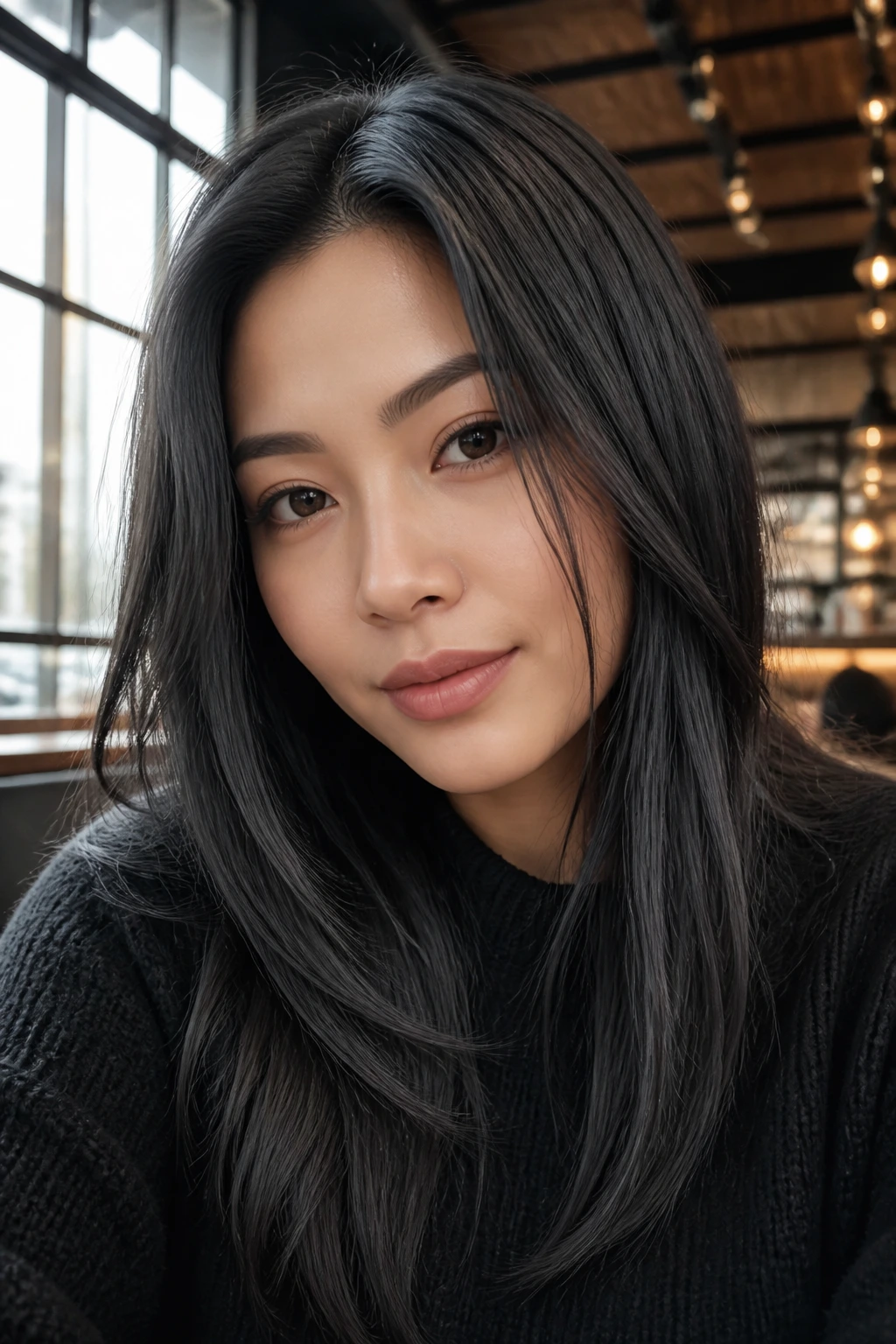
Smoky graphite black is for anyone who likes black hair with a little cool dust on top. It sits between jet black and soft charcoal, and straight hair gives it the cleanest read because the light moves smoothly across the surface. The result is darker than brown, lighter than ink, and just cool enough to feel polished without looking flat.
It’s also a useful shade if pure black has ever made your features look a bit hard. Graphite softens the edge. You still get the sleek drama, but with a faint gray cast that feels more breathable. On a long straight cut, this version can look almost silky, especially when the hair is in good condition and the ends are trimmed neatly.
If you’re going for this look, the finish matters more than the formula. A matte, dry graphite black can look dull. A glossy one looks intentional.
6. Raven Black with Face-Framing Money Pieces
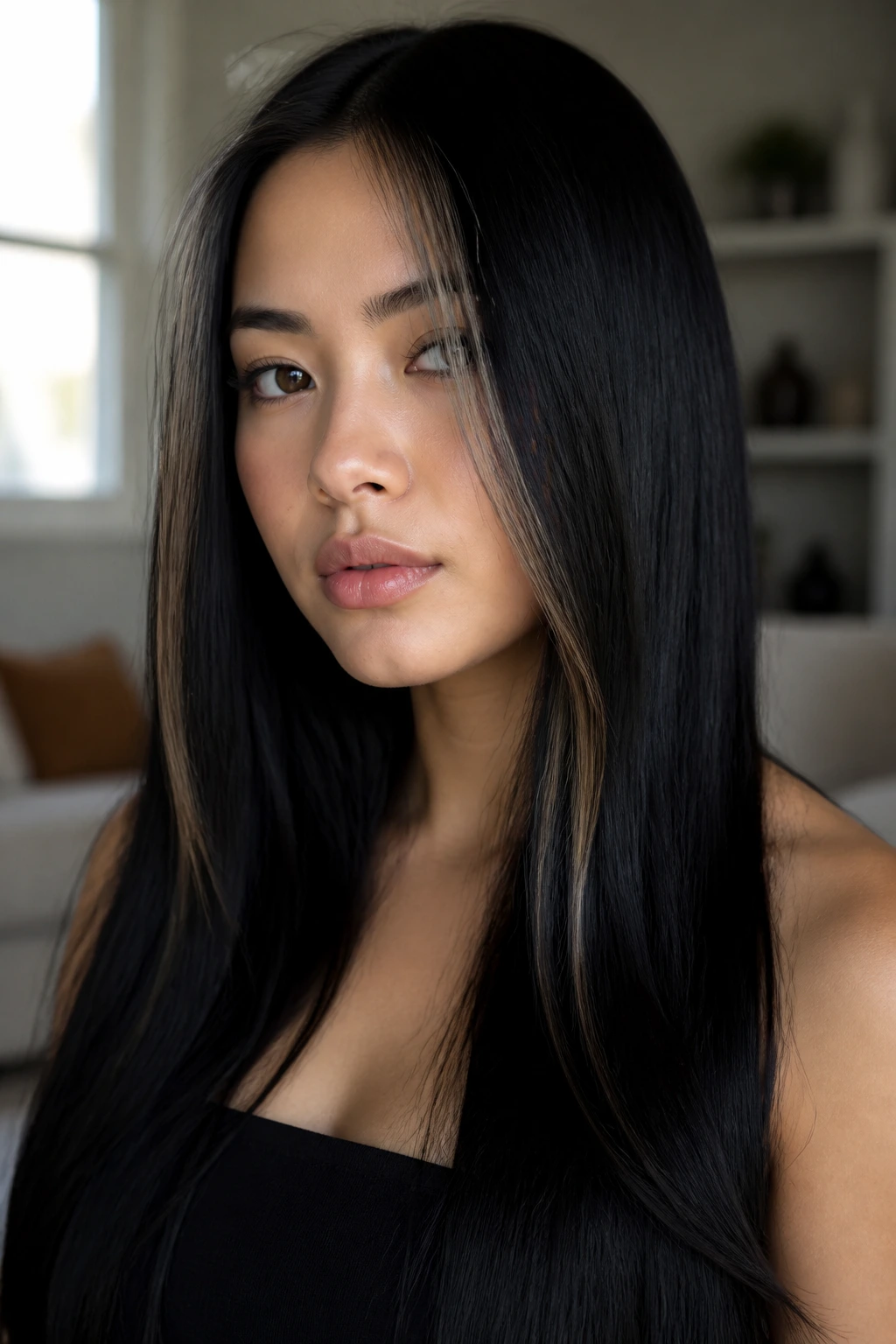
Unlike blonde money pieces, raven-black money pieces are subtle. That’s the point. The face-framing sections are lifted or toned just enough to create a soft frame around the front of the face while the rest of the hair stays deep, dark, and rich. On straight hair, those front pieces stay visible because they lie flat and catch light right where you want it.
This works especially well when your hair is long and pinned behind the shoulders, or when you wear a center part and want a little break around the face. Keep the contrast modest. A deep mocha, dark auburn, or cool brown in the front sections usually looks better than a pale streak. The color should feel like part of the black, not a separate idea shoved on top.
What to Ask For
Ask for two fine face-framing panels, no wider than about 1 to 1.5 inches each, toned one to two levels lighter than the rest. That gives the face shape without turning the front into a billboard. It’s a quieter move, and honestly, that’s why it works.
7. Soft Black Gloss for Fine Hair
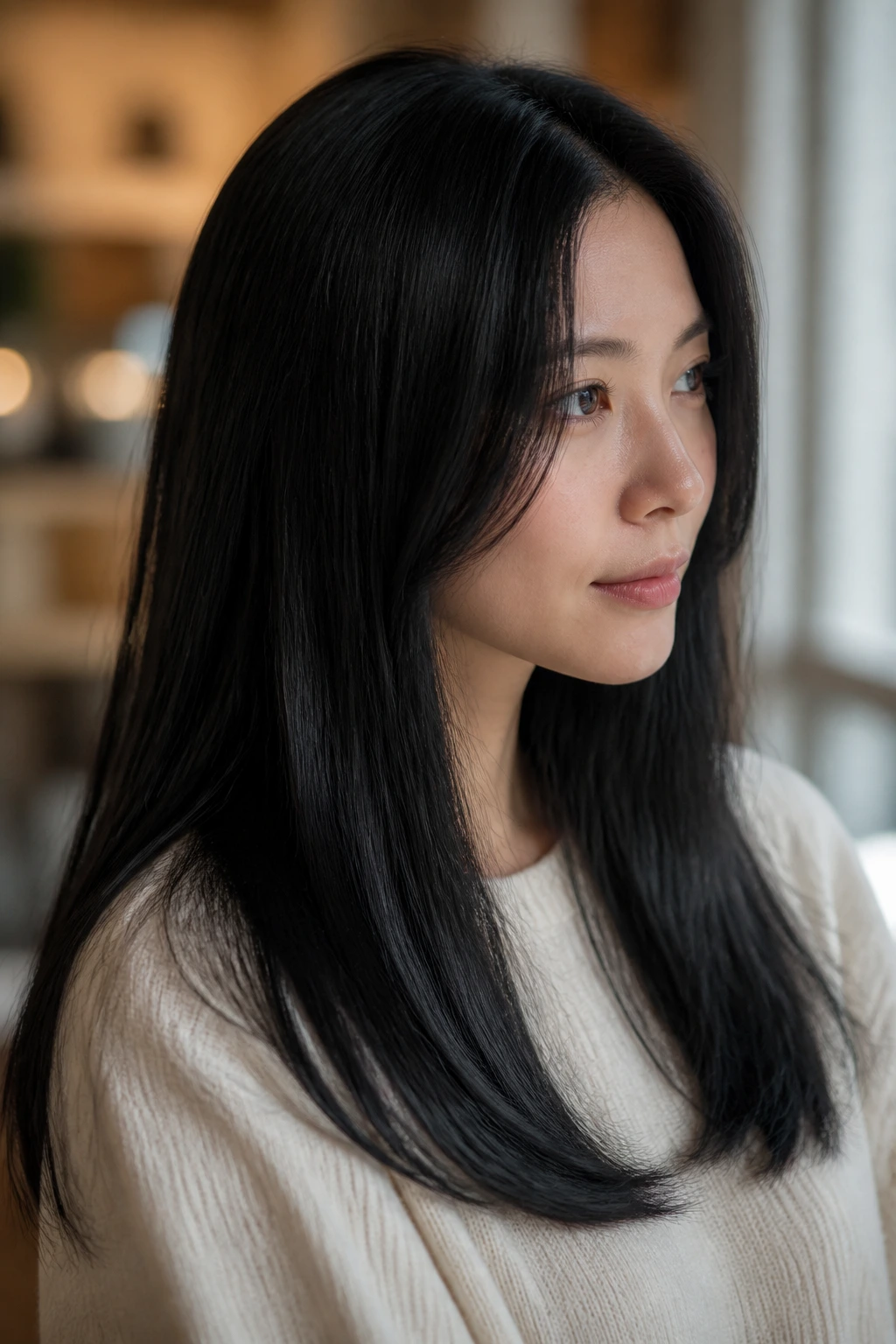
Soft black gloss is the smartest choice if your hair is fine and you want depth without heavy pigment. Instead of a hard, permanent-looking black, this version leans softer — more like dark brunette with black reflect. Straight fine hair can look stringy if the color is too dense and too flat, and a gloss helps avoid that overdone edge.
This shade is especially good when the goal is cleaner shine rather than obvious drama. It deepens the base, smooths out uneven warmth, and makes the hair look healthier without burying it in pigment. The light still moves through the hair a little, which keeps the length from disappearing.
A demi-permanent glaze or clear-black gloss usually handles this well. If you’ve ever looked at black dye and thought it swallowed your features, this is the gentler path.
8. Burgundy-Black Veil
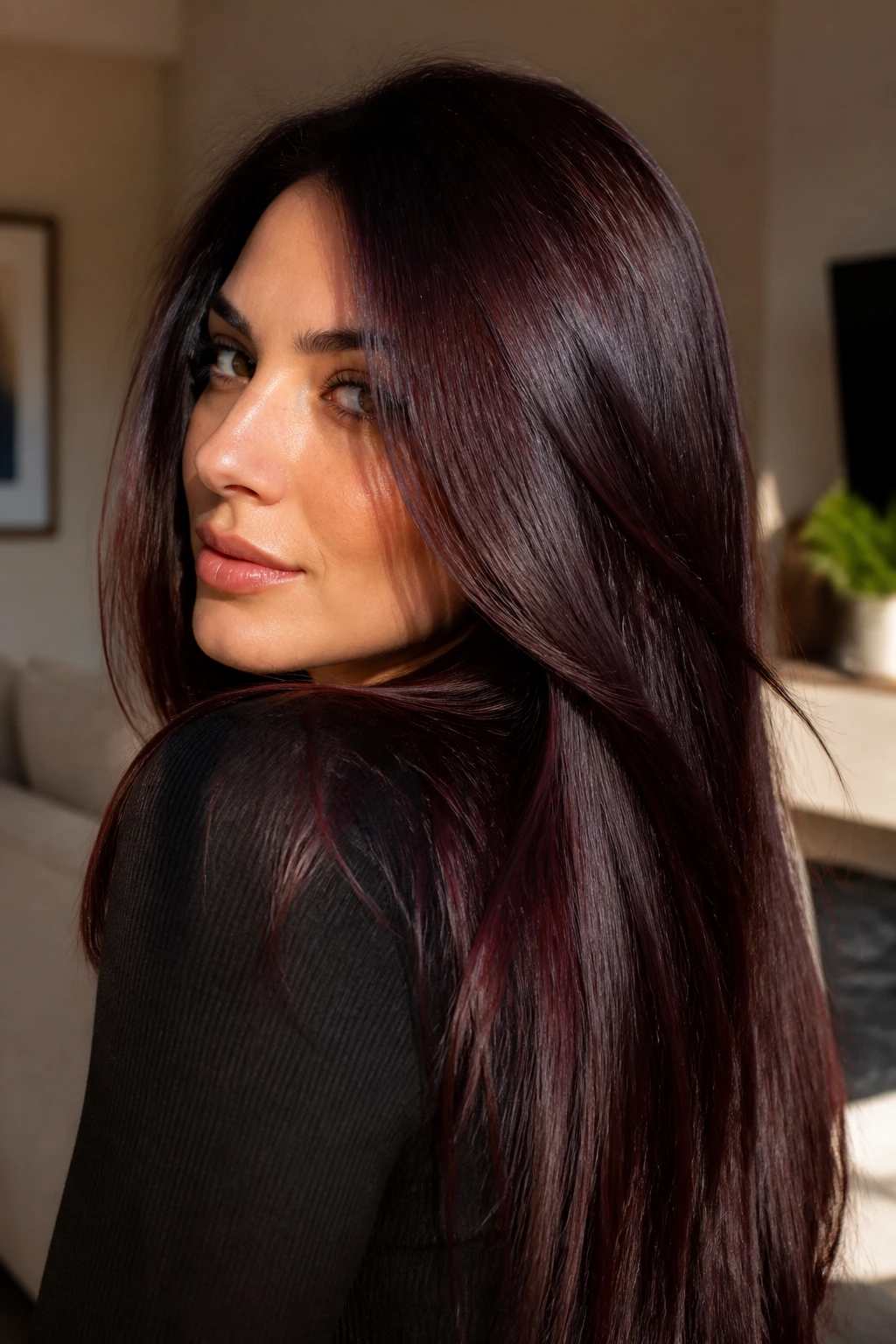
Burgundy-black is one of those shades that looks quietly dark until the light hits it. Then the red wine undertone wakes up. Straight hair is perfect for this because the reflective surface lets the burgundy show in bands and flashes without needing curls to help it along.
This is the black hair color idea I’d hand to someone who likes warm lipstick, gold jewelry, or clothes in deep brown and plum. The red undertone softens the severity of black and gives the hair a little warmth without drifting into brown. Indoors it reads almost like pure black. Outside, or under warm lighting, the veil shifts just enough to catch the eye.
Keep the pigment deep. You want burgundy, not cherry candy. If the red is too bright, the whole thing can move away from elegant and into costume territory fast.
9. Black-to-Charcoal Melt
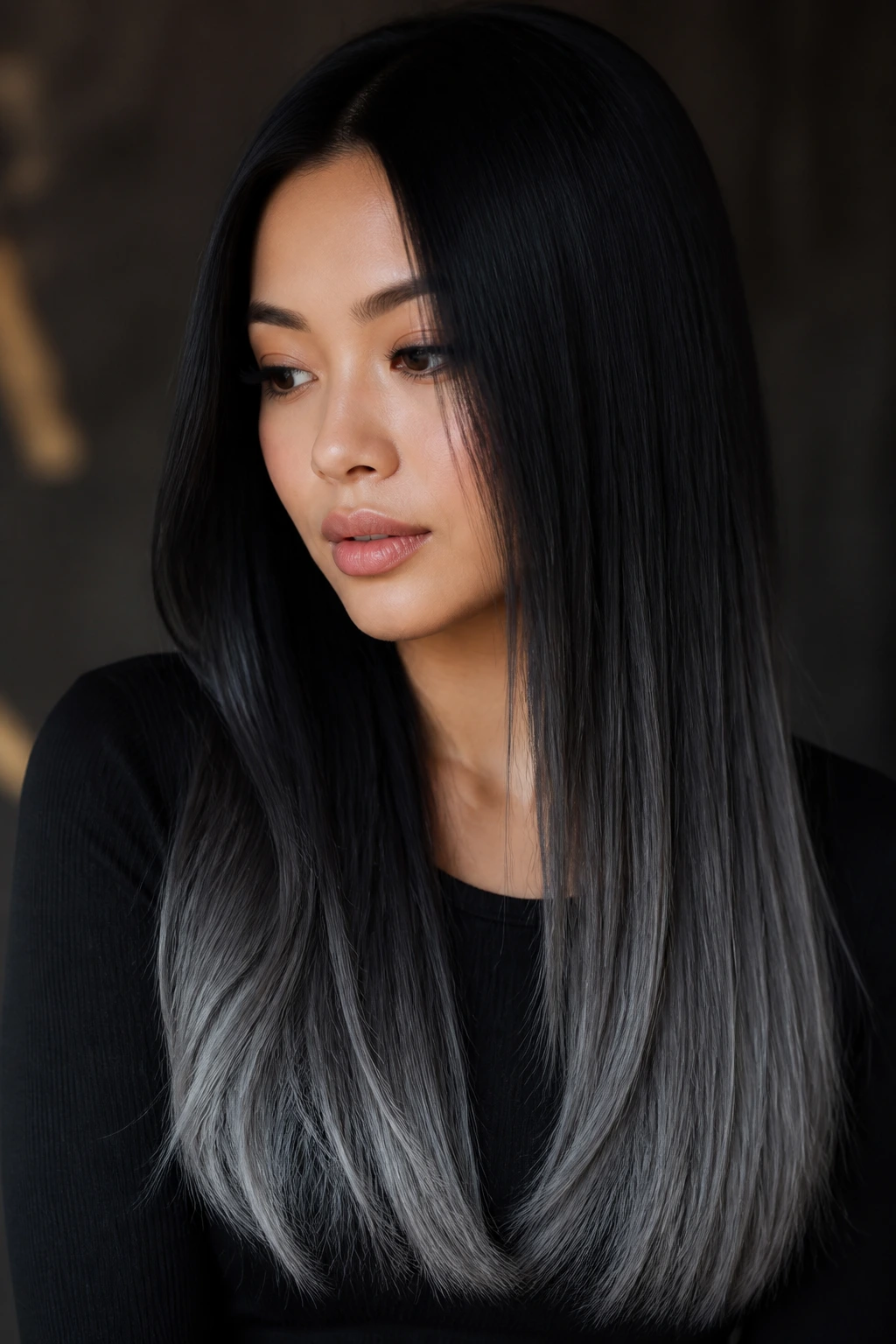
A black-to-charcoal melt works because straight hair shows every inch of the transition. There’s no curl pattern to hide the fade, so the gradient has to be clean. The roots start inky black, the mids soften into deep gray-brown territory, and the ends finish in charcoal smoke. If the transition is done well, it looks like the color naturally thinned out over time.
That makes this one of the most flattering dimensional options for long straight hair. It breaks up the weight at the bottom without introducing bright contrast. You still get the moody black base, but the ends stop feeling like one heavy block.
Ask for a soft smudge at the root and a gradual tonal shift through the lower half. The line between black and charcoal should be blurred, not blended to the point of disappearing. You want to see the movement, just not the hand behind it.
10. Black Velvet with Caramel Ribbons
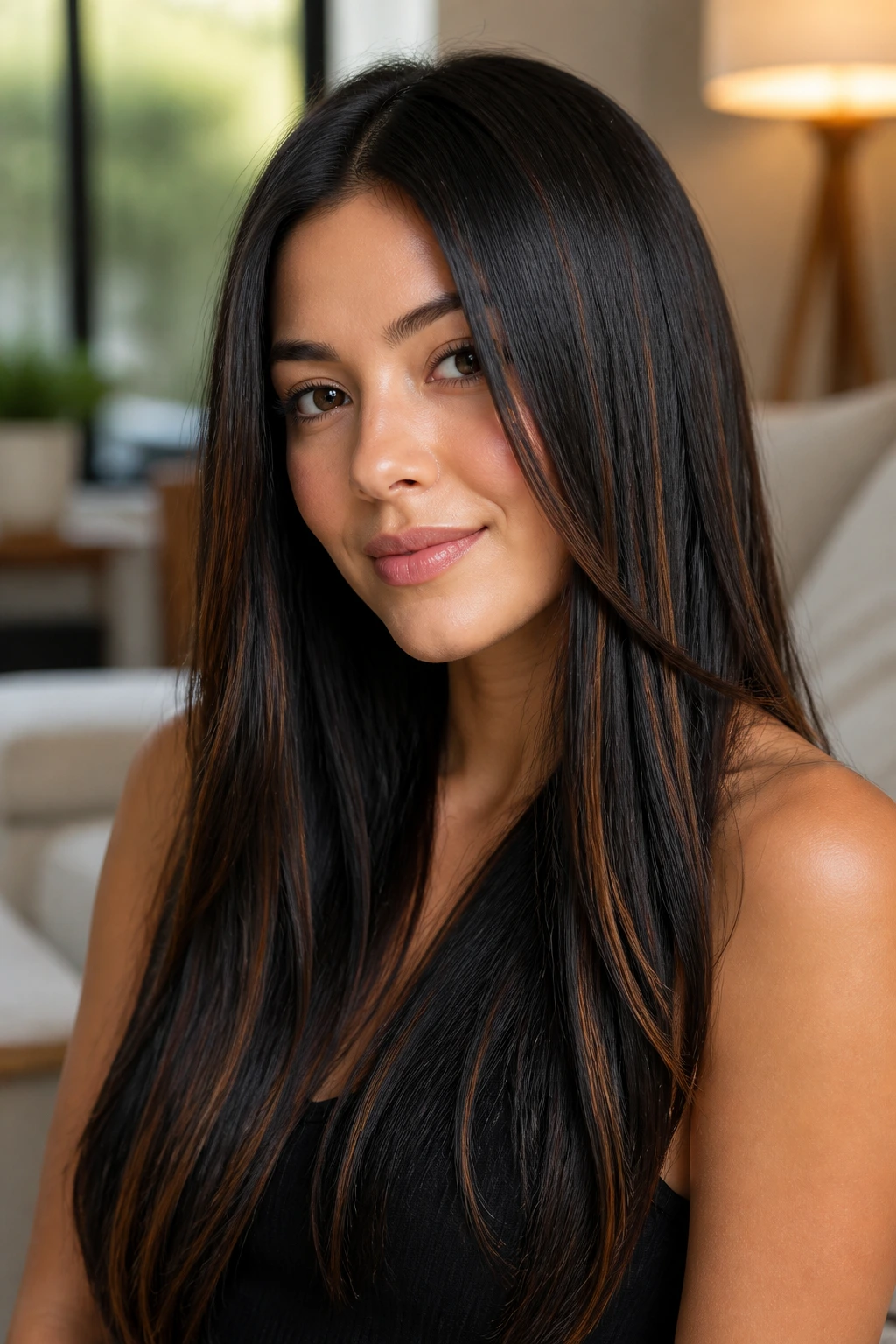
Black velvet with caramel ribbons is not a chunky highlight look. It lives or dies on restraint. The caramel pieces should be thin, painted softly through the lengths so they flicker instead of shout. On straight hair, those ribbon lights show up clearly and can make a long dark style feel less heavy around the shoulders.
This look has a warmer, softer mood than blue-black or graphite. The caramel pieces are best kept a couple of levels lighter than espresso, not pale blonde. If they get too bright, the contrast becomes striped, and straight hair will not forgive that.
The nice part is the movement. As the hair swings, the ribbons create tiny shifts in tone, especially at the mid-lengths. It’s a good option if you like black hair but want a little warmth to stop it from looking severe in harsh light.
11. Silver-Streak Black
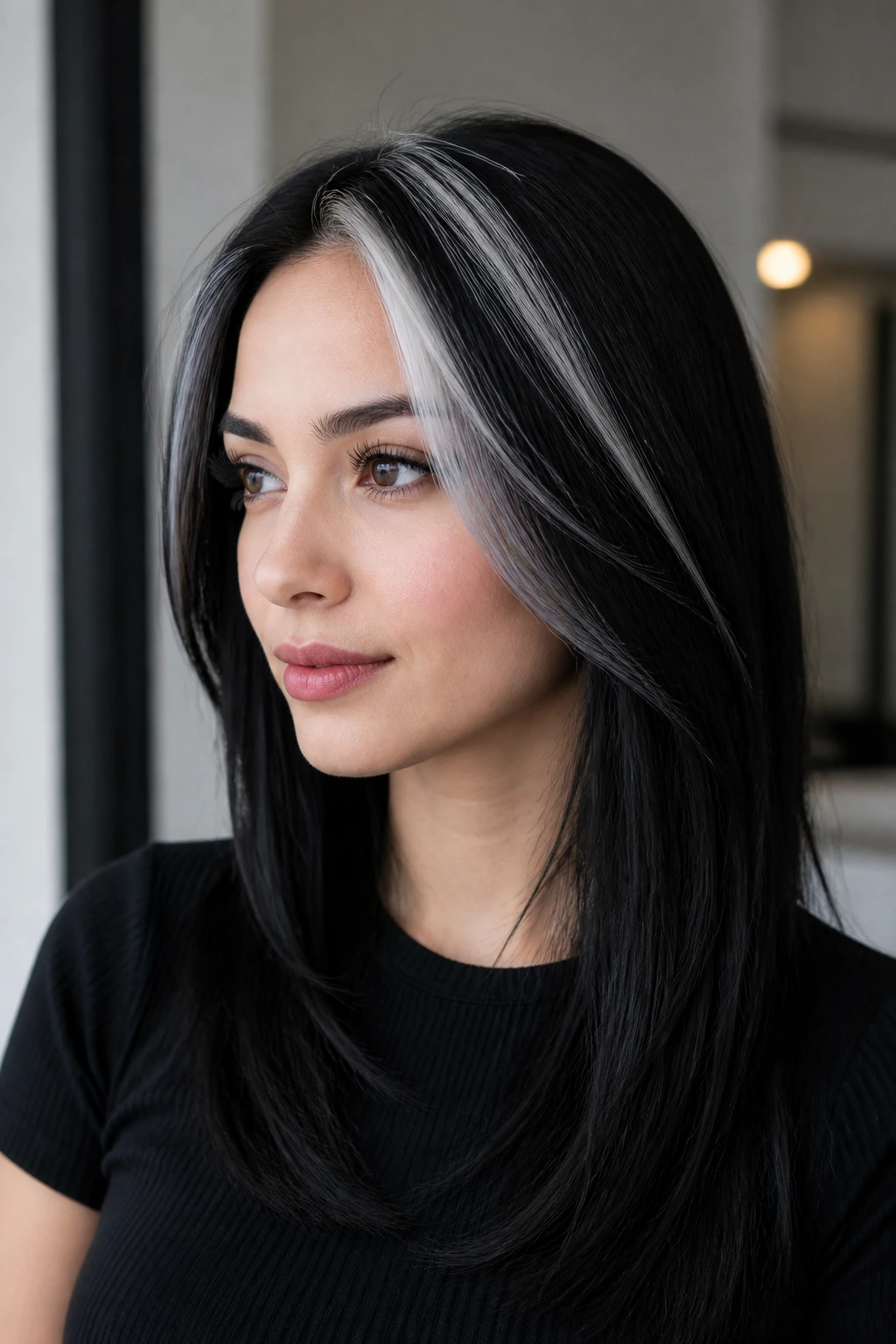
Silver-streak black is the boldest cool-toned choice in the whole group. A few well-placed silver or icy gray streaks against a black base create a sharp, graphic contrast that reads especially clean on straight hair. There’s nowhere for the silver to hide, which is exactly why it works. The hair becomes a moving panel of dark and light.
This look needs precision. Too many streaks and it turns messy. Too few and the contrast disappears. I like it best around the part line, through the crown, or in one carefully controlled section near the front where the hair falls naturally and shows the streaks without effort.
What to Watch For
Silver on black can go muddy if the base underneath is too warm. Ask for a cool toner and a true high-lift silver, not a smoky beige that will disappear after a few washes. The contrast should feel deliberate, not accidental.
12. Midnight Black Ombré
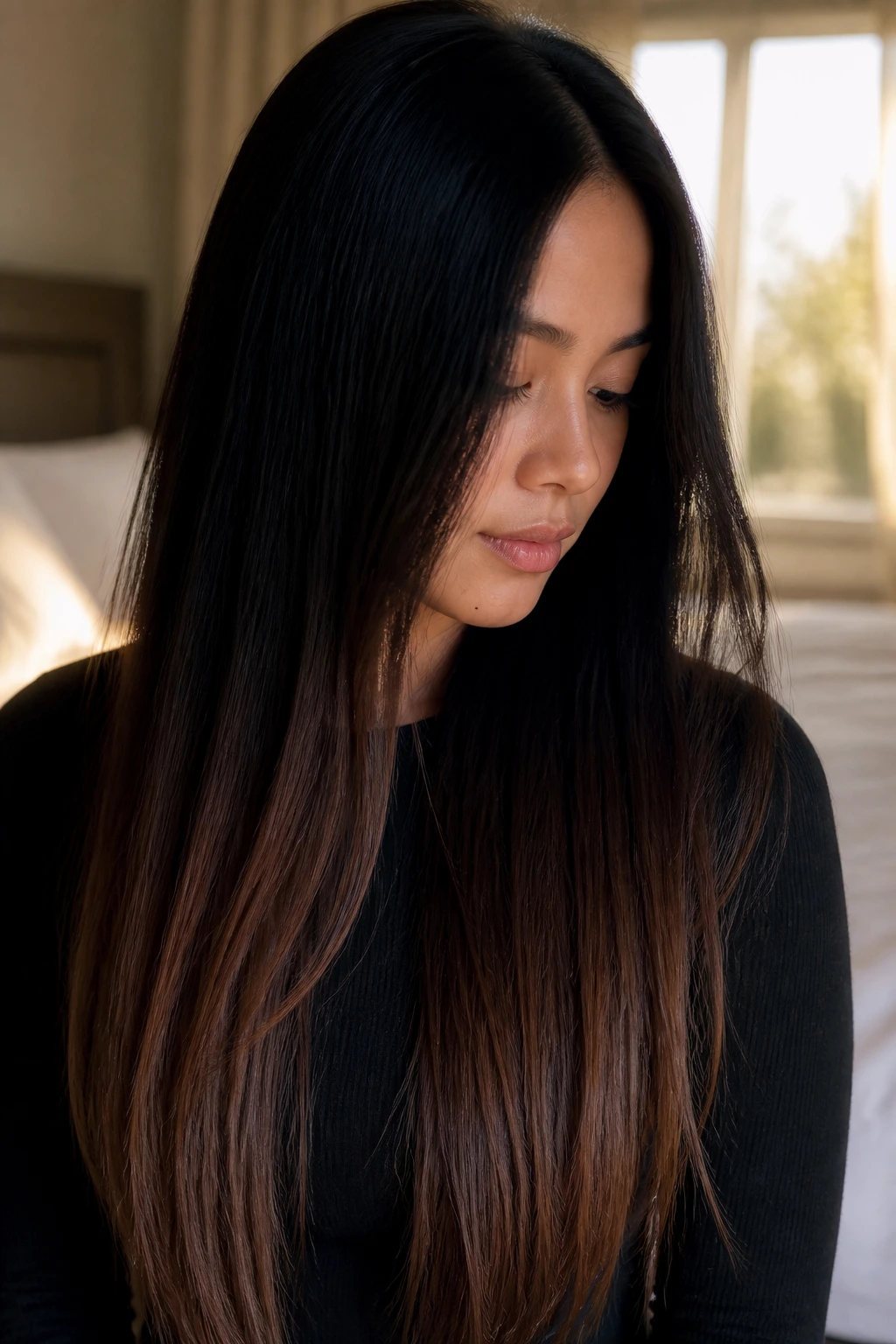
Midnight black ombré is a softer answer to all-over black. The root zone stays deep and dark, but the lengths drift into a softer smoky brown or dark graphite as they go down. On straight hair, that fade is easy to read, which is useful if you want dimension without obvious highlight lines.
This style works especially well on longer lengths, where the gradation has room to unfold. A short cut can make the shift feel abrupt. Long, straight hair gives the ombré space to breathe, and the ends look lighter in a way that feels natural rather than bleached.
It’s also one of the more forgiving options if your hair has uneven porosity. The lighter lower half can soften the look of old color bands, as long as the fade is done carefully. If you want a black look with a little more movement, this is a strong choice.
13. Plum-Black Shine
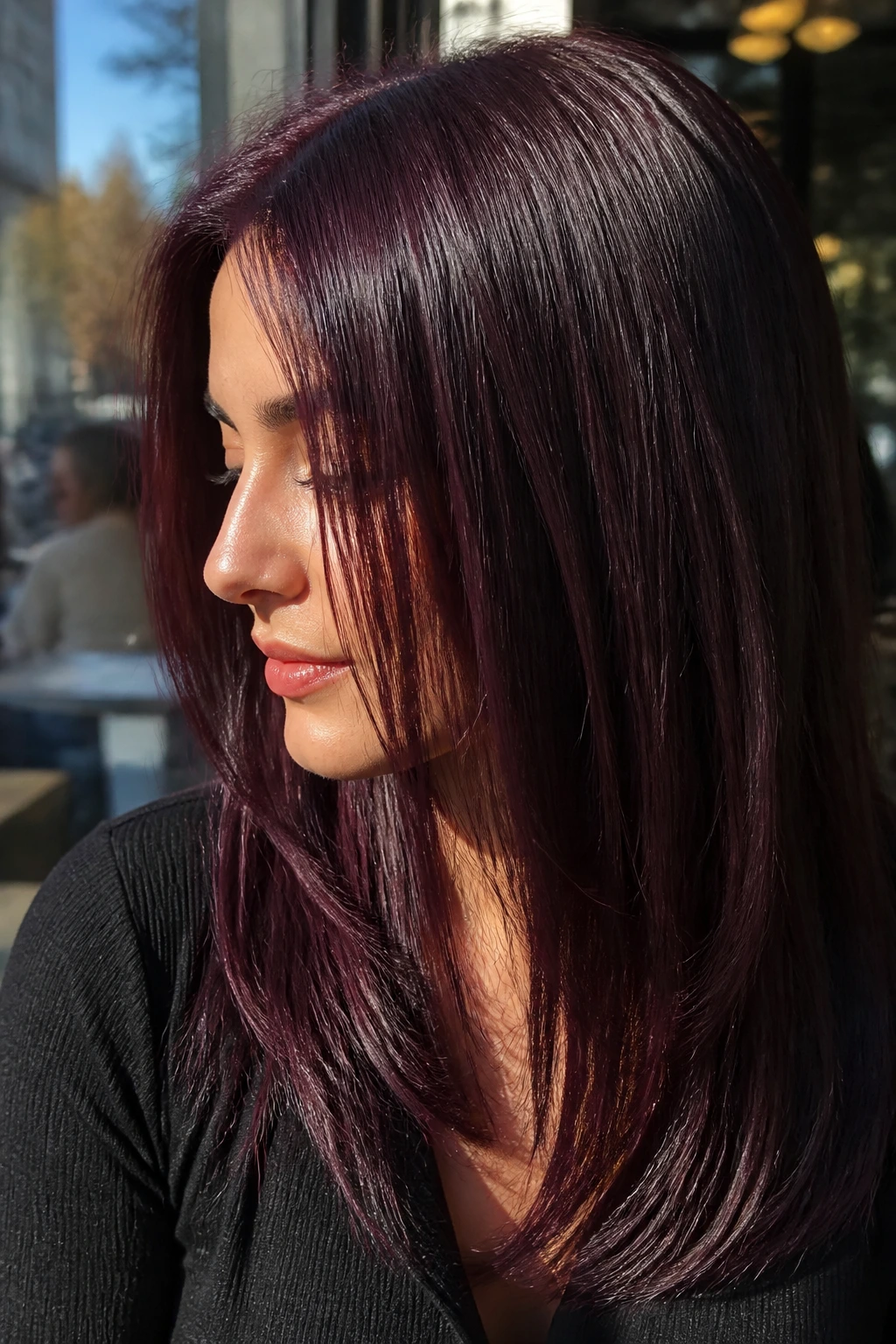
Plum-black is the friendliest of the fashion tones because it stays dark. The violet-red reflect only wakes up in bright light, which makes straight hair an ideal canvas. The smooth surface catches the color shift in a way that feels subtle at first glance and richer the longer you look.
This shade sits in a sweet spot between burgundy and blue-black. It has enough warmth to keep black from feeling harsh, but enough cool depth that it never drifts into brown. On a straight middle part, the color reflects like a dark wine stain with a purple edge.
If your skin tone tends to look washed out next to pure black, plum-black can solve that without lightening the overall mood. It is one of those shades that looks calm from a distance and a little more interesting up close. I always think that’s the better kind of drama.
14. Hidden Sapphire Underlayer
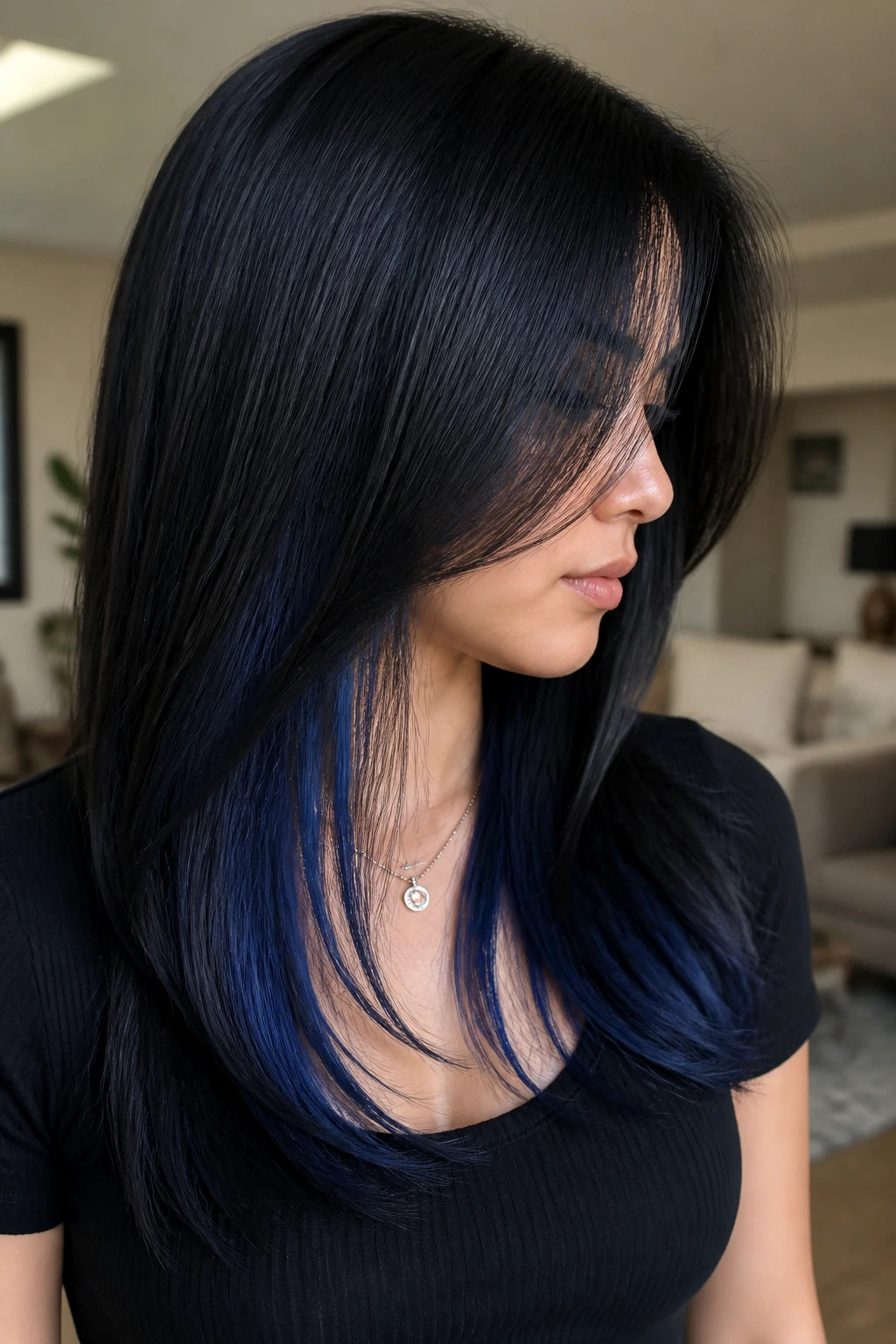
Hidden sapphire underlayers are for people who want black hair with a bit of a reveal. The top stays black and smooth, while the lower layer gets a deep sapphire or midnight blue deposit. Straight hair is ideal because the underlayer stays neat instead of blending away in texture. When the hair moves, the blue flashes through. When it’s still, the look stays conservative enough for regular wear.
This is a smart option if you want something expressive but not loud. The top layer protects the look from feeling too bright, and the sapphire underneath gives you a second color without the maintenance of full fantasy dye on every strand. It’s especially good on straight hair cut in layers, because the underlayer peeks through naturally.
Ask for the blue to stay deep and inky, not neon. The richer the sapphire, the more wearable it is.
15. Mocha-Black Shadow Root
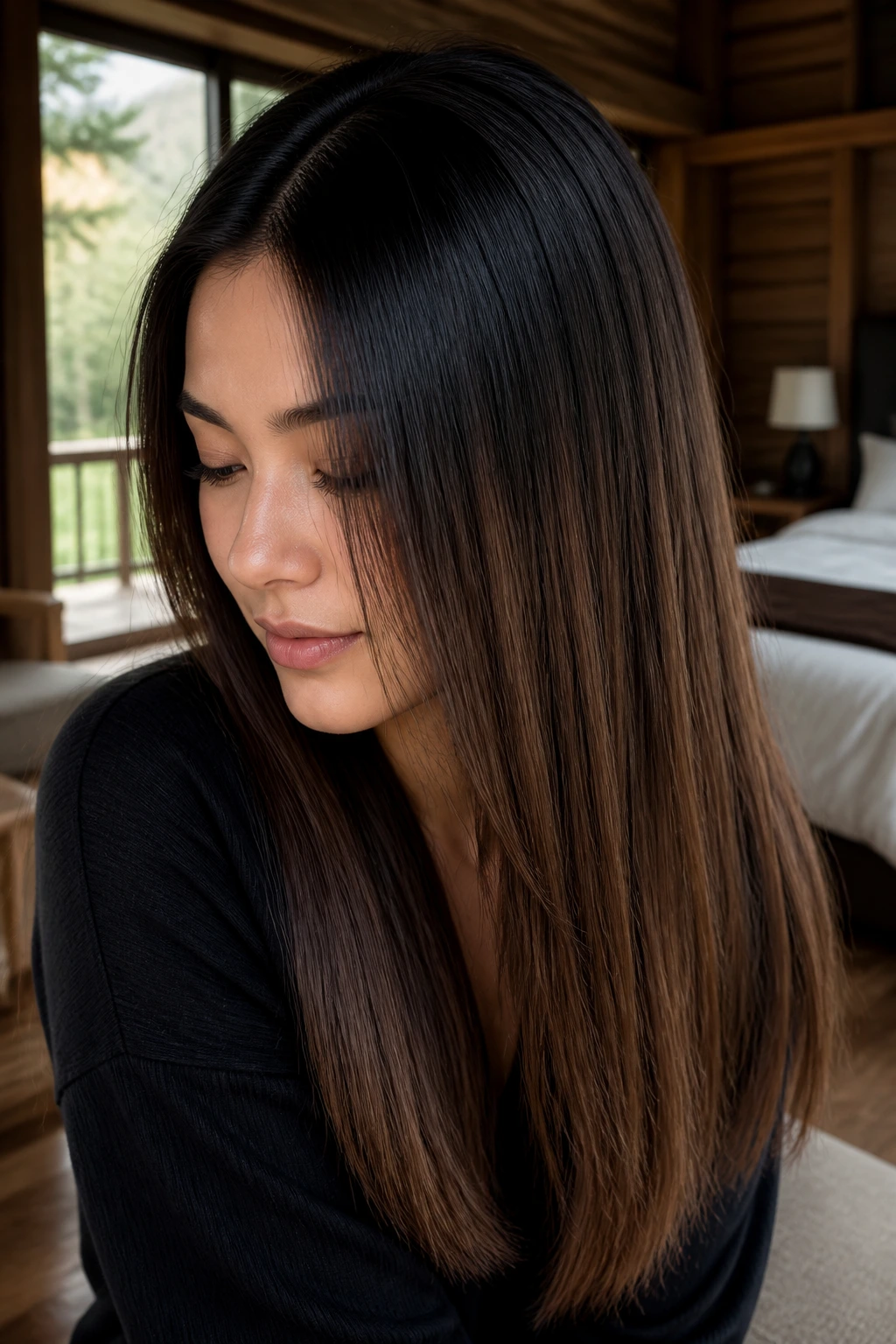
Mocha-black shadow root is the easygoing black look that doesn’t punish grow-out as much as a hard one-color service. The root stays dark and rich, but the mids soften into a mocha-black blend that feels a little less severe. On straight hair, this makes the color look smooth from top to bottom instead of helmeted.
It’s a useful approach if your hair is naturally medium brown or if you’ve been wearing lighter color and want to go dark without shocking contrast at the root. A shadow root also makes the color easier to maintain. The grow-out line stays softer, and the hair can move through a few weeks without screaming for a touch-up.
If you want black without the commitment of black-black, this is one of the best options on the list. It’s calm, clean, and much less fussy than people expect.
16. Inky Black with Copper Threads
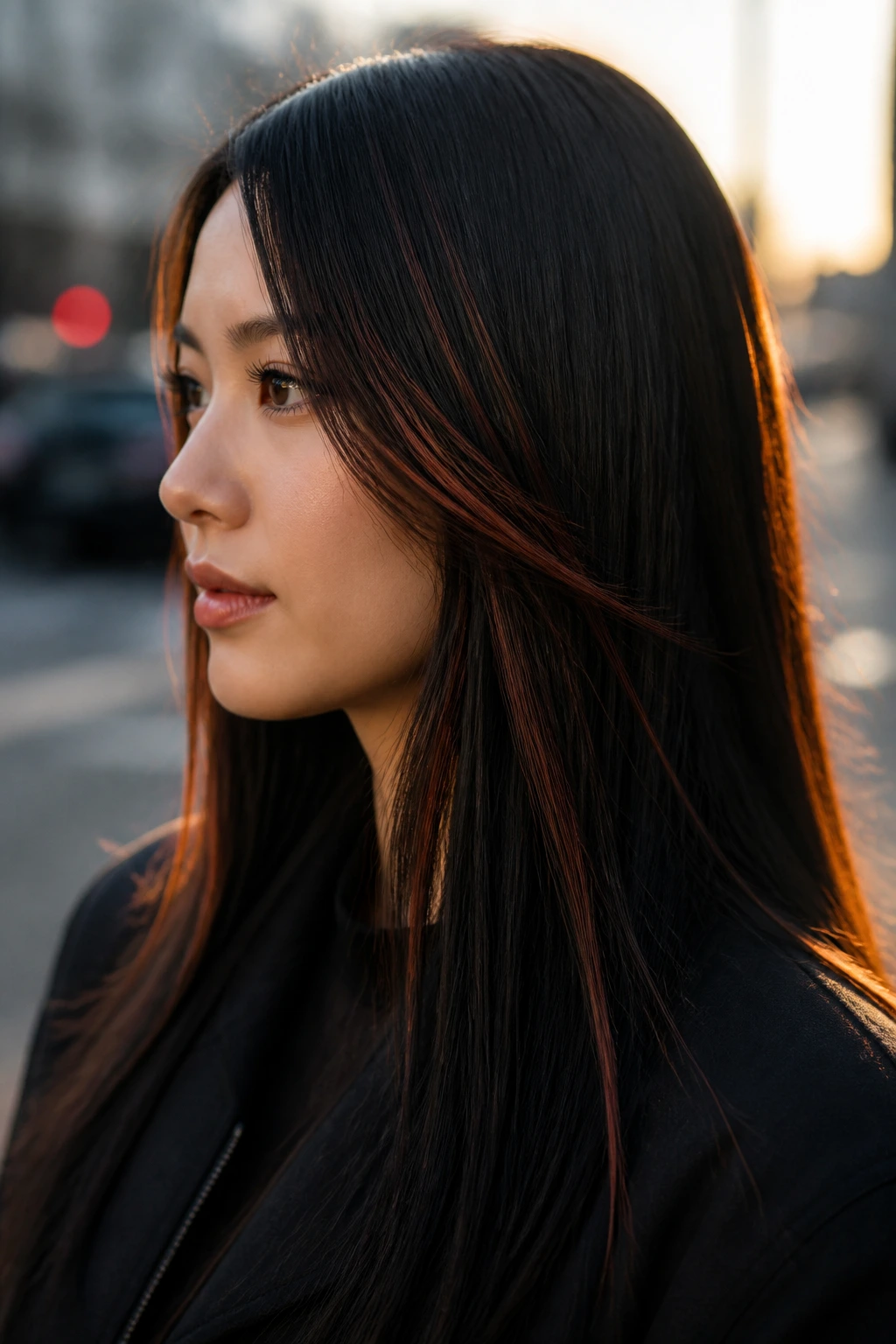
Copper threads on black hair are tiny, not chunky. That matters. On straight hair, even a few fine copper strands can create a real shift in the way the light sits on the hair. The warmth peeks through the dark base in small flashes, almost like thin lines drawn through ink.
This look feels more deliberate than a full copper highlight job because the base still dominates. The copper is there to interrupt the darkness, not take over the whole style. If your hair tends to look too cool or too severe in black, a few copper threads near the front or through the mid-lengths can make a big difference.
Keep the copper deep and burnt, not bright orange. The latter can make black look patchy by contrast. The richer shade reads like a choice; the brighter one can look like old color fighting its way out.
17. Ash Brown Slices on Black
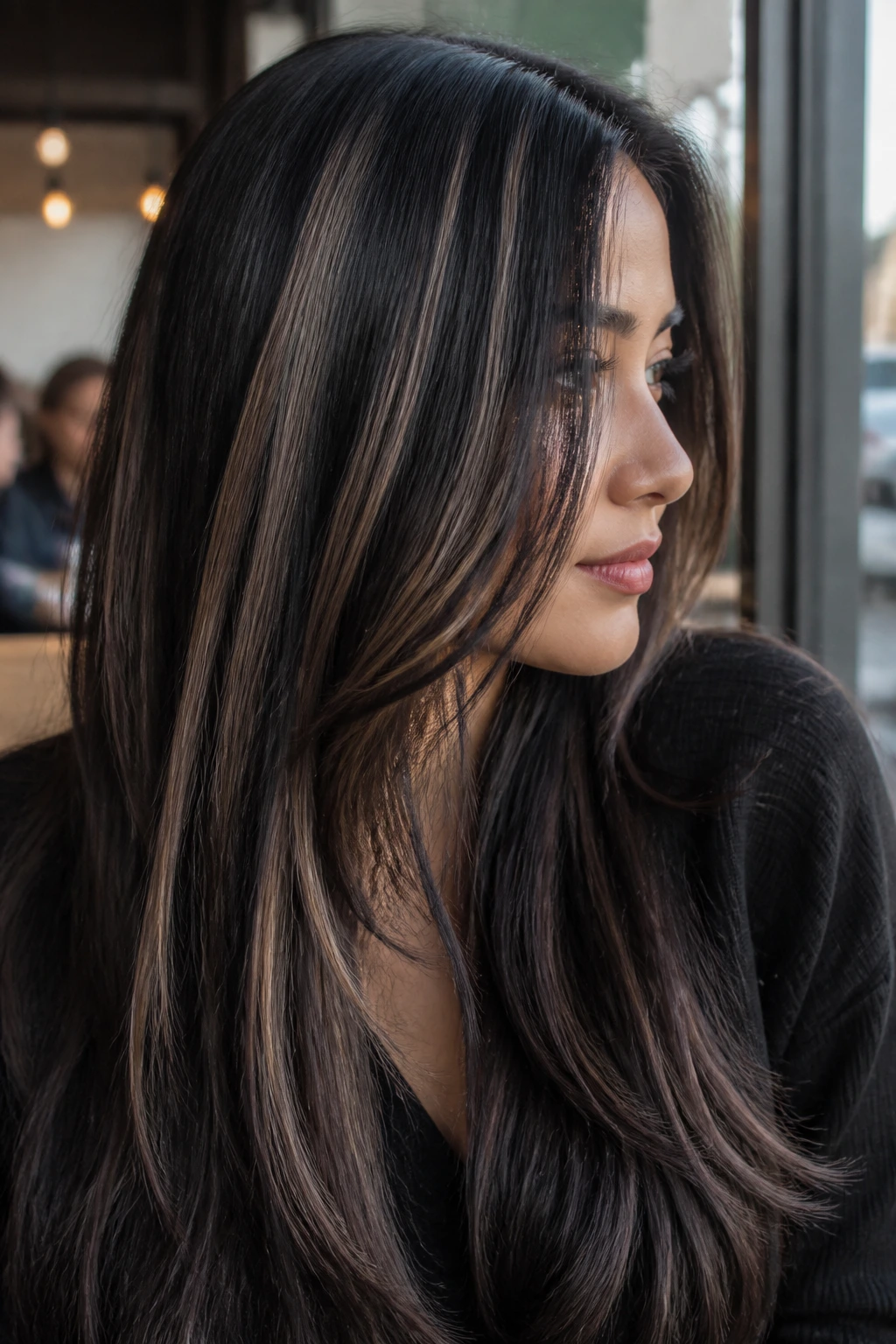
Ash brown slices are the answer when you want dimension but hate warmth. They sit against black hair with a smoky, cool edge and keep the whole style from reading flat. On straight hair, the slices show up cleanly, especially if they’re placed near the crown and through the longer lengths where the eye naturally follows the line.
This is not a big contrast look. It’s subtle, almost quiet, and that’s why it works for people who want black hair color ideas without obvious highlights. The ash brown doesn’t scream for attention. It just breaks the surface enough to keep the black from turning into one heavy mass.
If you’ve ever had caramel pieces go too orange on you, this is the smarter path. It stays cooler, softer, and much more controlled.
18. Violet-Veil Black
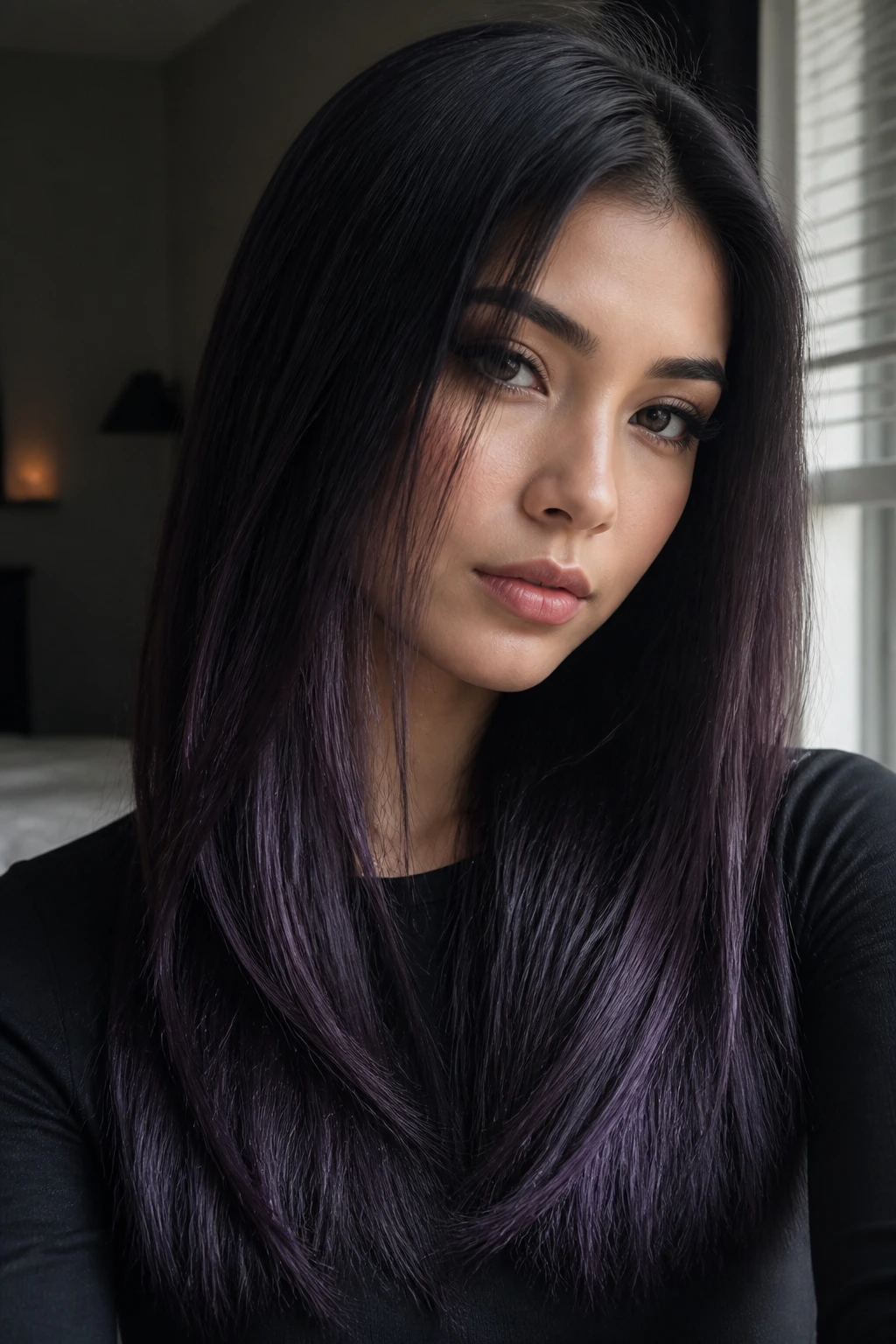
Violet-veil black is plum-black’s moodier cousin. The violet reflect is deeper and more shadowy, which makes it a strong choice for straight hair that needs a little edge. Under dim light it reads almost pure black. Under direct light, the violet comes forward in a smoky sheen that feels slightly editorial.
This color is one of the best options if you like a fashion shade but still want the versatility of black. It doesn’t behave like a bright fantasy color. It behaves like a dark neutral with a secret. On long straight hair, the effect can look especially rich at the ends, where the light catches the violet cast as the hair moves.
Ask for violet on a black base rather than a purple that has been diluted too far. The deeper tone holds better and fades in a more graceful way.
19. Satin Black Micro-Lowlights
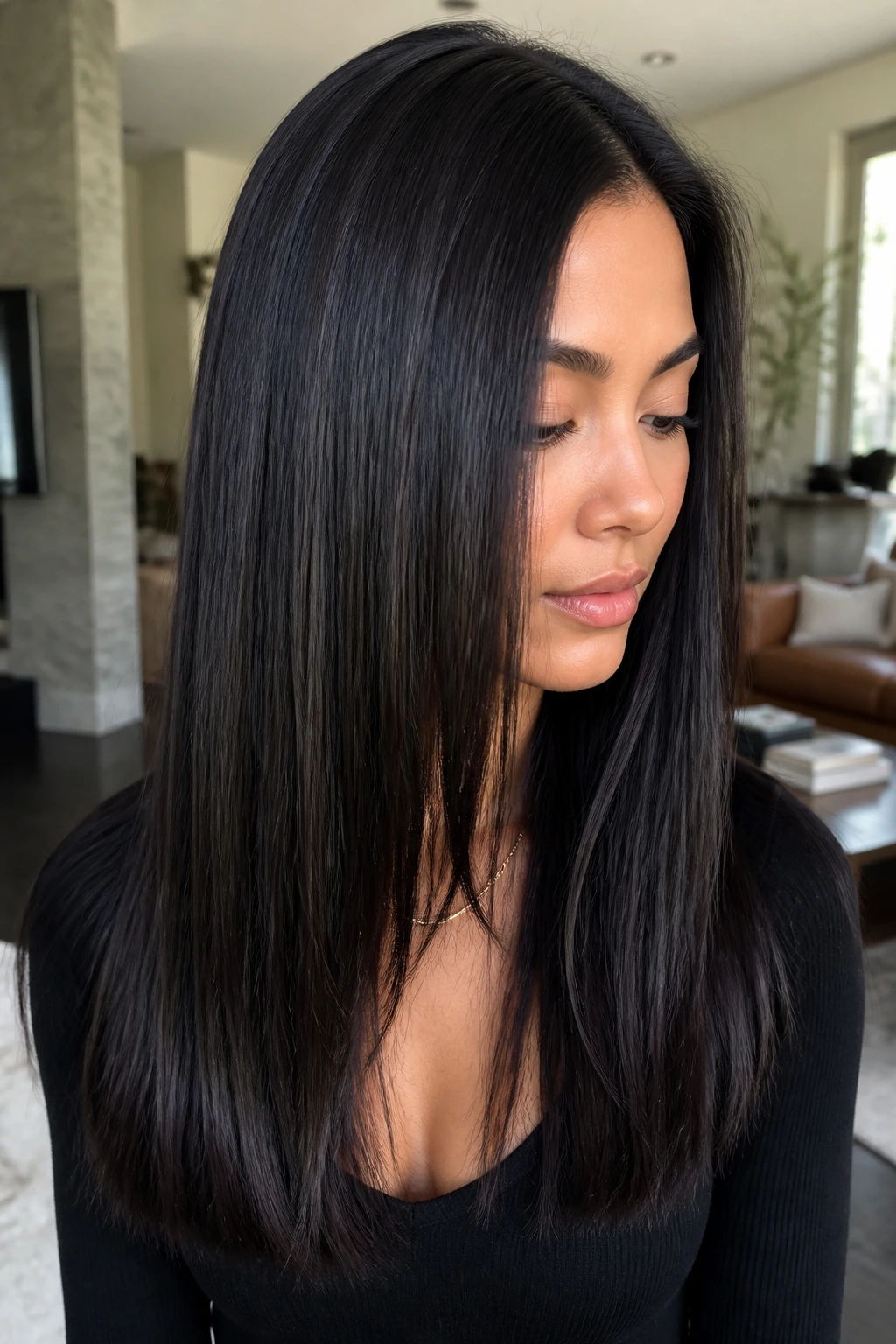
Micro-lowlights are the quiet detail most people miss, and that’s exactly what makes them good. Instead of bright pieces, you’re adding tiny darker threads or slightly varied black-brown panels through the hair to create movement. Straight hair makes this kind of work more visible because every tiny shift in tone stays aligned and neat.
This is a nice fix for hair that feels too solid after a one-process black color. The micro-lowlights don’t change the overall shade much, but they stop the color from looking flat in daylight. Think of them as texture without a curl pattern. That sounds abstract, but in the mirror you can see the difference right away.
It’s also a smart choice for long hair that needs dimension without noticeable highlights. If your goal is a polished black that still has life, this is a strong sleeper option.
20. Mushroom Brown and Black Blend
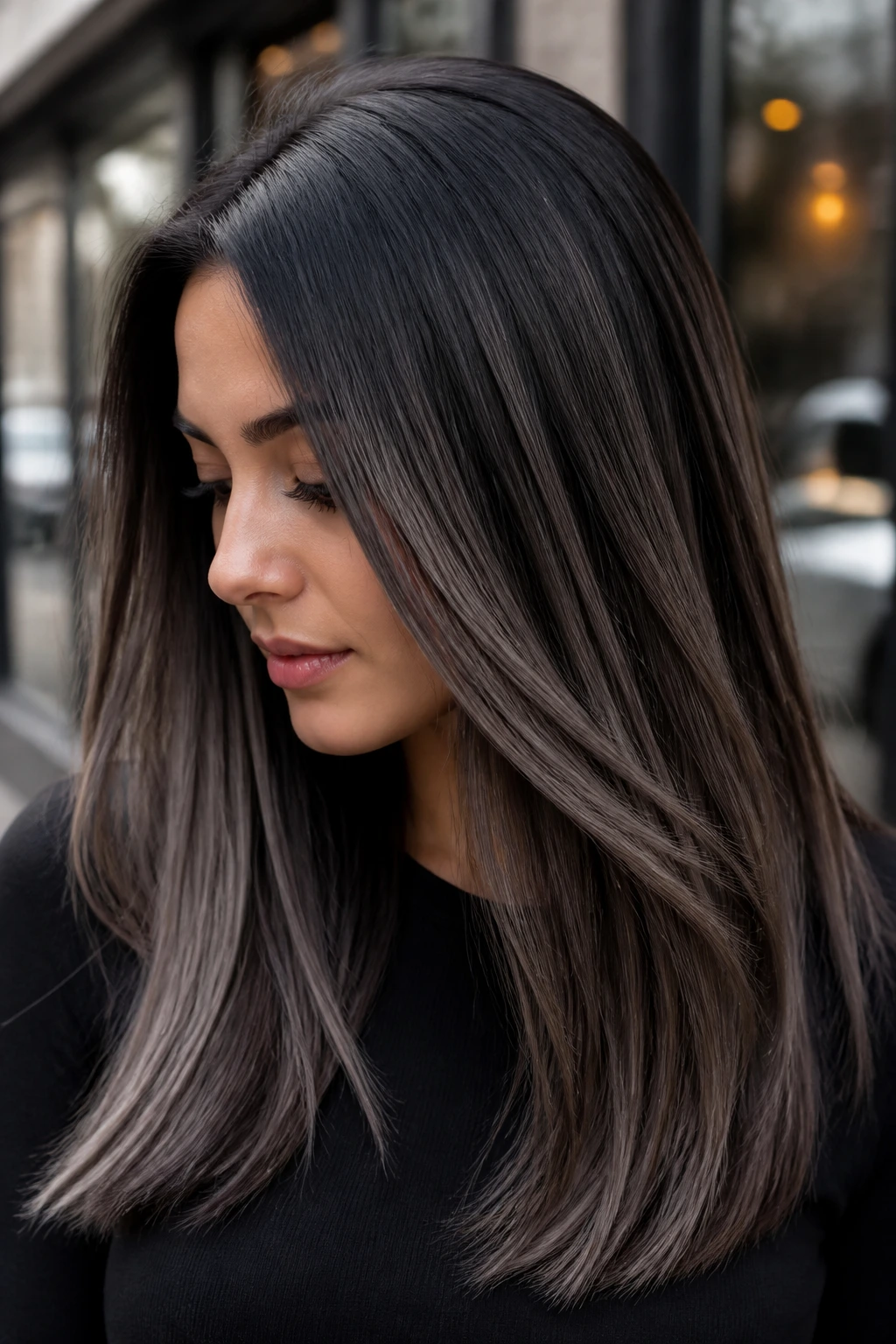
Mushroom brown and black is the cool-toned answer for anyone who wants depth with a softer finish. The blend sits between taupe, ash brown, and black, so it never turns warm or orange. On straight hair, the muted tones read cleanly and keep the color from feeling too heavy around the face.
This shade is a good bridge for people moving from lighter brown into darker territory. It gives you black-adjacent depth without the hard jump to a true inky base. Because the tones are close together, the hair looks smooth and expensive in the practical sense — no stripey contrast, no obvious line of demarcation, just a soft gradation that makes sense.
If your wardrobe leans gray, black, cream, or navy, this one slips in easily. It is quieter than jet black, but not dull. That’s a useful line to walk.
21. Cinnamon-Fringe Black

A cinnamon fringe against a black base can change the whole face shape. The cinnamon sits around the front hairline and bangs or curtain fringe, while the rest of the hair stays dark and sleek. On straight hair, the warmth at the front shows up without needing to fight the rest of the color for attention.
This works especially well if you wear a straight fringe or a soft curtain bang. The warm edge opens the face and keeps the black from looking too closed in. A little cinnamon goes a long way here. You do not need the front to turn copper. You just need enough warmth to catch the light and soften the contrast.
It’s a smart choice for winter coats, darker makeup, and blunt cuts. The front reads as a deliberate accent, not a random highlight job.
22. Jet Black Blunt Bob with a Center Part
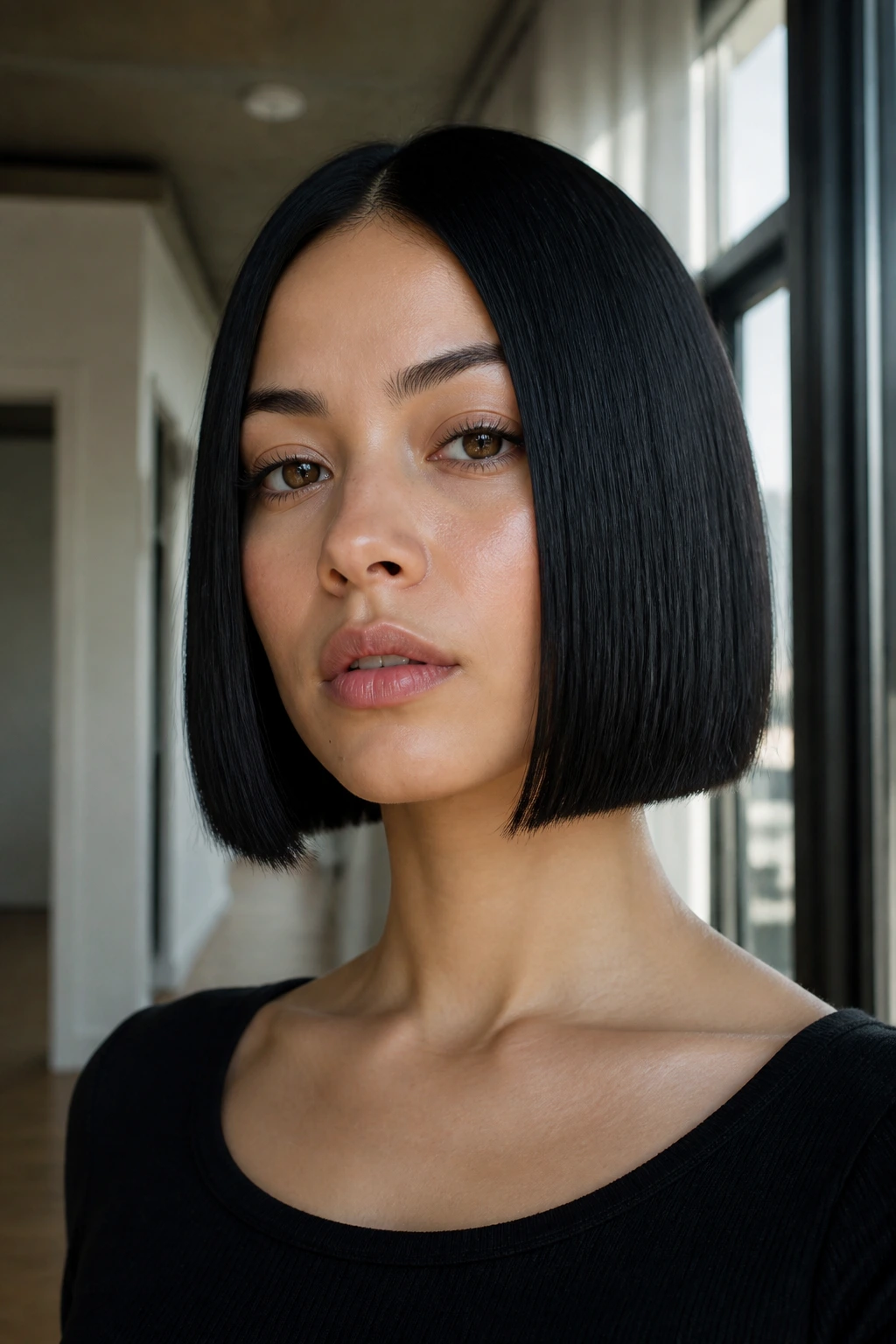
The blunt bob is where jet black turns into a statement. The straight line at the ends, the center part, the dense black pigment — all of it lines up in a way that makes the cut feel almost architectural. There’s no extra color trick here. The shape is the color story.
On straight hair, this works because the hemline can sit like a clean edge against the jaw or collarbone. Jet black makes that line even sharper. If you want the hair to look thicker and denser, this is the route I’d take before I’d reach for highlights or ribbons. Sometimes the strongest move is the cleanest one.
Keep the ends trimmed often. A blunt bob only looks expensive when the edge stays crisp. Once it starts fraying, the whole point starts to blur.
How Black Hair Color Shows Up So Cleanly on Straight Hair
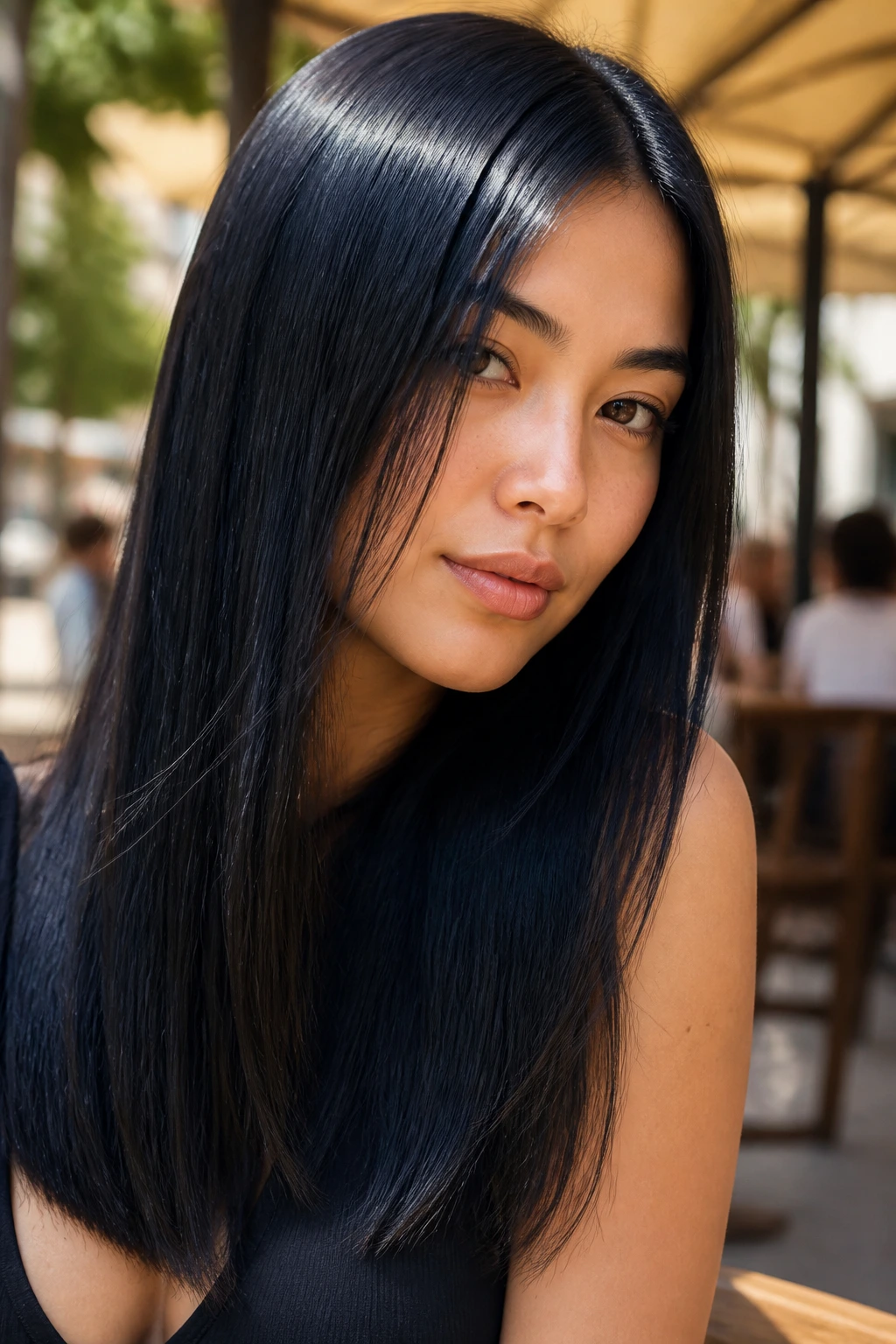
Straight hair gives black color a hard surface to sit on. That sounds obvious, but it matters more than people realize. On curly or highly textured hair, the tone breaks up as it moves through bends and coils. On straight hair, the color acts more like a sheet of fabric. Every undertone, every faded end, every shift in gloss shows up quickly.
That’s why the best black hair color ideas for straight hair are usually the ones that control shine and tone with some discipline. Blue-black looks bluer. Plum-black looks more wine-toned. Graphite black looks cooler and flatter in a useful way. And when the placement is right, even tiny ribbons of espresso, copper, or silver can show up clearly without needing dramatic lift.
Straight hair also exposes the cut. A blunt line can make black feel richer. Razor-thin ends can make the same shade look stringy. You can have the best formula in the room and still end up with a color that feels off if the perimeter is too wispy or the grow-out is too obvious. Black is not forgiving, but it is fair. It shows you exactly what you gave it.
The Tools and Products That Make the Finish Look Salon-Clean
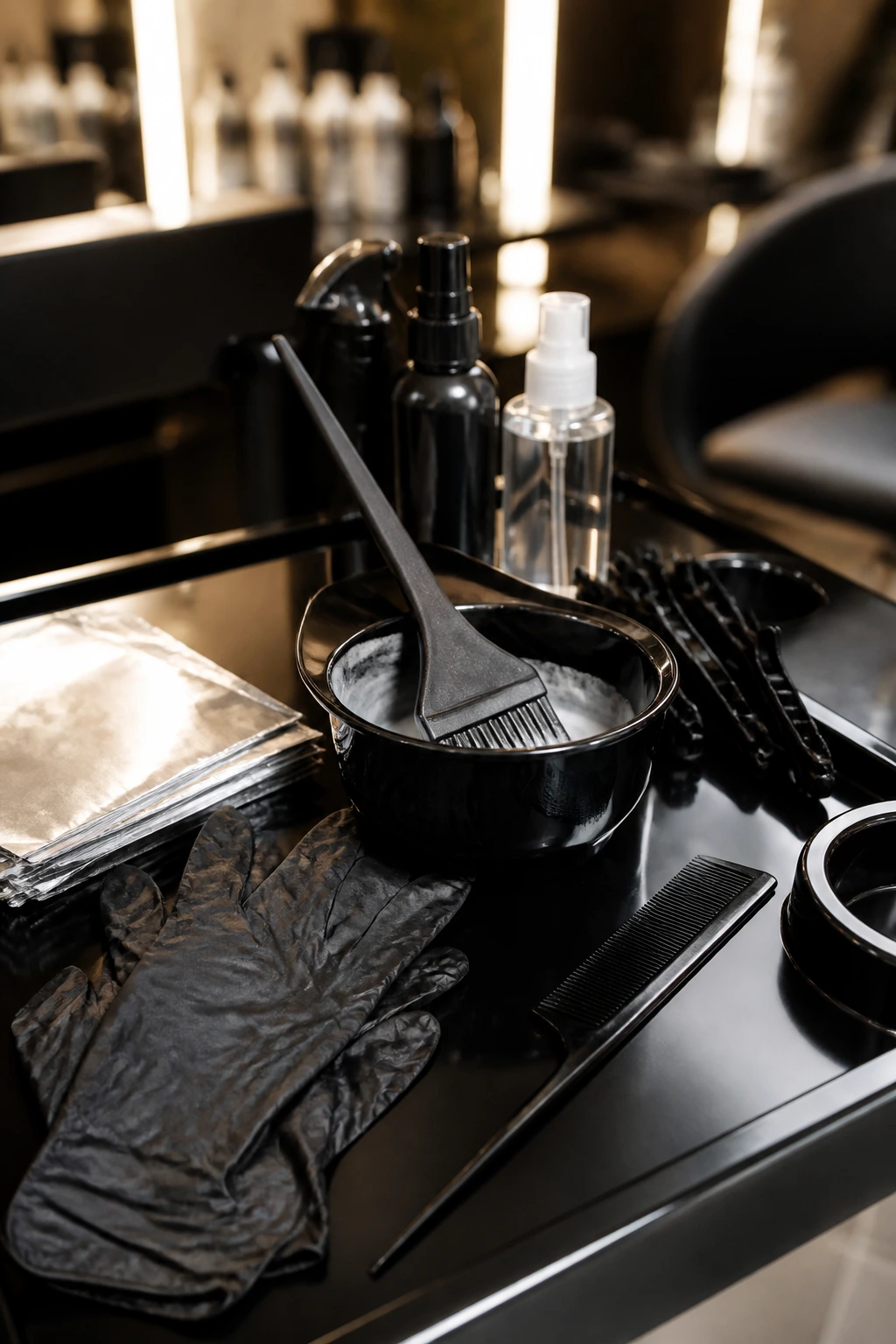
You do not need a drawer full of gadgets, but the right few tools matter a lot when you’re working with black hair color on straight hair. Clean sectioning, even application, and a glossy finish are what keep the shade from looking blotchy or dull.
-
Tint bowl and color brush: Useful for applying glosses, demi-permanent color, or root smudges in thin, even layers.
-
Sectioning clips: Straight hair lays flat, so clips help you keep clean sections while you work through the crown, sides, and nape.
-
Fine-tooth tail comb: Best for sharp parts, face-framing pieces, and clean ribbon placement.
-
Gloves: Black dye stains everything. Everything.
-
Foils or balayage board: Needed if you’re adding espresso ribbons, money pieces, or hidden panels instead of all-over color.
-
Color-safe shampoo and conditioner: Helps keep the black pigment from washing out too fast or turning muddy.
-
Heat protectant: Straight hair often gets styled with a flat iron, and heat without protection dulls black quickly.
-
Clear gloss or tinted glaze: Keeps the finish shiny and helps cool or deepen the tone without restarting the whole color service.
-
Microfiber towel: Cuts down rough friction after washing, which matters if you’re trying to keep the surface smooth.
-
Boar-bristle or smoothing brush: Useful for polishing the hair after it dries; it helps the finish look sleek instead of puffy.
If you’re going to a salon, bring photos shot in daylight and indoor light. Black shades shift a lot between the two, and a good picture in both settings saves a lot of guesswork.
How to Choose the Right Undertone Before You Commit
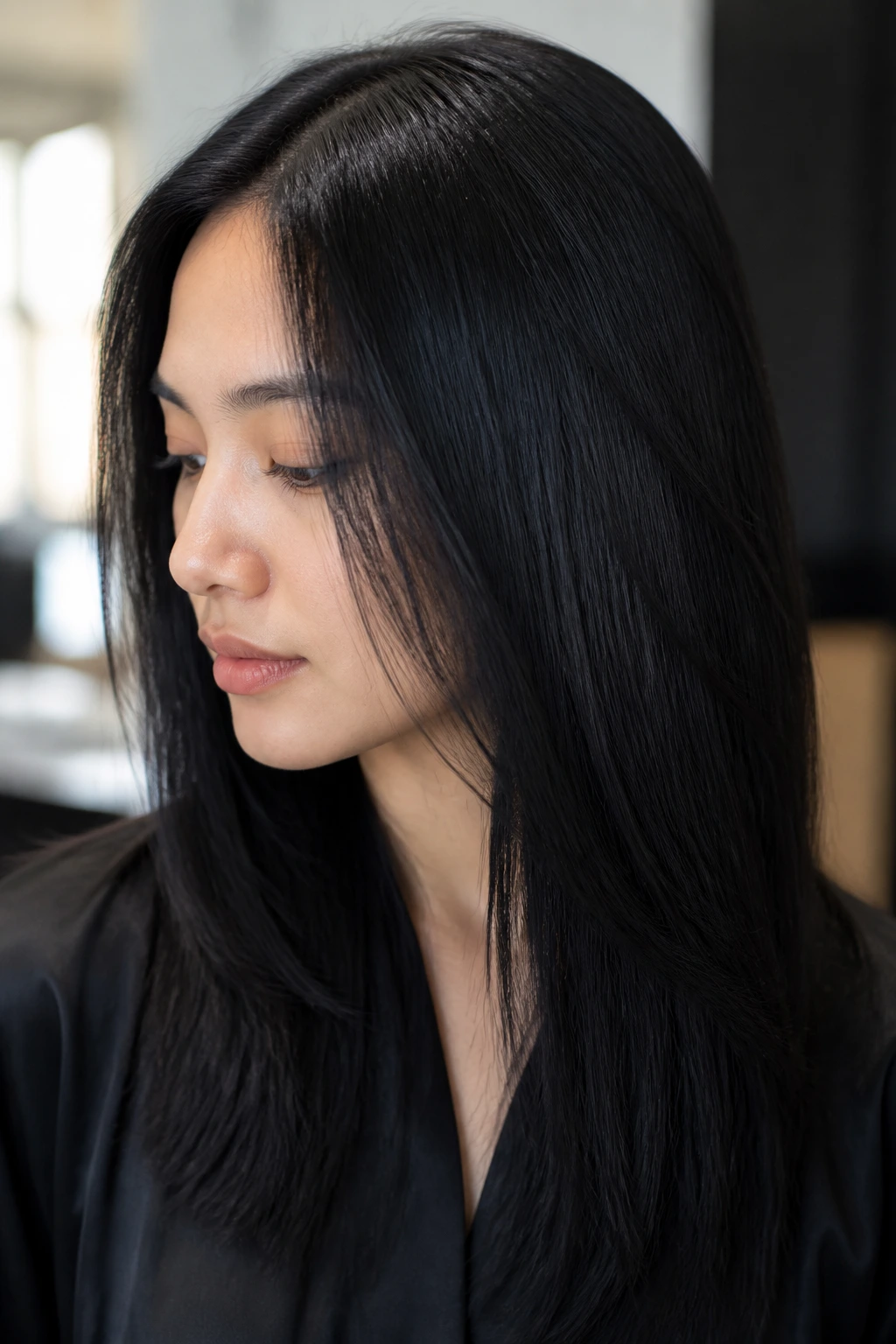
Undertone is the decision most people rush past, and it’s the one that changes everything. Black can lean blue, violet, burgundy, ash, mocha, graphite, or copper. Those differences sound small on paper. On straight hair, they are not small at all.
If you want a crisp, almost severe finish, blue-black or graphite black is the easiest place to start. If your skin runs warm or you wear warmer makeup, burgundy-black, plum-black, or mocha-black often feels softer around the face. Copper threads or cinnamon pieces are better if you want warmth to peek through without turning the whole look red. And if you want the black to feel expensive in the practical sense — smooth, controlled, and deliberate — then clear gloss and a neutral base matter more than adding extra darkness.
Porosity changes the result too. Porous ends grab pigment fast and can go flat or hollow if you skip filler. If your hair has been lightened before, a colorist may need to pre-fill the mids and ends with a warm brown before layering black over it. That step is boring. It also prevents the dreaded muddy fade.
How to Style Black Hair Color So It Doesn’t Fall Flat
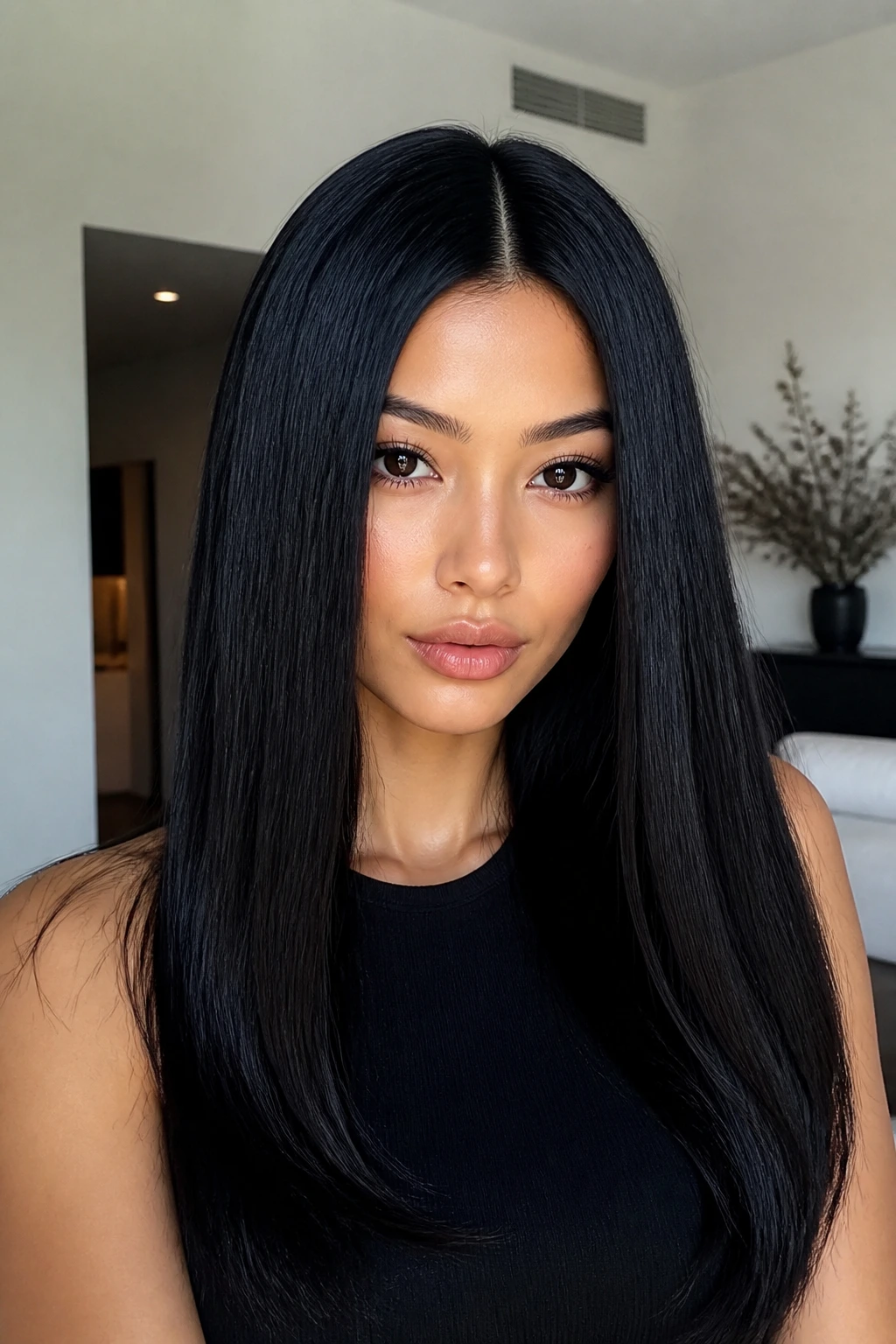
Straight hair looks best in black when the styling choice supports the color instead of fighting it. A center part creates a clean line that shows off jet black, blue-black, or graphite. A soft side part can make face-framing money pieces or peekaboo panels more obvious. And a blunt blowout, where the ends are slightly beveled instead of puffed out, usually works better than big volume.
If the color is one of the dimensional looks — espresso balayage, charcoal melt, copper threads, or mushroom blend — let the hair move. A tiny bend at the ends, or a tucked-behind-the-ear moment, is enough to show the variation. You do not need beach waves to prove the color is there. In fact, too much bend can hide the clean placement.
Heat is the quiet villain here. A flat iron at 300–350°F is usually enough for straight hair. Go much hotter and the shine starts to turn into dryness fast. Black pigment looks richest when the surface stays smooth, not scorched.
Extra Tips for Shine, Depth, and Richer Tone
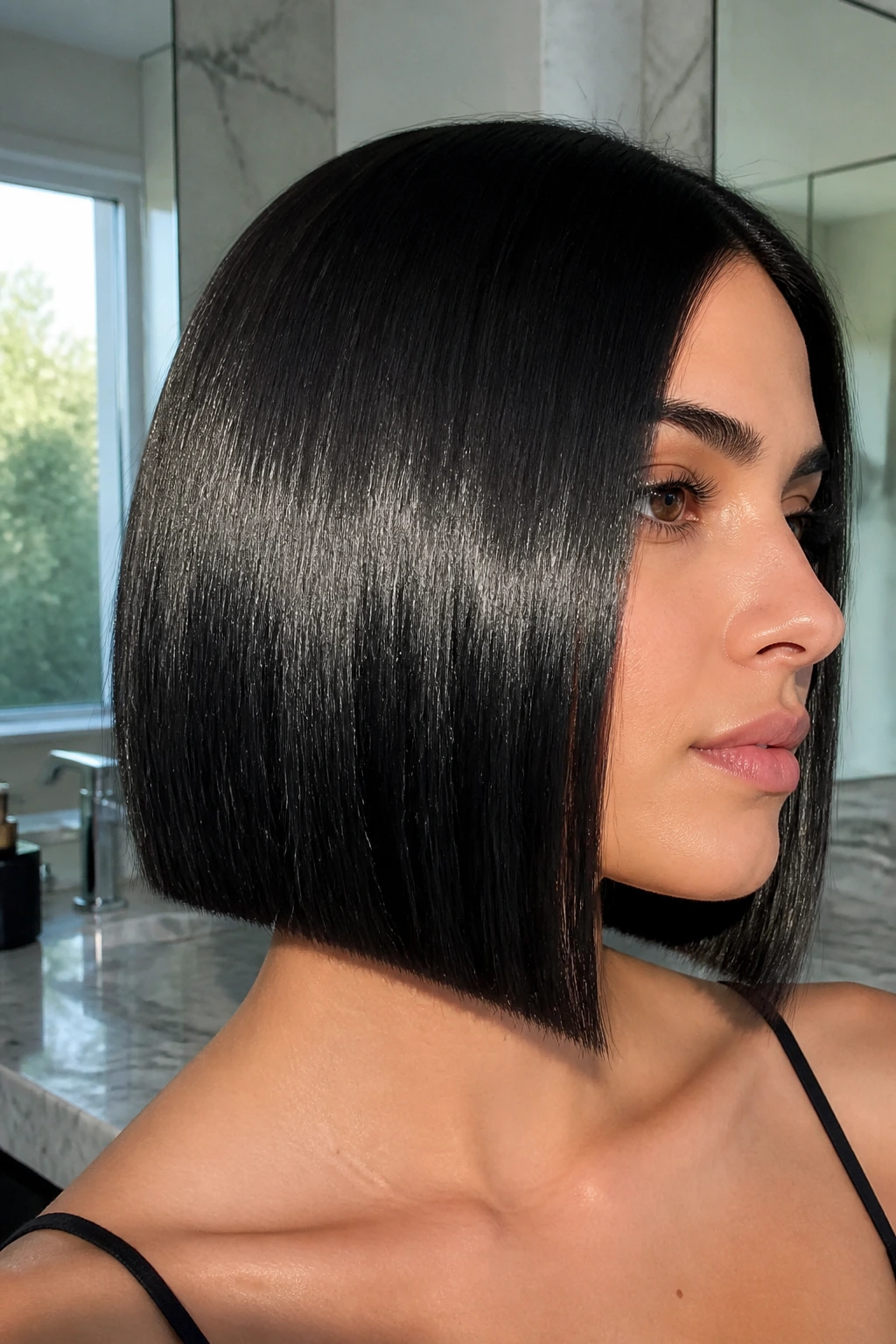
Gloss Finish: A clear or tinted gloss every 4 to 6 weeks keeps black hair looking slick instead of dusty. If your shade leans blue, plum, or graphite, a refresh with the same undertone helps the color stay where you wanted it.
Color Placement: Keep the lightest pieces near the face or the lower lengths. Straight hair shows harsh bands, so subtle placement beats chunky contrast almost every time.
Texture Control: A pea-sized amount of smoothing serum on damp hair can keep the surface reflective without making it greasy. Put it mid-length to ends first. Don’t slap it on the roots unless you want flatness.
Make-It-Yours: If your hair is fine, choose softer versions like soft black gloss or graphite. If it’s thick, a black-to-charcoal melt or ribboned balayage can stop the color from feeling bulky.
Finish First, Then Style: Black color looks far better on hair that’s trimmed and smoothed than on hair that’s loaded with split ends. A good trim can do more for the final result than another round of toner.
Common Mistakes That Make Black Hair Color Look Muddy
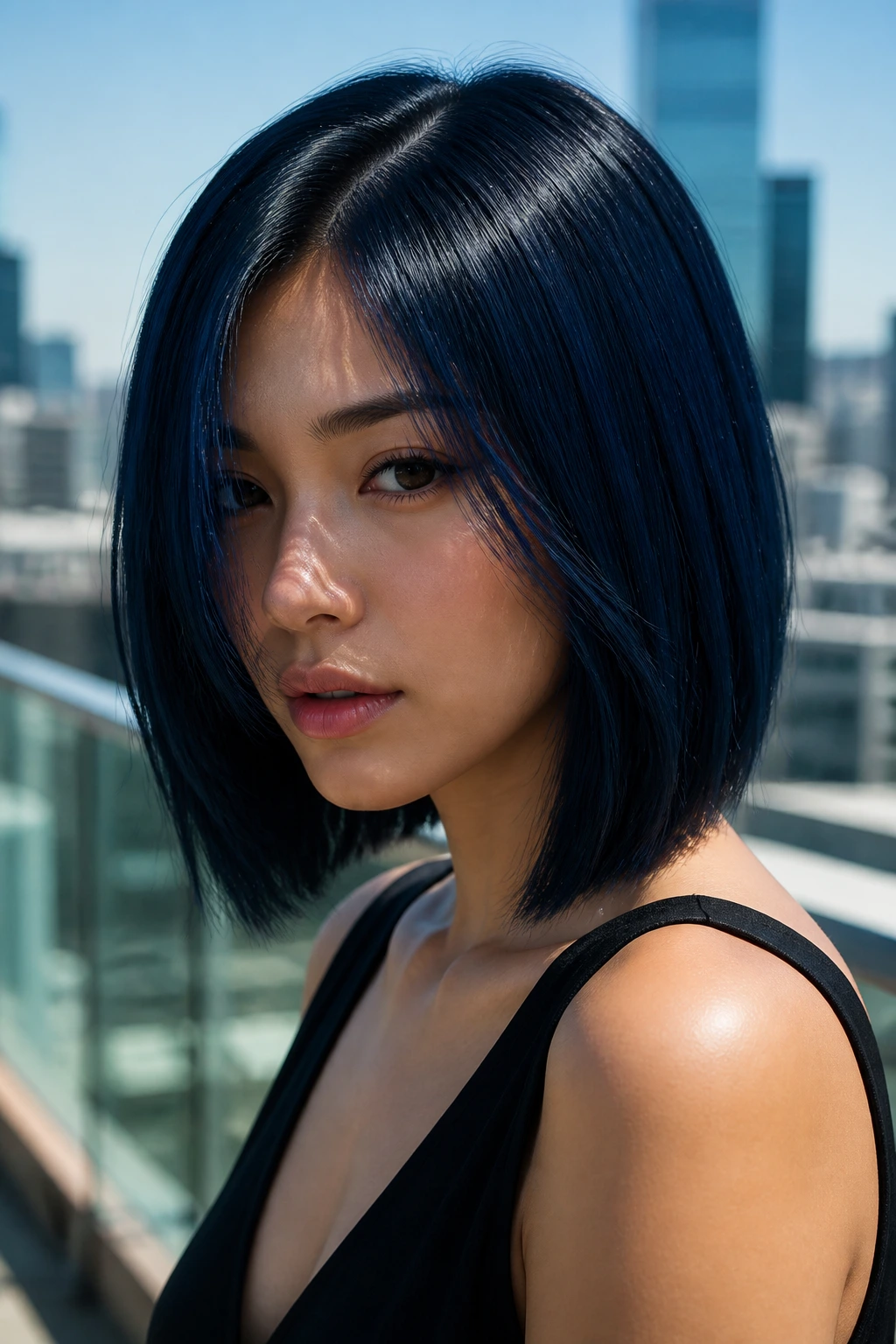
One of the fastest ways to ruin black hair on straight strands is to ignore porosity. If the ends are porous, they grab too much pigment and go hollow, greenish, or flat. The fix is simple in theory and annoying in practice: pre-fill light or damaged ends before applying black, especially if the hair has been bleached before.
Another common problem is choosing the wrong undertone. A black that leans too warm can turn reddish-brown in some light, while a black that’s too cool can look dusty if the hair condition is poor. The answer is not “darker.” The answer is “better matched.”
Chunky highlight placement is another trap. Straight hair makes thick stripes look obvious fast. If you want dimension, use thinner ribbons, softer panels, or a melt. Wide foils can work, but only when you want the contrast to read from across the room.
Then there’s heat. Flat irons above 375°F can smoke the shine right out of black hair, especially on color-treated strands. Keep the tool in check, use protectant, and do not pass over the same section six times because you’re impatient.
Finally, washing too often strips the finish. Black hair color fades in a dull direction when the cuticle keeps getting opened by harsh shampoo and hot water. Two to three washes a week is usually enough for straight hair, and cooler water keeps the pigment happier.
Variations and Alternatives to Try Next
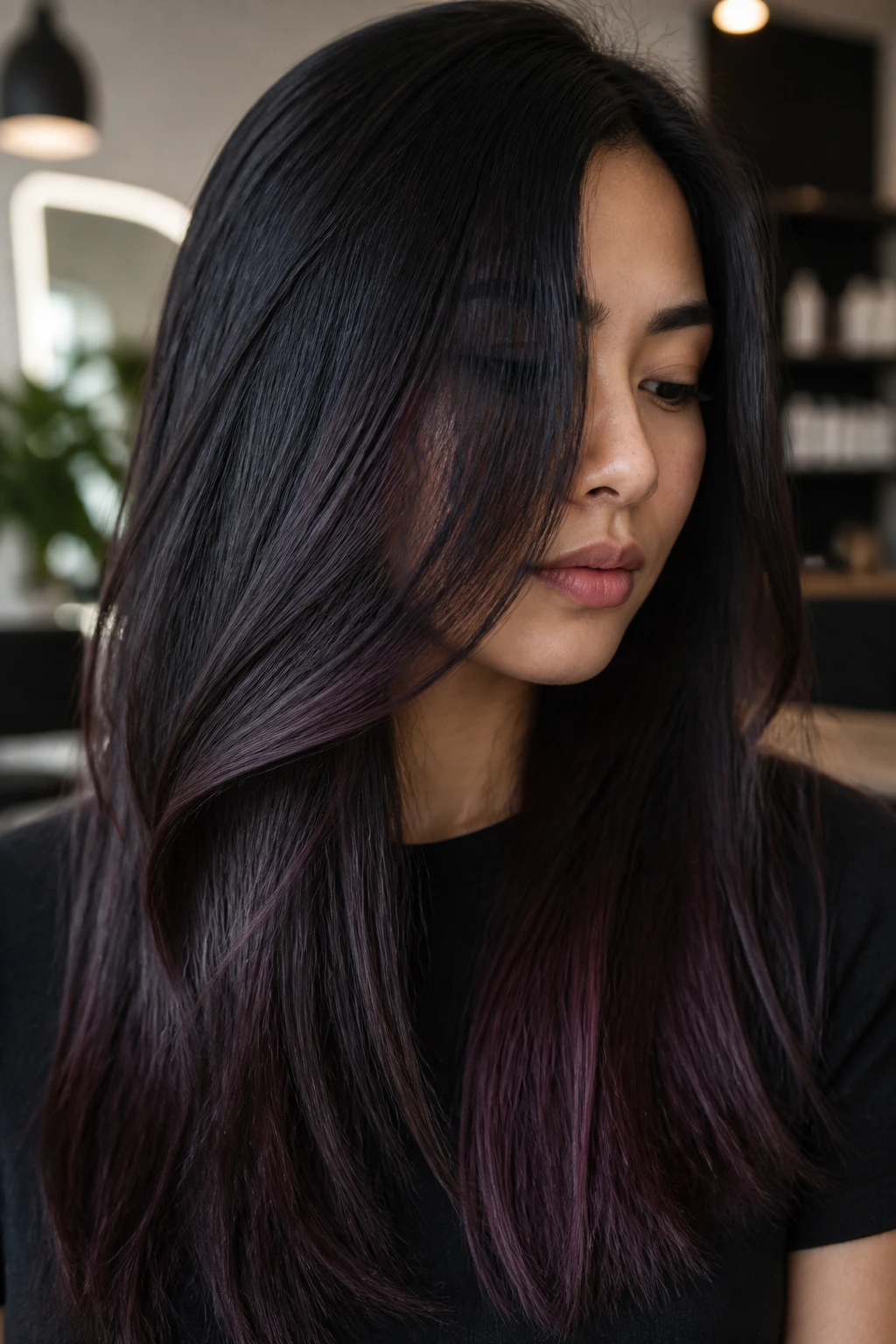
Soft Black for Everyday Wear: If jet black feels too stark, a soft black gloss gives you depth without a heavy line. It’s a nice bridge color for anyone moving darker from brunette.
Fashion Black with a Hidden Panel: Keep the top layer pure black and place a plum, sapphire, or cherry panel underneath. It stays wearable at work and still gives you something fun when the hair moves.
Low-Maintenance Shadow Melt: A root shadow that fades into black lengths grows out more softly than a hard all-over dye. This works especially well if you hate obvious regrowth.
Cool Smoke Blend: Combine graphite, ash brown, and black in thin slices for a smoky, cool finish. It’s subtle, but on straight hair it has just enough variation to keep the color from looking pasted on.
Warm Accent Black: If your style leans cozy, add cinnamon or copper through the fringe and face frame only. That single placement can make a blunt cut feel less severe.
High-Contrast Editorial Black: For a bolder look, use silver streaks, cobalt underlayers, or a true blue-black finish. Keep the placement controlled so the contrast looks intentional instead of busy.
Maintenance, Washing, and Fade Control
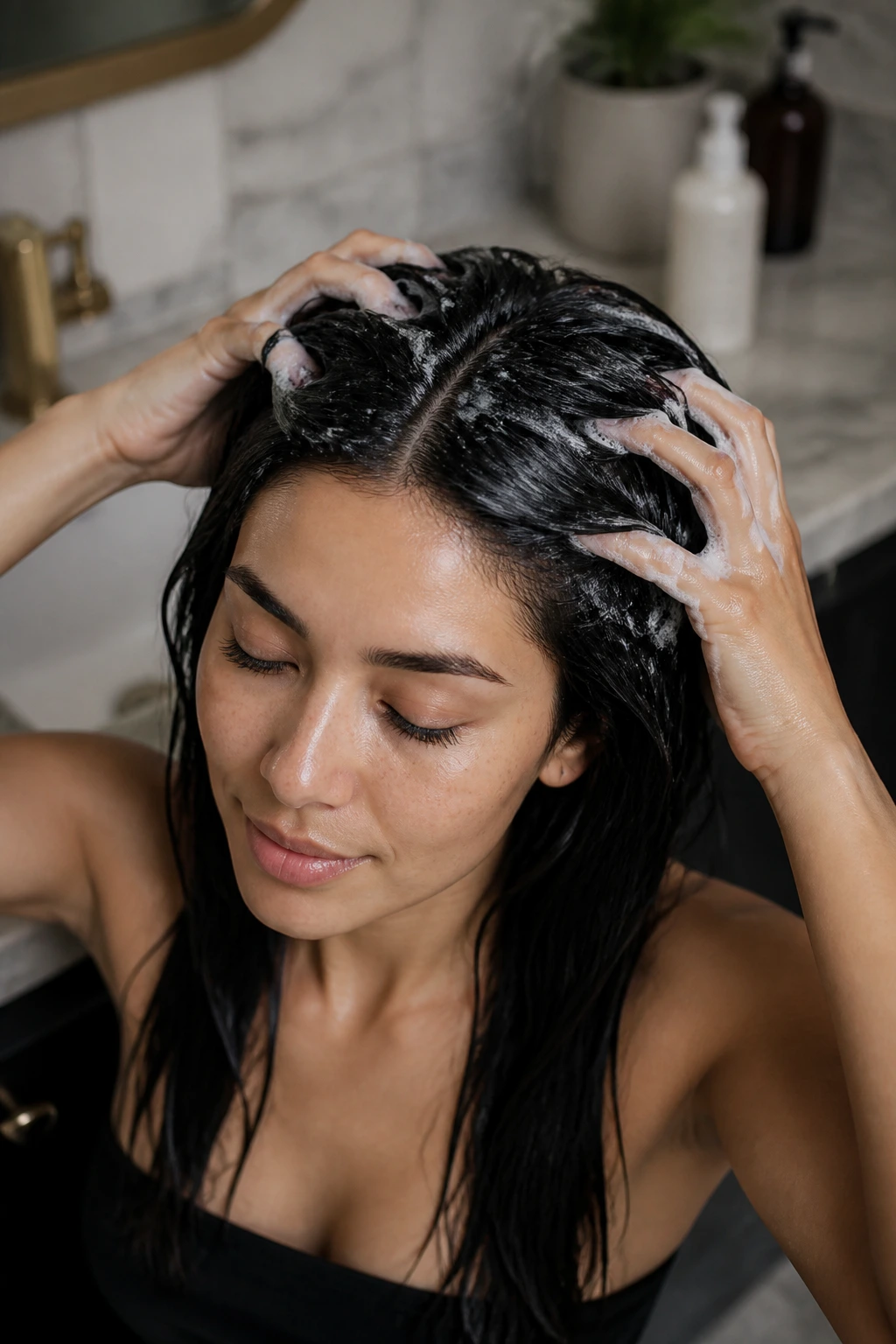
Black hair color can stay sharp for a long time if you treat it like a stain you want to preserve, not a color you want to scrub every day. Straight hair tends to show oil faster, which tempts people to wash more often. Resist that. Two to three washes per week is a good range for most people, and it helps the pigment stay richer.
Use a sulfate-free shampoo if you can. It’s not magic, but it is gentler on the cuticle and slows that dull, brownish fade that black dye often develops. A color-depositing mask or gloss every 3 to 6 weeks can also keep the tone from drifting too far. Blue-black, plum-black, and graphite shades usually need a refresh sooner than plain jet black because the undertone is part of the look.
If you style with heat, keep a steady hand. Straight hair often gets ironed more than waved hair, which means more surface stress. A protectant before blow-drying and flat-ironing matters. So does not cranking the tool to the highest setting just because it heats up fast.
For grow-out, root touch-ups usually land every 4 to 8 weeks, depending on how dark your natural base is and how visible you want the line to be. Balayage, shadow roots, and peekaboo placements buy you more time between appointments. One-process jet black is less forgiving. It looks clean. It also asks for more upkeep.
Frequently Asked Questions
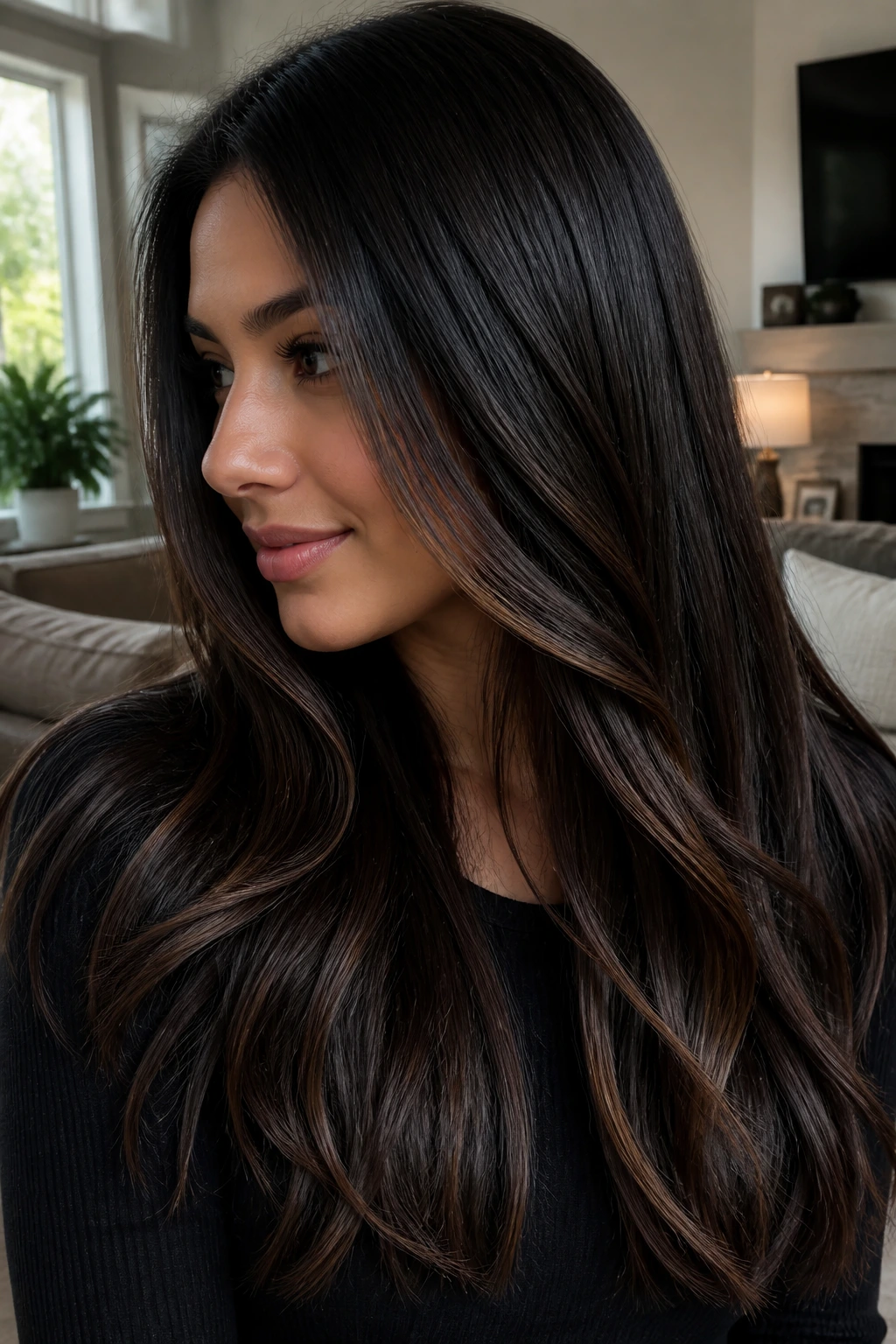
Does jet black hair look too harsh on straight hair?
It can, if the cut is too wispy or the shade is too flat. A blunt bob, sleek lob, or long one-length cut usually makes jet black look deliberate instead of severe.
What’s the best black shade if I want something softer than pure jet black?
Soft black gloss, mocha-black, plum-black, and graphite black are the easiest softer options. They still read dark, but they keep a little warmth or smoke in the tone so the hair doesn’t look like a painted surface.
Can I do black balayage on naturally dark hair?
Yes, but the contrast comes from subtle shifts, not bright lift. Espresso ribbons, charcoal ends, and smoky lowlights work better than pale balayage pieces on a black base.
How do I keep black hair from fading brown?
Wash less often, use color-safe shampoo, and refresh with a gloss or toner before the fade gets too warm. If your ends are porous, a pre-fill step can help the black hold its depth longer.
Will black hair make fine straight hair look thinner?
It can if the cut is too long, too wispy, or too flat around the ends. A blunt edge, a soft gloss, or a little front-framing dimension usually helps fine hair look fuller.
Can I get black hair color ideas without permanent dye?
Yes. Demi-permanent glosses, color masks, and temporary black rinses can deepen the hair for a few weeks without locking you into a permanent result. They’re especially useful if you’re testing the shade first.
Why does my black dye sometimes look green or muddy?
That usually means the base was too porous, too light, or too warm underneath. Black needs the right filler and undertone to sit cleanly, especially on previously lightened hair.
How often should I refresh the color?
Glosses usually need a refresh every 4 to 6 weeks. Root touch-ups for one-process black often come sooner, around 4 to 8 weeks, depending on how fast your hair grows and how visible you want the regrowth to be.
A Shade That Fits the Cut
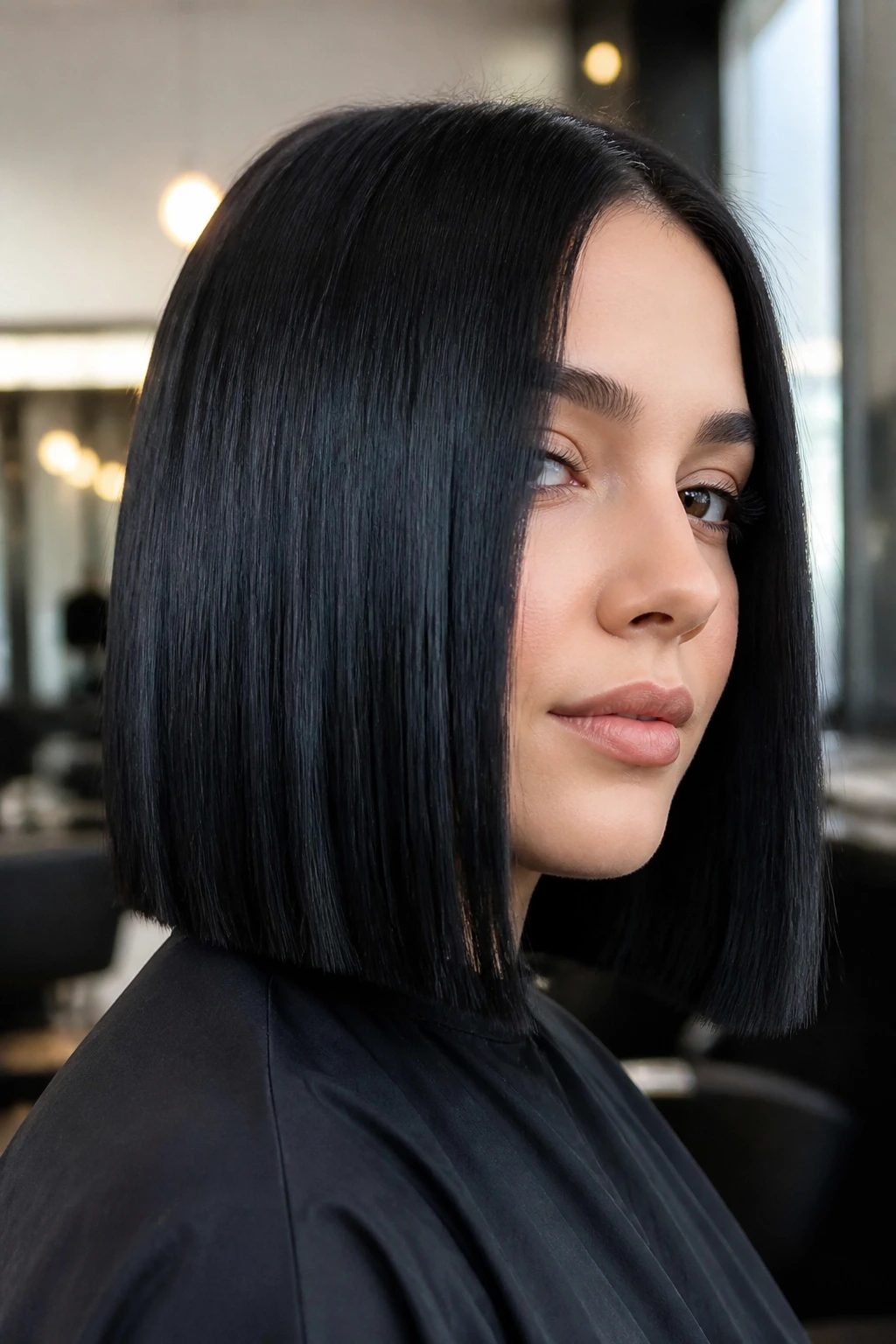
Black hair color ideas for straight hair work best when they respect the shape of the hair, not just the color on the box. A blunt cut can make jet black look sharper. A hidden panel can make the same base feel playful. A blue-black gloss can cool everything down without turning the hair flat, and a burgundy veil can soften the whole look in a way that feels more lived-in.
If there’s one thing worth keeping in mind, it’s this: straight hair shows the truth fast. That can be intimidating, sure. It can also save you from wasting time on colors that don’t suit your cut, your maintenance habits, or the way you like to wear your hair. Pick the undertone first, then the placement, then the finish.
Get those three things right, and black stops being just black.
