



Blonde beaded hairstyles have a funny habit of making a braid look more deliberate than a fresh blowout ever could. A simple row of beads changes the whole read of the style: honey blonde turns soft and sunlit, platinum starts looking sharp and glossy, caramel gets warmer, and ash blonde gets a little cooler and tougher around the edges.
In braids, twists, and locs, the bead is not filler. It’s punctuation. Clear acrylic beads on honey-blonde knotless braids can vanish until they catch the light. Brass beads on blonde locs add weight and a faint clink when you move. Tiny seed beads at the ends of a blonde halo braid feel quiet and polished, while chunky wooden beads on faux locs lean earthy and grounded. Same hair color. Totally different mood.
The part people miss is balance. Too many heavy beads near the hairline pull the style down. Too many colors fighting with the blonde can make the whole thing look busy instead of styled. The best versions know exactly where to stop. They let the braid shape do one job and the beads do another.
Why These Blonde Beaded Styles Stand Out
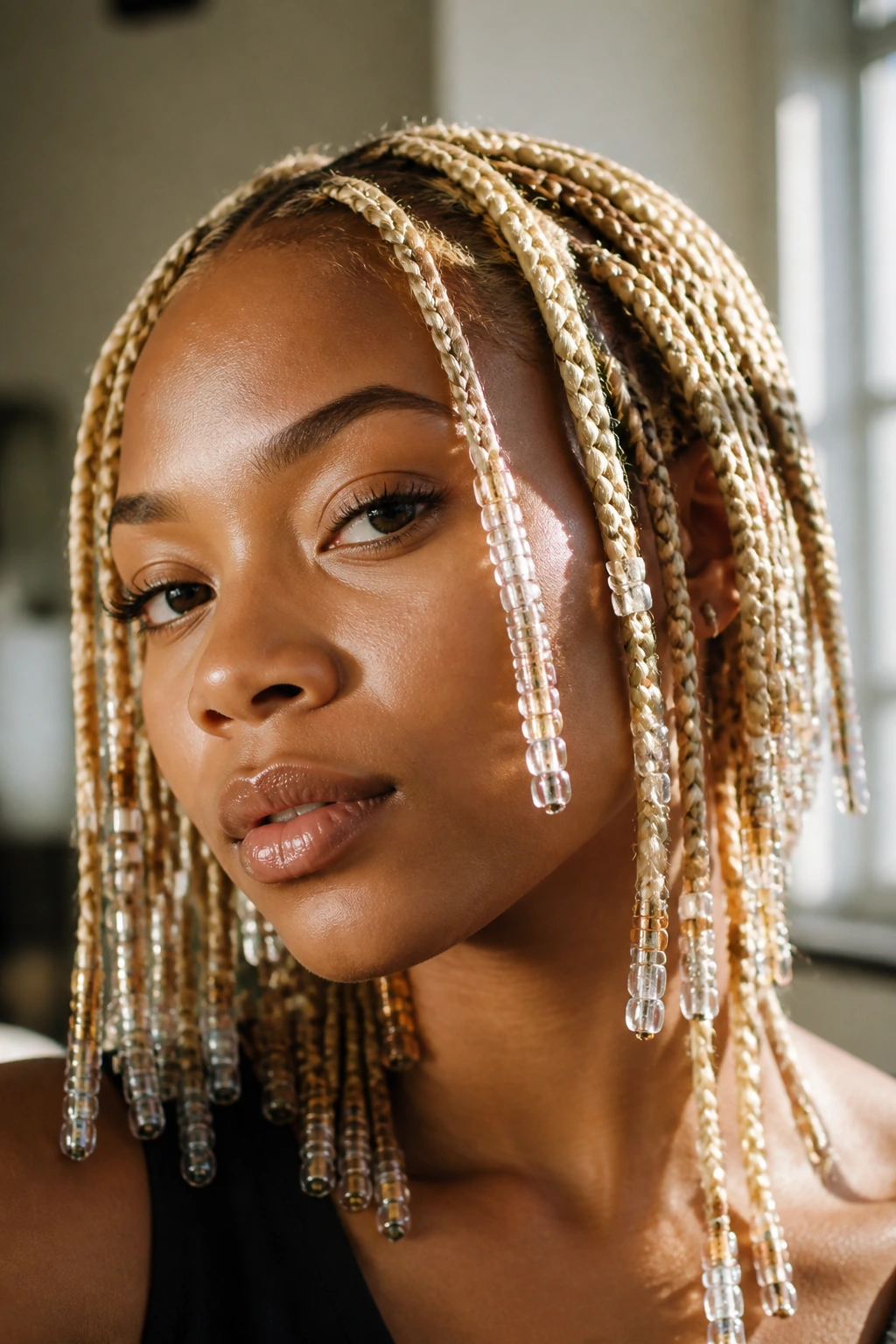
- Color does half the styling: Blonde hair reflects light, so bead finish matters more here than it does on darker bases; clear, silver, gold, and wood all read differently against the same braid.
- Weight changes the whole silhouette: A few light acrylic beads at the ends move with you, while stacked glass or metal beads can make the style feel heavy fast.
- They scale across textures: Knotless braids, passion twists, faux locs, cornrows, and micro twists all take beads well, but the placement needs to match the structure.
- You can steer the mood with one swap: Change the bead material and you change the vibe without redoing the whole install.
- They work in both simple and dressed-up looks: A plain center part with clear beads can look clean enough for everyday wear, while gold tubes or pearl accents can push the style into a more finished, occasion-ready place.
1. Honey-Blonde Knotless Box Braids with Clear Beads
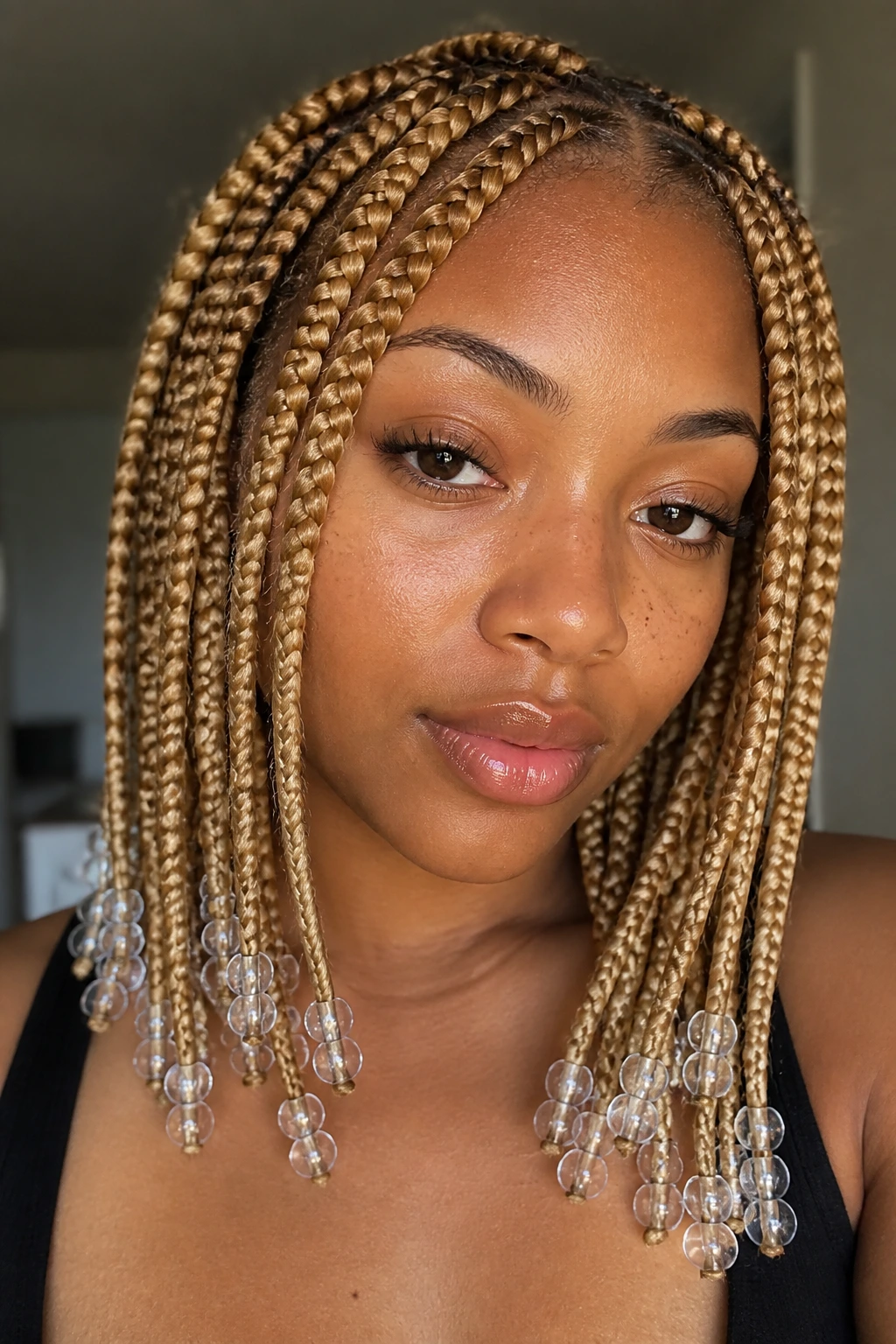
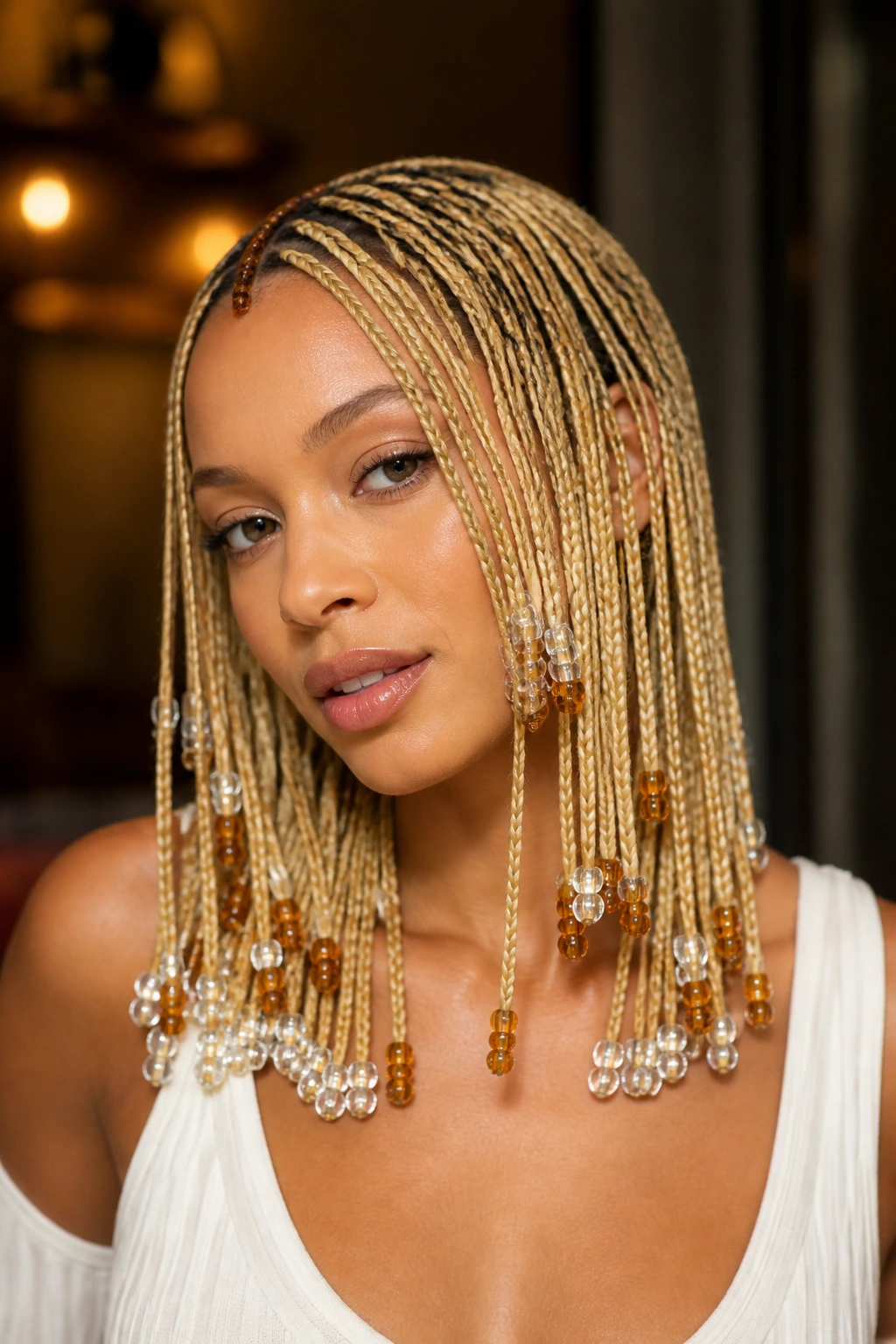
Honey-blonde knotless braids are the first style I reach for when I want beads to look easy instead of fussy. The color is warm enough to soften clear acrylic, and the knotless base keeps the hairline smooth so the beads feel like a finish, not a burden. When these braids swing, the clear beads almost disappear, then flash at the ends.
Why the clear-bead pairing works
Clear beads keep the focus on the braid itself, which matters because knotless braids already have a clean, gradual start. If you stack the beads too close to the roots, the style loses that soft, feathered look. Place them toward the last inch or two of the braid and the movement stays light.
A set of honey-blonde braids usually reads best with lightweight acrylic beads in a medium size, not oversized glass. If your braids reach past the shoulders, I like two or three beads per tail. Any more and the ends start clacking too hard against jackets and hoop earrings.
Quick visual note
- Clear beads keep the style airy.
- Honey blonde makes them look softer than they do on platinum.
- A blunt bob length gives a sharper finish.
- Waist-length braids need the bead count kept modest.
Small rule, big payoff: keep the bead cluster low and the braid line clean.
2. Platinum Micro Braids with Silver Ends
Platinum micro braids do not need much help. That’s the whole point. The color is bright enough to stand on its own, so silver beads at the ends feel like a precise echo rather than a loud add-on. The style looks sleek, close, and almost metallic when the parts are neat.
Micro braids are tiny, which means bead choice matters more than people think. A heavy bead can overpower the braid and make the tail droop. Use small silver cylinders or slim spacer beads instead of chunky rounds. The result is cleaner, and the braid keeps its straight fall.
What I like most here is the contrast. Platinum hair already has a cool edge, and silver beads amplify it without turning the style harsh. If you want the finish to feel softer, mix in one or two clear beads near the front. Keep the back consistent. That tiny shift keeps the style from looking overmanaged.
3. Golden Fulani Braids with Center Bead Rows
What happens when you stop putting beads at the ends and move them to the center rows instead? The whole style starts framing the face instead of trailing behind it. That is why golden Fulani braids with center bead rows have such a strong shape: the beads become part of the architecture, not just the decoration.
The side braids do the work of pulling the eye inward, and the center braid or temple braid becomes the place where you add the sparkle. I prefer gold beads, tiny brass discs, or a single pearl accent on each front row rather than a full bead pile. It keeps the style elegant and keeps the temples from feeling crowded.
How to place the beads
- Put the bead cluster just below the cheekbone line.
- Repeat the same spacing on both sides so the look feels intentional.
- Keep the ends simpler if the crown already has braid detail.
- Use lighter beads near the face; save heavier pieces for the ends if you want them at all.
This style is one of the few that can handle a slightly dressier bead without losing its ease.
4. Buttery Blonde Passion Twists with Pearl Beads
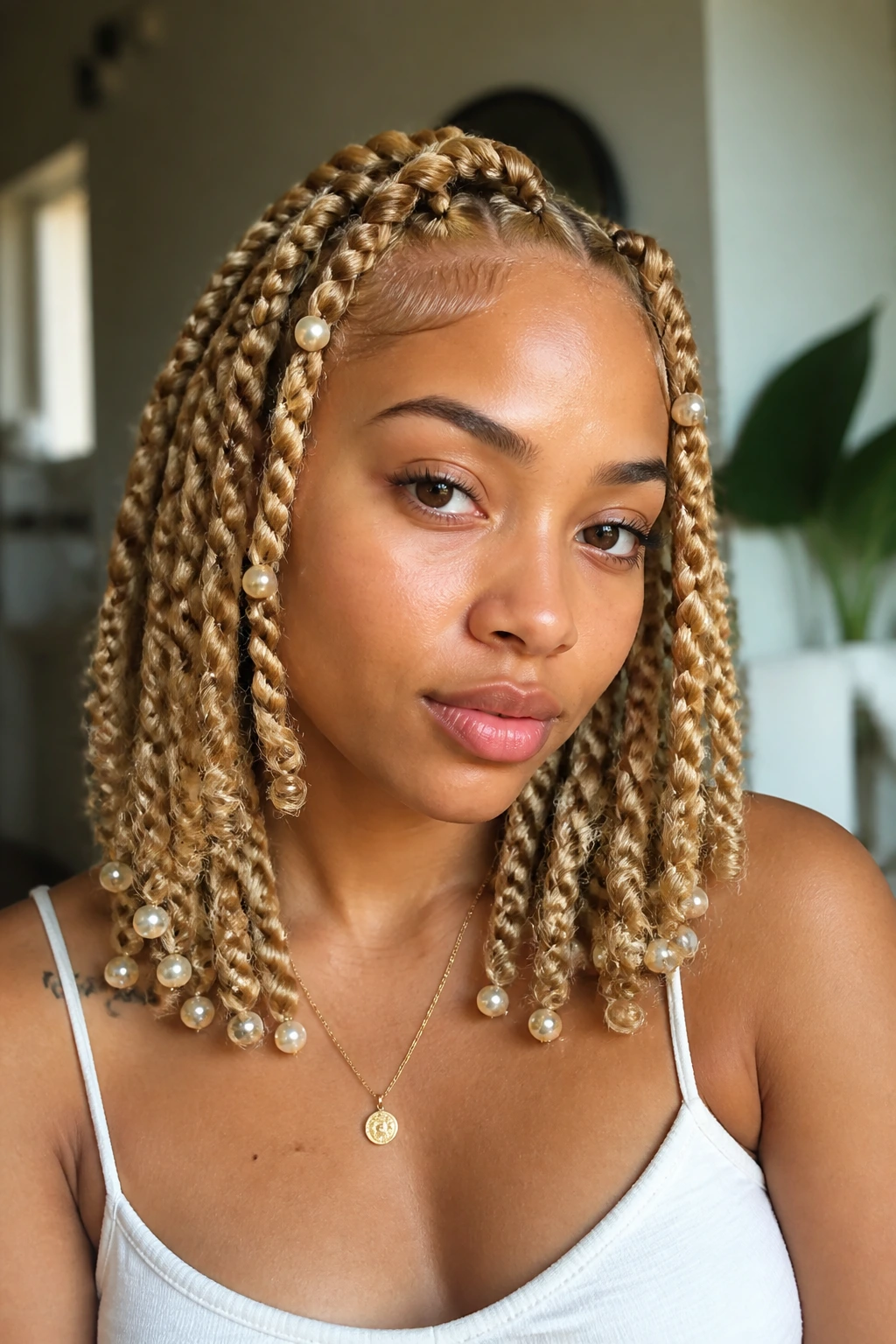
Buttery blonde passion twists have a soft, springy shape that works beautifully with pearl beads at the ends. The twists already have a bit of fluff, a bit of movement, and a bit of irregularity in the best way. Pearls tighten the look without making it stiff.
I like this combination for shoulder-length and collarbone-length twists because the pearls land right where the hair moves most. On longer twists, the pearls can start to feel too spaced out unless you keep them only on the front pieces. On shorter twists, they act like little finishing drops.
The important thing is restraint. Passion twists can look overloaded fast if you use too many large beads. Stick to small pearl beads or pearl-look acrylic and leave the rest of the style soft. If you want a little extra shape, add one bead at the very end and a second bead set a half-inch above it. That tiny stack gives you movement without turning the twist into a weight test.
5. Sandy-Blonde Tribal Braids with Mixed Beads
Sandy blonde needs texture around it. Without that, the color can read flat under indoor light, and nobody wants a braid style that only wakes up near a window. Mixed beads fix that by breaking up the surface: one matte cream bead, one amber translucent bead, one tiny gold ring, then back to neutral.
I like tribal braids because they let you play with rhythm. The front rows can stay tighter and cleaner, while the back pieces carry more bead movement. On sandy blonde, that mix keeps the whole thing from looking like one long block of color. A little variation makes the braid pattern easier to read, which is half the appeal.
The trick is to repeat the same 2 or 3 bead finishes throughout the style. Random bead shopping can turn this into costume hair in about five seconds. A controlled mix feels deliberate. A messy mix looks like you emptied a craft drawer on your head.
6. Caramel-Blonde Lemonade Braids with Gold Tubes
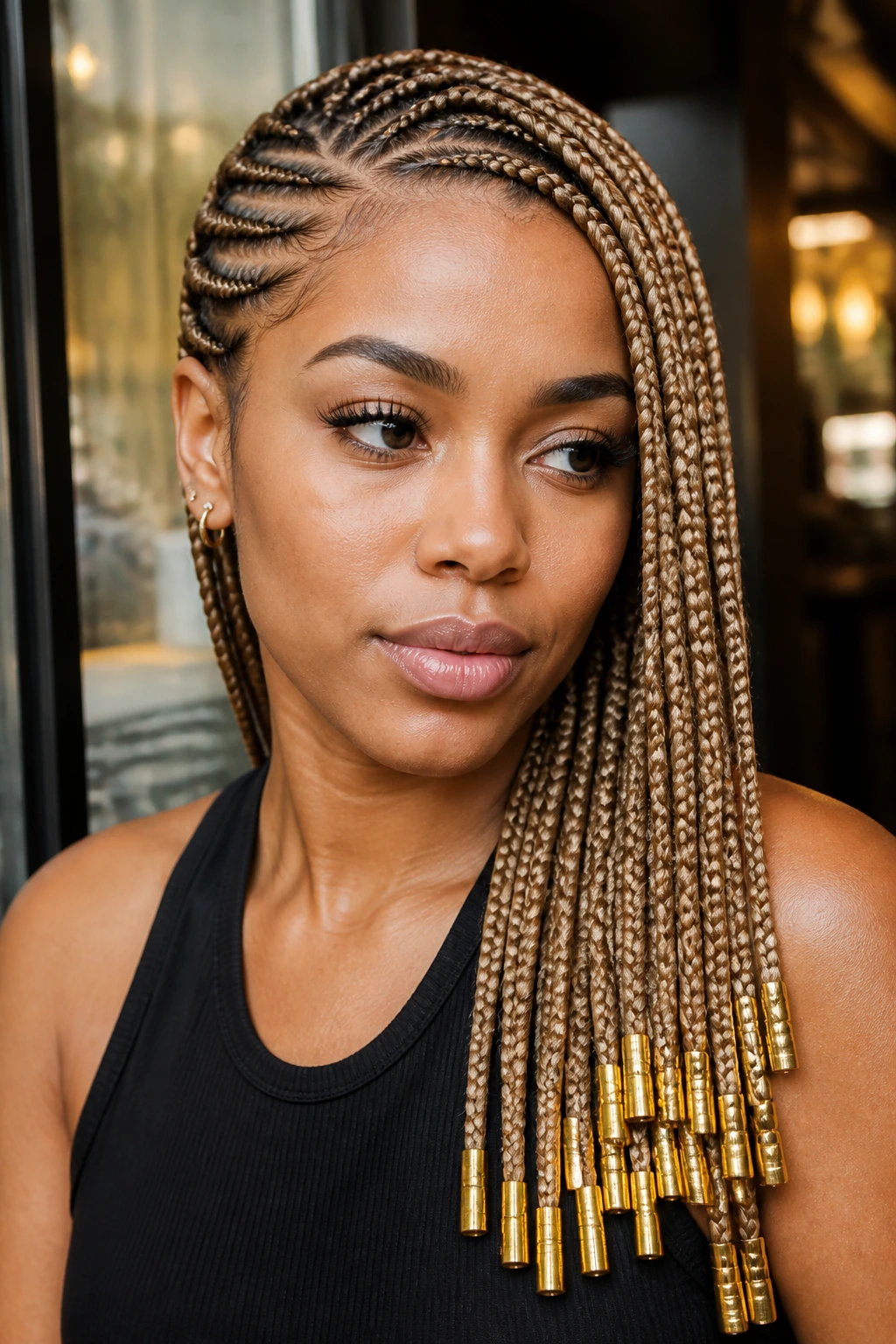
Caramel-blonde lemonade braids are already dramatic because of the side sweep. They pull the face in one direction and leave a clean open side, which means bead choice should be lean and tidy. Gold tubes at the ends are my favorite move here because they keep the braid line straight and the finish polished.
Unlike thicker box braids, lemonade braids sit closer to the scalp and reveal the parting. Heavy bead clusters near the root can make the whole look feel top-heavy. Put the weight at the ends, not the base. If you want extra detail, add one small tube near the tail and leave the rest bare.
This style is best when the gold repeats somewhere else — a hoop earring, a chain necklace, or even a tiny cuff. That repeat keeps the braid from looking isolated. The blonde and gold together are warm, clean, and strong. Too many other colors would only get in the way.
7. Blonde Bob Box Braids with Layered Beads
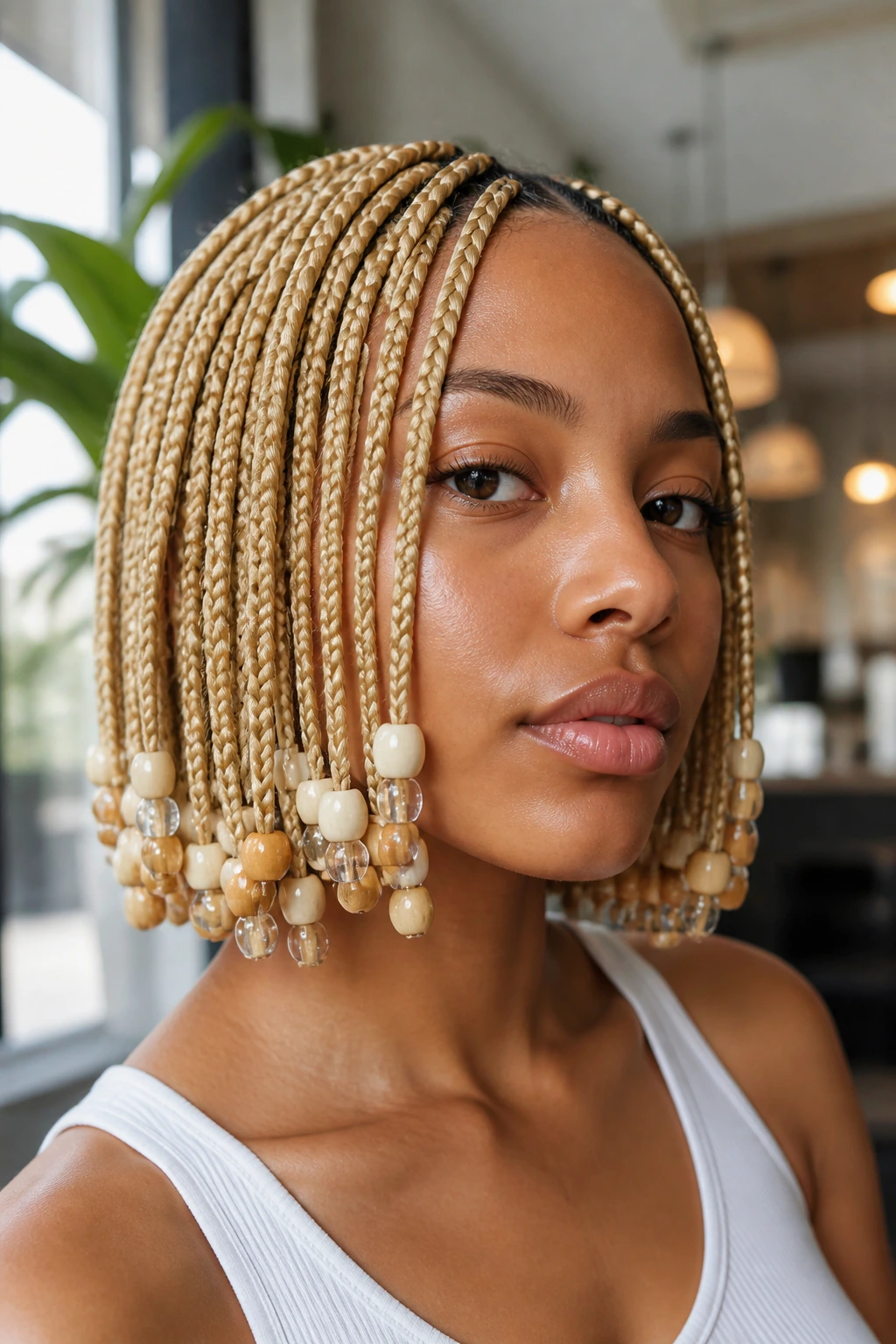
A bob changes the bead game. There’s less length to work with, so every bead shows more. Blonde bob box braids with layered beads can look crisp and modern, but only if you keep the layering controlled. A short braid that ends with three identical beads looks blunt. A braid that drops from small to medium bead size reads more thoughtfully.
I like this cut because the bead line lands around the jaw or upper neck, where it gets noticed without dragging. Use two bead sizes at most on each braid tail. If the bob is chin-length, one bead can be enough on some pieces and a double set on the front rows. That unevenness gives the style movement.
The bob shape also makes the blonde feel brighter. There’s less hair to absorb the light, so the beads stand out faster. Clear, gold, and soft pearl shades all work here. Big dark beads do not. They drag the style down and make the braid tails look like afterthoughts.
8. Ash-Blonde Stitch Braids with Matte Black Beads
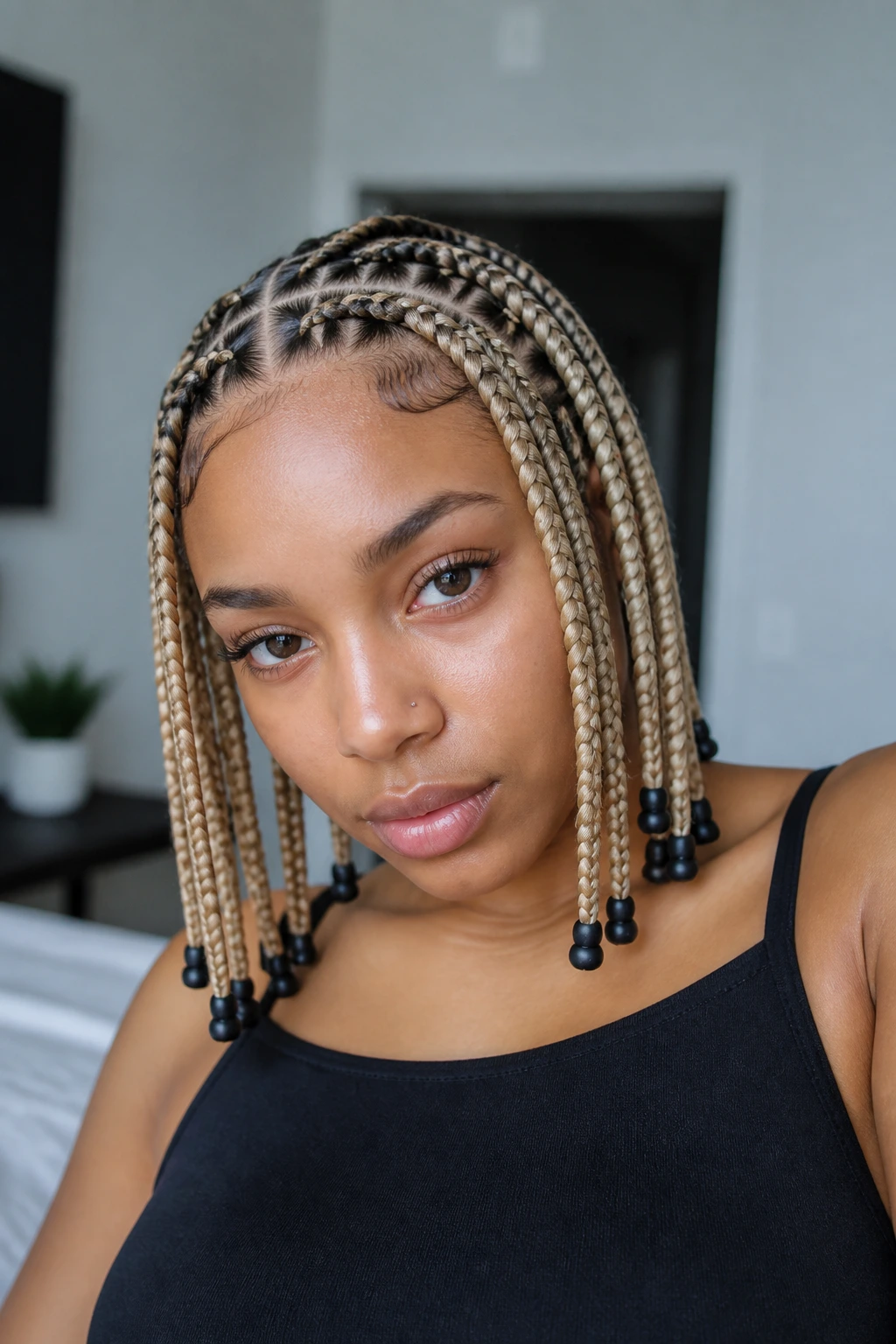
If you like sharp lines, this is the style. Ash-blonde stitch braids already have that clean, segmented look from the parting, and matte black beads sharpen it instead of fighting it. The contrast is strong, but not noisy. The beads feel graphic.
Stitch braids are all about precision, so the bead placement should follow the same logic. Put one bead at the end of each braid or a tiny pair if the length allows it. Anything more starts to clutter the pattern. The style looks best when the scalp design stays visible and the bead finish stays quiet.
I’m picky about this one. Glossy black beads can look too shiny against ash blonde, which tends to flatten the contrast. Matte black gives you a better line. It feels modern, almost architectural. That matters when the braid pattern is already doing the heavy visual work.
9. Champagne Senegalese Twists with Faceted Beads
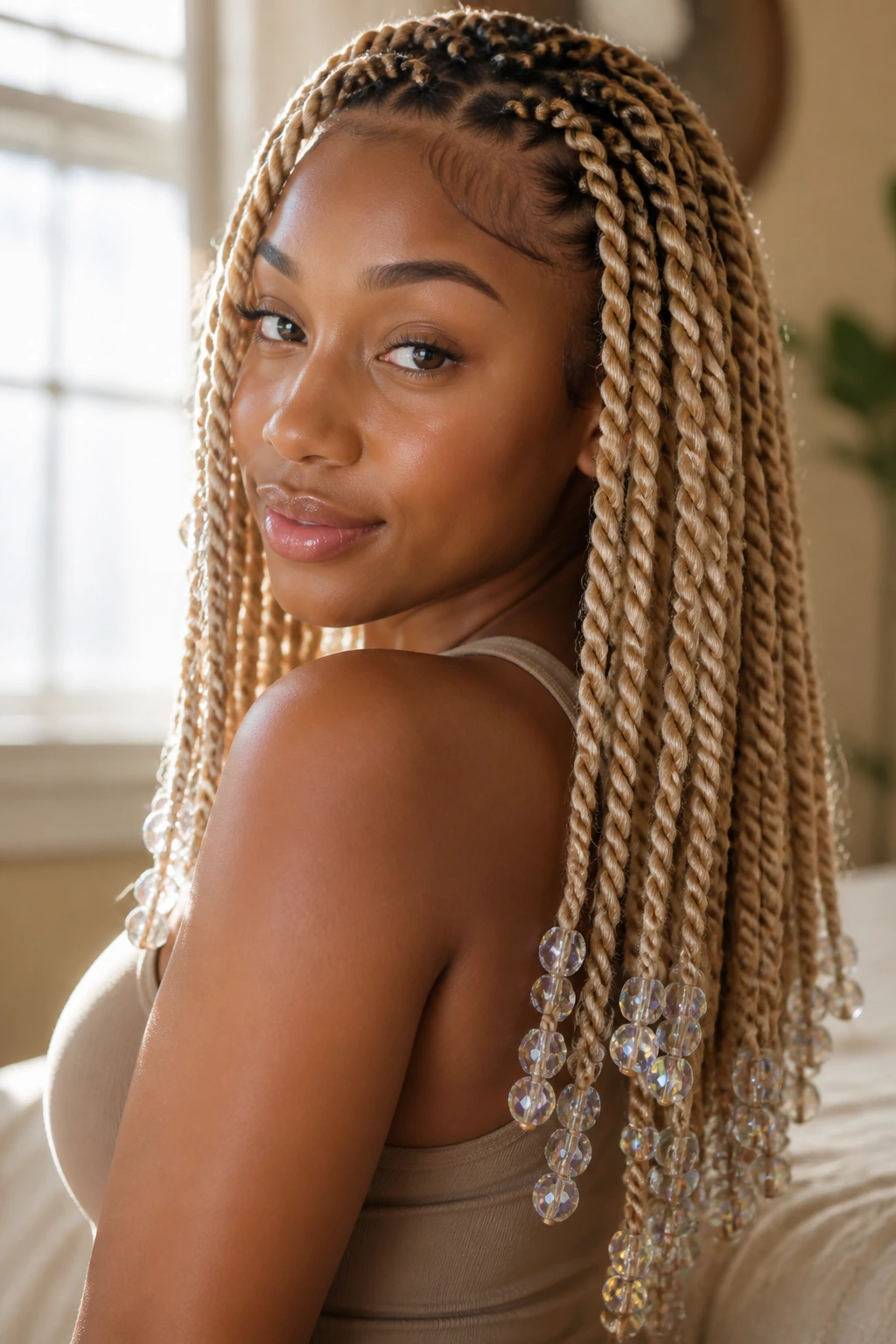
Why do faceted beads look so good on twists and not always on braids? Because Senegalese twists have that rope-like surface that catches edges differently as the hair moves. Champagne blonde already leans soft and a little luminous, so faceted beads add sparkle without turning the finish harsh.
This style looks best with small, light-catching beads near the ends rather than big ornaments halfway up the shaft. The twist itself is smooth and uniform; the bead should feel like the last beat in a sentence. I like faceted clear or pale-gold pieces here because they flash without dominating.
How to keep it balanced
- Use 1 to 2 beads per twist if the twists are long.
- Stick to one bead shape in the front rows.
- Keep the back a touch simpler so the movement doesn’t get crowded.
- Pair with soft makeup or a clean neckline if you want the beads to stand out.
The champagne tone is what keeps this from feeling too sparkly. It gives the style a gentle glow instead of a hard shine.
10. Honey-Blonde Feed-In Ponytail with Clear Beads
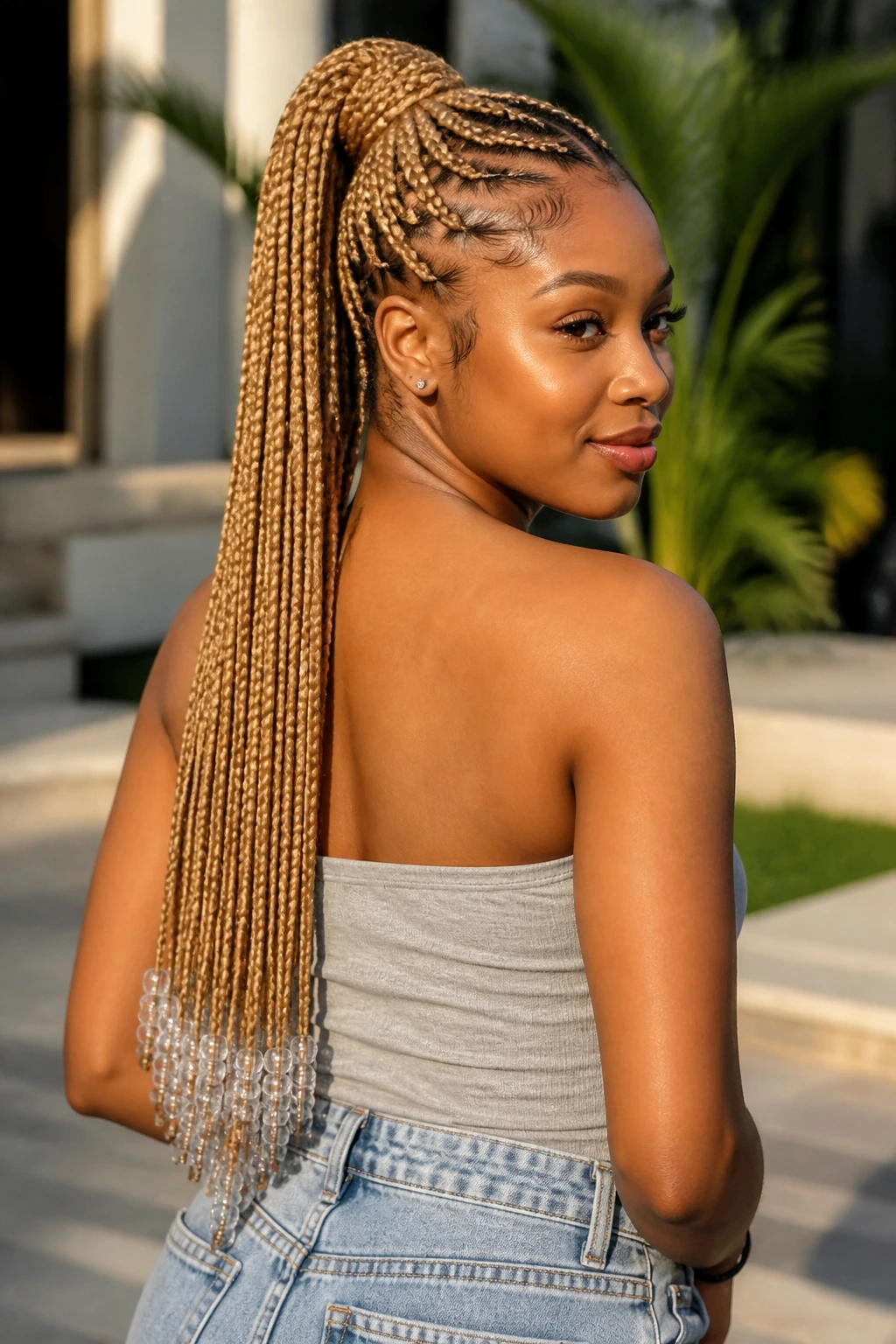
A feed-in ponytail gives you one long line, and beads at the tail turn that line into motion. Honey-blonde hair makes clear beads look almost weightless, especially when the ponytail sits high and swings from the crown. The whole style feels sporty until you see the ends.
The root area matters here. Keep the feed-ins smooth and the tension sane, because the ponytail will already be carrying bead weight at the back. I would not put beads near the base unless you’re using tiny ones. The cleanest version keeps all the decoration at the tail so the scalp stays comfortable.
This is one of the easiest blonde beaded hairstyles to dress up or down. Wear it with hoops and a sharp lip and it reads polished. Wear it with a hoodie and it reads casual. The beads do the shifting for you. That’s why this shape gets worn so often.
11. Blonde Pigtail Braids with Color Pop Beads
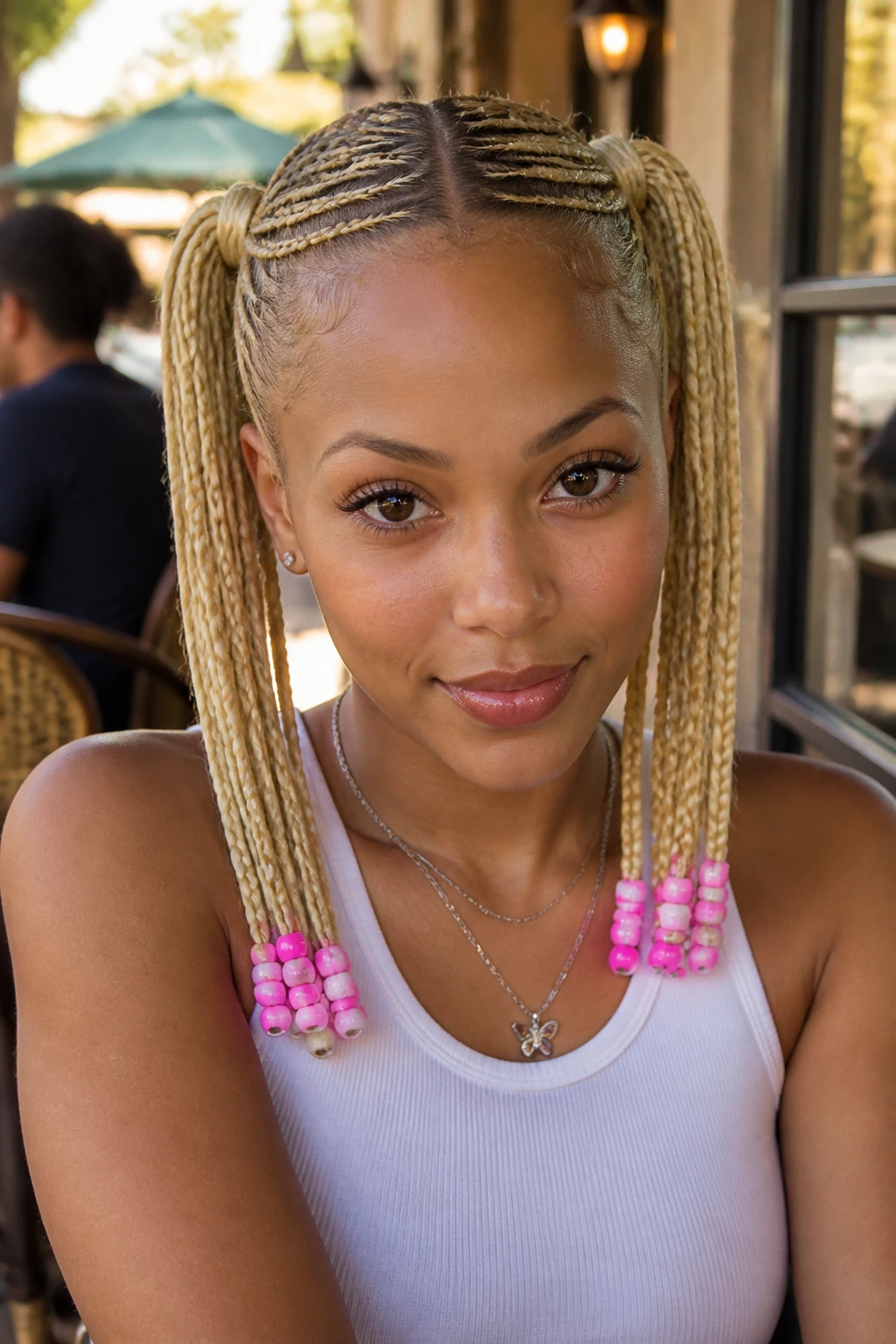
Pigtail braids can lean childish fast if the bead choice is lazy. Blonde pigtail braids with color pop beads avoid that by keeping the braid itself clean and letting the bead color do the playful work. Think two colors max: maybe turquoise and clear, or coral and gold, or white and amber.
I prefer this look when the blonde has warm undertones. That gives the brighter beads a little base to sit on. If the blonde is very pale, too many candy colors can make the style feel disconnected. One accent color at the ends of both braids is usually enough.
The best part is the speed of the change. You can swap the beads and shift the whole mood without touching the braids. That makes this a smart option when you want a style that feels lively but not overworked. Keep the braid lines simple, the parts neat, and the bead palette tight. That’s the whole trick.
12. Blonde Faux Locs with Wooden Beads
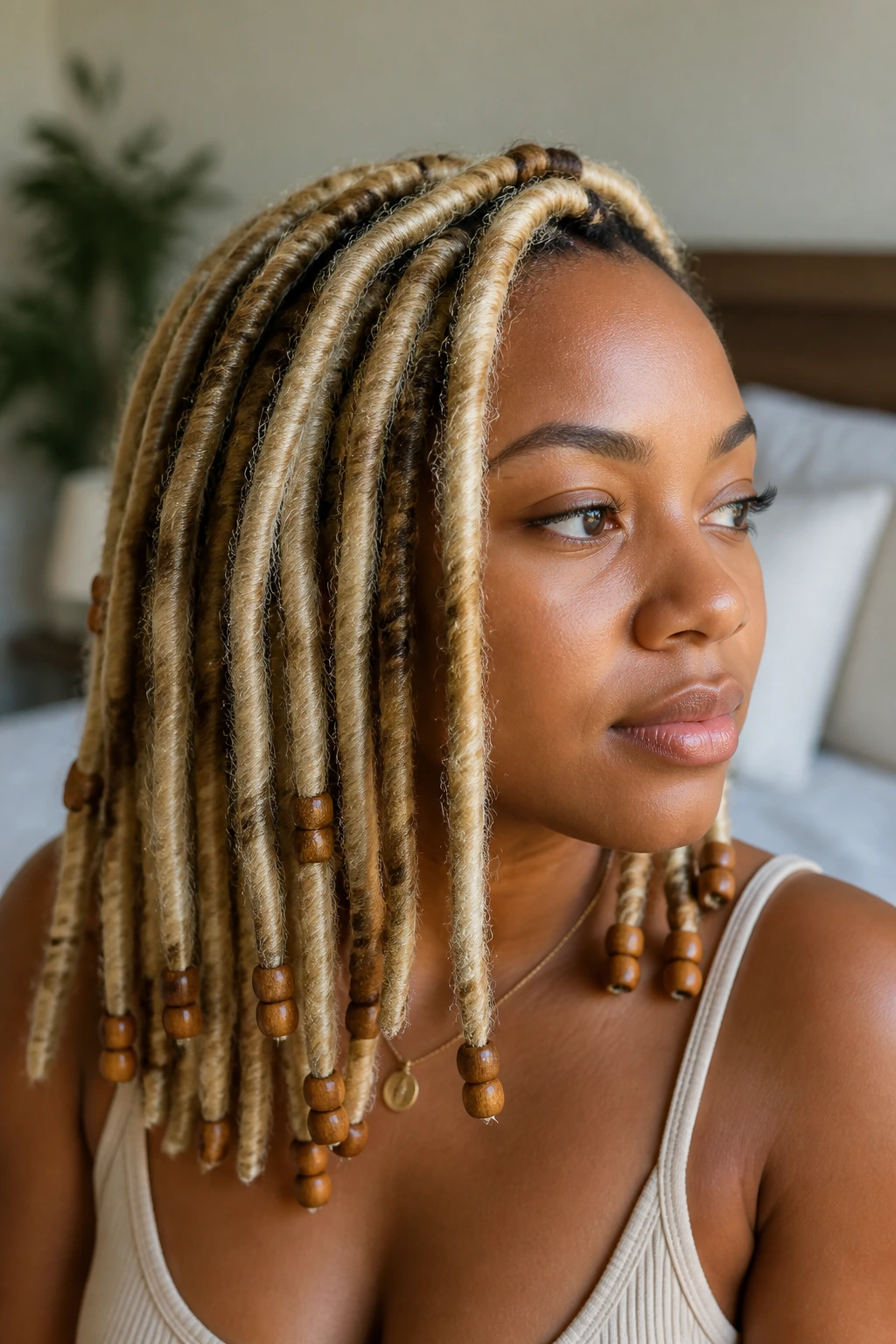
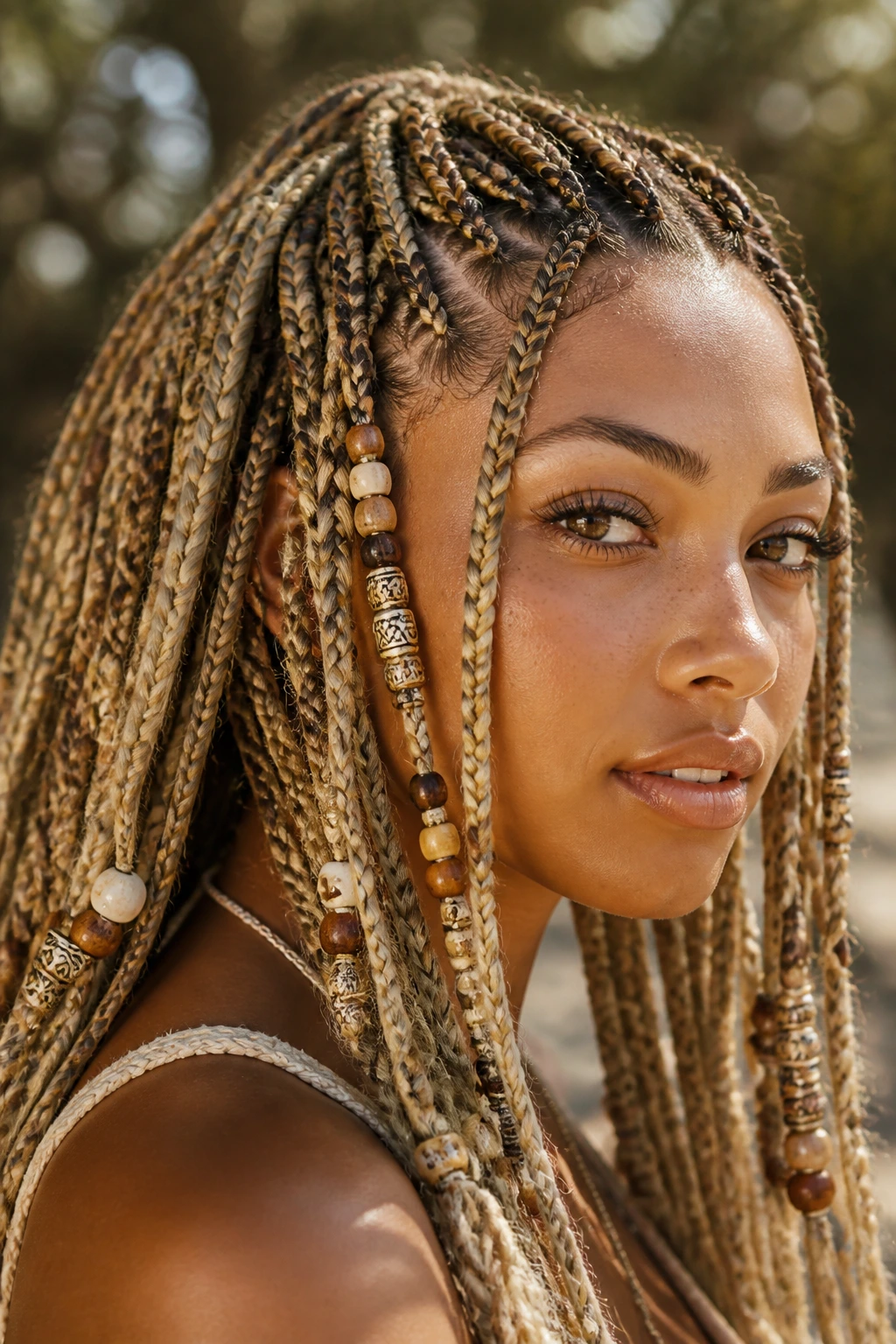
Faux locs carry weight differently from braids, and that makes wooden beads a natural fit. The loc texture has enough body to hold the beads without collapsing, and the blonde color keeps the wood from looking too dark or rustic. Instead, it reads warm, grounded, and finished.
I like wooden beads on faux locs because they cut the shine a little. Blonde hair can go glossy fast, especially under strong light, and the wood gives the style some texture at the ends. Use beads with a smooth bore so they slide on without catching. Rough holes can snag the loc wrap and fray the finish.
The loc bob, shoulder-length locs, and waist-length locs all work here, but the bead size should match the thickness of the loc. Thin faux locs need small wood pieces. Chunkier locs can take broader, carved beads. If the bead looks like it belongs on a necklace from across the room, it’s probably too big.
13. Ombre Blonde Boho Braids with Beaded Ends
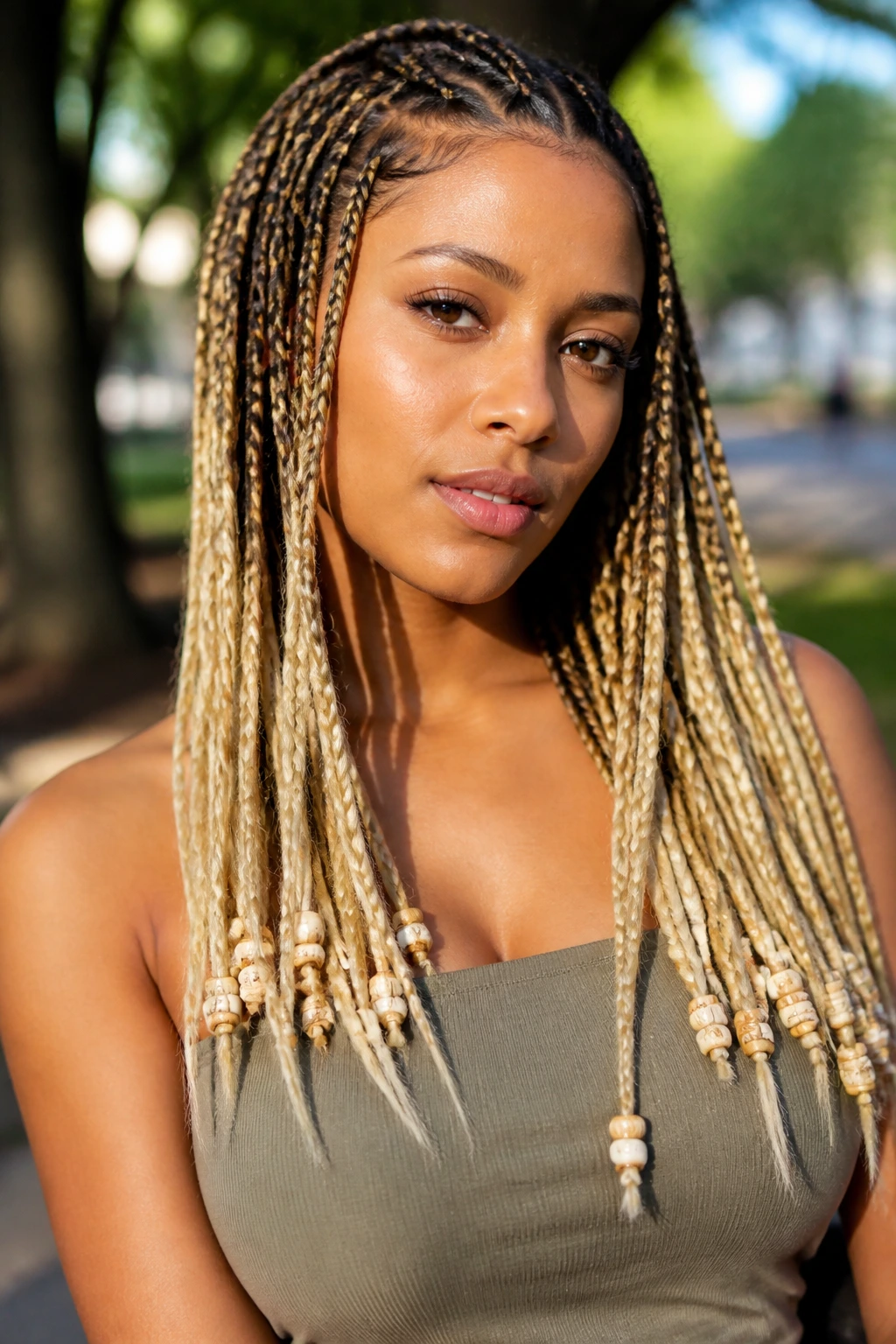
Ombre blonde boho braids have a built-in soft edge because the color shifts rather than stops. That makes them perfect for a few bead accents near the loose ends. The wavy pieces and the darker root-to-blonde fade already create movement, so the beads should finish the story, not rewrite it.
I’d keep the beads off the loose boho pieces and use them on the straighter braid tails. That contrast keeps the style from getting messy. Clear or pale gold beads work best if the ombre leans warm; smoked glass or pearl works if the blonde is cooler. One bead cluster per front section is enough.
The thing to watch is balance. Boho braids already have a relaxed, lived-in shape. If you add too many bead colors, the style can lose that softness. A few carefully placed pieces around the face and the lower lengths look better than bead clutter spread everywhere.
14. Platinum Side-Swept Cornrows with Crystal Beads
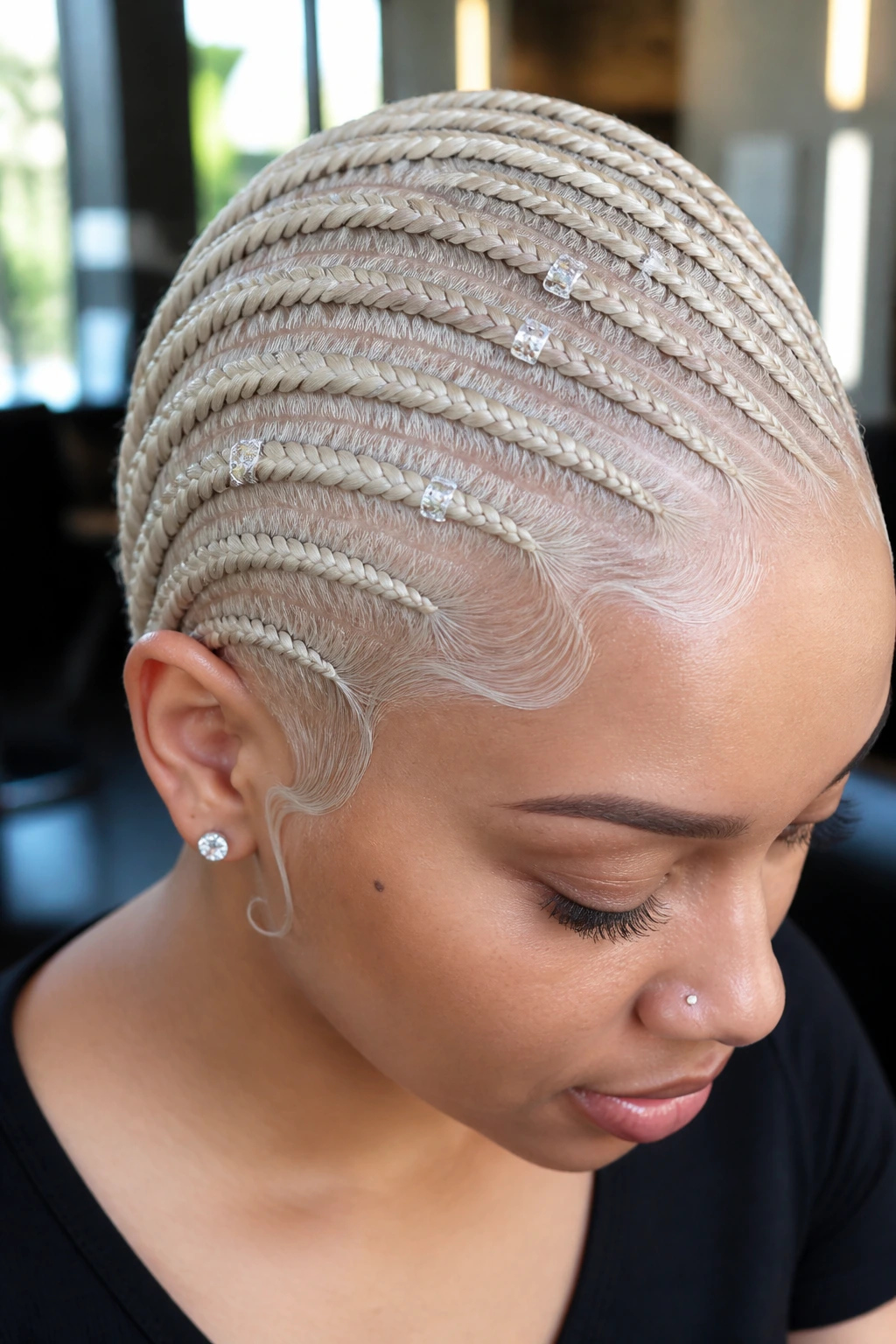
Platinum side-swept cornrows are precise, almost severe, and crystal beads sharpen that line instead of softening it. That’s what makes the style interesting. The side sweep creates a long diagonal, and the crystals catch that direction so the eye keeps moving.
I would keep the bead count low here. Cornrows are tight to the scalp, so anything bulky at the ends starts to look heavy fast. Small crystal beads, one or two per row, are enough. If you want more drama, let the braid pattern carry it and keep the beads almost invisible until they move.
The cool tone of platinum helps. Crystal beads on warmer blonde can wander into bridal territory quickly, which may be the point or may be too much. On platinum, they feel cleaner and more controlled. Add a sharp part and a smooth edge finish, and the whole style lands exactly where it should.
15. Golden Micro Twists Half-Up with Bead Clusters
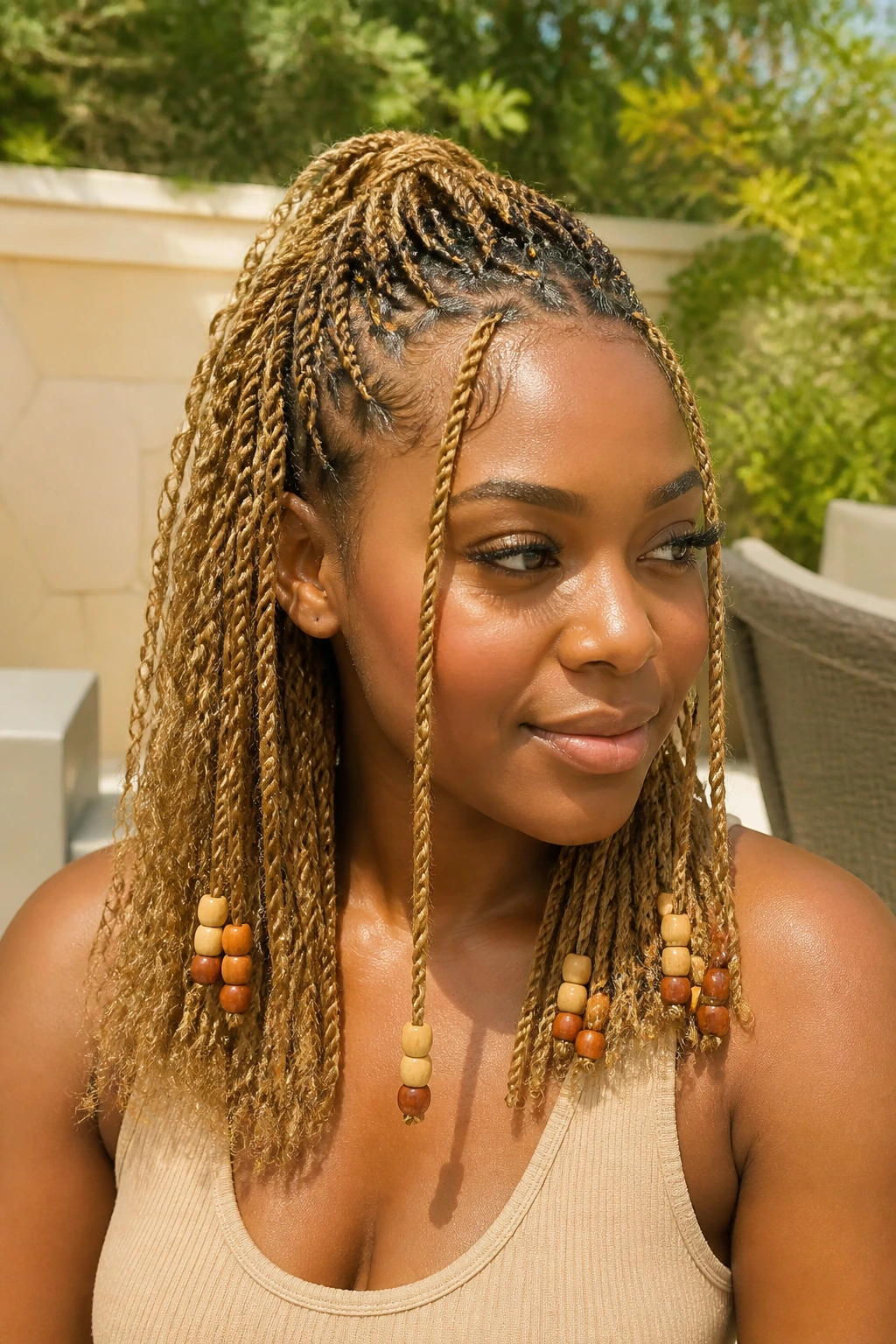
A half-up style gives you two different spaces to work with: the lifted top and the hanging bottom. Golden micro twists are perfect for that because the texture stays light, and bead clusters can live in the lower half without crowding the crown. The hair feels styled, not overloaded.
Why do clusters work here? Because micro twists are small enough to make individual beads disappear, but the grouped ends give your eye something to catch. Use 3-bead clusters on selected twists instead of every single tail. That staggered pattern keeps the style from getting noisy.
The placement rule
Keep the bead clusters below the line where the hair is pinned up. If the beads sit too close to the half-up section, the top starts to look cluttered and the lift loses shape. I’d also keep the clusters identical in color, even if the twist parts vary slightly. Repetition makes the style feel sorted.
16. Beige-Blonde Butterfly Locs with Neutral Beads
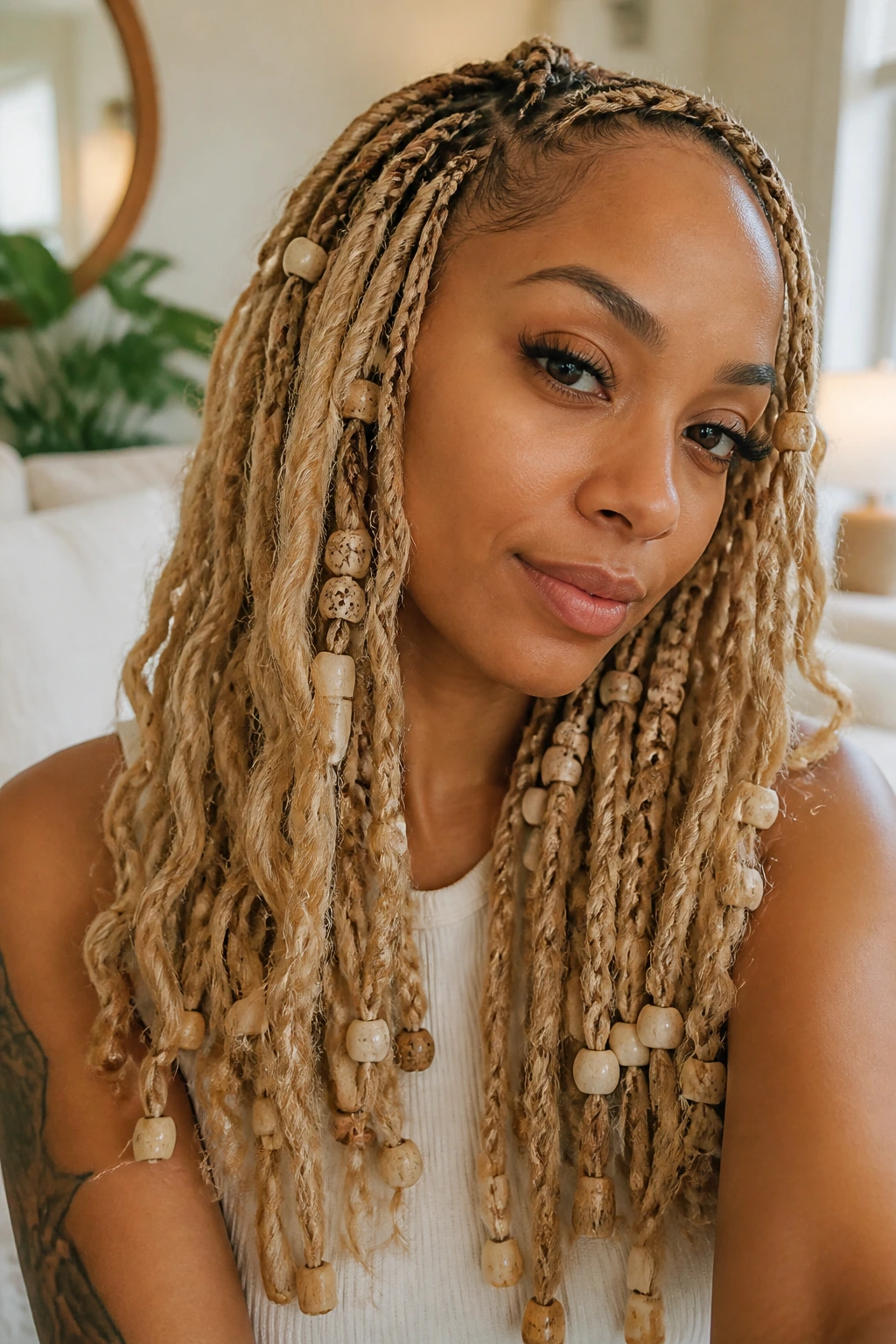
Butterfly locs already have those soft loops and bends that make the style feel airy, so neutral beads keep the look from drifting into costume territory. Beige blonde is a quiet color to begin with. Pair it with cream, tan, smoked-clear, or pale wood beads and the whole thing stays textured without getting loud.
I like this style because it is forgiving. The loops in butterfly locs hide small irregularities, which means the bead placement can be a little looser than on classic braids. That said, don’t overdo it. The loc shape is the visual interest. The beads are there to frame the ends and maybe a few face-framing sections.
If you want a bit more polish, use the same neutral bead at every end and one slightly larger accent bead on the front two pieces. That tiny repetition keeps the whole thing feeling intentional. Beige blonde is easy to mess up with too much contrast, so I’d stay inside a soft palette here.
17. Blonde Crown Braid with Scattered Accent Beads
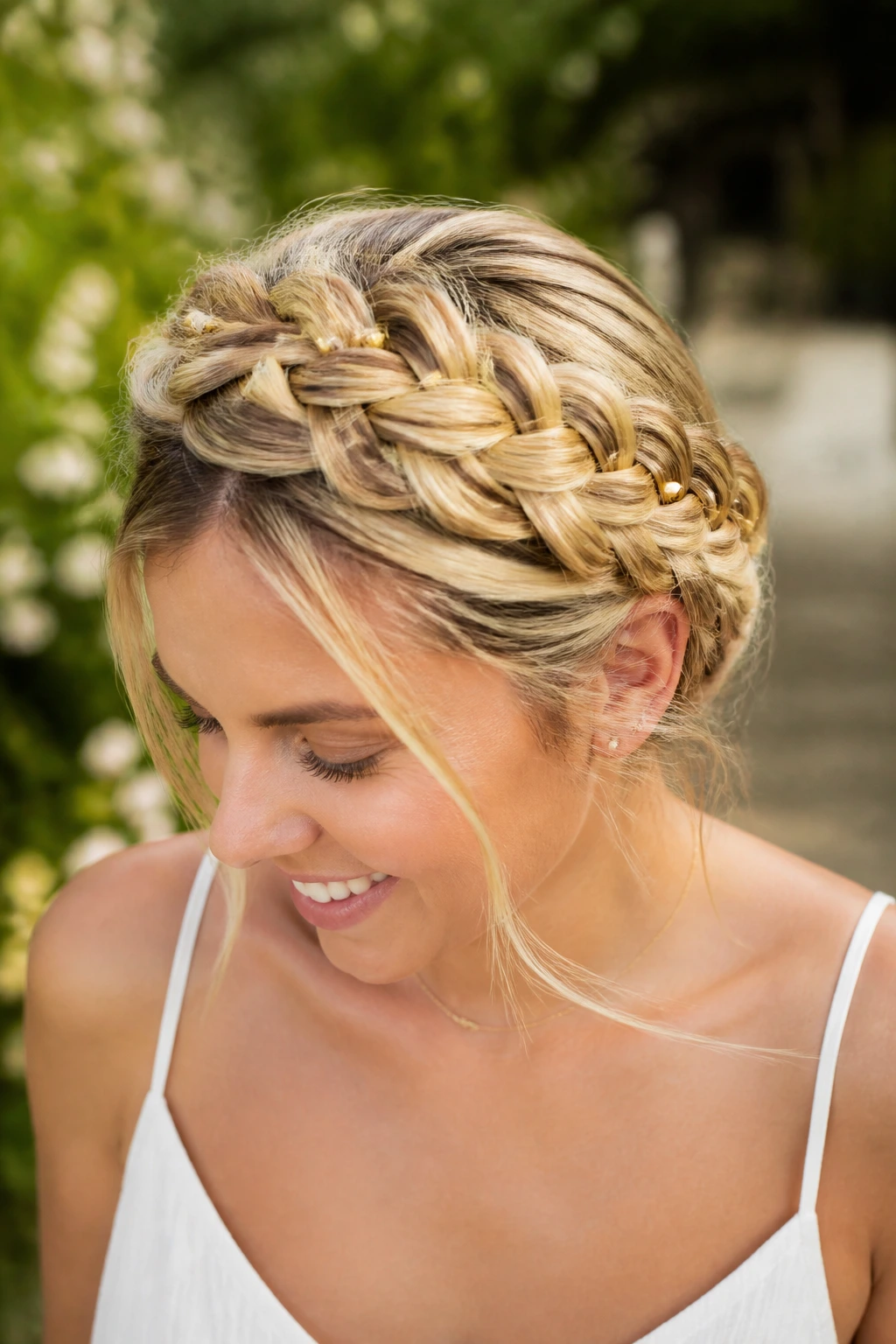
A crown braid already has presence. It wraps the head in a circle, which means every extra detail gets magnified. That is why scattered accent beads work better than a full bead run. A few tiny pieces tucked along one side of the crown are enough to keep the style interesting.
Blonde hair makes the braid line read clearly, especially if the crown braid is thick. Accent beads at the back curve or behind one ear create a little surprise without breaking the shape. I prefer pearl, tiny gold, or translucent beads here. Big beads interrupt the ring and can make the braid look uneven.
This is one of those styles where less really is more. You want the braid to feel like a halo, not a craft project. A handful of beads placed with care gives the crown braid a little edge while keeping the silhouette clean.
18. Sandy Blonde Halo Braid with Tiny Seed Beads
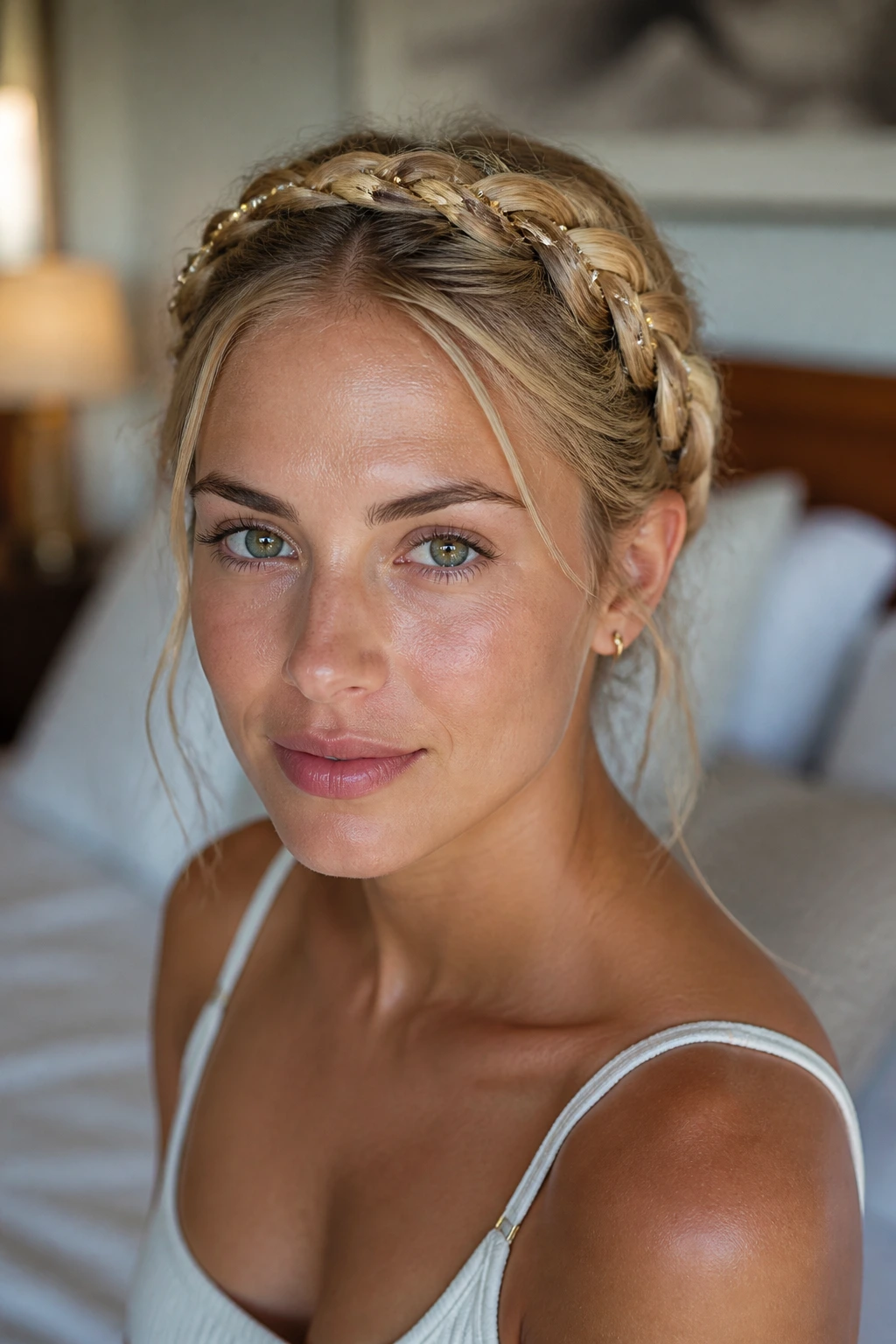
Halo braids sit close to the head and trace the perimeter like a frame, so tiny seed beads are the right scale. Anything larger would interrupt the circle and pull attention away from the braid path. Sandy blonde works especially well here because the softer color lets the tiny beads appear as texture rather than hardware.
This is a calm style. It does not need a lot of shine. Seed beads in smoked clear, matte gold, or soft white give the halo braid a little glimmer when you turn your head, which is plenty. Put them sparingly near the ends or at a single anchor point on each side.
The braid shape matters more than the accessories here. If the parting is clean and the braid is tucked neatly, the tiny bead detail feels elegant. If the braid is loose or uneven, the beads only call attention to that. That’s the tradeoff. The good news is that a halo braid rewards neat work more than almost any other style in this list.
19. Blonde Loc Bob with Brass Beads
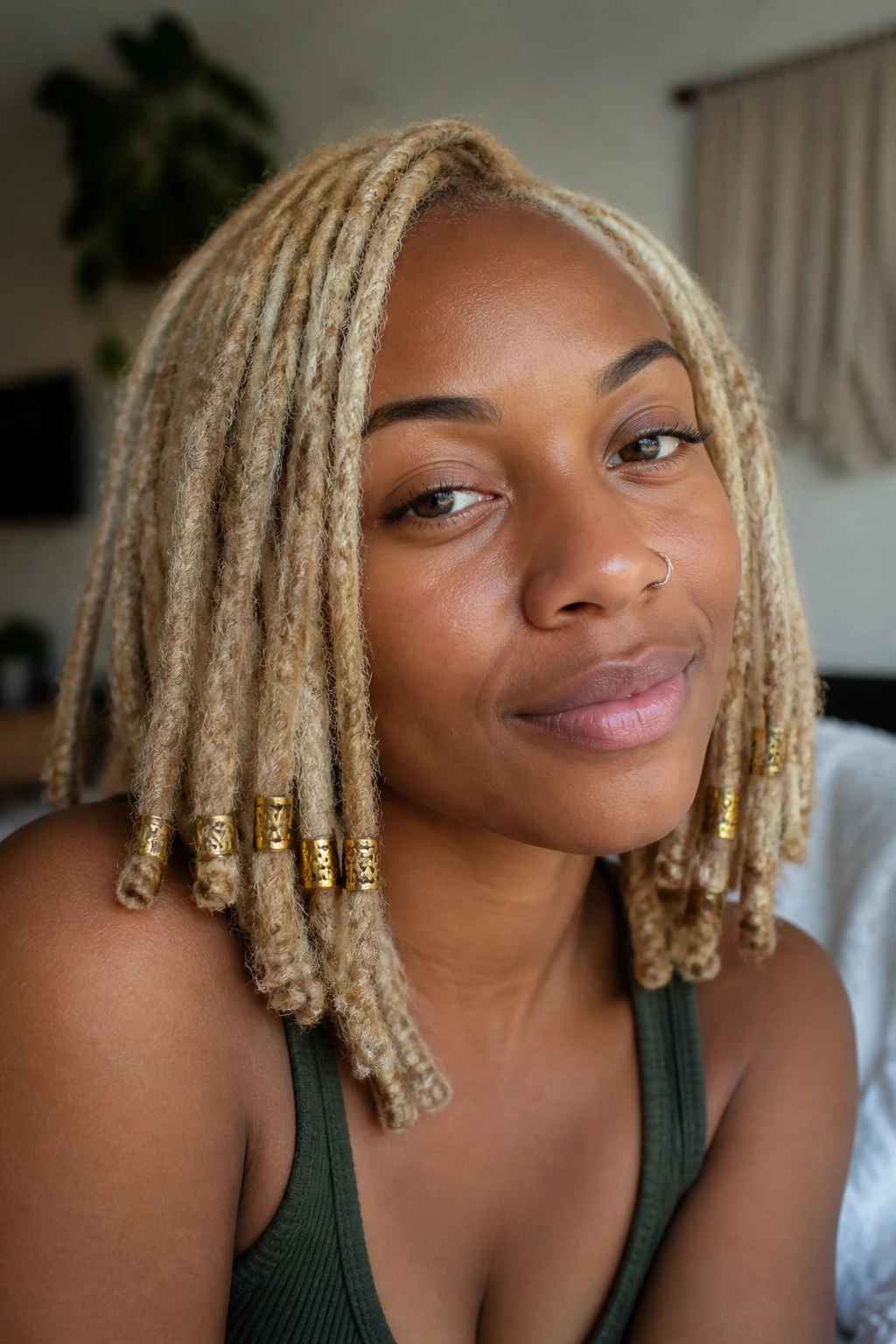
A blonde loc bob has a shape problem in the best possible way: it wants to swing, but it also wants to sit. Brass beads help it do both. They add enough weight to keep the ends from floating too much, and the warm metal keeps the blonde from looking flat.
I like brass on bob-length locs because the metal catches the line of the cut. The style ends around the chin or neck, so the beads land where the eye naturally stops. Use a small pair on some locs and a single piece on others. That uneven distribution makes the bob feel lived in instead of lined up like a row of pencils.
The thing to avoid is overstuffing the ends. Brass has presence. You do not need much of it. Keep the locs themselves neat and let the bead finish do the talking. It’s a strong combo, especially on deeper blonde shades that need a touch of warmth.
20. Cream-Blonde Triangle Parts with Mixed Metal Beads
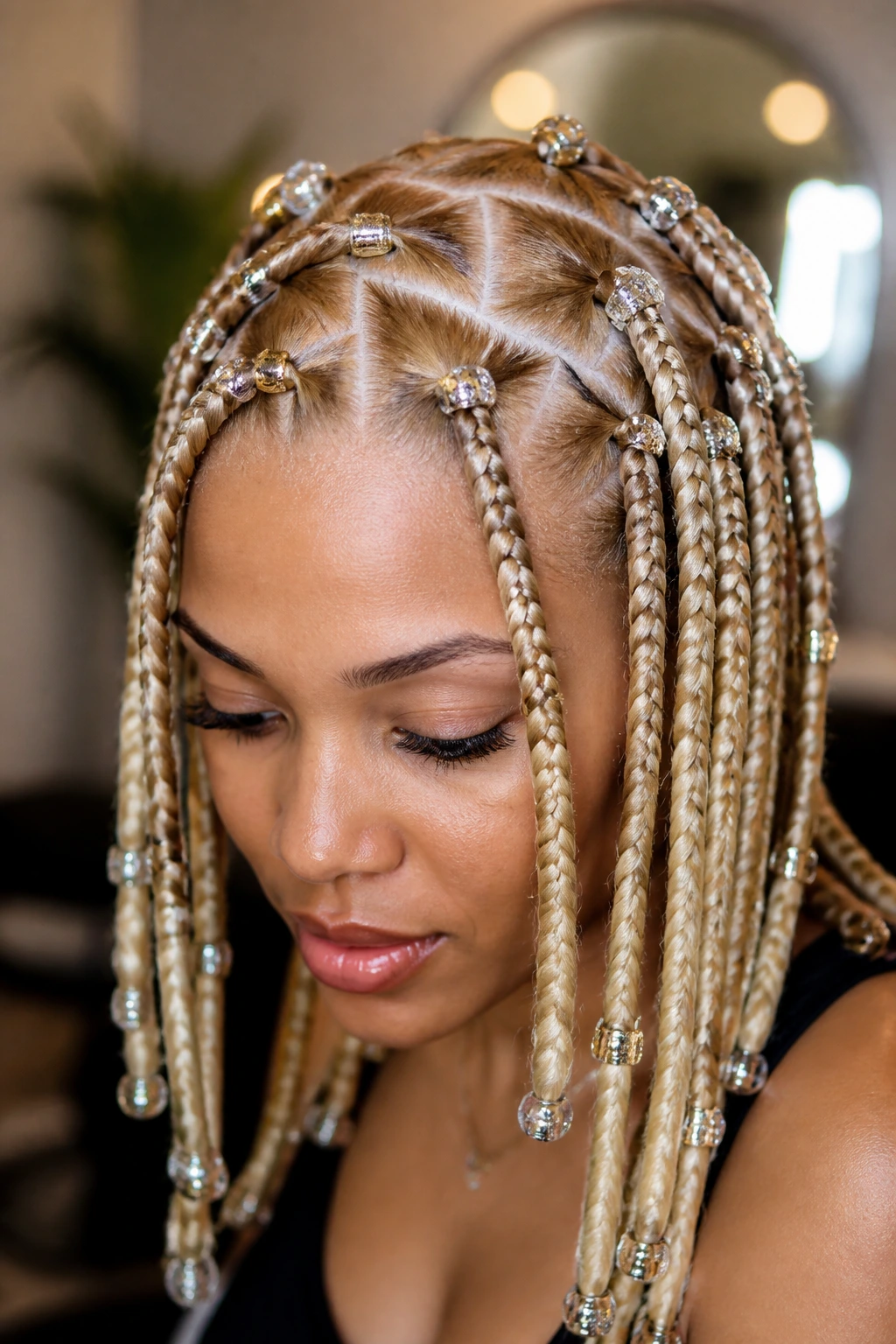
Triangle parts already give the style geometry. They turn the scalp pattern into part of the design, which is why the bead choice should stay disciplined. Cream blonde softens the triangle shape, and mixed metal beads bring just enough contrast to keep it from looking too uniform.
I like a repeating pattern here: silver, gold, then a clear bead, repeated across the head. That keeps the look structured. Randomly mixing five or six finishes can make triangle parts look cluttered, and the parting deserves better than that.
This is a good style for anyone who likes detail but not chaos. The blonde reads clean, the triangle parts give order, and the beads provide motion at the ends. A simple middle part or a neat side part works either way. Just keep the bead pattern repeated in a consistent way so the eye can settle.
21. Warm Blonde Double Braids with Shell Beads
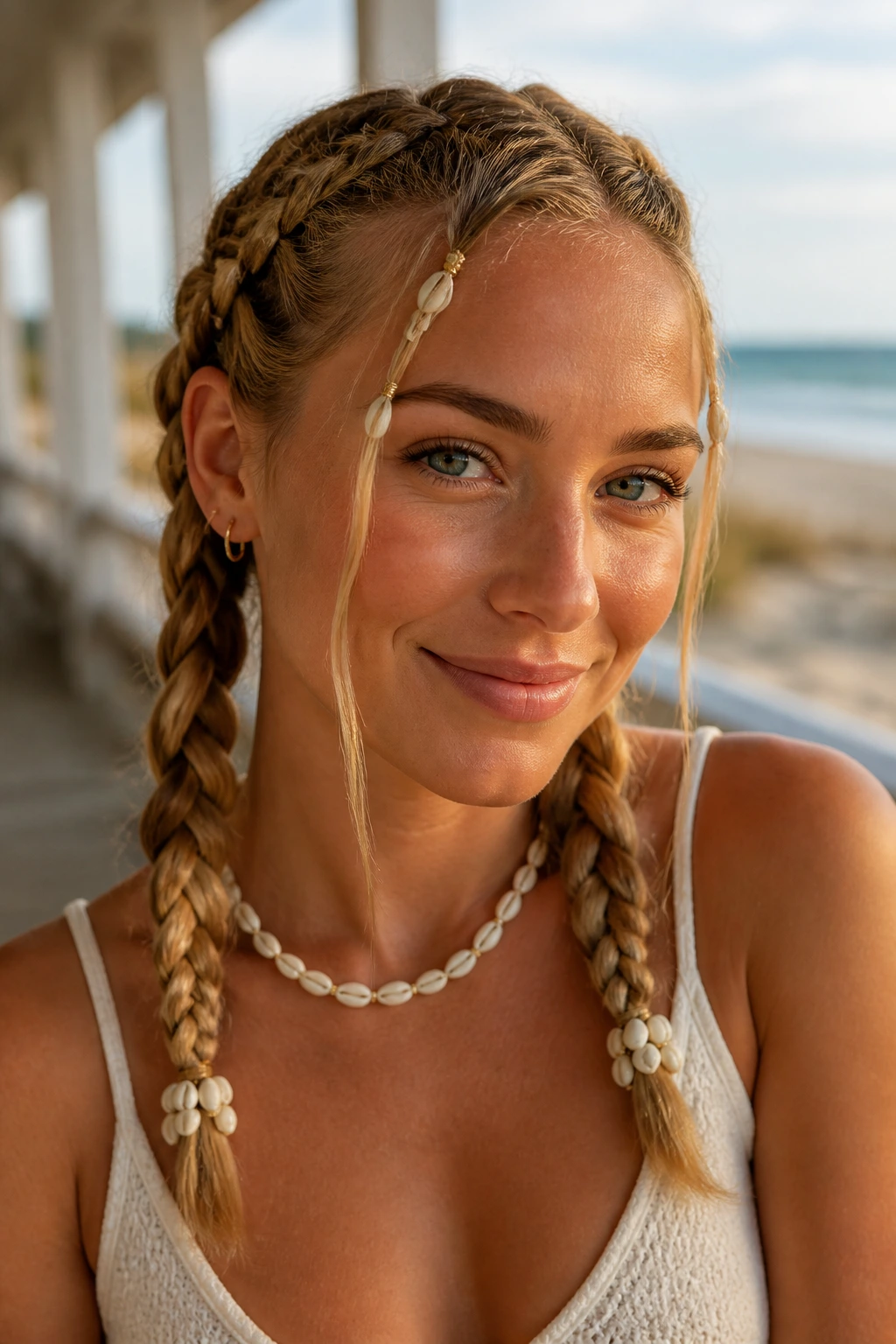
Warm blonde and shell beads belong together more naturally than most people expect. The shells soften the braid and push it toward a beachy, easy mood, but the double-braid shape keeps it from getting too loose or undone. You end up with something that feels casual and set at the same time.
I would keep the shells small. Big shell pieces can take over fast, especially on blonde hair that already reflects a lot of light. A couple of shell beads near the ends and maybe one accent piece on each front braid is enough. If the braid is long, let the shells cluster near the bottom third.
The warm blonde tone helps the shell finish stay grounded. Cooler blondes can make shell accents look out of place unless the rest of the styling is very soft. Here, the color and bead material meet in the middle without much effort. That’s why this one looks easy when it’s done well.
22. Blonde Braided Bun with Dangling Bead Tassels
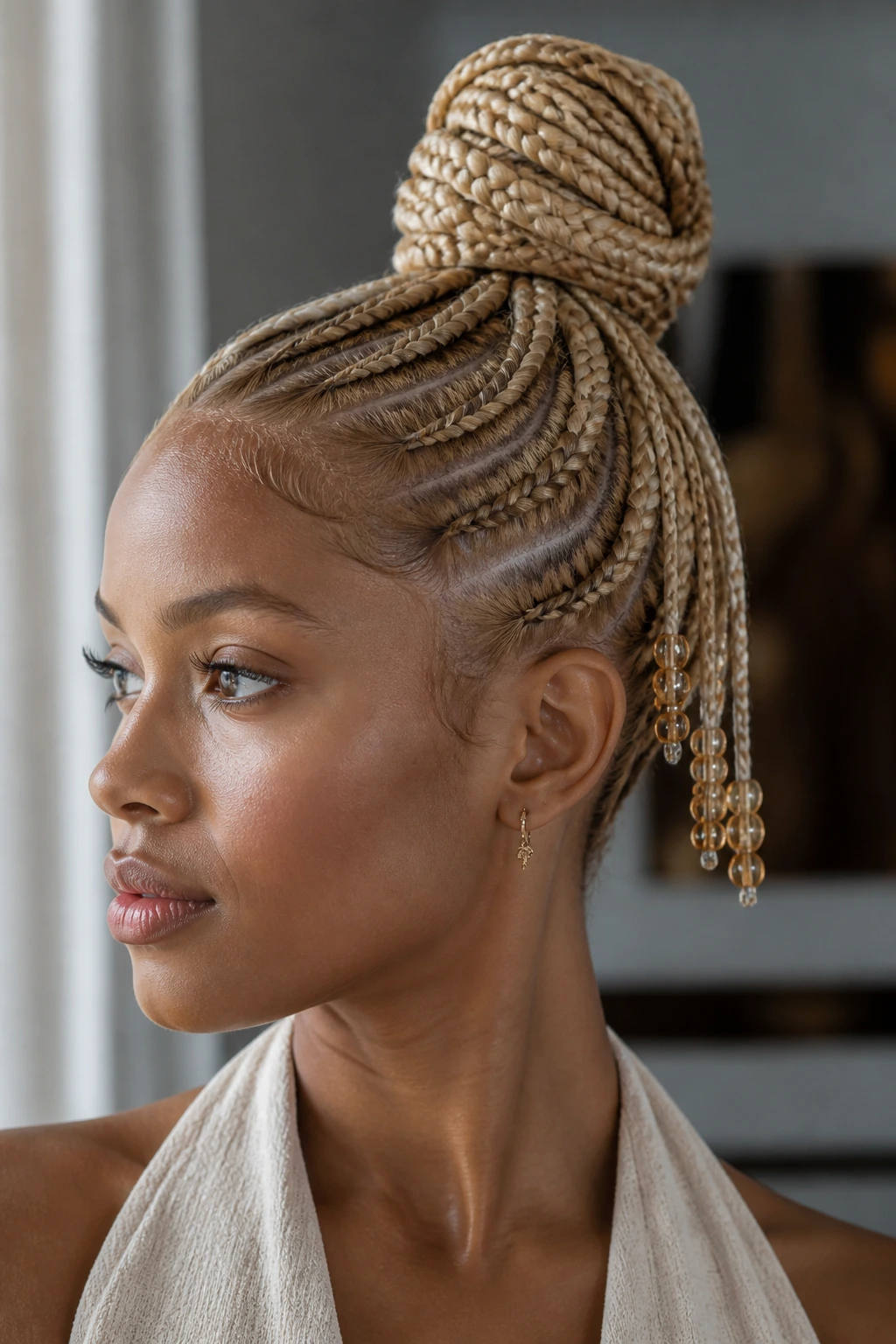
A braided bun gives you structure at the crown and freedom at the nape, which is exactly where dangling bead tassels make sense. The bun stays sleek, the braid lines stay tucked, and the beads get to move without bothering the face. Blonde hair keeps the whole thing bright, even when the style is pulled up.
I like this look for dressier days because the bun sets the shape and the tassels give it motion. Use a few bead strands only — too many and the bun loses its clean outline. Pearl, gold, or clear beads work best when they hang below the knot or wrap point. Keep them away from the tightest part of the bun so they do not pull.
This is one of the best styles in the group if you want something that looks formal without feeling stiff. The bead tassels catch light when you turn your head, and the blonde base keeps the finish soft. It’s a neat ending for the list because it shows how far the bead idea can go.
What Makes Blonde and Beads Work So Well Together
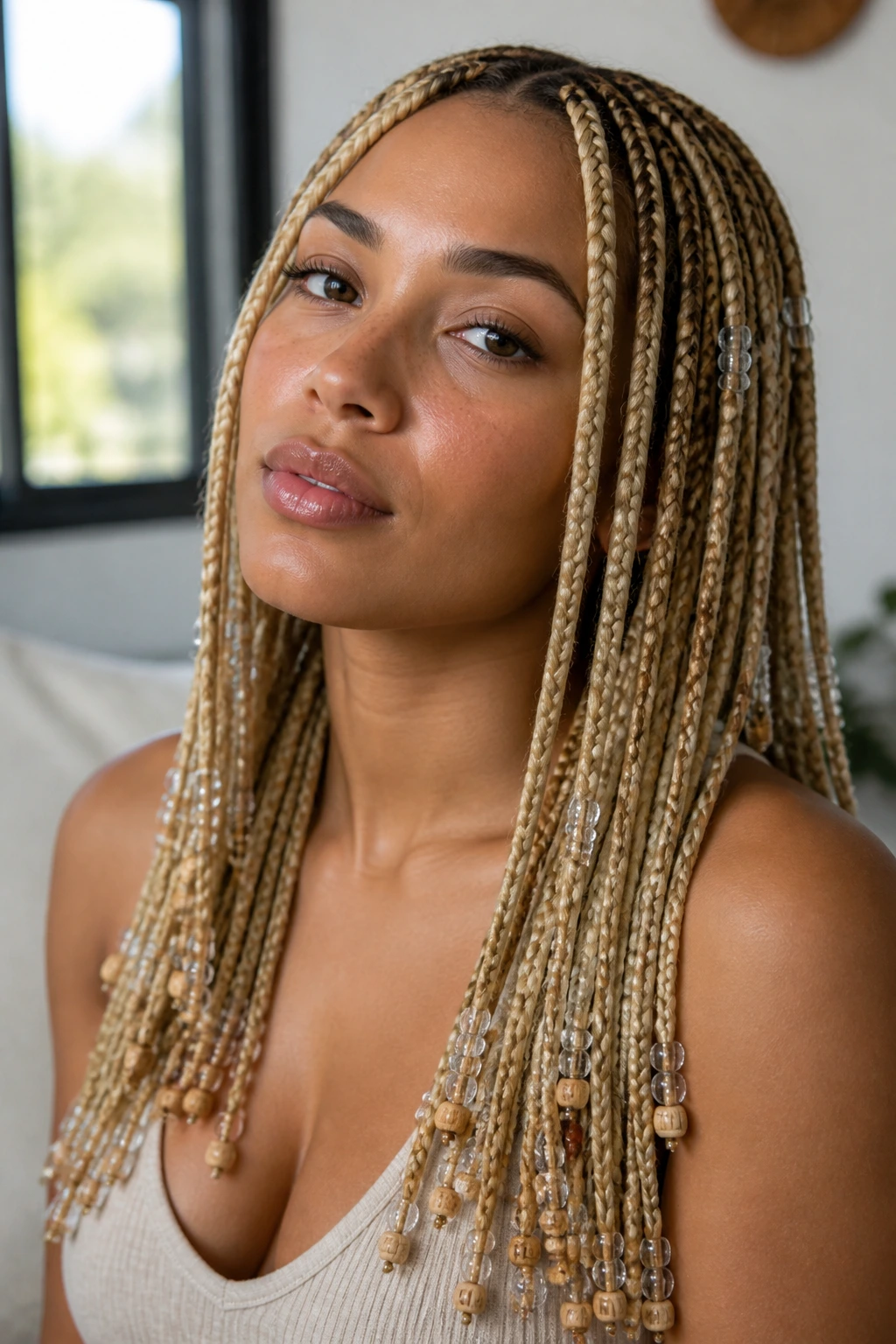
Blonde hair is a reflector. Beads are punctuation. Put them together and the style stops being only about pattern; it becomes about how light moves across the head, how the ends swing, and where the eye lands first. That’s why blonde beaded hairstyles can look so different from one another even when the braid pattern is nearly the same.
Tone matters more than people think. Honey blonde tends to flatter clear, amber, and gold beads because the warmth stays in the same family. Platinum and ash blonde usually look cleaner with silver, clear, matte black, or smoked finishes. If the bead finish fights the blonde undertone, the style starts to look off by a half-step, and half-steps are obvious on hair.
Then there’s weight. A braid with beads at the ends moves differently from one with beads near the crown, and the difference is not subtle. Ends-only placement keeps the style loose and swingy. Mid-shaft or root placement turns the beads into part of the silhouette. Both work. They just do different jobs.
I’m a bigger fan of restraint than excess here. One good bead finish repeated in the right place beats six finishes scattered everywhere. That sounds plain, but it is the difference between a style that looks designed and one that looks assembled in the mirror five minutes before you left.
Essential Tools for These Styles
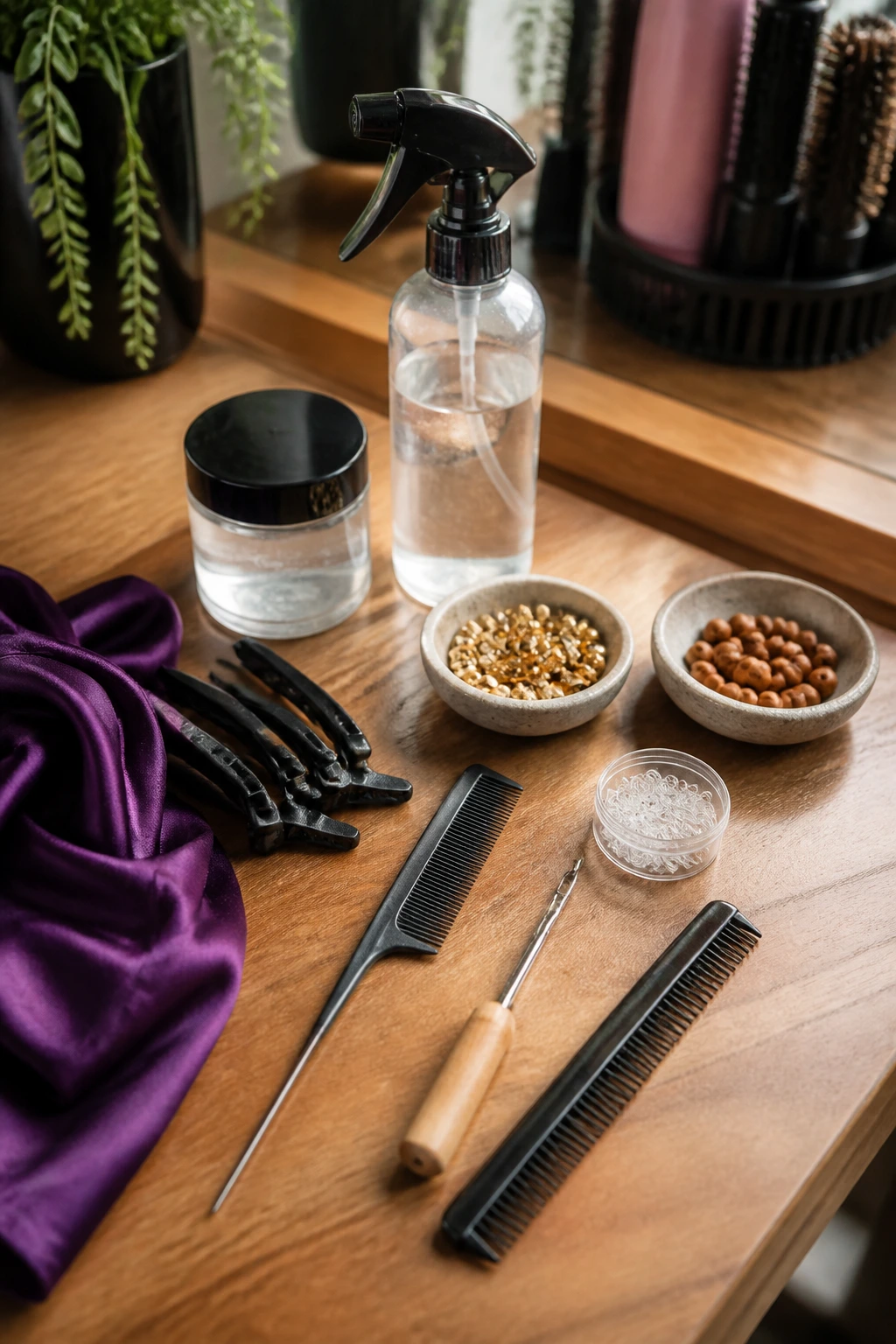
- Rat-tail comb: Clean parts make blonde braids and twists look brighter, and a sharp tail helps you section without guessing.
- Sectioning clips: Hold the rest of the hair out of the way so your part lines stay crisp.
- Braid gel or light edge control: Use enough to smooth flyaways, not enough to make the roots greasy.
- Lightweight beads in 1 or 2 finishes: Acrylic, wood, pearl-look, or small metal beads work best depending on hair thickness.
- Bead threader or braid bead tool: Saves time when the bead hole is narrow or the braid ends are bulky.
- Small clear elastics: Handy for securing the braid end before bead placement if the hair is slippery.
- Spray bottle with water or leave-in mix: Helps tame frizz and makes sectioning easier on dry hair.
- Satin scarf or bonnet: Keeps the style neat overnight and protects the bead placement.
- Fine-tooth comb: Useful for smoothing the base of feed-ins, ponytails, and cornrows.
- Optional hooded dryer or fan: Helps dry freshly washed braids or twists fully before beading and wrapping.
How to Choose the Right Blonde Shade and Bead Finish
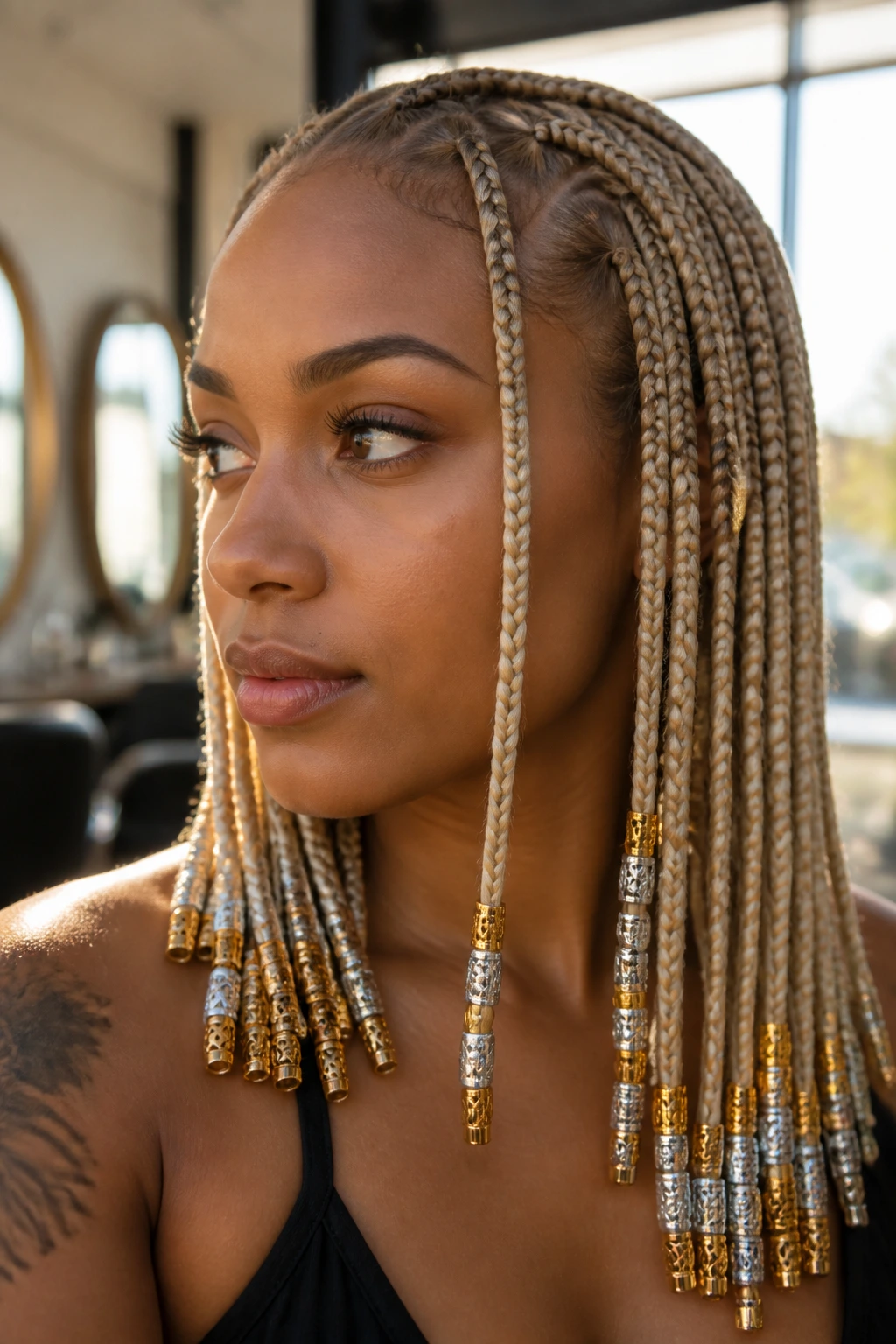
Blonde is not one color. That’s where a lot of bead choices go sideways. Honey, caramel, beige, champagne, ash, and platinum all behave differently under light, and the bead finish you pick should answer the same question: do you want the beads to blend, contrast, or sparkle?
Warm blondes — honey, caramel, buttery, and beige — usually look best with clear, gold, amber, pearl, or wood. Those finishes keep the warmth moving. Cool blondes — ash, silver-beige, champagne, and platinum — look cleaner with silver, clear, smoked glass, or matte black. If you mix warm blonde with a cold bead or cool blonde with a very yellow bead, the style can feel split in half.
I also pay attention to where the beads will sit. If they’re at the ends of long braids, you can get away with a more noticeable finish. If they sit close to the face, the bead material should be quieter unless you want the face-framing detail to take over. That’s a real difference, not a tiny one.
One last thing: hair density changes the bead choice. Fine braids need smaller, lighter beads. Thick locs or chunky twists can carry more. The right finish is not just about color. It is about how much weight the hair can actually hold without sagging by the third day.
How to Wear These Styles Without Letting the Beads Take Over
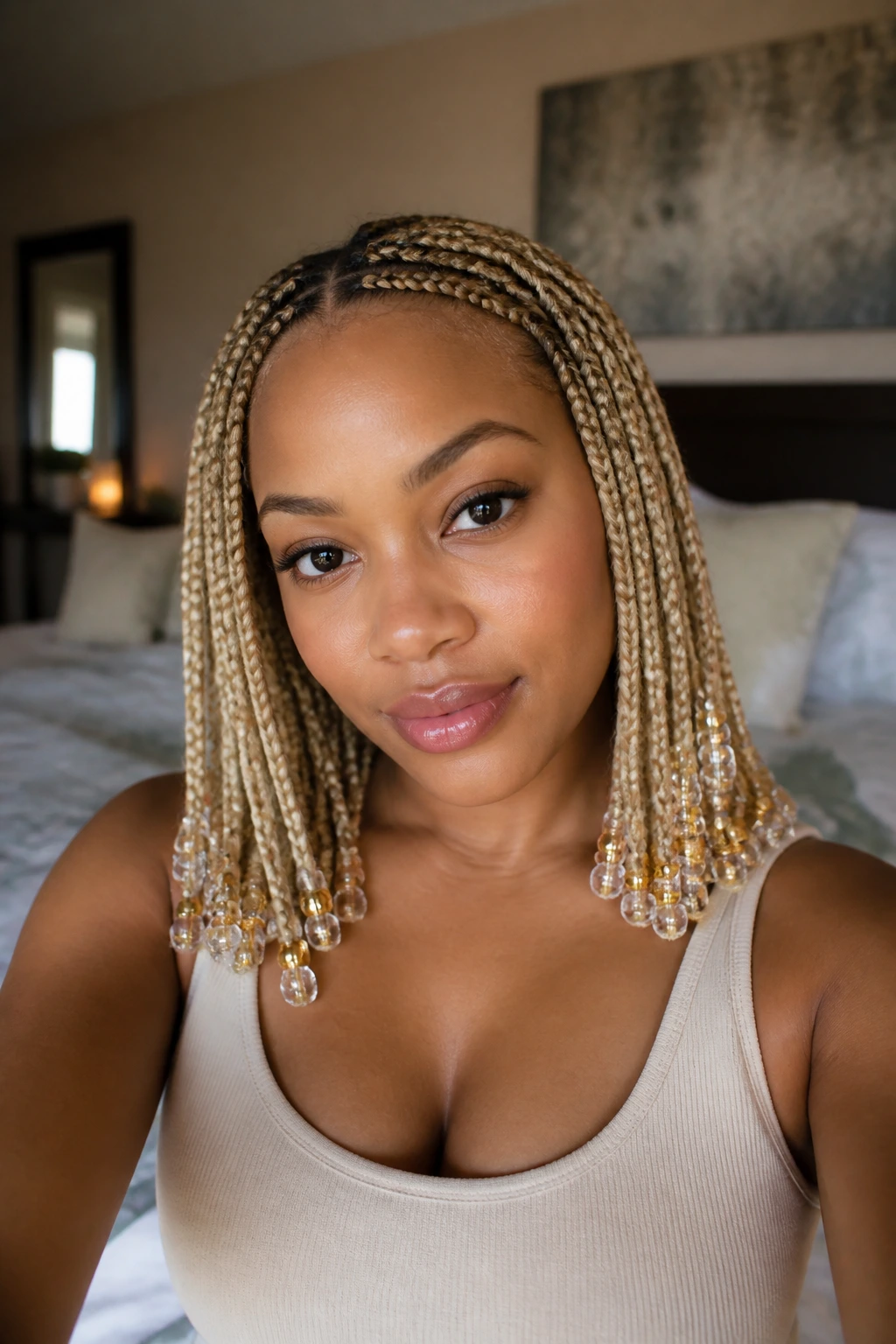
Presentation: Let the braid shape do the first job. If the style has a clean part, a neat edge, or a strong sweep, keep the bead placement focused at the ends or on one accent row so the eye has somewhere to rest.
Accompaniments: Simple earrings, a neckline that does not compete with the braid length, and a clean makeup finish all help the beads read intentional. Big necklaces and heavy earrings can fight with the movement, especially on shoulder-length styles.
Scale: Match bead size to braid thickness and hair length. Short bobs look better with fewer, smaller beads. Long braids can carry more movement, but not endless stacking; two to four beads per tail is plenty for most looks.
Comfort: If beads hit the collarbone, jaw, or the back of the neck all day, keep them lighter. A style that looks pretty in the mirror but nags your skin every time you turn your head will not stay a favorite for long.
Additional Styling Tweaks That Make the Look Feel Finished
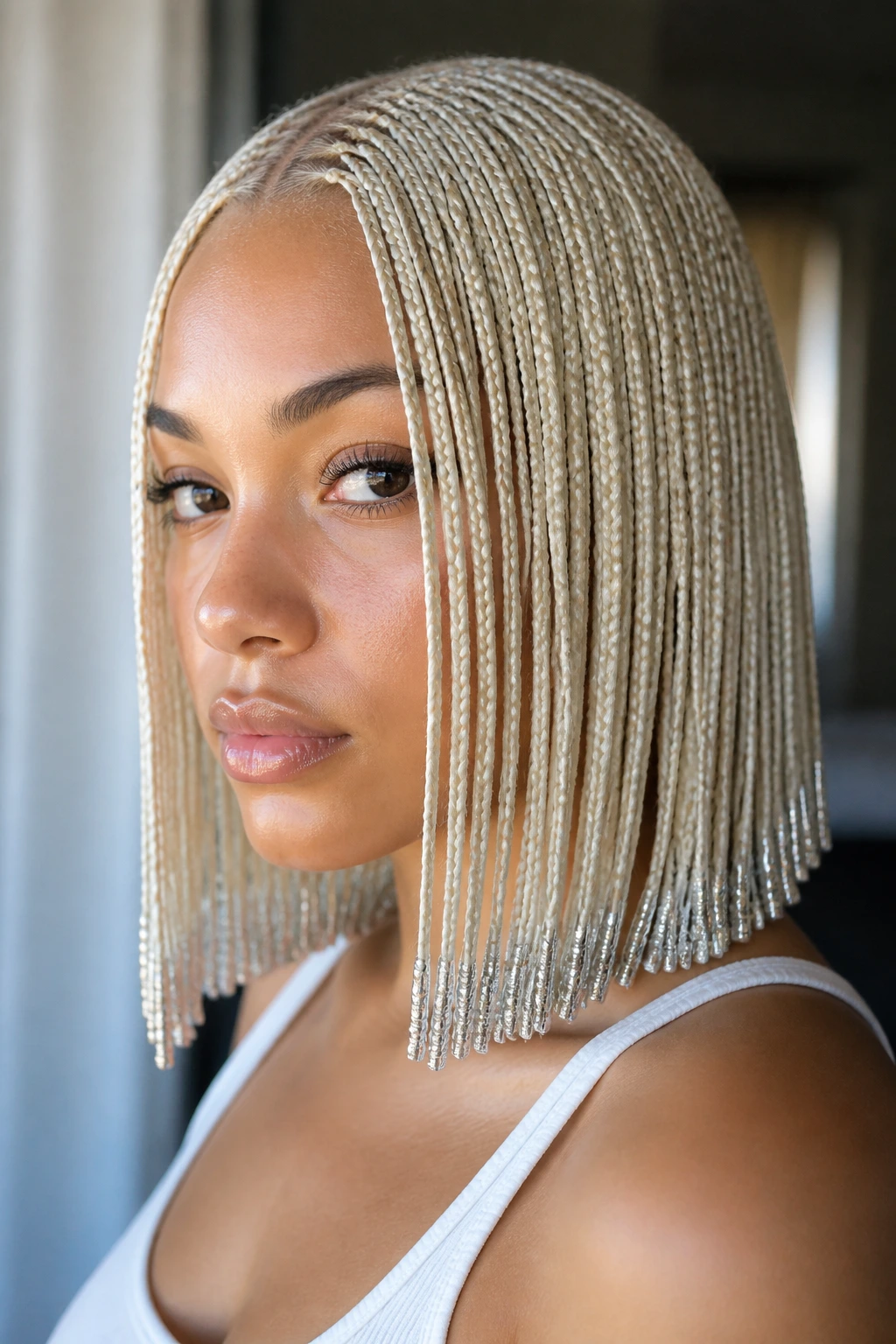
Color Contrast: Pick one bead finish and repeat it near the face, in the middle, or at the ends. That tiny repetition pulls the whole style together faster than a grab bag of mixed pieces.
Customization: If the blonde is warm, try gold, amber, or pearl accents. If it’s cool, clear, silver, or smoke will usually sit better. I’d only mix two finishes at a time unless the braid pattern itself is extremely clean.
Finishing Touches: A light mist of braid spray, a neat edge, and a clean part go farther than extra bead volume. The style should look deliberate before the beads even show up.
Make-It-Yours: For a quiet office look, stick to clear, smoke, or pearl. For a weekend style, add color-pop beads or a single metallic accent row. For heavier hair, choose larger holes and lighter material; for fine hair, keep the bead count modest and the weight down.
Common Mistakes That Flatten the Whole Style
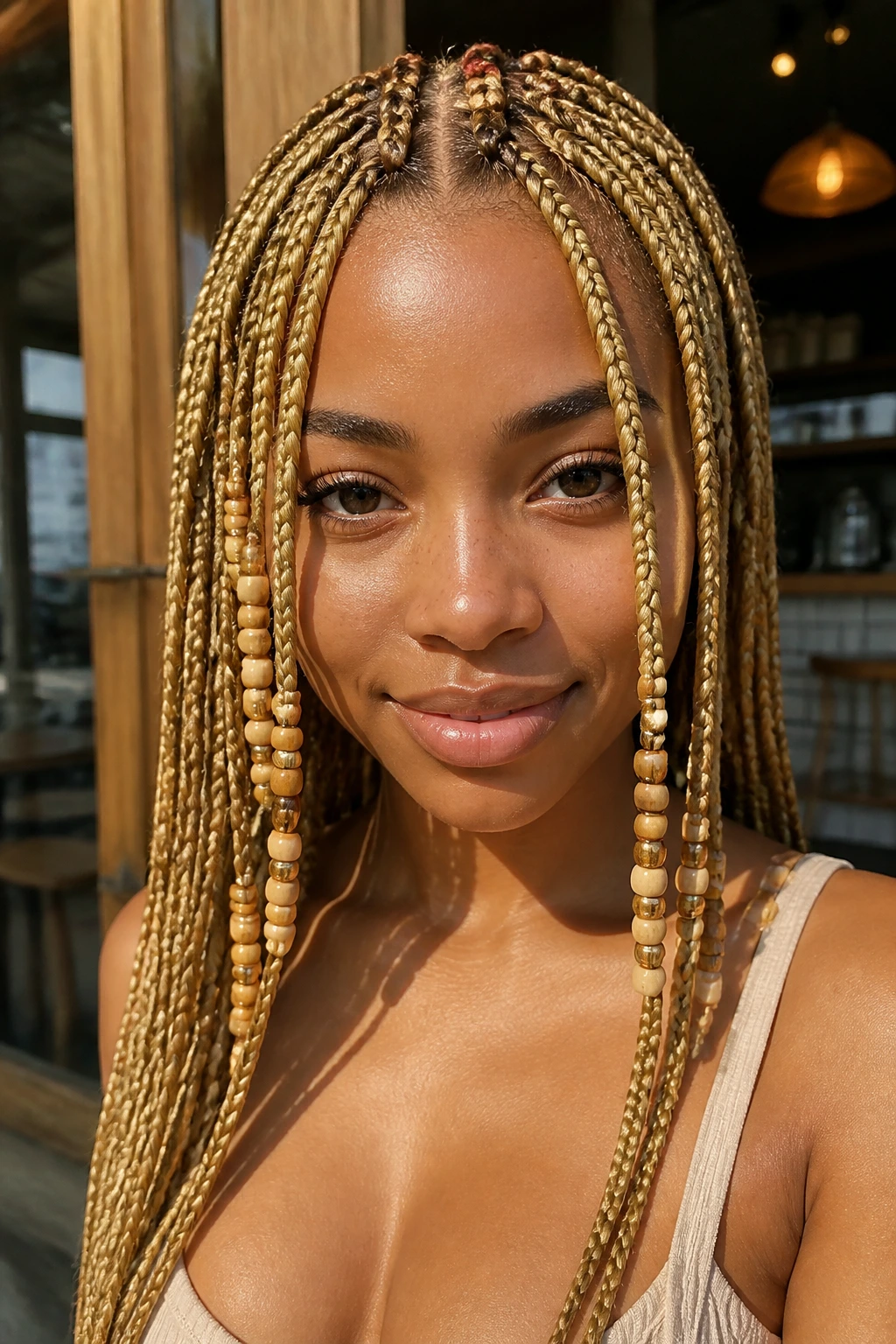
Too much weight at the roots: Heavy beads near the hairline pull braids, twists, and locs down and can leave the style feeling sore by the end of the day. Keep most of the weight at the ends unless the style is built for root detail.
Mixing every finish you own: Clear, gold, wood, black, pearl, and bright plastic all in one head can look scattered. Pick one main finish and, if needed, one accent finish. That’s enough.
Ignoring the blonde undertone: Cool beads on warm blonde, or warm beads on icy blonde, can make the style feel mismatched. Hold the bead next to the hair in daylight before you commit.
Using beads that are too large for the braid size: Small braids get swallowed by oversized beads. Thin micro braids and tight stitch braids usually need smaller, lighter pieces than people expect.
Leaving the ends rough before beading: Split or frayed braid tips make beads slip and catch. Seal the ends properly, or the bead ends up sitting crooked and annoying you every time it moves.
Variations and Adaptations Worth Trying
Clear-Ice Minimalism: Stick to clear acrylic or smoked-clear beads only, and keep them mostly at the ends. This works best on honey or beige blonde when you want the style to look clean and airy instead of decorated.
Warm Honey Mix: Use gold, amber, and soft pearl on honey or caramel blonde. The palette feels richer and more lifted, especially on longer braids or twists that need a little depth at the bottom.
Earthy Loc Edit: Swap metal for wood, shell, or matte cream beads on faux locs and loc bobs. The finish feels grounded and textural, which is a nice break from all the shine blonde can bring on its own.
Festival Pop: Keep the blonde base neutral, then add one bright accent color — turquoise, coral, or lilac — at the ends of only the front pieces. That keeps the style playful without turning the whole head into confetti.
Soft Office Neutral: Use pearl, champagne, and tiny clear beads in a very limited count. This is the version that works when you want movement and detail but not a lot of visual noise.
Keeping Braids, Twists, and Locs Fresh Between Wash Days
Beaded styles hold up best when the base stays clean and the beads stay light. For most braids and twists, I like a wear window of 2 to 6 weeks, depending on tension, hair density, and how much product is in the install. Loc styles can usually sit a bit longer, but the bead placement still needs checking every week.
Night care is non-negotiable. Wrap the style in a satin scarf or sleep in a bonnet so the braid ends do not tangle around the beads. If you toss around a lot, a satin pillowcase gives you backup. The goal is to keep the bead line from rubbing itself into a knot at the collarbone or nape.
For washing, use a diluted shampoo in a squeeze bottle and focus on the scalp. Rinse with lukewarm water and dry fully before you rewrap. Damp braid roots are where smell and buildup start. If any bead begins to slide, rattle, or snag on hair, take it off and reset it. Waiting only makes the damage worse.
I also keep a small pouch of spare beads from the original set. That way, if one goes missing, the replacement matches. Sounds tiny. It saves the whole style from looking off-balance.
Questions People Ask Before They Add Beads
Are blonde beaded hairstyles bad for your hair?
Not if the install is done with sane tension and the beads are light enough for the braid size. The problem is usually weight, not the beads themselves. If the style tugs at the scalp or gives you a headache, it is too heavy.
Which bead material is lightest?
Light acrylic usually wins on weight, followed by small wood or plastic pieces. Glass and oversized metal beads look nice, but they add up fast on fine braids. If you want shine without bulk, small acrylic is the safer move.
Can you wash your hair with beads in?
Yes, but gently. Use diluted shampoo, rinse well, and dry the hair completely so the beads do not trap moisture at the ends or along the braid shaft. Wet beads left against the scalp for too long are asking for buildup.
How many beads should each braid have?
For most long braids, one to three beads per tail is enough. Shorter styles often need just one. More than that can start to look busy unless the braid pattern is very simple.
Do these styles work on short hair?
Absolutely. Short bob braids, crown braids, and half-up twists can all take beads well. You just need smaller, lighter pieces and a tighter bead count so the cut does not get lost under the accessories.
How do I stop beads from slipping off?
Secure the braid end first, either with a small elastic or by making sure the end is sealed properly, then place the bead. If the hole is too wide, the bead will slide around and sit crooked. A bead tool helps, too.
Can I mix braids, twists, and locs in one look?
Yes, and mixed textures can look very good when the bead palette stays consistent. Use the same metal tone or the same transparent finish across the whole style so the texture mix feels intentional instead of accidental.
What if the beads feel noisy or annoying?
That usually means they’re too large, too many, or placed too close to the face. Remove a few from the front or switch to lighter pieces near the ends. The style should move with you, not argue with every step.
A Final Word on Blonde and Beads
The nicest thing about blonde beaded hairstyles is how much they can change with one small decision. Swap clear beads for gold, move the bead line from the ends to the temples, or change a chunky braid into a neat bob, and the whole tone shifts. Nothing about that feels random. It is all in the placement.
If you want the look to land, start with the braid shape, respect the blonde shade, and keep the bead weight honest. That’s the whole game. The styles that last in real life are usually the ones that look calm in the mirror and still make sense after a full day of moving, talking, and turning your head.
