



A fade with curtain bangs can look sharp at the temple and soft across the forehead at the same time. That mix is the whole appeal, and it’s the reason the cut keeps showing up on straight hair, wavy hair, curly hair, and even the thick, stubborn stuff that usually fights the comb.
The best fade haircuts with curtain bangs are not built on one haircut formula. They’re built on three choices: where the fade begins, how long the front sits when dry, and whether the top is sliced with scissors or trimmed with more texture. Get those choices right, and the cut can look neat for work and loose on a Friday night without turning into two different hairstyles.
Get them wrong and the front collapses, the fade disappears, or the whole thing starts looking like a grown-out mushroom. None of that is hard to avoid, though. Once you know how each version changes the silhouette, the options get a lot more useful — and a lot less random.
Why This Collection Is Worth Your Time
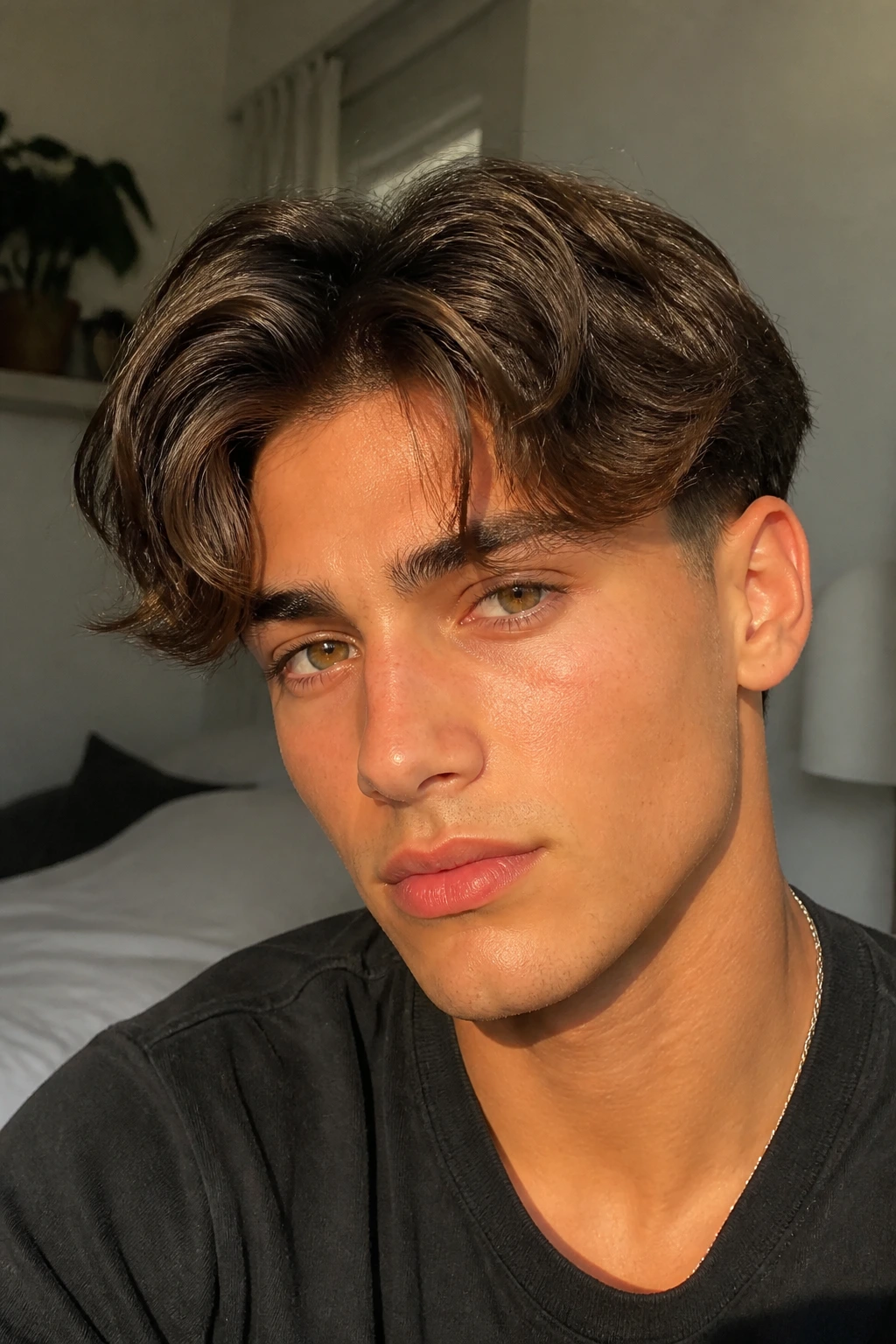
Face Framing: Curtain bangs split the difference between soft and structured, which helps balance sharper jawlines, wider foreheads, and features that need a little visual center.
Fade Contrast: A clean fade keeps the sides from puffing out, so the fringe can move without the whole cut turning bulky.
Texture-Friendly: Wavy, curly, and straight hair all behave differently here, but each one can be made to look deliberate with the right length on top.
Grow-Out Friendly: Low, shadow, and taper fades stay readable longer than a harsh high skin fade, which matters if you don’t want a barber visit every two weeks.
Styling Range: The same cut can be worn with a matte paste, a light cream, a sea-salt spray, or almost nothing at all if the cut is shaped well.
Easy to Personalize: A half-inch more fringe, a softer temple, or a deeper fade changes the mood fast without changing the whole haircut.
1. Low Skin Fade with Soft Curtain Bangs
A low skin fade with soft curtain bangs is the version I reach for when someone wants the forehead framed without shouting about it. The sides stay tight from just above the ear down to skin, but the fade begins low enough that the top still feels connected instead of floating.
Why It Reads Clean
The low start is what makes this cut usable. A fade that begins too high can make the front feel isolated; a low skin fade keeps the eye moving from the temples into the fringe without a hard jump. Leave about 4 to 5 inches at the center front, then feather the corners so the bangs bend open instead of hanging like a blunt curtain.
The Shape That Helps Most
- Keep the fade low and tight around the ear.
- Leave the fringe long enough to split at the bridge of the nose.
- Ask for point cutting through the front, not a straight blunt line.
- Matte cream or a light paste keeps the bend in place without shine.
Best for: straight or slightly wavy hair, especially if you want the style to look neat even when it’s not freshly styled.
My preference: this version looks best when the fringe is blown forward first, then broken apart with fingers.
2. Mid Fade with Loose Wavy Curtains
If your hair already bends on its own, a mid fade with loose wavy curtains gives that movement a cleaner frame. The fade sits high enough to sharpen the sides, but not so high that it steals attention from the front.
Waves do half the work here. Leave 5 to 6 inches through the fringe and a little extra length in the crown so the top doesn’t collapse into a flat sheet. A touch of sea-salt spray before drying keeps the movement separated, and a diffuser or rough-dry pass prevents the curl from turning frizzy at the ends.
I like this cut because it doesn’t need a perfect part. A loose center split, pushed open with your fingers, is enough. If the hair bends hard, keep the fade softer near the temples so the overall shape doesn’t feel too severe.
Use it when: you want a haircut that looks relaxed without looking accidental.
Skip heavy pomade. It kills the bend and turns the fringe into a sticky helmet.
3. Taper Fade with Feathered Center Split
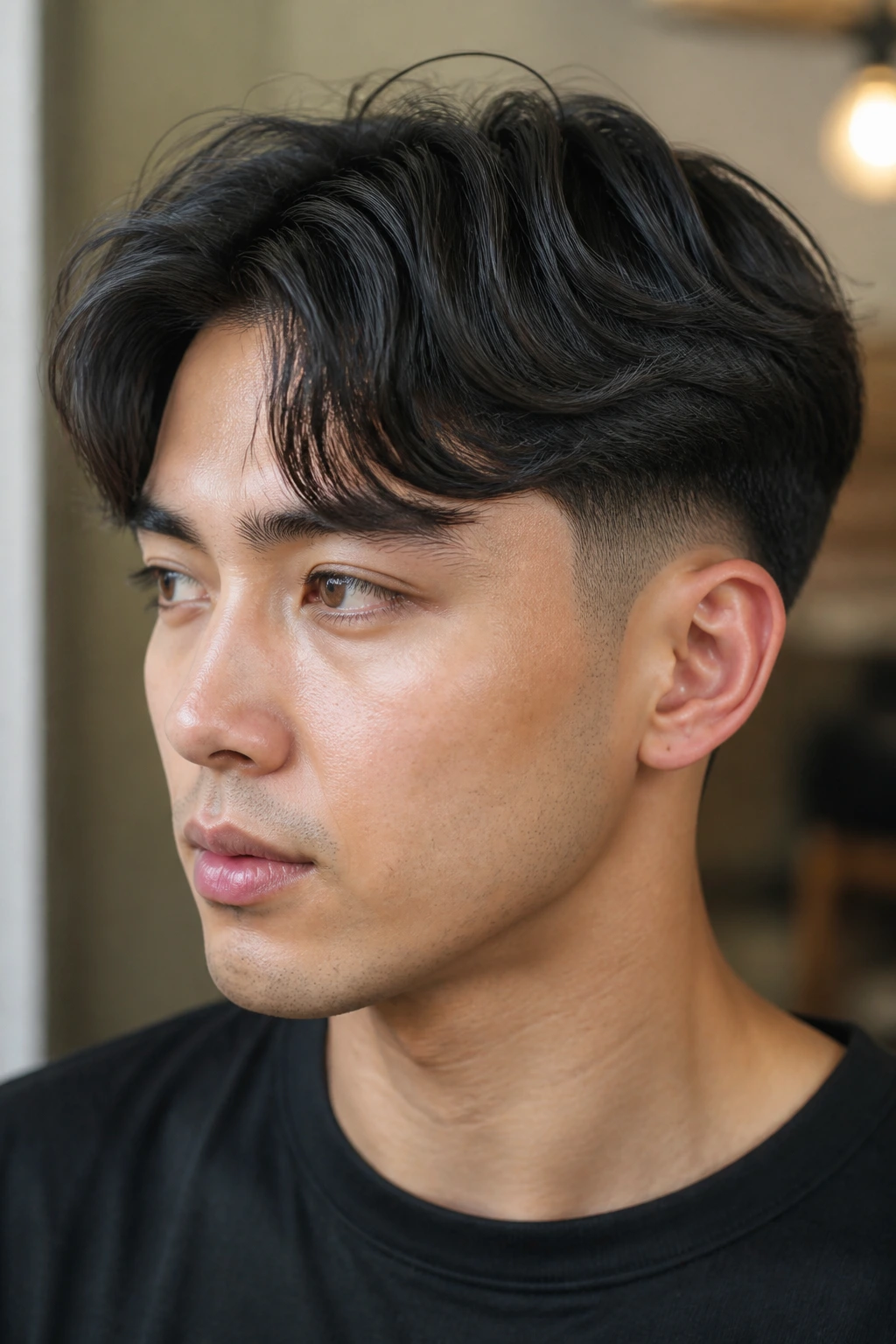
Want the fringe to look intentional on day four? A taper fade with a feathered center split is the safer bet. It keeps the neckline and sideburns neat, but it doesn’t erase the hairline the way a skin fade can.
How to Ask for It
- Ask for a low taper around the ears and nape, not a skin fade.
- Keep 3.5 to 4.5 inches at the front.
- Request feathering through the bangs so the center can separate softly.
- Tell the barber you want the curtain shape to sit open, not glued to the forehead.
This one works especially well if your hair has a cowlick or wants to split on its own. The taper gives the sides a tidy edge, and the feathered front lets the cut settle into its own shape after a quick comb-through. It’s one of the easiest versions to wear to work because it doesn’t lean too edgy.
My take: if you’re new to curtain bangs, start here. It’s forgiving.
Pro move: blow-dry the fringe left, then right, then finish straight down the center for a softer bend.
4. Burst Fade with Textured Fringe
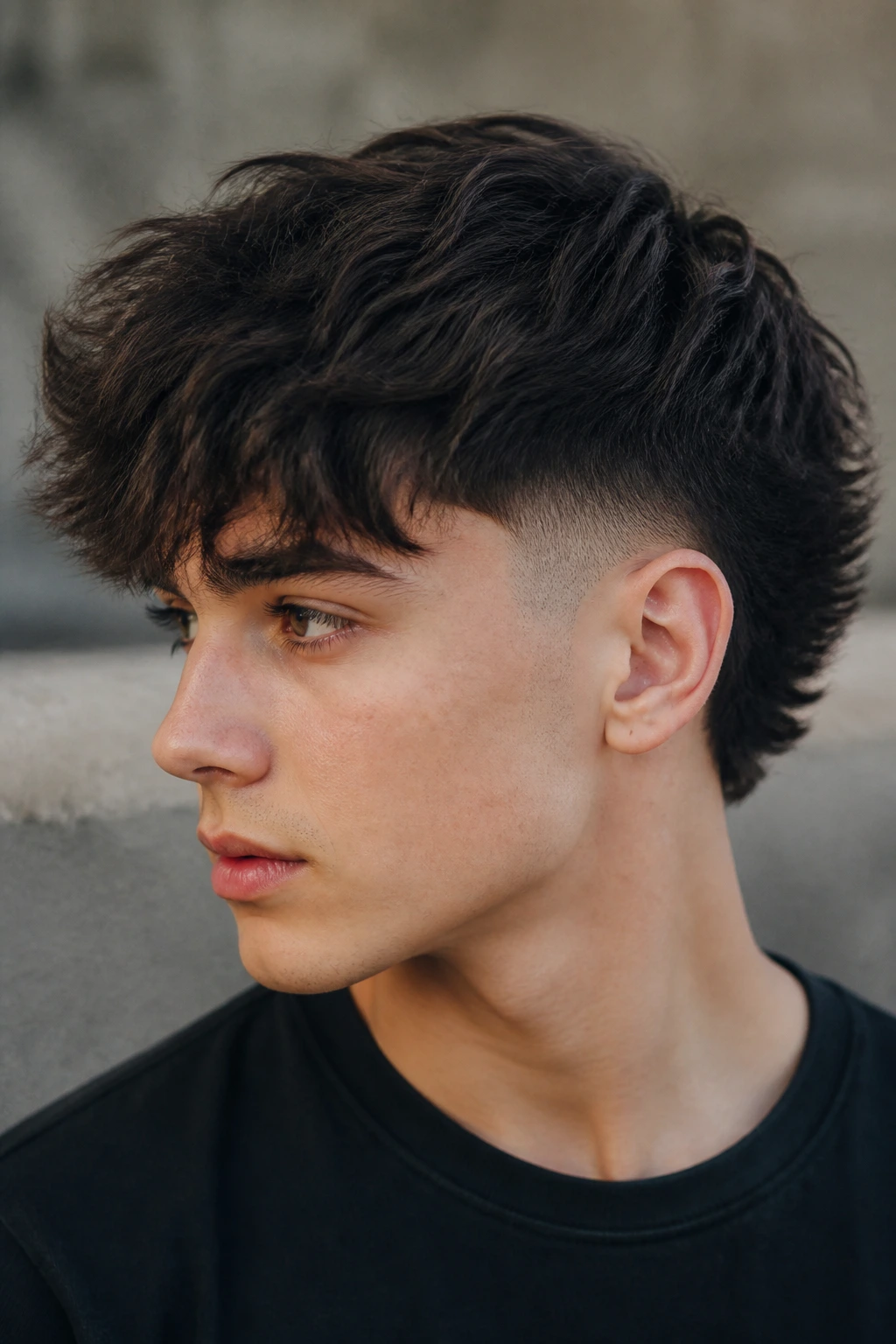
If you’ve ever left the barbershop thinking the front looked fine but the sides still felt too heavy around the ears, a burst fade fixes that quickly. The fade curves around the ear in a rounded burst, which gives the fringe room to stay messy up top without the haircut swallowing your head shape.
This version likes texture. Leave the front around 4 inches, then cut into it with a razor or point-cutting shears so the bangs break apart in small pieces instead of falling in one sheet. That matters. A burst fade with a blunt fringe looks too rigid, and the whole point is movement.
I’d call this the energetic version of the look. It suits thick hair, coarse hair, and anyone who wants the front to do more work than the sides. A pea-size amount of matte paste is enough; too much and the texture clumps.
What to watch for: the burst around the ear should look curved, not like a shaved semicircle gone wrong.
Good sign: the fringe shifts when you turn your head.
5. Drop Fade with Longer Curtain Length
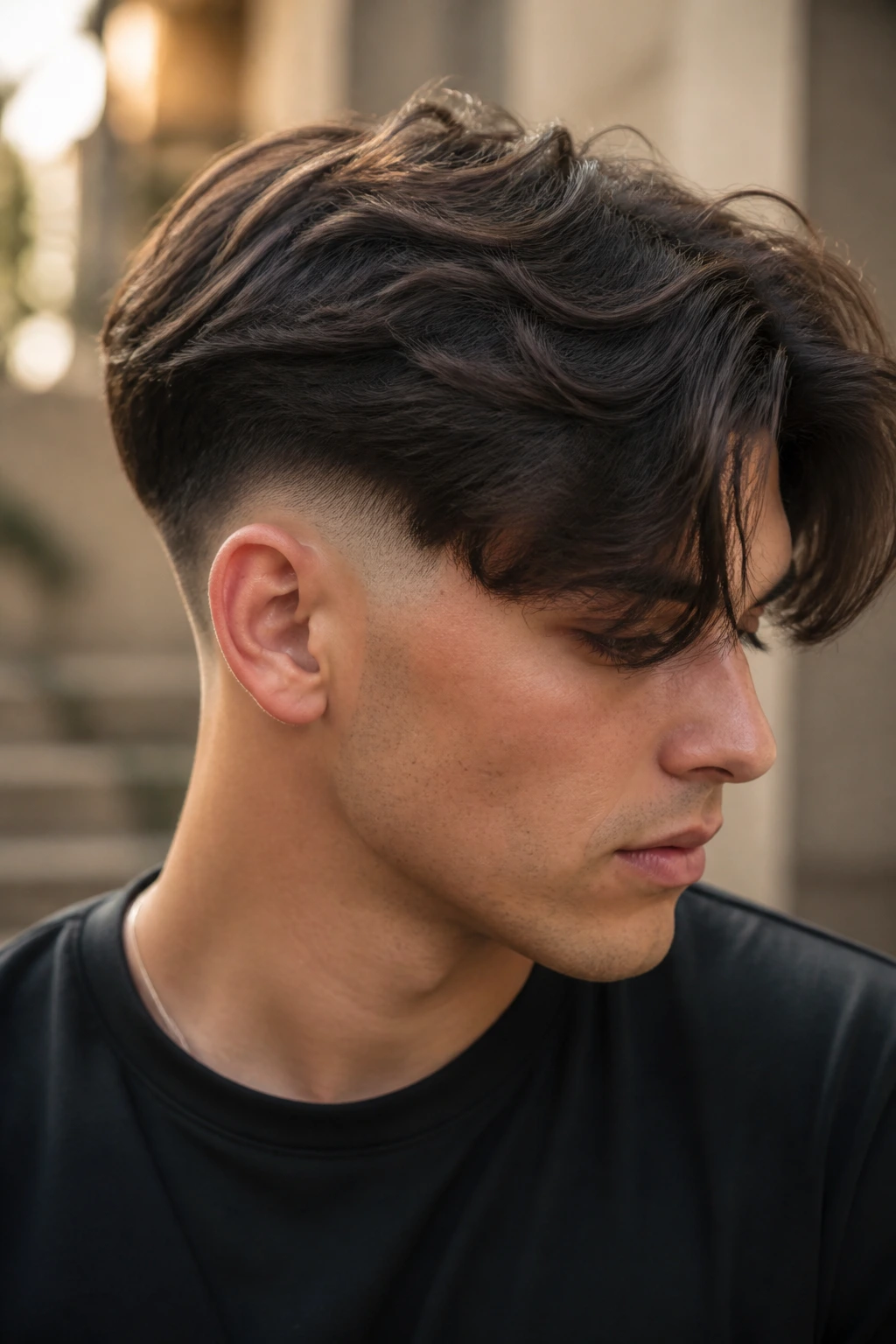
A drop fade with longer curtain length gives the cut more shape from the side. The fade dips lower behind the ear, following the head’s curve, so the profile looks cleaner and a little more sculpted. Up front, the longer curtain pieces can sit near the eyebrows or just below them, which gives the haircut a more relaxed drape.
This is one of the best versions if you want the fringe to feel soft rather than choppy. Keep the top around 5 to 7 inches at the front and a little shorter through the crown so the hair falls forward without collapsing into one heavy block. A round brush helps, but so does a vent brush if your hair is thick and needs more air.
The drop shape also helps rounder faces by adding a bit of vertical length. That doesn’t mean it’s only for one face shape. It means the silhouette has some stretch in it, and that matters when you want the haircut to do more than sit there.
A light cream or blow-dry lotion is enough.
Heavy wax is not.
6. High Fade with Sharp Center-Part Curtains
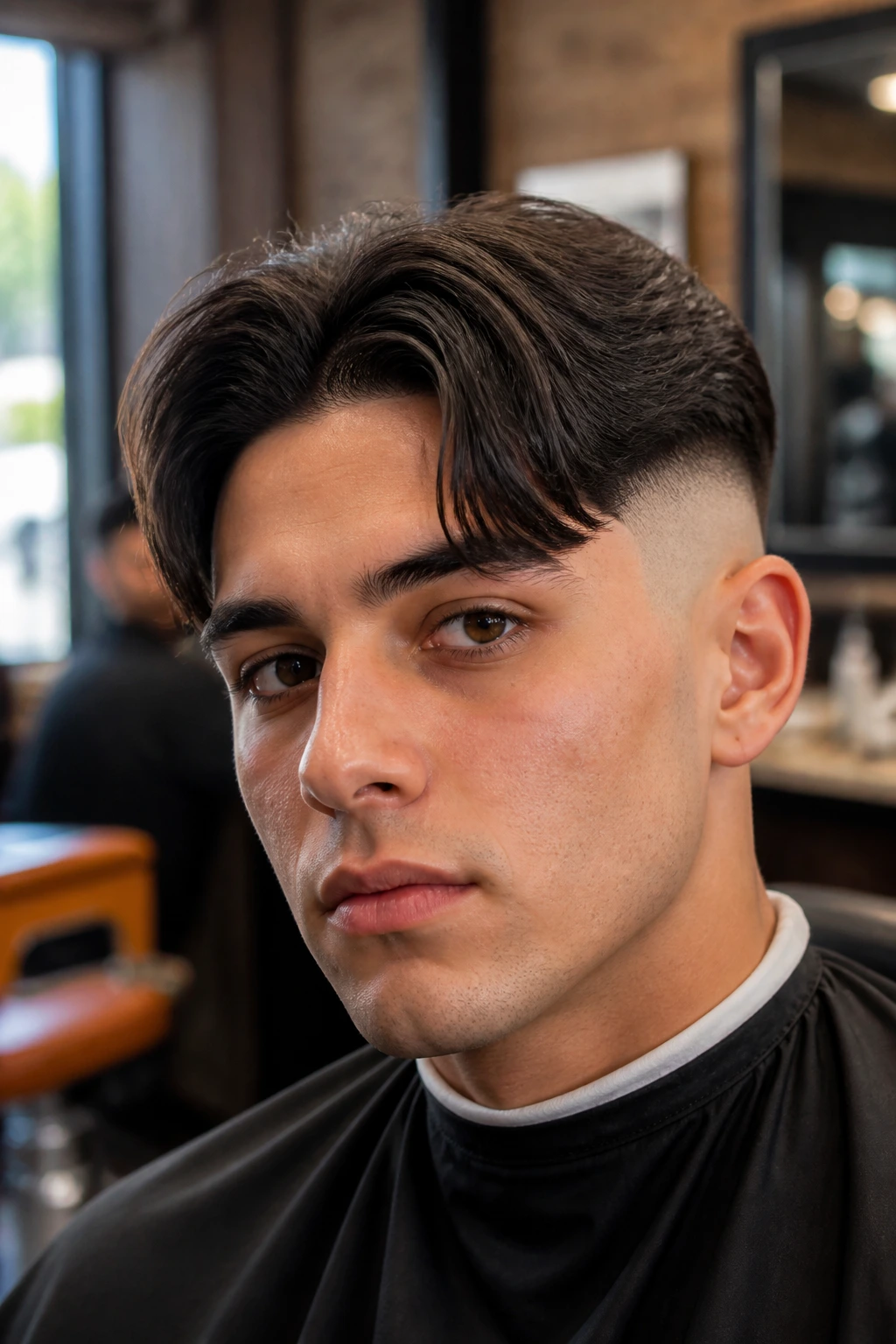
A high fade with sharp center-part curtains is the loudest version of the whole family. The sides are taken up high enough to show a lot of skin or nearly skin, and that opens a big clean frame for the front to hang in.
This one works best on straight hair or hair with just a slight bend. You need enough density up top to keep the curtains from looking thin. Ask for 4 to 6 inches at the fringe, then have the barber keep the top more structured than fluffy. The center part can be sharp, but the fringe should still move — that’s the difference between a curtain cut and a page-boy line.
I don’t love this version for very fine hair. It can expose too much scalp on the sides and make the top look smaller than it is. On thick hair, though, it lands hard in a good way. Use matte clay and blow-dry the center apart with the nozzle pointed down the hair shaft.
Best when you want: a clear, modern outline.
Avoid if: your front hairline already feels sparse.
7. Temple Fade with Curly Curtain Bangs
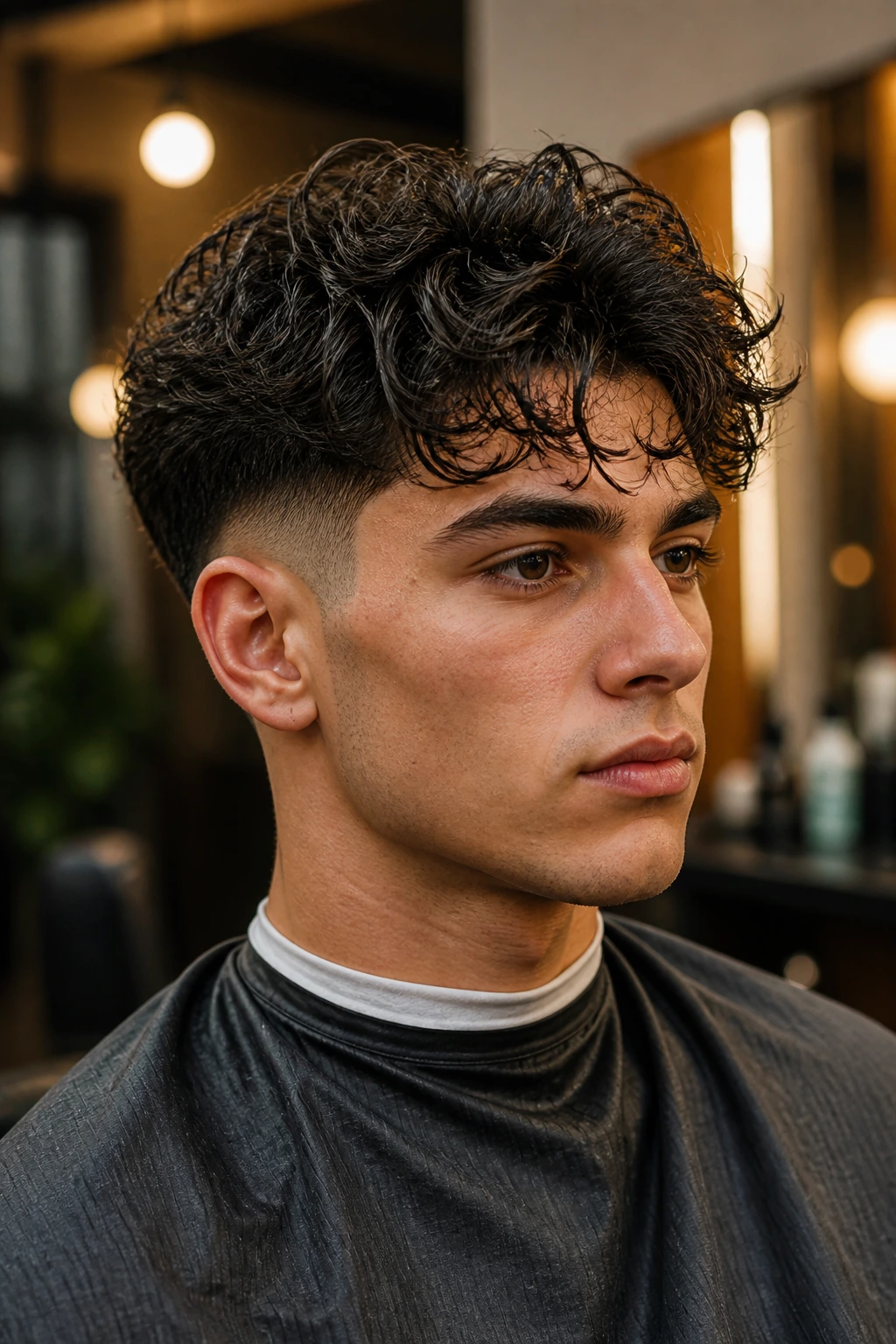
Curly hair can wear curtain bangs, but the temples need room to breathe. That’s where the temple fade helps. It removes bulk right where the curl tends to swell, so the front can fall forward without the sides puffing into a triangle.
Why the temple fade matters for curls
- It keeps the curl pattern visible at the front.
- It removes bulk around the temples, where curls often stick out.
- It helps the fringe open without fighting the side shape.
- It keeps the haircut from looking boxy when the hair dries.
Leave the front stretched length around 5 to 6 inches if the curl is tight; shorter than that and the bangs can spring up too much. Apply curl cream to damp hair, then diffuse until the roots are about 70% dry. After that, separate the front with your fingers rather than a brush. A brush can pull the curl apart in a way that looks forced.
This cut looks best when the curl sits naturally. Don’t chase a perfectly straight middle part. Let the front arc a little. That bend is the point.
8. Shadow Fade with Feathered Curtain Fringe
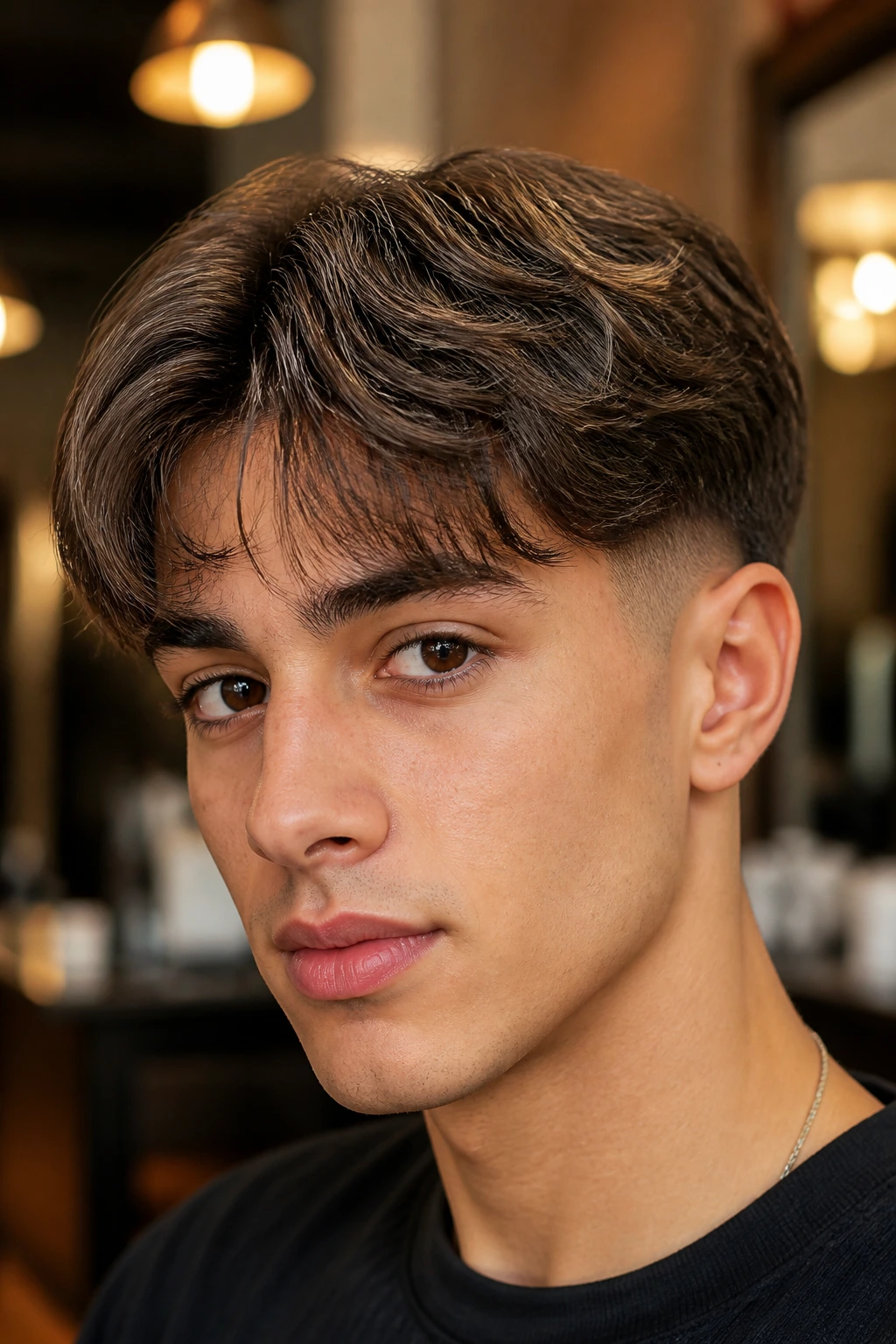
A shadow fade with feathered curtain fringe is the sleeper pick for people who hate harsh lines. The fade is soft by design — dark to light, but not skin-bare — so the haircut grows out with less drama and the fringe can stay the focus.
The feathering matters just as much as the fade. Ask for the front to be cut with a light hand, preferably with point cutting or a razor pass near the ends. You want the fringe to break apart into wispy sections, not form one flat sheet across the forehead. Keep the front around 4 to 5 inches if your hair is straight, a touch longer if it bends.
This cut is a good first step if you’ve never worn a curtain shape before. It doesn’t look too formal, but it also doesn’t announce itself from across the room. A light cream or low-hold paste is enough to keep the split in place. That’s the part I like most. It never feels overworked.
Best for: conservative settings, soft features, or anyone who wants a clean cut that won’t look weird three weeks later.
9. Bald Fade with Sleek Blow-Dried Curtains
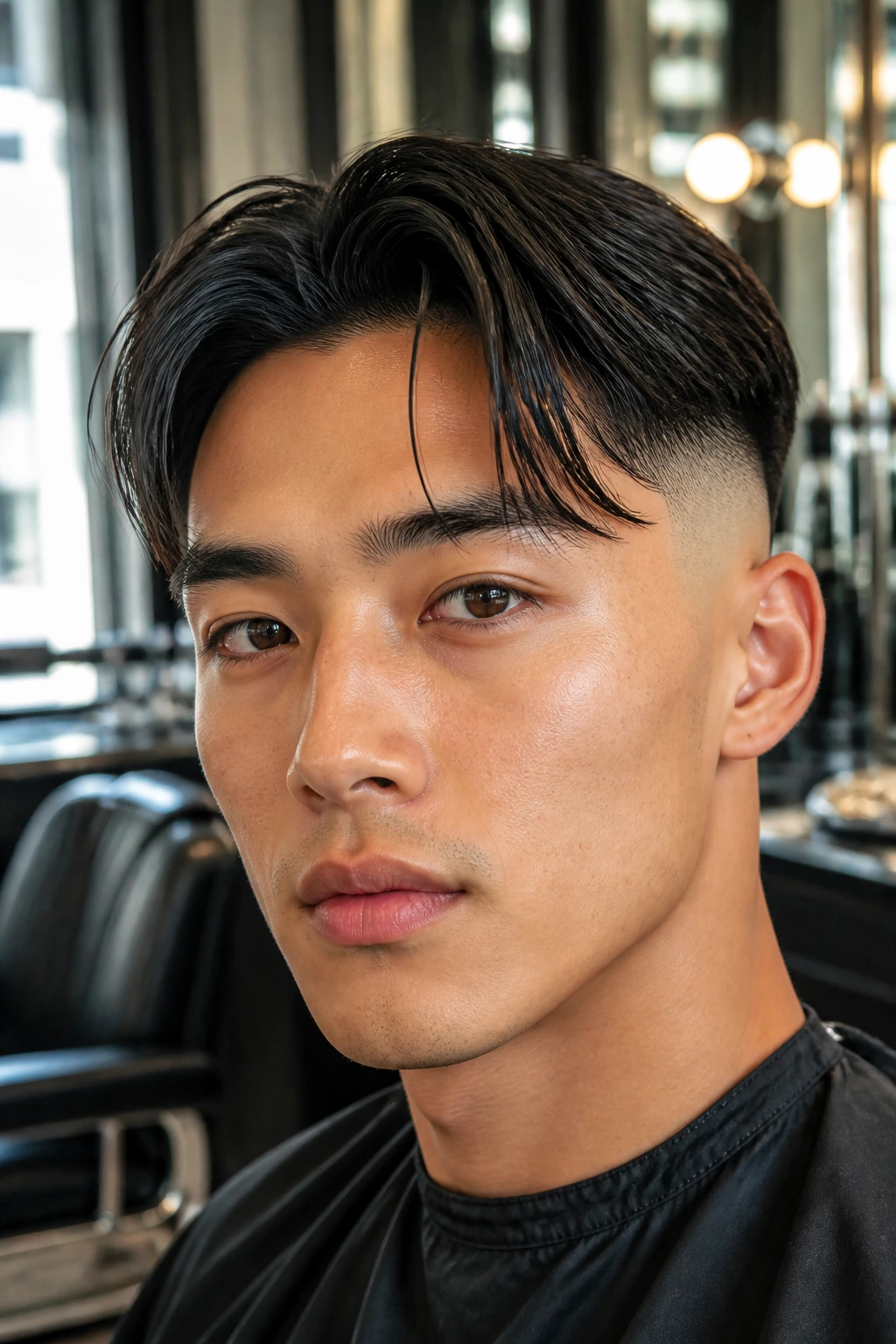
A bald fade with sleek blow-dried curtains is the sharpest possible contrast in this group. The sides disappear all the way to skin, which puts a bright frame under the longer front and makes the curtain shape look deliberate from the first glance.
It needs dense top hair. If the front is already thin, this version can expose too much scalp and make the cut feel narrower than it should. Leave 5 to 6 inches on top, with the longest pieces in the center front, then blow-dry them over a brush so they bend outward and drop back into place. The key is not volume for volume’s sake. It’s control.
I’d use a little matte pomade or styling cream here, no more than a pea-size amount. Too much and the bangs become shiny and separate in clumps. Too little and they won’t hold the sleek bend. That tiny middle ground is where the cut looks expensive in the real-world sense: tidy, shaped, and not screaming for attention.
If you like crisp edges and a cleaner forehead line, this one delivers.
10. Skin Fade Mullet with Curtain Bangs
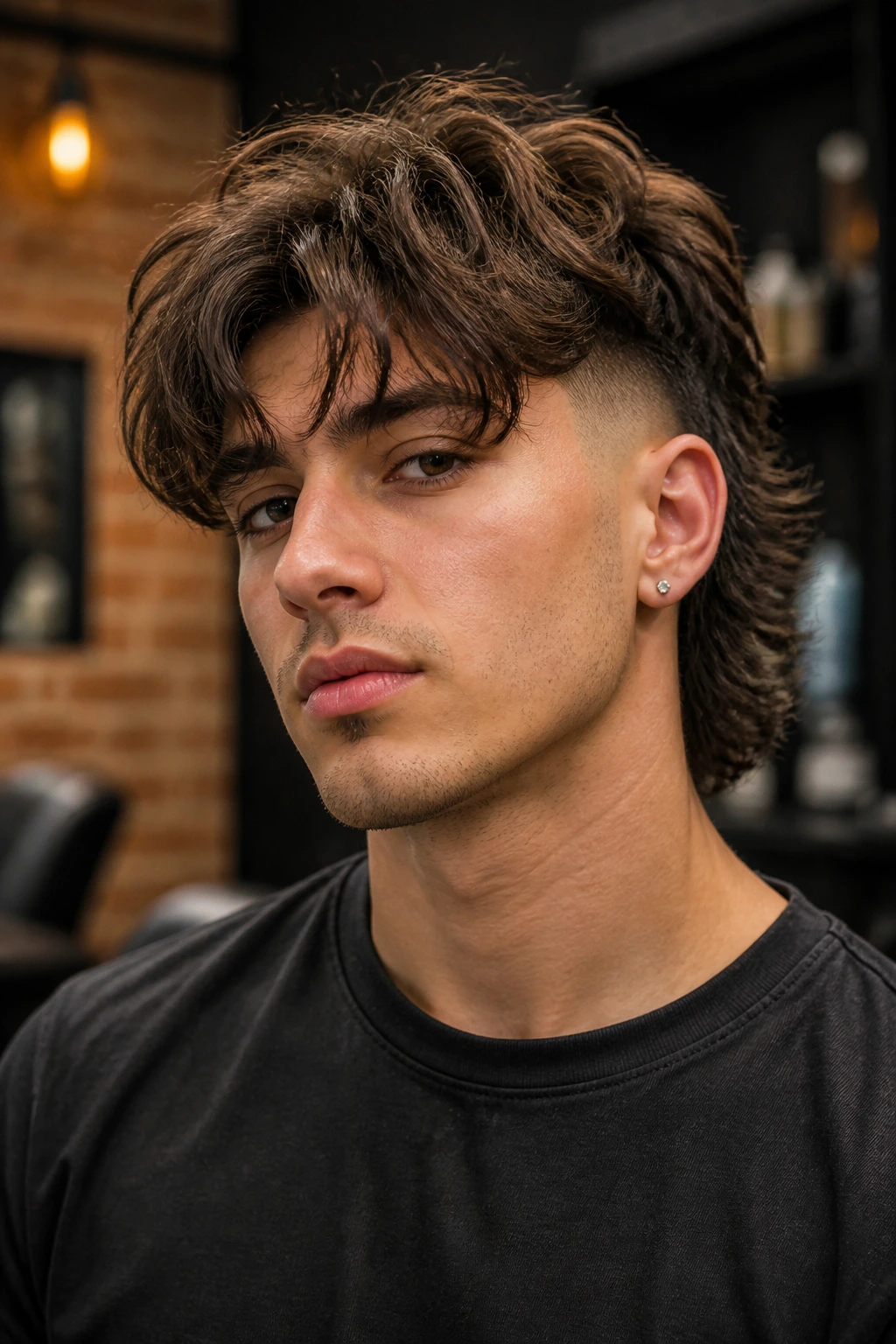
This is not the quiet option. Good. It shouldn’t be.
A skin fade mullet with curtain bangs puts the front, sides, and back in a little argument that somehow works. The fringe stays long enough to split and move, the sides get shaved tight, and the back keeps enough length to show that the haircut has a second act.
The trick is balance. Leave 4 to 6 inches in the curtain area, keep the crown slightly longer than the sides, and let the nape grow out a few inches so the shape doesn’t stop dead at the ears. The front should be textured with scissors or a razor, because a blunt fringe against a mullet feels clumsy fast.
This cut suits thicker hair best. The texture gives the front some lift, and the long back stops the whole thing from looking too top-heavy. I’d keep product matte and lightweight. A thick paste can make the curtain bangs sit too stiff, which is the fastest way to ruin the movement.
Best if you want: edge, length, and a cut that gets noticed.
Not for everyone. Which is part of the fun.
11. French Crop Fade with Short Curtain Bangs
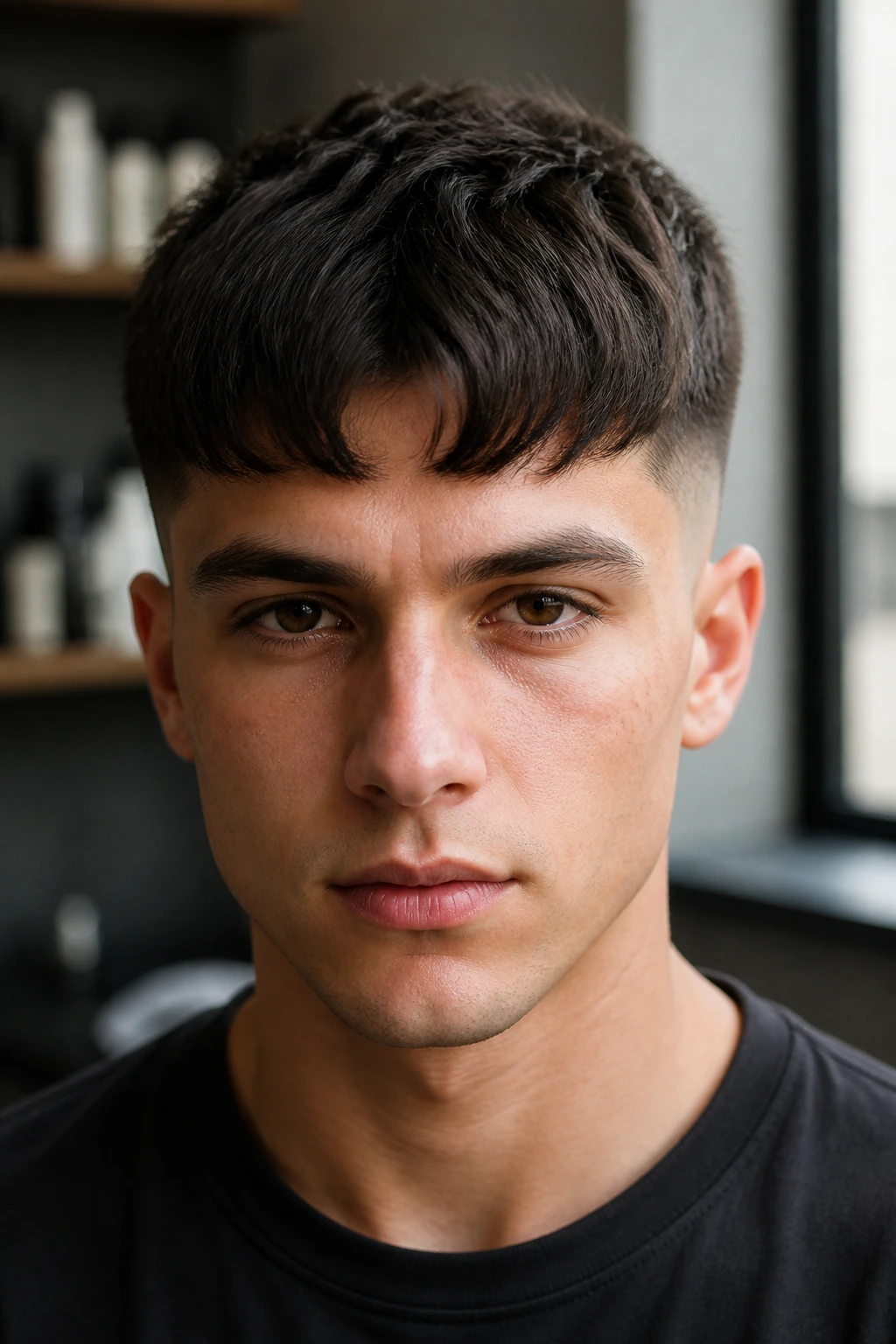
A French crop fade with short curtain bangs trims the drama down without losing the center split. The fringe sits shorter and heavier than the other versions here, but the middle part keeps it from reading like a plain crop.
This works especially well when you want a low-maintenance cut that still has a bit of shape up front. Keep the top around 2.5 to 4 inches, with the front left long enough to separate and fall forward by a little over the brows. The fade on the sides can stay low or mid, but don’t blur the front into the sides too much. The split needs a little edge to show.
I like this on straight hair and on dense hair that tends to puff. It gives the front some structure without requiring a lot of styling time. One pass with a comb and a small amount of paste is usually enough. If the fringe gets too short, though, the curtain idea disappears and you’re left with a crop. Not a disaster, just a different haircut.
My opinion: this is one of the most practical choices in the bunch.
12. Ivy League Fade with Short Curtains
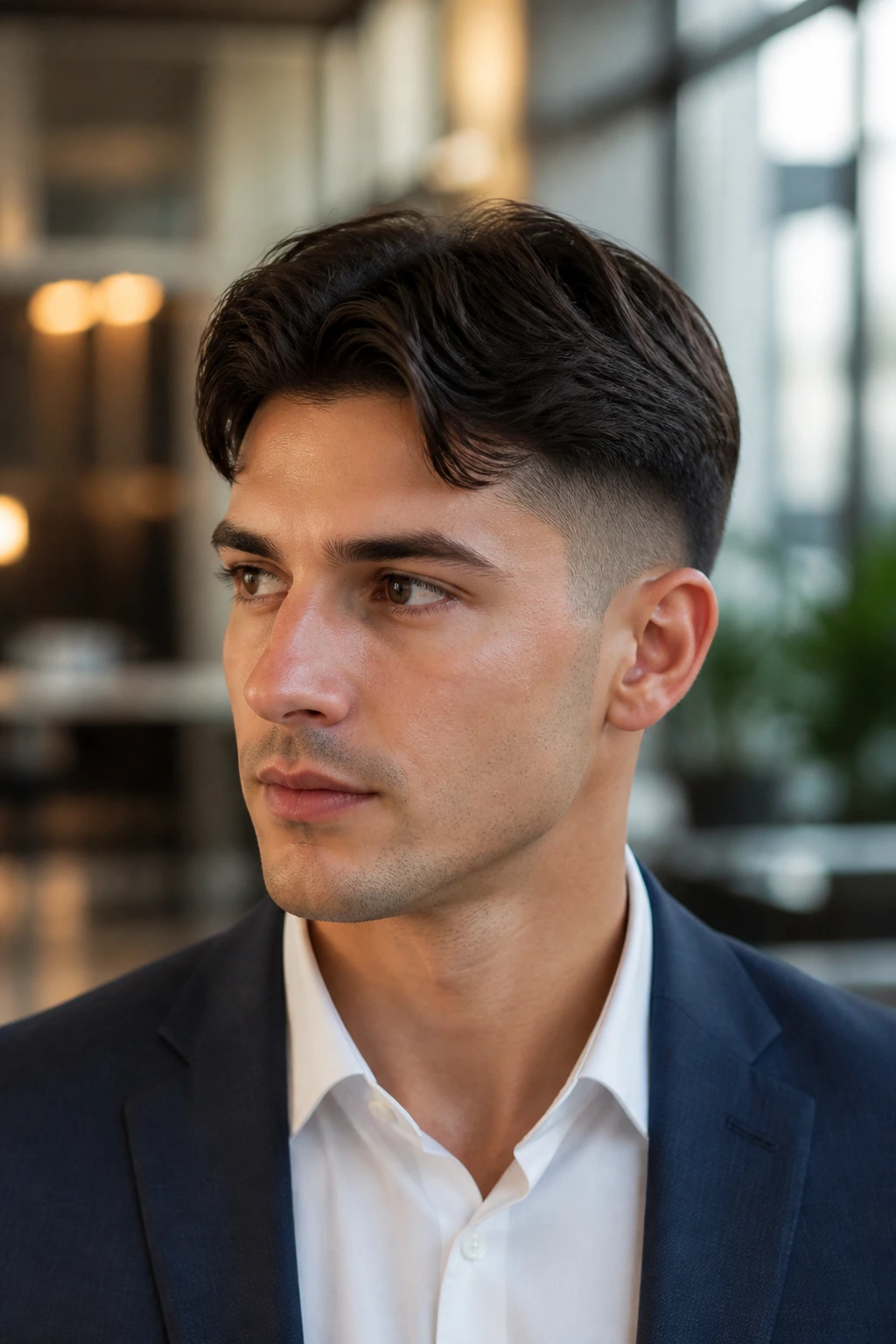
An Ivy League fade with short curtains is what happens when you want the front to look neat, not artsy. The top is kept a touch longer than a classic Ivy League, then split softly at the center so the fringe still falls with some movement.
This cut sits well on medium-density hair because it doesn’t need a big wall of length. 3 to 4 inches on top is usually enough if the hair has a bit of body. The fade can be low or mid depending on how formal you want the result to read. If the sides are too bare, the whole thing tips into a more fashion-forward lane than most Ivy League wearers want.
Blow-dry the front forward first, then open the center with your fingers or a fine comb. A light cream or lotion is enough. I’d avoid hard wax here. It fights the softness that makes this version interesting.
This is the cut for someone who likes a collar, a jacket, and hair that still moves when the wind hits.
13. Burst Fade Mullet with Heavy Curtain Bangs
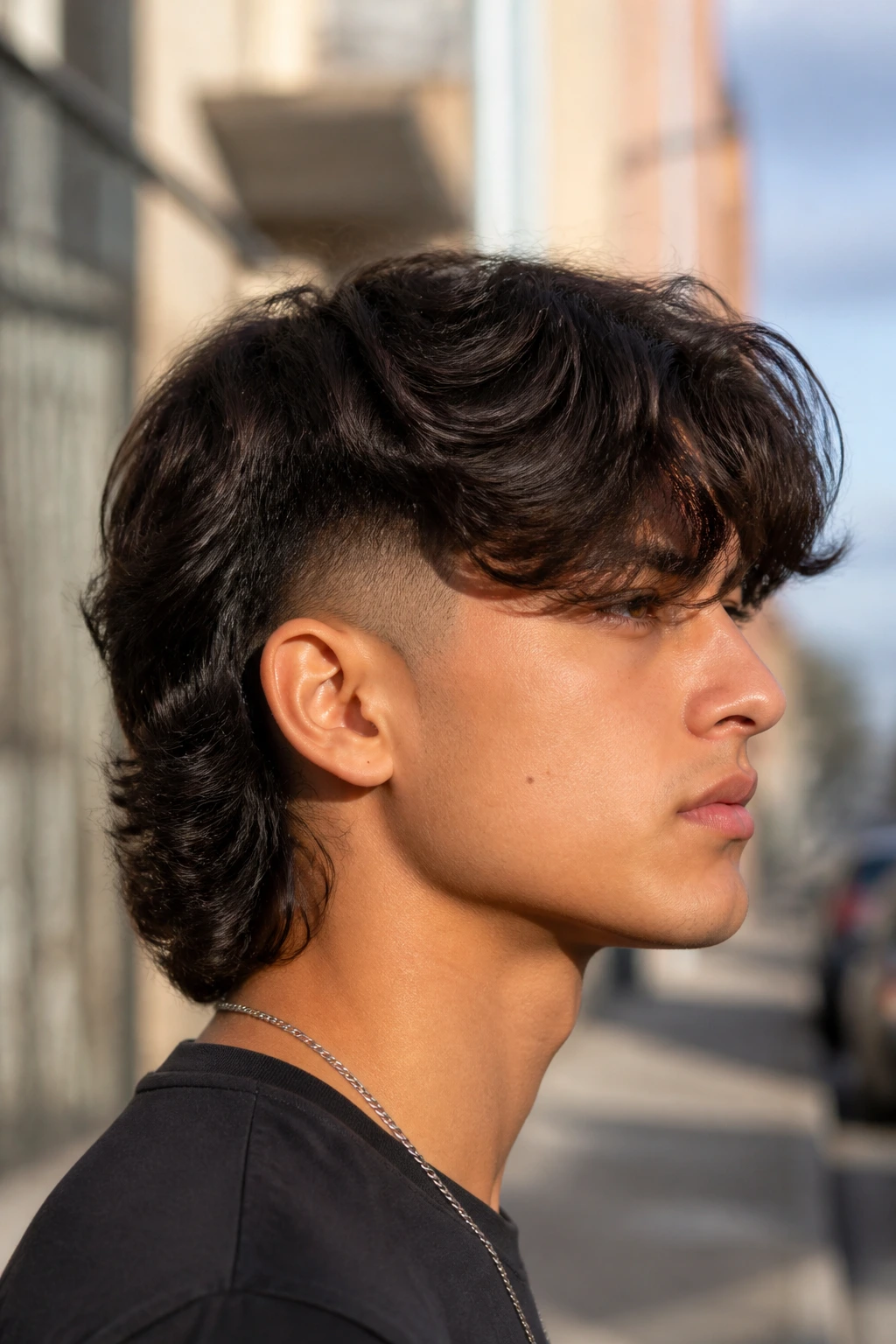
If the fringe is meant to be the headline, this is the version that says it out loud. A burst fade mullet with heavy curtain bangs puts more weight up front and more attitude through the back, with the fade curving around the ear to keep the sides from going wide.
The front needs serious texture control. Leave 5 inches or more at the curtain area if the hair is thick, then remove bulk with texturizing shears so the fringe doesn’t sit like a heavy drape. The back can stay long enough to show shape without turning shaggy. A lot of people overdo the weight here and the cut just droops. Better to leave a little more length and remove weight carefully.
This is a cut for people who like movement and don’t mind their hair having a point of view. Sea-salt spray at the roots, a quick blast with the dryer, and a small amount of matte paste at the ends are usually enough. Keep the front separated, not greasy.
Good sign: the bangs fall in layers, not one slab.
14. Low Taper Fade with Combed-Through Curtains
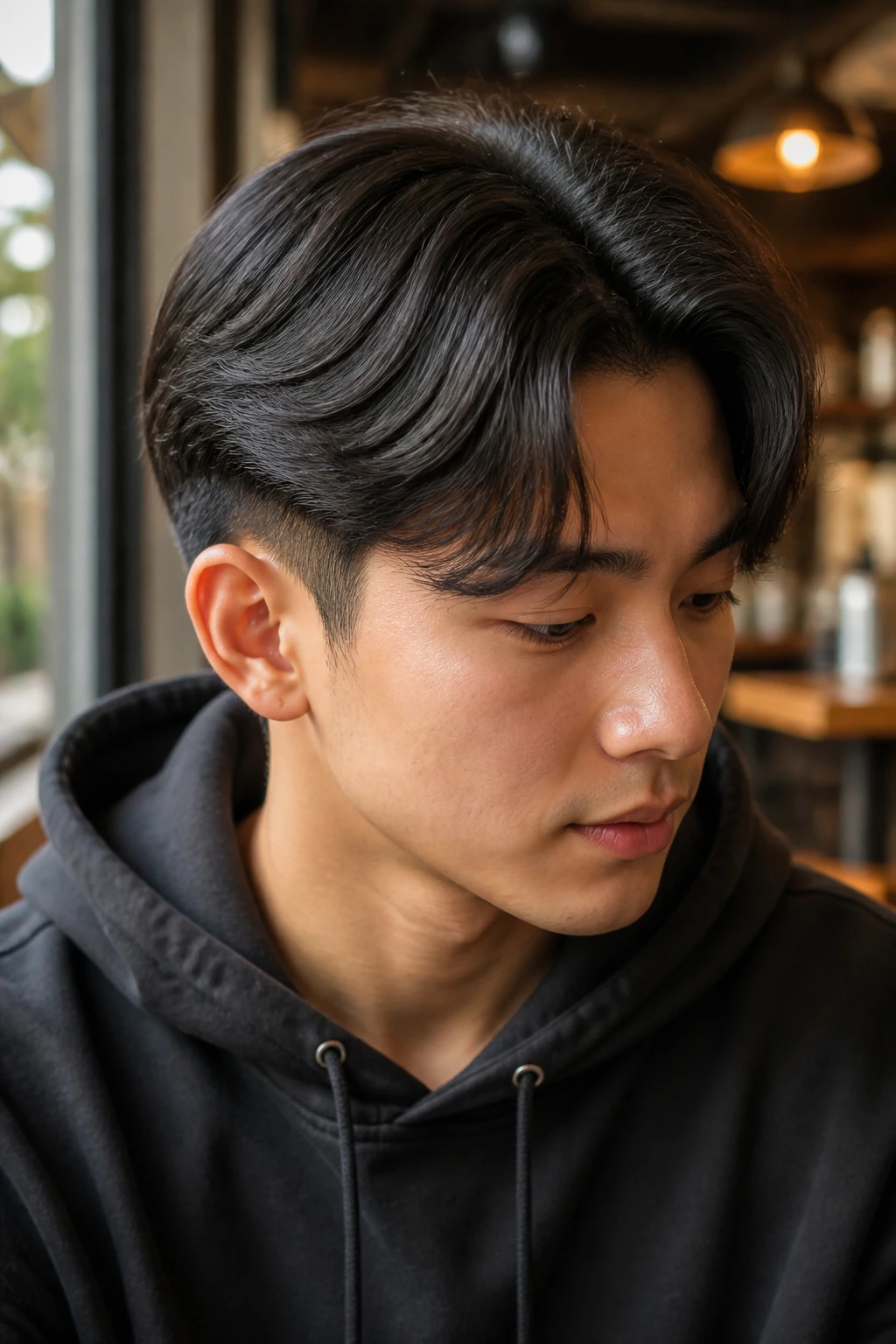
A low taper fade with combed-through curtains is the sort of haircut you can wear to a meeting and then mess up with your hands five minutes later without ruining it. The taper stays subtle around the ears and neckline, so the haircut reads polished before it reads trendy.
The front should be long enough to split, usually 3.5 to 5 inches depending on how straight your hair is. If it’s straight and fine, keep the top lighter and let the comb do the shaping. If it’s thicker, ask for a little internal layering so the front doesn’t sit like a slab on your forehead.
What I like here is the flexibility. You can wear the center part neat, sweep it slightly to one side, or push it forward for a softer look. The taper handles all of that without getting in the way.
A light cream is enough for most people.
If the product has too much hold, the curtains lose their swing.
15. Undercut Fade with Long Curtain Layers
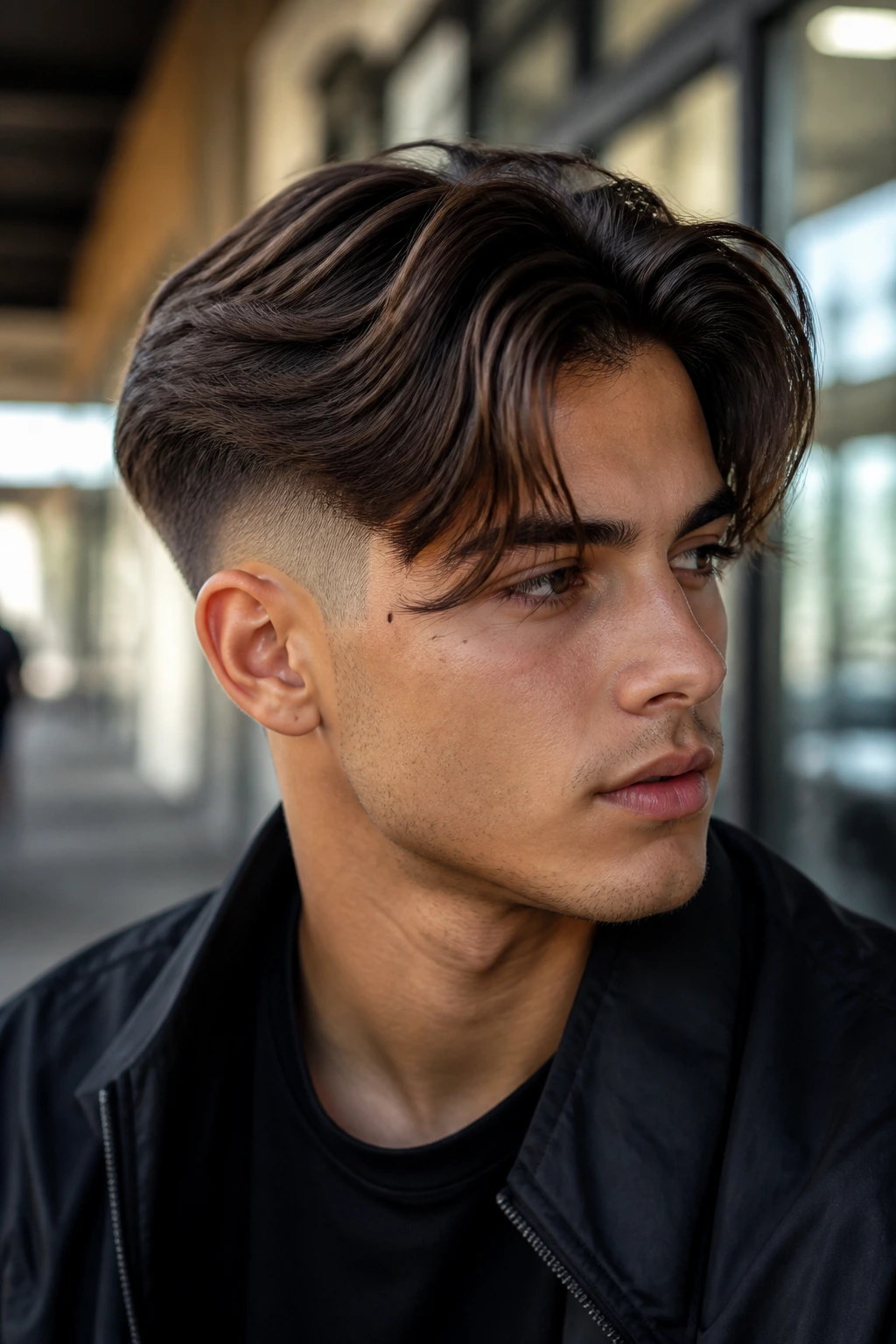
An undercut fade with long curtain layers goes harder on contrast than most of the other cuts here. The sides are cut short enough that the top feels almost disconnected, and the long front layers create a clean swing across the forehead.
This works best on thick straight hair or hair with a slight bend. Leave 6 to 8 inches up front if you want the curtain to drape with a real fold, then layer the top so it doesn’t fall like one solid sheet. The undercut portion should stay tight — not invisible, not blended away. That separation is what gives the cut its shape.
I don’t recommend this if you want softness. It’s a sharper look. That’s the point. Use a round brush or vent brush to lift the roots while drying, then finish with a small amount of matte product. If the top collapses, the whole thing loses its energy.
Best for: thick hair, sharp cheekbones, and anyone who likes a stronger outline.
16. Side-Swept Curtain Bangs with Mid Fade
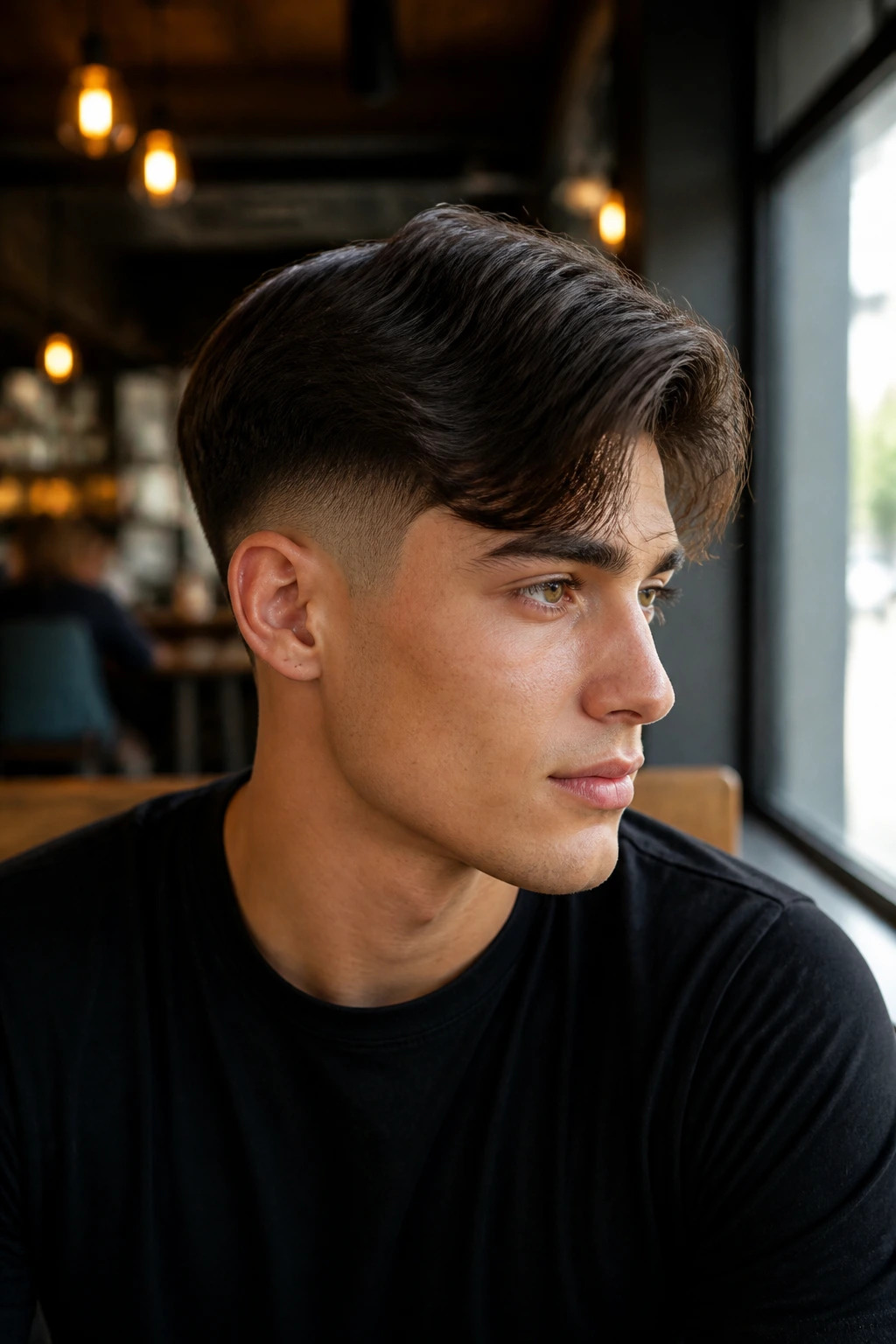
Not everyone wants a dead-center part, and that’s fine. A side-swept curtain fringe with a mid fade keeps the same face-framing idea but shifts the split just off center, which is useful if your hair has a strong cowlick or one side wants to fall differently.
The mid fade gives the haircut enough contrast to keep the shape readable. Leave 4 to 6 inches on top, then train the front with a blow-dryer so the bangs open slightly to one side first and only then split across the center. That tiny asymmetry is what makes the cut feel lived-in instead of fussy.
This version is especially good if a straight middle part makes your forehead feel too exposed. It softens the line without hiding the fringe entirely. I’d use a light paste or cream and keep the root area dry enough to hold shape. If the front is too wet when you style it, the sweep collapses by noon.
Short version: this is the curtain haircut for people who distrust symmetry.
17. Curly Top Fade with Loose Fringe Curtains
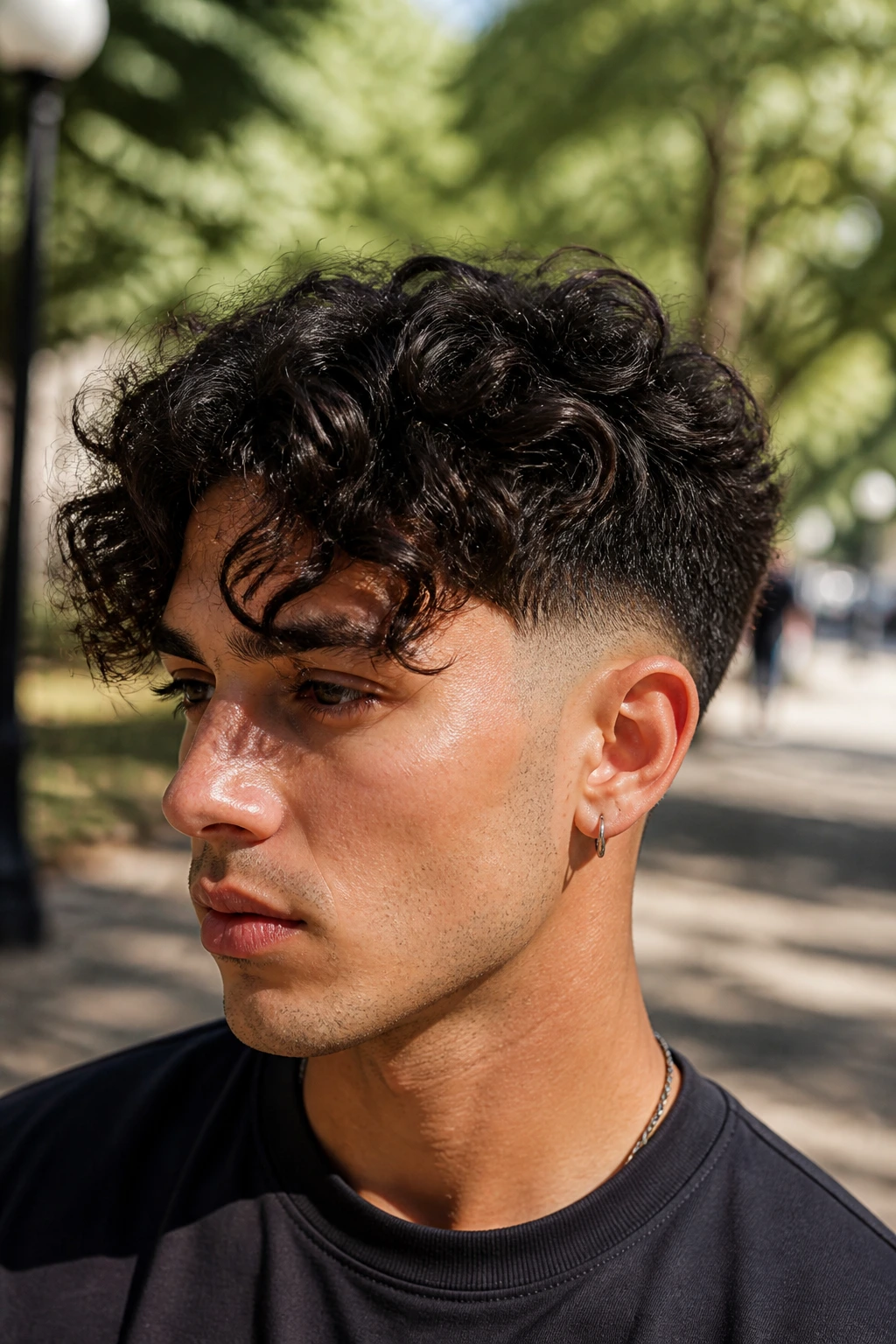
Curly hair and curtain bangs can get along just fine if the cut respects shrinkage. A curly top fade with loose fringe curtains keeps the sides tight and leaves enough length in front for the curls to fall forward instead of rising into a puff.
Ask for the front to be left longer than it looks necessary when wet — often 5 to 7 inches stretched, depending on curl tightness. The barber should shape the fringe with the curl pattern in mind, not against it. If the front is cut too short, the curl pops up and the curtain effect is gone.
Use leave-in conditioner on damp hair, then scrunch in curl cream and diffuse gently. Don’t rake a brush through it once it starts drying. That’s when curls fray and the front loses its clean split. The fade on the sides keeps the silhouette honest, and the loose bangs make the haircut feel softer than a standard curly top.
It’s a good cut.
Just don’t try to force it straight.
18. Waves with a Fade and Beachy Curtain Bangs

A waves-with-a-fade version has a completely different mood from the stricter curtain looks. It’s looser, airier, and a little sun-worn in the best possible way, with the fringe falling apart in soft bends rather than locked sections.
This is where sea-salt spray earns its keep. Mist it through damp hair, rough-dry until the roots have some lift, and finish with your fingers instead of a comb. The fade can sit low or mid, but I prefer a mid fade here because it keeps the shape sharp while the top stays relaxed. Leave about 4.5 to 6 inches in the fringe if your waves are mild, a touch more if they’re strong.
The main thing is not to over-control the front. The curtain split should be visible, but it doesn’t need to be ruler-straight. A little break in the line makes the haircut look more natural and less staged. Good beachy hair is never perfectly obeying you anyway.
Best for: medium-length wavy hair and anyone who wants movement without a heavy product feel.
19. Afro Fade with Natural Curtain Bangs
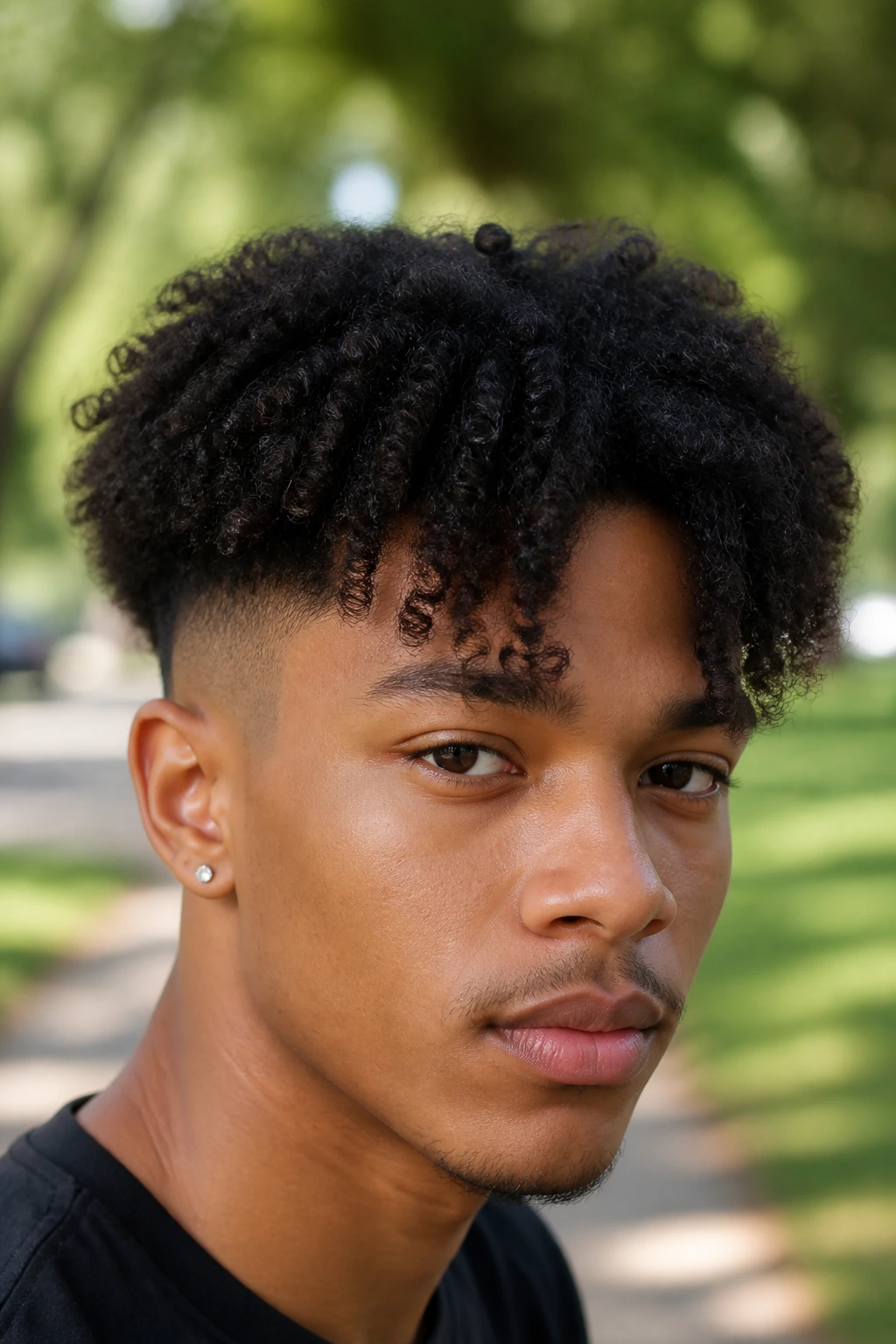
Natural texture can wear a curtain shape beautifully when the front is shaped with enough length and the sides are kept clean. An afro fade with natural curtain bangs preserves that texture up top while tapering the sides so the forehead frame has room to read clearly.
This is not about flattening the hair into a fake straight part. It’s about directing the front forward with enough length — usually 4 to 6 inches, more if shrinkage is strong — so the front pieces can split and fall in a controlled arc. The fade around the temples helps stop the haircut from widening out, which is the problem most people notice first.
Use a moisturizing cream or leave-in on damp hair, then shape the front with your hands, a pick, or a soft brush, depending on texture. The curtain effect comes from the direction and the taper, not from forcing a sharp line. If the front wants to coil, let it coil. That movement gives the cut its own character.
This version looks best when the edges stay crisp and the top stays soft. That balance matters.
20. Two-Block Fade with Airy Curtains
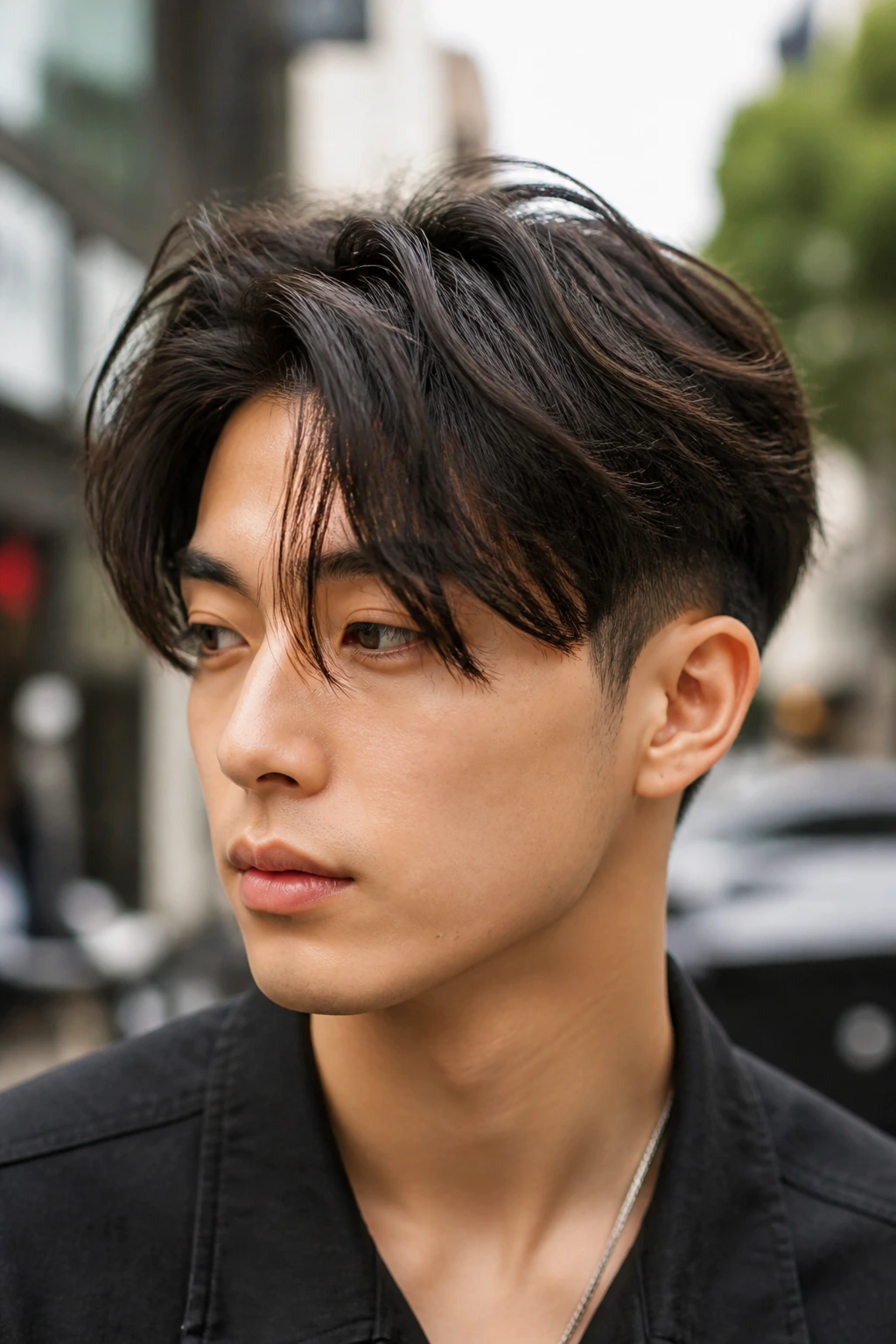
The two-block fade with airy curtains pulls from a more disconnected shape: short, tidy sides and back, with a longer top that falls independently. It’s a clean choice if your hair is straight, thick, and prone to sitting heavy when it grows out.
Keep the top around 5 to 7 inches and ask for the front to be textured into lighter pieces so the curtain split doesn’t look blocky. The sides can be taken short with a fade that stays low or mid, but the top should clearly sit apart. That separation is what gives the haircut its airy feel. If the barber blends everything too much, the whole effect disappears.
I like this when someone wants movement but doesn’t want the hair sitting on the face all day. A texture spray or powder at the roots helps the top stay lifted without turning crunchy. A small amount of dry cream at the ends can keep the front from flaring out.
Good fit: thick straight hair that usually needs de-bulking.
21. High Drop Fade with Choppy Curtain Bangs
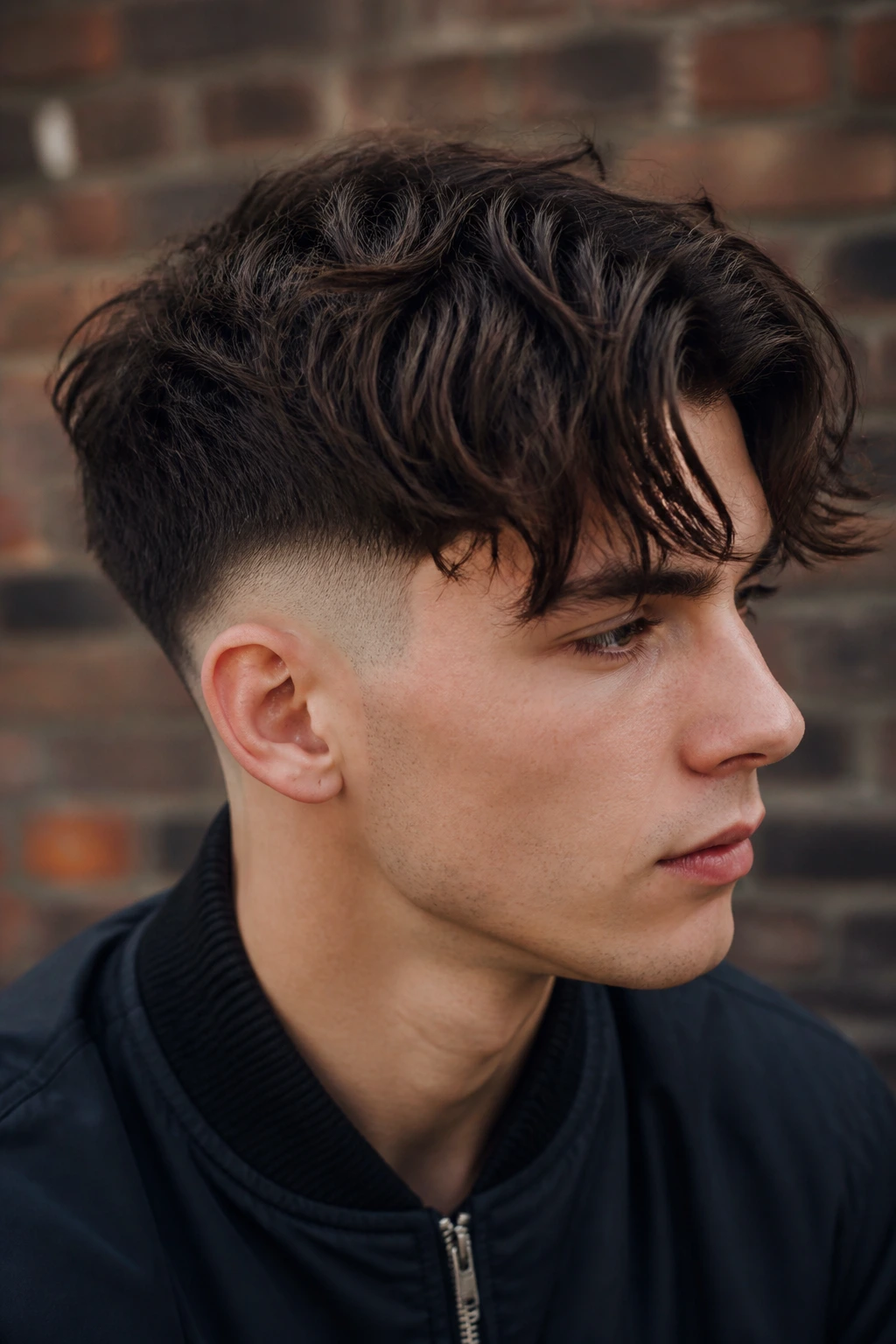
A high drop fade with choppy curtain bangs is one of the more modern, angular versions in the group. The fade rises high around the temples, then drops lower behind the ear, which gives the head shape a little curve. Up front, the bangs are cut choppily so the split feels casual instead of polished.
The choppiness matters because it keeps the fringe from looking too perfect. Ask for point cutting or a razor texture through the front and keep the bangs around 4 to 5 inches so they can break apart naturally. This is a good choice if you want the haircut to look styled even when it’s not overworked.
The drop in the fade helps with balance, especially on square or angular faces. It softens the side outline while the front keeps its own movement. If you like a little edge, this cut delivers it without needing color or extra design work.
A matte paste is enough.
Shiny products make the choppiness look accidental.
22. Scissor Taper Fade with Soft Center Part
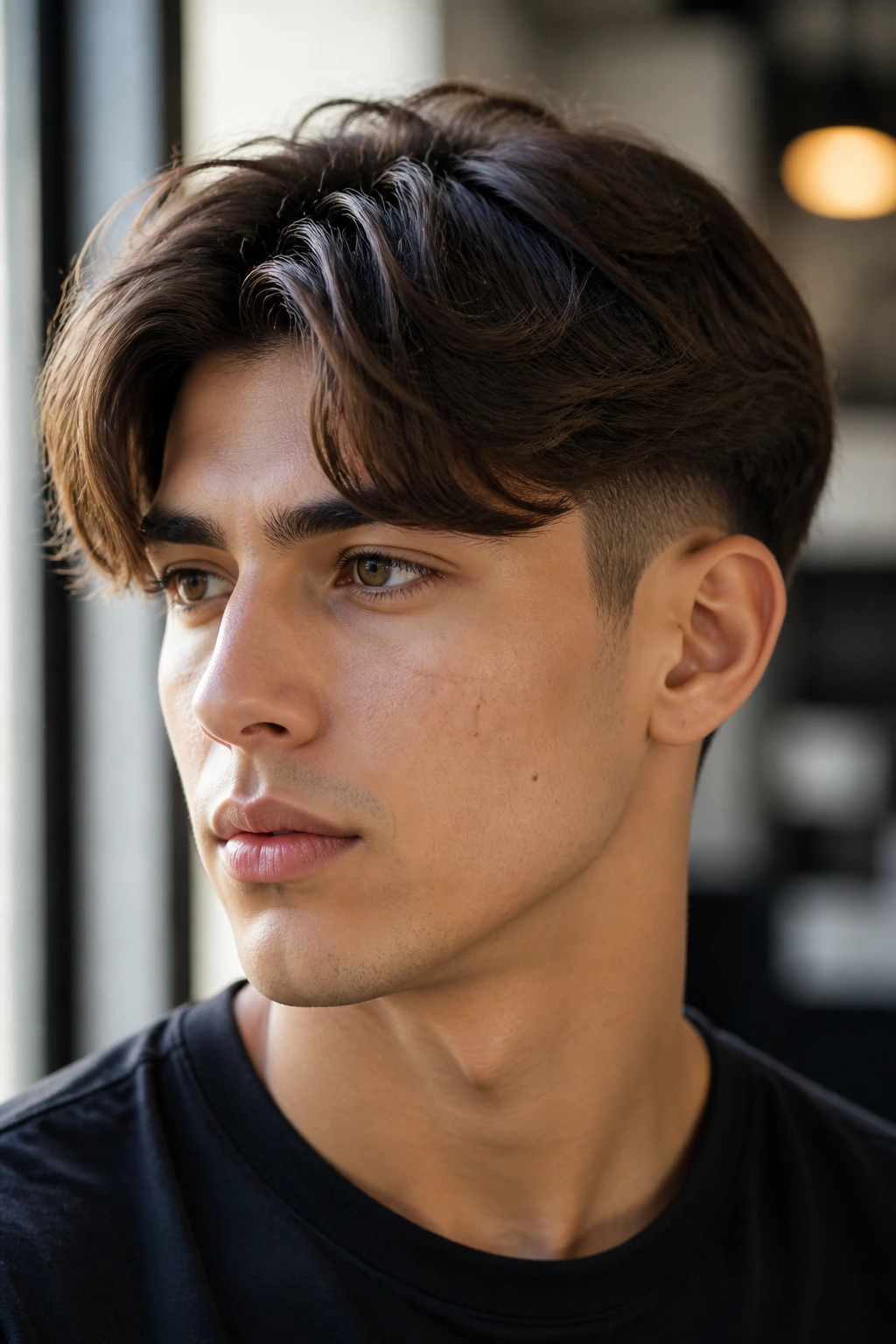
A scissor taper fade with a soft center part closes the list on a calmer note, and I think that’s fitting. The top is cut more with scissors than clippers, which keeps the texture softer and gives the curtain fringe a more natural fall. The taper around the ears and neckline keeps the shape tidy without pushing the cut into a hard-edged lane.
This is a smart choice for finer hair, mature hairlines, or anyone who wants curtain bangs without a lot of styling drama. Leave 4 to 5 inches at the front, but keep the crown a touch shorter so the top doesn’t collapse flat. Because the scissors preserve movement, the front can part gently instead of snapping into a rigid line.
I like this version because it grows out gracefully. It doesn’t lose its shape in a week. It just relaxes a little, which is usually what you want from a haircut that needs to live on your head instead of in a photo.
Best for: soft texture, low maintenance, and a more understated finish.
Why the Fade and Curtain Pairing Keeps Its Shape
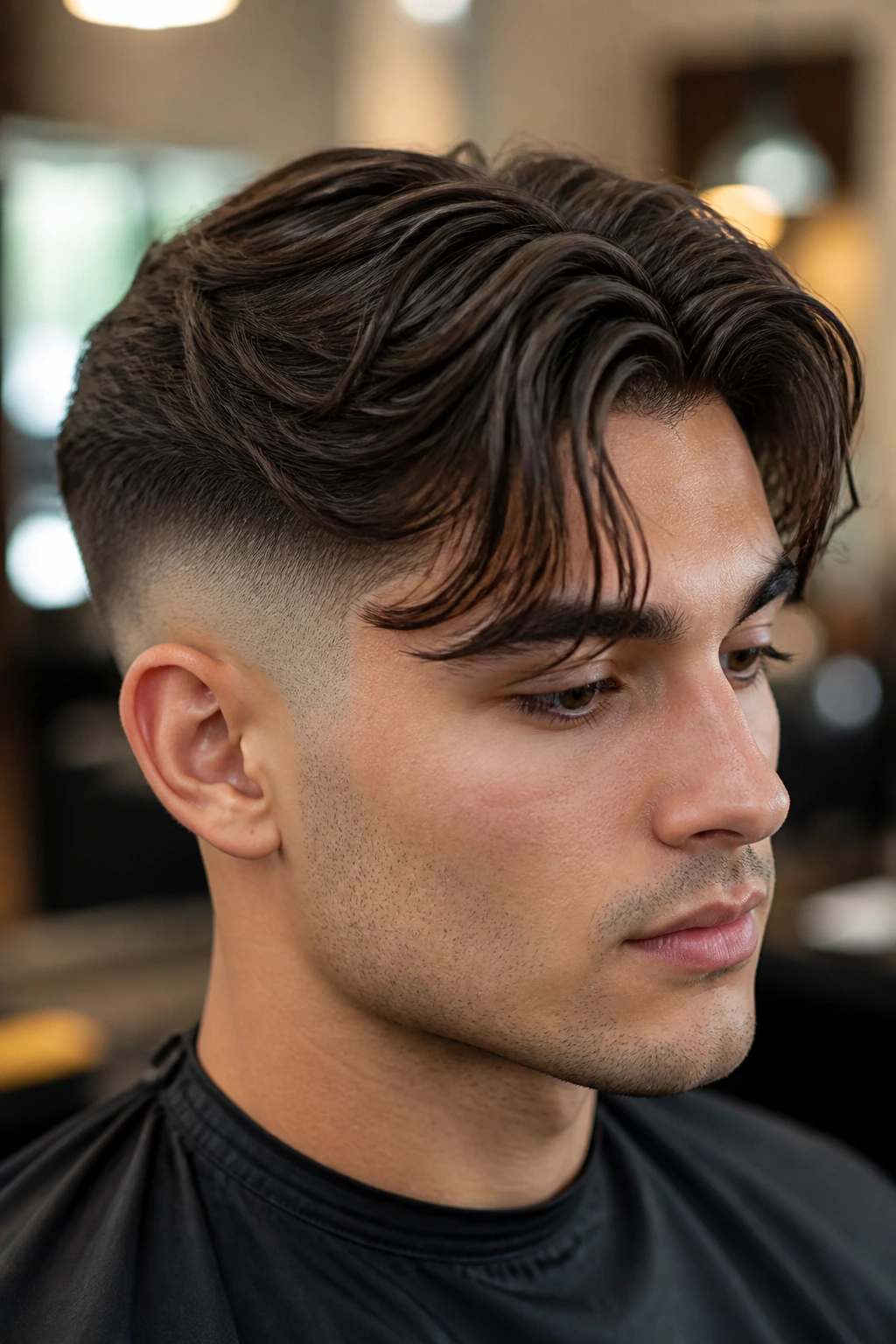
There’s a simple reason this combo keeps working: the sides and the front do different jobs. The fade clears space around the ears and neck, which stops the haircut from puffing outward. The curtain fringe gives the front something to say, which keeps the cut from becoming a plain short back and sides.
That split in responsibility is what makes the style so useful. You can adjust the fade height, you can add or remove fringe length, and you can change the texture without wrecking the overall shape. A low taper makes the cut gentler. A skin fade gives it more contrast. A drop or burst fade changes the profile. The curtain bangs stay in the middle of it all, which is why they work across so many hair types.
The other advantage is grow-out. When the sides blur a little, the front still looks like a choice. That matters more than people admit. A lot of haircuts only look good for the first ten days. These do not have to.
What to Tell Your Barber Before the Clippers Start
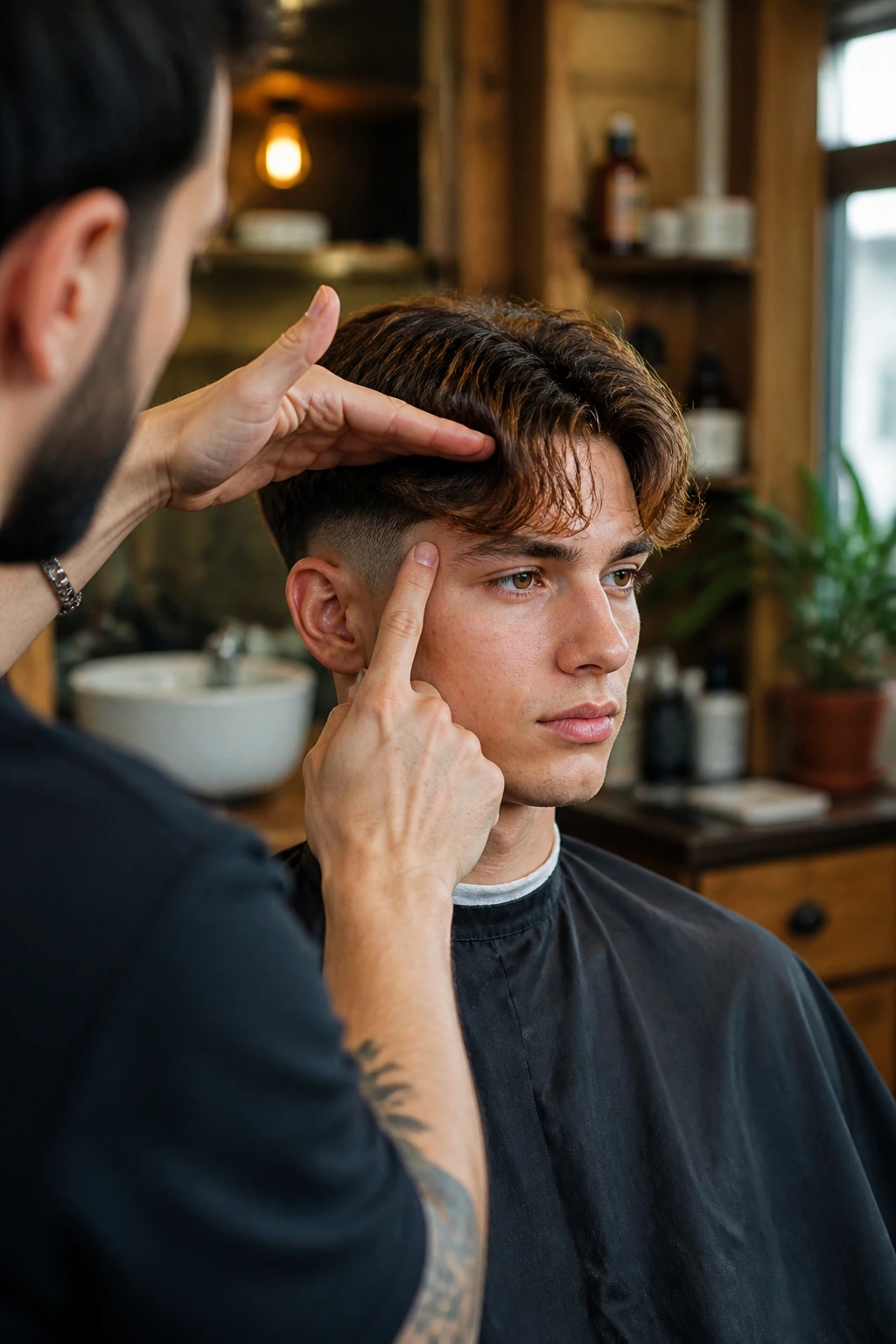
The fastest way to get a good result is to describe the haircut in pieces, not as one big idea. Say where you want the fade to start, how much forehead you’re comfortable showing, and whether you want the front to sit soft or sharp. That gives the barber actual targets instead of guesswork.
The details that matter most
- Fade height: low, mid, high, skin, shadow, or taper — each one changes the whole mood.
- Fringe length: tell them how far you want the bangs to reach when dry, not when wet.
- Texture: ask for feathering, point cutting, or scissor work if the front needs movement.
- Parting: center split, off-center split, or soft opening from the middle.
- Grow-out plan: if you hate frequent trims, say so upfront. That changes how tight the sides should be.
Bring a photo, but bring the right kind of photo. One angle is not enough. You want a front view and a side view if possible, because curtain bangs can look very different from profile. And if your hair has a cowlick, tell the barber where it pushes the front. That one detail saves a lot of frustration later.
Do not say “make it like this but shorter” and hope for magic. Be specific. Haircuts are built in millimeters. Vibes help, but measurements help more.
Essential Tools for These Cuts
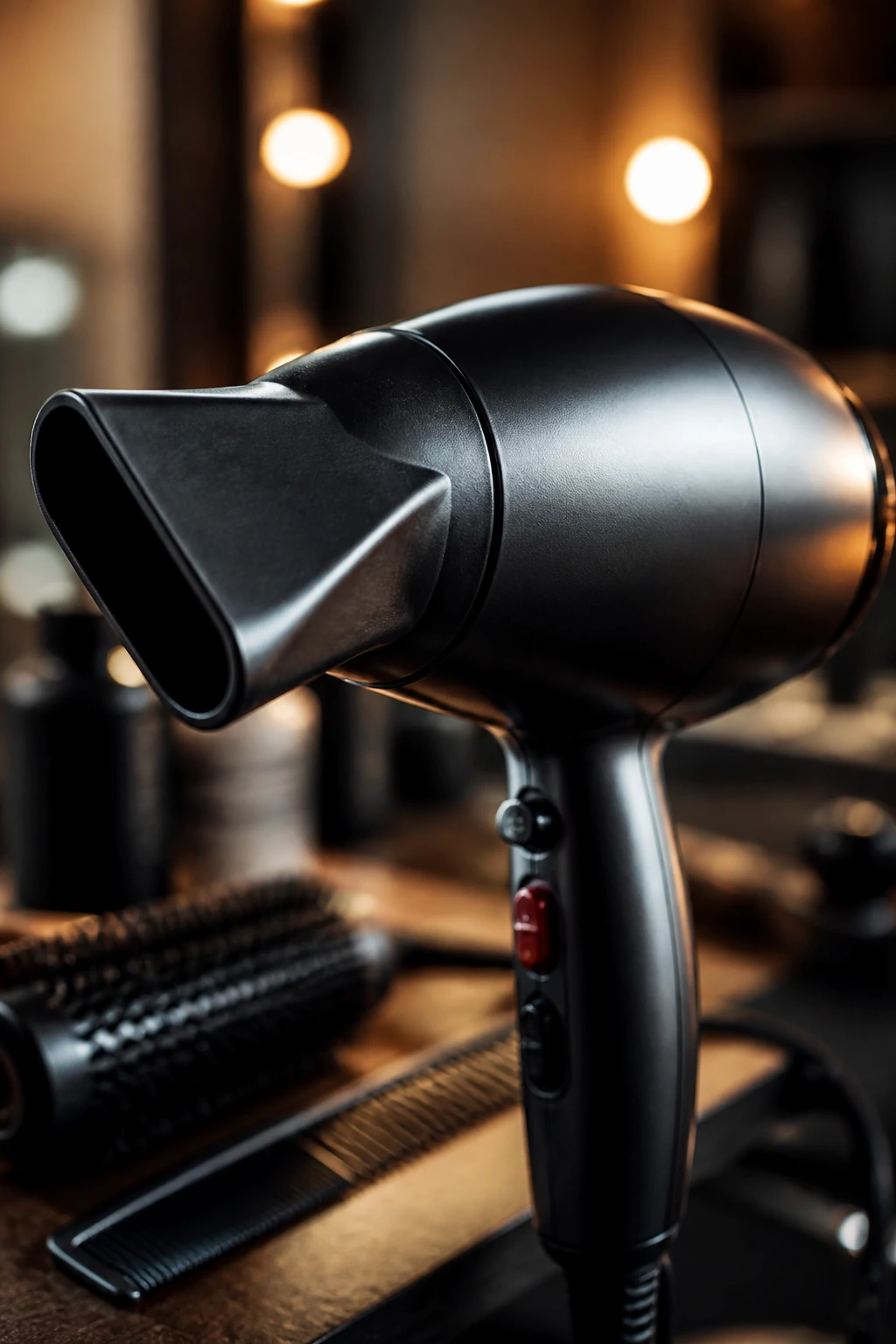
You don’t need a bathroom full of gear, but a few tools make styling and maintenance much easier.
- Hair dryer with concentrator nozzle: Directs air into the fringe so you can build the curtain shape instead of blasting it apart.
- Round brush, 1 to 1.5 inches: Best for bending the front outward and adding lift at the roots.
- Vent brush or Denman-style brush: Useful for rough-drying wavy or curly hair without flattening texture.
- Wide-tooth comb: Helps split the fringe softly without dragging too much product through it.
- Matte clay or paste: Gives hold without shine; ideal for straight and thick hair.
- Lightweight styling cream: Better for soft, natural movement and fine hair.
- Sea-salt spray: Adds grit and separation to wavy styles and beachier finishes.
- Curl cream or leave-in conditioner: Essential if your curtain bangs live on curly hair.
- Heat protectant: Worth using before blow-drying, especially if you style the fringe every day.
- Hand mirror: Handy for checking the back taper and neckline between cuts.
Choosing Product by Hair Type and Density
The wrong product can ruin a good cut faster than a bad clipper guard. That sounds dramatic. It isn’t. Curtain bangs sit right on the face, so heavy product, too much oil, or sticky wax shows immediately.
Straight hair
Straight hair usually needs lift first, hold second. Start with a heat protectant or sea-salt spray on damp hair, then blow-dry the fringe open with your fingers or a round brush. A matte clay or paste keeps the front from falling flat, but use a small amount. A big scoop turns the bangs into one stiff slab.
Wavy hair
Wavy hair usually behaves best with light cream or salt spray. You want movement, not slick control. If the waves are strong, dry the hair almost all the way with a diffuser and stop before it gets puffy. A tiny bit of paste at the ends can define the split if the middle wants to close.
Curly or coily hair
Moisture matters more here. A leave-in conditioner or curl cream helps the front fall forward instead of frizzing up. Use fingers, not a brush, to separate the curtain once the hair is about 80% dry. The product should support the shape, not freeze it.
Thick hair
Thick hair needs weight removed. If the top is too dense, the curtain bangs sit like a flap. Ask for internal layering or texturizing through the front so the hair can move. Matte products usually work better than creams because they give control without adding more bulk.
Fine hair
Fine hair needs less product than people think. Too much cream or clay makes it collapse. Use a root-lifting spray or a very light lotion, then dry the front with the nozzle aimed upward at the roots. Keep the fringe a little shorter and softer so it doesn’t pull itself flat.
How to Style the Fringe Without Fighting It

There’s a right way to style curtain bangs, and it’s not “pile product on and hope.” The shape comes from the order you do things in.
- Start with damp hair, not dripping hair. Towel-dry until the fringe is about 70% dry so it can still be shaped without soaking the product.
- Apply a small amount of pre-styler. Sea-salt spray, light cream, or heat protectant should go through the front and crown, not just the bangs.
- Blow-dry the fringe in both directions. Push the hair left, then right, then forward through the center. That bends the front and keeps the split from looking stiff.
- Use a round brush only if the hair needs bend. For straighter hair, wrap the fringe over the brush and turn the ends slightly outward. For wavy hair, fingers often do better.
- Cool the shape with a blast of cold air. Two or three seconds of cool air helps the bend hold longer and keeps the roots from falling.
- Finish with a tiny amount of product. Emphasis on tiny. Work it through the ends and the outer layer, not the scalp.
- Break the curtain apart with your fingers. Don’t comb it flat again. That just erases the shape you built.
If the fringe keeps closing in the middle, your hair probably wants more length or less product. If it keeps flying open too wide, the front needs a little more control at the roots.
How to Wear the Cut in Everyday Life
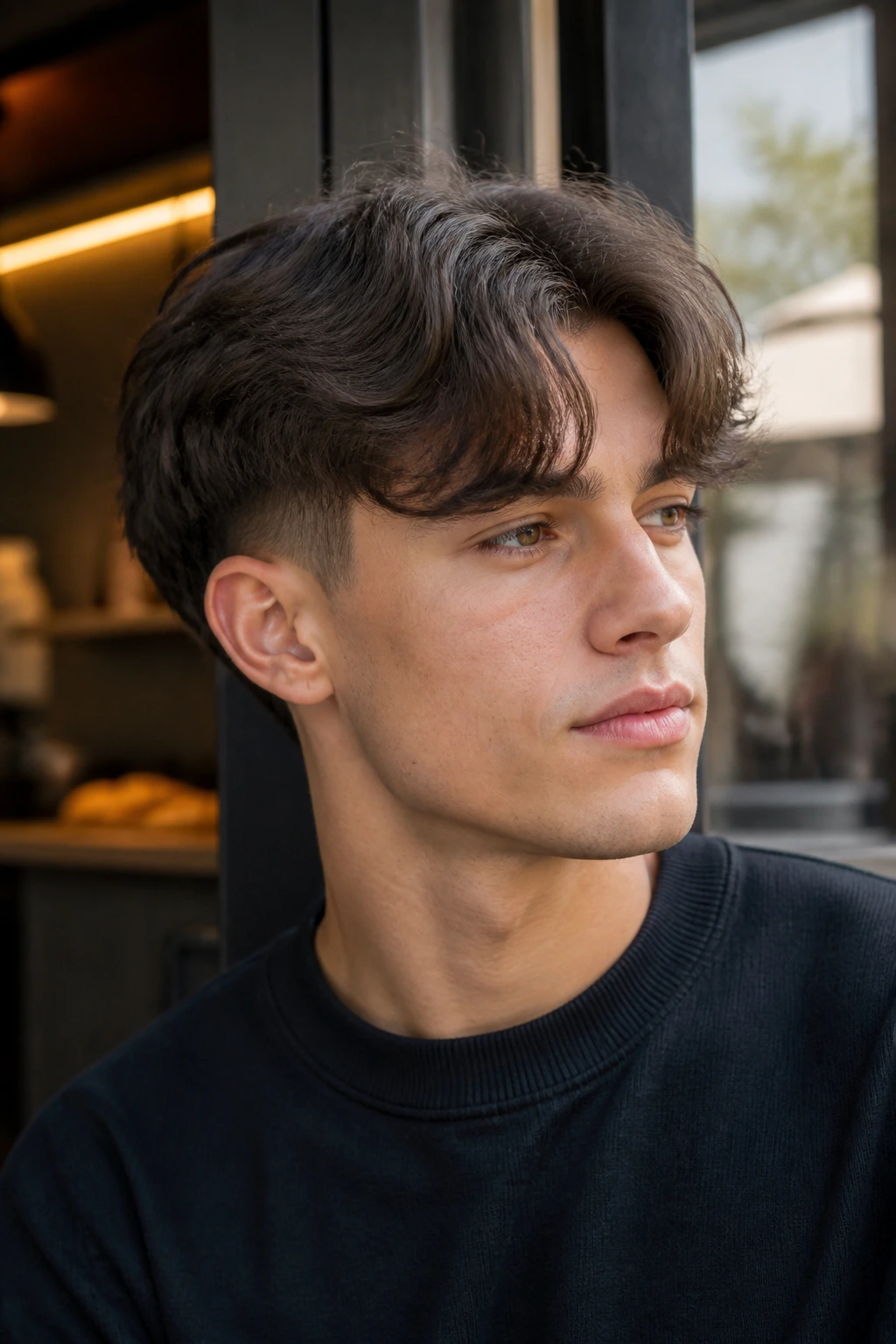
Presentation: Keep the split soft, not ruler-straight. A curtain fringe looks better when a few strands fall across the forehead than when the center line looks drawn with a pencil.
Companions: Clean sideburns, a short beard, light stubble, glasses, and even a sharp collar all sit well with this cut. It’s one of the few haircuts that can look relaxed with a T-shirt and still hold its shape under a jacket.
Length: If you want a subtle version, keep the front around 3.5 to 4.5 inches. If you want the fringe to drape more, go closer to 5 to 6 inches. Longer than that, and the haircut starts moving into a different category.
Occasion: A low taper or shadow fade works best if you need the cut to stay calm in a formal setting. A skin or high fade gives more contrast for casual wear, nights out, or days when you want the haircut to show up from across the room.
Keeping the Fade Clean Between Appointments
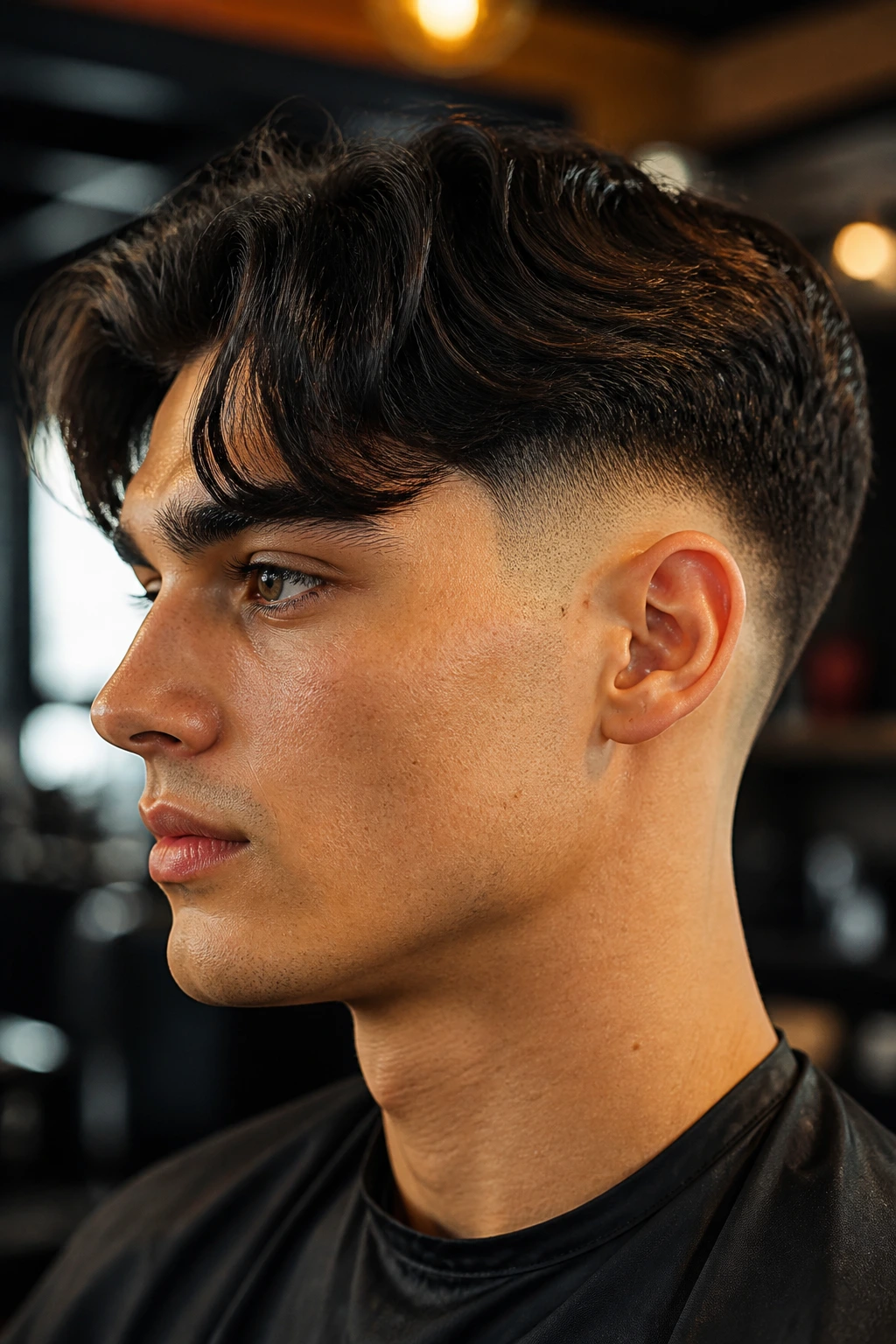
The fade is the part that gives up first. Hair on the sides grows fast, and once the blur line starts showing, the whole haircut loses some of its edge. That doesn’t mean you need a fresh full cut every two weeks. It means you need a rhythm.
A skin fade usually wants a touch-up every 2 to 3 weeks if you want it to stay crisp. A low taper or shadow fade can stretch farther, often 3 to 5 weeks before it looks shaggy. The fringe is separate. If the bangs start poking into your eyes or splitting too low on the forehead, a small trim can fix it without touching the sides.
Neckline cleanup helps more than people think. A quick pass with a trimmer every 10 to 14 days keeps the back from puffing out. Same with around the ears. If you’re comfortable doing small home touch-ups, use a guard and go slowly. If you’re not, leave it alone. A clumsy home fade is much harder to hide than a slightly grown-out one.
The best maintenance habit is simple: check the silhouette in a mirror, not just the front. If the sides stop supporting the curtain shape, the top starts looking heavier than it is.
Additional Tips and Customization Moves
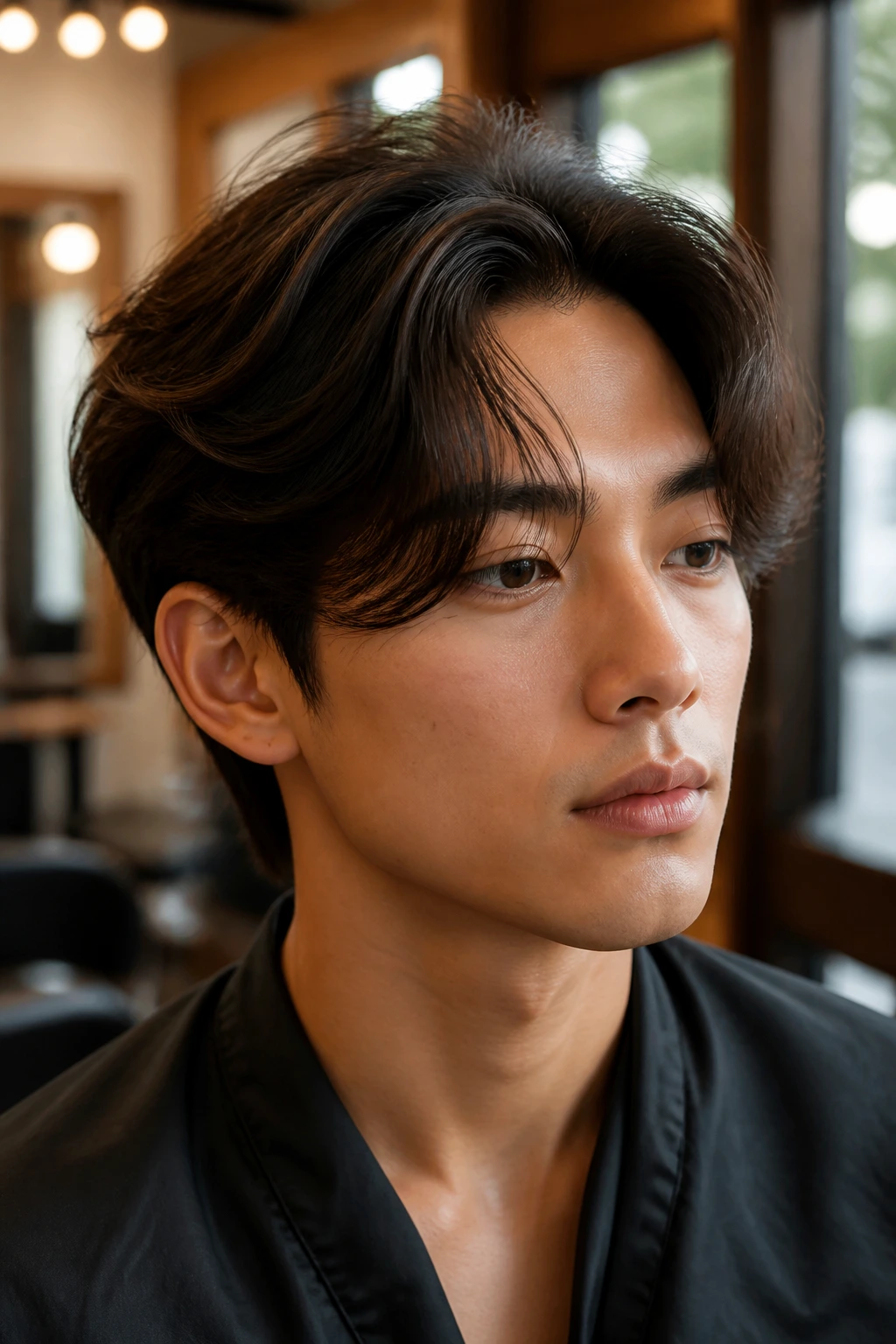
For More Lift: Ask for a little internal layering at the crown. That keeps the front from pulling everything forward and helps the curtain sit open instead of flat.
For Softer Cheeks: Keep the fringe slightly longer at the outer corners. That softens the face frame and avoids a blunt line across the forehead.
For Less Morning Work: Choose a taper or shadow fade and stay away from heavy pomades. A haircut that needs less product will forgive a rough dry much better.
For a Stronger Outline: Increase the contrast between the fade and the top. A skin fade or high drop fade makes the curtain shape read faster, especially if your hair is dense.
For Thicker Hair: Ask for weight removal through the mid-lengths, not just the ends. That keeps the bangs from drooping like a heavy blanket.
For Fine Hair: Keep the top shorter and lighter, and use a root spray before blow-drying. Fine hair looks better with motion than with too much length.
Common Mistakes to Avoid
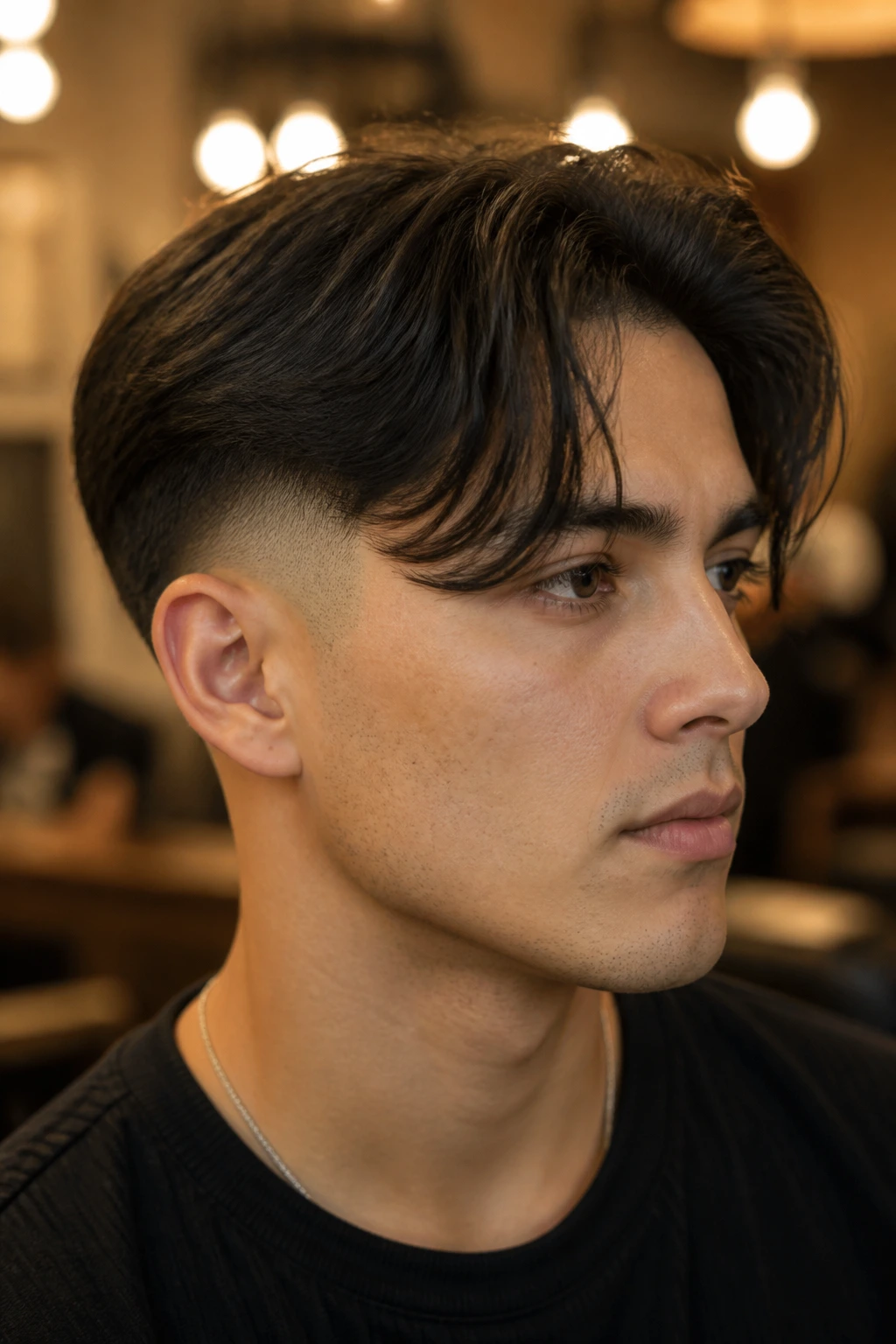
- Cutting the fringe too short: If the front doesn’t reach at least partway to the eyebrows when dry, the curtain effect is gone. Fix it by leaving more length next time and asking for a dry check before the final snip.
- Over-blending the front into the sides: When the top disappears into the fade too much, the bangs lose their frame. The cure is simple: keep enough separation at the temples so the curtain has an edge.
- Using too much product: Heavy clay, wax, or grease makes the bangs clump and close up. Start with a pea-size amount and add only if needed.
- Ignoring the natural part: If your hair wants to split slightly off-center, forcing a dead-middle part can make the fringe fight you all day. Work with the cowlick, not against it.
- Letting a skin fade grow too far: Once the clean line grows out, the haircut can look muddy fast. If you want longer stretches between cuts, shadow and taper fades are the calmer choice.
Variations and Adaptations to Try
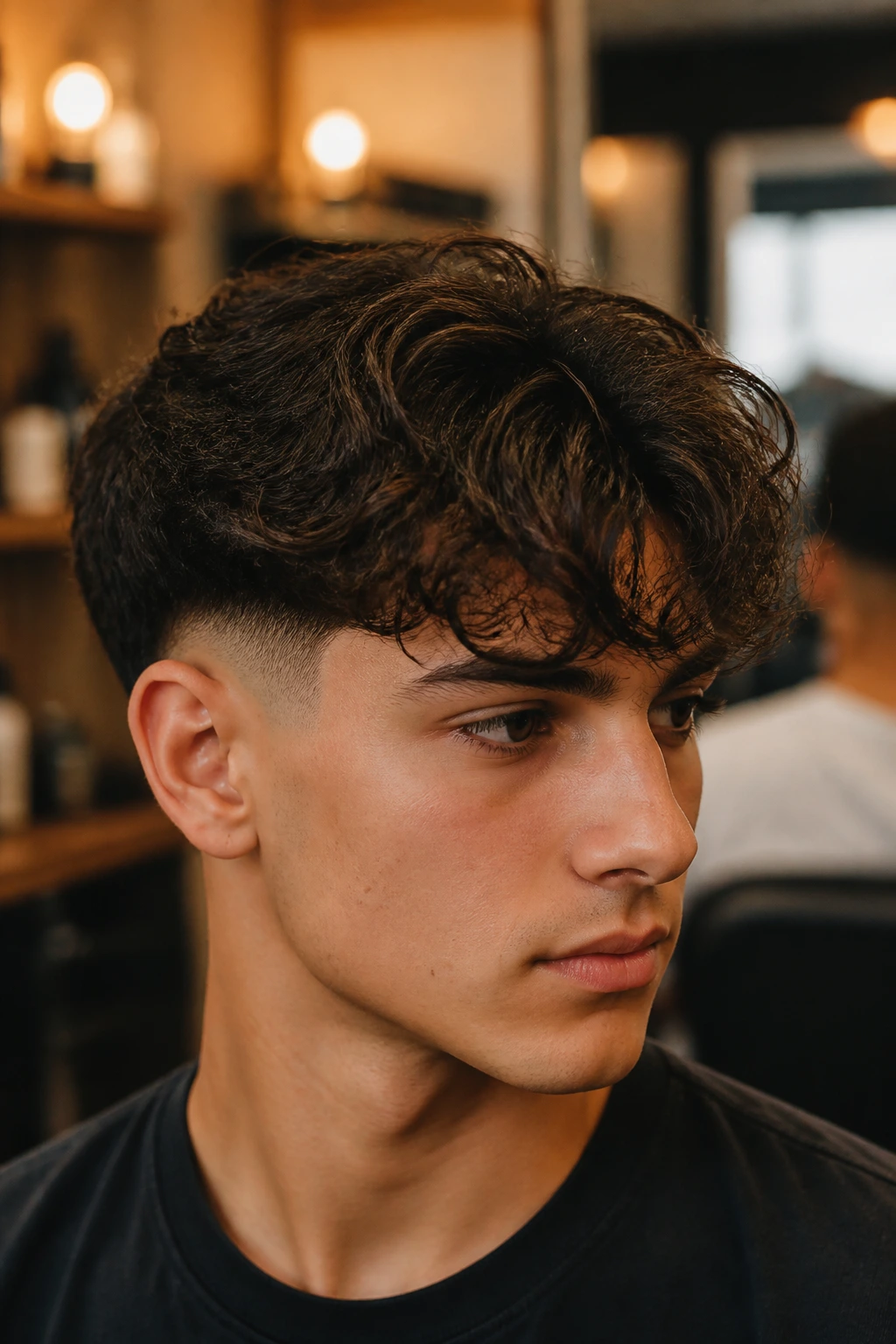
Office-Quiet Curtain Fade: Choose a low taper, keep the fringe soft and short, and avoid skin exposure at the sides. It reads neat from every angle and grows out without much fuss.
Textured Weekend Curtain: Go with a mid fade, choppy layers on top, and matte paste for separation. This is the version with a little mess in it, and that’s the point.
Curl-Friendly Arc: Use a temple fade or low drop fade and leave the front long enough for the curl to fall forward naturally. Curl cream and diffusing matter more here than exact parting.
Thick-Hair Debulked Curtain: Ask for point cutting through the front and some weight removal in the crown. This stops the top from sitting like one dense block.
Fine-Hair Lift Fade: Keep the top shorter, the fade softer, and use a root spray before blow-drying. You want the hair to stand up and part, not cling.
Long-Top Retro Curtain: Push the front longer and let the sides stay tighter for a more dramatic drape. This version leans more fashion than office, but it has a nice swing to it.
Frequently Asked Questions
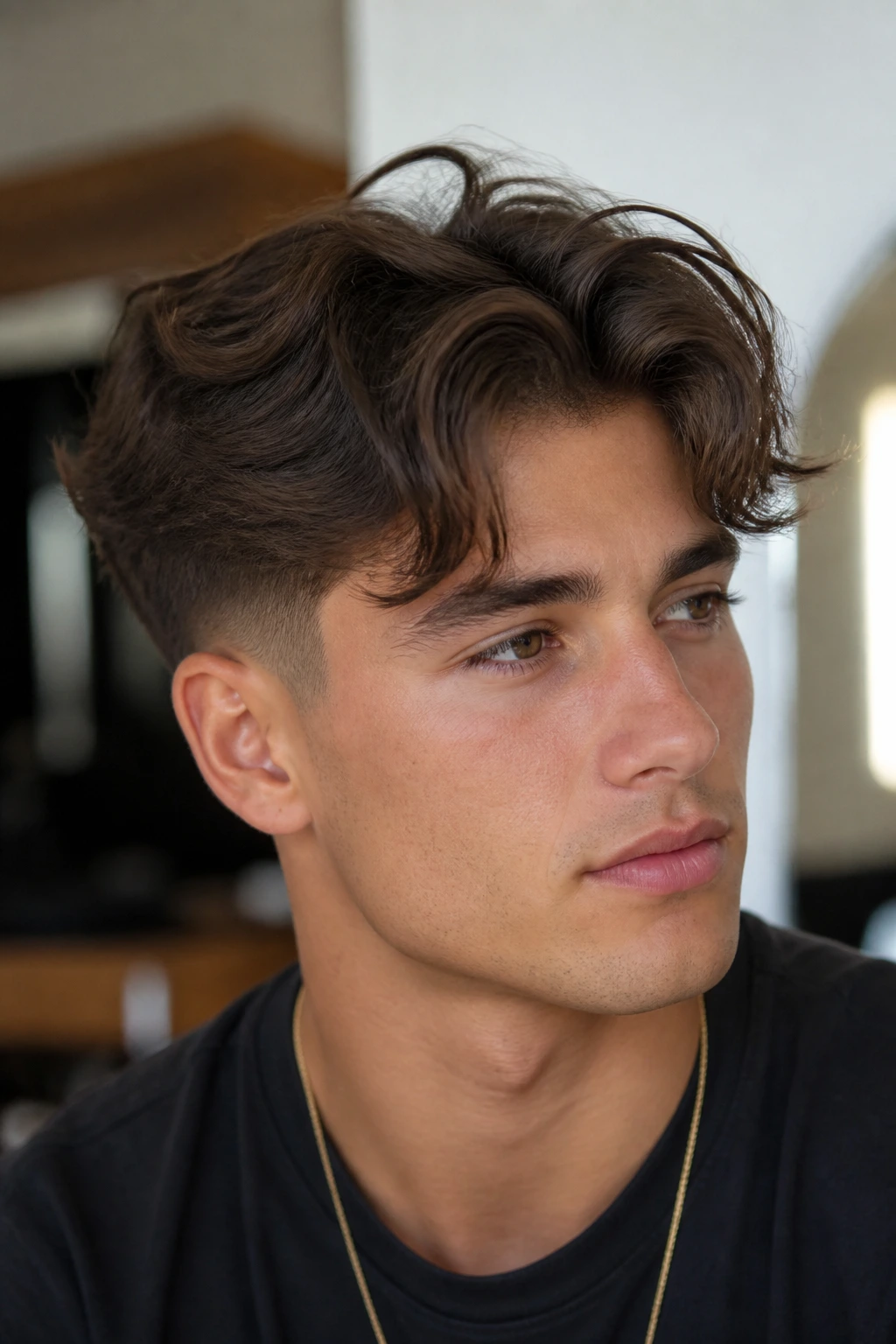
How long should curtain bangs be with a fade?
A useful range is usually 4 to 6 inches at the front, though curly hair may need more stretched length because it shrinks as it dries. If the fringe is too short, it will not split cleanly; if it’s too long, it can hang in your eyes and start to look heavy.
Does this haircut work on curly hair?
Yes, but the fade needs to respect the curl pattern. Curly curtain bangs work best when the sides are tapered or faded cleanly and the front is left long enough to fall forward without springing up too high.
Should I ask for a skin fade or a taper fade?
If you want strong contrast and a sharper outline, skin fade. If you want something softer, easier to grow out, and less demanding between cuts, taper or shadow fade is the safer pick.
What product works best for curtain bangs?
For straight hair, matte clay or paste. For wavy hair, sea-salt spray plus a light cream. For curly hair, leave-in conditioner and curl cream are usually better than stiff hold products because they keep the front moving.
How often do I need to trim it?
The fringe usually needs attention every 3 to 5 weeks if you want it to keep its shape, while the fade itself may want a touch-up sooner if it’s skin-tight. Taper and shadow fades stretch a little longer.
What if my bangs keep splitting in the wrong place?
That usually means your part follows a cowlick or a natural growth pattern. Ask the barber to work with the split instead of forcing the exact center, and style the fringe while it’s still damp so you can train it.
Can this haircut work if my hair is thinning at the front?
It can, but softer versions usually work better. A low taper or shadow fade with a feathered fringe tends to be kinder than a high skin fade, which can expose more scalp than you want.
Is this hard to style every day?
Not if the cut is balanced for your hair type. The less your hair fights its own growth pattern, the less work you’ll do in the morning. The right fade and fringe length matter more than a shelf full of product.
A Shape That Keeps Its Edge
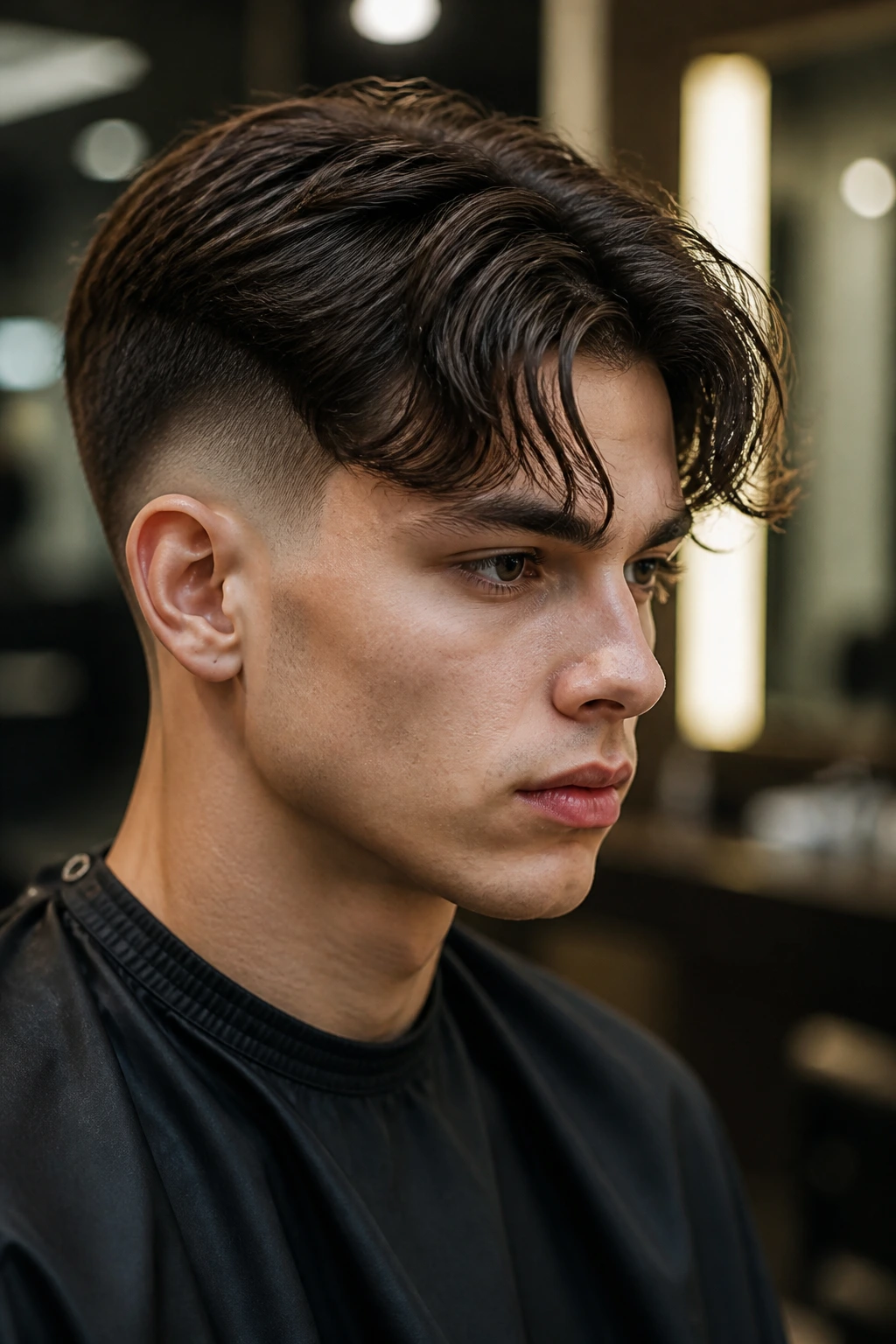
The nice thing about this haircut family is that it gives you choices without asking you to commit to one mood forever. You can go low and soft, high and sharp, curly and loose, or clean and tailored. The fade clears the sides. The curtain bangs keep the front alive. That combination stays useful because it gives shape where you want it and freedom where you need it.
If you’re bringing one of these versions to a barber, skip the vague language and talk in parts: fade height, fringe length, texture, and how much forehead you want to show. That is where the good versions come from. Not from luck.
Pick the shape that fits your hair as it actually grows, not just the one that looks best in a still photo. The cut will hold up better, and you’ll spend less time fighting the mirror.
