



Short gray hair color ideas live or die by light. On a pixie, a bob, or a cropped shag, there’s nowhere to hide a muddy toner, a harsh line of demarcation, or a silver shade that leans yellow the minute you step outside. The good versions look crisp, reflective, and deliberate. The bad ones look like they were mixed from leftovers.
Short hair changes the whole equation. You see the crown, the temples, the nape, the part line, and the way the ends feather around the ears. Gray hair itself changes the equation too — it can be coarser, more porous in some strands, and stubbornly different from one section to the next. That’s why a flat, one-note dye job so often falls apart on short gray cuts. Placement matters. Tone matters. And so does restraint.
The best part is that gray doesn’t have to read as “covered.” It can look pearly, smoky, steel-blue, mushroom-soft, or mirror bright, depending on the blend you choose. Short gray hair color ideas work best when they respect the cut instead of fighting it, which means a silver bob shouldn’t be treated the same way as a long layered style, and a cropped pixie needs a different balance than a shaggy lob. The shapes are smaller. The color has to do more work.
Why These 22 Looks Work So Well on Short Gray Hair
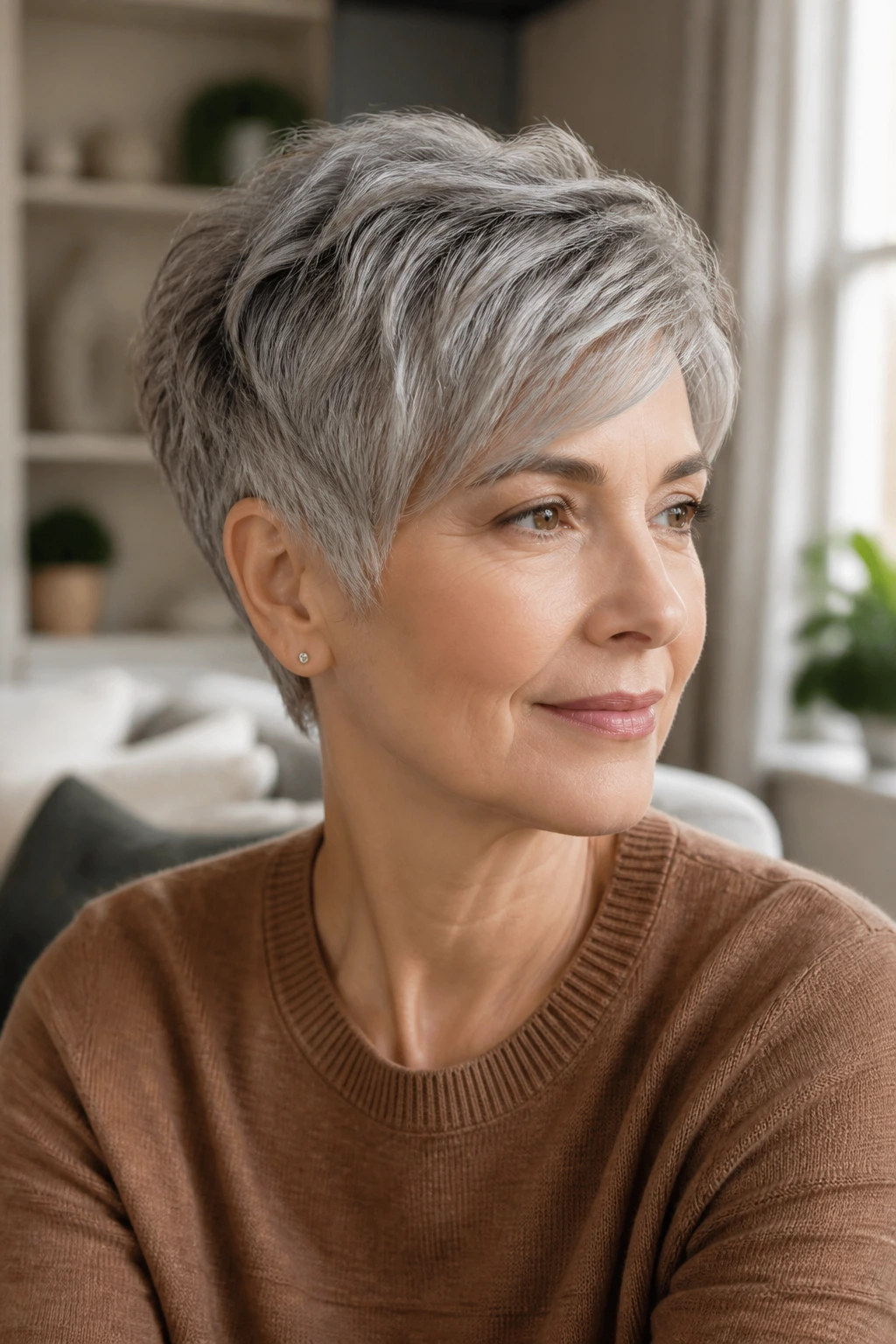
- They use tone, not just coverage: Short gray hair can look bulky if every strand is pushed to the same opaque level, while tonal work keeps the cut moving.
- They make grow-out easier: A soft root shadow or a dimensional silver blend avoids that blunt “helmet” line at the scalp.
- They suit coarse texture: Gray strands often hold pigment and toner differently, so layered color reads softer than a one-process block shade.
- They flatter short cuts from every angle: The back, sides, fringe, and crown all show; these ideas are built for 360-degree viewing.
- They give you range: You can go icy, smoky, neutral, warm-leaning, or metallic without losing the gray identity.
- They work with natural gray too: Some looks lean into silver and salt-and-pepper instead of covering it, which is a smarter use of the texture you already have.
If you’ve ever looked at a short gray cut and thought it needed one more layer of polish, that’s the thread running through this collection. Not more color. Better color.
1. Soft Silver Melt on a Pixie
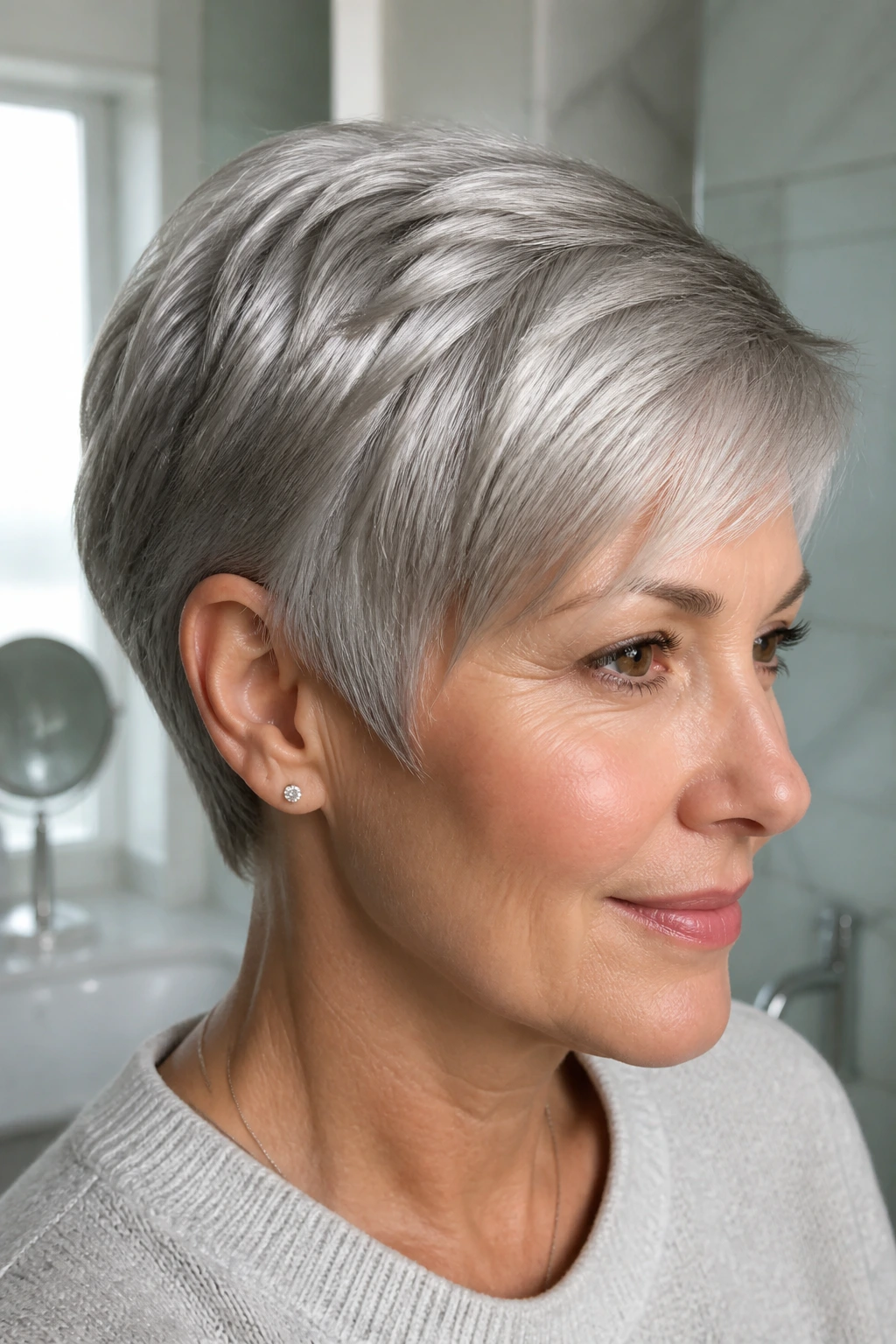
A pixie cut gets sharper when the silver isn’t all one level. The soft silver melt starts a touch deeper at the roots, then floats into a cooler, brighter silver through the crown and fringe. On short hair, that tiny shift keeps the shape from turning into a solid helmet of metallic color.
Why it works on cropped hair
A pixie exposes the head shape, which is great when the tone has movement. Ask for a root shadow that sits one level deeper than the lightest silver so the color grows out cleanly instead of looking painted on. The best versions use a demi-permanent gloss over pre-lightened or naturally light gray sections, not a flat permanent dye from scalp to tip.
The finish should feel airy, not heavy. If the silver catches every strand the same way, the cut loses texture. A melt gives you tiny changes in reflection, and on short hair that’s the difference between stiff and polished.
How to wear it
Keep the style a little piecey at the crown with a light matte paste or cream wax. A slick, hard finish can flatten the color. This one looks best when the top layers separate just enough to show the tonal shift.
2. Smoky Charcoal Bob
Charcoal gray on a short bob has a little attitude. It’s darker than the usual silver family, which makes the haircut look crisp and deliberate instead of airy. On a blunt bob, especially one that hits at the jaw or just below it, charcoal gives the ends a clean edge.
This look works because it doesn’t fight the geometry of the cut. A blunt bob already has a strong line, so a smoky charcoal tone reinforces that line instead of softening it into nothing. I like this shade when someone wants gray without the bright, icy finish that can sometimes read too cool against a strong bone structure.
For the best result, keep the root area slightly deeper and the mids and ends a muted slate. If your hair is naturally dark, that makes the grow-out cleaner. If it’s lighter, a gloss with a cool blue-violet base helps stop the color from drifting muddy. The trick is restraint. Charcoal should look like polished smoke, not black paint.
3. Frosted Micro-Lights on a Crop
Why do tiny highlights matter so much on short hair? Because the crop doesn’t need broad ribbons. It needs fine ones. Frosted micro-lights use extremely thin foils or hand-painted slices to create a dusting of light through the top and front, and that subtlety is what keeps a short cut from looking streaky.
The science behind the softness
Very narrow highlights let the natural gray underneath stay visible, which is what keeps the whole thing believable. Instead of lifting huge sections and hoping the toner does all the work, you get a peppered finish that reads cooler and more dimensional. On hair that’s already silver or white in spots, this is often more flattering than trying to force a full shade match.
The best placement is around the part, the fringe, and the crown. That’s where short hair gets the most light in real life. Under salon lights, micro-lights can look almost invisible in the bowl, then suddenly show themselves when the hair moves. That’s the point.
Quick note: ask for fine weaves with a soft violet toner, not chunky highlight panels. Chunky pieces on short hair tend to shout.
4. Steel Gray Money Piece
If your haircut has a fringe, side sweep, or a slightly longer front, steel gray around the face can do a lot of work. The money piece in this family is brighter and cooler than the rest of the head, so the eye lands there first. That can sharpen a rounder face or bring a little edge to an otherwise quiet crop.
I’ve always liked this on short layered cuts because the front gets the spotlight while the back stays calmer. The contrast feels intentional, not busy. A steel gray money piece usually sits over a darker root or a neutral gray base, which gives the lighter front section something to bounce against.
For a cleaner result, keep the front pieces cool with a silver-violet gloss and leave the rest of the hair slightly deeper — think slate rather than white. If the face frame goes too pale, it can wash out the skin and make the rest of the cut seem unfinished. Steel gray should look like brushed metal. Sharp, but not harsh.
5. Mushroom Brown-Gray Blend
Mushroom gray is the color for people who like gray but don’t want it screaming from across the room. It sits in that soft space between taupe, beige, ash, and brown, which makes it one of the most wearable short gray hair color ideas if your natural base is medium or dark.
This shade works because it plays nice with the haircut’s texture. A short crop can get very piecey, very fast, and mushroom tones keep those pieces from looking over-processed. The color has enough coolness to read as gray, but enough brown in the mix to keep it from turning icy or flat. On natural gray, it blends beautifully with salt-and-pepper regrowth. On pre-lightened hair, it softens the edge and removes that too-silver glare.
I like this best when the top is a little deeper and the ends are softly diffused. That tiny gradient matters. It gives the cut a lived-in feel without the messy fade you sometimes get from overly warm brown glosses.
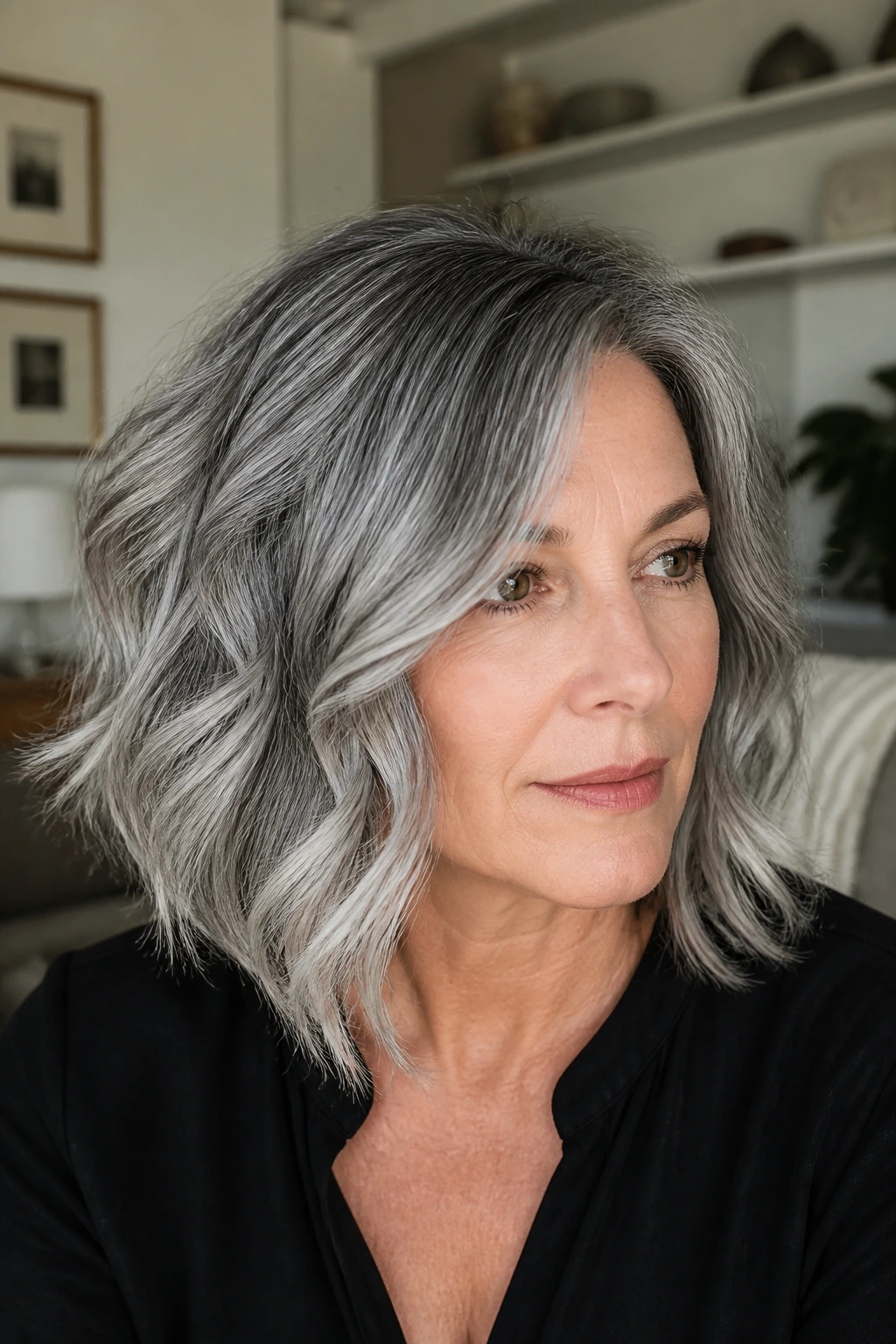
6. Slate Root Shadow on a Wavy Lob
A wavy lob and a slate root shadow are a very practical pair. The cut has movement built in, and the root shadow gives that movement somewhere to start. Instead of one solid bright gray from scalp to ends, you get a deeper gray at the root line, then a cooler, lighter finish through the mid-lengths and ends.
What makes it different from a full silver
A full silver lob can look gorgeous for about five minutes, then the regrowth line starts stealing the show. Slate roots buy you breathing room. They also make the shape look fuller at the top, which is handy if your hair gets a little too soft around the crown.
Ask for a shadow that sits one to two levels deeper than the mids, not a near-black root. That gap is enough to create shape without looking blocky. If the waves are loose and brushed out, the whole thing reads soft and dimensional. If the waves are more defined, the darker root gives them contrast and keeps the finish from looking washed out.
The real charm here is practicality. It grows out like a sensible person’s color, which is rarer than it should be.
7. Pearl Gray Gloss
Pearl gray is the closest thing short hair has to satin. It’s cool, pale, reflective, and slightly translucent at the edges, which gives the hair that polished glow people chase with bad lighting and too much toner. On a cropped cut, pearl gray makes the shape look expensive without trying to look fancy.
This is not a heavy coverage look. It’s a gloss look. The base can be naturally gray, pre-lightened blond, or lifted white-blonde hair toned down to a pearl finish. The goal is a reflective veil, not a mask. If the color sits too opaque, you lose the whole pearl effect and end up with plain gray.
I like pearl gray best on straight or softly bent short cuts, where the light can travel over the surface. Use a violet-silver conditioner sparingly, because too much purple can push it into lavender. If you want the finish to stay elegant and clean, think of pearl as a quiet sheen, not a bright silver flash.
8. Silver Lavender Tint
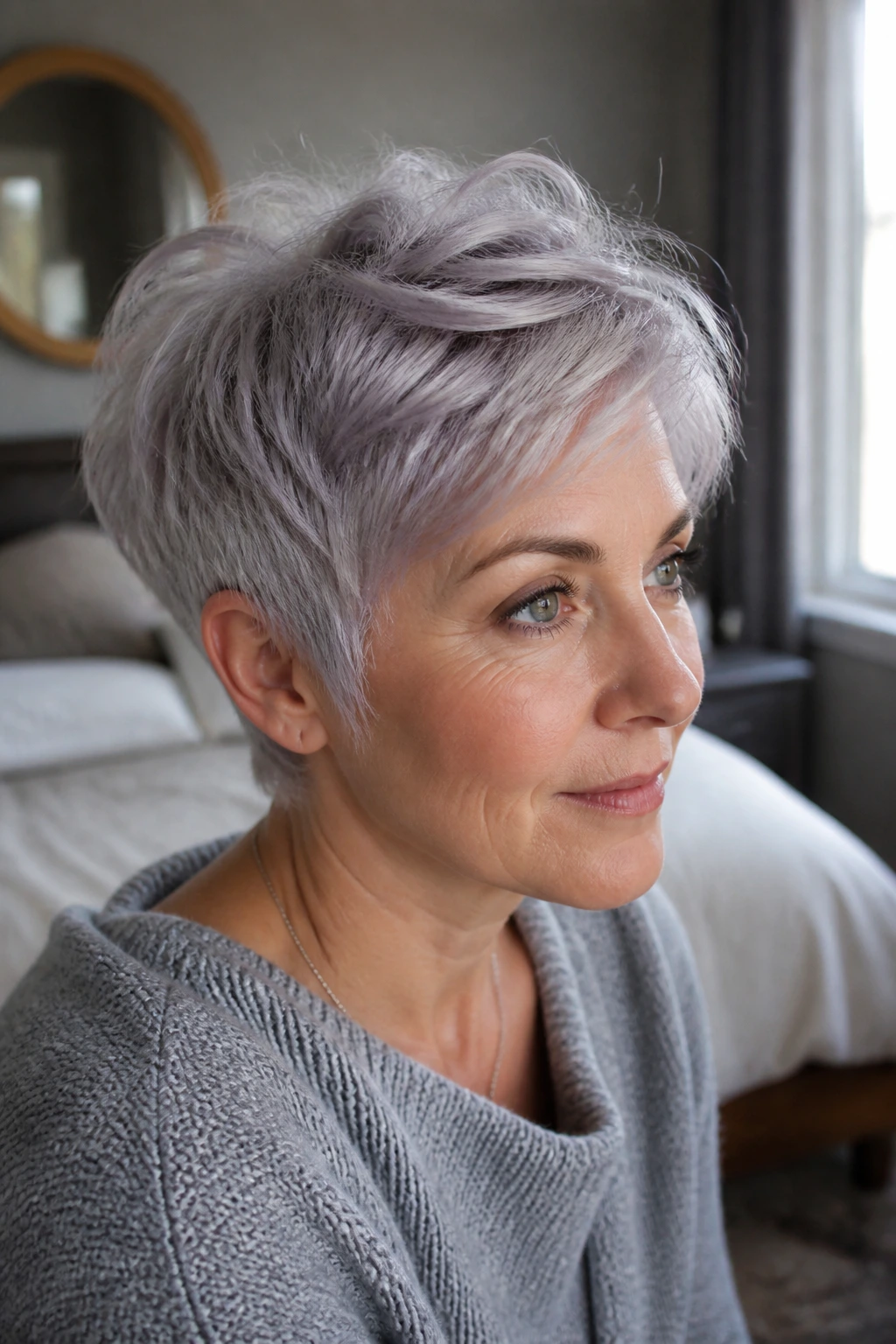
Want gray with a softer bite? Silver lavender is the move. The lilac cast takes the edge off cool gray and gives short hair a faint, almost misty blush that looks especially good in layered crops, asymmetrical bobs, and choppy pixies.
The reason this works is simple: lavender sits next to gray instead of fighting it. A little violet in the toner neutralizes yellow, but it also leaves a faint cool-violet veil that keeps the color from feeling severe. That matters on short hair, where every tone is more visible because there’s less length to dilute it.
Keep the lavender whisper-light. If it turns into pastel purple, the gray identity gets lost. I prefer it when the lilac is only obvious in certain light — near a window, under daylight, or when the hair moves. That kind of subtle shift gives the cut some personality without turning it into costume color.
9. Gunmetal Peekaboo Panels
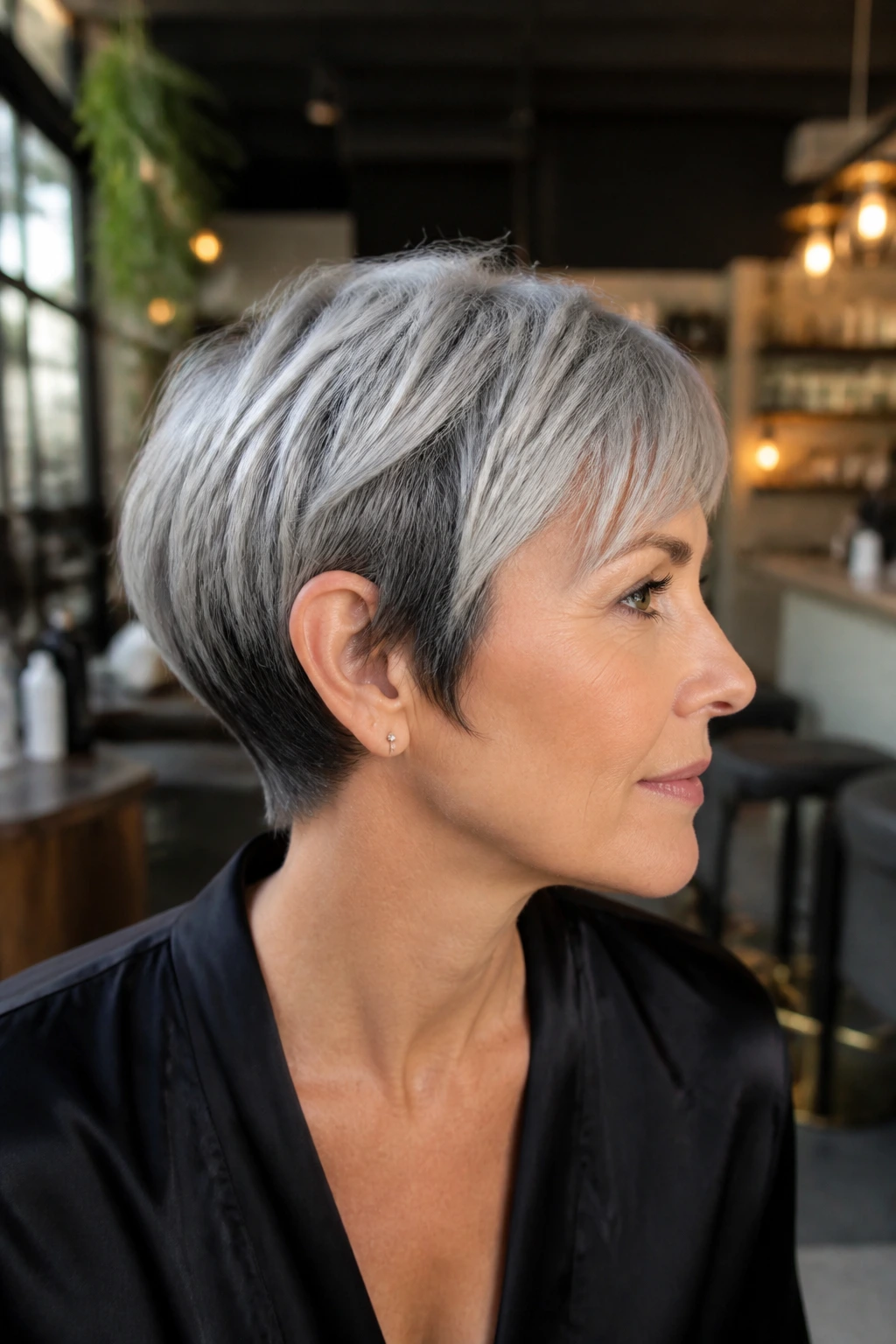
Gunmetal peekaboo panels are for the person who wants depth without broadcasting it at first glance. The darker gray sits underneath the top layer, usually in panels behind the ear, under the crown, or through the nape. On short hair, that hidden placement creates a quick hit of contrast when the head turns.
A cropped cut with peekaboo panels can look plain from the front and surprisingly rich from the side. That’s what makes this idea smarter than a simple all-over color. The top layer stays lighter or more natural, while the underlayer gives the haircut weight and shadow. The contrast is strongest on thick hair or on short styles with an undercut, where the shorter hidden layer can hold a deeper shade without looking bulky.
If you want this to read clean, keep the gunmetal cool and smoky, not blue-black. Heavy blue-black underlayers can look harsh when they peek out. Gunmetal has more restraint. It feels like depth, not drama for its own sake.
10. Ash Beige Gray Crop
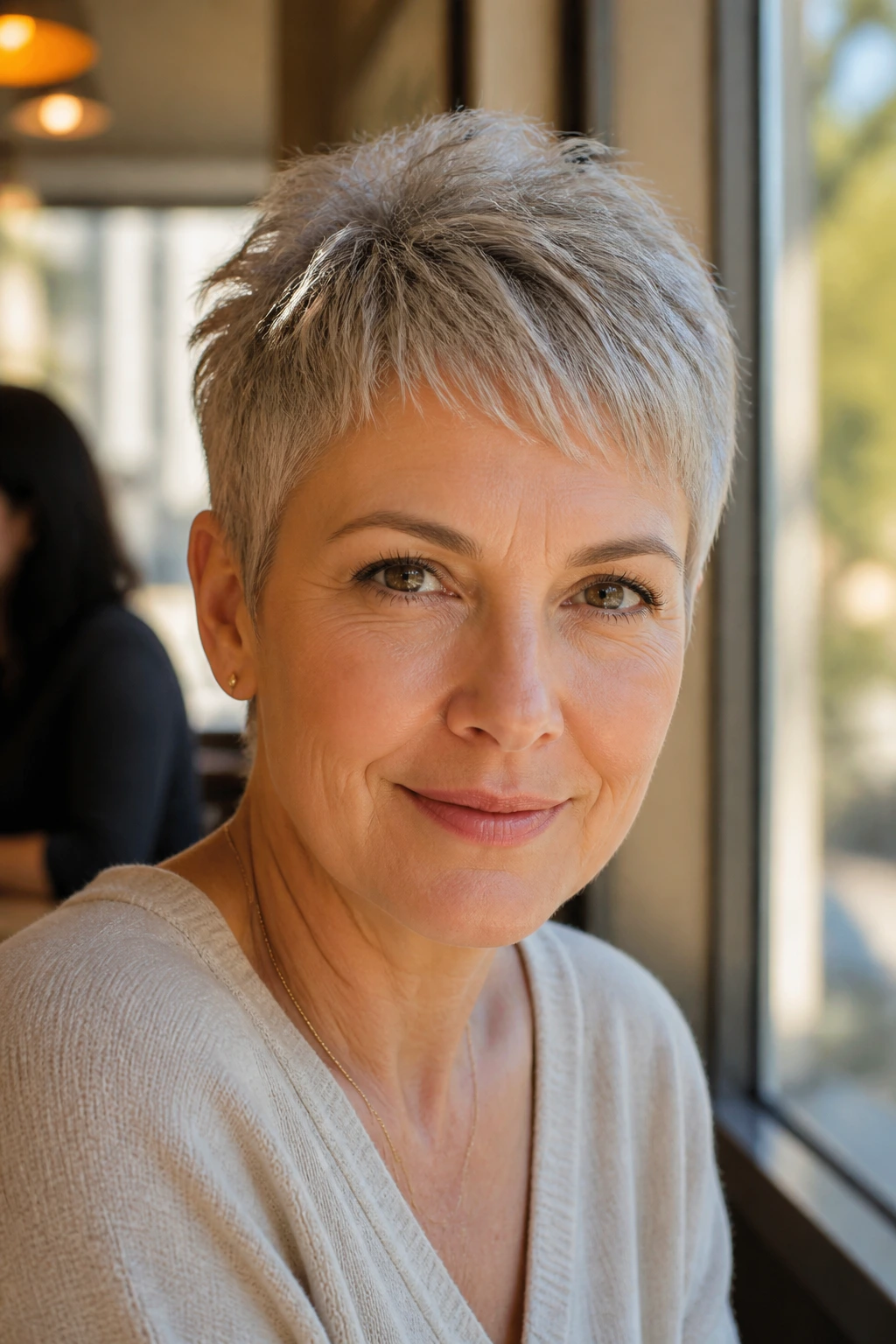
Ash beige is the shade people reach for when they want gray without the cold glare. It softens the face, plays well with short layers, and sits in that nice middle zone where the color looks intentional but not severe. On a crop, it can make the texture look almost brushed.
How to ask for it
Tell the colorist you want a neutral-to-cool beige with gray reflection, not a warm honey blonde. That distinction matters. A beige-gray crop should still read as gray in daylight, but it shouldn’t pull blue or violet so hard that the skin starts looking pink by contrast.
This is one of the easiest gray looks to live with if you don’t want to chase icy maintenance. The tone is forgiving. It hides small changes in root color better than pure silver, and it tends to fade into a soft neutral rather than a brassy mess. The color sits quietly on short hair, which is a nice change after all the metallic finishes people usually push toward.
I’d choose this for anyone whose natural skin tone gets overwhelmed by very cool silver. It’s gentler. Not boring. Just easier.
11. White Blonde Platinum Fade
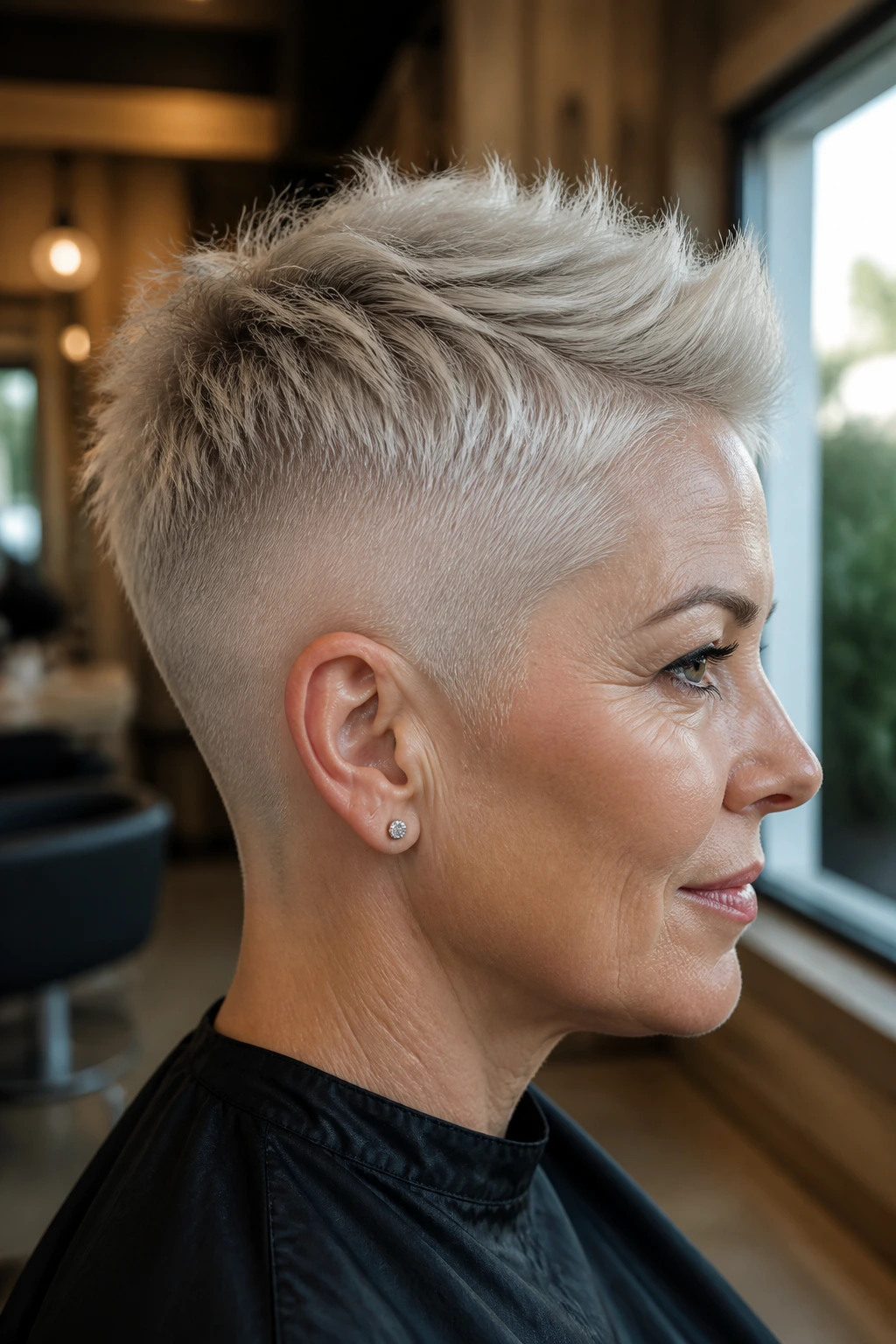
A white blonde platinum fade takes the gray conversation all the way to the edge of nearly colorless. Short hair makes this look striking because there’s no long length to dilute the brightness. You see the lightness immediately, and the cut starts to look sculptural.
This version depends on careful lifting and careful toning. Platinum short hair can’t be rushed. On hair that’s already gray or white in sections, the fade can be beautiful because the natural silver and the lifted platinum meet in the middle. On darker hair, the process needs patience or the hair will swell, snap, and go fuzzy around the hairline.
The fade itself should not be flat. Keep the root area slightly deeper and then pull brightness through the ends and top. That tiny shift helps the cut keep shape. A one-tone platinum crop can look dazzling in a chair and lifeless a week later. A fade gives it a little breath.
12. Denim Gray Streaks
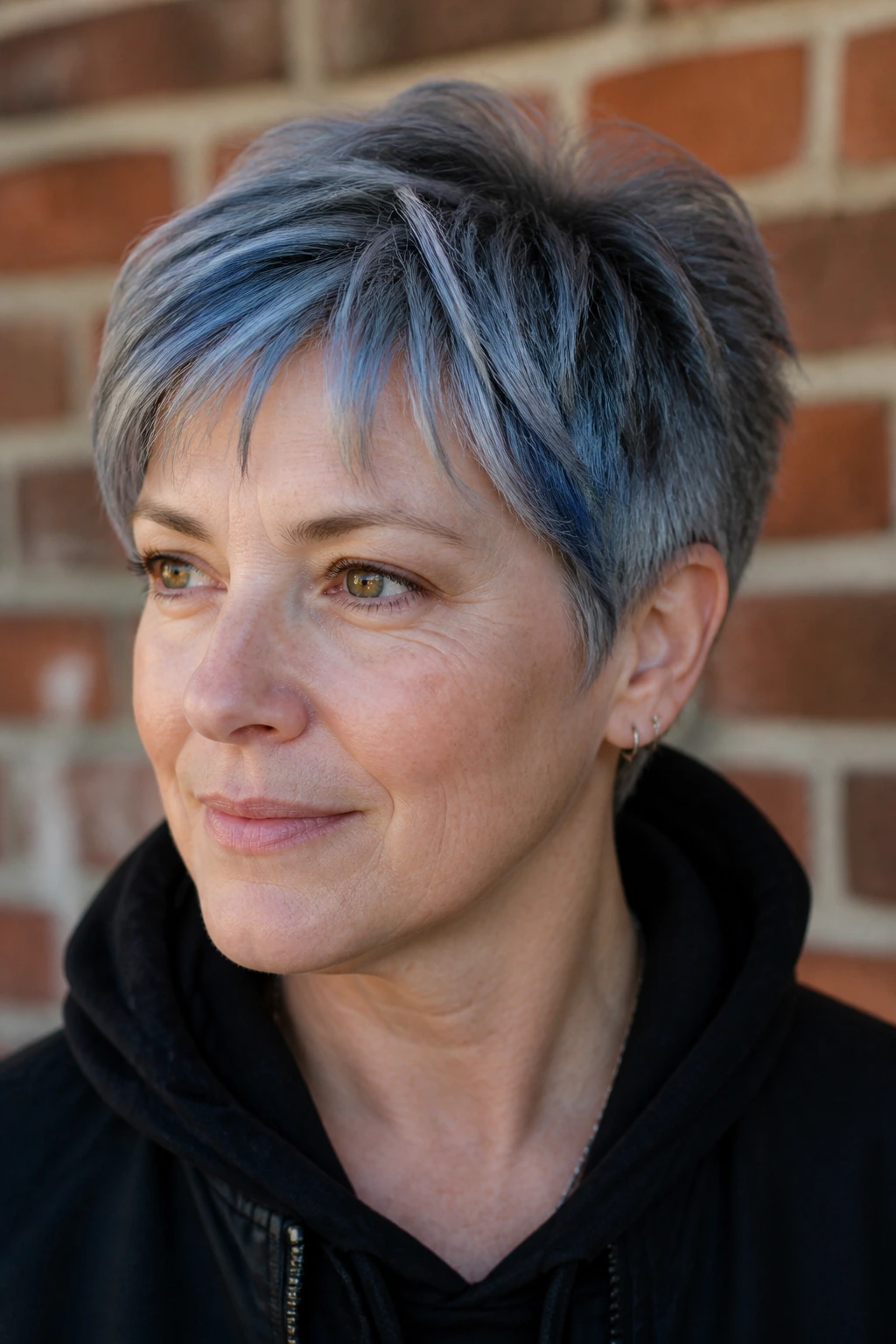
Denim gray is cooler than mushroom, softer than cobalt, and more relaxed than true blue. On short hair, those blue-gray streaks can turn a plain crop into something a little more alive, especially if the cut has layers that flick outward around the ears or nape.
The trick is to keep the blue tone buried inside the gray, not sitting on top of it. Think washed denim, not electric blue. A few streaks placed through the crown and around the fringe are enough. Because short hair doesn’t need much color to make an impression, too many streaks will crowd the cut. One or two panels near the front can be plenty.
I like denim gray on hair that already has a cool base. It doesn’t have to be vivid to work. In daylight, it can read as steel. Under indoor light, the blue undertone wakes up just enough to make the texture more interesting. That little shift is what keeps it from feeling flat.
13. Taupe Gray Neutral Blend
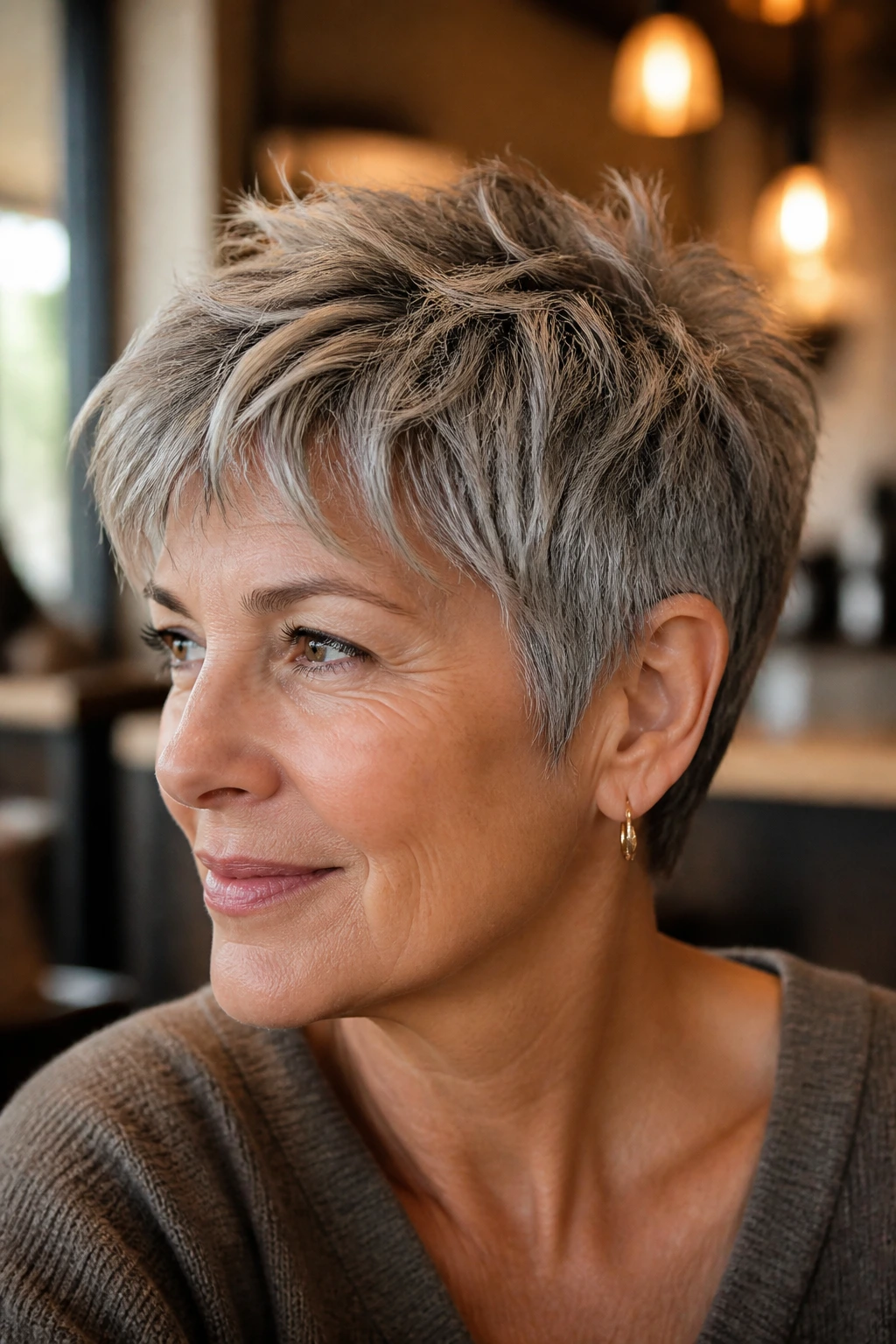
Taupe gray is the peace treaty between warm and cool. If pure ash makes your face look washed out and warm beige feels too golden, taupe lands in the middle and keeps the whole cut grounded. On short gray hair, that balance is gold.
This shade is especially useful on crops with lots of texture, because the neutral tone doesn’t compete with the styling. A spiky pixie, a shaggy bob, or a softly shattered crop can all handle taupe gray without looking overdesigned. The color quietly supports the haircut instead of stealing the show.
The best taupe blends usually include a soft beige base, a touch of ash, and enough gray gloss to prevent warmth from taking over. That mix sounds fussy, but it reads simply on the head: calm, soft, and grown-up without being stern. If you’ve ever seen gray hair turn too blue or too yellow, taupe is the shade that sidesteps both mistakes.
14. Icy Silver Shag
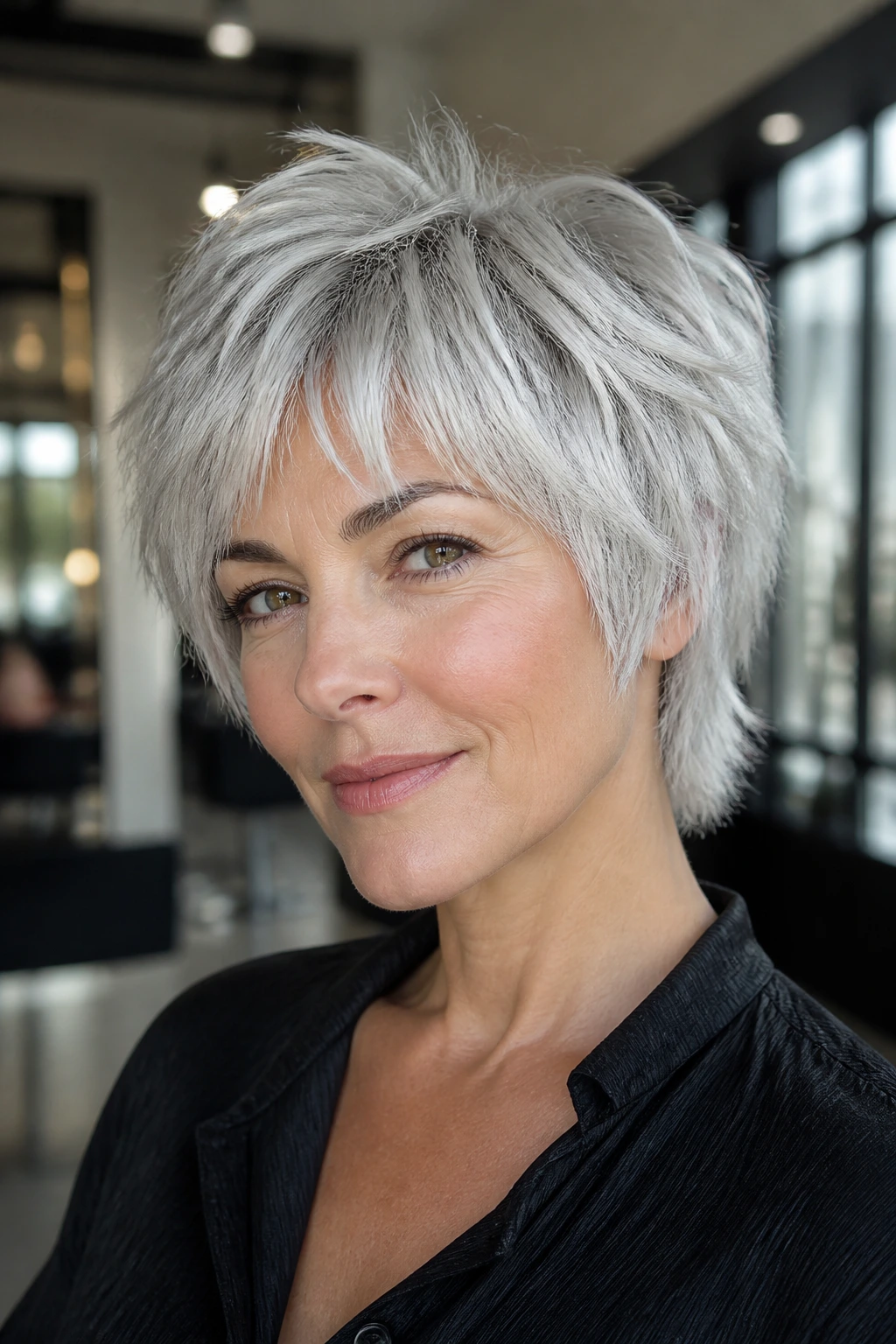
What makes an icy silver shag work is the texture. The shag already gives you broken layers, piecey ends, and a slightly undone shape. Add a pale silver tone, and every layer starts catching light in its own way. The result is less “polished helmet” and more sharp, feathery movement.
The right texture matters here
This look needs separation. If the hair is blown out too smooth, icy silver can look too hard. A little bend through the layers keeps it alive. On short shag cuts, especially those with a fringe, the silver should follow the shape of the cut rather than sit on top of it.
A cool toner with a silver base works best, but don’t overdo the ash. Too much ash can make the layers look dusty instead of icy. I’d keep the roots slightly deeper, the mids bright, and the ends a touch diffused. That gives the shag that broken, airy finish people are usually after when they choose this cut in the first place.
This one is for someone who likes their hair a little wild. Not messy. Wild.
15. Charcoal-to-Silver Ombre Bob
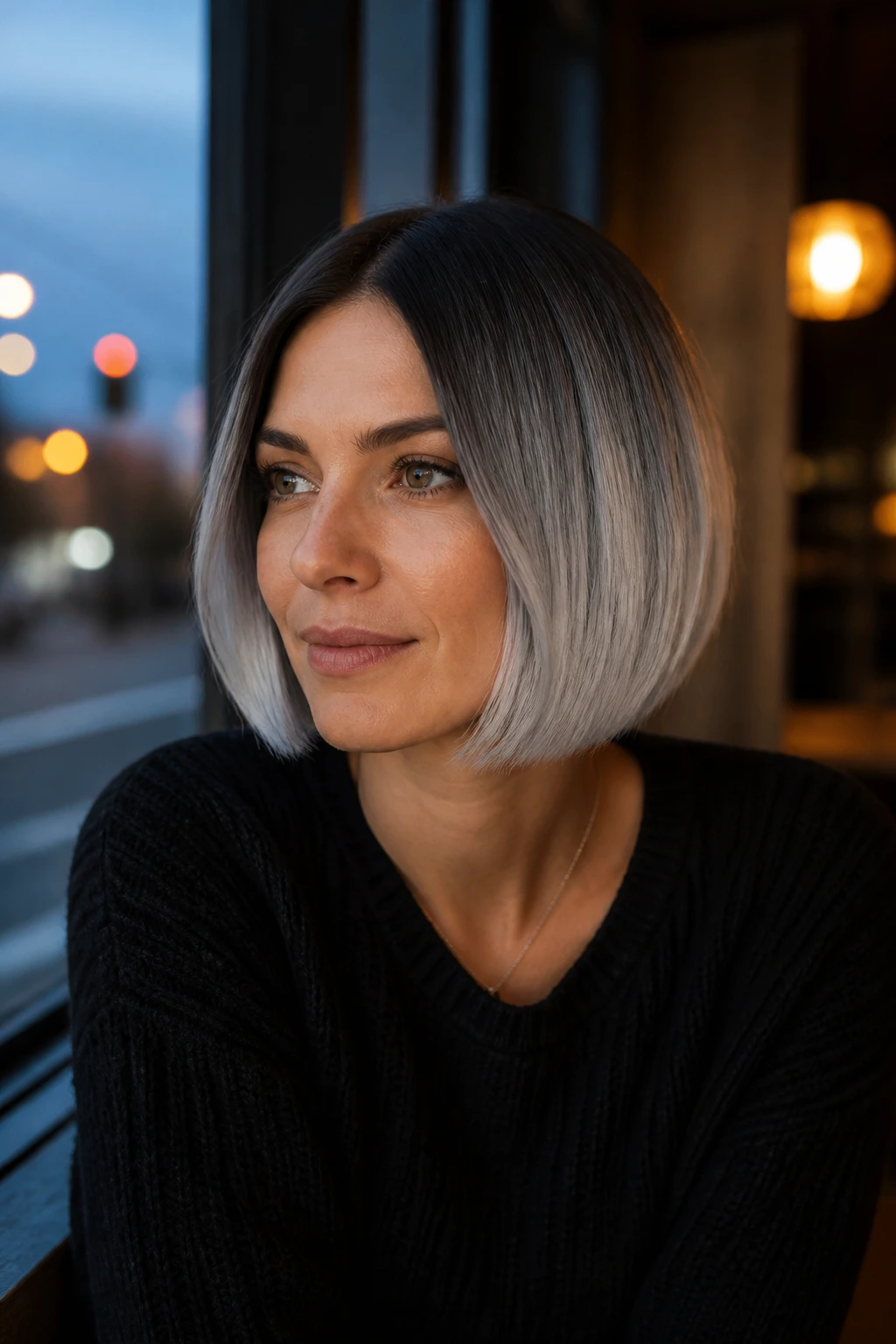
A charcoal-to-silver ombre bob gives short hair a clear beginning and end without looking too forced. Darker at the roots and crown, brighter through the mids and ends, it makes a blunt bob feel longer and a layered bob feel lighter. The gradient is the whole point.
This is one of the more forgiving gray color ideas if you want dimension without frequent root touch-ups. The dark charcoal root hides regrowth well, and the silver ends keep the cut bright. The transition should be smooth, not banded. If the line between dark and light is obvious, the whole thing loses its polish.
The best versions use a cool neutral charcoal at the top and a pearly silver at the ends. That contrast is strong enough to show shape but soft enough to stay wearable. On a bob that barely brushes the jaw, the ombre can make the whole haircut look more intentional, especially if the ends are slightly beveled inward.
16. Soft Smoky Rose-Gold Gray
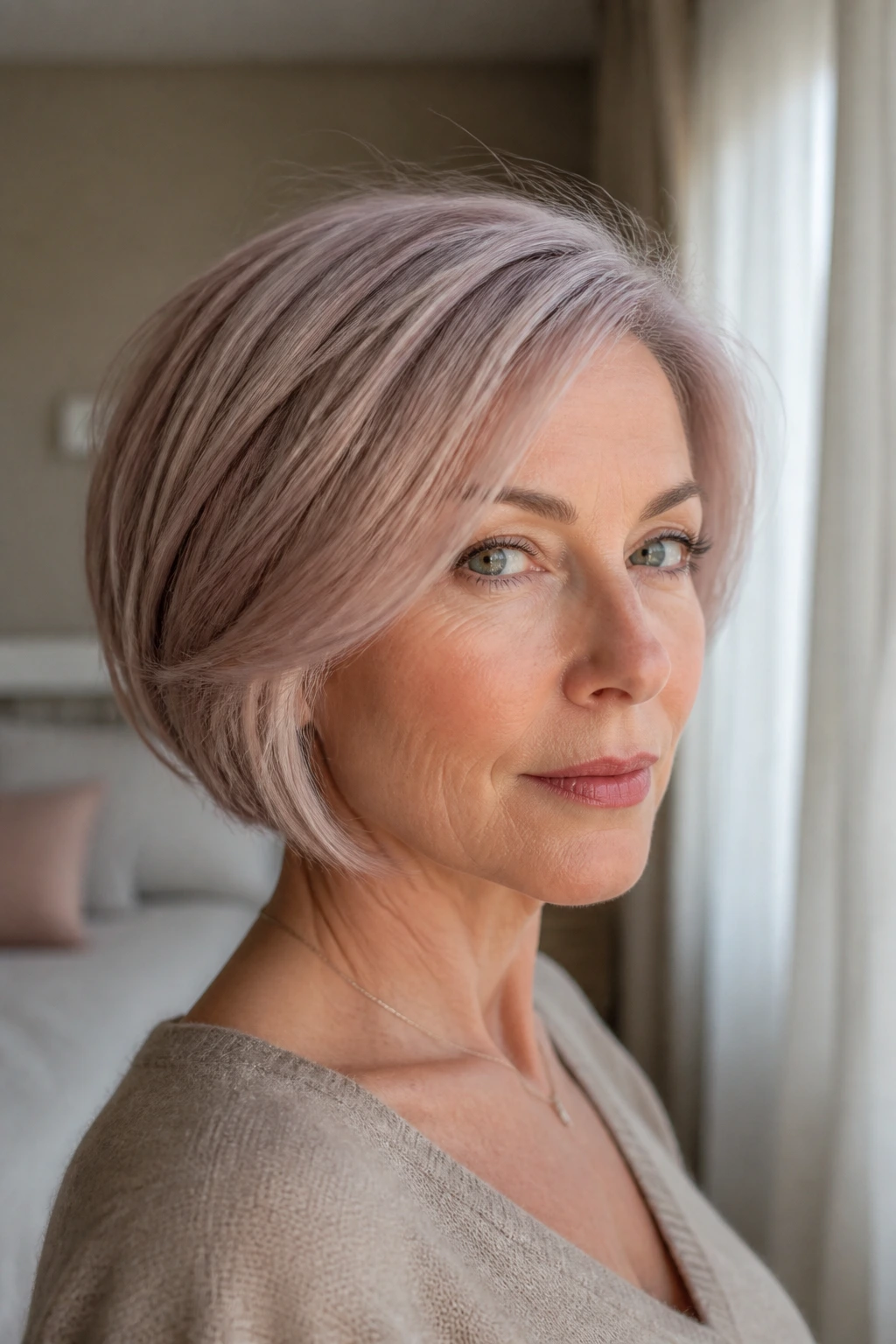
Smoky rose-gold gray sounds like it should be loud. It isn’t, if you keep the pink underlayer muted and dusted with gray. On short hair, that faint warmth can be a lifesaver if pure silver pulls your face too cool or too sharp.
The trick is to avoid peach. Peach makes the whole thing drift warm-fast, and warm-fast usually means brass by week three. A smoky rose-gold finish uses a very soft pink-beige glaze over a silver base, so the color catches the light with a blush tone instead of a candy tone. It can look especially good on short bobs and crop cuts with soft ends.
This is a nice choice if you want gray hair color ideas that still feel feminine or a little softer around the face. The rose note shouldn’t jump out. It should appear the way a shell pink glaze does on ceramic — barely there, but enough to change the mood.
17. Monochrome Salt-and-Pepper Crop
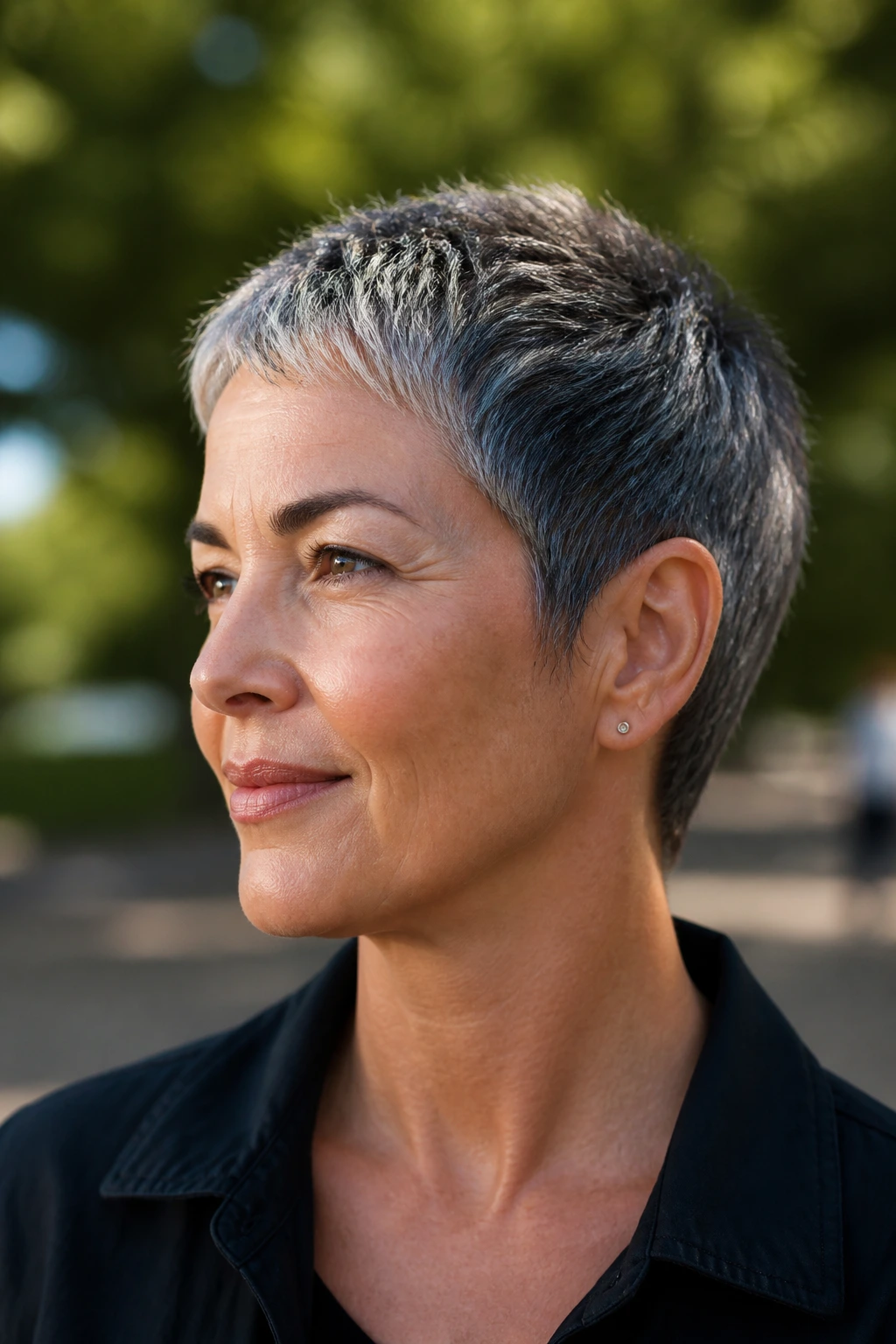
Sometimes the strongest move is not to cover the gray at all. A monochrome salt-and-pepper crop sharpens the natural pattern you already have, then cleans it up with placement, gloss, and a tidy cut line. It’s gray hair, yes, but edited.
This approach works because short hair makes natural contrast look deliberate. If your hair has silver at the temples, darker strands under the crown, and white around the front, a good crop lets those zones stay visible. A neutral gloss can deepen the dark pieces without killing the silver, which keeps the overall effect balanced rather than patchy.
I like this look when someone wants low maintenance but doesn’t want to look unstyled. A sharp nape, a clean perimeter, and a little shine product can make salt-and-pepper hair look like a design choice instead of a waiting room between color appointments. And frankly, that’s usually the more interesting option.
18. Bright Chrome Finish
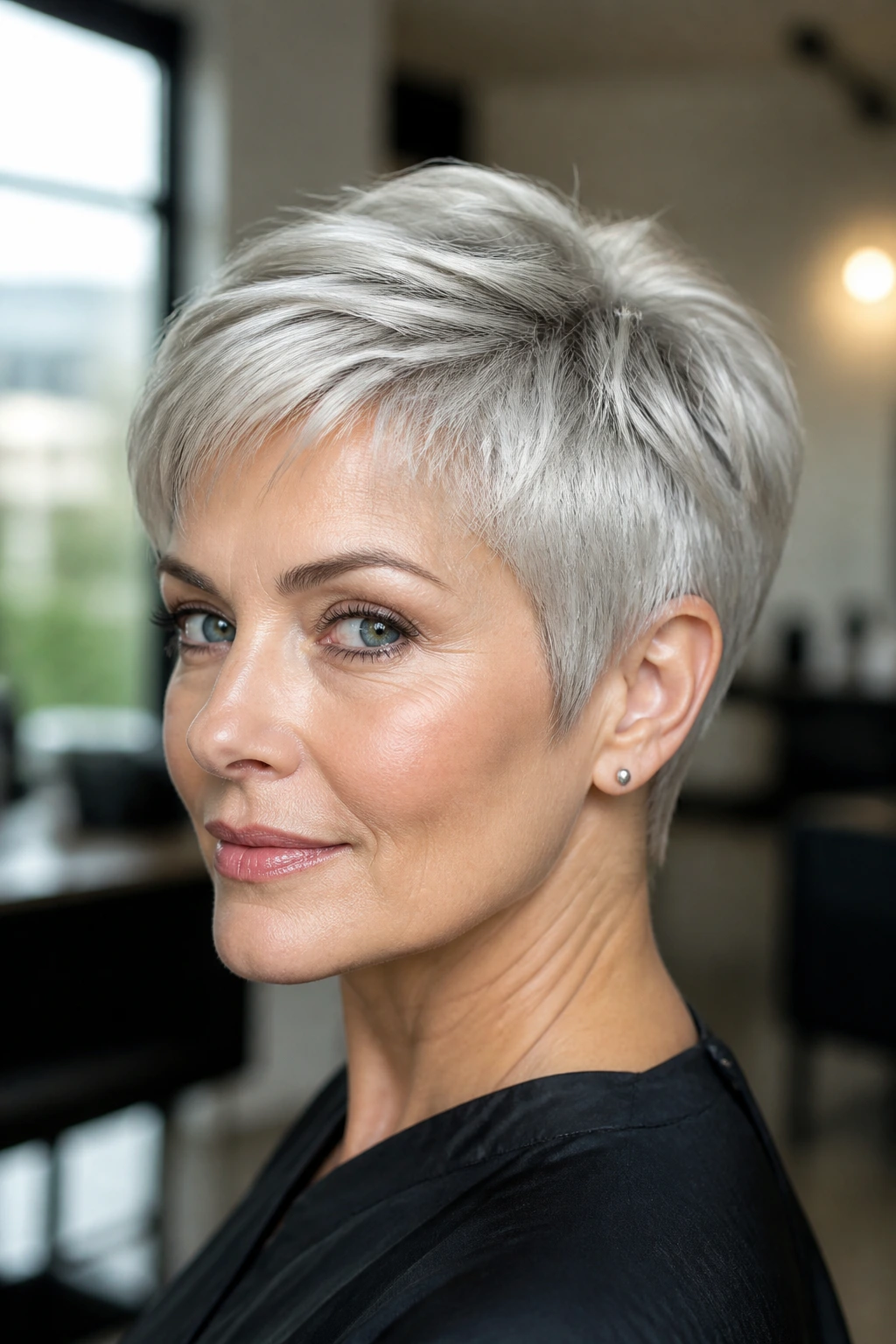
What if you want the sharpest silver possible? Bright chrome is the answer, but it asks for discipline. The finish should be reflective, metallic, and cool enough to look almost mirrored in strong light. On short hair, chrome can be spectacular because there’s so little length for the tone to hide in.
The shine is the point
Chrome gray depends on a clean blonde or naturally white base. Any leftover yellow will show, and it will show fast. The toner needs to be cool, but not purple-heavy. Purple can mute the chrome effect and push it toward lavender. You want shine, not haze.
This look works best on smooth cuts — a close pixie, a neat bob, or a precise crop with minimal frizz. The more chaotic the texture, the more the color breaks apart. That’s not necessarily bad, but it changes the effect. Chrome wants structure.
A good heat protectant and a smooth blow-dry matter here. So does a gloss refresh. Chrome is not the shade you ignore for three months and hope for the best.
19. Smoky Lilac Bob
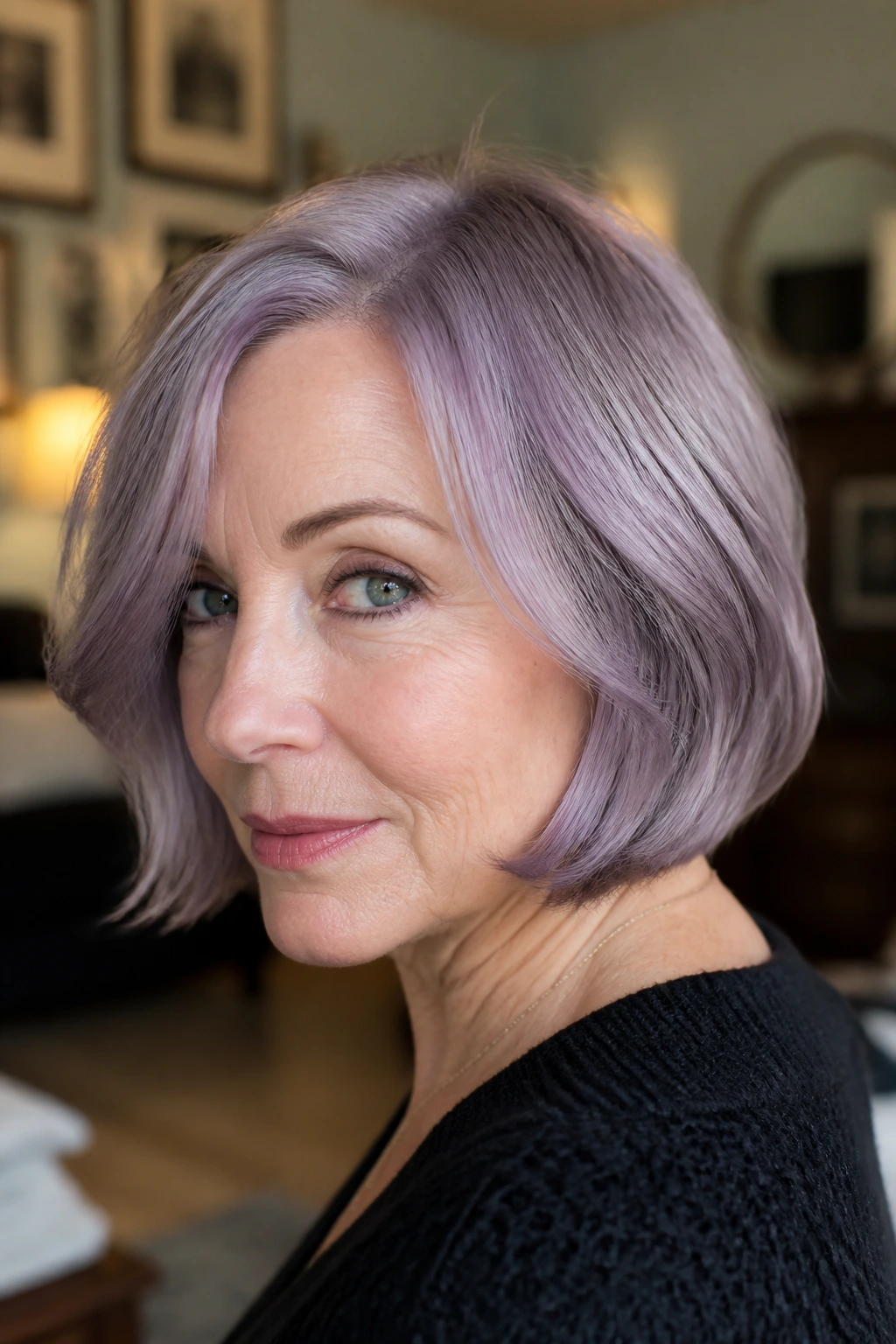
A smoky lilac bob sits between silver and mauve, which makes it one of the most charming gray-adjacent looks for short hair. It feels softer than a blue-gray finish and less serious than pure pewter. On a bob, that little hint of lilac can bring out movement in the cut without making the color look juvenile.
This shade works best when the lilac stays dusty and subdued. If the pink side takes over, the gray disappears. If the gray takes over, you lose the lilac mood. The balance is delicate, but on a short bob the payoff is strong because the shape already gives the color enough structure.
I like it with a slight bend through the ends and a side part or off-center part. That keeps the color from reading too uniform. Under soft indoor light, the lilac can nearly vanish, which is part of the charm. Then sunlight hits it and the whole cut changes tone by a half step.
20. Graphite Underlights
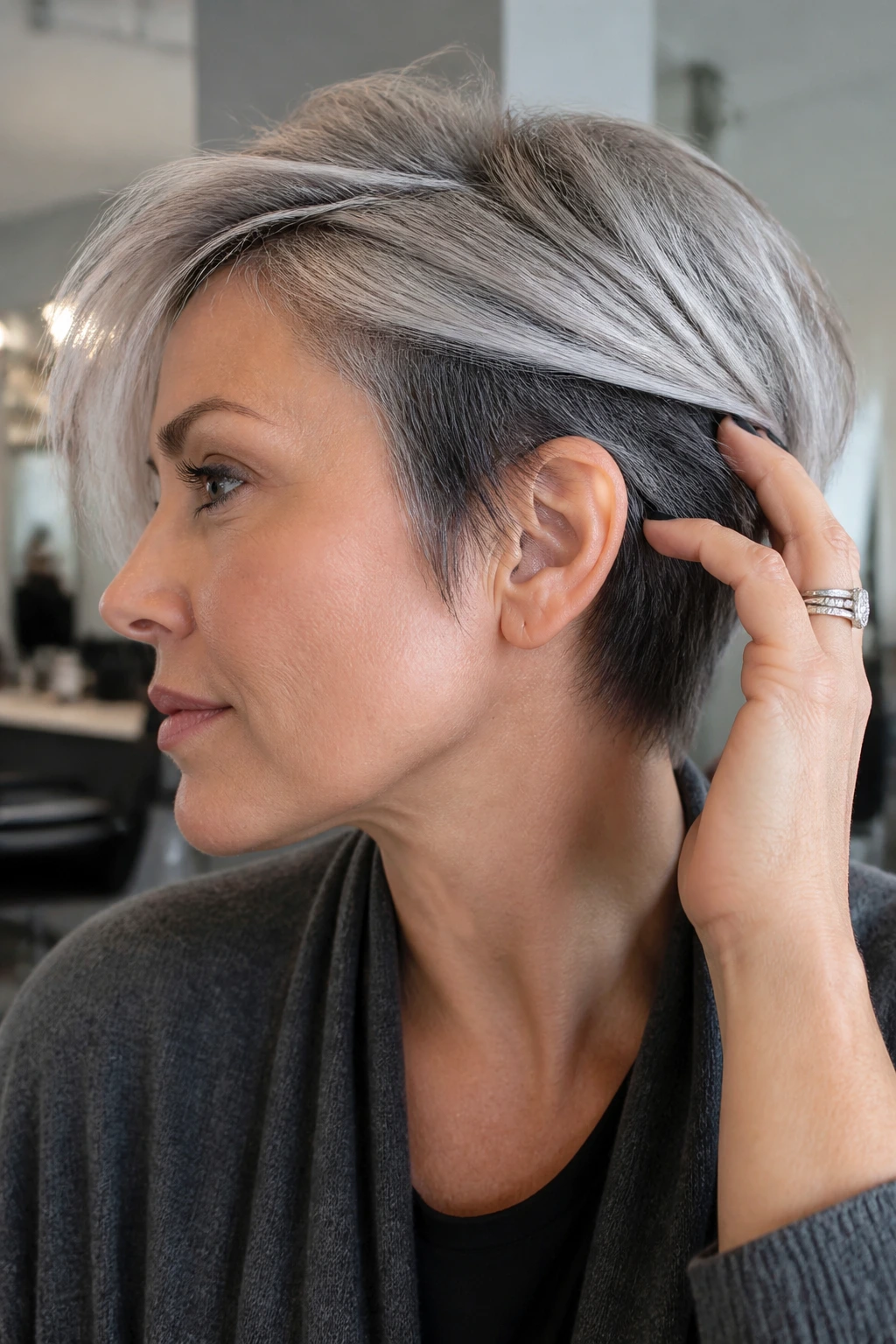
Graphite underlights are for people who want movement hidden in the haircut instead of painted all over the top. The upper layer stays lighter, silver, or natural gray, while the underlayer takes on a deeper graphite tone. On short hair, that hidden contrast becomes visible every time the hair tucks behind an ear or flips at the nape.
This is one of the easiest ways to add depth without making the style look busy. Because the darker tone sits underneath, it doesn’t compete with the skin or the fringe. It just gives the cut a shadow line. A pixie with graphite underlights looks more substantial. A bob looks more layered. A shag looks more broken-up in the best sense.
The key is keeping the graphite cool and soft, not inky black. If it’s too dark, the hidden panel looks like an accident. Graphite should feel like a shadow, not a stripe.
21. Cool Beige with Silver Ends
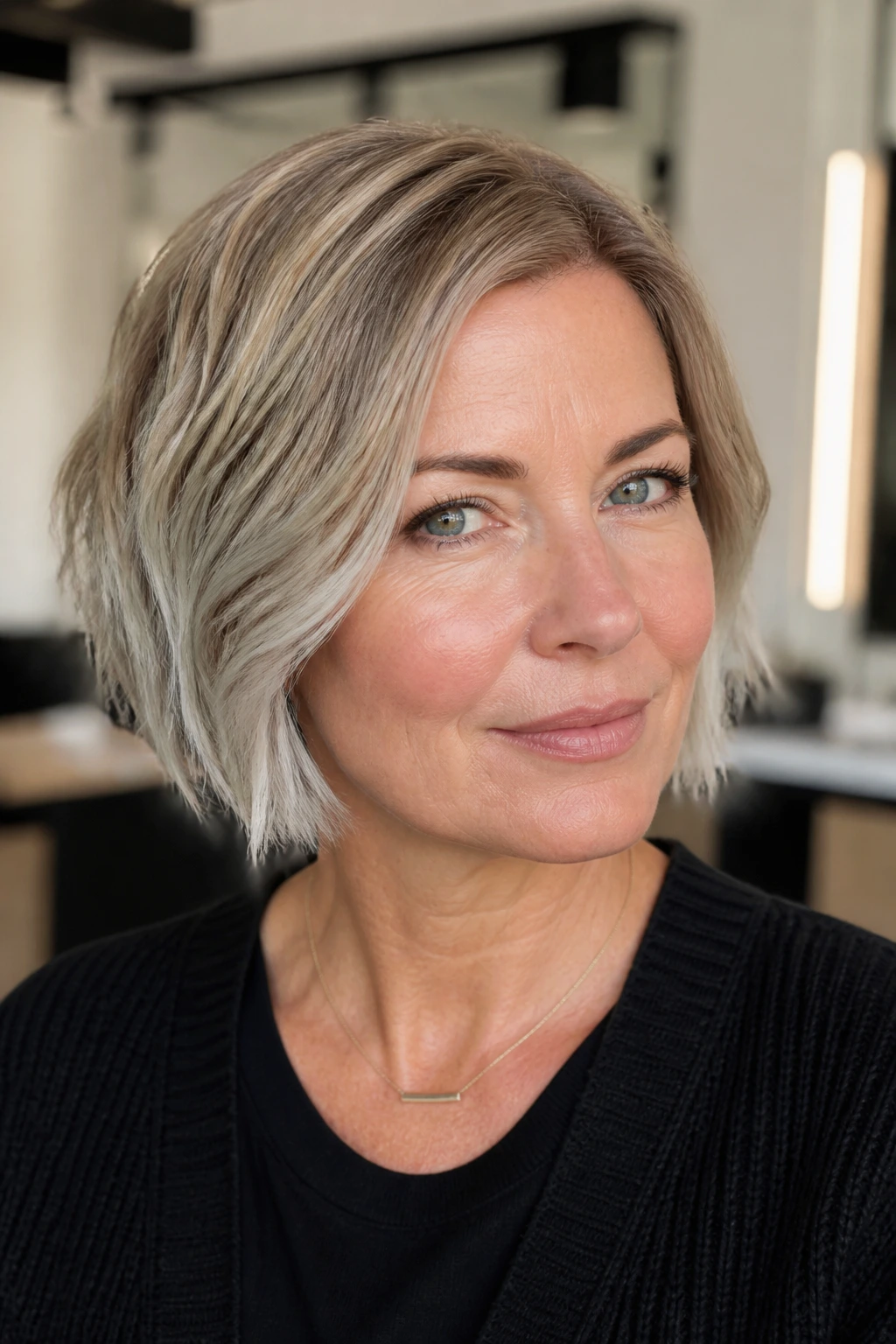
Cool beige at the top and silver at the ends gives short hair a gentle fade without the drama of a full ombre. It’s a nice middle ground for anyone who wants dimension but not a sharp color contrast. The beige keeps the base soft, while the silver ends sharpen the perimeter of the cut.
This idea is especially good on short layered bobs and crops with airy ends. The silver at the tips makes the haircut look light and fresh, while the cooler beige near the roots keeps the whole thing grounded. That balance matters on short hair, where too much lightness can make the style puff out visually.
If you want low-fuss upkeep, this is one of the better choices in the bunch. The root area doesn’t scream when it grows, and the silver ends can be refreshed with a glaze rather than a full service. It’s practical without looking plain. That’s a nice combination.
22. Dimensional Pewter Balayage
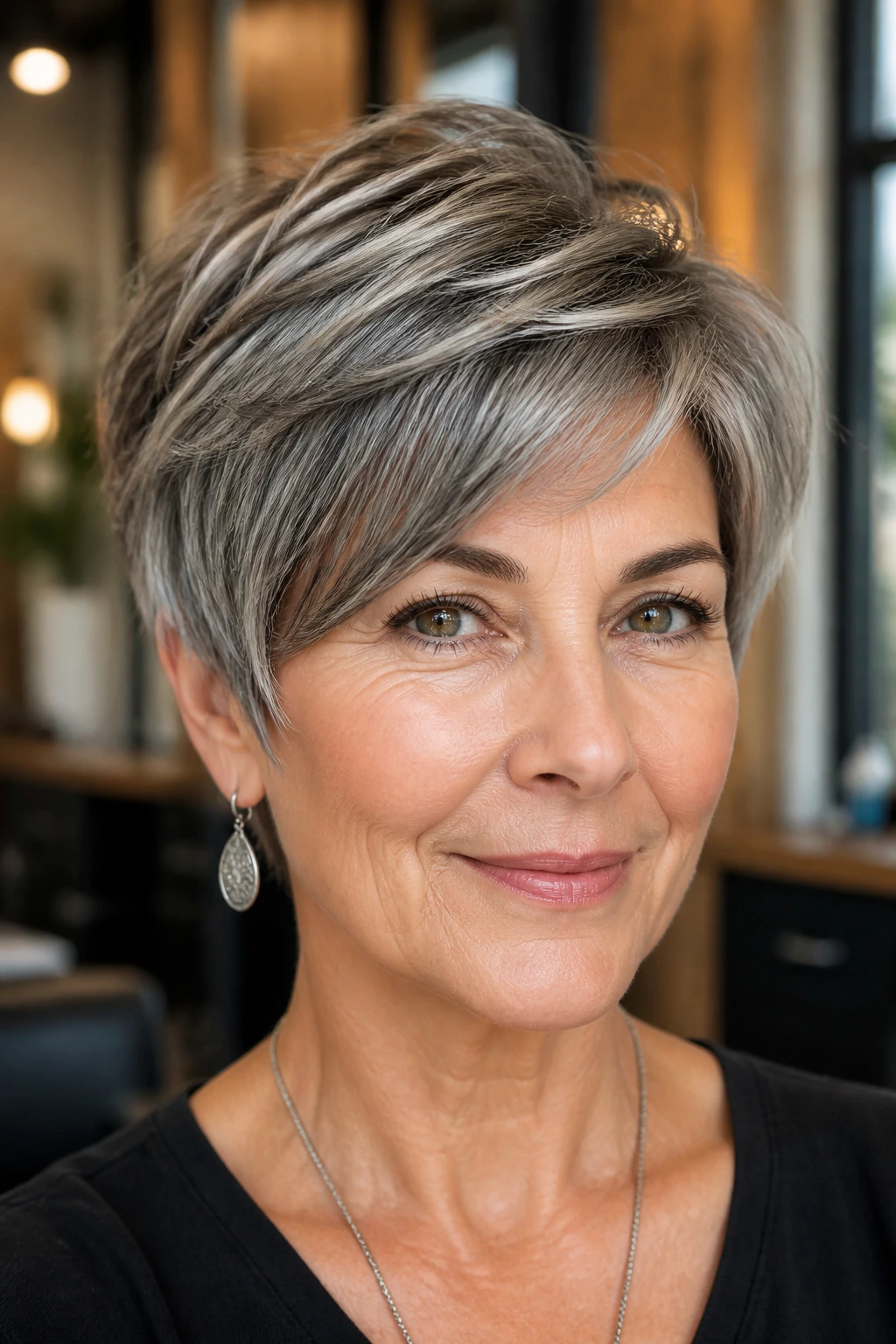
Pewter is the shade that sits between metal and stone. Dimensional pewter balayage gives short gray hair that same feeling — cool, textured, and a little industrial, but still soft enough to wear every day. The balayage placement keeps the color from looking stamped on. It sits where light would naturally hit the cut.
What to ask for
Ask for multi-tonal cool gray ribbons with a soft shadow at the root. That usually means the colorist will mix a couple of similar cool shades instead of relying on one toner. On short hair, that small difference matters. Pewter can go flat if every section is identical.
This look suits people who want visible gray without the icy brightness of platinum or chrome. The finish is quieter, but it still reads rich because the tones move against each other. It’s one of those shades that looks even better when the haircut has texture — a choppy bob, a short shag, or a layered crop with a little movement around the ears.
Pewter is a little underrated. It does not scream for attention, and that’s exactly why it works.
Why Short Gray Hair Likes Dimensional Color More Than Flat Dye
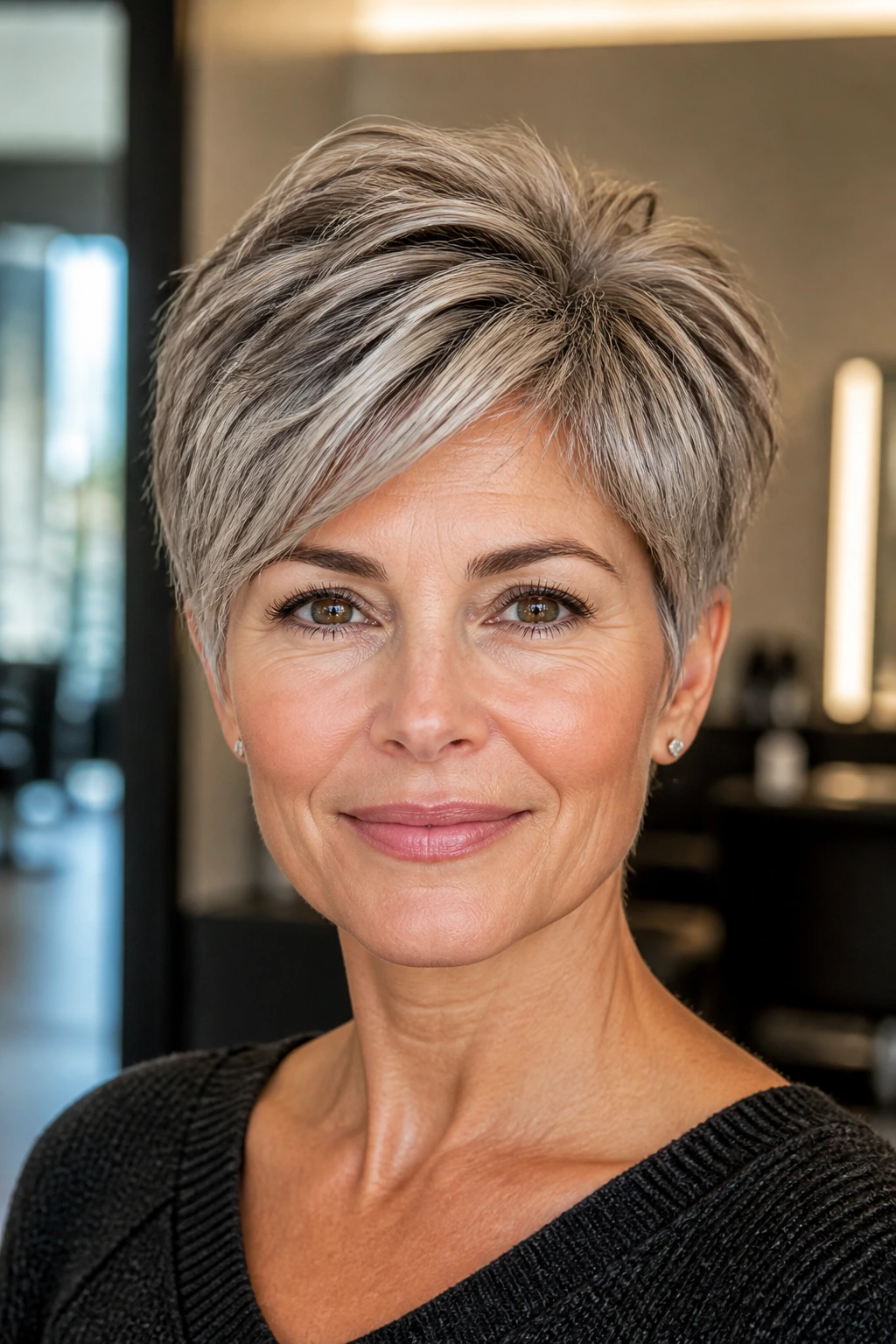
Short gray hair shows every choice you make. Every one. A flat, single-process gray can look tidy on day one, then start to feel heavy because the cut itself can’t carry all that pigment without help. Dimension fixes that. It gives the eye places to travel: root to mid-length, front to back, top to nape.
Gray strands also behave differently from darker pigmented hair. Some grab toner fast. Some resist it. Some go porous and hungry for pigment, while others barely shift. That’s why a dimensional approach is safer and usually prettier. If one strand takes a little more ash than its neighbor, the whole head still looks intentional because the tones are meant to vary.
Short hair benefits even more from this because the color sits close to the face. A few millimeters of tonal change at the crown can change the whole mood of the cut. That’s not true to the same degree on long hair. Short cuts are blunt about everything.
Essential Equipment for These Looks
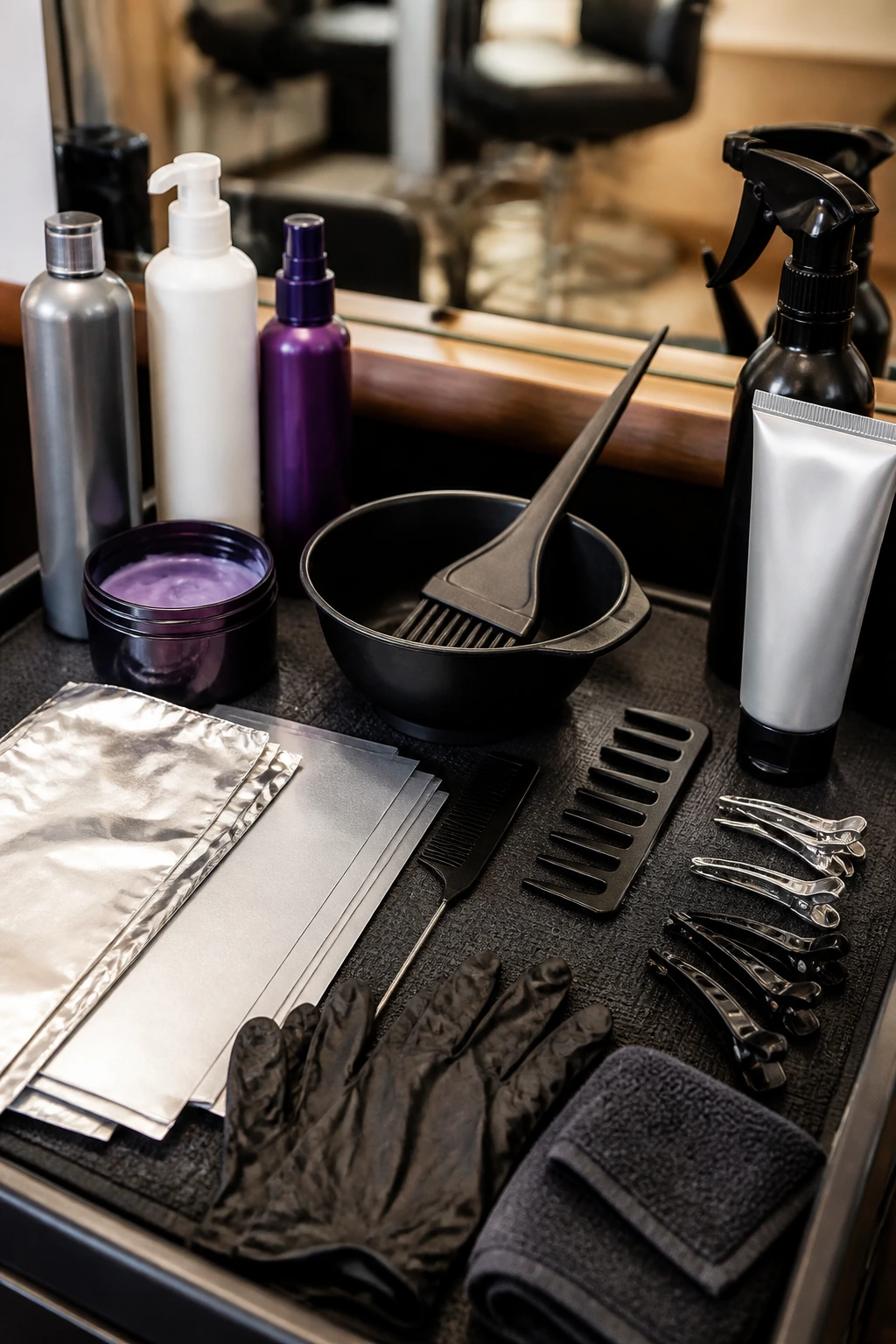
- Tint brush and mixing bowl: You need these for controlled toner or gloss application, especially around the hairline and nape.
- Sectioning clips: Short hair still needs clean sections, and clips stop the crown from getting over-saturated.
- Fine-tooth tail comb: Useful for slicing micro-lights, placing money pieces, and keeping part lines tidy.
- Foils or balayage boards: Needed for highlighted or dimensional looks; boards help keep short pieces from slipping.
- Color-safe shampoo and conditioner: These keep gray, silver, and ash tones from fading too quickly.
- Purple or silver depositing mask: Best for maintaining icy, pearl, or platinum finishes without a full salon visit.
- Heat protectant spray: Short gray hair can be dry at the ends, and heat makes the problem worse fast.
- Wide-tooth comb or detangling brush: Gentler than a regular brush when the hair is fresh off a toner or gloss service.
- Lightweight styling cream or paste: Helps separate pixies, shags, and cropped bobs so the color shows its dimension.
- Gloves and old towel: Useful for at-home glossing or toning; gray and silver pigments stain faster than people expect.
Smart Product Choices for Gray and Silver Hair
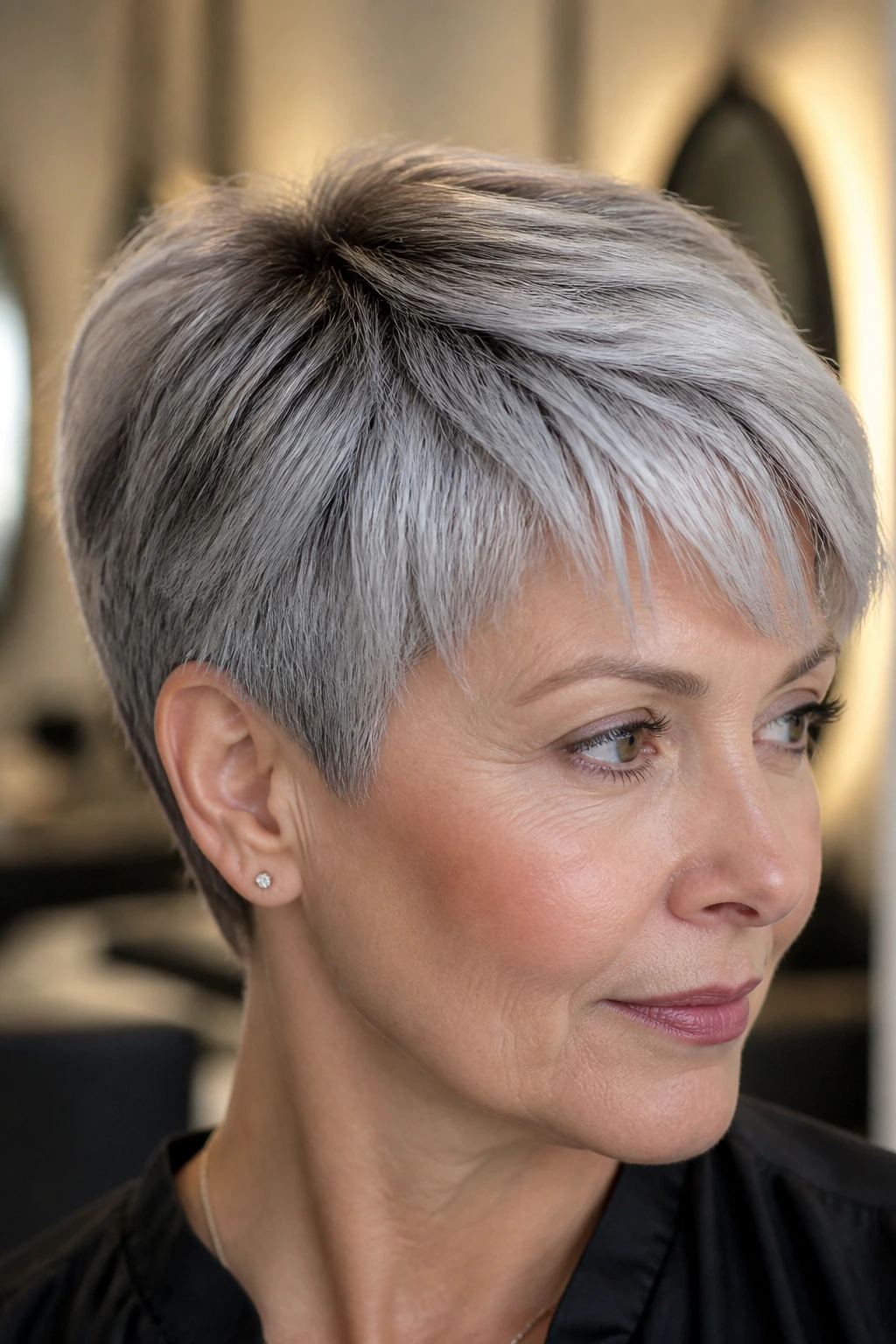
The product aisle can be noisy. Ignore the marketing gloss and look at three things: deposit level, tone, and how much maintenance you actually want to do. A demi-permanent gloss is often the best friend of short gray hair because it adds tone without turning the cut into a block of color. It fades cleaner than many permanent shades, which matters when the haircut is short and regrowth shows fast.
If your goal is silver, pearl, or chrome, pick cool-toned products with violet or blue-violet bases. Those tones help cancel yellow, which is the enemy of crisp gray. If your hair skews porous, don’t pile on heavy pigment all at once. Short hair can grab too much color near the ends and look muddy. One softer gloss is usually better than two aggressive ones.
For natural gray blending, look for neutral or ash-beige formulas rather than flat silver. The difference sounds small, but it isn’t. Neutral ash tends to look softer against skin and gives short cuts a more believable finish. If your hair is coarse, a bond-building treatment before toning can help the strands take color more evenly. That’s one of those boring steps that pays for itself.
And yes, a good purple shampoo helps. Once a week is plenty for most people. Too much and the hair can start looking dull, dry, and faintly lilac in the wrong way.
How to Wear These Shades So the Cut Does the Talking
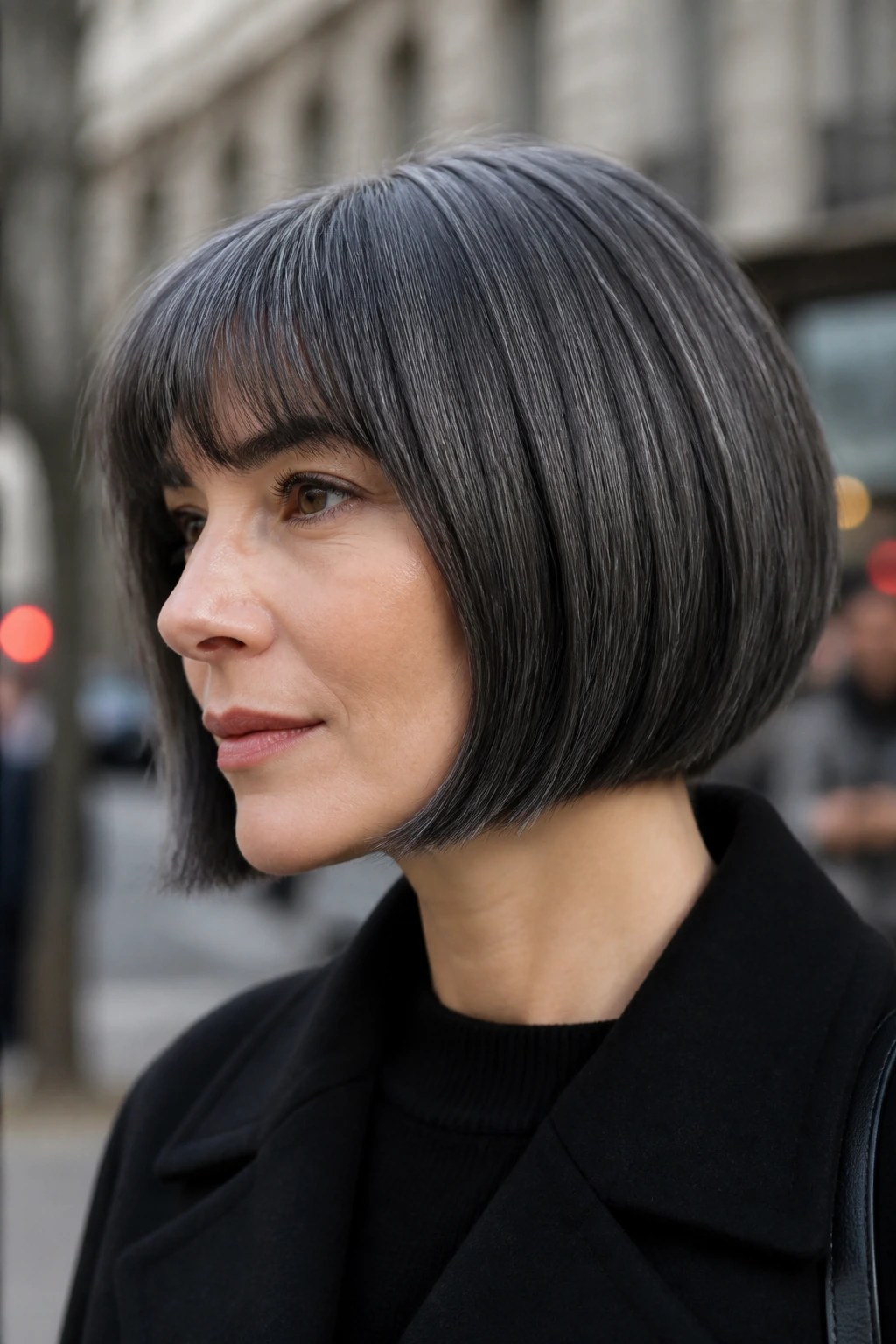
Shape: Short gray hair looks best when the cut and the color agree with each other. A blunt bob likes charcoal, chrome, and pewter. A shag likes icy silver, denim gray, and smoky lilac. A pixie usually looks strongest with a root shadow or micro-dimension so the crown doesn’t go flat.
Texture: If the color is bright and reflective, keep the styling smooth and deliberate. If the color is smoky or muted, let the texture break up a little. That contrast matters. A stiff, over-styled silver crop can look too formal, while a soft, tousled pearl bob can look unfinished if the ends are frayed.
Wardrobe: Cool grays love black, white, navy, charcoal, and deep green. Warm beige-gray blends sit nicely with cream, camel, and soft brown. You do not have to match your clothes to your hair, but you should know when the hair is already doing the cooling or warming for you. That makes getting dressed easier.
Makeup: On a bright silver or platinum finish, a bit more brow definition and a warmer lip can stop the face from disappearing. On taupe or mushroom gray, a soft brown liner and neutral blush usually look better than anything shiny. Small changes. Big payoff.
Additional Tips and Color Boosters
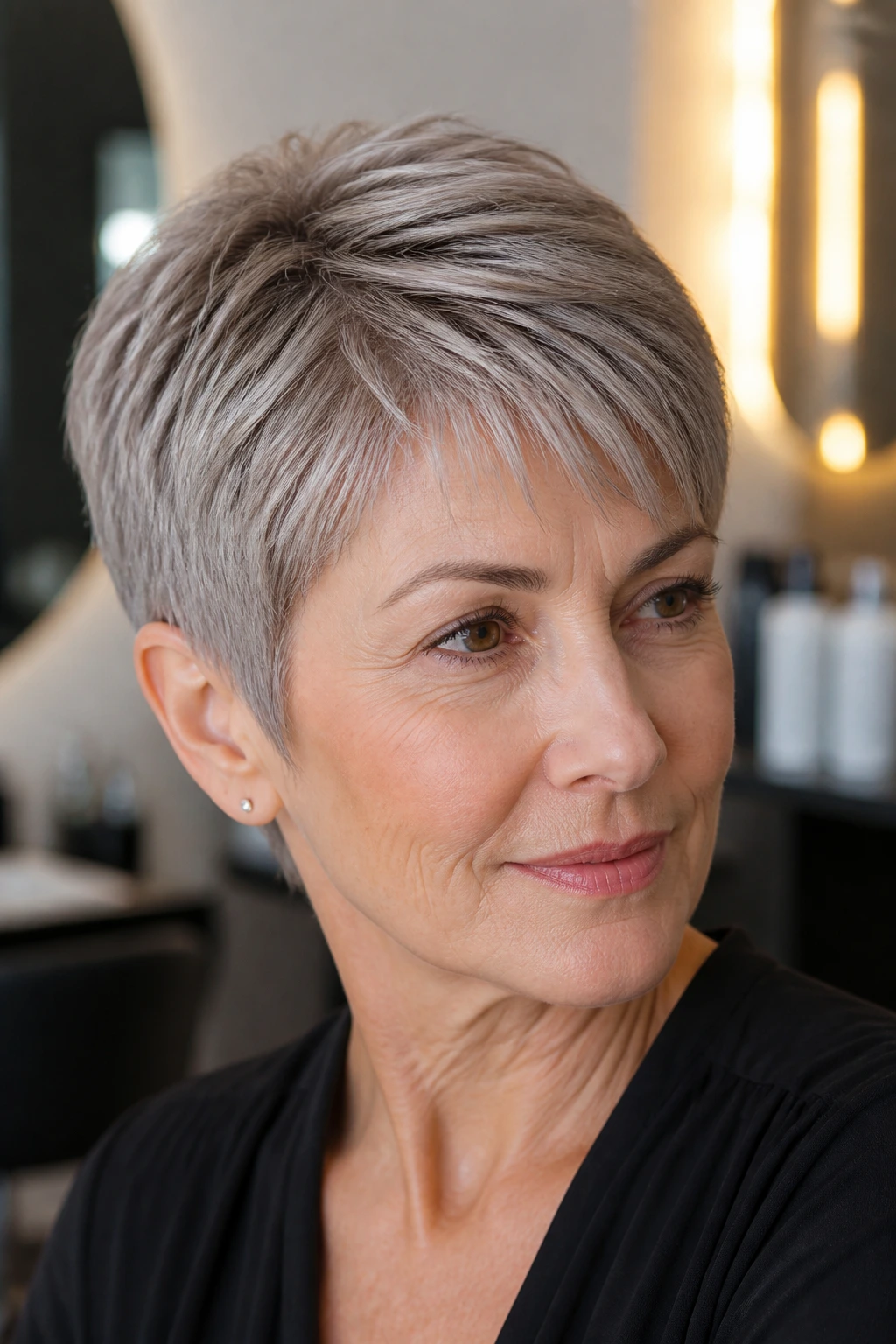
Tone Saver: If your silver, pearl, or chrome finish starts looking yellow, don’t panic and don’t overcorrect with heavy purple shampoo every wash. Use a cool depositing mask once, then step back and let the tone settle. Over-toning makes short hair look dusty.
Depth Booster: Ask your colorist for a shadow at the part and crown if the cut looks too “helmet-like.” A root shade that’s just one level deeper can give a short gray crop much more shape.
Softness Move: For mushroom, taupe, and ash beige looks, a clear gloss between color services can add shine without darkening the tone. That’s useful when you want the gray to stay airy.
Edge Move: If the haircut feels too polite, add one stronger zone — a money piece, underlight, or peekaboo panel. One focused contrast can do more than flooding the whole head with brightness.
Make-It-Yours: If you love warmth, keep the gray anchored with beige or taupe. If you love drama, go charcoal, chrome, or gunmetal. If you want the least maintenance, choose a root shadow or a natural gray blend and let the grow-out work for you instead of against you.
Maintenance, Refreshes, and Grow-Out
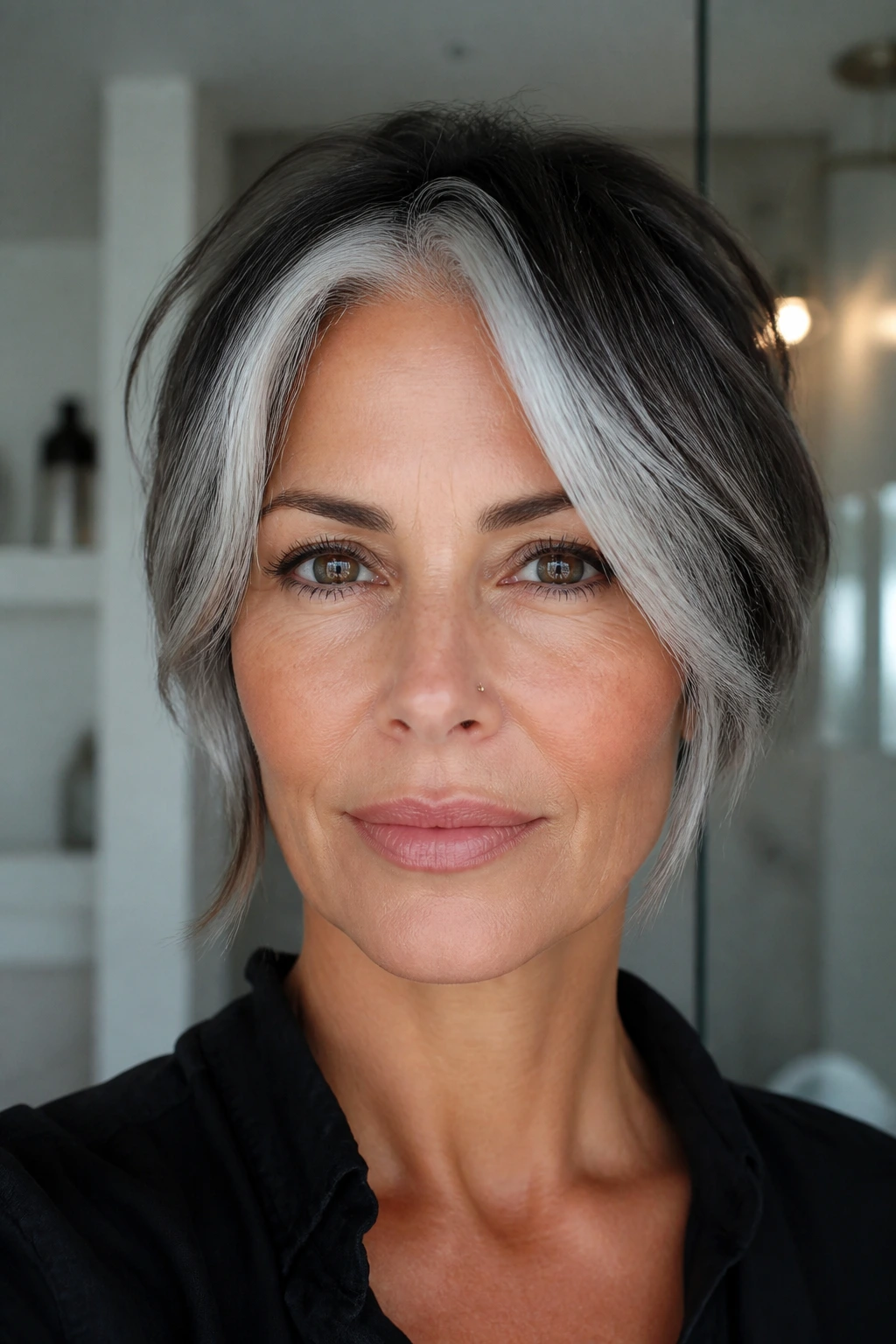
Short gray color lives or dies by upkeep. The good news is that short hair usually needs less product and less time to dry, but the bad news is that it also shows fading fast. A silver gloss can start to soften after 4 to 6 washes, especially if your water is hard or your shampoo is too strong. If you’re using a vivid silver, chrome, or lilac finish, plan on a refresh every 3 to 5 weeks to keep the tone clean.
For root touch-ups on darker gray blends, 4 to 6 weeks is a sensible rhythm. If you’re wearing a natural gray or salt-and-pepper look, you can stretch that much longer and just refresh shine with a clear or neutral gloss. Don’t shampoo the hair right after coloring unless your stylist tells you to. Waiting 48 hours gives the cuticle a chance to settle.
Heat is another thing to watch. Flat irons and hot brushes can dull silver and turn pale ash into tired beige if you use them daily without protection. A lightweight heat protectant every time makes a difference. So does using cooler water on rinse day. Not ice-cold. Just not scorching.
If you’re maintaining a bright finish at home, use a purple or blue-violet conditioner once a week, not at every wash. More is not better here. More often just means more buildup, and buildup is the enemy of shine.
Variations and Adaptations to Try
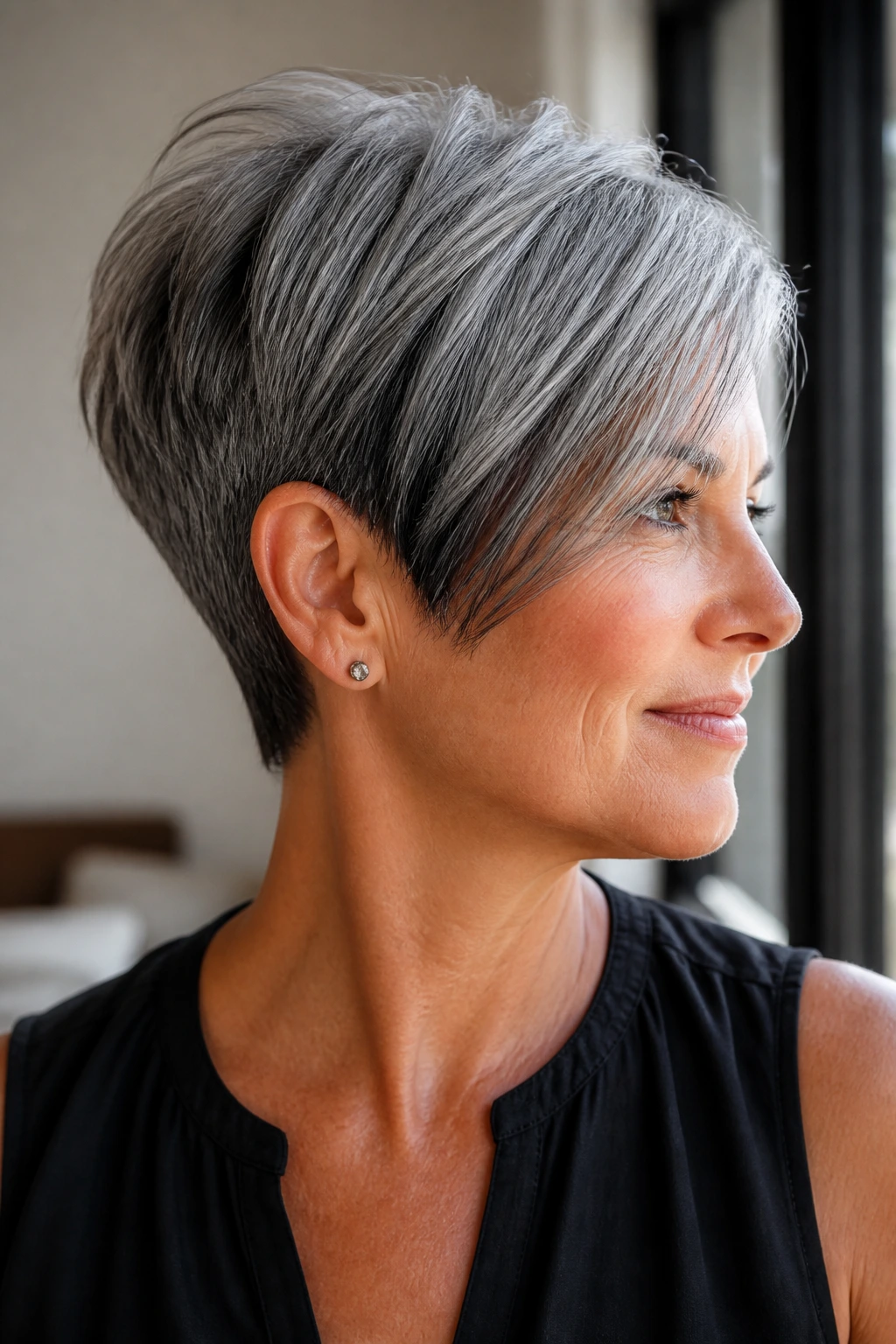
Low-Maintenance Rooted Gray: Keep the crown deeper and let silver brighten through the mids and ends. This is the easiest version to live with if you hate obvious regrowth.
High-Contrast Chrome: Push the ends much lighter and the roots much deeper for a sharper, more graphic look. Best on precise bobs and pixies with strong lines.
Warm-Neutral Taupe Blend: Swap icy toner for ash-beige and taupe pieces. This works well if cool silver tends to make your skin look flat.
Color-Boosted Lilac Gray: Add a faint lavender glaze over a silver base for a softer, slightly playful finish. Keep the lilac dusty, not pastel.
Natural Gray Enhancement: Instead of covering the gray, deepen the darker strands and brighten the silvers with gloss. This is a smart route if you like salt-and-pepper but want it cleaner and more intentional.
Hidden Dimension Version: Use underlights or peekaboo panels in graphite or gunmetal if you want depth that only shows when the hair moves. It’s a good choice for people who like quiet surprises.
Common Mistakes to Avoid
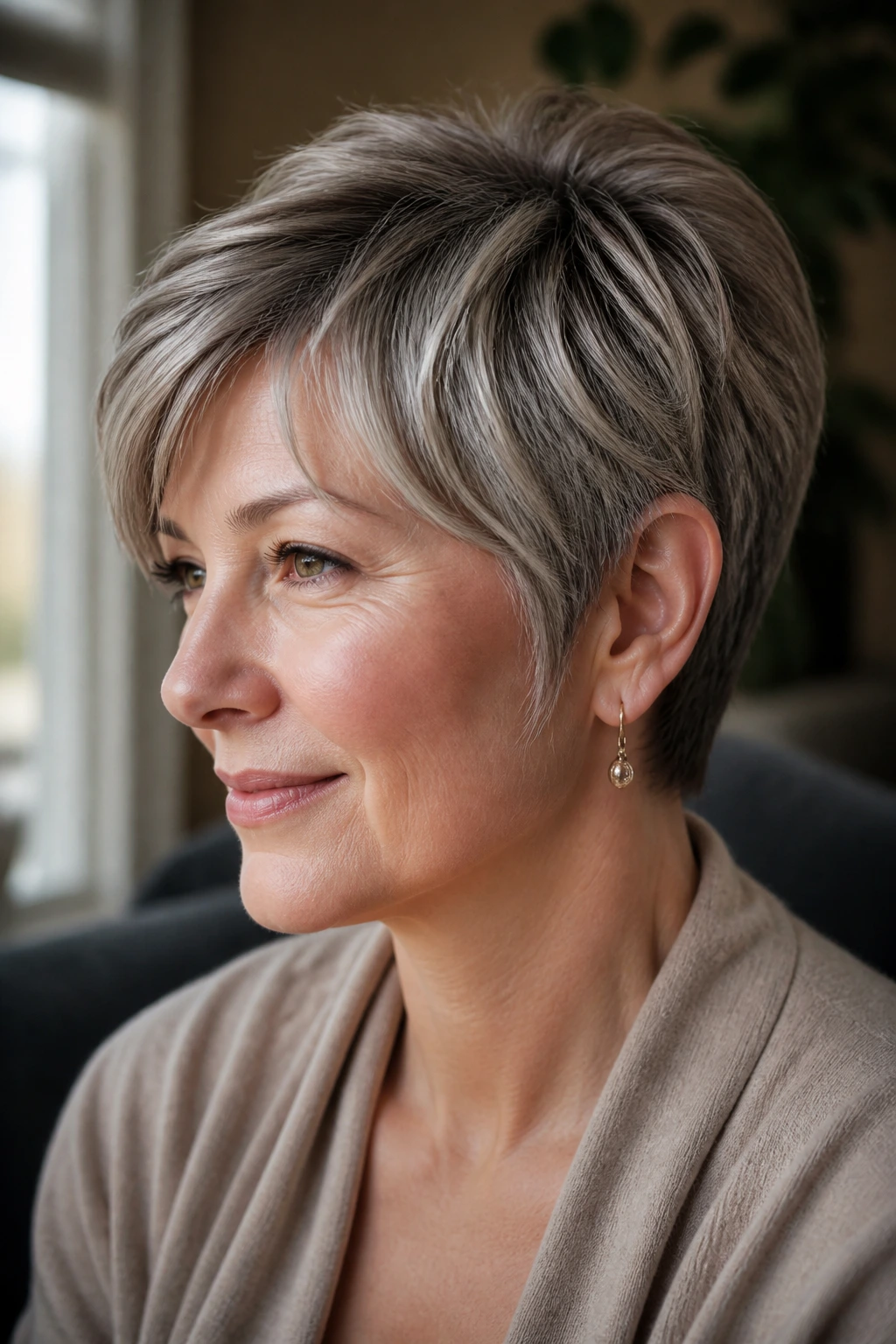
The first mistake is chasing one flat silver all over the head. On short hair, that often wipes out the shape and makes the cut feel heavier than it is. Ask for dimension, shadow, or placement so the hair still has movement.
The second mistake is over-toning. Purple shampoo, silver masks, and blue-violet glosses are useful, but they can stack up fast. If the hair starts looking dull, dusty, or faintly violet in a bad way, back off and use a clarifying wash before adding more pigment.
A third problem is choosing a shade that clashes with the haircut’s geometry. A very icy chrome finish on a fuzzy, over-layered crop can look scattered. A soft taupe on a razor-clean bob can look underpowered. Match the tone to the cut.
And then there’s the maintenance trap. Bright gray, silver, platinum, and lilac all fade faster than people expect, especially on short hair where the ends are exposed. If you want that crisp finish, you need a gloss schedule. If you don’t want a schedule, pick a rooted blend and save yourself the frustration.
Frequently Asked Questions
Can short gray hair be colored without bleaching?
Yes, if your goal is to deepen, soften, or blend rather than go bright silver or platinum. Demi-permanent glosses, root shadows, and neutral ash glazes often work well on natural gray without bleach. If you want a pale chrome or white-blonde finish, bleaching or pre-lightening is usually part of the process.
Which of these looks is easiest to maintain?
Mushroom brown-gray, taupe gray, and natural salt-and-pepper enhancement are usually the easiest. They grow out quietly and don’t ask for constant toner refreshes. Bright chrome, platinum fade, and silver lavender need more upkeep.
How do I keep gray hair from turning yellow?
Use a color-safe shampoo, protect the hair from heat, and add a purple or blue-violet conditioner once a week if needed. Hard water can also nudge silver tones yellow or dull, so a shower filter can help if your water leaves visible residue. Keep the frequency moderate; too much violet pigment can make the hair look flat.
Can these ideas work on coarse gray hair?
Absolutely, and coarse hair often holds these tones well once it’s properly prepped. The bigger issue is even saturation. A porosity equalizer or bond-building step before toning can help the color take more evenly from root to end.
What if my gray is patchy and uneven?
That’s where dimensional color shines. Root shadow, micro-lights, balayage, and gloss blends are better than one flat color because they work with the natural variation instead of trying to erase it. Patchy gray often looks best when it’s edited, not buried.
Can I do a silver look at home?
Some soft glosses and maintenance masks are manageable at home, especially on already light gray or blonde hair. Bright silver, chrome, and platinum are harder to control because they depend on a clean base and very precise toning. If you’re starting from darker hair, a salon service is the safer bet.
Will cool gray shades suit warm skin tones?
They can, but the tone needs a buffer. Mushroom, taupe, ash beige, and smoky rose-gray are usually kinder than very icy silver or blue-gray. A warmer blush lip or soft brown brow can help the overall look feel balanced.
How often should a short gray cut be refreshed?
For bright silver or pastel gray, plan on 3 to 5 weeks for a toner refresh. For rooted blends and neutral looks, 4 to 6 weeks is often enough. If the cut is growing out cleanly and the shine is still there, you can stretch it longer.
A Better Way to Wear Gray
Short gray hair doesn’t need to be hidden, corrected, or turned into a single flat shade. It looks better when the color respects the cut’s lines, the hair’s texture, and the way gray behaves in real light. That might mean chrome and pearl for one person, mushroom and taupe for another, or a simple root shadow that keeps a pixie from looking boxy.
The smartest short gray hair color ideas are the ones that keep the haircut alive from every angle. If you choose tone with the shape in mind, the result looks cleaner, softer, and far more intentional than a one-note dye job ever could. And once you start seeing gray as a material to work with instead of a problem to solve, the options get much more interesting.
