



Square faces have a kind of built-in drama. The jaw is strong, the cheek line is clean, and the whole shape looks confident before you even touch a mirror. That’s the good part. The tricky part is the same thing: the wrong fringe can sit on top of all that structure like a ruler laid across a table, and suddenly the face reads boxier than it really is. The best bang styles for square faces don’t fight the structure. They bend it, break it up, or pull the eye on a diagonal so the hard corners stop doing all the talking.
That’s why fringe choice matters more here than it does on a softer oval or a longer oblong face. You’re not trying to hide a square face. Please don’t. You’re trying to give it movement where the bones are straightest — across the forehead, at the temples, and right where the jaw starts to square off. A good bang shape can make a strong face look even more elegant. A lazy cut can make it look heavy, especially if the width runs too wide or the ends stop at the wrong point.
I’ve always liked bangs that feel a little alive on a square face. Not fussy. Not helmet-like. A bit of bend at the brow, a little air at the temple, maybe a curve that lands near the cheekbone and then gets out of the way. That’s the sweet spot. And once you know which line you want to soften — forehead, jaw, or both — the whole field gets much easier to sort through.
Why These Bangs Work on a Square Face
-
Diagonal movement beats straight lines: Bangs that sweep, split, or curve pull the eye across the face instead of letting it measure the width of the forehead and jaw.
-
Texture matters as much as length: A fringe with point-cut ends or a little separation looks softer than a dense, blunt shelf, even if the cut is short.
-
The best width is usually narrower than you think: A bang that starts a touch inside the temples keeps the face from looking wider at the top.
-
Cheekbone-length pieces do real work: Bangs that land near the cheekbones can make the jaw feel less square without hiding your features.
-
Density changes everything: Heavy fringe can be gorgeous, but on a square face it usually needs soft corners or a slight curve so it doesn’t feel too severe.
1. Soft Curtain Bangs
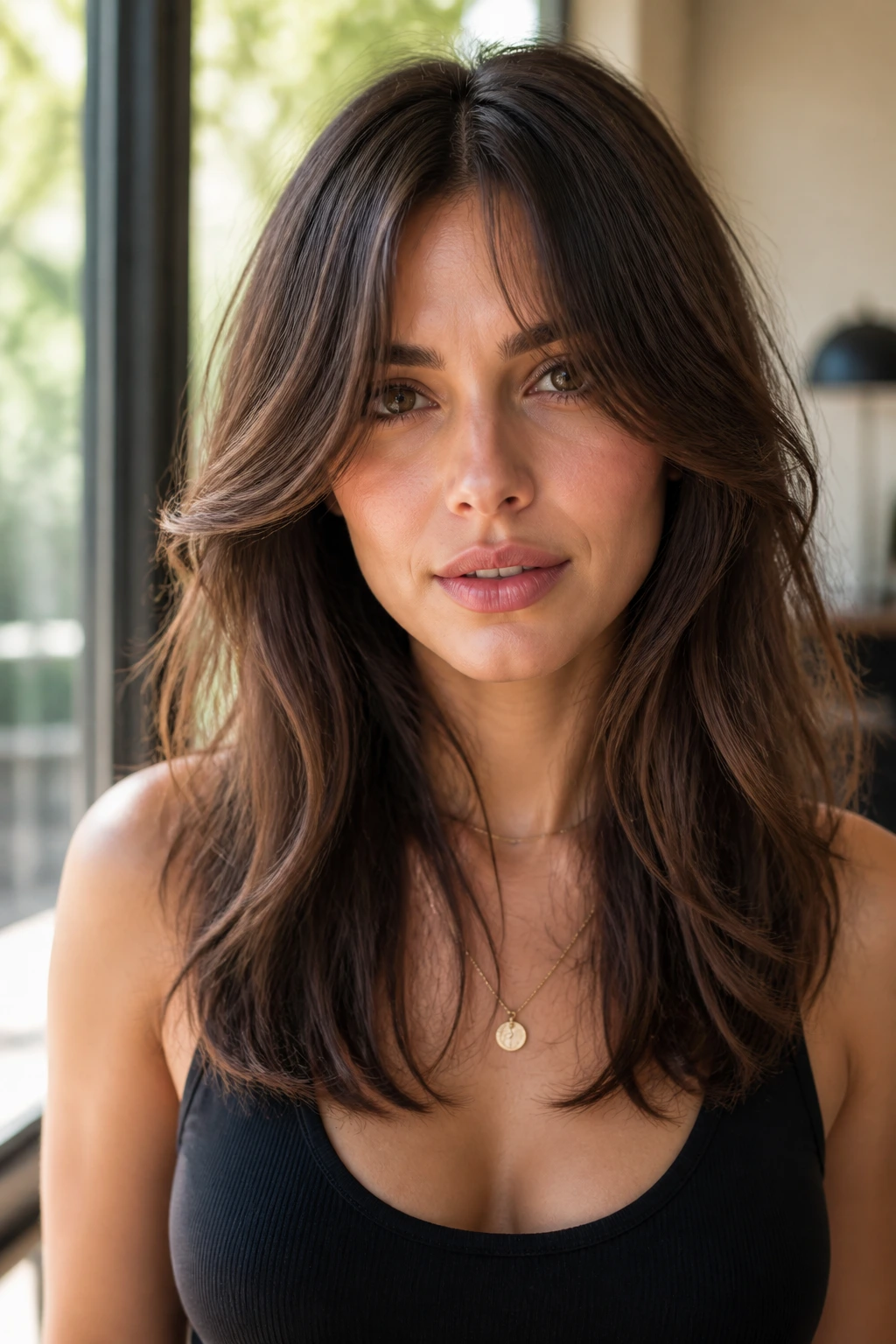
Soft curtain bangs are the easy favorite for a reason. They part in the middle, fall away from the face, and leave enough forehead showing that a square face doesn’t feel boxed in. The center stays lighter, the sides get a little longer, and the whole shape reads relaxed instead of stiff.
Why They Sit So Well on Square Faces
The center part creates a vertical break, which is useful when your face has strong horizontal lines at the jaw and forehead. The longer outer pieces then skim the cheekbones, which is where square faces usually benefit from the most movement. Ask for the shortest point to sit around the brows, then let the sides taper toward the cheekbone or lip.
Best match: medium to thick hair that can hold a bend.
Styling cue: blow-dry away from the face with a round brush, then let the ends fall softly.
Watch for: a curtain fringe that’s cut too short at the sides. That’s where it starts looking boxy.
A little root lift at the center helps too. Nothing crunchy. Just enough bend that the part doesn’t collapse flat by noon. If you want one safe starting point, this is it.
2. Bottleneck Bangs
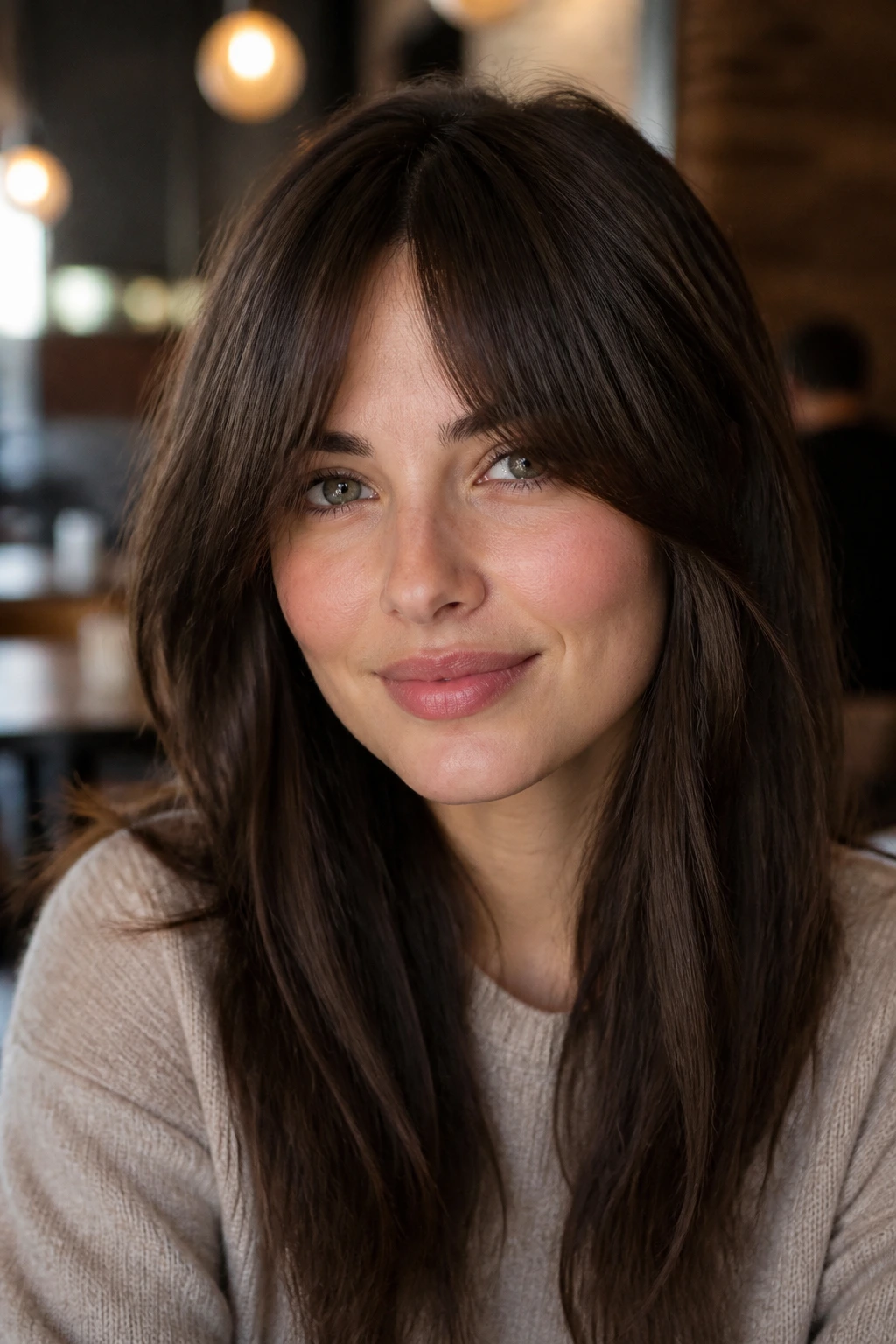
Bottleneck bangs are one of those cuts that sounds very stylized and turns out to be quietly practical. They’re narrow at the center, then widen just a bit around the eyes and cheekbones before tapering out. On a square face, that taper is the whole point.
The shape takes pressure off the forehead without drawing a hard line across it. It also keeps the attention moving downward, which is useful when the jaw is the strongest part of the face. I like this style on people who want bangs that feel intentional but not precious. There’s enough shape to matter. Not so much that you need a full styling ritual to leave the house.
If your hair is thick, ask for the inner section to be thinned carefully rather than bluntly removed. If it’s fine, keep the fringe a little longer so it has weight and doesn’t split too fast. Bottleneck bangs are especially good when you want something that grows out without looking awkward on week two.
3. Deep Side-Swept Bangs
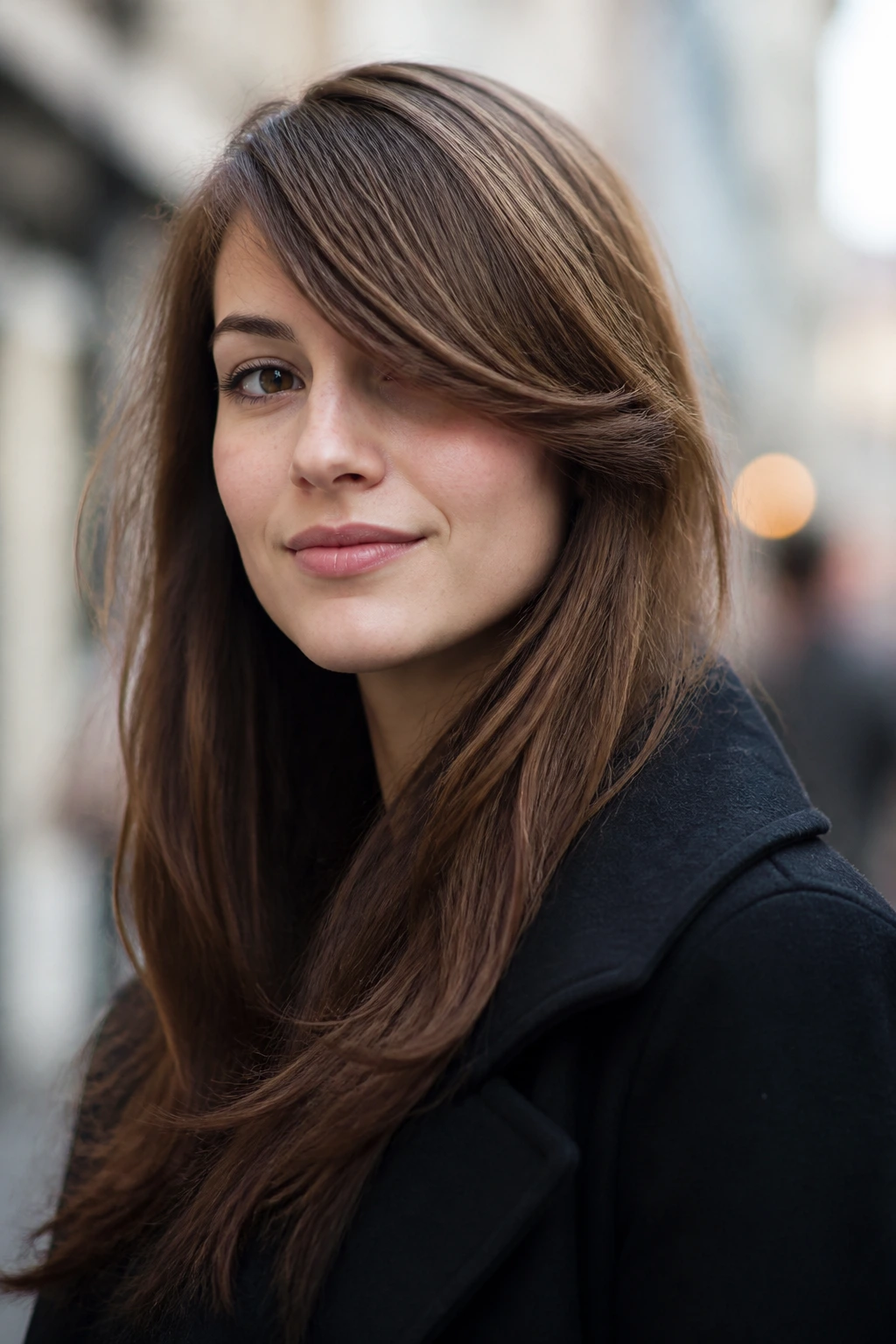
Want a fringe that cuts across a square face without shouting about it? Deep side-swept bangs do exactly that. They build a diagonal line from part to cheekbone, which is one of the fastest ways to soften a strong jawline and a wide forehead in the same move.
What Makes Them Work
The magic is in the direction. Straight-across bangs can flatten a square face if they’re too dense, but a side sweep sends the eye from one side of the forehead down toward the opposite cheek. That movement breaks the symmetry just enough. It’s also a good choice if your hair naturally wants to fall to one side anyway. Fighting that habit is a waste of energy.
Ask for: a longer front section that starts near the brow and lands somewhere between the cheekbone and lip.
Best on: straight, wavy, or lightly textured hair.
Styling note: set the sweep with a blow-dryer nozzle first, then wrap the ends around a medium brush for 10-15 seconds.
This style can look a little too polished if it’s curled in a perfect swoop. Leave a bit of separation at the ends. That tiny bit of mess keeps it modern.
4. Wispy Feathered Fringe
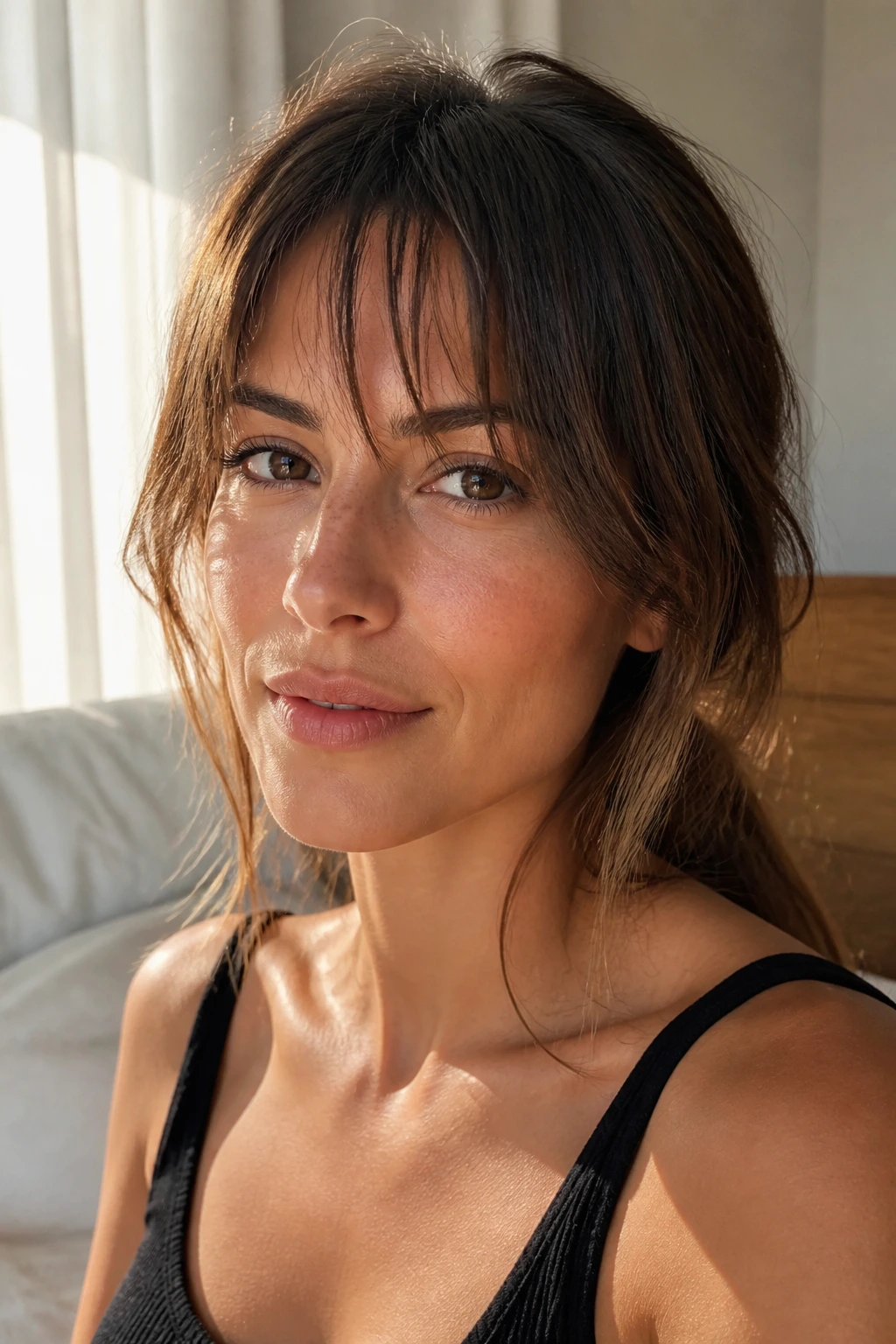
Wispy fringe is the opposite of a heavy, ruler-straight line. It lets air through. That matters on a square face because air is what keeps the forehead from looking like a wall. Feathered ends break up the line, and the face reads softer before anyone can overthink why.
I like this style when someone wants bangs but doesn’t want to commit to a dense block of hair across the brow. It’s also kind to fine hair, which can disappear under thicker bangs if the cut is too heavy. On square faces, wispy fringe works best when the outer corners are slightly longer than the center. That little bit of taper stops the cut from feeling like a shelf.
If your hair gets oily at the root fast, this fringe is easier to live with than a full blunt cut. A quick mist of dry shampoo at the hairline gives it lift without making it stiff. Feathered doesn’t mean shapeless. You still want a clear edge. Just not a hard one.
5. Choppy Piecey Bangs
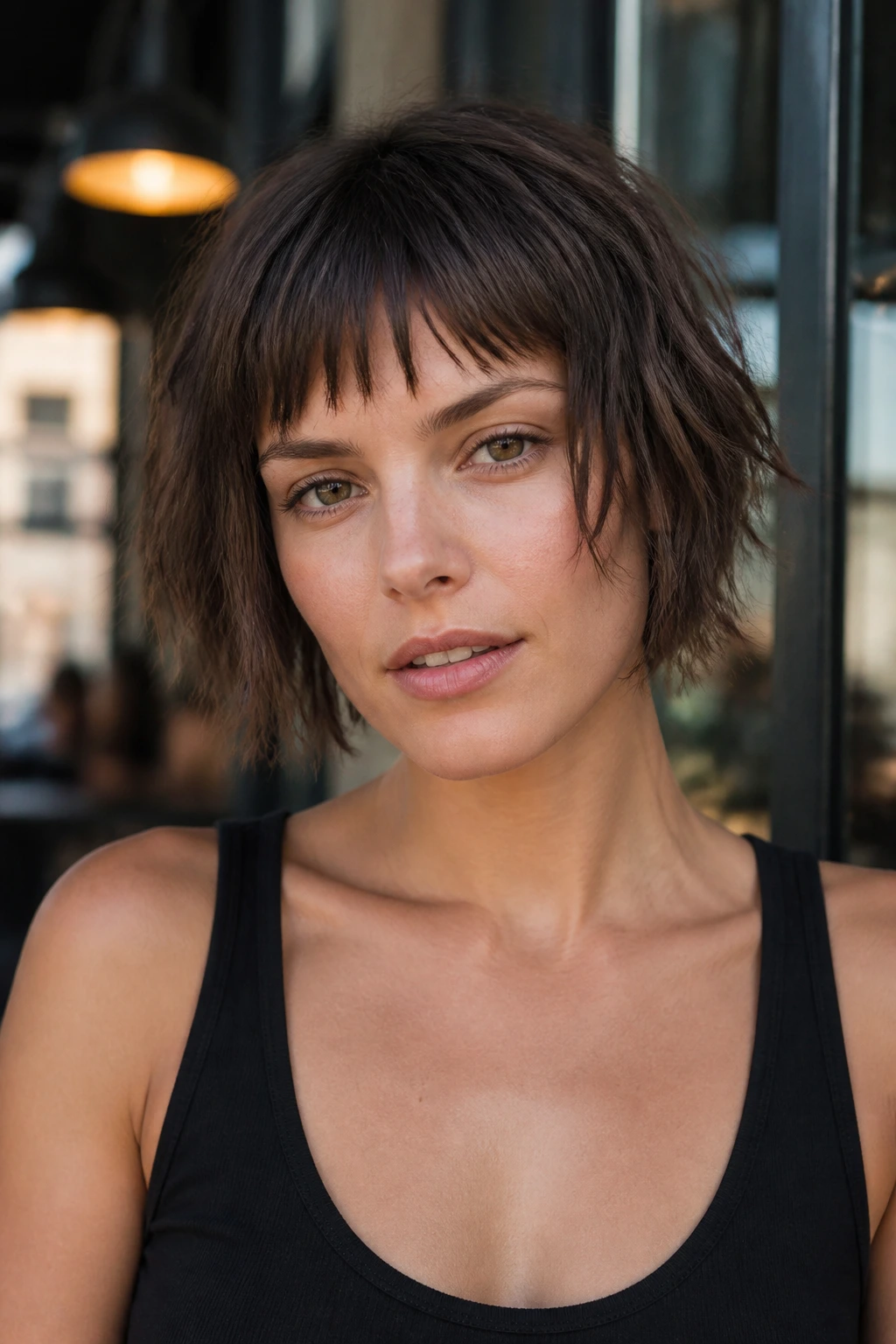
Choppy bangs are the answer for people who like a little edge but don’t want their face to look stiff. The broken ends create tiny gaps of skin and hair, and those gaps matter. They keep the fringe from reading like one solid block, which is exactly what a square face often needs less of.
The best version of this style looks intentional, not hacked at. Ask for point-cut ends and a fringe that is slightly uneven in the best way — not jagged, just lived-in. The texture does the softening work, especially when the hair around the jaw is also layered. That combination keeps the whole cut moving.
This one suits thick hair very well because density gives the stylist something to remove from. Fine hair can wear it too, but the pieces need to stay light so the fringe doesn’t disappear into the forehead. Let the shape stay a little irregular. That’s the charm.
6. Micro Bangs with Soft Edges
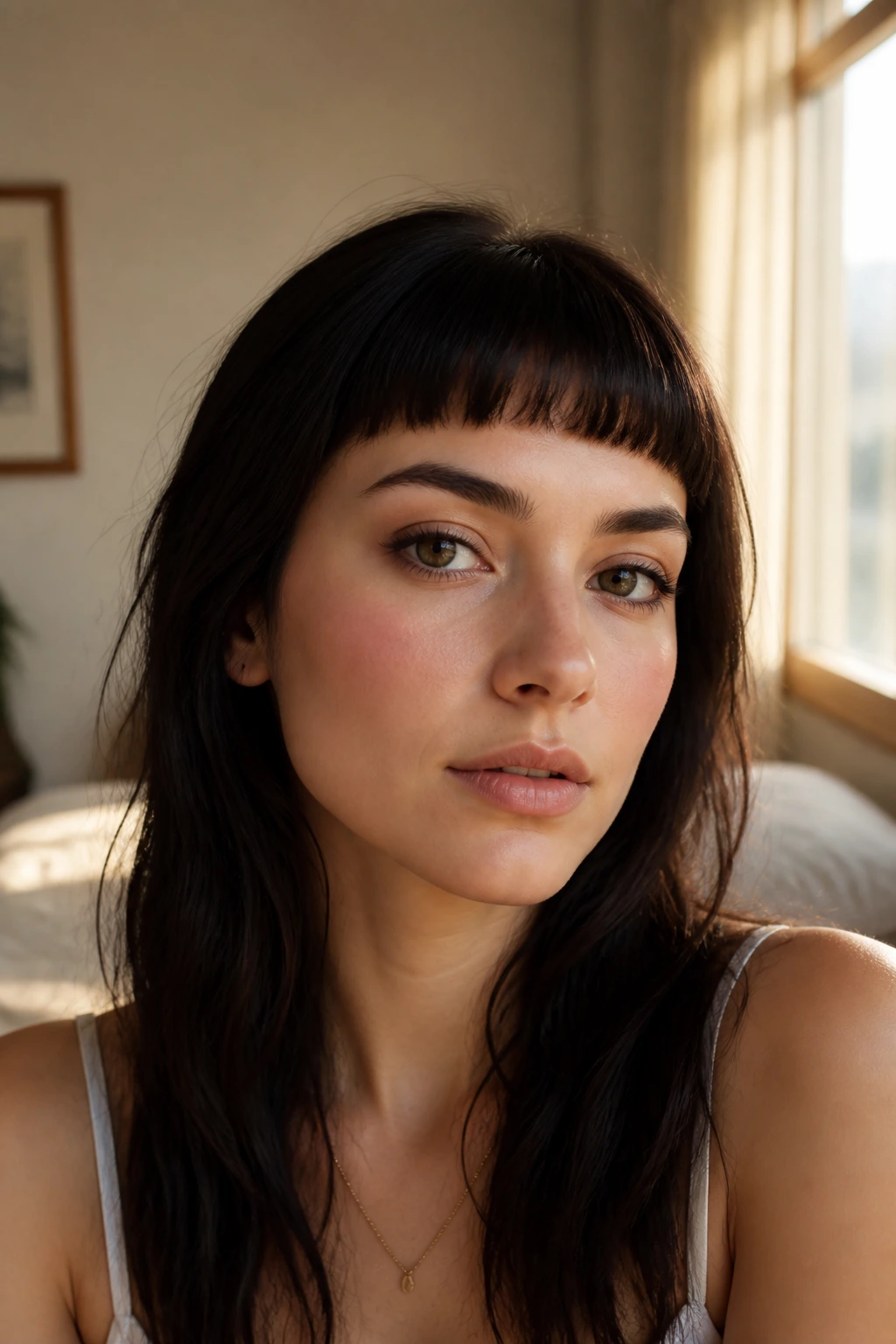
Micro bangs can look brilliant on a square face if they’re cut with softness instead of severity. The key is not the short length by itself. It’s the edge treatment. A blunt micro fringe can feel severe fast. A softened micro fringe, with slightly tapered corners, feels graphic without turning the face into a block.
The reason they work is simple: they open up the lower part of the face. When the forehead is framed but not covered, the jaw doesn’t get dragged into the same visual weight. That’s useful for square faces because the features stay strong, but the whole shape feels lighter. It’s a bold look. Not a shy one.
Best on…
- straight or slightly wavy hair that holds a clean line
- brows you actually like showing off
- people who don’t mind trims every 2-3 weeks
Tip: keep the shortest point just above the brow line, not halfway up the forehead.
If your goal is “small face, big fringe,” this is not your style. If your goal is crisp, modern, and a little unexpected, it’s a very strong choice.
7. Arched Bangs
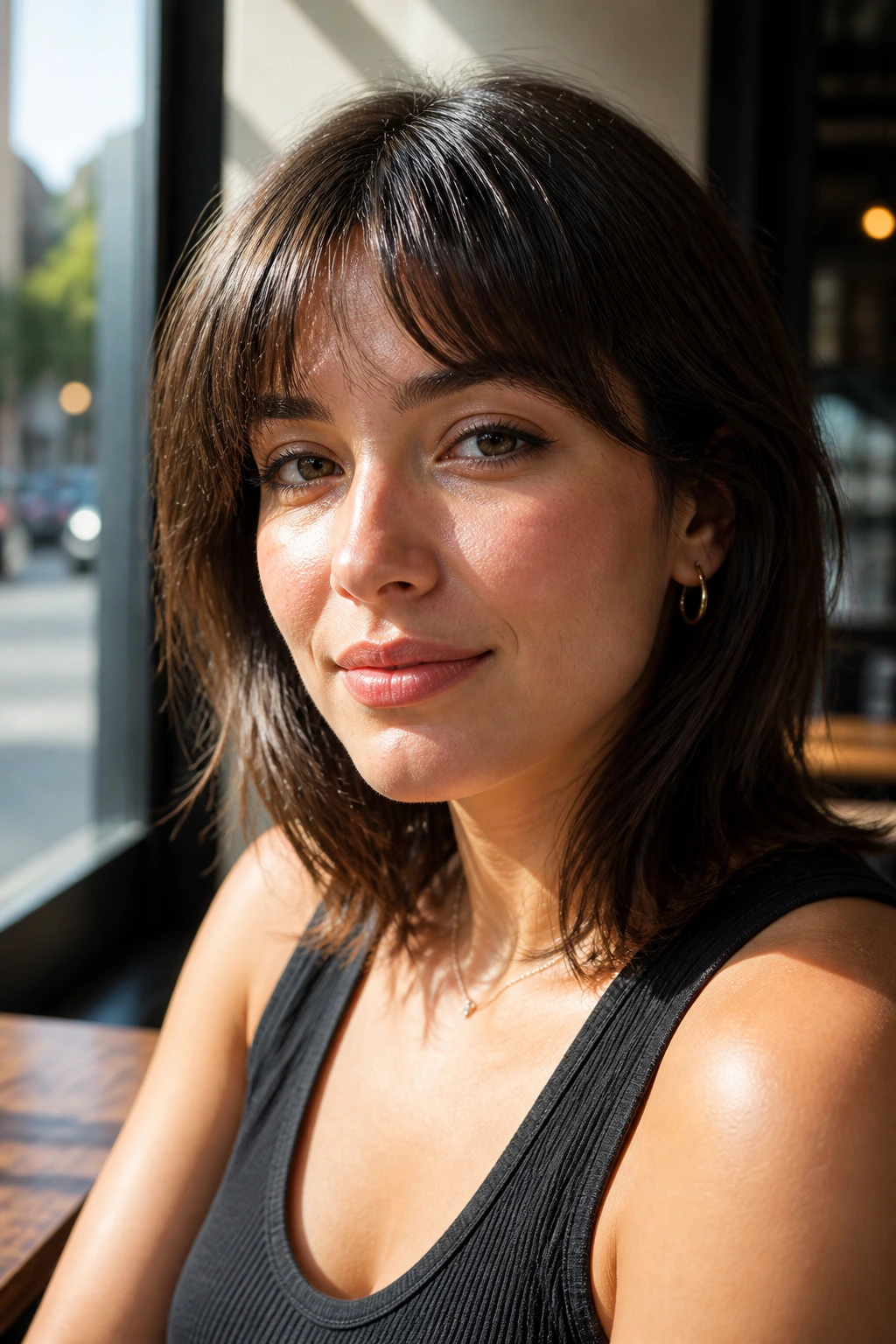
Arched bangs follow the natural curve of the brow instead of fighting it, and that small curve changes everything on a square face. Straight lines make the angles feel stronger. Curves interrupt them. Simple, but effective.
This shape is especially useful if your brow line is strong or your forehead is wide enough that a flat fringe would read too hard. The arch can be subtle — think rounded, not theatrical. The ends should taper slightly as they move toward the temples so the fringe doesn’t look like it was cut with a stencil.
I like arched bangs on medium-density hair because they hold the shape without looking bulky. They also work well if you wear your hair tucked behind one ear a lot. The fringe gives the face a little softness even when the rest of the cut is pulled back. That’s a useful trick, and one a lot of people overlook.
8. Bardot Bangs
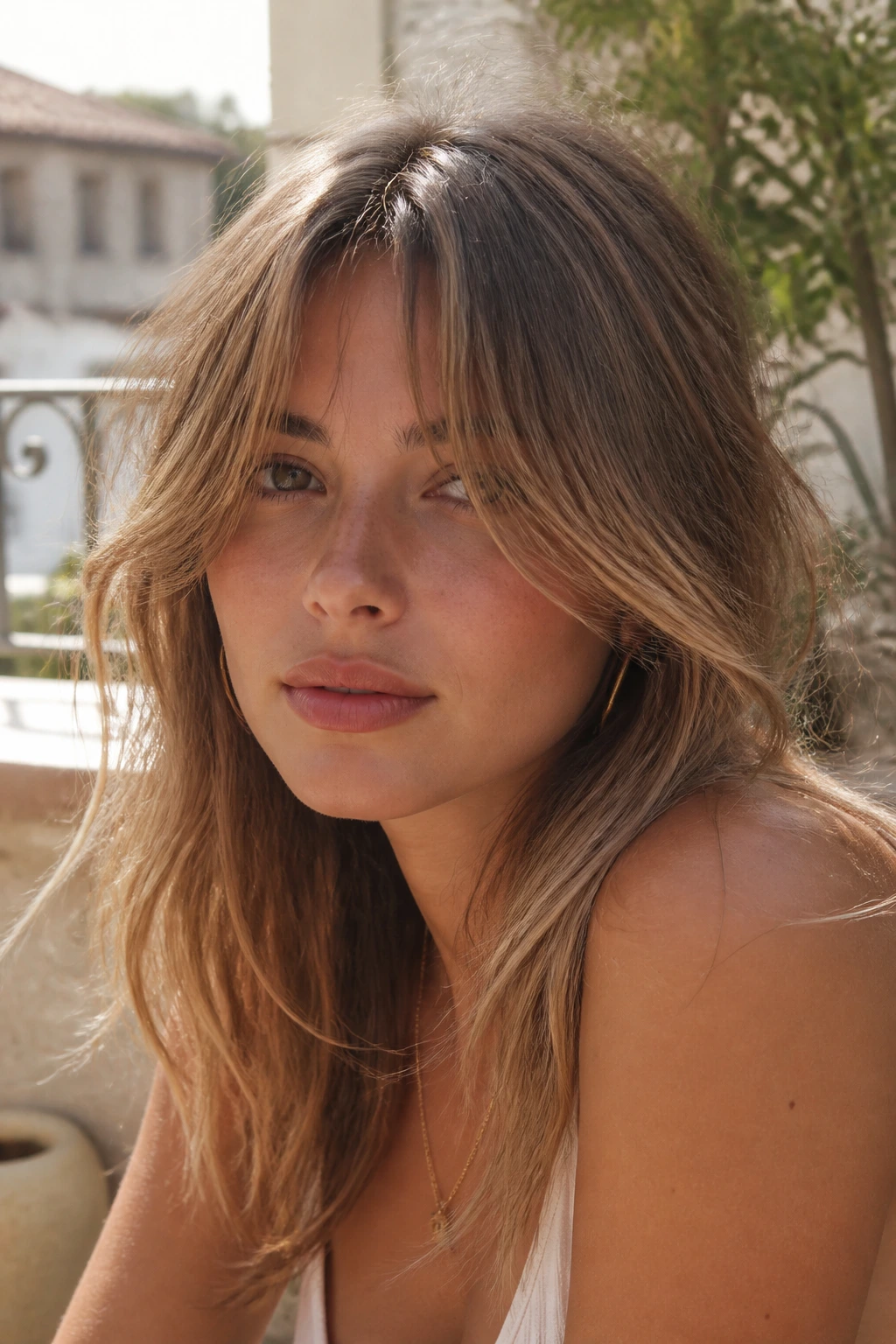
Bardot bangs are longer, looser, and a little more romantic than classic curtains. They split near the center, float away from the forehead, and usually have enough length to brush the cheekbones. On a square face, that length matters. It keeps the fringe from stopping right where the face is widest.
What I like here is the balance. The shape says “bangs,” but the execution says “I did not spend an hour wrestling with them.” That’s a nice line to walk. A square face gets the softness of movement without losing the clean structure underneath. The result feels open, not hidden.
If you like big sunglasses, soft makeup, or a cut that grows out elegantly, this is one of the best options in the whole set. Just don’t cut the sides too short. Bardot bangs are about drifting outward, not sitting like two little curtains stuck to the forehead.
9. Long Layered Fringe
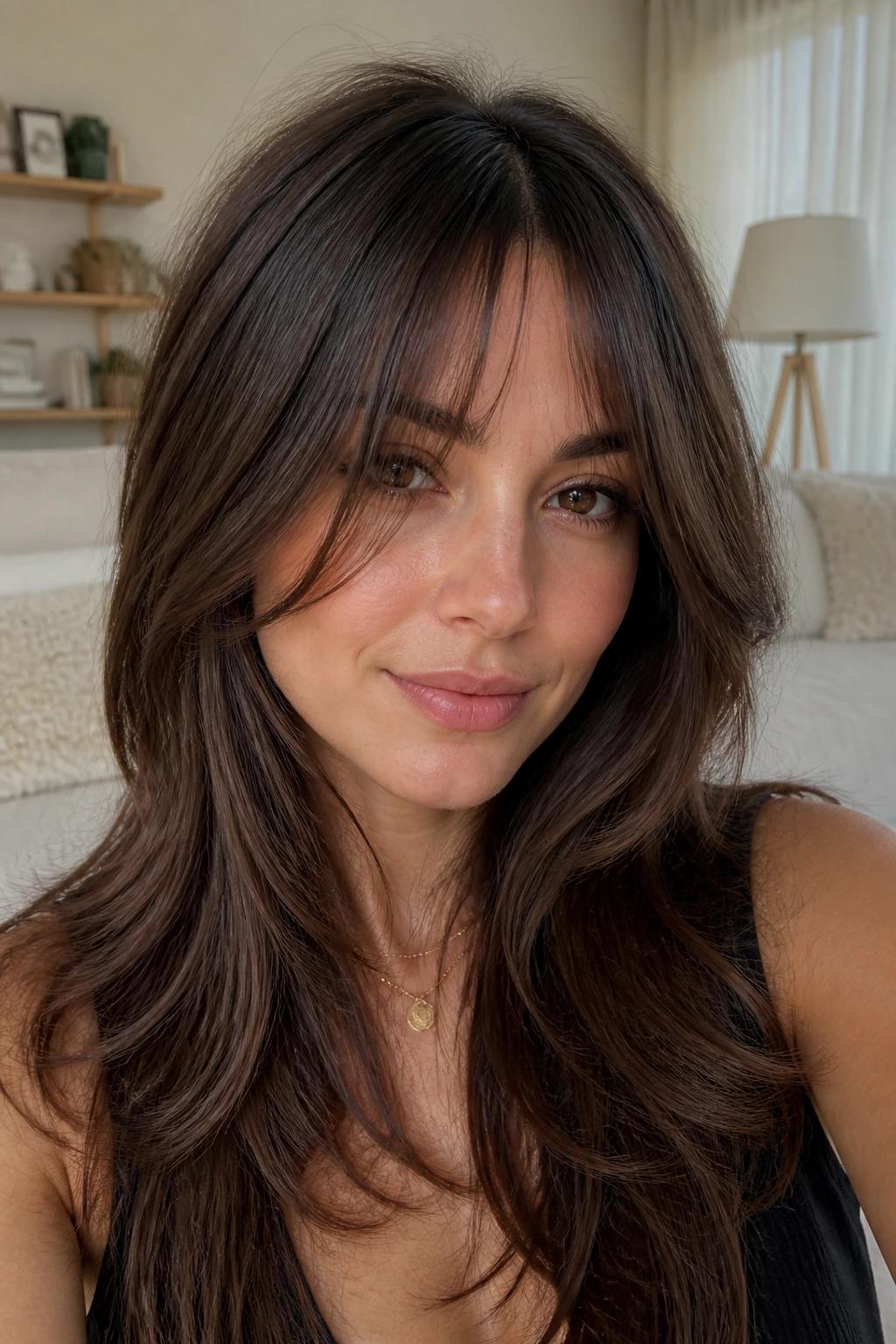
Long layered fringe is what I recommend to people who want the idea of bangs without the daily behavior of bangs. The front pieces blend into the rest of the haircut, so the line across the forehead never gets too sharp. On a square face, that matters because the haircut starts to frame instead of fence in.
There’s also a nice side effect: long layers can make the jaw look less square simply by creating more movement around the cheeks. It’s not magic. It’s shape. Hair that bends around the face changes the way the eye tracks across it. If the front pieces sit around the cheekbone or just below, the face looks longer and a bit more relaxed.
This style works well on people who wear their hair down most of the time and want something low-friction. It’s especially good for a first bang experiment because there’s no dramatic line to regret. If you decide later you want more fringe, the cut is already halfway there.
10. French Girl Bangs
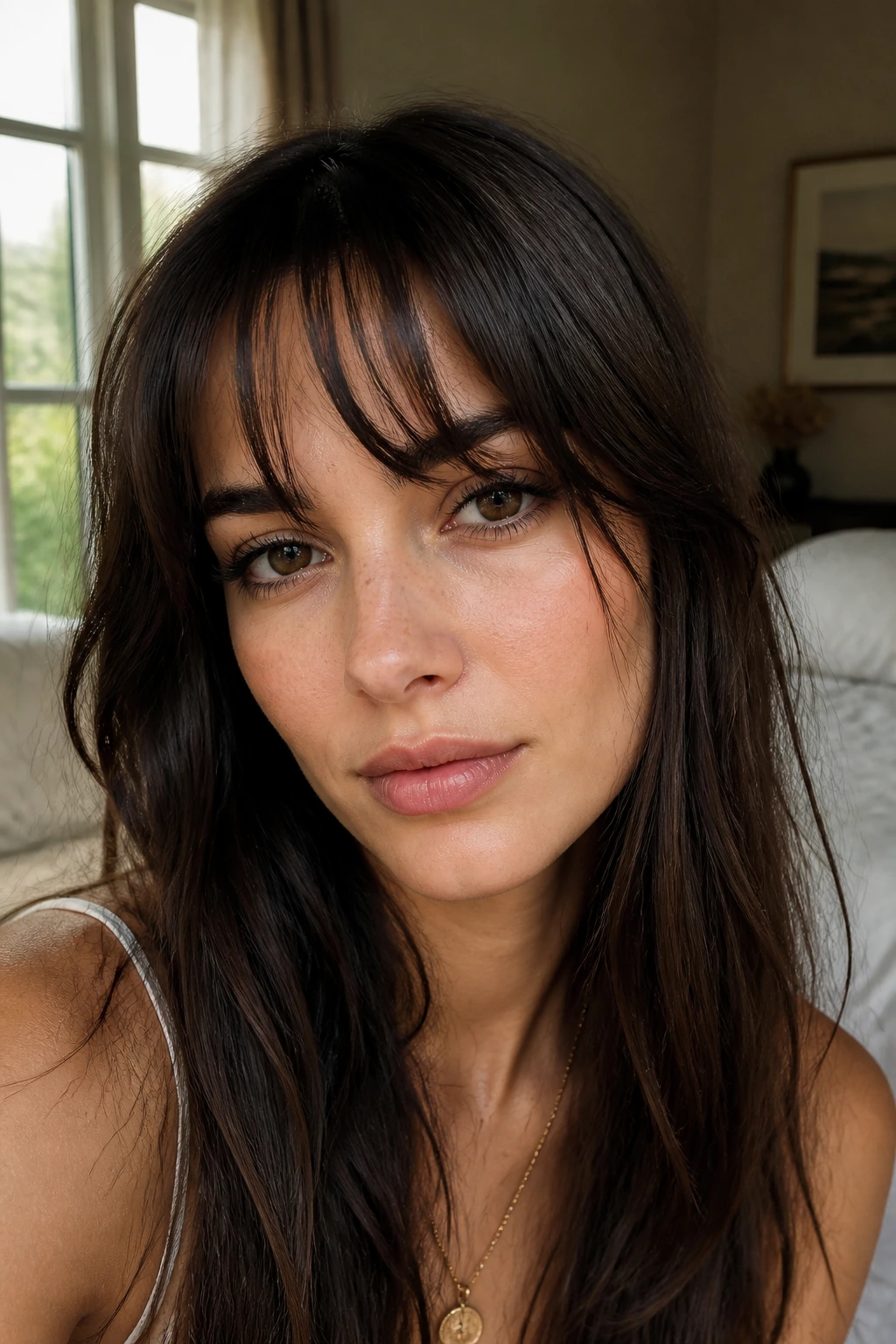
French girl bangs are not actually about being French, which is useful to remember because the look is often borrowed more than it is defined. What matters is the texture: a little piecey, a little imperfect, and usually sitting somewhere around the brow rather than straight on top of it. For square faces, that looseness is the point.
This fringe works because it lets some forehead show while still framing the eyes. Too much coverage makes a square face feel compressed. Too little and the bangs vanish. The sweet spot sits in the middle, with just enough bend at the sides to keep the shape soft. If you like a fringe that looks better after you’ve lived in it for an hour, this is a strong match.
I’d avoid making this cut too heavy at the center. That’s when it turns from chic to stern. A touch of separation in the ends keeps it alive.
11. Textured Blunt Bangs
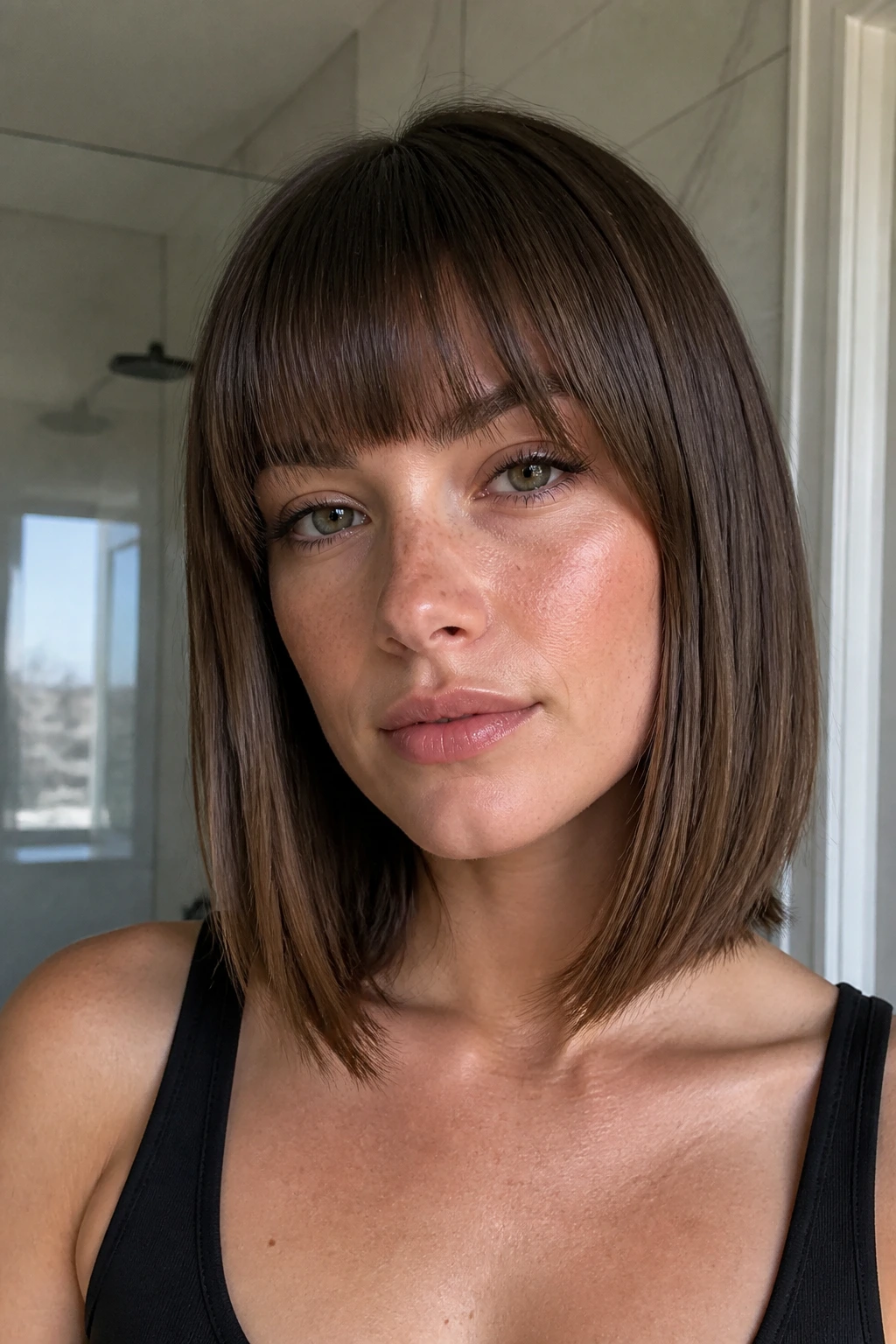
Blunt bangs on a square face can work. I know that sounds like I’m arguing with the usual advice, but it’s true if the line is handled with care. The issue is never bluntness by itself. It’s bluntness with too much width, too much density, and no softness at the corners.
Textured blunt bangs keep the straight edge but remove the hard wall effect. A point-cut finish or a very slight bevel at the ends lets the fringe sit cleanly without feeling severe. That can look excellent on square faces, especially if the rest of the haircut has soft layers or the ends are slightly curved under. The contrast can be sharp in a good way.
If your hair is naturally straight and fairly thick, this is one of the few blunt styles that can look polished without looking helmeted. If your hair is wavy, be honest with your stylist about how much daily styling you’re willing to do. This is not a wash-and-go shape unless the wave pattern is cooperative.
12. Face-Framing Fringe Layers
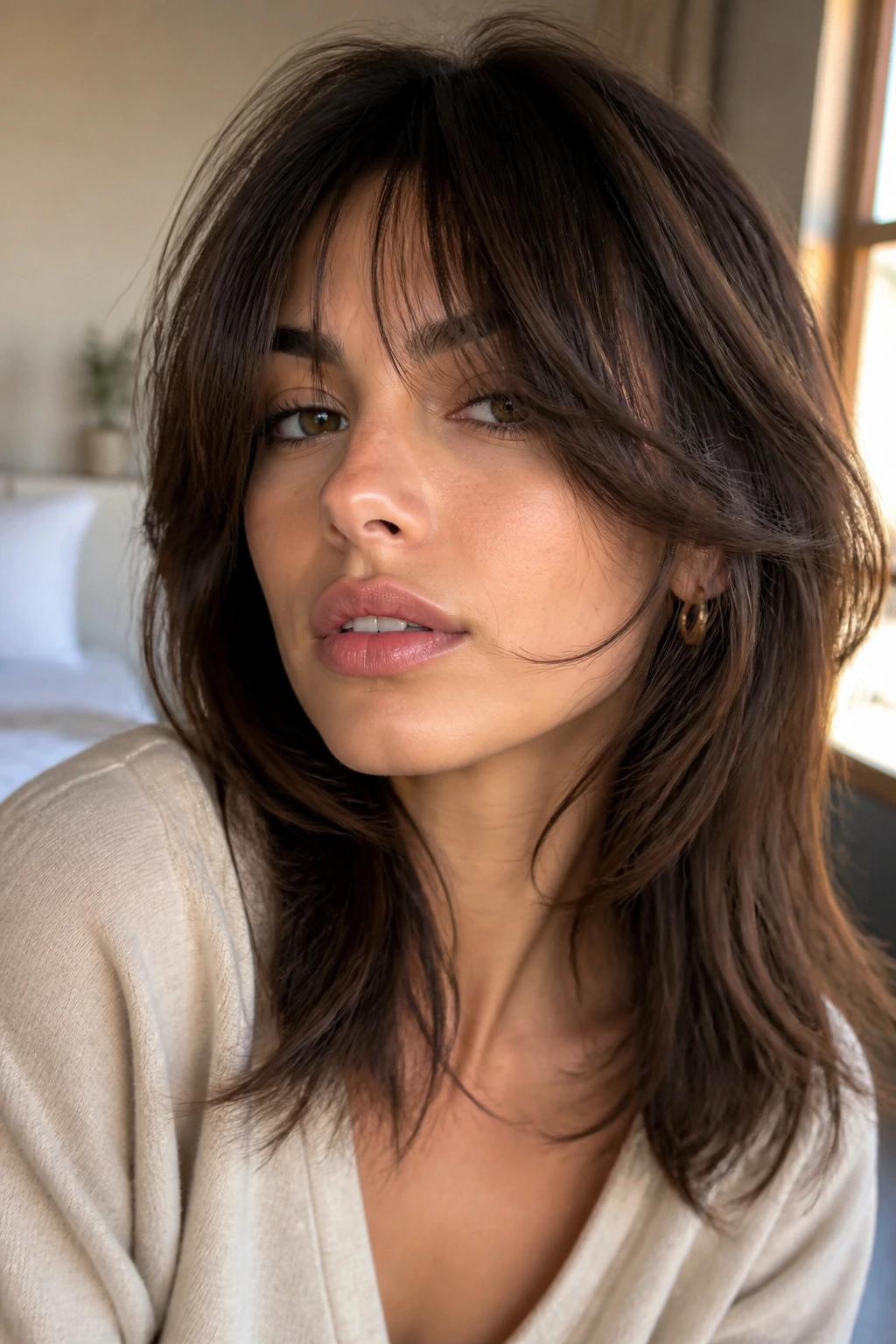
This is less a classic bang and more a front-loaded haircut, and I mean that in the best way. Face-framing fringe layers start near the forehead, then slide into the cheeks and jaw through soft lengths rather than stopping at one line. For a square face, that kind of progression is gold.
Why? Because the face never gets pinned to a single horizontal edge. The eye moves from shorter pieces to longer ones, and that motion diffuses the squareness a bit. It also works across a lot of hair textures. Straight hair gets shape. Wavy hair gets built-in movement. Curly hair gets a frame that doesn’t require the front to behave like a separate species.
If you hate maintenance, this is one of the safest bets. It can live as a fringe one month and just become layers the next. That flexibility is worth a lot more than people admit.
13. Curved Side Fringe

A curved side fringe lands somewhere between a side sweep and a soft arc, and that’s exactly why it flatters square faces. The curve breaks up the forehead width, then points the eye toward the cheekbone instead of the jaw corner. It’s subtle. Which is the whole charm.
What to Ask For
- Keep the shortest point around brow height.
- Let the side length slide toward the cheekbone.
- Point-cut the ends so the curve doesn’t feel stiff.
- Avoid over-thinning the front, or the shape turns stringy.
This style is especially good if you want side-bang energy without a dramatic flip. It works in office settings, on casual days, and anywhere you want the face to look a little less angular without looking “done.” I’d choose it over a stiff side bang almost every time.
14. Curly Bangs
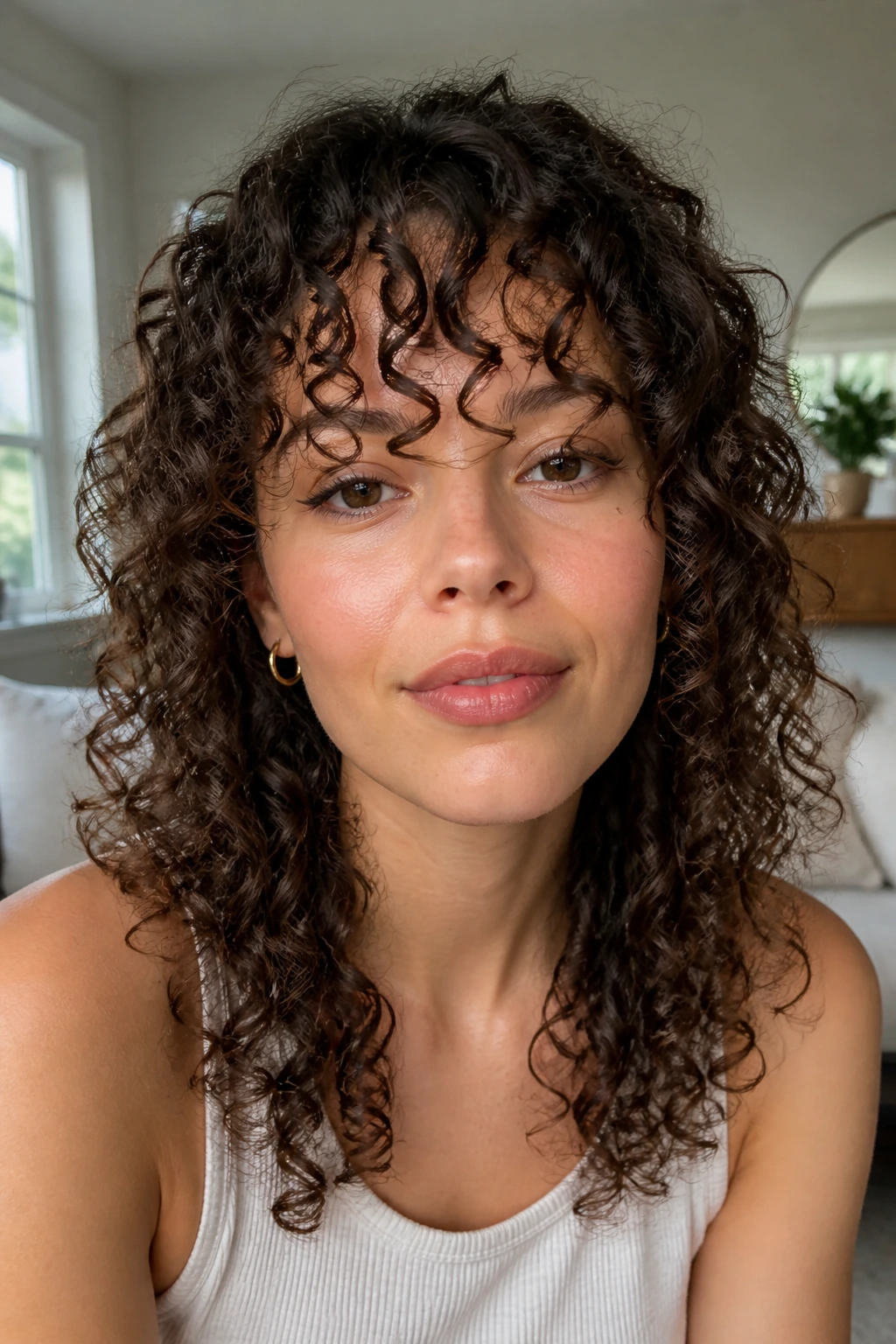
Curly bangs can be gorgeous on a square face, but only if they’re cut with curl behavior in mind. That means longer than you think, often by a full inch or more than a straight-hair fringe would be. Curly hair shrinks. A lot. And when it shrinks into a short, dense fringe, the face can start to feel top-heavy.
The good version keeps the curls light and springy around the forehead, with a little separation between clumps. That separation matters because it stops the bang area from reading as one heavy block. The face stays open, the curls do their own thing, and the square jaw gets softened by the bounce.
Ask for the cut to be done dry or at least with the curl pattern visible. Wet curls lie. They lie constantly. A stylist who cuts curl fringe dry is paying attention to how the hair actually sits, which is the whole point. On a square face, that attention shows up immediately.
15. Shaggy Fringe
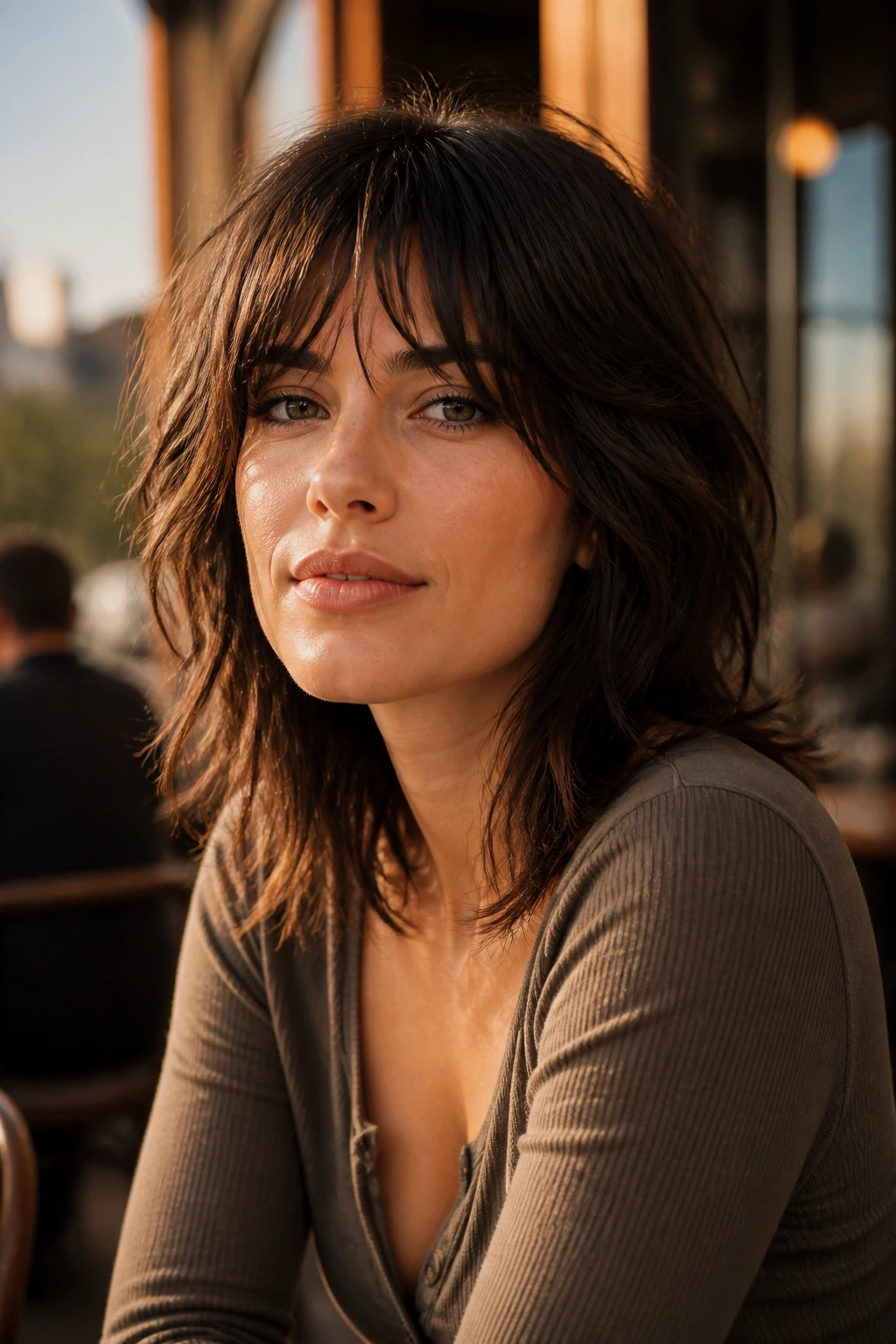
Shaggy fringe is a good fit when you want your bangs to look like they grew out of the haircut rather than landed on top of it. The broken layers and irregular pieces keep the eye moving, and that movement is what flatters a square face. Hard edges make square faces read harder. Shaggy pieces interrupt that.
It’s also one of the easiest ways to keep the hair from feeling too precious. There’s no need for perfect symmetry here. In fact, a little unevenness is better. The front can be lighter, the temples can get a little longer, and the layers around the jaw can do their own work. Together, the cut looks relaxed but intentional.
This is a smart style if you have thicker hair and want to remove bulk around the front. It can also rescue a blunt haircut that feels too severe. Add texture, and the whole face opens up.
16. Split Fringe
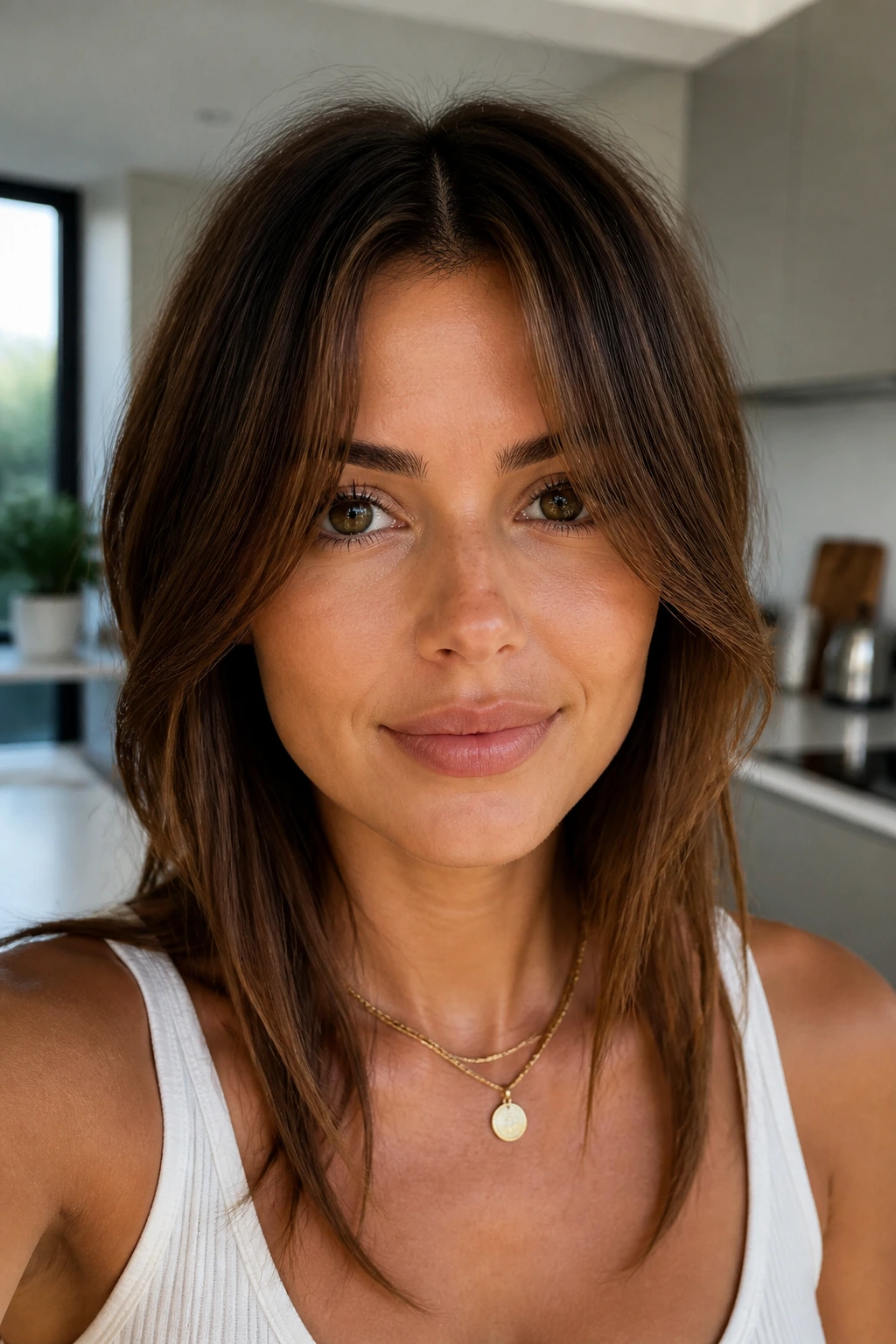
Split fringe is the clean, centered version of “I want bangs, but I also want my forehead visible.” It parts in the middle and falls in two softer sections, which gives square faces a nice vertical break without hiding the bone structure. That’s a useful balance.
What I like about this style is that it can look neat or undone depending on how you dry it. Blow it smooth, and it reads polished. Let it dry a little messier, and it becomes more relaxed. Either way, the split line stops the fringe from forming a hard horizontal block across the forehead.
It’s especially good for people with symmetrical features who still want the face to feel a touch less rigid. If your square face already has strong cheekbones, this can frame them without crowding them. Just keep the shortest pieces soft. If the middle is too short and the sides too blunt, the whole thing starts looking accidental.
17. Peekaboo Bangs
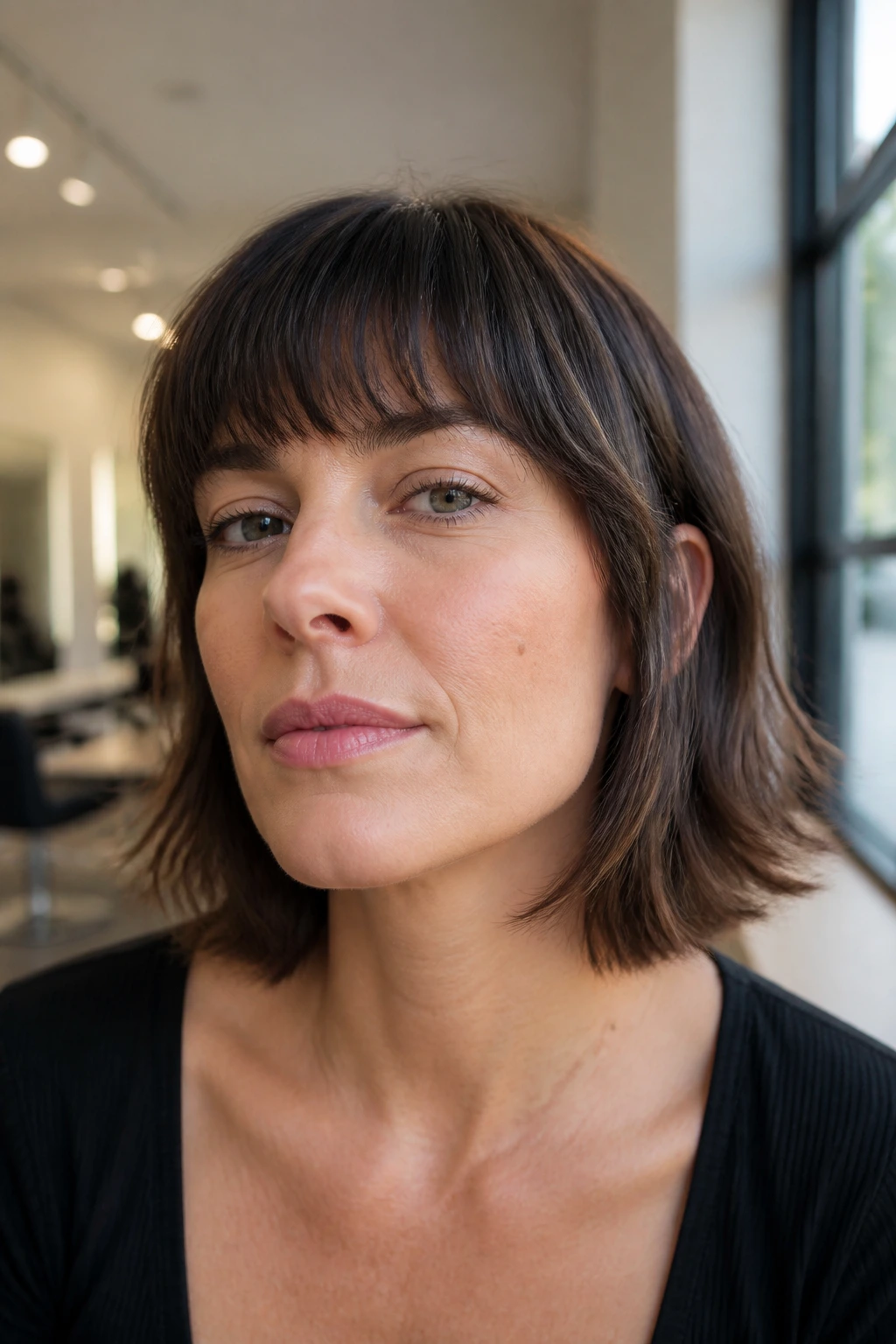
Peekaboo bangs are the shy cousin in this group, and that’s not a bad thing. They sit under longer layers or slip through the front in small pieces, so the forehead is never fully covered. On a square face, that lightness keeps the structure from feeling heavy.
They’re a good choice if you like the idea of bangs more than the reality of daily styling. A square face can handle a lot of shape, but sometimes the smartest move is to add just a little bit of framing and stop there. Peekaboo fringe gives a whisper of softness around the eyes without changing the whole haircut.
This style is also forgiving during grow-out. If you get tired of it, it melts into the rest of the hair with less drama than a blunt cut. That’s worth considering if you’re bang-curious rather than bang-committed.
18. Swept-Over Fringe
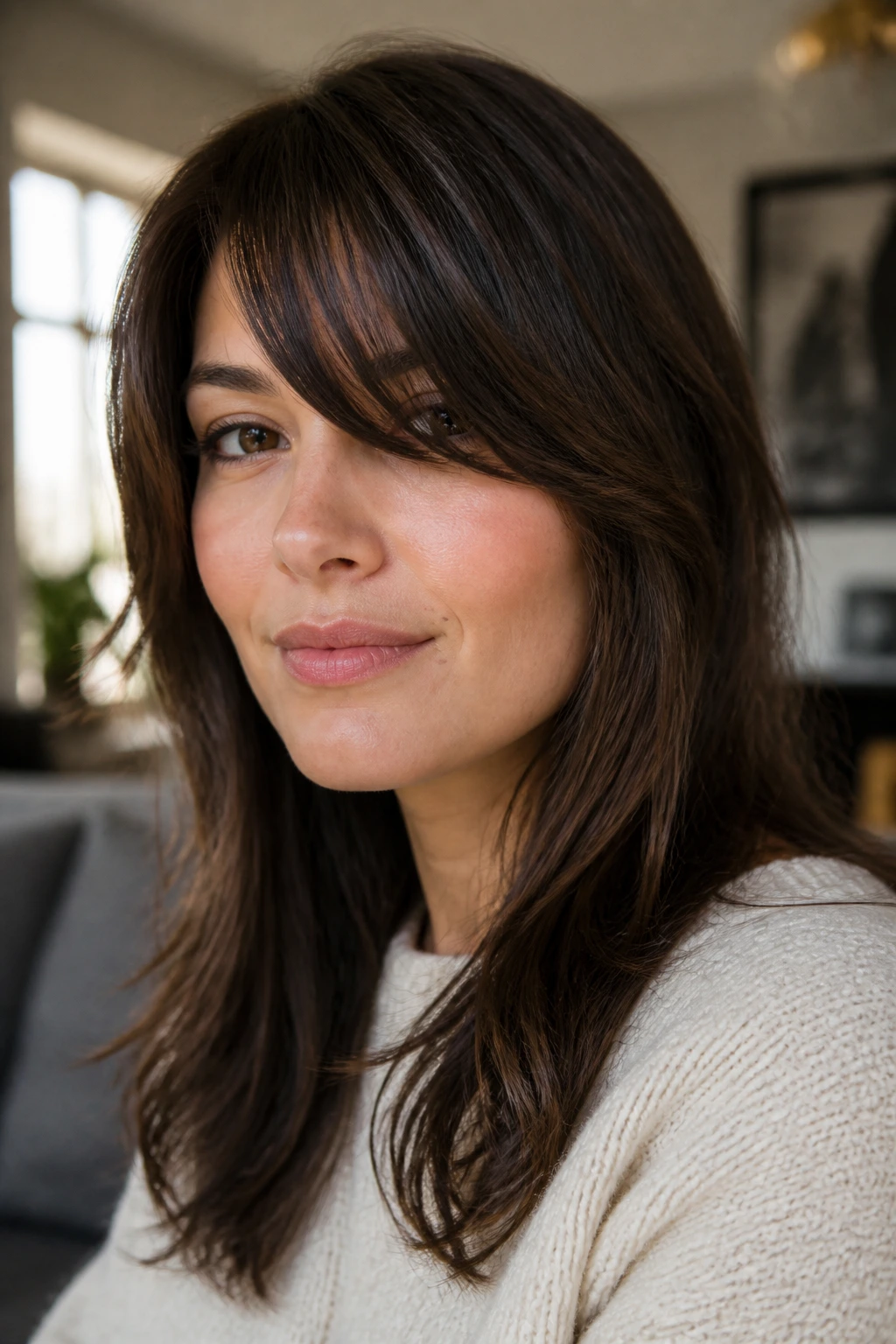
Swept-over fringe has more polish than a casual side bang. It’s designed to move smoothly from one side of the forehead to the other, usually with a little lift at the root and a long taper toward the opposite cheek. On a square face, that sweep matters because it cuts across the strongest lines with intention.
I’d pick this over a blunt side fringe when I want the face to look a little longer and less squared off at the top. It’s a good dinner-party bang. A good work bang too, honestly. The shape holds its own, but it doesn’t steal the whole haircut. That restraint is part of the appeal.
The best version keeps the ends soft and movable, not curled into a stiff arc. Let the fringe brush the brow and then open away from it. A face like this doesn’t need more corners. It needs motion.
19. Cheekbone Curtain Bangs
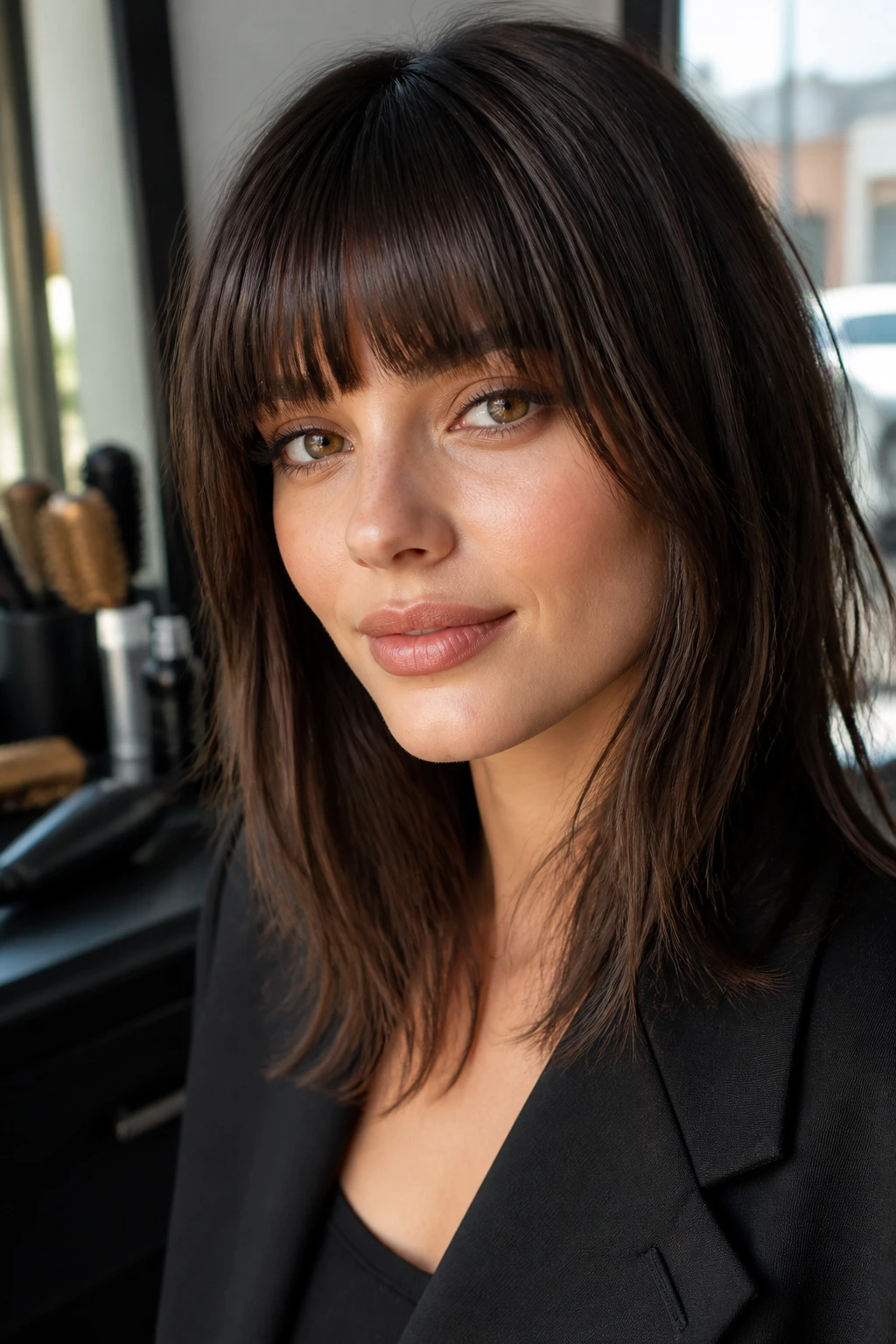
Cheekbone curtain bangs do their best work lower on the face than a standard curtain fringe. They start softly at the forehead, then fall toward the cheekbones where a square face tends to benefit from the most break in the line. That lower landing point helps redirect attention away from the jaw without hiding it.
Why They’re So Good Here
The cheekbone is the hinge point. When the fringe lands there, it creates a kind of visual curve between the forehead and the jaw, which square faces often need. Ask for the center to stay lighter and the outside pieces to graze the top of the cheeks. The sides should move, not cling.
Works best on: medium to thick hair with some bend.
Avoid: cutting the outer pieces too bluntly. That can make the whole front feel blocky.
I like this one for people who want framing without obvious bangs. It’s soft, flattering, and easier to live with than a dense front section.
20. Blended Side Fringe
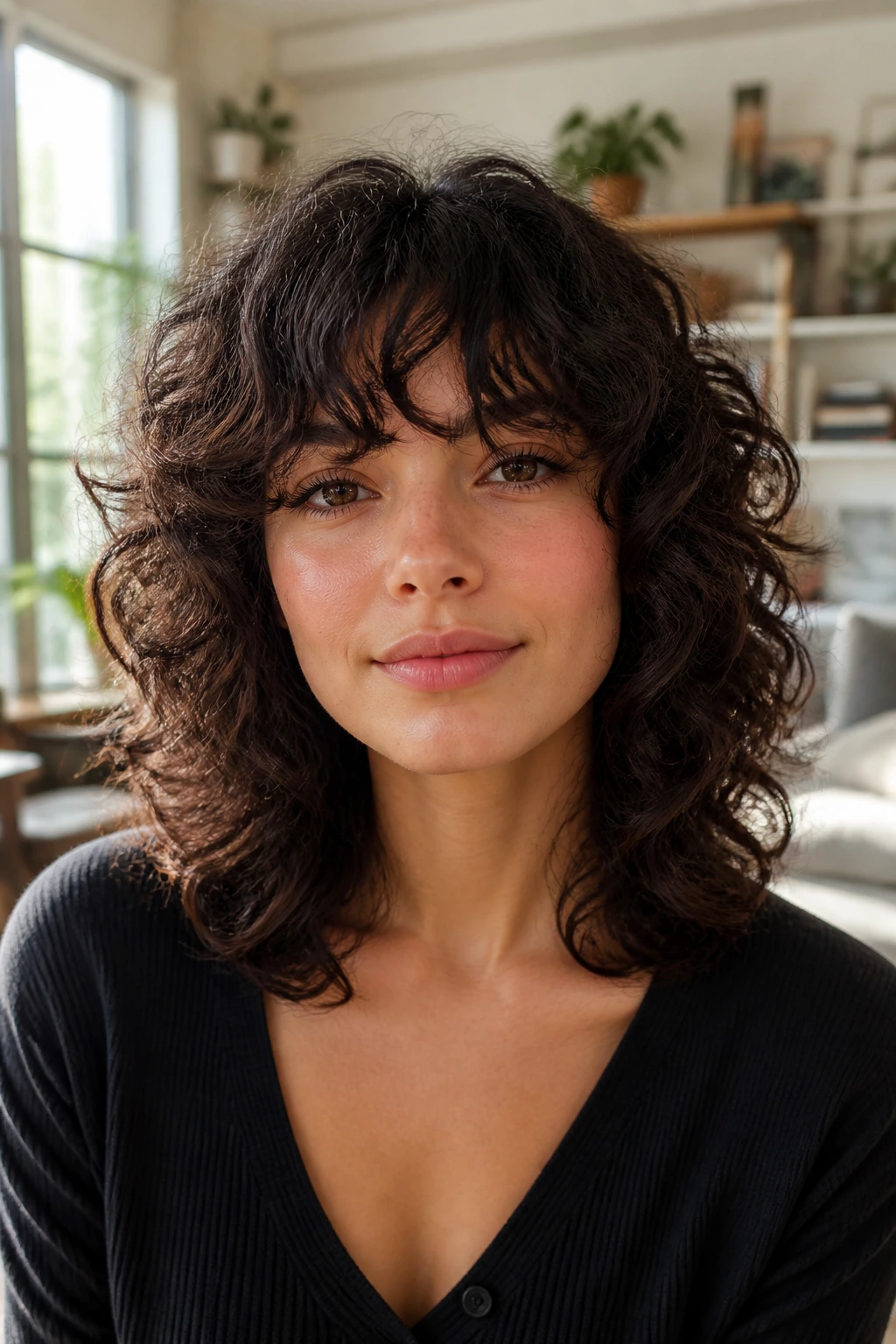
If you hate the feeling of “having bangs,” blended side fringe is probably the answer. It doesn’t announce itself from across the room. Instead, it slides into the haircut so the front pieces feel like part of the whole shape. On a square face, that blending is useful because the line doesn’t stop and start in one blunt place.
This style works especially well when the rest of the cut has some layers around the face. The fringe joins those layers, then disappears into them. The face still gets a diagonal shape, but the effect stays soft. That makes it a nice option for people who want less structure at the forehead and more movement overall.
A lot of stylists will call this a “bangs lite” moment, and honestly, that’s not wrong. It’s a smart entry point if you’re unsure about commitment. The grow-out phase is nearly painless, which is more than I can say for many fringe shapes.
21. Airy See-Through Bangs
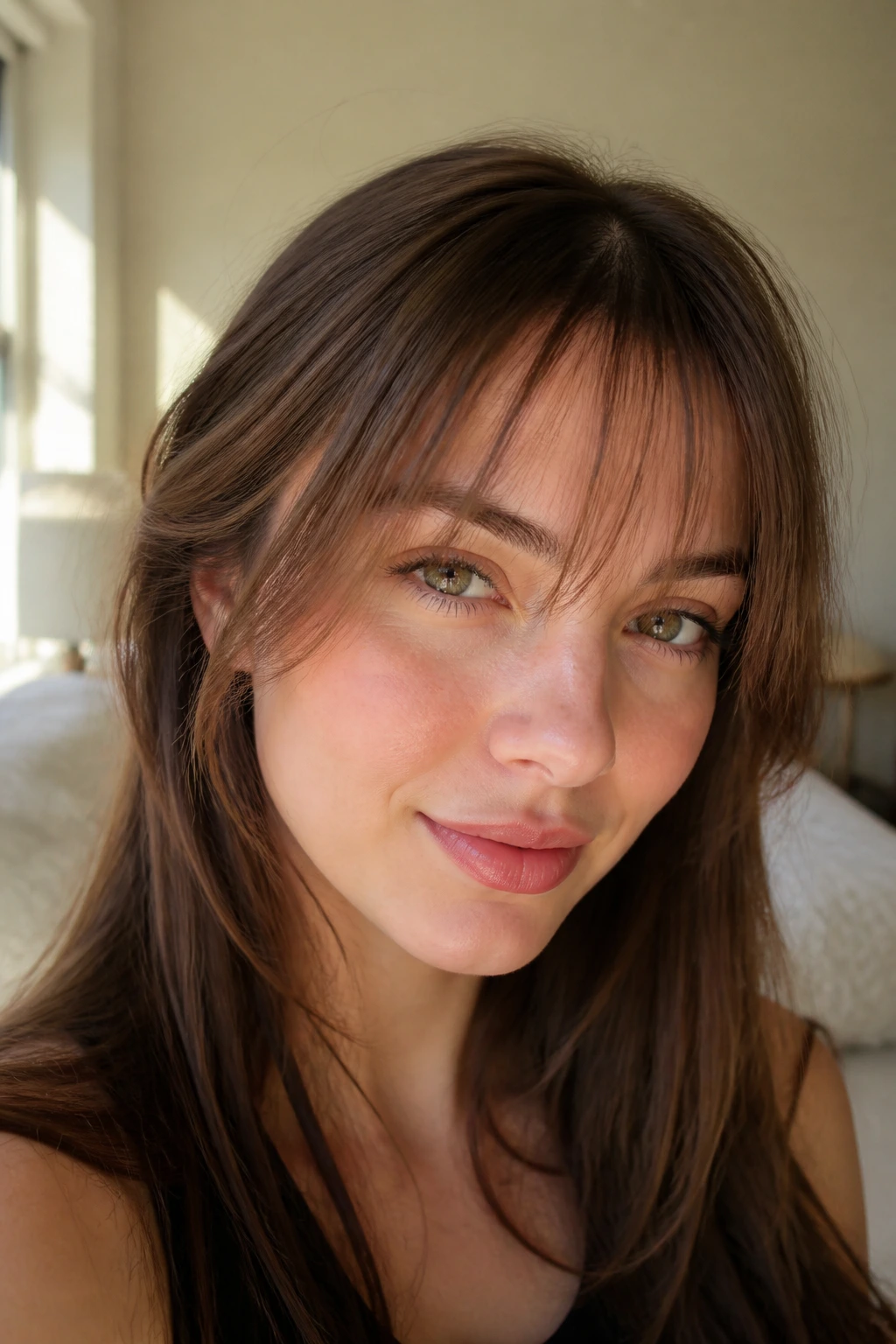
Airy see-through bangs are all about density. Or rather, the lack of it. They leave enough space between pieces that the forehead still shows through, which helps a square face look lighter and less boxed in. They’re especially nice if you have fine hair and don’t want the front of your head to disappear under too much weight.
This style tends to work best when the edges are softly feathered and the longest pieces sit just at or below the brows. The see-through effect keeps the fringe from becoming a heavy band, while the brow-skimming length still gives the eyes a frame. It’s delicate without being flimsy.
If your hair gets greasy fast, this is also practical. A little dry shampoo at the root can revive the shape without making the fringe stiff. Just don’t make it so thin that it looks accidental. Sparse and airy are not the same thing.
22. Soft Blunt Bangs
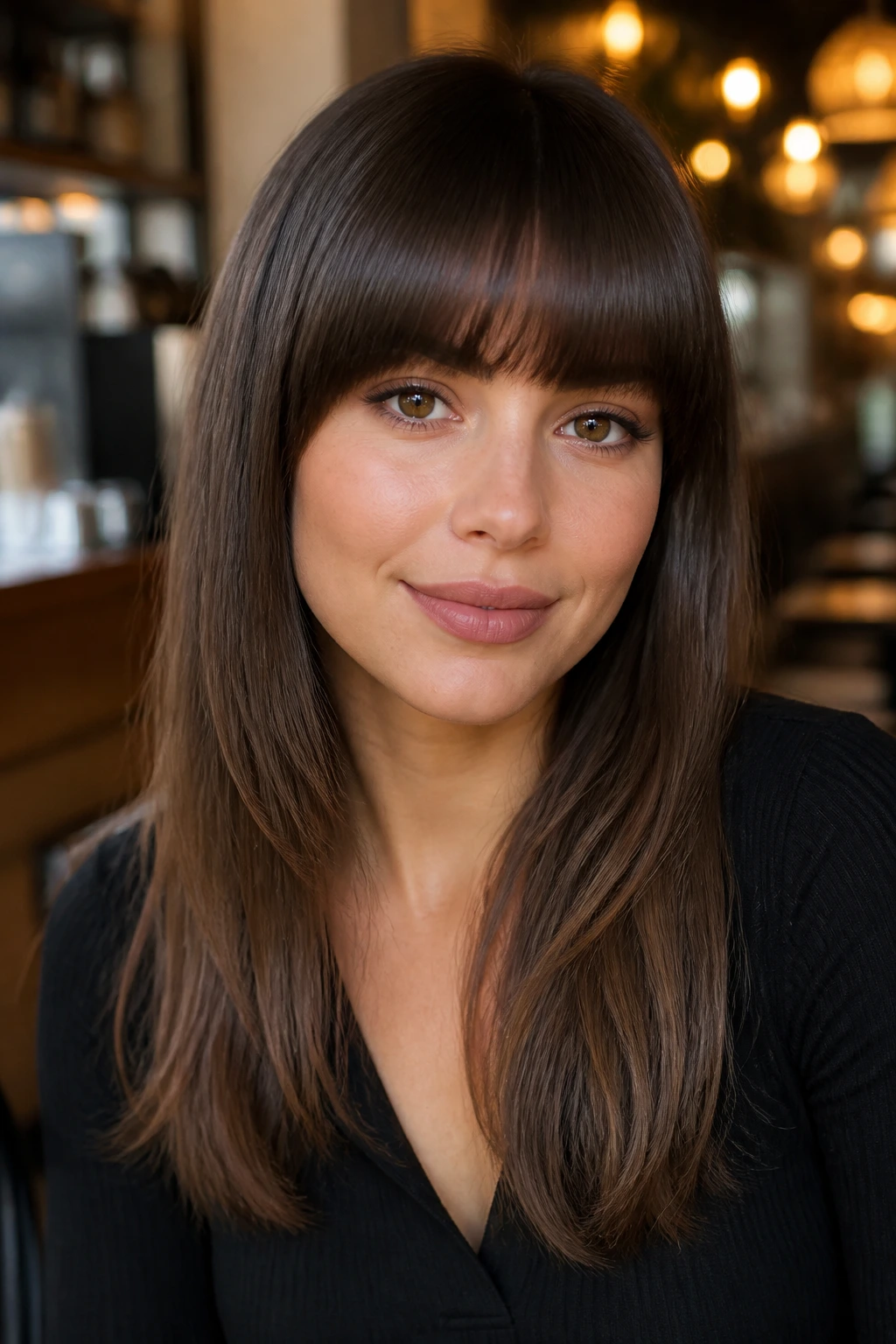
Soft blunt bangs can be a really strong choice for square faces when you want a little structure up front. The difference between this and a severe blunt fringe is the edge. The line should be full, yes, but the corners need to round off slightly so the cut doesn’t echo the jaw too directly.
I like this style on straight or lightly wavy hair because the surface stays smooth enough to show the shape. It’s also good when you want your eyes to be the focus. A clean line across the forehead can make the brows and eyes pop, which square faces often wear well. The trick is to avoid making the fringe too wide. Too much width turns the top of the face into a rectangle.
A soft blunt bang is not low-effort. It usually needs a round brush or a quick pass with a flat iron to keep the edge tidy. But if you like precision, it can be worth the upkeep.
23. Wolf-Cut Bangs
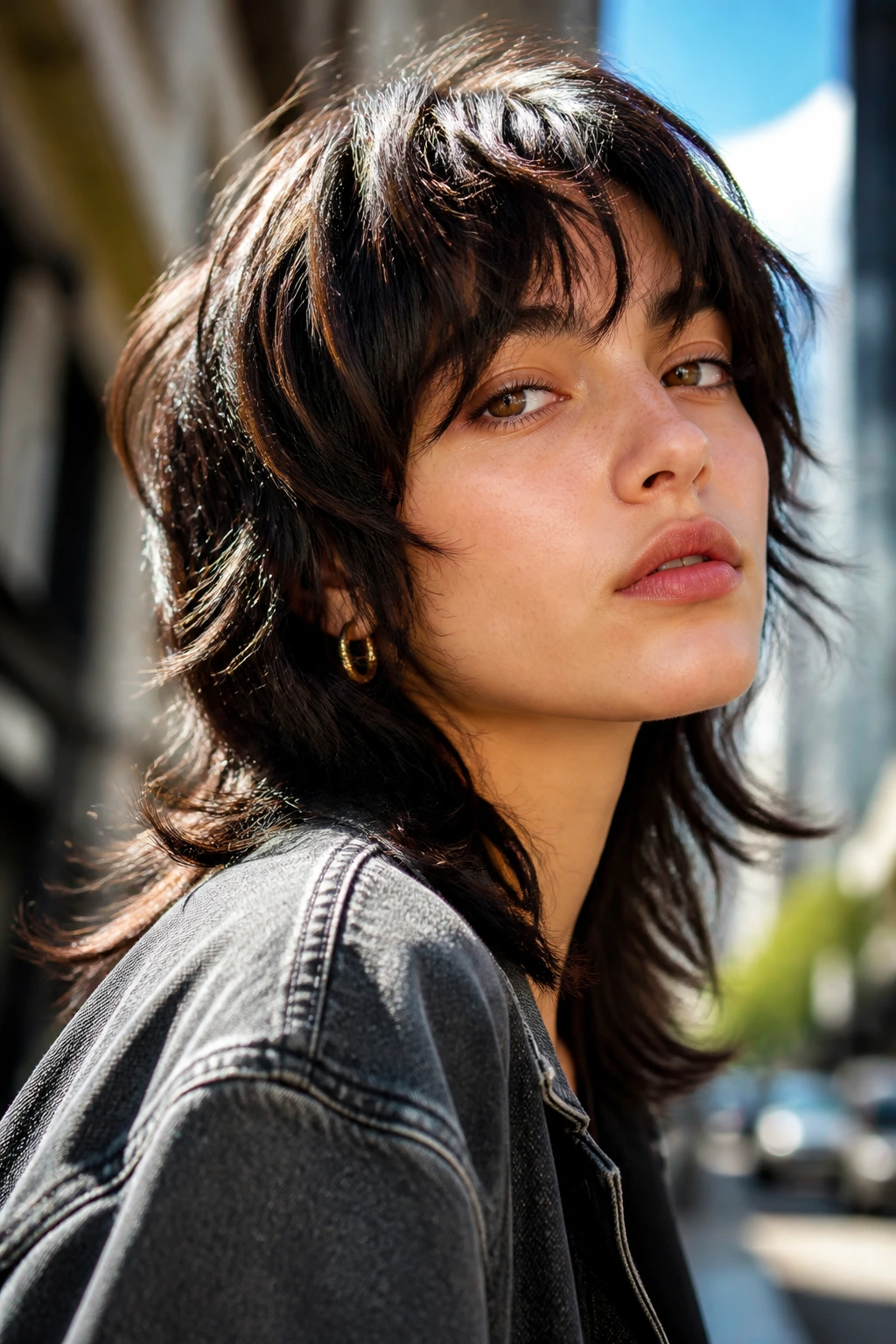
Wolf-cut bangs are for people who want texture first and polish second. The layers around the face are broken up, the fringe is messy in a controlled way, and the whole cut feels alive. On a square face, that chaos is useful because it keeps the jawline from dominating every angle.
The wolf cut works by refusing to stay one shape. The bangs can be short in the center, longer at the sides, and shaggy all the way through. That unevenness is what softens the face. It also plays nicely with medium to thick hair, where the layers can build some lift without going flat by lunch.
If you like hair that looks better when it’s a little imperfect, this is your lane. If you want everything tidy and precise, skip it. The style depends on movement, and movement never looks perfectly combed.
24. Brow-Grazing Wispy Bangs
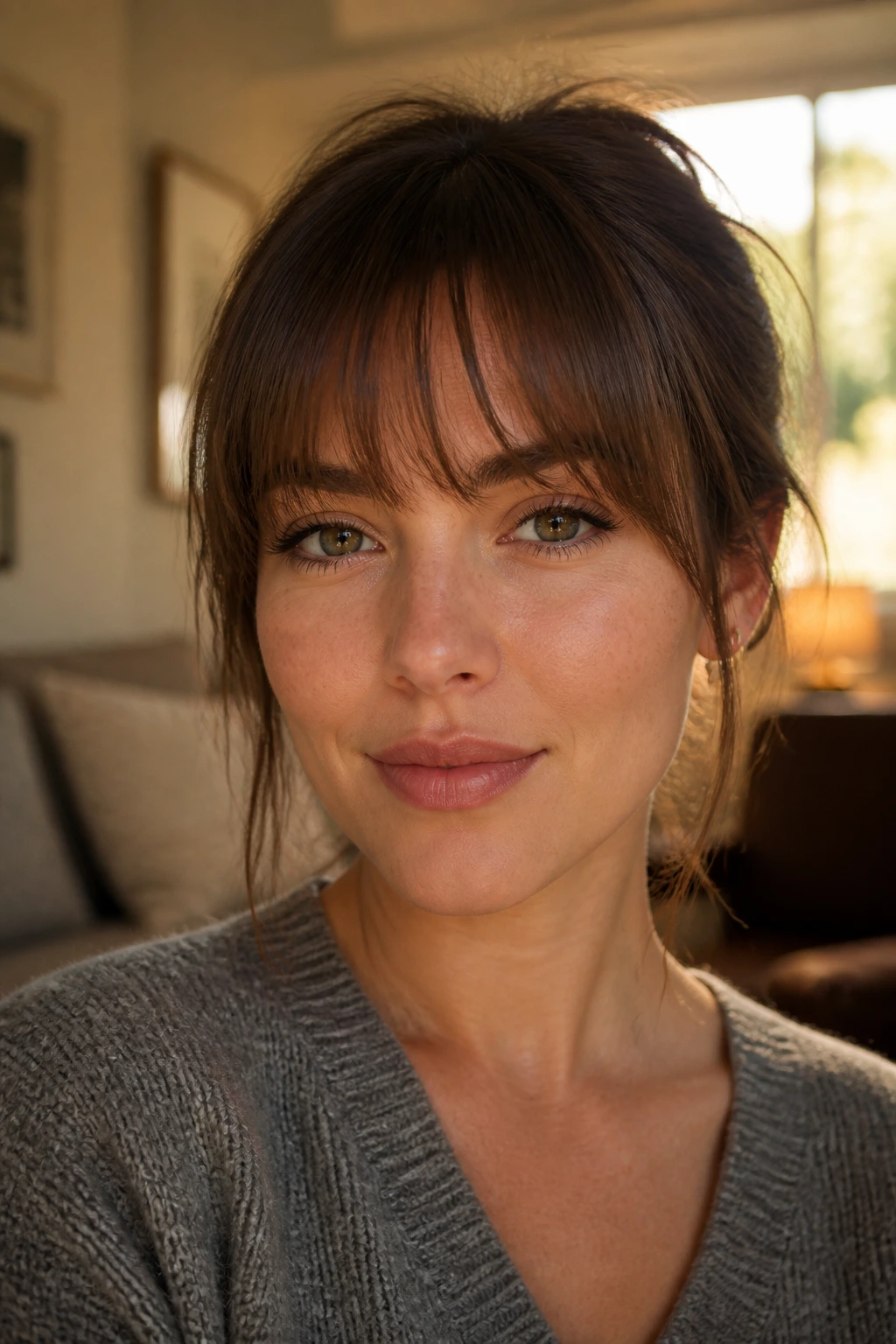
Brow-grazing wispy bangs sit right where the eye wants to linger. That makes them useful on square faces because they frame the top half of the face without covering it up. The wispy part keeps them from feeling dense, while the brow length gives enough shape to matter.
This is one of my favorite “I want bangs but not a bang situation” options. It’s subtle. It also works well if you wear strong brows or glasses, because the fringe doesn’t crowd either one. The cut should have a little separation and a soft edge, not a thick, straight bar.
A tiny detail makes a big difference here: the center should sit just at the brows, while the outer pieces can drift a bit longer. That slight slope keeps the face looking open. Tiny change. Big payoff.
25. Full Fringe with Tapered Corners
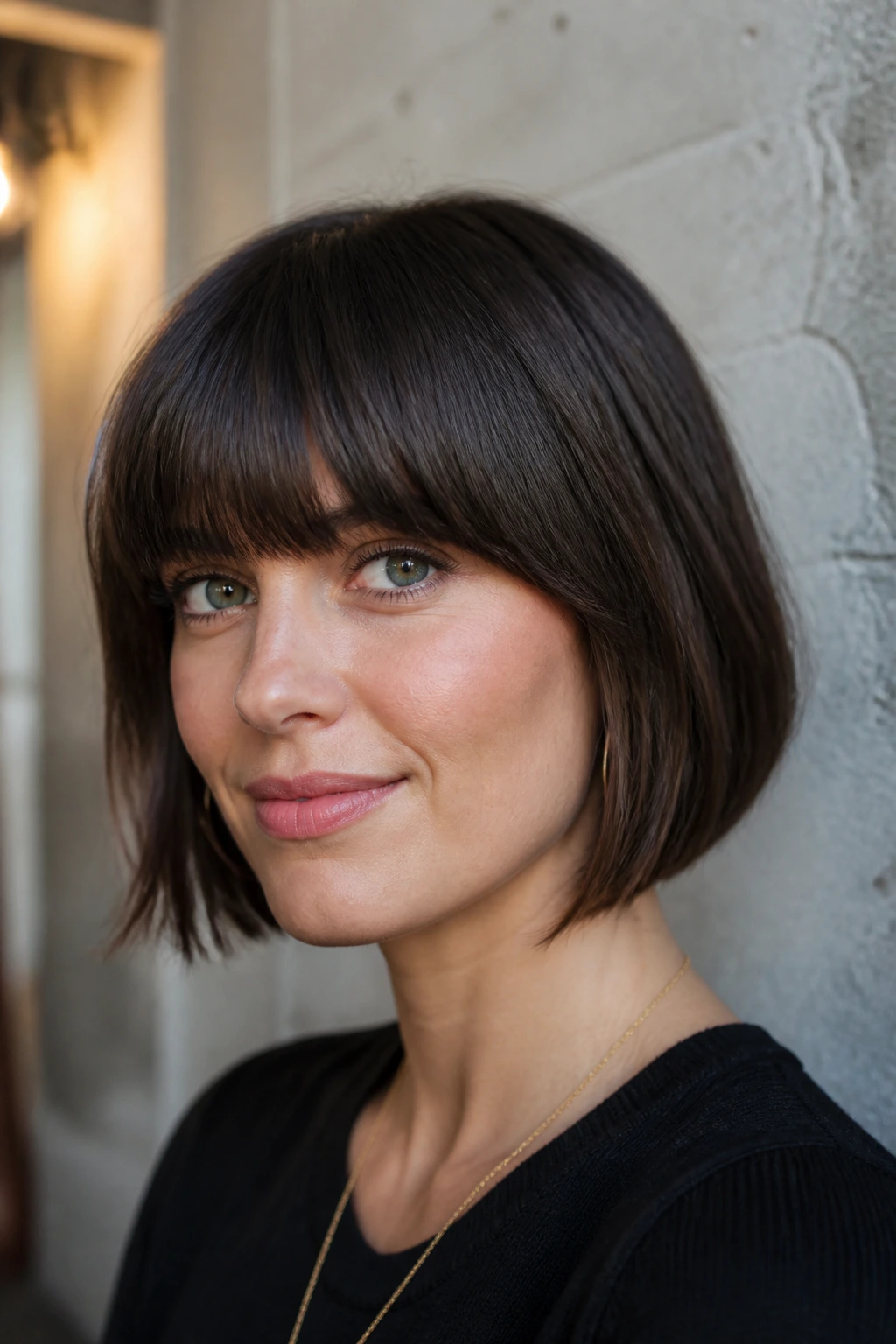
A full fringe with tapered corners gives you the density of a classic bang without the harsh box effect that can annoy square faces. The center carries the fullness, but the corners are softened so the fringe doesn’t slam straight across the forehead from temple to temple.
What to Ask Your Stylist For
- A full center section that lands around the brows.
- Tapered outer corners that blend toward the temples.
- Point-cut ends instead of a hard, blunt perimeter.
- Slightly shorter center length if your forehead is high.
This shape is good when you want real bangs, not a whisper of them. The taper keeps the face from feeling wide at the top, while the fullness gives a clear frame. I’d choose it for straight or moderately thick hair most often.
The look is more structured than curtain bangs, less severe than a classic blunt bang. That middle ground is exactly why it works.
26. Asymmetrical Fringe
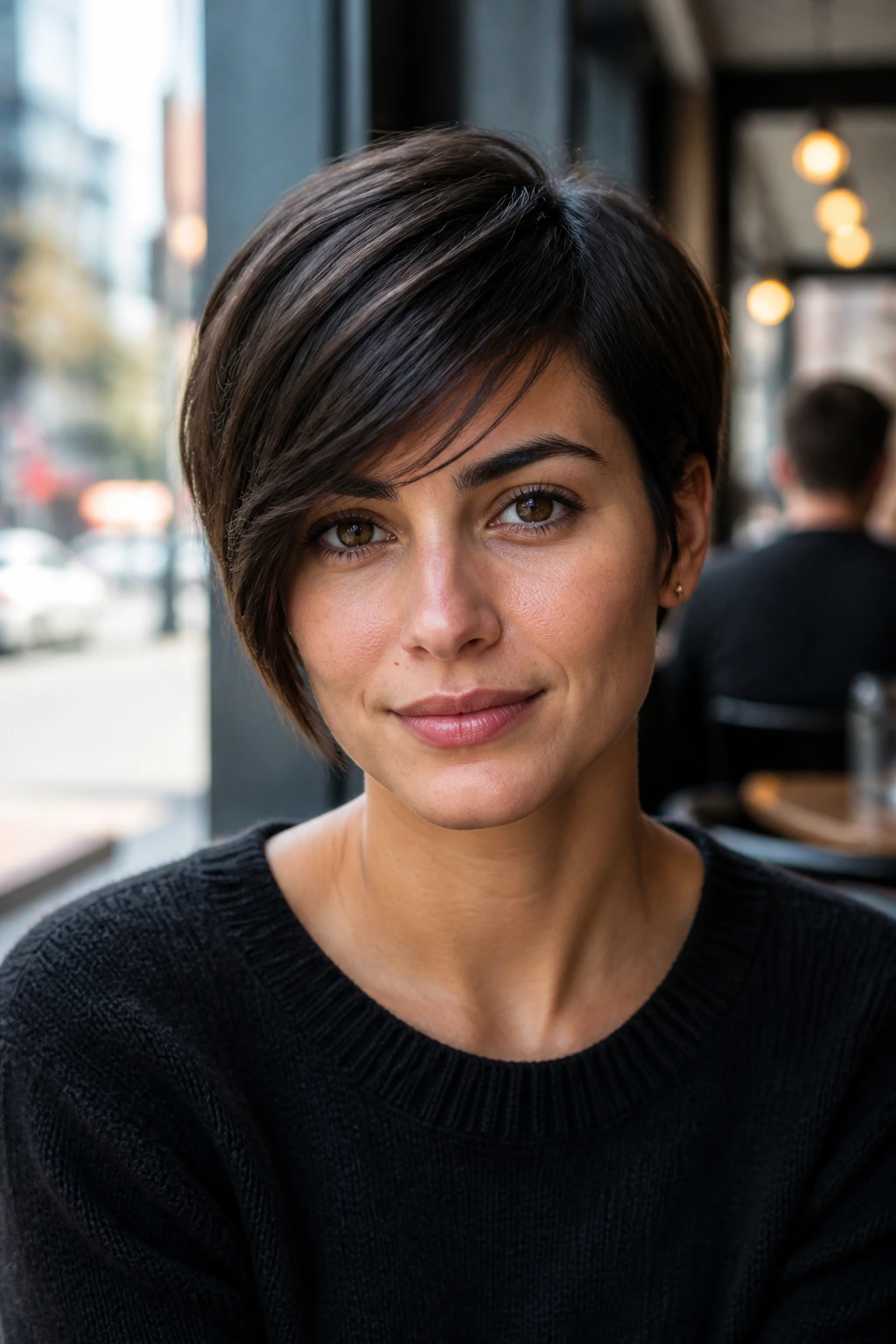
Asymmetrical fringe is sneaky. Because one side is longer than the other, the face immediately loses that even, box-like feeling square faces sometimes create with a straight line. The diagonal pulls the eye across the forehead and down the cheek instead of letting it sit and measure width.
This is a strong choice if you like a little edge in your haircut. It can look modern, sharp, and a bit architectural without being too stiff. The trick is to keep the longer side soft, not blade-like. If the cut gets too precise, it can start to feel severe rather than flattering.
It’s also one of the better options for people with a strong side part or a cowlick that refuses to behave. Instead of fighting the natural direction, you use it. That usually looks better anyway.
27. Flipped-Out Fringe
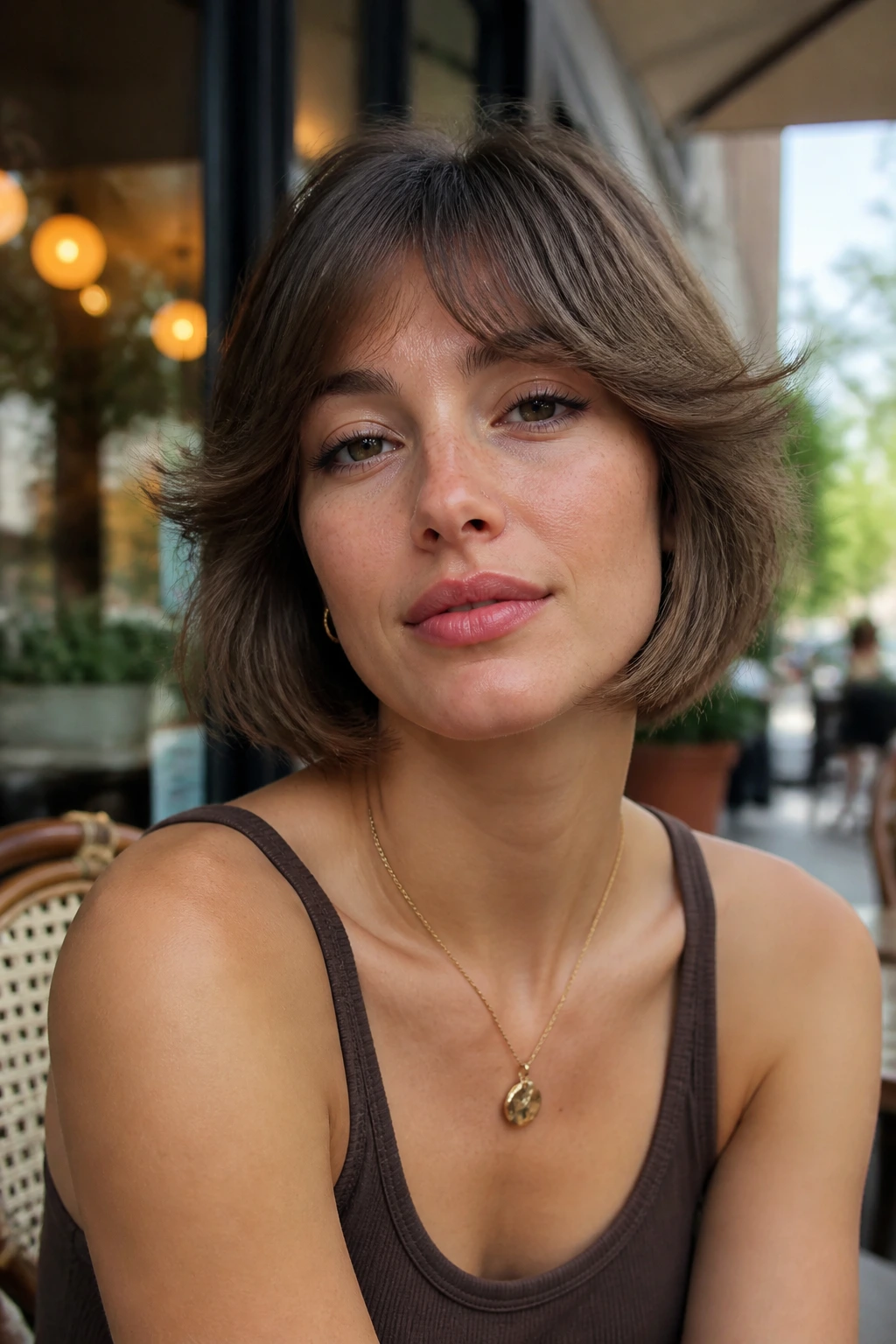
Flipped-out fringe has a retro feel, but the right version can be surprisingly good on a square face. The ends turn away from the forehead, which means they don’t sit like a hard bar. That outward motion opens the face and adds a little lift near the temples.
The flip works best when the fringe is not too short. If the ends sit around the brows or just below, the shape has enough length to bend without sticking out oddly. I like this with shoulder-length cuts and layered bobs where the front needs a little movement anyway. It’s playful, but not childish.
You’ll need some styling. A small round brush or a flat iron bend near the ends helps the shape hold. Leave the roots soft and the flip a little loose. Too much curve and it gets costume-y fast.
28. Curly Curtain Fringe
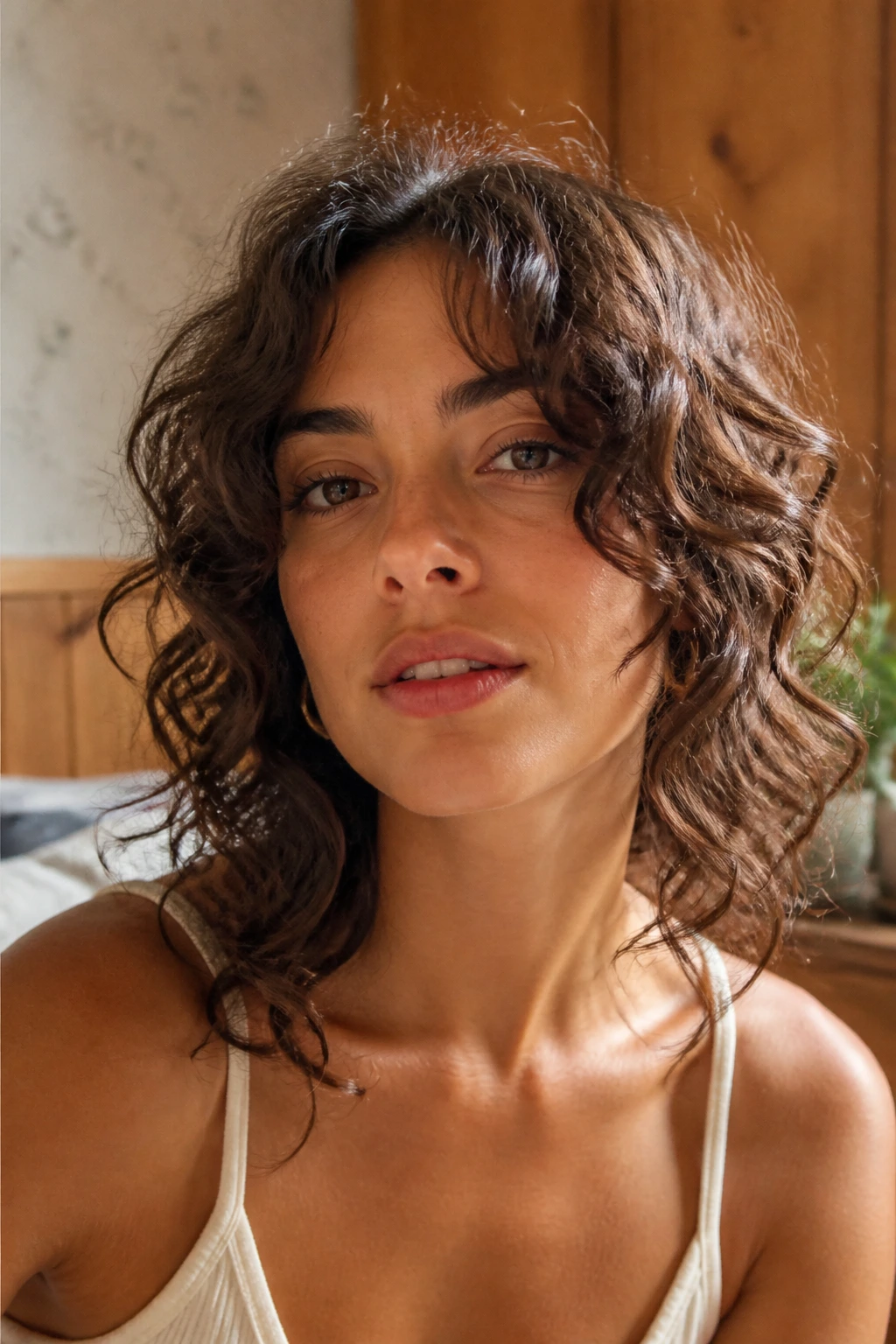
Curly curtain fringe is one of the nicest ways to let curls frame a square face without forcing them into a shape they don’t want. The split in the middle opens the forehead, while the curly pieces fall outward and create movement around the cheeks. That movement softens the jawline in a way straight hair sometimes can’t.
The most important thing is length. Curls need room. Ask for the fringe longer than you think you need, because the dry length will shorten up. If the pieces hit the brow when wet, they may spring way above it once they dry. That can be cute. Or it can be a surprise you didn’t order.
A curly curtain fringe looks best when the curl pattern is respected, not flattened. Let it separate a bit. Let it breathe. Square faces can carry that openness very well.
29. Long Swoop Bangs
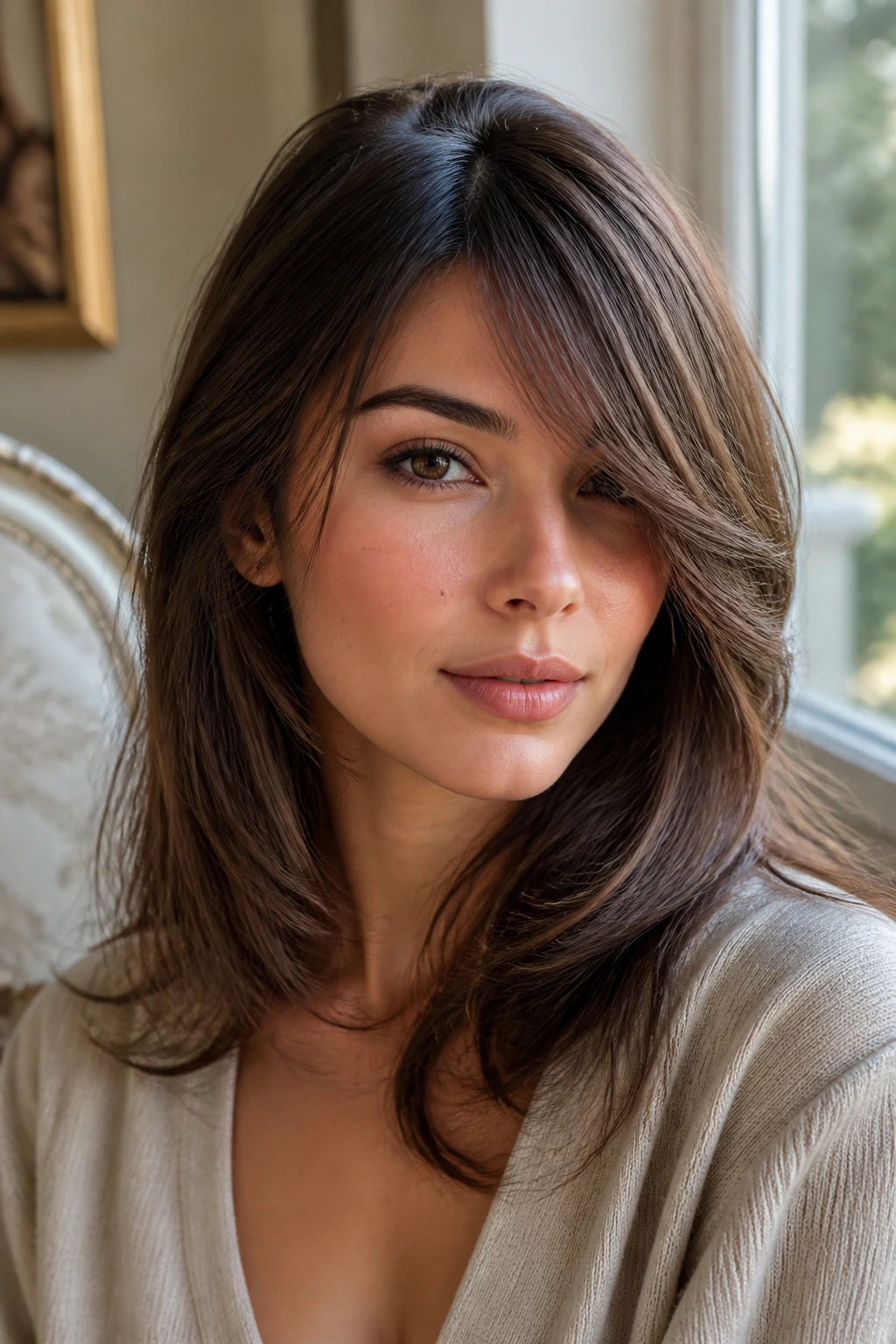
Long swoop bangs are dramatic in the best way. They travel across the forehead in one long diagonal, which is exactly the sort of motion that softens a square face without burying it in hair. The line is elegant, but the key word here is line — it has to stay smooth enough to read as intentional.
This style is especially nice if you like a polished blowout or you tend to wear one side tucked back. The swoop gives the haircut some motion even when the rest of the hair is straight. It also works well when you want the jawline to step back a little. Not disappear. Just stop shouting.
If your hair is coarse or thick, the bang may need careful thinning at the corners so it lies down instead of puffing out. If your hair is fine, keep enough length that the swoop doesn’t collapse. The shape matters more than the drama.
30. Center-Parted Fringe
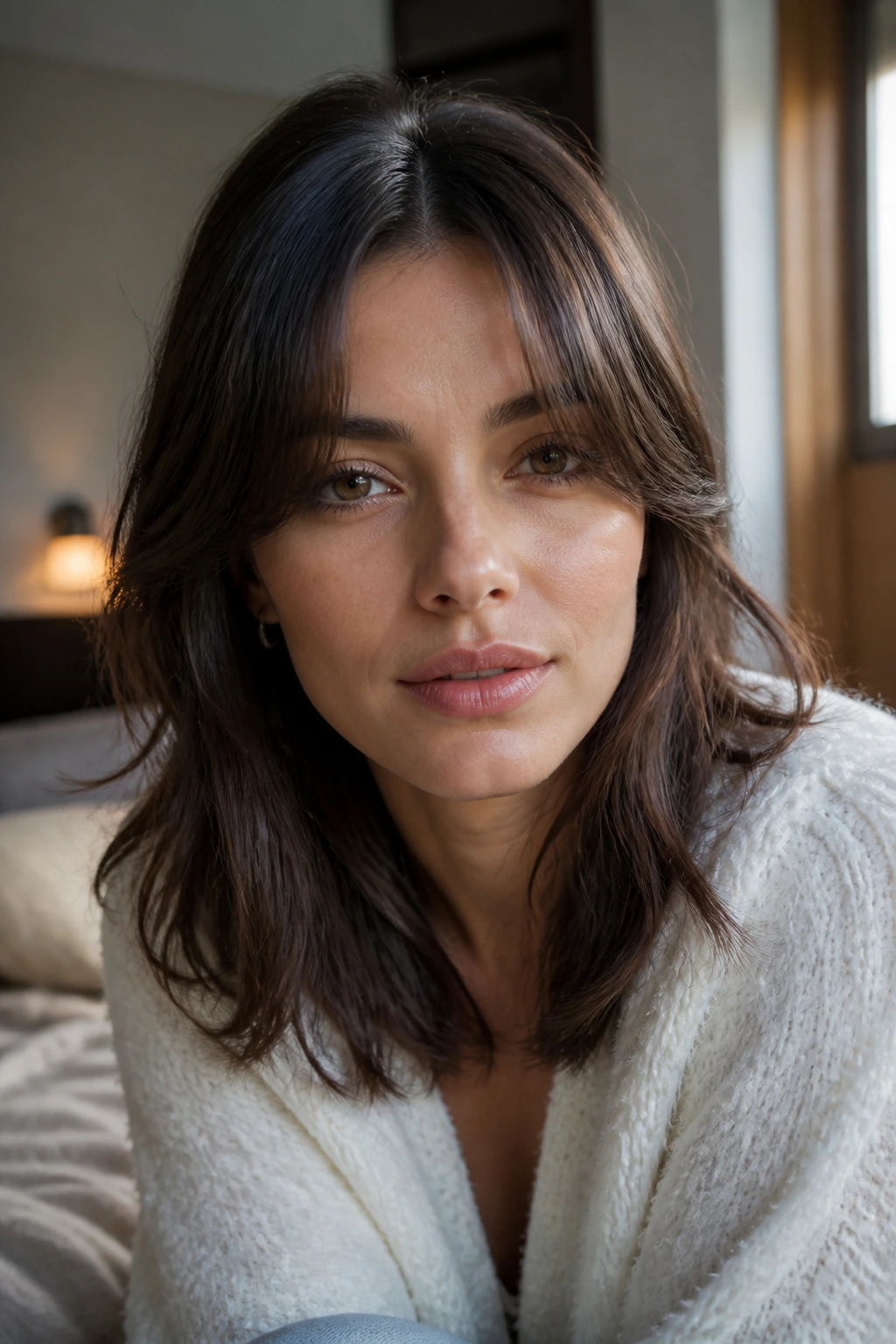
Center-parted fringe is not the same as curtain bangs, though people blur them together all the time. This version tends to stay a little more deliberate and symmetrical, with two sections that frame the forehead without drifting too far into the cheeks. On a square face, that center split gives a vertical opening right where the shape needs it.
What I like about it is the balance. It keeps the forehead from feeling heavy, but it doesn’t make the face look over-layered either. If you have strong brows or a strong jaw, the symmetry can be lovely because it lets the face read cleanly while still softening the upper edge.
This style needs a little discipline in the styling chair. If the pieces get too short at the center, they can poke up. Too long, and they lose the framing effect. The sweet spot usually lives around brow level with sides that taper gracefully.
31. Graduated Fringe
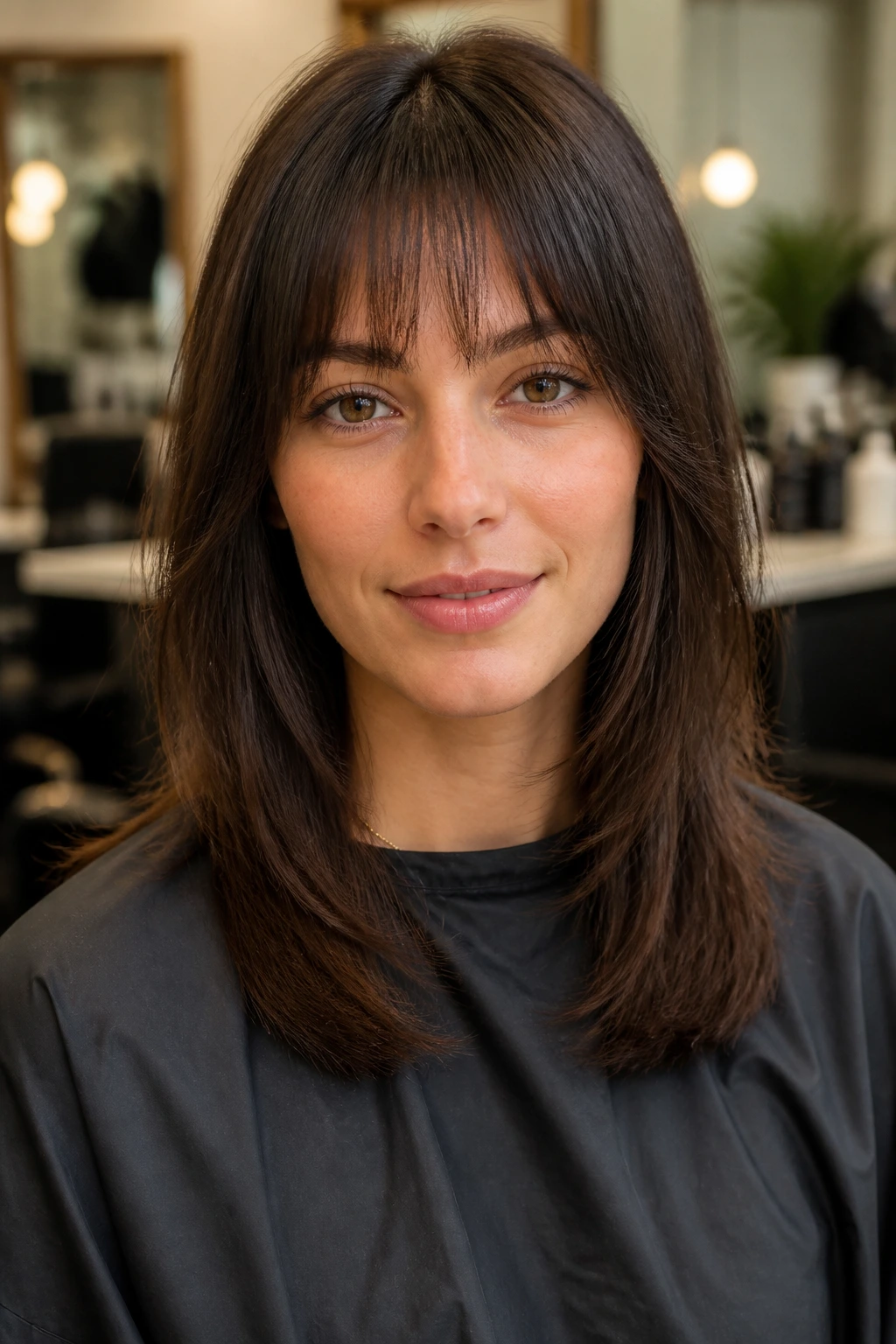
Graduated fringe is one of the smartest shapes for square faces because it uses length as a tool. The center stays shorter, and the sides get progressively longer. That graduation creates a soft arc instead of a flat bar, which helps the face look less square without losing any definition.
Why It’s Worth a Look
This shape works like a visual slope. The eye starts high in the middle, then travels outward and downward toward the temples and cheekbones. That slope is flattering on square faces because it interrupts the horizontal strength of the forehead and jaw. The result feels smoother, not hidden.
Best for: thick hair, wide foreheads, or anyone who likes a clear shape.
Styling tip: blow-dry the center first, then set the sides with a brush so the longer corners don’t kick out.
I’d call this a designer’s fringe. It’s controlled, but not rigid. That’s a nice combination.
32. Grown-Out Bangs

Grown-out bangs are underrated. A lot of people treat them like an in-between stage, but on a square face they can be the finished look. The length softens the forehead, the extra width at the sides can graze the cheekbones, and the whole shape feels less severe than a freshly cut blunt fringe.
The trick is making the grow-out look intentional. That usually means keeping the center parted or softly swept and asking the stylist to blend the ends into the front layers. If the fringe is left to hang in one awkward chunk, it loses the flattering effect fast. But shaped properly, a grown-out bang is one of the easiest ways to keep some frame around the face without constant trimming.
This is also the practical choice for people who hate salon maintenance. It buys time. And on square faces, time usually helps the shape relax in a good way.
33. Browbone Fringe
Browbone fringe sits right on that narrow line between full coverage and open face. It’s long enough to brush the brow bone, which keeps the forehead framed, but not so heavy that it swallows the top half of the face. For square faces, that balance is useful because the fringe adds shape without making the whole look harder.
I like this style when someone wants a classic bang with a little softness. It can be worn smooth, slightly piecey, or tucked into a side sweep on days when you want less forehead. The length also makes it easier to work with glasses, strong brows, and changing part lines, which is more flexible than people expect.
If the cut is too dense, it loses the lightness that makes it work. Keep the corners softened and the center just touching the brow bone. That little bit of control is the difference between flattering and flat.
Why Bang Geometry Matters More Than Trend Names
The name of the fringe matters less than the shape it draws on your face. A square face already has strong architecture built in: even width at the forehead and jaw, clean lines, and corners that show up immediately in a mirror. That’s why a bang has to do more than “look cute.” It has to change the direction of the eye.
The best fringe shapes for square faces usually add one of three things: a diagonal, a curve, or a bit of air. Diagonals break symmetry. Curves soften corners. Air keeps the forehead from looking boxed in. A bang that does none of those things can still be pretty, but it often feels harsher than it needs to.
I’m also a believer in matching the fringe to the haircut instead of treating it like a little add-on. A soft curtain bang with blunt shoulder-length hair can feel a little unfinished. The same bang with layers around the cheekbones suddenly makes sense. Hair lives as a shape, not a single piece. That’s the part people forget.
Essential Tools for Styling Square-Face Bangs
-
1-inch round brush: Small enough to shape bangs without turning them into a puffy roll. Great for curtain, bottleneck, and side-swept fringe.
-
Blow dryer with a concentrator nozzle: The nozzle matters. It keeps the airflow pointed at the fringe so the shape sets instead of frizzing out.
-
Mini flat iron: Useful for micro bangs, blunt bangs, or fixing a bend in a piecey fringe. A full-size iron is harder to control near the forehead.
-
Heat protectant spray: Bangs sit closest to the skin and usually get the most heat. Skip this and they dry out fast.
-
Duckbill or sectioning clips: These keep the rest of the hair out of the way while you dry the fringe first.
-
Texturizing spray or light dry shampoo: Good for wispy, piecey, and shaggy styles that need a little separation at the root.
-
Finishing cream or pea-sized pomade: Best for taming flyaways in blunt or browbone bangs. Use sparingly, or the fringe turns greasy.
-
Tail comb: Helpful for clean parts and for placing the fringe exactly where you want it before drying.
Choosing the Right Fringe Before the First Snip
If you’re sitting in the chair deciding between three different bang ideas, start with your hairline before you start with the face shape. A square face can wear a lot, but a cowlick at the center or a strong side swirl changes how the fringe will sit every single morning. If your hair splits on its own, a heavy center bang will fight you. If the front grows forward flat, a softer curtain or bottleneck can be easier.
Density is the next thing I’d look at. Thick hair can handle bluntness and still move. Fine hair usually needs air, texture, or a little separation so the fringe doesn’t swallow the forehead. Curly and wavy hair need extra length because shrinkage is not a theory; it’s a daily event. A bang that looks eyebrow length when wet can end up a full inch shorter once it dries.
Think about glasses too. Frames change where the fringe rests and where it bends. If the glasses sit high on the nose, a browbone or cheekbone-grazing fringe usually behaves better than a short blunt cut. And if you wear your hair up often, go for a shape that still looks sane when the rest of the hair is pulled back.
How to Wear Each Fringe Without Fighting Your Face Shape
Presentation: Let the fringe sit where it creates movement, not where it clamps down on the forehead. On a square face, that usually means a little lift at the root and soft ends at the brows, cheekbones, or just below.
Accompaniments: The best partners are long layers, soft lobs, shags, and cuts with a little bend around the cheek. Those shapes echo the same softening job the bangs are doing, so the whole haircut works together instead of arguing.
Portions: Ask for a fringe that is wide enough to frame the eyes, not so wide that it reaches straight into the temple line. The center can be fuller, but the corners usually look better when they taper. That keeps the face from looking wider at the top.
Finish: Airy styles like wispy, see-through, or shaggy bangs want texture spray and a dry finish. Blunt, browbone, and soft blunt styles usually need a smoother polish with heat protection and a small round brush. Pick the finish that matches the shape, not the mood you had that morning.
Small Styling Moves That Make a Big Difference
The fastest way to improve bangs on a square face is to dry them first. Always first. If you leave the fringe for last, the rest of the hair starts cooling while the front hairline sets however it wants. That usually means a cowlick, a bend, or a flat root you’ll spend the next ten minutes fighting.
Pro move: direct the airflow downward from root to tip while the fringe is still damp, then switch to a round brush only when the basic direction is right. That keeps frizz down and saves you from overworking the front.
Texture trick: pinch a few ends together with a tiny bit of lightweight cream after the hair is dry. Just a little. The goal is separation, not product face. This matters most for choppy, shaggy, and see-through styles.
Time-saver: if your bangs get oily fast, wash just the fringe in the sink with a drop of shampoo and blow-dry it while the rest of your hair stays dry. It sounds fussy, but it’s faster than styling the whole head again.
Glasses note: if your frames sit close to the brows, leave the fringe a touch longer than you think. A half-inch can save you from constant pushing and blinking.
Common Mistakes That Make Bangs Look Too Boxy
-
Cutting the fringe too wide: If the bangs run straight to the temples, they echo the width of a square face and make the top half feel heavier. The fix is simple: keep the widest point slightly inside the face line and taper the corners.
-
Stopping the bangs at the jawline: That’s the fastest way to reinforce squareness. If the front pieces end right where the jaw is strongest, the face reads more geometric. A better landing point is usually the brow, cheekbone, or just below.
-
Making everything too dense: Heavy fringe can be gorgeous, but on a square face it needs softness somewhere — either in the edge, the length, or the side pieces. No softness usually means no movement.
-
Ignoring curl and shrinkage: Curly and wavy bangs are almost always cut too short by impatient hands. Dry the fringe in its natural pattern before judging the length.
-
Styling into a perfect helmet: A rounded blowout can make bangs look polished, but too much curve creates a bubble over the forehead. That bubble is not your friend.
-
Skipping trims for too long: Bangs that grow past their intended shape start drooping into the eyes or splitting in odd places. Square faces tend to look best when the front remains intentional, not accidental.
Variations and Alternatives to Try
The Low-Maintenance Grow-Out: Start with long layered fringe or grown-out bangs and keep the center soft. This gives you fringe energy without the regular trim schedule.
The Curl-Friendly Version: Ask for curly curtain bangs or curly browbone fringe cut dry and left longer than straight-hair bangs. The extra length protects against shrinkage and keeps the shape open.
The Glasses-Friendly Fringe: Choose browbone bangs, see-through fringe, or a soft side sweep that sits above or just at the frame line. This keeps the hair from pressing against your lenses all day.
The Thick-Hair Control Cut: Go for a soft blunt bang, textured blunt bang, or full fringe with tapered corners. Thick hair needs structure, but it also needs weight removed from the corners so the face doesn’t look wider.
The Edgy Softener: Micro bangs with soft edges, asymmetrical fringe, or wolf-cut bangs give square faces a strong look without the hard line problem. These are better when you want the haircut to make a statement, not just behave politely.
Keeping the Fringe Fresh Between Trims
Bangs on square faces usually need more upkeep than the rest of the haircut, and the schedule depends on the style. Blunt and browbone fringes often need a trim every 3-5 weeks. Curtain, bottleneck, and grown-out shapes can stretch farther, usually around 5-7 weeks before they start losing their line.
If the fringe gets oily, don’t shampoo the whole head every time unless you need to. A quick sink wash or a small amount of dry shampoo at the roots usually handles it. Bangs dry faster than the rest of the hair, so they’re also the easiest part to refresh in the morning. Ten seconds under the dryer can save you from a full restyle.
Store the heat tools where you’ll actually use them. That sounds trivial until you’re late and the flat iron is buried in a drawer. Keep a small brush, a comb, and your heat protectant in the same spot. If you’re growing the fringe out, ask for the corners to be blended into the front layers rather than chopped off bluntly. That makes the grow-out phase look like a plan, not a mistake.
Square-Face Bang Questions People Actually Ask
Do square faces have to avoid blunt bangs?
No, but blunt bangs need softness somewhere else — usually at the corners, density, or width. A heavy straight line that runs temple to temple can make the face feel wider, while a softened blunt fringe can look sharp in a good way.
Which bangs are easiest to grow out on a square face?
Curtain bangs, long layered fringe, grown-out bangs, and split fringe are the least annoying during grow-out. They blend into face-framing layers instead of hanging around as a stubborn block.
Are curtain bangs still a good choice for square faces with strong jaws?
Yes, especially when the sides are long enough to brush the cheekbones. That length shifts attention away from the jaw corners and keeps the face from feeling too squared at the top.
What if my hair is very curly?
Ask for longer bangs than you think you need, and get them cut with the curl pattern visible. A curly fringe that’s cut too short can spring into a shape that sits above the brows before you’ve had time to react.
Can I wear bangs if I have a big forehead and a square face?
Absolutely. In fact, some of the best styles here — bottleneck, curtain, and browbone fringe — are useful because they soften the forehead without turning the face boxy. The trick is keeping the center lighter and the sides slightly longer.
How often do bangs need trimming?
Shorter and blunt styles usually need attention every 3-5 weeks. Longer, softer styles can go a bit longer, but they still need shaping before they lose the line.
What if my bangs keep separating at the center?
That usually means a cowlick or a natural growth pattern is pushing them apart. A little more weight at the center, a different part, or a longer curtain-style shape usually fixes it better than trying to force a straight line.
Should I cut bangs dry or wet?
For curly or wavy hair, dry cutting is often safer because it shows how the hair sits in real life. For straight hair, either can work, but the final check should always happen on dry hair before the stylist releases the scissors.
Soft Edges, Less Geometry
Square faces don’t need to be hidden. They need a little redirection. That’s the whole game. The best fringe shapes break the eye off the straight path, send it diagonally, or give it something soft to land on at the cheekbone. Once that happens, the strong jawline reads as strength instead of hardness.
If I had to keep only one rule, it would be this: let the bangs bend. Bend at the brow. Bend at the temple. Bend at the cheek. A square face already knows how to make a statement. The fringe just decides whether that statement feels sharp, soft, or a little bit of both.
A good stylist can adjust almost any of these shapes to your hairline, texture, and daily routine. Bring photos, yes, but bring a sense of where your hair wants to go on its own. That matters more than chasing a name. The right bang style is the one that makes your face look like itself — only better lit, slightly softer, and a touch more interesting every time you catch it in a mirror.
