



A heavy bang can make a short haircut look boxed in. A wispy fringe does the opposite. It lets the forehead breathe, softens a strong hairline, and keeps short styles from feeling stern or overworked — which is exactly why wispy bangs over 50 keep showing up on cuts that still look good after a long day, a windy walk, or one too many passes of the hand through the hair.
There’s a practical reason for that, too. Hair often gets a little finer at the front, a little coarser at the ends, and a little less cooperative around the cowlicks and temples. A blunt fringe can exaggerate all of that. A feathered, point-cut bang with a bit of bend is more forgiving. It moves with the haircut instead of sitting on top of it like a lid.
The best short hairstyles with wispy bangs don’t try to hide age. They work with texture, gray tones, glasses, forehead lines, and changing density. Some are soft and piecey. Some are cropped and energetic. A few lean elegant. A few lean cheeky. All of them understand the same basic idea: a little air at the front makes short hair easier to live with.
Why These 22 Cuts Keep Working
- They soften the front of the face: A few see-through strands at the brow break up a hard line without hiding your features.
- They play well with texture: If your hair is fine, wispy bangs add movement; if it’s thick, they remove some of the visual weight that makes short hair feel helmet-like.
- They’re friendlier with glasses: A light fringe can skim above the frames or split around them instead of crashing into the lens line.
- They handle gray hair well: Silver and salt-and-pepper strands often have more stiffness, and wispy ends keep that from turning into bulk.
- They’re easier to style than blunt bangs: A round brush, a quick pass of the dryer, and a little product are usually enough.
- They age with the haircut, not against it: The fringe can be kept soft as the cut grows out, so you’re not stuck waiting for a dramatic reshaping appointment.
What Wispy Bangs Need From Short Hair After 50
A wispy bang only looks airy if the rest of the haircut carries its weight. If the back is too bulky or the sides are cut blunt, the fringe starts to look accidental instead of intentional. The best versions have some sort of internal movement — layering, beveling, tapering, or a slight graduation at the nape.
Face shape matters, but not in the rigid way people love to pretend it does. A round face often likes a longer, side-swept fringe that opens at one temple. A longer face usually benefits from bangs that skim the brows and add width across the forehead. Square jaws can take soft, broken-up pieces that blur the edges. Oval faces get the most freedom, which is unfair but useful.
Cowlicks deserve respect. Seriously. If your bang line fights a swirl at the front hairline, it will split no matter how expensive the haircut was. The answer is usually a slightly longer fringe, cut with the natural growth pattern instead of against it, then dried in the direction it wants to travel.
1. Feathered Pixie with Side-Swept Wispy Bangs
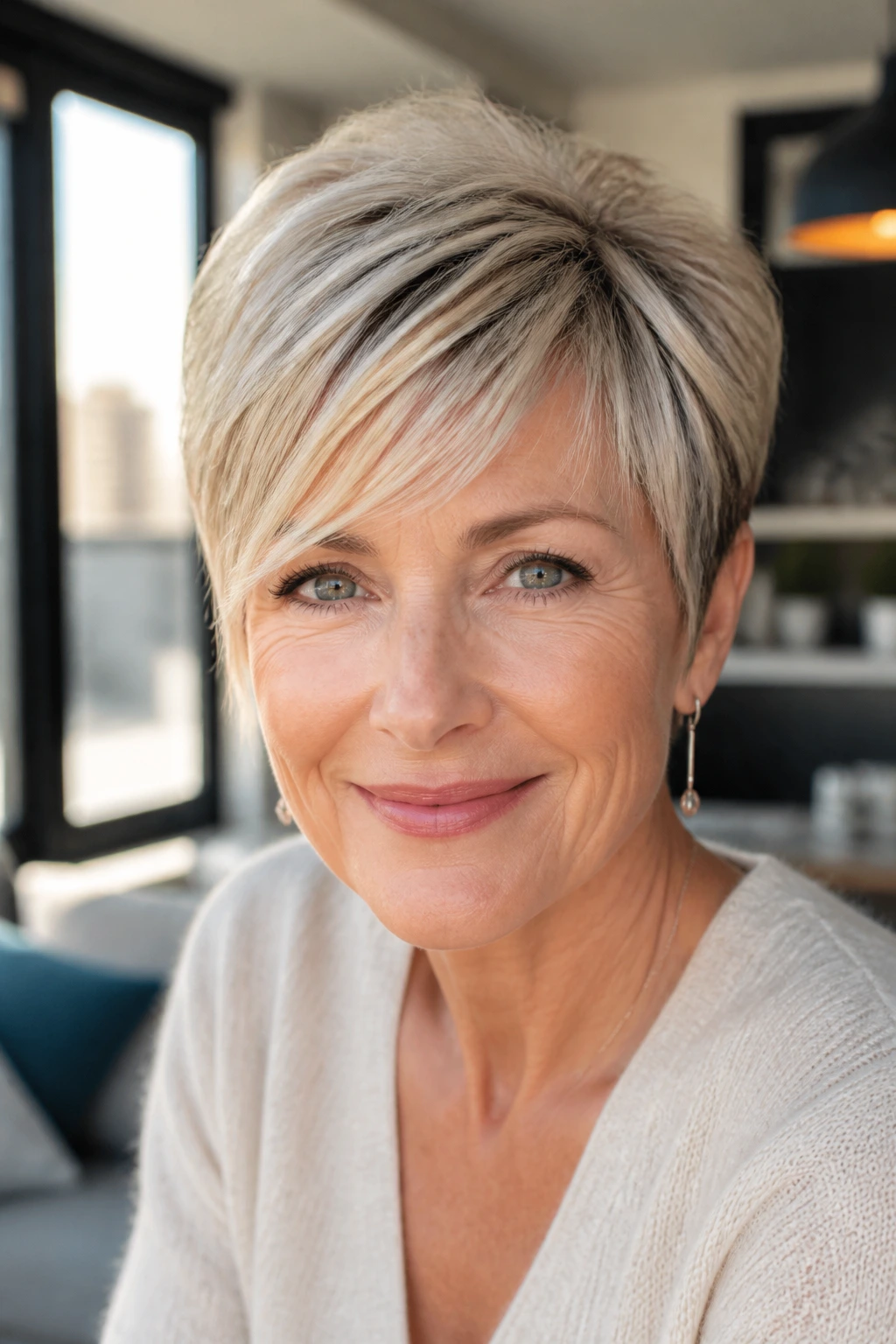
A feathered pixie is one of the cleanest ways to wear wispy bangs without making the face look crowded. The short back and tapered sides keep the shape light, while the fringe skims across the forehead in a soft diagonal that feels easy rather than severe.
Why It Works
The trick here is balance. The haircut stays close to the head, but the bangs add just enough softness at the front to stop the pixie from looking too clipped. Ask for point-cut ends and a slightly longer front piece — usually around eyebrow length on the shortest side — so the fringe can sweep instead of sticking straight out.
- Best for fine to medium hair that needs lift at the crown.
- Ask your stylist to keep the top 2 to 3 inches longer than the sides.
- A pea-sized amount of mousse gives the fringe some hold without stiffness.
- This one looks best with a side part, not a dead-center split.
Pro tip: Blow-dry the bangs first, while they’re still damp, and direct the airflow from the crown toward the opposite side. That small move keeps the fringe from sticking flat to the forehead.
2. Chin-Length Bob with Airy Fringe
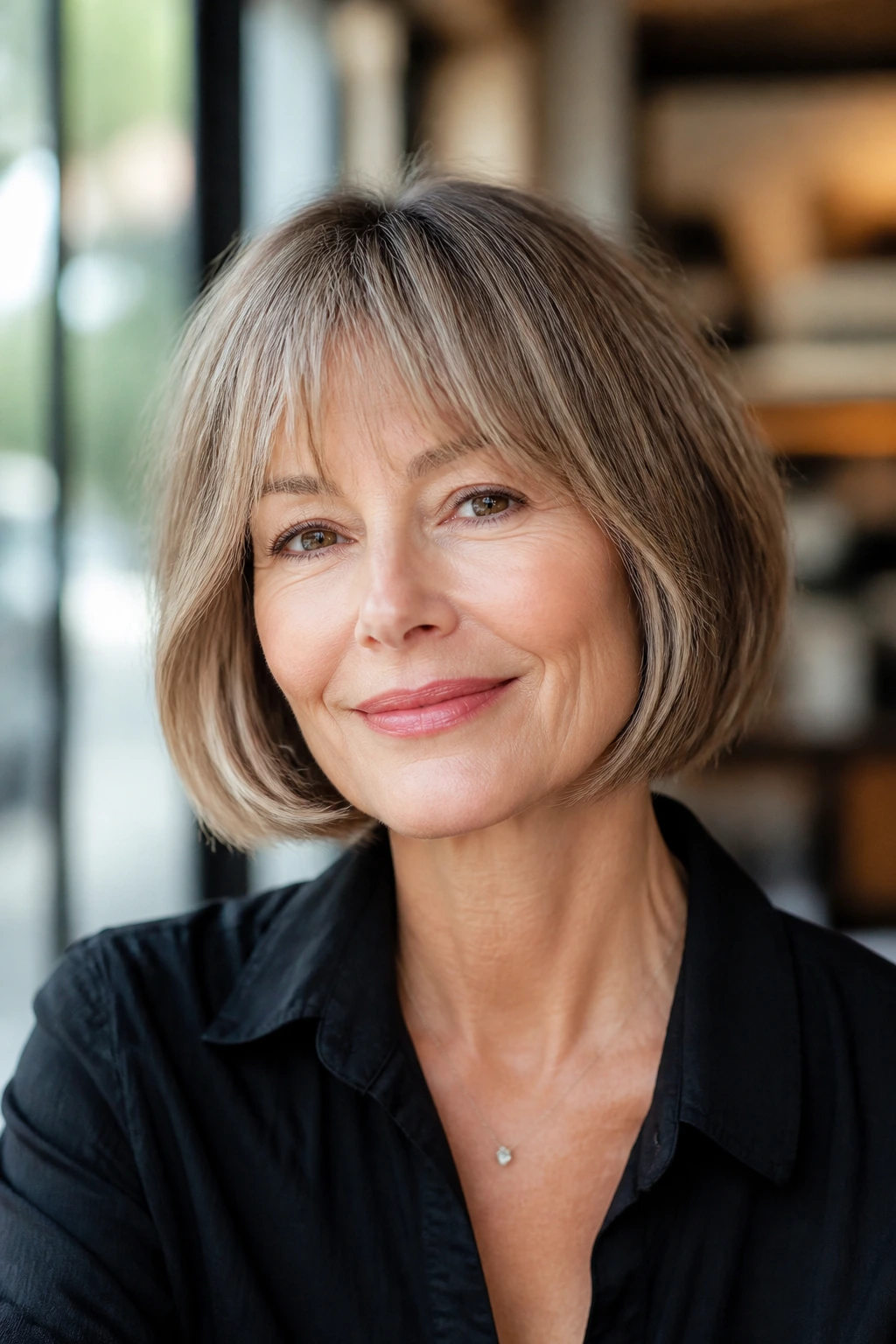
If you want short hair that still feels polished, this is the cut I keep coming back to. The chin-length bob gives structure around the jaw, and the airy fringe keeps that structure from turning hard or boxy.
The bang line should barely graze the brow, not cover it completely. That little bit of transparency matters. You want the eyes to stay open, not hidden behind a wall of hair that needs daily fighting.
For styling, I like a round brush with a medium barrel and a quick bend under at the ends. The bob should curve just enough to follow the jawline, while the bangs stay piecey. If your hair tends to puff at the sides, ask for a soft undercut or internal layering so the bulk lives under the top layer instead of around your cheeks.
This is also one of the better options if you wear lipstick often. The shape frames the mouth and jaw without competing with them. Small thing. Big effect.
3. Tapered Crop with See-Through Bangs
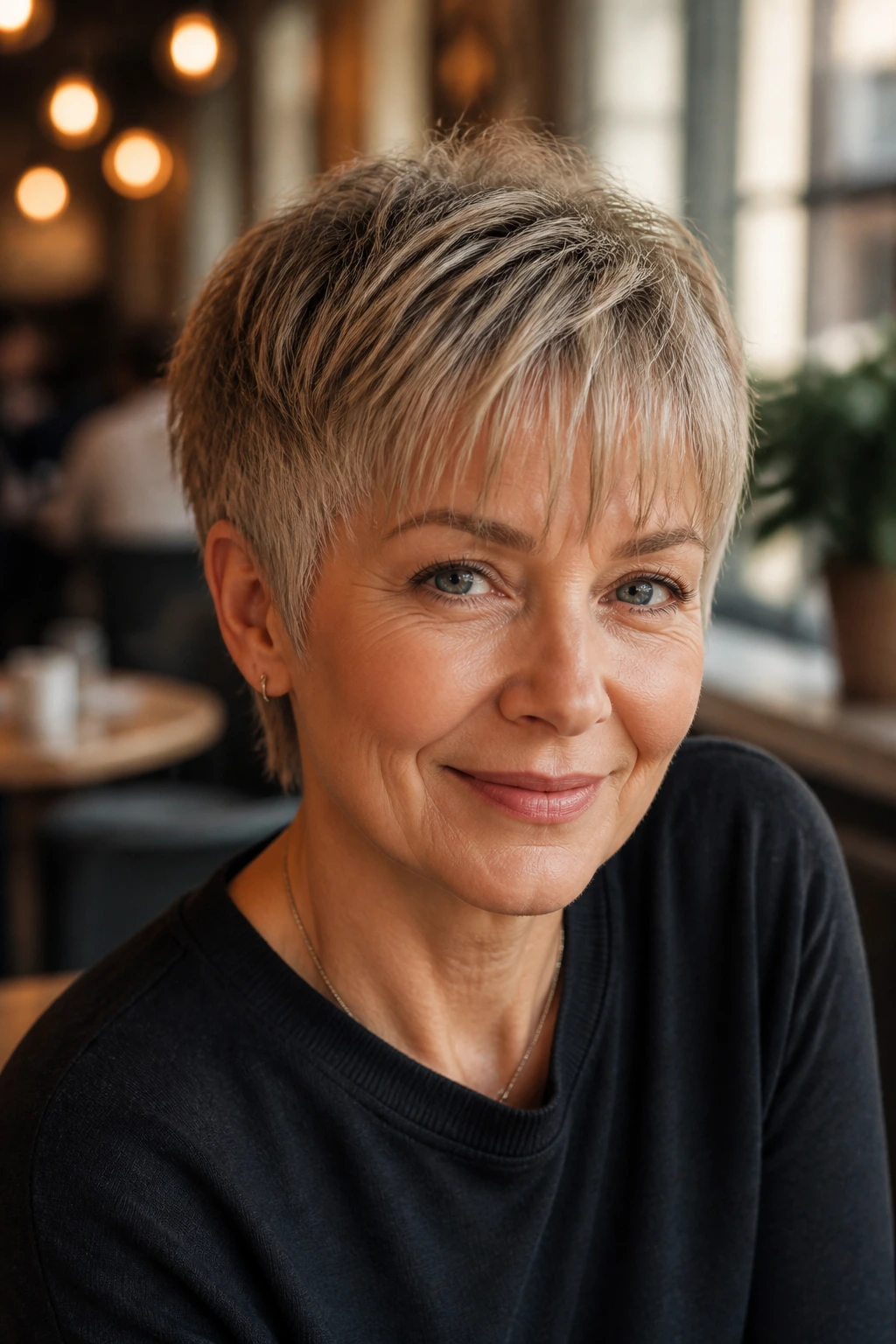
Why does a crop with see-through bangs look less severe than a blunt crop? Because the eye can pass through it. That sounds simple, but it changes everything.
A tapered crop sits close at the nape and ears, then opens up slightly toward the top and front. The bang area is cut thin enough that skin shows between the strands. It’s not sparse; it’s controlled. The difference matters.
How to Style It
Keep a tiny blow-dryer nozzle on the fringe and dry the bangs forward first, then sweep them apart with your fingers while they’re still warm. A small dab of texturizing cream at the tips is enough. If you use too much product, the see-through effect disappears and the cut starts looking stringy instead of light.
This is a strong choice for anyone with a low-maintenance routine and a little natural movement in the hair. It grows out well, too. That counts for a lot.
4. Textured Shag Bob with Curtain Wisps
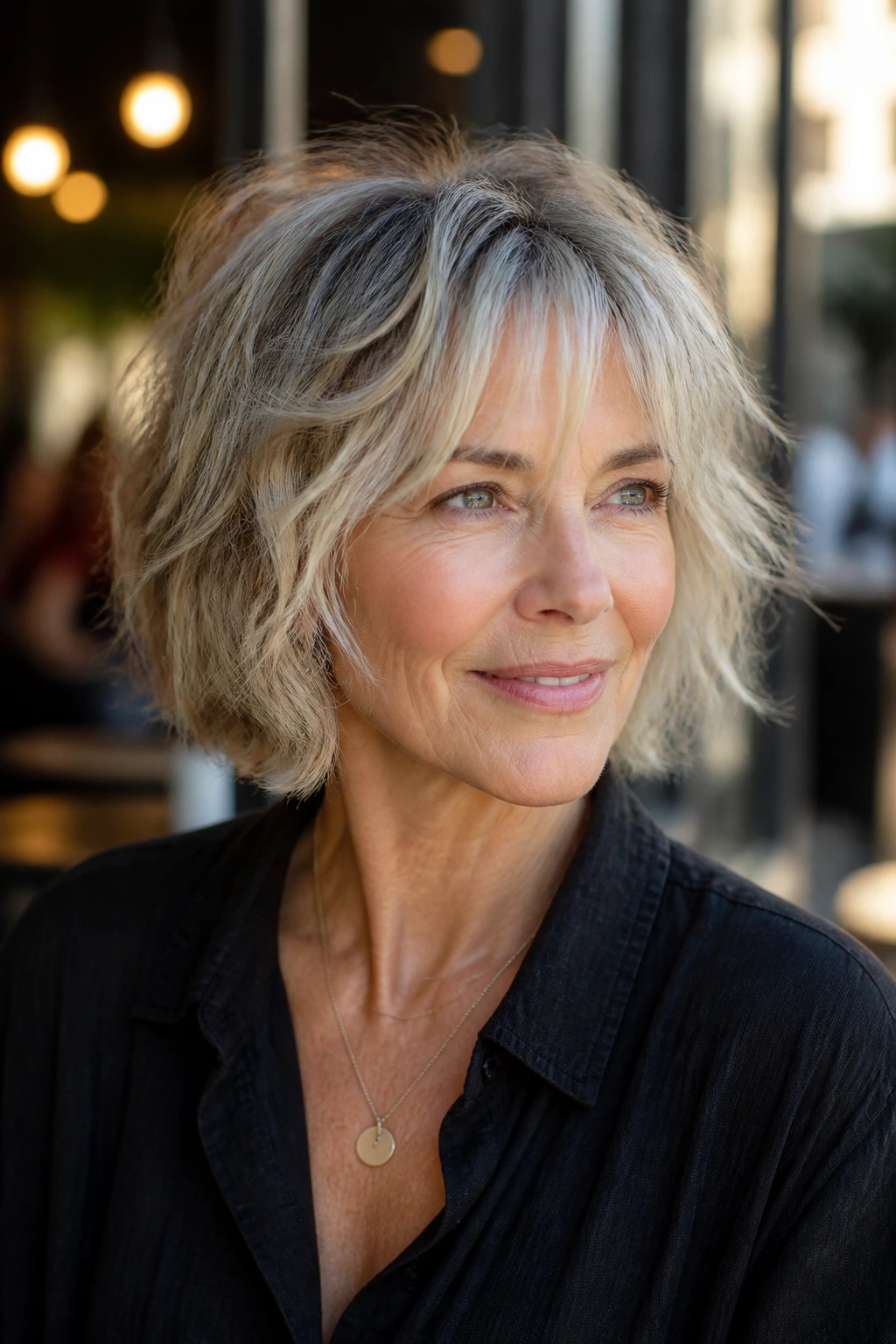
Picture a bob that still moves when you turn your head. That’s the point here. The shaggy layers keep the body loose, and the curtain-like wisps split around the forehead instead of forming one solid panel.
The best version has broken-up ends and a little lift at the crown. Not too much. You’re after movement, not a 1970s costume. The bangs can part in the middle or slightly off-center, depending on where the hair naturally falls. If you have a stronger cowlick on one side, let it win by a few millimeters. Fighting it usually makes the fringe harder to manage.
- Works especially well on wavy hair that needs shape, not heavy layering.
- Ask for face-framing pieces that start around the cheekbone.
- A salt spray or lightweight mousse gives the ends separation.
- Air-drying is fine if you scrunch the fringe lightly while it dries.
The whole cut feels relaxed, but not sloppy. That’s the sweet spot.
5. Soft French Bob with Brow-Grazing Fringe
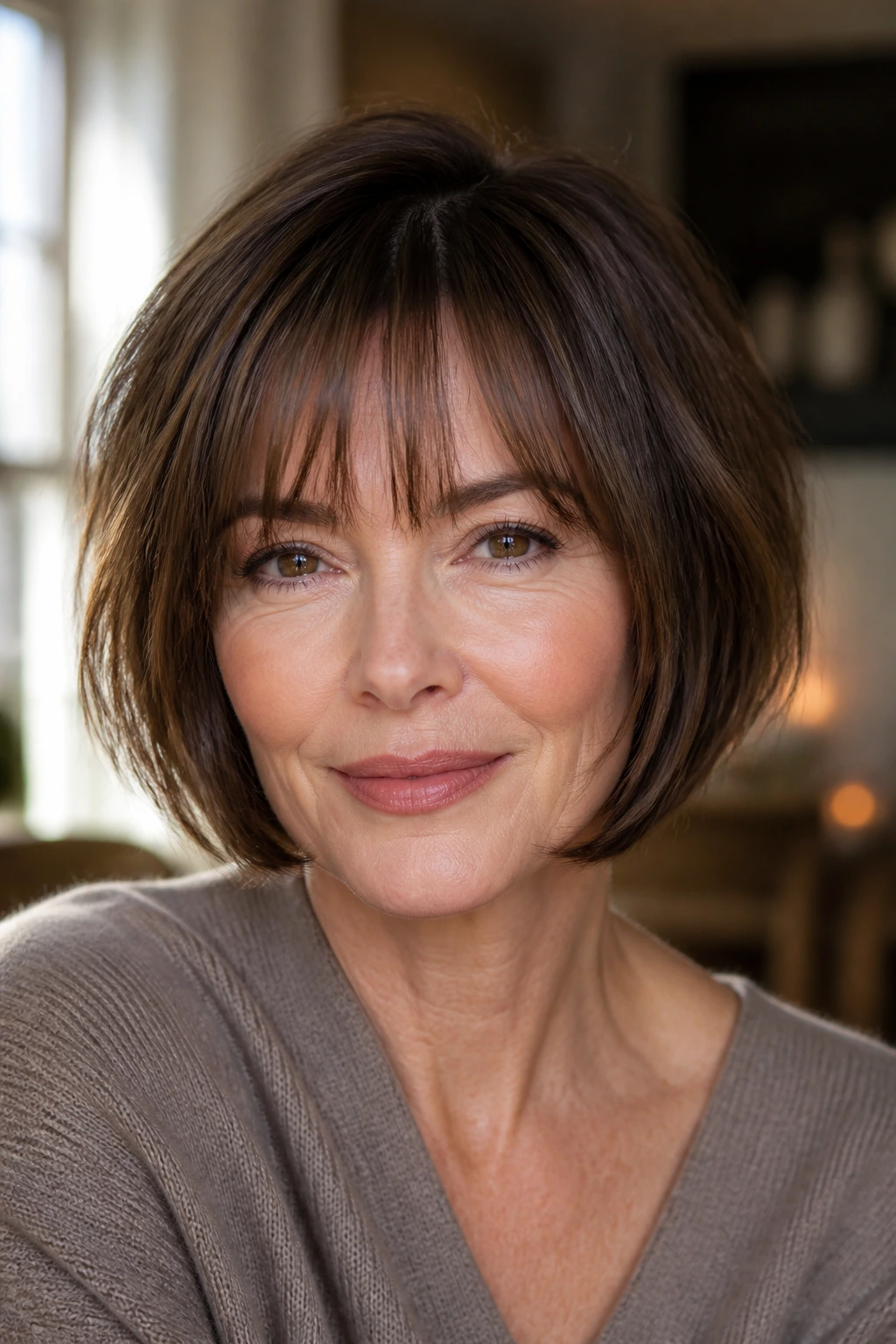
A French bob with wispy bangs has one job: make short hair look deliberate without making it stiff. The line sits around the cheekbone or jaw, the ends are blunt enough to feel chic, and the fringe is broken up just enough to keep the forehead visible.
What I like most about this version is the contrast. The bob itself has shape. The bangs have softness. Put the two together and the cut gets that slightly undone feel that works far better than a precise helmet shape. If your hair is naturally straight, the fringe can be cut a touch longer so it bends instead of sticking out like a shelf.
It’s a good fit for glasses, red lipstick, strong brows, and necklines that show a little collarbone. The cut likes simplicity. A polished shirt or a plain tee does more for it than a busy neckline ever will.
6. Stacked Bob with Feather-Light Bangs
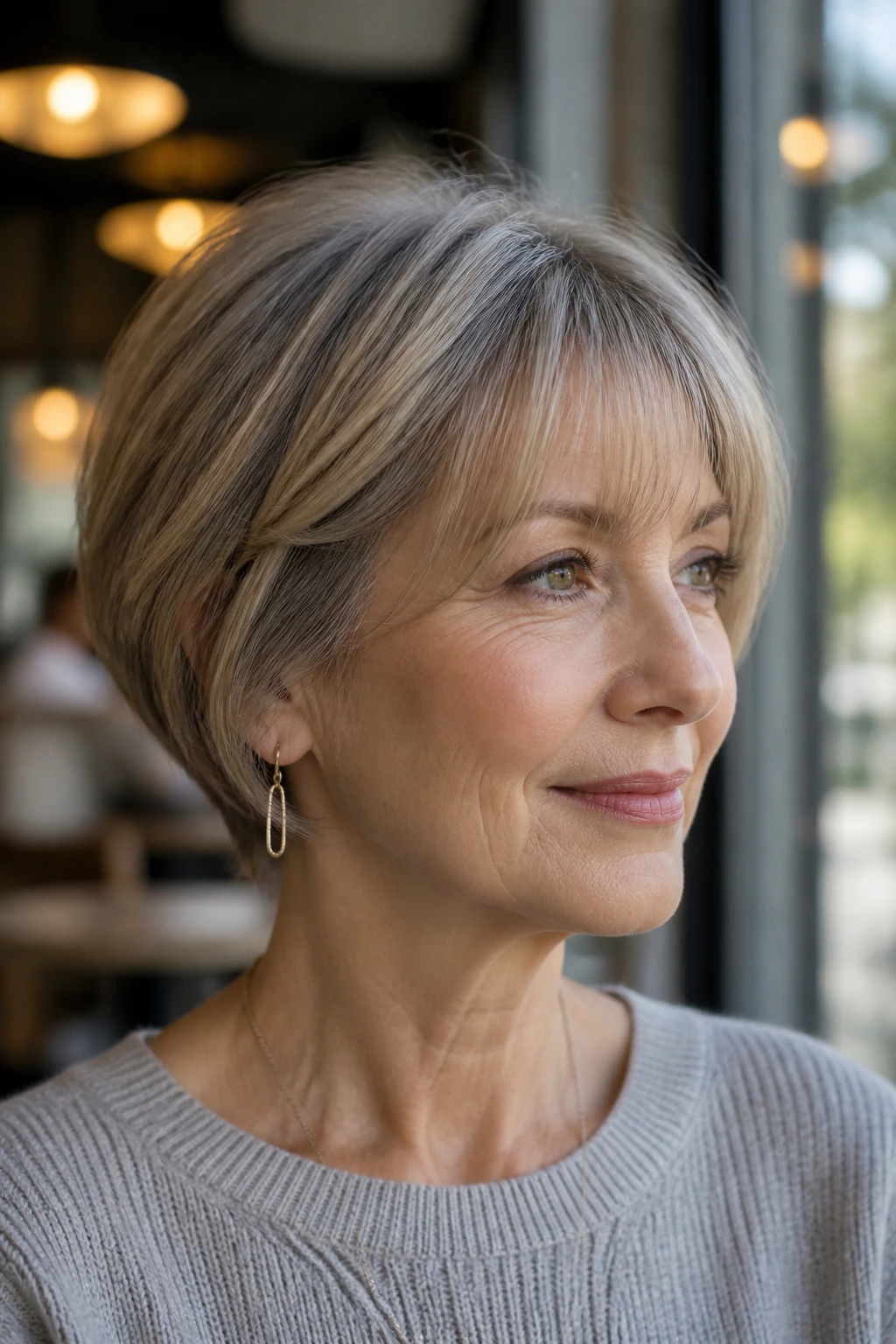
A stacked bob gives you back lift without asking for a teasing comb and a prayer. The shorter layers at the nape build that rounded shape, while feather-light bangs keep the front from feeling too heavy.
This is a smart cut if your hair has lost some density at the ends but still has body near the roots. The stack gives the illusion of fullness where you want it, and the bangs keep the silhouette from looking too formal. Ask your stylist to keep the front slightly longer than the crown line so the shape doesn’t tip into the old-fashioned side of stacked bobs.
The fringe should be thin enough that you can see the brow through it when the light hits. That bit of transparency keeps the whole haircut modern. Without it, the stack can start to feel a little too rigid.
7. Curly Crop with Soft Fringe
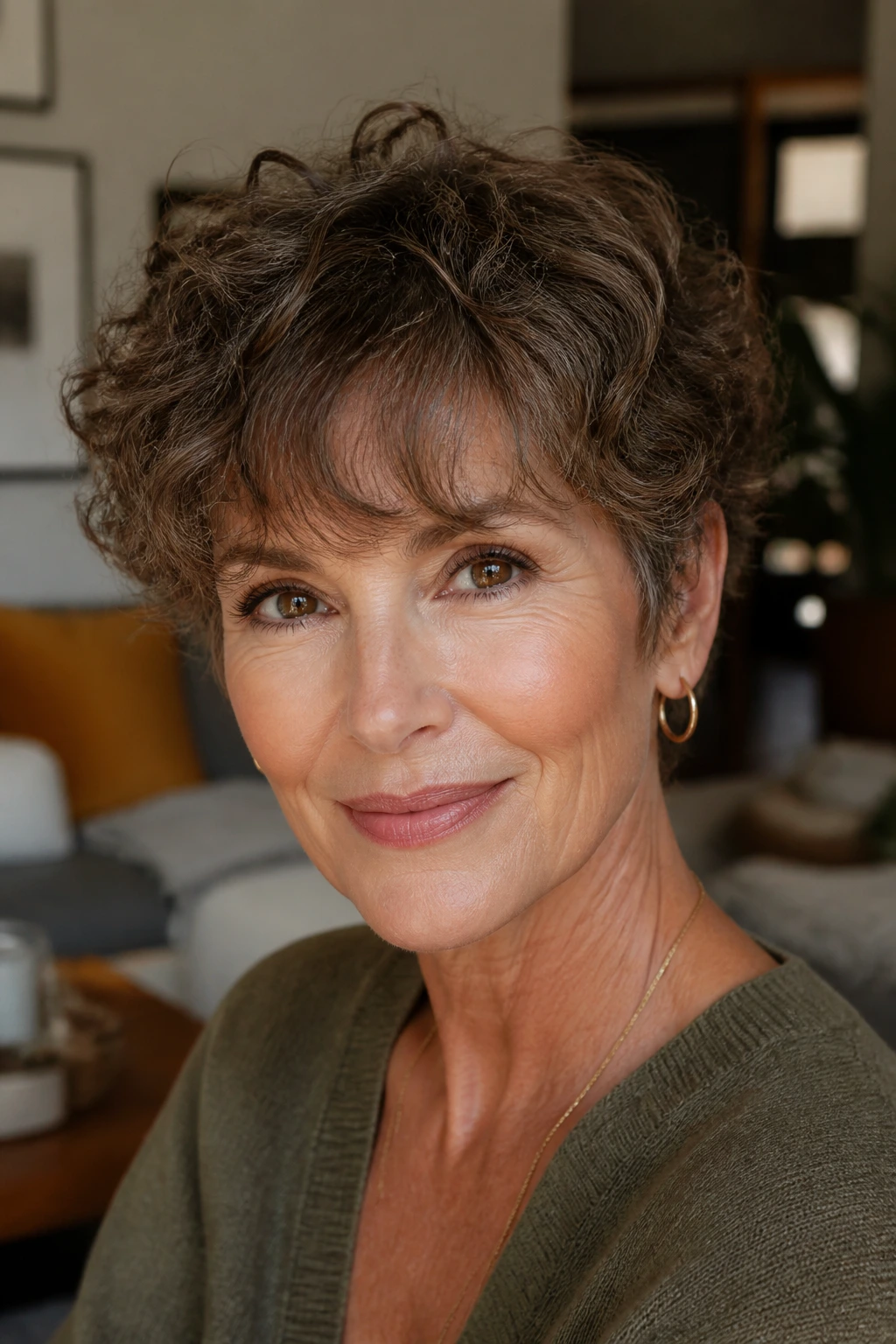
Can curly hair and wispy bangs actually get along after 50? Yes — if you respect shrinkage and stop trying to force the curls into a flat line.
A curly crop works best when the fringe is cut longer than you think it should be. Curls bounce up, sometimes by an inch or more, so the stylist needs to leave room for that. The bangs should fall in soft pieces, not one dense block, and the top should have enough layers that the curl pattern can move instead of stacking in one puff.
How to Wear It
Diffuse the fringe on low heat and stop before it gets bone-dry. That leaves a little bend and avoids the frizz halo that can make curly bangs look rough. If your curl pattern is tighter near the temples, let the fringe follow that shape rather than forcing a straight-across cut.
This cut looks especially good when the curls are slightly imperfect. A little frizz here is part of the charm.
8. Asymmetrical Pixie-Bob with Feathered Front
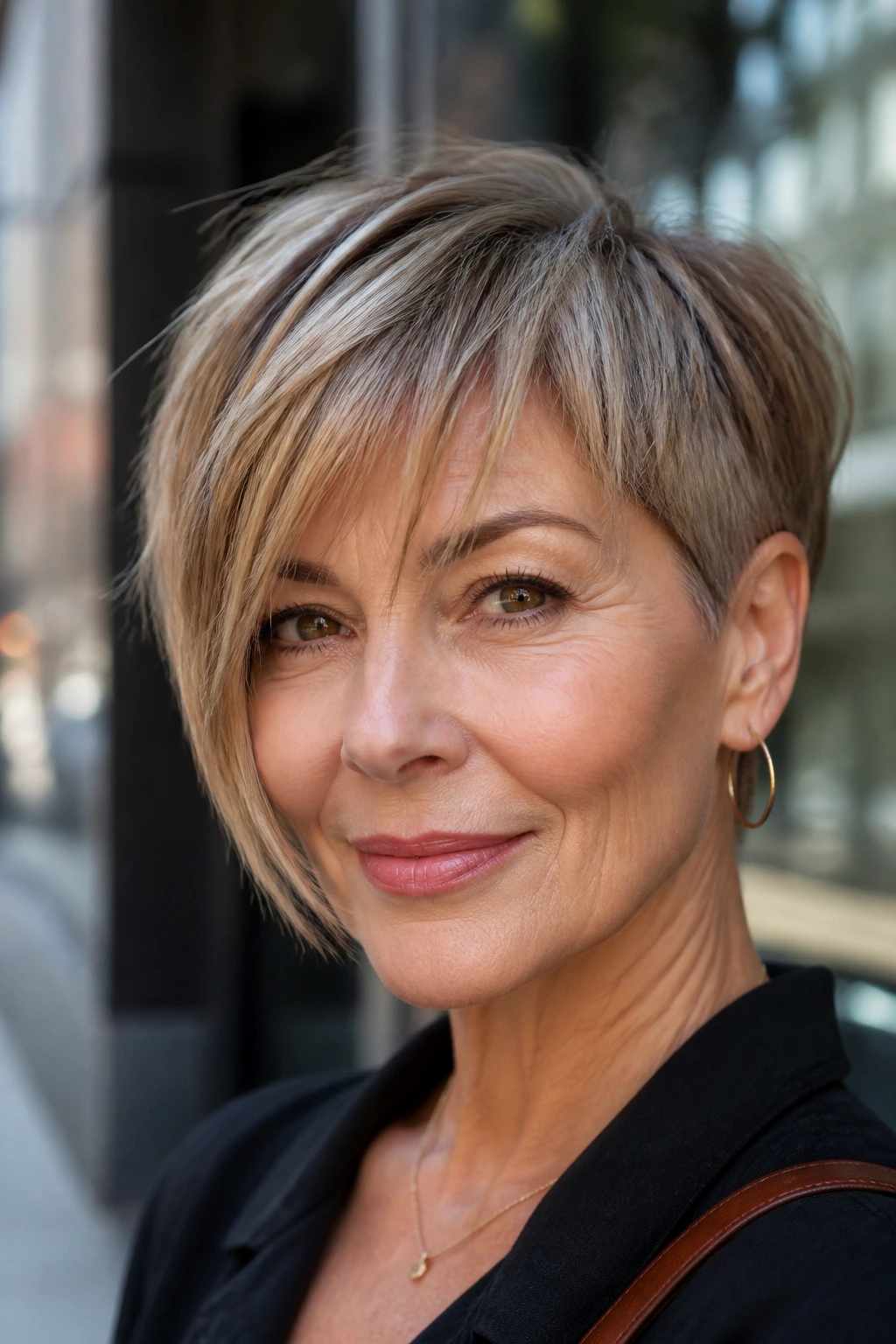
A pixie-bob with one side a touch longer can be a useful little trick if your face isn’t perfectly symmetrical — and whose is? The asymmetry gives the eye something to follow, while the feathered front keeps the bang area soft and easy.
The longer side can skim the cheekbone or tuck behind the ear. The shorter side opens the face. Together, they make the fringe feel like part of the cut instead of a separate piece sitting on top. Ask for the front to be point-cut, not sliced bluntly, or the asymmetry will look harsh.
This is one of those styles that looks especially good in motion. Turn your head, and it changes. That’s the fun of it. It also lets you play with parting direction depending on mood, which is handy when you don’t want to feel locked into one look.
9. Rounded Mushroom Bob with Wispy Edges

A modern mushroom bob sounds risky until you see how soft the edges can be. When the shape is rounded and the fringe is broken up, it stops looking retro-cute and starts looking sharp in a quiet way.
The top is usually fuller, the sides curve in gently, and the bangs are trimmed thin enough to show a little forehead through the strands. If the cut is too wide at the bottom, it can look heavy fast. The fix is simple: keep the perimeter tucked in and let the wispy fringe lighten the front.
This one works well for people who like shape but not fuss. The roundness gives a neat outline even when the hair isn’t freshly styled. A little dry shampoo at the roots goes a long way here.
10. Wedge Cut with Tapered Wisps
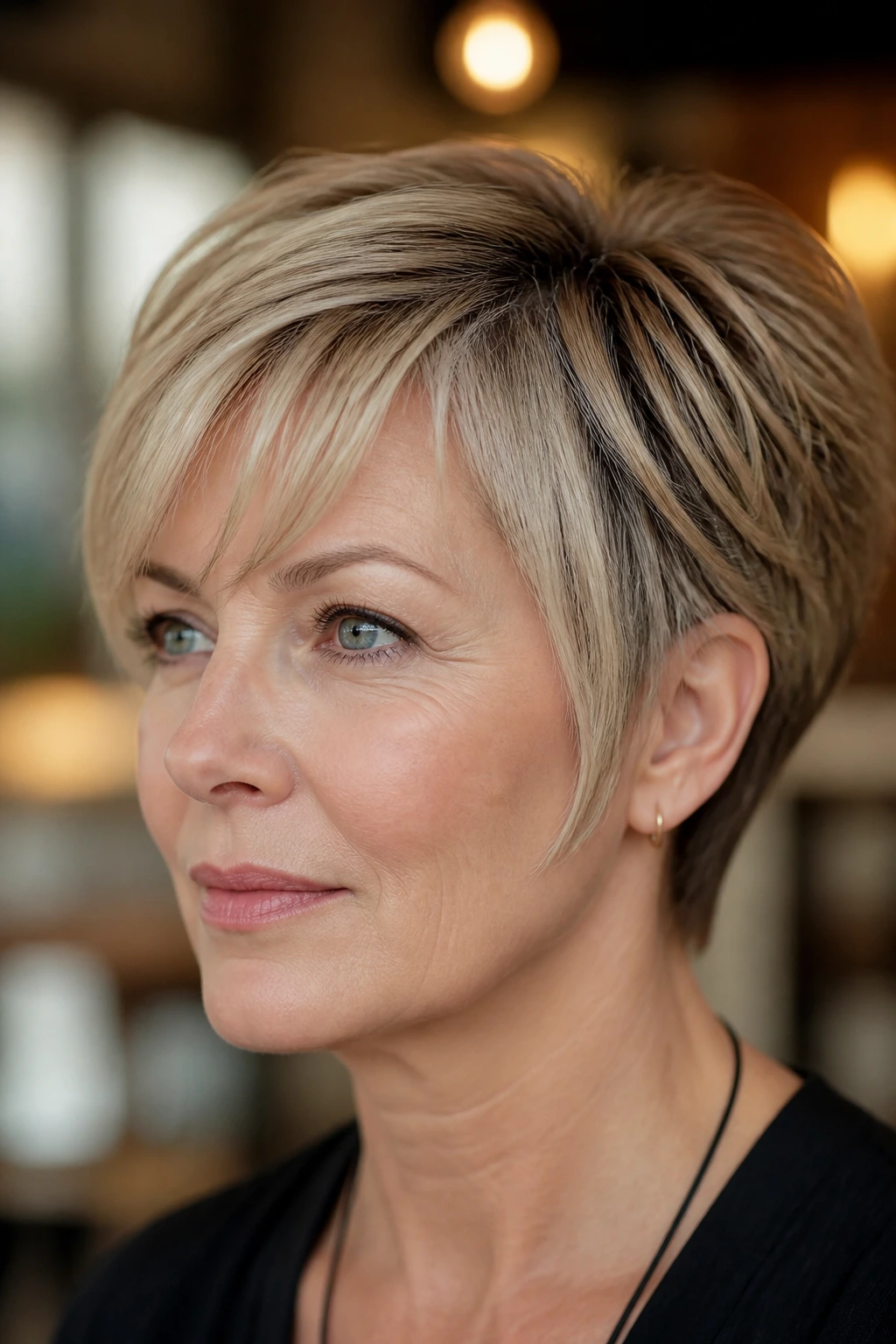
The wedge cut is one of those shapes that gets underestimated because people remember the old versions. The modern one is cleaner at the nape, softer at the temples, and much kinder to wispy bangs.
The back is stacked just enough to build lift. The sides taper toward the face. The fringe stays light, with the middle a touch shorter than the temples so it follows the brow line instead of chopping it off. If your hair is coarse or thick, this cut can remove a lot of visual bulk without making the head look narrow.
It’s a practical style for anyone who likes a bit of order. You don’t need much more than a blow-dryer and a brush. And if you let the fringe dry too flat, a quick blast of heat from underneath usually revives it.
11. Choppy Boyish Crop with Feminine Fringe
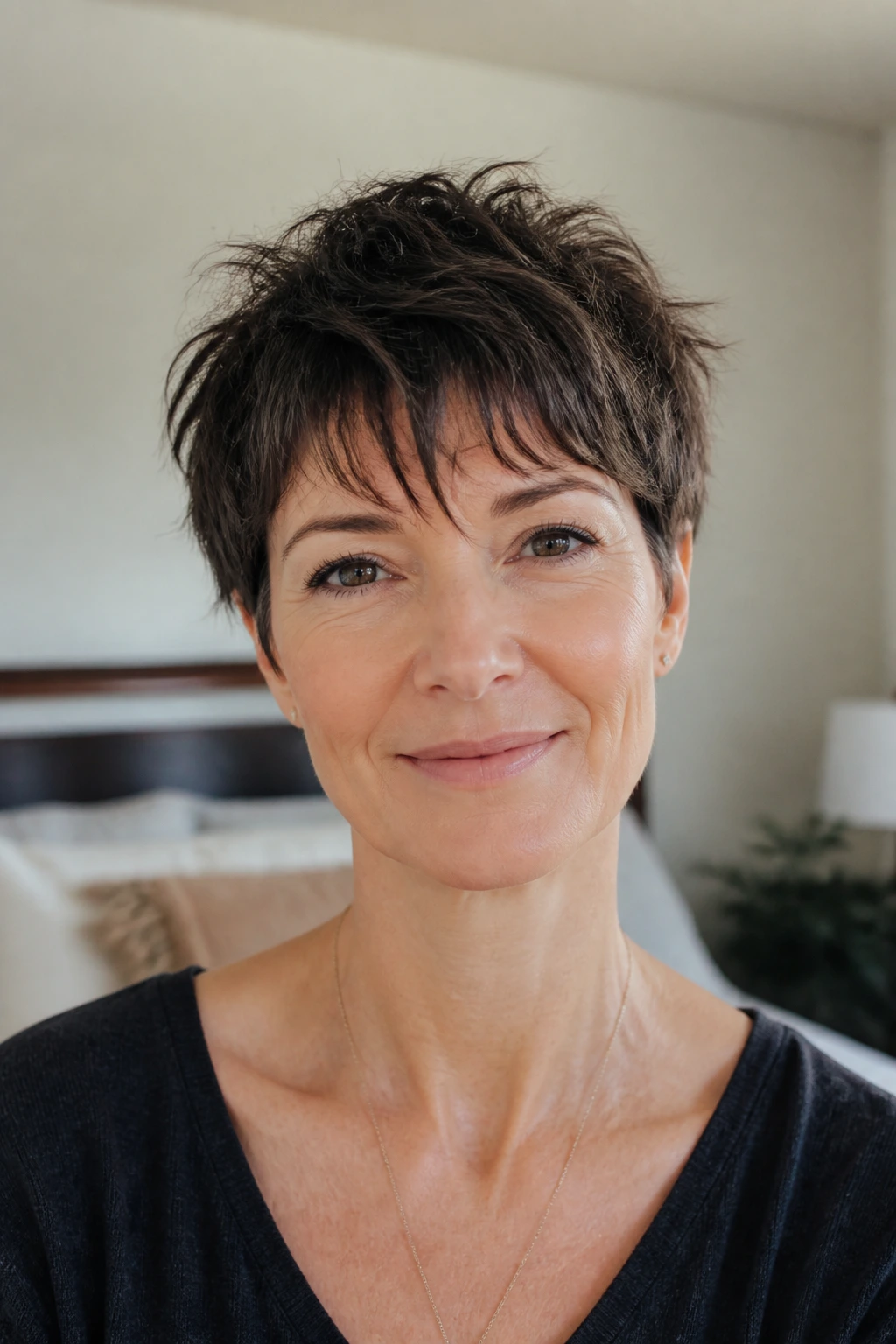
A choppy crop can look a little stern if you leave the front blunt. Wispy bangs fix that. They soften the boyish edges just enough to keep the haircut from reading too hard.
Unlike a neat pixie, this version relies on uneven ends. That means the fringe should also have unevenness — tiny broken pieces, not a single smooth line. The result is casual, but not sloppy. It has a bit of edge, which some people love because it works with strong brows, silver strands, and sharp cheekbones.
This cut suits women who do not want to spend 20 minutes on styling every morning. A little paste rubbed between the fingertips, then pinched into the front, is usually enough. It’s a no-nonsense haircut with a softer face front. That combination keeps it from feeling too severe.
12. Razor-Cut Bob with Thin Fringe
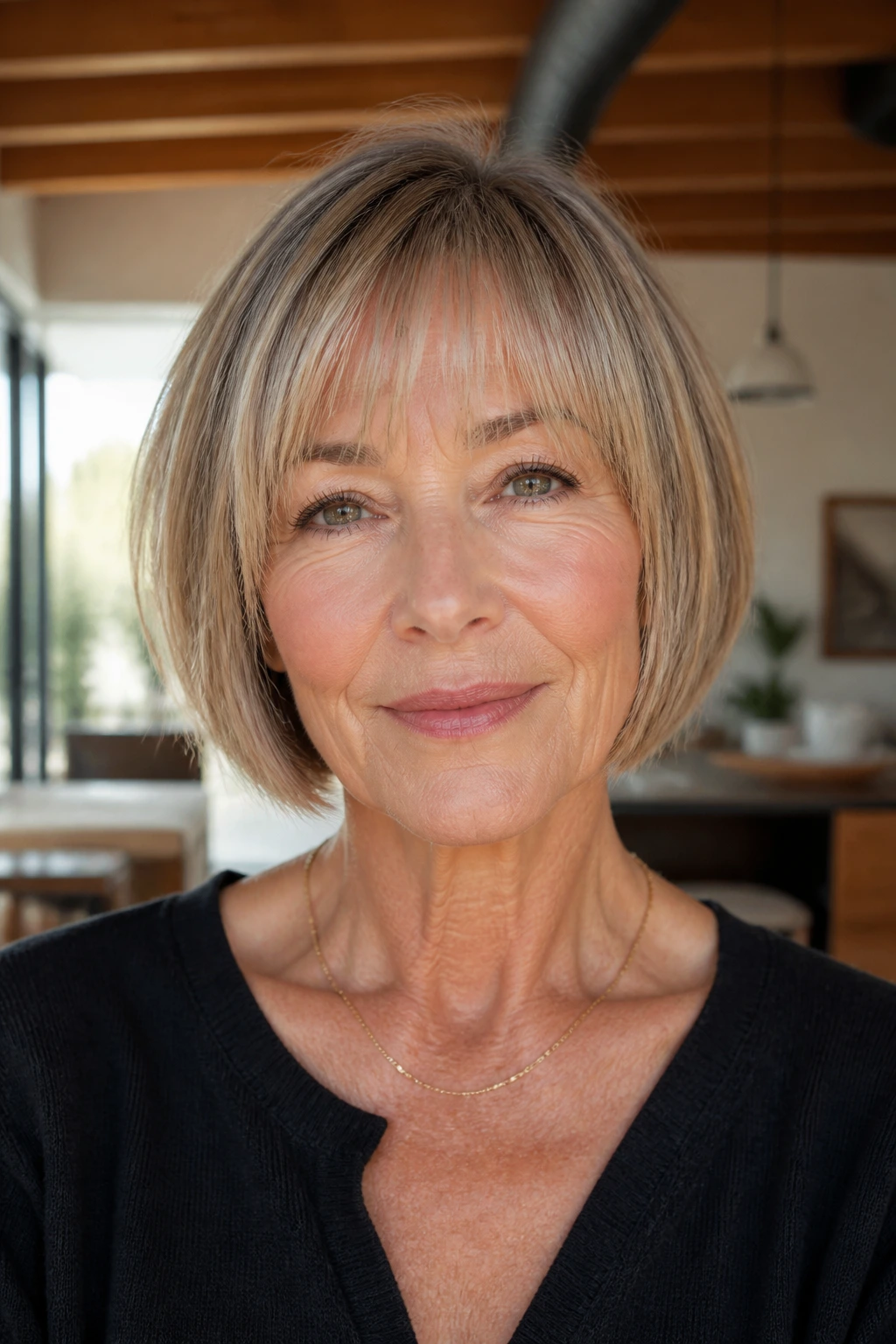
Why does a razor-cut bob feel lighter than a scissor-cut bob? The edges are softer. The razor takes away some density at the perimeter, so the shape moves instead of sitting like a block.
The thin fringe should be done by someone who knows how your hair behaves when it dries. Razor work can be beautiful on fine or medium textures, but it needs restraint. If the ends are too shredded, the bangs can look stringy. The answer is a controlled, delicate pass, not a dramatic one.
How to Style It
Use a light blow-dry cream and a flat brush, then bend only the last half-inch of the fringe. Don’t overcurve it. The point is a soft line, not a round loop. If the ends stick out, a mini flat iron on low heat can tame the front in a few seconds.
This is a good one if you want the bob to look precise without feeling stiff.
13. Graduated Bob with See-Through Bangs
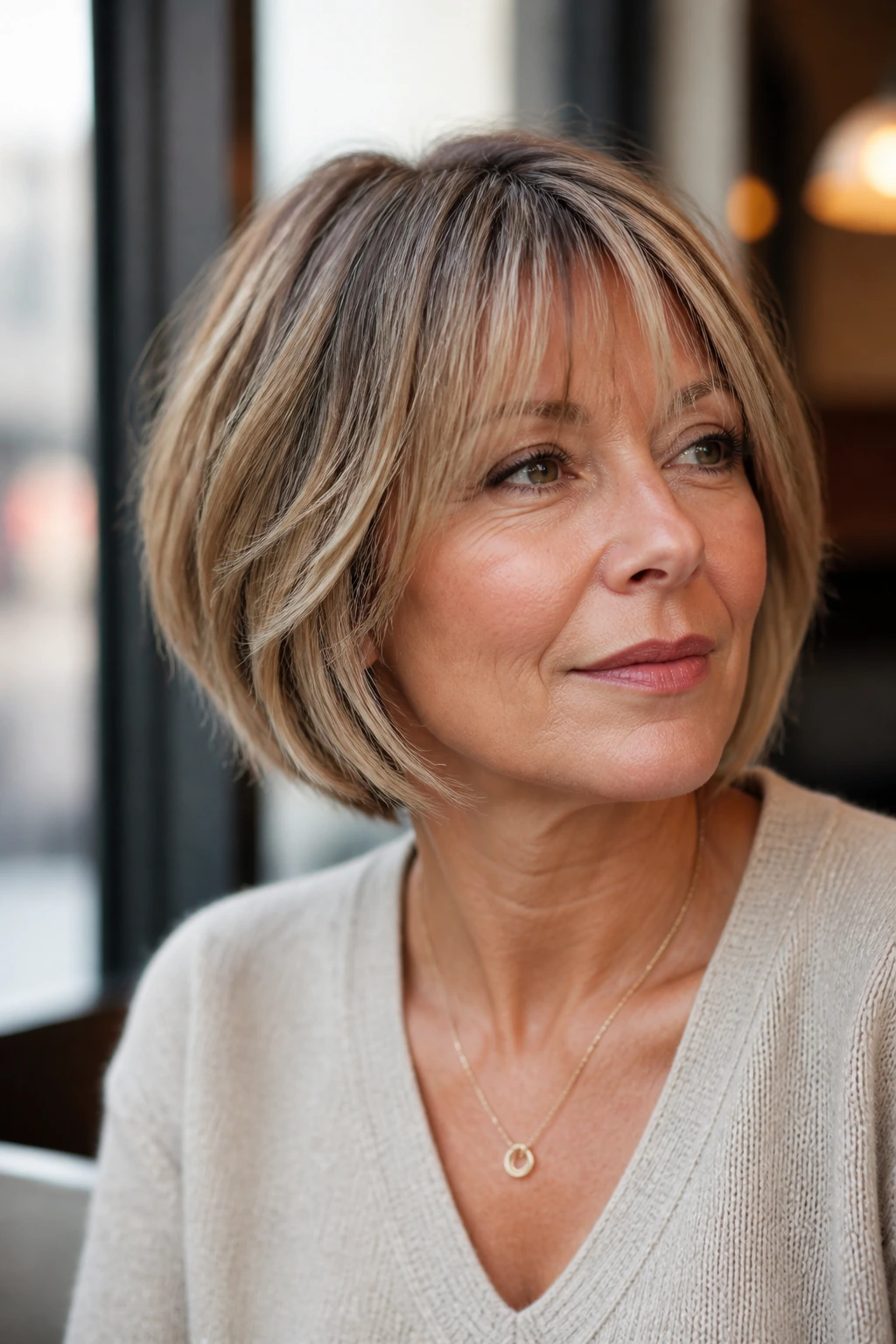
A graduated bob gives you a cleaner silhouette at the back and a little more length in front, which helps the fringe feel integrated instead of tacked on. The see-through bang line keeps the front from becoming too formal.
The graduation matters because it gives the haircut direction. Without it, a wispy fringe can float around on top of a boxy shape and look unfinished. Here, the front pieces have a place to land. They skim the cheeks, the jaw opens a bit, and the overall shape stays smooth.
This style works well for women who like structure but don’t want a stiff outline. It’s tidy. It also has enough room to grow before the cut starts to lose its shape, which means fewer emergency trims.
14. Tousled Ear-Length Crop with Side Fringe

You can tuck this one behind the ears, pull it forward, or leave it messy on purpose. That flexibility is the whole point.
An ear-length crop with a side fringe feels relaxed because the bangs don’t sit in a rigid row. They sweep across the forehead in a loose diagonal, often blending into the longer side pieces. If you want hair that doesn’t fight hats, glasses, or windy weather, this is a useful option.
The texture should look touched, not combed to death. A matte cream or a little sea-salt spray helps. What you want is separation at the front and a little pieceiness around the temple. The cut looks best when it’s moved by your hands, not frozen in place by product.
15. Layered Pixie with Lifted Crown and Wisps
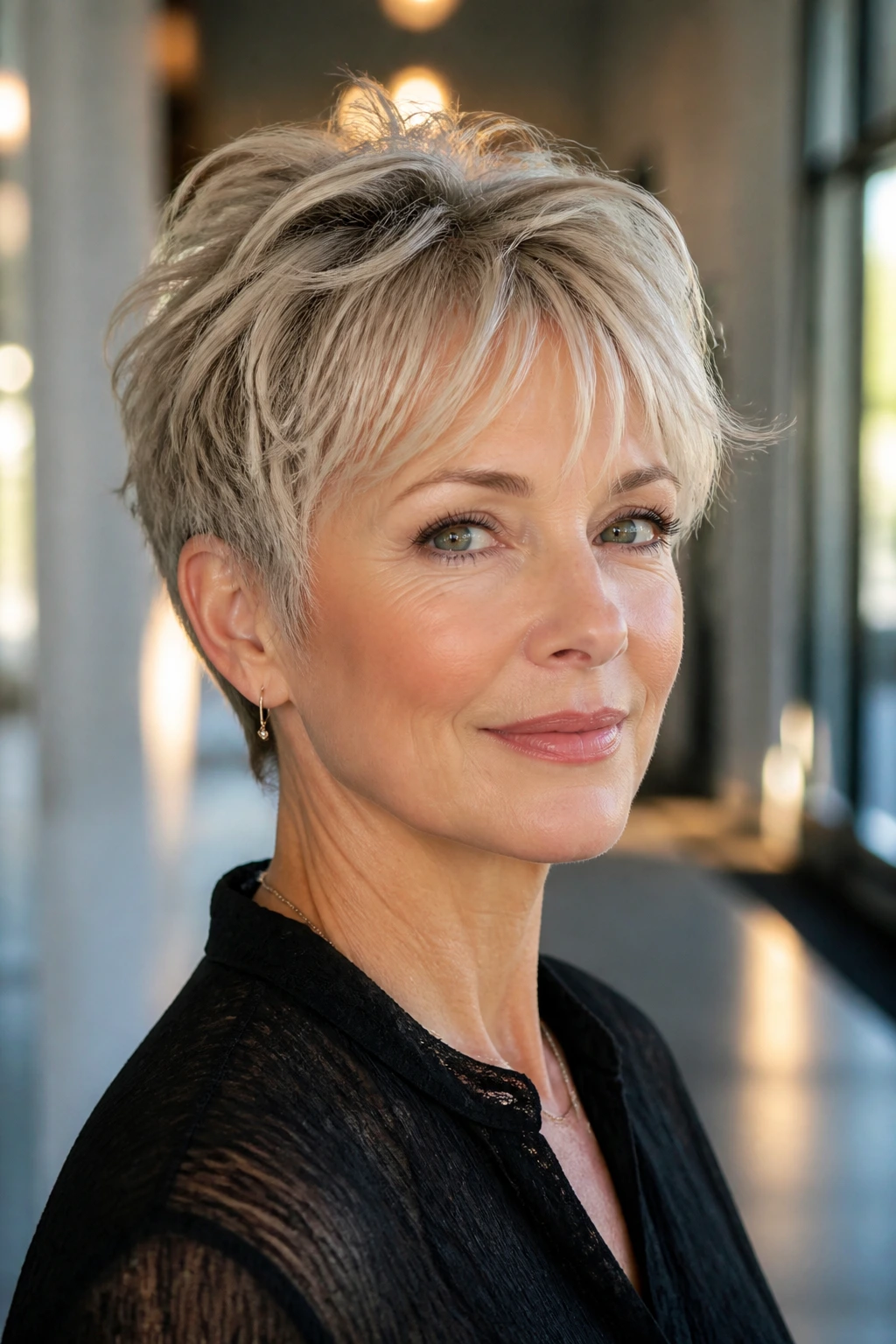
A layered pixie is one of the fastest ways to make fine hair look like it still has a pulse. The crown gets enough lift to keep the top from flattening, and the wispy bangs stop the whole thing from becoming top-heavy.
The styling trick here is to work from the roots. Lift the top with a small round brush or your fingers and direct the fringe slightly forward before pushing it to the side. That creates a soft bend and keeps the front from separating in weird little spikes, which can happen with fine gray hair.
This cut gives good cheekbone show. It also lets earrings do more of the talking, which I like. When the hair gets this short, the face has room to breathe, and the fringe is there to soften, not hide.
16. Inverted Bob with Floating Bangs
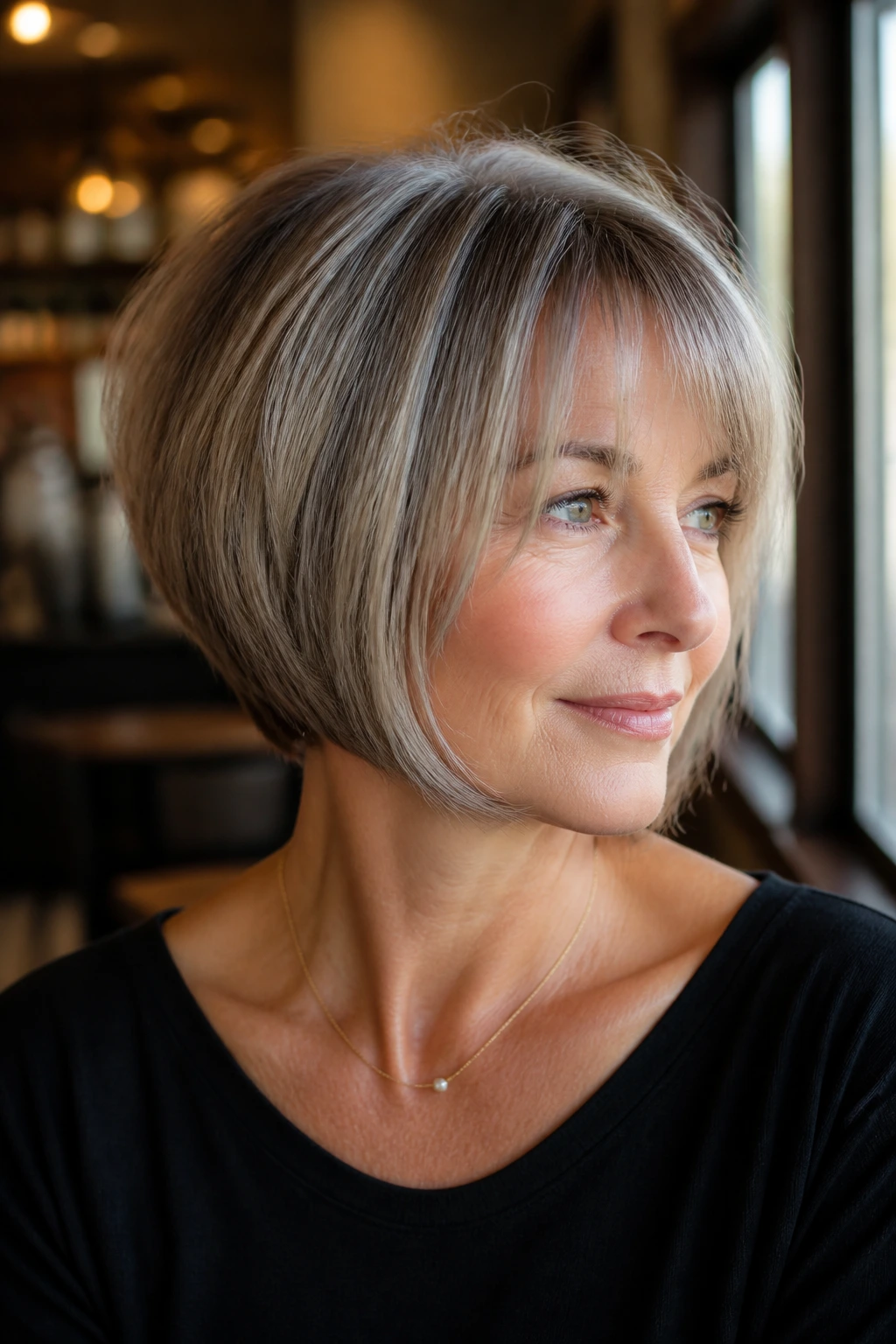
An inverted bob, with its longer front and shorter back, already has a built-in sense of movement. Add floating bangs, and the cut stops feeling formal in a hurry.
The length in front pulls the eye downward in a clean line, while the fringe stays light enough to hover instead of land. That’s why this shape works so well when you want the face framed but not closed in. If the bangs are cut too straight, the whole thing gets heavy. Leave the ends broken and the result feels lighter.
This is a strong pick for straight or slightly wavy hair. It’s also one of the better choices if you like a side part but don’t want a bang that merges into a face frame too aggressively.
17. Soft Undercut Pixie with Long Wisps
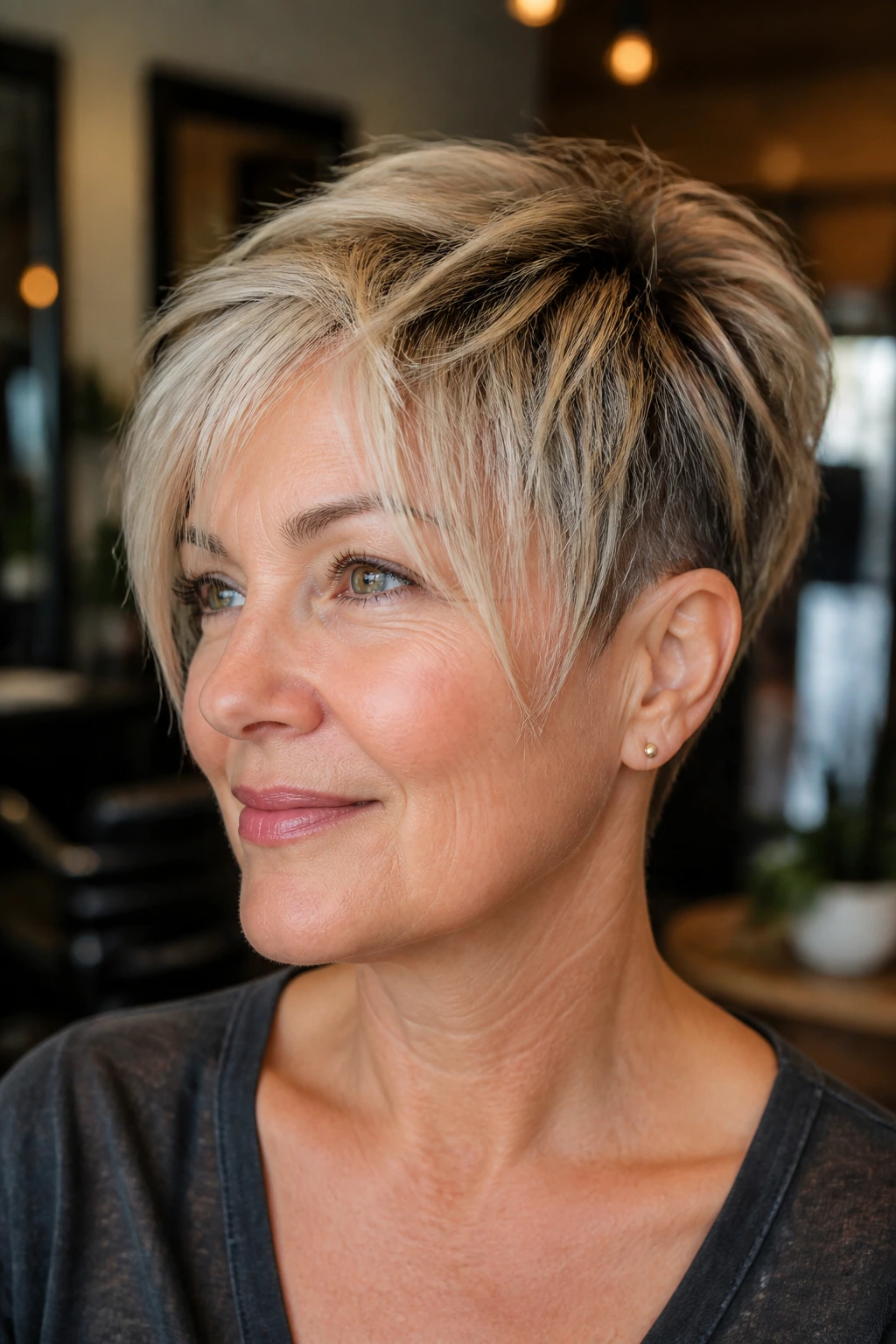
Does an undercut sound too severe? It doesn’t have to. When the top stays a little longer and the fringe is cut into soft wisps, the whole thing reads light instead of edgy-for-the-sake-of-it.
The hidden undercut removes bulk at the nape and around the lower sides. That makes the crown and fringe easier to manage, especially if your hair is thick or puffy in humid weather. The long wisps at the front can be pushed forward, swept aside, or tucked with a clip when you want the forehead fully open.
This is a practical haircut for someone who likes short hair but hates the triangle shape that thick hair sometimes creates. The undercut fixes that without forcing the front to get too short.
18. Wavy Jaw-Length Cut with Split Fringe

A split fringe on wavy hair has a loose, almost casual charm that works better than a hard bang line. The fringe parts around the center or just off-center, then falls into the waves at the temples.
The jaw-length cut gives enough shape to define the face, while the fringe keeps the forehead from feeling too exposed. If your waves are uneven — and they usually are — this cut is forgiving. One side can lift a little more, one side can drop lower, and the whole thing still looks deliberate.
A little leave-in conditioner and a touch of curl cream are usually enough. Scrunch the fringe gently and let the pieces fall where they want. The split front makes this one especially nice if you prefer a softer, lived-in look over something polished.
19. Sleek Straight Bob with Delicate Bangs
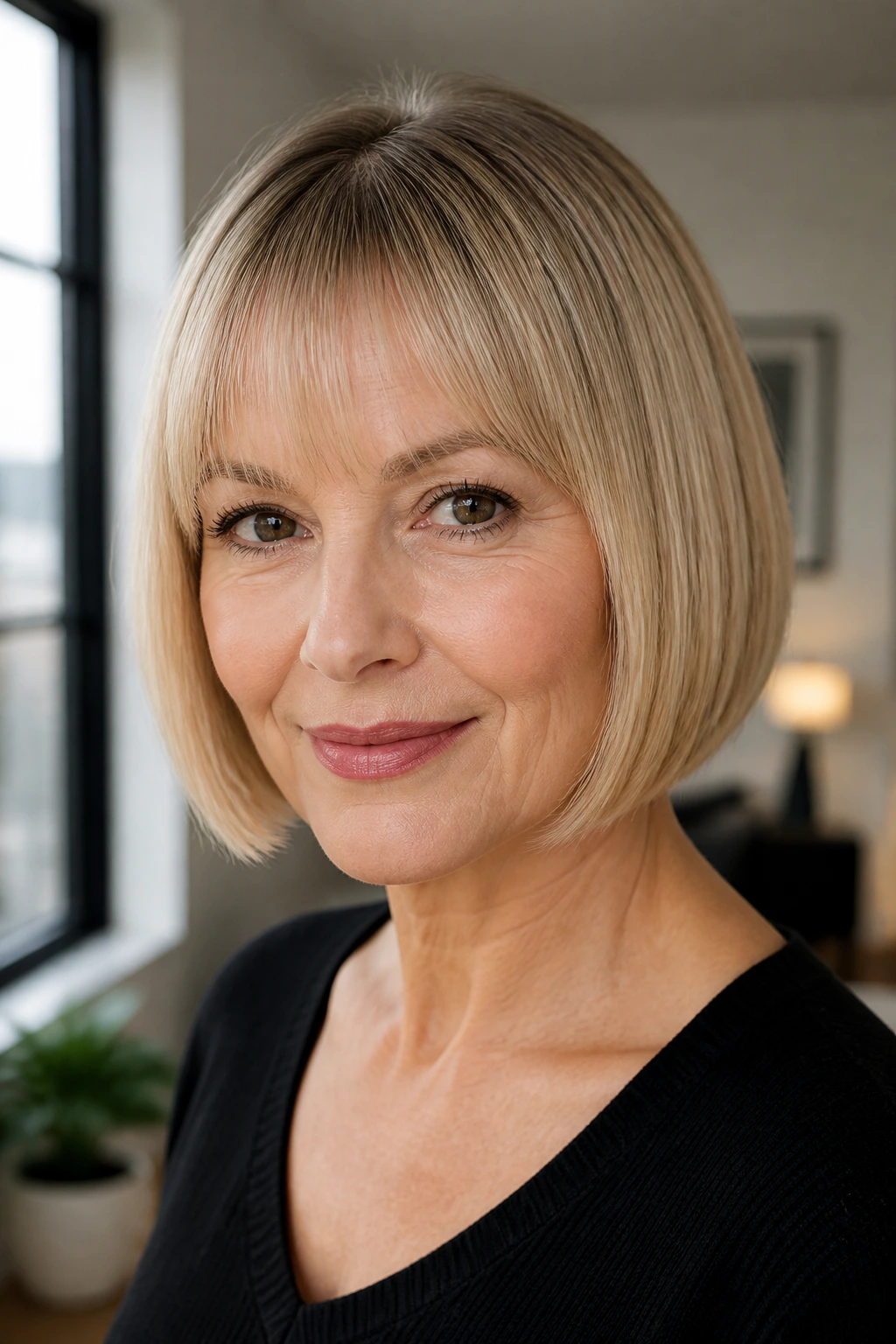
A sleek bob can be unforgiving if the bangs are too heavy. Delicate bangs fix that by letting the cut stay crisp while the front remains soft enough to move.
The key is restraint. The bob line should be clean, maybe with a slight bevel under the chin or just below it, while the fringe stays thin and lightly textured. If the hair is very straight, the bangs can be sliced a touch longer at the temples so they don’t create a hard shelf across the forehead.
This cut suits people who like order. It’s neat without being stiff, and the fringe adds interest without stealing the show. A flat brush and a cool shot from the dryer are usually enough to keep the shape in line.
20. Salt-and-Pepper Textured Crop with Airy Fringe
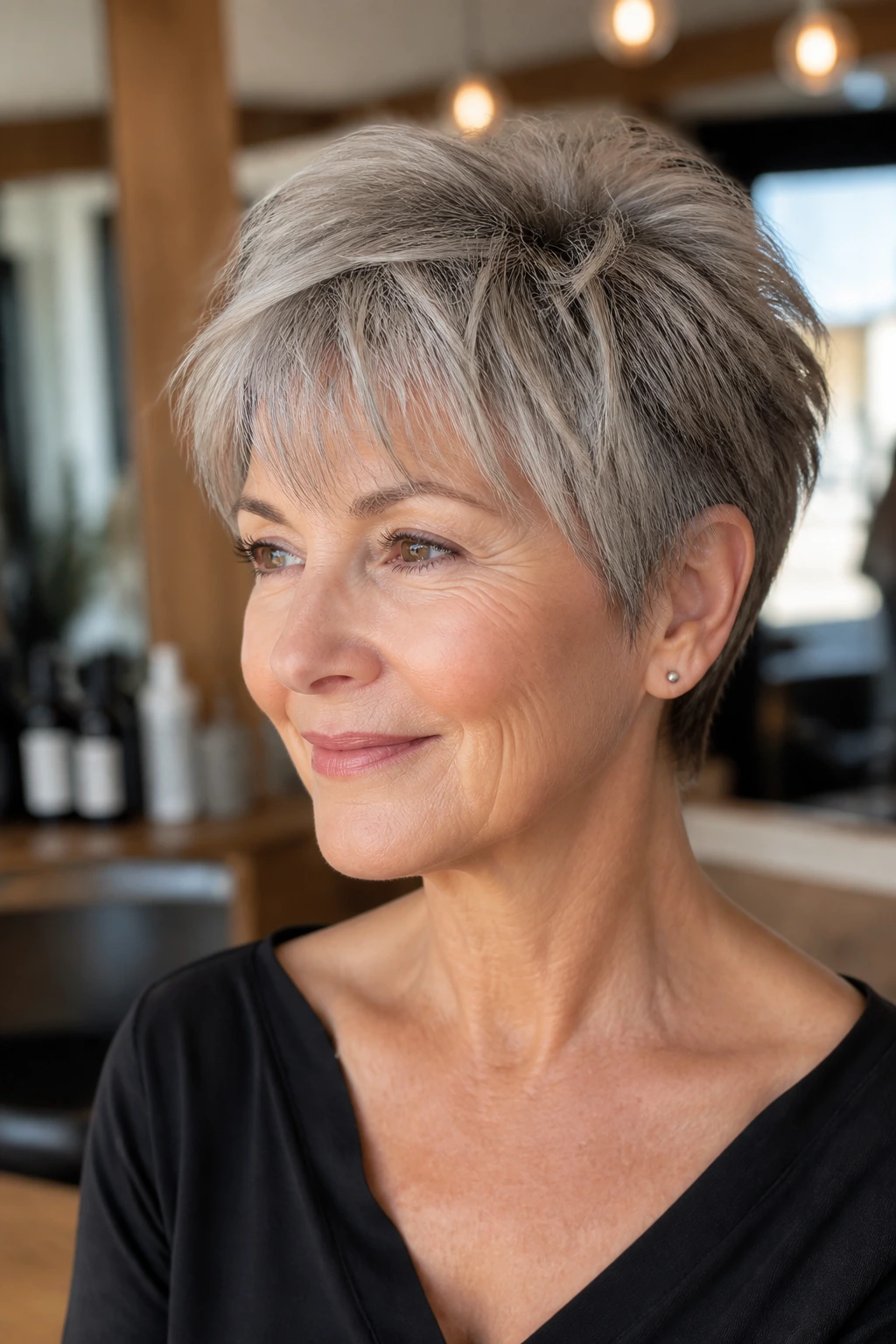
Salt-and-pepper hair has a texture all its own, and trying to force it into a sleek, perfectly even shape often backfires. A textured crop with an airy fringe respects the grain of the hair instead of fighting it.
The cropped sides keep the silhouette tidy, while the fringe stays broken up and light. That lets the silver and darker strands mingle instead of sitting in a solid block. The result is crisp, not harsh. If your gray grows in with a wiry edge at the front, a little smoothing cream at the roots can keep the fringe from sticking up.
This is one of my favorite looks on women who are done apologizing for their texture. Good. Let the hair be what it is.
21. Neck-Length Layered Cut with Sweeping Bangs
If you want something short without going all the way to a pixie, a neck-length layered cut gives you room to breathe. The sweeping bangs help it keep that breezy feel.
The layers should move away from the face instead of piling up around it. The fringe can start at the brow and blend into the sides, which makes the front look soft even when the back is neatly shaped. This is one of the easiest options for someone who likes to tuck hair behind one ear and leave the other side loose.
It also gives you a little more styling freedom than a tighter crop. You can wear it smooth one day and piecey the next. That matters more than people admit.
22. Short Curly Bob with Bottleneck Wispy Bangs
The best thing about a short curly bob with bottleneck bangs is that it gives structure to curls without flattening them into obedience. The bangs are short in the center, then longer toward the sides, so they taper into the rest of the cut instead of stopping hard across the forehead.
That shape matters for mature curls, which often tighten in some spots and loosen in others. The bottleneck fringe gives them room to behave. It also works well if your hairline has changed a bit and you want a softer frame without a full curtain bang.
Diffuse the bangs first, then the rest of the bob. If the front dries too fast, it can frizz before the curl clumps set. The result should be soft, a little airy, and clearly curly — not forced into a fake wave pattern. And that’s the point.
Why Short Hair and Wispy Bangs Stay So Wearable
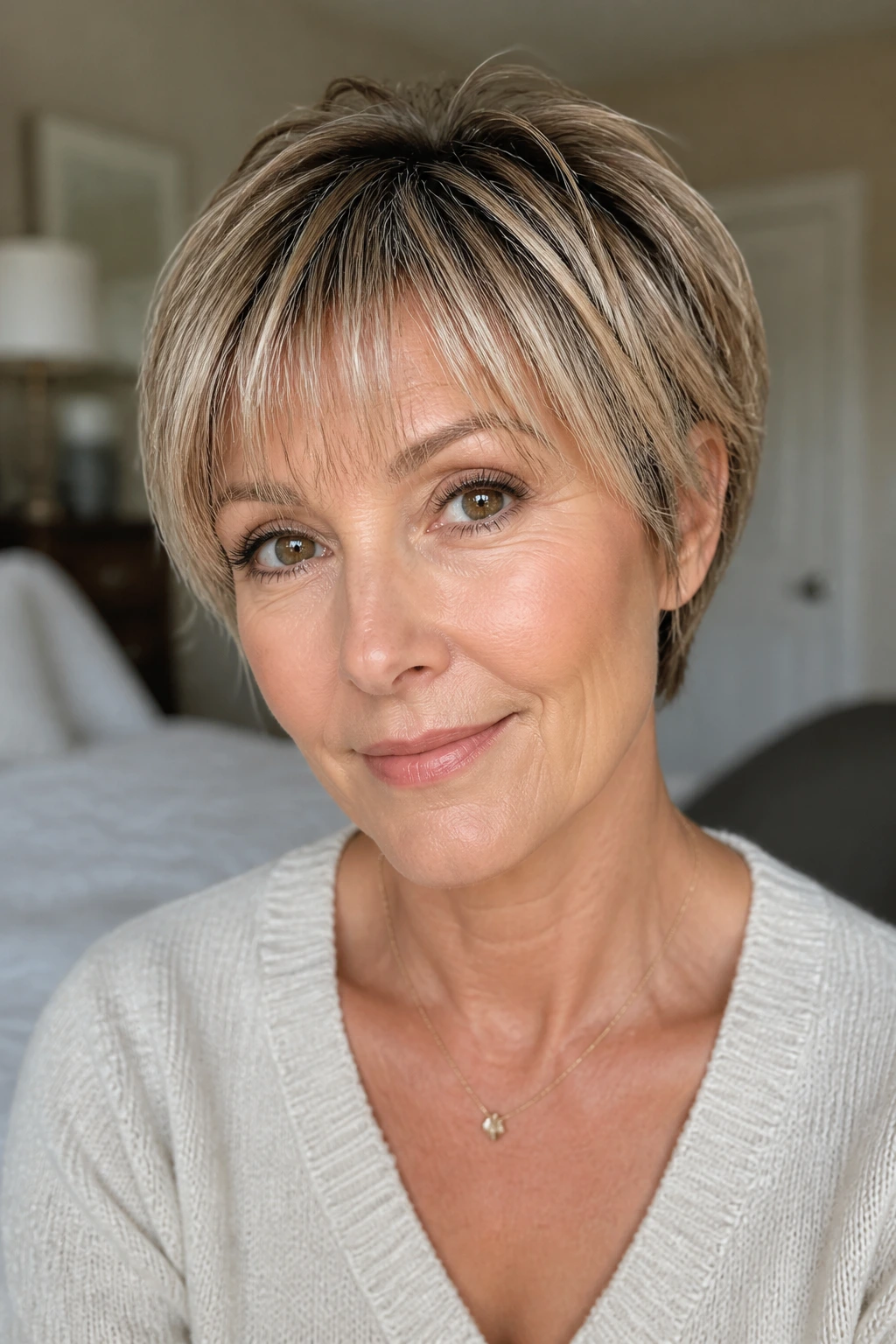
The reason these cuts keep working has less to do with age and more to do with proportion. Short hair shows everything: forehead shape, brow line, jaw angle, neckline, earrings, glasses. That can be a blessing or a mess, depending on how the haircut is built. Wispy bangs soften the front just enough to make the whole shape feel intentional.
They also solve a very practical problem: short hair grows fast in the wrong places. A dense fringe can become annoying in two weeks. A wispy one usually holds its shape a little longer because the edges are already broken up. That matters when you want a haircut that lives in the real world, not just the salon mirror.
And there’s a bonus people do not talk about enough. Wispy bangs give you flexibility. Wear them forward. Push them aside. Let them separate a bit. Clip them back on a humid day. A hard fringe gives you one answer. A wispy fringe gives you room.
Essential Tools for These Cuts
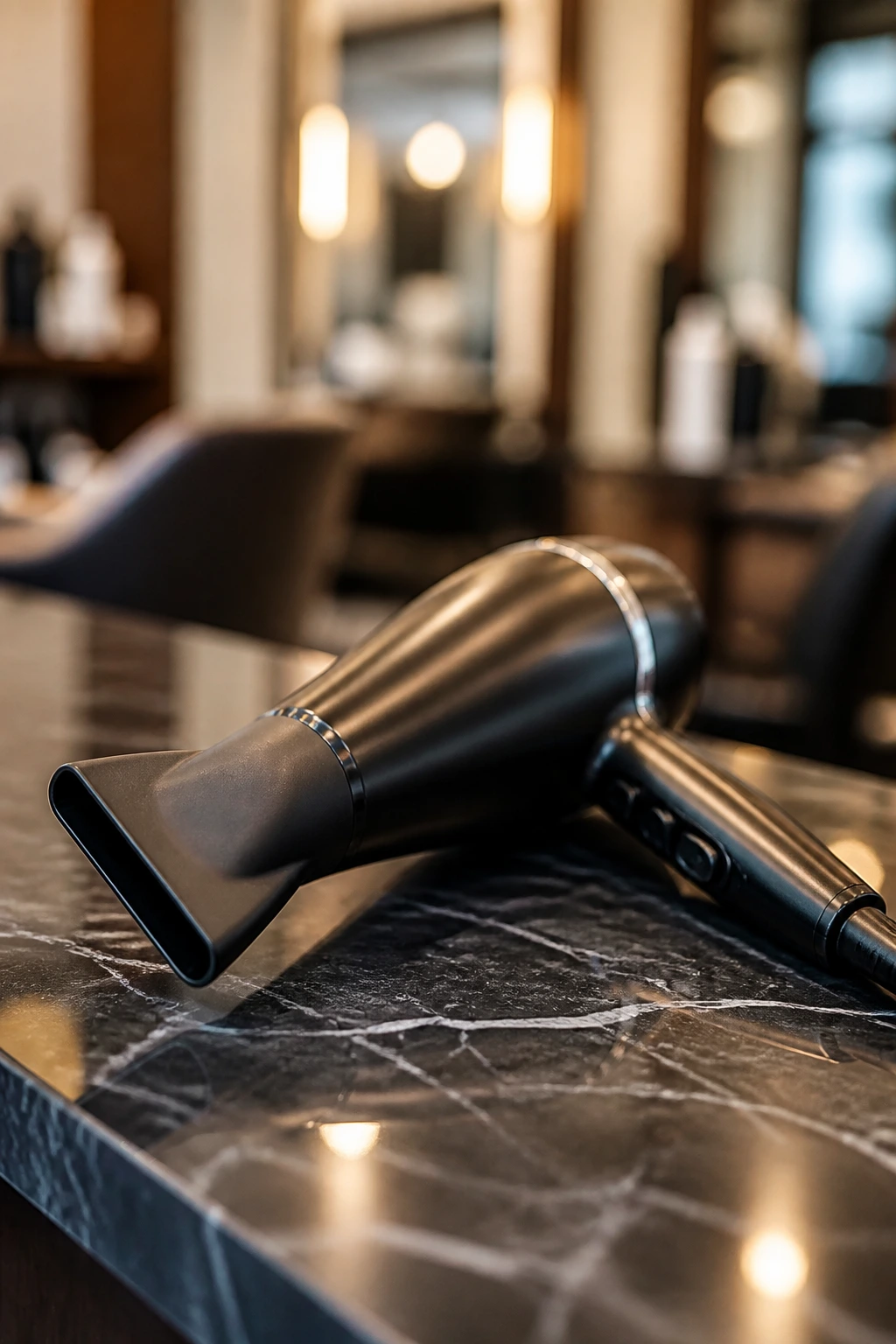
- Hair dryer with a concentrator nozzle: Direct airflow keeps the fringe from frizzing all over the place.
- Small round brush, 1 to 1.5 inches: Best for bending bangs without overcurling them.
- Flat brush or vent brush: Good for smoothing the sides of bobs and pixies fast.
- Light mousse or root-lift spray: Adds shape at the crown without making the fringe crunchy.
- Heat protectant: Useful if you use a flat iron or blow-dry daily.
- Texturizing spray: Helps piece out the ends on shaggy or choppy cuts.
- Mini flat iron: Handy for taming one stubborn bang section in under a minute.
- Sectioning clips: Keep the top layers out of the way while you style the front.
- Fine-tooth comb: Better than a wide brush for separating wispy pieces neatly.
- Dry shampoo: Helps the fringe survive a second day without going flat at the roots.
How to Choose the Right Cut at the Salon
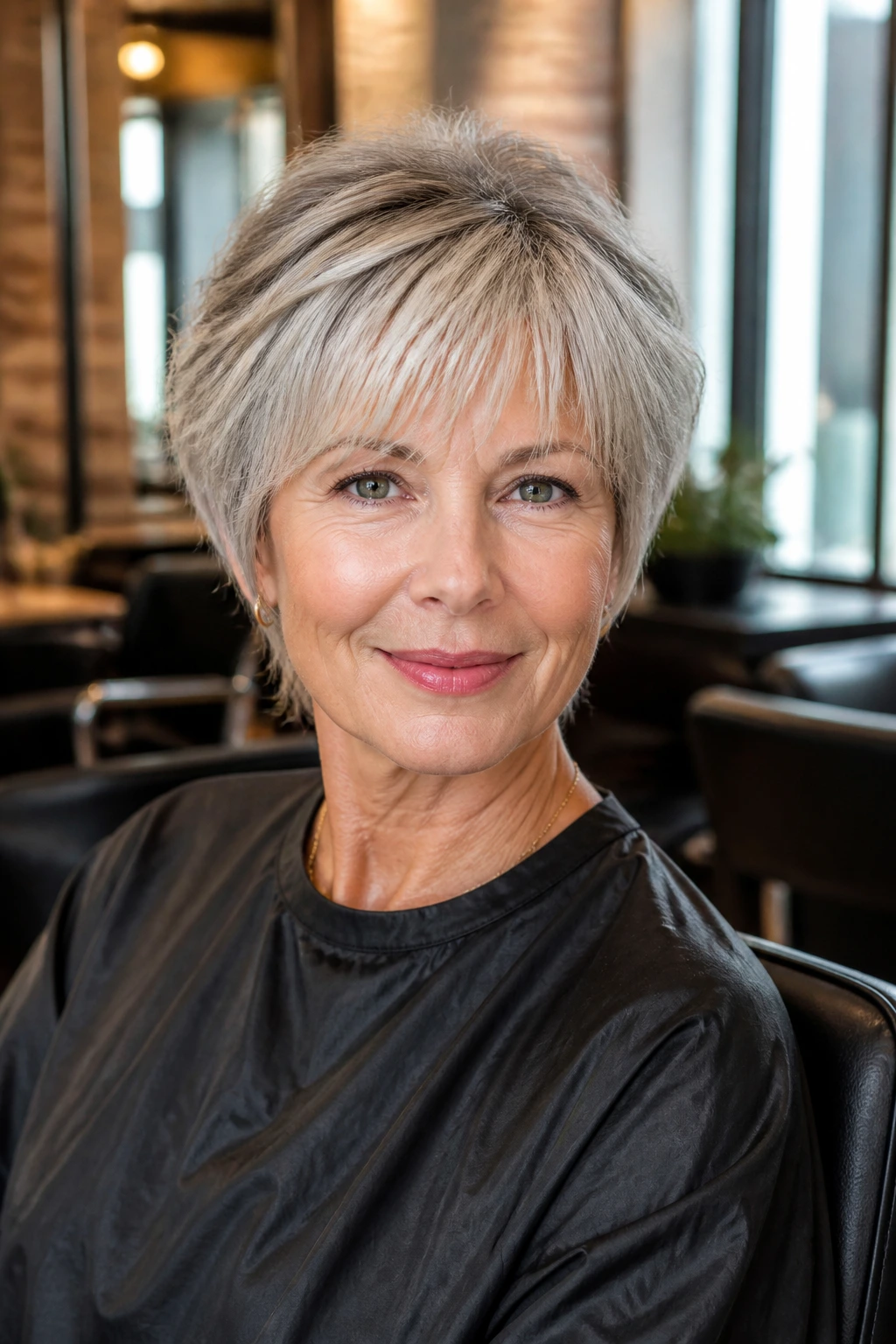
Bring pictures, yes, but bring useful ones. Don’t just show a photo and say you want “something like that.” Point out the part you actually like: the fringe density, the ear length, the crown volume, the way the side pieces sit near the jaw. Stylists can work with that. Vague admiration is harder to cut from.
The biggest choice is density. A wispy bang should be light enough to move, but not so thin that it looks like the stylist forgot the rest of the front. If your hair is fine, ask for softness through point-cutting rather than aggressive thinning. If your hair is thick, ask where the bulk should be removed so the fringe doesn’t puff up at the sides.
Your hairline and cowlicks need to be discussed out loud. A stylist can hide a lot with the right length and direction, but only if they know the hair tries to do. Mention whether your bangs split in the middle, lift at one temple, or dry forward and then kick out. That detail sounds small. It is not small.
How to Style These Cuts Without Overthinking It

Polished Finish: Use a round brush at the fringe and a flat brush through the sides. Dry the bangs first, then finish the rest of the head. The front should bend, not curl.
Air-Dry Finish: Work a little mousse through damp roots and pinch the fringe into shape with your fingers. Leave the ends alone. If you keep touching them while they dry, they frizz.
With Glasses: Keep the fringe a touch shorter in the center or sweep it to one side so it doesn’t sit inside the frame line. A bang that lands exactly on the top of the glasses usually gets annoying fast.
For Dressier Days: Add a small bend at the ends and tuck one side behind the ear. That opens the face and makes short hair look cleaner without turning it stiff.
Additional Tips for More Lift and Softer Fringe

Texture Boost: A tiny dusting of texturizing powder at the roots can rescue a flat fringe faster than re-wetting the whole head. Use less than you think; too much makes bangs look dusty.
Fringe Control: If the bang line splits, dry it from side to side for 10 to 15 seconds before aiming it forward. That resets the root direction without overworking the hair.
Lift at the Crown: Short hair looks better when the crown isn’t collapsed. Even a quick lift with a round brush changes the whole outline of a pixie or bob.
Glasses-Friendly Trick: Ask for the outer corners of the bangs to sit a bit longer than the center. That keeps the fringe from bumping into the frame and gives the eyes a clean window.
Keeping the Shape Fresh Between Salon Visits
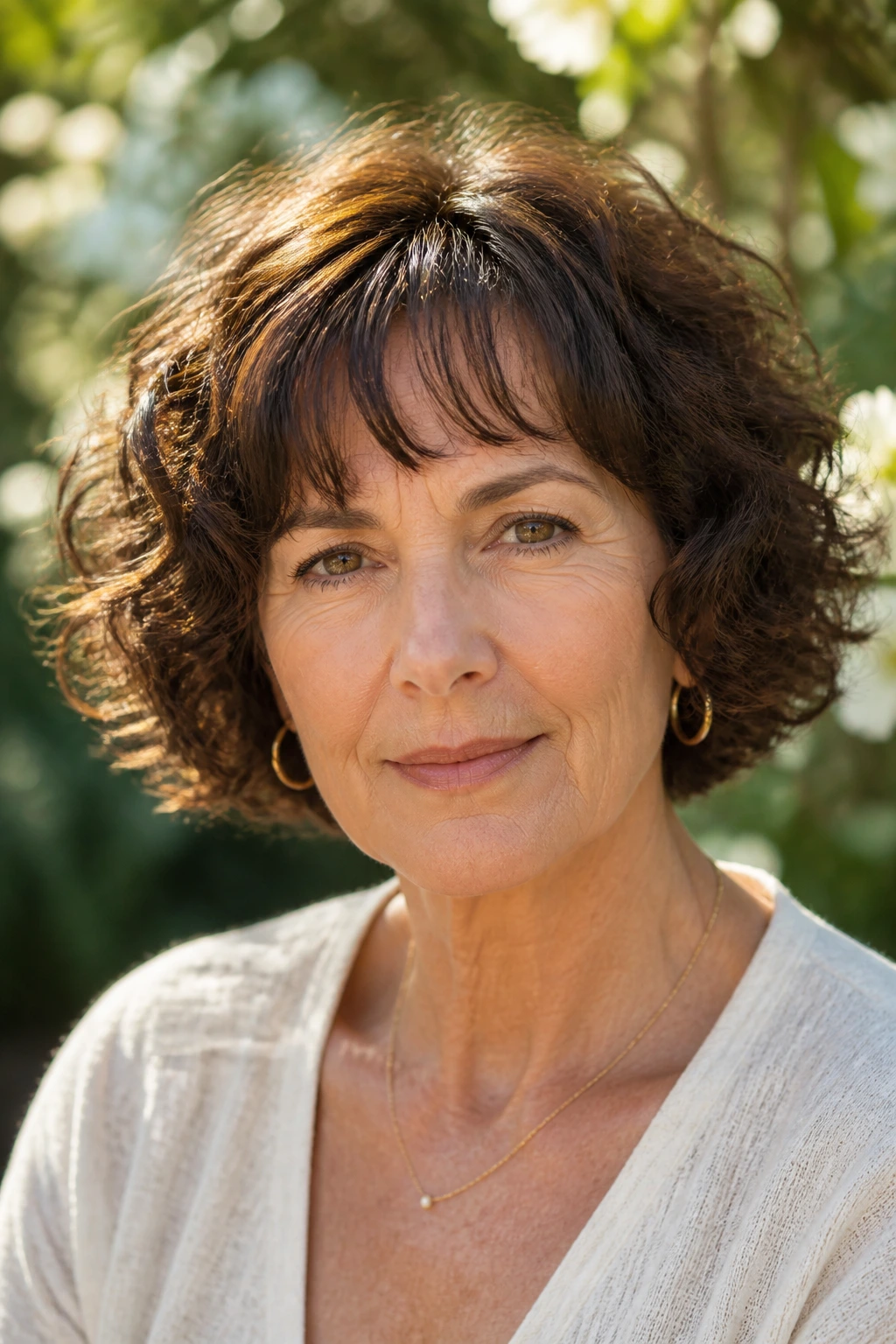
Wispy bangs are forgiving, but they are not magic. The front often needs a touch-up every 2 to 4 weeks, especially if the fringe sits right on the brow or you wear glasses. Pixies usually need full shape maintenance every 4 to 6 weeks. Bobs can stretch a little longer, usually 6 to 8 weeks, if the layers are cut well.
Wash the fringe more often than the rest of the head if it gets oily. Forehead oils travel fast, and bangs show it first. A quick sink rinse or a small shampoo at the front line can buy you another day. If the roots go flat, dry shampoo works best when sprayed at the hairline, left for 30 seconds, then brushed through lightly.
At night, if your fringe misbehaves, clip it up loosely or pin it to one side before sleeping. Satin pillowcases help too. They do not cure bad cutting, but they do reduce the odd crease that makes a wispy bang look chunky in the morning.
Variations and Adaptations to Try
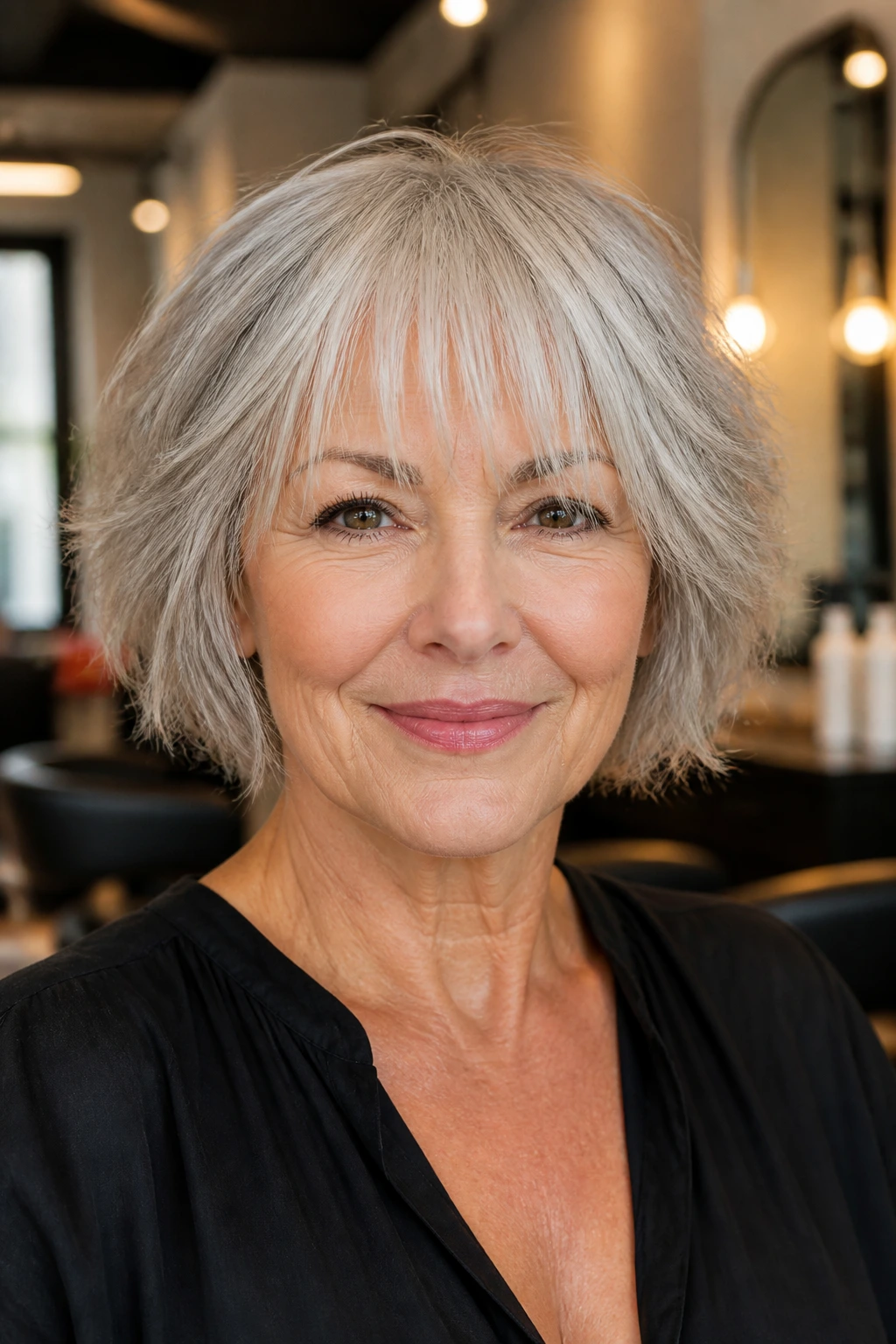
Soft Gray Glow: Let the natural silver come through and keep the fringe especially light. Gray hair often has a stronger texture, so a softer bang line prevents the front from feeling heavy.
Glasses-First Fringe: Ask for longer outer corners and a slightly shorter center section. That shape leaves room for frames and keeps the eyes open.
Fine-Hair Lift Cut: Choose a pixie or stacked bob with internal layers at the crown. The fringe should be feathered, not thinned to the point of fraying.
Curly-Texture Version: Leave the bang length longer and taper the sides into the curl pattern. The center should bounce rather than collapse.
Low-Fuss Air-Dry Shape: Pick a shag bob, tousled crop, or wavy layered bob. These are the cuts that still look coherent if you only add product and finger-style the fringe.
Softer Grow-Out Plan: If you want a style that can stretch between trims, choose side-swept or curtain-like wisps rather than a straight-across fringe. The grow-out phase will look more intentional.
Common Mistakes to Avoid
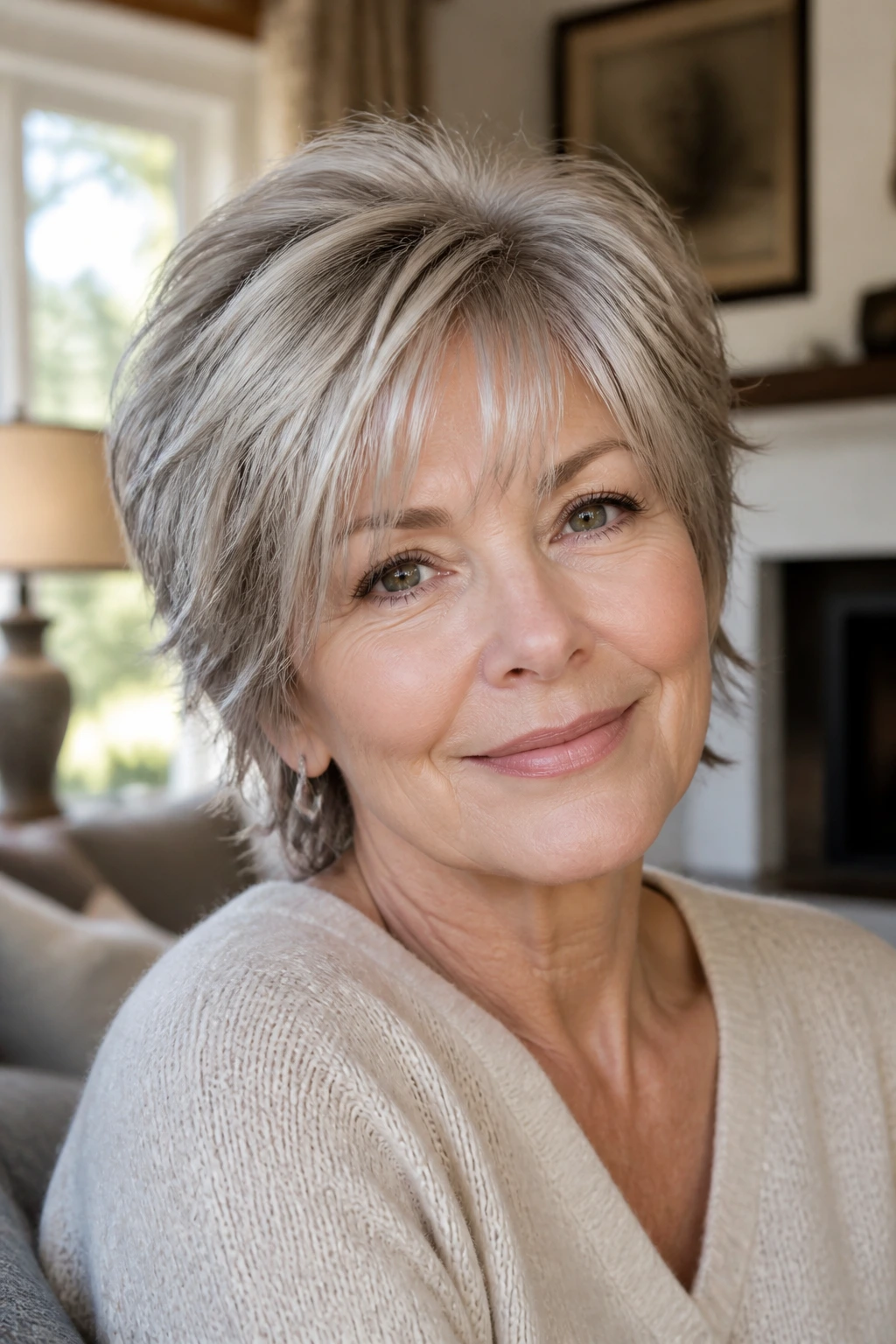
The first mistake is making the bangs too dense. That’s the quickest way to turn a light haircut into a heavy one. If the fringe blocks the forehead like a sheet of hair, ask for more internal softness and a little removal through the ends.
The second is cutting the fringe straight across when the hair wants to part. A stubborn cowlick will split that line in public, and then you’ll spend all day fighting it. Cut with the growth pattern, not against it.
The third is ignoring the rest of the shape. Wispy bangs can’t rescue a bulky bob or a pixie with too much width at the sides. The haircut has to taper, bevel, or layer somewhere else, or the front will look disconnected.
The fourth is overstyling the fringe into one fixed shape. A wispy bang is supposed to move. If you drown it in spray, hot curl it every day, and brush it flat ten times, you’ll lose the softness that made it work.
The fifth is skipping trims until the bangs cover your eyes. Then the fringe starts to feel annoying instead of airy. A tiny trim keeps the shape alive.
Frequently Asked Questions
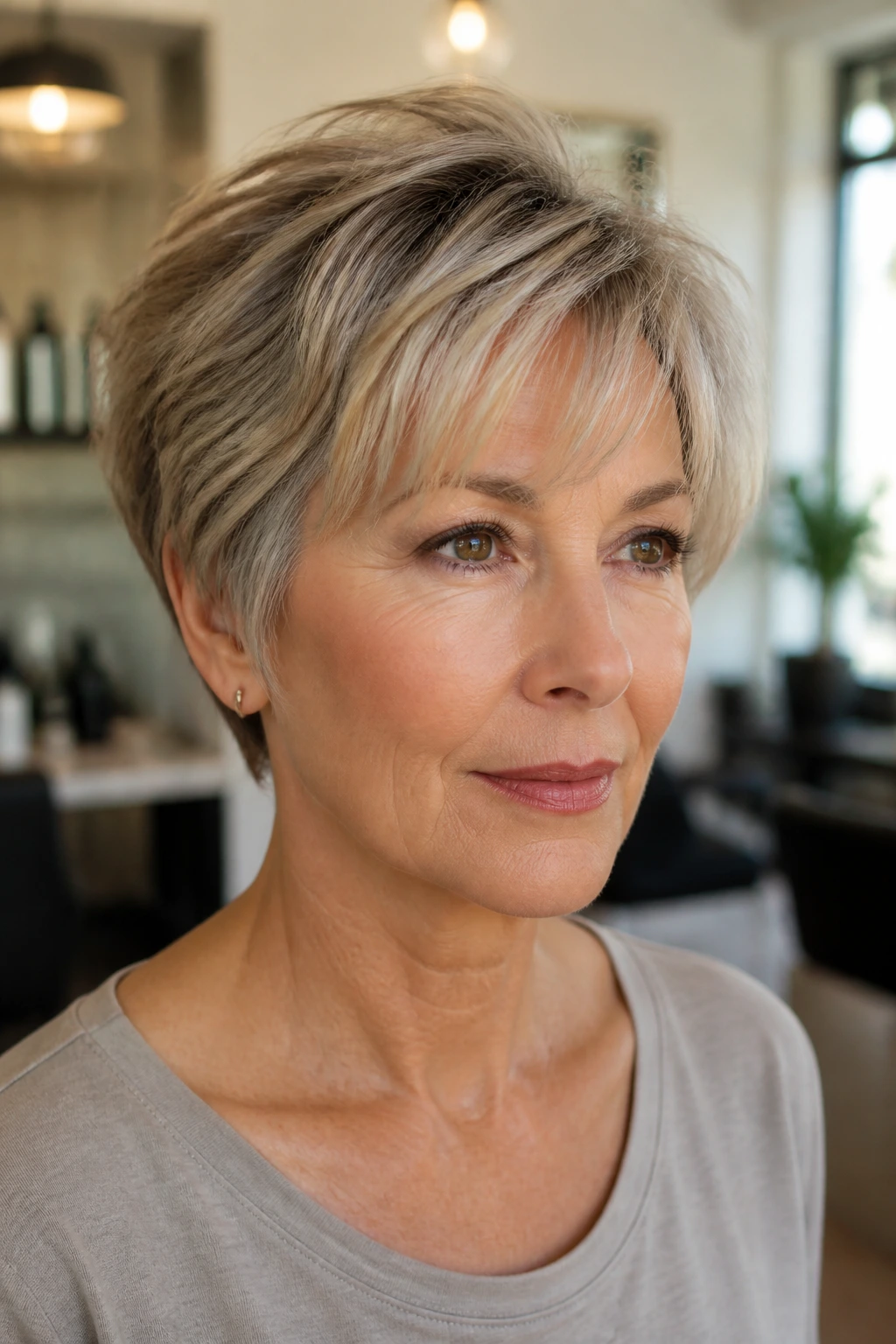
Are wispy bangs flattering after 50?
Yes, when they’re cut with enough softness to show some forehead through the strands. The point is not to hide the face; it’s to soften the front of it. A wispy fringe works especially well when the rest of the haircut has movement.
Do wispy bangs work on fine hair?
They can, and often better than thick blunt bangs. Fine hair already lacks bulk, so a light fringe adds shape without overwhelming the front. The trick is to keep the ends feathered rather than aggressively thinned.
What if my hair is thick?
Ask for internal removal in the fringe and around the sides so the bangs don’t puff up. Thick hair usually needs controlled layering, not just a shorter cut. A good stylist will keep the fringe light while preserving enough body to avoid gaps.
Can I wear wispy bangs with glasses?
Absolutely. In fact, glasses often look better with wispy bangs than with a heavy fringe because the front doesn’t fight the frame. Keep the length just above the lenses or sweep the fringe slightly to one side.
How often do wispy bangs need trimming?
Most need a touch-up every 2 to 4 weeks if they sit directly on the brow. If the fringe is side-swept or curtain-like, you can stretch that a little longer. Pixies and cropped styles usually need full shape trims more often than bobs.
What if my bangs separate because of a cowlick?
Cut them to work with the cowlick, not against it. Dry the roots in the direction they want to go, then redirect them with a brush while they’re still warm. A slightly longer fringe usually behaves better than a short one.
Can curly hair pull off wispy bangs?
Yes, but the bangs should be cut longer and with shrinkage in mind. Curly fringe needs room to bounce. If the cut is too short, it can spring up and look choppy in the wrong way.
How do I grow wispy bangs out without hating the process?
Side-swept pieces and curtain-like fringe are the easiest to grow out. Clip the front back on off days, part it a little deeper to one side, and let the longer pieces blend into the sides. That awkward middle stage passes faster when the cut already has movement.
The Fringe That Keeps the Cut Light
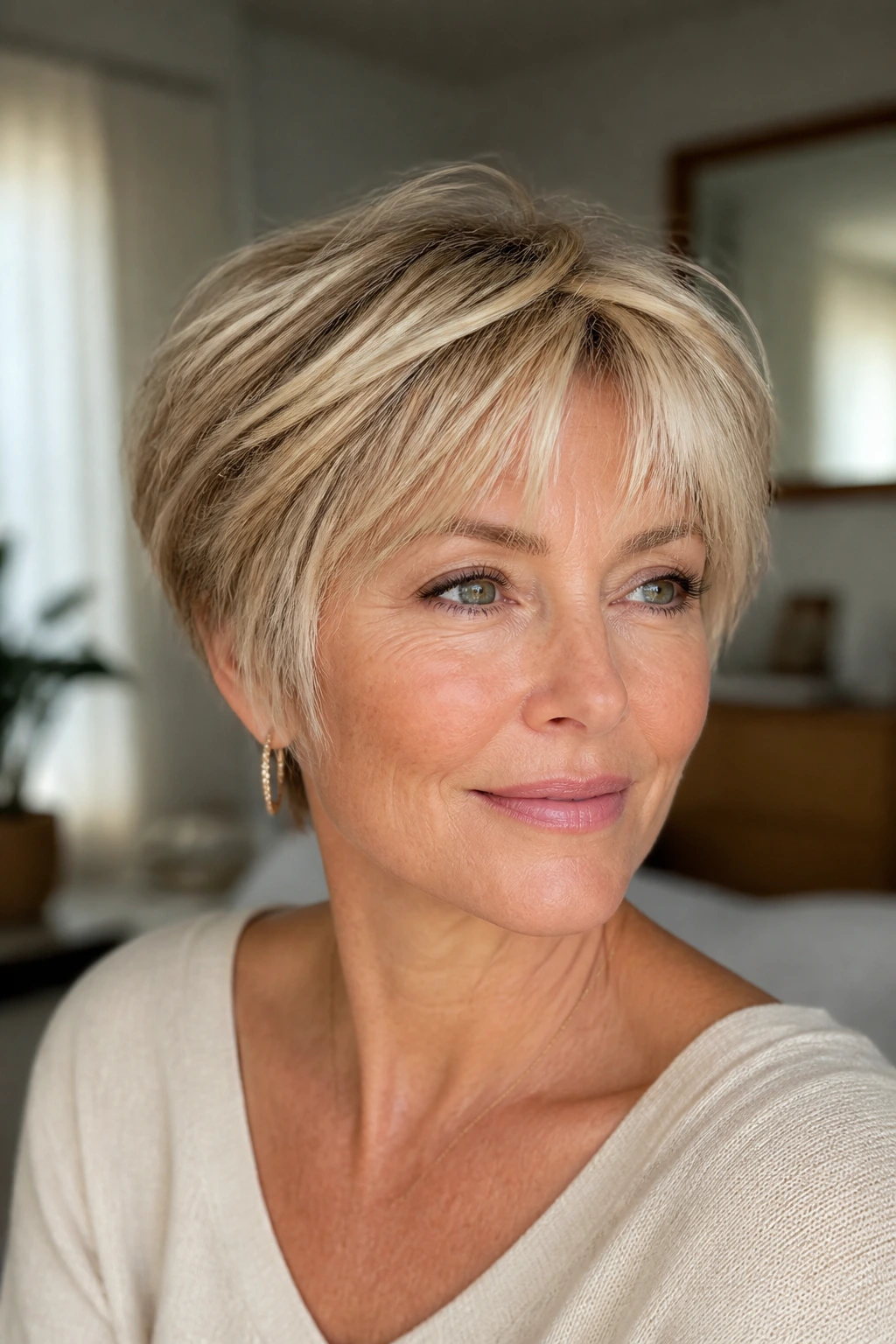
Short hair after 50 doesn’t need to be severe to be neat, and it doesn’t need to be elaborate to feel current. The best wispy bangs do one thing very well: they keep the front of the haircut open enough that your face still looks like yours.
That’s why these cuts hold up. A feathered pixie, a chin-length bob, a curly crop, a stacked shape — they all work when the fringe is soft enough to move and the rest of the haircut supports it. Nothing stiff. Nothing helmet-like. Just enough air at the front to make the whole thing easier to wear.
If you’re heading to the salon, bring one of these shapes with you and pay attention to the fringe density first. That’s where the whole haircut lives or dies.
