



The best updos for short hair never pretend you’ve got more length than you do. They work with a chin-length bob, a grown-out pixie, or a blunt lob the way those cuts actually behave: a little slippery at the ends, stronger at the roots, and happiest when they’re folded, pinned, and tucked in small sections instead of shoved into one giant knot.
That’s the part most people get wrong. They try to make a short cut do a long-hair job, and the result is usually a lopsided puff, a bun with ends sticking out like antennae, or a style that sags before you’ve made it to the door. Short hair needs grip. It needs smart pin placement. And it needs shapes that can survive the stubborn little pieces around the nape and temples.
Some of the looks below are polished enough for a formal dinner. Some are the kind of short hair updos you can wear with a white T-shirt and still look like you meant it. All of them are built for real life, not fantasy hair.
Why These Short-Hair Updos Actually Work
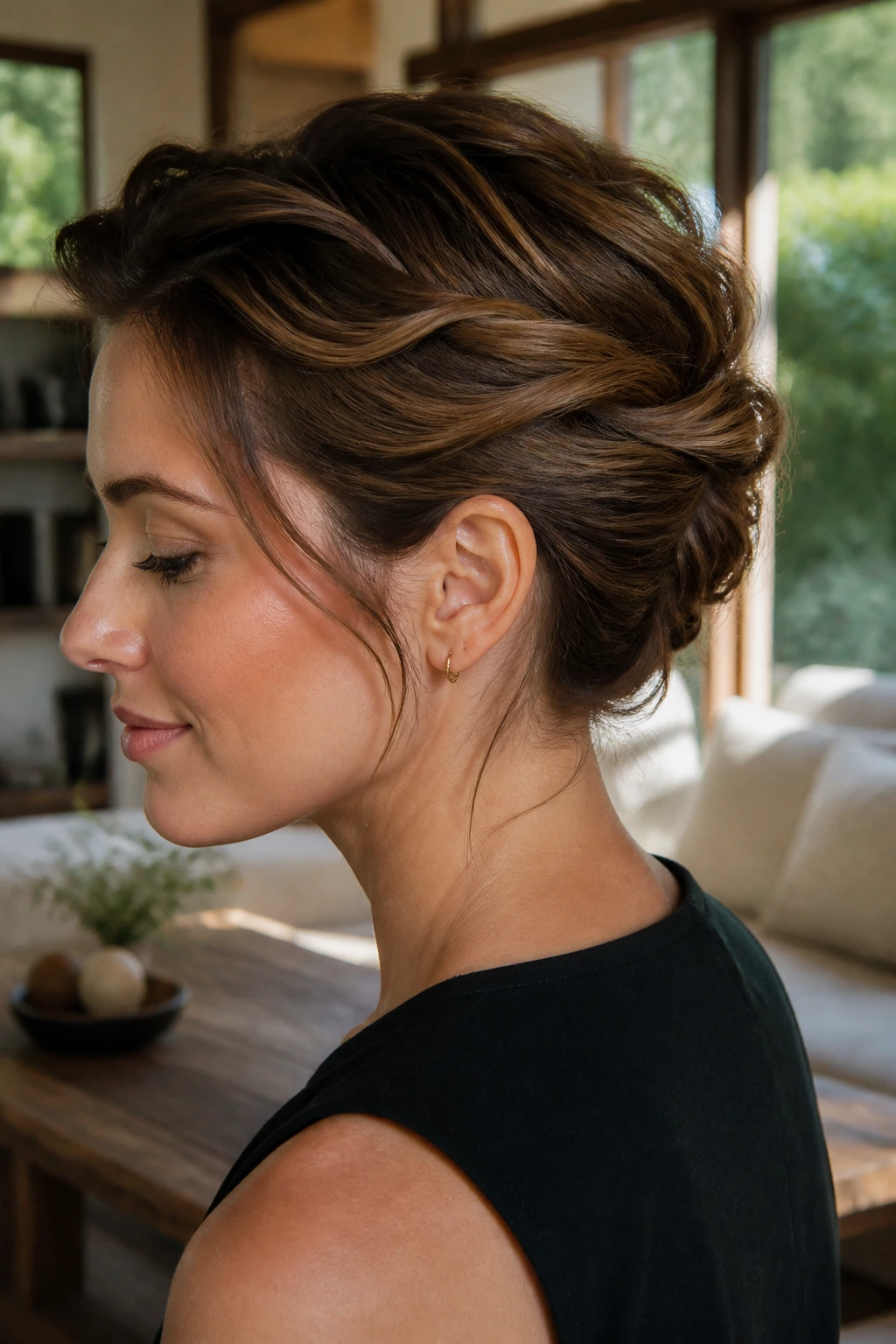
- Built for bobs, lobs, and grown-out pixies: These styles rely on twisting, folding, and pinning instead of one long wrap, so you can wear them before your hair hits shoulder length.
- They handle layers instead of fighting them: Short layers usually break a style apart; these looks hide the shorter pieces inside the shape or leave them out on purpose.
- They need ordinary tools, not a drawer full of gadgets: A tail comb, a few bobby pins, small elastics, and texture spray can carry most of the load.
- Some are sleek, some are messy, and that’s the point: You can choose a neat French twist for a blazer or a loose mini bun for a sweater without changing the whole method.
- They work better on second-day texture: Freshly washed hair can be too slick; a little grit gives pins something to grab.
- They respect the haircut you already have: No fake drama. No pretending your bob is waist-length. Just good structure and a little nerve.
1. The Twisted Low Chignon That Works at Jaw Length
A jaw-length bob can absolutely wear a low chignon, but it has to be built in pieces. You twist each side back first, then fold the remaining length into a small knot at the nape, hiding the ends underneath so the shape reads soft instead of precarious.
Why It Holds
The side twists create tension across the head before the bun ever starts. That matters. It keeps the weight spread out, which is why this style sits flatter than a regular bun and doesn’t sprout loose bits after twenty minutes.
- Best for: chin-length bobs, fine-to-medium hair, and cuts with a little bend in the ends.
- Use: 6 to 8 bobby pins, 1 small clear elastic, and a light mist of texturizing spray.
- Works best on: hair that has been blow-dried smooth or lightly waved the day before.
One thing I’d do every time: pin from underneath first, then cross one pin over the top of the knot. That little X keeps the whole thing from drifting.
2. The Mini French Twist That Cheats Height
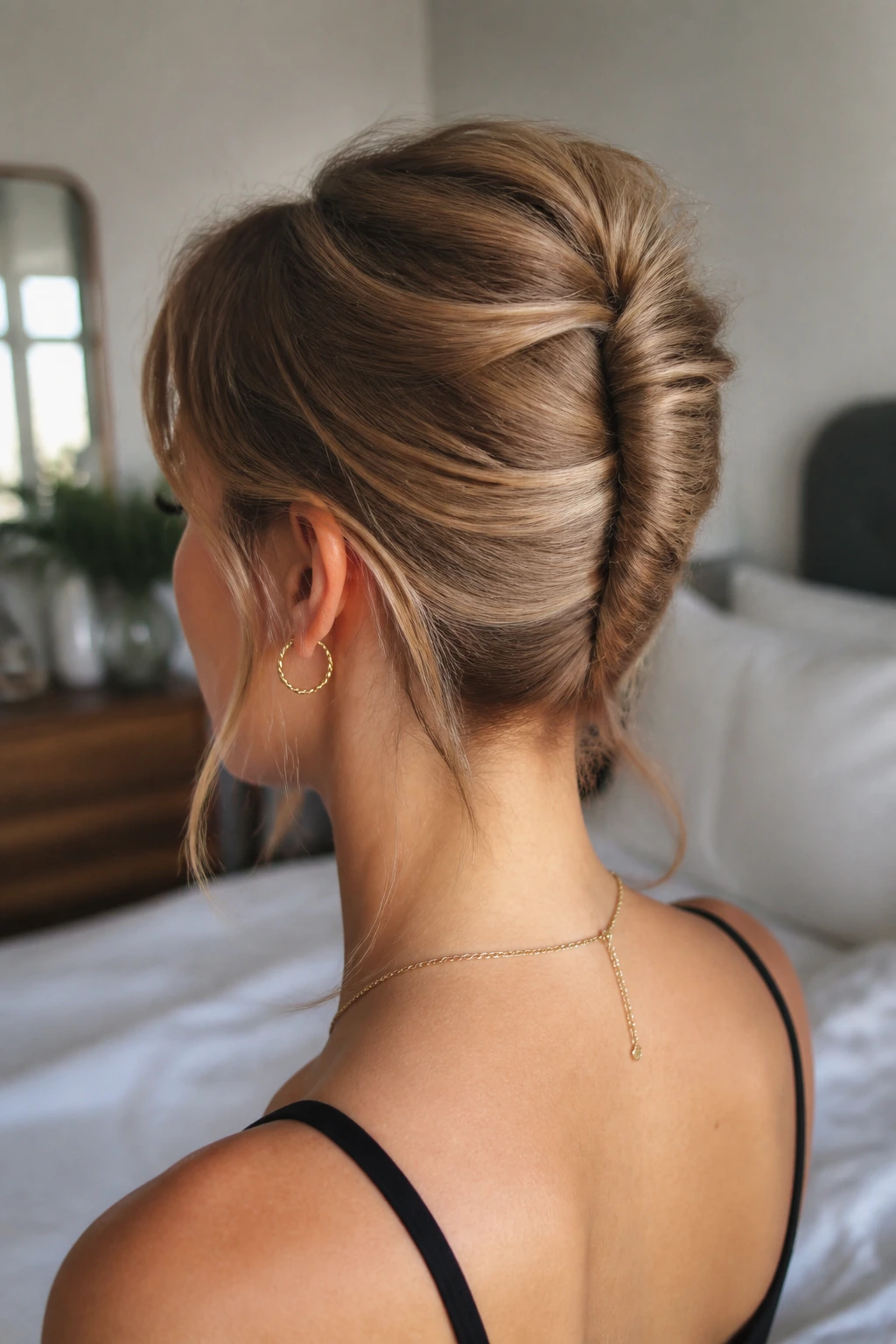
A short bob can wear a French twist. It just can’t be a giant one. The trick is to create a narrow roll at the back of the head, tuck the ends inward, and pin the shell of the twist straight into the scalp so the shape stands up without ballooning out.
The smartest versions are not perfectly glossy. They have a little texture at the crown, which keeps the twist from looking like it’s sliding off. If your hair is pin-straight and clean, give the roots a quick pass with dry shampoo first. The extra grip helps more than another ounce of hairspray.
A slim French twist looks especially good with earrings that sit close to the ear. It opens the neck, too, which is probably why this style keeps coming back around. Clean line. Small amount of hair. Strong shape. That’s the whole story.
3. The Crown Braid That Becomes a Headband
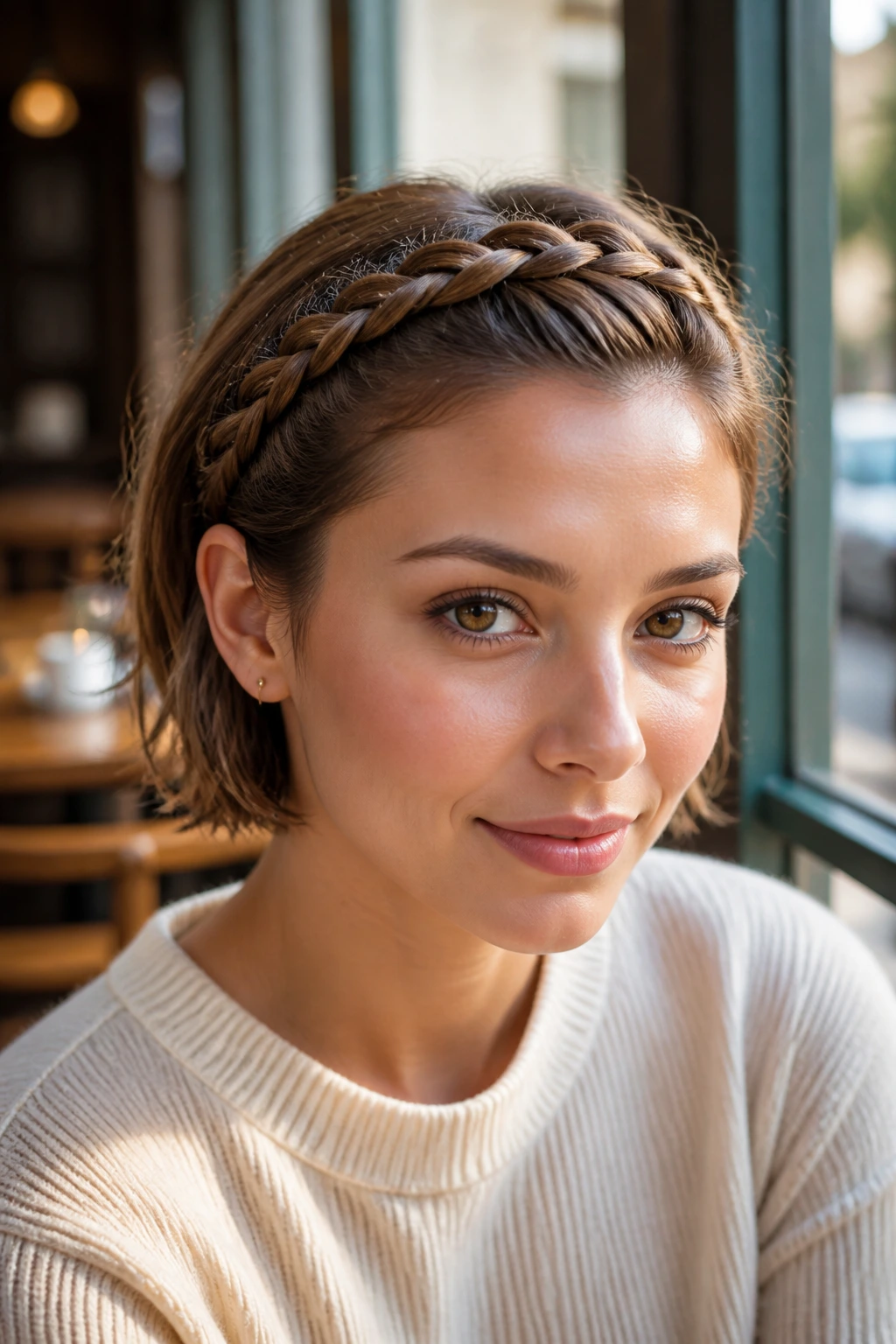
Can a short bob wear a crown braid? Yes, if you stop thinking of it as a full halo and start treating it like a stitched headband. You braid from one temple, follow the hairline, and pin the tail where the braid disappears behind the ear.
Where to Anchor It
The braid needs help from the part line and the temples. Start with day-old hair, because freshly washed strands slip through your fingers like wet ribbon. A little texture at the roots keeps the braid from unraveling before you’re done pinning.
A crown braid on short hair looks best when the braid is modest and close to the head. Don’t pull it wide. Don’t pancake it too much. The charm is in the clean curve, not in volume for volume’s sake.
If you have layers, braid a touch tighter than you think you need to. The shorter pieces will loosen the whole thing slightly as you go.
4. The Half-Up Knot for Short Layers
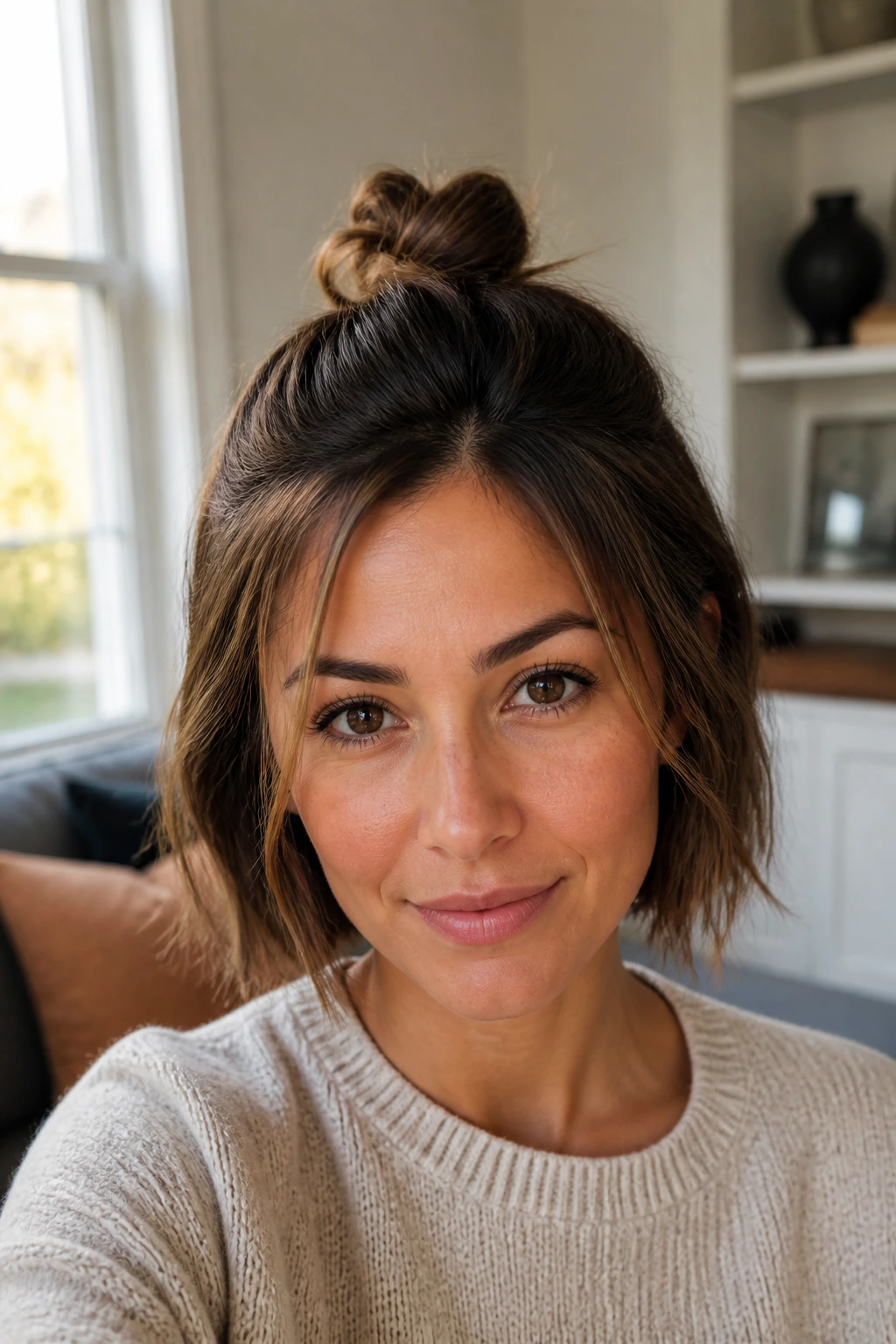
If your layers keep falling out of every style, the half-up knot is the honest answer. You gather the top half of the hair—just enough to control the crown and temples—twist it once or twice, then tuck it into a tiny knot while the bottom half stays loose.
That split is the whole reason it works. The shorter pieces at the back don’t have to be forced into the knot, and that saves the style from looking overstuffed. It’s especially useful on cuts that hit the chin or collarbone, where the top section has more length than the lower layers.
A half-up knot also buys you a little height without teasing the hair raw. If you want the top to look fuller, lift the section slightly before twisting it. Don’t pull tight at the temples. That’s where the style starts to feel stingy.
5. The Gibson Tuck for Chin-Length Cuts
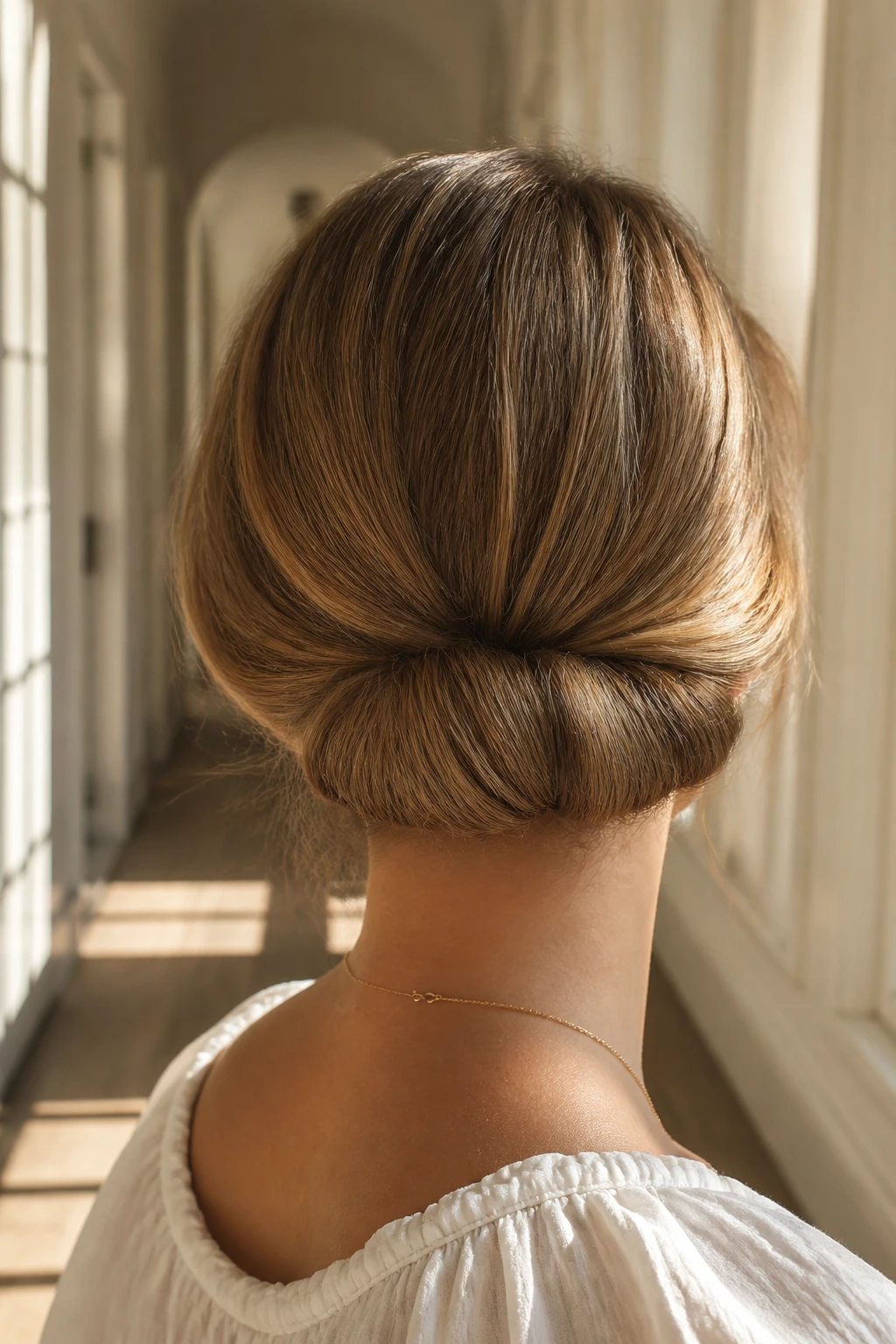
The Gibson tuck looks fancy, but on short hair it’s mostly a matter of folding and patience. A soft headband or small elastic creates the base, and the ends are tucked upward into the roll until the shape hugs the back of the head.
This is one of my favorite short hair updos because it doesn’t ask the cut to do anything dramatic. It asks the cut to fold. That’s a different job, and a much easier one. A chin-length bob has enough length to disappear into the tuck, especially if the ends are lightly waved first.
It works best when the hairline is kept neat and the roll sits low. If you place it too high, the tuck starts to puff out. Too low, and it gets lost. Right in the middle of the back of the head is the sweet spot.
6. The Sleek Rolled Bun at the Nape
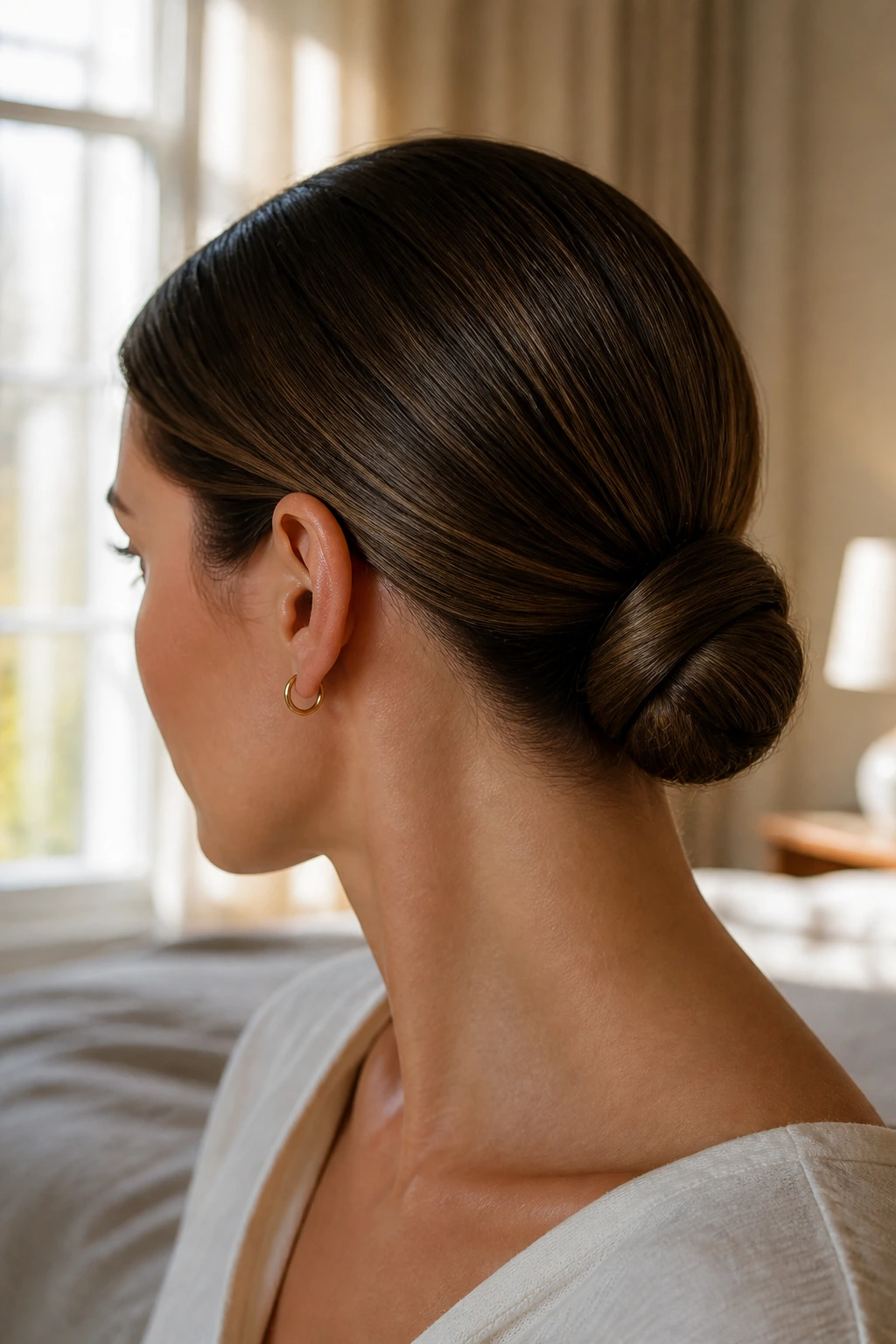
The sleek rolled bun is not the same thing as a soft chignon. This one is tighter, cleaner, and more deliberate. Think smooth sides, a low roll at the nape, and a finish that shows off the shape of the head rather than hiding it.
That difference matters. A fluffy bun can feel too big on short hair and end up looking like a small cloud. The rolled version stays compact, which is exactly what you want if the back section only gives you a few inches to work with.
A tiny amount of styling cream on the mids and ends helps here, but don’t drown the roots. If the roots get slippery, the bun starts to slide. Keep the shine where the hair is folded and pinned, not everywhere.
7. The Side-Swept Pin-Up Bob
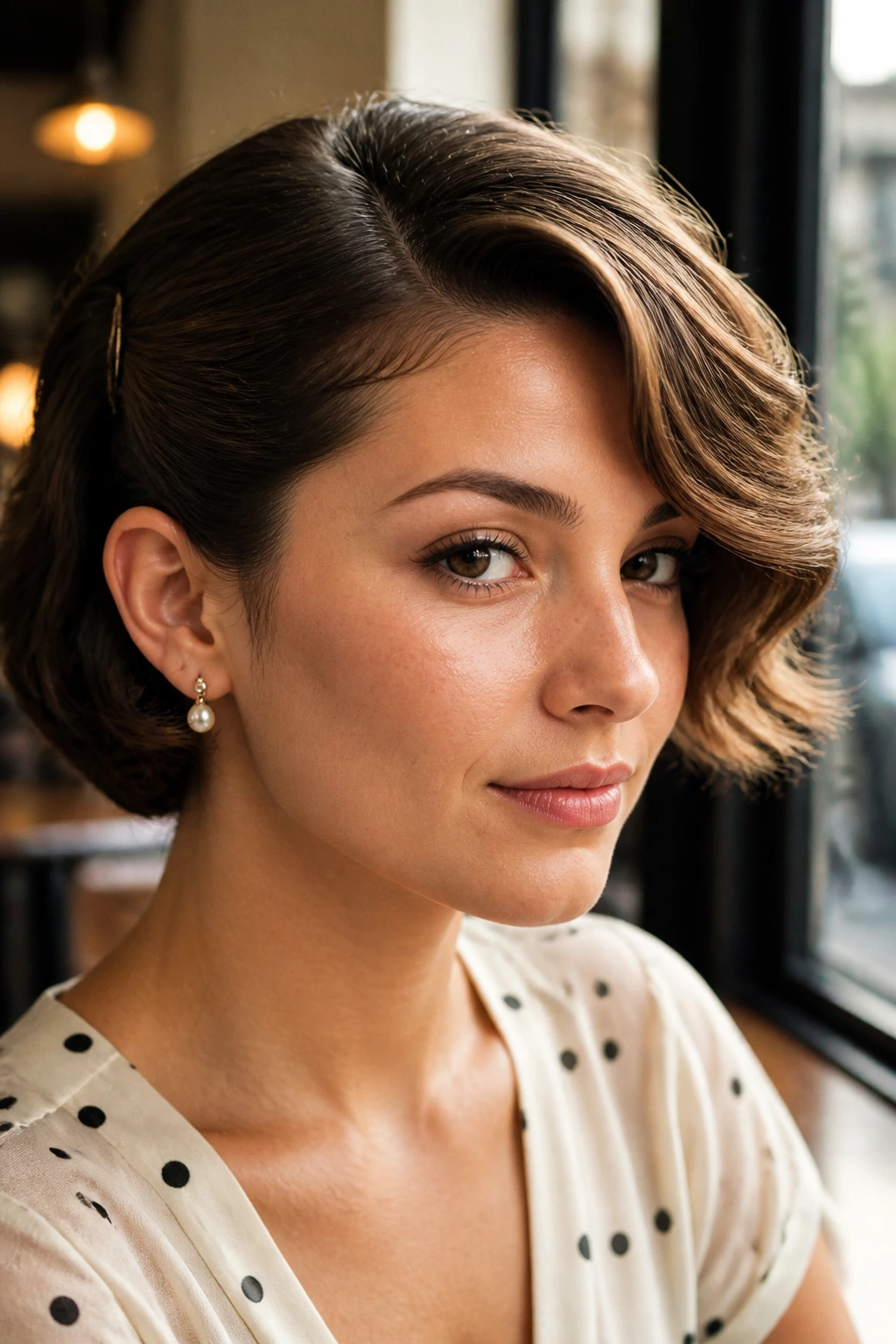
This one has attitude. A deep side part, one side tucked low and pinned, the other side rolled slightly back from the temple—it gives short hair the feeling of a vintage pin-up style without needing a full set or a huge barrel curl.
Best on Shiny, Brushed-Through Texture
If the hair has a little bend in it, even better. The softer the ends, the easier the side sweep sits against the head. A light wave around the front piece keeps the style from looking severe, and a few hidden pins under the tucked side lock everything down.
The result is tidy but not stiff. That’s the line worth aiming for. Too much spray and it turns helmet-like. Too little and the tucked side starts to spring out around the ear.
I like this on shorter cuts because it gives asymmetry some structure. One side does the talking; the other side keeps the shape quiet.
8. The Double Mini Buns for Cropped Hair
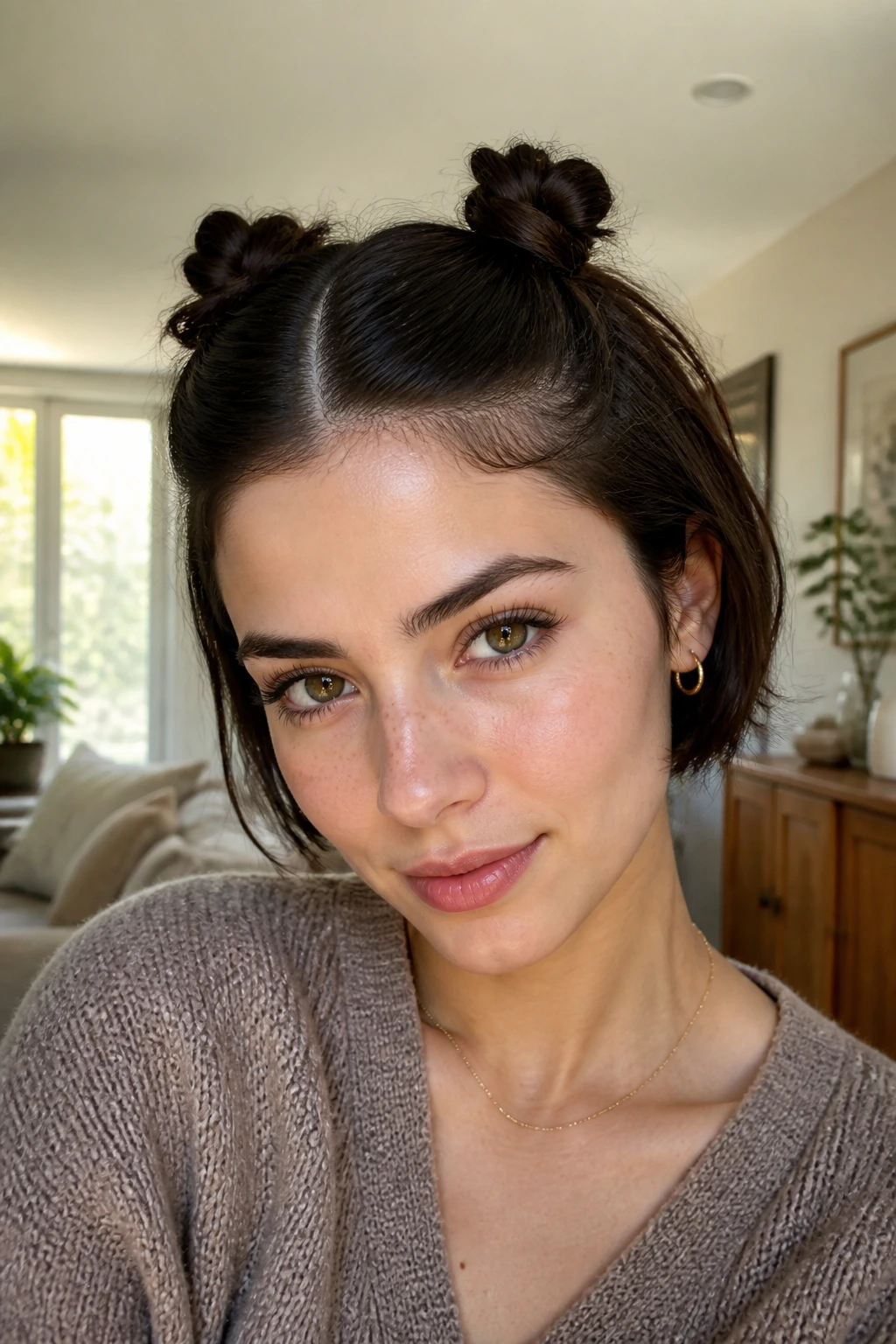
Split the hair down the center and suddenly short hair has a different personality. Two mini buns, one on each side or slightly back from the temples, can make a cropped cut feel playful without looking childish—if you keep the buns small and the parts clean.
A center part gives the style balance. The buns themselves should sit low enough that they don’t look like little ears. That’s the mistake. People lift them too high and the whole thing gets cartoonish. Keep them close to the crown or a touch behind it, and the look turns sharper.
This style loves texture. If the hair is too smooth, the buns slide toward the back. A little dry shampoo at the roots and a few crossed pins inside each knot make a big difference.
9. The Claw-Clip French Twist Shortcut
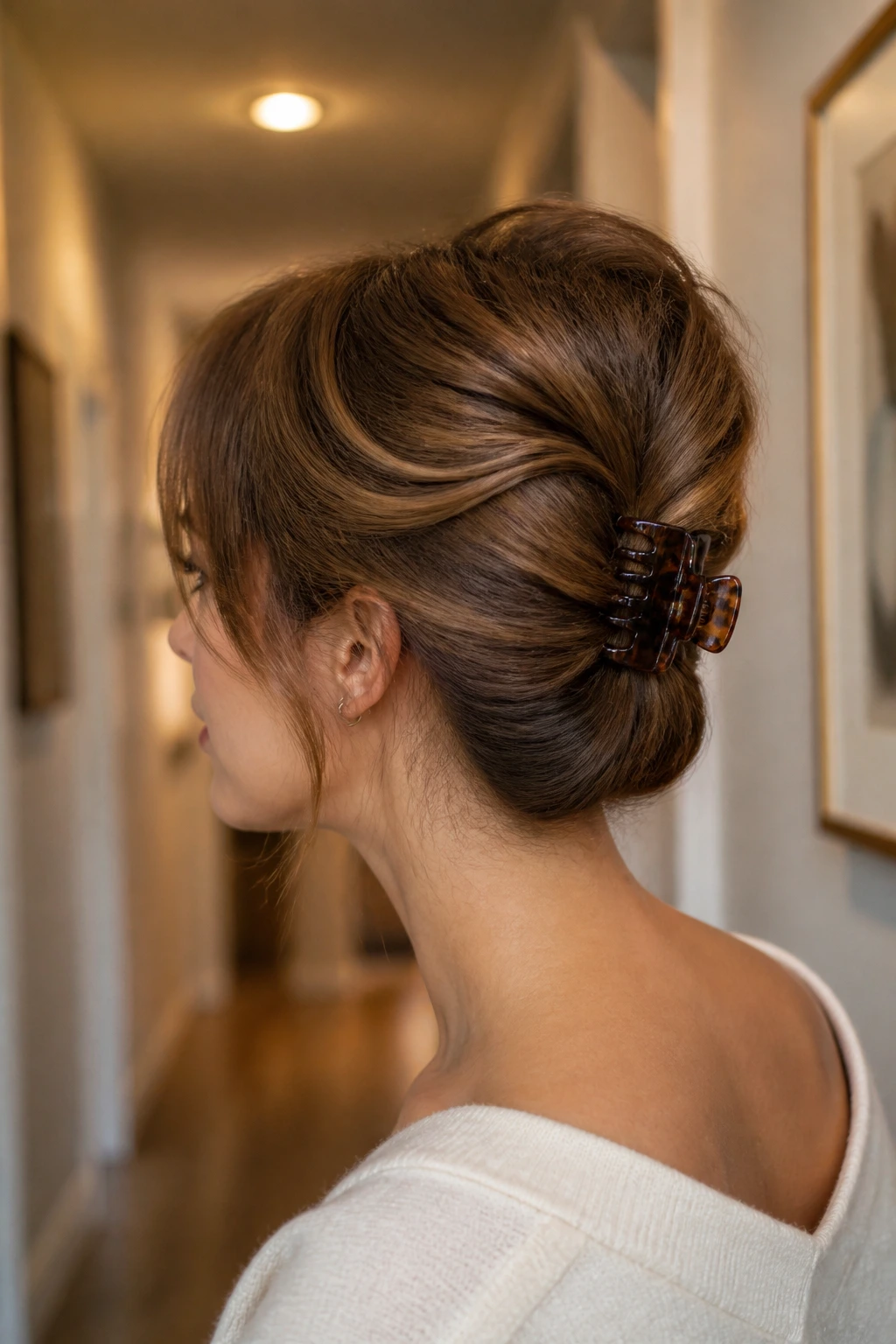
A claw clip is not cheating here. It’s the right tool.
Short hair often needs a clip more than it needs another elastic, especially when the ends are too short to wrap neatly. Twist the hair upward, fold the tail inward, and clamp a small or medium claw clip vertically so it catches the thickest part of the twist. That keeps the style in place without flattening the whole back of the head.
I prefer this version for hair that sits between jaw and shoulder length, where the ends are long enough to twist but not long enough to make a proper bun. A good clip grips the twist without scraping the scalp, which is more comfortable than people expect.
If the clip is too big, the style collapses into itself. If it’s too small, the twist pops out. The fit matters more than the brand name ever will.
10. The Tucked Ponytail Turned Updo
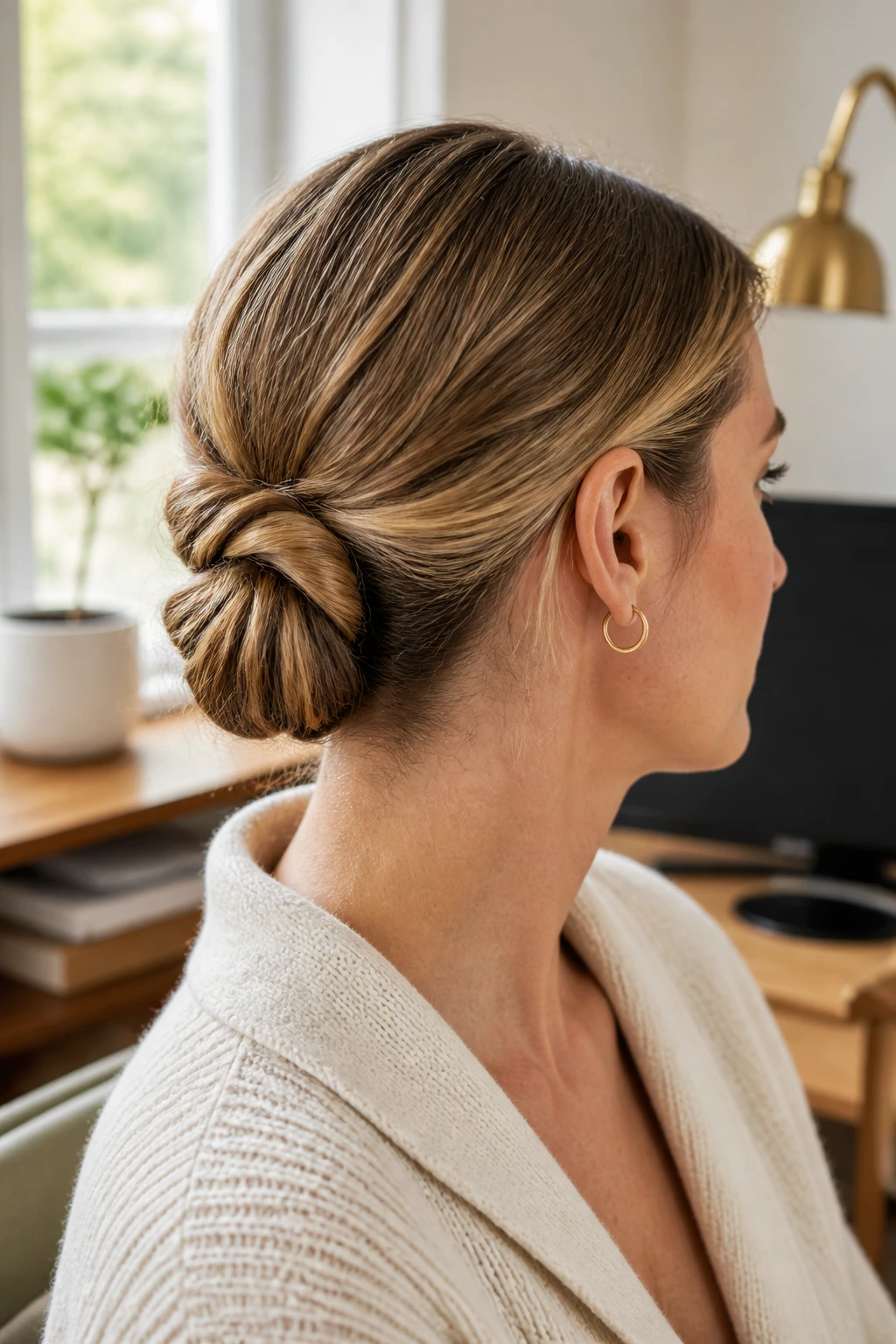
A tiny ponytail at the nape can become a neat updo in about thirty seconds if you know where to split the hair. Make the ponytail low, open a small space above the elastic, and flip the tail upward through that gap before tucking the end inward.
That little loop turns a stubby pony into something much more finished. It’s especially useful on hair that just barely reaches the neck, because you’re not asking it to fold around a bun form. You’re asking it to loop and disappear.
Where This Style Earns Its Keep
It works for office days, dinner plans, and anything that needs a low-profile finish. Add a few pins around the tucked tail and the whole style sits flat against the nape.
If your hair is very layered, leave the tiniest front pieces free. The softness makes the tuck look deliberate, not rushed.
11. The Flat-Twist Mohawk Updo
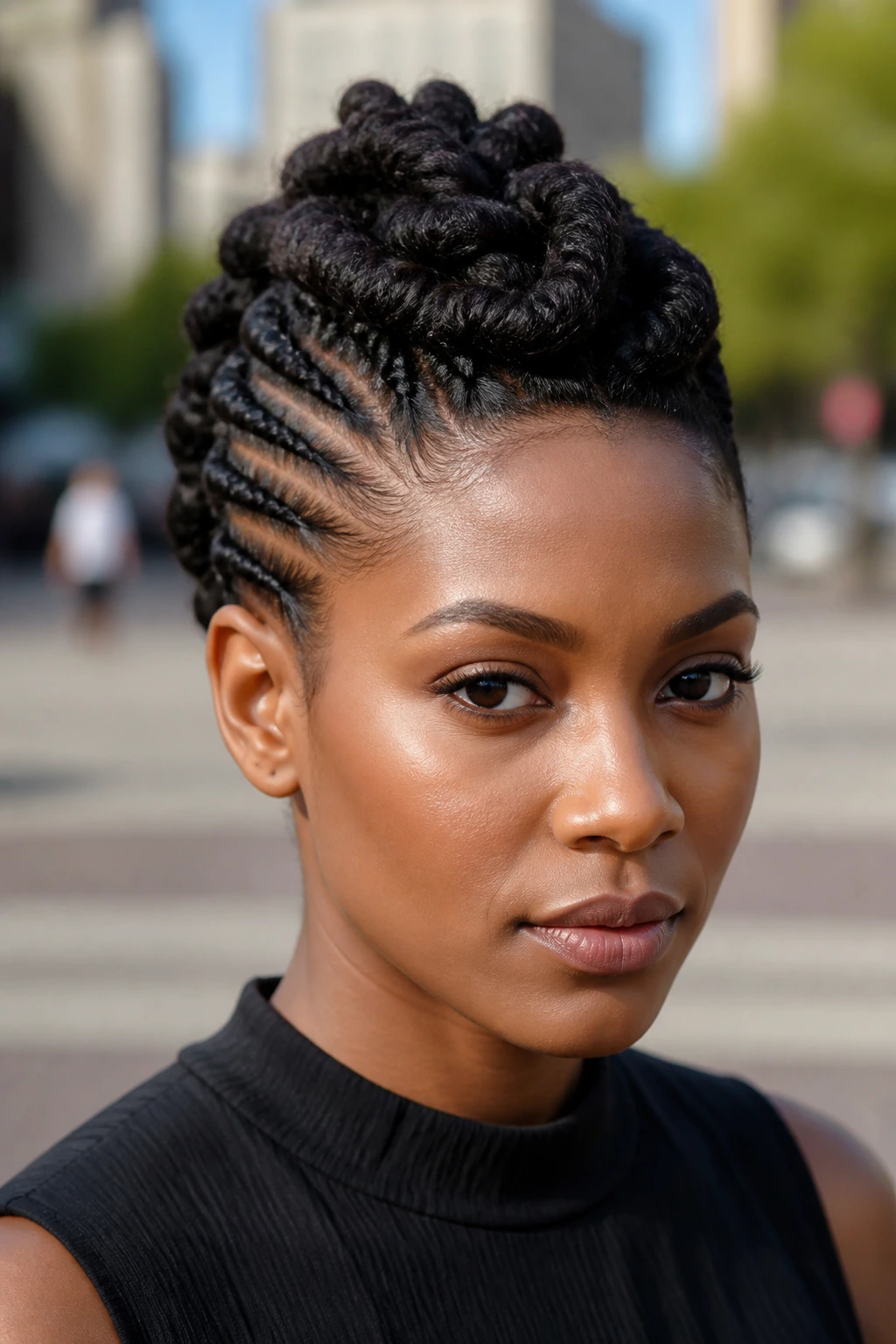
This style has a little edge to it. The sides are flat-twisted or tightly pinned back, while the center ridge stays fuller and higher, creating a short-hair mohawk effect that still reads polished enough for real errands, real events, and real weather.
It’s a strong choice for wavy or curly hair because the natural texture gives the center ridge body without much coaxing. Straight hair can do it too, but it needs a bit more prep at the crown—usually a rough blow-dry and a small amount of root-lifting spray.
What I like most is that it makes short hair look intentional even when the cut has uneven layers. Instead of hiding the asymmetry, the style uses it. That feels more modern than pretending everything is perfectly even.
12. The Bubble Pony That Disappears Into a Roll
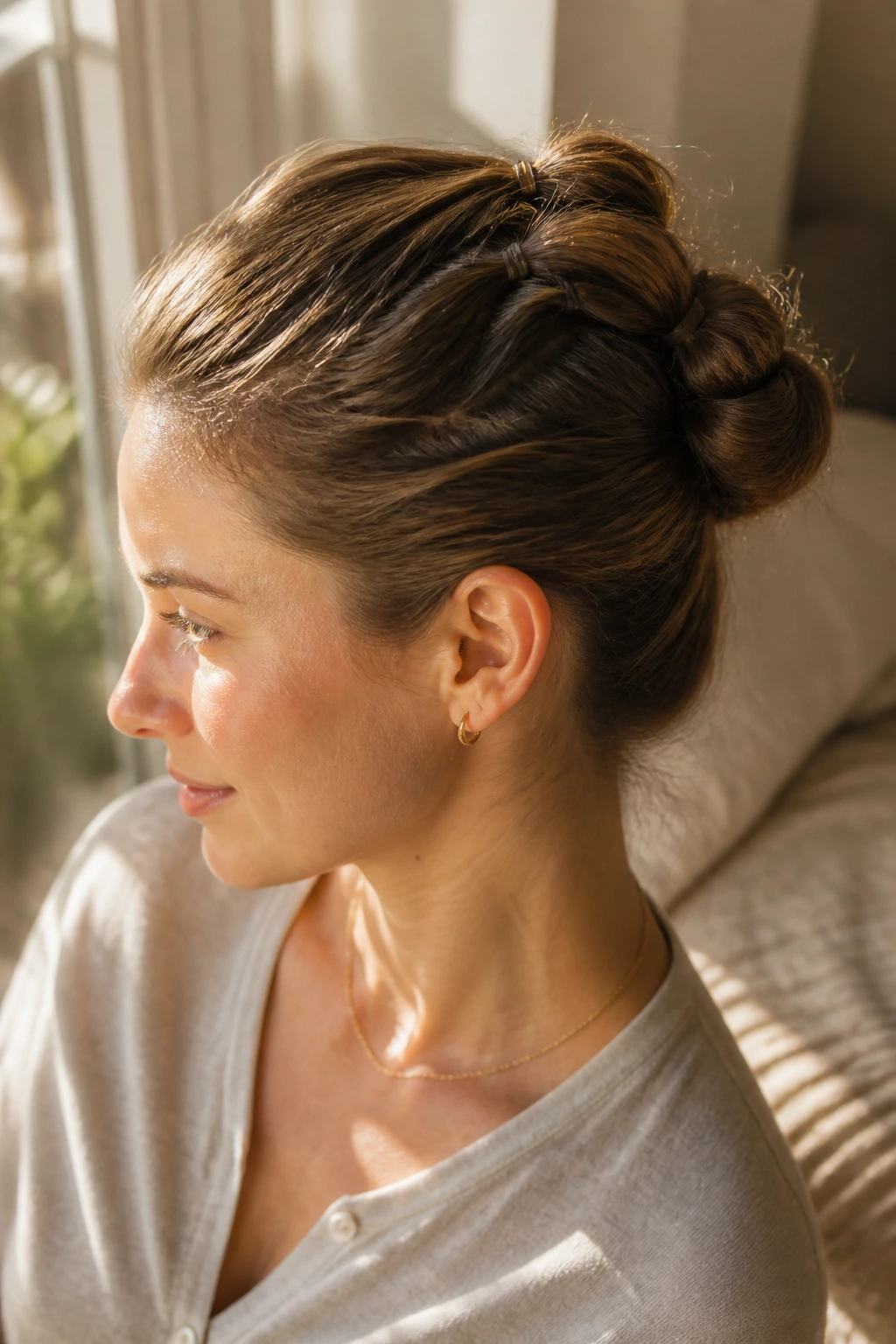
A bubble pony on short hair sounds like something for longer lengths, but the trick is to keep it tiny and fold the end under after the last elastic. The bubbles give shape, the fold hides the final stub, and the whole thing ends up reading like a compact rolled style with a little rhythm.
How the Elastics Disappear
Use two or three small elastics spaced a few inches apart. Gently puff each section between the ties so the pony looks fuller than it really is. Then tuck the tail under the last bubble and pin it flat.
This is one of the most forgiving styles in the bunch because it doesn’t need a perfect bun shape to work. The bubbles create structure for you. If the hair starts to slip, another elastic solves the problem fast.
It’s a good one for layered cuts that refuse to stay smooth. The shape is the point, not the polish.
13. The Scarf-Wrapped Low Knot
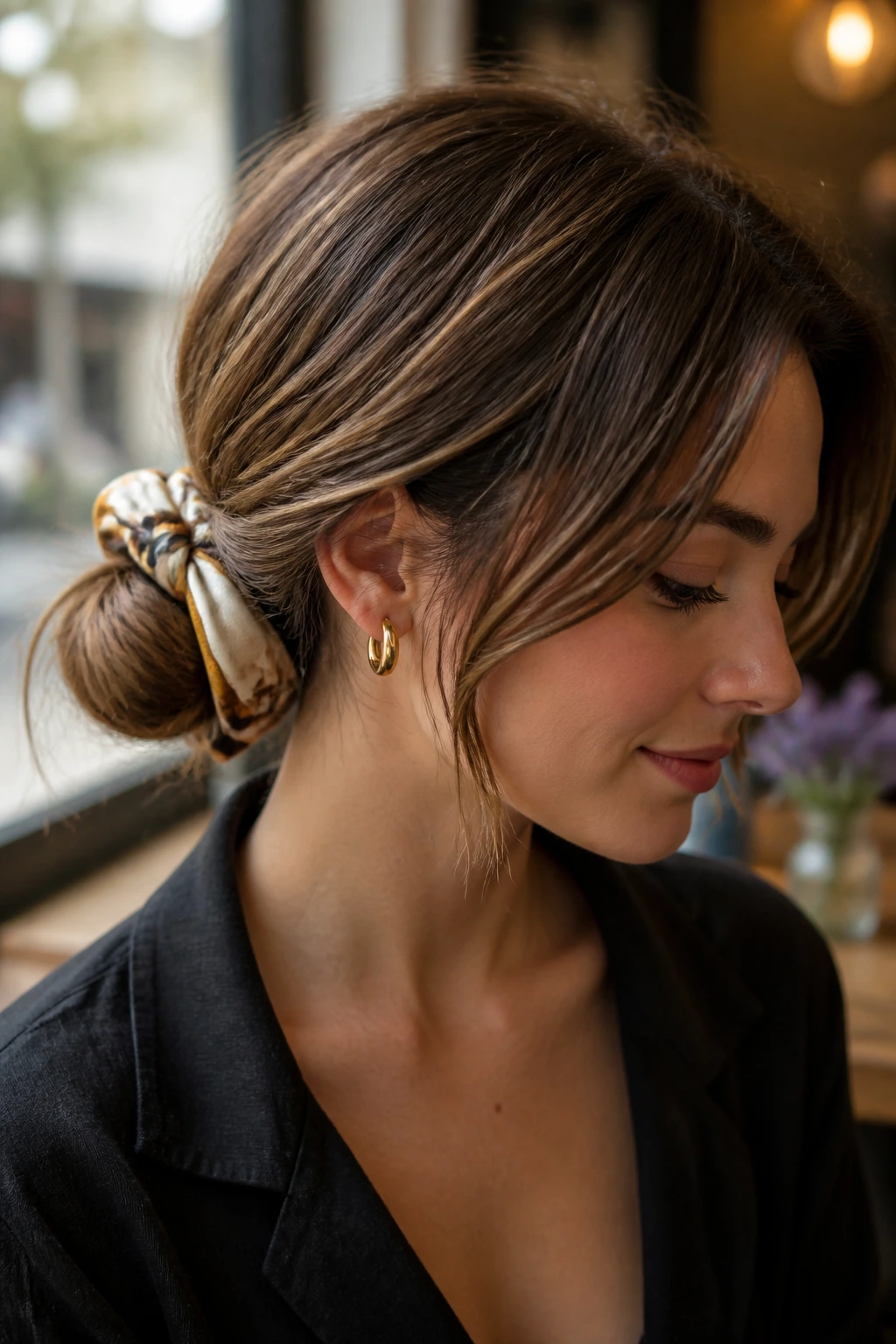
A silk scarf can turn a simple knot into something that looks thoughtful instead of improvised. Tie the scarf around a small low pony or knot, let the tails wrap around the base, and pin them under the fold so the fabric becomes part of the style instead of an afterthought.
Why the Scarf Matters
It gives a short updo a visual anchor. On hair that doesn’t have much length, a scarf creates the feeling of fullness around the knot without adding bulk where you don’t want it. A patterned scarf can also hide the fact that the bun is smaller than you’d prefer.
This works especially well with blunt bobs, because the clean cut can take the boldness of a print. Keep the knot low and the scarf tails tidy. Too much fabric can swallow the shape.
I like a slightly textured scarf better than a slippery one. It grips the hair and stays put longer.
14. The Undone Pin Curls Bun
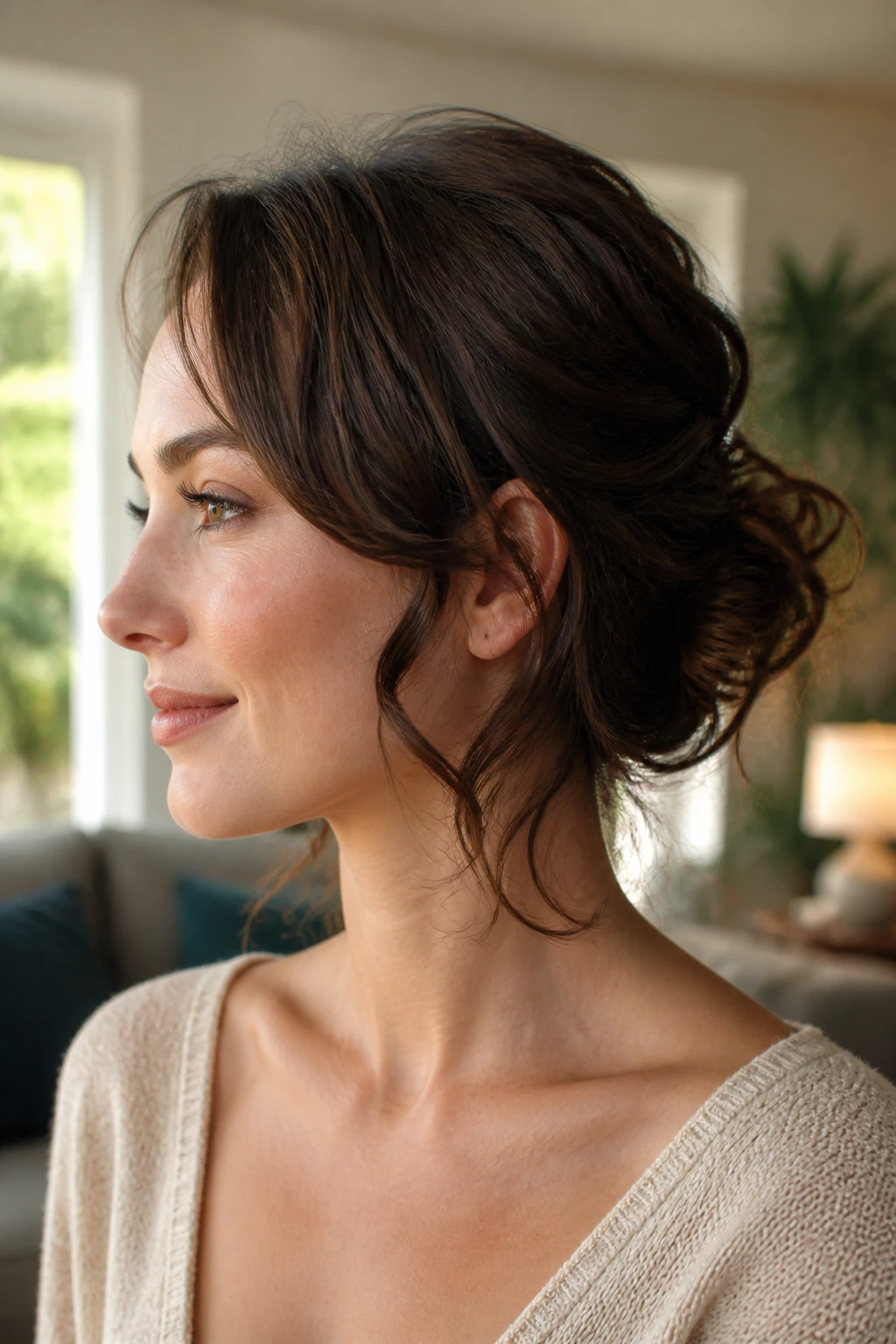
Messy is not the same thing as sloppy. If you curl the ends first and then pin the hair into a loose bun, the style gets that soft, lived-in curve that short hair often needs to avoid looking stiff.
This updo is built for pieces that are just long enough to twist but not long enough to wrap cleanly. Curl the ends away from the face, pin the lengths into a soft loop, and leave a few curled pieces visible around the temples or neck. Those little fragments keep the whole thing from looking overworked.
I reach for this when I want movement. A tight knot can feel too formal on short hair. The undone version gives you shape without locking every strand in place.
15. The Braided Mini Bun at the Crown
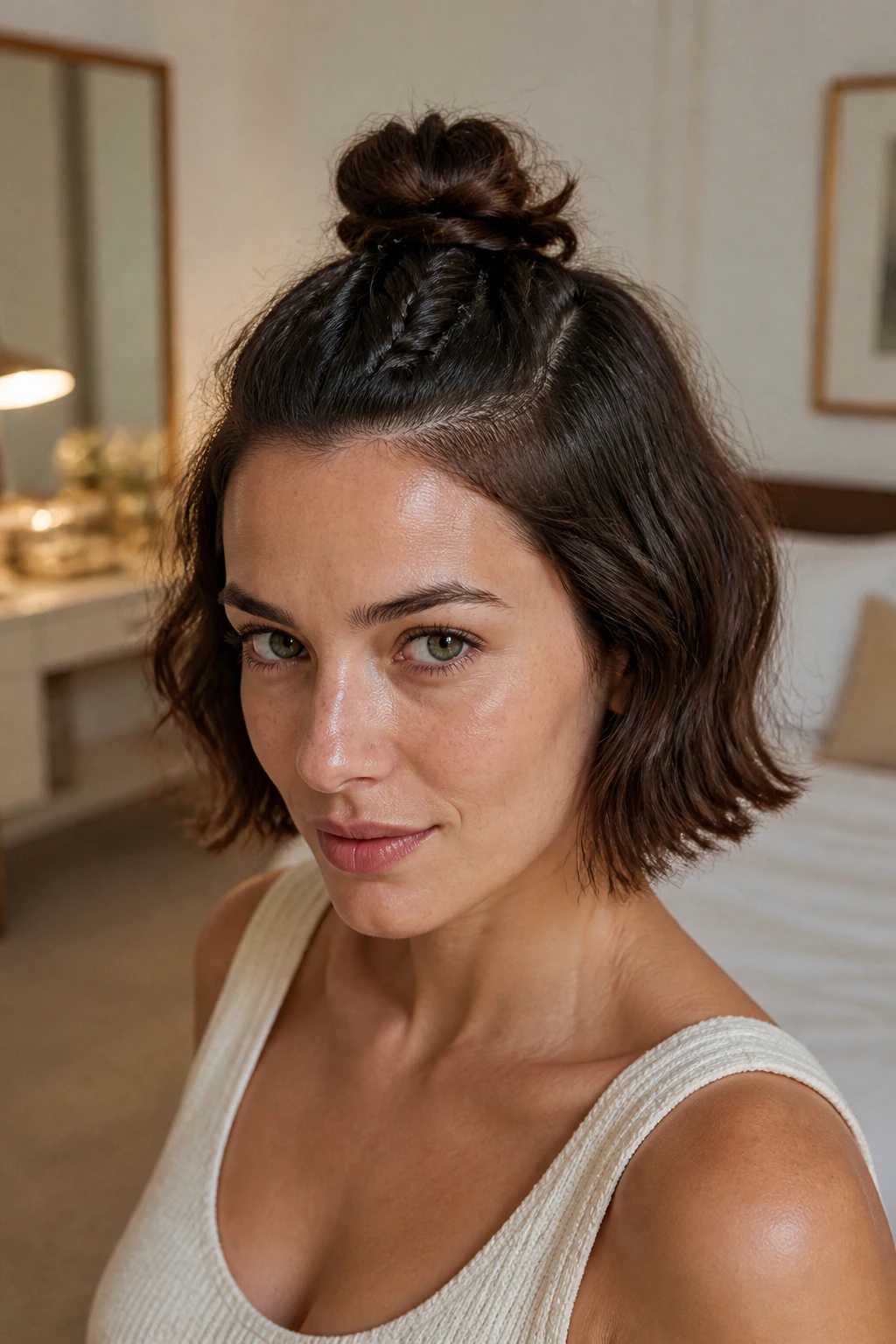
Do you want height without teasing the crown until it feels angry? Start with a tiny braid at the top.
The braid acts like a spine for the rest of the style. You braid a short strip from the front or top, pull the rest back into a small bun at the crown, then wrap the braid into the knot or let it feed around the base. It gives the style a little architecture, which short hair needs more than people realize.
This works best when the braid is narrow and close to the head. A wide, chunky braid tends to eat up too much of the available length. Keep it tight, keep it small, and let the bun stay compact.
A crown bun like this can look surprisingly dressed up with almost no extra work. That’s the nice part.
16. The Pin-and-Roll Bob Updo
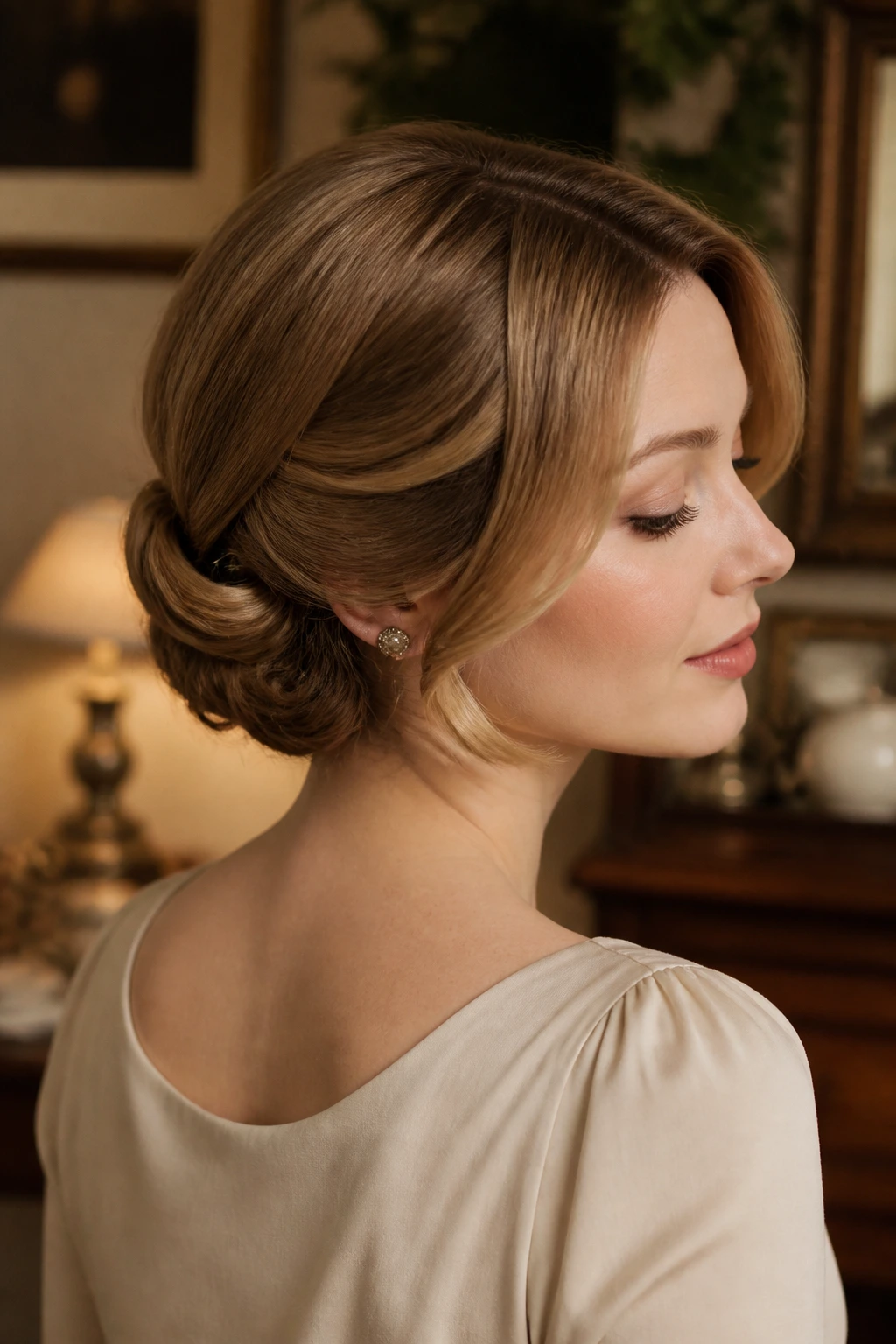
A pin-and-roll bob is the hairstyle equivalent of smart sewing. You take small sections, roll them inward one by one, and pin each roll flat so the finished shape forms a smooth wave or tucked curve at the back of the head.
Where It Shines
This one is especially good for vintage-inspired looks, because the rolls create a controlled surface that feels neat without becoming severe. It’s also one of the better options for short bob updos when the haircut is blunt at the ends. Blunt edges stay tucked more easily than wispy layers.
Work in small sections—about one inch wide. Any larger and the roll gets clumsy. The tighter the section, the cleaner the curve.
If you’ve got time, a quick pass with a small curling iron on the ends before rolling makes the pinning easier. The hair folds more willingly once it has a slight bend.
17. The Wet-Look Slick Knot
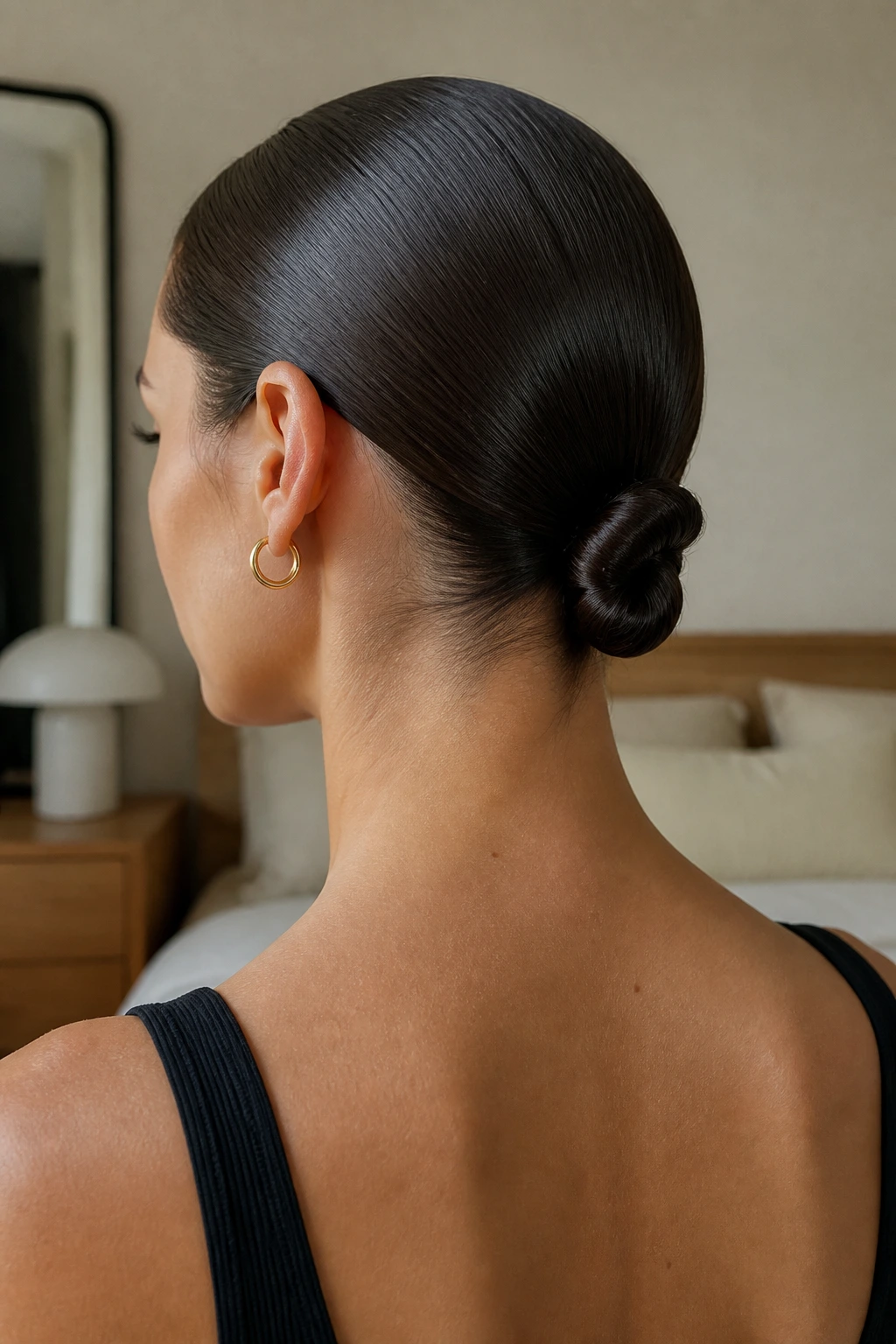
A slick knot is the opposite of the messy mini bun. It’s tight, glossy, and low. The hair is brushed back with gel or a strong cream, then folded into a small knot or tucked bun at the nape so every line sits close to the head.
I like this style on short hair because it turns a limited amount of length into a sharp shape. There’s nowhere for the hair to hide, which sounds unforgiving, but that’s exactly what makes it useful. If the cut is blunt or the part is clean, the whole look gets stronger.
It pairs well with bold earrings and a neckline that leaves room for the hair to disappear. Think high polish, low volume. If you want the style to stay tidy, let the gel set for a few minutes before you touch it again.
18. The Twisted Faux Hawk Bun
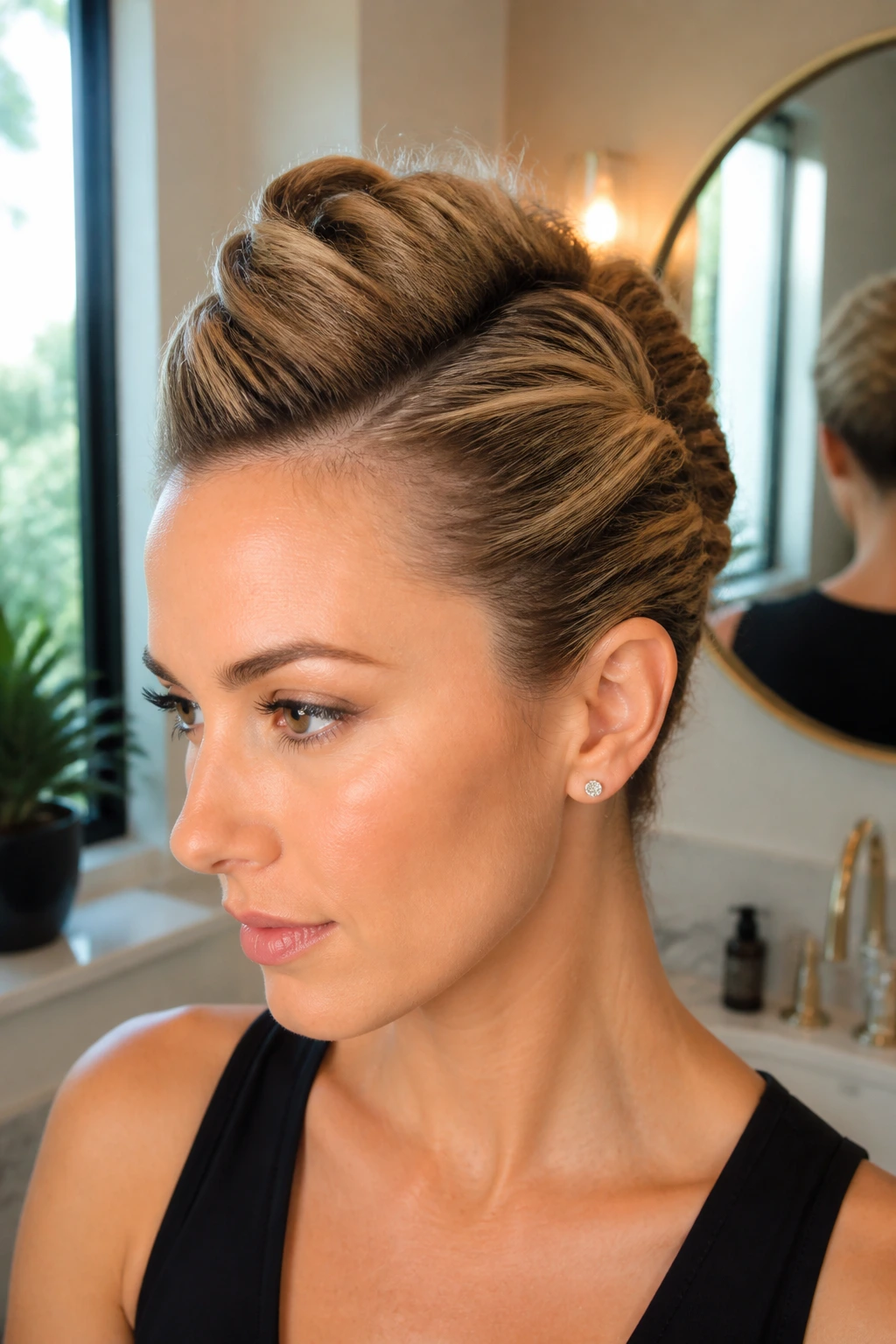
A faux hawk bun gives you lift in the center and control along the sides. You twist the side sections back tightly, pin them flat, then build the middle into a ridge, knot, or stacked twist that rises just enough to show shape without getting wild.
It’s a good fit for hair that already has texture, especially if the cut is layered and refuses to sit neatly in a standard bun. Instead of forcing the sides into something smooth, you use those sections to create a cleaner line toward the middle.
This is one of the few short hair updos that can look a little tough and still feel polished. That contrast is why it works. It has edges.
19. The Side Chignon With Face-Framing Pieces
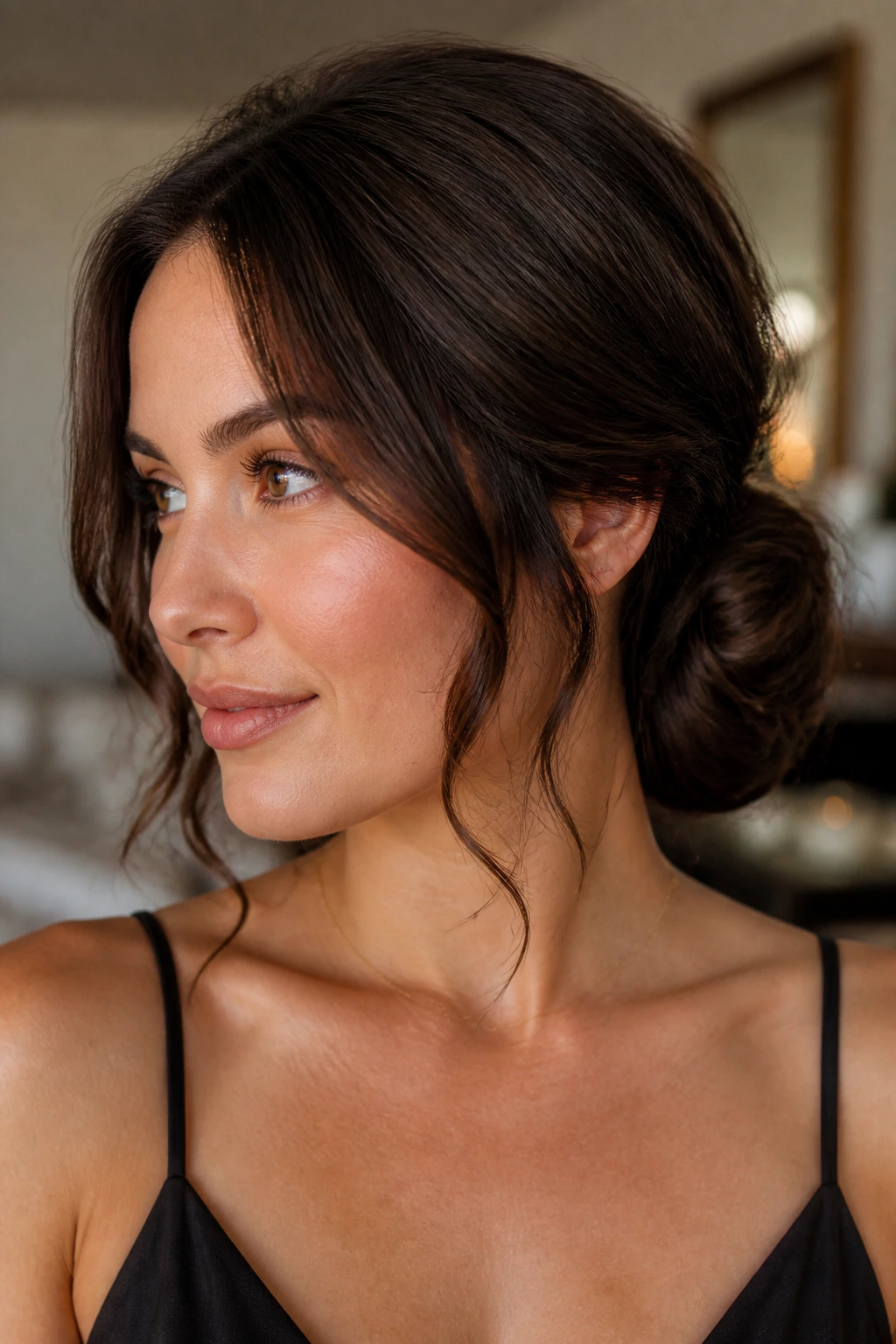
A side chignon can look soft in a way a center-back bun never will. The knot sits slightly behind one ear, the front pieces are left loose, and the whole thing feels more relaxed because the asymmetry gives the eye somewhere to rest.
The best version has just enough face-framing hair to soften the jaw and cheekbones. Too much and the style loses structure. Too little and it starts to look severe. Two small tendrils are usually enough, especially if they’re curled away from the face.
I like this on short cuts with layers around the front. Those layers belong here. Letting them fall out on purpose is part of the shape.
20. The Headband Tuck for Layered Hair
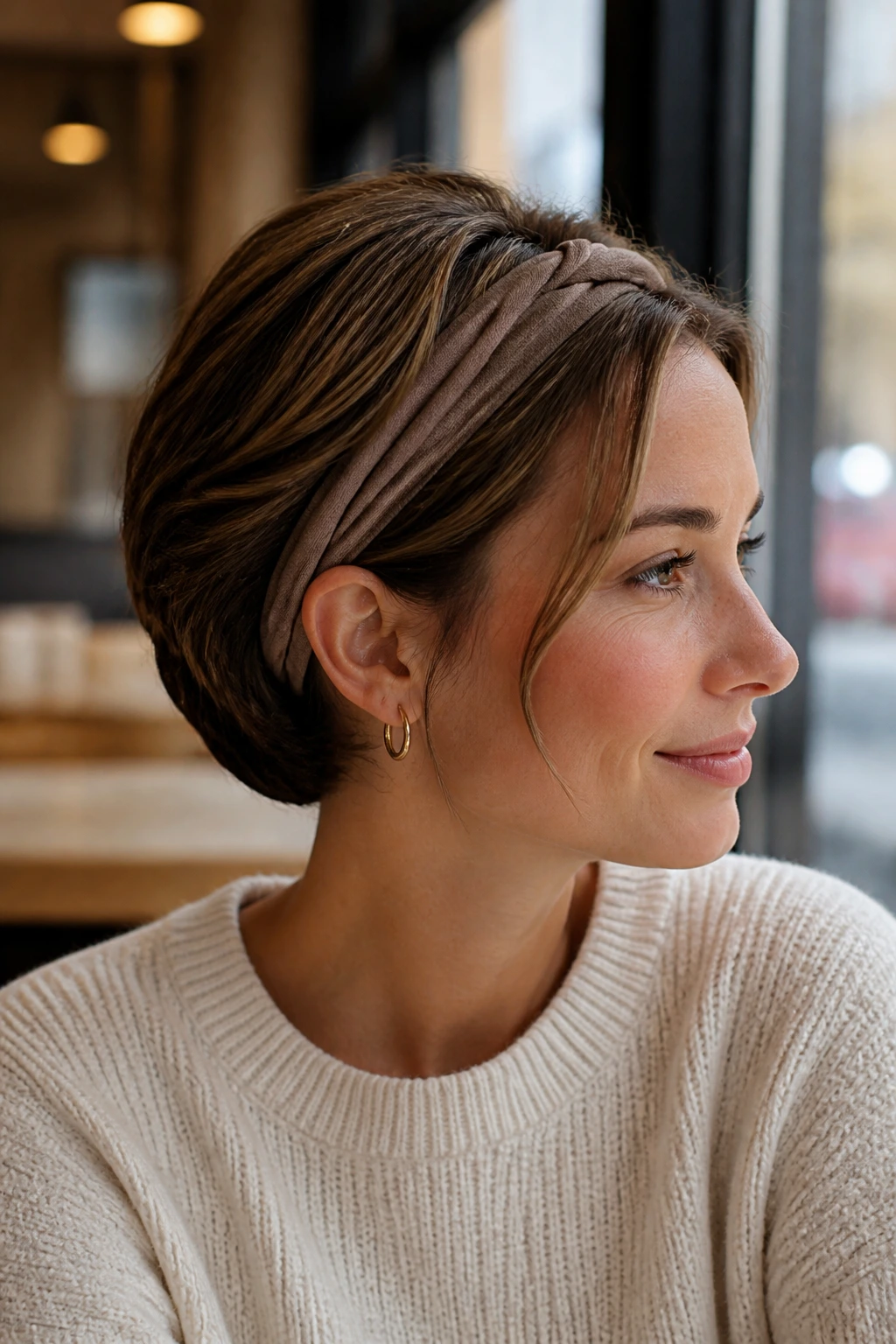
Can a headband do the whole job? On layered short hair, yes—if the band has enough grip and the tuck is done in small sections instead of one big fold.
Put on a soft but snug headband, then wrap or tuck the lengths upward and under the band until they disappear into the back. The hair at the nape should sit flat, not stuffed. That’s why this works for layers that would fight a bigger updo.
Best for Easy, Low-Stress Styling
This is one of the fastest updos for short hair, and it’s surprisingly tidy when the band matches the hair color or sits as a deliberate contrast. A velvet band adds grip. A metal band without padding usually slips.
If the front pieces are shorter than the rest, leave them loose near the temples. That keeps the finish from looking too boxed in.
21. The Messy Mini Topknot With a Strong Base
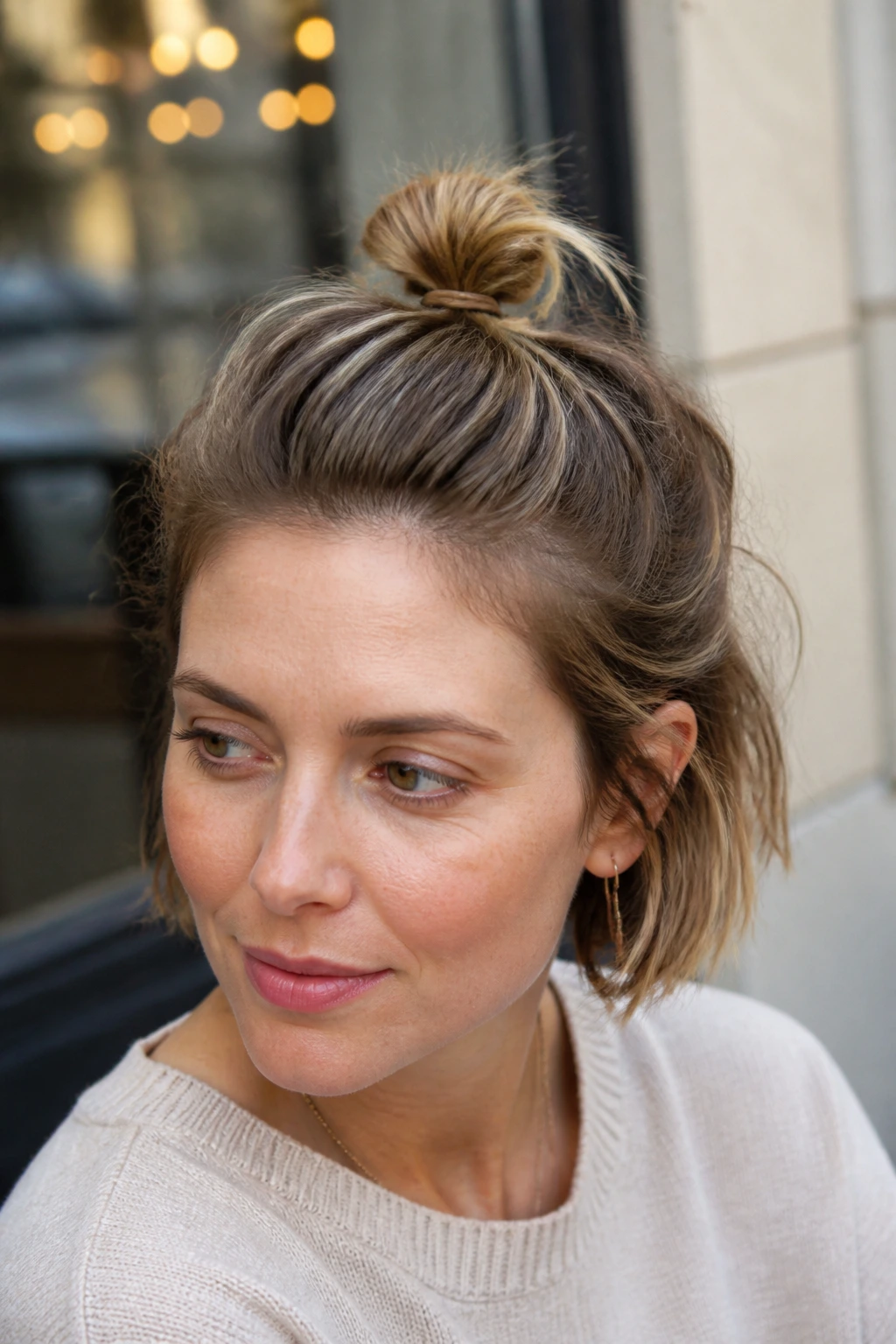
A mini topknot can look careless if it’s built on air. Give it a real base—usually a tiny ponytail, a few crossed pins, and a little backcombing at the crown—and the style suddenly looks deliberate instead of rushed.
This is the one I’d wear for coffee, a casual dinner, or any day when I want my short hair up without pretending it’s a formal event. The knot sits high, but it should stay small. If it gets too big, it starts fighting the proportions of a short cut.
Leave a few ends visible if your hair is blunt. That tiny bit of texture keeps the topknot from looking too precious. Honestly, that’s the whole appeal.
22. The Pinned Pixie Roll for the Shortest Cuts
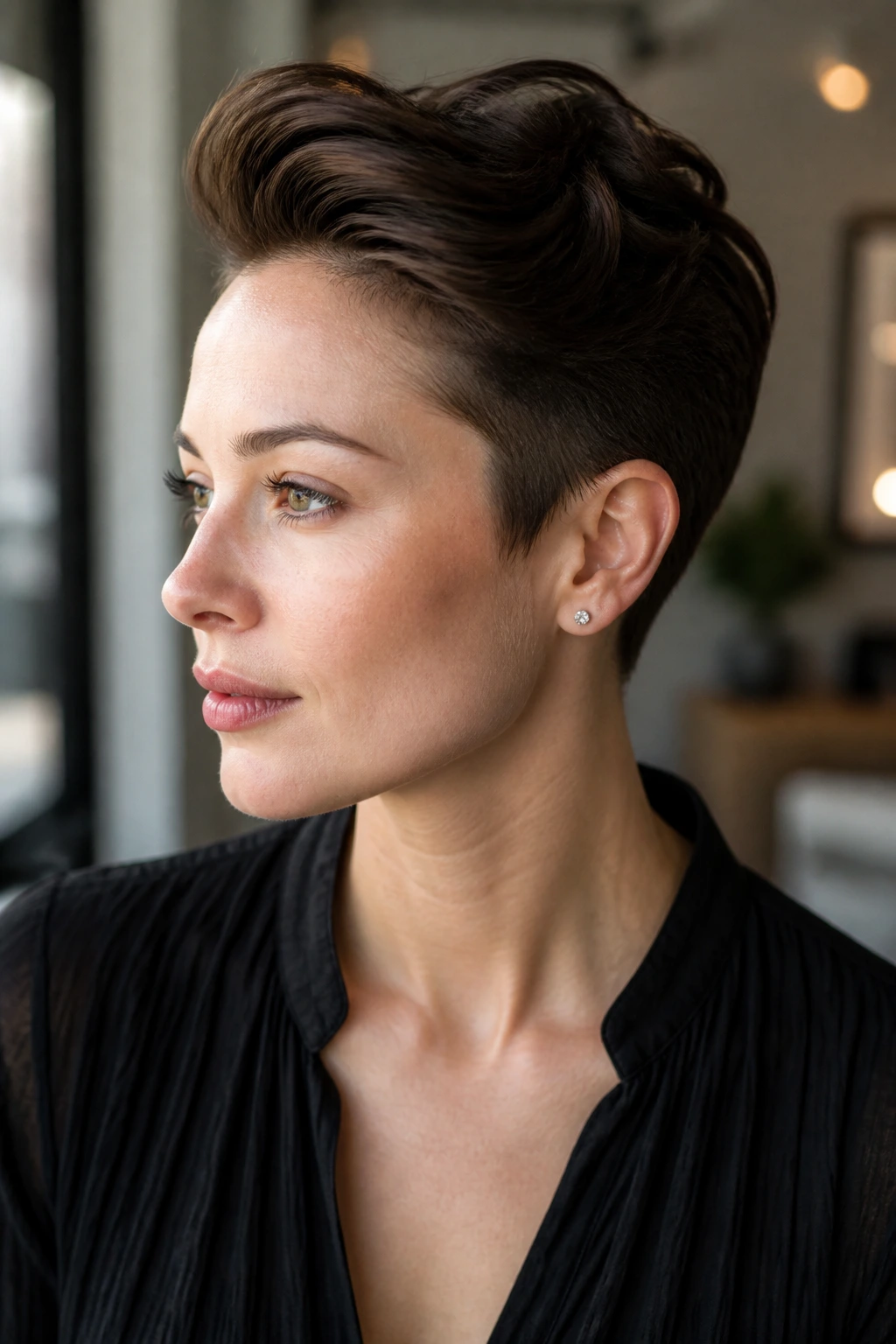
A pixie can wear an updo too. Not a full bun. A roll, a tuck, a pinned wave—something that uses the longer top section and lets the sides stay sleek.
Brush the top section back or slightly to one side, roll it gently toward the crown, and pin the ends flat. If the cut has enough length at the front, you can create a small pompadour shape before tucking the roll. It’s sharp, compact, and far more useful than people expect from a short cut.
The key is restraint. Don’t try to force every strand into the same direction. A pixie updo works because it keeps the silhouette clean and lets the cut stay visible. That’s the point.
What Makes Updos for Short Hair Stay Put
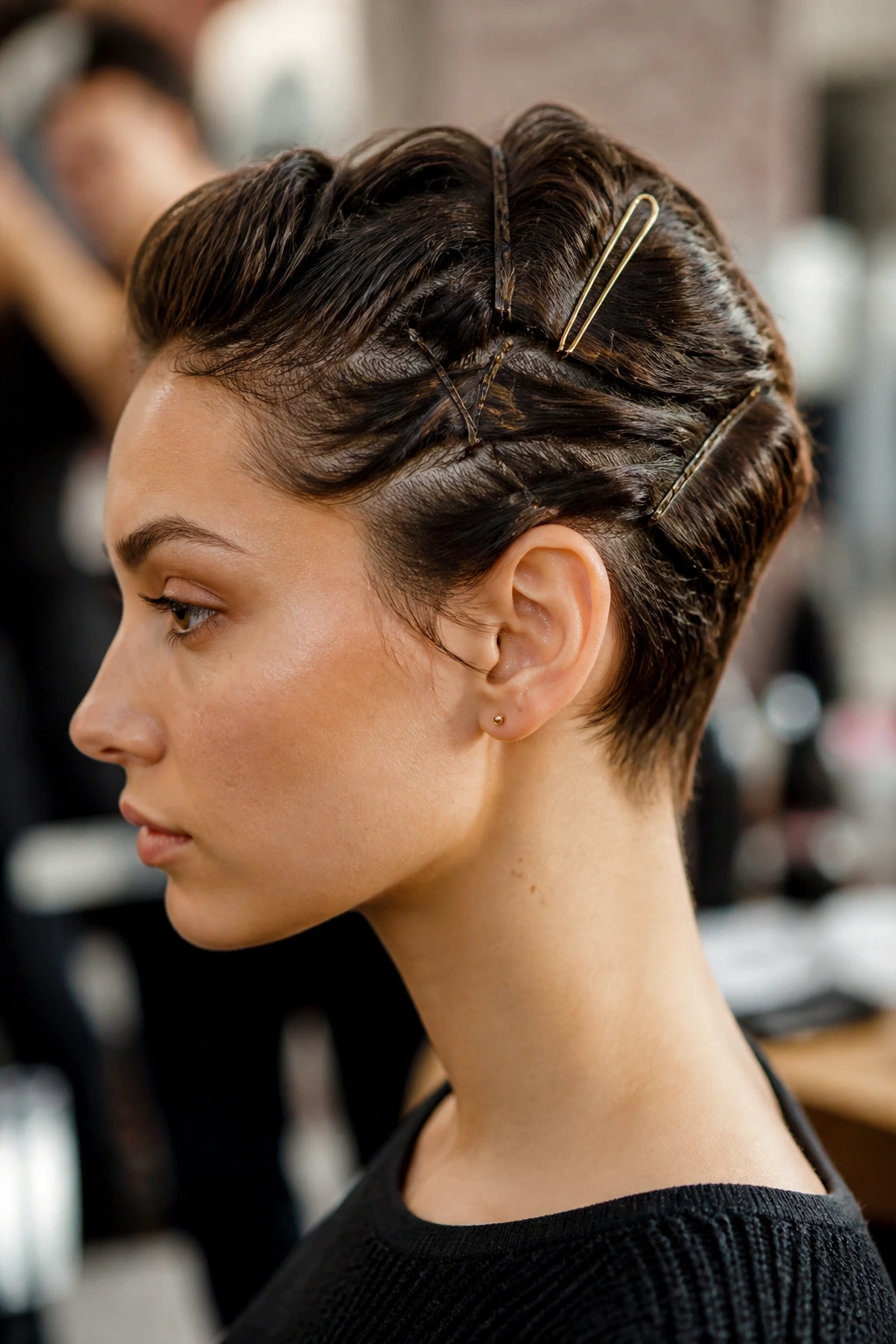
Short hair behaves in sections, not in one big sheet. That’s the first thing to understand, and it changes everything. When a bob or pixie falls out of a style, it is usually because someone tried to gather too much hair at once and asked one pin or one elastic to do all the work.
Grip matters more than length. Hair that is freshly washed can be too slippery, especially if it’s fine. A bit of dry shampoo at the roots, a light mist of texturizing spray through the mids, and a few minutes of air time before you start pinning can make a huge difference. If the hair has already been dried, even better—slightly lived-in texture gives bobby pins something to catch.
Pin geometry matters too. One pin can slide. Two crossed in an X usually hold. A U-pin can cradle a thicker twist or a rolled bun without flattening it. And pins need to go into the hair in the direction of the twist, then down into the scalp, not just laid across the top like little silver bars. That’s how they disappear and stay put.
The last thing people miss is shape. Short hair likes compact shapes, side shapes, and layered shapes. If the style needs a giant round bun, you’re probably fighting the haircut.
The Tools That Make a Short Cut Behave
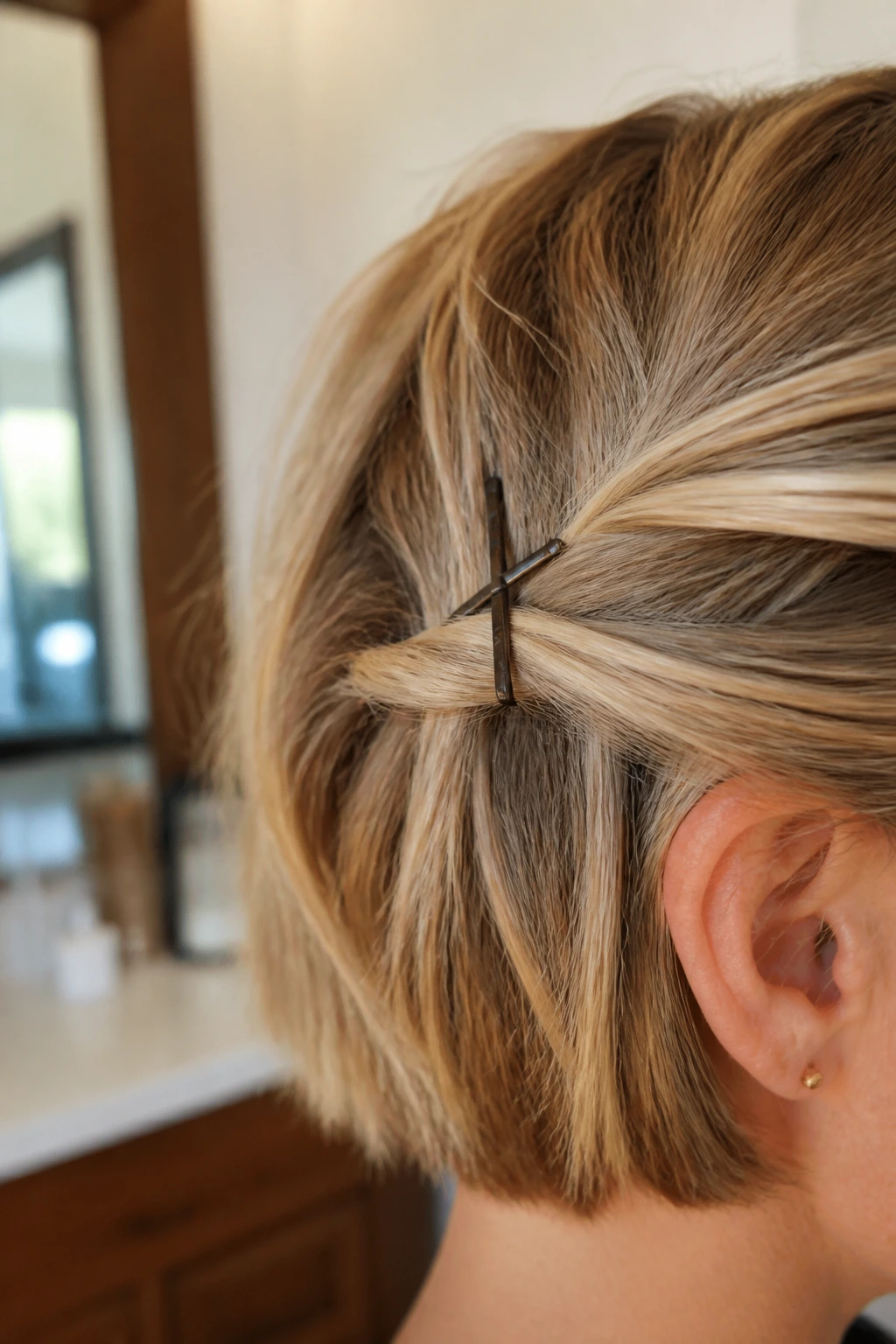
- Bobby pins in two lengths: Short pins help with tiny sections; longer ones anchor thicker twists or rolled ends.
- U-pins: Better for loose buns and chignons when you want support without crushing the shape.
- Small clear elastics: Handy for mini ponytails, tucked loops, and section control.
- Mini claw clips: Useful for French twists and quick half-up styles on jaw-length cuts.
- Tail comb: Clean part lines and precise sectioning matter more on short hair than on long hair.
- Sectioning clips: Keep the hair you’re not styling out of the way, especially around the crown.
- Texturizing spray or dry shampoo: Gives grip to fine or freshly washed hair.
- Strong-hold hairspray: Locks the finished style without needing a full helmet.
- Flat iron or curling iron: Optional, but useful for adding bend to ends that refuse to tuck.
- Blow dryer with a nozzle: Helps rough-dry the roots and direct the hair where you want it.
- Hand mirror: Essential if you care what the back looks like.
- Silk scarf or satin bonnet: Not for the style itself, but for preserving it if you need it to last.
Smart Product and Accessory Picks
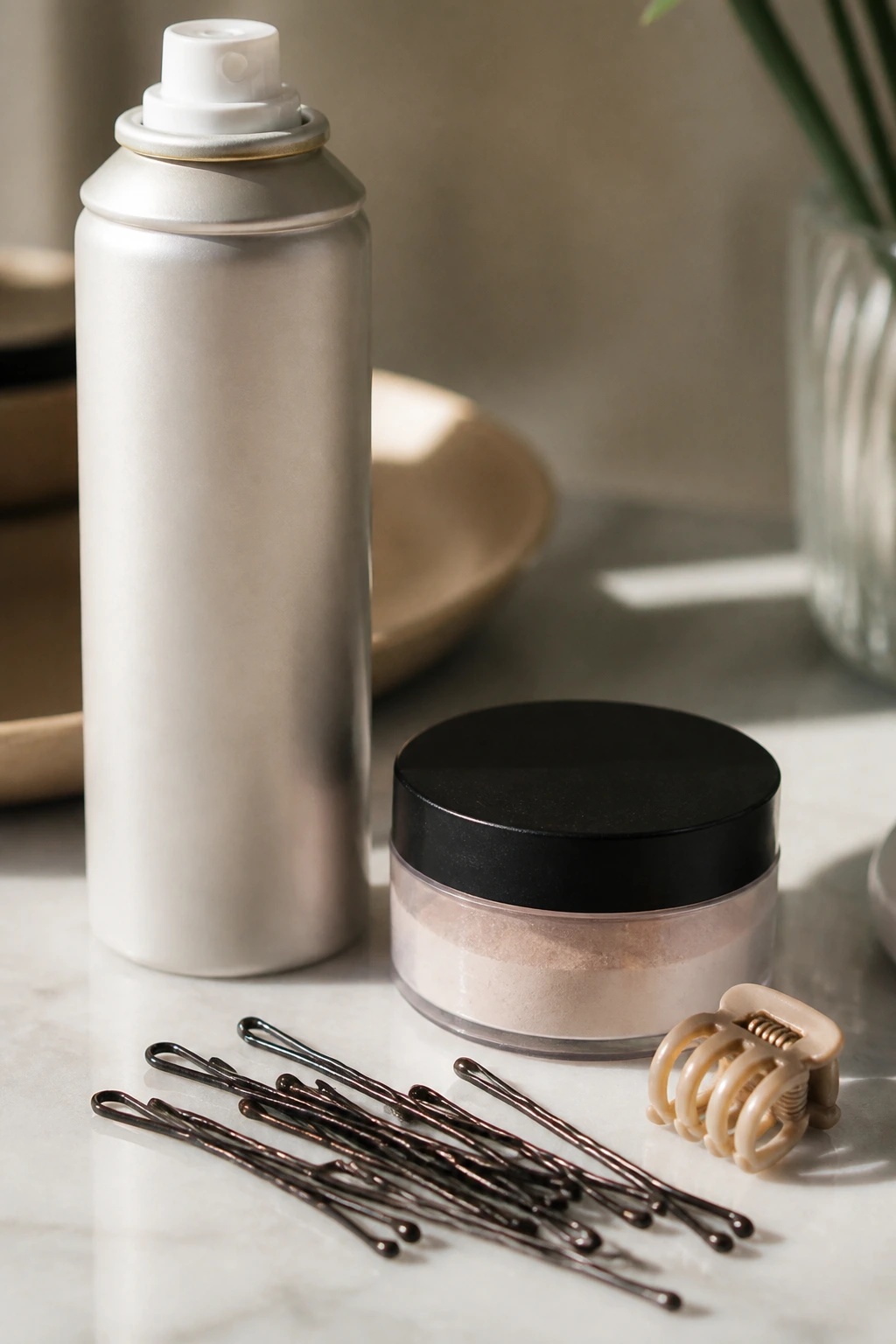
The right products for short hair updos are the ones that add grip without turning the hair into glue. That’s a narrower target than most people expect, and it’s why heavy cream can be a nuisance on fine hair while a little texture powder can make a bob behave beautifully.
For fine or slippery hair, a matte texture spray usually beats a glossy serum. It gives the hair some tooth. For thicker or coarser hair, a small amount of smoothing cream on the mids and ends can calm frizz without killing hold. If the roots are too soft, add dry shampoo at the crown before you start pinning.
Pins matter almost as much as product. Matte-coated bobby pins hold better than shiny ones, and color matching helps them disappear into the style. That said, a darker pin can sometimes disappear better than an exact match because it hides in the shadow of the hair. Small details, but they count.
Accessories should support the shape, not drag it down. A headband with a grippy underside is worth far more than a floppy decorative one. A silk scarf can hide a messy base. A tiny claw clip can save a French twist when the hair is just short enough to be awkward. Heavy ornaments? I’d skip them unless the hair is dense enough to carry the weight.
How to Match the Style to Your Hair, Outfit, and Occasion
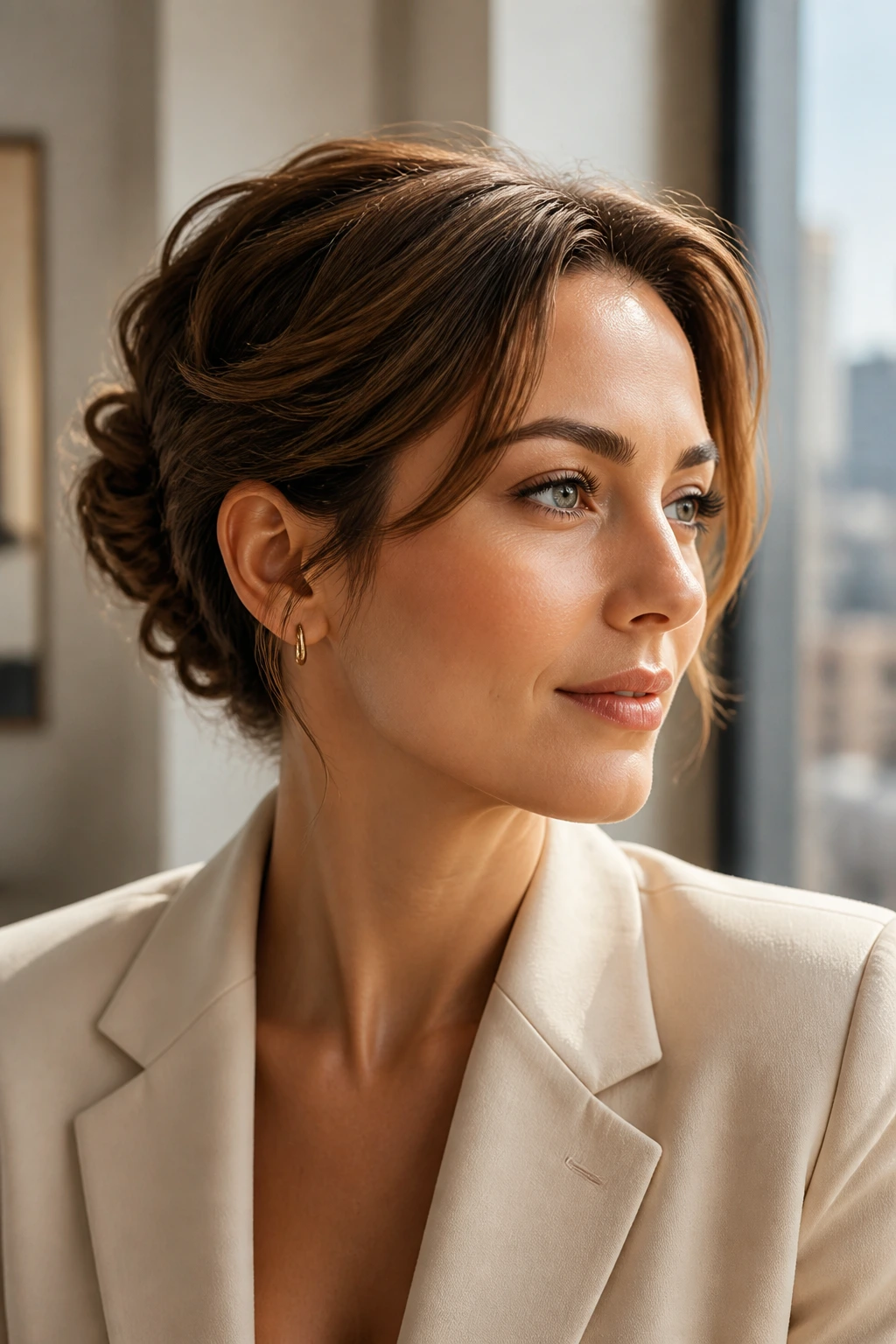
Length: Chin-length bobs do beautifully with rolls, tucks, and low chignons. Grown-out pixies usually need styles that live higher on the head or use only the top section. If your hair is somewhere in between, you can usually choose either direction.
Texture: Straight hair likes texture spray and a tighter pin pattern. Wavy hair gives you a head start on volume. Curly hair should keep some of its shape instead of being brushed flat; a curly updo looks better when it still feels like curly hair.
Outfit: Sleek knots sit well with sharp collars, square necklines, and structured jackets. Softer side chignons and pinned curls are kinder to open necklines and simple dresses. If the clothes are loud, the hair can stay cleaner. If the clothes are plain, the hair can carry more detail.
Occasion: The claw-clip twist, headband tuck, and messy mini topknot read casual fast. The slick knot, mini French twist, and pin-and-roll bob lean formal. In between, the twisted chignon and side-swept pin-up bob cover a lot of ground.
Accessories: Small earrings work with compact styles. Bigger earrings need a little neck space, which is where low buns and side chignons earn their keep. If you’re using a scarf or clip, let that one piece be the star and keep the rest quiet.
Small Tweaks That Make the Finish Look Intentional
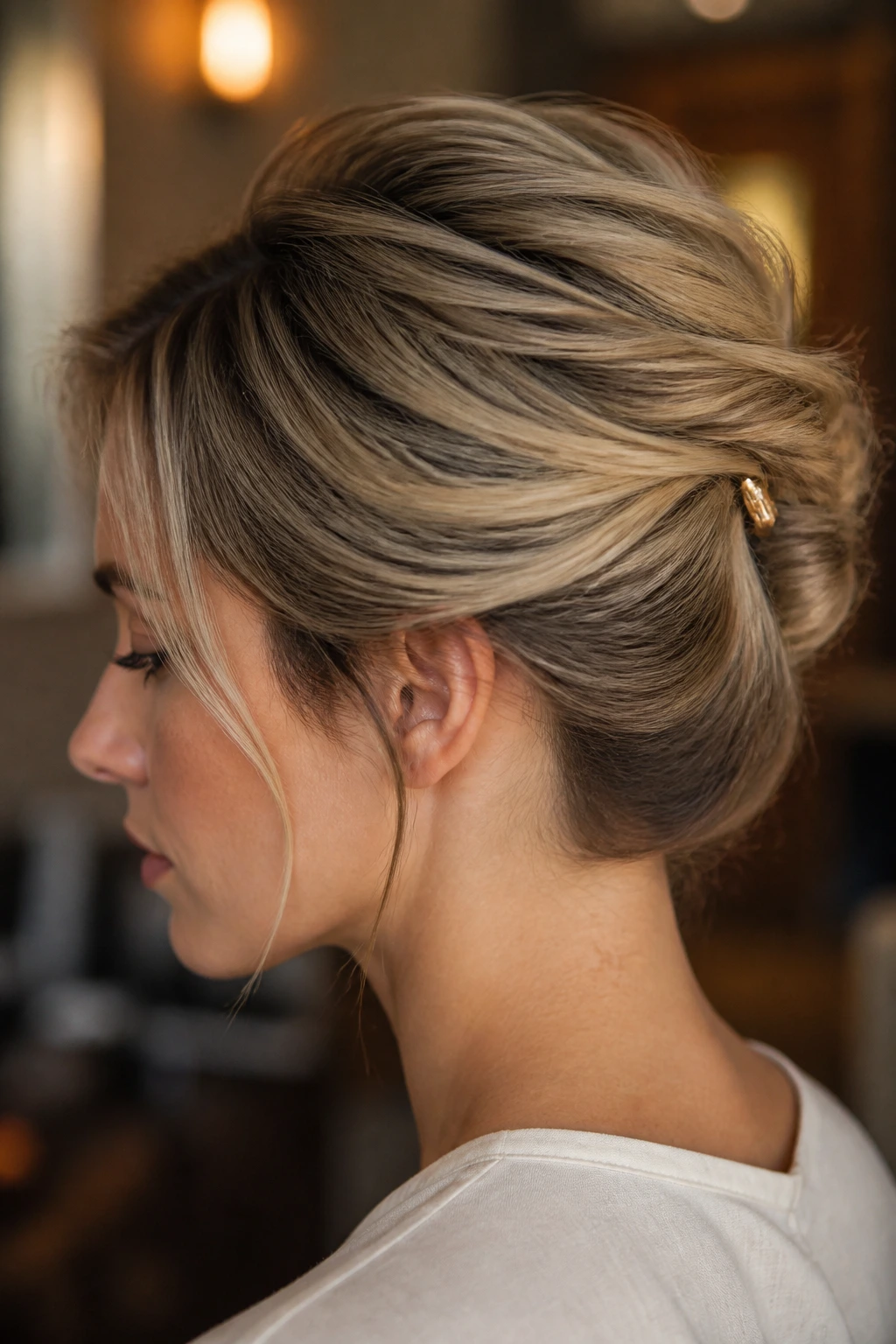
Texture Boost: If the hair is too clean, mist the roots with dry shampoo, wait a minute, then rough them up with your fingertips. That tiny bit of grit helps every pin grab more cleanly.
Pin Placement: Slide bobby pins in the direction opposite the twist, then cross two of them where the hair feels thickest. A pin that only sits on top looks decorative; a pin that disappears into the fold does real work.
Finish Line: Spray from about 10 inches away, not right up close. You want a fine mist, not a wet spot that darkens the hair and flattens the crown.
Shape Control: Short hair often looks best with one intentional loose piece, not ten. Leave out one curl near the temple or one soft bit at the nape and stop there.
Make-It-Yours: A pearl pin, a velvet ribbon, or a narrow barrette can change the mood fast. Use one accent, not three. The hair should still be the main thing.
How to Prep the Night Before and Refresh the Next Morning

If you know you need the style to last through a long day, prep the texture before you go to sleep. That can mean rough-drying the hair, setting a few bends with a curling iron, or braiding the top section loosely so it wakes up with a little grip. Flat, silky hair is harder to pin than hair with shape already in it.
Sleep on a satin pillowcase if you can. If the style is already finished and you want it to survive overnight, wrap it in a silk scarf or use a satin bonnet that doesn’t squash the crown. Short hair doesn’t have the same weight as long hair, so it can spring out of shape faster when it rubs against cotton.
For same-day wear, most short updos can hold comfortably for 8 to 12 hours if they’re pinned well and not overloaded with product. If the style loosens, don’t rebuild the whole thing. Add one or two pins where the structure feels soft, then mist lightly from a distance and let it sit for five minutes before touching it again.
The next morning, if you need to revive it, warm a few flattened sections with a blow dryer on low for 5 to 10 seconds, then pinch the bend back into shape. If the hair has gone sleepy and limp, rework only the crown and nape. The rest is usually fine.
Variations and Adaptations to Try
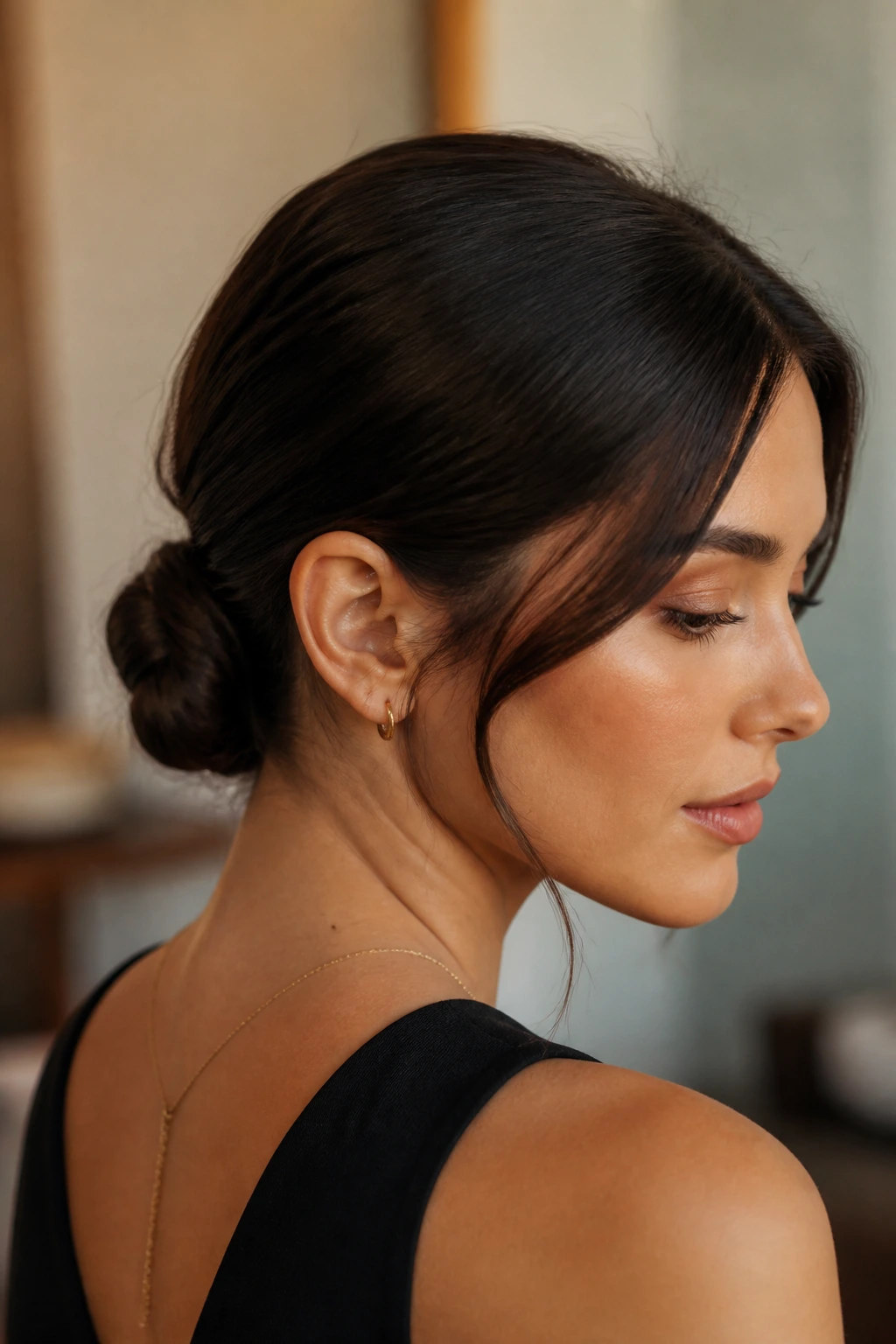
Fine-Hair Grip Set: Use texture powder at the roots and build the style in smaller sections than you think you need. Fine hair looks fuller when the pieces stay narrow and the pins have real traction.
Curly-Hair Cloud Knot: Keep the curl pattern intact and tuck the curls into a loose bun or side chignon without brushing them out. The shape gets body for free, and you avoid the frizz that comes from overhandling.
No-Heat Side Roll: Let the hair air-dry with a little mousse, then create a side roll or tuck without hot tools. This works well when you want a polished finish but don’t want to flatten the hair with a straightener first.
Sleek Event Finish: Use gel or a strong smoothing cream for a low knot, French twist, or slick bun. It’s the cleanest option in the group, and it looks best when the rest of the outfit has a strong line.
Protective Low-Tension Version: Keep the tension gentle at the hairline and use a satin scarf or soft clip to hold the base. This is the version I’d pick for fragile edges, tender scalps, or a day when you know you’ll be wearing the style for hours.
Pixie-Length Pin Roll: For very short cuts, focus only on the longest top section and let the sides stay sleek. You’re not building a full updo; you’re creating a lifted shape that makes the haircut feel styled rather than stuck.
Common Mistakes That Make Short Hair Updos Fall Apart
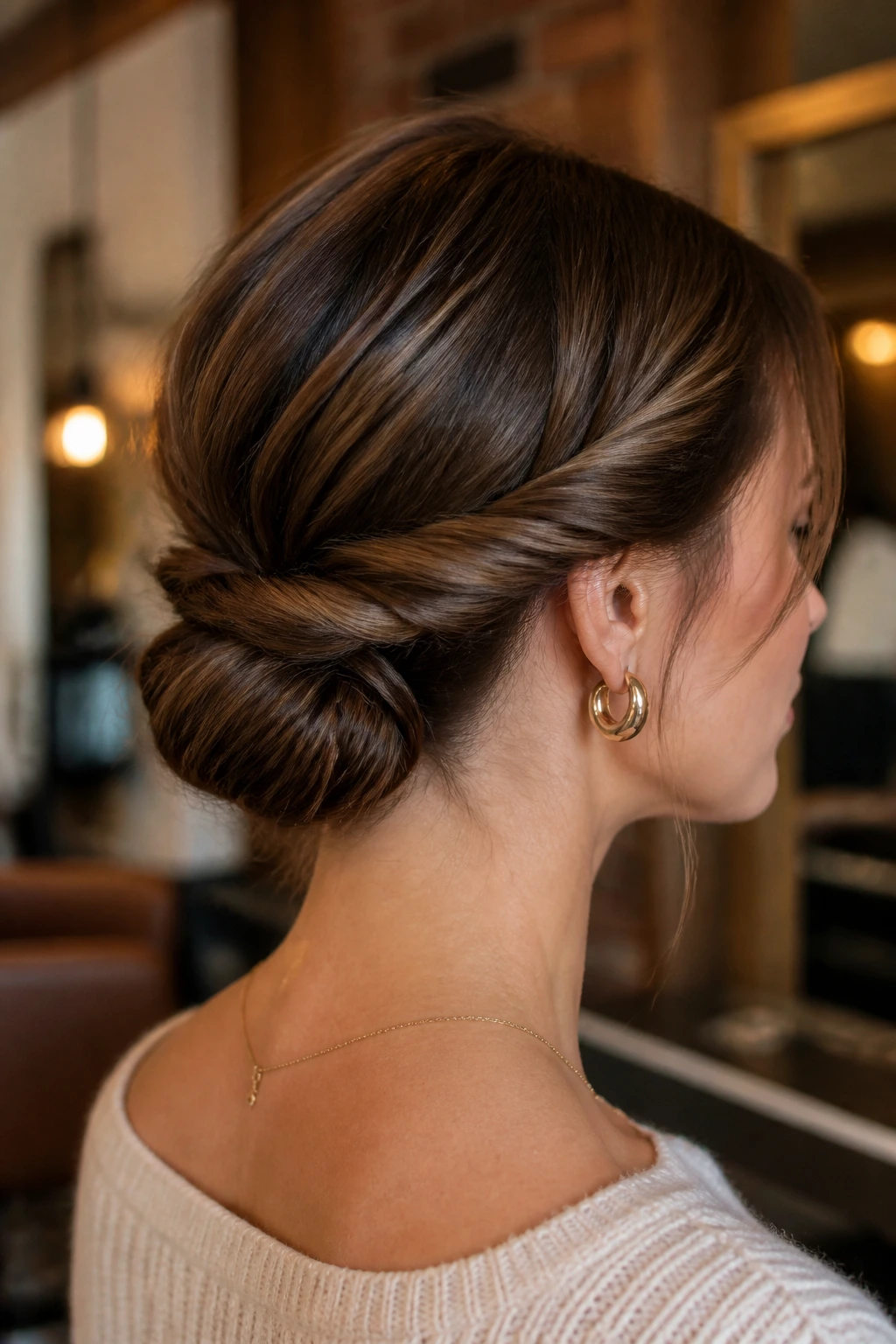
- Starting with hair that’s too clean: Silky, freshly washed hair slips before the pins can settle. Fix it with dry shampoo, a little rough-drying, or by styling on day-two hair.
- Using one giant pin or one giant elastic: Short hair needs several small anchors, not one big hold. Break the style into sections and pin the folds where the hair is thickest.
- Making the shape too large for the cut: A huge bun on a jaw-length bob can look like a top-heavy nest. Keep the bun compact, or choose a twist, tuck, or side style instead.
- Skipping the back mirror check: The front may look fine while the nape is unraveling. Check the back with a hand mirror before you leave the room.
- Overloading with cream or oil: Too much softness kills grip. Use the lightest amount on the mids and ends, then let texture spray do the rest.
- Pulling the sides too tight: The style can start to look severe, and the hairline may rebel. Leave a touch of softness near the temples unless you’re going fully slick.
Questions People Ask Before They Pin It Up
How short is too short for an updo?
If the hair can’t reach a pin with at least a little bend, you’re probably in clip-and-twist or pixie-roll territory rather than full bun territory. Even then, there’s usually a style that works; it just lives closer to the head.
Do short hair updos last all day?
They can, if the hair has grip and the pins are placed well. The styles usually fail when the hair is too clean or too much product makes it slippery, not because the hair is short.
What’s the best style for layers that keep falling out?
Half-up knots, side chignons, and tucked low buns tend to handle layers better than tight round buns. They let the shorter pieces live where they want to live instead of forcing them into a shape they’ll escape from.
Can curly hair do these styles without being brushed flat?
Yes, and it usually looks better that way. Curly texture gives short updos shape and body, especially in pinned buns, faux hawks, and side twists.
How do I hide bobby pins in short hair?
Match the pin color to the hair or place the pin under a fold so it disappears in the shadow. A pin that’s tucked into the twist from the underside usually vanishes better than one laid flat on top.
Is day-old hair better than freshly washed hair?
Usually, yes. Day-old hair has a little grit, which helps the style hold, especially if the haircut is fine or slippery.
Can I wear a claw clip with short hair?
Definitely. Use a smaller clip than you would for long hair, and choose a twist or tuck that folds the ends inward instead of leaving them loose.
What if the style starts to sag by dinner?
Add one or two pins where the fold feels soft, then mist lightly with hairspray and let it set for a few minutes. Don’t rebuild the whole thing unless the structure has truly failed.
Short Hair, Fully Styled
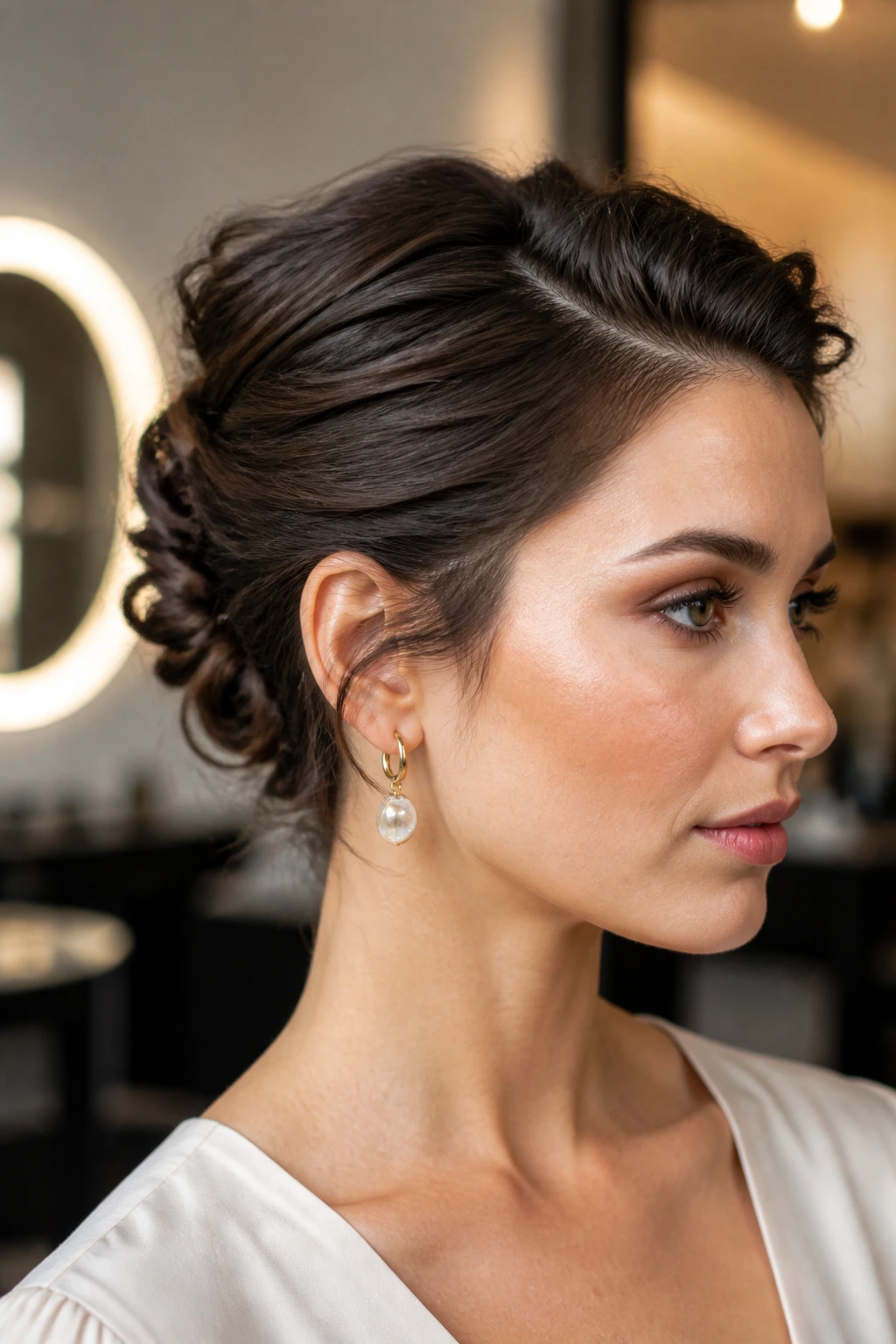
Short hair doesn’t need to be longer to look finished. It needs the right shape, the right pins, and a little respect for how the cut actually falls. That’s why these styles work: they don’t fight the haircut, they use it.
Some days call for a neat French twist. Some call for a messy mini topknot or a side chignon with a few loose pieces at the temple. The nice part is that you’re not locked into one version of yourself. A bob can be sharp, soft, cool, romantic, or a little punk depending on how you pin it.
And if the first try looks awkward, that’s normal. Short hair usually needs one round of adjustment—one pin shifted, one twist tightened, one piece left softer than planned. After that, the shape starts to make sense.
