



Long hair can get heavy in a hurry. One day it’s swinging nicely, the next it’s hanging like a single damp sheet that never quite settles right. A good V cut haircut changes that immediately. The hemline drops into a point, the sides slide down around it, and the whole length starts to move with a little more purpose.
The shape looks simple from a distance. Up close, it’s doing a lot of work. A shallow V keeps the ends full and soft. A deep V makes very long hair feel lighter and sharper. Somewhere between those two lives the sweet spot for most people — the version that keeps long cascading hair from looking heavy without turning the back into a thin tail.
And the catch? The wrong V can be fussy. Cut too high, and the point can look choppy. Thin hair can lose too much visual bulk. Curly hair can shrink into a shape the salon mirror never warned you about. The good versions are deliberate, and the best ones are chosen with the hair’s texture, density, and daily habits in mind.
Why These V Shapes Keep Long Hair from Looking Heavy
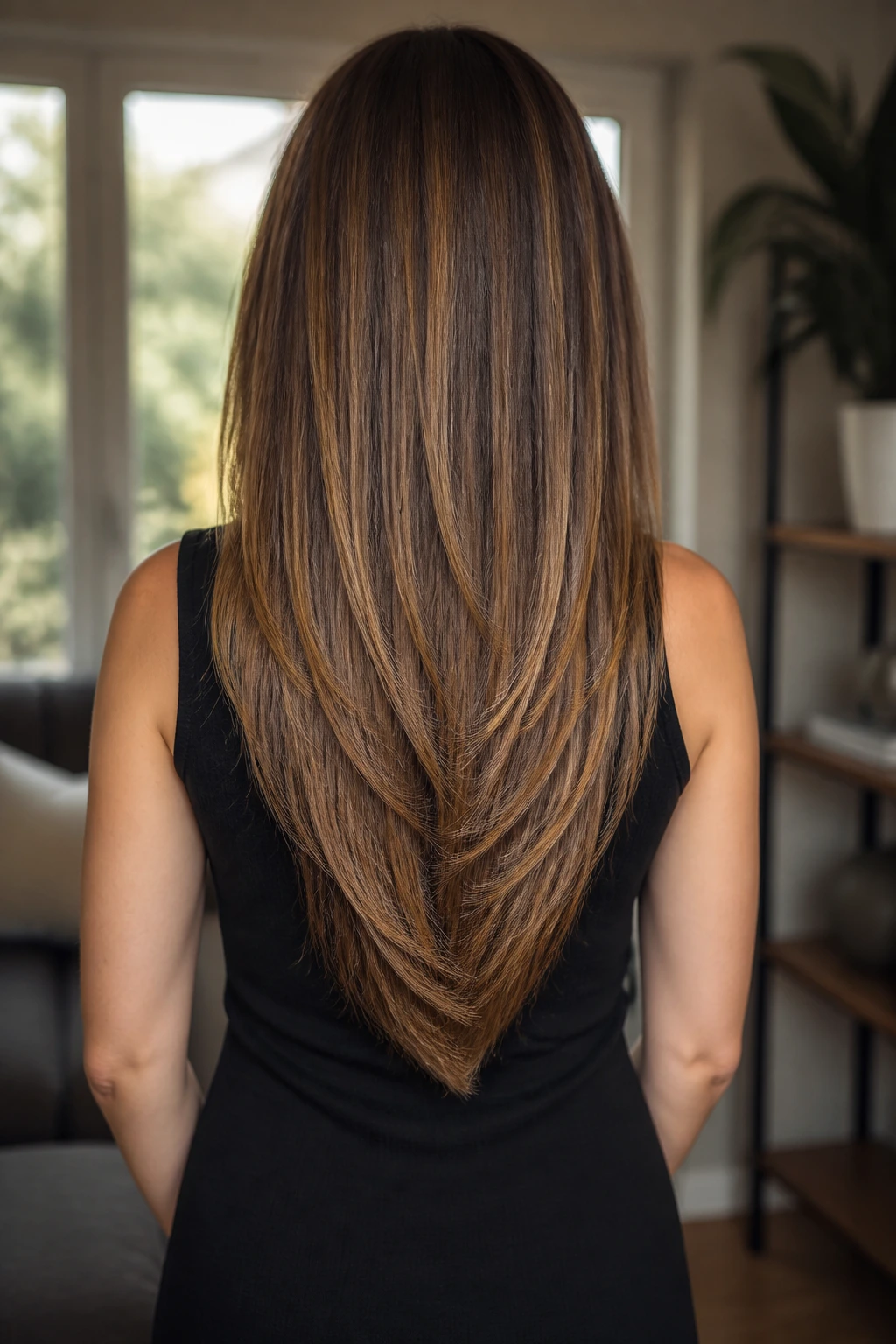
- They keep the length, not the shelf: A blunt hemline can sit flat across the back and feel bulky at the bottom, while a V lets the outer edges taper so the hair falls in a cleaner line.
- They give thick hair somewhere to go: Dense hair needs release points. A centered point shifts weight downward instead of letting it sit in one wide block.
- They show movement faster: The diagonal sides catch waves, bends, and blowouts in a way a straight cut often hides.
- They grow out with less drama: A soft V usually turns into a rounded U over time, which looks natural instead of sloppy.
- They work with long styling habits: Ponytails, braids, half-ups, and loose blowouts all show the shape differently, which is why the cut feels useful instead of decorative.
1. Soft Classic V Cut with a Gentle Point
A soft classic V is the one I’d hand to someone who wants a shape change without making a speech about it. The center point dips low enough to show from the back, but the sides still keep plenty of fullness, so the ends don’t look wispy or overworked. On long hair, that matters. A lot.
Why it works
The gentle angle lets the haircut keep its density while still breaking up the flat line that long hair can develop at the hem. It’s especially good if your hair falls straight when air-dried and only gets a little bend with a brush or curling iron. The cut shows up without begging for styling every morning.
If your hair sits around mid-back or lower, this is a safe place to start. The point reads as intentional, but not sharp enough to feel severe.
A shallow V also makes trim day less nerve-racking. You can take off an inch or two and still keep the same basic outline.
2. Deep V Cut with a Long Center Tail
Want the shape to announce itself the second you turn around? Go deeper. A deep V cut pulls the center line down farther, which makes the back look longer and the edges feel more dramatic. It’s a strong choice on very long hair, especially when the hair is thick enough to support that point without looking stringy.
Best fit
- Waist-length or longer hair
- Medium to thick density
- Straight, blown-out, or softly waved hair
The thing a deep V does well is create contrast. The outer sections feel fuller because the center drops away, and the whole head of hair reads as longer and more sculpted. But it needs maintenance. Let it grow too far, and the point can start to look blunt in the wrong place.
I like this best when the wearer actually styles the ends. Sleek and glossed? Great. Loose waves? Also great. Air-dry-and-forget? Less convincing.
3. Face-Framing V Cut That Opens the Front
You can keep the length in the back and still make the front feel lighter. That’s the whole point of face-framing pieces paired with a V cut. The front layers start around the chin or collarbone, then drift longer into the back point, which gives the haircut a soft diagonal flow from every angle.
What makes it useful
This version is kind to people who wear their hair down often but still want movement near the face. The front pieces break up a heavy curtain effect, and the back keeps the nice long tail. It also helps if your hair tends to pull your features down when it’s all one length.
A small detail matters here: the front pieces should blend, not sit there like two separate chops. If the transition is too abrupt, the whole cut feels disconnected. Done well, it looks like the hair falls naturally from cheekbone to shoulder to back.
4. Curtain Bangs with a Soft V Back
Curtain bangs change the mood fast. They make long hair feel lived-in instead of severe, and when they’re paired with a soft V at the back, the haircut gets that easy front softness and clean trailing shape at the same time. The bangs sit widest near the middle, then taper along the cheeks, which plays nicely with the V’s downward line.
This version works best when you like to style the front a little. A round brush, a blow-dryer nozzle, and 90 seconds of effort around the bangs make a noticeable difference. Without that, the fringe can split in awkward places and the whole cut loses polish.
I prefer this on long hair that already has some natural bend. The bangs and the V both need a little movement to make sense. Stick-straight hair can wear it, sure, but it usually wants a bit of heat styling to look finished.
5. Feathered V Cut for Airy Movement
Feathering softens the ends so they move like they’ve been brushed through by air, not carved by scissors. On a V cut, that makes the point feel less blunt and the side lengths feel lighter as they fall toward the back. It’s a very different look from a crisp, sharp V.
Where it shines
Feathered ends are useful when long hair gets bulky at the bottom but you still want plenty of visual thickness. The hair flips more easily, especially if you dry it with a round brush or wrap the lower sections around a large barrel iron.
This cut can go too far on fine hair. If the ends are over-feathered, the shape can lose its backbone and start looking fuzzy instead of soft. Thick hair, though, takes to feathering like it was built for it.
6. Razor-Textured V Cut for Sleek Ends
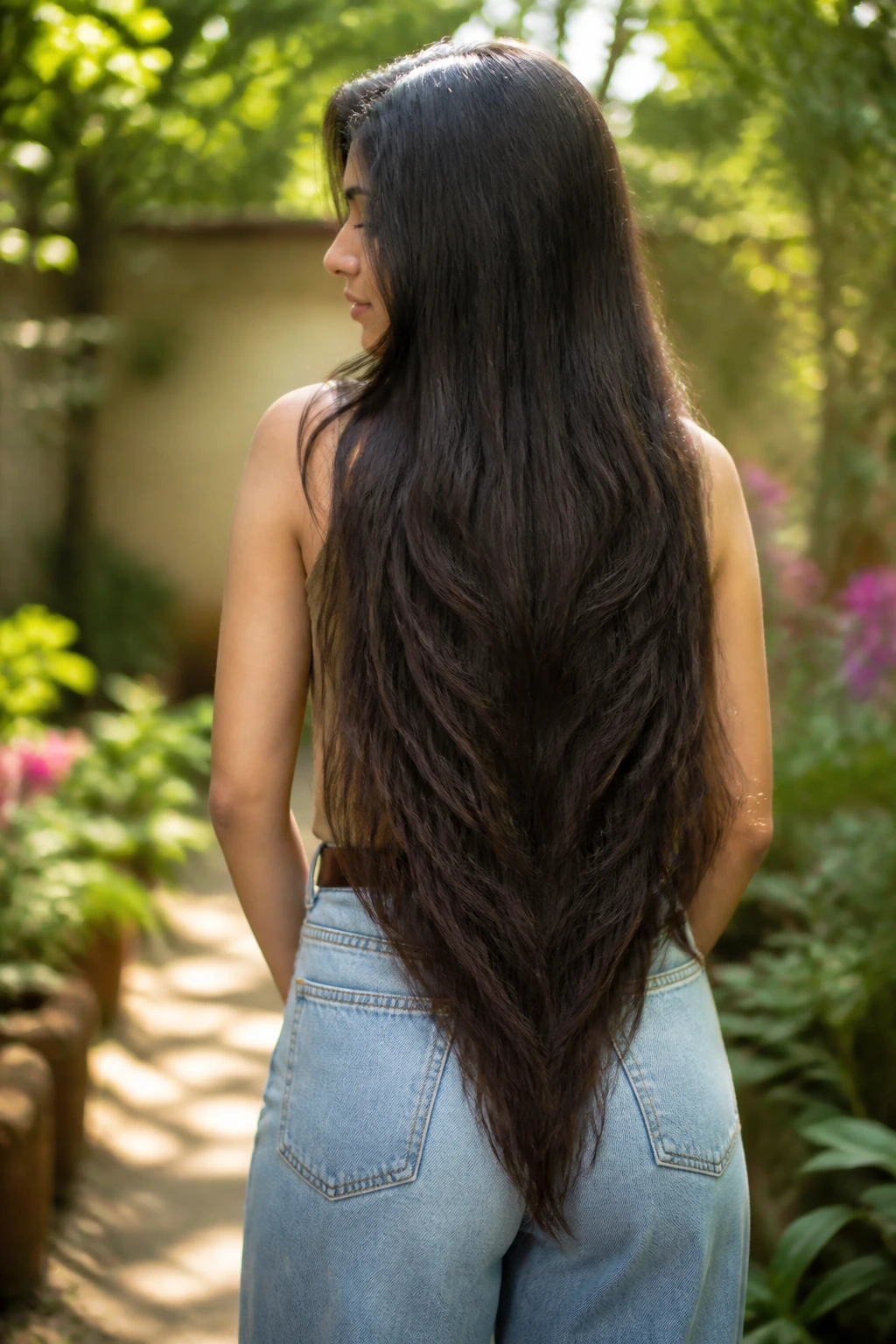
A razor-textured V is not the cut I’d hand to everyone. But on dense, straight hair, it can be a very good thing. The razor takes some of the blunt weight out of the ends, so the V line feels cleaner and more fluid instead of bulky.
The look is smoother than a choppy cut, but less rigid than a scissor-only shape. You get a little bend in the hemline, a little softness through the lower lengths, and less of that helmet effect thick hair can develop when it’s all one length.
The warning is simple: if your ends are already dry, split, or fragile, a razor can make them look rough. You want a stylist who knows where to stop. This is one of those cuts where a light hand beats a clever one.
7. Shallow V Cut for Fine Hair
Can fine hair pull off a V cut? Yes. It just needs to stay shallow. The point should sit low enough to keep the perimeter feeling full, because a deep V on fine strands can make the ends look thin before they’re ready to look thin.
A small rule that helps
Keep the face framing minimal and the angle soft. Fine hair needs the illusion of width at the bottom, not a lot of broken pieces through the sides. The shape should whisper V, not shout it.
This version looks best when the finish is polished. A smooth blow-dry with a lightweight serum gives the hair enough sheen to keep the ends looking intentional. Heavy oils and thick creams tend to flatten the shape, which defeats the point.
8. Weight-Removing V Cut for Thick Hair
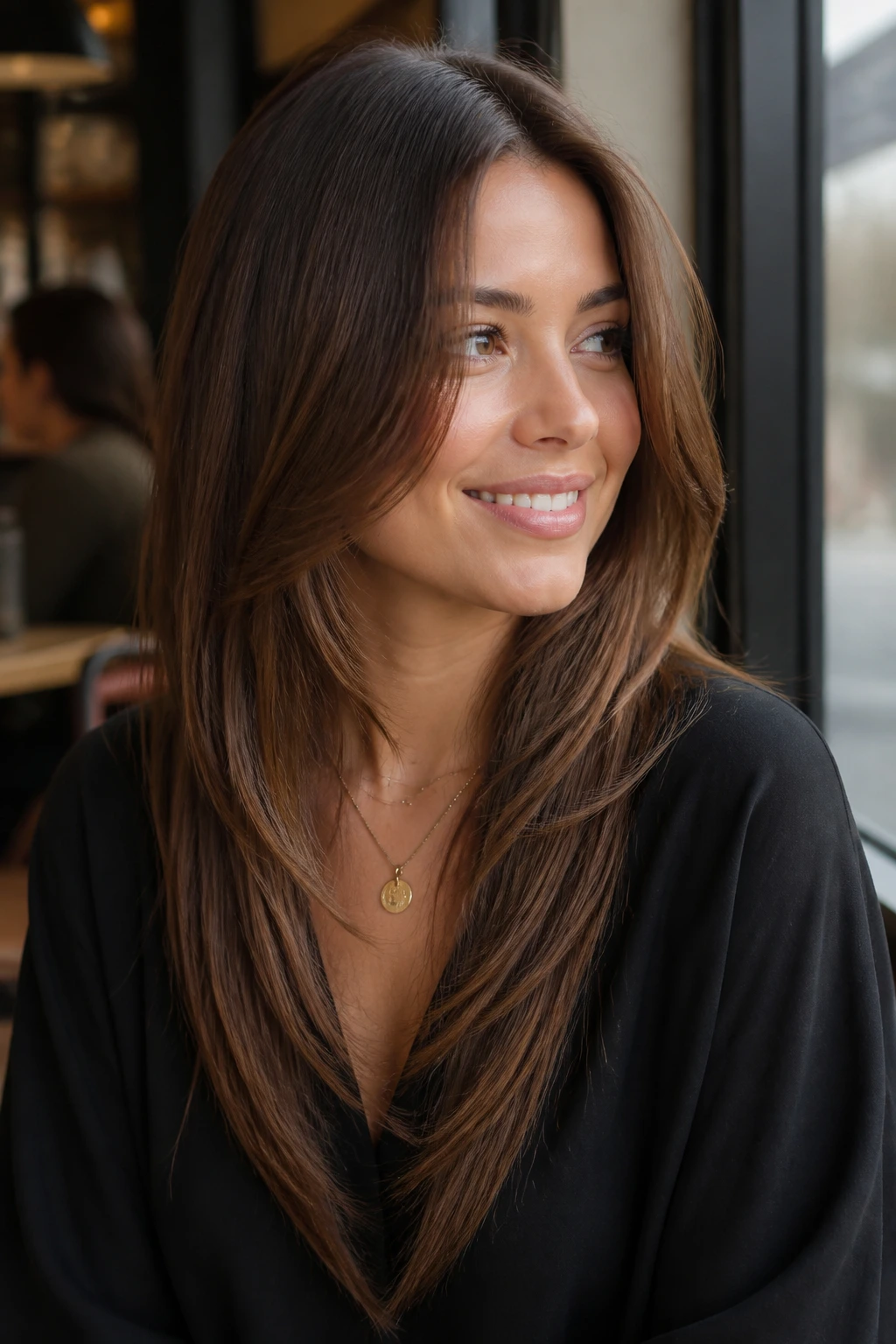
Thick hair loves a V cut when the stylist removes weight in the right places. Otherwise the shape can just become a heavy triangle with a point at the bottom, which is not the same thing at all. The best version takes bulk out of the interior and lets the exterior fall into a clean line.
This is the haircut for hair that takes forever to dry and feels like a blanket at the neck. Once the weight is shifted, the ends move instead of sitting there. You can feel the difference when you toss it over one shoulder.
I’d ask for visible shape from the back but not too much thinning at the ends. Too much texturizing near the hemline makes thick hair frizz out and loses the rich, full look that makes the cut worth having in the first place.
9. Wavy V Cut That Follows the Bend
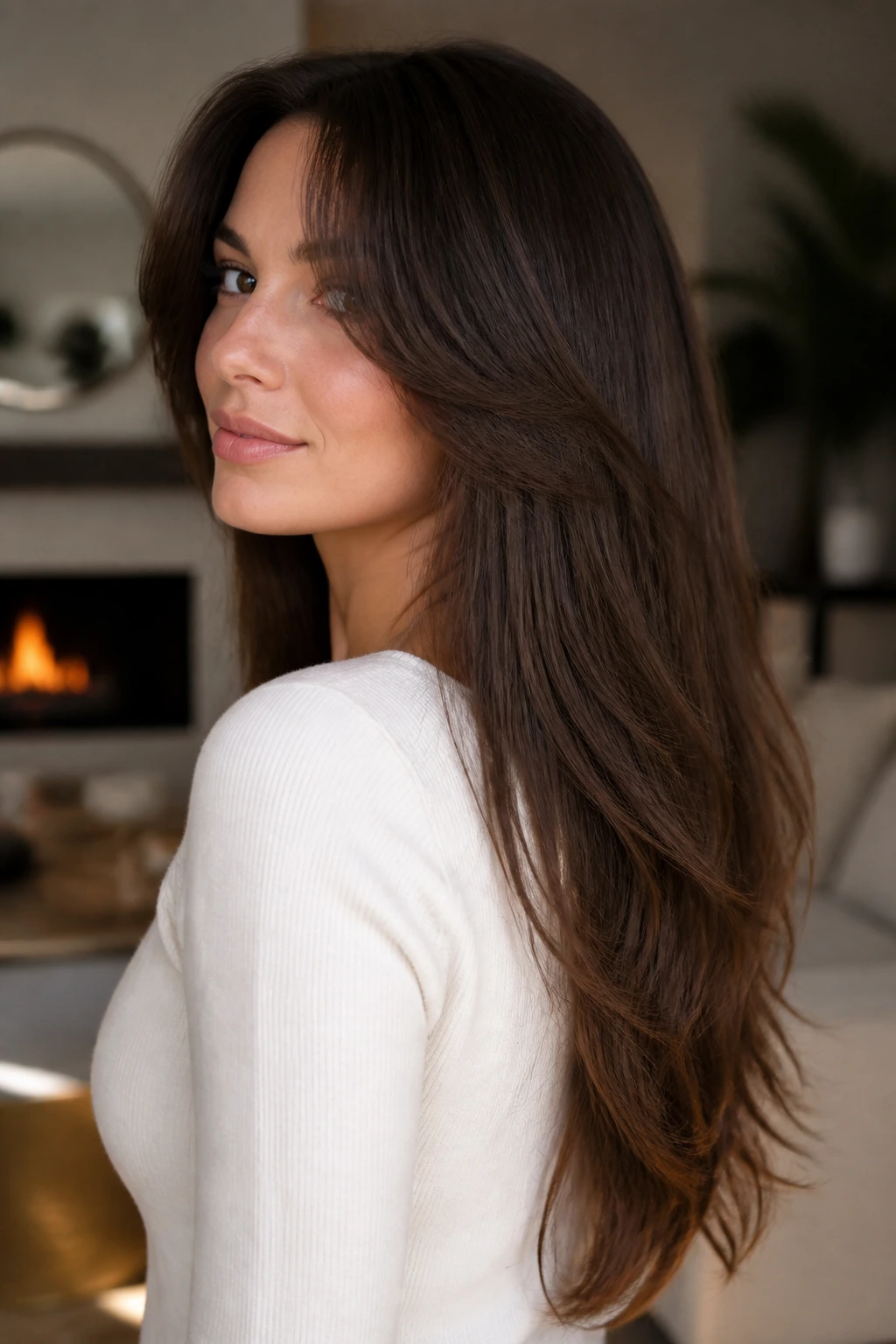
Waves make a V cut come alive. The line doesn’t need to be razor-clean because the texture already brings the motion. What matters is that the cut follows the bend pattern instead of fighting it.
A wavy V usually looks best when it’s cut with the hair in its natural state or at least observed close to it. If the waves are ignored, the front can kick up too high while the back drops too low. That’s how a shape that should feel easy turns awkward.
I like this version with a little mousse, a rough dry, and a scrunch at the ends. You don’t need glossy perfection. You need the long layers and the point to show up when the hair starts moving on its own.
10. Curly V Cut with a Softer Point
Curly hair can wear a V cut, but it wants a softer point than straight hair does. Shrinkage changes everything. What looks like a neat dip when wet can spring into a much shorter shape once the curls dry.
That’s why curly V cuts usually work best when the stylist cuts with the curl pattern in mind, often dry or mostly dry. The point should feel more curved than sharp, and the layers should be long enough that the curls still clump instead of separating into frizz.
The payoff is real. A good curly V helps the hair hang in a more balanced shape, especially if the bottom is heavy and triangular. But the wrong version can make the ends look airy in the wrong way, so the difference between “light” and “thin” matters a lot here.
11. Sleek Straight V Cut with Clean Lines
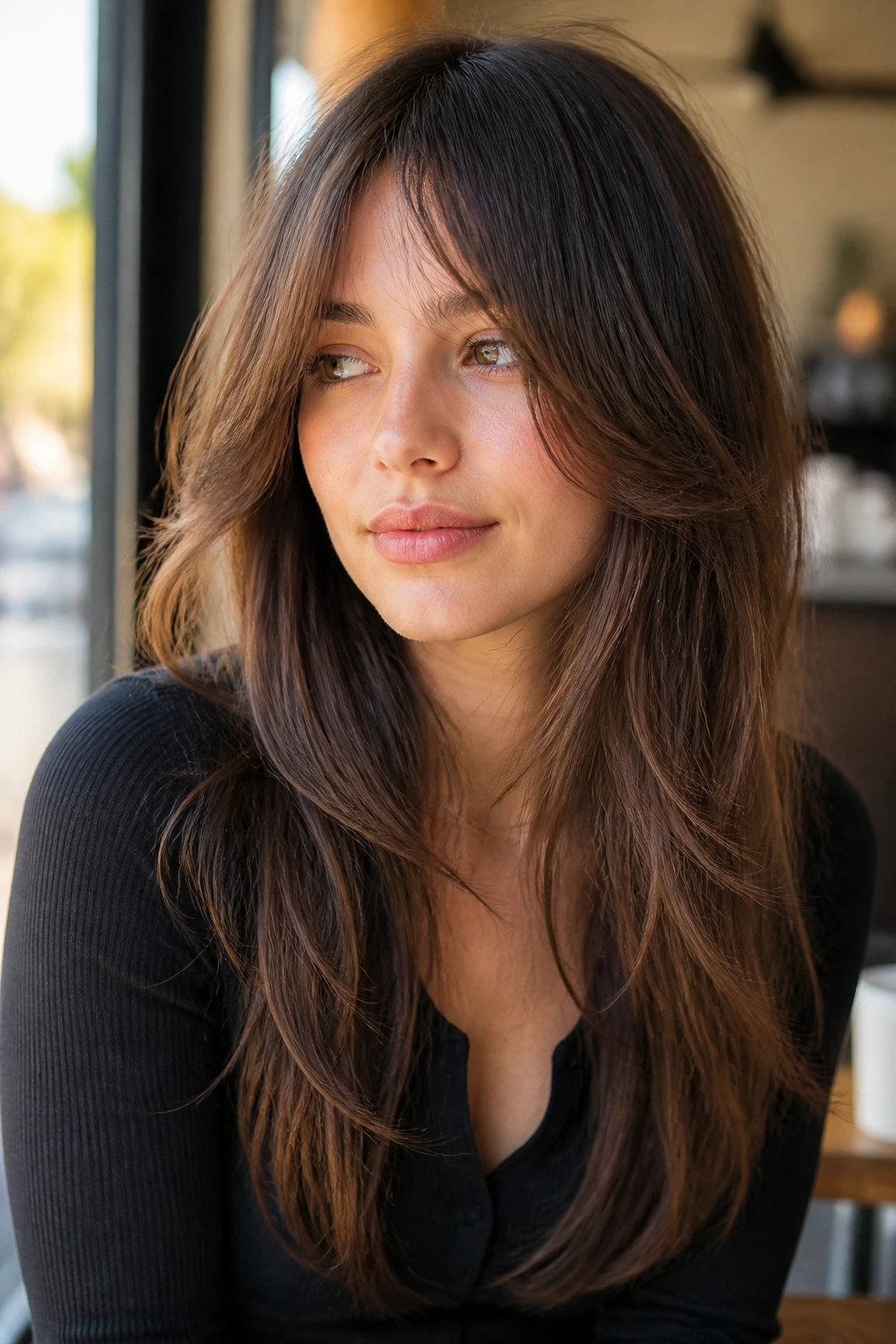
Straight hair shows every inch of a V cut, which is why this version either looks stunningly precise or slightly off within five seconds. There’s nowhere to hide. That’s the appeal.
When the line is clean, the back point reads like a deliberate design choice. The sides sweep down in tidy angles, the ends look glassy, and the whole cut has a crispness that’s hard to fake with styling products alone.
What to ask for
- A center point that sits where you want the hair to trail, usually lower than the shoulder blades on very long hair
- Minimal texture at the hem if you want a polished finish
- A tidy blend through the sides so the V doesn’t start too high
This is the version I’d pick if you love flat-iron smoothness, sharp parts, and hair that falls into place without a lot of fuss.
12. Invisible-Layer V Cut for Quiet Movement
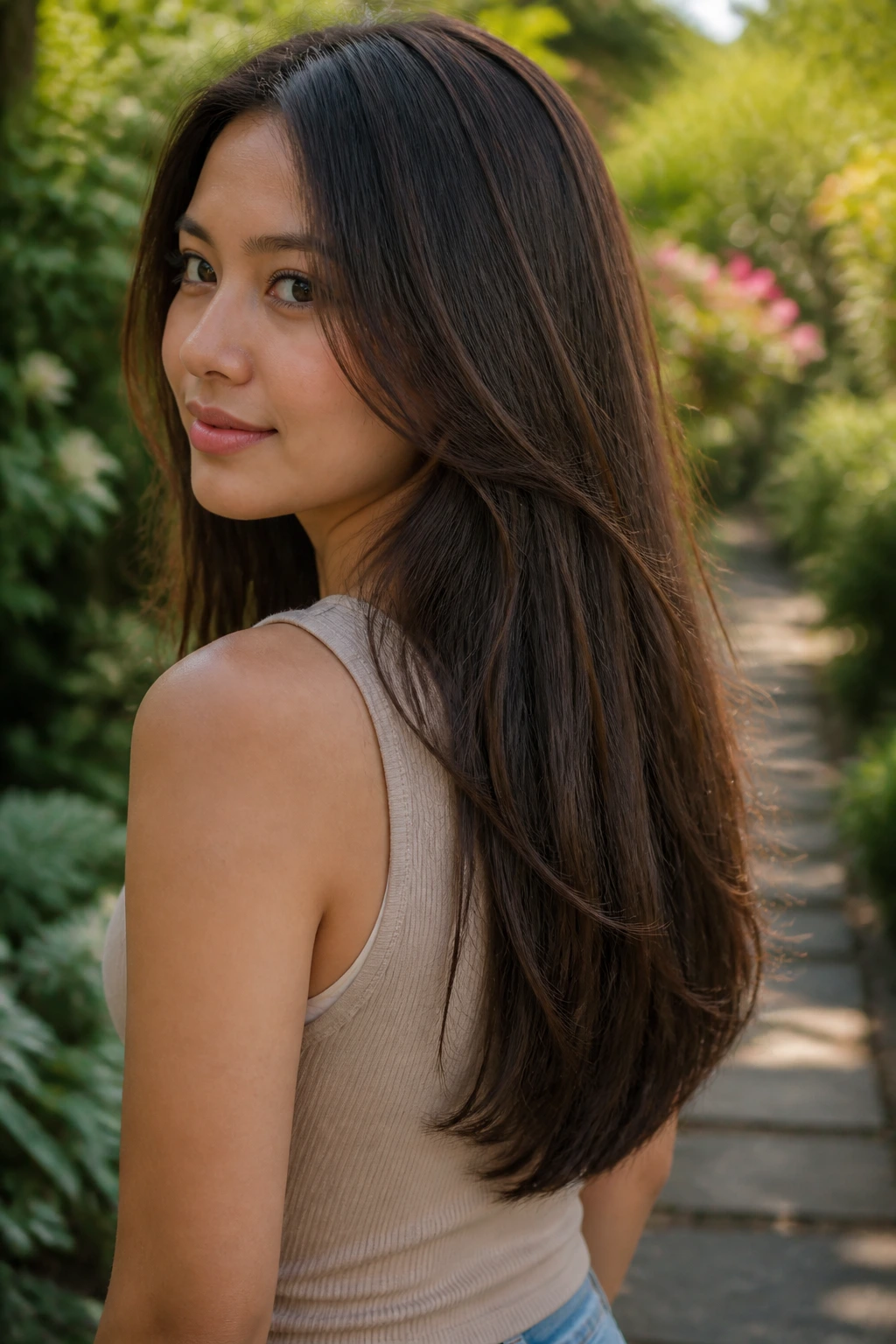
Invisible layers are the sneaky cousin of the obvious layered cut. The outer line still looks clean, but the inside of the hair has been trimmed in a way that lets it bend and move more freely. Paired with a V, that gives you the shape without a lot of visible chop.
It’s a smart choice for people who want their hair to feel lighter but hate the look of obvious layers from the side. The back point still shows. The front still flows. But the haircut doesn’t shout about the scissors every time you turn your head.
This one is especially good if you wear braids or low ponies often. The hidden layers keep the hair from feeling like one dense block, yet the outside still looks smooth when you let it down.
13. Bottleneck Bang V Cut with Soft Cheek Framing
Bottleneck bangs are a little less obvious than curtain bangs and a little more tailored around the face. They sit narrower at the top, then fan out toward the cheeks, which makes them a natural companion for a V cut because both shapes soften as they travel outward.
The result feels tidy without being stiff. The bangs add focus around the eyes, while the V keeps the length moving behind them. It’s a strong option if you want a face frame that feels more current than heavy fringe but less open than a curtain bang.
The only real catch is styling. Bottleneck bangs need a quick round-brush pass or a small flat-iron bend to keep the shape from splitting. If you want a completely no-fuss front section, this isn’t it.
14. U-Shape Blend for a Less Pointy Finish
Not every long cut needs a sharp point at the center. A U-shape blend rounds the back slightly so the hemline feels softer, which makes it a good answer for anyone who likes the movement of a V but not the obvious tail.
This is the quieter version of the same idea. It keeps the weight distribution flattering, but the outline looks more natural and less engineered. If your hair is already long and fine or if you’re nervous about the point showing too much, this is the safer middle ground.
I’d call this the “I want shape, not a statement” haircut. It grows out easily and usually stays flattering longer between trims.
15. Choppy V Cut for Piecey Texture
A choppy V cut takes the basic shape and roughens the edges on purpose. The ends look piecey, the layers show a little more separation, and the whole haircut feels looser and more casual. If you live in texture spray and messy buns, this one makes sense.
It works best on medium to thick hair that can hold a bit of grit. The choppiness helps the shape show up even when you don’t style every strand into submission. You can curl it, scrunch it, or let it dry naturally and still keep a visible line.
The downside is pretty obvious. If you want sleek, shiny, one-pass blowouts, a choppy V will fight that. It has personality. Sometimes a little too much.
16. Minimal-Layer V Cut for Low Maintenance
Some people want the V shape and nothing else. No stacked layers, no big front pieces, no dramatic texture. Just a long line that dips into a point and grows out without making a scene. That’s the minimal-layer version.
It’s one of the easiest shapes to live with because it doesn’t depend on a lot of styling. Air-dry it. Brush it out. Tie it up. The silhouette still shows. The line is soft enough that a few extra weeks between trims won’t make the haircut collapse.
This is the cut I’d recommend to anyone who likes the idea of a V but hates salon maintenance. It won’t give you the biggest swing or the most dramatic movement, but it will keep long hair from looking like one heavy slab.
17. Waterfall Layer V Cut for Long Lengths
A waterfall version uses long layers that cascade down the sides before meeting the V point in the back. It creates that drifting, stepped feel you get when the hair moves in pieces instead of one big sheet. On very long lengths, it looks especially good because there’s room for the layers to travel.
This cut is flattering when the hair needs softness around the shoulders and collarbone without giving up the dramatic length in the back. It works with curls, waves, and blowouts, but it needs the layers to be long enough to blend. Short layers turn this shape into something busier than it needs to be.
The best part is motion. Every time the hair turns, the layers catch a little differently.
18. Side-Swept Fringe V Cut for a Diagonal Line
A side-swept fringe changes the mood of a V cut by pushing the eye diagonally across the face before it lands on the back point. That diagonal line is flattering on a lot of face shapes because it softens the center and keeps the haircut from feeling too symmetrical.
This is a good choice if a middle part makes your long hair feel flat or severe. The side fringe gives you a little lift at the front, and the V keeps the back from looking static. Together, they create a shape that feels softer and a bit more editorial without being fussy.
I’d pick this when I want movement but not the upkeep of full bangs. It’s forgiving. It also tucks behind the ear better than people expect.
19. Blowout-Ready V Cut with Crown Lift
Some V cuts are built to be air-dried. This one wants a round brush and a dryer. The crown has a touch of lift, the lengths fall cleanly, and the ends curve just enough to show the shape. It’s the kind of cut that looks even better after a few minutes of styling than it does fresh from the chair.
The advantage is obvious once you wear it. The top doesn’t sit flat, the back still has a point, and the whole haircut feels polished without needing a dozen tools. If you like a bouncy salon finish, this is the version to ask for.
The tradeoff: it loses some of its charm if you let it dry without any shaping. The silhouette needs a little help.
20. High-Contrast Layered V Cut for Big Shape
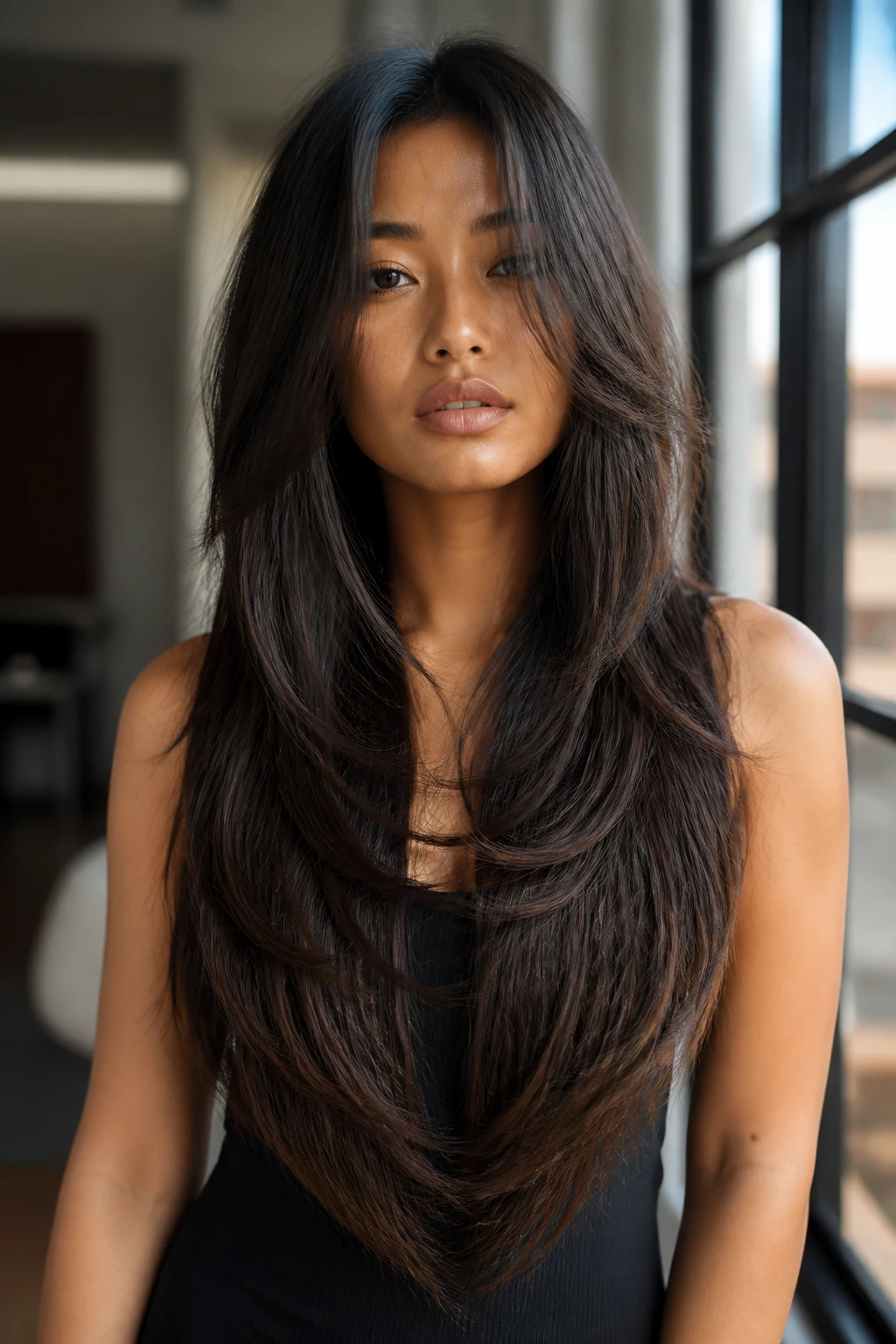
This is the dramatic one. The front pieces sit much shorter than the back point, and the layers create a visible difference from side to side. It’s a stronger shape than most V cuts, which makes it useful if you want the haircut itself to do some of the styling.
It suits people who wear long hair loose and like a bit of movement around the face. The contrast keeps the style from disappearing into a single curtain of length. Thick hair and naturally wavy hair wear this best because there’s enough body to support the layered structure.
If you want subtle, skip this. If you want hair that reads from across the room, keep going.
21. Grow-Out Friendly V Cut with a Soft Angle
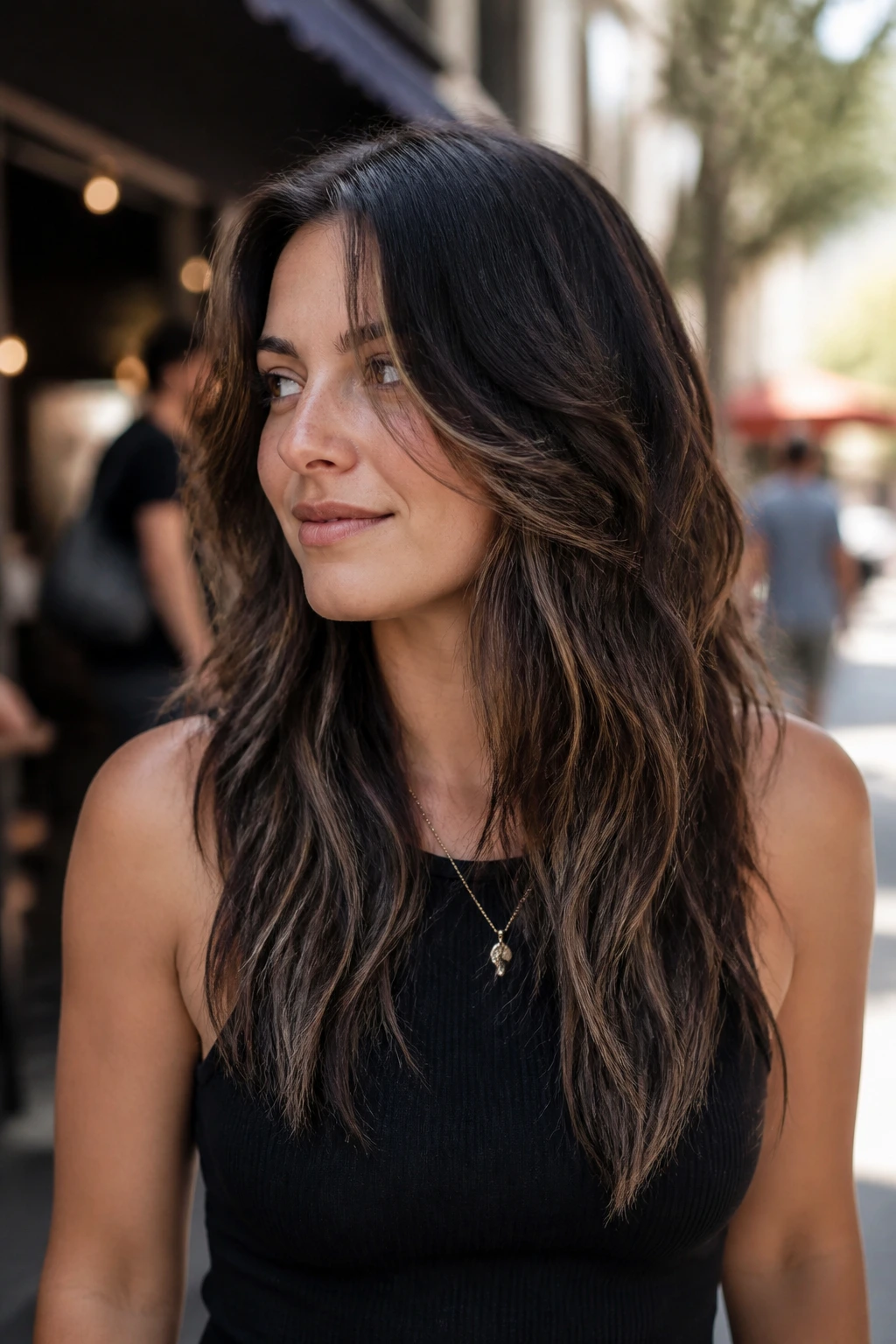
A grow-out friendly V is softer from the start, which means it can stretch a little longer between trims without looking neglected. The angle is gentle, the layers stay long, and the back point never gets so sharp that a month of growth turns it awkward.
This is the haircut for busy people. It still gives long hair movement, but it doesn’t demand perfect upkeep. You can wear it in waves one day and a low ponytail the next without the shape collapsing.
I like this version because it feels honest. It doesn’t pretend you’re in a salon every six weeks. It just keeps the hair looking neat while life happens around it.
22. Sharp Statement V Cut for Extra-Long Hair
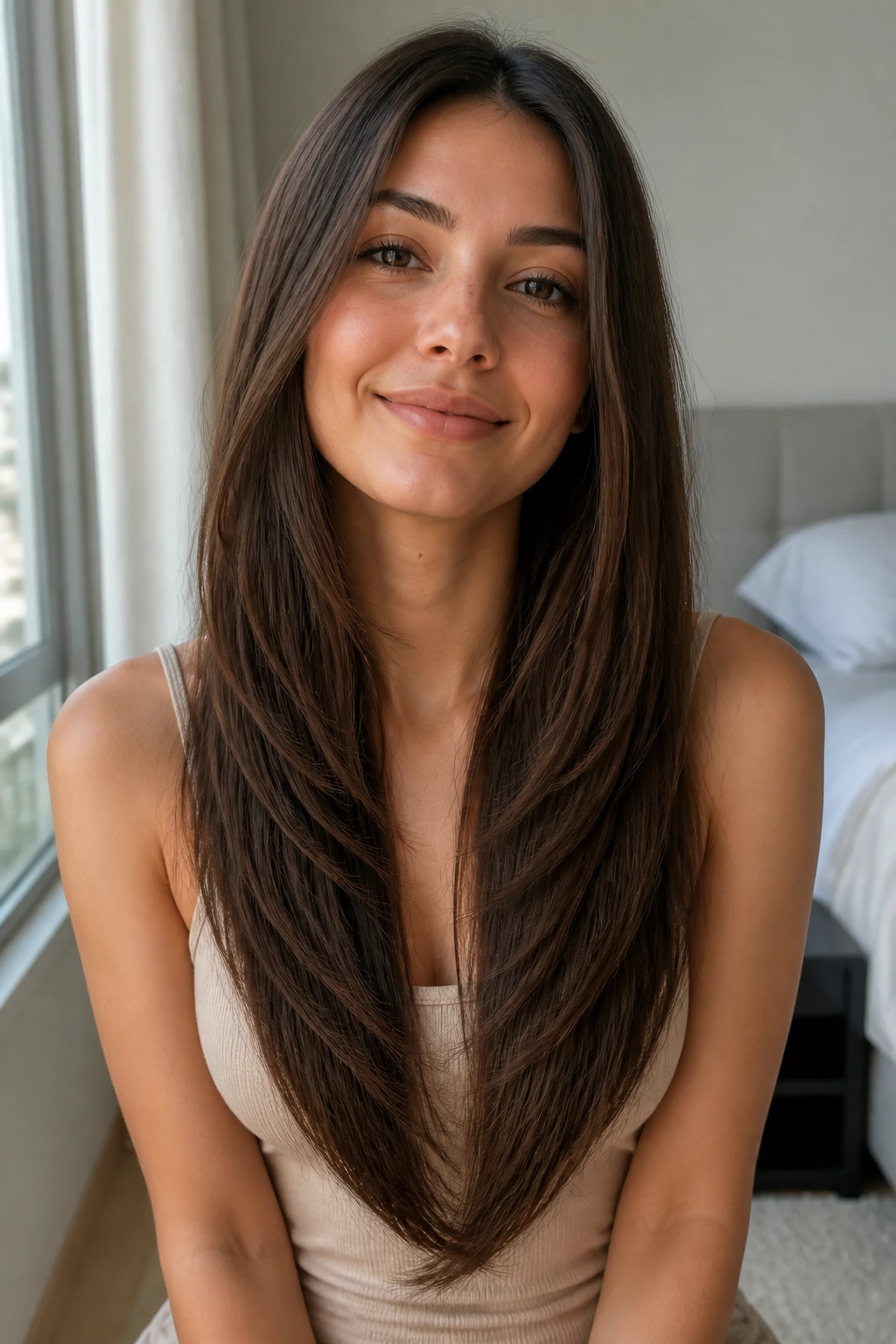
When hair gets very long, a sharp V can look almost architectural. The point at the back becomes part of the silhouette, not just a detail, and the sides fall away in a way that makes the length feel deliberate rather than merely grown out.
This cut works best on extra-long straight or silk-pressed hair, where the line can stay visible from roots to ends. The center point should land cleanly, and the sides should blend so the haircut doesn’t look sliced in the middle. It’s bold, but it’s not messy.
A sharp V is the one people notice when the hair moves. That’s the whole point. It turns length into shape.
Why the V Shape Makes Long Hair Look Lighter
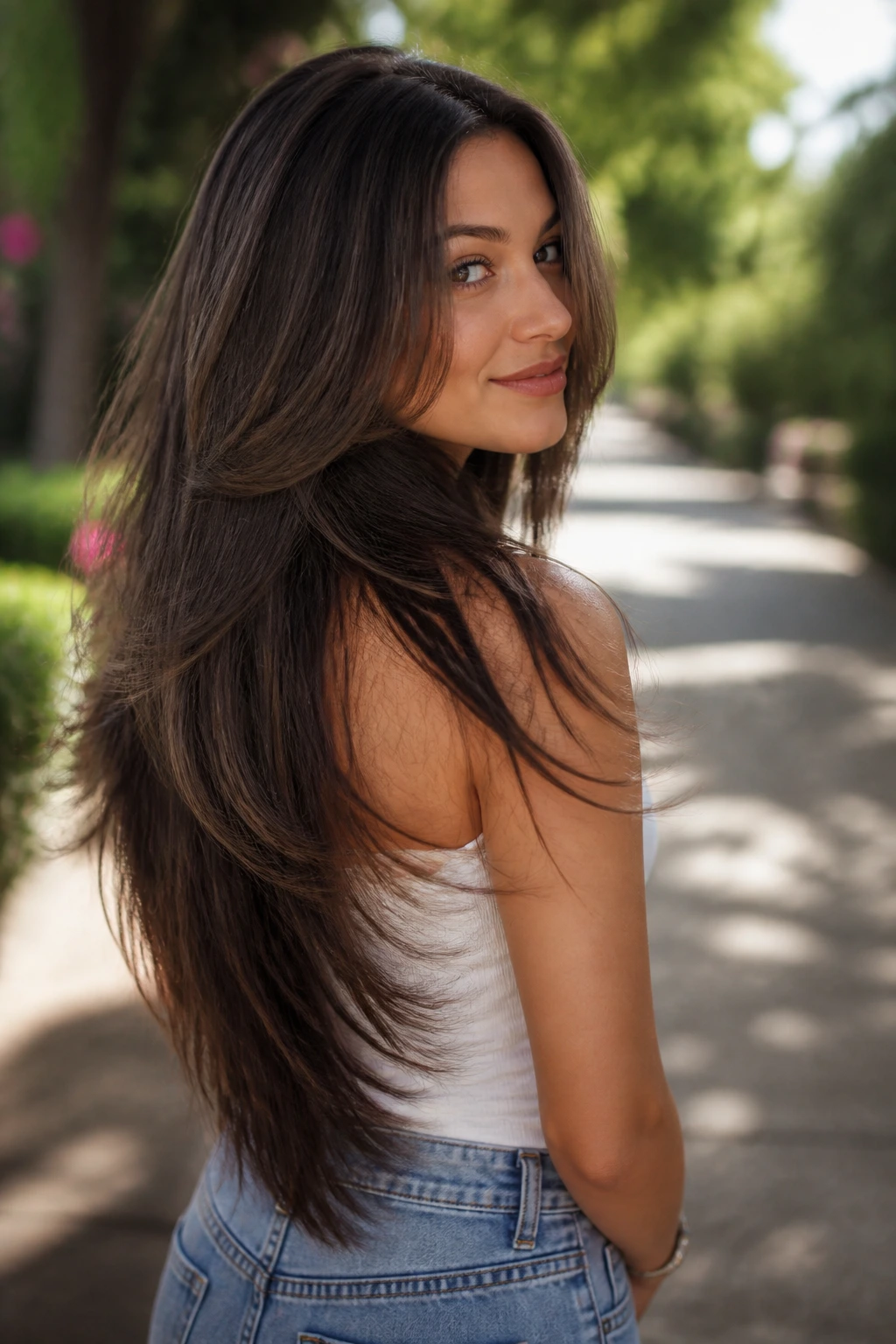
A blunt hemline on very long hair can do one of two things: sit beautifully, or sit like a wall. The V shape fixes the wall problem by changing where the weight lands. Instead of everything stopping at one straight edge, the sides fall away and the center keeps going, which gives the eye a clearer path.
That shift matters more on long hair than on shoulder-length hair. At long lengths, even a small change in angle can make the ends feel easier to wear. The cut doesn’t remove length for the sake of it. It redistributes the visual weight so the hair moves in a longer line and feels less boxed in.
I also think this is why V cuts age well between appointments. They don’t need to be perfect to look deliberate. A little grow-out usually just softens the point, which is a kinder outcome than a blunt cut turning into an awkward shelf.
How to Pick the Right V Cut for Your Hair Type
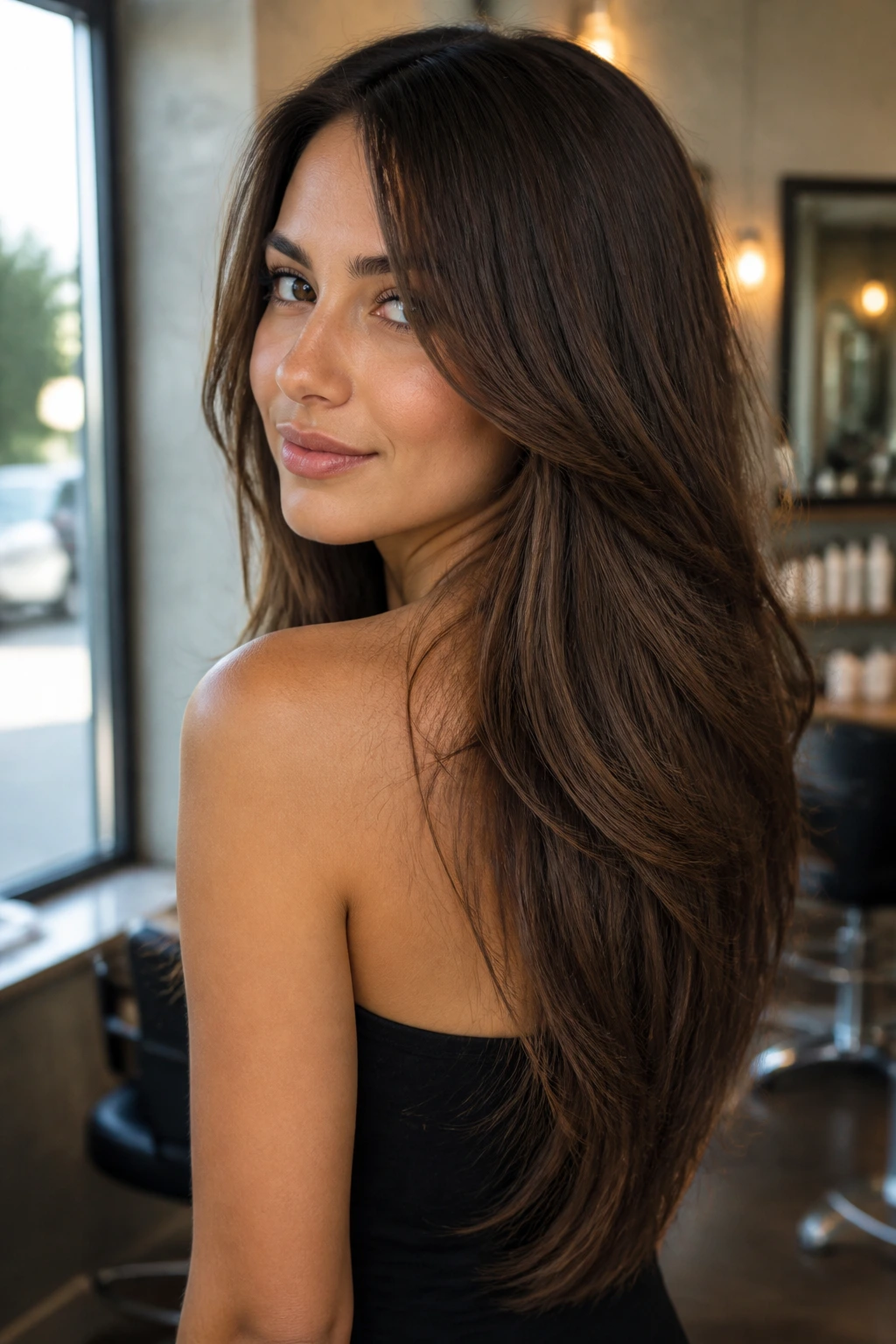
Hair texture decides more than face shape here. A person with fine, straight hair and someone with dense curls can both wear a V cut, but they need very different versions of it. One can handle a sharper point; the other usually needs softness and longer layers.
Fine or delicate hair
Keep the V shallow and the layers long. Too much removal at the ends makes the cut look sparse, especially in backlit photos or under harsh bathroom lighting.
Thick or coarse hair
Go deeper and ask for weight removal through the interior. Otherwise the shape can look bulky at the bottom and too solid to move.
Wavy hair
Ask for a cut that follows the wave pattern. The V should show up when the hair bends, not fight against the way it naturally falls.
Curly hair
Cut with shrinkage in mind. A softer point and long blending are safer than a sharp angle.
Straight hair
You can go cleaner, sharper, and more dramatic. Straight hair shows the geometry.
What to Tell Your Stylist Before the First Snip
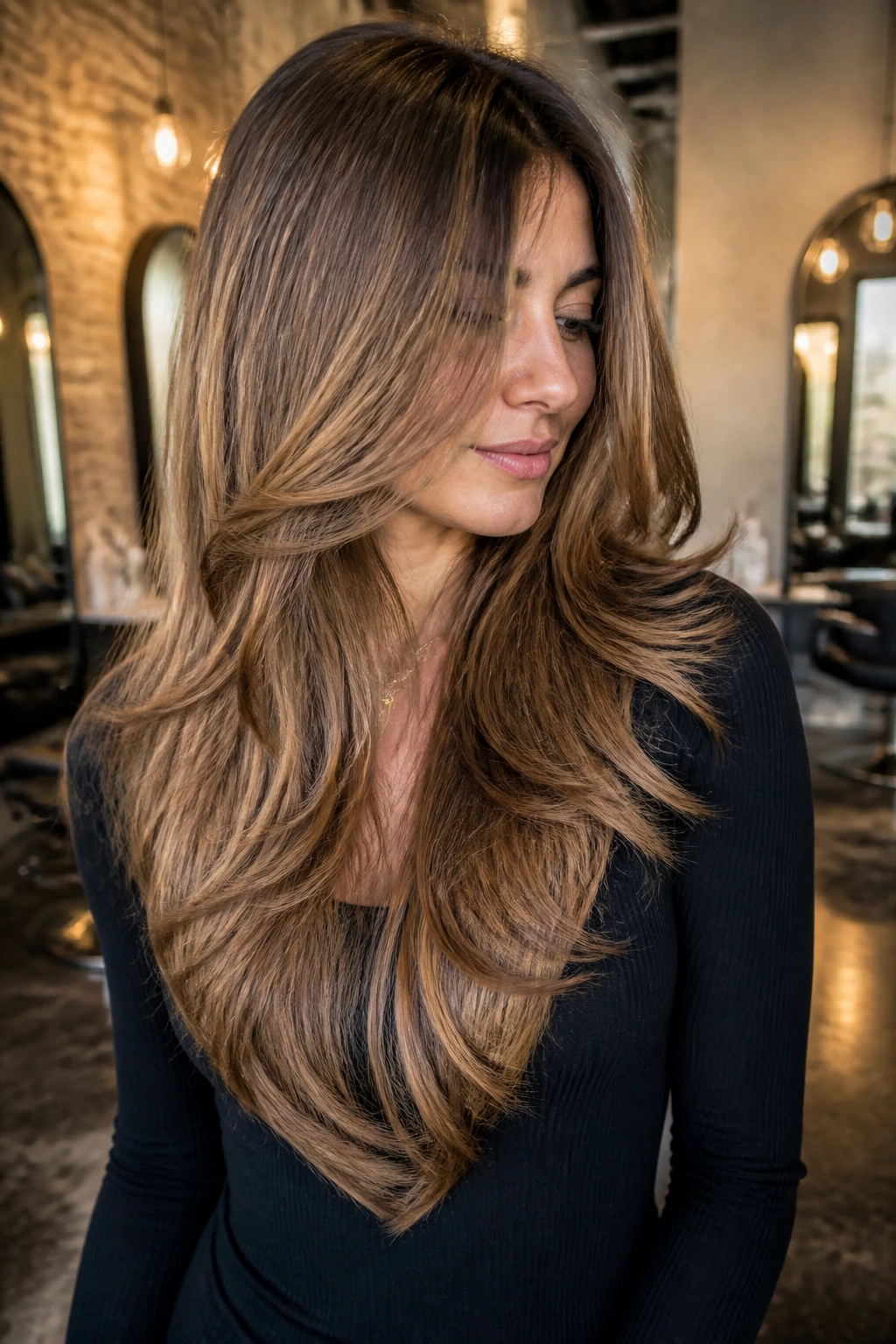
Bring pictures. Not one. Two or three. One should show the back, because that’s where the V lives. Another should show the front or side, because the front layers and face-framing pieces can change the whole haircut more than people expect.
Say how you wear your hair most days. If you live in a middle part, say that. If you put it in a low ponytail every afternoon, say that too. A V cut that looks perfect loose can be a nuisance in a ponytail if the front pieces are cut too high.
I’d also be specific about the point. Do you want it below the bra strap? At mid-back? Just a subtle dip? Those little details matter more than vague words like “long” or “soft.” A stylist can work with a number or a clear landmark. They cannot guess your favorite silhouette.
Essential Tools for Styling Long V-Cut Hair
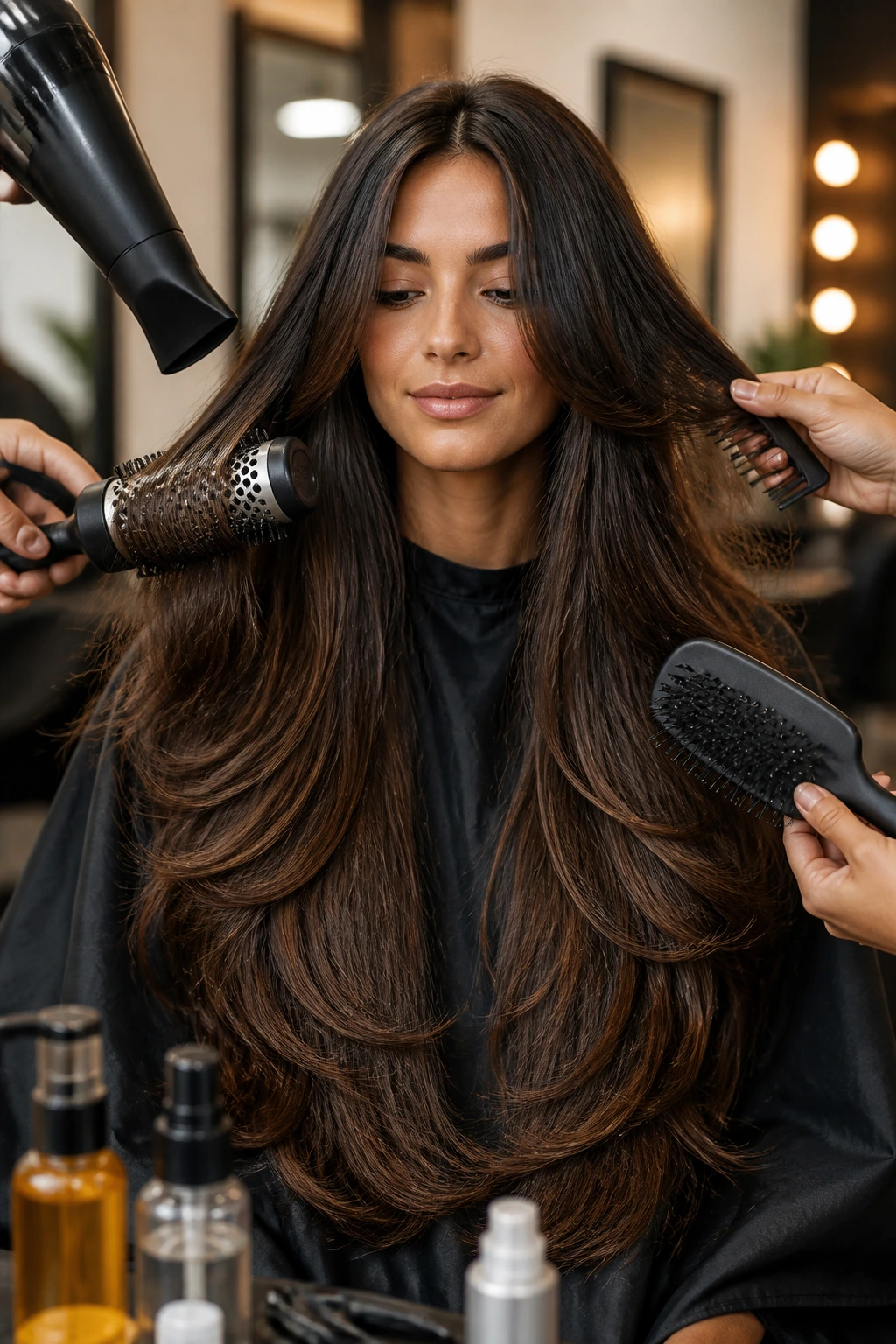
- Blow dryer with a concentrator nozzle: Helps keep the cut smooth and show the line of the V instead of puffing the ends out.
- Large round brush: Useful for giving the side sections a gentle bend and a little lift through the crown.
- Paddle brush: Better for smoothing long lengths fast without creating too much curl at the ends.
- Wide-tooth comb: Good for detangling long hair before styling, especially if the ends are prone to snagging.
- Heat protectant spray: Worth using every time you blow-dry, flat-iron, or curl the hair.
- Sectioning clips: Make it easier to keep the top layers out of the way while you work on the bottom sections.
- Lightweight serum or hair oil: A small amount on the last 2 to 3 inches keeps the point looking polished.
- Texturizing spray: Useful if you want the V shape to show through waves and bends instead of sitting flat.
How to Wear a V Cut So the Shape Shows
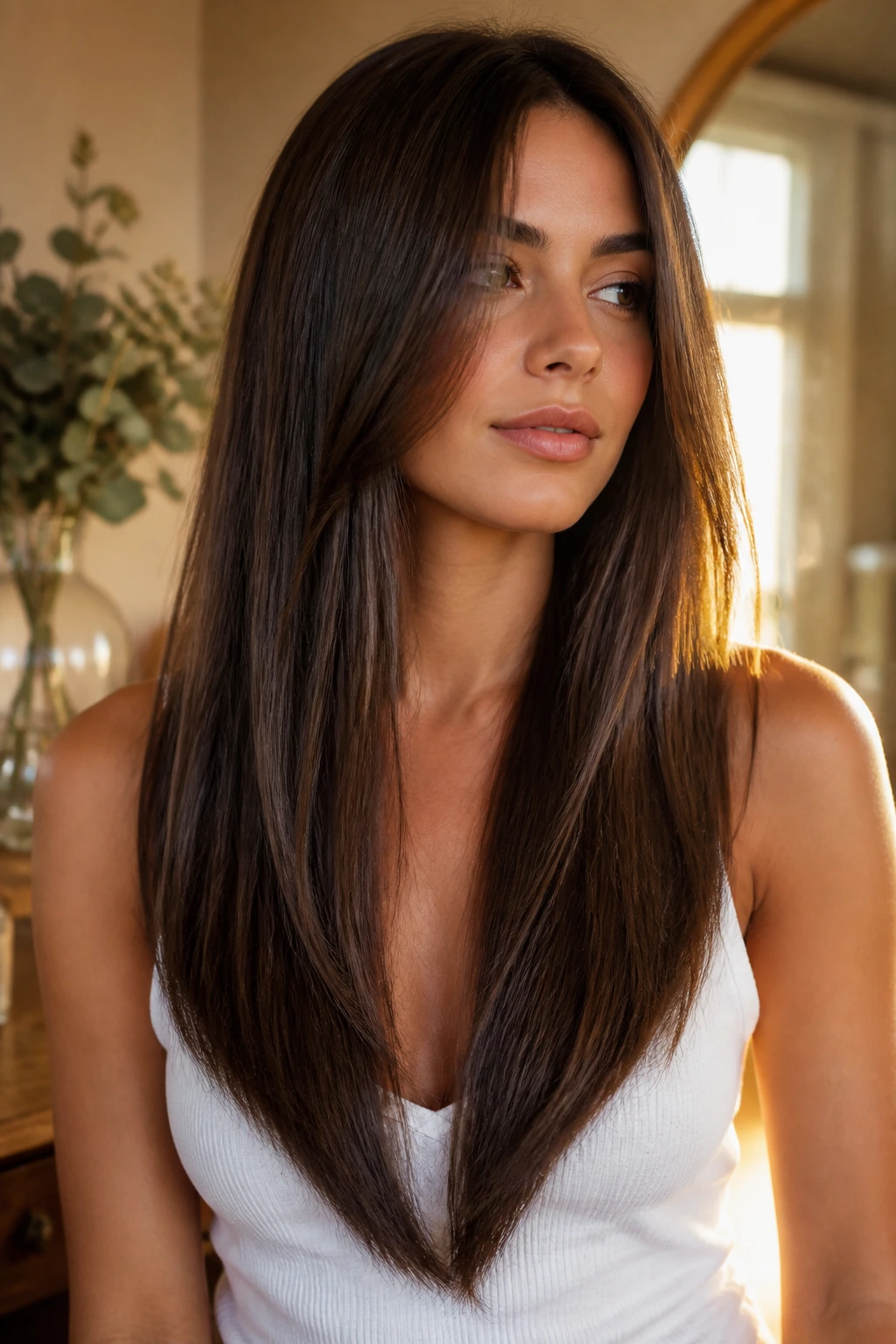
Straight Finish:
A smooth blowout or flat-ironed finish makes the outline easiest to see. Work a nozzle-dried section from roots to ends, then turn the brush slightly under at the last few inches so the point doesn’t look chopped off.
Soft Waves:
Loose waves reveal the side lengths and the center point in a softer way. A 1-inch curling iron, wrapped away from the face, gives the cut enough movement to show shape without looking overdone.
Ponytails and Half-Ups:
These styles are where a V cut quietly earns its keep. The front pieces still frame the face, and the back length drops neatly beneath the tie instead of bunching up.
Braids and Accessories:
A V cut can make a braid look longer because the lower lengths taper more gradually. Clips, silk ties, and wide headbands also work well because they don’t hide the hair’s center line.
Common Mistakes That Flatten the Point
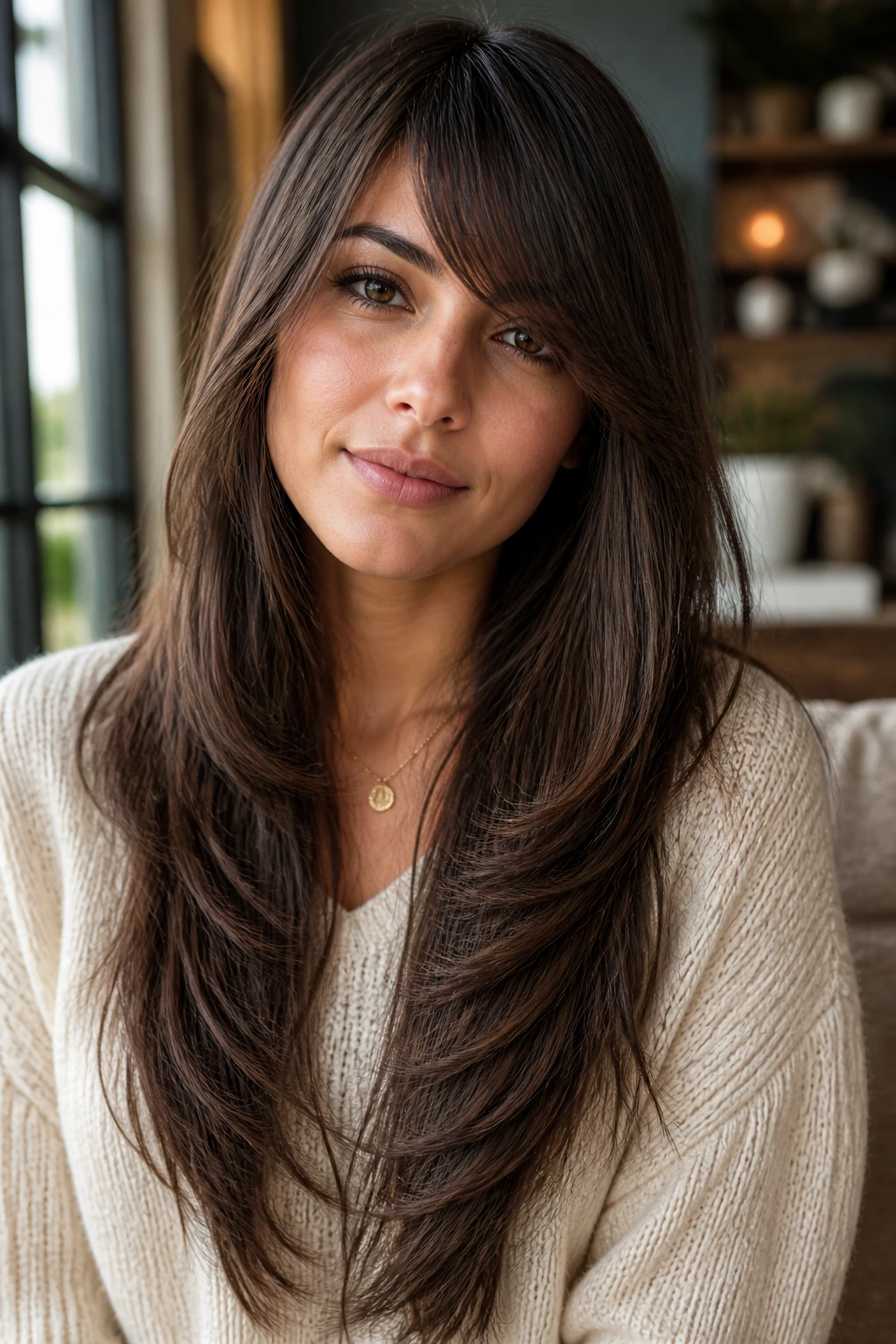
Cutting the point too high:
If the center point starts too near the shoulders, the haircut can look like a bad grow-out instead of a long V. The fix is simple: keep the dip lower and confirm the placement before the scissors move much.
Over-thinning fine hair:
Fine hair needs a clean outline, not a shredded one. If the ends look see-through, the shape loses body fast.
Ignoring shrinkage on curls:
A V cut on curly hair can jump up much shorter than expected. A dry or curl-aware cut prevents the back from ending up too short.
Skipping trims for too long:
The point softens over time, which is normal. Let it go too far and the cut turns into an uneven U with no clear shape.
Variations and Adaptations to Try
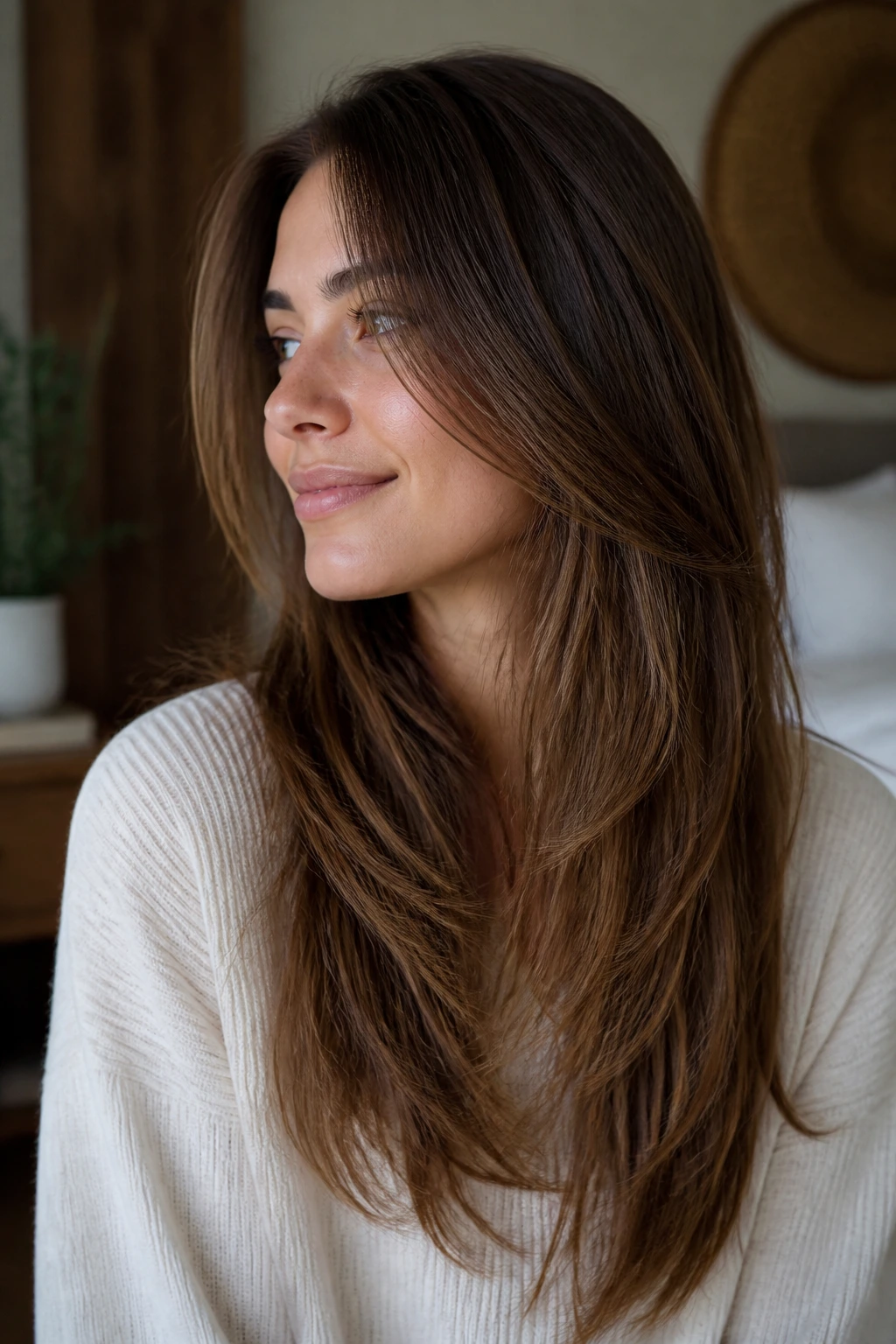
The Soft Landing V:
This version keeps the angle shallow and the layers long. It’s the most forgiving choice for first-timers and anyone who wants the shape without a big visual shift. If your hair is fine or you wear it up a lot, this is the place to start.
The Thick-Hair Rescue V:
Built for density, this variation uses interior weight removal so the ends stop feeling like a blanket. The point still shows, but the sides breathe more. It’s a smart move if blow-drying takes forever.
The Curly Ribbon V:
Here the point is softened and the layers are drawn to follow the curl pattern instead of fighting it. The result looks less sharp and more like a curved ribbon trailing down the back. Great for curls that need balance, not control.
The Glossy Glass V:
This one is sleek, precise, and happiest under a flat iron or a careful blowout. The line matters more than texture, so the ends should stay clean and polished. It suits straight hair that already lies smooth.
The Grow-Out Ease V:
The angle is soft, the front pieces are modest, and the whole cut is designed to age well. If you know you won’t trim every eight weeks, this is the version that stays neat longest.
Keeping the Shape Sharp Between Trims
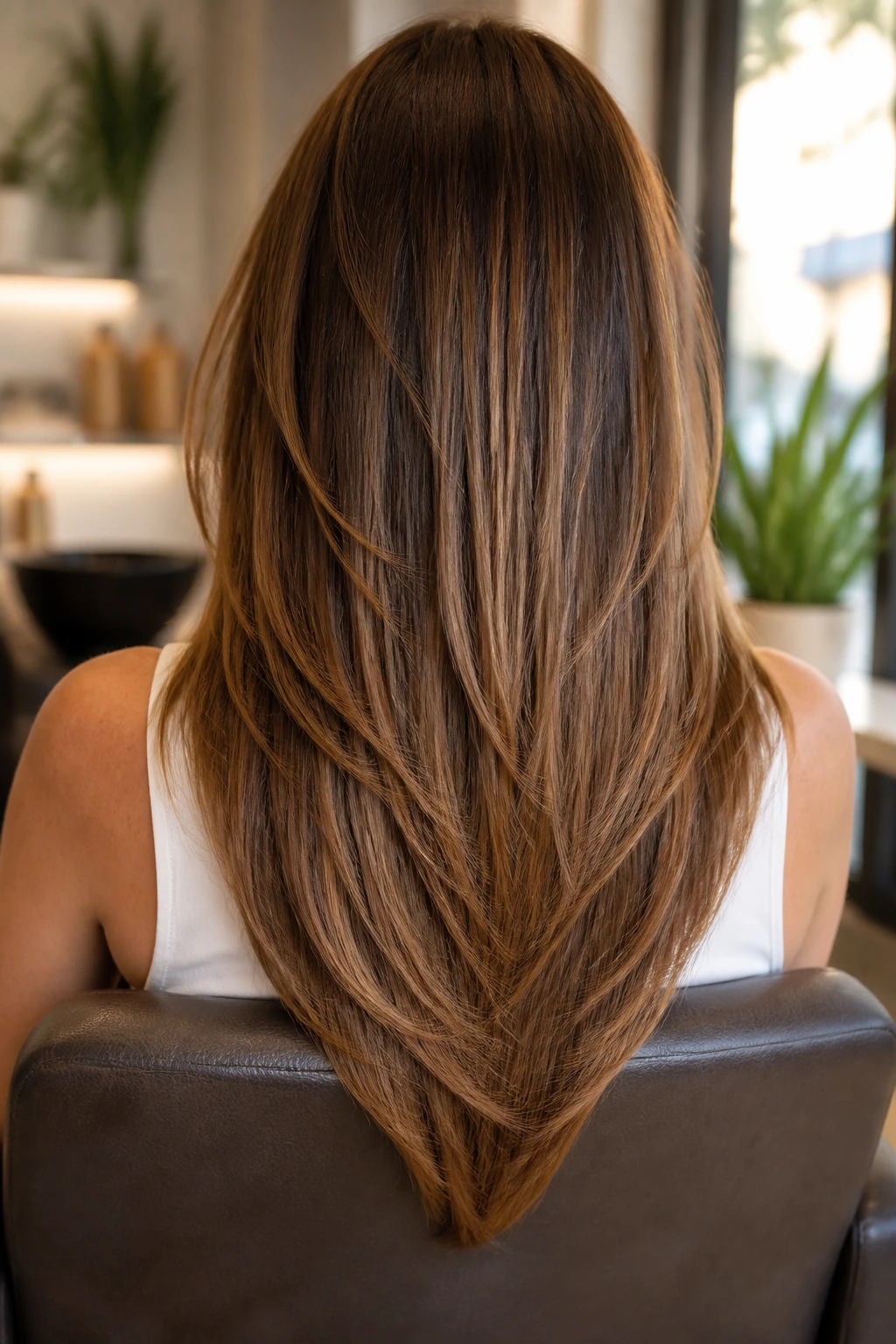
A V cut stays nicest when the ends are kept tidy, not when they’re constantly restyled into submission. For most long hair, a trim every 8 to 12 weeks keeps the point visible and prevents the sides from getting ragged. If the V is deep or the hair is prone to split ends, closer to 8 weeks makes more sense.
Wash-day routine matters too. Use a heat protectant whenever you blow-dry, and don’t overload the ends with thick oil. A pea-sized amount is plenty for most long hair; too much will make the point collapse into one heavy clump.
If your hair is wavy or curly, reshape it with the same direction each time so the sides keep falling in the same line. A little consistency goes a long way. Hair that’s always dried differently starts to lose the silhouette faster than people expect.
Frequently Asked Questions About V Cut Haircuts
Is a V cut the same as long layers?
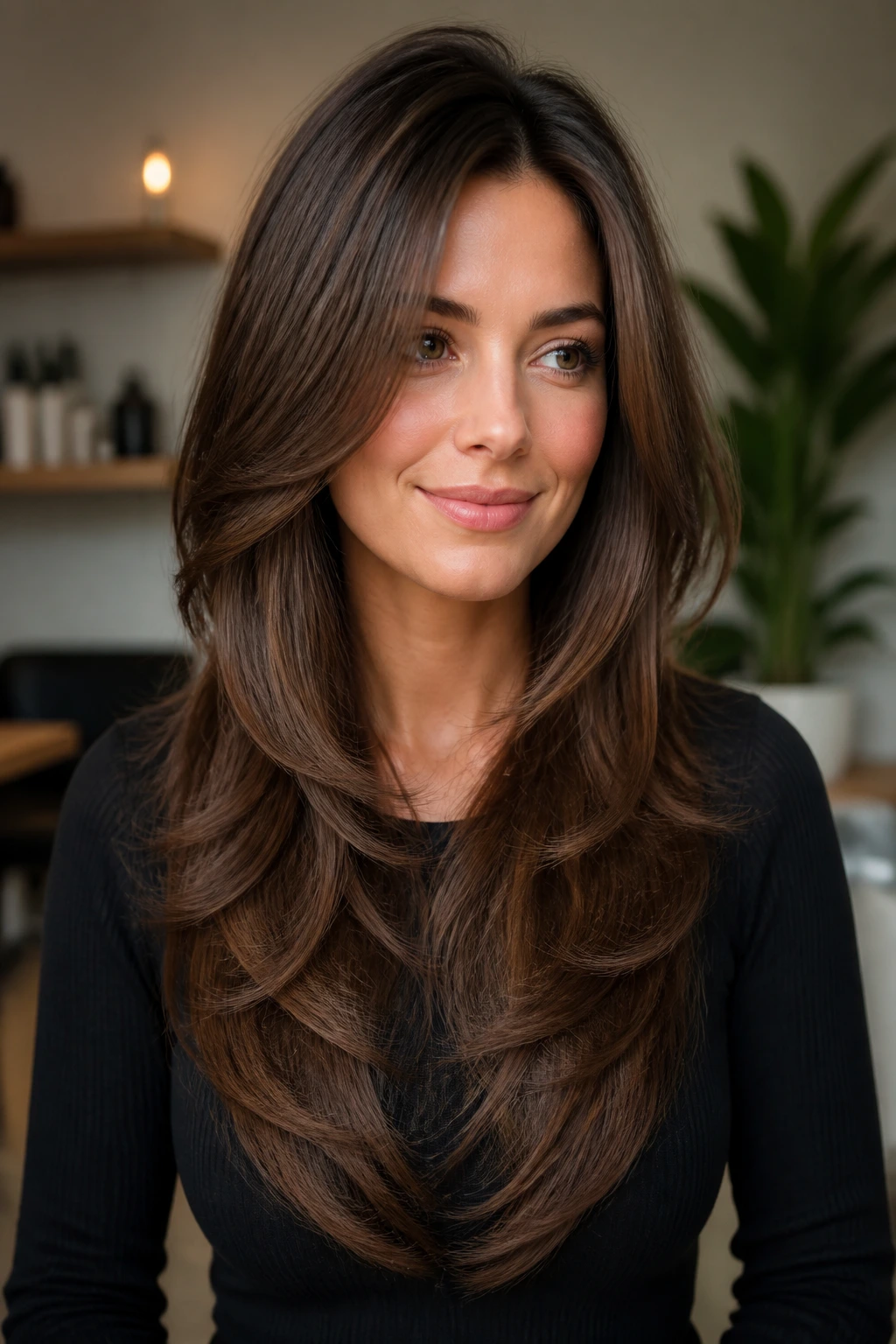
Not quite. Long layers add movement throughout the hair, while a V cut focuses on the outline of the hemline, especially the way the back tapers to a point. Many salon versions use both, but they are not the same thing.
Will a V cut make my hair look thinner?
It can, if the point is cut too deep or your hair is already fine. A shallow V keeps more visual weight at the ends, which is usually the safer move for delicate strands.
Can I wear a V cut in a ponytail?
Yes, and that’s one of its better features. The front pieces still help frame the face, while the back drops cleanly beneath the tie instead of sticking out in a blunt block.
Does a V cut work on curly hair?
Yes, but the cut has to respect shrinkage and curl pattern. A softer point and careful blending work better than a sharp angle that only looks right when wet.
How do I ask for a V cut without losing too much length?
Show a photo and say how deep you want the point to sit. If you want to keep the perimeter full, ask for a shallow V and long blending through the sides.
What’s the easiest way to style a V cut at home?
A smooth blow-dry with a paddle brush or large round brush is the simplest route. If you prefer air-drying, a little mousse and a scrunch at the ends helps the shape show up instead of disappearing.
How often should I trim it?
Most long V cuts look tidy with trims every 8 to 12 weeks. Very sharp points or heavily layered versions usually need the shorter end of that range.
What if the point looks stringy?
That usually means the angle is too deep or the hair has been over-thinned. A stylist can soften the point a bit, or you can let it grow into a gentler U shape while keeping the rest of the cut intact.
A Shape That Still Moves
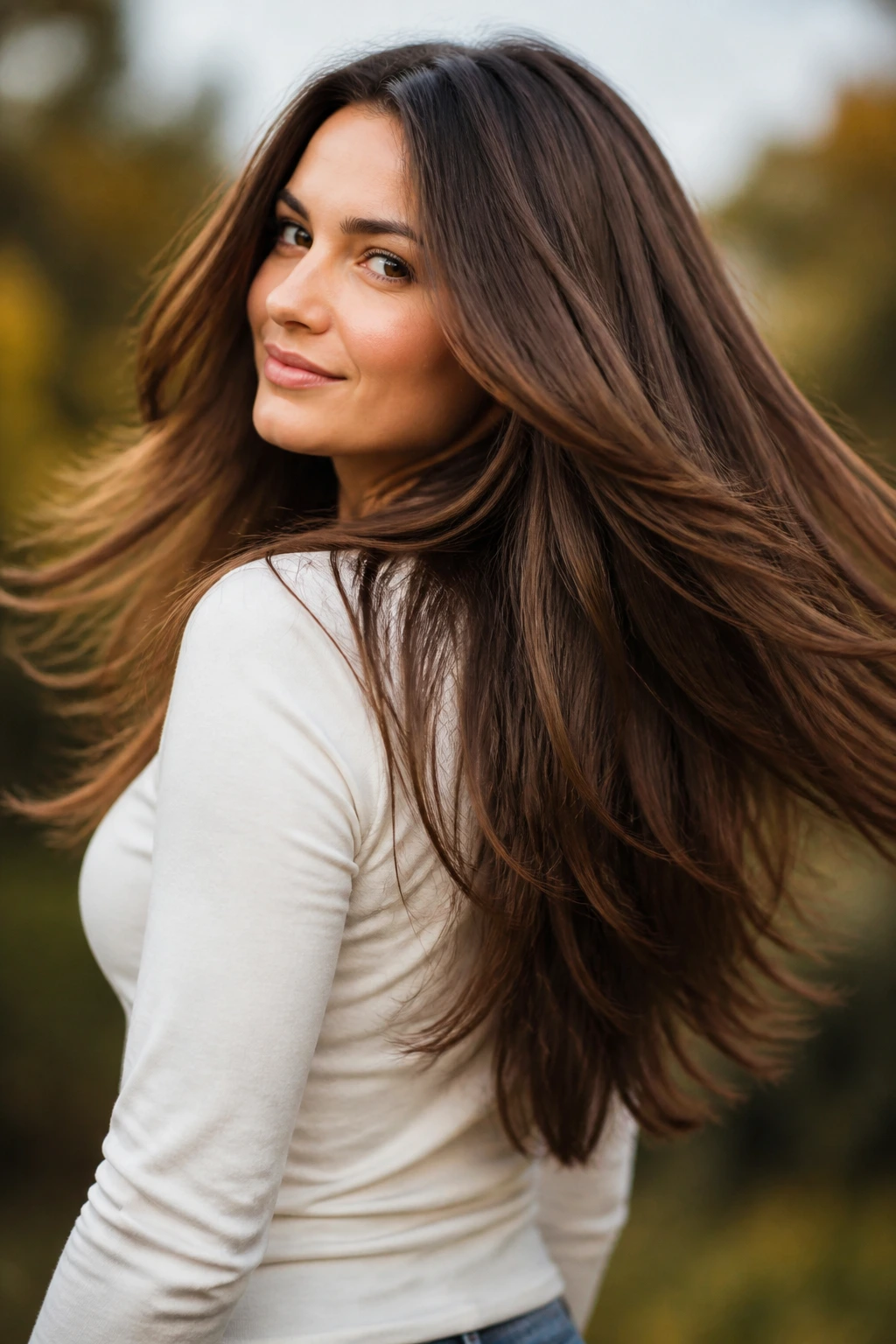
A good V cut does something blunt hair often won’t: it gives long length a direction. The back becomes a feature instead of an afterthought, and the sides fall in a way that makes the whole style feel more alive. That’s why the shape keeps showing up on long hair that needs movement without losing the drama of length.
The trick is choosing the right version. Soft, deep, feathered, curly, sleek — they each solve a different problem. Pick the one that matches how your hair lives, not just how it looks in a photo, and the cut will keep paying you back every time you turn around or pull it into a ponytail.
