



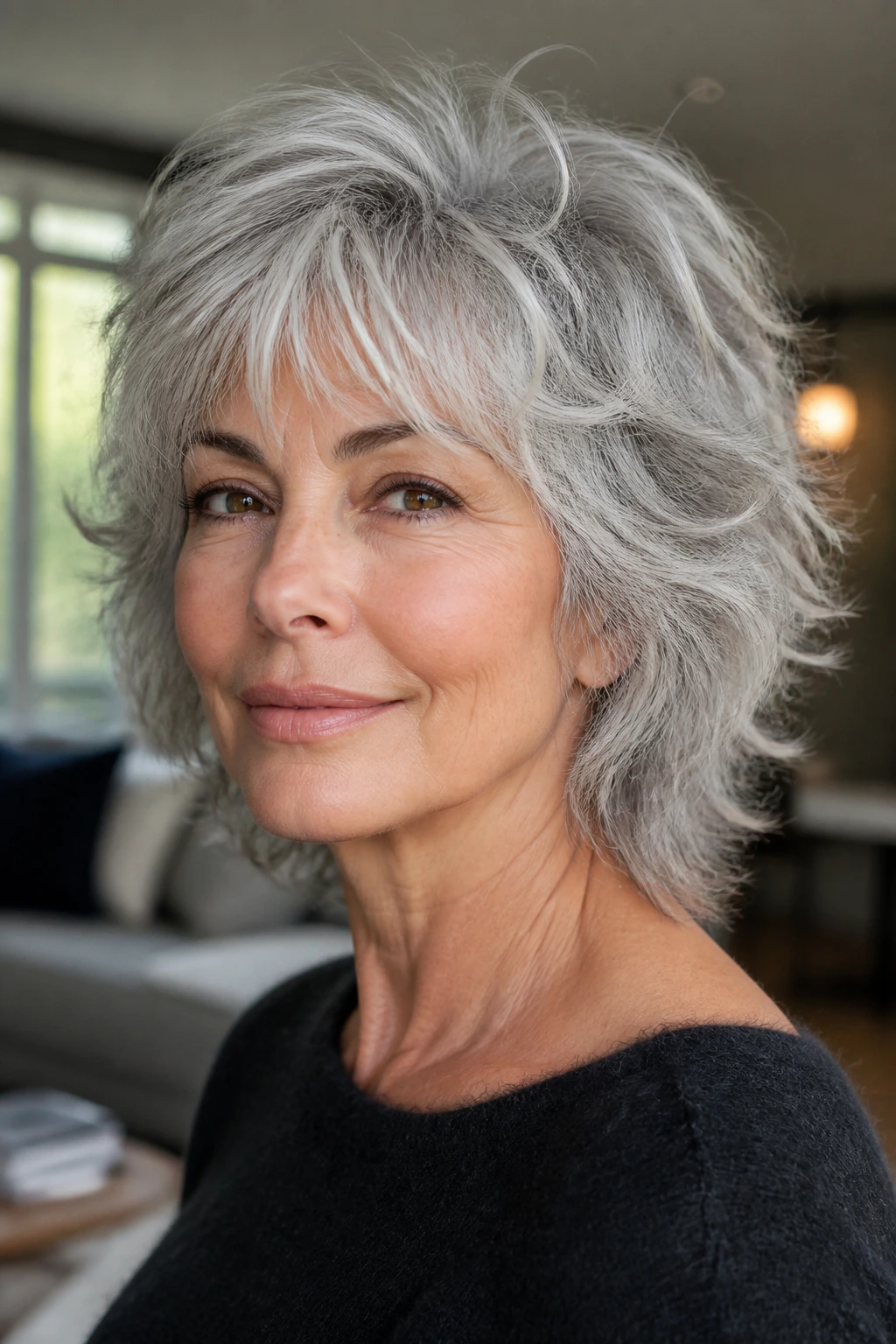
Gray wavy shag haircuts for older women work because they stop pretending hair should behave like a single, smooth sheet. Silver strands move differently. Some sections puff out near the crown, some fall flat at the temples, and the front often has its own opinion. A good shag doesn’t fight any of that. It turns the mess into shape.
That matters more than people admit. Once the hair goes gray, it often feels a little drier, a little coarser, and a lot less interested in holding a blunt line. Add natural wave, and you’ve got a cut that can either breathe or turn boxy fast. The shag is the rare style that gives you lift at the top, softness around the face, and enough broken-up texture that the whole thing looks intentional instead of overworked.
And yes, it can still look polished. That’s the part I like most. A gray shag can be feather-light and modern, or longer and softer, or a little bit wild in the best way. The right version depends on where your wave lands, how much density you have, and how much time you want to spend with a blow dryer before breakfast.
Why These Gray Wavy Shag Haircuts Work So Well
-
They keep the crown from collapsing: Shorter layers at the top create lift where gray hair often lies flat, so the cut keeps its shape longer between washes.
-
They soften silver edges: Broken-up ends and feathered layers blur hard lines, which matters because gray and white strands can make a blunt perimeter look harsher.
-
They work with wave instead of against it: A shag lets bends, bends stay bends. You do not have to force every section into a polished blowout.
-
They grow out with less drama: When the trim gets a little late, the layers usually turn into a softer shag rather than a weird helmet shape.
-
They can be tailored to fine or thick hair: The same family of cuts can add body to finer waves or remove bulk from dense, coarse texture.
-
They make fringe options easier to wear: Curtain bangs, side-swept bangs, and bottleneck bangs all sit naturally inside shaggy structure, which gives you room to play.
1. Soft Crown-Lift Shag with Curtain Bangs
A soft crown-lift shag is the one I reach for when the hair is starting to feel a little too flat at the top and a little too busy around the sides. The curtain bangs open from the center and slide into the cheekbones, which keeps the face from getting boxed in. On gray hair, that center part can be especially pretty because the lighter strands around the forehead read like a natural highlight.
Why it works: The shortest layers sit high enough to create lift, but not so short that the cut turns spiky or dated. Ask for the top layers to land around the crown and the longest face-framing pieces to hit just below the cheekbone. That gives the wave room to bend.
Best for: Oval and heart-shaped faces, especially if the crown needs a little help. A round brush and a small dab of mousse at the roots is usually enough. Nothing fussy.
2. Chin-Length Gray Shag with Airy Fringe
Chin-length shags have a clean little snap to them. They show off the jaw without sitting right on it, which is useful if you want structure but not a hard line. With airy fringe, the whole haircut feels light, and gray tones take on a soft, almost cloudy finish that looks lovely in daylight.
The sweet spot: Keep the fringe wispy enough to move, not dense enough to behave like a blunt bang. If your hair has a strong wave, the ends should be textured by point-cutting or a gentle razor finish so they don’t puff outward. That tiny detail changes everything.
Styling cue: Scrunch in a light mousse, then diffuse for 5 to 8 minutes on low heat until the roots are dry and the fringe still has movement. Air-dry the rest if you want a more lived-in shape. This one looks best when it’s not too perfect.
3. Shoulder-Grazing Razor Shag

There’s a reason shoulder-grazing shag cuts show up so often on gray wave patterns: they give enough length to look elegant, but enough internal movement to avoid dragging the face down. A razor-softened perimeter helps the ends feather instead of stacking up in a blunt block.
What makes it different: The shoulder length lets the wave stretch a little, which is useful if your hair shrinks when it dries. The layers should start below the cheekbone and travel through the mid-lengths, not just sit at the top. If the cut is too top-heavy, it will puff. If it’s too heavy, it will collapse. The middle is where it lives.
This one is especially nice on hair that’s medium-density and has a loose S-wave. A dab of cream on the ends and a light spray at the roots is usually enough. Easy. Clean. Not boring.
4. Long Silver Shag with Cheekbone Layers
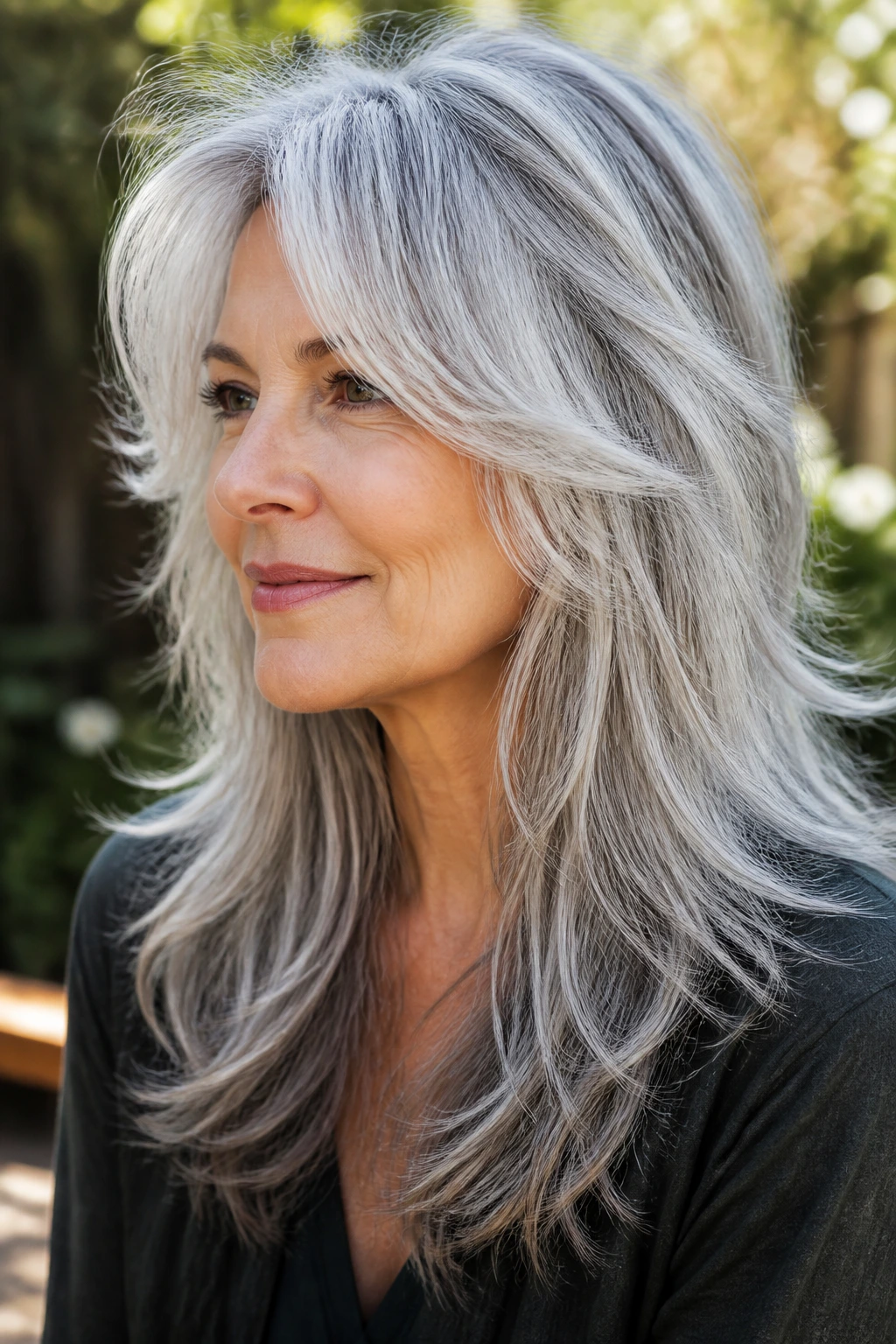
If you are not ready to give up length, this is the shape to ask for. The longest pieces stay well below the shoulders, while cheekbone layers pull the eye upward and prevent the haircut from reading as one long sheet. Gray hair often looks beautiful at this length because the silver and white strands catch in different places as the waves move.
Why I like it: It keeps the drama of long hair without making you babysit it. The key is restraint. Do not carve the whole head into tiny, choppy sections. Leave the bottom long and let the top half do the shape work.
A little wave cream, a diffuser, and maybe a single bend from a large-barrel iron on the front pieces can make this look finished without flattening the texture. It’s a good cut if you like your hair to feel a bit romantic.
5. Salt-and-Pepper Feathered Shag

Salt-and-pepper hair has its own contrast, and a feathered shag takes advantage of that instead of hiding it. The darker strands add depth near the interior layers, while the silver pieces catch light at the ends. Feathering keeps the overall outline soft, which matters when the color pattern is already doing visual work.
What keeps it soft: Ask for feathered layers around the face and through the sides, but keep the perimeter full enough that the cut doesn’t go thin at the tips. That balance is the whole trick. Too much texturizing and the style gets stringy. Too little and the contrast looks heavy.
This cut is a smart choice if your hair has a little natural volume and you want the color to feel intentional rather than patchy. The feathering makes the transition between silver, white, and darker pieces look relaxed. And relaxed is better here.
6. Collarbone Shag with Side-Swept Bangs

The collarbone shag is one of those cuts that behaves well on almost anybody, which is why I keep coming back to it. The length is long enough to tuck behind the ear or clip back, but short enough that the wave still shows. Side-swept bangs add a gentle diagonal line across the forehead, which is useful if you wear glasses or want to soften a strong brow.
How to wear it: Sweep the bangs away from the fuller side of your face and keep the opposite side slightly tighter. That asymmetry gives the haircut a little motion without needing a dramatic chop. A root-lifting spray at the part and a round brush on just the bang area is often enough.
This is a good “I want movement, not fuss” haircut. It doesn’t need a perfect blowout. It needs a hand, a dryer, and a willingness to let the wave do some of the work.
7. Grown-Out Wolf Shag

A grown-out wolf shag has a bit more edge, but it doesn’t have to scream for attention. The top stays fuller, the ends stay piecey, and the overall silhouette gets a little narrower at the bottom. On gray hair, that shape can look sharp in a very clean way, especially if the texture is naturally wavy rather than pin-straight.
Why it works for older women: It gives lift without making the cut feel overly young or costume-y. The trick is to keep the layers controlled. You want the lived-in feel of a wolf shag, not the over-thinned ends that sometimes show up when someone gets too aggressive with the razor.
Use a light styling cream on damp hair and scrunch the mids only. Leave the roots a little lifted and the ends a little separated. That uneven finish is part of the charm. Too polished and it loses the point.
8. Rounded Shag for Fine Waves

Fine gray hair can be tricky. It often needs body at the root and a shape that doesn’t stretch too far downward. A rounded shag solves that by keeping the silhouette a little fuller through the sides and letting the layers arc softly instead of going straight out. The result feels almost buoyant.
The important part: Do not let the layers get too short or too sliced. Fine hair can go see-through fast if the interior is overcut. Ask for gentle layering that supports the wave pattern without exposing too much scalp. That’s the difference between airy and sparse.
A volumizing mousse at the roots, then a quick blow-dry with a small round brush, helps the roundness hold. I’d skip heavy oils here. They flatten fast, and fine silver strands do not need help lying down.
9. Piecey Midi Shag with Deep Side Part
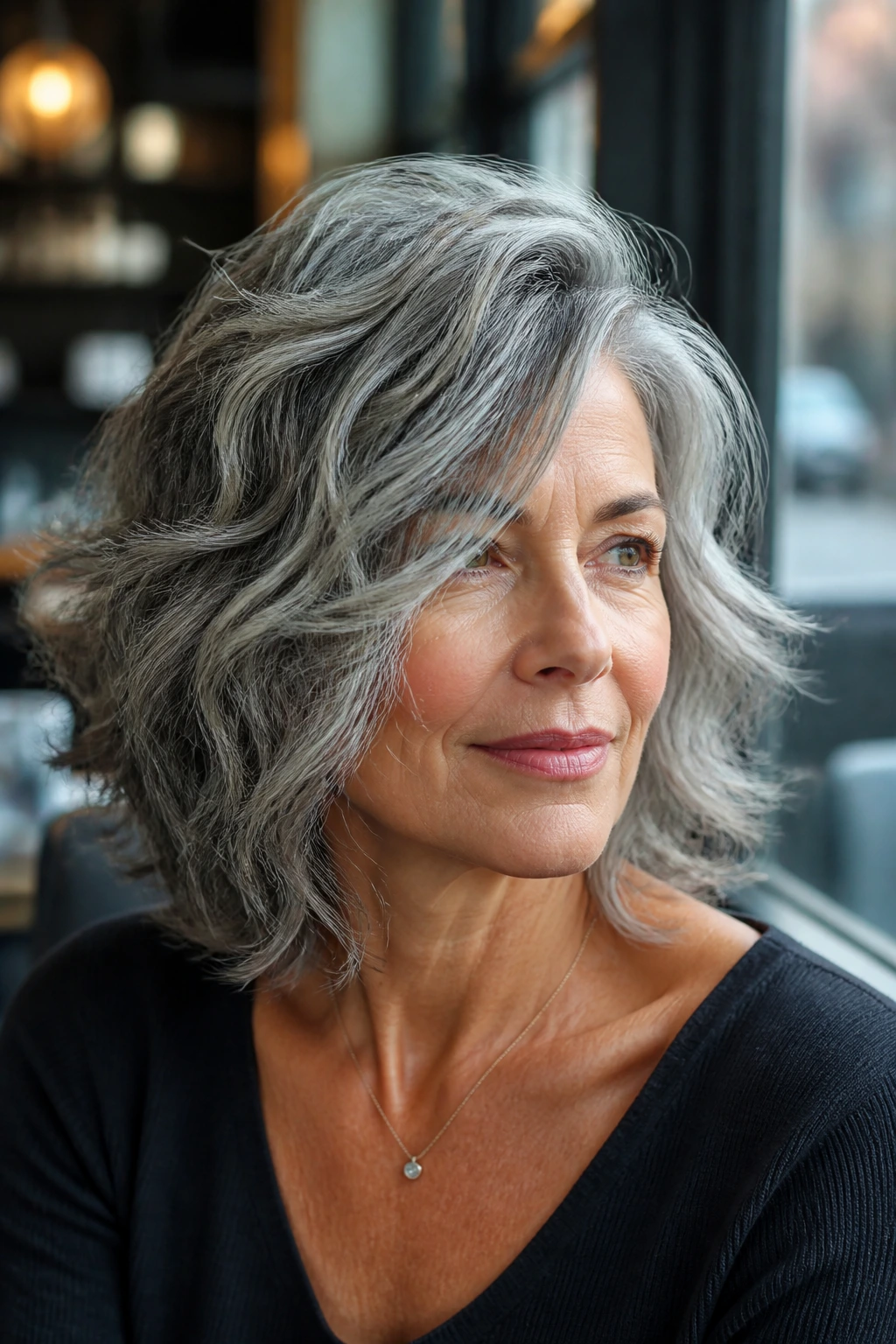
This is the cut that looks a little more dramatic without turning severe. A deep side part creates height on one side and lets the wavy layers fall across the face in a looser, piecey way. It’s a nice option if your hair has lost some density at the part line and you want to disguise that with shape instead of covering it.
What makes it flattering: The longer midi length gives enough weight that the waves fall in ribbons, not in a puff. The deep part breaks up the symmetry, which can be a mercy if the face feels softer than it used to. Gray hair loves a side part because it catches light across the front.
A little salt spray through the mids can help define the pieces. Don’t overdo it. One or two sprays, then scrunch. That’s enough. If the hair starts looking crunchy, you’ve gone too far.
10. Tousled Shag with Bottleneck Bangs
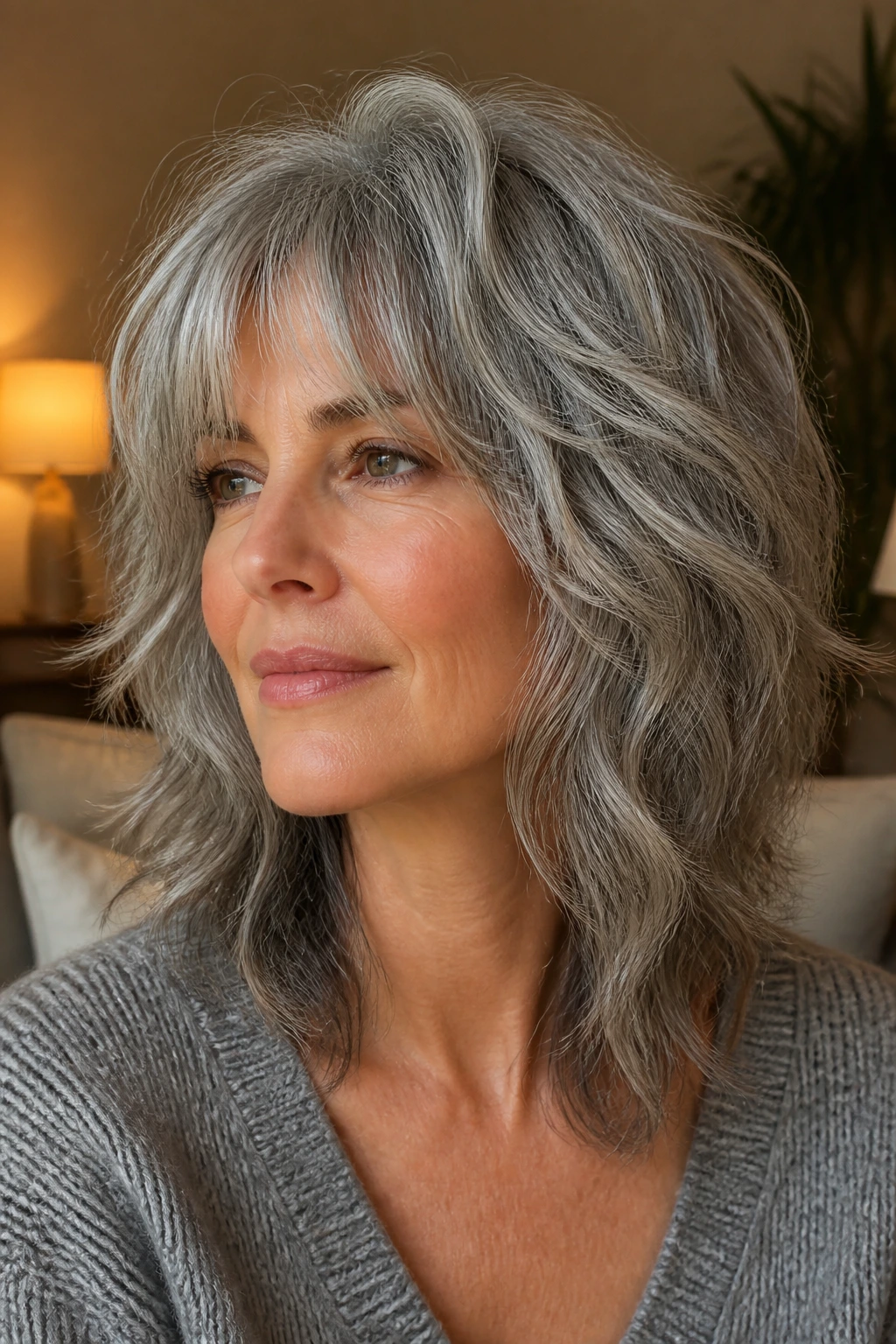
Bottleneck bangs are softer than blunt bangs and more deliberate than curtain bangs. They open a little at the center, hug the forehead with a narrow middle section, then widen near the cheekbones. On a tousled shag, that shape feels modern without being harsh.
Where it shines: If you have a high forehead or a face that benefits from a bit of framing near the eyes, this is a smart cut. The bangs should sit around brow level when dry, maybe a touch longer if your wave springs up a lot. Dry-cutting the fringe helps because gray hair often shrinks in a more stubborn way than it appears wet.
The rest of the cut can stay lightly layered through the shoulders. Keep the styling loose. A diffuser on low, a little scrunching, and then fingers only. A comb can make it too neat.
11. Feathered Shag Bob

A feathered shag bob sits right in that useful middle ground between a classic bob and a freer, softer shag. The length usually lands between the jaw and the upper neck, with feathered layers that keep the sides from puffing out like a triangle. That’s the line I care about here.
Why it’s smart: Gray hair at bob length can go blunt fast. Feathering the top and side layers adds movement, so the cut doesn’t feel stiff. It also gives the haircut a slight lift around the cheeks, which is flattering if you want the face to look a bit more open.
This one is a favorite for women who want the ease of shorter hair but dislike the severe shape some bobs can create. A half-round brush and 2 minutes at the roots usually change the whole mood. Very little effort. Better result.
12. Layered Gray Shag for Thick Hair
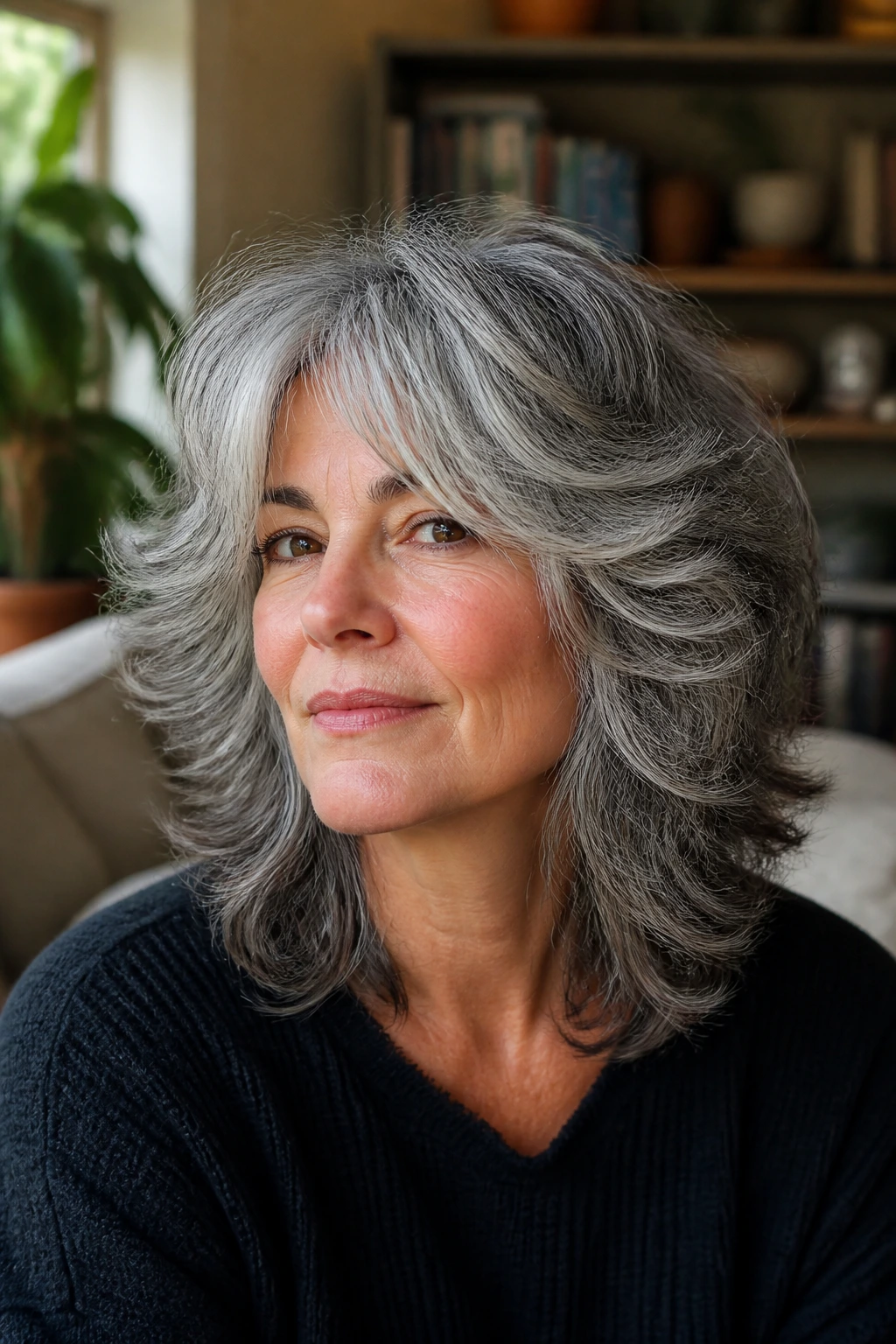
Thick gray hair can be gorgeous and exhausting in equal measure. A layered shag helps by removing bulk from the interior without turning the ends wispy. The shape should move, not explode. That’s the difference.
What to ask for: Internal layers under the crown, soft face-framing pieces, and enough length at the perimeter to keep the outline grounded. If you go too short in the wrong place, thick hair will spring out and steal the shape. Keep the weight line at the bottom clean, and let the layers live above it.
This is one of the best cuts for women whose waves have a mind of their own. A cream or serum alone won’t solve everything here. You need structure in the cut first, then a product that smooths without flattening. Otherwise the hair will do that puffy, triangular thing that nobody asked for.
13. Soft Layered Shag with No Fringe

Not everyone wants bangs. Some people are wise about that. A soft layered shag without fringe still gives movement through the crown, temples, and sides, but leaves the forehead open and the styling routine simpler. The face-framing pieces do the work instead.
This version is especially good if your hairline is changing, or if you wear glasses that sit high on the face. The layers should begin around the cheekbone and continue through the collarbone area, with a little softness near the nape so the cut doesn’t end in a blunt block.
My advice is simple: keep the front pieces long enough to tuck behind the ears. That little bit of flexibility makes the haircut live easier day to day. It also helps the shape survive those in-between weeks before your next trim.
14. Asymmetrical Wavy Shag

A slight asymmetry can make gray waves look fresh without trying too hard. One side can sit a touch longer or fuller than the other, and that tiny imbalance gives the haircut movement even when the hair is barely styled. It’s subtle. Good subtle, not accidental-subtle.
Why it works: Wavy hair already has uneven behavior, so a tiny bit of asymmetry makes the cut look designed rather than random. Keep the difference small enough that the eye reads it as shape, not mistake. A quarter inch to half an inch in visible length can be enough.
This is a nice choice if you like modern lines but don’t want a hard-edged haircut. It photographs well in motion, but more importantly, it makes the front feel alive when you turn your head. That matters more than people think.
15. Air-Dried Shag with Face-Framing Ribbons
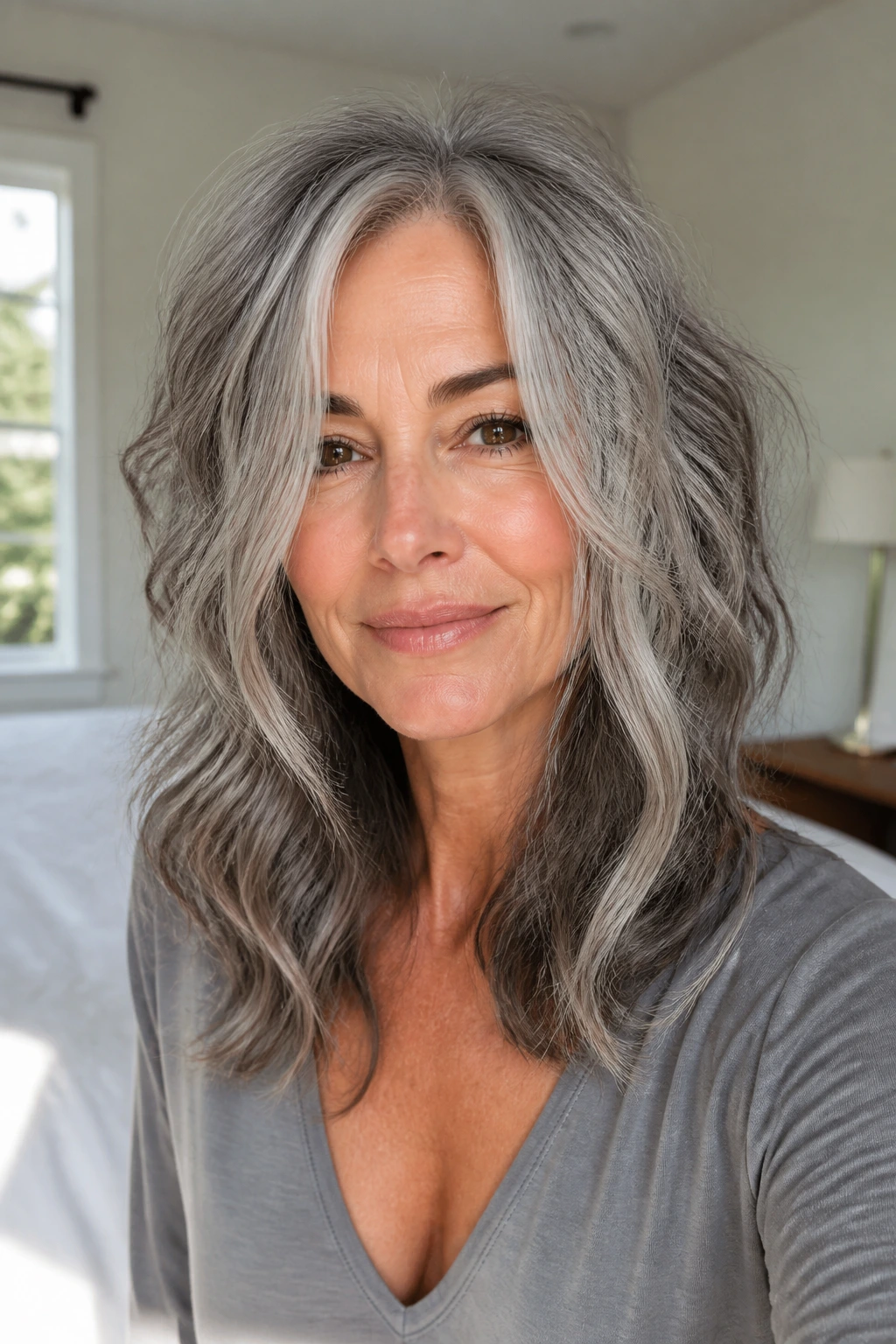
If you are going to air-dry, the haircut has to do some of the work for you. This shag is built with longer, ribbon-like face-framing pieces that separate naturally as they dry. The rest of the layers stay soft and loose, so the final shape looks casual instead of unfinished.
How it behaves: Put a lightweight curl cream through damp hair, rake it with your fingers, then twist the front sections away from the face for a few minutes while they dry. That little twist helps the ribbons hold their direction. After that, leave it alone. Touching it too much breaks the wave and gives you frizz.
This is one of the easiest ways to make gray texture look intentional on ordinary mornings. A good cut can do a lot. The air-dry routine just lets it show off.
16. Nape-Soft Shag with Lifted Crown
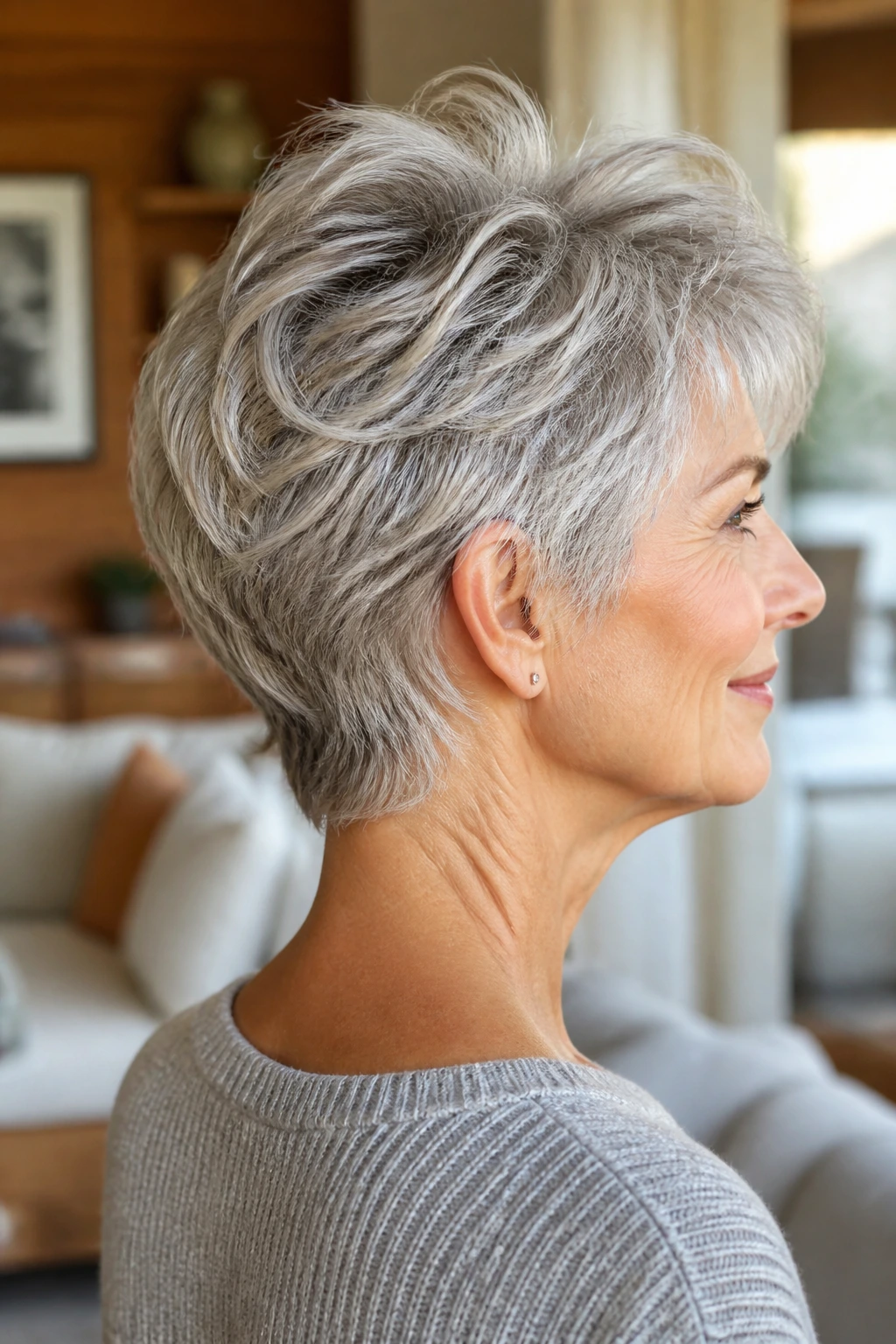
A nape-soft shag keeps the back of the hair light and close, which helps if your neckline feels crowded by heavy layers. At the same time, the crown stays lifted, so the silhouette doesn’t go flat from front to back. That contrast makes the head shape look cleaner.
What to notice: A good stylist will leave softness at the nape rather than carving it bluntly. The back should taper, not stack. If the nape gets too heavy, the whole haircut can feel old-fashioned in a hurry.
This version is especially flattering if you wear earrings, scarves, or high collars. It leaves the neck visible and keeps the haircut from competing with your clothes. That’s a small detail, but it changes the whole mood of the look.
17. Curly-Wavy Hybrid Shag

Some gray hair sits right on the border between wave and curl, especially around the ends. A hybrid shag respects that by layering the hair in a way that supports both patterns. The curls can spring a bit, the waves can bend a bit, and neither has to be forced into a single story.
The key: Ask for the cut to be shaped on dry or mostly dry hair if possible. Wet curls can lie to you. Once the hair dries, the pattern changes, and the layers need to be placed where the hair actually lives, not where it looked like it lived in the bowl.
This cut is useful if your texture changes from one season to another or from one section of your head to the next. The shag gives the hair room to behave differently in different spots. That is not a flaw. It’s the whole point.
18. Blunt-Edge Shag with Soft Layers
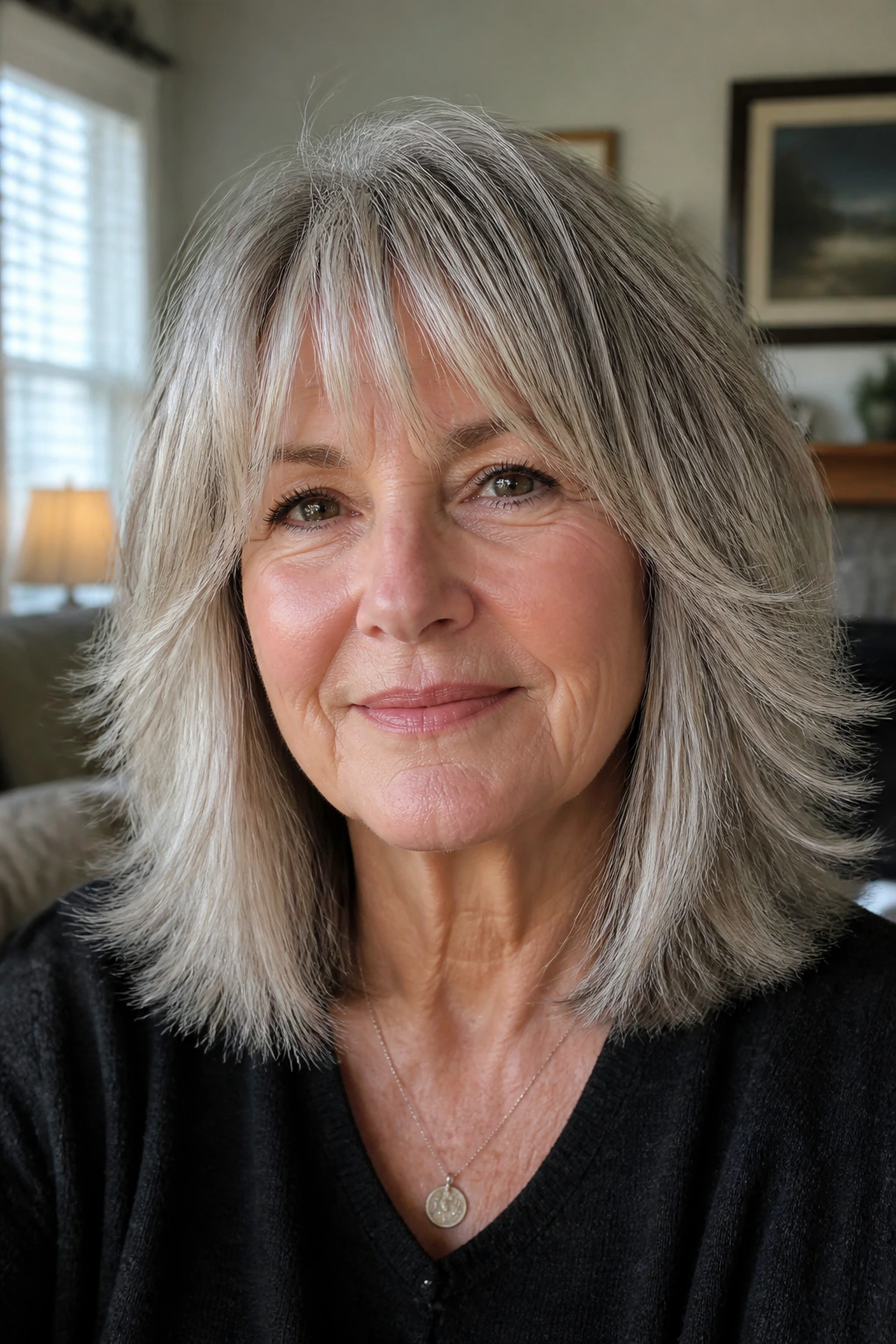
Here’s a slightly contrarian one: a shag does not have to be shredded to work. A blunt-edge shag keeps the bottom line a little stronger while soft layers lift the top and sides. The result is more grounded and less wispy, which can be a relief if your gray hair feels sparse at the ends.
Why I like it: It holds density. Some layered cuts take too much off the perimeter and leave the hair looking hollow. This one keeps the shape fuller while still letting the top move. That balance is especially kind to medium-thick hair.
You’ll usually style this with a smoothing cream and a soft bend at the ends. Not straight. Not curled. Just enough curve to show the layers. Very civilized. Still relaxed.
19. French-Inspired Shag with Eyebrow-Grazing Bangs

This one has a little polish, a little looseness, and a fringe that sits right around the brows. The shape feels tailored without being stiff, which is why it works so well with silver or pewter-gray hair. The bangs frame the eyes, and the sides stay soft instead of overconstructed.
What keeps it chic: The bangs should be light enough to separate with your fingers. Heavy bangs on gray hair can look blunt in a way that swallows the face. A lighter brow line keeps the haircut bright.
I’d choose this for anyone who wants a more styled effect without a lot of daily drama. It looks especially good with a side tuck on one side and a loose piece left out on the other. Small asymmetries make it breathe.
20. Low-Maintenance Silver Shag
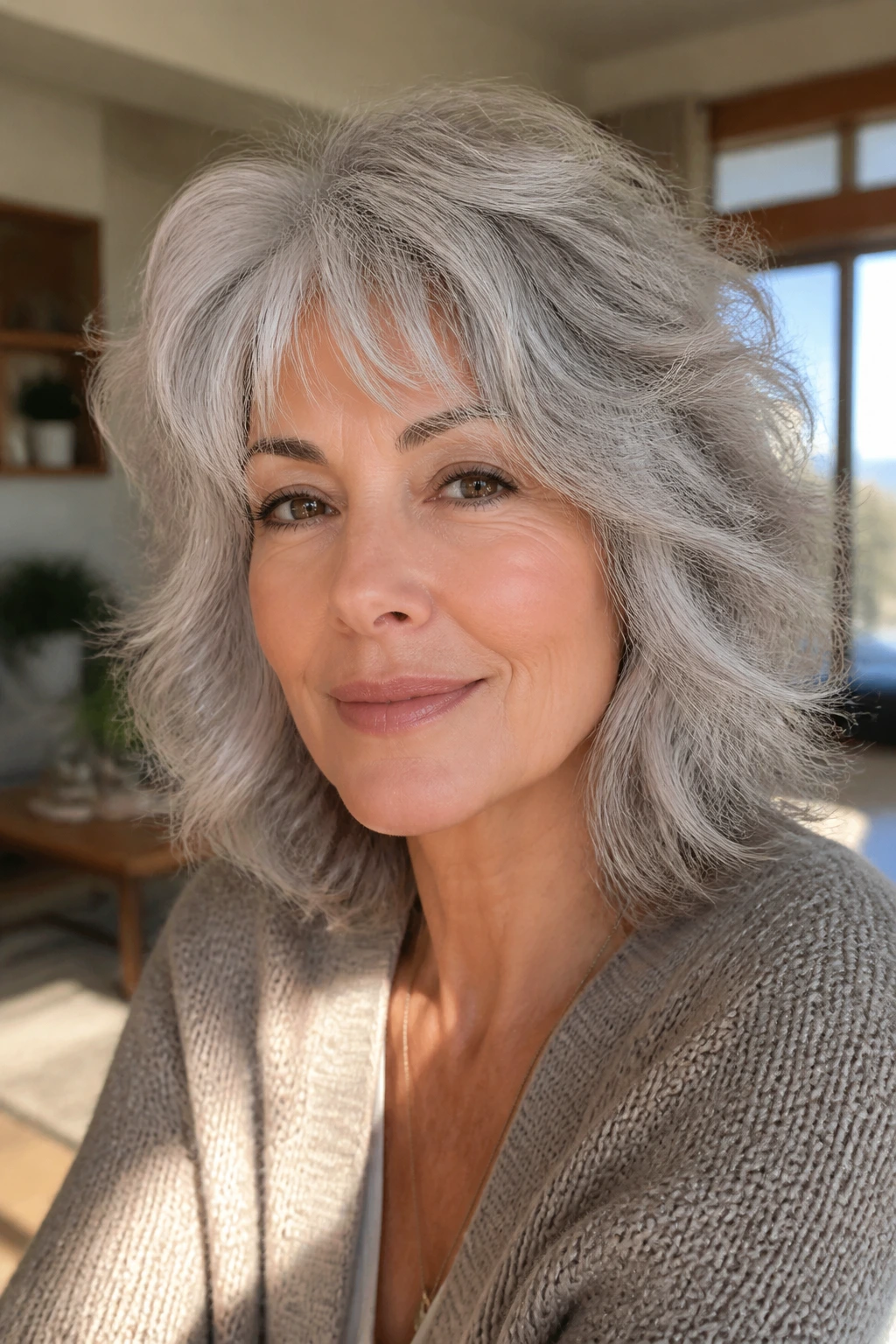
Some cuts ask for a whole routine. This one doesn’t. A low-maintenance silver shag uses medium layers, a forgiving fringe or no fringe at all, and an outline that still looks decent when the styling gets lazy. It’s the haircut I’d suggest to someone who wants shape but doesn’t want to become a student of mousse.
Why it matters: The layers should be soft enough to move but not so short that they need constant fixing. A trim every 8 to 10 weeks keeps it neat. If you wait longer, it can start to grow into a triangle, and nobody enjoys that.
This cut is a good fit for travel, humid weather, and busy weeks. It behaves on second-day hair, which counts for a lot. Maybe more than a lot.
21. Long Shag with Hidden Internal Layers

Long hair can still be shaggy without looking chopped up. Hidden internal layers remove weight from the center and underside, so the surface keeps its length while the wave gets more lift. It’s a smart choice for women who like having hair on the shoulders but hate how heavy it can feel by noon.
The nuance: The layers should be mostly invisible when the hair is dry and smooth. That’s the point. You feel the movement more than you see the cut. If the layers shout, they’re probably too short.
This cut works especially well if your gray pattern is mixed with darker strands underneath, because the movement reveals color shifts in motion. Very little fuss. Lots of payoff.
22. Tapered Shag for Glasses Wearers

Glasses change the whole equation. A tapered shag keeps the sides from crowding the frame while letting the top and crown keep their lift. The fringe can be side-swept or softly broken at the center, depending on where your frames sit and how much forehead you want to show.
Best detail: The layers around the temples should end above or just beside the frame line, not inside it. If they sit right on the glasses, the haircut and the frames start fighting each other. That annoyance is easy to avoid with a good consultation.
This one looks tidy without going stiff, and it keeps the face open. If you wear larger frames, it’s especially useful because the hair won’t disappear behind the lenses or puff up around the arms.
23. Elegant Mid-Length Shag with Loose Ends

This is the version for someone who wants the movement of a shag but still likes a little quiet elegance around the face. The length usually sits between the shoulders and collarbone, and the ends stay loose rather than heavily razored. Gray waves look especially nice in this shape because the soft perimeter keeps the cut from feeling too edgy.
Why it closes the list well: It’s adaptable. You can wear it tucked, clipped, blown out, or air-dried, and it still reads as deliberate. The loose ends make the whole thing feel less severe than a sharper shag, which is useful if you want softness more than attitude.
If you’re unsure where to start, this is the safe bet that doesn’t look safe. That’s a rare thing.
What Makes a Gray Shag Feel Fresh Instead of Overdone
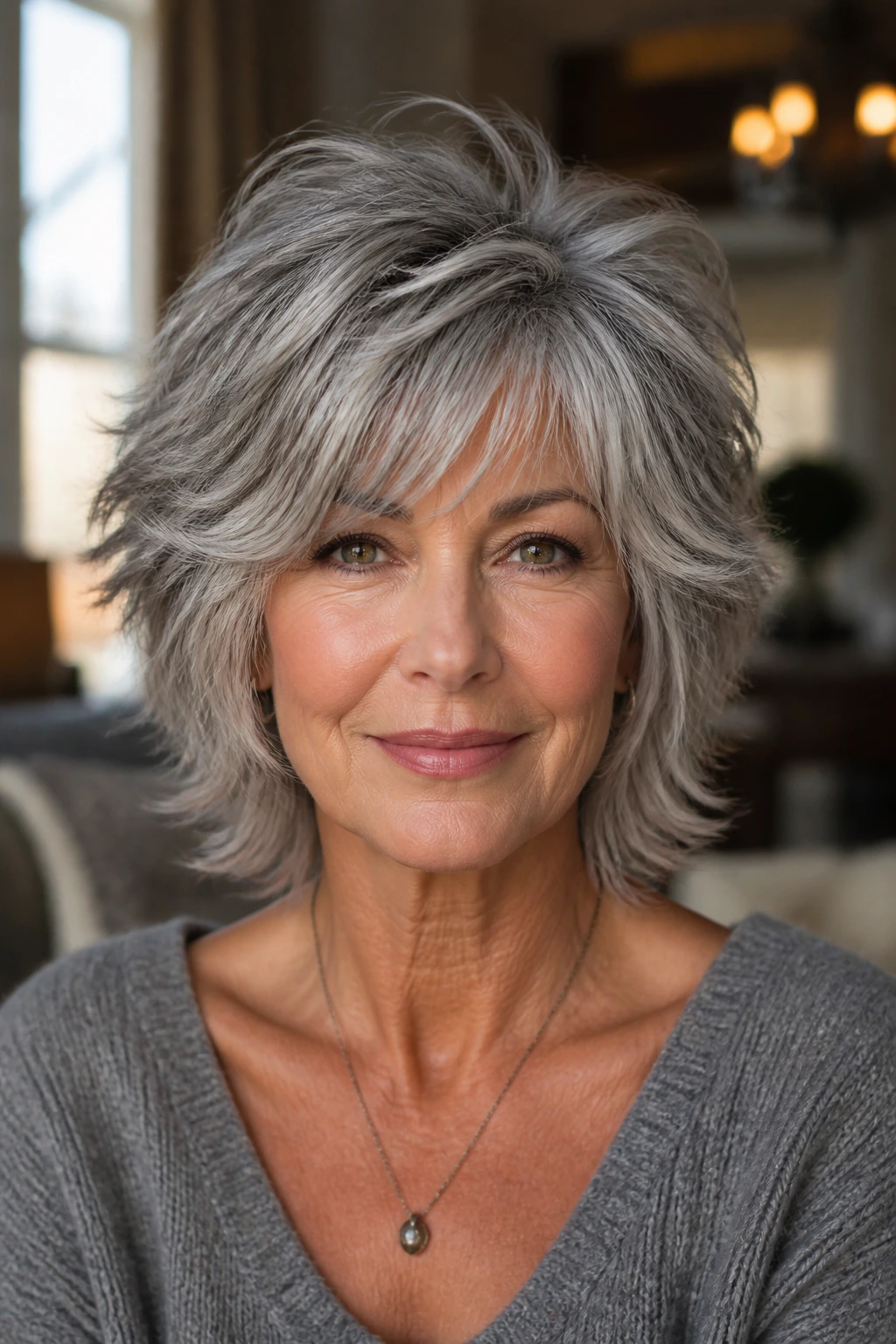
A good gray shag has movement in the crown, a face frame that does not sit too heavy, and a perimeter that still holds enough structure to look finished. That sounds simple. It isn’t, because gray hair shows every blunt corner and every over-thinned end a little faster than darker hair does.
The shape should match the way your hair actually behaves on day two, not only on the salon chair. That’s where the real usefulness lives. If the cut still looks like itself after a sleep, a misting of water, and a quick scrunch, you’ve got the right version.
What to Tell the Stylist Before the First Snip

Bring two or three photos at most. One should show the overall shape you want, and one should show the fringe or face frame. More than that usually muddies the conversation, because one photo may have thicker hair, different growth patterns, or a blowout that has no relation to your own head.
Tell the stylist where your wave starts and where it collapses. That sounds small, but it’s the difference between a cut that helps your hair and a cut that just looks cute in the chair. If the wave kicks in around the ear, you’ll need different layering than someone whose waves begin right at the root.
Speak plainly about density, not age. Fine, medium, coarse. Dense, sparse, or mixed. A good shag is built from those facts. If you wear glasses, say so. If your fringe splits on the left, say that too. Those details shape the haircut more than any generic description ever will.
Tools That Make Gray Waves Behave
-
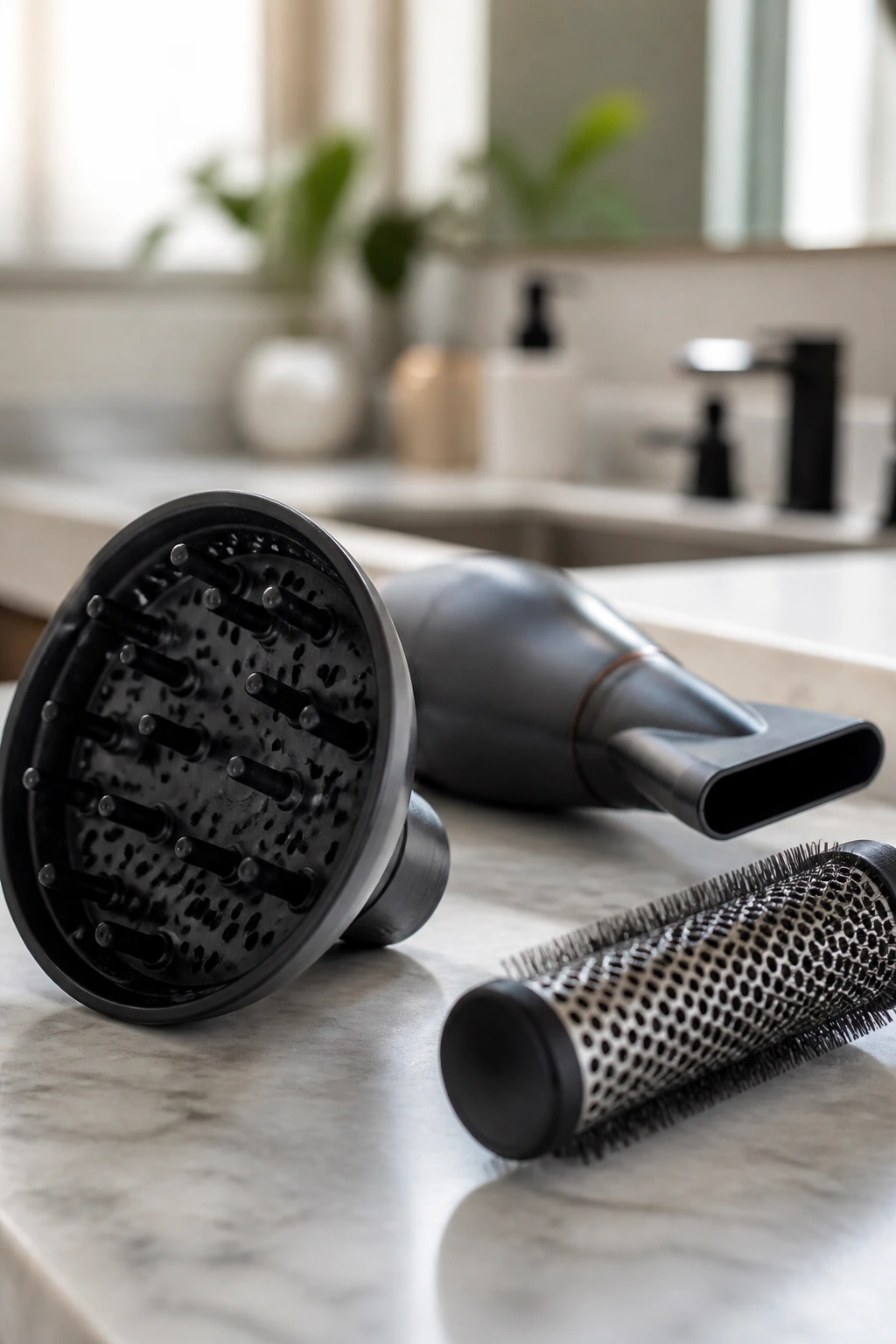
Blow dryer with a nozzle: Directs airflow at the roots so the crown gets lift instead of fuzz.
-
Diffuser attachment: Useful if your waves turn into curls in humid air and you want the pattern to dry in place.
-
1- to 1.5-inch round brush: Good for shaping curtain bangs, the front sections, and the first inch of lift near the scalp.
-
Wide-tooth comb: Safer than a fine comb for wet wave patterns; it separates without pulling the shape apart.
-
Lightweight mousse: Gives roots some memory without making silver strands sticky or dull.
-
Texture spray or dry shampoo: Helpful on day two and day three when the shape needs a little grit.
-
Heat protectant mist: Necessary if you use a dryer or iron often; gray hair can feel dry faster, and you do not need extra heat damage.
-
Duckbill clips: Great for pinning the top while you dry the lower layers or for setting a side part.
How to Keep the Shape Between Salon Visits

Gray shag haircuts usually stay in shape longer than blunt cuts, but they are not magic. Trim the fringe every 4 to 6 weeks if you wear bangs. Let the full shape go 8 to 12 weeks between appointments, depending on how fast your layers grow and whether the perimeter starts to flare out.
Wash as often as your scalp needs, not according to someone else’s routine. Fine hair often likes a lighter schedule because too much conditioner can flatten the crown. Thicker or coarser gray hair may want more moisture, especially on the ends. Use a lightweight conditioner from the ears down, then rinse well. Gray strands hang on to product if you are sloppy.
For day-two refreshes, mist the hair lightly with water, add a pea-sized amount of mousse or curl cream, and scrunch the ends. If the roots go soft, put a bit of dry shampoo under the top layers, not just on the visible part line. That gives the haircut a clean lift without leaving a white cast.
Common Mistakes That Flatten a Good Shag
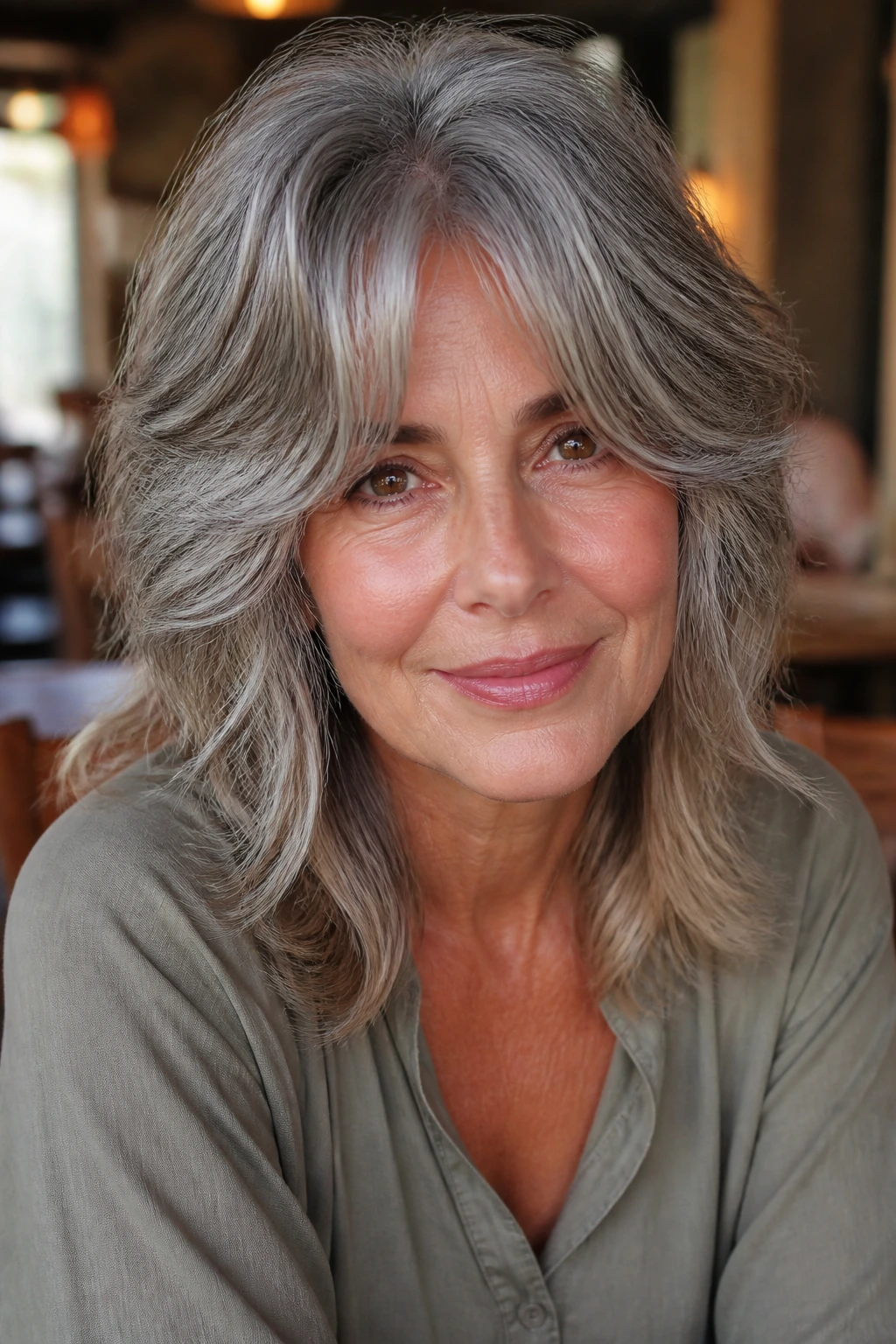
The first mistake is cutting the fringe too short. Gray hair often springs up more than expected, especially if it’s coarse or wavy. The fix is simple: dry the fringe fully before final trimming, and keep the first version a touch longer than you think you need.
The second mistake is over-thinning thick gray hair. When the ends get too wispy, the haircut starts to split and puff at the same time. Ask for bulk removal inside the shape, not a heavy texturizing job on the perimeter.
Another one: using heavy creams and oils everywhere. Gray waves can go flat in a hurry. If the hair starts looking limp by lunchtime, move to lighter mousse or spray cream and use oils only on the driest ends.
And then there’s ignoring the glasses line or jawline. The haircut should sit with your face, not against it. If layers collide with your frames or the nape looks too blunt, the whole shape turns fussy.
Variations Worth Trying If You Want a Softer or Sharper Look

The Softer Salon Shag keeps the layers longer and the fringe lighter. It’s the best choice if you want movement without a visibly choppy finish, and it’s especially kind to fine gray waves.
The Wolf-Shag Lite pushes the crown a little higher and the ends a little pieceier. Choose it if you like a bit more edge and don’t mind a style that says something on purpose.
The Fringe-Free Shag skips bangs entirely and leans on cheekbone and collarbone layers. That works well if your forehead opens nicely or if you wear glasses and don’t want extra material around the frame.
The Long Silver Swirl keeps length below the shoulders and softens everything else. It’s a quiet option for women who want movement without giving up the feeling of long hair around the neck.
Frequently Asked Questions

Will a shag make gray hair look thinner?
Not if it’s cut well. The mistake is over-thinning the perimeter; that’s what creates a see-through look. A good shag keeps enough weight at the ends to look full, then uses internal layers for lift.
Is this cut good for fine wavy hair?
Yes, if the layers are soft and controlled. Fine waves usually do better with a rounded shape and a lighter fringe, not a heavily razored finish that exposes too much scalp or makes the ends look sparse.
Can I wear a shag with glasses?
Absolutely, but the layers need to respect the frame line. Side-swept bangs or a taper around the temples keeps the hair from crowding the glasses arms or sitting in your eyes all day.
How often should I trim it?
Fringe-heavy versions usually need a trim every 4 to 6 weeks. The rest of the cut can often go 8 to 12 weeks before the shape starts to drift.
Should gray shag layers be razored or cut with scissors?
Either can work, but the texture matters. Razor work softens thick, resilient hair fast; scissors are safer if the strands are fine or already fragile. A mix of both is often the smartest answer.
What if my waves go flat at the roots?
Start with a root-lifting spray or mousse at the crown, then blow-dry just the top section before touching the rest. If you let the crown dry flat first, it usually stays that way.
Does this style work on thick, coarse gray hair?
Yes, and sometimes it works better than on any other texture. The catch is bulk control. The layers need to remove weight without leaving the ends too thin, or the cut will puff in humid air.
Can I air-dry a gray shag and still look finished?
You can, if the cut is built for it. Longer face-framing pieces, a little mousse, and minimal touching while it dries make a huge difference. Air-drying a blunt cut is one thing; air-drying a well-built shag is another.
The Shape That Keeps Moving
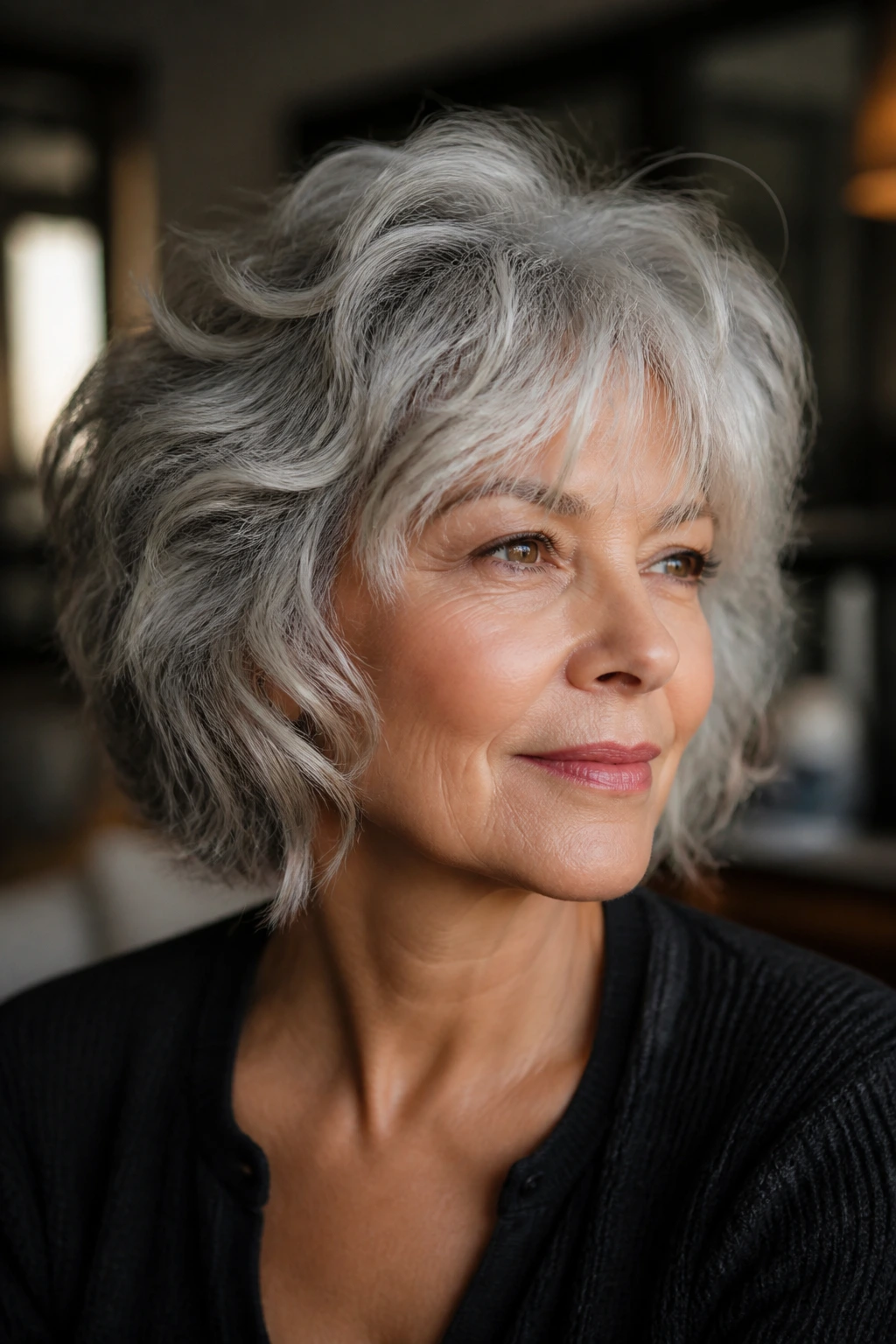
Gray waves do not need to be tamed into something stiff to look polished. In fact, they usually look better when they keep a little motion at the crown, a little softness around the face, and enough texture at the ends to avoid that heavy, helmet-like finish. That is the whole appeal of a shag. It works with the hair you actually have.
The best part is how many directions it can go. Soft and elegant. Choppy and modern. Long. Short. Bangs or no bangs. Once the layers are matched to your texture and your daily routine, the haircut stops being a project and starts being a relief. And that is worth the chair time.
