



A round face doesn’t need to be hidden. It needs a little architecture.
That’s where lob hairstyles with bangs for round faces do their best work. The length drops the eye lower, the fringe breaks up the width across the forehead, and the front pieces carve space around the cheeks instead of sitting right on top of them. When the cut is done well, the whole face looks a touch longer and a lot less circular — not because anything is being disguised, but because the hair is finally pulling in a better direction.
The mistake people make is thinking “bangs” means one thing. It doesn’t. On a round face, a blunt sheet of fringe, a soft curtain bang, a side sweep, and a bottleneck bang all behave differently. Some of them open the face up. Some of them pin it wider. A good lob gives you room to choose, and the right fringe decides whether the cut feels boxy, soft, sharp, or lived-in.
Why These 23 Lob-and-Bang Pairings Work
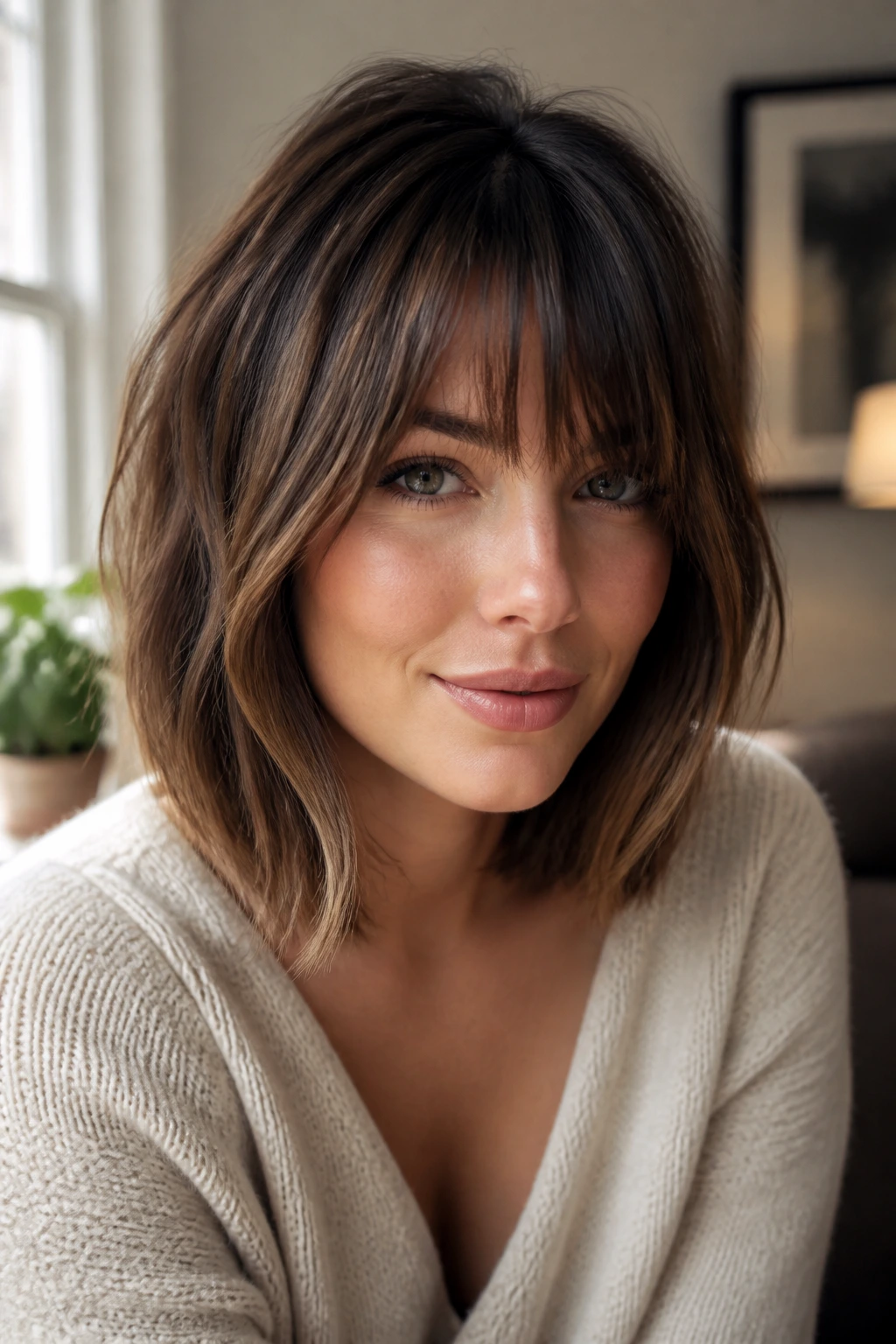
- Longer front pieces: A lob that lands below the chin gives the eye a downward path, which matters when the cheeks carry the width of the face.
- Bangs with movement: Fringe that splits, feathers, or sweeps keeps the forehead from reading as one heavy horizontal line.
- Built-in angles: Side parts, inverted lines, and asymmetry all interrupt the face’s natural roundness without making the cut look severe.
- Texture in the right place: Volume at the crown helps. Volume at the cheeks usually does not. That one detail changes everything.
- Grow-out friendly shapes: Lob lengths and softer bangs forgive awkward stages better than short cuts with hard edges.
- Style flexibility: These cuts can read polished, messy, airy, or sharp depending on how you dry them. That matters more than most people admit.
1. Curtain Bang Collarbone Lob
Curtain bangs and a collarbone-length lob are one of the easiest pairings to wear on a round face, and there’s a good reason for that. The fringe opens in the middle, so it never forms that blunt wall across the forehead, while the lob length keeps the face from looking boxed in at the jaw.
The sweet spot is the length. Ask for the ends to hit right around the collarbone, not the chin. That extra inch or two makes the front pieces fall past the widest point of the face, which is where this cut starts doing its best work.
What I like most here is the soft diagonal line. The bangs draw the eye down and out, and the longer front pieces echo that movement without feeling fussy. Blow-dry the bangs away from the face with a round brush, then give the ends a slight bend under or away from the neck. Either way, keep it loose. Too much curve turns the lob into a helmet.
Bold tip: Keep the shortest point of the curtain bang just below the brows, not halfway up the forehead.
2. Side-Swept Lob With a Deep Part
Why does a side part still work so well? Because it breaks symmetry in the fastest, cleanest way possible.
A deep side part on a lob creates a long diagonal line from the crown to the cheek, which is exactly the kind of line a round face likes. The bangs don’t sit across the forehead like a curtain; they move over one eye and skim the cheekbone instead. That shift pulls the eye sideways and downward at the same time.
This is a smart cut if your hair naturally falls flat at the top. The deep part gives you instant lift on one side, and that lift keeps the face from reading wider. Ask for the front to be left long enough to tuck behind the ear on the heavier side. That little detail matters. It keeps the fringe from collapsing into the cheek area.
If you wear glasses, this one is especially useful. The sweep creates room for the frames, and the length keeps the whole look from feeling crowded around the eyes.
3. Blunt Lob With Eyebrow-Grazing Bangs
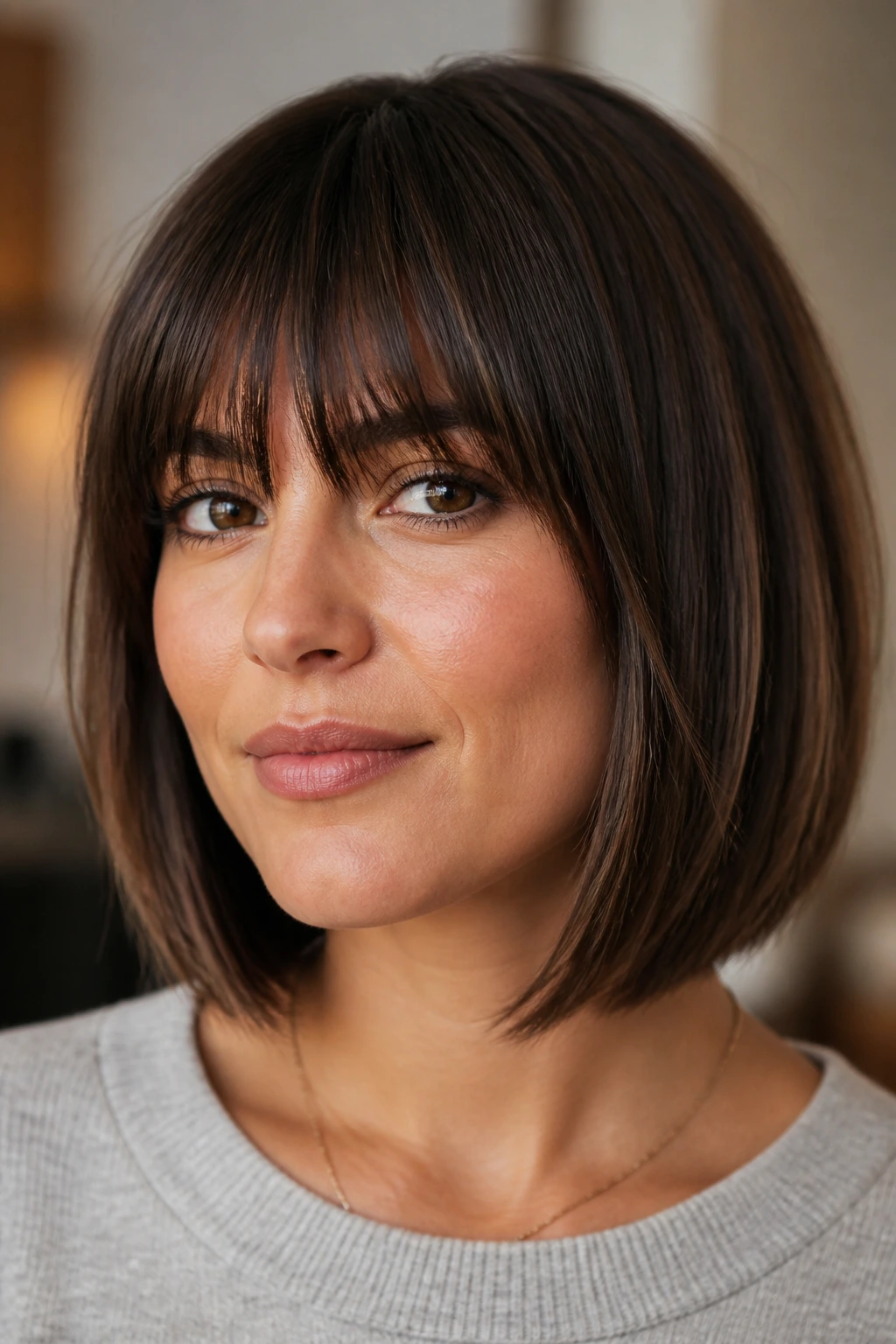
A blunt lob can work on a round face, but only when the fringe is handled with some restraint. The lob itself should stay below the chin, and the bangs should graze the brows rather than sit high on the forehead. That keeps the cut from looking too boxy.
Why It Flatters a Round Face
The blunt edge at the ends creates a clean line, which can be useful when the face already has soft curves. The fringe interrupts the width at the forehead, and the longer lob elongates the silhouette. Done right, it looks strong, not heavy.
What Keeps It From Looking Harsh
The trick is softness at the ends of the bangs. Ask for a slight point-cut or razor-soft finish so the fringe doesn’t land like a shelf. If your hair is thick, a blunt outline can get bulky fast, so a tiny bit of internal weight removal around the front helps. Not much. Just enough to keep the front from puffing up at cheek level.
This cut has real presence. It’s not airy or shy. But it rewards a steady hand and a good blow-dry, and it can be one of the sharpest options on the whole list.
4. Wavy Textured Lob With Airy Fringe
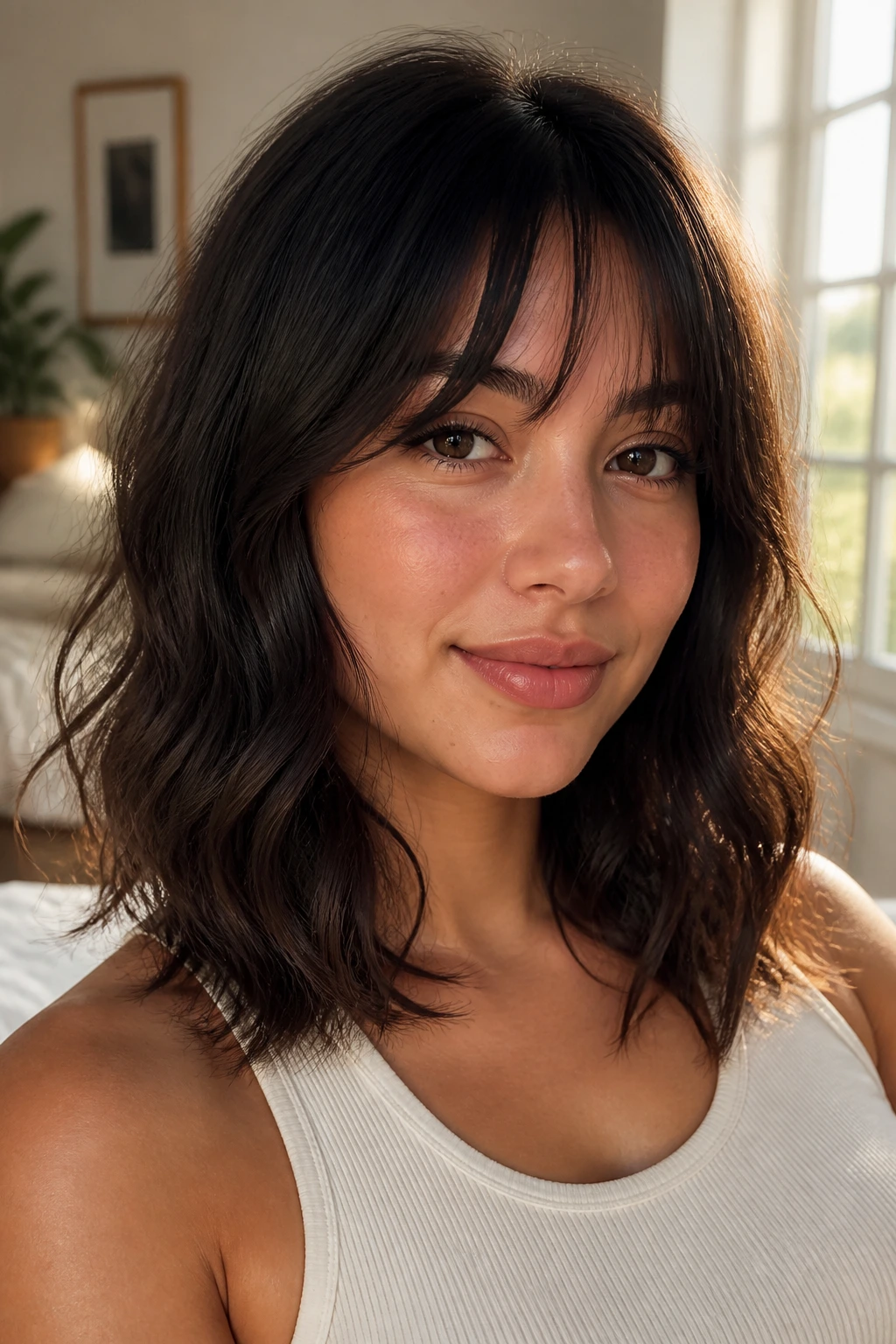
A wave breaks up a round face better than a lot of people realize. Not wild curls. Not beach-hair chaos. Just enough bend to keep the eye moving.
This version works because the waves stop the lob from forming one solid circle around the head. The airy fringe keeps the forehead soft, but the pieces are broken up enough that they don’t add width. That’s the line to watch with round faces: softness without fullness right at the sides.
Picture the cut on second-day hair. The waves have a little bend, the fringe has separated into fine strands, and the ends sit around the collarbone instead of puffing outward. That’s the version worth asking for.
- Best for: medium to thick hair with a slight natural wave
- Styling note: use a light mousse at the roots and a small amount of texture spray through the mid-lengths
- Watch for: too much volume at the cheekbone; keep the widest part of the wave below the mouth
- Ask for: soft layers that begin below the cheekbone, not right at it
5. Angled Lob With Long Front Bangs
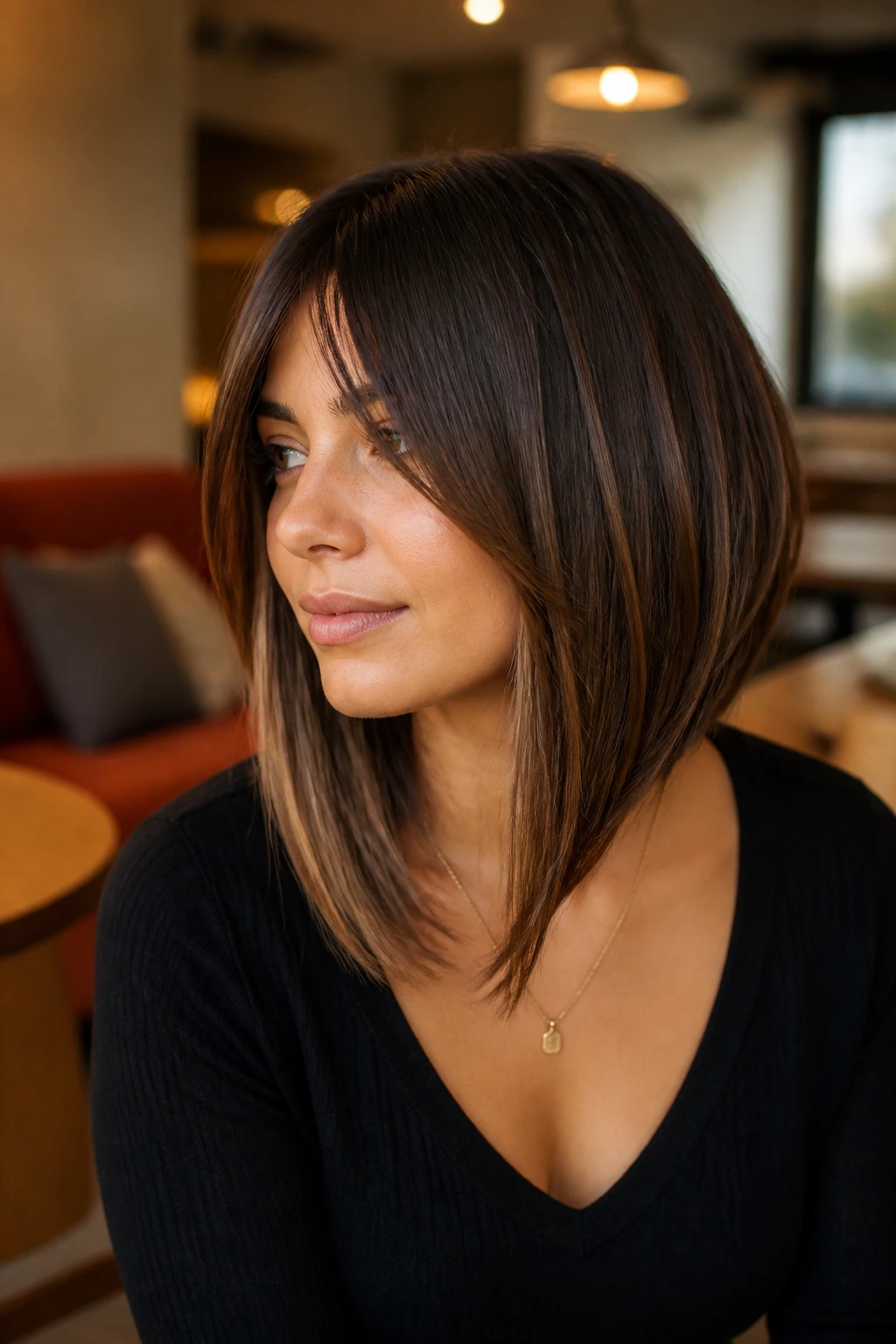
An angled lob does a sneaky thing on a round face: it shortens the look of the cheeks by putting the visual weight lower and farther forward. The back sits a little shorter, the front stretches toward the collarbone, and the bangs blend into that line instead of sitting on top of it.
That front angle is the whole story here. If the length in front is left a bit longer than the back, the cut pulls the face downward in a way that feels clean, not dramatic. Long front bangs help even more because they connect the fringe to the side pieces. The eye doesn’t stop at the forehead. It keeps going.
This shape is good if you like a haircut that looks intentional even when it’s air-dried. The angle gives you structure. The fringe gives you movement. Keep the bend at the ends subtle, though. A sharp flip under the chin can land right on the widest part of the face, and that’s where the cut loses its advantage.
6. Shaggy Lob With Piecey Bangs
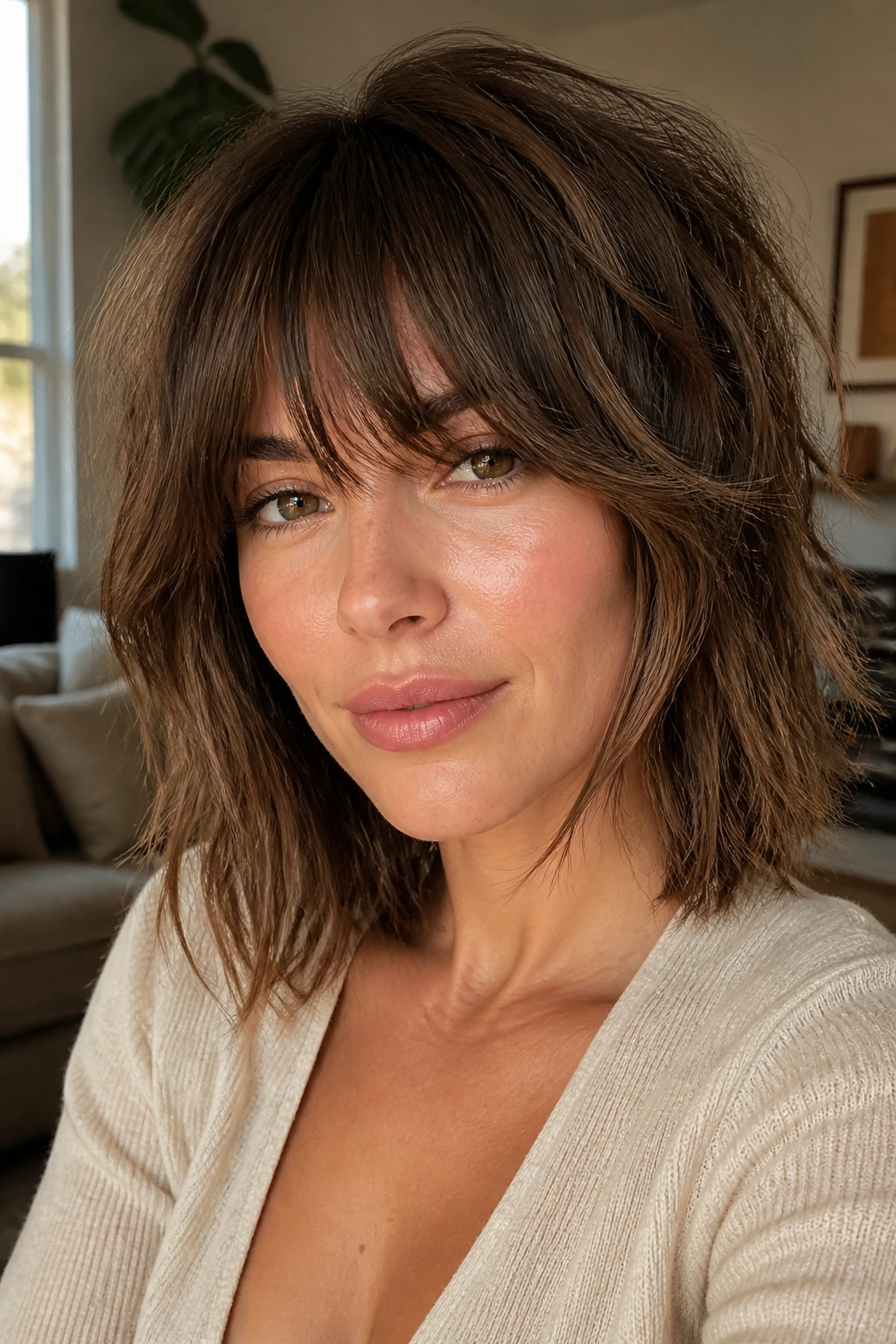
Compared with a smooth one-length lob, a shaggy lob has attitude. It’s rougher around the edges, lighter through the interior, and better at handling hair that wants to puff or frizz at the first sign of humidity.
The piecey bangs are what make it useful for a round face. Instead of one solid fringe, you get little separated sections that break up the forehead and keep the cut from looking like a single shape. The texture adds vertical movement. That matters. A lot.
This is the cut for someone who likes hair with a little grit in it. Not messy in a lazy way — messy in a lived-in, finger-tousled, “I used a diffuser and stopped there” kind of way. If your hair is thick, this shape removes weight without making the ends look thin. If your hair is wavy, it lets the bend do most of the work.
Best note: keep the shaggiest layers below the cheekbones so the width doesn’t gather where the face is already fullest.
7. Sleek Middle-Part Lob With Bottleneck Bangs
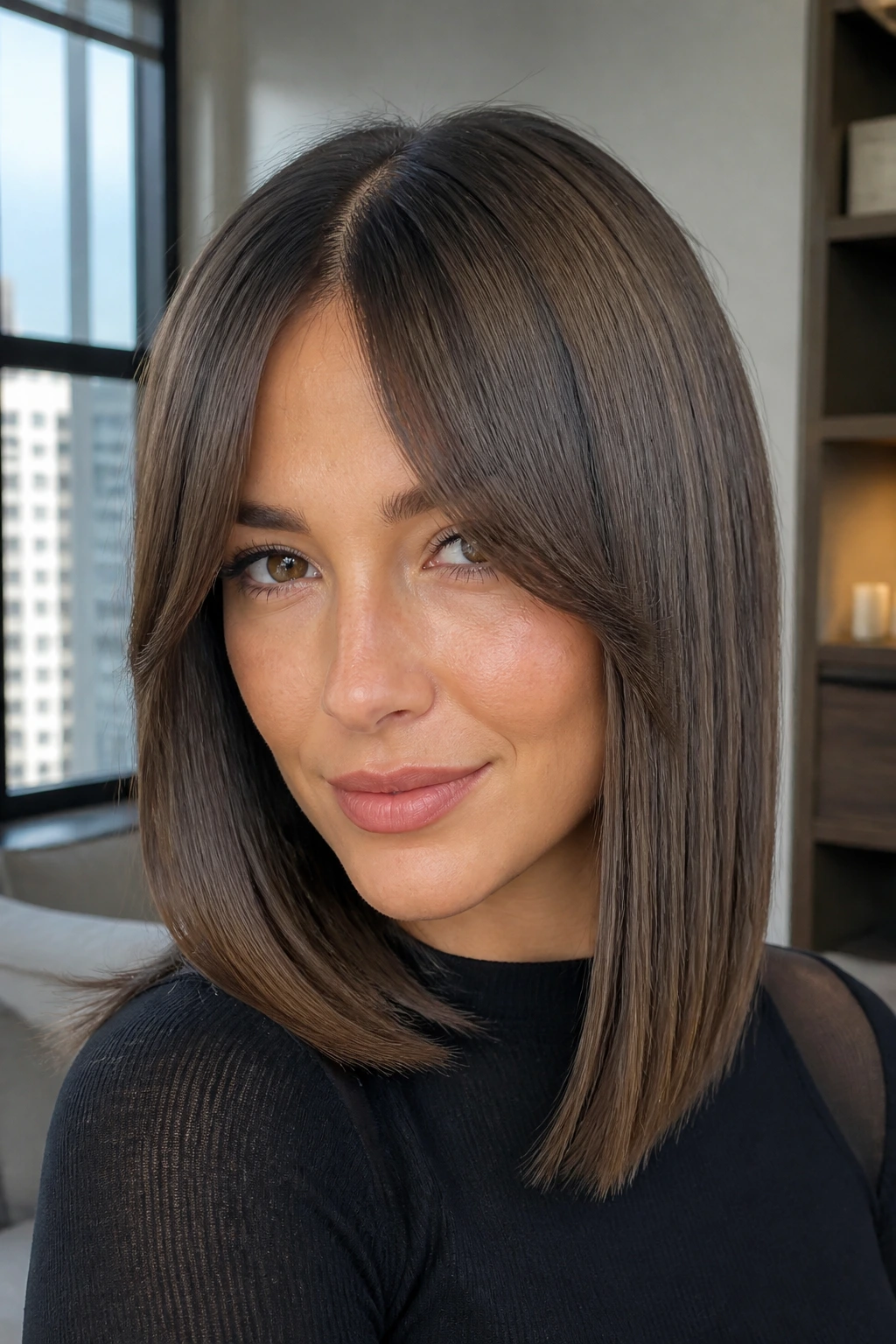
A middle part can be a good move on a round face when the fringe is shaped correctly. Bottleneck bangs do that job better than almost any other style in this group.
The Trick Is in the Taper
The center of the fringe is shorter and narrower, then the pieces widen as they move toward the temples and cheekbones. That creates a soft, tapered frame instead of a blunt horizontal band. The effect is subtle, but it’s strong. The face reads longer because the eye follows the opening in the middle.
What to Ask Your Stylist For
Ask for bangs that start near the bridge of the nose and fall into longer face-framing pieces at the temples. The lob itself should stay sleek and fairly clean through the ends. If the haircut gets too layered, the whole thing starts to blur.
This look is especially good on straight or smoothed hair. It has a precise edge, and precise edges are useful when the face already has soft shape. Keep the roots lifted just a little at the crown and let the rest stay polished.
8. Feathered Lob With Wispy Bangs
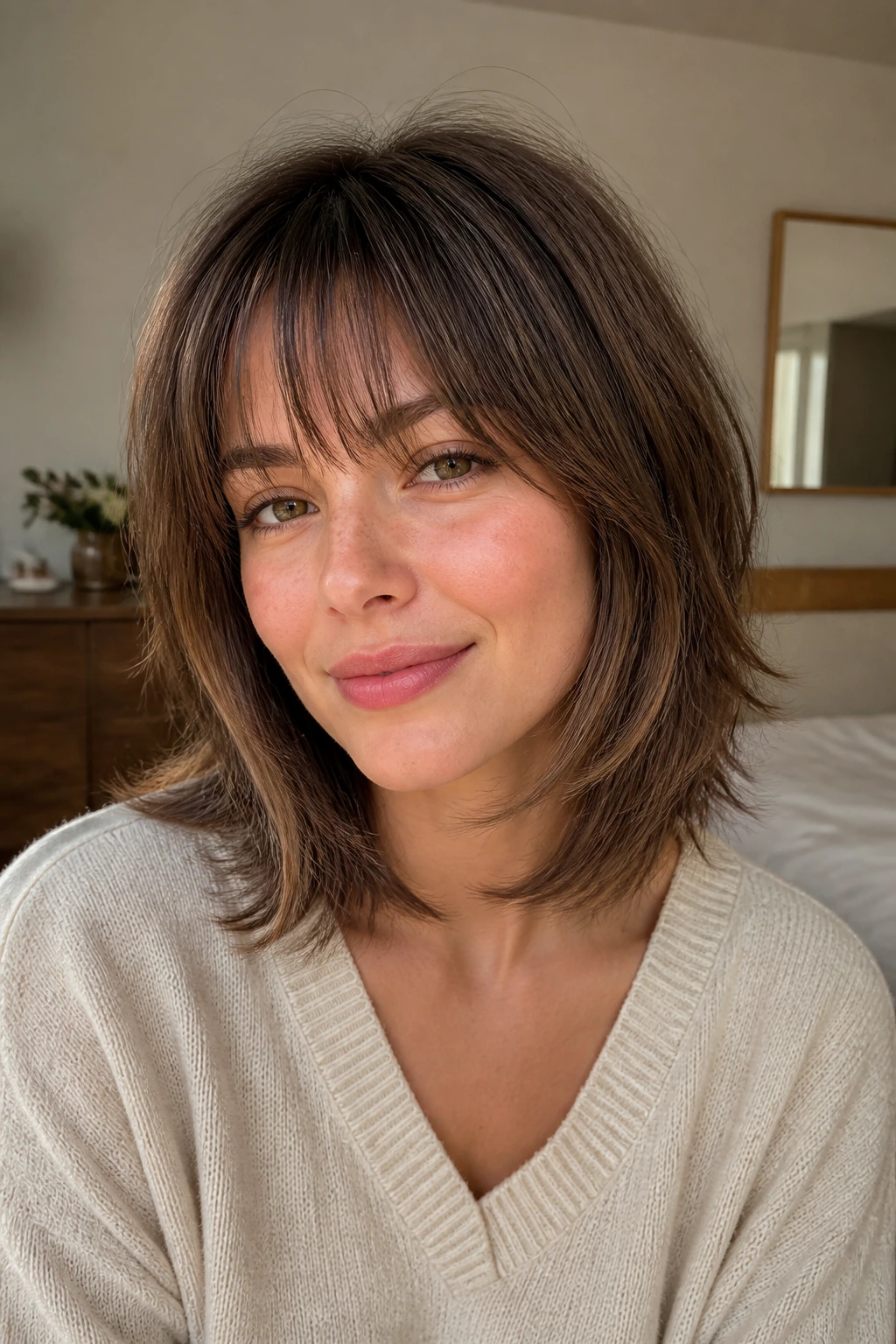
Feathered ends can make a round face look lighter, but only when the layers are handled with a little discipline. Too many choppy cuts around the cheeks will add width. Wispy bangs avoid that by keeping the front soft and transparent instead of dense.
The best version has a bit of movement near the ends, almost like the hair was brushed forward and then let fall apart naturally. The fringe should feel airy between the fingers. Not see-through, not sparse, just light. That helps the face stay open.
This one is especially good for fine to medium hair. Heavy bangs can swallow those textures, but wispy fringe lets the hair keep its lift. A small round brush and a quick pass of low heat are usually enough. Don’t overwork it. The charm is in the looseness.
One small warning: if your hairline is very strong or your forehead is narrow, a fringe that’s too thin can disappear. Keep enough hair in the bang to make a visible frame.
9. Inverted Lob With a Sweeping Fringe
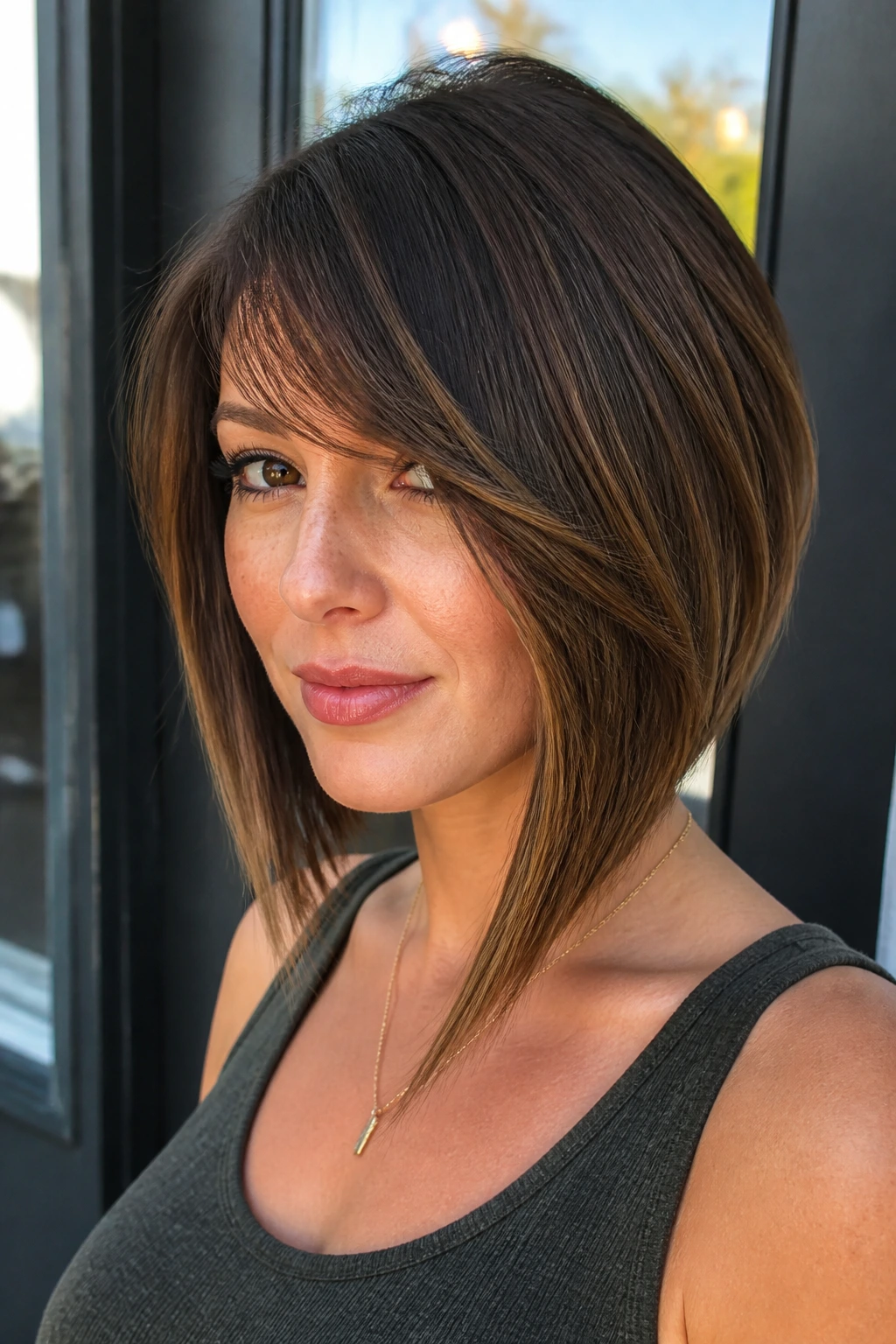
No, round faces do not have to avoid angled cuts. That old rule gets repeated a lot, and it misses the point.
What matters is where the angle starts and where it ends. An inverted lob that keeps the front long and the back shorter can be excellent on a round face because it pushes the visual line forward. Add a sweeping fringe, and the face gets a long diagonal that moves from temple to jaw without stopping at the cheeks.
This cut has more shape than a blunt lob, less softness than a shag, and a little more drama than a standard layered cut. It works best when the angle is controlled, not steep. If the front is too short, it widens the face at the exact point you want to avoid. If it’s too long, the whole cut loses the lift that makes it interesting.
I like this look on thicker hair or hair that tends to fall flat in one long curtain. The inversion gives the ends direction. The fringe gives the eye something to follow.
10. French Girl Lob With Soft Full Bangs
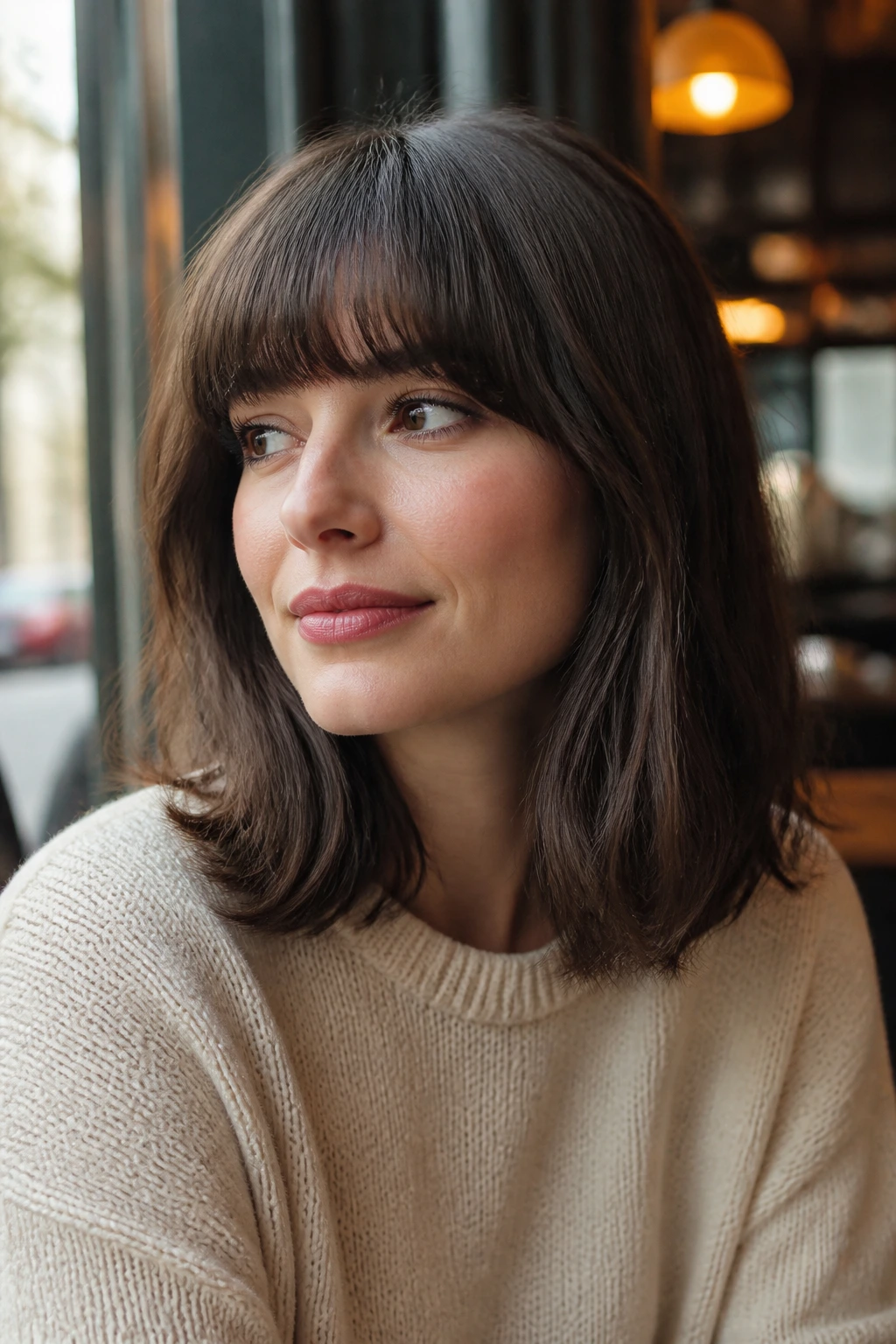
There’s a difference between full bangs and heavy bangs, and round faces need the first one, not the second.
A French-style lob usually keeps the length grazing the collarbone, while the bangs stay soft at the bottom and slightly longer at the sides. The fringe covers the forehead without building a hard line. That’s why it works. It gives shape up top, but it doesn’t trap the face inside a rectangle.
The best way to wear this look is with a little bend in the ends and a fringe that sits just above the lashes. If the bangs are cut too short, the face opens too much at the top and can feel wider. If they’re too thick, the forehead disappears and the cut looks severe. The sweet spot is somewhere in the middle, with a touch of texture at the tips.
This is one of those cuts that looks better after a few minutes of wear. The bangs loosen, the ends settle, and the whole shape feels less engineered. That matters. Hair should not look like it’s holding its breath.
11. Tousled Beach Lob With Grown-Out Bangs
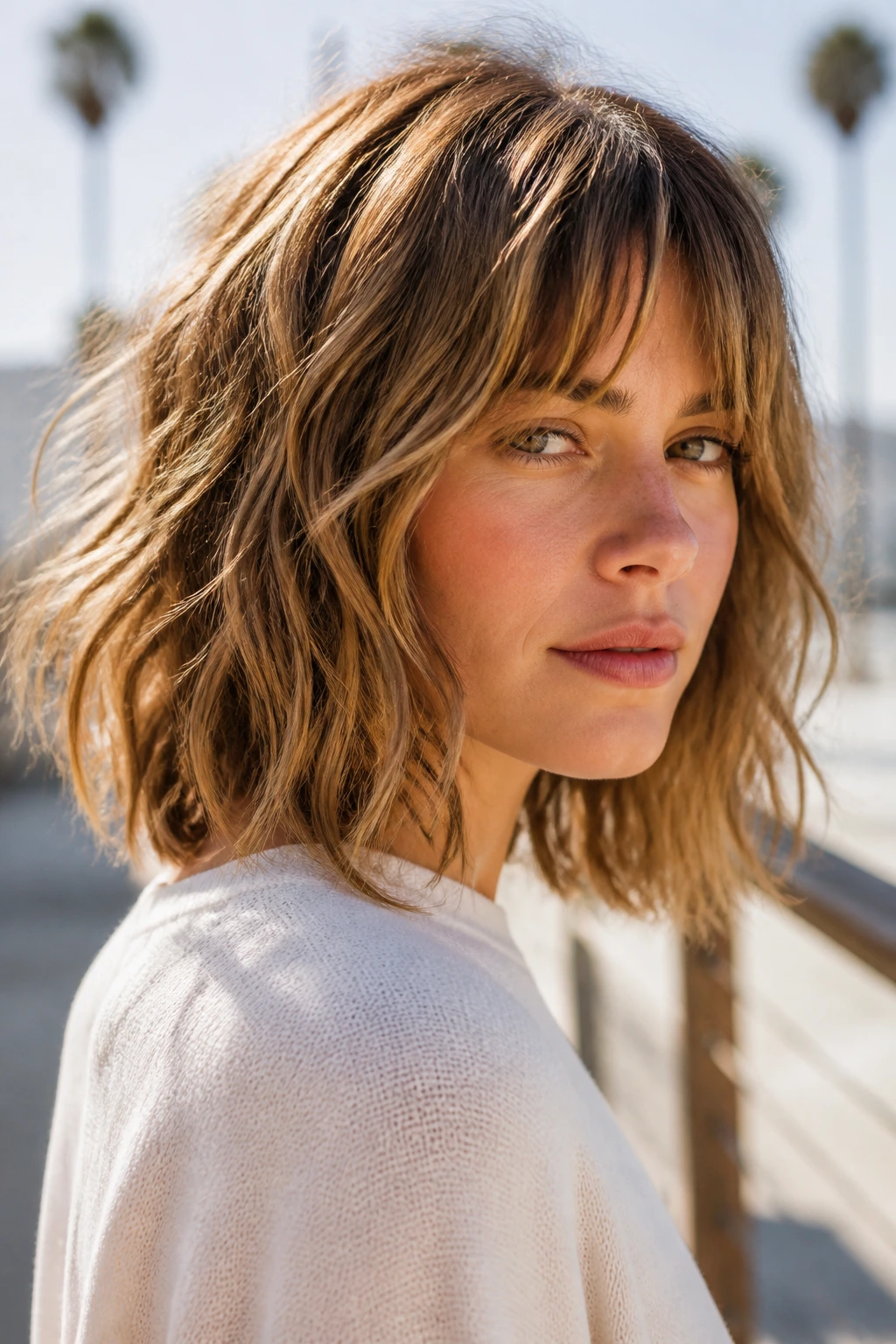
This is the cut for people who do not want to fight their hair before coffee.
Grown-out bangs split naturally at the middle or just off-center, then melt into a tousled lob with enough bend to keep the silhouette from turning round again. The key is that the bangs are long enough to sit with the rest of the hair, not on top of it. That creates a softer frame around the face and makes the cheeks look less prominent.
The texture does most of the work here. A little salt spray, a little mousse, and either a quick rough-dry or an air-dry with scrunching are enough. You do not need perfect symmetry. In fact, a tiny bit of irregularity helps. It keeps the hair from forming a smooth circle around the face.
I like this version for anyone who’s growing out old fringe. It buys time without looking awkward. The cut still feels current, even when the bangs are at that in-between stage that usually drives people nuts.
12. Curly Lob With a Curly Fringe
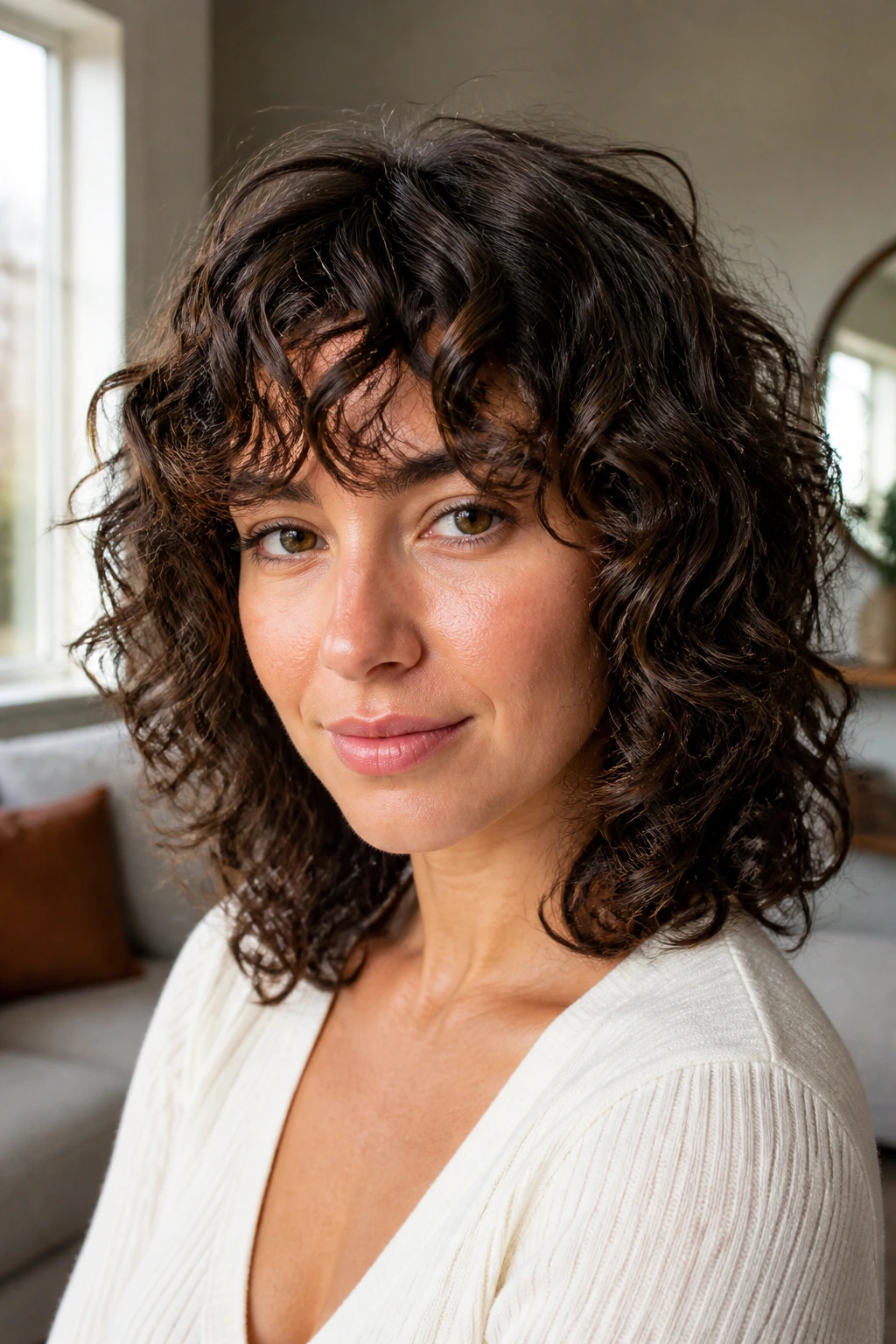
Curly hair changes the rules, and that’s a good thing. A round face can look beautifully balanced with a lob, as long as the bangs are cut for the curl pattern rather than against it.
Cut It Dry, or Close to It
Curly bangs should not be measured on wet hair and then hoped into shape. The curl shrinks, bends, and sometimes shifts sideways. A dry or mostly dry cut lets the stylist see where the fringe will actually land. On a round face, that usually means the bangs should hit around the upper cheekbone or just below the brows when dry, not when wet.
Let the Shape Follow the Curl
The lob itself should keep enough length to drop below the chin, with layers placed carefully so the width doesn’t balloon at the sides. A diffuser can help, but don’t blast the curls into a dome. That’s where the face gets wider. Work the roots first, then let the curls settle with minimal touching.
Curly fringe looks especially good when it breaks apart naturally. A soft, imperfect frame around the forehead and cheeks feels better than a tight, sculpted shape. If your curls are springy, leave room for shrinkage. If they’re looser, keep the ends shaped but not over-cut.
13. Razor-Cut Lob With Shattered Bangs
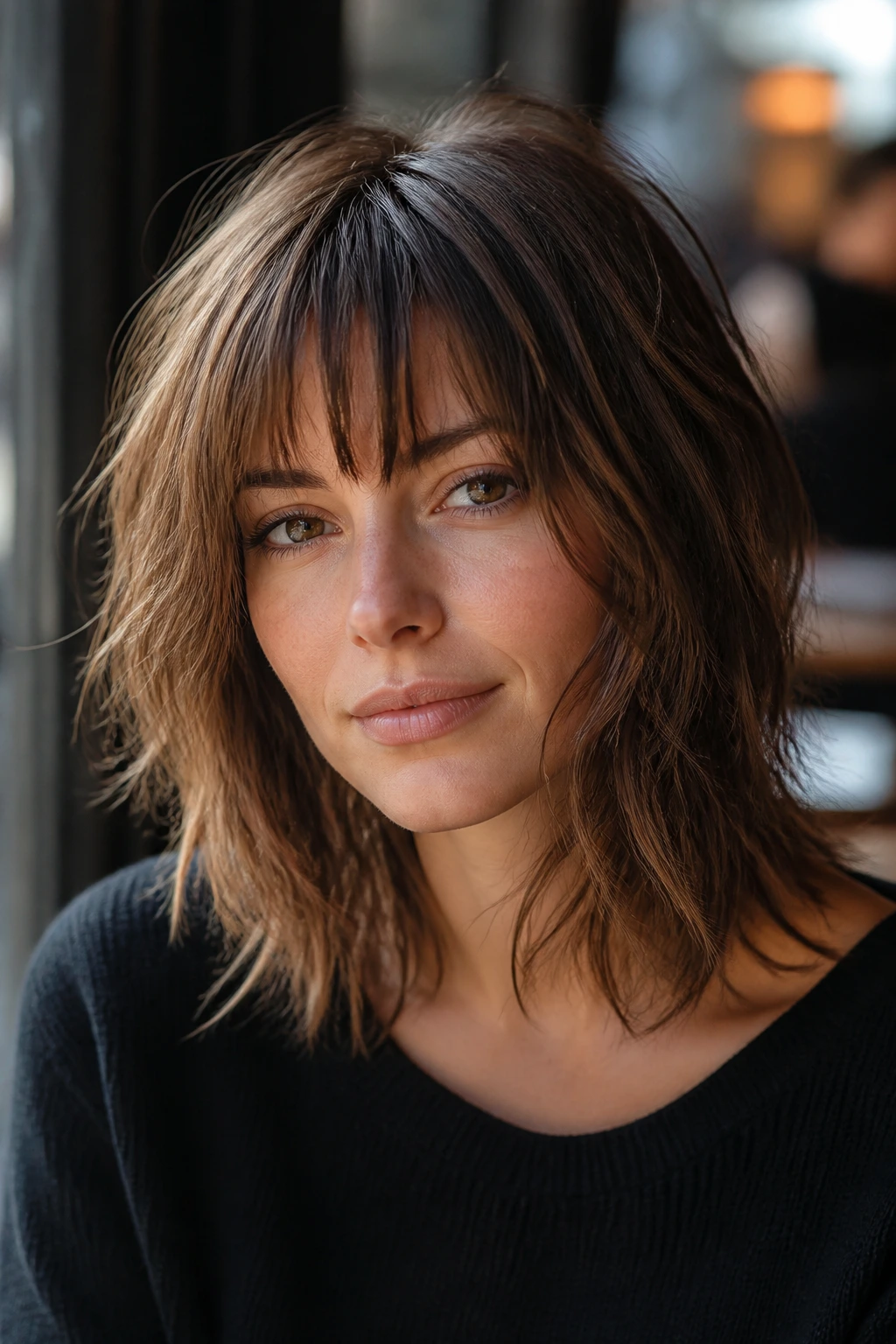
This is the cut for hair that wants movement, not polish.
A razor-cut lob takes some of the bulk out of the ends and turns the fringe into broken, separated pieces instead of one dense line. On a round face, that kind of edge can be useful because it keeps the hair from building a full circle around the cheeks. The bangs look shattered in a good way — feathered enough to show skin between the pieces.
The caveat is obvious. If your hair is already fine or fragile at the ends, too much razor work will leave it wispy in the wrong way. That’s not texture. That’s thinning. You want the cut to move, not disappear. So ask for soft, controlled razoring only where the hair is dense.
I’ve always thought this style looks best when the wear is slightly imperfect. A little bend, a little separation, a little unevenness in the fringe. It doesn’t need to be glamorous. It needs to look alive.
14. One-Length Lob With a Narrow Micro-Fringe
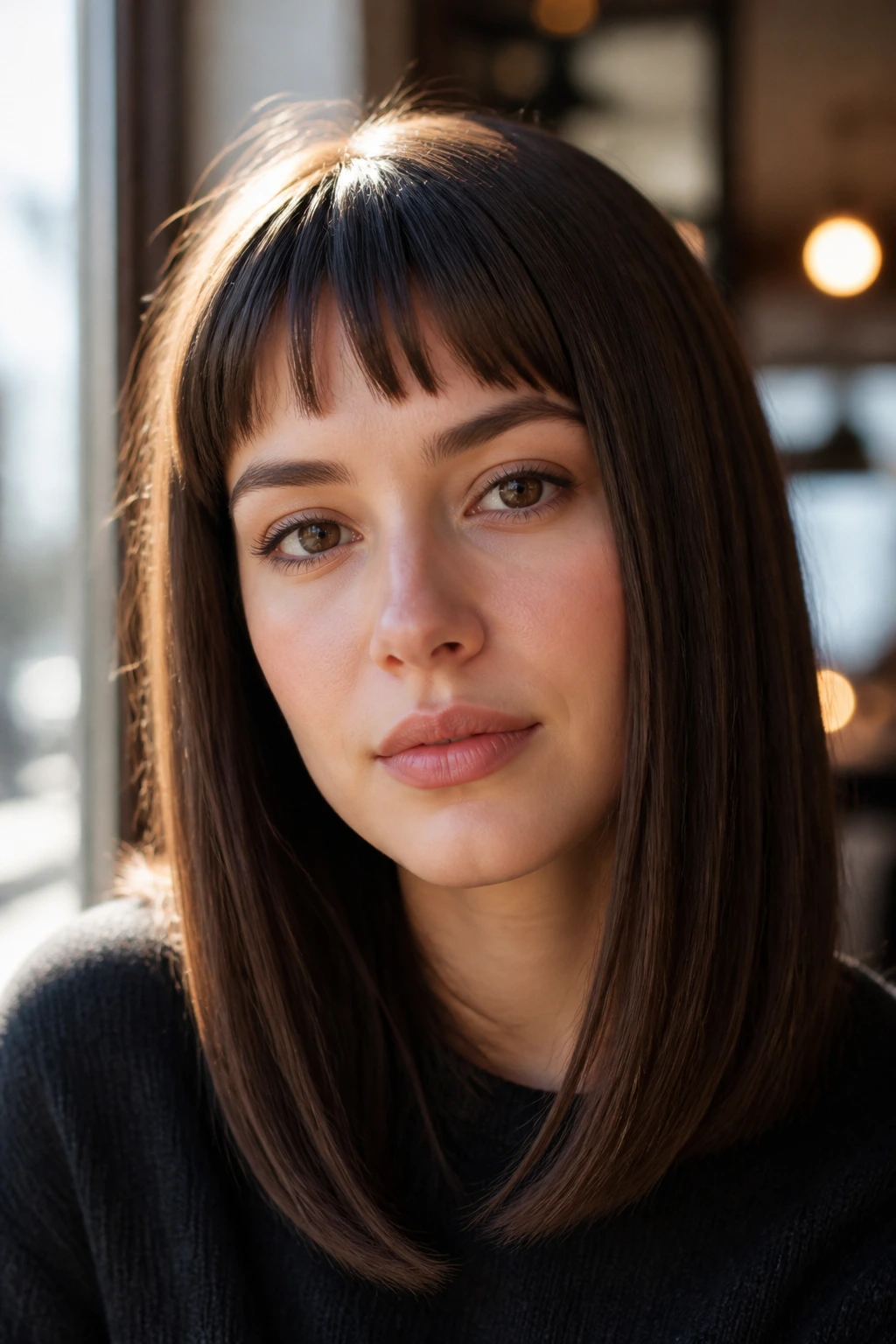
Micro-bangs sound intimidating, and on some faces they are. On a round face, though, a narrow micro-fringe can work if the rest of the cut carries enough length and softness to balance it.
The trick is not to make the fringe blunt and heavy. Keep it narrow, lightly tapered, and just long enough to show the brows or hover at the upper forehead. Then let the lob stay long enough to hit the collarbone or just below. That balance matters. A short fringe with a short cut can make the face feel wider. A short fringe with a longer lob creates contrast, which is what saves it.
This style has a little edge to it. It’s not shy. It’s also not as hard as people think when the lines are clean and the bangs are soft at the ends. If you have a strong brow line and a neat hairline, this can be a sharp, modern choice. If your forehead has cowlicks, though, this one asks for more styling than it’s worth.
15. Face-Framing Lob With Bardot Bangs
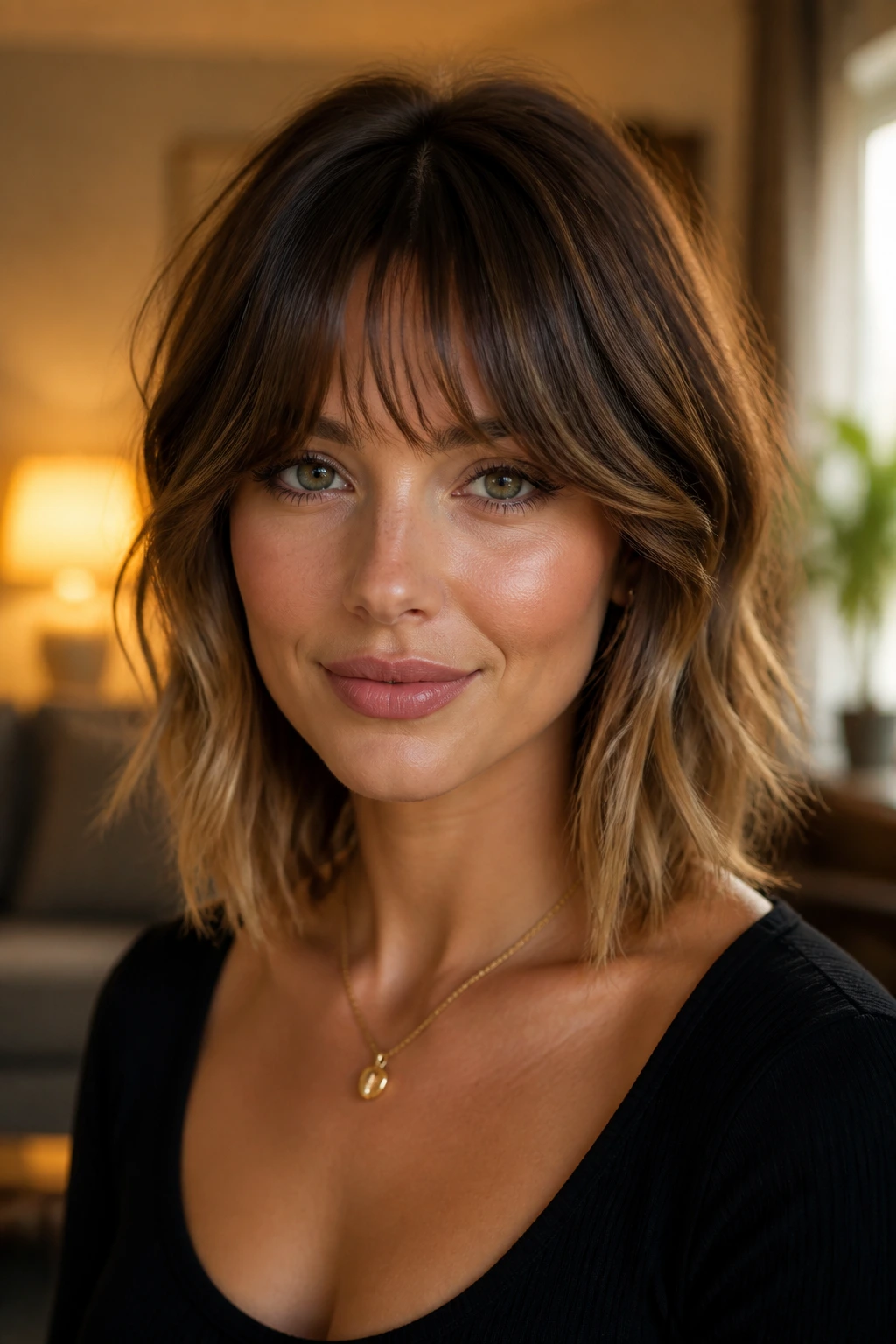
Bardot bangs sit somewhere between curtain bangs and full fringe, and that middle ground makes them useful for round faces. The center stays a little shorter, the sides open toward the temples, and the lob underneath gives the whole cut somewhere to land.
What I like here is how the bangs skim the cheekbones without covering them. That’s the exact area many people want to soften, and this shape does it without dragging the eyes sideways. The face stays open, but not bare.
This cut works especially well if you like a slightly undone finish. The fringe can be blow-dried with a round brush, then raked apart with fingers once it cools. The ends of the lob should stay soft, not poker-straight. A gentle bend keeps the haircut from feeling too formal.
If you want one cut that sits in the middle of “pretty” and “cool,” this is a strong place to start. It’s readable from across the room, but it doesn’t shout.
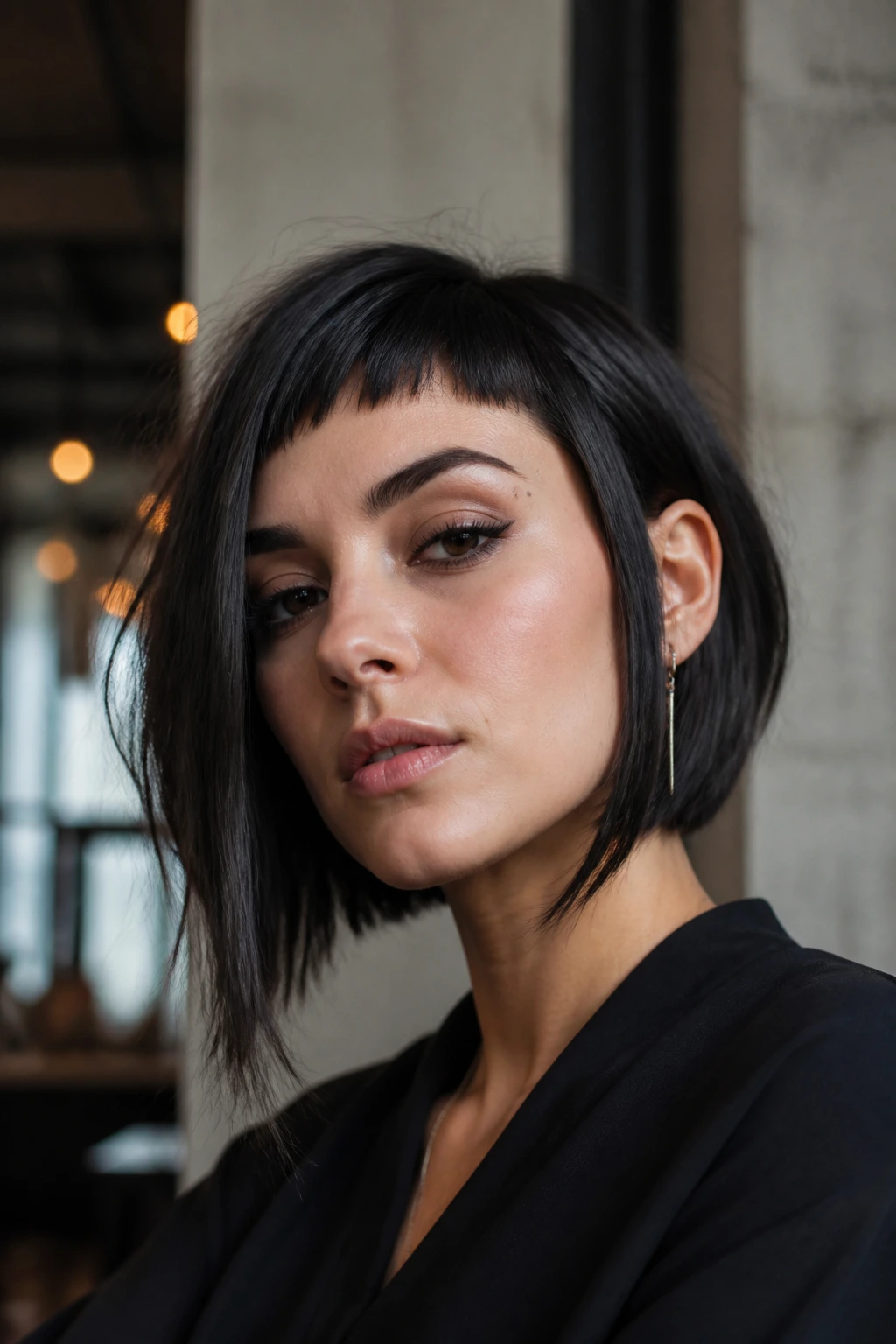
16. Asymmetrical Lob With One-Side Sweep
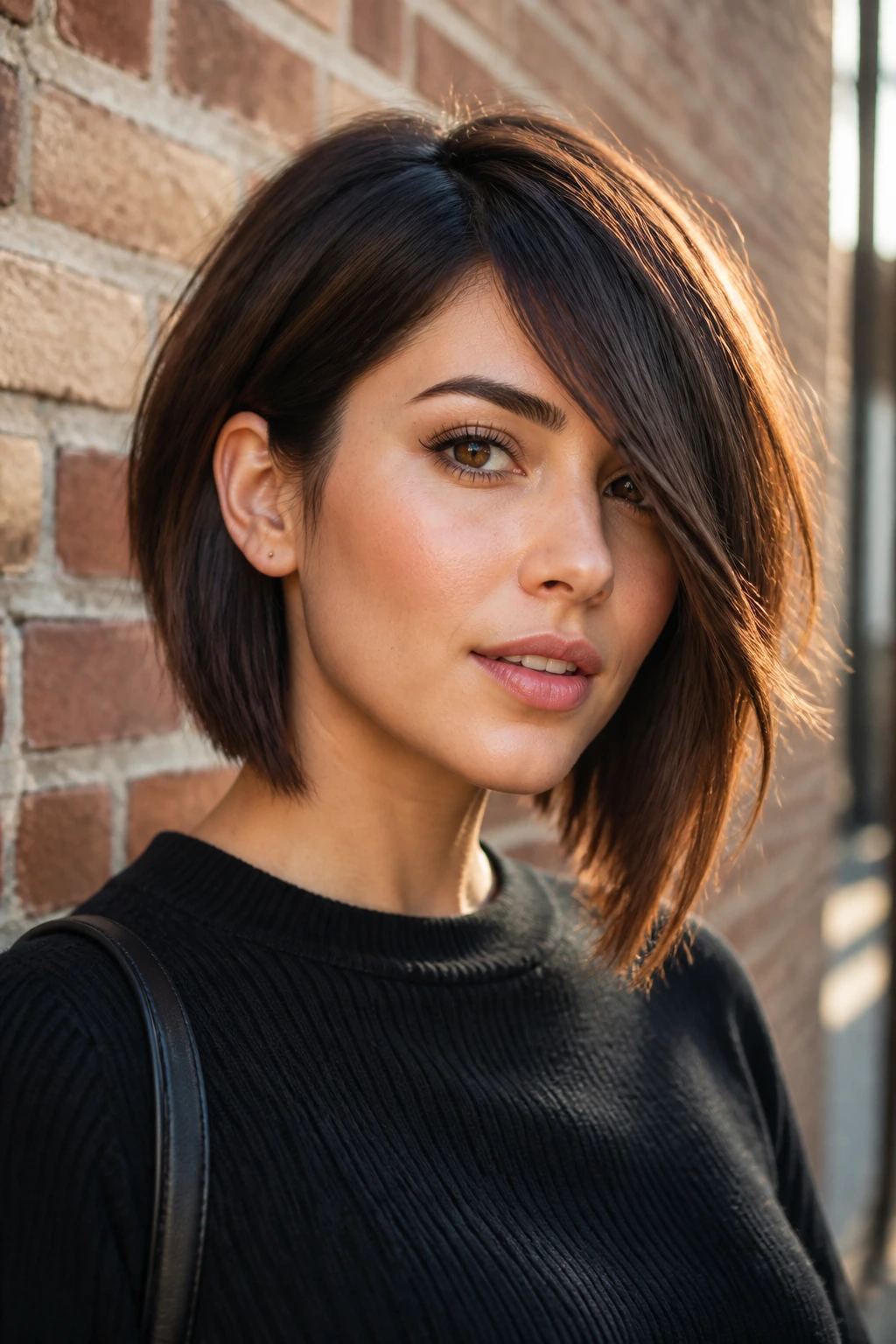
Asymmetry is useful. Simple as that.
A round face often benefits from a haircut that refuses to mirror its shape. An asymmetrical lob does exactly that by giving one side more length or a stronger angle than the other. Add a sweep of bangs from one temple across the forehead, and the face gets a long, slanted line that breaks up the circle.
This style can be subtle or dramatic. A small difference in length between sides keeps it easy to wear. A bigger difference pushes the look into fashion territory. Either way, the diagonal line is the real point. It creates motion, and motion is flattering here.
If your hair naturally parts to one side, this is a very smart way to work with it instead of arguing with it every morning. Keep the shorter side from ending right at the cheekbone, though. That’s the trap. The longest side should be the one that drops below the jaw.
17. Collarbone Lob With Choppy Layered Bangs

Choppy bangs are not the same as messy bangs. They need a plan.
On a collarbone lob, short broken-up fringe pieces can give the forehead a lighter frame and keep the whole cut from looking too polished. For round faces, that texture matters because it stops the front from becoming one wide, blunt band. The layers should be scattered enough to move, but not so many that the fringe starts fraying.
This style is especially good if your hair is medium-density and falls heavy in a straight line. The choppiness breaks the weight. It also makes styling easier because the bang pieces don’t have to sit perfectly together. A bit of separation is the point.
One clean rule: keep the shortest fringe pieces centered above the eyes and let the outer pieces lengthen toward the temples. That preserves the opening effect and avoids adding width right at the sides of the forehead.
18. Sleek Lob With Side Bangs and Tucked Ends
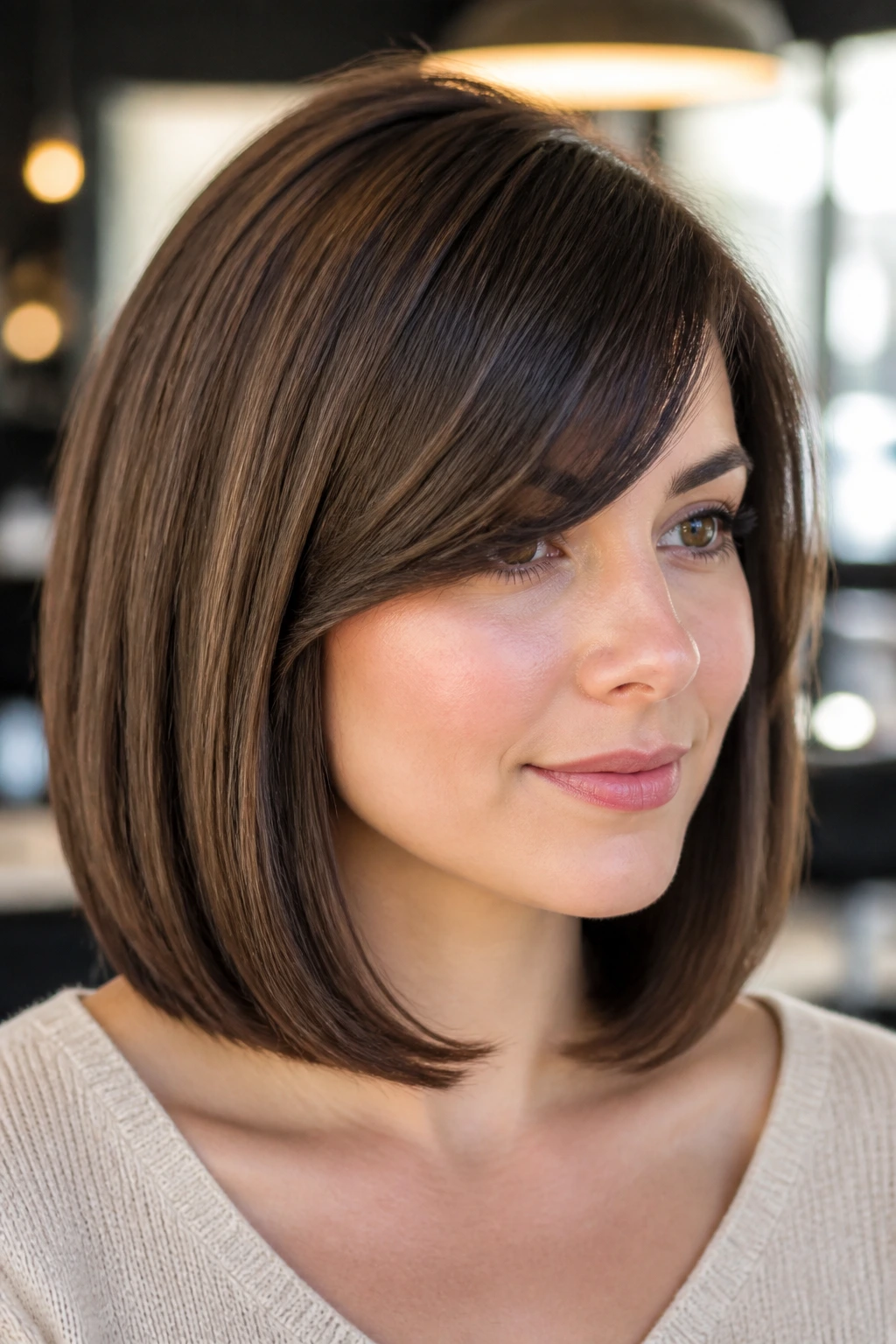
A sleek lob can look expensive even when the styling takes twelve minutes. Side bangs help a round face by turning the front of the haircut into one long sweep, and tucked ends keep the silhouette neat instead of puffy.
The beauty of this cut is its restraint. The hair doesn’t compete with the face. It frames it. The side bangs can skim the cheekbone, then slide into the lob, while the ends are tucked under slightly or behind the ears to keep the line controlled.
This is a good option if you wear structured clothes, sharp collars, or glasses. The haircut doesn’t fight those shapes. It sits with them. Use a smoothing cream sparingly, then blow-dry with the nozzle pointed downward so the cuticle lies flat. A little root lift at the crown keeps the face from looking compressed.
No big waves are needed here. The power comes from the neat line and the side sweep.
19. Messy Lob With Overlapping Curtain Bangs
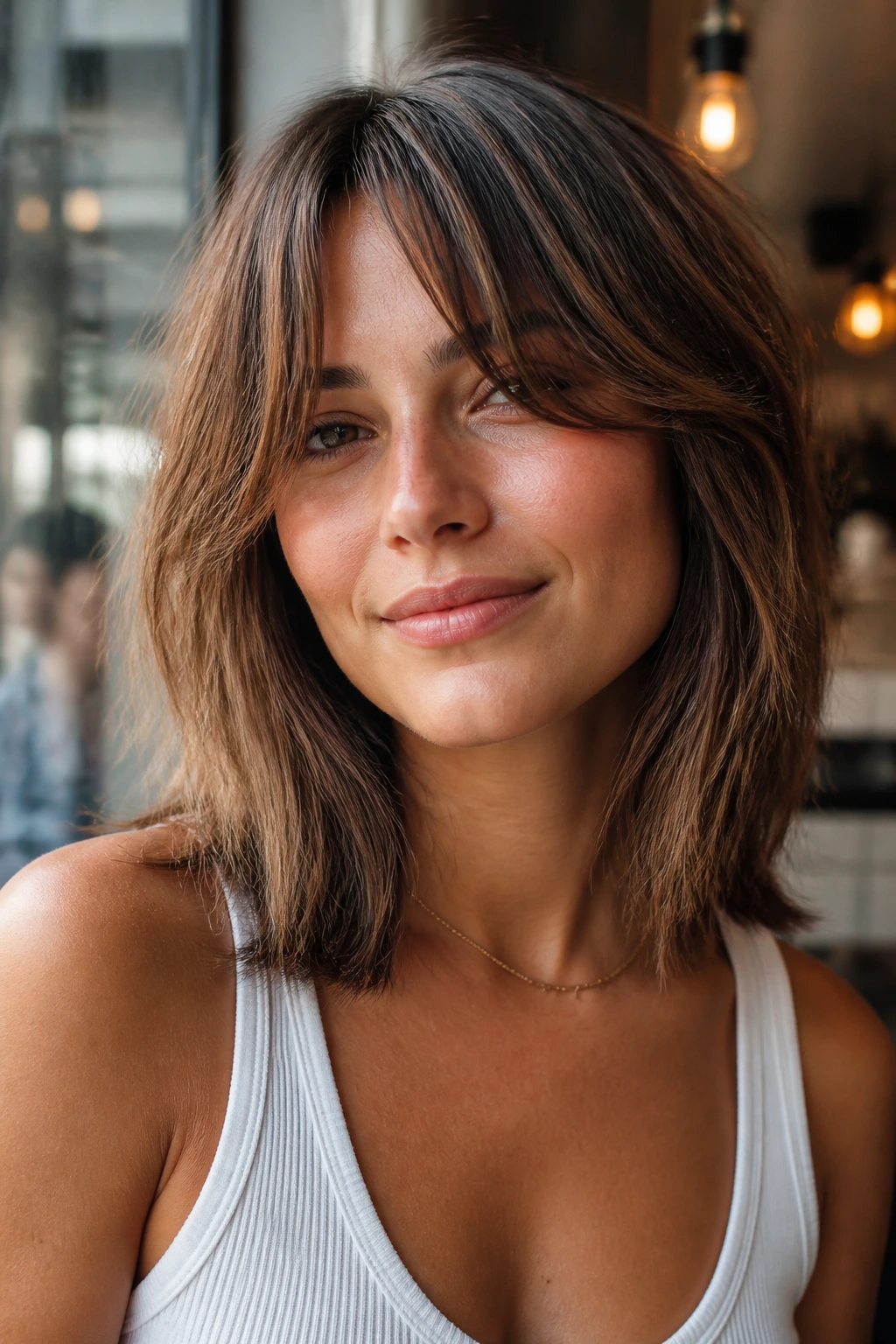
This version looks casual, but there’s more thought in it than people realize. The curtain bangs overlap at the center instead of parting cleanly down the middle, which gives the forehead a softer frame and keeps the face from reading overly round.
The lob itself should be loose and slightly layered, with enough internal movement that the hair falls in soft chunks rather than a single sheet. That overlap at the fringe and the uneven texture through the lengths keep the shape from going too symmetrical. Round faces usually do better when the hair is a little less obedient.
If you like to run your fingers through your hair and keep moving, this cut makes sense. It doesn’t demand a perfect blowout. It likes bend, dry texture spray, and a little attitude. The trick is to keep the volume higher at the crown and lower around the cheeks, where the width would otherwise collect.
A lot of “messy” haircuts end up looking lazy. This one doesn’t. It looks intentional, just not fussy.
20. Rounded Lob With Soft Arched Bangs
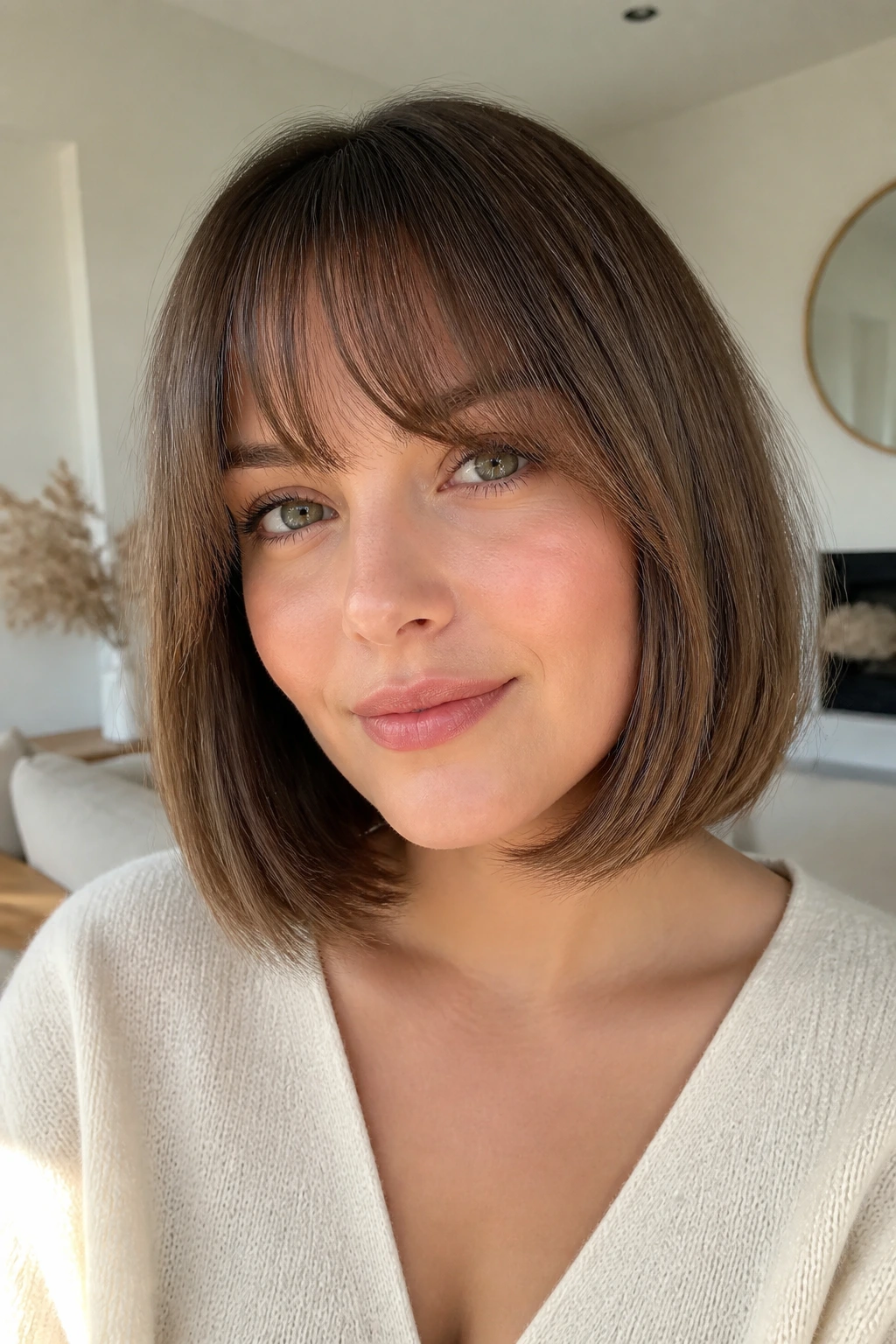
This is a quiet cut, and that’s part of its charm.
The lob has a softened curve through the ends, but not one that echoes the roundness of the face too closely. The bangs arch gently across the forehead, giving a subtle lift in the center and a softer drop at the sides. The result is a frame that feels balanced rather than mirrored.
That distinction matters. You do not want the haircut to copy the face shape exactly. You want it to steer the eye. A soft arch does that by drawing the eye upward before it drifts down the sides. If the ends are kept just below the chin, the cut keeps enough length to avoid looking circular.
This style is especially pretty on straight or lightly wavy hair. It’s controlled, but not severe. If you like a clean silhouette with a little curve at the fringe, this is one of the most wearable choices in the group.
21. Voluminous Blowout Lob With Flip-Out Bangs
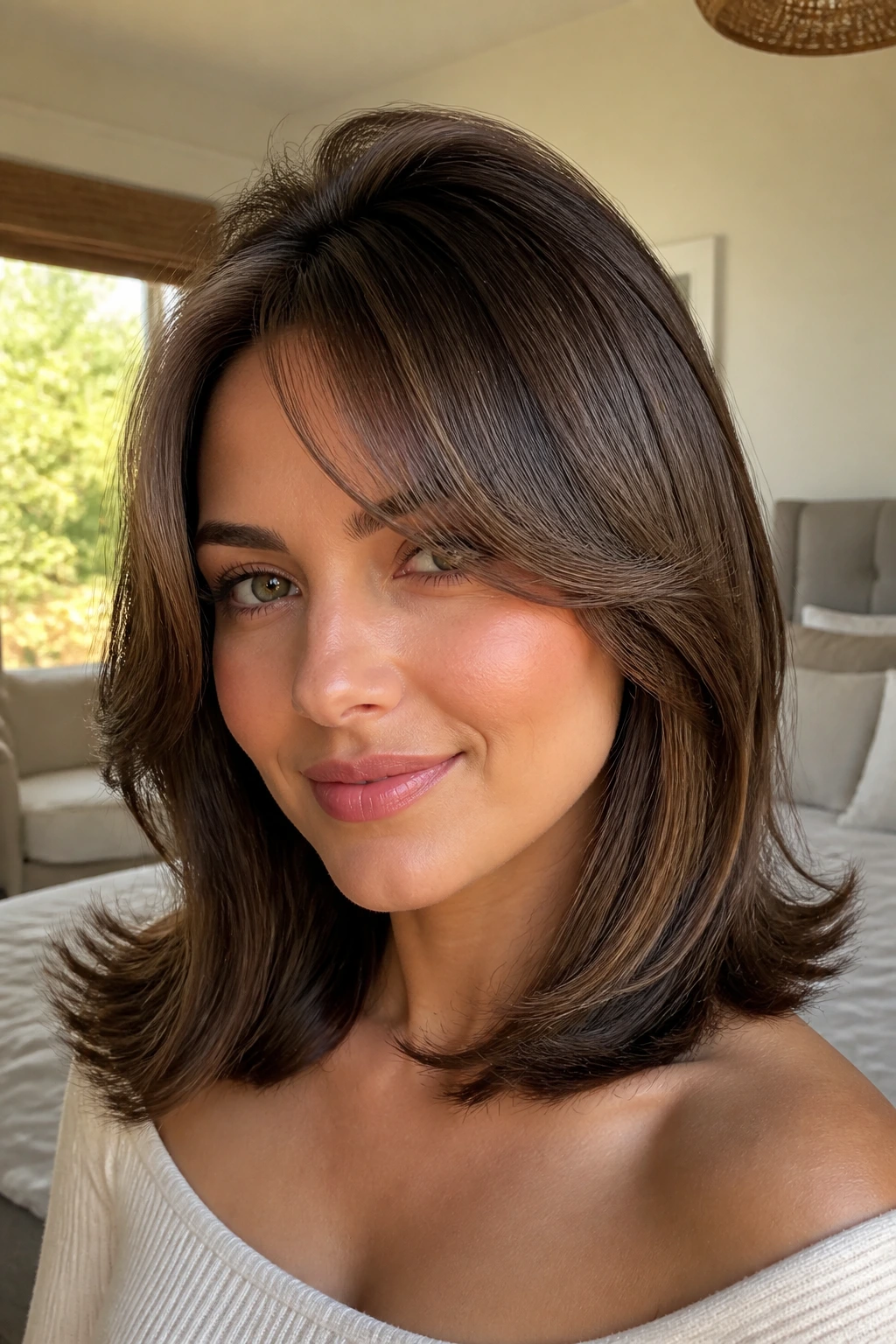
Big hair can work on a round face. It just needs the volume in the right place.
The crown should be lifted first, then the body of the lob should fall away from the cheeks. Flip-out ends at the collarbone add movement and keep the hair from collapsing into the face. The bangs should be curtain-like or side-swept, not blunt. A full fringe here can make the whole shape too dense.
This cut looks its best when the blowout has a little bounce, not a stiff curl. Use a round brush or a blow-dry brush to direct the roots upward, then flick the ends outward just enough to break the outline. That tiny flip creates air around the face, which is what keeps the width under control.
It’s a good choice for thicker hair that wants body anyway. If your hair naturally holds shape, this style gives it room to do that without turning heavy.
22. Air-Dried Natural Lob With Bendy Bangs
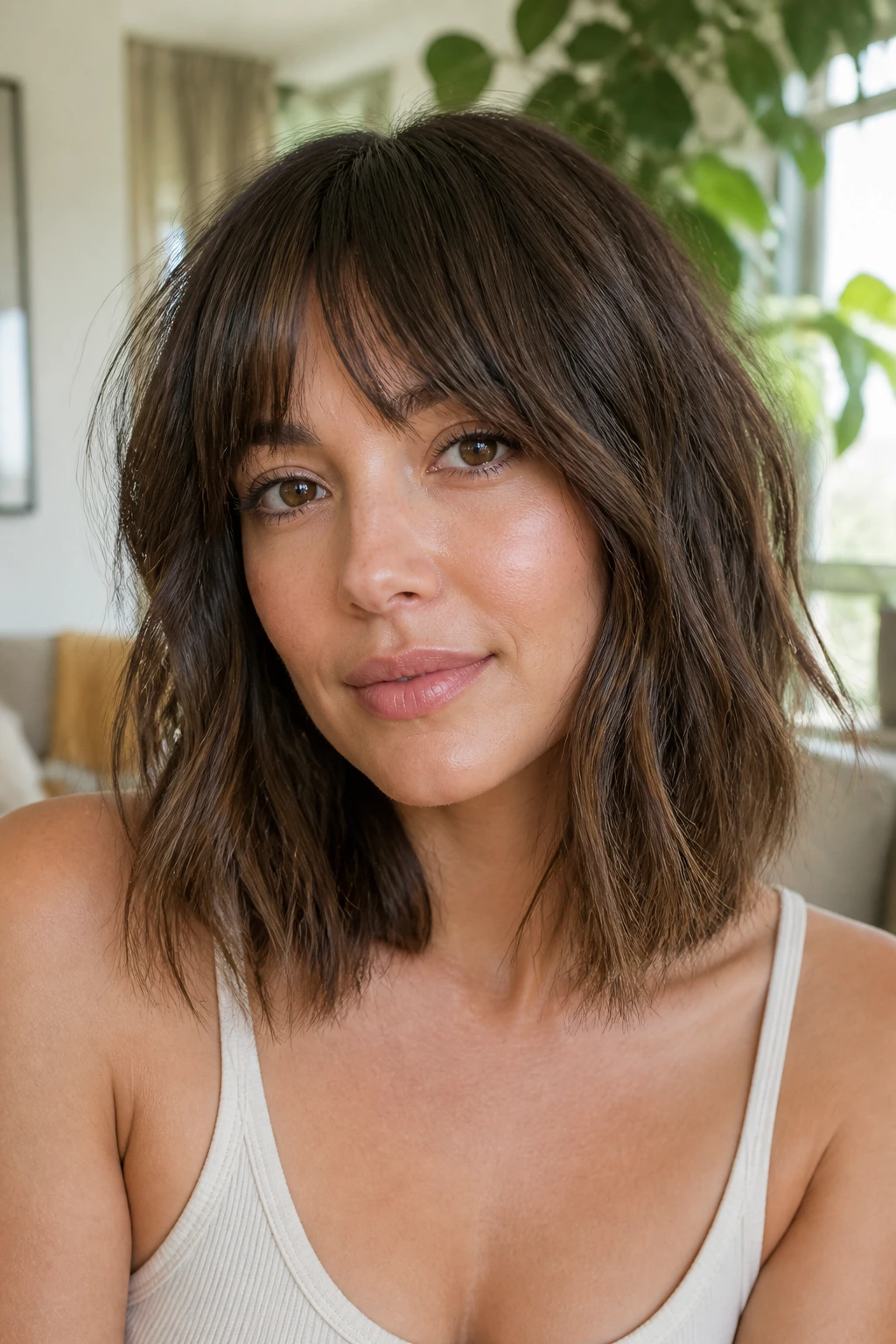
Some cuts need a dryer. This one does better when you stop fussing with it.
The natural bend in the hair becomes the style, and the bangs are cut long enough to settle into a soft shape on their own. On a round face, that loose movement is useful because it keeps the fringe from creating hard edges. The bangs can split a little, curve a little, or fall partly across the forehead without losing the frame.
This works especially well for hair that has a bit of wave or texture already. Add a leave-in cream or a light curl cream, scrunch gently, and let the shape form without overhandling. If the hair dries flat at the root, clip the crown for a few minutes while it sets.
A lot of people think air-dried hair means sloppy hair. Not true. It just means the haircut has to do more of the work. This one does.
23. Sleek Center-Part Lob With Grown-Out Curtain Bangs
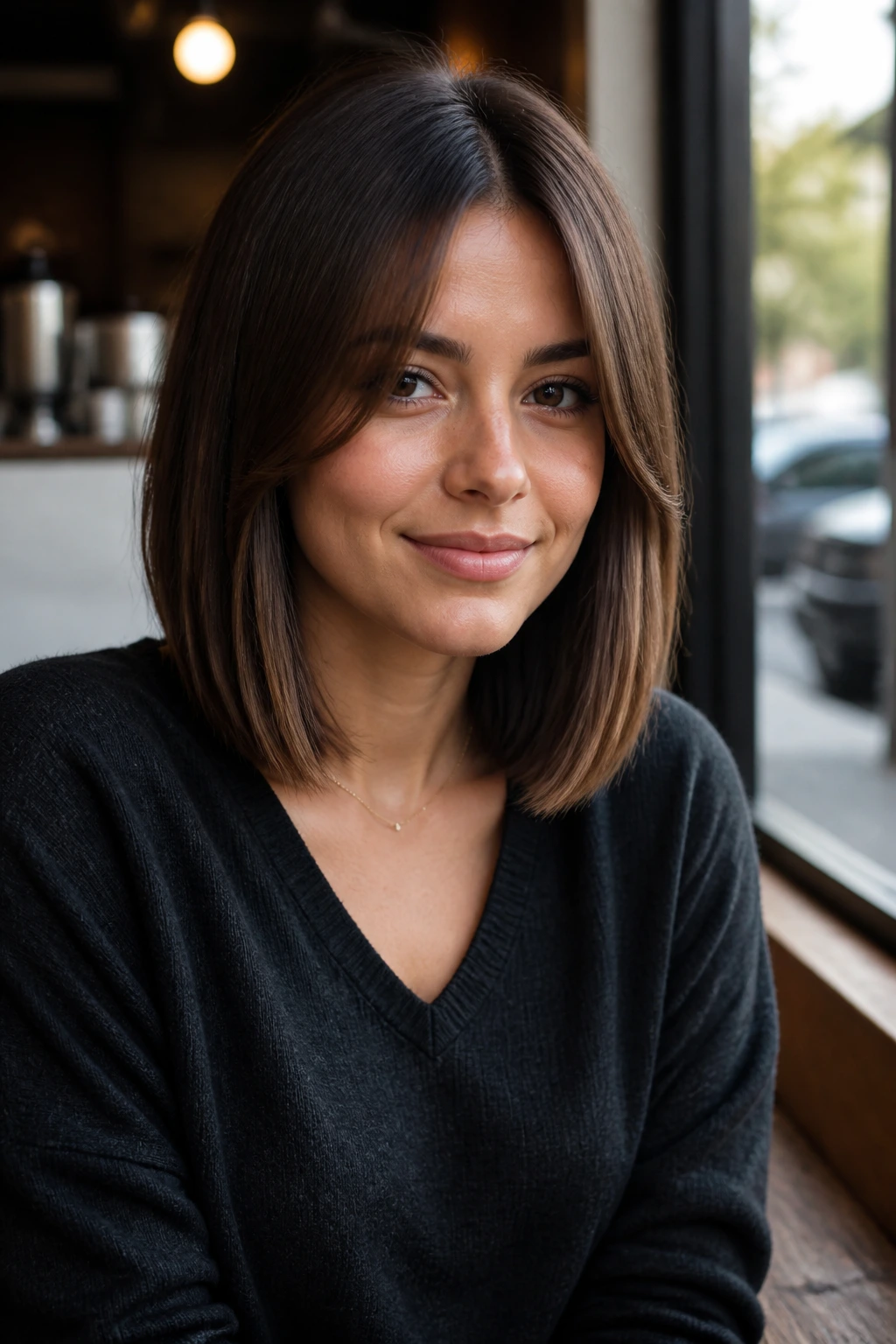
This is the quietest look in the bunch, and maybe the smartest.
Grown-out curtain bangs are long enough to blend into the front pieces, which keeps the face open and lets the lob carry the silhouette. The center part adds length, but the fringe softens the forehead so the face never looks too broad across the top. It’s a balanced cut, not a loud one.
What makes it especially useful is the grow-out. As the bangs lengthen, the cut still looks intentional. That is a rare thing. Most fringe styles get awkward before they get good again. This one keeps a shape while the pieces move past the brows and into the cheekbone zone.
If you want a lob that doesn’t trap you in one styling routine, this is a strong finish to the list. It works straight, it works waved, and it doesn’t panic when you miss a wash day.
Why the Lob Length Matters More Than Most People Think
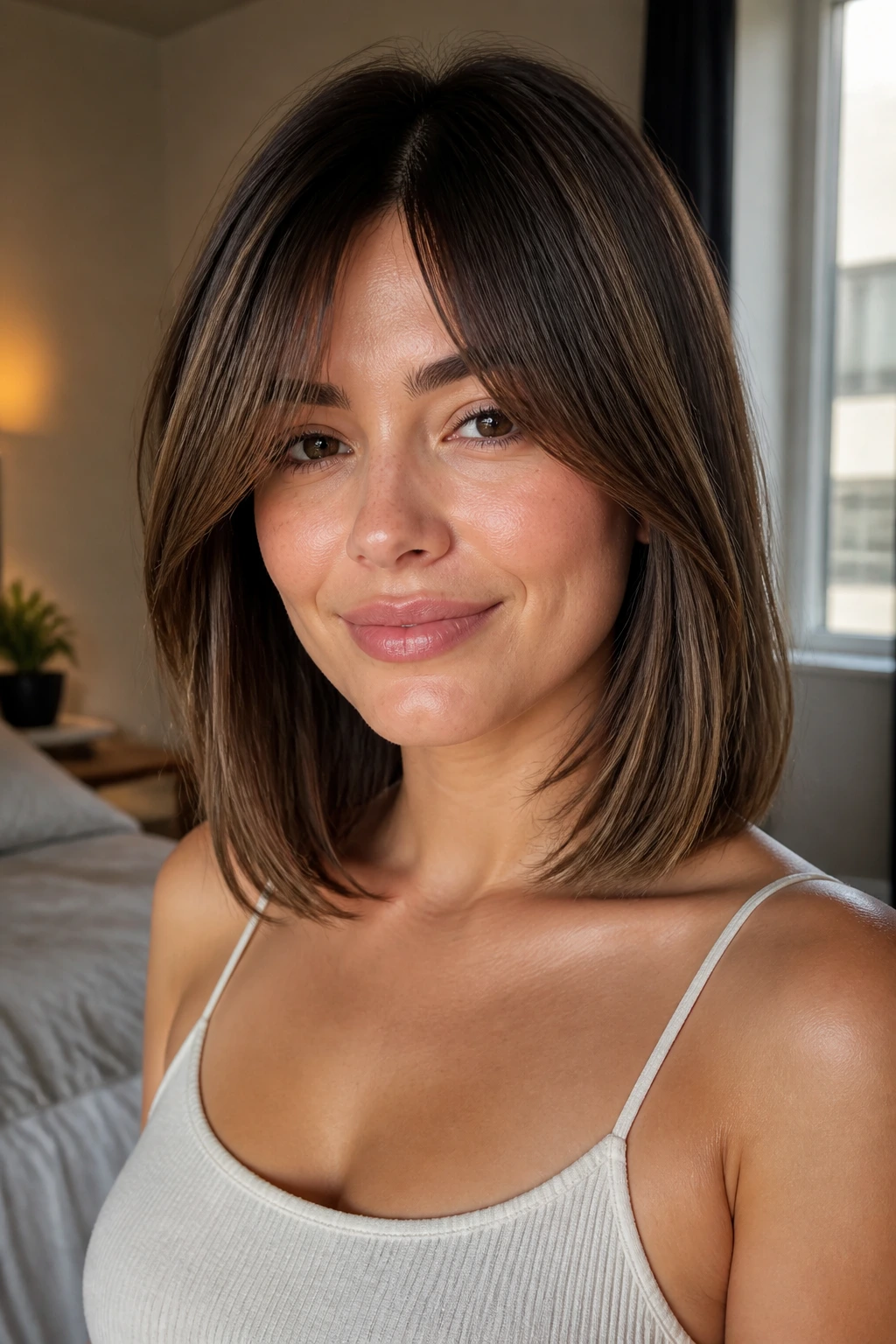
A round face isn’t only about width. It’s about where the eye lands, and the lob length controls that better than almost any other part of the cut.
If the hair ends right at the chin, the face often looks wider. If it falls below the chin and toward the collarbone, the eye keeps moving downward, which creates the illusion of length. That is why collarbone cuts keep showing up in the strongest lob hairstyles with bangs for round faces. They give the bangs room to work without crowding the lower half of the face.
The same thing happens with layers. Short layers around the cheeks can make the face feel fuller. Longer layers that begin lower, near the mouth or below, are usually safer. They frame instead of puff. That difference sounds small until you see it in the mirror, and then it stops feeling small very fast.
Essential Tools and Products for Styling These Looks
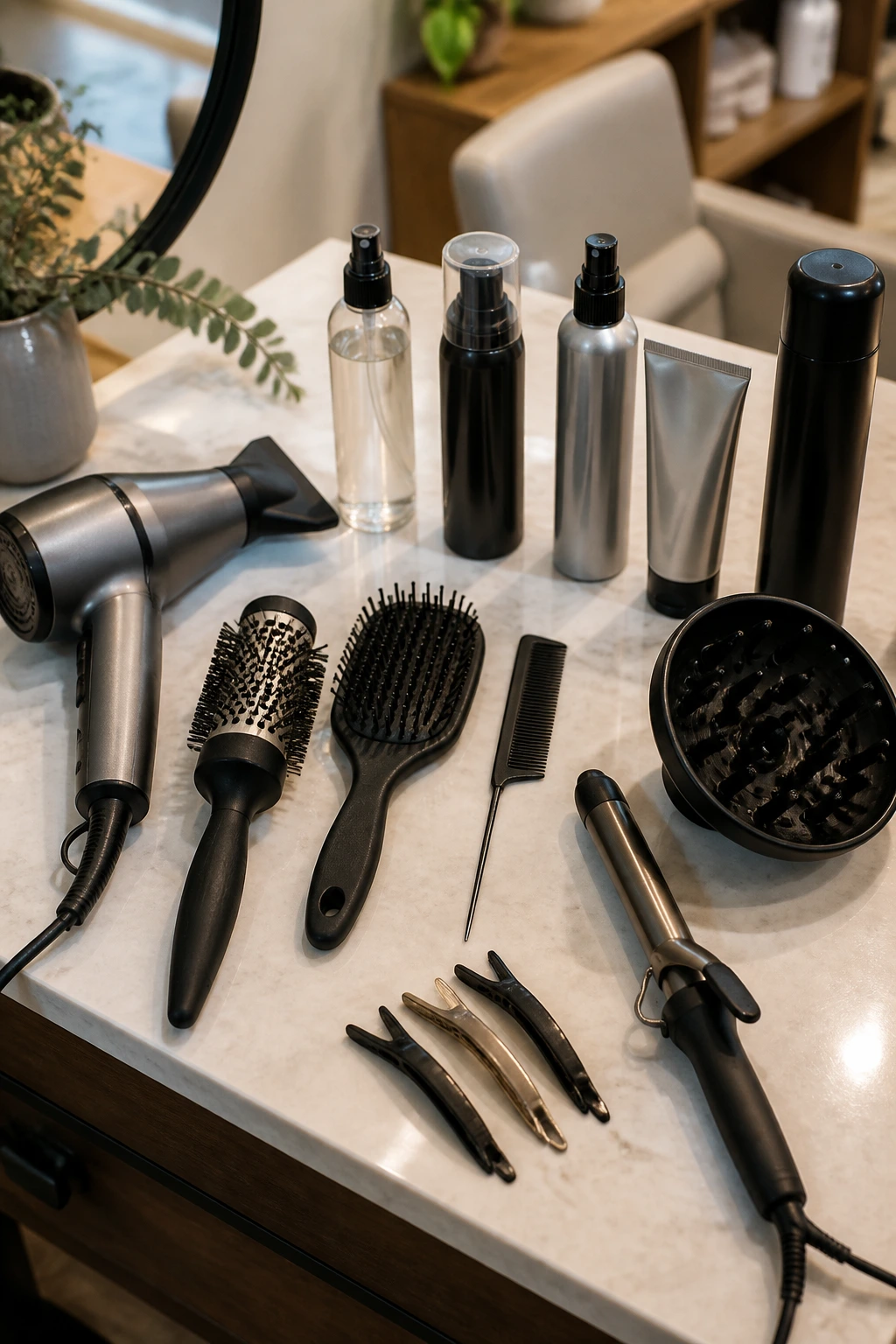
- Blow dryer with a nozzle: Keeps the airflow controlled, which matters if you want bangs to lie flat instead of flaring out.
- Round brush: Best for bending bangs away from the forehead and giving lob ends a soft curve.
- Paddle brush: Useful for sleeker styles like blunt lobs and center-part looks.
- Tail comb: Helps with clean parts, especially for curtain bangs and bottleneck bangs.
- Heat protectant spray: A non-negotiable if you’re using a flat iron or blow dryer on the fringe.
- Light mousse: Gives root lift without turning the hair stiff.
- Texture spray: Good for shaggy, beachy, or piecey styles that need separation.
- Smoothing cream or serum: Use a tiny amount on the ends, not the roots, if you want polish.
- Clips or duckbill clips: Handy for setting bangs while they cool after drying.
- 1-inch curling iron or wand: Useful for soft bends in the ends of the lob and for shaping curtain bangs.
- Diffuser: A must for curly versions and for anyone who wants the fringe to keep its natural shape.
- Dry shampoo: Great for bangs, which tend to show oil first and flatten fast.
How to Choose Lob Hairstyles With Bangs for Round Faces by Hair Texture
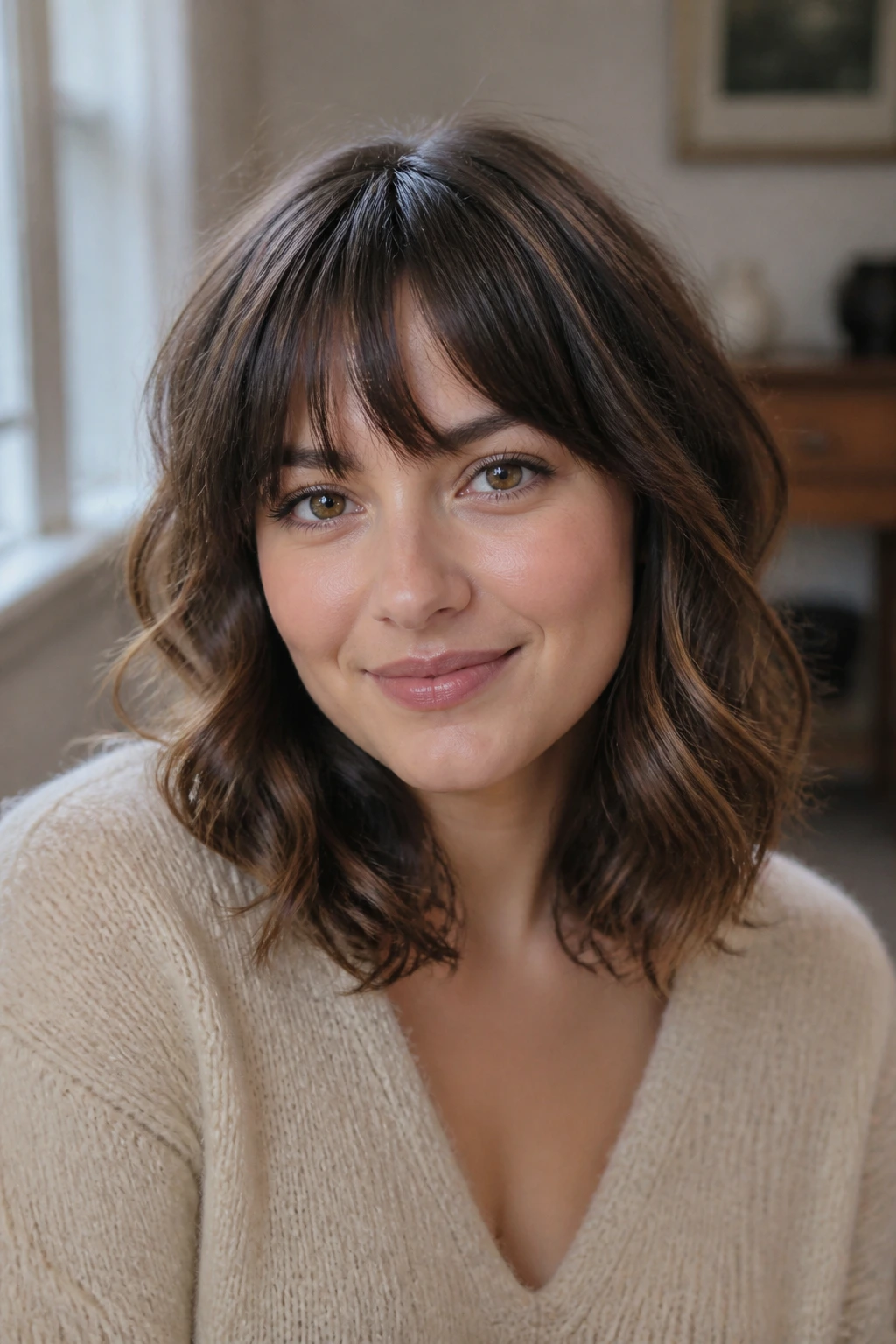
The same cut behaves differently on fine hair, thick hair, waves, and curls. That is not a small detail. It’s the whole deal.
Fine Hair
Fine hair does best with lobs that keep a solid outline and bangs that don’t get too sparse. Wispy fringe can work, but too much texturizing will leave the ends stringy. Ask for softness around the front, not a lot of internal carving, and keep the length near the collarbone so the hair has enough weight to sit properly.
Thick Hair
Thick hair needs shape control. A blunt fringe can look amazing if the stylist removes bulk in the right places, but too much layering around the cheeks can turn the cut into a puffball. Bottleneck bangs, side sweeps, and soft curtain pieces usually behave well because they break up the density without making the haircut floppy.
Wavy Hair
Wavy hair is often the easiest texture for lobs with bangs because it already gives the cut movement. The one thing to watch is shrinkage through the fringe. Cut a little longer than you think you need, and keep the front pieces just past the cheekbone so the wave can sit without springing up too much.
Curly Hair
Curly hair should be cut with the curl pattern in mind, not against it. Bangs need extra length and plenty of room to spring. A dry cut or a curl-by-curl trim is usually the safest route. The goal is a fringe that lands where you want it after the curl settles, not where it looked good for ten wet minutes.
Cowlicks and Strong Growth Patterns
If your hairline kicks up, splits, or bends one side harder than the other, a blunt fringe can be a headache. Side-swept bangs, longer curtain bangs, and grown-out fringe usually cooperate better. Sometimes the best cut is the one that makes peace with the cowlick instead of fighting it every morning.
How to Style the Cut Without Spending an Hour on It
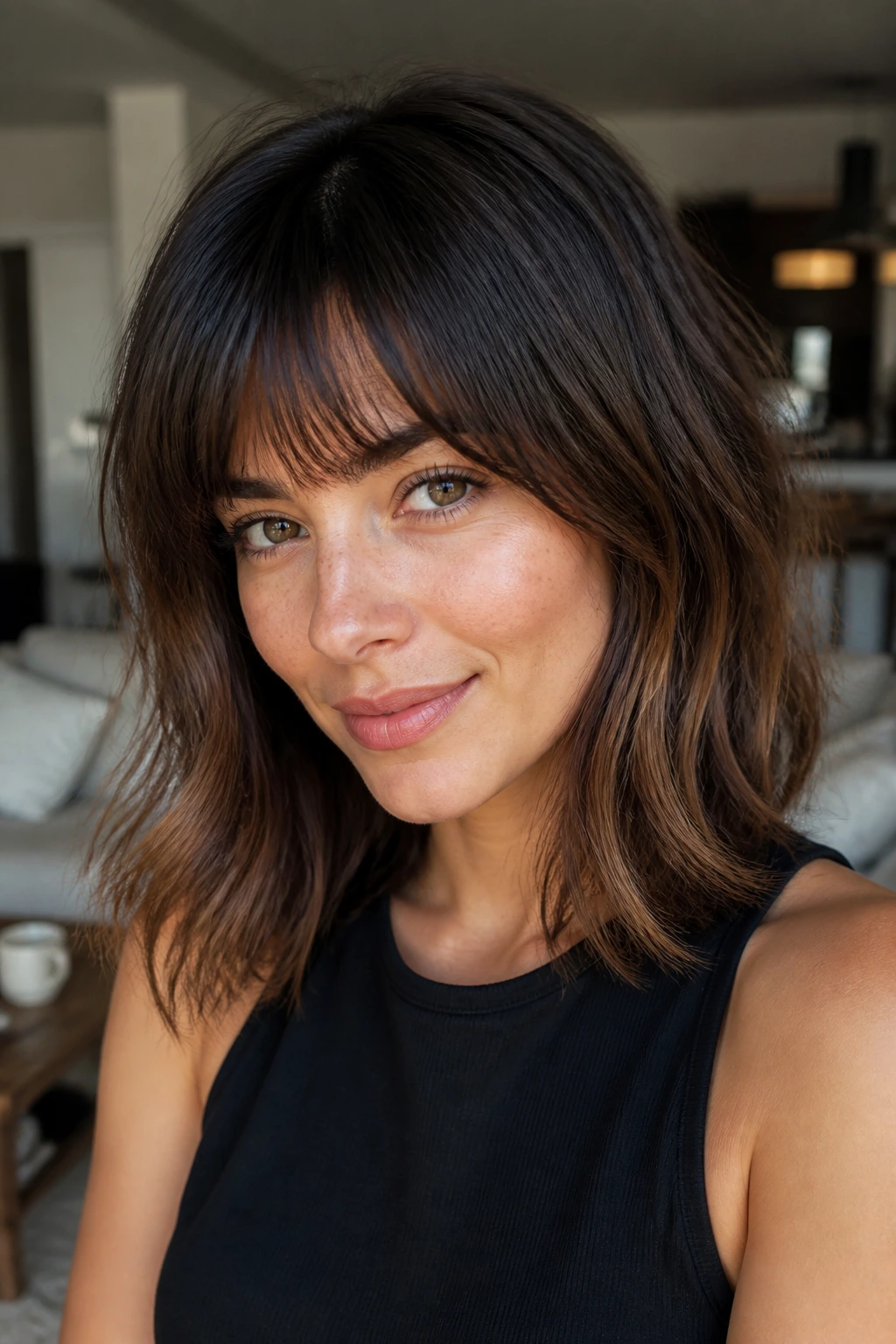
A round face usually looks best when the crown has a little lift and the cheeks stay relatively clean. That’s the real styling rule.
Root Lift: Aim the dryer at the roots first, especially at the crown and the side where the part starts. A little lift there changes the whole shape. If the top lies flat, the face reads wider.
Bang Control: Dry bangs first, while they’re still wet. Clip them side to side or brush them in the direction you want them to sit, then let them cool before touching them again. That small pause keeps them from bouncing back into a weird bend.
End Shape: The ends do not need to be curled to death. A soft bend under or away from the face is enough. Too much curl at the cheekbone is the fastest way to make the cut feel round again.
Texture Choice: If you want sleek, keep the texture concentrated at the fringe or the ends, not both. If you want shaggy, keep the volume at the crown and let the sides stay lighter. Mixing both styles without a plan tends to make the haircut look confused.
Common Mistakes That Make a Round Face Look Wider
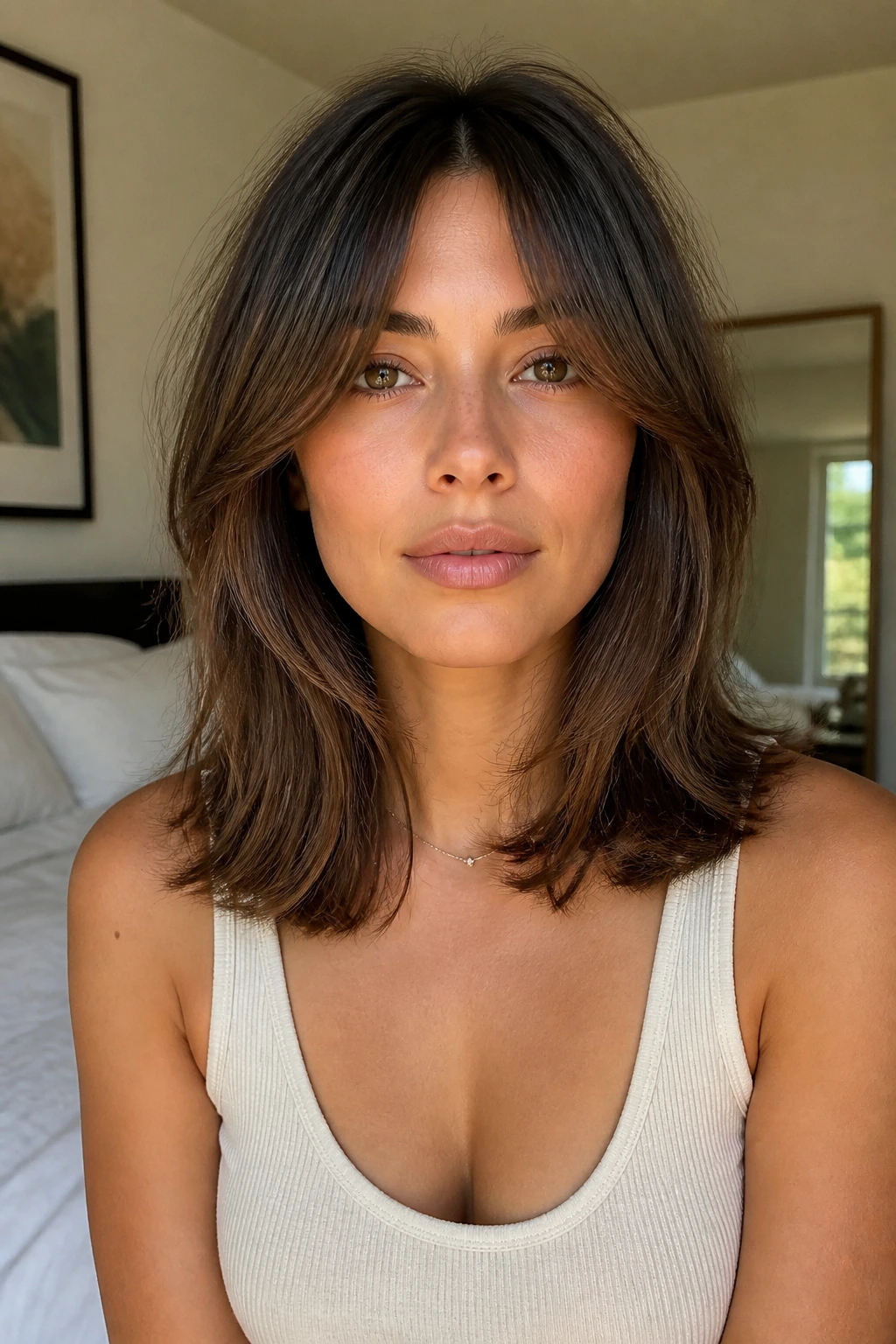
- Cutting the bangs too short and too blunt: Short fringe can pull the eye upward and stop the face from lengthening. The fix is to keep the bang line soft and a touch longer, usually near the brows or below.
- Ending the lob at the cheek’s fullest point: That’s the classic mistake. The hair stops right where the face is widest, and the whole outline gets wider. Keep the length below the chin, ideally at or past the collarbone.
- Adding too much volume at the sides: Big side volume around the cheeks works against the face shape. If you want lift, put it at the crown instead.
- Over-thinning fine hair: Fine hair that’s been razored too much loses shape fast and can look see-through at the ends. Leave enough weight for the lob to hold its line.
- Ignoring the cowlick: If the fringe has a strong split or lift, a straight-across bang may refuse to cooperate. Build the cut around the growth pattern instead of trying to steamroll it.
- Styling curls or waves too close to the face: If every bend lands at the cheek, the width stacks up. Keep the movement lower or longer so it drapes instead of balloons.
Variations and Alternatives to Try
The Fine-Hair Float: Keep the lob blunt or only lightly layered, then choose curtain bangs or wispy side bangs. This gives the hair enough weight to stay in place without collapsing at the ends.
The Thick-Hair Taper: Ask for internal weight removal below the cheekbone and choose bottleneck or sweeping bangs. Thick hair needs room to move, but the shape has to stay controlled near the cheeks.
The Curly Halo: Let the lob sit a little longer than you think, and cut the fringe to the curl pattern with plenty of shrinkage allowance. This version works when the curls frame the face, not when they sit like a solid ring around it.
The Low-Maintenance Air-Dry Cut: Use grown-out curtain bangs and soft layers that start low. If you hate daily heat styling, this is the one that behaves after a quick scrunch and a leave-in cream.
The Edgy Graphic Cut: Choose an asymmetrical lob, a micro-fringe, or a blunt line with a deep side part. This works best when you want the haircut to be the first thing people notice.
Keeping the Shape Sharp Between Salon Visits
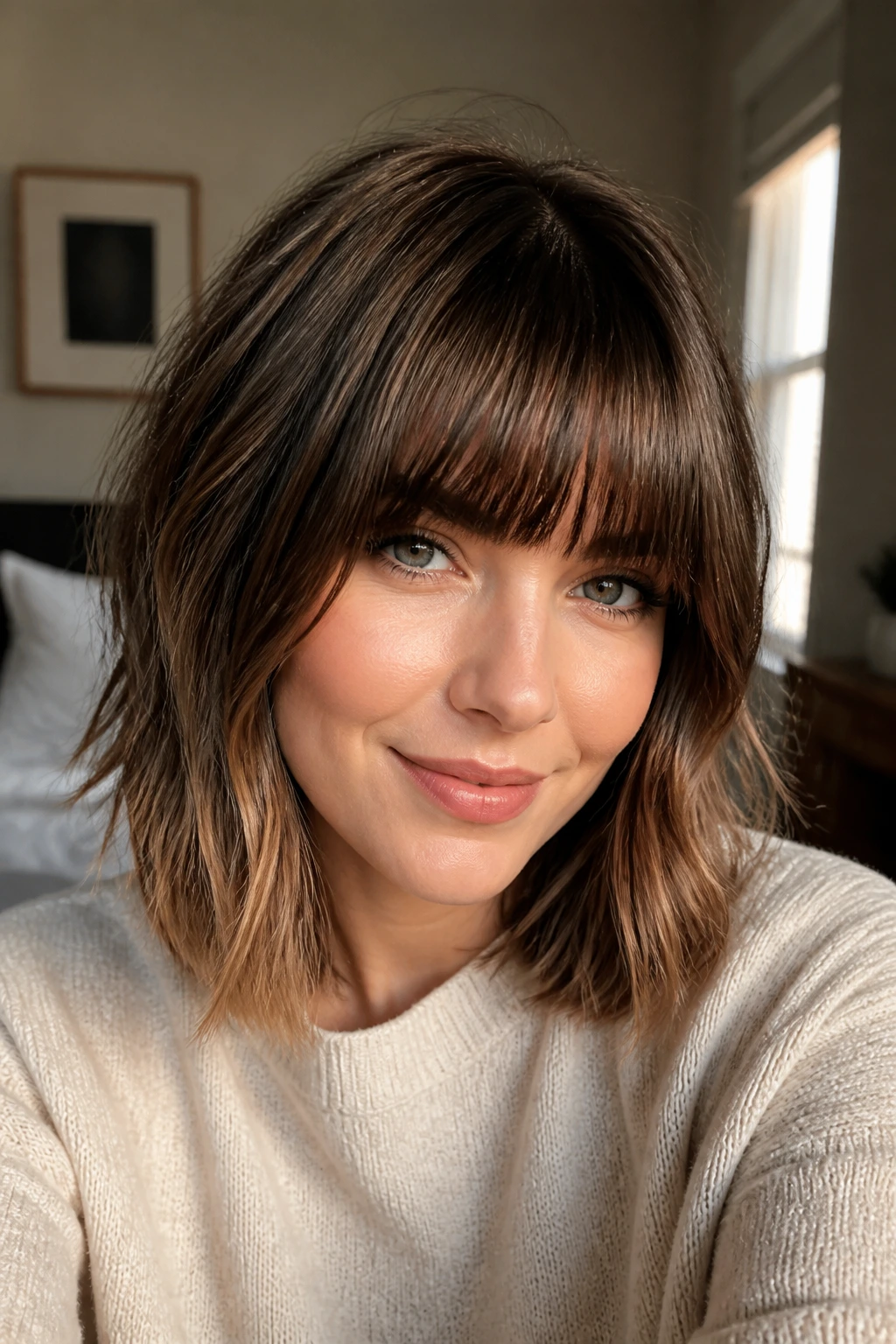
Bangs show growth before anything else does. A quarter inch can change the whole look.
For fringe, most people need a tidy-up every 3 to 4 weeks if they want the shape to stay crisp. The lob itself can usually go 8 to 10 weeks before it starts losing its line, though thick hair and fast growth may push that sooner. If the front pieces start flipping into the cheeks or the bangs start splitting in strange places, that’s your cue.
At home, dry shampoo is your friend. Use it at the roots of the bangs, not just the crown, because fringe collects oil fast. A tiny bit of smoothing cream on the ends can stop the cut from frizzing out by midafternoon, but don’t put that cream near the roots unless you want the style to collapse.
If you’re growing the bangs out, do it with a plan. Sweep them into a side part, pin the middle back with tiny clips, or let them blend into the front layers of the lob. The in-between stage is less annoying when the rest of the haircut is already built to handle it.
Frequently Asked Questions About Lob Hairstyles With Bangs for Round Faces
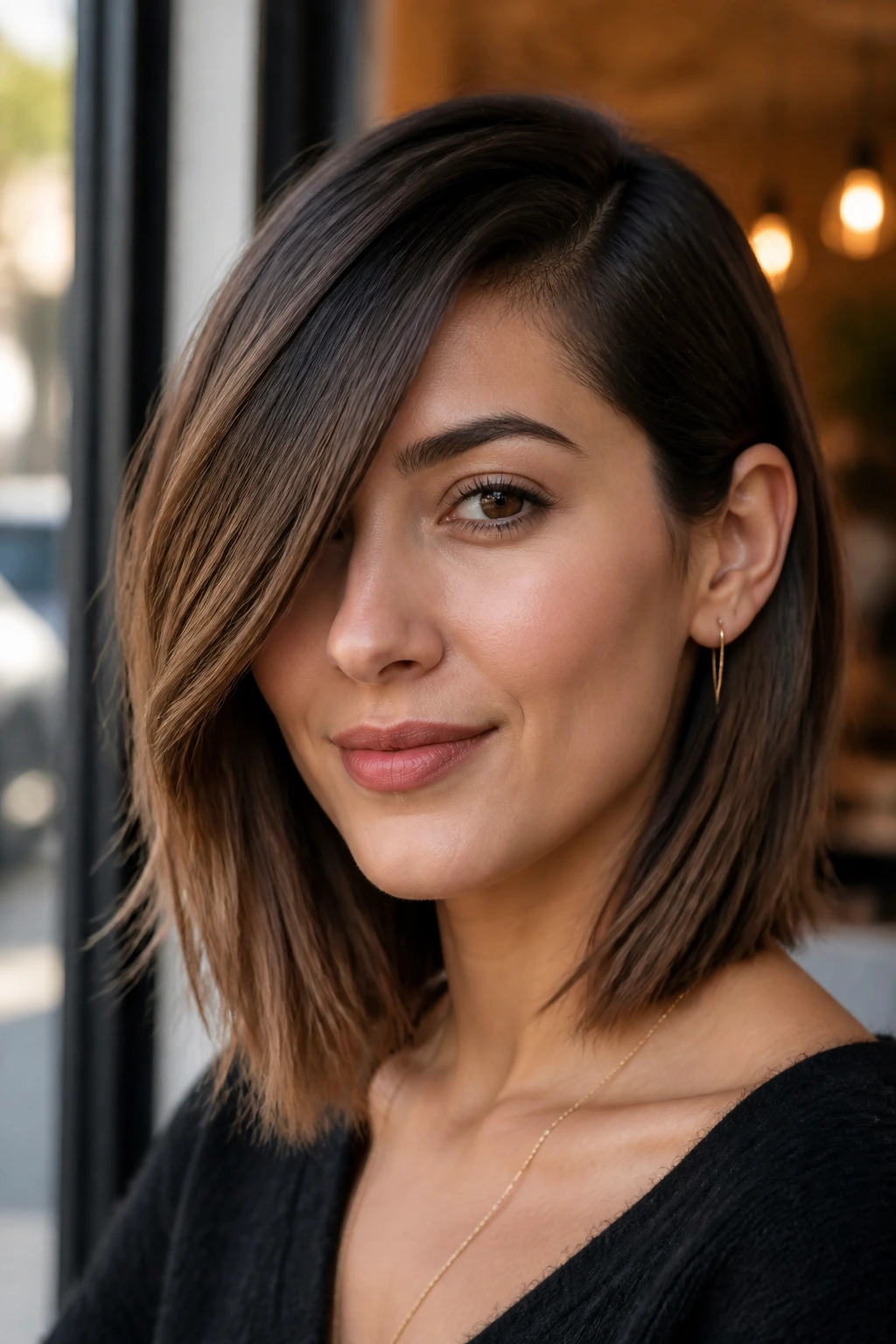
What bangs are most flattering for a round face?
Curtain bangs, bottleneck bangs, soft side bangs, and grown-out fringe usually work best because they break up the forehead without creating a hard horizontal line. The goal is to keep the face open and slightly longer-looking, not boxed in.
Does a lob make a round face look slimmer?
It can, if the length lands below the chin and the front pieces are shaped with some angle or movement. A lob that stops at the jaw can do the opposite, so the placement of the ends matters as much as the fringe.
Should round faces avoid blunt bangs?
Not automatically. A blunt fringe can work if the lob is long enough and the bangs are softened a little at the ends. The problem is usually the combination of a short cut and a hard bang line, not blunt bangs by themselves.
Can curly hair wear a lob with bangs on a round face?
Absolutely, but the cut needs to respect shrinkage and curl pattern. Curly fringe should usually be cut longer and shaped dry or nearly dry so it lands where you want it once the curl settles.
Is a side part better than a center part?
A side part often gives the quickest lengthening effect because it creates a diagonal line. A center part can still work if the bangs are soft and the front pieces fall long enough to frame the cheeks instead of stopping at them.
How often should bangs be trimmed?
Usually every 3 to 4 weeks if you want a crisp line. Softer, grown-out bangs can stretch longer, but once the fringe starts hitting the lashes or splitting at the temple in a way you don’t like, it’s time for a trim.
What if my hair is fine and flat?
Choose a lob that keeps some weight in the ends and avoid over-layering the front. Curtain bangs or wispy side bangs tend to move better than heavy fringe, and a bit of root lift at the crown helps the whole cut stay alive.
How do I stop bangs from puffing up in humidity?
Dry them first, set them with a cool blast, and use only a small amount of smoothing product. If the bangs are too short or too thick, humidity will fight them harder, so a softer, slightly longer fringe usually behaves better.
The Lobs That Keep Their Shape
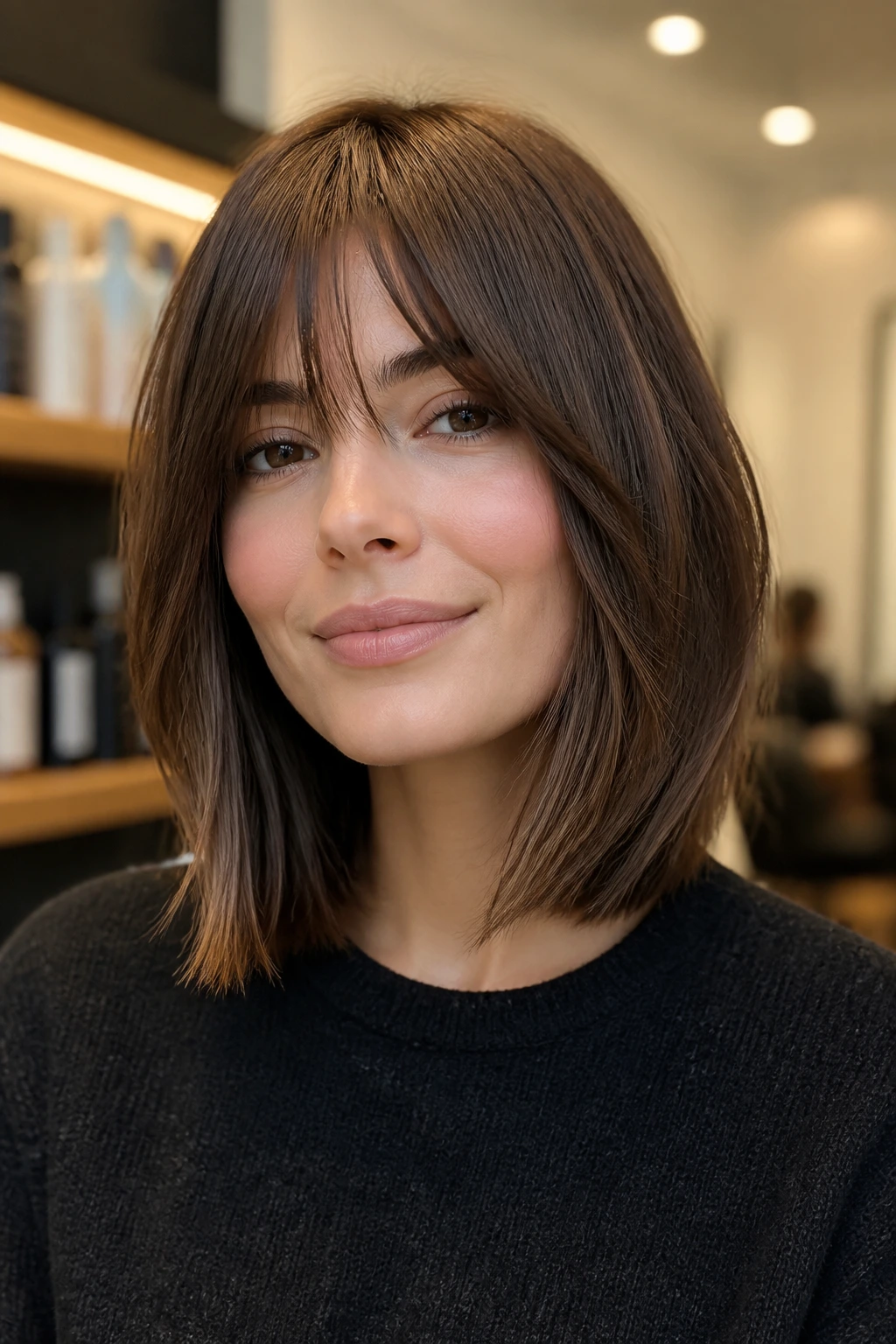
The strongest lob-and-bang pairings for a round face all do the same quiet thing: they keep the eye moving. Down from the brow. Past the cheek. Toward the collarbone. That’s why these cuts last, even when they’re styled in very different ways.
Pick the version that fits your hair texture first, then choose the fringe that gives you the most room around the cheeks. A good cut should make styling easier, not demand a daily negotiation. And if the shape grows out well, so much the better. That’s the kind of haircut worth returning to.
