



Curly hair and thick hair can make updos feel like a tug-of-war. The same volume that gives you gorgeous shape can also bulldoze a flimsy bun by noon, and the tighter you pull, the faster the whole style starts arguing with your scalp. The best updos for curly hair and thick hair do not try to flatten all that texture into submission. They use the texture as grip, padding, and shape.
That’s the part people miss. Dense curls already bring their own architecture, which means you’re working with a head of hair that can hold a line, hide a pin, and build a full silhouette without much teasing at all. But the weight changes the rules. A style that looks secure on fine hair can sag fast on a thick coil pattern, especially if the base is too slippery or the pinning is too shallow.
So the smartest styles here are the ones that respect that mix of spring, bulk, and shrinkage. Some sit high and playful. Some hug the nape. Some are polished enough for a dress with a clean neckline, while others are the kind you can do in five minutes with one mirror and a little nerve. There’s a lot of room to work with, which is half the fun.
- Built for volume: These styles use fullness as the shape, not the problem.
- Better hold: Thick curls give pins more to catch, so the right updo can last longer than a flat style on slippery hair.
- Less heat needed: Most of these looks work on dry curls, stretched curls, or second-day hair, which keeps the pattern intact.
- Flexible finish: You can make the same shape look sleek, soft, formal, or a little messy depending on where you leave the curl.
- Useful beyond special occasions: Some of these are quick errand styles, and some can carry a wedding dress or a work blouse without looking stiff.
- Kind to thick hair: The right placement keeps the weight off your crown and the pins out of your face.
Why Updos for Curly Hair and Thick Hair Need a Different Base
Curly hair does not behave like straight hair, and thick hair does not behave like fine hair with more of it. That sounds obvious, but a lot of styling advice still pretends a bun is a bun. It isn’t. On denser textures, the base has to do more work because the hair itself is heavier, springier, and more likely to push back at a tight coil or a weak elastic.
There’s also the matter of slip. Curls create their own friction, which is a gift when you want a pin to stay put. But too much conditioner, too much oil at the crown, or a slick brush pass can erase that grip fast. The hair can feel soft and look shiny, then slide out of the twist the moment gravity gets involved. If you’ve ever watched a carefully pinned style sink an inch in the first hour, that’s usually the culprit.
Shrinkage changes the picture too. A style that seems roomy when you’re building it can tighten as the hair dries or settles, especially if you started with damp roots. That’s why many curl-friendly updos behave better on fully dry hair or hair that has been stretched a bit first. You want the shape to be set before the style starts compressing itself.
1. Pineapple Puff Crown
High volume is the whole point here. The hair is gathered at the crown, lifted straight up, and secured loosely enough that the curl ends still spring outward instead of being crushed into a tight knot. On thick curls, that lift reads cleanly from across the room. It also keeps the nape free, which is a small mercy on warm days.
The trick is placement, not force. Tilt your head forward, gather the hair at the highest point you can reach without pulling the hairline back, and use a soft scrunchie or two if one elastic starts to strain. Then fan the curls around the base so the puff looks full rather than squeezed. If the sides are puffy in the wrong way, smooth only the outer layer at the temples. Don’t flatten the crown completely. That’s the move that kills the shape.
2. Rope-Twist Low Bun
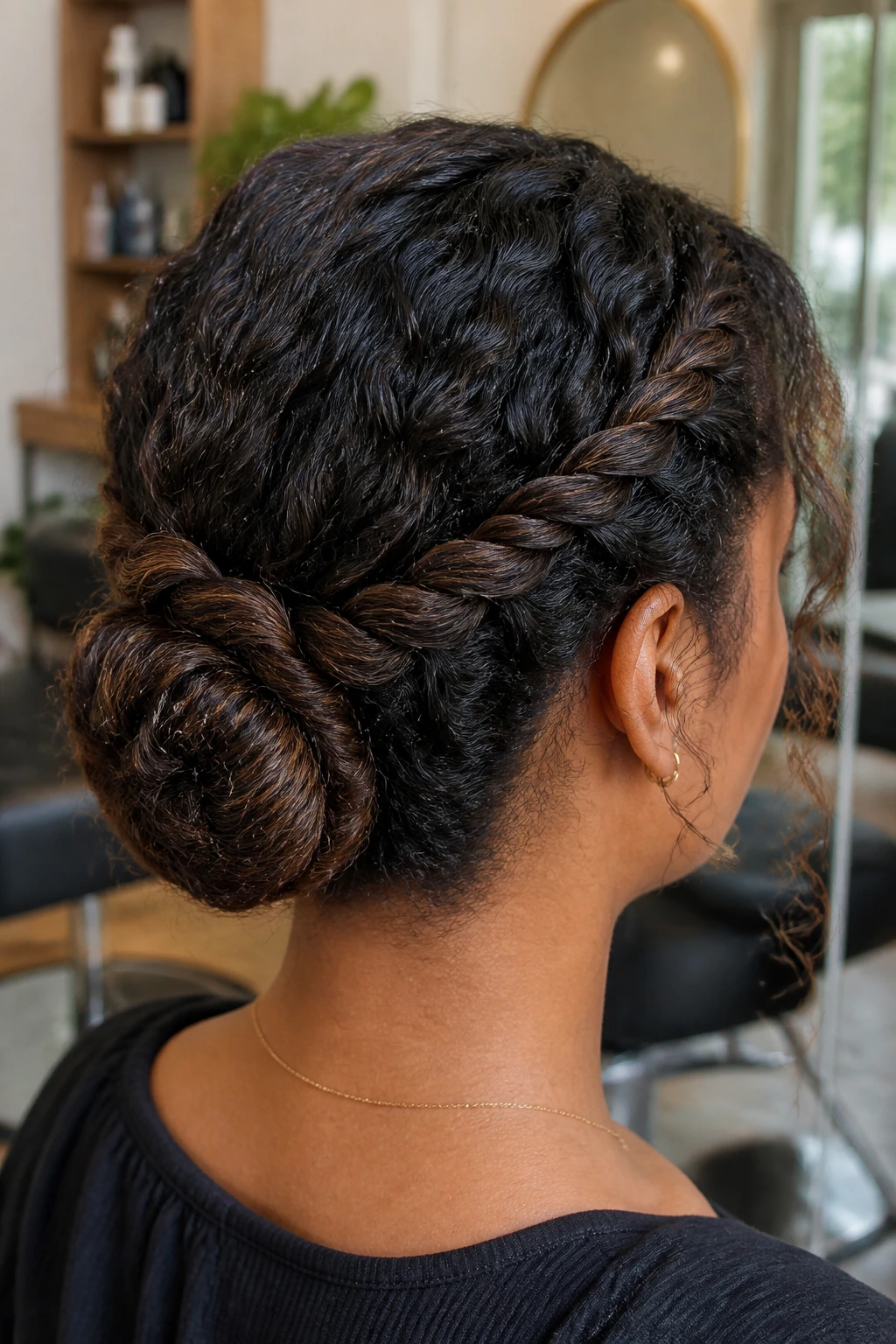
Need something that stays put without a fistful of pins? A rope-twist low bun is one of the smartest answers. Split the hair into two sections, twist each one tightly in the same direction, then wrap them together into a low coil at the nape. The rope structure gives thick hair a better anchor than a loose single twist, which tends to loosen under its own weight.
Why the double twist helps
The tension spreads across two strands instead of one. That matters when the hair is heavy, because the bun doesn’t hinge on a single point of failure. I like this style for dense curls that have a little stretch in them already—day-two hair, twist-out hair, or anything with enough texture to hold the rope shape.
Use 6 to 10 bobby pins, placed in an X around the bun, not just stabbed into the top. The bun should feel secure, not cemented. If you can move your head normally without feeling a tug at the scalp, you’ve got the balance right.
3. Braided Halo Bun
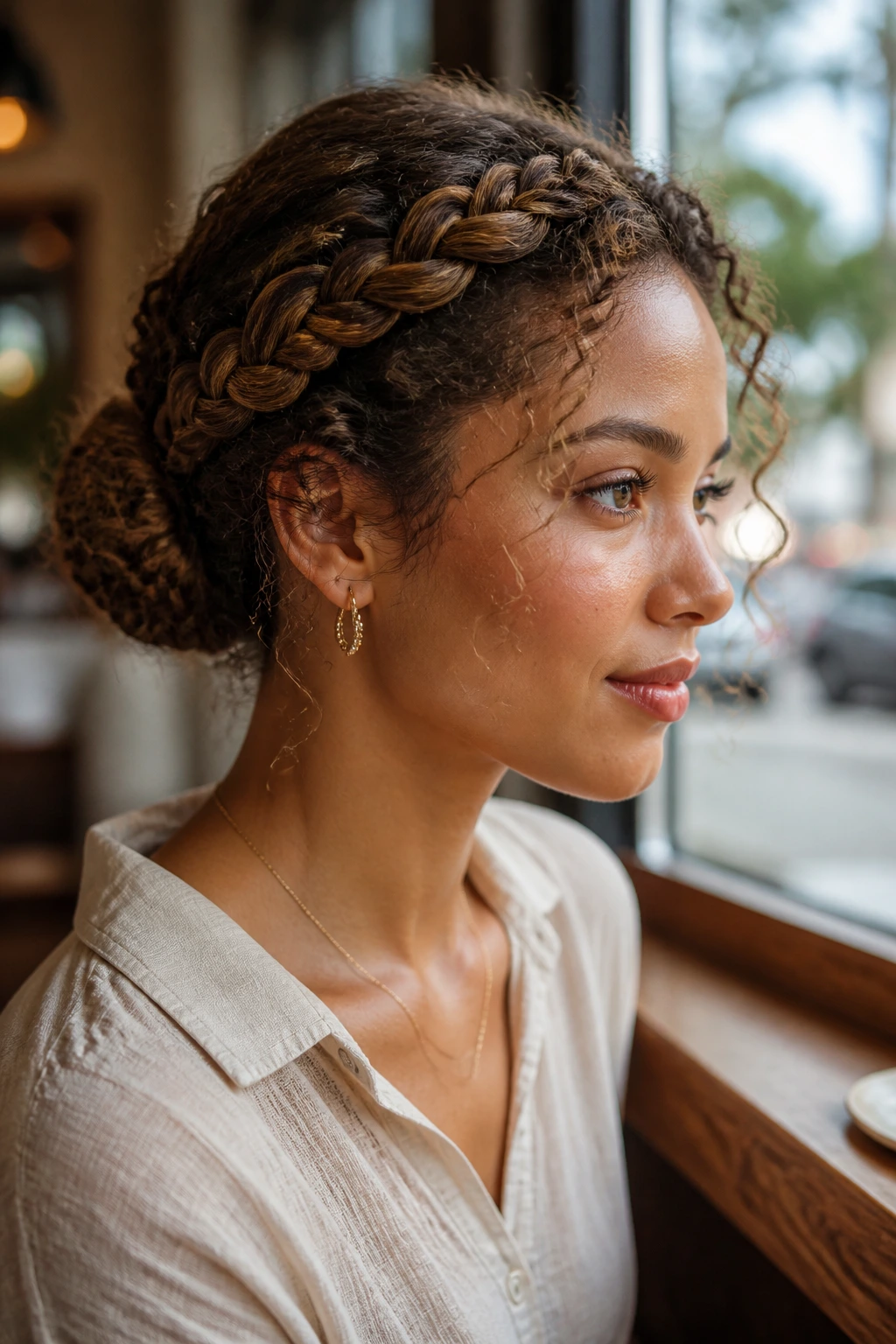
A braid traveling around the hairline does more than decorate the style. It gives the front of the head a clean edge, which is useful when thick curls want to fan out at the temples and ears. From there, the remaining length can be tucked into a low bun or coiled at the back for a finish that looks deliberate instead of improvised.
This one is especially good when you want your face to stay open. The braid acts like a frame, while the bun carries the bulk. On dense hair, that split of labor makes the whole style easier to control because you are not trying to make one section do everything. If your curls are tighter, keep the braid slightly loose so it doesn’t shrink into a thin line by the time you’re done. If they’re looser, braid a little firmer so the halo stays visible.
4. Claw-Clip French Twist
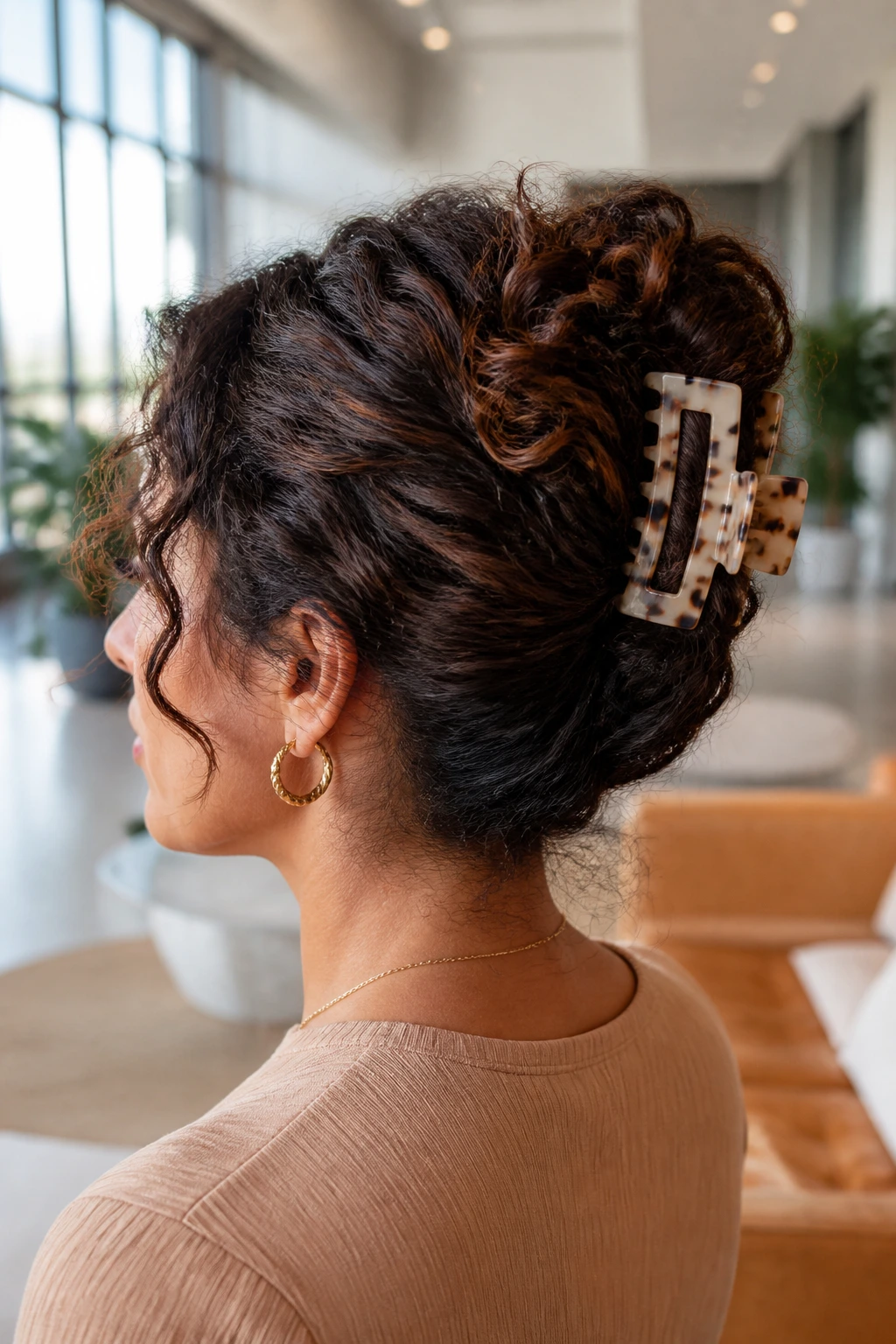
A claw clip can handle thick curls better than a dozen bobby pins, but only if the clip is actually big enough. That’s the first rule. If the teeth barely close over your hair, size up. Thin clips snap, and tiny clips just sit there like a bad joke.
Fold the curls upward, twist the length vertically, and tuck the ends into the shell of the twist before clipping. Leave some curl volume visible at the top or crown so the style keeps its texture. The best version of this look feels easy, not over-managed. It’s the kind of thing that can go from office chair to dinner table without losing its shape. If a few curls pop out at the top, fine. That’s part of the charm.
5. Curly Chignon with Tucked Ends
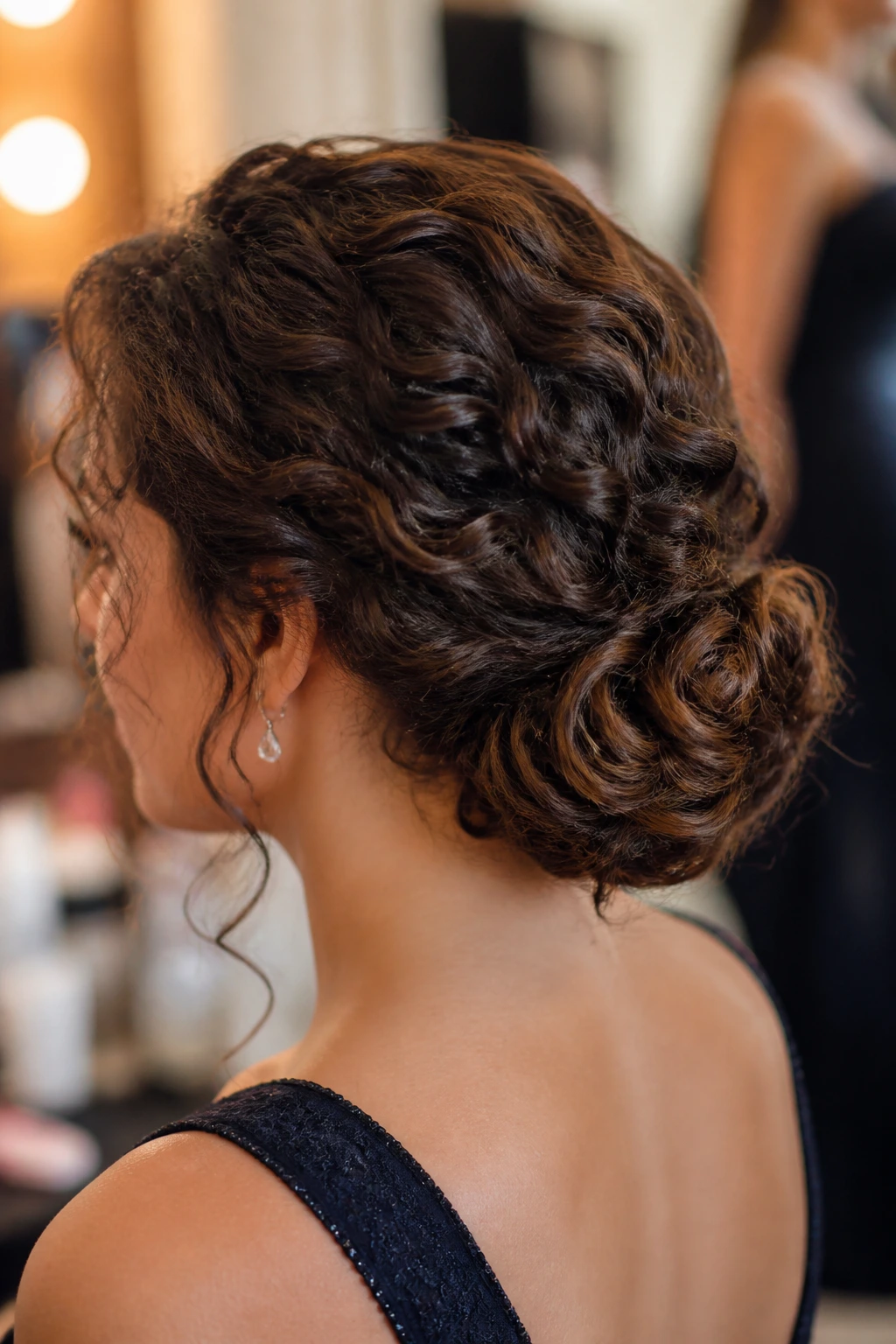
This one sits low and calm. Hair is gathered near the nape, twisted into a compact coil, and the ends are tucked underneath in a way that lets the bun keep its rounded shape without looking bulky. On thick hair, a chignon can sometimes turn into a huge lump if the ends aren’t directed carefully. Tucking the length under itself solves that.
I like this style for formal events because it handles texture without over-polishing it. The surface can stay curly, wavy, or slightly frizzy in a way that looks intentional. The key is to pin the bun in two directions: one set of pins across the base, another set crossing them from the side. That stops the weight from sliding backward. A touch of shine spray on the surface is enough. Don’t soak it.
6. Side-Swept Rolled Updo
A deep side part changes everything. Instead of pulling all the volume to the middle, you sweep the hair to one side, roll it inward, and pin it low behind one ear or just below it. Thick curls love this shape because the roll has room to show off texture, while the side placement keeps the silhouette softer than a center bun.
This one flatters broad shoulders and strong necklines, but it also works when you want to make your hair feel a little less top-heavy. The side sweep creates movement without needing much teasing. If your curls are very dense, use the natural curve of the head and let the roll follow it. Forcing the roll into a straight line only makes the pins fight the shape. And they will fight.
7. Space Buns with Curly Ends
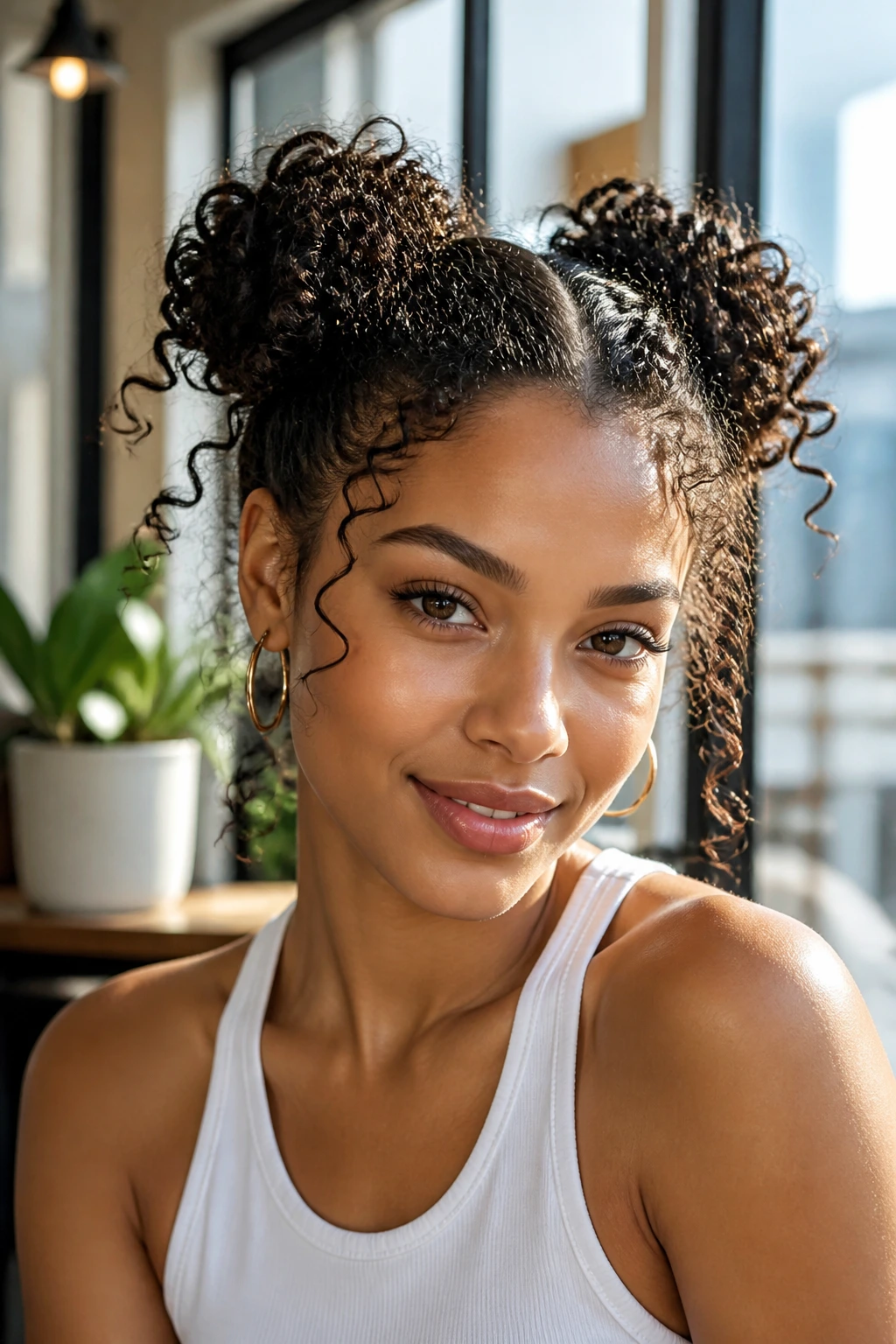
Two buns can look playful or sleek, depending on how much curl you leave visible. For thick hair, the sweet spot is somewhere in the middle. Build the buns slightly farther back than the temples so the weight sits on the head instead of at the very front. Leave a few coils loose at the perimeter. That keeps the style from reading too stiff.
Space buns are one of the few updos that actually enjoy fullness. Thin hair often needs padding to fake the shape. Dense curls already have it. If you want the look to feel more grown-up, keep the part clean and the buns moderately sized. If you want them looser, pull a few curls free around the ears and the nape. Do not make the buns too tiny. On thick hair, tiny buns just look like the style ran out of room.
8. Faux Hawk Puff Updo
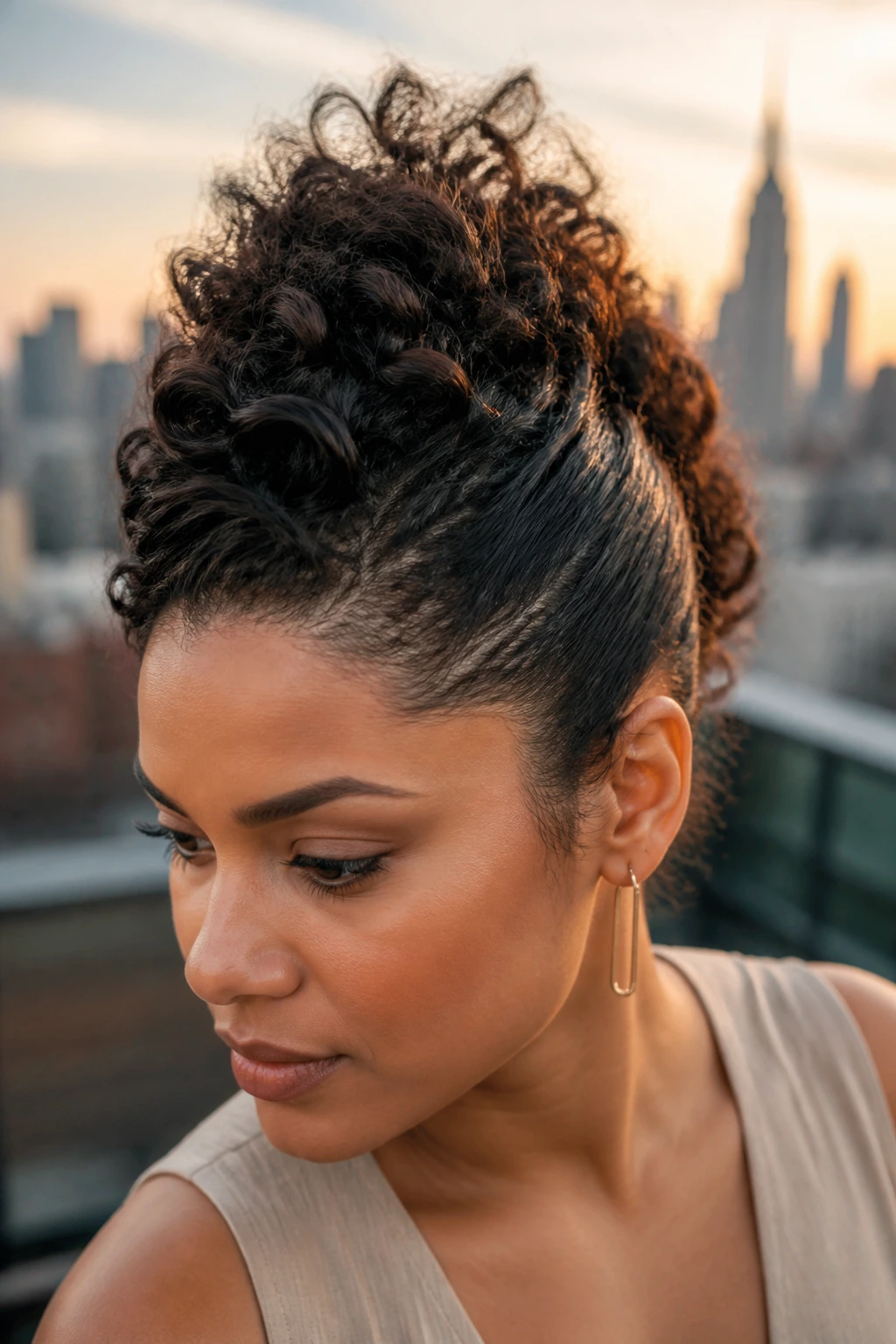
This is the bold one. The sides are pinned close to the head while the center section stays lifted in a ridge or puff running from forehead to nape. With curly hair, that ridge can be built from twists, small pony sections, or simply pinned curls stacked along the middle. The effect is sharp without requiring straight hair or a flatiron, which is why it works so well on dense texture.
Keep the center loose, not messy
The top should have height, but not chaos. A little lift at the crown is enough; the point is shape, not spikiness. Use bobby pins parallel to the scalp along the sides, then cross-pin any parts that want to puff out. I’ve seen this style fall apart when people over-smooth the sides. You want the outer surface neat. You do not want it shiny and taped-down.
This one likes strong-hold gel at the front hairline and a light mist of hairspray along the finished ridge.
9. Knotted Low Pony
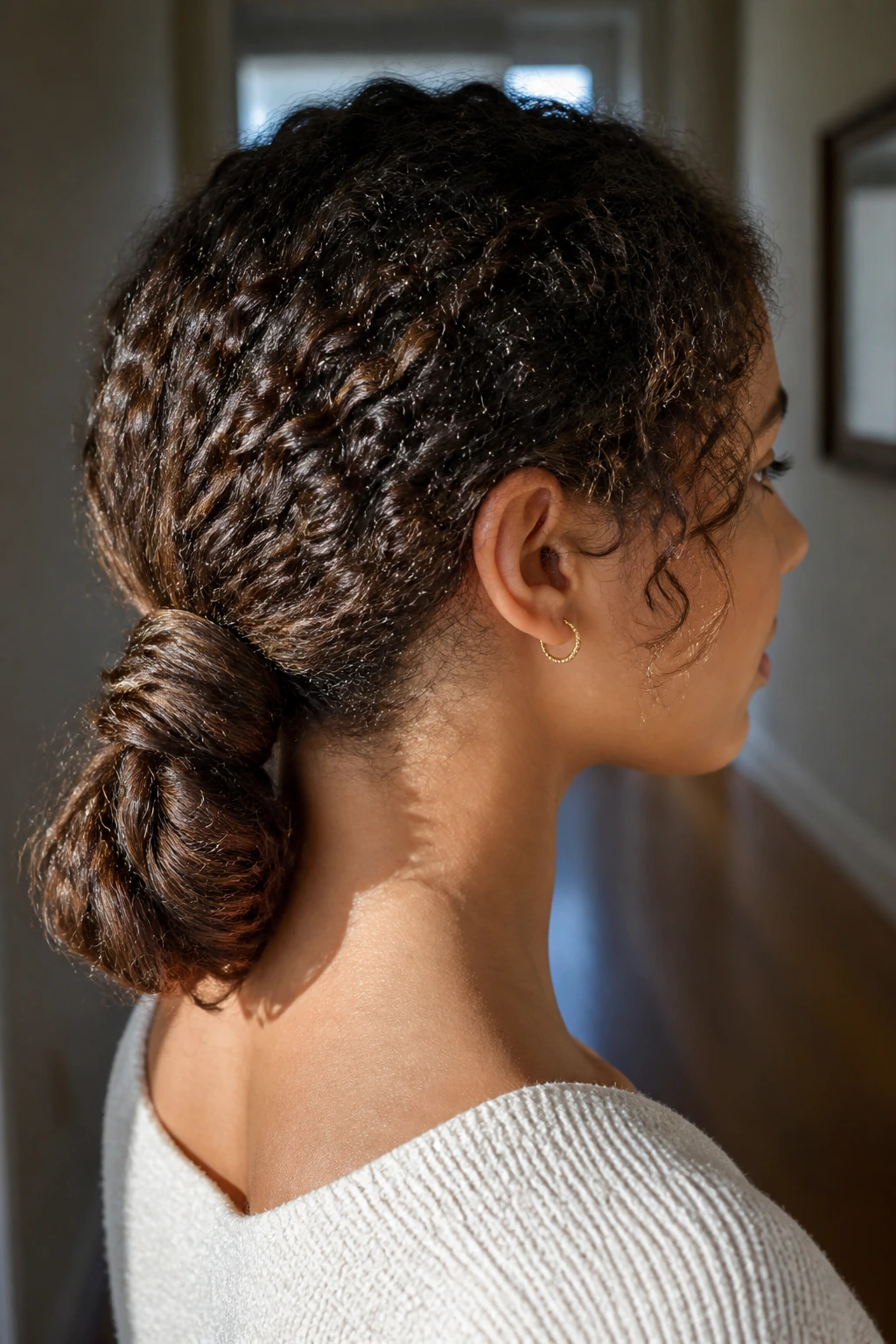
A knotted ponytail sounds simple because it is simple, but on thick hair the knot has real presence. Pull the hair into a low pony, split the tail into two sections, and knot them once or twice depending on length. Then tuck the ends under the knot or let them spill below it if you want a looser finish.
The shape works because the knot acts like a visual center point. Instead of the ponytail hanging straight and heavy, the weight gets compacted into a shape that feels more finished. This is a good choice when your curls are too full for a slim pony and too soft for a stiff bun. Keep the base secure with a seamless elastic and one or two pins underneath the knot. If the pony starts to sag, it usually means the elastic is too far from the nape. Move it closer.
10. Dutch Braid Into Bun
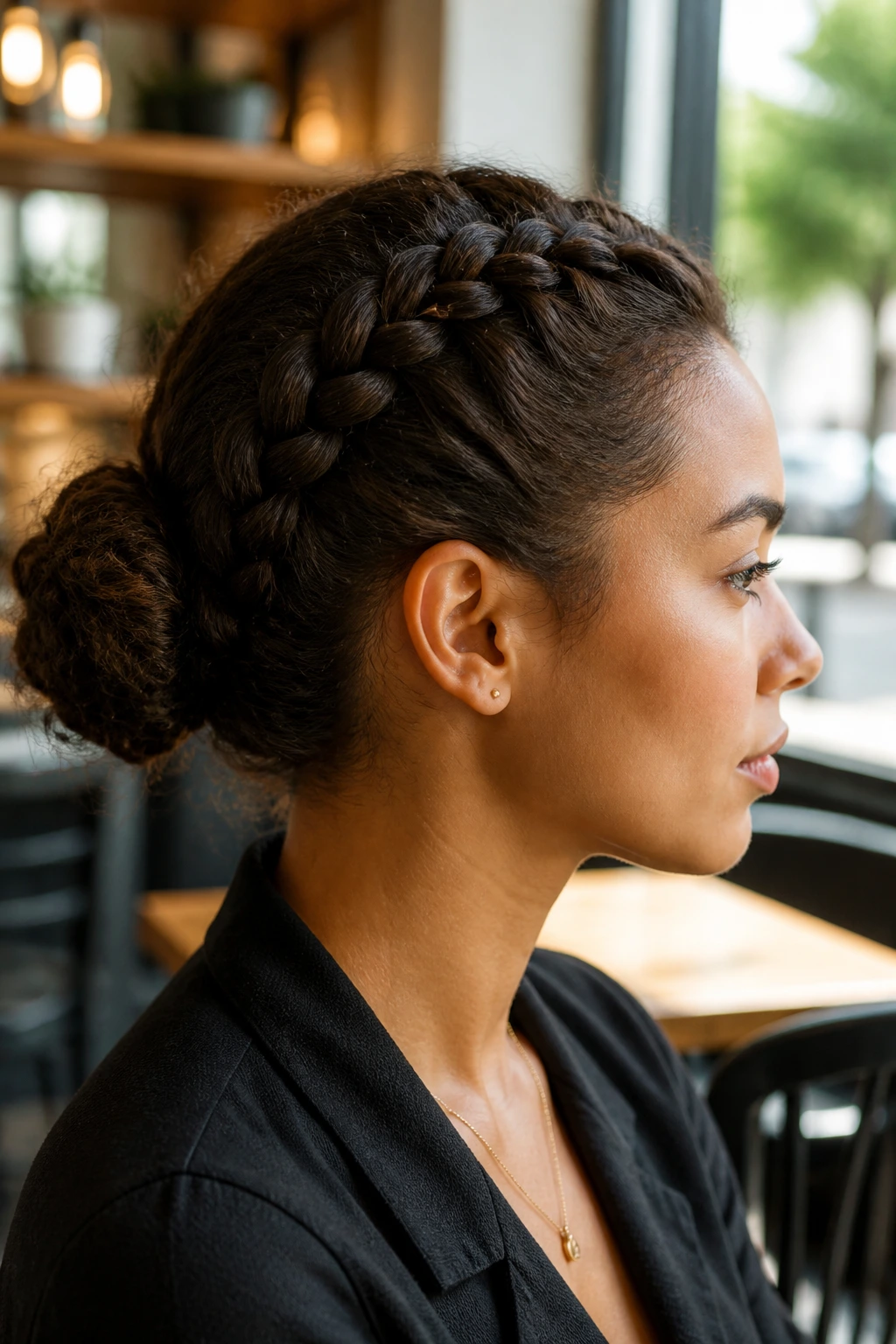
This style starts with control and ends with a little volume. A Dutch braid runs along the scalp from the front hairline toward the nape, then the remaining length is wrapped into a bun. Thick curls like this because the braid serves as an anchor, and anchors matter when the rest of the hair has a mind of its own.
If you’ve got dense hair, braid with moderate tension. Too loose, and the braid puffs out before it reaches the nape. Too tight, and the scalp gets angry. The finished bun can be compact or soft, depending on how much curl you leave exposed. This is one of the better styles for active days because the braid keeps the front tidy while the bun handles the bulk at the back.
11. Gibson Tuck
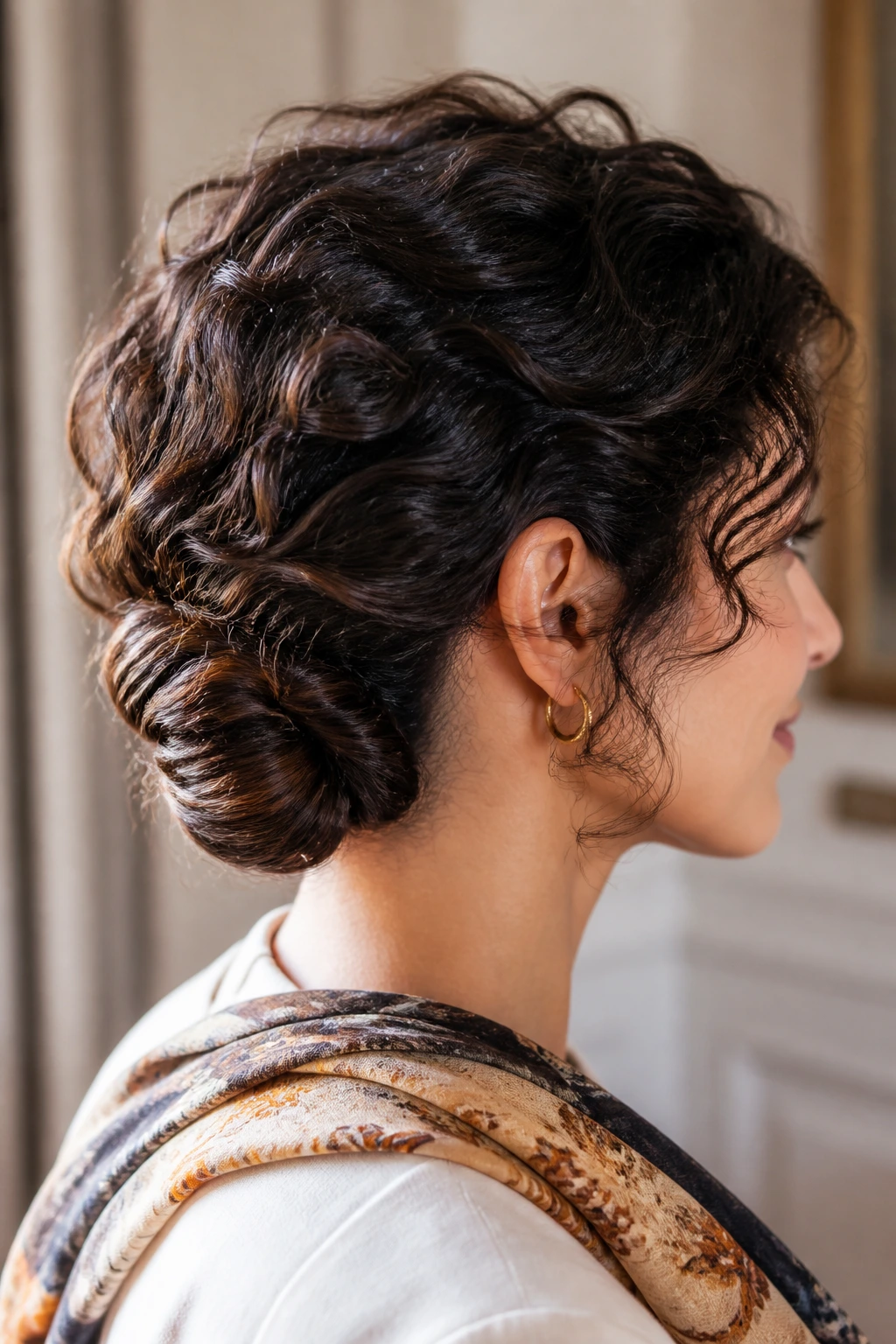
The Gibson tuck has that neat, almost old-fashioned shape that becomes interesting again when you feed it curly, thick hair. The hair is folded upward and tucked into itself, usually at the nape, so the length disappears into a smooth roll. On curls, the surface texture keeps it from looking severe.
This style loves hair that has been stretched a bit, especially if the ends are not overly slippery. A fabric headband or scarf can help hold the tuck while also hiding the seam. If the roll starts to open, add pins from underneath, not from the top. That keeps the surface clean. It’s one of the better choices for long necklines and structured collars, because the style stays low and doesn’t compete with the outfit.
12. Half-Up Crown Knot
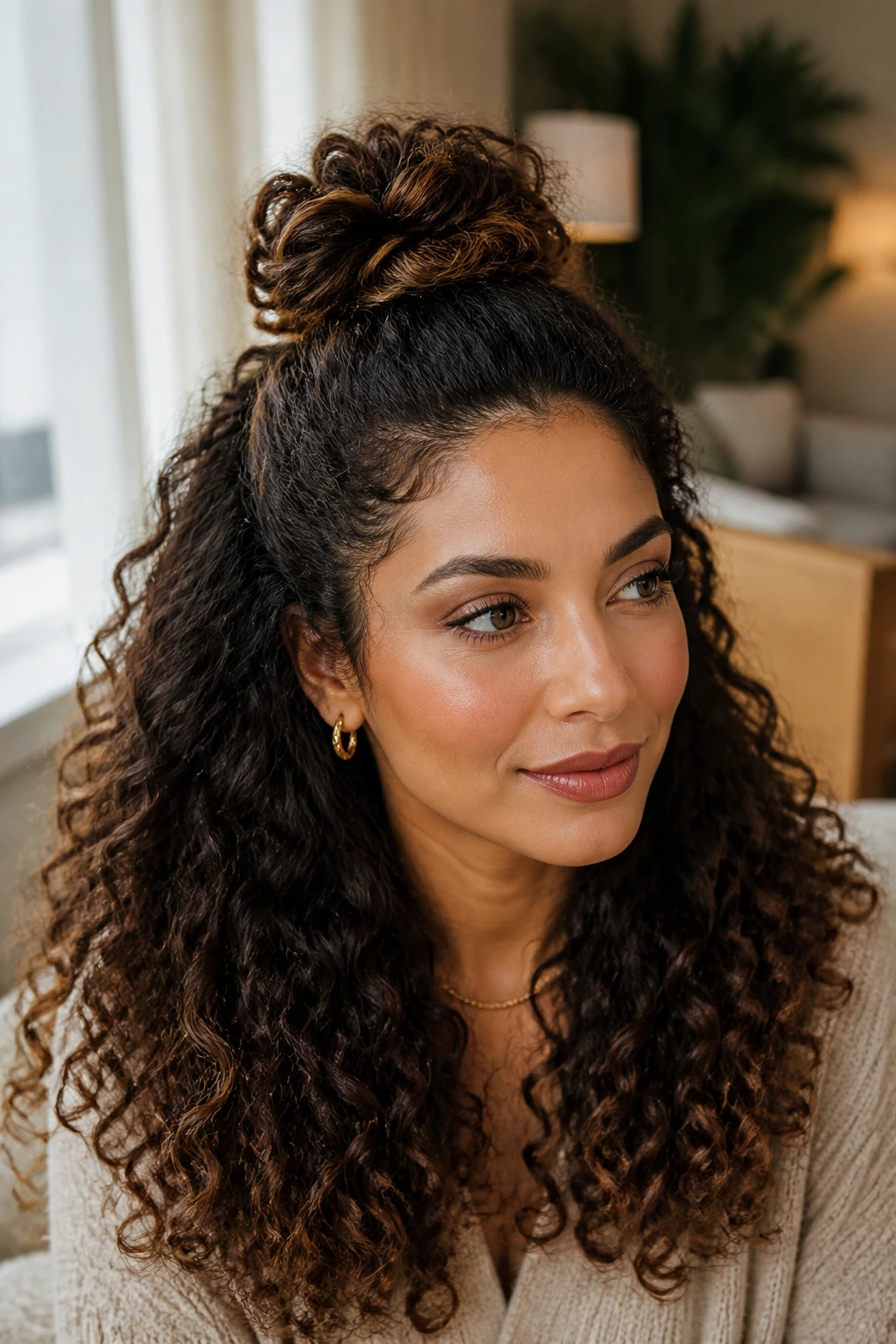
Not every updo has to take every strand off the neck. The half-up crown knot pulls the top section into a knot or small bun while leaving the lower curls free. That makes it a smart compromise when your hair is too full to pile up completely, or when you want the front controlled and the length still visible.
It’s also a good way to manage thick hair without committing to a full set of pins. The top section gets the lift; the rest of the hair does its own thing. This works especially well if your curl pattern is strongest on the bottom half and a little less cooperative at the crown. Keep the knot centered or slightly back from the hairline so the style doesn’t feel top-heavy. A few curls pulled out around the temples soften the whole look.
13. Rolled Side Chignon
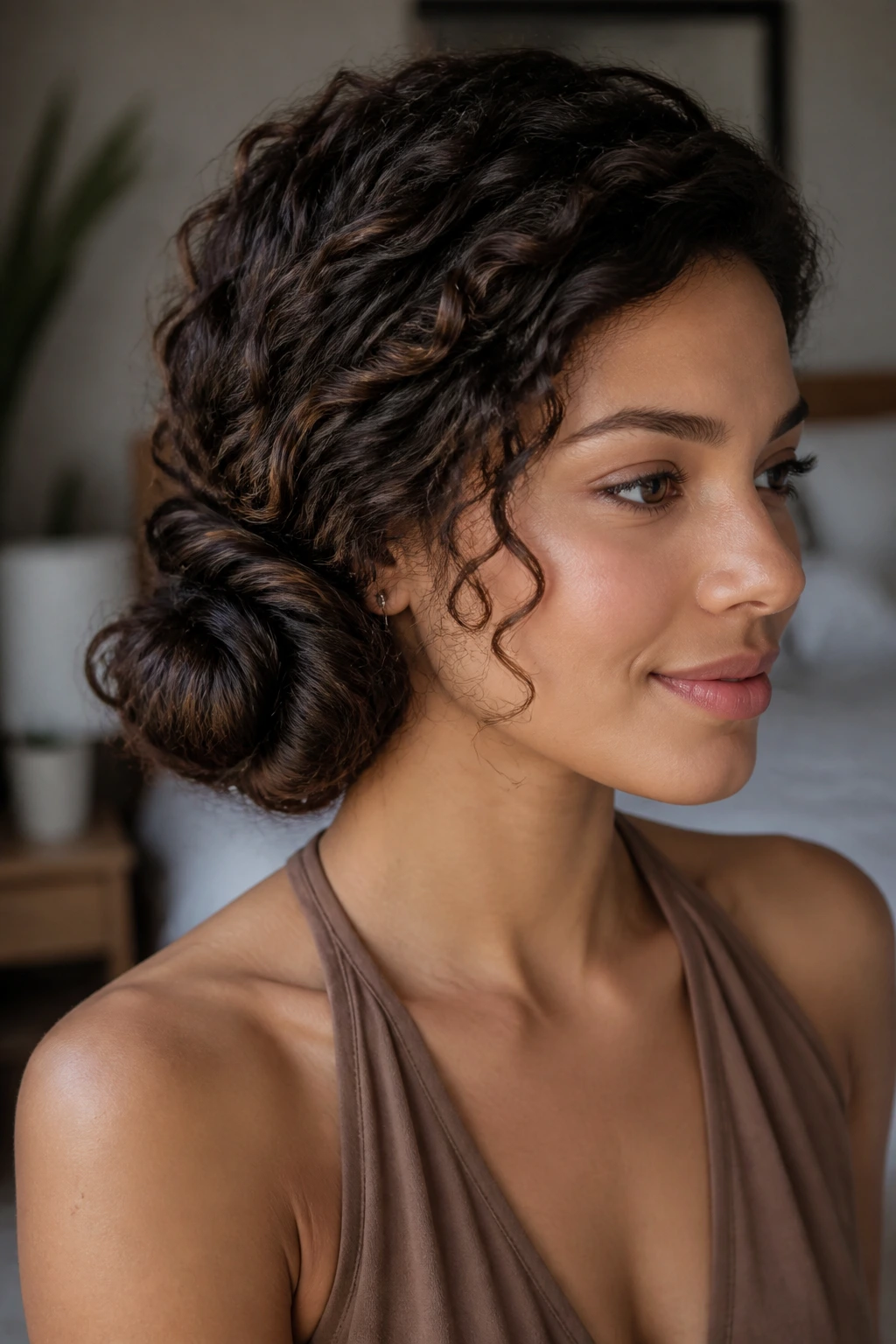
The side chignon is a softer cousin of the formal bun. Hair is swept to one side, rolled inward, and pinned into a low shape near the jawline or behind one ear. Thick curls make this more interesting because the roll can show several textures at once: smooth at the crown, springy along the curve, and fuller at the base.
I like this when a dress or shirt has one-shoulder lines, an asymmetrical neckline, or a lot of detail up top. The hair should support the outfit, not argue with it. Keep the front section neat and the roll broad enough to hold its shape. If the ends poke out, tuck them deeper and pin beneath the curl line. A single decorative pin or comb can finish it without adding weight.
14. Scarf-Wrapped Puff Bun
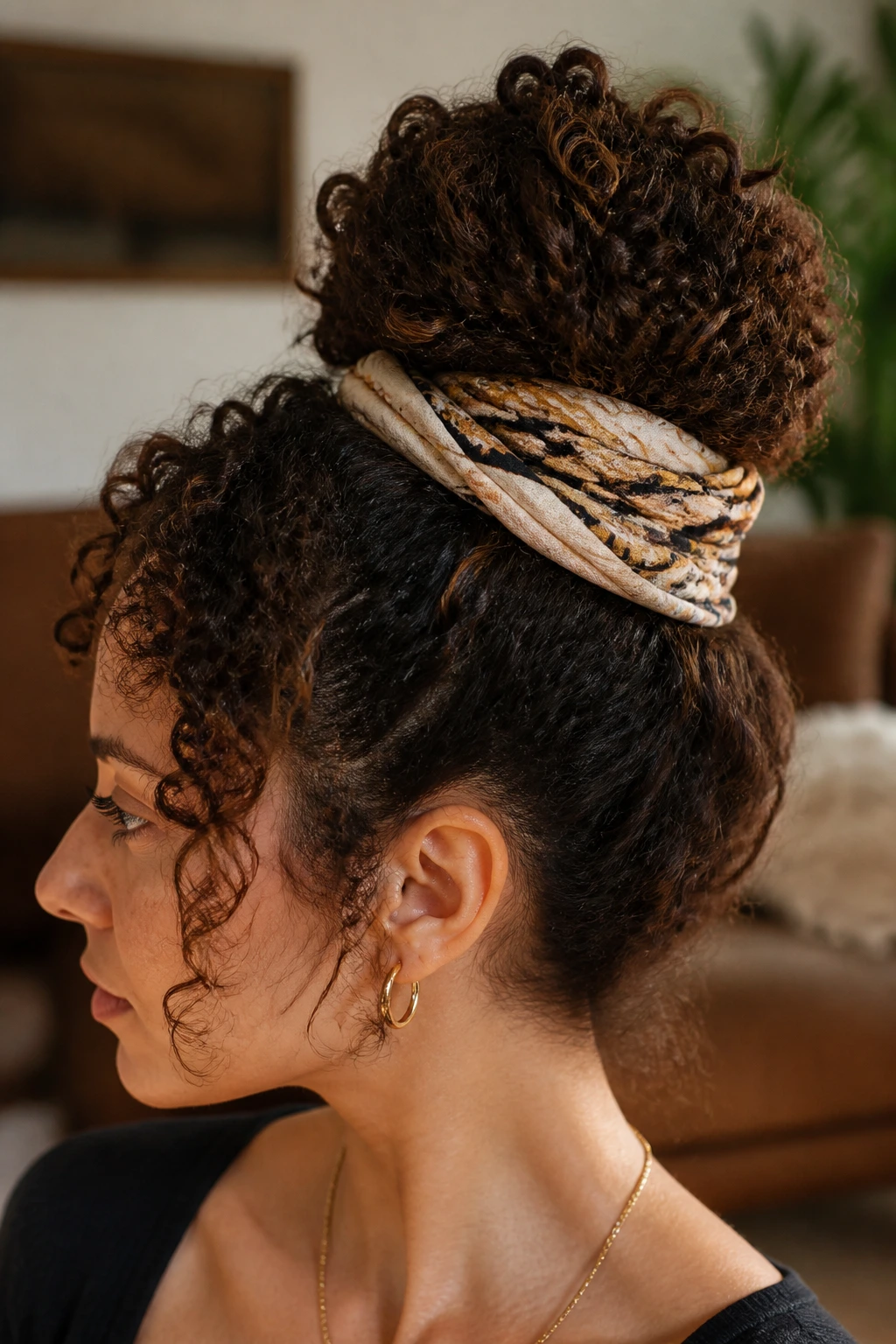
A scarf is not just decoration here. It helps anchor the shape, hides the elastic, and gives thick hair something soft to sit against. Wrap the scarf around the base of a puff bun or weave it lightly through the bun before tying it off. Cotton scarves grip a little more; silkier ones slide more easily but look sleeker.
This style is especially useful if your hairline needs a break from tight tension. The scarf lets you keep the base secure without pulling the roots too hard. It also adds a bit of structure to curls that might otherwise fray at the edges. If you’re wearing the scarf on top of the bun, keep the knot low and off-center so it doesn’t look bulky. If you’re using it as a wrap, place the fabric where the bun feels weakest. That’s where the support matters.
15. Braided Ponytail with Ends Free
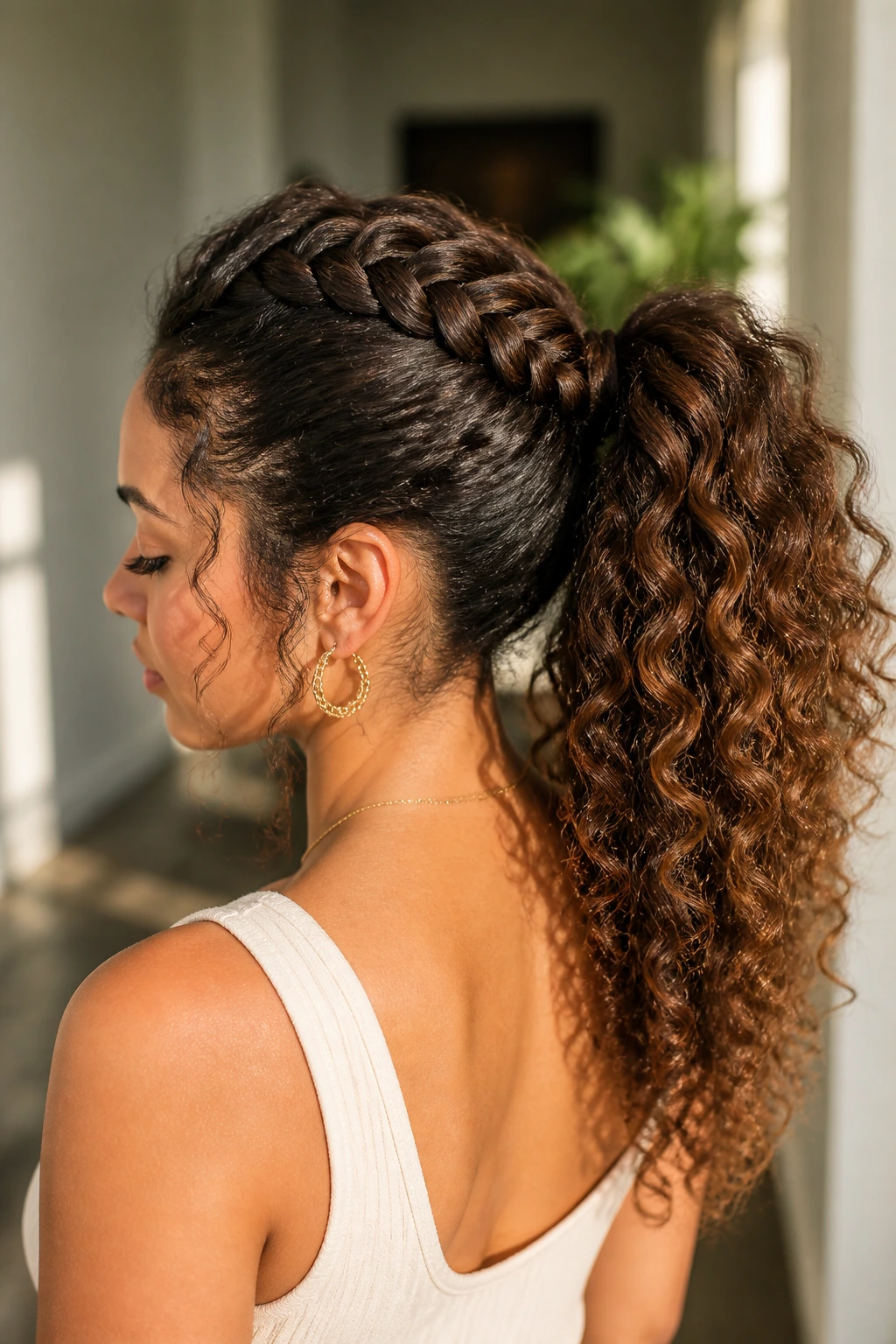
Here, the braid is doing the bookkeeping, and the curls are doing the showing off. You braid part of the hair—usually the top or the base near the crown—then gather everything into a ponytail and let the ends stay curly and loose. Thick hair benefits from that split because the braid keeps the top section from puffing too much while the ponytail still gives you movement.
This is a good style when you want length on display. It also works nicely on second-day curls that need a little direction but not a full reset. The braid should not be so tight that it flattens the root line. A clean, medium braid is enough. If the tail is extra heavy, anchor the ponytail with two elastics, one on top of the other, and hide them with a small section of wrapped hair.
16. Crown-Braid Ponytail
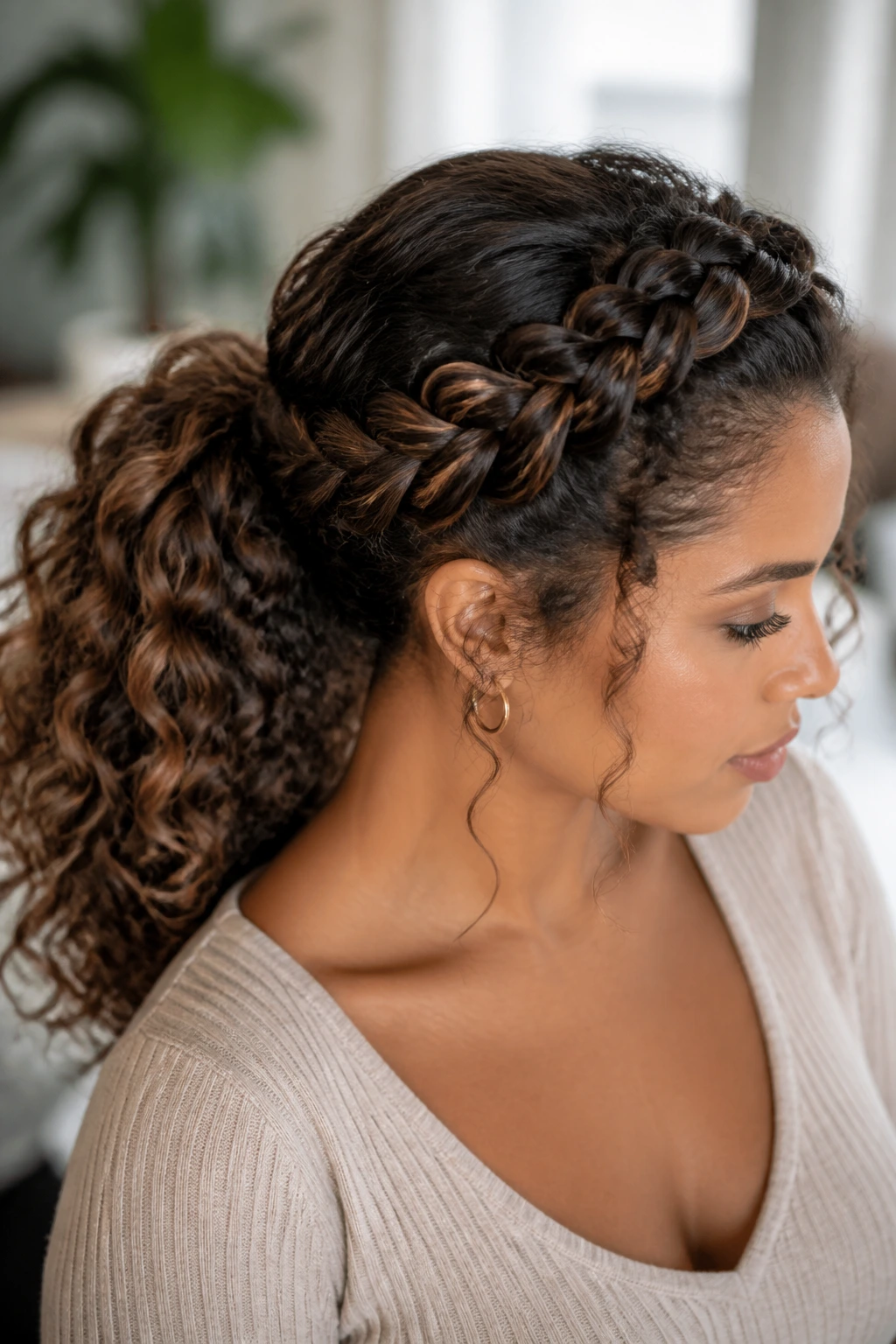
A crown braid that feeds into a ponytail gives you the best part of both shapes: the control of a braid and the swing of a pony. Thick curls like this because the braid manages the front and sides, while the tail keeps enough volume to avoid looking skimpy. It’s also easier than trying to force every strand into a full updo when the hair is too full for that kind of compliance.
The braid does not need to be tiny. In fact, on dense hair, a slightly wider braid looks better and holds longer. Once it reaches the back of the head, secure it with an elastic and let the ponytail fall low or mid-height. The finished shape is tidy but not flat. If you want extra polish, wrap a small curl around the elastic. If you want it softer, pull out one or two face pieces and stop there.
17. Twisted Halo Bun
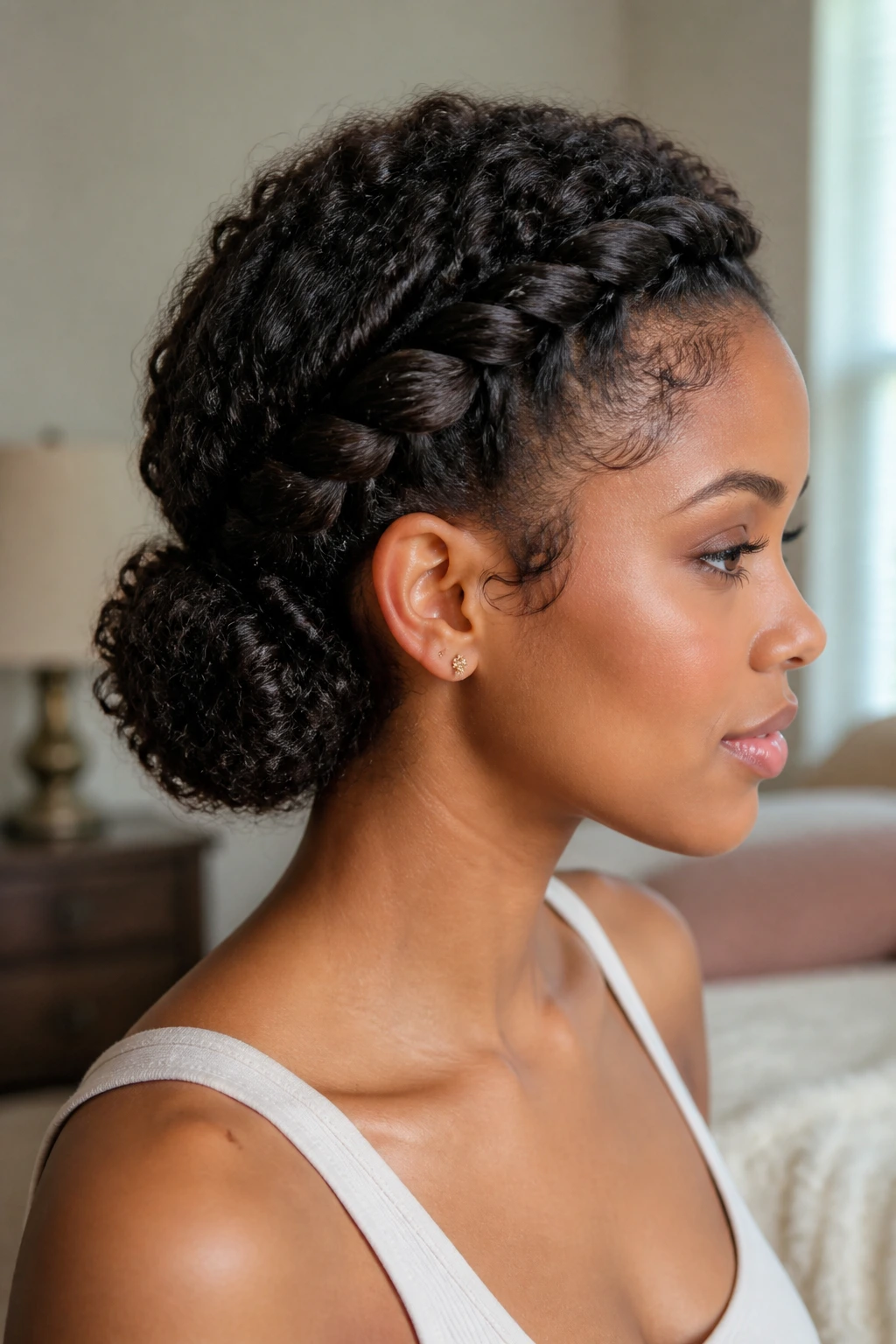
Two temple twists meeting at a low bun can feel almost protective in the best way. The twist keeps hair off the face, while the bun collects the length in one place. For curly hair, the halo effect is especially pretty because the twists carry natural texture instead of trying to hide it.
This is a strong choice when you want the edges and crown to stay controlled without pulling everything back too hard. The twists should follow the curve of the head, not fight it. Pin them where they meet, then build the bun just below that point. If the style starts to puff at the twist line, smooth only the outer layer with a tiny bit of gel or cream. Too much product there will make the rest of the hair limp.
18. Messy Top Knot
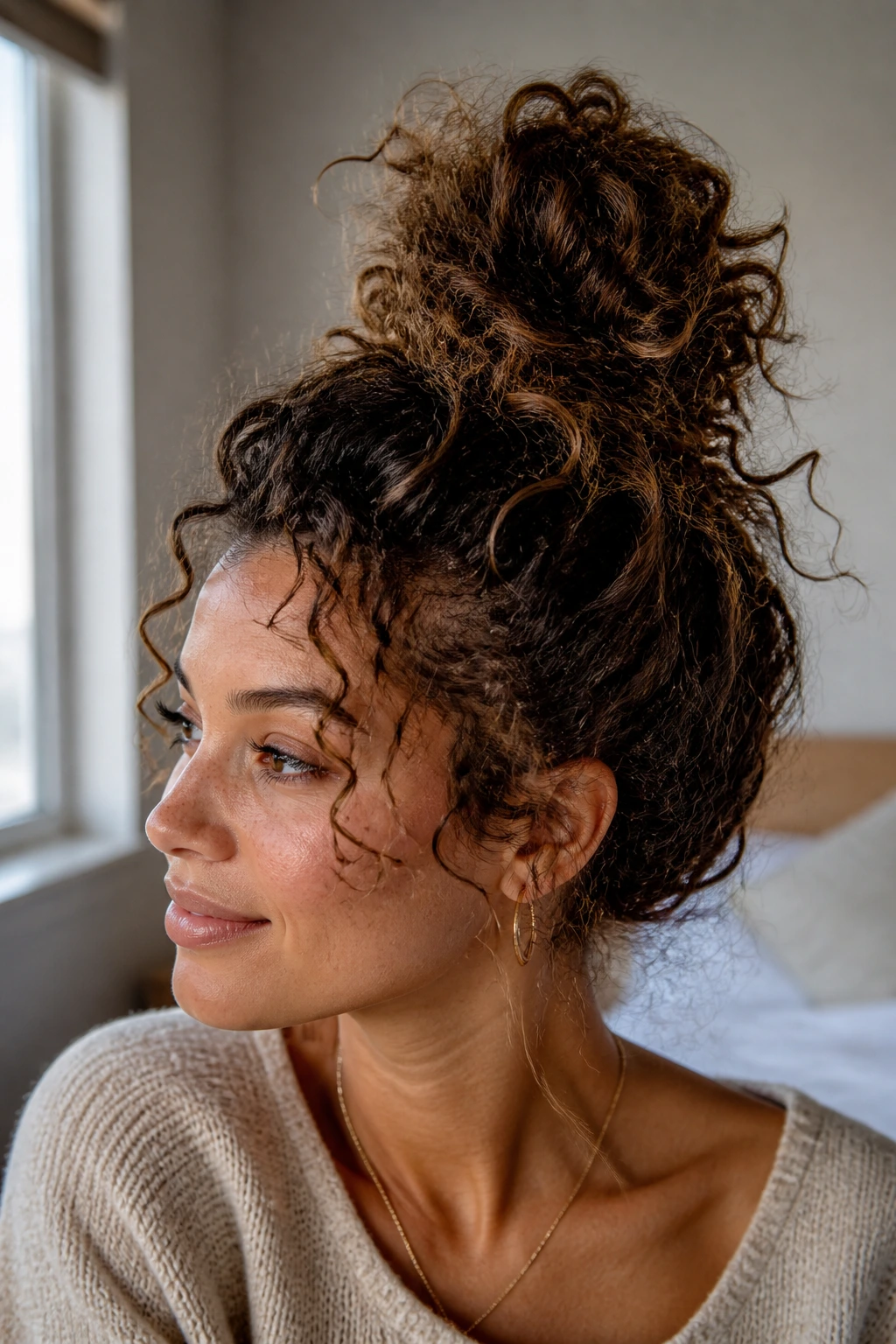
A messy top knot is useful because it does not pretend to be anything else. Gather the hair high, twist loosely, and pin or wrap it into a knot that leaves some ends exposed. On thick curls, the knot gets enough body to look full even when it’s deliberately imperfect.
The mistake people make is over-smoothing it. Don’t. This style wants lift at the crown and a little irregularity around the edges. If you pull the sides too tightly, the whole thing becomes harsh and the curls lose their shape. I like this one on mornings when the hair is already a little puffy and you’d rather work with that than against it. Add a couple of pins under the knot so the bulk sits where you want it.
19. Low Bun with Defined Face Pieces
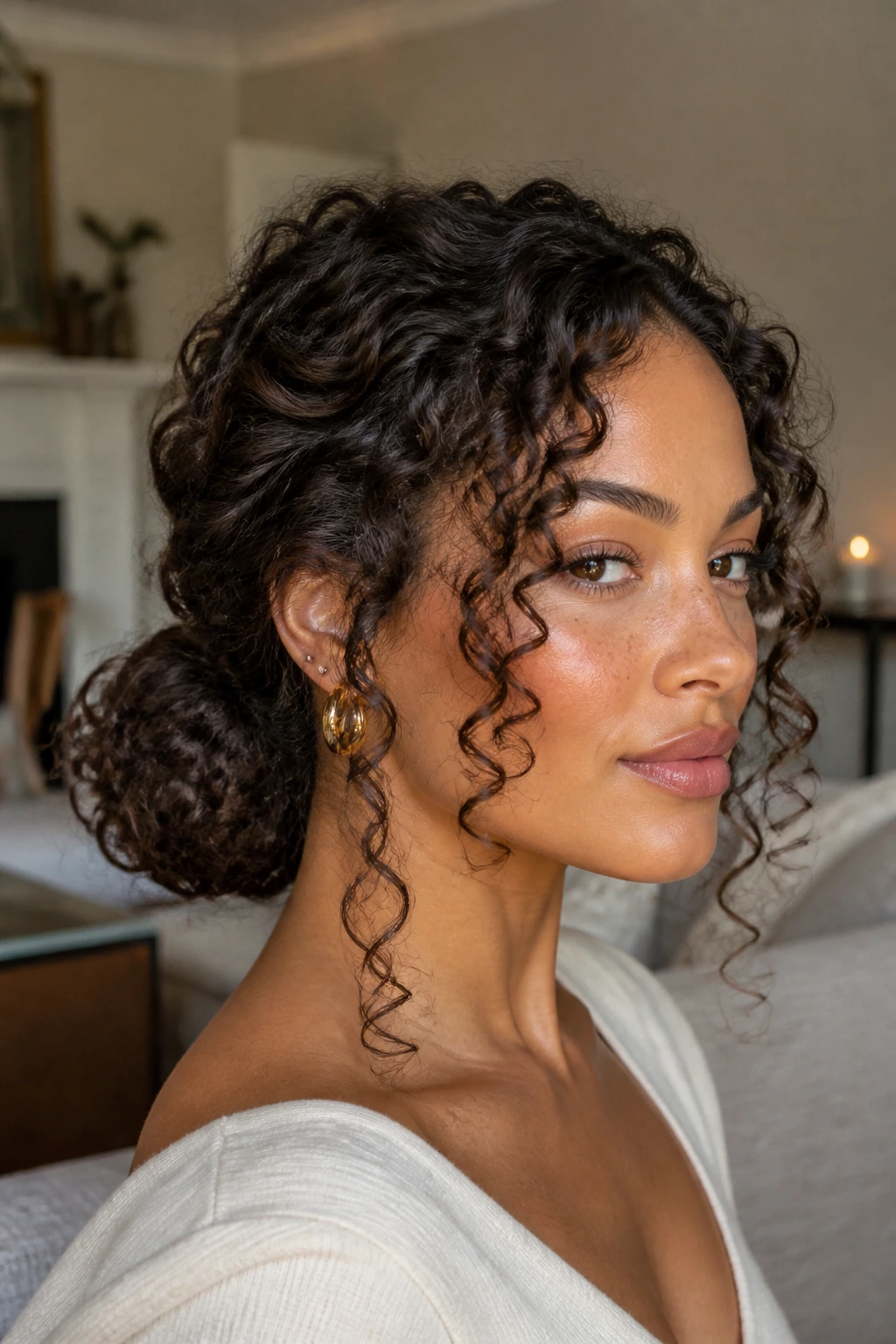
A low bun gets much softer when you leave a few curls out around the face. Those pieces do a lot of work. They break up the mass of the bun, frame the cheekbones, and keep thick hair from looking too contained. The bun itself can be loose or compact, but the face pieces should stay defined enough to show the curl pattern.
This is one of the more forgiving looks in the bunch. If the bun grows a little larger by the end of the day, it still reads as part of the style. If the front curls frizz a bit, that usually looks fine too, because the style already has softness built in. Use pins under the bun rather than across the top so the curl surface stays visible. A tiny bit of serum on the face pieces is enough. Anything more starts to separate the curl clumps.
20. Sleek-Back Crown Bun
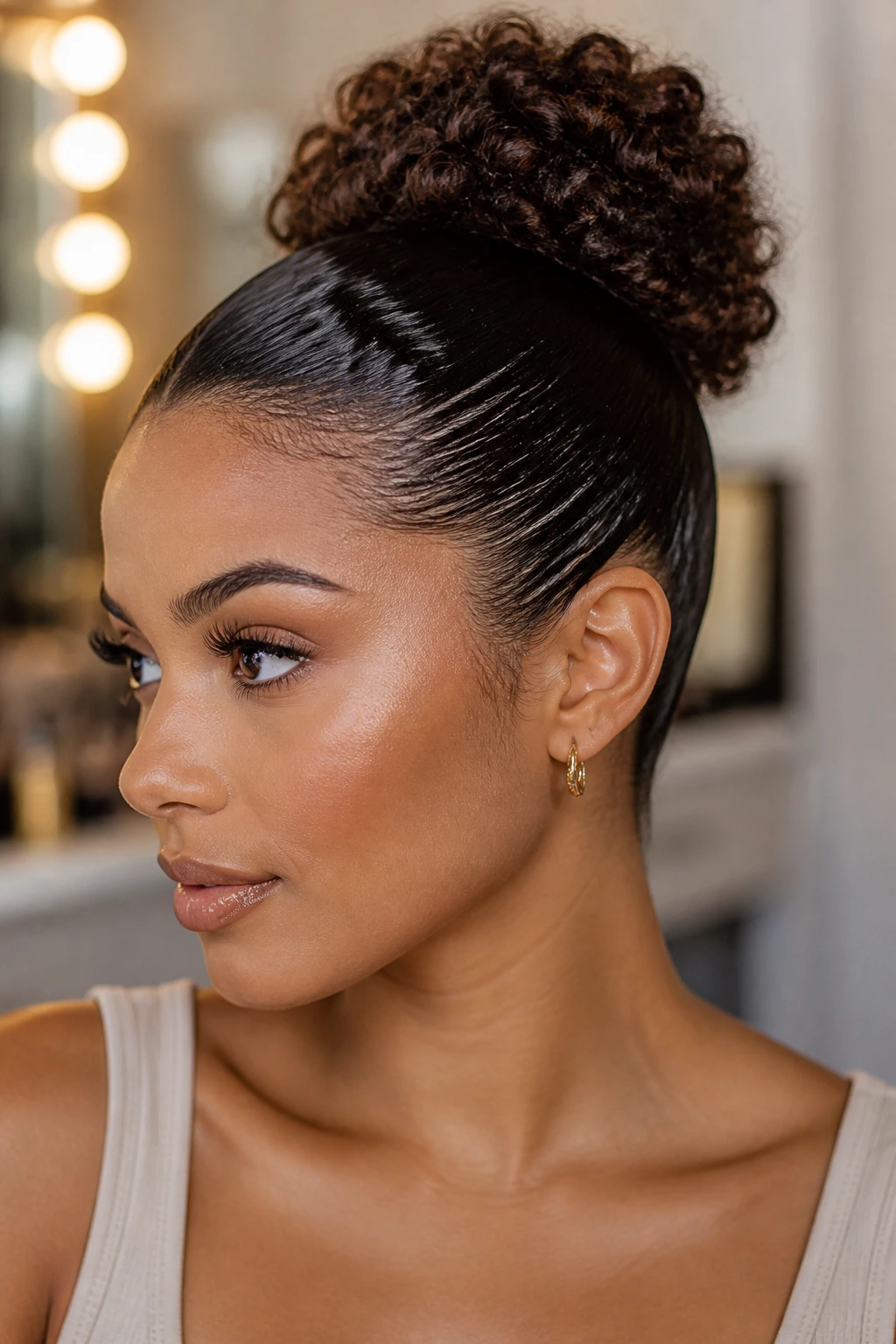
This is the sharpest look here, and it works only when the hairline is smoothed cleanly. The sides and crown are brushed back with gel or edge control, then the length is gathered into a bun that can sit high, mid, or low depending on your neck and outfit. On thick curly hair, the contrast between slick sides and a full bun can look strong in the best way.
Gel belongs at the front, not everywhere
That’s the rule. If you load the lengths with heavy gel, the bun can dry stiff and oddly flat. Keep the product focused at the hairline, where you need control. The rest can stay textured. A boar-bristle brush or smoothing brush helps here, but don’t overwork the crown. Two or three passes are enough to lay the hairs down. If you keep brushing, you’ll strip away the natural lift that gives the bun its shape.
21. Wrapped-Base Puff Ponytail
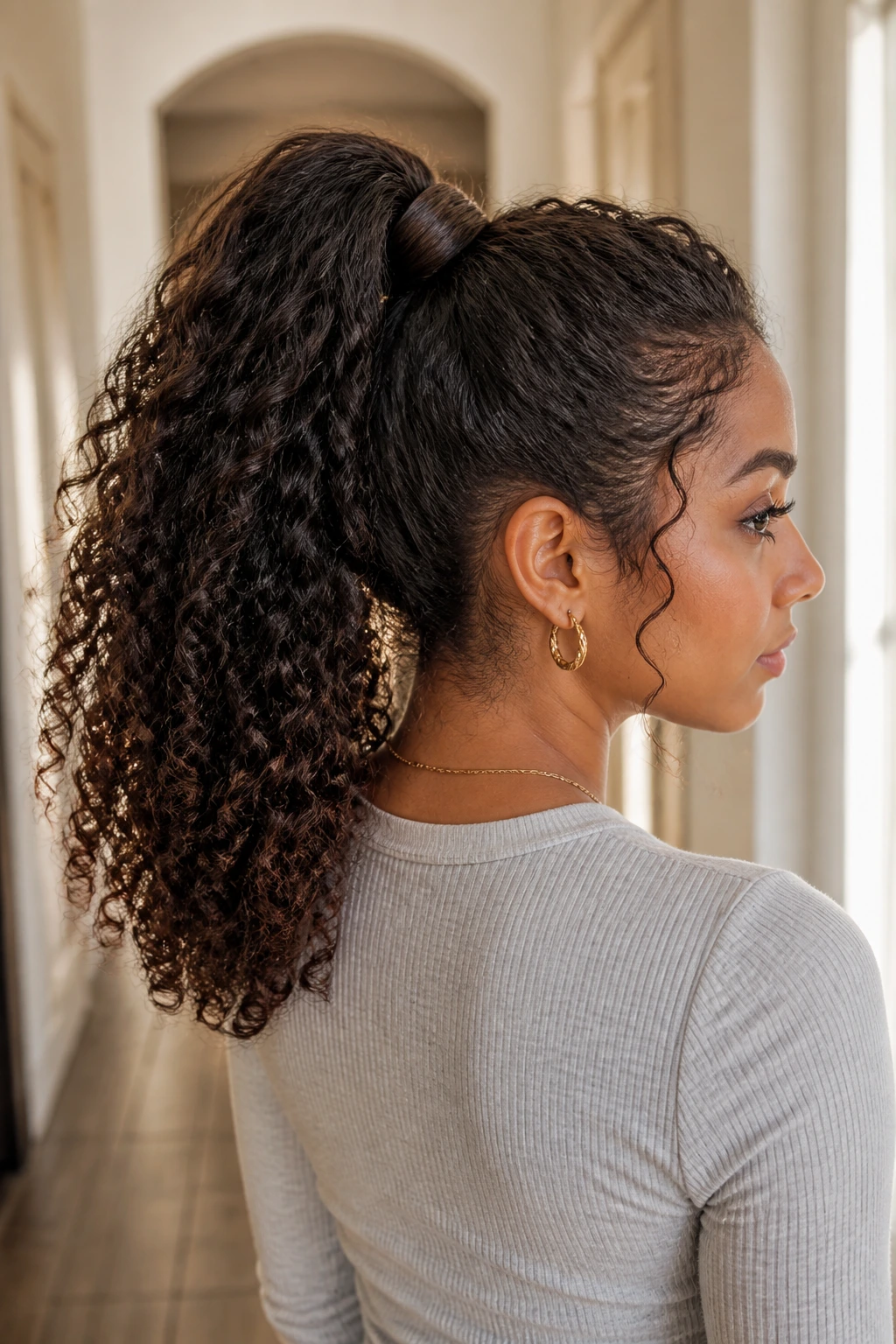
A wrapped-base ponytail is one of those styles that looks far more polished than the effort it takes. Pull the hair into a high or mid ponytail, then wrap a section of hair around the elastic to hide it. On thick curls, the ponytail itself becomes a puff of texture, so the wrapped base gives the whole thing a cleaner start.
This works especially well if you want height without a full bun. The ponytail moves, the curl pattern stays visible, and the base looks neat. If your hair is very dense, split the tail into two loose sections before wrapping so the weight doesn’t pull all in one direction. Secure the wrapped section with a hidden pin beneath the ponytail. The result should feel springy, not rigid.
22. Infinity Knot Updo
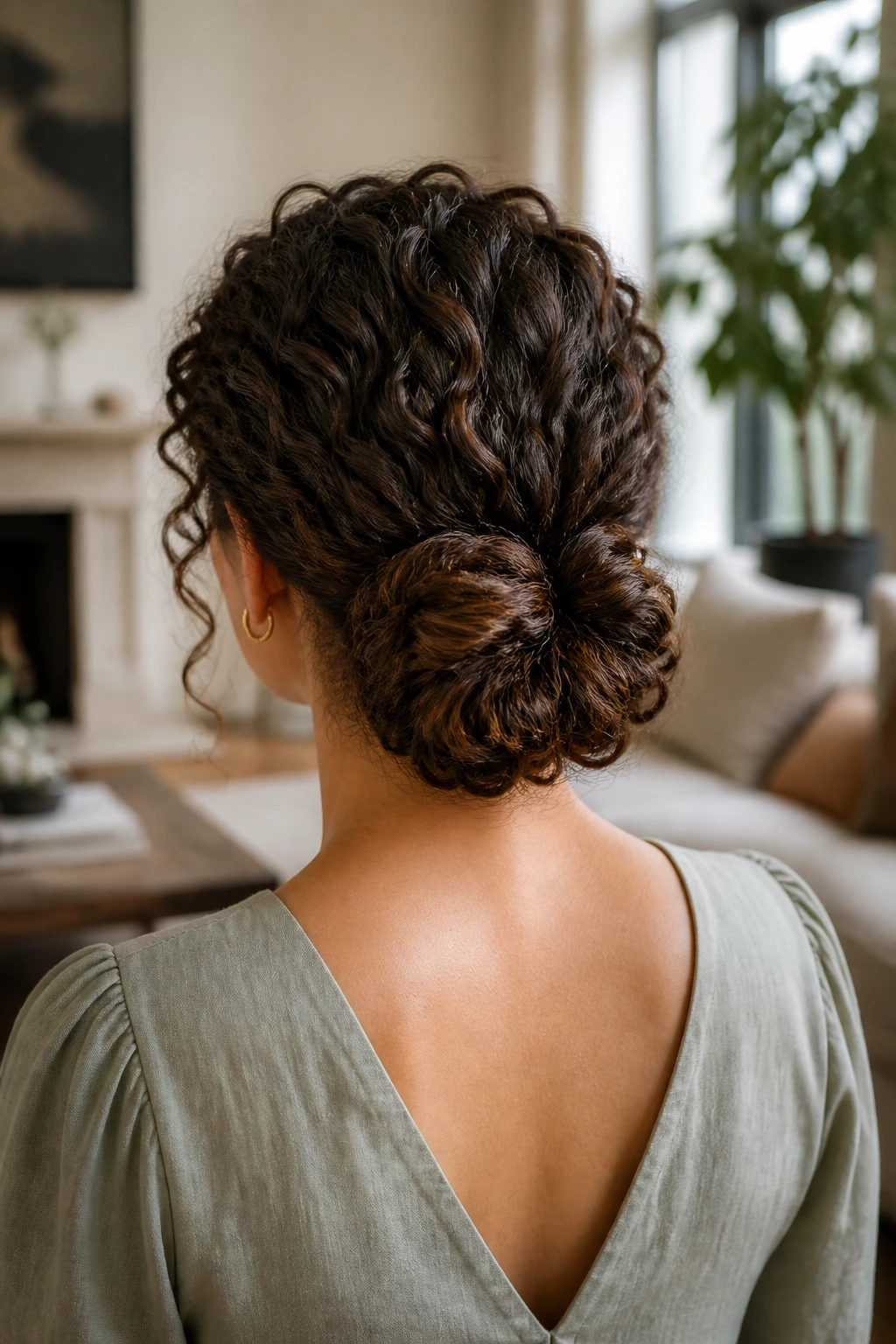
The infinity knot has a more sculpted look than a plain bun. The hair is looped into a figure-eight or twisted knot shape and pinned so the two curves sit against each other. On curly, thick hair, that shape becomes a little richer because the texture fills the gaps that straight hair would leave empty.
It’s a good choice for longer lengths, especially when you want something that feels special without requiring elaborate braiding. The trick is to build the knot from two balanced loops. If one side is larger, the whole shape tilts. Use U-pins or long pins underneath the curves to hold the center still. A few loose curls at the nape can soften the look, but the knot itself should stay crisp enough to read as a shape, not just a bundle.
23. Curly French Roll
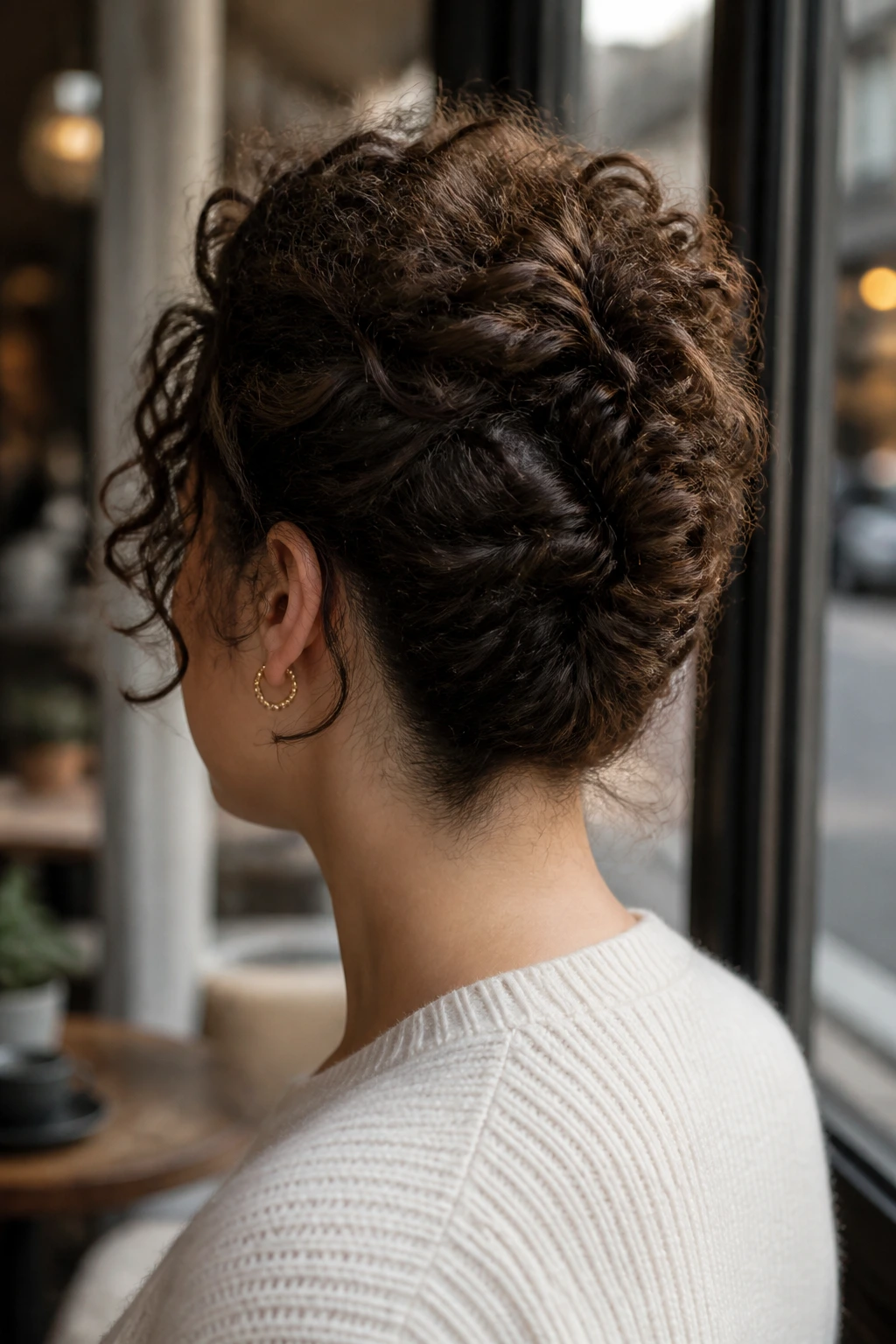
The French roll has been around forever for a reason. It keeps the neck clear, handles length well, and gives thick curls a vertical line that feels elegant without forcing the hair flat. Roll the hair upward and inward along the back of the head, then pin the seam securely from the inside. The curls can stay visible on the surface or be tucked in more tightly, depending on how polished you want it.
This style asks for a little patience, but not perfection. Dense curls give the roll body, which helps it look fuller than it would on fine hair. Use a tail comb to guide the seam and a handful of pins to keep the middle from sagging. If the top starts to lift too much, pin there before you fuss with the rest. That’s where the shape lives. The ends should tuck cleanly, and the shell should feel springy when you tap it lightly.
Why These Styles Hold Their Shape on Dense Curls
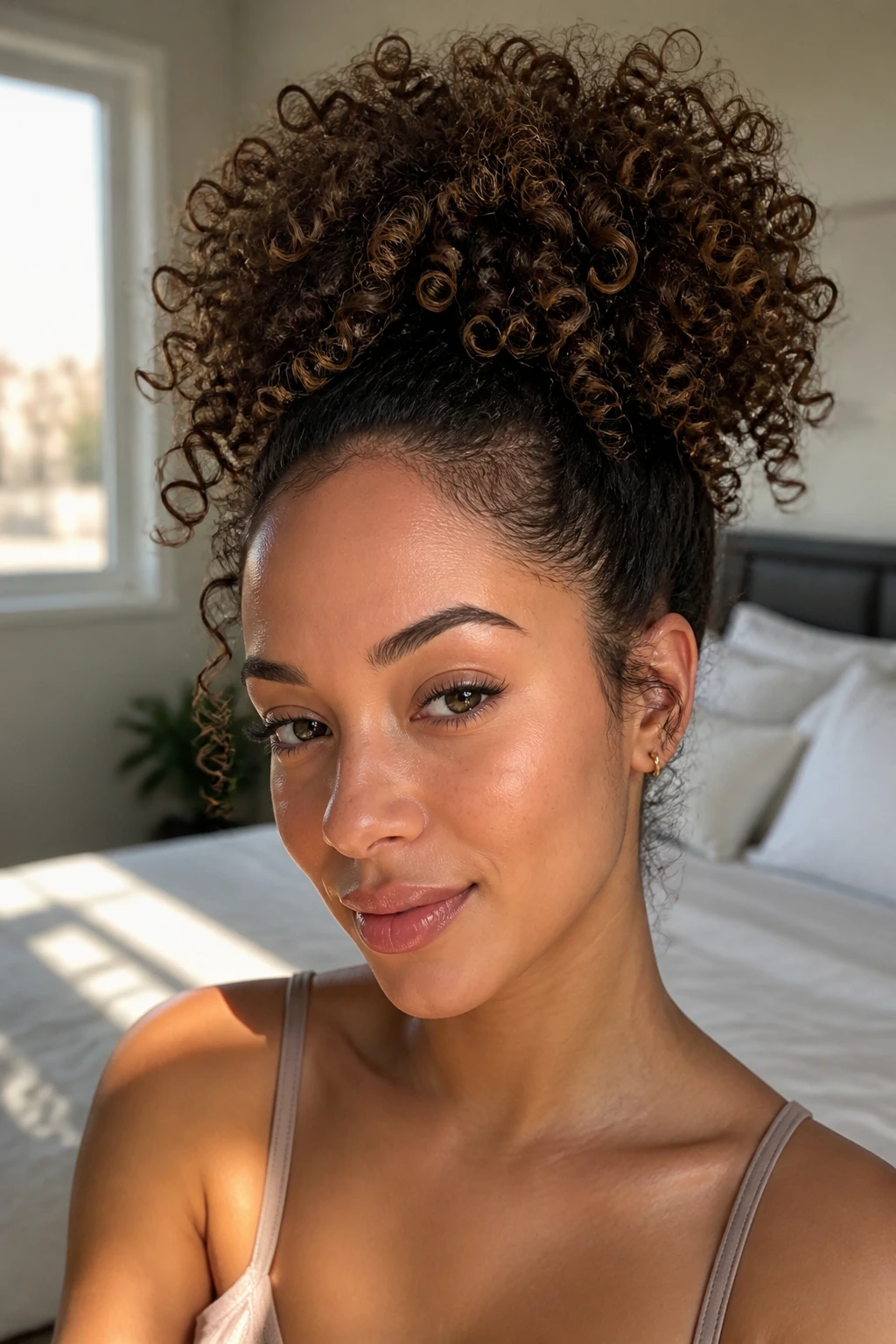
There’s a simple reason these updos work: they respect friction, weight, and curl memory. Thick hair has enough mass to create structure on its own, but it also needs anchors that can resist that mass. A style that uses the hair’s natural grip—braids, twists, wrapped bases, tucked seams—usually lasts better than a style that depends on smoothness alone.
The other piece is shrinkage. Curly hair moves as it dries, which means an updo that looks loose at the start can tighten into place later. That can be helpful if you’ve left enough room for the hair to settle. It can be a problem if you built the style too tight from the beginning. The good versions give the hair a little breathing room at first, then let the shape close in as the curls relax and spring back.
One more thing: thickness is not a styling flaw. It’s load-bearing material. Once you stop treating it like something to tame, the whole job gets easier.
Essential Tools for Curl-Friendly Styling
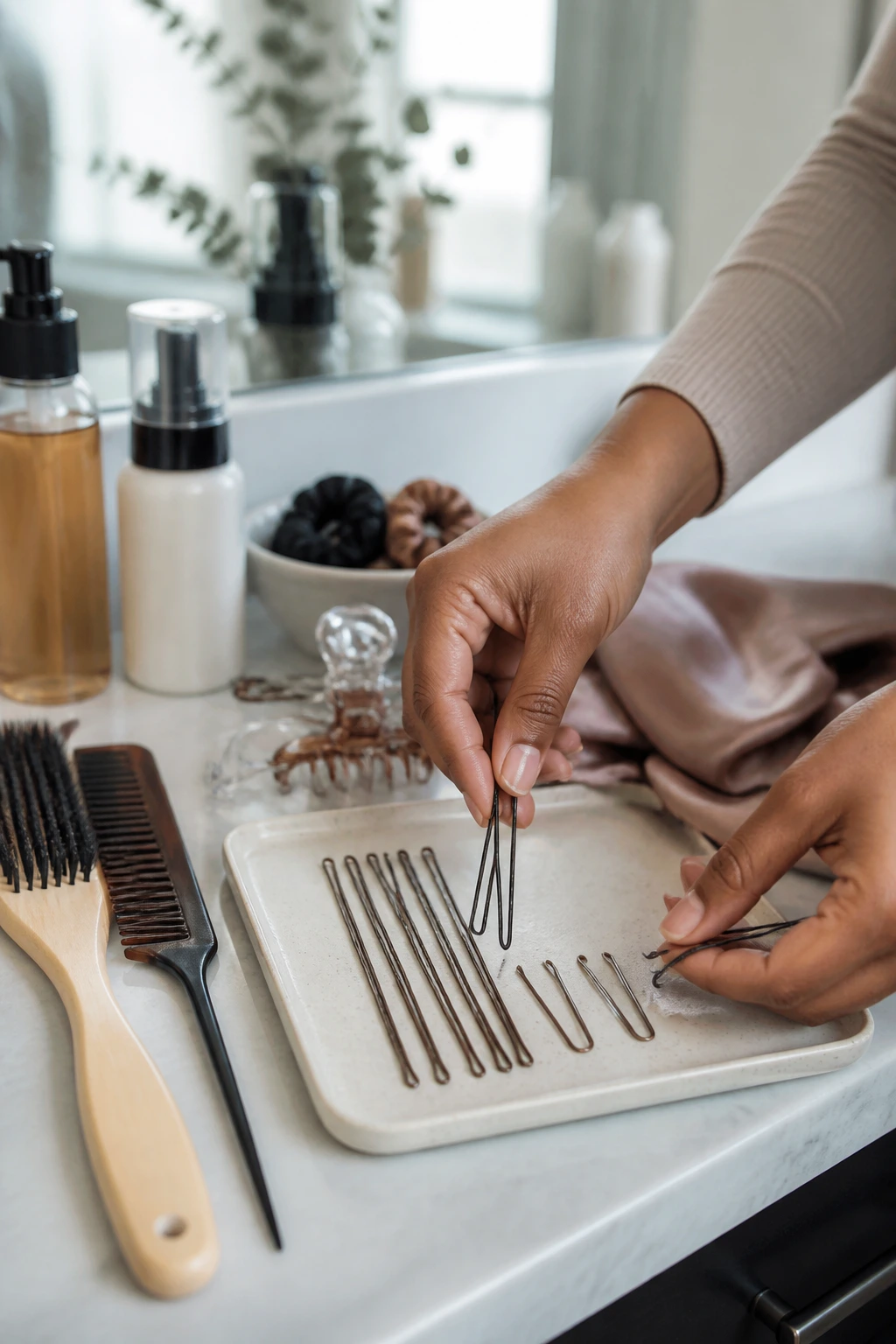
- Long bobby pins: The longer length helps them catch more than one curl or twist, which matters when the hair is dense.
- U-pins: These are useful for buns because they hold without flattening the shape as much as regular pins.
- Seamless elastics: They grip without a metal seam snagging the curl pattern or breaking the line of the style.
- Large claw clip: Look for a clip with strong teeth and enough span to hold thick hair without pinching it shut.
- Rat-tail comb: Good for clean parts and for separating sections when you want a neater base.
- Wide-tooth comb or fingers: Use these for detangling and shaping; they keep curl clumps from turning frizzy too early.
- Boar-bristle or smoothing brush: Best for sleek-front styles, but use it lightly so you don’t erase all volume.
- Light-hold gel or edge control: Helpful at the hairline and nape when you want the front to stay in place.
- Mousse or curl cream: Good for adding a little control before styling, especially if the hair feels dry and wild.
- Satin scarf or bonnet: Keeps the style from rubbing itself apart overnight.
Smart Product Choices for Hold Without Crunch
The right product mix depends on how much control you want at the root and how much curl you want to leave visible. For a soft bun or puff, a little mousse at the roots can add body without making the hair feel heavy. For a sleeker style, a small amount of gel at the hairline gives the front enough control to survive a few hours of movement. The mistake is loading the whole head with one heavy product and hoping the style will sort itself out.
Creams and oils are useful, but they belong in the middle and ends when the hair feels dry. Put too much slip near the crown and the pins lose their grip. That’s one reason thick curls sometimes slide out of a style that looked secure in the mirror. The hair was too soft to stay put.
For hold, think in layers. A base of moisture, a touch of structure, and a final mist of hairspray or setting spray where needed. If your curl pattern runs tighter, you can usually use less product and still get the shape. Looser, fluffier curls often need a little more direction so the style doesn’t widen faster than you want.
How to Wear Updos for Curly Hair and Thick Hair Without Flattening the Curl Pattern
Presentation: Decide early whether the style should read sleek, soft, or sculptural. Thick curls can handle all three, but they behave differently on the head. A sleek bun wants a cleaner crown and sharper lines. A halo braid or pineapple puff wants visible texture and a little lift around the edges.
Accessories: Earrings do more work here than necklaces do. Hoops, drop earrings, and simple studs all sit well against an updo because the neck is open and the shape of the hair is already doing visual work. Scarves, clips, and combs can help, but don’t clutter the style with too many extras. One good accessory usually beats three average ones.
Scale: Bigger hair needs bigger shapes. A tiny bun on very thick curls can look like it gave up halfway through. A larger bun, a wider braid, or a puff with enough volume to breathe usually looks better and feels more balanced. If your hair is shoulder-length, keep the structure low and neat. If it’s longer, you can move the weight higher without the style collapsing.
Setting: Match the style to the day. A French roll or Gibson tuck feels right for a dressy dinner or a formal event. A messy top knot, claw-clip twist, or wrapped-base ponytail handles errands, work, and humid air without demanding constant attention. The style should suit the weather and the clothes, not just the mood in the mirror.
A Few Small Moves That Change the Finish
Grip Boost: A mist of texture spray at the roots before pinning gives the hair something to catch. Thick curls already have grip, but a little texture spray helps the style lock in when the surface is freshly washed or too soft from conditioner.
Shape Control: Pin from the inside out. If the pins are visible from the start, the style usually looks overworked. Hide the first few pins beneath the weight of the hair, then use the last pin or two to clean the seam.
Frizz Insurance: Leave a few curls untouched on purpose. It sounds odd, but a small amount of intentional texture looks better than trying to burnish every hair smooth. That is especially true around the nape and temples, where curl patterns tend to puff first.
Make-It-Yours: If your hair is very tight and springy, keep the silhouette a little looser so the style has room to settle. If your curls are looser or stretched, build more structure at the base so the shape does not disappear. Same style, different support.
Common Mistakes That Make Thick Curls Slip or Puff Out
- Pulling the hair too tight at the start: The scalp gets sore, the curl line flattens, and the style often loosens anyway as the hair fights back. Start a little looser and anchor the base with pins instead of brute force.
- Using pins that are too short or too few: Thick hair eats pins for breakfast. If the style feels secure for two minutes and then starts sliding, add more pins at crossing points and choose longer ones.
- Smoothing the crown with too much product: Heavy cream or oil near the roots makes the hair too slick to hold. Keep slippery products off the base and save them for the ends.
- Forgetting the nape: Many styles fail where the hair meets the neck because that’s where the weight pulls hardest. Add hidden pins there first, then shape the rest.
- Making every curl disappear: A curly updo should still look like curly hair. If you flatten all the texture, the style can read stiff and the shape often looks smaller than it should.
- Ignoring shrinkage: Hair that looks loose when first pinned can tighten later. Leave a little extra room if your curls spring hard after styling or drying.
Variations and Adaptations to Try
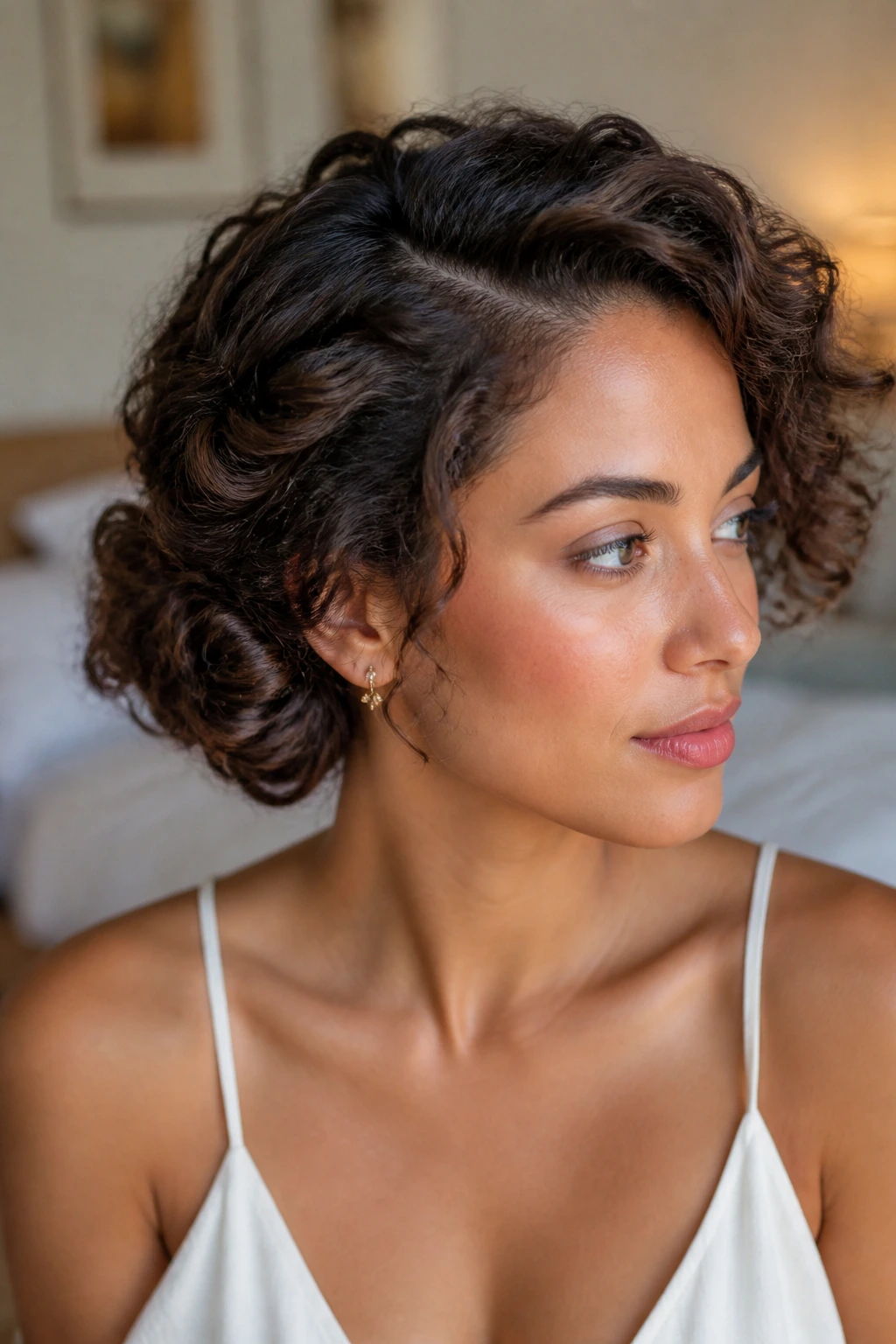
Humidity Shield: For muggy weather, lean into styles with more pins at the nape and less smoothness at the crown. A rope-twist bun, braided halo, or claw-clip French twist tends to hold up better than anything that depends on a slick finish.
Low-Tension Office Version: If you wear updos all day, keep the base lower and the front softer. A Gibson tuck, low chignon, or wrapped-base ponytail gives shape without the kind of tension that sends you reaching for your hair by lunch.
Protective Weekend Version: On days when you want less manipulation, choose styles that tuck the ends away and keep the hairline calm. Twisted halo buns, scarf-wrapped puffs, and crown-braid ponytails are useful here because they reduce friction and leave the curls less battered.
Formal Event Finish: For a dressier look, pick one strong line and keep the rest controlled. Sleek-back crown buns and French rolls look sharper when the surface is clean and the bun is compact. Add one decorative pin, not five.
Quick-Exit Version: For rushed mornings, use a claw-clip French twist, messy top knot, or half-up crown knot. These styles forgive a rough section or two and still look deliberate once they settle.
How to Keep an Updo Fresh Overnight
Curly updos last better when you treat them like something worth preserving, not something to crush under a pillow. If the style is high enough to live comfortably in a satin bonnet or scarf, use one. The satin cuts down on friction, which means fewer frizzy edges and fewer flattened curls by morning. For lower buns and French rolls, a loose scarf wrap usually works better than a tight bonnet.
If you expect to wear the style again the next day, resist the urge to keep adding product. More product often means more slip, and slip is the enemy of a pinned style. Instead, pin the weak spots before bed—usually the nape, the side nearest the pillow, or the section that carries the most weight. One extra pin at the right spot is worth more than a fresh layer of spray.
In the morning, loosen only what needs loosening. A few drops of water on your fingertips can wake up a curl clump without soaking the whole style. If a puff has lost its height, flip your head forward for ten seconds, lift the roots gently, and put one pin back where the shape started to sink. If the base feels oily or the curl pattern has gone soft in a bad way, take it down and rebuild. Patching a tired updo forever is how it starts looking tired.
Frequently Asked Questions
How do I know if my hair is long enough for these updos?
If you can gather the hair into a low ponytail or twist it into a compact section, you probably have enough length for at least half of these styles. French rolls, Gibson tucks, and tucked chignons usually need more length than a pineapple puff or messy top knot.
Can I do these styles on wash day hair?
Yes, but only if the hair is fully dry or close to it. Wet or damp curls keep shrinking as they dry, which can loosen pins and change the shape. Day-two hair often behaves better because it has a little extra grip.
How many bobby pins do thick curls usually need?
More than you think. A simple low bun may need 6 to 10 pins, while a braided halo or French roll can take a few more depending on density. The goal is not to hide the pins at all costs. The goal is to hide the right pins in the right places.
Are claw clips strong enough for thick hair?
They can be, if the clip is large and the teeth actually grip the hair. A tiny clip with a pretty finish usually fails fast. For dense curls, choose a clip that closes with some resistance and can hold the hair without bending under it.
What if my curls frizz the moment I start styling?
That usually means the hair is too dry on the surface or you’re handling it too much. Use a small amount of water, cream, or light gel on the sections you’re touching, then stop fussing once the shape is secure. Over-brushing thick curls almost always makes the finish fuzzier.
Can I stretch my curls first, or should I keep the pattern tight?
Either works, but the style changes. Stretched curls make sleeker buns, French rolls, and tucked styles easier to build. Tighter curls give puffs, halo buns, and messy top knots more volume. Pick the amount of shrinkage you want to see in the final shape.
Which styles are best if my hair is heavy and gives me headaches?
Lower styles usually win. Low buns, Gibson tucks, side chignons, and wrapped-base ponytails keep the weight off the crown. Skip the tight high ponytail if your scalp already feels tender by midafternoon.
How do I keep the style from collapsing at the nape?
Anchor the nape first. That’s the section that carries the most weight, so it needs the first pins and often the strongest elastic. If the base slips, the rest of the style will sink no matter how pretty the top looks.
Curls That Stay Put
The nicest thing about thick curly hair is that it already brings the shape most styles are trying to fake. You do not need to fight it into submission. You need to choose a structure that respects the weight, catch the right spots with pins, and leave enough texture in the finish so the whole thing still feels like hair, not a helmet.
A good updo on this texture usually looks better the second it settles. That’s the magic of it. The braid softens. The bun gains a little body. The curls around the hairline relax just enough to stop looking rehearsed. If you build the style with a solid base and a little room to breathe, it tends to reward you later in the day.
Pick the one that fits your length, your patience, and the amount of control you actually want. The right style is usually the one that still looks like yourself after a few hours, not the one that survived only because you kept standing in front of the mirror.
