



A fringe can change a face faster than most people expect. On a round face, the wrong line can pull the eye straight across the widest part of the cheeks; the right one adds a sliver of height, a diagonal sweep, or a soft break at the cheekbone that changes the whole balance. For women over 40, that matters even more because hair often gets a little finer at the front, cowlicks start acting like they pay rent, and a bang that looked easy at 28 can sit like a stubborn curtain at 48.
The trick is not “hiding” anything. It’s shape. A good fringe for a round face makes room for the eyes, trims the visual width at the cheeks, and gives the forehead a little structure without turning the haircut into a blunt shelf. I’ve always preferred bangs that move a bit — ones that can survive a humid afternoon, a pair of glasses, or a rushed blow-dry without collapsing into the eyebrows.
Some of these styles are soft and forgiving. A few are bolder, and one or two come with real caveats. That’s the point. Bangs are not a personality trait; they’re a design choice. And the right choice starts with knowing which shapes actually work with a round face instead of fighting it.
Why This Fringe Lineup Is Worth Your Time
-
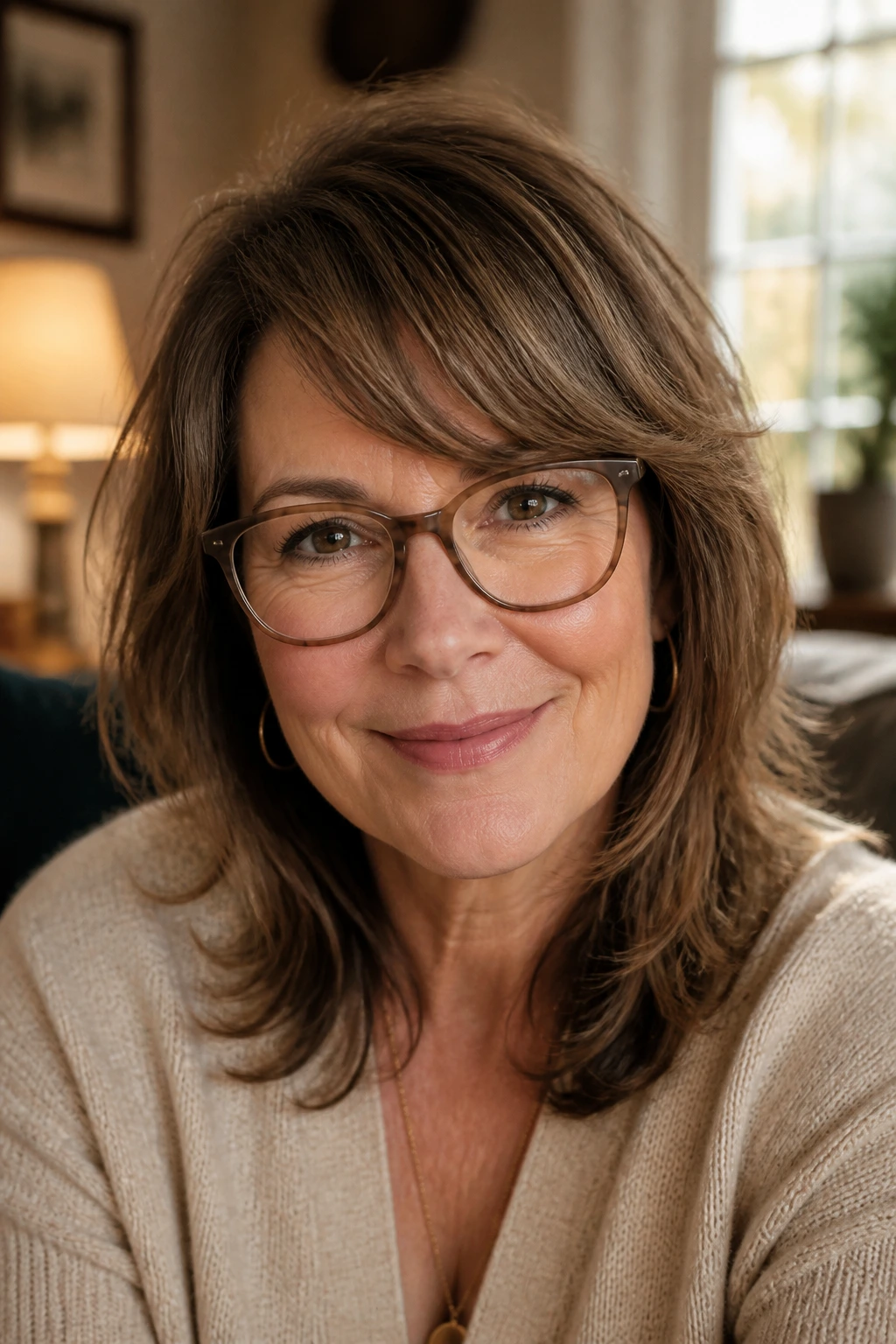
Diagonal lines do the heavy lifting: Bangs that sweep, split, or taper at the sides break up the widest part of a round face instead of framing it like a circle sticker.
-
You do not need a harsh wall of hair: Soft edges, point-cut ends, and a little transparency at the center keep the fringe from swallowing the forehead or making the face look shorter.
-
Most of these styles play nicely with glasses: Longer front pieces and side movement keep frames from fighting the haircut, which is where a lot of bang regret begins.
-
Fine hair and thick hair both have options: Some fringes add air without taking away density, while others remove bulk so the front does not feel like a wool cap.
-
They can work around real-life hairlines: Cowlicks, little forehead lines, and a slightly uneven front growth pattern are not deal-breakers; they just change which cut will behave.
-
There’s a low-commitment path here: If you’ve been side-eyeing bangs for years, several of these styles grow into layers cleanly instead of demanding a dramatic grow-out.
How to Choose the Right Fringe Before You Sit in the Chair
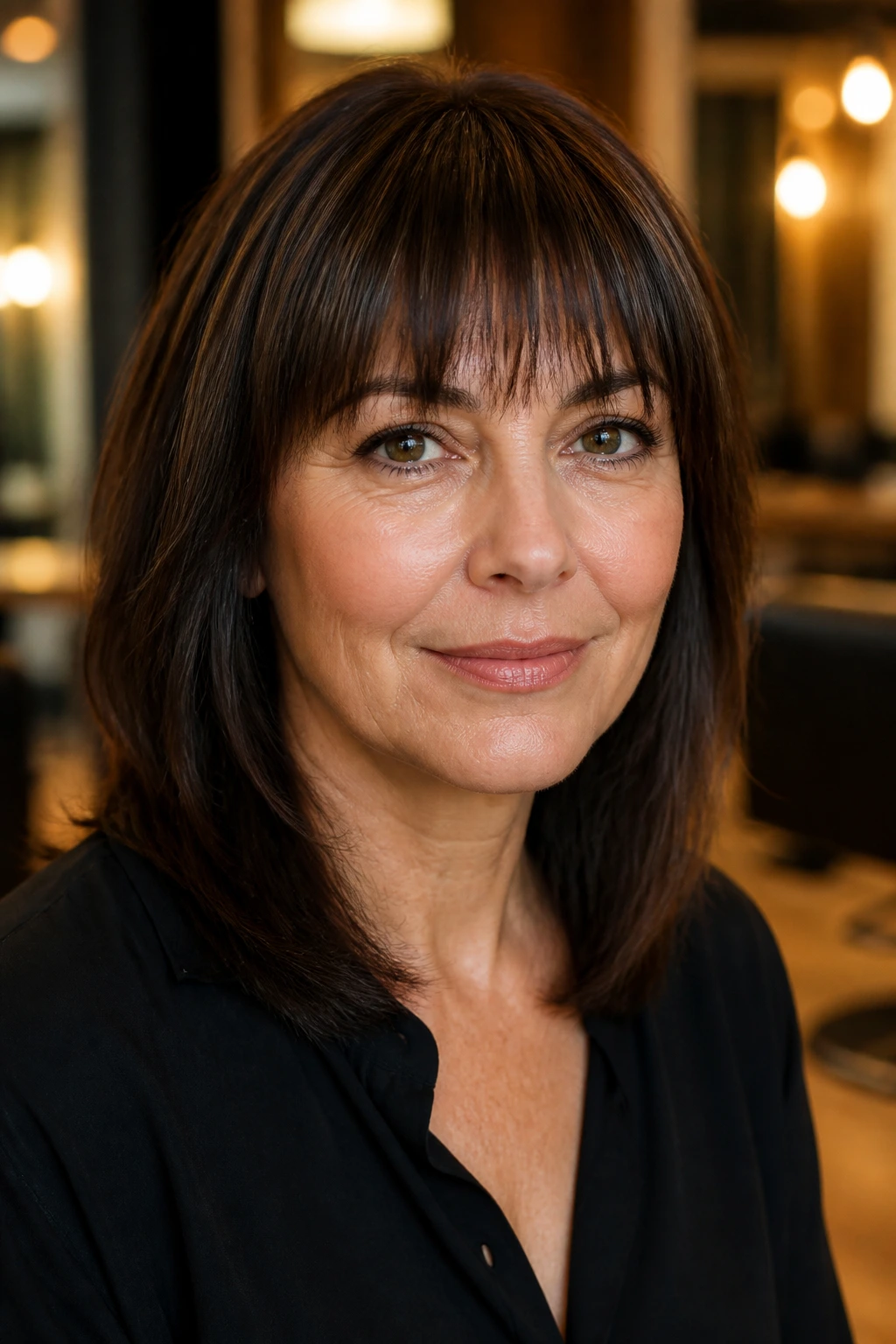
A good bang starts before the scissors. You need to know how your hair falls when it’s clean, half-dry, and a little rebellious, because that’s the version your stylist is actually cutting. If your front hairline splits down the middle on its own, don’t fight for a fully blunt line. If your hair sticks forward at the temples, you’ll usually do better with a shape that allows that area to bend outward instead of asking it to lie flat.
Hairline: Check the first inch of growth at the front. If it’s sparse, a heavy bang can look patchy fast. If it grows dense and straight, you can carry more weight at the center, but the sides still need softness so the face does not widen.
Texture: Fine hair tends to disappear if it gets over-thinned, while thick hair can turn into a sheet if it is cut too bluntly. Wavy hair usually wants a little more length than you think, because the bend lifts the ends up by about half an inch once it dries.
Glasses: Bring your frames into the conversation. The right fringe usually sits either above the top edge of the lens or sweeps away from the bridge; sitting exactly on the frame line is where things get fussy.
Styling time: Be honest. If you will not round-brush your bangs for six minutes in the morning, do not order a style that depends on a perfect bend.
1. Curtain Bangs That Start at the Cheekbones
Curtain bangs are still one of the cleanest answers for a round face because they part the face in the middle and then drift outward, which keeps the eye from stopping at the cheeks. The best version for women over 40 usually starts somewhere between the bridge of the nose and the upper lip, then opens out so the longest pieces land around the cheekbones. That length matters. It gives you motion without cutting the face into a shorter shape.
What I like here is the flexibility. Blow them under with a round brush for a softer finish, or let them air-dry and tuck them behind the ears for that slightly undone look that still feels intentional. If your hair has some bend, this fringe does a lot of work with very little effort. If your hair is pin-straight, you’ll want a little mousse at the roots or they can separate too cleanly and lose the softness that makes this style flattering.
Ask for a center part, a shorter center point, and a gentle feather into the side layers. Do not let the corners stop at the jawline if your face is already full around the cheeks; that’s where the shape starts adding width instead of subtracting it.
2. Long Side-Swept Bangs With a Real Diagonal
Why do side-swept bangs still work so well on round faces? Because a real diagonal line is hard to argue with. The sweep pulls the eye from the part down across the forehead and toward one cheekbone, which creates movement without shouting about it. On faces that read softly rounded, that line can do more than a blunt cut ever will.
This style is especially useful if you like your hair one-length or lobbed at the shoulders. The bang gives the front some lift while the rest of the haircut stays quiet. That combination keeps the face from feeling trapped inside a frame of hair. It also behaves better when you have one side that grows flatter than the other — which, frankly, is most of us.
How to Wear It Well
- Blow-dry the bang in the opposite direction first, then sweep it over once it cools.
- Keep the longest piece around the cheekbone or slightly below it.
- Use a light cream, not a heavy balm, or the front will collapse by noon.
- If you wear glasses, let the bang travel above the frame line and then fall around it.
A side-swept bang can look fussy if it’s too polished. A little bend and a little separation are your friends here.
3. Bottleneck Bangs That Narrow Before They Open
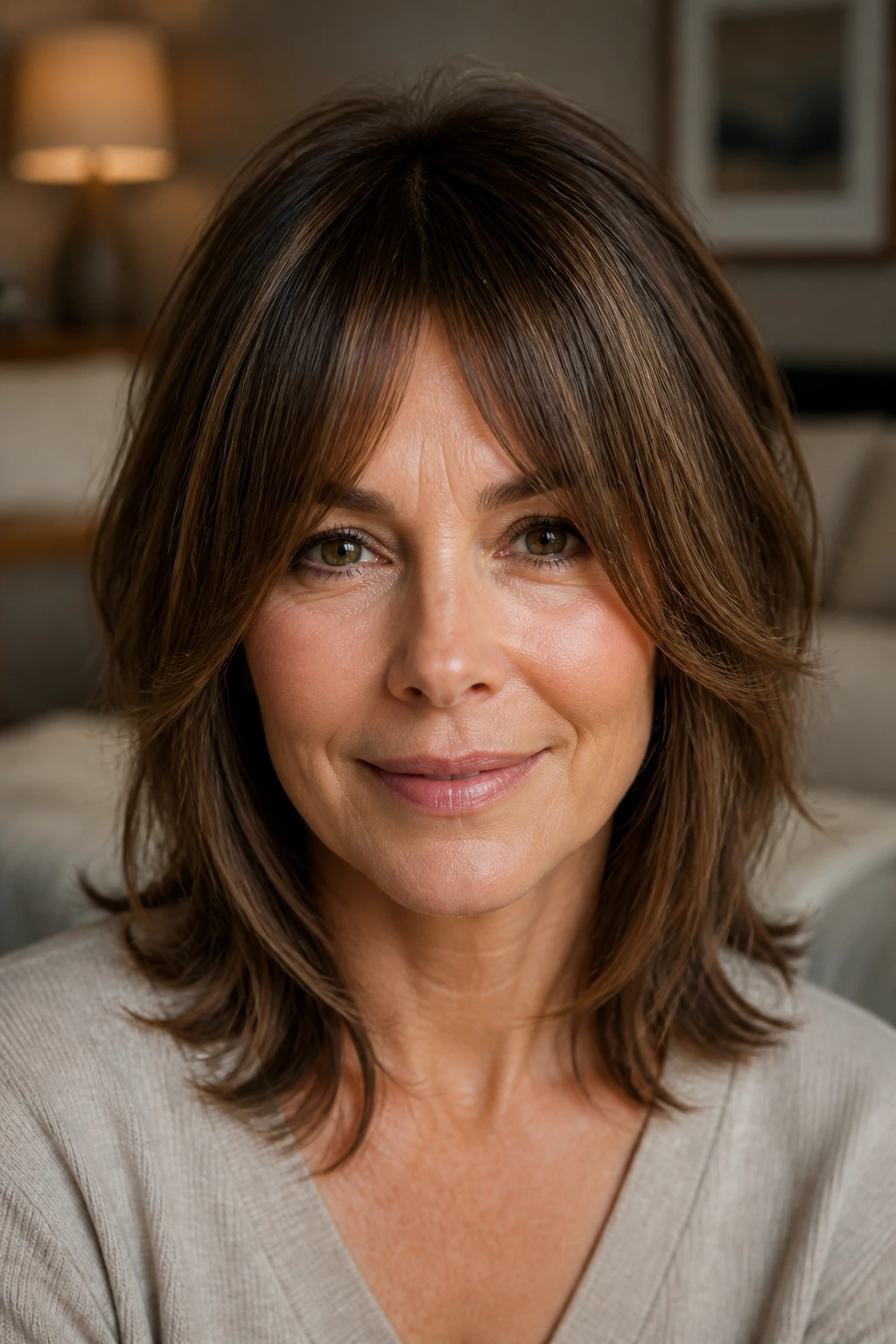
Bottleneck bangs got their name for a reason: they start narrower in the center and open out toward the sides, like the neck of a bottle widening into the shoulder. That shape is a gift for round faces because it keeps the center light and lets the edges do the framing. The result is structure without a hard, obvious line.
The style works best when the shortest center point sits around the middle of the forehead and the side pieces get longer fast. You want the opening to happen before the widest part of the cheek. That early release is what makes the fringe feel airier than a full curtain bang. It is also one of the few fringes that can make a round face look a bit more oval without pretending the face is something it isn’t.
What to Ask for at the Salon
- A soft center with shorter middle pieces.
- Longer side corners that land near the cheekbone.
- Point-cut ends so the fringe doesn’t look boxed in.
- No heavy texturizing at the very tips if your hair is fine.
This is a smart choice if you want a bang that feels current without being trendy in a way that dates the haircut. It has enough shape to matter and enough softness to keep it wearable.
4. Wispy See-Through Bangs That Leave Some Forehead Showing
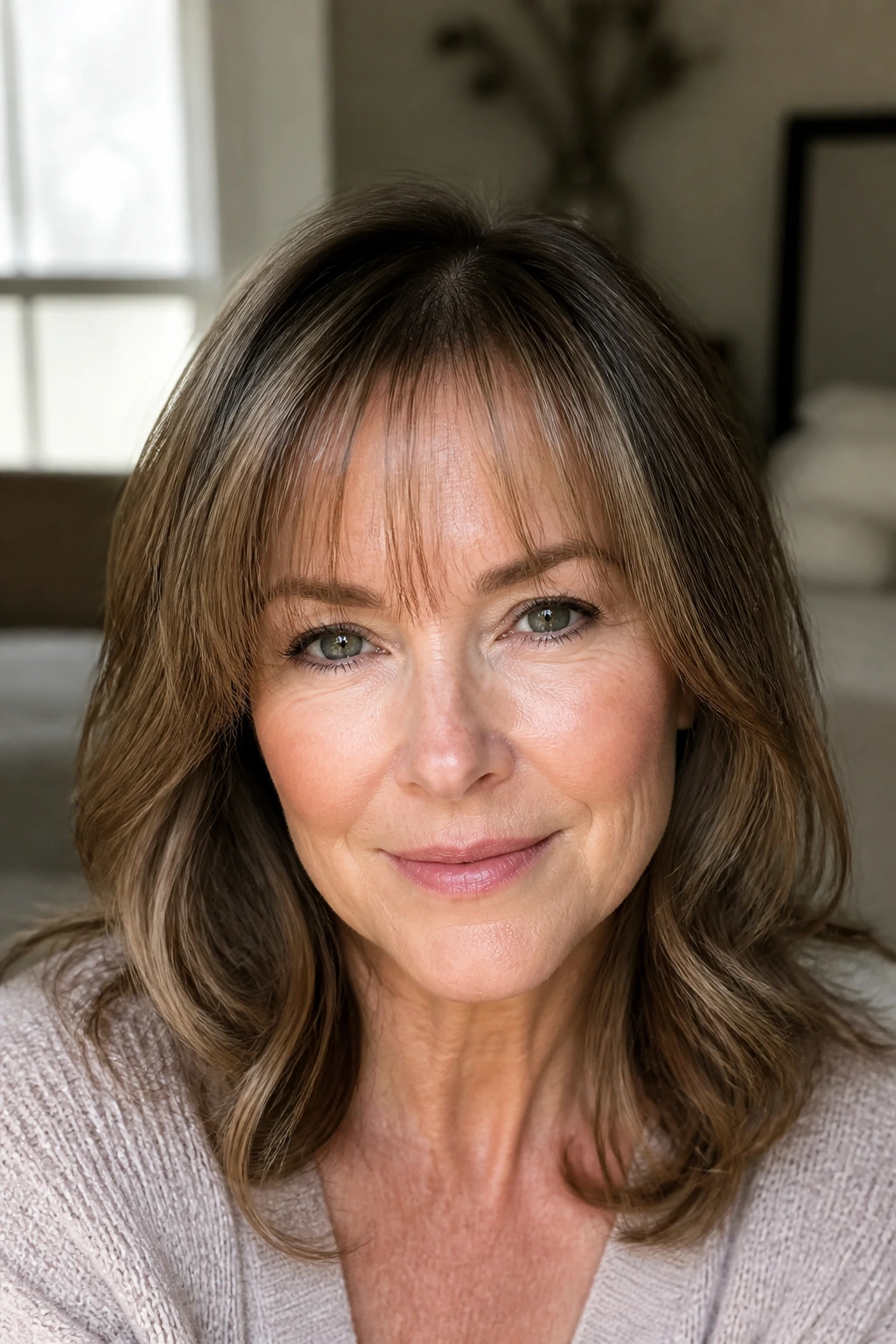
Heavy bangs are not the only way to cover a forehead. Wispy bangs leave a little skin visible, which is exactly why they work on round faces that need breathing room. When the fringe is light enough to show a bit of forehead through it, the whole front area reads softer and less blocked off.
This is a lovely option for fine hair, but only if the cut is handled carefully. Too much thinning and the fringe turns into three sad strings. What you want is transparency with intention: enough hair to create a line, not enough to create weight. A point-cut edge helps a lot. Razor cutting can be fine on some heads, but on frizz-prone hair it can create a fuzzy halo that looks messy by lunch.
These bangs are easy to live with if you like a face that shows a little more skin. They also pair well with a soft bob or collarbone length cut because the overall shape stays light. If your forehead is small, though, keep the wispy pieces a touch longer so they don’t crowd the face.
Best detail to request: ask for “soft separation, not thinning.”
5. Soft Blunt Bangs That Keep Their Shape

Blunt bangs get a bad reputation on round faces, and I think that’s mostly because people picture a dense, heavy rectangle sitting across the forehead. That’s not what this version is. A soft blunt fringe keeps the edge line, but it uses point-cut ends and slightly rounded corners so the bang feels like a shape rather than a slab.
This is a strong choice if you like a little definition around the eyes and you don’t want all your front hair to drift apart. The line can make the eyes look clearer and the forehead look more deliberate, especially when the rest of the haircut has movement around the jaw. The key is to keep the corners soft enough that they don’t stop at the widest point of the cheeks.
If your hair is very thick, blunt bangs can start looking too square unless the stylist removes some bulk from underneath. If your hair is very fine, a true blunt cut can look sparse at the ends. In both cases, a softer edge saves the day. You get the graphic line without the hard block.
It’s a confident look. Not loud. Just certain.
6. Feathered Shag Fringe That Moves With the Rest of the Cut
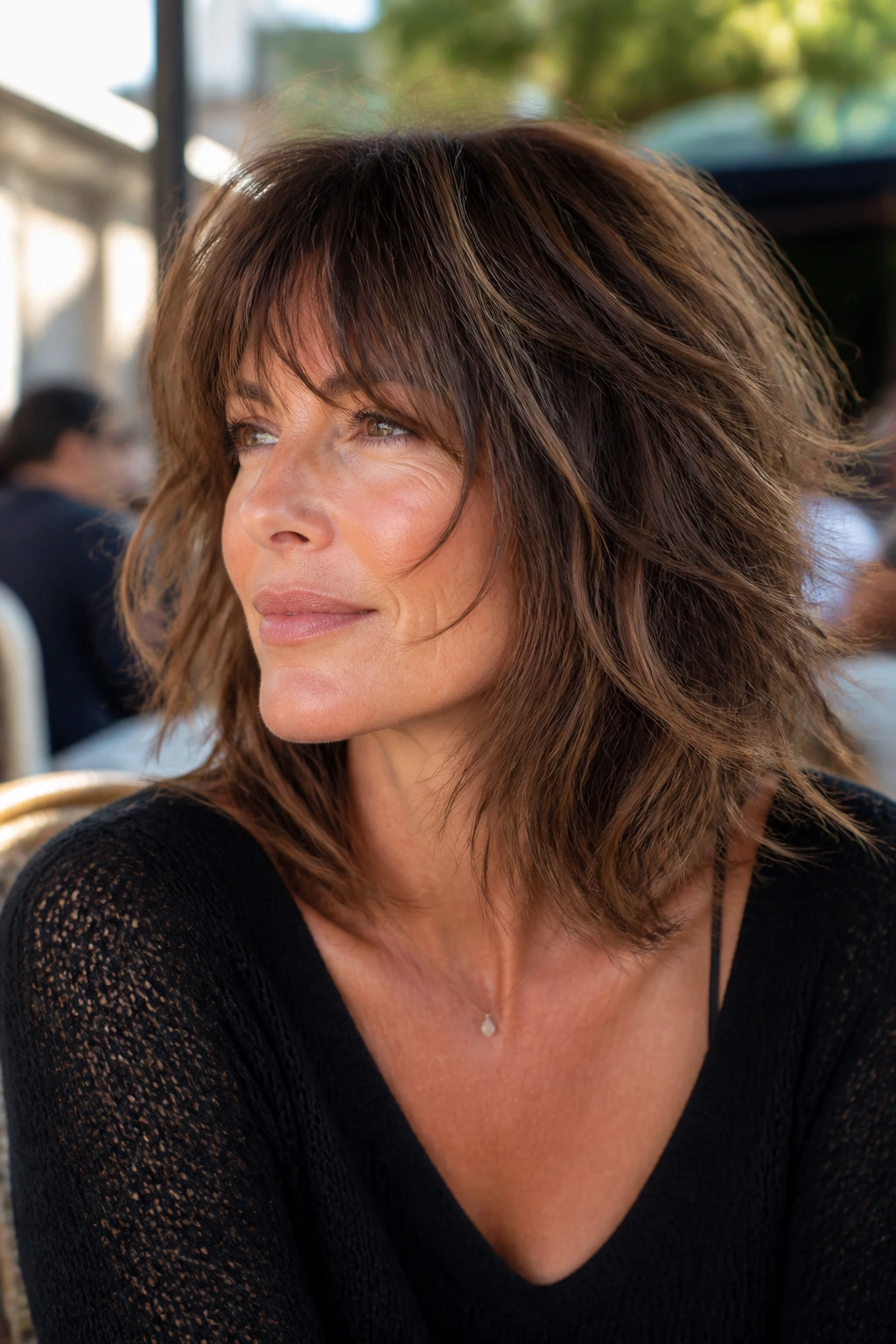
A feathered shag fringe works because it refuses to sit still in one place. The bangs break into small, piecey sections that blend into layers, and that movement does a lot to keep a round face from looking wider than it is. Instead of framing the cheeks with one flat edge, the cut sends little directional shifts around the face.
This style is made for wavy hair and for people who like a haircut that doesn’t demand a perfect blowout. You can rough-dry it with mousse, scrunch it a bit, and let the pieces land where they land. That airiness matters. A dense front line can make a round face look boxed in; a feathered fringe lets the face breathe.
Styling Note
Use a lightweight mousse at the roots and dry the fringe forward with your fingers before you finish with a round brush or diffuser. If the pieces go limp, add a small amount of dry texture spray at the root, not the ends. End-heavy product is what makes shag bangs collapse into the eyes.
The one caveat: this shape needs some overall movement in the haircut. It looks best with layers that echo the fringe, not with a stiff one-length cut underneath.
7. Bardot Bangs With a Lifted Center

Bardot bangs are like curtain bangs with a little more glamour and a little more lift. The center opens softly, but the top has volume — not teased-to-the-heavens volume, just enough root height to keep the forehead area from lying flat. That lift is useful on round faces because vertical movement stretches the face visually without making it look overstyled.
This version also plays well with a slight recession at the temples or a softer hairline. The openness near the middle gives the face some air, while the longer sides skim the cheekbones. If you’ve ever liked the idea of bangs but hated the feeling of being boxed in by them, this is a good place to start.
The style needs a round brush or a large velcro roller at the center front. Blow the fringe up and slightly back, then let it fall forward as it cools. That cooling step matters. Skip it and the lift disappears within the hour.
It has a little old-Hollywood energy, but not in a costume-y way. More like the haircut knows where the light is.
8. Choppy Piecey Bangs for Thick Hair
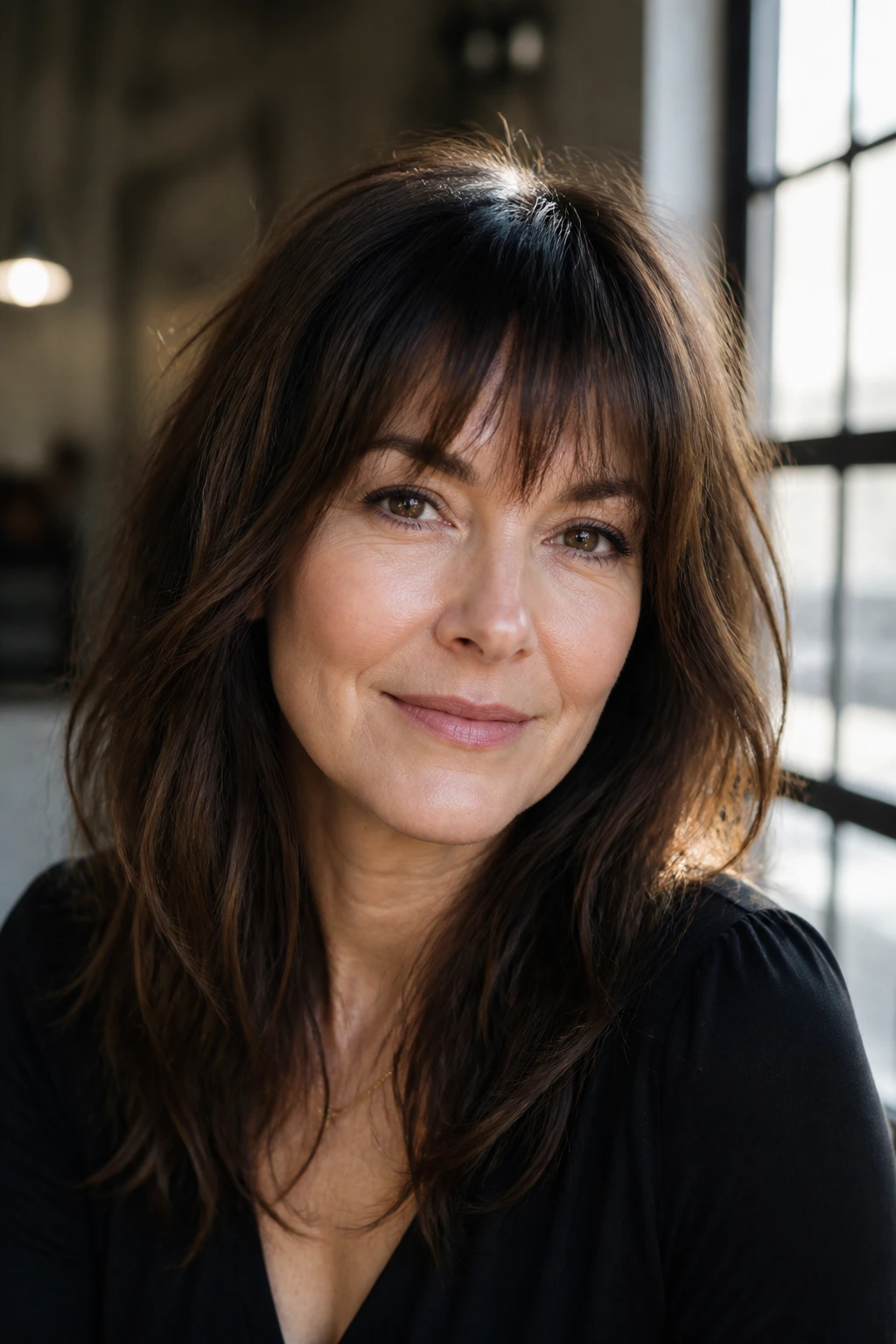
If your hair comes in dense and stubborn at the front, piecey bangs can save you from the triangle effect. A thick bang cut straight across can turn into a wall, especially on a round face. Breaking it into pieces creates air between the strands, which keeps the front from overwhelming the features.
What makes this style work is separation. The strands are cut in small sections, often with point cutting or gentle slide cutting, so the ends don’t all stop in the same place. That unevenness is what gives the fringe some life. It also makes the bangs easier to style because they don’t sit as one heavy block on the forehead.
You’ll probably want a matte paste or a tiny bit of styling cream to define the pieces once they’re dry. Use too much, and the whole thing clumps. Use too little, and the pieces disappear into the rest of the haircut. The sweet spot is a pea-sized amount rubbed between the fingers, then pinched lightly through the ends.
This is not a shy bang. It has attitude. But the good kind.
9. Arched Brow-Skimming Bangs That Open the Eyes
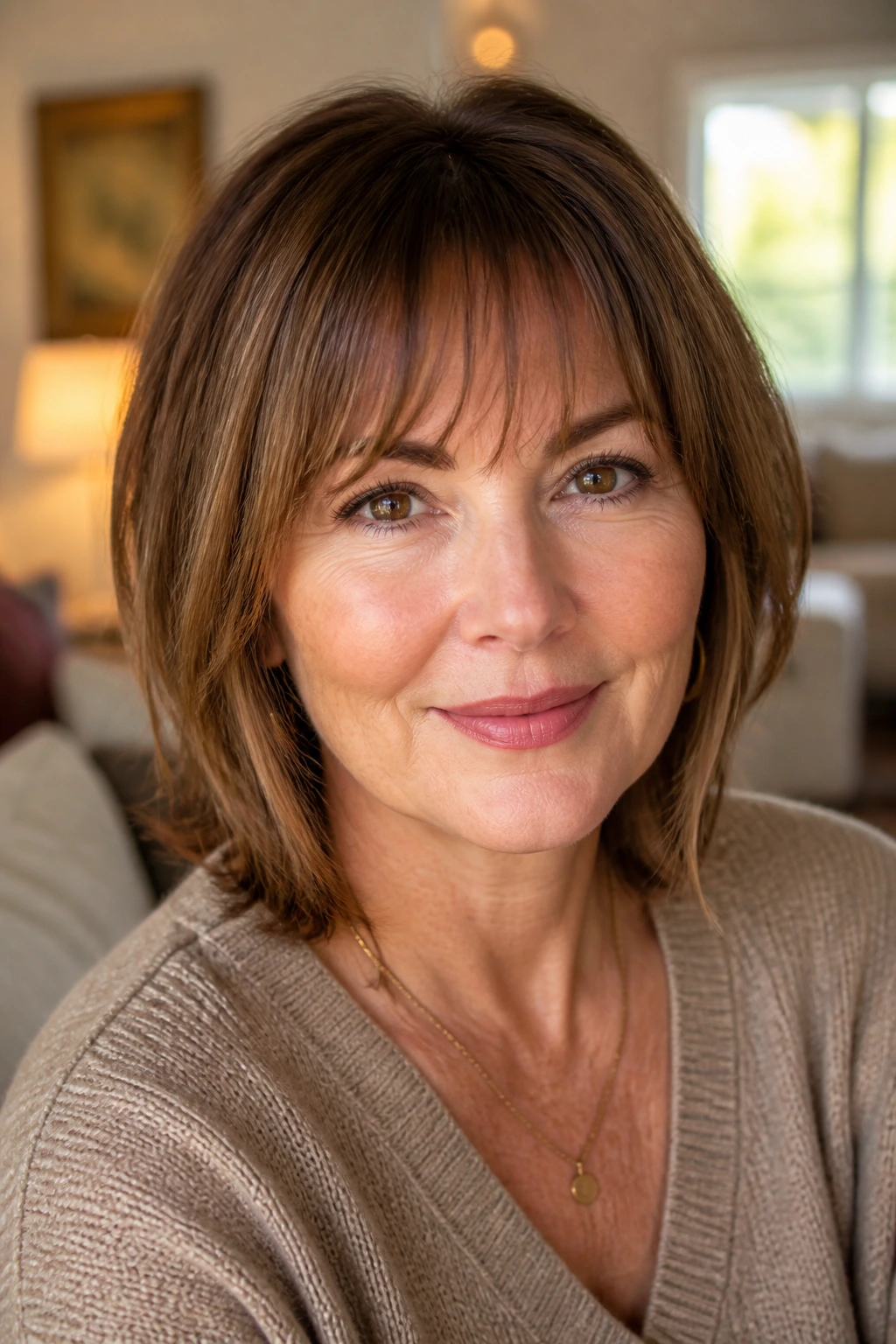
An arched fringe follows the brow line instead of fighting it, and that small detail changes how the face reads. On a round face, a straight line can make the forehead and cheeks feel equally wide. A soft arch opens the center and leaves a little more length toward the temples, which shifts the focus upward and outward.
The cut works especially well if your eyebrows are one of the strongest features on your face. Letting the fringe echo that curve creates a cleaner frame around the eyes. It’s also a smart move for anyone who wants forehead coverage but does not want the bang to land so low that it crowds the lashes.
Cut Notes
- Keep the center just above or at the brow.
- Let the corners get slightly longer.
- Ask for softness, not a sharp arc.
- Style with a small brush so the curve stays gentle.
This bang can look polished with very little fuss. It’s one of those styles that seems simple until you realize the shape is doing all the work.
10. Long Peekaboo Bangs You Can Tuck Away
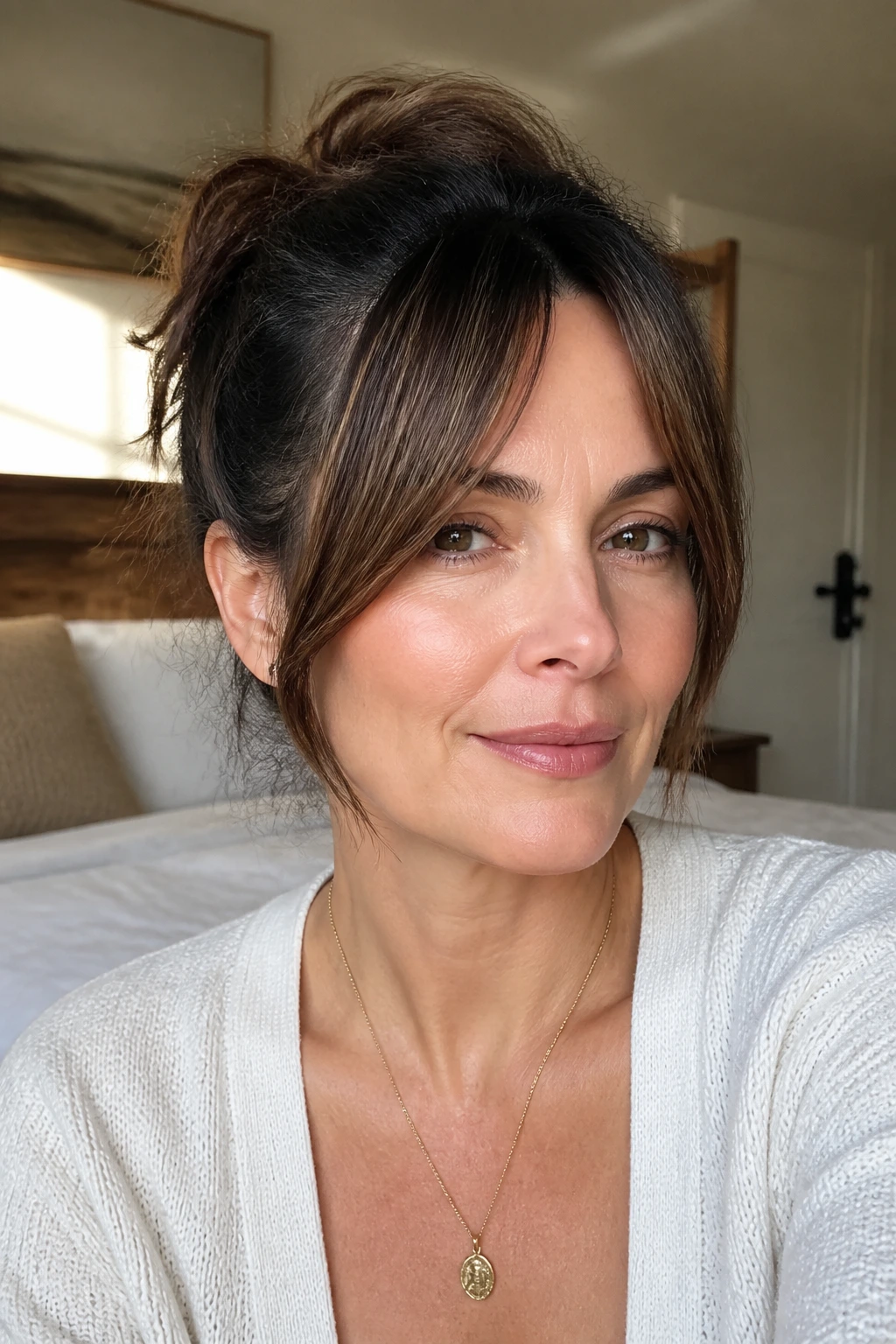
Long peekaboo bangs are the peace treaty between “I want bangs” and “I do not want to be trapped by bangs.” They sit long enough to split naturally, brush into the cheekbones, or disappear behind the ears on a lazy day. For a round face, that flexibility is gold. It means the front can create shape without demanding constant attention.
I like this option for anyone who’s testing the waters. It gives you the frame, the movement, and a little forehead interest, but it doesn’t feel severe if you wake up late and skip styling. The longer length also makes the grow-out less painful, which is something people forget to ask about until they’re three weeks in and regretting everything.
If your hairline is a little uneven or your forehead has a cowlick, the extra length gives the hair enough weight to settle. Keep the shortest pieces near the outer brow or top of the cheekbone, not the middle of the forehead. That keeps the style soft and lets the sides do the framing.
This is the bang for people who like options. And options, frankly, are underrated.
11. A Deep Side-Part Sweep That Adds Instant Diagonal Movement
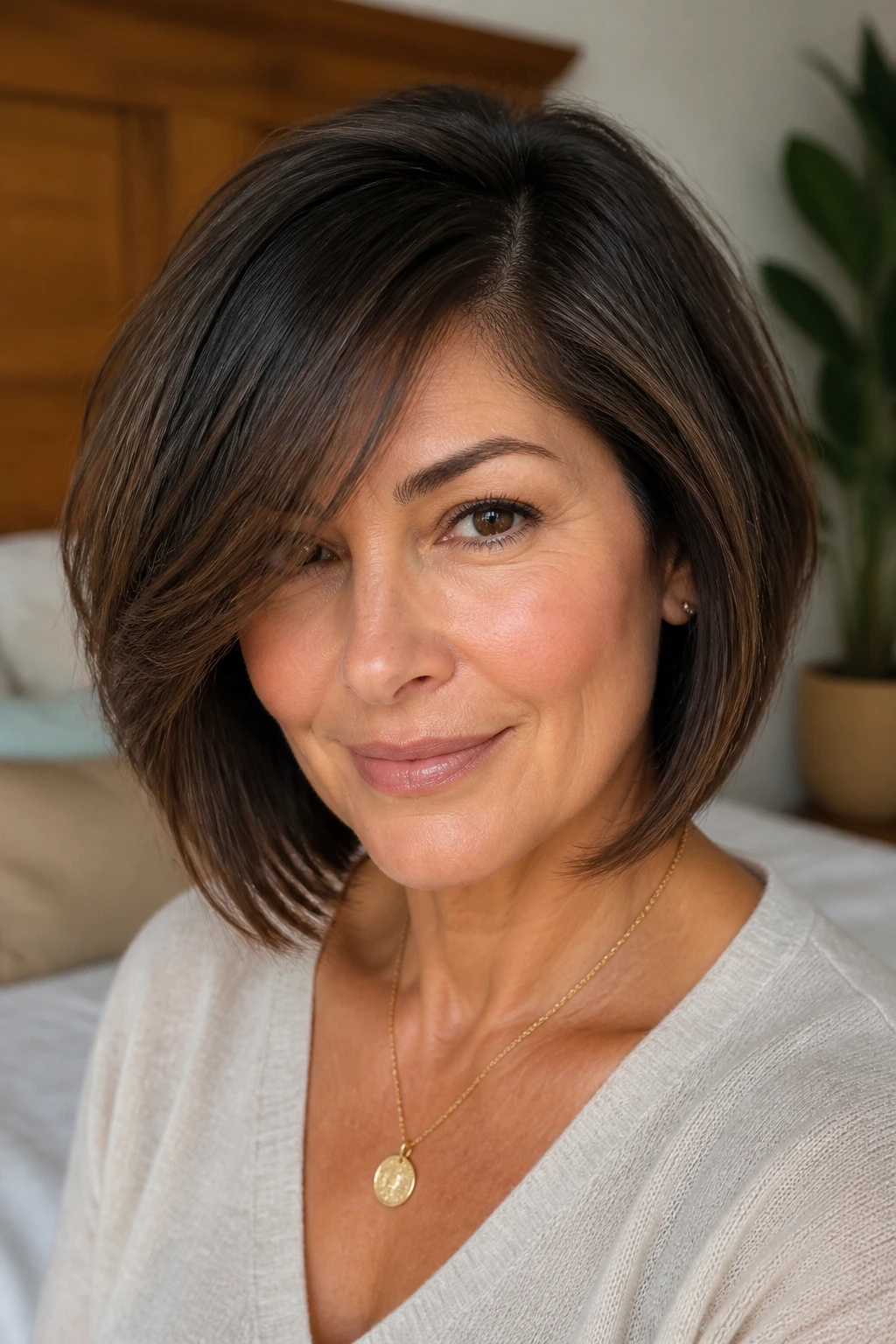
A deep side-part sweep is what I reach for when a face needs direction more than coverage. The bang starts high on one side, then slides across the forehead in one long arc, which creates a strong diagonal line on a round face. That diagonal is what stops the cut from reading too symmetrical.
The style has an advantage over a straight side bang: it can build more height at the crown. That little lift matters. A round face usually looks longer when there’s some rise above the forehead, even if it’s only an inch or two. The sweep also gives you room to soften the cheek area without making the front heavy.
To style it, dry the root in the opposite direction first, then sweep it across with a paddle brush or a large round brush. A quick blast of cool air will lock the bend. If you have fine hair, don’t drown it in product. A touch of root spray is enough.
This is a good choice if you want something a little more polished than curtain bangs but less committed than a blunt fringe.
12. Curly Fringe Shaped Dry, Not Cut Blind
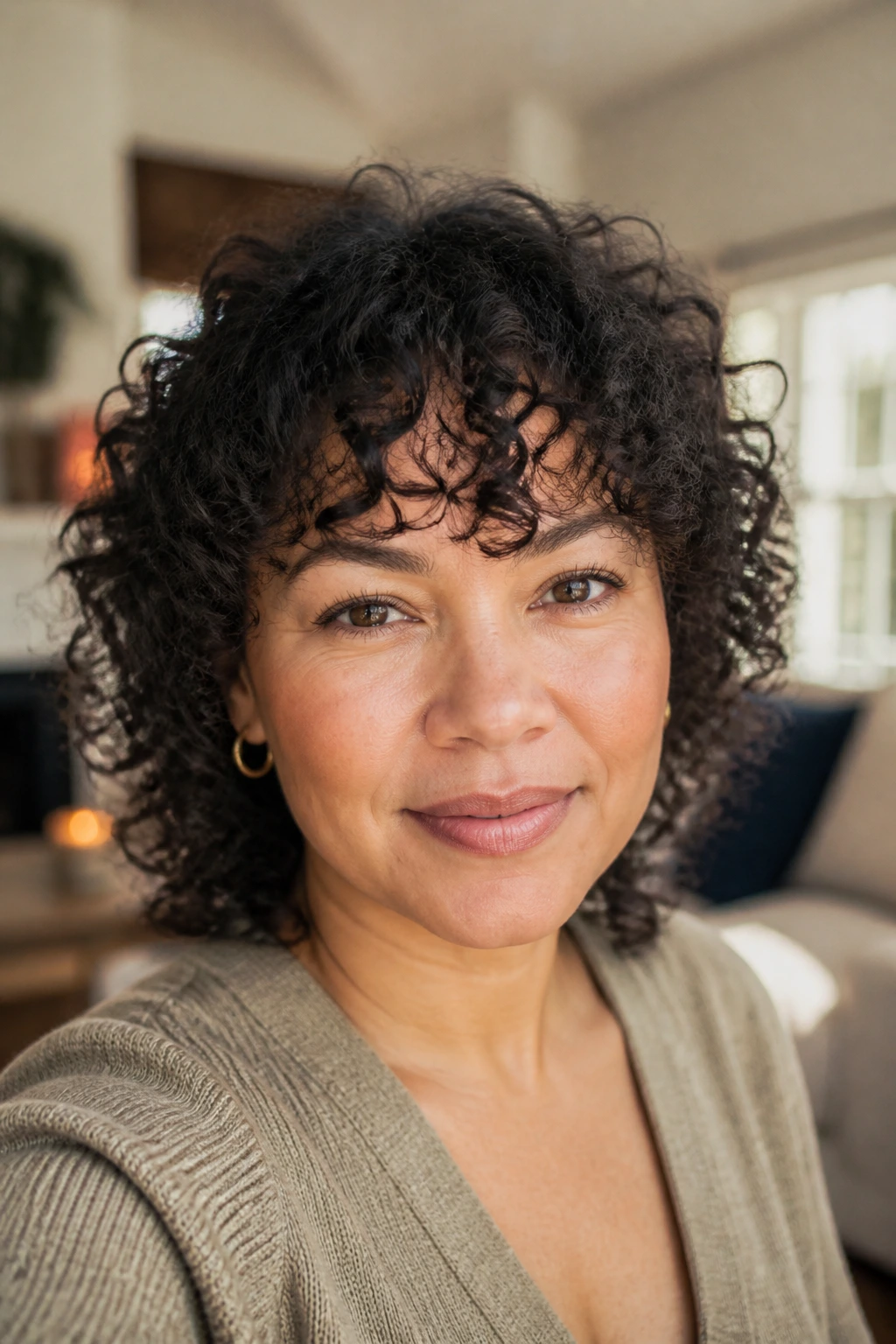
Curly bangs can be fantastic on a round face — if the cut respects shrinkage. That’s the whole game. Curly hair springs up when it dries, and if the fringe is cut too short while wet, you can end up with a tiny bounce of hair sitting far above the eyebrow line. Not ideal.
The best curly fringe is shaped dry or mostly dry, then refined curl by curl. The goal is a soft curve that follows the face and breaks the width at the cheeks without creating a horizontal shelf. Letting the curls fall a little longer at the sides helps the face look more oval, especially when the rest of the haircut has layers around the jaw.
What works best here
- Cut with the curl pattern in its natural state.
- Leave the center longer than your first impulse says.
- Diffuse with the head slightly forward so the roots do not collapse.
- Do not over-brush once it dries.
Curly bangs are not “low maintenance” in the lazy sense. They are lower fuss when the shape is right. Once the pattern is dialed in, they can look wonderful with minimal fiddling.
13. French Fringe Softened at the Corners
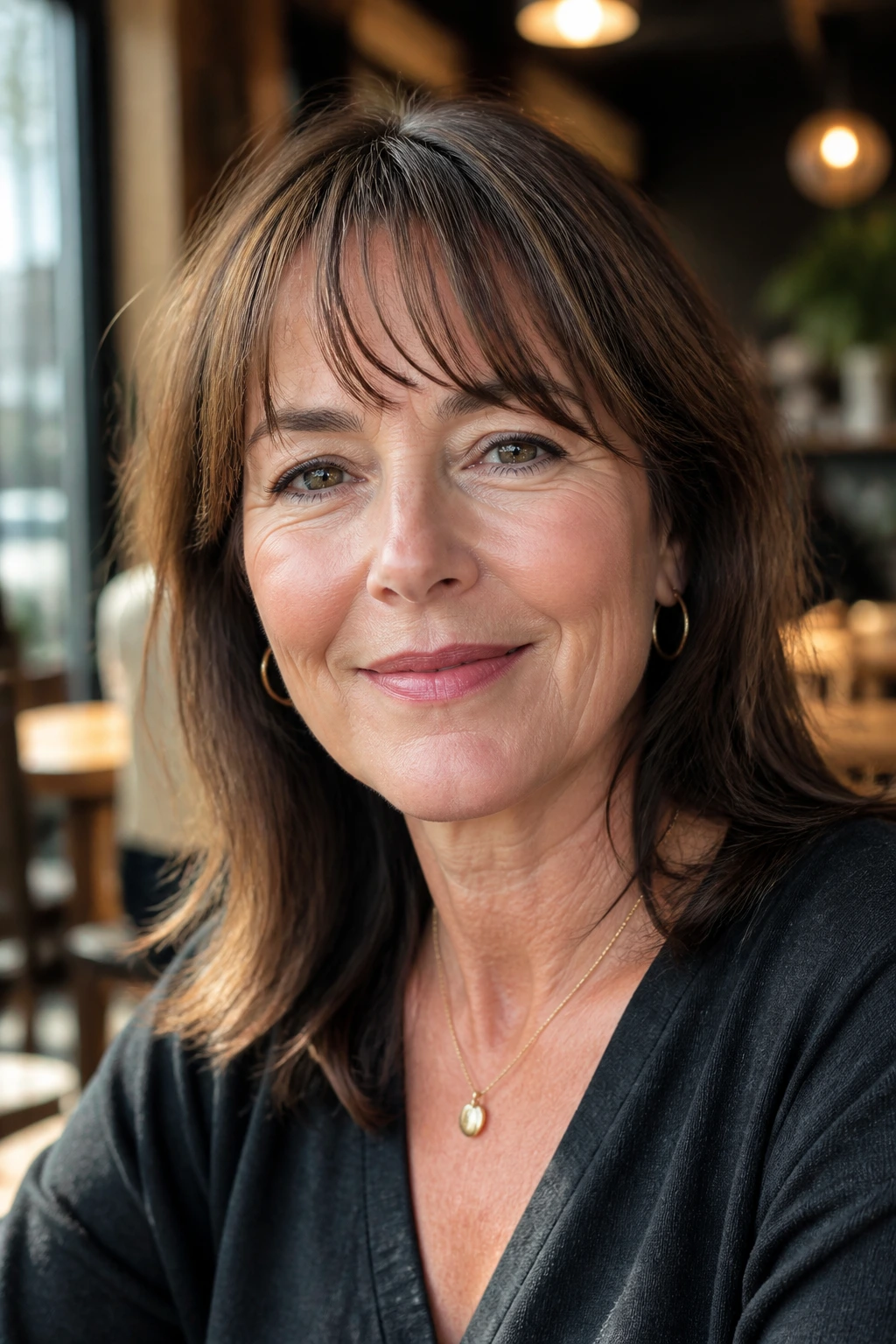
A French fringe gets its appeal from that slightly lived-in, slightly cool shape that never looks too pristine. On a round face, the softened version works better than a heavy, straight-across version because it doesn’t box in the forehead. The center can sit a touch shorter, while the corners taper and loosen into the sides.
I like this style on hair that has a little natural movement or a slight bend from the shower. It does not need to look perfect. In fact, it often looks worse when it’s too neat. A little separation keeps the fringe from feeling dense, and density is what you’re trying to manage on a round face.
The corners matter a lot. If they stop at the broadest part of the cheeks, the cut gets wider visually. If they slip past that point, the whole face looks more open and less circular. That’s the move.
It’s a nice middle ground for someone who wants a fringe with character, but not one that screams for daily maintenance.
14. Grown-Out Bangs That Blend Into the Layers
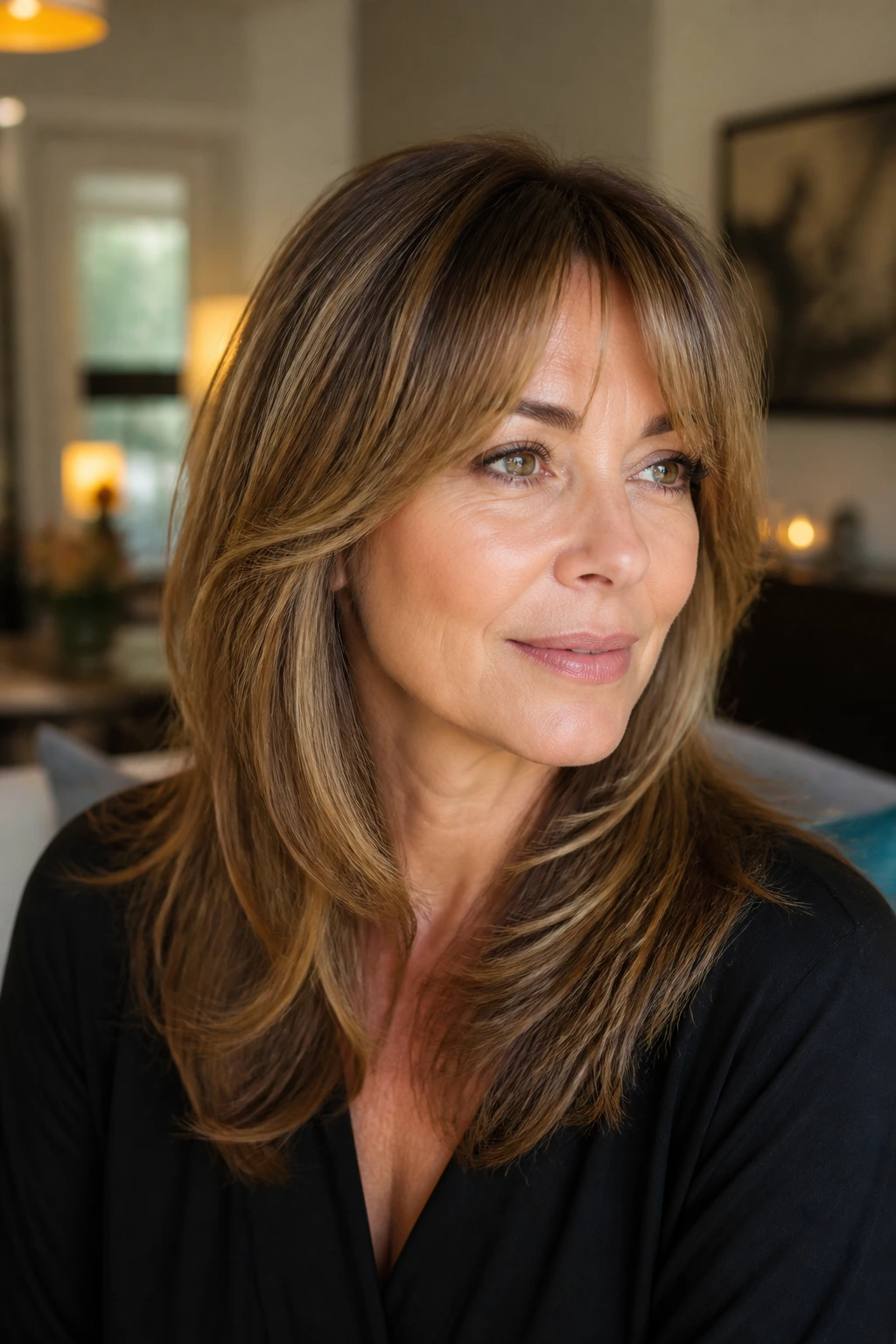
Grown-out bangs are not a mistake when they’re cut on purpose. In fact, they can be one of the best-looking options for round faces over 40 because they keep the front soft without setting up a hard line across the forehead. The bang begins as a fringe, then turns into face-framing layers before anyone gets bored with the idea.
The strength here is ease. You can tuck pieces away, split them in the center, or wear them forward on days when you want a little more shape. That kind of flexibility matters if you do not want to trim bangs every three weeks. It also makes this style a smart bridge if you’re growing out another fringe and do not want to rush the process.
Ask your stylist to start the shortest layer around the cheekbones and let it melt into the rest of the haircut. If the transition is too short, the face can look chopped up. If it’s too long, you lose the bang effect entirely. The sweet spot sits somewhere in the middle, and it’s worth being exact about it.
This is the fringe for people who want movement first and commitment second.
15. Glasses-Friendly Fringe That Skims Above the Frame Line

If you wear glasses, bang length becomes a little more technical. The fringe can’t live exactly where the frames live. That’s where the annoying part starts — the lens line and the bang line start arguing with each other all day. A glasses-friendly fringe usually sits just above the top edge of the frame or sweeps over it in a clean curve.
Round faces often look better when the bang doesn’t stop at the frame height. You want a clear separation between the two lines. That creates room around the eyes and stops the face from feeling crowded in the middle. Longer side pieces help even more because they guide the eye down and out, away from the cheeks.
A small round brush helps a lot here. Lift the fringe at the root, then bend the ends away from the frame so they don’t land on the lenses. If your frames are thick, leave the shortest point a touch longer than you think you need. Thin metal frames are more forgiving; chunky acetate needs extra room.
This is one of those practical details people forget until the first bad hair day. Then they remember every single time.
16. Temple-Length Fringe That Draws the Eye Outward
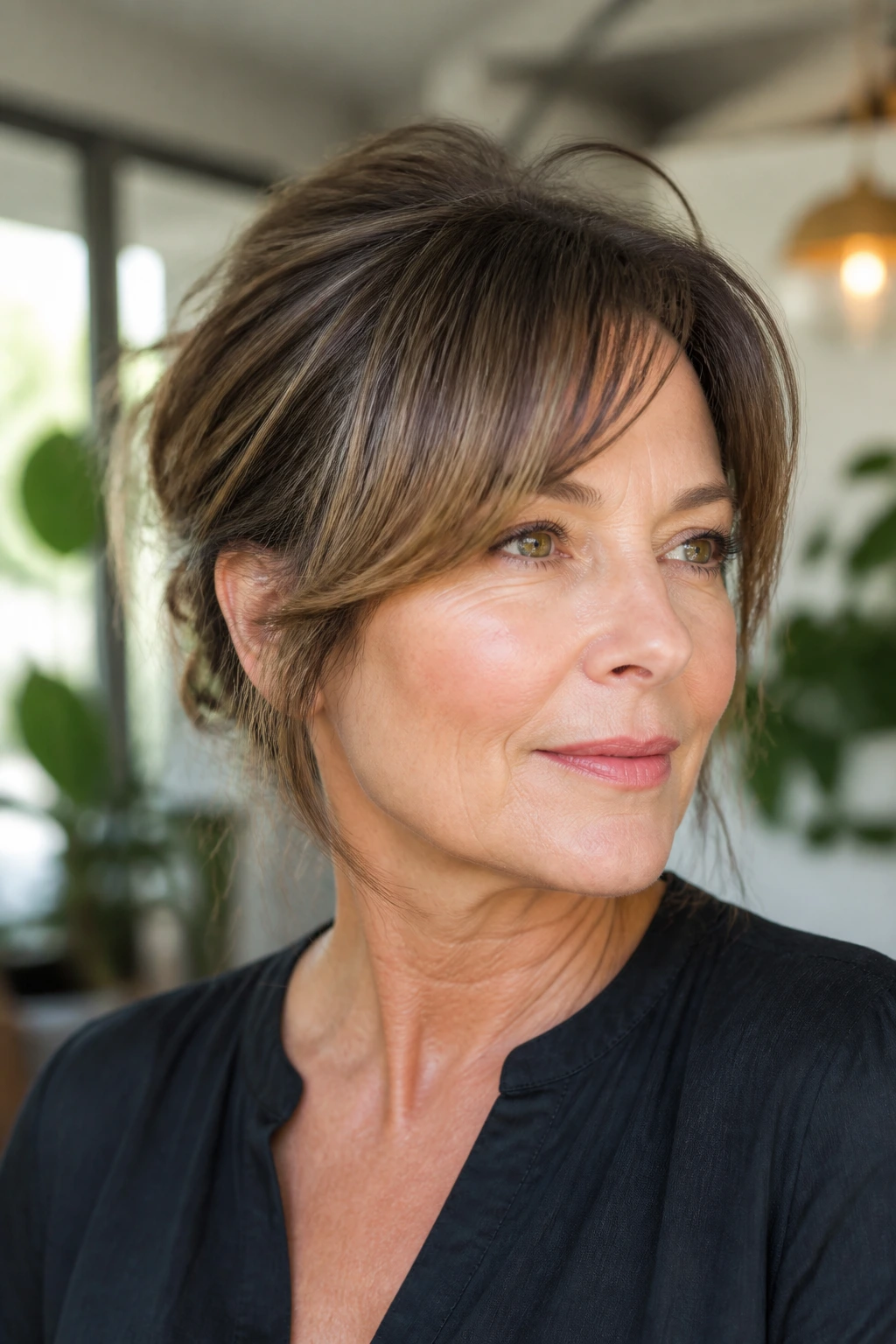
Temple-length bangs are a quiet trick. Instead of focusing the fringe across the forehead, they let the front pieces start near the temples and travel inward, which creates framing around the upper face and softens the cheeks. On a round face, that outer focus helps because the eye gets pulled toward the sides of the head instead of stopping right in the middle.
This shape is especially nice if you like to wear your hair up sometimes. The fringe still gives the front some softness when the rest of the hair is pulled back, and it doesn’t leave you with a hard line around the hairline. It also gives a face a little structure without asking for full forehead coverage.
The key is balance. The temple pieces should be long enough to move, not so long that they disappear into the rest of the cut. If the hair around the ears is dense, the fringe can get swallowed unless the stylist removes some bulk underneath.
It’s a good option for anyone who wants the face-framing effect of bangs without the daily obligation of a full fringe.
17. C-Shape Bangs That Curve Into the Jawline
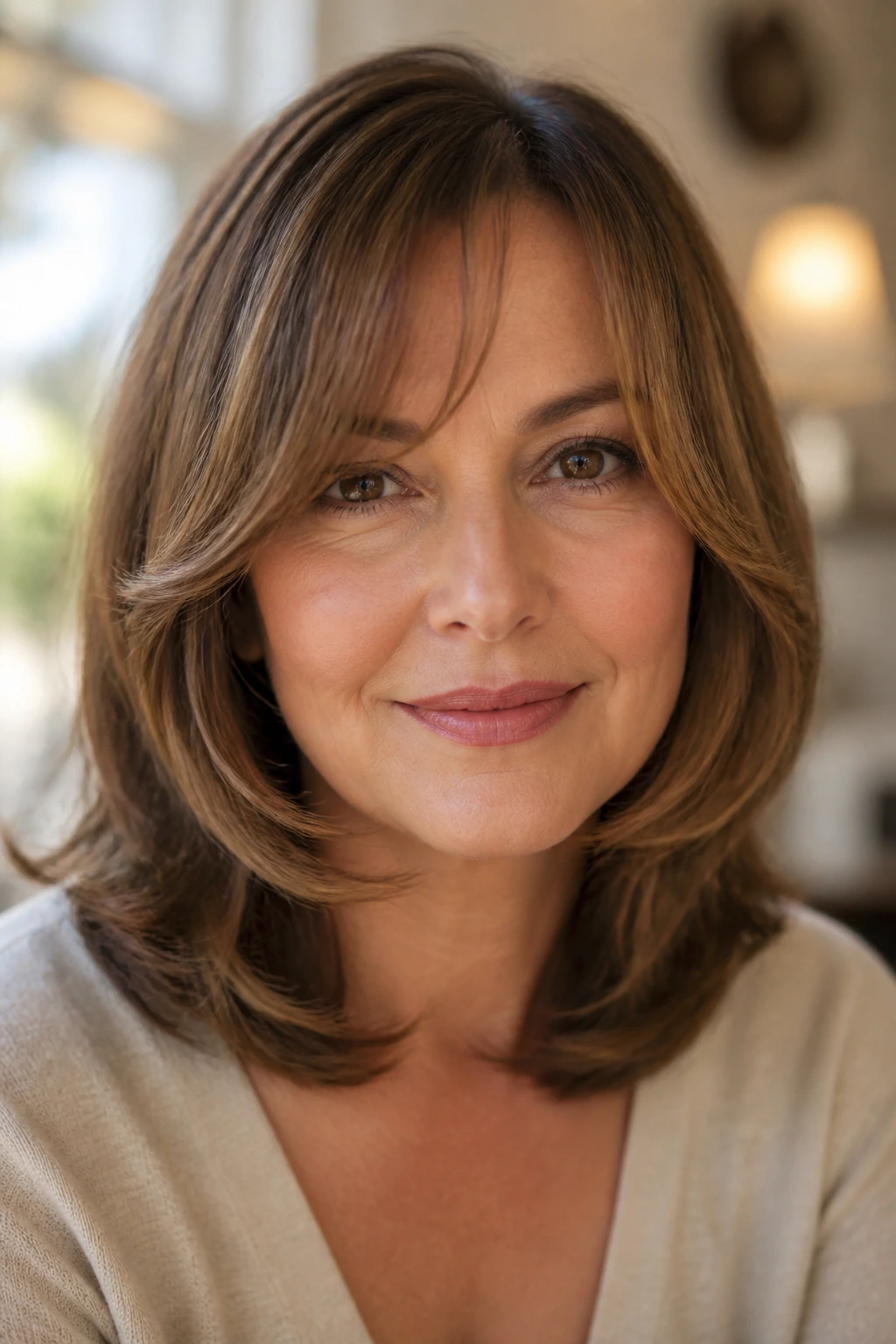
C-shape bangs are basically face-framing layers that start as fringe and then arc around the cheek and jaw. On a round face, that curve is useful because it gives the face a cleaner outline. Instead of the hair sitting straight across, it moves in a soft curve that narrows the look of the cheeks.
This cut works well with mid-length and long hair, especially if the rest of the layers are also curved inward at the ends. The whole haircut starts to echo itself. That repetition is nice — not boring, just consistent. It gives the face a frame that feels soft but deliberate.
Why it flatters round faces
The C-shape creates a vertical-and-diagonal mix. The center opens the face, and the side lengths travel down toward the jaw. That downward movement stops the haircut from widening the face at the cheek level, which is where round faces can look fullest.
You’ll usually style this with a medium round brush, bending the front pieces under just a little. Too much curl and you create volume where you don’t want it. Just enough bend and the shape does its job quietly.
18. Razored Fringe That Takes Bulk Out of Thick Hair
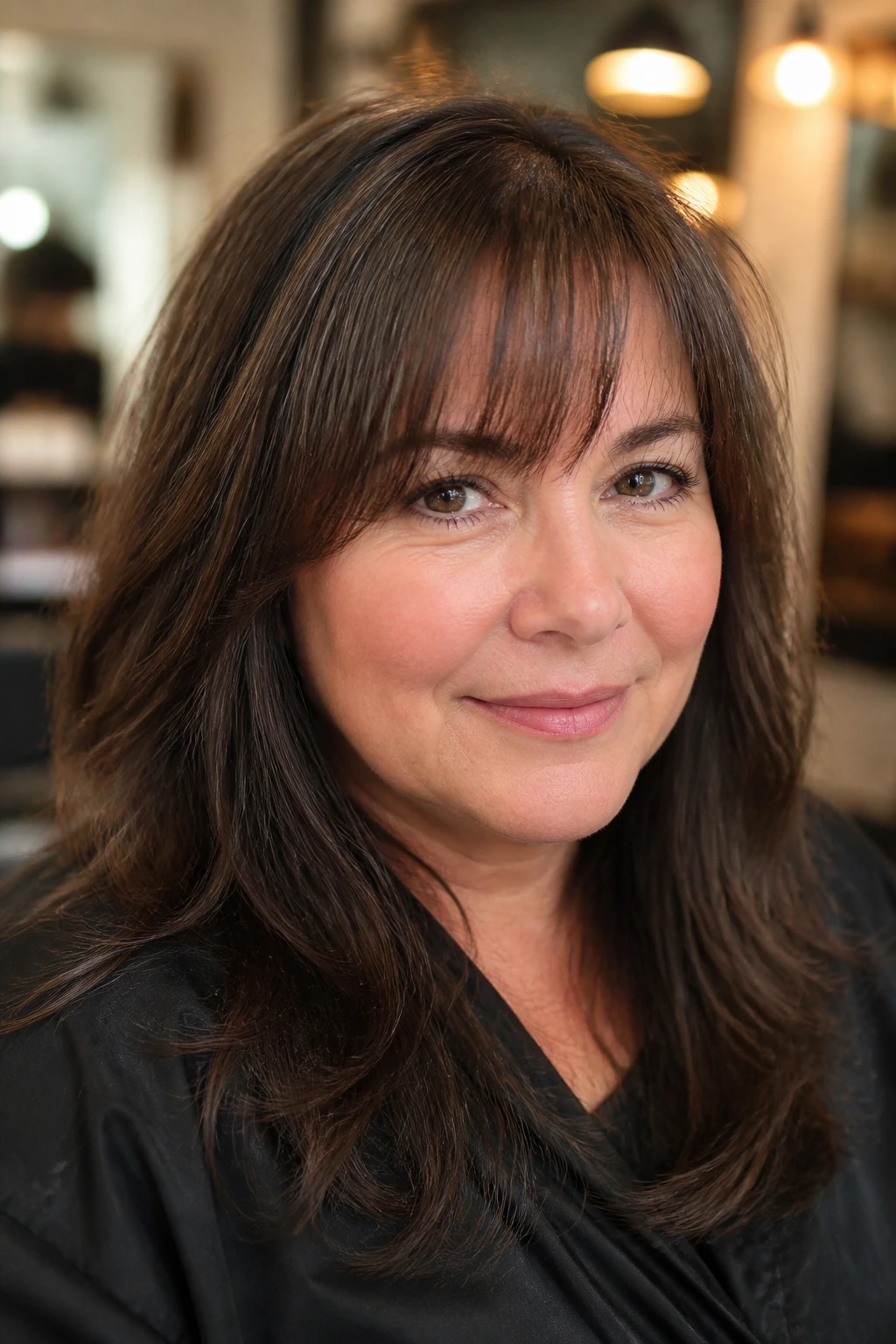
Thick hair can wear bangs beautifully, but not if the front is cut like a solid board. A razored fringe removes some of that weight and lets air move between the strands, which keeps the forehead from feeling smothered. On a round face, that breathing room matters because a heavy front can make the cheeks look even fuller.
The best razored version is soft, not shredded. You want the ends to taper and the front to separate a little, not look like it was attacked by a kitchen knife. A good stylist will use the razor to reduce bulk while keeping the line controlled. If the hair is very coarse or frizzy, point cutting may be safer than razor work.
What to request
- Bulk removal in the middle, not just the ends.
- A soft edge that still holds a shape.
- Corners that lengthen slightly toward the temples.
- No over-thinning if the hair already has a lot of texture.
This style can be a lifesaver if your bangs puff up in humidity. The lighter shape tends to sit closer to the forehead and move more easily.
19. Airy Fringe for Fine Hair That Needs Some Presence
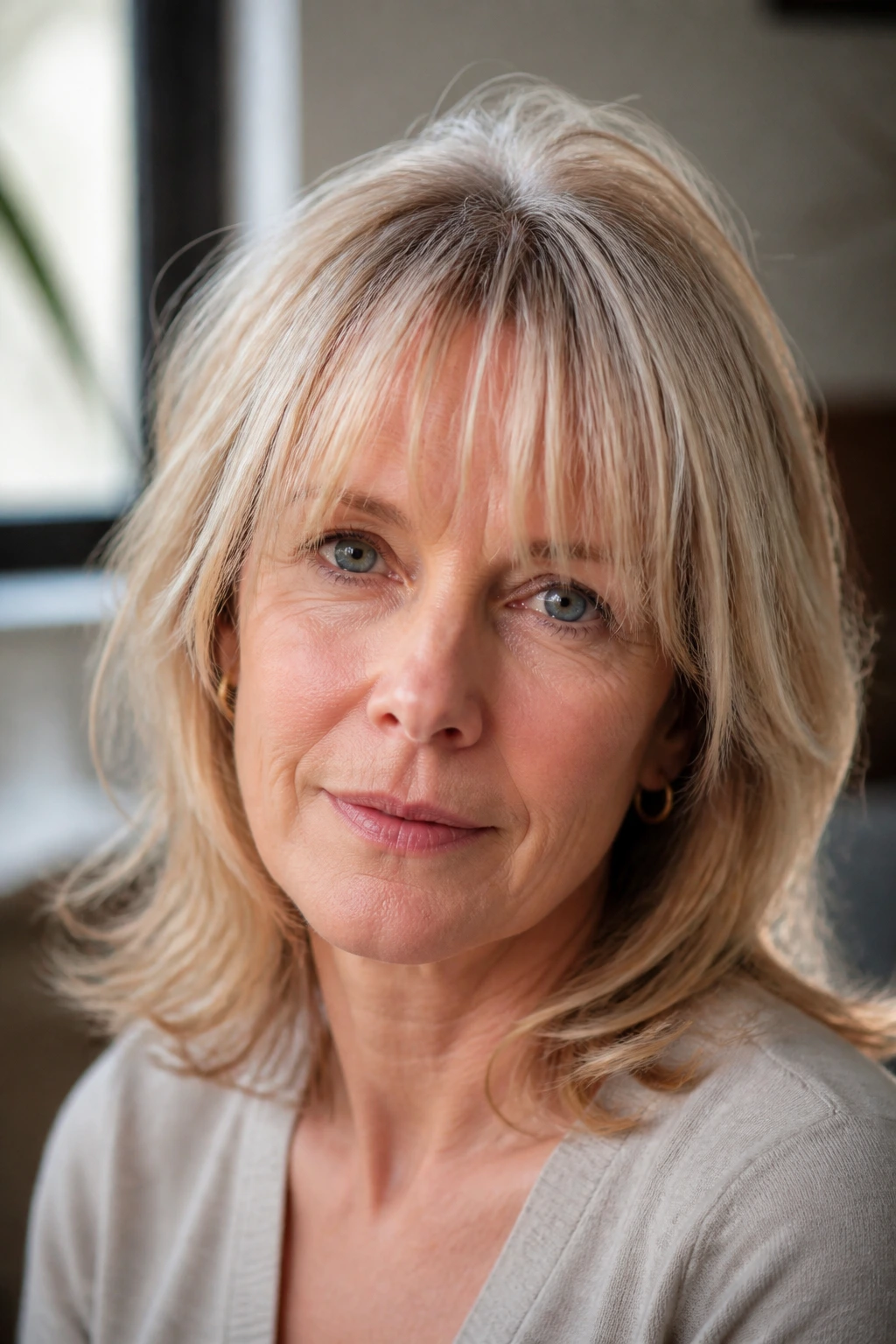
Fine hair needs a different kind of care. If the bang is thinned too much, it disappears. If it’s cut too bluntly, it can look stringy or limp at the sides. An airy fringe lands in the middle: enough density to show shape, enough lightness to keep the face open.
For round faces, the center should usually stay a bit fuller than the corners. That gives the forehead some presence without making the whole front look wide. A slight point cut at the ends helps the fringe sit softly, and a root-lifting spray can keep it from lying flat against the skin.
I would avoid aggressive razor work here unless the hair is naturally straight and cooperative. Fine hair often looks thinner after too much texturizing, and then the bang reads as sparse instead of airy. That’s a bad trade.
A tiny round brush and a quick blast at the roots can make a huge difference. You don’t need a salon-level blowout; you need the fringe to have a little lift away from the forehead so the face still feels open.
20. A Split Fringe With a Center Gap That Looks Intentional

A split fringe is what happens when a center part is allowed to stay visible on purpose. It’s a small thing, but on a round face it creates a vertical line right where the eye needs it. That line helps the face look longer, and the open space at the center keeps the forehead from feeling crowded.
This is one of the best answers for a stubborn cowlick because it stops pretending the front wants to lie flat. Instead, it works with the natural split. The side pieces can be short enough to feel like bangs, or longer enough to merge into layers. Either way, the gap is part of the design.
The trick is not letting the gap turn into two awkward curtains hanging from the same root. The center should look clean and deliberate, with enough softness around it that the style feels finished. A little round-brush work at the sides usually does it.
If you’ve spent years pushing your bangs apart with your fingers anyway, this is the cut that stops you from fighting your own head.
21. Side Bangs With Flipped Ends That Move Away From the Cheeks
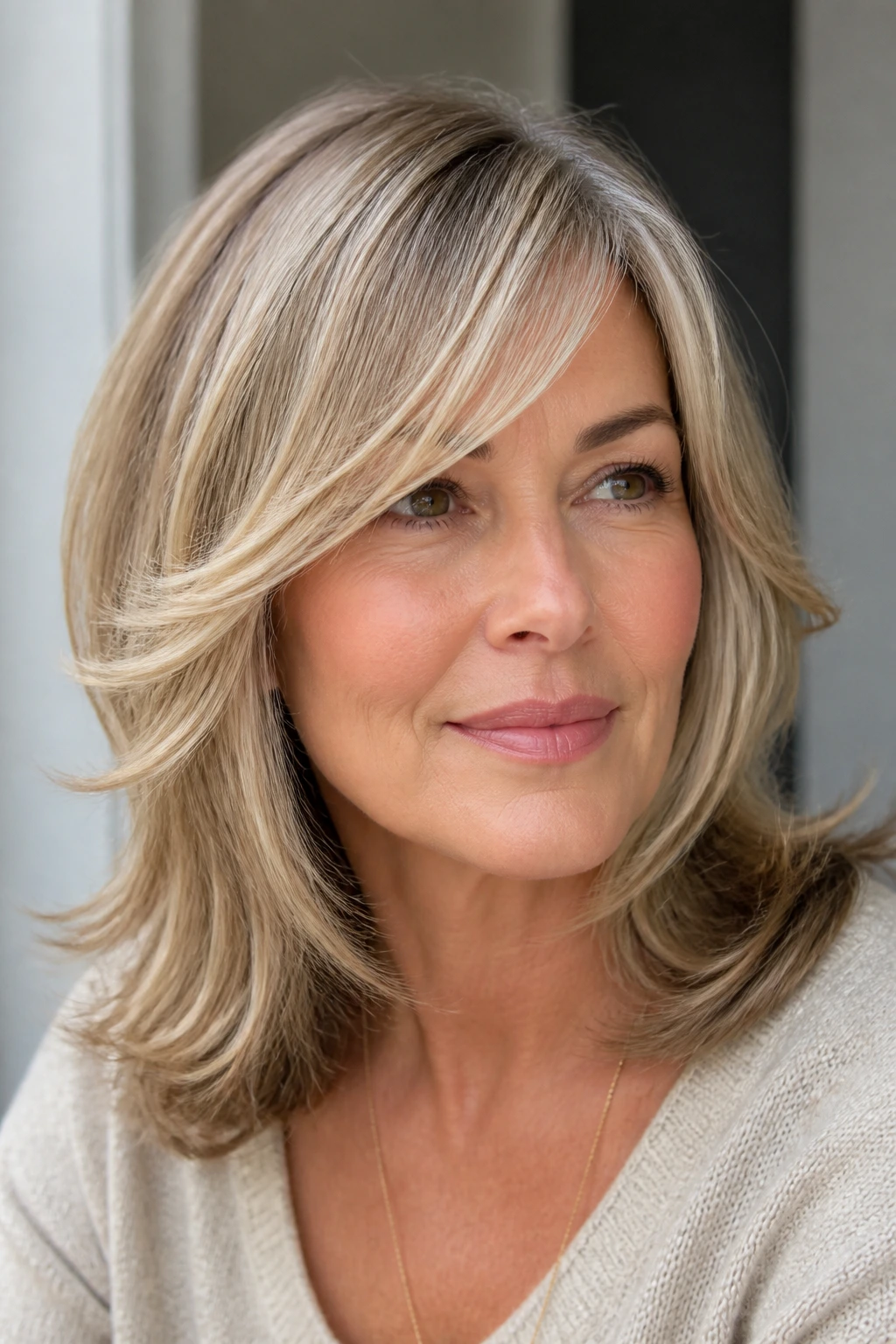
Side bangs can be wonderfully flattering when the ends flip slightly away from the face. That outward bend keeps the fringe from sitting on the cheeks, which is the mistake that makes some side bangs widen a round face instead of slimming it. The flip creates air at the front and a softer outline near the jaw.
This shape works best when the longest front piece lands around the cheekbone or just below it. A smaller round brush or even a flat iron twist at the ends can give you that gentle outward curve. Don’t overdo the bend. You want a suggestion of movement, not a 1970s flip that fights the rest of the haircut.
It’s a good style if you want something feminine and easy to tuck behind the ear when needed. The flip gives the bang enough personality that it doesn’t disappear, but it stays soft enough to live with. On straight hair, it looks neat. On wavy hair, it gets a little more relaxed.
This is one of the more wearable options for workdays, school drop-off, and all the ordinary stuff in between.
22. Micro Fringe With Soft Edges, Not a Hard Line
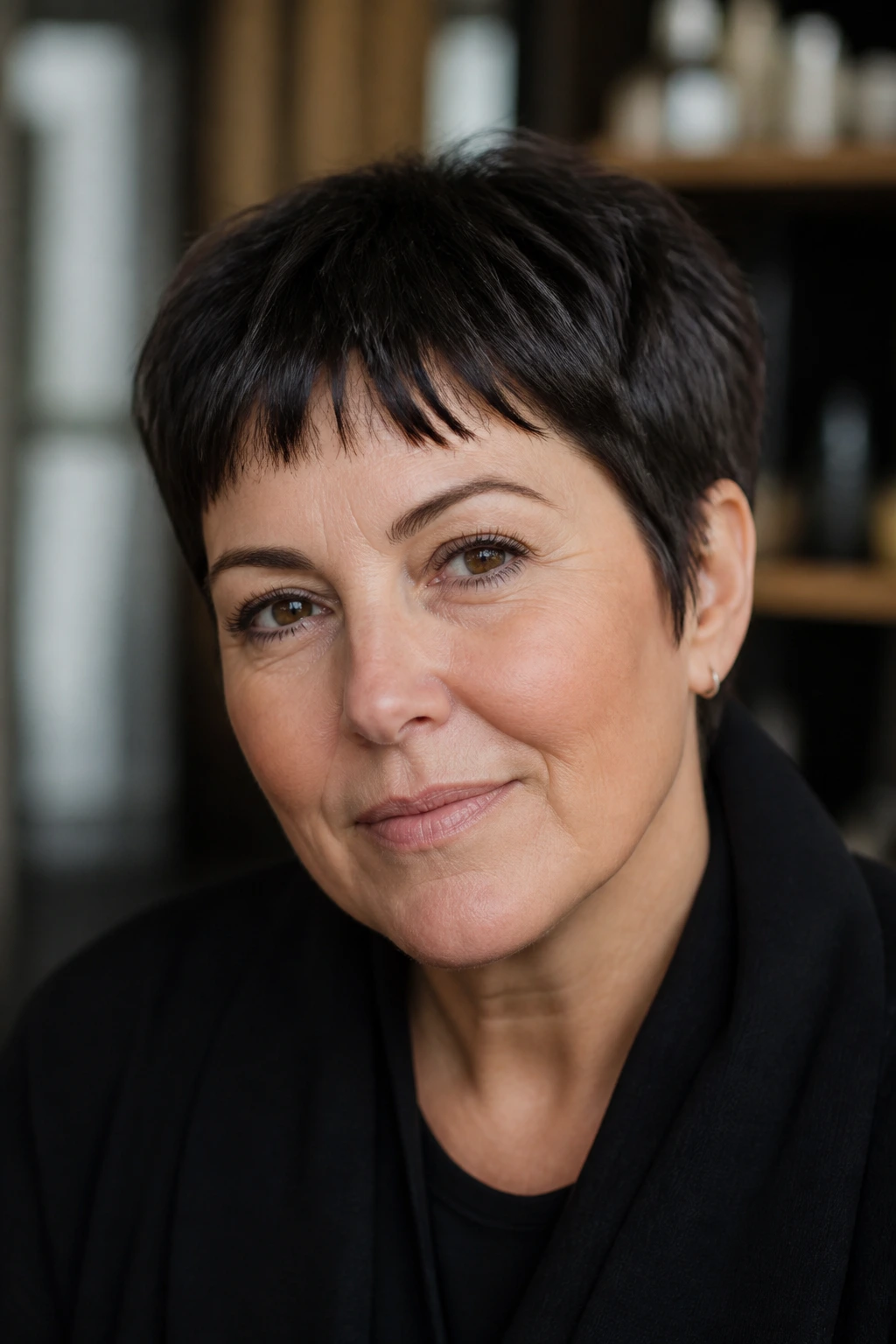
Micro bangs can be brilliant on the right face, and they can be terrible on the wrong one. On a round face, the main risk is shortening the visual length too much. That’s why I prefer the softened version: short, but not severe; defined, but not razor sharp. If you go this route, the texture has to do some of the work.
The fringe should be broken up a little at the ends so it doesn’t look like a hard bar across the forehead. Pair it with longer hair or a haircut that has strong vertical shape, because the rest of the style needs to give the face some length back. Without that counterbalance, the face can read even rounder.
This is not a “hide your bangs under a hat” style. It’s a statement. If you like a little edge and don’t mind trimming often, it can be a great choice. If you want low maintenance, skip it. No judgment. Just honesty.
What I would ask for is a short fringe with soft corners and a tiny bit of separation at the center. That little gap keeps it from looking like a paper cut.
23. Rounded Fringe With Longer Corners
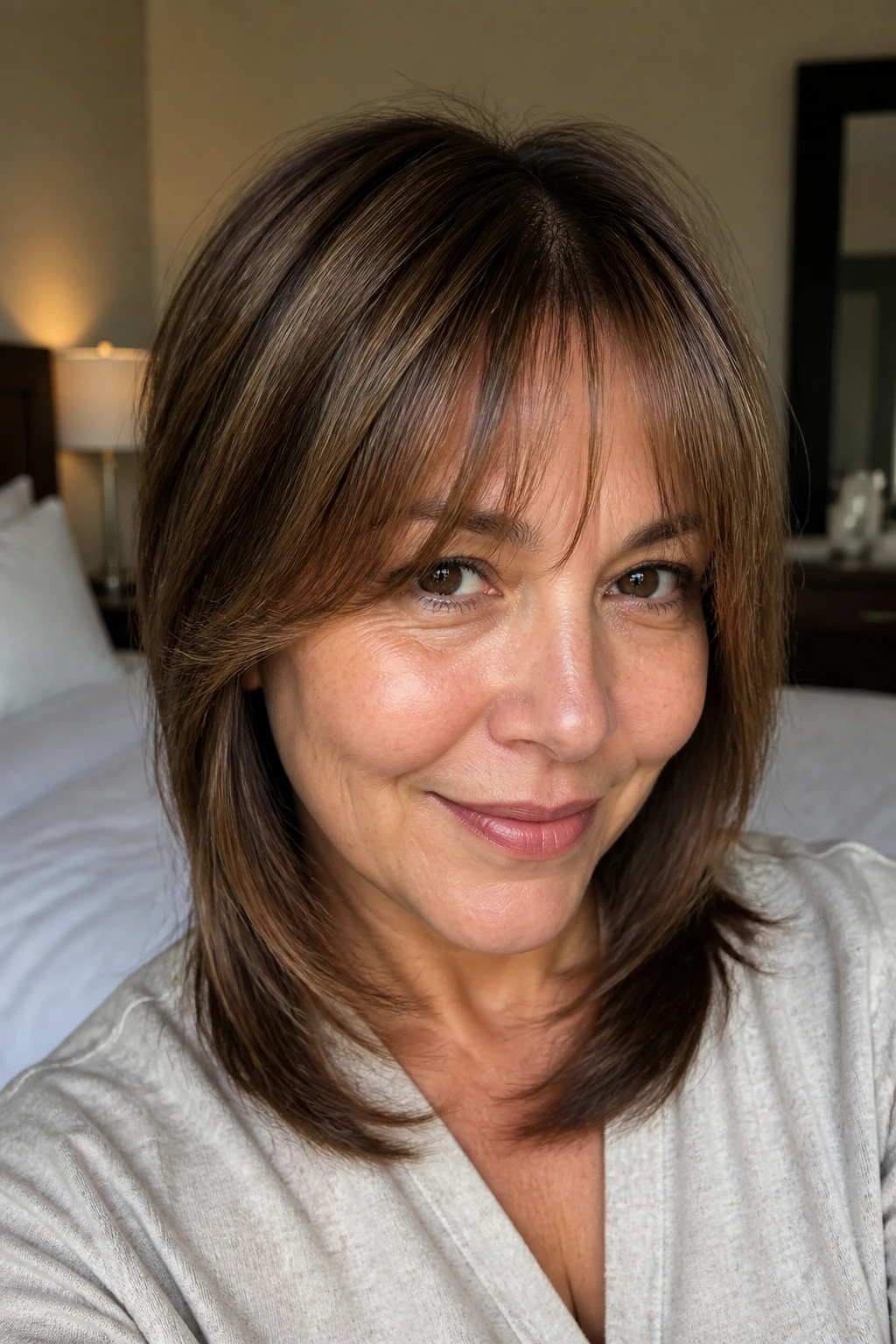
A rounded fringe sits somewhere between a blunt bang and a curtain bang. The middle is shaped softly, the corners stay longer, and the whole front line follows a gentle curve instead of a flat edge. On a round face, that curve can be useful because it gives the forehead some shape while still letting the sides soften the cheeks.
This style works best when the corners are not too short. If they stop at the widest part of the face, the fringe can make the cheeks look fuller. If they drop just past that point, the whole face reads cleaner. That is a tiny detail, but tiny details are where bangs live or die.
It also helps if the ends are point-cut instead of carved into a hard arc. You want the curve to feel light. Not perfect. The minute a rounded bang gets too exact, it starts looking like it came from a mannequin head.
For a woman over 40, this is a nice compromise between coverage and softness. You get a front shape without the severity of a true straight-across fringe.
24. Collarbone Cuts With a Whisper Fringe
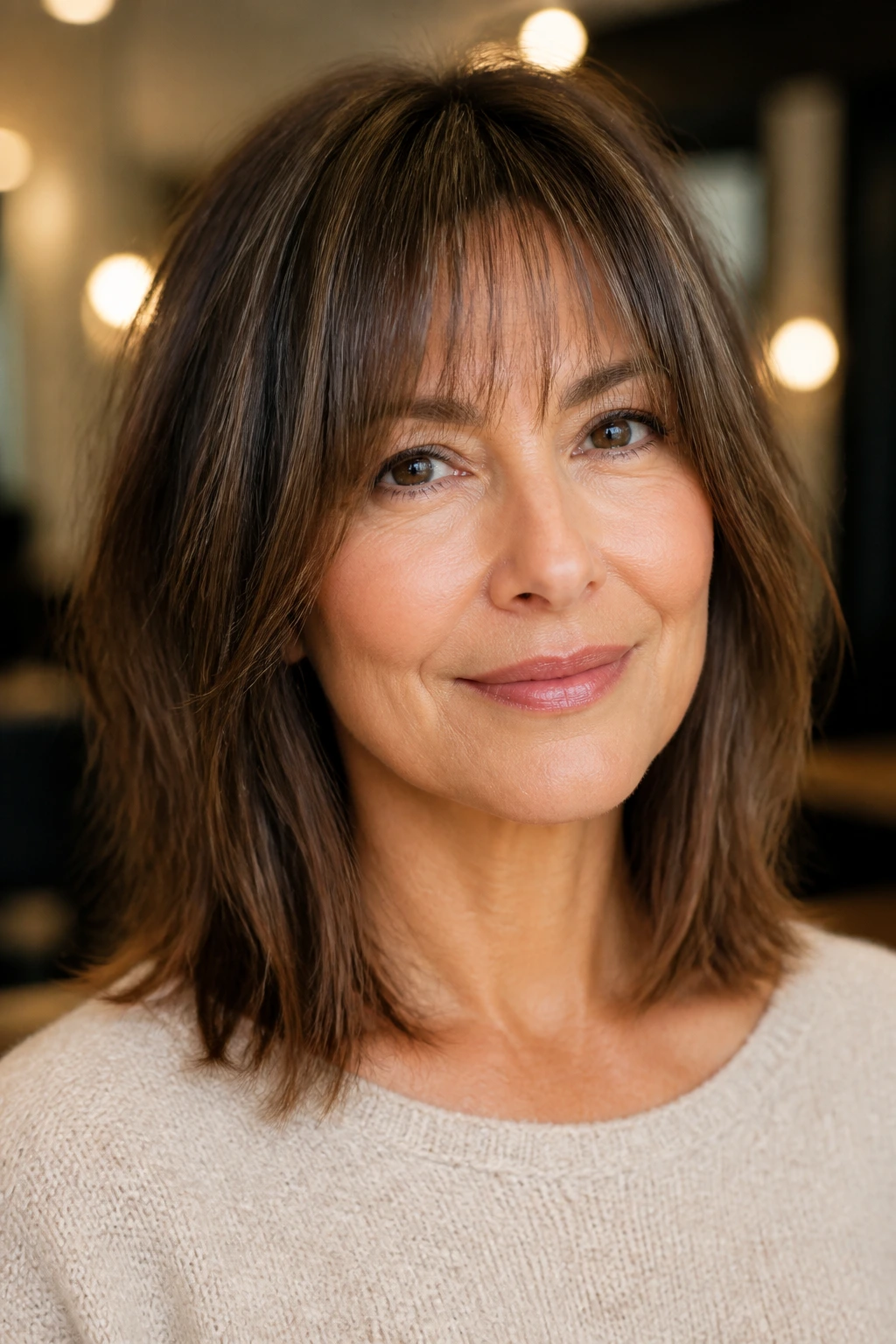
Sometimes the best bang choice is not really about the bangs alone. A collarbone-length cut with a whisper fringe can flatter a round face because the length below the chin does as much work as the fringe itself. The face gets a long, clean line from the collarbone down, and the bangs stay light enough not to crowd the forehead.
The whisper fringe is barely there in the best way. It usually splits a little, sits soft around the forehead, and blends into the front layers instead of declaring itself from across the room. That makes it a strong choice if you want a subtle shift rather than a full bang moment.
This cut is useful for people who like low drama and high wearability. It grows out cleanly, it works with updos, and it does not punish you if you miss a styling day. The downside is obvious: if you want the fringe to carry the whole haircut, this is too quiet for that. But quiet hair can be a smart move.
A little whisper fringe can be the difference between “I’m trying bangs” and “I live in this haircut.”
Why These Fringe Shapes Work Better on Round Faces Than a Heavy Straight Line
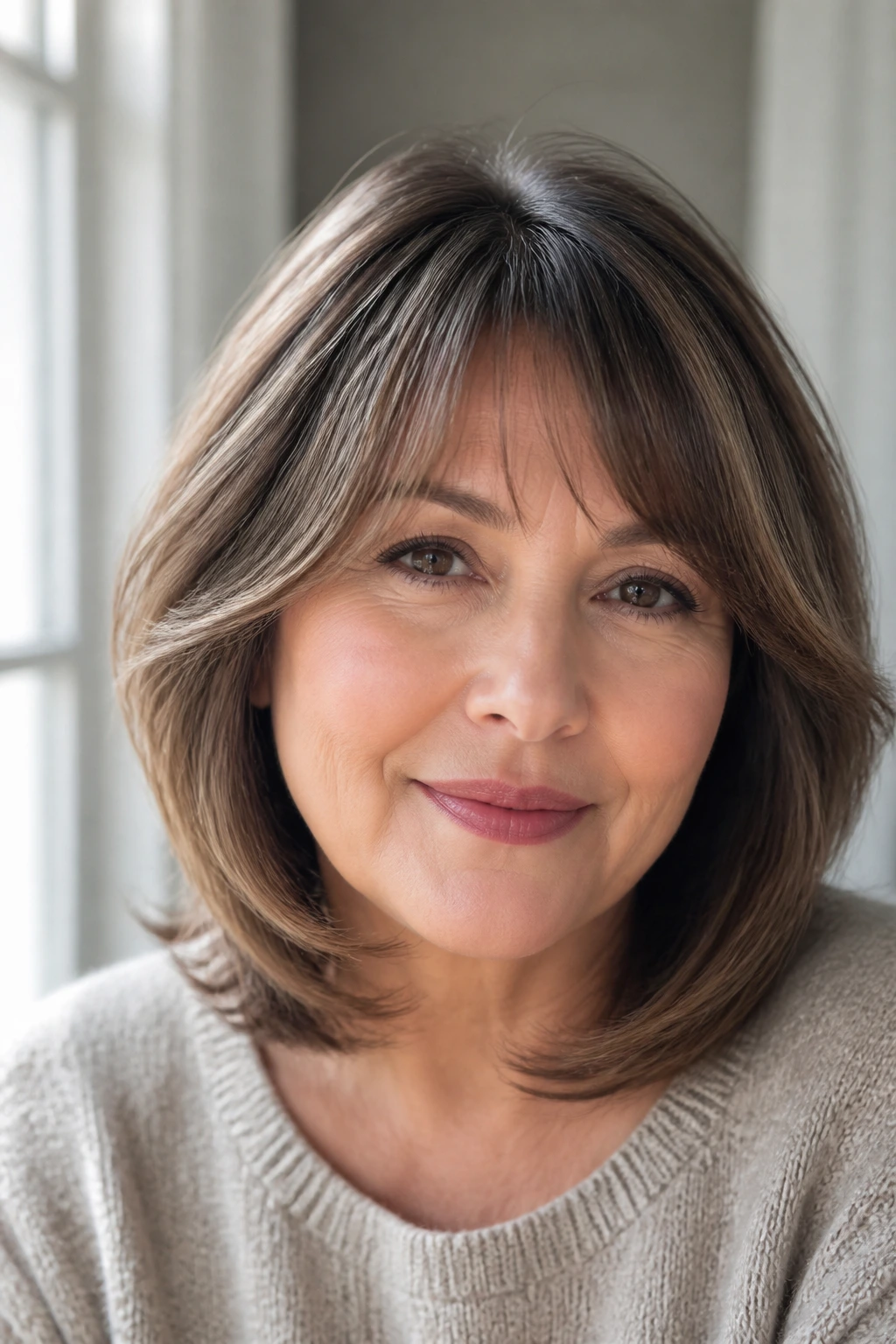
A round face usually has width at the cheeks and a softer taper toward the chin. That means the wrong bang can make the face feel shorter and broader, while the right one adds motion where the eye needs to move. Angles help. Curves help too, as long as they curve outward or downward rather than stopping flat across the forehead.
Over 40, the front of the hair often changes first. The density may drop a little, the hairline can get less even, and the hair may stop holding a hard shape the way it used to. That is why soft edges matter so much. A cut that looks strong on a thick 20-year-old fringe can look harsh and high-maintenance on a more mature hairline. The goal is not to erase age. It’s to keep the front of the haircut from fighting the face.
A good fringe should also work with your real habits. If you always wear glasses, the frame line has to be part of the plan. If you’re dry-shampooing at 8 a.m., the bang needs enough texture to reset quickly. If you hate blow-drying, a long sweep or a grown-out fringe will usually treat you better than a heavy line that needs a perfect curve every morning.
The best styles in this group share one thing: they give the forehead some shape without drawing a hard border around it. That border is the enemy. Small opening, soft sides, little lift. That’s the whole trick.
Tools That Make Fringe Styling Less Annoying
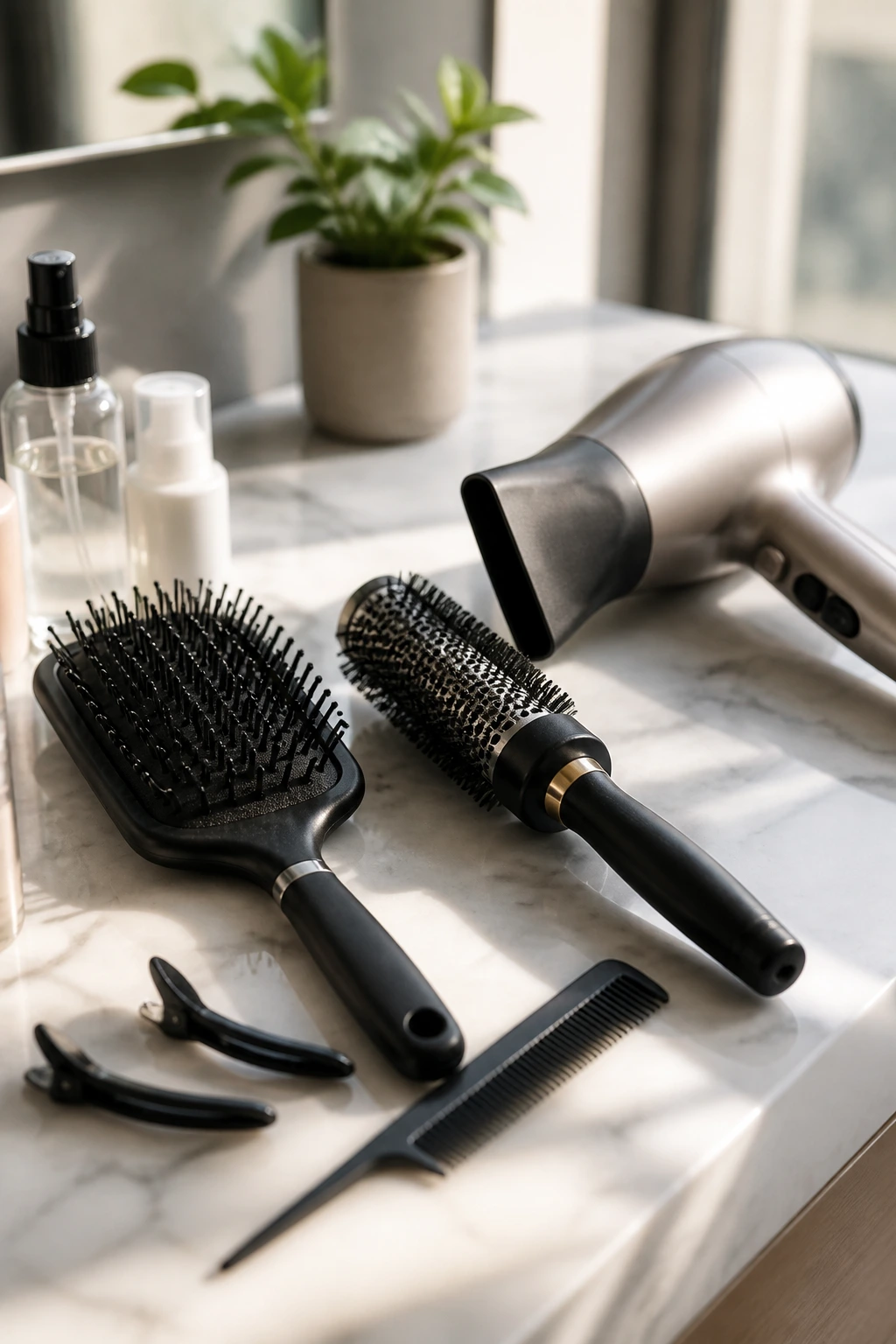
You do not need a bathroom full of gadgets, but a few specific tools make bangs behave a lot better.
- Small round brush, 1 to 1.5 inches: Best for bending curtain, side-swept, and rounded fringes without making them puff out.
- Paddle brush: Useful when you want a softer, straighter finish on longer fringe pieces.
- Blow-dryer with a nozzle: The nozzle matters. It helps direct air so the bang doesn’t scatter in ten directions at once.
- Duckbill or sectioning clips: Handy for pinning the rest of the hair away while you dry only the front.
- Fine-tooth comb: Good for checking symmetry and separating piecey bangs without over-brushing them.
- Mini flat iron: Useful for quick direction changes on stubborn side bangs or a small bend at the corners.
- Light mousse or root spray: Gives the front a little structure before drying.
- Dry shampoo: Not just for oil; it also adds a bit of grip, which bangs often need by day two.
- Velcro roller or large setting roller: Great for Bardot and curtain styles when you want lift at the root.
- Diffuser: Worth owning if your fringe is curly or wavy and you want shape without frizz.
A good mirror in daylight helps too. Bathroom lighting lies.
How to Ask Your Stylist for the Fringe You Actually Want
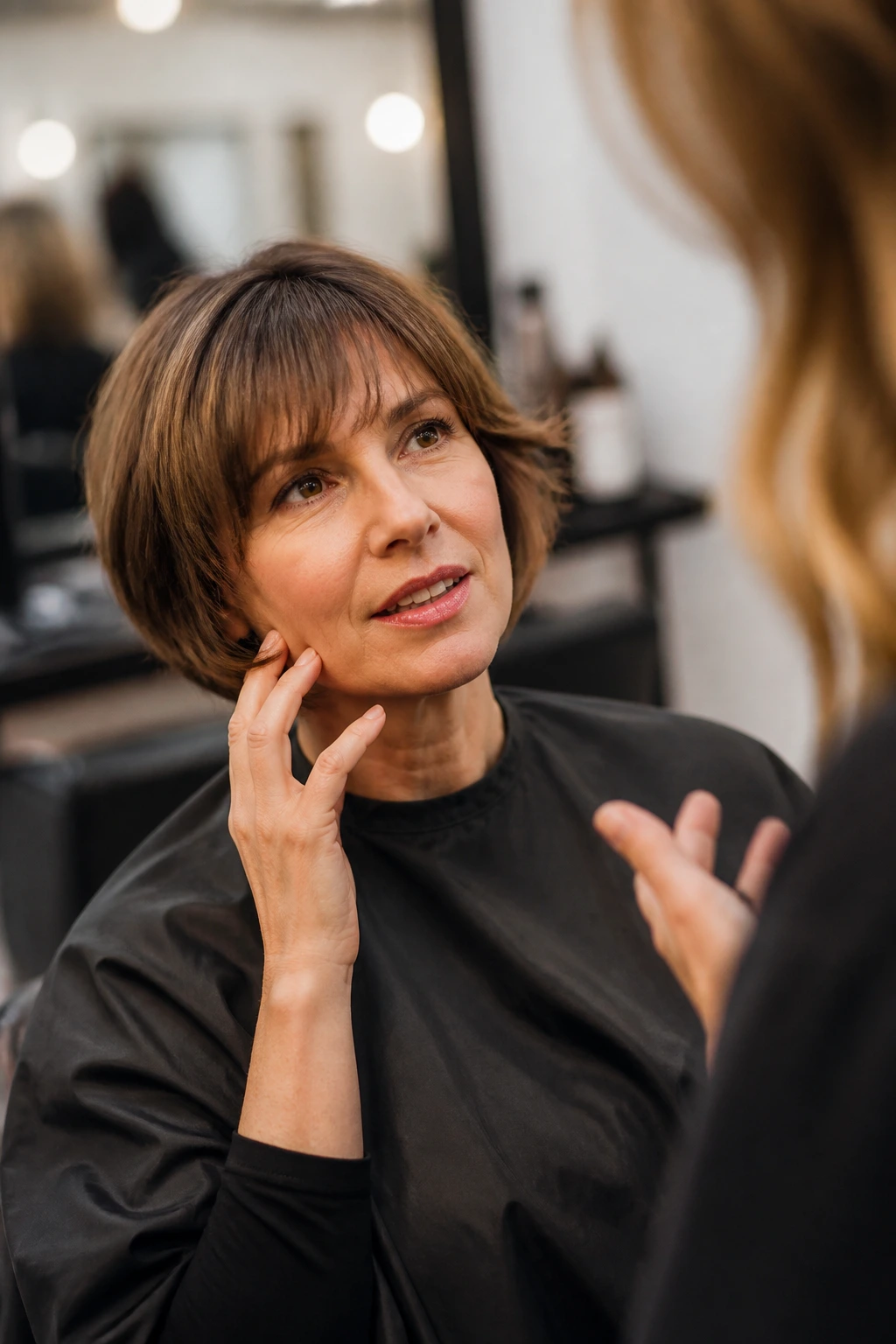
Bringing photos helps, but photos alone are not enough. Say what the bang is supposed to do. “I want to soften my cheeks,” “I need this to work with glasses,” or “I don’t want to style for more than five minutes” tells your stylist more than a screenshot ever will.
Show them your hair when it’s clean and dry if you can. Front growth patterns change a lot when hair is wet, and the wrong consultation picture can make the cut too short. Mention any cowlicks, especially at the center front or temples. Those little swirl points can make a fringe split, kick up, or separate in the exact spot you least want it to.
Ask for the length in landmarks: bridge of the nose, brow bone, cheekbone, lip line. Stylists think that way because it prevents guesswork. If you like softness, say point-cut. If you want movement, say avoid a blunt shelf. If you want a bang that grows out gracefully, ask for the sides to connect into the front layers instead of ending abruptly at the temple.
One honest sentence saves a lot of regret: “I will not spend ten minutes styling this every morning.” That sentence does more than any trend photo.
Styling Moves That Keep Bangs Lively Instead of Flat
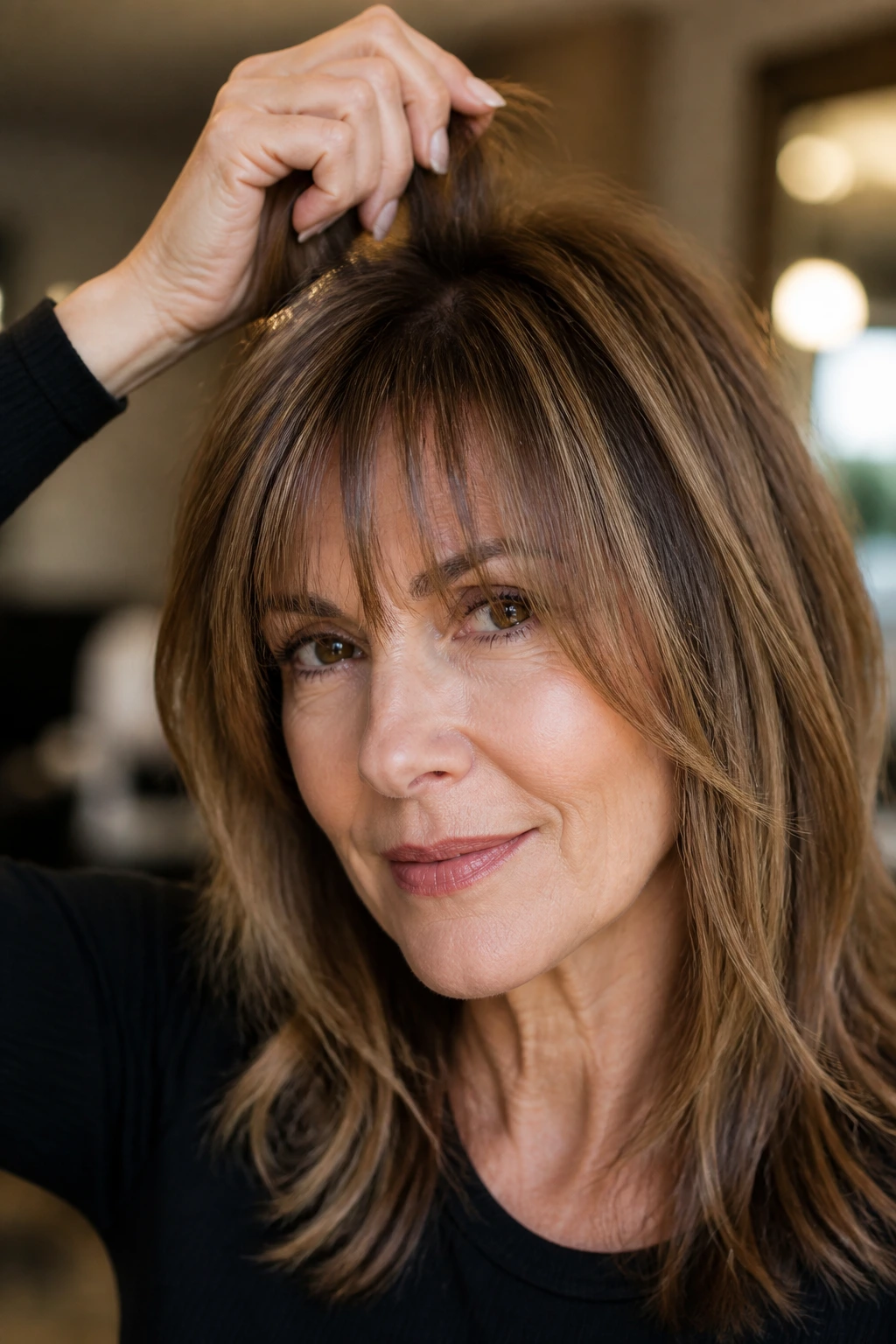
The best fringe styles usually fail for the same reason: too much product, too much heat, or too much touching. Bangs sit on the skin, so they pick up oil fast. They also lose shape fast if you keep pushing them around with your fingers.
Root lift first: Dry the roots in the opposite direction of the final shape, then redirect them. That one move builds a bend that lasts longer than drying them straight from the start.
Use less product than you think: A pea-sized amount of mousse or cream is usually enough for the front. If the fringe looks shiny, you probably used too much.
Cool it down: Bangs need to cool in the shape you want. Warm hair is a liar. It always relaxes once you stop holding it.
Refresh the front only: You do not have to restyle your whole head every day. Dampening the bang and re-drying just the front can buy you another decent day.
Keep a tiny brush nearby: A small brush or comb in your bag is more useful than a full arsenal of products. A quick reset beats a complicated fix.
If your fringe starts to split, do not panic and keep adding cream. Dry shampoo at the roots often helps more than another layer of softness.
Common Mistakes That Make Bangs Work Against a Round Face
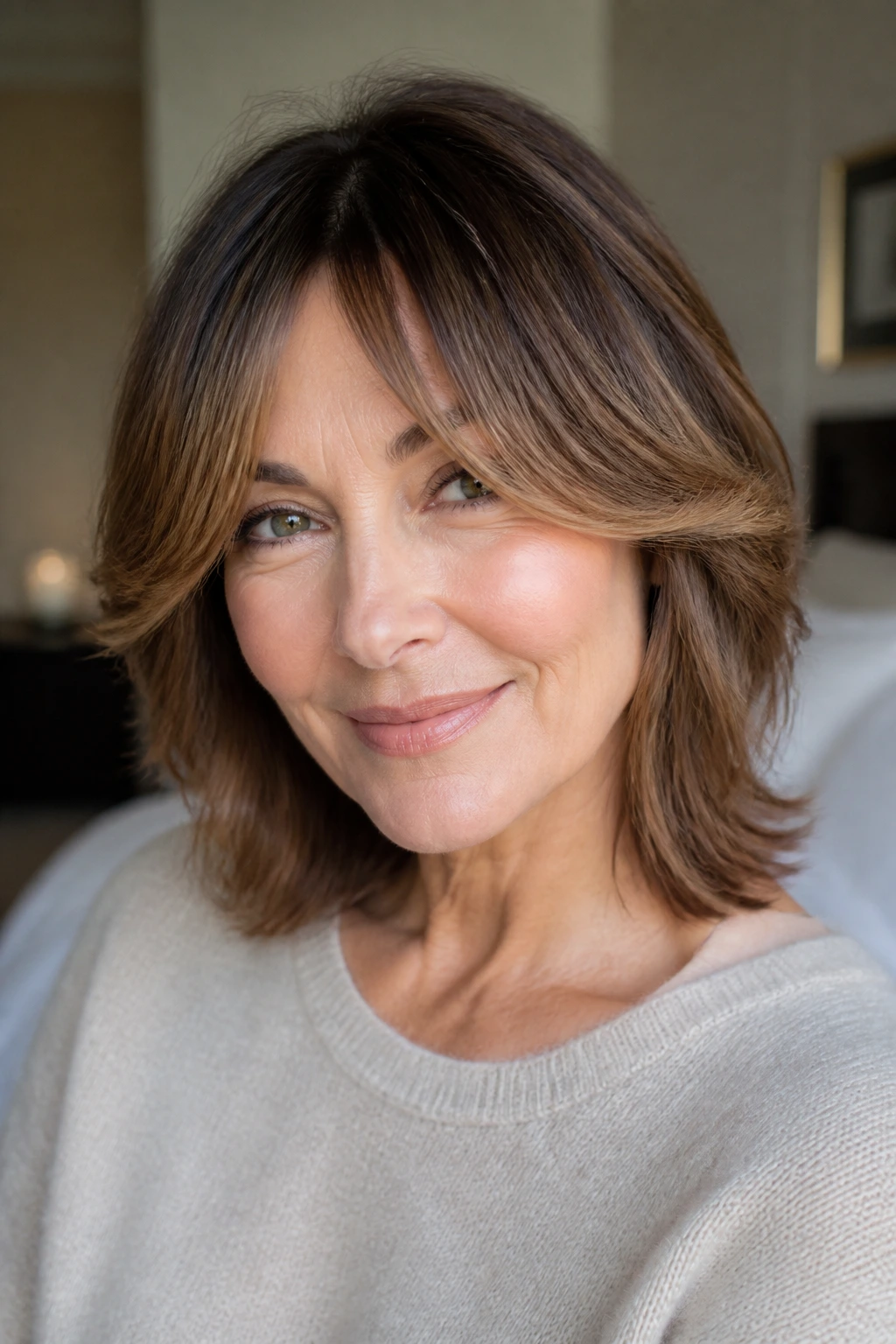
The first mistake is cutting the fringe too short across the middle. That short center can make a round face look broader because it pulls attention to the widest part of the face and leaves nowhere for the eye to travel. The fix is simple: keep the shortest point a little longer and let the sides open earlier.
The second mistake is over-thinning fine hair. You lose the shape, the bang disappears, and then you start styling it more aggressively to compensate. That turns into a loop. Better to keep density in the center and soften the corners gently.
The third mistake is ignoring the rest of the haircut. Bangs on a round face look much better when the layers below also have direction. A one-length bob with a heavy fringe can look boxed in. A collarbone cut, a shag, or even just a few face-framing layers will lighten the whole effect.
A fourth one: cutting bangs without accounting for glasses. Frames sit where bangs often want to live. If those lines clash, the face feels crowded. Build space in the cut from the start.
And one more, because this comes up constantly: using too much styling cream. The bang turns greasy, separates at the ends, and clings to the forehead. Use less. Then use even less than that.
Variations and Alternatives to Try If You Want a Softer or Bolder Look
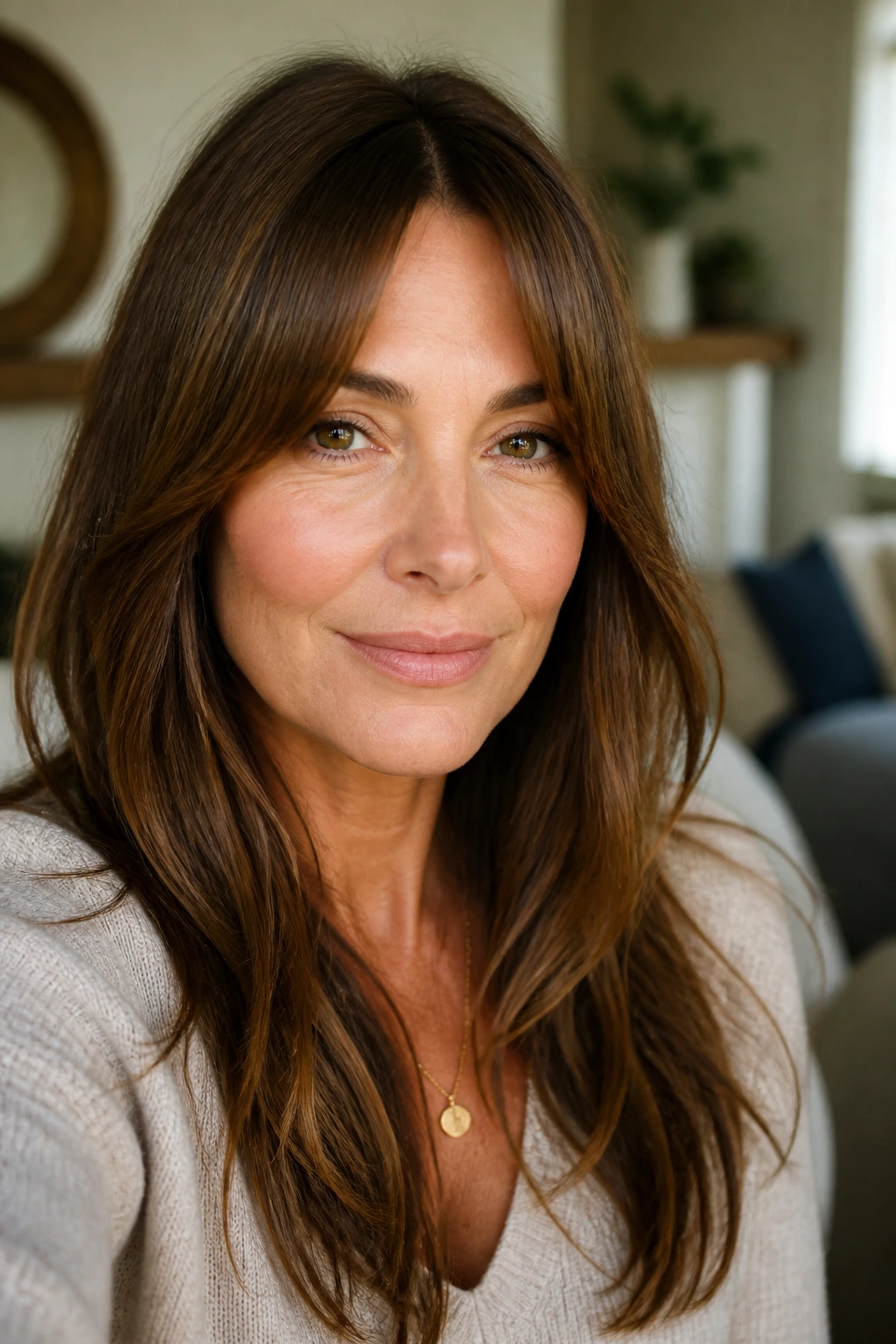
The Soft Start: If you want bangs but you’re nervous, begin with a long curtain fringe or a whisper fringe that can grow into layers. It gives you the framing effect without a sharp commitment.
The Glasses-First Cut: Ask for a fringe that clears the frame line by at least a quarter inch at its shortest point. That small buffer saves a lot of daily fuss, especially if your lenses sit high on the face.
The Curl-Friendly Shape: For wavy or curly hair, keep the fringe longer at the center and let the sides taper into face-framing pieces. The cut should respect shrinkage instead of trying to fight it.
The Thick-Hair Tamer: If your front grows dense, lean into razored or piecey bangs with internal bulk removal. That keeps the front light enough to move instead of becoming a heavy block.
The Bold One: A micro fringe or a stronger blunt line can work on a round face if the rest of the haircut has length and lift. It’s a sharper look, so it needs a haircut with enough shape elsewhere to balance it.
The No-Stress Grow-Out: If you hate frequent trims, choose a side-swept bang or a grown-out fringe that merges into layers. Those styles forgive a missed appointment better than anything cut straight across.
Keeping Bangs in Shape Between Salon Visits

Bangs ask for more upkeep than the rest of the haircut. There’s no way around that. But the maintenance is manageable if you know the rhythm.
For a blunt or soft blunt fringe, plan on a trim every 3 to 4 weeks if you want it to stay clean. Curtain bangs, side sweeps, and grown-out fringes can usually stretch to 5 to 8 weeks, depending on how fast your hair grows and how exact the shape is. Curly fringes often need a shape refresh when the curl pattern starts changing, not just when the length changes.
At home, dry shampoo at the front roots helps on day two or three, especially if your skin is a little oily. A small roller at the crown can revive a curtain or Bardot fringe in about 5 minutes. If the bang starts behaving badly, dampen only the front section, re-dry it with tension, and let it cool before you touch it again.
Sleeping habits matter more than people think. If you smash a bang flat into your forehead all night, it wakes up with a grudge. A loose pin curl, a soft roller, or even clipping the fringe up and away from the skin can preserve shape overnight. That’s one of those tiny routines that saves a lot of morning swearing.
Wash the front more often than the rest if needed. A bang that lives against the skin picks up oil faster, and sometimes that oil is the whole reason the front looks flat by afternoon.
Questions People Actually Ask About Bangs for Round Faces Over 40

Which bang shape is the safest starting point if I’ve never had bangs?
Long curtain bangs or a soft side-swept fringe are usually the easiest first try. They grow into layers cleanly and do not lock you into a severe front line. If you hate them, the grow-out is much less painful than with a blunt cut.
Are blunt bangs bad for round faces?
Not automatically. A heavy, exact rectangle can be rough on a round face, but a soft blunt fringe with point-cut edges and rounded corners can work well. The difference is in the finish and the side length, not just the fact that it’s blunt.
Will bangs make my face look shorter?
They can, if the fringe is too dense or too short across the center. Styles that open at the sides — curtain, bottleneck, side-swept, and split fringes — help keep the face visually longer.
What if I have a cowlick at the front hairline?
Tell your stylist before the first snip. Cowlicks usually behave better with longer, more flexible bangs than with short, rigid ones. A split fringe or a side sweep often cooperates better than a strict straight-across shape.
Can I wear bangs with glasses and still look balanced?
Yes, but the length has to respect the frame line. Keep the shortest point slightly above or below the top of the frame, not right on it. That little bit of space keeps the front from looking crowded.
Do bangs work on fine hair after 40?
Absolutely, if the cut keeps enough density in the center and avoids over-thinning. A wispy or airy fringe can be lovely on fine hair, but it should still have enough body to show a shape.
How often will I need trims?
Most fringes need a touch-up sooner than the rest of the haircut. Sharp, blunt styles want trims every few weeks; softer curtain or grown-out shapes can go longer. If the bang keeps landing in your eyes or separating where you don’t want it, that’s your trim cue.
What if my bangs keep splitting apart during the day?
That usually means the front is either too short, too heavy with product, or fighting a cowlick. Try a lighter styling product, dry the roots in the opposite direction, and ask for a softer shape next time so the hair has somewhere to fall.
The Fringe That Fits
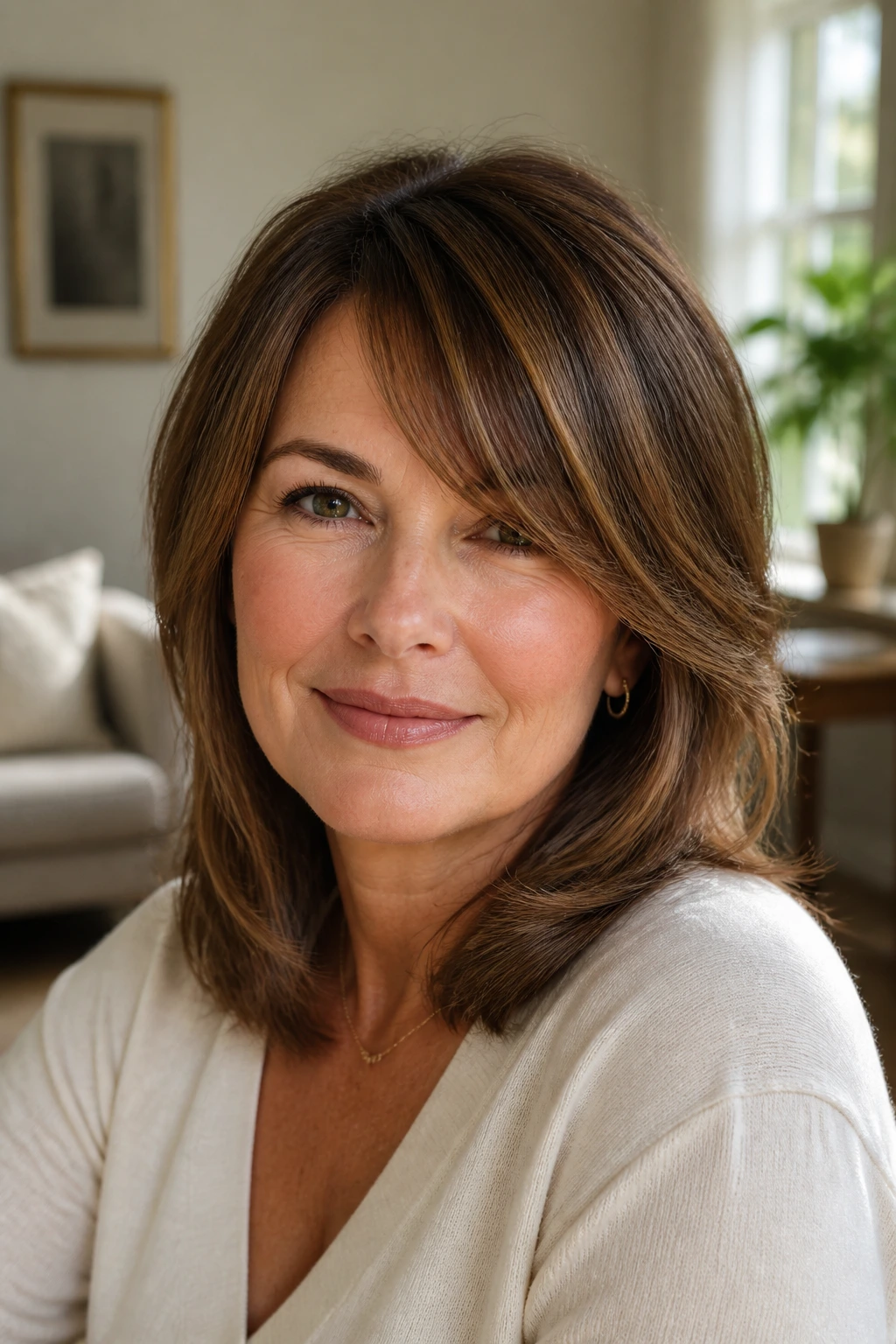
The best bangs for a round face over 40 are the ones that keep the eye moving. They do a little work at the center, a little more at the temples, and they never trap the face inside one hard line. That’s why the soft diagonals, split centers, and cheekbone-length corners keep showing up in the strongest versions of this list.
And the more honest you are about your hair, the better the cut gets. Hairline, glasses, texture, time, cowlicks — all of it matters. A fringe that looks good for five minutes and then turns into a daily chore is not a win. A fringe that cooperates with your real life is.
Bring a photo, yes. Bring a few honest notes about what your hair actually does, too. That’s the part that turns a pretty haircut into one you’ll keep reaching for.
