



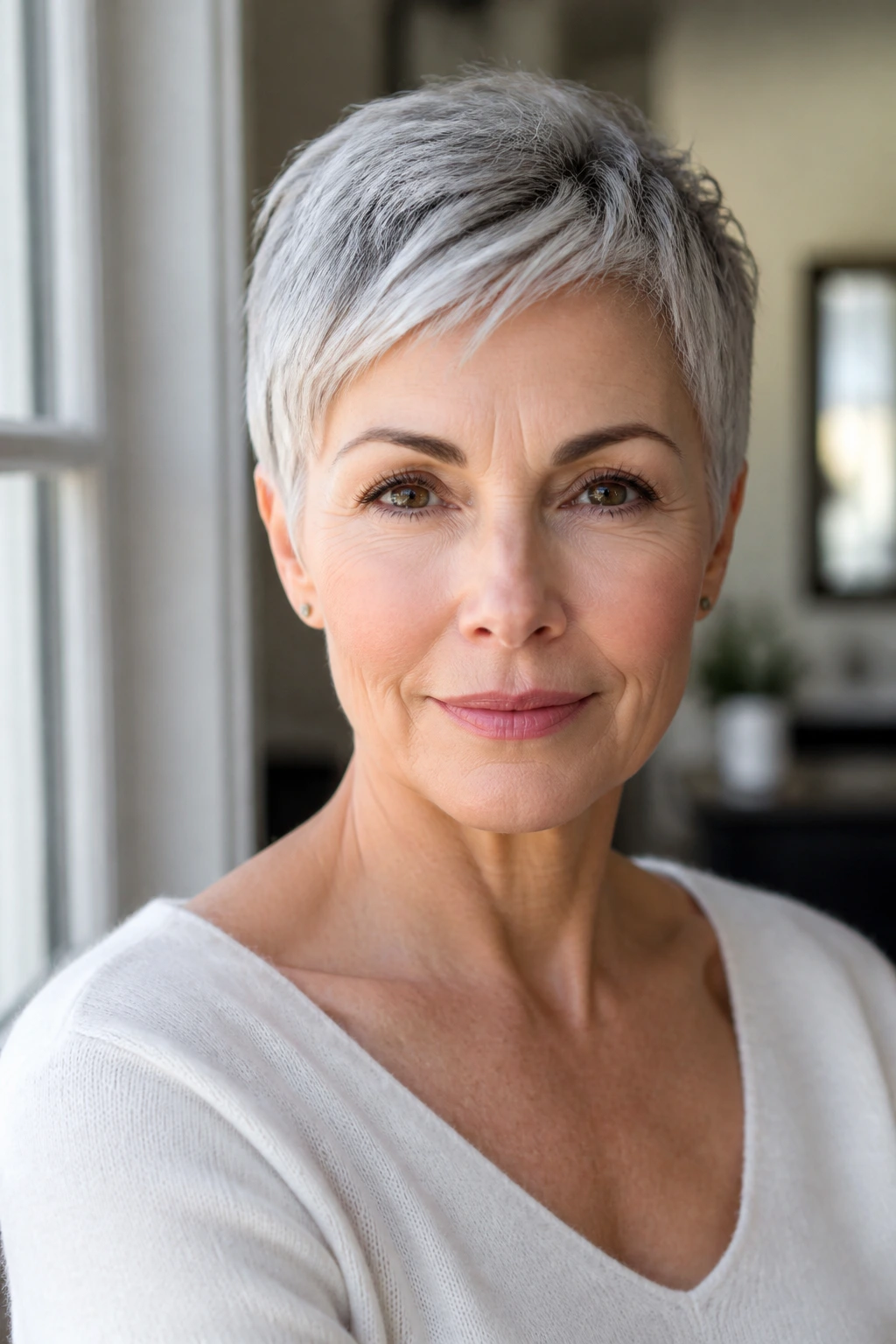
Gray hair pixie cuts for older women have a special kind of honesty. They don’t hide the silver, and they don’t apologize for the face underneath it, either. A good pixie gives gray hair shape, lift, and a little edge — the kind that makes a soft sweater, a bright lip, and a pair of glasses feel intentional instead of accidental.
I’ve always thought gray hair looks best when it’s cut with purpose. Not overworked. Not teased into submission. Just shaped so the crown has some air, the nape sits clean, and the fringe does a little work around the eyes. Gray strands often show texture better than pigmented hair does, which means the wrong cut can look fuzzy fast. The right one? It looks crisp, luminous, and oddly youthful without trying to be.
That’s the real appeal here. A pixie can make silver, white, and salt-and-pepper hair look polished on a normal Tuesday, not only after a salon blowout. Some versions lean soft and feathered. Others go sharp and graphic. A few are forgiving on fine hair, and a few are built for dense, stubborn strands that want to stick out in every direction. There’s a sweet spot for almost every face shape, hair texture, and level of styling patience — and the good ones are worth knowing.
Why These Gray Pixie Cuts Keep Showing Up on Smart Haircuts Lists
-
They open up the face: A well-cut pixie puts the eyes, cheekbones, and jawline back in charge instead of letting long hair swallow everything whole.
-
They work with silver texture: Gray hair often feels drier and a bit more wiry, and short layers handle that texture better than heavy lengths do.
-
They save time without looking lazy: Five minutes with a vent brush or a dab of styling paste can do more for a pixie than twenty minutes of wrestling with a longer cut.
-
They make glasses easier to wear: A smart fringe or side part keeps frames from fighting the haircut around the temples.
-
They’re easy to personalize: The same pixie can read soft, edgy, elegant, or boyish depending on the fringe, crown height, and how tight the nape is cut.
-
They suit gray hair at every stage: Pure silver, salt-and-pepper, or a mix of white and darker strands all show off the line of a pixie beautifully when the shape is clean.
1. Soft Feathered Silver Pixie
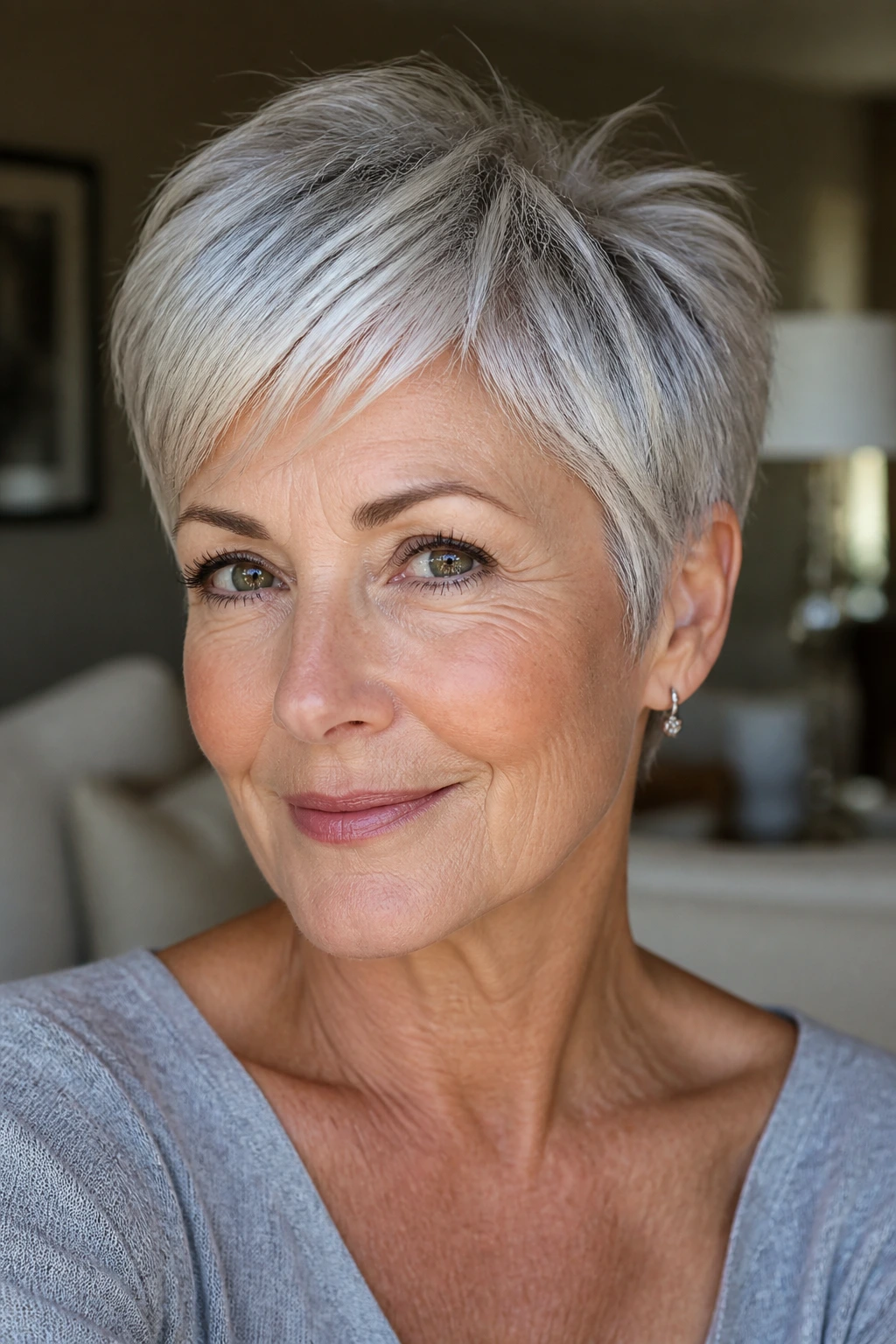
A feathered silver pixie is the one I recommend first when someone wants short hair but does not want to look severe. The layers are light, the edges are soft, and the whole cut has a little movement around the temples and crown. On gray hair, that feathering catches the light in a way blunt ends never can.
The trick is restraint. The top should have enough length to be brushed forward, slightly off-center, or lifted at the root with a touch of mousse, but not so much that it turns into helmet hair. Ask for the ends to be point-cut so they don’t sit in one hard line. That tiny detail matters more than most people think.
This cut works especially well if your hair has gone finer over time. The lighter layers remove bulk without stripping the shape bare. It’s also a kind cut for women who wear earrings often, because the hair stays out of the jawline and lets the face breathe.
2. Tapered Pixie with Side-Swept Fringe
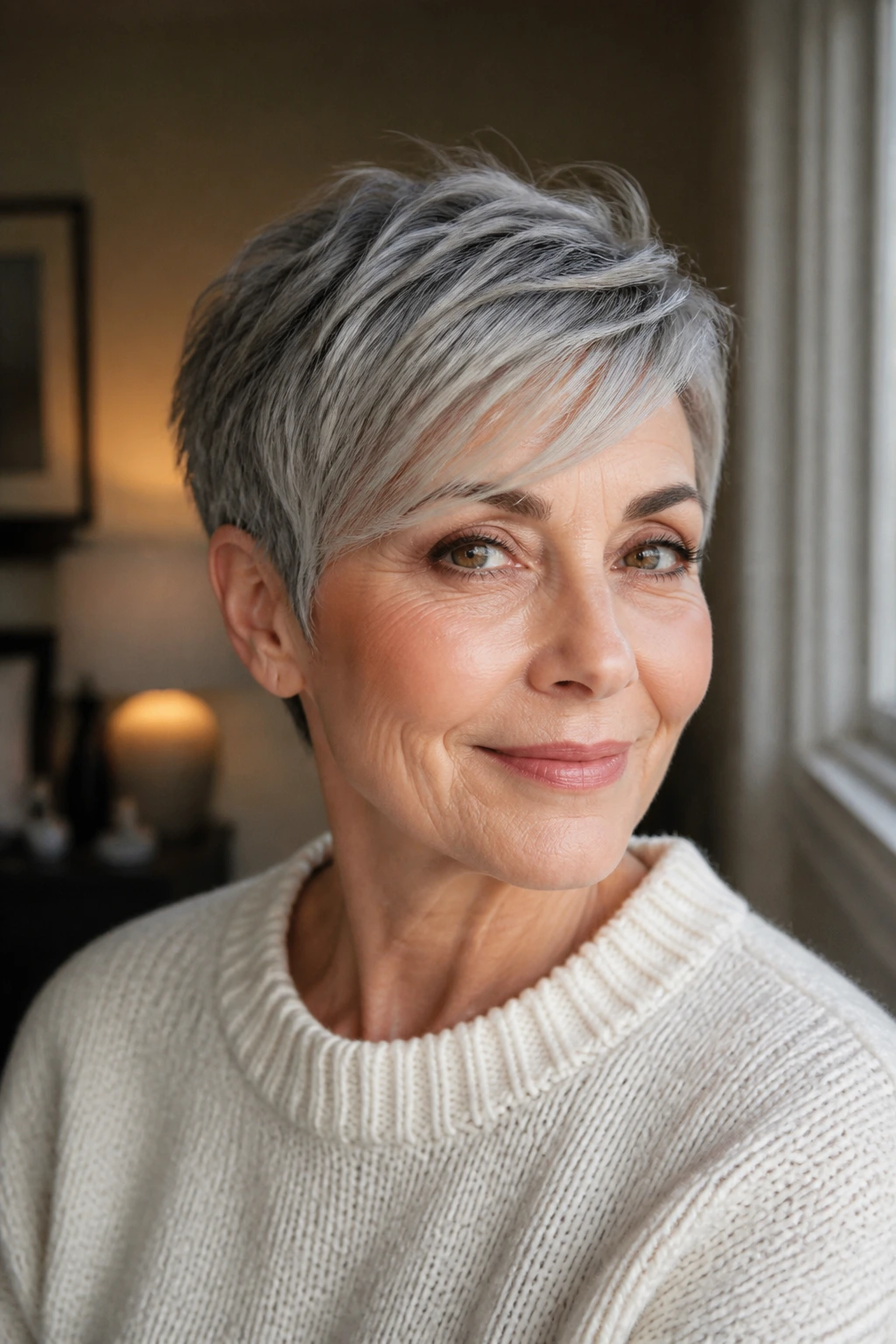
Side-swept fringe changes everything. It softens the forehead, pulls attention toward the eyes, and gives gray hair a little motion right where people look first. The tapered sides keep the silhouette neat, while the fringe does the flattering work.
What I like about this version is how forgiving it is on mornings when the hair won’t cooperate. A quick blast from the dryer, a round brush, and a dab of light cream at the fringe usually gets it there. If your hair bends in odd places, this style can absorb the bend instead of fighting it.
Why It Flatters So Many Faces
A side-swept pixie helps if your face is long, heart-shaped, or broad through the forehead. The diagonal line breaks up width and gives the haircut a softer read. It also plays well with a strong brow, which is useful if your eyebrows already do some of the visual heavy lifting.
3. Choppy Textured Crop
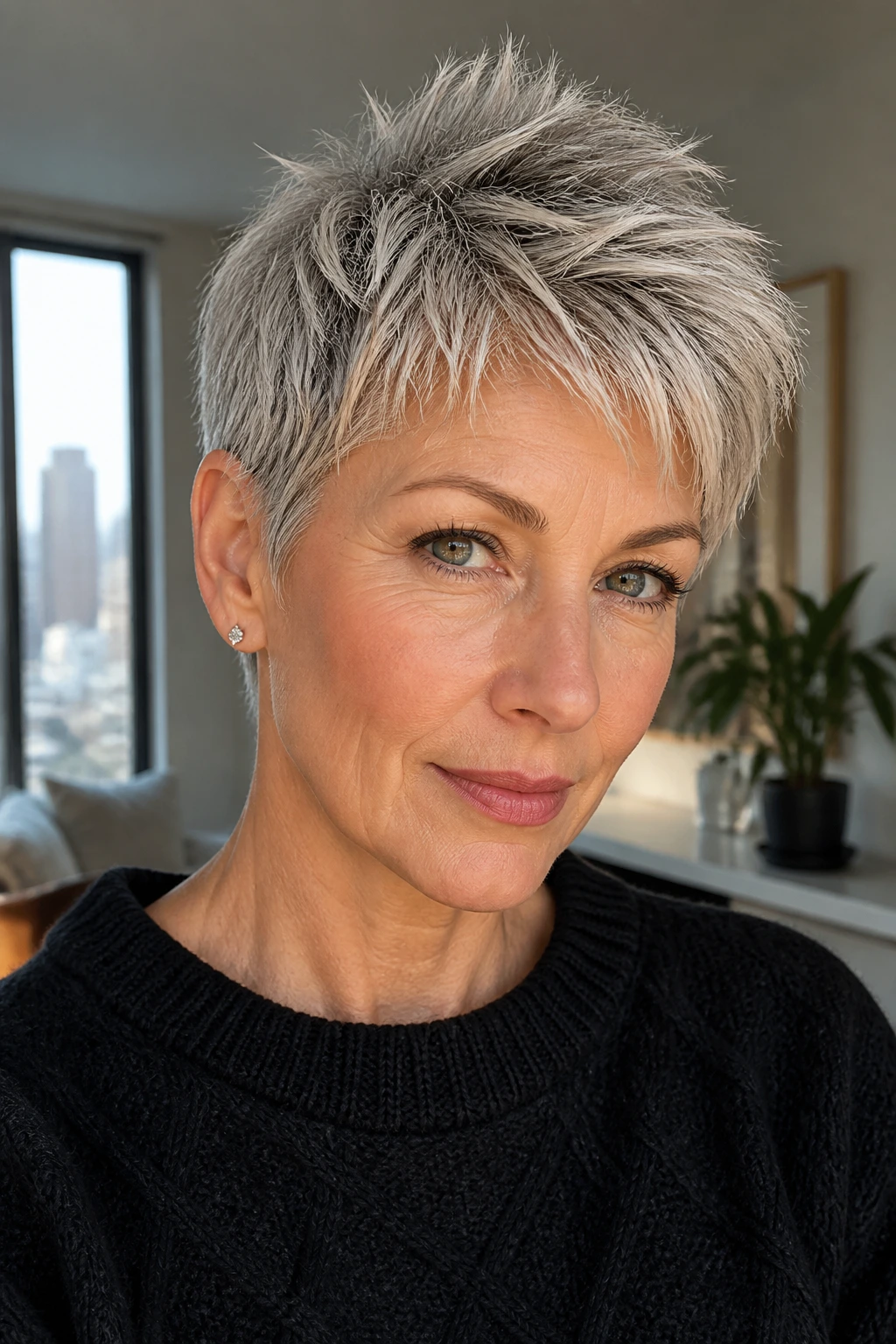
This one has a bit of attitude. The layers are sliced or point-cut into irregular little pieces, which gives the hair texture that looks intentional instead of airy and fluffy. On silver hair, those choppy ends can look almost frosted at the tips.
Dense hair loves this shape. So does hair that grows in different directions and refuses to lie flat. The shorter bits stop the outline from puffing out near the ears, while the top can be scrunched with a pea-sized amount of styling paste. Not a fistful. A pea.
If you want a pixie that looks modern without being fussy, this is one of the strongest options. It’s not the smoothest or the softest. That’s the point. It wants a little grit.
4. Curly Gray Pixie with Lifted Crown
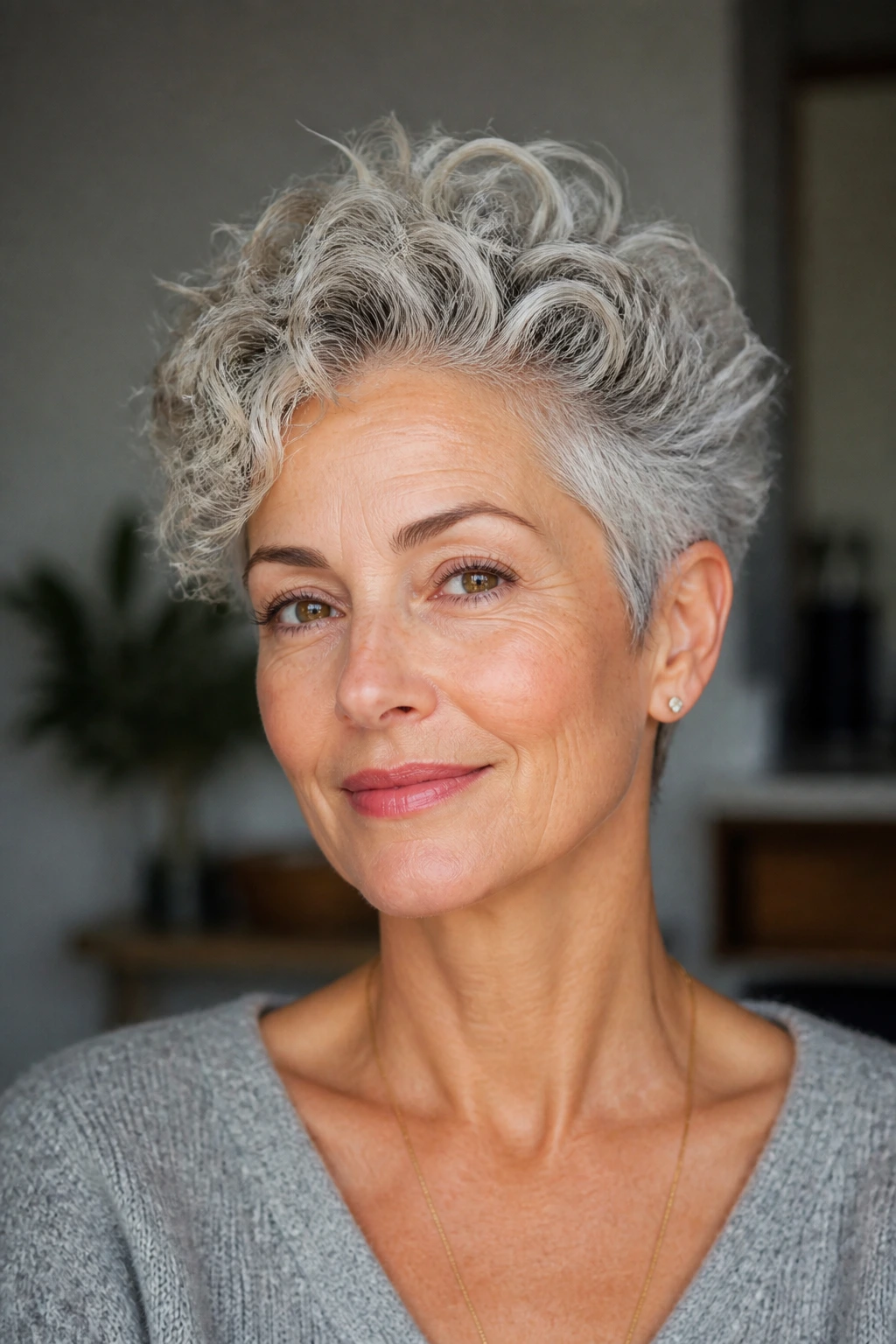
Curly gray hair needs respect, not flattening. A curly pixie lets the curl pattern stay visible, which is half the beauty of silver curls anyway. The crown should be cut to keep lift, while the sides and nape stay shorter so the whole cut doesn’t bloom outward.
A dry cut is often the smartest move here, because curly hair lies to you when it’s wet. It can shrink, spring, or twist once it dries, and a cut that looks neat in the chair may turn into a different animal at home. If your stylist knows curls, ask for shape first and length second.
Use a light mousse or curl cream, then let the hair air-dry or diffuse it on low heat. Heavy oils can weigh down the crown and make the curl clump in a way that hides the shape. Curly gray pixies should look lively. Never pasted down.
5. Long-Top Pixie with Tucked Sides
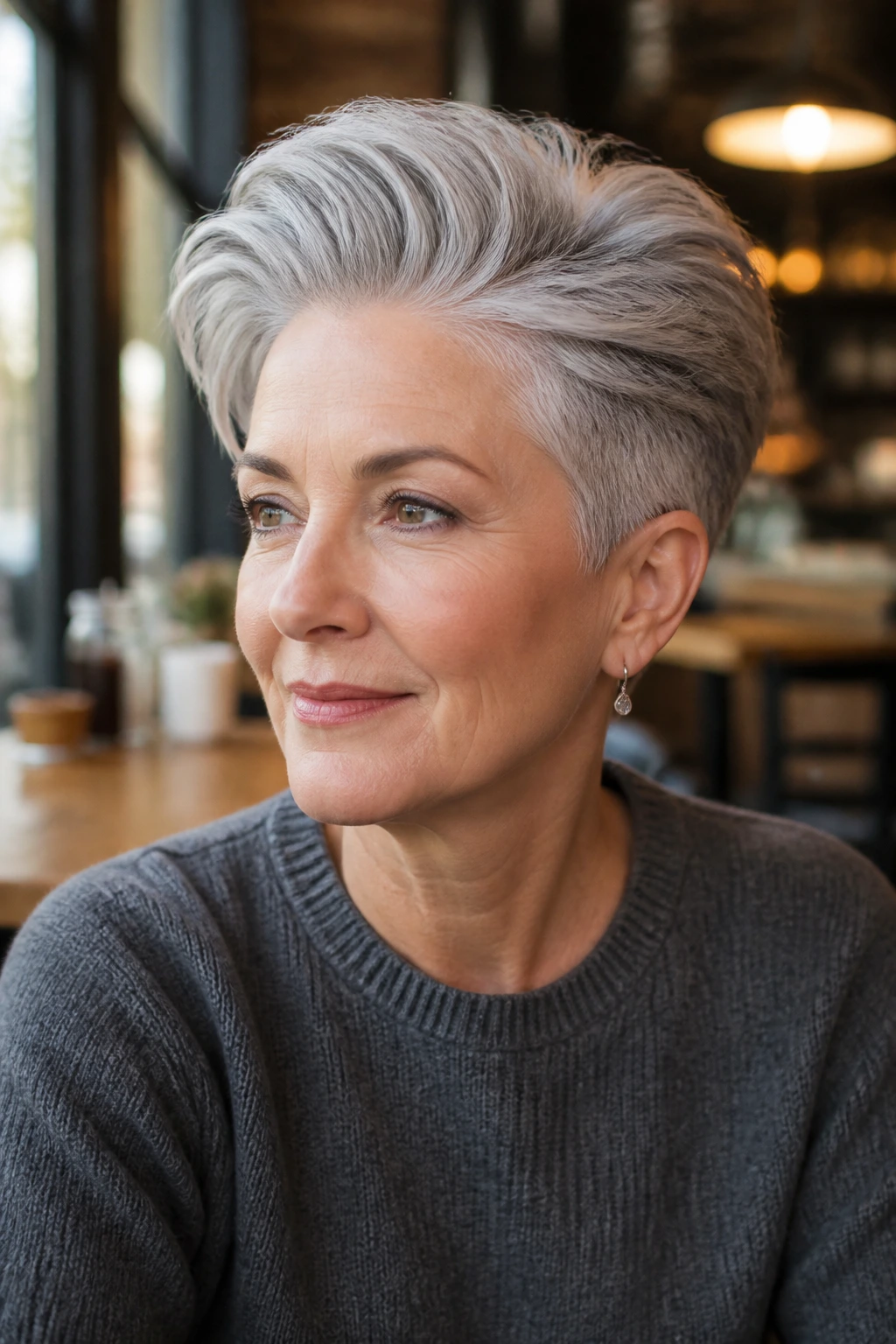
This is the pixie for someone who wants options. The top stays long enough to brush back, sweep to the side, or break into a little wave, while the sides are tucked close enough to keep the outline clean. It gives you the feeling of short hair without fully giving up styling range.
The contrast matters. If the top and sides are too close in length, the whole cut can fall flat. Keep the top visibly longer — enough to move, not enough to flop into your eyes. The nape can be slim and neat, which gives the haircut a sharper finish.
I like this shape on women whose hair is a little thicker on top than at the temples. It uses that fullness instead of fighting it. A light root spray at the crown is often enough. Sometimes that’s all it takes.
6. Ear-Hugging Pixie with a Clean Nape
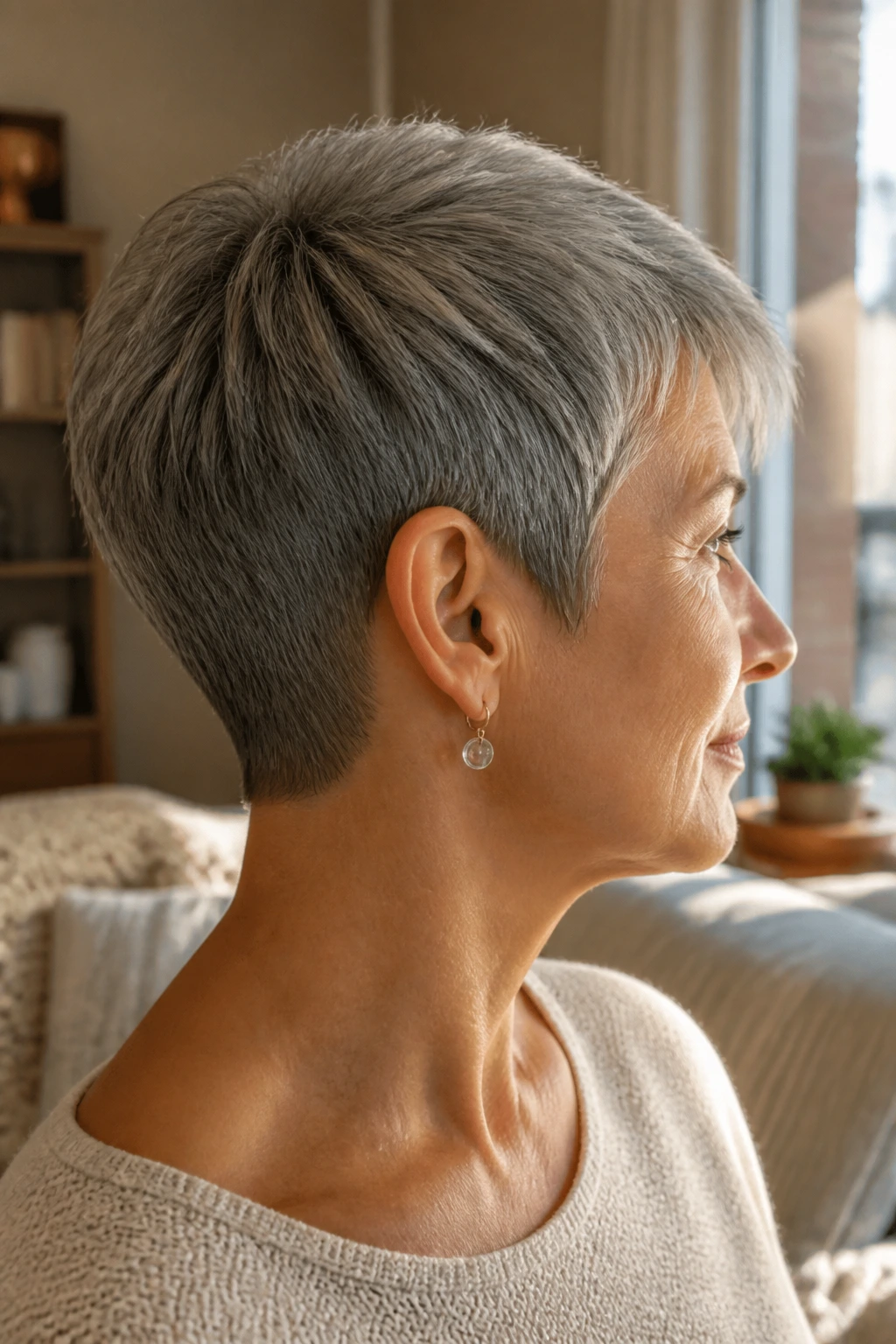
There’s something almost architectural about an ear-hugging pixie. The sides sit close, the nape is crisp, and the hairline around the ears is carved neatly enough to make silver strands look almost polished. It’s a cut that shows confidence without shouting.
This shape is especially useful if you dislike hair brushing the neck. Some people love that sensation. Others don’t want a single strand touching their collar. Fair enough. A clean nape solves that, and it also makes the neckline of a shirt or jacket look sharper.
The best version keeps just enough softness near the temple so the cut doesn’t feel too hard. Think neat, not shaved-down unless you really want that edge. A tiny touch of shine cream through the top can keep it sleek without making it greasy.
7. Asymmetrical Silver Pixie
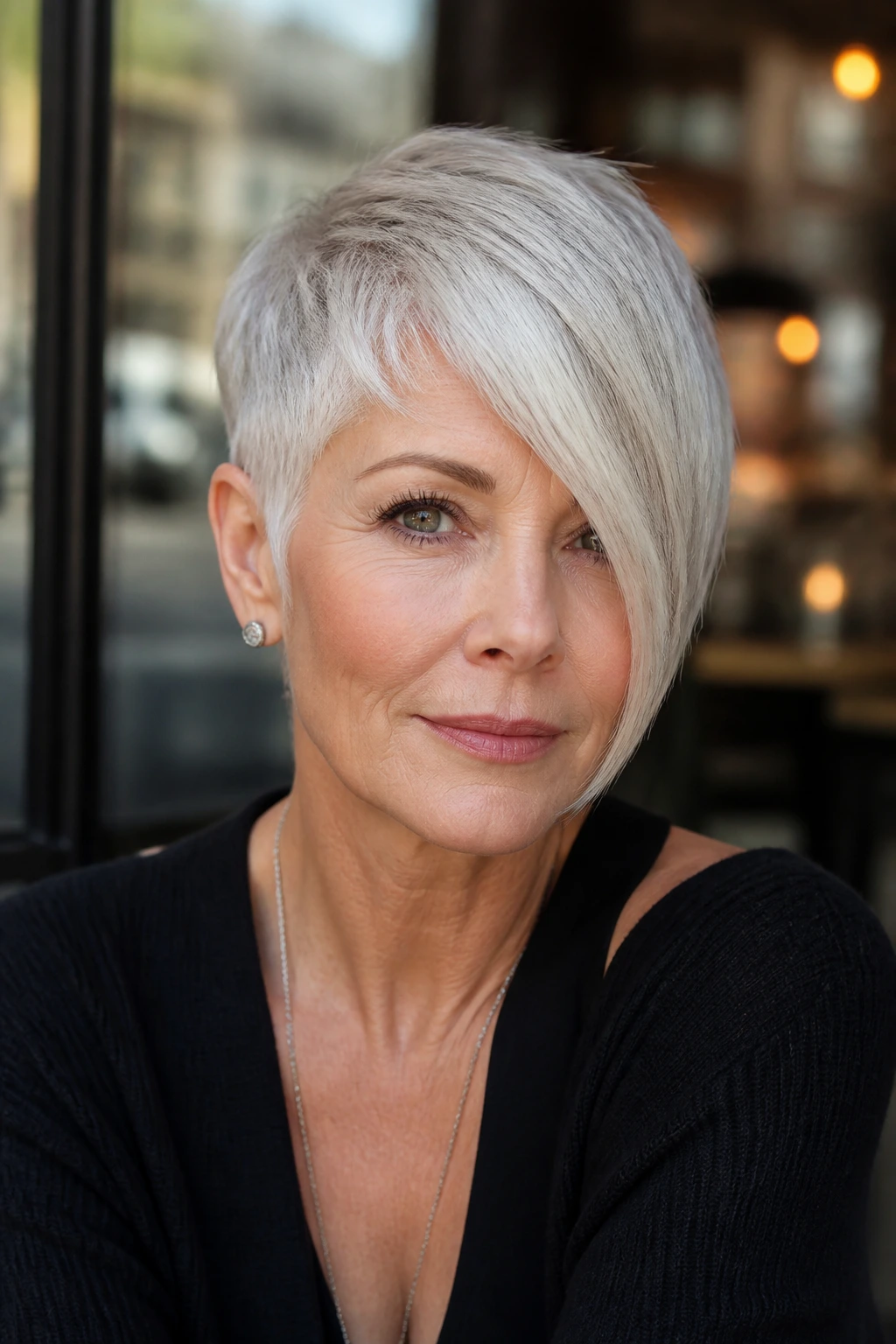
One side longer, one side shorter. Simple idea. Big effect.
An asymmetrical pixie creates a diagonal line that wakes up the whole face, and on gray hair the contrast shows even more clearly. It’s a good choice if you like a little drama but don’t want to commit to a full undercut or a highly sculpted shape. The longer side can skim the cheekbone or sit just below the eye, depending on how bold you want it.
This cut works best when the length difference is obvious enough to read from across the room. Too subtle, and it just looks uneven. Too extreme, and it starts to belong to a different mood entirely. There’s a sweet middle ground where the haircut feels fresh, not fussy.
If your hair is straight or slightly wavy, this is a sharp way to play with line. If it’s curly, ask for the asymmetry to be built into the shape rather than forced with styling. Forced asymmetry always looks tired by lunch.
8. Rounded Pixie with Wispy Fringe
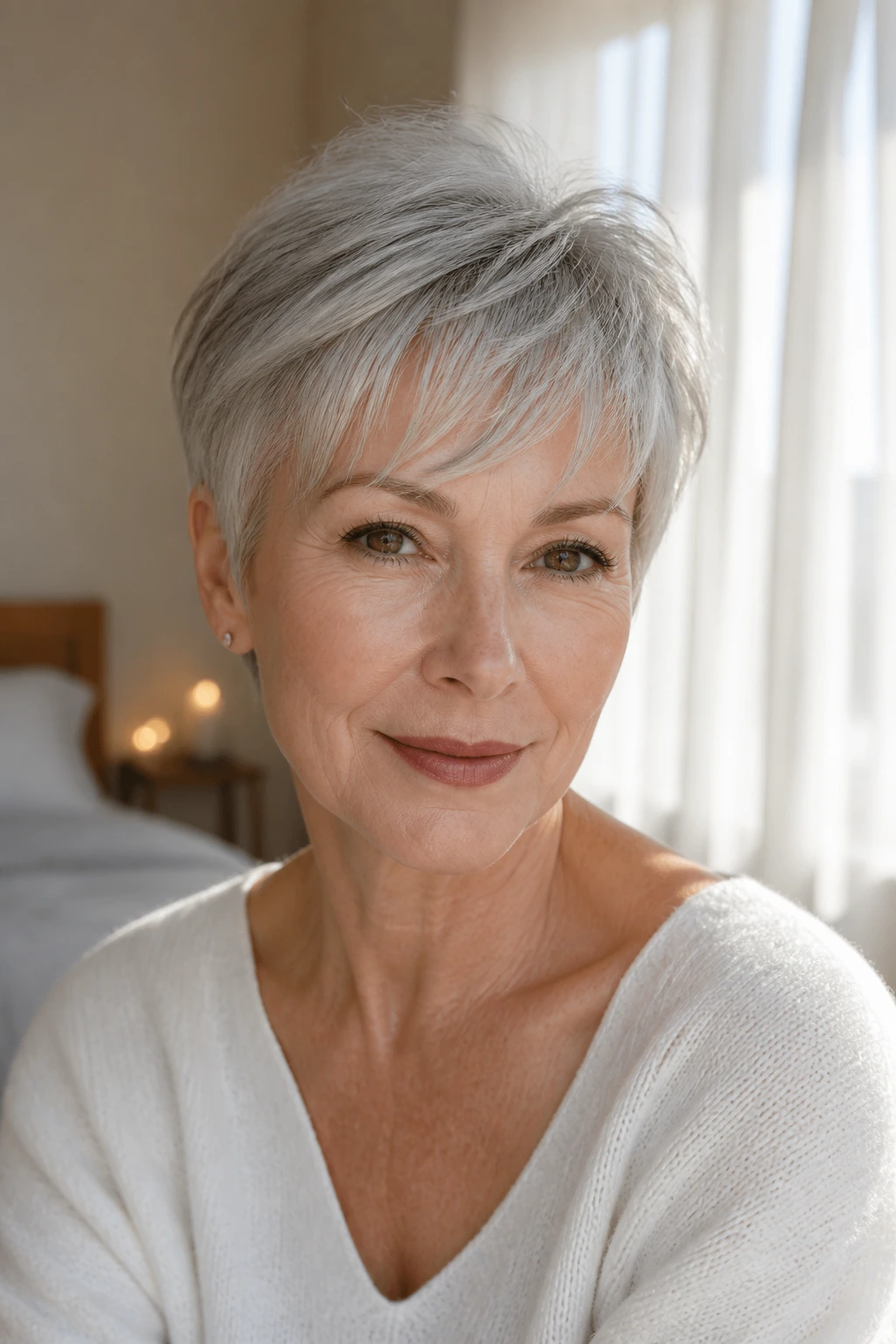
A rounded pixie has a softer outline through the crown and sides, which makes it especially good for narrow faces or features that already lean sharp. The wispy fringe keeps the front light. No heavy curtain of hair. Just a gentle brush across the forehead.
This is one of those cuts that can look very delicate in the chair and very chic in real life. The roundness gives balance, but the fringe keeps it from feeling too formal. On gray hair, that softness can read almost luminous when the light catches the fringe.
It’s a nice option if you want short hair that doesn’t feel severe around the temples. The edges can be nipped in at the ears, but the overall line should stay airy. If the hair is fine, a bit of root lift at the crown helps preserve the shape instead of letting it collapse into the head.
9. Spiky Piecey Pixie
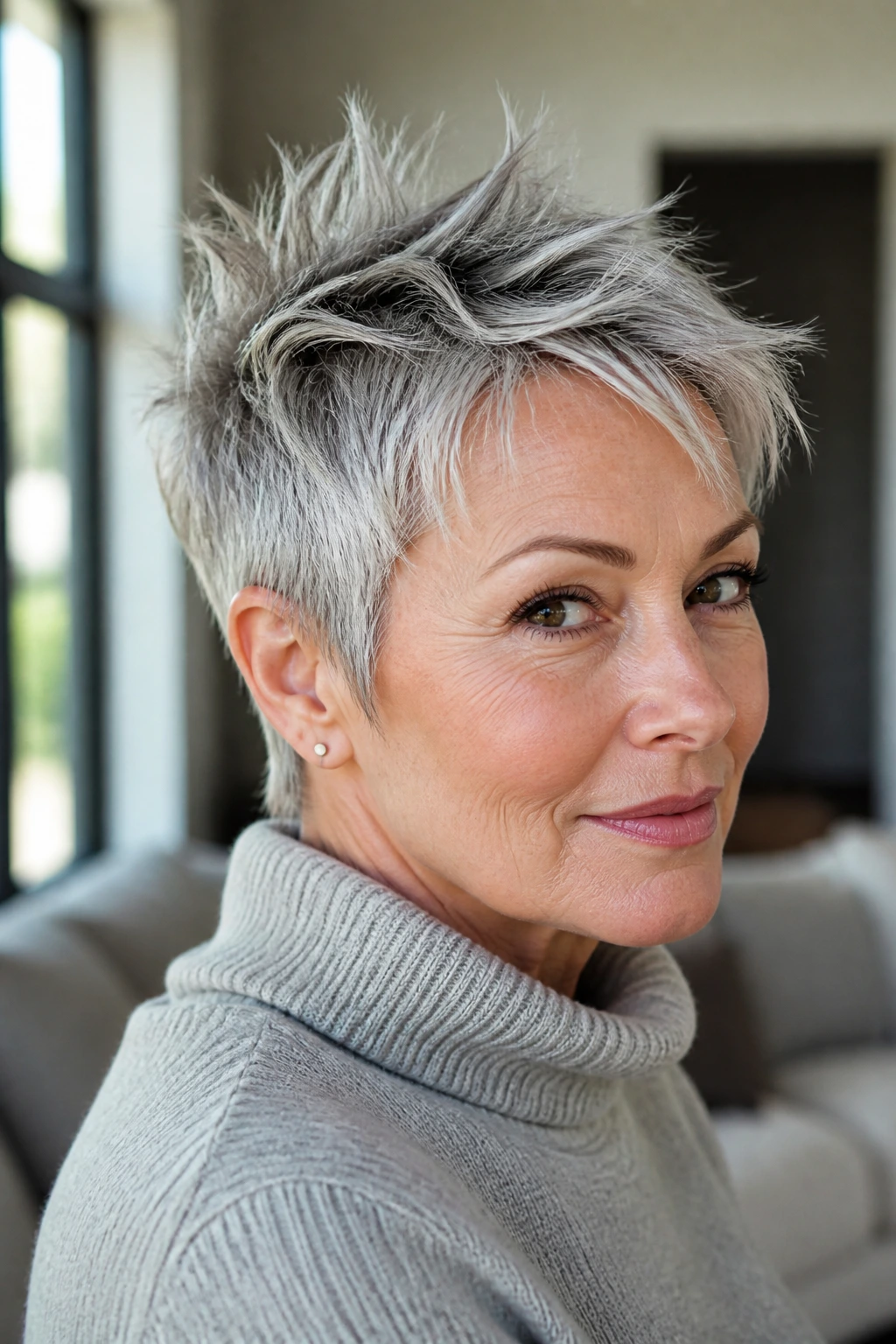
This is the cut for someone who enjoys a little bite in the haircut. Shorter pieces are separated enough to stand up, bend over, or flick in different directions, which gives the crown texture and keeps the look from going soft. Gray hair often shows this definition well because the lighter strands catch shadow and shine at the same time.
The key is not to overdo the product. A matte paste or lightweight wax, warmed between the fingers, should only hit the ends and top layers. If the hair looks wet, you’ve gone too far. If the pieces hold but still move, you’ve got it right.
This style can look especially good on thicker hair because it removes the feeling of bulk. It also has a nice practical side: the messier it is, the better it often looks by midday. That sounds backward, but it’s true.
10. Layered Pixie-Bob Hybrid
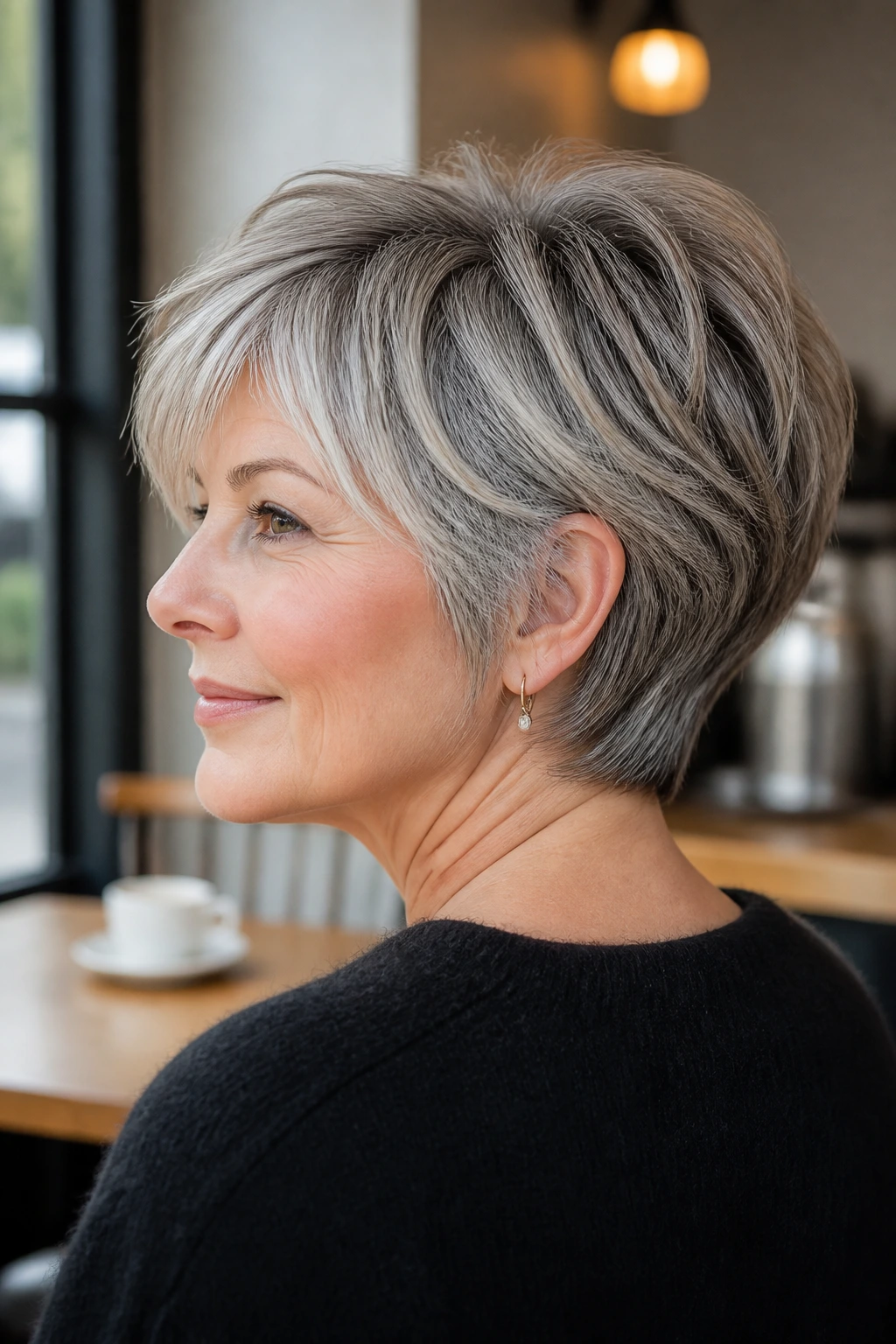
Some people are not ready to go all the way short. Fine. The pixie-bob hybrid lives in that middle space where the neckline is still open, but the top and sides keep enough length to tuck, sweep, and soften. It’s a useful cut if you’re testing the waters.
The layers should be stacked lightly so the hair doesn’t sit like one solid block. Gray hair can go bulky fast if it’s cut too bluntly at this length, especially around the ear. A little graduation in the back helps the shape bend inward.
I like this version for women who want short hair but still enjoy running fingers through the top. It grows out gracefully, which matters more than people admit. A haircut that looks good at week one and week six is worth paying attention to.
11. Ultra-Short Crop with Soft Edges
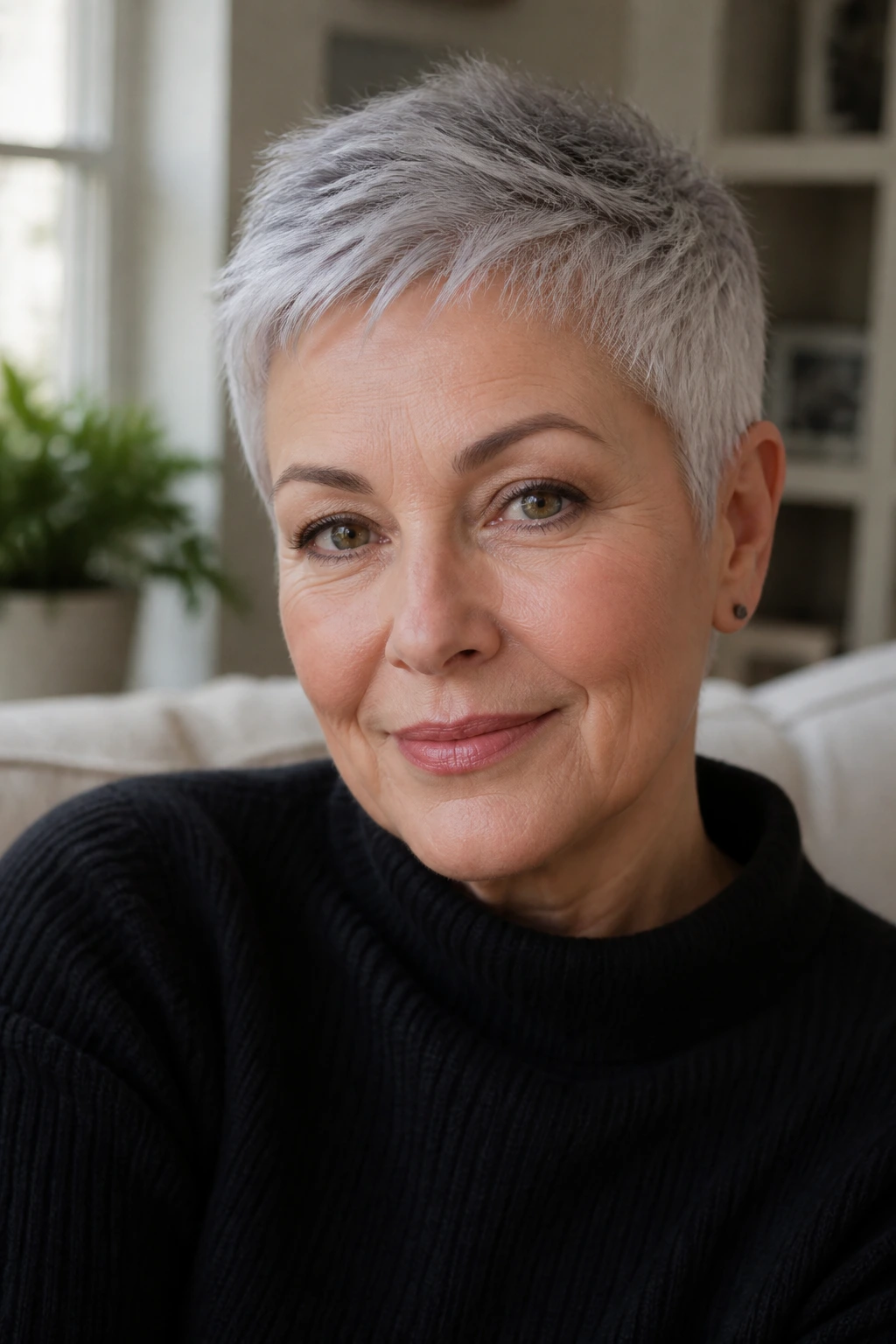
There’s no pretending with this one. The hair is short, the outline is close, and the face gets all the attention. But “ultra-short” does not have to mean harsh. Soft edges around the ears and neckline keep it from looking clipped flat to the scalp.
This cut is brilliant for women who are tired of fighting heavy hair or who want a shape that makes gray look clean and intentional. It works best when the top still has enough length to be brushed forward or pushed slightly up. A little movement on top keeps the crop from feeling too strict.
If your hair is coarse, this may be one of the easiest cuts to wear because it removes the weight that makes coarse gray strands stick out. If it’s fine, the short length can make the hair look denser, not thinner. That surprises people.
12. Swept-Back Glam Pixie
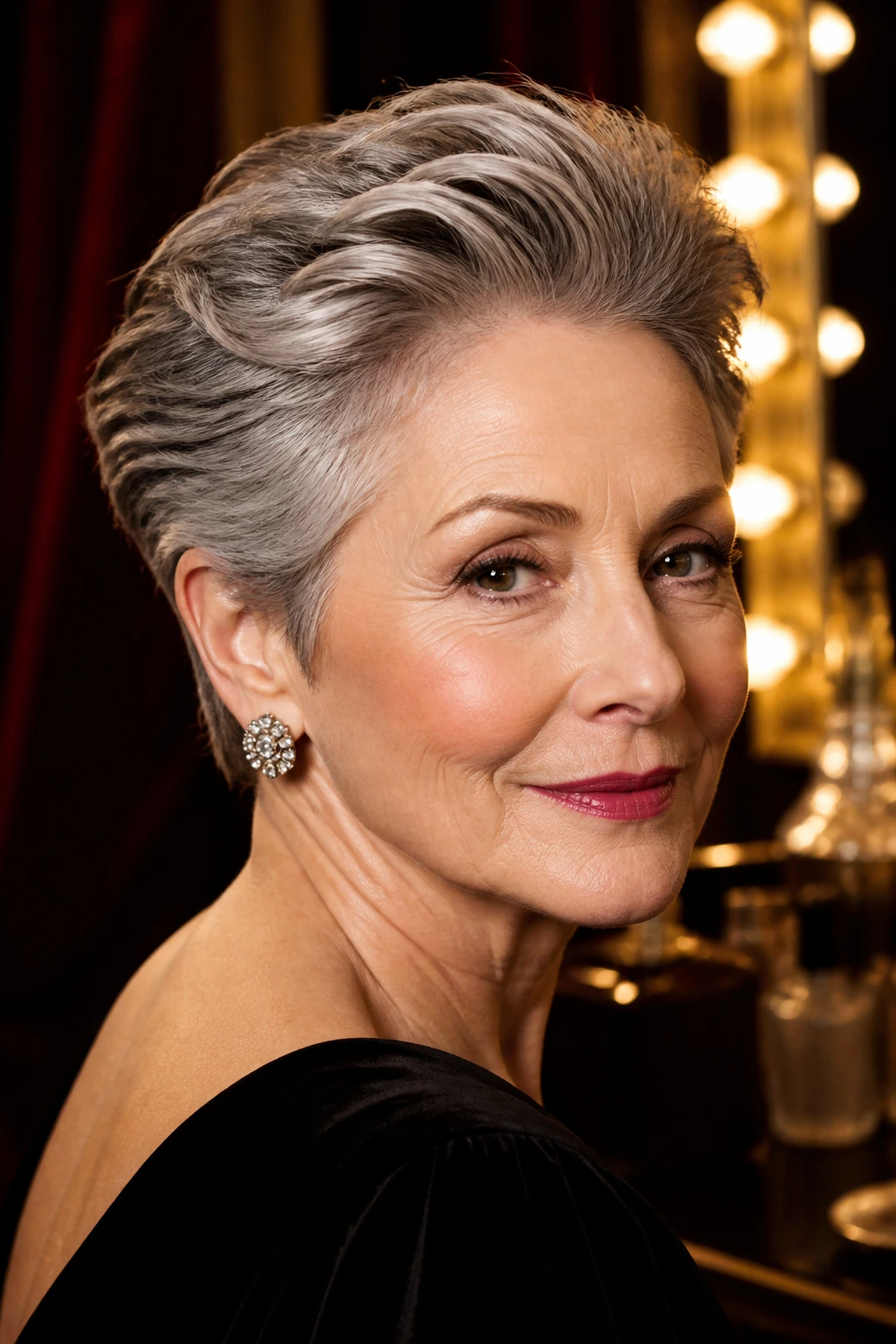
This one has a little old-Hollywood energy, but in a pared-down way. The front is kept long enough to sweep back from the forehead, and the crown has enough lift to give the haircut a polished profile. Gray hair looks especially striking in this shape because the smooth surface shows off the color variation.
A round brush and a dryer nozzle matter here. Blow the front back and slightly up, then set the shape with a light spray. Not stiff. Just enough hold to keep the lift from disappearing the moment you step into humidity or a warm room.
Swept-back pixies suit people who like earrings, lipstick, or a strong brow. The cut gives those details room to work. It’s neat, but it isn’t timid.
13. Wavy Undone Pixie
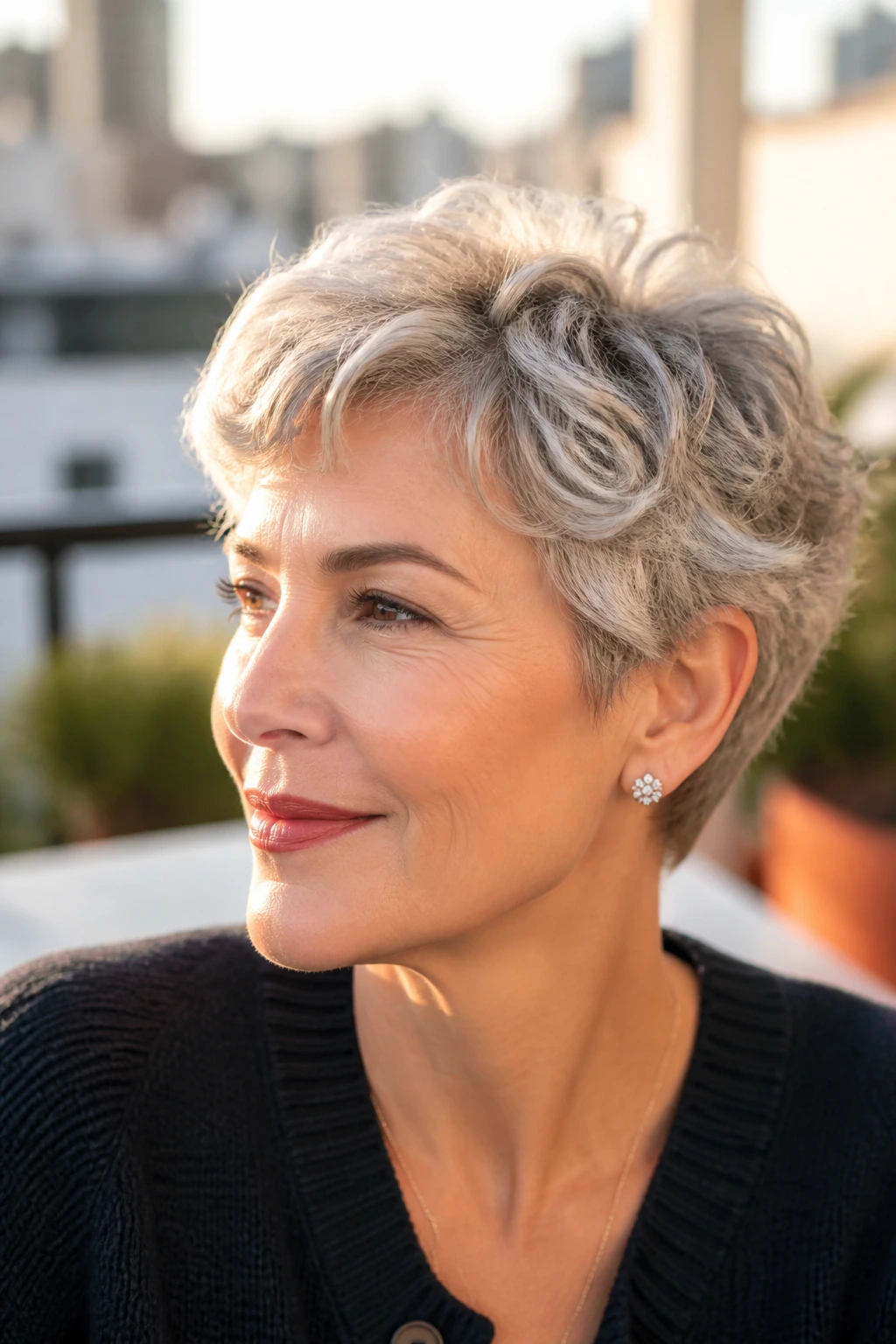
A wavy pixie should look like you touched it, then stopped before it became precious. The waves bend through the top and around the temples, while the nape stays cropped enough to keep the whole shape from turning fuzzy. On gray hair, that texture can look gorgeous because every ripple catches light differently.
This is a good option if your hair has a natural bend or if you’ve got a little more movement on the sides than on the crown. A salt spray can help, but use it lightly. Too much and the strands get dry and rough fast, which gray hair does not need.
The beauty of this cut is in its imperfection. It doesn’t need each piece to sit in the same place every day. In fact, it looks better when it doesn’t.
14. Glasses-Friendly Side-Part Pixie

Glasses change the whole math of a haircut. A side-part pixie keeps the hair away from the temples where frames usually sit, which means less puffing, less rubbing, and fewer awkward bends at the side of the face. The part itself creates a clean diagonal that works well with rectangular or round frames.
The best version leaves enough fringe to skim above one lens without dropping into it. That small detail keeps the cut looking intentional instead of like it lost a fight with your glasses. The sides should be slim, not shaved tight unless that is the look you want.
If you wear glasses every day, this is one of the smartest shapes in the bunch. It respects the frames instead of competing with them. And that matters more than people realize.
15. Feathered Shag Pixie
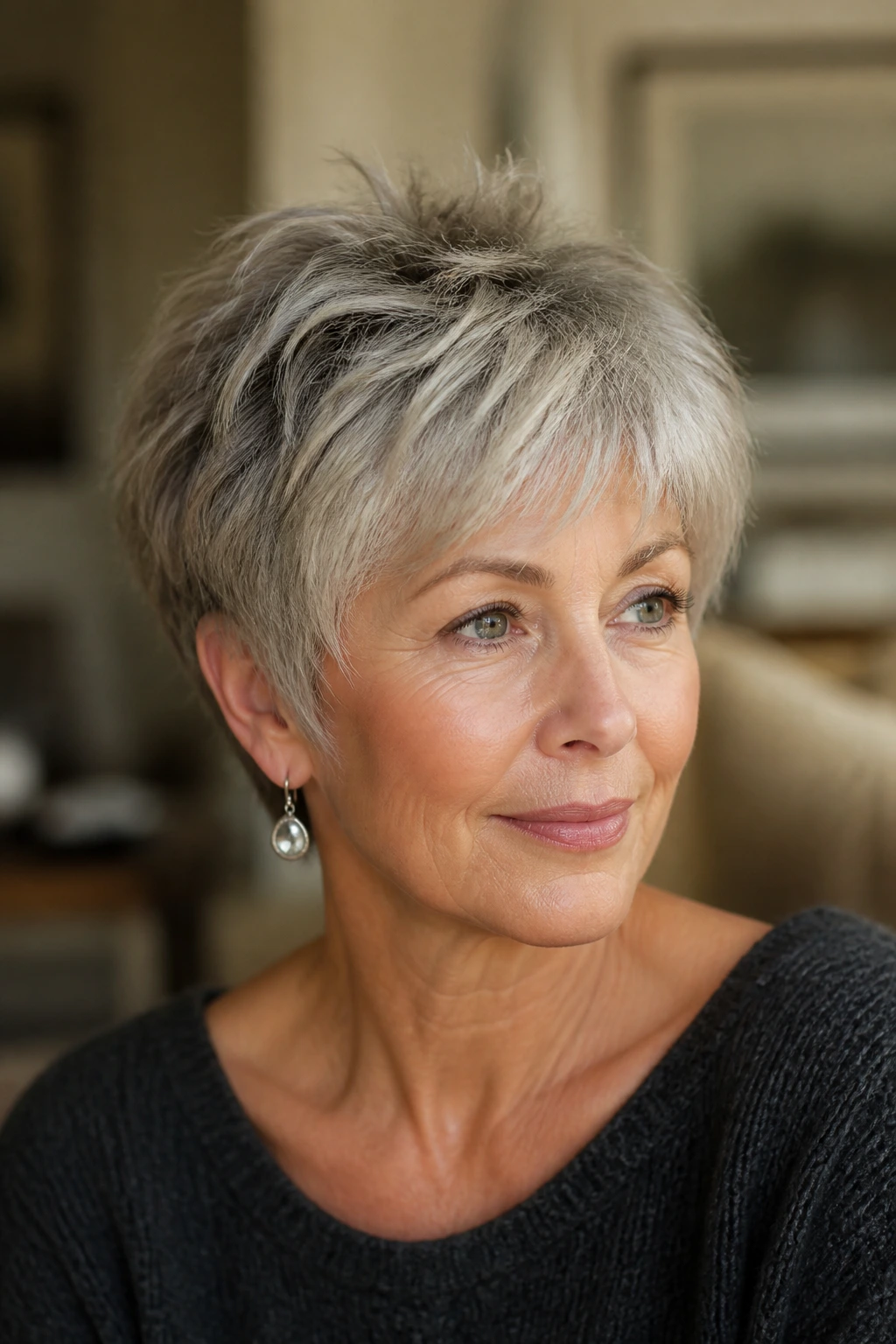
This cut lives between a shag and a pixie, which makes it one of the more forgiving options if your hair likes movement. The layers are softer and a little longer than a classic pixie, especially around the crown and fringe. Gray hair takes well to that kind of feathering because it breaks up density without looking choppy.
The shape is especially useful for thick or wavy hair. You want the ends to feel light, not heavy. A stylist who point-cuts well can make the layers sit in a loose, airy way that still keeps some outline around the face.
I’d choose this if you like hair with a bit of personality. It’s less formal than a sleek pixie, more relaxed than a polished crop. Somewhere in the middle. That middle is often where the best short cuts live.
16. Salt-and-Pepper Classic Crop
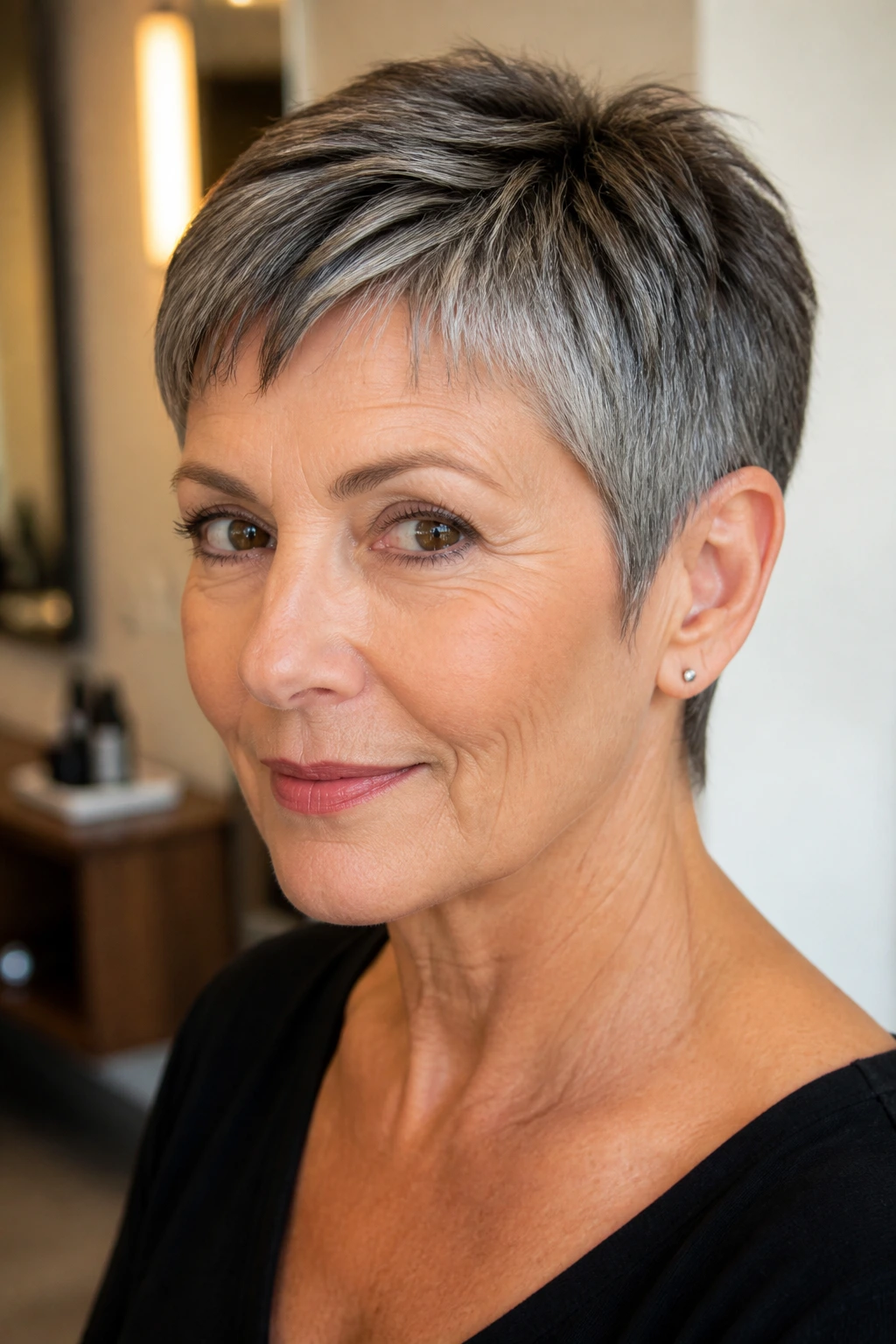
Sometimes the smartest move is to stop trying to invent something new and just give the hair a clean classic shape. A salt-and-pepper crop keeps the sides neat, the top modestly layered, and the overall line tidy. It lets the natural contrast in the hair do the work.
This cut is especially good when the gray is mixed with darker strands, because the pattern shows best in a shape with clear edges. Too much texture can make salt-and-pepper hair look busy. A classic crop keeps it readable.
If you like a haircut that looks expensive without requiring a lot of styling, this is the one to remember. It may not be the flashiest style in the room, but it tends to age better than trendier shapes that depend on heavy product or perfect blow-drying.
17. Platinum Sleek Pixie
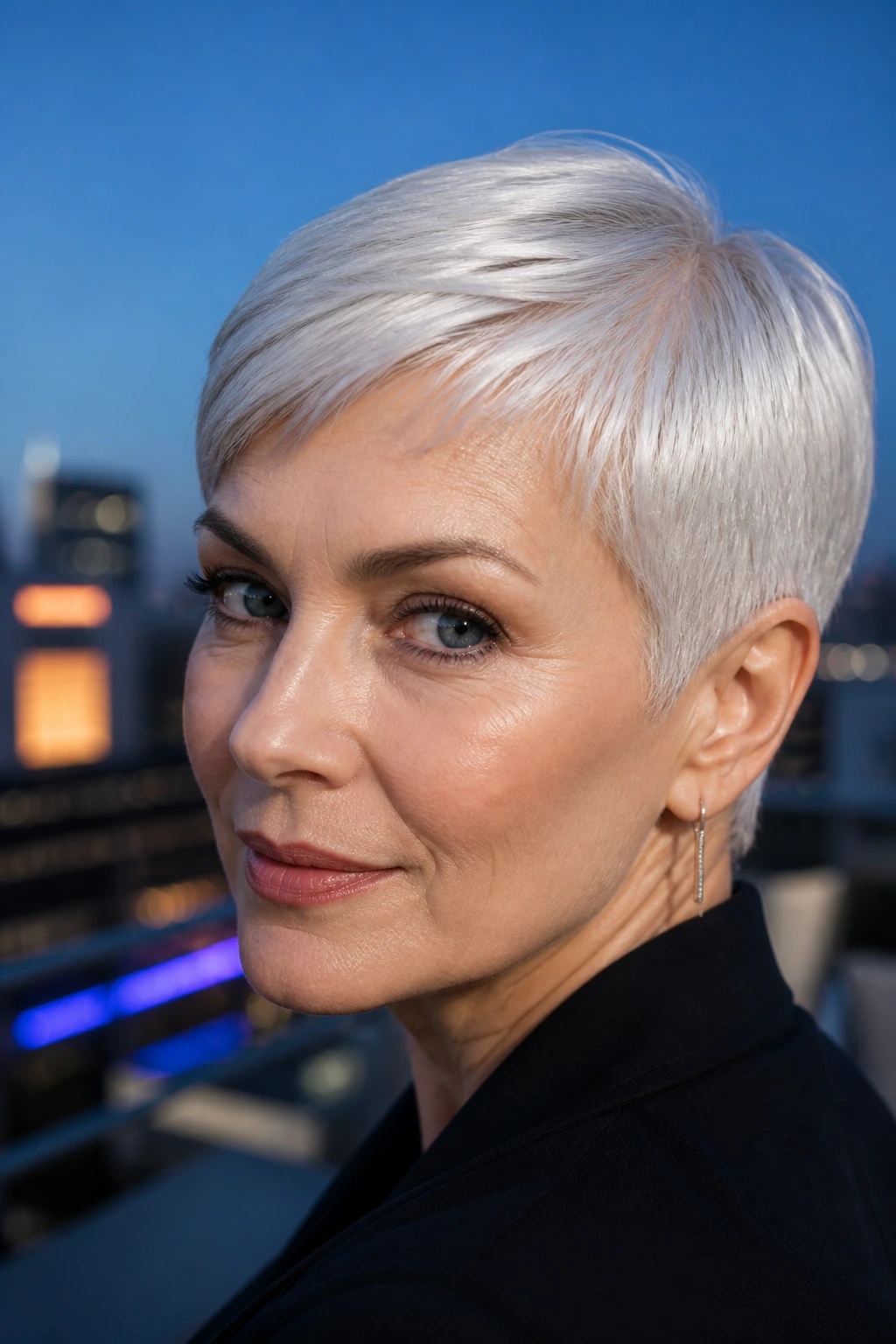
A sleek platinum pixie has a sharper mood. The hair is smoothed close to the head, the fringe is controlled, and the finish leans glossy rather than airy. On cool silver or platinum gray, that smoothness can look very clean.
This style favors straight or slightly wavy hair. If your texture is very coarse, it may need more smoothing cream and a flat brush finish to sit the way you want. The secret is not to drown it in product. A little shine serum on the ends is usually enough.
What I like here is the contrast between the crisp shape and the softness of gray. It can feel modern without becoming cold. That’s a hard balance to get right, and a sleek pixie does it better than most short cuts.
18. Tousled Vacation Pixie

This is the kind of haircut that looks better once you stop fussing with it. The top is left airy and moved around with fingers, while the sides stay short enough to keep the outline neat. It feels relaxed, slightly wind-touched, and a little sun-washed — even in the middle of a normal weekday.
A tousled pixie is ideal if you don’t want to spend time blow-drying every strand into place. A texturizing spray at the roots and a tiny bit of paste on the ends can give the illusion of a more complex styling routine than you actually used. Good. Let the haircut do the work.
It’s a strong choice for women with silver hair that has natural bend or a little lift at the crown. If the hair is very straight and very fine, it may need a root product to keep it from lying too flat. Otherwise it can slide toward helmet territory. Nobody wants that.
19. Frosted Crown Volume Pixie
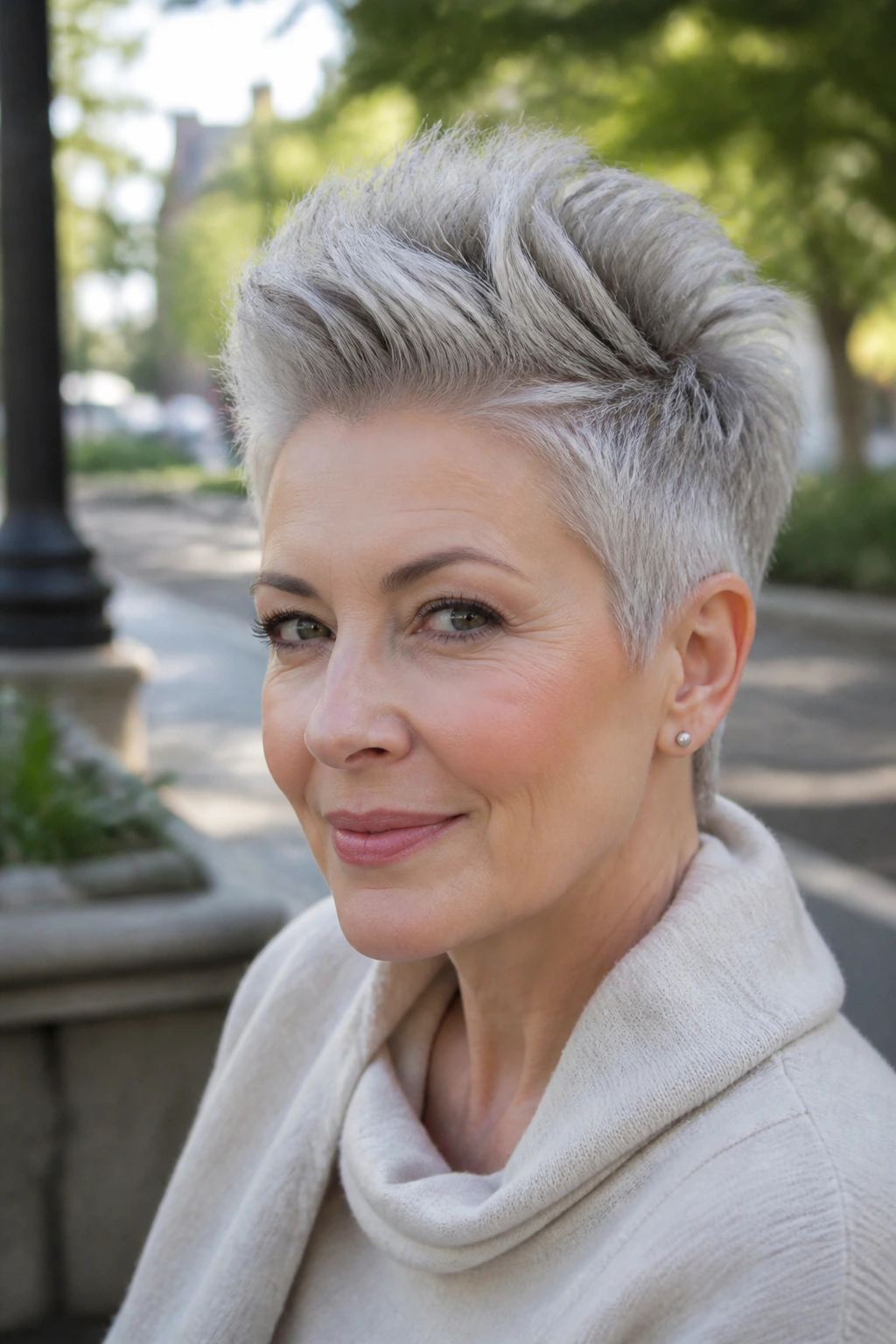
Volume at the crown changes the silhouette fast. This pixie keeps the sides and nape tighter while building lift through the top, which makes gray hair look frosted and airy instead of flat. The effect is subtle if the cut is done well, but the shape reads from across the room.
This is one of my favorite options for women whose hair has started to lose some body on top. A little height there can restore balance to the whole face. Not a towering bouffant. Just enough lift to keep the head from looking compressed.
Blow-dry the roots upward with a small round brush or your fingers and a diffuser. If the crown is cut right, it should hold with less product than you’d expect. That’s the nice part. The cut earns the style.
20. Chin-Skimming Pixie-Bob
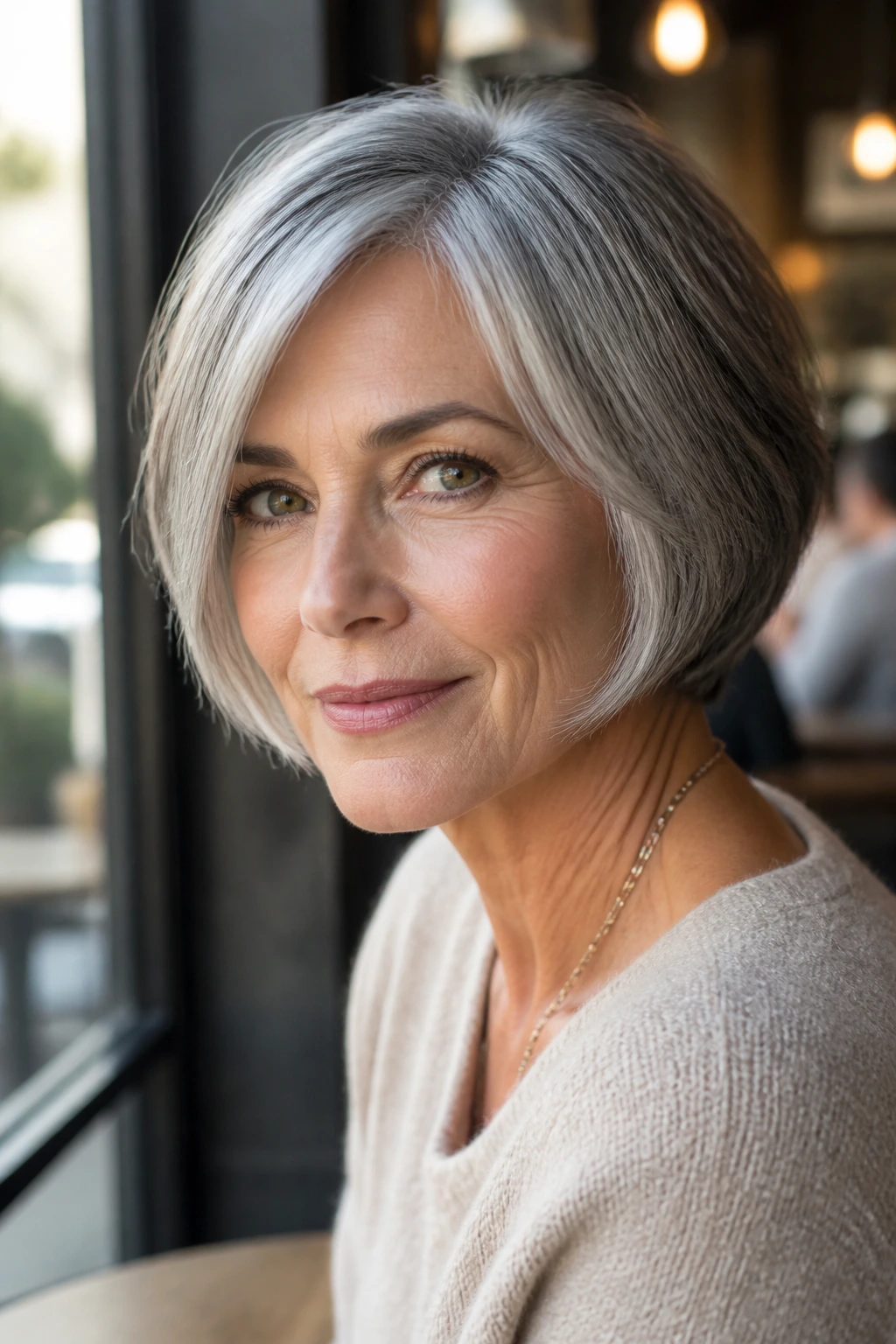
A chin-skimming pixie-bob gives you the short-neck feel of a pixie with a bit more swing around the face. It’s a useful bridge for anyone who wants to keep some softness near the jaw while still going short overall. The longer front sections can skim the chin and frame the mouth in a flattering way.
This shape can be especially good if you’re not ready to expose the ears fully. Some people like that little bit of coverage. Some don’t. The point is choice. The longer front lets you keep the haircut feminine without making it sugary.
Gray hair often looks rich in this shape because there’s enough length to show movement, but not so much that the ends drag the whole look down. It’s one of the more graceful grow-out options on the list, which matters if you don’t want a strict trim schedule.
21. Mini Shag Pixie
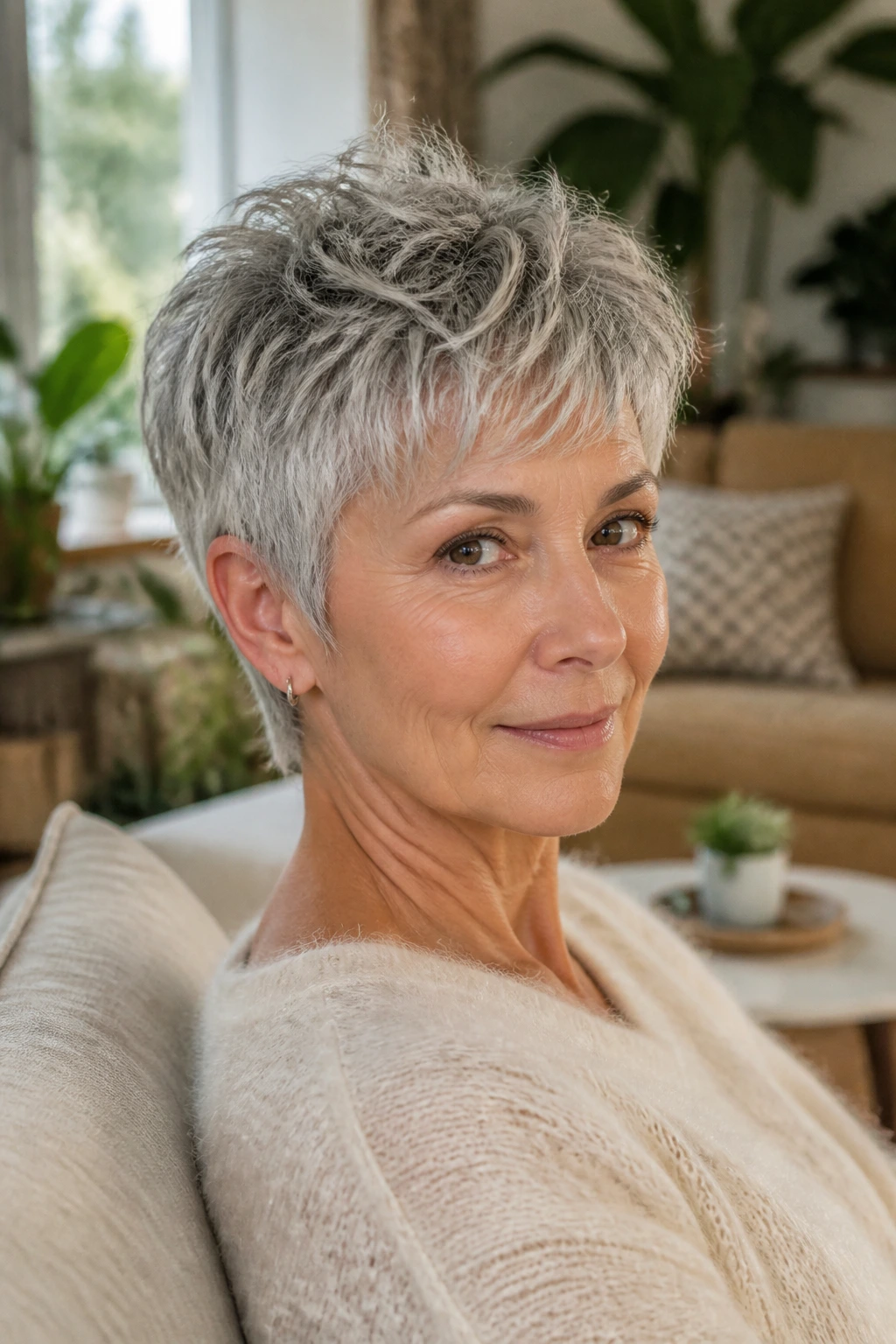
A mini shag pixie is for women who like a little mess in the best sense. The fringe can be piecey, the crown layered, and the nape short but not severe. It has the choppiness of a shag, just scaled down so it still counts as a pixie.
This shape handles natural wave well, and it can rescue hair that tends to puff around the sides. The layers keep the outline from getting round in a bad way. You still need a stylist who knows how to remove bulk without hacking the shape apart. That distinction matters.
The result is playful, easy, and forgiving on days when the hair refuses to cooperate. Which, to be honest, is most days for most people. A haircut that forgives reality is a good haircut.
22. Low-Maintenance Wash-and-Go Pixie
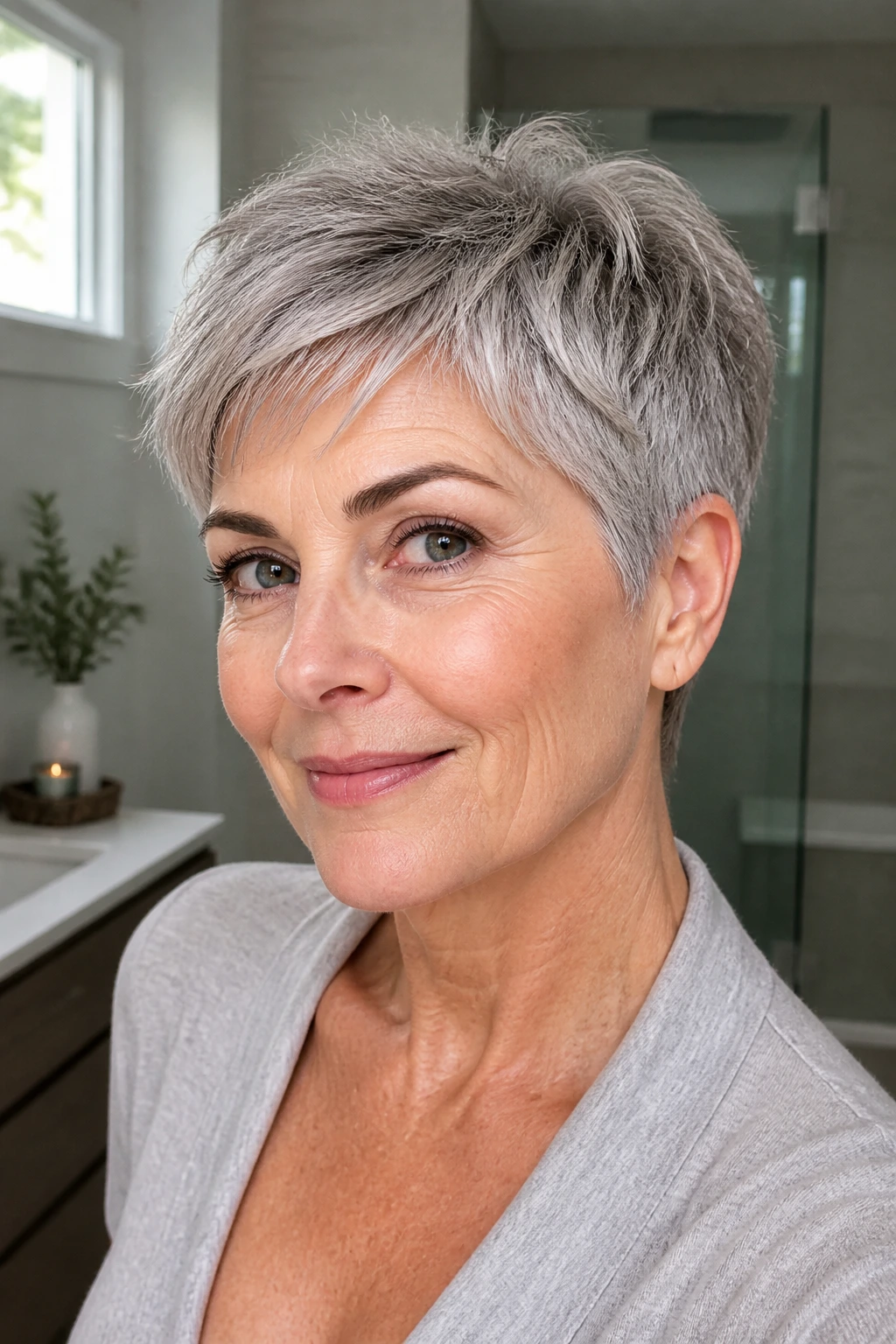
Some pixies look lovely in a salon chair and annoying everywhere else. This is not one of them, if it’s cut correctly. The wash-and-go version keeps the layers simple, the nape tidy, and the top short enough to dry into shape without much intervention.
The key is to avoid too many disconnected layers. They can look exciting for a week, then start sticking up in random directions. A wash-and-go pixie should have enough structure that the hair falls back into place after a rinse, a towel squeeze, and a bit of air-drying.
This cut is a blessing if you’re done with complicated mornings. It’s also a smart answer for women whose gray hair has become coarser and less predictable. Short, clean, and not over-designed. Sometimes that is the whole trick.
23. Elegant Taper with Long Fringe
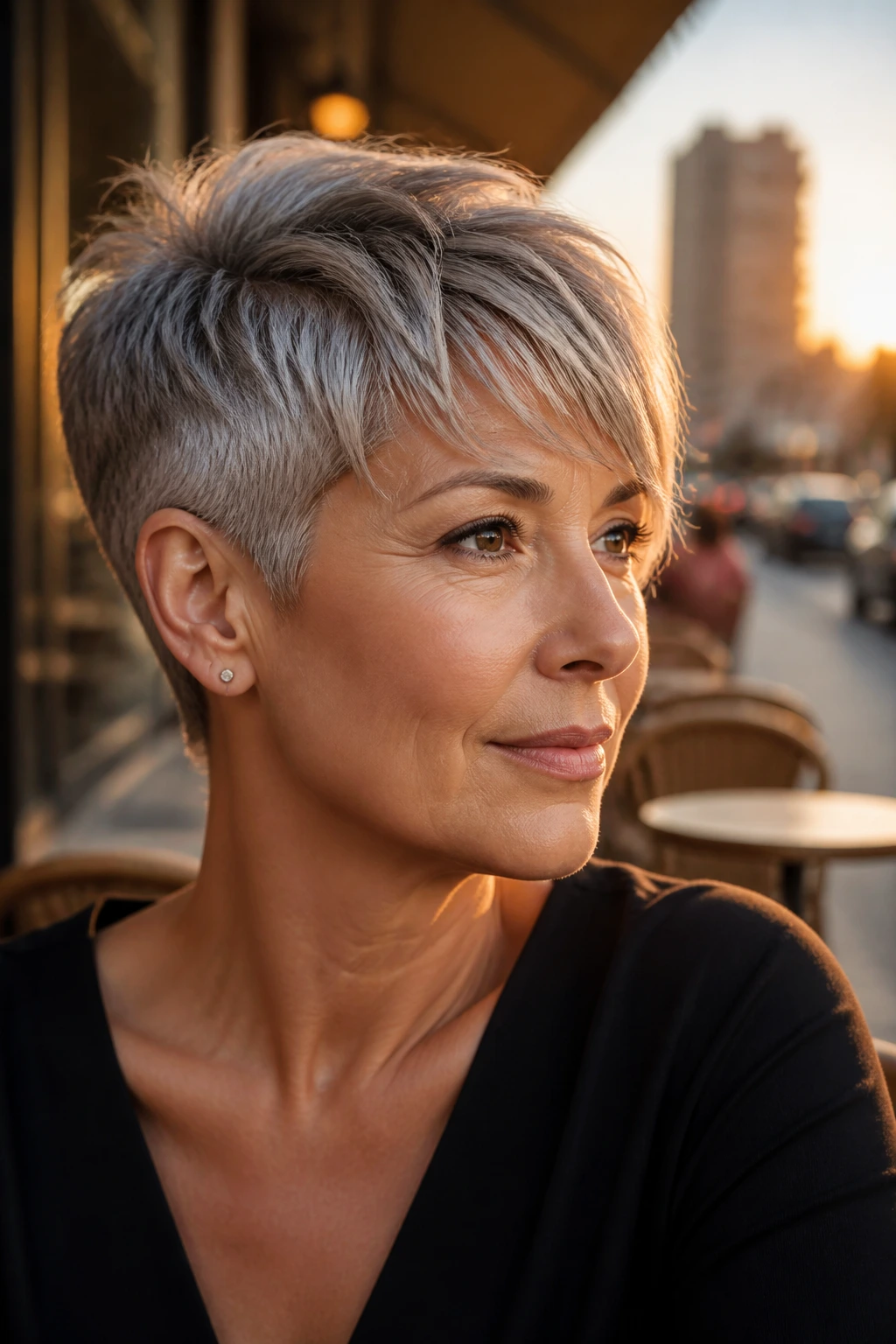
This is one of the prettiest gray pixie options if you want softness without losing shape. The taper keeps the sides and nape neat, while the longer fringe gives you something to sweep, separate, or tuck behind a brow line. It feels refined without looking stiff.
The long fringe is the part that changes the mood. Wear it forward and it softens the forehead. Sweep it back and the haircut suddenly reads more sculpted. That flexibility makes it useful if you like your hair to shift a little with your outfit or makeup.
Gray hair shines in this cut because the taper shows off the clean line at the back while the fringe keeps the front from feeling too bare. It’s a nice balance. I’d call it quietly elegant, except that phrase gets abused everywhere. So let’s just say it looks polished without trying too hard.
24. Bold Undercut Pixie
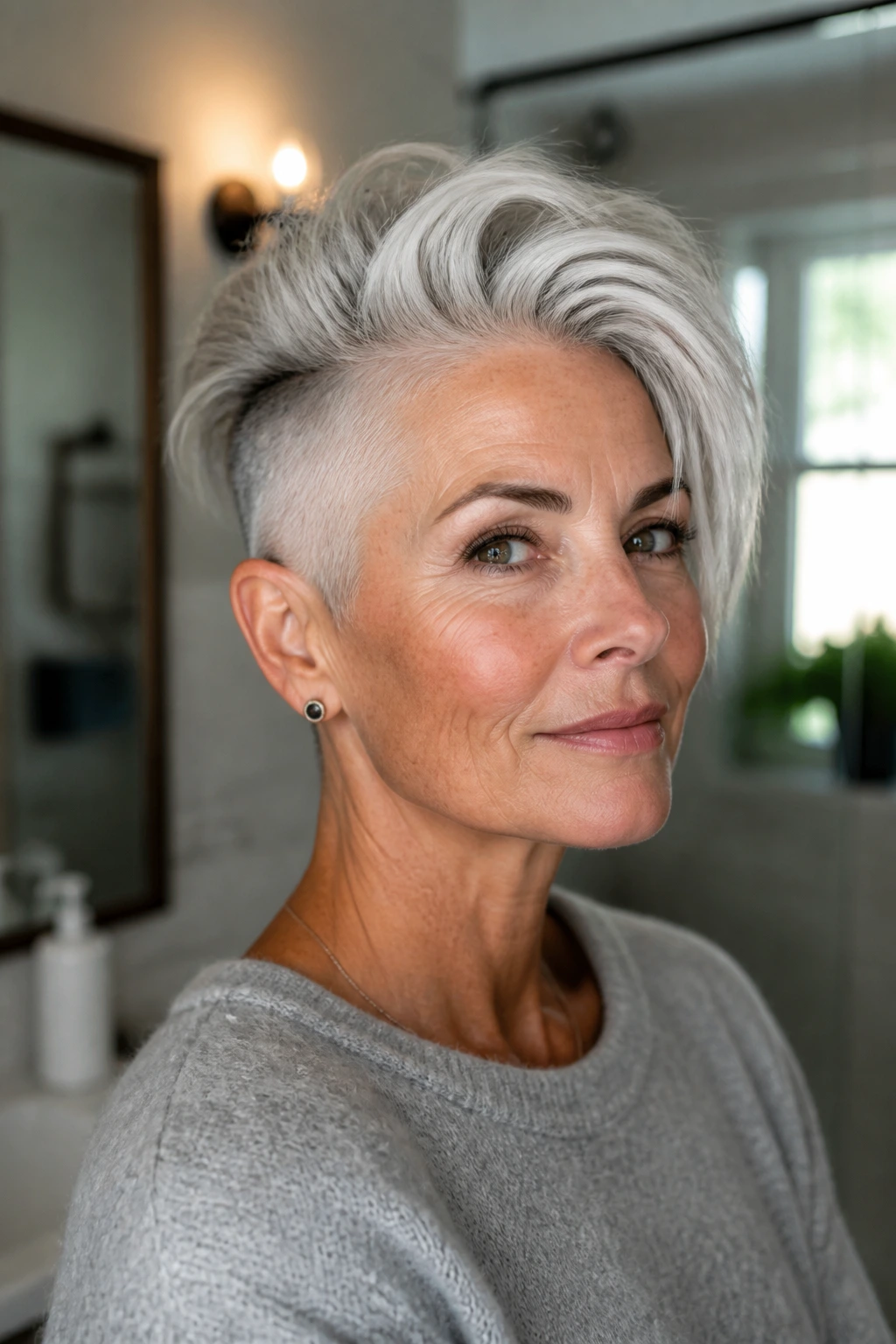
The undercut pixie has the most edge in the group, and I’m not going to pretend otherwise. One side or the back is clipped shorter, sometimes much shorter, while the top stays long enough to sweep, spike, or drape over the contrast. On silver or white hair, that contrast can look striking.
This cut works best if you like clear lines and don’t mind a shape that gets noticed. It can also be surprisingly practical, because the undercut removes a lot of bulk from thick gray hair. Less puff, more control. That matters in humid weather or on textured hair that likes to expand.
If you’ve ever wanted a short cut with a bit of bite, this is the one. It can be softened with a side fringe or sharpened with a close shave. Either way, it says exactly what it means.
Why Gray Pixie Cuts Work So Well on Mature Hair
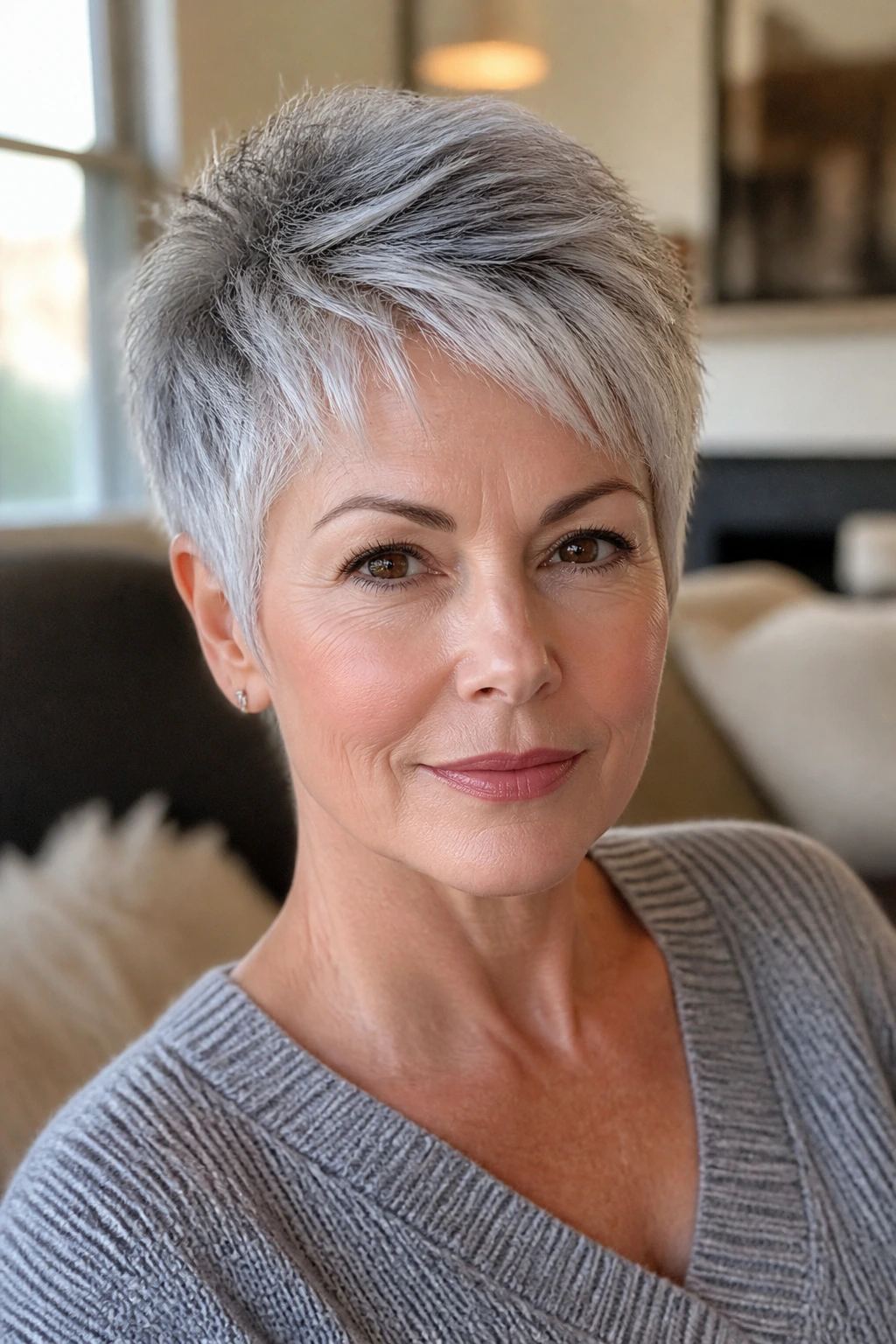
Gray hair changes the rules a little. The strand often feels drier, sometimes rougher, and not as willing to hang in a heavy curtain the way younger hair might. That is why gray hair pixie cuts for older women make such good sense: they remove dead weight and give the hair a shape it can actually hold.
Shorter cuts also make color variation look intentional. A silver strand next to a darker one can read as dimension when the cut is clean, but as frizz when the hair is too long and unshaped. A pixie keeps the eye focused on the structure instead of on every stray piece. That’s a gift, honestly.
There’s another thing people forget. Short hair shows the face, not just the hair. That’s not a drawback. If anything, it’s the whole point. A good pixie lets the jawline, cheekbones, eyes, and brows do their job again.
And yes, it can be practical. But practical is not the same as dull. A short gray cut can look sharper than a long one because the line is clearer. The silhouette does the talking.
How to Wear These Pixies With Glasses, Earrings, and Necklines
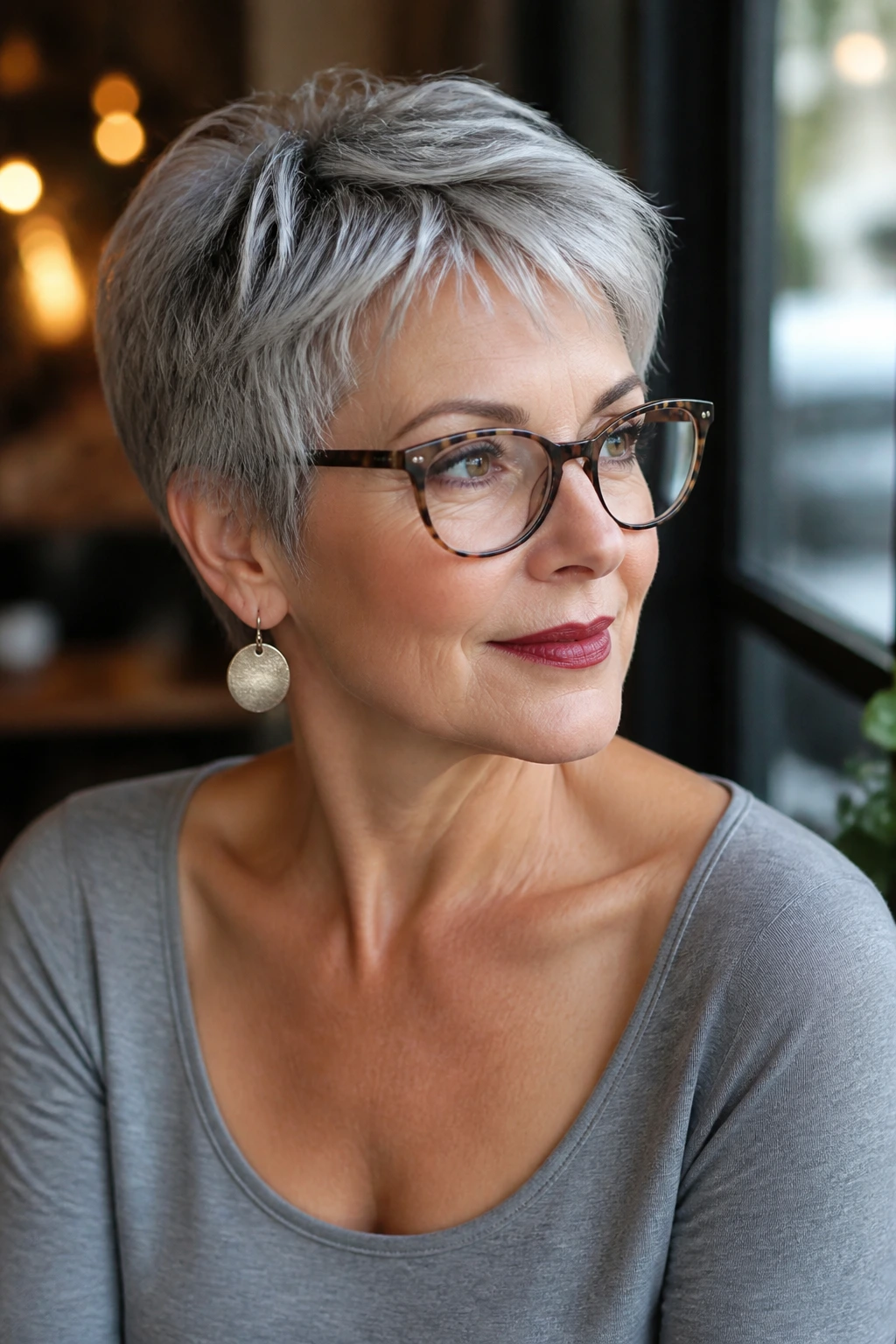
A pixie changes the whole balance of what sits around your face. A pair of thick glasses can suddenly look bolder because the hair is no longer crowding the temples. Long earrings can finally move without tangling in the ends of a bob. Even a plain crewneck looks more deliberate when the neckline is open and the nape is neat.
Glasses: Keep a little space at the temples so the frames don’t get swallowed by the cut. Side-swept fringe and tapered sides usually work better than heavy, center-heavy bangs.
Earrings: Hoops, drops, and small studs all behave differently with a pixie. If you wear statement earrings, ask for a nape that’s clean enough to show the line of the jaw.
Necklines: A boat neck, scoop neck, or V-neck gives short hair room to breathe. Turtlenecks can work too, but they make a cropped nape look more graphic.
Makeup: You do not need a heavy face just because your hair is short. A brighter brow, a little blush, and some mascara often do more than a dozen products.
Scarves and collars: Choose softer wraps if the pixie sits close at the neck. A bulky scarf can fight a tight crop and make the head look smaller than it is.
Essential Tools for Styling Short Gray Hair
-
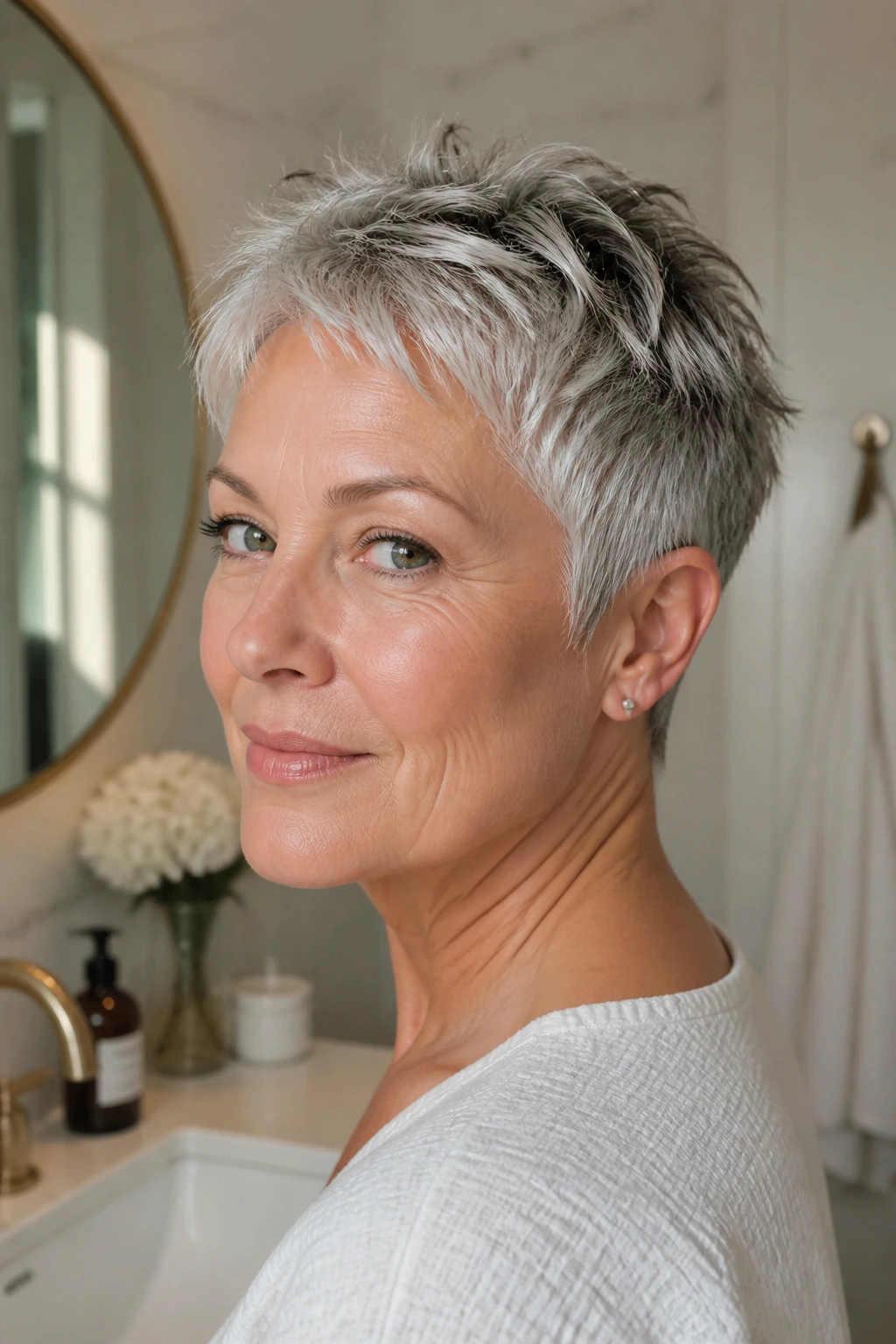
Blow dryer with a narrow nozzle: Directs airflow to the roots, which matters when you want lift at the crown instead of puff around the sides.
-
Small round brush, about 1 to 1.5 inches: Best for bending the fringe, smoothing the top, and adding a little root curl where you need it.
-
Vent brush or flat styling brush: Useful for quick, low-fuss drying on pixies that don’t need much sculpting.
-
Lightweight mousse or root lift spray: Gives fine or flat gray hair some memory without making it stiff.
-
Matte styling paste or cream wax: Helps piece out choppy or spiky layers; use a tiny amount and warm it in your palms first.
-
Heat protectant spray: Worth using even on short hair, especially if you style with a dryer several times a week.
-
Fine-tooth comb: Handy for clean parts, smoothing the fringe, and checking the line at the temple.
-
Purple or blue-toned shampoo: Not a styling tool in the old-fashioned sense, but it keeps yellow brass from muddying bright gray or white hair.
How to Ask Your Stylist for the Right Pixie
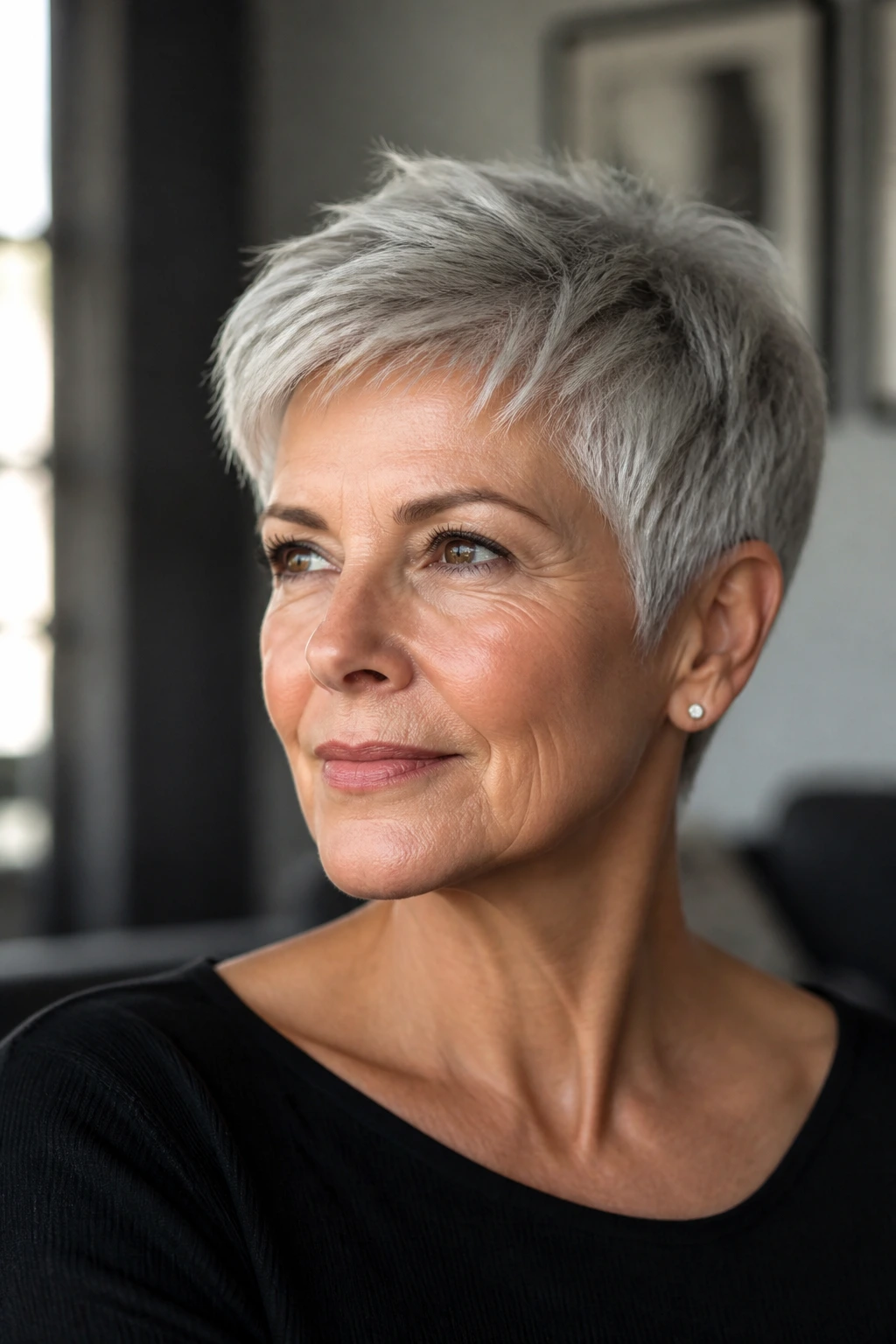
Bringing a picture helps, but a picture alone does not tell the whole story. A clean photo of the front, side, and back of the haircut gives your stylist a better read than ten screenshots taken from weird angles. One strong photo plus a few plain words usually works better than a pile of images with different lengths and textures.
Say the Length in Plain Terms
Tell them where you want the fringe to sit: above the brow, at the brow, or sweeping across it. Say whether you want the ears exposed or partially covered. Mention the nape too. A pixie can look completely different depending on whether the neckline is clipped close or left soft.
Talk About Your Hair’s Personality
Cowlicks, a flat crown, a strong swirl at the back, coarse texture, fine strands, dense sides — all of it matters. If your hair sticks up in one corner every time it grows out, say so early. That lets the stylist build the shape around the problem instead of pretending it doesn’t exist.
Use Maintenance as a Clue
If you want a cut you can live with for six weeks between trims, say that directly. If you’re happy to visit the salon more often for a sharper shape, say that too. A highly sculpted undercut and a soft wash-and-go pixie are not the same commitment, and your stylist should know which one you’re buying into.
How to Style These Pixies on Busy Mornings
Start at the roots. Short hair lives or dies by lift at the crown, so a quick blast of heat at the base does more than fussing with the ends. Use your fingers if the cut is textured; use a small brush if the fringe needs direction.
Use less product than you think. Gray hair often needs moisture, but it does not need a greasy finish. A pea-sized amount of paste or cream is enough for most pixies. If your hands feel loaded with product, you’ve probably gone too far.
Set the shape before it cools. Once the hair dries flat in the wrong direction, you’ll spend more time fixing it later. Push the fringe where you want it while it’s damp, then let it dry in that position. It sounds obvious. People skip it constantly.
Keep a small spray bottle nearby. A pixie often wakes up with a crease after sleeping on one side. A few spritzes, five finger-comb passes, and a touch of root lift spray can reset the whole shape without starting over.
Smart Product and Tone Tips for Gray Hair
Gray hair can go yellow around the crown, dull around the ends, or dry all over if the wrong products pile up. That’s why product choice matters more on silver hair than many people expect. A heavy serum can make the cut collapse. A strong mousse can leave it crunchy. The sweet spot is lighter than most people use on longer hair.
Purple shampoo is useful, but not every wash. Use it when the hair starts reading yellow or dingy, especially if your silver is bright and cool. If your gray has a warmer salt-and-pepper cast, you may only need a purple formula once every one to two weeks. Blue shampoo can help if the hair picks up brass from heat styling or hard water.
A lightweight leave-in cream or spray conditioner usually works better than a thick mask on short hair. You want softness, not drag. Heat protectant should go on the fringe and crown even if you’re only using a dryer for five minutes. Short hair still burns. It just does it faster.
And one thing I’d skip most of the time: heavy oils at the roots. They make the crown collapse and can leave gray hair looking stringy. A tiny drop on the ends is one thing. Slathering the top is another.
Common Mistakes That Make a Pixie Misbehave
The biggest mistake is leaving the sides too bulky. Gray hair can puff out around the ears and temple if the cut isn’t tapered enough, and then the whole shape starts to feel mushroom-like. The fix is a cleaner outline at the sides and a little more length on top so the silhouette has balance.
Another one: using too much product. Short gray hair does not need to be drowned in cream, wax, and spray all at once. The symptom is obvious — the hair looks darkened, sticky, or piecey in the wrong way. Start with less, then add a touch more only where the cut collapses.
Fringe problems are common too. If the bangs are cut too short, they stand up and show every swirl in the front hairline. If they’re too heavy, they drag the whole face down. Ask for a fringe that suits your forehead height and styling habit, not a photo that looks good only when the model is standing in a breeze.
Skipping trims is a quieter problem, but it shows fast. A pixie goes from crisp to shaggy much quicker than a bob. Once the nape grows out, the whole head loses shape. That’s not a disaster. It just means the haircut wants maintenance, even when it’s short.
Variations and Adaptations to Try
The Fine-Hair Whisper Cut: Keep the sides close and the top lightly layered so the hair looks fuller without being overcut. This works when you want lift, not fluff, and it’s kind to strands that have thinned a bit over time.
The Thick-Hair Chisel Cut: Build in stronger tapering at the sides and a more deliberate breakup through the crown. That removes bulk and keeps the cut from puffing into a triangle by afternoon.
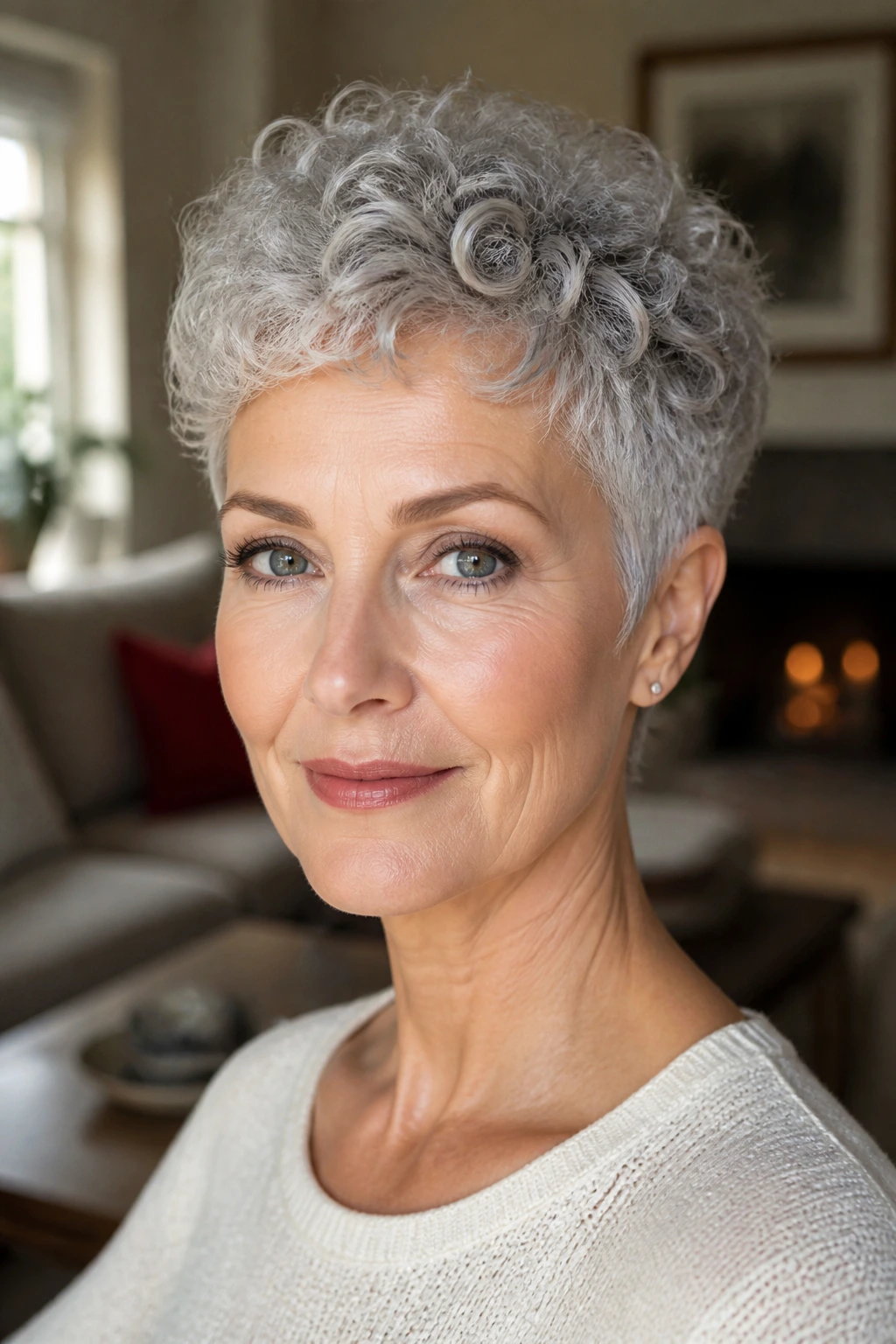
The Curly-Gray Halo: Let the curls live a little longer on top while trimming the perimeter cleanly. It gives you a soft halo effect without letting the sides balloon.
The Glasses-Ready Frame: Keep the fringe shorter on the side where your frames sit and leave a little extra length above the lens line. That small adjustment keeps the haircut from fighting your glasses every day.
The Grow-Out Bridge: Ask for a pixie-bob hybrid with a soft nape and a longer front section. If you think you may want more length later, this is the safest starting point.
Trim Schedule, Growing Out, and Daily Care
Pixies usually need a trim every 4 to 6 weeks if you want the shape to stay sharp. If you prefer a softer outline and don’t mind a little grow-out through the nape, you can stretch that to 6 to 8 weeks. Past that, the silhouette starts changing whether you want it to or not.
Daily care is simple, but not careless. Use a gentle shampoo when the scalp needs it, a lightweight conditioner on the ends, and a leave-in only where the hair feels rough. Gray hair often benefits from less washing than people think, especially if the scalp is not oily. Overwashing can leave the cut dull and puffy.
Growing out a pixie is easiest if you do it in stages. Let the top go first, then soften the sides, then decide whether to shift toward a bixie or a short bob. If you try to grow everything at once, the shape gets awkward in a hurry. Better to plan the awkwardness than stumble into it.
A little neck cleanup between trims can help too. Some stylists will tidy the nape for a small fee, and that one service can make the whole haircut look fresh for another week or two. Tiny thing. Big difference.
Frequently Asked Questions
Will a pixie make gray hair look thinner?
Not if the cut is shaped well. A pixie can actually make fine gray hair look fuller because the shorter length removes limp ends and lets the crown hold lift.
Can thick gray hair pull off a pixie?
Absolutely, but it needs stronger tapering and more internal layering. Without that, the sides can puff out and make the cut look boxy.
How often should I trim a pixie?
Most pixies need shape maintenance every 4 to 6 weeks. If you like a softer grow-out, you can push it a little longer, but the nape will show it first.
Is purple shampoo necessary for silver hair?
No, but it helps when the hair starts looking yellow or dull. Use it sparingly; too much can make very white hair look dull or slightly violet.
What if I have a cowlick at the crown?
Tell your stylist before the first snip. A good pixie can work with a cowlick, but the crown length and direction need to be cut around it instead of against it.
Do pixies work with glasses?
They do, especially when the temples stay slim and the fringe is angled away from the frame line. Side parts and tapered sides tend to be the easiest match.
Can I grow a pixie out without looking awkward?
Yes, if the top is allowed to lead the grow-out first. A soft pixie-bob or chin-skimming version makes the transition easier than a very tight crop.
What styling product should I start with if I only buy one?
A lightweight styling paste or cream is the safest first pick. It can define, soften, or separate pieces without making gray hair feel coated.
A Sharp Finish
A good pixie on gray hair does something that long hair often can’t once the strands get drier and the texture gets a little less predictable: it gives the hair a line. That line can be soft, sharp, playful, elegant, or a little rebellious. The point is that it looks chosen.
If you’re standing in front of the mirror wondering whether short hair will suit you, the better question is usually which version will suit you best. A feathered silver pixie, a sleek tapered crop, or a choppy textured cut can change the whole mood of the face with a few smart snips. Pick the shape that matches your daily life, not the one that needs a full production to behave.
The right short cut should make the morning easier and the profile cleaner. When that happens, gray hair stops reading like something to manage and starts reading like something to wear with confidence.
