



Thick hair and a mohawk are a better match than most men expect. The density gives you lift, shape, and a strong silhouette without a heroic amount of product, but it also brings a very specific problem: if the sides are left too bulky, the whole cut turns into a boxy mound instead of a sharp ridge. That’s the difference between looking deliberate and looking like you forgot to finish the haircut.
The good versions have backbone. They stand up at the center, tighten around the temples, and leave just enough length to show texture instead of a stiff helmet. The bad versions puff out at the ears, collapse at the crown, or get so overworked with gel that they look wet in the wrong way. Thick hair can handle a lot, which is handy, but it punishes lazy shaping faster than fine hair does.
That’s why mohawk styles for men with thick hair deserve more than a quick photo scroll. The cut has to be chosen for your hair’s weight, your head shape, and how much daily styling you’re actually willing to do. A narrow strip with a skin fade feels different from a curly ridge, which feels different again from a long rocker mohawk with a heavy back tail. Same family. Very different mood.
Why Thick Hair Makes a Mohawk Work So Well
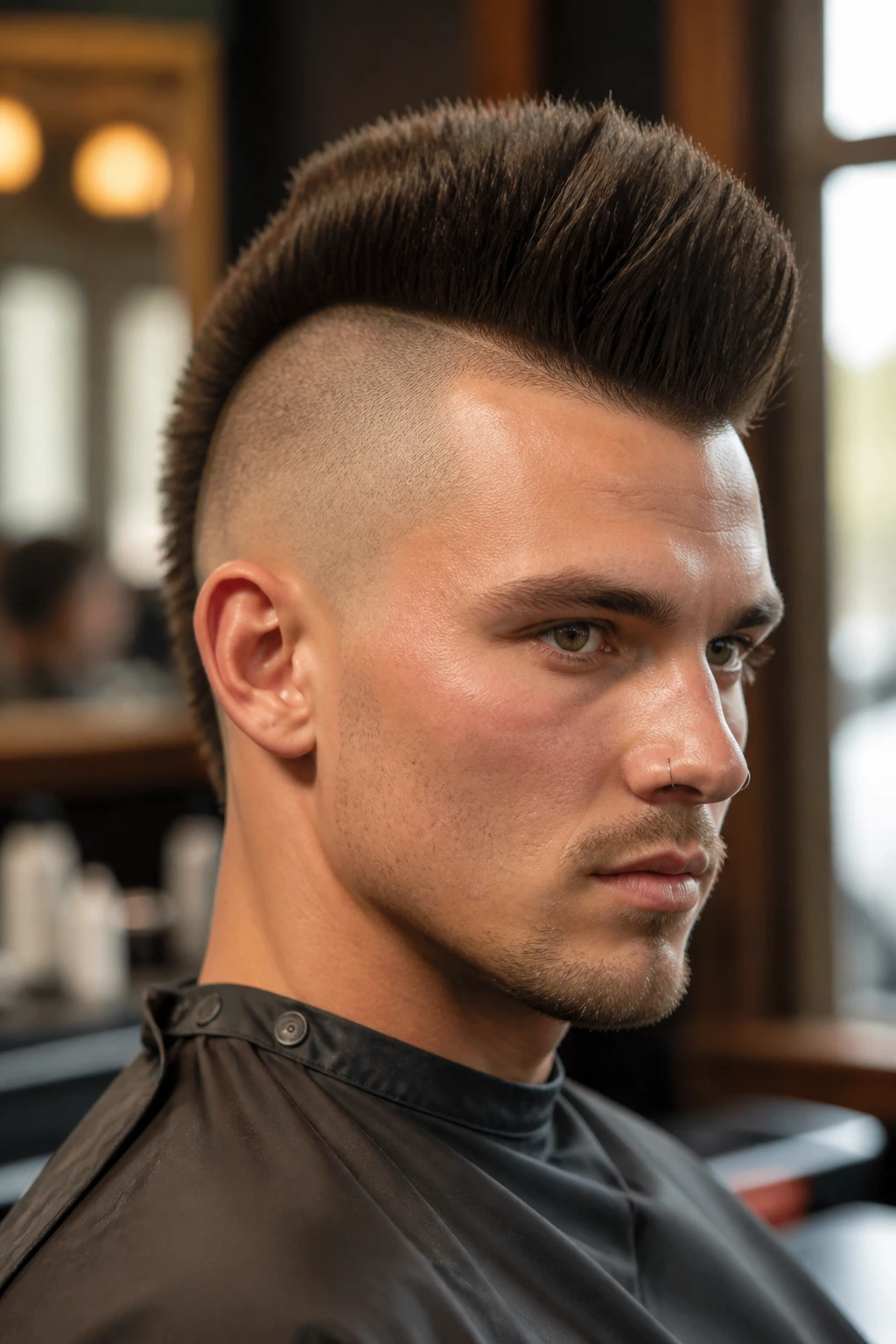
- Built-In Volume: Dense hair already wants to stand up, so the center strip can hold height without needing a gallon of product or a blow-dryer marathon.
- Sharper Contrast: When the sides are clipped down cleanly, thick hair makes the ridge read from across the room instead of disappearing into the background.
- More Styling Range: The same cut can be worn spiky, brushed back, wet, curled, or messy, because there’s enough hair to change the texture without losing the shape.
- Less Fragile Growth: A little grow-out doesn’t ruin the look right away; thick hair keeps the outline readable longer than fine hair does.
- Better Beard Balance: If you wear facial hair, dense hair on top gives the barber more room to connect the whole shape instead of making the beard look separate and heavy.
1. Classic Strip Mohawk
This is the version people picture first: a tight central strip, shaved or closely clipped sides, and enough height on top to make the middle lane look like a ridge instead of a flat strip. On thick hair, the classic mohawk works because the hair already has enough body to lift without fighting for it. You’re shaping volume, not inventing it.
Why It Still Works
The clean line between the top and the sides gives thick hair a job. If the strip is kept around 1.5 to 3 inches wide, the cut reads sharp without looking cartoonish. I like this version best when the barber removes weight from the top, not just the sides, because thick hair will mushroom if the interior stays too heavy.
What to Ask For
- Keep the center strip narrow and centered from the front hairline to the nape.
- Clip the sides down to a #0.5, #1, or #2 depending on how hard you want the contrast.
- Leave the top long enough to stand at 2 to 4 inches, then point-cut the ends so it isn’t blunt.
Pro tip: blow-dry the center strip upward first, then pinch a little matte clay through the tips. Don’t rake product from front to back like you’re combing a horse.
2. Burst Fade Mohawk
A burst fade is one of the smartest moves for thick hair because the fade curves around the ear instead of running straight down the side of the head. That curve steals bulk where thick hair tends to balloon first, and it makes the mohawk look intentional rather than wide.
The best burst fades are tight near the ear and slightly softer as they move toward the back, so the top can stay bold without the side profile turning heavy. If your hair naturally grows out wide around the temple area, this cut cleans that up fast. It also plays nicely with a beard, because the arc around the ear gives the face a stronger frame.
How to wear it: keep the ridge textured and let the crown sit a touch looser than the front. The front can be spiky or brushed up; the back should stay controlled so the whole thing doesn’t look like two different haircuts stitched together.
3. Skin Fade Mohawk
Want the top to look taller without the sides stealing attention? Go skin fade. The bare transition around the temples makes thick hair look even denser on top, which is the whole point here.
A skin fade mohawk is not subtle, and that’s why it works. Thick hair can take the visual punch of a near-bald side without making the top feel disconnected. The important part is the blend: if the fade is sloppy, the cut starts reading as a strip floating above the head. If it’s clean, the shape looks precise and modern.
Ask Your Barber For This
- A tight skin fade from the temple down to the skin at the base.
- A top section left thick enough to stand up after blow-drying.
- Point cutting or texturizing so the ridge doesn’t become a solid block.
One thing to watch: the skin fade grows out fast, and on thick hair the regrowth line shows early. If you like crisp edges, this one needs more upkeep than a taper.
4. Low Taper Mohawk
If a full skin fade feels too sharp, the low taper version is the polite cousin. The sides narrow around the neckline and sideburns while keeping more coverage through the temple area, which makes thick hair easier to wear in places where a hard punk cut would feel out of place.
The shape is softer, but not weak. That matters. Thick hair often looks best when the sides are controlled without being stripped bare, because too much removal can make the top look oversized. A low taper keeps the center ridge honest and lets the cut sit closer to the head.
Best For
- Guys who want a mohawk shape without a harsh scalp-heavy look.
- Thick hair that gets puffy when the sides are taken too short.
- Men who need the cut to work with a jacket, collar, or helmet.
Small detail, big payoff: ask the barber to keep the taper clean behind the ear. That little area is where thick hair often balloons first.
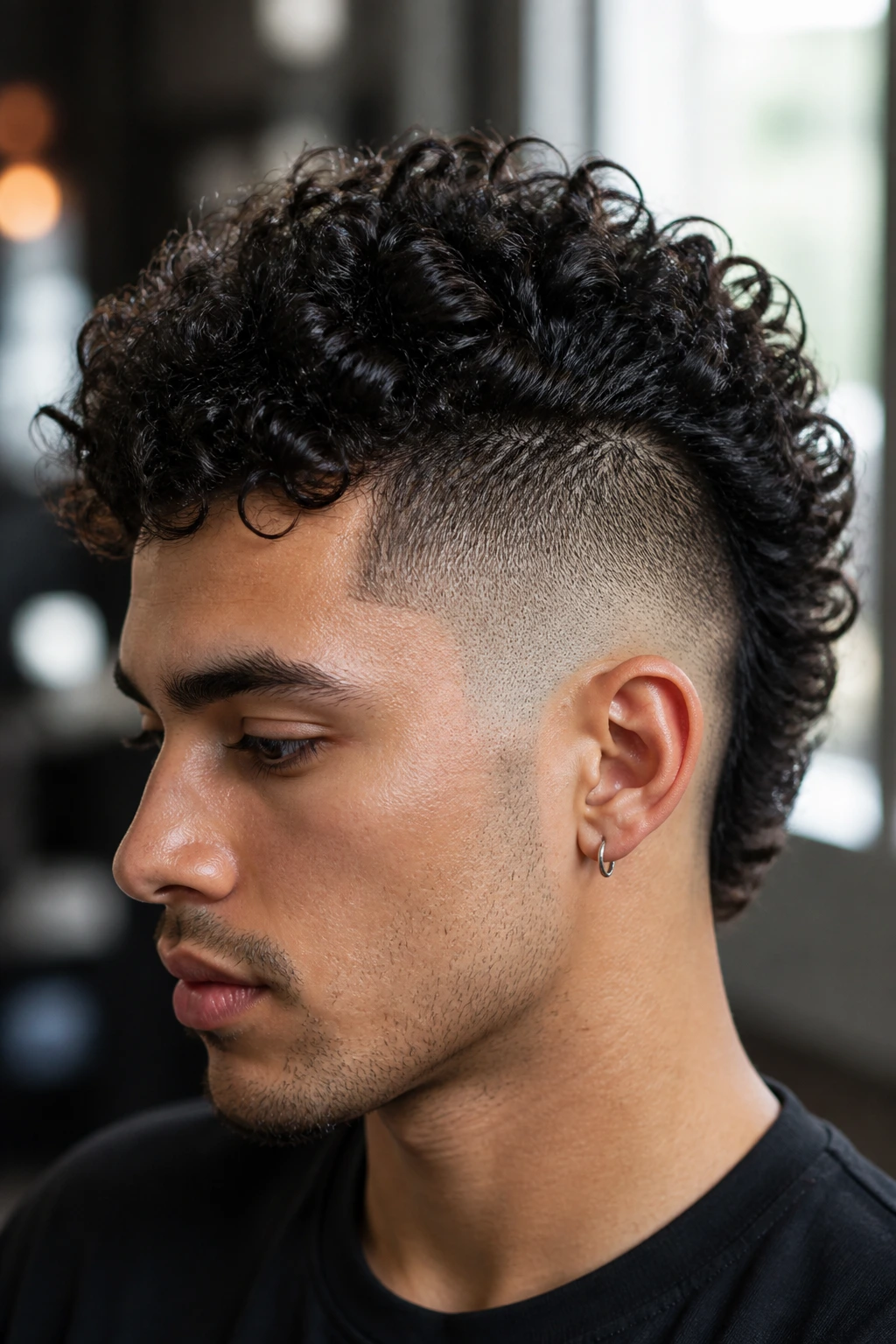
5. Curly Thick-Hair Mohawk
Curly hair does not need to be bullied into behaving like straight hair. Let the texture do the work. A curly mohawk on thick hair can look better than a spiked one because the curls build height on their own, and the shape feels full instead of forced.
The trick is to keep the sides tight enough that the curls look like a ridge, not a halo. The top wants moisture and definition, not crunchy stiffness. Curl cream, a light leave-in, and a diffuser are the real tools here. Brushing curls dry is how you end up with wide, fuzzy volume where you wanted a mohawk.
Best move: leave the curls slightly longer than you think you need. Once they spring up and dry, the true length gets shorter fast, and a too-short curly mohawk turns into a bristly patch instead of a real shape.
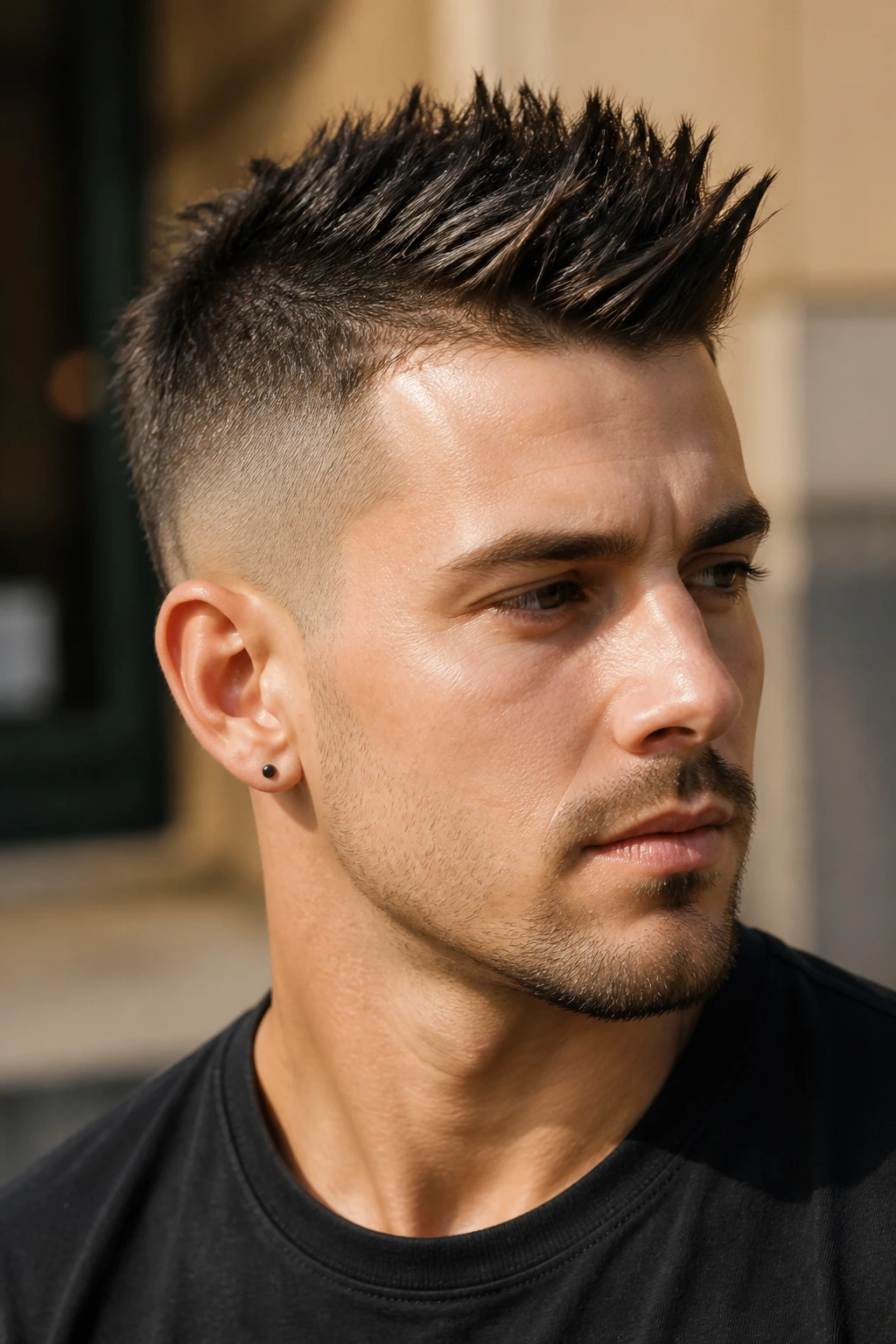
6. Spiky Short Mohawk
This is the cut for men who want the mohawk idea without the long daily routine. Keep the center strip short enough to spike in under a minute, and thick hair will do half the work for you. The result is clean, hard-edged, and a little aggressive in the best sense.
A short spiky mohawk looks better with a matte finish than a glossy one. Thick hair can hold texture, so you don’t need wet shine to convince anyone it’s styled. Sea salt spray before blow-drying gives the top a little grit, and a fiber paste or strong matte clay finishes the job.
Quick guide
- Top length: about 1.5 to 3 inches.
- Sides: tight fade or close clipper cut.
- Finish: dry, separated spikes instead of one solid ridge.
Tip: if the spikes are all leaning the same way, it looks stiff. Push a few forward, some up, and a couple slightly back. That messiness is the point.
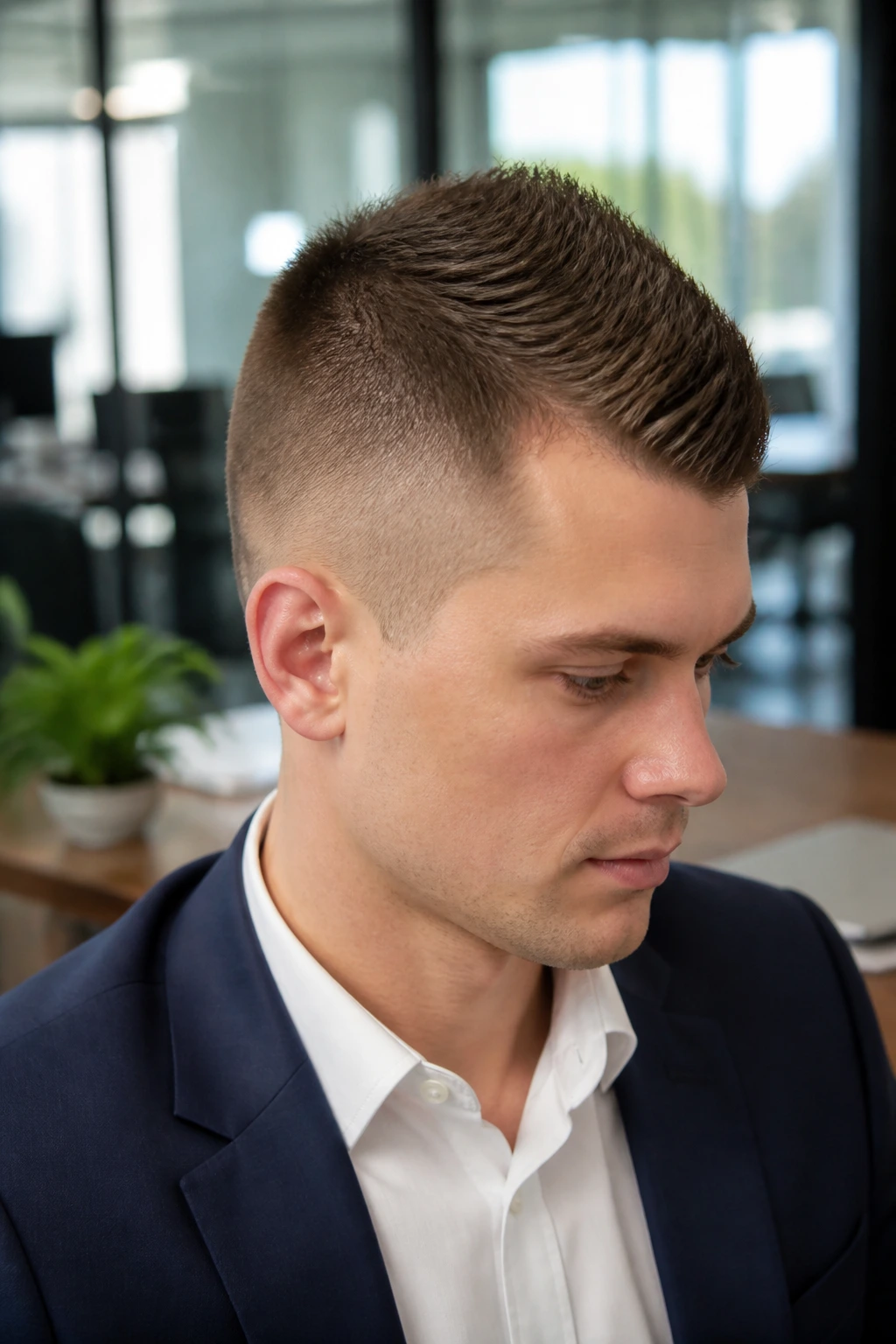
7. Office-Friendly Narrow Mohawk
Yes, a mohawk can be restrained. Not boring. Restraint. The narrow-strip version keeps the center line tight, the sides tapered rather than shaved, and the front short enough to comb down when the situation calls for it.
Thick hair helps here because it gives the style enough body to still read as a mohawk even when the top is worn lower. That’s the quiet magic of this cut. You get the shape without turning every meeting into a costume change.
A good office-friendly version depends on edges. The neckline should be neat, the temple area should be tidy, and the ridge should not sprawl outward. If the hair grows dense around the crown, have the barber remove some interior weight so the top doesn’t sit like a padded cushion.
8. Disconnected Undercut Mohawk
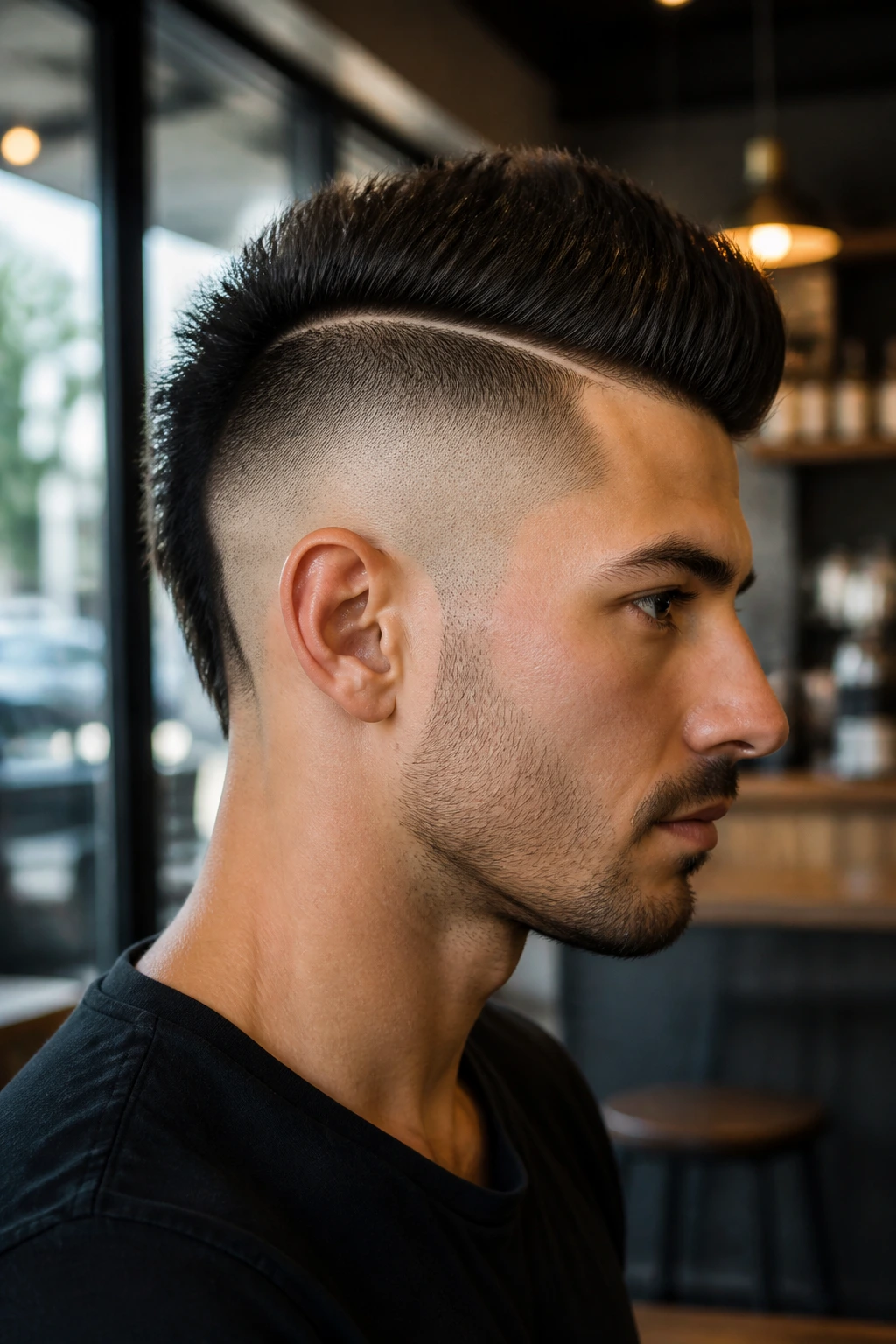
The disconnected undercut mohawk is about contrast. There’s a visible break between the top and the sides, and on thick hair that break makes the center strip look stronger, not smaller.
That clean disconnect is what keeps the style from turning muddy. Thick hair loves to hide lines, which sounds nice until you want a defined silhouette. Here, a sharp disconnection solves the problem. The barber leaves the top long and clearly separate, then takes the sides down so the eye immediately follows the ridge.
Why it stands out: the cut has a built-in edge, so you don’t need heavy styling to make it read. A little matte product and a quick blow-dry are enough. If you like a mohawk that looks engineered instead of chaotic, this is one of the better choices.
9. Faux Hawk for Thick Hair
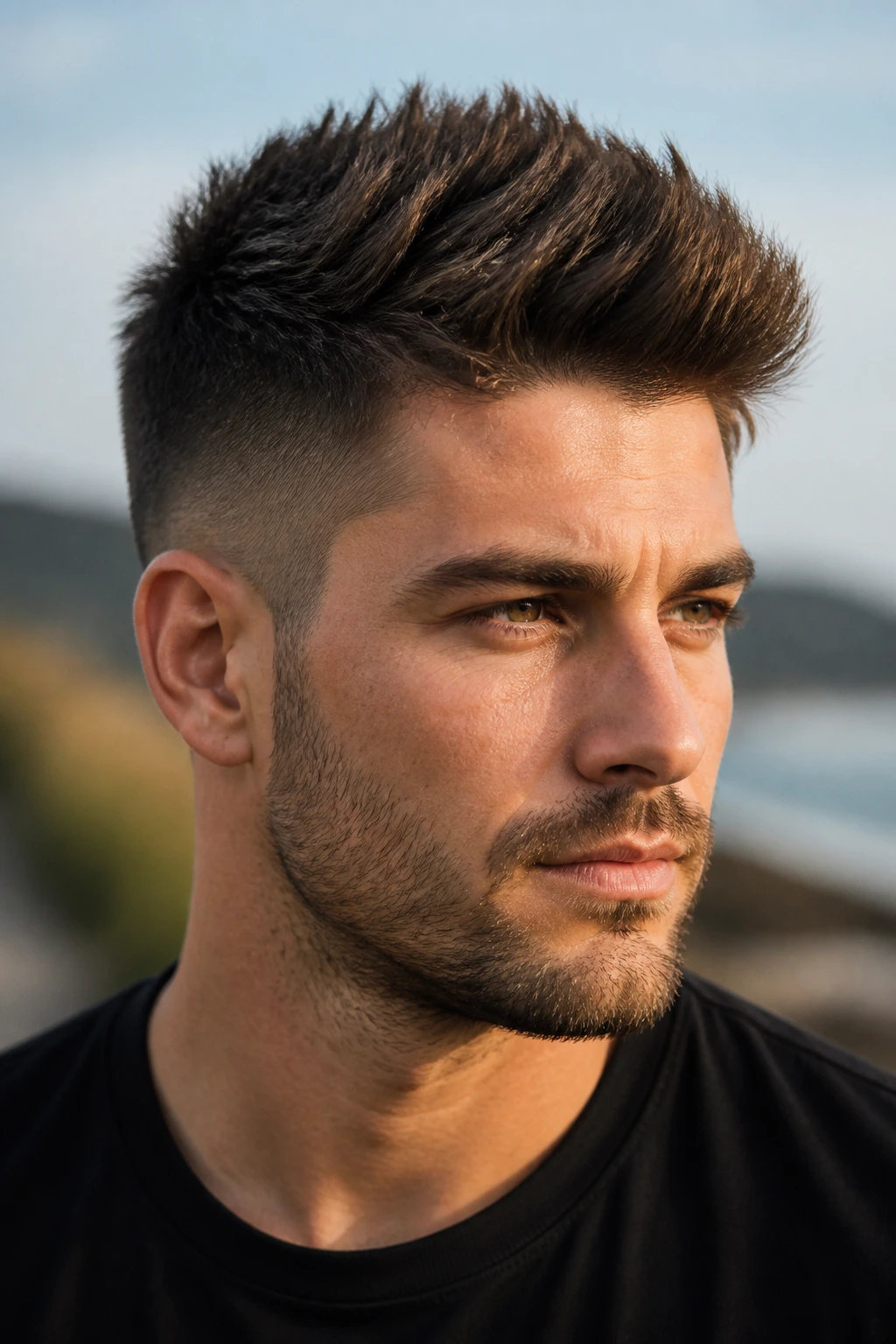
Not ready for shaved sides? The faux hawk keeps the center energy without going all the way. It works especially well on thick hair because the middle section can be pushed upward while the sides stay shorter, not bald. That softer edge makes the style easier to live with.
The real difference is width. A faux hawk spreads a little more across the top, so it looks less like a strip and more like a controlled ridge. Good thick hair gives it enough backbone to hold that shape even when you’re not using a ton of product.
How to use it
- Keep the top longer through the front and crown.
- Taper the sides rather than shaving them.
- Use a blow-dryer and medium-hold matte product so the front lifts, then settles.
This is the one I’d point a first-timer toward. It gives you the mohawk feeling without forcing you to commit to the most dramatic version on day one.
10. Braided Mohawk
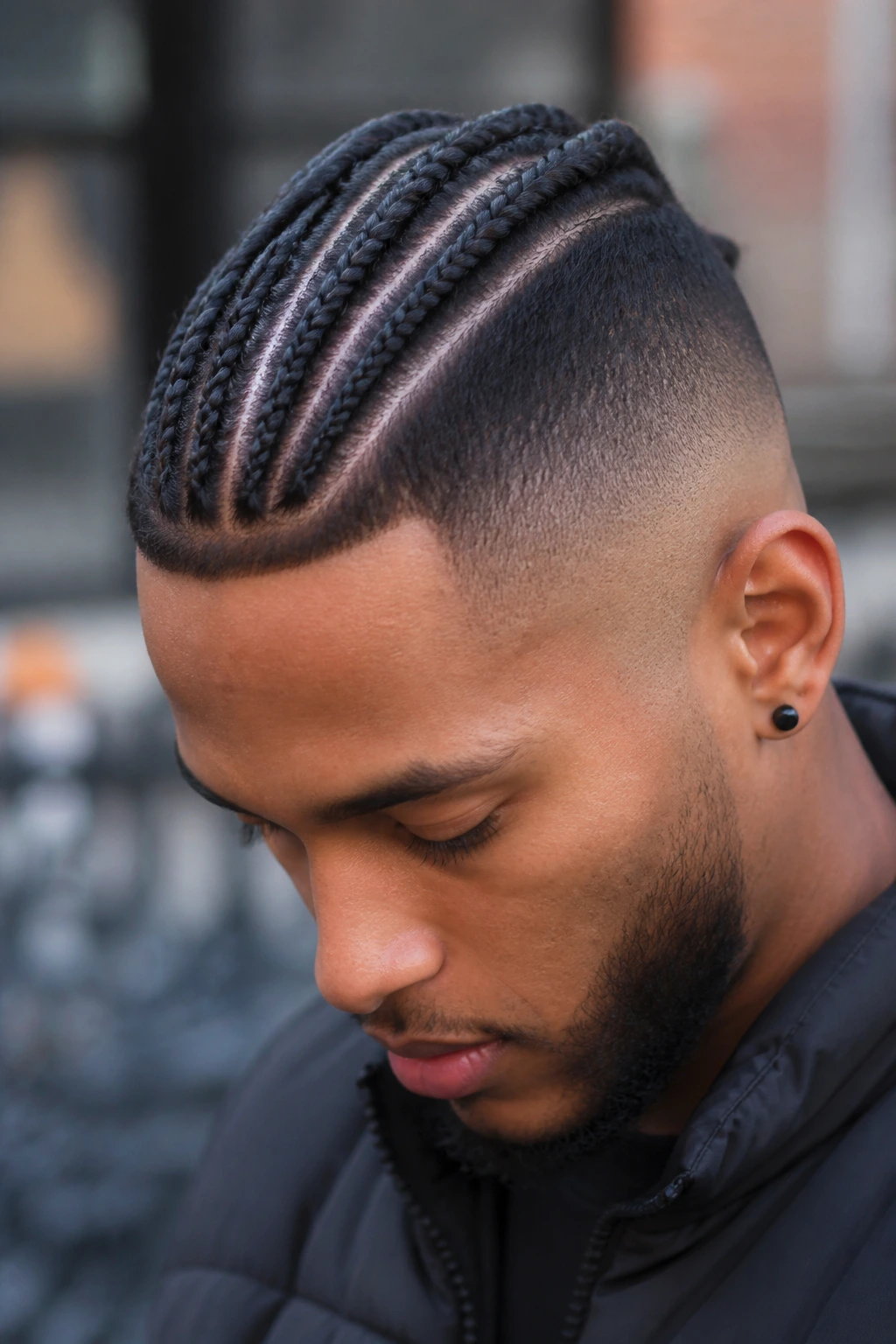
Braids change the whole mood. Instead of pushing thick hair straight up, you gather the center strip into cornrows, Dutch braids, or tight plaits that run down the middle of the head. The sides stay faded or clipped, so the braid becomes the feature.
This style is practical if your thick hair gets too heavy to hold vertical all day. Braids solve the weight problem by controlling it. They also keep the line clean for longer, which is useful if you’re tired of restyling every morning.
What matters most
- The braid tension should be firm, not painful.
- The scalp needs to be clean and hydrated before styling.
- The base fade or undercut should be neat, because the braid draws attention straight to the parting line.
Small warning: if your hair is very short on top, the braid will look thin and awkward. Give it enough length to build a real center run.
11. Razor-Design Mohawk
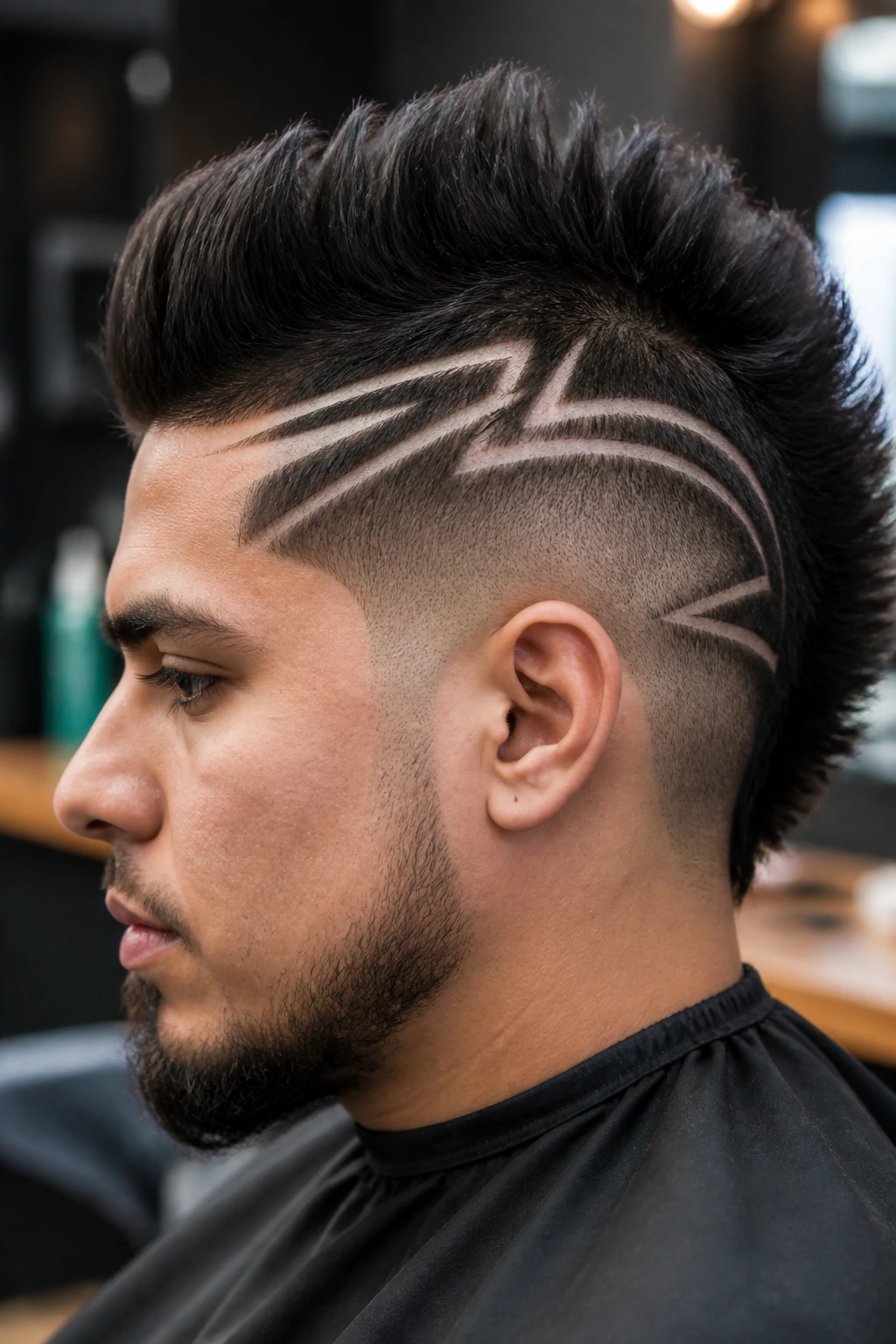
A mohawk with razor lines or etched designs is a barbershop cut that likes a bold canvas, and thick hair gives it exactly that. The heavier top keeps the focus where it belongs, while the shaved sides become a place for lines, lightning bolts, or geometric cuts.
The design should support the shape, not fight it. Too many lines and the whole thing looks noisy. One or two clean details near the fade usually hit harder than a crowded patch of scribbles. Thick hair’s density lets the design read with more contrast, especially when the sides are taken down close.
If you choose this version, expect upkeep. The design blurs as the sides grow, and it loses its crispness faster than a plain fade. Still, when it’s fresh, this is one of the most striking ways to wear a mohawk with thick hair.
12. Modern Mullet Mohawk
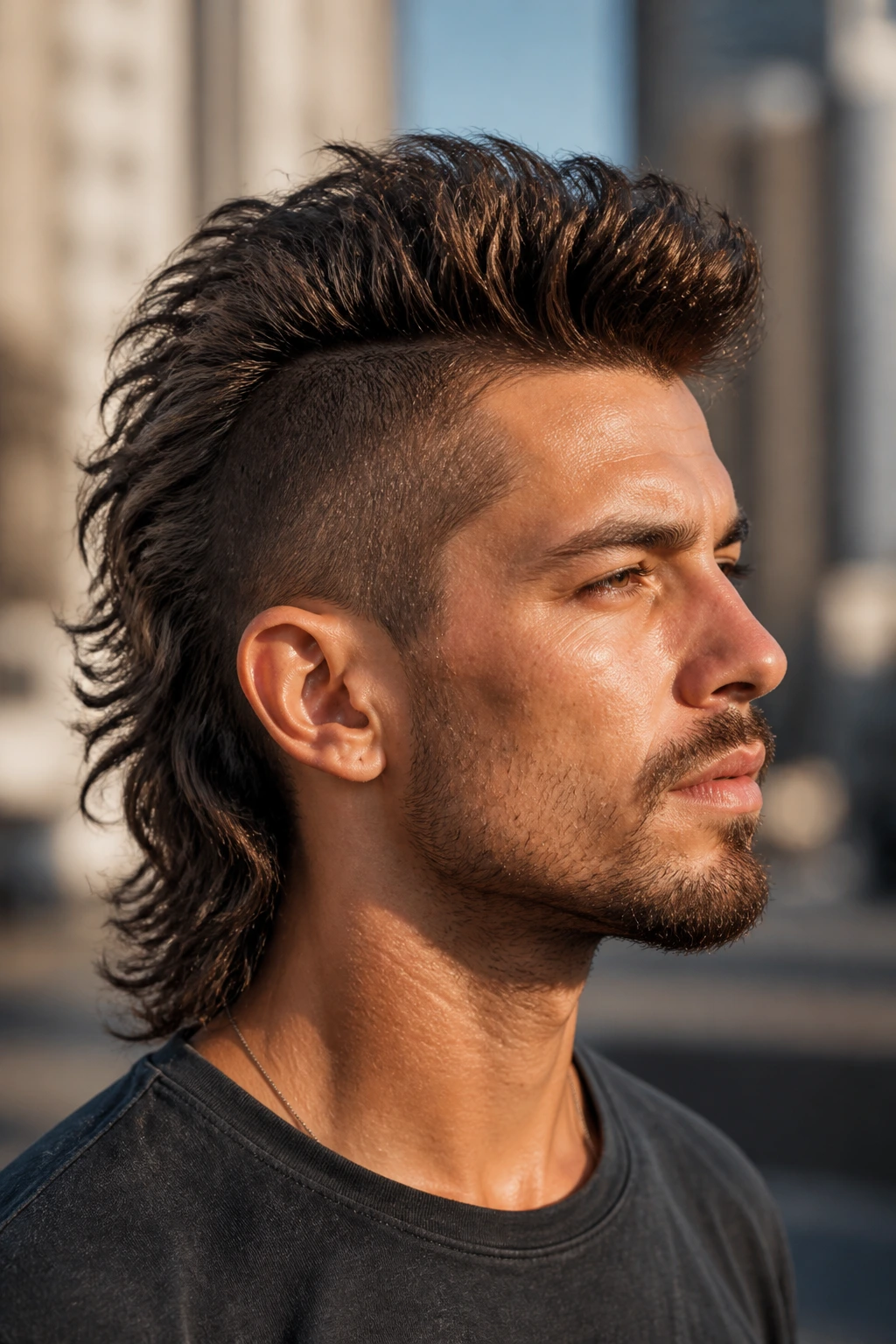
This is the style for men who want the mohawk’s attitude and the mullet’s length without pretending the two aren’t related. The front and crown keep the ridge, while the back is left longer and softer. Thick hair is good at carrying that extra length because it holds shape instead of hanging flat and sad.
Compared with a classic mohawk, this version feels looser. The back creates movement, and the top can be less rigid, which makes the cut look less like a statement helmet and more like a lived-in shape. It suits dense hair that has a little wave or bend, since the back length can move instead of sitting still.
Best fit: if you want the silhouette to be visible but not severe. It’s less rigid than a pure strip, and that flexibility is the whole appeal.
13. Brush-Up Mohawk
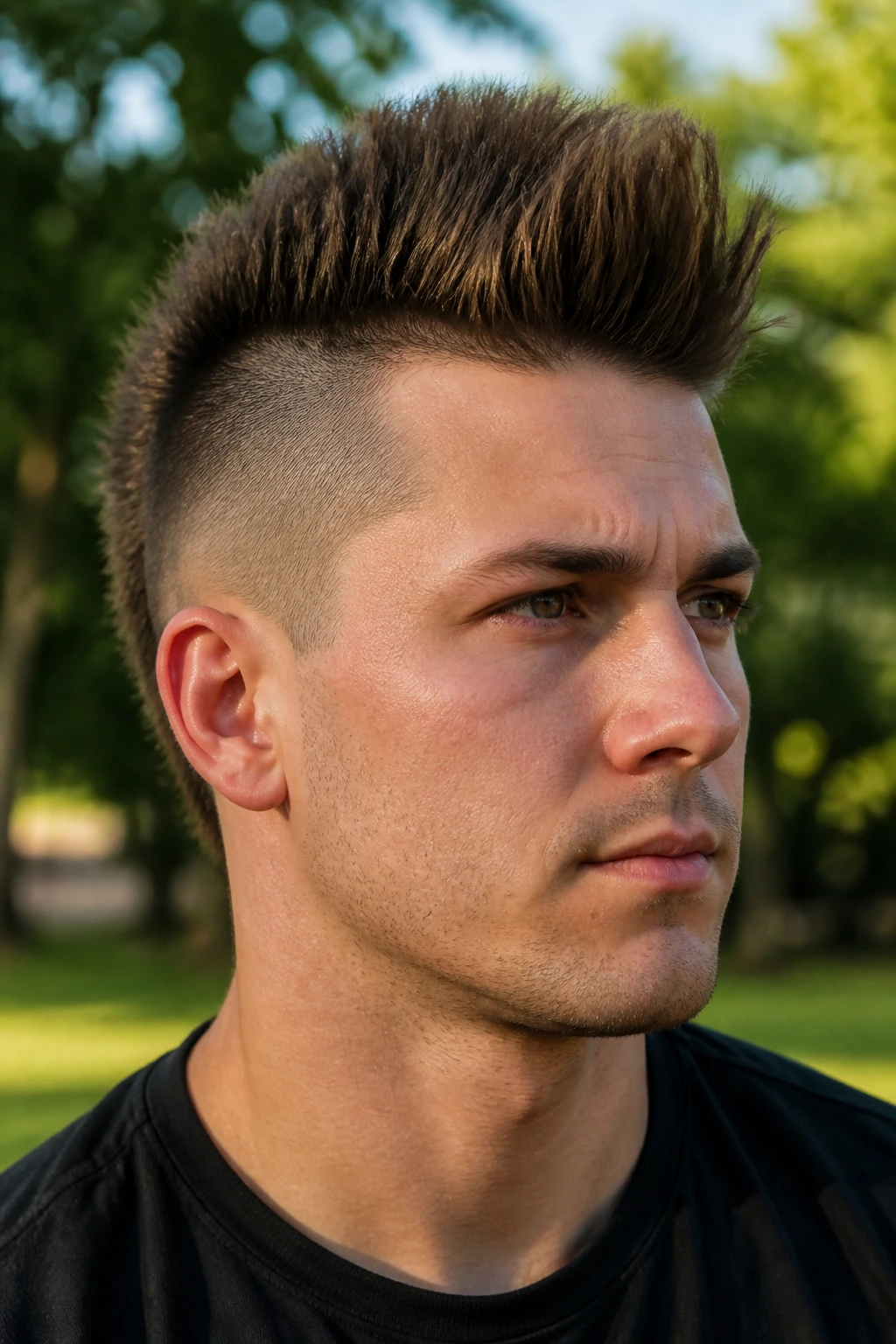
If your hair wants to stand up anyway, use that. The brush-up mohawk is basically a controlled vertical lift: the front rises first, the crown follows, and the center strip gets enough height to look sculpted without turning into a spiky mess.
The point here is direction. Thick hair needs to be blown upward from the roots while it’s still damp, then shaped while it cools. A vent brush or round brush helps, but you don’t need to overwork it. Too much brushing flattens the texture and leaves you with a shiny, over-processed ridge.
What makes it work: the cut doesn’t need to be extreme if the styling is strong. Even a moderate length can look bold when the base is lifted and the ends are separated.
14. Drop Fade Mohawk
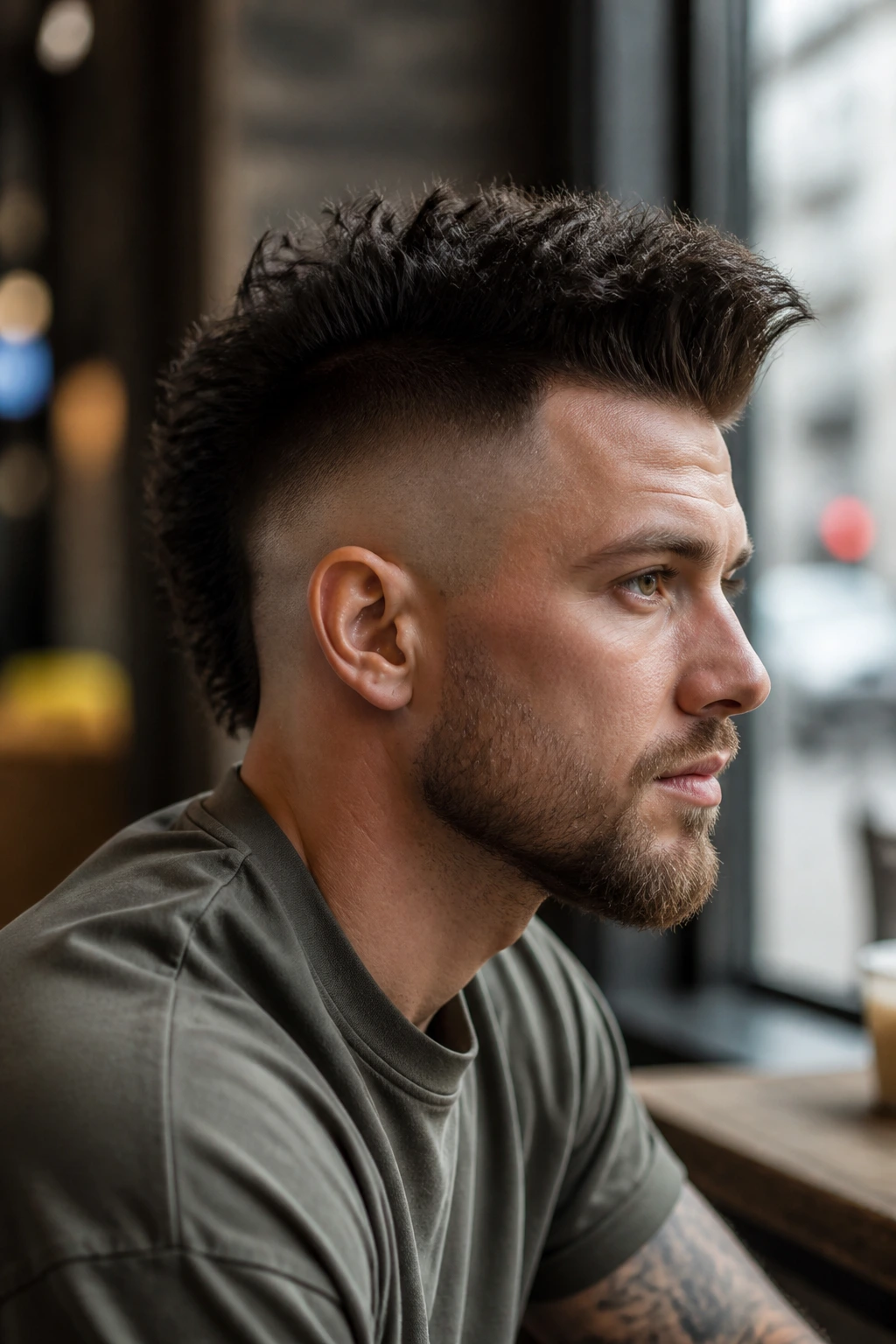
Why does the drop fade look so good on thick hair? Because it follows the shape of the head instead of fighting it. The fade drops lower behind the ear, which makes the mohawk feel tailored to the skull rather than stamped on top of it.
That curved fade line is especially useful if your hair grows heavy around the back and sides. It removes bulk where the head widens, then lets the ridge stay visible from the front and profile. The result is a cleaner transition than a straight fade, and the style tends to look more finished in motion.
Best for
- Rounder or wider head shapes.
- Thick hair that swells around the ear line.
- Men who want a mohawk shape that doesn’t look square from behind.
Tip: ask for the drop to start lower than you think. A fade that drops too high loses the whole point.
15. Temple Fade Mohawk
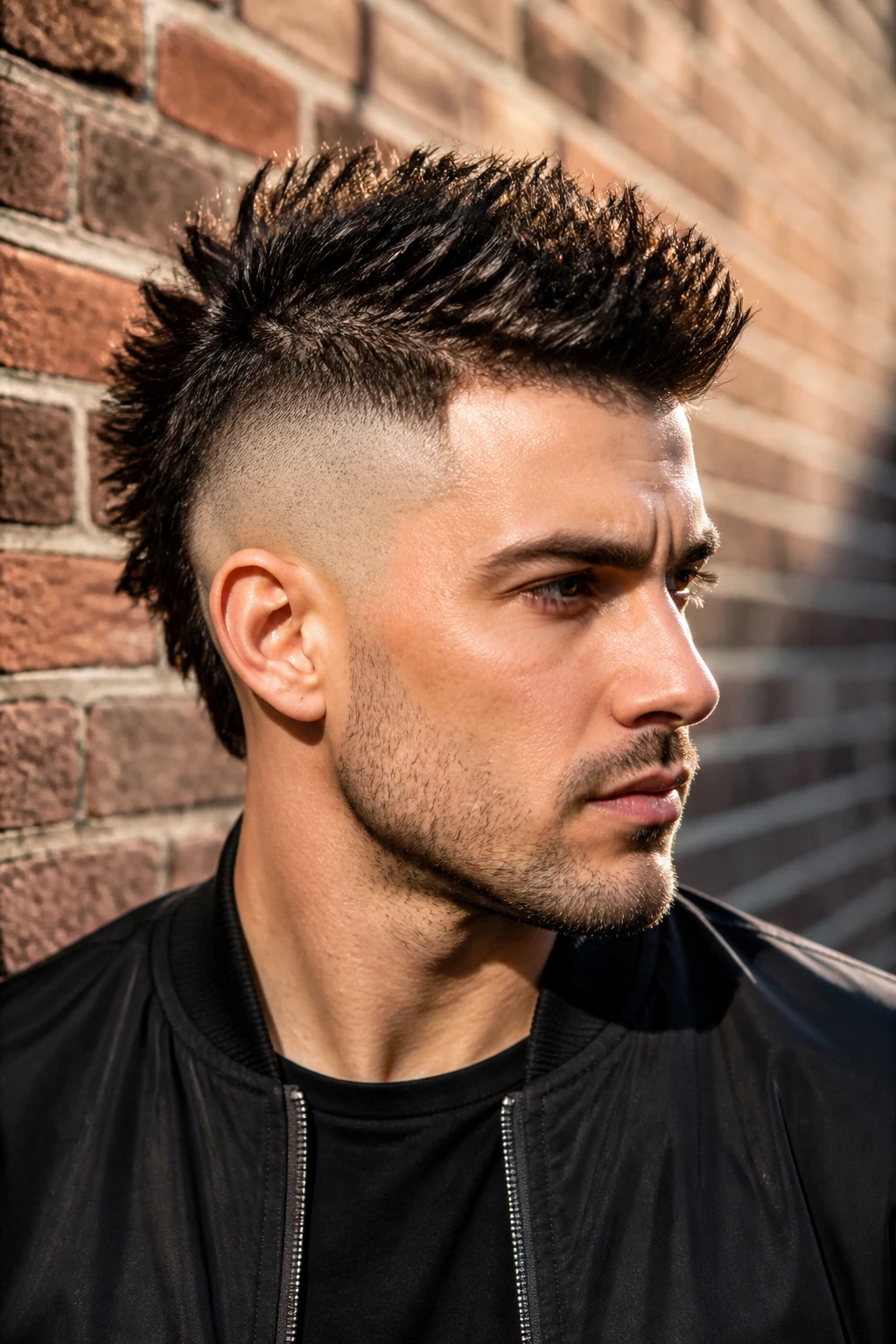
The temple fade is a neat compromise between sharp and wearable. It tightens the hair only at the temples, which is where thick hair usually creates the most bulk, then leaves more coverage higher up. That means the mohawk reads clearly, but the sides don’t vanish all the way to skin.
I like this version because it keeps the face framed. The temple area gets cleaned up, the center line stays strong, and the cut still has enough side presence to feel balanced. It’s a good answer if you want structure without going full shaved-sides.
One useful detail: the temple fade gives glasses and a beard more room to sit naturally. The haircut won’t crowd the face as much, which matters more than people think.
16. Beard-Connected Mohawk
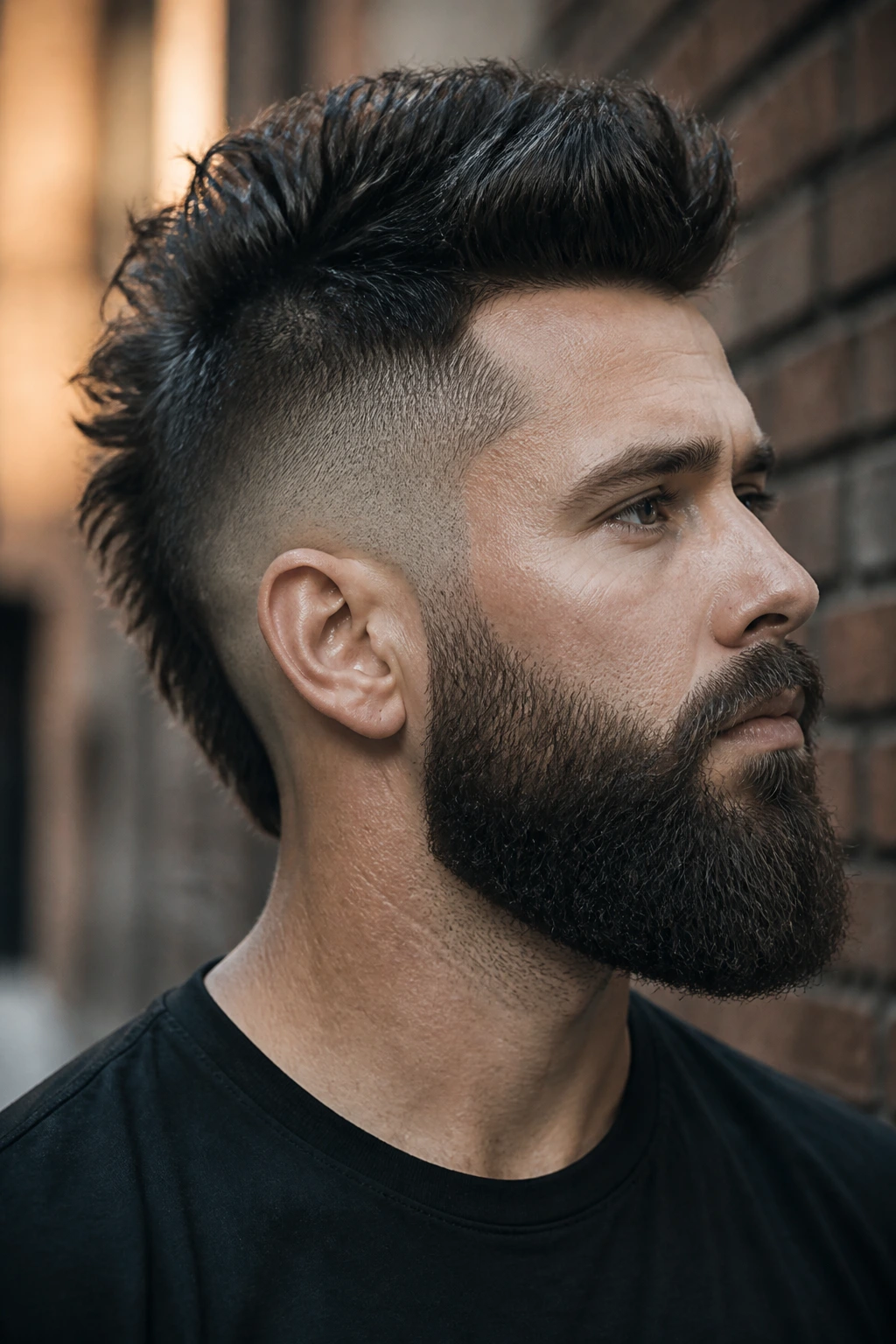
The best beard-connected mohawks don’t look like the top and beard were cut in separate rooms. The fade at the sideburn should flow into the beard, and the top should have enough width to balance that heavier lower half. Thick hair helps because the ridge has the volume to hold its own beside a full beard.
This cut is strongest when the beard lineup is crisp. A rough beard with a sharp mohawk can work, but the look gets messy fast if the edges are fuzzy. Clean the cheek line, shape the neckline, and let the mohawk stay tall enough to stand against the beard’s weight.
It’s a solid choice if you like a masculine, grounded silhouette. The top, sides, and facial hair should all feel like they belong together.
17. Wet-Look Mohawk
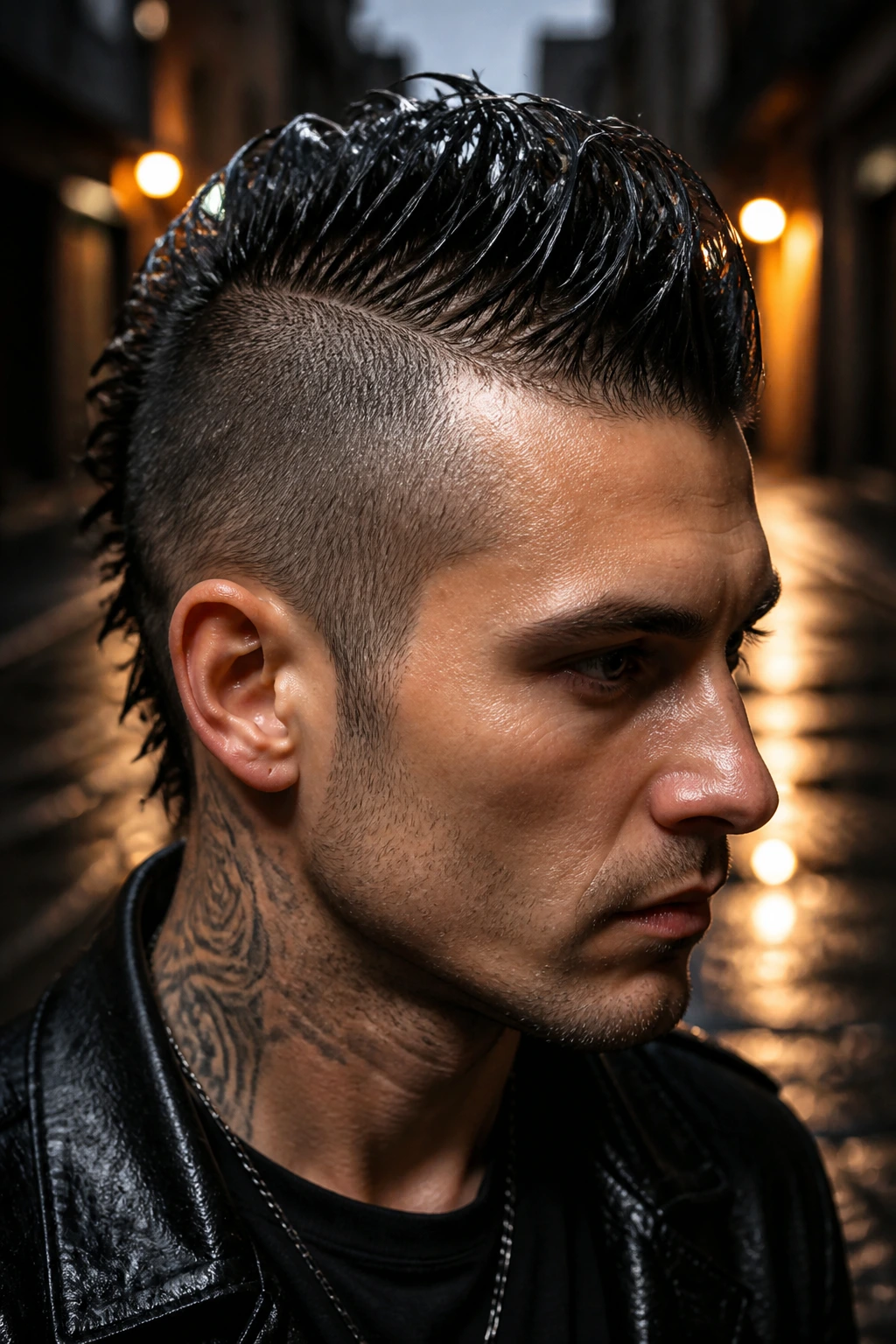
Dry texture gets most of the attention, but a wet-look mohawk on thick hair can be slick in the old-school sense. The shine shows off the ridge, and the product holds every little tooth of the comb line. It’s sharper, more controlled, and a bit more dramatic than matte styling.
The key is restraint with the gel. Thick hair can swallow product, so it’s easy to keep adding until the top turns into a helmet. Start with damp hair, work gel from roots to tips on the center strip, then comb the sides down cleanly. Leave the top glossy, not soaked.
Why it works here: coarse, dense hair holds shape under gel better than fine hair, so you get a defined line without collapse. That’s the whole appeal. Clean lines. A little shine. No fluff.
18. Messy Bedhead Mohawk
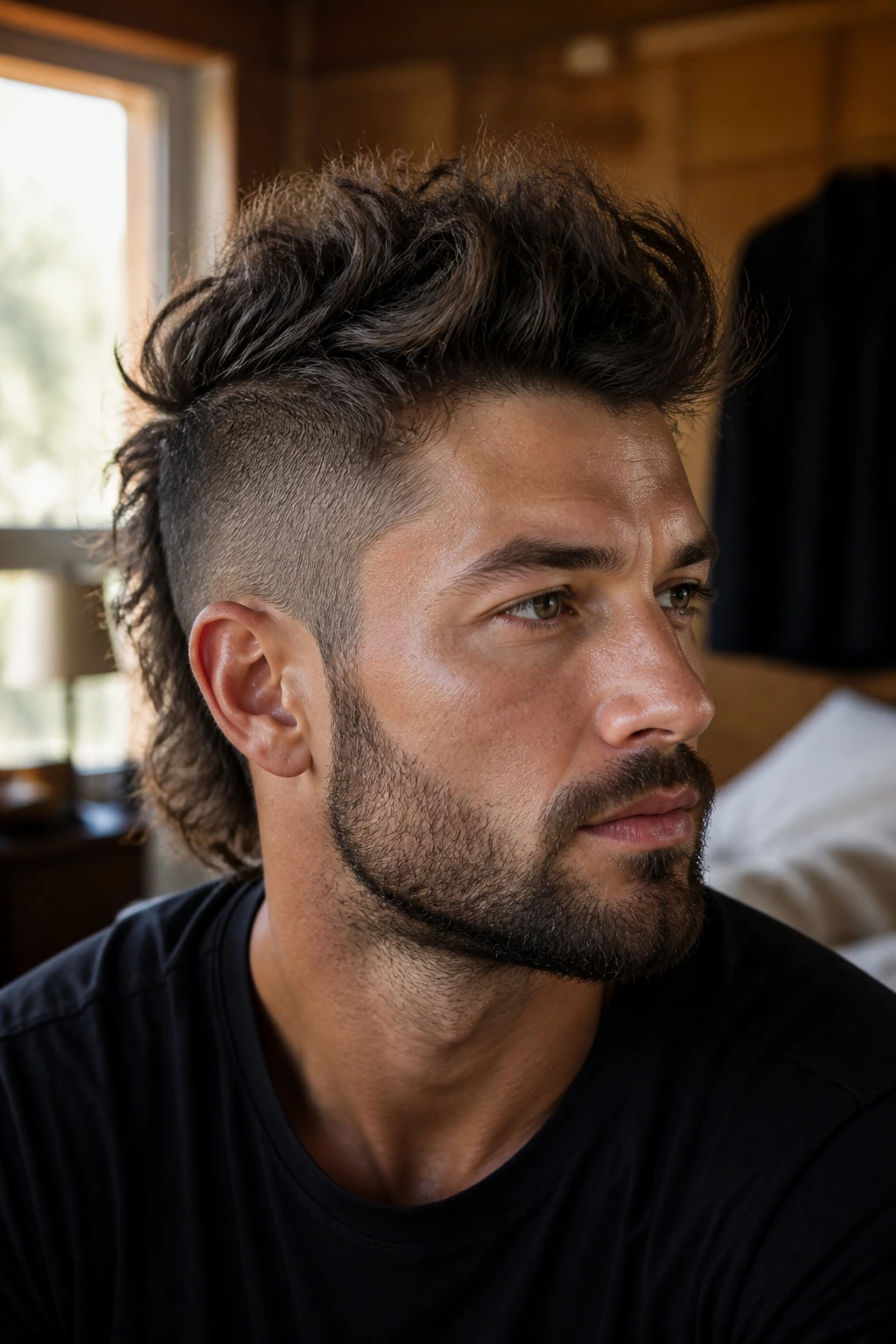
A messy mohawk sounds casual, but on thick hair it needs control underneath or it just looks neglected. The best version keeps the sides tight and lets the top break into uneven peaks with paste or clay. It should feel accidental from three feet away and carefully edited from six inches.
That balance is easier with thick hair because the texture already creates natural separation. You’re not building volume from scratch; you’re steering volume. A quick blow-dry with your fingers, then a dab of matte paste, usually gives the top enough chaos to look right.
Don’t over-comb it. Seriously. The charm of this version is the uneven ridge, not a perfect row of spikes pretending to be messy.
19. Long Tail Mohawk
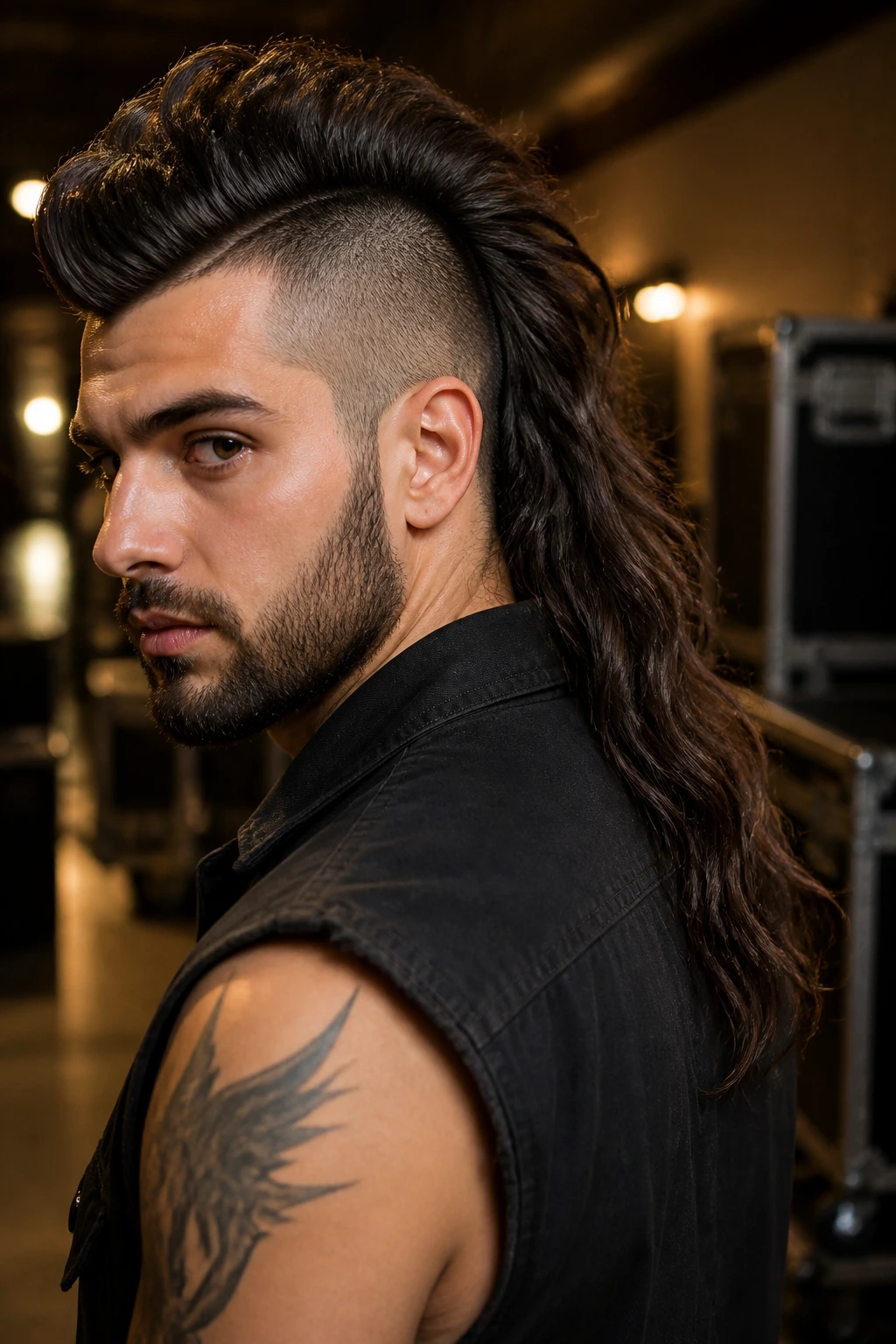
What if you keep the center strip and let the back run long? You get a long-tail mohawk, and thick hair gives it the density needed to avoid looking stringy or limp. The shape is dramatic, sure, but it also has movement, which makes it more interesting than a rigid strip that stops at the crown.
The biggest issue is weight. Thick hair can pull the tail down if the interior isn’t thinned properly, so the cut needs layers or point cutting to keep the tail from turning into a heavy curtain. The sides should still be clipped tight enough to keep the mohawk line visible, even from behind.
If you like music-scene energy and a more lived-in shape, this is a strong pick. It looks better when it’s slightly imperfect.
20. Flat-Top Mohawk Hybrid
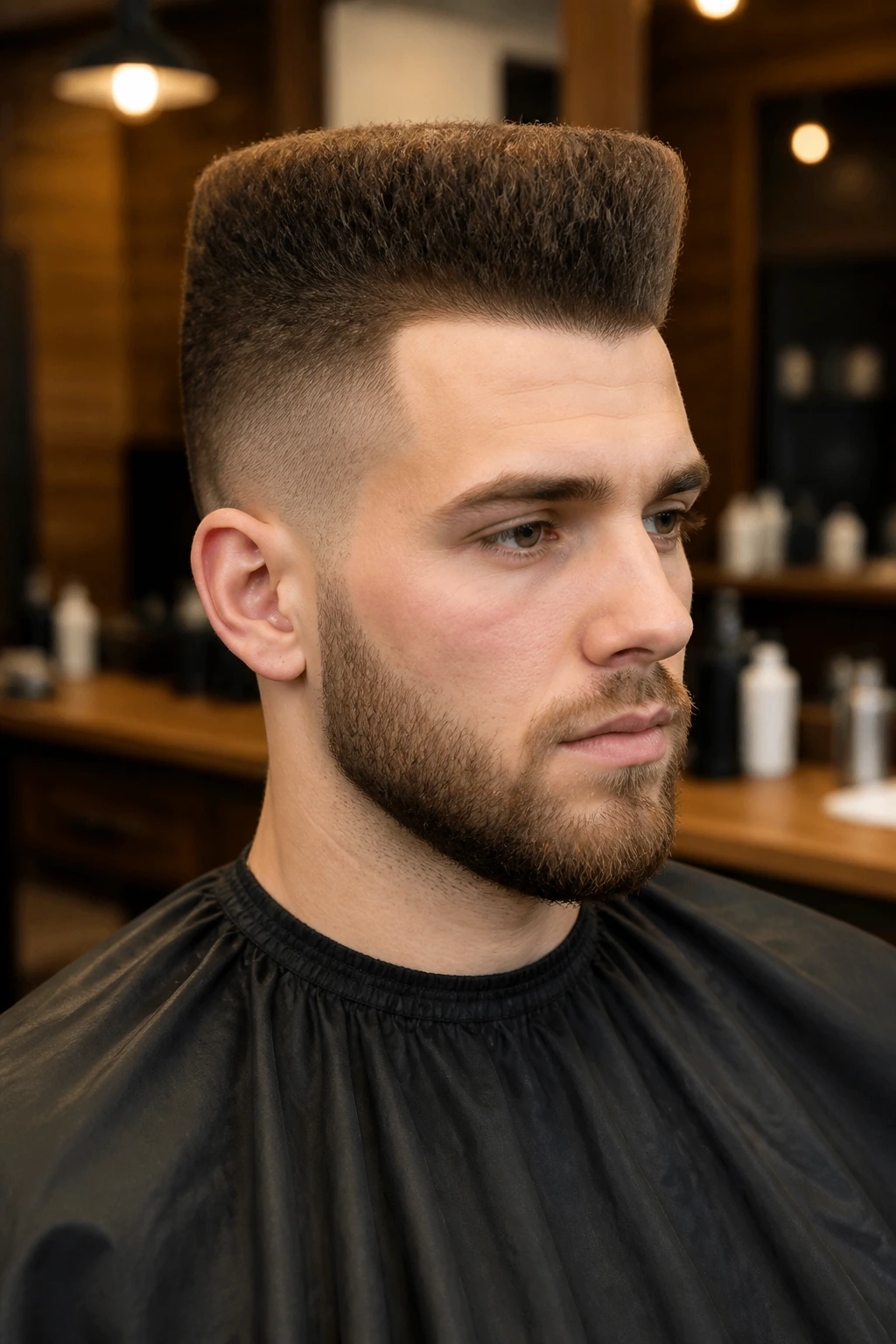
This one sits between architecture and attitude. The top is shaped with a flatter, squared surface instead of a pointed ridge, and the sides are kept tight enough that the whole style still reads as a mohawk hybrid. Thick hair is useful here because it holds that flat plane without collapsing into mush.
The cut works best when the barber uses clipper-over-comb and some careful squaring at the top. You do not want random bulk. You want edges that look deliberate. This is one of those styles where the silhouette matters more than the details of the strands.
It’s a smart choice if you want something old-school and a little severe. Not flashy. Strong. Clean.
21. Swept-Back Mohawk
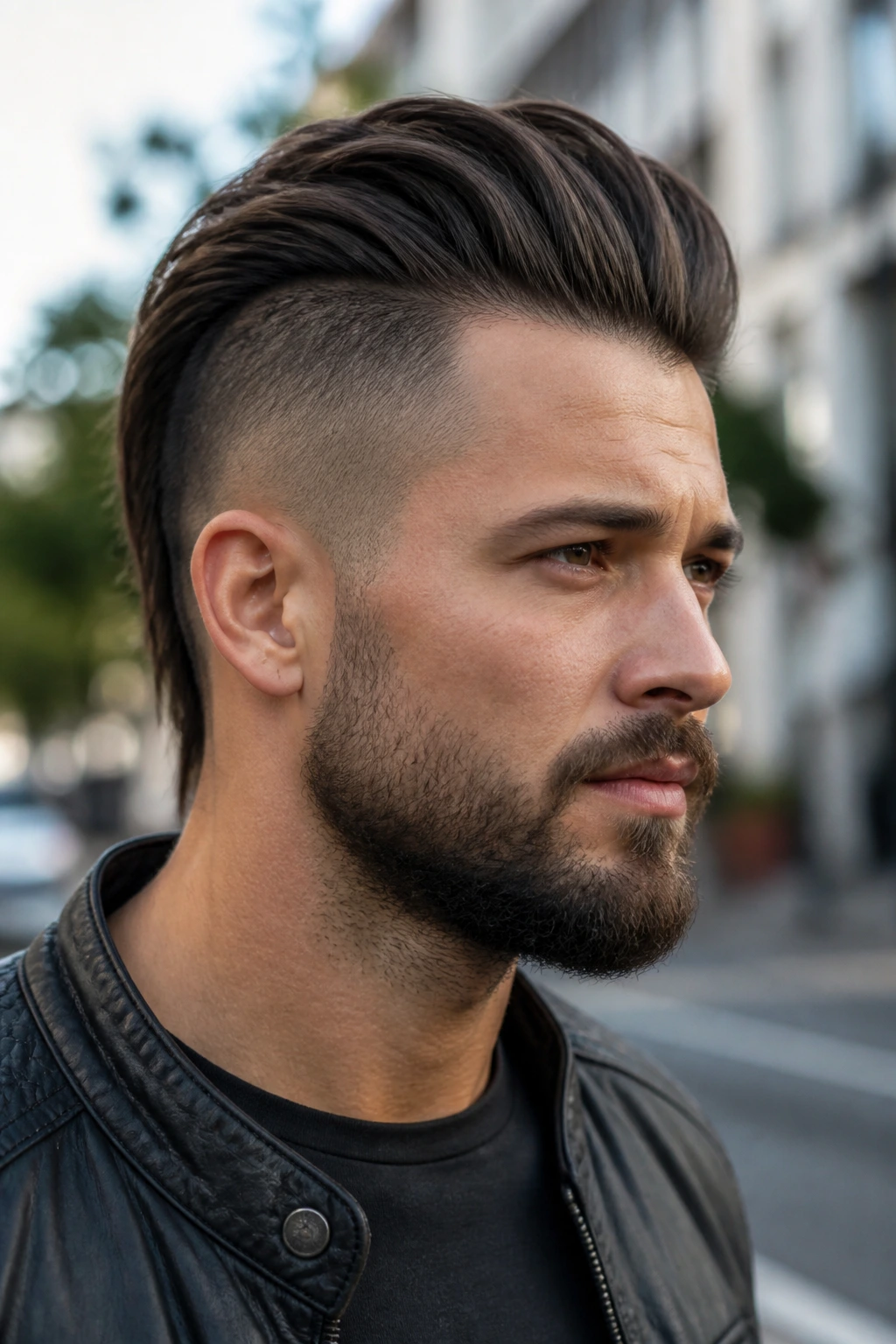
A swept-back mohawk is the version for men who don’t want the front standing straight up all the time. Instead of building a vertical spike, you brush the center section back at a slight angle so the ridge looks longer and smoother. Thick hair makes that shape easier to hold because the strands have enough body to stay off the face.
This is especially useful if you work with wind, hats, or a lot of movement during the day. The style still has mohawk roots, but it behaves more like a controlled sweep. Pomade or a medium-hold cream helps keep the direction without freezing the top in place.
The nice thing here is that the cut reads mature without losing its edge. That’s a rare balance.
22. Hard-Part Mohawk
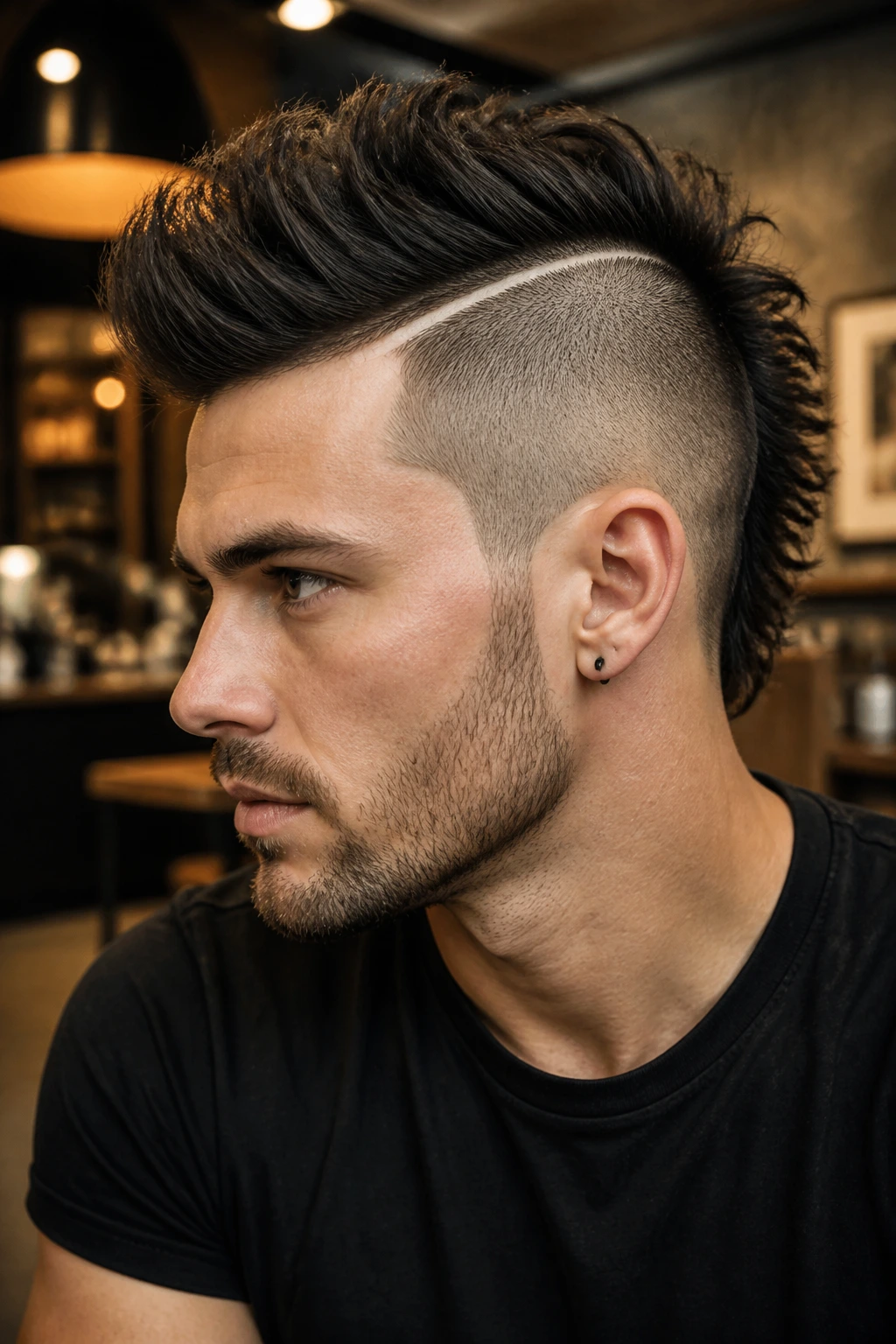
A hard part gives the mohawk a graphic edge. Instead of relying only on fade contrast, the barber shaves a clean line into one side, and that line makes the center section look sharper. Thick hair benefits because the strong top volume balances the part instead of overpowering it.
Compared with a disconnected mohawk, the hard part adds direction. Your eye follows the line, then lands on the ridge. It feels more tailored, less chaotic. If the part is placed too low, though, the style gets lopsided, so the barber has to respect the head shape and the natural growth pattern.
Best for men who like precision: the part needs to stay visible, which means regular touch-ups. A faded hard part loses its bite fast.
23. Fringe-Forward Mohawk
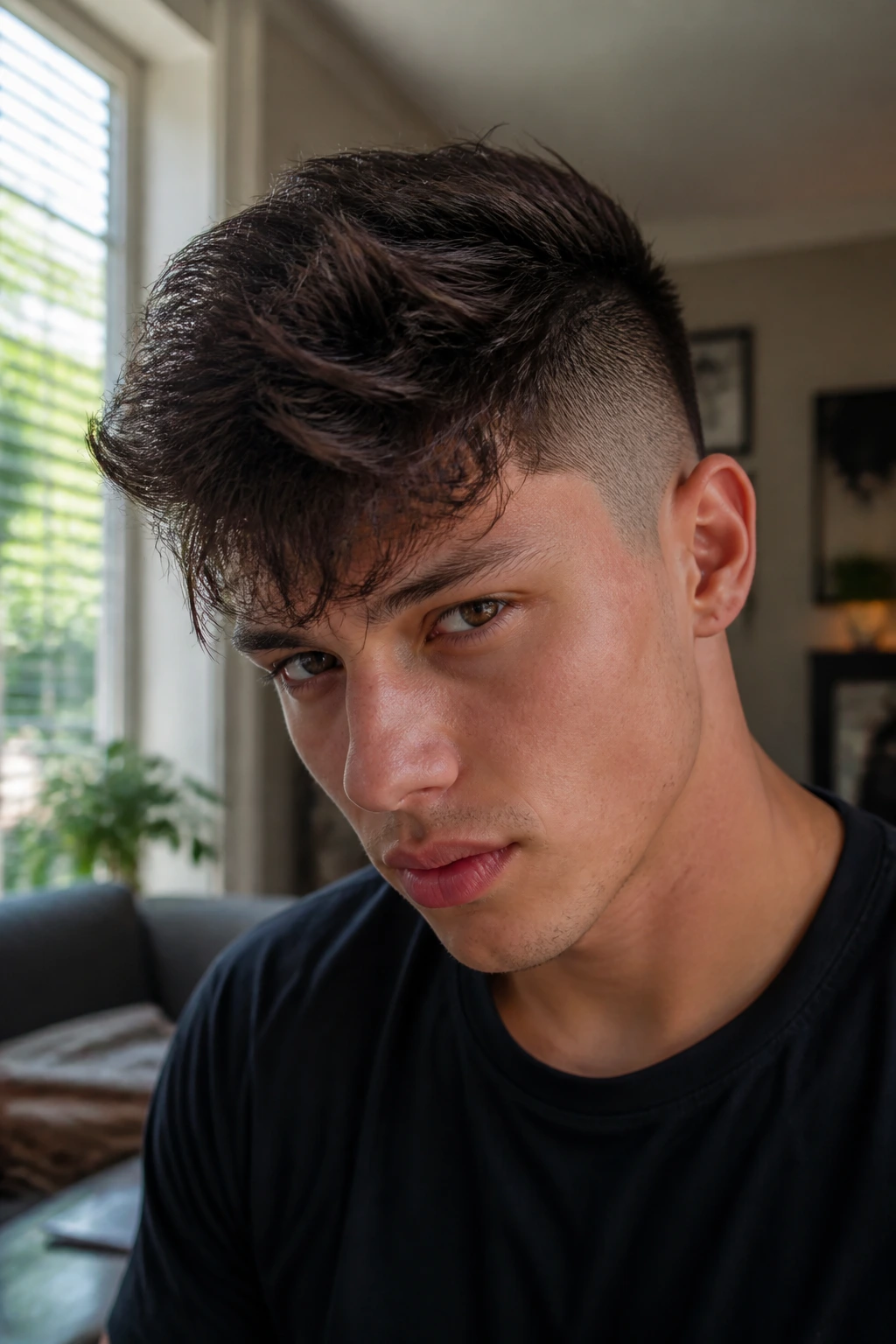
Push the front forward, then lift it. That’s the trick. A fringe-forward mohawk is especially useful on thick hair with a heavier front hairline, because the fringe can be directed into the style instead of fighting it. The result looks younger, a little restless, and less formal than a straight-up crest.
I like this on hair that has a natural bend or a slight wave, since the front can move without needing to stand at attention. The cut also softens a high forehead if that’s a concern. Keep the sides tight and the front textured, or the fringe just lies there and ruins the whole idea.
Small but useful: dry the front forward first, then push it upward with your fingers. If you do the opposite, the hair fights you and loses shape.
24. Rocker-Length Mohawk
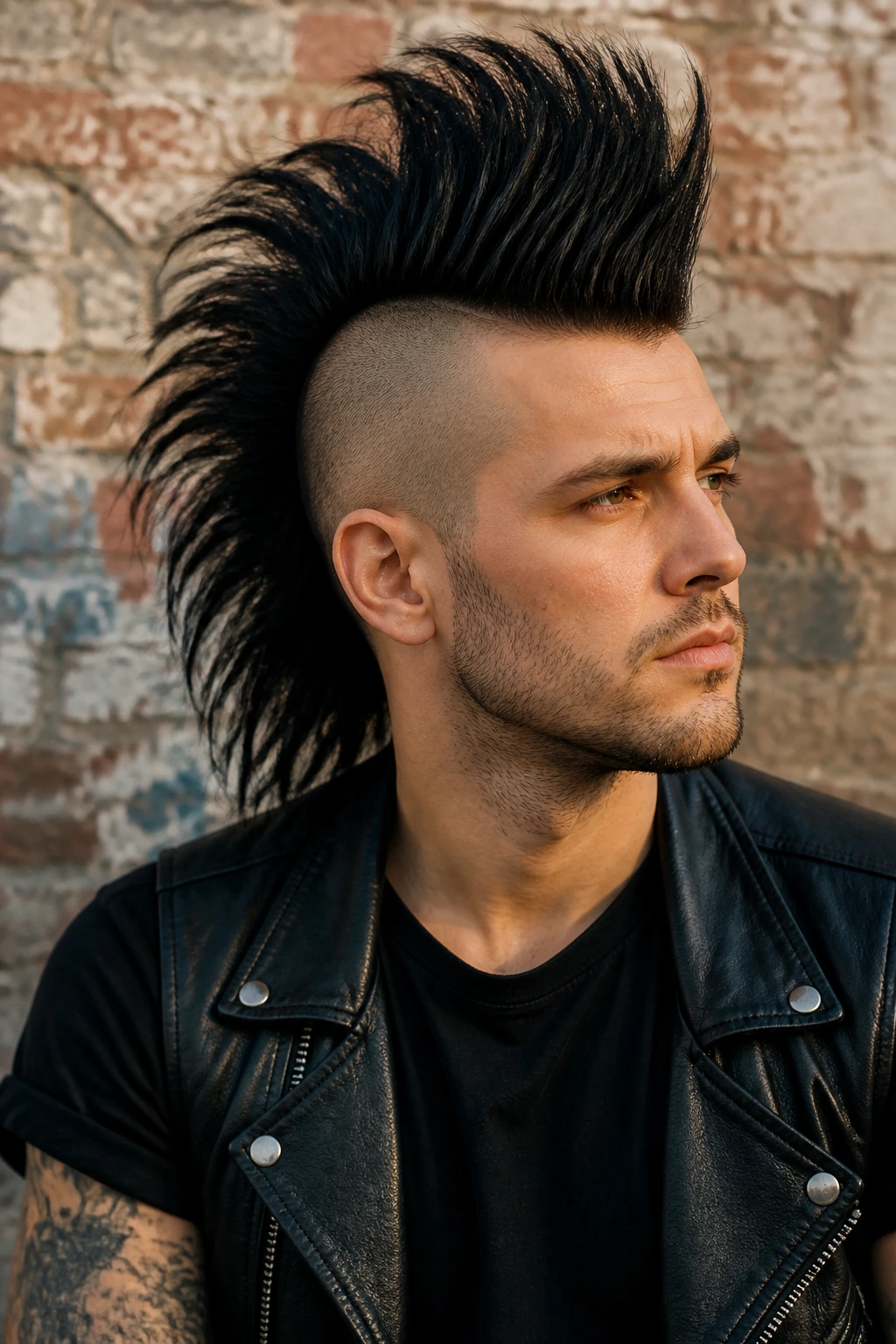
This is the full commitment version. Long on top, narrow on the sides, and loud in the best possible way. Thick hair can carry the length because it has enough density to keep the ridge from looking stringy, but the cut has to be thinned properly or it turns into a heavy block.
The appeal is the silhouette. Long rocker mohawks have movement when you walk, and that movement is half the point. They feel less like a hairdo and more like a stance. If you’re choosing this style, be honest about upkeep. It needs product, shape checks, and a barber who knows how to remove weight without wrecking the line.
If you want a mohawk that announces itself before you do, this is the one.
Why Thick Hair Changes the Mohawk Game
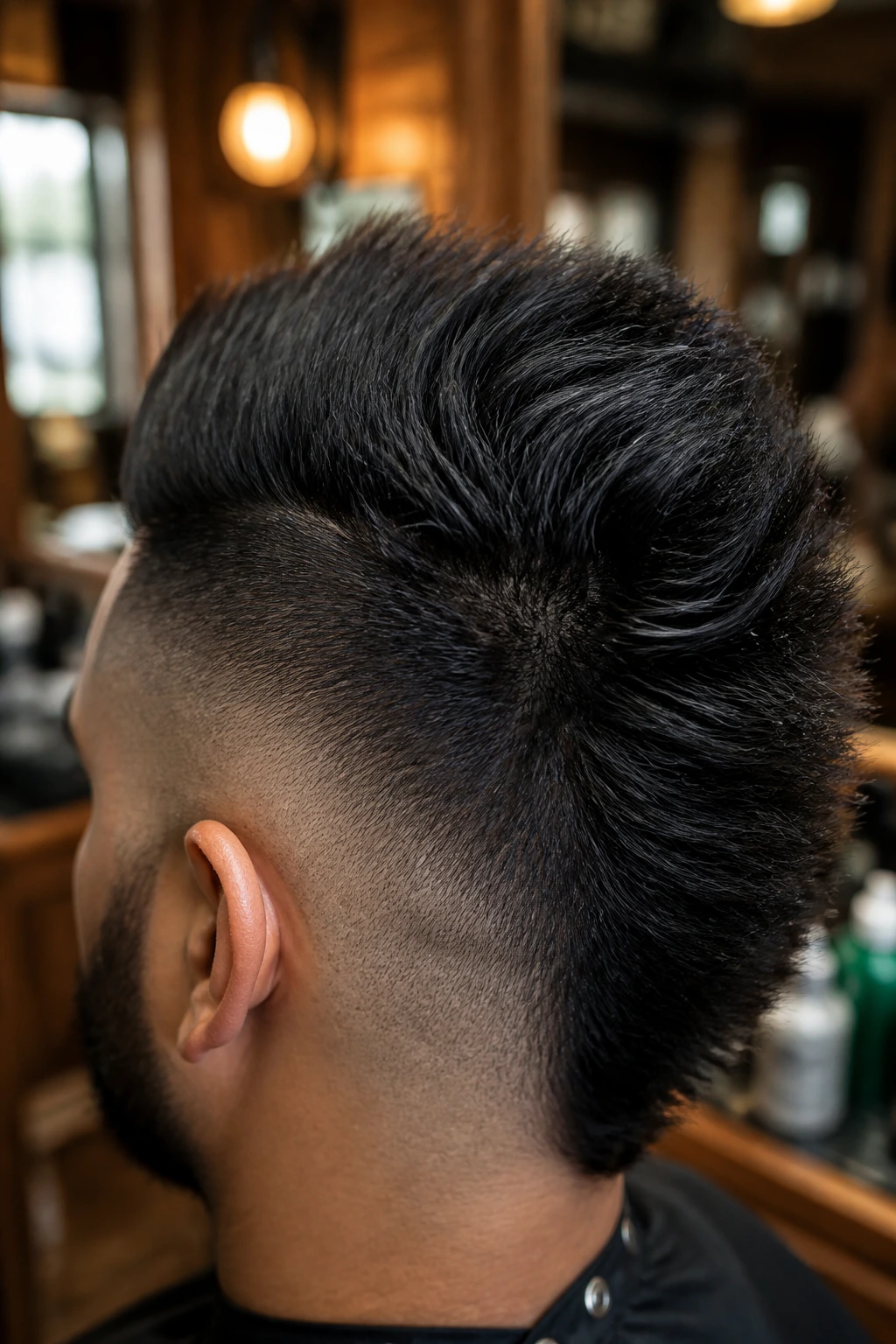
Thick hair behaves like a material, not just a texture. That sounds dramatic, but it’s true. Dense strands have weight, and that weight is the whole reason some mohawks look strong while others look like a puffed-up strip of carpet. The barber has to control both the outline and the bulk inside the outline.
A lot of people focus only on the fade. That’s half the job. The other half is what happens on top and just behind the ridge, especially at the crown where thick hair loves to swell. If that interior mass stays untouched, the mohawk rises in the wrong places and starts tipping sideways. A good cut removes weight in small, careful passes instead of hacking away blindly.
Dry cutting can help here because thick hair often looks taller when it’s dry than when it’s wet. A haircut that seems tame while wet can spring up a full inch once it dries. That’s not a problem if the barber expects it. It is a problem if nobody checks the shape before you leave the chair.
Face Shape, Beard, and Collar Lines Matter More Than People Think
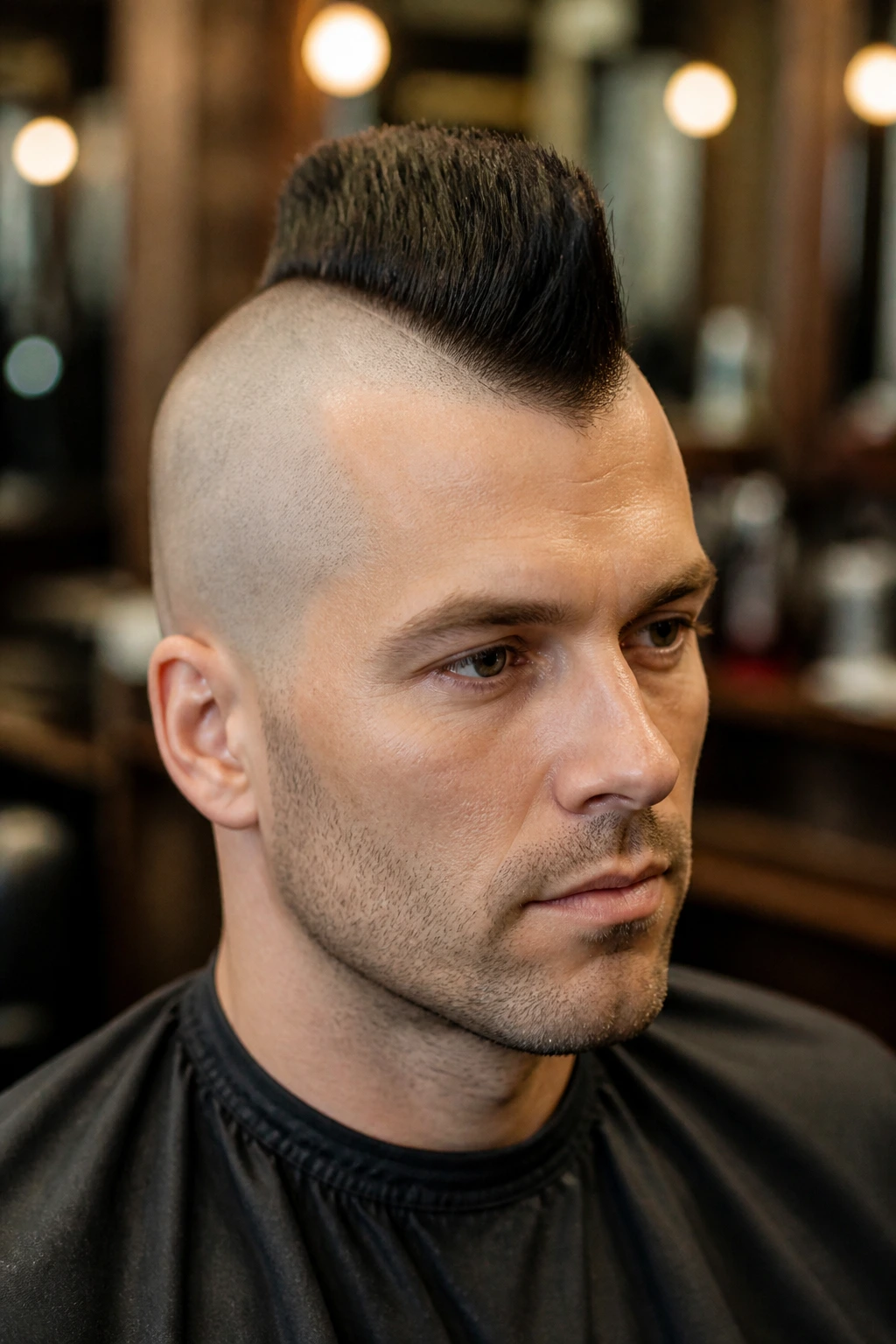
A mohawk does not live in isolation. It sits on a head, near a face, beside a beard, and under clothing that changes the frame. That sounds obvious, but it gets ignored constantly. A round face can handle more height through the center. A longer face usually looks better with a slightly lower ridge and more width through the top. Square jaws can carry a harder, more vertical shape without looking too severe.
Beards change the equation too. A heavy beard with a wide mohawk can look balanced, but only if the fade is crisp where the sideburn meets the cheek. Patchy facial hair plus a huge crest can feel uneven. If the beard is strong, the mohawk can be narrower and taller. If the beard is light, a softer taper often looks cleaner.
Collars matter. Jackets, hoodies, and shirt collars can flatten the nape or make a long tail mohawk kick out awkwardly. If you wear a lot of structured collars, think about how the back of the cut will sit when you move your head.
Essential Tools and Products for Thick-Hair Mohawks
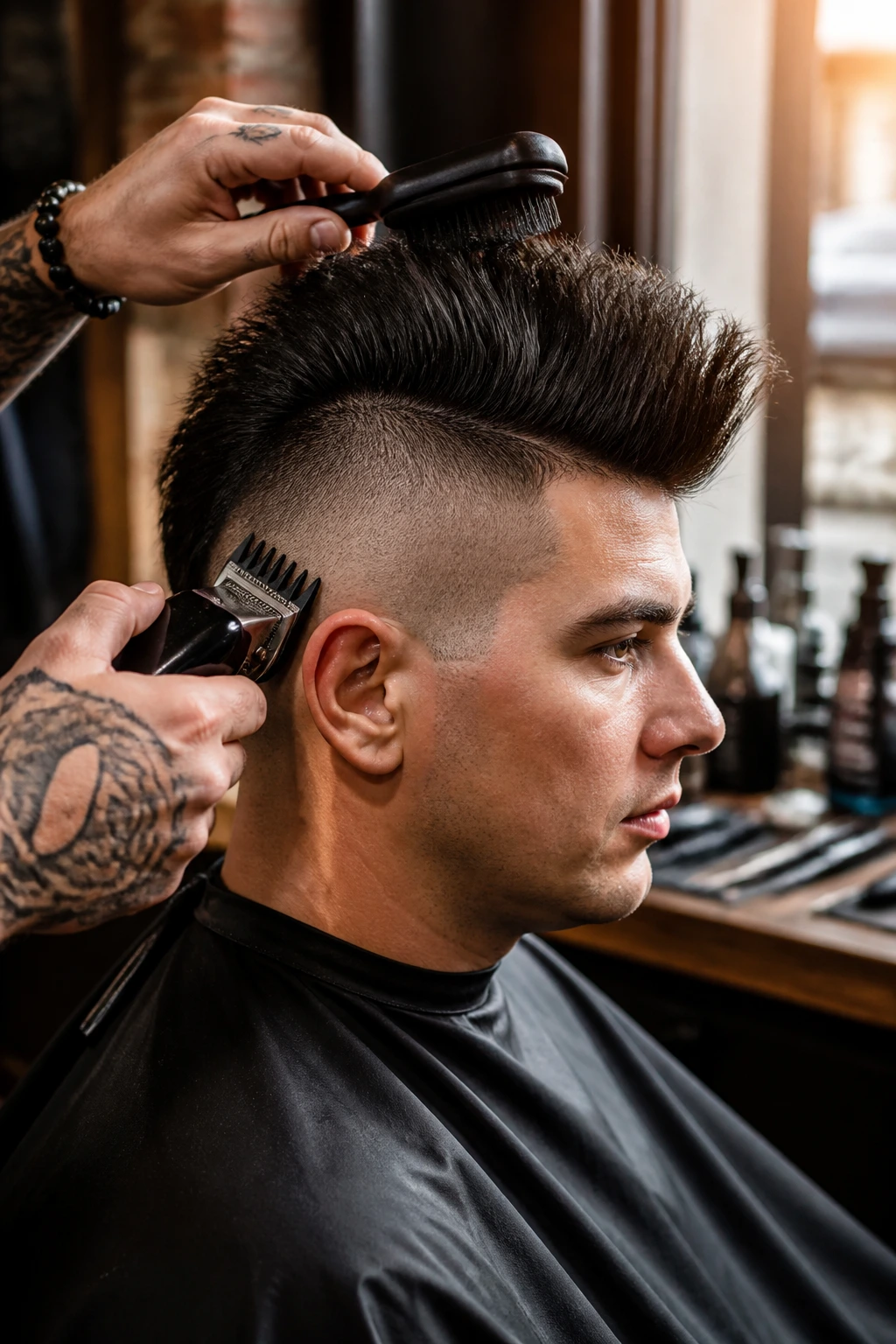
- Clippers with guards from #0 to #4: You need a range that can take the sides down hard and still blend the top cleanly.
- Detail trimmer: This keeps the neckline, sideburns, and temple edges sharp between barber visits.
- Blow dryer with a nozzle: Thick hair needs directed heat so the top lifts instead of frizzing outward.
- Vent brush or round brush: Use this to guide the center strip upward or backward while drying.
- Texturizing or thinning shears: Helpful if your hair is dense enough to bulge in the middle.
- Matte clay or fiber paste: Best for dry, separated texture with a natural finish.
- Strong-hold gel: The better choice for wet-look or sharply spiked versions.
- Sea salt spray: Gives grip before blow-drying and helps coarse hair feel less slippery.
- Leave-in conditioner or curl cream: Useful if your mohawk keeps natural wave or curl.
- Hand mirror: Essential for checking the back line and the fade symmetry at home.
How to Tell Your Barber Exactly What You Want
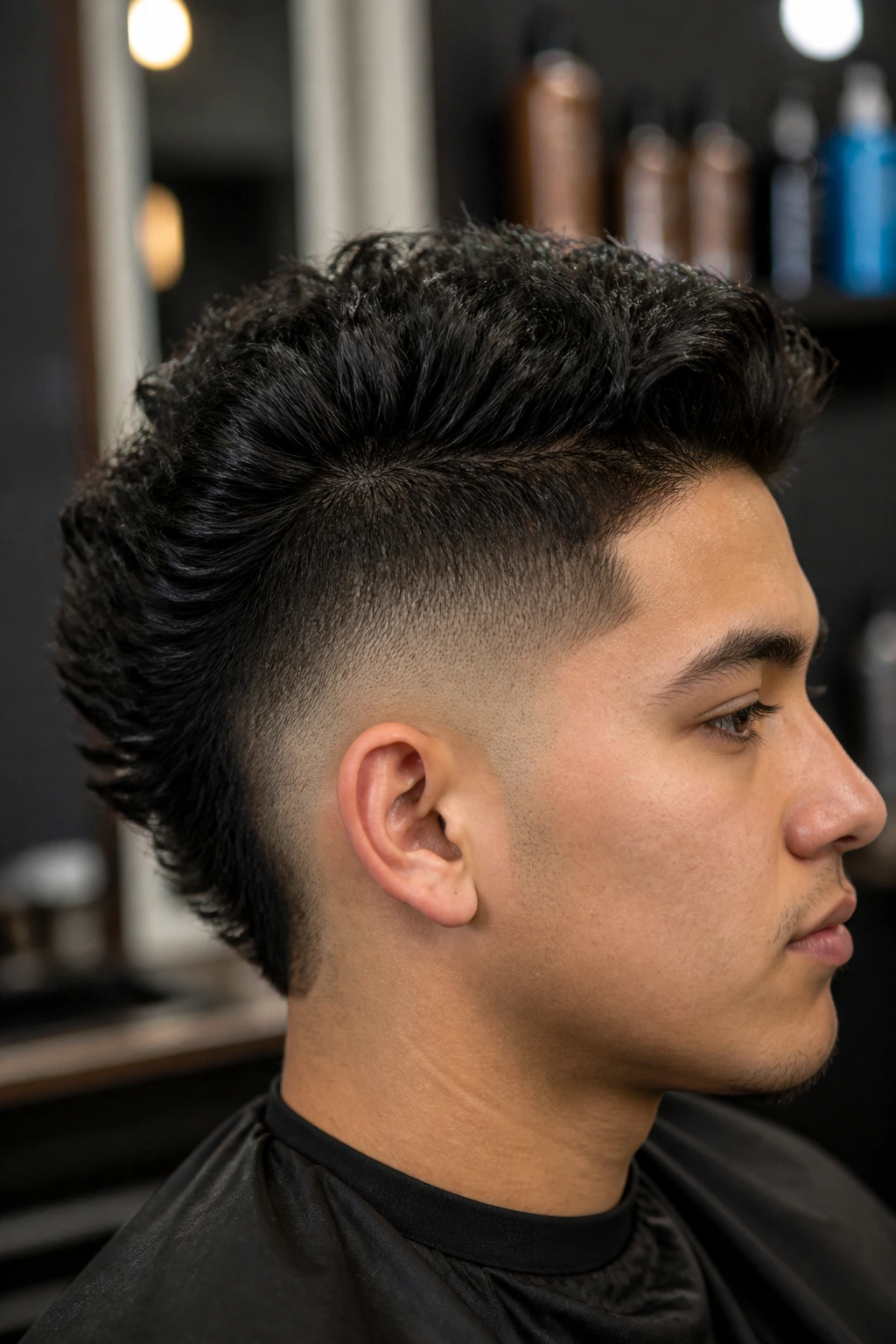
Bring a photo, yes, but don’t stop there. Photos help with shape; words help with technique. With thick hair, you need the barber to understand that you want bulk removed where the hair naturally swells, not just the obvious sides. Say that plainly.
A good way to describe it: keep the center strip narrow enough to stand, clean up the temples hard, and thin the interior if the top feels too heavy. If you want a burst fade, say so. If you want the cut to be wearable down, say that too. Those details change where the weight gets taken out and how aggressive the silhouette will be.
Useful things to mention
- How high you want the ridge to stand.
- Whether you want a skin fade, taper, or undercut.
- How much time you’re willing to spend styling it in the morning.
- Whether your hair tends to puff at the crown or around the ears.
And yes, mention cowlicks. Thick hair often has them, and they can change how the ridge sits. If the barber knows where the hair fights back, the finished cut will behave much better.
Additional Styling Tricks That Make Thick Hair Behave
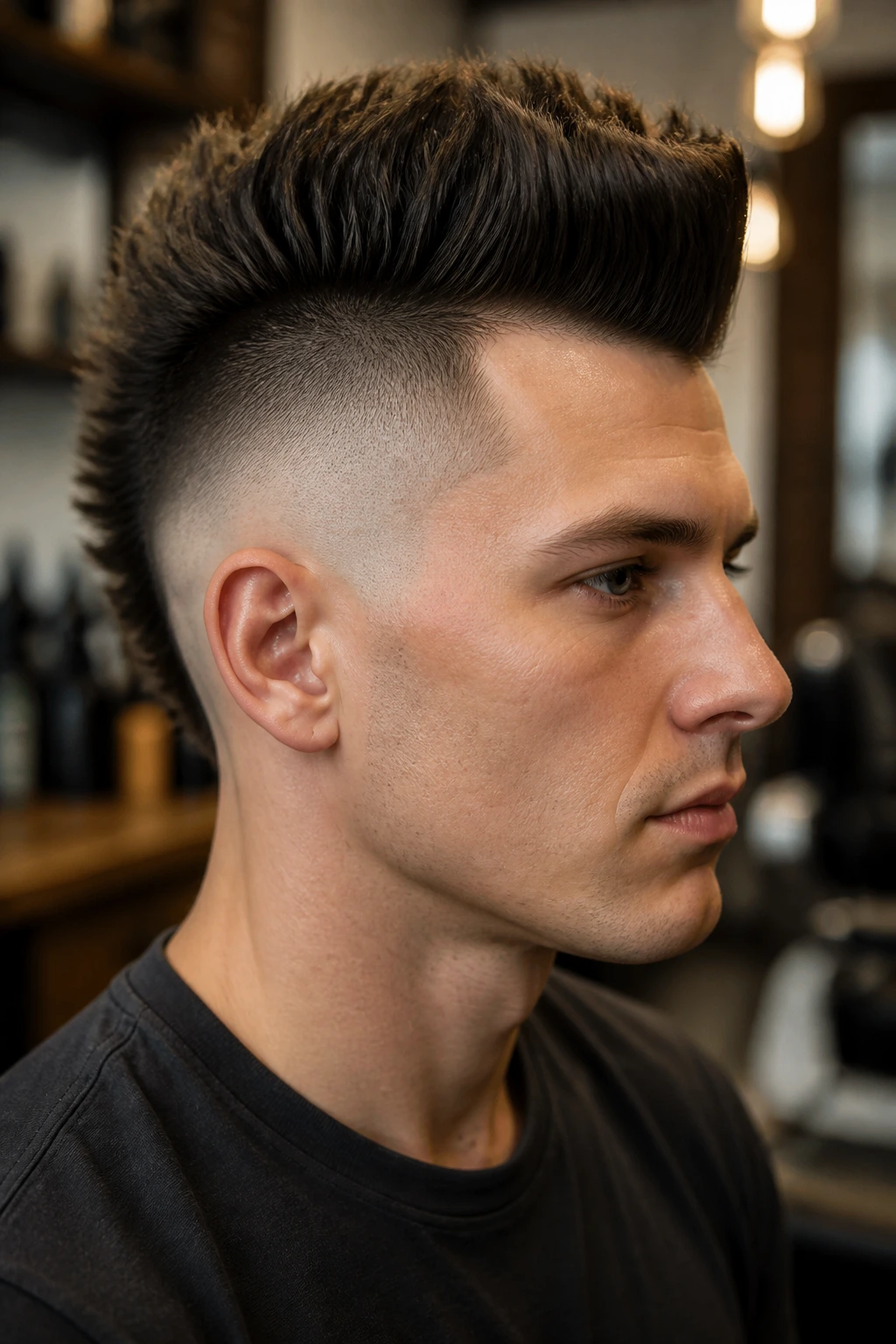
Blow-dry first, product second: That order matters. Thick hair takes shape when it cools in the direction you want, so hit the root lift with the dryer before you add clay, paste, or gel.
Use less product than your hand tells you to use: Thick hair tempts people into overloading the front. Start with a pea-sized amount of matte paste and build. You can always add more; scraping too much product out of a dense ridge is annoying and leaves lumps.
Work the crown separately: The crown usually needs more direction than the front. Lift it, then push it toward the center strip so it doesn’t split open and create that awkward trough that makes a mohawk look tired.
Keep the neckline honest: A mohawk looks sharp only when the back is maintained. A fuzzy nape makes the whole cut feel older than it is. Clean it up every couple of weeks if you want the ridge to stay crisp.
Common Mistakes That Make Thick-Hair Mohawks Look Sloppy
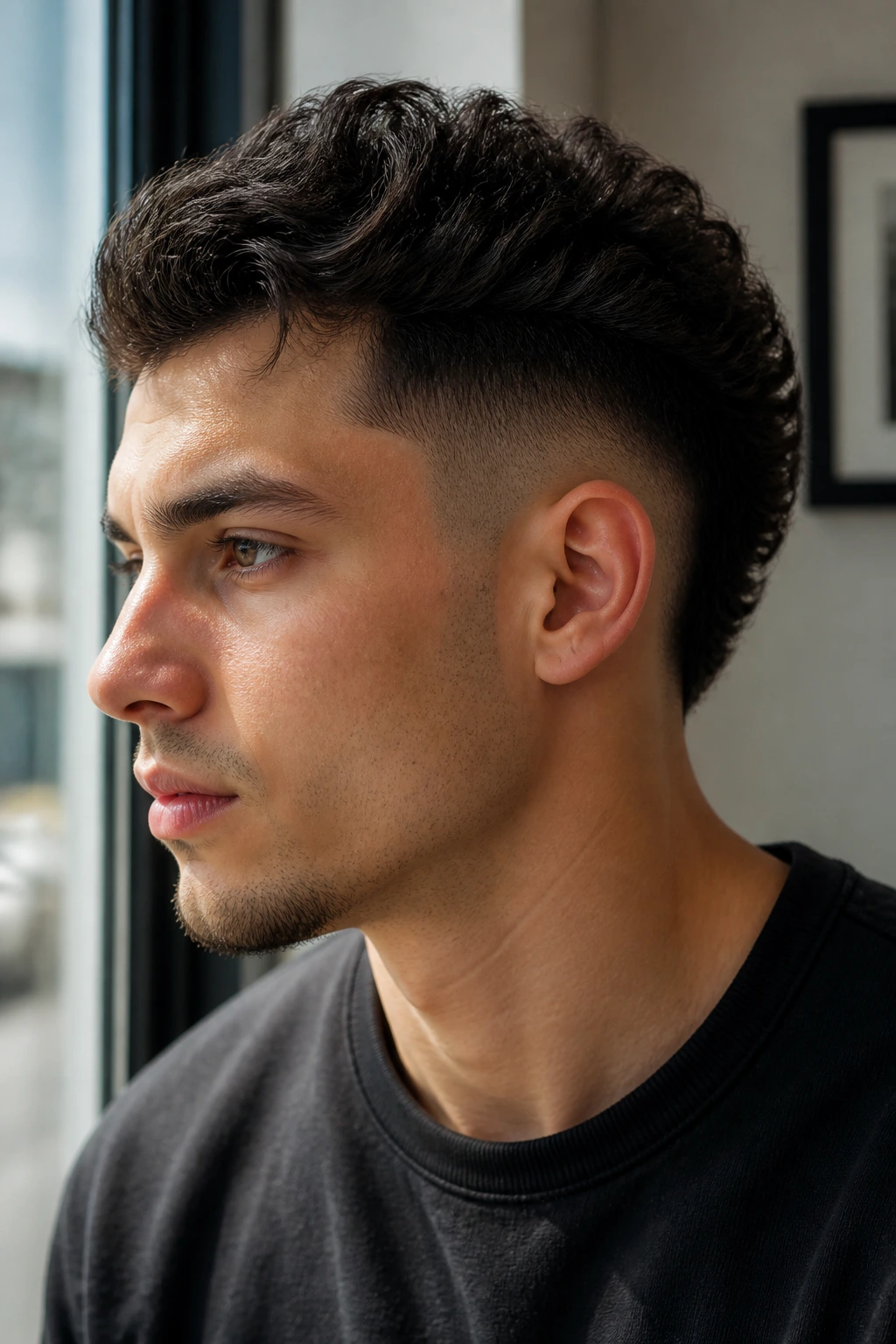
The first mistake is making the strip too wide. Thick hair already has visual mass, so a fat center section can look like a mohawk-shaped helmet. Narrower usually looks better, especially if you want height.
The second mistake is cutting the sides too softly. If the fade or taper doesn’t remove enough bulk around the ears and temples, the shape spreads outward instead of upward. You end up with width where you wanted lift.
The third one is drowning the top in product. Wet gel on thick hair can create a hard shell that flakes later and collapses at the roots. Matte products give you separation; gel should be reserved for the styles that actually need shine.
Another common miss: ignoring the crown. Thick hair often kicks out there first. If the crown is left heavy, the ridge splits and the cut starts looking like it was done from the front only. That’s a bad habit. Fix it by asking for interior weight removal and by blow-drying the crown straight up before shaping the front.
Variations and Adaptations to Try

The Quiet Mohawk: Keep the sides tapered instead of shaved, shorten the ridge, and style it with a low-shine cream. It reads more like a sharp haircut than a punk statement, which makes it easier to wear with a button-down or blazer.
The Full-Volume Punk Strip: Go narrow on the center, tight on the sides, and longer through the crown and back. This is the loud version, and it works best when thick hair is allowed to stand tall instead of being flattened into a polished shape.
The Curly Ridge: Let natural curls form the center line and keep the sides faded clean. This is the best route if your hair resists straight spikes and wants to coil on its own.
The Beard-Heavy Balance: Pair a narrower mohawk with a strong beard lineup and a low fade into the sideburns. The facial hair becomes part of the silhouette instead of competing with it.
The Low-Maintenance Crop: Shorten everything and keep the top textured, not tall. You still get the mohawk outline, but it dries fast, styles fast, and grows out with less drama.
Keeping the Shape Between Barber Visits
Thick hair grows out with opinion. A mohawk can lose its edge fast if the sides start puffing at the temples or the neckline goes fuzzy, so maintenance matters more than people expect. For most fade-based versions, a cleanup every 2 to 3 weeks keeps the outline honest. For longer, softer styles, you can stretch that a little longer, but the neckline still needs attention.
At home, a quick mist of water and a small amount of product is usually enough to revive the ridge. Don’t wash it every day unless you have to; thick hair often styles better with a little natural grip left in it. If you do use heavier clay or gel, a clarifying shampoo every week or two keeps buildup from making the top limp and dull.
Sleep matters too. If the top gets flattened overnight, reshape it in the morning with damp hands and a short blast from the dryer. That’s faster than rebuilding the whole cut from scratch, and it keeps the mohawk from turning into a tired hump by lunchtime.
Thick-Hair Mohawk FAQ
Can thick hair be too thick for a mohawk?
No, but it can be too bulky if the interior weight isn’t removed. The fix is not more product; it’s better shaping through the top and a cleaner fade at the sides.
What length should the top be?
A short mohawk can work at 1.5 to 3 inches, while more dramatic versions often need 4 inches or more. The right length depends on whether you want spikes, a ridge, curls, or a swept-back shape.
Does a mohawk work with straight thick hair?
Yes, and straight thick hair is often the easiest to spike or brush up. It usually needs more texturizing so the top doesn’t sit in one solid block.
What product is best for thick hair?
Matte clay or fiber paste is the safest starting point for most styles because it gives hold without shine. Use gel only when you want a wet finish or a very locked-in shape.
How do I stop the sides from puffing out?
Ask for a tighter fade or a more aggressive taper around the temples and ears. At home, don’t overcondition the roots; soft, heavy hair near the scalp tends to swell more.
Can I wear a mohawk if I have a beard?
Absolutely, and thick hair pairs well with facial hair. The trick is keeping the sideburn and beard connection neat so the whole look feels balanced.
What if my crown sticks up in the wrong direction?
That’s a cowlick problem, not a failed haircut. The barber can cut with it in mind, and you can redirect it with a blow dryer while the hair is still damp.
How often do I need a trim?
For crisp fades, every 2 to 3 weeks keeps the shape sharp. If you’re wearing a longer, messier version, you can go longer, but the neckline and temples still need cleanup.
A Cut With Backbone
A mohawk on thick hair works when somebody respects the weight of the hair instead of trying to brute-force it. That’s the real difference between the styles that land and the ones that look puffy, overgrown, or oddly square. Shape first. Product second. Every time.
The good news is that thick hair gives you room to choose your version. You can go narrow and sharp, curly and loose, braided, wet-looking, beard-heavy, or long and punky, and the hair still has enough substance to carry the outline. Pick the one that matches your routine, not just the one that looks loud in a photo, and the cut will keep earning its keep long after you leave the chair.
