



Curly hair and a round face can be a surprisingly tricky pairing. Not because the face shape is a problem — it isn’t — but because curls have a habit of doing what curls do best: filling space. Add a blunt fringe in the wrong spot, or layers that stop right at the cheeks, and the whole silhouette can start to feel wider than you wanted. The fix is not to fight the curls. It’s to give them a cut that knows where to open up, where to fall forward, and where to keep the eye moving.
The best curly haircuts with bangs for round faces do one very specific job: they add shape without boxing the face in. I’m always more interested in the way a fringe moves when it dries than the way it looks in the salon mirror. A bang that lands at the brow wet can spring to the bridge of the nose dry. A layer that seems harmless at the chin can puff straight out at the widest point of the cheeks. That shrinkage math matters.
What works, in practice, is pretty consistent. You want some height at the crown, some length below the chin, and a fringe that breaks up the forehead instead of drawing one hard line across it. The 25 cuts below handle that idea in different ways — some soft, some sharp, some low-drama, some with a little swagger. A few are for fine curls. A few are for dense coils. And a few are the sort of cuts that make you wonder why anyone ever told curly hair to play small.
Why These Curly Haircuts With Bangs for Round Faces Work
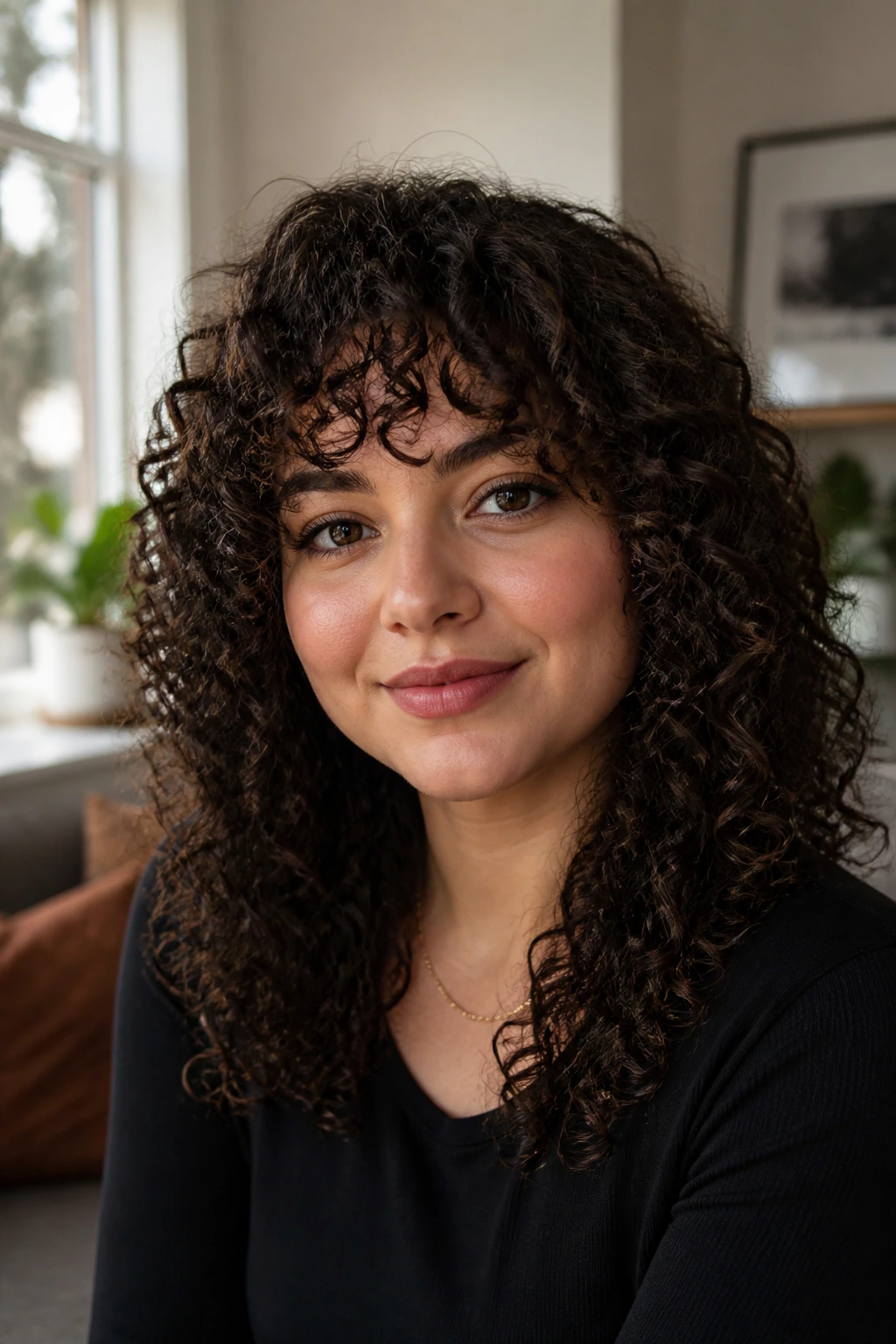
Vertical length beats horizontal width.
A round face usually looks longest when the eye is pulled up and down, not side to side. That’s why collarbone lengths, crown volume, and front pieces that taper past the cheeks tend to work better than one solid curve sitting at jaw level.
Broken bangs are kinder than a hard line.
A fringe with separation — curtain bangs, bottleneck bangs, side-swept pieces, or even a soft, uneven fringe — keeps the forehead from turning into one broad block. I like this especially on curls, because the texture already gives you movement for free.
Shrinkage is part of the design.
Curly bangs do not stay where they are cut. A curl that looks like eyebrow length when wet can rise an inch or more as it dries. That’s not a mistake; it’s the reason dry cutting or dry refinement matters so much on this face shape.
The best cuts keep fullness away from the cheeks.
That doesn’t mean flattening the sides into submission. It means placing the heaviest visual weight either above the cheekbone or below the chin, so the widest part of the face doesn’t get crowded.
These styles still look like hair on a normal Tuesday.
A good curly cut should survive air-drying, diffusing, and the occasional rough morning. If it only looks right after an hour in front of a mirror, it’s too delicate for real life.
1. Collarbone Curly Shag with Curtain Bangs
A collarbone shag is one of those cuts that quietly does the work. The ends sit low enough to stretch the face, while the layers at the crown add lift where a round face can use it most. Curtain bangs are the move here because they open in the center and skim past the cheekbones instead of landing like a curtain wall across the forehead.
I like this shape on loose curls and medium curls especially. Ask for the shortest face-framing pieces to start around the bridge of the nose or just below it when dry, not wet. If the stylist goes too short, the bangs can spring up and sit awkwardly above the brows. That is fixable. But it is better not to play that game.
The charm is in the movement. The shag keeps the curls from bunching into one heavy shape at the sides, and the collarbone length means the silhouette doesn’t stop at the jaw. If you wear your hair air-dried, this cut still has enough texture to look intentional. If you diffuse, the crown lift gives you even more length through the face.
2. Long Layered Curls with Side-Swept Bangs
If you want to keep your length and still soften a round face, this is the safest bet. Long layers stretch the silhouette, and side-swept bangs break the face shape on a diagonal, which is exactly what a round face likes. Diagonals do not feel flashy here. They just work.
This cut shines on curls that fall somewhere between loose spirals and medium coils. The side bang should not be chopped into a neat, straight slice. It needs some softness at the ends so it can blend into the rest of the cut. I’d ask for the longest edge of the fringe to graze the cheekbone or upper lip dry, because that length gives you room for shrinkage and for change.
What I like most is that it doesn’t scream “I got bangs.” It just makes the face look a little slimmer and the curls look more fluid. If you’re cautious about fringe, this is the place to start.
3. Curly Lob with Piecey Fringe
A curly lob earns its keep by landing below the chin. That matters. The chin is often where a round face needs the visual break, and a lob that ends just under it pulls the eye downward instead of parking it right at the widest part of the cheeks. Piecey fringe keeps the front from looking heavy.
The fringe should be broken into small curl clumps, not one solid section. Think airy, not sparse. That little openness at the forehead keeps the style from turning square or bulky. It also makes the cut easier to wear with glasses, because the bangs can live around the frames instead of sitting on them.
I like this on tighter waves and curls that want structure but not a lot of length. It feels tidy without getting stiff. And if your curls are the kind that inflate on day two, a lob gives you enough weight through the ends that the shape stays calm instead of puffing outward.
4. Shoulder-Length Deva Cut with Face-Framing Bangs
A Deva cut is built around the curl pattern itself, which is why it’s so good on round faces. Instead of forcing all the hair into one blunt outline, the stylist works curl by curl, usually dry, and places the layers where the hair naturally wants to spring. That lets the face-framing bangs do something useful instead of just hanging there.
The front pieces should begin around the cheekbone and gradually lengthen toward the jaw. Not all at once. That slow shift creates a contour effect without looking carved up. If the bangs are too short or too full, they can crowd the forehead and widen the top of the face. The point is to open, not cap.
This is one of my favorite shapes for curls with mixed density, because the dry cutting approach shows you exactly where the hair lives. The result usually looks lived-in from day one. No helmet effect. No stiff line. Just curls that fall where they should.
5. Wolf Cut with Airy Curtain Bangs
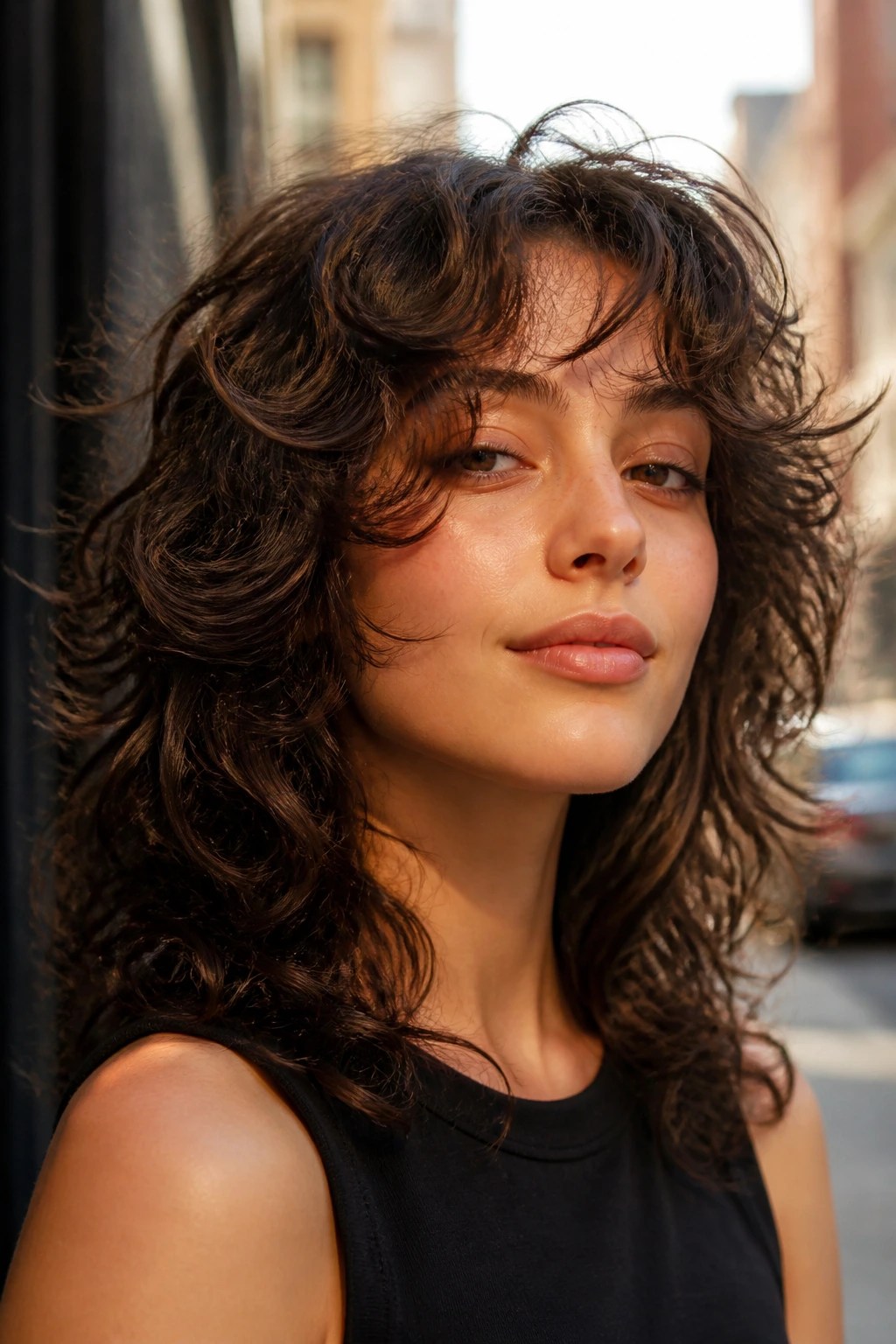
The wolf cut can look a little wild in the wrong hands. In the right shape, though, it gives a round face something it often needs: lift at the crown and movement around the face without extra bulk at the cheeks. The airy curtain bangs are the part that keeps it from going full triangle.
What matters here is restraint. The top pieces should be short enough to create height, but not so short that the crown turns fluffy in a bad way. The sides need to stay long enough to keep the width below the cheekbone. That balance is what makes the cut read edgy instead of noisy.
I’d suggest this more for people who like a little attitude in their haircut. If you want polished and quiet, skip ahead. If you want texture, separation, and the kind of fringe that falls open with a finger comb, this one has real energy. It looks best when the bangs are a little imperfect.
6. Curly Pixie with Wispy Fringe
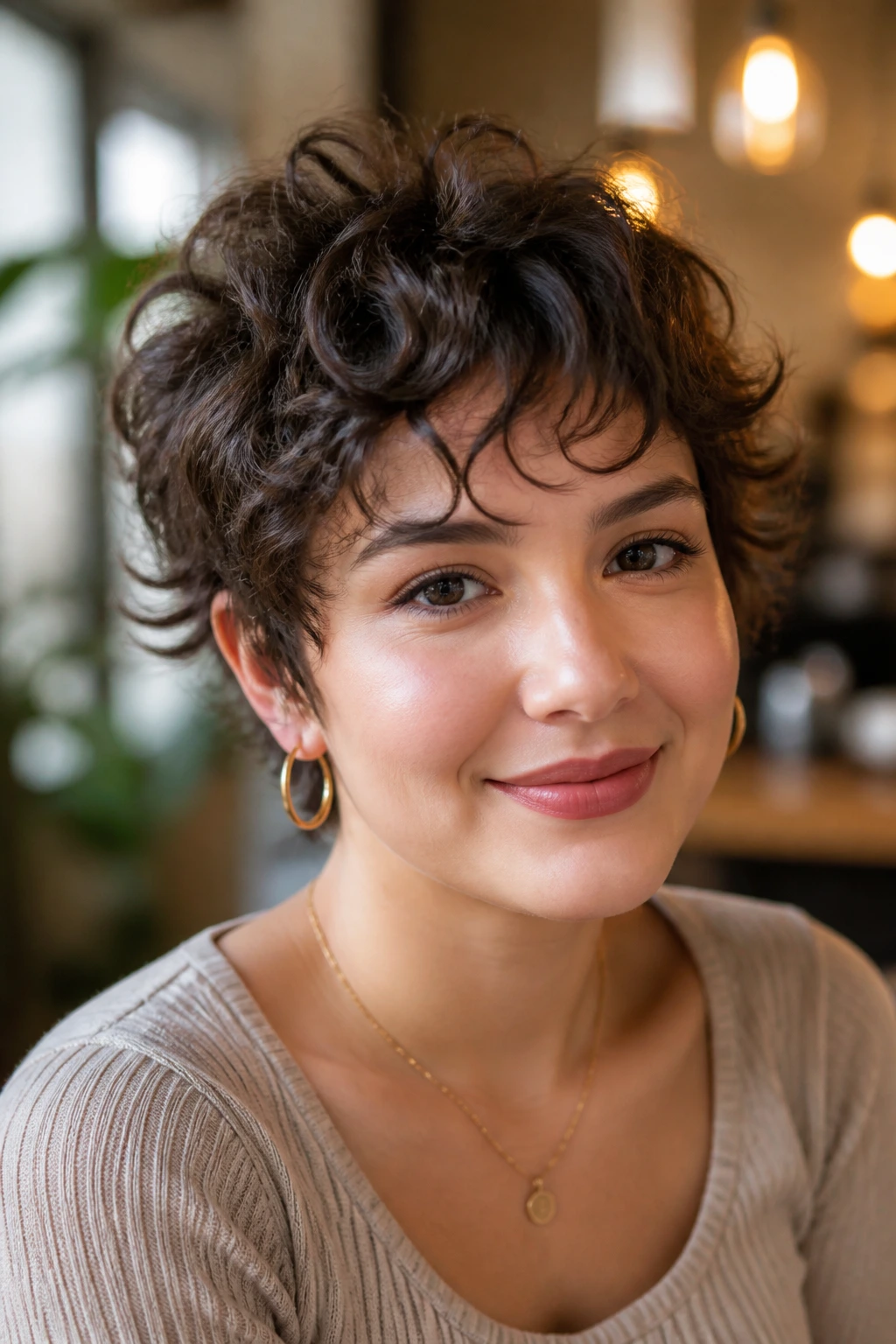
Short hair can absolutely flatter a round face, but only if the cut has intent. A curly pixie with wispy fringe works because it leaves lift at the top and softness at the forehead. The fringe should be airy enough to break the line, never dense enough to turn into a little curtain that makes the face look wider.
The trick is in the contrast. Keep the sides tapered, let the top grow a touch longer, and keep the fringe feather-light. That creates vertical movement, which is the whole game with round faces. A blunt pixie with heavy bangs can shorten the face fast. A wispy one does the opposite.
This cut is also one of the easiest to style if you’re tired of a long routine. A little curl cream, a quick finger shake, and some root lift are usually enough. It’s not a lazy cut. It’s a smart one.
7. Chin-Length Curly Bob with Swoop Bangs

A chin-length bob sounds risky for a round face, and honestly, sometimes it is. The cutoff point at the chin can widen the face if everything is rounded and uniform. That’s why the swoop bangs matter so much here. They break the outline and direct attention diagonally instead of straight across.
The bob itself should have slightly longer front corners. Not dramatic angles. Just enough length to keep the sides from ballooning right beside the cheeks. The fringe should sweep from a deeper side part, with some softness so it doesn’t look stiff or overworked.
I’d choose this cut if you like a tidy outline and you’re comfortable with regular styling. It has shape. It has personality. But it does ask for a little attention in the morning, especially if your curls shrink hard or your hairline has a stubborn cowlick.
8. Rounded Afro with Soft Fringe
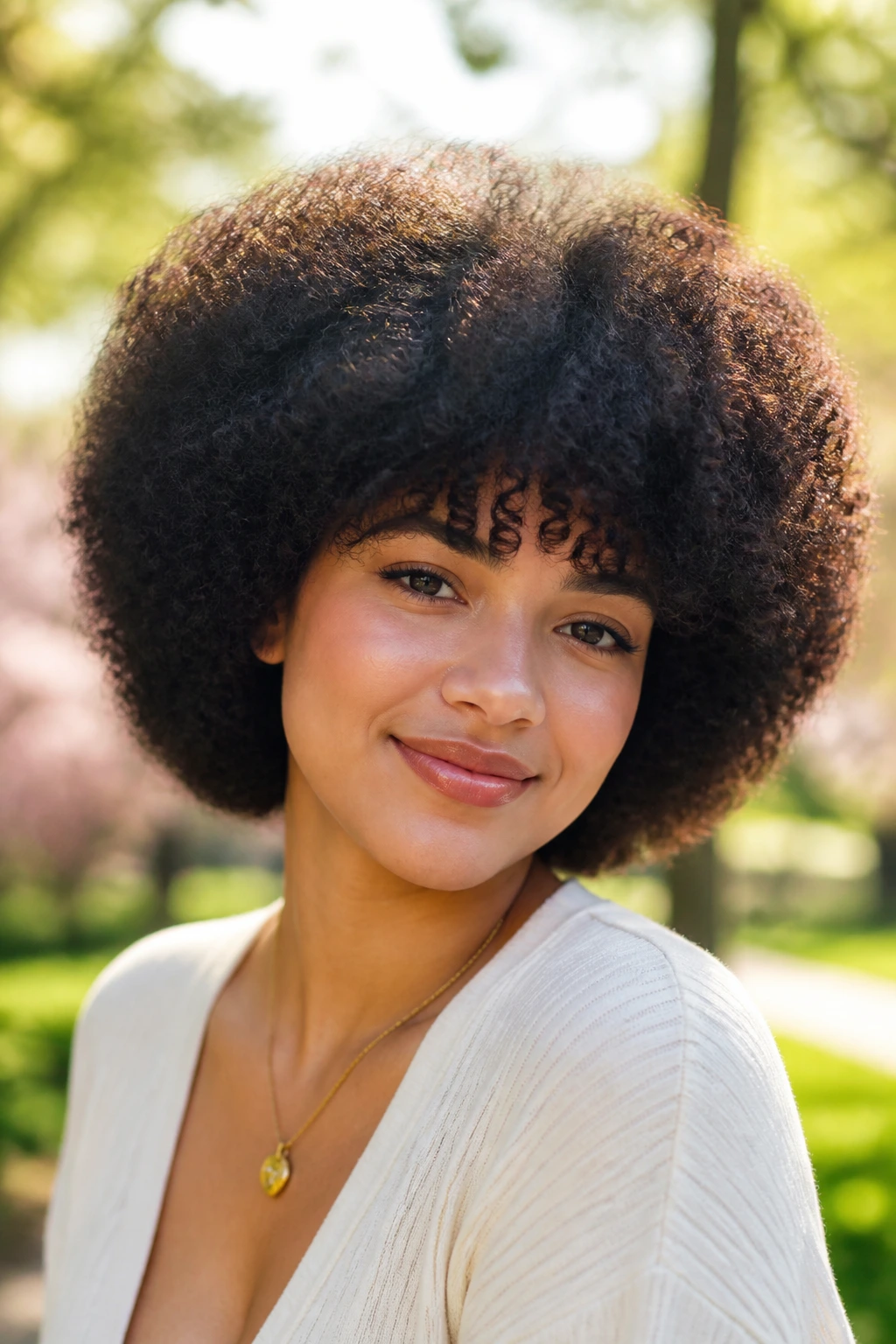
A rounded afro does not have to mean a perfectly circular shape. In fact, that’s the part I’d avoid on a round face. What you want is height at the crown, softness at the sides, and a fringe that breaks forward just enough to frame the forehead without building width at the temples.
Soft fringe on coils is usually better when it sits a little longer than you think. Let the curls fall and breathe. A tight, heavy line across the front can make the whole shape feel compact. But when the fringe is feathered and allowed to separate, it adds texture without stealing space from the face.
This style is especially good if you love volume and do not want to smooth it away. The shape should feel lifted, not widened. That distinction matters. Big hair can be flattering here, but only when the top gets more visual attention than the sides.
9. Butterfly Cut with Curtain Bangs
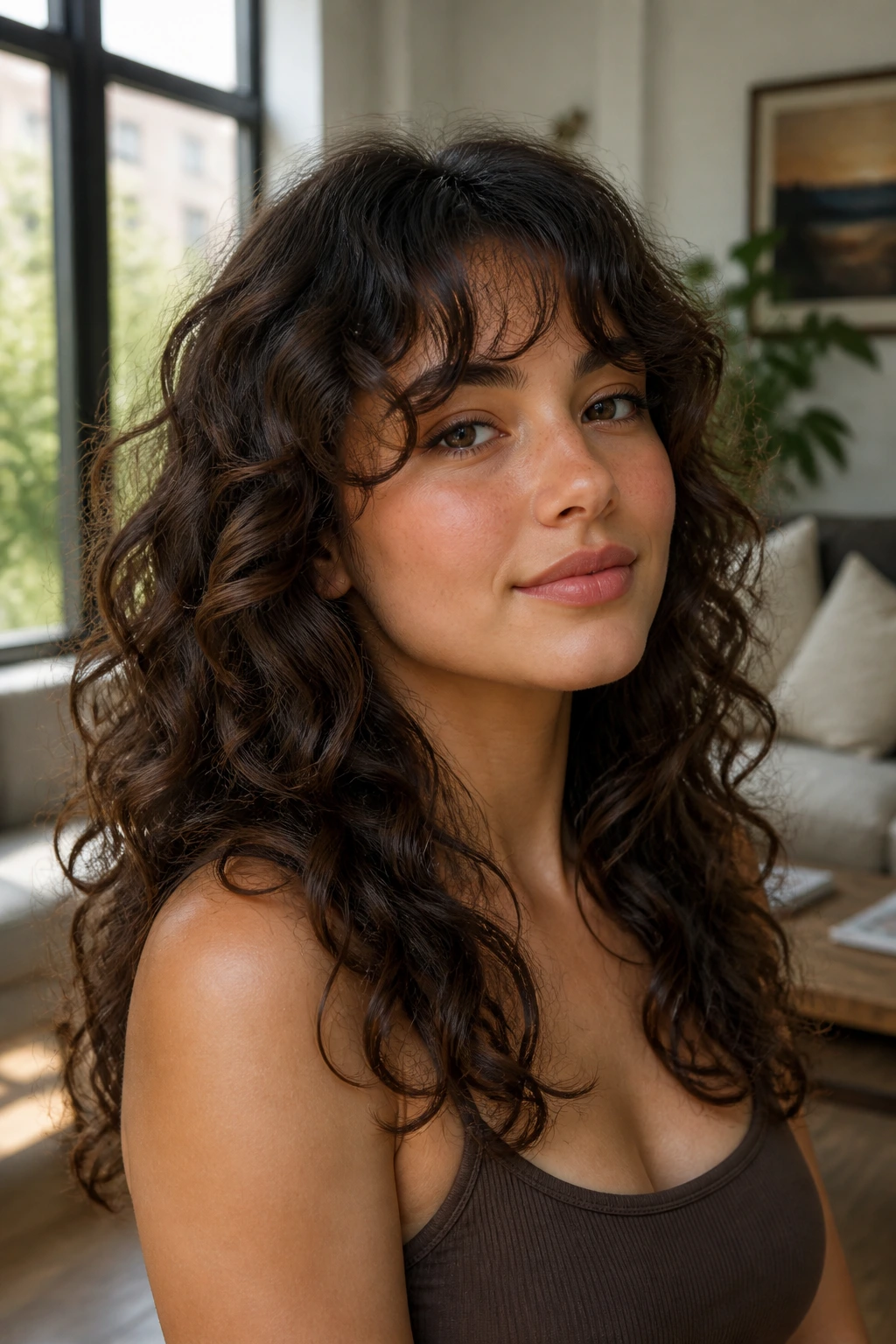
The butterfly cut keeps the length while building a lighter frame around the face, and that’s a useful combination for round faces. The upper layers give you movement near the cheekbones, while the longer layers below keep the silhouette stretched out. Curtain bangs fit into that structure almost too easily.
I like this cut for medium-to-long curls that need bounce without losing their length. The face-framing pieces should start high enough to create that fluttery effect, but not so high that they become a short fringe in disguise. A little softness near the temples goes a long way here.
The whole point is movement. Not volume for its own sake. The hair should seem to fold open around the face rather than sit on top of it. If your curls have a strong spring, this cut gives that spring somewhere elegant to land.
10. Tapered Curly Cut with Brow-Skimming Fringe
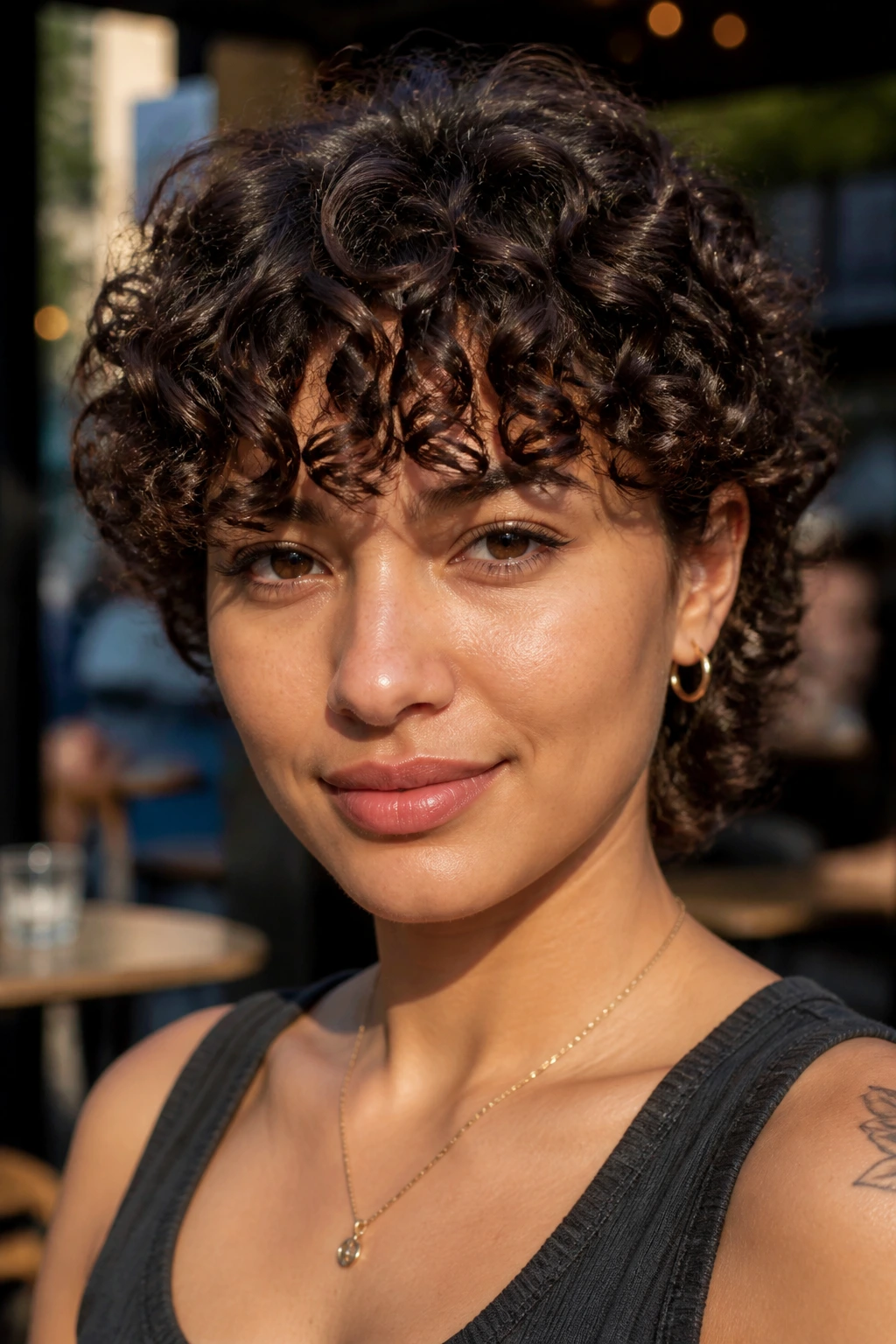
A tapered curly cut reduces the visual weight around the sides, which is one reason it works so well on a round face. The sides and nape sit tighter, while the top stays fuller and the fringe stays soft. That contrast gives you the lengthening effect without needing to drag the hair long.
Brow-skimming fringe can be lovely here, but only if it’s cut with shrinkage in mind. I would want it a touch longer than the brow when dry, especially if the curls are springy or humid air makes them bounce. A heavy, boxy fringe defeats the whole purpose.
This is a strong option if you have dense curls and want shape more than softness. It can look clean, cool, and a little unexpected. And because the taper removes side bulk, the face stays more open. That’s the win.
11. Asymmetrical Curly Bob with Long Side Bangs
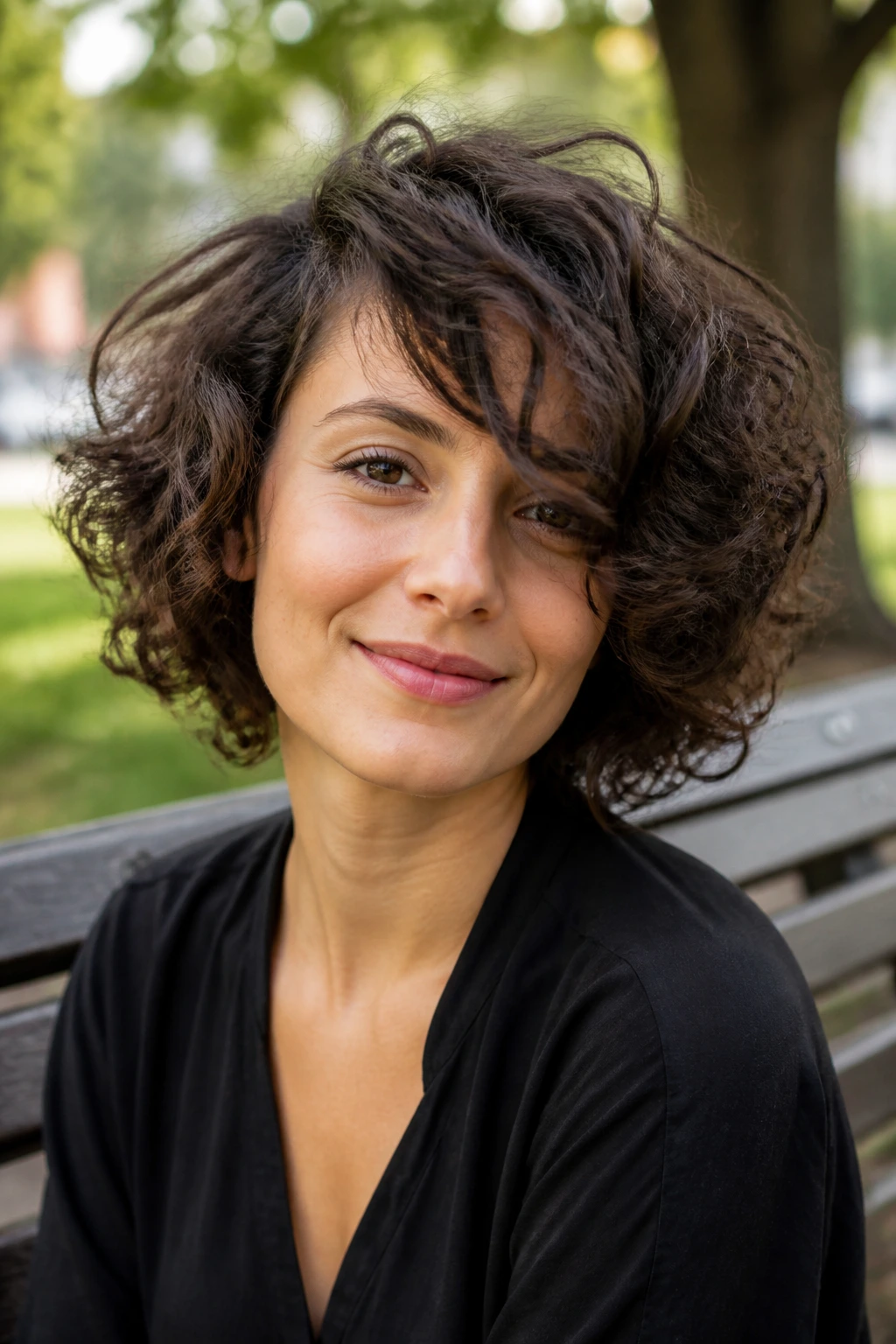
A small asymmetry changes the whole mood of a round face. The longer side creates a diagonal line that moves the eye across the face instead of around it, and that alone can make the cheeks look less dominant. Long side bangs are the anchor that makes the shape feel deliberate.
The bob should not be pinched too high at the chin. Keep one side slightly longer, let the front pieces fall with some bend, and make sure the side bang lands at or past the cheekbone. If it ends right on the widest part of the face, the effect gets muddy fast.
I love this cut when someone wants a little drama without giving up curl texture. It has enough structure to feel styled, but it still reads as soft. That blend is hard to beat.
12. U-Shaped Cut with Split Bangs
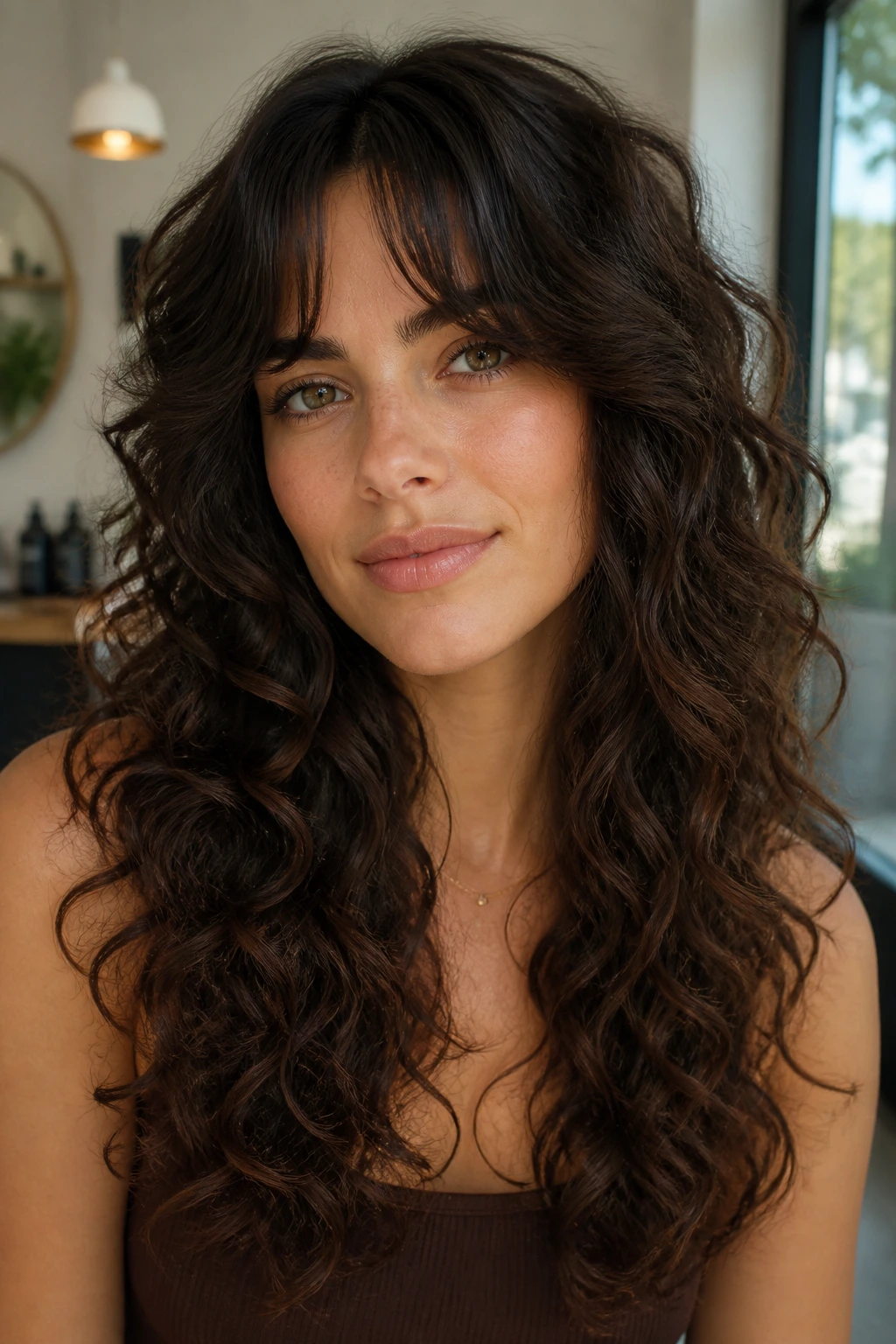
A U-shaped cut keeps the longest weight in the back and lets the front frame stay softer, which helps a round face look a little longer. Split bangs do their part by opening the forehead in the middle and framing the sides rather than covering everything at once. There’s less blockiness. More air.
This cut works especially well on long curls that start to look shapeless when everything is the same length. The U shape gives the curls somewhere to fall, and the split fringe keeps the face visible. If you wear a center part but hate straight bangs, this is the cousin I’d hand you first.
It’s also a good choice for people who want grow-out-friendly bangs. Split fringe tends to age better than a blunt straight-across line. By the time it grows out, it already looks like face-framing layers. That’s not an accident. It’s the whole point.
13. Rezo Cut with Blended Front Layers
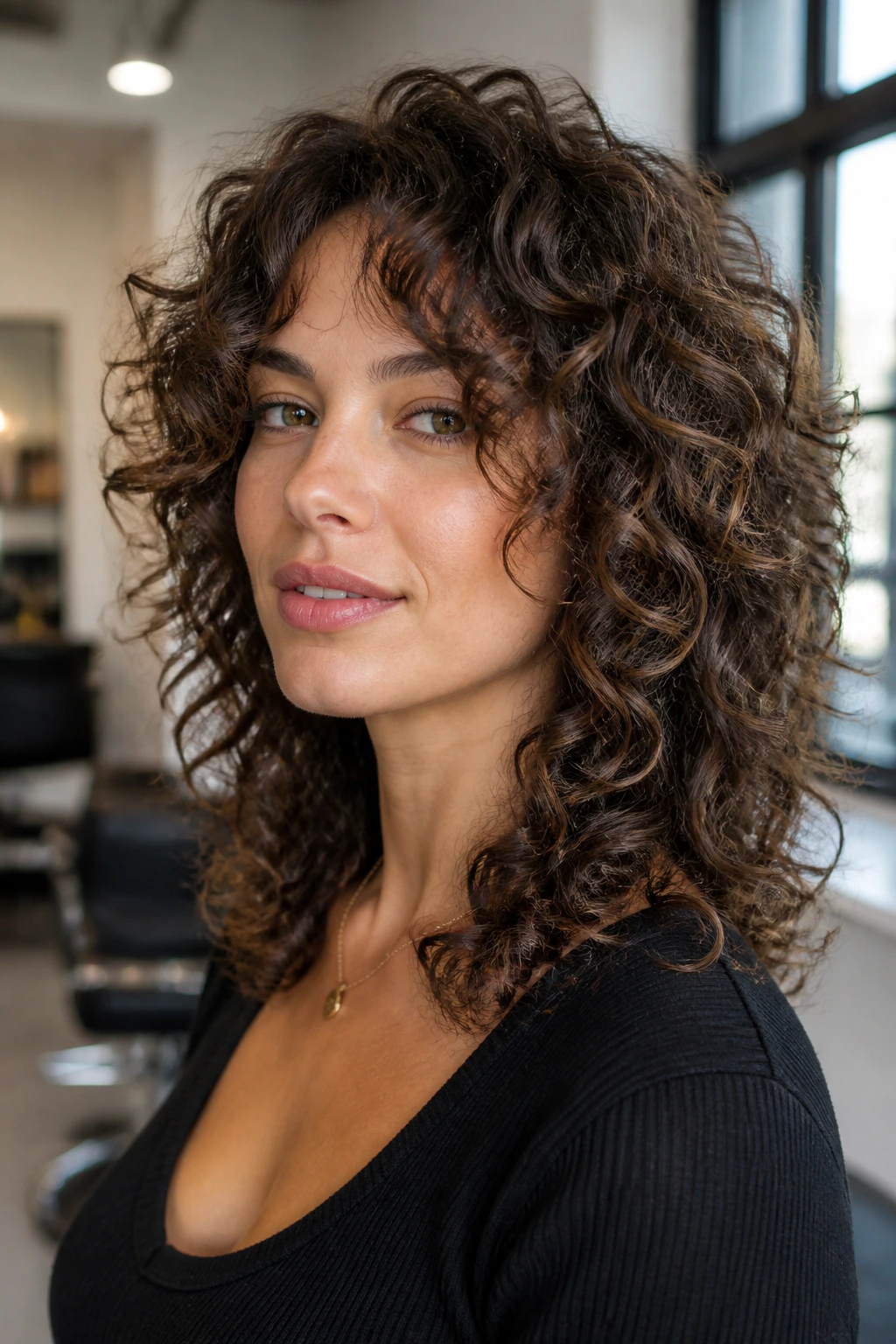
The Rezo cut has a clean logic to it: it balances the curl pattern around the head so the shape looks even when the curls dry. On a round face, that balanced perimeter is useful because it stops the sides from becoming too heavy while still keeping the curl clumps intact.
What I like about this cut is the front. The blended layers near the face do not hit like hard steps. They dissolve into the rest of the cut, which keeps the cheek area lighter. If you want a fringe effect without obvious bangs, this is a smart route.
Ask for the front to be shaped with your actual dry curl pattern in mind. That matters more than almost anything else here. A Rezo cut that respects shrinkage usually looks expensive without trying too hard. And yes, I mean that in the plainest way possible: it just sits well.
14. Feathered Shoulder Cut with Face-Framing Bangs

Feathering is a useful word here because it tells the stylist you want softness, not a blunt outline. On a round face, feathered shoulder-length curls can take some of the mass off the sides while keeping enough length to stretch the face. The face-framing bangs then pull the eye inward and downward.
This style is a good middle ground if your hair is thick. It avoids the puffed-out triangle that can happen when curls are one length through the shoulders. The feathering keeps the curl clumps from stacking into a broad wall near the cheeks.
I’d choose this cut if you want something wearable without feeling plain. It has a little movement. It has some polish. And because the bangs blend into the front layers, the cut is forgiving on busy mornings.
15. Curly Mullet with Soft Fringe
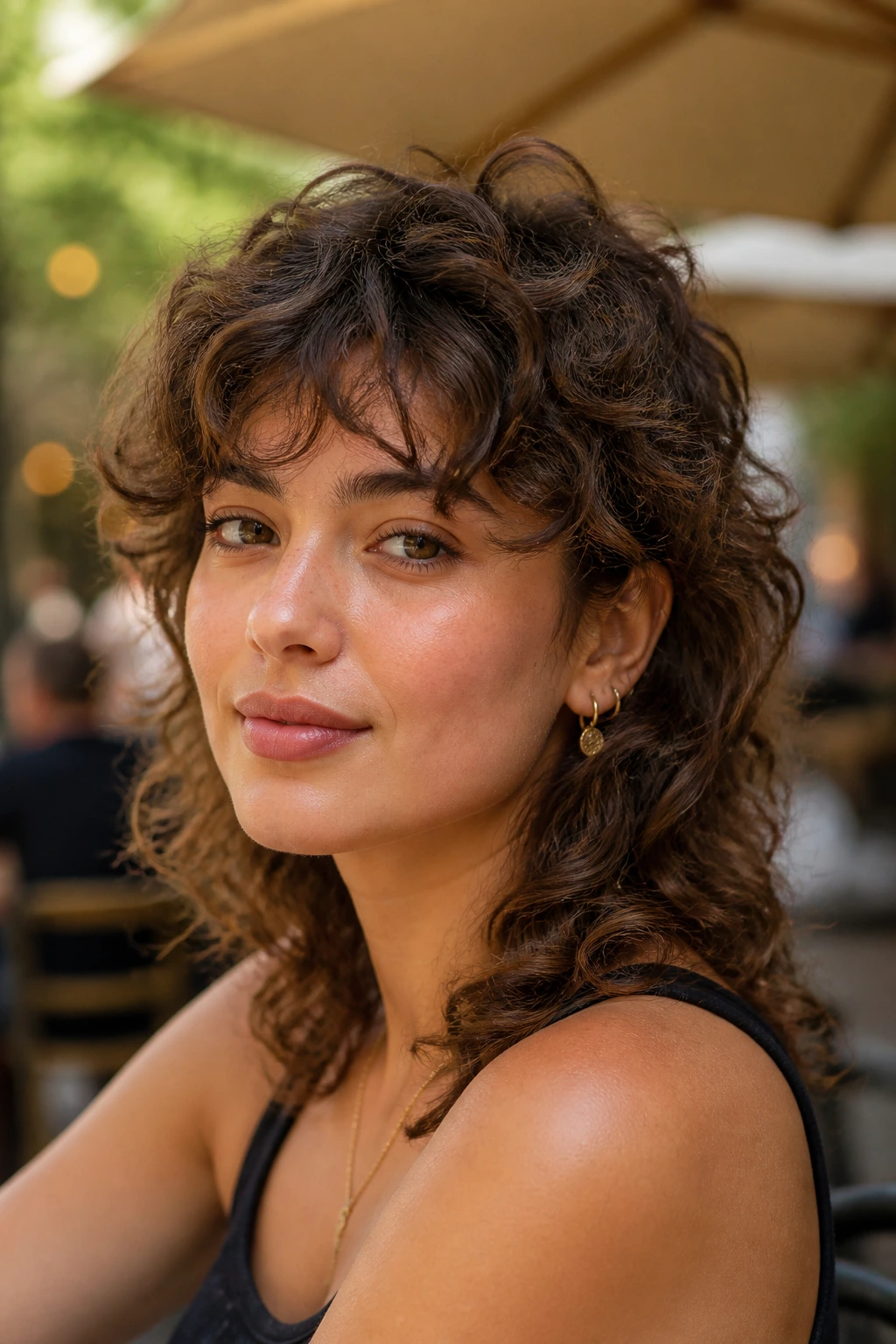
The mullet sounds cheeky, and fair enough. But on curly hair, it can be a very smart shape for a round face because it keeps volume where it helps and pulls length where it counts. The top and crown stay lively, the back stays long, and the soft fringe keeps the front from feeling severe.
The key is softness. A harsh mullet can get angular in a way that fights curl texture. A curly one should feel airy, almost shaggy, with the front pieces broken up enough to sit around the forehead instead of across it. That little bit of chaos is what makes it wearable.
This is for people who don’t want a polite haircut. It’s not shy. It’s also not as hard to wear as it sounds, especially if your curls already do a lot of the shaping for you.
16. Mid-Length Ringlet Cut with Bottleneck Bangs
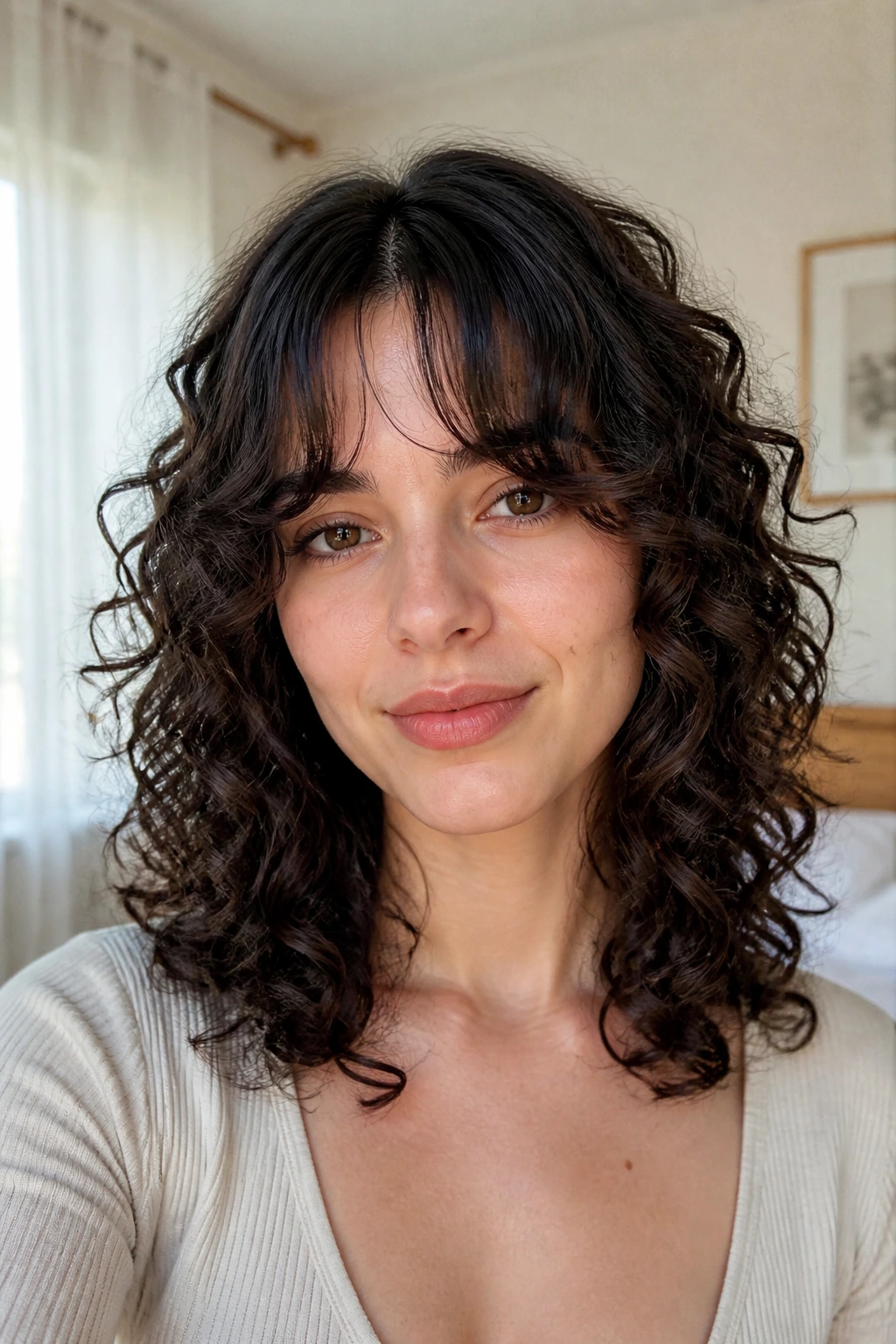
Bottleneck bangs are one of the most flattering fringe shapes for a round face because they keep the center shorter while opening wider at the temples. That shape pulls the eye inward and then outward in a gentle curve, which gives the forehead definition without adding width where you don’t want it.
On ringlets, this looks especially neat because the curls stack in clear clumps. The mid-length cut keeps the overall silhouette from getting boxy, and the bangs give you that bit of face framing that makes the style feel finished. I’d keep the shortest part of the fringe a touch longer than you think you need.
This cut is a favorite of mine for people who want bangs but hate the idea of a full fringe maintenance routine. Bottleneck bangs grow out better than most. They lose the precise shape and still look like a style, which is a rare and useful thing.
17. Glasses-Friendly Curly Crop with Lifted Bangs

Glasses change haircut math. Frames sit right where a lot of bangs want to live, so the crop has to work around that line instead of fighting it. A curly crop with lifted bangs keeps the fringe above or beside the frames and gives the face a bit more vertical space.
The lifted part matters. If the bangs collapse straight onto the glasses, the whole front can feel crowded. A little root lift, a little separation, and a slightly longer top make the difference. The sides should stay clean enough that the hair doesn’t build up around the temples.
This is a cut I’d recommend to anyone who wears frames daily and is tired of hair sitting in their lenses. It can still be playful. It just needs a smarter front shape.
18. Volume-Forward Halo Cut with Broken Fringe
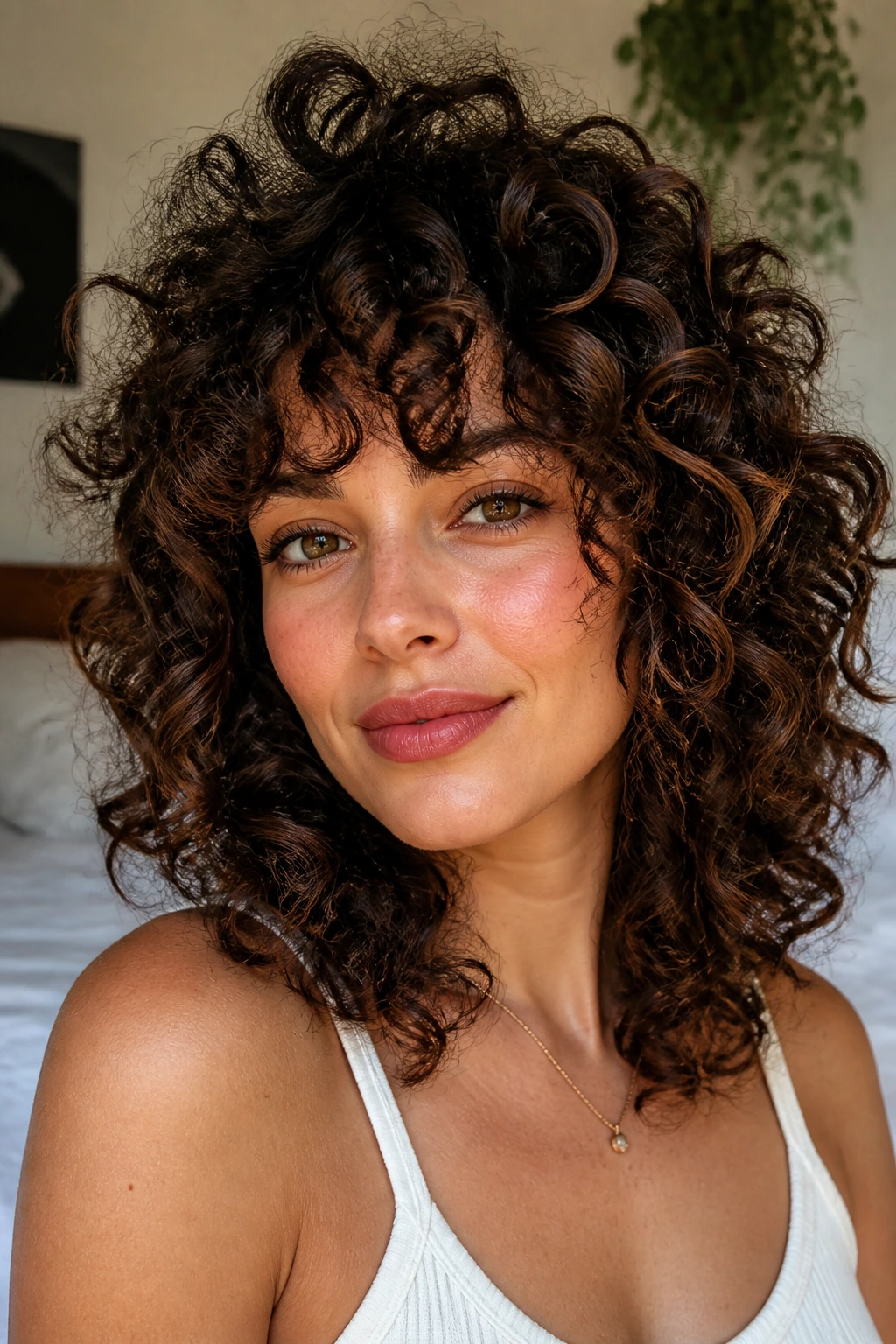
If you love big curls, own it. A volume-forward halo cut puts that fullness where it does the most good: higher up on the head, away from the cheeks. The broken fringe keeps the forehead from turning into one broad line, which is the thing that can make a round face look wider.
The halo shape works because it doesn’t let the hair flare straight out at the cheekbone. Instead, it builds a softer, higher silhouette and lets the fringe separate into pieces. Think lifted, not puffy. That distinction is everything here.
This cut does best when the curls are allowed to keep their clumps. Don’t brush them into oblivion. Don’t over-smooth the front. The shape needs texture to stay alive.
19. Long Spiral Layers with Diagonal Bangs
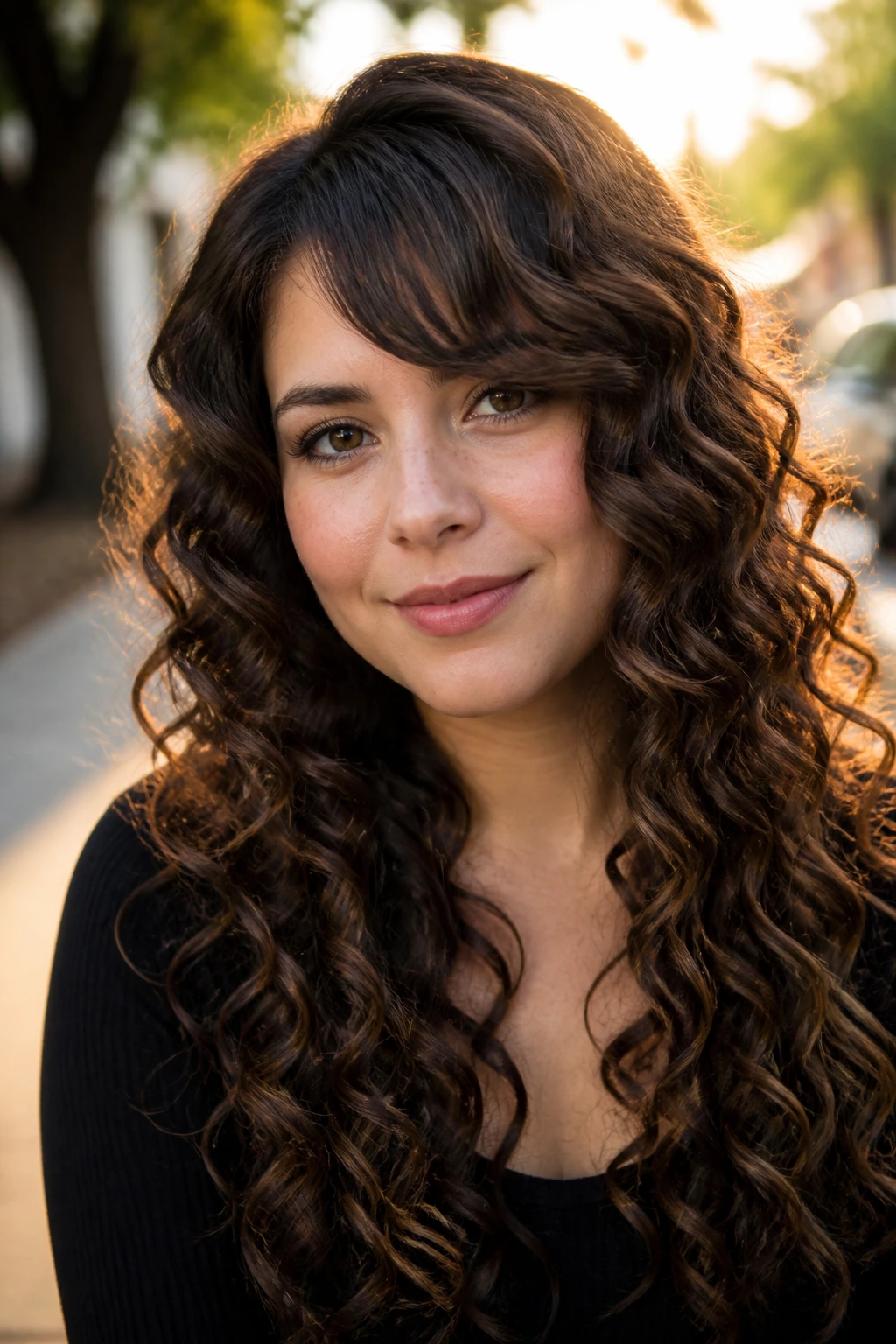
Long spiral curls can look narrow and elegant, but they can also widen a round face if the front hangs straight across. Diagonal bangs fix that by slicing the front line at an angle and leading the eye down toward the jaw and shoulders. It’s a simple trick. A strong one.
The layers should stay long enough to preserve the spiral pattern. You do not want so many short pieces that the whole head turns fluffy. A few precise front layers are better than a hundred tiny ones. That’s especially true if your curls are dense and springy.
This is one of the easiest styles to grow out, which I appreciate. The diagonal fringe slowly turns into a face frame instead of a problem. That kind of graceful awkward phase is worth a lot.
20. Chin-Grazing French Bob with Curly Fringe

A French bob can be lovely on curly hair, but it needs discipline. On a round face, the length has to hover at the chin or just under it, and the fringe needs to stay airy. If both the bob and the bangs are too blunt, the shape starts to box the face in fast.
The best version feels beveled rather than squared off. The curls should round gently into the jaw, and the fringe should break into texture instead of forming one heavy strip. A little side part helps too, even if it’s only slight.
I like this cut when someone wants a sharp silhouette with soft texture. It has a little Parisian ease, sure, but the real appeal is practical: it keeps the curls contained without making the face look crowded.
21. Layered Lob with Temple Bangs
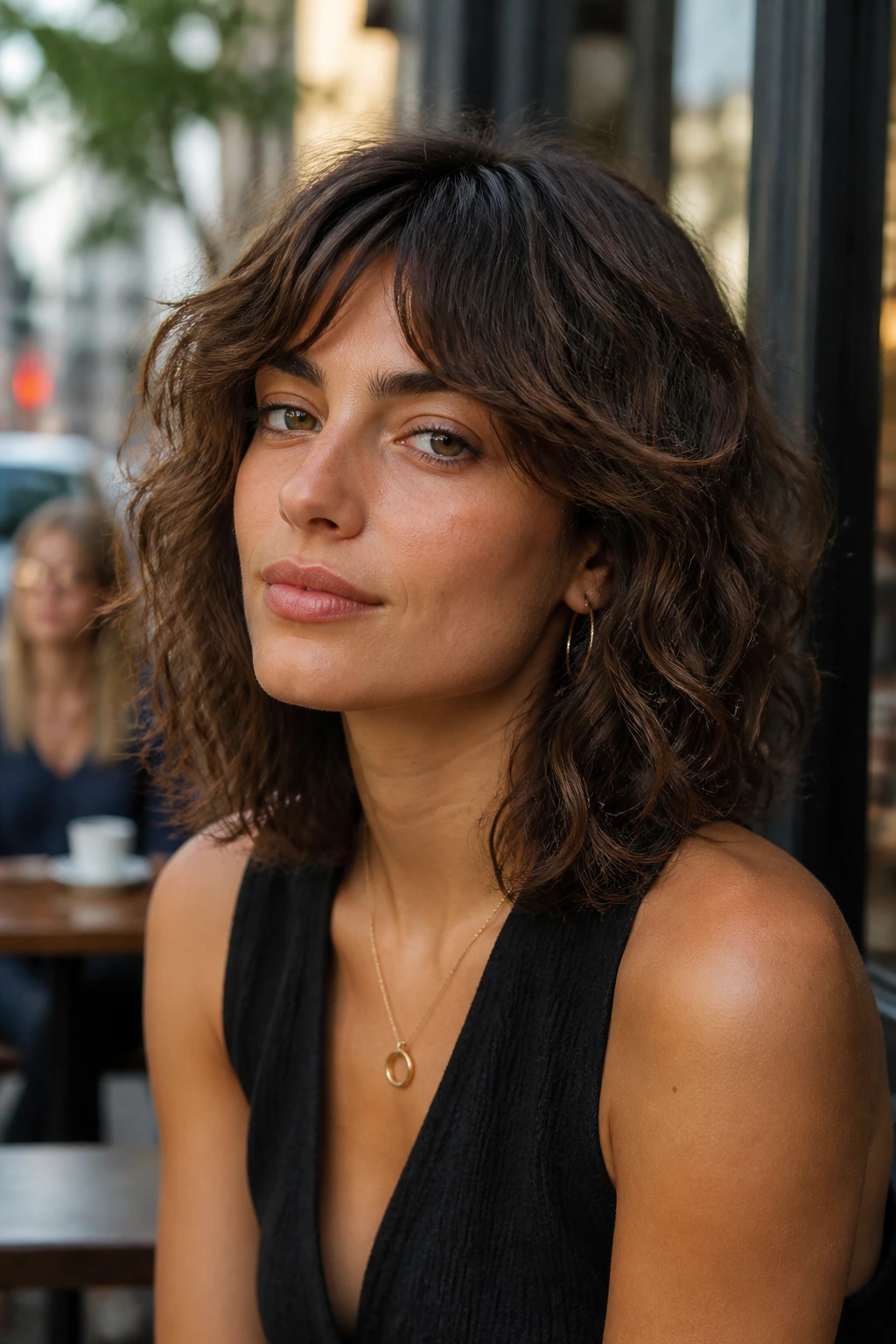
Temple bangs are the quiet trick in this haircut. Instead of covering the whole forehead, they place soft pieces only at the outer sides, right around the temples and cheekbones. On a round face, that creates contour without drawing a thick line across the front.
The layered lob itself gives you enough length to keep the face stretched. It also keeps the curl pattern from expanding too much at the sides. That matters. If the lob ends too high or too blunt, the cut can feel boxy. A little gradation fixes that.
This is a good choice if you want bangs but not the whole bangs experience. The temple pieces are subtle, easy to style, and forgiving on day two. They’re also a nice option if your forehead is not the part you want to feature the most. Fair enough.
22. Big Coily Layers with Curved Bangs
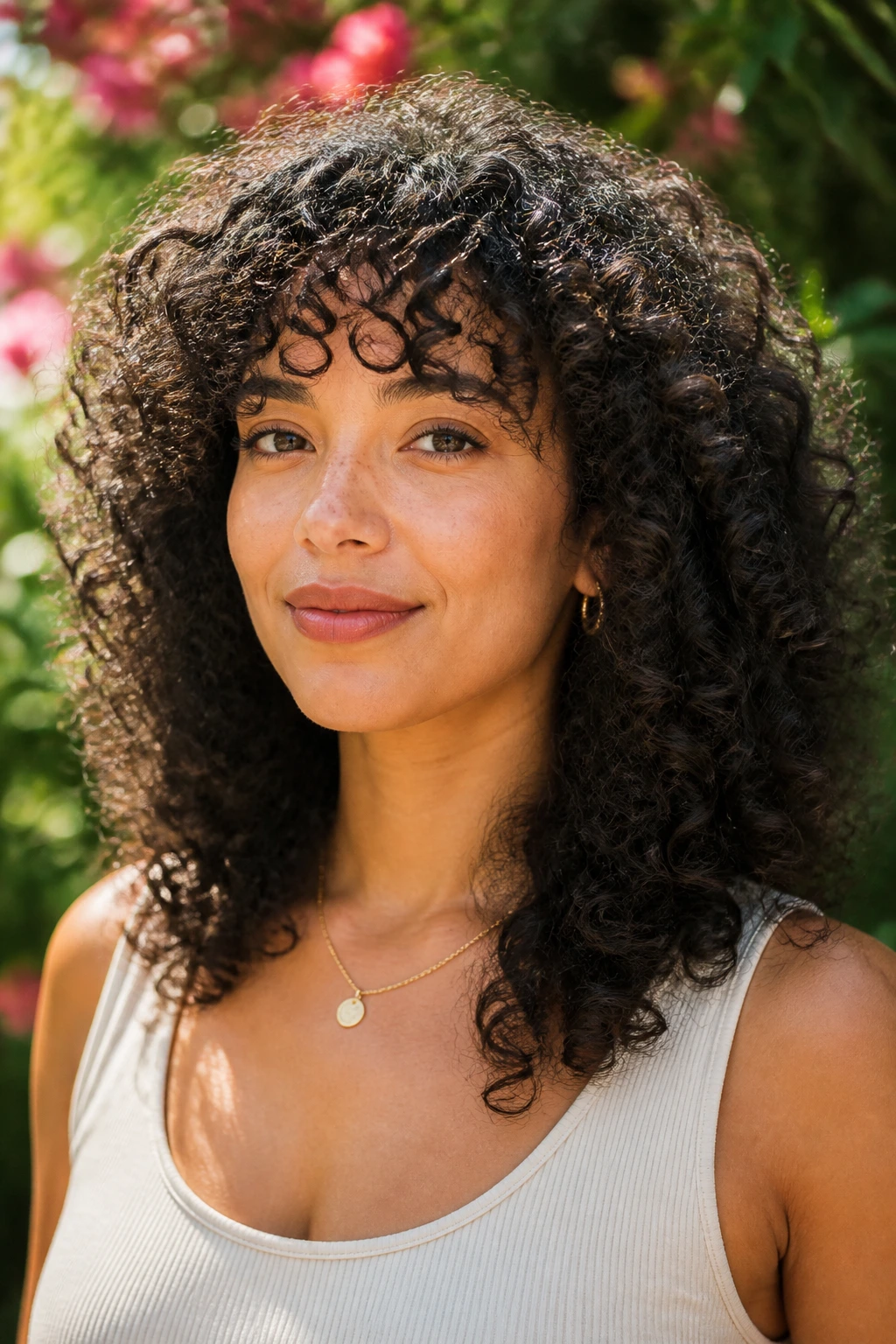
Coily hair needs room. It also needs shape. Big layered coils with curved bangs manage both by removing weight from the sides while keeping the front soft and shaped in a gentle arc. That curved fringe matters because it keeps the face open without flattening the personality out of the cut.
A round face with coils often looks best when the top has some extra height. Not a tower. Just enough lift to make the face feel longer. The curved bangs should sit a touch longer at the center and angle outward near the temples. That soft U-shape is much kinder than a hard straight line.
This is one of those cuts that looks best when it is not over-managed. Let the coils do their thing. The shape should hold even when it isn’t perfect, and honestly, that’s where it gets interesting.
23. Sleek-at-the-Root Curly Cut with Loose Bangs
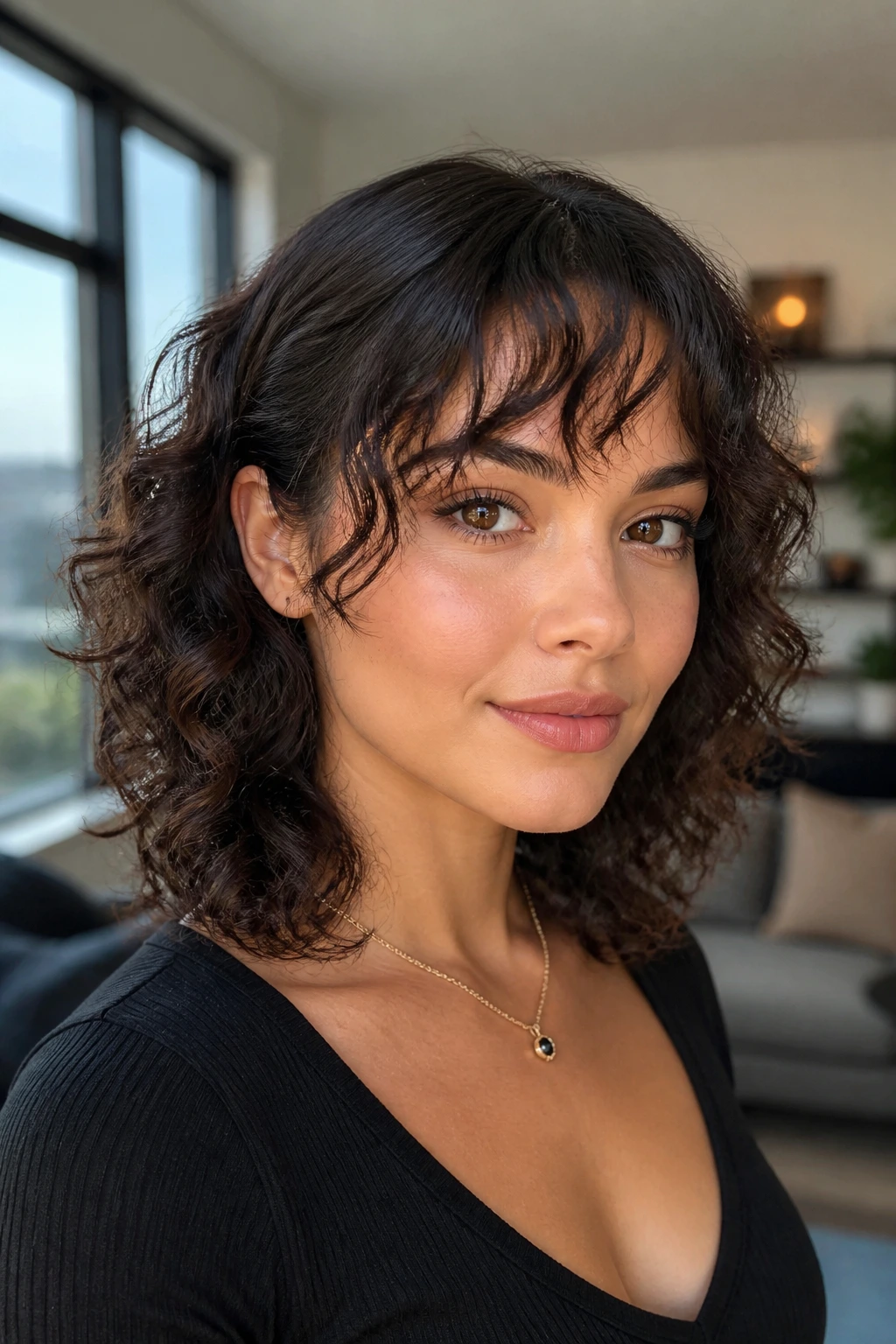
Sometimes the face looks slimmer because the roots are calmer, not because the curls are smaller. A sleek-at-the-root curly cut keeps the crown smooth enough to avoid extra width while the mid-lengths and ends still show the curl pattern. Loose bangs finish the job without crowding the forehead.
This is a smart cut for people who like a more polished finish. You don’t need pin-straight roots. You just need a little control near the scalp and some movement below. That combination keeps the silhouette lengthened and makes the bangs feel like part of the cut instead of a separate event.
I’d recommend this if your hair tends to puff at the sides when left entirely unstructured. A touch of smoothing at the root can make the whole shape look more deliberate. The trick is to stop before the hair loses its curl identity.
24. Shoulder Shag with Center-Part Curtain Bangs
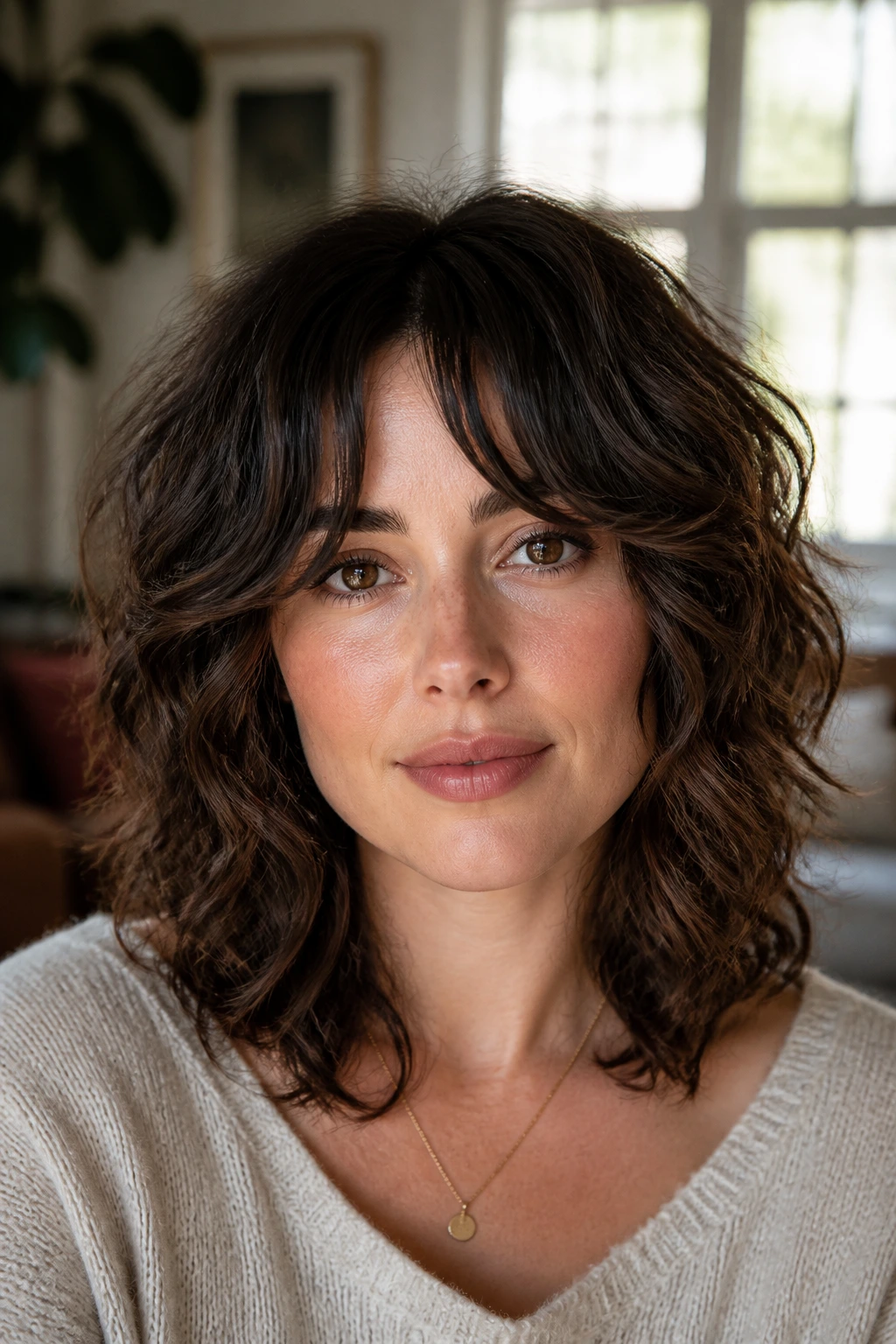
A shoulder-length shag with a center-part curtain fringe is one of the most reliable shapes for a round face. The shoulder length keeps the weight low enough to stretch the silhouette, while the curtain bangs split the forehead and soften the cheek line. It’s an easy cut to grow into, which I always appreciate.
The center part works here because the fringe is not a solid block. Each side falls away from the face, which opens the top half while still giving you that framing effect. The shag layers stop the shape from getting too broad at the sides. Very useful. Very practical.
This cut suits people who want something easy to live with. It looks good with a little frizz. It looks good with a lot of texture. It tends to look better on day two than on day one, which is the sort of hair behavior I trust.
25. Grown-Out Fringe Cut with Long Face Frames
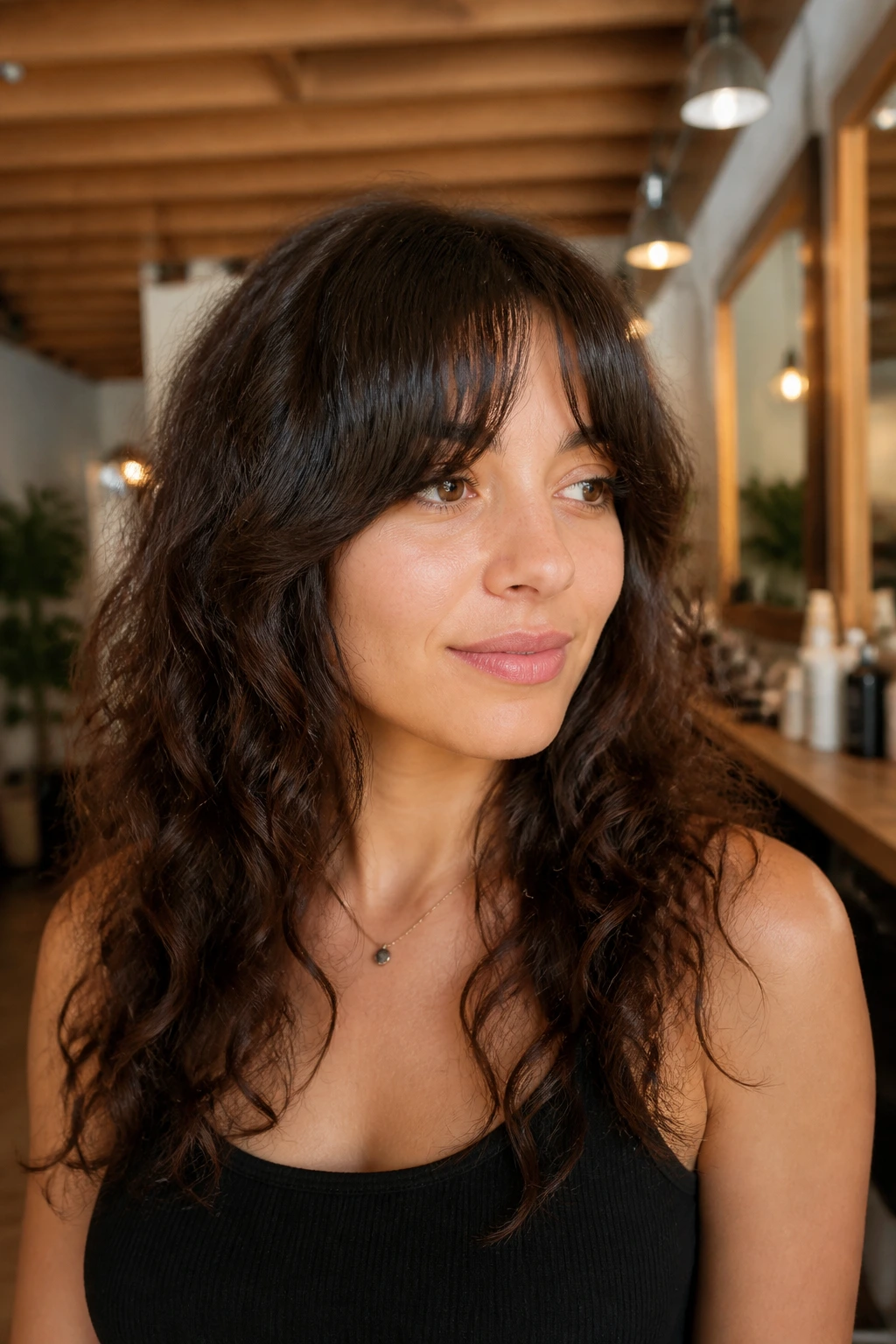
If you have ever regretted a bang cut three weeks later, this is your answer. A grown-out fringe cut turns the bangs into long face frames on purpose, so the front pieces sit at the cheekbone, mouth, or jaw instead of acting like a hard line. For round faces, that length is gold.
The cut is forgiving because it leans into softness. The bangs do not need to be crisp to work. They just need enough separation to suggest a frame and enough length to pull the eye down. That makes it one of the easiest styles to maintain if you don’t want frequent bang trims.
I like this for anyone who wants the face-framing effect without the constant commitment. It’s a little less dramatic than a true fringe, but in daily life that can be the smarter move.
Why the Shape Matters More Than the Trend
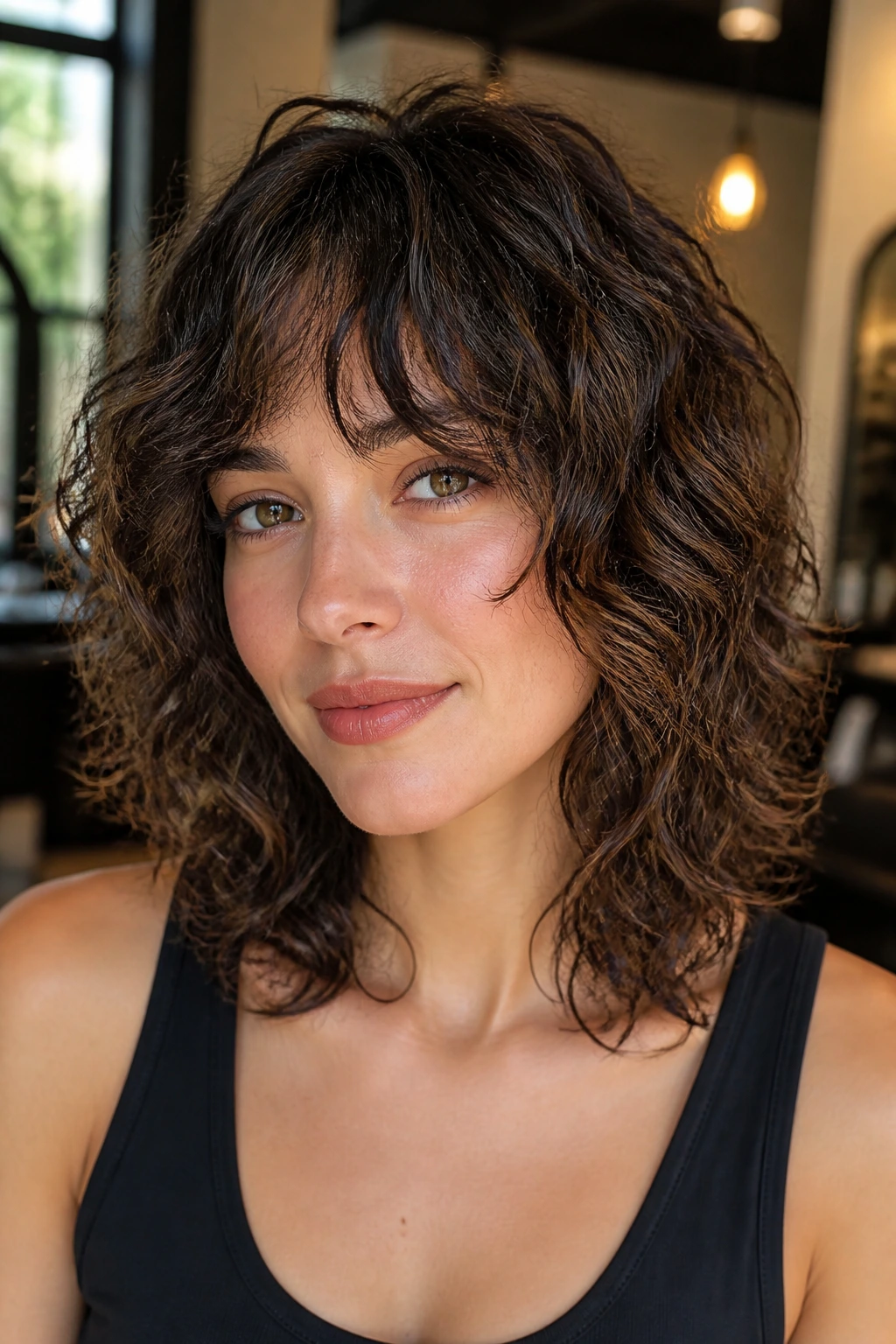
A round face does not need to be hidden. It needs a haircut that understands balance. That usually means the same few ideas showing up in different clothes: lift at the crown, length below the chin, and bangs that break apart instead of building a wall across the forehead.
The funny thing about curls is that they already do most of the styling for you. The wrong cut fights that. The right cut works with it. Once the layers land where the curls want to bend, the whole face starts to look a little more open, a little more sculpted, and a lot less boxed in.
Essential Tools for Styling Curly Bangs
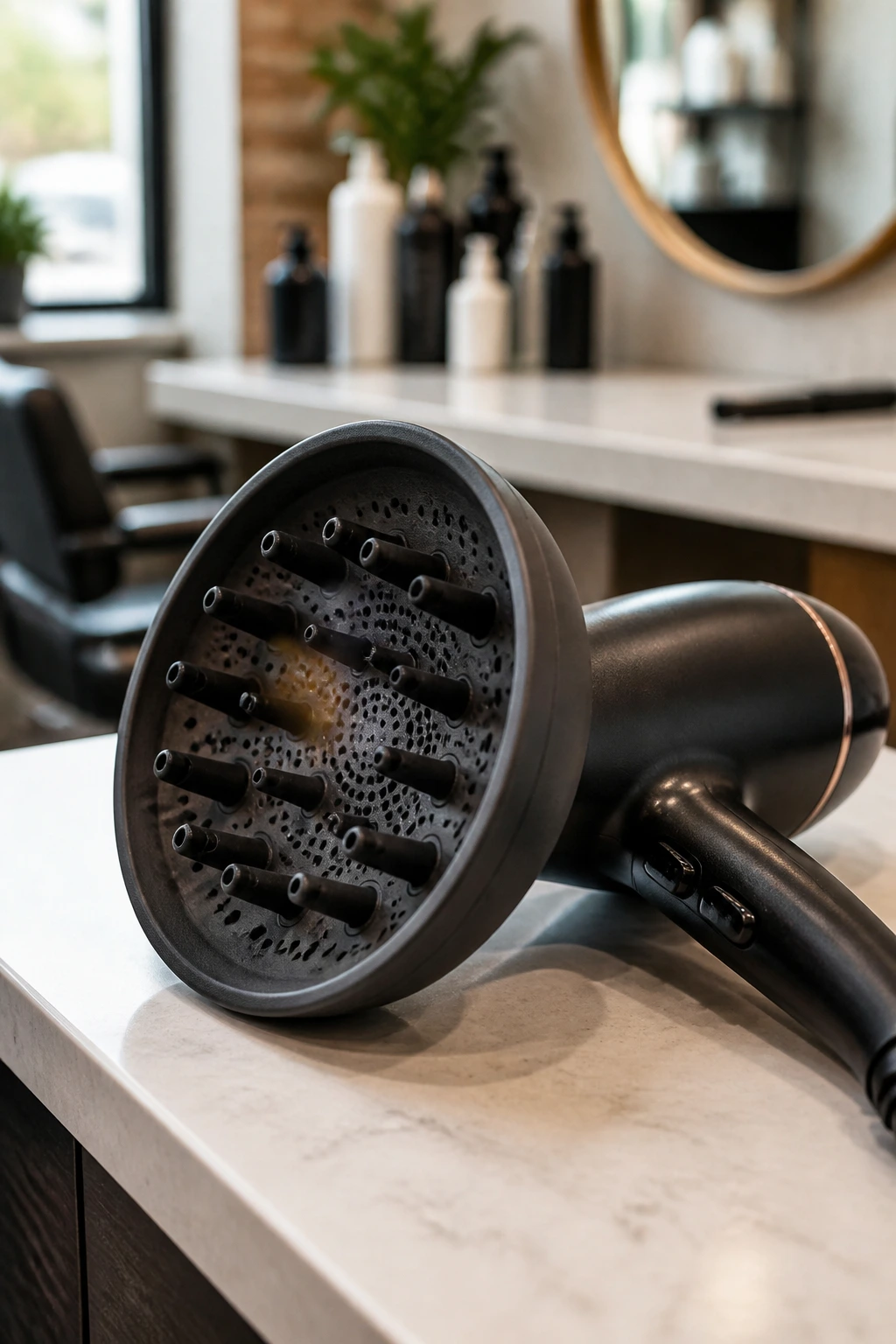
- Diffuser attachment — Helps lift the roots and set the fringe without blasting the curls apart.
- Spray bottle with water — A light mist is enough to reset bangs in the morning; you do not need to soak the whole head.
- Leave-in conditioner — Keeps the front pieces soft, especially if the bangs sit near the forehead and dry faster than the rest.
- Lightweight curl cream or gel — Use it sparingly on the fringe so the pieces stay separated instead of stringy.
- Microfiber towel or cotton T-shirt — Removes extra water without roughing up the curl clumps.
- Wide-tooth comb or fingers — Best for detangling while the curls are wet; brushes can blow out the shape.
- Duckbill clips or small claw clips — Useful for root clipping at the crown or pinning bangs while they set.
- Small round brush — Optional, but handy if you want to tuck a bang under a frame or smooth a stubborn section.
- Satin pillowcase or bonnet — Keeps the fringe from frizzing into a triangle overnight.
What to Tell Your Stylist Before the First Snip
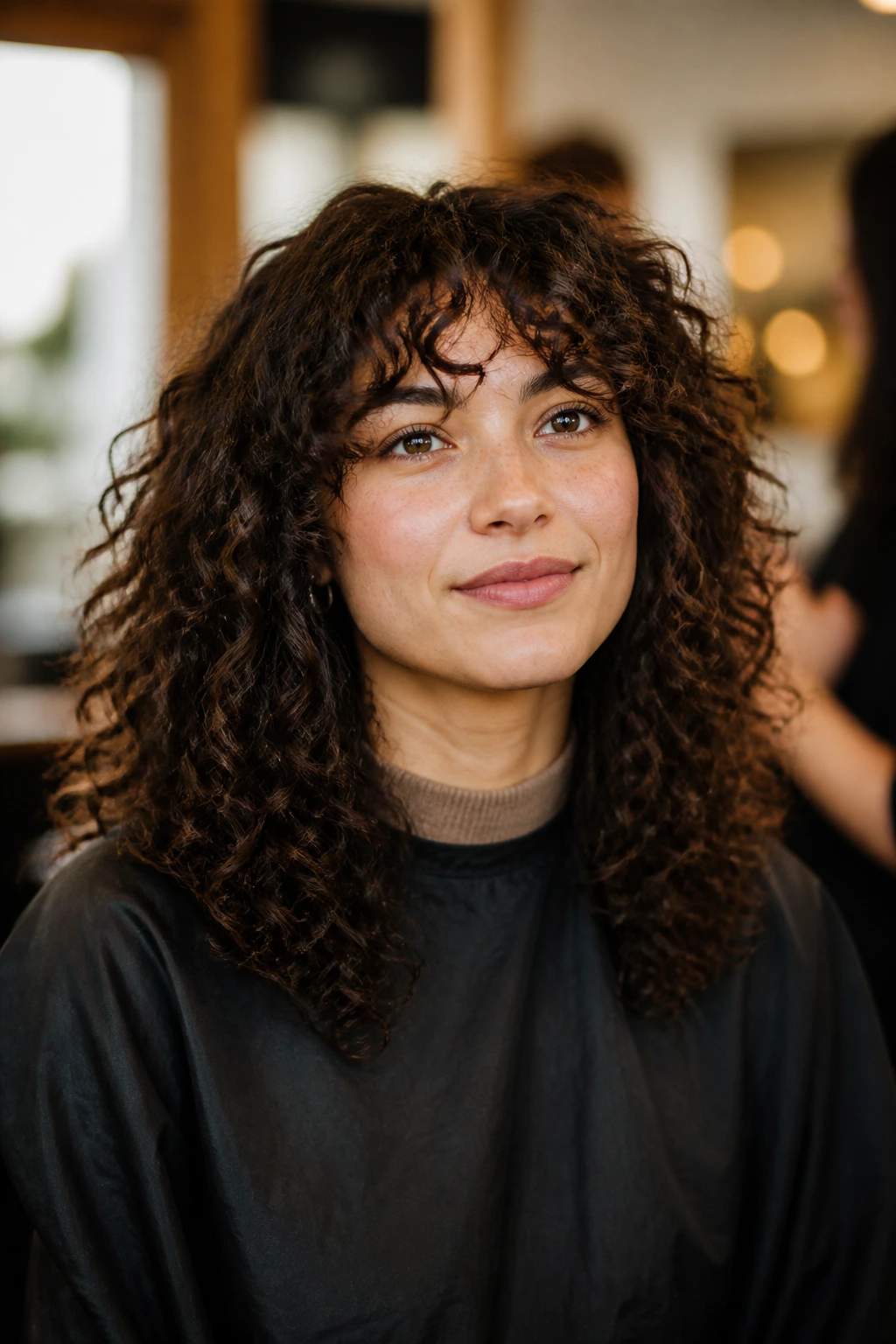
Bring photos, yes, but bring the right ones. Show one front view, one side view, and if you can, a photo where the curl pattern looks close to your own. A gorgeous cut on a tighter curl pattern can behave very differently on looser waves, and the other way around.
Say where your curls shrink. Point to the front section and tell the stylist how high it bounces once dry. If your bangs spring up two inches, say that. If the hair at your temples flares wider than the rest, say that too. That detail matters more than asking for a “cute fringe,” which is vague enough to be dangerous.
I also like to ask for the bangs to be refined dry, or at least checked dry before the final length is set. Curly hair hides its true shape when wet. That is not news, but it still gets ignored in chairs all the time. If you wear glasses, mention the frame height before the scissors come out. If you prefer a side part, say so. If you need the cut to air-dry well, say that too. The salon is not a guessing game.
How to Style the Shape on Wash Day

Shape:
Start by deciding where you want the weight to live. On a round face, the safest silhouette usually keeps the widest part of the hair below the jaw or above the temple line, not right at the cheekbone. If the top looks flat, clip the roots while the curls are still damp. That tiny lift changes the whole outline.
Parting:
A soft off-center part is often easier to wear than a hard center part, especially if the bangs are full. Curtain bangs can handle a center part, but they should still break open naturally so the forehead doesn’t look boxed in. If one side keeps puffing, shift the part by half an inch and see what happens. Half an inch can be the whole story.
Drying:
Diffuse on low heat and low airflow. High heat can make the fringe frizz before it forms. I like to dry the bangs separately for the last few minutes, either by hovering the diffuser or cupping the section lightly in the bowl. Stop when the hair is about 85 to 90 percent dry. If you keep handling it after that, the curl clumps start to fray.
Finish:
Separate the bangs only after they’re dry. Use one or two fingers, not a brush, and keep the rest of the curls mostly intact. A pea-size amount of gel on the ends can tame fuzzy pieces, but overdoing it makes the front look greasy fast.
Small Styling Moves That Change the Silhouette

Crown Clip Lift:
Clip two or three small sections at the roots while the hair dries. It gives the crown a little height, which helps the face look longer without changing the cut itself.
Bang Reset, Not Full Wash:
If the fringe starts to go wonky, mist only the front section and reshape it with your fingers. The rest of the head does not need to be soaked every morning.
Temple Taming:
When the sides puff out too much, pin those front pieces back for ten minutes while they dry. You’re not hiding the shape. You’re teaching it where to fall.
Product Only Where Needed:
Use more product on the ends than the fringe. The bangs sit near the forehead, so heavy cream there can make them separate in a sticky way. Light hands work better.
Common Mistakes That Add Width Instead of Length
-
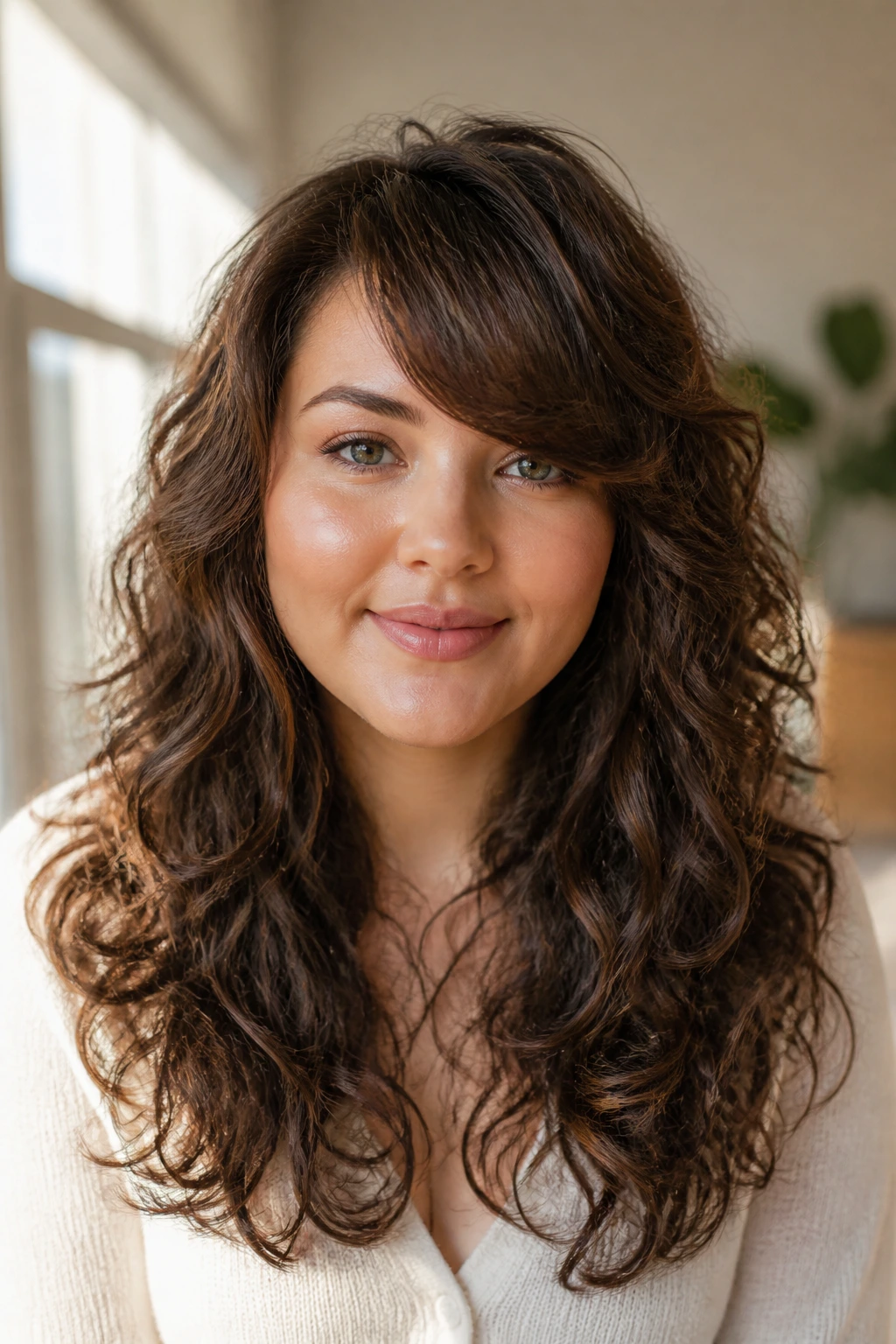
Cutting the bangs too short.
The symptom is obvious: the fringe springs up above the brows and leaves the face looking wider and shorter. Fix it by asking for a dry check and keeping the first pass longer than you think. -
Making the front one solid block.
A blunt, dense fringe creates a horizontal line that can make a round face feel even rounder. Ask for separation, a curtain split, or some taper at the temples. -
Letting the shortest layers hit the cheeks.
If the layers end right at the widest part of the face, they act like arrows pointing sideways. Move those layers either above the cheekbone or below the jaw. -
Overloading the bangs with product.
Too much cream or gel makes the fringe stringy and flat, then frizzy as it dries. Use the lightest amount that keeps the pieces together. -
Ignoring curl shrinkage.
Curly bangs can rise a lot once dry, and the amount depends on texture, porosity, and humidity. Always leave room for bounce.
Variations and Adaptations to Try
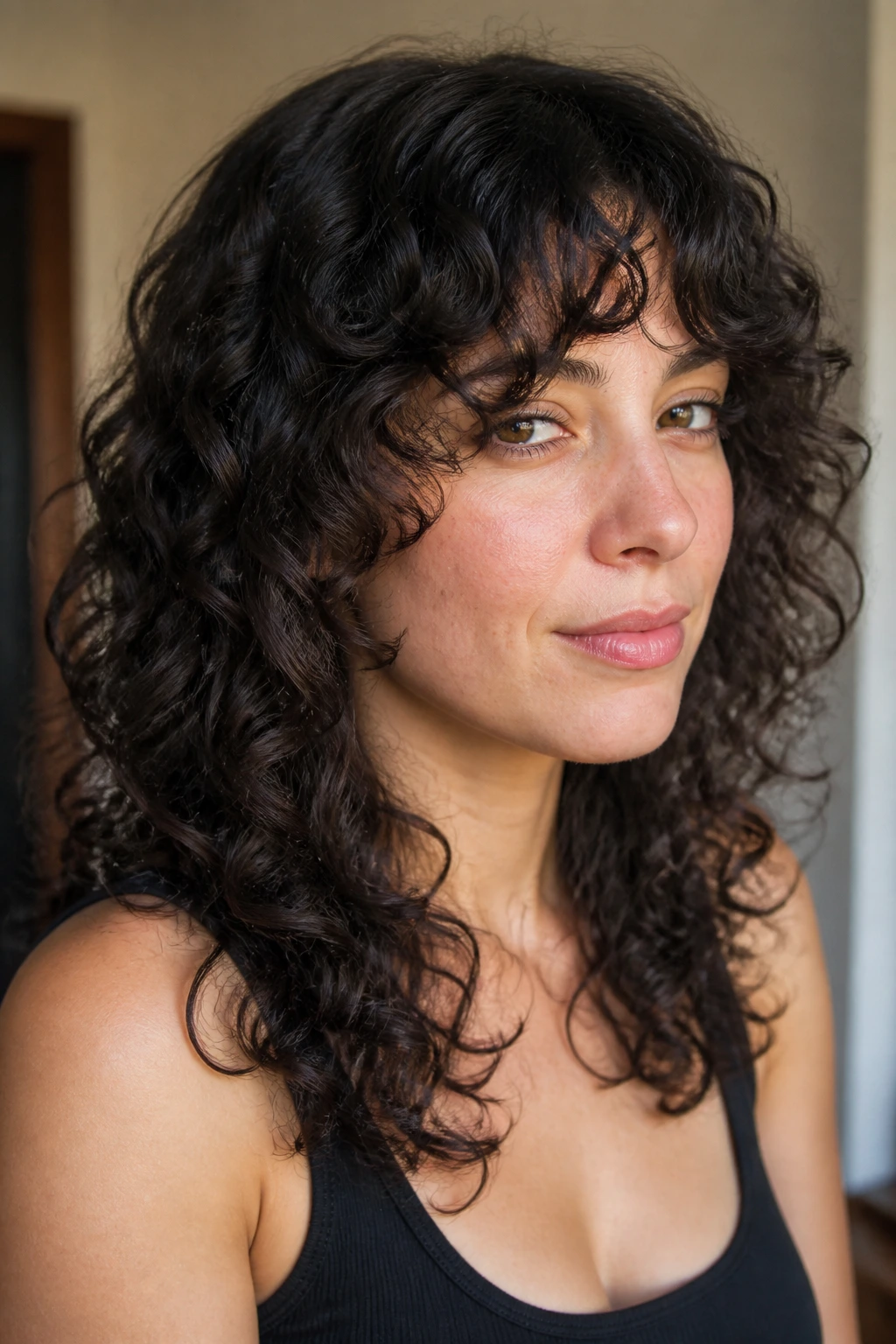
For Fine, Loose Curls:
Keep the layers longer and the fringe lighter. Fine curls can look sparse if they’re over-thinned, so ask for soft shaping instead of heavy interior removal. Curtain bangs or a side-swept fringe tend to behave better than a dense front.
For Thick, Dense Curls:
Ask for weight removal inside the cut, not at the perimeter. That keeps the silhouette from ballooning at the sides. Longer bangs with some taper are usually easier to control than a very short fringe.
For Tight Coils and Coily Hair:
Leave the fringe longer than you would on looser curls. Coils shrink aggressively, and a bang that looks perfect wet can end up far above the brow. Dry cutting or dry refinement helps a lot here.
For Glasses Wearers:
Choose a fringe that lives above the frames or splits around them. Bottleneck bangs, lifted curtain bangs, and temple bangs all work well because they leave room at the lenses.
For Low-Maintenance Days:
Pick the shoulder shag, the grown-out fringe, or the layered lob. These shapes look decent with imperfect styling and grow out without making the face feel crowded.
For Extra Drama:
Try the asymmetrical bob or the curly mullet. Both create stronger shape and more movement, which can be very flattering if you want the haircut to feel like part of your outfit.
How to Keep Bangs and Layers in Shape Between Wash Days
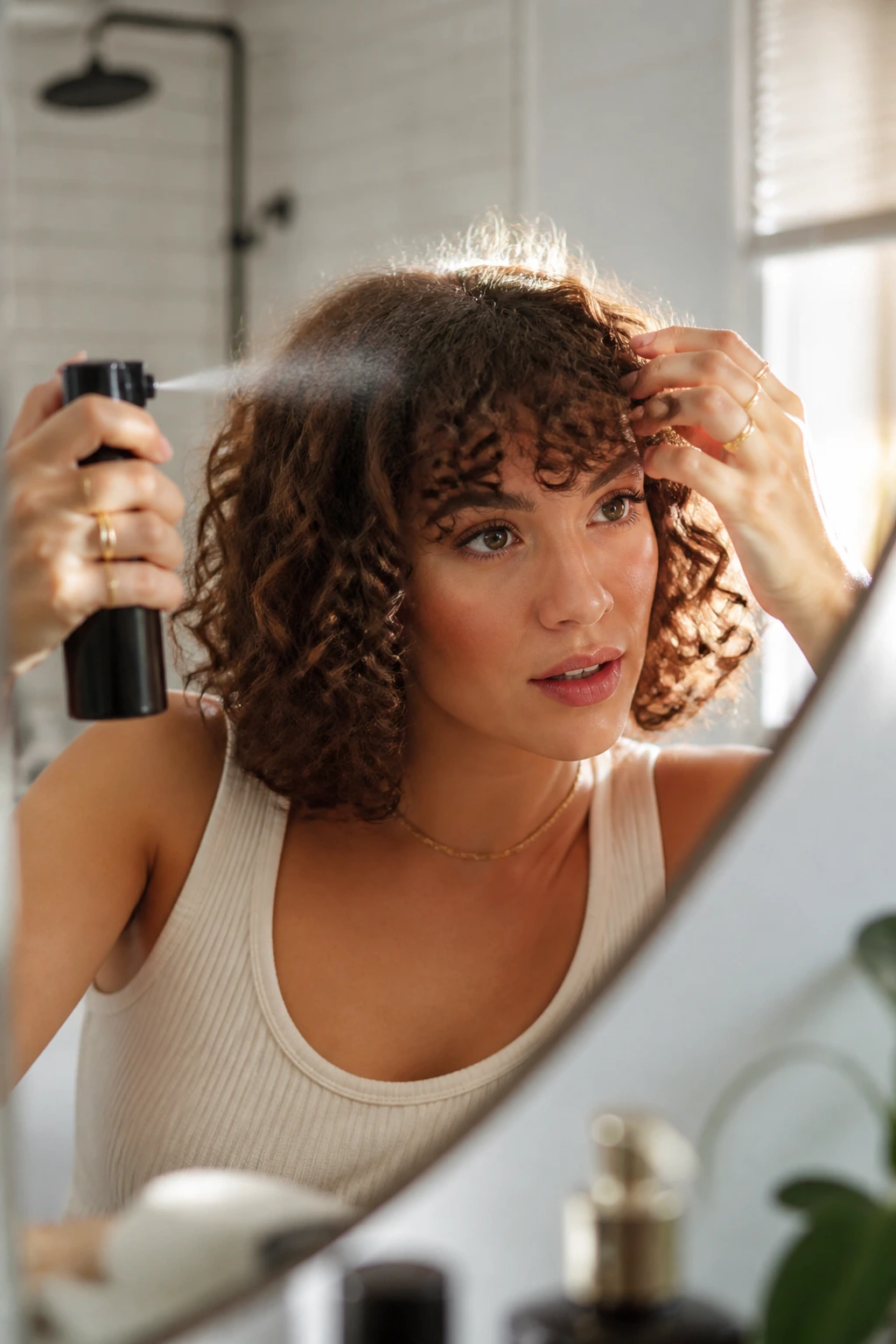
Curly bangs usually need a little morning reset, even when the rest of the hair is fine. A quick mist from a spray bottle, a finger re-clump, and three to five minutes of diffusing on low heat can bring the front back into line. The whole head does not need a full wash every time the fringe misbehaves. That would be a waste of time and moisture.
At night, a satin pillowcase helps more than people expect. So does a loose pineapple or a soft clip that keeps the front pieces from getting crushed. If your bangs tend to flatten, push them up and away from the face before bed instead of tucking them under. Tucking sounds neat. It rarely is.
Trim the fringe every 4 to 6 weeks if you want it to stay intentional. The rest of the layers can usually go 8 to 12 weeks between shaping appointments, depending on how fast your curls grow and how much frizz you can tolerate. If the front starts to split into awkward pieces, that is your sign to reset it sooner rather than later.
A small dab of dry shampoo at the roots can help if the bangs get oily faster than the rest of the cut. Use it at the scalp, not through the ends. Curly fringe does not need to be powdered into submission.
Frequently Asked Questions

Which curly bangs are most flattering on a round face?
Curtain bangs, bottleneck bangs, and soft side-swept fringe usually work best because they break the forehead into pieces and add diagonal movement. A heavy blunt fringe can work, but only if it’s textured and cut with shrinkage in mind.
Are blunt bangs a bad idea for round faces with curly hair?
Not automatically, but they are the easiest to get wrong. A blunt straight-across line can widen the face fast if the bangs are too short or too dense. If you want that look, keep the ends soft and leave enough length for the curls to settle.
Should curly bangs be cut wet or dry?
Dry cutting is usually safer for curls because it shows the real shrinkage and shape. Some stylists do a wet first pass, then refine dry. That second step matters a lot. Without it, the fringe can end up higher than intended.
How often should curly bangs be trimmed?
Every 4 to 6 weeks is a good rhythm if you want the fringe to stay clean. If you like a softer, grown-out look, you can stretch that a bit longer, but the shape will stop looking deliberate faster than the rest of the haircut.
Can a curly bob work on a round face?
Yes, if the bob sits below the chin or has longer front corners. A chin-length bob can work too, but it needs diagonal fringe or extra height at the crown so it doesn’t widen the cheeks.
What if my curls shrink a lot?
Ask your stylist to cut the fringe and face frame longer than you think you want. Bring your hair in its usual styled state if possible, or at least talk through how many inches it springs up. Shrinkage is not a small detail.
How do I keep curly bangs from puffing out?
Use less product at the front, diffuse on low heat, and separate the bangs only once they’re fully dry. If they still puff, a half-inch shift in the part or a little root clipping can calm the shape down.
Do glasses change which fringe I should choose?
They do. Frames and bangs can fight for the same space, so split fringe, lifted curtain bangs, or temple pieces usually behave better. You want the hair to frame the glasses, not sit on top of them all day.
What if my hair is fine and curly, not dense?
Choose longer layers and a lighter fringe so the hair keeps enough body. Fine curls can look stringy if the cut is too aggressive. A soft lob or shoulder shag usually gives better balance than a heavily layered short cut.
The Right Shape
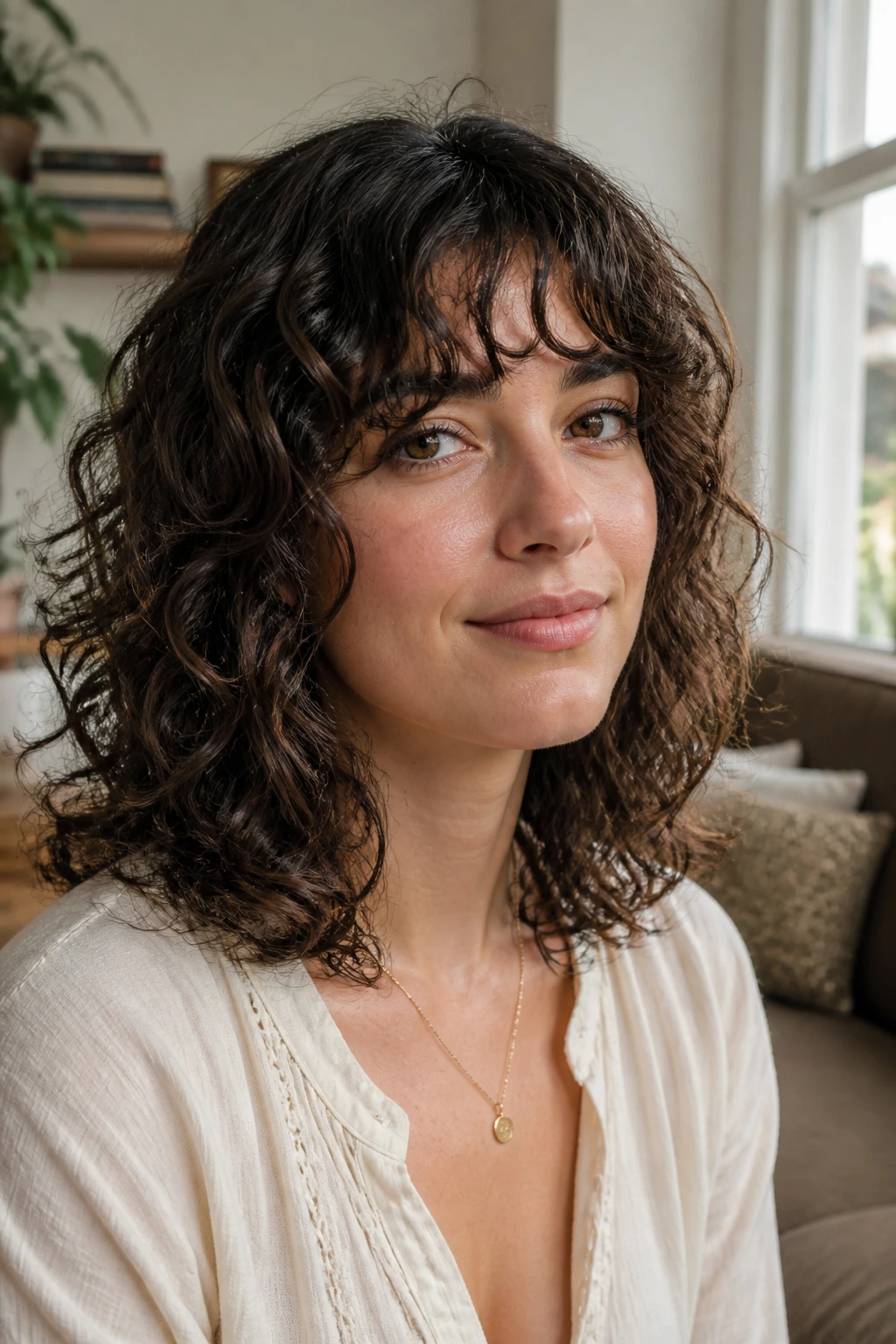
A round face does not need a haircut that hides it. It needs one that gives the curls a better map. That usually means some lift at the crown, some length where the jaw can breathe, and bangs that move instead of block. The styles above do that in different ways, which is the part I like best.
Bring photos, yes. Bring shrinkage info too. And if you’re choosing between two fringe lengths, pick the one that leaves a little room to spare. Curly hair always has another opinion once it dries, and the smartest cuts make room for that.
