



A fishtail braid has a useful trick up its sleeve: it looks intricate, but it doesn’t feel fussy. In fishtail braid hairstyles, the tiny crossovers create that woven, almost ribbon-like pattern that softens the whole head shape, especially when the braid isn’t pulled tight to the scalp. Add a few loose pieces around the temples or a little bend through the ends, and the result stops looking severe in a hurry.
That’s why this braid shows up in so many romantic looks. It works for wedding hair, date-night hair, brunch hair, and the “I need something pretty but not precious” category that a regular braid often misses. The style can sit low at the nape, sweep over one shoulder, wrap into a bun, or frame the face like a soft halo. Same braid. Different mood.
The catch is that the fishtail is unforgiving when you rush it. Big sections make it chunky. Hair that’s too slippery slides apart. Pull too hard and the whole thing loses the airy, lived-in texture that makes it worth doing in the first place. Get the balance right, though, and you get a braid that looks intentional without feeling lacquered in place.
Why This Collection Feels Softer Than a Standard Braid
Smaller crossovers make softer lines. A fishtail braid breaks the hair into finer pieces than a three-strand braid, so the pattern reads delicate instead of bulky. That matters when you want romance, because the eye sees movement first and structure second.
Loose tension keeps the face open. Tight braids pull everything back and sharpen the features. These styles leave a little room at the hairline, which is what gives the whole look that easy, unforced feel.
Texture does half the work. Second-day hair, light waves, and a touch of dry shampoo give the braid something to grip. Freshly washed hair can be too slippery and too flat, which is one reason a fishtail sometimes looks better the day after washing.
Accessories change the whole tone. A ribbon, pearl pin, or velvet tie can push the same braid from casual to dressy in one minute. That flexibility is the real appeal here.
- Works on long hair: The weave shows best when there’s enough length for the braid to taper.
- Still useful on medium hair: Half-up versions, headbands, and tucked ends keep the style from feeling forced.
- Friendly to soft waves: A little bend through the hair keeps the braid from looking stiff or overgrown.
- Easy to dress up: One clip, one ribbon, one side sweep, and the braid picks up a polished edge.
Best takeaway: keep the crown loose, the braid tidy, and the finish a little undone. That’s the sweet spot.
1. Loose Half-Up Fishtail with Face-Framing Waves
A half-up fishtail is the one I reach for when hair needs shape but not commitment. The top section stays controlled, the length still moves, and the loose waves around the face stop it from feeling too done. It’s one of those fishtail braid hairstyles that looks nicer when it isn’t perfect.
Why It Looks Softer
Pull the crown section back just enough to anchor the braid, then start the fishtail at the back of the head. Keep the weave a little loose and leave two slim pieces out near the temples. Those pieces matter more than people think.
- Best on hair that reaches the shoulders or longer.
- Curl the ends first if the hair is pin-straight.
- Use a small clear elastic and hide it with one wrapped strand.
- Pinch the outer edges of the braid after it’s secured.
Tiny trick: don’t start the braid too high. A half-inch lower at the crown usually looks calmer and prettier.
2. Side-Swept Fishtail over One Shoulder
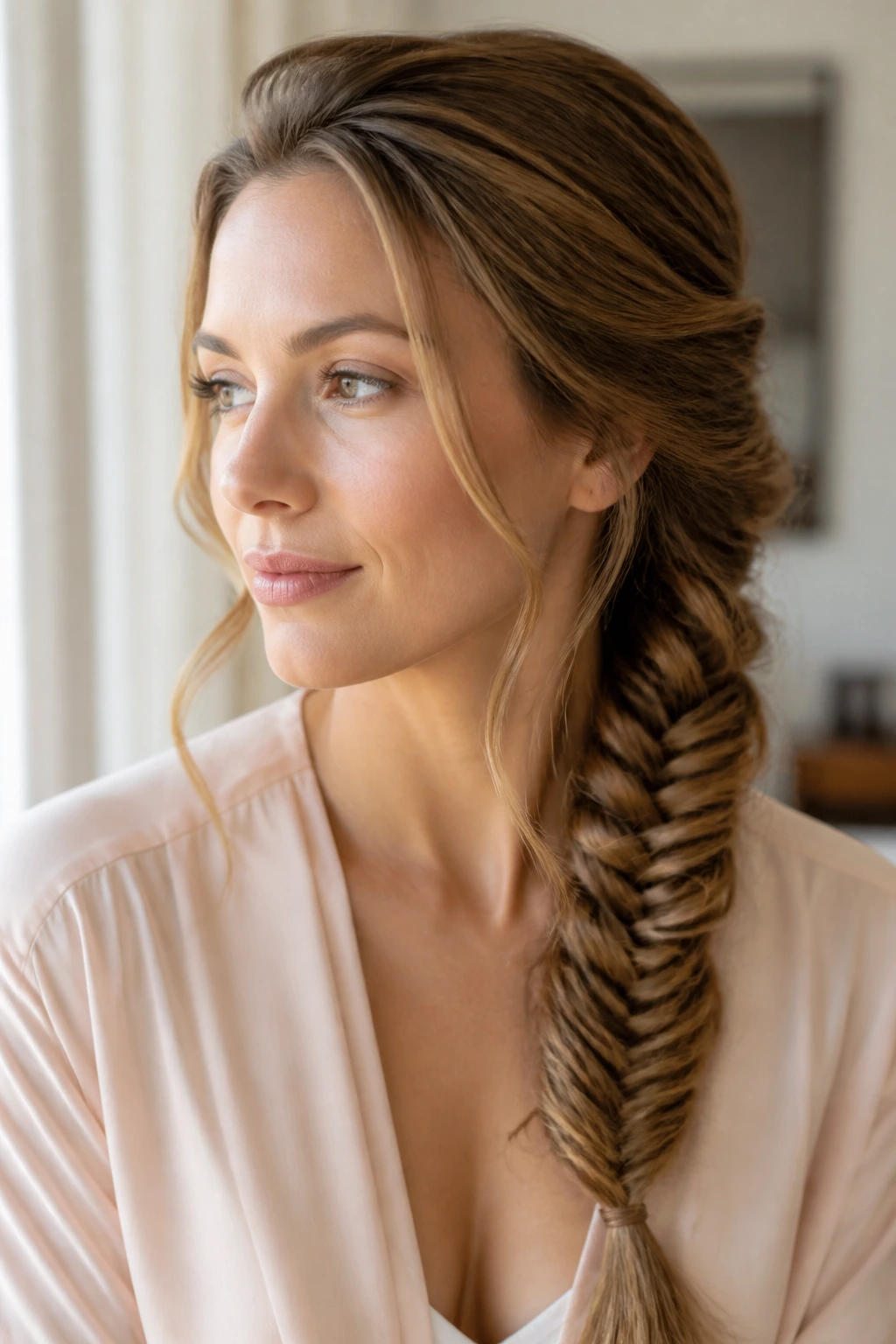
Side placement changes everything. A braid draped over one shoulder instantly feels more deliberate than a braid that sits down the back, and it gives you a clean view of the weave. That’s why this version works so well with off-shoulder tops, wide necklines, and dresses that need a little softness near the collarbone.
The braid should start opposite the shoulder where you want it to rest. Sweep the hair across the head, then fishtail it down over the front of the shoulder instead of letting it hang behind. Keep the top section a touch smoother than the rest; the contrast between a neat crown and a loose braid reads elegant without looking stiff.
This is a good choice when you want a style that holds its shape from dinner through the last dance. It’s also kind to layered hair, because the side angle hides shorter pieces better than a braid that runs straight down the middle.
3. Low Fishtail Ponytail with a Velvet Ribbon
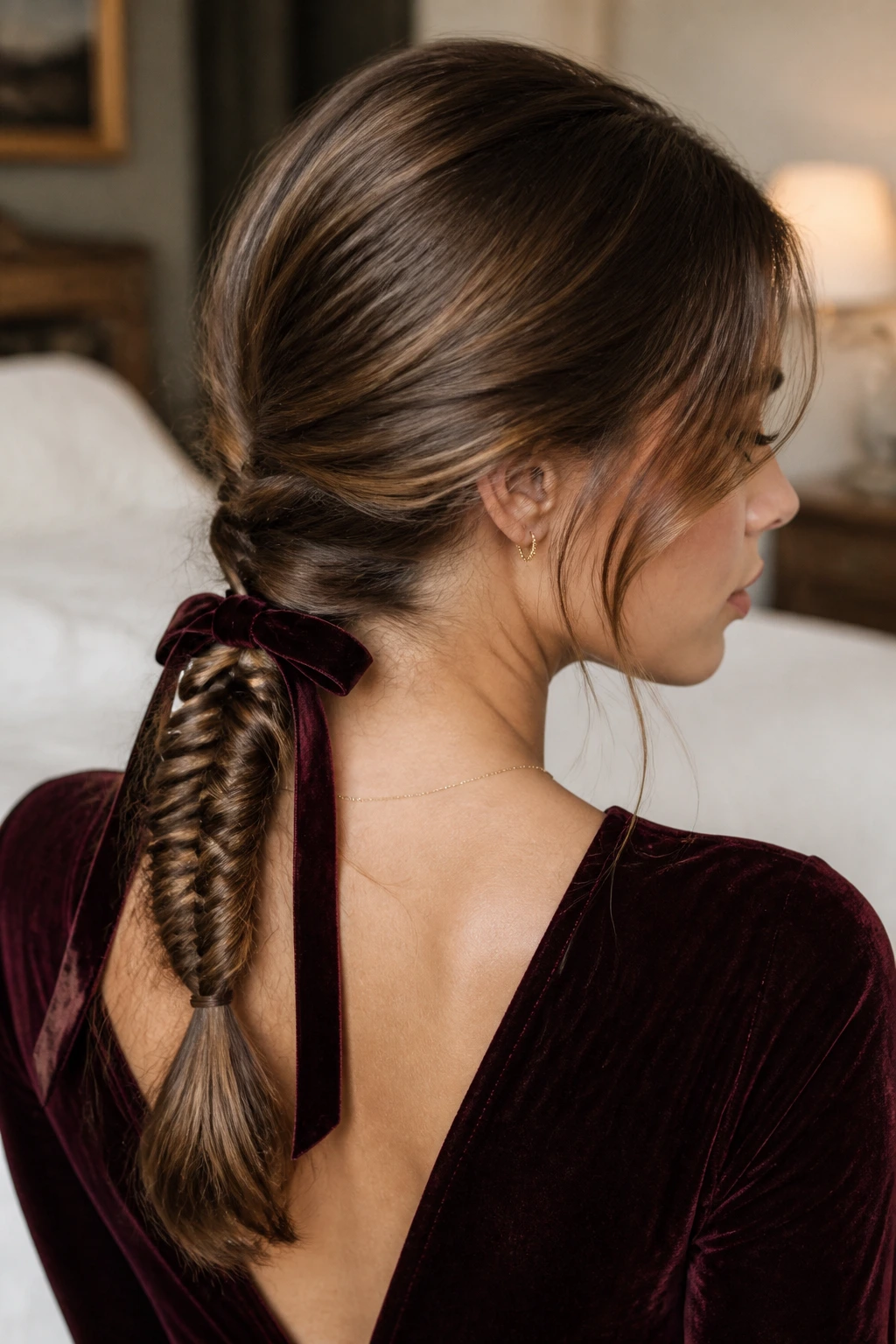
What if the easiest braid is also the prettiest one? A low fishtail ponytail proves the point. The braid starts at the nape, the ends stay neat, and a velvet ribbon gives the whole style a soft finish that feels a little old-fashioned in the best way.
How to Wear It
Tie the ribbon around the base of the ponytail after the braid is finished, not before. A ½-inch to 1-inch ribbon is enough; anything wider starts to compete with the braid instead of framing it. I like this version for thicker hair because the low anchor keeps the weight under control.
- Works well with smooth blowouts or loose bends.
- Use a matte ribbon if the hair is glossy; use satin if the hair is more textured.
- Keep the ponytail low enough that the ribbon sits just above the nape.
- Finish the ends with a tiny bit of serum, not a full coating.
Small detail, big payoff: let the ribbon tails fall at uneven lengths. It looks less stiff.
4. Crown Fishtail Halo
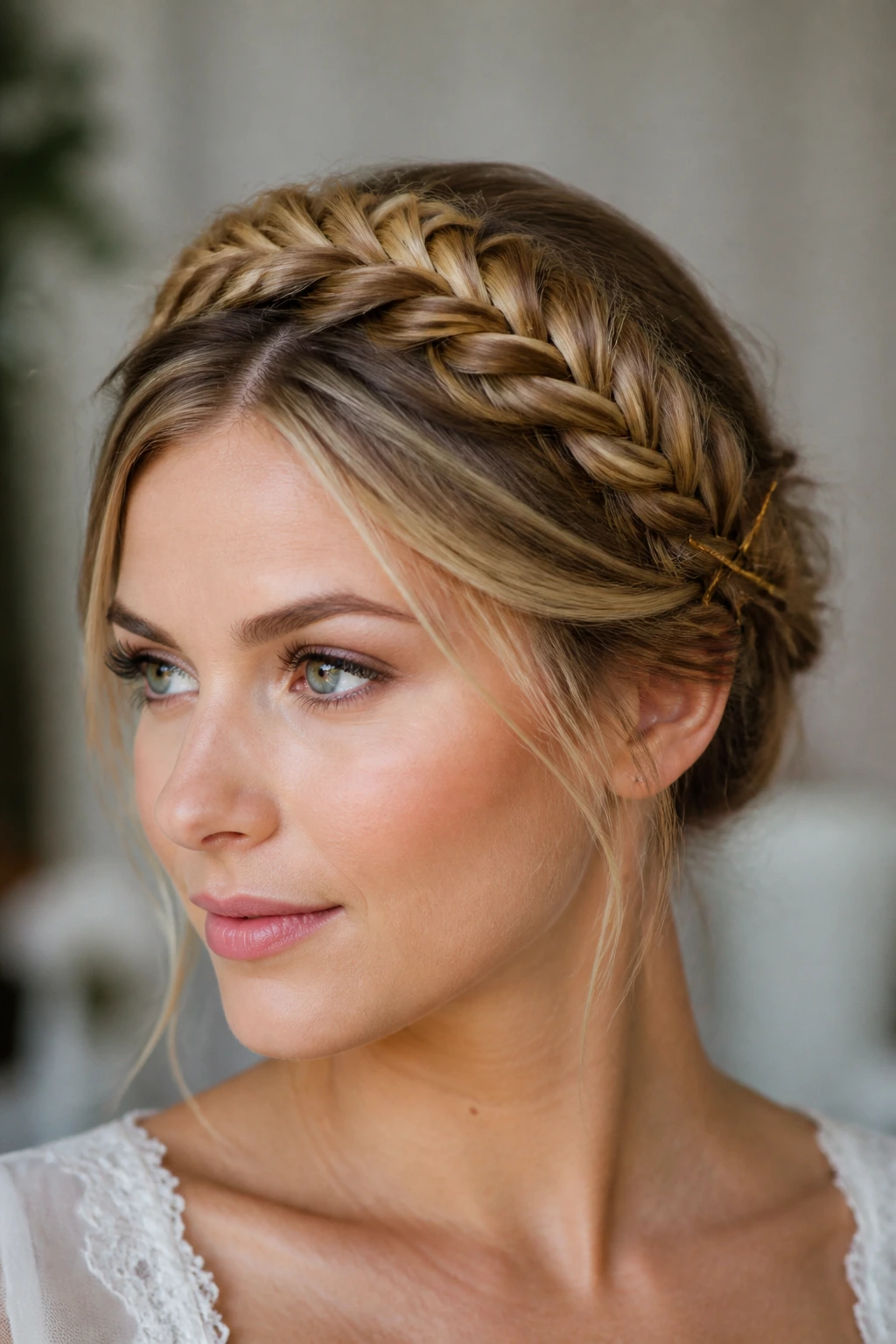
A crown fishtail turns the braid into the main event. The braid wraps around the head like a halo, which sounds formal until you loosen the edges and leave the face open. Then it becomes romantic instead of severe.
This style needs a bit more patience than the others because the braid has to travel around the head and stay even at the same time. Start from one temple, braid along the hairline, and pin the end behind the opposite ear. Use crossed bobby pins rather than straight ones; they hold better and sit flatter against the scalp.
- Best for long hair or added extensions.
- Leave a few wisps near the ears so the braid doesn’t read too tight.
- Tuck the end under the braid instead of letting it poke out.
- A light mist of flexible hairspray keeps flyaways from breaking the outline.
The halo shape has a quiet charm to it. It frames the face first, then the braid.
5. Messy Pancaked Fishtail with Face-Framing Pieces
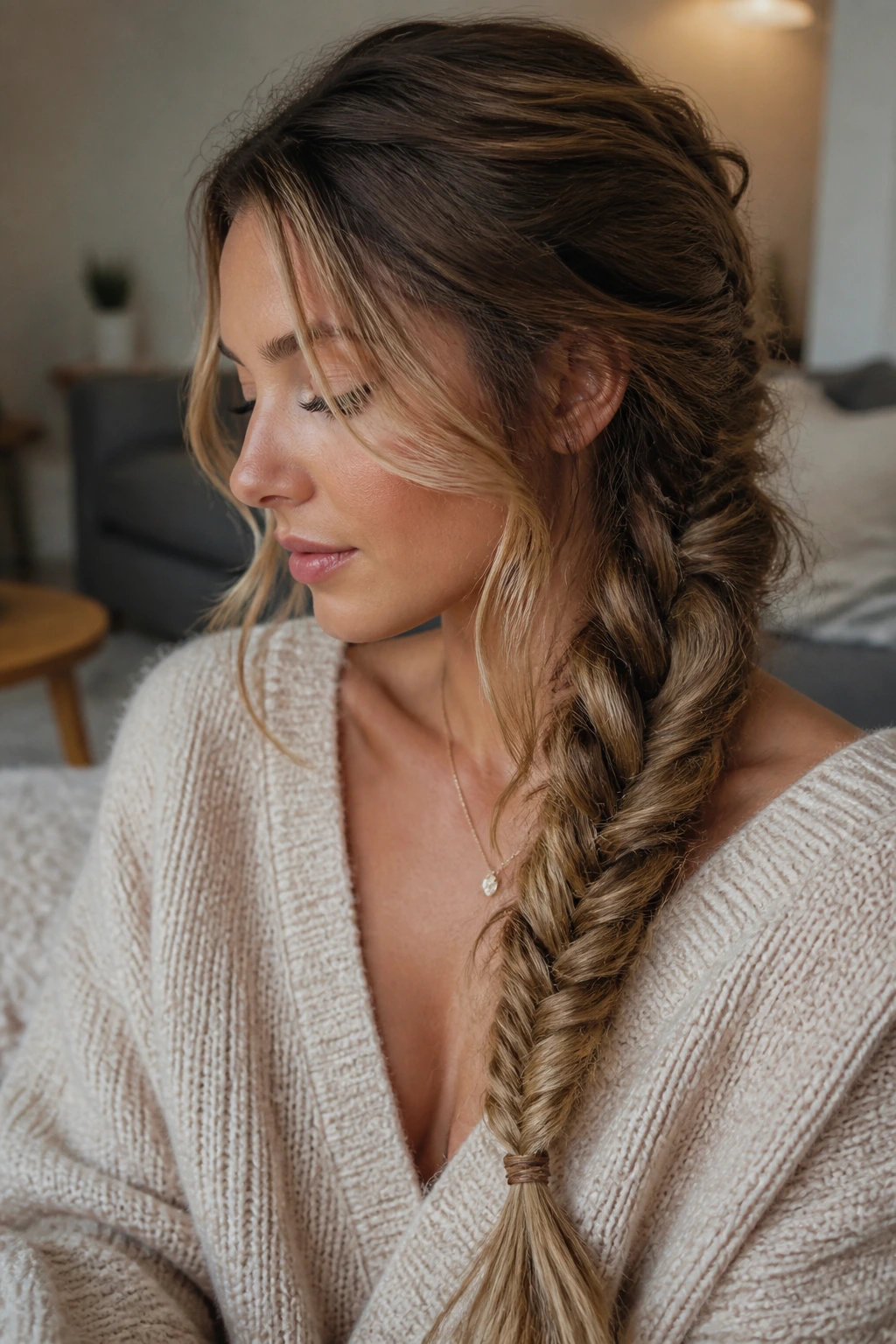
This is the braid for people who hate the look of hair that’s been dragged into place. The structure is there, sure, but the loosened edges and soft face-framing pieces keep it from looking overworked. Pancaking—the gentle tug that widens the braid—does most of the visual lifting here.
Start with a standard low or side fishtail. Secure the end, then work from the top down, pinching each outer loop outward just a little. Don’t pull at the center spine or you’ll flatten the whole thing. The goal is to make the braid look broader, not messy for the sake of it.
A few shorter pieces around the cheeks help too. They should bend away from the face, not cling to it. If the braid looks too neat, this is the version that fixes it fast.
6. Double Fishtail Pigtails
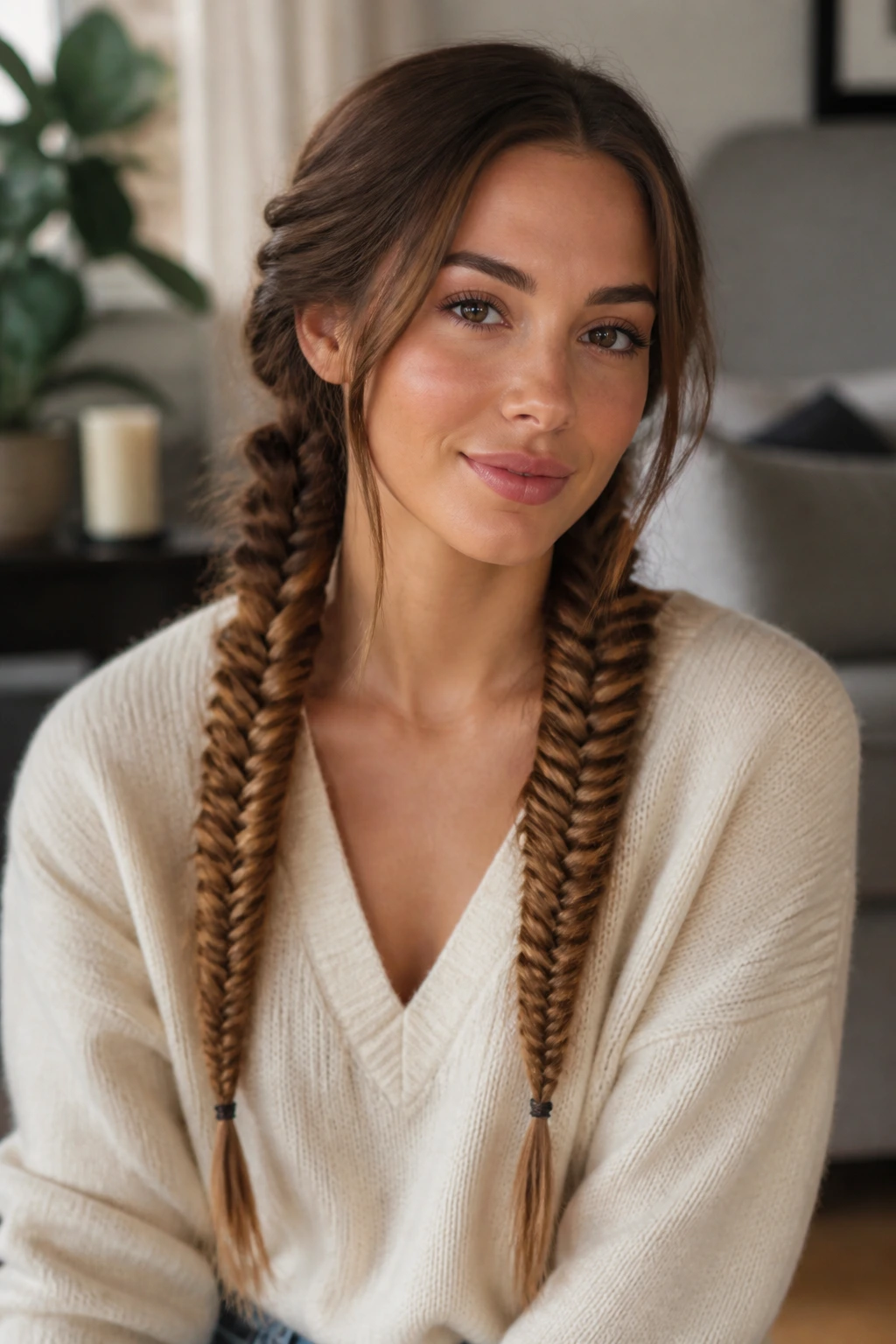
Two braids change the mood immediately. Instead of one heavy line down the back, you get symmetry, movement, and a softer frame around the face. It’s a younger look, yes, but not childish when the braids sit low and the texture stays a little loose.
This version works especially well on medium-length hair that feels awkward in a single long braid. Part the hair down the middle, keep the sections clean, and start each fishtail just behind the ears. Leave the top smooth, then loosen the lower half after securing both ends.
The reason it works is simple. The eyes move across the two braids, not down one rigid center line. That makes the style feel lighter, which is exactly what you want if the rest of the outfit already has enough weight or structure.
7. Fishtail Bun with a Soft Twist
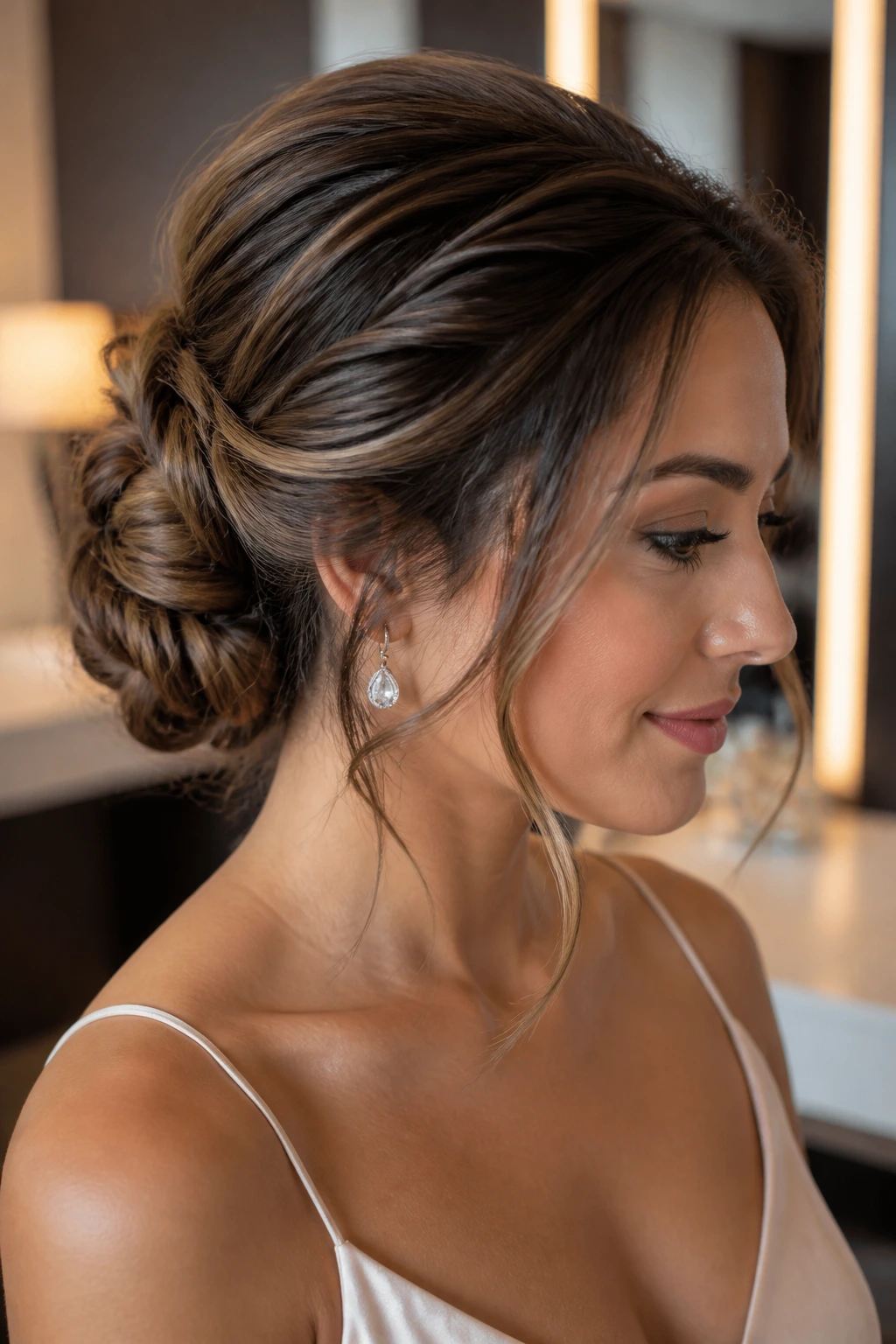
A fishtail bun solves a common problem: how to keep the braid visible without letting it drag down the whole style. The braid builds texture, then the bun gathers it into a shape that sits cleanly at the nape or a little higher.
Why It Works
The braid gives the bun detail. The bun gives the braid a place to stop. It’s a tidy partnership, and it avoids the flatness that a plain low bun can pick up after an hour.
Use this for formal events, long workdays, or any situation where you want your hair off your neck but still interesting. A few loose pieces around the hairline soften the outline. Pin the bun with crossed pins and hide the ends under the fold.
- Keep the braid slightly loose before wrapping it.
- Use a donut only if you want extra volume.
- Finish with a fine mist of hairspray, not a heavy shell.
- Pull two tiny pieces at the nape if the look feels too strict.
8. Waterfall Fishtail Hybrid
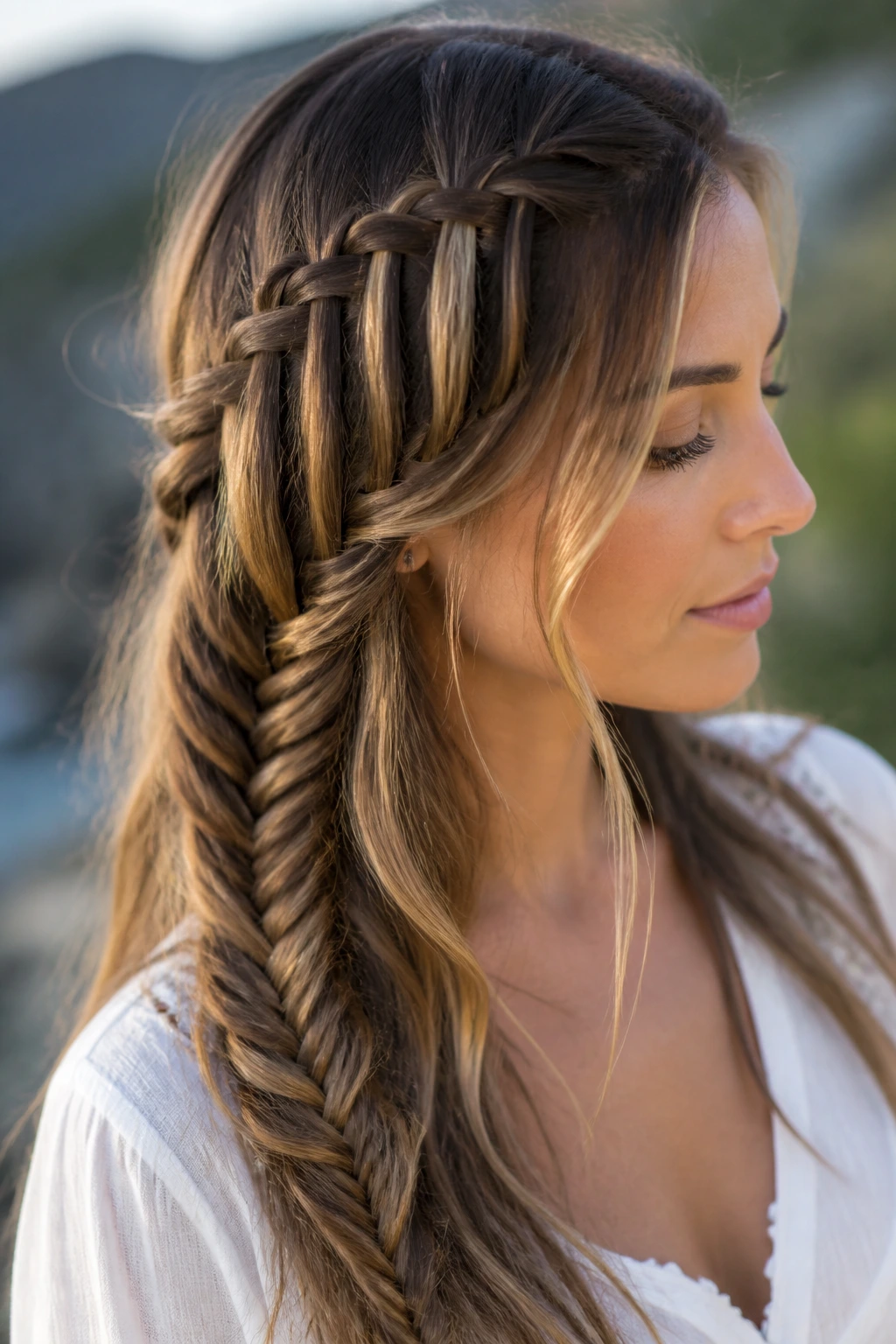
A waterfall braid and a fishtail braid are a lovely match because they solve different problems at the same time. The waterfall sections keep the hair open and airy, while the fishtail adds texture where you want it most. It’s one of the prettiest ways to make long hair feel lighter.
Start the waterfall near the temple, let a few strands drop through, then shift into a fishtail through the mid-lengths. That change in structure matters. The braid stops feeling repetitive and starts reading like a design choice.
This style is especially good when you want length visible. The loose strands create movement around the shoulders, and the fishtail anchors the whole thing so it doesn’t float away. If you’ve got curls or loose waves through the ends, keep them. They make the braid look softer, not sloppier.
9. Fishtail Braided Headband with Open Hair
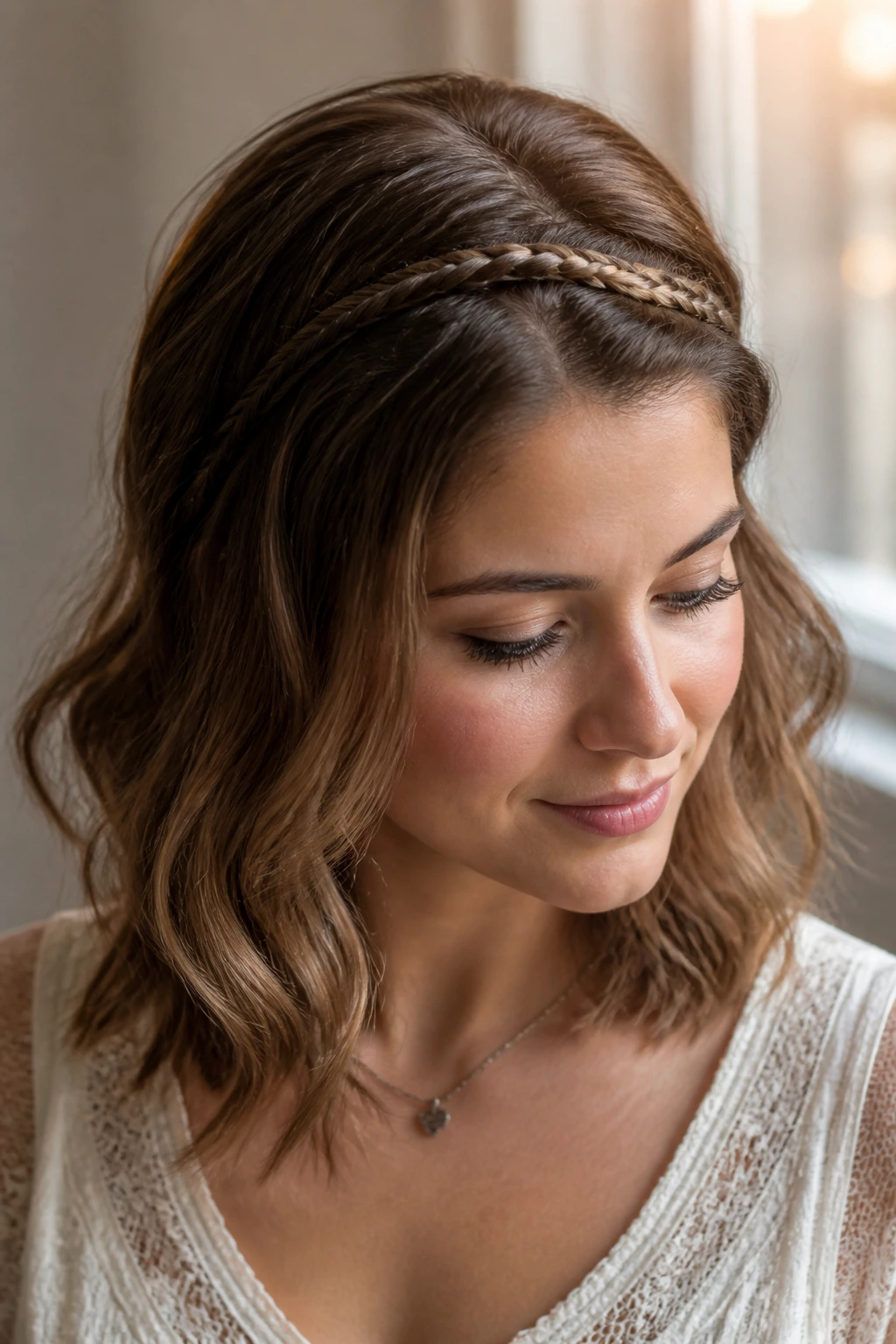
Need the front of your hair out of your face without giving up volume? A fishtail headband braid does the job neatly. It sits across the hairline like a soft band, while the rest of the hair stays down and loose.
The braid should be narrow enough to look delicate, not thick enough to fight the hair underneath. Pin it behind the opposite ear and hide the end under the top layer of hair. This is one of those styles that looks better when the braid is a little imperfect, because the open hair balances out any rough spots.
Best for Shorter Lengths
If your hair barely reaches the chest, this is easier than a full-length braid. You’re working with a smaller section and using the open length to carry the style. Add a few waves through the loose hair, and the braid stops feeling like a fix for short hair and starts feeling like the plan.
10. Dutch-to-Fishtail Low Updo
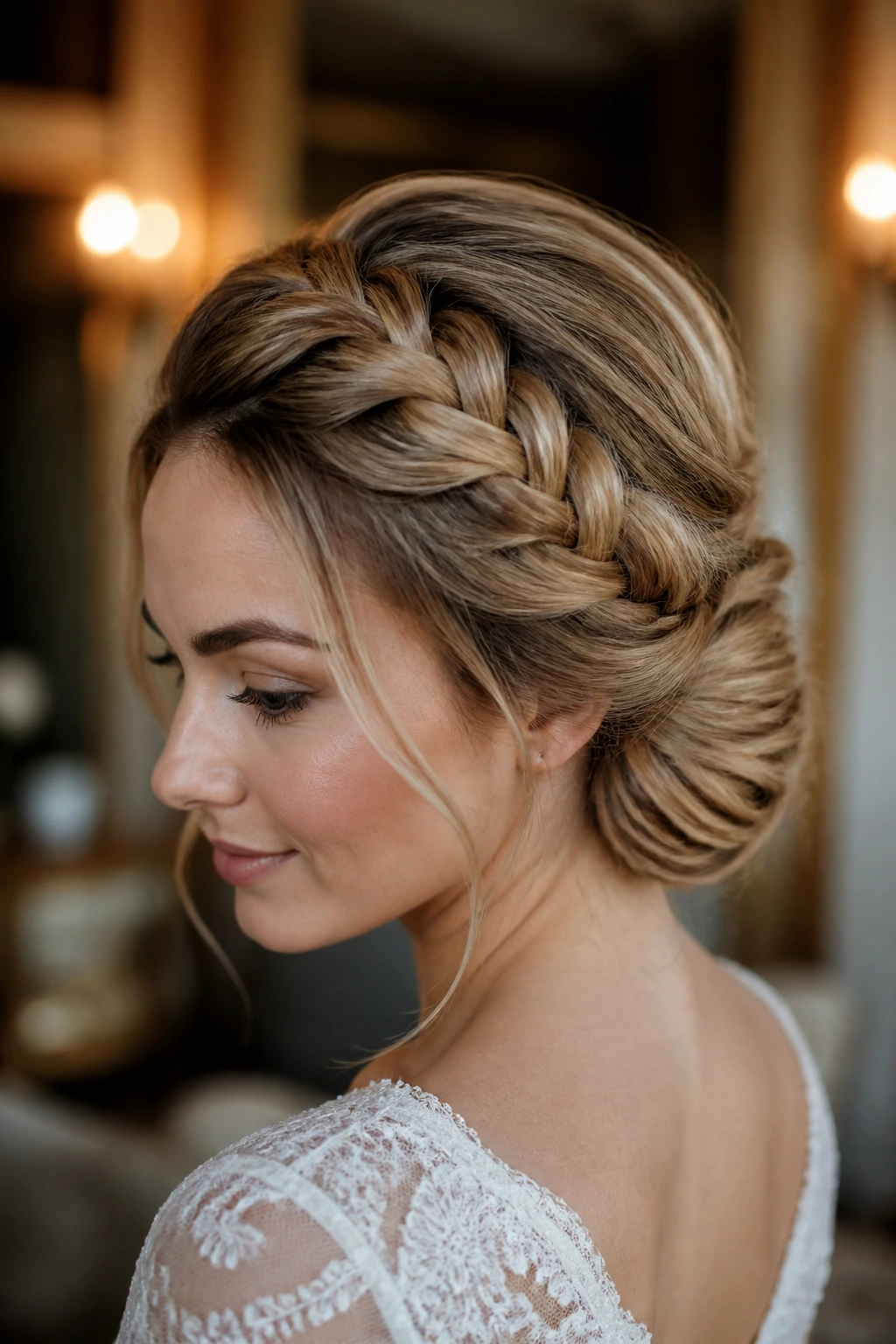
A Dutch braid at the top gives lift. A fishtail through the lower section gives softness. Put those two together and you get an updo that feels controlled without looking severe, which is a rare and useful thing.
Begin with a Dutch braid or a reversed braid at the crown so the top section sits slightly raised. Once you reach the nape, switch to a fishtail and continue to the ends. Then tuck the braid into a low fold or knot and pin it from several angles. Use more pins than you think you need; this style should feel secure when you tilt your head.
The result is polished enough for formal settings but not stiff enough to look frozen. It’s especially good for thick hair, because the Dutch section gives the roots space before the braid gets denser.
11. Pull-Through Fishtail Illusion Braid
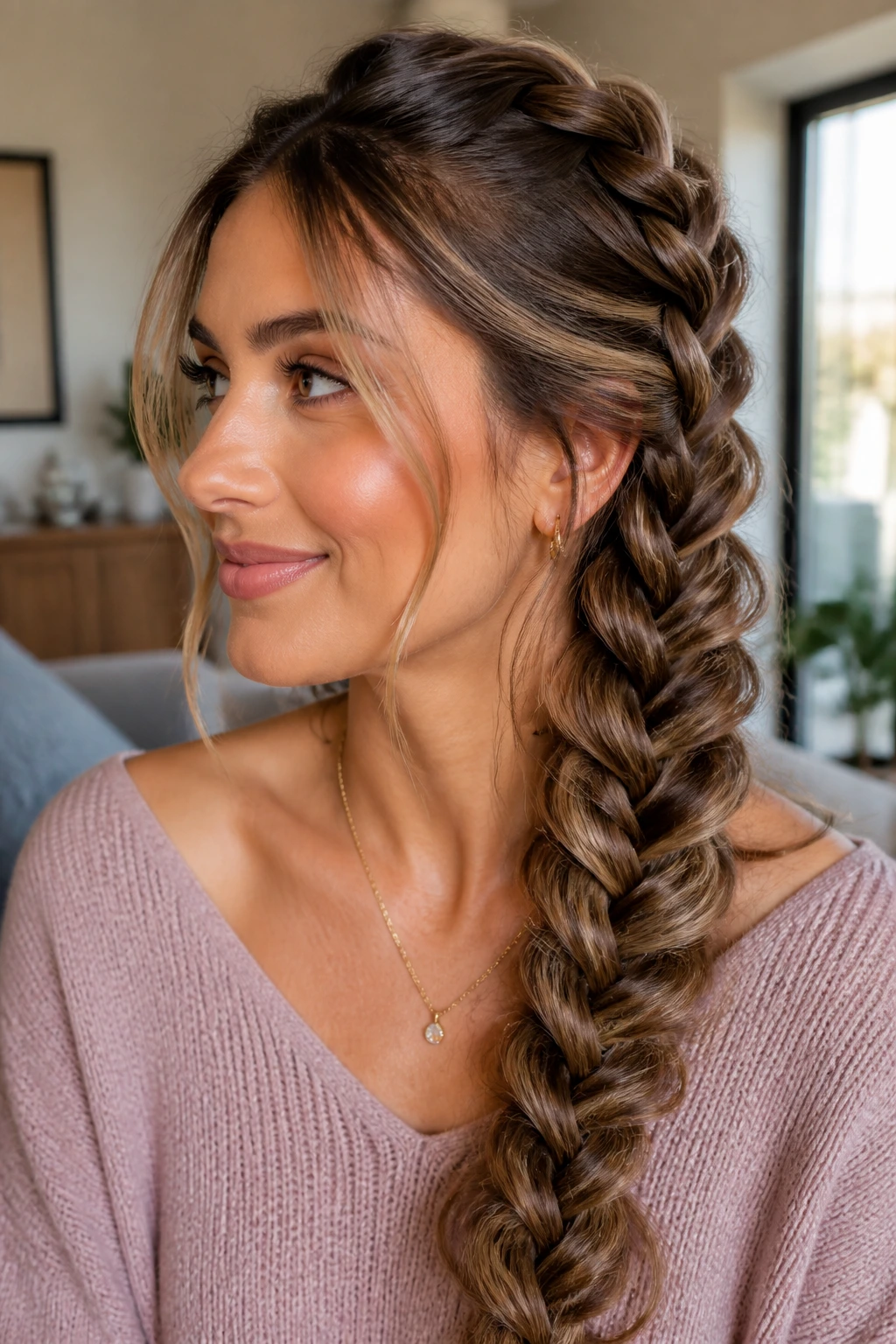
This one isn’t a true fishtail, and that’s fine. The pull-through version gives you the same thick, linked look with more volume and less finger strain. If your hands get tired doing a real fishtail, this is the easier cheat code.
The trick is a series of small ponytails stacked down the length of the hair, with the top sections split and pulled through each lower tie. The spacing stays narrow—about 1 to 1½ inches between elastics—so the final shape reads like a braid rather than a pile of ponytails. Then pinch the edges outward a little to soften the outline.
I like this version on fine hair because it builds bulk fast. It also holds up well when you want the braid to look full from the back in photos or under a veil. No guesswork. Just structure.
12. Boho Fishtail with Tiny Braided Accents
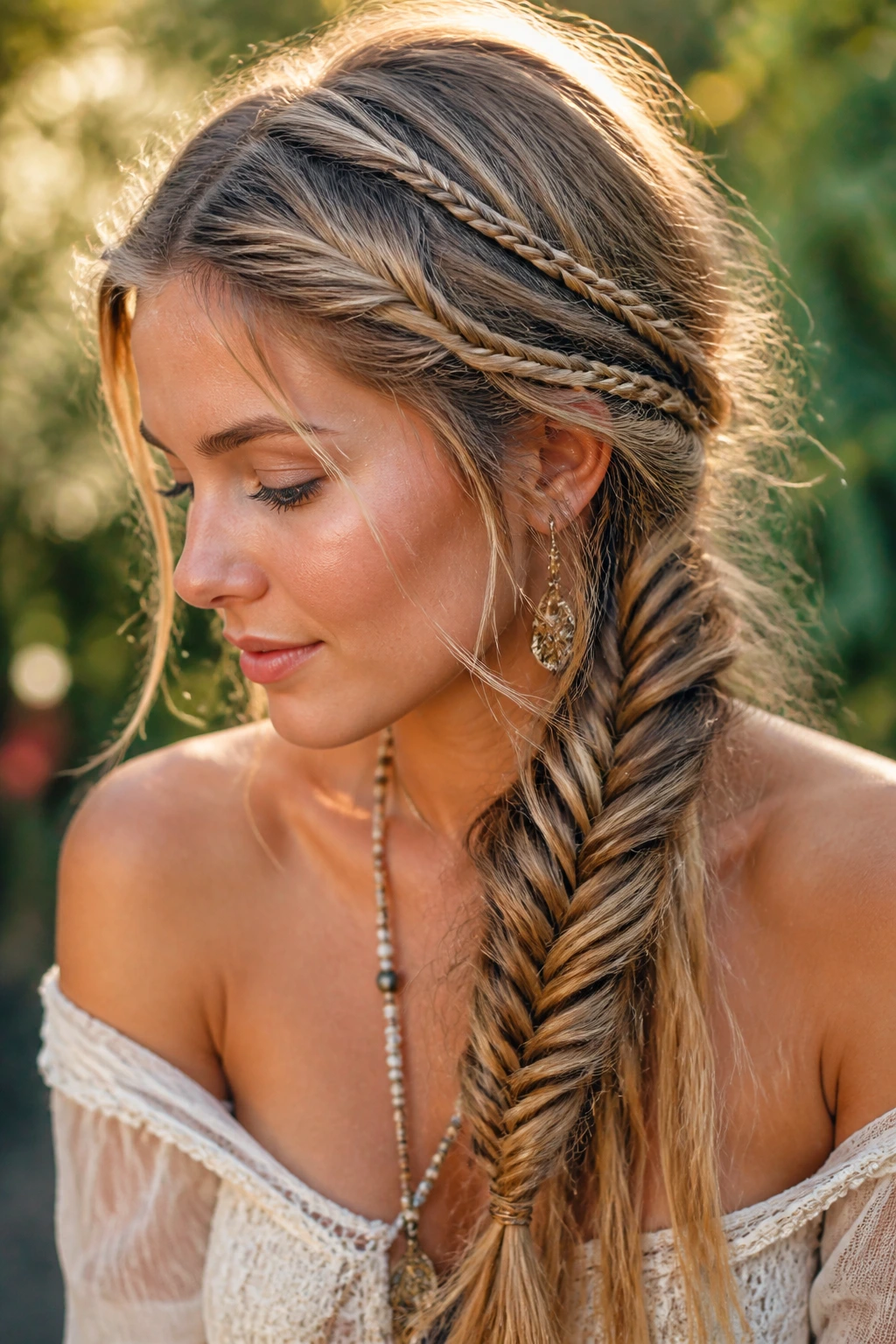
A single braid can look spare. Add a few micro braids through the sides or top, and the whole style starts to feel layered and lived in. That’s the charm of this boho version: it gives the main fishtail some company without turning the hair into a tangle.
You can braid two thin strands near the temple, let them fall into the main fishtail, or weave them alongside the outer edges. Keep the extra pieces slim. If they’re too thick, the whole style loses its softness and starts looking busy.
This works especially well for concerts, outdoor gatherings, or long afternoons when the hair needs personality more than polish. A little wave through the loose sections helps, but don’t chase perfect curls. The braid wants movement, not control.
13. Fishtail Into a Low Chignon
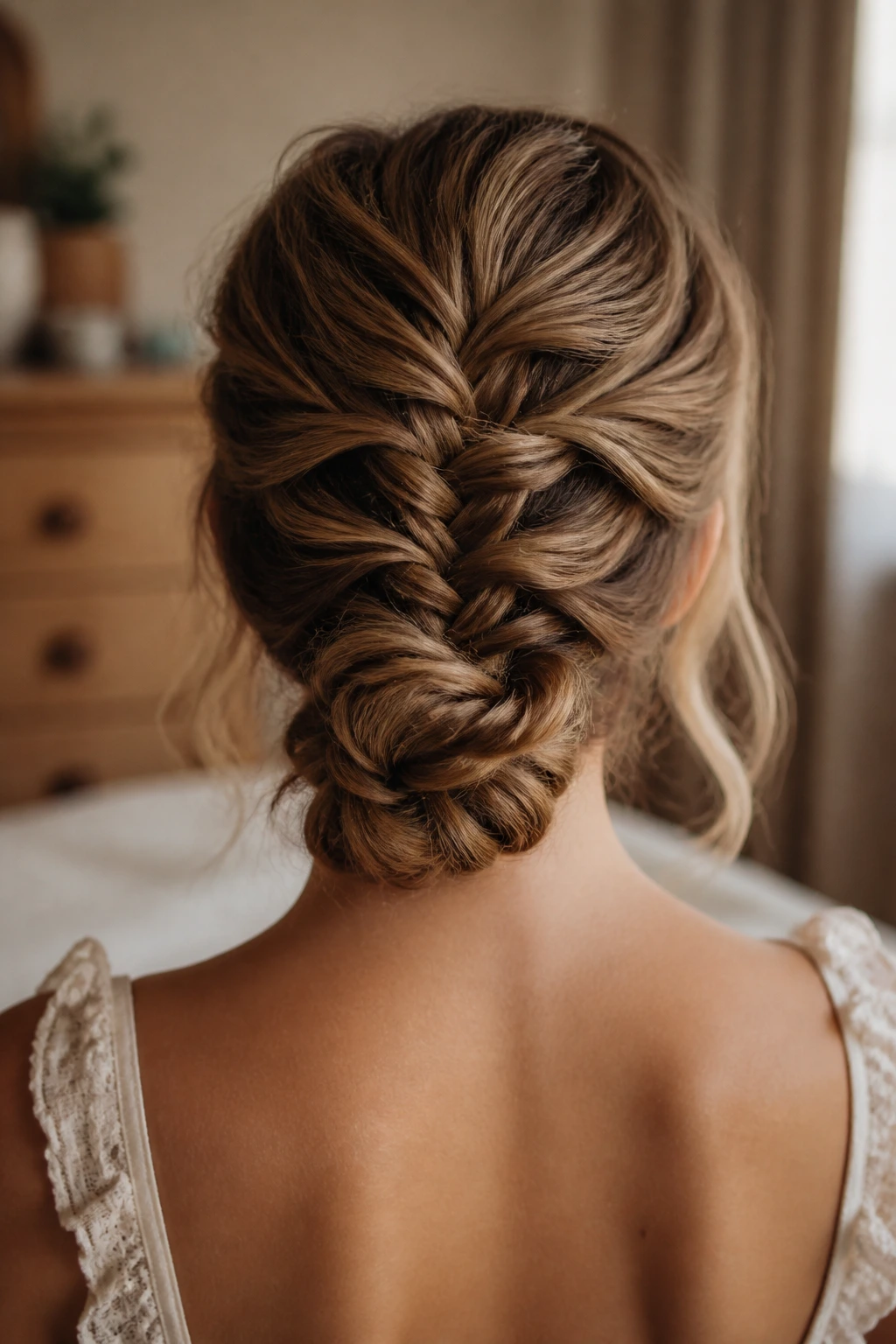
There’s something satisfying about a braid that disappears into a knot. A fishtail that rolls into a low chignon gives you the texture up front and the clean shape at the end. It’s the sort of style that holds through a long evening and still looks composed when you take your coat off.
Braid the hair down to the nape, then coil the length into a soft chignon rather than a tight twist. Pin the coil in an X pattern so the weight stays centered. Leave a little looseness on the sides of the bun if you want the style to keep its romantic edge.
This is a good choice when the outfit already does a lot. A high-neck dress, a dramatic neckline, or a pair of statement earrings all work well with it. The braid stays visible without stealing the whole show.
14. Fishtail Mohawk Braid
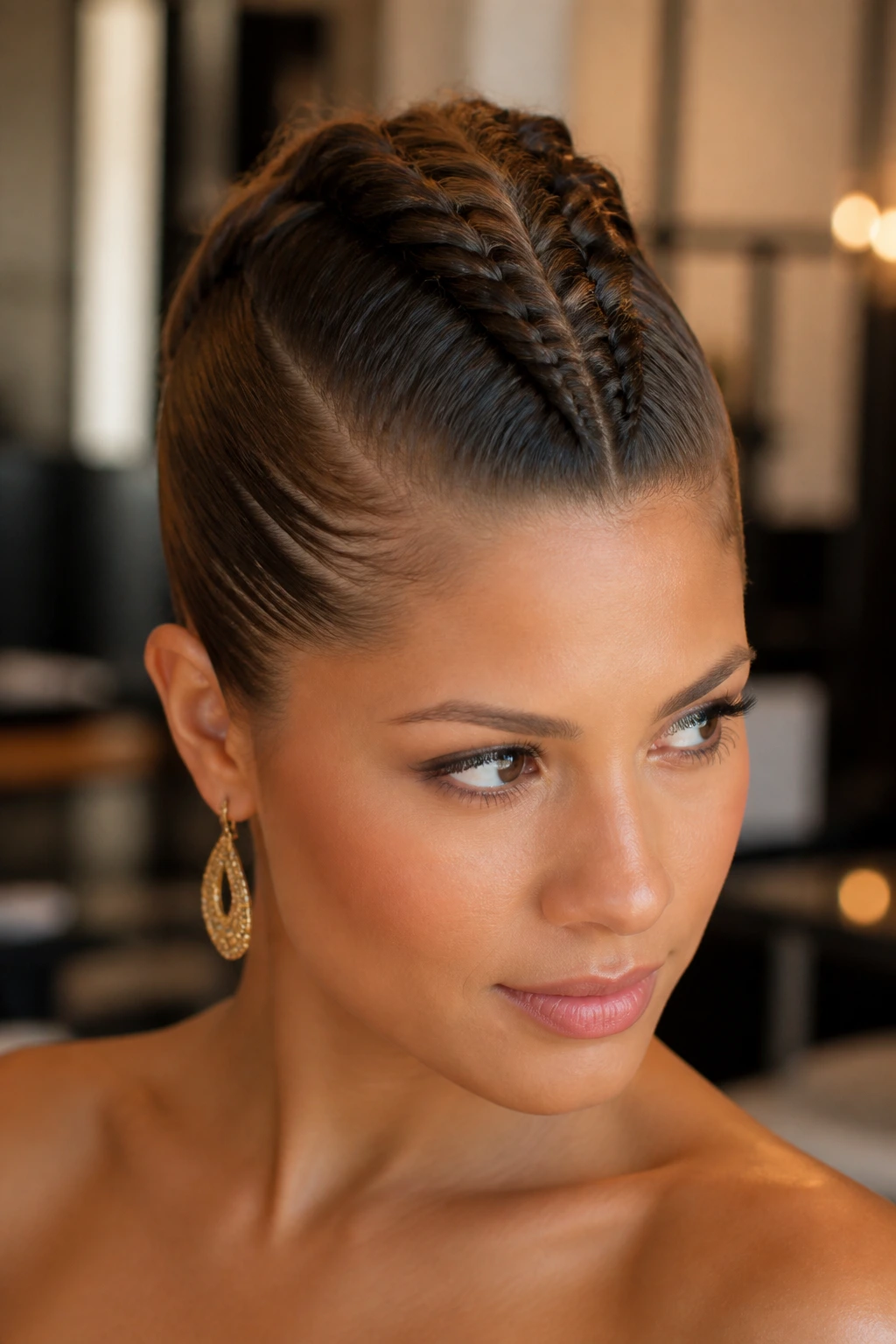
A fishtail can have attitude. The mohawk version proves it. The braid runs down the center of the head, with the sides smoothed or pinned back, so the shape gets height and a little drama without losing the delicate weave that makes fishtails so appealing.
This is a smart pick for medium to long hair when you want the crown lifted and the sides under control. Keep the side panels tight enough to flatter the face, then loosen the braid at the center just a bit so it doesn’t look armored. The contrast is what makes it work.
It’s not the softest look in the set, but it can still read romantic if the ends are left loose and the braid is slightly pancaked. Think “modern evening hair,” not “festival helmet.”
15. Minimalist Tucked Fishtail for Medium Hair
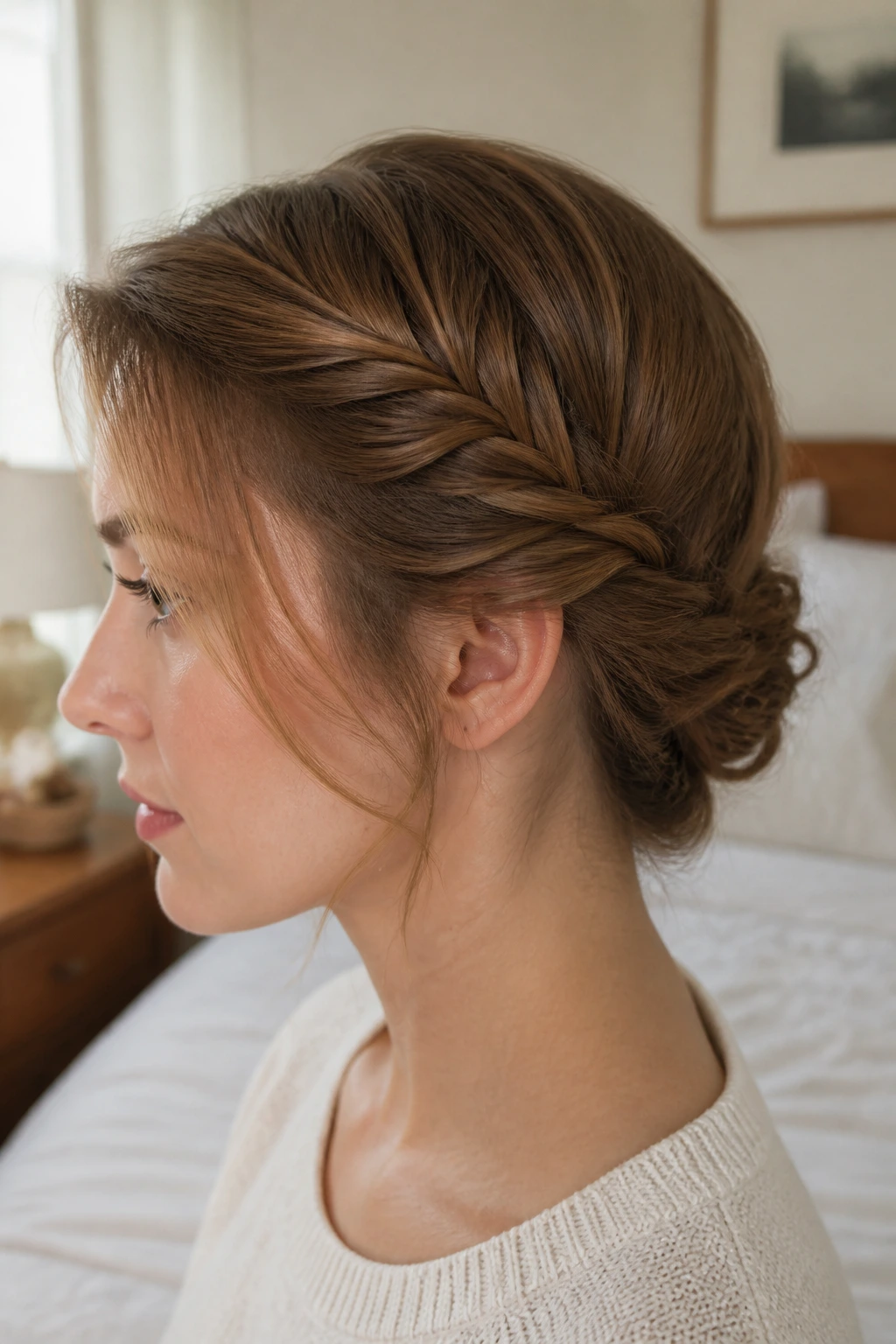
Can a fishtail work when the hair barely brushes the shoulders? Yes. You just have to stop pretending it needs to be a long, free-hanging braid. A tucked fishtail uses the available length wisely and keeps the shape compact.
Start at the back of the head, braid until the ends are short, then fold and pin them under the braid. You can also tuck the last inch into a low knot or twist if the hair is too short to hang cleanly. The key is to keep the braid tidy and let the texture do the visual work.
This is one of the best options for medium hair that tends to frizz at the ends. The tuck hides the awkward bits and gives you a finished outline without requiring extra length.
16. Fishtail with Pearl Pins and a Polished Finish
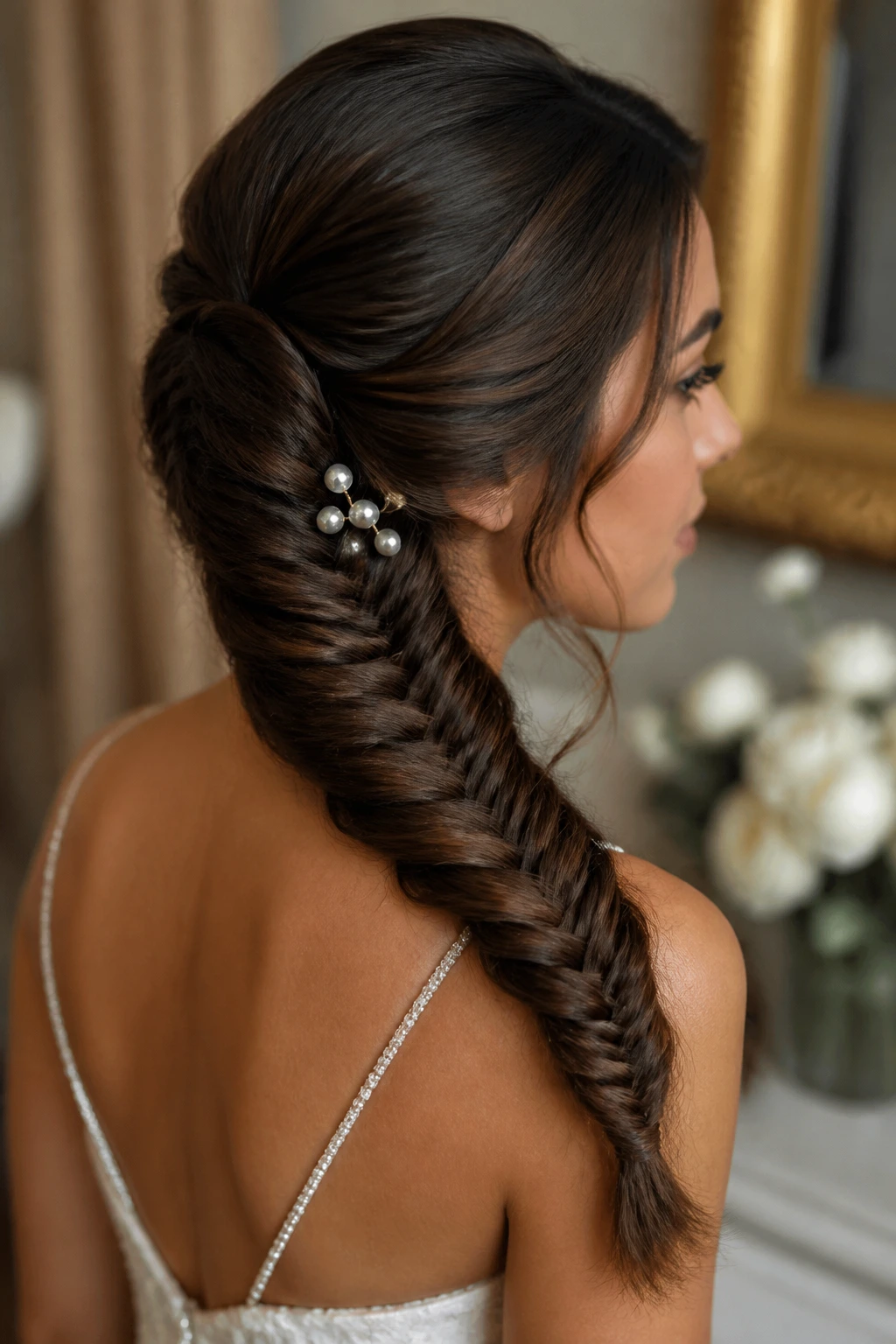
A basic braid becomes dressy fast when pearl pins are placed with a little restraint. Not scattered everywhere. Clustered. Three or four small pins near the braid’s curve or at the base of a low style are usually enough.
Use this version when the outfit is simple and needs one deliberate detail. The braid itself should stay neat, with the surface smoothed before pinning. A small amount of shine spray on the outer layer helps the pearls read crisp instead of lost in the hair.
The thing to avoid is overloading the braid with accessories. Too many pins make the style feel heavy. A few well-placed pearls catch the eye and let the braid remain the star.
17. Twisted Side Fishtail for Fine Hair
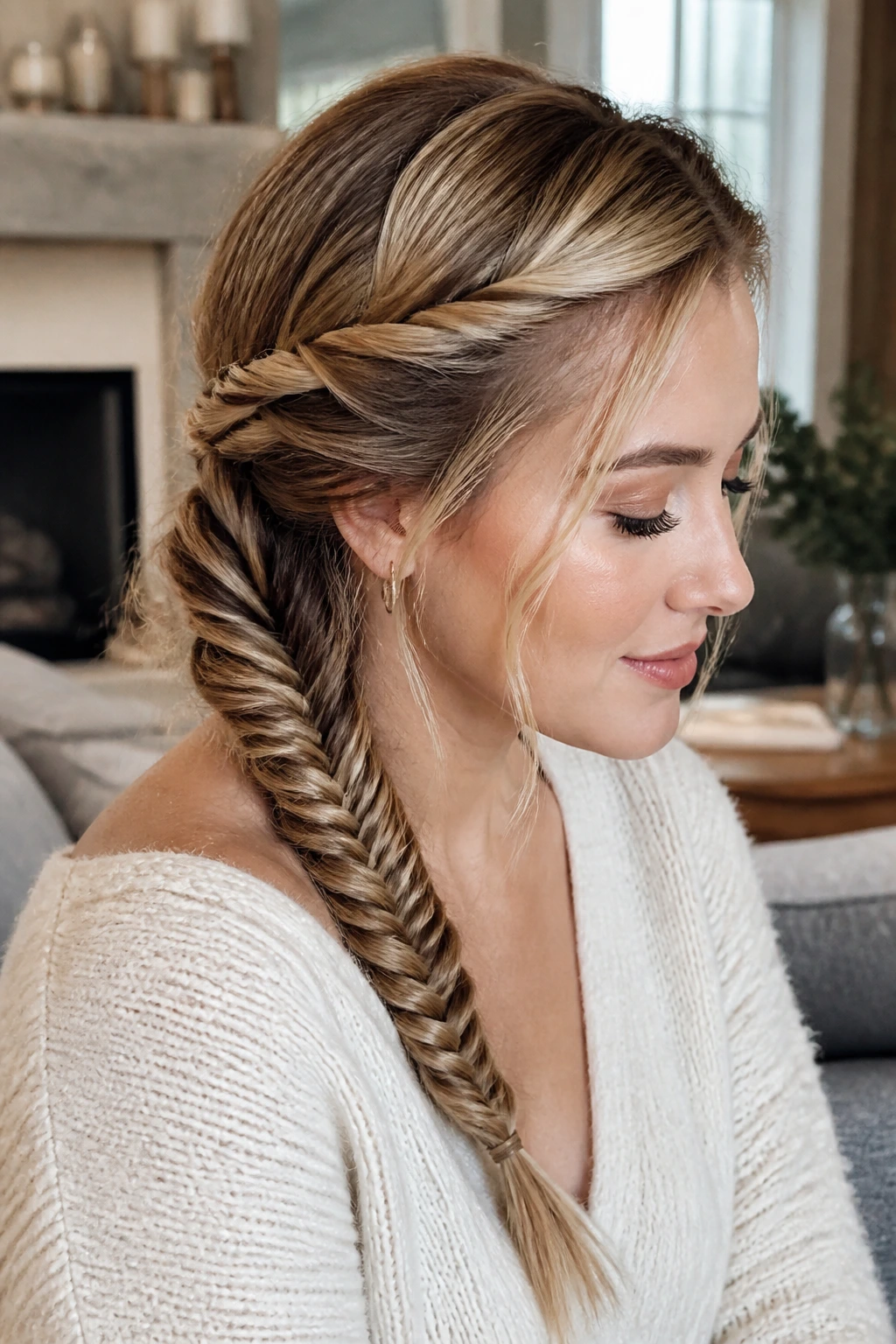
Fine hair often needs a little pre-work before a fishtail shows up properly. Twisting the front sections before starting the braid gives the shape more body, especially near the hairline where thin hair can go limp fast.
Part the hair to one side, twist each front section back toward the ear, then gather everything into the fishtail. The twists create a thicker-looking start, and the side angle helps the braid fall with more presence. Finish with a little volumizing spray at the roots, not a heavy cream through the ends.
This is the version I’d point people toward if they’ve tried a fishtail and thought, “Mine just looks narrow.” It’s not the hair. It’s the setup. Fine hair usually just needs a better base.
18. French Fishtail Seam Into the Ends
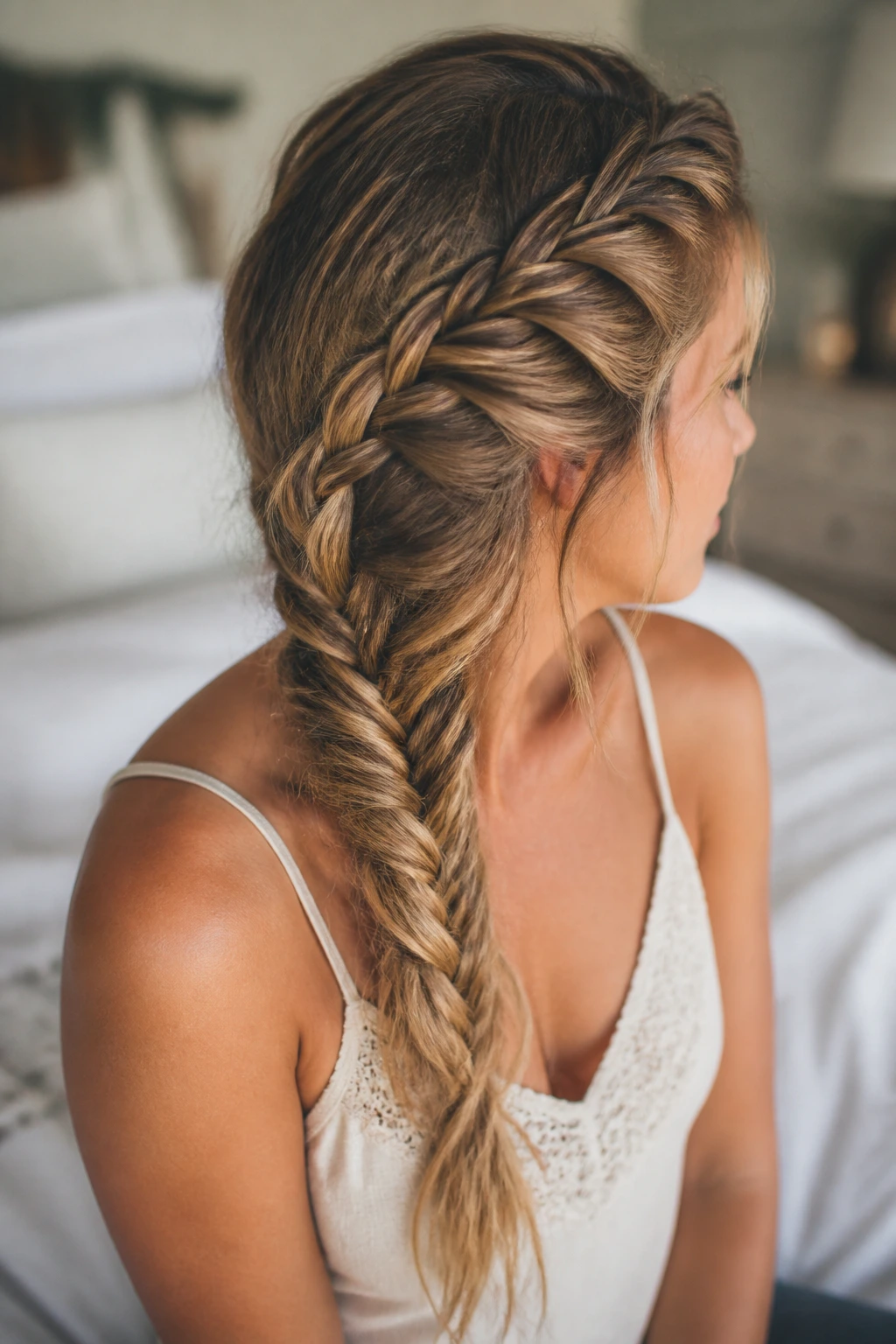
A French fishtail has one of the prettiest transitions in braided hair. The top section is woven close to the scalp, then the braid drops into the longer lengths and gets looser as it goes. That shift makes the braid feel architectural and soft at the same time.
What Makes It Different
The scalp-hugging start gives lift through the crown, which keeps the braid from collapsing backward. Once the braid reaches the mid-back, loosen the tension a touch so the ends taper gently instead of stiffening into a rope.
This style suits longer hair best, especially hair that needs root control. It also holds better than a loose braid if you’re moving around a lot. The seam from French braid to fishtail is the part that gives it character, so keep that section neat before you start pulling the braid apart.
19. Half-Crown Fishtail with Curled Ends
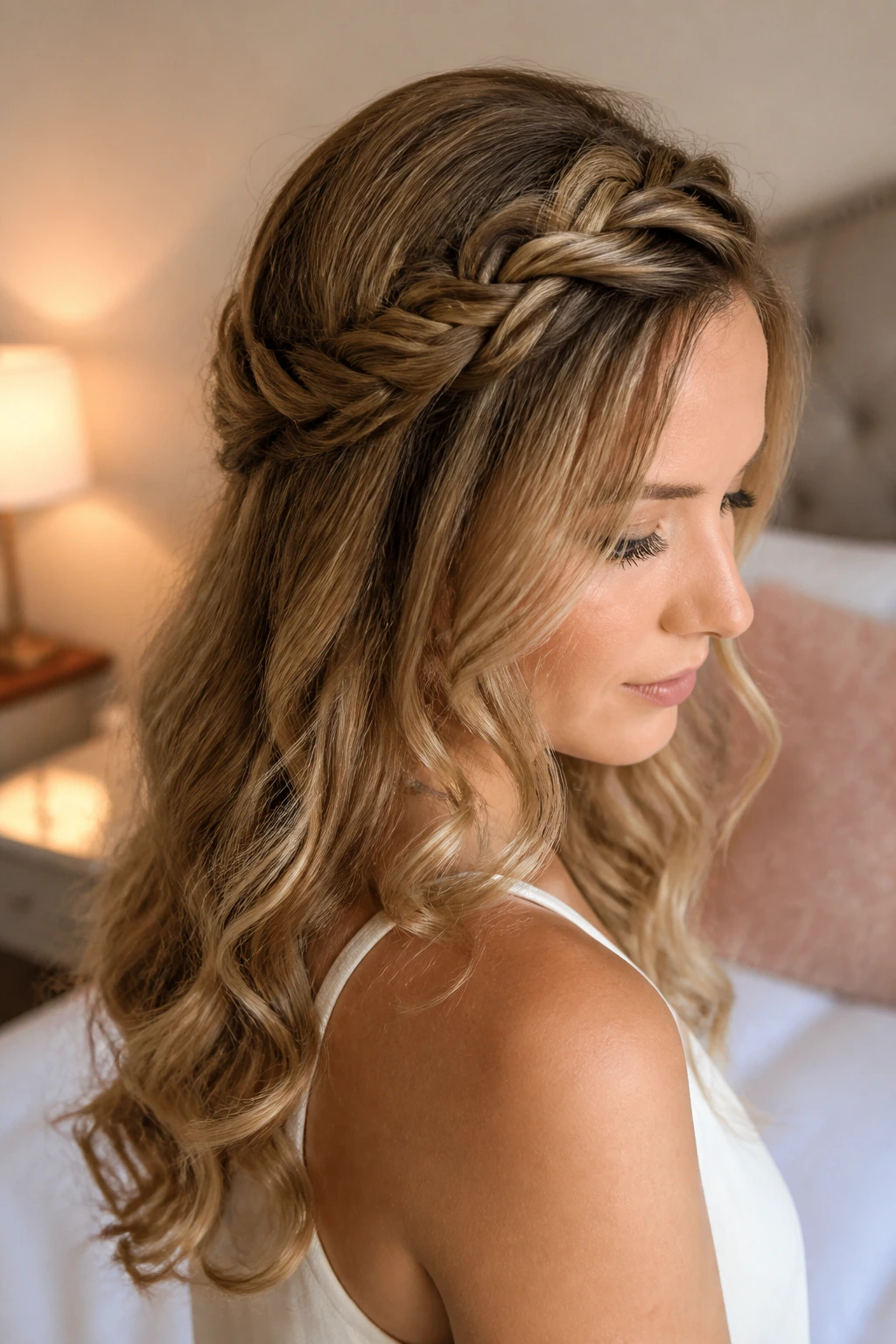
A full crown braid can feel formal. A half-crown version keeps the romance and drops the rigidity. It frames the top of the head, then lets the rest of the hair fall in soft curls or bends, which is a much gentler read.
This works well when the hairline needs a bit of structure but the length deserves to stay visible. Start the braid at one temple, cross the top of the head, and pin it behind the other side. Keep the ends curled so the loose hair looks intentional next to the braid.
If the top starts to puff too much, flatten just the very top with your palms. Don’t crush the whole braid. A little height near the braid line is part of what makes the style feel airy.
20. Oversized Pancaked Fishtail for Thick Hair
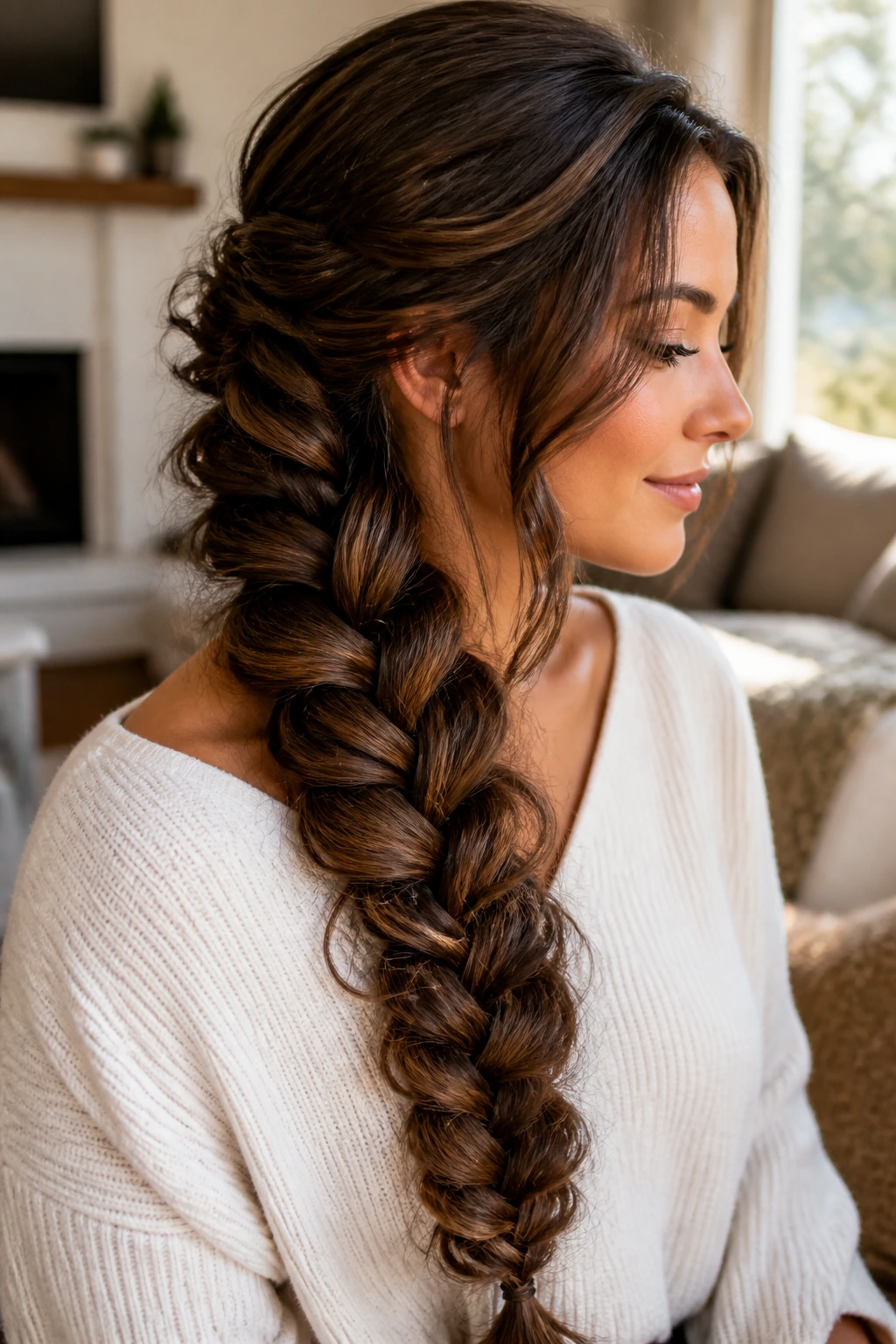
Thick hair can make a braid look dense fast. That’s fine if density is the point. It’s less fine when you want softness. The oversized pancaked version lets you keep the fullness while widening the braid enough that it reads romantic instead of packed.
Start with smaller sections than you think you need. That keeps the weave cleaner. Once the braid is secured, gently tug at the outer loops from top to bottom, working in short increments so the shape opens without collapsing. A smoothing cream on the ends helps, but keep it away from the roots or the braid will slip.
This is one of the easiest ways to turn “a lot of hair” into a feature rather than a challenge. The braid gets larger, yes, but also more graceful.
21. Fishtail with Scarf Weave
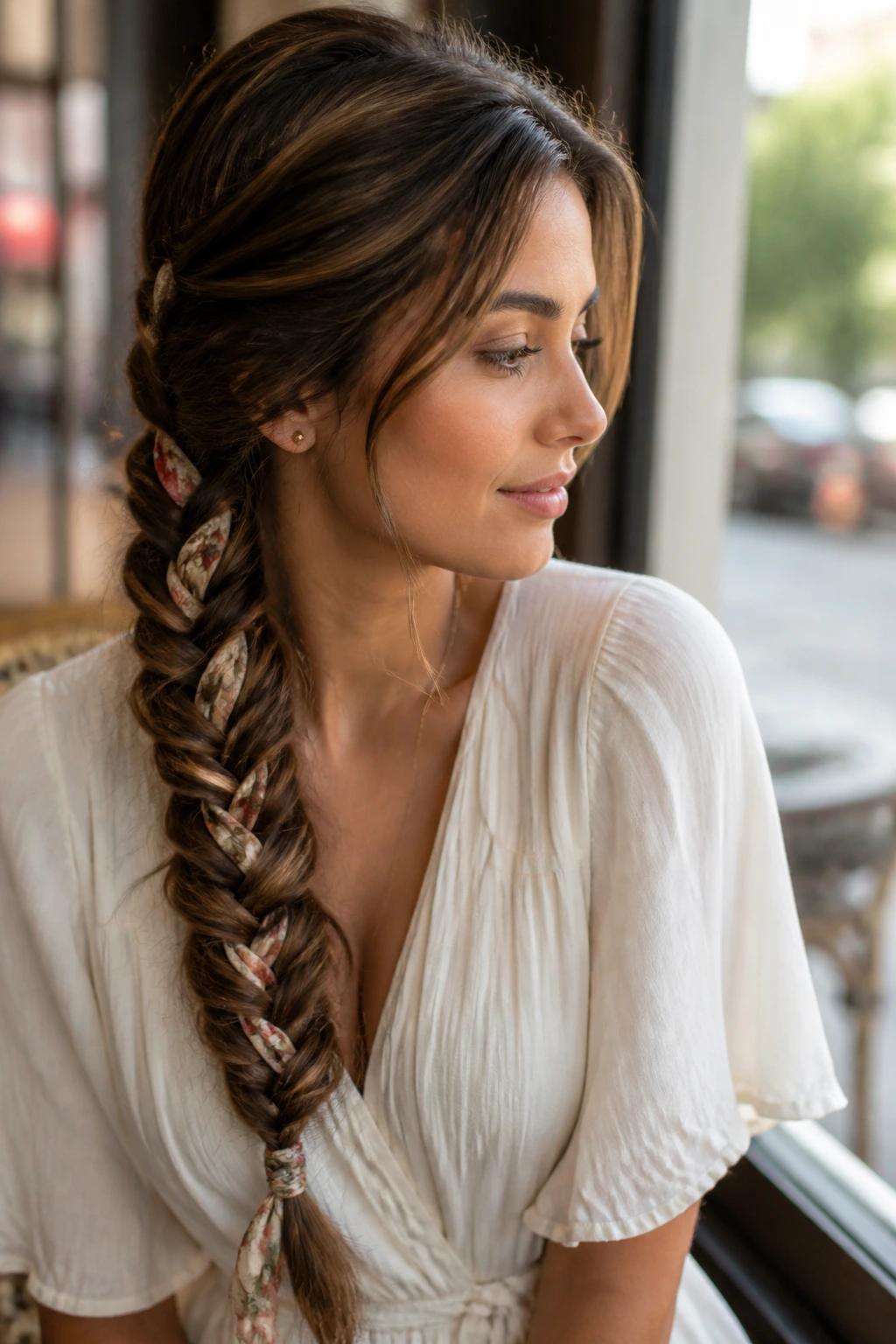
A scarf woven through a fishtail changes the whole tone of the braid. A narrow silk or satin scarf adds color, length, and movement, and it’s a neat way to soften a braid that might otherwise feel too plain.
Thread the scarf into the top section before you begin the braid, then treat two scarf ends as part of the weave. Keep the scarf narrow—about 1 to 2 inches—so it doesn’t overwhelm the braid pattern. The best effect comes when the fabric peeks through in small flashes rather than sitting on top like a headband.
This version works for casual outings and dressier events alike. It depends on the scarf. A matte print feels relaxed. A glossy silk version reads more polished. Either way, the braid gets a little personality without much extra work.
22. Bridal Fishtail Updo with Hidden Pins
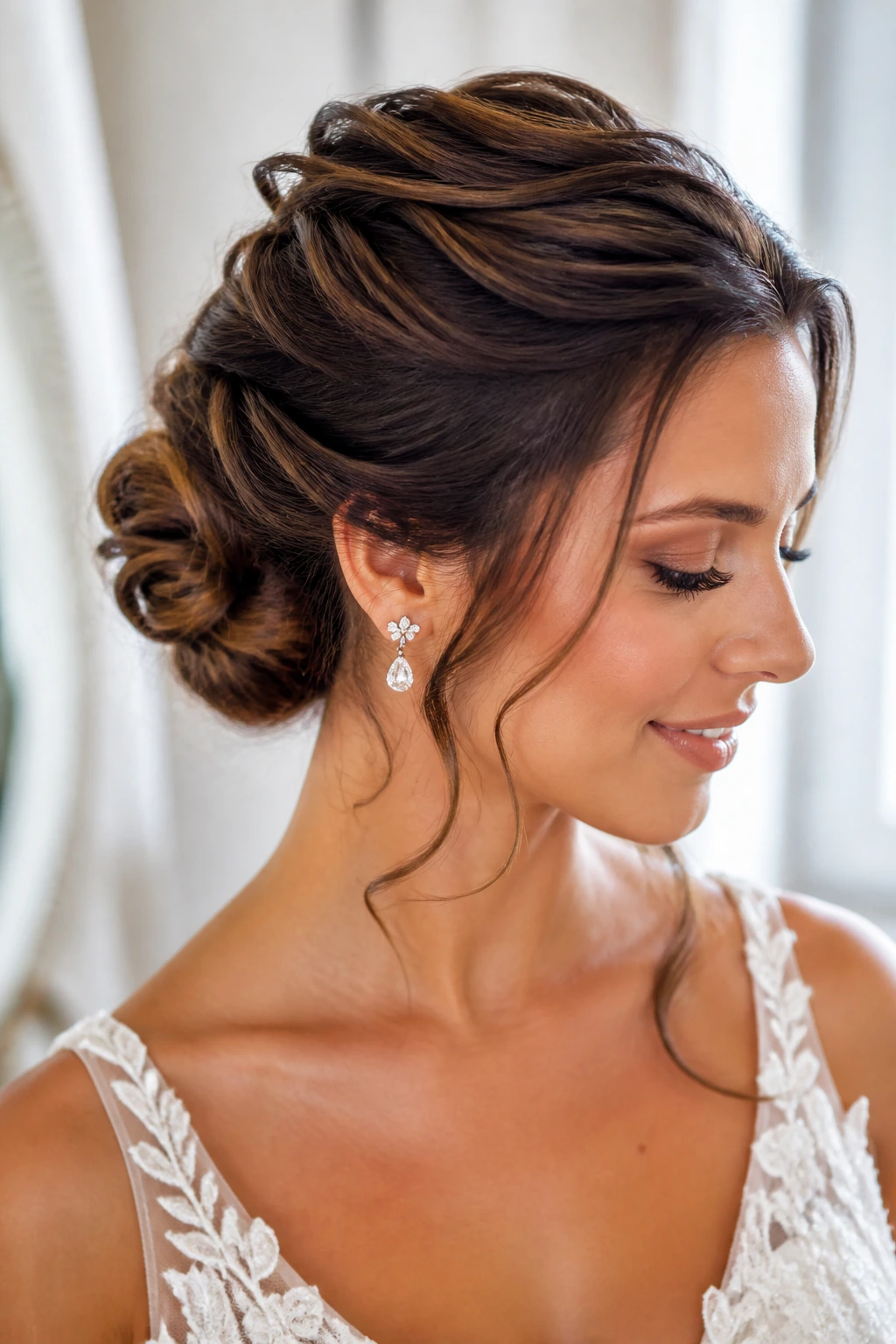
A bridal braid needs to behave from every angle. That’s the non-negotiable part. The fishtail updo handles that by building texture first, then hiding the structure in a twist or low roll so the hair stays secure without looking packed down.
Braid the length loosely, coil it into a tucked updo, and place pins under the folds rather than across the surface. Hidden pins matter more than decorative ones here because they keep the silhouette smooth. If the braid needs veil support, anchor the veil comb under the braid’s upper edge, not through the loosest part of the bun.
This is one of those styles that looks calm in person and on camera. The braid gives the updo texture, and the updo gives the braid longevity. Useful combination.
23. Sleek Center-Part Fishtail Ponytail
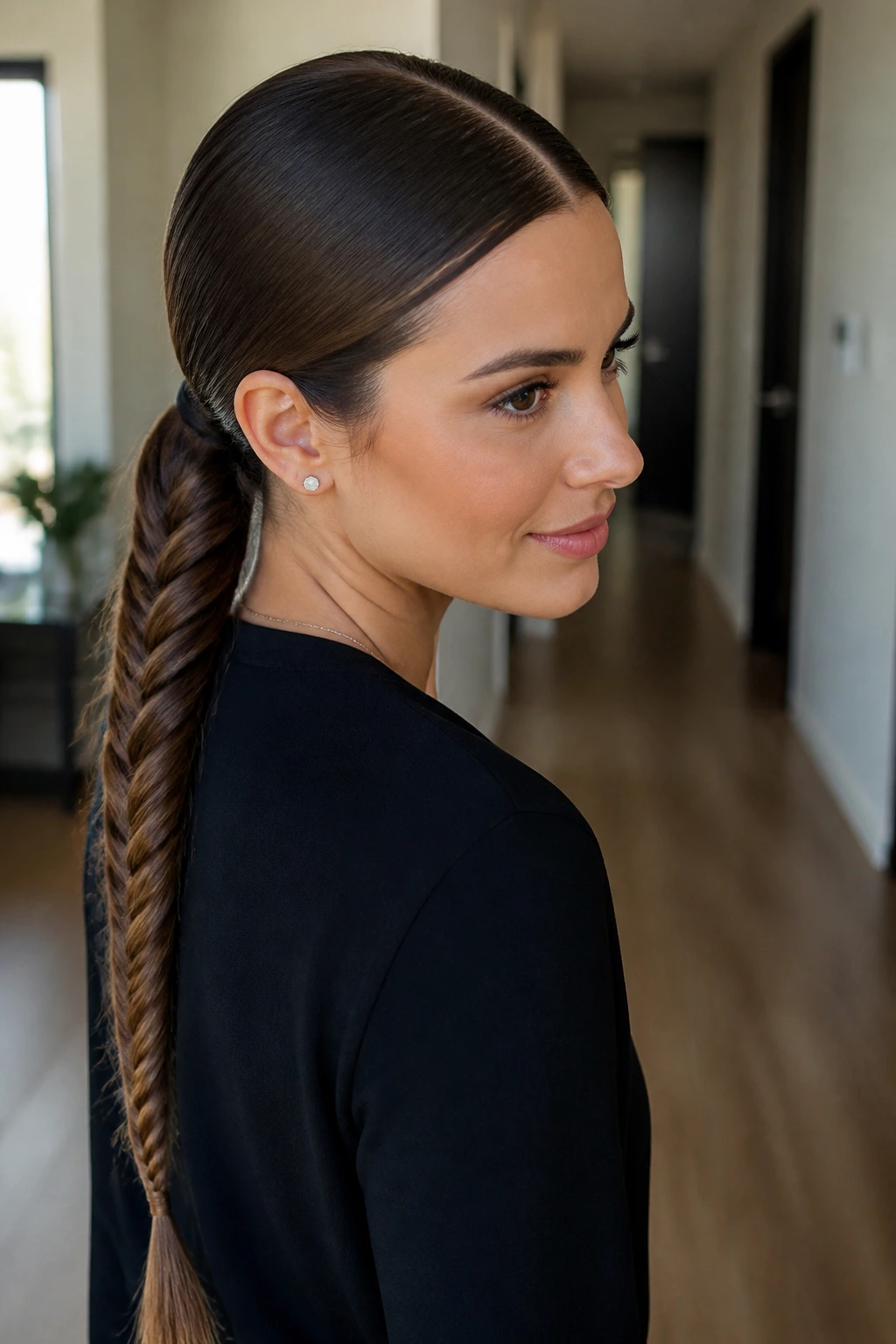
Clean can still be romantic. A center-part fishtail ponytail has a sharper edge than most styles in this collection, but the braid softens the symmetry. That’s the appeal. The top stays smooth, the braid length does the decorative work, and the finished line down the back feels deliberate.
The center part should be precise. The ponytail should sit low or mid-low, not high enough to look sporty. Use a small amount of serum only on the surface and the ends; too much and the braid will slide apart faster than you want.
This style is a strong pick for structured outfits or minimal makeup. It has enough shape to hold its own, but not so much softness that it disappears. A clean line can be romantic too, if the braid itself stays loose.
24. Asymmetrical Fishtail Bun for Modern Romance
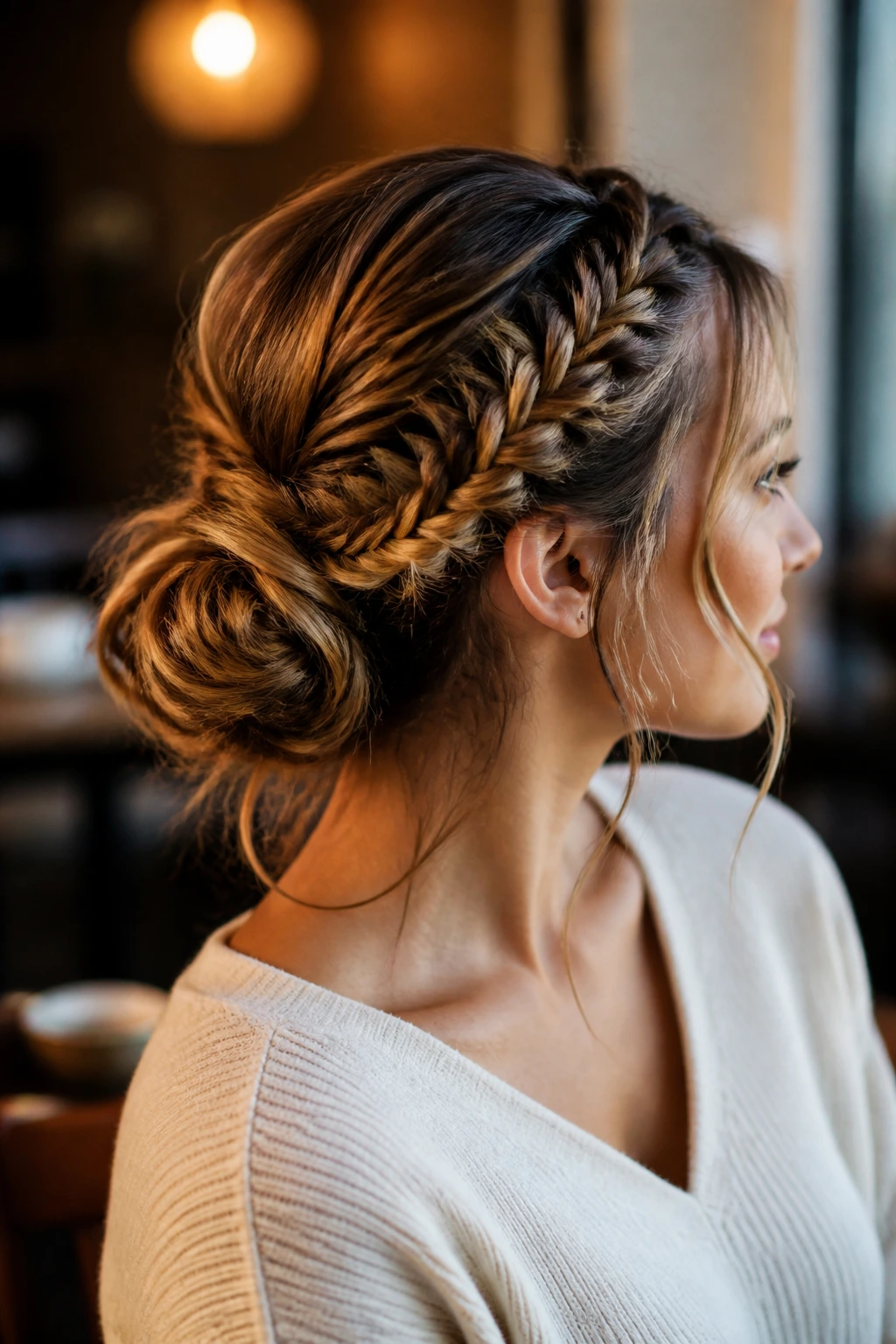
A braid doesn’t have to be centered to feel balanced. The asymmetrical version starts off to one side, then folds into a bun that sits slightly off-center at the nape or just behind one ear. That offset is what gives it movement.
The shape works best when one side is smoothed more tightly than the other. The looser side can skim the cheek, while the tighter side keeps the structure anchored. Pin the bun from the underside first, then hide the remaining pins under the braid coils.
This is a nice option when the outfit has an asymmetrical neckline or one dramatic shoulder. The hair echoes the clothes instead of fighting them. That kind of echo makes a style look thought through.
25. Undone Fishtail with Tendril Fringe
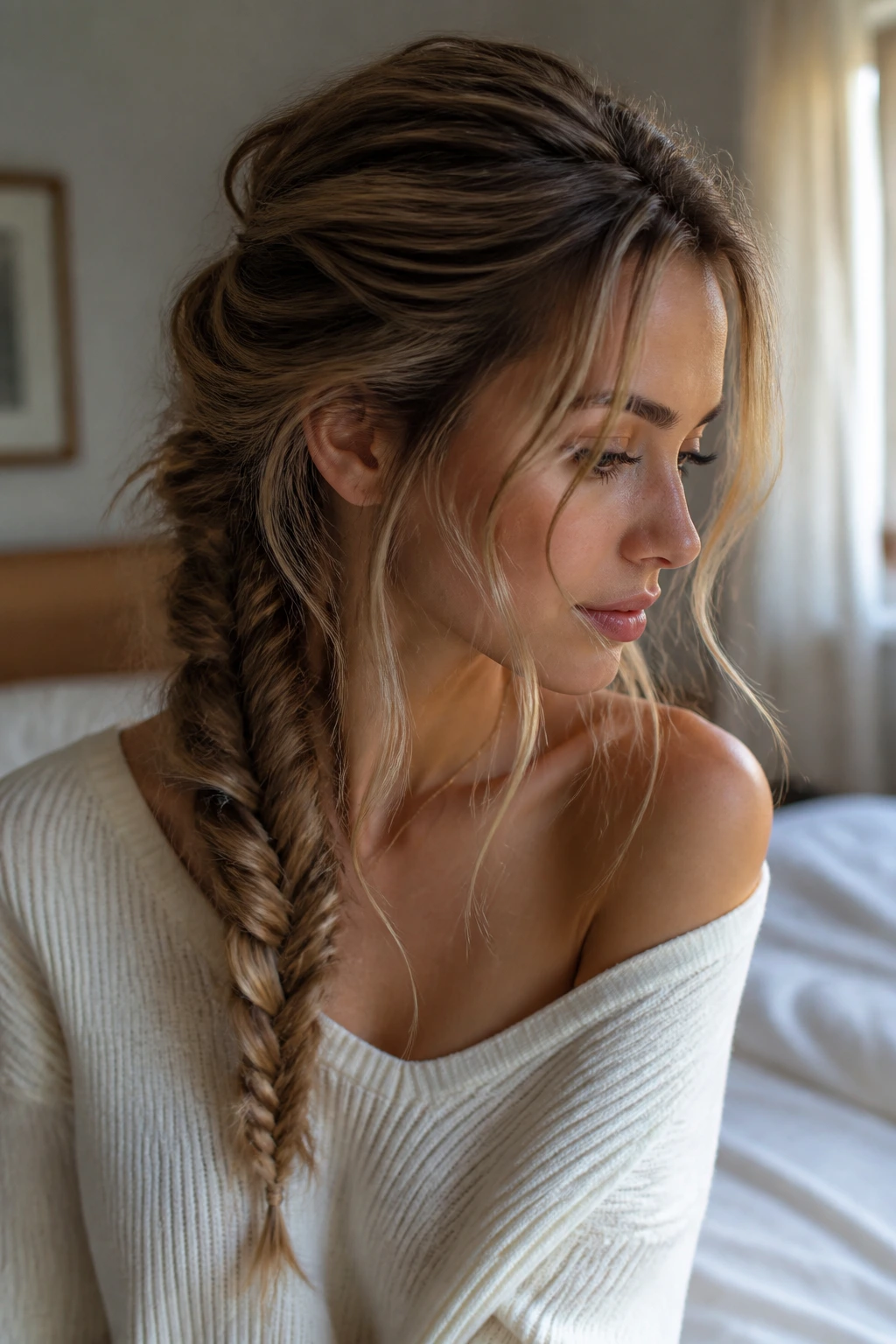
The most romantic fishtail in the bunch is often the least strict one. The undone version keeps the braid loose, leaves tendrils around the temples and jaw, and lets the ends fall with a little irregularity. It feels easy because it is easy. That’s the point.
Braid the hair without pulling every section tight, then widen the edges just enough that the pattern breathes. Curl the tendrils away from the face so they move with the braid instead of sticking to the cheeks. A whisper of texture spray at the ends helps the whole style stay light.
If you want a braid that looks soft in motion, this is the one. It doesn’t need much. Good hair texture, a few loose pieces, and the nerve not to over-finish it. That’s all.
Why Fishtail Braids Read Soft Instead of Stiff
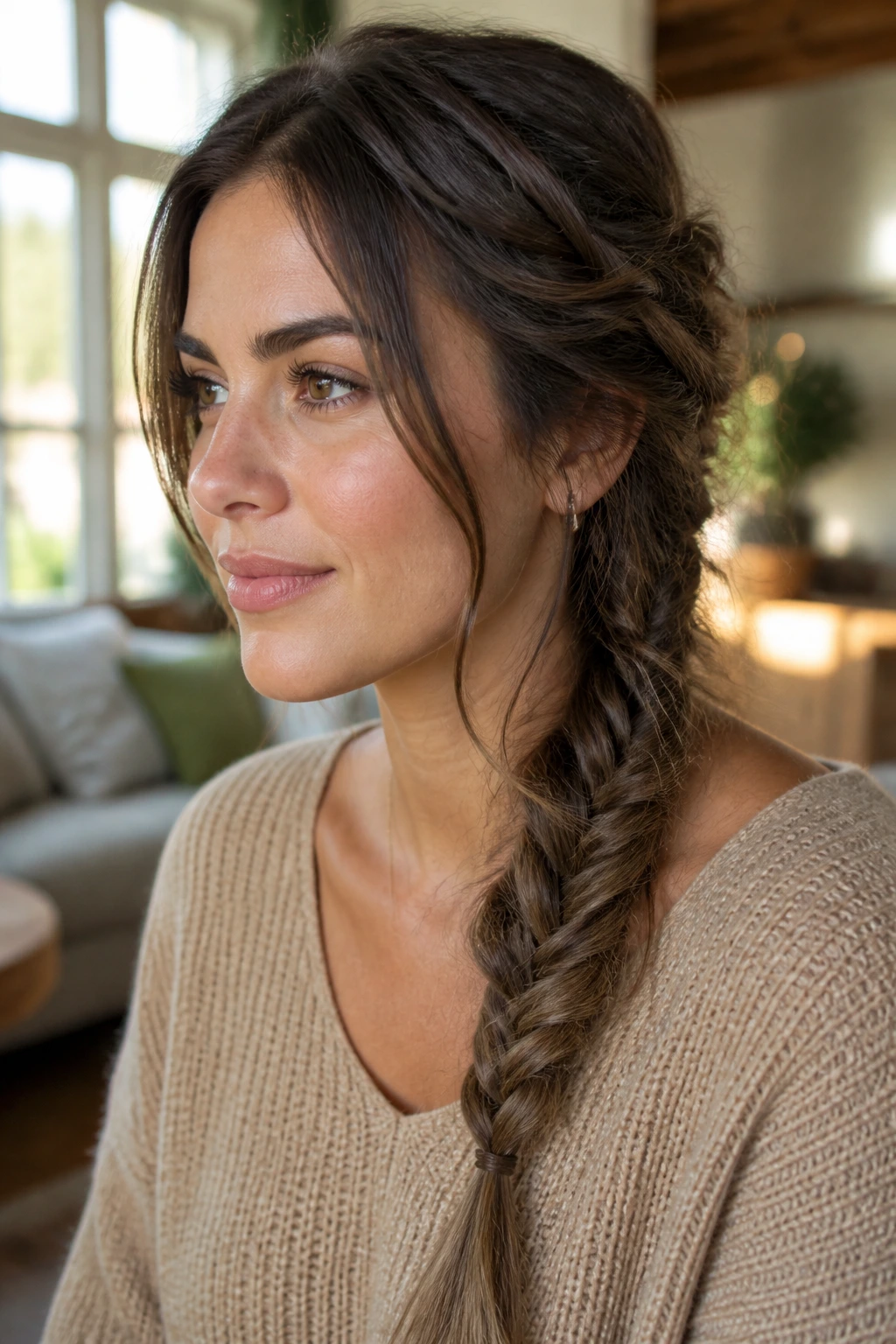
A fishtail braid works for romantic styling because the pattern itself is fine-grained. The smaller the sections, the gentler the visual line. A standard braid can sometimes feel ropey or blocky; a fishtail breaks that up into a woven surface that catches the eye in a calmer way.
The other reason is tension. A tight braid pulls the face backward. A looser fishtail keeps some air at the hairline and around the ears, which changes the whole expression. Hair that can move a little always reads less formal than hair that’s locked in place.
Accessories matter too, but only because the braid gives them a clean surface to sit on. A ribbon, pearl pin, or even a single small clip has room to breathe against the texture. That’s why this braid style works so well for weddings, date nights, and outfits that need a soft finish rather than a hard edge.
Essential Tools for Clean Braids and Easy Grip
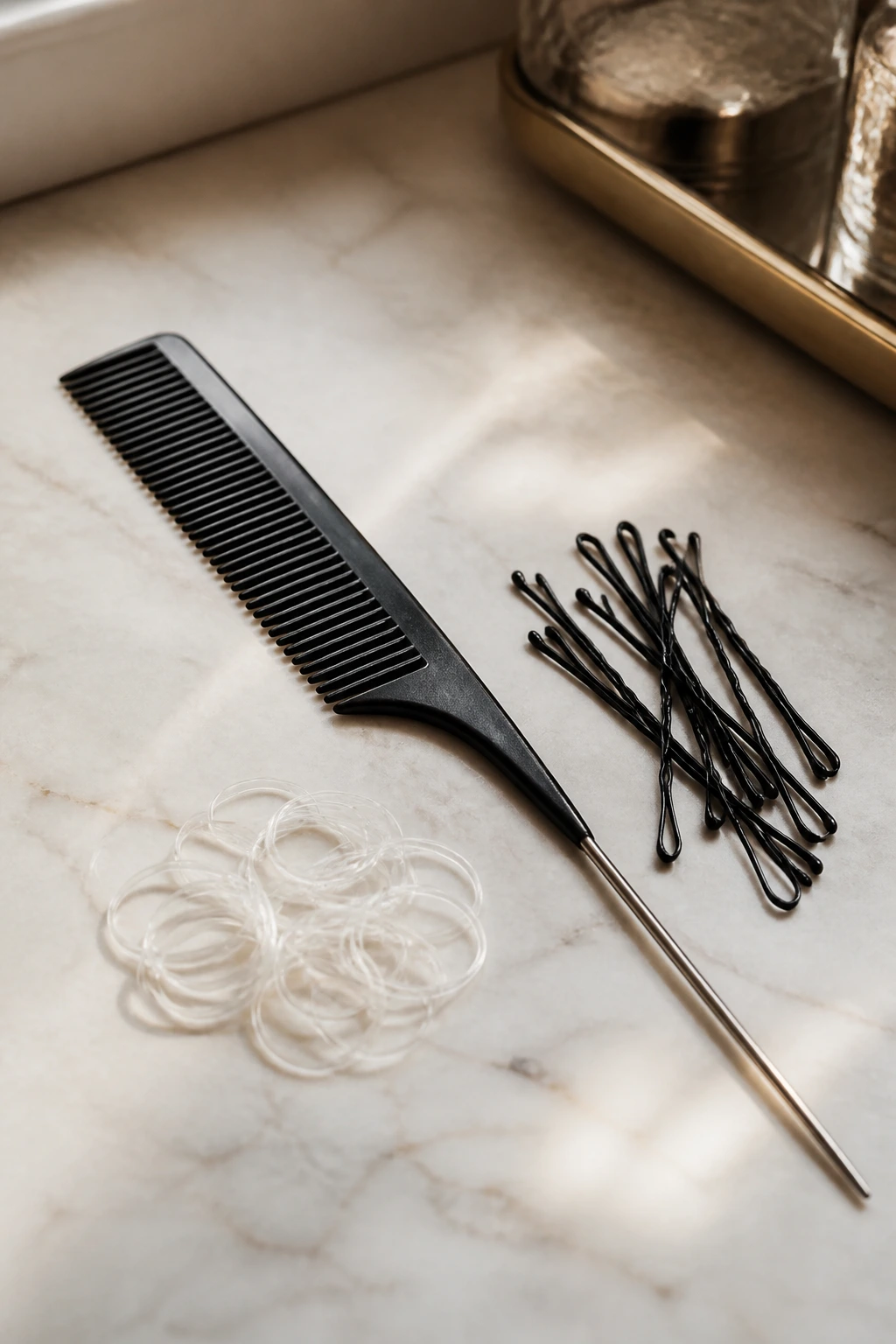
- Rat-tail comb: Helpful for clean parts and for lifting small sections without disturbing the rest.
- Clear elastics: Best for finishing the braid without stealing attention from the weave.
- Bobby pins with a grippy finish: Smooth pins slip more on polished hair; textured ones hold better.
- Texturizing spray: Gives fine or freshly washed hair the grit a fishtail needs.
- Dry shampoo: Good at the roots for slip-prone hair and for second-day volume.
- Light-hold hairspray: Keeps flyaways quiet without turning the braid rigid.
- 1-inch curling iron or flat iron: Useful for adding a soft bend through the ends or front pieces.
- Hair clips: Keep the sections separated while you braid; tiny duckbill clips work well.
- Ribbon, scarf, or decorative pins: Optional, but they change the finish fast.
- Hand mirror: Useful for checking symmetry at the back, especially on crown and low styles.
Smart Prep and Product Picks for Fishtail Braid Hairstyles
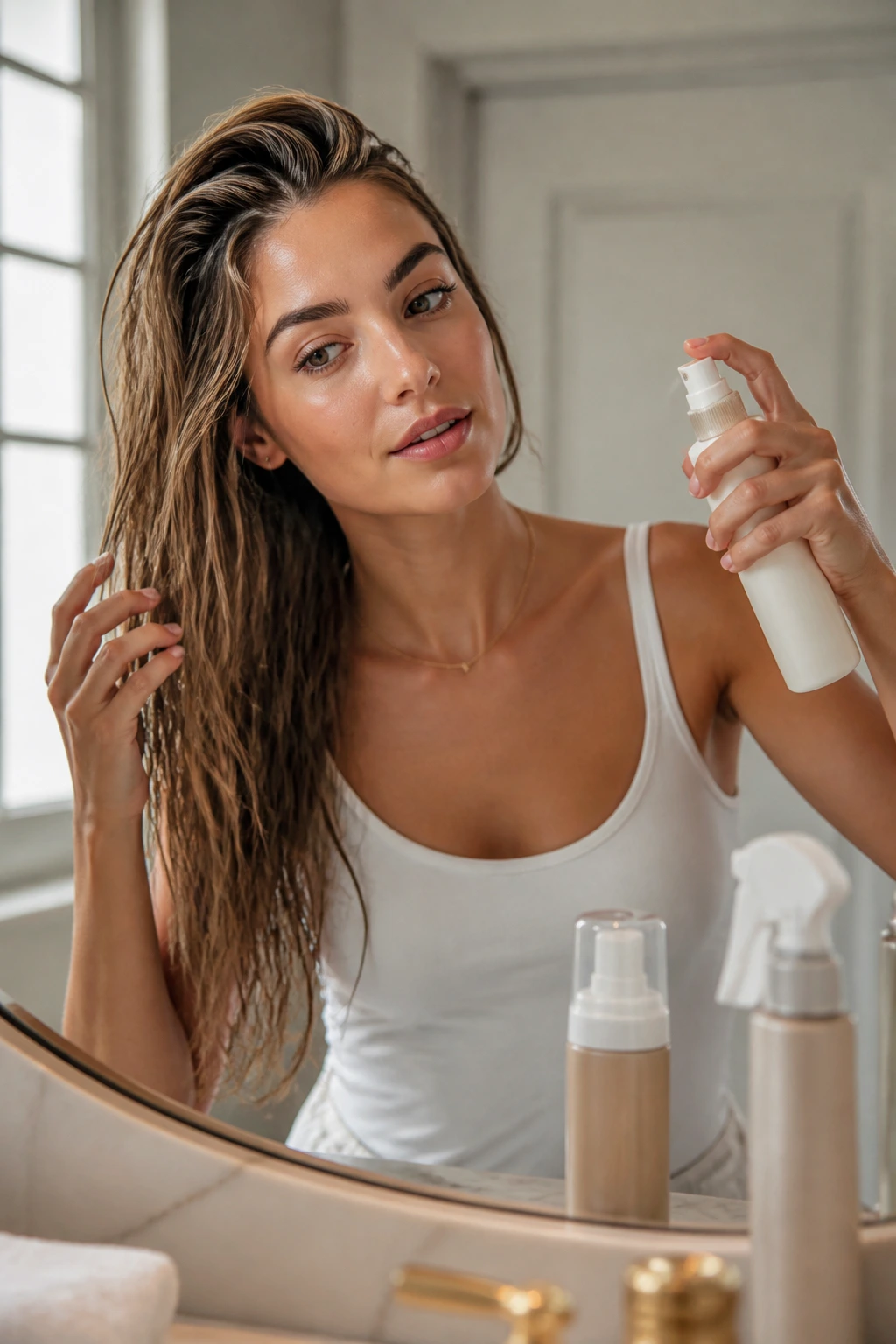
Hair that is too clean is usually the hardest hair to braid. Freshly washed strands tend to slide, especially if they’re fine or straight. A little texture helps the braid catch itself, so day-old hair, dry shampoo at the roots, or a light veil of texturizing spray often gives better results than a squeaky-clean finish.
Product choice matters more than people admit. A lightweight mousse on damp hair can add grip without leaving the ends sticky. A smoothing cream works well on thick or frizz-prone hair, but keep it off the roots or the braid may collapse sooner than you want. Heat protectant belongs anywhere you’re adding waves first. That part is non-negotiable.
Clear elastics are useful, but not always enough on their own. If your hair is very silky, pick small elastics and pair them with one or two hidden pins. If your hair is coarse or curly, the braid may hold on its own once it’s set, which means you can use less product and keep the finish softer. The goal is grip, not helmet hair.
How to Match the Braid to the Moment
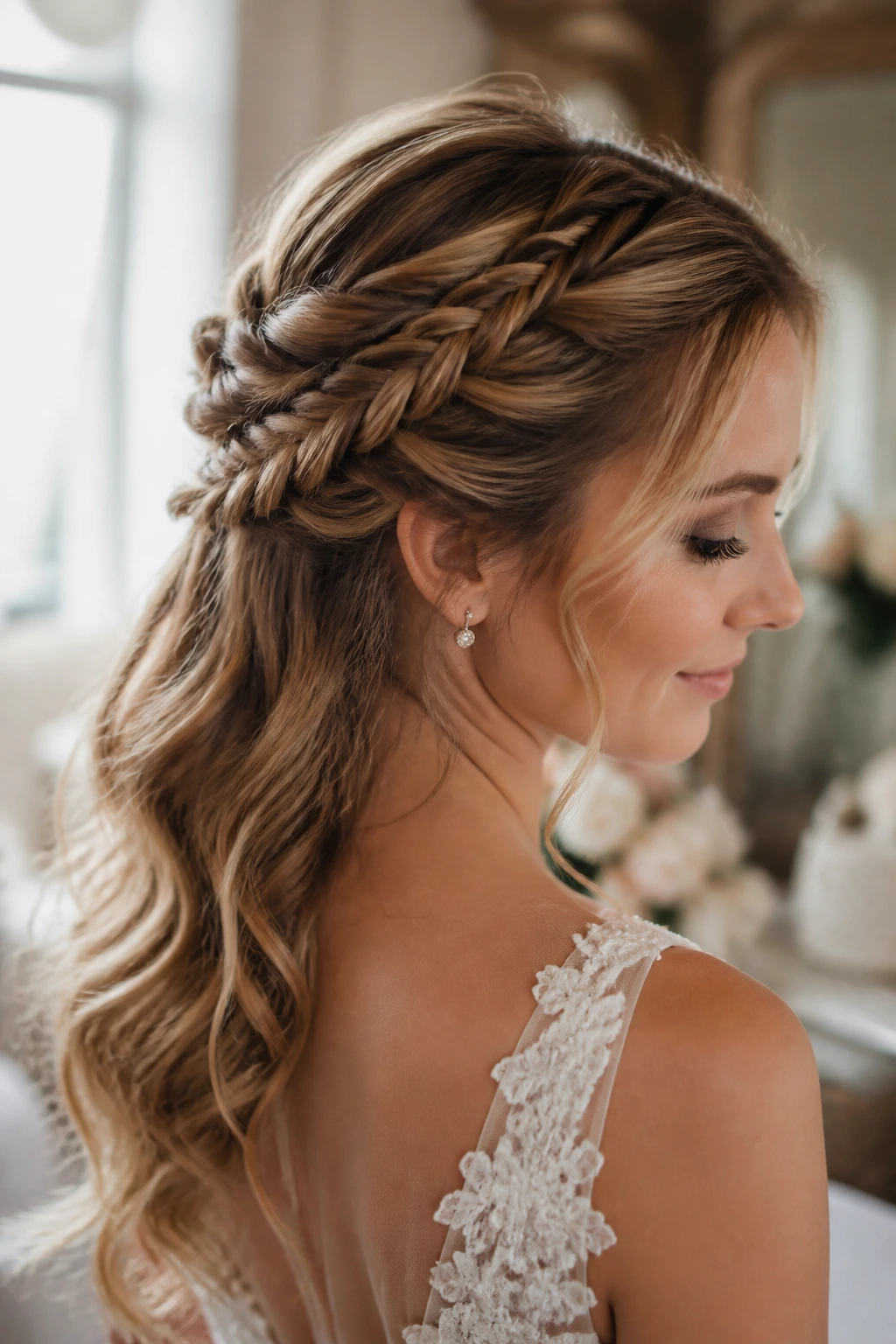
Bridal and formal events: Choose a crown braid, low chignon, or tucked updo. These styles hold from every angle and don’t compete with a neckline, veil, or earrings.
Casual days and brunch: Half-up fishtails, side braids, and scarf-woven versions feel relaxed without looking unfinished. A little wave through the lengths keeps the style from going flat.
Work or long days out: Low ponytails and headband braids are the safest bets. They stay close to the head, keep hair off the face, and don’t need constant adjustment.
If the outfit is already dramatic: Pick a cleaner braid with less volume. A sleek center-part ponytail or asymmetrical bun gives the clothes room to lead.
If the outfit is plain: Go looser and a little fuller. Pancaked braids, pearl pins, or face-framing tendrils add enough detail to carry the look.
Practical Tips for Fuller, Softer Braids
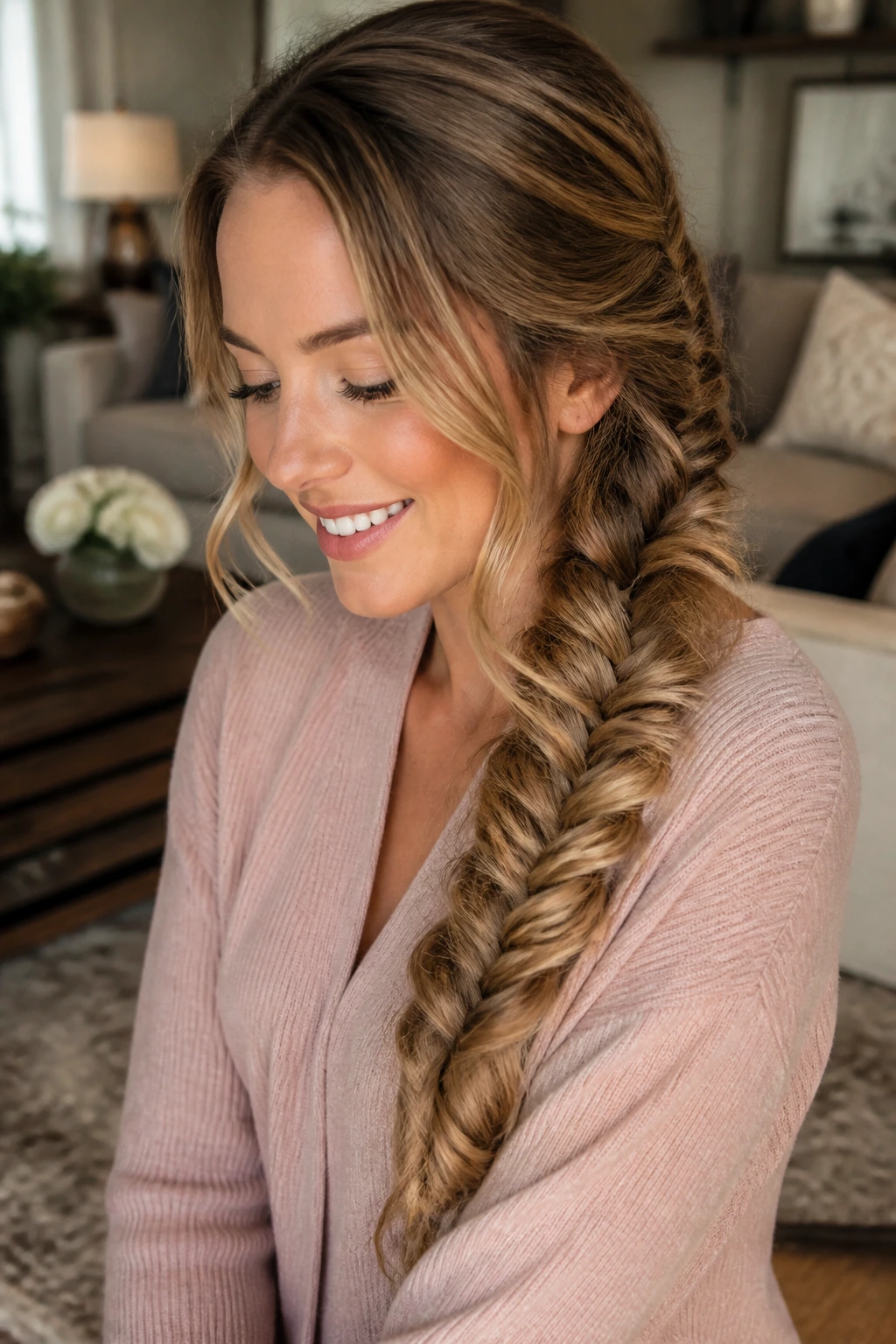
Grip first, style second. If your hair slips while you braid, pause and mist the roots with dry shampoo or texture spray. A braid that starts sliding at the crown usually needs grip, not more tension.
Braid smaller than you think. Tiny sections create the fishtail pattern more clearly. Large sections make the braid chunky, and chunky is not the same as soft.
Pancake only the outer edge. Pulling the center apart flattens the whole style. Tug the outer loops instead, and work from top to bottom in small motions.
Finish the ends with restraint. A touch of serum or cream is enough. Too much shine product at the bottom makes the braid look greasy and weakens the hold.
Common Mistakes That Flatten the Look
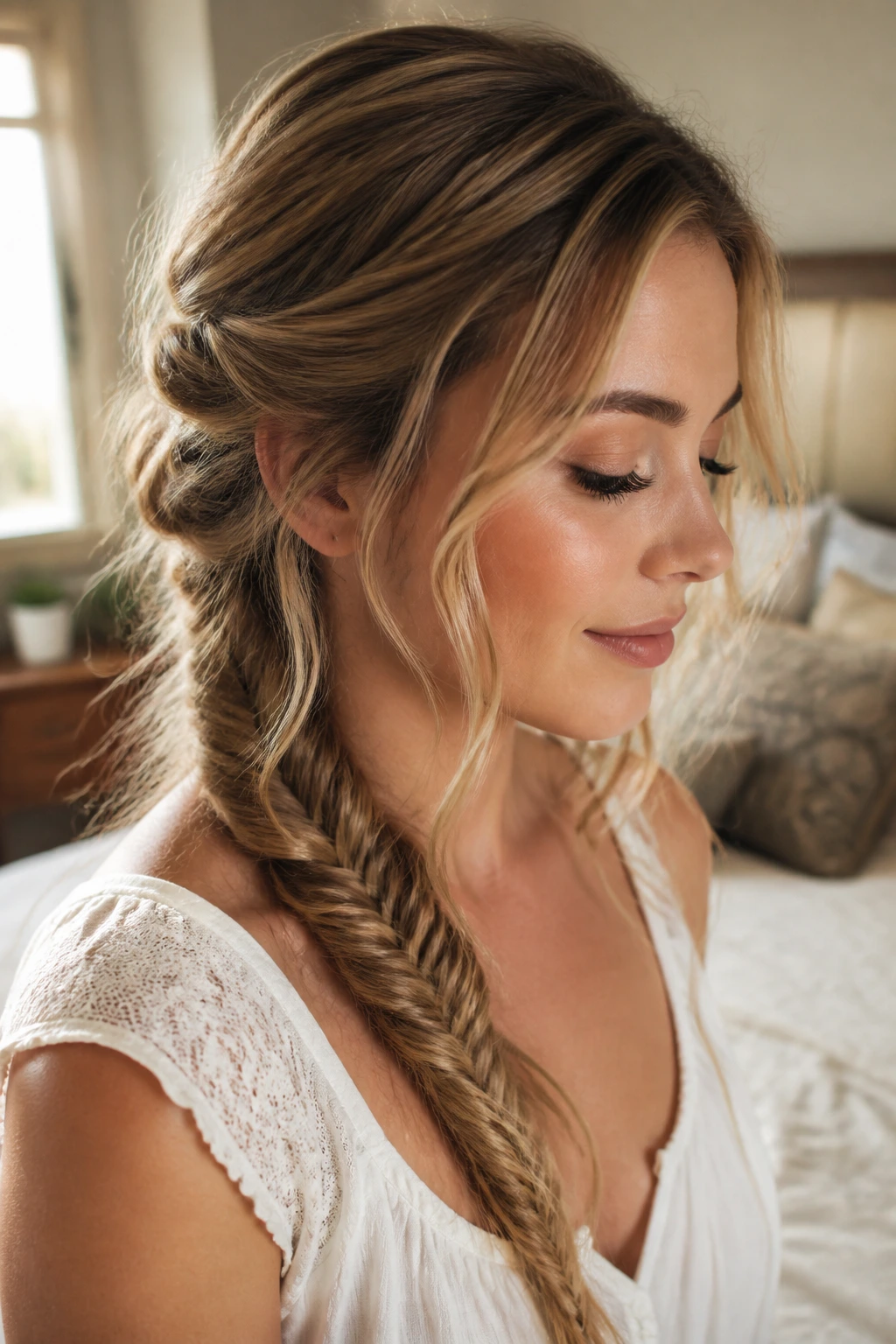
The first mistake is starting with hair that’s too silky and doing nothing to it. Freshly washed, straight hair can look pretty for about six minutes, then the braid starts slipping apart. Dry shampoo, texture spray, or a soft wave gives the braid a surface to grab.
Another one: making every section too large. That’s how a fishtail loses its delicate pattern and turns into a chunky rope. Keep the splits small, even if the braid takes a little longer.
People also pancake too early. If you widen the braid before the elastic is secure, it loosens at the bottom first, then the whole thing starts to sag. Finish the braid, lock it in, and only then loosen the loops.
Heavy oil is a quiet problem. A little on the ends is helpful. Too much anywhere near the braid base makes everything slide and can make even good work look flat by noon.
Variations and Alternatives to Try
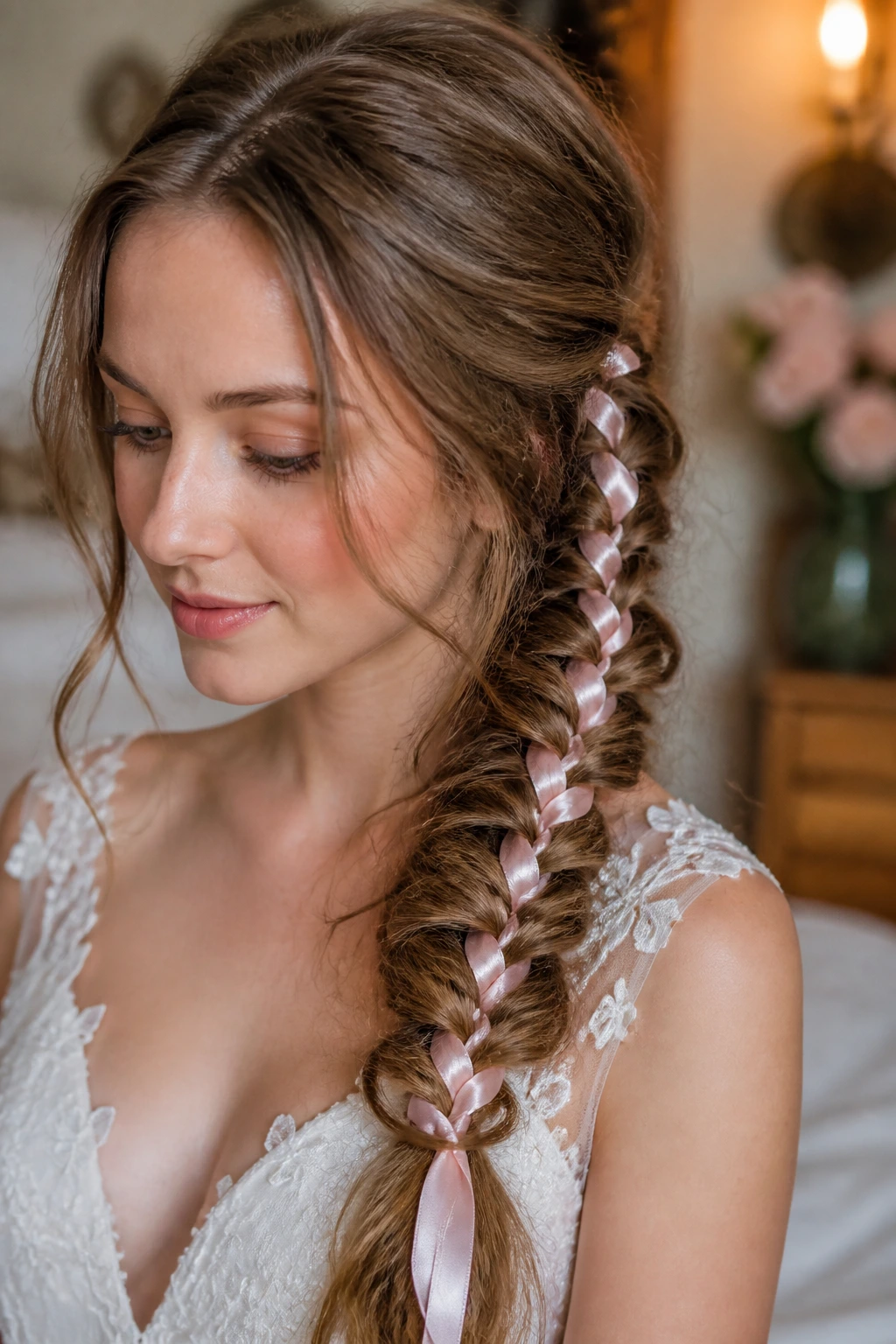
Ribbon-Threaded Romance: Weave a narrow satin ribbon through one side of the braid for a softer, dressier finish. This works best when the ribbon color echoes the outfit rather than shouting over it.
Pearled Ceremony Braid: Add pearl pins near the curve of a crown braid or bun. Keep the spacing uneven so the style feels organic, not plotted.
Curly-Hair Softening Pass: Let curls or waves do the texture work and braid more loosely than usual. The braid will read fuller, and the ends will feel less stiff.
Sleek Minimal Version: Smooth the crown, keep the braid low, and skip the tendrils. This suits sharp necklines and clean outfits that need one elegant line instead of a lot of movement.
Short-Hair Cheat Code: Use a headband braid, tucked ends, or a half-crown version when the length won’t support a long fishtail. The romantic feel is still there, just scaled to the hair you actually have.
Keeping the Braid Soft Overnight and the Next Day

Loose fishtails usually look best on the day they’re made, but some versions hold neatly for 8 to 12 hours with no issue. Low buns, tucked styles, and crown braids can survive overnight if they’re pinned well and protected from friction. A silk scarf or silk pillowcase helps more than most people expect. Cotton roughs the surface up fast.
If you want to wear the style again the next day, keep the braid slightly looser than you think you need. That gives you room to refresh it without rebuilding the whole thing. In the morning, smooth the top with a tiny bit of water or leave-in spray, then pinch the braid edges back into shape. A pea-sized amount of serum on the ends is enough.
Do not sleep on loose pins near the temples. Pull them out or pad them with a scarf. Sharp pins and a side-sleeper do not get along.
Frequently Asked Questions
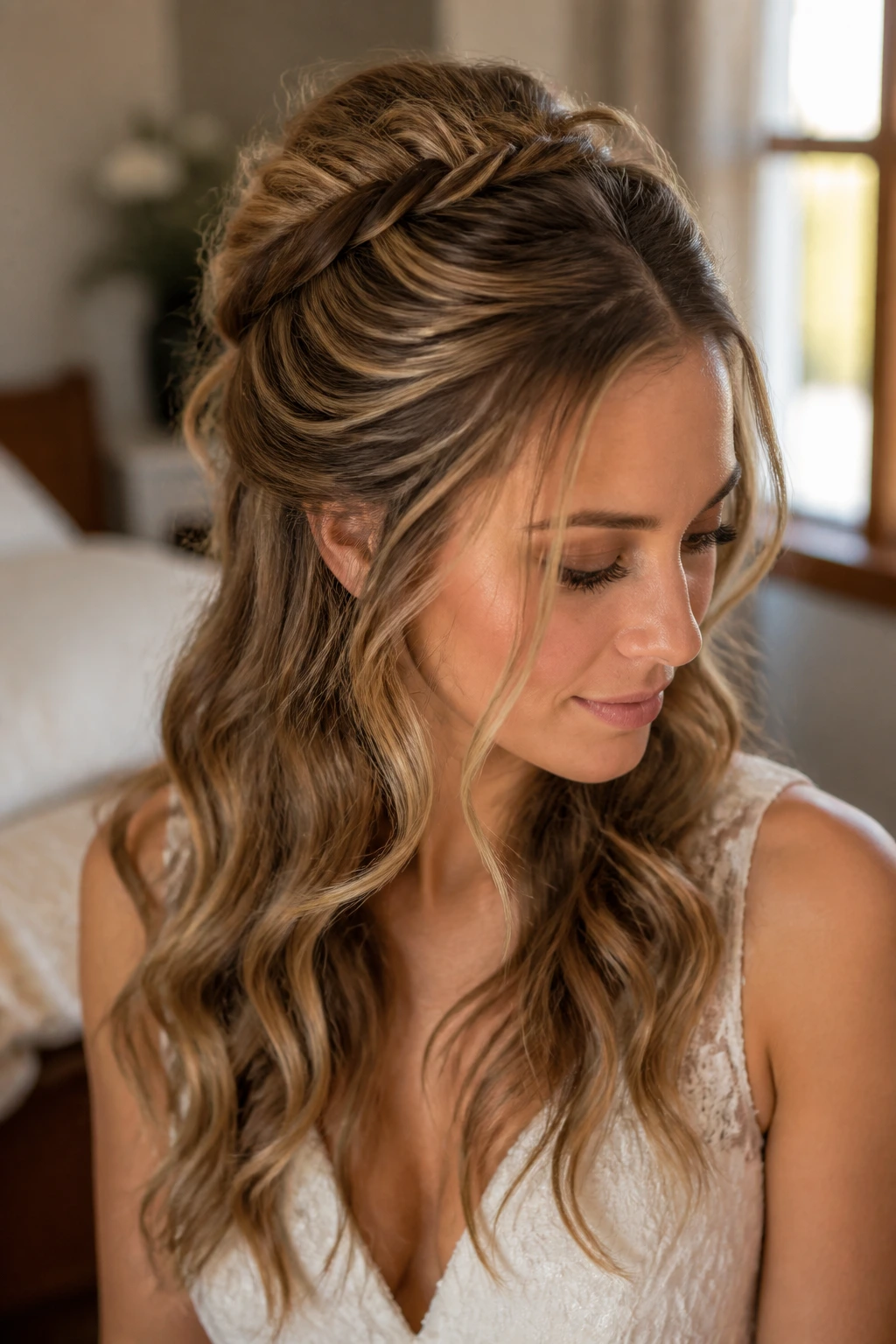
How long does a fishtail braid need to be to look good?
Shoulder-length hair can manage tucked or half-up versions, but the braid starts to show best once the hair reaches the collarbone or longer. If the ends are short, keep the style close to the head so the missing length doesn’t show.
Is a fishtail braid harder than a regular braid?
At first, yes. The sectioning is smaller, so your hands need a little more patience, but the motion is straightforward once you get the rhythm. Smaller pieces and even tension matter more than speed.
Can you do fishtail braids on layered hair?
Yes, but layers need a little help. Texture spray and a few hidden pins keep the shorter pieces from poking out of the weave. A looser, undone finish usually hides layers better than a tight braid.
Should hair be clean or a little dirty for a fishtail braid?
A little texture is better than squeaky-clean softness. Day-old hair, dry shampoo, or a soft wave gives the braid grip and helps the weave stay visible.
How do you make a fishtail braid look fuller?
Pancake the outer loops after securing the braid, not before. You can also curl the hair first or use a pull-through braid if your hair is fine and the true fishtail keeps collapsing.
What if the braid keeps slipping apart?
Your hair is probably too smooth, or the sections are too large. Add texture at the roots, shrink the section size, and use a smaller elastic at the end.
Can short or medium hair still do these styles?
Yes. Headband braids, half-up versions, tucked ends, and low buns are the easiest options when the length is limited. You do not need waist-length hair to get the soft romantic effect.
Do accessories make the braid harder to wear?
Only if you overdo them. One ribbon, a few pearl pins, or a single scarf can add shape and color without making the braid feel weighed down.
A Softer Way to Wear Braids
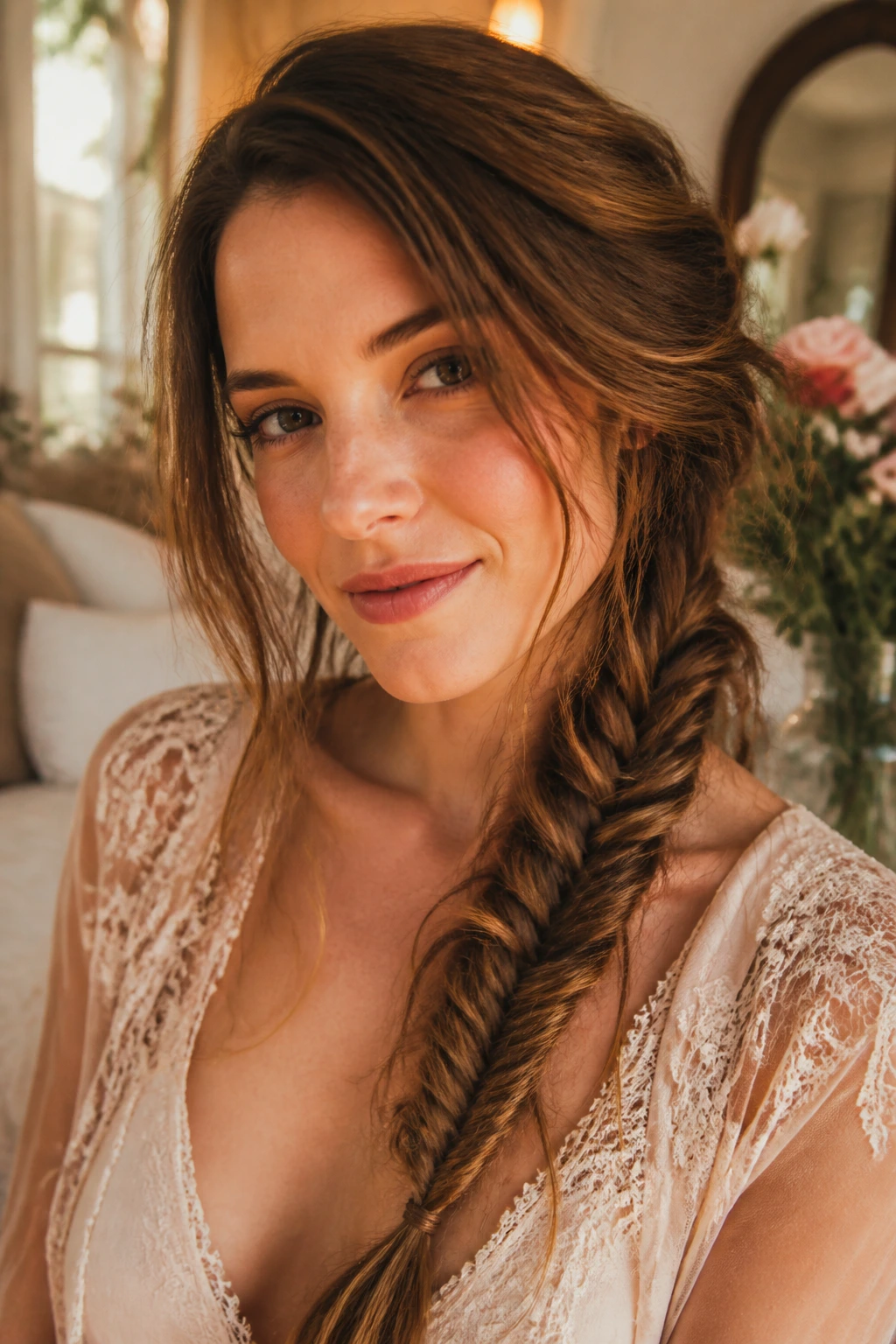
The nicest thing about fishtail braid hairstyles is that they can lean polished or loose without losing their shape. That gives you room to dress them up with pearls and ribbon, or keep them plain and let the texture do the talking. Either way, the braid brings softness to the face and structure to the hair, which is a better combination than most styles manage.
If your usual braid feels too plain or too tight, this is the gentler turn. Start with a little texture, keep the crown calm, and let the ends stay a touch undone. That’s where the romance lives.
