



A bad fringe can hijack a haircut. It sits there too blunt, too short, or too heavy, and suddenly the rest of the style feels like it never got a vote. A good one does the opposite. It makes the layers around it look intentional, even when the hair is doing a little bit of its own thing.
Layered haircuts with bangs are worth paying attention to because they solve two problems at once: weight and shape. Layers take bulk out of the places that puff up, and bangs bring the eye back to the face instead of leaving all the focus on the ends. When the cut is balanced, the hair moves before you touch it — a small thing, but you notice it every time you catch yourself in a shop window or grab a claw clip on the way out the door.
The trick is not choosing a random fringe and hoping for the best. It is matching the bang shape to the haircut’s weight, your hair texture, and how much morning effort you can stand. Some versions need a round brush and five minutes. Others dry into place with almost no help. The 25 looks below range from airy curtain bangs to blunt fringe, shaggy texture to clean lines, because the right answer changes with the hair sitting on your head, not the photo on your phone.
Why This Collection Keeps Working
Face-framing changes the whole outline: A good bang shape pulls the eye up and in, which is why layered haircuts with bangs can make a heavy cut feel lighter without removing much length.
There’s a version for every texture: Fine hair, dense hair, curls, waves, and straight strands all need different layering patterns, and the right fringe can help each one sit better.
The grow-out matters as much as the first week: Curtain, bottleneck, and side-swept bangs age more gracefully than a hard line across the forehead, which is why they show up so often in real salons.
Layers fix the “triangle” problem: If your hair gets wide at the ends and flat at the top, the right internal layers bring the shape back in line without turning the perimeter into confetti.
You can make it low-maintenance or high-style: Some of these cuts air-dry into shape. Others want a brush, a dryer, and a little patience. That range is the point.
1. Long Butterfly Layers with Curtain Bangs
Long butterfly layers with curtain bangs are the haircut equivalent of opening a set of heavy drapes. The shorter front pieces usually start around the cheekbone, then slide into longer layers that keep the length looking full instead of stringy. On straight hair, the face frame swings. On waves, it gets that loose, split movement people keep trying to fake with a curling wand.
Why the shape lands so well
The butterfly shape keeps the crown from collapsing while still preserving long, dramatic length through the back. That matters if your hair feels flat when it’s all one length, but you do not want to give up the swing that comes with long hair.
- Keep the shortest face-framing pieces at cheekbone level.
- Ask for internal layering, not a choppy ladder of ends.
- Dry the bangs side-to-side first, then back toward the center for that soft split.
- Use a 1.25-inch round brush if you want a smooth bend instead of a curl.
Best for: medium to thick hair that needs lift without losing length.
2. Collarbone Lob with Bottleneck Bangs
This is the cut I reach for when someone wants change without losing the safety net of length. The collarbone lob still tucks into a ponytail, but the bottleneck bangs give it a more tailored front than a standard curtain fringe. They start narrower in the center and widen as they move outward, so the face gets framed without a hard horizontal line.
The shape works because it feels deliberate from every angle. If you wear your hair straight, the lob reads clean and modern. If you wave it up, the layers keep the ends from looking boxy. It’s a smart choice for anyone who wants a haircut that can look polished at work and loose on the weekend without needing two separate styling routines.
Ask your stylist to keep the perimeter blunt enough to hold weight, then soften the front with long, slanted fringe pieces. That balance is the whole trick.
3. Soft Shag with Wispy Fringe
Want texture without the full shag commitment? A soft shag with wispy fringe gives you the movement, but keeps the outline a little cleaner. The layers start higher through the crown, so the top has lift, while the fringe stays feather-light instead of sitting in one solid chunk across the forehead.
What makes it wearable
The wispy fringe is the part that saves this cut from feeling costume-y. It breaks up the front just enough to show skin, which keeps the look airy even when the rest of the hair is thick or slightly coarse.
This is one of those cuts that looks better when it is not overmanaged. Rough-dry the roots, twist the fringe with your fingers, and let the ends do a little of their own thing. If your hair has a natural bend, this shape will lean into it fast. If it’s pin-straight, you’ll need a texturizing spray or a soft wave from a wand.
Who should ask for it: anyone who likes movement but hates a heavy fringe.
4. Modern Wolf Cut with Micro Fringe
Picture hair that goes flat at the crown by noon and puffs at the bottom by three. The modern wolf cut fixes that split personality in one sweep. Shorter layers around the crown give the top lift, the longer lengths keep the outline from going fuzzy, and the micro fringe gives the cut a sharp, slightly rebellious front edge.
Micro bangs are not subtle. That’s the point. They expose more forehead, which makes the rest of the cut look bigger and more deliberate. If you have a strong brow or a face that can handle a little contrast, the effect is crisp. If you are nervous, ask for the fringe to sit just above the brow instead of going ultra-short.
A wolf cut lives or dies on texture. You want separation, not a helmet.
5. Feathered Mid-Length Cut with Side-Swept Bangs
This is the haircut version of a good leather jacket: it works because it knows when to stop. Feathered layers skim through the mid-lengths, and the side-swept bangs soften the front without splitting the whole shape down the middle. The result feels lighter than a blunt cut, but more controlled than a shag.
The real advantage here is flexibility. Blow it smooth, and the layers fall in neat ribbons. Bend it with a round brush, and the ends flip just enough to keep the style from looking stiff. I like this shape for people whose hair is fine to medium because the feathering creates movement without removing too much bulk.
If you want a haircut that looks polished without looking like it tried too hard, this one earns its keep.
6. French Bob with Piecey Bangs
Unlike a blunt bob, the French bob with piecey bangs leaves a little air between the strands. That space matters. The cut usually sits near the jaw, the bangs break into small sections instead of one solid strip, and the whole thing feels lighter when you tuck one side behind the ear.
It’s a good choice if you like clean lines but do not want the rigidity of a straight-across fringe. The piecey finish keeps the face open, especially if you have strong brows or wear glasses. On fine hair, it gives the illusion of fullness. On denser hair, it stops the bob from turning boxy at the ends.
I prefer this cut with a soft side part or a slightly off-center part. Dead-center can feel too graphic unless that is exactly what you want.
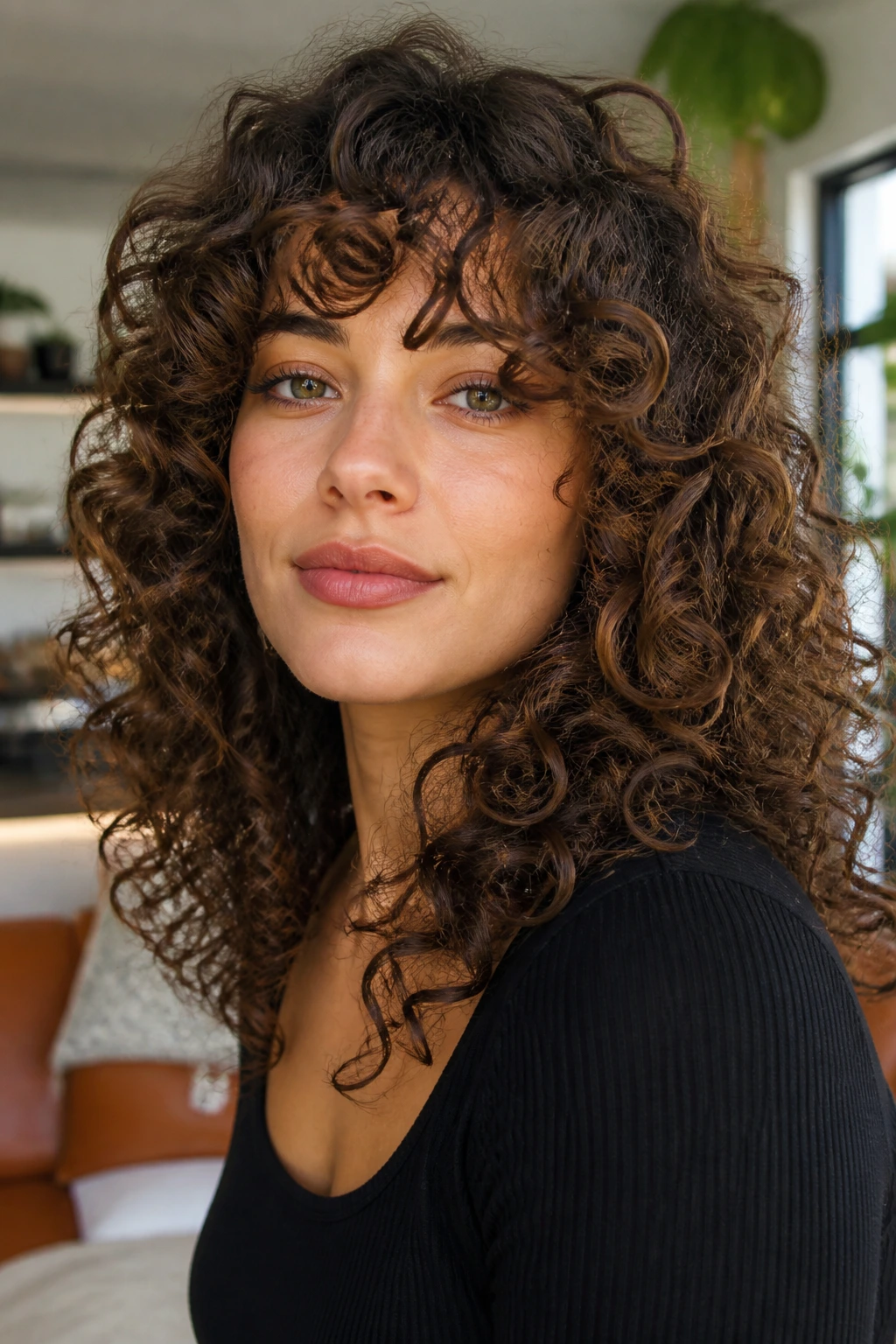
7. Curly Layers with Curly Bangs
Curly bangs are not the problem; cutting them too short is. A good curly layer cut lets the fringe sit a little longer when wet so it springs up to eye level instead of your forehead. That one detail changes everything. The layers around the face should follow the curl pattern, not fight it.
Cut it for the curl, not against it
Dry cutting is often the cleanest route here because it shows the true spring and width of each curl. If a stylist cuts curls as if they were straight hair, the bangs can bounce up into a line that’s way shorter than you planned.
- Ask for the fringe to be cut with shrinkage in mind.
- Keep the face-framing pieces soft enough to blend when diffused.
- Use a diffuser on low heat so the curls set without frizzing into a halo.
- Let the bangs air-dry for a few minutes before deciding they are “too long.”
This is one of the most flattering ways to wear bangs on curly hair, but only if the cut respects the curl’s actual behavior.
8. Razor-Cut Lob with Long Fringe
Razor-cut ends change the mood of a lob fast. Instead of a heavy line, the edges get a softer, lighter finish, and the long fringe blends into the front layers instead of sitting on top of them like a separate piece. That makes the haircut feel breezy rather than blunt.
This works especially well on medium to thick hair with a little wave. The razor removes weight in a way scissors sometimes don’t, so the lob can swing instead of hanging. I would not push this on hair that is already fragile or split at the ends — a razor can make damaged hair look even more frayed.
Keep the fringe long enough to tuck behind the cheekbone. That length is forgiving, and it grows out without a hard line.
9. U-Shaped Long Layers with Sweeping Bangs
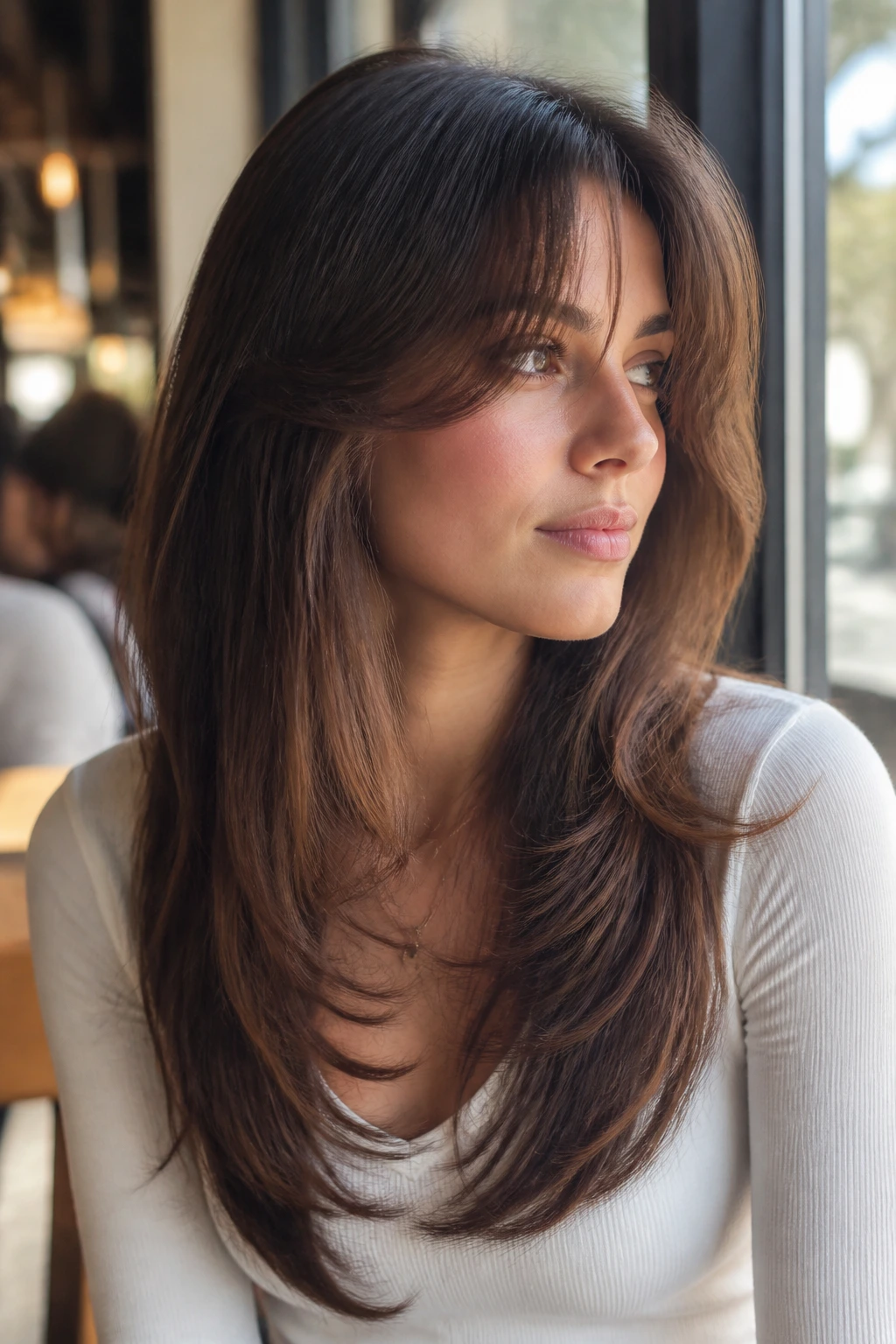
Why choose a U-shape instead of a straight perimeter? Because it keeps the back fuller while the sides get a gentle curve that frames the shoulders. Add sweeping bangs, and the whole cut feels softer around the face without losing the thickness people usually want from long hair.
The U-shape is subtle, which is why it works. You see the movement when the hair falls over the shoulder, but you do not get a dramatic point in the back the way you would with a V-cut. Sweeping bangs blend into the front layers, so the haircut reads as one shape instead of two separate ideas stitched together.
If your hair is long and you want to keep it that way, this is a dependable move. It adds shape without the emotional drama of taking off four inches.
10. V-Cut Long Layers with Full Bangs
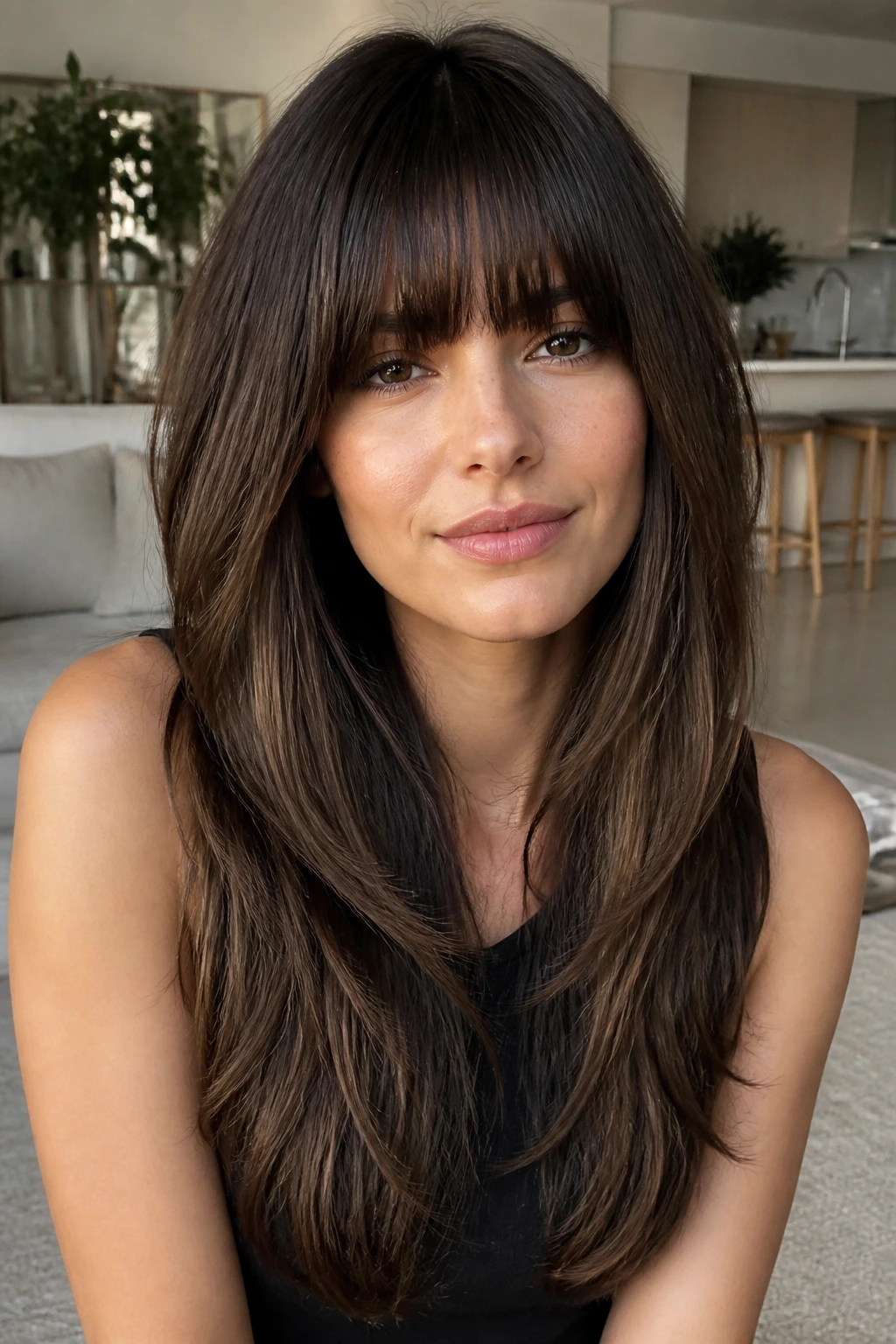
A V-cut is for hair that wants to fall with a little drama. The longest layer sits in the center back, while the sides angle inward, which makes the length look more sculpted. Add full bangs, and the front gets a solid frame that balances the longer lines behind it.
This cut shines on dense straight or wavy hair because there is enough body to show the shape. On very fine hair, the V can start looking thin at the bottom unless the ends are handled with restraint. Full bangs keep the style from feeling too narrow at the top, but they do ask for more maintenance than a curtain fringe.
If you like blowouts, this shape rewards them. If you air-dry and hope for magic, it may fight back a little.
11. Bixie with Choppy Fringe
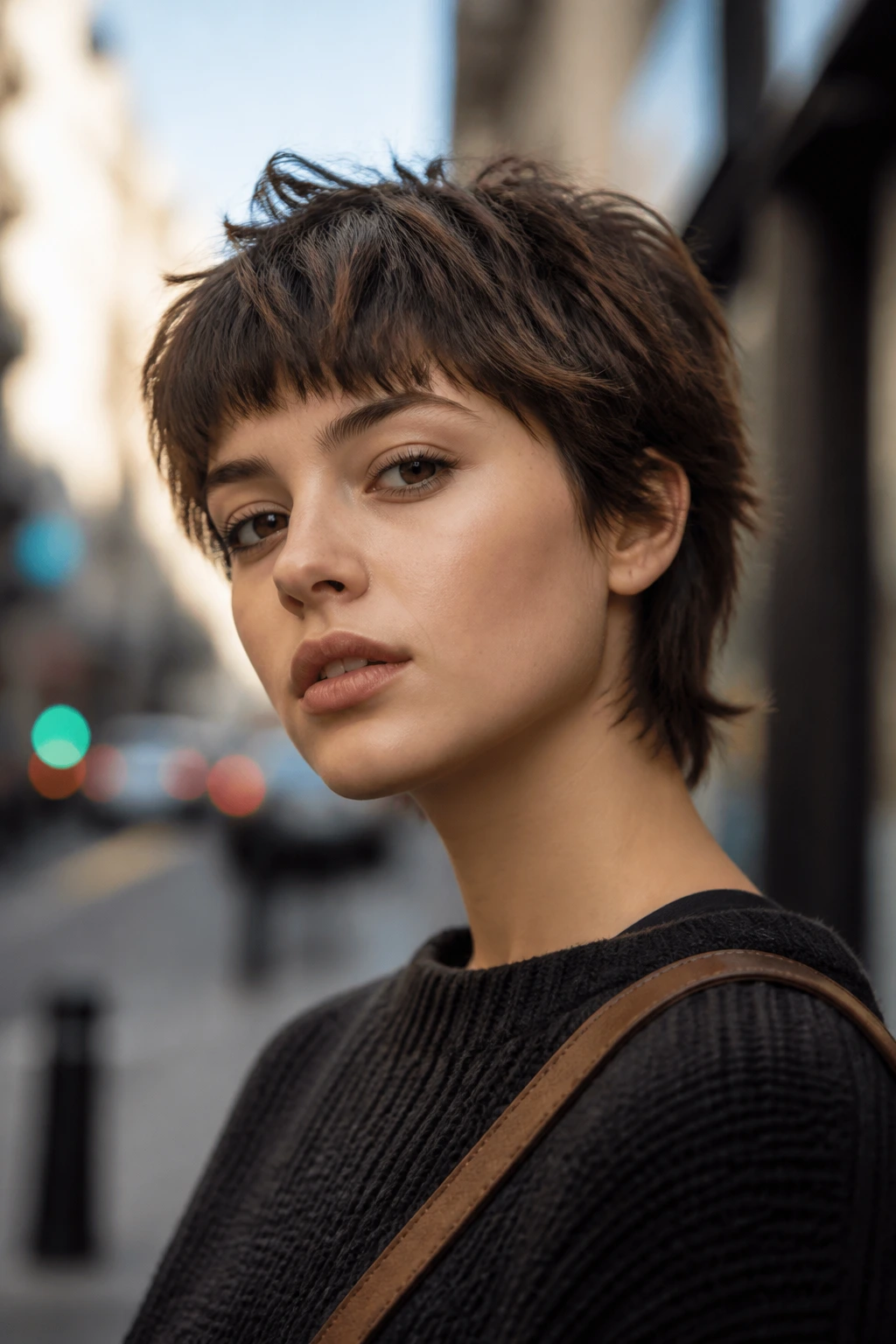
The bixie sits somewhere between a bob and a pixie, and that in-between space is exactly why it feels interesting. The choppy fringe keeps the front from looking too neat, while the layers through the crown and sides create a little lift so the cut does not hug the head too hard.
This one has real personality, but it still works in daily life if the edges are cut well. The fringe can be styled forward, swept slightly off-center, or pushed piecey with a tiny bit of paste. That flexibility matters more than people think; short cuts need options.
I like this on straight and slightly wavy hair best. If your hair is extremely curly, the bixie can still work, but the layers need to respect the curl pattern so it doesn’t puff at the temples.
12. Shoulder-Length Cut with Bottleneck Bangs

Shoulder-length hair often gets stuck in a no-man’s-land: long enough to feel heavy, short enough to lack swing. Bottleneck bangs fix that by giving the front a clean frame without cutting a hard, blunt stripe across the forehead. The bangs start narrow and widen as they drop, which means they sit neatly even when the hair is tucked behind one ear.
The shoulder-length perimeter is practical. You can still clip it up, twist it into a low knot, or smooth it into a quick bend with a brush. The layers keep the ends from flipping out in one awkward chunk, which is where so many shoulder-length cuts go wrong.
If you want the haircut to look nice on day one and still make sense three weeks later, this is a very sensible place to start.
13. Airy Curls with Curly Curtain Bangs

Curly curtain bangs need space. If they’re cut too short, they spring up and sit like a little shelf. Leave them longer, let them split at the center, and they fall into the rest of the curls instead of sitting in front of them like a wall.
The dry-cut rule matters here
This is another one that often benefits from a dry or mostly dry cut. Curly curtain bangs should follow the curl’s real shape, not the stretched version you see in the chair. The layers around the face can be shorter than the rest, but they still need enough length to blend once the curl shrinks.
A diffuser and a light leave-in are the whole story here. Heavy cream or too much gel can drag the bangs down and make them separate oddly. Keep the product light at the front, then let the curls settle where they want to land.
When this cut is done right, it has a soft, easy split that looks deliberate without looking stiff.
14. Sleek Straight Layers with Blunt Bangs
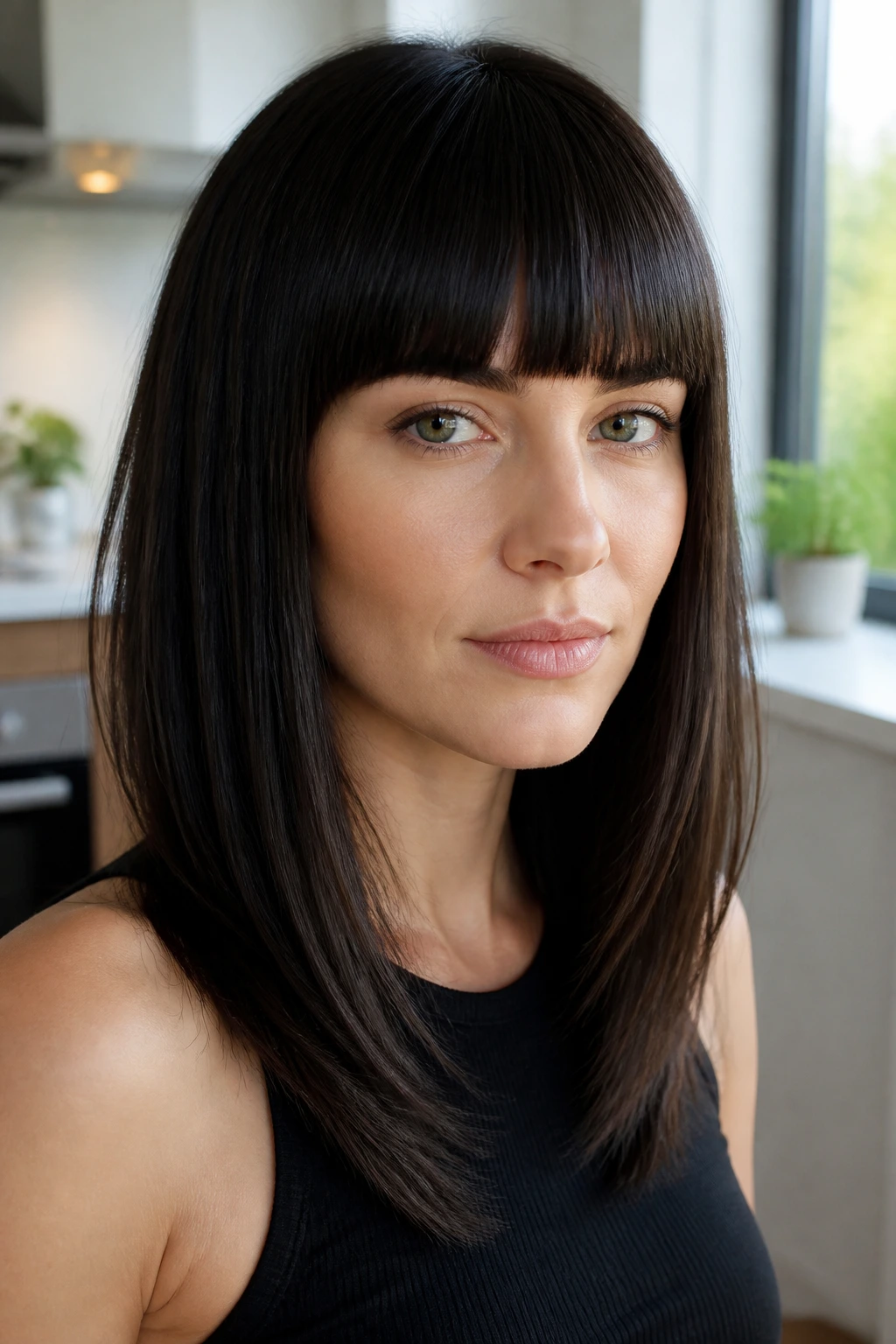
If you like sharp lines, this is the cleanest option on the list. Blunt bangs create a solid top frame, while the straight layers below keep the length from feeling like a brick. On naturally straight hair, the effect is crisp and tidy; on hair with a slight bend, it looks polished after a quick pass with a flat iron.
The key is restraint. Too many layers and the bangs start to look disconnected from the rest of the haircut. Too few, and the whole style can feel heavy. I prefer this cut when the fringe is the main statement and the layers are there to control weight, not steal attention.
It is not the lowest-maintenance choice, but it does photograph in the real world — meaning it still looks clean when you catch it in daylight, not just in a salon mirror.
15. Textured Pixie with Long Bangs
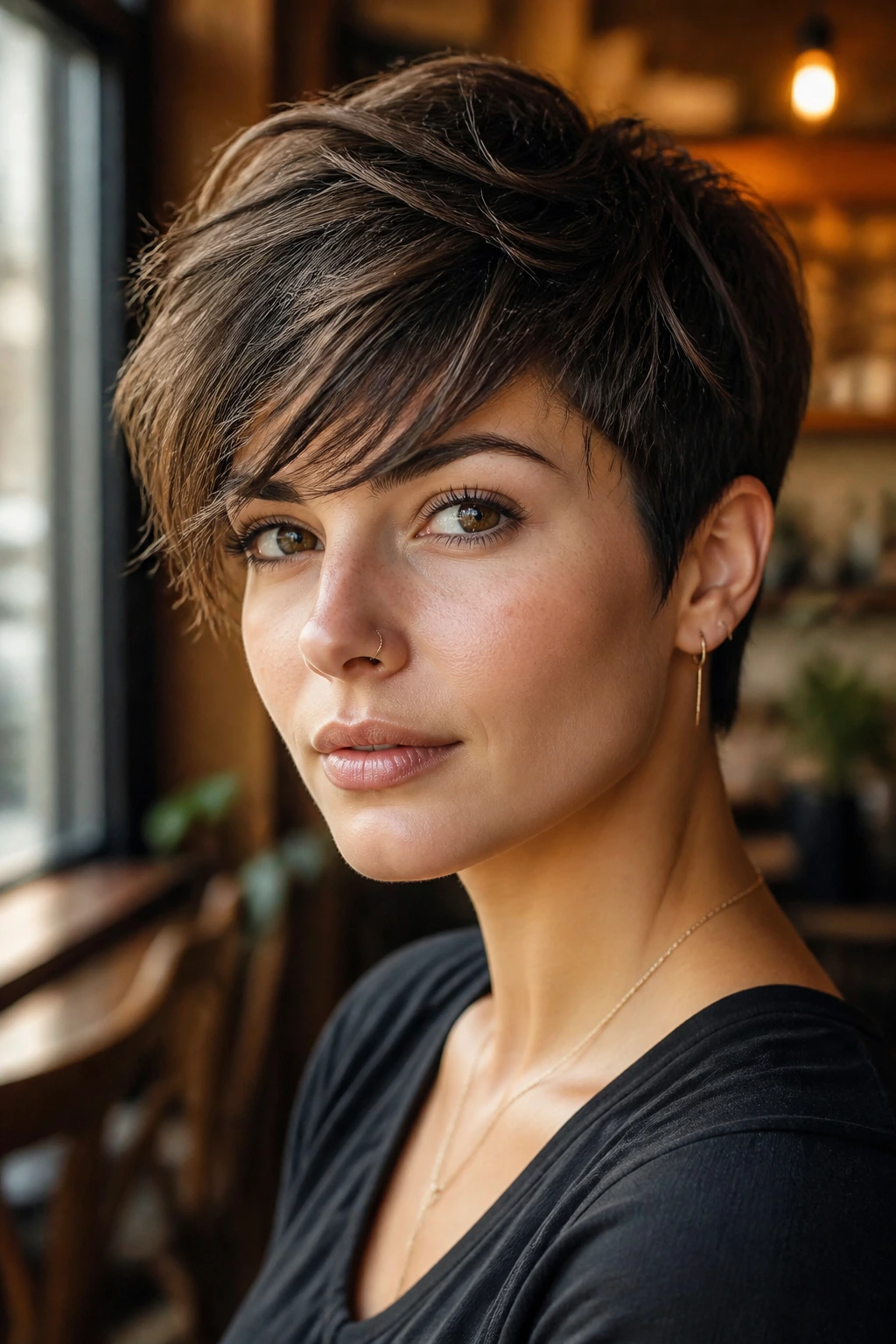
Want short hair without giving up the option to hide behind it? A textured pixie with long bangs keeps the sides short and the top movable, so the cut feels soft instead of severe. The longer fringe can be swept across the forehead, lifted with wax, or broken up into pieces if you want something more playful.
This shape is especially useful if you have a strong cowlick near the front. A little length in the bangs gives you room to work with the growth pattern instead of fighting it every morning. The layering through the top keeps the crown from lying flat.
Use a tiny amount of paste, not a blob. Short hair shows product fast, and too much will make the fringe look greasy before lunch.
16. Ruffled Shaggy Lob with Bardot Bangs
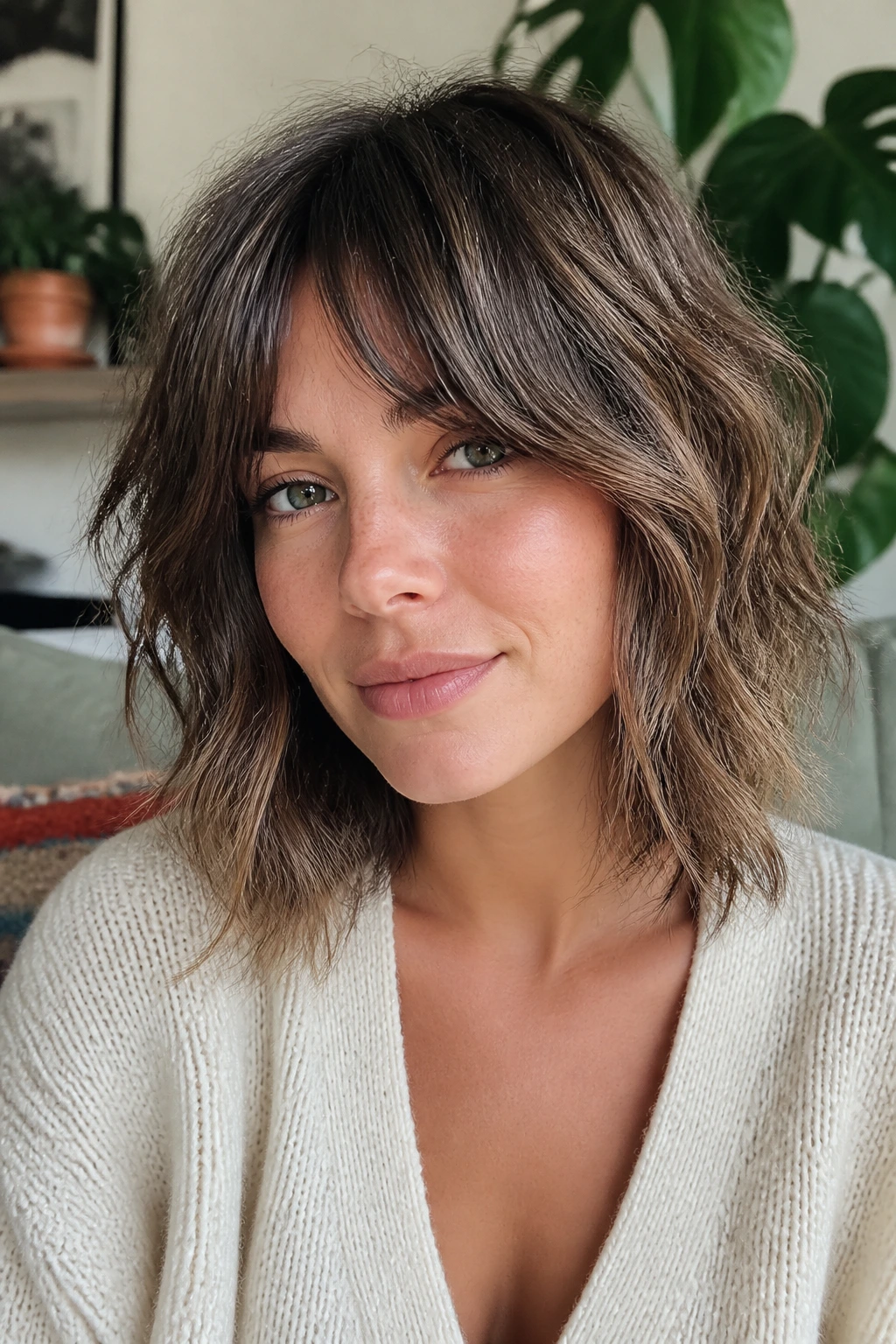
Bardot bangs split down the center and fall open around the eyes, which is exactly why they work so well with a shaggy lob. The front looks soft and romantic, but the cut underneath has enough texture to keep it from turning too polished. Think lived-in, not fussy.
This is a cut that likes a little ruffle. Rough-dry the roots, add a bend through the mid-lengths, and let the ends stay slightly irregular. The lob length keeps it practical; the shag layers keep it from hanging flat.
If you have a round brush and thirty extra seconds, you can smooth the bangs into a gentle curve. If not, a finger-dried version still reads well. That’s the kind of flexibility people actually use.
17. Feathered ’70s Flip with Curtain Bangs
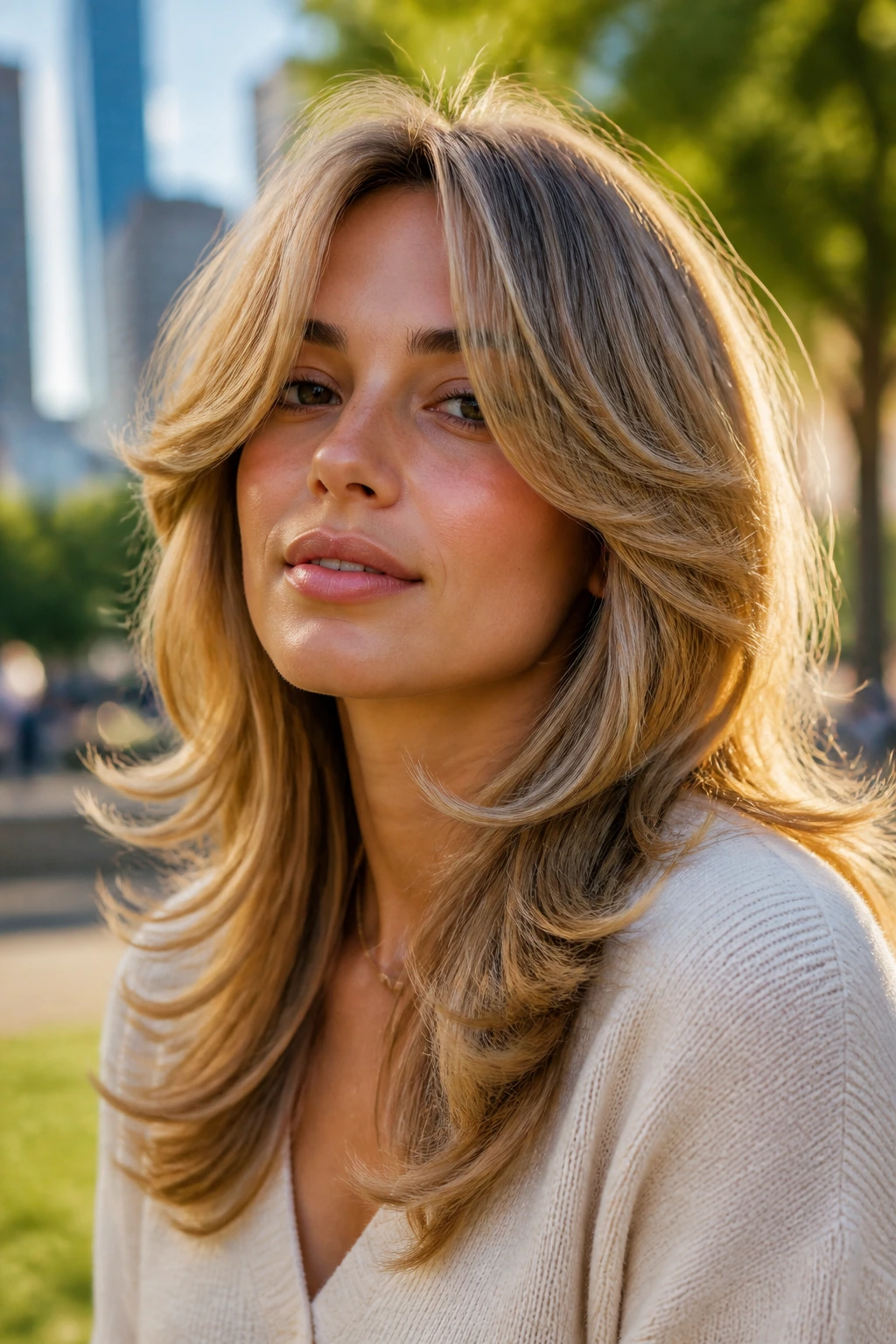
There’s a reason feathered cuts keep coming back. The shape does a lot with a little. Long layers flip away from the face, the curtain bangs split softly at the center, and the whole cut gives movement without needing a dramatic chop.
This version works especially well when the hair has enough density to hold a bend. Blow-dry the bangs forward first, then sweep them out and away from the face with a round brush. The ends should look light, not wispy to the point of disappearing.
The finish has a retro feel, but it does not read costume-like if the layers stay soft. That’s the difference between a haircut that looks copied from a mood board and one that actually suits a real head of hair.
18. Heavy Layered Cut with Curved Fringe
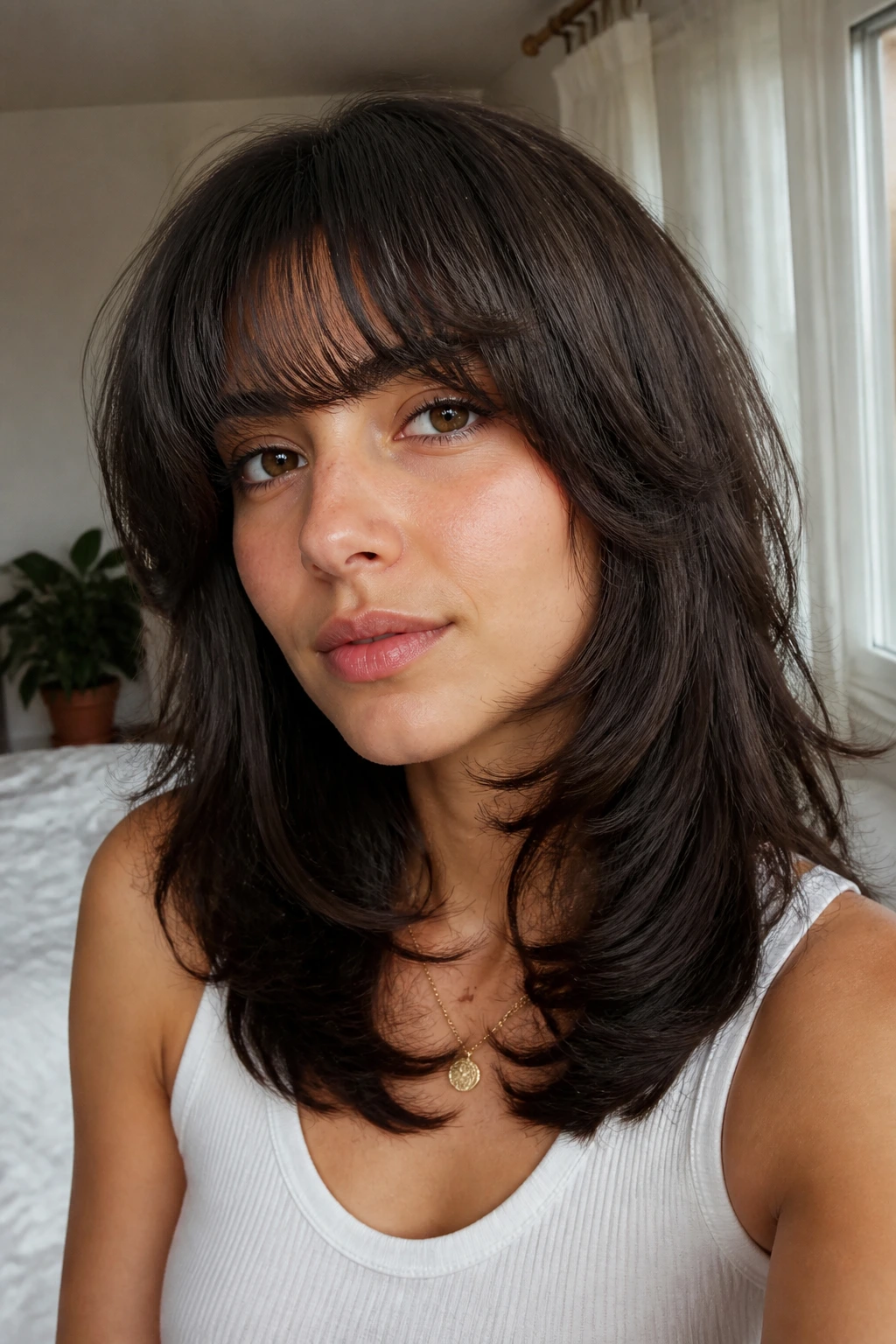
A heavy layered cut sounds contradictory, but it makes sense when you want to keep fullness while moving weight around. The layers are concentrated enough to stop the hair from ballooning, yet the overall perimeter stays full. The curved fringe arcs gently above the brows and blends into the side pieces, which keeps the front from feeling boxy.
This is a good answer for thick hair that likes to sit on the shoulders like a blanket. The curve in the fringe softens the upper face, and the layers keep the bottom from feeling too wide. It’s not the choppy, airy route. It’s the controlled route.
If your hair is dense and tends to expand when dry, this shape can be a relief. It gives structure without taking away too much substance.
19. Soft Mullet with Fringe and Tapered Sides
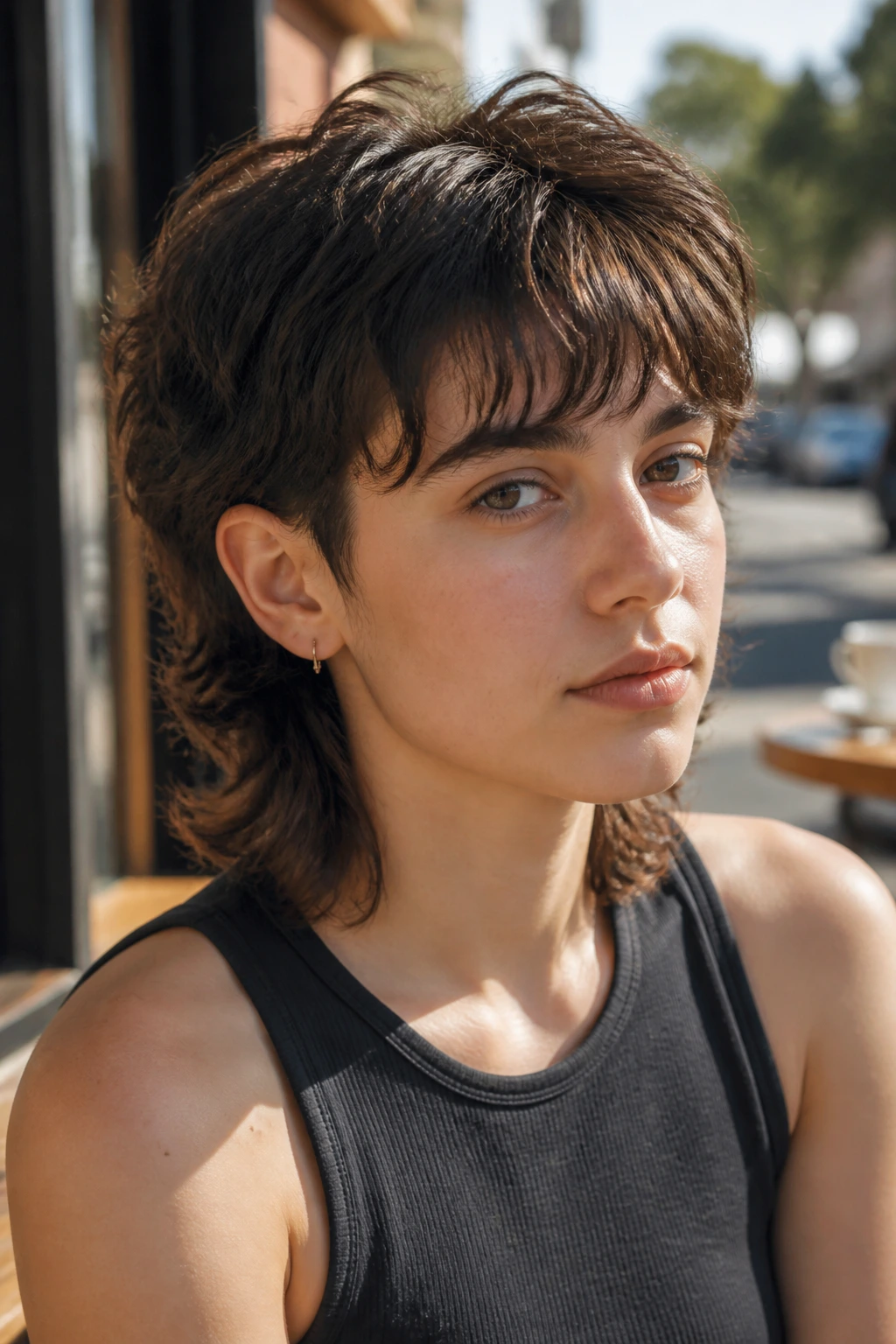
A soft mullet is not the punk version people picture first. The taper is gentler, the fringe is friendlier, and the sides are cut to keep the outline from puffing out like a triangle. You still get that slightly undone, cool shape, but it feels wearable instead of theatrical.
This cut is at its best on wavy and curly hair because the texture helps the layers sit where they’re supposed to. The fringe can be short and broken up, or longer and more blended, depending on how much forehead you want to show. I like the softer version when someone wants movement around the neck and cheekbones without losing length everywhere.
It’s a committed look. But if you like hair with attitude, this one has some.
20. Layered C-Cut with Side Bangs
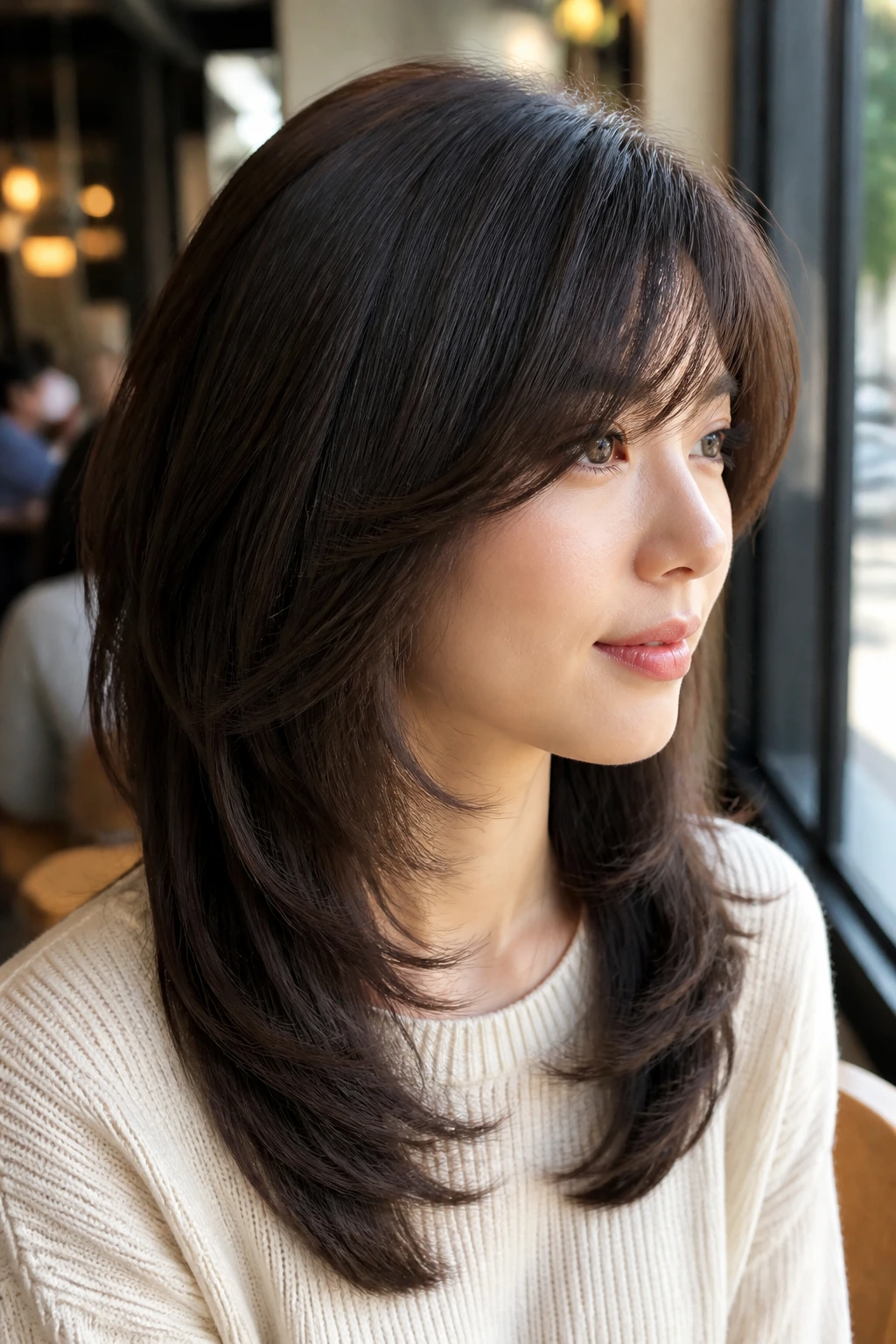
A C-cut curves around the face like its name suggests, which makes it one of the easiest ways to add shape without a dramatic front frame. Side bangs help the curve flow into the rest of the cut, so the front doesn’t feel chopped off from the length.
The shape is flattering because it does not demand symmetry. If your hair parts a little off-center or one side falls flatter than the other, the side bangs work with that instead of pretending it doesn’t exist. The layers sweep inward around the chin and collarbone, which is where the movement shows up most.
This is a friendly cut for people trying bangs for the first time. It gives you fringe without locking you into a strict center part.
21. Face-Framing Layers with Grow-Out Bangs
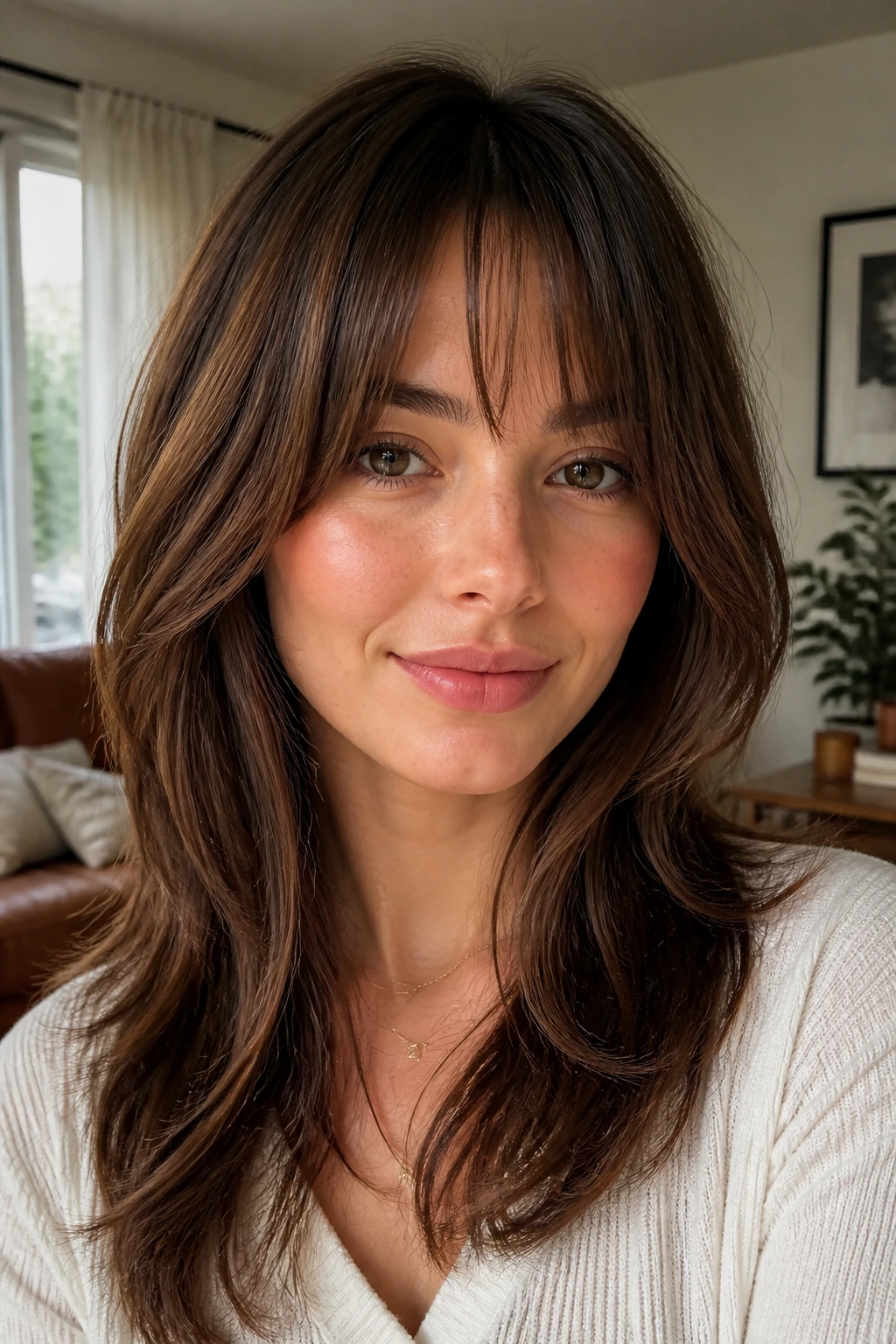
Some bangs are designed to look good on day one. These are designed to look good on week six. Grow-out bangs sit longer than a full fringe, usually grazing the brows or hovering just below, so they can slide into face-framing layers instead of turning into an awkward strip of hair that needs daily babysitting.
The layers around the face should start around the cheekbone and move toward the collarbone, which gives you that soft sweep without a hard line. This is a smart choice if you know you will not book trims every three weeks. It still looks deliberate when tucked behind the ear, pinned back, or air-dried on a rushed morning.
If you want bangs but fear the maintenance, start here. It’s the least bossy version of fringe.
22. Long Layers with Bottleneck Bangs
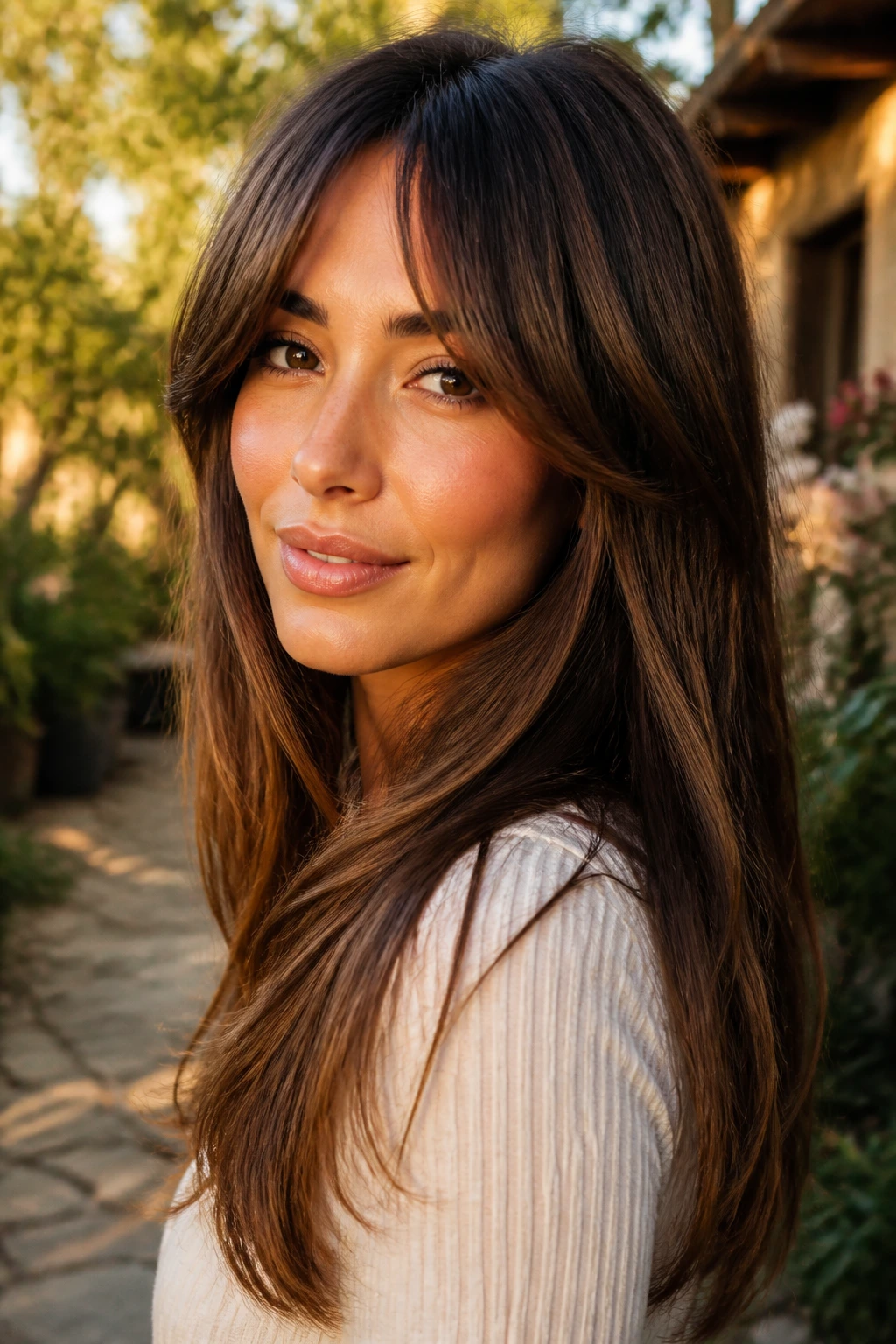
Bottleneck bangs give long layers a more tailored front than curtain bangs alone. They begin tighter at the center, then open outward around the eyes and cheekbones, which creates shape without taking over the face. Long layers behind them keep the overall length moving, so the haircut never turns into a flat sheet.
This is a good middle ground if you like softness but want a little more structure in the fringe. The bangs read neat at first, then relax into the rest of the cut as they grow. That is the part I like most: the grow-out looks planned, not accidental.
Thick hair handles this especially well because the length can support the shape. On finer hair, keep the layers long and avoid over-thinning the ends.
23. Thick-Hair Layers with Piecey Bangs
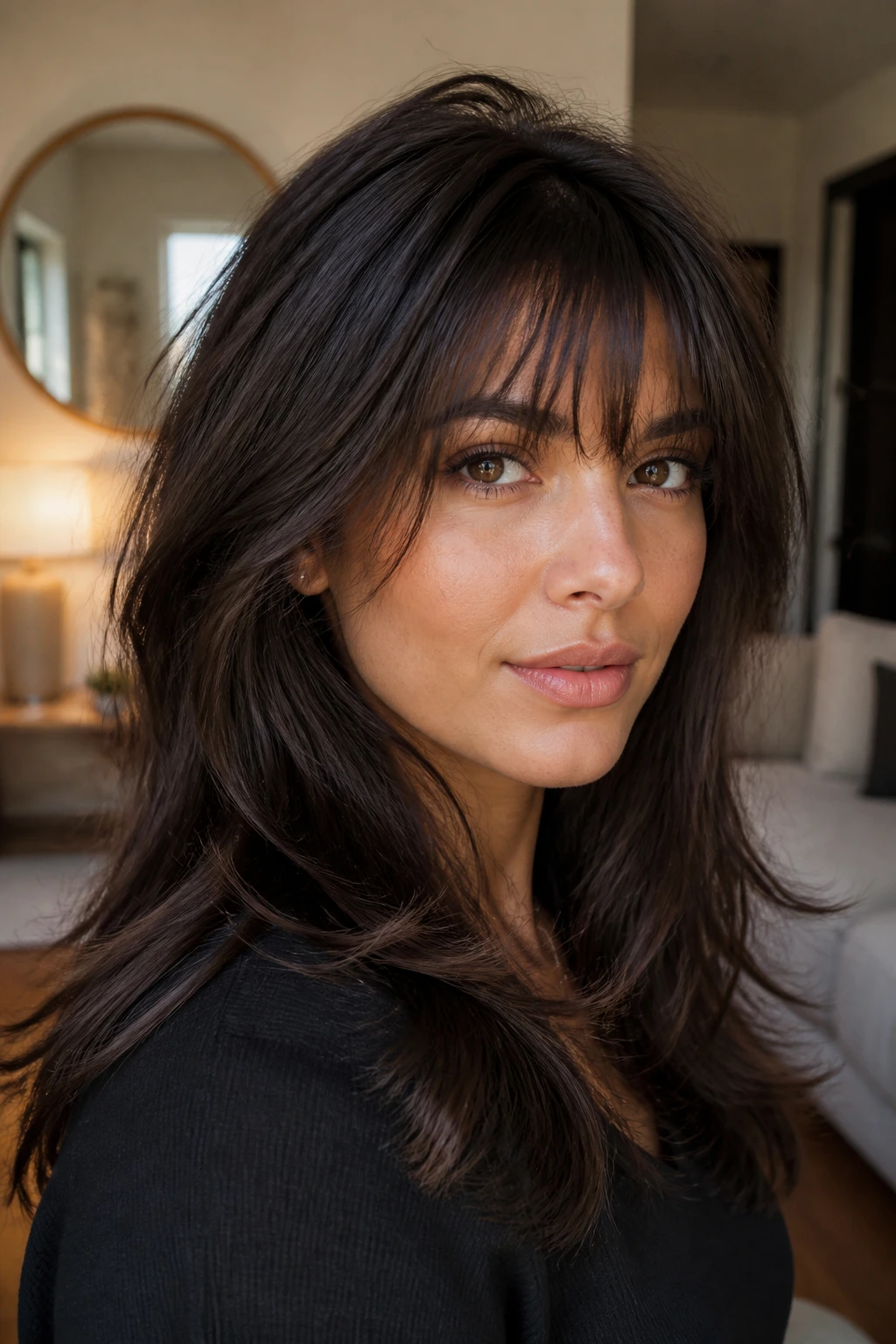
Thick hair needs room to breathe. If the layers are too blunt, the whole shape can sit like a block; if they’re too thin, the ends go frayed. Piecey bangs fix some of that by breaking up the forehead line, so the front feels lighter without losing the density that makes thick hair look full.
The key is internal removal, not dramatic chopping. You want the weight taken out from inside the shape so the outside still has presence. Piecey bangs can be separated with a touch of styling cream or left a little irregular after rough-drying.
This is the haircut for someone who has enough hair for two people and wants it to move like one. The wrong version of thick-hair layering gets bulky fast. The right version looks expensive for a simple reason: it sits where it is supposed to.
24. Fine-Hair Cut with See-Through Bangs
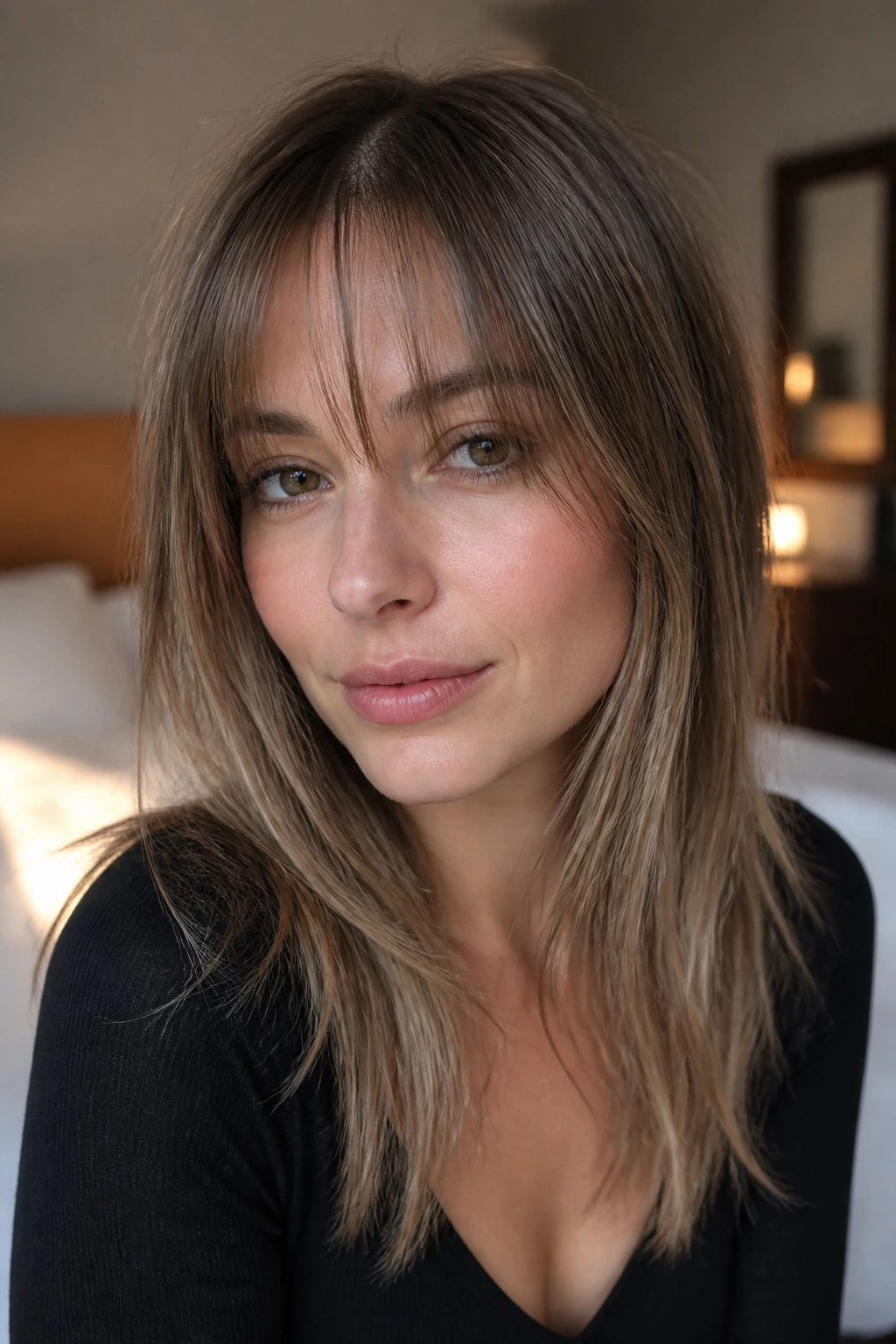
Fine hair needs a gentler hand than people usually give it. See-through bangs cover the forehead without taking away a huge chunk of density, which is important when every strand matters. The fringe should look soft at the edges, not sparse in the middle.
The layers around the face should stay long enough to keep the ends looking full. If you over-layer fine hair, it can start to look see-through all the way down, and no amount of mousse fixes that. A little movement goes a long way here.
I like this cut with a soft blow-dry and a lightweight volumizing spray at the roots. Heavy cream weighs it down fast. The goal is lift, not stiffness.
25. Wavy Mid-Length Cut with Split Bangs
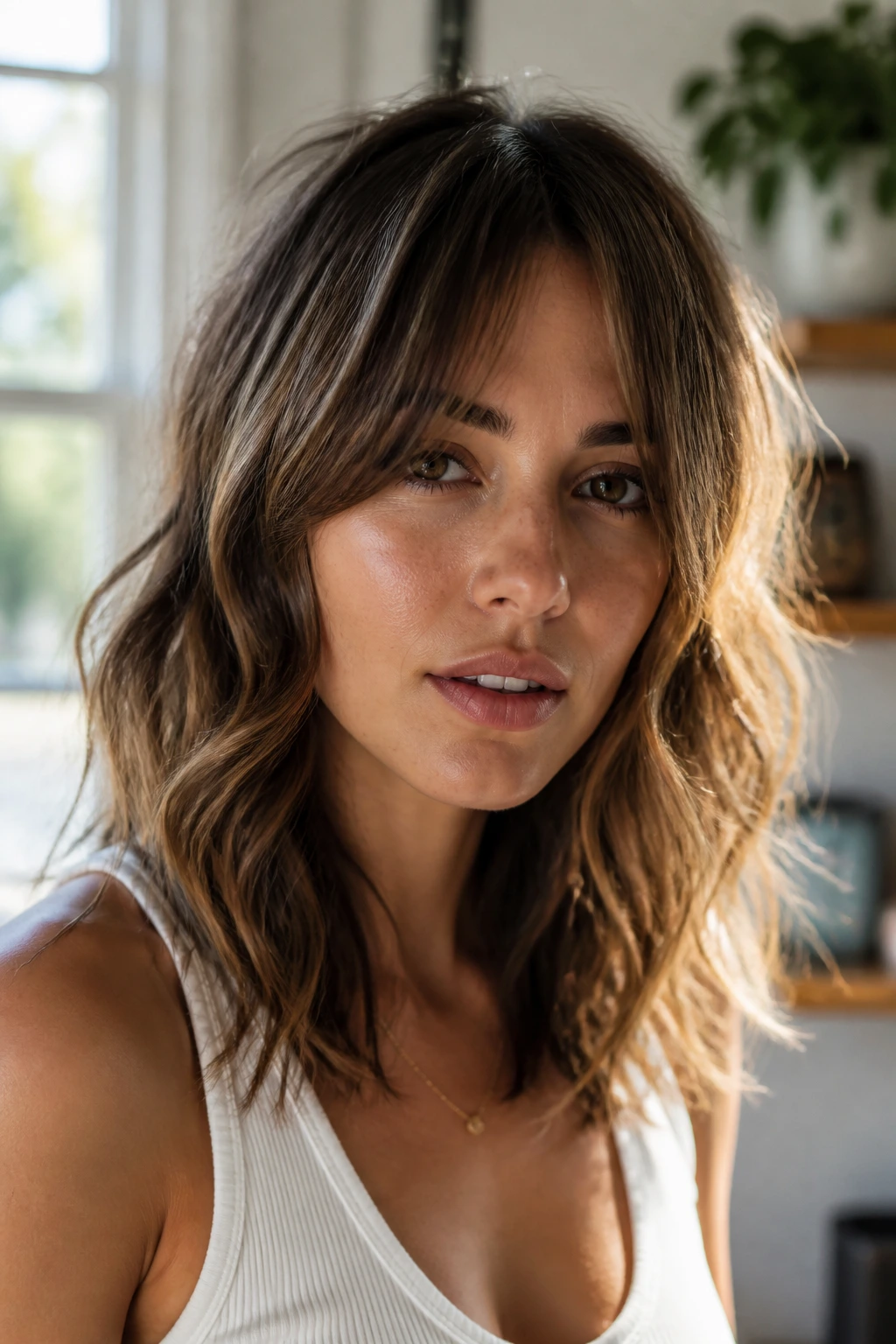
Wavy hair and split bangs are a strong pair because they both like a little irregularity. The bangs separate naturally at the center, and the mid-length layers keep the shape from turning into a triangle when the wave expands. It is one of the easiest ways to make wavy hair look finished without making it look overworked.
The split fringe should start long enough to graze the brow or cheekbone, depending on the wave pattern. Too short, and it bounces too high. Too heavy, and it loses the airy split that makes the cut work.
This is the kind of haircut that looks even better on day two. The wave settles, the bangs loosen, and the whole thing gets that soft, lived-in bend people keep trying to fake with hot tools.
Why Layered Haircuts With Bangs Work So Well
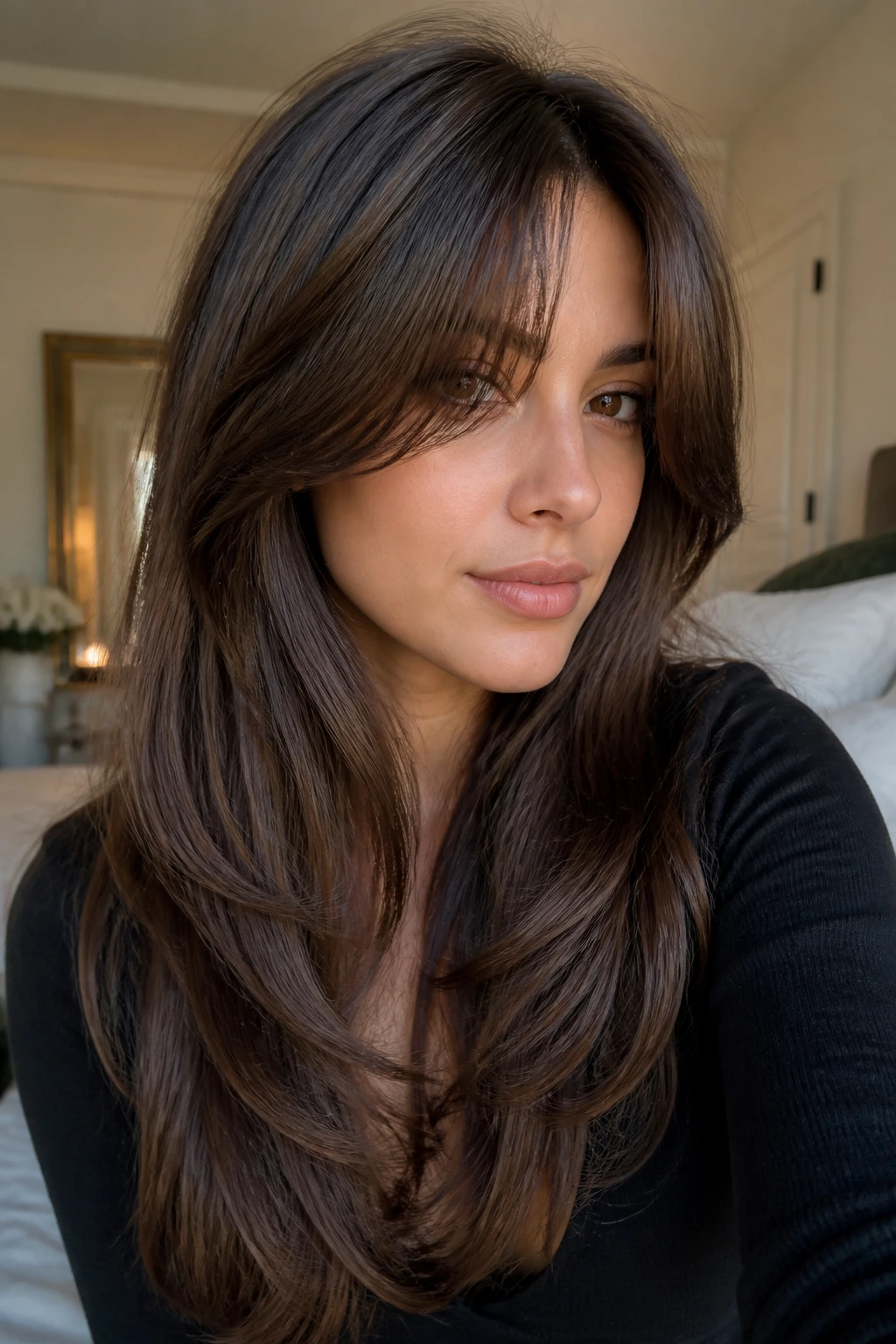
Layers and bangs solve different problems, then meet in the middle. Layers remove bulk and create motion; bangs reshape the front and change where the eye lands. When those two jobs are planned together, the haircut stops fighting itself.
The best versions also give you a better grow-out. A curtain fringe can slide into face-framing layers. Bottleneck bangs can widen gracefully as they get longer. Side bangs can drift into a sweep instead of sitting there like a chopped-off line. That matters more than the first-day photo, because most people live with their hair after the salon, not under good lighting with a cape on.
Texture changes the whole conversation. Straight hair shows every line cleanly. Wavy hair softens the edges. Curly hair shrinks and expands, which means the shape has to be built with that movement in mind. The cut that looks “simple” in a photo may actually require a very specific balance of length, weight, and fringe width.
I also think this pairing works because it gives you one focal point instead of three. The bangs keep the front alive. The layers keep the rest from getting heavy. No extra drama needed.
Essential Tools for Styling These Cuts
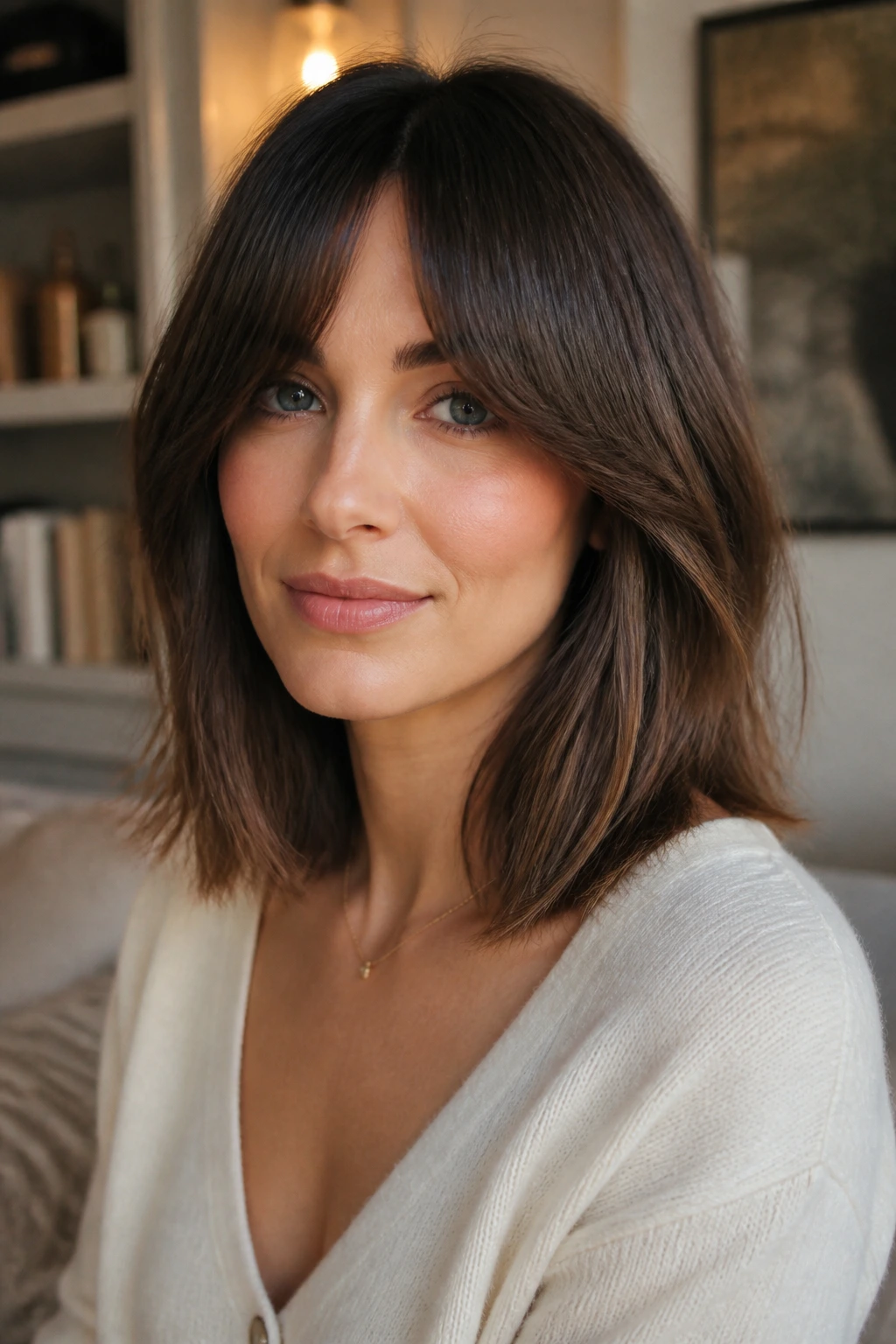
- Blow dryer with a nozzle attachment — Helps direct the bangs and top layers so they dry in the right direction instead of puffing everywhere.
- Small round brush, around 1 inch — Best for shorter fringe, pixies, and bang sections that need a bend.
- Medium round brush, around 1.25 to 1.5 inches — Better for curtain bangs, lobs, and face-framing layers that need a softer curve.
- Duckbill or sectioning clips — Keep the fringe separated while you dry the rest of the hair.
- Wide-tooth comb — Useful for curly and wavy cuts when you want to keep definition without breaking up the pattern.
- Lightweight heat protectant — Keeps the ends from getting dry and rough, especially if you use a brush and dryer often.
- Dry shampoo — A bang saver on day two; it cuts the oil line before the fringe clumps together.
- Texture spray or light mousse — Gives soft grip to shag, wolf cut, bixie, and shaggy lob shapes.
- Diffuser — Worth it if you wear curly bangs or curly layers and want less frizz at the front.
- Small styling cream or pomade — Handy for piecey fringe, pixies, and choppy ends when you need a little separation.
How to Ask for the Cut You Actually Want
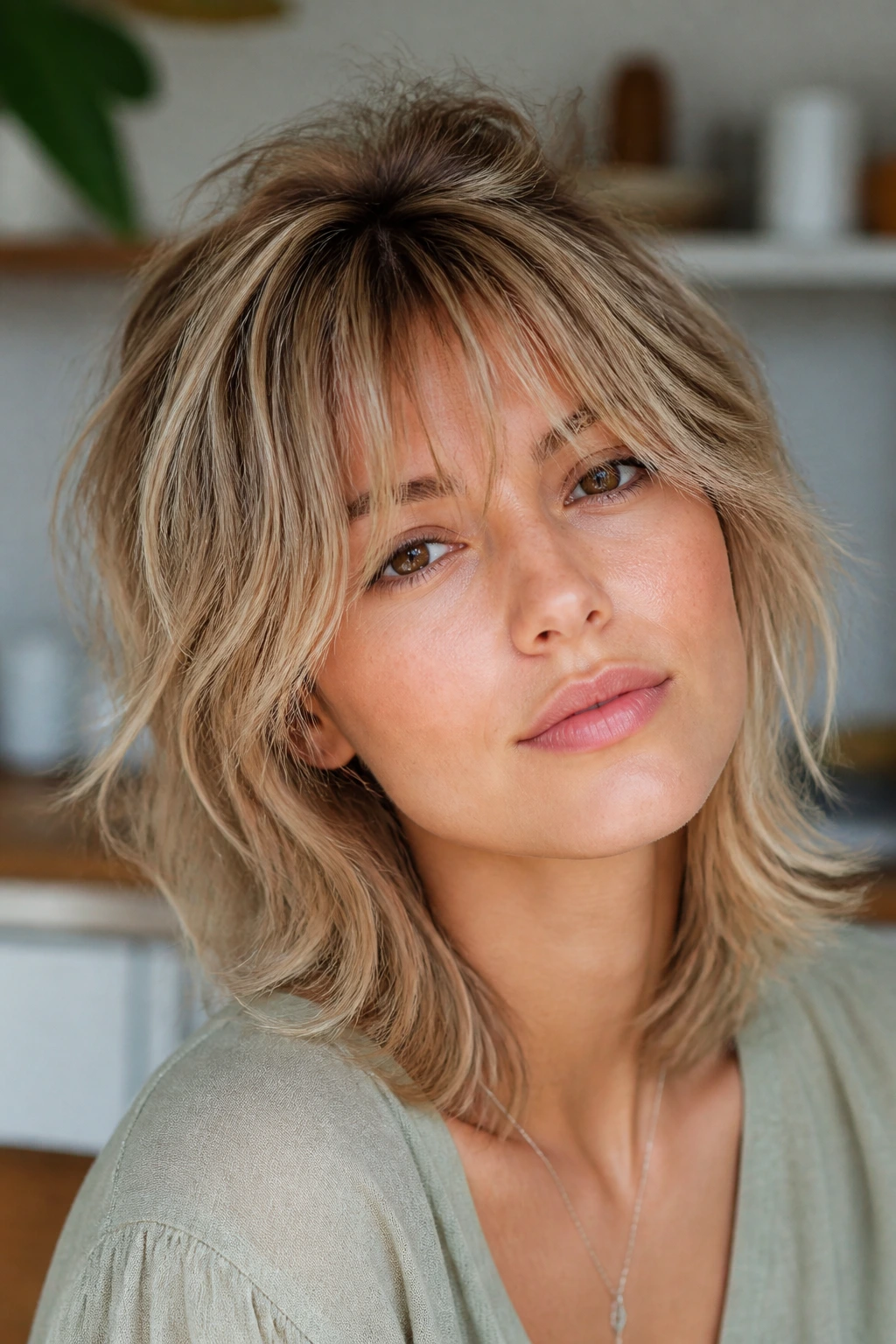
Bring photos, but bring the right kind. One photo should show the overall shape and length. The other should show the bangs. If you hand a stylist a single picture and expect them to read your mind, you’re setting both of you up for a weird afternoon.
Length checkpoint: Say exactly where you want the shortest layer to land — cheekbone, jawline, collarbone, or brow. That one detail changes the whole cut.
Bang behavior: Tell them how you wear your part. Center-parted curtain bangs and side-parted fringe are not the same request, even if the photos look close enough on a screen.
Weight removal: If your hair is thick, ask for internal shaping rather than aggressive thinning. Thinning shears can make ends look fuzzy when the haircut grows out.
Curl reality: If you have waves or curls, say whether you air-dry, diffuse, or blow it out. A cut built for a smooth blowout will not sit the same if your hair dries naturally.
Growth plan: Ask how the bangs will behave in three weeks, not just on day one. That sounds picky. It isn’t. It is the whole game.
How to Style Layered Haircuts With Bangs at Home
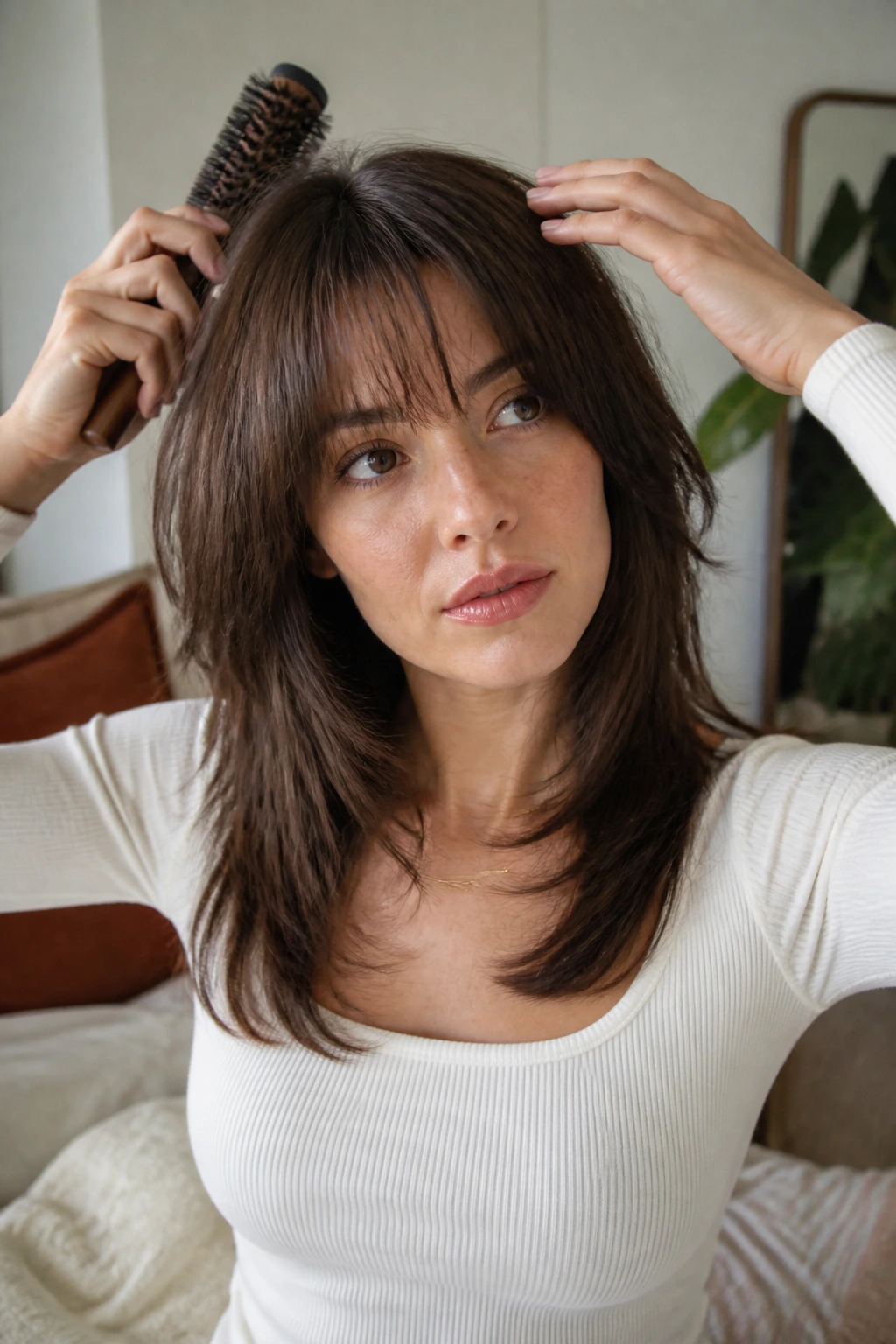
Air-Dry: Work a light mousse or curl cream through damp hair, then clip the bangs where you want them to fall while the rest dries. That small pin-up can keep curtain bangs from splitting too early or sinking into the forehead.
Blowout: Dry the fringe first, side to side, until it loses the wet bend. Then use a round brush to guide it away from the face and back toward the center or side, depending on the cut. The rest of the layers can dry with a bend at the mid-lengths, but the bangs need the most control.
Second-Day Reset: Mist the roots with a little water, hit the bangs with the dryer for 20 to 30 seconds, and add a touch of dry shampoo at the roots. Don’t soak the front. That only sends the bangs into that weird separated state where they never quite recover.
Heatless: Large Velcro rollers or soft curlers around the face can create lift without a hot tool. They work especially well on lob and feathered cuts, where the goal is shape, not curl.
Common Mistakes That Make the Cut Fight Back
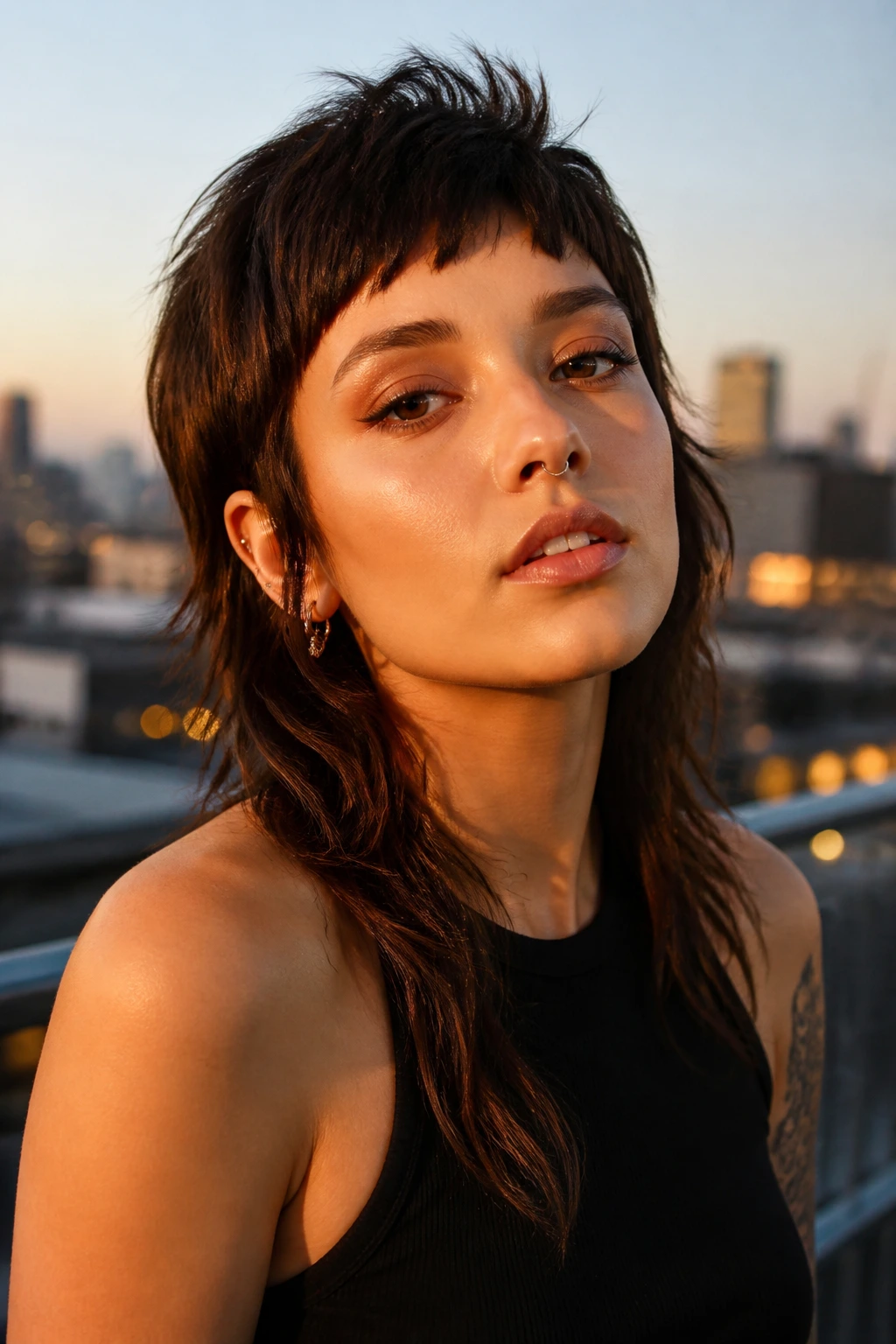
Cutting the bangs too short on the first visit: Short bangs bounce up more than people expect, especially on straight or curly hair. Ask for a little extra length and trim later if needed.
Over-layering fine hair: Too many short layers make the ends look thin and the shape collapse. Fine hair usually needs softer, longer layers that keep the perimeter full.
Ignoring the cowlick or part line: A fringe that fights a strong growth pattern will split, stick up, or slide sideways every morning. Show your stylist the problem area while your hair is dry.
Using too much product at the front: Heavy cream, oil, or mousse near the bangs can make them look dirty before lunch. Start small and add only if the hair needs more control.
Thinning curly hair like it’s straight: Curly layers can go frizzy fast if the texture is over-cut when wet. The curl needs room to spring, not a lot of aggressive slicing.
Choosing a fringe you won’t trim: A blunt bang that sits exactly on the brow usually needs regular upkeep. If you won’t maintain it, pick a longer shape with a softer grow-out path.
Ways to Make the Cut Feel More Like You
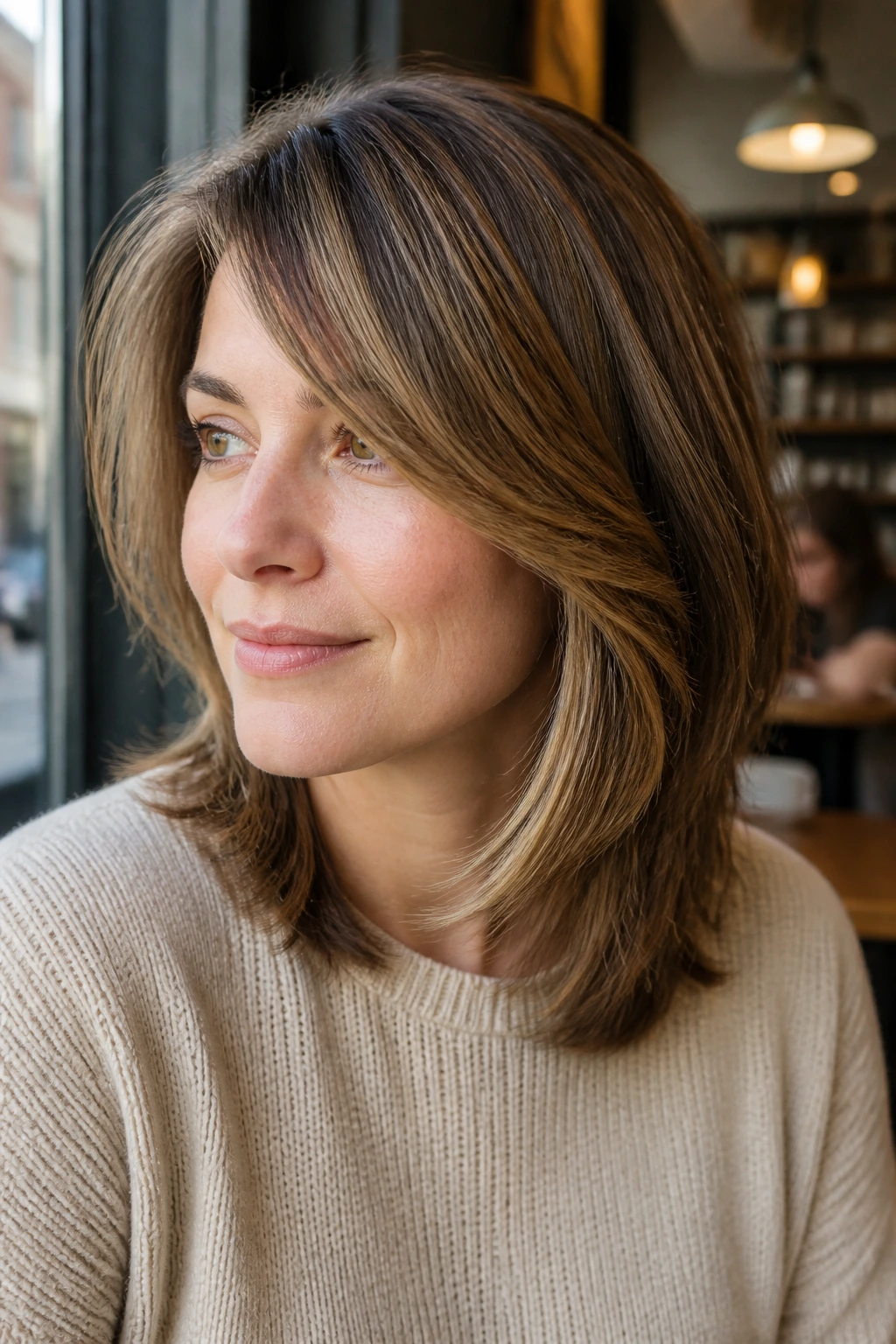
Soft and Easy: Keep the front pieces long enough to tuck behind the cheekbone and let the layers blend gently. This version suits anyone who wants bangs without a hard line across the forehead.
Big Blowout Energy: Ask for more internal shaping through the crown and a rounder face frame. It gives the hair lift and bounce, especially on medium to thick strands.
Low-Maintenance Grow-Out: Choose curtain or bottleneck bangs that start at the brow and get longer toward the temples. They’re kinder to busy schedules and still frame the face.
Texture-First Version: If your hair is naturally wavy or curly, ask for the layers to follow the bend, not flatten it. That keeps the cut from looking overcontrolled.
Sharper Front Line: If you like a little edge, go for a fuller fringe, shorter face frame, or a bixie shape with clean lines around the brow and jaw.
Maintenance, Bang Trims, and Grow-Out
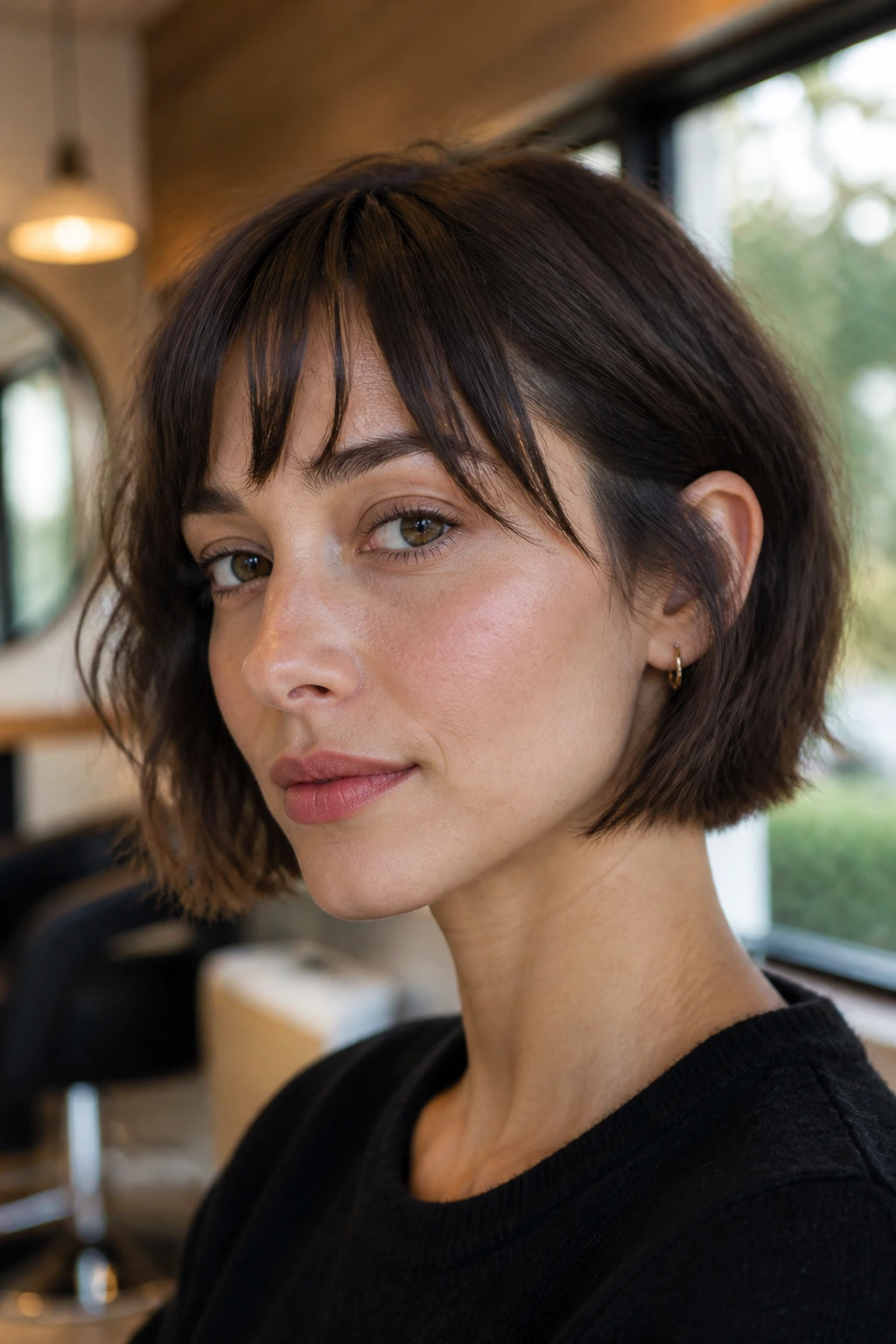
Bangs need more frequent attention than the rest of the haircut. A fringe trim every 2 to 4 weeks keeps the shape from falling into your eyes or splitting in the wrong place. Longer curtain and bottleneck bangs can usually go a bit longer — often 4 to 6 weeks — because they have more room to move as they grow.
The layers themselves usually need a refresh every 8 to 12 weeks, depending on how much shape you want to keep. Thick hair can go a little longer before the outline looks heavy. Fine hair often needs shaping sooner because the ends start to look wispy before they actually feel long.
If you are growing out bangs, don’t let the front go wild and call it “intentional.” Ask for the shortest pieces to blend into the cheekbone and chin so the grow-out has a path. Dry shampoo helps the front sit away from the forehead, and a small clip can save you on the awkward in-between days.
Curly and wavy cuts need a different rhythm. They may not need frequent trims for length, but they do need shape checks when the curl pattern starts to sit unevenly around the face. That’s a different kind of maintenance, and it matters just as much.
Frequently Asked Questions
Which layered haircut with bangs is easiest to maintain?
Long curtain bangs with soft face-framing layers are usually the easiest place to start. They grow out in a way that still looks deliberate, and you can wear them straight, wavy, or tucked back without the style falling apart.
Do layers make fine hair look thinner?
They can, if the layers are too short or too aggressive. Fine hair usually needs longer, softer layers that keep the perimeter full while adding movement near the front and crown.
Can curly hair wear bangs with layers?
Yes, and it can look excellent when the cut is done with curl shrinkage in mind. The front pieces should usually be left longer than you think, and a dry or mostly dry cut is often safer than cutting curls like straight hair.
What bangs are best if I want something that grows out nicely?
Curtain bangs, bottleneck bangs, and side-swept fringe tend to grow out more cleanly than blunt bangs. They can blend into layers instead of sitting there as a hard line.
How often should I trim my bangs?
Short fringe usually needs a trim every 2 to 4 weeks. Longer bang shapes can go longer, but once the fringe starts falling into your lashes or splitting badly, it’s time to reshape it.
Why do my bangs separate in the middle?
Cowlicks, a strong center part, or too much oil at the roots can make bangs split. Drying the fringe in the opposite direction first, then setting it into place, usually helps more than adding extra product.
Can I style these cuts without heat?
Yes, especially shaggy lobs, curtain bangs, and wavy mid-length cuts. Use clips, mousse, and a little air-drying control at the roots so the front doesn’t dry flat or crooked.
What should I tell my stylist if I want low upkeep?
Ask for a bang shape that can grow into face-framing layers, and be honest about how often you trim your hair. If you do not want to visit the salon often, avoid a super-short blunt fringe and choose a longer, softer front instead.
Why These Cuts Keep Showing Up

The best layered haircut with bangs is not the one that looks perfect for one afternoon. It is the one that still behaves after a windy commute, a dry-shampoo day, or a week when you did not feel like doing much to it. That is where the smarter shapes on this list earn their place.
Pick the version that fits your hair’s real habits — where it parts, where it bends, how fast it gets heavy — and the whole cut starts working with you instead of demanding a performance every morning.
