



A good bridal half-up style does three jobs at once: it keeps hair off the face, preserves length down the back, and gives the crown enough shape that the style still reads from the front. That sounds simple. It isn’t.
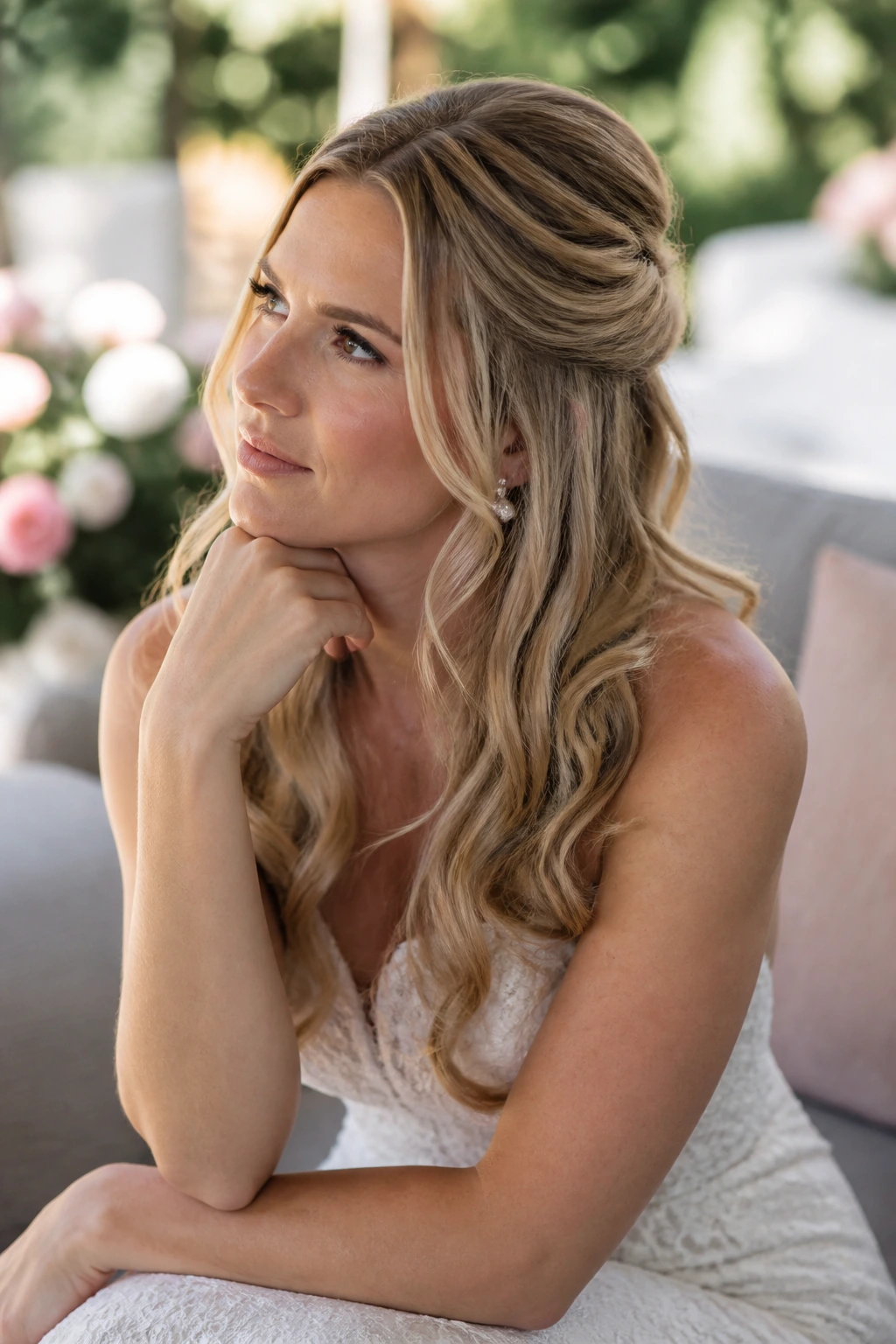
Wedding half up half down hairstyles keep showing up for one reason: they solve a practical problem without making the hair feel trapped. Fully loose waves can slump flat before the first toast. A full updo can feel too severe if the dress wants movement around the shoulders. Half-up hair sits in that middle lane, and when the shape is handled well, it looks like it belongs there.
The details matter more than people think. A twist pinned with two crossed bobby pins behaves differently from one held by a single clip. A 1-inch curling iron gives a tighter ribbon of movement than a 1.25-inch barrel. A veil comb placed a half-inch too low can drag the whole style down. Tiny differences on paper. Big differences on the head.
Why These Wedding Half Up Half Down Hairstyles Keep Getting Chosen
- The length still shows: You keep the movement and drape that make long hair feel special, instead of hiding it in a knot.
- The front stays calmer: Hair pulled back from the temples stops the constant brushing-away that ruins lipstick, earrings, and photos.
- The crown gets real shape: Even a small lift at the back of the head makes the whole profile look more finished.
- Veils and clips have somewhere to live: A half-up anchor gives pins, combs, and pearl pieces a stronger base than loose hair does.
- The style can lean formal or relaxed: The same basic structure can look sleek, boho, vintage, or soft depending on the twist, braid, and finish.
1. Soft Twists and Loose Waves That Frame the Face
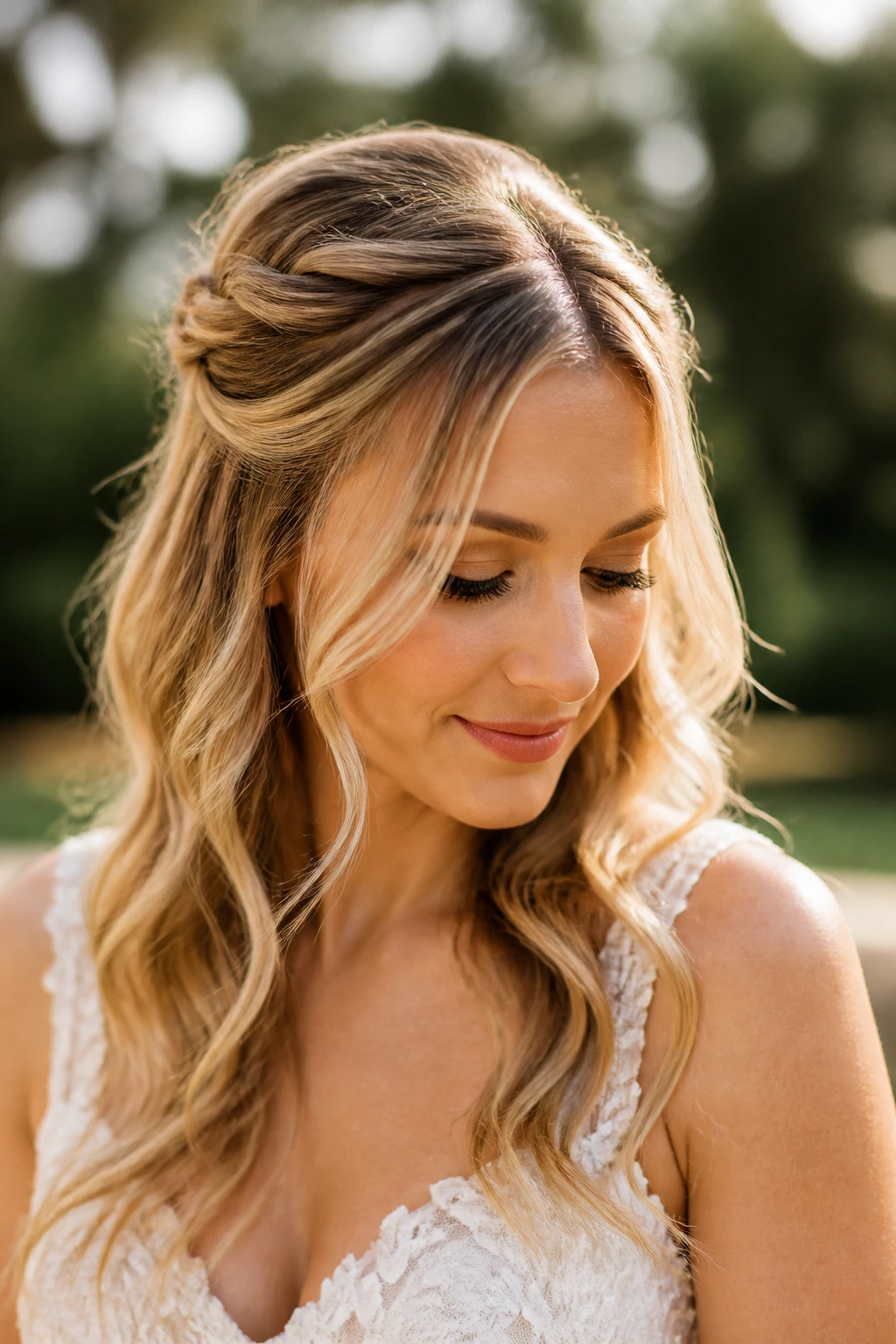
This is the style I reach for when someone wants the hair to look touched, not built. Two soft twists meet at the back of the head, and the rest falls in loose waves that move when you turn. Nothing feels stiff. Nothing feels overworked.
Why It Works
The twist creates a small anchor at the crown, which is the part that usually starts to collapse first. That matters more than people expect. Once the hair is pinned there, the length can hang freely without dragging the whole style flat.
It also gives you room to keep the front pieces soft. If the bride wants cheekbone framing without hiding the eyes, this is a good lane. The face stays open, the shoulders stay visible, and the back still has enough motion for photos.
Best For
- Medium to long hair
- Oval, heart, and round face shapes
- Dresses with sleeves, lace backs, or a softer neckline
The nicest thing about this version is that it doesn’t fight the hair’s natural bend. If the ends want to sit a little messy, let them. That loose finish is what keeps the look from feeling too polished for its own good.
2. A Sleek Center Part with a Statement Barrette
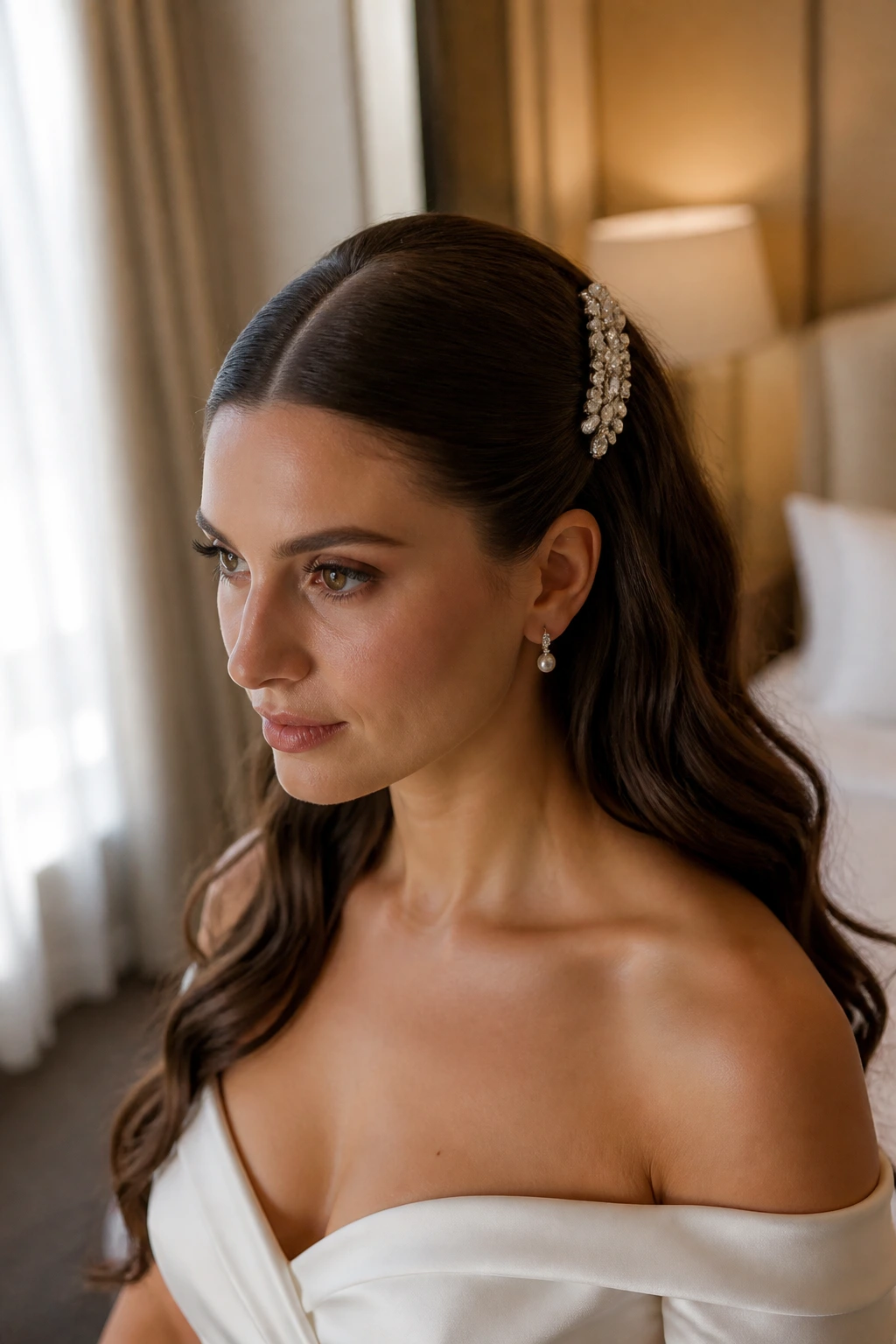
This one has a quieter mood. The center part stays crisp, the crown is smoothed close to the head, and one clean barrette or clip does the work of the whole style. It looks deliberate from the first glance.
A style like this needs clean sections and a little discipline. Use a smoothing cream on damp hair, blow-dry with tension, then flat-iron the top layer only if the hair needs it. The point is not glassy perfection. The point is a controlled surface so the barrette sits flat instead of wobbling.
This is the style for a bride who likes structure. It works especially well with square or minimalist gowns because the hair doesn’t compete with the dress. And if the clip is substantial enough — pearl, crystal, brushed gold, or matte silver — the accessory becomes the focal point without drowning the rest of the hair.
3. Braided Halo Half Up with Soft Ends
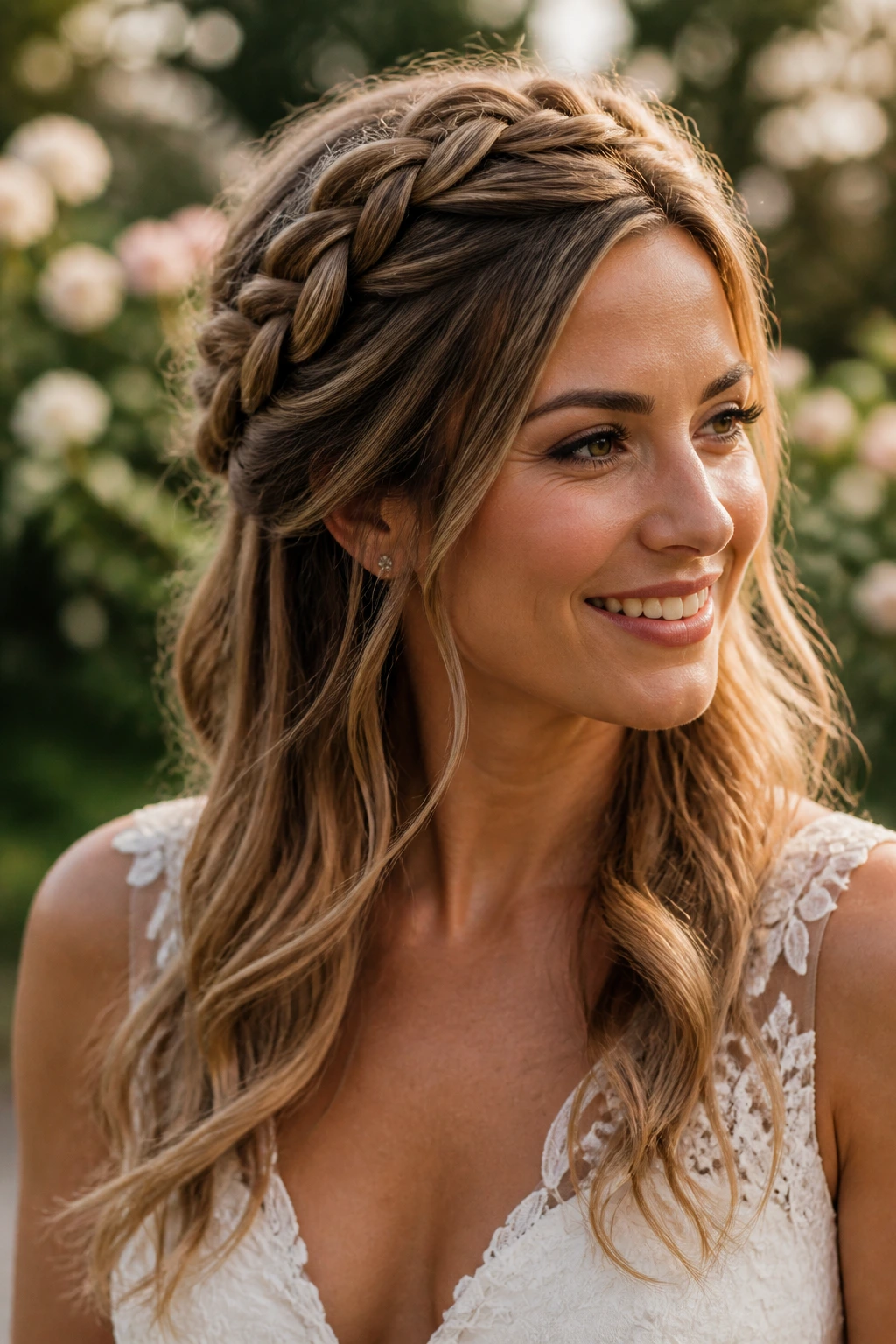
Why does this one last so well? Because the braid acts like a built-in scaffold. Once the crown is braided from temple to temple or from both sides into the back, the loose length underneath has something steady to hang from.
That makes it a smart choice for outdoor ceremonies, warm venues, or any wedding where the hair has to behave for hours. The braid also gives texture in a way curls alone can’t. Even if the waves relax a bit, the braid still reads clearly in photos.
The trick is to keep the braid close enough to the head that it feels secure, but not so tight that it looks stiff. Leave the ends soft. If the loose hair is curled with a 1.25-inch iron and brushed out lightly, the contrast between braid and waves is what makes the style feel finished.
4. Crystal-Comb Curls with Extra Crown Volume
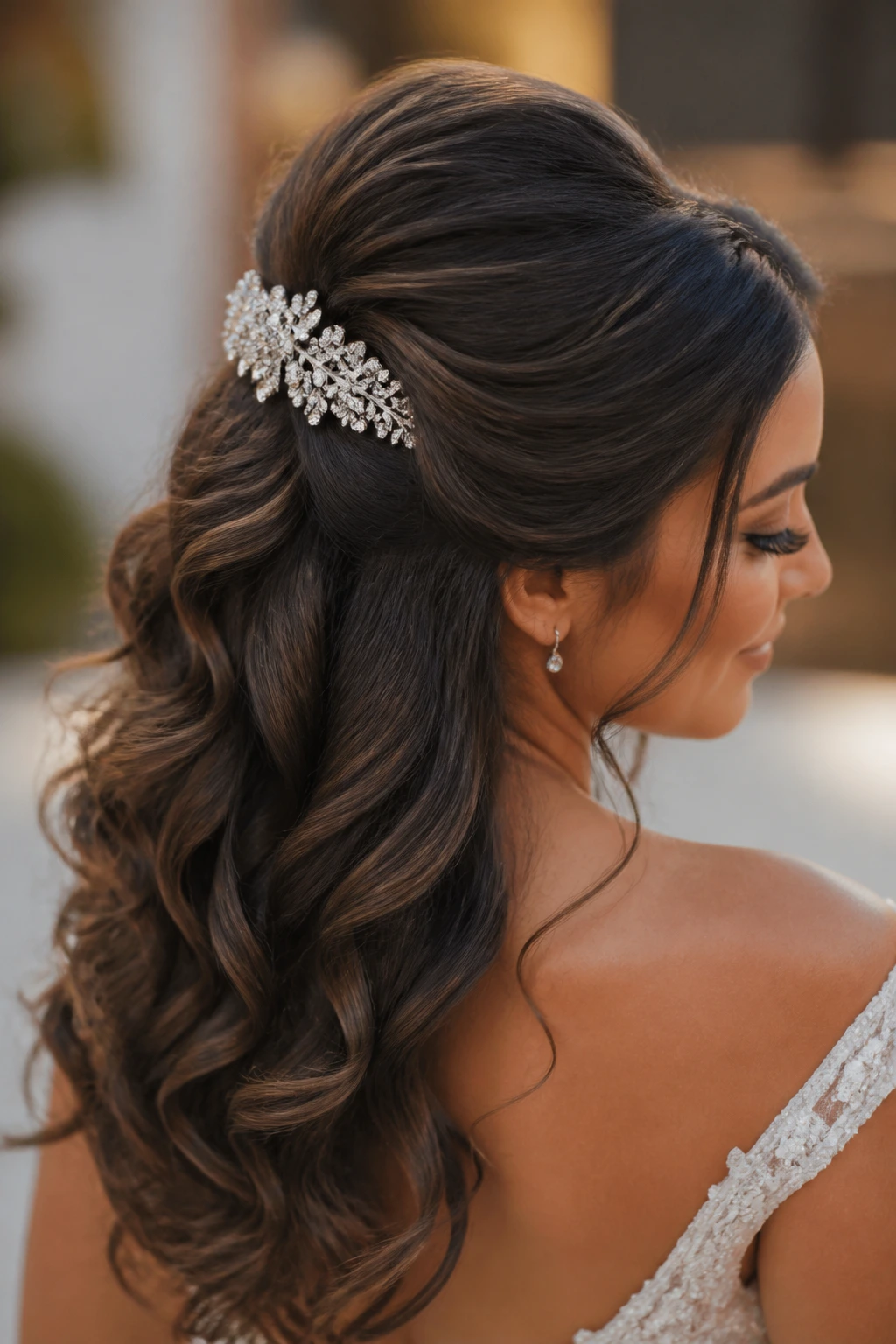
This style has a little sparkle in it, and it knows it. The crown is lifted, the loose hair is curled into wide, shiny bends, and a crystal comb is tucked where the back of the head starts to round away. When the light hits it, the comb catches the eye first, then the curl pattern follows.
What Makes It Different
The volume is the whole point. Without it, the comb can look like it’s floating on top of flat hair. A small backcomb at the crown, plus a mist of texturizing spray before pinning, gives the comb something to sit in.
The other thing I like here is the balance. The accessory is formal, but the curls keep the style from turning rigid. That mix matters with dresses that have beading or a detailed bodice, because the hair needs to hold its own without shouting.
If your hair is fine, clip the crown curls up while they cool. Do not rush that part. Warm curls fall faster, and this style lives or dies on the lift.
5. Low Twist Half Up with Face-Framing Pieces
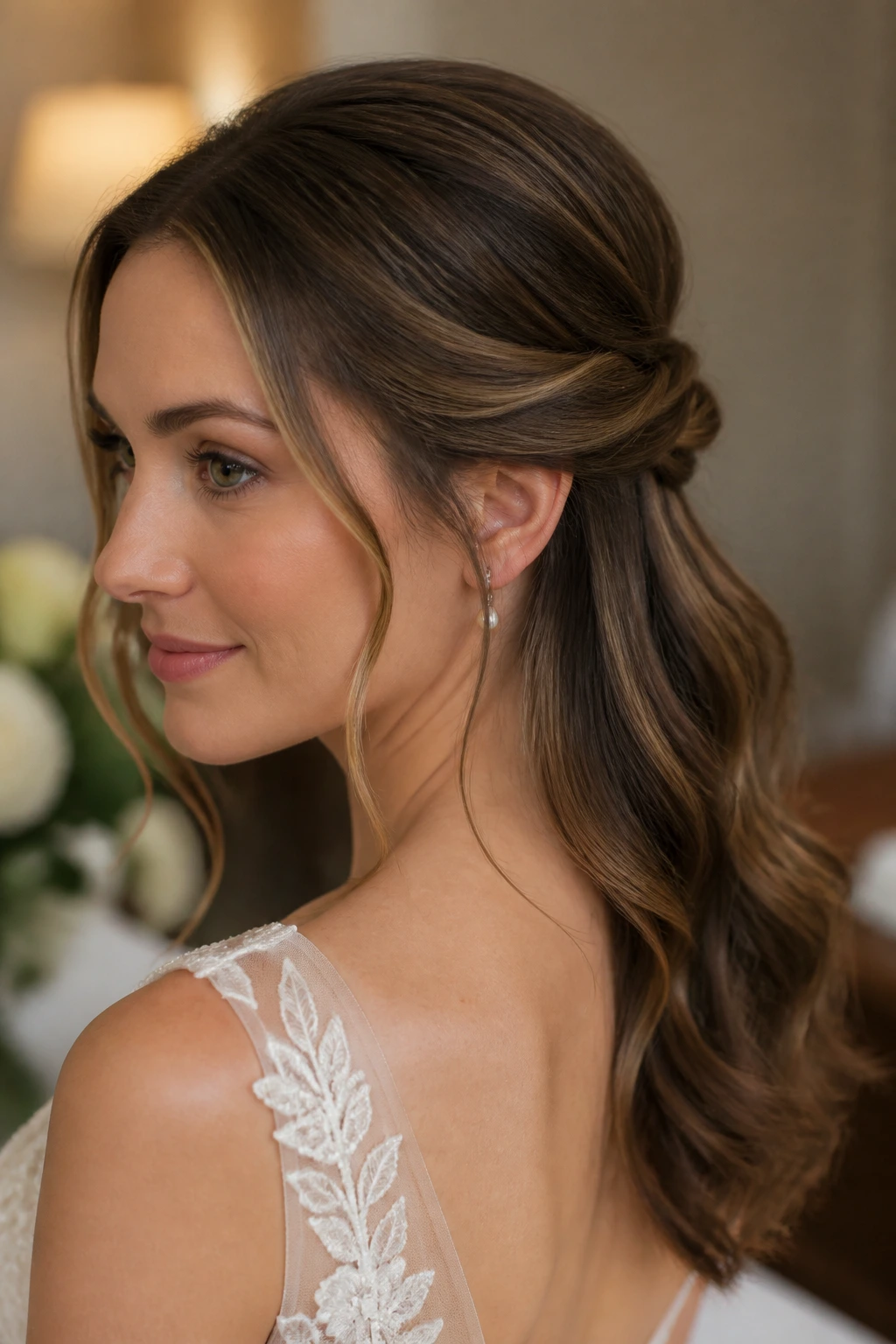
A low twist changes the whole mood. Instead of lifting the hair high on the crown, the twist sits a little lower, right where the head begins to narrow toward the neck. The result feels softer and more grounded, especially with strapless, halter, or open-back dresses.
This style is doing subtle work. The low placement keeps the shape elegant without adding height that might fight the neckline. Two longer face-framing pieces are left out, usually starting near the cheekbone and curling toward the jaw, which keeps the style from looking too tucked in.
It’s also one of the more forgiving options for brides who don’t want constant touch-ups. A low twist is less likely to poke, slip, or get knocked by a veil edge. If you like the idea of being able to move without thinking about your hair every five minutes, this one deserves a hard look.
6. Fishtail Accent Braids for Thick, Textured Hair
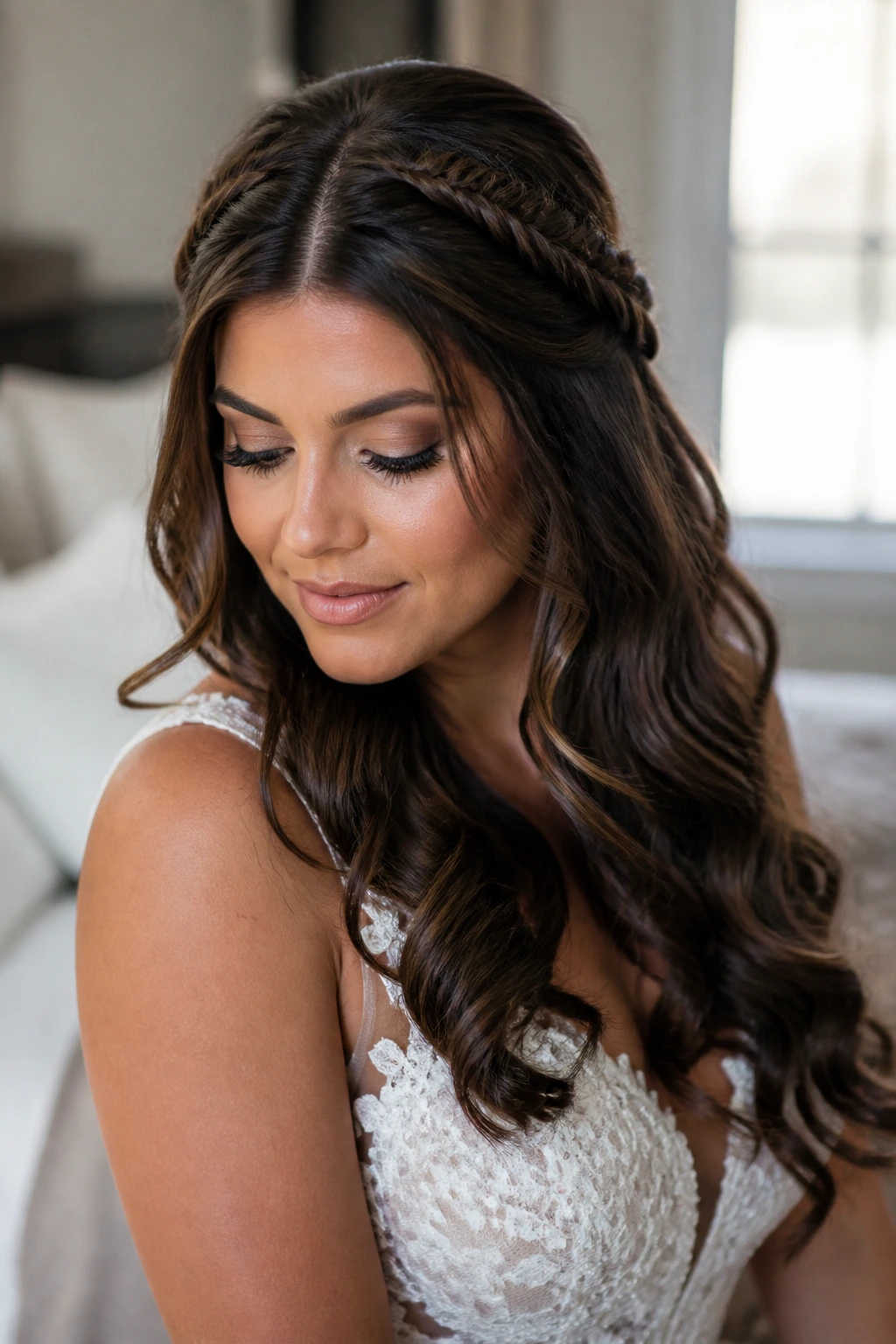
Thick hair can handle a fishtail braid where finer hair sometimes cannot. That extra density shows off the braid pattern instead of letting it disappear. If the hair is layered or has a lot of natural texture, the fishtail reads like detail rather than clutter.
The braid does not need to take over the whole style. Sometimes the best version is just a pair of fishtail sections drawn from the temples and pinned into the back, leaving the rest in soft waves or a blown-out bend. You get texture near the crown without turning the whole head into one big braid.
A couple of quick notes:
- Keep the braid close to the scalp so it doesn’t puff away.
- Use a clear elastic or a pin hidden under the braid tail.
- Loosen only the outer edges if you want softness; don’t pull the whole thing apart.
This is a strong choice for people who like detail in the hair itself. It has enough structure to look intentional from the front, which matters more than most brides realize.
7. Old Hollywood Side Sweep with a Half-Up Pin
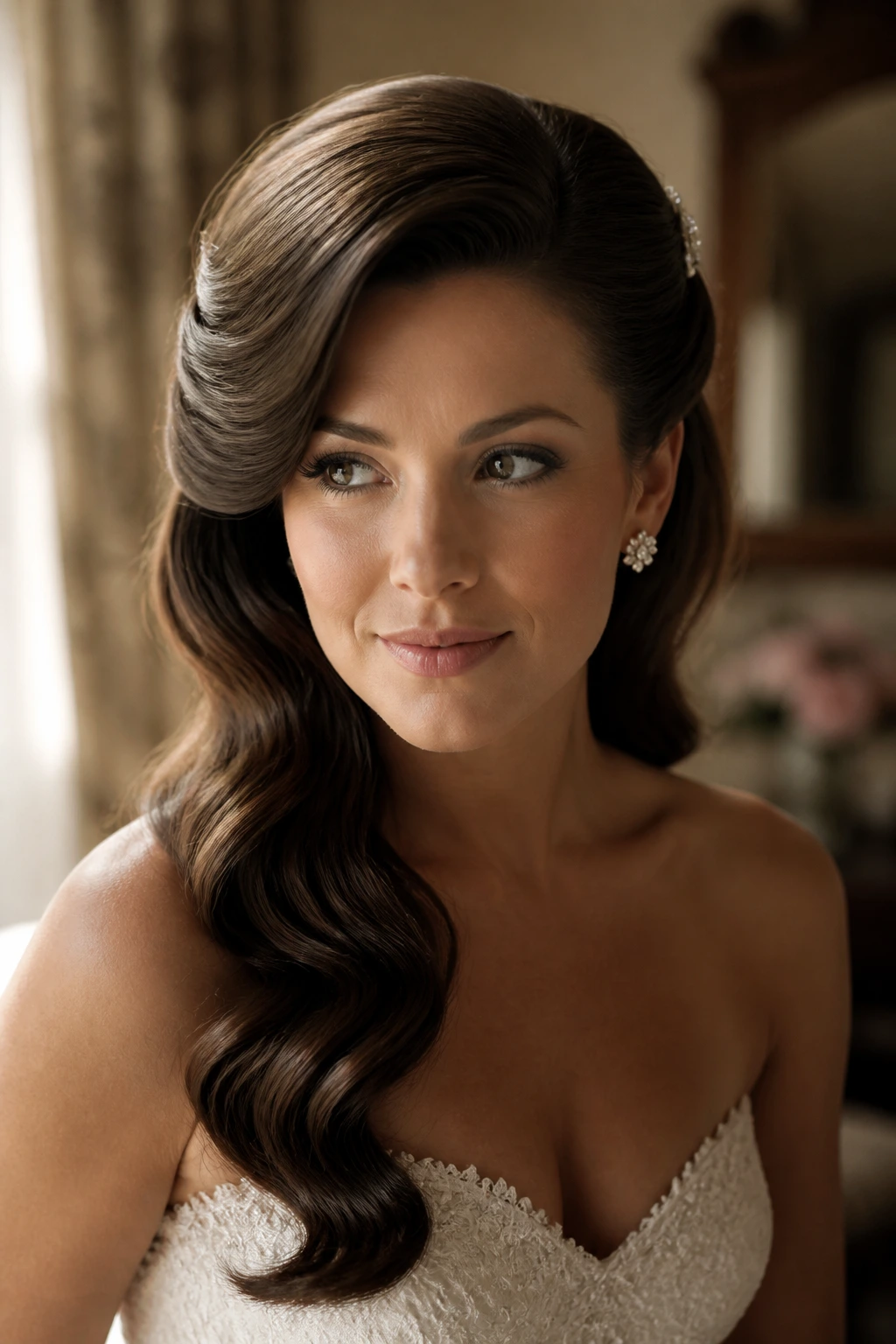
A deep side part changes the face before you even touch a curling iron. Once the hair is swept over and one side is pinned back just enough to stay open, the whole look starts to feel more formal, more sculpted, and a little more dramatic.
The wave pattern matters here. Think broad, polished curves rather than separated curls. The front should move in one smooth line before it drops into the rest of the hair. If the ends are too frizzy or too piecey, the shape loses that old-movie feel and starts reading as unfinished.
This style shines when the dress already has strong lines. Satin, crepe, or a clean neckline can handle the drama. So can a bold earring. The hair becomes the frame, not the whole painting, and that’s why it works.
8. Bubble Braid Half Up for Long Hair
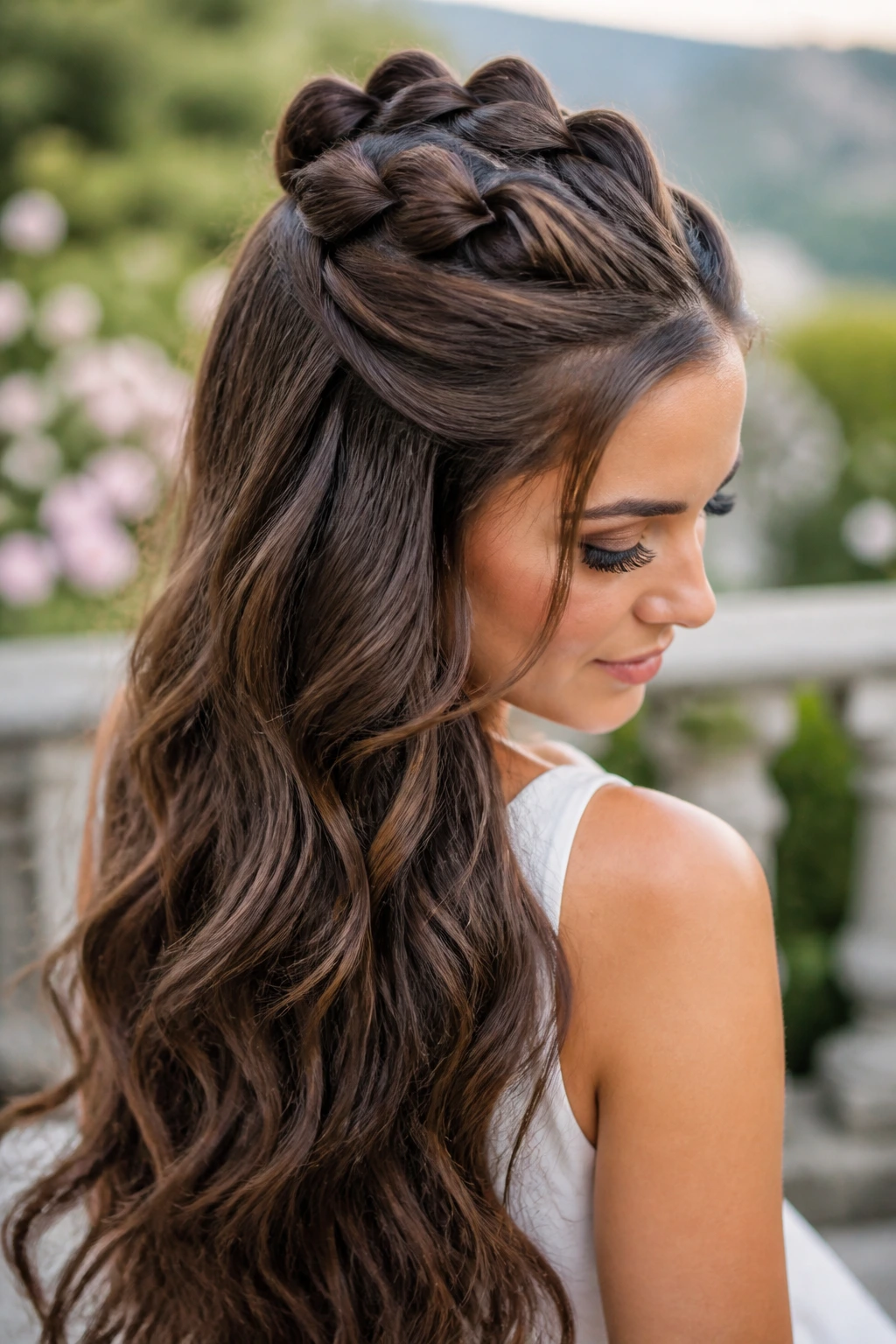
Bubble braid half-up hair looks modern without being severe. You gather the top section, secure it with small elastics every inch and a half or so, then gently tug each segment to puff out the “bubbles.” The result is playful, but it still feels groomed enough for a wedding.
What makes it practical is the hold. Each elastic gives the section its own anchor point, so the style stays more stable than a loose twist on slippery hair. That is useful for long hair that tends to slide down by the end of a ceremony.
If you want this look to feel bridal rather than casual, keep the bubbles neat and the lower hair smooth. A little shine spray on the ends helps. Too much texture turns it into something more festival than wedding, and that’s a line worth watching.
9. Pearl Pin Clusters Across the Crown
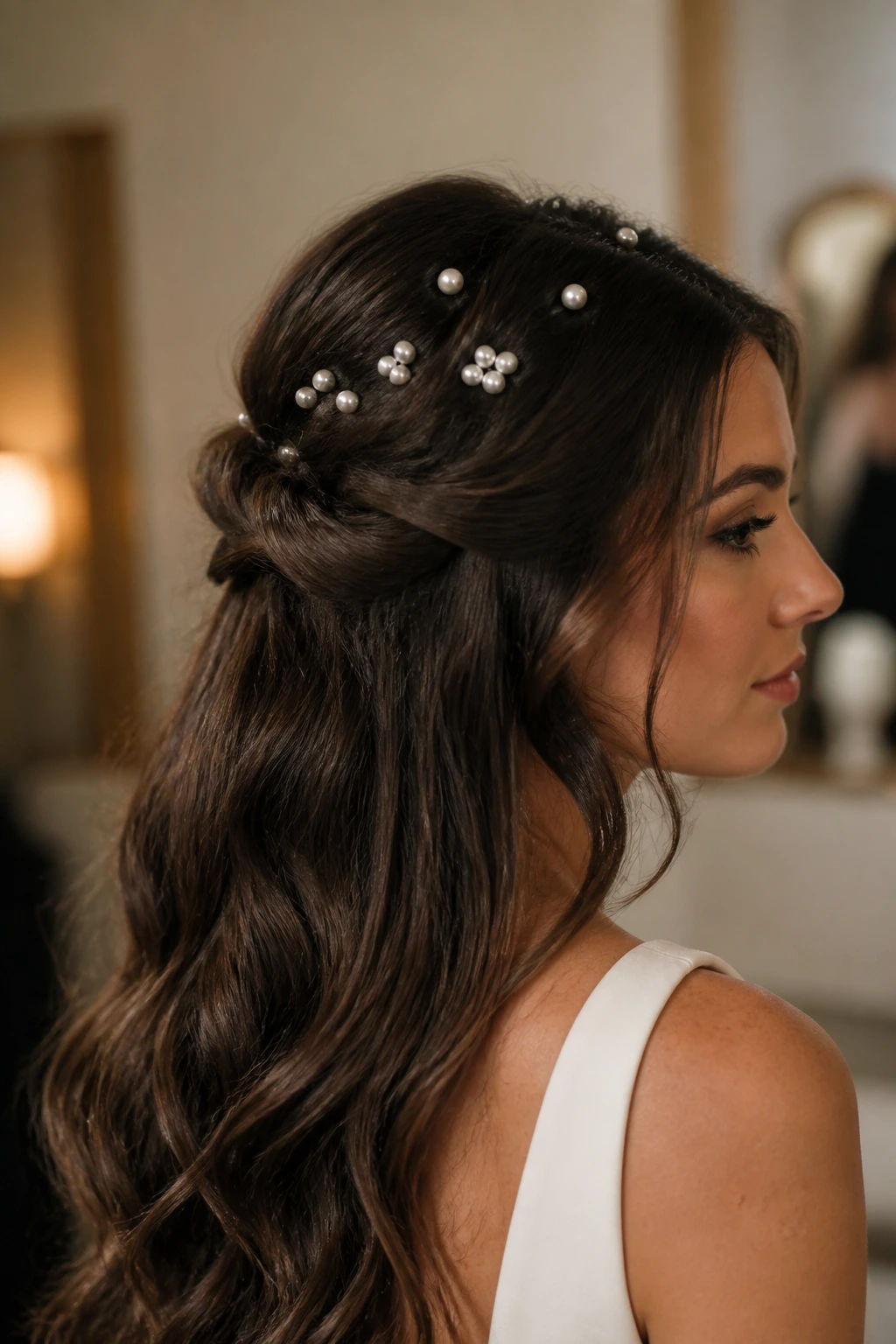
Pearl pins work best when they’re not trying too hard. A few scattered pins near the crown — usually in an uneven cluster rather than a straight row — can make a plain half-up style feel finished without covering the hair.
This is the sort of look that rewards restraint. The hair itself can stay soft and waved, maybe with a slight twist at the back, but the pins create a visual focal point. Pearl pieces also play nicely with dresses that already have beading or buttons, because they echo the detail without duplicating it.
I like this style for brides who want jewelry in the hair but not a full comb. It sits lighter on the head, which helps if you’ll be wearing the look for a long stretch. And because the pins are small, they’re easier to place around a veil comb or tucked above a twist.
10. Deep Side Wave Half Up with Sculpted Front Pieces
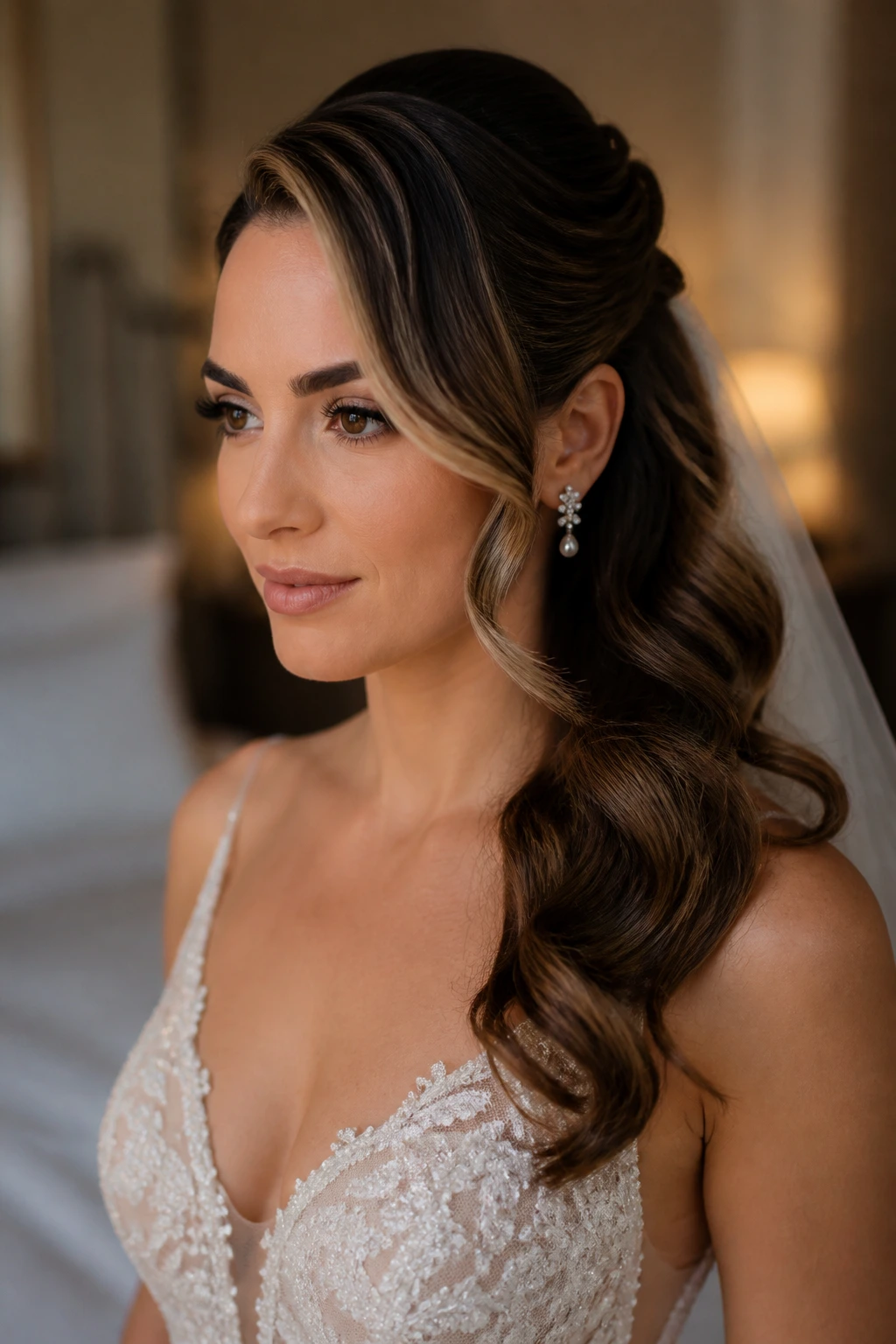
This is the sharper cousin of the old Hollywood sweep. The side part is still deep, but the front pieces are sculpted a little more tightly so the style has cleaner lines and less softness at the temple.
The difference is subtle in photos and obvious in person. The hair sits closer to the head on one side, then opens into a controlled wave over the shoulder. That asymmetry gives the style a bit of drama without making it fussy. It feels tailored.
If the dress has one strong shoulder detail, an asymmetric neckline, or a lot of structure through the bodice, this version tends to sit better than a symmetrical half-up style. It gives the eye somewhere to go. And if you’ve ever looked at a side part and thought, “That needs a little more purpose,” this is the answer.
11. Floral Vine Half Up for Garden Ceremonies
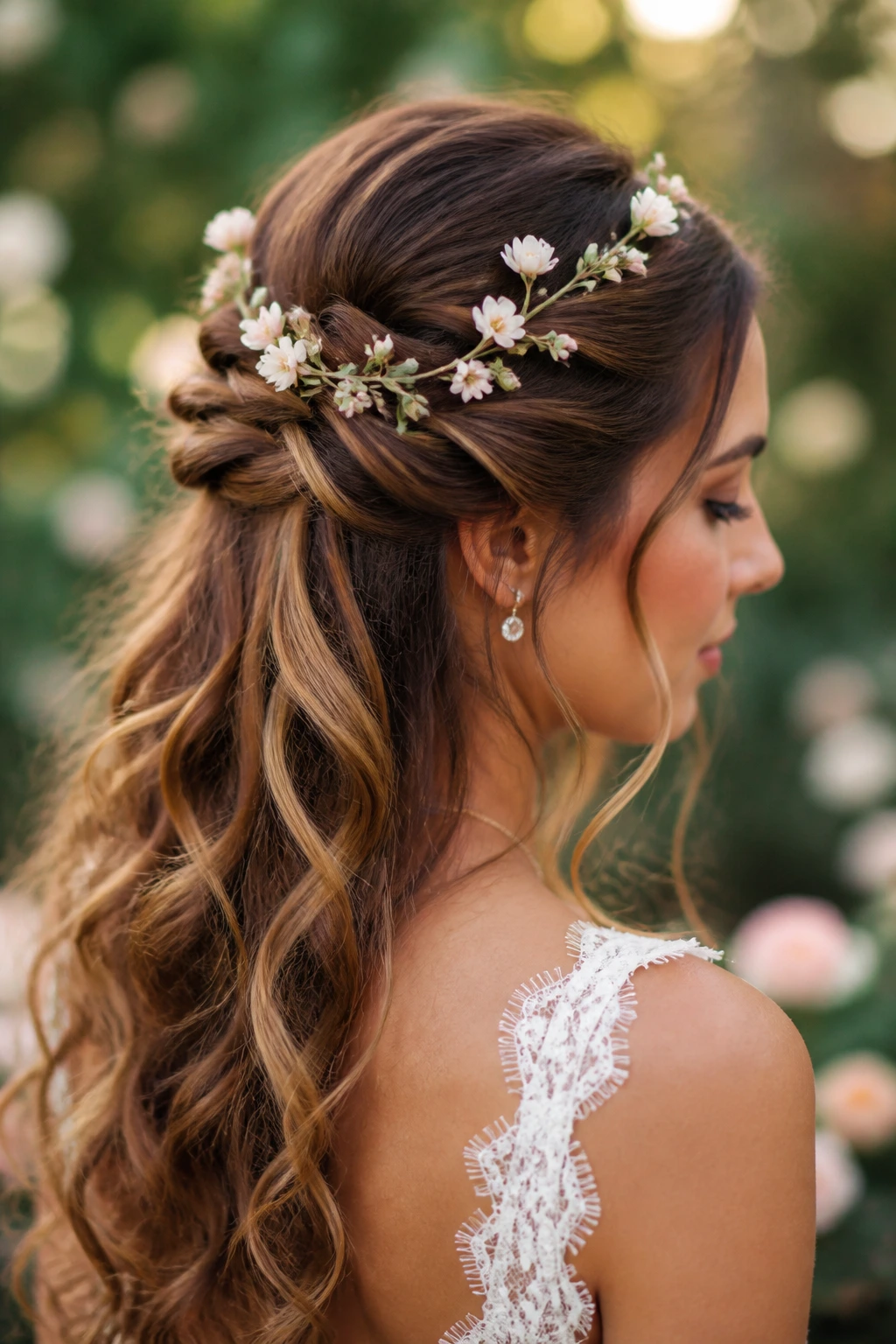
Fresh flowers change the temperature of a hairstyle fast. A floral vine woven through the half-up section can make the hair smell faintly green and look almost alive, especially when the flowers are small and tucked through a braid or twist rather than pinned on top like decorations.
The best versions use restraint. Tiny roses, spray blossoms, waxflower, or silk stems threaded along the twist keep the shape from turning bulky. Larger blooms look pretty for about ten minutes, then they start to overpower the hair and tilt the style sideways.
If you’re using fresh flowers, they need to be conditioned and secured carefully. Soft stems should be wrapped or tucked into floral wire, not shoved directly into the hair. Silk flowers are easier, and I won’t pretend otherwise. They last through heat, dancing, and the long awkward period between the ceremony and the second round of photos.
12. A Messy Knot Half Up with Airy Texture
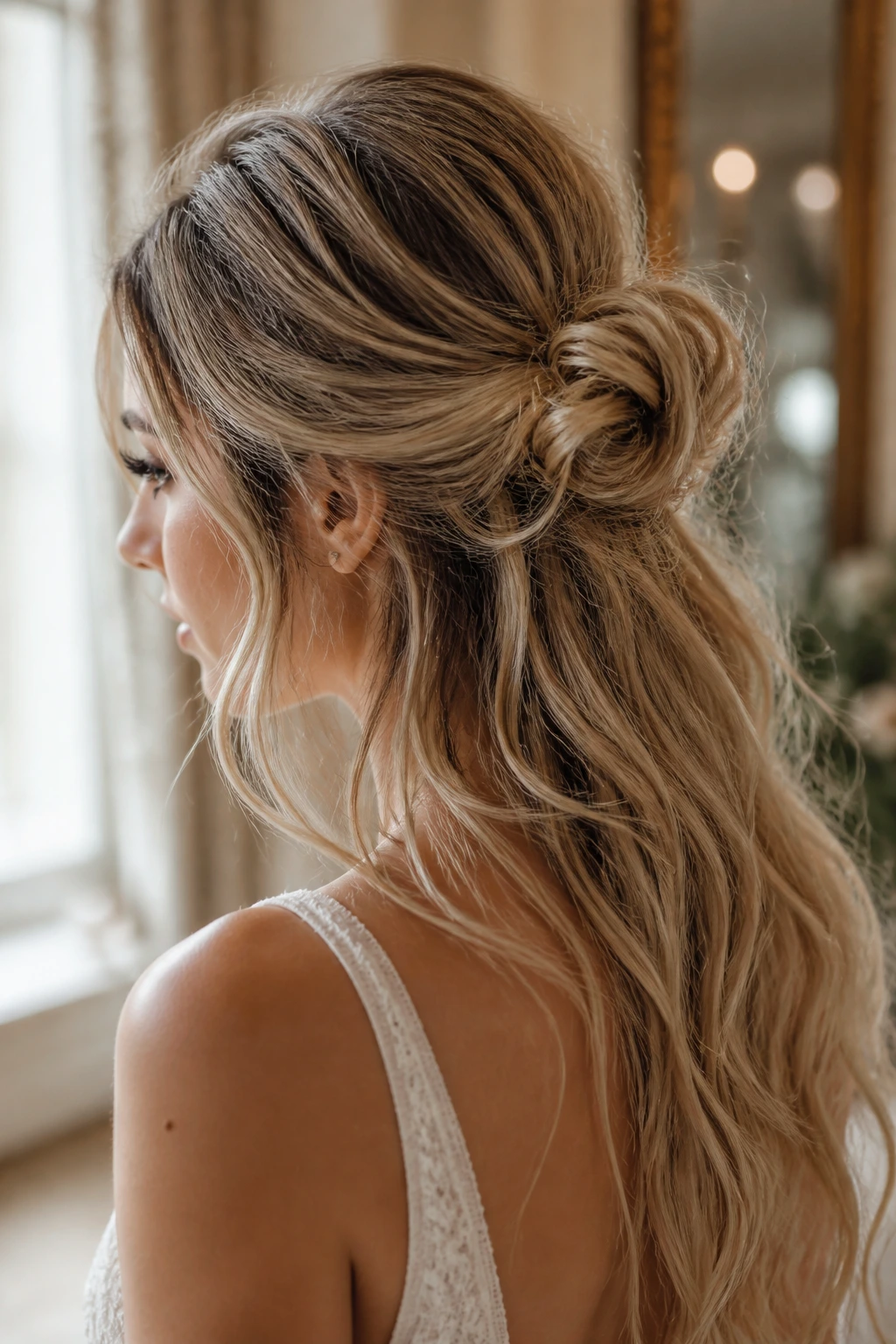
Messy does not mean random. The good versions of this style still have a shape: a loose knot or bun at the back of the head, lifted just enough to create a point of interest, with the rest of the hair falling in airy bends.
This works when you want the hair to feel relaxed but not undone. The texture is the whole point, so a little backcombing at the crown and a rough-dry finish on the lengths helps. You want the pieces to separate slightly. Not in a frizzy way. In a lived-in way.
The easiest mistake here is over-smoothing. If every piece is polished, the knot looks pasted on. Leave a few ends loose. Let one side sit a little flatter than the other. That unevenness is what keeps it from looking like a formal updo that forgot to commit.
13. Rope Twists Finished with Ribbon
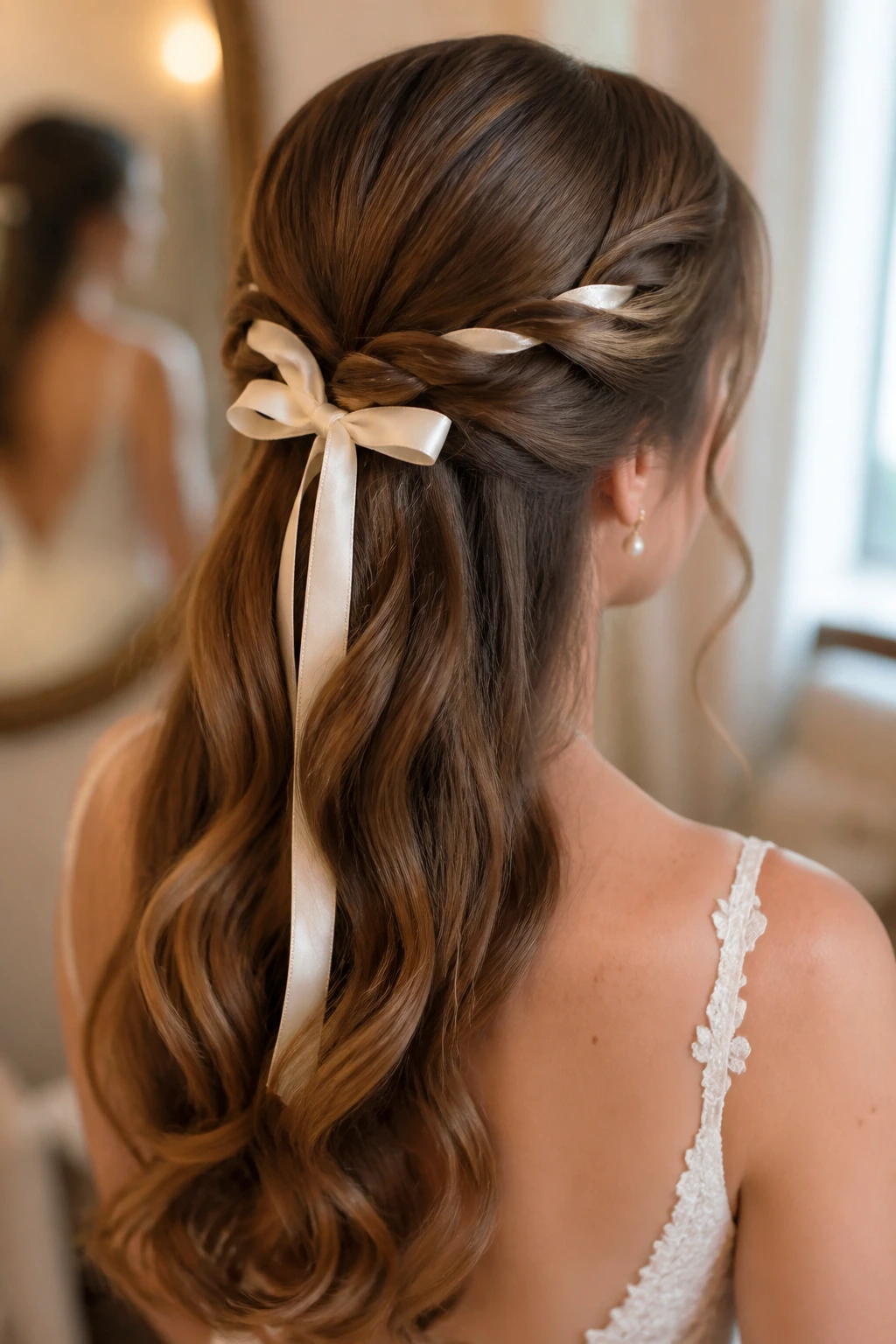
Why use rope twists instead of braids? Because they’re faster, slimmer, and they sit neatly under a ribbon without turning the back of the head into a knot of texture. A rope twist gives you the visual of detail with less bulk than a three-strand braid.
The ribbon should be more than a bow tied on at the end. Thread it under the twist base or wrap it once around the pinned section so it feels part of the shape, not an afterthought. Satin reads dressy. Velvet brings weight. A narrow organza ribbon can keep things light if the gown already has plenty of detail.
This style is especially nice for brides who want a hint of softness without leaning too sweet. The ribbon can echo the dress trim, the bouquet, or even the shoes. That little match creates a quiet line through the whole look.
14. Waterfall Braid Half Up on Long Layers
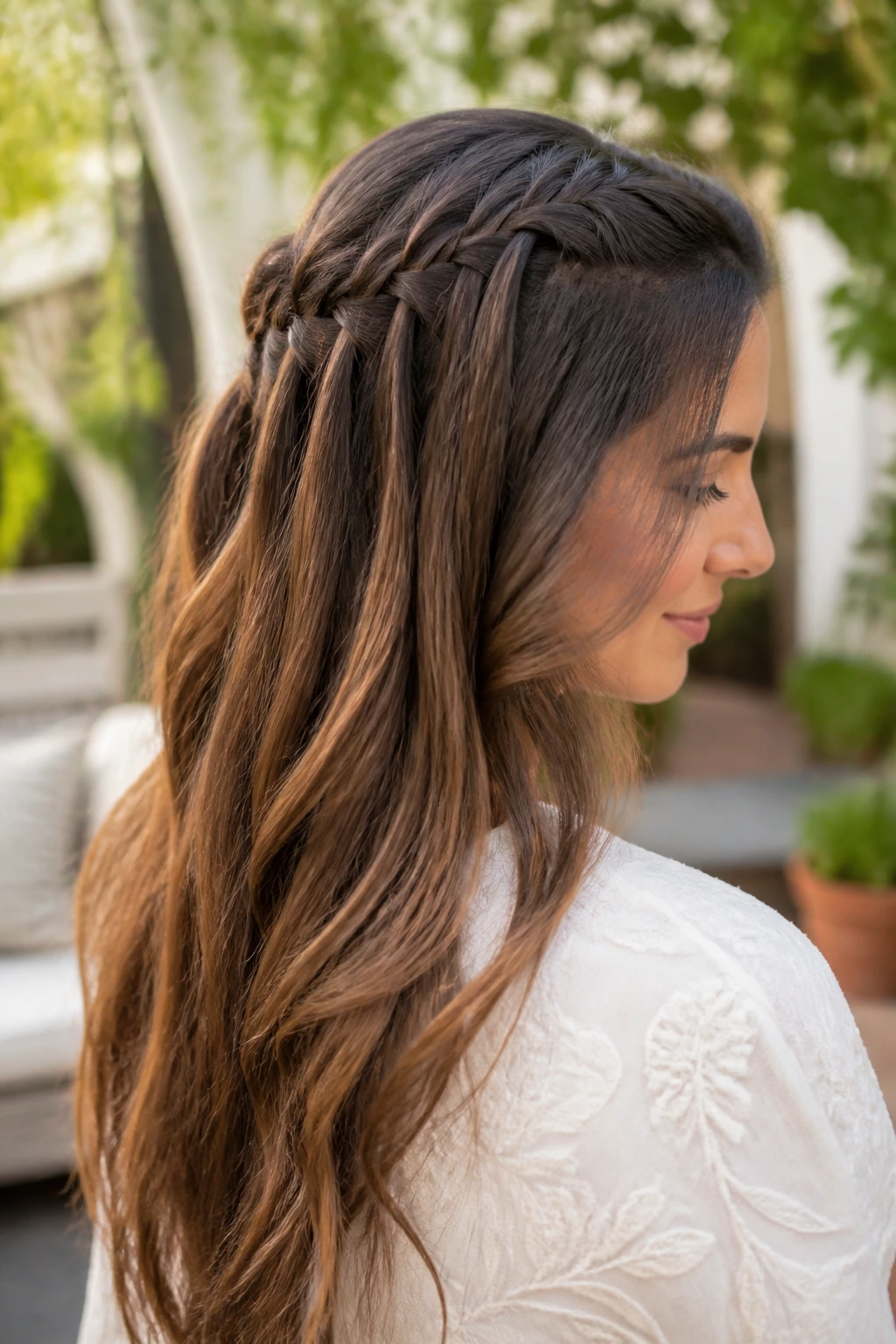
A waterfall braid works because it lets pieces of hair drop through the braid as you build it, which creates a soft cascade instead of a wall of woven texture. On long layers, that movement is the whole reason to choose it.
The braid should travel just enough to hold the top section back, then stop. If it runs too far around the head, the style starts to feel heavy. If it’s too loose, the dropped pieces can disappear into the rest of the hair. The sweet spot is a braid that says, yes, this was made on purpose, but doesn’t shout.
I’d use this on someone whose hair takes a curl well and keeps shape through the day. The braid frames the top, the loose hair carries the motion, and the result has more detail than a simple twist without requiring the stiffness of a full updo.
15. A Mini Top Knot Half Up with Soft Length
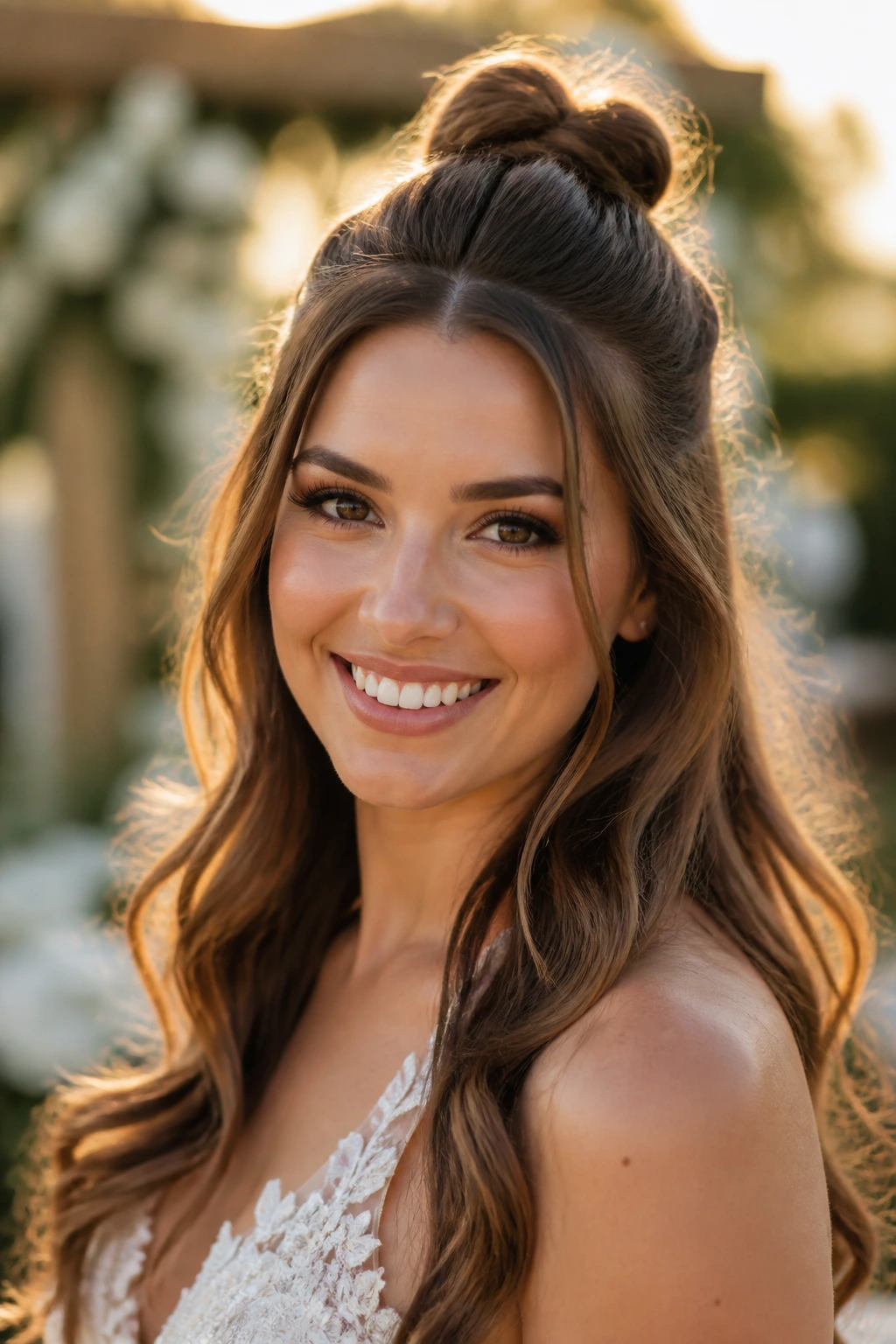
Small knot. Big lift.
That’s the whole appeal here. A compact knot sits high on the crown, lifts the profile, and leaves enough length below to keep the hair from feeling pinned into a box. It looks especially good on brides who want the face opened up a little more but don’t want a full bun.
The knot should be small enough that it doesn’t steal the whole show. Think wrapped sections, not a giant loop. The lower hair can stay in waves or blown-out bends, which keeps the style from becoming too severe. If the knot is built with a little texture first, it holds better and looks less like a math problem.
This is a nice choice with high necklines or dresses that already have clean shoulder lines. The crown gets a little architectural. The rest of the hair still moves.
16. Vintage Roll Half Up with Glossy Ends
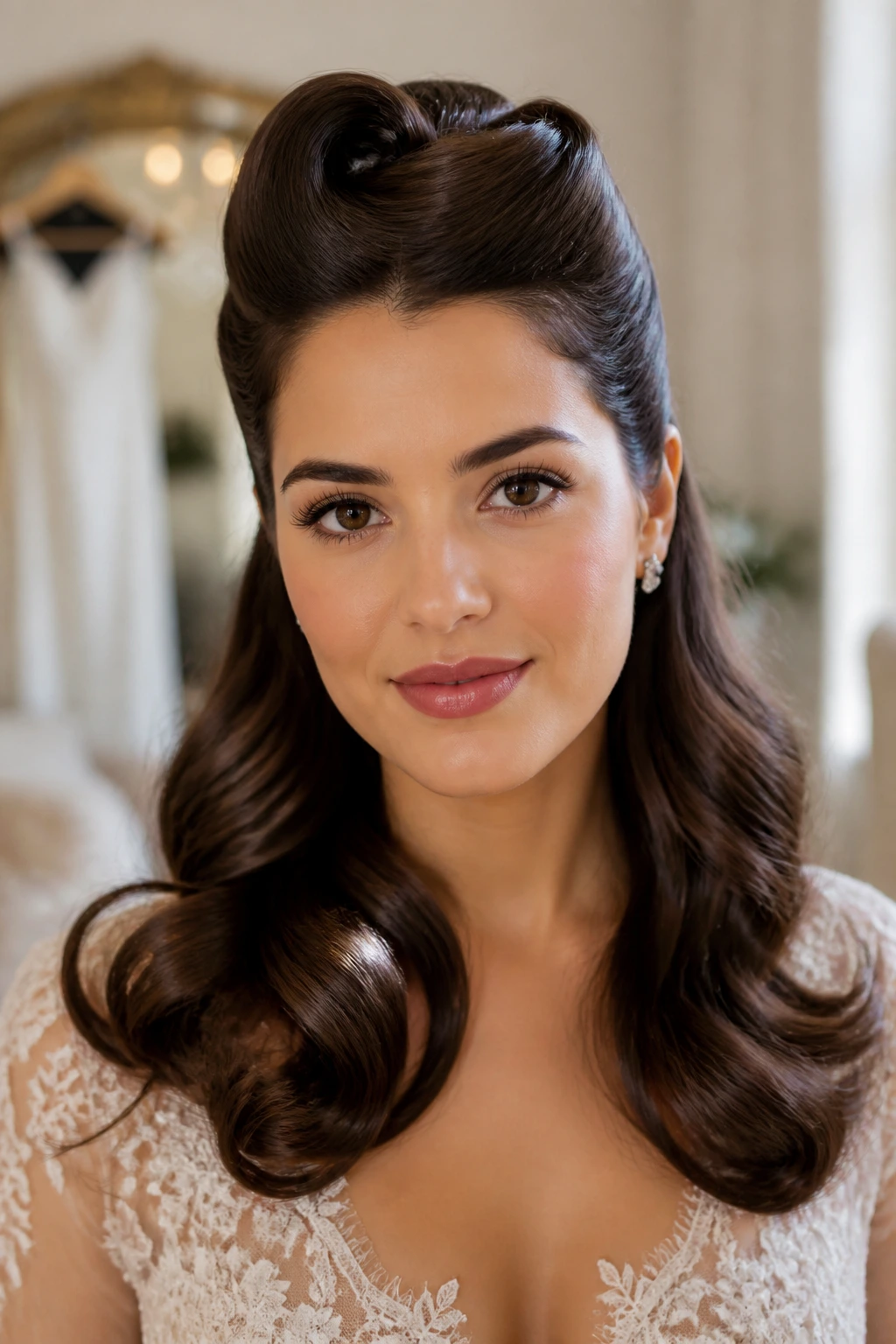
A vintage roll brings the front of the hair under control in the most specific way possible: by rolling the top section back on itself and pinning it into a soft ridge. It has a 1940s feel without needing the rest of the hair to match a period look.
The gloss matters here. Too much matte texture and the roll loses its shape. A little smoothing serum on the ends, a clean side or center part, and a precise roll at the crown will do more than extra hairspray ever will. That shine keeps the style from looking dusty.
This works beautifully with a red lip, a satin dress, or any look where the bride wants the hair to look intentional from the front. It’s one of those styles that looks plain in a bad photo and elegant in a good one, which is why a trial run is smart.
17. Crown Braid Half Up That Stays Put
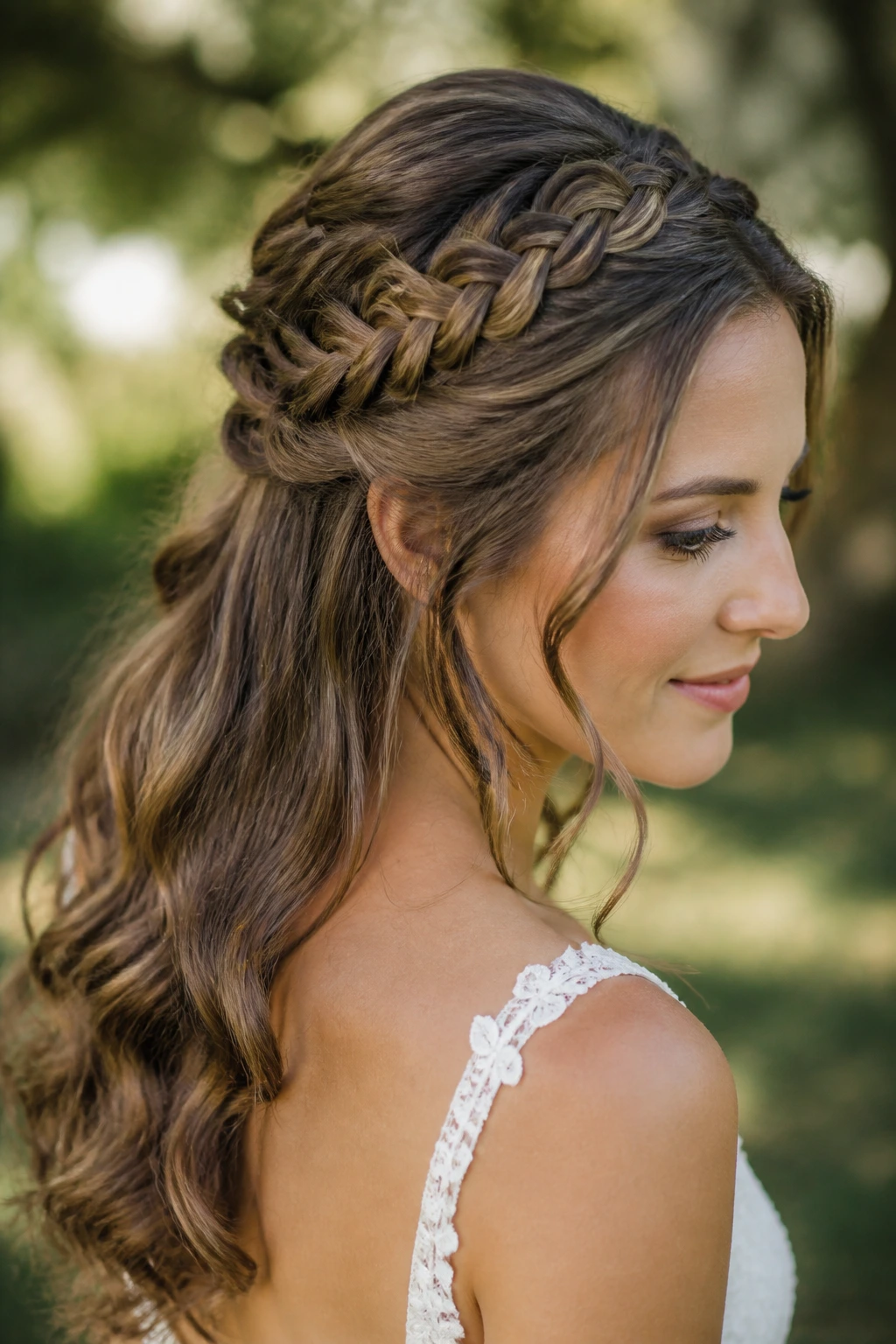
If I had to choose one half-up style for staying power, this would be near the top. The braid wraps across the crown like a built-in headband, and that structure gives the rest of the hair a strong base.
It’s especially useful for long ceremonies, outdoor venues, and hair that tends to slide. The braid should be pinned into the side points of the head with more than one pin on each side. Don’t be shy here. This is load-bearing hair.
The loose length can stay wavy, curled, or even straightened if the rest of the look is clean. The braid does the heavy lifting. That’s the attraction. You get a style that reads polished in the front and secure in the back without feeling stiff.
18. Short Hair Half Up with Tiny Clips
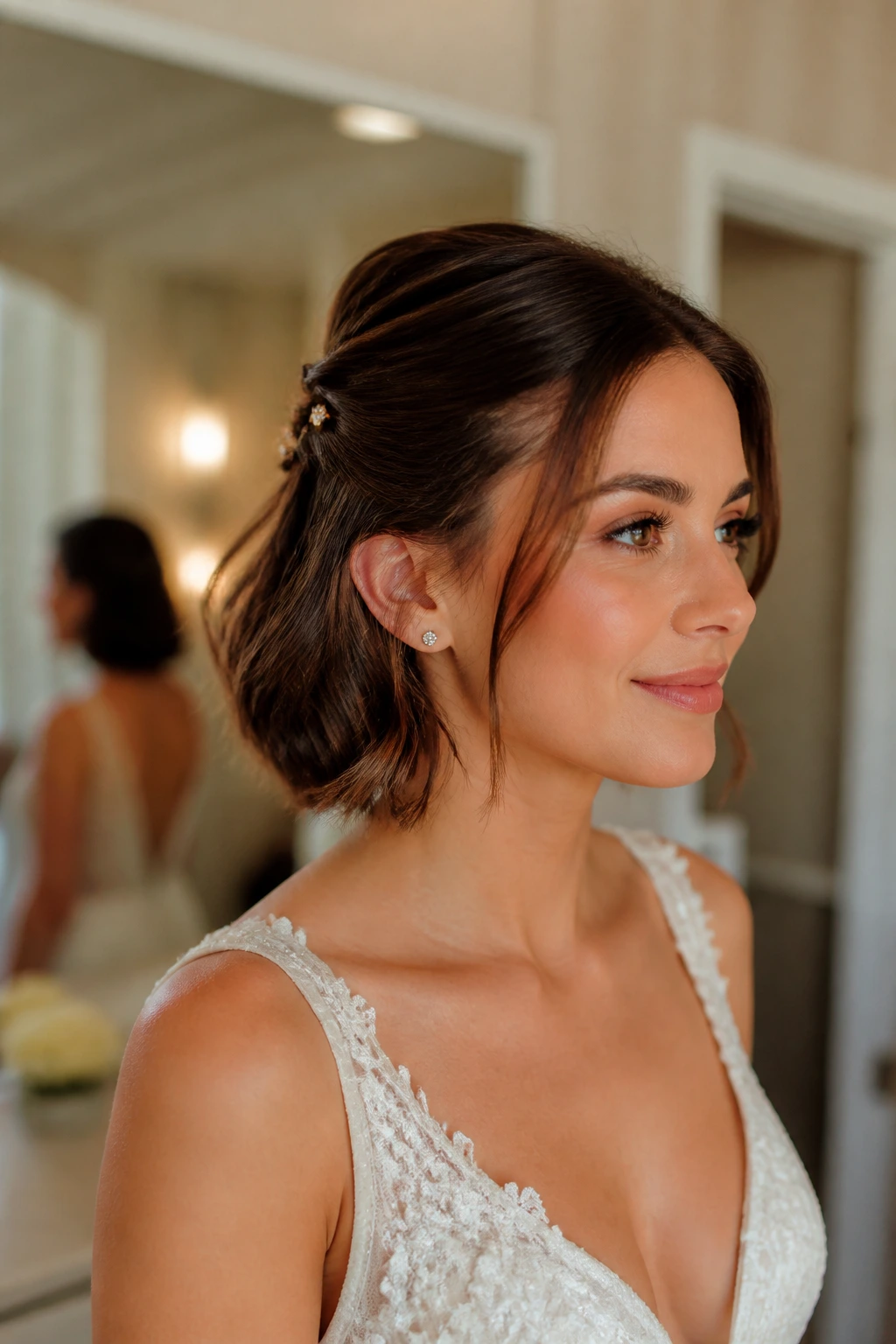
Shorter hair can absolutely do a half-up style. The trick is not pretending the hair is longer than it is. On a bob or lob, the top section should be small, the clips should be delicate, and the finish should look tailored to the actual length.
Tiny clips, micro barrettes, or two slim pins placed just above the ears can hold back enough hair to create the shape without forcing a big twist that falls apart. A bit of bend at the ends helps the style read as deliberate. Flat, blunt short hair usually needs more texture than people expect.
This version is strong for brides who like clean lines and hate the feeling of too much hair on the neck. It also works well when the dress already has a lot going on, because the hair stays close to the head and doesn’t compete with the neckline.
19. Half Up Styles for Defined Natural Curls
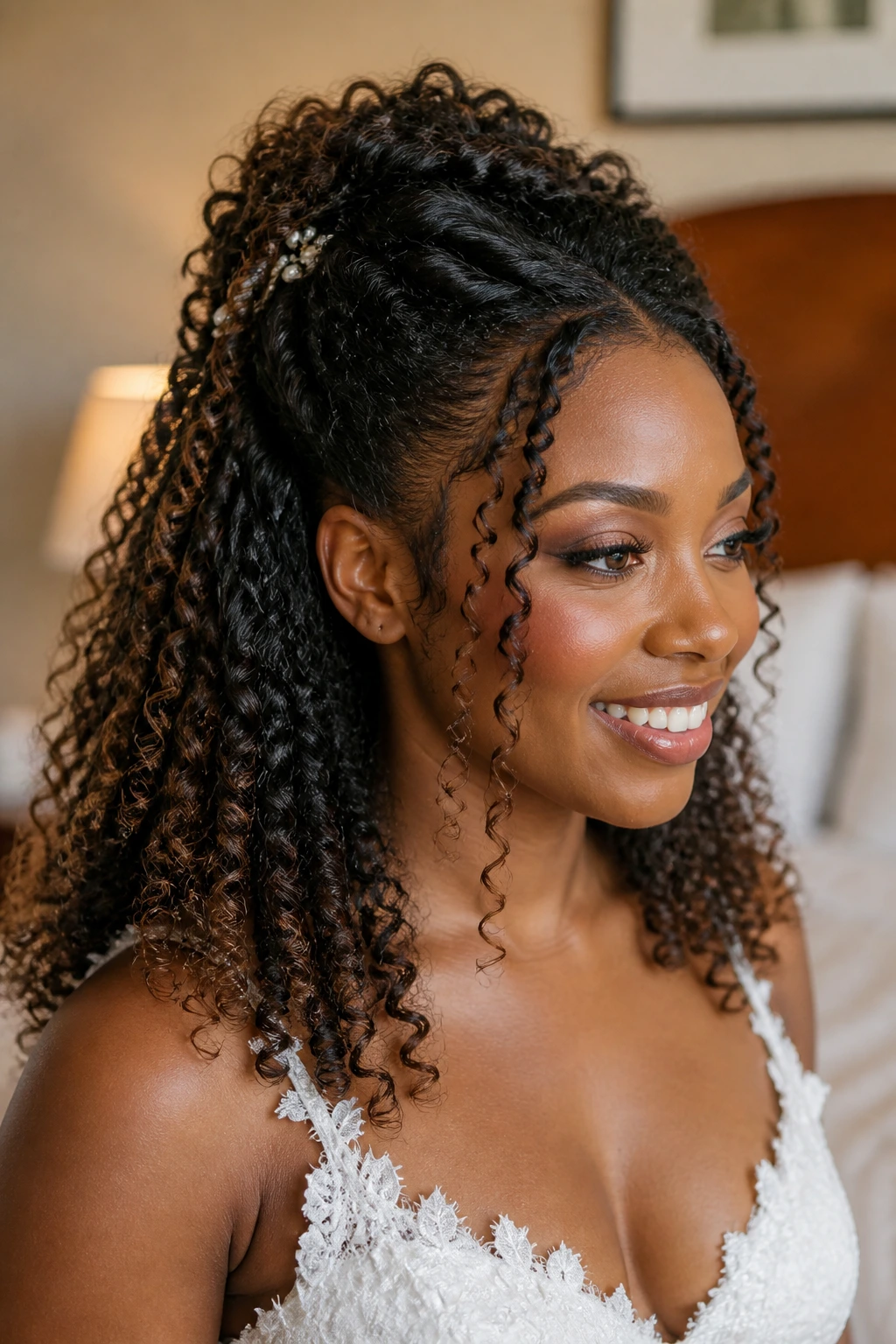
Natural curls make this category far more interesting. The goal is not to flatten them into something else. It’s to lift the top section, show the curl pattern, and let the length do what it already does well.
A curl cream or light gel should go on damp hair before diffusing. Once the curls are dry, pick up only the top section and pin it back with enough grip to hold the shape, but not so much tension that the curl pattern stretches out. Leaving the front pieces soft can keep the style from feeling too pulled.
What I like about this approach is that it looks like the hair belongs to the bride instead of borrowing someone else’s texture. That’s harder to get right than it sounds. When it works, it looks confident, and the curls add movement that straightened styles spend a lot of time trying to fake.
20. Fine Hair Half Up with Teased Crown Volume
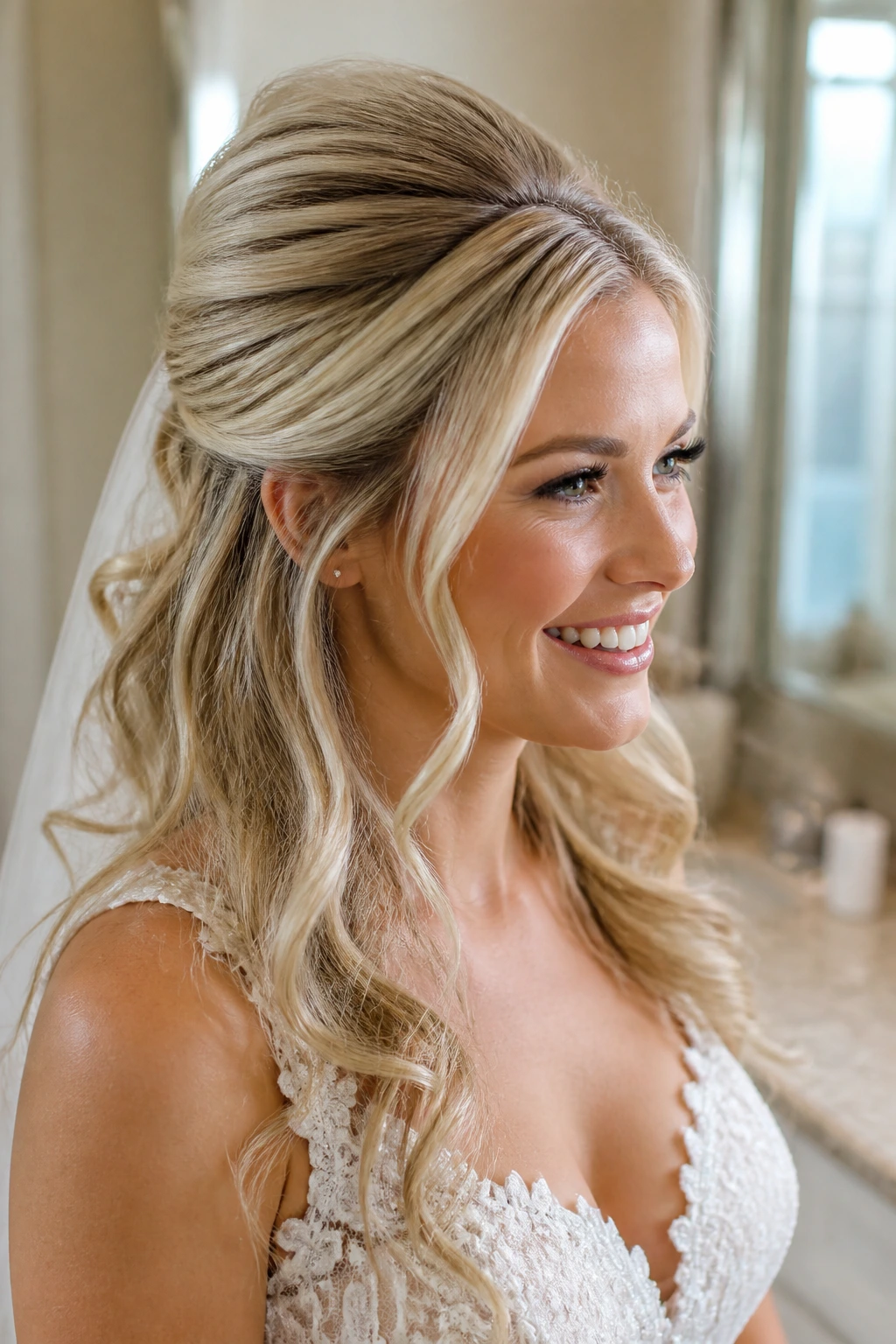
Fine hair needs a different kind of honesty. It usually won’t hold a big, heavy-looking half-up shape unless you build the crown first. That means dry texture spray, careful backcombing at the roots, and sometimes a small hidden pad or support clip beneath the top section.
The goal is lift, not puff. If you over-tease, the shape collapses faster and looks thinner by the hour. A little root spray on clean, dry hair gives the pins something to grip. Then the top section can be twisted or pinned back without sliding.
This is one of the places where second-day hair helps a lot. Fine hair tends to behave better once it has a little natural oil and less silkiness at the roots. Do not drown it in serum. The ends can shine. The crown needs grip.
21. Braided Bun Hybrid Half Up
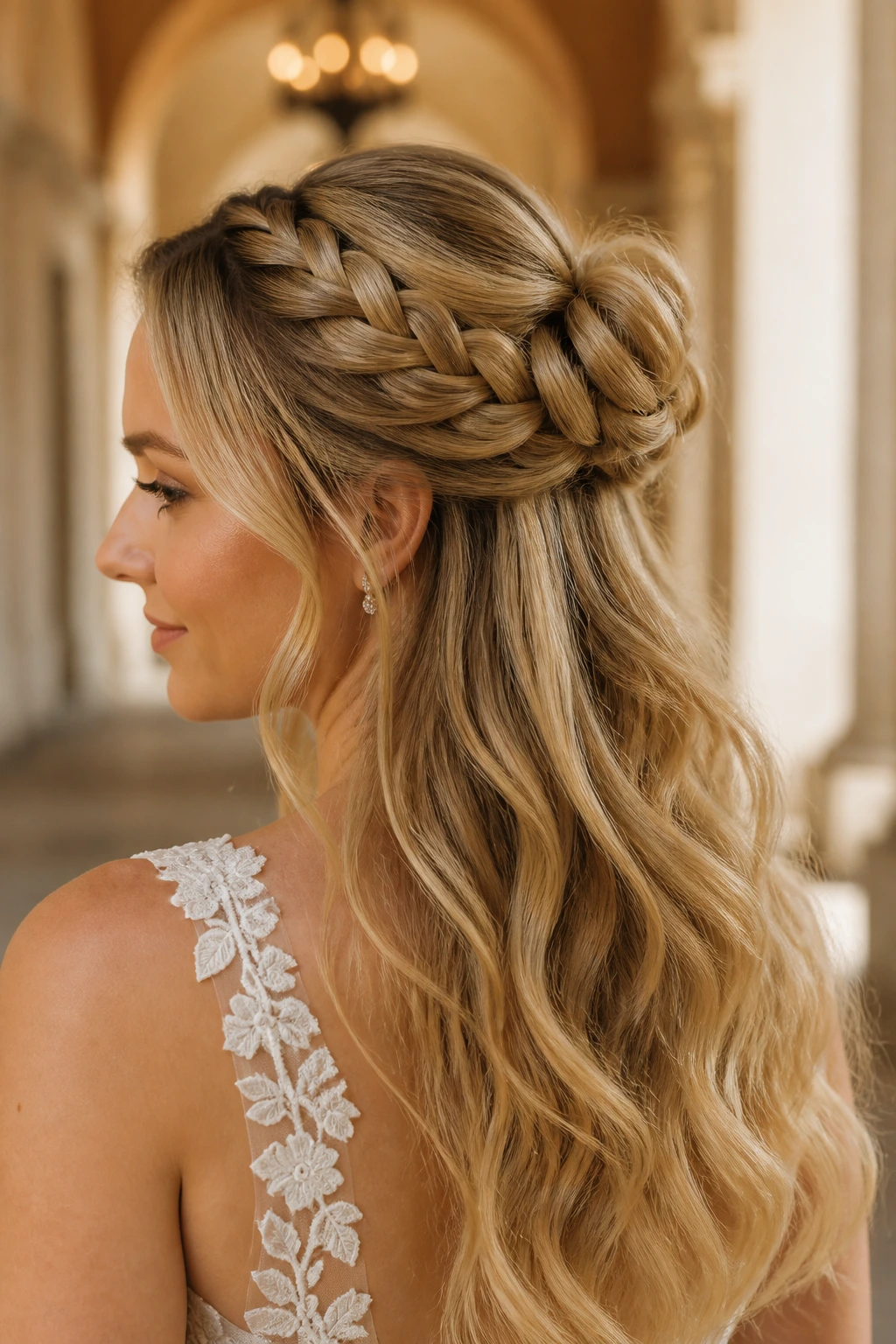
This style lives halfway between a half-up and a full updo, which is exactly why people choose it. The top section is braided and wrapped into a small bun, while the rest of the hair stays down and movable.
The braid gives the bun structure. The bun gives the crown weight. Together, they make the whole style feel more formal without pinning every strand off the shoulders. It’s a good answer for someone who likes the idea of an updo but doesn’t want to lose the length in photos.
It works especially well when the dress has a lot of detail at the back. The bun sits as a neat focal point above the loose length, and the transition between the two becomes part of the design. This is one of those looks that feels more secure than it first appears.
22. A Half Pony Hybrid with Wrapped Base
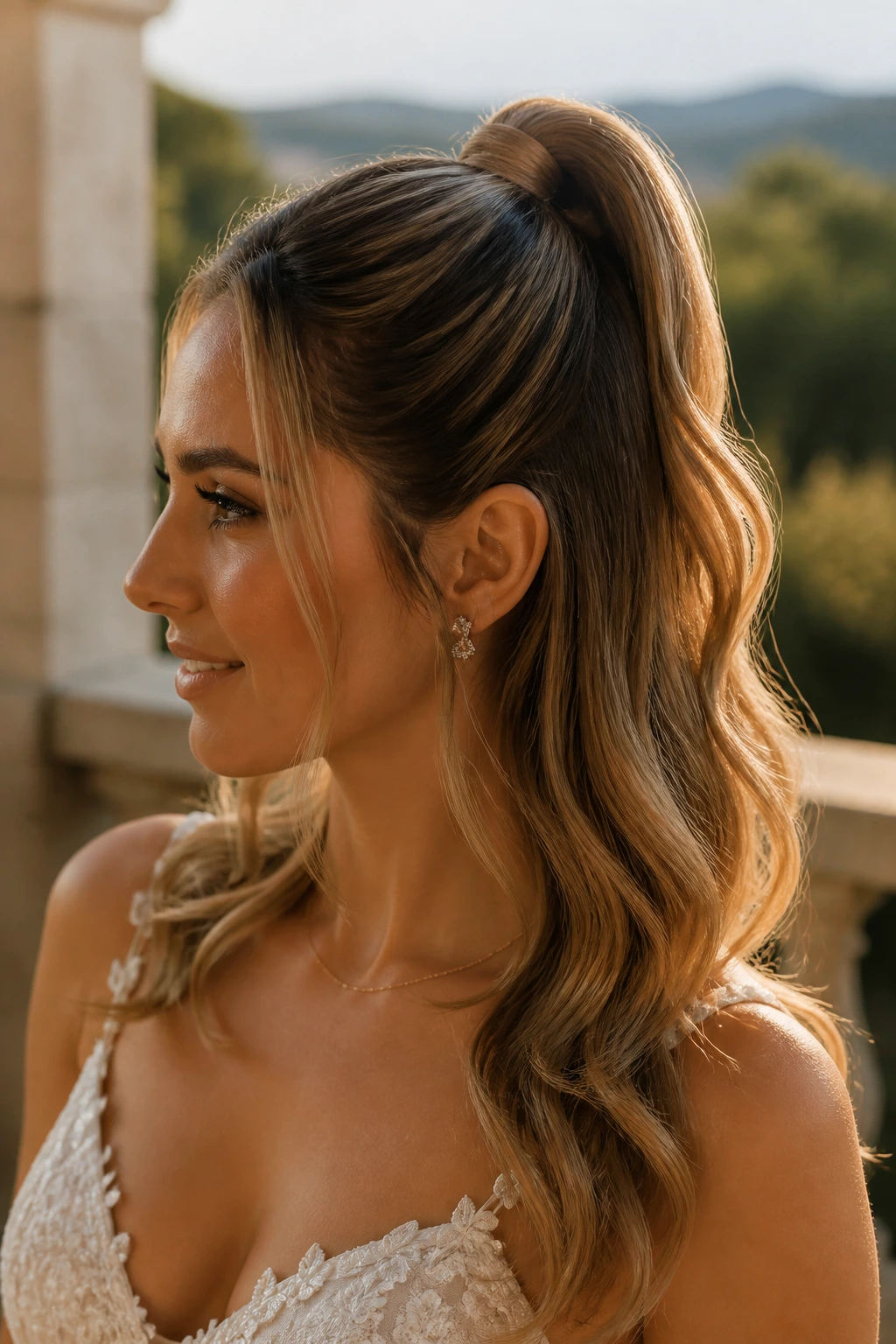
Want movement, but a little less ceremony? A half pony delivers that. The top section is gathered into a high or mid-height ponytail, then wrapped with a strand of hair so the elastic disappears. The rest stays down, usually in a clean wave or blowout.
The shape is a bit more energetic than a twist or braid. It opens the face, adds lift, and keeps the style from sinking into the shoulders. That makes it useful for brides who want to dance without fussing with low pieces around the neck.
This version looks best when the base is neat and the lengths are controlled. If the ponytail section is too tight, it starts to feel sporty. If it’s too loose, it can slip. I’d call this one a smart compromise for brides who like their hair off the face but still want the back to move.
23. Curtain Bangs with Soft Bridal Waves
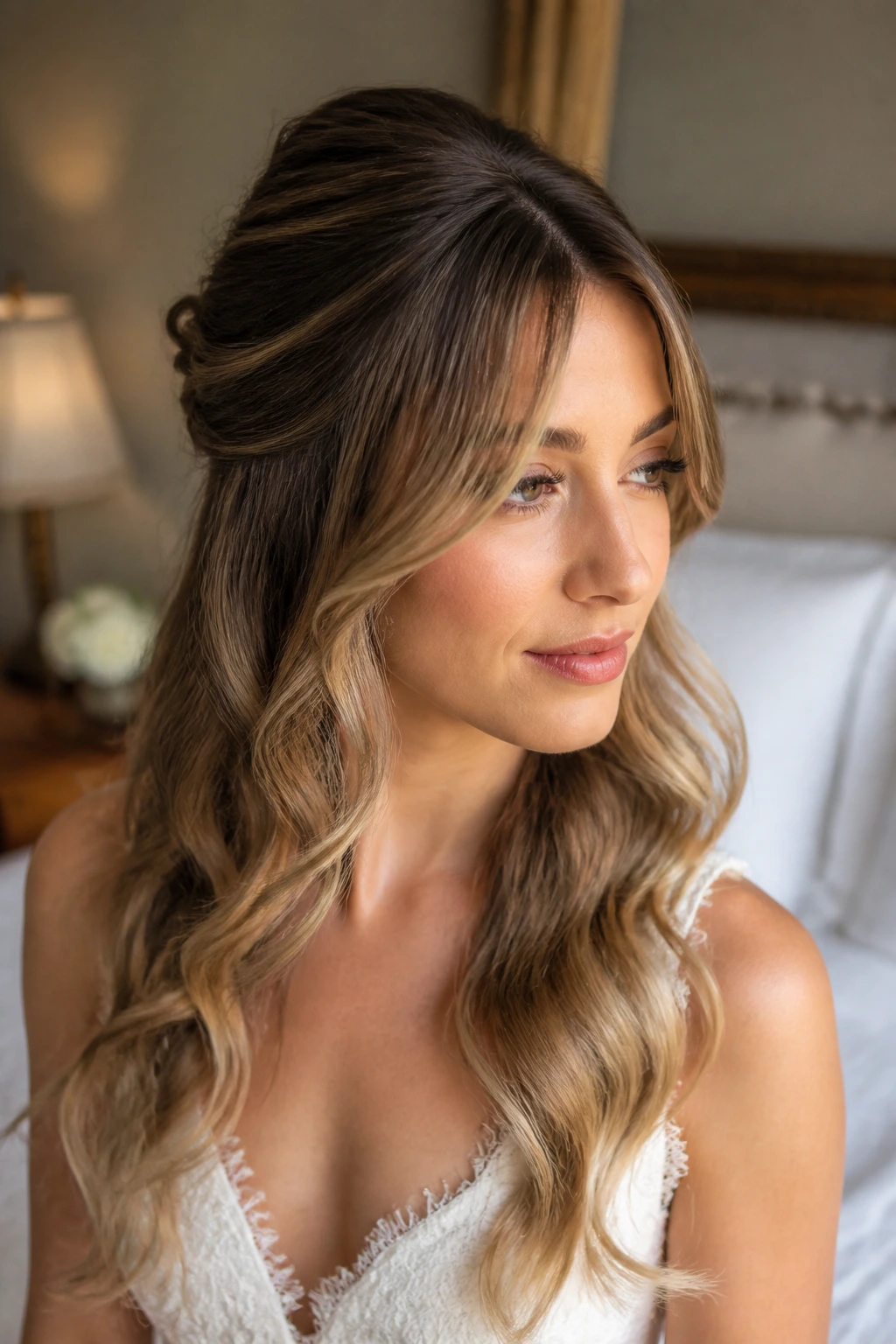
Curtain bangs change the entire frame of the face, so the half-up section should start behind them, not fight them. That keeps the fringe visible and soft, which is the point of wearing curtain bangs in the first place.
The waves below should be gentle enough that the bangs don’t get lost in the rest of the hair. A 1.25-inch iron or hot rollers can help create a bend rather than a tight curl. If the bangs are too polished, they can feel stiff. If they’re too loose, they disappear.
This style suits people who like a little softness around the forehead and cheekbones. It plays well with simple gowns, because the bangs do some of the visual work. And if you’re the kind of person who hates the feeling of hair pinned straight back, this is a much kinder option.
24. A Statement Accessory Cluster at One Side
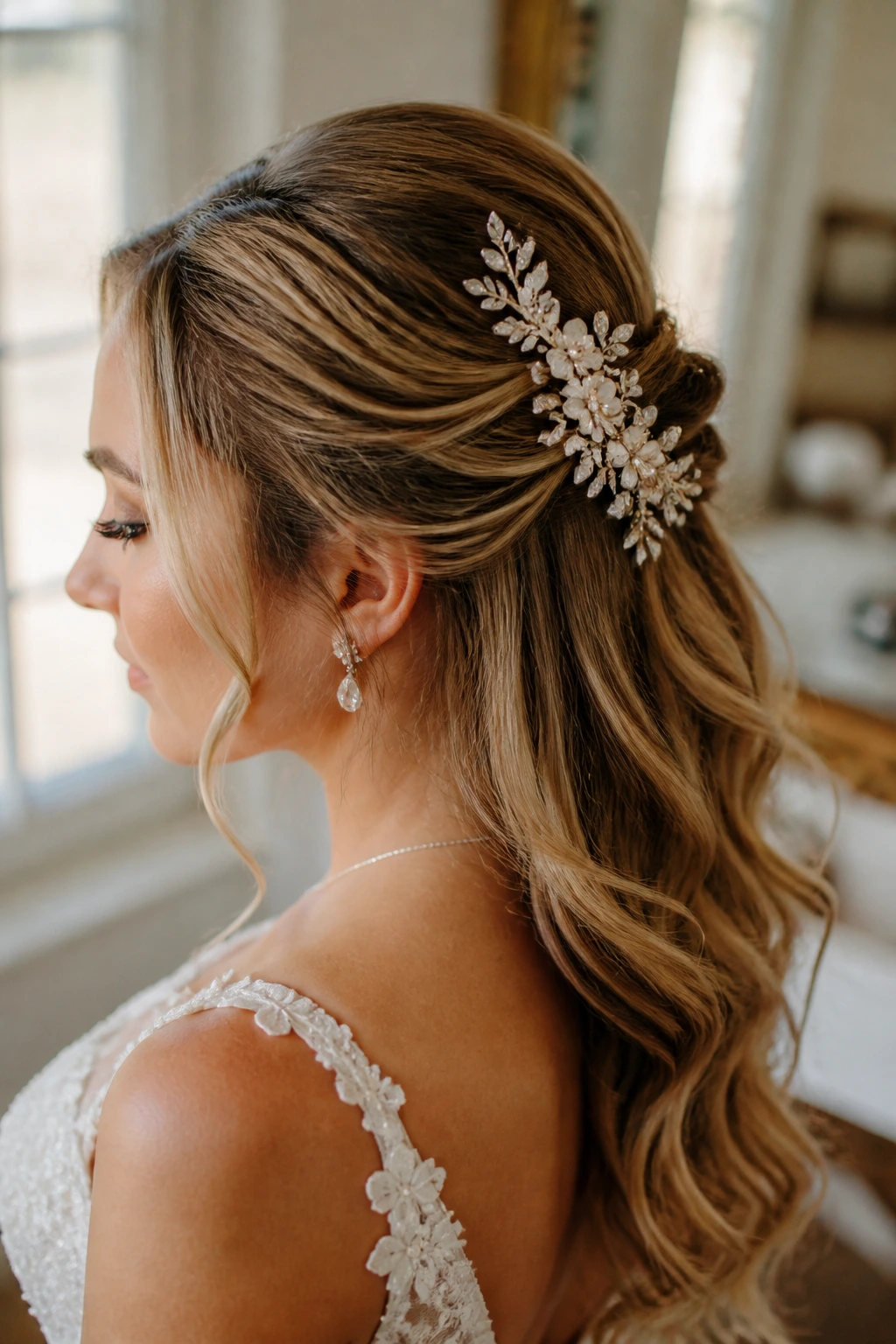
Some dresses are so detailed that the hair should not compete. In that case, let the accessory do the heavy lifting. A cluster of pins, a jeweled comb, or several small clips placed on one side can turn a simple half-up shape into the finished look.
The key is placement. Don’t scatter the pieces randomly. Group them in a deliberate diagonal or crescent where the eye naturally lands. That gives the hair a focal point without making it feel crowded. The rest of the style can stay soft and understated.
This is one of my favorite options for brides who want the dress, jewelry, or bouquet to remain the stars. The hair supports the look instead of trying to outrun it. And if the accessories are chosen well, the style can look more expensive than a much larger updo.
25. High-Lift Half Up for Long, Thick Hair
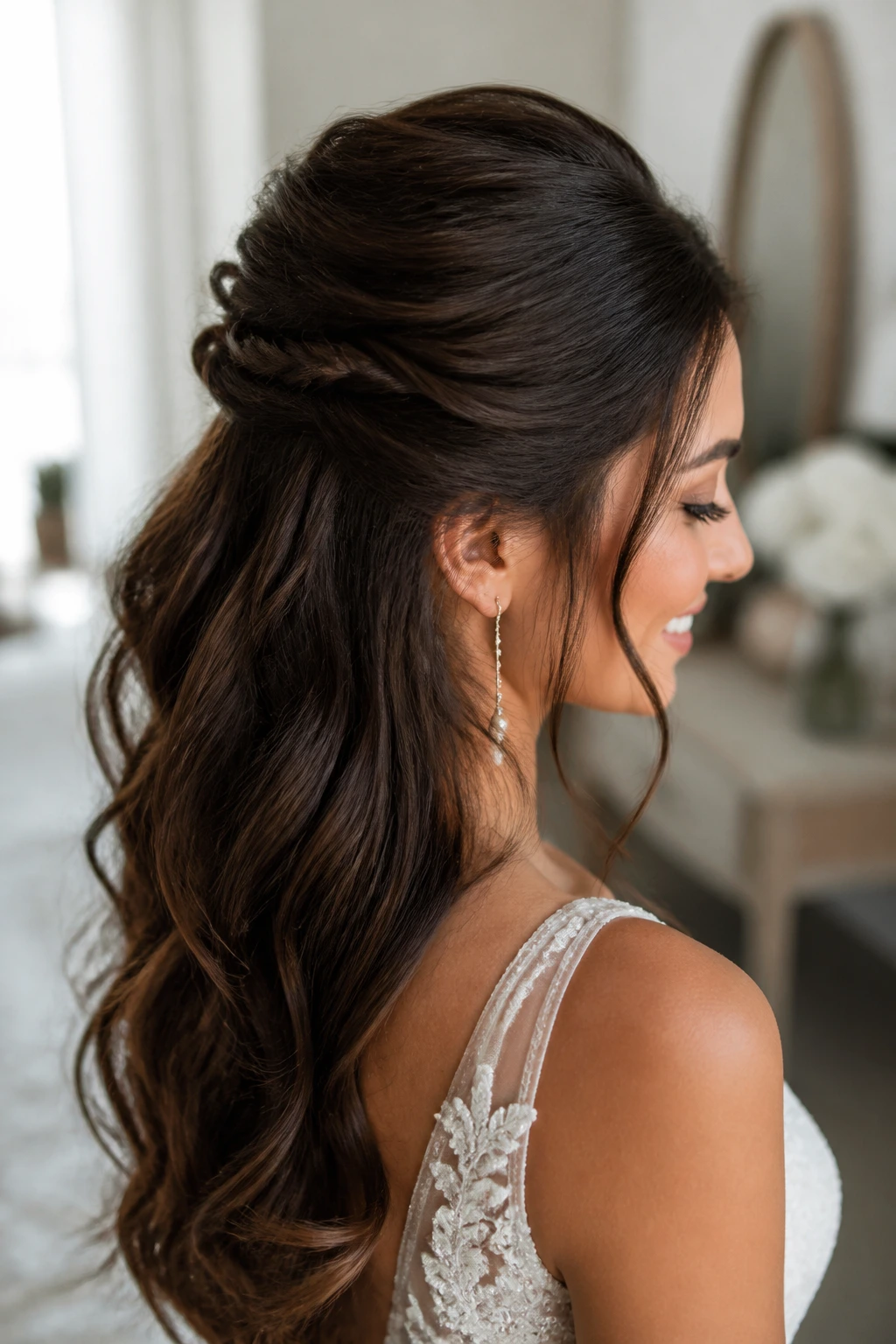
Long, thick hair can carry a lot of weight, which sounds like a blessing until the crown starts to slide halfway through the day. A high-lift half-up style handles that by building real support at the top and giving the length a controlled drop underneath.
The crown needs sectioning, not guesswork. A hidden braid or two beneath the lift helps anchor the top, and cross-pinned bobby pins keep the weight from settling. I’d rather see a style pinned firmly from underneath than sprayed into a crunchy shell on top. The structure should do the work, not the product.
This is the version I’d trust when the hair is heavy, the ceremony is long, and the photos are happening in different light. It keeps the face open, the length visible, and the shape from folding under its own weight. That’s the real trick with thick hair: make the support disappear, but never pretend you don’t need it.
Why Wedding Half Up Half Down Hairstyles Work Better Than They Look
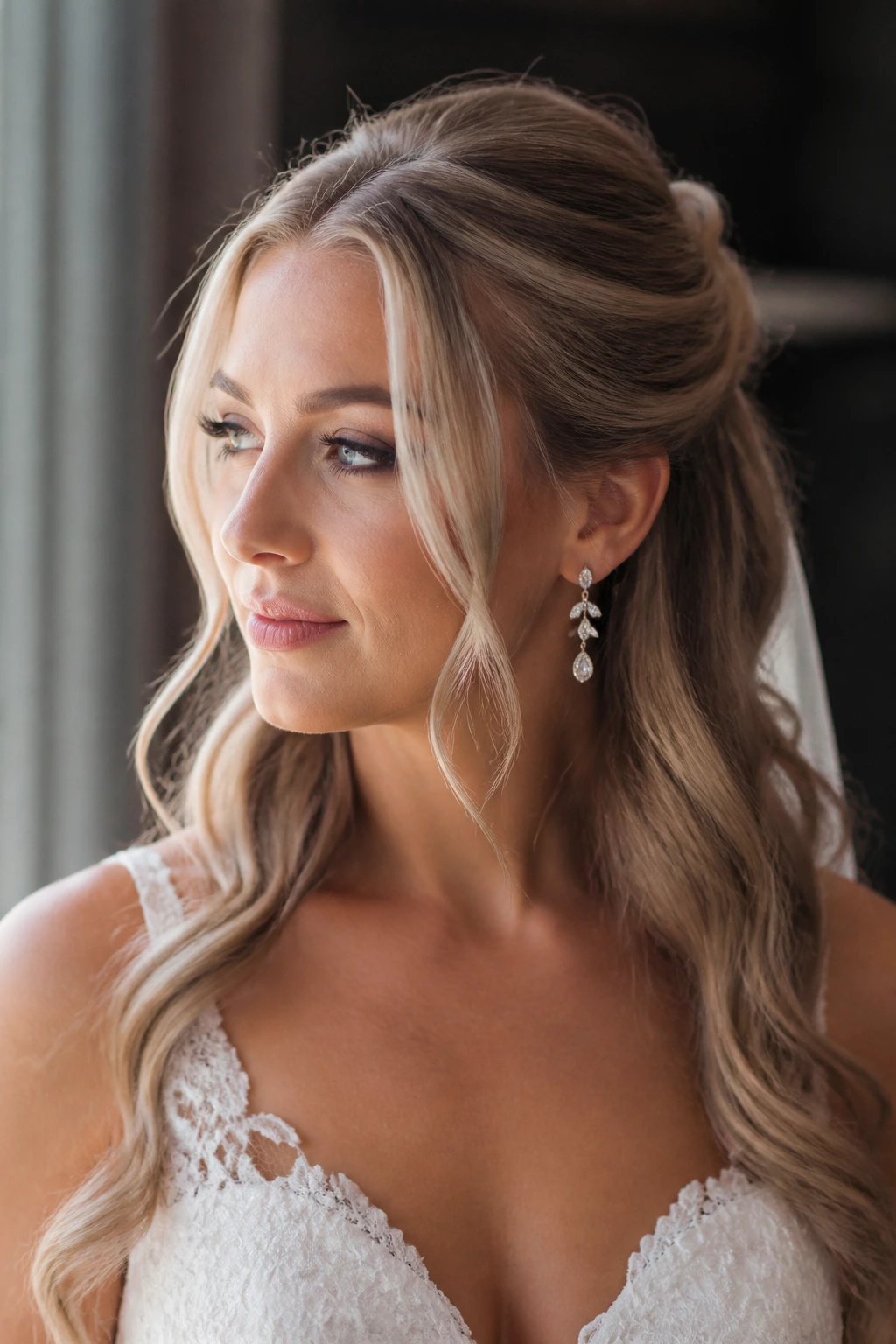
The crown is the load-bearing part of the style. Once you accept that, the rest makes sense. A half-up shape gives the top section a place to live, which keeps the loose hair from dragging the whole look flat. A full updo removes movement. Fully loose hair removes control. Half-up styling keeps both.
That middle ground matters even more once the dress, veil, earrings, and neckline enter the picture. The hair needs to stand up to all of that without becoming louder than the outfit. A good half-up style gives you room to breathe around the face and enough hair down the back to keep the look from feeling formal in a stiff way.
It’s also kinder to the head over a long event. The style doesn’t need to be yanked tight to stay visible, and the neck doesn’t have to carry the full weight of every pinned section. That’s the practical side people forget when they’re looking at the first photo. By hour six, the difference is not abstract.
The Small Styling Moves That Make the Hair Hold
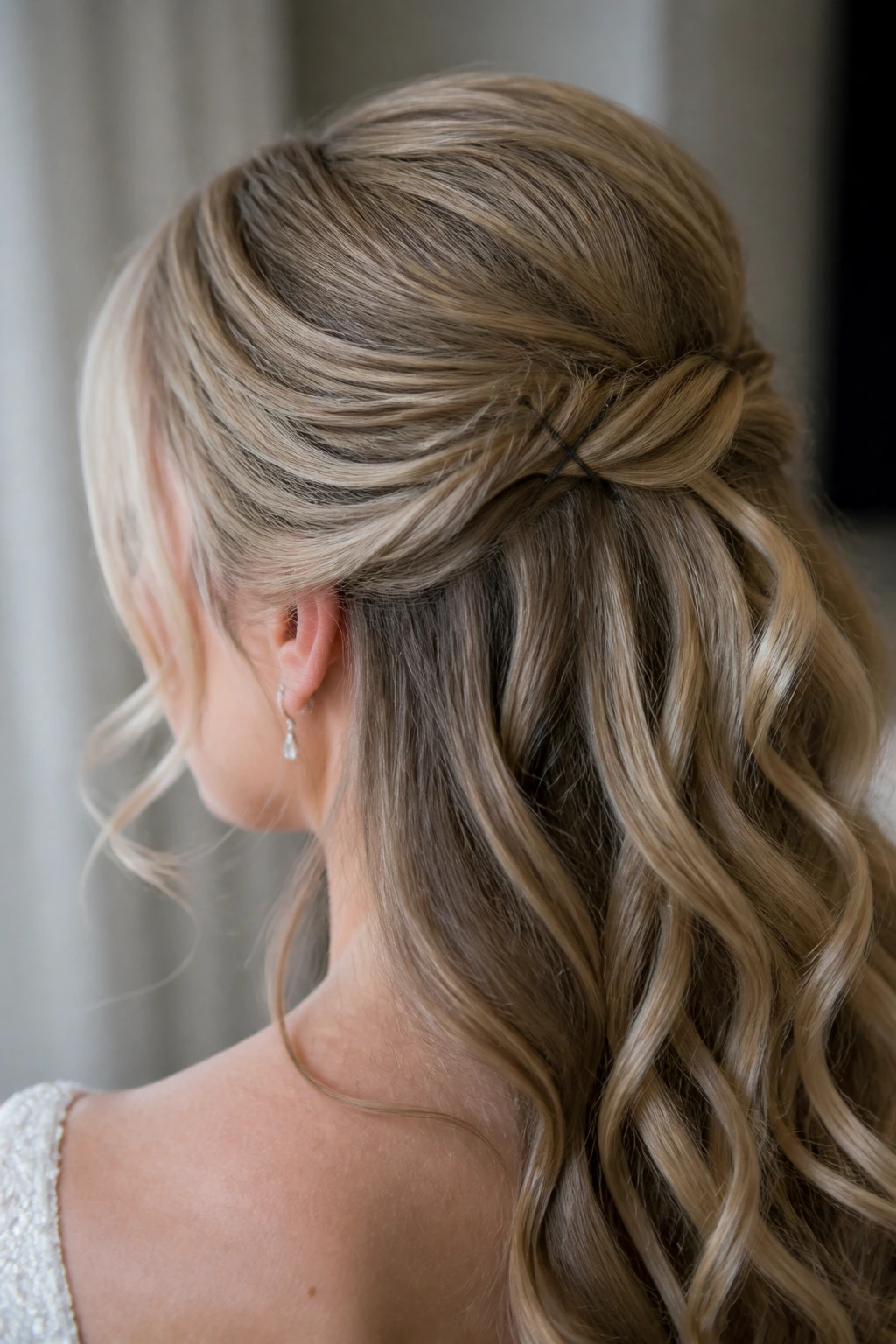
Grip: Start with hair that has a little texture. Day-old hair, a light mist of dry shampoo, or a small amount of texture spray at the roots gives pins something to catch.
Lift: Clip curls up while they cool. Warm hair falls. Cool hair remembers. That one habit changes more bridal styles than any fancy finishing spray.
Security: Use two bobby pins in an X when the half-up section is heavy. One pin can slide. Two crossed pins grip from different directions and stay put longer.
Softness: Leave the front pieces a little longer than you think. If they’re too short, they start poking out near the cheek instead of framing the face.
Humidity Insurance: Finish with flexible-hold hairspray, not a helmet. A second light mist after the hair is set works better than one heavy blast that turns the style stiff and brittle.
The other move I swear by is a quick photo check from the side. If the twist, braid, or clip looks good only from the front, it isn’t finished yet.
The Tools That Earn Their Place at the Mirror
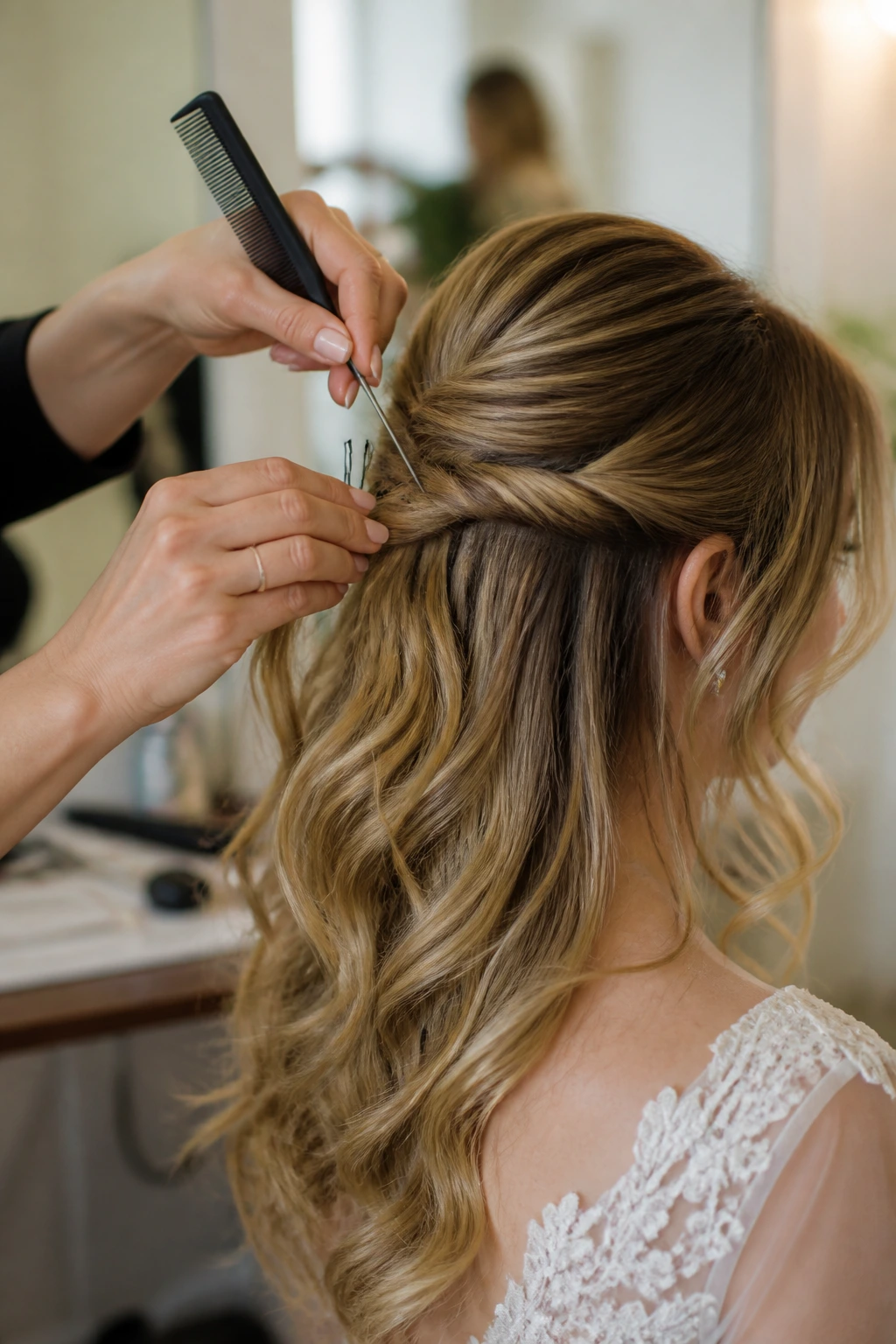
- Tail comb: The fine point helps make clean parts and small sections without tearing the top layer.
- Sectioning clips: You need these to hold curls or twisted sections while they cool and set.
- 1-inch curling iron: Best for tighter, longer-lasting movement on fine or medium hair.
- 1.25-inch curling iron: Better for softer waves and a looser bridal finish.
- Flat iron: Useful for smoothing the crown or shaping front pieces that refuse to behave.
- Blow-dryer with nozzle: Keeps the root area smooth and gives you more control during prep.
- Bobby pins in hair-matching colors: These are the real workhorses. Buy more than you think you need.
- U-pins: Handy for heavier twists, buns, and braids that need hidden support.
- Texturizing spray: Gives the crown and the braid something to hold onto.
- Flexible-hold hairspray: Keeps the style together without turning it stiff.
- Heat protectant: Non-negotiable if the hair is being curled or straightened.
- Mini elastics: Clear or hair-colored ones disappear better in bubble braids and half pony styles.
- Veil comb or accessory comb: If you’re wearing one, test it with the hairstyle before the big day.
Matching the Style to the Dress, Veil, and Hair Texture
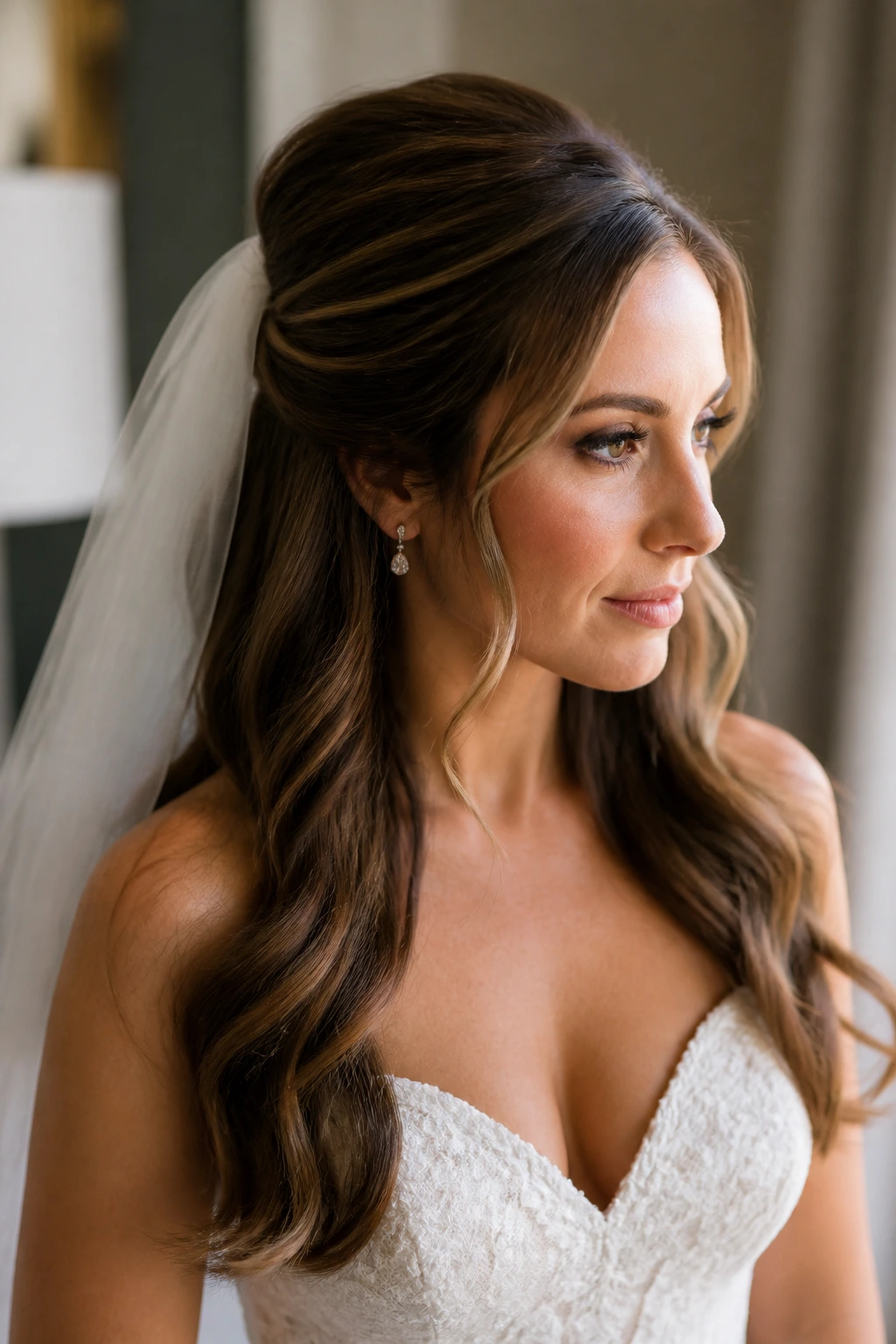
Neckline: Strapless, sweetheart, and square necklines can handle more crown height because the hair has room to breathe above the bodice. Halters and high necks usually look cleaner with a lower twist or a sleeker half-up line.
Veil: Place the veil comb below the most visible part of the style so it doesn’t chew through the twist or flatten the braid. If the veil is heavy, the hair underneath needs a stronger anchor, not just more spray.
Jewelry: Pearl pins, crystal combs, and floral accents should echo the dress rather than compete with it. If the gown already has heavy beading, keep the hair detail quieter. If the dress is simple, the hair can carry more of the visual weight.
Texture: Fine hair wants light product and clever pinning. Thick hair wants stronger anchors and less fuss. Curly hair usually looks best when the curl pattern is respected instead of flattened into a straight-hair plan that never fit in the first place.
Face shape: Longer face-framing pieces soften square jaws. A little more crown height can open rounder faces. And if the forehead is already a strong feature, a lower half-up line often looks better than a top-heavy one.
Common Mistakes That Flatten the Crown
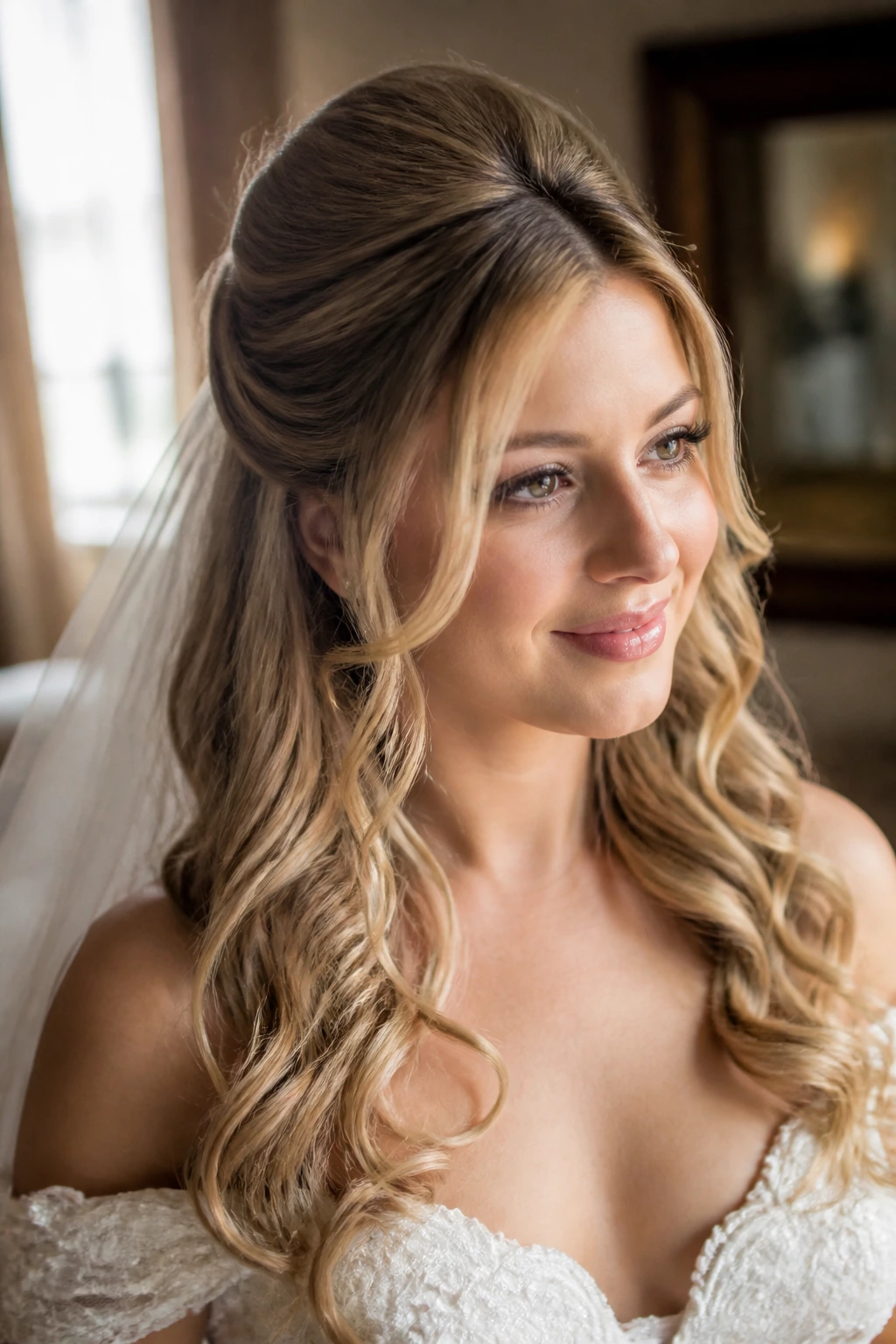
Starting on slippery hair: Freshly washed hair can be too clean and too smooth, especially at the roots. The style slides before the ceremony ends. A little texture from the day before or from a root spray fixes most of that.
Hiding the anchor too well: Some people pin the half-up section so low that it disappears into the rest of the hair. The result looks accidental. The crown needs enough lift to read as a deliberate shape.
Overloading the style with accessories: A braid, a comb, pearl pins, and a floral vine can all be lovely on their own. Together, they can turn the style into a crowded shelf. Pick one main accent and let it lead.
Brushing curls out too early: If the hair is brushed the second it leaves the iron, the shape falls faster and the ends blur. Let the curls cool, pin them up for a few minutes if needed, then loosen them with fingers or a wide-tooth comb.
Using too much oil near the roots: Shine belongs on the ends. Oil at the crown kills lift and makes pins slide. That’s one of those small mistakes that creates a big problem by the second hour.
Ignoring weight: Heavy veils, thick extensions, and large clips need stronger anchoring than a soft twist does. If the head starts to droop, the style was under-pinned from the beginning.
Variations and Adaptations to Try
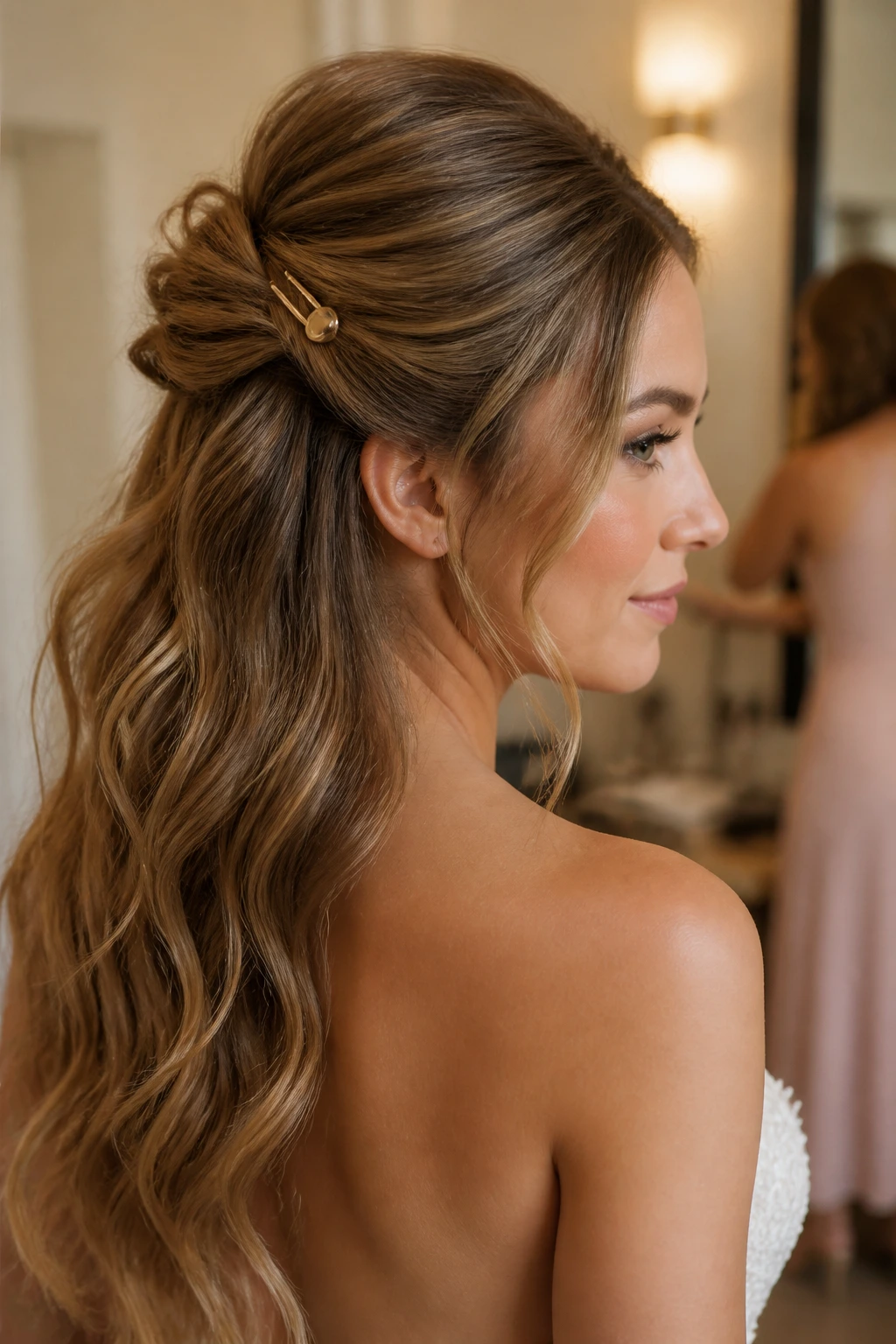
Veil-First Anchor: Build the half-up section a little lower and reinforce it with hidden pins before placing the veil comb. This is the smartest choice when the veil is heavy or the ceremony is long.
Natural-Texture Finish: Let curls or waves keep their own pattern, then lift only the crown and front pieces. This version feels honest and usually holds better than forcing the hair into a shape it doesn’t want.
Minimalist Metal Clip: Swap crystals or pearls for a slim metal barrette in gold, silver, or matte black. The effect is cleaner and sharper, which works well with modern gowns.
Garden Bloom Accent: Add tiny fresh or silk florals to one side of the twist or braid. Keep the flowers small enough that the hair still shows through.
Volume-Heavy Crown: For fine hair or anyone who likes a more dramatic profile, build a stronger lift at the crown with padding, teasing, and cross-pinned support. It creates a fuller silhouette without needing more length.
Make-Ahead Prep, Trial Runs, and Touch-Up Guidance
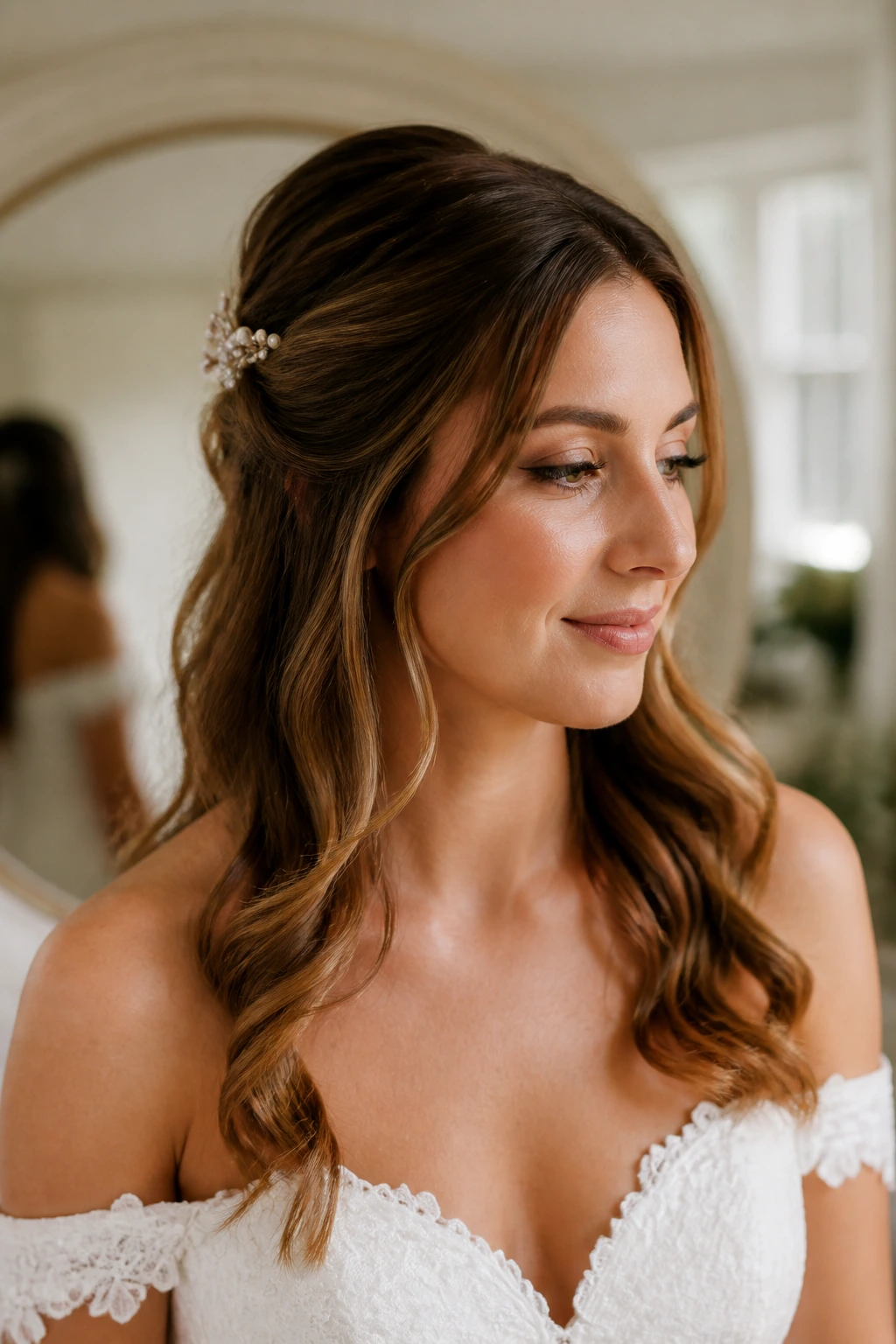
A trial run is worth more than most people expect. Do it with the actual accessory, the same part, and the same tools you plan to use on the wedding day. Take photos from the front, side, and back, because a style that looks fine in the mirror can collapse in three-quarter view.
If the hair needs curling, prep it in sections and let each curl cool fully before brushing. That cooling time is not filler. It’s the difference between a style that lasts three hours and one that survives the whole evening. If the hair is being styled on second-day hair, use only a small amount of texture spray at the roots so the crown doesn’t get dusty.
On the day itself, style the hair close enough to the ceremony that it still feels fresh, but not so late that you’re pinning in a rush. A touch-up kit should include 4 to 6 bobby pins, 2 U-pins, a small comb, travel-size hairspray, and a spare elastic if the look uses one. If a piece loosens, re-pin from underneath instead of drowning the outside with spray.
Accessories should be stored in separate pouches or small labeled bags if you’re bringing them to a venue. It saves a ridiculous amount of time when somebody asks, “Where’s the second clip?” and everybody is already dressed.
Questions Brides Actually Ask About Half-Up Styles
Will a half-up style hold through an entire wedding day?
Yes, if the crown is pinned properly and the hair has enough texture to grip. The styles that fail usually weren’t anchored well enough at the top or were built on hair that was too slippery.
Does this style work with a veil?
It does, especially when the veil comb sits below the main twist, braid, or lift. Heavy veils need more hidden support, so the anchor matters more than the accessory itself.
Is half-up hair good for fine hair?
Yes, but fine hair usually needs root texture, a little teasing, and careful pin placement. Without that, the crown goes soft fast and the style collapses toward the shoulders.
Can curly hair wear half up half down without being straightened?
Absolutely. Natural curls often look better when they’re kept intact and the crown is lifted gently. Straightening the whole head usually removes the one thing that makes the style feel alive.
How short can the hair be for this look?
A bob or lob can still work if the top section is small and the clips are tiny. The key is to build a shape that fits the length instead of forcing a large twist that the hair cannot support.
Should the hair be washed on the day of styling?
Usually no, especially if you need grip at the crown. Hair with a little natural texture, or hair washed the day before, tends to hold pins and curls better.
What if the crown keeps slipping during the trial?
Add texture first, then use cross-pinned bobby pins or a hidden support clip. If the hair is still sliding, the section is probably too small or too smooth.
Can I wear a statement clip and a veil together?
Yes, but the two pieces need to be planned together. Place the clip where it doesn’t crowd the veil comb, and keep one element more restrained so the style doesn’t get overloaded.
A Bridal Style That Moves With You
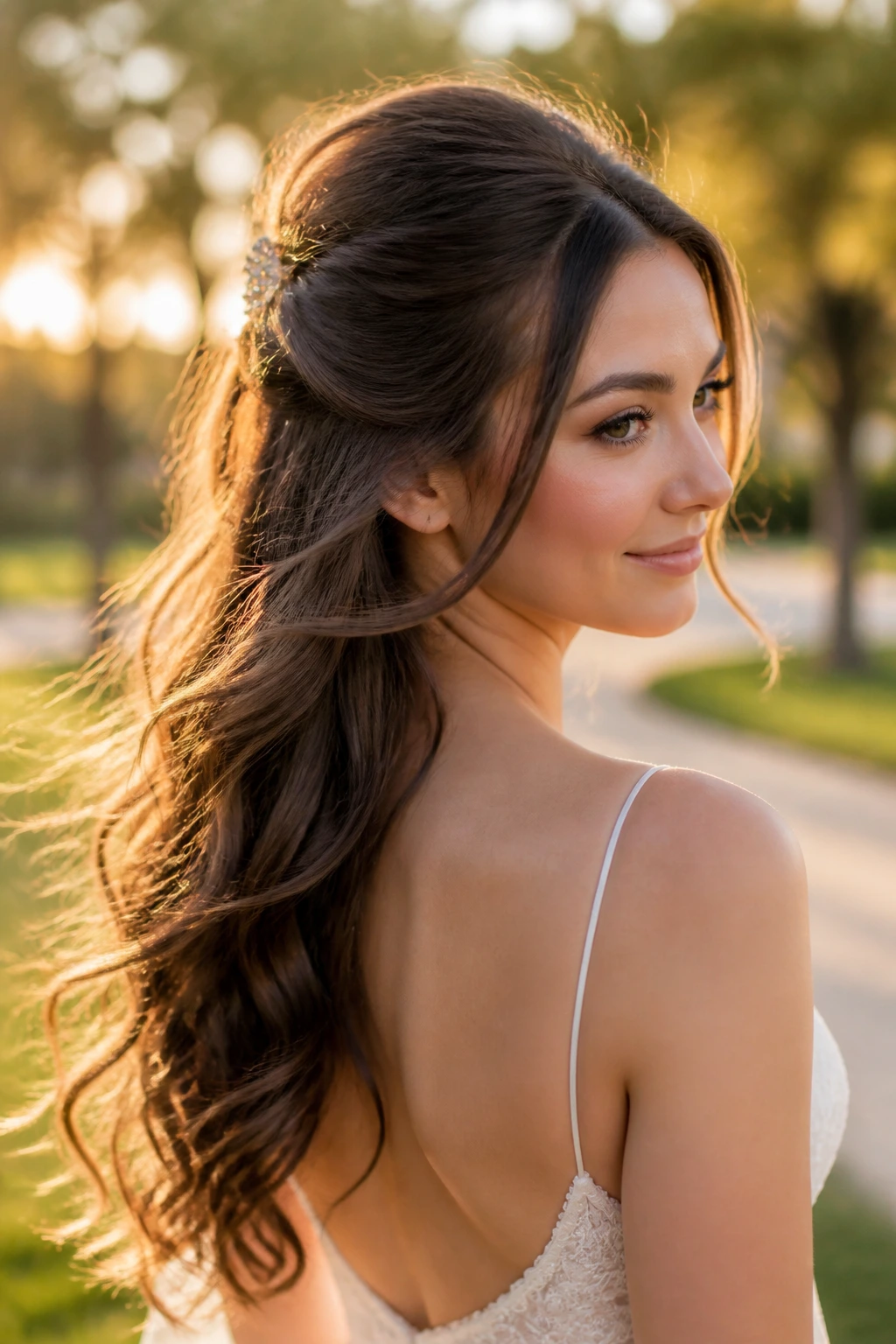
The best half-up wedding hair doesn’t look overbuilt. It looks like the hair had a plan. You still see movement down the back, but the crown has enough shape to survive a ceremony, a hundred hugs, and whatever the weather decides to do to your part line.
Pick the version that matches your dress, your texture, and the way you actually like to wear your hair. If a style feels forced in the trial, it will feel worse on the day. Bring a photo of the neckline, the veil, and the accessory together, and the right half-up shape usually shows itself pretty fast.
