



A good wedding ponytail hairstyle does something most bridal looks struggle with: it keeps the dress visible, the face open, and the back of the head from turning into a tangle of pins. That sounds simple, but on an actual wedding day it matters. Hair has to survive hugs, humidity, veil changes, a late-night dance floor, and a camera that keeps finding the side angle you forgot to check.
The best wedding ponytail hairstyles are not the gym-class version you throw together in a hurry. They’re built with shape at the crown, a clean anchor point, and one small detail — a wrapped elastic, a braid, a ribbon, a pearl pin, a twist — that changes the whole mood. Some read sleek and modern. Some look soft and romantic. A few lean glamorous enough to hold their own against a heavy satin gown or a dramatic necklace.
What I like about ponytails for weddings is that they leave room for the rest of the look to breathe. A neckline stays visible. Earrings get their moment. The back of the dress does not disappear. And if the style is done well, the ponytail moves when you move, which is a lot prettier in real life than a stiff updo that looks frozen in place. The trick is choosing the right one for the dress, the hair texture, and how much polish you want to carry into the evening.
Why You’ll Love This Collection
-
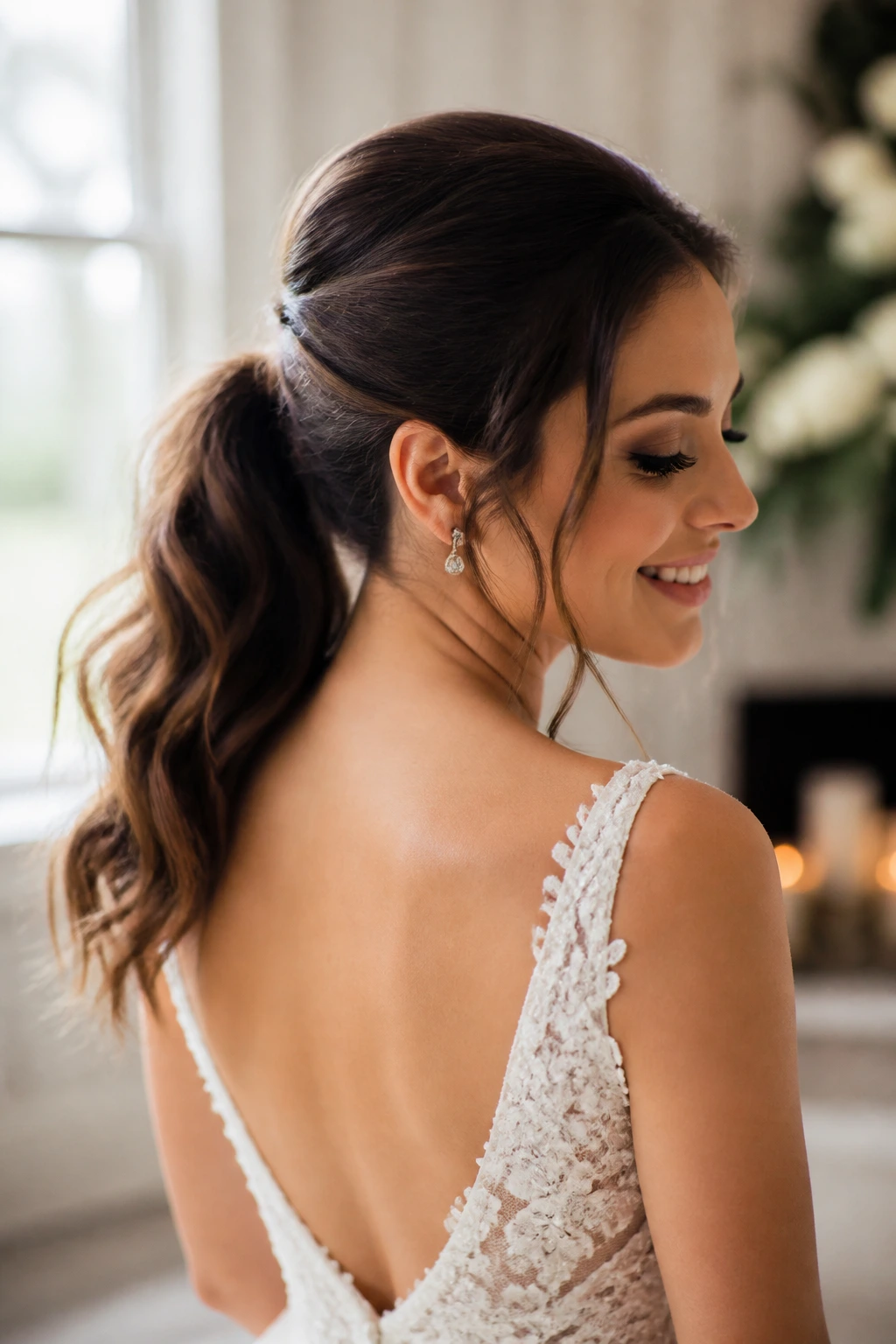
They keep the neckline clean: A ponytail lets a square, strapless, or low-back dress stay visible instead of competing with a wall of hair.
-
They can look formal fast: One wrapped base, a polished wave, or a few pearl pins can push a ponytail straight into bridal territory.
-
They stay comfortable for hours: Compared with a rigid updo, a ponytail usually puts less pressure on the scalp and gives you a little more movement.
-
They work with veils and accessories: Comb veils, clips, ribbons, and even statement earrings have room to show up instead of getting buried.
-
They flatter a lot of hair types: Fine hair can get lift, thick hair can be controlled, and curls can keep their shape without being crushed flat.
-
They photograph from every angle: A good bridal ponytail gives you something worth seeing from the front, side, and back, which is harder than it sounds.
1. Sleek Low Ponytail With a Wrapped Base
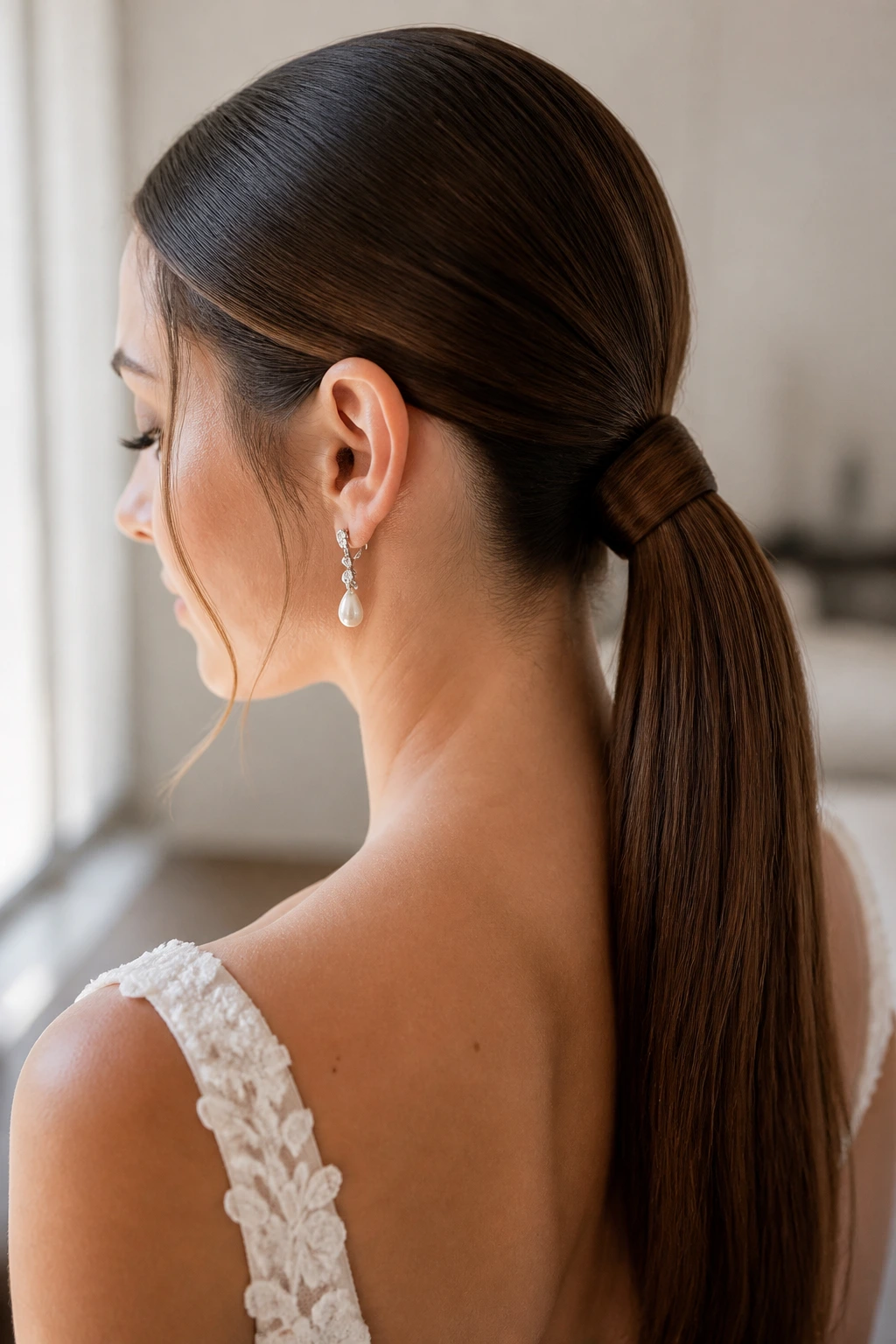
A sleek low ponytail is the style I reach for when the dress already has the drama. Think satin, crepe, satin-backed buttons, a sharp neckline, or a back that should stay visible. The hair sits low at the nape, the part is clean, and the wrapped base does the work that a plain elastic never can.
Why It Works
A low ponytail keeps the silhouette calm. That matters on a wedding day, when every other detail is already speaking loudly. The shine reads polished in photos, and the low placement means the style won’t fight a veil, shoulder detail, or a set of chandelier earrings.
Best Pairings
- Dresses: square neck, bateau, bateau with back detail, low-back satin
- Hair texture: straight, blow-dried smooth, or lightly pressed waves
- Accessories: thin pearl pins, a comb veil, or a single crystal barrette
The wrapped section should be small and tight. If it looks bulky, the whole style starts to feel clumsy. I like a fine-tooth comb and a pea-sized amount of smoothing cream, then a final pass with shine spray from about 10 inches away so the hair catches light without looking greasy.
A tiny detail makes this one sing: leave the ponytail itself straight or softly beveled at the ends, not overly curled. Too much curl makes the line busy. This style wants restraint.
2. Soft Hollywood Wave Ponytail
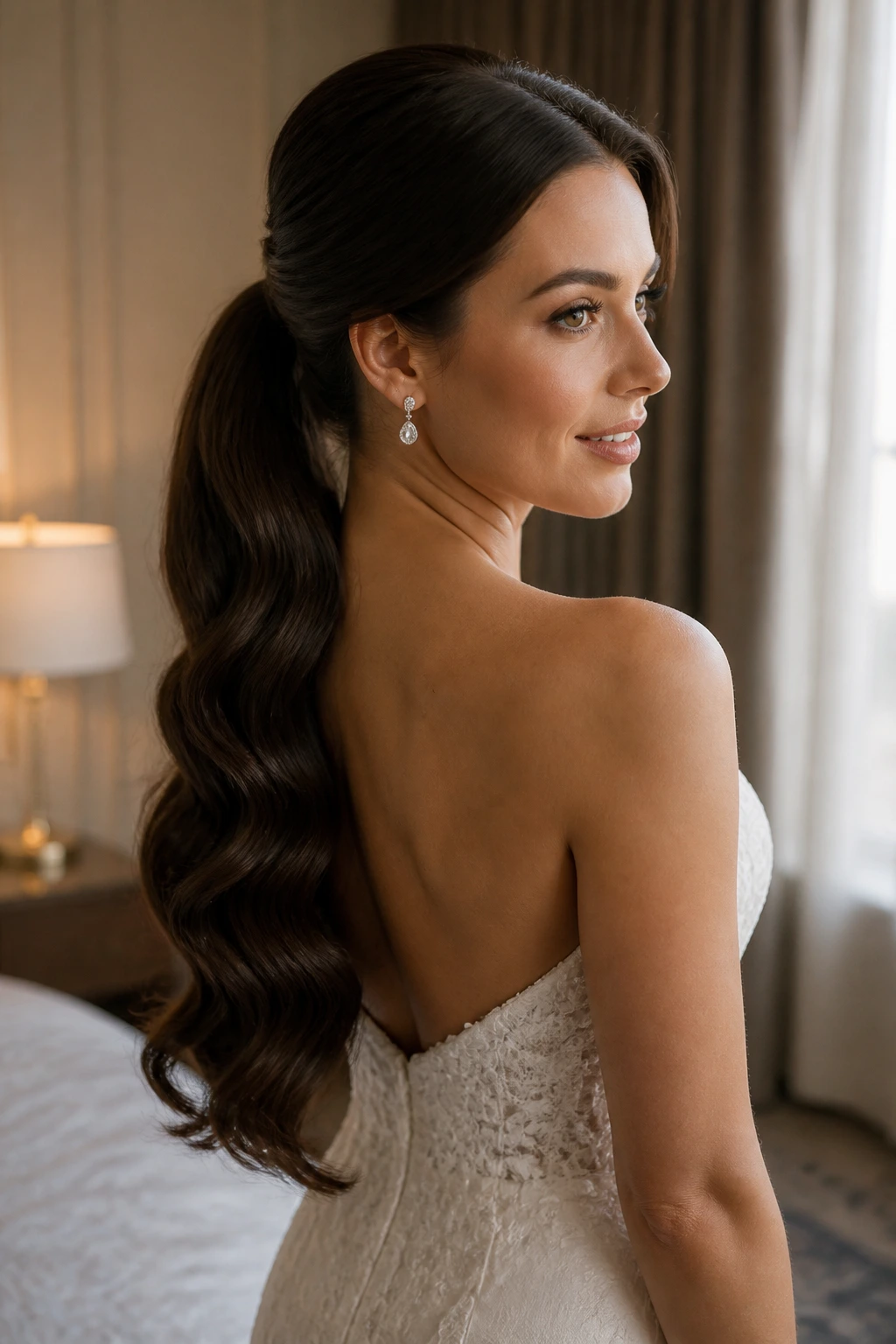
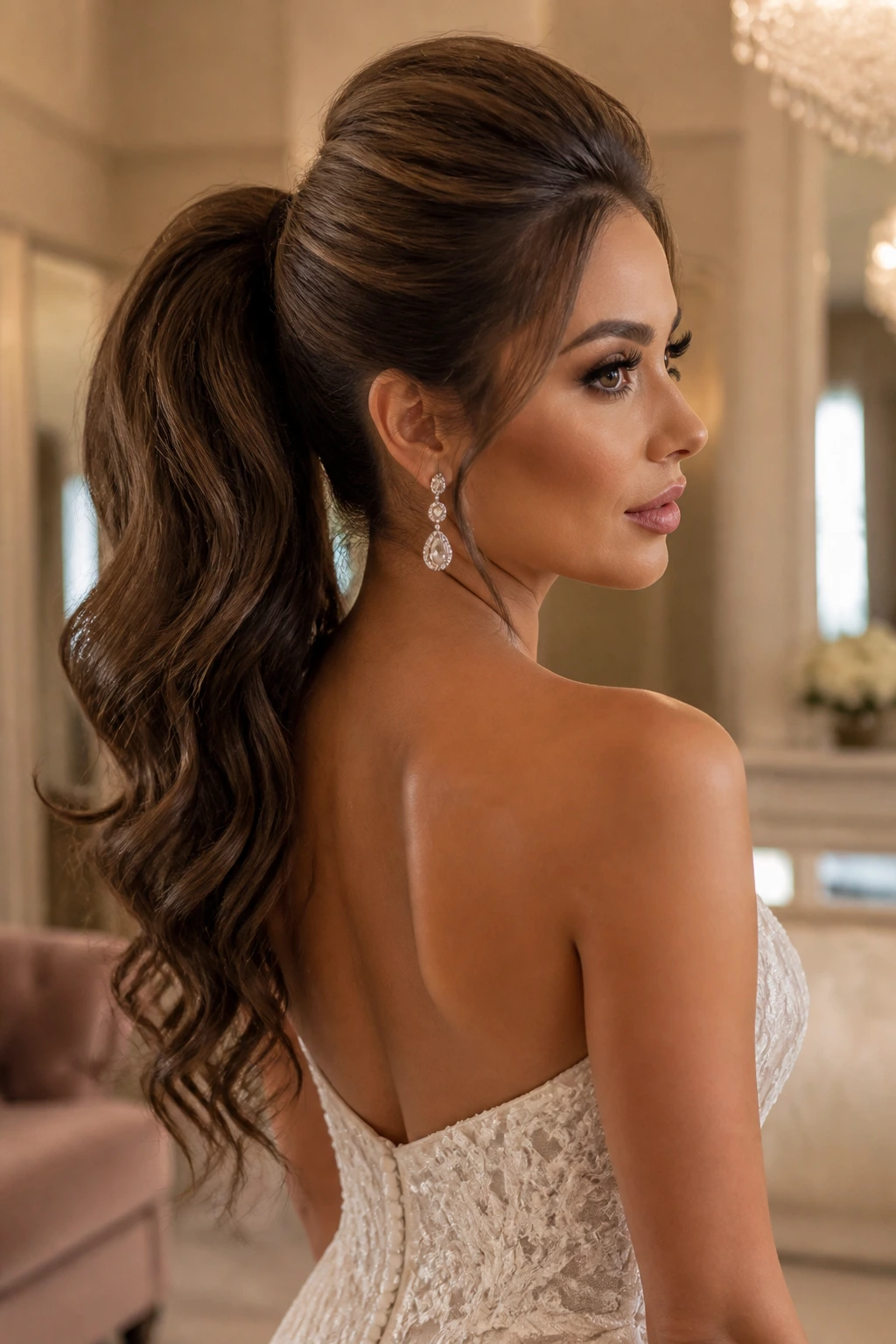
This is the ponytail that looks like it walked out of a black-tie photo set and forgot to apologize for it. The hair is pulled back low or mid-height, then the tail falls in a glossy wave over one shoulder. It has movement. It has shape. It has that expensive-looking side profile everyone notices.
The style works because the wave does the visual heavy lifting. You don’t need a dozen accessories when the bend of the hair already looks intentional. A 1¼-inch curling iron, brushed-out curls, and a little root lift at the crown are enough to build the whole thing.
What I like most is the balance. The front stays neat, but the tail gives you softness. If the dress is strapless or off-the-shoulder, this one keeps the upper body open while still giving the look some drama. And yes, it’s one of the few styles that actually looks better when the hair moves a little.
3. Bubble Ponytail With Pearls
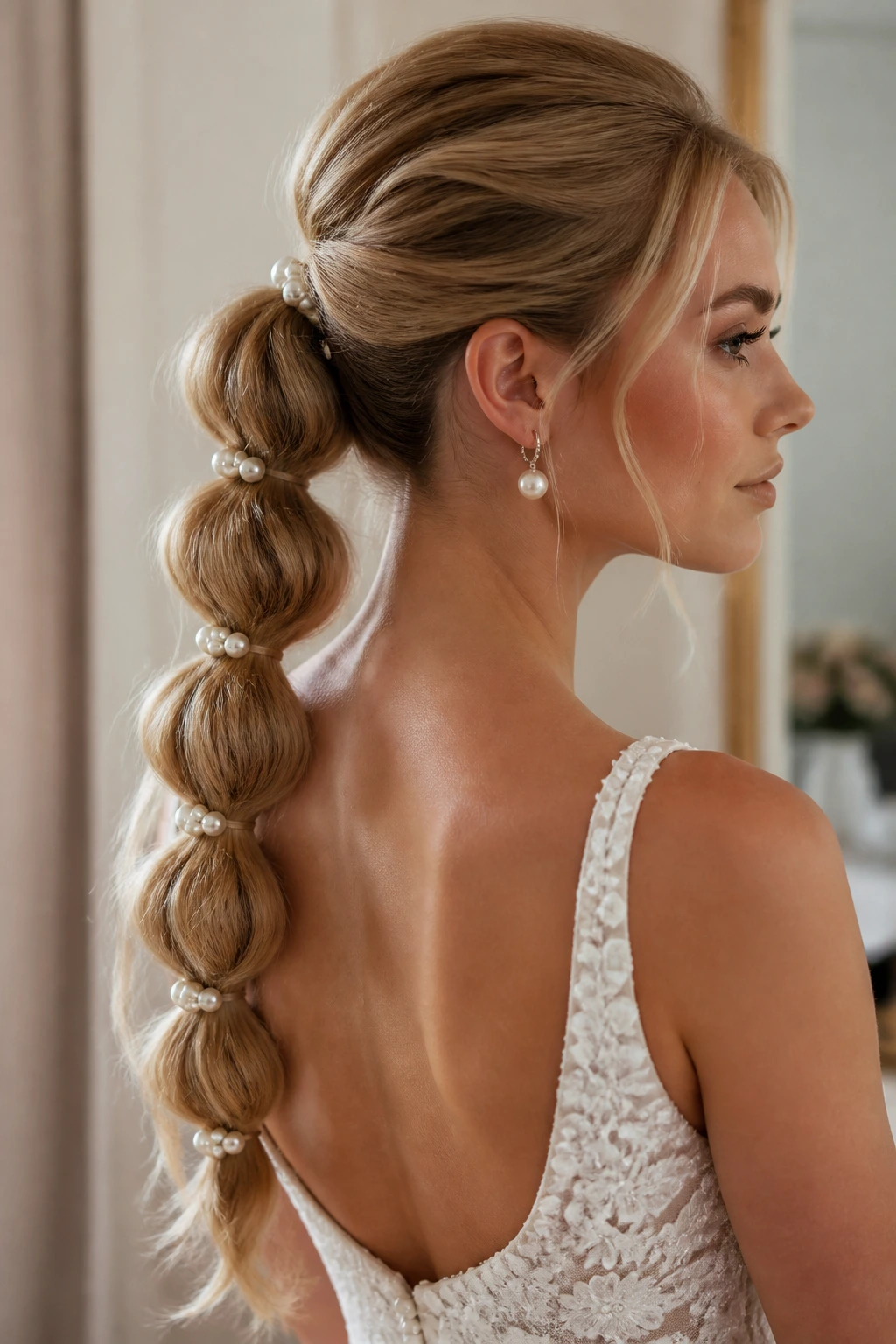
Want something bridal that doesn’t feel fussy? A bubble ponytail with pearls has a clean shape and a slightly playful rhythm that still reads special enough for a wedding. The sections give the tail structure, and the pearls turn each “bubble” into a deliberate detail instead of a styling accident.
How to Keep the Bubbles Round
Use small clear elastics about 1 to 2 inches apart, then gently pull each section outward until it forms a soft cylinder. Don’t yank from the sides so hard that the tail looks pinched in the middle. That’s the mistake. You want rounded volume, not a row of sad balloons.
What to Pair It With
- Works best with: modern gowns, high slits, clean necklines, or a fashion-forward reception dress
- Accessories: pearl pins, small crystal clips, or a single dramatic earring
- Hair length: medium to long hair, or shorter hair with hidden extensions
Pearls make the whole style feel dressed up fast. You can pin them just on the sides of each bubble or cluster a few near the base for a more expensive finish. Keep the crown smooth and the bubbles soft, and this one stops looking playful and starts looking editorial.
4. Braided Crown Into a Low Ponytail
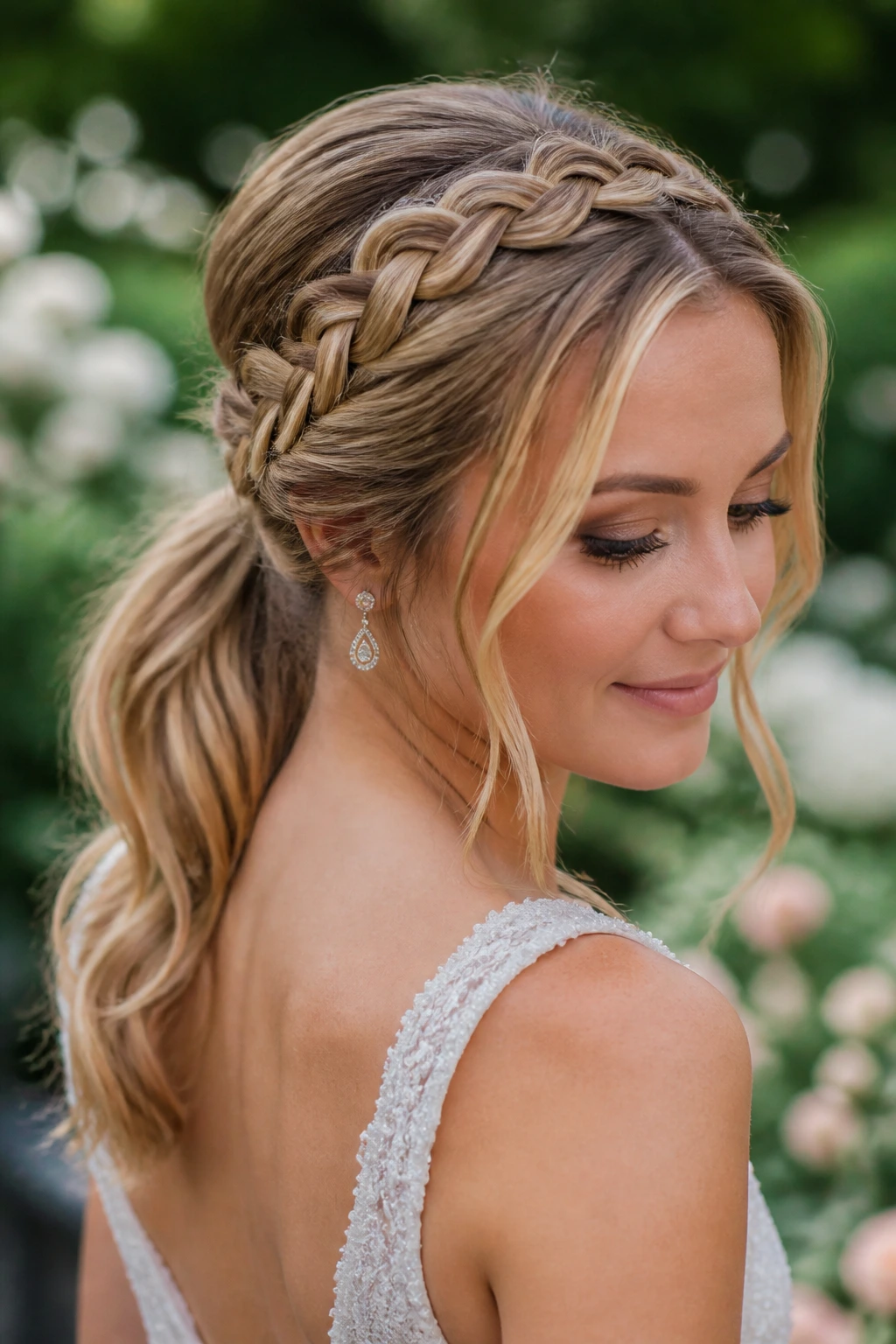
A braided crown into a low ponytail is what I recommend when the dress has a romantic back and the bride wants texture without going full boho. The braid frames the head like a built-in accessory, then hands off to a low tail that keeps the whole thing grounded.
It’s especially good when the hair has mixed textures. A little wave at the crown, a braid through the top section, then a loosely gathered tail creates enough detail that you don’t need much else. The braid also helps hold the front in place, which matters if the ceremony involves wind, outdoor photos, or a few hours of moving around before the reception starts.
The trick is not to braid too tightly. Tight braids can look harsh next to a soft dress. A slightly loosened braid with a few polished flyaways feels more balanced.
5. High Glam Ponytail With Lift at the Crown
A high ponytail can go wrong fast if it sits too cleanly against the head. Then it starts looking athletic. This version fixes that by building lift at the crown first, then pulling the tail high enough to sharpen the profile without flattening the top.
I like this for brides who want energy in the look. It elongates the neck, shows off earrings, and leaves room for a bold neckline or a structured bodice. The key is the crown. Tease it gently, smooth the top layer over the backcomb, and lock it with light hairspray before the ponytail ever goes up.
If the hair is thick, this style can hold its own with a big tail and a glossy finish. If the hair is fine, a few hidden clips and a small pad at the crown help the shape stay visible from every angle.
6. Textured Low Ponytail With Face-Framing Pieces
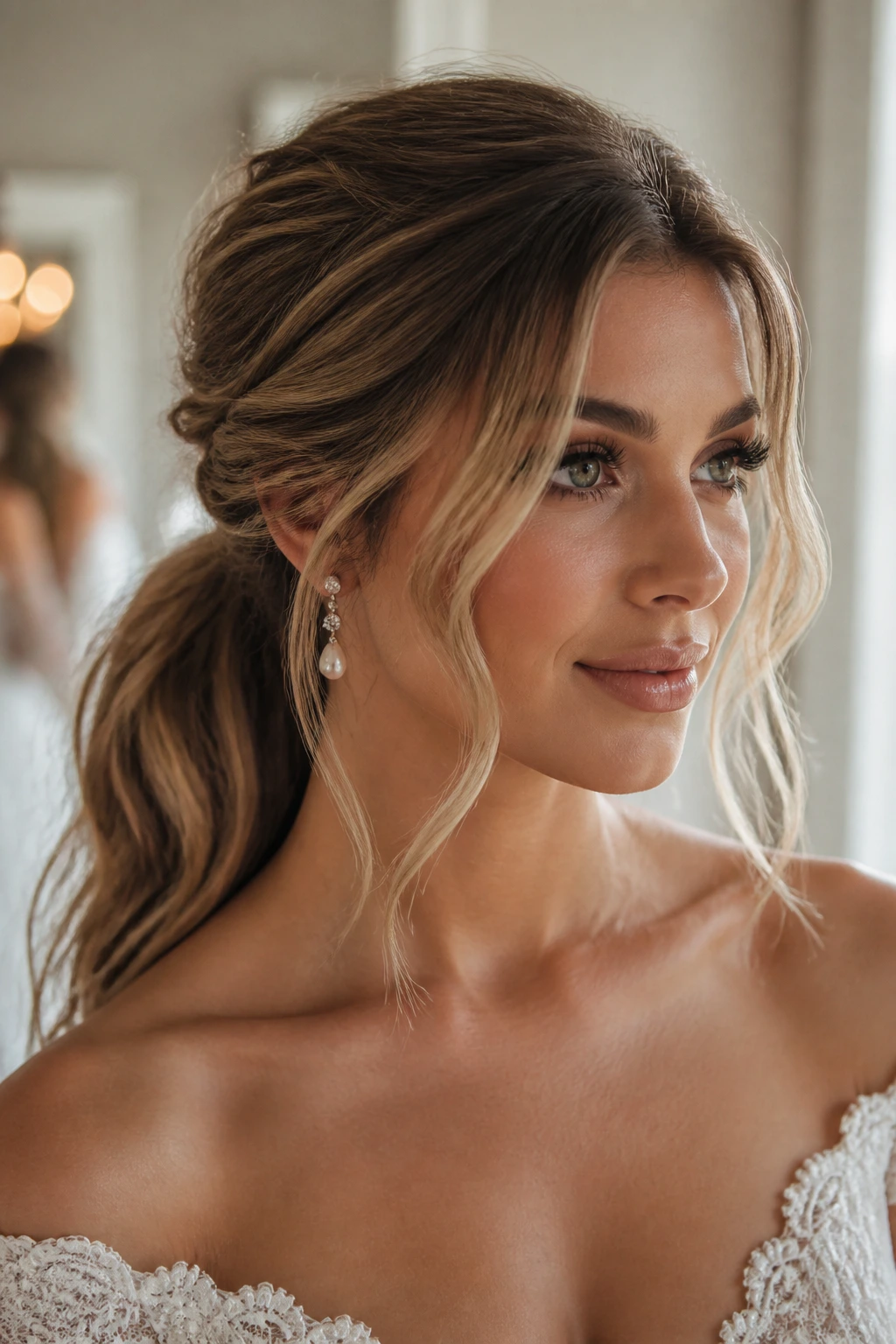
This one feels softer than the sleek version, and that’s the point. A textured low ponytail with loose face-framing pieces gives you the structure of a ponytail without taking all the softness away from the face. The front pieces should bend around the cheekbones, not cling to the jaw.
It works especially well with lace, tulle, and dresses that need a little movement near the collarbone. I like it when the tail itself is gently teased or lightly waved so the end doesn’t look too flat. A touch of dry texture spray at the roots and through the tail gives the style grip and a more lived-in finish.
The face-framing pieces deserve attention. Too short and they look accidental. Too long and they drag the whole style down. Aim for pieces that land around the cheekbone or just below the jawline, then soften the ends with a brush or a flat iron bend.
7. Side-Swept Ponytail With a Vintage Curl
If you want a ponytail that feels a little old-fashioned in the best way, go side-swept and let one sculpted curl do the talking. The ponytail sits low and off-center, usually near one shoulder blade, with the front swept across the forehead or temple in a smooth curve.
This shape gives you drama without volume everywhere. It also flatters dresses with asymmetrical necklines because the hair echoes the line of the gown instead of sitting squarely in the middle of the back. I like it for brides who love vintage references but don’t want a full victory-roll moment.
The curl at the front matters more than people think. It should look intentional and soft, not like a loose tendril that escaped mid-styling. Set it with a hot roller or curling iron, then pin it until it cools so the curve holds.
8. Ribbon-Tied Romantic Ponytail
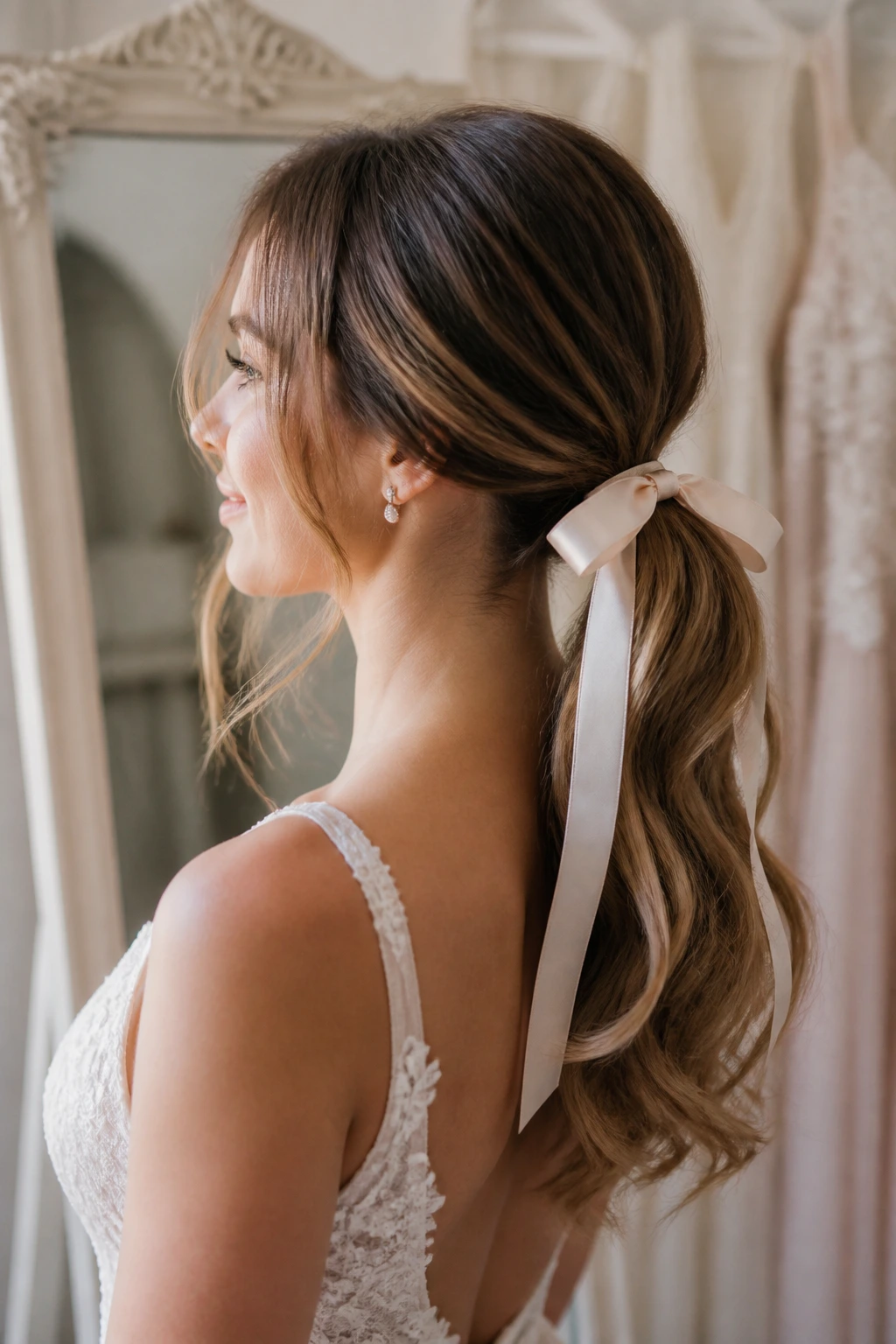
A ribbon can change the whole mood of a ponytail in one move. Satin makes it feel formal. Velvet leans colder and richer. Silk keeps it light and airy. A ribbon-tied romantic ponytail is one of those styles that looks simple from a distance, then surprises people when they get close and notice the finish.
The ponytail itself can be low, mid, or slightly off-center. The ribbon is the feature, but it needs a clean base. If the elastic is lumpy or the sectioning is sloppy, the ribbon just exposes it. Wrap the ribbon once around the base, knot it or tie a bow depending on the fabric, and let the tails fall long enough to move when you walk.
I prefer this style with softer fabrics in the dress. It keeps the whole look from feeling too hard-edged. And if you want the ribbon to photograph well, choose a shade that echoes a detail in the bouquet, sash, or shoe — not a random color that shows up nowhere else.
9. Boho Braided Ponytail
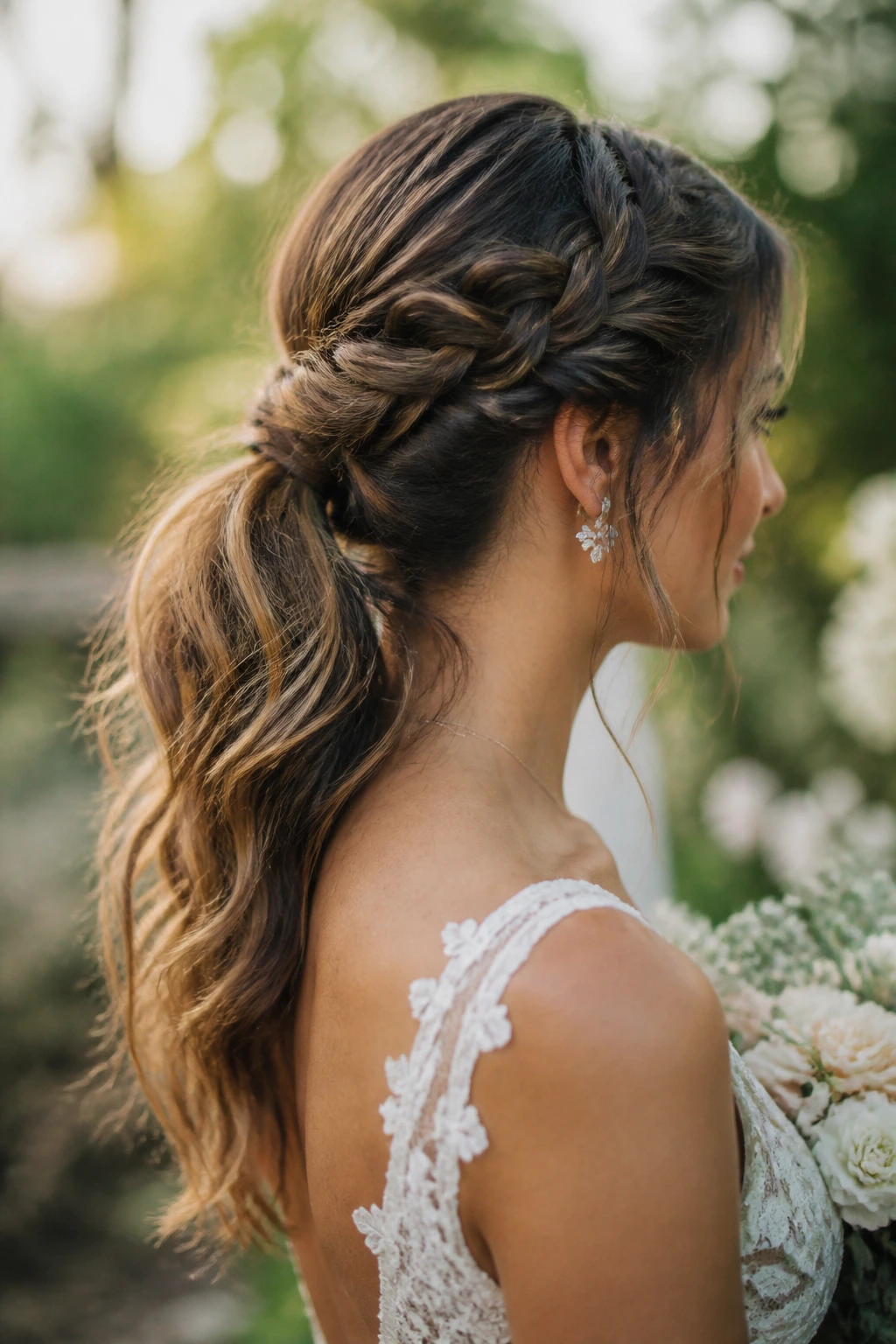
A boho braided ponytail is all about texture, but it still needs discipline or it turns into a mess. The best version starts with a relaxed braid on one side or across the crown, then folds into a loose ponytail that looks full and touchable rather than overworked.
Where It Fits Best
- Settings: garden weddings, beach ceremonies, barn venues, or anything with a soft, open-air feel
- Dress match: flutter sleeves, chiffon, embroidery, or anything with movement
- Finish: matte or softly polished, not glassy
The braid gives the style its shape. The ponytail gives it motion. I like a few pulled-out strands near the temples, but only a few. Too many and the style loses its line. A little dry shampoo at the roots helps if the hair is freshly washed and too slippery.
A boho ponytail is also one of the better styles for adding flowers or tiny pins. You can tuck a small bloom into the braid, then leave the rest of the tail alone. That restraint is what keeps it from looking like a craft project.
10. Curly Ponytail With Defined Ends
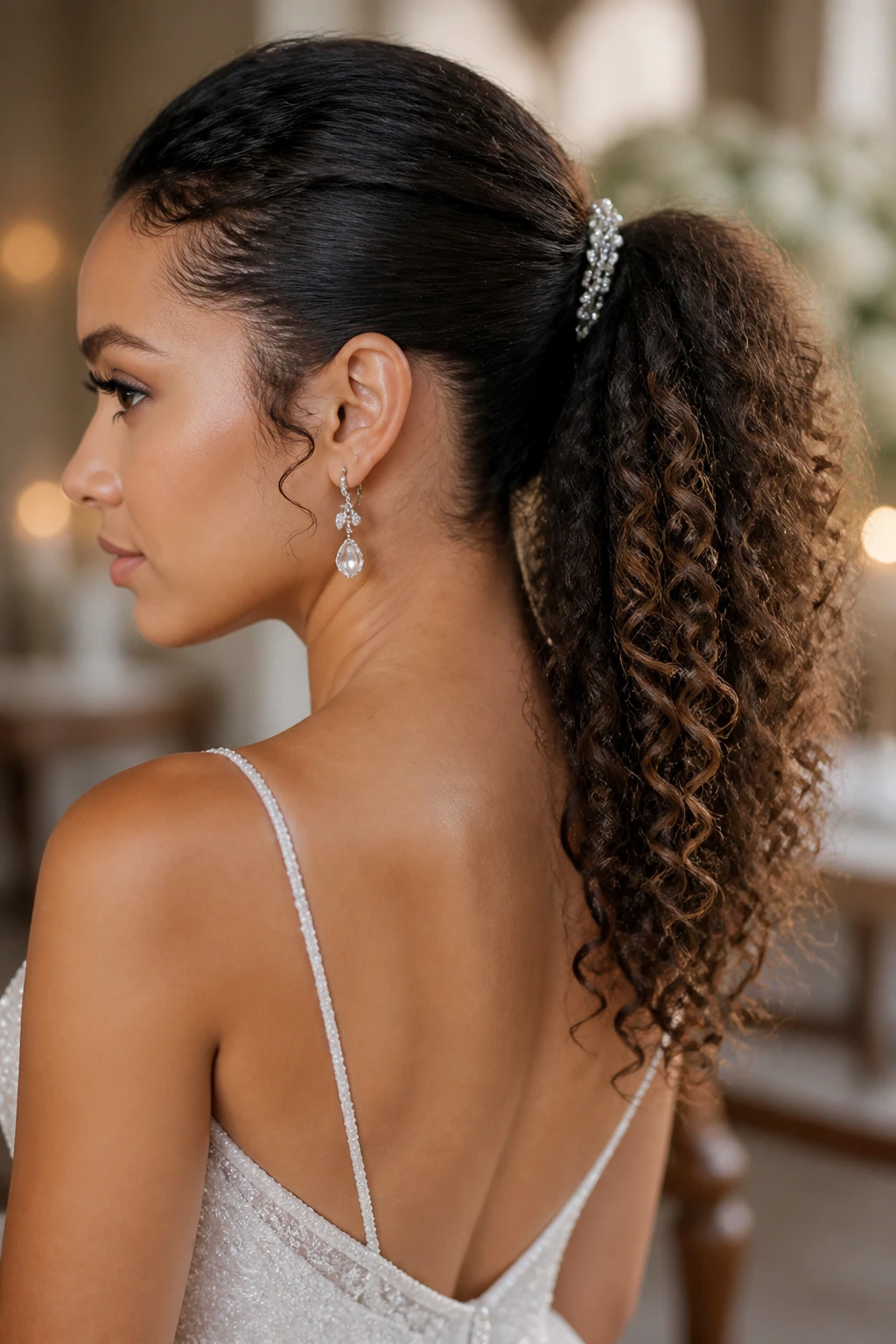
Curly hair in a ponytail can look absolutely gorgeous at a wedding when the curls are treated with respect. No brushing them into a puff and hoping for the best. A curly ponytail with defined ends keeps the curl pattern visible, preserves shape, and lets the tail look full without losing control.
The front can be sleek or softly shaped, but the tail should stay hydrated and defined. A curl cream or light gel at the ends helps the pattern hold its shape after the ponytail is secured. If the hair is stretched by the elastic, fluff the tail from the bottom up with your fingers rather than a brush.
This style is one of the easiest ways to make natural texture feel bridal without forcing it into something else. A pearl clip, a jeweled pin, or even a single polished side part can be enough. The goal is to let the curls stay themselves, just with cleaner edges.
11. Sleek Center-Part Ponytail
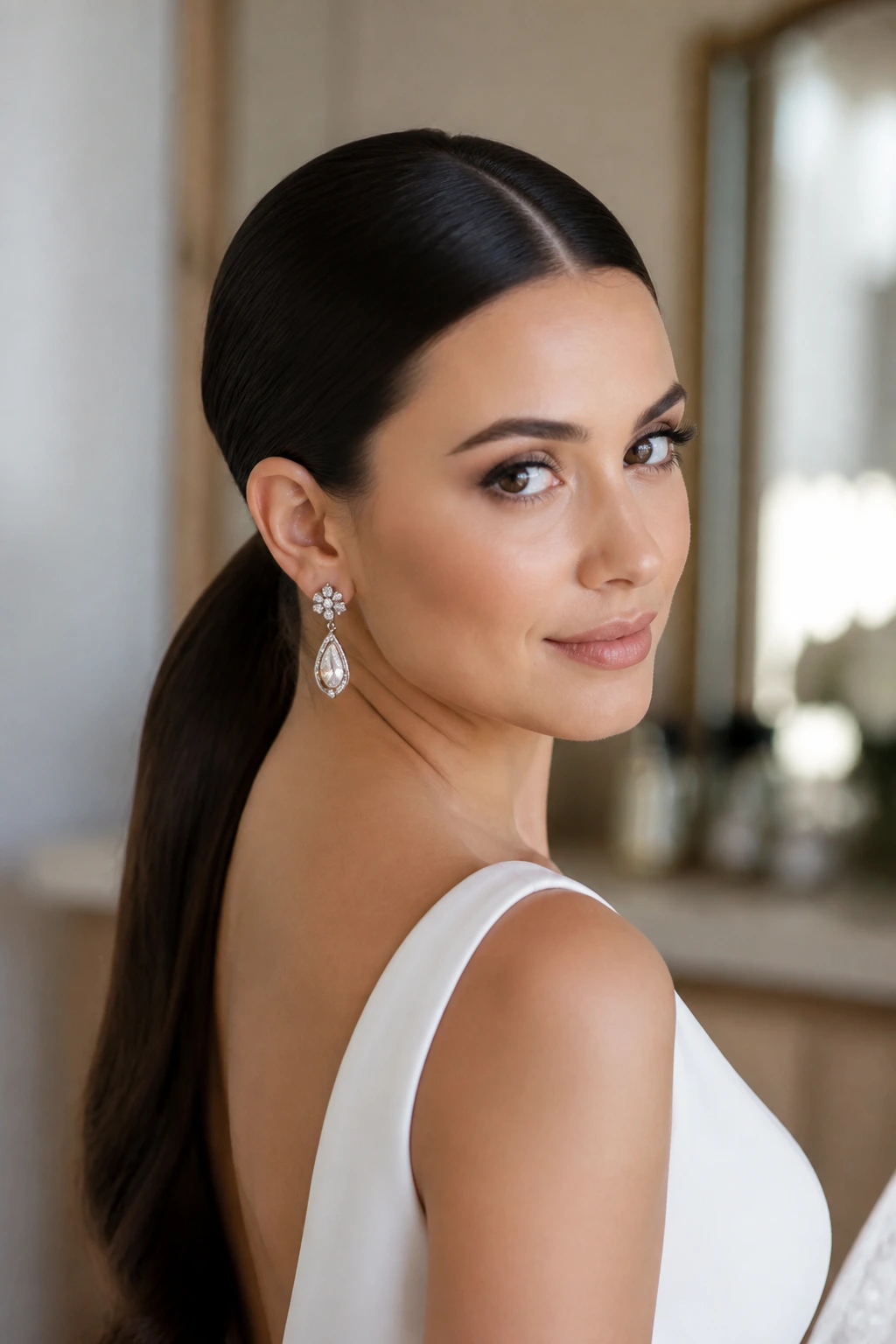
A center part can look severe if you stop halfway through the styling process. Finish it properly, though, and it becomes one of the cleanest wedding ponytail hairstyles on the list. The middle part creates symmetry, the low or mid ponytail brings calm, and the whole thing feels sharp in a way that photographs beautifully from straight on.
This style is strongest with minimalist gowns or sharp tailoring. It also works when the earrings are doing real work, because the hair doesn’t crowd the sides of the face. I’d keep the crown smooth and the ponytail polished, with maybe a soft bevel at the ends so the tail doesn’t look stick-straight unless that’s the point.
If you want this one to feel less strict, soften the front with a tiny bend near the temples. That tiny change takes it from severe to finished.
12. Fishtail Accent Ponytail
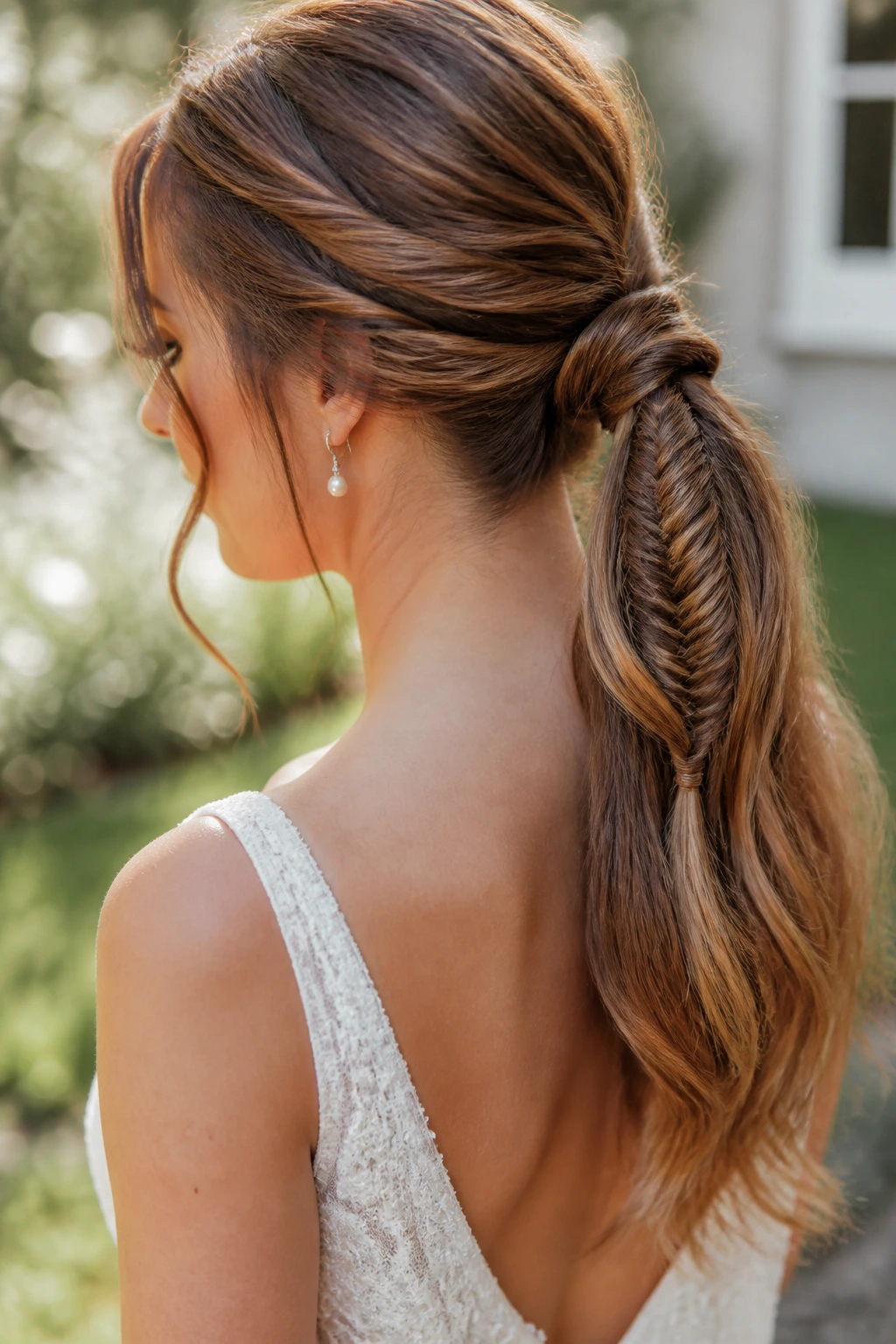
A fishtail accent ponytail gives you detail without turning the whole style into a braid-heavy look. The fishtail can live at the crown, run through the base, or show up as a section within the tail itself. Any of those options adds texture in a way that feels deliberate.
The best part is that a fishtail braid behaves well in photos. It gives the eye something to track. If the dress back is simple, the braid becomes the visual anchor; if the gown already has texture, the braid supports it instead of competing.
This is one of those styles that benefits from a light hand. Loosen the braid a bit after weaving it so the strands look woven rather than tight and ropey. Then keep the ponytail below it smooth or gently waved. Too many competing textures and the style starts to look busy.
13. Pearl-Pinned Ponytail
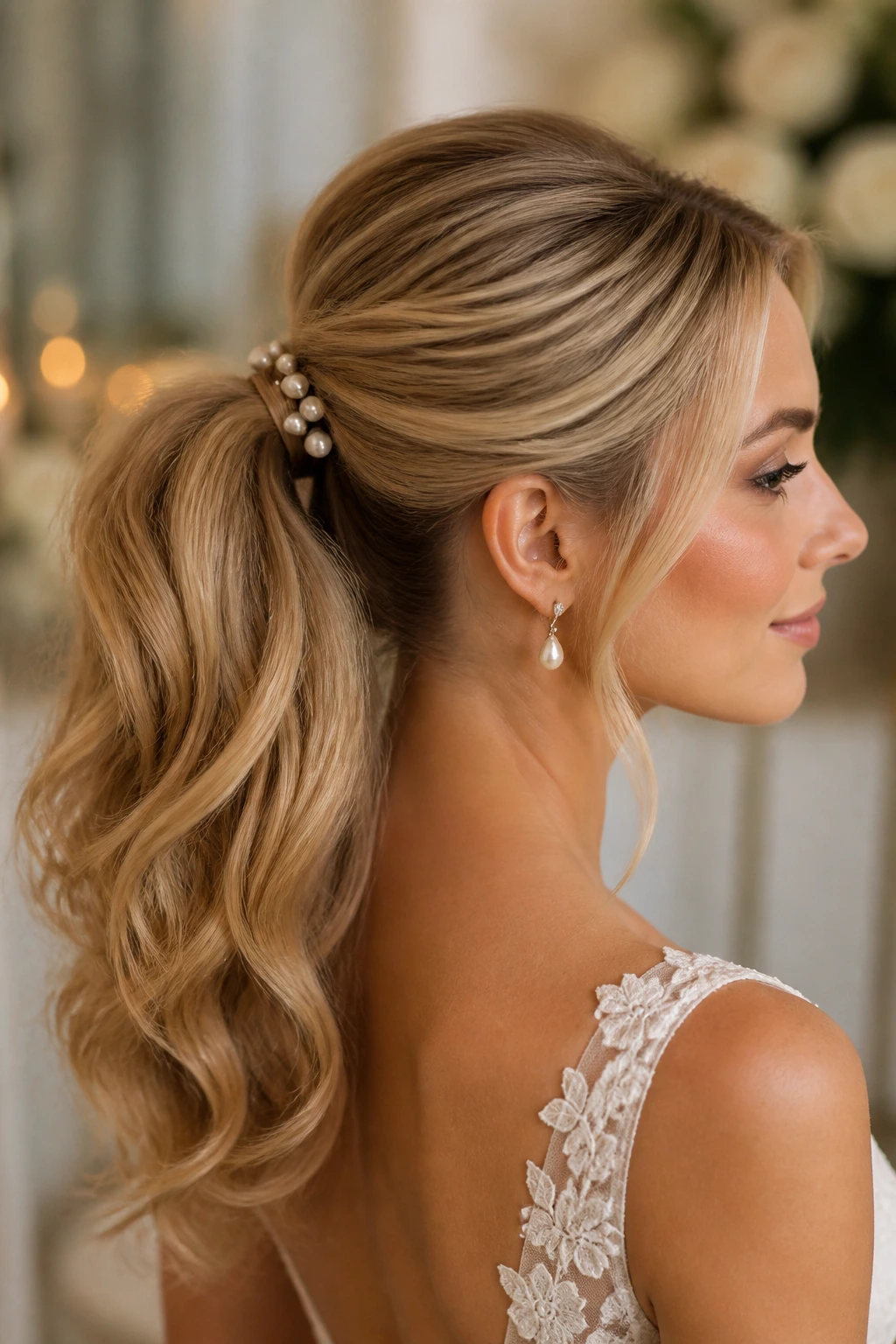
Pearl pins are the fastest way to make a simple ponytail look bridal without making it heavy. A pearl-pinned ponytail can be sleek, loose, wavy, low, or mid-height. The pearls are the punctuation marks.
Placement Matters
- Cluster them near the base for a richer, more formal look
- Scatter a few down one side for something lighter and more modern
- Keep them tiny if the dress already has beadwork or lace
I like pearl pins when the bride wants something recognizable as a ponytail but still needs it to feel dressed up enough for a ceremony. They also work well on second-day hair because the texture helps the pins grip. A clean bun can sometimes swallow accessories. A ponytail lets them breathe.
Try not to overdo the count. Three to seven pins is usually enough. Once the head starts looking like a jewelry tray, the effect gets noisy. Less. Better.
14. Half-Up Ponytail Hybrid
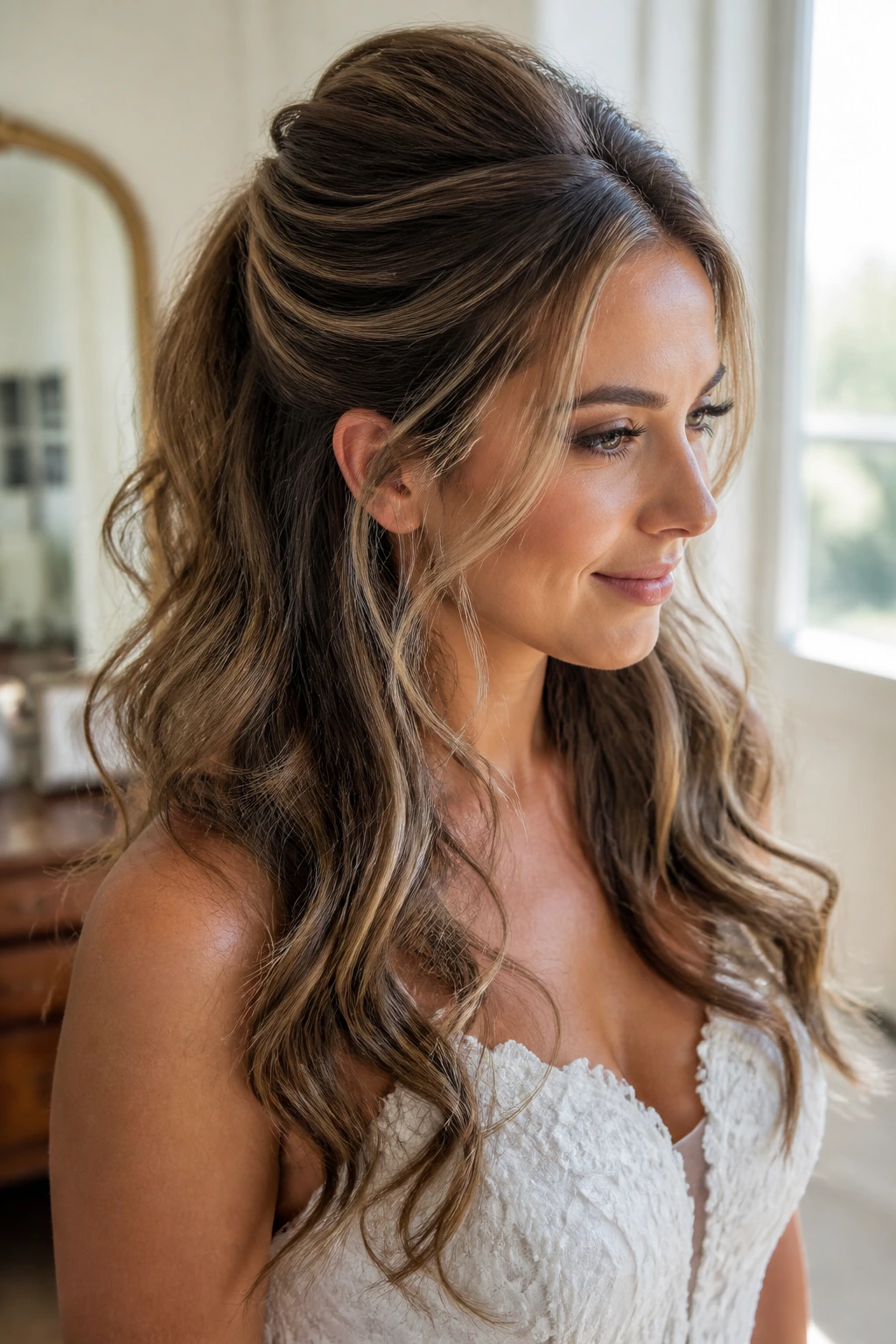
Half-up ponytails are useful because they solve a common wedding problem: hair that needs to come off the face, but not all the way back. You get some lift at the crown, some length left down, and a shape that reads softer than a full ponytail.
This works especially well for brides who want movement around the shoulders or have a dress that already shows a lot of back. It also plays nicely with waves and curls. I’d keep the top section controlled and the lower length polished, so the style feels planned instead of improvised.
The hybrid shape makes it easy to add a small comb, a ribbon, or a few pins at the pullback point. It’s one of the friendliest options for brides who are nervous about looking too “done.” The hair still feels like hair, just better arranged.
15. Low Ponytail With Twisted Sides
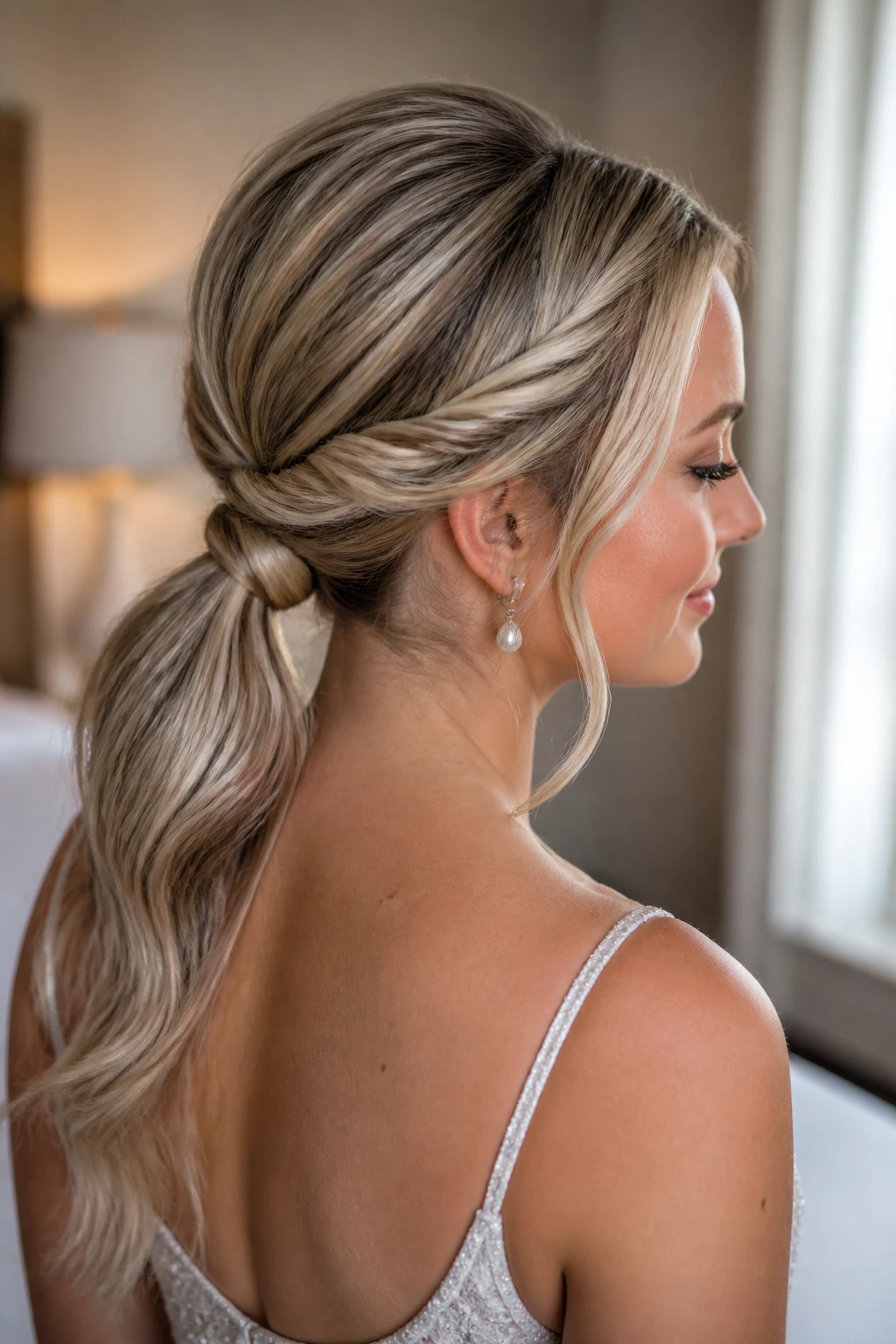
Twisting the side sections before they meet at the back creates a soft frame around the head and keeps the ponytail from feeling flat. A low ponytail with twisted sides works beautifully when the dress has detail at the shoulders or back and you want the hairstyle to echo that shape.
The twists add interest without asking for a braid. That’s handy if the gown already has a lot going on and the hair just needs a little structure. I like this version with a slightly puffed crown and a smooth finish around the temples. It keeps the look bridal, not sleepy.
Best Use Cases
- Dresses with straps or sleeves: the twists echo the line of the garment
- Medium-density hair: enough length to show the twist, enough weight to hold it
- Soft accessories: one comb, one pin, maybe a thin veil
16. Tucked-Under Chignon-Ponytail
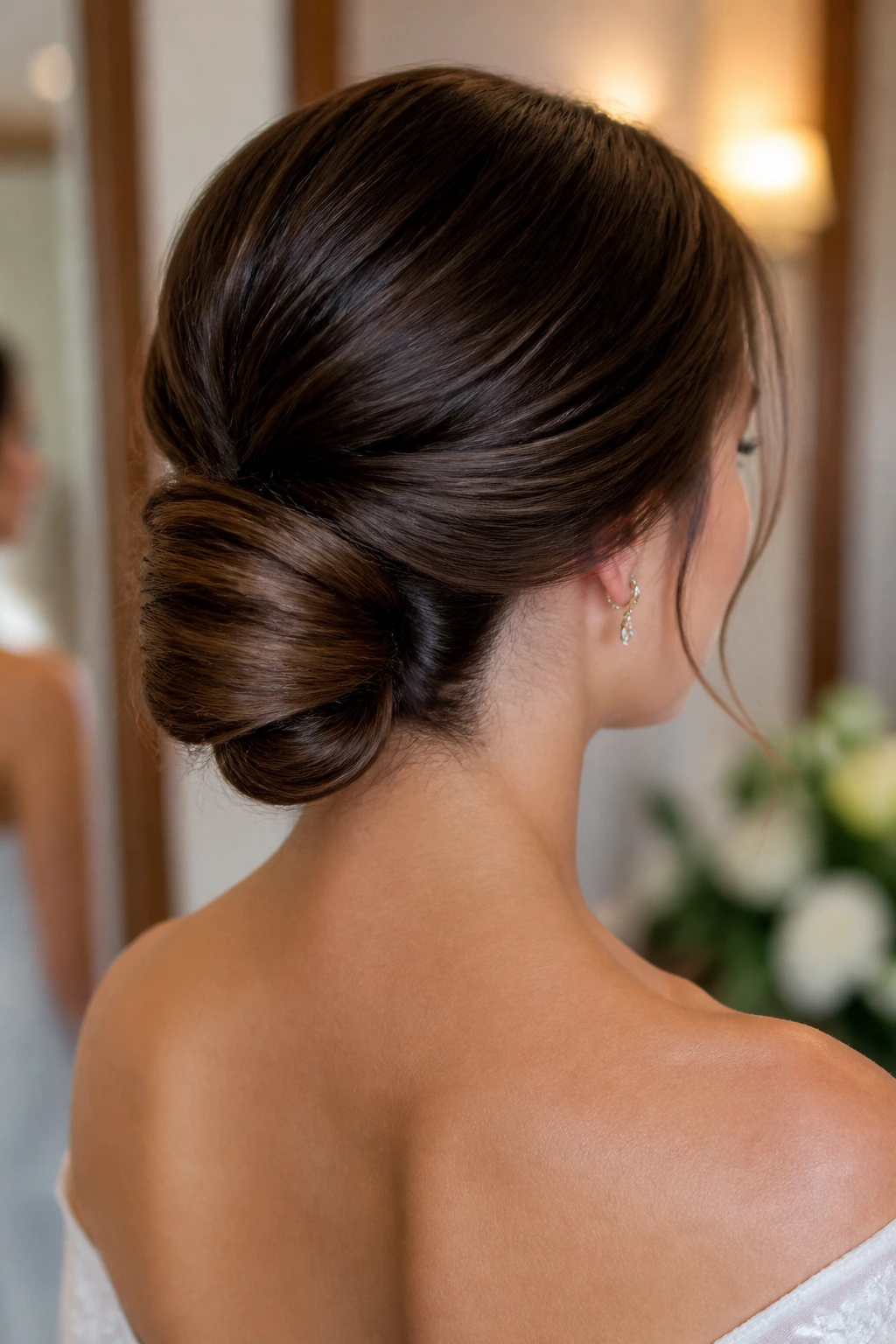
This is a ponytail that cheats a little, and I mean that in the best way. The tail is gathered low, then tucked under so it reads like a compact chignon with a ponytail’s easier structure. The result is neat, polished, and less formal than a hard-shell updo.
It suits brides who want the neck area clean but do not want something rigid. The tucked shape also works well if the ends are uneven or if the hair is a mix of lengths. You don’t have to show every inch of the tail. The tuck hides the messy parts and leaves the finish looking intentional.
I’d keep the base smooth and secure with discreet pins. If a few ends peek out, that’s fine. Too much perfection can make this style look stiff, and the charm is in how it balances order with movement.
17. Wet-Look Bridal Ponytail
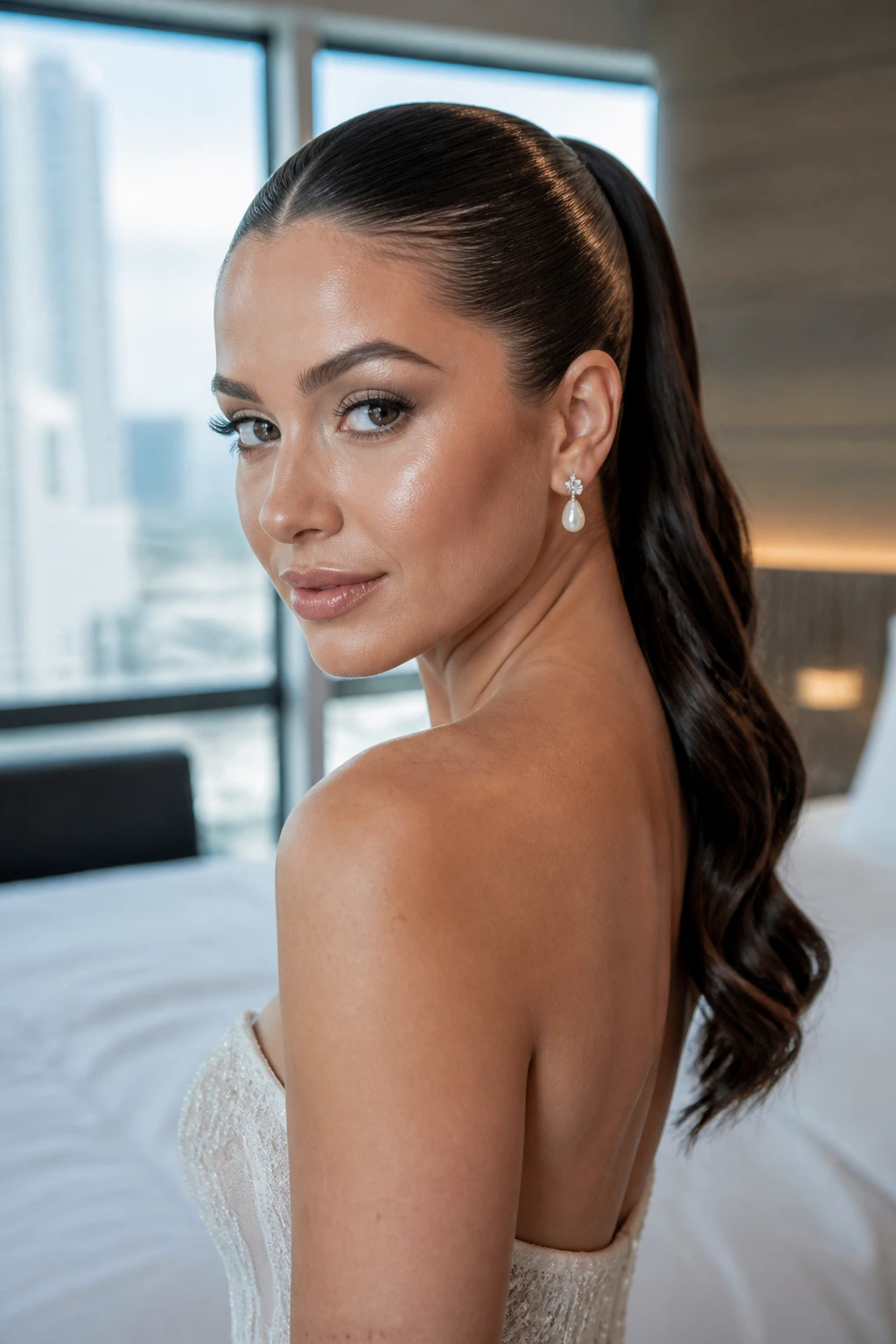
A wet-look ponytail is not for everyone. Good. Wedding hair should have some point of view. This style is glossy, sculpted, and a little editorial, which makes it ideal for brides who want the hair to feel modern and a little fearless.
The finish is the whole story. The roots are sleek, the lengths are coated with shine, and the shape is controlled enough to stay neat, but not so stiff that it looks shellacked. I would pair this with a pared-down dress or a very architectural gown. It’s the kind of ponytail that needs room around it.
This one is more about placement than volume. Too much fluff and the wet-look idea disappears. Too much product and it starts to look sticky instead of glossy. The sweet spot is a smooth surface and a tail that still moves when you turn your head.
18. Voluminous Curled Ponytail
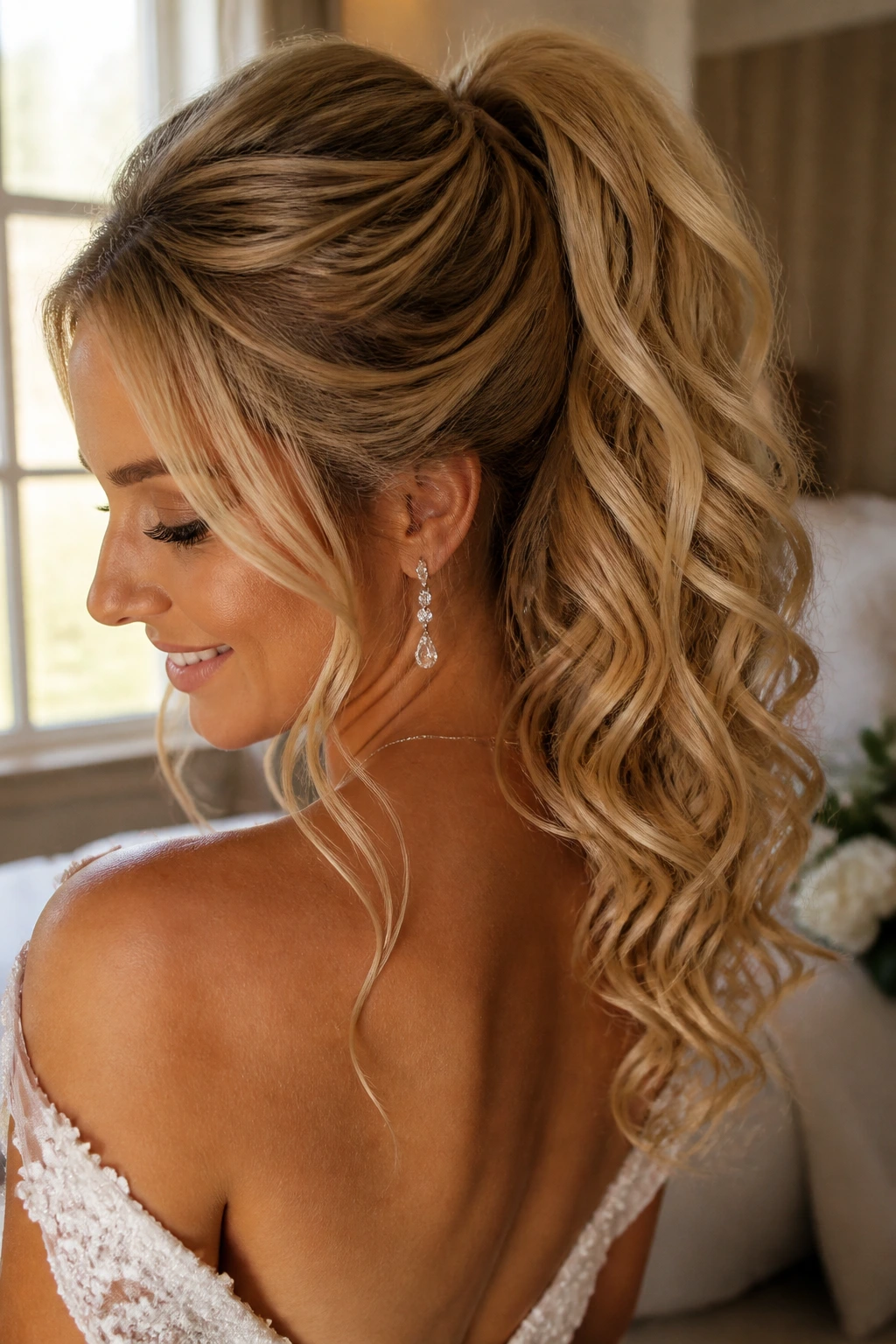
If you love big hair, don’t fight it. A voluminous curled ponytail gives you bounce, body, and that full, soft shape people try to fake with too much teasing. This one starts with a solid blowout or set curls, then gathers them into a tail that keeps the fullness intact.
It’s especially nice for brides with long hair who want the style to feel rich from every angle. The curls can be brushed out slightly for softness or left more defined for a stronger pattern. I’d keep the base lifted and the tail thick, because if the crown goes flat, the whole style loses its shape.
This is one of the most forgiving ponytails for dancing. The movement looks natural instead of overmanaged. And if the dress is simple, the hair can carry more of the visual weight without making the outfit feel crowded.
19. Minimalist Knot-Base Ponytail
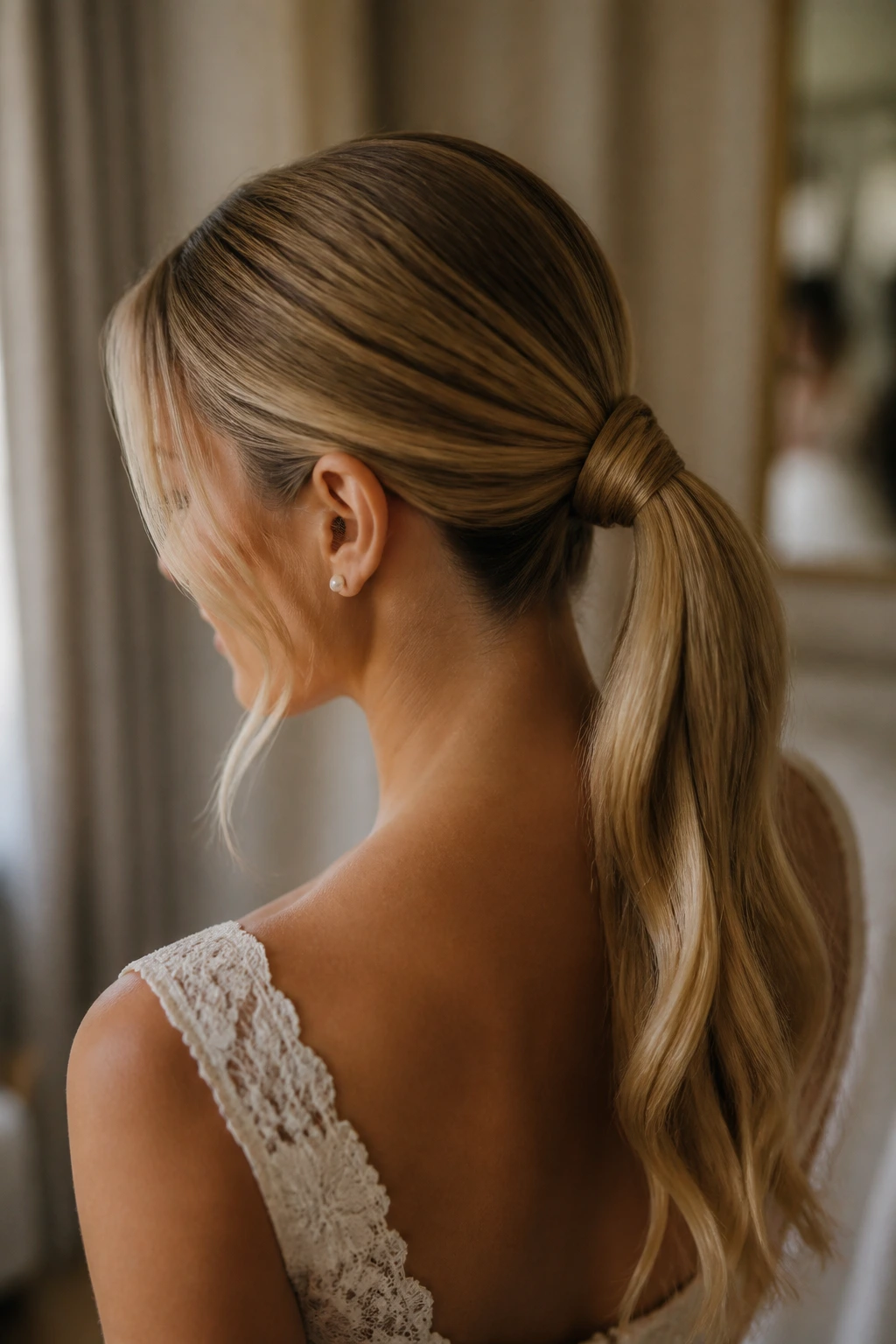
A knot-base ponytail skips the wrapped elastic and uses the hair itself to hide the base. That sounds tiny. It isn’t. The knot changes the whole mood. It feels cleaner than a wrap, less fussy than a braid, and just a little more modern than a standard low ponytail.
This is one of my favorite styles for brides who hate visible fuss. The front can be center-parted or side-parted, but the back should look neat and deliberate. The knot at the base gives the style enough detail that the eye doesn’t stop at “just a ponytail.”
Why It’s a Good Choice
- Works with sleek gowns and structured necklines
- Keeps the finish simple, which helps if the dress already has ornament
- Gives the stylist a clean anchor point for a veil or pin
20. Veil-Friendly Low Anchor Ponytail
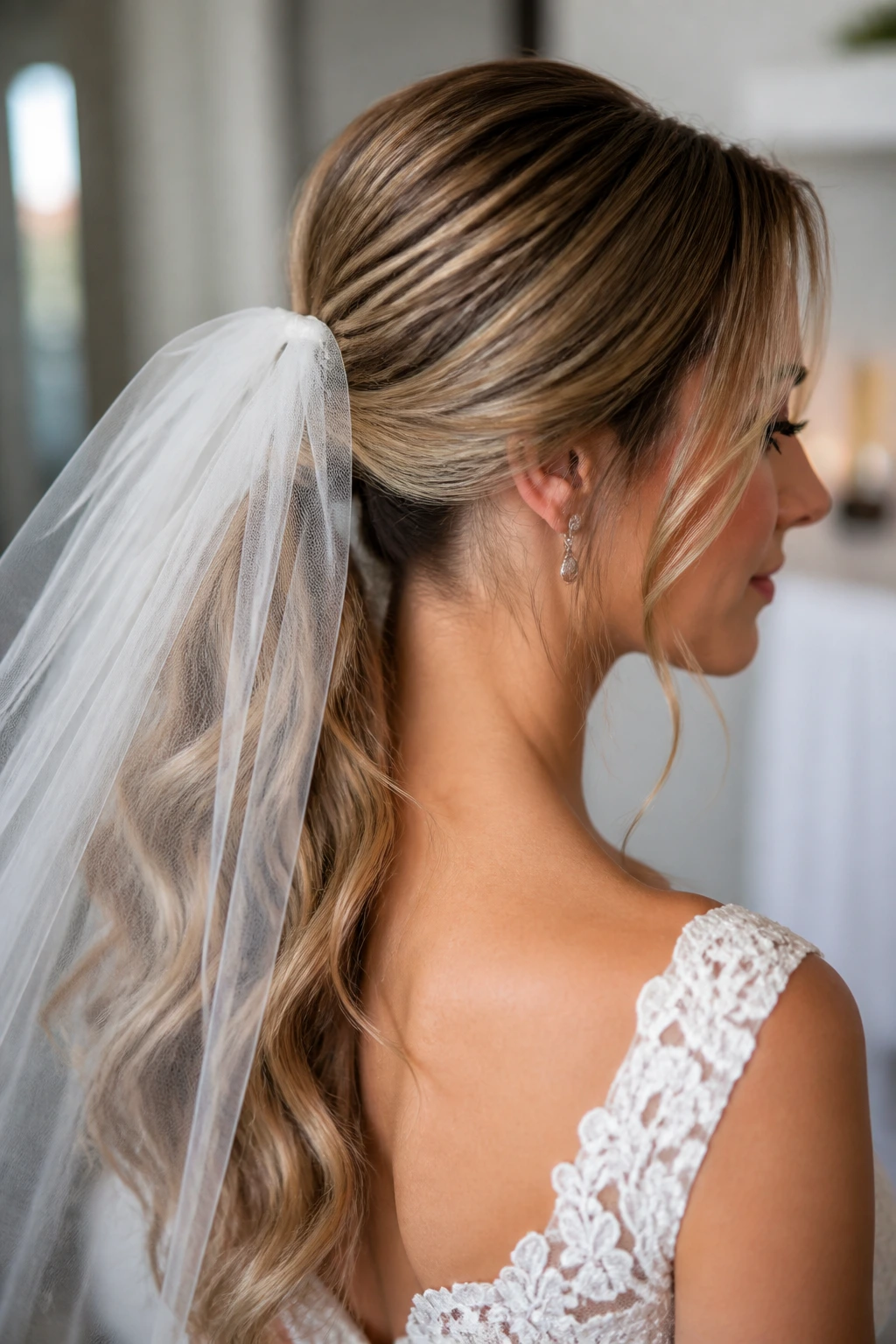
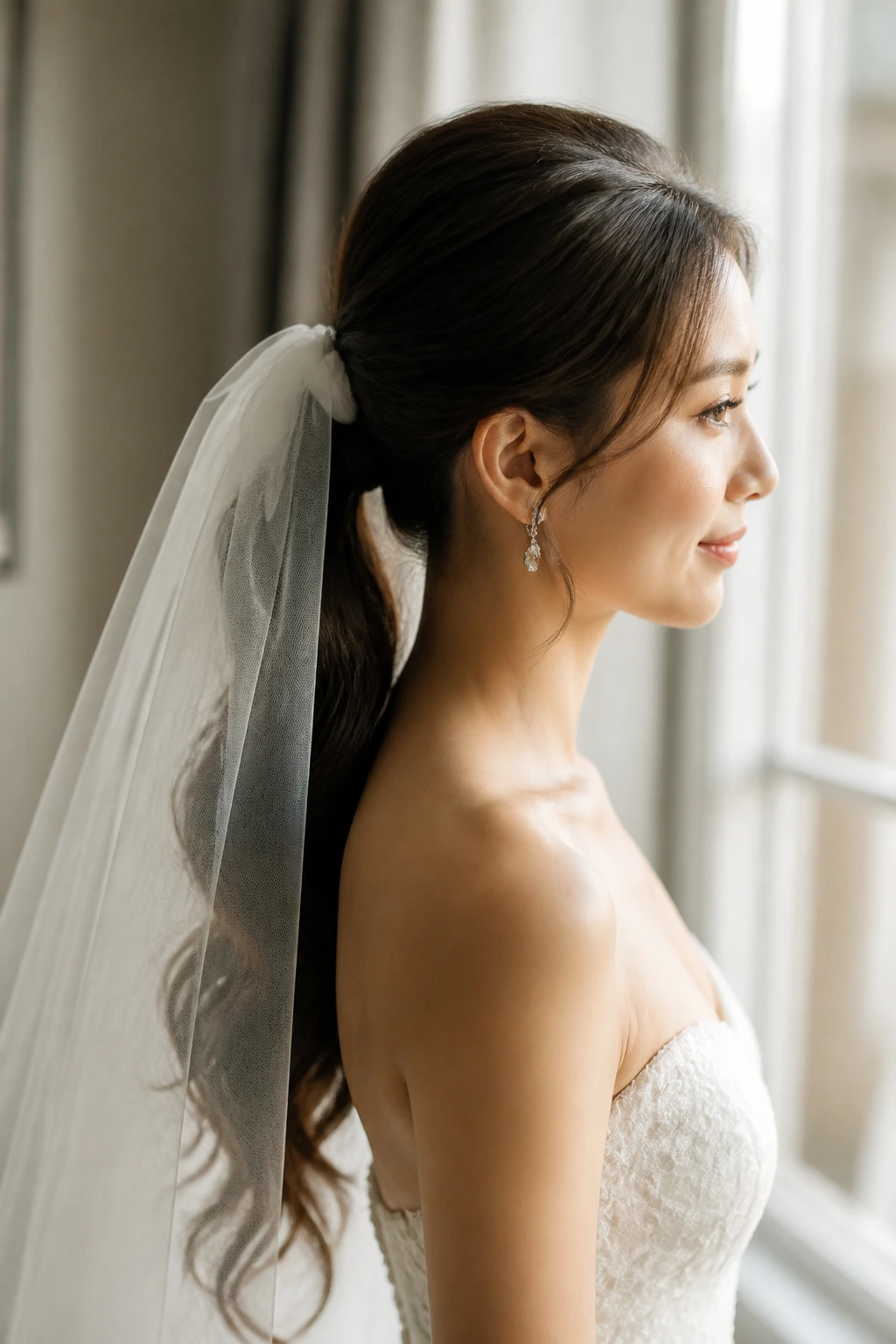
Some ponytails are made to coexist with a veil. This is one of them. The low anchor sits a little below the place where a comb veil would usually go, which keeps the veil secure without crushing the ponytail shape underneath.
That spacing matters. Too high, and the veil fights the tail. Too low, and the whole style can drop into the collar. I like this for brides who want the veil for the ceremony, then plan to remove it later and still have a ponytail that looks finished on its own.
The shape can be sleek, waved, or softly textured. What matters is the placement. The ponytail should sit low enough that the veil has its own lane, but not so low that it disappears under the dress. When that balance is right, the hairstyle and the veil stop competing and start cooperating.
21. Braided Bubble Ponytail
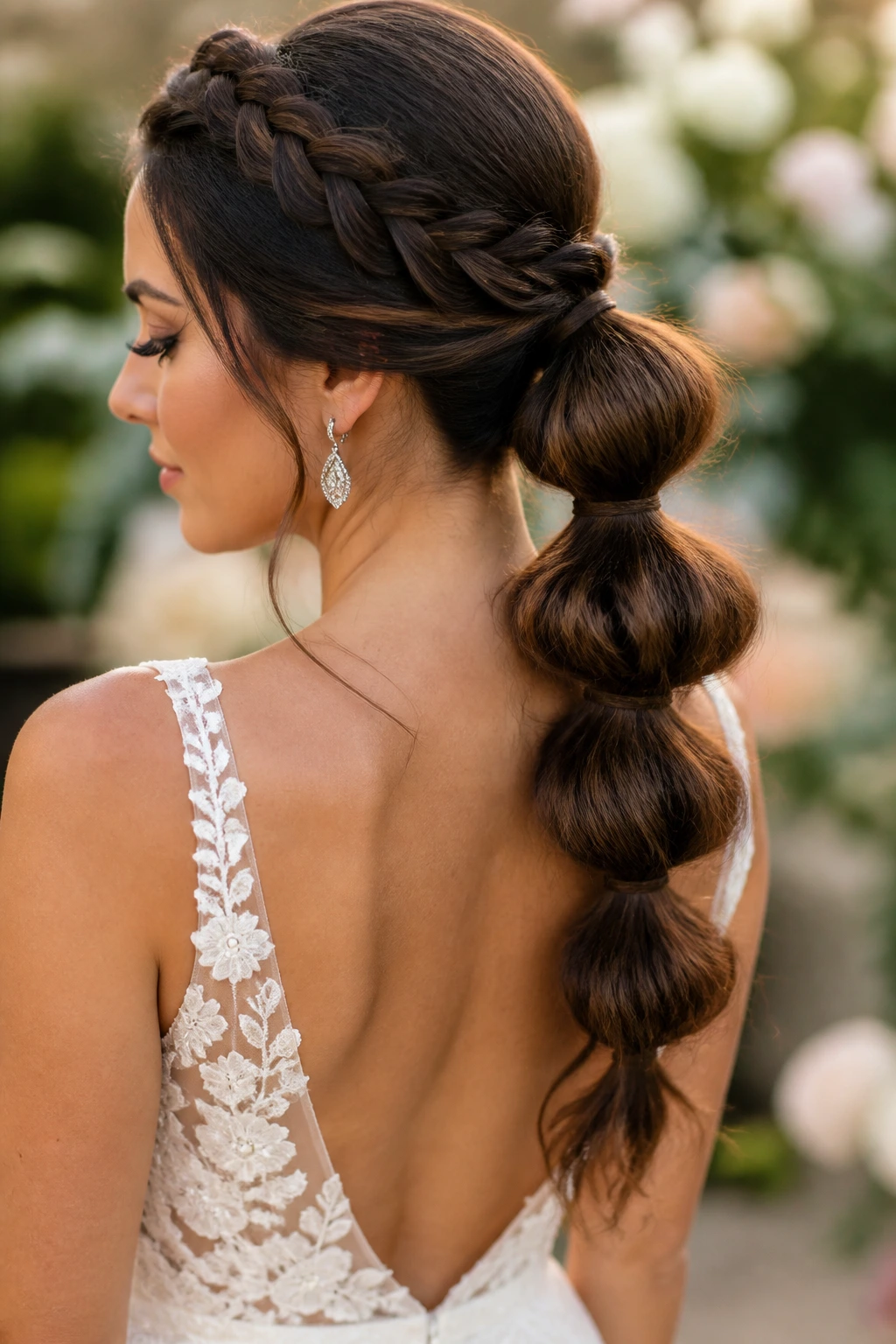
This one is a little playful, a little structured, and a lot more interesting than a plain tail. Start with a braid near the crown or through the top third, then switch into bubble sections down the rest of the ponytail. You get the neatness of a braid and the rhythm of bubbles in one look.
It’s especially good when the dress is simple and the hair needs to do more of the visual work. The braid keeps the top anchored. The bubbles add shape down the length. It also photographs well because the sections create shadows and highlights, which makes the style look fuller than it is.
The trick is spacing. Keep the bubbles consistent, maybe 1½ to 2 inches apart, and tug each one evenly so they look round. If one section gets puffy and the next one stays flat, the eye catches it right away.
22. Old-Hollywood Side Ponytail
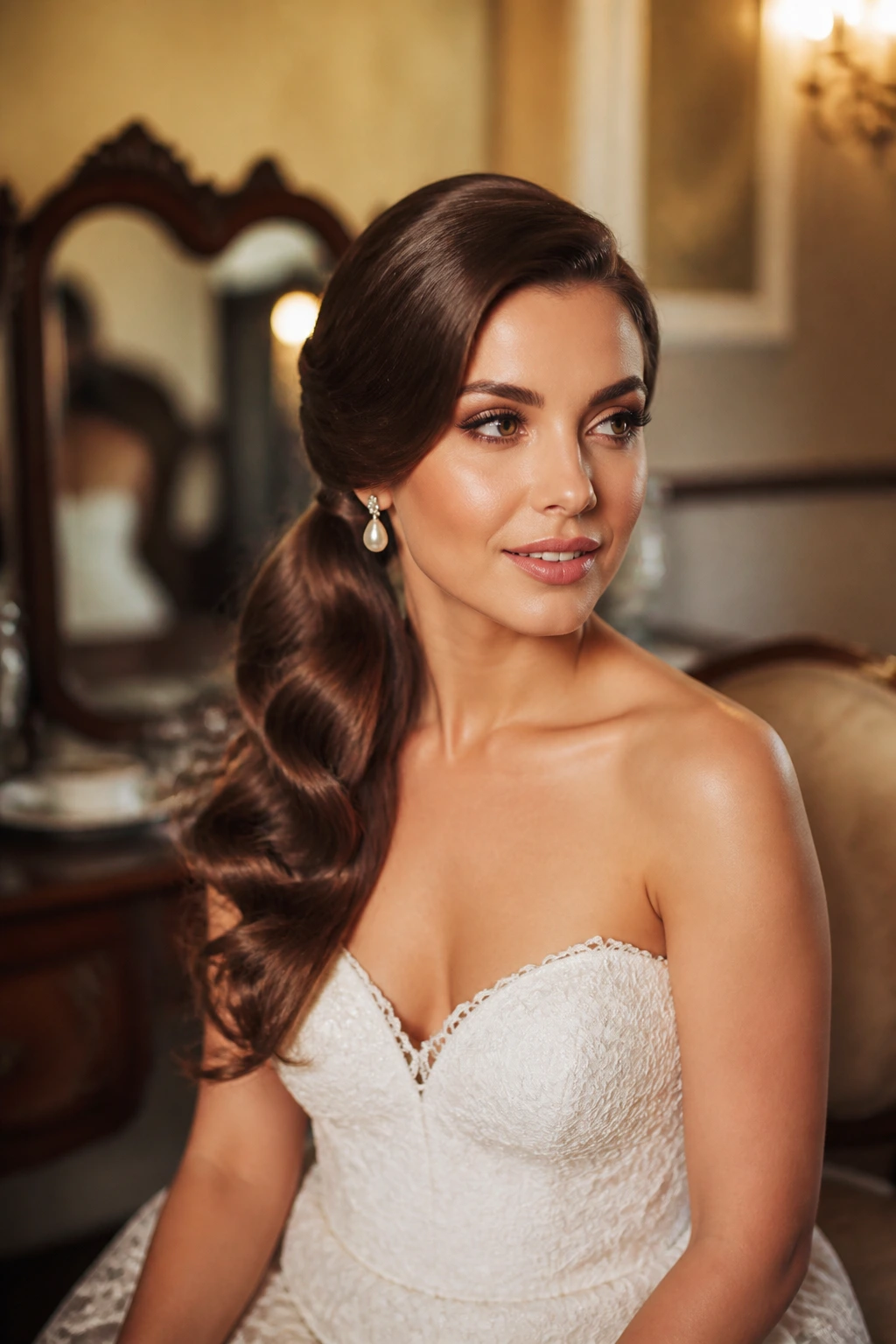
An old-Hollywood side ponytail carries that soft brushed wave you see in vintage portraits, then gathers it low over one shoulder. The front can have a deep side part or a sweeping curve, but the star is the texture. It should feel polished, not crunchy.
This works beautifully with one-shoulder dresses, draped bodices, or gowns with sleeves that deserve a clean line on the opposite side. The asymmetry gives the look motion. It also lets earrings and cheekbones do a little more work, which never hurts.
I like this style best when the waves are smooth and the ends have a little weight. If the tail gets too fluffy, it loses the Hollywood reference and starts to look like a casual side ponytail. Brush it out enough to soften the curl, then stop.
23. Floral-Accented Garden Ponytail
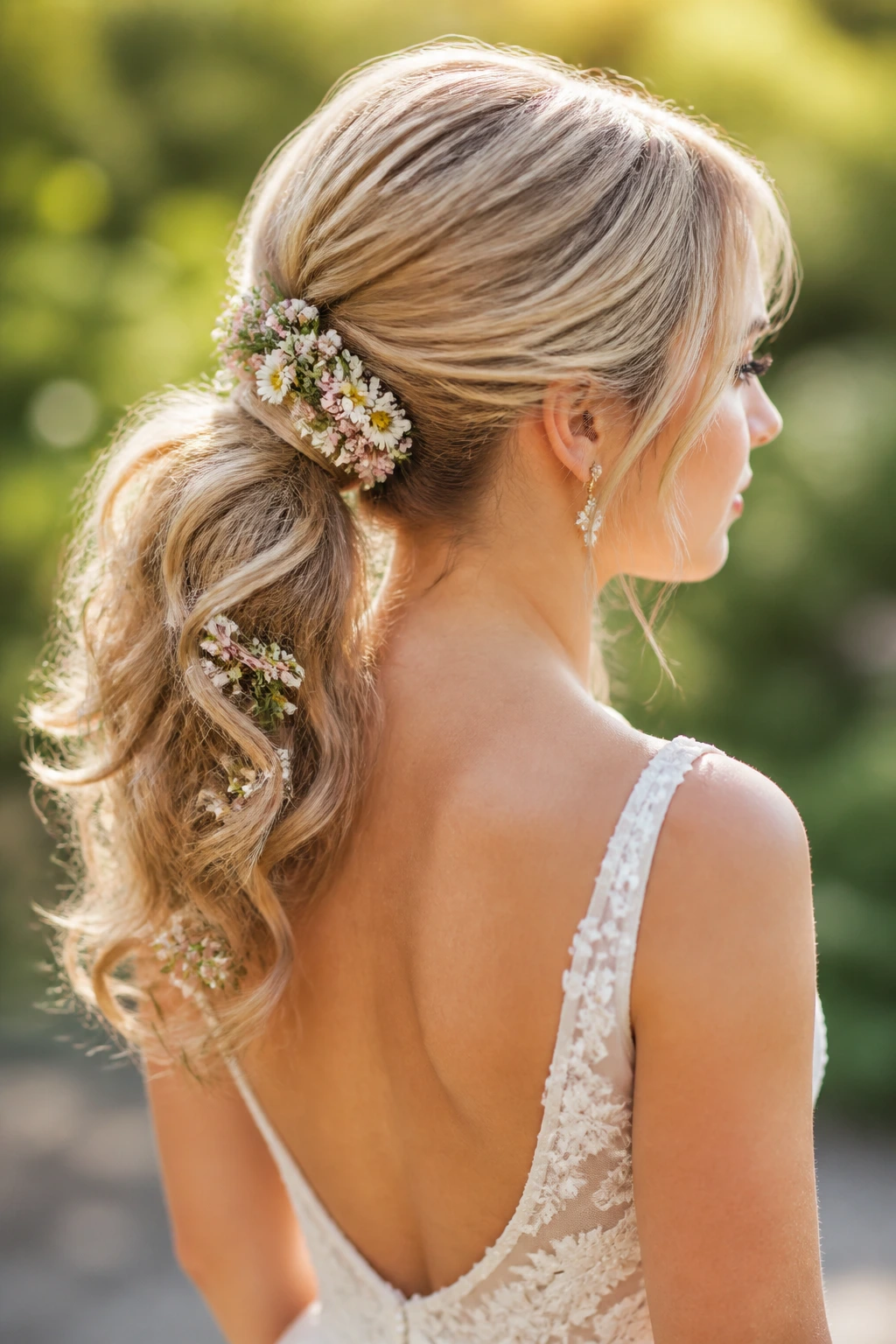
Flowers in hair can go wrong when they look like they were pressed in as an afterthought. A floral-accented garden ponytail avoids that by giving the flowers a real role. A few tiny blooms at the base, one tucked into the braid, or a sprig of greenery woven into the side can be enough.
This style belongs to outdoor ceremonies, botanical venues, and dresses with movement. The ponytail itself should stay light and soft so the flowers don’t fight the shape. I’d avoid heavy bouquet-style clusters unless the whole wedding design is lush and full. Tiny blooms are usually smarter.
Fresh flowers need to be secured properly and chosen with care. Delicate stems bruise fast, so florist wire or tiny pins help. Dried flowers can work too, especially when the palette is muted. Either way, the floral accent should feel intentional, not pinned on like a craft sample.
24. Long Extension Ponytail
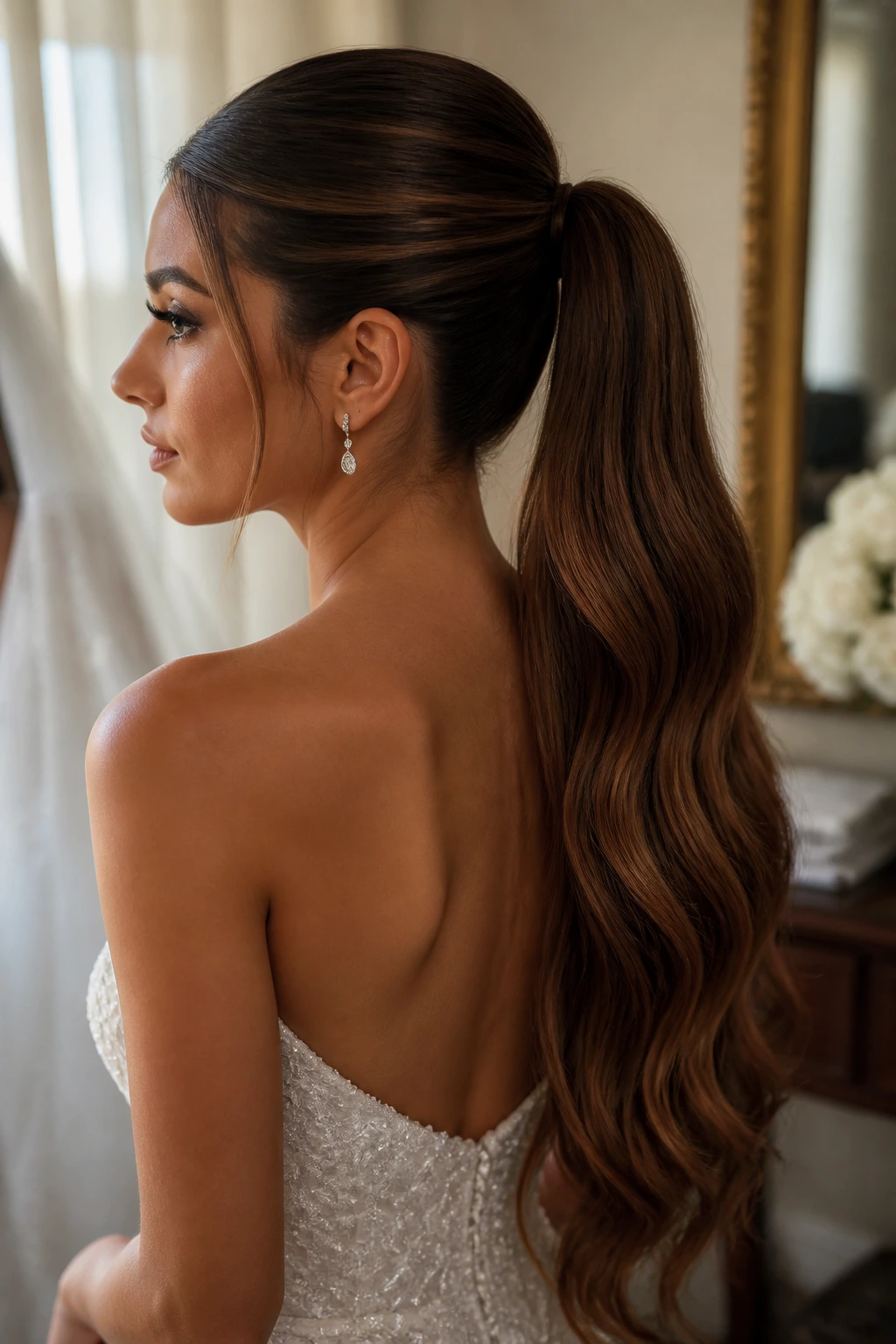
A long extension ponytail is for brides who want the kind of length that makes the tail swing. Extensions can add thickness, length, or both, and a wedding is one of the few times where that extra drama feels completely justified.
The best part is that the base can stay fairly simple while the tail carries the impact. A sleek top with a long, brushed-out tail gives you scale. A wavy extension ponytail gives you movement. A braid through the extension gives you texture. The extension does not have to look fake if the color match is solid and the attachment is hidden well.
I like this option when the natural hair is fine or shoulder length and the dress needs a little more balance below the shoulders. The ponytail can visually fill the space the dress creates, which keeps the whole look from feeling top-heavy.
25. Sculpted Bridal Ponytail With Crown Lift
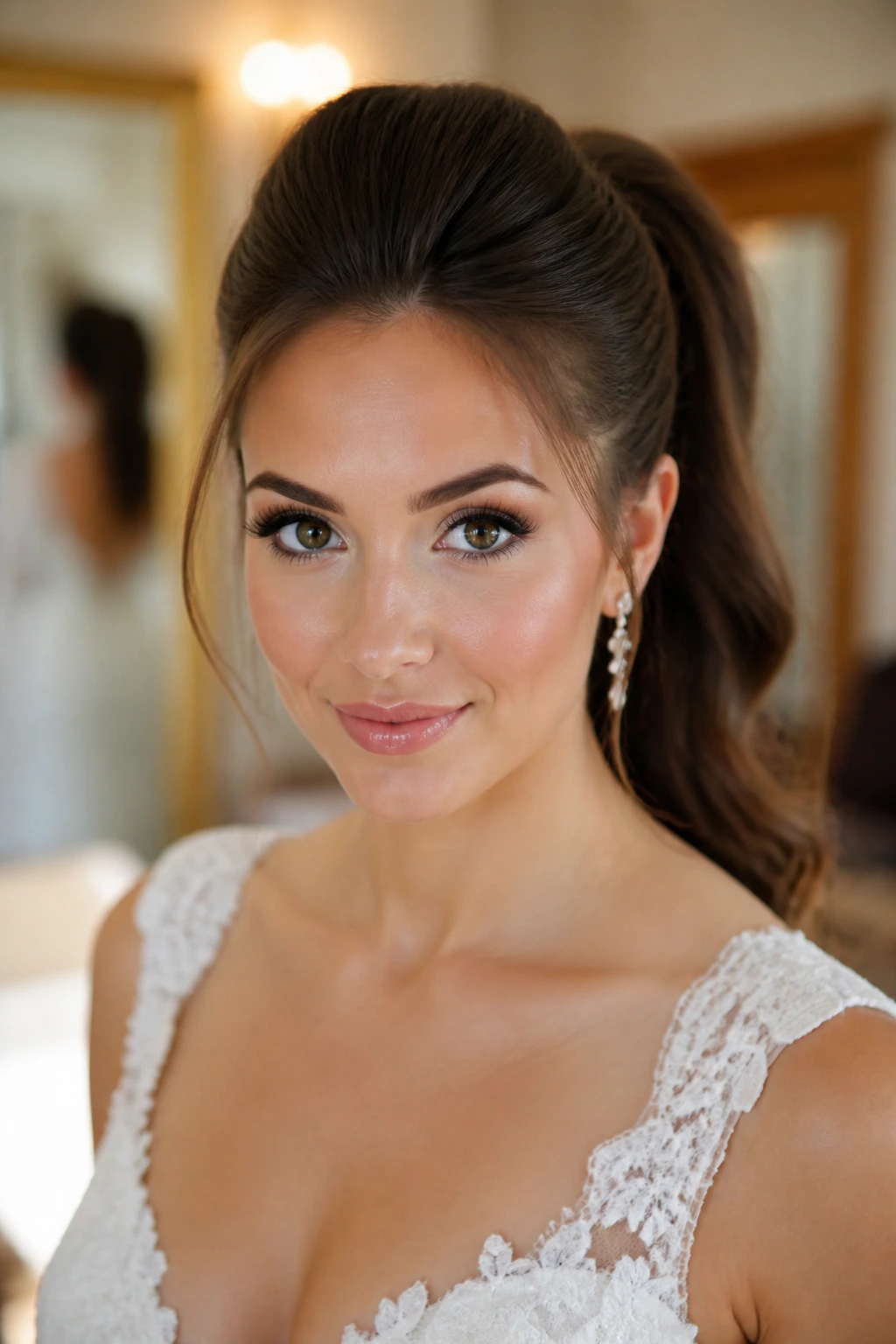
This is the polished one. The sculpted bridal ponytail with crown lift has enough height to feel formal, enough smoothness to feel expensive, and enough shape to stay interesting from the front and side. It is a good ending point for the list because it borrows a bit from several styles and still stands on its own.
The crown is lifted, not puffed. The sides are controlled. The ponytail itself can be sleek, waved, or softly curled, but the architecture at the top is what makes it feel bridal. It’s the style I’d pick when the dress is tailored, the veil is minimal, and the bride wants the hair to look finished without shouting.
A little patience matters here. The crown needs to be set section by section, with hidden pins placed where they actually support the shape instead of just decorating it. Once it’s in place, the look feels balanced — clean at the front, elegant at the back, and steady enough to survive the entire day without collapsing into something sad and flat.
Why Bridal Ponytails Work So Well With Dresses That Need Clean Lines
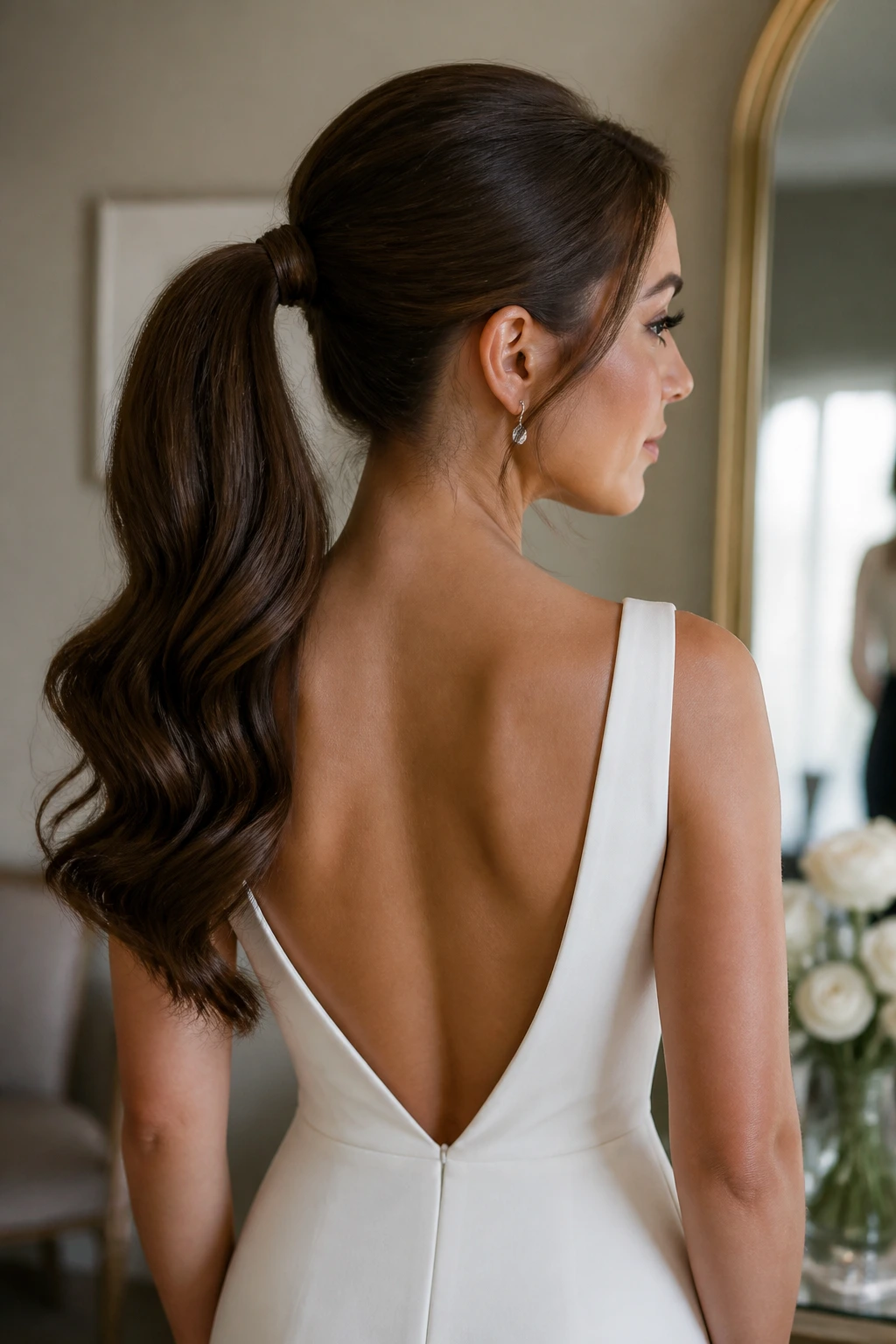
A wedding ponytail has a useful habit that many updos lose: it keeps the hair moving in one direction. That sounds obvious, but it changes how the dress reads. Instead of spreading hair across the shoulders and back, a ponytail creates a clear line, which makes the neckline, straps, and back details easier to see in photos and in person.
It also lets the style breathe. A tight chignon can pin the whole head into place, which is fine for some dresses and terrible for others. A ponytail gives you structure at the base and movement in the tail, so the style feels finished without becoming static. That movement matters when the bride turns, laughs, dances, or leans in for a hug.
There’s a practical side too. Ponytails are easier to adjust than a rigid updo if the veil needs to come off, the earrings need to be swapped, or a few face-framing pieces need a quick touch-up before the reception. The style can be formal, romantic, sharp, or soft, and it usually asks for less maintenance than something sculpted into place with a dozen pins. That’s not a small advantage.
Essential Tools for Bridal Ponytails
-
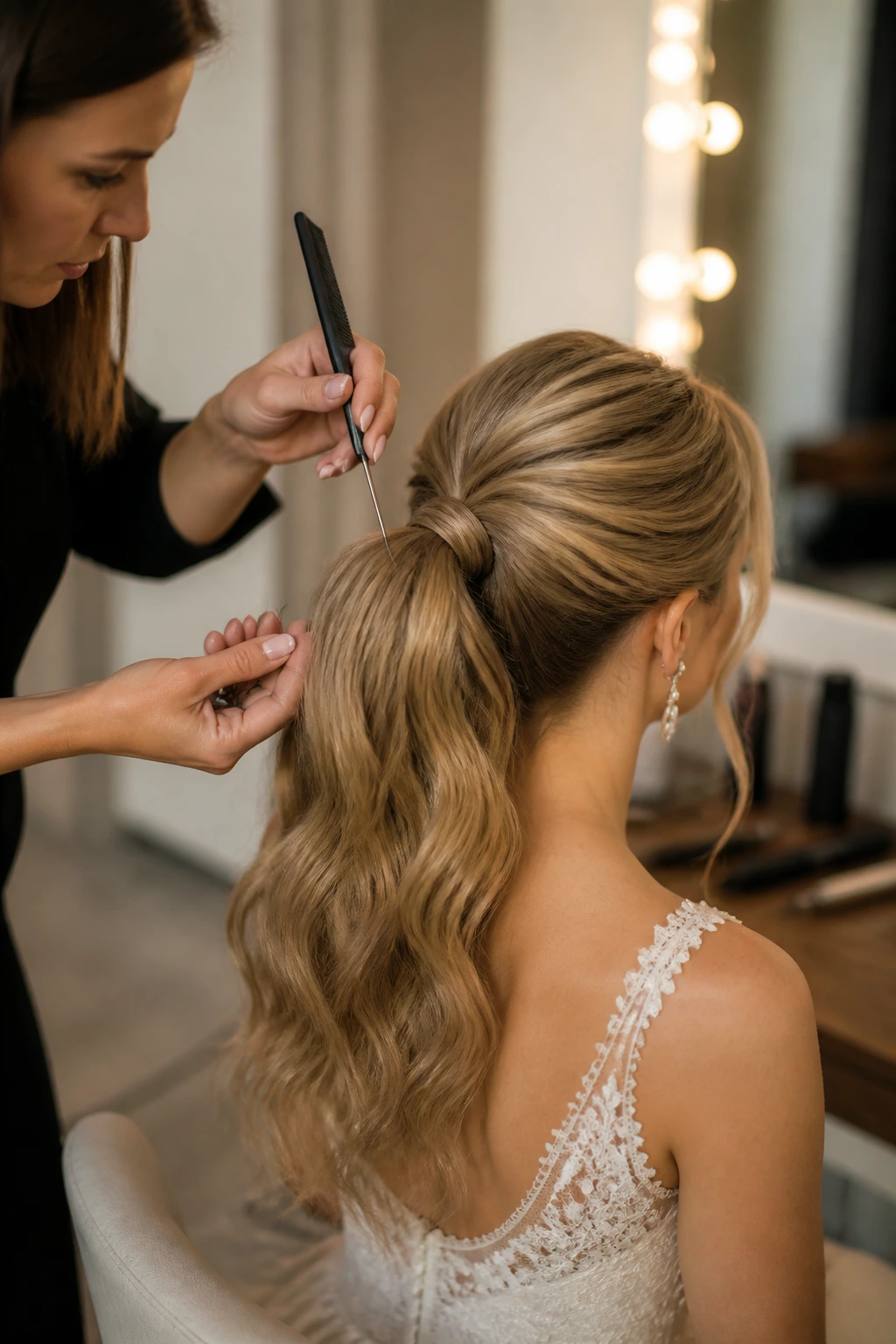
Tail comb: Clean partings and neat sectioning start here; a rat-tail comb is especially useful for wrapping hair around the elastic.
-
Boar-bristle brush: Best for smoothing the crown and polishing the surface without leaving obvious brush marks.
-
Fine and medium clear elastics: Use the fine ones for bubbles and braids, and keep medium elastics for the main ponytail anchor.
-
Bobby pins in two shades: Match them to the root color and the mid-length color if the hair has highlights; it keeps the pins less visible.
-
Texturizing spray: Gives grip to clean hair and helps curls hold in styles that need body.
-
Smoothing cream or serum: Use a small amount on the crown and flyaways; too much and the style goes limp.
-
Curling iron or wand, 1 to 1¼ inch: Handy for waves, curls, and face-framing pieces that need a softer bend.
-
Flat iron: Good for sleek ponytails, polished parts, and touching up the ends of a tail.
-
Strong-hold hairspray: Choose one that sets without leaving the hair crunchy enough to crack when you move it.
-
Teasing comb: Useful for crown lift and fullness under a smooth top layer.
-
Hair pads or small insert pieces: Optional, but they help if you want height without heavy teasing.
-
Veil comb and accessory pins: Keep these on hand during the trial so you know exactly where they sit before the wedding day.
Smart Product and Accessory Tips
The products that matter most are the ones that change grip and finish. A little mousse at the roots or a light texturizing spray can keep clean hair from sliding out of a ponytail by the second hour. That matters more than fancy packaging. If the hair is too silky, the style can collapse before you’ve even gotten through portraits.
For sleek looks, choose a smoothing cream that disappears into the hair instead of sitting on top of it. You want slip, not weight. For textured styles, use a spray that gives hold without making the hair feel sticky. If your hair is fine, too much product will make it look stringy. If it’s thick or coarse, you can usually take a bit more.
Accessories should match the hair’s finish. Pearls look soft on brushed-out waves. Crystals look sharper on sleek bases. Satin ribbons work best when the rest of the look is calm. And if you’re wearing a veil, bring it to the trial. The veil can change where the ponytail sits by a surprising amount, and it’s much easier to adjust that in a stylist’s chair than on a wedding morning with a timeline breathing down your neck.
How to Wear These Styles at the Wedding
Presentation: Place the ponytail so it flatters the neckline instead of hiding it. A low ponytail keeps the back open for gowns with buttons or lace, while a mid or high ponytail gives more lift around the shoulders and reads stronger in profile.
Accessories: Pick one lead accessory and let it do the work. That could be a veil, a ribbon, pearl pins, a comb, or a pair of long earrings. Two or three small details can coexist; five competing details just start talking over each other.
Volume: Match the scale of the ponytail to the dress and your hair density. Fine hair usually needs root lift, a few hidden pieces, or a wave pattern to look full enough. Thick hair can carry a cleaner line and still look substantial.
Event Fit: For outdoor ceremonies, styles with grip and a little texture hold up better than ultra-slick looks. For black-tie or formal indoor settings, polished low ponytails and sculpted high styles usually feel more at home. If there’s dancing, choose a base that’s pinned tight enough to survive movement but not so tight that it feels painful by dessert.
Additional Tips and Personalization
Finish with Shine: A tiny mist of shine spray on the mid-lengths and ends makes a ponytail look cared for, especially in photographs. Keep it off the roots unless you want the crown to go flat by hour two.
Texture Play: If the hair feels too fresh or too slippery, rough it up with a little dry shampoo at the roots and a light texturizing mist through the tail. That grip helps curls stay in shape and keeps braided sections from unraveling.
Accessory Swap: A ribbon can replace a comb, a pearl pin can replace a veil, and a floral accent can replace both if the dress is already doing the heavy visual work. Pick one focal point and commit.
Make-It-Yours: For a softer look, leave a few curved pieces around the face. For a sharper look, tuck everything cleanly behind the ears and keep the base smooth. For curly hair, let the pattern lead. For straight hair, build shape with bend and lift instead of trying to fight the texture into something it isn’t.
Make-Ahead, Trial-Run, and Touch-Up Guidance
A wedding ponytail should never be a surprise. Book or do a trial run long enough before the event that there’s time to correct it, not just admire it. Two to four weeks ahead is a solid window, because it gives you time to test the veil, accessories, and any clip-in pieces without panic. If extensions are part of the plan, try them on the same day as the style so the weight and color match feel right together.
The night before the wedding is usually the sweet spot for prep. Most hair behaves better with a little natural oil in it, so freshly washed hair is not always your friend. Many ponytail styles hold better on hair that was washed the day before, rough-dried, and set with a little product. If the hair is very clean, add dry shampoo at the roots and let it sit for a few minutes before you start sectioning.
For touch-ups, keep a tiny kit nearby: 4 to 6 bobby pins, a mini hairspray, a comb, a few clear elastics, and a spare accessory pin if you’re using one. The crown usually needs the first adjustment, not the tail. If the style starts to loosen, press the surface back into place with your hands, then pin from underneath instead of spraying indiscriminately over the top. That keeps the finish cleaner.
If the ponytail has curls, set them before the wedding and let them cool completely. Heat without cooling gives you soft waves that fall faster. Cool curls hold shape longer. That small pause matters.
Common Mistakes to Avoid
The most common mistake is pulling the ponytail too tight. It sounds neat in theory and feels miserable in practice. The scalp gets sore, the face looks strained, and the style can create a little crease near the temples. Leave a touch of softness at the hairline unless the look is intentionally slicked back.
Another one: using too much product at the root. A little grip is useful. A heavy layer of cream or oil makes the hair slip, which is the last thing you want when the style needs to survive several hours and a lot of motion. If the hair is fine, start with less product than you think you need.
Accessories can backfire too. If the pins are added after the ponytail is already sealed with a wall of hairspray, they won’t sit well. Put in the accessory while the style still has a bit of flexibility, then lock it in after. That small sequence change saves a lot of annoyance.
And don’t ignore the dress. A ponytail that looks gorgeous with a plunging neckline can feel awkward against a high collar or an elaborate back. The hairstyle doesn’t live alone. It has to sit in the same room as the dress and behave itself.
Variations and Adaptations to Try
The Low-Satin Edit: Swap a textured ponytail for a sleek low version with a wrapped base if the dress has beading or a strong silhouette. The cleaner finish keeps the outfit from feeling crowded.
The Curly-Length Version: Keep the ponytail shape but let the tail stay curly from base to ends. This works well for brides whose natural texture should be the star, not the thing being flattened.
The Ribbon Swap: Replace pearls or crystals with a silk ribbon if the wedding leans softer, sweeter, or more romantic. It changes the mood fast and costs very little visual effort.
The Extension Build: If the natural hair is short or fine, build the style around clip-ins or a ponytail extension for extra body. The trick is matching the color at the ends, not just the roots.
The Outdoor Windproof Version: Choose a lower anchor, a little more texture, and fewer loose face-framing pieces if the ceremony is outside. It looks intentional and holds better when the air moves.
The Minimalist Trim: Strip the style back to a clean part, smooth crown, and one accessory if the dress already has a lot happening. That edit often makes the whole look stronger.
Frequently Asked Questions
Can a ponytail look formal enough for a wedding?
Yes, if the base is clean and the finish has intention. Wrapped elastics, polished waves, pearl pins, and a well-placed veil can push a ponytail far past casual.
What’s the best ponytail for fine hair?
A low or mid ponytail with crown lift and a little texture spray usually works best. Add hidden padding or a few clip-in pieces if you want the tail to look fuller in photos.
Will a ponytail work with a veil?
Absolutely, as long as the veil comb and the ponytail sit in separate spots. A low anchor below the veil comb is usually the easiest setup.
Should I wash my hair on the wedding morning?
Usually, no. Hair that was washed the day before tends to have better grip, especially for smooth or braided ponytails. If your hair gets greasy quickly, use a little dry shampoo at the roots.
How do I keep the ponytail from falling flat?
Build support at the crown, not just at the base. Light teasing, a small insert, and a flexible hairspray do more than piling on extra product.
Can curly hair wear a wedding ponytail without losing definition?
Yes. The trick is to secure the base without disturbing the curl pattern and to use a curl cream or light gel on the tail. Don’t brush the curls out unless you want a softer, fuller shape.
What if my hair is too short for a full ponytail?
A half-up ponytail, a tucked-under hybrid, or a styled extension piece can solve that fast. A good stylist can also hide shorter layers with pins and texture so the style still looks deliberate.
How long should a bridal ponytail take to style?
Plan on 30 to 60 minutes for a polished version, longer if extensions, braids, or veil placement are involved. A trial helps the actual day move much faster because the placement is already decided.
The Style That Stays Put
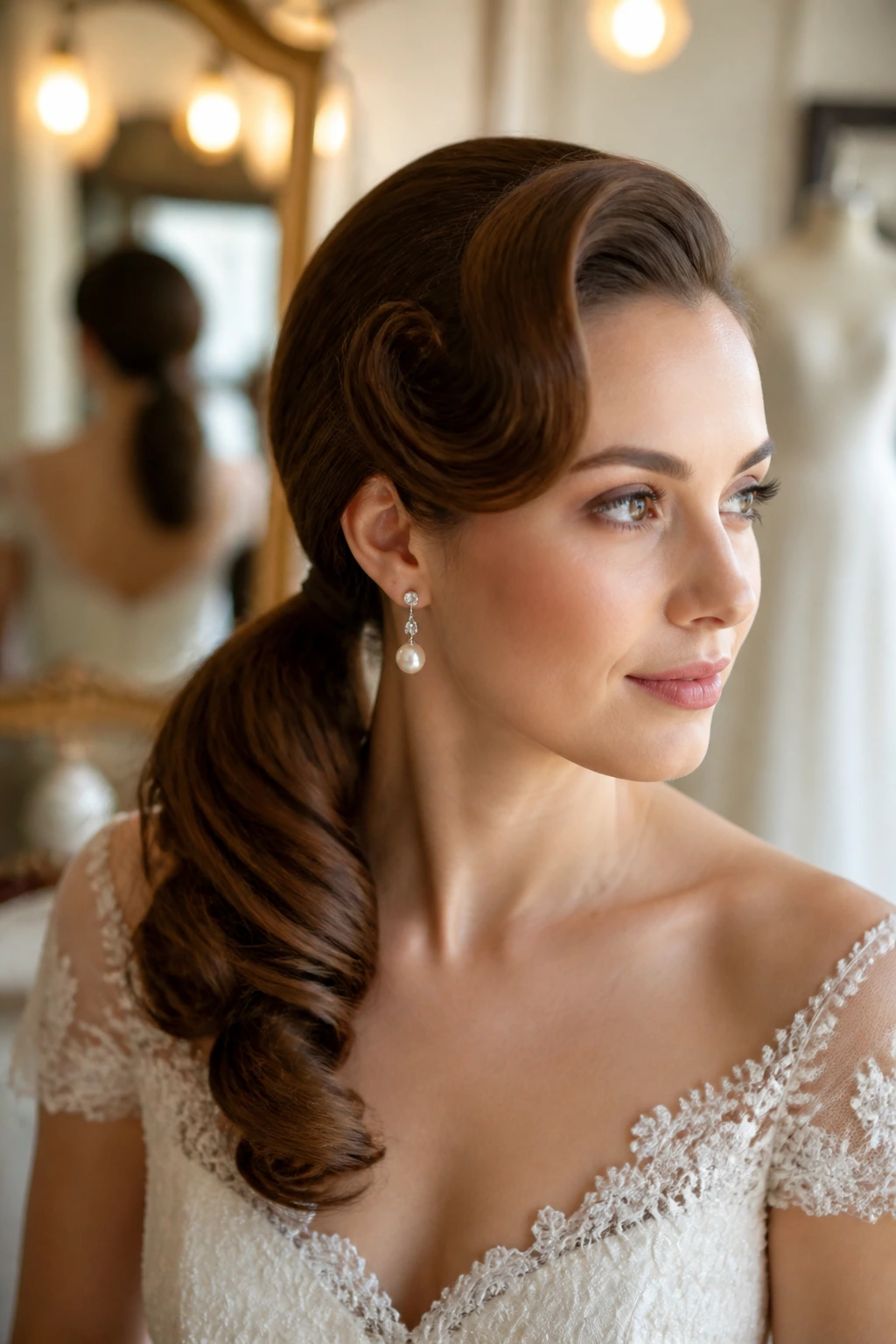
A bridal ponytail works because it does two jobs at once. It gives the hair shape, and it gives the dress room to breathe. That’s a useful combination, especially when the rest of the look is already carrying lace, beadwork, satin, or a veil that needs somewhere to land.
The smartest version is the one that matches the dress and the hair you actually have, not the one that looks good only in a static photo. If the base is secure, the finish is clean, and the accessories are chosen with a little restraint, a ponytail can feel more elegant than a fussy updo. It just moves better.
Try the one that fits the neckline first. The right shape usually becomes obvious the moment the hair goes back.
