



Long shaggy curly haircuts for older women have a particular kind of magic: they keep the length, but they stop the hair from sitting there like a heavy curtain. Curls need room. Once the ends get too blunt or the crown gets too flat, the whole shape can feel boxy, dry, or strangely older than the face wearing it.
A good shag changes that almost immediately. The right layers let silver spirals spring, let salt-and-pepper waves show their texture, and let thick curls stop ballooning at the bottom. I’ve always liked shags that are cut with a little restraint — not chopped to bits, not thinned to death, just layered with enough thought that the hair can move on its own.
What matters most is balance. Too few layers and the curl mass gets heavy. Too many, and the shape goes frizzy or hollow. The sweet spot is a long, shaggy structure that works with shrinkage, gives the face some softness, and still leaves enough length to tuck behind an ear, clip up, or wear loose without fuss. That’s where these 27 cuts start to earn their keep.
Why These Shaggy Curl Cuts Keep Showing Up
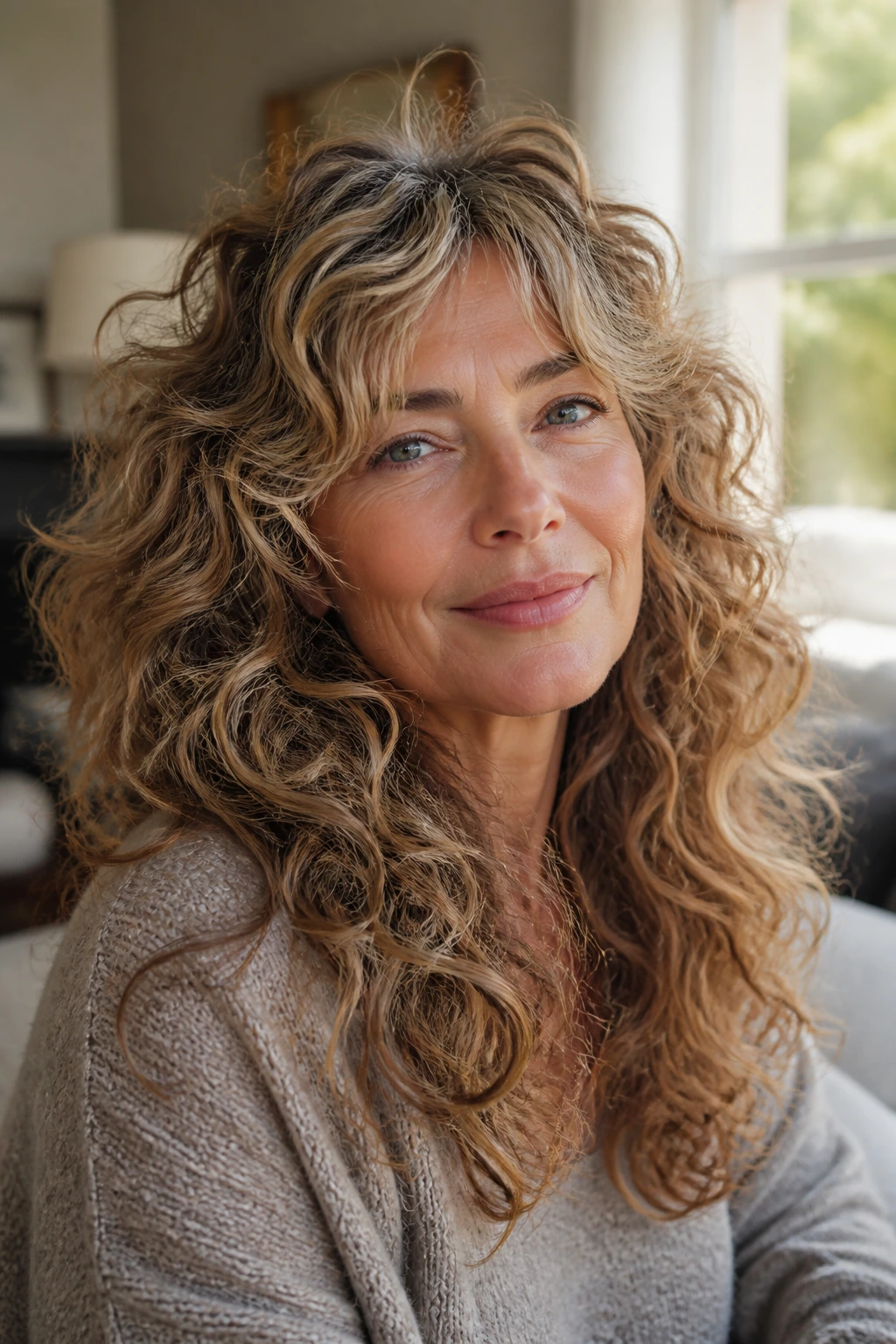
- They remove bulk without stealing length: Long layers let curls breathe, so the ends don’t sit in one heavy triangle.
- They suit changing texture: Coarser curls, finer curls, gray curls, and mixed curl patterns all behave better when the shape has movement built in.
- They soften the face on purpose: Cheekbone and jawline layers do a lot of work here, especially when hair has lost some density around the temples.
- They can be styled fast: A little curl cream, a diffuser, and five minutes of scrunching often does more than a full blowout.
- They grow out well: Long shaggy curly haircuts usually keep looking intentional for weeks, not days, because the layers are already part of the shape.
- They make silver strands look lively: Movement keeps gray and white curls from reading flat, which is a small thing until you see the difference in the mirror.
1. Soft Shoulder-Length Shag With Curly Curtain Bangs
This is the shag I reach for when someone wants movement without drama. The length sits around the shoulders, where curls can bounce but still tuck into a coat collar or clip back cleanly. Curtain bangs soften the front without chopping the face open too sharply, and that matters when the hair around the temples has gotten finer.
The best version keeps the crown lightly layered and the perimeter loose. You want the front to fall away from the face, then swing back in when the curls dry, almost like a frame that knows when to step back. It works especially well on medium curls that need shape but not a full volume explosion.
A center part keeps the curtain effect clear. A soft side part makes the cut look a little more casual. Either way, the bangs should land at cheekbone level when dry, not at the brows when wet. Curl shrinkage is the whole story here, and anyone who ignores it ends up with bangs that feel too short by day two.
2. Rounded Silver Shag With Feathered Ends
Silver curls love a rounded shag. The color itself already brings attention to the texture, so the cut should support that with soft, tapered ends instead of a blunt shelf. When the perimeter is feathered, the whole style reads lighter and cleaner, even if the hair is thick.
Where This Shape Helps Most
It’s a good choice for women whose hair has gone gray in patches, because the mixed tones pick up the layers in a very natural way. The feathering around the bottom keeps the outline from looking blocky, which is a common problem with longer gray curls that haven’t been cut in a while.
A good stylist will leave enough weight in the middle and remove it mostly through the lower thirds of the hair. That keeps the crown from puffing out while the ends still move. It’s the sort of cut that looks polished in daylight and a little softer at dinner — not stiff, not overworked.
- Best for: Thick or medium-density silver curls
- Ask for: Rounded shape, soft face-framing layers, tapered bottom
- Avoid: Heavy texturizing near the crown; it can make gray curls look frayed
3. Side-Part Curly Shag With a Long Swooping Fringe
A deep side part changes everything. It gives the face a diagonal line, and diagonals are your friend when curls have softened around the jaw or cheek area. The long fringe can sweep across the forehead and graze the brow, then drift into the rest of the layers instead of sitting there like a separate piece.
The charm of this cut is that it looks deliberately shaped even when it’s not perfectly styled. You can let the fringe fall a little unevenly and still look finished. That’s handy on days when you dry your hair fast and leave the house with only a little product and a lot of hope.
This cut works best when the front is slightly shorter than the back, but not so much that the profile turns into a wedge. The goal is a long line that bends, not a short one that spikes. If your hair tends to split at the part, a side-part shag is a clean way to work with that instead of fighting it.
4. Razor-Textured Shag for Thick Ringlets
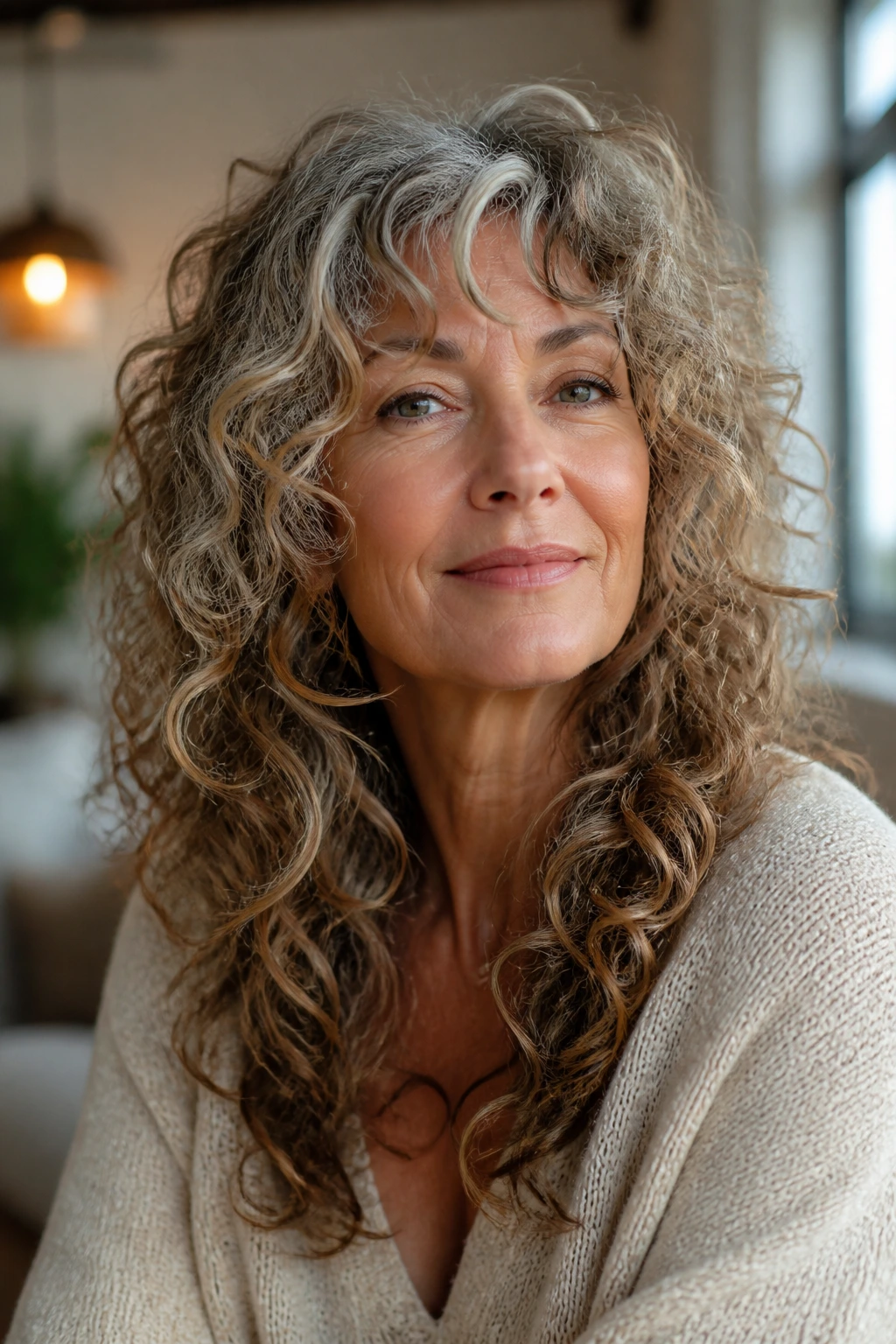
Thick ringlets need room to expand. They also need weight removed in the right places, which is why razor texture can help here — when it’s done by someone who actually knows curls. The razor should not shred the hair. It should soften the edge so the curls fall into one another rather than forming a dense shelf.
The shape is especially useful if your ringlets gather into a wide triangle by the end of the day. A long shag can keep the top and middle layers light while leaving enough length at the bottom to anchor the whole thing. That balance is the part people miss when they try to thin thick curls with scissors alone.
What to Tell the Stylist
Tell them you want removed bulk, not removed density. Those are not the same thing. You still want the hair to feel full, just less stacked.
Ask for long interior layers and a softer perimeter around the back. If the stylist talks about thinning shears everywhere, I’d be cautious. Too much thinning near the ends can make thick ringlets frizz out instead of settling.
5. Airy Shag for Fine Curls That Still Need Body
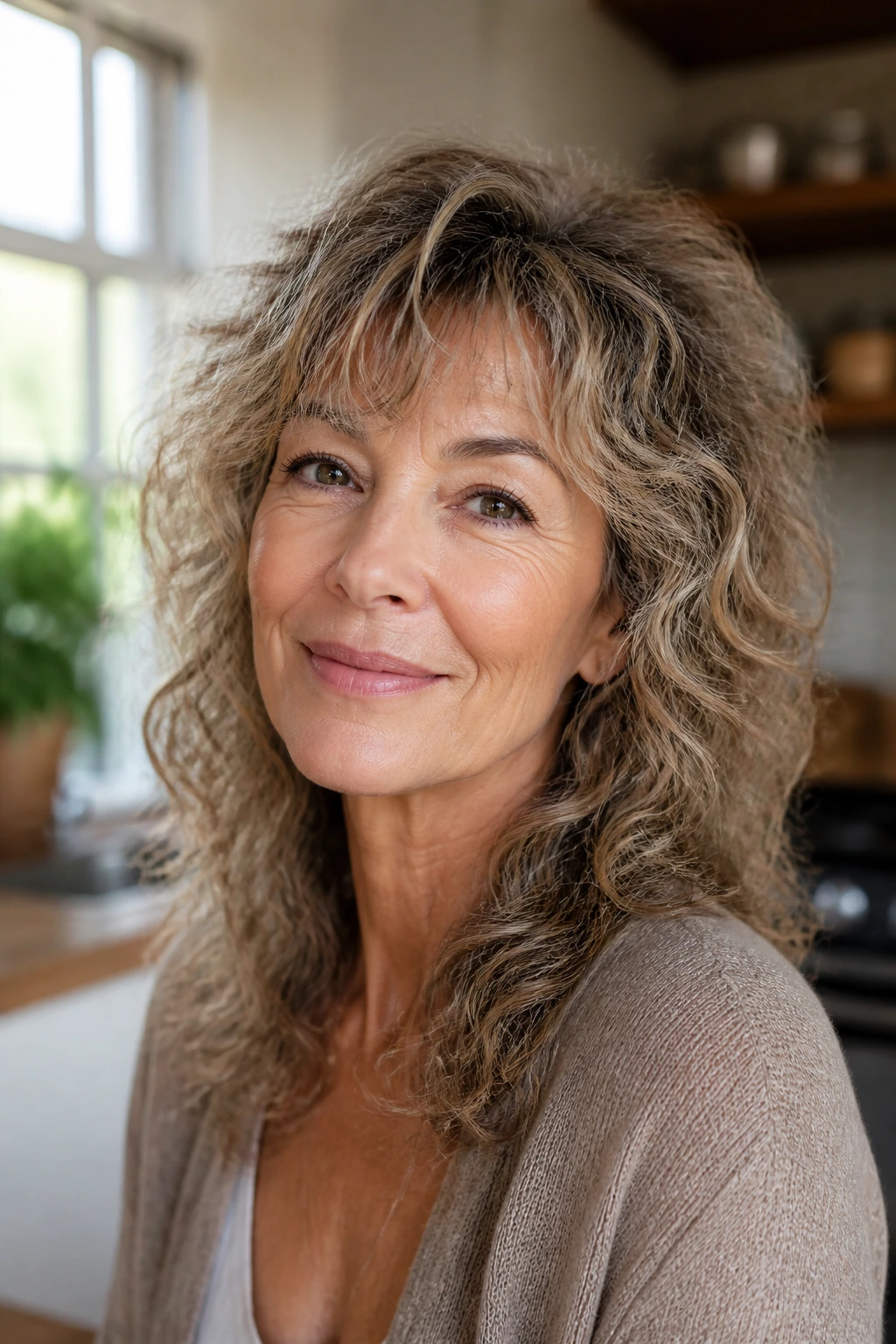
Fine curly hair can look sleepy in a long one-length cut. The bottom hangs, the top lies flat, and the whole thing loses personality fast. A shag gives that hair a better job to do: it redistributes the weight, lifts the crown, and lets the curl pattern show up instead of getting buried.
The trick is not to over-layer it. Fine curls need air, yes, but they also need enough material to hold shape. Too many layers and the ends go see-through, especially once the hair dries and shrinks. A skilled cut keeps the layers long and soft, with the shortest pieces placed where they create lift rather than holes.
This is one of the best curly shag haircuts for older women whose hair has thinned a little at the temples or around the part. The shape can fake density without looking puffy. A lightweight mousse at the roots and a curl cream through the mids usually does the trick.
6. Collarbone-Length Shag With a U-Shaped Back
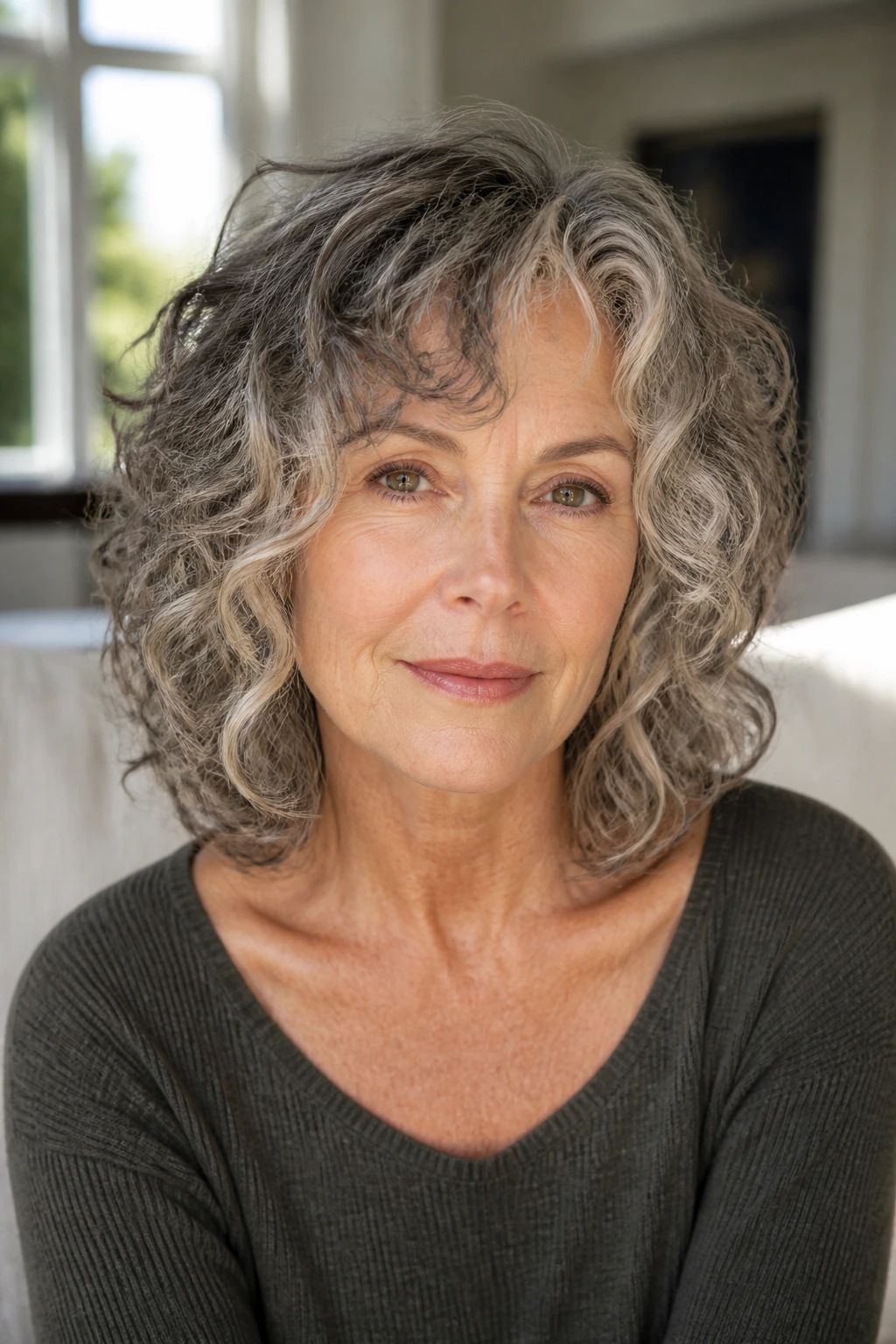
There’s a reason this shape keeps hanging around: it preserves length where people want to keep it, then sneaks movement in from the sides. A U-shaped back lets the center fall a little longer than the corners, which gives curly hair a softer silhouette than a straight across hemline.
The collarbone length matters because it gives curls a place to land. Too short, and the volume can get wild. Too long, and the layers disappear under the weight. Around the collarbone, the cut has enough swing to move, but enough heft to stay elegant when air-dried.
If your curls are mixed — looser in the back, tighter in front, or one side more springy than the other — this shape is forgiving. It doesn’t ask for perfect symmetry. It just asks for a clean perimeter and long internal layers that keep the sides from ballooning.
7. Big-Crown Shag for Women Who Want Lift Up Top
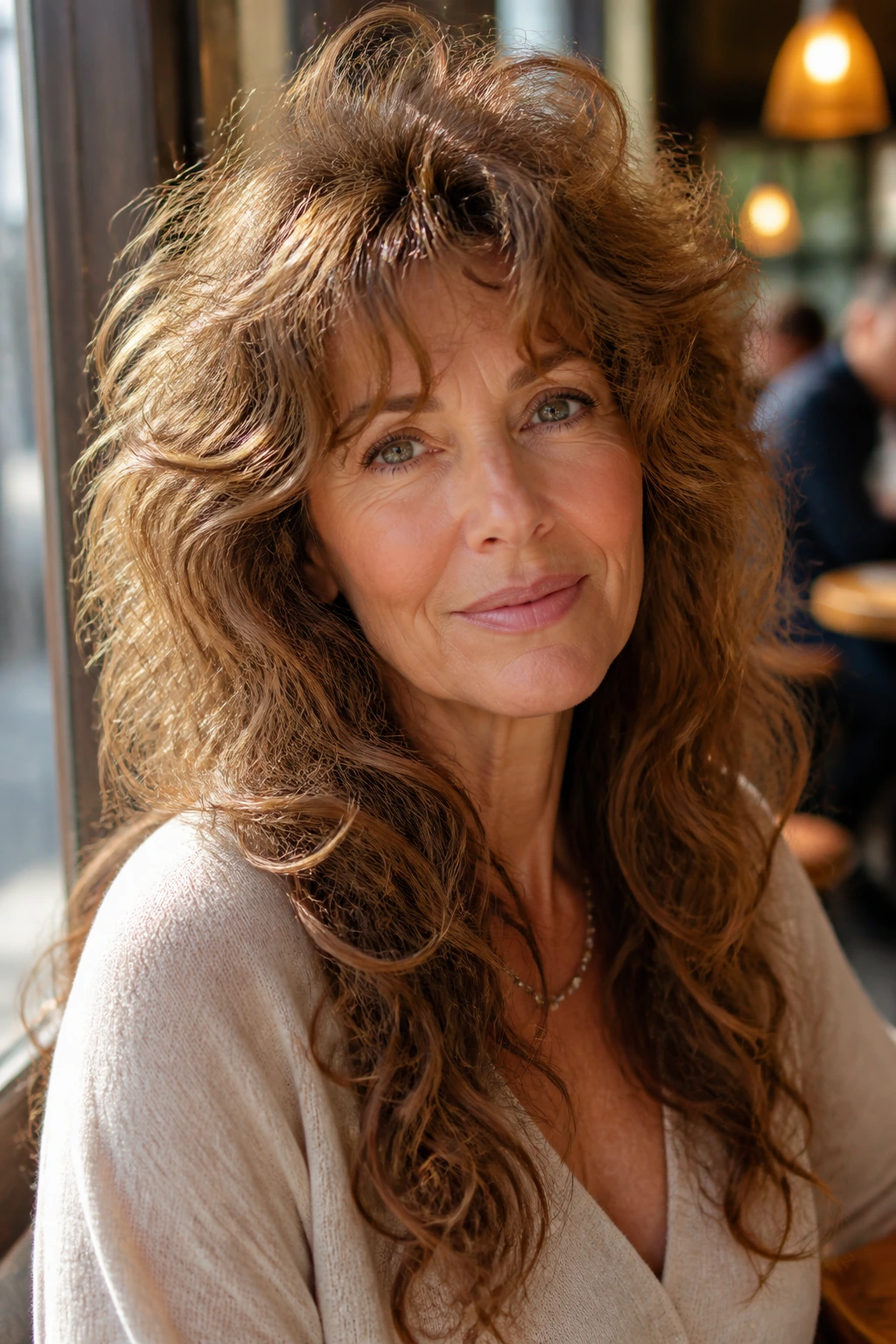
Some curly shags are about softness. This one is about height. The crown gets the most attention here, with layers placed to encourage lift at the roots and a bit of buoyancy through the top third of the hair. If your hair tends to fall flat at the scalp but gets big at the ends, this cut can rebalance the whole head.
It works best on medium to thick curls that can hold shape. The crown layers should be short enough to create volume, but not so short that they stand away from the head like a halo on a humid day. The rest of the length stays long, which keeps the cut from turning into a short curly puff.
A diffuser helps, but only if you keep the airflow low and direct it upward from underneath. Rough drying will wreck the shape. So will piling all the hair on top of the head while it’s soaking wet. Lift, yes. Chaos, no.
8. Salt-and-Pepper Shag With Cheekbone Layers
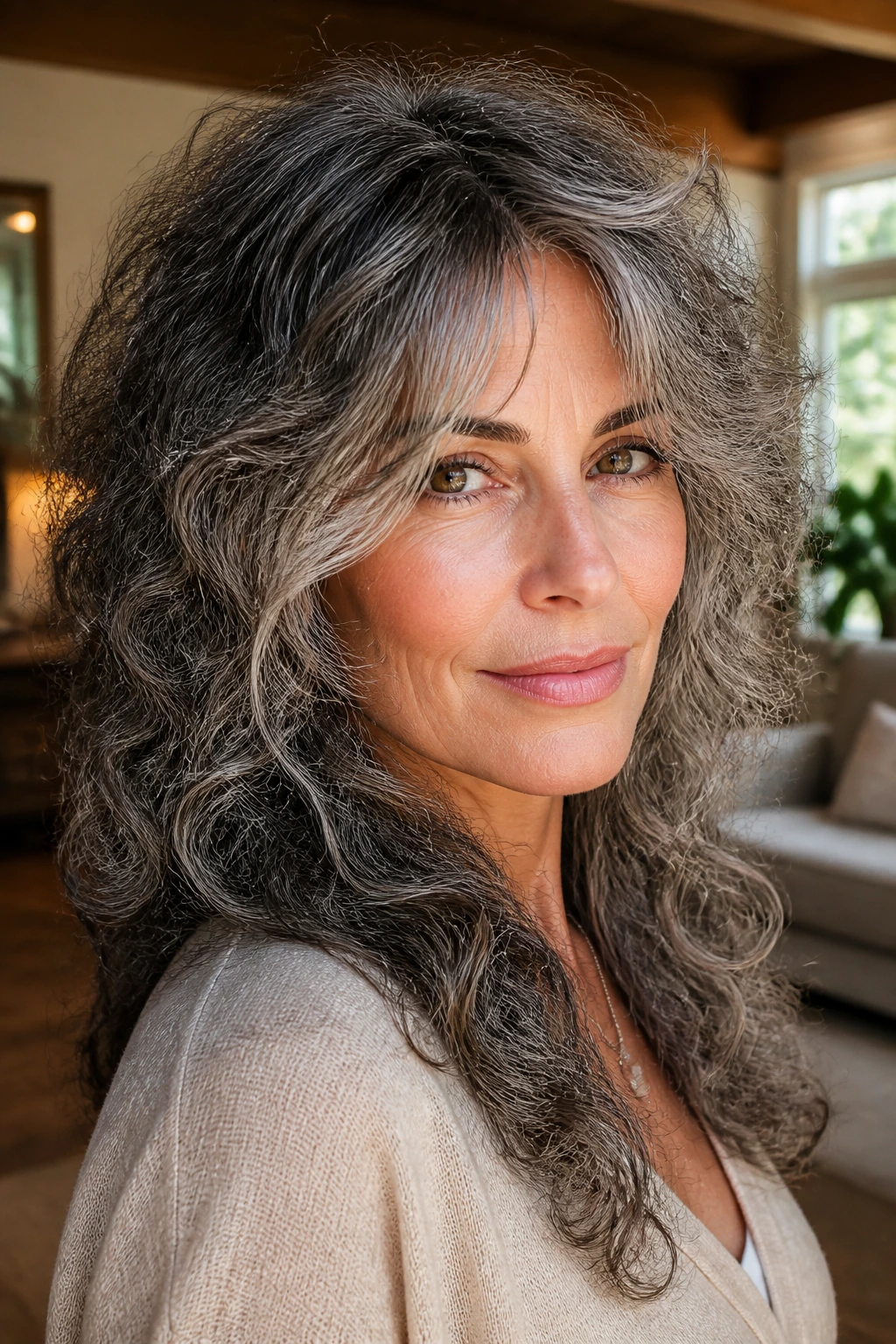
Salt-and-pepper curls can look sharp in a shag because the layers catch both the dark and silver strands in motion. Instead of hiding the mix, the cut gives it a better outline. Cheekbone layers are the important part here; they draw the eye upward and keep the face from disappearing under the length.
I like this cut when a woman wants her hair to look deliberate without looking fussed over. The layers should open around the face, then taper down slowly through the lengths. That keeps the transition from gray to darker strands from reading patchy. It becomes texture, not mismatch.
A little side-swept volume helps here too. So does a soft bend through the front. You don’t need every curl defined to the last strand. You need the pattern to look alive, and that comes from space between the layers.
9. Long Shag With Spiral Bangs
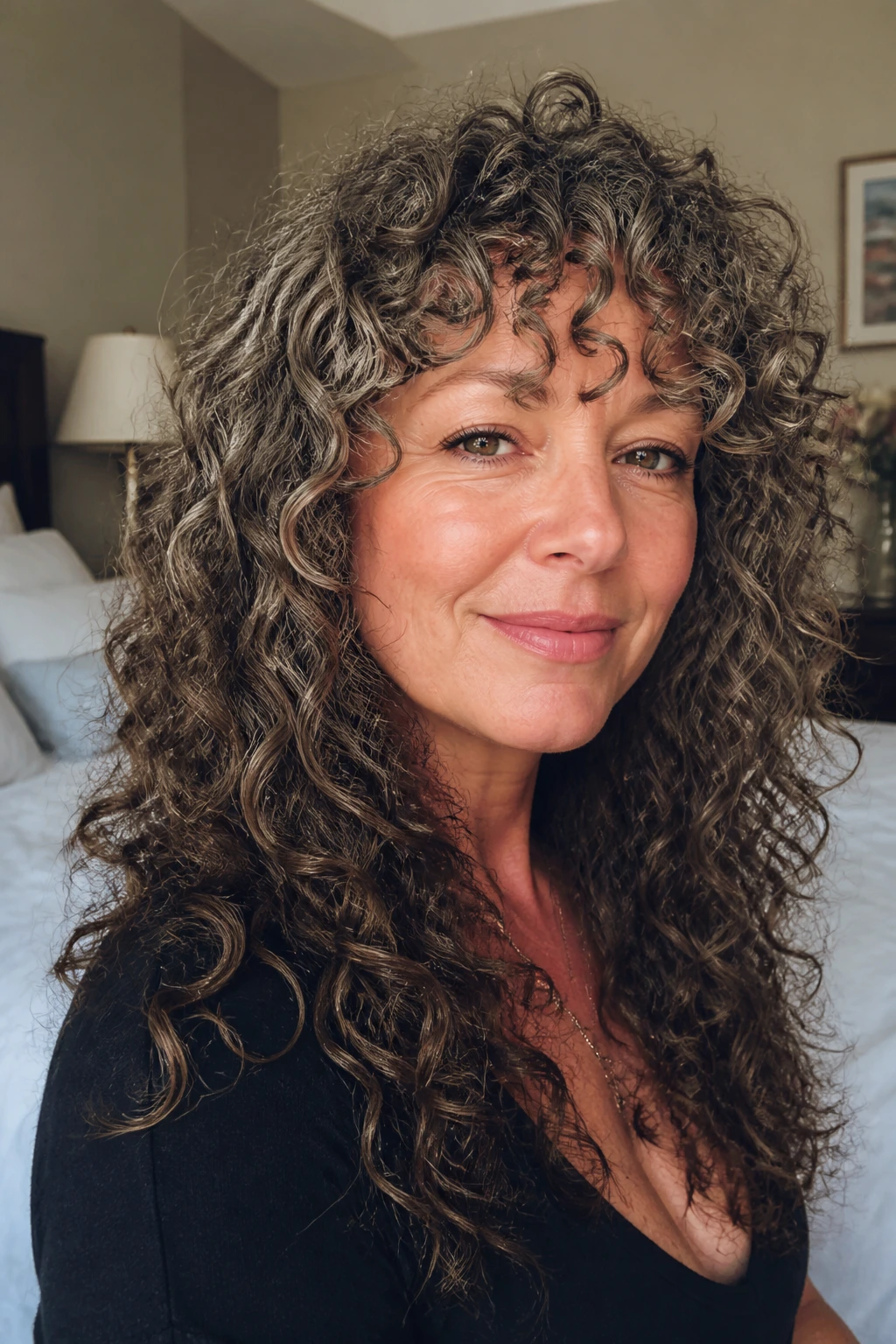
Spiral bangs are not for the faint of heart, and that’s part of the appeal. When they’re cut correctly, they look like a little curl party at the front of the face, then fold into the rest of the cut instead of sitting there like a separate bang section. The key is length — these bangs should be long enough to shrink and settle, not hover above the brow like a mistake.
This style flatters women who like seeing their curl pattern in the front instead of always pushing hair away from the face. It also helps if the forehead feels a little exposed with traditional curtain bangs. Spiral bangs give you texture without the bluntness.
How to Wear Them
Keep the bangs hydrated and separate them while drying. If they dry together in one clump, they lose the curl-by-curl effect and turn into a fuzzy curtain.
A tiny dab of gel at the front can help them set. Just a tiny dab. Too much product on a bang section and you’ll spend the afternoon breaking the cast and complaining about it.
10. Low-Maintenance Wash-and-Go Shag

This is the cut for people who would rather let their hair do its own thing than stand in front of a mirror with six tools. The layers are long enough to look intentional after a simple wash-and-go routine, and the front pieces are shaped so they don’t require a full styling session to behave.
What makes it work is restraint. The haircut should not be over-thinned or carved up into tiny pieces. It needs enough length that the curls can fall, clump, and settle on their own. A little leave-in conditioner, a curl cream, and a microfiber towel are often enough.
I’d call this one practical, not plain. It can look relaxed, yes, but it still has shape at the cheeks and movement through the sides. If your hair gets frizzy when you overhandle it, this cut lets you stop touching it sooner.
11. Glasses-Friendly Shag With Temple-Skimming Layers

Glasses change the game, and most haircut photos ignore that. Temple-skimming layers solve a real problem: hair that falls directly onto the frames and makes the front feel crowded. A shag can work beautifully with glasses when the layers are lifted just enough at the sides to clear the temples and cheekbones.
The best version has a slightly narrower front, not in a pinched way, just in a way that keeps the hair from fighting the frames. The bangs, if there are any, should sit above or beside the glasses line rather than landing right on top of it. That tiny difference saves a lot of annoying adjusting.
It helps if the side pieces are a touch longer than the face frame at the front. They can drape behind the frames instead of over them. Clean, easy, done.
12. Polished Curly Shag for Dressier Days
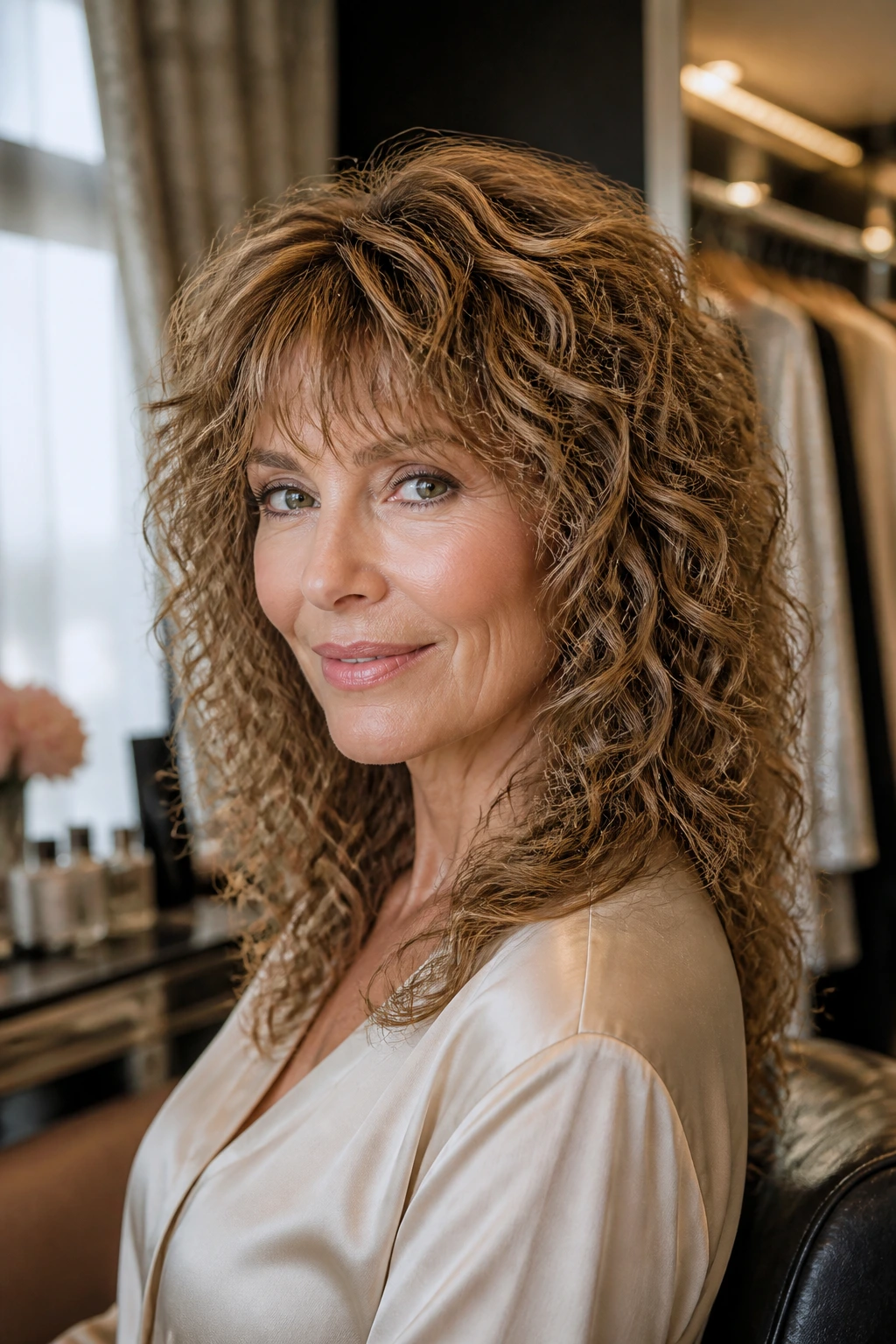
Not every shag has to look windswept. A polished version keeps the same layered structure but asks for a smoother finish, a little more definition, and a stronger perimeter line. This is the shag you can wear with a silk blouse or a structured jacket and not feel underdone.
The cut should still be shaggy, just not ragged. Long layers, soft fringe, and a bit of rounded shaping around the face give it movement without the wildness. The styling is where the polish happens: a diffuser, a light serum on the ends, and a careful scrunching out of the cast once the curls are dry.
This version is especially kind to women whose curls have changed from tight to loose over the years. It doesn’t force the hair into a younger-looking texture. It just cleans up the silhouette so the curls read elegant instead of messy.
13. Coarse-Curl Shag With Internal Weight Removal
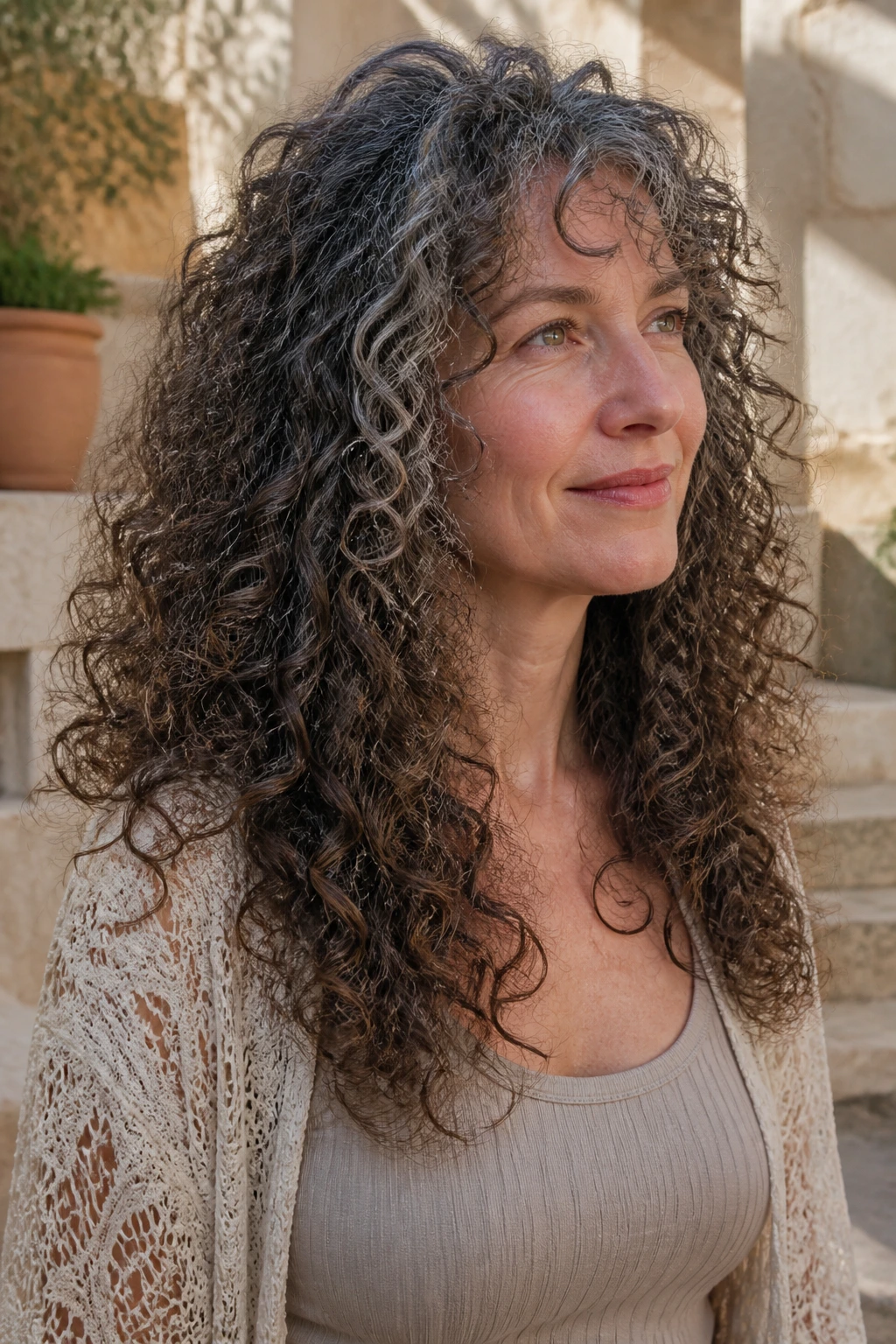
Coarse curls have a lot going on. They can be dry, springy, and large in diameter, which means a long haircut can turn boxy fast if the weight isn’t handled from the inside. Internal layers help here. They create space without stripping the outside line to pieces.
The goal is to keep the outer shape intact and remove bulk where the eye can’t see it immediately. That keeps the cut from going puffy at the sides. It also makes the hair easier to dry, because the water isn’t trapped in one dense sheet.
A coarse-curl shag often needs richer products than fine curls do. I’d look for a cream with slip, not a sticky lotion that sits on the surface. The hair should feel coated enough to soften, but not so loaded that the curls stop springing.
14. Loose-Wave Shag With Feathered Perimeter
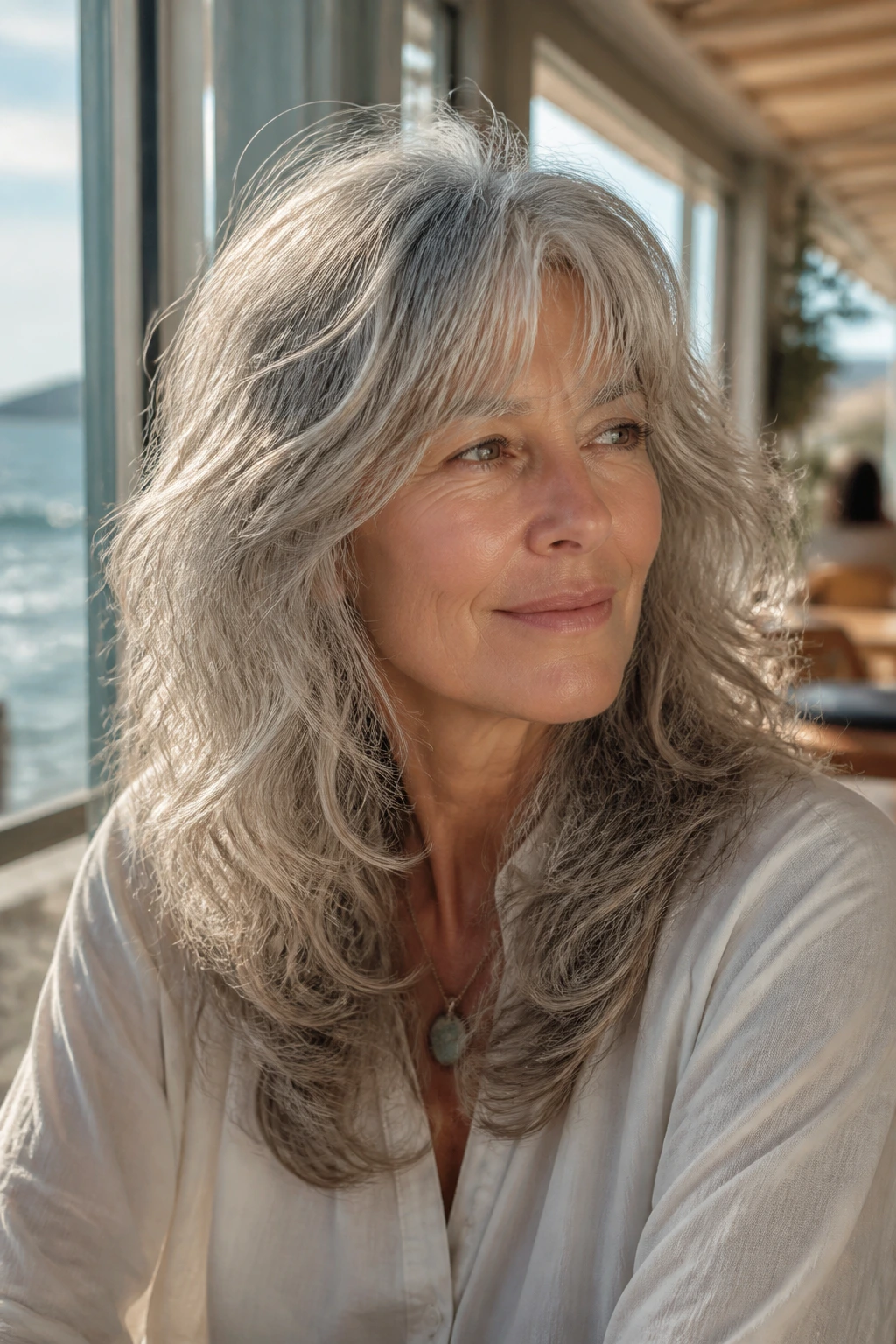
Loose waves can get bored in a long one-length cut. They need some break in the outline, some movement at the edges, and a little face framing to keep the style from looking like a single curtain of hair. A feathered perimeter does that job.
This cut is softer than a curly shag with deep layers. The layers are there, but they’re spread out so the wave pattern can stay loose and airy. If your hair bends rather than coils, that spacing matters. Too much layering and the wave loses its rhythm.
The feathering at the ends also helps when the hair is graying and the texture is changing. It keeps the outline from feeling heavy or stale. The style looks lived in, not lazy. There’s a difference.
15. Soft Curly Mullet-Inspired Shag
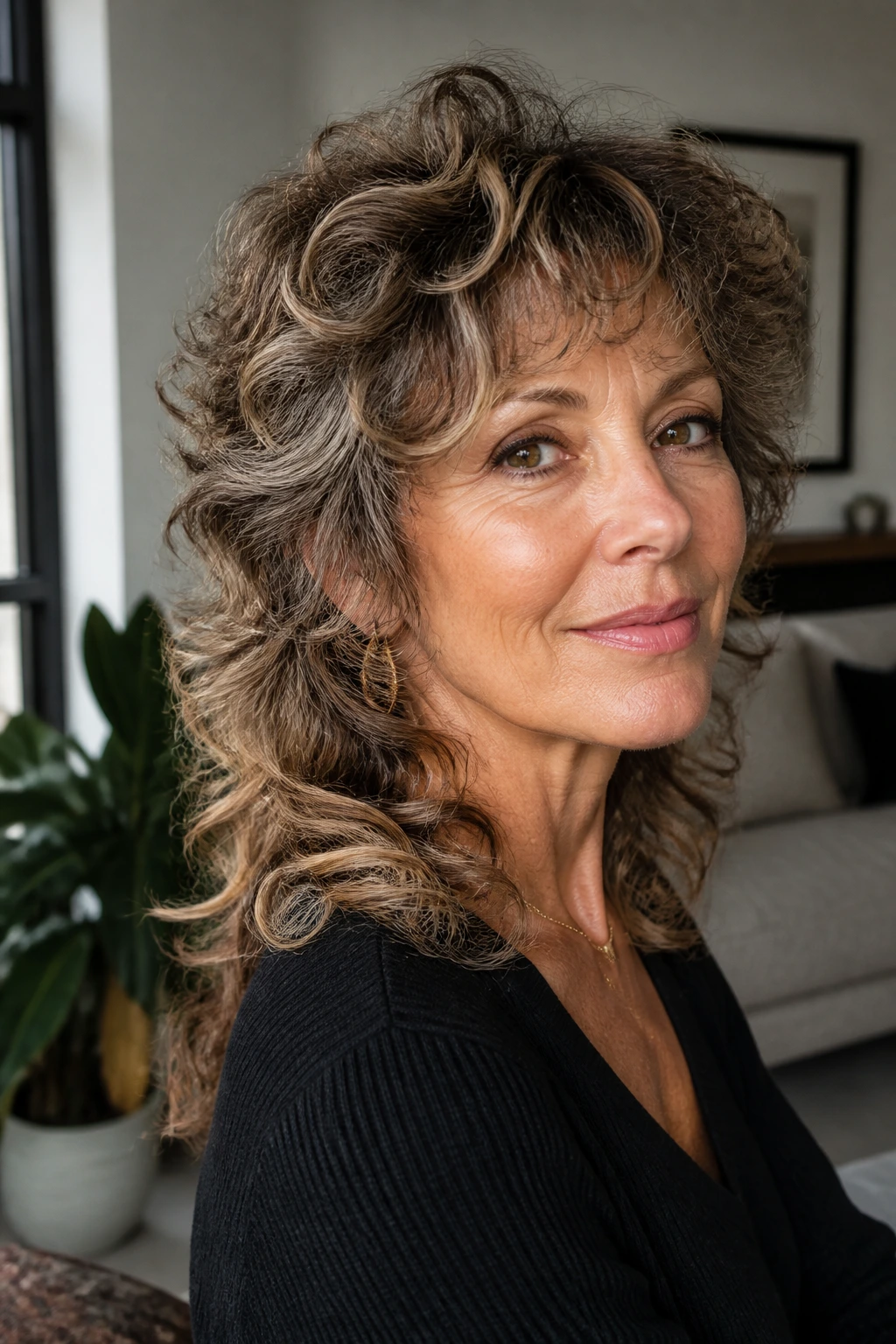
Yes, the mullet word makes people nervous. Fair enough. But a softened shaggy version can be surprisingly flattering, especially for older women who want length in back and shape around the face without a stiff outline. The front stays layered and airy, while the back keeps more of the length.
The trick is moderation. You do not want a hard disconnect. You want a gradual shift: shorter face framing, a little more lift through the crown, and longer layers in the back that keep the curl mass from collapsing. Done right, it feels edgy in a controlled way.
I like this cut on someone with a confident curl pattern and a bit of natural swagger. It’s not quiet. It has presence. If you like your hair to move when you turn your head, this shape delivers that with less effort than a perfectly sculpted blowout.
16. Face-Lifting Shag With Jawline Layers
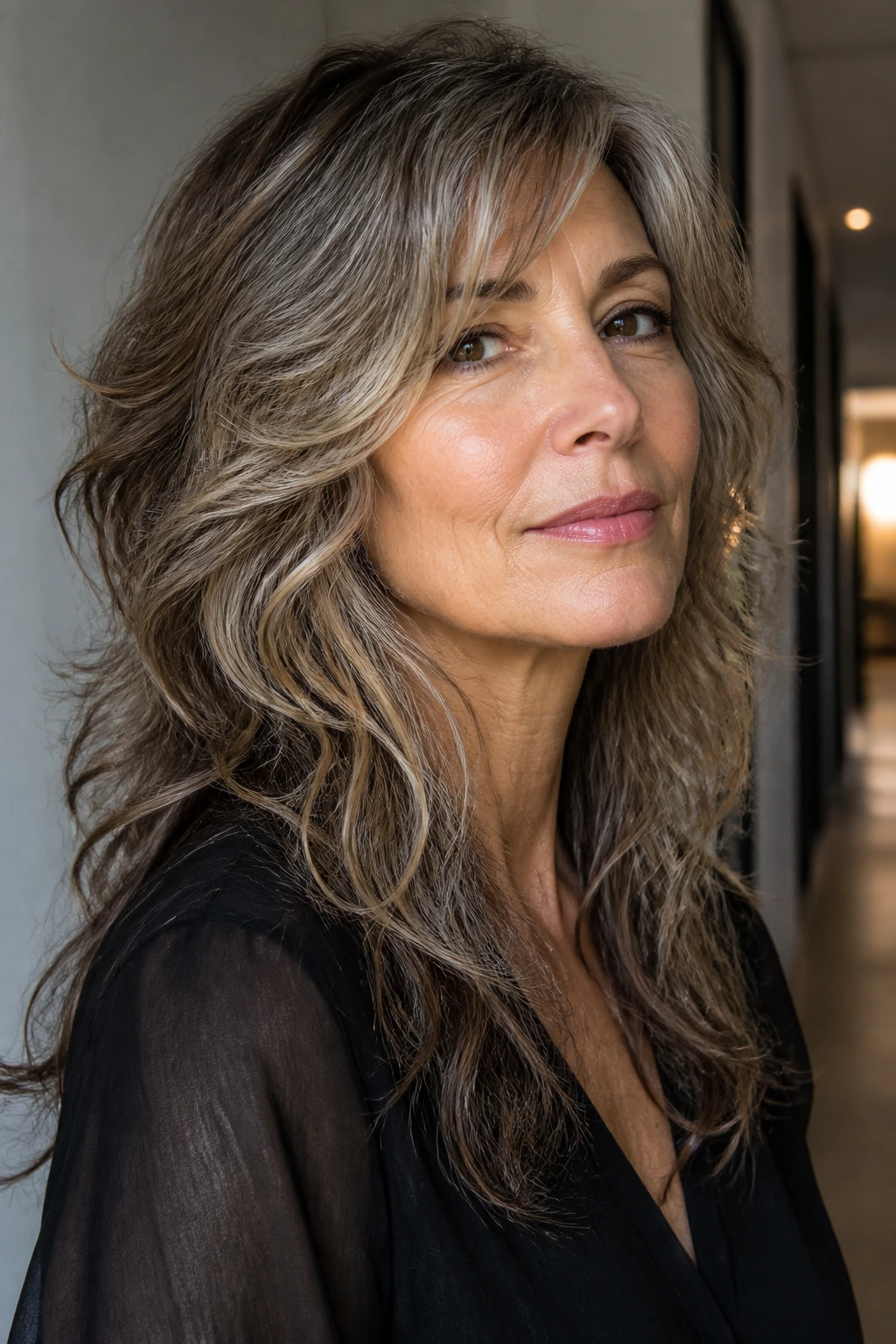
Some haircuts hide the jawline. This one opens it. The key is placing the shortest face-framing layers just under the cheekbone and through the jaw, where they can turn inward and soften the lower half of the face. That’s useful if the hair has started to feel heavy around the sides.
The haircut works best with curls that are medium to loose, though tighter curls can wear it too if the layers are long enough. You want movement near the face, not a wall of hair that sits forward. The rest of the length should stay relaxed so the front pieces don’t feel disconnected.
This is one of those styles that looks better with a bit of asymmetry. One side can fall a little more forward than the other. That small imperfection keeps the cut from feeling overdrawn.
17. Center-Part Shag for Balanced Curls
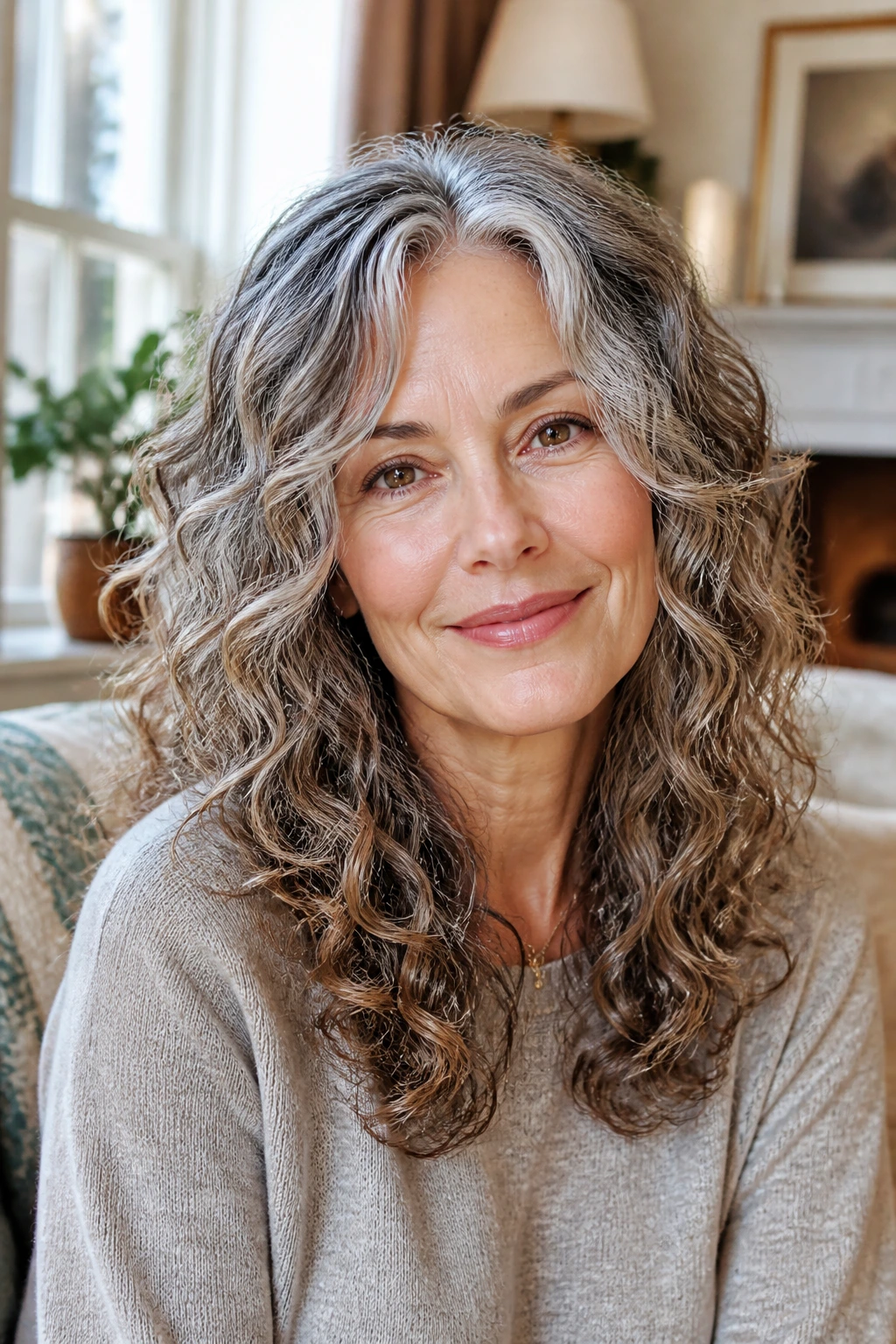
A center part can be unforgiving in the wrong haircut. In a shag, though, it gives the curls a neat spine. The two sides can mirror each other without becoming flat, and the layers can fall away from the face in a way that feels clean, balanced, and a little modern.
This shape suits women whose curl pattern is fairly even from side to side. If your part naturally splits in the middle, you can work with that instead of forcing a side part every morning. The front layers should start near the cheekbones and taper down into the length, which keeps the center from looking too severe.
The best thing about this version is the way it frames the whole face at once. No dramatic sweep. No heavy fringe. Just a neat middle line and movement on both sides.
18. Long-Length Shag That Keeps the Ends Full
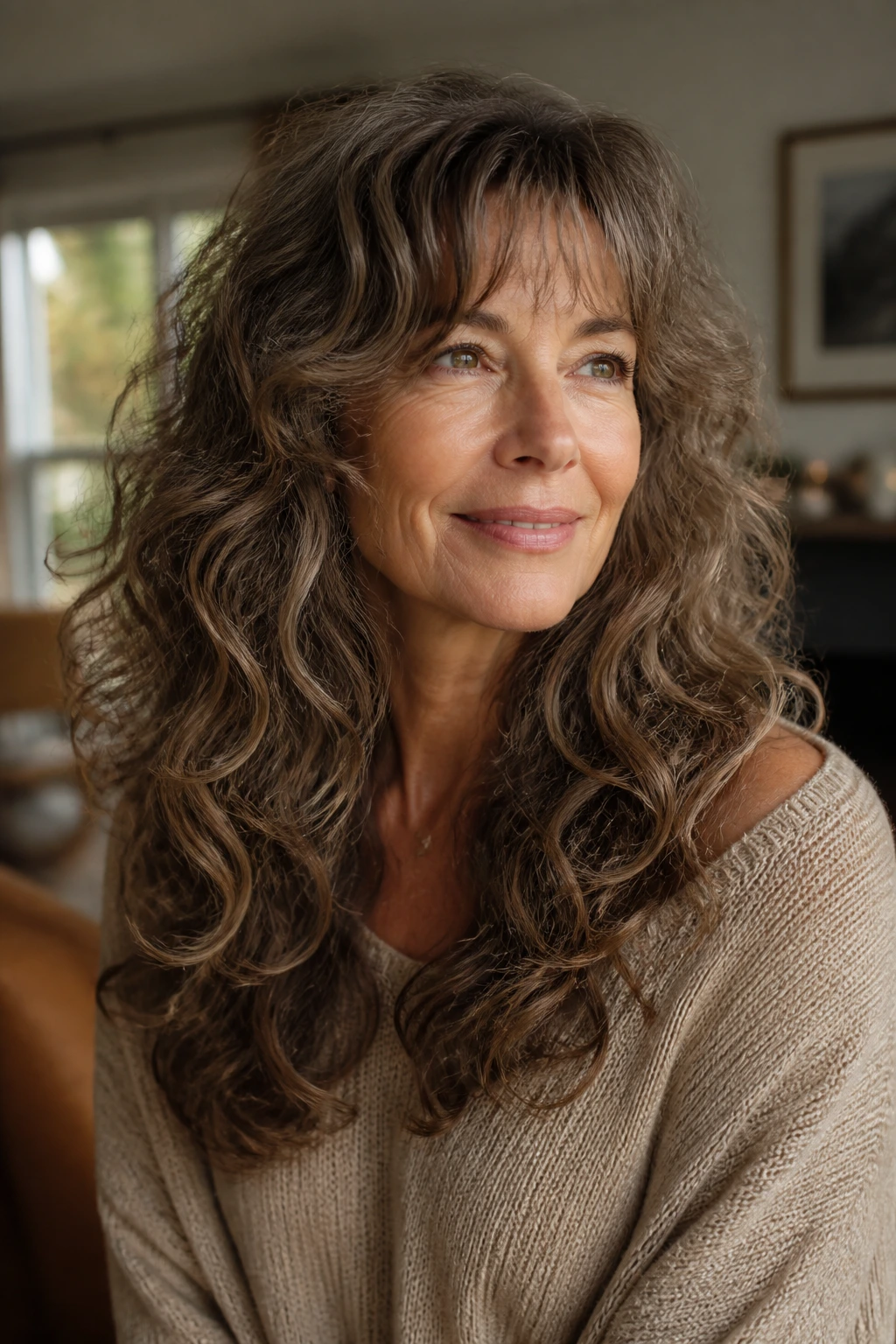
For women who do not want to sacrifice length, this is the one to watch. The cut keeps the bottom line fuller than a lot of shags do, so the hair still feels long when it hangs, not chopped off. The movement comes from the mid-lengths and the crown, not from hacking away at the ends.
That makes it a smart choice for curls that need shape but also need some weight to stay defined. If the ends get too sparse, long curly hair can look stringy fast. This version avoids that by leaving enough density at the perimeter.
It’s especially nice on women who’ve grown attached to their length but want more life in the shape. The curls move. The ends still feel there. That sounds obvious until you see how many layered cuts lose the bottom completely.
19. Halo Shag for Dense, Springy Curls
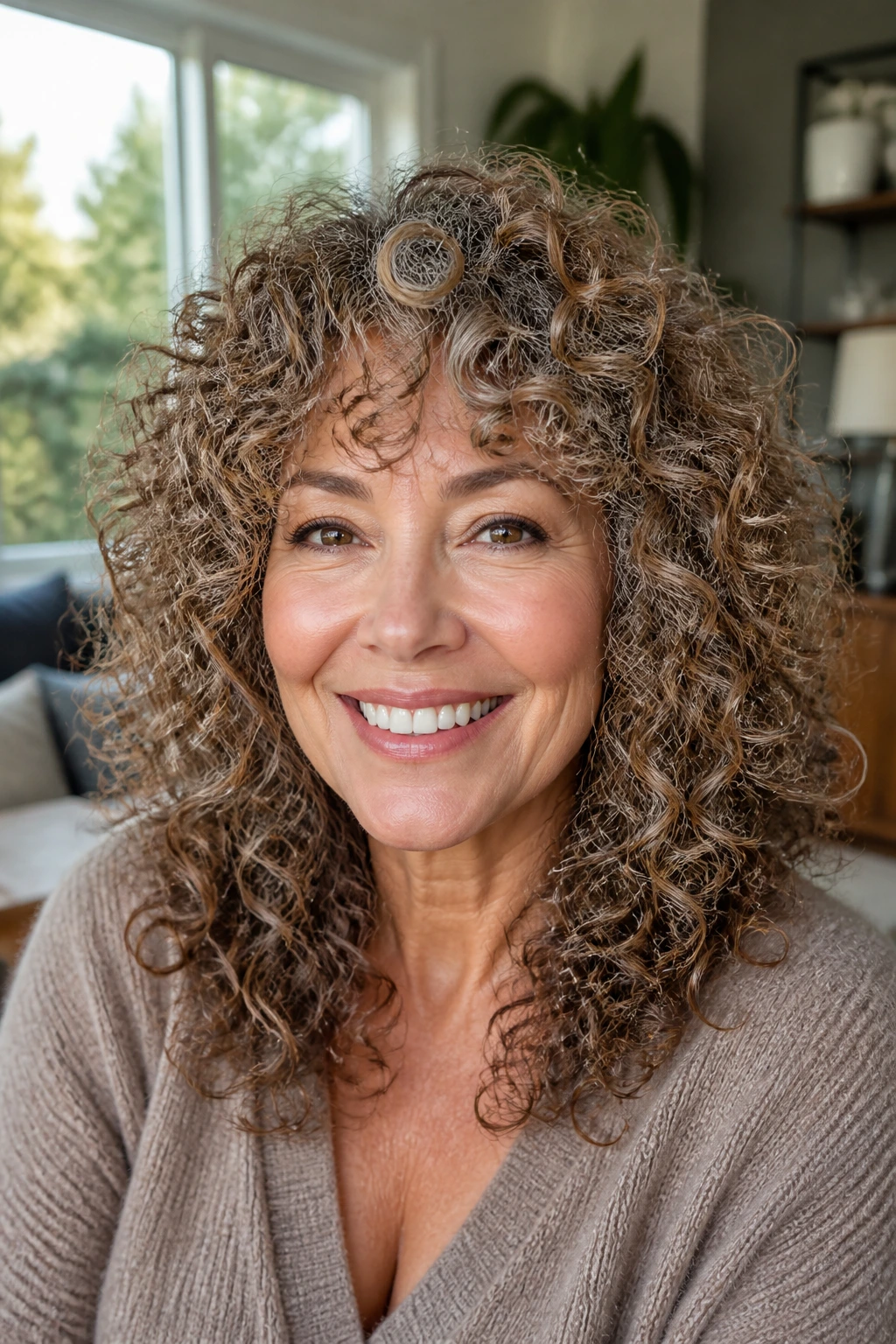
Dense springy curls can take over the room. A halo shag reins them in without flattening them. The shape is rounded, with layers that encourage lift around the crown and softness around the edges, creating a cloud-like outline that still has structure.
What matters here is placement. You want enough removal at the right internal points so the curls sit on top of each other instead of stacking in one huge mass. The shape should feel buoyant, not wide. That’s a narrow line, and a lot of stylists miss it.
A halo shag can be glorious with gray curls, because the rounding lets the silver strands catch the light in more than one place. It reads airy. It reads full. It does not read bulky, which is the whole point.
20. Sculpted Shag for Low-Porosity Hair
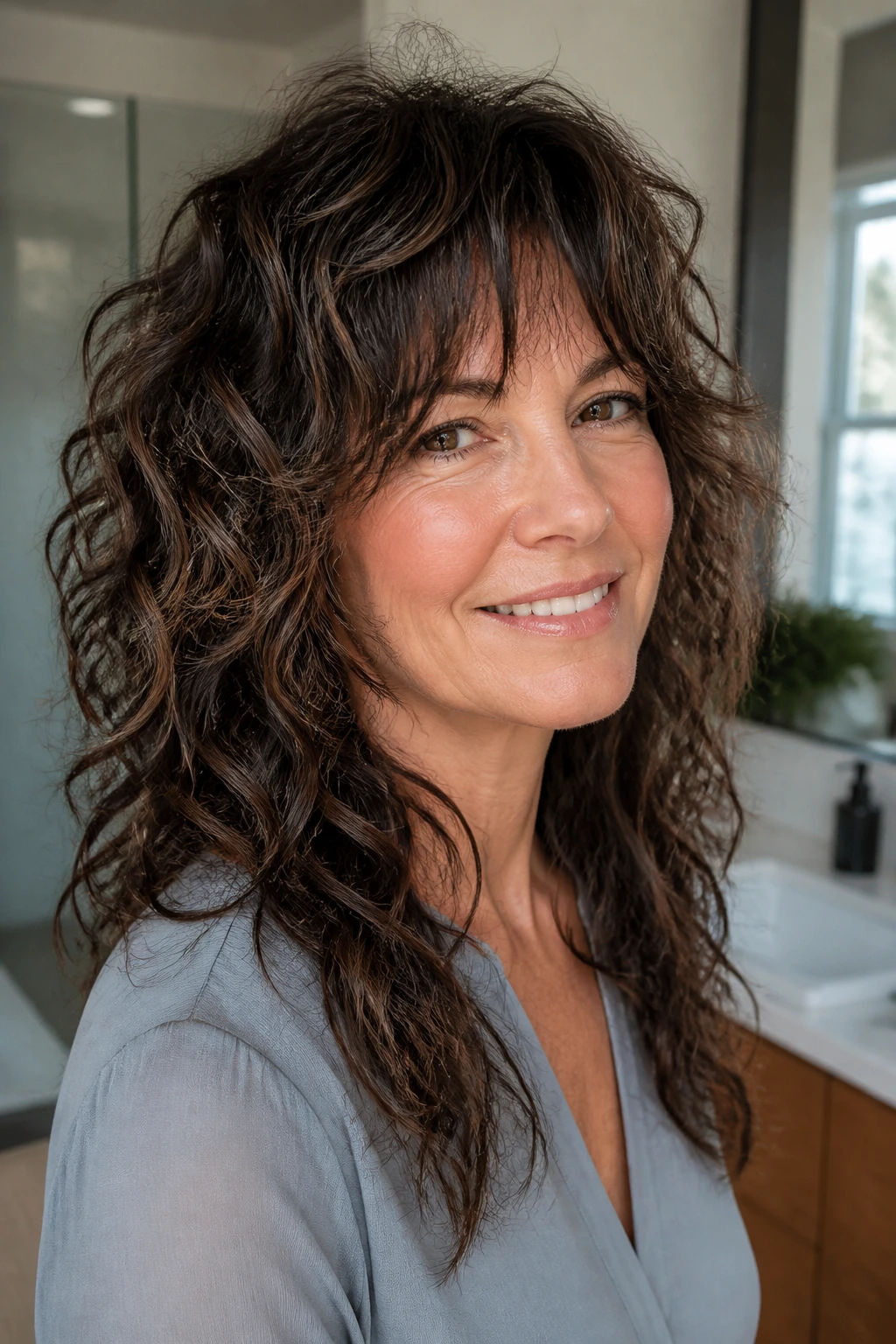
Low-porosity curls can be maddening. Products sit on top, water beads and runs off, and the curl can take forever to settle into the final shape. A sculpted shag gives that hair a cleaner structure, which helps the pattern look more deliberate while it dries.
The cut should have long, clear layers that guide the hair instead of overcomplicating it. Too much texturizing can make low-porosity hair feel coated and stubborn. A more sculpted shape tends to cooperate better because each section has a job.
I’d pair this cut with lighter products: a thin leave-in, a foam or mousse, and maybe a small amount of gel in the front. Heavy cream can be too much. If your hair loves to stay damp for hours, this shape will feel better than one overloaded with product.
21. Romantic Shag With Soft Bangs and Long Layers
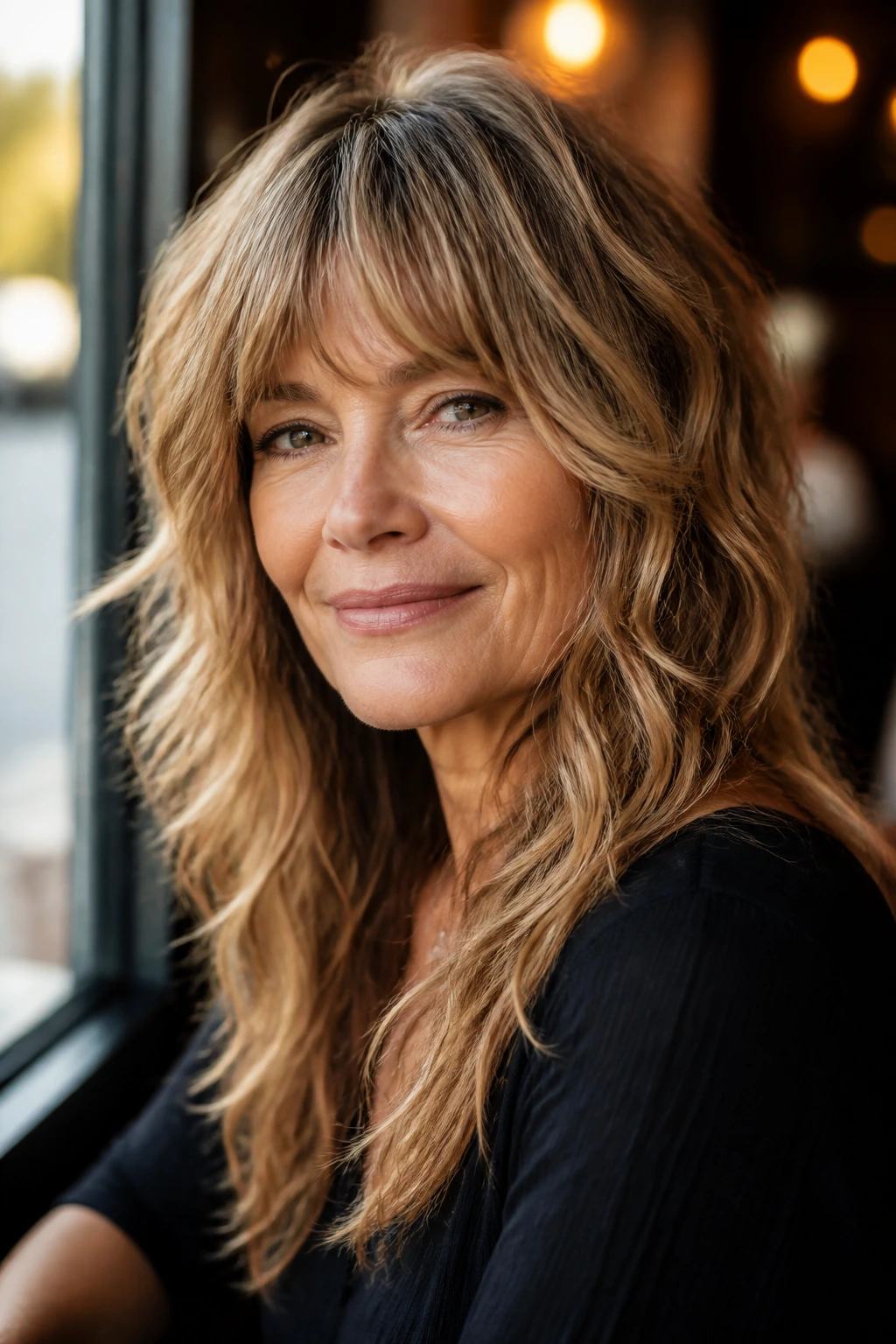
There’s a gentler side to shag haircuts, and this is it. The bangs are soft, not blunt; the layers are long, not jagged; the overall effect is loose and graceful rather than edgy. It’s a nice choice for older women who want movement but don’t want the haircut to announce itself first.
The soft bangs should blend into the sides so they don’t look clipped on. A bit of curl in the fringe is welcome here. Actually, it’s the point. The cut looks better when the bangs have their own bend, even if they’re not symmetrical on both sides.
This one is easy to dress up or down. Air-dry it and it feels relaxed. Diffuse it and the face frame turns sharper. That flexibility is part of the charm.
22. Chin-Opening Shag With a Sweeping Side Fringe
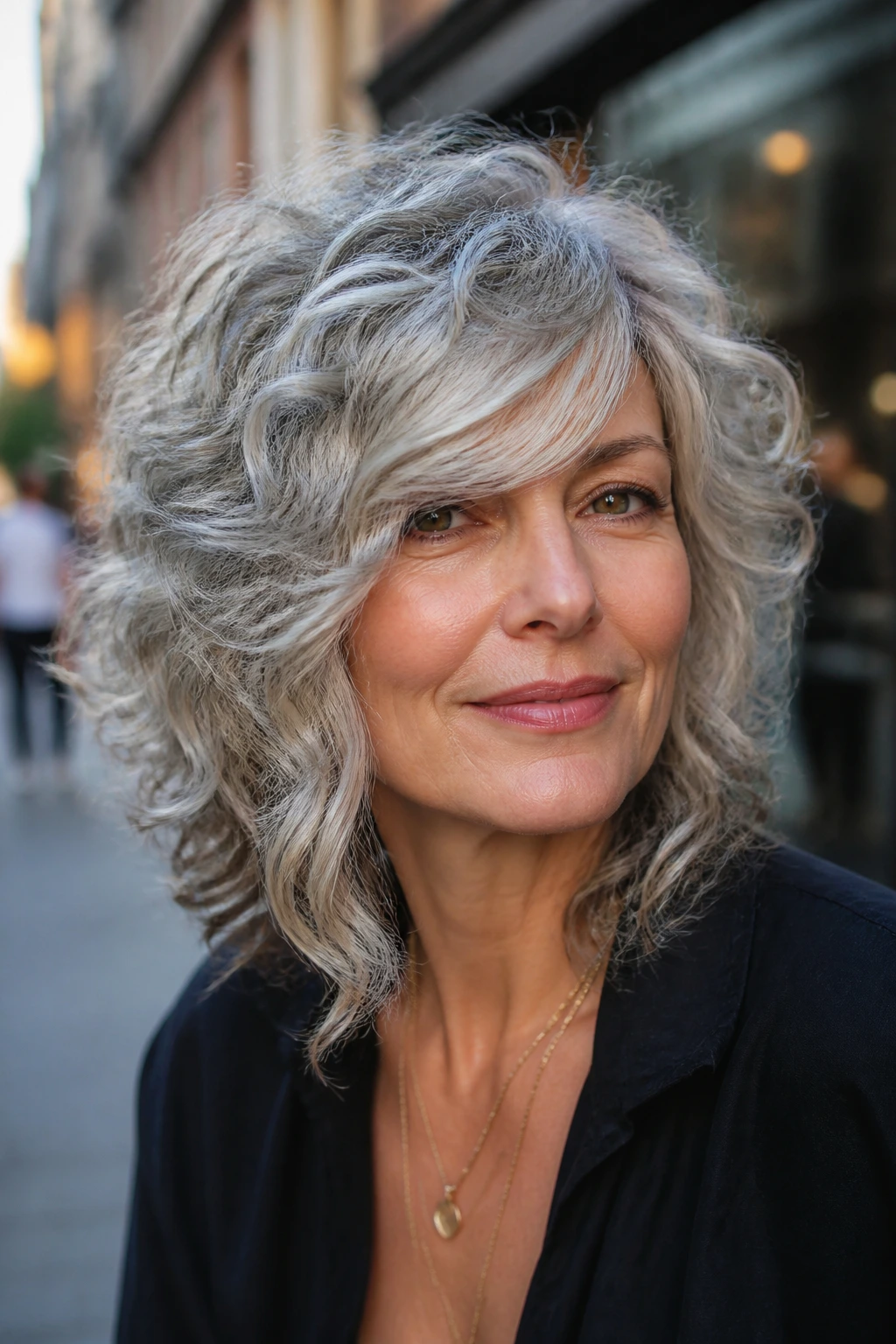
If the jawline feels like the place you want more air, this cut opens it up. The sweeping side fringe moves diagonally across the forehead, while the front layers slide past the chin instead of sitting on it. The result is a softer lower face and a more lifted front view.
It’s a strong option for curls that shrink a lot near the face. The fringe can start long enough to dry into the right spot, and the side layers can fold inward without getting too short. That avoids the awkward triangle that sometimes happens when face framing is cut too aggressively.
This style has a nice side effect: it makes earrings and glasses stand out a little more. The hair gets out of the way without looking pulled back. That small difference can matter more than people expect.
23. Diffused Glam Shag With Rounded Shape
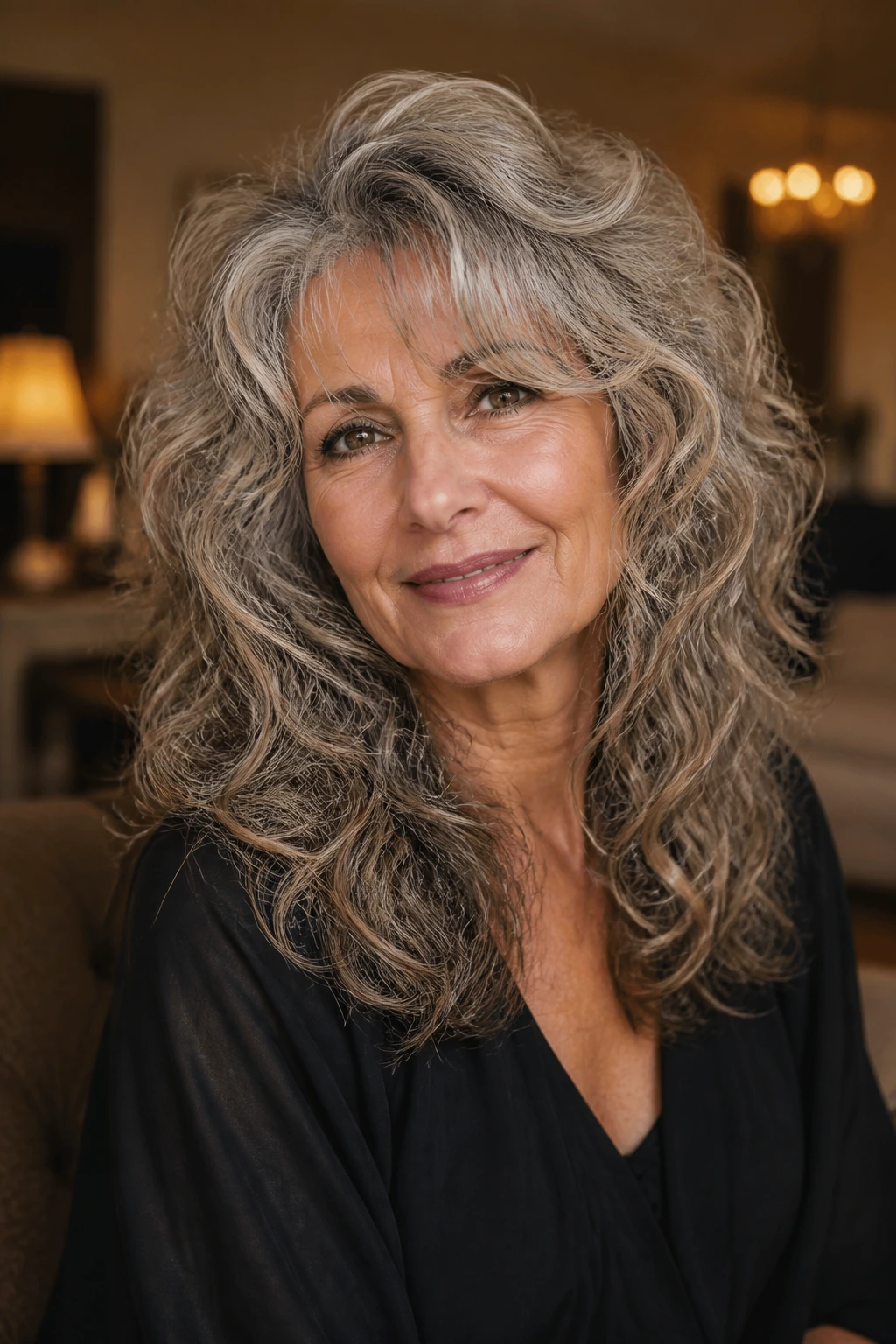
A diffuser can make a shag look dressed up fast, provided the cut already has enough shape to hold the volume. This version is rounded, softly layered, and intentionally lifted from the roots so the curls dry into a full silhouette instead of a flat mop or a frizzy cloud.
The hair should be cut to encourage a smooth curve around the head. Not helmet-like. Just shaped. The front can be a touch shorter to support the cheekbones, while the back keeps enough length to avoid the feeling of a cropped style.
What I like here is the way it holds well for an evening out. You can scrunch, diffuse, and then smooth the ends with one drop of serum. That’s enough. No need to fight every curl into submission.
24. Tapered Shag for Very Thick Hair
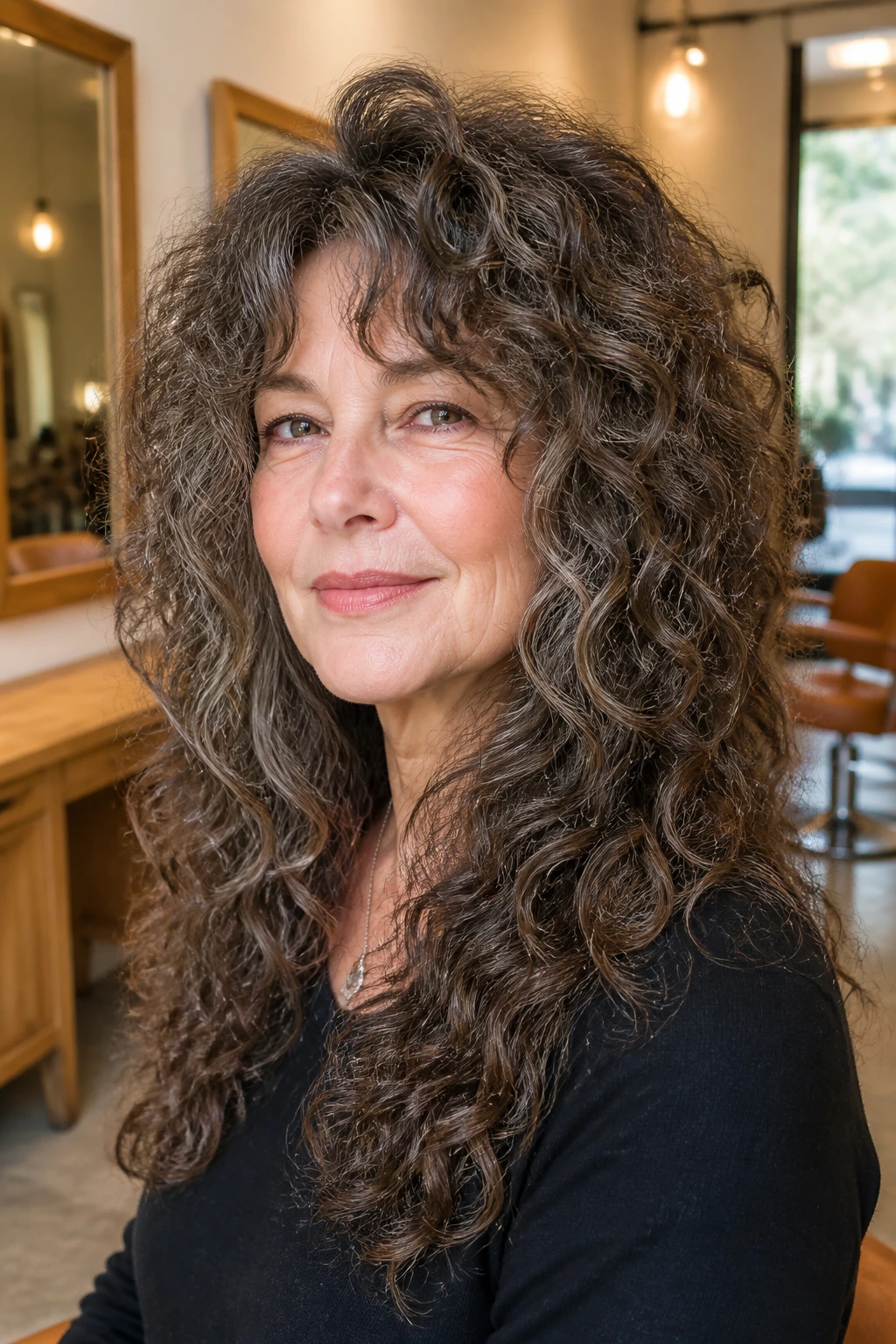
Very thick curls need a haircut with a plan. A tapered shag removes weight from the interior and lets the outer shape narrow slightly toward the ends, so the bottom doesn’t sit as a giant shelf. That taper is what keeps the cut from becoming a wide box.
The layers should be long enough to avoid frizzing the perimeter, but placed often enough to break up the density. Thick hair loves to look polished for the first hour and then explode by lunch if the shape is wrong. Tapering helps the cut stay more controlled.
This is not the haircut to give someone who wants maximum drama at the bottom. It is the haircut for someone who wants the hair to move, sit close to the head, and still keep its length. Clean, practical, and a little easier to live with.
25. Silver Cloud Shag With Invisible Layers
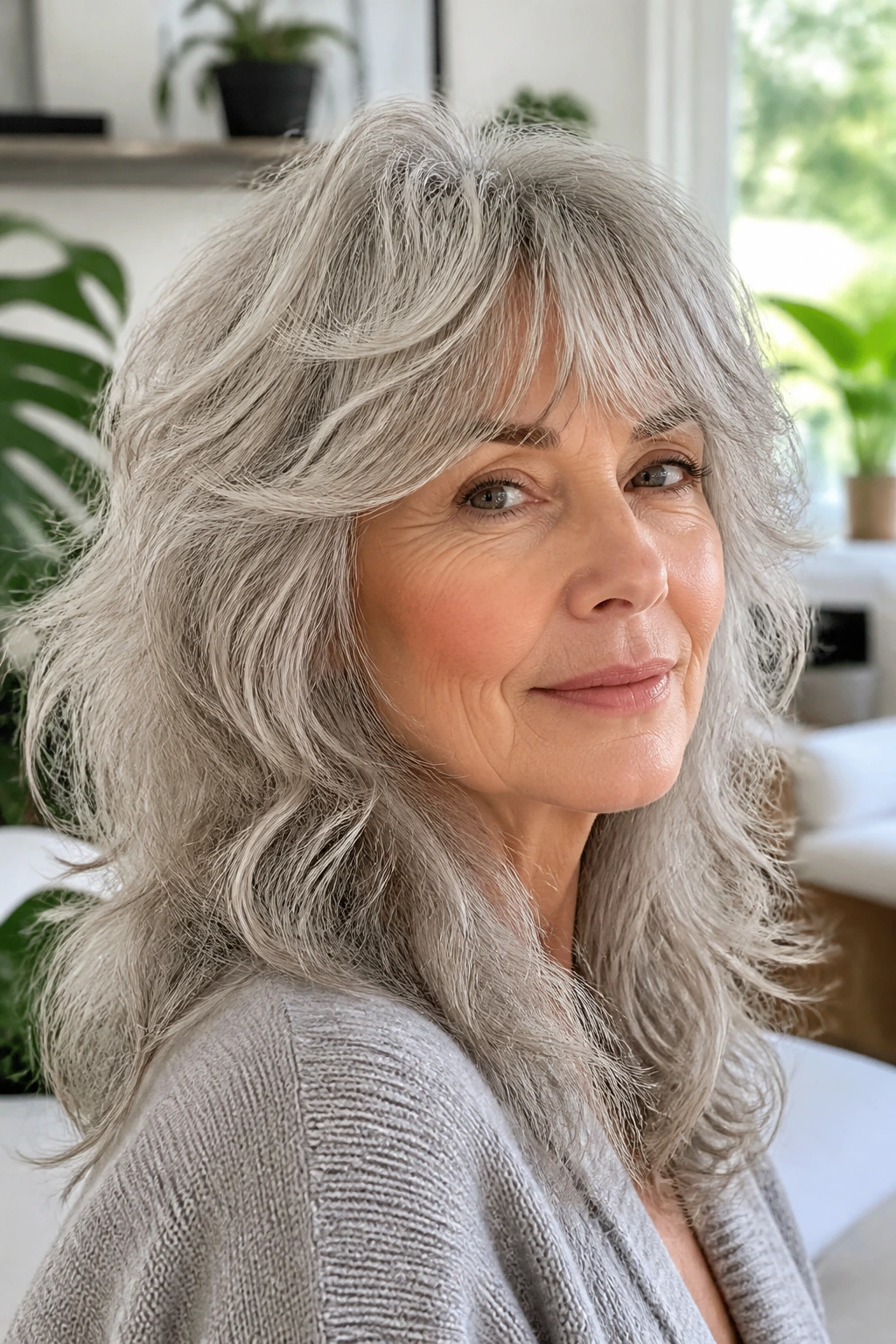
This is one of my favorites for gray hair that has gone soft, airy, and a little fine around the edges. The layers are there, but they’re tucked so lightly into the shape that you feel them more than you see them. The result is a cloud-like outline that doesn’t look chopped up.
Invisible layers help keep the silver from reading stringy. They make the curls look fuller without breaking the surface into obvious steps. That matters when the hair is mostly one tone, because the texture has to do the visual work.
The style also grows out well. Since the layers are hidden, the shape doesn’t suddenly scream for a trim. It just loosens a little. That’s a very useful quality.
26. Movement-Heavy Shag for Growing Out Gray
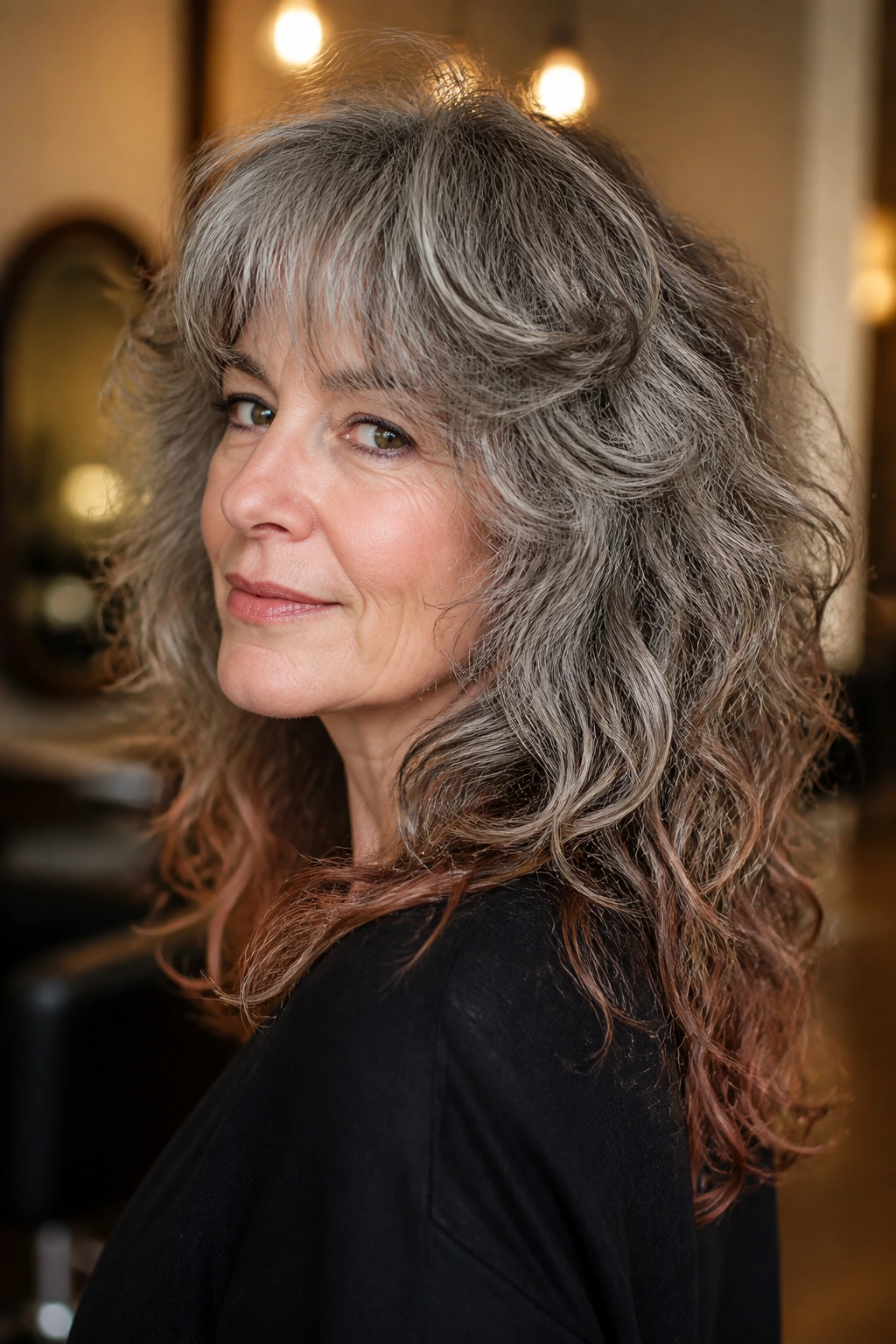
Growing out dyed hair into gray is its own little transition, and a shag can make it less awkward. The movement in the layers distracts from any harsh line between old color and new growth. More important, it makes the in-between stage look intentional instead of stalled.
The front should be soft enough to frame the face while the back keeps enough length to hold onto the remaining dyed ends until they’re trimmed away. A shag with this much movement also keeps the eye on the shape, not on the color shift.
I’d recommend this one for women who are tired of staring at the grow-out line in the mirror. The cut gives the transition some dignity. It does not erase the process, but it does make the process easier to wear.
27. Length-Keeping Curly Shag With a Soft Bottom Line
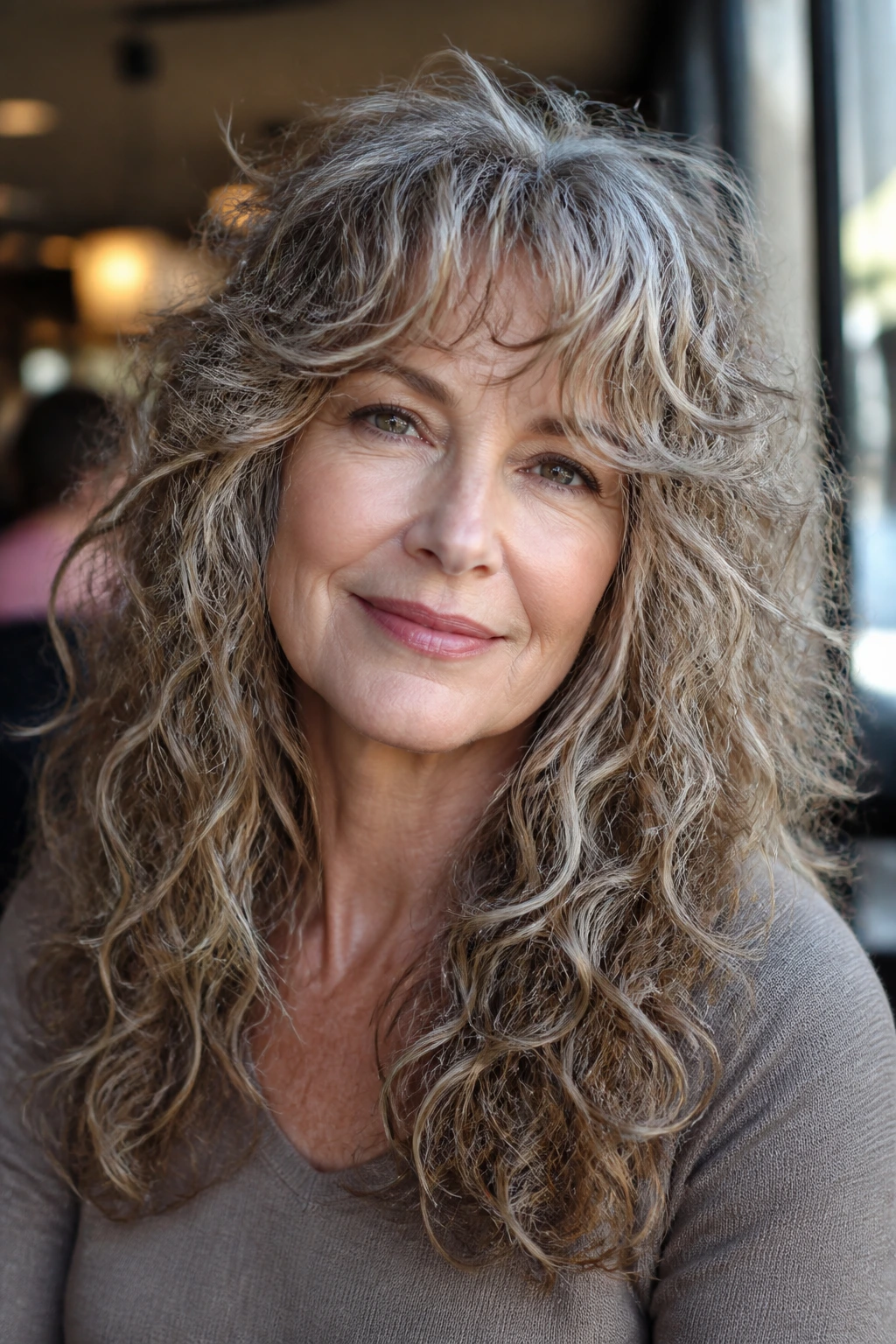
Some women are attached to length for a reason. The ends can brush the shoulders, brush the back, get clipped up, or swing into a ponytail without issue. This cut respects that. It keeps the bottom line soft and present while placing the shag elements higher up, where they create movement without sacrificing inches.
The face frame stays light. The crown gets enough lift. The length stays there. That combination is harder to get than it sounds, especially on curls that shrink more than expected. A soft bottom line solves the problem by leaving the perimeter fuller and less chopped.
This is a strong finale for anyone who wants a long shaggy curly haircut that still feels like long hair. Not a compromise. A shape.
Why Long Curly Shags Work So Well on Hair That Has Changed Over Time
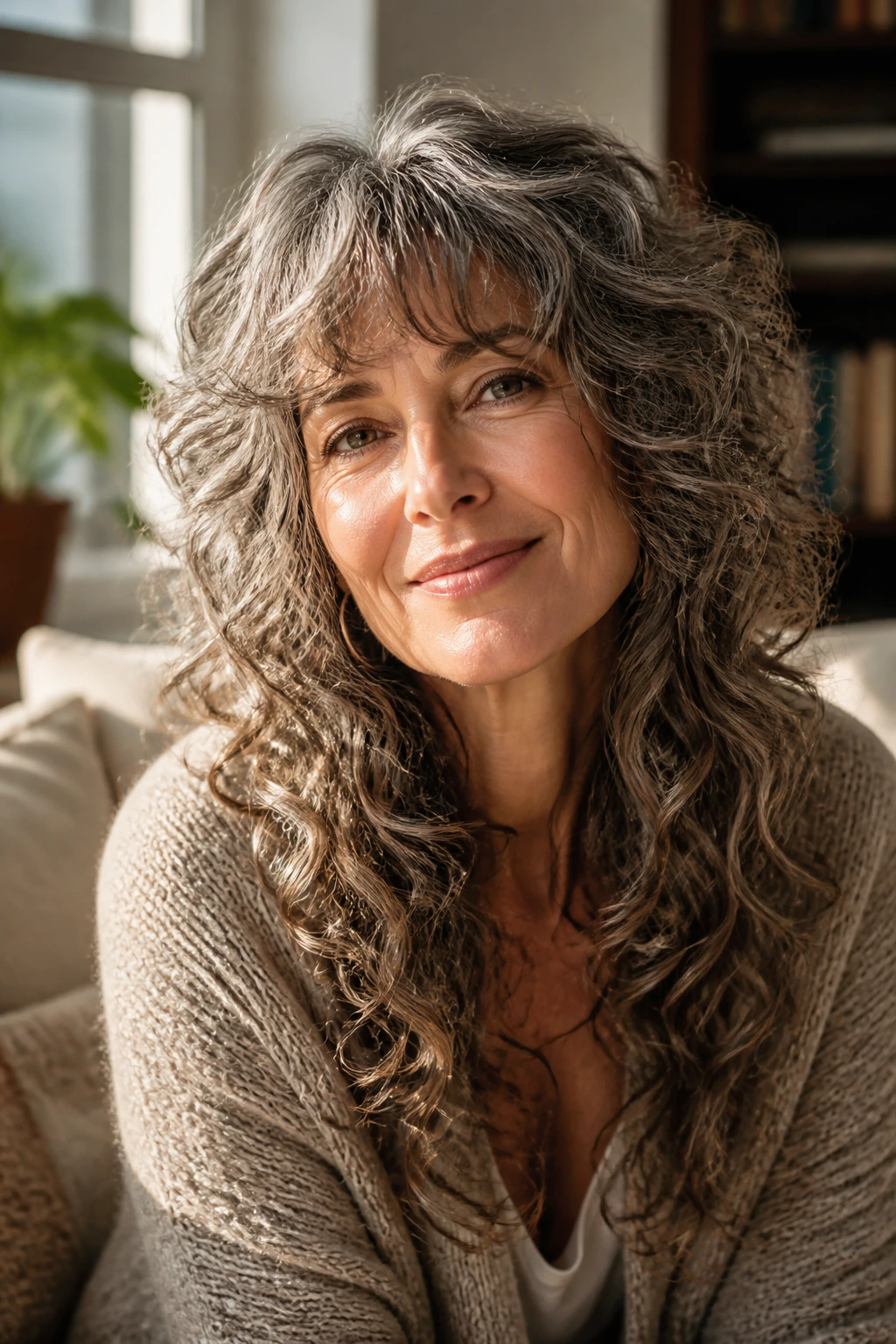
Curl changes are normal. Hair can get drier, a little finer, a little wider at the crown, or a little more unpredictable at the front. A blunt cut tends to make all of that feel louder. A shag works with the changes instead of pretending they are not there.
That’s the whole reason these haircuts keep showing up on women with mature curls. Layers add lift where the hair has gone flat, take away bulk where the hair has gotten puffier, and create enough movement that the face frame looks soft rather than strict. The right shag is less about looking younger and more about letting the hair look like itself again.
Dry-cutting often helps here, because curls do not behave politely when wet. They bounce. They shrink. They move in different directions depending on density and porosity. A stylist who cuts curls in their natural state can keep the shape honest, which saves you from that dreaded “it looked right in the chair” problem.
What to Tell Your Stylist Before the First Snip
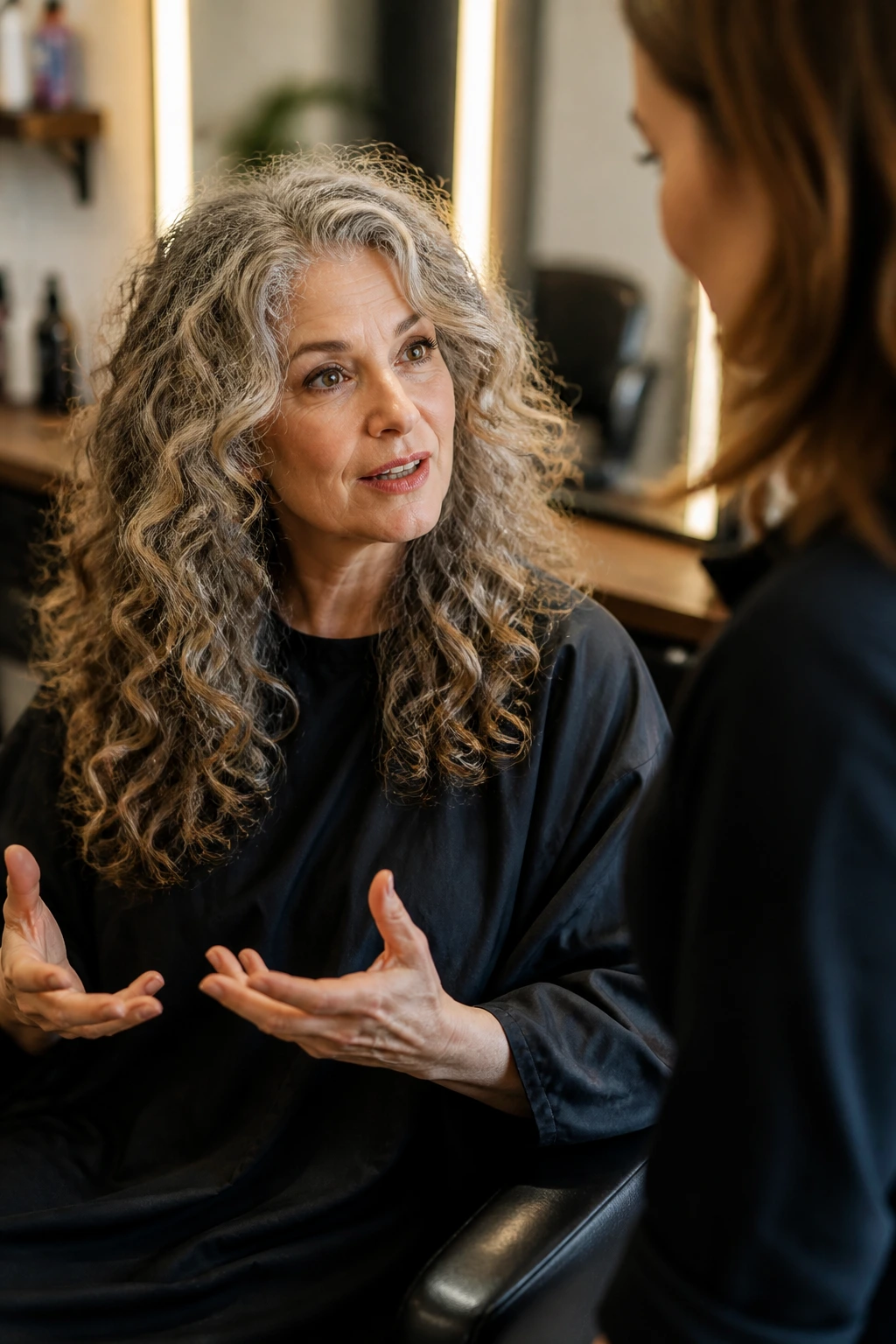
Bring photos, but bring the right photos. A front view, a side view, and a back view matter more than one glamorous selfie with perfect lighting. Show the lengths you want to keep, and point to the layers you actually like. Half the battle is translation.
Say how your curls dry. Say where they fall flat. Say whether your hair gets fluffy at the top or wide at the sides. That information changes the haircut more than a vague request for “something shaggy.” Those words can mean ten different things in ten different salons.
Also mention how much styling you’re willing to do. A long curly shag can be shaped for a quick air-dry, or it can be shaped for more definition and polish. If you want a wash-and-go life, say so. If you don’t mind diffusing for ten minutes, say that too.
The Tools That Make Curly Layers Behave
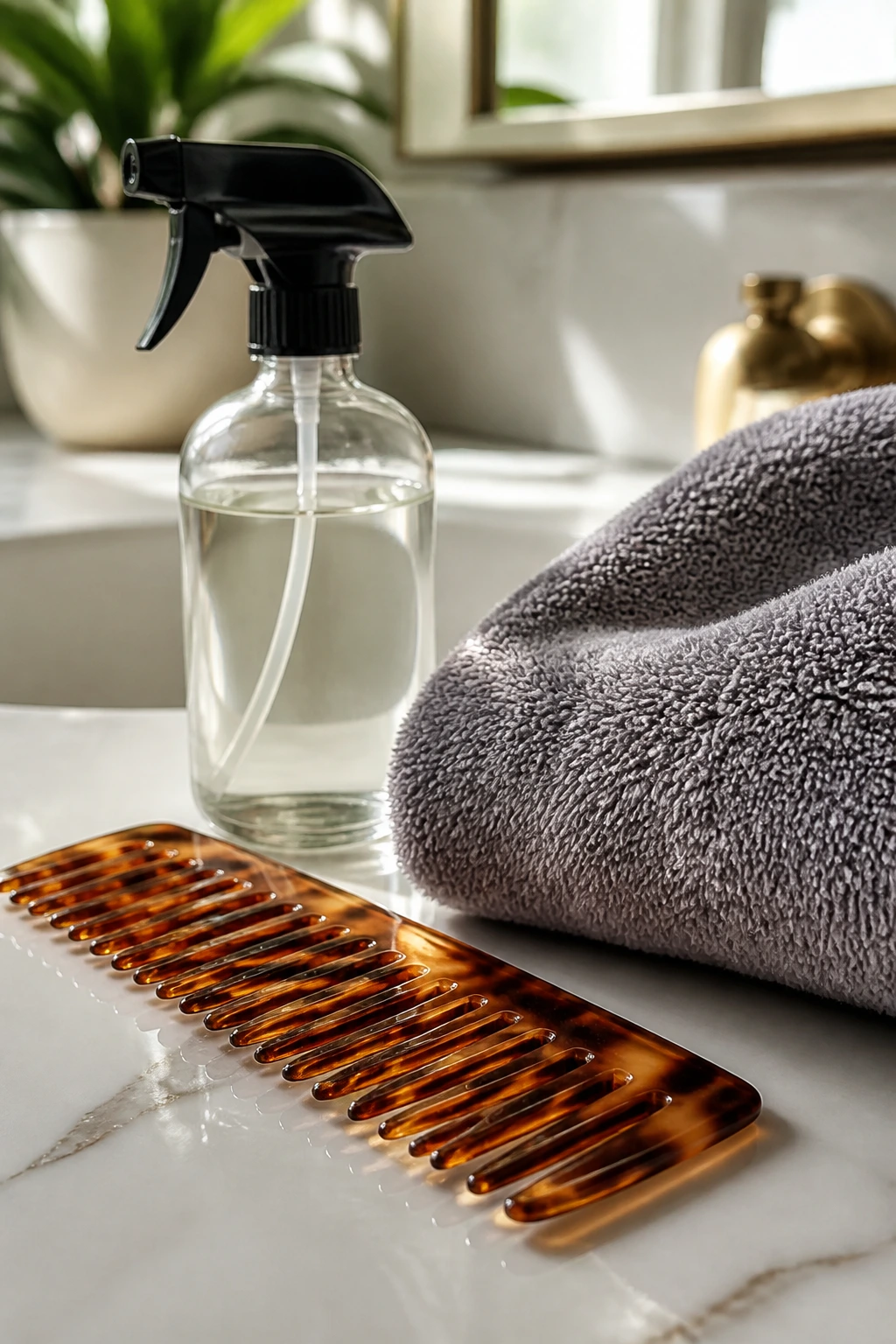
- Wide-tooth comb: Good for detangling in the shower without tearing curl clumps apart.
- Microfiber towel or cotton T-shirt: Cuts down on rough frizz right after washing.
- Leave-in conditioner: Helps the mid-lengths stay soft, especially if the ends are dry.
- Curl cream: Useful for shaping long layers without making them stiff.
- Mousse or foam: Adds root lift to softer curls that need a bit more structure.
- Gel: Helps the front sections hold their shape if bangs or face-framing layers tend to frizz.
- Diffuser attachment: Worth it if you want volume without blasting the curl pattern apart.
- Hair clips: Handy for sectioning bangs, crown layers, or the sides while drying.
- Satin pillowcase or bonnet: Keeps the layers from rubbing into a halo by morning.
- Spray bottle with water: The simplest refresh tool. Sometimes that’s all you need.
How to Wear a Curly Shag So It Looks Intentional
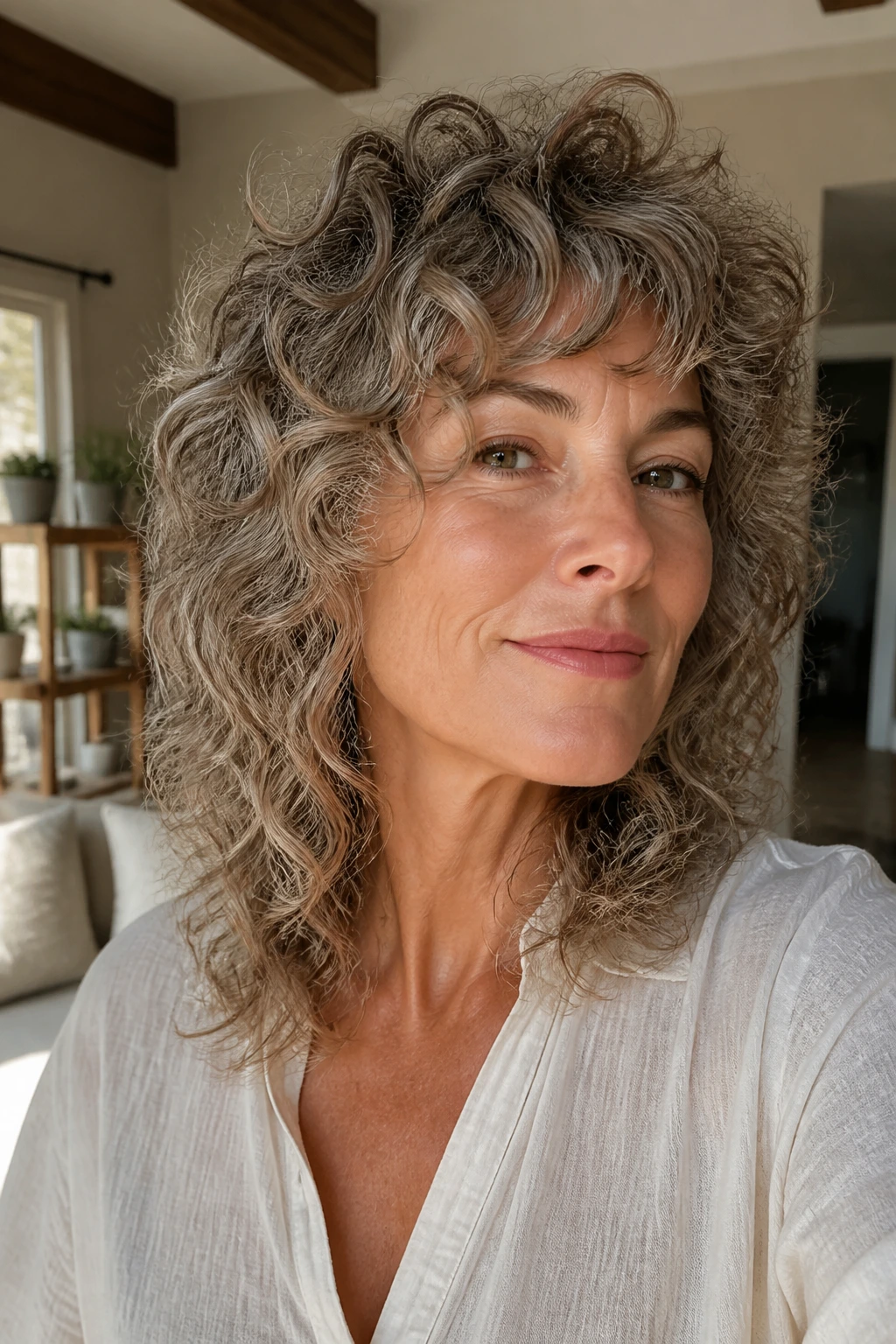
Parting: A center part gives a balanced shag a clean line. A deep side part adds drama and helps lift flatter roots. Pick the one that matches your face and your curl pattern, not the one that photographs best on somebody else.
Styling: Use less product than you think at the root area and a bit more through the mids and ends. Long shag layers can handle a small amount of cream plus a light mousse, but they do not need to be drowned. Too much product makes the layers stick together and lose their bounce.
Drying: Air-dry if your curl pattern is strong and your layers are well cut. Diffuse if you want more volume at the crown or a cleaner bend through the face frame. Either way, stop touching the hair once it starts to set. The frizz fairy loves busy hands.
Finish: Break any gel cast with two or three drops of lightweight oil, then shake the roots gently with your fingertips. That gives the style movement without destroying the shape.
Small Tweaks That Make a Big Difference

For fine curls: Keep the products light and the layers long. Heavy creams collapse the shape faster than you’d expect.
For thick curls: Ask for more weight removal through the interior, not the surface. Surface thinning often just creates fluff.
For gray hair: Use a little shine product on the ends. Silver curls can look dry under bright light if the cut is perfect but the finish is dull.
For humidity: A stronger hold gel at the face frame helps the shape survive the day. It does not have to be crunchy forever; it just has to hold long enough to matter.
For glasses wearers: Keep the temple area cleaner than the back. That one detail changes how the whole haircut sits on your face.
Common Mistakes That Throw Off the Shape
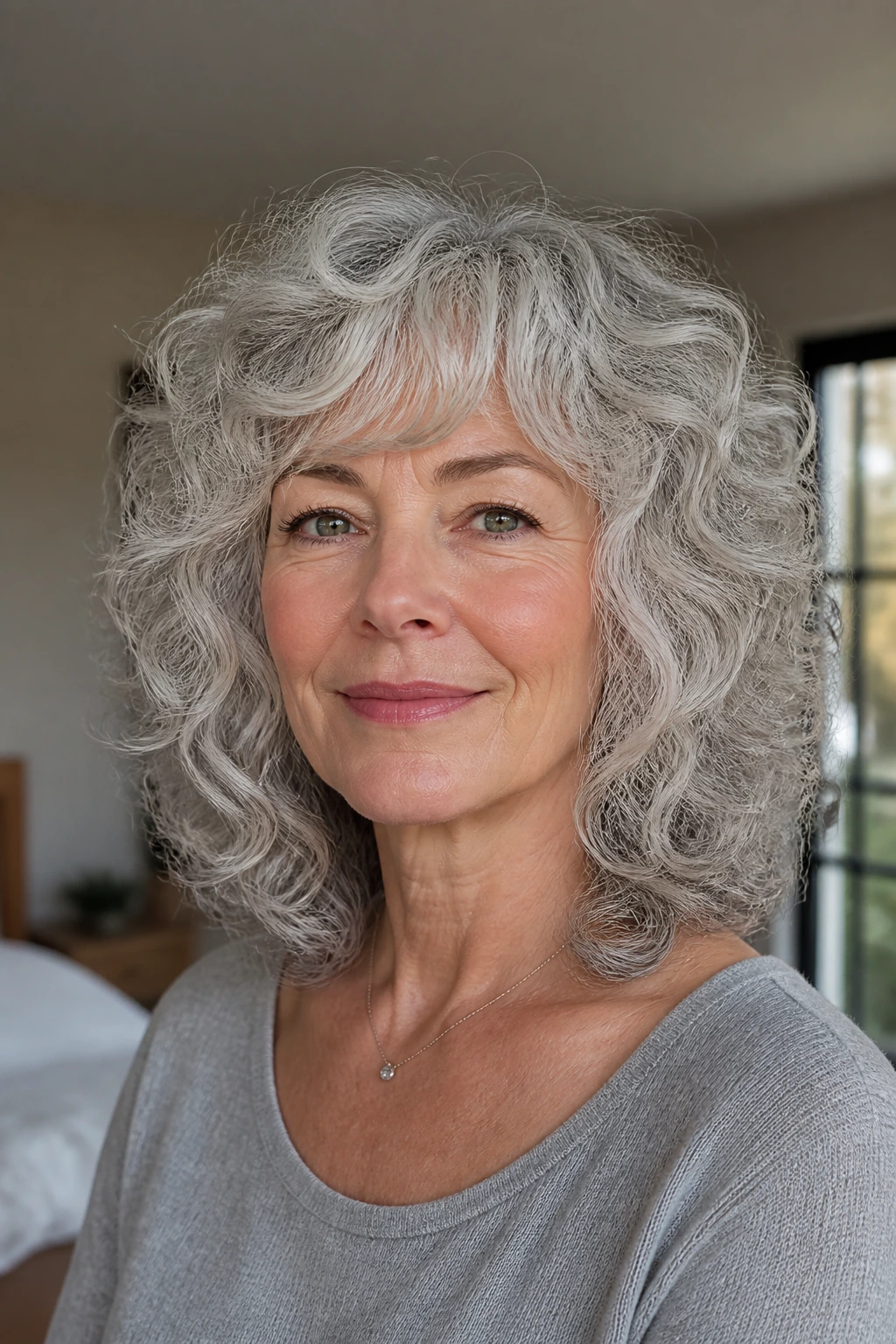
- Cutting the front too short: Curly bangs and face frame layers shrink more than expected. The fix is simple: leave them longer on the first cut and trim only after they dry in their natural pattern.
- Over-thinning the ends: The hair can turn frizzy, see-through, or wispy at the bottom. If you want softness, ask for long layers and light internal removal instead.
- Ignoring shrinkage: Wet hair lies. Dry hair tells the truth. A shag that looks shoulder-length when wet may sit well above the shoulder when dry.
- Making the crown too short on already voluminous curls: The top can puff out while the sides collapse, which is a bad trade. Keep the crown layers controlled unless you want height on purpose.
- Using too much product near the roots: The lift disappears, and the shag loses the airy movement that makes it work. Keep heavy creams lower on the hair shaft.
- Skipping trims until the shape is gone: Long shags can grow out gracefully, but not forever. Once the face frame starts hanging in one block, the whole haircut loses its point.
Variations and Alternatives to Try
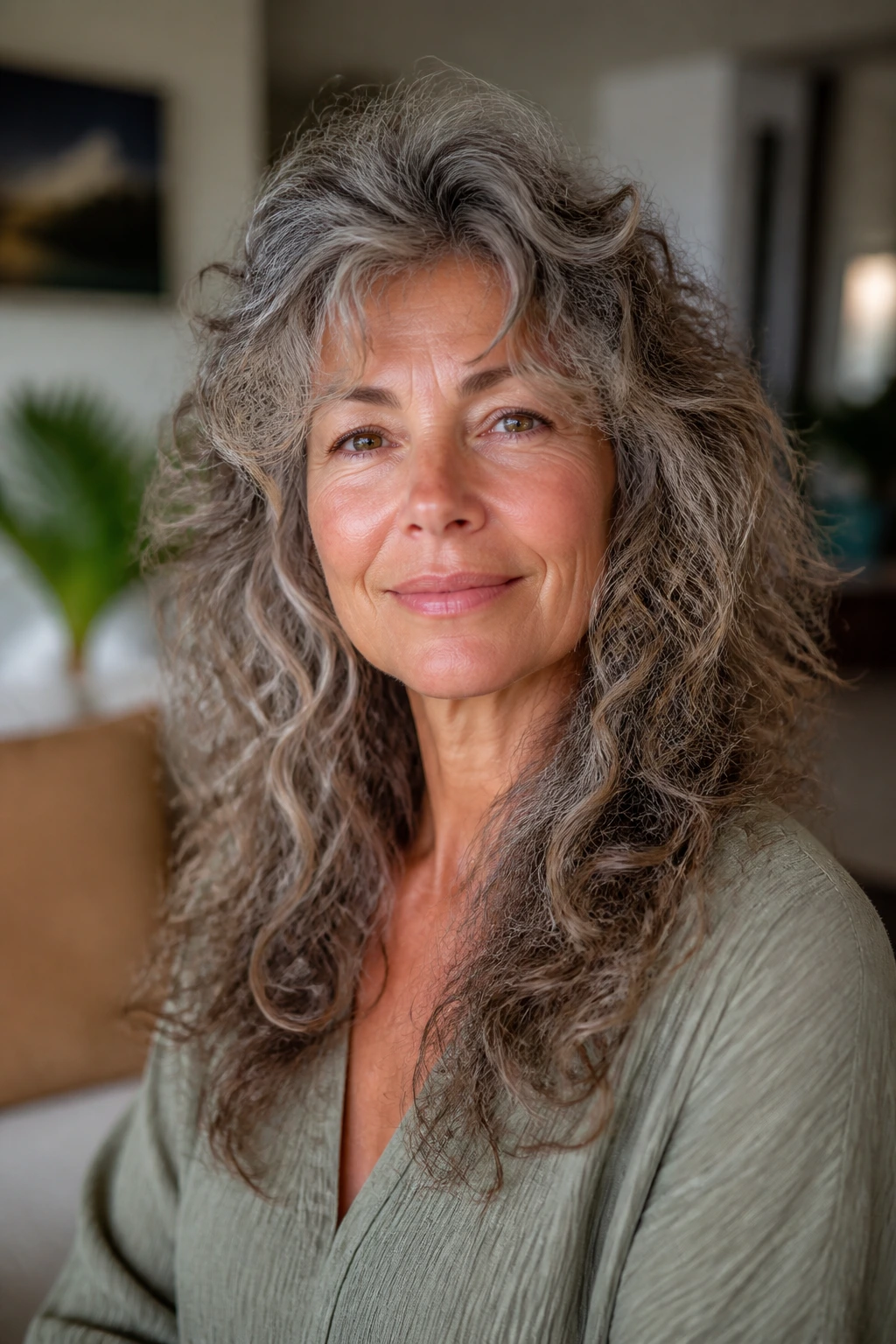
The Bangs-Free Version: If you hate anything touching your forehead, skip the fringe and keep the front pieces long enough to bend away from the face. You still get the shag shape, just with more openness around the eyes.
The Extra-Soft Grow-Out: Ask for fewer obvious layers and a gentler curve around the perimeter. This is the version that stays forgiving for months, which is useful if you do not want a haircut that demands constant attention.
The Fuller Crown Option: Great for finer curls that need lift up top. The crown layers are shorter and more purposeful, but the rest of the length stays long so the cut does not veer into short-hair territory.
The Silver-First Version: Built for gray, white, or salt-and-pepper curls. The layers should be airy, the finish should be soft, and the face frame should keep the lightest pieces close to the cheekbones.
The High-Control Version: If your curls are dense, frizz-prone, or hard to redirect, ask for a more sculpted shag with cleaner lines and less random texture. It holds up better when humidity gets involved.
Keeping the Shape Between Haircuts

Long shaggy curly haircuts do not need constant trimming, but they do need attention. Most curl-friendly shags hold their shape for about 8 to 12 weeks before the face frame starts to lose its line. Bangs may need a tiny dusting sooner, especially if they sit right at the cheekbone or brow.
Night care matters more than most people admit. A satin pillowcase helps, but a loose pineapple or a soft clip at the crown can keep the curls from flattening at the back. If you sleep on one side every night, the shag will eventually confess that secret in the morning.
Refreshing is simple. Mist the hair lightly, add a pea-sized amount of curl cream to the drier sections, and scrunch from the ends upward. If the top is the problem, flip the head over and give the roots a little lift with your fingers. Do not soak the hair unless you want to start the day over.
Frequently Asked Questions
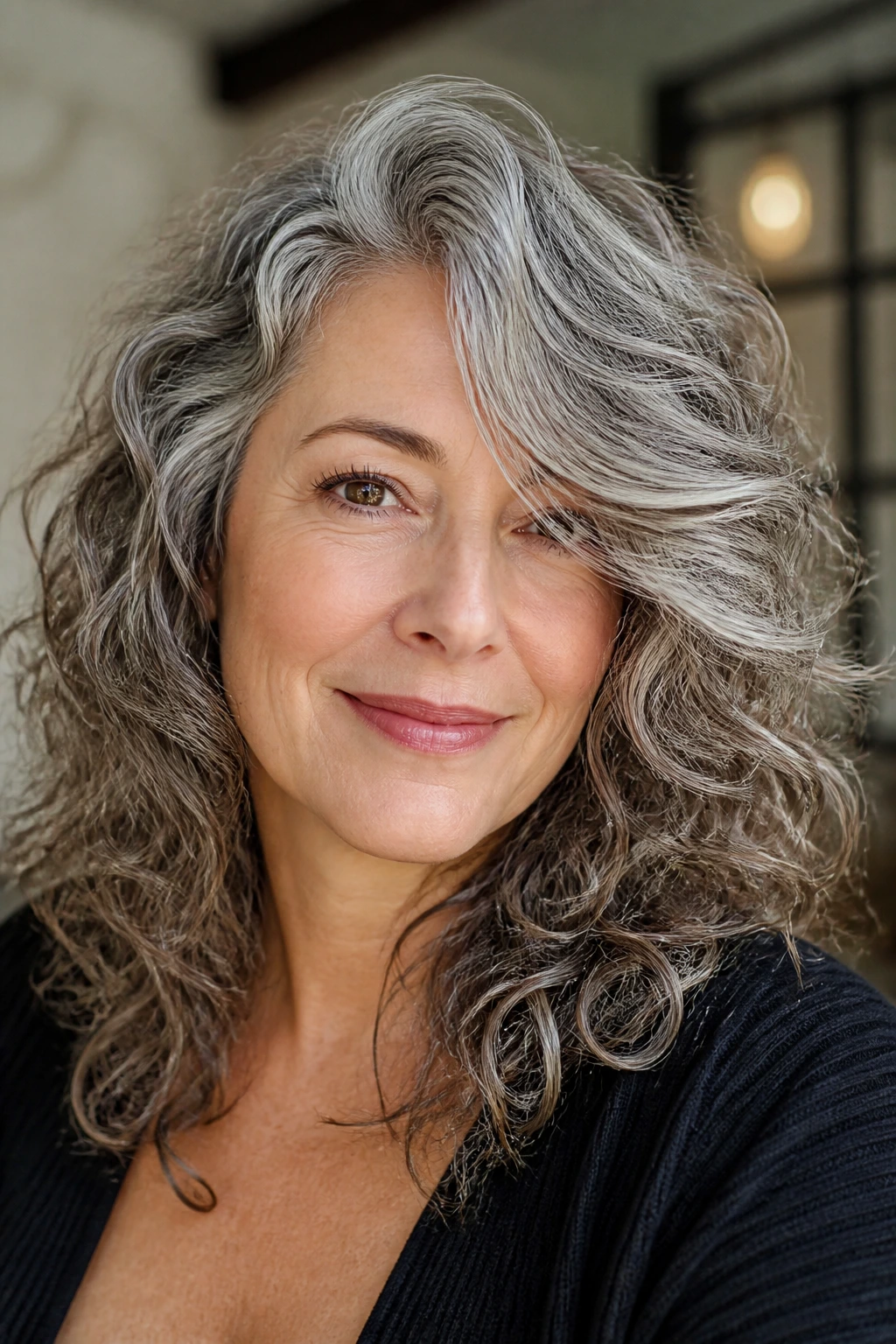
Are long shaggy curly haircuts good for older women with fine hair?
Yes, if the layers are kept long and the crown is not over-thinned. Fine curls need shape, but they also need enough density to avoid looking patchy once they dry.
Should curly shags be cut wet or dry?
Dry cutting is often better for curls because it shows the real length, the shrinkage, and the natural bend. Some stylists use a mix of both, which can work well if they know how your hair behaves.
Will a shag make thick curly hair puff out more?
It can, if the layers are too short or the ends are thinned too aggressively. A longer shag with internal weight removal usually controls bulk better than a blunt shape does.
Can I wear a shag if I use glasses every day?
Absolutely. Ask for temple-skimming face frame layers and keep the fringe away from the frame line. That small adjustment keeps the haircut from crowding your face.
How often should I trim a long curly shag?
Every 8 to 12 weeks is a useful rhythm for most curl patterns. If the bangs are short or the face frame starts falling into the eyes, a quicker cleanup may help.
What if my curls look too triangular after the cut?
That usually means the crown was too flat or the perimeter was left too heavy. A stylist can remove weight from the interior and add a bit more lift near the top to rebalance the shape.
Can I straighten a shag sometimes without ruining it?
Yes. Long shag layers usually straighten into soft movement rather than a harsh line, which is part of the appeal. A heat protectant matters here, because layered ends can dry out faster than blunt ones.
What’s the best way to keep gray curls shiny in a shag cut?
Use a light leave-in, don’t overload the root area, and finish with a small amount of serum on the ends. Gray hair can look bright and wiry if it’s stripped; the shine comes from moisture and a clean outline.
Do curtain bangs work on every curl pattern?
Not quite. They work best when the front curls can separate into two soft panels instead of springing straight up. If your fringe has a lot of shrinkage, ask for them longer than you think you need.
Can a shag still look polished, or is it always messy?
It can look polished if the layers are shaped well and the finish is controlled. The haircut gives movement; your styling choices decide whether that movement looks relaxed or refined.
A Cut That Keeps Its Bounce
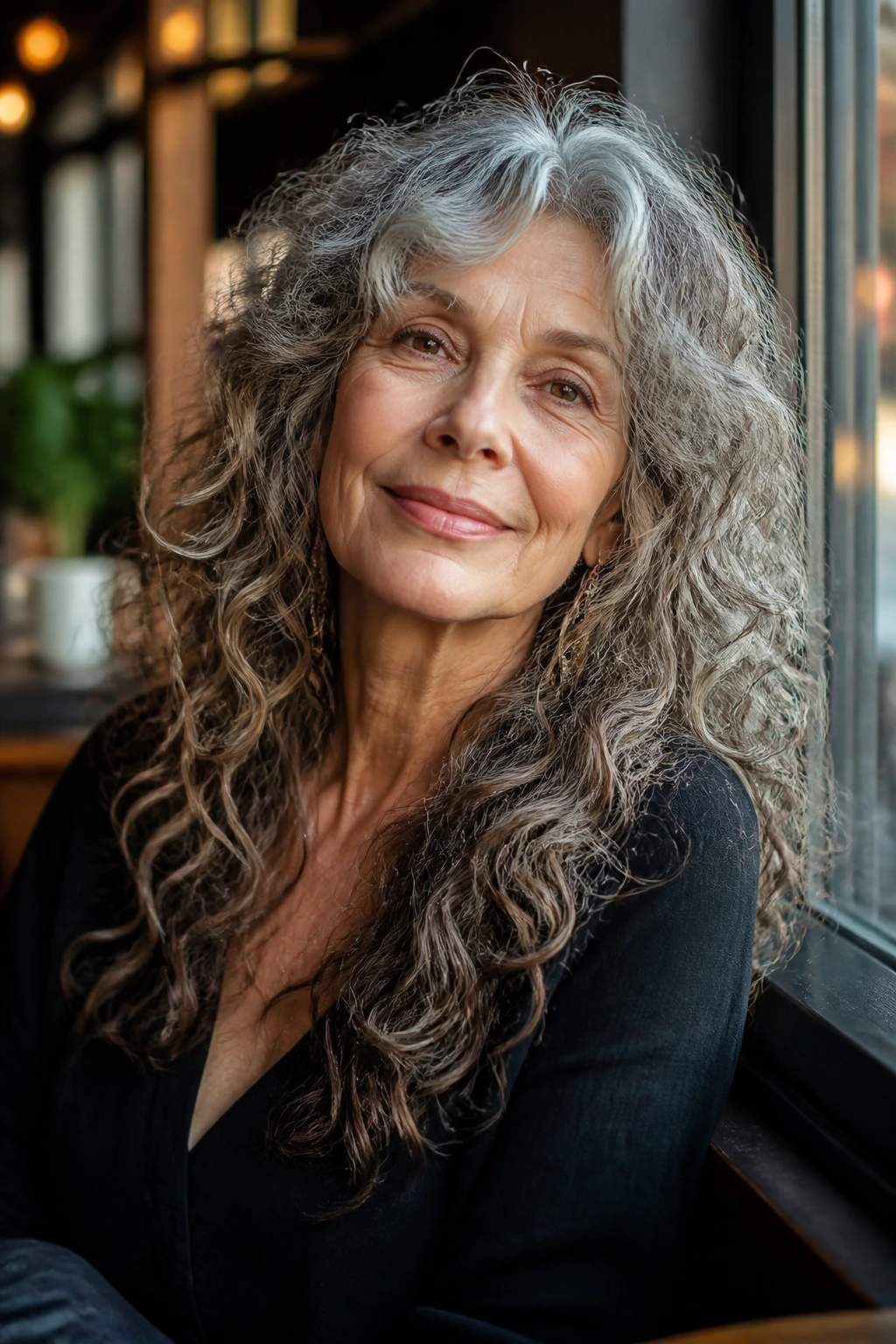
The best long shaggy curly haircuts for older women do not chase youth. They chase shape, motion, and hair that feels like it belongs on the head it’s growing from. That’s a much better goal, and honestly, it usually looks better too.
Bring a few photos, say what your curls actually do, and ask for layers that support the hair instead of fighting it. A good shag should feel lighter the moment you shake it out. If it doesn’t, keep refining the shape until it does.
